Archive

Monthly Archives: July 2013

Linville falls from upper look

I first saw Linville Falls 40 years ago. Getting there meant finding an unmarked gravel road and an unmarked dirt parking lot — really just a thicker place in the road to pull over onto.

Then we followed a spongy, loamy footpath under the hickories and oaks toward the distant roar of the waterfall on North Carolina’s Linville River. No one was there but us, and we picnicked on the rocks over the crashing water. The upper falls are a broad, shallow drop, but at the lower falls, the quartzite pulls tight, constricting the river and forcing it down a spiraling chute that drops over the edge of the cliff and down 75 feet to the river and Linville Gorge.
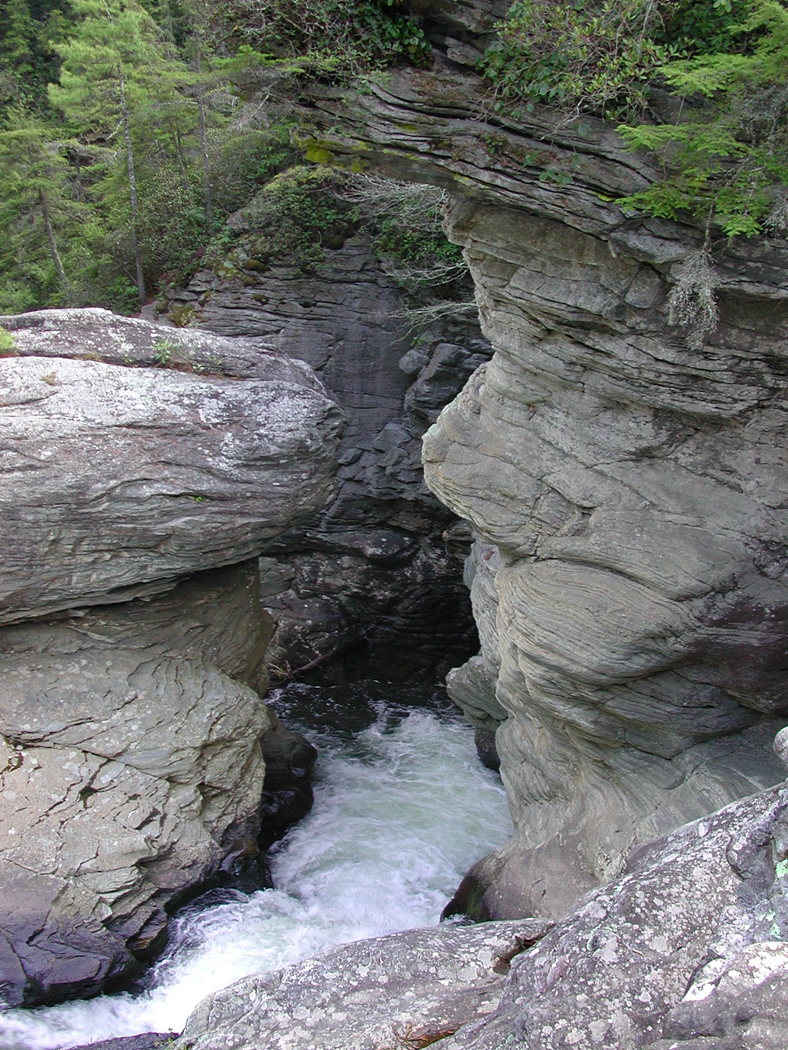
Linville Falls 03

It is an impressive torrent with a basso profundo roar, and nothing will ever change the way it seemed to me that day, as I leaped over rocks, crossing the white water to the other shore so I could climb on the gnarled rock to see down the waterway.

I’ve been back many times over the years. The National Park Service built a paved road from the Blue Ridge Parkway, making it easier to find. Then they paved the parking lot and built a pedestrian bridge over the river upstream from the falls.

The last time I went back, there was a visitor’s center and a souvenir shop and a parade of vacationers trotting down the path to the fenced-in overlook. The falls are just as impressive, but the experience isn’t.

If I speed up those 40 years in my head like time-lapse photography, I can see time take shape. It builds and it destroys in a constant rise and fall like an ocean tide.

And what comes in, ebbs.

Linville trillium

A few years ago, my wife and I visited another familiar site, on Old Route 16, a dirt road that drops down the side of the Blue Ridge toward North Wilkesboro. When we lived in the mountains, we used to visit an abandoned farm along the road, halfway down the mountain face.

There was a clearing in the wood and an old wooden house with a broad porch that looked out over the steep valley below. Above us was the spot ominously known as the ”Jumpin’-Off Place.”

We could picnic on the porch with the bluebird and tanager singing in front of us, the buzz of insects all around and the gentle breeze rattling the grass in the field.

It had been 14 years since we visited that farmhouse, and we thought we should see what had become of it.

About three miles down the old dirt road, we passed where it should have been, but there was no break in the forest, no open field. We couldn’t find the house. We kept driving, hoping we’d find something that looked familiar, but we didn’t. Finally we stopped the car where the farm should have been and walked deep into the woods.

Buried a hundred yards into the tangle of maple trees was a naked standing chimney, completely eaten up by brush and undergrowth.

When I climbed down the hill toward it, I discovered the forest floor was spongy with rotten boards, completely collapsed in on themselves, with a few nail heads showing.

In the 14 years since we last visited, the old house had been completely digested by the woods, leaving only the indigestible brickwork of the twin-sided chimney.

And the once-glorious view of the declivity was now completely obscured by trees and brush. Instead of a vacant field overgrown, the house was survived only by complete woods.

In 14 years.

Nature can reclaim an entire farm in 14 years and leave nothing behind but the masonry. And that won’t last much longer.

Linville Gorge1

manzanar

My attraction to Manzanar was initially artistic, not political.

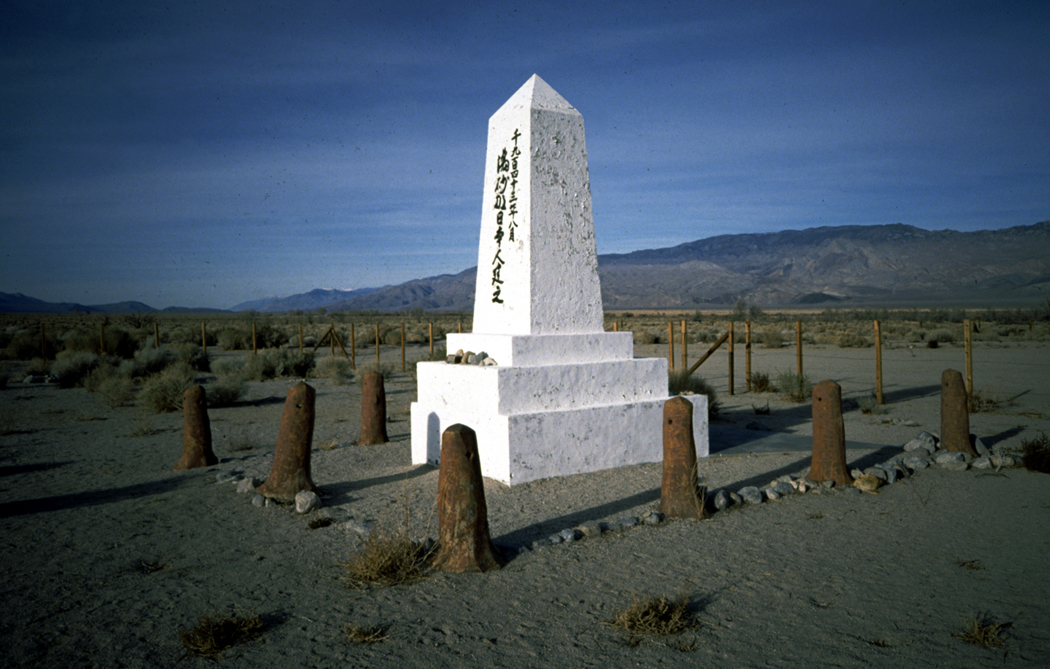
The 500-acre site in California’s Owens Valley on the eastern slope of the Sierra Nevada is now a dusty spot of desert under the snow-capped peaks, but in 1943 it was home to 10,000 Japanese-Americans detained under federal order in a concentration camp built there, one of 10 such camps in the American West.

That year, it was visited by photographer Ansel Adams, who was invited to make a series of photographs of camp life. I had seen prints of those photographs while doing research at the Library of Congress, where they are stored, and had long wondered about the place.

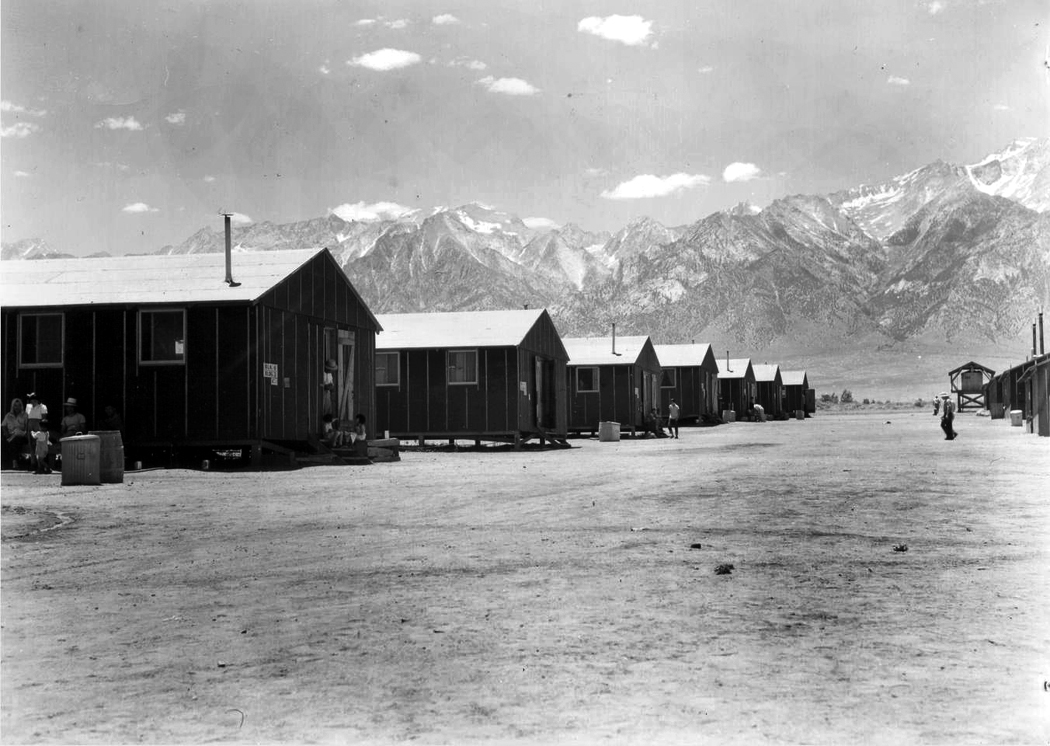
”My first impression of Manzanar,” Adams wrote in his autobiography, ”was of a dry plain on which appeared a flat rectangular layout of shacks, ringed with towering mountains. … row upon row of black tar-paper shacks only somewhat softened by the occasional greenery.”

manzanar barracks

Most of the photographs he made are of the people, their homes and the social lives they maintained under impossible circumstances. But he also found something redemptive in the landscape.

”I have been accused of sentimental conjecture when I suggest that the beauty of the natural scene stimulated the people in the camp. No other relocation center could match Manzanar in this respect, and many of the people spoke to me of these qualities and their thankfulness for them,” he wrote.

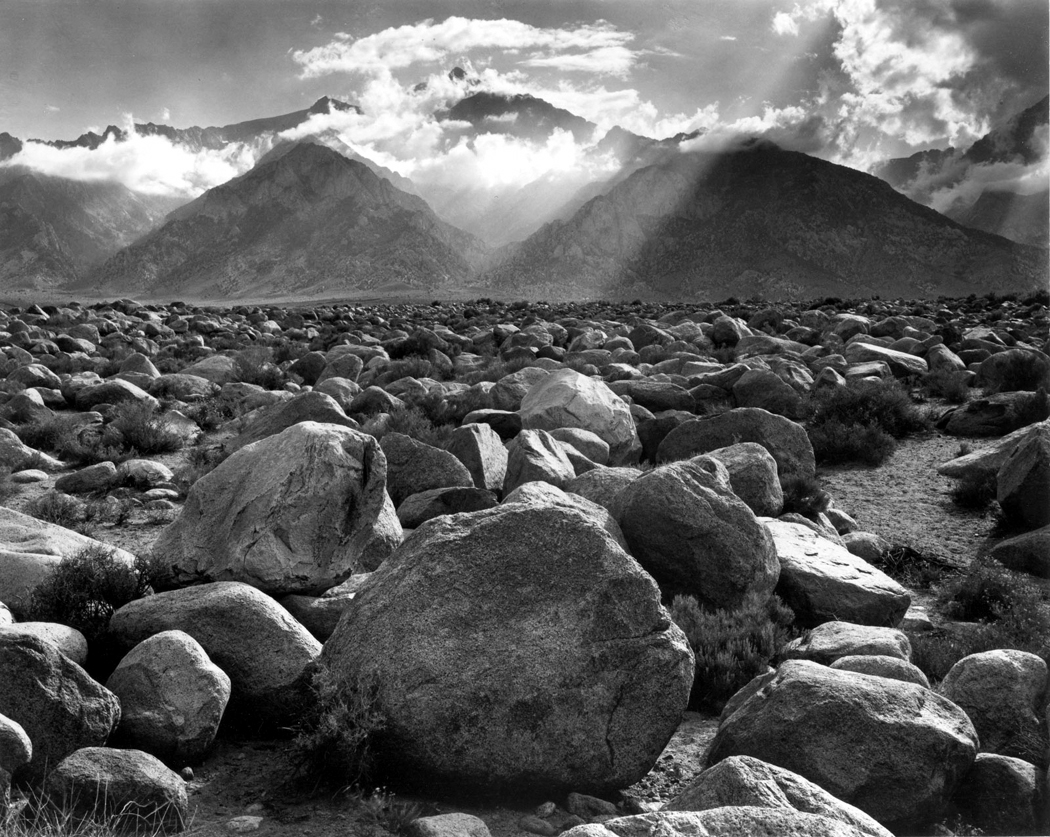
And the single most famous image from Adams’ time in the camp is his Mount Williamson, Sierra Nevada, from Manzanar, California. It was prominently featured in the Museum of Modern Art show ”The Family of Man” in the 1950s, with its foreground of gargantuan boulders and background of sunlight breaking through a storm over the mountain peak. If ever there was a photograph meant to evoke the spiritual power of landscape, this is it.

manzanar mt williamson

So I was drawn to Manzanar to see the land. Certainly nothing was left of the camp, I was certain.

And the only thing that gives away the location of the camp is a stone sentry booth off the side of U.S. 395 about 15 miles north of Lone Pine. Behind it, all you see at first glance is gravel, dry grass, mesquite trees and clumps of datura wobbling their coarse white lace in the breeze.

But as soon as you drive into the camp and crawl along the old dirt roads, you discover what the decades have tried to obscure: flat concrete foundations of barracks, some weathered lumber littering the ground and the odd sight of water-system standpipes poking up like leafless shrubbery in the emptiness.

Walking through the old foundations, you discover broken bits of dinner plates and an occasional fork with its tines splayed. In one plaza area between the concrete ruins, there was a 5-foot mound of earth ringed with stones. It had been a Japanese rock garden built by the internees.

Above the camp, Mount Williamson still looks impressive although nothing in nature ever looks quite so impressive as it does in Adams’ prints.

And the reality of American politics is sometimes less impressive than it looks in the Constitution. Here in Manzanar, American citizens were locked up for no reason but their race.

When Adams published a book, Born Free and Equal, of his Manzanar photographs in 1944, copies were actually burned by what Adams called ”reactionary groups with racial phobias and commercial interests” who questioned his loyalty and patriotism.

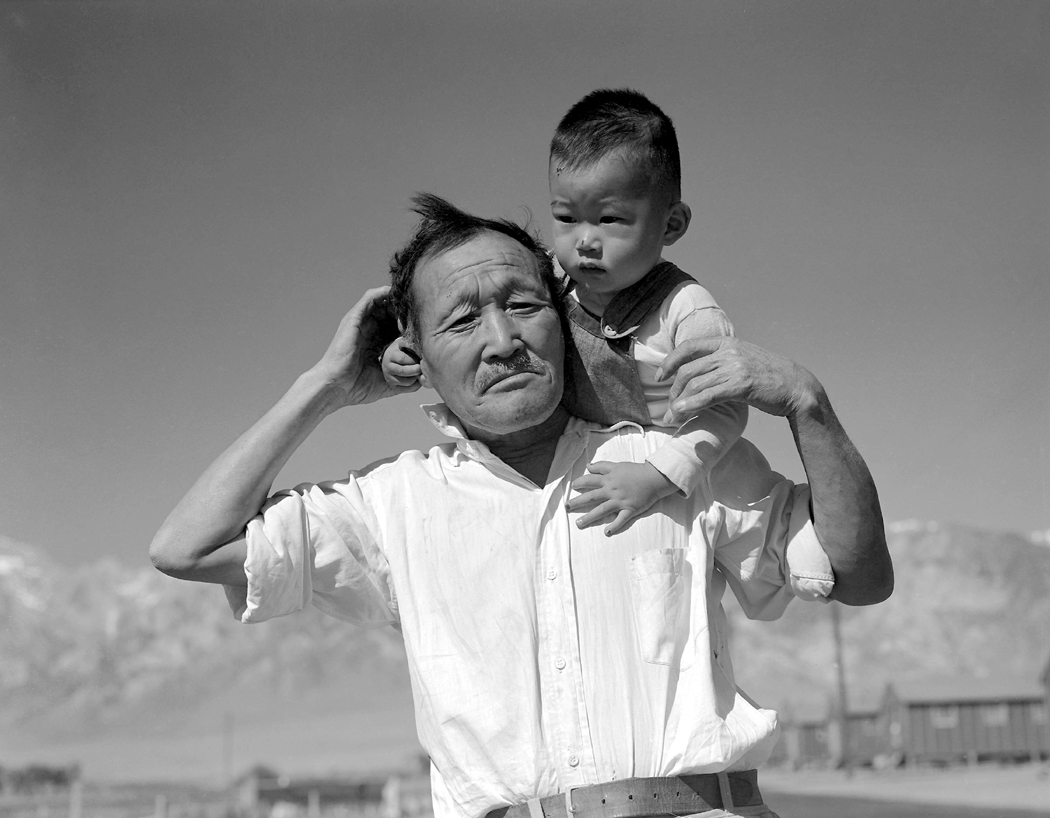
manzanar father and son

I became adult as the Vietnam War raged both here and in Asia, and I recall many of the same sentiments expressed then.

And as I left the camp, I poked through the sentry booth, which is filled with 50 years’ worth of graffiti, most of it in Japanese and left by those who were detained there and now by their descendants, who often come back to visit.

A young Japanese man pulled up on his Kawasaki while I was there and started photographing the booth interior. He spoke almost no English, but when I asked him if he could translate the words, he told me that most were names.

I pointed to one set of characters carved into the woodwork around a window, and he told me it was the Japanese transliteration of the name Clark.

In 1992 Congress designated Manzanar as a National Historic Site. It was the 50th anniversary of Franklin Roosevelt’s executive order authorizing the internment.