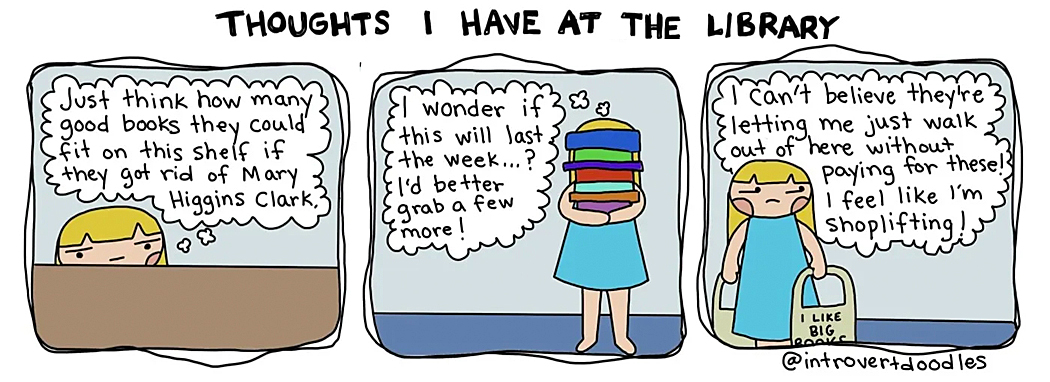
Granted, it was only a nickel a day, but it was increasing. By the time the Library Police knocked on my door, that price was in the high single dollar range. Who knew the library had police? They came in pairs, like Mormon missionaries, and were nearly as polite; they wanted the money and they wanted their book back. I had forgotten I had even borrowed it from the Virginia Beach Public Library and now, I didn’t know where it was, in the welter of books in the house; I paid them the price of the book to be done with it. This was the most dire episode in my long relationship with libraries.
It was also a long time ago (you should have been tipped off by the fine of a nickel-a-day — library fines have grown with inflation), and it was at a time when I was suffering from student poverty, and so libraries were a godsend when I needed or wanted a certain book — and for those of us with the book affliction, the difference between want and need is very thinly sliced.
There is a word for this affliction. At first, I just thought of myself as a bibliophile, but the proprietor of a used bookstore in Norfolk, Va., recognizing the symptoms explained to me that what I was, in actuality, was a bibliopath. I kind of liked the name and have perpetuated the usage ever since. You know you are a bibliopath if you have ever feared for the life of your cat when the pile of books on the floor next to your bed reaches critical mass and you suffer what in our household we call a “bookslide.” Buried under there, like survivors of a third-world earthquake, is the unhappy cat you have to exhume.
Some of my earliest memories were of descending to the basement of my elementary school in New Jersey, where the town’s public library was hidden, and spending countless hours of joy poring over the shelves and finding the books that would explain the world to me.
In high school, I persuaded my Latin teacher to give me an entire pad of signed library passes so I could avoid the dreaded study hall — a place where tired students could place their weary heads in the crease of an open book and fall into a confused slumber — and go to the school library instead. Study hall proctors eyed me with suspicion every day, as if I were somehow avoiding the cruel and unusual punishment that my adolescent status deserved. They clearly thought I was getting away with something. Such was the pedagogical theory of 60 years ago.
In college, there was little more delicious than burying yourself deep in the stacks, seated at a tiny, poorly lit carrel with a tower of scholarly tomes and doing research late into the night. These lucubrations were almost as delightful as the traditional student discovery of sex and beer.
Even after graduation, I would go back to the university library and dive deep into its inventory — the stacks, called The Towers, were open only to students, but no one checked my ID — and I discovered many a quaint and curious volume of forgotten lore and managed to check out several rare books, including an 18th century printing of the sagas of Ossian — that famous fraud by James Macpherson. I was sorely tempted to pay the library fines and keep the book, but my conscience won out and I read the thing and returned it. (I have since bought a 19th century edition of the poems and it sits in my own stacks here in my tiny office — an office modeled on the site plan and measurements of the library carrel).
When I finally came to work for the newspaper, no assignment made me happier than one requiring a trip to the library, where instead of “reporting,” I engaged in “researching.” I was an indifferent reporter, but I was a great researcher.
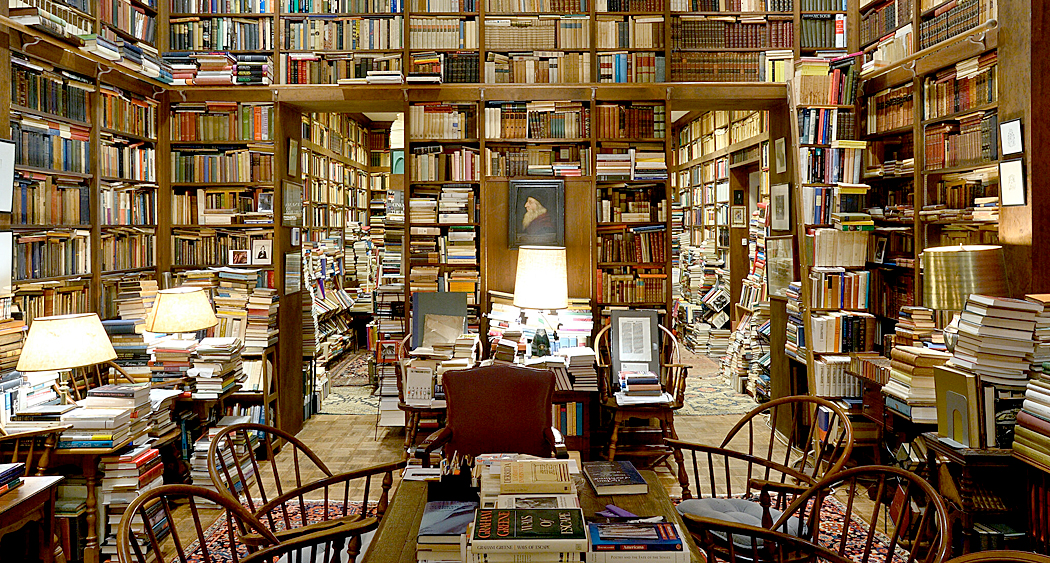
And now that I am retired, I live in my library — my personal library — where the walls are made from bookshelves and each book is a door, and while I spend many a happy hour in Google-land or riding the Wikipedia bus, it is still the feel of paper, the sound of turning pages, the smell of the residue of dust from the spine of a book that makes my pulse quicken.
Alas, libraries are under attack, mostly by irate villagers with pitchforks and torches afraid their children will be exposed to unregulated thinking, but also because the very act of reading is dying out, like endangered species or network TV.
The newspaper where I worked had a library where I went to fact check what I was writing, but by the time I retired, it had been closed and the dear librarians who had helped me for 25 years had been offered buy-outs.
I had my own small library, several hundred reference books, at my desk, including a bookshelf jammed into the passageway behind my chair that had needed to be cleared by the fire marshal. But even that eventually became mostly decorative, since I could more quickly and efficiently find out birth- and death-dates of whoever I was writing about by Googling them on my computer.
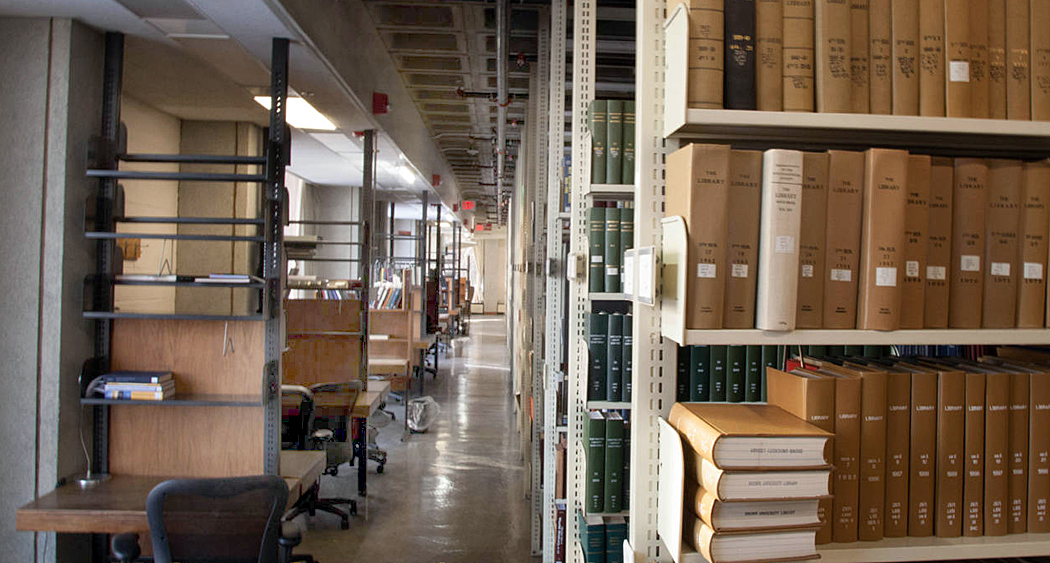
I mourn the loss of libraries, and mostly the old-fashioned ones, with dark shelves piled high into corners of institutional basements, with their sequestered carrels lit by desk lamps, tucked into hallways.
The Library of Alexandria may have burned down, the Carnegie library buildings may have been rented out to non-profit foundations, the newspaper library has been thinned by a kind of bureaucratic deliquescence, and the public library has become a battery of computer screens, but I am here, behind the moat of my own books, vowing never to surrender.
“How could such sweet and wholesome hours/ Be reckon’d but with stacks and Tow’rs!”
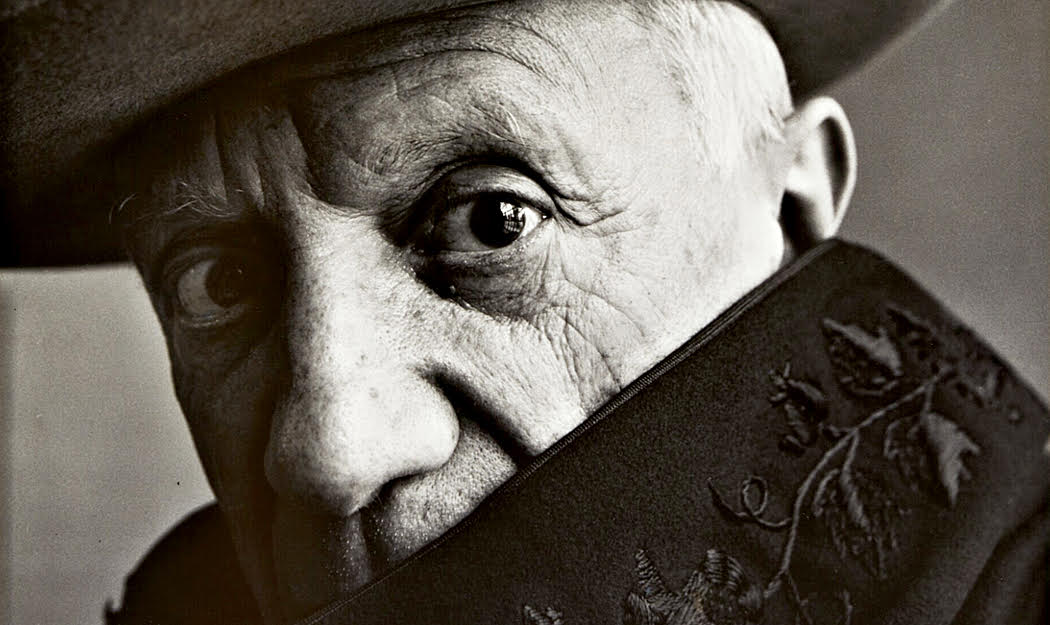
In a recent piece on this blog, I mentioned that Pablo Picasso, while he was undoubtedly a great artist, might not be a particularly good painter. That is, his craftsmanship over the years could be quite indifferent. Inventive, no question, but seldom painstaking over execution. I wrote a fuller explanation of this in an essay I wrote in 2023 for the Spirit of the Senses salon website and I thought this might be a good time to reproduce that post for a wider audience.
Pablo Diego José Francisco de Paula Juan Nepomuceno María de los Remedios Cipriano de la Santísima Trinidad Ruiz y Picasso was a very impatient man, perhaps because his name takes so long to say or write.
I say he was impatient on the evidence of his paintings. I certainly never met the man. But I have seen a boatload of his paintings in person and hundreds in reproduction, and they all tell me he didn’t have the patience to spend time on their finishing touches.
Don’t misunderstand: Pablo Picasso was a great artist, and for many reasons. But he was not what I would call a great painter. Let’s take a look.
There was a time when many thought that Picasso’s art was a hoax. You know, the “My kid could paint better than that,” and serious-minded critics would say, “First, you have to be able to master the techniques before you can experiment with abstraction.” (Yeah, this was a while ago).
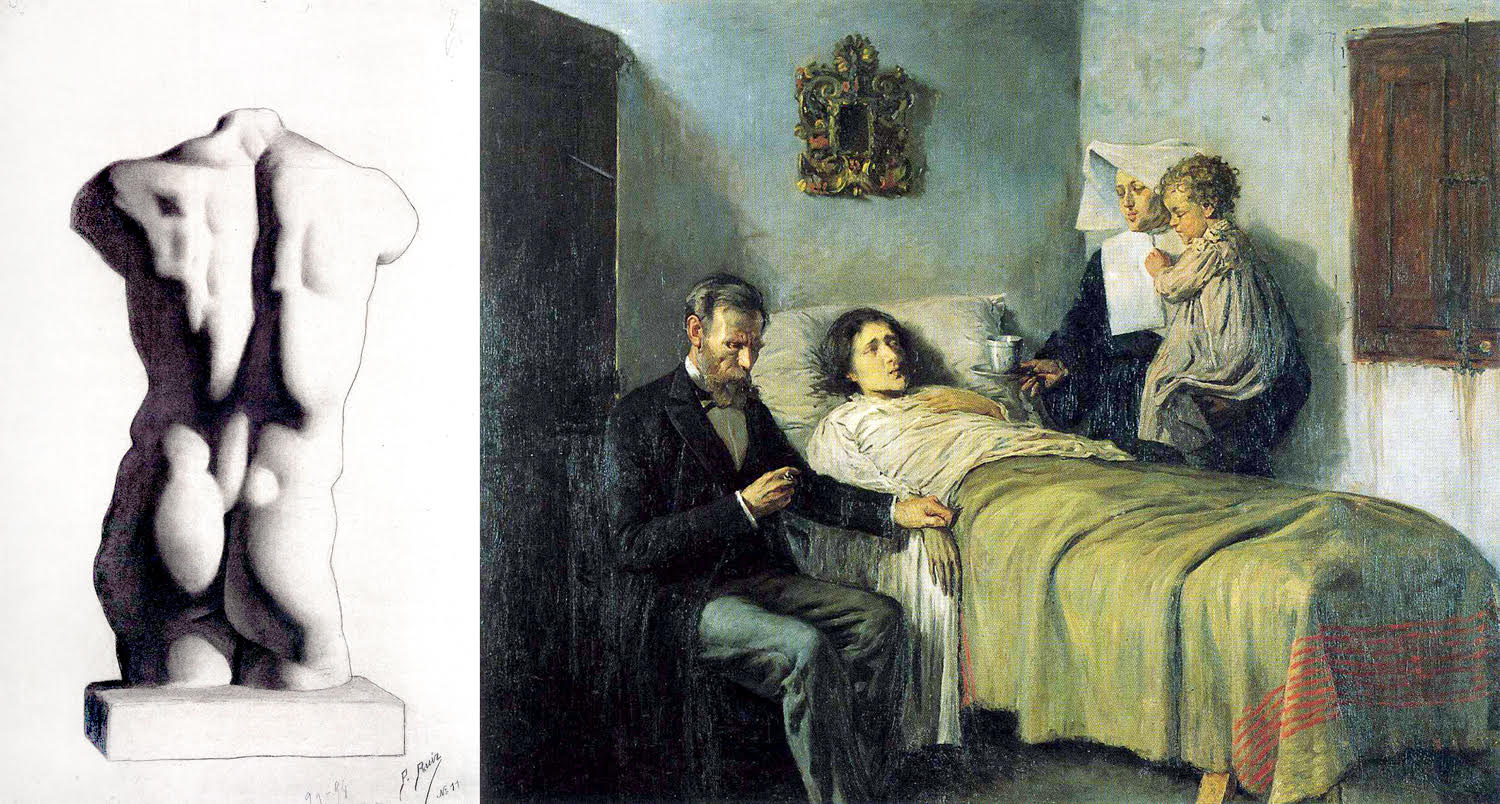
But then, some of the young Picasso’s art, from his adolescence, began showing up and it was clear that he had been a masterful draftsman and could draw and paint as realistically as anyone.
He could pump out an academic figure study like an Old Master. And he could put on canvas as realistic a painting as you could wish. Just look at some of these, from 1893, when the artist was 12, and 1896. It is clear he could do anything. But he didn’t: By the turn of the century, he had been taken with more modern trends in art, from Impressionism to Post-Impressionism, to Fauvism and Expressionism. His style loosened and the works became sketchier.
This evolution of style was characteristic not only of Picasso, but of other artists, writers and poets. There had been Impressionism and Post-Impressionism, Van Gogh, Gauguin, Cezanne — all with different styles.
By the middle of the last century (that’s the 20th, remember), Modernism had not only established itself, but become entrenched. Its hagiography had been codified and the heads of its various branches were Igor Stravinsky in music, James Joyce in prose, Ezra Pound in verse, and Picasso on canvas.
These were hardly the only names in the mix, and they may not even have been the best artists working, but they became the names we all knew. They are the names in the anthologies and textbooks.
And they all burned through styles. Stravinsky went from late Romantic chromaticism, to a savage primitivism, to Neo-Classicism and finally to his version of 12-tone serialism. Joyce from some of the most beautiful, clear prose in The Dubliners to the stream-of-conscious jumble in Ulysses and into the paronomastic almost-abstract gibberish of Finnegans Wake. Pound began with highly poeticized Edwardian prettiness to a hard-edged sarcasm and into his own form of pan-linguistic word salad.
Most serious artists go through stylistic growth from early to late periods, but Modernism seems less like organic growth and more like a conscious seeking-out of something new, something that would get attention. Pound’s battle cry was, “Make it new!” Where style had been a function of personality, it became a “brand” and ever newer versions were sought, like updating your car every few years.
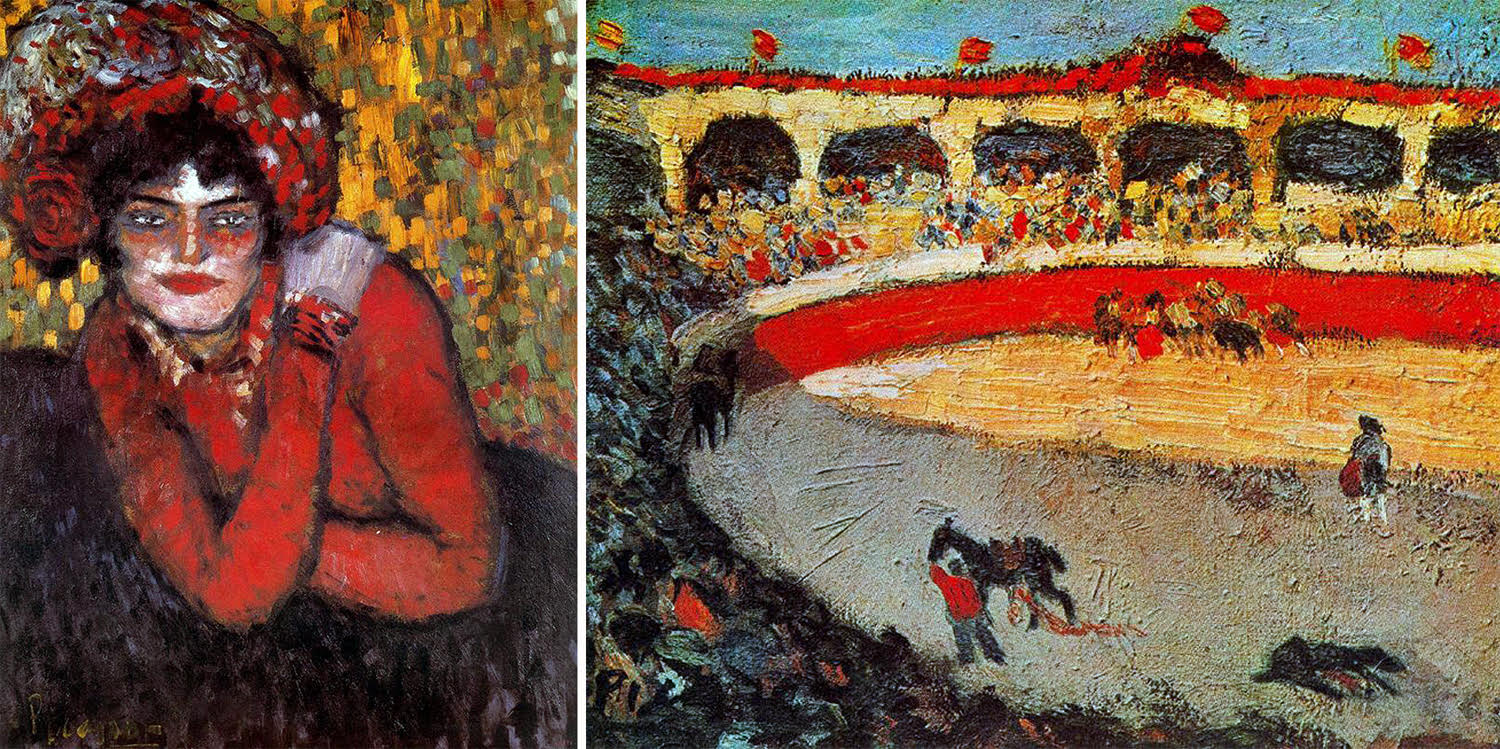
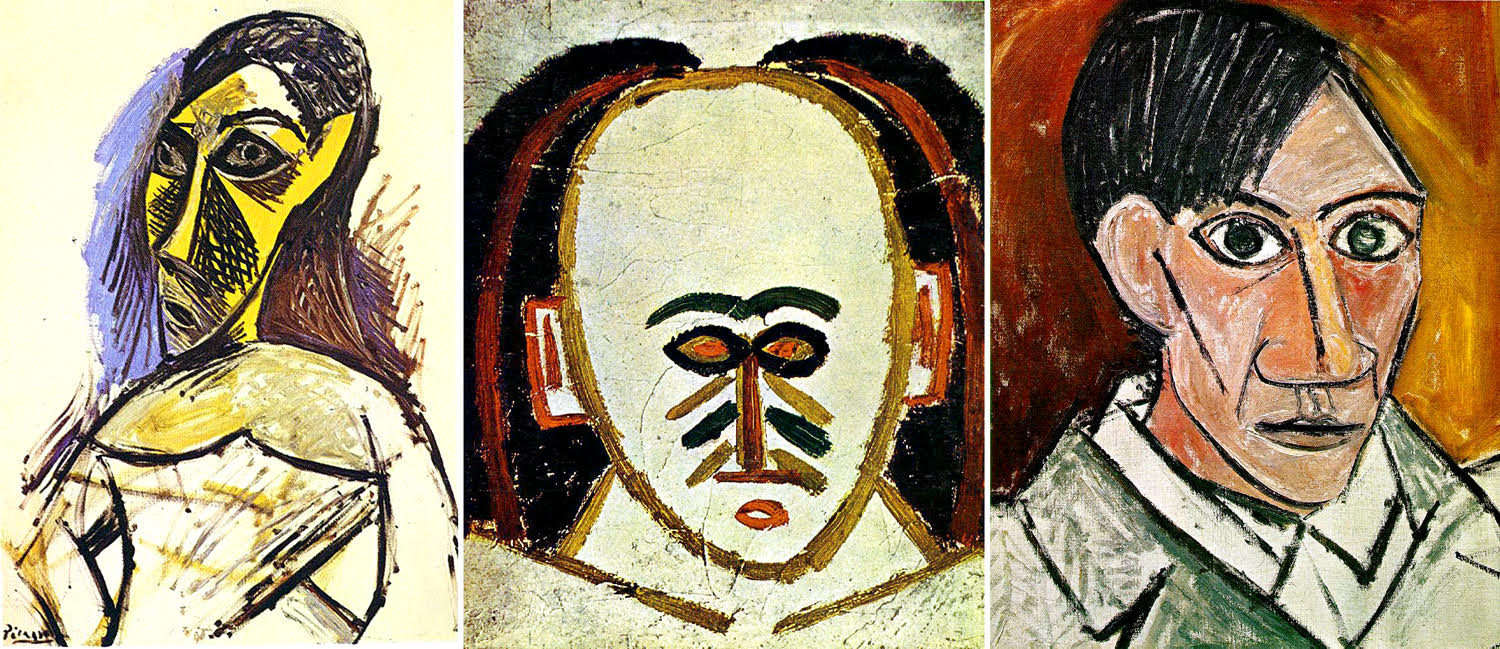
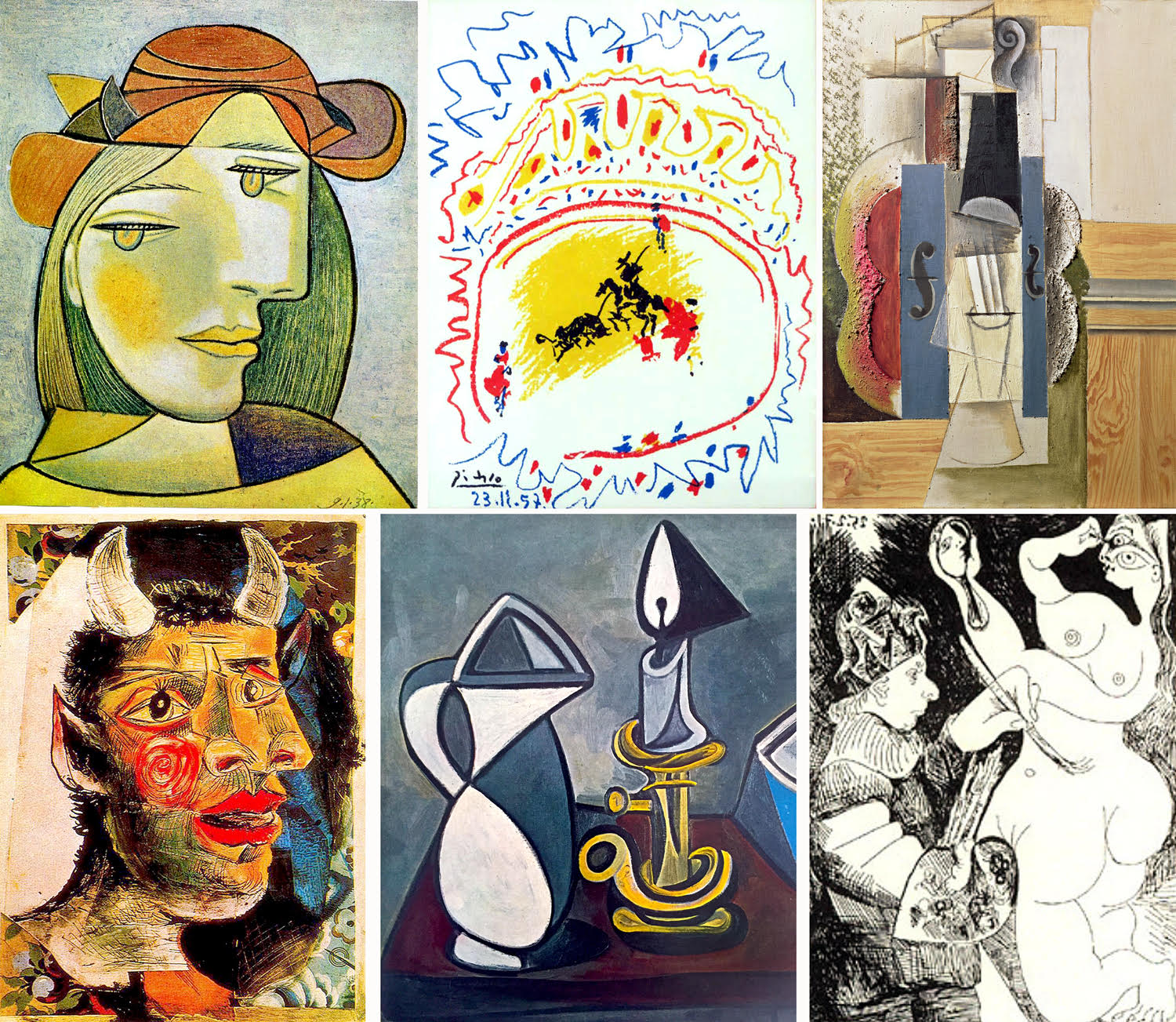
I’m being too harsh here, but to make a point. Picasso kept evolving, from that early Expressionism
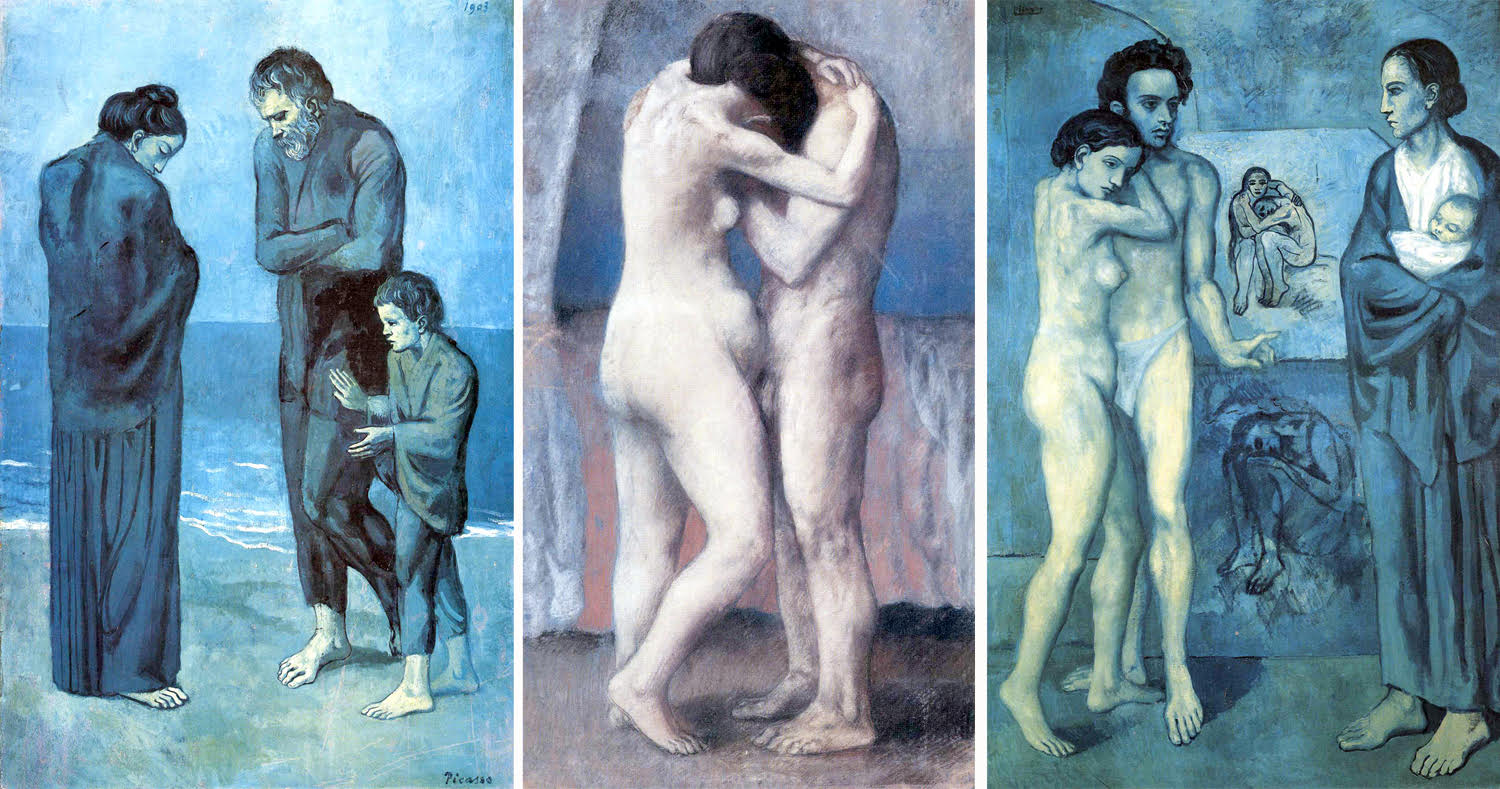
To the famous “Blue Period”
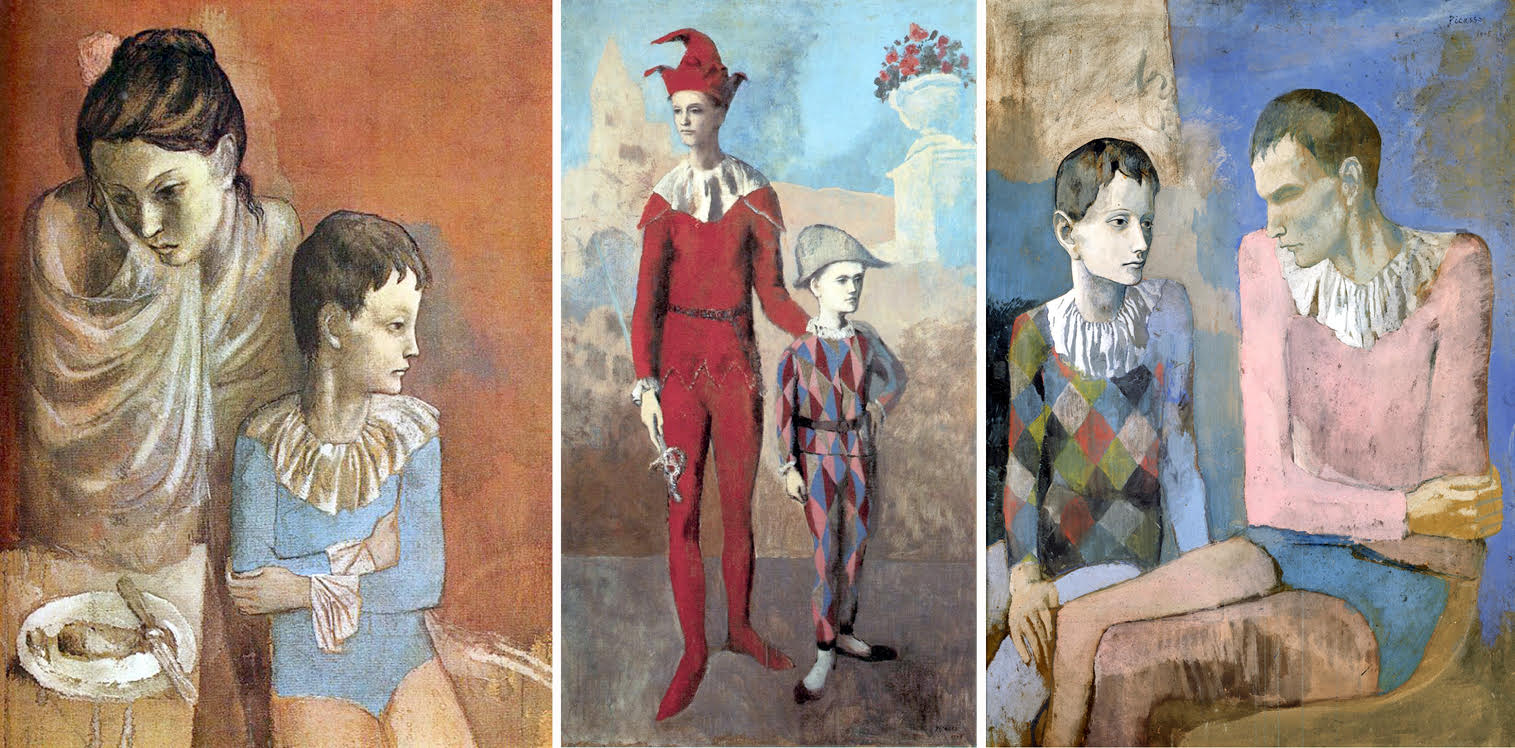
Through a subsequent “Rose Period”
to African primitivism,
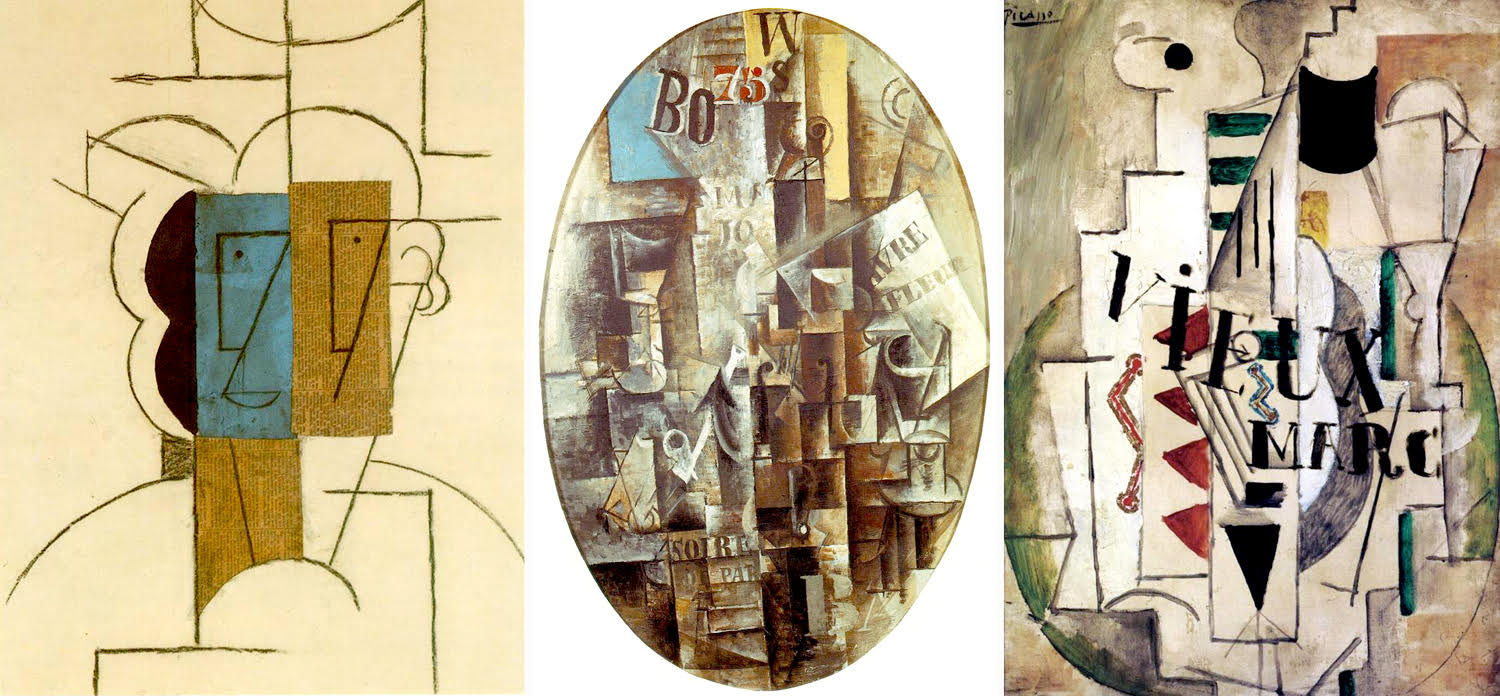
to analytic Cubism,
to Synthetic Cubism,
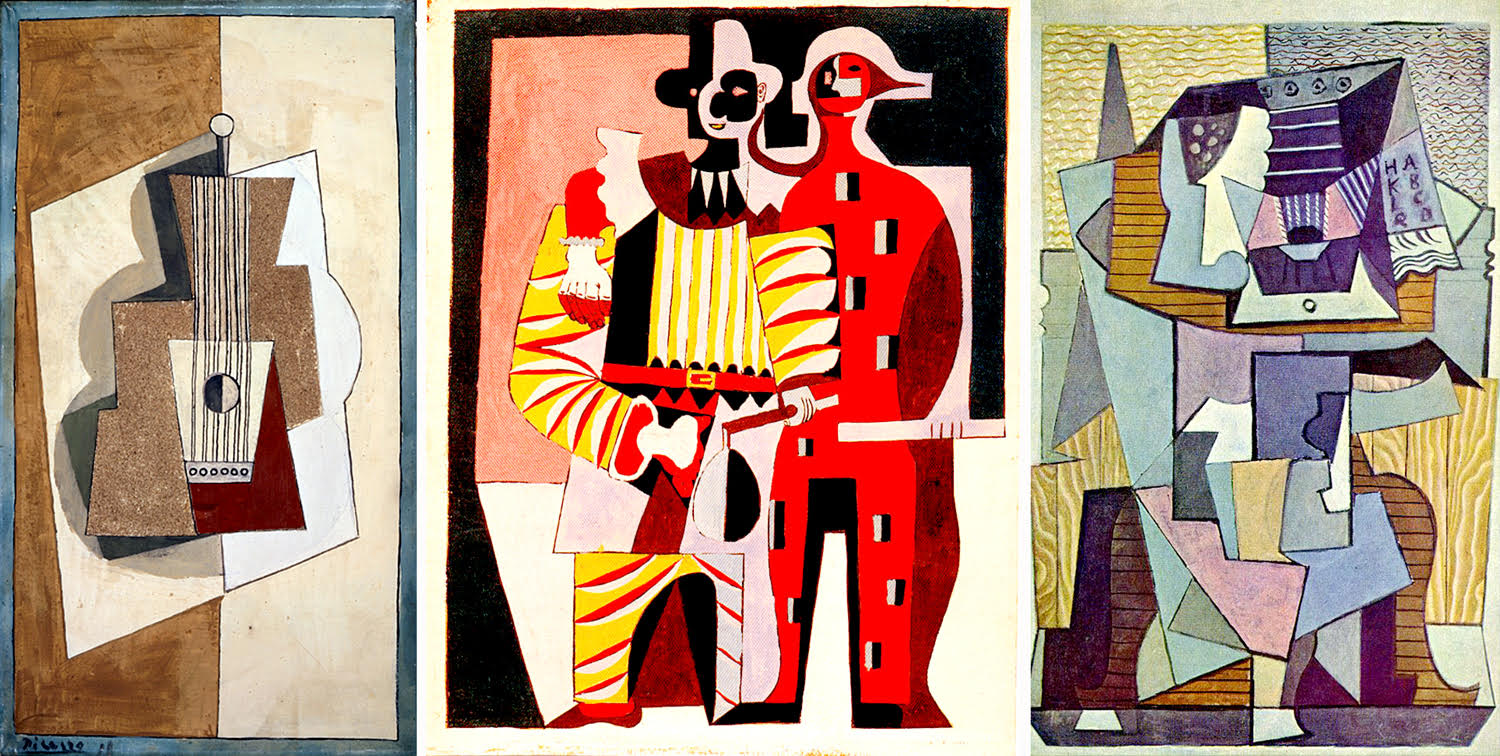
to Surrealism
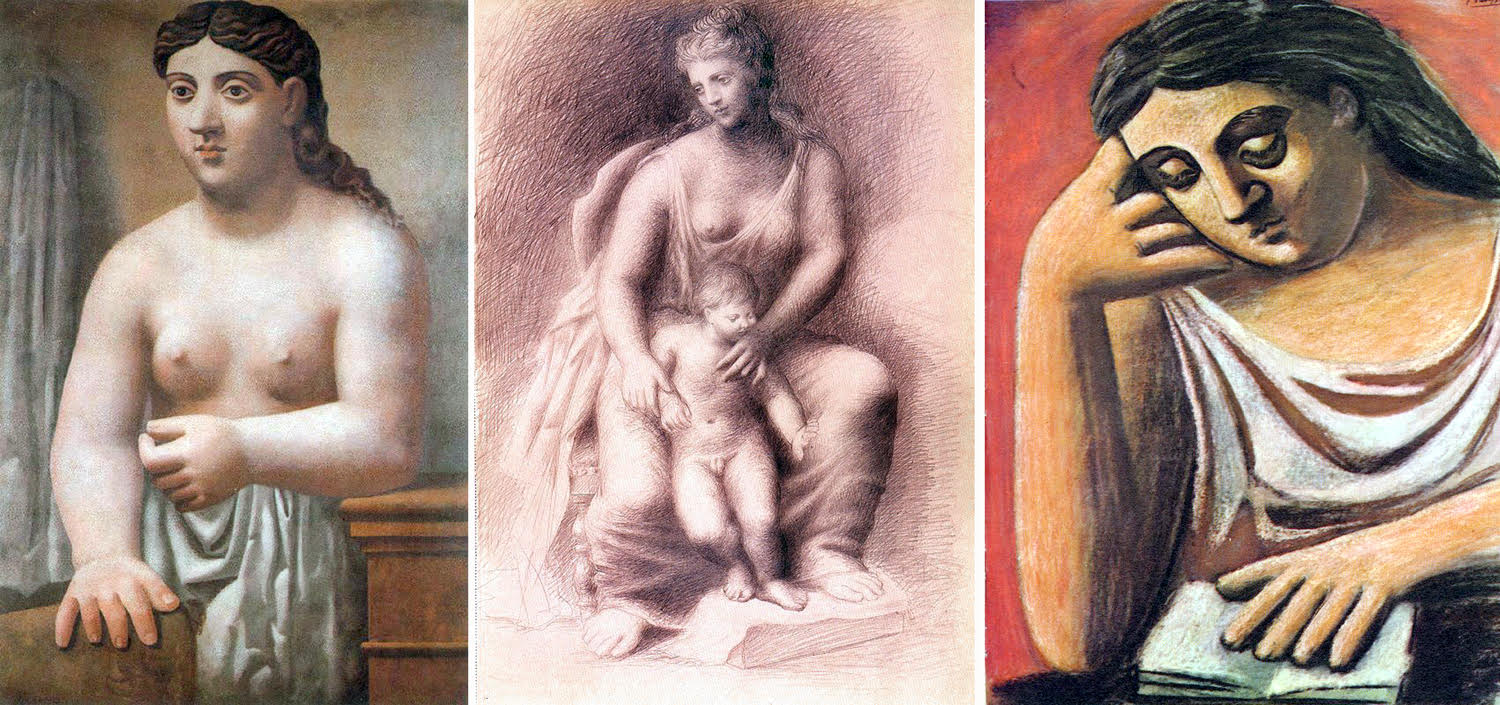
and Neo-Classicism
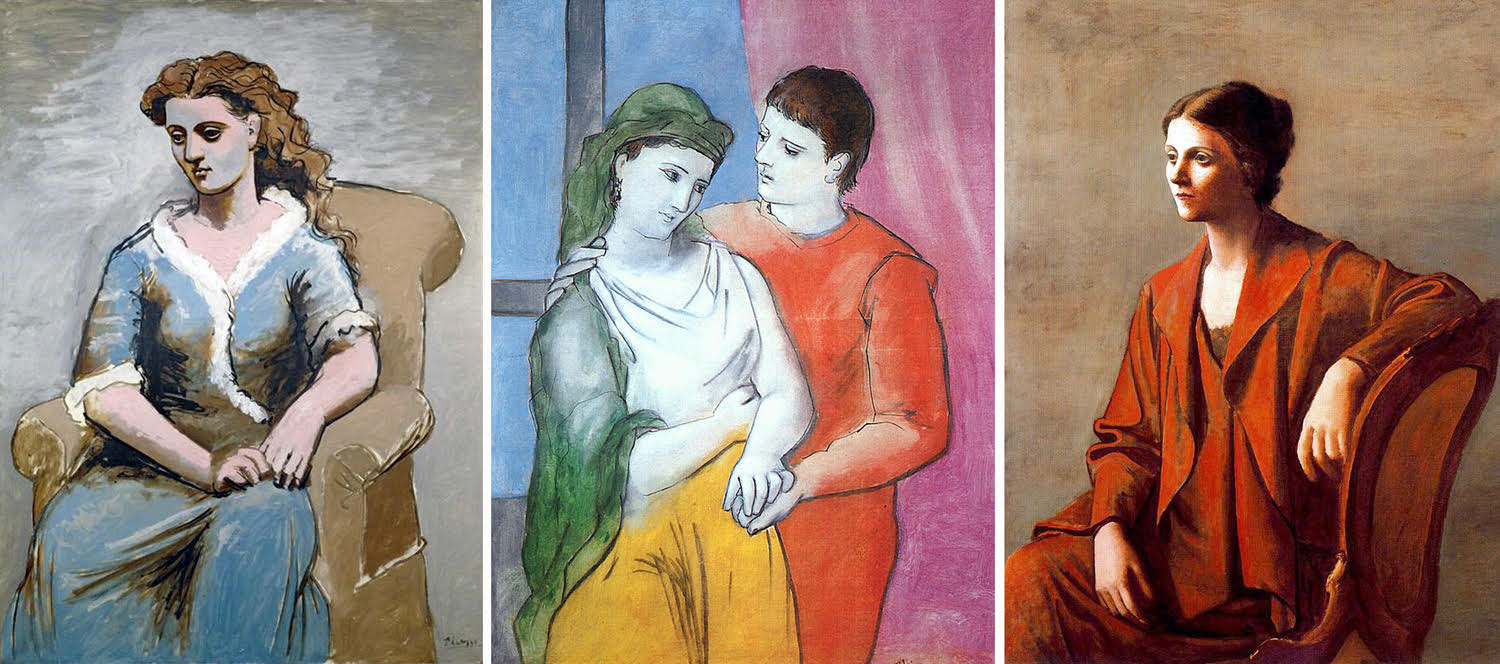
Then a brief period in the mid 1920s of what might look like a return to a kind of realism
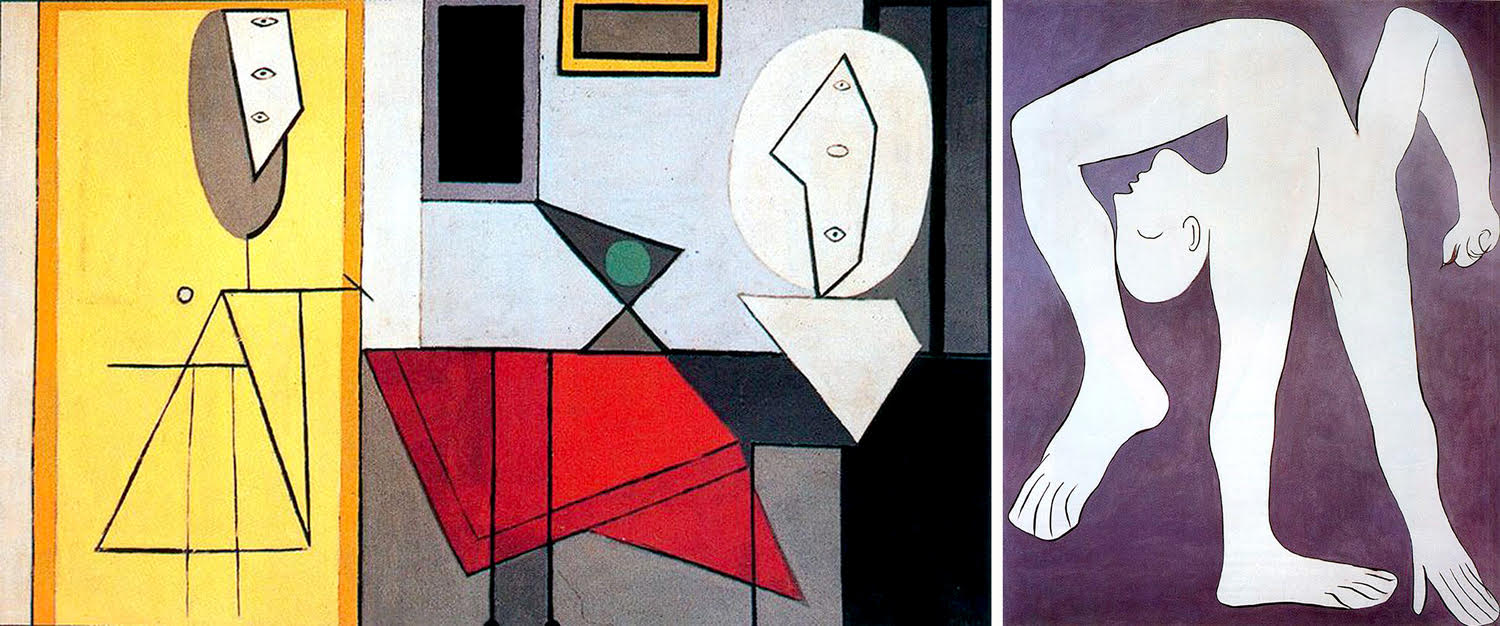
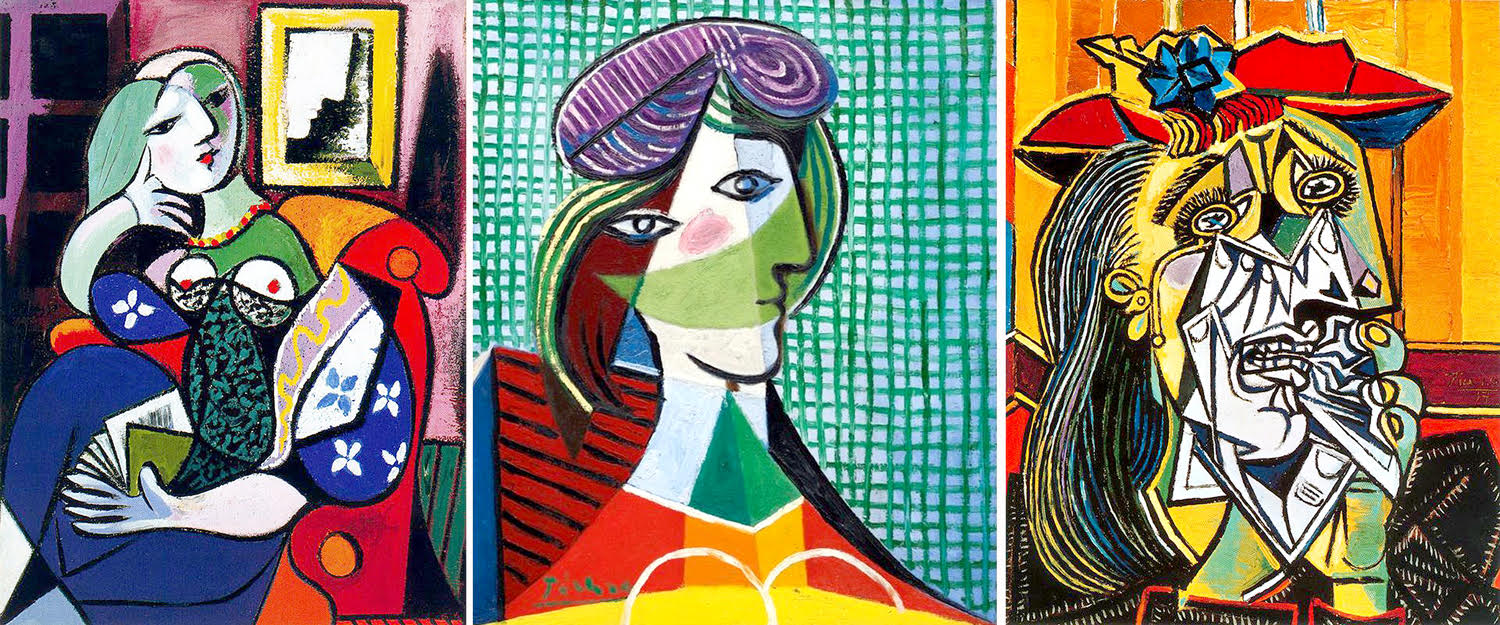
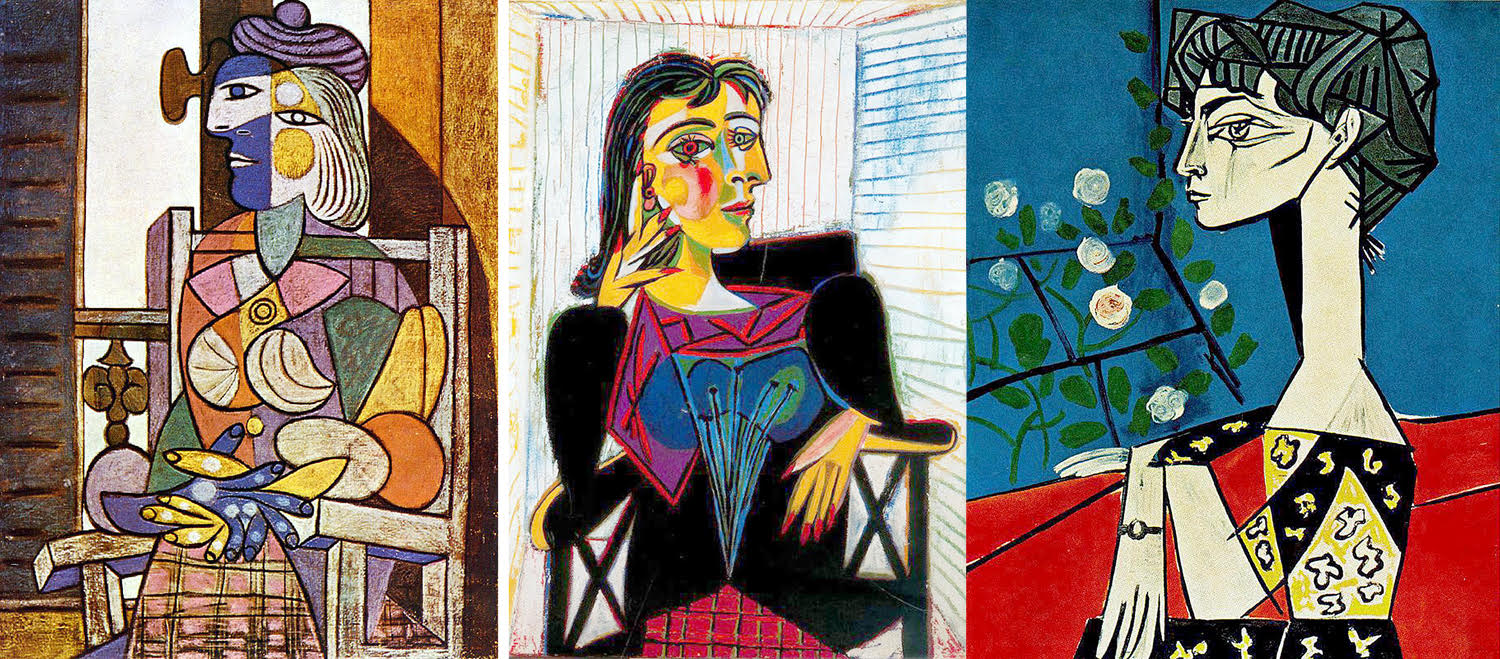
and then, into what can only be termed Picasso-ism — his playful mix of everything and anything, usually turned out in a few hours and often rather haphazard.
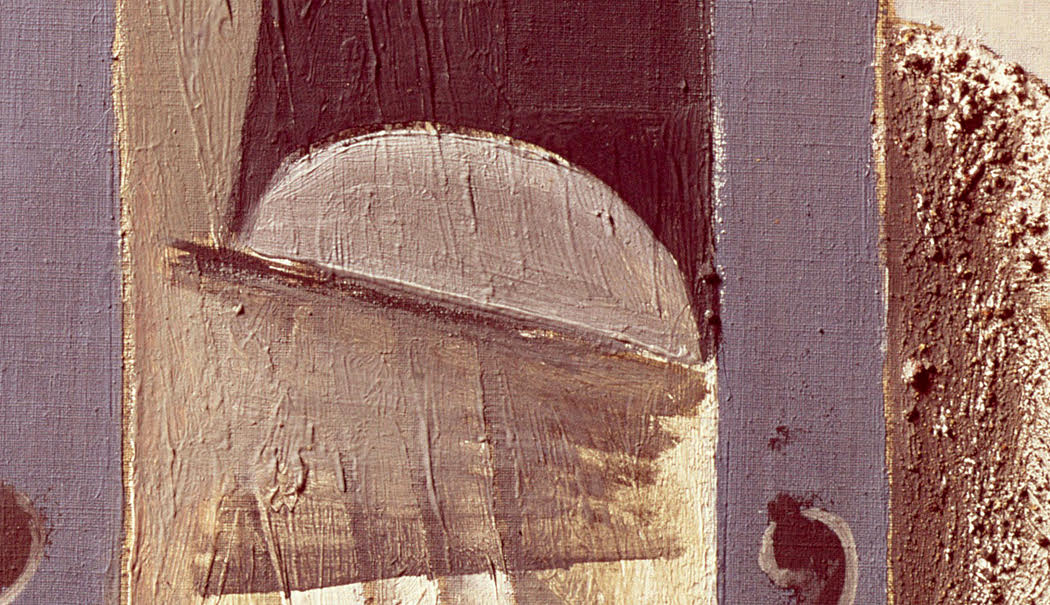
And this gets to my main point: That Picasso was an epically inventive visual artist, clever in the first degree. But from his earliest work onward, was always rather indifferent about the craft of painting. His application of paint to canvas was often sloppy; parts of many paintings were essentially unfinished; many are more caricature than character; even his color choice often seems unconsidered — any red might do, any green, any blue. His art is one of suggestion rather than observation.
This was typical of his approach in other ways. Where most artists use their work to react to life and the world, Picasso seemed always more interested in cultural tropes. That is, he picked on several archetypes — or stereotypes — and re-imagined them over and over. These are themes straight from his brain, without recourse to the actual world.
There were bulls and bullfights; Harlequin and Pulcinello; circus performers; the down-and-out; birds; women, both as portrait and as nude; satyrs, fauns and demons; still lifes; and over and over: the artist and his model.
He drew these subjects from his mind, not his eye. And the goal seems to have been to get them down as fast as possible and to get on to the next canvas. During the Renaissance, an artist might work on a painting for a month, polishing it to a perfect finish; Picasso seems to have been more likely to complete several paintings in a day.
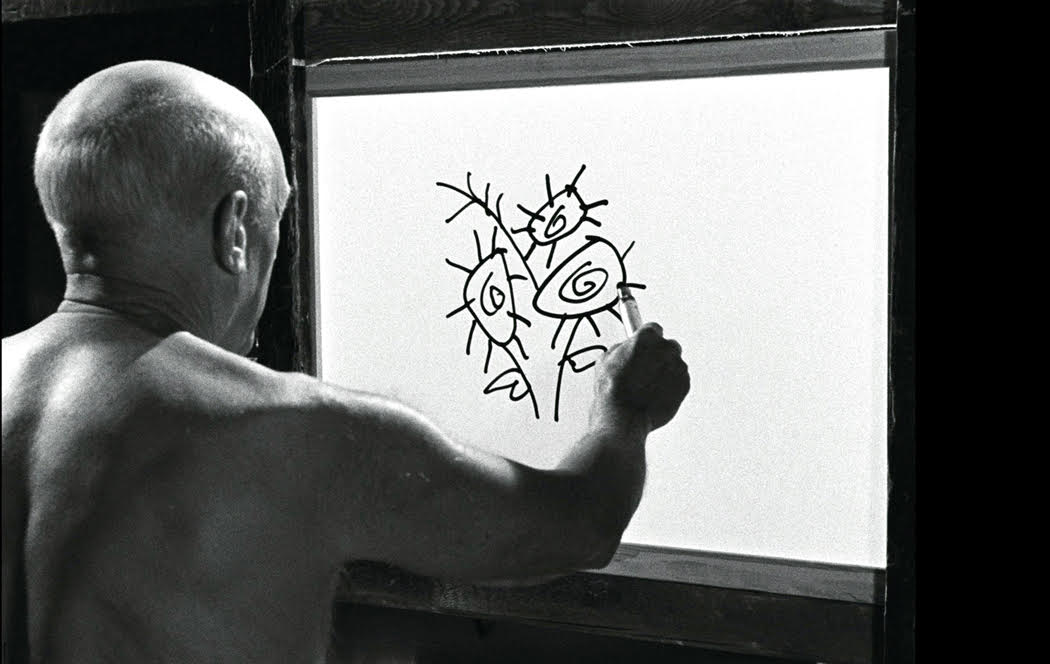
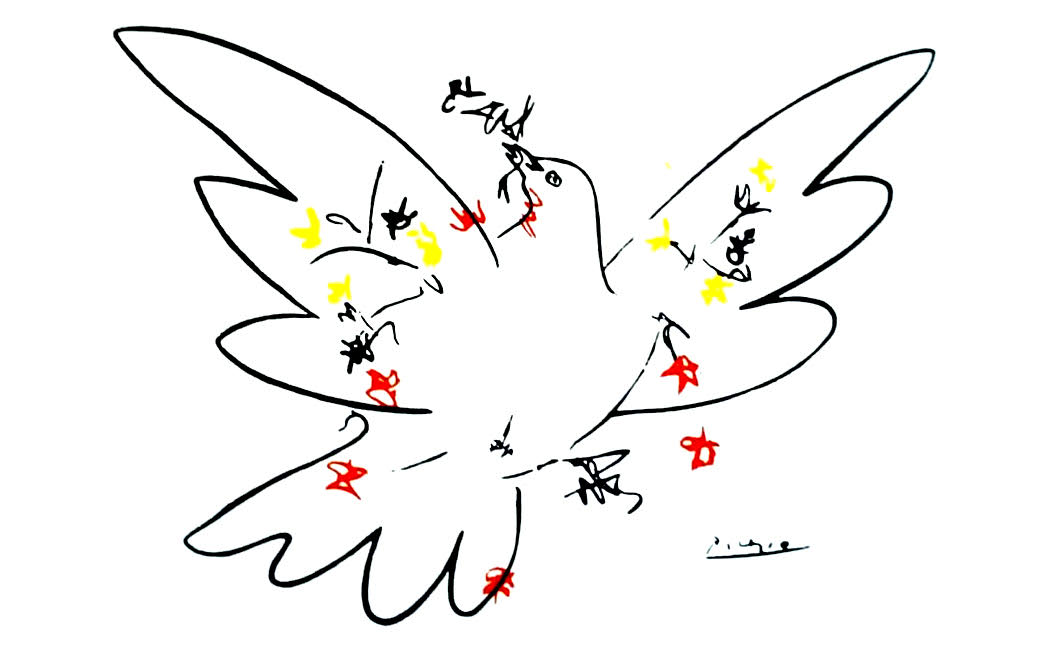
You can see how fast he works (and how fast his mind could work) in the 1956 film by director Henri-Georges Clouzot, The Mystery of Picasso, in which, over the course of its 75 minutes, the shirtless Picasso completes 20 drawings and paintings. Of course, most of these are merely sketches, but you can see how fast his brain is functioning — and how diagrammatic his take on the visual world really is. He is not capturing the way the world looks, but rather creating hieroglyphs to be read, the way his dove is a symbol for “peace.” Or the stick-figure man or woman on restroom doors.
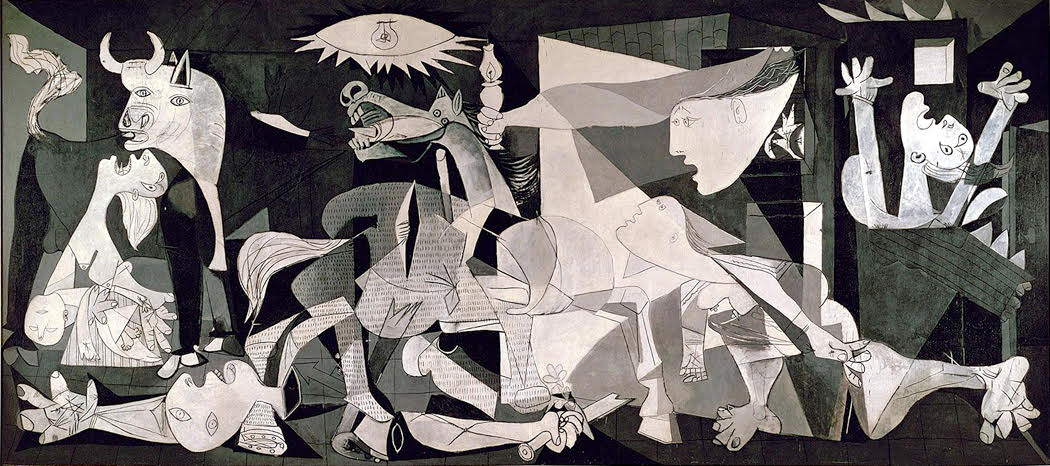
The one time he made the effort, worked over many preliminary sketches and worked his canvas to a fine finish, he produced what is probably the most important, most powerful painting of the century — his 1937 Guernica, about the bombing of the Basque city by Nazi planes supporting the Fascist forces of Francisco Franco. The giant painting —roughly 12 feet by 25 feet — hung for many years at the Museum of Modern Art in New York, as, under the will of the artist, it could not be returned to Spain until the reestablishment of democracy. It finally went home to Madrid in 1981.
I saw the painting many times when I was a young man, living just outside New York, and visiting MoMA as often as I could. It anchored one end of the museum and you could see it as soon as you got out of the elevator on the second floor, the focus of the whole museum.
I’m not saying that we would have been better off if Picasso had spent more time on fewer paintings — his prodigious energy is largely why we honor him. But what can’t be ignored is that his work is often slapdash, sometimes not much more than a doodle.
When I was young, and for the first three-quarters of the 20th Century, Picasso was a colossus, almost universally acclaimed as the era’s greatest artist — the Muhammad Ali of the paintbrush — but in recent years, his primacy has receded. Partly because the adrenalin rush of Modernism has petered out; partly because the art market has become so much more simply part of the financial world, more interested in investment and less in the actual art; and perhaps most of all because Picasso, the man, has been revealed as such a misogynist pig. He was a very unpleasant man.
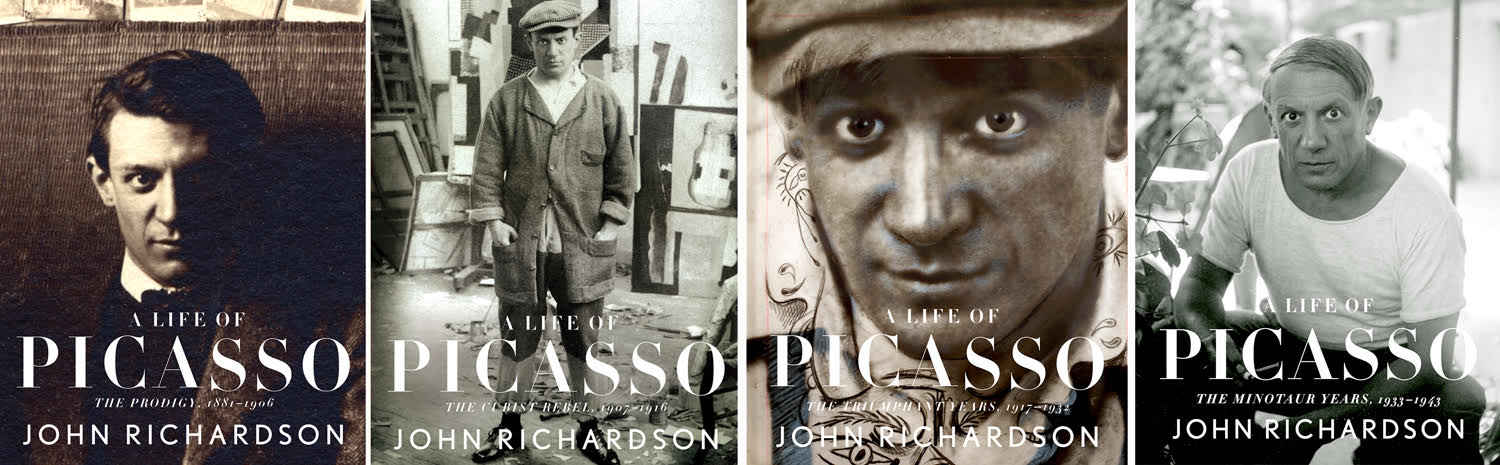
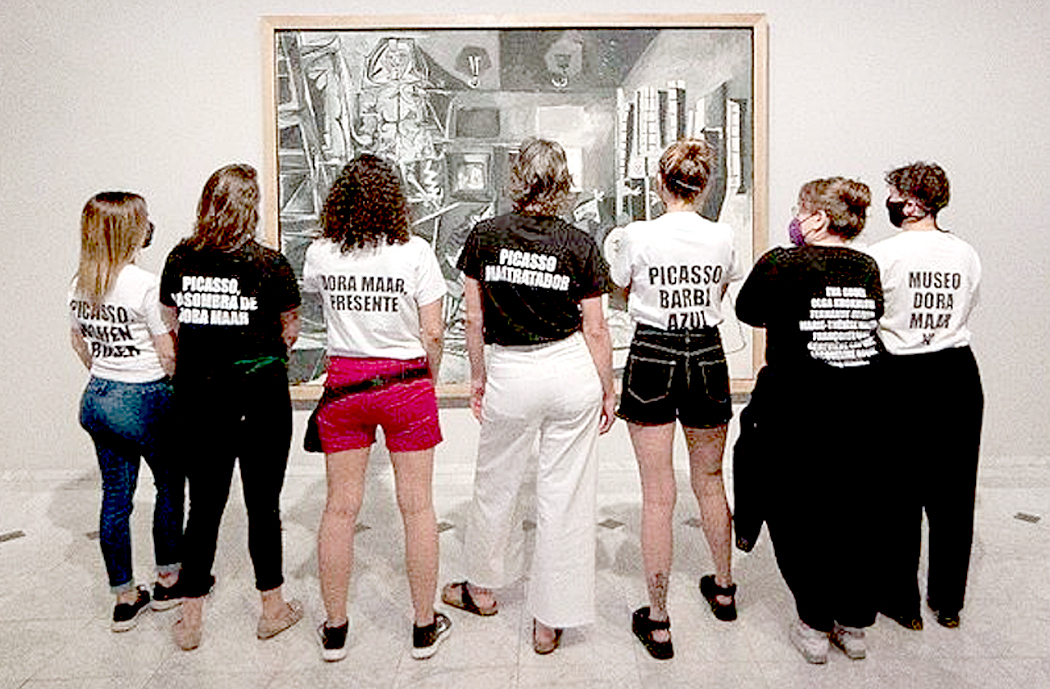
Since the publication of the four-volume biography by John Richardson, it has been clear what a self-serving, self-promoting, egotist he was. He went through wives and mistresses, using them and often abusing them. Once we thought of him as the great stud of art, now more like a frat boy with little care for the women in his life. Fernande Olivier, Olga Khokhlova, Marie-Thérèse Walter, Dora Maar, Françoise Gilot, Jacqueline Roque — there and gone.
Then, there was the semi-criminal past, selling fraudulent or stolen art, and footsying with the Nazis in occupied wartime France. In our current more censorious age, we more likely to knock the laurels off the heads of our writers, artists, filmmakers and actors — Did they diddle underage girls? Did they coddle to dictators? Did they steal the credit due to women? Were their intentions less than pure?
If we give in to these worries, we will have to strike from the record much of our cultural heritage. Artists are just as human as the rest of us.
And so, I forgive the genius his sins — they are past and he is dead — and honor the art. But I cannot ever not notice that for all his brilliance, Picasso was an indifferent craftsman. When I look at his work, I see the careless brushwork, the muddy colors, the repetitive subject matter.
My own youthful enthusiasm for Picasso has aged into a mature appreciation for his accomplishments. However diminished he is in the public eye, he is still the dominant artistic name from the first half of the 20th century.
It is midwinter spring, those few days that habitually show up in February with sunshine and temperatures into the 70s that fool you into believing that spring is close at hand, only later to kick you with plummeting temperatures and perhaps another snow. The National Weather Service predicts that for this weekend.
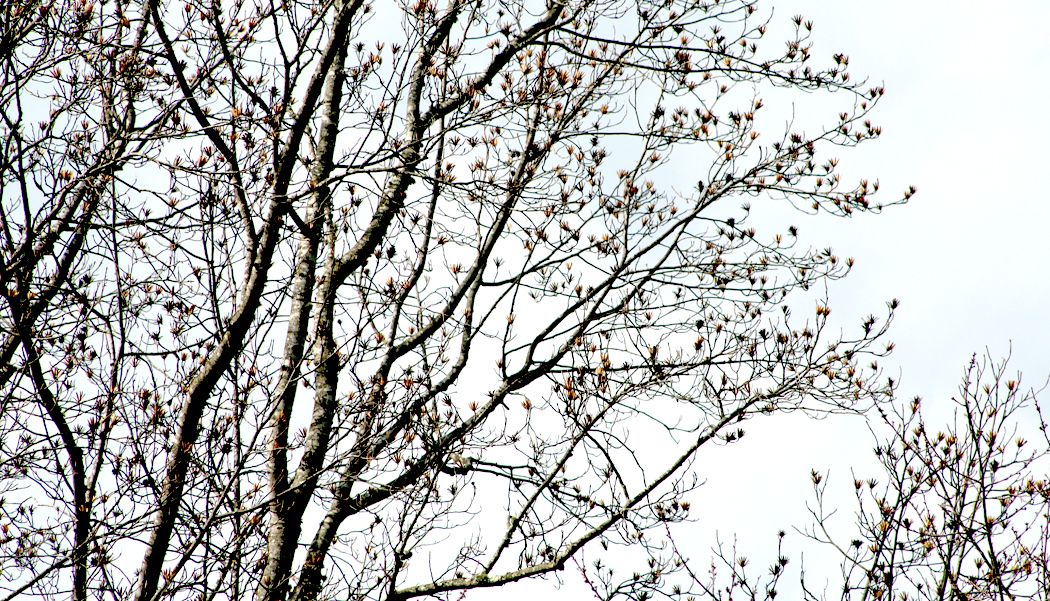
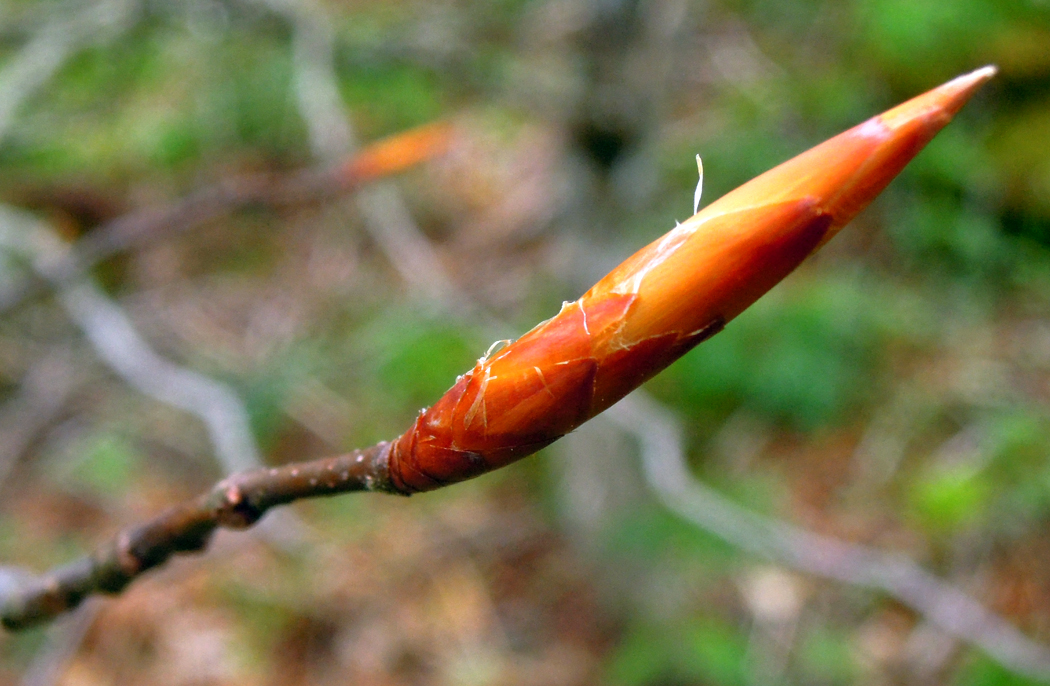
This is my favorite time of the year, when the bare trees begin budding at the twig tips. You can watch the trees change day by day, turning the dead sullen grey of December into something that clearly has a rising sap under the dull bark. When you watch the buds close up, their bud scales slowly separate, with thin lines of green beginning to spread at the edges.
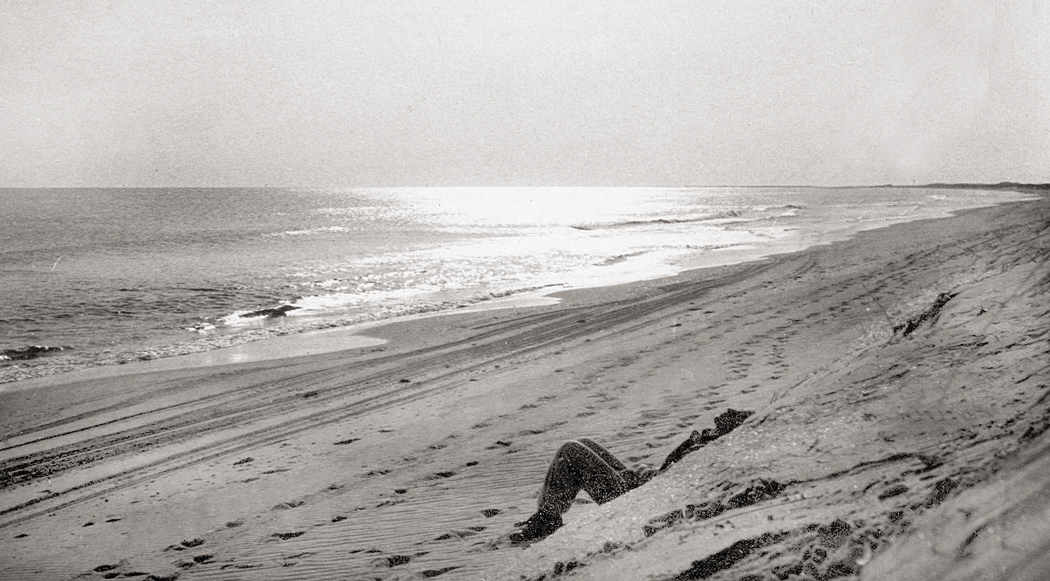
Fifty years ago, my friend Sandro and I would annually take this time to camp at the Outer Banks. Off-season meant we had the sand and sea to ourselves and could walk five miles along the strand without ever meeting another human.
Sandro at Cape Hatteras, 1969
It was also Mud Season. You don’t read about it in literature, with its darling spring buds, its gold first green and its young sun half-run in the ram’s course. But there it is — early winter rains drained deep into soil and then turned hard as rock in the frozen air. November’s squishy footprint is turned to fossil, brittle as any sandstone, its edges wedged up in a tiny crater. But the February thaw, or later, when March brings those buds to stretch their scales, those footprints turn once more to watery goo, slippery under your shoe, sucking your heel right off your foot. It is what is wrong with pretty literature. Among all the pinking petals, among all the bright girls in spring dresses, among all the apple blossoms and greening grass to come, there is the mud, ripe, fertile, pliable in your squeezing fist, the one brown, crowning reality of the the coming spring, when there is mud again.
It is such elemental things that seem most real, most important. Culture changes, fashions change, but the cycle of seasons wears a constancy.
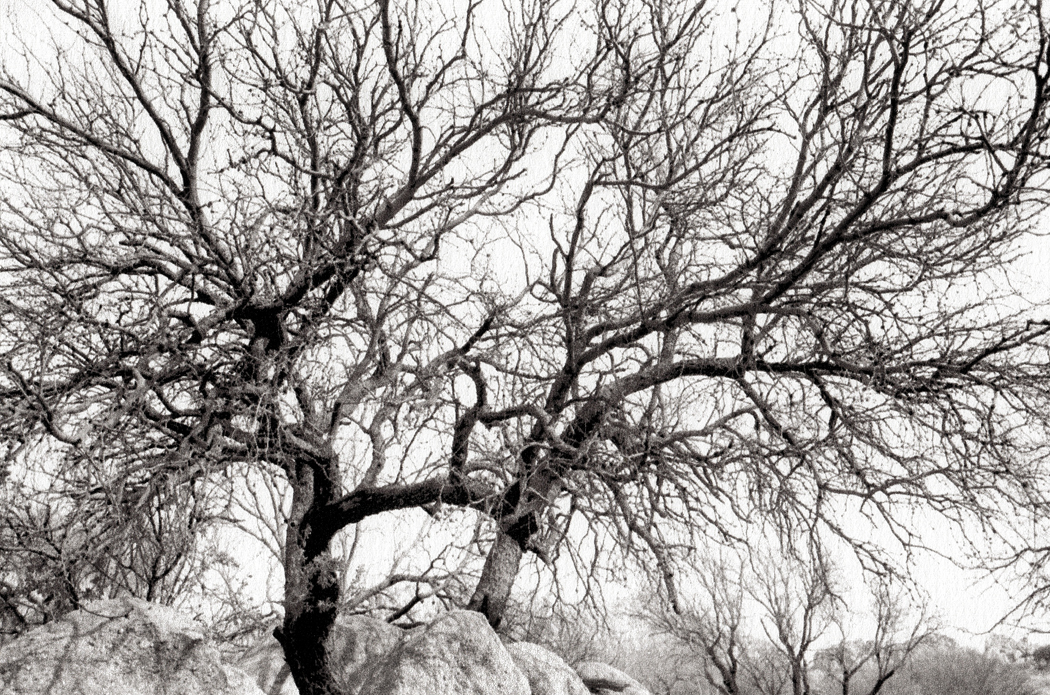
Texas Canyon, southern Arizona
For me, it is the trees, most of all. I love the spring trees well enough, but it is this time of year, when the trees are still bare and show their bones that I wait for each fall. Drop the leaves ecdysiastically and I can see the shape of the thing they cover.
Spring oak, Blue Ridge
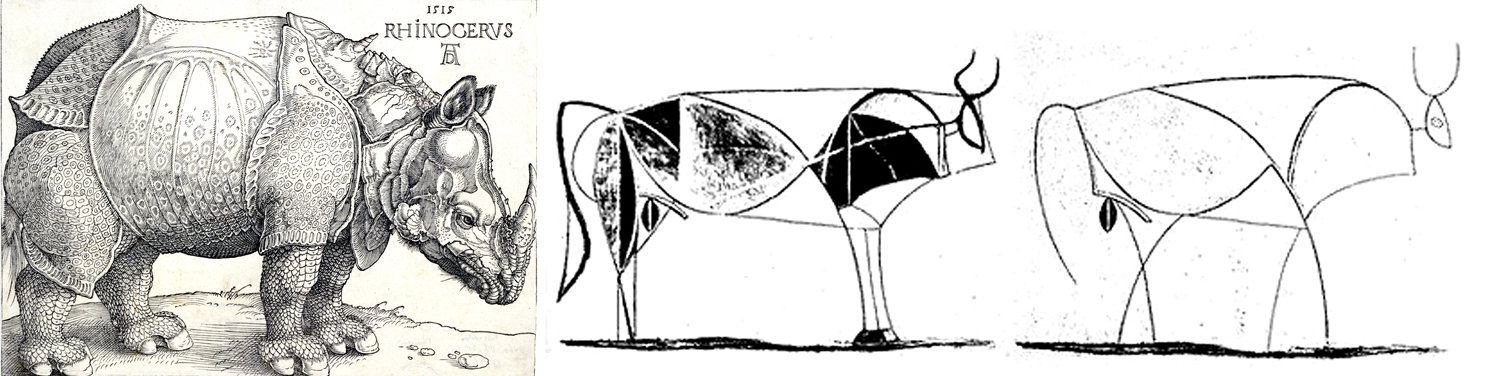
It is the lines they make against the sky. An etching more than a painting. Artists through history are generally assigned to one of two categories — they are either line people or color people. Line painters, like Botticelli, tend to draw their scenes, often in actual outlines, and then fill in the colors, while color guys, like Titian daub pigment onto the canvas and let the patterns of color define shapes. It’s one of the major distinctions made by Heinrich Wölfflin in his 1915 book, Principles of Art History. It doesn’t mean the line guy doesn’t appreciate color or the color guy doesn’t appreciate shapes and forms, but rather it defines what hits them first and most centrally.
(There is a similar distinction in music. Composers — and performers, too — tend to be line guys or chord guys. Lots of counterpoint for the first, and washes of tonal color for the latter. Bach vs. Debussy.)
Albrecht Dürer rhino; Pablo Picasso bull
Albrecht Dürer was a line guy, most characteristically in his wood engravings. Picasso was a line guy and certainly an indifferent colorist. Most of his paintings could easily be given different fill-in colors. Matisse, though, a color guy to his teeth. Even more recent painters can be divided. Ellsworth Kelly a color guy; Lucian Freud a line guy.
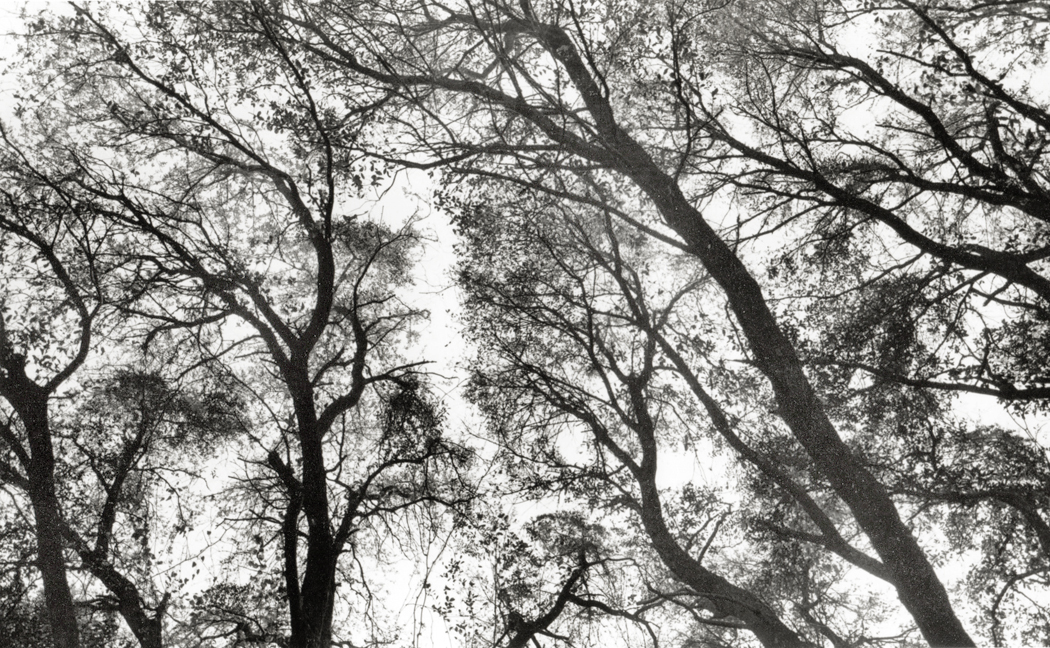
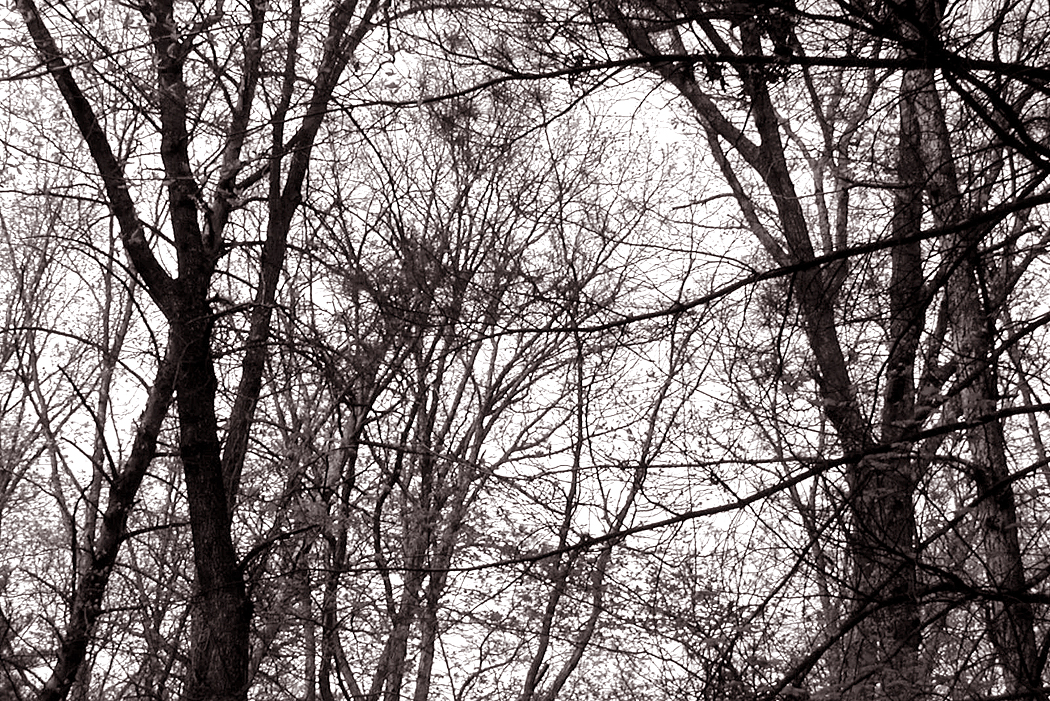
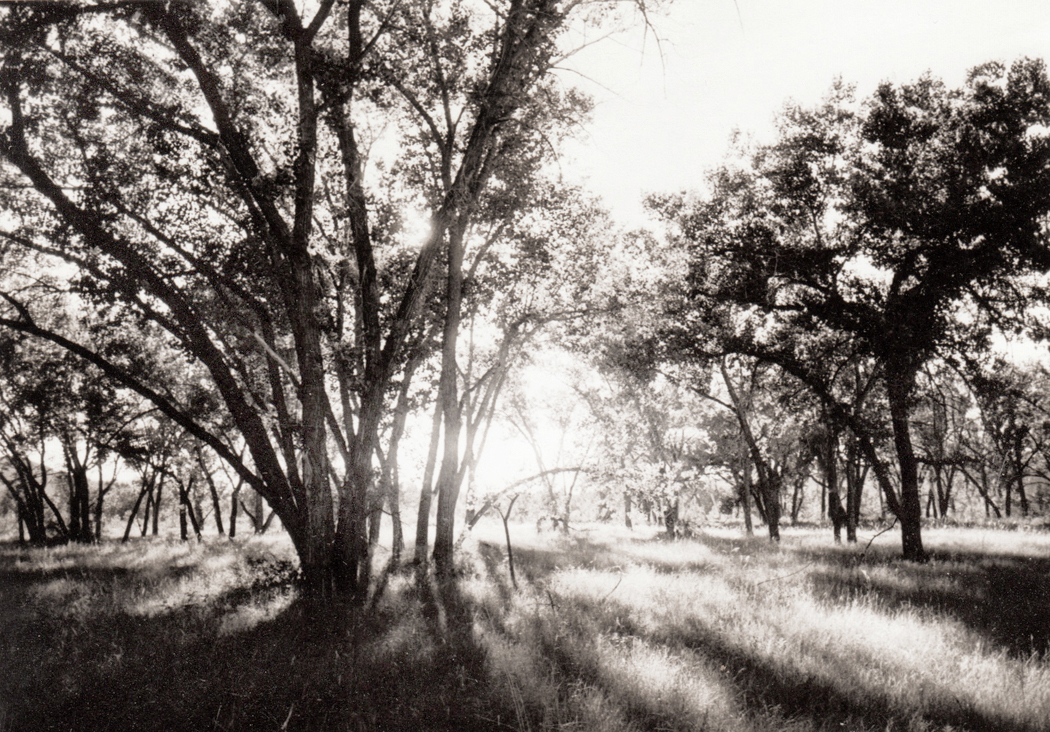
Well, I’ve always been a line guy. And the lines drawn by winter trees have hypnotized me since I was a wee bairn. One whole category of my photographs are what I called my “tree nudes.”
The nude has a specific purpose (outside the merely voyeuristic). Clothes drop their subjects into a very particular time and place. Eighteenth century breeches; flapper skirts; bell-bottom trousers; togas; saris; morning coats with a peeking handkerchief in the breast pocket.
But the nude is — or can be — timeless (with the caveat that hairdos can be a giveaway). There is a universality to the nude in art, which is why so many Greek statues are naked. And we are meant to appreciate the form — shape, detail, muscularity — and not just a specific person with a name, family, opinions, and personality.
And I feel the same thing in the bare ruined quiers, where late the sweet birds sang. There is structure in the dark lines of the branches, and a systematic chaos in the way they all cross each other in a welter of visual information.
In this, I am reminded of the drip paintings of Jackson Pollock, which I came to love in the New York art museums I visited beginning as a teenager. A good nature-scribble of branches puts a buzz in my visual brain. I love it and have sought it for the past 60 years. Among the first photographs I ever made, 60 years ago with an ancient 35mm Praktica camera were of trees.
Of course, while trees are beautiful, they can become an obsession. If I had chosen to make a career out of photography instead of writing, the trees pictures would have dwindled. As Fred Astaire says in the film Funny Face, “You’d be amazed how small the demand is for pictures of trees.”
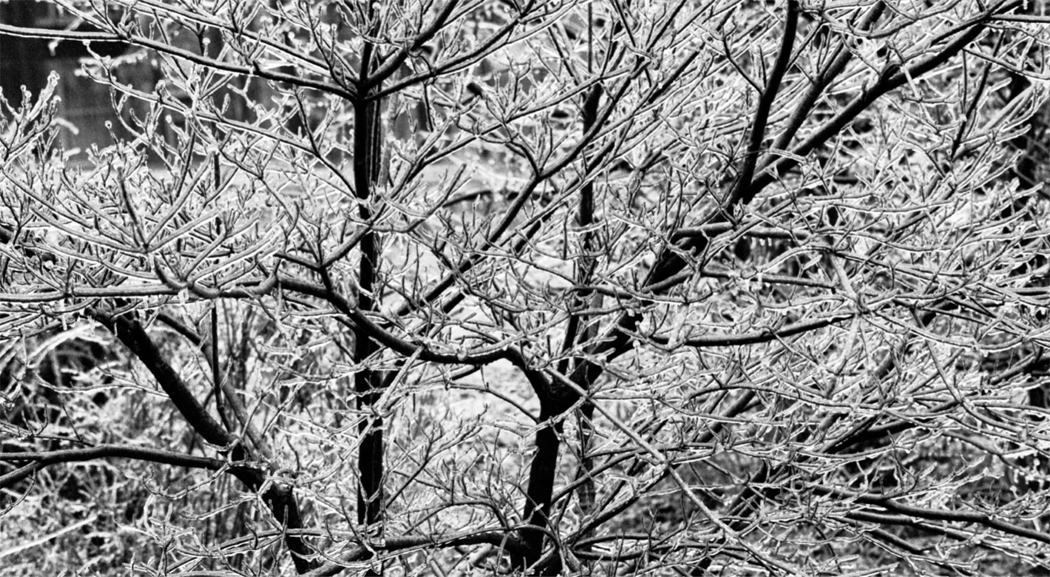
But I have followed trees through seasons
Ice storm, Greensboro, NC, 1969
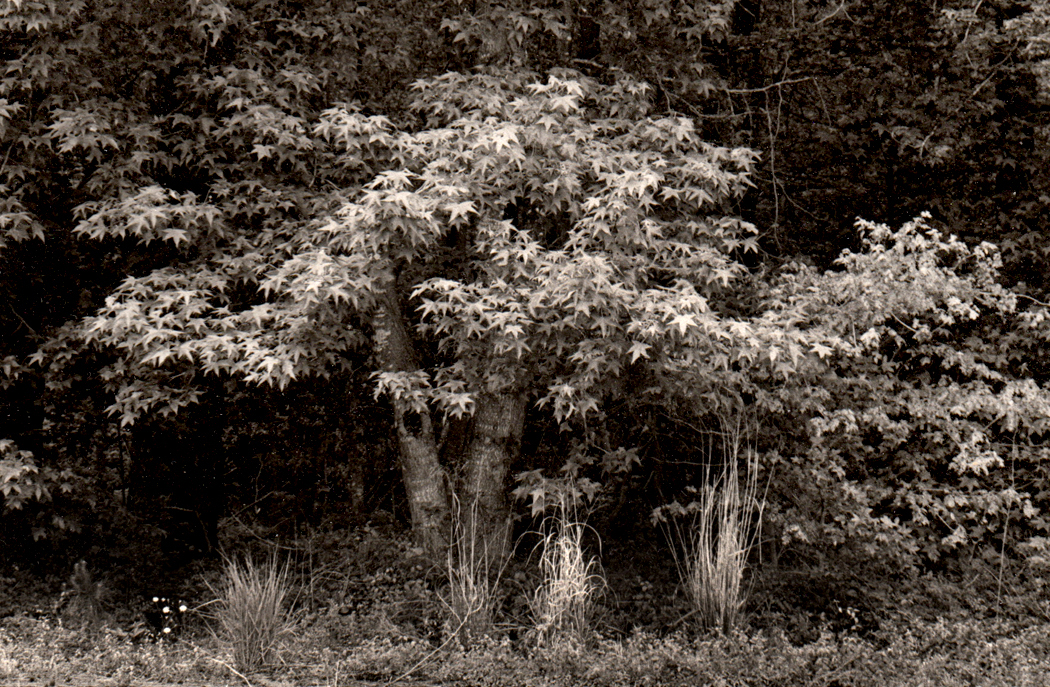
and all their leafy-ness
Sweetgum tree, Redwing Golf Course, Virginia Beach, Va., 1984
I have sought the best image of the jumble of buds, twigs, branches, trunks and bark that I feel as a signal for my emotions.
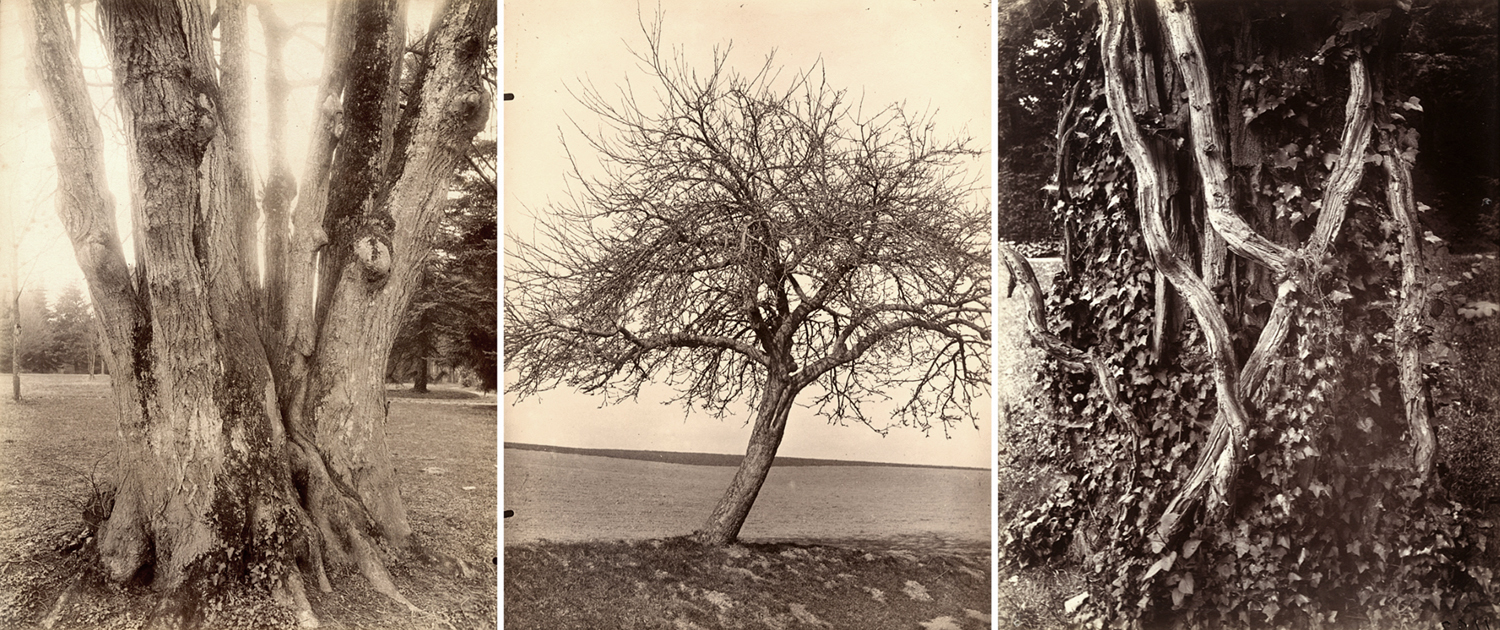
One of the first shows at the Museum of Modern Art that made a deep impression on me was in the summer of 1972, when they put together a group of 50 photographs of Paris trees by Eugene Atget (1857-1927).
Lined up on the wall in a darkened space, with brilliant track lighting that made each photograph gleam like a jewel, the photographs made my heart jump and my eyes smile. Most of the trees were winter trees, with wiry roots dug into the ground, and ancient boughs twisted and weighed down with age. They were ungodly beautiful, but also, in Minor White’s expression, it wasn’t just what they were, but what else they were.
Three tree photographs by Atget
The way they were lit, the gnarled forms they took, their texture and even the gold-toned sepia surface of the silver images all functioned as metaphor. They evoked emotion the way art can.
Usually, when most people see a picture, in a magazine or newspaper for instance, the image is just a kind of shorthand for language. You see a picture of a house or car and instantly the words “house” or “car” spring to mind. The journalistic photograph is a kind of pictogram or hieroglyph, like the stick figures on the doors of public restrooms.
But images can also do more than that: When you abjure the naming phase and feel the color, line, shape, form and also the cultural resonance of an image, they evoke thoughts and emotions beyond the named subject.
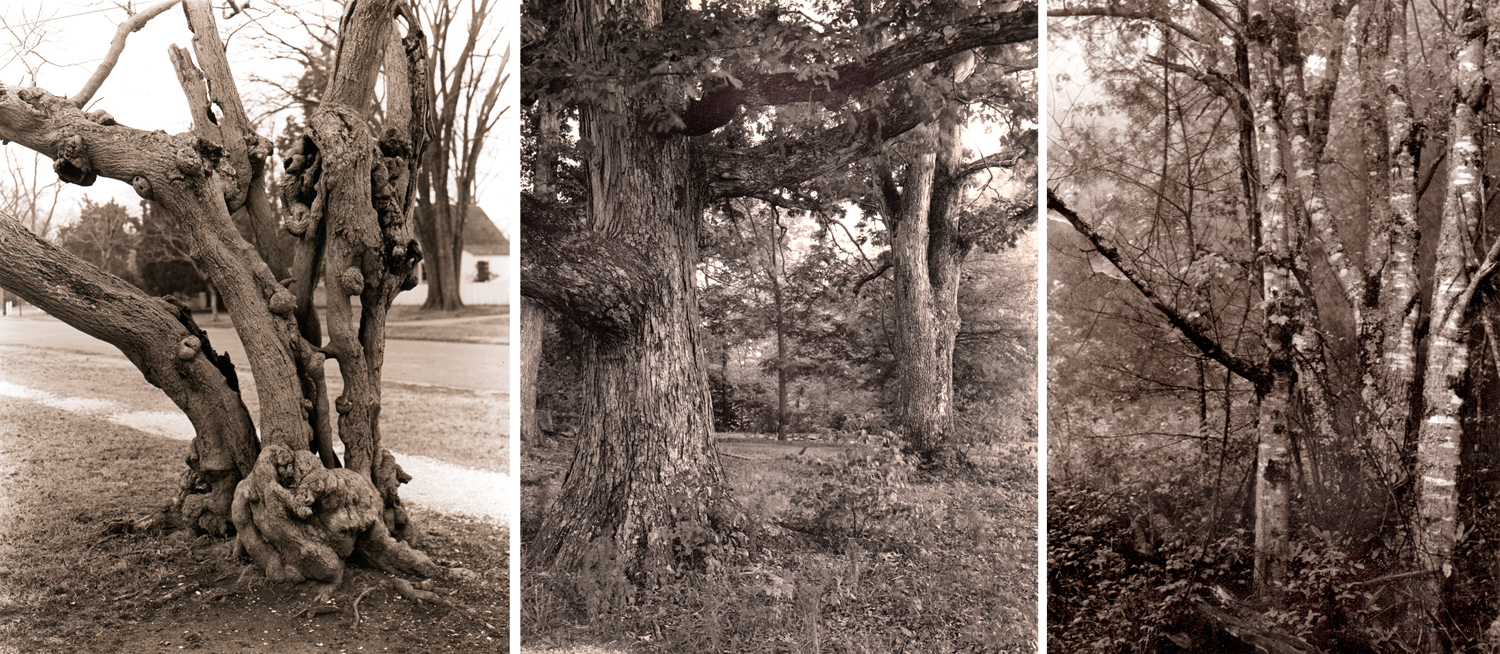
My imitations of Atget
And it was that that blew into my brain, seeing the Atget trees.
And that is something I have been hunting all of my creative life. And attempting to find in my own photographs of trees. Or not just trees, but in all the photos I’ve tried, whether landscape or still life or nude or portrait or abstract. — What else it is.
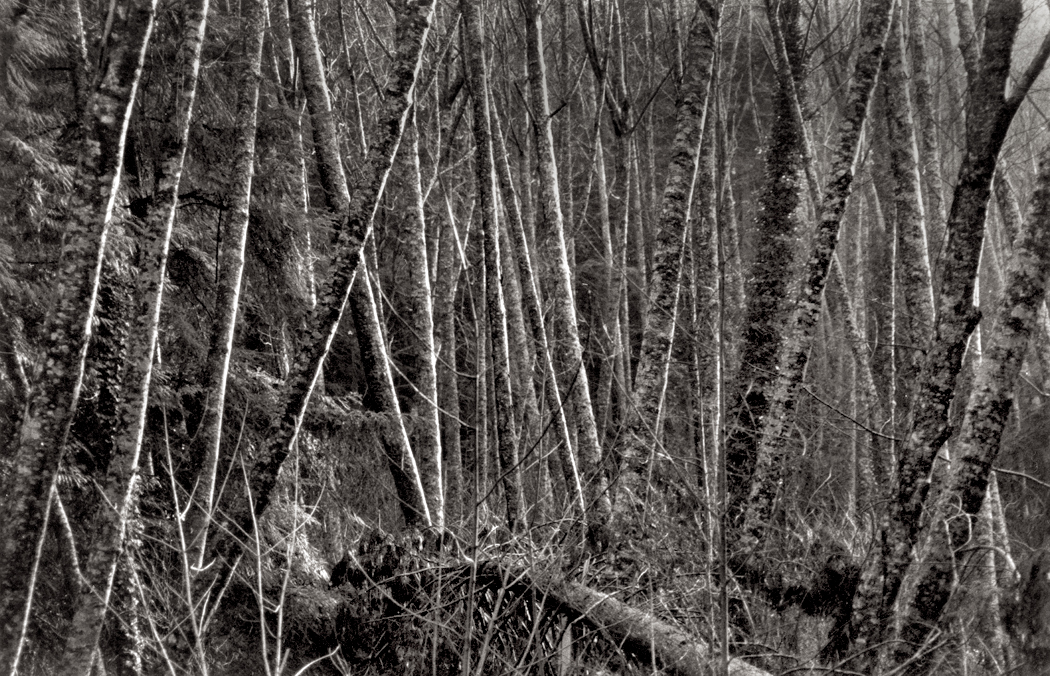
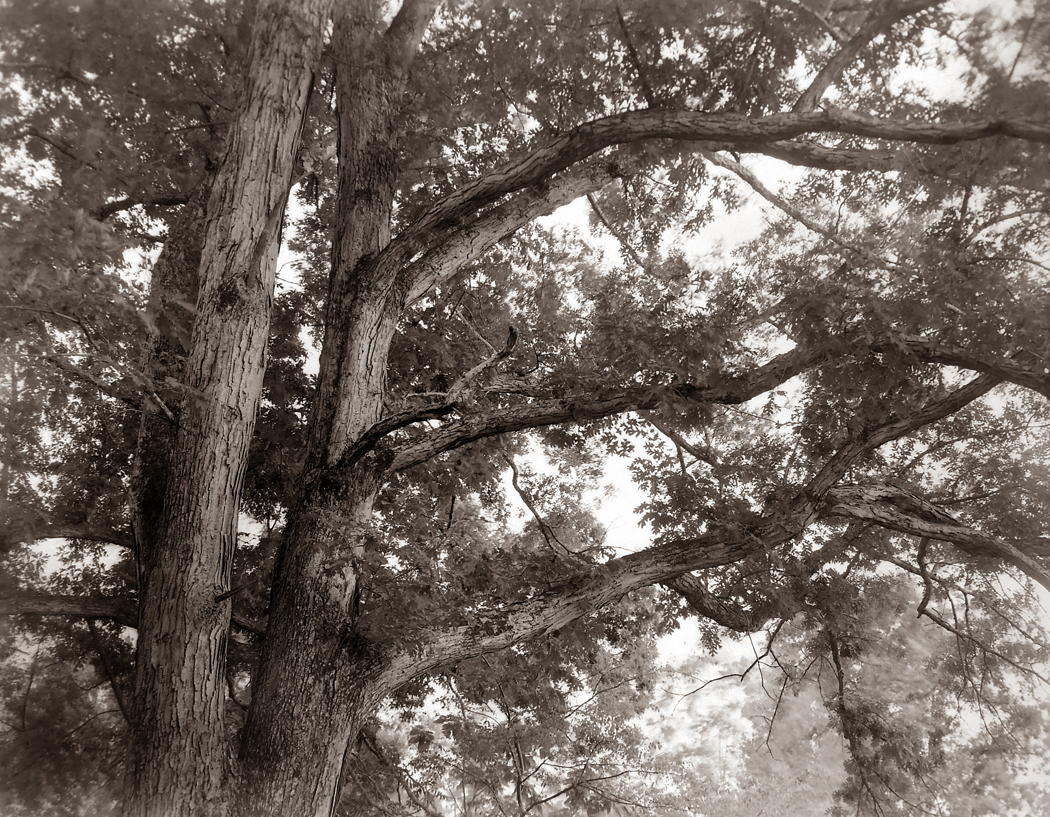
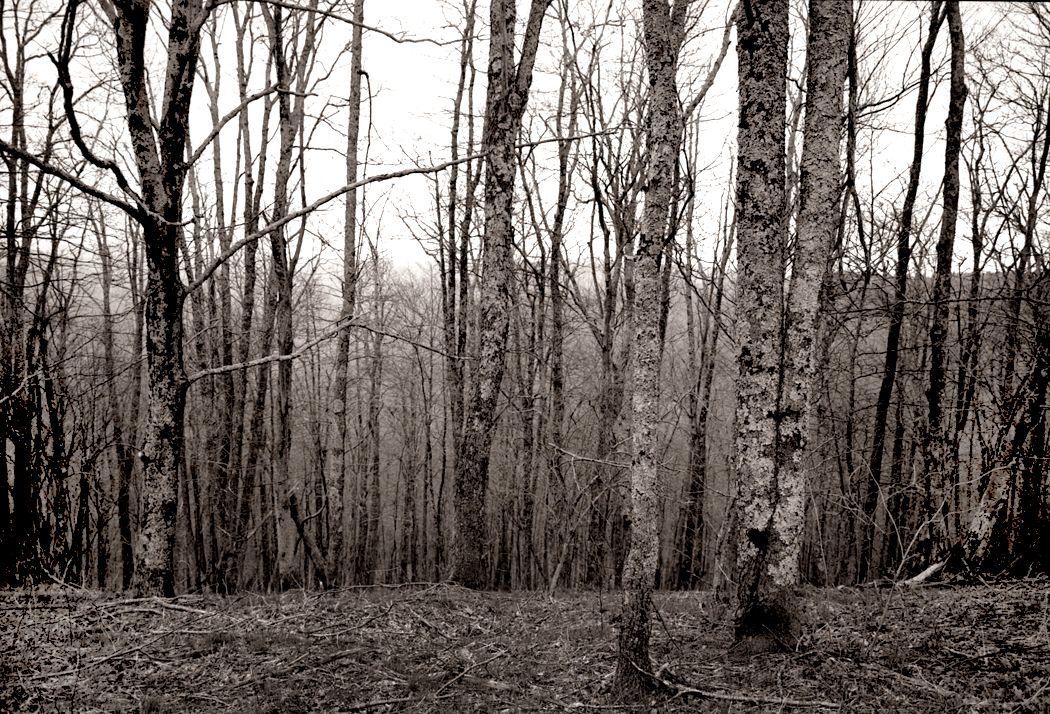
So, when I sit on my back patio and look up the hill at those mid-winter spring trees, with their augury of renewal, and their complex shapes and overlaps — those wonderful lines drawn against the sky’s paper — I want to catch something as it flickers by.
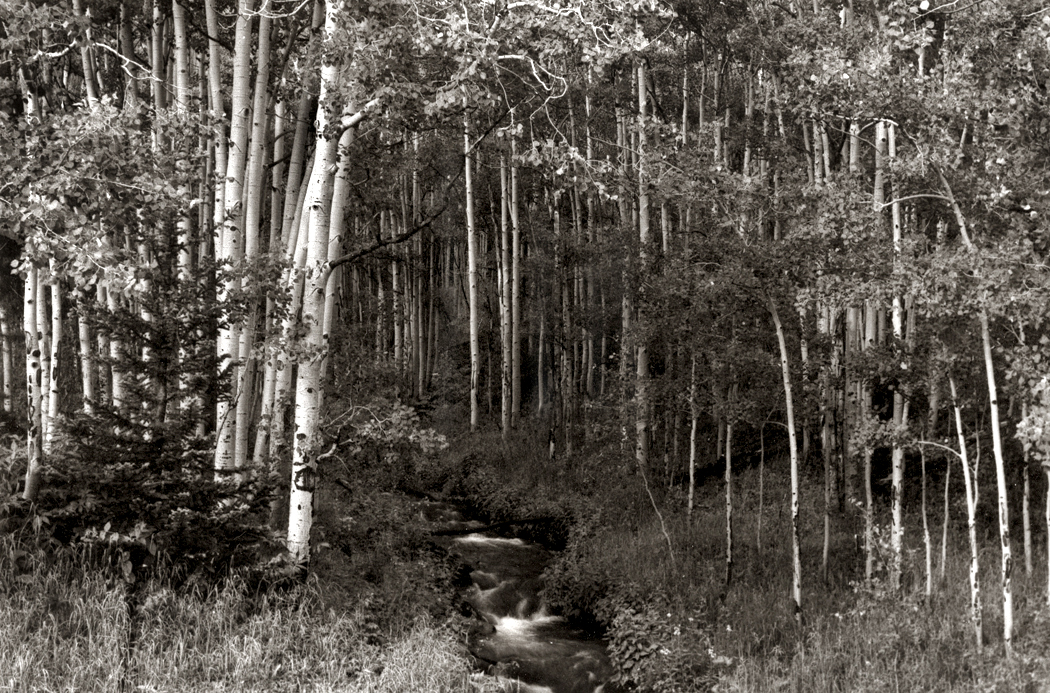
Aspens, Colorado
I’ve snapped a lot of them, although I’ve caught few. Many don’t have the magic and just sit there as noble attempts. It hasn’t just been bare trees. I’ve tried to find the emotion in all kinds of them.
Morning, Obids, NC, Blue Ridge Mountains
The photographer Alfred Stieglitz called the equation between the subject of a picture and the emotions that are evoked “equivalents.” It’s part of the constant fight between the simple depiction of something you can name, and the attempt to make the image stand on its own as an esthetic entity.
It’s what most visual art tries to do: create an equivalent in the limbic system to the shapes, colors, lines, and even the subject matter and its resonance with the personal.
Bainbridge Island, Puget Sound, 1979
Most glossy travel photos are meant to make you wish to be there. But with the image made for display, or as art, you are there, in front of the thing itself. You don’t have to make travel plans. Not just pretty pictures, but objects of contemplation.
Sandro’s oaks, Summerfield, NC, 1980
The point is twofold. First, to make you pay attention to the world around you, to see with intention. And second, to allow you to connect with the emotions you have in potential.
Wise, Va.
Both together they make a single bond: interior and external; you and the world; individual and cosmos. No longer separate.
Over the years, the images I make have become less public and more personal. I no longer pay much heed to the wide acceptance of the art I make. I don’t make it for others, but as a kind of personal meditation.
I seek new ways of making this happen. One morning, while visiting my brother- and sister-in-law in Reidsville, N.C., I saw the shadows of winter branches projected onto the window blinds. It made for a kind of Japanese byōbu screen.
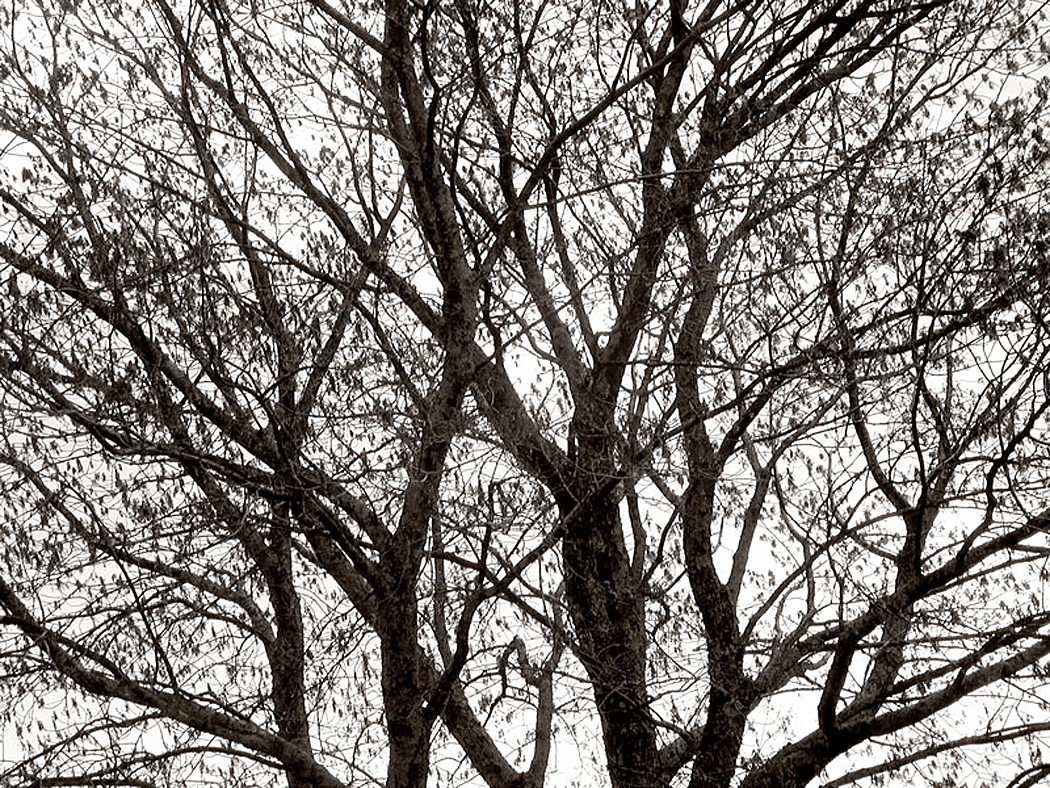
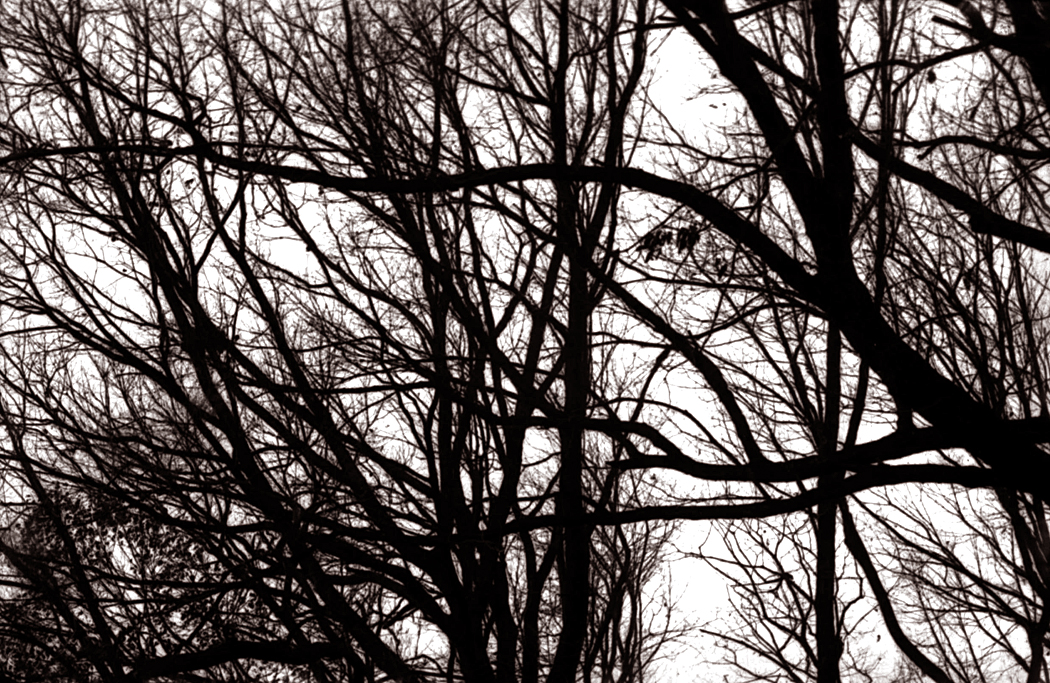
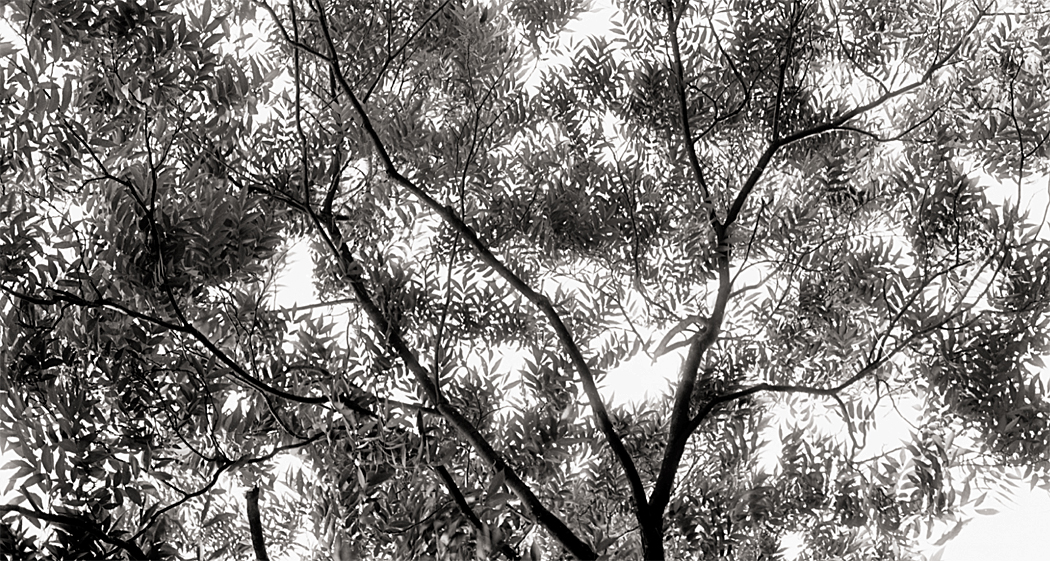
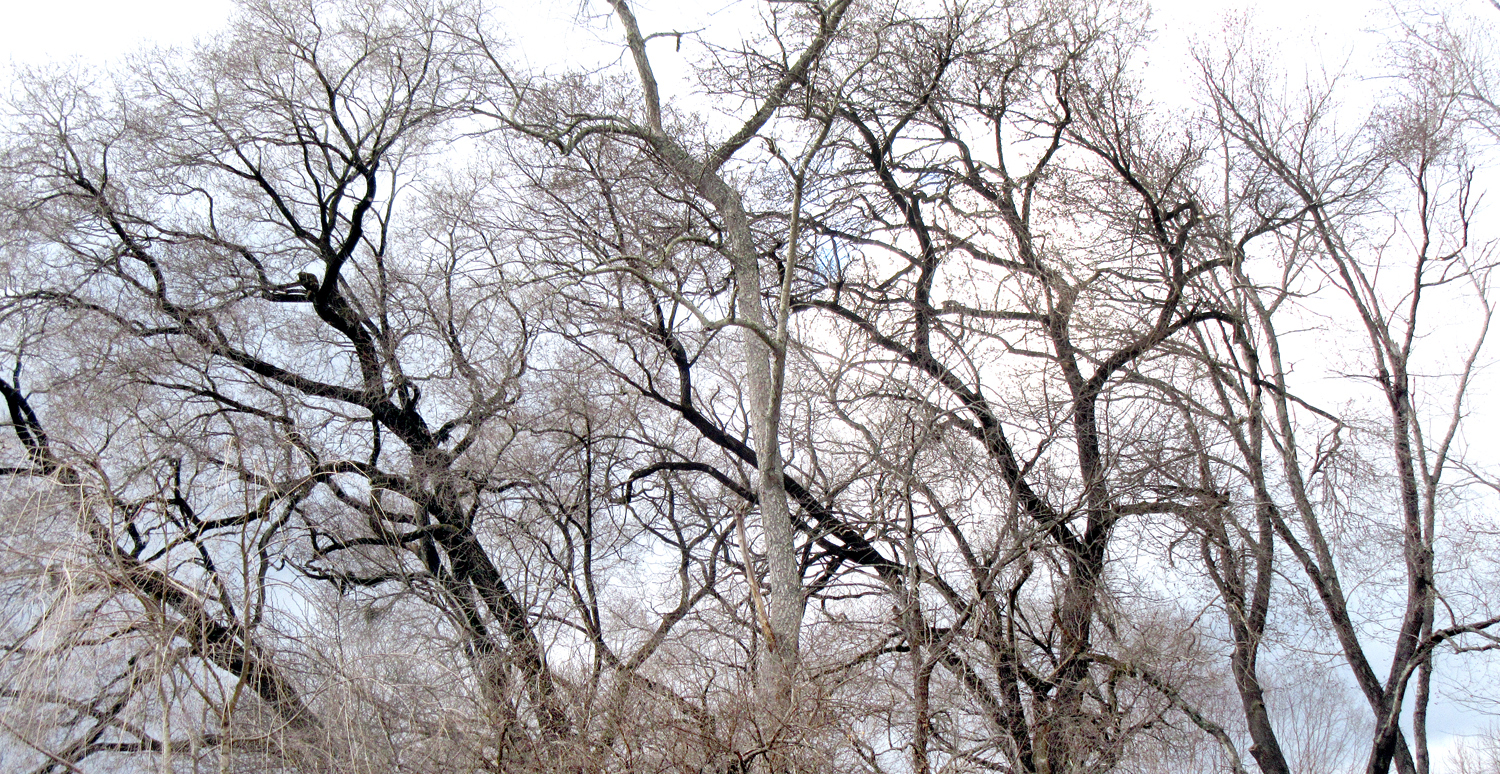
And then, one day last week, in midwinter spring, sempiternally recurring, I was sitting out back, listening to birds and airplanes, the dogs down the street and watching the clouds move west to east and the branches waving in the moving air, and I managed to make an image that finally captures for me the complexity of the abstract, neuronal jumble, all the connections, the scribble and the energy. It is small on your computer screen, but it should be large as a mural.
If I could, I would print it out mural size to cover a wall. Or split it up over several vertical panels, like a Japanese byōbu screen.
But I no longer have means to do that, and so, I just look at it and contemplate.
It is the provisional answer to a question in the best TV series ever made. At least on my list.
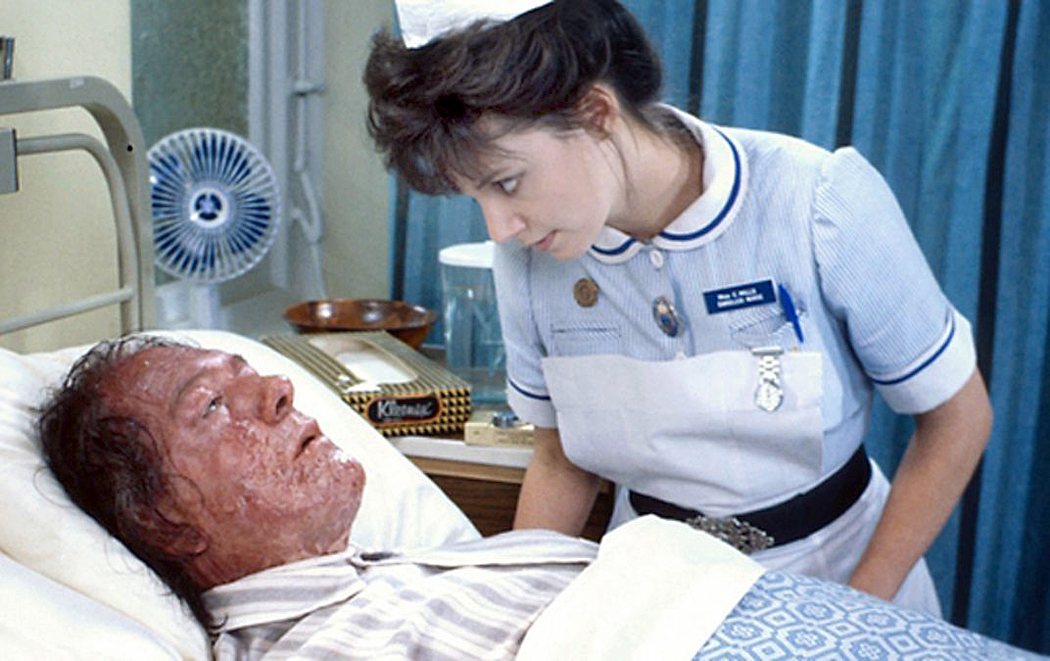
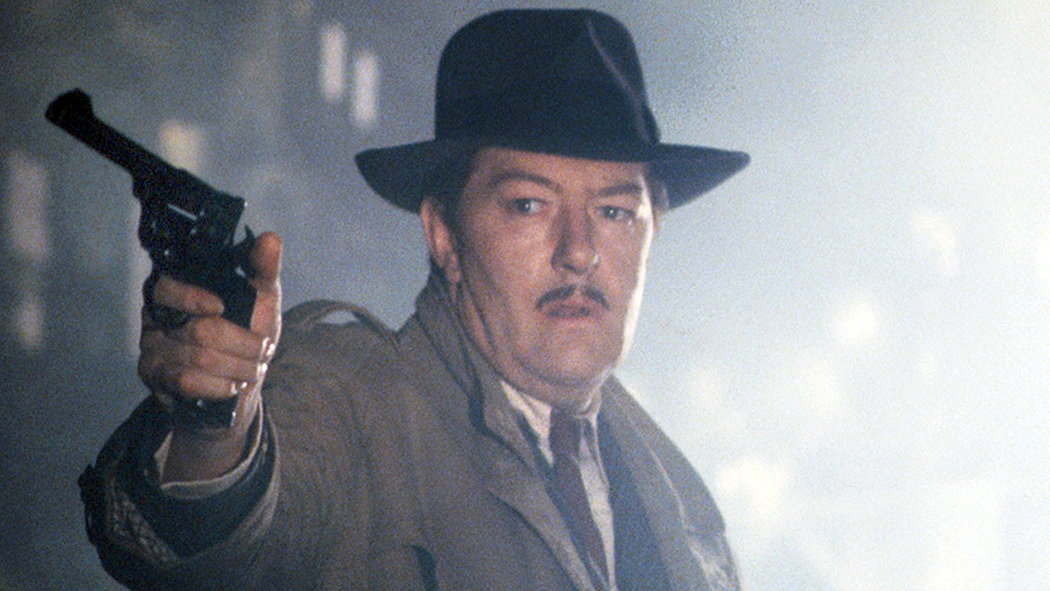
The question? “What’s the loveliest word in the English language? In the sound it makes in the mouth? In the shape it makes on the page?” It is the kind of question a writer thinks about, but not so much a civilian. It is the hospitalized crime writer Philip Marlow in Dennis Potter’s 1986 BBC serial, The Singing Detective. “E-L-B-O-W,” comes the answer. Pronounced in the euphonious baritone of Michael Gambon as he talks to his Nurse Mills, played by the young Joanne Whalley.
I had avoided watching the series when it was first broadcast in the U.S. on PBS in 1988 because I thought the title meant it was an airy musical, perhaps in the Doris Day mode. I couldn’t have been more wrong. It is dark and gritty and brilliant. And it is No. 1 on my list of greatest television series.
Of course, any such list, whether Top 10 or “100 Greatest…” are ultimately meaningless and catalog simply one person’s taste. Your mileage may vary. But I’m pretty secure in my choices, with the proviso that although I am 78 years old and was born roughly the same time as television, I haven’t seen everything ever aired, not even all that was broadcast in this country. No one has.
There are a number of popular and well-thought of series I have never seen. Game of Thrones — I am bored by quasi-Medieval post-apocalyptic fantasy. Lonesome Dove — I love Robert Duvall, but mostly gave up cowboys after Hopalong Cassidy retired from the 12-inch black-and-white screen. The Wire — I should probably watch it, but it sounds unrelentingly grim.
But of the things I have watched, here are my top five series of all time. There are some qualifying parameters. I’m not talking about long-running TV series, or notable sitcoms or dramas. So, I’m not including All in the Family or Seinfeld. There are plenty of those, and they would qualify for a different list. I’m talking about limited series presentations, usually with a direct beginning, middle and end, like mini-series or one-offs.
And my taste runs to character-driven shows rather than plot-centered ones. Very few gunfights or car chases and a lot of talking and psychologies. I have nothing against one-liners or action thrillers; they have their place. But I am more taken with more complex stories, something more akin to art than simply entertainment.
And so, here are my top five TV shows of all time, and can all, in their way, be talked about as sharing some of the depth and insight of, say, Shakespeare or Tolstoy.
The Singing Detective (1986) — The six roughly hour-long episodes follow an English pulp fiction writer suffering in a hospital ward from psoriatic arthropathy, who tries to fight his boredom and maintain his sanity by mentally rewriting one of his books — about a private-eye who moonlights as a dance-hall singer — but increasingly hallucinates about a traumatic episode from his childhood during World War II, the suicide of his mother, and a foul deed he committed in school. The episodes become increasingly confused and mixed, punctuated by popular songs from the 1930s and ’40s. The whole is a phantasmagoria of paranoia with some of the most brilliant writing ever put to screenplay.
“Mr Marlow, you can’t deny I’m paying you good money…” “Money. You’re paying me money. Why put ‘good’ in front of it? Who knows its virtue? I don’t know where it’s been. Do you?”
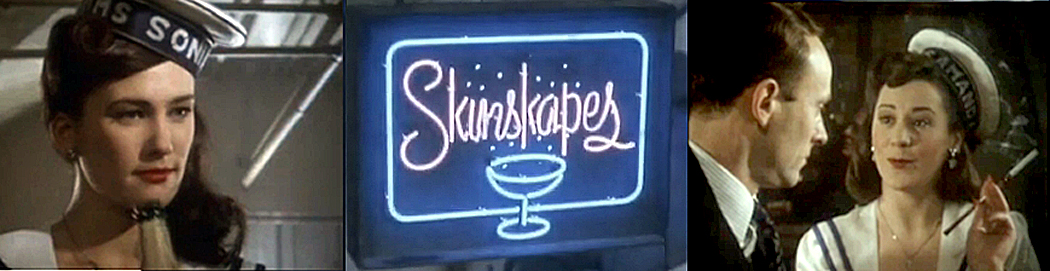
The mystery he is imagining concerns smuggled Nazis, Russian spies, and ladies of commercial morality, all played out in a cheap dive called Skinskapes. The writer’s West Country childhood, with the deep accents and vocabulary of the region, concerns his love for his father and the infidelity of his mother, which he witnesses. Then, there is the interaction he has with his doctors, nurses, and fellow ward patients and most notable with his psychiatrist who tries to fathom the roots of the writer’s hysteria. And then, there is his estranged wife, who visits him in the ward and whom he abuses most horribly. All Osterized into a grand, almost operatic imbroglio, rising to a peak and resolution in the final episode.
The cast is a who’s who of all the actors you will find in later British classic TV shows, such as Midsomer Murders or Downton Abbey. We get to see them younger, before they aged: Patrick Malahide, David Ryall, Gerard Horan, Ron Cook, Janet Suzman, Alison Steadman, Bill Paterson, and, of course, Jim Carter and Imelda Staunton. These are names well known to anyone streaming British TV on Britbox or Acorn or PBS Masterpiece.
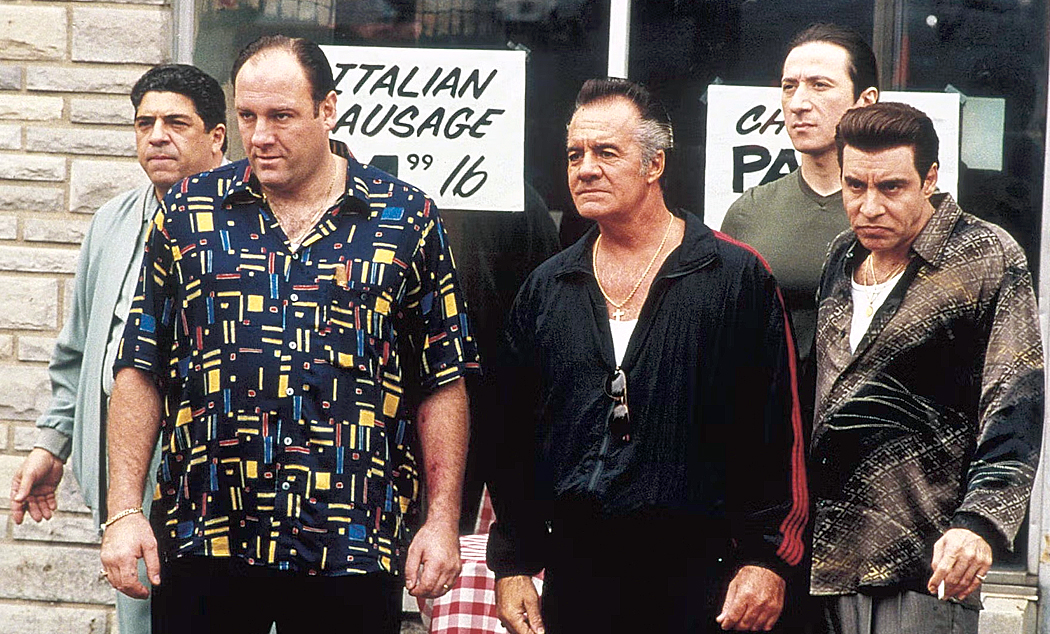
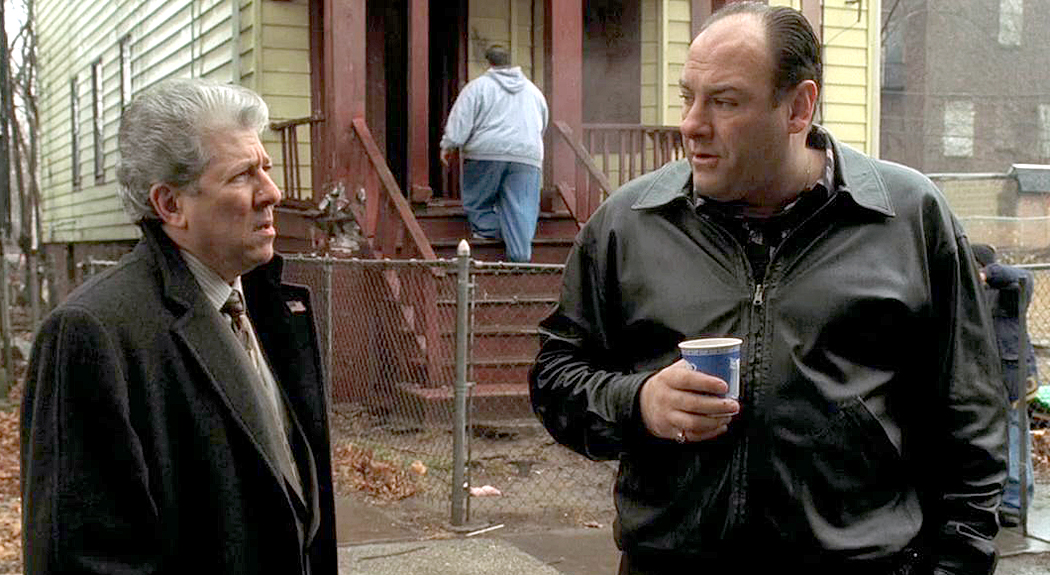
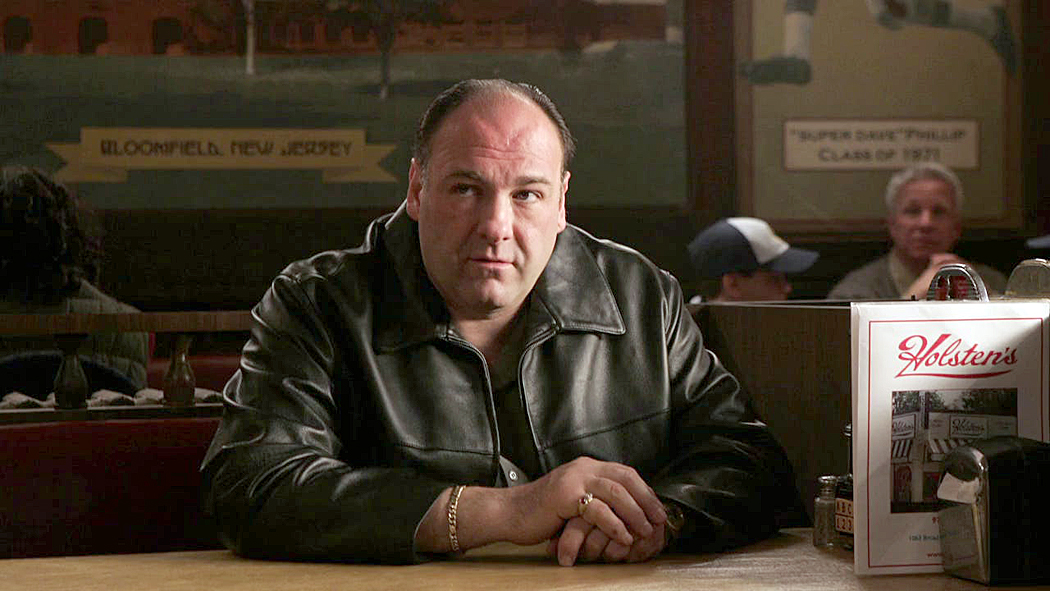
The Sopranos (1999-2007) — Over six seasons and 86 episodes on HBO, we followed Mob boss Tony Soprano and his two families — domestic and crime — as they turned obscure New Jersey into a nationally familiar landscape. Hooray for Hoboken.
It is primarily the first two seasons that were memorable, changing American TV viewing habits permanently, and launching a new “Golden Age” of television. Over the quarter-century since its debut, streaming has taken over from network television and made CBS, ABC and NBC into also-rans.
It took great acting and great writing to do this, and we followed Tony as he suffered panic attacks over some ducks in his swimming pool, challenges to his leadership in the mob, various betrayals, both by him and against him, and, most importantly in the first two seasons, the absolutely awful behavior of his mother, Livia (Nancy Marchand), who Rolling Stone magazine named as the “Third Greatest TV Villain of All Time.” I assume she is beaten only by Iago and Satan.
After Marchand’s death in 2000, the show didn’t exactly go downhill, but it never again had the norm-smashing impact it had at the beginning. It was still riveting, but less revolutionary.
Two of its best episodes came in those first two seasons. “College,” in which Tony takes his daughter, Meadow, to college and discovers a mob informant living under witness protection and proceeds to garrote him in the most realistic-feeling depiction of strangulation I’ve ever seen in a film or on TV. It took a long, agonizing time to accomplish and viewers felt every second of it. And, on the other side of the spectrum, “Pine Barrens,” in which Paulie Walnuts and Christopher Moltisanti attempt to dispose of a Russian gangster in snowy South Jersey and get lost in the process. Both episodes are listed in Wikipedia as among the 30 best television episodes ever.
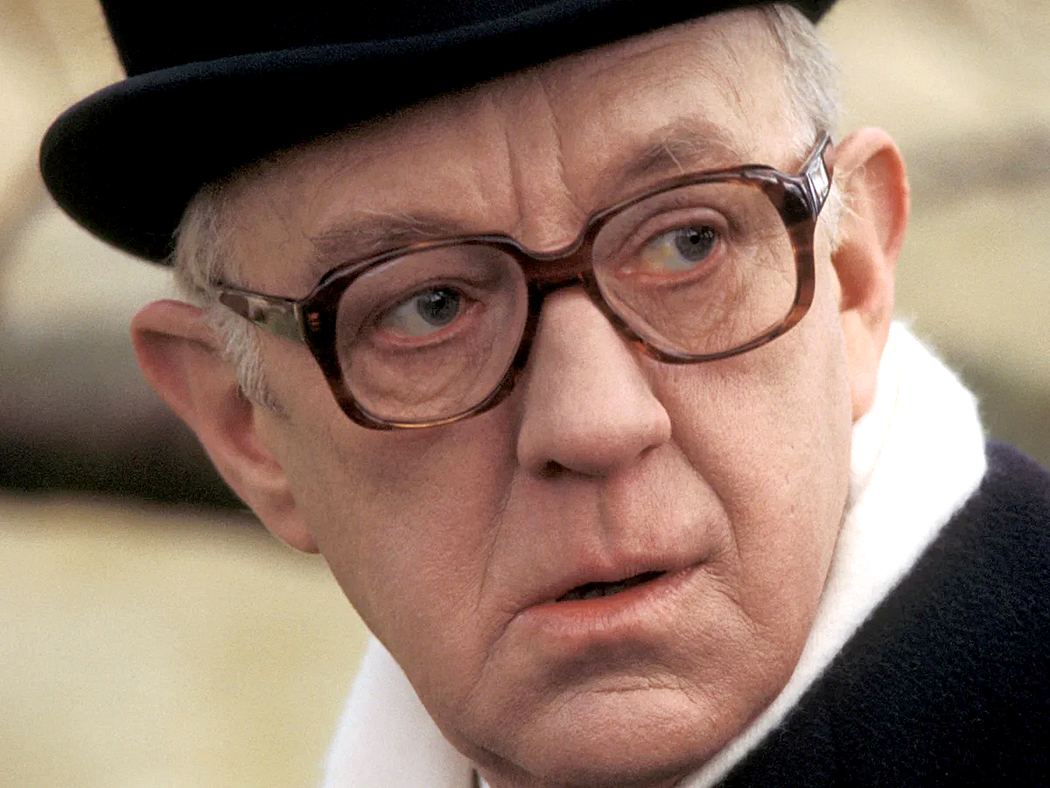
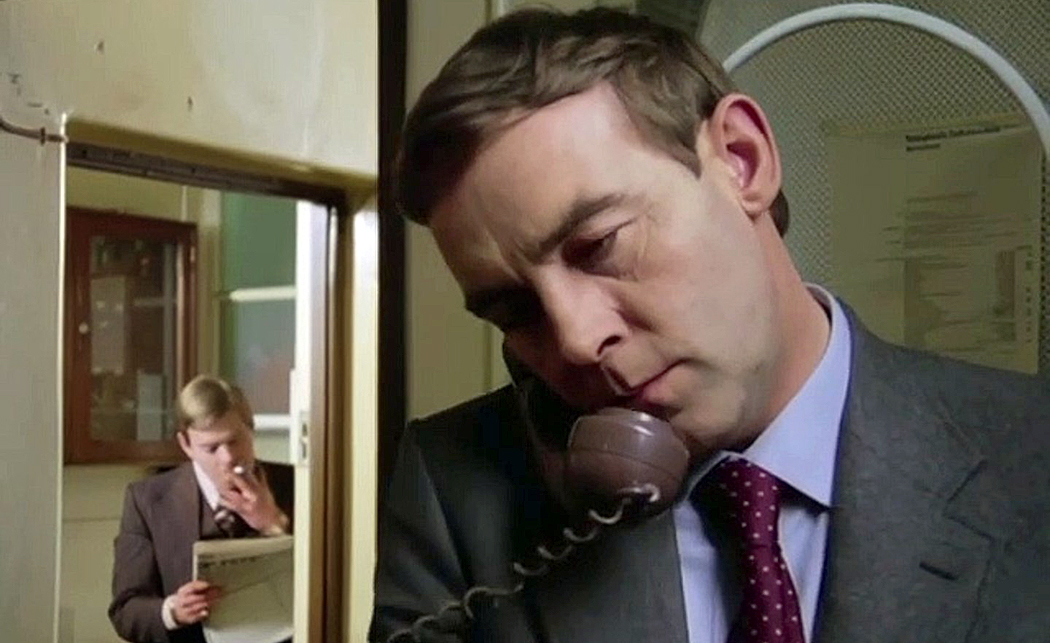
Tinker Tailor Soldier Spy (1979) — This is all down to Alec Guinness, who defines the role of British spy George Smiley so microscopically that no matter what great actor attempts the part — and Gary Oldman is not chopped liver in the 2011 movie version — it can never be topped or even equalled. Guinness can “say more with a slight parting of his lips than most actors can say while shouting from the rafters,” wrote The New York Times.
The seven-episode adaptation of le Carré’s 1974 novel did away with all the hokey James Bond razzmatazz and gave us slow, believable procedure as Smiley sniffs out a traitor in the British secret service. Le Carré made up all the slang and the spycraft, but made us believe everything must really work this way in the real MI6.
The story proceeds slowly and carefully, and the dramatis personae comprise some of the best and best-known British actors of the time, including Ian Richardson (House of Cards); Patrick Stewart (Star Trek: The Next Generation); Sian Phillips (I, Claudius); Michael Jayston (Nicholas and Alexandra); Michael Aldridge (Last of the Summer Wine); Warren Clarke (A Clockwork Orange); and other stalwarts of U.K. films and television, Bernard Hepton; Ian Bannen, Joss Ackland; John Standing; Anthony Bate and others. It’s a joy to watch them all doing what they do best.
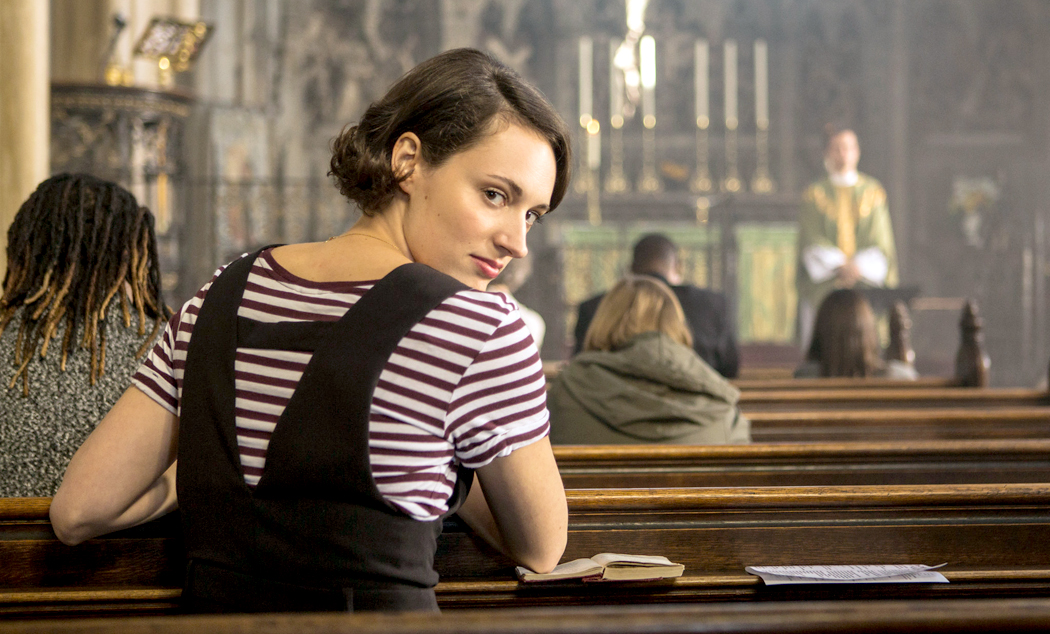
Fleabag (2016-2019) — It isn’t just the Golden Oldies that count. More recently Phoebe Waller-Bridge’s extension of her one-woman stage show became nominated as one of the best TV presentations ever. It is comic, nasty, witty, intensely observant and a punch in the eye of Postmodern meta brilliance.
Her character, never named except as “Fleabag,” clumsily negotiates family, sex, relationships, and grief in ways embarrassingly both egocentric and clueless. And all the while speaking to us, the audience, in private asides — direct progeny of George Burns talking out of the TV at us in his 1950s sitcom.
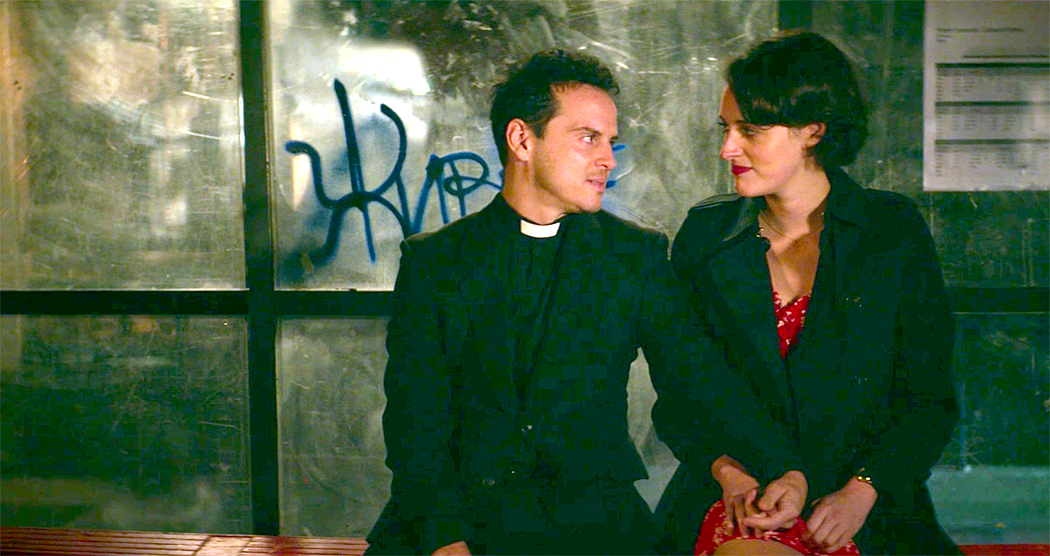
Its second season may even be better than the first, when she develops a crush on the Sexy Priest (Andrew Scott). In that season’s Episode 3, the priest notices — for the first time anyone in the whole series has done so — that Fleabag is zoning out and talking to the camera, which is a way she has of disengaging from awkward situations. This disruption in the normal contract of fiction between the reality of the story and the reality of the story-telling is a shivering moment, and leads to the resolution of the entire series.
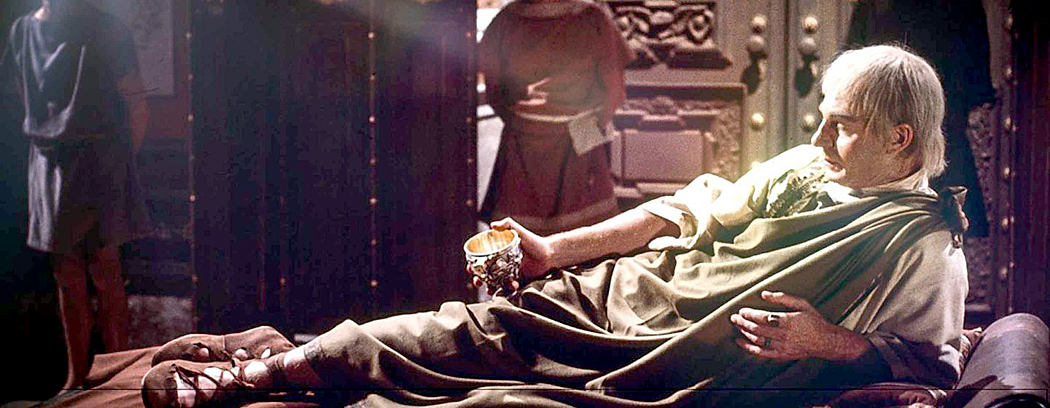
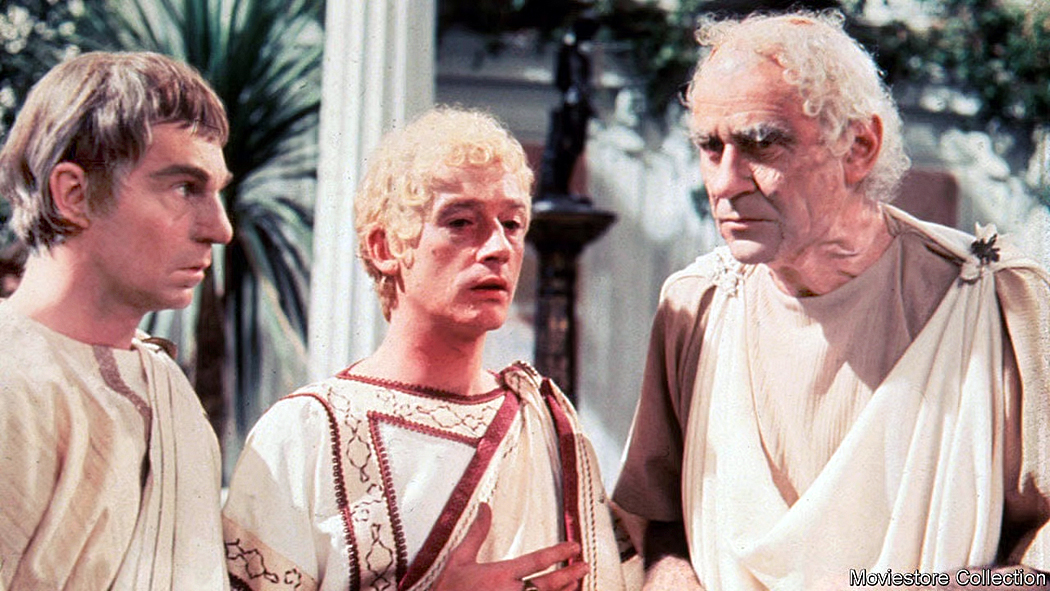
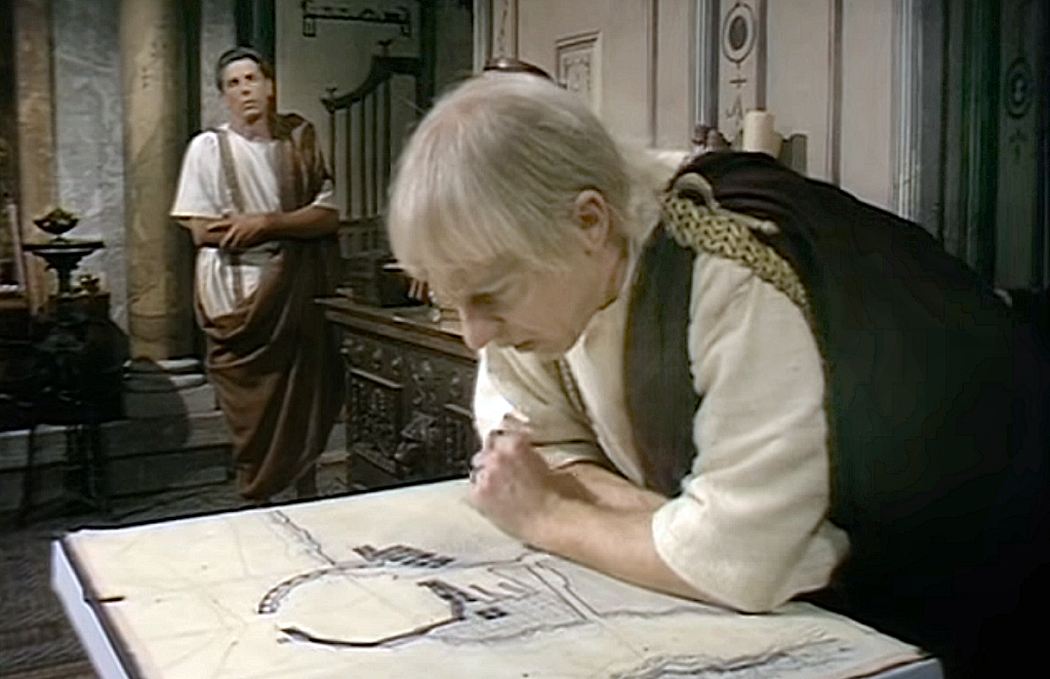
I, Claudius (1976) — I hesitated in picking No. 5 for my list, because there are other legitimate contenders (see below) for the spot. But finally, I have to pick the BBC adaptation of Robert Graves’ two novels about the first four emperors of the Roman Empire (five if you count the foreshadowing of Nero).
It suffers from the early videotape technology, which required a bland sort of lighting. But it compensates by its psychological complexity, great acting and something not normally noticed — great directing.
There is a YouTube video by the name of Moviewise that offers a careful examination of the combined blocking and camera positioning and movement that keeps the action moving seamlessly (Link here). When it is pointed out, you can’t help noticing how craftily it is all done.
Yes, it all plays out as a kind of Roman soap opera, but that is the point — what we think of as grand history is really just today in togas. All the social climbing, back-biting, treachery, power grabbing and hidden agendas we come to see every day on cable news. Caligula seems all too familiar.
Then, there are all the great actors: Derek Jacobi, Sian Phillips, Brian Blessed, George Baker, Margaret Tyzack, John Hurt, Bernard Hepton, Patrick Stewart — all familiar names from other shows on this list and elsewhere.
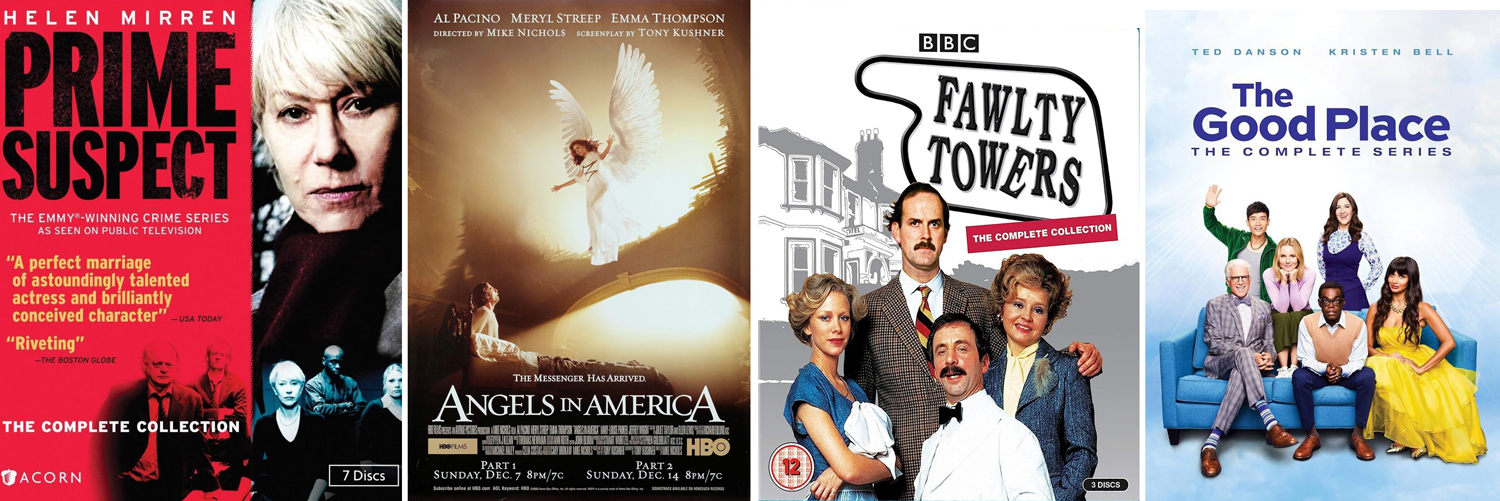
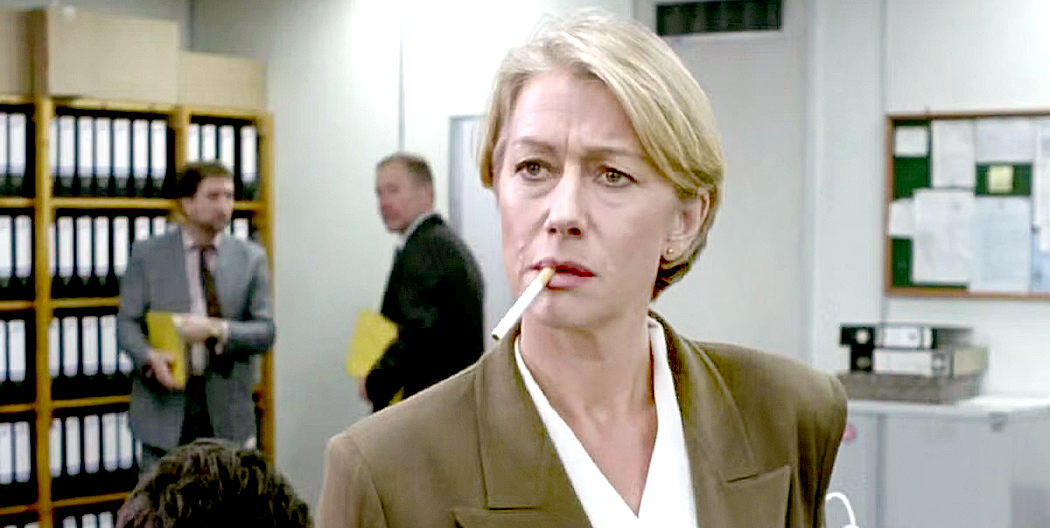
As I said, lists like this are fun, but they are arbitrary. There has been so much good on the airwaves over the decades. Picking the five best has meant not including Prime Suspect (1991-1996, 2003, 2006), one of the grimmest, most realistic police procedurals ever, which first brought Helen Mirren to a wider public (at least in America — in the U.K., she has been a known quantity since at least the 1969 Michael Powell film, Age of Consent.)
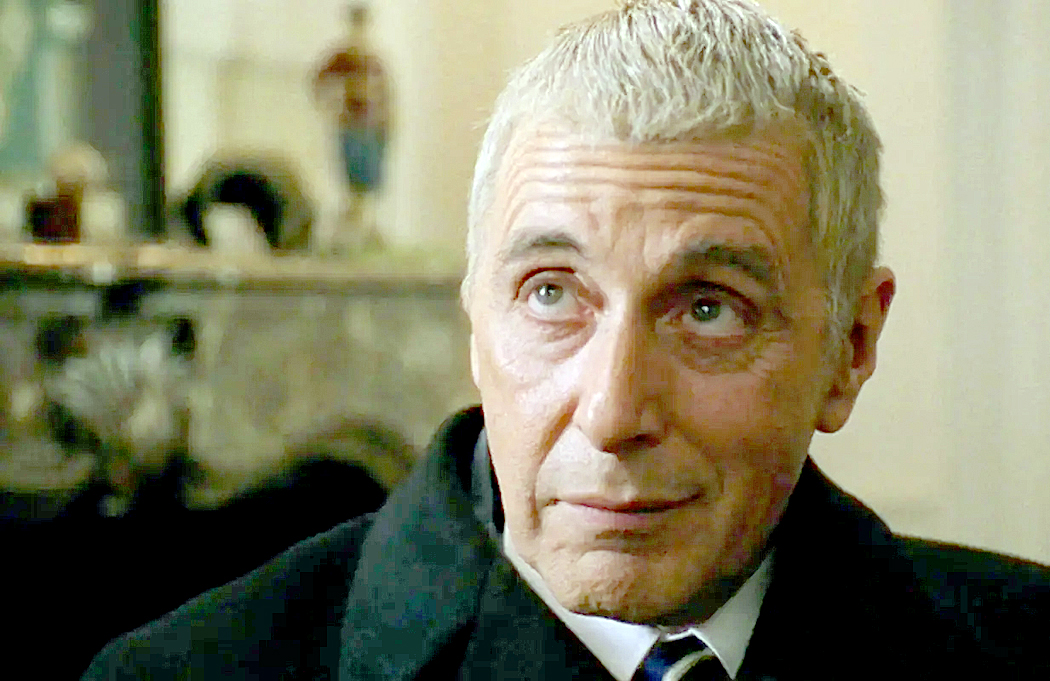
Then, there’s the Mike Nichol’s TV version of Angels in America (2003), with Al Pacino playing villain Roy Cohn. I saw the original Broadway production of the two-part stage play, and later two other versions live, and the filmed version cannot carry the visceral gut-punch of live theater, but it does as well as can be done on film.
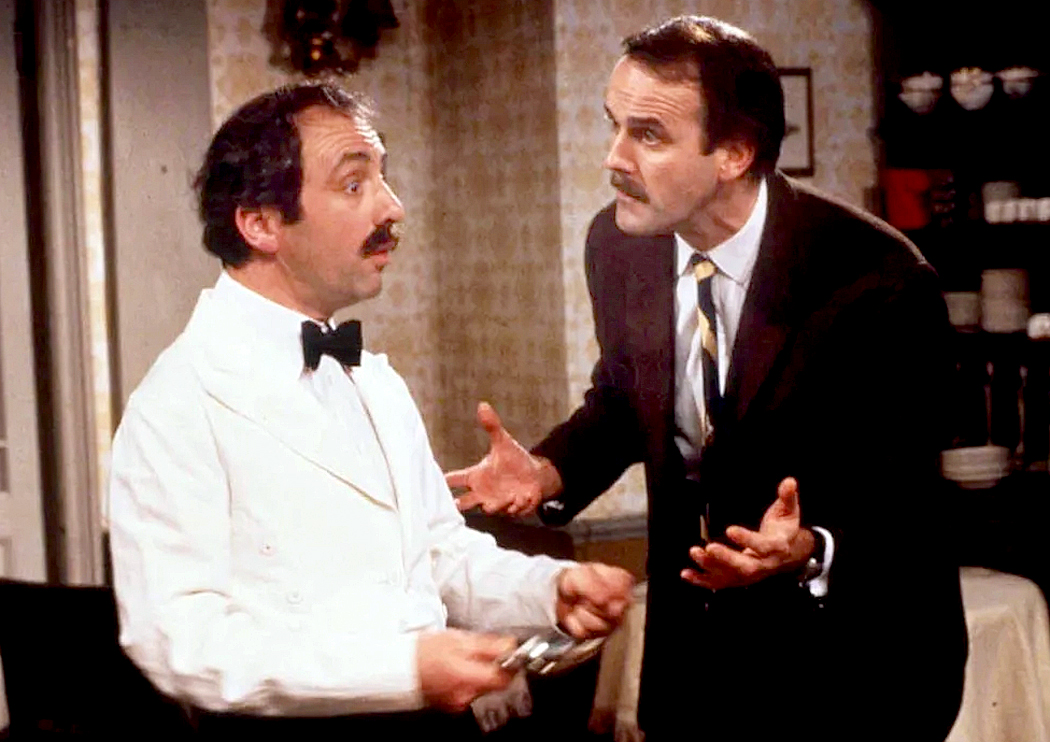
And how can you not include Fawlty Towers (1975-1979), probably the funniest 12 episodes of sitcom ever put together, with John Cleese, Prunella Scales, Andrew Sachs and Connie Booth. Ended after two short seasons because you cannot top perfection.
And a special mention to the most literate silly sitcom ever, The Good Place (2016-2020), with Ted Danson and Kristin Bell. Both smart and funny, it seems to have slipped past most viewers on its original airing, but plays with philosophy, life and death in thoughtful and playful ways. It counts for me as one of the best things TV has ever given us. If you haven’t seen it, I highly recommend it.
Finally, there are two made-for-TV series that were later edited and released as theatrical films that most people think of as movies rather than television shows, but they are truly masterpieces and best seen in their multi-episode forms.
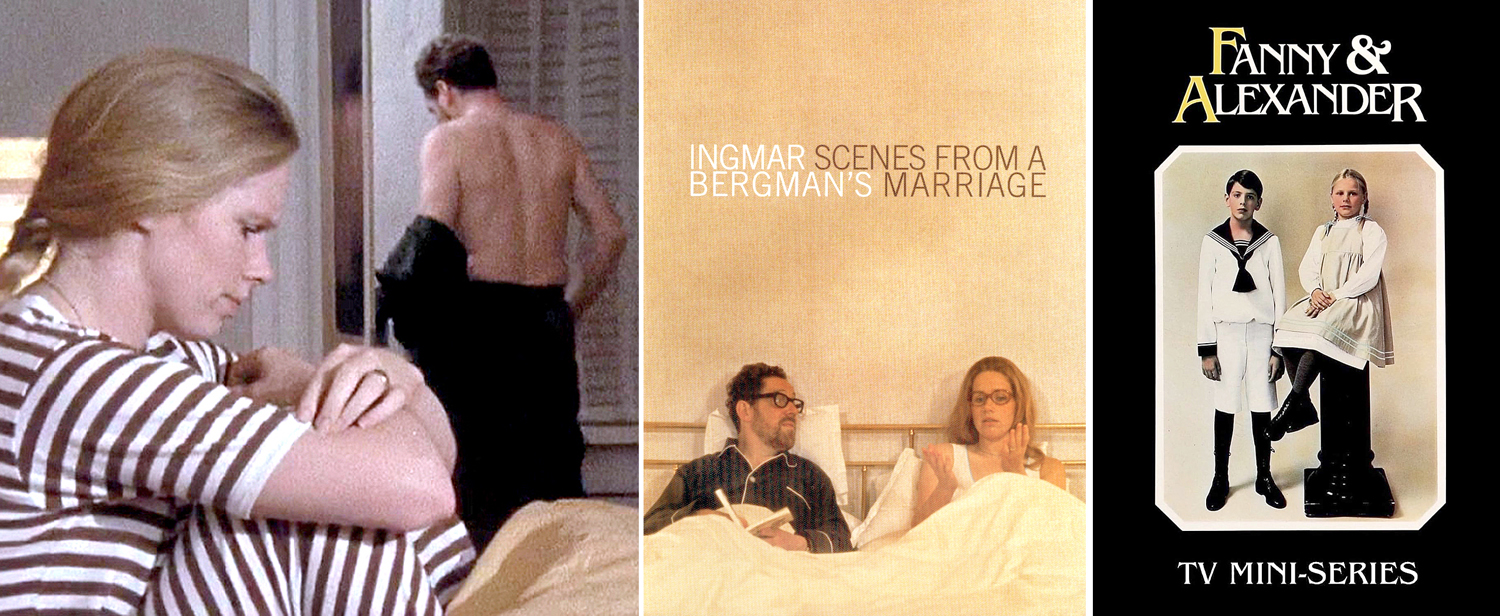
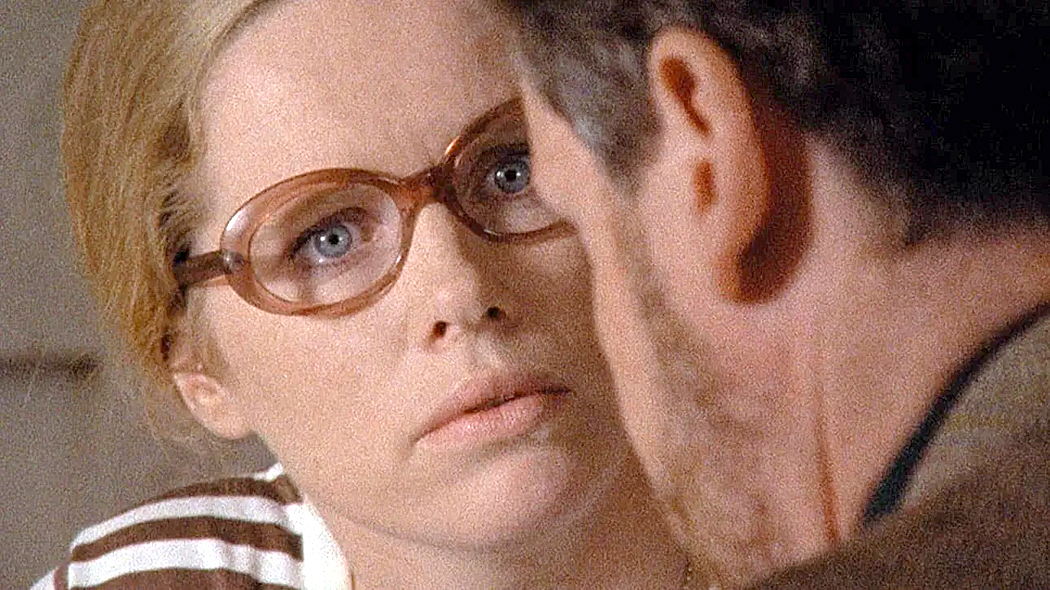
First, there was Scenes from a Marriage (1973), by directed by Ingmar Bergman, following the ennui and dissolution of an otherwise happy marriage, with Liv Ullmann and Erland Josephson. It was groundbreaking when first made, focusing on all the small details most stories elide past. (One also has to acknowledge the American TV series An American Family, from the same year, which takes a more documentary approach to the same themes, but has a more “reality TV” feel about it, more performative than deep.)
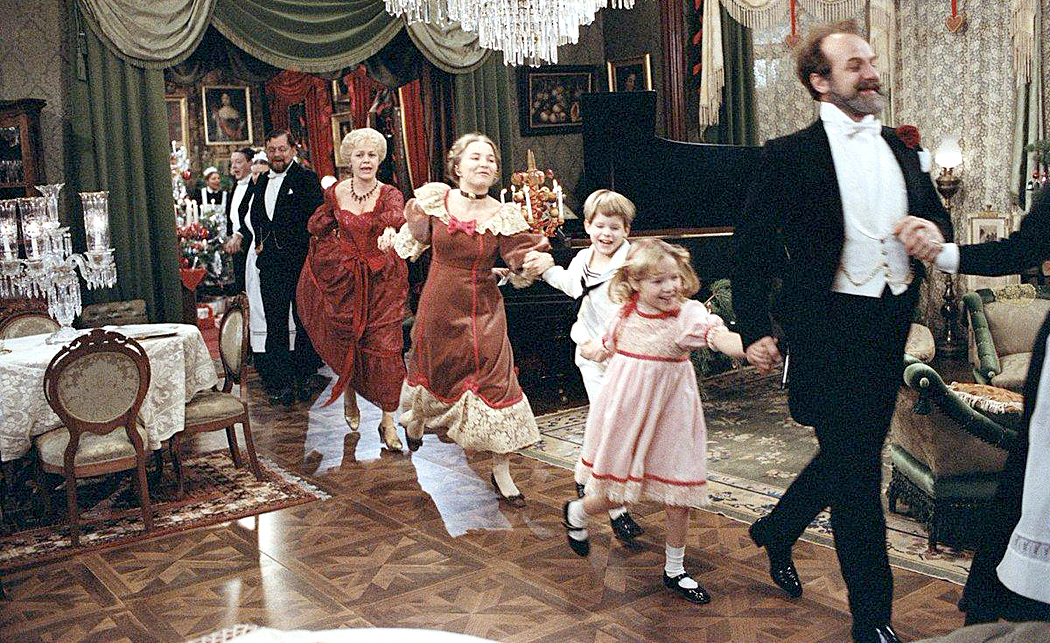
And there’s Bergman’s Fanny and Alexander (1982), which is perhaps the richest, warmest, most inclusive family portrait ever screened. Nobody doesn’t love Fanny and Alexander. At 5-hours long, it was shown on Swedish television in five episodes, but later edited to 3 hours for theatrical release. It is considered one of the greatest films of all time, but could equally be added to the list of greatest TV.
So there, you have a challenge. What would make your list of the five greatest TV series of all time?
I have been a reader for about three quarters of a century. It began so long ago, I don’t remember exactly when I started — probably in kindergarten when I discovered words. But once I began, I couldn’t get enough.
I read anything I could get my mitts on, from the backs of cereal boxes to the funny pages in the newspaper to road signs when the family was out driving. I’m sure I drove my parents nuts by pointing out stop signs and mileage markers.
This is not to claim any sort of prodigy. I believe most kids latch on to text as soon as they learned to decipher it.
But lately, I’ve been thinking about how my reading habits have changed over the years, and how those changes parallel life experience, and the needs I sought to satisfy as I grew up. Shakespeare wrote about the seven ages of life, and I think about the stages of reading.
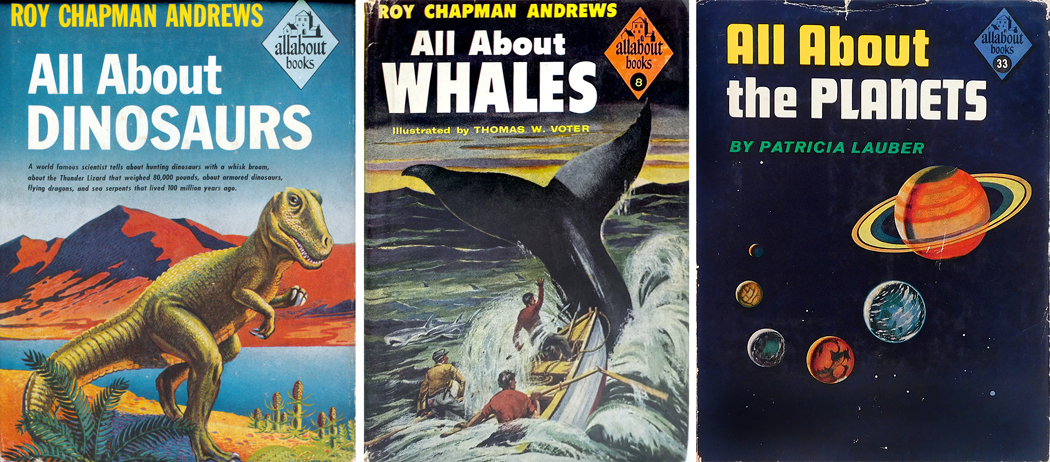
My early reading is chronicled by years. In third grade, I was fascinated with dinosaurs and read all the books I could find in my elementary school library (which was also the town library). There was Roy Chapman Andrews and his All About Dinosaurs, part of a series of “All About” books written for kids.
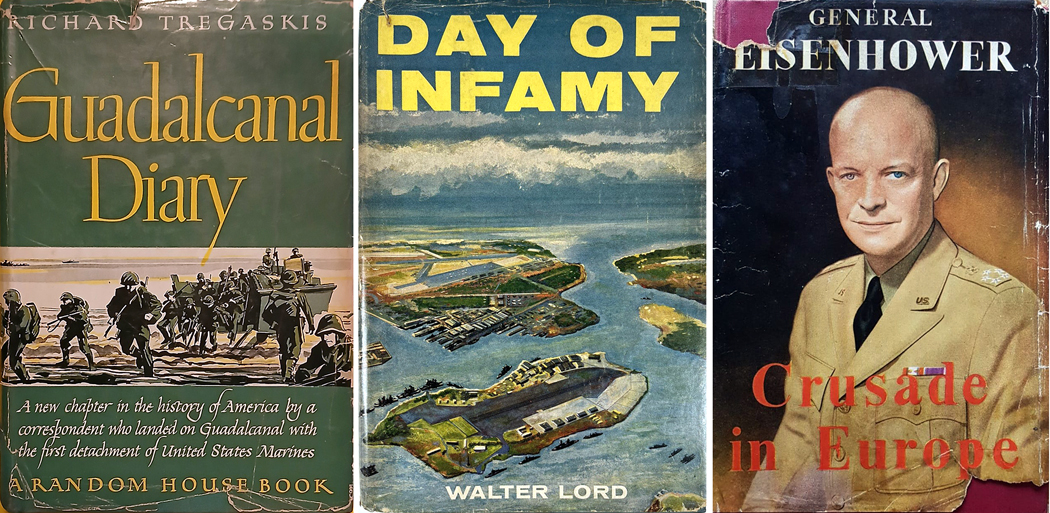
By the fourth grade, I had moved on to whales, and spent the school year absorbing everything I could about cetaceans. And so it progressed through astronomy, airplanes, and, by the seventh grade, I was into World War II. By then I had left behind the books written for young readers and took on the history books and memoirs. Guadalcanal Diary by Richard Tregaskis; Day of Infamy by Walter Lord; Crusade in Europe by Dwight Eisenhower.
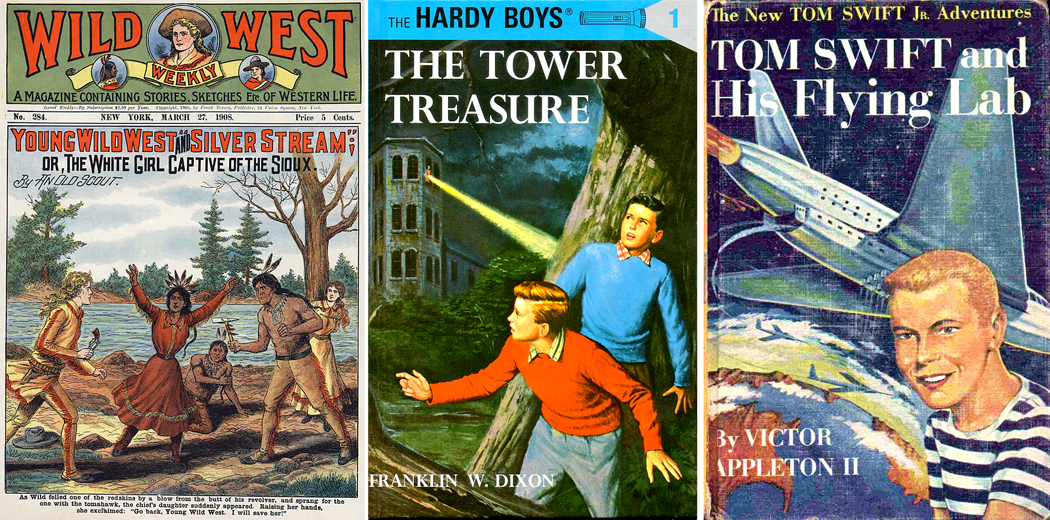
Other boys my age were reading Hardy Boys books and maybe Sherlock Holmes, but I was single-minded in reading non-fiction. I wanted to learn everything. I was a compendious fact basket. Dump it all in.
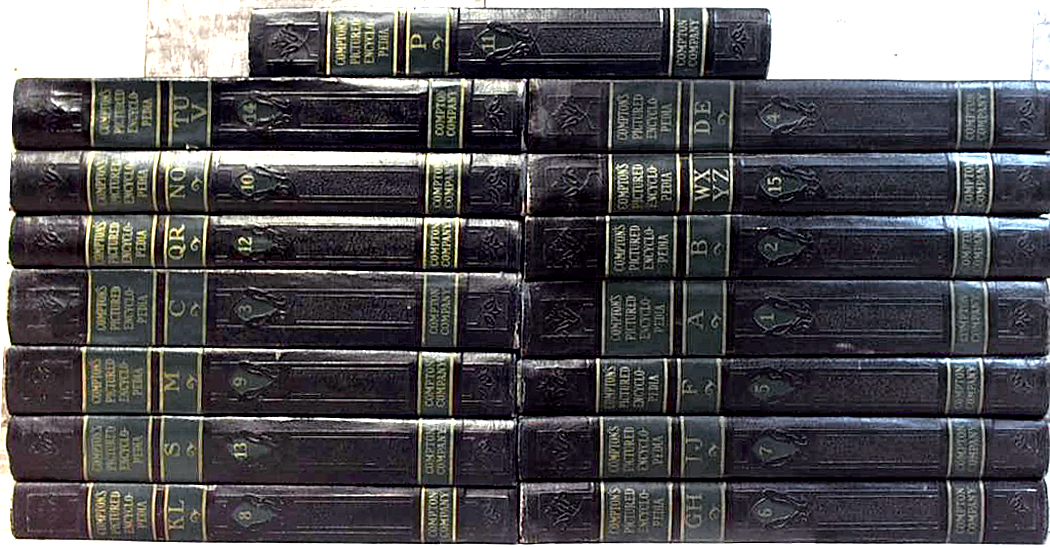
We were given a 1930s copy of the Compton’s Illustrated Encyclopedia and I read through it constantly. It might have been out of date, but it had lovely drawings of autogiros and streamlined trains and learned about everything from Angkor Wat to frog-egg fertilization and The Great War.
My parents, who had just high school educations and had lived through the Great Depression, were eager to educate their children to guarantee them good jobs in life. There was never any doubt they would send their three sons to college. And so, they encouraged this reading.
They thought they would help by buying books for me, including a copy of some young adult fiction. I sneered at it. Fiction? “I don’t want to read anything that isn’t true,” I said.
This first phase was the fact-gathering stage. I wanted to learn as much as possible and reading was the funnel that poured it all into my hungry brain. You have to fill the pepper grinder before you can grind pepper.
And so, it poured in and stuck: 44 B.C.; A.D. 1066; 1215; 1588; 1776; 1914 — and Aug. 6, 1945, a date that hangs over anyone my age like a threatening sky.
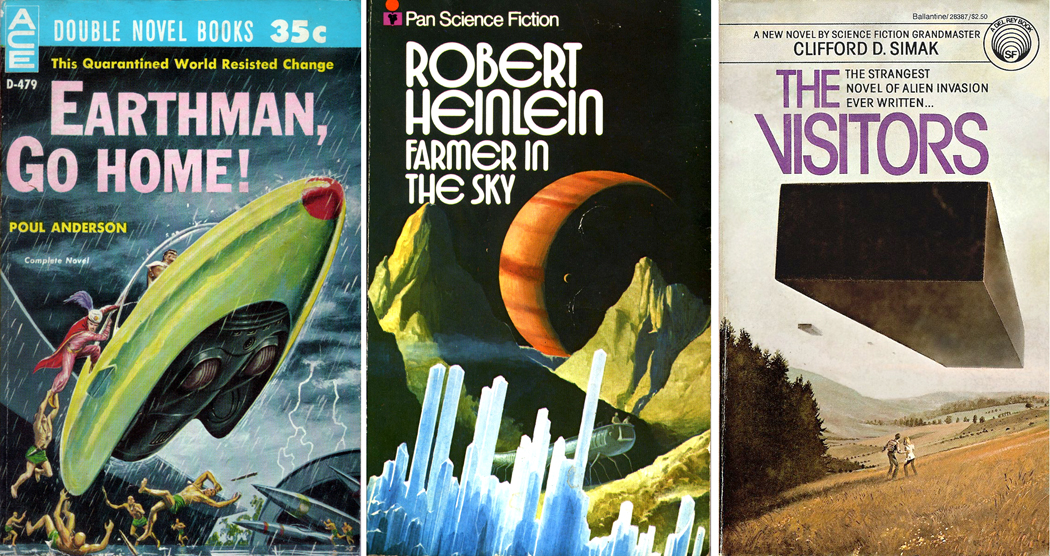
I stayed away from fiction until, I was, perhaps, 12 or 13 years old, when I discovered science fiction. I gobbled it up like candy. All the mid-level sci-fi writers that were popular in the late ’50s and early ’60s: Poul Anderson: Lester del Rey; Robert Heinlein; Frederick Pohl; and, of course, Ray Bradbury. I must have burned out on it, because I cannot read any fantasy or sci-fi anymore. Lord of the Rings? God help me. No, never.
But there were the Fu Manchu books of Sax Rohmer, with their Yellow Peril and archly Victorian prose. All pure pulp, but they opened the world of fiction to me and transitioned me into the second phase of readership, which is perhaps the most embarrassing phase.
By high school, I wanted to prove I was a grown-up, and what is more, an intellectual grown up. I subscribed to Evergreen Review and Paul Krassner’s Realist. I was hip, in my tight jeans, pointy shoes and hair slicked with Wildroot Cream Oil.
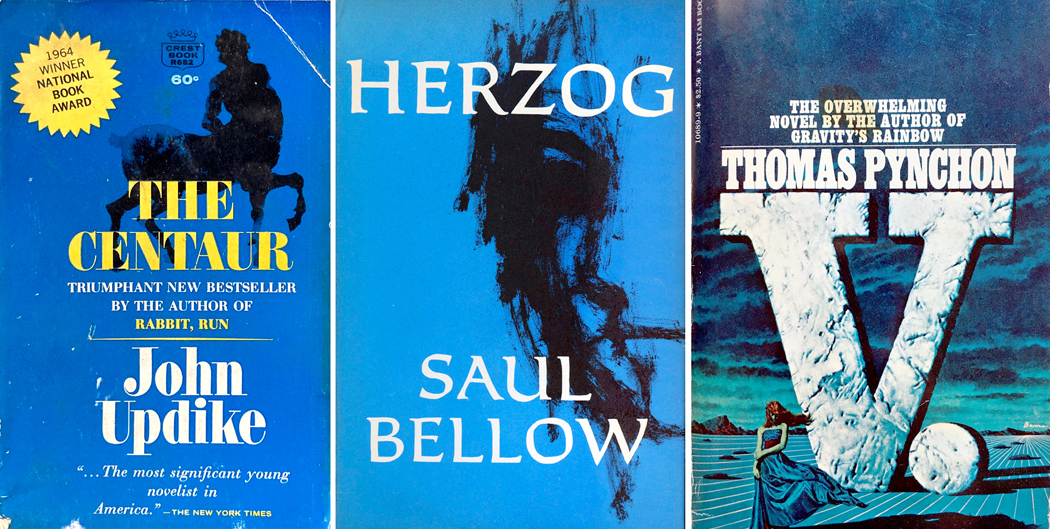
And I began reading important fiction of the time: Saul Bellow; John Updike; Norman Mailer; Thomas Pynchon. Of course, I didn’t understand any of them. I was a pimply-faced high-school kid. What did I know? But I looked oh, so sophisticated carrying around Herzog under my arm. It was only when I read it again a few years ago that I fully realized how funny the book is. I didn’t know it was a comedy when I first read it. There is nothing more earnest than a teenager.
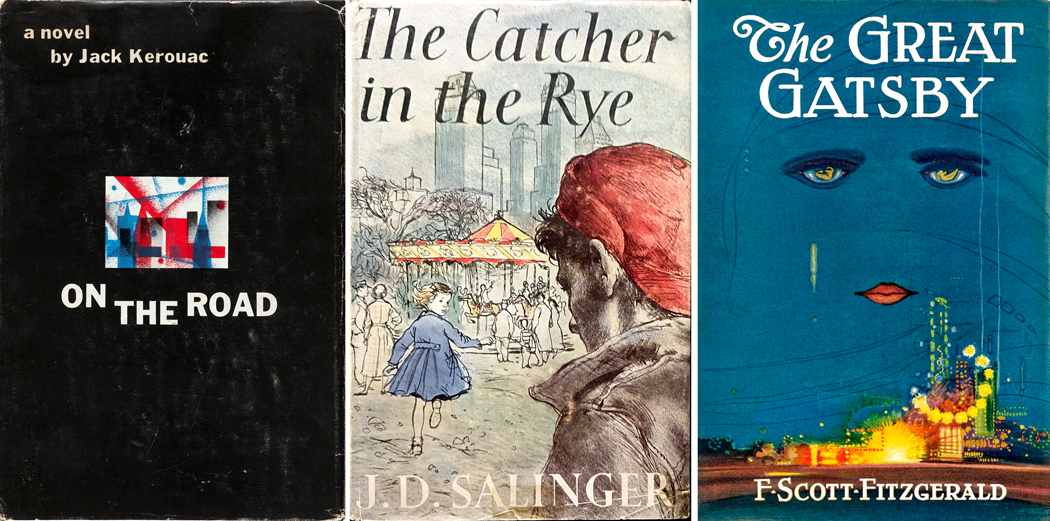
I did manage to pick up and understand On the Road and other Kerouac books, and J.D. Salinger spoke directly to my adolescent soul. On the Road held up on re-reading years later; not Catcher in the Rye, which is now close to unreadable. I couldn’t even finish a re-read.
The problem with adolescence is you have almost no life experience. It’s all just literature to you. You get caught up in “symbolism,” and what a book “means.” As if it were written in code to be deciphered. A 16-year-old is in no position to know what was going on in those books. It wasn’t much different from when we were assigned The Scarlet Letter or The Great Gatsby in eighth grade. I could understand the words, but not understand what was said between the lines.
A teenager thinks the world is simple. It is the tragedy of youth.
The following stage was college reading. There was, of course, a lot of it. But I loved it, especially the Classics courses I took, reading Greek and Roman authors, the English Romantic poets, and Chaucer. I took to Chaucer immediately. I still read him for the pleasure of his language. There was a course on Milton and another on William Blake. I ate the stuff up. I still do.
And I was then old enough that I actually understood much of what I was reading. I was beginning to have a life and feel the complexity of the world.
College only lasted four years and after that came marriage and divorce and unemployment and — just as bad — employment. I still read, but mostly I just tried to keep it all together, and not always successfully. (Unemployment gave me a lot of reading time and for months, I managed a book a day.)
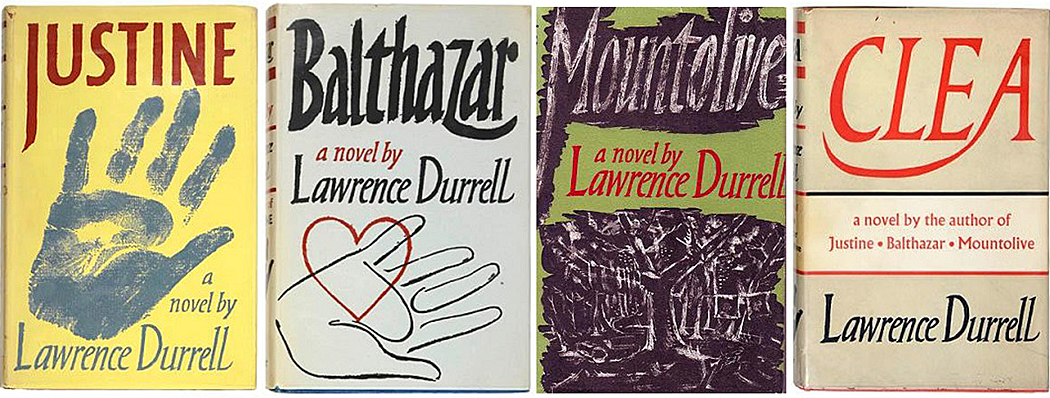
The fourth great phase of reading came after divorce and other traumatic events, when I had what might now be called a break down. It didn’t stop me reading, and actually it led to a fever of it. I read all of Henry Miller (or as much as was available, not counting his privately printed short works); all of Melville, or pretty near; piles of D.H. Lawrence; and basket-loads of Twain, Hemingway and Faulkner — and Lawrence Durrell’s Alexandria Quartet, which seemed to sum up my situation — and that marked a change in my relationship to books.
This was a turning point that not everyone seems to experience. Until this point, I measured my life against what I read. Was I like Nick Carraway or Sal Paradise? I wanted to be “important” like them and thought literature was there to show me the way.
After that point, instead of measuring my life against the books, I measured them against my life. Did they seem true to what I had experienced? When I was young, the books were real and my life a simulacrum; as I grew, it became clear my life was the real thing and the literature was only a reflection. Not “did I measure up,” but “did the books measure up?”
Books, as a percentage of time spent, varies quite a bit over the course of a life. I find the more I am engaged with doing something, like work or socializing, the less time I spend reading. And the fifth phase began when I started teaching in Virginia. It wasn’t that I stopped reading, but that I did less of it, and that the books I did read tended more toward histories, biographies, memoirs and essays.
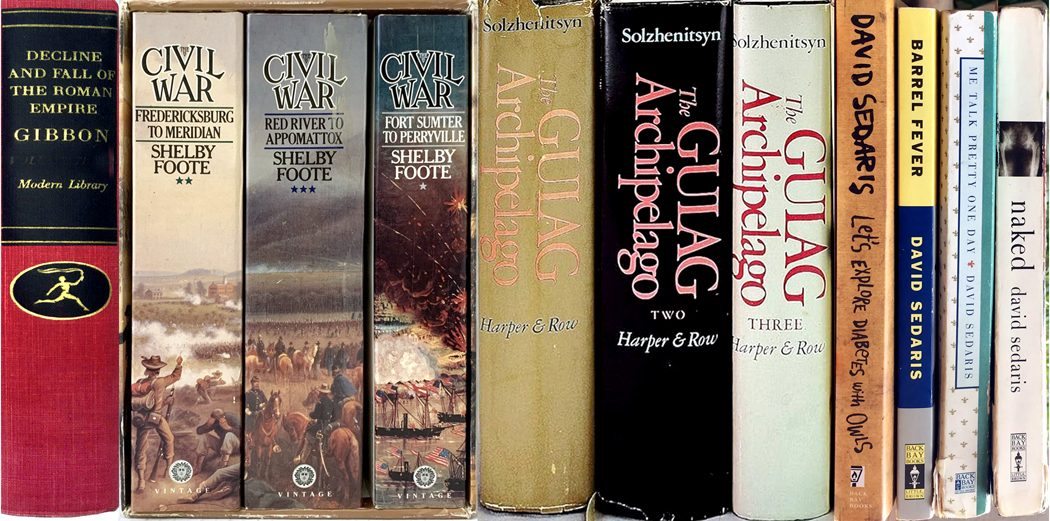
I tore through Shelby Foote’s three-volume history of the Civil War; a one-volume selection from Edward Gibbon’s Decline and Fall of the Roman Empire; tons of H.L. Mencken, including all his Prejudices; Solzhenitsyn’s Gulag Archipelago; and as antidote, all the David Sedaris I could find.
This phase continued through 25 years working for The Arizona Republic, in Phoenix, where I was, among other things, the art critic. I read a lot for work — including background on things I was writing about.
The relationship with books had changed, but so had my relationship with words altogether. When I was young, I was eager for knowledge and read by the boatload in search of ways to fill my insides. But somewhere along the line the well was full and the words spent less time piling in and more gushing out: I became a professional writer and all that back-pressure of words, information and experience burst out. I wrote like a hose spraying water. I couldn’t fill the buckets fast enough.
Even on vacations, driving around this country or others, I spent part of every day writing down notes that later turned into stories for the paper.
So, there were those two major shifts in life: first when I began measuring the books against my life; and second when instead of just adding more words to the pile, all the millions of words dammed up behind my cranium began pouring out.
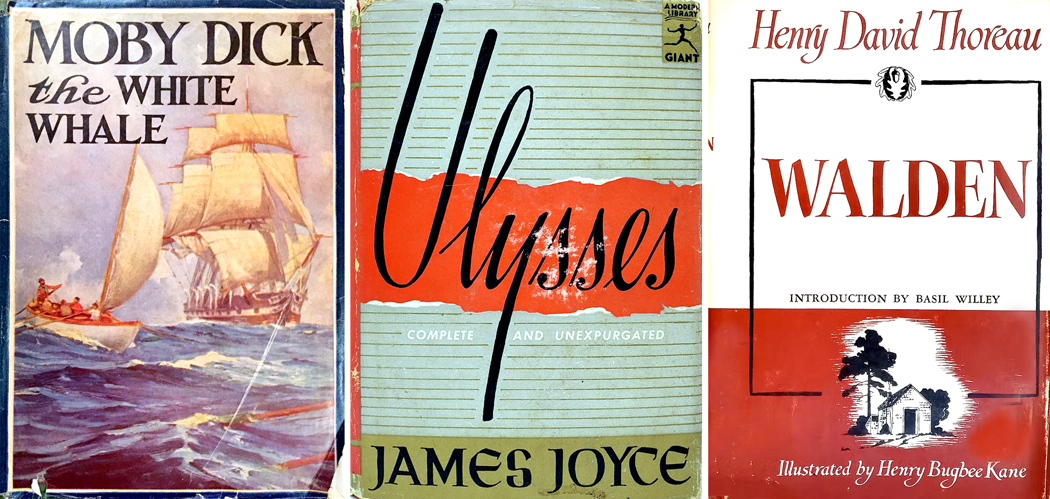
Through all of these phases, but increasingly over the years, I found myself re-reading as much as reading. My favorite books I tackled again and again. I cannot number the times I have read Moby Dick or Paradise Lost or James Joyce’s Ulysses — all dived into time after time for pure pleasure. There are others: Thoreau’s Walden; Hemingway’s Sun Also Rises; Gatsby, of course, now that I know what’s going on in it.
I try to re-read the Iliad once a year, usually with a different translation each time. I sometimes change pace and do the Odyssey. I tried Dante, and can gobble up Inferno any time, but admit I find Purgatorio and Paradiso quite a slog. I’ll stick with Hell, thank you.
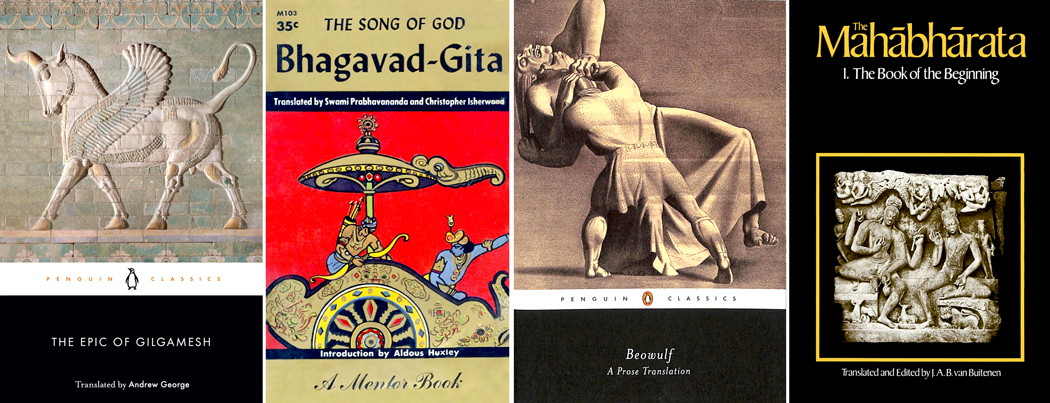
The books I’ve mentioned so far indicate a fairly parochial taste for Western culture, and I have to admit to that. But I’ve soaked up a fair amount of early and non-Western writings to try to keep some balance. I’ve read and re-read the Epic of Gilgamesh, the Mahabharata, Lao-Tze, Beowulf, and Basho’s Narrow Road to the Deep North, among others. I’ve read large swaths of the Vedas and Upanishads, and even a bit of various versions of the Book of the Dead. There is Sufi poetry and the Popol Vuh. I have tried to soften the boundaries of my cultural walls.
There is a sixth phase, where I am now — retired. Although, as I’ve said many times, a writer never really retires. He just stops getting paid for it. I now write this blog, for which I’ve written more than 800 entries with another hundred more for other online venues, all of which total a million and a half words, all since 2012 when I left the madding crowd behind.
I have slowed down some, but I still read. Now, I read a good deal of poetry. I find it satisfies my love not just of meaning but of the words themselves, the taste and mouth-feel of them. It is a connection with the world, and with the netting of language that holds that world up before my mind.
It is said in some cultures, after a life of striving and ambition, that there comes a time of quiet and reflection, a time to spend on weighing the life and figuring out where it falls in the larger picture of time and the universe.
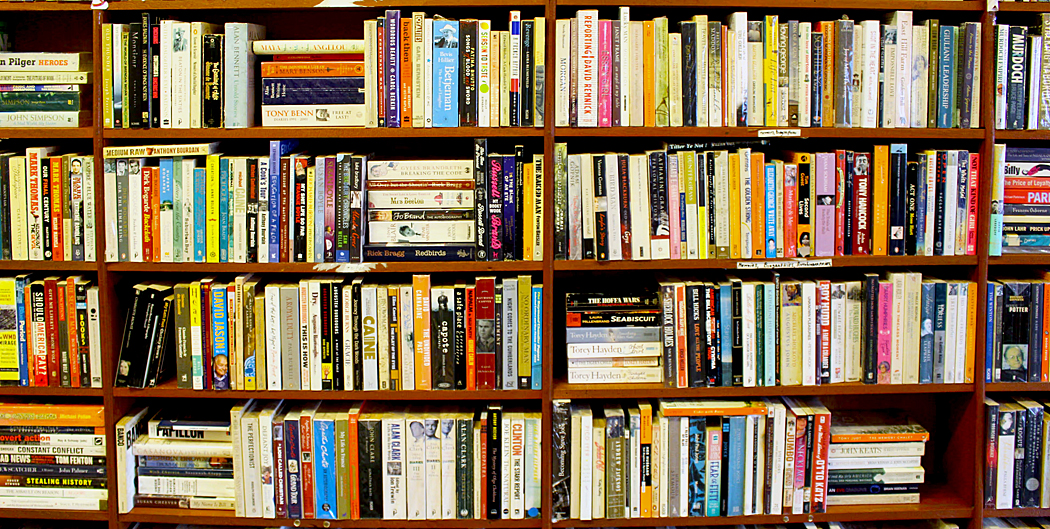
I certainly feel that. But it hasn’t reduced my need to recharge that well from which I draw my words. My Amazon account proves that. I keep getting new books and find that I simply don’t have any more space on my bookshelves, and so, they pile up on top of other books and in dangerous stacks on the floor.
Every once in a while, there is a book-avalanche and under the chaos I rediscover some book I had forgot and sit down and open it up again. I’ll deal with the mess later.



 Richard Nilsen