Archive

Uncategorized

Every once in a while as if by a miracle, something good is transformed by art into something godawful. Case in point: the most recent remake of the detective stories of Georges Simenon that go under the heading “Maigret.” 

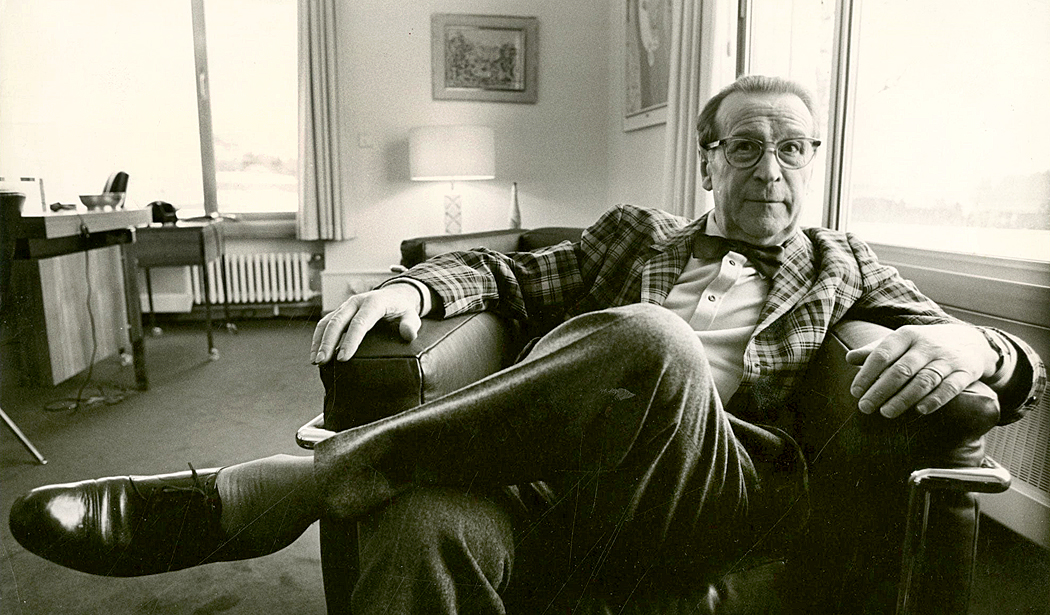
The Belgian writer pumped out (and that is about the only way you can describe his method) some 75 novels and piles of short stories featuring his creation Jules Maigret, commissaire of the police judiciaire at le Quai des Orfèvre in Paris. 

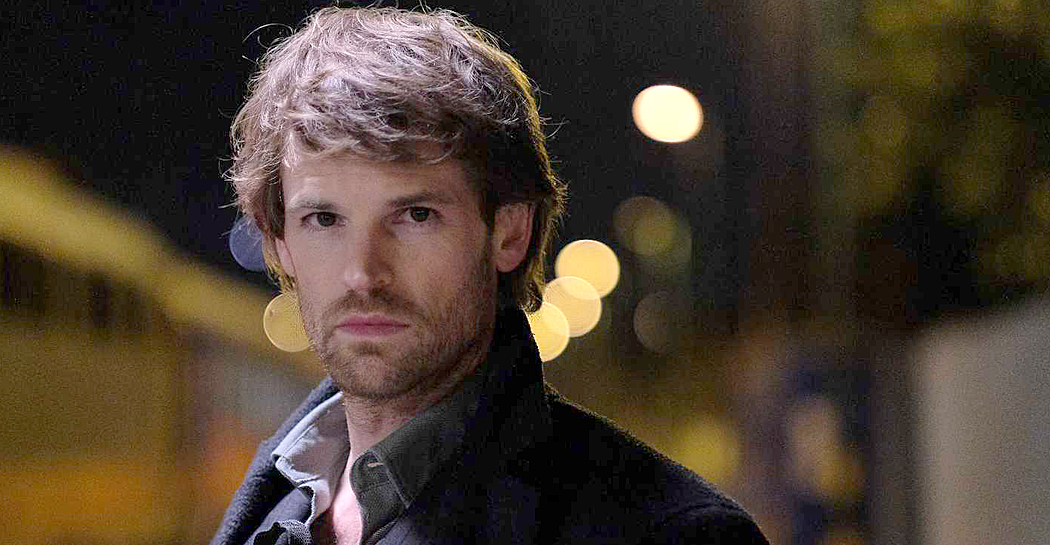
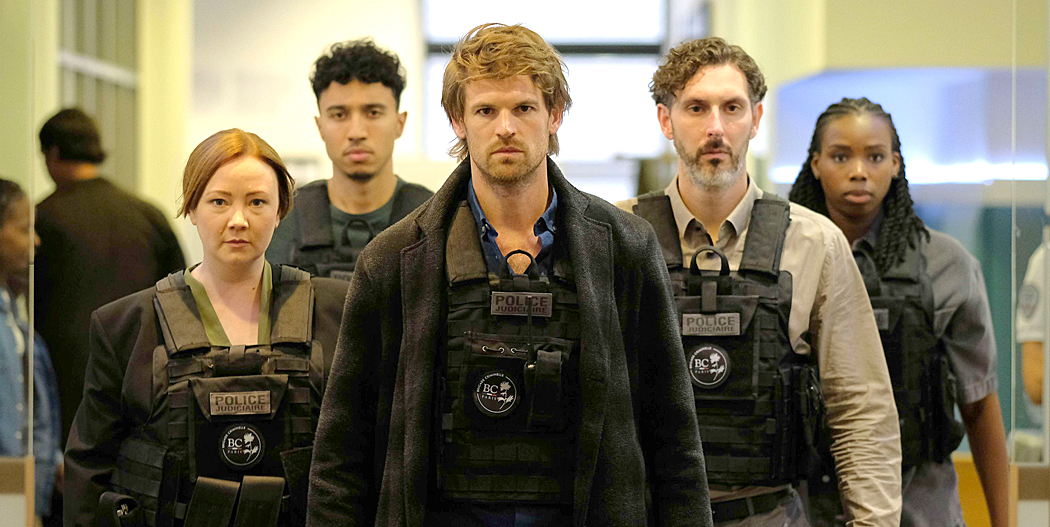
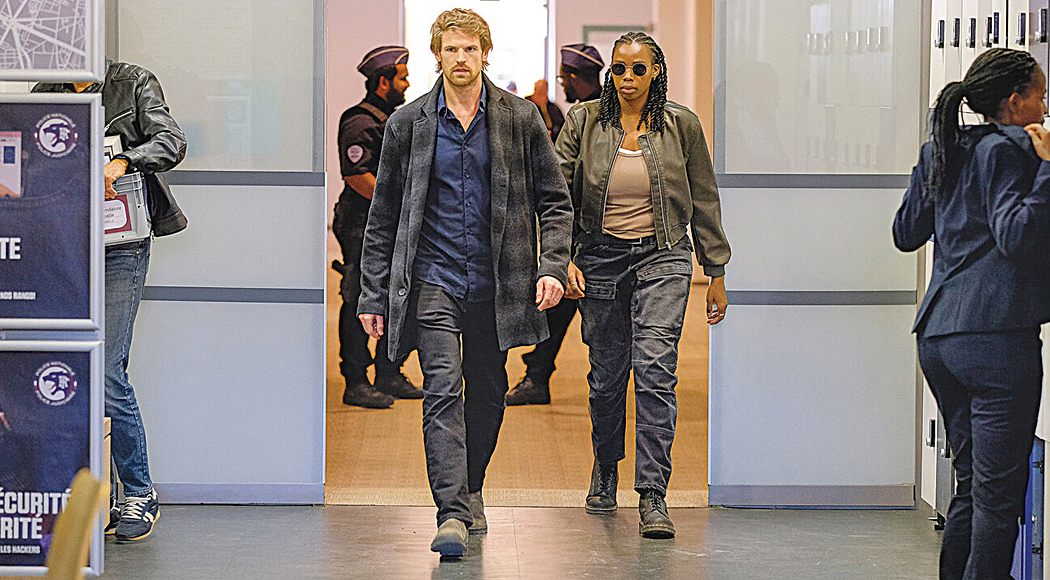
I just tried watching the new Maigret series on PBS Mysteries and, honestly, someone needs to be shot before a firing squad. They seem to have turned Maigret and his team into “Le Mod Squad.” Simenon’s Maigret is famously middle aged and looks like a tired bureaucrat. That’s how Simenon wrote him. To turn him into a — and I quote — “young, streetwise leader of an elite crime unit known as ’The Maigrets’” — is worse than a travesty, it is pandering of the worst sort. 

“Le Mod Squad” hardly ridicules it enough. “Montmartre 90210”  perhaps — No pipe, no hat, no overcoat. Probably doesn’t even drive a Citroen. And that curated day-old chin scruff — what a tired cliche! And from the images I’ve seen online, the series seems to be lit in the contemporary flat digital style, with faces darker than the background. Oy veyzmir. 

In other words, I don’t think I’ll be watching this series. I could barely make it through the first episode. In fact, I couldn’t. The episode was a two-parter and I quit after the first part. 

Its sins are legion. Perhaps if it had been made under some other title, like “Les Flics a la Mode,” it might have served a purpose on network TV, alongside long running series. Maybe even “CSI: Paris.” But its questionable status as a remake of the famous French detective is not its only or worst sin. Its dialog is straight out of a soap opera, with great lumps of exposition floating like unincorporated lumps of flour in a gravy. The script seemed assembled rather than written. 

It’s not that I object to modernizing or updating a classic. Mark Gatiss and Steven Moffat did a great job with the BBC’s Sherlock, with Benedict Cumberbatch, keeping all the quirkiness but adding a digital world. But the new Maigret is simply ham-handed. 

Simenon wrote his Maigret books from 1931 until 1972, which were only a fraction of his immense literary output. Right from his apprenticeship, writing under 17 pen names, he produced 358 pulp novels and short stories from 1921 to 1934. He was writing at a pace of 70 typed pages a day. Even after he began writing under his own name, his production was prodigious. There can be no count, only approximations. Estimates have run from 170 books to about 500. What is more amazing is the quality level. No less than Andre Gide wrote, “I consider Simenon a great novelist, perhaps the greatest, and the most genuine novelist that we have had in contemporary French literature.”

Simenon’s mysteries are functionally different from the standard model, where, as in Agatha Christie books, suspects and clues pile up and at the end, Miss Marple sorts it all out and solves the crime. With Maigret, we often know who the perpetrator is in the first few chapters and the bulk of the book is Maigret figuring out how to catch the bad guy, or what motivates him and could lead to his capture. The heart of a Maigret book is not the mystery, but the characters and their psychologies. It seems almost as if Simenon begins with a vivid character or two and builds a story around that. We read them not to find out “whodunnit,” but to spend time with fascinating personages. 

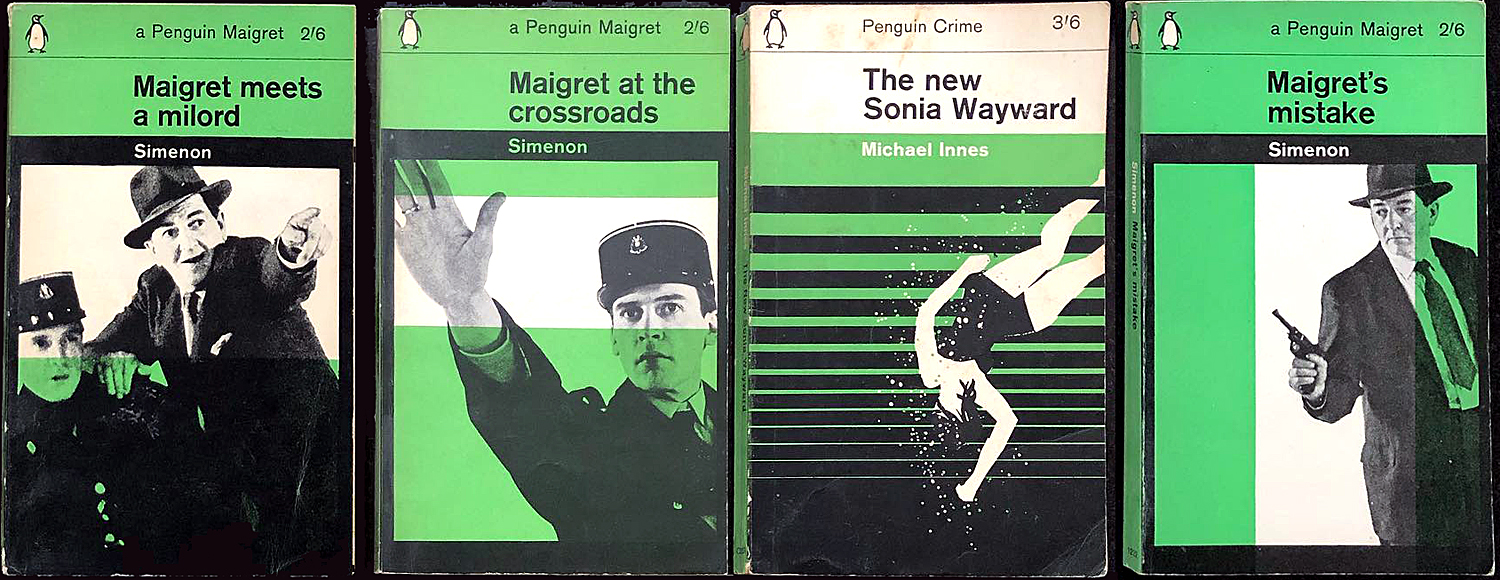
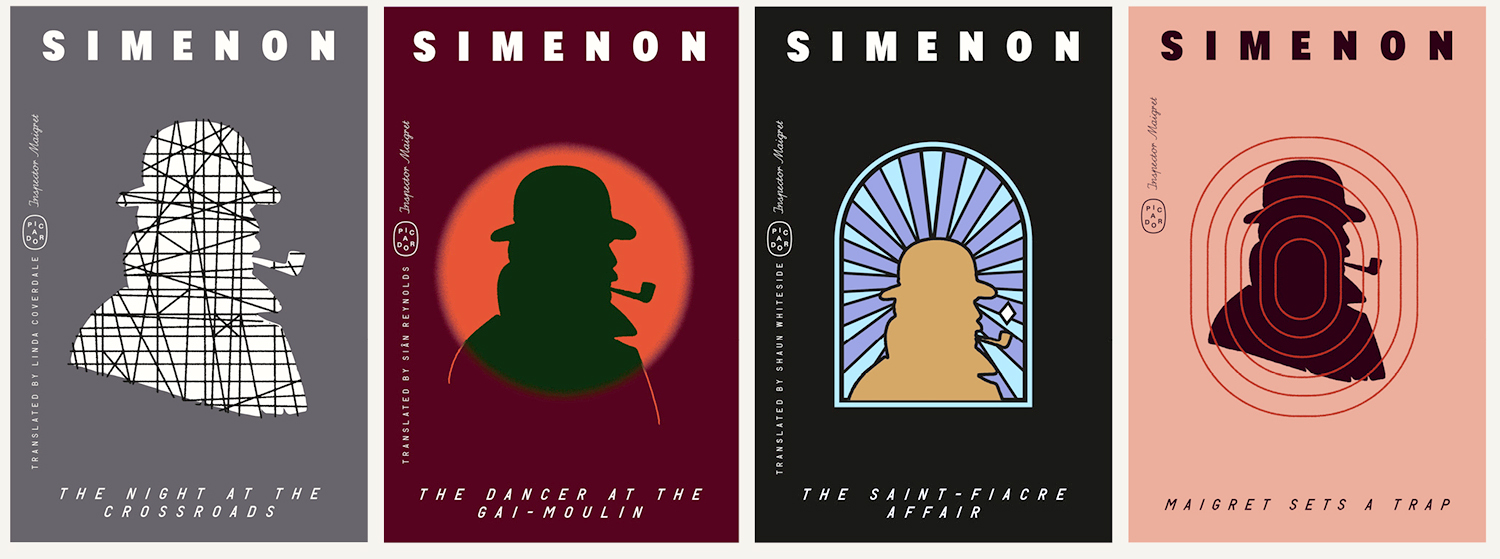
All of his Maigret novels remain in print — the whole series in English translation is published by Penguin Books. Numerous other translations are available, and multiple compilations. 

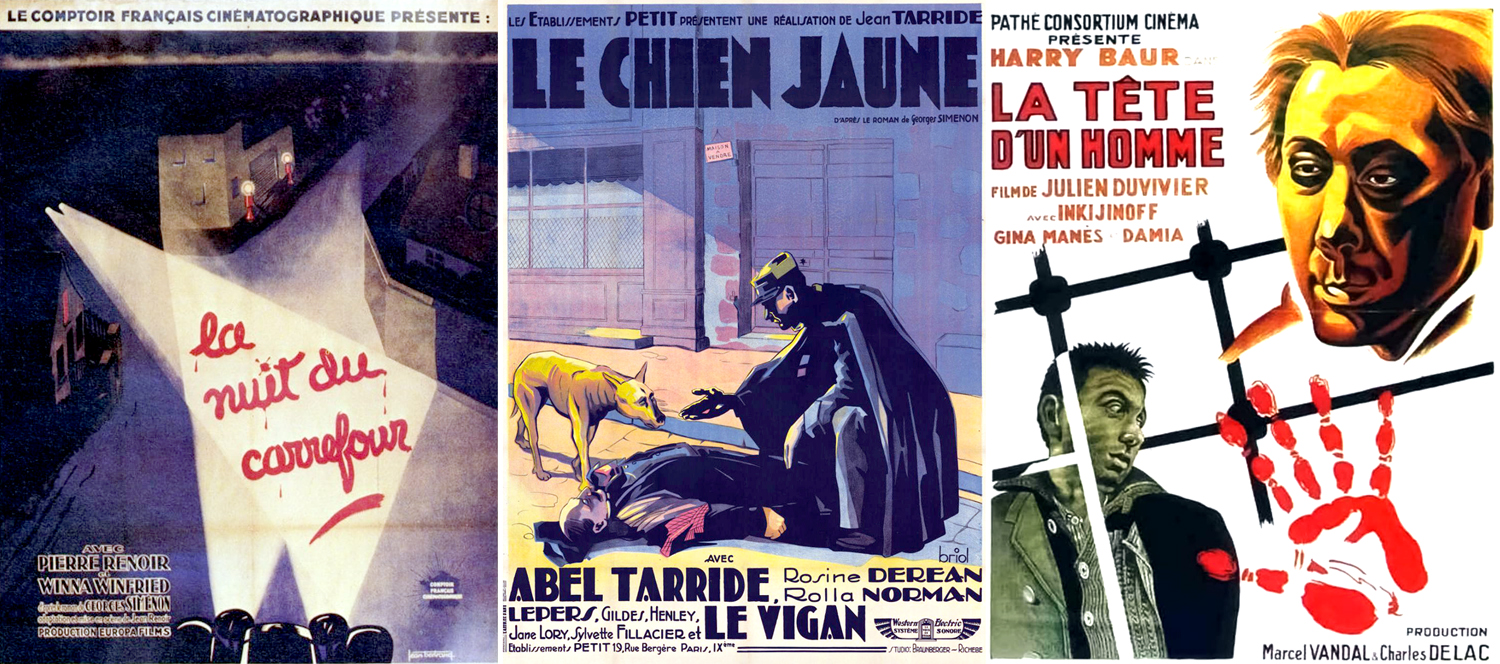
At least 70 films and TV series have been made from his works, beginning with Jean Renoir’s La Nuit du Carrefour, from 1932, starring the director’s brother Pierre Renoir as Maigret. The same year saw Le Chien Jaune (“The Yellow Dog”), with Abel Tarride as the commissaire, directed by his son, Jean Tarride. The following year, Julien Duvivier directed Harry Baur as Maigret in La tête d’un homme (“A Man’s Neck.”) 

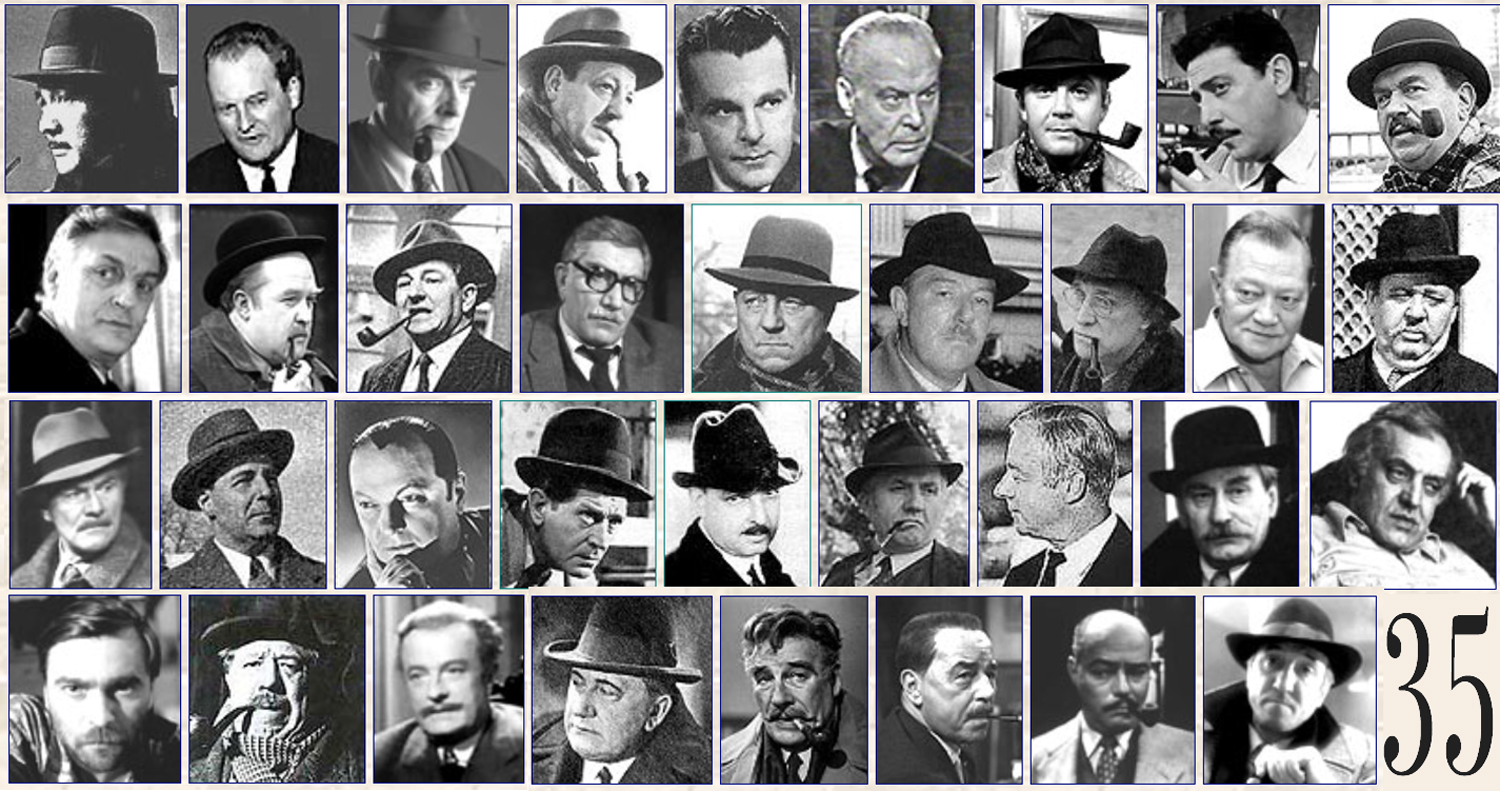
Over the years, at least 35 actors have smoked the pipe as Inspector Maigret, give or take some forgotten versions. They were made in several languages, including Italian, German, Russian, and Japanese. 

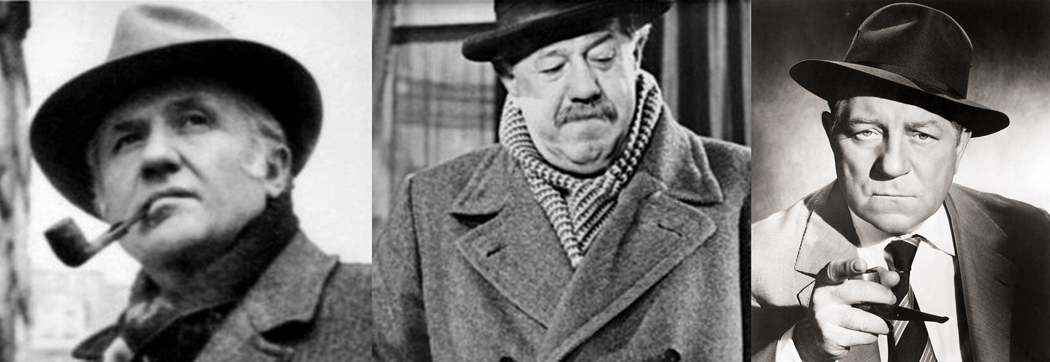
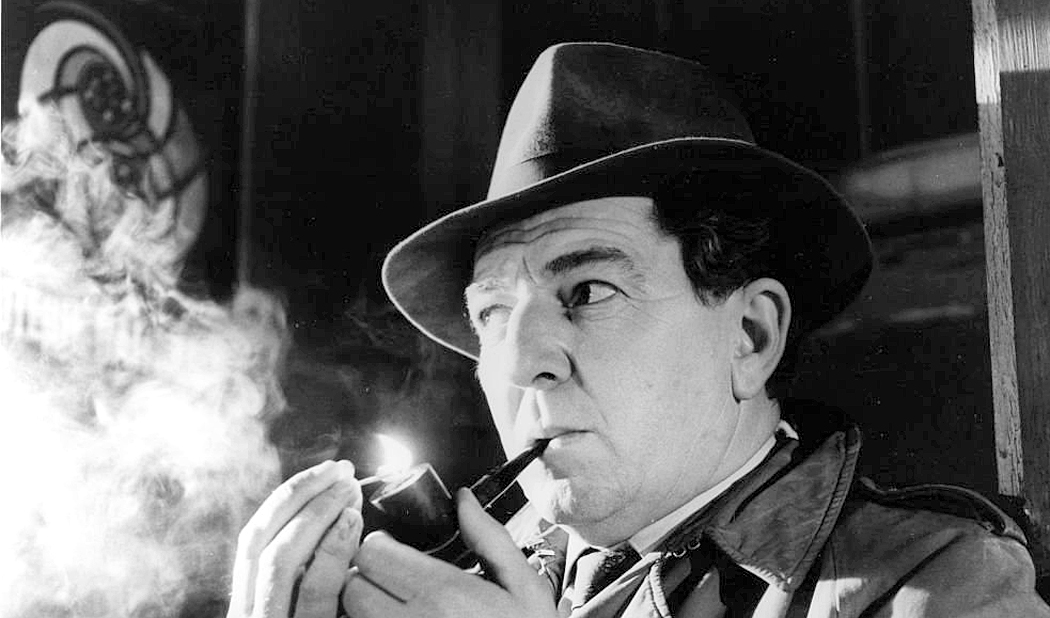
Albert Prejean, Michel Simon, Jean Gabin

But most notable, in English or French, including three films made with Albert Prejean as Maigret in the mid-1940s, by a wartime German film company in occupied France; and another three, from 1958 to 1963 with Jean Gabin. The great Michel Simon took his turn in 1952 in one-third of the anthology film Brelan d’as. Maurice Manson played him in Maigret dirige l’enquête (1955). 

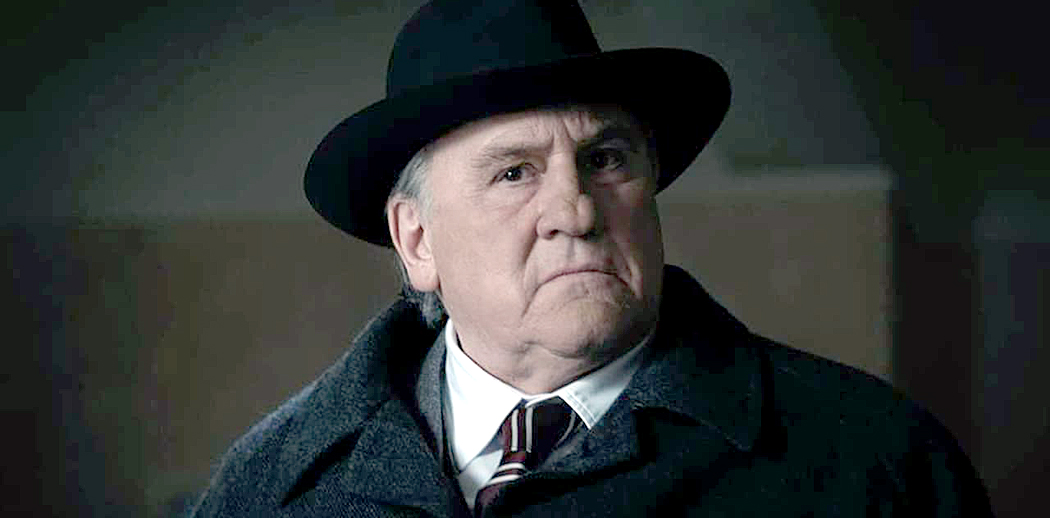
And Gerard Depardieu was an especially bulky commissaire in Maigret (2022). The prolific (and prodigious) French actor had previously played a Maigret clone in 2009’s Inspector Bellamy

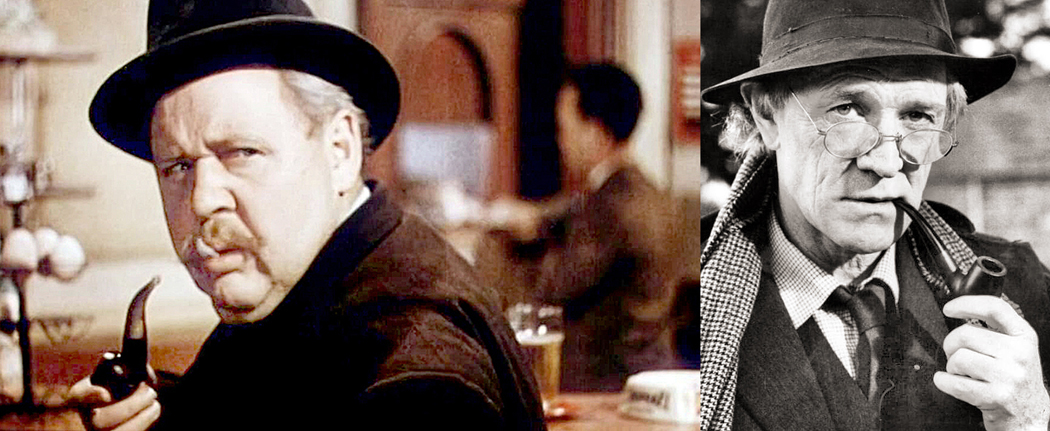
Charles Laughton, Richard Harris

English language one-offs begin with Charles Laughton in The Man on the Eiffel Tower (1950), and Richard Harris, in a tweed hat, in Maigret (1988), of which, the less said, the better. 

Rupert Davies

But, when you have 75 novels and 28 short stories to draw from, the ideal version of Inspector Maigret is a television series. The first — 53 episodes from 1960 to 1963 — featured Rupert Davies, who would have been the ideal Maigret except for the fact that the episodes were only 50 minutes long, and the production was rather studio-bound (other than some excellent exteriors actually shot in Paris). Standard TV lighting and sets. 

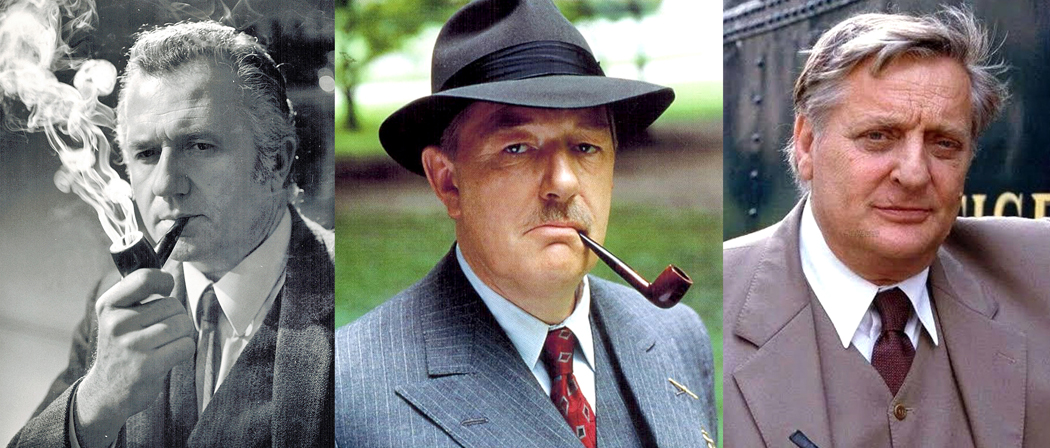
Jean Richard, Michael Gambon, Bruno Cremer

Jean Richard starred in 88 90-minute episodes from 1967 to 1990, and was the version Simenon said he liked best. Bruno Crèmer filmed 53 episodes from 1991 until his death in 2005, each 90 minutes long. These are probably my favorites. 

Michael Gambon gave what might be the definitive English language version in only 12 episodes from 1992 and 1993. Although each episode was only 50 minutes, he embodied Maigret so perfectly, at least for an English-language audience, that his successors all pale in comparison. 

And those include Rowan Atkinson in four 90-minute versions from 2016 and 2017. Atkinson (aka Mr. Bean) does a very good job, but the filmmakers attempted to turn the books into noir films, mostly shot at night or in moody rain, and dumped so much dialog, they were almost silent films. The Maigret books are almost pure dialog, very like the earliest Dragnet episodes. 

I have not seen the Dutch versions, first with Kees Brusse in 6 episodes from 1964; or 17 episodes with Jan Teulings from 1966-1969. Nor the Italian version with Gino Cervi from 1967-1972. And not the 25 episodes in Japanese with Kinya Aikawa from 1978, where the inspector’s name is transliterated as “Megure.” “Meg-goo-ray.” I’m not sure where any of these might be found. 

And that leaves us with the latest misery, a poor substitute for the real Maigret. 

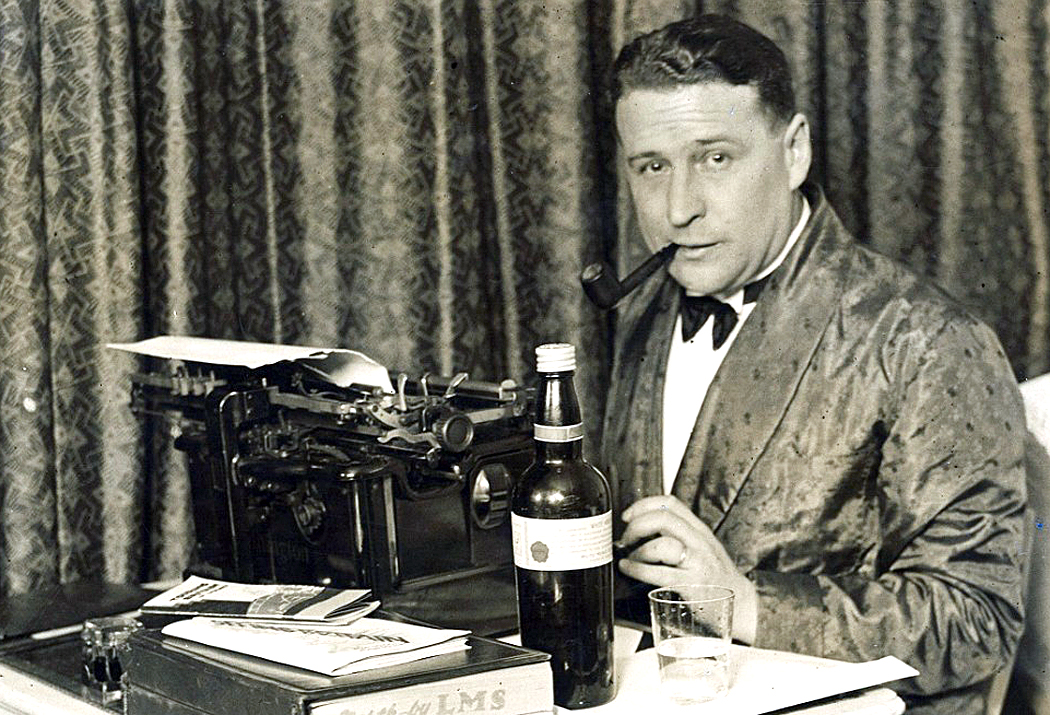
Simenon

L’Envoi

Georges Simenon was as much a character as those he stuffed into his novels. His writing was prodigious — those hundreds of novels — but so was his sex life. He was one astonishing horn dog. 

When he married, the pair took on a young housemaid, and by the evening of her hiring, Simenon had already had sex with her. This went on for some time. His wife seems to have become inured to his proclivities, which included frequent visits to brothels. 

When his wife went away for a spell, he hired a second maid. Same result. When his wife finally left him, everyone moved up a notch. Later a third maid took over from the second, in a kind of musical beds. Although beds are not really the issue. One report has him coming home one day and seeing his maid washing dishes, and then coming up behind her, lifting her skirts, having his way while she continued the scrubbing. 

He once claimed to have had sex with 10,000 women, although his second wife, Denyse, said, “Georges always exaggerates. We worked it out ourselves once and it came to no more than 1,200 women.” 

How strange, then, that Jules Maigret was so faithful and attentive to his wife, Louise — aka Madame Maigret.

We look at history all wrong. In school, history seems like a bunch of random dates we have to remember. You know: 1492; 1066; 1929; 1588. Just numbers. But history isn’t like that. History is continuous, all connected. 

It all needs to be looked at a different way. I think of history as a series of grandmas. It makes history more relatable, but also a good deal shorter than you might imagine. 

My grandmother was born in 1900. It is now 2025. That’s a 125 years. The way the Romans counted centuries — grandparents birth to grandchild’s death — was called a “saeculum,” which we tend to translate either as “era” or “century.” But I know my grandmother was born before the Wright brothers flew and didn’t die until after Neil Armstrong walked on the moon. An augenblick in time. 

And so, I try to line up these consecutive eyeblinks to imagine how distant, really, is the past. Now, I understand that not all grandma-to-grandkid timespans are the same. Some are considerably shorter. But I use my own as a milestone to count my way through the past I’ve learned about. In that way, the Declaration of Independence was from my grandmother’s grandmother’s time. Only two grandma’s ago, so to speak. 

The Roman Empire, in the east, fell in 1453, which is just 4.5 grandmas in time. My grandmother’s grandmother’s grandmother’s grandmother could have witnessed it. 

We think we have been on this planet so long, that prehistory seems interminable. But I attempted to calculate how long it has been since humans painted aurochs on the cave walls at Lascaux. The date for the original artwork is usually given as about 19,000 years ago. A long time, no? 

Well, in grandmas, that is just 152 grandmas ago. Your standard charter bus carries about 50 people, and so it would only take three busloads of grandmas and their grandmas to get us back to the cave paintings. It really isn’t all that long ago. 

In sum, I have long believed we should never teach history simply as dates, and shouldn’t teach it from back then to now, but rather from now, counting grandmas — or some other measure of time — backwards through time to see the continuous thread we are connected with. 

I have been listening seriously to classical music since 1965, and I have attended hundreds of concerts and recitals since then. Most of those were enjoyable, well-played, musical and provided emotional nourishment, yet almost every one was ultimately digested and forgotten. How could it be otherwise? It takes an exceptional performance to register permanently on the psyche, so that, even 60 years later, they are still resonant in the memory. Now that I am 77, I think about them again. 

I grew up in a household with very little music, outside of watching Perry Como or Dinah Shore on the TV. But my high school girlfriend was a musician. She was studying bassoon with Loren Glickman, the man who played the opening notes of The Rite of Spring on the recording conducted by Igor Stravinsky. (She later studied with Bernard Goldberg, primary bassoonist with the Philadelphia Orchestra — she was the real deal). She later went on to work with both PDQ Bach and Philip Glass. 

She and I often took the bus into Manhattan to attend concerts. We heard Emil Gilels play the Liszt sonata at the Brooklyn Academy of Music and we went to the very first PDQ Bach concert at Carnegie Hall, hearing both the Concerto for Horn and Hardart and the cantata, Iphegenia in Brooklyn. (For about 20 years after that I went to at least one PDQ Bach concert each year, no matter where I was living). But most of all, we went to the New School concerts led by violinist Alexander Schneider. Tickets were $3 and we could afford them. 

And on Christmas Eve, Schneider held an annual midnight concert which allowed me to escape to New York and avoid the boring evenings with my coffee-drinking repressed Norwegian aunts and uncles. 

Schneider has always remained my ideal of committed musicianship. He led his chamber group from his seat, with his leg wrapped around the chair leg like the serpent of a caduceus, leaning forward into the music with the intensity of a man defusing a bomb. The music was always exciting. (To this day, I seek out the rare Schneider recordings, such as his Handel op. 6 Concerti Grossi and his Haydn quartets. Schneider was a force.)

New York Times critic Howard Klein wrote about Schneider at the time, “… the playing was that rare ideal of single-mindedness, give-and-take, technical polish and heart. There were a few slides to Mr. Schneider’s melodic playing, just enough to remind one of his romantic tradition. Some scholars might object to the rhythmic liberties that were taken, those marvelous pauses, the slackenings of pace, then the eager striding forth into a fugue, or slipping into a dance rhythm. But this was not romantic Handel, just human warmth. As usual, Mr. Schneider was totally consumed with playing, putting his back into every bow stroke and exhorting the others from his chair to join in the fun. Mr. Schneider is one of the city’s most valuable musicians.”

To this day, Schneider remains my touchstone. 

I owe a lot to that first serious girlfriend, but high school romances notoriously don’t last, and this one didn’t, but the music did. I became a serious classical music junkie, going to concerts, recitals, chamber music, and buying endless reams of LPs, tapes and CDs. 

Shelly and Benny

In my college years, most of the music I heard, at Greensboro Symphony concerts, under first Sheldon Morgenstern and then Peter Paul Fuchs, was what you would expect from a community orchestra, although I was still happy to hear the music live. I also heard Benny Goodman play the Weber Clarinet Concerto in F-minor there (and after intermission, play the rest of the evening with his jazz trio). 

Morgenstern became director of the Eastern Music Festival held each summer at Guilford College in Greensboro, where I was a student, and I heard some world-class soloists come to play with the festival orchestra. The Hungarian Wunderkind Miklos Szenthelyi played the rarely heard Bartok First Violin Concerto and I fell in love with it. Szenthelyi was the most dignified soloist, with the most erect posture I’ve ever seen and played like the music was the most important ever written. It was wonderful. Szenthelyi is now the elder statesman of Hungarian violinists. It has been that long. 

Beyond the EMF, one concert stands out from that time. A still-teenage Yo-Yo Ma played both Haydn concertos with the High Point Symphony, one before intermission and one just after and the tunes became ear worms for weeks. Yo-Yo Ma has been a constant ever since, and I have heard him live over and over throughout my concert-going life. 

Over the next decades, I moved around quite a bit, often with low-paying jobs, or none at all, and could not often afford tickets. But I still managed to hear Bernstein and the New York Phil play La Mer, and later the same orchestra under Kurt Masur play Schoenberg’s Transfigured Night and Beethoven’s Eighth Symphony. Masur had a reputation as a mere Kappelmeister, a time-beater, but he played Beethoven’s smallest symphony as if it were a tiger as big and muscular as the Fifth. I was surprised and blown away. Ever since, I have had greater respect for the power possible to be found in the Eighth. 

Haitink and the LSO

There is a class of musician whose recordings have a reputation for being bland, but hearing live, they take the chances they never do for records. Masur was one. Bernard Haitink was another. All the CDs I had of Haitink were safe and, while well-played, were kind of boring. But then I heard him with the London Symphony at the Salle Pleyel in Paris playing the Eroica with all the fire and passion that could be wrung from the piece. Completely changed my mind about the Dutchman, although it didn’t make the CDs better.

I have to admit that my cherished Yo-Yo could be that way, too. Not that his recordings are bad or boring, but they never capture the buzz and excitement of hearing him live, where he is electric. I heard him playing the Dvorak concerto in Phoenix and I was in tears, almost shaking with emotion after hearing it. It was one of the greatest concert performances I ever attended. His recording of the concerto is really good, but nothing like the live beast. 

He has recorded the Bach cello suites three times over his career. The first two are dependable, even excellent, but I’ve heard him doing them live several times and the metaphor again shows up: Played with the intensity of someone defusing a bomb. In his third recording of the six suites, he finally got something of that adventurous power into the CD. 

In Seattle, I got to hear the Berlioz Requiem, a piece, because of its logistical demands (expanded orchestra and chorus, four extra brass bands at the four corners of the hall and eight tympani blasting away) I never expected to hear live. It may not have been the best performance of the piece ever, but it yanked my hair back. In the late 1970s, when I lived in Seattle, my regular date was a former professional violinist, turned bicycle messenger, and we went to many concerts together. Unfortunately, although we were good friends, she played for the other team. 

By the late 1980s, I was living with my late espoused saint in Phoenix, Arizona, and was the art critic for the major daily newspaper, and later became to classical music critic as well. When you don’t have to pay for your tickets, you get to go to a lot more music. And I heard some great music, not only from local Arizona musicians and from touring groups, but because the paper sent me all over the country, I got to hear music in Los Angeles, New York, Chicago, Boston and Philadelphia (and Boulder, Colo., too). 

One of the most unforgettable experiences was hearing the Philadelphia Orchestra under Wolfgang Sawallisch play Richard Strauss’ Don Juan. If I ever needed to be persuaded that live music offers something recordings cannot, it was the great horn call in Don Juan, when eight French horns sound off in unison and one doesn’t just hear the sound in one’s ears, but vibrating through the fundament: It was music with a physical presence of a brick wall. No recording can capture that shudder. You have to be there. 

I heard Maurizio Pollini in LA playing a first half of all the Chopin Preludes and a second half doing Stravinsky’s Two Scenes from Petruschka (with an intermission of over an hour while, from the lobby, we heard a piano being tuned to his satisfaction in the emptied hall) and ending with the Prokofiev Piano Sonata No. 7. That was the single most daunting program I had ever heard up to that point. 

At least until I heard pianist Jeremy Denk at Zankel Hall, part of Carnegie Hall, when the first-half of the recital was Charles Ives’ Concord Sonata and the second half Beethoven’s Hammerklavier — two of the longest and most difficult pieces in the repertoire. He then re-played the “Hawthorne” movement of the Concord Sonata as an encore. His fingers must have been bloody stumps after all that. 

I later heard Denk in Scottsdale playing Beethoven’s Eroica Variations, and showing their comic side, and several Ligeti etudes, showing that composer was more than the film score to 2001: A Space Odyssey

Some of these memorable cases come in pairs, like the Denk’s. 

At Carnegie Hall, I heard the Israel Philharmonic play the Tchaikovsky Fourth Symphony under Gustavo Dudamel, and it was pure magic. The 80 or so old Israeli pros were turned back into teenagers by the young enthusiasm of the Dude. They played their hearts out for him. At the end, Dudamel did not take the customary audience bows, but ran up into the orchestra, shaking the hand of every musician, making them all stand up and accept the applause. 

Later, with the LA Phil, I heard him lead the Mahler First. These were two of the greatest orchestral concerts I ever heard. 

One might expect great sounds from these orchestras, but two of the best live performances I have under my belt came from the Phoenix Symphony and its concertmaster Steven Moeckel, under the direction of Music Director Michael Christie. Moeckel played the greatest version of the Beethoven Violin Concerto I ever heard live, perfect in every expressive detail, and powerfully emotional. I was so blown away that I came back the next night to hear it again, but the magic had passed. It was a very fine performance, but not the same. You are not allowed back into Eden. 

Several times, I had lunch with Moeckel and we talked of many things. He mentioned that he had always wanted to play the Elgar concerto, a piece I didn’t know, having always thought of Elgar as a stuffy English imperialist. But he persuaded Christie to let him do it, and I was transfixed and realized how much I had been missing all my life. The Elgar Violin Concerto is one of the five or six greatest ever written, up there with Beethoven, Brahms, Sibelius, Tchaikovsky, Berg, and Mendelssohn. And Moeckel’s performance couldn’t have sold it any better. It changed my musical life. 

Then, there were two concert opera performances by the Phoenix Symphony and Christie. They engaged Dawn Upshaw to sing in Osvaldo Golijov’s Ainadamar, about the death of Spanish poet Gabriel Garcia Lorca at the hands of the Fascist forces of Franco. 

As the music critic for The Arizona Republic, I often had issues with conductor Michael Christie over 19th century classics — Christie had not a Romantic bone in his body — but he was brilliant with contemporary music. I fell in love with Golijov’s eclectic style.

And Christie led a great semi-staged version of John Adams’ Nixon in China, one of the rare contemporary operas to make it into the mainstream repertoire. What a great piece, and the Phoenix Symphony played the daylights out of it. 

Twice I heard Itzhak Perlman give recitals in Mesa, Ariz. and each time the same thing happened. He opened with a slight sonata, at the first recital a Bach sonata for violin and keyboard and at the second, one of the op. 12’s of Beethoven. I don’t remember which exactly. Perlman played them expertly and even brilliantly, but he just didn’t seem all that involved. I thought, Oh, he’s playing for the boonies and just phoning it in. 

Then, the second piece on the program he played like the Greatest Living Violinist, with all the deep engagement, excitement and power anyone ever had. I realize those first pieces were just warm-up. In one recital, it was Beethoven’s “Kreutzer” Sonata and in the other, it was the Strauss Violin Sonata, a piece generally ignored as turgid and overlong, one of the composer’s less inspired works. Well, not when played by Perlman: This was one of the great musical experiences of my life. Geezus! Who knew this was really great music? If I ever had any doubts about Perlman, I lost them completely. 

Of course, all that makes up for after intermission, when Perlman puts on his embarrassing Borscht Belt act. The program just says, “selections to be announced from the stage,” which means the violinist plays a series of short schmaltzy pieces once played by the likes of Fritz Kreisler, Ole Bull or Bronislaw Huberman, catchy virtuoso show-off pieces that once fit on a single side of a 78rpm record: Hora Staccato, Liebeslied, Salut d’Amour. And worse, Perlman spends even more time with a pile of dad jokes and cornball puns, as if he really wanted to be a baggy-pants vaudeville comedian rather than a great fiddler. A comic he is not. I shoulda left at intermission with the warm memory of the Strauss still in my mind. 

Finally, I want to mention three pianists I heard, whose appearances have permanent real estate in my psyche. 

The first is Andre Watts, who I heard several times, but once at the Scottsdale Center for the Arts playing the same Liszt sonata I heard Gilels play at the beginning of my listening life. This time, I understood what I was hearing, and watching Watts’ fingers on the keys, dancing and pouncing. It was a wonderful, performance of clarity and power. 

Second, quite different, was Olga Kern playing the Rachmaninov Paganini Rhapsody with the Phoenix Symphony. It is clearly a 20th century piece, but often played as if it were late Romanticism, like his famous concertos. But it is an ironic masterpiece, and Kern played it with such lightness and humor that it was reinvigorated. And the audience gasped at the audacious ending when Kern began standing up even before knocking out the last cadence as if it were an afterthought. Yes, it was a coup de theatre, but it worked and perfectly summed up the tone of the piece as she played it.

And third, a problem performer. You never know what you’re gonna get with Lang Lang. He is often seen as a flashy product of PR and promotion, and doesn’t help himself by often showing off and posturing for audiences, making faces as he stares at the ceiling and waving his arms around. I’ve heard Lang Lang live four times and sometimes he is very good and earns his credit, and sometimes you just wanna slap him. But one time, he played the first Chopin concerto with the Phoenix Symphony and time stopped still for the entire slow movement. Dead still. The world disappeared. Eternity opened up. It cannot be played better or more affectingly than Lang Lang did it that evening. I am forever grateful for what he gave me — one of the greatest performances I ever heard. 

Of course, the next time he came to town, it was the other Lang Lang who showed up. 

Casablanca is one of the best loved films ever to come out of the Hollywood studio machine, but it is hardly the story that makes it so. After all, the basic plot is “boy loses girl,” “boy finds girl” and “boy loses girl again.” A pretty thin thread to hang an epic on, even if the boy and girl are Humphrey Bogart and Ingrid Bergman. 

And the movie’s success is especially surprising considering what a mess its making was, well-documented in several books: many rewrites; a team of script doctors; and an ending that wasn’t known or decided upon until the last moment. And that is beside the fact that most of the plot details were simply not believable, or had no basis in historical fact. In other words, pure succotash. 

The love story may have been enough to make Casablanca a successful run-of-the-mill studio release in 1942 — after all, Warner Brothers churned them out by the bucketload — but the film has a secret ingredient that lifts it up to a classic. And sometimes, they barely spoke English. 

The love story may be the mortar that holds the story together, but it is the hundred extras, with their vivid vignettes, that are the bricks that form the substance and power of the movie. And those bit parts, most played by actual refugees from the war and from the Nazis, breathe actual life into the film. 

Each goes by so fast, you may not notice how many of them there are. Between each scene that advances the plot, there are interlarded brief glimpses into the lives of those made stateless, seeking a way to escape the horrors of war and fascism. The complete cast list on IMDb of those uncredited actors is a hundred names long, and most of those were actual refugees, making scant living in Hollywood. 

In fact, of the credited actors at the top of the cast, only three were born in America, and of the three primary characters, only Bogart, who was born in New York City in 1899. Down the roster, you have Dooley Wilson, born in Texas in 1886; and Joy Page, who also happened to be the step-daughter of Warner studio head, Jack Warner (she played the Bulgarian refugee, Annina, who almost gives herself to police chief Louis in order to save her husband). 

Let’s go down the list. Not all of them fled Nazis, but all were caught up in the turmoil in Europe.  

Ingrid Bergman (Ilse Lund) — Born in Stockholm in 1915 to a German mother, she spent summers as a child in Germany. In 1938, she made a film for the German movie conglomerate, UFA. But she said, “I saw very quickly that if you were anybody at all in films, you had to be a member of the Nazi party.” She never worked in Germany again. 

Paul Henreid (Victor Laszlo) — Born in 1908 as Georg Julius Freiherr von Hernreid, Ritter von Wasel-Waldingau in Trieste, which at the time was part of the Austro-Hungarian Empire. His father was born a Jew, but converted to Catholicism in 1904 to avoid the anti-Semitism in Austria. Henreid was nevertheless persecuted as Jew by the Nazis after the Anschluss, and his application to work in the German film industry was rejected personally by Joseph Goebbels. 

When he helped a Jewish comedian escape from Germany in 1938, he was declared an “official enemy of the Third Reich” and his assets were confiscated. He then escaped to England and then to Hollywood in 1940. 

Conrad Veidt (Major Heinrich Strasser) — Veidt, born in 1893 in Berlin, had a long, successful career in German silent films (famously playing Cesare the somnambulist in The Cabinet of Dr. Caligari in 1920), but when the Nazis came to power, like all German actors, he was required to fill out a “racial questionnaire” and declared himself a Jew, although he wasn’t, but his wife, Ilona Prager, was. He smuggled his in-laws from Austria to neutral Switzerland, and even helped his former wife, Radke, and their daughter escape. He also got out, first moving, to England in 1939 and to the US in 1941. 

A staunch anti-Nazi, he wound up playing many Nazis in American movies, although his contract stipulated that he would only do so if they were villains. Veidt said it was ironic that he was praised for playing “the kind of character who had force him to leave his homeland.”

“You know, Rick, I have many a friend in Casablanca, but somehow, just because you despise me, you are the only one I trust.”

Peter Lorre (Signor Ugarte) — Hungarian Lorre was born Laszlo Lowenstein in what is now part of Slovakia in 1904 (many borders have changed). He had been a very successful actor in German films — playing child murderer Hans Beckert in 1931 in Fritz Lang’s M, a film the Nazis later condemned and they even used a clip of Lorre in the propaganda film The Eternal Jew, implying that Beckert was typical of Jews. 

Lorre’s parents were German-speaking Jews (his mother died in 1908). The actor left for Paris in 1933, later moving first to London and in 1935, to Hollywood. 

Claude Rains (Captain Renault) was born in London in 1889 and moved to the US in 1912; and Sydney Greenstreet (Signor Ferrari) was born in Kent, England in 1879, the son of a tanner, and began working for Warner Brothers in 1941.

So, the rise of Hitler and Nazism affected the majority of the above-the-line cast of Casablanca, but it is the character actors and the extras where the story really plays out. Most of these were not even part of the source material for the movie.

In 1940, writers Murray Burnett and Joan Alison wrote an anti-Nazi play called Everybody Comes to Rick’s, about the cafe owner in Morocco helping a Czech resistance fighter escape, with “Lois,” the woman Rick, the cafe owner, is in love with. That play, unproduced, was bought by Warner Brothers and handed over to studio screenwriters, who buffed it up, rewrote dialog and dithered over its ending. First Casey Robinson (writer on Captain Blood) worked over the play, beefing up the romantic plot of Rick and Ilse; then Howard Koch (writer on The Sea Hawk), worked on the politics; and twin-brother writers, Julius and Philip Epstein, script doctors punched up dialog and restructured the plot (together they had brightened up the banter in The Man Who Came to Dinner). 

Koch and the Epsteins won the Oscar as Casablanca’s screenwriters; Burnett, Alison, and Robinson were nowhere to be mentioned. 

The original play was compelling enough finally to be successfully produced in London in 1991, and it provided what Koch called “the spine” of the movie, but it is the dozens of brief details that make so much of the film memorable, beginning near the opening, when a middle class English couple (Gerald Oliver Smith and Norma Varden, both British) are interrupted by a thin, nervous pickpocket (Curt Bois). 

“I beg of you, Monsieur, watch yourself. Be on guard. This place is full of vultures, vultures everywhere, everywhere.” A moment later, the Englishman says, “Oh, how silly of me. I’ve left my wallet at the hotel.” 

The scene takes only seconds on screen, but sets the tone for irony, cynicism and dark comedy. Bois was a Jew born in Berlin, who escaped Germany in 1934, after the rise of Hitler. 

(To understand what the Epsteins gave the movie, the original script has Bois saying only, “M’sieur, I beg of you, watch yourself. Take care. Be on guard.”)

Such slight moments, throughout the movie, keep every second alive and vivid. And most play out with actors who have fled Europe. Such as:

Melie Chang, Torben Meyer and Trude Berliner

Trude Berliner — born 1903 in Berlin. Jewish. Left Europe in 1933 when Nazis came to power. In the film, she portrayed a woman playing baccarat with a Dutch banker, played by Torben Meyer, Danish, born 1884, who came to the US in 1927. In one scene, she asks Carl, the waiter, “Will you ask Rick if he will have a drink with us?” “Madame, he never drinks with customers. Never. I have never seen it.” When Meyer say he runs “the second largest banking house in Amsterdam” “Second largest?” says Carl. “That wouldn’t impress Rick. The leading banker in Amsterdam is now the pastry chef in our kitchen.”

Then, there’s the sweet old couple who are learning English for their trip to America. “Liebchen, sweetheart, what watch?” “Ten watch.” “Such much?” They are:

Ilka Grünig — Jewish actress from Vienna, born 1876. Left Germany in 1938 after the Nazis came to power. and:

Ludwig Stössel — Born 1883 in Leika, Hungary (now Lockenhaus, Austria. I mentioned borders changed a lot) After the Anschluss, Stössell was imprisoned several times but was able to escape Vienna and get to Paris, and then to London.

And the woman who “has to sell her diamonds,” Lotte Palfi Andor, born 1903 in Bochum, Germany, a Jewish stage actress who had to flee in 1934 with her husband, Victor Palfi, after the Nazis came to power. Offered a small amount for her jewels, she asks, “But can’t you make it just a little, more? Please?” The buyer says, “Sorry, but diamonds are a drug on the market. Everybody sells diamonds. There are diamonds everywhere.”

Marcel Dalio, born in Paris in 1899 as Marcel Benoir Blauschild, had featured in two of the greatest films ever made, Rules of the Game and The Grand Illusion, for Jean Renoir. He was born to Romanian-Jewish immigrants and left Paris in 1940, ahead of the invading German army, reached Lisbon, went to Chile, to Mexico, to Canada and finally to Hollywood, where he found small roles, such as Emil the Croupier in Casablanca. In occupied France, his face was used on posters as a representative of “a typical Jew.” All other members of Dalio’s family died in Nazi concentration camps.

After the Bulgarian youth wins twice at the roulette, betting on the same number, Rick asks Emil, “How we doing tonight.” The surprised croupier answers, “Well, a couple of thousand less than I thought there would be.” 

The youth was played by Helmut Dantine, born 1918 in Vienna. When he was 19, after the Anschluss, he was rounded up with hundreds of opponents of the Third Reich and sent to a Nazi concentration camp. He parents bought his release and sent him to California, where he made a living playing Nazis in various movies. 

Madeleine Lebeau played Bogart’s discarded girlfriend, Yvonne. “Where were you last night?” she asks Rick. “That’s so long ago, I don’t remember.” “Will I see you tonight?” “I never make plans that far ahead.” 

Lebeau married Marcel Dalio in 1939 and the both had to flee Paris ahead of the German advance. Her best moment in the movie is when the French sing La Marseillaise against the Germans singing Die Wacht am Rhein. Many of the actors in the scene were real-life refugees from Europe, and Lebeau ends with “Vive la France! Vive la democratie!” with tears in her eyes. “They’re not tears of glycerin shed by an actress,” recalled Leslie Epstein, son of the screenwriter. “The tears in her eyes are real.” Another actor noticed everyone was crying: “I suddenly realized they were all real refugees.”

Richard Ryen was born Richard Anton Robert Felix Revy in Hungary (now Croatia) in 1885 and worked as an actor in Germany and became a well-respected stage director at the Munich Kammerspiele (Munich Chamber Theater). He was expelled by the Nazis and emigrated to Hollywood, where he made a living playing Nazis. In Casablanca, he follows behind Major Strasser like a puppydog. 

Louis V. Arco was born in 1899 in Baden bei Wien, in Austria Hungary as Lutz Altschul. He escaped to America after the Anschluss. Near the beginning of Casablanca, he is looking very depressed and has one line: “Waiting, waiting, waiting. …I’ll never get out of here. …I’ll die in Casablanca.”

Wolfgang Zilzer was a special case. He was born in 1901 in Cincinnati, Ohio to touring German film actor, Max Zilzer and moved with his family back to Germany in 1905. The young Zilzer worked for UFA before the war, but after Hitler’s rise to power, he fled to France. He returned briefly to Germany in 1935, but then applied for a visa to emigrate to the US, only then realizing he was already a US citizen. In Hollywood, he made several anti-Nazi pictures with Ernst Lubitsch, but used a pseudonym to protect his father, still in Germany. Zilzer married German Jewish actress Lotte Palfi. In Casablanca, Zilzer played a man without a passport who is shot by the police at the beginning of the film.

Probably the best known of the emigres was S.Z. Sakall, born in 1883 in Budapest to a Jewish family, and known by everyone as Cuddles. He played the head waiter Carl. “Carl, see that Major Strasser gets a good table, one close to the ladies.” “I have already given him the best, knowing he is German and would take it anyway.” 

Sakall was a familiar character actor in Hollywood in the ’40s and ’50s appearing in scores of films as kindly European uncles and befuddled shopkeepers. He escaped the Nazis in 1940 and moved to Hollywood. Sakall’s three sisters and his wife’s brother and sister all died in Nazi concentration camps. 

Hans Heinrich von Twarkowski was born in 1898 in Stettin, Pomerania, in Germany (now Szczecin, Poland). He escaped Germany as a homosexual, threatened by the Nazis, and like so many refugees, ended ironically playing Nazis in the movies. 

Not all the actors escaped the Nazis. Some fled Stalin’s Soviet Union, such as Leonid Kinskey, born 1903 in St. Petersburg. He fled first to Germany in 1921 and then came to the U.S. in 1924. He played the bartender Sascha in Casablanca. “Sascha, she’s had enough.” “I love you, but he pays me.”

Gregory Gaye was also born in St. Petersburg, in 1900, and had been a cadet in the Imperial Russian navy. He fled the USSR in 1923, and worked as an actor in Europe and Asia before moving America. In Casablanca, he played an official in Hitler’s Reichsbank and tries to enter the back-room casino in Rick’s cafe, but is stopped by Abdul (Dan Seymour). He tells Rick, “I have been in every gambling room between Honolulu and Berlin, and if you think I’m going to be kept out of a saloon like this, you’re very much mistaken.” Rick tells him, “Your cash is good at the bar.” He responds, “What? Do you know who I am?” To which Rick replies, “I do, you’re lucky the bar is open to you.” Gaye angrily responds, “This is outrageous! I shall report it to the Angriff” and storms away. (The Angriff was the official Nazi propaganda newspaper.) 

They weren’t all Germans or Jews, but some 34 different nationalities were found in the cast and crew of Casablanca, including Hungarian-born director Michael Curtiz, who worked as a film director for UFA in Germany before moving to America in 1926; and English-born film editor Owen Marks who came to the US in 1928 (and won an Oscar for Casablanca); and Carl Jules Weyl, born in Stuttgart, German and was the art director; and composer Max Steiner, born in Vienna and naturalized as an American citizen in 1920. 

John Qualen, who played Berger the jewelry-selling Norwegian resistance member was born in Vancouver; Frank Puglia, the Moroccan rug merchant was born in Sicily; Nino Bellini, who played a gendarme, was from Venice, Italy.

And, of course, the studio heads, the Warner brothers, Harry, Albert, Sam and Jack, born in Poland and victims of vicious anti-Semitism there, who came basically penniless to the US and built up one of the largest movie studios, and notably the first to make films about the dangers of Nazism, which, in the 1930s was not a popular position. 

Charles Lindbergh at America First Rally in Fort Wayne, Indiana

An overwhelming majority of Americans opposed the resettling of Jewish refugees; hundreds of thousands of people were turned away in the 1930s. As late as 1939, 20,000 American Nazis held a rally in Madison Square Garden in New York. And America aviation hero Charles Lindbergh headed the isolationist America First movement. Father Charles Coughlin and industrialist Henry Ford preached rabid anti-Semitism and praised Adolf Hitler. 

In 1932, Joseph Breen, soon to become head of the Production Code Administration (PCA), the censorship arm of the Motion Picture Producers and Distributors of America, called Jews “the scum of the scum of the earth” and “dirty lice.” Breen would soon be charged with enforcing a ban on anti-Nazi films in Hollywood between 1934 and 1941, at the behest of Joseph Goebbels, by way of the Nazi consul in Los Angeles, Georg Gyssling.

“Confessions of a Nazi Spy,” 1939 Warner Bros.

While most of the studio heads complied with the ban, which also strongly discouraged the production of films about Jewish subjects or featuring Jewish actors, the Warner brothers did their best to fight back. The studio ended all business relations with Germany in 1934, and even a year earlier had made fun of Hitler as an incompetent ruler in an animated film. The Warners were the only studio heads to support the 1936-created Anti-Nazi League, and most notably, made the 1939 film, Confessions of a Nazi Spy, based on a real-life espionage case and starring Edward G. Robinson (born Emanuel Goldenberg in 1893 to a Yiddish-speaking Jewish family in Bucharest, Romania). 

The film defied the PCA ban on films attacking foreign leaders, but Jack Warner said, “It is time America woke up to the fact that Nazi spies are operating within our borders. Our picture will tell the truth — all of it.” Confessions predated the later Chaplin film, The Great Dictator and the Three Stooges short, You Nazty Spy!, both released in 1940. 

So, Casablanca has a studio history behind it. 

Later, in the 1950s, when McCarthyism threatened America with its own brand of fascism, many Hollywood notables were called to inform on their colleagues. The Epstein twins were reported to the House Un-American Activities Committee and were quizzed if they had ever been members of a “subversive organization,” and they answered, “Yes. Warner Brothers.” 

Envoi

Thanks to its many screenwriters, and especially the Epstein brothers, Casablanca is famously quotable from first to last. We all have our favorites. The American Film Institute, which publishes lists of greatest films and greatest performances, put out a list of the “Top 100 Quotes from American Cinema” and Casablanca takes six of the spots, twice as many as second place — a tie between Gone With the Wind and The Wizard of Oz.

No. 5 “Here’s looking at you, kid.”

No. 20 “Louis, I think this is the beginning of a beautiful friendship.”

No. 28 “Play it, Sam. Play As Time Goes By.”

No. 32 “Round up the usual suspects.”

No. 43 “We’ll always have Paris.”

No. 67 “Of all the gin joints in all the towns in all the world, she walks into mine.”

This is a repeat posting of a piece I wrote in 2017, during the first Trump administration. But I believe it may still be apposite, although the stakes are even higher this time around.

I avoid writing about current politics for several reasons. Firstly, because the situation so quickly changes, nothing you write today may hold for tomorrow. Secondly, because it is so touchy a subject, you risk alienating your reader for minor offenses that can be taken as index markers for major disagreements. Thirdly, because politics is such a minor part of what makes a difference in our individual lives; so many other things are more important and more interesting.

Nevertheless, the chaos of the current American situation calls for some small clarification. Arguments muddy when thinking is unclear.

To begin, there is the issue of Donald Trump, which is a great squirt of squid juice, obscuring more lasting problems. It is easy to make fun of the Great Pumpkin, he practically satirizes himself. While he has fervent supporters, it is hard to know exactly what he stands for, because his words are so vague in application, no matter how blunt in expression. It is always possible to assume he is your ally, because you only listen to those words that honk your horn. Is he conservative? Conservatives value free trade. Is he pro-business? Business has told him they need an immigrant workforce. What does he stand for besides ignorance?

He is an obfuscation on the surface, a chaos beyond that because, of course, he has no ideology, other than Trumpism. It is not his supposed conservatism that I object to; there have been many thoughtful conservatives. Trump is not one of them; he isn’t even a conservative at all. What scares the bejeezus out of me about him is that he is so clearly unbalanced mentally. The word Andrew Sullivan has used is “bonkers,” and that can hardly be improved for accuracy. The constant wheezing about his vote count, poll numbers, inauguration crowd, all spouted against obvious and visual evidence, is a clear indication that he is unmoored from reality.

Then, there are the speeches, barely in English. They are really just sentence fragments thrown together with unattached adjectives. Yuge, sad, unbelievable, disgusting. They, as Philip Roth has counted them, are constructed from a vocabulary of a mere 77 words, reused and rearranged ad hoc. They jump around from topic to topic with little or no segue. And then, they are filled with things that are demonstrably untrue. One watches over an over when Trump says he never said this or that, followed by the videotape of him saying exactly what he now says he never said. Does he not know that his words have been recorded?

It cannot be easily said that Trump is a liar, because a liar knows what he is saying is untrue. Others manipulate statistics to make their arguments; Trump just pulls stuff out of his ass. Evidence is irrelevant.

Further, he uses these exanus pronouncements to support his chaotic policy pronouncements, which tend to be simple-minded in the extreme. Problems are usually complex and systemic; his solutions are simple-minded and blunt as a cudgel. He shows contempt for subtlety. If the problem is illegal immigration, his solution is not to consider the cause of the immigration, but to build a wall, despite the fact that the majority of the illegal immigration does not cross the desert border, but flies into our airports. My favorite joke about the wall: “Wall — cost: $12 billion; ladder — cost: $35.”

But this is not meant to be a jab at Trump, who is clearly unhinged, not very bright, not at all subtle, and basically a bully at heart. It is too easy to target him; he is a joke. A dangerous joke, who may very well destroy the world at the push of a button, but a joke nonetheless.

No, what I want to point out is that there is, beyond Trump, a basic misunderstanding of the political divisions in the country.

The divisions are very real. Between urban and rural, between liberal and conservative, between Republican and Democrat. But I want to point out that these may overlap, like Venn diagrams, the dipoles are not identical. We too often confuse conservative with Republican and liberal with Democrat. There may be overlap, but more important, their goals are different.

There is a clear difference between liberal and conservative. As they are defined nowadays (very different from when they originated and when conservatism favored a strong central government), the conservative now seeks a smaller central government and the liberal, an activist government working for the betterment of its citizens. The one favors the individual, the other, the community. The one is exclusionary, the other inclusive. And it is clear that as the political scene is currently deployed, Republicans tend to favor conservatism and Democrats tend to the liberal, although Republicans are more extremely weighted to the far-end of conservatism than the Democrats are to the left wing.

But, such thoughts of political philosophy are largely irrelevant to the actualities of politics. One should never conflate Republican with conservative, nor Democrat with liberal. The aims of ideology are to promote a world view and an action plan to enforce that world view. But that is not the aim of the Republican party. Certainly, it will use conservative ideas to further its ends when it can, but its primary driving aim is the accrual and preservation of power. This is central and should never be forgotten: Republicans will do whatever they need to to gain and keep power. Democrats have a similar, but weaker drive. Many Democrats join the party because they think they can make the world a better place. Some Republicans do that, too, but the aim of the party on the whole is not the improvement of society, but the exercise of power. It is King of the Hill on a hemispheric playing field.

This is not to say that most Republicans don’t believe, by and large, that conservative policies would help the nation, but that whether or not they do is secondary to the accretion of political power. Hence, the contorted, serpentine Congressional districts, gerrymandered into silliness in order to ensure Republican supremacy. (Yes, Democrats have done the same — in fact, they invented the procedure in the 19th century — but they were pikers compared to the modern attempt to engineer a “permanent Republican majority.”) Hence, the bald-faced hypocrisy of choosing sides on an issue solely on the basis of whether a Republican or Democrat is offering it for a vote (as with the Republican-designed Affordable Care Act, which became an unswallowable “disaster” when recycled by the Obama administration. Hence, the use of arcane Senate or House rules, or the threat of the “nuclear option,” when it favors them, and outrage when used against them.

And it is why Republicans were gulled into supporting Trump when it looked like he might win the White House back for the party, despite the problem of Trump espousing ideas contrary to longstanding Republican policies. Trump is, after all, not a Republican, except in name, and not a conservative, as it is usually defined. He is sui generis, a propounder of Trump now, Trump tomorrow, Trump forever.

One area in which Trump and Republican world views agree is that the primary lens through which to view policy is economic. Money is the gravity that holds that world together. Whether it’s tax cuts, deregulation or fear of unions and a raise in minimum wage, the heart and soul of the conservative world view is money. The very idea of “running government like a business” is a consequence of this Weltanschauung. But across the world, this idea is changing. Governments are not businesses.

There is a historical storyline here. In the feudal past, with the king at the top of the pile, government was essentially a protection racket, with each level of vassalage “wetting its beak” in the next level down, and everyone feeding on the peasants. The general welfare of the populace was not even an empty platitude. As nation states developed from the Medieval sense of monarchal real estate, the idea of decent governance took hold. Since the New Deal in the U.S., and post-war in the better part of the rest of the world, governments have assumed the duty of protecting the welfare of its populace. All through Europe, governments guarantee health care, safety, minimum living wages, shorter work weeks and longer vacations. The U.S. has resisted such things. For Republicans (distinct from conservatives, who also have many social issues) and Trump see the world through dollar-tinted glasses. It is a reversion to the Medieval model, where all wealth floats upward like a bubble in the champagne. And it is power that guarantees the income. The goal of the Republican party is not so much the institution of conservative ideas, rather it is the use of conservative ideas to protect and increase individual wealth.

The problem is, that while money can make life easier to navigate, money cannot make life worth living. For that, you need the other aspects of life that Democrats — and most of the rest of the world — embrace. Freedom from oppression, sufficient means for living, cooperative communities, aid for the less fortunate, an even playing field for all. Among the things that make life worth living are family, love, art, religion, good health, and shared interests and shared mythology.

For Trump and the Republican party both, the world they see is transactional. It is also a zero-sum game, and the winning is all. We need to recall that when we let ourselves be gulled into arguing over conservative and liberal. Those labels are merely the masks worn in the more brutal fight over who will be the alpha dog.

Originally published Feb. 17, 2017

David Attenborough on Desert Island Discs with host Kirsty Young in 2012

One of the longest running radio shows is Desert Island Discs, which has been on the BBC since 1942. It is often said to be the second longest-running radio show after the Grand Ole Opry, which cranked up in 1925, although a few critics have discovered some obscure programs in foreign climes that may have been on longer, and there’s also the British Shipping Forecast which began in 1861, before radio was even invented, and first disseminated via telegraph before switching to radio in 1924. 

On Desert Island Discs, prominent people, whether politicians, entertainers, sports stars or academics, are asked to choose eight recordings they would take with them to the proverbial desert island, and place them in the context of their lives. Since the 1950s, they have also been asked to name a book, other than the Bible or Shakespeare, they would also take, and later still, adding on a “luxury item” they couldn’t live without. 

Nearly 4,000 episodes have been broadcast, with some predictable results. The music most often mentioned is Beethoven’s Ninth Symphony, and the luxury item most chosen is pen and paper, or “writing materials,” although Tom Hanks specifically mentioned “a Hermes 3000 manual typewriter and paper.” 

Many of the archived broadcasts can be heard from various online sources, and you can learn, for instance, that Alfred Hitchcock’s book choice was Mrs. Beeton’s Household Management, and his luxury item was “a continental railway timetable.” Some of the choices were equally eccentric. Oliver Reed wanted Winnie-the-Pooh to read and “an inflatable rubber woman.” Actress Janet Suzman wanted a “mink-lined hammock,” and Hugh Laurie asked for an encyclopedia and “a double set of throwing knives.” His long-time double-act partner Stephen Fry wanted a PG Wodehouse anthology and a “suicide pill.” 

My favorite, so far, is John Cleese, who asked for Vincent Price’s cookery book and “a life-size statue of Margaret Thatcher and a baseball bat.” 

One of the inevitable by-products of such a format is the urge to create your own list. And so, I have my own. 

I grew up in New Jersey in a family largely indifferent to music. What music there was came on TV in such variety shows as Perry Como or Dinah Shore. When I was little, there was a small portable record-player on which I played children’s songs, but I don’t count any of that. “Fire, fire, fire, raging all about. Here come the firemen to put the fire out.” 

My musical education began in high school when my first serious girlfriend played music on the phonograph while we spooned on the sofa in her parents’ house. She went on to become a professional bassoonist and was studying at the time with Loren Glickman, who played the difficult opening bassoon solo on Igor Stravinsky’s recording of his Rite of Spring. I hadn’t known such music existed. It was mesmerizing. Who knew it was great make-out music? And so, that is my first choice for my desert island disc. 

There have been hundreds of other recordings of that music, and a few, perhaps, more exciting or primitive than the composer’s own, but that recording has never been out of print and comes in many versions, from LP to 8-Track to CD and now, streaming. As an introduction to classical music, I could hardly have done better — dive into the deep end. 

When I got to college in North Carolina, I made the acquaintance of Alexander Barker, who has remained my best friend for 60 years. He was as enthusiastic about classical music as I was and we spent hours in our dorm rooms spinning LPs and introducing each other to music that was our favorites. We were, of course, very serious about great music, as only college students can be, but we knew Beethoven’s string quartets were as serious as you could get. I bought a budget-line set of the quartets, by the Fine Arts Quartet on the off-brand Murray Hill label, and one evening, we started with Opus 18, No. 1 and played through all 16 of them, plus the Grosse Fuge, in one marathon session. (We later attempted the same thing with the piano sonatas, but gave up in exhaustion and the need for sleep by the time we hit the Hammerklavier.)

I have not been able to find a CD version of the Fine Arts Quartet set, but I found much better-played versions later on. I have owned a half-dozen or so complete sets of the Beethoven quartets, and as many of just the late quartets, but on the desert island, I would take the original mono versions by the Budapest String Quartet. They redid them later in stereo, but I like the earlier set better. I could have chosen the Guarneri, or the Tokyo or the Emerson, but I still think the Budapest have the measure of them best.

If you have the earnest seriousness of youth, you will eventually get into Wagner. After college and after a failed first marriage, I was living in North Carolina with my favorite redhead, scratching by on subsistence jobs, and I managed to save enough money to finally buy the Solti Ring. Something like 16 hours of music subsuming four operas, it opened up a world of myth and raw musical power. Now in retirement, I own five Ring cycles on CD and another two on DVD. And I’ve attended two complete live Ring cycles (not a patch on my late friend Dimitri Drobatschewsky, who went to Bayreuth 16 times beginning just after World War II.) But the Solti Ring of the Nibelungs is still my go-to set. And with it, I must also take the Deryck Cooke explication of the cycle, An Introduction to “Der Ring des Nibelungen.” Can’t have one without the other; they’re a set.

When the redhead and I split up, after seven years, I moved to Seattle and began working at the zoo, where I met a zookeeper whose hair was as blond as the sun. I fell. She had been a professional swing dancer at one time, and she played me old swing records on her Wurlitzer jukebox, which she had at her home. I had a whole new universe of music to learn about. But the one who stuck was the jazz musician closest to writing classical music, Duke Ellington. 

I still have about 50 CDs of Ellington’s recordings. There are counted several epochs of Ellington’s career, beginning with the “jungle music” of the 1920s and going through his rebirth at the Newport Jazz Festival in 1956. But most count the high point of his band and music to be those years in the early 1940s when Ben Webster was his tenor sax man and Jimmie Blanton was his string bass player. A collection of their recordings has been issued several times as “The Blanton-Webster Band.” It was the era of Take the A Train, Ko-Ko, Harlem Airshaft, and Perdido

But then, neither can I do without The Queen’s Suite, which he wrote with Billy Strayhorn in 1971, and is his most completely classically composed work. I love it. And so, I’m adding it to my Ellington entry. 

The zookeeper dumped me and I moved back to North Carolina. A few years later, I met Carole, who I married and lived with for 35 years, until her death in 2017. Marriage humanized me, and the most human composer is Mozart and the most humanistic of conductors was Bruno Walter. It was the the last years of the LP era, in 1980, and before digital took over, I found the last six symphonies of Mozart played by Walter and the Columbia Symphony Orchestra (a pickup ensemble, mostly of musicians from the New York Philharmonic). 

Walter’s Mozart remains the most humane and beautiful version of these works, which are now buried under historical-performance rhetoric and bounce along at a jog-trot, mechanistic pace. But one can still find the echt-Mozart, songful, emotional, and velvety rich, under Walter’s baton. Like all of my choices for the desert island, it has never been out of print. 

Carole and I moved to Arizona in 1987, where she took up teaching art to elementary pupils, and I began writing for The Arizona Republic as its art critic (later also its classical music critic). 

When we moved to a house at the foot of Camelback Mountain, it was a 20 to 30 minute drive (depending on traffic) to the Republic office downtown, and I found the perfect drive-time music, playing a Haydn symphony each way. I eventually went through all 104 symphonies, driving back and forth, three times, and absorbed their spirit from the Austro-Hungarian Haydn Orchestra and Adam Fischer. They have become my go-to performers for this music. I also have the earlier Antal Dorati version, which sometimes sounds like a quick read-through, and later was sent a review copy of the Dennis Russel Davies versions on Sony, which proved to be the most utterly humorless Haydn possible and I had to give them away. How can anyone misunderstand this music so thoroughly? 

When Carole died, and I sunk into grief, from which I have never fully recovered, I found myself listening with my whole being to Brahms German Requiem. I have spent the anniversary of her death every year driving up the Blue Ridge Parkway to find an old fire road into the woods, and sit quietly to Bruno Walter’s recording of the German Requiem. It is the most sympathetic, consoling music ever written. 

On Desert Island Discs, they also ask the guests to choose the one recording, above all, which they would take if everything else were not possible. And for me that is Johann Sebastian Bach’s Passion According to Saint Matthew, a three-hour musical retelling of the last days of Jesus and his death. I am not religious. (I am so not religious, I not even an atheist.) But every note of Bach’s music speaks to me on the deepest level of humanity. The opening chorus and the ending chorus are, for me, the greatest musical utterances ever penned. I’m keeping it with me.

There are many performances, and no one really does it badly, but most recordings now have been run through the historical performance wringer and the juice has been squeezed out. This is majestic and noble music, not something from a squeeze box. And the recording left behind by Otto Klemperer is the one I listen to over and over. He’s got the measure of this music. 

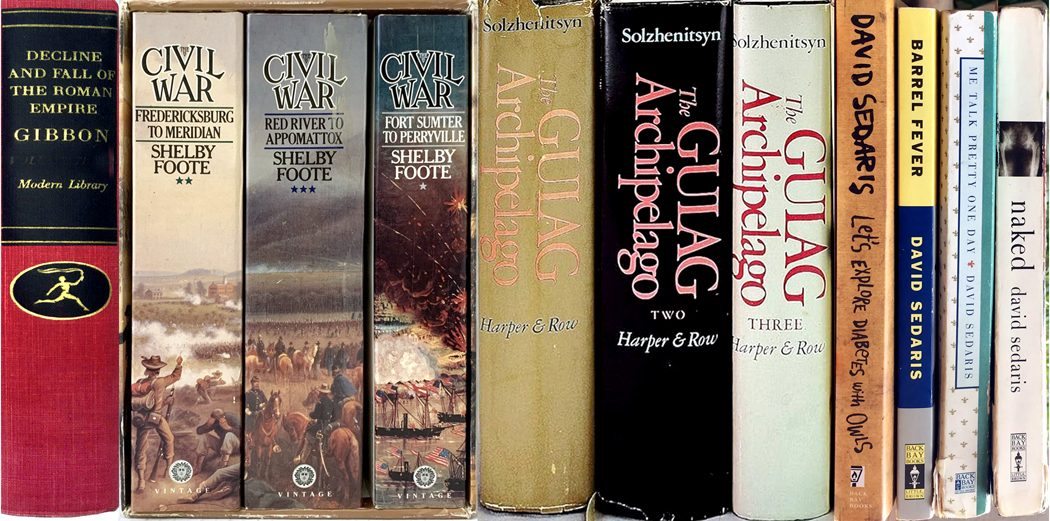
That leaves us a book and a luxury. People value books for, usually, one of three reasons. Either for the information they gather, or for the stories that are told, or for the prose they are written in. I fall into the last camp. I thought about Gibbon’s Decline and Fall of the Roman Empire, which is an utter joy to read, whether you care about the factual history of Rome or not. I revel in its river of words. But I read it in short segments, ultimately filling up like a rich meal and need to wait some hours before hitting the table again. And, for all the wonderful writing, there is a sameness that can creep in. 

Or I might have chosen a classic that somehow I’ve missed in 77 years of life. Many on Desert Island Discs have taken Marcel Proust’s Á la Recherche du Temps Perdu. But when it comes to monster works, I already put in my time, having gotten through The Gulag Archipelago. I no longer need to prove myself. 

So, I have chosen Joyce’s Ulysses, the book I can read and re-read over and over, with such a variety of prose and method and such delicious words, that I don’t think I could ever tire of it. 

As for a luxury item, I had some difficulty coming up with something, because I am not much for luxury. But I have always owned a pear-wood handled Opinel folding knife. The current one sits in the glove compartment of the car, ready for anything called for. A man needs his tools.

Of course, the whole exercise is entirely pointless. There is no desert island, and with a house full of books, CDs, musical scores, and art, I don’t need to choose so parsimoniously. The whole idea is merely a pleasant game to play. 

But going through the process, and forcing myself to narrow the list arbitrarily, I come to see myself in a dusty mirror. And I surprise myself, looking back at me. 

I was sitting on the backyard patio this morning, soaking up sunlight, when a squirrel skittered across the lawn, back and forth like a pinball. Eventually, he came to within 10 feet of me. I sat stock still, and he stared, twitching his nose, standing on hind legs like a deacon. After about a minute — which can feel like quite a long time — I must have blinked, because he jumped, startled, and took off running away. 

I often sit in the back yard, to hear the birds and watch the clouds. It feels like an unmediated soak in existence. I sit trying to notice everything, the birds singing, the clouds moving, the wind making the trees wiggle in random motion, and until recently, the incessant noise of the cicadas, sounding like the A Train rushing through the 81st Street subway station. I felt the breeze in my hair, saw the bluish greens of the iris plants and the yellower green of the grass, I enjoyed the warm concrete on the soles of my bare feet and the incipient sunburn on the backs of my hands.

Bill Moyers once asked Joseph Campbell about the search for meaning, but Campbell switched focus: “People say that what we’re all seeking is a meaning for life. I don’t think that’s what we’re really seeking. I think that what we’re seeking is an experience of being alive, so that our life experiences on the purely physical plane will have resonances with our own innermost being and reality, so that we actually feel the rapture of being alive.”

And so, I sit watching my back yard, the trees that line it and the sky above it. I can feel myself breathing, wiggling my toes and being alive, and what is more, recognizing the world being alive around me. For a moment, there is no boundary between my existence and the sea of being in which I swim. 

A wren flits down and sits on the steps to the shed and moves from one position to another with no apparent intervening motion, as if it were a jump-cut in a movie. A really bossy mockingbird runs through his repertoire of bird calls, claiming this patch as his own. A cardinal flies from my left to land on a bush to the right. A white butterfly bounces on the air waves to disappear behind the bushes. 

I’ve seen so much life in this tiny patch of ground, it sometimes astounds me. I cannot count the birds. Crows, even a raven. Way up in the sky, I’ve seen up to a dozen buzzards at a time circle as they catch the updraft coming from the river and up the bluff to this house. 

There have been cottontails and many squirrels. Two years ago, coming home from a trip to Maine, as I pulled into the driveway, two bear cubs were climbing up a tree at the back of the property. We watched them having their fun, and then mama bear climbed up behind them to encourage them to come back down. A dog barked aggressively from somewhere down the neighborhood and the bears all dropped to the ground and ran off. I’ve seen bears waddling through the streets here, and long ago learned not to put the trash out until garbage delivery day. 

A groundhog has crossed the back yard so often, he has left a permanent trace in the lawn. I have seen him multiple times harrumphing his way along. If he spots me sitting, he will take a moment to stare and consider his next move, but then run faster than you think he can move, back where he came from. 

Then, there are the bumble bees, the honey bees, the wasps and the ant lions — their little sandy funnels in the dirt of the front garden. Big black butterflies, and their yellow and orange doubles light on the hedges and weeds. Ants build their nests in the cracks of the driveway, leaving tiny ridges of dirt where they have dug down. 

Yesterday, as I was headed out the back door to have my daily sit-down on the patio, before opening the door, I saw the groundhog plopped down right by my chair, butt-flat on the concrete and motionless as a garden gnome, while an angry mockingbird jumped in a half-circle around him aiming “Cht-Cht — Cht Cht” at him. They continued this performance for a good two minutes until I must have made a noise and the great, heaving woodchuck became disturbed, turned its head my way and waddled off to hide under the shed and the bird, having had its way, flew up to a tree and quieted down. 

When I was little and visited the Bronx Zoo, I was impatient to see the animals, who sometimes hid in the shade at the back of their enclosure, or sat behind some rocks, and if I did not have my interest piqued in the first five seconds, I moved on to the next animal. But my father told me to wait. Just watch. Eventually something would happen. I didn’t understand that then; I do now. I find myself in my yard patiently waiting for the next miracle. 

(Many years later, I worked at the Woodland Park Zoo in Seattle, and saw crowds of impatient kids moving from exhibit to exhibit. And it is only worse now, in an era of cell phones and digital immediacy.) 

Writing in the Fourth Century, the Christian poet Prudentius identified in his Psychomachia (“Battle of the Souls”) his version of the Seven Deadly Sins, and the corresponding Seven Virtues, at war with those sins, and among the virtues was Patience. 

I don’t know if I learned it from my father, or inherited it from his DNA, but, like him, I have become rather patient. Or maybe I’m just sluggish. But, I believe it served both of us well. The old man was slow to judge, slow to anger, and would never think to get outraged at traffic. Being raised that way, I, too, am willing to wait, when waiting seems either inevitable or purposeful. In fact, I can sit quietly in a chair neither talking or thinking for ages at a time. When I’m being philosophical about it, I call it meditation.

In the 1950s, the aging photographer Edward Steichen rarely left his home in West Redding, Connecticut, and began photographing a serviceberry tree (he called it a shadblow tree) through his window. He watched the seasons shift across the face of the pond and the tree and pictured them in all seasons and hours of the day, under varied weather, and made a case you could spend an infinite amount of time in a single place with a single subject and discover everything. As Yogi Berra once famously said, “You can observe a lot by just watching.” 

And it is the little things, carefully watched, that won’t happen again. The flow of the world is that it won’t happen again, all in constant forward motion and I sit to watch it move past me, and take me with it. 

 I just want to sit and soak, to sense the universe around me without thinking. We tend to glorify rationality, and the power of our brains to think meaningful thoughts, and we diminish the value of pure sensation, the sensuous awareness of colors, shapes, earthforms, clouds, birds, song, rhythm, touch, smells, and tastes. But these things are primal and exist before thought. Sensation is primary; making sense is an afterthought. 

And so I sit, trying to lose myself in the larger pattern.  

But, damn it, I can’t help being a writer and so I need to belittle what I enjoy, turning it all into words, into capsules of meaning that when read by others will be turned into ideas about sensations. Words not experience. And so, I can’t stop myself from writing this, hoping you share some of that delight when you step outdoors on the right day, with the right breeze, and the right mockingbird and crow squawking, and can see the trees dancing and the sun moving slowly across the sky blotted with whatever variety of cloud you have that moment.

Over the past few decades, the programming at our symphony concerts has become routine and predictable. I’m certainly not the only one to notice this, but almost every program follows one of two patterns: Either overture, concerto, intermission, symphony; or, overture, smaller symphony (perhaps Mozart), intermission and then big concerto (like Rachmaninoff Third). Over and over, this pattern holds, which leaves a lot of great music never played. Programming has become stultified. 

And even the list of symphonies and concertos that do regularly make the cut has shrunk to a roster of “fan favorites.” When was the last time you heard a live performance of, say, the Bruckner Sixth or the Joachim Violin Concerto? They used to be played — they show up in old programs. 

Of course, you can find recordings of everything. If you want an Atterberg symphony, there are multiple CDs on Amazon. But go to Symphony Hall and you will wait a very long time and grow your beard very gray.

There is a particular class of music that has suffered by this development: those shorter, once-familiar staples of both concerts and Looney-Tunes animations. They used to be a regular part of symphony concerts but now are seen as “not serious enough” for well-bred audiences seeking morally and spiritually uplifting artistic experiences. That is too bad, because a lot of this music is absolutely brilliant, and what is more everyone loves it, to the point of being able to whistle the tunes. 

The conductor Thomas Beecham once said, “Composers should write tunes that chauffeurs and errand boys can whistle.” And, “Music first and last should sound well, should allure and enchant the ear. Never mind the inner significance.” 

Beecham was one of the greatest conductors of the 20th Century, and could lead a great performance of a Beethoven symphony, so he wasn’t a mere light-weight. But he regularly included in his programs what he called “lollipops,” which are the smaller, brighter pieces that get short shrift nowadays, pieces such as Tchaikovsky’s Nutcracker Suite or Handel’s Largo from Xerxes. There were excerpts from longer pieces, and shorter concerted works for piano or violin soloists that weren’t full-lengths concertos. When was the last time you heard a live performance of Saint-Saëns’ Introduction and Rondo Capriccioso? It is a brilliant show piece for a virtuoso violinist. 

There are several registers of concert music. At the top sits the top-hat and tails music of Brahms and Beethoven. At the lower end are the Pops concerts with their orchestrated show tunes and movie scores. Arthur Fiedler ruled that kingdom, and included lightweight but catchy music by Leroy Anderson or Albert Ketèlbey. In between there are the New Years concerts of Strauss waltzes and polkas. Fiedler often included some of the more serious music in his Boston Pops programs, but those works have all mostly disappeared from Carnegie or Severance halls. 

If you look at symphony programs from a hundred years ago, or two hundred, you find these shorter pieces sprinkled in among the symphonies and tone poems, with no apologies made for their simple popularity. Concerts, after all, are meant to be entertainment. 

In Haydn’s day, when middle class supplanted the aristocracy as the prime audience for concert music, his programs included singers, soloists, maybe a chorus and a symphony (then called an “Overture”), which often had its movements split up, with bits of song or violin music in between. It was a varied experience, more like a music hall show than a serious artistic event. They were meant to be popular; meant to sell tickets. 

Even in the earlier 20th century, concerts featured both heavy and light classics. But the helium has fizzled out of the balloon. 

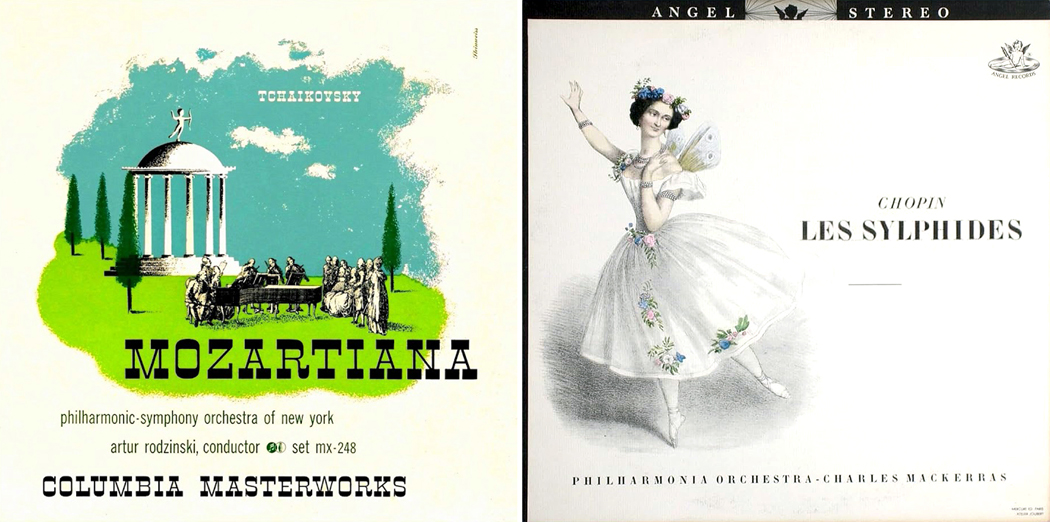
In the LP era, Beecham released several records made up solely of these lighter,  brighter gems, in albums titled “Lollipops.” 

They were once the common cultural inheritance of American and European culture. They made up the bulk of recordings from the first half of the 20th century, when 78 rpm records could contain only about 5 minutes on a side, which made recordings of entire symphonies or complete operas both exorbitantly expensive and with 20 or 30 sides on 12-inch discs, really, really heavy to haul around. And so, shorter, popular pieces, like the encores of violinist Fritz Kreisler, became best sellers. I am old enough to have once owned piles of 78 rpm classical music recordings. 

A last vestige of that can be found in the recitals of Itzhak Perlman. I’ve seen him several times and it’s always the same. A warm-up sonata, played very well, but nothing special, followed by a major piece performed to blow your socks off (I heard him do the Strauss Violin Sonata — a piece  not thought of as among Strauss’ best work — and make it sound like the greatest thing every written for the fiddle); then, after intermission, he spends the last half of the recital playing old short pieces, sometimes requests, and tells corny jokes in between — real Borscht-Belt material. And so, we hear Hora Staccato and Liebesfreud, pieces otherwise consigned to history.  

But why couldn’t symphony orchestras do something similar, make half a program of shorter tchochkes and tuneful shorter pieces. Perhaps load them up in the first half of a concert and follow that with a second-half major symphony. 

Or, do it like Perlman and leave the audience warm and fuzzy as they leave the auditorium humming the old familiar tunes of Offenbach or Ferde Grofé. 

Somehow, symphony programs need to be decongested, and let breathe more freely. And there is all this wonderful music that is kept in storage that should be pulled out and given some sunshine. 

Click on lists for improved readability

Delmarva Peninsula

When I was a kid, most things in the world just were. Everything was normal, even if it wasn’t. People lived in houses, roads were paved, families had a mom and dad. And, for a kid, parents were just parents; I never gave much thought to why they did what they did. It wasn’t even that if they did something, they must have had a reason. They just did things. They were Mom and Dad, and as children, me and my brothers just followed along. As a child, the world is a given. 

It’s hard to recall that state of affairs, when things happened because they happened. That they might have done things for the abstract good of their children never dawned on me. Of course, now that I am old, I look back and realize how much they did for us, things they didn’t have to do, or things they probably would have preferred to do some other way, including some other things they might have wanted to do with their sparse vacation time. 

Gettysburg, Pennsylvania

But one of the things they did for us was travel. When we had our summer school vacations, Mom would pore over various brochures, magazine articles, and roadmaps and carefully plan routes to drive and sites to take in, and then, when it came time, we would load up the car and take off. We went to Washington D.C., to Niagara Falls, to Fort Ticonderoga, to Gettysburg — and many spots in between. Only later did I come to understand there was a purpose to these vacation trips. they chose these things to expose their children to history, geography, politics and to let us see what was possible outside suburban New Jersey. Travel was part of our education. 

Back when they were children, they didn’t get to travel. They both grew up in northern New Jersey and neither had more than a high school education. Dad’s family was heavily religious and didn’t approve of having fun, and Mom had to raise her two younger siblings after her father died when she was still in grade school and her mother had to find work in New York City. And so, the worlds they grew up in were limited.

German gun, Omaha Beach, Normandy, France

But when my father was drafted in 1940, he was sent to Camp Wheeler in segregated Georgia. He didn’t talk much about his army life, but he did express shock at discovering the pervasiveness of racial discrimination. And then he was sent overseas after D-Day to France, Czechoslovakia and Germany and found that other peoples had various ways of making a decent life. His horizons were involuntarily expanded. 

When they got married, shortly after the war, they felt it was important to broaden their children’s horizons, too, and to make sure we got the best educations. There was never any question that their kids would go to college. (I was told that when I entered second grade, I asked if that meant I could go to college “next year?”) Education was Priority One. Travel was a component of that. 

Kristiansand, Norway

Later, when I was in high school, they made it possible for me to go to Europe, accompanying my immigrant grandmother to her birthplace in Norway, and to take a bus tour through France, Germany, the Netherlands, Belgium and Luxembourg. A few years later, my younger brother, Craig, was sent off on a similar trip. 

Mark Twain famously said that “Travel is fatal to prejudice, bigotry, and narrow-mindedness, and many of our people need it sorely on these accounts. Broad, wholesome, charitable views of men and things cannot be acquired by vegetating in one little corner of the earth all one’s lifetime.” 

The vast bulk of the MAGA world, it seems to me, is made up of those who have never ventured far from their birthplace. If they had seen how others live, they would not accept the lies. 

Cairo, Illinois

Travel, then, has pretty much always been an essential part of my life, and having become an adult — at least as quantified in years accrued on the planet — I have continued the habit instilled by my parents. Education wasn’t only in books; I read Huckleberry Finn, of course, but I’ve also been to Mark Twain’s childhood hometown of Hannibal, Mo., and to what remains of Cairo, Ill. I’ve driven along the entire length of the Mississippi River, from Lake Itasca, Minn., to the Venice Marina where the road ends in Louisiana. 

Vancouver Island, British Columbia

It is rare to mention a place I haven’t been in the continental United States or provincial Canada. Big Sur; Mt. Katahdin; the Everglades; El Paso;, the Union Pacific Bailey Train Yard in North Platte, Neb.; Hudson Bay; Halifax, Nova Scotia; the Tehachapi Loop in California; the Sturgis Rally in South Dakota; even Glacier Bay in Alaska.

Glacier Bay, Alaska

Believe me, I can be quite irritating, when someone mentions some far-off place and I chime in, “Oh, yeah, I’ve been there. Had a great Po Boy sandwich in a little shack along the road in Pecan Island.” Which is a tiny community along the southernmost road in Louisiana. Or “Abiquiú? Yes, we visited Georgia O’Keeffe’s place there.” I am slowly learning to keep my yap shut. 

Red Mesa, Navajo Reservation, Arizona

I’ve been to every state except Hawaii, and most of them many times, and every province in Canada, save only Prince Edward Island and Newfoundland. I’ve lived in four corners of the continental states, growing up in the Northeast, moving to the American South, then to Seattle in the Northwest, and spending 25 years as a writer in the Southwest. Each move gave me a chance to explore all the territory nearby, often in some detail (There’s hardly a square meter of Arizona that I haven’t been to. Go ahead, name something obscure: Ajo? Red Mesa? Tumacacori? Freedonia? Gadsden? Quartzsite? Check, check, check, check, check and check.)

Cape of Good Hope, South Africa

I’ve been to the Cape of Good Hope in South Africa and to Marylebone Road in London; I’ve been to the Chartres Cathedral, and to the bull ring in Arles, in Provence. My late wife and I went back to France many times, and drove to all six corners of “The Hexagon.” 

And so, yes, I’ve been to the D-Day beaches at Normandy and to the bomb craters still evident in Verdun, to the cave art along the Vézère Valley, to the paleolithic menhirs and dolmens near Locmariaquer. 

Dolmen, Locmariaquer, Brittany, France

I’ve visited the Museum of Questionable Medical Devices, the Museum of Jurassic Technology and the Hammer Museum of Haines, Alaska. 

And it has all been an education. I certainly learned that the omelet I get at Denny’s is a pale mutilation of the rich, creamy offering you can find at any neighborhood cafe in Paris. 

O’Keeffe Country, New Mexico

Of course, I’ve also learned how little of the world I’ve actually seen. I have so much of the non-European inflected planet yet to see, although, at my age, it’s almost certain I will never get to Japan or the Seychelles or Samoa. Just as, no matter how many books I’ve read, there is always a hundred times more books I will never get to read, and not enough time left even to put a dent in that list. I keep trying. 

Windsor Ruins, Mississippi

And so, in addition to bragging about all the places I’ve been, I am shamed by all those places I have not gone to, just as all the art I haven’t seen, all the books I haven’t read, all the music I have never heard. But I think that it is only because of all I have read, seen, and heard, that I know enough to feel the gaping holes in my education.

Happiness is a strange emotion, not a single thing, but really an umbrella term for a diffuse group of hard-to-define states. Periodically, studies are published about which nation is the happiest (usually, it seems, a Scandinavian country.) But what they are measuring is a rather tepid version of happiness. Usually, if we ask if someone is happy, what we mean is an absence of problems — basically a neutral state in which we are not currently threatened, hurting, being oppressed, or worried. “Are you happy?” “Yeah, sure, I guess so.” Enough to eat, a roof over the head, a relationship that isn’t a chore, no pending hospital bills or tax audits. 

Really, that is a condition to be wished for, as dull as it sounds. For most people in the world, its achievement would be a godsend. So, I don’t want to downplay such a state. Not getting bombed is a net positive. Yet, there are other happinesses. Falling in love, birth of a child, success at work — these all provide a joyful uplift that raises the psyche above the day-to-day and makes life more radiant, if only briefly. It is a state we cannot maintain over long periods without being considered a bit loopy. So, we return back to the state of happiness that is unremarkable. 

But, as adults, we can watch our children at play and recognize in their faces such a state of unreflective happiness that can only break our hearts. Oh, what they don’t know yet about being alive. It’s not just an emotion: The entire body explodes with it.

There is what I might call “body happiness,” which they express in movement, in play, in dancing and skipping, singing, letting out squeals that express the inner state that, as adults, we can only mourn the loss of. “There hath passed away a glory from the earth.” 

I mention all this because one of the reasons I listen to music — primarily, for me, what is called classical music — is its ability to evoke emotions in its listeners. They arise sympathetically and are often emotions more subtle than mere language can name. It has been said that music is more precise than words, and I recognize that, whenever I am moved by a quartet or sonata but cannot speak exactly the words that would distort the emotion into easily fixed categories. 

A standard symphony moves from thought to thought, emotion to emotion, in ways that express the same sort of progress a story makes, beginning, middle, end. Episodes all build together to a longer, coherent emotional or intellectual ride. Our limbic system moves along with that progress and we can basically take our emotional selves through the moves. The widest range is the most completely human. 

And one of the things music can express is that ebullient, body happiness, so that we can feel it again. 

Mostly, it jumps out of a single movement in the whole, or even a few bars in the movement, but it is inexpressible joy, and it makes our body move, to tap toes or sway our bodies to and fro, often with a surprised smile on our faces. I think of the finale of Haydn’s Symphony No. 88, for instance, or the scherzo from Dvorak’s Eighth Symphony. I can’t sit still while listening. 

George Frideric Handel has two “happy”numbers in his Acis and Galatea. The opening chorus sings of “Oh the pleasures of the plains, happy nymphs and happy swains,” which extolls the life of the peasants, and a love duet that repeats endlessly, “Happy, happy, happy we.” It all sets up the tragic ending. 

But, there are a very few works that take that body happiness from start to finish, works you can play or stream, that will infallibly lift your mood and remind you of the happiness that is upwards of neutral, and can replace all the fret and sorrow for the length of its performance, and usually, for some time after, as you bathe in the memory of its tunes. 

There are at least eight of these that I can name, which always leave me uplifted, my senses turned up several notches, and my memory of childhood’s version of happiness is re-animated. 

Prime among these is Franz Schubert’s “Trout” Quintet. It bounces and sings through five distinct movements, each of which floods with tune, rhythm and color, anchored by the bottom notes of the double bass. 

It was written in 1819, when Schubert was 22 years old, and before the lingering illness that eventually killed him nine years later. The haunting of death darkens the later String Quintet that he completed in 1828, just two months before his death. But the “Trout” is the antithesis of all that: Life giving, life affirming, joyful from first bar to last. What can you do when every tune is an ear-worm. Once inside your body, you carry the “Trout” with you the rest of your life. Play it every time you need it. 

Less well-known, but even more relentless is Darius Milhaud’s Le Boeuf sur le Toit, or “The Ox on the Roof.” Milhaud wrote it in 1919 after living in Brazil for two years in the French diplomatic service, and quotes dozens of Brazilian folk songs, adapted into a dance-hall band playing Latin rhythms, complete with güiro. He employs a polytonal technique, where different parts of the band play in different keys at the same time, giving the whole a piquancy and aliveness that has a feeling of spontaneity, like an amateur band in a smoky bar. It’s always just about to come apart. 

Written in the Baroque form of ritornello, with an 8-bar tune coming back over an over between alternate dances, it has some 20 Brazilian tunes buried in it, with infectious beats that express the unabashed happiness of a sweaty dance hall. Evybody dance now!

Mostly we think of Johannes Brahms as a sober German burgher writing symphonies with the seriousness required of höchste Deutsches Kunst. But the boy could let his hair down, which he did with two sets of vocal quartets, Liebeslieder Waltzes, op. 52 and op. 65. 

Brahms made his living, early in his career, when he moved to Vienna, as leader of various choruses such as the Singakademie and Musikverein, for which he wrote tons of choral music and songs. So, he had a popular streak in him. 

The 33 songs, each no longer than a minute or two, celebrate bourgeois domestic love in tunes so meltingly gemütlich that you will have them running through your head for days. They were meant to be sung in homes or in taverns, so they are best with normal voices, not the operatically trained soloists that so often record the set. “Ich gäbe dir so gern hunderttausend Küsse” — “I long to give you a hundred thousand kisses.” 

When Georges Bizet was a mere stripling of 17, he wrote a Symphony in C as an exercise for his studies at the Paris Conservatoire. It was never performed in his lifetime and ultimately forgotten about, until it was rediscovered in 1933, and performed two years later by Felix Wiengartner, a suitable conductor, whose first name means “happy.” 

Bouncy and tuneful from first note to last, it has proven hugely popular since then, and one wonders why Bizet never had it published, in fact, never even mentioned it. It is a masterpiece, but not on one of those marble pedestals, but the kind that makes your ears grateful to be on your head. It is breezy and fluent and just makes you happy to be alive. 

Georges Balanchine choreographed it for the Paris Opera Ballet, and I was lucky enough to see the New York City Ballet perform it with a live orchestra at the Palais Garnier in Paris, (where it was first performed in 1947). One of the highlights of my life. 

Also a youthful work is Serge Prokofiev’s Classical Symphony, written in 1916 when he was a conducting student at the St. Petersburg Conservatory. When one of his teachers, Boris Asafyev, mused “that there is no true joyfulness to be found in Russian music,” as Prokofiev wrote, he responded with one of the happiest works ever written by a Russian. 

And so, he wrote in his diary, “I composed a new finale, lively and blithe enough for there to be a complete absence of minor triads in the whole movement, only major ones.” 

It displays what is often called the composer’s “wrong note Romanticism,” with catchy tunes and ascerbic harmonies, and was meant to mimic the spirit of Haydn and Mozart. What a joy. 

Much shorter, at merely five minutes, but so fresh and lively as to become its composer’s most frequently performed piece, the overture Leonard Bernstein wrote to his musical Candide just can’t stop laughing, and teasing, with bubbling wit and elan. 

The musical (or operetta — it could never entirely make up its mind and went through multiple reworkings) never quite caught on the way West Side Story has, but its overture, shaped as a mock Rossini overture, is irresistible. 

Johann Strauss II produced music the way a lawn sprinkler sprays water. The “Waltz King” composed over 500 waltzes, polkas, quadrilles, and other types of dance music and several operettas, all of surprisingly consistent craftsmanship.

No one in his right mind, though, would sit for all of it; before too long the program would become monotonous: How do you tell one polka from another. That is, except for the large handful of truly memorable masterpieces, all of which will raise you spirits and make you want to dance. 


I mean, the Blue Danube, the Voices of Spring, Tales of the Vienna Woods, the Artist’s Life, the Kaiser Waltz — a CD full of the best Strauss is a must-have for any collection. It’s hardly surprising that Brahms envied Strauss’ gift for melody. Each is basically a tone poem in three-four time. Lift the spirits, make you smile and move your body. 
Finally, there is Benjamin Britten’s Simple Symphony, which displays a childlike joy in just spinning tunes, which is hardly surprising, since he wrote those tunes when he was a child, between the ages of 10 and 13. When he turned 20, he reworked the tunes into this four-movement suite for strings, with movements titled “Boisterous Bouree,” “Playful Pizzicato,” “Sentimental Sarabade,” and “Frolicsome Finale.” It premiered in 1934 with Britten conducting. 

Since then, it has been recorded dozens of times, usually as a filler on discs with other Britten pieces. 

There are other joyful pieces, but these are eight that come immediately to mind. They are each available in videos on YouTube, and worth seeking out, especially if you’re having a bit of a down day.