A few years ago, I read the Bible, cover to cover, and my general response was “These people were out in the desert sun too long.”

I mean, you must slice off bits of your private parts, but you must never cut off your sideburns? You cannot wear cotton blends without risking being stoned to death or eternally damned? If you have a flat nose, you cannot go to your house of worship? I mean, either you have to allow the possibility that in 40 years in the wilderness of the Sinai Desert, someone suffered sunstroke, or that perhaps the manna from heaven was actually some sort of psychotropic mushroom.

Or, you can read the so-called prophetic books and ask yourself, is this some sort of occult conspiracy gibberish? It too often reads like word salad. There is some sanity in the gospels, but then you descend back into paranoid craziness with St. Paul.

I can think of no better prophylactic against religion than actually reading the Bible. Those who profess belief too often cherry-pick the parts they like and ouija-board interpret the prophesies and ignore the batshit nutjob stuff that surrounds it all.

So, I hope I have established my bona fides as a non-believer when I say I am against removing the Bible from public schools. That’s right — I believe the Bible should be taught in school from an early age. Not for religious indoctrination, and also not for religious inoculation, but rather to familiarize the upcoming students with the stories from the book.
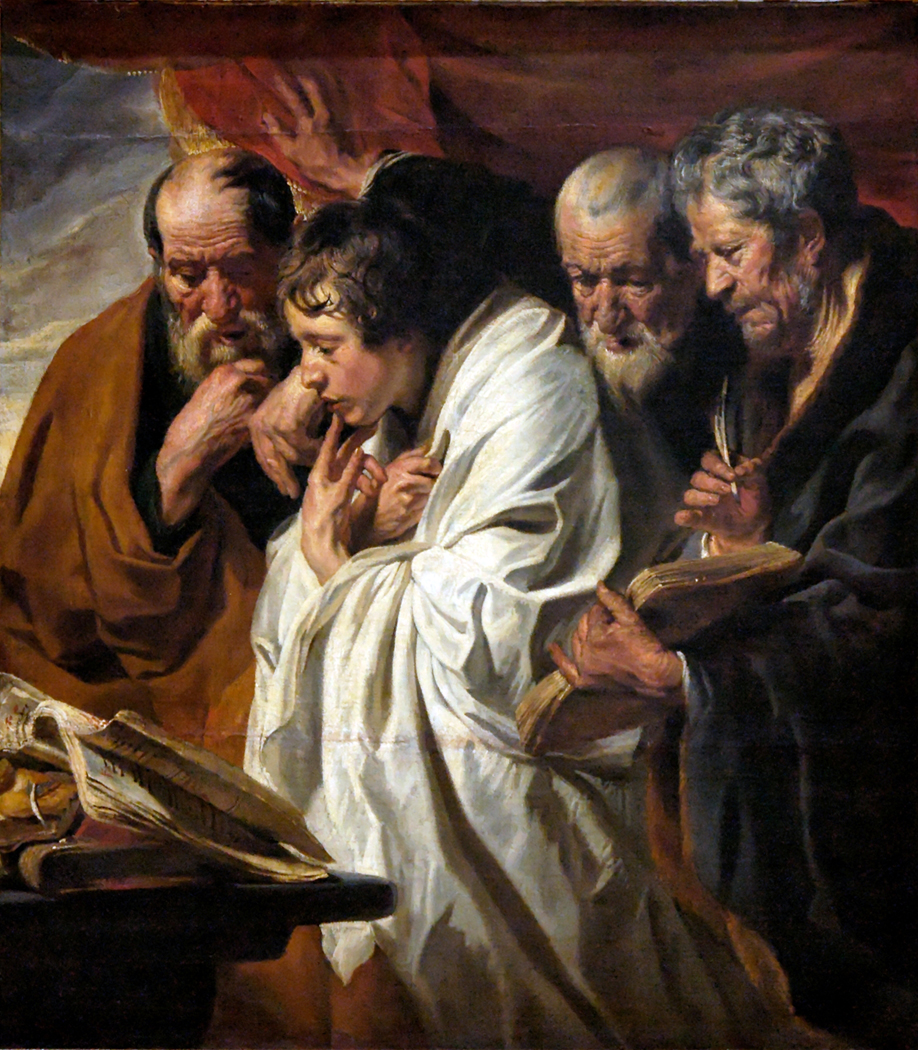
The Four Evangelists by Jacob Jordaens

When I was teaching art history, many, many years ago, I was surprised that my students knew so little about the subject matter of the paintings we were studying. Renaissance and Baroque paintings are suffused with biblical imagery, and to understand what is going on in many of those paintings, you need to know the cultural context — i.e., you need to know the Bible stories.

But, in a test, when I asked “Who were the four Evangelists,” only two of a class of 22 knew. One of them half-remembered, “John, Paul, George and Ringo.”

It hardly mattered if the students considered themselves Christian, or even merely generally religious. They were by and large, astonishingly ignorant of their cultural patrimony.

Abraham and Isaac. Cain and Abel. Lot’s wife. Jacob and Esau. Potiphar’s wife. Jacob’s ladder. Aaron’s rod. The golden calf. Balaam’s ass. Joshua and Jericho. David and Jonathan.

There are tons of stories that were once the common well of cultural reference for all European and Euro-American peoples, and by extension and the African-American church, for Black Americans, too.

It isn’t just Renaissance paintings, but in everything from Medieval illuminated manuscripts to the poetry of W.H. Auden. It shows up in sculpture, in novels, in dance, in symphonic music and Baroque opera.

The Slaughter of the Innocents by Rubens

Daniel in the lion’s den. Boaz and Ruth. Jonah and the great fish. Paul and the road to Damascus. The massacre of the innocents. The wedding at Cana. The raising of Lazarus. The giving unto Caesar. Doubting Thomas.

The loss of these stories in popular parlance isn’t just a loss of religious faith, but a casting off of hundreds of years of art, literature and mores.

When Herman Melville begins his magnum opus with “Call me Ishmael,” we need to understand who Ishmael was in the Bible if we want to feel the depth of the meaning of such a simple statement. It resonates.

When John Steinbeck titles his book, East of Eden, do we know what geography he is laying out for us? When William Jennings Bryan exhorts us not be be crucified on a “cross of gold,” do we feel the mythic undertones of his rhetoric? Everything we say has resonance, more and less, with the long line of cultural continuity. We have lived with the Bible, in one form or another (depending on denomination) for nearly 2,000 years, and the Torah, for even longer and the residue from it has colored almost every cultural effusion since the Emperor Constantine decided to change the rules for the Roman Empire.

Of course, it isn’t only the Bible that needs to be taught. All of Greek and Roman mythology is equally part of our cultural inheritance. It should also be taught. How can you read Shakespeare or Milton — or John Updike — without it? I would recommend that everyone by the 8th grade have read Ovid’s Metamorphoses.

What I see is a rising population of those cut off from their past, from their inheritance. They are like untuned strings, with no fiddle or lute to provide resonance. And it is this resonance that is so important. A familiarity with our cultural origins allows meaning to open up when you read, that emotions become complex and connections are made. The world is electrified: A switch has been turned on and a darkened room is lit.

And what do you get without this resonance? I fear you need only look at the White House and its current occupant (and I use the word advisedly: an “occupant,” like an anonymous piece of junk mail rather than a “resident,” which implies roots.) For without resonance, you have simplicity instead of complexity, you have response without consideration of consequence. If someone insults you, heck, punch him in the face — a simple and simple-minded response. And a dangerous imbecility in the face of the complex cross-forces and dangers of the interconnected world.

Tower of Babel, by Pieter Brueghel the Elder

Resonance is complexity. It is the plate tectonics under the surface geography.

A great deal of art and literature has something important to say to us, and the best of it resonates within the sounding board of 6,000 years of cultural development, with each layer built on the last and a through-line of meaning. Without it we are intellectually, emotionally and morally naked.
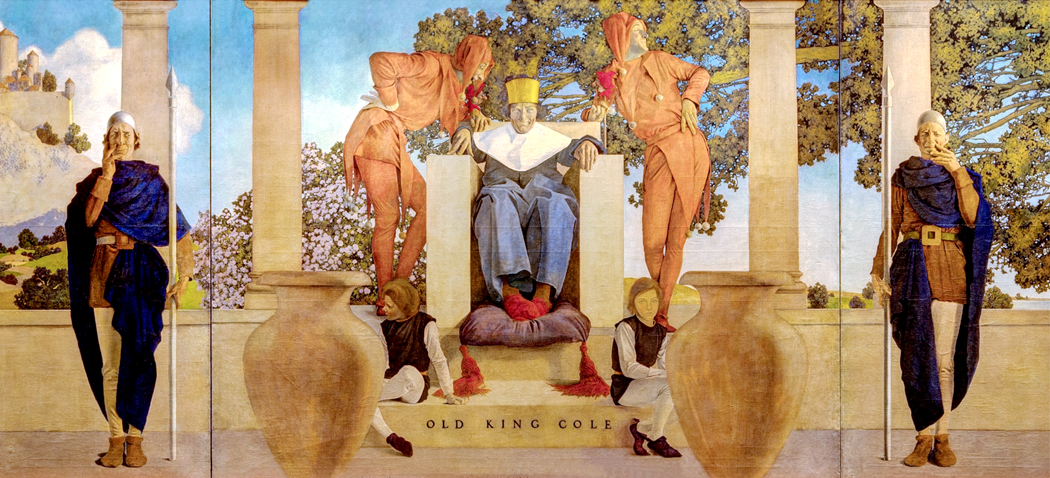
I have a book I love greatly. In august buckram, of a deep navy blue, with gold embossed letters on the spine, it is the Oxford Dictionary of Nursery Rhymes, compiled in 1951 by Iona and Peter Opie. It is more than an anthology; it is a deeply researched tome of scholarship, as one would expect from the Universitatis Oxoniensis.

Each rhyme is compiled with variorum versions and usually several pages of history, interpretation and arcana. Humpty Dumpty covers four pages, with footnotes. We learn that versions exist in Sweden (“Thille Lille”); in Switzerland (“Annebadadeli”); Germany (“Rüntzelkien-Püntzelken”); France (“Boule Boule”) and elsewhere. That Humpty-Dumpty is the name of a boiled ale-and-brandy drink; that there is a little girls’ game by the same name; that the name was also given to a siege engine in the English Civil War.

And we learn that there is a commonly-held belief that the rhyme (I can’t really call it a poem) is really about the fall of “My kingdom for a horse” Richard III. Not, apparently, true.

If there is a common theme in the book, it is that although so many people believe there is a “secret” meaning to so many of these nonsensical nursery rhymes, and seek out who in history is really being referenced, almost always such belief is unfounded. The poems are either attested to much earlier than the historical figure, or we know by internal evidence, it could not be.

How many people believe “Ring around the rosey” is about the Black Death or the Great Plague of 1665? This folk etymology doesn’t appear until after World War II, but now seems universally accepted, despite all evidence to the contrary. The symptoms in the verse are simply not the symptoms of the disease.

Or take “Sing a song of sixpence, A pocket full of rye; Four and twenty blackbirds, Baked in a pie.” The Opies relate several “interpretations” of the rhyme: “Theories upon which too much ink has been expended are (1) that the twenty-four blackbirds are the hours of the day; the king, the sun; the queen, the moon; (2) that the blackbirds are the choirs of the about-to-be dissolved monasteries making a dainty pie for Henry; the queen, Katherine; the maid, Anne Boleyn; (3) that the king, again, is Henry VIII; the rye, tribute in kind; the birds, twenty-four manorial title deeds presented under a crust; (4) that the maid is a sinner; the blackbird, the demon snapping off the maid’s nose to reach her soul; (5) that the printing of the English Bible is celebrated, blackbirds being the letters of the alphabet which were ‘baked in a pie’ when set up by the printers in pica form. … If any particular explanation is required of the rhyme, the straightforward one that it is a description of a familiar entertainment is the most probable.”

Occam’s razor, once again.

I grew up in suburban New Jersey, largely destitute of what Bruno Bettelheim called the “enchantment of childhood.” I never read any fairy tales until college. And the child rhymes I had about me were not usually the ancyent classiques, but rather, the newer comic ones.

Fuzzy Wuzzy was a bear

Fuzzy Wuzzy had no hair

Fuzzy Wuzzy wasn’t fuzzy

Wuz he?

or:

Oo-ee Goo-ee was a worm

A mighty worm was he

He sat upon the railroad track

The train he did not see

Oo-ee goo-ee!

Then there were the spelling rhymes:

Chicken in the car

The car won’t go

That’s how you spell

Chicago.

or

A knife and a fork

A bottle and a cork

That’s the way to spell

New York.

There were those set to familiar tunes, like the “Great green gobs of gooey grimy gopher guts,” or:

Be kind to your webfooted friends

For a duck may be somebody’s mother.

Be kind to your friends in the swamp,

where the weather is very, very damp.

Now you may think that this is the end —

Well, it is!

That abrupt ending was a theme, as in “Ooey-Gooey” and in

There was an old crow 

Sat upon a clod; 

That’s the end of my song. 

—That’s odd.

When I was a kid, I thought that kind of deconstruction of the scansion was hilarious.

Later, I learned such eternal classics as:

O I had a little chicken and she wouldn’t lay an egg

So I ran hot water up and down her leg

O the little chickie cried and the little chickie begged

And the little chickie laid me a hard boiled egg.

Which we rounded off with the modern rewrite of “Shave and a haircut, Five cents:”

Match in the gas tank:

Boom-boom.

Also hilarious:

On top of spaghetti,

All covered with cheese,

I lost my poor meatball

When somebody sneezed.

It rolled off the table

And onto the floor,

And then my poor meatball

Rolled right out the door.

“Rolled right out the door,” had me rolling on the floor.

Almost as much as:

I see London, I see France;

I see someone’s underpants.

Underwear being, of course, in grade school second in delirious comedy only to farts.

Such rhymes may refer to real personages, of course, as:

Lizzie Borden took an ax

And gave her mother forty whacks

And when she saw what she had done,

She gave her father forty-one.

(Although court records tell us Lizzie’s stepmother received 18 blows and her father, 11. Still, we don’t go to children’s doggerel for historical research.)

The fact is, this stuff is just nonsense verse, and we loved it, not only because we were immature little brats who found bodily functions risible, but because rhyme and meter delight the mind and ear. The children’s rhymes we recited when we were bairns were one of the ways we acquired language. (It has often been pointed out that we don’t “learn” our native tongue, but rather “acquire” it, picking it up by example, and examples that are memorable are easier to remember, QED.)

I don’t mean to imply these versicles were understood to be, or designed to be pedagogical, but that their effect was to make language magical and something we didn’t simply use, but delighted in.

Of course, sometimes the stupid rhymes were meant to teach, like “In Fourteen-hundred and Ninety-two, Columbus sailed the ocean blue.” Or, in even more egregious form, causing lifelong damage to those required to memorize them in music-appreciation classes, those mnemonics that taught classical music:

This is the symphony

That Schubert wrote

And never finished.

Or:

In the hall of the Mountain King

Mountain King

Mountain king

In the hall of the Mountain King

Was written by Edvard Grieg.

Can’t unhear what you’ve heard. Such things led to parodies, also, sung to the opening of Mozart’s Symphony No. 40:

It’s a bird, it’s a plane, it’s a Mozart

Shoot him down, shoot him down, shoot him down…

So, as we grew up, we still loved the silliness that we first encountered with our nursery rhymes and nonsense verse. It is why Walt Kelly’s Christmas carols are sung even by people who don’t know where they come from:

Deck us all with Boston Charlie

Walla-Walla, Wash., and Kalamazoo

Nora’s freezing on the trolley

Swaller dollar cauliflower alley-garoo!

It is why we love Shel Silverstein’s ditties:

The Slithergadee has crawled out of the sea.

He may catch all the others, but he

won’t catch me.

No you won’t catch me, old slithergadee,

you may catch all the others, but you wo— 

My brother says he doesn’t even remember writing this one, but I wrote it down many, many years ago:

Watch your scotch

Or it’ll get brittle.

And I was once asked to be a Cyrano for a college roommate I detested and to write a poem that he could pretend he wrote for a girl he fancied. Her name?

If you have a yen,

Don’t ask if, ask Gwen.

I don’t remember how that romance turned out, but, you know, “Match in the gas tank; Boom-boom.”

I cannot forget that Abigail Adams said, “Remember the ladies.”

I recently wrote a blog about several of my “heroes.” I was not oblivious of the fact that my five choices were all of the dangly-bits gender, and I promised in that entry to follow up with one on women who were also my heroes — those who embody character that I admire and would aspire to, if I were a better person than I have managed to be.

Top on my list of women who are my heroes I would place my wife of 35 years, but I will not be writing about her, for deeply personal reasons. Let us simply acknowledge that there is now a constellation that bears her name, made up of the brightest stars, cast up into the nighttime sky.

As with the previous posting, there are some women who most of the world would add to the list. I will never be as brave or as eloquent as Malala Yousafzai. If someone had shot me in the face, I’m sure I would have lain low for the rest of my life, looking back nervously over my shoulder and jumping at Fourth of July fireworks. But Malala continues to speak out forcefully for the education of women. She won the Nobel Peace Prize in 2014, when she was 17, which is the age my granddaughters are now. I think of them as mature for their ages, but Malala — wow. They don’t hand out Nobel Peace Prizes for being class president or state legislative page. She is one in a billion.

They do hand out Nobel Peace Prizes for upholding democracy in the face of authoritarian military juntas, though. Aung San Suu Kyi has one. She spent a total of 15 years under house arrest in her native Burma for speaking out against the repressive government, and finally managed to bring democracy back to her nation. (I recognize that all heroes run the risk of clay feet. Malala so far has avoided that fate, but Aung San Suu Kyi nearly blew decades of good will in the world by failing to condemn violence against the Rohingya Muslim minority in Burma. One always has to forgive something in one’s heroes. Not one of us is perfect.)

But my personal pantheon comprises five women who have something to give me on a more personal level; they embody traits that I would aspire to and that among them are fervent curiosity; a willingness to include everyone in the circus of humanity; an ability to feel not just sympathy, but empathy; a refusal to accept the conventional wisdom; and a burning aliveness. The each see the multiple layers of existence not as contradictory, but as accumulative.

Toni Morrison — Another Nobel Prize winner, this time for literature, Morrison has the fierce physiognomy of a Tibetan temple’s guardian demon. She suffers not fools gladly. But, as with the Buddhist demons, when you accept her for herself, she turns out to be a guide, not a gatekeeper. I especially appreciate that, although she can walk through walls — indeed, chew the walls up and spit them out — she does not cave in to the conventional definitions laid out for her by society.

When asked about feminism in a 1998 interview in Salon magazine, she said, “In order to be as free as I possibly can, in my own imagination, I can’t take positions that are closed. Everything I’ve ever done, in the writing world, has been to expand articulation, rather than to close it, to open doors, sometimes, not even closing the book – leaving the endings open for reinterpretation, revisitation, a little ambiguity.” 

She has done a great deal for feminism by being the powerful woman she is. It may be “off-putting to some readers, who may feel that I’m involved in writing some kind of feminist tract. I don’t subscribe to patriarchy, and I don’t think it should be substituted with matriarchy. I think it’s a question of equitable access, and opening doors to all sorts of things.”

And geez, can she write.

Agnès Varda — French New Wave cinema broke away from the conventions of studio filmmaking in the 1950s and ’60s, with a fresh approach to storytelling. Varda is often including in their ranks, but really, she isn’t in anyone’s army. She is peculiarly and significantly her own. It is often hard to tell whether she is making documentary or feature film. Her fiction often includes bits of real life, and her documentaries are often so imaginative that the only way you can categorize them is to call them “personal essays” in film language.

She is clearly in love with the things of this world, from her first feature, La Pointe Courte, from 1954, which focuses as much on the physical settings and objects in the small fishing village central to her story, as it does on the two main characters. There are wooden sheds and fishing nets lingered over lovingly by the camera, which moves ever so slowly, giving us all the time we need to pay attention. She dares us to be bored and challenges us to transcend that boredom by paying attention to the wealth she has spread before us.

In The Gleaners and I, she begins by following the poor as they gather bits of food left in the farm fields — a practice written into French law. But, the movie goes on to look at many people who have found value in things forgotten and discarded, including artists who make work from found objects. This includes herself. She said in an interview “I’m not poor, I have enough to eat.” But she points to “another kind of gleaning, which is artistic gleaning. You pick ideas, you pick images, you pick emotions from other people, and then you make it into a film.”

There is no doubting Varda’s feminist bona fides, but her argument is found not in politics, but in human relationships, and in the unembraceable fact that we all die. We wait for the biopsy results with the pop star in Cleo from 5 to 7, we watch the suffering of the poor wraith as she winds down to a cold death in a ditch in Vagabond, and we see Varda’s own love for her husband, Jacques Demy, as he slowly winks out of this life in Jacquot de Nantes. In all of them, death is not a literary device, but a vivifying fact of life we all must face with — if nothing else — creativity.

Ruth Bader Ginsburg — There are many reasons for admiring Ginsburg, not the least of which is her sparkling wit. Even as she becomes older and slower, the words that come out of her mouth always a bit more hesitatingly as age grips her ribcage are often ripping funny. There is always light flashing in those eyes. Whenever she shows up on a C-Span panel discussion, I stop flipping channels and sit through the duration. I love hearing her.

And certainly one admires the legal career which lead her to the senior position on the U.S. Supreme Court (in age, if not in length of service). She is always on the right side, even if not always on the winning side. Her dissents are deeply felt and forcefully written.

One also admires her fashion choice, wearing that lacy jabot across the front of her judicial robe. She was the third woman to administer the oath of office to a president, and the first Supreme Court justice to preside over a same-sex wedding.

And there is her love of opera; she has even appeared several times as a supernumerary in opera productions. And her long marriage to her late husband, Martin Ginsburg. I have a warm regard for anyone forming so close a bond for so long a time.

But the single quality I most admire in the Notorious RBG is the fact she could be friends with the late Antonin Scalia. How, you ask, could this have been possible. Scalia was the most ideologically inflexible of the justices during his term, and the most biting in his writings, whether in the majority or in dissent. Truculent and pugnacious, he had a nasty turn of phrase and seemed to ooze contempt for those who disagreed with him. Yet, Ginsburg and Scalia had a famous friendship in the court. They went to opera together. For years, the Scalias and the Ginsburgs had dinner together every New Year’s Eve. (His friendship with RBG is the one single redeeming feature I can cite in Scalia’s favor).

Nan Goldin — Seeming a universe apart from the high-achieving Supreme Court justice is an artist known for her snapshots of her drug-using friends. Goldin, now 63, made her name with The Ballad of Sexual Dependency in 1985, a slide show with music accompaniment that was presented via a Kodak Carousel transparency projector presented against the walls of a gallery. Along with the hundreds of slides, a recording of music by the Velvet Underground, Charles Aznavour, Nina Simone, James Brown and Richard Strauss played, underlying both the rebellious and romantic nature of the lifestyle portrayed — that of the gay subculture, the heroin chic, the damaging personal life of Goldin herself.

It is painful to look at these lost people, with their bruises, smeared eye-liner, tangled hair and thousand-yard-stares. One critic called them “the beaten down and beaten-up,” with “gritty disheveled miens” photographed in “dark and dank ramshackle interiors.”

An edited-down version of the slide show was published a year later as a book. It would be hard to turn those pages and feel there was anything to admire in them, other than the color and composition of them as photographs. But they are redeemed by two contradictory things: their truth and their romanticism. Goldin was not pointing her camera at this lifestyle to admonish it, but to document it; she was not outside it, but a part of it. It was a harsh self-inspection. But it also, while telling hard truths, explored the deep and abiding search for meaning in life. The need for transcendence, for escaping the banality of bourgeoise existence. Surely we are more important as individuals than as cogs in a societal machine.

For a more in-depth analysis of Goldin’s work, check out: https://richardnilsen.com/2013/08/30/the-goldin-mean/

Anne Iott — There are people who are bilingual, but Anne Iott is so in a very specific way: She is an artist, but she was also the chair of the art department at Tidewater Community College in Virginia Beach, Va., for many, many years and was fluent both in art and in administration. This is — if you haven’t been subject to either or both — extremely rare. To be able to converse meaningfully with artists about art in their own language, but to be able to function efficiently in the bureaucratic atmosphere of academe is more than a talent, it is a genius.

As an artist, she is first a painter, but that is just the start. There is hardly an art form or medium that she hasn’t essayed brilliantly. There are prints, collages, photographs, assemblages and in recent years, artist books, which she seems to spin out of her like a tree grows apples.

Certainly her prolific drive to create would nominate her for this list, but it is rather more than that. Anne has a special genius for seeing in other people that which they do not see in themselves. She has helped uncounted people with their careers and with their lives. I know; I owe my career as a writer to her. When I was teaching as a lowly adjunct faculty member at TCC, she finagled a position for me at Norfolk’s Virginian-Pilot newspaper as a freelance art critic. She knew I was a better writer than teacher. I wound up writing one or two reviews each Sunday for the paper, which gave me the confidence and experience to sign on full-time to the Arizona Republic when my wife and I moved to Phoenix, Ariz.

But it is not mere gratitude for her constant support and aid that I put her on this list, but rather for the particular ability to see other people clearly, even when they don’t see themselves, to go out of her way to make life better for other people. Anne has made a good life for herself, but she has also made good lives for all those she has helped. Nothing feels so good as to be seen. Really seen.

All those on these lists, both men (in a previous post) and women embody qualities I love and admire in them, and would wish to be able to emulate. I can try, but even when I don’t succeed, these are the lodestars of my better self.

Everyone has his heroes. Of course, the definition of “hero” changes through time and according to who is making the list. In Classical literature, the hero was the one who could translate the will of the gods into history. For some nowadays, we call heroes those who save little children from burning buildings. For others, they call schoolteachers “hero,” or their fathers, or someone else they admire. We have fallen a great way since Achilles became the man who bought us ice cream when we were toddlers.

But really, it has gotten even worse. I remember when the question turned bureaucratic and we began substituting the phrase “role model” for hero. The language is the poorer for it. So is the culture.

But perhaps something less ambitious is appropriate these days, since it is not as if we can believe in the epic hero, the Siegfried or the Aeneas. The 20th century destroyed any illusion we might have had about nobility, and the democratizing replacement has proved sadly short on transcendence.

And in the 20th century, those who aspired to translate the will of the gods brought disaster and destruction to the planet. One thinks of the mythic aura that the propaganda machine set as a halo around Adolf Hitler and the Übermensch, and the idea of heroism now has a stink about it that is hard to shake off. We cannot take seriously the idea of the single human who transcends human limits and converses with the gods. Clay feet for everyone. The cult of personality has left us with Kim Jong Un. However dangerous he may be, he still looks like a parody. So does Mr. Trump, with his dangling neckties and slouch walk, orange skin and ferret-fleece head. Sad.

No, we cannot take any of these pint-size heroes seriously.

Not that there isn’t still a hunger for such. How else can you explain the tsunami of superhero movies, with their rippling chests and spandex tights? Or, for that matter, the rise of so many authoritarian and would-be authoritarian regimes around the globe?

In the ancient myths, heroes were defined by a single act, often resulting in their deaths, making for few retired heroes. But it isn’t the paroxysm of the heroic act that we seek anymore, or can accept — after all, you can’t make a sequel if your hero has been killed and translated into a constellation in the night sky.

And neither can we believe anymore in the “will of the gods.” Whatever gods may have survived Nietzsche have retired to their corners to let the last remaining deity any culture fervently believes in fight it out with himself as Sunni and Shia.

That doesn’t mean we can’t have personal heroes, those we feel embody the values and achievements we care most about. For some, those heroes play sports or lead insurgencies, or make millions of dollars in real estate. They aren’t exactly “role models,” because we don’t truly aspire to put in the hard work required to meet these goals. But we like to imagine that, given the right circumstances — mostly in our daydreams — we might be like them.

Certainly there are a few heroic people who the large proportion of the world’s populace can admire. At least those who feel the warm pumping of humanity beating in their veins.

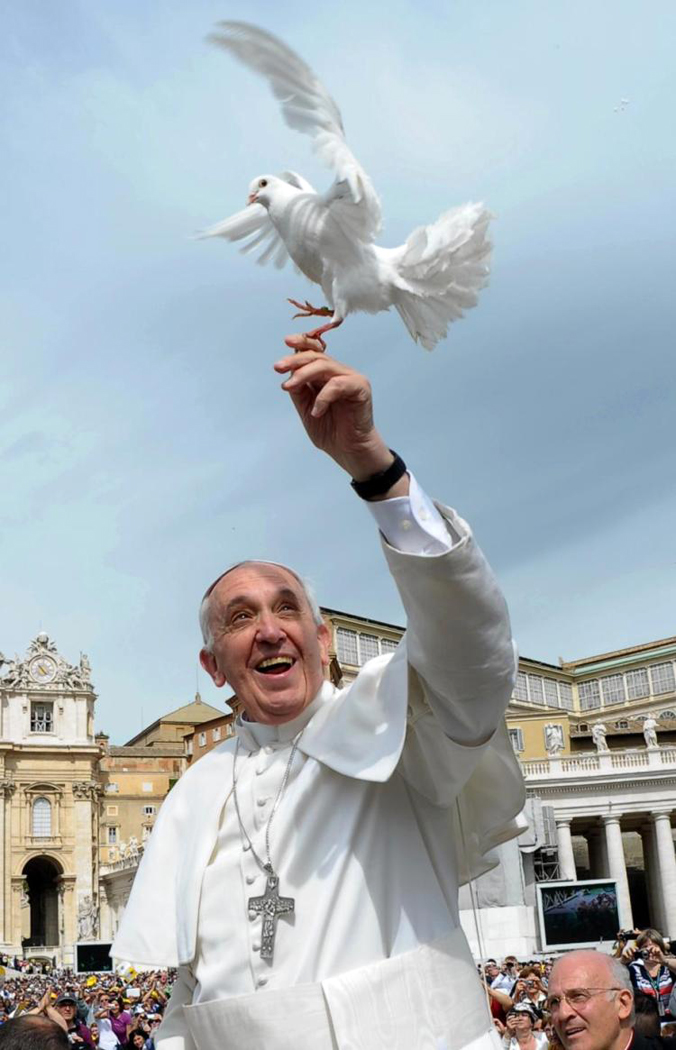
It’s hard not to think that, despite the recalcitrant and reactionary stubbornness of the Vatican, that Pope Francis is trying his damnedest to reform the Roman Catholic Church. Not in all particulars, of course, but he has clearly made clear he is less judgmental and more inclusive than anyone at the head of the church, perhaps since its founder. He has sent out olive branches to Muslims, to atheists, to homosexuals, even to the Orthodox Church. Now, if he could just do the same thing for women.

And there is an overpowering force of acceptance and forgiveness in the Dalai Lama. Yes, perhaps he giggles just a wee bit too much, and there are the political ramifications of Tibetan separatism, but the Dalai Lama seems to be able to function as a spiritual leader to everyone from Buddhists to atheists — and even to fundamentalist Christians, who recognize in him, if not the spirit of “true religion,” at least that he means well.

And I have to admit that these two men are heroes to me, too. Perhaps one sees their limitations, but then, Siegfried and Aeneas had notable shortcomings as well. (Siegfried was none to bright; he didn’t know the meaning of the word “fear.” Someone should have bought him a dictionary. And Aeneas, well, as far as heroes go, he was sliced from a large sheet of cardboard.)

Who would I put in my personal hagiography? It changes from time to time, as new heroes emerge and former ones snap off their clay feet at the ankles. But for the purpose of writing this short entry, I want to nominate five names. These, then, are my personal heroes, more than bureaucratic, and perhaps a tad less than monumental.

David Attenborough — Pretty much anyone who has seen the 91-year-old BBC TV presenter recognizes immediately the genuineness of his enthusiasm and his complete lack of vanity, with his white hair blowing around his head as he climbs trees in the rainforest or rides under the waves in a submersible. Attenborough, unlike most presenters, not only writes his own material — which is delightfully free from the usual nature-film cliches — but is his own producer. In fact, he was the head of BBC programming for years. He is not just a talking head, he is our surrogate for discovery. Everything he presents, he seems to be finding out for the first time and wants us to share it with him.

“I just wish the world was twice as big and half of it was still unexplored.”

If nothing else, his longevity onscreen is unmatched. His first nature film was made in 1954, which for those of you who are math-challenged, was 63 years ago. I am a geezer, but I was in first grade when he made Zoo Story for the BBC. Although he has slowed down, he still provided the voice over for a sequel to The Blue Planet.

I wish I had his enthusiasm and his energy.

Werner Herzog — If Attenborough is the avuncular voice of nature films, Herzog is the voice of nature biting back. His Bavarian-accented English is hypnotic — you cannot turn away. But it is the voice of doom. Make that in capital letters. But there is a kind of smile behind the terror. For Herzog, life is nasty, brutish and short, but it seems to amuse him. If it isn’t bears out to eat you, it is albino crocodiles, or Viet Cong shooting at you in the jungle.

“I believe the common denominator of the Universe is not harmony, but chaos, hostility and murder.”

If that isn’t enough, then take this one: “I am fascinated by the idea that our civilization is like a thin layer of ice upon a deep ocean of chaos and darkness.”

How is it, then, that his films are so life-affirming and joyous? It must be because he throws himself into the Maelstrøm with abandon. One sees him like Slim Pickens as Maj. Kong in Dr. Strangelove, riding the nuclear bomb like a bucking bronco.

It is the documentary films primarily that I am talking about. He also makes some of the most daring feature films — how can you top Aguirre, der Zorn Gottes, or Fitzcarraldo? — but it is the many, many documentaries that Herzog shows his peculiar Weltanschauung. Again, like Attenborough, there is never an ounce or a gram of cliche. Every utterance is original, but more to the point, true — at least as Herzog understands it.

As the late Roger Ebert had it, Herzog “has never created a single film that is compromised, shameful, made for pragmatic reasons, or uninteresting. Even his failures are spectacular.”

Brian Lamb — If Werner is a wolf, then Brian is a lamb. In the current political climate, where everyone yells at the top of their lungs, spewing venom and spit, Lamb is the quiet center of a vortex. Lamb invented C-Span, made it happen, and managed it from 1975 until he retired in 2012. He still shows up on the TV network, asking simple, direct questions of those in the news, without rancor, and seemingly without any agenda other than getting at the facts. I have never heard him raise his voice; I have never heard him express a political opinion. To this day, I cannot tell whether he is liberal or conservative, so close to the vest does he play it.

On the other hand, one believes he leans to the liberal side, if for no other reason than his happy toleration of diverse points of view. Diversity tends to be a liberal virtue. Nevertheless, I cannot tell for sure.

Lamb manages to make C-Span more than just a static camera in the Senate or on the House floor. On weekends, there is Book TV, and then, there is History TV on C-Span 3. You hear engaging lectures and panel discussions from every spot on the political spectrum — again, all played straight, no comment, no angle. Wow. For my money, Lamb is a secular saint.

John Lewis — You see his face behind the podium and you hear his deep, sorrowful voice and you know this is the pure expression of humanity, straight, no chaser. There is a moral power to his utterance. One imagines him reading a shopping list and making you feel like a better person for it.

Now 77 and a Congressman from Georgia’s Fifth District, Lewis is the soul of dignity. He has been through great suffering, was beaten and jailed, watched his mentor murdered in Memphis, fought for Civil Rights and now, as one of the few remaining voices of the Struggle, speaks not for African Americans, not for Americans, but for human beings. If we were any of us a hundredth as noble as he is, we should be proud. If we were to be visited by some alien civilization, I would want Lewis to speak for humanity as we were introduced.

John Waters — We make no bones about it, John Waters is an indifferent filmmaker. Many of his films are notable, but more for their outrageousness than for their cinematic virtues. Not that saying such would much bother him; he seems to know just where he fits into film history.

But it is Waters the man that I wholly admire. He can be funny — he usually is — he is often ironic, although he says he eschews irony, he knows the borders of good taste and makes sure he stays on the far side of the line, but there is an essential and unquenchable goodness about his vision.

I first noticed this in one of his lesser films, Pecker, about a young man devoid of irony who makes a splash in the New York art scene. Waters could easily have lampooned the nabobs of that scene as shallow and exclusionary — and he does have some fun at their expense — but in the end, he finds room for them in his universe, too.

It is admirable that he can be sharp but accepting also. There is a loving gentleness behind the kitsch and Waters never, ever looks down on his creations. He recognizes the silliness of human behavior, but counts himself among the silly. I would trust my life to Waters.

So, these are my saints, at least for the moment. There are more of them, but this gives you a range of them. There are women, too; I hope to write about some of them in the future. And even some political figures, although I might be hard pressed to name any of them currently living.

Do I live up to their example. Hardly. But in my mind, I try my best, which is all any of them can, or have asked.
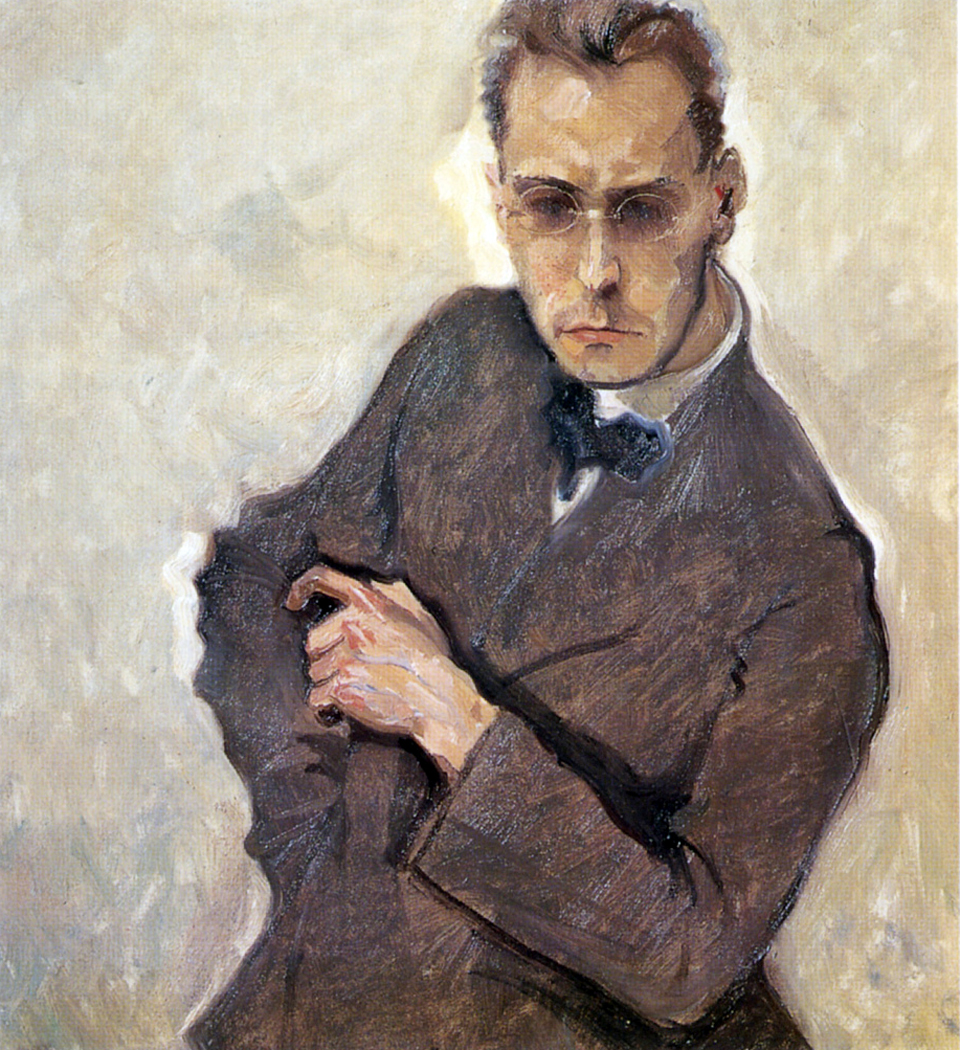
 

Please forgive me for what I am about to do.

Over the past five years, during which I’ve written nearly 500 blog entries, the least popular among them, according to the page views, have been those concerning music. People don’t seem to like reading about music, and worse, about classical music.

But today, I’m going to do far worse. I’m going to write about the Second Viennese School — the so called “atonal” and twelve-tone composers who have been blamed for destroying serious music in the 20th century.

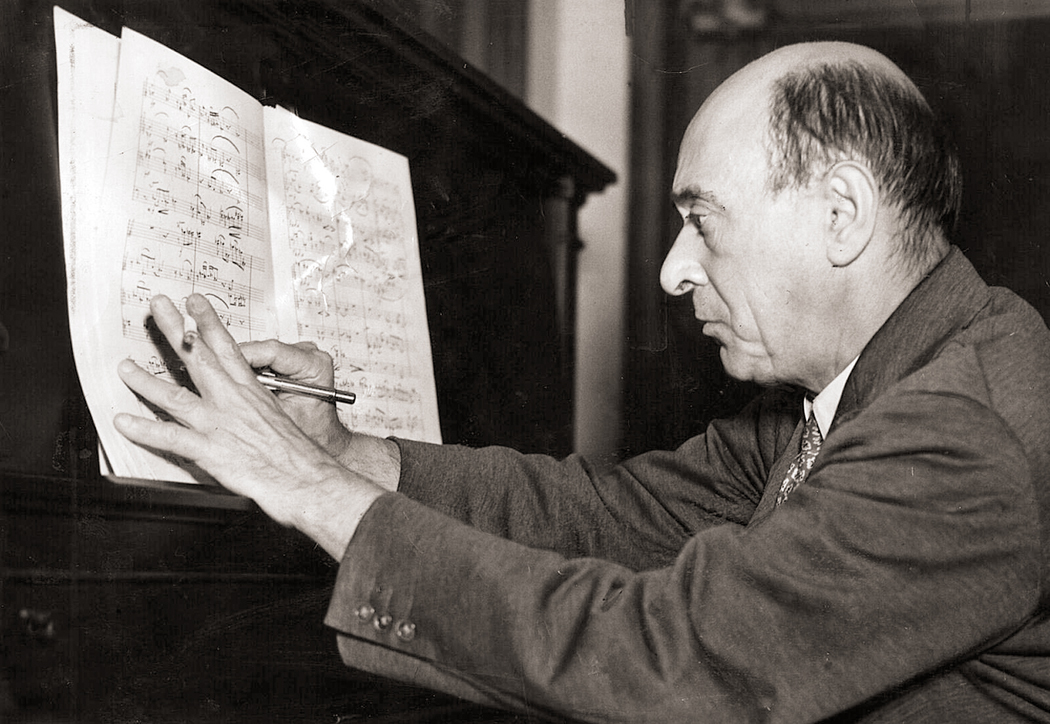
The three primary composer in this supposed school are its founder, Arnold Schoenberg, and his two students, Alban Berg and Anton Webern. There are many things to be said about them, not the least of which is that they are three very different artists, whose music can hardly be mistaken for each others’, but what I am most interested in doing is undoing the misunderstandings about their work, primarily about Schoenberg’s music.

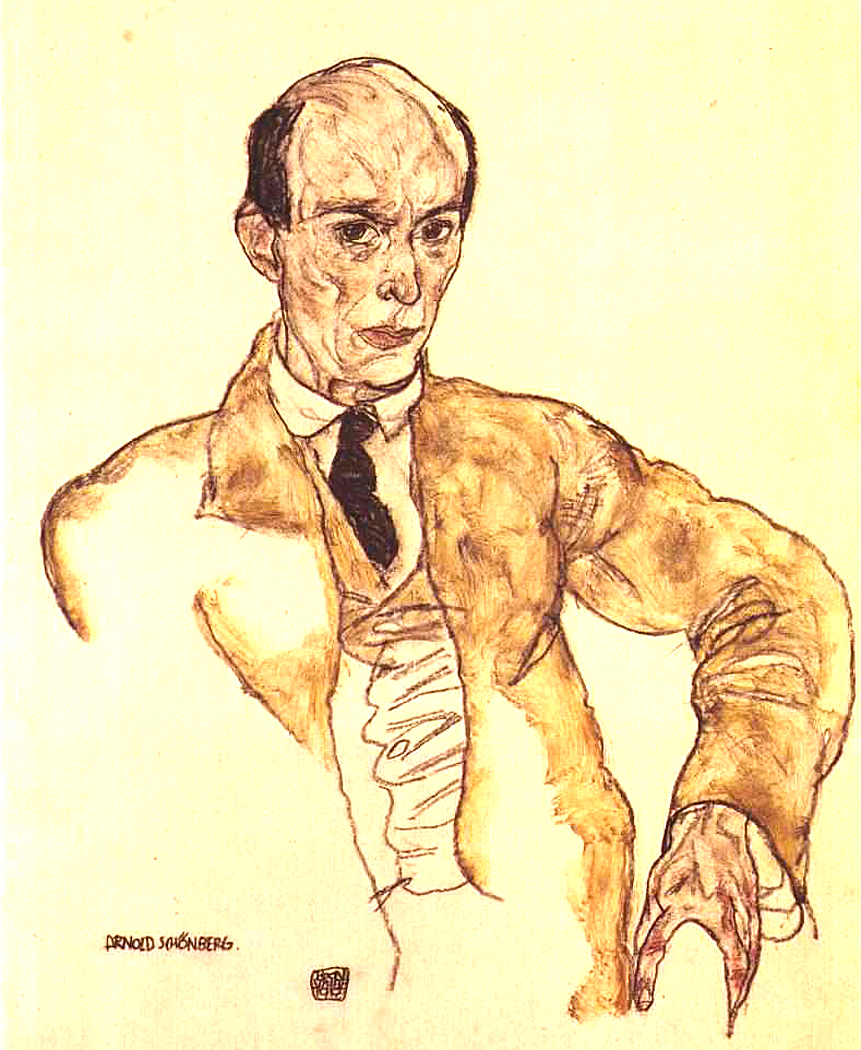
Schoenberg by Egon Schiele 1917

Because I want to say at the outset that I find Schoenberg’s music — for the most part, and there are exceptions — ungodly beautiful and moving.

Schoenberg shares with Johann Sebastian Bach that the most common and simple-minded things said about them are patently untrue. People, even those who should know better, believe that Bach’s music is somehow mathematical and logical, whereas if you have ears to hear, you find some of the most irrational sounds, and deeply and profoundly emotional music ever penned. Bach’s music is not rational, but Baroque, which means florid, extravagant, formally adventurous, like the extended keyboard cadenza of the Fifth Brandenburg, or the unpredictable trailing series of odd comet-tails at the end of the C-minor Prelude of the first book of the Well Tempered Clavier.

Schoenberg, likewise, is seen by those who don’t know his work well enough, as dry, academic and formulaic.

And, because Schoenberg in his later career, came up with a “system” of writing music, he is also seen as somehow dry, academic and formulaic, as if his music were somehow a hyper-complex form of sudoku. In fact, Schoenberg is a hugely Romantic composer, whose music — again with a few exceptions, is as emotional as the most fraught moments of the St. Matthew Passion.

Another similarity between the two composers is that Bach, before Schoenberg was one of the most dissonant composers in music history. We’ll get back to that.

But first, let’s look to Schoenberg’s actual career and output. His first works, which were enthusiastically received when premiered, include such late-romantic period pieces as the Gurre-Lieder and Verklaerte Nacht, which are both so fervent and passionate that they make Wagner’s Tristan sound like Haydn. Gurre-Lieder is a huge undertaking, lasting almost two hours, with 150 orchestra players, including 10 horns and 6 tympani, and another 200 singers in the choir. It was first recorded by Leopold Stokowski in 1932 and it took 27 sides of 78 rpm discs.

Simon Rattle conducting Gurre Lieder

Gurre-Lieder has since been recorded scores of times, but each is a major event. The music is profoundly chromatic, taking up where Wagner left off. But, for all that, it shares with the music of Gustav Mahler and Richard Strauss the orchestral complexity and harmonic richness of late Romanticism.

Verklaerte Nacht (“Transfigured Night”), written originally for just six string players and later orchestrated, is less expensive to perform, and therefore gets frequent hearings in American concert halls. I once heard the New York Philharmonic under Kurt Masur play it, and I was overwhelmed. The music has both such power, and such shimmering surface beauty, that it is hard not to have your breath taken away.
But, of course, it is not this music that most people think about when they think of Schoenberg. Actually, it isn’t really the music they think about at all, but the theory, the words, which can sound mechanical, whereas Schoenberg’s music is anything but.

Which brings us back to JS Bach.

The word often used for Schoenberg’s music is “atonal.” And along with that, it is seen as overwhelmingly dissonant. And it is true that Schoenberg saw that the chromaticism of late-romantic music was stretching the limits of traditional tonality. After Tristan und Isolde, the standard harmony was so consistently modulation-oriented that it hardly made sense to call a piece “in D major,” or “E-minor.”

Schoenberg hated the term, “atonal,” and for good reason — his music remained tonal throughout his career, although in a complex and disorienting way.

Bach, again, was a hugely dissonant composer. Just take any of his chorales and play only the off-beat chords and you find it sounds rather like Schoenberg. With all those appoggiaturas, passing tones, suspensions and pedal-tones, notes grate on other notes constantly. But the containing tonality of Bach’s language means that these dissonances are always resolved, so the overall effect is one of consonance. But just look at those notes on the page: constant and pungent dissonances.

With the emphasis on chromatic modulation in Schoenberg’s music, it led him to create music that uses the expectation of dissonance resolution to keep us hooked-in to the harmonic sound-world of Western music, while never letting us reach that final resting place. It is akin to keeping the 12 pitches up in the air like a juggler, with no way to stop.

This creates strong emotion in the listener; it is often a nagging, unpleasant emotion, one of alienation and anxiety, but that doesn’t mean it isn’t emotional. Schoenberg felt that the emotions appropriate for the 20th century — a century of war, genocide, deicide, dislocation and fear — should be appropriate to its era, and its music should explore these honest emotions rather than playing to the sweet-and-light expectations of audiences used to Dvorak and Schubert.

So, Schoenberg’s music uses the expectations of harmony and subverts them to create emotion. It is hardly dry or mechanical; it is in fact, often unbearable, not because it is ugly, but because it strikes so close to the bone, so unnerving in its accuracy when conveying such emotions.

Just listen to A Survivor from Warsaw, or the second string quartet, or the piano concerto. This is great music, of profound and raw emotion.

If you listen understanding the music not as aimless atonality, but frustrated tonality, drawing out the expected and hungered-for resolution, you will hear it fresh and anew, freed from the cliches about Schoenberg’s “method.”

Ich fühle Luft von anderem Planeten.” (“I feel air from another planet.”)

The method so decried in the latter half of the 20th century is serial technique. With his first so-called atonal works, Schoenberg found it was harder than he thought to escape the apparent resolution of his dissonances into the schema of major-minor tonality, and sought a way of ensuring he could avoid being heard as writing in a key. So, he invented — slowly over several decades — dodecaphonic composing. In its simplest form, it requires the composer to use all 12 tones of the octave serially, before using the first tone again. A “tone-row” would create a repeating pattern of those 12 notes that substituted as a kind of melody, or at least a kind of content for the music.

It should be noted that Schoenberg himself never gave himself over to the technique completely. He mixed and matched. He once later complained, “There is still much music to be written in C major.”

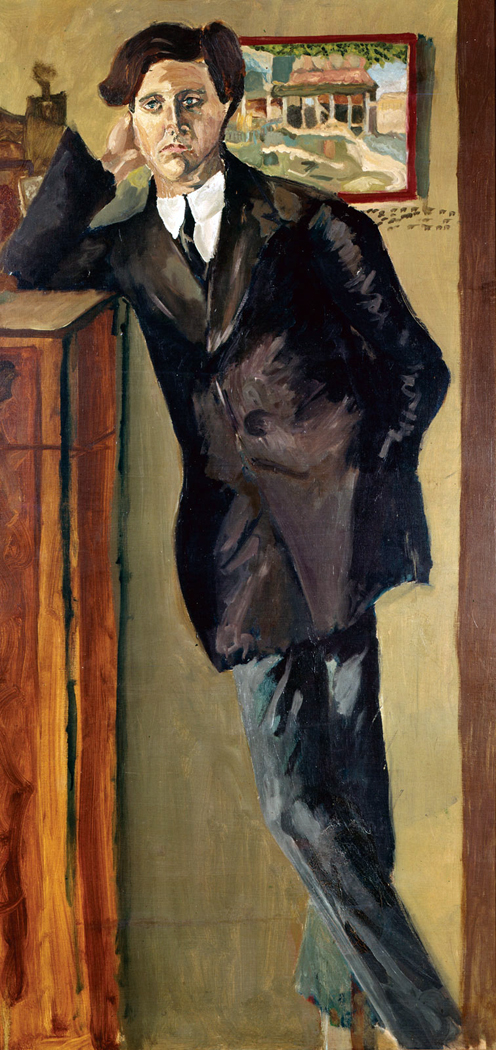
Berg painted by Schoenberg 1910

It is his acolytes who took up the cudgel of 12 tone music and hammered it home with such relentless humorlessness that it practically destroyed concert-hall music. Serialism was extended to include not only pitch, but rhythm, also, destroying any ability for an average educated listener to comprehend the music as an esthetic pattern.

But, that is later, and a misapplication of Schoenberg’s example.

His two primary apprentices each took 12-tone music in divergent directions.  Alban Berg managed to force 12-tone music into a harmonic framework, the way Schoenberg had attempted to make impossible; Anton Webern gave up tonality altogether and began exploring timbre and pitch as tantalizing new sounds, in an of themselves: If you want music as sudoku, it is with Webern you should travel, not Schoenberg.

Berg was, if anything, more romantic than his mentor. His operas, Wozzeck and Lulu, are shattering emotional experiences, and his violin concerto is one of the most noble and profound pieces of music written in the past 100 years.

In the concerto, Berg arranges his tone row in such a way as to make major and minor triads almost inevitable. To create his organizing tone row, he stacks on top of each other, a G-minor chord, a D-major chord, an A-minor, and an E-major chord, and follows them with a tail that plays out the beginning of a scale. Throughout the concerto, the 12-tone technique manages to imply tonal centers.

Webern by Max Oppenheimer 1908

Webern, going in the opposite direction, uses his tone rows to make delicious pings and squawks in the orchestra. To those who love it, the music scintillates. What you enjoy in it are novel sounds and novel arrangements. Whereas Berg is on-the-sleeve emotional, you could believe that with Webern emotion is irrelevant to music. (The composer would disagree).

It is Webern’s brand of serialism that took hold as the century progressed, and taken up by such later composers as Milton Babbitt and Pierre Boulez. If you have a problem with such music (I find Babbitt’s music tedious, but Boulez’s Répons is glorious), then blame Webern, not Schoenberg.

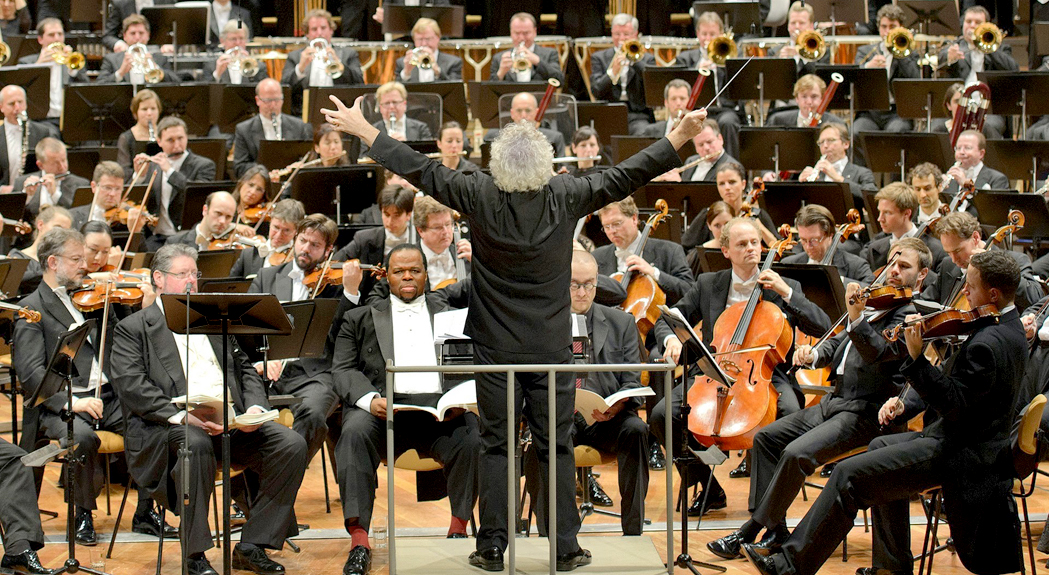
It is certainly true that you probably don’t want Schoenberg’s Pierrot Lunaire playing in the background while you serve dinner guests, or listen to the String Trio through headphones as you sit back comfortably in your easy chair to spend an hour reading Proust. It isn’t easy listening, nor was meant to be. The music demands your intense attention, both intellectually and emotionally: You must give yourself over completely to the music, and then, you will discover one of the great composers, a colleague of Bach, Mozart, Beethoven, Wagner and Mahler.

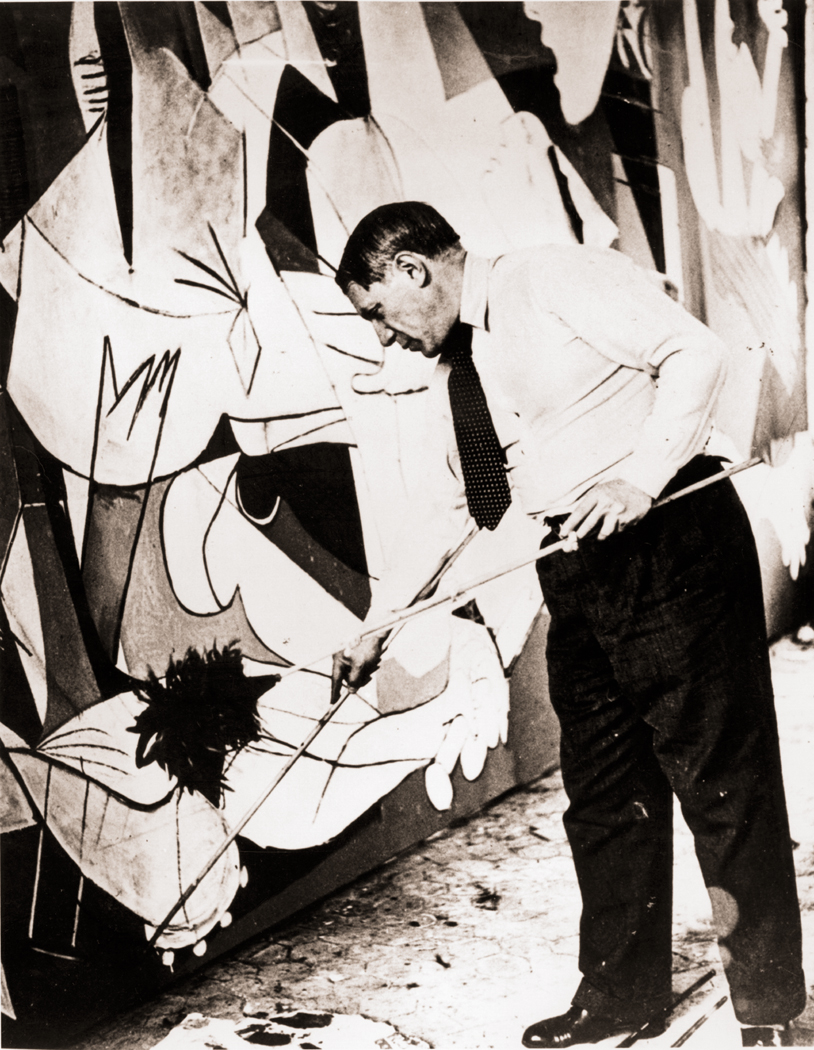
Pablo Picasso painting Guernica in his studio, Paris, 1937; photograph by Dora Maar

When Pablo Picasso painted Guernica, he knew he was making a monument. When Milton wrote Paradise Lost, he knew he was writing for the ages. When Bergman filmed Seventh Seal, he knew he was saying something important and not merely entertaining us with a cool story.

Art is often made with large purpose. Artists may work a whole lifetime to be able to sum things up in a major piece, or group of pieces, like  the Isenheim Altarpiece of Grünewald, or Proust’s À la recherche du temps perdu.

In these cases, the art becomes an entity in itself, a thing produced. It takes on a life beyond its maker’s; it is a milepost in cultural history. We look to it not only for beauty, but for wisdom, for inspiration, for a sense that there is something large which we all share as humans.

On the other end of the spectrum are the snapshots we take of our families, on birthdays, on vacations, on weddings. As such, the photographs are seldom seen as esthetic objects, but rather encapsulated memories — something to hold fast a fleeting moment of importance to our singular lives. They may capture something intensely human, but that is not their primary purpose.

(It is always fun to scavenge anonymous snapshots to find glimmers of the idiosyncratic or the universal, that is, to see them as if they were intended as art. But that is a piece of active curation on our parts, as if we were the artists ourselves, editing the random into a coherent message. The family photos were never meant to hang in art galleries.)

Even if a painter isn’t making a Sistine Chapel, if he is a professional, he is creating a commodity — an object that can be sold. And even if it’s not bought, the thing exists as a thing. There it is, framed and hanging on a wall, with track lighting making it glow jewel-like in the gallery.

But there is something between these two poles — between commodity and snapshot. It is the artist’s working sketch, never meant to be sold, never meant even to be seen. It is either the artist trying out ideas for a painting, or — and this is even more important — just keeping his hand in.

There is something of the throwaway in such noodling, but there is also something of value we shouldn’t underestimate.

We often forget that there is an intimate connection between art and the experience of living. It has been made easier to forget because in the last half century or so, a good deal of art has been made simply about art, about its materials, its limits, its meaning, its history. But through most of that history, art was about the world. Whether it was landscape or still life, whether portrait or history painting, it was meant to reflect something of our common experience of life.

Even when art has been about art, it has been about the experience, in life, of thinking about art. There is an unbreakable connection between experience and its image.Which takes me back to those sketches. Whether it is Picasso doodling on a napkin or Turner washing light watercolor pigment over rag paper, it is — aside from any commercial intention — an effort by the artist to make the connection with the world. To see, and see clearly.

Andreas Gursky

Photography, as much as painting, has its monuments, whether it is an Edward Weston pepper or Ansel Adams’ Moonrise Over Hernandez, or more recently, the giant photomurals of Thomas Struth or Andreas Gursky. They are the opposite of family photos.

But there is a middle ground in photography, also. It is the equivalent of an artist sketching. Photographer Lee Friedlander calls it “pecking.” It is the quick, improvisatory snapping of bits of the world, to see what is there.

With is 35mm rangefinder Leica camera, Friedlander says, “you don’t believe you’re in the masterpiece business. It’s enough to be able to peck at the world.”

Only afterwards, going through his accumulation, does he edit and pick a few that stand on their own to be published or to be exhibited. But the interesting part, to Friedlander, is the engagement with the world.

“I take more to the subject than to my ideas about it. I am not interested in any idea I have had, the subject is so demanding and so important,” he says. “Sometimes just the facts of the matter make it interesting.”

Friedlander is amazing in that his peckings are often so visually rich and complicated that they are nearly as Baroque as a painting by Rubens. Action seems to be in every corner of the frame.

But you don’t have to be an artist as good as Friedlander to engage with the things of this world. Making photographs is a way of seeing, similar to sketching. It is about paying attention. We can focus on the details.

For many Americans — maybe most humans anywhere — only use their eyes for useful things. They see the road they drive on, the could that tells them it will rain, the house, the car, the coat closet. When they make a snapshot for the family album, it is enough to be able to name the items in the picture — that is Uncle Vern, that is the house we used to live in, that is my first car — and beyond the naming of the subject, we don’t really pay attention to what is there. Most probably, we have framed the image so the house or the uncle stands dead center in the frame.

Frielander talks about the potency of the photograph describing what is either his experience when he was a boy with his first camera, or perhaps anyone’s similar experience: “I only wanted Uncle Vern standing by his new car (a Hudson) on a clear day. I got him and the car. I also got a bit of Aunt Mary’s laundry and Beau Jack, the dog, peeing on a fence, and a row of potted tuberous begonias on the porch and seventy-eight trees and a million pebbles in the driveway and more. It’s a generous medium, photography.”

For Friedlander, his life work became making all these disparate bits harmonious in the frame. Again, like a Rubens.

For most of us, these pecked pictures are mostly details. They are not the grand view or the concatenated whole, but the tiny bits out of which the larger scene is built. Most of us pay attention only to the whole, when we pay attention at all; for most Americans — maybe most humans anywhere — only use their eyes for useful things. They see the road they drive on, the cloud that tells them it will rain, the house, the car, closet. But every house has a door, and every door a door-handle; every car has tires and every tire a tread and each tread is made up of an intricate series of rubber squiggles and dents. Attention must be paid.

Paying attention to the details means being able to see the whole more acutely, more vividly. The generalized view is the unconsidered view. When you see a house, you are seeing an “it.” When you notice the details, they provide the character of the house and it warms, has personality and becomes a Buberesque “thou.” The “thou” is a different way of addressing the world and one that makes not only the world more alive, but the seer also.

(It doesn’t hurt that isolating detail makes it more necessary to create a design. You can make a photo of a house and just plop it in the middle of the frame and we can all say, “Yes, that’s a house,” and let the naming of it be the end-all. But if you find the tiny bits, they have to organize them in the frame to make something interesting enough to warrant looking at.)

Sectioning out a detail not only makes you look more closely, but forces your viewer to look more closely, too. Puzzling out what he sees without the plethora of context makes him hone in on its shape, color, and texture. It is a forced look, not a casual one.

This is a rich world, profound in detail, millions of species, visual patterns in every rock and cloud. Each bit of rust on a grate is intense, when noticed. And noticing is what “pecking” is all about. With my own peckings, I am not making any argument for them as art; they will not be hanging in a gallery. I make them for myself, to force me to pay attention to the minutiae that are the bricks of the visual world they inhabit. And paying attention is a form of reverence.

Click to enlarge any image

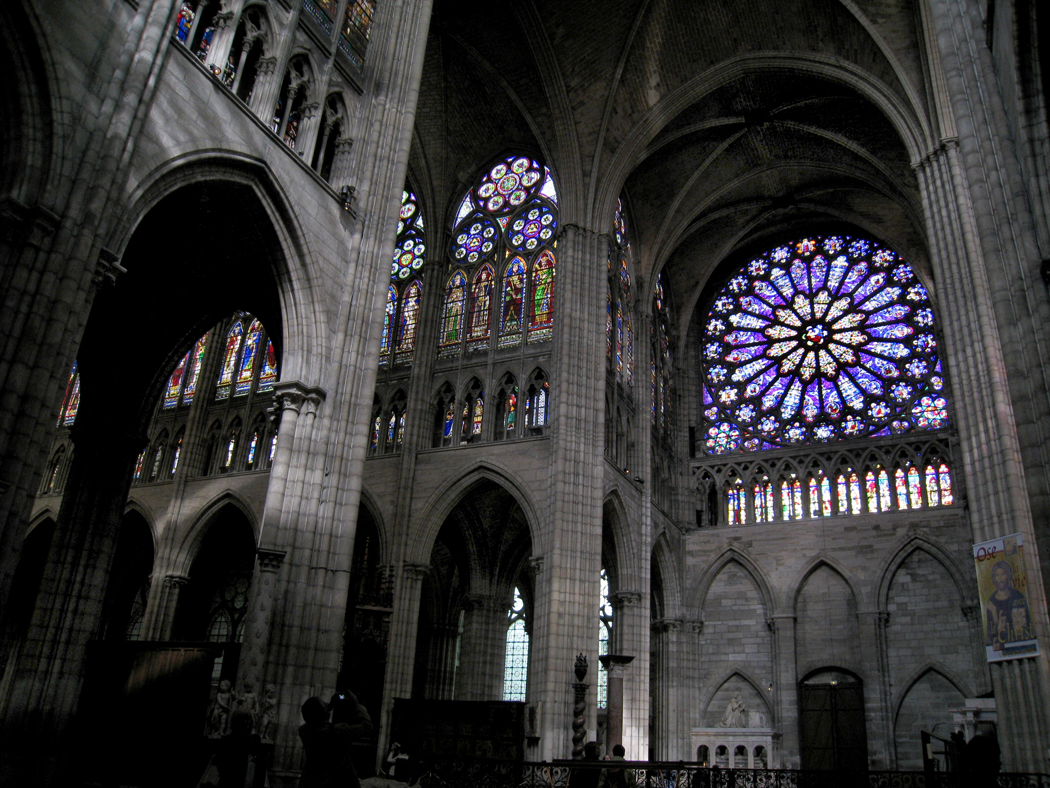
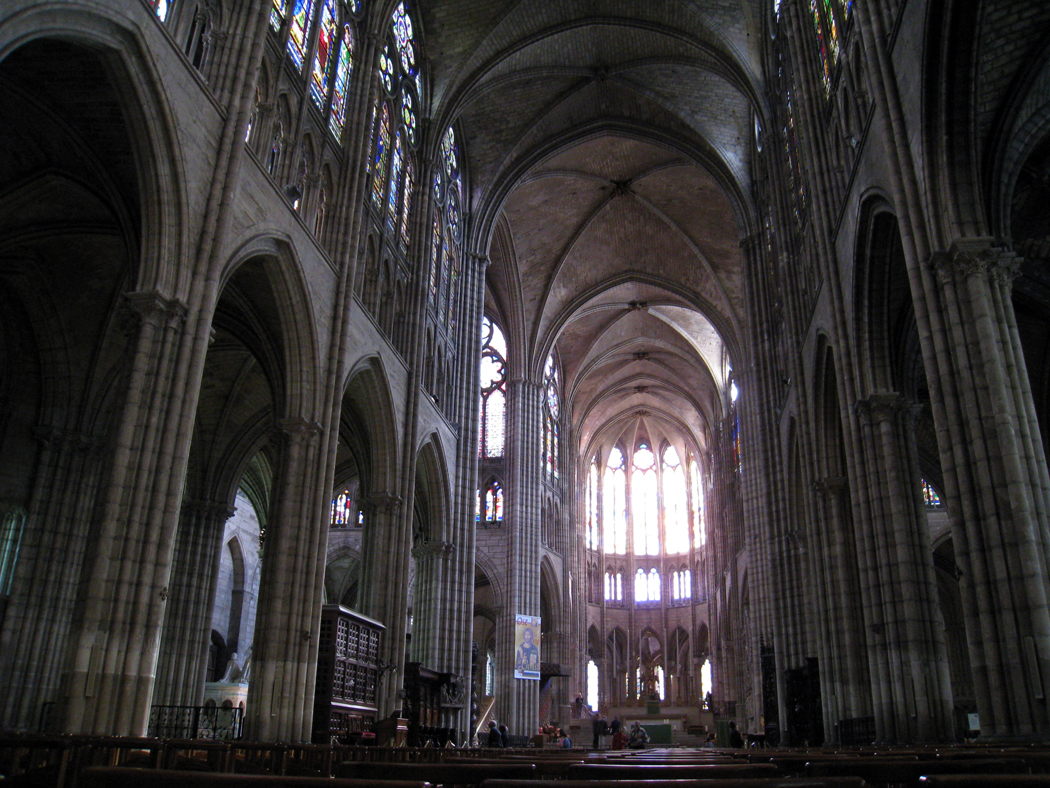
Some seven miles north of the cathedral of Notre Dame de Paris, and a short trip on the Paris Metro, is the abbey basilica of Saint Denis, which has the claim to fame of being considered the first completely thought-out expression of Gothic architecture.

Yet, its origin is bound up in myth and misunderstanding, of almost comic complexity, focusing on its eponymous bishop.

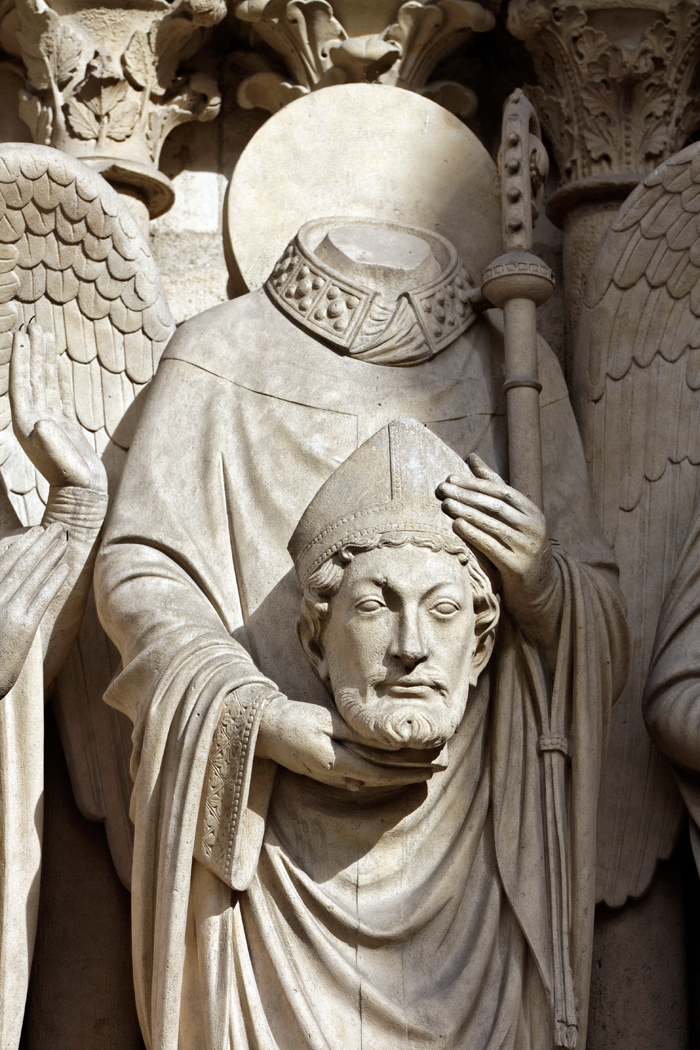
The beheading of St. Denis

The St. Denis for which it is named lived in the third century and was bishop of Paris at a time when the city was still primarily pagan. Under the repression of the emperor Decius, he was martyred, along with two of his fellow Christians. According to the legend, after Denis was beheaded, he calmly picked up his severed head and, holding it under his arm, walked the six miles from Montmartre, where he had been executed, to a place where the basilica now stands, preaching the whole way.

St. Denis at Notre Dame de Paris

(The phenomenon of cephalophorism — carrying your severed head — is surprisingly common in hagiography. You can find statues of these saints on many a Gothic cathedral. It raises an interesting problem of iconography, though. If you are a saint and you are beheaded, does your halo remain with your head or hover over the stump of your neck? This is a question of more than academic interest to the Medieval painters and sculptors of the patron saint of France. The jamb statue of St. Denis on the front of Notre Dame de Paris opts for the stump.)

A martyrium was built on the site where Denis finally died, a saint in  two parts. From that a church grew and it became a place of pilgrimage by the fifth and sixth centuries. An abbey was founded and it was this abbey that fell under the authority of the Abbot Suger in the 12th century.

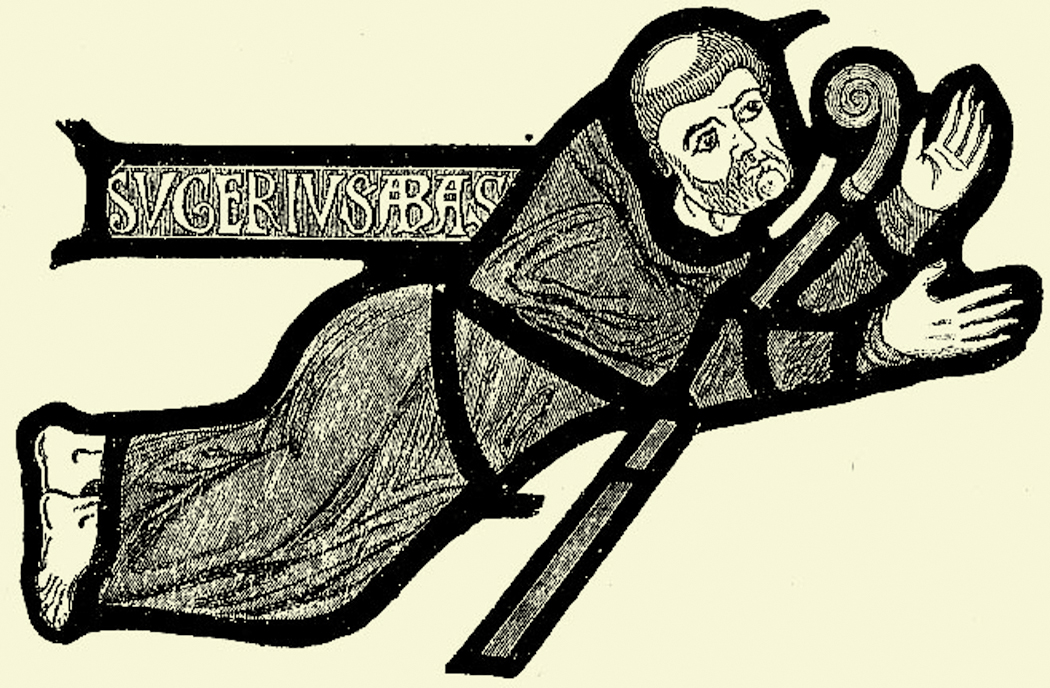
Abbe Suger

Suger is one of the most remarkable personalities of the late Middle Ages. He was a priest, but also a politically powerful ally of kings Louis VI and VII, an ambassador to the Vatican, and ultimately regent of France during the absence of Louis VII during the Crusade. In addition, he was a prolific writer and wrote biographies of both kings.

Basilica of St. Denis

But he is best remembered today because he took on the task of rebuilding parts of the Carolingian abbey church, first with the west facade of the church, beginning in 1137. The old church front had a single door. Suger had a new facade designed, mimicking a Roman triumphal arch, with three doors. It also had the first known rose window built into it. It was completed in 1140, at which time, Suger took on rebuilding the east end of the church, leaving the Romanesque nave intact.

It is with the choir of the abbey of St. Denis that architectural history takes a great turn and opens up new worlds for the future. It is also where another major Medieval confusion enters the story.

It turns out that there were (at least) three people conflated into the Medieval understanding of who St. Denis was. In Latin, he was named Dionys, or sometimes Dionysius. There was a Dionysius named in the New Testament as a “The Areopagite,” who was converted by St. Paul (Acts of the Apostles 17:34). Despite being in different centuries and in different countries, few Medieval writers differentiated this biblical Dionysius from the French saint.

But more to the point, there was a fifth or sixth century writer, now known as the “Pseudo-Areopagite” who wrote a series of Neoplatonist tracts, who was thrown into the blender as well.  This three-headed St. Dionysius or St. Denis was the person Abbot Suger knew in 1137 when he began the refurbishing of the abbey church. (You might ask if such a three-headed beast might well have been able to spare one to the executioner’s blade and still survive to carry it six miles to the place where he finally dropped dead).

Suger was a confirmed Neoplatonist, and the aspect of this philosophy/theology that most concerns us is the identification of deity with light.

“Suger, one might almost say, was infatuated with light,” wrote art historian Otto Von Simson in his 1956 book, The Gothic Cathedral.

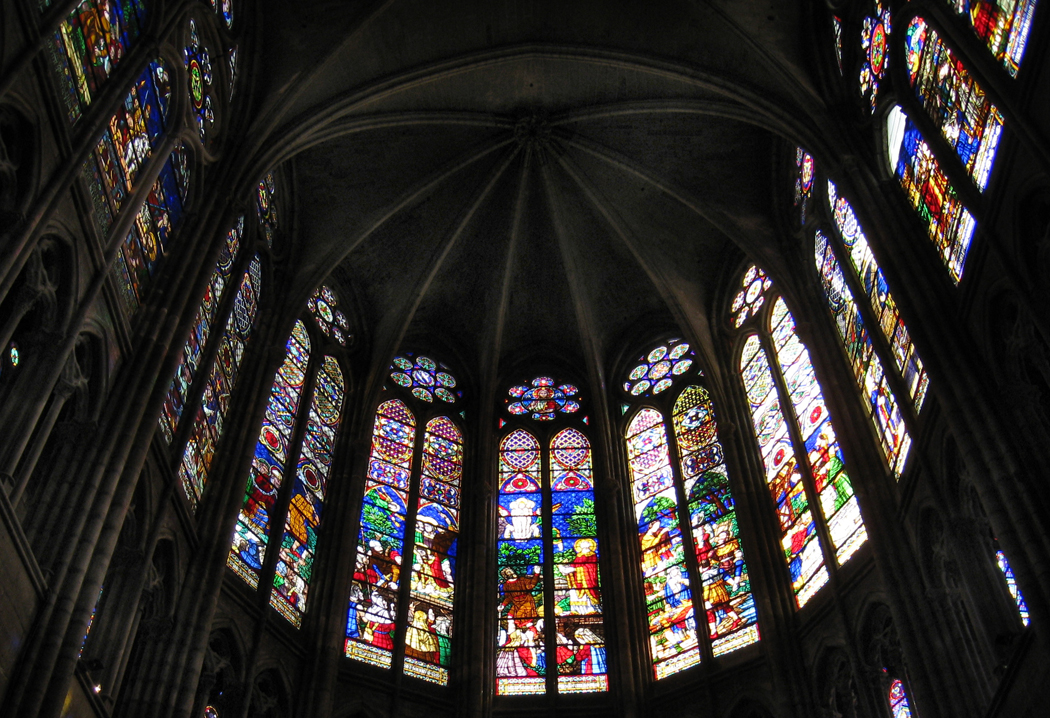
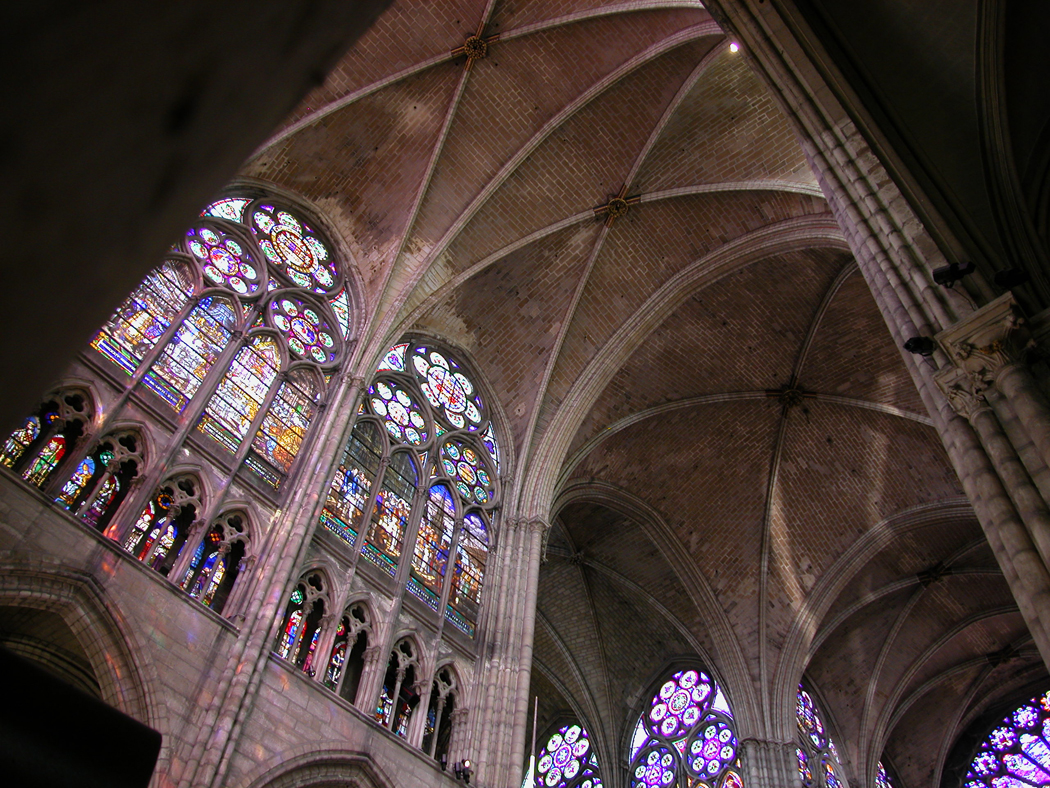
So, when Suger commissioned the design of the new choir to the old abbey church, he or his anonymous architect rounded up several new innovations in building construction — the pointed arch, the ribbed vault, the flying buttress, and stained glass — and created what is usually considered the first genuinely Gothic statement of church architecture. The point of it all was to open up the dark Romanesque interior of the church to the glorious radiance of divine illumination.

The new structure was completed in 1144 and became the rage, inspiring all the new church construction in northern France and later spreading to the rest of Europe.

The innovations were brilliant, in both senses of the word. The light admitted to the stony interior of the church was a revelation.

Yet, when Suger died, the church was a stylistic gryphon, with a Romanesque head, Carolingian body and a Gothic tail. In 1231, Suger’s successor, Abbot Odo Clement began to replace the nave with an updated Gothic middle, heavy on the glass. He also remade the upper stories of Suger’s choir and finally, made the nave the resting place for French kings.

In 1264, the bones of 16 former kings and queens were relocated to new tombs arranged around the crossing, eight Carolingian monarchs to the south and eight Capetians to the north. Since then, all but three French monarchs from before the Revolution have found their resting place at St. Denis.

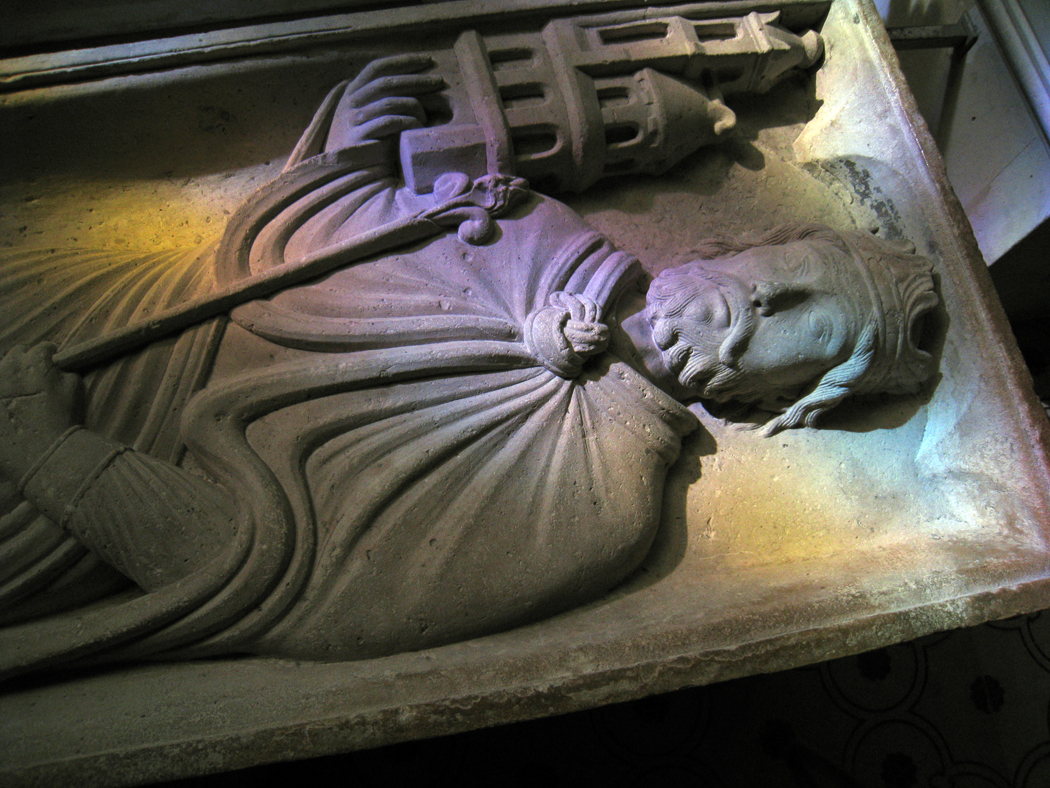
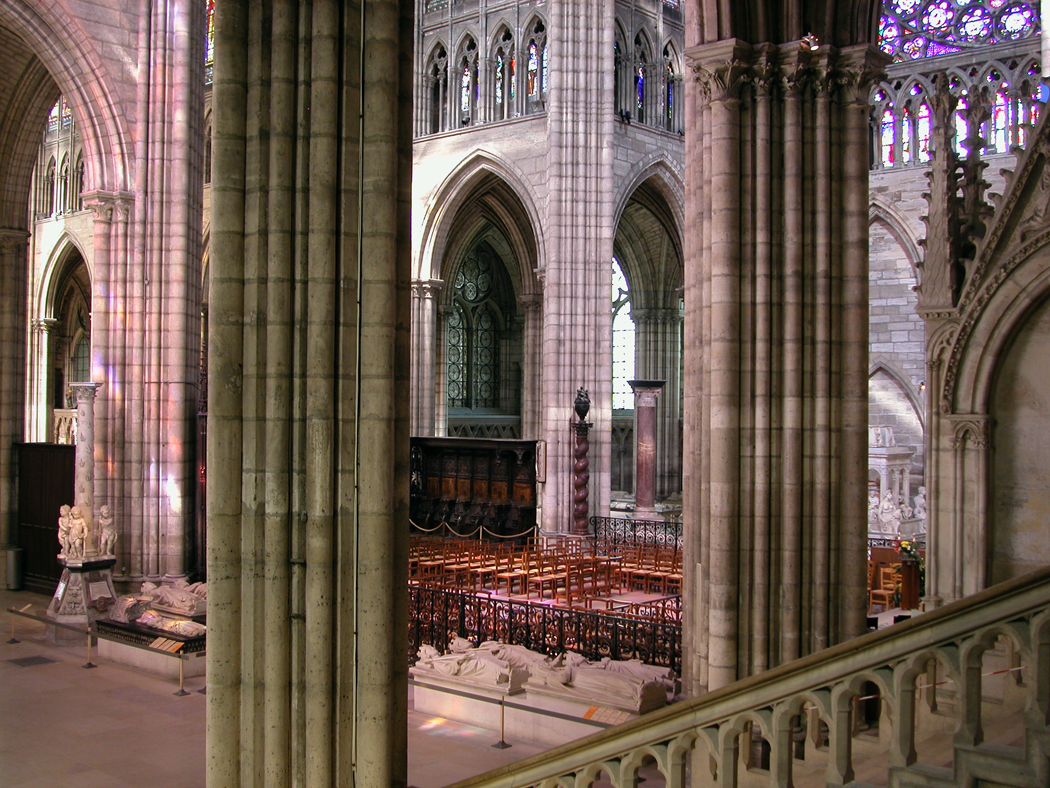
Their funeral effigies lie like so many tanning salon patrons in the nave and transepts. most of the effigies are of a much later date and not at all Gothic (with a few exceptions), but they don’t seem out of place. Again, this is the peculiar magic of the Gothic style. Nothing seems out of place in it: It absorbs everything and makes it part of itself.

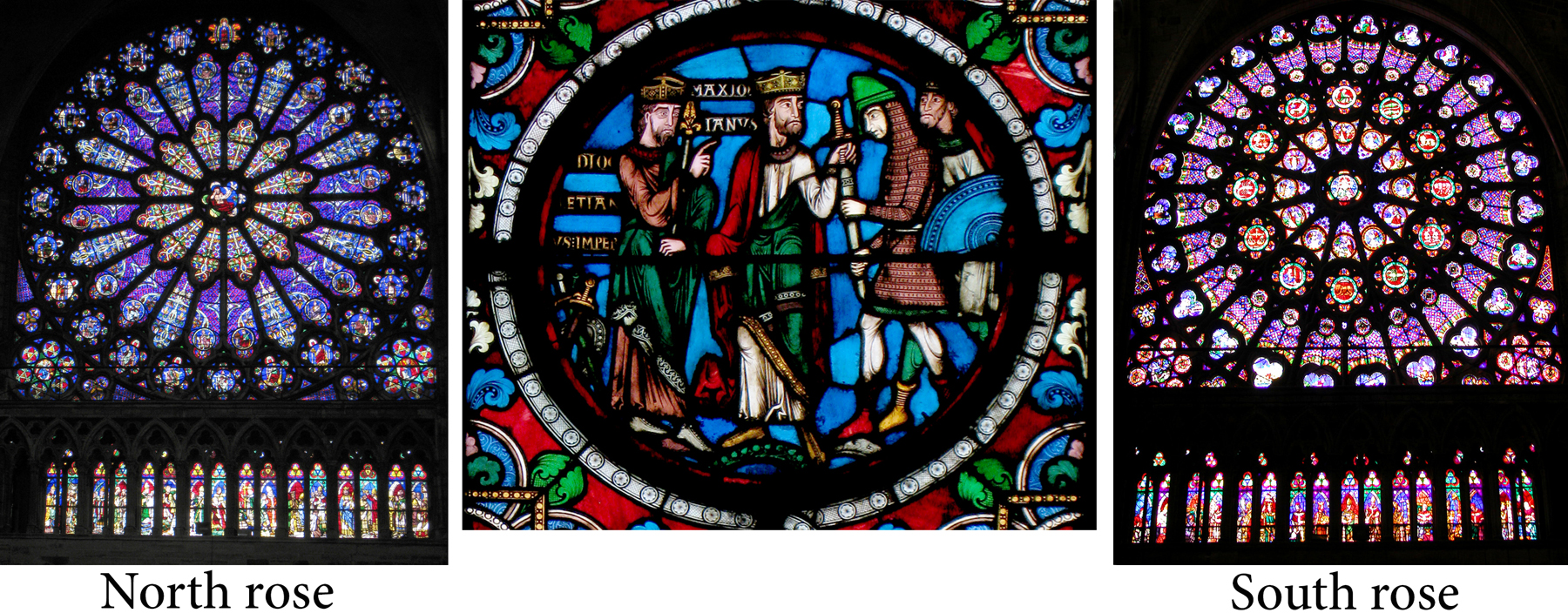
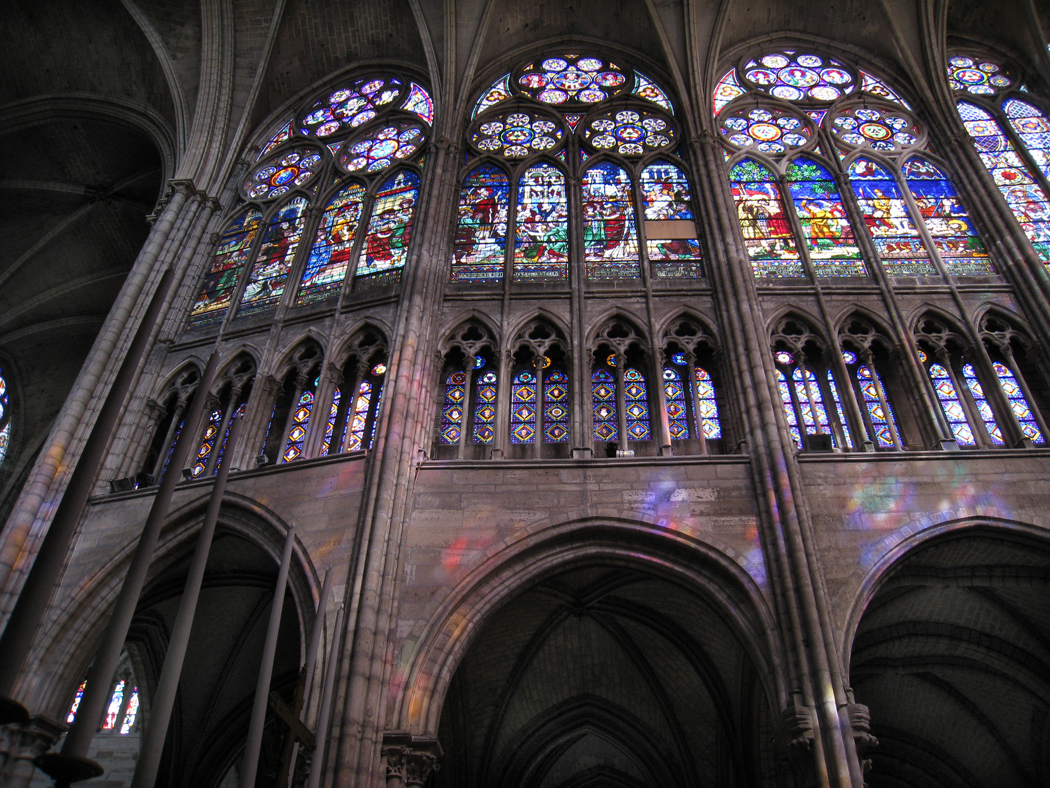
And more than at any other Gothic church, the sunlight streams through the stained glass and colors the floors and walls with great patches of glowing red, blue and yellow.  You look at the sarcophagus face of Cuthbert (or whatever his name was) and see it blue and red, covered in light like a disco dancer.

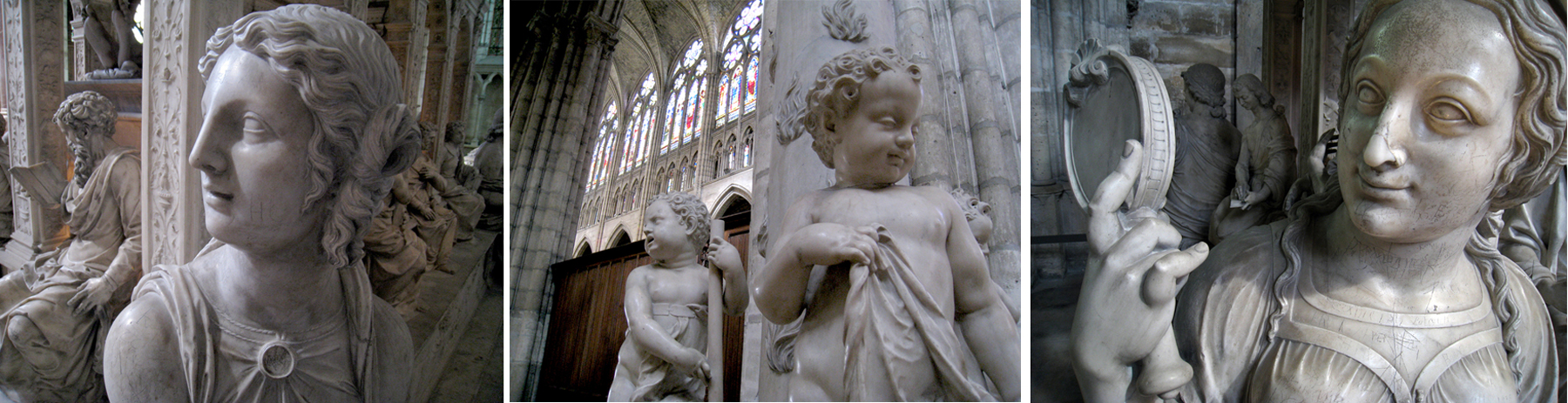
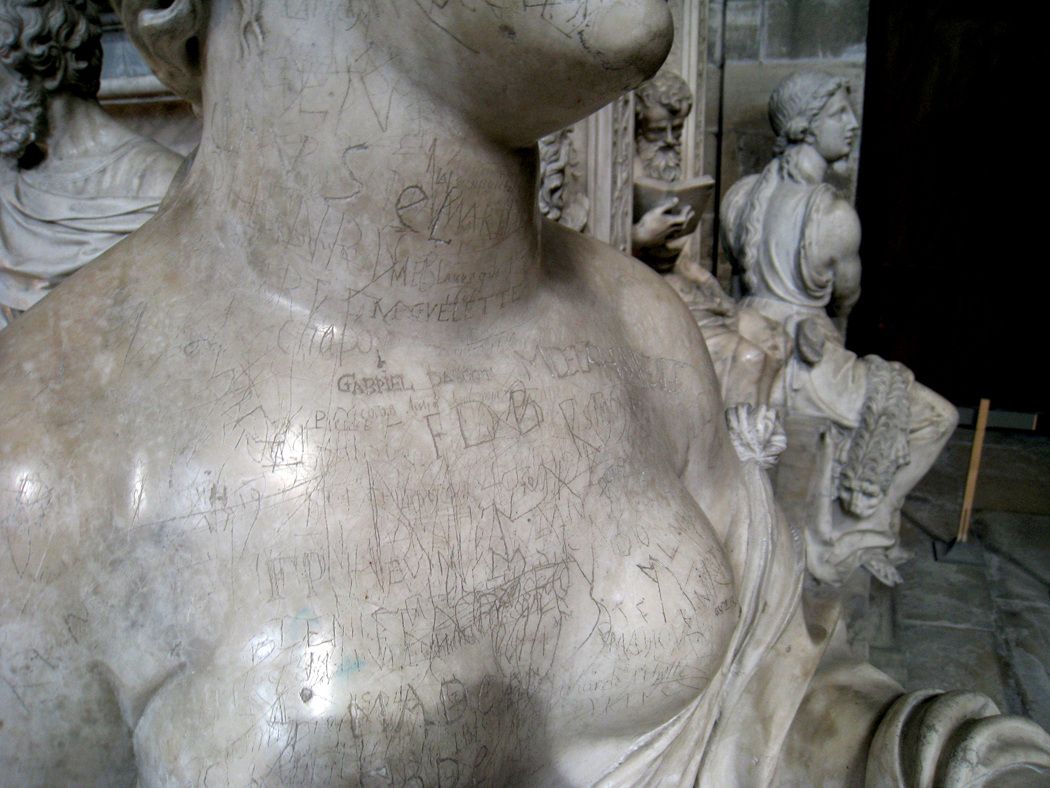
It is surprising to see how much vandalism had defaced the sculpture. The beautiful polished bosom of the angel in Philippe II’s tomb is covered with scratched initials and a few scurrilous obscenities. The faces of most of the kings and saints have been etched into with penknife or nail-point. You don’t notice it from a distance, but up close, you can read them. It doesn’t help that grit and grime have filled in the scribings, like ink in scrimshaw.

The tombs, the stained glass and the sculpture were all desecrated during the French Revolution, high as it was on anti-clericism, and were restored in the mid-19th century by Viollet-le-Duc and his colleagues.

By the 20th century, eons of soot had blackened the facade of St. Denis, and a thorough cleaning began, which only recently finished, unblackening the jamb statues and portals and tympanums.

St. Denis is oddly out of line: You may not notice it on first sight, but soon, you realize that the apse is not in line with the nave, and in fact, the nave itself has a kink in it. I don’t know if this was a mistake in execution, or because it happened over time, or did the master builder need to make slight adjustments based on bedrock or water table, or did they start from both ends and not quite meet up in the middle? No matter which, it helps give St. Denis an oddly organic feel, and gives it something of a Piranesi “carceri” kind of architectural idiosyncrasy.

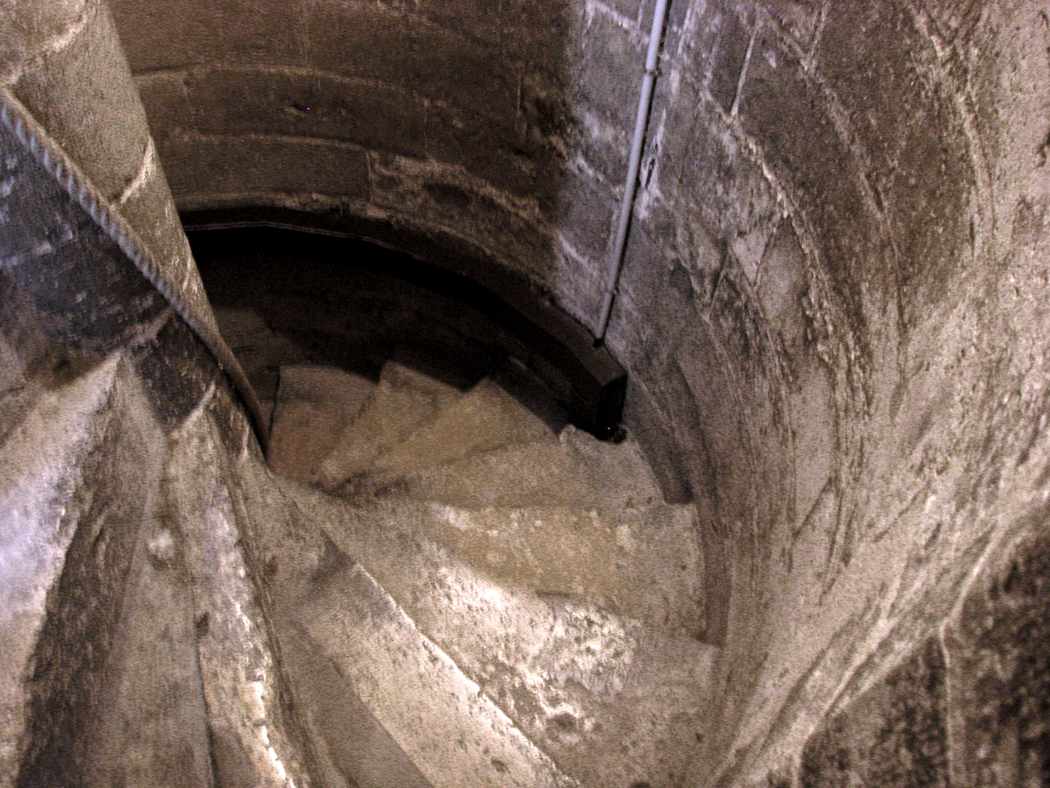
I love the views through one set of piers on to a set of arches and behind that, a lineup of stained glass, layering on layering, or the odd cornering of a staircase against the well of the crypt doorway, with the deep penetration of the apse peeking in behind. The angles are complex and visually fascinating.

It is true that not much is left to be seen of Suger’s original design, but his intent is obvious: Outside of Sainte-Chapelle, no Gothic church we have visited is more brilliantly lit and colored by the streaming sunlight filtered through the stained glass, more fully committed to the principle that divinity is light, and the temple of the divine should glow and inspire.

Click any image to enlarge


How do you hold up a roof?

Seems like a simple question: Walls hold up a roof. And if your roof is heavy and two or three stories up? A stronger, thicker wall.

This is the problem faced by the builders of European churches in the 11th and 12th centuries. With those thicker, stronger walls, windows became a problem because they weakened the walls with holes, which meant that the churches had small windows and were rather dank and dark places to worship the Creator.

When we are taught about Romanesque and Gothic cathedrals in our art history classes, we are usually given a list of characteristics they have: round arches for Romanesque; pointed arches for Gothic: thick walls for Romanesque; flying buttresses for Gothic: barrel vaults for the Romanesque;  rib vaults for the Gothic — as if the shift from one to the other were merely a catalog of stylistic tics and the change from one to the other nothing but a change in fashion, as if giving up pegged trousers and taking on bell bottoms.

Why would it be important for art history students to spend this much time on something so old and arcane? Our professors always seemed to think this was such a profound change and worth a week of class time. We couldn’t wait to move on to Impressionism.

It was never made clear in class why it would be important for us students to know these things: buttresses, rose windows, naves and aisles, apses and choirs. These cathedrals were in Europe, not America.

But the change from Romanesque to Gothic should not be seen as merely a change in styles, but as a major innovation in architecture whose results led to the glass and steel skyscrapers that populate all our cities. The Seagram Building in New York is merely an extension of the ideas behind Chartres cathedral.

What happened was (for reasons I will get into in my next blog post) someone figured out you didn’t really need walls to keep a roof up. You could, like a picnic pavilion, support the roof with posts, leaving the space between the posts open. And, if you build a church this way, you can glaze the open spaces with colorful glass and let inspiring light into the interior of the church. Wow. In an instant, churches became lighter, both by weight and by illumination. What had been dour and forbidding became bright and inviting.

Perhaps the most dramatic example of this is the small royal chapel built on the Ile de la Cite in Paris between 1238 and 1248. While it is tiny in comparison with the big cathedrals, such as Notre Dame or Reims, it is a glory of glass. Its walls are explosive with color and light.

If you were to stand in the middle of Ste.-Chapelle and gaze up at the ceiling, you would see that the ceiling and roof are supported by a cage of stone pillars, between which are cascading sheets of stained glass. When you realize that such roofs are made primarily of lead or slate, you realize how heavy it must be, and how brilliant was the engineer who figure out how to keep it up with only these spindly supports.

This is the genius of Gothic architecture. Follow its logic out to the 20th century and you understand that you can make a skyscraper with a cage, not of stone, but of steel, and glaze the open areas and let light into every one of the 40 or 50 stories of office space. In some sense, the International Style — all those glass-and-steel towers that define our urban architecture — are really just a further refinement of the Gothic breakthrough.

Ste.-Chapelle was built for King Louis IX, later known as St. Louis, as his private church on his palace grounds. It was meant to house a series of holy relics he had bought, including the supposed “crown of thorns” Jesus had worn upon his crucifixion, and a piece of the “one true cross,” of which there were a whole woodpile scattered across Europe. These relics were held in great esteem. Louis wanted a home for them that would honor their importance with great beauty and wealth, and Ste.-Chapelle is the result.

Louis spent 40,000 livres on the chapel, but nearly four times that in buying the relics from the cash-strapped Byzantine emperor, Baldwin II in 1239. The chapel was built to hold the relics and finished in record time.

Ste.-Chapelle is 118 feet long and 56 feet wide, but more importantly, 139 feet high. Above that a spire of cedar wood extends another 108 feet. (The current spire is a 19th century replica, designed after the 15th-century spire. It is unknown if the original chapel had a spire).

The church is a two-story affair, with the lower level once reserved for the royal staff and servants, while the upper level, with its grand windows, was for the king. He had an elevated walkway built between the palace and the chapel’s second floor so he never had to descend to ground level with the hoi-polloi. The palace is largely gone now, replaced with the bureaucratic buildings of the Paris metropolitan police force, but Ste.-Chapelle remains on the grounds, surrounded now by parking lot.


You can see how it once sat, in the illuminated manuscript of the Limbourg Brothers, made in 15th century and known as the Très Riches Heures du Duc de Berry.

Today, there are lines waiting to get in to see Ste.-Chapelle. You walk through security and through the parking lot and into the ground floor chapel, where the fleur-de-lys seems to be painted everywhere in gold. It is a stunning space, even if its ceilings are low. The paint is bright and colorful. The staff wasn’t cheated; the lower chapel is plush and beautiful.

But then, you walk up the stone staircase to the main floor and it is as if the heavens open up above you. The glass, the color, the light: They stun.

In 1323, the French writer Jean de Jandun wrote of Ste.-Chapelle in his Tractatus de Laudibus Parisius, “The most excellent colors of the pictures, the precious gilding of the images, the beautiful transparency of the ruddy windows on all sides, the most beautiful cloths of the altars, the wondrous merits of the sanctuary, the figures of the reliquaries externally adorned with dazzling gems, bestow such a hyperbolic beauty on that house of prayer, that, in going into it (from) below, one understandably believes oneself, as if rapt to heaven, to enter one of the best chambers of Paradise.”

While it is true that Ste.-Chapelle was restored in the 19th century, its restorers attempted to be exceptionally faithful to the original. And while most of the paint is more recent, a full two-thirds of the windows are original 13th century glass. The remaining panels replace glass removed when the chapel was used as a government records archive after the French Revolution.

The glass in the nave tell primarily Old Testament stories, in the apse the glass covers New Testament stories. The 15 stained glass windows, each more than four stories high, depict 1,113 scenes from the Bible in 6,458 square feet of glass.

The great Rose window is a replacement from 1390 when the original window, in Rayonnant style (as seen in the Très Riches Heures), was updated into the then-current Flamboyant style, with its curlicues and circles.

The tympanum painting above the king’s doorway is a recreation, but in the style of the original.

The designs in the floor are wonderfully graphic.

The columns and walls are brightly painted.

All this color, light and throat-grabbing beauty is understandable on esthetic terms, but its purpose was more than to be pretty, or even awesome. The philosophical momentum behind the architectural advance will be discussed more thoroughly in the next blog, about the basilica of St. Denis.

Click on any image to enlarge

Next: St. Denis

Le Stryge

It seems obvious that the present moment is the product of all the time that went before; what is not so obvious is that the past is also a product of the present. That is, we always see the past through the eyes of the present; the present has need of a version of the past that validates the way we see ourselves now.

History is uncontrollably large and what we consider the history, which we consolidate in books and Ken Burns documentaries, is a tiny fraction of what actually occurred, and each generation gets to pick the bits it wants or needs to justify itself.

All of which makes history not a fixed and certain thing, but a constantly flowing eddy of revisions and reconsiderations. And each age sees itself reflected in the mirror of its historiography.

Notre Dame de Paris 1841

The Enlightenment, for instance, saw the so-called Middle Ages as a time of irrationality and superstition. That age saw its ideals in classical Rome. But the 19th century, given in to Romanticism, idealized the very things the previous century had dismissed. So, in the 19th century (yes, beginning in the late 18th century — these things are not governed by calendar dates), you had a Gothic revival, a raft of novels set in castles, the knights of Sir Walter Scott, the cornball folly of Strawberry Hill and Victor Hugo’s Hunchback of Notre Dame.

And you found, in France, a renewed interest in the monuments left over from those discarded days. And discarded is the proper word: The cathedral of Notre Dame de Paris, for instance, was a crumbling shambles, stripped of most of its sculpture and left to be a ruin on the island in the middle of the Seine River. In addition to the ravages of time and 500 years, there had been various “updates” to the building, and then, before, during and just after the French Revolution, the sculpture on the door jambs had been removed and the Gallery of Kings above the western portals had been junked in a frenzy of anti-monarchical and anti-clerical sentiment.

Before restoration and now

But in an ironic stroke of luck, the central government appropriated church property in 1789, and thus became responsible for the administration and upkeep of churches, including the cathedral (know then as the Métropole), which had for a time been turned from a Roman Catholic cathedral into a “temple of reason” and then into a food warehouse.

Under the auspices of the state, a few clumsy attempts were made to restore the cathedral, but those attempts did more damage than good.

Then, in 1831, Victor Hugo published his novel, Notre Dame de Paris (better known in English as “The Hunchback of Notre Dame”), and began a personal crusade to repair and renovate the crumbling monument. He and others worked for a decade persuading public opinion and so, in 1841, a committee was established in Paris to consider the matter, and a year later, architect Jean-Jacques Arveuf was asked to submit a plan for the refurbishment of the cathedral. Several others decided to submit plans, also, and eventually it was the team of Jean-Baptiste Lassus and Eugène Viollet-le-Duc who were chosen to mastermind the restoration. Lassus had already spearheaded the restoration of Sainte-Chapelle, and Viollet-le-Duc had been in charge of the work at Vezelay. They were the two most qualified restorers of the age (and although Lassus died in 1857 before the completion of the work in Paris, Viollet-le-Duc went on to work on several more of the cathedrals and basilicas of northern France).

During restoration, mid-1850s

The project began in 1845 and didn’t finish until 1864. It was a huge project. Walls needed rebuilding, statues were carved and put back on the door jambs, all the gargoyle waterspouts that had been replaced over the centuries by lead pipes were redesigned and recarved. (The hideous lead pipes had caused the cathedral in the previous century to be compared to a hedgehog, with all the points spiking out from its walls). The windows were reworked, the doors remade, a new spire added to the roof above the crossing, and perhaps most remarkable — a series of 54 grotesques — “chimères,” or “chimerae,” as Viollet-le-Duc called them — were added to the gallery along the roof line.

This is where history and its progeny enter the picture. For most people, little says Paris and the Middle Ages more than the monster animals that stare down from the summit of Notre Dame de Paris. The most famous chimera — Le Stryge, or “The Vampire” — is perhaps the second symbol of Paris (after the Eiffel Tower). It seems to tell us more about the Middle Ages than any number of scholarly tomes. It is hard to imagine Notre Dame without its guardian spirits, yet they are completely the invention of Viollet-le-Duc. They are the 19th century imagining the Middle Ages.

It is true that Viollet-le-Duc justified his invention of them by claiming he had noticed in some old engravings the remnants of what he took to be the original chimerae, the remains of some broken birds’ feet left carved on the balustrade of the upper stories.

“On every corner of the balustrade,” he wrote, “birds have come to perch, demons and monsters have come to squat. These picturesque figures have just been reestablished; the originals exist no more, but some of them, in falling, have left their claws attached to the stone.”

And there is recorded evidence that such things were once part of many Gothic churches. In the 12th century, St. Bernard of Clairvaux wrote a rant against them as being unsuitable for a Christian church:

“What are these fantastic monsters doing in the cloisters before the eyes of the brothers as they read? What is the meaning of these unclean monkeys, these strange savage lions, and monsters? To what purpose are here placed these creatures, half beast, half man, or these spotted tigers? I see several bodies with one head and several heads with one body. … Surely if we do not blush for such absurdities, we should at least regret what we have spent on them.”

But what these “savage lions” and “unclean monkeys” were looked like, and whether Notre Dame de Paris had ever featured them, are not known. But for Viollet-le-Duc, they were an essential part of what made the cathedral genuinely Gothic.

At any rate, Viollet-le-Duc designed and sculptor Victor Pyanet carved the 54 monsters. Each is of a piece with the portion of the balustrade atop which it sits, monster and fence a single piece of stone.

Viollet-le-Duc also designed the more-than-a-hundred actual gargoyles that stick out from the walls and buttresses of the cathedral, replacing the ugly lead that had defaced the architecture.

(We tend to use the term “gargoyle” for all the mythical beasts on a Gothic church, but a true gargoyle is a rainspout, the word coming for the Medieval French word for “gullet.” The other figures are usually called grotesques or chimerae.)

Viollet-le-Duc and his partners sat at the crux of a change in restoration theory — at midpoint between the older ideas of just replacing worn-out parts with modern equivalents and the more recent concept of saving everything original as best as can be done. Viollet-le-Duc’s idea was not to put Notre Dame back to any historically accurate version of the building, which had changed over the centuries with add-ons and updates, but rather to create a vision of the “perfect completed ideal” of what the building would have looked like, if it had ever been completed according to a single plan.

Viollet-le-Duc wrote that, for him, restoration should be a “means to re-establish [a building] to a finished state, which may in fact never have actually existed at any given time.”

So, Notre Dame as we see it today, is a fiction, a 19th century overlay upon the remains of a 13th century building in an attempt to recapture what the Romantic 19th century believed to be the soul of the Medieval era.

What we see now is the past through the lens of Viollet-le-Duc’s imagination, an imagination formed by the epoch of Victor Hugo, Honoré de Balzac, Prosper Mérimée, Hector Berlioz and Eugène Delacroix.

Now that lens is more than 150 years old itself, and we who are perpetually modern use our own lens to judge the motives and achievements of Lassus and Viollet-le-Duc and their colleagues.

Viollet-le-Duc

But we should not be too harsh on them. Viollet-le-Duc was an astonishing person, the best-informed restorer of his time, who published the standard encyclopedia of Medieval architecture and design. His energy and commitment were legendary, and although he had his critics, there was no one else in the central years of the 19th century better placed to give us the Middle Ages.

And without him, the cathedrals of northern France would today be more like the ruins of Ancient Greece than like the awe-inspiring churches in which the Mass has been celebrated for 800 years.

The fact is, there is no “original” and “authentic” Gothic building to which we can point. All such churches were constructed over centuries, with changing styles, and continuous updates and remodelings. The Gothic cathedral is less a thing than a process, and Viollet-le-Duc should be seen as simply part of that continuing process.

Click on any image to enlarge

Next: Sainte-Chapelle

At the climax of Fritz Lang’s 1925 classic, Metropolis, the mad scientist villain kidnaps the heroine and climbs to the top of the city’s cathedral, dangling precipitously over the narrow walkway at the edge of the roof. From the first time I saw the movie, I wanted to join him.

Not, obviously, as a kidnapper, but rather to experience the hidden acroscape of the cathedral — the skin over the vast interior space that defines such a cathedral. It is akin to the thrill of walking along the catwalks above a stage, among the ropes and dropscenes. You have the charge of being somewhere illicit, somewhere ordinary mortals never get to see.

If you are willing to climb the stony steps inside the northern tower of Chartres cathedral in France, you can break out into the air high above the town and look down not only at the houses but on the gargoyles arrayed below you. You have something of the point of view of the angels Cassiel and Damiel from Wim Wenders’ film, Wings of Desire. It is almost like flying.

It is a long way up and a lot of stairs narrow inside a tube of rock and no one with serious claustrophobia should attempt it. But you can climb to the bell tower rooms and then to the roof of the cathedral and walk on the narrow stone walkway, with the low stone balustrade preventing you from a headlong five-second, wind-rushed appointment with your inevitable end.

You look down at the flying buttresses and notice architectural details you cannot see from the ground. You see the moss and lichen that has been slowly eating at the stone for centuries. You see the vivid green of the roof and beyond that, the distant round horizon.

What is more, and perhaps the most surprising, is the incredible amount of ornamental detail put into the structure at a level that no normal human would ever get a chance to see. There are finials and floral scrollwork, there is tracery and statuary, all placed there, as far as anyone can tell, for the sole amusement of gods and angels — for who else will get to appreciate the work put in to such places that have no public access, no meaningful purpose for the clergy or staff, no liturgical function. The old stone carvers who made such beasts must have had a grand time unlocking the cage doors of their ids.

Indeed, much of the carving along the roofline of Chartres seems positively pagan rather than Christian. There are demons and lizards, chimeras and gargoyles. The building is positively animated with this menagerie of odd animalia.

And up this high, you can see the gargoyles from above, and see the grooves down their backs and the holes through the skulls that guide the rainwater out into the streets, away from the foundations of the church. Gargoyles are drainspouts; the others are chimera — the odd animals that decorate corners, niches and summits. In the Middle Ages, they were all called “babewyn,” which was Italian for “baboon.”

It is one of the touchstones of Gothic thinking that a building should match the fecundity and variety of the world. We who have grown up in the age of Mies van der Rohe have come to think that the hallmark of elegance is simplicity, that “less is more.” But the Medieval artist looked around him and saw oak leaves and irises, chipmunks and rooks, gullies and precipices, and all in an abundance of color and shape — and he strived to match that earthly brilliance with a corresponding abundance in his work.

Cultural history shows us a constant pendulum swing between epochs in which unity and simplicity were elevated, and those eras in which complexity and extravagance were valued. The Romanesque that preceded the Gothic, and the Renaissance that followed both were times of constricted unity. A few shapes served as template for an entire building.

Ernest Hemingway characterized the contrasting impulses when he said there were “putter-inners and taker-outers” among writers — he being the ultimate taker-outer. The Gothic age in history is the key putter-inner. Everything is dumped into the esthetic hopper and the plenitude is gloried in.

Take for example the great neo-classic St. Paul’s Cathedral in London, which is a marvel of studied simplicity and symmetry. Each column and capital is uniform in design, each window matches for an overall sense of unity and simplicity. Then take Chartres and realize that each column is different, each capital a unique design. And because the cathedrals were built over such a long time scale, the style at the beginning of the build may vary greatly with that at the completion. At Chartres, the west facade is nearly Romanesque in its austerity, while the north porch is extravagant in its Gothicism.

You can see this tendency not only in the columns (often called pillars when discussing Gothic cathedrals) and capitals, but in the column bases. Just in the north porch alone, I photographed a series of them. Here are six.

They vary from foliage to flowers, to star shapes and scrollwork. And even when they depict the same variety of leaf, they are designed differently. You can enjoy the image of the world in seeing them, just as one patch of ivy in a garden mimics but still varies another patch.

Unity or diversity, it is still a tension we feel these days, as the gravitational pull of unified Modernism gives way to the stunning diversity and lack of unity in the Postmodern world. Throw it all in together and see what happens.

The elders among us, brought up in the orthodoxy of the 20th century sees this trend as a decline, but in reality, it is really just another pendulum swing, back to a moment when motion, complexity, diversity, light and shade can triumph once again over stasis, simplicity, coherence and uniformity.

You walk around Chartres and you can see the glory in such a world view, such a vivifying afflatus, a joy in living, and in the world we inhabit; and less of a mechanized drive to control and regularize our lives.

As William Blake wrote, “Energy is eternal delight.”

Click any image to enlarge

Next: The chimera of Paris