Tea party 2

America is a nation of tax whiners.

It is one of our least attractive features. I understand complaining about tax money ill spent; I understand about fretting over taxes being spent on programs we disagree with. In such cases, one should petition for reform of the wasted money or campaign for representatives who will repeal the programs. But complaining merely about taxes seems entirely beside the point.

After all, the very people who most whine about taxes are the same people who scream at the top of their lungs of American exceptionalism: “We’re Number One!”

But, if you live in a country club, you have to pay the dues.

Whine, whine, whine.

It is our unofficial national anthem.

We were founded on the principle of complaining about taxes, and the whining has never ceased despite that Americans pay less in tax than citizens in most other developed countries.

According to the Organization for Economic Cooperation and Development, the only developed nations that have less of a tax burden than the United States are Australia, Japan, Korea and Mexico.

Total tax revenue in the United States is a shade more than 29 percent of the Gross Domestic Product, 25 down the list from the world tax leader, Sweden, which pays more than 50 percent of its GDP in tax.

We are beat out by all of Europe. The median percentage on the list for Europe is about 35 percent of GDP, and the average is above 40 percent.

Many, of course, would say that Americans pay less tax precisely because of their chronic whining — to which we also owe our prosperity and our freedom. Whether you agree, it’s likely that seldom before in history has there been a people who expected so much — in terms of government service — for so little. And in recent years, America’s traditional anti-tax sentiment has increasingly blended into our resurgent demonization of government in general.

Today you cannot turn on a television newscast without hearing a politician or a protester complain that American taxes are unconscionable.

“Taxes are too high and government is charging more than it needs,” said President George W. Bush in his budget speech to the joint session of Congress. “The people of America have been overcharged.”

His answer at a time of two unfunded wars: tax cuts. Whoopee!

This has always been gospel in America. The fighting cry for independence in the 18th century was, “No taxation without representation,” although the protest often seemed more against taxation of any kind.

In 1776, in fact, the American colonists paid less per capita in taxes to the crown than mainland English citizens did. And they paid five times more tax in 1698 than they did in 1773, the year of the Boston Tea Party.

It is ironic that the most famous act of tax rebellion in our history actually protested the elimination of a tax. How many of our current Tea Party activists know that?

The colonists had paid a tax on tea for years, but in 1773 the British Parliament allowed the British-owned East India Co. to sell its tea in the colonies tax free, making its tea cheaper than the American-imported product and essentially creating a tea monopoly.

There were other taxes that colonists found intolerable even when the amount of money collected was nominal. The Sugar Act of 1764 and the Stamp Act of 1765 added fuel to the pyre of anti-tax sentiment.

The true call, it seems, was then, as now, for representation without taxation.

But even after independence, when taxation came with representation, the first serious threat to the new nation came in the form of a tax revolt — the Whiskey Rebellion of 1794, in which farmers of western Pennsylvania rioted against excise tax collectors. President George Washington had to lead the Army one last time to quell the revolt.

Four years later, when Congress enacted the Federal Property Tax to pay for the expansion of the military in anticipation of a feared war with France, John Fries began what is known as Fries Rebellion in opposition to the tax. Fries was tried and convicted of treason, though he was pardoned by President John Adams in 1800, not long before Adams left office.

The first American income tax was floated soon after to pay for the War of 1812, but the war ended before any tax money was collected, so it died a-borning.

It was reanimated during the Civil War; an income tax was collected from 1862 to 1872 although even then tax rebellion was afoot in the form of widespread tax evasion.

More to the point, there is an undercurrent of American historical thought that believes taxes were the primary cause of the Civil War.

Abraham Lincoln had promised the South that if elected he would not interfere with slavery. But he also promised in his inaugural address that he would enforce the collection of excise taxes even if the South attempted to secede. Those taxes were highly unpopular in the South as they favored Northern industry.

An income tax was tried again in 1893 under President Grover Cleveland. The primary income of the federal government had always been tariffs on the import of foreign goods, but Cleveland ran on the platform of reducing tariffs, which had restricted free trade. To make up for the lost revenue, he asked for an income tax on corporate earnings. The following year, Congress passed such a tax, expanded to include personal income.

The Supreme Court would have none of it and struck down the tax as unconstitutional.

The issue was Section 9 of Article I of the Constitution, which said, “No capitation, or other direct, Tax shall be laid, unless in proportion to the census or enumeration herein before directed to be taken.”

Which meant that the collection of direct taxes — as opposed to indirect taxes such as sales taxes — must be made in proportion to the populations of the various states. This made a simple income tax nearly impossible.

But as populist sentiment arose at the turn of the century, many saw an income tax as a way of getting money from the rich.

Theodore Roosevelt advocated a graduated tax on inheritance in 1906. In 1908, he called for Congress to enact a progressive income tax.

But the Constitution still stood in the way.

So, an amendment was proposed, which came into law in 1913 as the 16th Amendment, authorizing an unapportioned income tax. By the way, the Senate voted for the amendment 77 to 0, and the House of Representatives followed, voting 318 to 14. It was hardly a squeaker.

The first income tax under the new amendment gave a $4,000 exemption to families (perhaps equivalent to a $40,000 exemption today) and then charged 1 percent on the first $20,000 above that, 2 percent at $50,000 and a maximum rate of 7 percent on incomes above $500,000.

World War II made the big difference, spreading the tax burden into the middle class. Before the war, about 15 percent of the people paid all of the income tax. After the war, 80 percent paid it.

That is when the federal government first started payroll withholding. During the 1930s, federal individual income taxes never topped 1.4 percent of the Gross National Product. During 1990, that number was 8.77 percent.

The income tax remains the single most contentious tax we pay. And it is the center of most of modern whining.

“When the 16th Amendment became law in 1913,” wrote Robert Ringer in his book Restoring the American Dream, “an important step was taken in laying the groundwork for the destruction of the spirit that had made America the freest, strongest and most prosperous country in history.”

It might be noted that it wasn’t until after the income tax that America, in fact, rose above the level of a Third World nation and became the strongest, most prosperous country in the world.

But the complaints continue.

There was a local tax revolt in Chicago in the 1930s during the height of the Depression and another in California in the 1970s.

The latter revolt still reverberates today, culminating most recently in the Taxpayers Bill of Rights passed overwhelmingly by Congress and signed into law by President Clinton in 1998.

But there was an edge to that 1970s movement, championed by Howard Jarvis, among others, that began to question not just tax but the legitimacy of government.

It resulted in the passage of Proposition 13 in 1978, which limited the state’s ability to increase property taxes. Jarvis was an unlikely revolutionary; he looked more like a jowly retiree bearing photographs of his grandchildren, but he had a mission and a message:

“Tax, tax, tax, spend, spend, spend; elect and elect and elect, is bankrupting we the American people and the time has come to stop it.”

Jarvis

Implicit in his message was a growing mistrust of government in general.

“Proposition 13 in California was an assault not simply on taxes but on government as we know it,” tax historian Elliott Brownlee has said. “It was really the beginning of an anti-government crusade that has continued.”

More extreme elements of this sentiment thrive all over the Internet, in scores of screed-filled Web sites about the evils of tax, government and a one-world conspiracy. One describes taxes as the “economic rape of America.”

“Tax is theft,” it says, “legalized robbery, crime” — begging the question how something legal can be a crime. It is called parasitism, cannibalism, cancer and, alternately, a Mafia protection racket.

Such ranting is the equivalent, amplified and larded with aggressive hype, of the pamphleteering of Tom Paine and others more than 200 years ago. Appealing to the emotions and an unrefined sense of personal freedom, with little sense of practical reality or the interconnectedness of society, they are the screams of our national id.

The founding fathers, it could be said, created the Constitution as a kind of superego to that id, to help Adam Smith’s famous “unseen hand” bring collective benefit out of the selfishness of the individual.

Certainly, as April 15 spins around each year, we all grow anxious: No one likes paying. And if we could run our government on less money, we’d all breathe easier. But taxes, in and of themselves, are at the very least a necessary evil. America would hardly maintain itself if no one paid teachers or built roads. We should decide what we want from government and argue over that, rather than whine about having to pay anything at all.

Colbert painting

Jean Baptiste Colbert, finance minister to King Louis XIV of France in the 17th century, once famously said, “The art of taxation consists in so plucking the goose as to obtain the largest possible amount of feathers with the smallest possible amount of hissing.”

On this count, America may have the world’s lowest threshold of pain.

A look back

Tax receipts can be found among the oldest artifacts of human civilization. Wrapped in a pottery ball from the fourth millennium B.C. discovered in the Near East are the records of a tax having been paid.

The earliest taxes, though, probably came in the form of work extracted. People would be required to work for the state for a given period of time each year. They provided the labor to build roads or pyramids or fill the ranks of armies during war. The military draft was a late remnant of such taxation.

Before money, when tax was exacted, it came in the form of crops and cattle.

In ancient China, one fifth of a farmer’s crops was taken as a “flat rate” tax. A poem from the Chou Dynasty complained about big government: “Big Rat, Big Rat, do not gobble your millet.”

But by the time of the Roman Empire, tax was often monetary. Under Julius Caesar, for instance, a 1 percent sales tax was introduced. And at an early date, a 5 percent inheritance tax was created — later raised to 10 percent — although applied on only what was left after bequests to wife and children.

Roman taxes at first relied on “tax farming” — that is, hiring private enterprise to collect the taxes. These were the publicans mentioned in the Bible, who grew so corrupt that Caesar Augustus outlawed the practice, putting civil servants in charge of gathering the money.

The first income tax was created in 1799 in England to raise money to fight Napoleon. It was repealed in 1816.

In the United States, the first income tax came in 1862 to help underwrite the Civil War, 50 years after an aborted attempt to help finance the War of 1812.

In one of those periodically surreal pronouncements from Washington, D.C., the tax commissioner said, “The people of this country have accepted it with cheerfulness.”

A more realistic assessment of how happy people were can be found in 1870 — the year of the highest compliance for that first income tax — in a nation of 38 million people, that only 276,000 people filed returns.
Papa E and bull

Earl Thaddeus Steele was a man who could think sideways. In fact, he invented the art.

He was my wife’s grandfather, and he was never completely socialized. He kept rattlesnakes under the house. He fished and hunted for a living, and although he sometimes held a job, if he thought the fish were biting, he left the job site for the fishing pond without a single wince of conscience.

He also believed that traffic signs and stoplights were there to ”instruct those who didn’t know how to drive.” Because he knew what he was doing, he ignored them.

But it is for his inventive method of problem solving that I remember him here. Thad Steele never met a problem he couldn’t solve, and in a way no one else might have thought of.

When the corner post of his back porch cracked, and the porch roof sagged on one side, he lassoed a nearby sapling and pulled it down under the porch eave, using the natural springiness of the tree to keep the roof from falling.

”It was still that way the last time I saw it,” my wife says.

Once, when a neighbor used a shortcut across his lawn, eventually wearing a path in the grass, Thad Steele knew how to stop her. He never would have confronted her directly; that wasn’t his style.

No, he dug a person-size hole hip deep in the center of the path, mixed up a load of pudding-quality mud to fill it in, used carpet tacks to secure a cloth across the hole and sprinkled it with dirt and grass to camouflage the hole.

The next day, the woman stepped into the hole up to her waist in brown goo. She stopped shortcutting across his yard.

I especially like the touch of the carpet tacks.

There are many examples of Thad Steele’s peculiar approach to life.

His friend Hub Hawkins had a stutter. Thad had said many times that ”if Hub were frightened enough, he’d talk as plain as the next man.” One day, while Thad and Hub’s cousin Dewey were sitting on the front porch, they saw Hub walking toward them on the railroad tracks.

Thad leveled the pistol he always carried — as all real men in Madison, N.C., did in those days — and fired several times at Hub’s feet, making him dance. Hub yelled back, ”D-D-Dod d-damn you, D-Dad D-D-Deele!”

That was one solution that didn’t take.

But sideways thinking often did work. Thad Steele kept five blue Dodges in his backyard so he always had parts for the blue Dodge he drove.

When his wife and her sister argued violently over who owned a beautiful pitcher and bowl that had belonged to their mother, Thad Steele took the crockery down to the creek and broke them on the rocks. It stopped the squabble.

”He pierced straight through to the reality, to the heart of the matter,” my wife says. ”He was not about social acceptance. He thought it silly.”

She remembers once, when she was about five years old, her grandfather was asked to baby-sit her. For Thad Steele, baby-sitting meant the child adapting to him, not the other way around.

And so, because he had intended to go hunting that day, the child went hunting with him.

He had seen a bunch of flying squirrels in the woods near the house, and so the three of them — Thad Steele, his gun and the five-year-old girl — went out shooting.

After he had shot three of them, he wrapped them in a blanket and handed them to the child, telling her, ”Take care of them like babies.”

There are perhaps more appropriate ways to deal with a child, but the old man knew who he was dealing with.

”He could have said, ‘Watch these while I go down the path looking for more,’ but he didn’t. He turned them into baby dolls for me. He understood me and made me feel like a million dollars. I was their mother because of what he said to me.”

My wife has learned her lessons from Thad Steele well. She is also a master of sideways thinking. She is an artist, after all.

When she was young and poor, recently divorced, she couldn’t afford her automobile inspection, so she painted the inspection sticker on the windshield of the car and used it for the full year.

As an adult and an art teacher in Arizona, she was given an art room with carpet – not the best kind of floor for a room full of second-graders with jars of tempera paint. And when the inevitable spill happened and she couldn’t scrub out the stain, she realized: ”I’m an art teacher; I can mix that color.”

So she matched the color of the original carpet and painted over the stain.

Another time, in another school, after a month of working with clay, the dried gray powder was ground into the tile floor. When she asked the janitor to mop the floor to prevent the clouds of dust from clay choking the kids, the janitor replied ”mopping is not in my job description,” and ignored her.

So, as a master of sideways thinking, she and the kids filled up a dozen or so 10-gallon buckets with tap water and then, in one grand cascade, poured it all out onto the floor. She sent one of the kids to the janitor with the message: ”Help! The room’s flooded!” And the janitor came and mopped up the mess.

”The floor was the cleanest it had ever been,” she notes.

Sideways thinking helps get things done when ordinary thinking is stymied.

I recommend it to Congress.


georgeb&w

The dollar isn’t what it used to be.

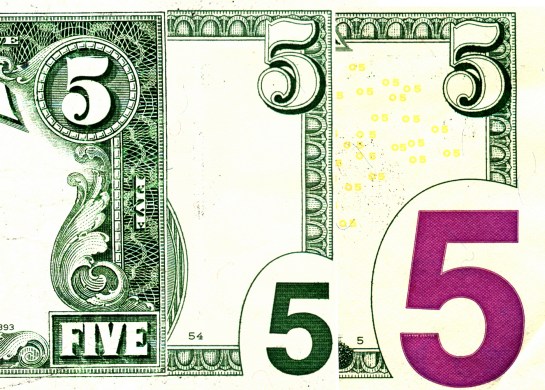
I’m not talking economics here; I’m talking esthetics. And actually, the dollar bill is about the only one that actually IS what it used to be. The U.S. mint and the Bureau of Engraving and Printing have redesigned most of our money in ways that show a miserable falling off in design and execution.

Our $5, $10 and $20 bills and our coins have suffered a severe drop in quality when considered as art.

Yes, money is art, whether it’s the engraving that makes up the bills or the bas-relief sculpture on our coins. There are long histories in both as art mediums, from the intricate lozenge-and-dot portraits of the 17th and 18th centuries and the commemorative medallions struck from the Renaissance on.

But craftsmanship at the mint and at the Bureau of Engraving and Printing has declined precipitously, leaving us with wallets full of bad art. This wouldn’t be so noticeable if the older coins and bills hadn’t been so beautifully made.

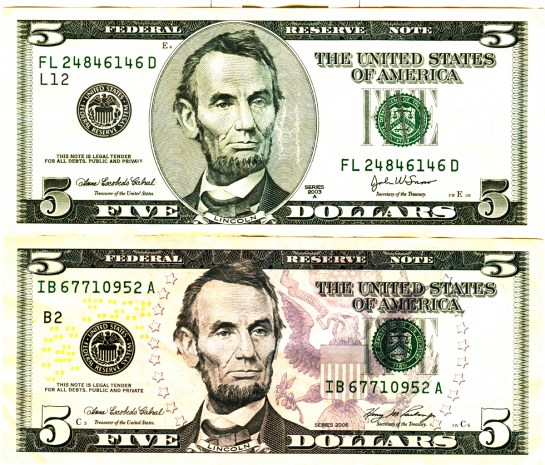
Look at an old bill, before the anti-counterfeiting “improvements” of the 21st century. Not only are the portraits more lifelike — there’s a personality behind the eyes in Grant’s picture on the $50 bill — the designs also are fuller, more detailed and graceful, full of trailing acanthus and olive leaves.

The vegetative growth and architectural motifs that used to grace our bills announced our national fecundity. We were a waxing moon, a rising tide. The scrollwork and border ornament recalled the inventive bustle of the Renaissance.

fivescrollcompare

The new bills, full of iridescent ink, microprinting and watermarks to discourage counterfeiting, are defensive and speak of a nation feeling the need to protect itself. There is no room now for the purely ornamental or decorative profusion of the old designs. Everything there has a purpose, stripped down like some typographic battlement.

twentyreversea

Genuine beauty comes from an effusion of confidence and grace; in contrast, our new bills look as though they were designed by forensic engineers.

Even worse are the newer coins, which look less like legal tender and more like tokens at a state fair. Or perhaps you catch yourself trying to peel back the foil to eat the chocolate inside.

The portraits on them are an embarrassment — one observer noted that the frontal portraits must have been “zombie presidents.”

One problem is that the coin designers have chosen to represent the faces not in profile, but head-on. It’s hard to make a shallow relief sculpture of a full face without having the nose stick out too much. The new coins try, but because they have to be flat — after all, they have to stack — the nose gets squashed flat into the cheeks, and the eyebrow ridge stick out as much as the nose. Hence the zombie look.

Looks not important

Madison looks more like Count Olaf in the Lemony Snicket movie than a founding father. Jefferson has an eyebrow ridge like Frankenstein’s monster.

madison snicket

The “Return to Monticello” nickel is just as bad, with its oddly squished portrait of Jefferson, off-center on the coin’s front.

The problem is that the rationale for changing the design is conceptual, not visual.

As Edmund Moy, most recent director of the U.S. Mint (resigned in 2011, leaving the office vacant), said, “We are proud of the result of interesting design innovations like the forward-facing Jefferson nickel, so appropriate in showing a forward-thinking president who had the foresight to expand our country westward through the Louisiana Purchase.”

Fine metaphor, lousy image. There’s a reason we have used profiles since the beginnings of coinage some 2 millennia ago.

The worst is probably the new State Quarters series. The many state designs vary in quality, but it’s the road-kill George Washington on the front that’s the main problem.

These things are hard to describe in words, but reach into your pocket and pull out some art — I mean, some change — to see for yourself.

If you have more than a couple of quarters, at least one is likely to be the old eagle-backed quarter that has been standard since 1932, and another will probably be one of the new state quarters.

Look at Washington’s head on both. The old head was satisfying and sculptural; the new head is flat, ugly and can’t make up its mind if it wants to be bas-relief sculpture or incised drawing. Sculpture and drawing are different things, and they don’t sit well together in such a tiny space as a coin.

OLYMPUS DIGITAL CAMERA

“Relief on most modern coins is lower,” says Michael White, spokesman for the Mint, “because of volume and vending-machine usage. When you make billions of coins, you don’t do the same relief.”

Little relief in sight

In fact, there’s hardly any relief at all.

You can see that confusion between the three-dimensional sculpture and the outlined two-dimensional drawing on many of the individual state designs. The Michigan quarter is practically nothing but an outline map of the state. That isn’t sculpture. Coins this dull could be molded out of plastic and tossed out at Mardi Gras parades.

Even the space around Washington’s head is a disgrace. Move the old quarter in the light to notice that the background space is not flat, but dish-shaped. Because it’s modulated, it catches the light as it moves in a way that makes the space — even the empty space — come alive. But the new quarter has a flat, uninflected background, as if no one really cared or paid attention.

All around, the founding fathers’ portraits have lost their vitality. Look at the lifeless portraits on the newer $5, $10, $20 and $50 bills. Hamilton’s nose is out of joint on the $10.

tenmedalliona

Look at Andrew Jackson on the $20 and ask yourself, “What’s going on with those shoulders?” His head looks like a giant paste-on over what might be taken for a volcano.

Aside from poor draftsmanship, there’s a lowering of craftsmanship in the bills.

The problem is that money is printed by engraving, and the engraving process is a slow, exacting one that few people have either the talent or patience for anymore.

We live in a time that moves much faster than it did in the 16th, 17th or 18th centuries, when engraving rose to a peak of craftsmanship. We don’t want to spend the time to do it anymore.

The engraver has to cut a line in a metal plate using a sharp metal burin. For the lozenge-and-dot technique used for portraiture, a series of parallel lines have to be drawn to follow the contours of the face. They are incised more shallowly in areas that should be light and more heavily in darker areas. Keeping the pressure even is a task for someone who has a great deal of time to spend getting it right.

In the details

Few people have the patience needed or the courage to attack a metal plate knowing that making a mistake means having to start over again.

We’re a nation with ADD, and our money shows it. The esthetic concern fades away. Who actually looks at money, anyway?

Perhaps decline is a historical inevitability. One remembers the incredible flowing drapery carved by Greek and Roman sculptors and the slow decline of the art into the third and fourth centuries, when the drapery folds no longer had any relation to the body underneath.

This is what happens when people lose their ability to see, to look with attention. It has often been said that we live in a visual culture, but that’s not really true. We may have given up the written word, but what we are calling visual is really just a written symbol: The stick-figure female that signifies the women’s restroom. It is an ideogram. You read such symbols, not see them. It gives up its meaning instantly.

A real woman, in contrast, can be studied for a lifetime.

There are hopeful signs. The initial design update of the bills had a giant medallion holding the presidential portraits. But instead of placing the medallion in the center, they shifted it off to the side. It may have looked more au courant, but it was totally out of balance.

But the newer bills, such as the most recent $5 bill, has done away with the medallion altogether, and although Lincoln is still large, he fits into the design better without the space-eating oval surrounding him. And with the addition of subtle colors, a line of stars and an eagle, it begins to recover from the disaster of the previous design.

newfivesobversea

They haven’t attacked the $1 bill yet. Perhaps that’s because the naked dollar simply isn’t worth counterfeiting.

onereversescroll01a

|

Money facts

* George Washington first appeared on a $1 bill in 1869.

* It wasn’t until 1907 that someone figured out that a lower relief, matched to the same height as the rim of a coin, would allow the coins to be stacked evenly.

* The first coin with a president on the front came in 1909, when the Lincoln-head penny made its debut on the centennial of Lincoln’s birth. The Washington quarter (1932) came second, followed by the Jefferson nickel (1938) and the Roosevelt dime (1946).

* The 5-cent nickel isn’t the only one: There used to be other nickels, worth 3 cents and 1 cent.

* The Eagle is not a nickname but a congressionally mandated coin with a $10 value. It’s no longer in circulation. There were also Double Eagles ($20), Half Eagles ($5) and Quarter Eagles ($2.50).

* Nickels were originally called half-dimes. Dime was originally spelled disme.

* The $10 bill was once called a sawbuck because a Roman numeral X on its face reminded some of a carpenter’s sawbuck. A $20 was called a double sawbuck.

* The $5 used to be nicknamed a fin, as in, “Buddy, can you spare a fin?”

* We are familiar with Washington on the $1 bill; Jefferson on the $2; Lincoln on the fiver, Hamilton on the sawbuck, Jackson on the $20, Grant on the $50 and Benjamin Franklin on the infrequently used $100 bill. But there used to be higher denominations: William McKinley on the $500, Grover Cleveland on the $1,000, James Madison on the $5,000 and Salmon P. Chase on the $10,000.

* Salmon Chase, secretary of the Treasury under Lincoln, was also on the first $1 bill (1862, when he was still in office — no shrinking violet, Chase).

* Martha Washington is the only woman whose portrait has appeared on a U.S. currency note. It appeared on the face of the $1 Silver Certificate of 1886 and 1891 and on the back of the $1 Silver Certificate of 1896.

* The highest denomination note ever put in circulation was Hungary’s 100 million-billion pengo, issued in 1946, worth about 20 cents at the time.

wildflowers copy

Sometimes, it’s not just where you take a trip, but when.

You can be too young to appreciate something or too old to partake.

When I was young, I loved the spring flowers, from the first jonquils that burst through the last snow on the lawn, to the wake robin in the woods. Nothing could compare with the speckled salmon color of the pinxter flower hanging over the stream, dripping dew in the early morning from the long, bowed tongues of its stamens.

All up and down the East Coast, the bright red stars of fire pinks grew along paths and blue spiderwort grew under the shade of trees. When they came out, the Eastern Seaboard seemed to be waking from its frozen sleep and taking its first deep stretches of the year.

After that, the seasons seemed anticlimactic. Summer was when leaves were turned to dry Swiss cheese by hungry insects. Fall was when those leaves dried out completely and fell off. Back then, I didn’t trust anyone over 30, either.

But a single road trip through northwestern New Jersey changed that for me. As I drove up the Delaware River in October from Philadelphia, north past the Water Gap and into the Kittatinny Mountains, every field was a paint box.

There had been a death in my family, and I had just gone through a divorce. After the formalities, I drove along the river, looking for some quiet.

In its northern parts, the Delaware is not much of a river; it is just a broad, shallow, stony-bottomed stream with a sandy bluff on one shore or the other, depending which way the riverbed turns.

The Kittatinnies are not much in the way of mountains, either.

But along the roadsides, the bobbing orange heads of black-eyed Susans mixed with the midnight blue of ironweed.

There is something different about the fall wildflowers, something weedier, something more insistent. Their vegetable smells and sticky white sap are less immediately pretty, but they have more character: They are grown-up.

Perhaps, too, it is the drier air of autumn, the mixed stands of plants, blending goldenrod with Queen Anne’s lace, bull thistle and hawkweed in a Pointillist stew of color.

Anyway, that’s how it seemed as I drove by the railroad yard in Port Jervis, at the point New Jersey, New York and Pennsylvania all meet. The old yard was grown over in asters.

There were millions of them in the open acres of the yard, each with its yellow disk surrounded by blue ray flowers. Intermixed were all the other fall flowers: the yarrow, boneset, coneflowers and chicory left over from midsummer.

And in the weedy field, even the spring flowers were represented, not by their blossoms, but by their fruits: the burrs; seed pods; milkweed down and nightshade berries.

There was yet no frost in the air, but you could see it coming in the overgrown fields that grind in the breeze with the peculiar sound of weeds.

I am now 64 and this is not a story about flowers.

Platypus-sketch

Contemporary American conservatism is a very strange duck. Maybe a platypus. 

To begin with, it espouses what has always previously been called liberalism: When our nation was founded, it was the conservative Hamilton who imagined a strong central government and the liberal Jefferson who feared it. 

Conservatism has traditionally been in favor of strong government. It is one of its hallmarks through history. Of course, behind that belief in central power was the heart of true conservatism: maintaining privilege for those who enjoyed it. That is why we could talk about Soviet hardline conservatives hanging on to Communism. It was their own privilege they were attempting to save. 

It was conservatives who supported the aristocracy in monarchist Europe; it was conservatives who fought reform in 19th century England and justified the subjugation of Ireland; it was conservatives who supported segregation in the American Jim Crow South. The record of conservatives on the progress of human liberation is a dismal one. 

There is a graspingness and miserliness at the heart of historical conservatism. All change threatens the status quo and that threatens those who hold the best cards.

But what remains the oddest thing about the current iteration of conservatism in America is the way it marries this retention of old social norms — even injust ones — with a form of political radicalism that would have dumbfounded the founders. 

At the heart of the Tea Party movement is what can only be described as “soft” anarchism. One central tenet is the dictum that government is not the solution, government is the problem, and therefore, we need to eradicate government. This is not, in any way, shape or form, conservatism. It has no relation to conservatism historically, nor conservatism in ideal or theory. 

The philosophical grandfathers of the Tea Party, let’s face it, are Mikhail Bakunin, Peter Kropotkin and Max Stirner. Get the government out of the way and everything will be peachy-hunky.

Kropotkin2

Those who call themselves libertarians can sign on to this soft anarchism and feel their views are coherent. But so-called conservative Republicans have a hard time reconciling this anti-government sentiment with the converse idea that everyone should behave according to the Judeo-Christian norms they observe. On one hand, they extoll personal freedom, and on the other hand, they negate it to anyone who disagrees with them. 

Even more, those Republicans who have signed on to the Tea Party’s soft anarchism have a difficult time matching that up with their own drive for political power. And we must face the fact that our two-party system is just a bipolar grasping of power. Republicans can claim that government should be smaller, but a short gander at the record proves that after years of striving for the power, when they have it, Republicans use it just as much as Democrats. What’s the point of winning if you don’t get the perks? 

That’s why I call this a platypus. The parts don’t belong together.

I suppose one shouldn’t expect any political movement to be philosophically coherent. Politics remains sausage manufacturing and always will. But the part that causes thoughtful people profound disquiet comes with the reflection on history.

This marriage of one radical idea with reactionary social conservatism has along history, and not a history that inspires much confidence or hope.

Every tyranny or reign of terror has its own version of a radical idea melded with a nostalgic longing for a past where everyone was good and righteous and behaved in the old-fashioned ways. Look at the incorruptible Robespierre; look at the agrarian virtues of Mao; look at xenophobic Stalin. 

Not to put too fine a point to it, and I don’t mean to equate one-to-one Republicans with Nazis, but the same principle is at work. No one extolled the virtues of family and marriage more than the National Socialists. Hitler loved children and dogs, as they say. The combination of reactionary social ideas with radical political ideas has fueled this kind of crackpotism since the days of Plato. 

During the last election, a healthy percentage of Americans turned away from the extremism of the Tea Party, and I don’t have a fear that this platypus will reconquer our politics. America has a long history of quietism, and has always in the past, so far, retreated from any radical departure from the comfort it finds in a stodgy middle class normality. It’s one of our country’s saving graces: We don’t go in, like the French, for theory. 

But nonetheless, this water-and-oil mixture of radicalism and reaction is something, as the doctors always say, we should keep an eye on. 

bipolarportrait

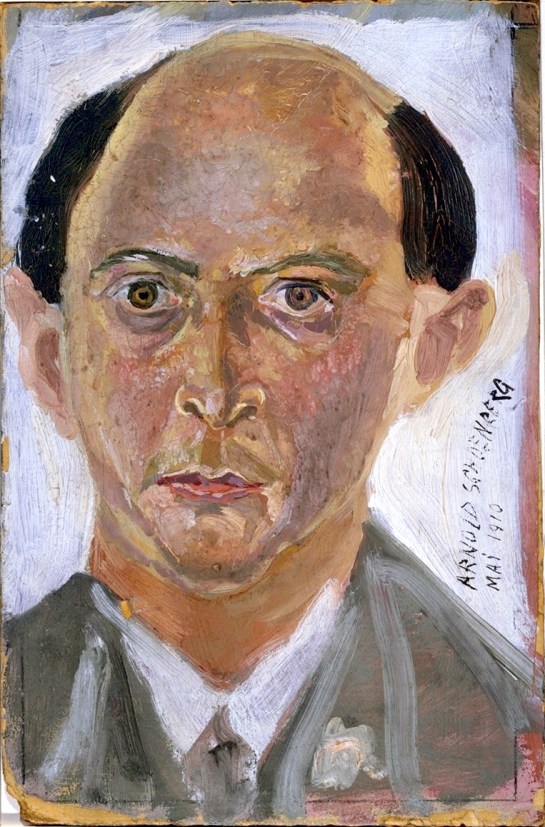
I’m going to make an argument here that will perturb any normal classical music lover: The atonal music of Arnold Schoenberg is not atonal.

Schoenberg is a whipping boy for all those who hate, just hate what happened to music in the 20th century. He is held to be the archdeacon of unlistenable cacophony. But whether you like his music, the way you might like the music of Mozart, or not, a good deal of the disapprobation that has been visited upon him is undeserved and derives from a complete misunderstanding of his music, and I would argue a misunderstanding of what is called classical music, in general. 

Some background: Arnold Schoenberg was born in Vienna in 1874, when Richard Wagner and Johannes Brahms were still alive, and the two ruled the German music world, as two poles of artistic radicalism and conservatism. Schoenberg was 8 when Wagner’s final opera, Parsifal, premiered in 1882. He was 23 when Brahms died (when Schoenberg was born, Brahms had not even written his first symphony). 

He became a composer, writing first in the arch-Romantic style that borrowed a good deal from Wagner’s chromaticism and Brahms’ idiosyncratic rhythmic complexity. He came of age in a Vienna dominated by the musical will of Gustav Mahler.

As a composer, he believed he was moving on the logical path set forward by Wagner, Brahms and Mahler, among others, a path that moved historically from diatonic to chromatic music, and then to music of indistinct tonality — which has sometimes been called atonal. His final move was to a structured composing method he felt would reimpose order in the making of music. In this, he was one of the two primary sources of Modernism in music, along with his “archenemy,” Igor Stravinsky.

(That “method” was, of course, the 12-tone, or dodecaphonic system, also called “serial” music — more of that later). 

To those ears used to hearing music with tonic and dominant harmonies in major and minor modes, Schoenberg’s later music seemed hopelessly aimless, and worse, ungrounded in traditional harmony. To them, it seemed like noise rather than music.

Setting aside questions of taste: For some of us, Schoenberg’s music is unutterably beautiful, while others may never see (or hear) past the dissonances. But as I said at the beginning, there is a serious misunderstanding of Schoenberg’s aim. 

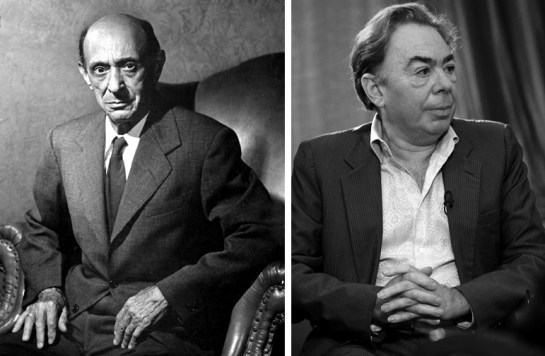
By my definition, Schoenberg’s music — even his later 12-tone music — is not actually atonal. If I want atonal music, I must look to Andrew Lloyd Webber.

What! You say? How can that be?

I’m not being facetious: I’m making a central point about classical music.

For the sake of argument, we should say that what we call music is often broken down into three primary components: melody, rhythm and harmony. It is admittedly simplistic to make this generalization, but it has a kernel of truth to it: If we divide the world’s music up, it can be said that Asian music is given over to the primacy of melody and can consist of melodies of incredible complexity; African music respectively finds enormous complexity and expressiveness in rhythm. Yes, there is melody, harmony and rhythm in all these musics, but there is a special place given to melody in the often drone-harmonied Asian music, and a special place to rhythmic complexity on sub-Saharan African music.

But European music has placed its money on harmony. Since the Renaissance, harmony has been the most expressive, and certainly the most complex element of European music. By the 18th century, this had evolved into a system of keys and key relationships.

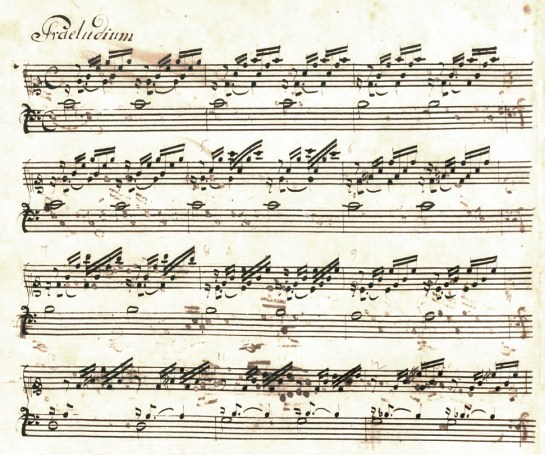
If you want a demonstration of what I mean by harmony being the central element, consider something as simple as Bach’s Prelude in C-major from the first book of the Well-Tempered Clavier. In it a simple eight-note rhythmic figure is repeated, over and over, twice to a bar, unchanged for 32 bars. That is 64 identical iterations. It serves as both melody and rhythm. The only thing that changes is the harmony, constantly shifting: It is beautifully expressive in its simplicity. 
BachPrelude

Or take a Schubert song. It would appear that the melody is what makes Schubert so can’t-get-out-of-your-head, but in fact, it is the often-wild and inventive harmonies he has underpinned them with. Try re-harmonizing any of his songs and the magic evaporates. 
Reharmonize Andrew Lloyd Webber and it hardly matters; in fact, his music is commonly reharmonized with each new arrangement, so indifferent is the harmonic underpinning. In a good deal of contemporary music (mostly pop) the harmonies are merely ornaments to the beat and tune, and can be interchanged with impunity. The “chords” are just called “changes,” and little thought is given to them, or to their interrelationships. 

This is what I consider atonal music. It may be consonant and it may all sound very pleasant, but it does nothing expressive with its harmonies and there is no coherence to key relationships. 

All music also depends on the setting up of expectations and then satisfying them or deflecting them. This is true of the changing rhythms of African drums or the melisma of the Arabian oud. 

Tension and resolution. 

In Western music, this creation of expectation and its subsequent completion falls primarily to harmony. 

The primary engine of this tension is dissonance and the primary resolution is found in the subsequent consonance. But that is only in the short term. To make a piece of art that lasts longer, requires a more sophisticated pattern: how to delay the final resolution until it comes to us like a dawn sun after a dark night. 

Consider the slow tread to C-major in Beethoven’s Fifth Symphony, where the tonal resolution comes after many short glimpses, but not in full till the finale. Or even more extreme: the way Bruckner withholds the genuine tonal resolution until the very last B-flat chord of his Fifth Symphony. 

Wagner depends on holding off that longed-for resolution; it’s what gives the Liebestod its unendurable sense of longing.

The history of Western music is the history of what Leonard Bernstein once called “newer and better ambiguities” in tonality. The thumping tonic-dominant structure of Beethoven turns eventually to the sliding chromaticism of Wagner, and later, the battering tone clusters of Stravinsky. 

You can hear the way tonality gives direction to music in something as simple as the blues. The chord changes in the blues, although they are sometimes given a little kick by adding sixths or sevenths to the basic chords, is a very simple set of chord progressions. Tonic, tonic; subdominant, tonic; dominant, tonic. Over and over. You can feel the movement at each chord change.

Classical music does that to, albeit in a more complex, subtle and varied manner. You need to feel the chords — the harmonies, change under your feet.

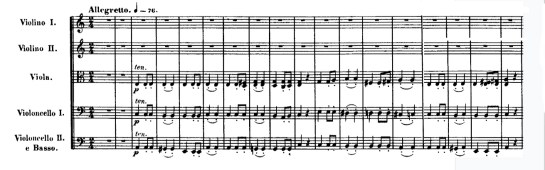
Listen to the second movement of Beethoven’s Seventh Symphony, one the most memorable and moving in his oeuvre. The melody is hardly more than a single repeated note in a repeated “Dum-ditty-dum-dum” rhythm. But the harmony changes constantly and meaningfully: It moves from A-minor and into C-major and on to B-major and B-minor before noodling back through the dominant E to the home A-minor at the end of the phrase. Beethoven keeps it alive and fresh; he keeps it interesting. 

Beethoven7

You should not only notice, you should feel the harmony. It is meant to convey emotion.

The best way to do this is to listen more to the bass line than the soprano. You’ll get the tune whether you listen especially to it or not, but listen to the bass, and you’ll hear where the music is going.

Brahms always used to cover up everything but the bass staff in a score when looking at the printed version of a new piece of music. He claimed it was the best way to tell whether the music had any lasting value. 

Of course, music isn’t just the triads on parade: It is the non-harmonic tones that give it spice. 

Dissonance is everywhere in music. You cannot have music without it. If you think Schoenberg is dissonant, you should consider Johann Sebastian Bach. He is probably the most dissonant composer of all time. Of course, there is this central distinction between his dissonance and that of Schoenberg: Bach always resolves his dissonance.

If you were to take a simple choral tune, say, “Ein feste Burg,” (“A Mighty Fortress is our God”) and play only the off beats, you would hear something as modern and dissonant as Schoenberg himself. All those passing tones, all those appoggiaturas, all those mordants and nachschlags. Most of the vertical harmony (harmony at any given moment, seen from highest note to lowest bass) in Bach is clangorous , but always resolved immediately and given a place in the key structure of the melody. 

When we are comfortable in C major or G minor, we feel comfortable also to take minor departures, in full expectation of the resurrection of harmonic order. All is right in Bach’s universe.

Schoenberg lived in a different time from Bach, a time when all was not right. It was the early 20th century, and wars, ethnic cleansing, fascism, colonialism’s evils and even the death of God made life seem less secure. For Schoenberg, tension was the order of the day, not resolution. And so, in his so-called atonal music, each cluster of tones, although the equal of any tone cluster in Bach, is not fit into a hierarchy of key, and does not anticipate its own resolution into something emotionally satisfying. 

If Wagner attempted to keep resolution at bay for minutes and quarter-hours at a time, Schoenberg keeps it at bay for entire pieces of music.

Each cluster twists in a matrix of implied tonal structure, but moves from one to the next in such an eel-like manner that no tonal structure is ever settled or constructed. We are never in D minor, although it may seem at certain instants that we are headed there.

The meaning of Schoenberg’s music, thus, depends on our ears expectation of tonality, and its meaning depends on the denial of the same. In this sense, Schoenberg’s music is still tonal, even when it avoids any key center. Even at its most radical, his music relies on our own ear’s sense of the harmonic universe in which it exists to provide “Luft von anderem Planeten:” “air from another planet.”

Schoenbergselfportrait

That is true even of the serial music he wrote. It’s emotional resonance depends on our placing it in an endlessly shifting tonal universe, a ball of mercury that cannot be pinned down. 

In this sense, Andrew Lloyd Webber’s music, although it is written in a key, does not depend on tonality the way Western music from Bach to Debussy did. Its tonality is mere happenstance, something unconsidered because merely habitual, something virtually unseen, or unheard by its creator. 

And hence, I claim that Schoenberg’s music is tonal, and Webber’s music is not.

Blake_ancient_of_days

I’ve always been interested in the way things translate from one language to another. Of course, that also means from one culture to another, and, as in the case of Bible translation, from one era to another. Time changes, language metamorphoses, and our world-views alter with our understanding of the world around us.

There is no question that the most powerful translation of Genesis can be found in the King James version, but words that meant one thing in the era of Shakespeare may very well mean something different now. And the verse forms of ancient Hebrew are different from our expectations of poetry, now.

So, I’ve always wondered, what does the original Hebrew mean in the Torah? Is there a way to make a translation that hews closely to the original meaning, the tribal meaning of the language?

I’ve gone through several interlinear translations, several translations in clear text, and lots and lots of footnotes to come up with something that gives me as close as I can tell, what the original Creation story meant in its Hebrew iteration, uninflected by several millennia of religious interpretation, sectarian wars and violence, pogroms and anathemae.

In the interests of disclosure, I should admit up front that I have no stake in this game: I am not a believer (when asked, I usually say I have no religion, I’m not even an atheist), so I’m not trying to persuade anyone that the Bible is true, or not true, or that this or that dogma is the “true” one. This is just my attempt to understand what metaphors and language was used in the ancient Middle East as they slowly came to terms with what would become their religion.

Believe me, I don’t claim this is a good translation of the first Creation story in Genesis. But it is a defensible one.

King James is still the king, but its rather archaic feeling — which, of course, was not archaic when it was written — has unfortunately become the default diction and rhetoric of belief. (So much that Joseph Smith’s “Book of Mormon” is written in a botched imitation of the sound of KJV, albeit with lousy grammar and many gross lexical misunderstandings).

There are many points in the Hebrew text where scholars either disagree, or throw up their hands and say, “We just don’t know what is being said here.” They give it their best guess, like the bit about the stars being created for calendar use. The original Hebrew is obscure.

Anyway, here’s my version:

Genesis, the beginning

When it all started up, and the gods were arranging the sky and the ground,

When the earth was emptiness with darkness over the ocean,

the wind of the gods hung over the face of the water

The gods said:

“Let there be light,” and light happened.

And the gods said, “We did a good job.”

the gods split up the light and the dark,

calling the light “Day,” and the dark, “Night.”

There was a sunset; there was a sunrise — One Day.

The gods said:

“Let there be a bowl over the water and let it split up water from water.”

The gods made the bowl

and separated the water that was below the bowl

from the water that was above the bowl.

It Was.

The gods called the bowl, “Sky.”

There was a sunset; there was a sunrise — Two Days.

The gods said:

“Let the water under the sky be brought together in one place

and let the dry land be seen.”

It Was.

The gods called the dry part “Ground,” and the collected waters they called “Sea.”

The gods saw the craftsmanship was good.

The gods said:

“Let the ground sprout with growing sprouts —

plants that seed-forth seeds, fruits trees that fruit, according to their type.”

It Was.

The ground grew growing sprouts, seeding plants seeding seed plants, fruiting fruit trees.

The gods recognized they were well made.

There was a sunset; there was a sunrise — Three Days.

The gods said:

“Let there be lamps in the bowl of the sky to split up the day from the night, that they may be signs (Hebrew “difficult”) for a calendar, and let them be lamps in the bowl of the sky to provide light on the ground.”

It Was.

The gods made two big lamps:

The bigger lamp for ruling the day; the smaller lamp for ruling the night.

And the stars.

The gods placed them in the bowl of the sky to provide light on the ground and to rule the day and the night.

The gods liked what they saw.

There was a sunset; there was a sunrise — Four Days.

The gods said:

“Let the water swarm with a swarm of beings, and let the birds fly across the bowl of the sky.”

The gods created huge sea serpents and all the crawly things that crawl about, with which the water swarmed, after their type, and all the birds, after their type.

And the gods saw they looked good.

And the gods blessed them, saying:

“Grow fruit and be many and fill the water of the seas and let the birds be many.”

There was a sunset; there was a sunrise — Five Days.

The gods said:

“Let the ground bear creatures in types, herd-animals, crawling things, wild things of the earth, all divided by type.”

It Was.

The gods made the wild things of the earth, divided by type, and the herd animals, divided by type, and the crawling things in the dirt, divided by type.

The gods saw it was working out well.

The gods said:

“Let us make people in our shape, looking like us.

Let them rule over the fish in the sea, the birds in the sky, all the earth, all the crawling things that crawl on the ground.”

So the gods made people in their shape, so they looked like the gods,

male and female, the gods created them.

The gods blessed them and said to them:

“Grow fruit and be many and fill up the earth and conquer it. Have rule over the fish in the sea, the birds in the sky and all the crawly things that crawl on the ground.”

The gods said:

“Here, we give you all the seeding plants that seed that are on the face of the earth, all the trees in which fruits fruit. For you they will be for eating. And also for all the living things of the earth — all the birds of the sky and the crawly things that crawl about on the ground — all green plants for eating.”

It Was.

Then the gods looked at all they had done with exceeding satisfaction.

There was a sunset; there was a sunrise — Six Days.

So, everything was finished — sky and earth, with all their entourages.

The gods had finished, on the seventh day, the work they had done

Then they stopped on the seventh day, all the work they had done.

The gods gave the seventh day their blessing and made it sacred, for on that day, they stopped working on all that they had done.

This is how it all began, the sky and the earth and all history.

Movies for list

With the end of the year coming up, everyone’s already getting into the list-making game. Top 10 lists are about to descend on us like an asteroid descending on the dinosaurs.

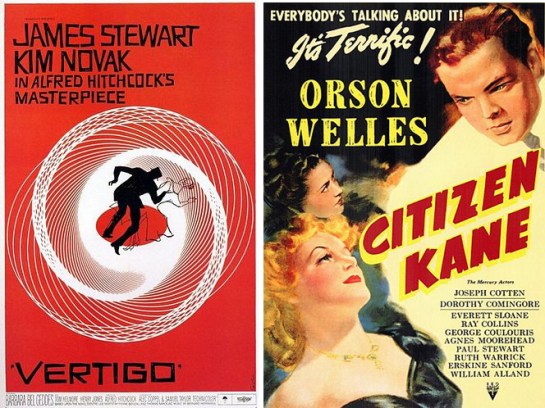
Sometimes, it seems as if lists are the central cultural form of the nation. We’d rather scan a list than read the book. Untold significant conversations are prompted by the idea that Alfred Hitchcock’s Vertigo might be the alltime greatest movie ever made, and whether something is seriously wrong in the cultural ethos if Citizen Kane is bumped down a few pegs.

So far, James Joyce’s Ulysses seems to be holding onto its rank as the Number One novel of the 20th Century, although there are enough quibbles to warrant the opinion that the only thing they all seem to agree on is that Ulysses is hard to read.

Of course, lists have been around a long time. They predate writing. Some of the first evidence we have of human existence are the odd scratchings on bone or stone that anthropologists believe are calendar listings. Prehistoric people notched their medicine sticks to remind them of significant events — they were memory aids.

And the ancient Incas communicated with a knotted string, a “quipu,” each knot standing for an item the messenger was required to remember.

So, why not cut to the chase. It is lists that matter in the new century, so let’s forget the long difficult novels, or the subtitled films, and decide what are the 50 Best Lists of All Time.

It is no surprise that the 10 Commandments come in at No. 1. It is a consensus choice. There were a few rumblings among the more erudite judges that perhaps Hammurabi’s Law should displace the Decalogue, but finally, the conciseness of the Torah beats out the comprehensiveness of the Babylonian ruler.

The list of the Seven Wonders of the Ancient World, compiled by the Byzantine mathematician Philon, one of the oldest and most venerable in the world. In his De Septem Orbis Spectaculis, he listed the Pyramids, the Hanging Gardens, the Olympian Zeus, The Ephesian temple of Diana, the Mausoleum of Halicarnassus, the Colossus of Rhodes and the Lighthouse of Pharos.

His list was so influential, that when they made King Kong in 1933, they called the big ape, the “Eighth Wonder of the World.” And everyone in the audience knew what the reference was.

The Bill of Rights comes in at No. 3, although it is a list of amendments to the Constitution that many Americans are vague about, except for their favorite one, whether it be the First and Larry Flynt, the Second and Wayne LaPierre or the Seventh and David Petraeus — No, wait, sorry: That last one is the 10 Commandments.

Fourth is the Index Librorum Prohibitorum, or the “Index of Prohibited Books” first published by the Vatican in 1557. At one time, it listed 5,000 books that were bad for you, and undoubtedly more lively than many of the moldy classics on the Modern Library list.

Index for list

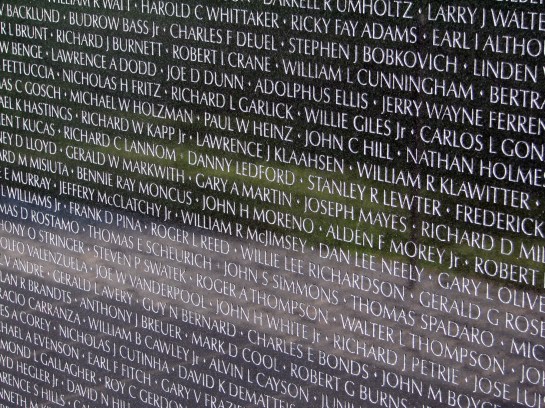
And rounding out the top five is the Maya Lin’s Vietnam War Memorial in Washington, D.C., perhaps the most moving of the lists and the only one that people actually make a pilgrimage to.

This last proves that lists need not be trivial.

Vietnamvet for list

The 50 top lists of all time

1. The 10 Commandments

2. The Seven Wonders of the World

3. The Bill of Rights

4. Vatican’s Index of Forbidden Books.

5. The Vietnam Memorial, Washington DC.

6. FBI’s 10 Most Wanted List

7. Billboard’s Top 40

8. New York Times’ Bestseller List

9. Nixon’s Enemies List

10. The Periodic Table of the Elements.

11. The Seven Deadly Sins.

12. National Register of Historic Places.

13. AFI’s 100 Best American Movies.

14. The Book of Lists by David Wallechinsky, Irving Wallace and Amy Wallace.

15. Joe McCarthy’s list of Communists in the State Department

16. 50 Ways to Leave Your Lover by Paul Simon

17. Elizabeth Taylor’s husbands

18. AP’s Top 20 College Football list

19. The zodiac

20. The Fortune 500

21. Schindler’s List

22. Charles Messier’s catalog of astronomical nebulae

23. The Koechel catalog of Mozart’s works

24. TV Guide

25. People magazine’s list of the 50 most fascinating people.

26. Butler’s Lives of the Saints

27. Standard and Poor index

29. Dow Jones Industrials

30. Martin Luther’s 95 Theses.

31. The Arbitron Ratings.

33. Oxford English Dictionary

34. USA Today Weather Page

35. Readers’ Guide to Periodical Literature

36. Google.com

37. The “catalog of ships” in the Iliad.

38. The notches in Wild Bill Hickock’s revolver handle

39. End credits of Airplane  

40. Money magazine’s Best Places to Live in the U.S.

41. Military Manual of Arms.

42. David Letterman’s list of “Top Ten Things That Sound Good When Said by James Earl Jones.”

43. The list of uses for WD-40.

44. Mr. Blackwell’s “worst-dressed” list.

45. The List of Adrian Messenger

46. Franz Liszt

47. Martha Stewart’s “To-Do” list.

48. Santa’s list of those who are naughty and nice.

49. JFK’s little black book.

50. 50 Top Lists of All Time.

Part 2 of 2

Mont-Saint-Michel

What was there about the Normans? That they covered the countryside in forts, castles, abbeys, churches, all with heavy, heavy stone architecture that says, in no uncertain terms, “I’m not here for fun. I mean business.”

The architecture feels almost Protestant in its brutal directness and lack of ornament. Like the dragon in its determination not to move, but squat on a hill, glowering.

Is there something about this rainy, gray countryside that made the Normans that way? Is it a residue of their Nordic blood? Is it a response to the brutality of the Dark Ages, when every duke or king had to defend his kingdom at every season?

Surely, Mont-St.-Michel is an interesting case: Part monastery, part fortress.

Who but a Norman, it seems, would build a monastery on the top of a giant rock out in the middle of a bay whose feature is killer tides?

You can see Mont-St.-Michel from the other side of the bay, 20 miles or so off. It hovers over the water like a mountain in the distance, with a needle spire pointing up at God.

The island — it was once an island, even if now it is connected to the mainland by a causeway, and the bay has so silted up that scientists say that soon, there will be no way for water to surround the place, even at high tide — the island is a rock.

In 708, Aubert, bishop of Avranches, had a vision of the sword-bearing St. Michael and built a sanctuary on the rock. It later became an abbey. The monastery grew, burned down, grew some more, caught the interest of a king, grew even bigger, and the monastery became surrounded by a fortress wall. Was the king interested in protecting the monks, or was he more interested in co-opting the island as a coastal defense under the disguise of peaceful religious orders?

At any rate, the result is a merveille — a marvel.

In England and Normandy, they call this stony style of building “Norman.” Elsewhere it is Romanesque, with arches like the Romans built.

The Romanesque is a heavy style, with thick walls and tiny windows. It can be claustrophobic, unlike the open Gothic style that followed it.

The Gothic cathedrals are famous for height: As you walk through them, your eye is drawn toward heaven.

The older Mont-St.-Michel is also vertical, but it is an external verticality: something you see from a distance, and becomes more imposing the closer you come, until, after you reach the island, the stonework rises over you in ways that make you feel not just small, but powerless. Is there any way you can climb to the peak, where God is, or where religious dispensation is? The monastery towers over you, ever upward, reaching its finish in the spire of the topmost church and the golden statue of St. Michael on top of that.

This is a Sisyphean hill that you clamber up and slide back down over and over. It is an impossible thing to master. It is Lurch the Butler looking down at you. It is the model for Citizen Kane’s Xanadu and King Kong’s Skull Island.

Around the base of the island, running higher or lower as the rock underneath decrees, is a rampart, with towers and loopholes. At its highest point, it intersects with the stone stairways that lead even higher, into the lamasery of the abbey. For the pilgrim, or for the tourist, the stairs seem endless. Each time you reach a landing, you look up and the buildings seem higher, and looking down, the earth seems farther away. The stairs actually exaggerate the verticality of the place.

The engineering was state-of-the-art for the time: They managed to build a functioning monastery on top of and around a pinnacle of rock, so that all you see from the outside is human stonework. The core of rock is concealed inside.

But the rock shapes the rooms, chambers, dungeons, refectories, chapels, meeting halls and workrooms that had to be built not simply on the stone, but around it.

The result is a warren of buildings, a hodgepodge, so split-level that you never can tell where you are in the compound. You move from one side of the rock to the other, while traveling up staircases and down staircases, through vaulted rooms and up more staircases, so that when you reach the other side, you cannot tell if you are on the same level, have gone down one or two levels, or a level and a half. Blueprints are no help. They seem to regularize what on the ground is chaos. The confusion is increased by the mess of architectural styles.

Take the abbey church at the very top. Its nave is Romanesque, with a barrel vaulted ceiling lined with wood, spread out like the wooden bars of a Japanese suit of armor. It is the oldest part remaining from the original construction.

The middle of the church — the transept — is Gothic, but of an early sort, with coarse vaulting and dirt-plain stone walls.

The apse at the far end, however, is later Gothic, with all the lightness that implies: complex stone tracery, windows piled on windows.

One end, dead weight — although the sternness of it also reflects a basic majesty — at the other end, all filigree and sunlight. The halves cannot mesh, but somehow they do: It is the magic of the Gothic style that it can accept any number of stylistic additions and just wear them like a great patchwork.

When you leave the church and head down a staircase and up another, and around a passageway, you come to a Romanesque room, dark and somber, in the bowels of the complex.

Pass through that and you eventually find your way to the three-story section called “La Merveille,” the marvel, an astonishing piece of engineering and construction. There, primitive fan vaulting spreads out from graceful piers, and you see the obvious aesthetic superiority of the Gothic. This is what the Middle Ages mean to most people.


Up and down stairs, through dark corridors, through stone doors, past arched windows, beyond a cloister with a double-columned colonnade.

The towering mass of stone and glass is like nothing else in Christendom.

Certainly, Notre Dame de Chartres has an imposing exterior, but it is the interior that carries its essential message. At Mont-Saint-Michel, it is the opposite: While the interiors are certainly interesting, it is the exterior that carries the central message of the warrior Christian saint.


Part 1 of 2

Introduction

West of Paris in northern France are two monuments of the Middle Ages: the cathedral at Chartres and the abbey at Mont-St.-Michel.

In 1904, American historian Henry Adams privately printed a classic book that he called “Mont-Saint-Michel and Chartres,” after the two signature sites of his thesis: that the older Romanesque architecture celebrated the masculine, martial virtues of St. Michael, while the newer Gothic style worshiped the “eternal feminine” of the Virgin Mary. Most of the major cathedrals of northern France are called “Notre Dame” — “our Lady.”

Notre Dame de Chartres is the ur-cathedral, the one used everywhere as the prototype cathedral. Mont-St.-Michel is less clear: It is a palimpsest of styles, bunched one over the other.

A trip to both still can be the best way to experience the art and culture of the Middle Ages.

And it is a very personal experience.

Chartres

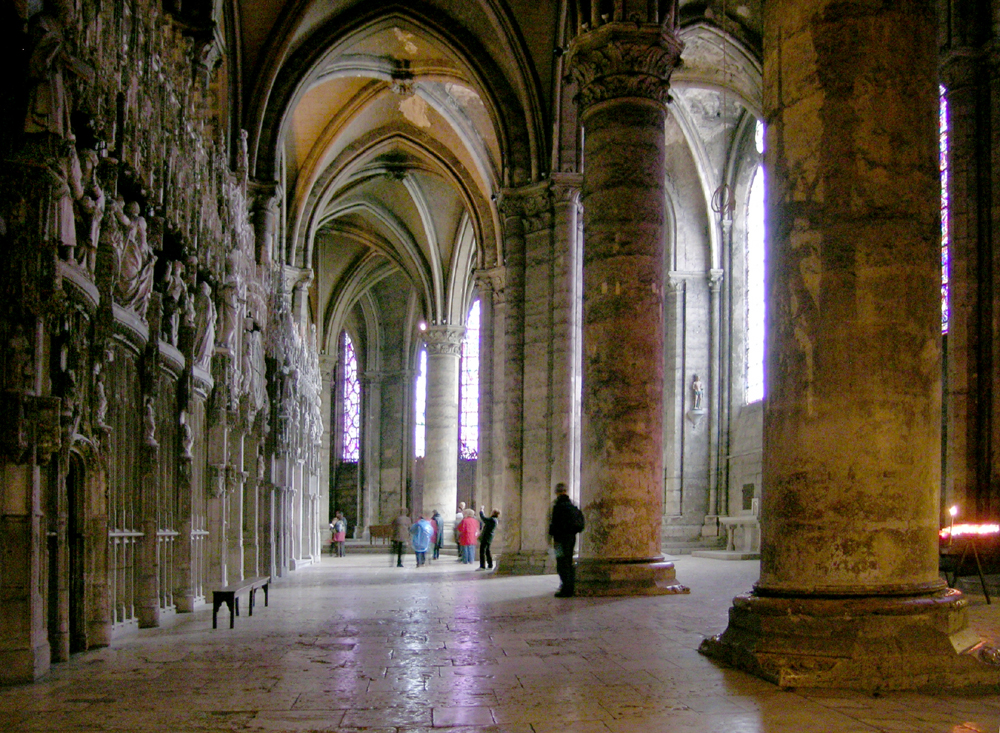
 Visiting the Gothic cathedrals of northern France is a kind of spelunking.

You enter the cavernous, dark spaces of the cathedral at Chartres and you hardly can avoid thinking of Carlsbad or Luray. The spaces defined by those stone walls and stained glass are always cooler than the weather and dimmer than the day, and the oldest, damp churches even can show you a stalactite or two in a draftier corner.

In the cathedrals you also descend, but you descend into the past, a darker past, barely recognized, of a Europe 700 years ago, when the church was the center of town and the source of political as well as spiritual power.

Expression of civic pride

Most of the famous cathedrals are built at the highest point in town, and can be seen for many miles, declaring their hegemony.

The churches were built as an expression of civic pride: In Chartres, it was primarily textile merchants who paid for the cathedral. They wanted to attract pilgrims — tourists — to spend money.

But the descent into the past is matched with another — a voyage into your own psyche, your sense of spirit.

The church takes you out of the daily world of business and family, and plops you down into a kind of eternity, a place where time and effort, gain and loss disappear and you are left face to face with what really counts.

Outside the cathedral, people are hawking postcards, souvenirs and crepes. Cars buzz by; the pompiers — France’s emergency workers — pass a block or two away to the sound of their tritone sirens.

But step inside, and you are blasted by the quiet. Even the tourists tend to whisper.

It has nothing to do with whether you are a believer. It is such an extraordinary experience, it can knock the breath out of you.

Spare in the extreme 

Notre Dame de Chartres is a veritable Spartan of cathedrals. Her west facade, for instance, is spare in the extreme, with only a few decorations, not counting the portals and their sculpture. But the portals are small and restrained, unlike their cousins at Notre Dame in Paris. You almost get the idea of a facade that isn’t yet finished, that it is waiting for someone to come along and add the finials, Hebrew kings, garlands of trefoils and quatrefoils.

Instead, it almost looks like the Gothic cathedral equivalent of plywood.

The proportions of the nave seem almost primitive. The large side-aisle arcades take up almost half the height of the central nave. The small triforium leaves room for a rather scaled-down clerestory — those windows at the upper edge of the walls. The result of these odd proportions is that not much light drifts down to the nave floor. It takes quite a while for your eyes to adjust.

When they do, there is a good deal of wear to be seen. Not only is the stone floor worn wobbly, but the vaulting in places is peeled or exfoliated, showing brickwork behind the stone.

Attend Sunday Mass 

The interior almost gives you the feeling of an empty apartment. Where are the paintings, the furniture, the curtains? In Chartres, where are the windows, the interior carving, the elaborate bosses in the vaulting?

One of the reasons Chartres is so highly prized is that so much of it is original. The statuary at Notre Dame de Paris is cleaner and more neatly featured, but then, it is only 150 years old, having been restored by Eugene Viollet-le-Duc in the 19th century. Viollet-le-Duc was a magnificent man, and his restoration work at Paris is convincingly original looking. You don’t sense much of the 19th century in it.

But it is still pristine and new looking. At Chartres, the statuary is weathered. You can see the lichen growing on the stone. Even the walls of the cathedral sport tufts of daisies high up, in unlikely places, growing straight out of the masonry.

Intoxicating chant 

The limestone is mossy, lichened and eroded. Paris looks fresher than her matronly cousin in Chartres. Paris recently has been sandblasted.

For some, the best time to visit is off-season on a weekday, when you can have the place nearly to yourself. But a cathedral wasn’t built to be empty. You should try to take in a Sunday Mass.

A machine is always more beautiful when it is running, and a cathedral is a machine to take you someplace. It’s best to see that machine with all its gears rotating and its cylinders pumping.

The church is packed. At the altar, spotlighted as if on a theater stage, there are priests and a choir, which is chanting plainsong that echoes through the building like surf.

Grasping the metaphor 

A priest is swinging a censer around the altar, spreading smoke through the crossing of the transept. It is intoxicating to hear the chant, melismatically floating like the censer smoke, under the brilliant blues and reds of the rose window, high above.

One doesn’t have to be a believer to appreciate how the Mass, spoken and sung in the space built for it 700 years ago, addresses the magnum misterium.

The vaulting, the lights, the stained glass, the church spread out in it is cruciform, that is also the diagrammatic shape of my body and your body, with the vast ceiling, which is metaphorical of the inner dome of the skull. You can see how the priest at the crossing of the transept — the place that counts as the heart of the cruciform homunculus — is casting us out into the cosmos, out into the mystery, out into an intense beauty we only rarely let ourselves become aware of.

One listens to the choir, now taking on a descant from the 15th or 16th century, with the soprano floating her melos out over an alto’s lower harmony, and look up, and on raising eyes, one sees the axis of the rose window, with all the light pouring through the interstices in the tracery, very like the angels dancing around the divine center of Dante’s mystical rose.

The vastness of the cathedral interior became the vastness of the universe, the singing became the music of the spheres.

That melisma becomes something completely separate from music as an aesthetic event. It becomes the closest thing we can hear — outside the sounds of children playing — to the human equivalent of a bird’s song, a sound beautiful beyond its need to be beautiful, uttered out of instinct and joy.

The doctrine doesn’t matter, except to the faithful. The metaphor behind the doctrine — the metaphor truer than the sometimes unknowing doctrine — takes over.

And you will be privileged to witness the building doing what it was designed to do, like a jet breaking the sound barrier, or the dynamos at Hoover Dam spinning out electrical power.

Let there be Light

From our vantage point, eight centuries later, Gothic architecture looks as old as dirt, but it is important to remember that it was once as new as the iPhone. It was innovative, and a craze for the new style of building spread across France and the rest of Europe.

People get taught about Gothic and Romanesque architecture in schools in the most boring way: a list of arcane terms and concepts.

But in reality, you can grasp the difference if you recognize the difference between a brownstone apartment building and the Empire State Building. It’s exactly the same difference, really.

Think of it: The brownstone is built brick on brick. You can build your edifice only so high, or the weight of the brick will crush your foundation.

In the late 19th century, they figured out that you didn’t have to make your walls hold the weight of the building. You could build a steel frame and hang your bricks on it, so the steel carries the weight, not the wall.

In fact, that led to the modern buildings of glass and steel with no walls at all, only windows.

It was the same thing in the 12th century. The older buildings, called Romanesque, were built brick on brick, or stone on stone, and in order to support the great weight of the stone, the walls had to be thick and strong, and windows tiny.

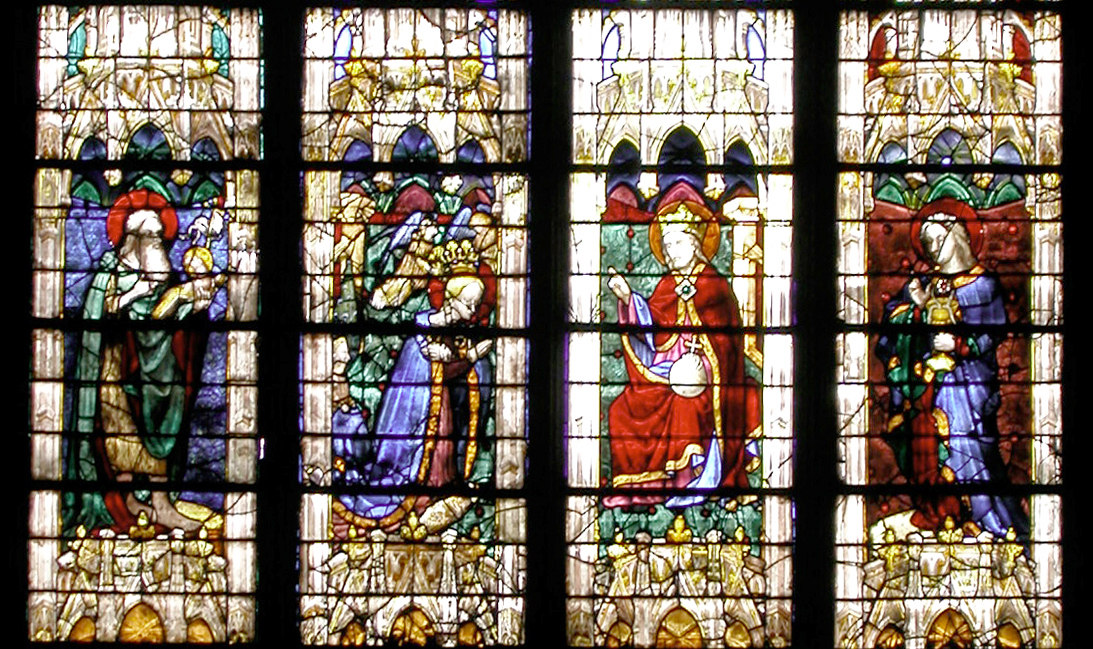
But builders realized that you really didn’t need the wall to hold up your roof. You could put your roof on stilts — columns or piers — and fill in the space between them with glass — stained glass.

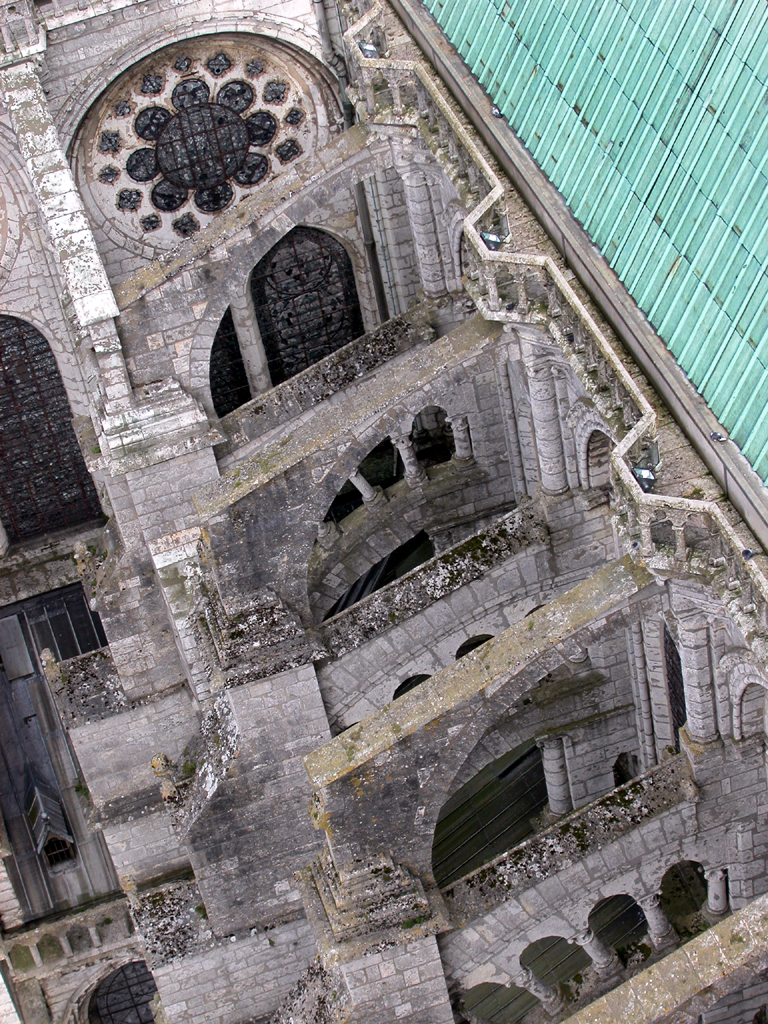
This is the Gothic: vast open spaces instead of heavy walls. To strengthen the columns and distribute the thrust of the roof weight, buttresses were added. They didn’t need to be so heavy, either, if they were placed in the right place at the correct angle, so they were opened up the same, and you had the flying buttress, the arch of stone to help hold up the roof.

The stained glass let streams of light enter the building.

This wasn’t just practical. Abbot Suger, the head of the church in Paris in the mid-12th century, was part of an intellectual renaissance, a Gothic renaissance, and had read the Classical and early Christian authors, Aristotle and Plotinus, and believed that light was the primary metaphor of divinity. God dispels darkness. So, he wanted his new church, now called the Basilica of St. Denis, in northern Paris, to be bright and well-lighted. The new architecture was just what he needed.

Now, the church wouldn’t seem heavy and dismal, but brilliant and airy. It was perfect, and within 20 years, everyone who was building a church used the new style, which lasted for 300 years before being rivaled by the Italian Renaissance and the Baroque.

But even now, you find new churches in America with their Gothic pointed-arch windows and their naves and aisles.

The style persists in our cultural memory.

To be continued