Archive

Tag Archives: animated cartoons

Some years ago, there was an unusual installation at the Scottsdale Museum of Contemporary Art. It was a 34-minute video by Mungo Thompson titled The American Desert (for Chuck Jones) and consisted of altered clips from old Warner Brothers Roadrunner cartoons, with the protagonists filtered out, leaving a series of edited backdrops of the American Southwest, with mesas, buttes, canyons and cliffs. 

Screen grabs of Mungo Thompson’s “The American Desert (for Chuck Jones)

The video loop (it played continuously) showed me the landscape I knew so well, but translated into cartoon visuals, with all the shapes, colors and weirdness I loved from the Colorado Plateau — Monument Valley, Canyonlands National Park, Capitol Reef NP and Arches NP, the Navajo and Hopi reservations — simplified and turned into theatrical backdrops. 

That region has served its term many times over more than a century, as backdrop for drama, from early silent Westerns (The Vanishing American, 1925), through classic John Ford films (beginning with Stagecoach, 1939), and most recently in the Coen Brothers’ Ballad of Buster Scruggs. The Southwest is photogenic, if nothing else. 

But the Warner Bros.-Chuck Jones animation presented a stripped-down, diagrammatic version of the landscape that gave us the essentials only — the rocks, cactus, roads and precipices. 

Warner Brothers, already famous for its Bugs Bunny and Daffy Duck cartoons, tried something new in 1949, with the first of its series of Roadrunner cartoons, Fast and Furry-ous, with characters created by writer  Michael Maltese and drawn by Chuck Jones. 

Michael Maltese (l.), Chuck Jones (r.) and their star (c.) 

The seven-minute short was a series of attempts by a hungry coyote (originally named “Don Coyote” after Don Quixote) to capture and dine on a roadrunner (given spurious scientific names in the cartoons, such as “Disappearialis Quickius,” although in the natural world, Geococcyx Californianus). The Coyote comes up with an endless series of Rube Goldberg contraptions to catch the bird, who perpetually escapes usually leaving the coyote blown up by dynamite or falling to a sodden crash at the bottom of a canyon. 

For 49 animated cartoons, the formula never really changed, each film just a catalog of gags with the same outcome. And after Warner Brothers closed down their animation studio in 1963, Jones took his Roadrunner into various newer permutations, both in theaters and on TV, never varying the formula, but later adding a sheepdog, or Bugs Bunny into the works — even a baby roadrunner and coyote. 

The formula never changed, but the desert did. Several background designers worked on the films. The earlier ones, by Robert Gribbroek, were more realistic, but as time went on the landscape, designed by Maurice Noble, became both more abstract and more surreal. 

Roadrunner landscape, early (l.) and late (r.)

But, to be honest, how can you really make such a landscape more abstract or more surreal than the actual thing. The Southwest, and particularly the Colorado Plateau of northern Arizona and southern and central Utah, is a wonderland of geoforms, with buttes rising up and canyons dropping down. And in the popular mind, they have become a generic version of the American West, the place setting for countless cavalry-and-Indians movies, and endless TV series. 

The idea of a cartoonish Southwest landscape goes back before the Roadrunner. Beginning in 1913 and continuing until his death in 1944, cartoonist George Herriman filled Hearst newspapers with Krazy Kat comic strips, set in a bizarro world Coconino County, the original of which sits in northern Arizona. 

Although now famous, the Krazy Kat cartoon strips were not terribly popular when they first ran. They were too weird for popular tastes. Only because the big boss, Hearst himself, loved them, they continued until Herriman’s death. But since then, Krazy has become a cult favorite. 

Of course, just like the Roadrunner cartoons, they never changed. Gender-fluid Krazy is in love with Ignatz the mouse, who hurls bricks at the cat and is punished or admonished by Offissa Pup, the doggy policeman of Coconino County. A thousand changes are rung on the formula. 

And behind them, the surreal landscape that was a stylized version of the Four Corners region, a landscape Herriman himself came to love through many visits to the Kayenta area just south of Monument Valley.

But, it should be noted that Herriman wasn’t the first cartoonist to fall in love with the Western landscape. It is often stated that the first cartoon strip ever created was The Yellow Kid, by Richard Outcault, which ran in the Pulitzer and later Hearst papers at the end of the 19th century. But the prize for being first has an equal claimant in Jimmy Swinnerton (1875-1974), who began producing the Little Bears strip for the San Francisco Examiner a few years earlier than The Yellow Kid

Panel from Swinnerton comic strip, with Hopi kachinas

Like Herriman, the California-born Swinnerton loved the American West. When diagnosed with tuberculosis, he moved to Arizona. In 1922, he began a cartoon strip for Good Housekeeping magazine, titled Canyon Kiddies, about Navajo children and life in the Four Corners region. Each was a series of pictures with rhyming verse underneath. 

In one, he almost predicts the Roadrunner cartoons, as a coyote eyes a rabbit (instead of a roadrunner) but asks, “It’s simply terrible to have a meal/ That can run much faster than yourself.” 

Swinnerton was also a serious painter, and from the 1920s on, made many landscapes of the West. They were more realistic than his comic-strip landscapes, but were still a kind of stripped-down style that borrowed from the popular Art Deco esthetic of the times. 

That style has proved durable over the decades. There are artists who prefer a more detailed, more photographic style, but many others seem to have realized that a smoothed-out, simplified version of the landscape was perhaps more expressive. They emphasized tones and colors above detail. 

Maynard Dixon

Among the first serious artists who adopted the style was Maynard Dixon (1875-1946). Born in California, he later lived, and died, in Arizona. 

Dixon began as an illustrator and painter of a kind of generic California Impressionism, but his career hit its stride with the landscape of the West, and a more Modernist approach. 

What was a distinct style with Dixon later became a common vision for painters of the West. Simplified mesas and buttes, huge clouds above a low horizon, and dusty pastel colors. 

Maynard Dixon 

With Georgia O’Keeffe, geology turns almost to biology, as her many paintings of New Mexico seem almost like bulging muscles and twisting torsos. 

Of all the artists working in this style, no one did more to make the style personal. You can spot an O’Keeffe from the other side of the room. Who knew that the most stubbornly cussed Modernist painter of the Southwest could share so much with Roadrunner cartoons? 

What all these artists have in common is the reduction of sharp detail and an emphasis on color and general form. The desert Southwest surely demands such.

As the turn-of-the-20th-century art critic John C. Van Dyke wrote in his book, The Desert (1902): “Painters for years have been trying to put it upon canvas — this landscape of color, light, and air, with form almost obliterated, merely suggested, given only as a hint of the mysterious. Men like Corot and Monet have told us, again and again, that in painting, clearly delineated forms of mountains, valleys, trees, and rivers, kill the fine color-sentiment of the picture.”

Van Dyke continues: “The great struggle of the modern landscapist is to get on with the least possible form and to suggest everything by tones of color, shades of light, drifts of air. Why? Because these are the most sensuous qualities in nature and in art. The landscape that is the simplest in form and the finest in color is by all odds the most beautiful.”

Dixon (l.) and O’Keeffe (r.)

 In my years as an art critic in Arizona, I knew many artists who found the color more important than the texture. The Art Deco style of Dixon or (more idiosyncratically) O’Keeffe proved to be infinitely malleable for their work. 

Many more recent artists have adopted and adapted this style for their landscapes of the Southwest. 

Dennis Ziemienski (l.), Martin Sabransky (c.), and David Jonason (r.)

There is a thriving market for Western paintings. (I had to deal with quite a bit of it during my stretch as art critic in Arizona, where a kitschy version, called “Cowboy Art,” was popular in toney art galleries. These artworks, filled with bronco busters and noble Indians, were often painted with considerable technical skill, but very little originality — they were really more merchandise than art). 

But among the kitsch are quite a number of landscape artists, including Brett Allen Johnson … 

G. Russell Case … 

Gary Ernest Smith, who usually paints more Midwestern scenes, but occasionally gives a go at the Southwest … 

And Doug West, whose work is often done in silkscreen, or mimics the silkscreen style, which is the simplified color-and-shape taken to extremes. 

If you think we have wandered too far from the Roadrunner cartoons, they consider at least this one painting by Carol Bold:

Roadrunner cartoon (l.) and Carol Bold (r.)

But there are two artists I want to mention in particular, both of whom I knew back when I kept track of all the art being made in Arizona. 

The first is Ed Mell, who began his career painting fancy cars as a commercial illustrator. Not finding personal satisfaction as a New York advertising artist, he took a job teaching on the Hopi Indian Reservation and rediscovered the landscape of the Colorado Plateau. 

His early works tended to be influenced by Maynard Dixon, but as his career progressed, his painting tended to combine the Art Deco with a kind of Cubism, to what one might call “Cubist Deco.” More like the stylized landscape of the cartoons.

That Cubist Deco has made it to other artists, as well, including the above-mentioned David Jonason …

The other artist I want to bring up is Bill Schenck, who has also given us work in the Deco style …

But has also branched out into what can only be called a “paint-by-numbers” esthetic. It gives a hard edge to the otherwise more Impressionistic styles of his contemporaries. 

The style has also been mixed with the techniques of Bob Ross, to make a kind of “furniture store” art. One example shows up as a background to MSNBC security analyst Frank Figliuzzi. It is a painting by gallery-owner and artist Diana Madaras. 

And I couldn’t end this study without mentioning the Roadrunner esthetic of Wes Anderson’s Asteroid City

He even has a few appearances of a roadrunner, just to let you know, wink-wink.

I collected more than 200 images for this essay, and I had to leave out so many that I wanted to include. But there is only so much space, and so much attention willing to be subjected to this rabbit hole. 

But I did want to end with one final road runner, set in the landscape we’ve been discussing. 

Click on any image to enlarge

In the 1920s, the world of animated cartoons was the Wild West. The same group of animators all worked for each other, began their own studios, worked for other studios, went bankrupt and built new studios. There were Bray Productions, Van Beuren Studios, Terry Toons, Barré Studios. All populated by a circulating cast of the pioneers of movie cartoons: Paul Terry, Walter Lantz, John Bray, Amadee Van Beuren, Pat Sullivan, Ub Iwerks, Vernon Stallings, Earl Hurd, Grim Natwick. And, of course, Max and Dave Fleischer, and Walt Disney. 

Among them, they created a whole series of popular cartoon characters that populated the silent era of animation: Bobby Bumps, Colonel Heeza Liar, Felix the Cat, Oswald Rabbit, Ko-Ko the Clown, Milton the Mouse, Krazy Kat, Farmer Al Falfa, Mutt and Jeff, and an early, non-cat-and-mouse version of Tom and Jerry. 

There were popular series, such as the Aesop’s Fable animal cartoons and Disney’s early Alice cartoons. 

I watched tons of these old, silent cartoons as a kid when they were licensed to TV syndication. In those early years, television was desperate for content and these cartoon mice and cats filled up the after-school hours. They were part of the cultural landscape for early Boomers; they are now largely lost to prehistory and archivists. Some may be found, usually in fuzzy, bad prints, on YouTube. 

By the end of the 1920s, two studios stood on top of the pile. On the West Coast, via Missouri, there was Disney; in New York, there were the Fleischer brothers. 

The two studios were poles apart. Disney was bland and inoffensive; the Fleischers were urban, surreal and ballsy. Disney came up with Mickey Mouse, who, while visually identifiable, is about the most innocuous character in the history of animation. What is Mickey’s character? Well? He has none. 

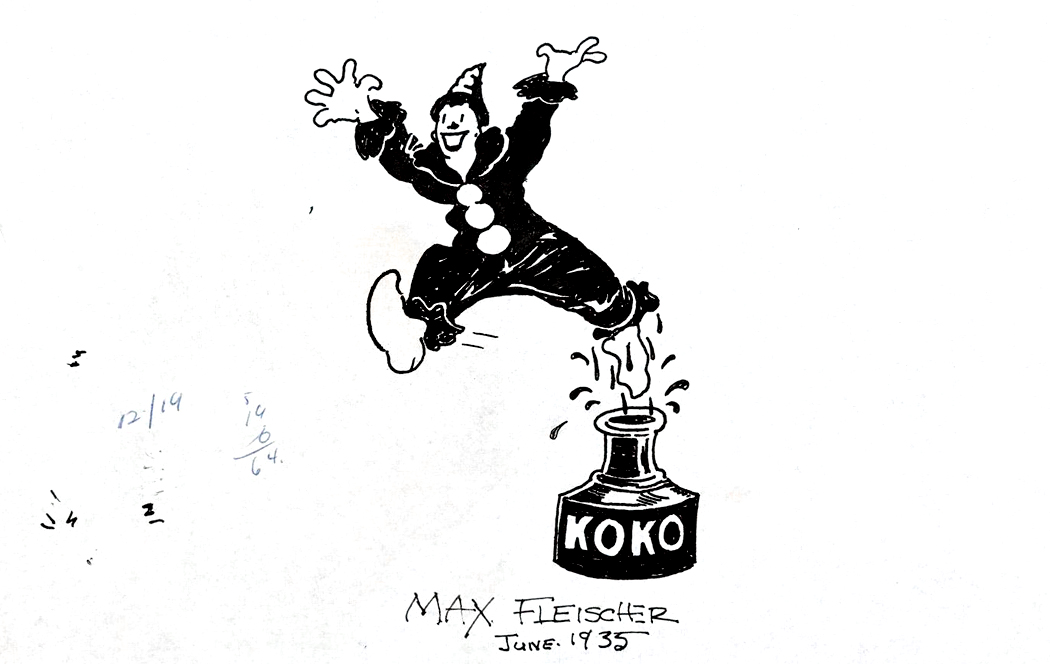
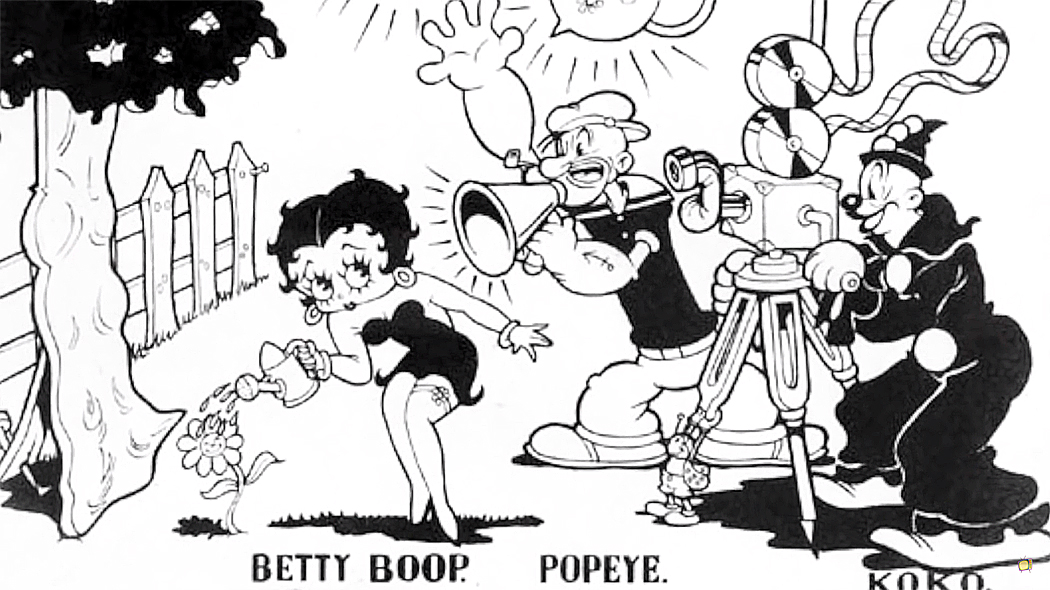
But in New York, the Fleischers created the “Out of the Inkwell” series, combining live action and animation. In most of these short cartoons, the dominant brother, Max, would open a bottle of ink and out would pop his characters, or he would draw them and they would come to life. His chief character was Ko-Ko the Clown (later, just Koko). 

Max Fleischer was an energetic inventor and came up with many of the techniques since common in animation. He held some 200 patents. Fleischer was an artist and could draw fluently. Disney, by contrast was an indifferent draftsman, but, in contrast with the hapless Fleischers, he was a world-class businessman who went on to found an empire of cartoons, films, TV shows and amusement parks. Disney made his cartoons for a researched audience; the Fleischers made their animations for themselves. By the end of World War II, they could no longer compete. 

But what a run they had, beginning with Koko, followed by Bimbo the dog and then, paydirt — Betty Boop was born. She arrived in this world at the same time as talkies. It is impossible to imagine Betty without her voice. 

Disney often claimed to have made the first animated cartoon with sound, in the 1928 short, Steamboat Willie, with Mickey Mouse. But by then, the Fleischers had been running cartoons with sound for four years. They pioneered the “bouncing ball” sing-along cartoons. And for that, Steamboat Willie is hardly a “talkie” — there is no dialog in it, only sound effects. And compared with Disney’s later slickness, it is a surprisingly crude cartoon. The Fleischers were miles ahead of Disney technically. 

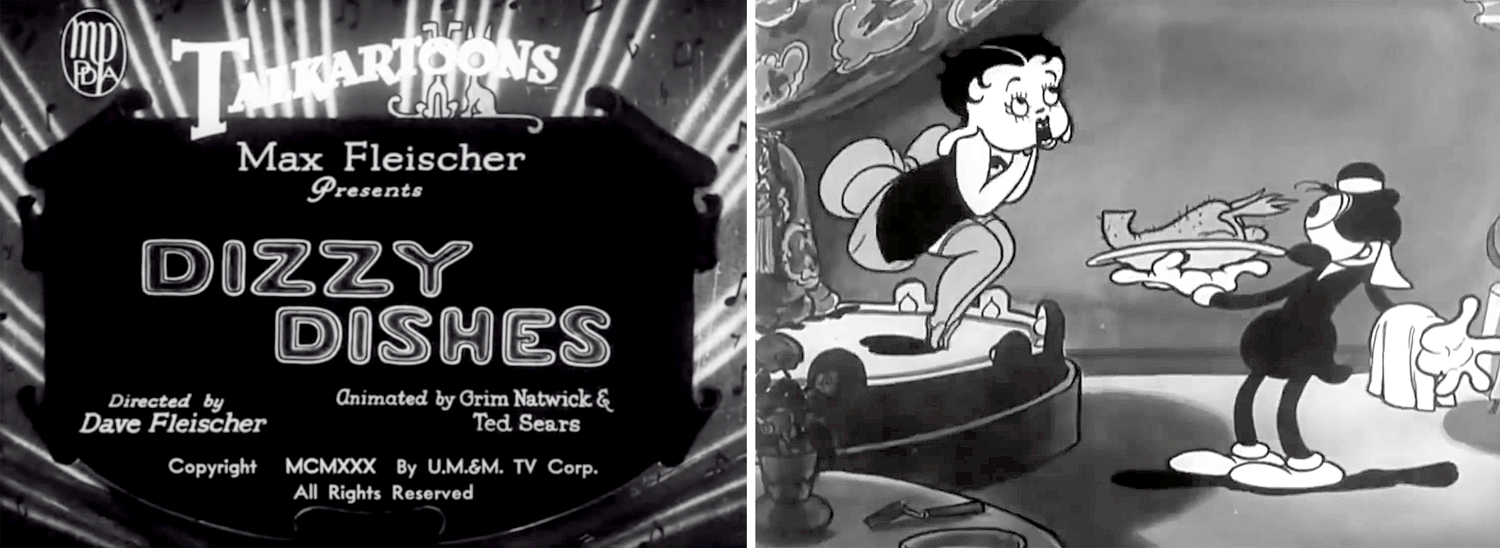
Betty first appeared in the 1930 cartoon Dizzy Dishes. Fleischer asked one of his animators, Grim Natwick, to come up with a girlfriend for their established character, Bimbo, and Natwick whipped up a sexy poodle. She has only a bit part in Dizzy Dishes, singing onstage, while the hero, Bimbo, sees her and falls in love. Betty has long doggy ears and a dark, wet doggy nose. 

Later, Betty evolved into a Jazz-Age flapper with human ears and nose, and a sexy bareback dress, short enough to show off her garter. 

Betty got her own series of cartoons, and from 1930 to 1939, she starred in 90 releases. Her career spanned two eras in early film history — the pre-Code days until 1934, and then the clamp-down by the Catholic Legion of Decency and the Hollywood Hays Code, which put quite a crimp in Betty’s style. 

After her first 30 films, the Code kicked in. In her final pre-Code short, Betty Boop’s Trial (June, 1934), Betty turns her back on the camera, flips up her tiny skirt to show off her panties and bottom. 

It’s hard now to recognize just how shocking and adult the Betty Boop cartoons could be. The Fleischer cartoons were made for grown-up audiences, not just kids. There were sex, violence, gritty urban scenes and even a recognition of the Great Depression. She was, after all, a Jazz-Age independent woman. 

And despite some unfortunate blackface scenes, Fleischer films were surprisingly integrated. African-American musicians Louis Armstrong and Cab Calloway star in several Boop-toons. I don’t want to make too much of this, there are still some horrid African cannibal stereotypes  and some blackface in several of the cartoons. But the Fleischers seem to have been fairly progressive for their time. Some of their cartoons were refused showing in the South. 

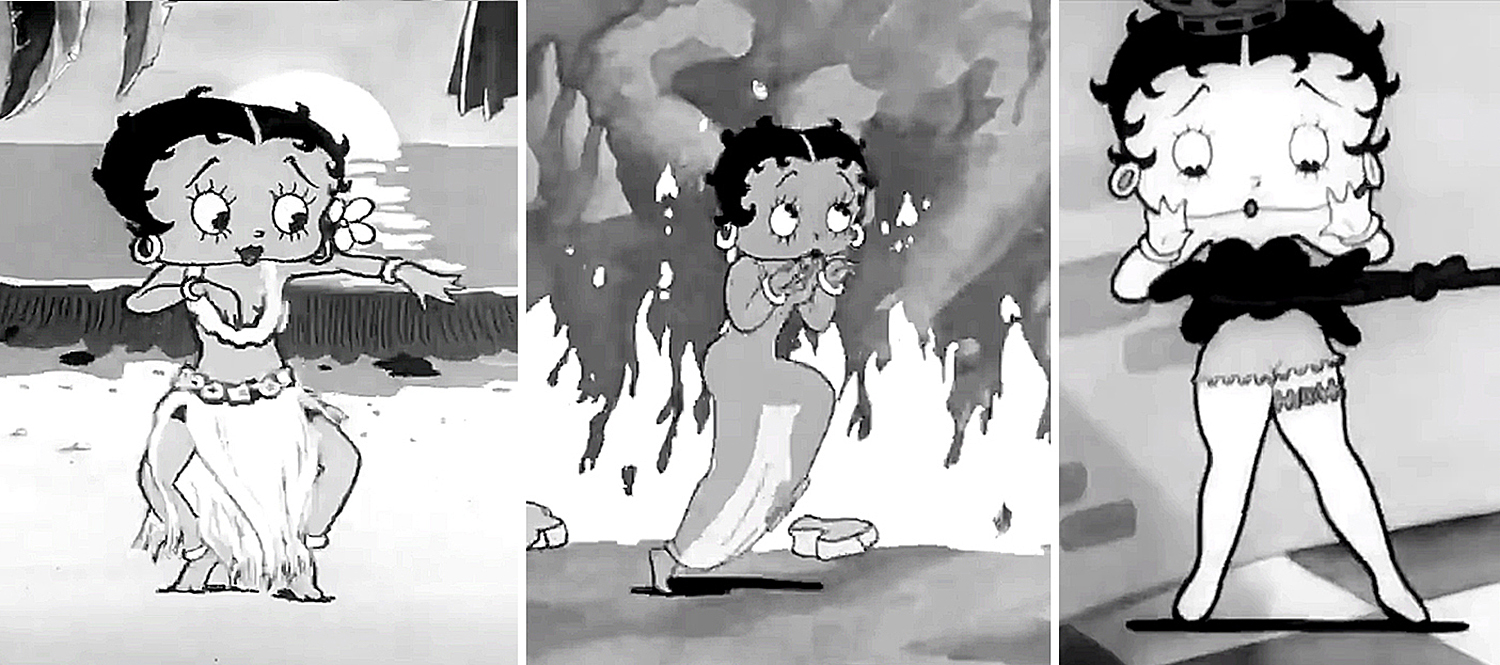
And Betty was a Jazz Age Modern Woman — at least before 1934. Racy and risque, she dances a topless hula in Betty Boop’s Bamboo Isle (1932); prances before the fires of hell in a see-through nightie in Red Hot Mamma (1934); has her dress lifted up to show her underwear in Chess-Nuts (1932). 

Betty’s virtue is frequently besieged and there is little subtlety over what her signature phrase means in 1932’s Boop-Oop-A-Doop. Betty is a circus performer and the giant beast of a ringmaster lusts after her. In a creepy Harvey Weinstein move, the ringmaster paws all over Betty and implies that if she doesn’t do what he wants, she will lose her job. Betty sings “Don’t take my boop-oop-a-doop away.” 

By the end, she is saved by Koko the clown and her virginity is safe. “No! He couldn’t take my boop-oop-a-doop away!” 

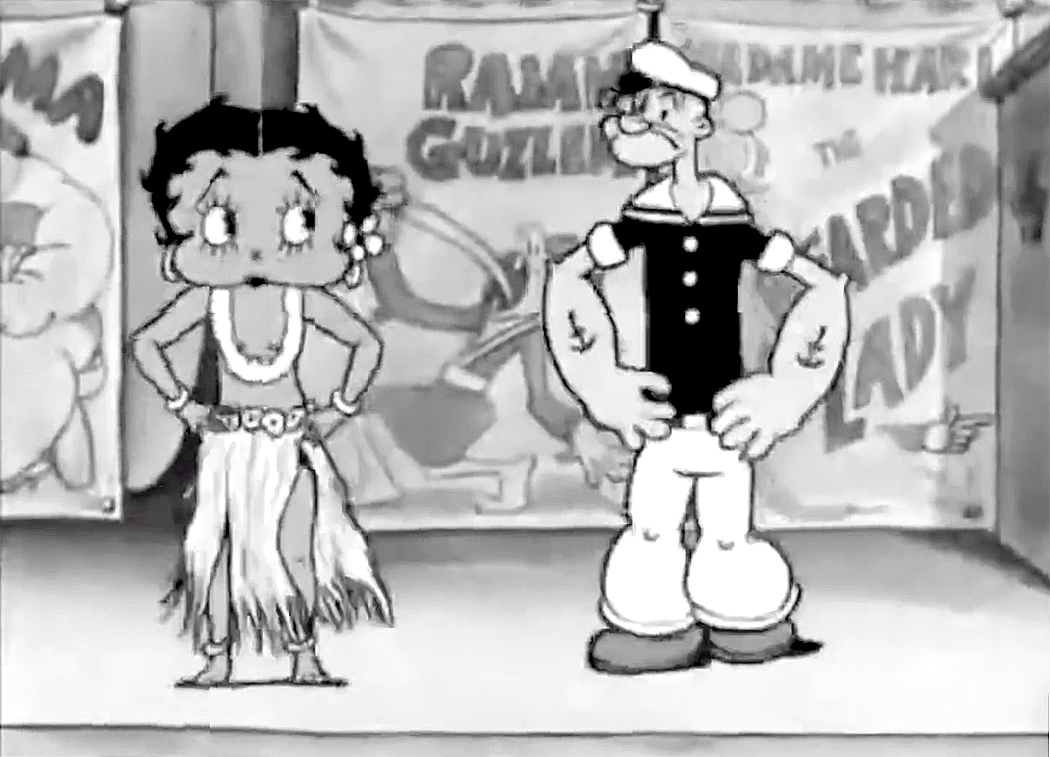
 In the 1933 Betty Boop cartoon, Popeye the Sailor, she only appears briefly, doing the topless hootchie-coochie dance she did in Bamboo Isle, joined by Popeye onstage, also wearing a grass skirt. The short introduced Popeye in his first appearance in an animated short. 

As Betty became tamed and dowdy after 1934, her popularity waned just as Popeye’s grew, eventually overtaking her as the Fleischer’s prime property. 

By the end, in 1939, Betty had turned into a swing-music figure. Her head-to-body ratio had subsided. Her skirts lengthened and her neckline rose. Then she disappeared.

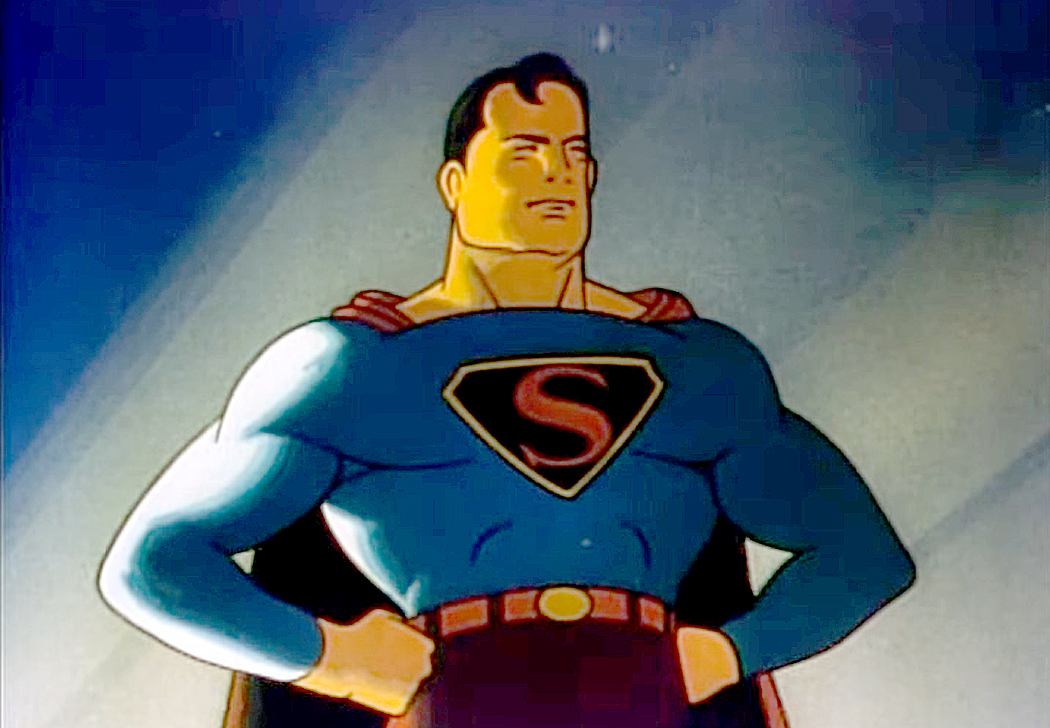
The Fleischers continued making Popeye cartoons, lost their company to Paramount Pictures, who then fired the brothers. Their last project with Paramount was the stylish Art-Deco inspired Superman cartoons. 

Betty had a resurgence, not as a cartoon star, but as a pop-culture star and even a feminist icon, in the 1980s, with a merchandising boom. She then appealed to a generation that may not even have known she had been an animated cartoon star. 

__________________________

“Don’t take my boop-oop-a-doop away!”

— “Boop-Oop-A-Doop,” 1932

__________________________

When Betty Boop was introduced in 1930, Fleischer animator Grim Natwick based her look and sound on popular singer Helen Kane, who had a baby-voice and scatted as she sang. In 1932, Kane sued the Fleischers over their use of her image. It came to trial in 1934. 

“Your honor,” said Kane’s lawyer to Justice Edward J. McGoldrick, “we contend this character [Betty Boop] has Miss Kane’s personality her mannerisms her plumpness, her curls, her eyes, and that she sings the songs Miss Kane made famous.” A style Kane called the “baby vamp.” 

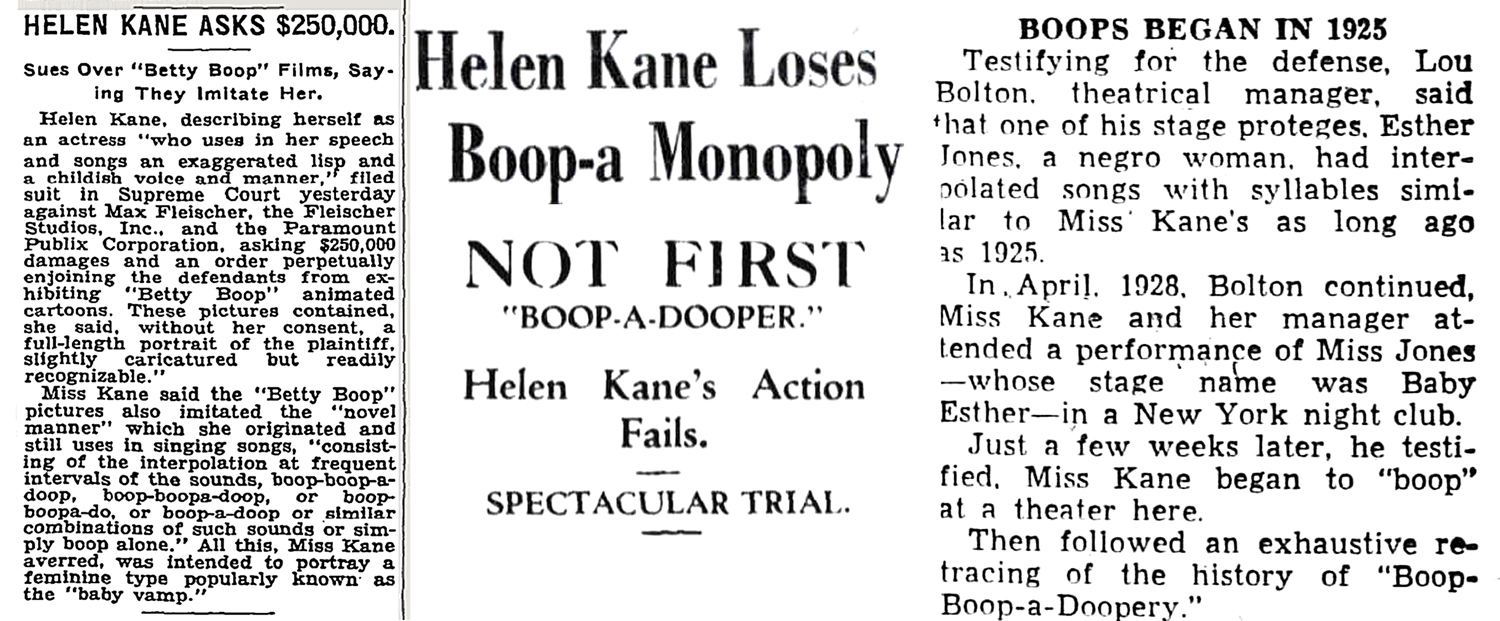
Kane (1904-1966) was born in New York and by age 15 was performing professionally. She achieved popularity in the 1920s on stage in vaudeville and on Broadway. She recorded 22 songs and made seven films in Hollywood. Her trademark was a squeaky baby voice and scat singing. But her style of singing was going out of fashion by the early 1930s, although she continued to find work onstage. When Betty Boop came out, she sued the Fleischers for $250,000 (equivalent to about $5 million today). The trial lasted two weeks and filled the newspapers with juicy stories. 

Betty Boop was described in the court case as “combin[ing] in appearance the childish with the sophisticated — a large round baby face with big eyes and a nose like a button, framed in a somewhat careful coiffure, with a very small body of which perhaps the leading characteristic is the most self-confident little bust imaginable.”

Kane’s lawyers made a tactical mistake by basing their claim on the fact that she uses scat syllables in her singing, including the famous “Boop-oop-a-doop.” Kane claimed to have invented the practice of singing nonsense words to music, a claim too easily disproven. 

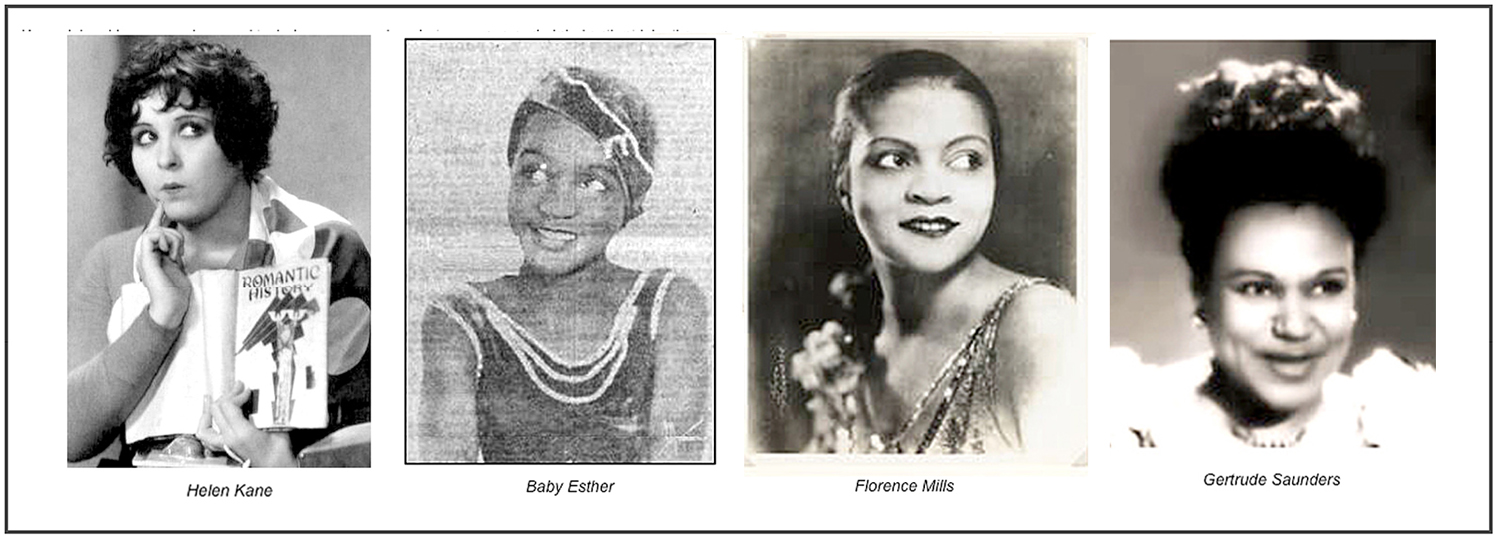
The Fleischers’ lawyer demonstrated that Kane had seen a juvenile Black performer, Baby Esther Jones, who shared a manager with Kane, and that Baby Esther (also sometimes called L’il Esther) used the same scat singing and baby voice before her. 

Kane caricature and Sweet Betty

Trial transcripts can be quite a kick in the pants to judicial dignity. Asked what Baby Esther did on stage, the manager said, “She sang the chorus and during her choruses, we had four bars omitted, which we called the break, of so-called ‘hot licks.’” Question: “During those breaks or ‘hot licks,’ what did Baby Esther do?” Answer: “A funny expression in her face and a meaningless sound.” Q: Will you tell us what those sounds were?” A: “At various times they differed, they sound like ‘boop-boop-a-doop,’ and sometimes…” Kane’s lawyer then objects. So Fleischer’s lawyer rephrases:

“Give us as nearly as you can how they sounded?” A: “I could do it better if I had rhythm with it.” Q: “Give us the sounds.” A: “Boo-did-do-doo.” Q: “Where there other sounds besides the one that you have just mentioned?” A: “Yes, quite a few.” Q: “Will you give us as many as you can remember?” A: “Whad-da-da-da” Q: “Others.” A: “There are quite a few — ‘Lo-di-de-do’” Q: Any others that you recall?” A: “Sounds like a time she would make a sound like sort of a moaning sound, finished off with ‘de-do’” 

According to one newspaper account, “That’s when the court stenographer threw up the sponge and admitted he couldn’t spell such things.” 

At one point, film of Betty Boop and film of Helen Kane were shown, without sound, to compare their styles. 

Another newspaper account reported “Except for the occasional throat-clearings of a roomful of attorneys, it was strictly a silent performance, the court having ruled agains any audible ‘booping.’

“Miss Kane’s attorneys strove vainly to have the sound tracks included, saying they wished to show how Betty Boop has ‘simulated our voice and our style of singing,’ but Justice McGoldrick ruled that any ‘booping’ would be incompetent, immaterial and irrelevant.”

Kane with three women who voiced Betty Boop in the cartoons

The fact that Betty Boop was clearly based on Kane (later readily admitted by Boop designer Grim Natwick) hardly mattered. The judge ruled that the sound of a voice cannot be copyrighted, and that the nonsense syllable singing was quite common beyond its use by Kane and found for the Fleischers. 

Three of the women who voiced Betty Boop in the Fleischer cartoons had all been participants earlier in a Helen Kane imitation contest. They had all performed, outside the Boop-toons as Kane knock-offs. 

The knowledge that Betty Boop imitated the White Kane who imitated the Black Baby Esther has recently raised the specter of “cultural appropriation” — a concept that has now become something of an ethical fad. I know of few things sillier or more pointless. 

After all, Baby Esther was known as a “Little Florence Mills,” imitating that singer. The actual Mills took over on Broadway from Gertrude Saunders in the 1921 hit, Shuffle Along. Each performer borrowing from the previous. 

In the Fleischer trial, the famous pianist and composer, Clarence Williams testified that he’d been using the scat technique since 1915. Very few things have virgin birth; most things are developments of other things. We could make the claim that scat began with Stephen Foster and Camptown Races and its “doo-dah, doo-dah” or trace it back to the 16th century and Josquin de Prez’s frotolla El Grillo, where the singer imitates the sound of a cricket. 

As the Fleischer trial judge ruled, “the vocables ‘boop-boop-a-doop’ and similar sounds had been used by other performers prior to the plaintiff.” 

The whole issue of cultural appropriation is bothersome, to say the least. I am not talking here about cases such as when an Anglo artist sells his work as Indian art, pretending to be Native American. That isn’t cultural appropriation, it is simply fraud. But when an artist finds something from another culture that piques his interest and creativity, well, that’s just normal. Everybody is always borrowing from everybody else. It is how culture moves forward. 

Is spaghetti cultural appropriation because the tomato came from indigenous cultures in the New World? 

Mexican Japanese and Filipino spaghetti

How about when spaghetti makes the journey back to the Americas and becomes Mexican chipotle spaghetti. Or further travels to Japan with added daikon, or to the Philippines, where they add hot dogs (pace Sheldon Cooper)? 

In the Columbian Exchange, the New World gave the Old not only tomatoes, but corn (maiz), cacao, vanilla, potatoes and tobacco. 

The Old gave back to the New grapes, onions, apples, wheat, to say nothing of swine, cattle, horses and honey bees. 

So, today, there is nothing more typically Navajo than satellite dishes and pickup trucks. 

It’s all a great mix, and to forbid such churn is to stall human progress. Culture is never static but always on the move. “Traditional” is always a museum-piece. 

I’m not making a case here for blackface minstrelsy — such things are rightfully seen as appalling. But should that mean that Vanilla Ice should not rap? Or that Jessye Norman shouldn’t sing opera? That we should all be stuck in our particular silos and never learn from others? 

George Harrison should never have learned the sitar? That Sergio Leone should have left the plot of A Fistful of Dollars to Akira Kurosawa? 

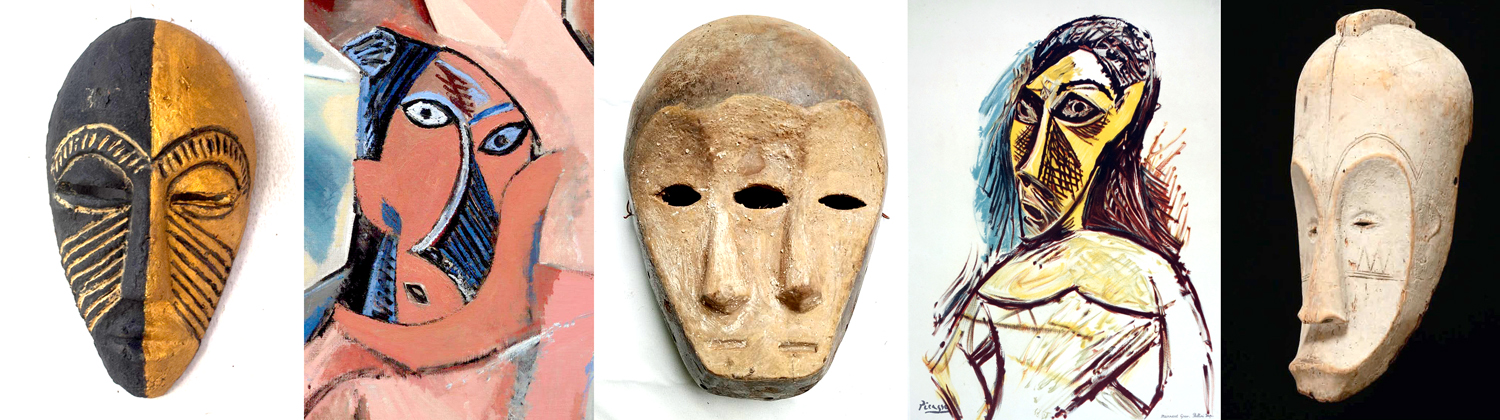
That Cubism should be trashed because Picasso became fascinated by African masks? 

This isn’t to say there aren’t egregious examples, but they mostly concern stereotyping —  which is to say, ignorance, a failure to see what is actually going on in the other culture. finding something good and useful in another culture and adapting it is rather different, even if you take the original completely out of context. 

Cross-fertilization is not only one of the pleasures of culture, but one of its essentials. Culture is a group enterprise, not an individual one, and it lives through free exchange. 

The current blather about cultural appropriation reminds me, more than anything else, of the Victorian fear of the body and sex, like calling legs “limbs.” It is blue-stocking puritanism and to hell with it. 

Click on any image to enlarge