Archive

Tag Archives: architecture history

Frank Lloyd Wright was one of the greatest architects in history, and he’d tell you so, himself. The man in the cape and porkpie hat had an ego as big as any of his buildings, but as they say, if it’s true, it ain’t bragging. 

It is so tempting to dismiss Wright. He was a monster of egotism. His taste could be appallingly bad. He spoke in egregious platitudes. He abandoned children and wives. He was arrested for violating the Mann Act. He made life a misery for almost everyone around him. And what is worse: His roofs leaked. For an architect, that may be the worst sin. 

But no matter how irritating, Wright cannot be dismissed. It matters not that he insisted he was the greatest architect in American history. (“Why limit it to America?,” he then asked.) The fact remains that no architect of our time — and probably not of any other time — has had so fertile an imagination or produced so many outstanding buildings. 

That is undoubtedly the most infuriating thing about Wright: He didn’t only talk the talk, he walked the walk. 

“I hated him, of course,” said waspish architect Philip Johnson, “but that’s only normal when a man is so great.” 

From his early Prairie Style homes near Chicago to his giant spiral Guggenheim Museum in New York, Wright kept inventing new ideas. “Why, I just shake the buildings out of my sleeves,” he once said. 
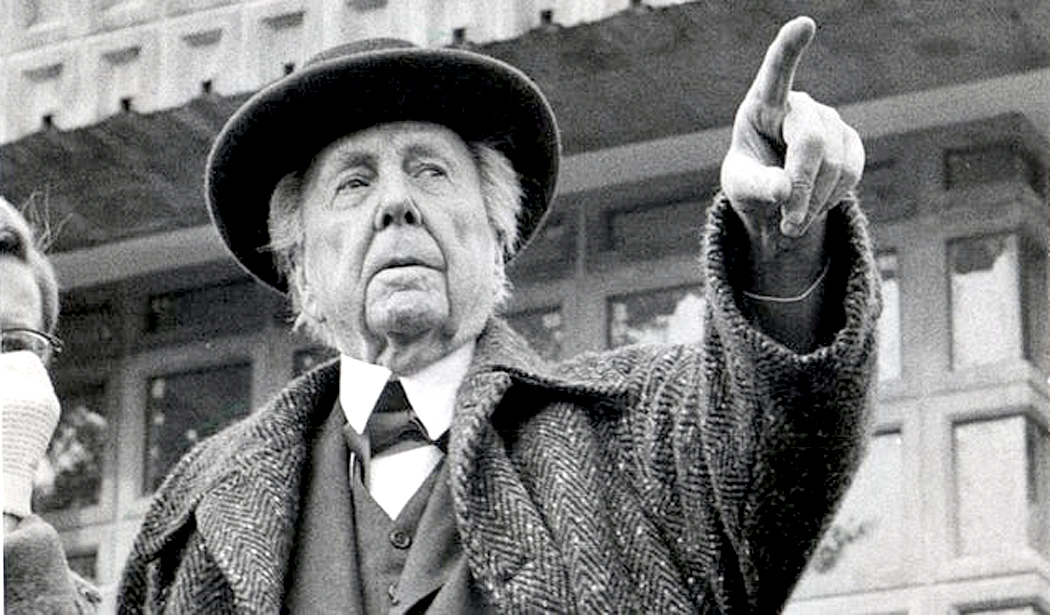
The man is difficult to pin down because, not only did he change constantly over his 90-plus years of life, he also notoriously lied about everything. He was always making orotund pronouncements and declarations, but not a one of them stands without careful checking. 

England has its eccentrics, its beekeeping vicars and parish historians, but America requires something more grandiose. 

America has crackpots. 

The crackpot differs from the mere eccentric in his missionary zeal, his transcendent ego, his absolute certainty and his touch of utopianism. From Henry Thoreau to Ezra Pound, from Charles Ives to Harry Partch, American art and culture have been defined by crackpots. Something in the American character warms to them. Something of the best of America can be found in them. 

It is important to remember that. So much has been written and said about the architect, and with such reverence and hype. It is not that I mean to debunk Wright; he was a singular genius and must be recognized as such. 

But he also was a true American crackpot, and we need to remember not only the dynamic imagination and idiosyncratic design, but also the odd geezer in the black cape and cane who wrote crank letters to the president. We need to remember the despotic man who installed glass bars instead of windows in his most famous industrial commission, Wisconsin’s Johnson Wax building, because he declared, “No one should have to look out at Racine.” 

There are several things that join to make Wright’s work justifiably the most celebrated by any American architect. First among these was his uncanny sense of space. 

What makes architecture work, and particularly Wright’s architecture, is the shape of its insides, the particular chunk of air it surrounds with walls. To experience architecture is to walk through it, sit down in it, see where the space seems to grow and shrink as you pass through. 
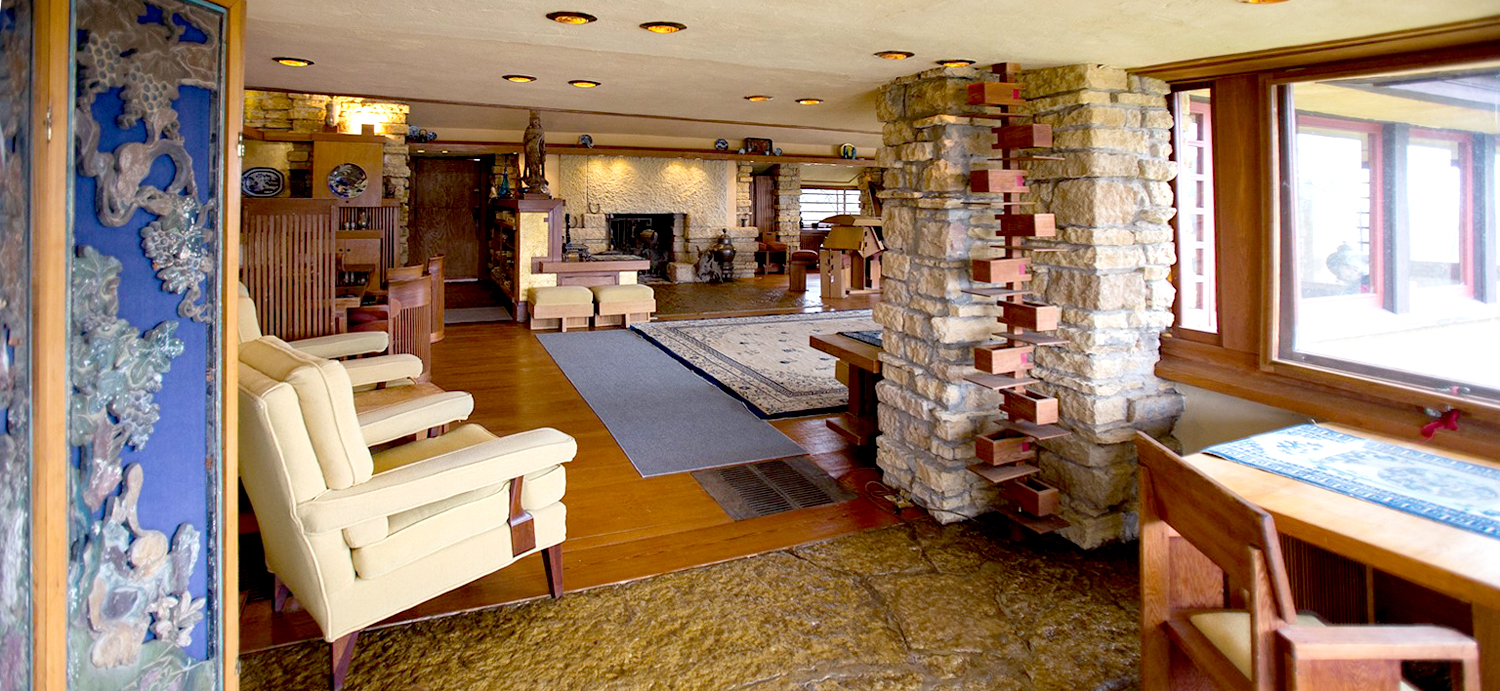
So many of us live and work in simple boxlike rooms — little boxes inside bigger boxes — we don’t always remember that rooms don’t have to be that way. “Break the box,” was one of Wright’s war cries. And in his buildings, he constantly did just that. Instead of boxes of rooms off a hallway, Wright created vast open spaces, one room opening into another. In his own home, called Taliesin, in Wisconsin, you can stand in the center of the house and see out of it in all four directions. 

Wright recreated for us that sense we had more easily when children that space can have emotional meaning, building “forts,” or climbing in tree houses of discovering caves in the hillsides. Adults can have those emotions, too. And great architecture can provide the adult emotions that are analogous to those childhood ones. I can write about thoe spaces and you can see pictures, but pictures of them don’t do it. You can only have those emotions when standing in those places. 

Even with his earliest buildings, the Prairie style homes, he attempted to reduce the number of rooms and create large flowing spaces, part of which might serve as dining area and part as living room. They would be built at different levels and sometimes at different angles, all to obliterate the hated “‘box.” In his best buildings, you can feel as if you are standing outside when you are actually indoors, and indoors when you are out. 
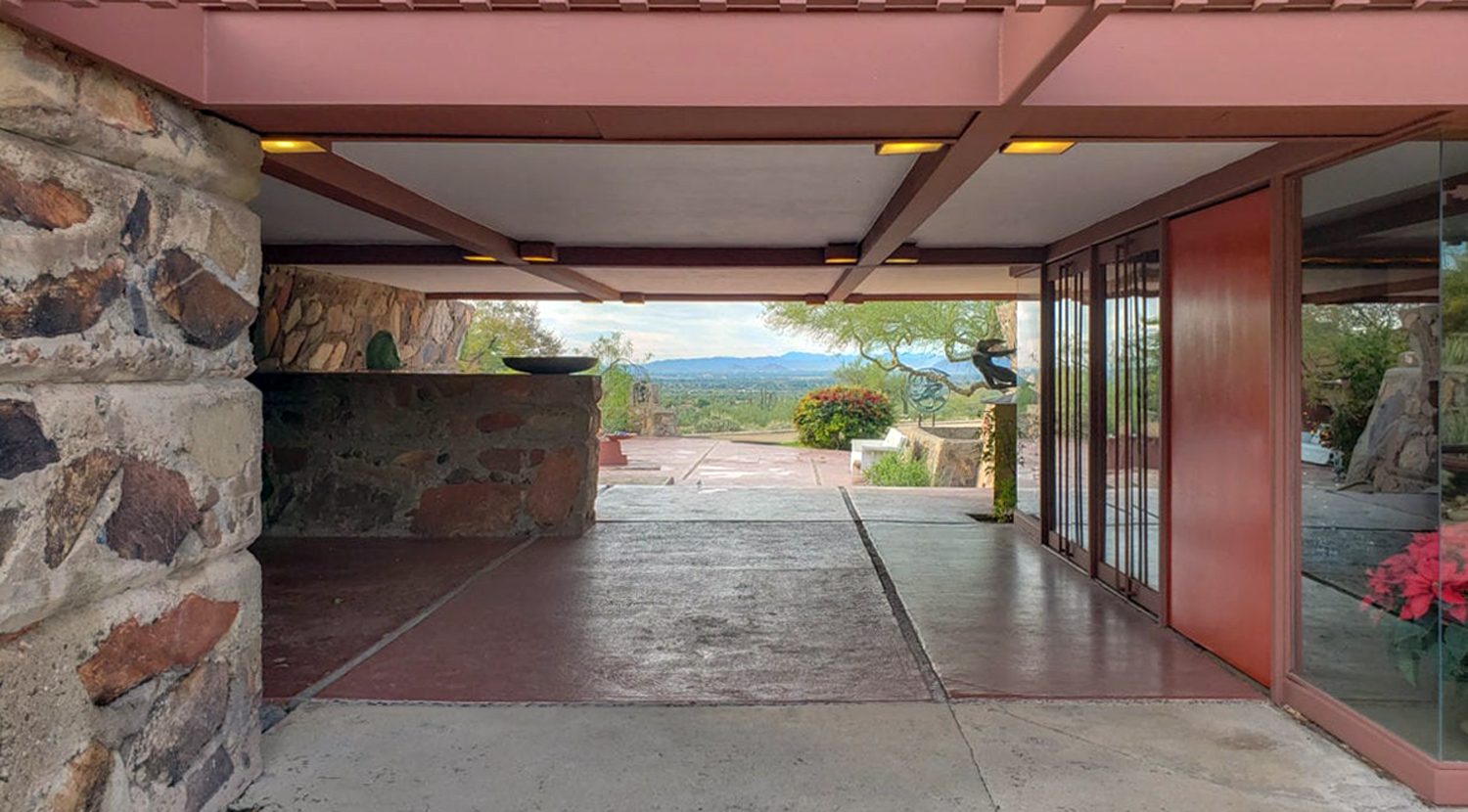
The second great strength of Wright’s work is its unceasing originality. Wright ideally approached each design as a completely new problem, to be solved in its unique way. This means that, unlike the work of his great contemporary Mies van der Rohe and his International style, there is not, after the Prairie style, a single “look” that can be identified as Wright’s. For Wright, “what we did yesterday, we won’t do today.” 

Mies groused back, “You don’t start a new style each Monday.”

But because he did start out each Monday, Wright has given us a startling variety of invention. It is true that not all the work is of equal value, but it is hard to find another artist in any medium who so thoroughly reinvented himself with each idea.

I was architecture critic for most of my 25 years living in Phoenix, Ariz., where Wright had his second home and architecture school later in his life (Taliesin West in Scottsdale), and I was immersed in Wright hype and legend. I got to visit many of the most notable Wright buildings across the country, and I came to recognize and value his genius (there really is no other word for it), but I also came to know and loathe the man himself. I will try to do justice to both. 
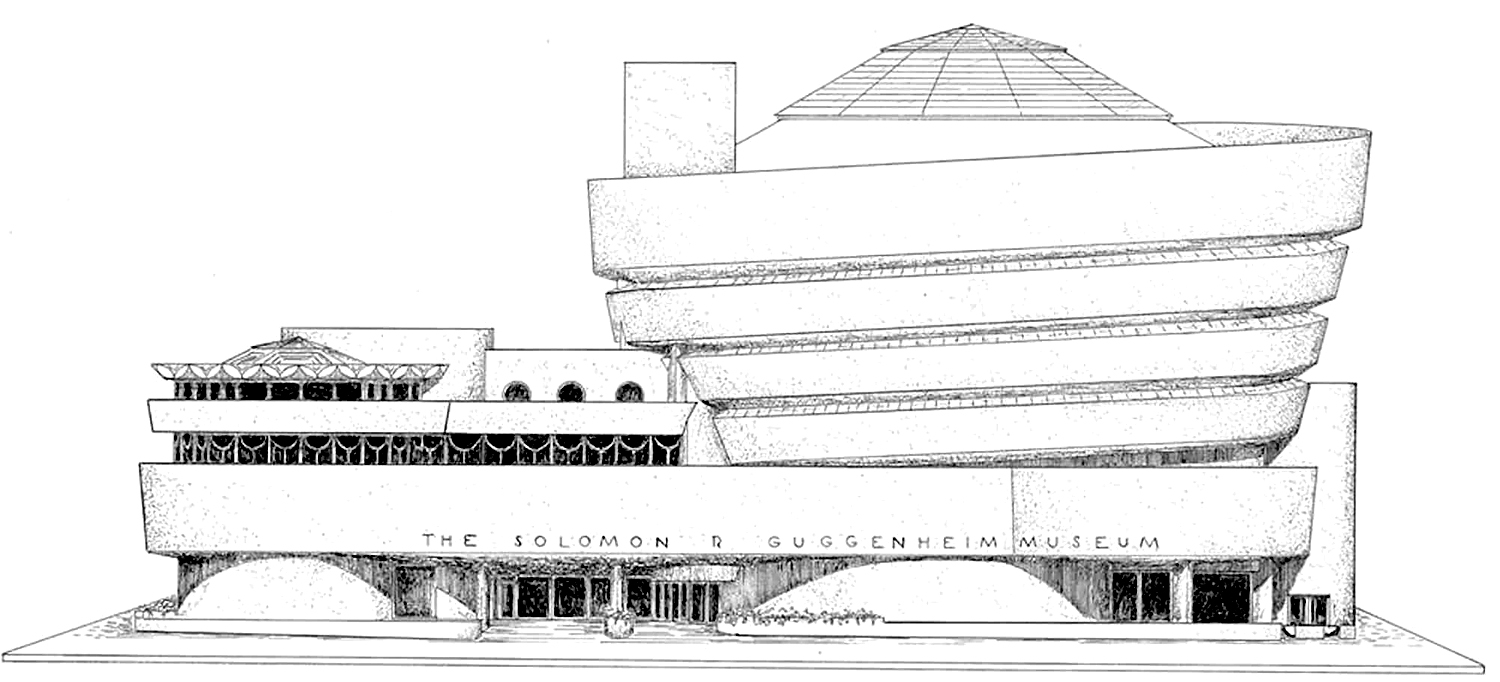
Architecture has four main components. First, there is the sculptural aspect, the shape a building cuts. It is what most people think of as architecture: the building as seen from the outside. 

Second, there is the engineering. Wright was both an innovative engineer and an occasionally casual one. His innovations are myriad; his lapses legendary. 

Third, there is the interior design aspect. Early in his career, Wright was especially good at this, and it is the part of his work that comes across best in photographs. The windows, the tables, the carpets he chose are beautiful, refined and subtle. Later in his career, his design became garish and loopy. But it is still what people know best. 

But the fourth part of architecture is arguably the most important aesthetically. It is the essence of architecture: the emptiness inside. And Wright’s particular genius is his way with space, the way he orchestrates large and small spaces, to stimulate your emotions as only great art can. 
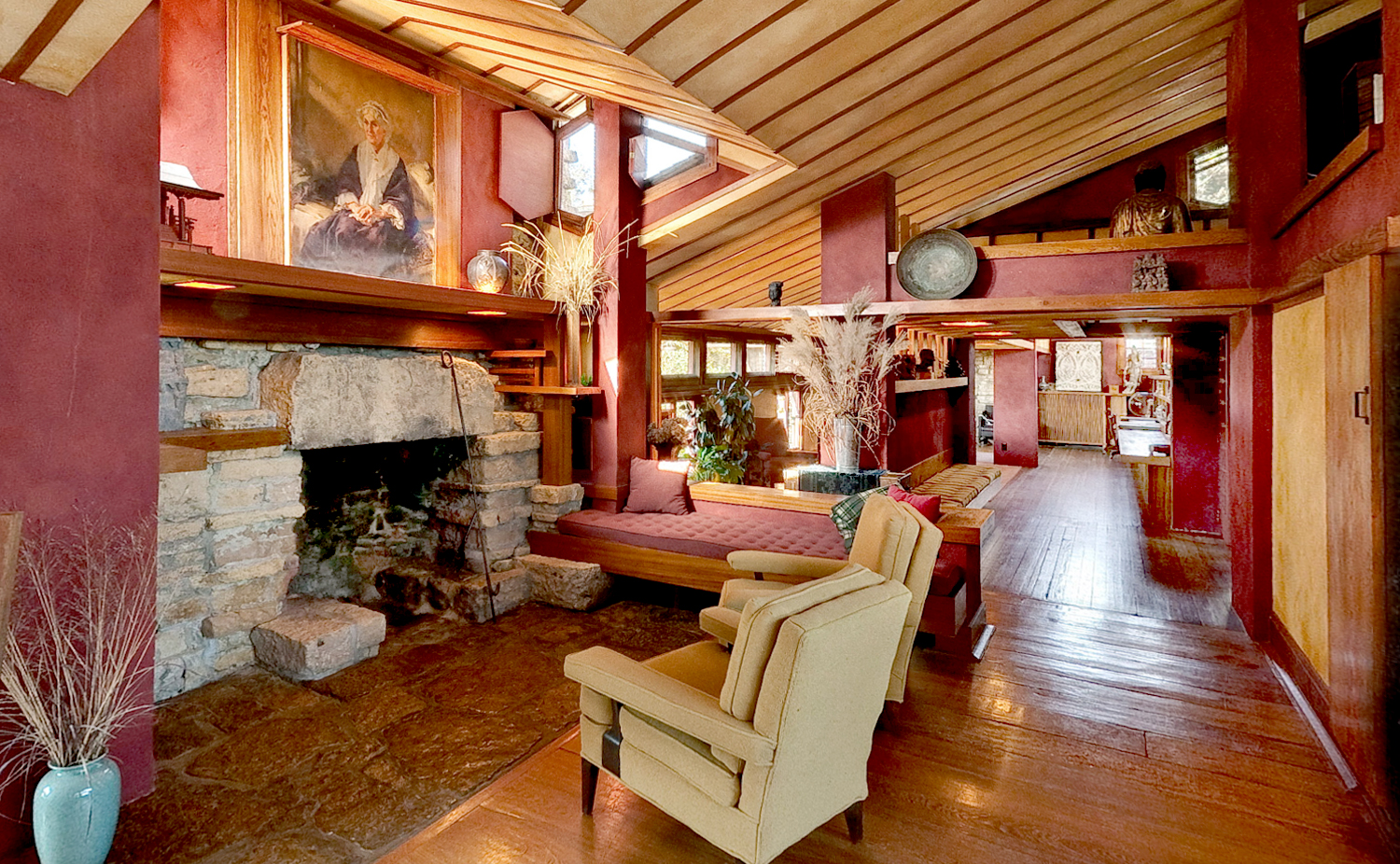
Wright was especially concerned with how one room led to another, how a low ceiling makes you feel, or how nooks make magic. He called space “the invisible fountain from which all rhythms flow and through which they must pass.” These are things that cannot be conveyed in pictures; you have to be there, in the rooms, to sense their splendor. 

It is like pictures and writings about Beethoven: No matter how good the text, it cannot tell you what the music sounds like. You have to experience it.  So, photographs still cannot show its readers what truly made Wright the special case he was. No one invented interior space more creatively. Wright was not merely inventive, he was revolutionary. On the scale of Stravinsky, Picasso, Brecht or Eisenstein. 

People easily mistake the outside of a building as its “architecture.” For most people, architecture is a kind of very large, inhabitable sculpture. And there is certainly that aspect to the art. We recognize the Chrysler Building immediately, or the U.N. Building, from their outsides. But how many people can say what the insides of these buildings look like? 

Wright’s essential genius was not that of a sculptor. In fact, some of his buildings are almost ugly. No, his genius was for the empty space inside a building. He changed utterly and forever our idea of what an interior could be. Wright was a creator of empty spaces. Really interesting empty spaces. He approached a building with the air inside it as a kind of armature for the exterior. 

He found 2,000 years of architecture in which square rooms inhabited square buildings, one set of cubes inside a larger one, and broke it open, breaking down walls and finding new ways of dividing the space enclosed by the exteriors. 
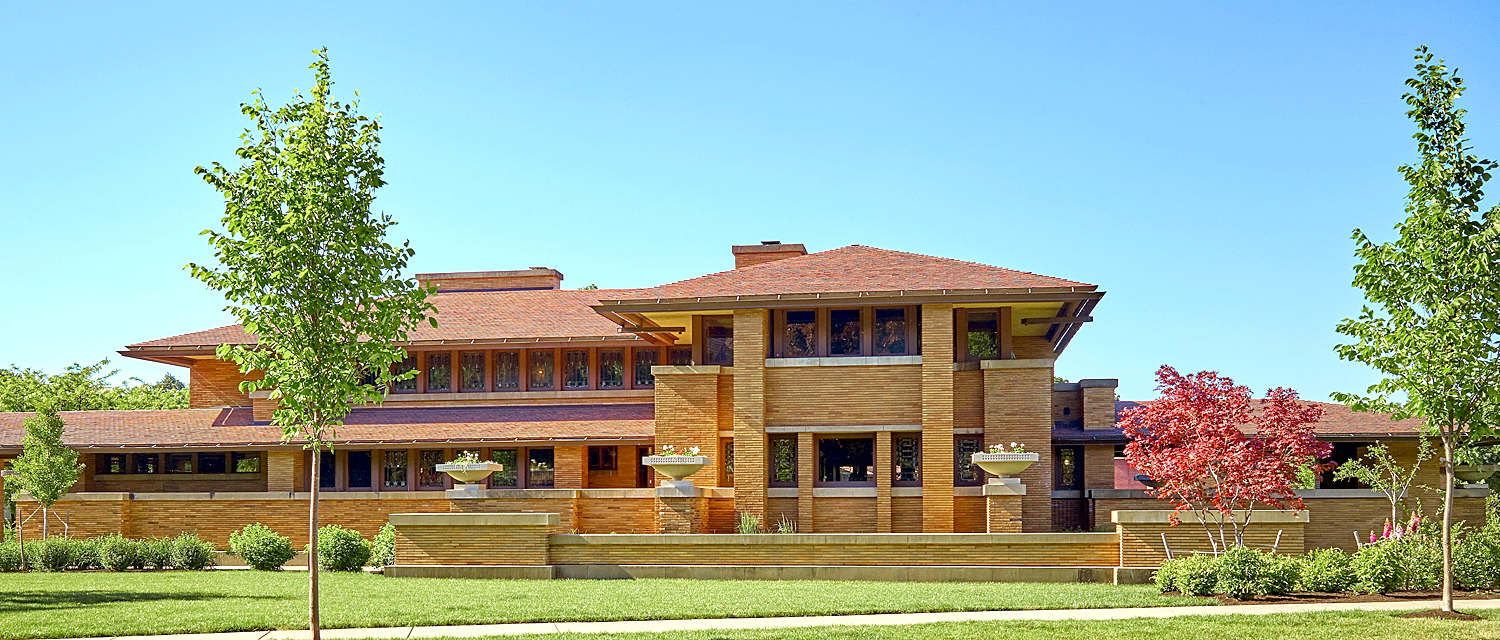
Like Stravinsky or Picasso, Wright constantly changed styles, from the Prairie Style of his early residences to the “Planet Mongo” style he sometimes devolved into in his later years. But like Stravinsky and Picasso, the style itself was never the point. Stravinsky may rush from the lush Firebird to the astringent L’Histoire du Soldat, but underlying it all is an irony. You cannot imagine Stravinsky without the irony. Picasso has his plastic inventiveness — that shows through whether he’s doing Cubism or Neoclassicism. 
And Wright always has his empty spaces. Every corner you turn brings a discovery: a room bigger or smaller than you expect, a space that stretches out in interesting ways, or closes you in and makes you cozy. You can like or dislike the decorative style in which Wright worked, but you cannot help but be astonished at the way he makes you feel inside a space.

He was born in Wisconsin in 1867 and began work in the Chicago area in the 1880s, soon becoming one of the most innovative and stylish architects working. His Prairie Style homes from the early 1900s became his signature look. 

But by 1909, the 42-year-old wunderkind felt he was losing his grip on his work, “even interest in it,” he wrote. So he left his wife and six children and ran off to Europe with the wife of one of his clients. The scandal affected his practice, and Wright moved into a period of relative obscurity. He built his first Taliesin in 1911 as “a hope and a haven” for himself. 
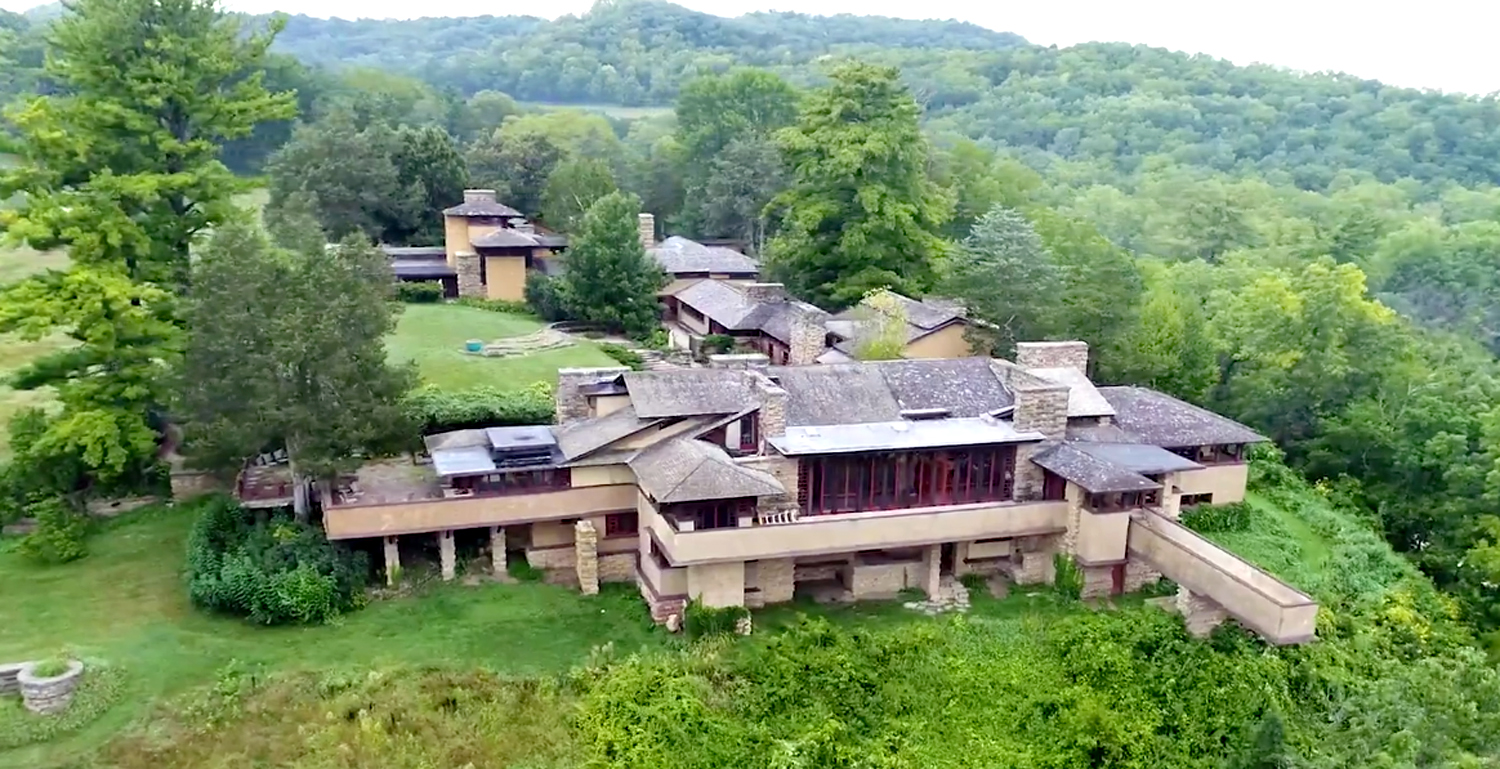
Many artists have written their autobiographies, but Frank Lloyd Wright built his. It sits near the top of a hill in southern Wisconsin near the town of Spring Green and looks out over farm fields and forests. Wright titled his architectural autobiography “Taliesin.” It was his home. 

But three years later, that first house burned down in a tragedy of epic proportions when a workman went berserk, took an ax and slaughtered Wright’s mistress, two of her children and four other people, then set fire to the building. Wright was out of town at the time. The scandal was front page news across the country. 

He rebuilt immediately. The blow left him numb, but, as he wrote, “There is release from anguish in action. Anguish would not leave Taliesin until action for renewal began. … Steadily, again, stone by stone, board by board Taliesin the II began to rise from the ashes of Taliesin the first.” 

And so did Wright’s career. He took a new direction once more, a commission in Tokyo to build the Imperial Hotel, which opened in 1923. 

In 1925, a second fire razed Taliesin. Again, he built it up, even using stones from the first two incarnations in the walls of the third. 
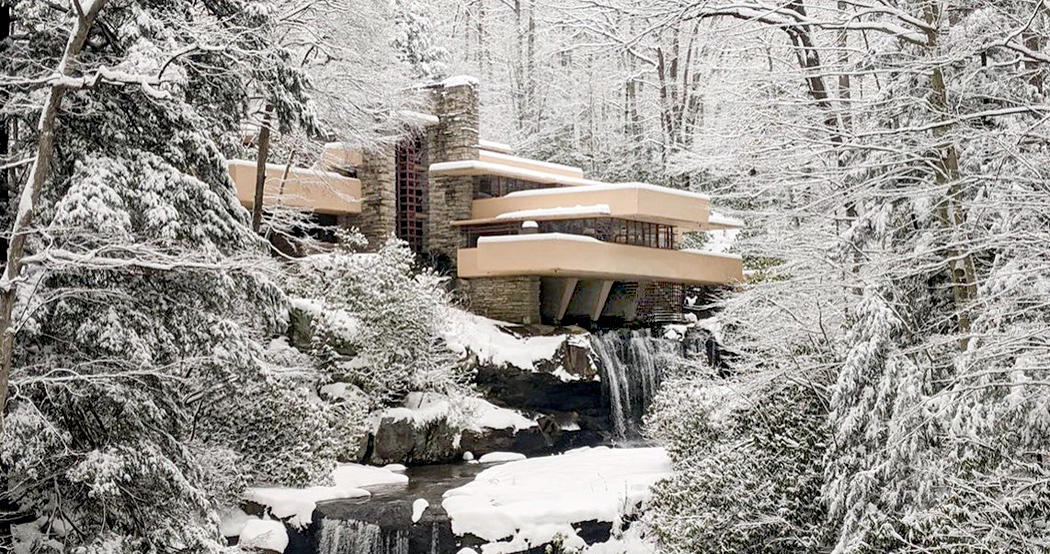
He went on to design some of the landmark buildings of the century: the Johnson Wax Building in Wisconsin and Fallingwater, a summer home for the Kaufmann family, in Pennsylvania, and a long series of distinguished private and public buildings. 

Many of the design and engineering innovations he used in those buildings had their “off-Broadway” run at Taliesin, as Wright built and rebuilt the house. By his own account Taliesin was never finished. 

It is one of the most beautiful houses I’ve ever seen. Every angle and corner has something rich and meaningful to give up. One of the other party tricks Wright pulls on us is that, however stunning the living room is while you are standing in it, it is even more glorious when you sit down. Then, the long walls of windows become frames for the landscape outside. Standing, there is greenery, but no horizon; sitting, the horizon cuts halfway through the glass frame, making the windows like another spread-out Japanese screen. 

The house is amazing. Wright always said he wanted to “break the box,” by which he meant he wanted to avoid the sense that each room had four walls and a door. So he opened up his house. It is rare to find a corner, for instance: When you approach what looks like a corner, it opens up to display some unexpected nook or hallway. So that, at dead-center of the house, you might almost be standing outdoors: There is a four-direction view. 

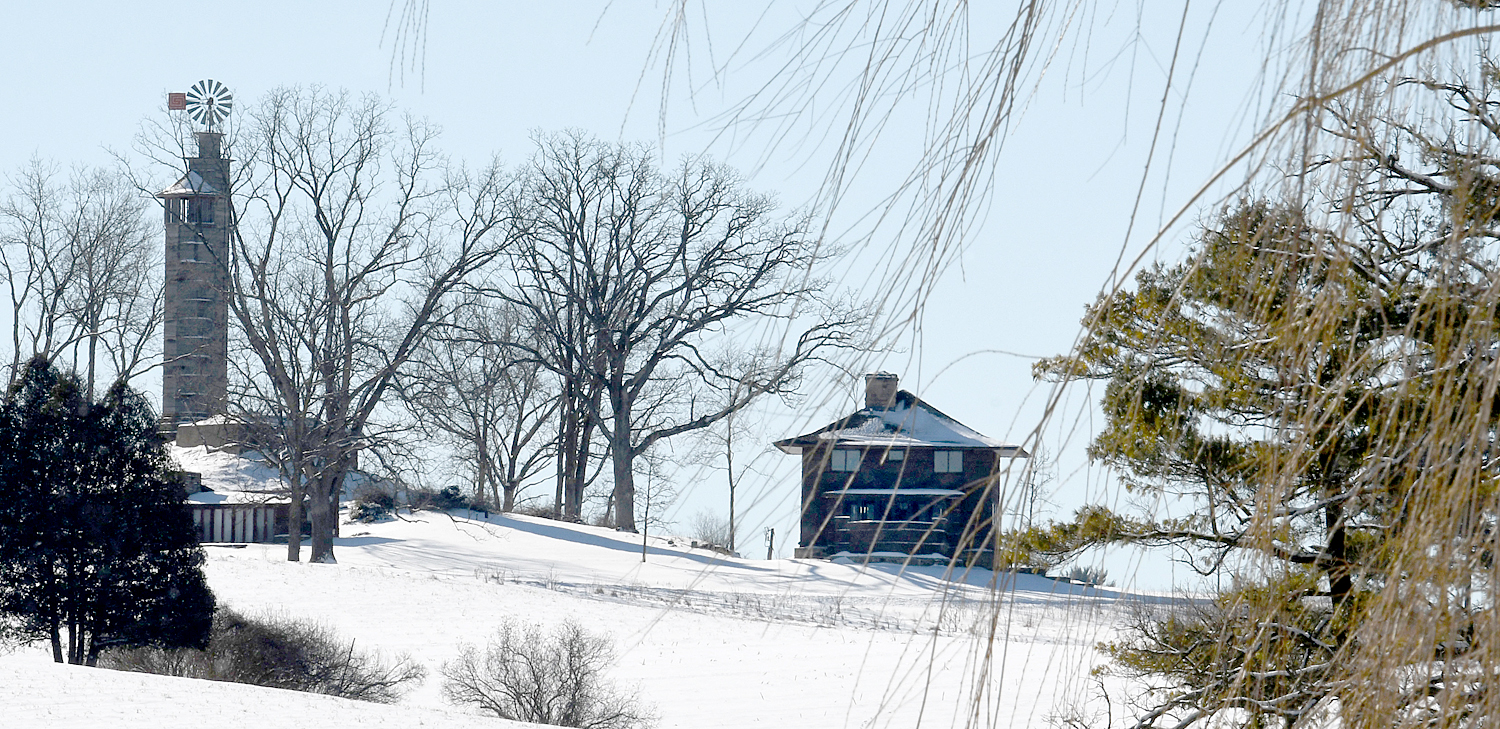
At that point, standing in the hallway just where it opens into the den, you can look to the north through the living room and see the Wisconsin hillsides; then turn to the east and see more through that room’s glass walls; then turn south and peek through the distant windows of Wright’s office and bedroom, to see the hillside with the house called Tan-y-deri and the windmill that pumped the estate’s water; then, finally, turn west and see the top of Taliesin’s hillside and the garden and greenery surrounding the tea circle where Wright and his apprentices met for discussion. 
Almost any room you enter will require you to duck and scrunch down as you worm through the hallway or entry or door and then feel the weight of the universe lifted from you as the room expands upon your entry. It is a party trick, no doubt, but one Wright plays with great relish and effect. 
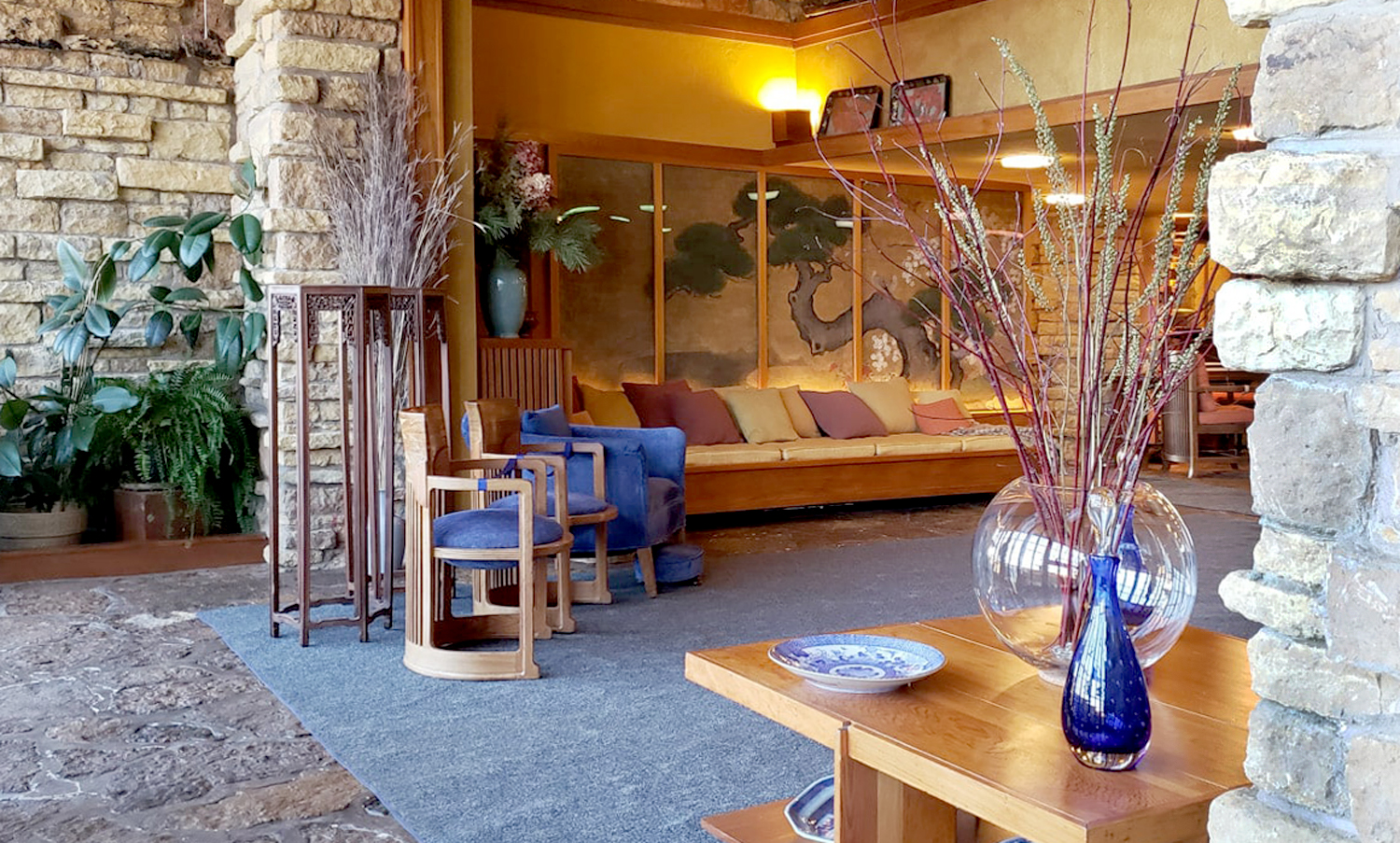
I could go on, waxing ecstatic over other Wright buildings I have visited, from Fallingwater in Pennsylvania to the Marin County Civic Center in San Rafael, California. I have always been astonished by what I saw. But there is the other Frank Lloyd Wright, the liar, cheater, fraudster and prophet of some of the worst developments in civic life. 

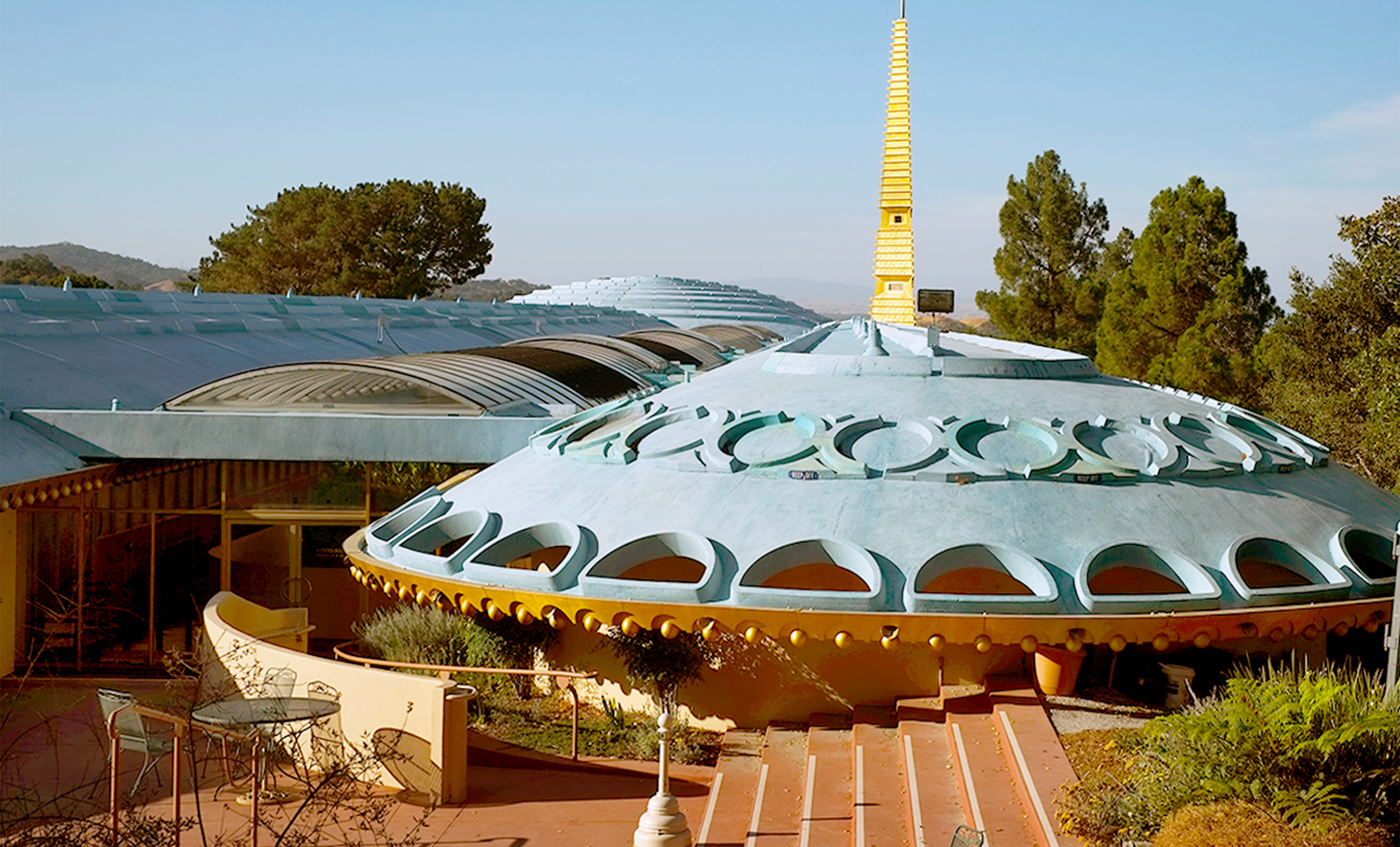
The shopping mall concept, it can be argued, began with a government building by Wright. In 1957, the equivalent of a Steven Spielberg “mother ship” landed on a woody hillside in San Rafael, Calif. It was the Marin County Civic Center and, from the outside, it was one of Wright’s “Planet Mongo” designs — odd, ungainly and a model of kitsch.

But inside … inside it was truly original. It placed the county governmental offices several stories high along the outer walls of the complex, with balconies running the length of the building overlooking a pedestrian walking space. You could look down at the “storefront” offices and the ferns and plantings along the fountains and escalators. 

When you visit the building, you can’t help but think: shopping mall. Brilliant, but I don’t know how grateful we should be for all the soulless malls we find filled with T.J. Maxes and Sbarros.

That Flash Gordon esthetic increasingly began to take over Wright’s design esthetic as he got older. In his early years, Wright was at the forefront of Modernism in architecture and his best work — those Prairie-style houses, the Johnson Wax building — have remained ever fresh and new. But in his senescence, many of his designs have become dated, like those futuristic book illustrations filled with dirigibles and autogiros. 

Instead of modern, he became what might be called “modernistical.” As in his design for the First Christian Church in Phoenix, with its science-fiction spires and reptile-scale roof. 

Then, there was Wright’s hatred of cities — an odd opinion for a builder of buildings. He called them “a persistent form of social disease,” and when asked in Pittsburgh what could be done to improve the city architecturally, he replied, “Tear it down.”

And he singled out New York for special opprobrium, biblical in its rancor. He compared it to Sodom and Gomorrah, complained that it was the city of Cain. He called it “a pig pile. A fibrous tumor. Is this city not Anti-Christ?” and said it was “a place fit for banking and prostitution and not much else.”

He once said the only logical place to build a skyscraper was in the desert, where the height could afford a view worth seeing. And he designed a skyscraper a mile high, never built, of course. 
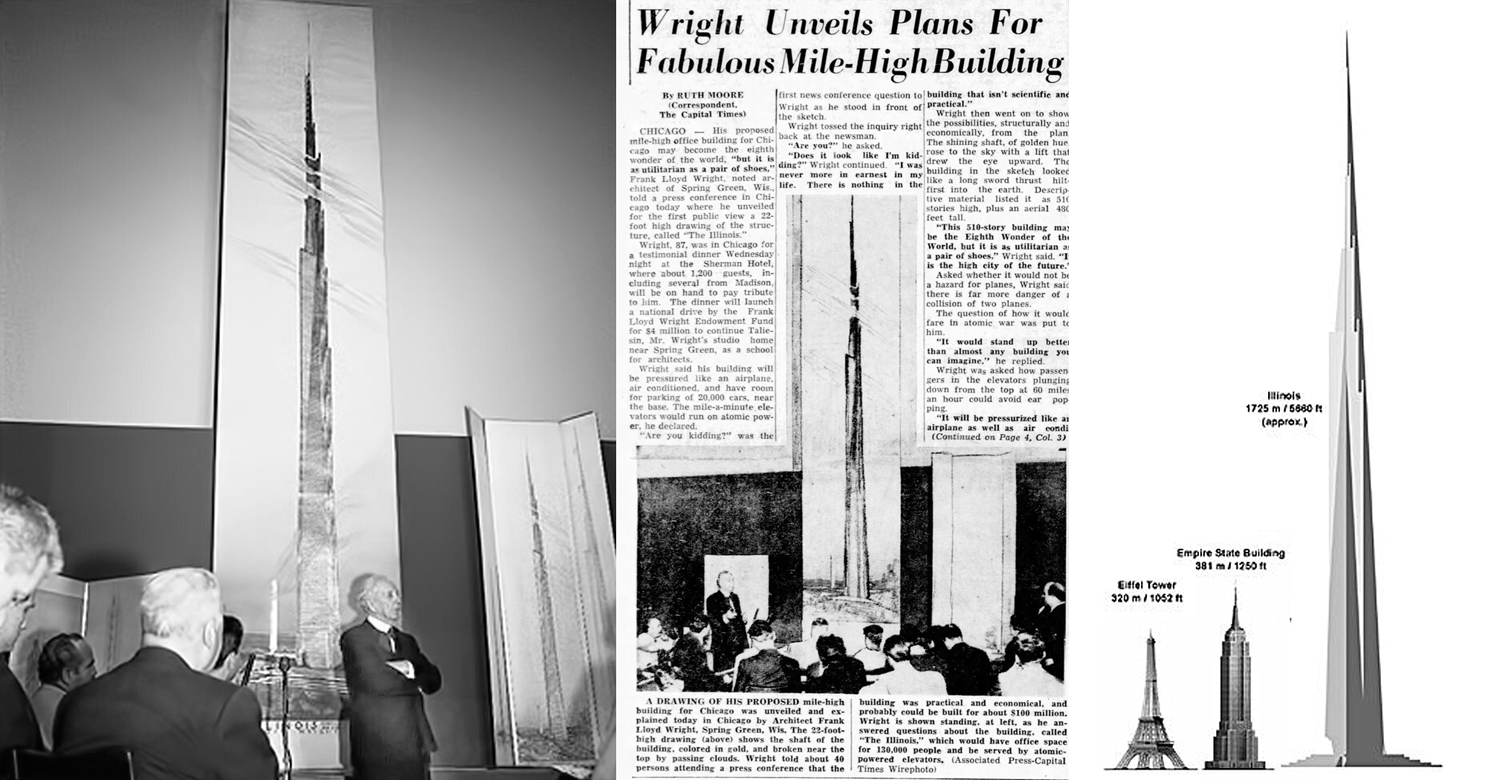
“Mile-high? Why stop there? Why not two miles, or even five miles, if need be?” he asked a friend. (The irony is that the Burj Khalifa, which is a quarter-mile high, was built in the desert, and although not designed by Wright, did borrow his plan for making the footprint of the building a triangle, giving it the stability of a tripod). 

The fruit of this dislike was a vision of suburbia. Wright cannot exactly be said to have invented the suburban prototype Levittown, but he certainly predicted it in his 1932 plans for the fictional Broadacre City. Wright envisioned a sprawling suburbia, created out of minitowns, or self-contained neighborhoods, linked by automobile and tree-lined roadways. 
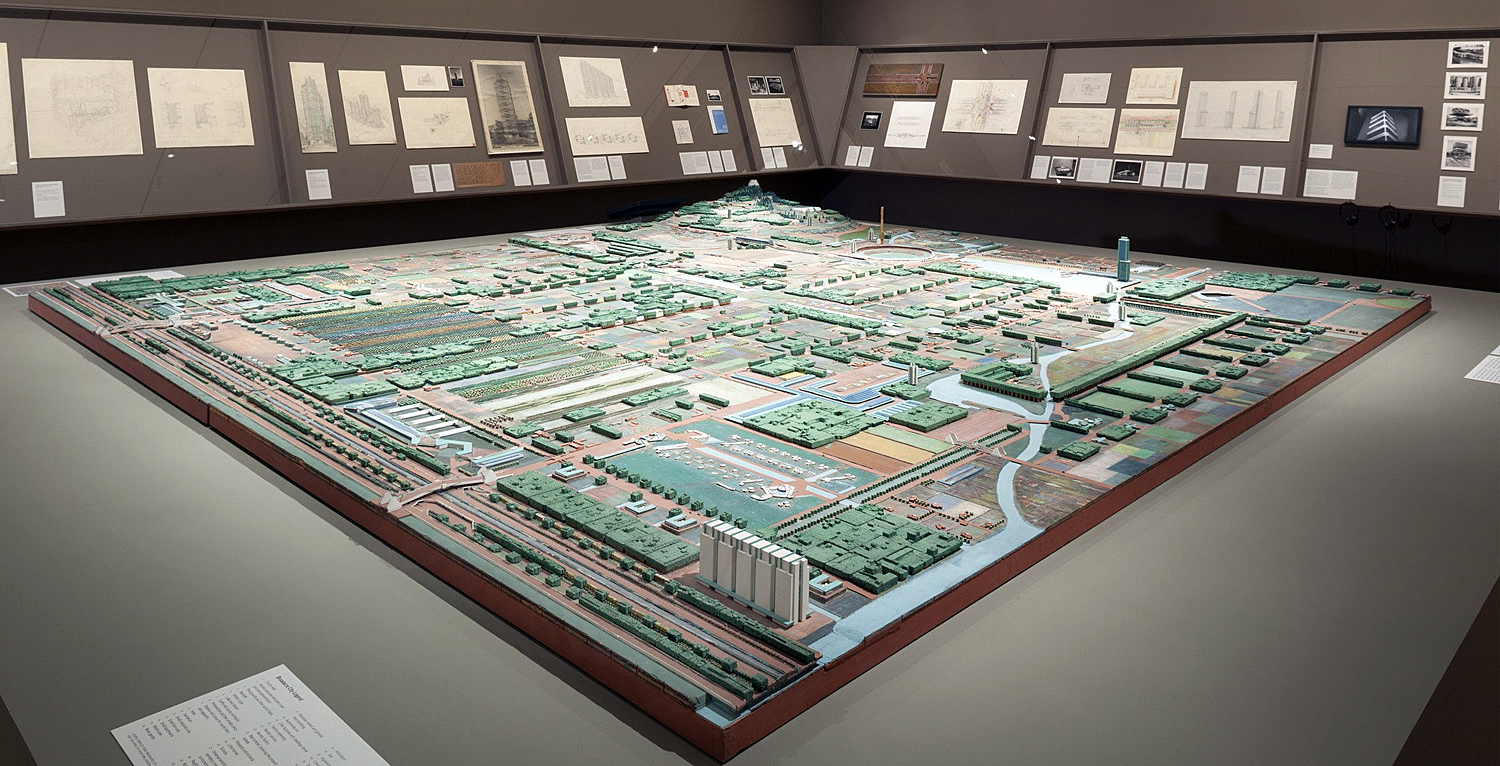
If the thrust of American growth was upward, Wright cast his vote for outward. But we now live with the results of that thinking: It’s most extreme embodiment is Los Angeles, sprawling neighborhoods over an area the size of some Eastern states. It is Broadacre City metastasized. 

Wright was as bad as Wagner when it comes to breaking up families. In the 1930s, the architect left his wife and six children and ran off to Europe with Mamah Cheney, who was the wife of one of his principal clients. Wright was notorious, at least in his younger years, for having the sexual morality of an alley cat.

He was a monster of self-regard. “Not only do I fully intend to be the greatest architect who has yet lived, but fully intend to be the greatest architect who will ever live. Yes, I intend to be the greatest architect of all time,” he wrote.

There is a famous TV interview with Mike Wallace, from 1953, where the man spouts off in the most irritatingly smug fashion, about his own greatness. When Wallace asks him if he said something about being the greatest architect of the 20th century, Wright answered, “You know, I may not have said it, but I may have felt it.” Actually, he did say it, many times. He also wanted to claim humility as one of his great virtues. 
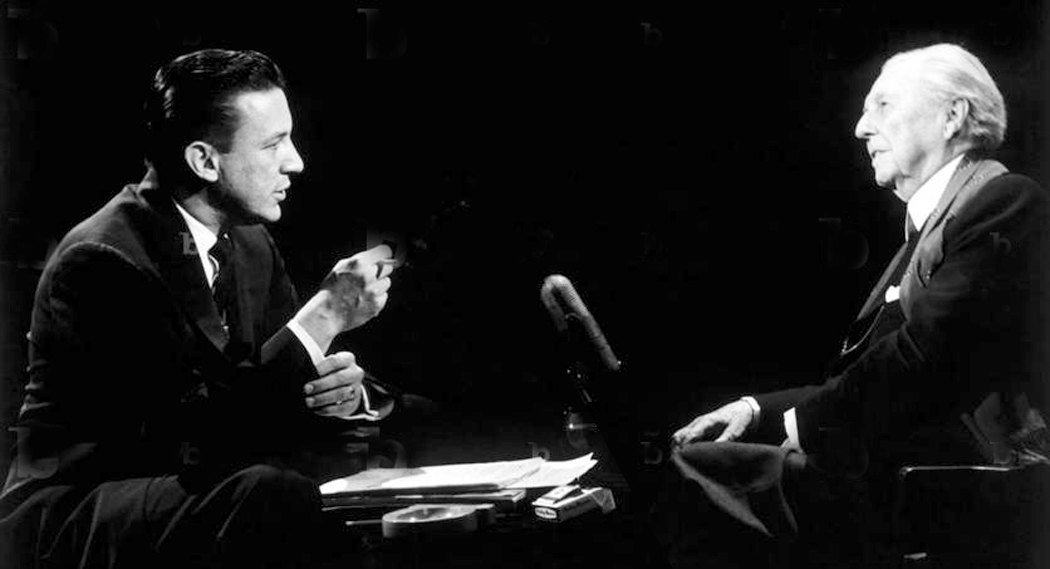
Much of the interview is a piling up of fatuous truisms and platitudes. “The answer is, within yourself.” That kind of thing, but spoken as if he were giving us pearls of wisdom from Zarathustra in his mountain cave. (The interview is available on YouTube.) 

Nothing sums up his dabbling in fraud and mendacity as his involvement with the construction of the Arizona Biltmore Hotel in Phoenix. It was opened in 1929, designed by architect Albert Chase McArthur. Yet, tourists visiting Arizona are often told that the Arizona Biltmore was designed by Frank Lloyd Wright. It wasn’t, although, as we’ll see, Wright sometimes took credit. 
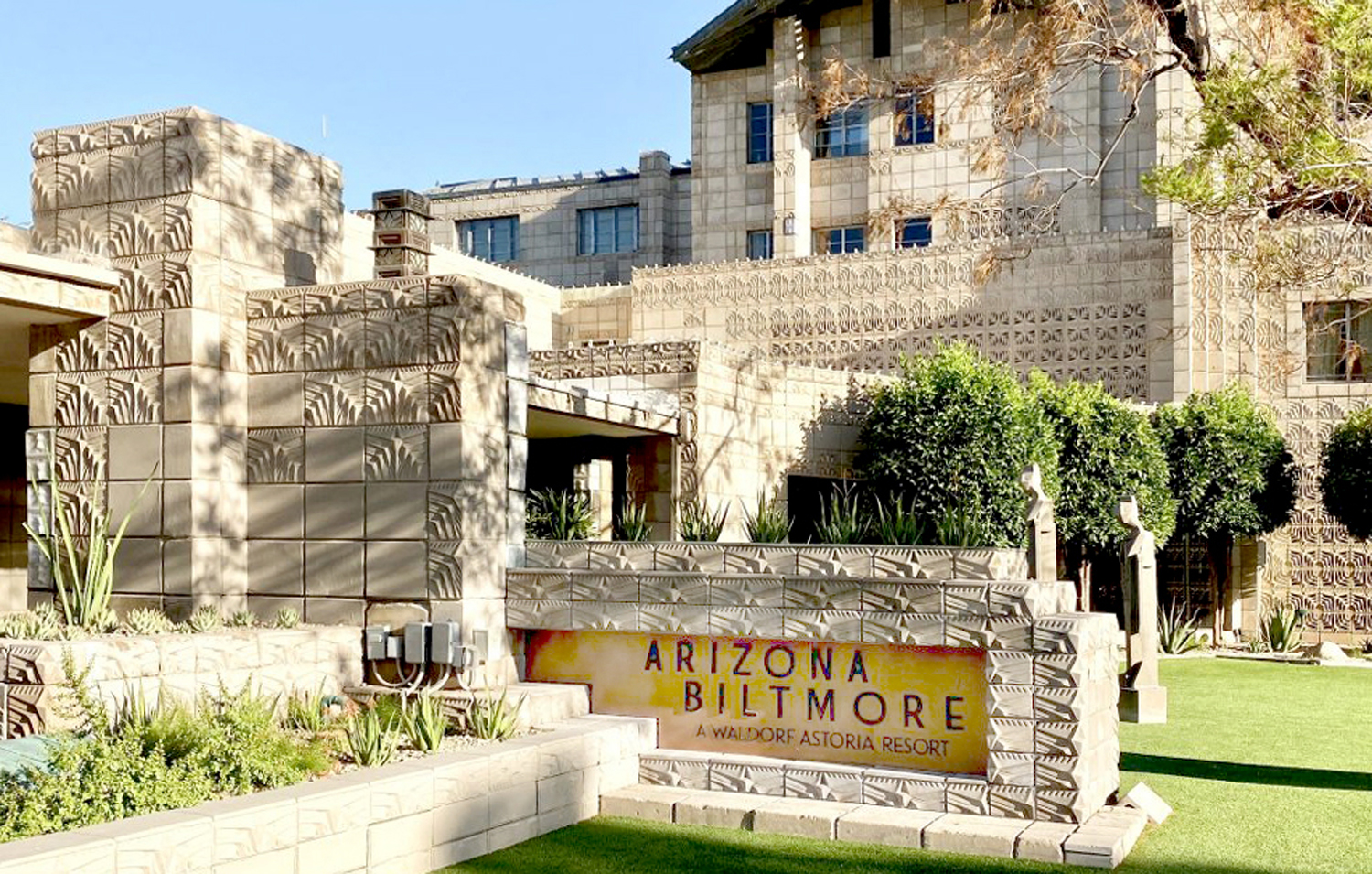
There are two things to note about the resort and hotel. First is that Wright was given $10,000 as a license fee by McArthur, for permission to use the patented “textile-block” technique. Problem was, the patent wasn’t Wright’s. It was invented elsewhere by others. Wright had previously used the technique and found no reason to disabuse McArthur of the idea the technique was his to license. Wright was later sued by the true patent owners and had to pay up. 

When McArthur contacted Wright about using the textile-block system, the Chicago architect telegraphed back that he would be there immediately, and in January 1928 he showed up at the door. 

In another of the changing stories, Wright’s stay in Phoenix stretched out longer and longer. Early sources say Wright was here anywhere from a few weeks to a few months. A little bit later, Wright claimed he worked on the Biltmore for six months. And in a public speech made a few years before his death, he claimed, “I spent a whole year at it.” 

In reality, the visit was probably less than a week, after which McArthur had had enough of the overbearing Wright and sent him packing. 

“The contractor was complaining about his interference,” McArthur says, “and when Wright refused to pay his rent for the house he was living in, they came with the police and evicted him. Wright said, ‘I don’t have to pay rent; I’m Frank Lloyd Wright.’ ”

McArthur had previously worked for Wright in Chicago from 1909 to 1911, performing various jobs and soaking up the influences. He later set up a practice of his own there. 

It is one of the marks of Wright’s tenacious mendacity that each time he later recalled McArthur, Wright’s memory of McArthur’s tenure with him got shorter, until, late in his career, Wright claimed that McArthur “had spent a few months” with him. 

It is important to note this, because Wright’s lack of generosity to his fellow architect becomes a major part of the Biltmore story, and a contributor to the mythology. 

Wright’s version of his participation in the design also changed over the years. Shortly after the hotel opened, he wrote a letter saying, “Albert McArthur is the architect of that building. All attempts to take the credit for that performance from him are gratuitous and beside the mark.” 

In fact, Wright thought the hotel was a botch. He criticized the building as “even worse” than he had imagined. “Far from being a great work of art, (it is) lacking even the most primitive elements of good design.”  

Yet, when the hotel became popular and its architecture praised, Wright changed his story. In his notoriously inaccurate and self-serving autobiography of 1943, he appears to see himself as the master architect working sub rosa for the “architect of record.”

And in a lecture in 1957, he answered a woman’s question by saying, “This lady wants to know if I designed the Arizona Biltmore hotel, and I did.” 

Wright went on to tell the audience, “There was a young student of mine who had the commission. He never built anything but a house, so they sent for me to help out and I helped out. So that’s the Arizona Biltmore.” Of course, by that time, Albert Chase McArthur had been dead for six years and could hardly defend himself. 

Mendacity the great speed bump of Wright’s personality: arrogant, often supercilious, egocentric and selfish. Wright could belittle those around him, fail to acknowledge their contributions, and he could be frustratingly patronizing. He lied, committed fraud, failed to pay bills. Biographers have been unraveling the lies he told about himself for years.

When Brendan Gill wrote his 1987 biography of Wright, Many Masks: A Life of Frank Lloyd Wright, he had to spend a good deal of his time debunking Wrightian lies. The architect used to tell the story that when his mother was pregnant with him, she had already decided he was going to be an architect and hung his nursery with engravings of English cathedrals cut from a magazine. Yet, the magazine engravings in question weren’t published until Wright was a teen-ager, and the tiny house they lived in at the time was too cramped to have a nursery. 

He even lied about his name: He was born Frank Lincoln Wright.

He was a monster. We are unfortunately too familiar these days with the concept of the malignant narcissist. Yet, there is an important difference: Wright was also a genius. 

When I go to any decent-size bookstore, I can find one or two books about any of the names you read about in architecture — Rem Koolhaas, Renzo Piano, Frank Gehry, Norman Foster — but there are two-and-a-half shelves on Wright, and he’s been dead for 65 years.

ENVOY

It has become common to conflate artists with their work. And artists are rarely angels. If we no longer watch Woody Allen movies, or appreciate Picasso’s paintings because their creators were fallible, even monstrous (Byron diddled his sister; Shelley had a things for underage girls; Wagner was a vicious anti-Semite) then we are likely to be required to excise more than half of all of the creations of civilization — maybe all of it, depending on where you draw the line. 

Caravaggio was a murderer; Lewis Carroll enjoyed taking photographs of nude little girls; Samuel Taylor Coleridge and Hector Berlioz were drug fiends. They — and we — are all human and bundles of contradiction. For their crimes, we may prosecute them, as we do anyone else. For their simpler sins, we develop short memories. For what they have given us, we need to be grateful.

Click on any image to enlarge

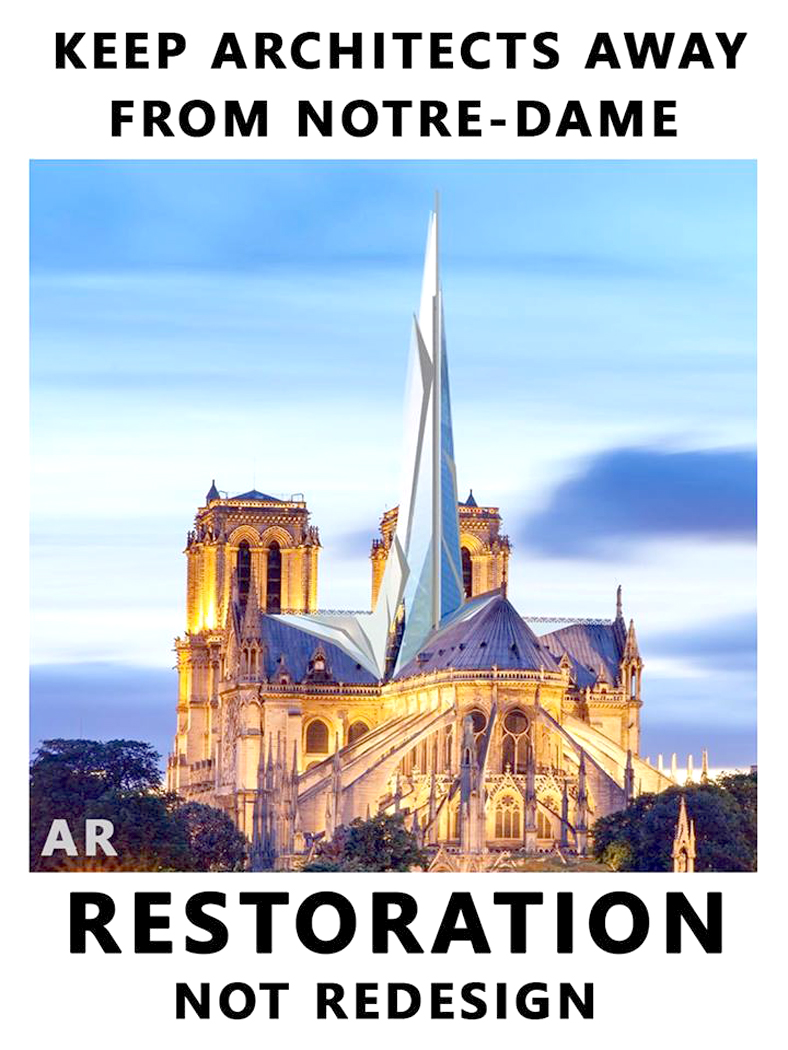
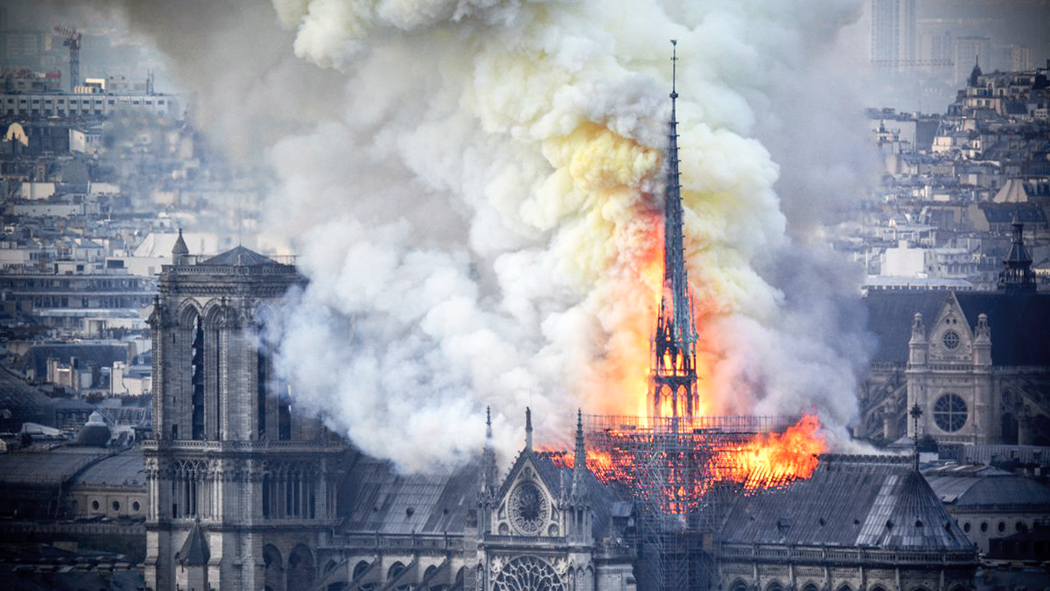
The day after the fire that destroyed the roof of Notre Dame de Paris, more than a billion dollars have been pledged toward the reconstruction, and French President Macron has promised the work would be completed within five years.

But already, a backlash has begun, a rearguard action, to prevent any “modernization” of the building in its restoration. This reaction demonstrates a misunderstanding of what a Gothic church is, and its peculiar history.

Fires are not the exception, but the norm for these buildings. Hardly a one has survived from inception without at least one grand conflagration. Indeed, most catalog a history of fires and collapses, followed by rebuilding, and almost always in a newer and more modern style than the original. For the norm of the Gothic style is its constant change and adaption.

Now, I’m not suggesting that Notre Dame de Paris should be rebuilt in the style of Frank Gehry, but I am suggesting that it is a sentimentalism and a distortion to believe that any Gothic cathedral is “pure” and “historical.” They are all patchworks of styles and modernizations over the centuries. 

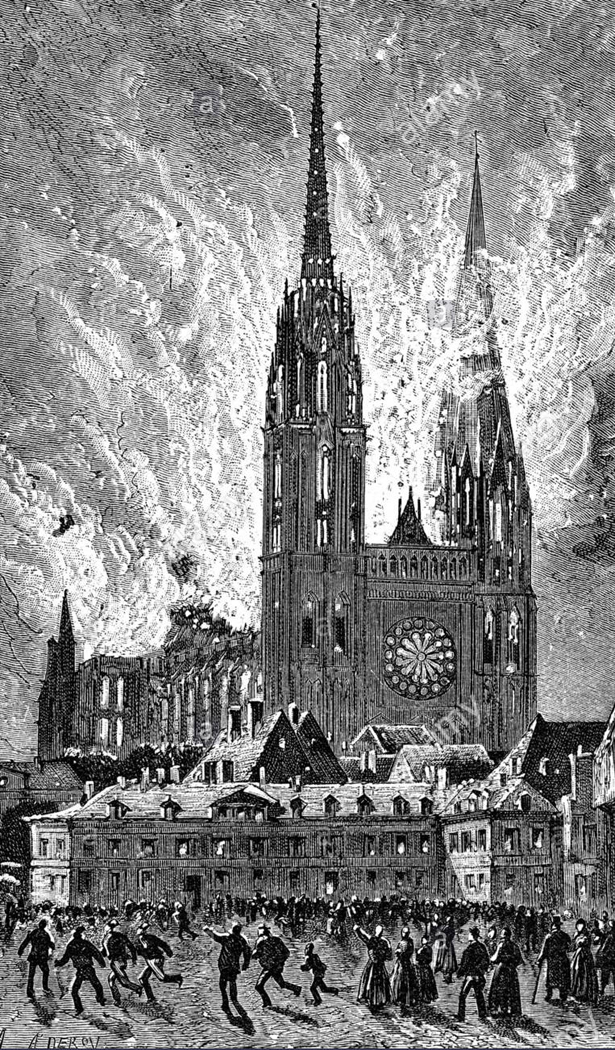
In fact, we would not now have Chartres Cathedral if the older building had not burned down in 1194 and wealthy donors had not given money to rebuild in a new style — the Gothic. 

There had been at least five cathedrals on the same hill in the town, each destroyed by fire or war. The first, destroyed in 858, the Carolingian replacement burned in 962, another in 1020 and another in 1134. In 1506, the north spire was destroyed by lightning and its replacement came in the newer “Flamboyant” style — making the two spires so unlike, which is the characteristic feature of Chartres. 

In 1836, the lead roof burned and was replaced by copper. The flammable wood braces were replaced with cast-iron ribs. 

Most of the Medieval churches were constructed piecemeal over centuries, and in almost every case, styles changed over that time, and so Gothic architecture is an especially heterogeneous one: unity out of difference. 

The church considered the original Gothic cathedral, at St. Denis, north of Paris, was built by Abbot Suger and completed in 1144. But he kept a Romanesque Western facade, and filled in behind it in this newer style, with stained glass and a flood of light. 

When he died, the church had three parts: a Romanesque front, a Carolingian middle and a Gothic choir. In 1231, Abbot Odo Clement, Suger’s successor, updated the nave with a newer Gothic style and remade the triforium and clerestory of Suger’s choir and apse. As we see it today, the building is an architectural gryphon. 

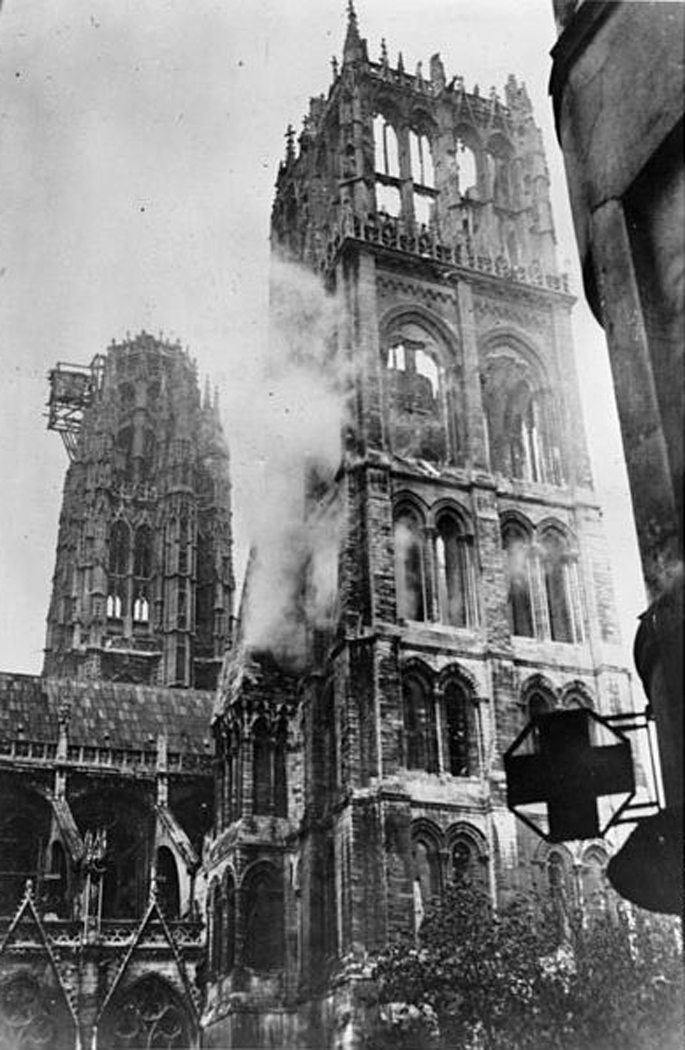
Rouen takes that idea and runs with it. It was begun in 1035 on the ruins of a previous Romanesque site that had burnt down. Since then, the history of Rouen is one of calamity and rebuild. This constant reboot has made it a less harmonious jumble than one finds elsewhere, of ad hoc fixes, misguided redesigns and megalomaniac civic striving.

It is the Peter Abelard of cathedrals, and a book could be written on the history of its misfortunes. The previous cathedral was struck by lightning in 1110, and construction began on the current building. The new one burnt again in 1200, destroying all but the nave arcades, the Saint-Romain tower and the left portal, with work ending in 1250. It was struck again by lightning in 1284, was partially taken down and rebuilt in 1302, the spire was blown down in a wind storm in 1353. The construction of the Butter Tower in the 16th century led to disturbances in the facade, which had to be reinforced (finished 1530). 

The original Gothic spire had burned down in 1514 and was finally replaced by a wooden spire covered in gold-plated lead in 1580, paid for, in part, by the selling of indulgences. In 1562, it was damaged by rebelling Calvinists  during the Wars of Religion, when much of the statuary and windows were destroyed. The cathedral was struck again by lightning in 1625 and 1642, damaged by a hurricane in 1683. The choir burnt in 1727 and a bell broke in 1786. 

During the French Revolution, the church, like many in France, was deconsecrated and turned into a civic building and metal parts of the church were melted down to make cannons and cannonballs. The spire was again blasted by lightning in 1822 and a new one made from cast iron added in 1876 (making it the tallest building in the world until displaced from atop the list four years later by the cathedral at Cologne. (Then to the Eiffel Tower in 1889).

The misfortunes continued. In 1940, a fire damaged the building’s structure and burned that part of the city from the church to the Seine river, and later during World War II, the cathedral was bombed twice, first by the British, then by the Americans, just before D-Day. Parts of the south aisle were destroyed and the south tower burned. Much of the remaining stained glass was blown out, leading to the current situation with frosted glass in many of the windows.

Then, in 1999, a cyclone named Lothar destroyed one of the four wooden turrets surrounding the central lantern tower was blasted and fell crashing into the choir. The history of Rouen’s cathedral is one of constant upkeep and rebuilding, like trying to sustain a sand castle against the tide.

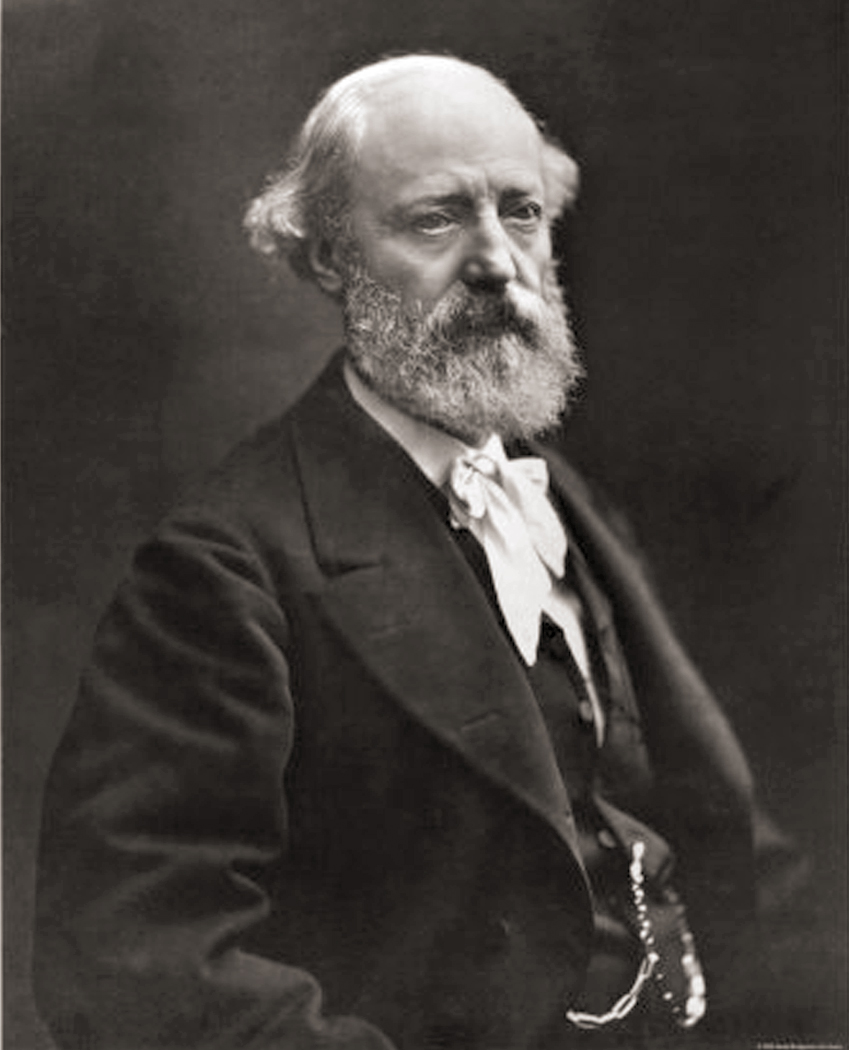
If anything is true of these prodigies of architecture, it is that there is no such thing as a Gothic cathedral — at least no such thing as a “pure” Gothic cathedral. Each has been built over decades, even centuries, and each has add-ons in different styles, rebuilds made more “modern,” and restorations by well-meaning finaglers such as the 19th-century Eugene-Emmanuel Viollet-le-Duc, who replaced damaged statuary, added grotesques and redesigned finials and gargoyles according to his Victorian sense of what Gothic style should be.

Viollet-le Duc

Viollet-le-Duc was put in charge of restoring Amiens in the late 19th century, and he added a whole new line of statues at the top of the west facade, called the “Galerie des Sonneurs,” or “Gallery of Bell Ringers,” a passageway arcade between the two towers. He redid a good deal of the statuary and had the cathedral floor redone to smooth out the cobbling of centuries of foot traffic. Modern standards for restoration were not part of his procedure. “To restore an edifice”, he observed in his Dictionnaire raisonné, “is not to maintain it, repair or rebuild it, but to re-establish it in a complete state that may never have existed at a particular moment.” In other words, as he might imagine it.

It is the genius of the Gothic style that it can absorb almost anything and still seem perfectly harmonious. Some historical styles that strive for unity require any additions to be matched stylistically or the new parts seem like carbuncles grown where they are least desired. (Can  you imagine an addition to London’s Saint Paul’s Cathedral designed by, say, Louis Kahn?) 

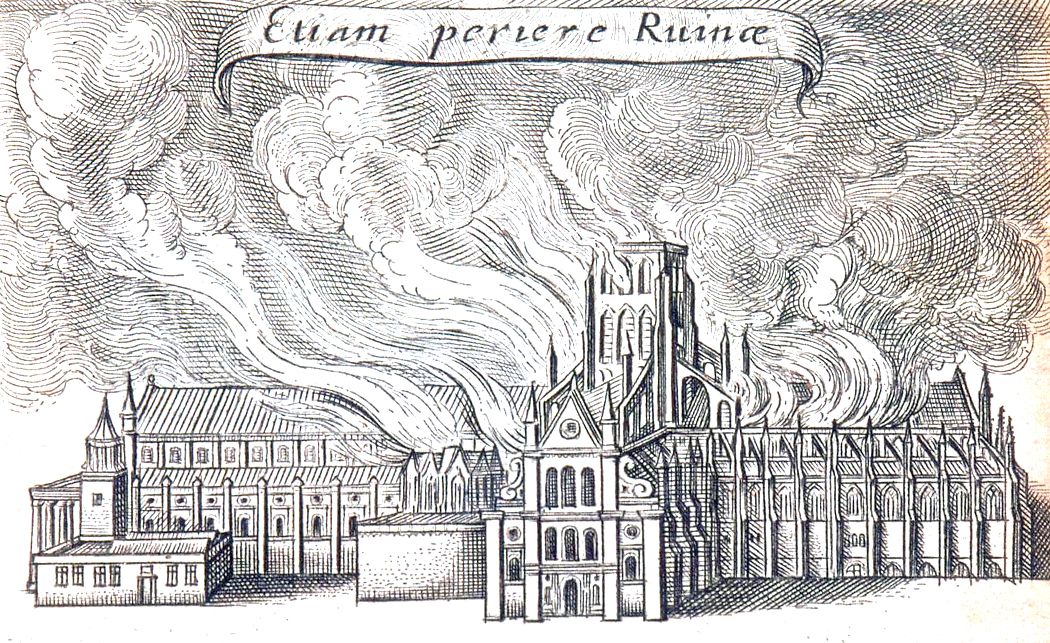
Burning of St. Paul’s 1666

St. Paul’s would not exist now, but for the burning down of the older Gothic cathedral in 1666, which had replaced one burned down, built after the Norman church burned in  1087. 

But Gothic is an accepting style. There is not much you can do to it and not have it welcomed into the family.

The past as we imagine it is always a shaky construct. History is always being revised, and those scholars who do the work are initially derided as “revisionist,” when, of course, that is their job. To quote the revered Firesign Theatre, “Everything you know is wrong.”

Take Beauvais, the tallest of all Gothic churches. It makers were proud, certainly, not only of the tallest church, but the finest, slenderest flying buttresses supporting the roof. But 12 years after it was finished, the roof collapsed. It seems to modern engineering studies, that a gale wind off the English Channel caused sympathetic vibrations in the structure and it shook apart. They rebuilt.

But the collapse, which caused concern about the engineering, and trouble fund raising to complete the whole left the church with only the choir and transept. At some point, it was decided that instead of using the money they had to finish the nave, they would use it to top the whole with a giant spire, which was finished in 1569 and left the church — at 502 feet high — the tallest building in the world at the time.

“We will construct a spire so high that once finished those who see it will think that we were crazy.”

Perhaps they were. Unfortunately, on April 30, 1573, it, too, came crashing down, along with three levels of the bell tower.

As described by author Elise Whitlock Rose, “On the eve of Ascension Day, 1573, a few small stones began to fall from its heights. The next morning, a mason, who had been sent to test it, cried out in alarm; the bearers of the reliquaries, about to join the Procession of the people and the clergy who were waiting outside, fled; — there was a violent cracking, — and in an instant, the vault crashed amidst a storm of dust and wind. Then, before the eyes of the terrified worshippers, the triple stories of the lantern sank, the needle fell, and a shower of stones rained into the church and on the roofs.”

This could almost describe the fall of the spire on Notre Dame de Paris this week. 

The choir at Beauvais was rebuilt once more, but without the spire. But the nave (except for one bay) was never completed, leaving Beauvais as the trunk of a cathedral, a mutilated fragment.

The shakiness of its construction continues to threaten the building even today. The inside, meant to be an awe inspiring sublime holy space, is filled with trusses and braces, attempting to keep the whole from final catastrophe.

This stylistic hodge-podge is something that you face in almost every Gothic survivor. One recalls the problem of Theseus’ ship, in which, over the years, every board, every nail, every rope has been replaced, one by one. And one asks, is this the same ship that carried Theseus home from Crete?

Or, more aptly, the Japanese temple, whose wood is replaced every 20 years. The grand shrine in the city of Ise has been replaced this way more than 60 times, yet is considered the same temple that was built in AD 692.

(It is widely believed — though not exactly true — that all the cells in a human body are replaced every seven years, yet we think of ourselves now as the same person we were when we popped out of the dark into this bright world.)

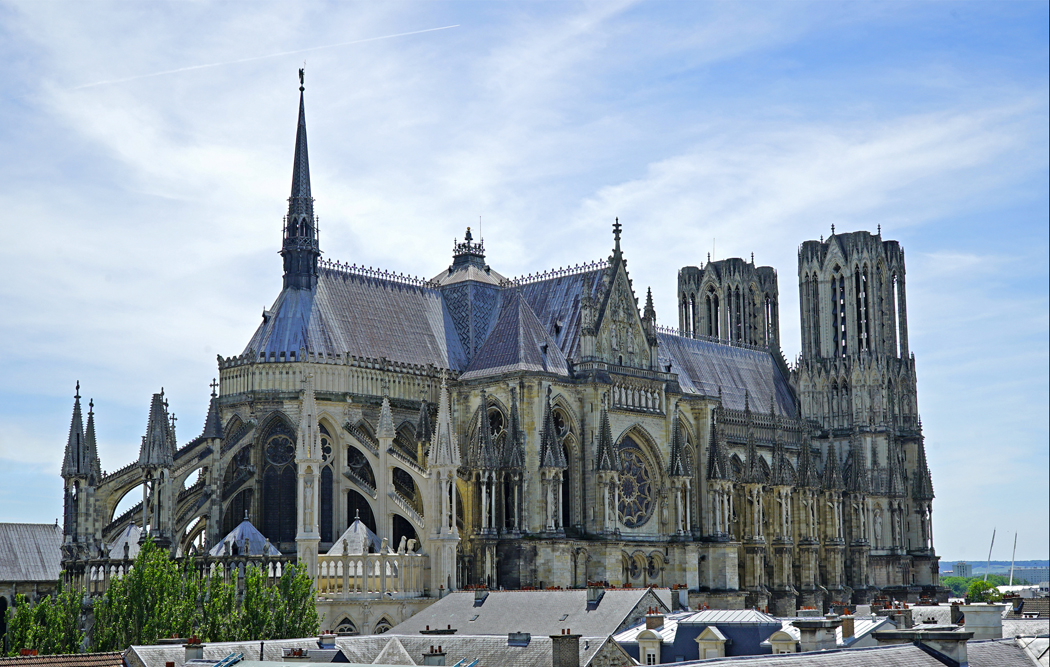
Reims has undergone something of the same constant renewal, like the goddess Aphrodite.

The modern cathedral was begun in about 1220 and was finally roofed in 1299, but work continued, adding details through the 14th century. A fire in 1481 required major reworking, finished in 1516, keeping to the Medieval style.

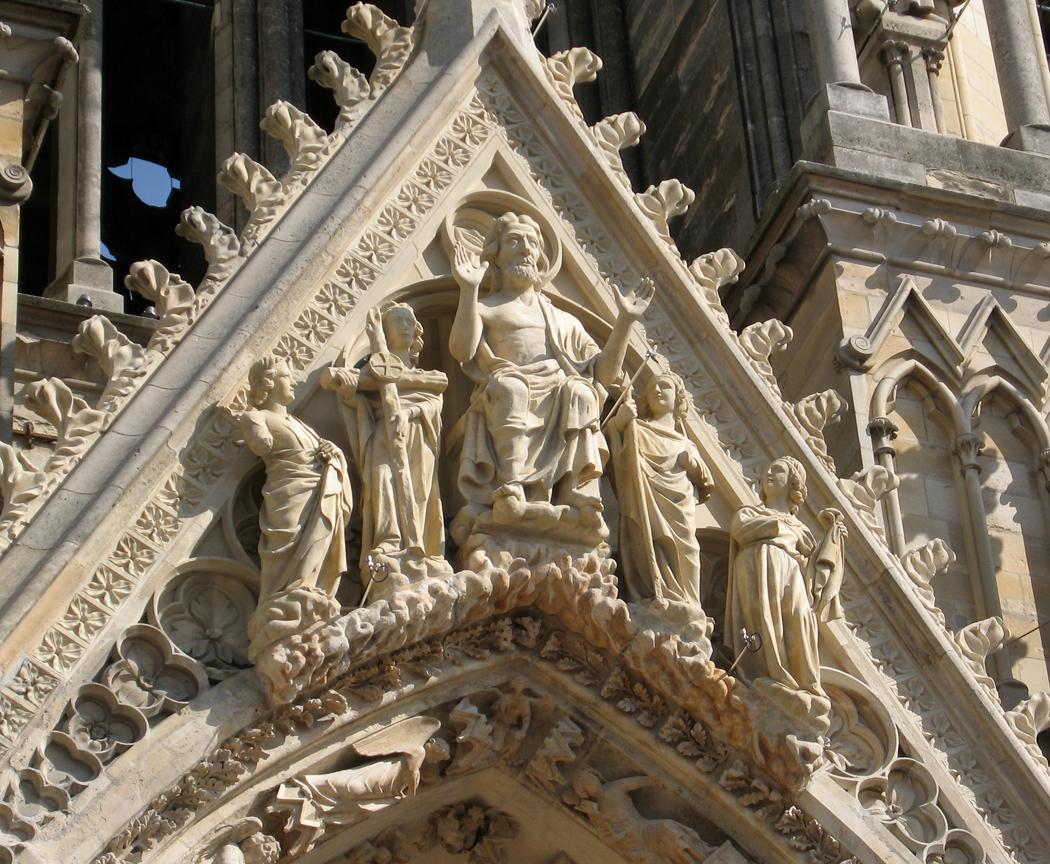
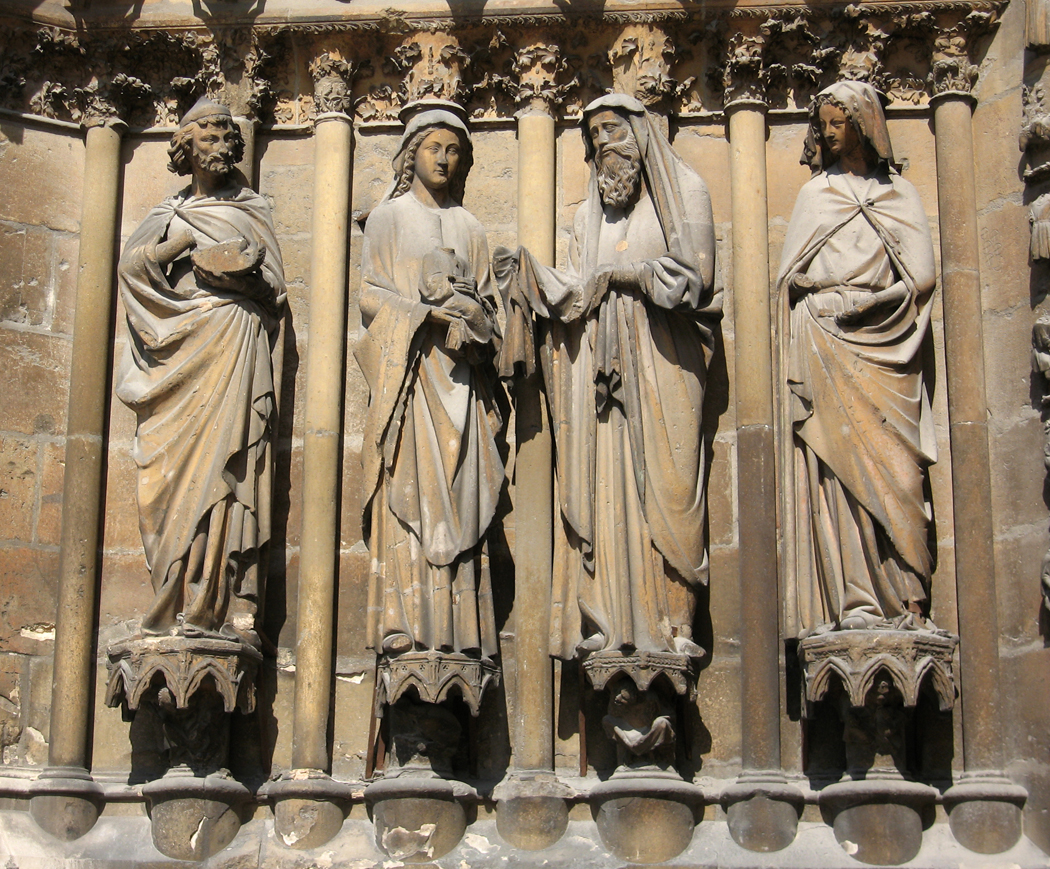
The continuous renewal of Reims began in 1610 with gussying up the central portal of the west facade. Nineteen statues of the central portal archivolts were replaced.

Later reworkings took place from 1727 to 1742 and from 1755 to 1760 to repair the deterioration caused by rain leakage and freezing. Many of the sculptures were repaired or replaced.

But the real overhauls began in the 19th century, as France began looking at its great cultural monuments and deciding to upgrade them. The earlier Enlightenment, for instance, saw the so-called Middle Ages as a time of irrationality and superstition. That age saw its ideals in classical Rome. But the 19th century, given in to Romanticism, idealized the very things the previous century had dismissed. So, in the 19th century (yes, beginning in the late 18th century — these things are not governed by calendar dates), you had a Gothic revival, a raft of novels set in castles, the knights of Sir Walter Scott, the cornball folly of Strawberry Hill and Victor Hugo’s Hunchback of Notre Dame.

The Romantic movement in art and literature idealized the Middle Ages, and books such as Chateaubriand’s The Spirit of Christianity, and Victor Hugo’s Hunchback of Notre Dame (to give it its popular title) revived interest in buildings that had been allowed to deteriorate or had been desecrated during the violently anti-clerical French Revolution.

In 1818, a catalog of Romantic and Picturesque Sites of Ancient France was begun, not finished, in 20 volumes, until 1878. And in 1830, the government created a post of Inspector of Historical Monuments.

Hugo wrote a pamphlet called War on Demolishers, to “stop the hammer that is mutilating the face of the country” by destroying historic edifices. He denounced “ignoble speculators,” who “vandalized” the great monuments to build cheap get-rich-quick developments. He called for a national law to protect the old treasures.

He also explained “There are two things in an edifice: its use and its beauty. Its use belongs to its owner, its beauty to everyone. Thus, the owner exceeds his rights in destroying it.”

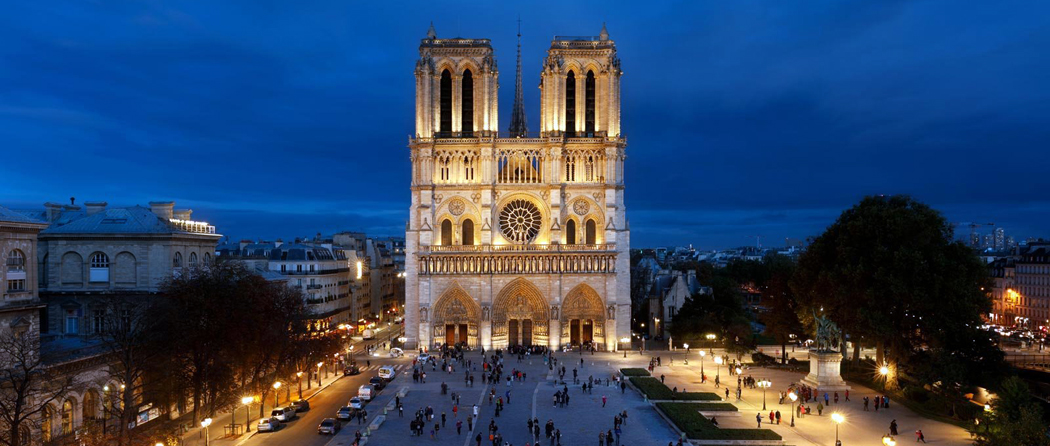
Notre Dame de Paris before 19th C. restoration

Between 1826 and 1837, the first major interventions of the 19th century were carried out, replacing sculptures on the western facade. One after another, from then on, a series of restorers and architects tried to bring Reims back to what they considered the authentic and original designs of the cathedral. First diocesan architect Arveuf, then Viollet-le-Duc, the restorer of Notre Dame of Paris, who undid the modifications of 1481-1516 and replaced them with his own design.

After Viollet-le-Duc, Eugene Millet did the same thing to the south side of the nave. From 1879 to 1886, Victor Ruprich-Robert did the same thing to the north side. After him, Denis Darcy jumped in, working to 1904. From 1904 to 1915, Paul Gout reworked the western facade and parts of the chevet. The work was not quite finished when World War I broke out. The war did not treat Reims kindly. It was bombed and a good portion left in rubble.

It took another 20 years to fix what the German artillery shells had broken. Restorer Henri Deneux, began in 1919, clearing away debris and cataloging the fragments and installing a temporary roof. The glass was a particular victim of the war. Deneux had the guide of drawings made of the stained glass made before the war and had many of the windows rebuilt, sometimes from the shards of the originals.

By 1938, most of the restoration was complete,  but World War II was in the offing. This time, the windows were removed for safe storage and reinstalled after the war.

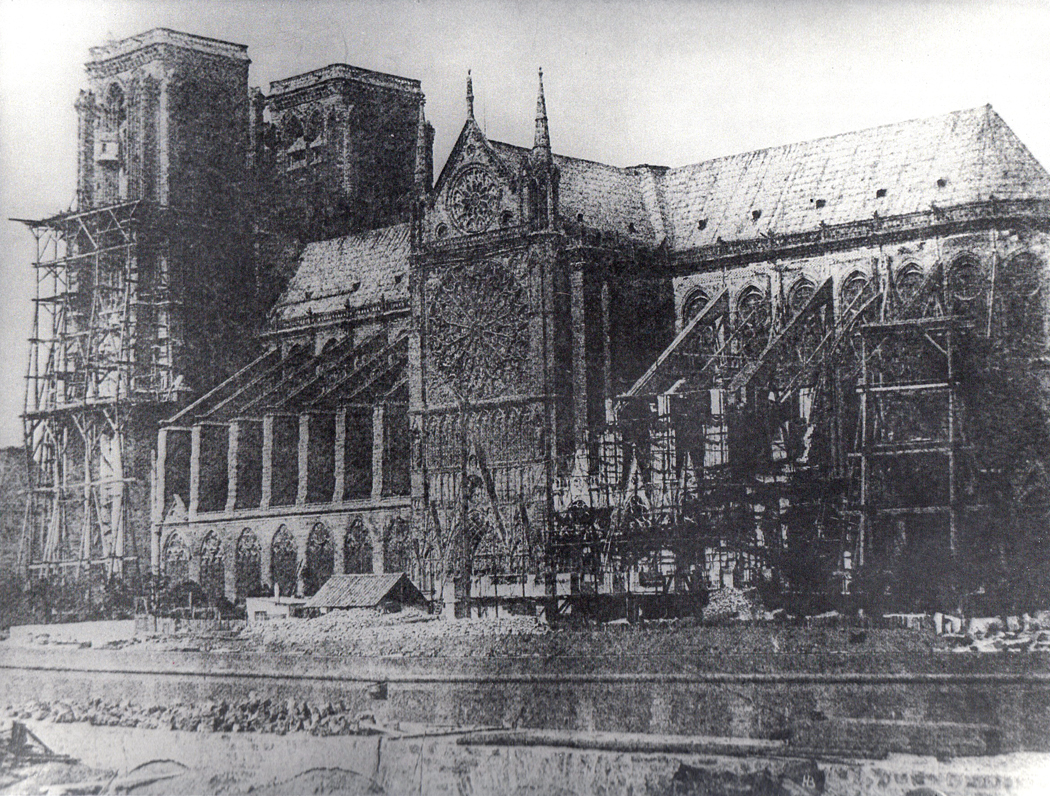
The attempt to make the Gothic church “pure,” or “as originally built” is a chimerical idea, only fancied beginning in the 19th century. And you found, in France, a renewed interest in the monuments left over from those discarded days. And discarded is the proper word: The cathedral of Notre Dame de Paris, for instance, was a crumbling shambles, stripped of most of its sculpture and left to be a ruin on the island in the middle of the Seine River. 

In addition to the ravages of time and 500 years, there had been various “updates” to the building, and then, before, during and just after the French Revolution, the sculpture on the door jambs had been removed and the Gallery of Kings above the western portals had been junked in a frenzy of anti-monarchical and anti-clerical sentiment.

But in an ironic stroke of luck, the central government appropriated and deconsecrated the church property in 1789, and thus became responsible for the administration and upkeep of churches, including the cathedral (know then as the Métropole), which had for a time been turned from a Roman Catholic cathedral into a “temple of reason” and then into a food warehouse.

Under the auspices of the state, a few clumsy attempts were made to restore the cathedral, but those attempts did more damage than good.

Then, in 1831, Victor Hugo began his personal crusade to repair and renovate the crumbling monument. He and others worked for a decade persuading public opinion and so, in 1841, a committee was established in Paris to consider the matter, and a year later, architect Arveuf was asked to submit a plan for the refurbishment of the cathedral. Several others decided to submit plans, also, and eventually it was the team of Jean-Baptiste Lassus and Viollet-le-Duc who were chosen to mastermind the restoration. Lassus had already spearheaded the restoration of Sainte-Chapelle, and Viollet-le-Duc had been in charge of the work at Vezelay. 

They were the two most qualified restorers of the age (and although Lassus died in 1857 before the completion of the work in Paris, Viollet-le-Duc went on to work on several more of the cathedrals and basilicas of northern France).

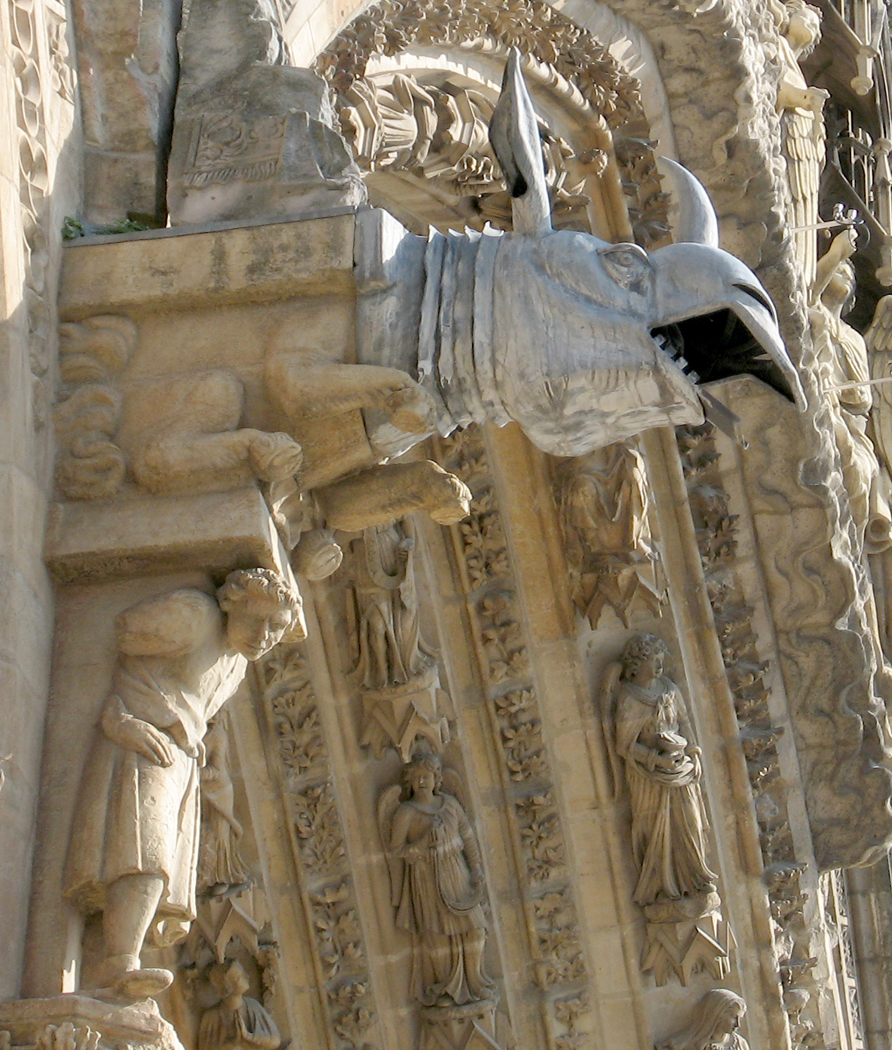
The project began in 1845 and didn’t finish until 1864. It was a huge project. Walls needed rebuilding, statues were carved and put back on the door jambs, all the gargoyle waterspouts that had been replaced over the centuries by lead pipes were redesigned and recarved. (The hideous lead pipes had caused the cathedral in the previous century to be compared to a hedgehog, with all the points spiking out from its walls). The windows were reworked, the doors remade, a new spire added to the roof above the crossing, and perhaps most remarkable — a series of 54 grotesques — “chimères,” or “chimerae,” as Viollet-le-Duc called them — were added to the gallery along the roof line.

Yes, that spire, so lamented in its collapse, was never Gothic, never original. It is a 19th century addition. 

Viollet-le-Duc and his partners sat at the crux of a change in restoration theory — at midpoint between the older ideas of just replacing worn-out parts with modern equivalents and the more recent concept of saving everything original as best as can be done. Viollet-le-Duc’s idea was not to put Notre Dame back to any historically accurate version of the building, which had changed over the centuries with add-ons and updates, but rather to create a vision of the “perfect completed ideal” of what the building would have looked like, if it had ever been completed according to a single plan.

In other words, a fantasy of what the 19th century wanted to believe about the Gothic era. 

Viollet-le-Duc wrote that, for him, restoration should be a “means to re-establish [a building] to a finished state, which may in fact never have actually existed at any given time.”

So, Notre Dame as we see it today, is a fiction, a 19th century overlay, almost a “Disneyfication” upon the remains of a 13th century building in an attempt to recapture what the Romantic 19th century believed to be the soul of the Medieval era.

But we should not be too harsh on them. Viollet-le-Duc was an astonishing person, the best-informed restorer of his time, who published the standard encyclopedia of Medieval architecture and design. His energy and commitment were legendary, and although he had his critics, there was no one else in the central years of the 19th century better placed to give us the Middle Ages.

And without him, the cathedrals of northern France would today be more like the ruins of Ancient Greece than like the awe-inspiring churches in which the Mass has been celebrated for 800 years.

The fact is, there is no “original” and “authentic” Gothic building to which we can point. All such churches were constructed over centuries, with changing styles, and continuous updates and remodelings. The Gothic cathedral is less a thing than a process, and Viollet-le-Duc should be seen as simply part of that continuing process.

And we need to remember that when attempting to repair the newly burned and mourned Notre Dame de Paris. And not be too “precious” about how it will be rebuilt. 

Certainly, the “forest” of wooden beams and joists will be replaced with reinforced concrete or steel, and the toxic lead roof sheathing will become either copper or titanium, with a patina to mimic the dull lead. And it will be architects who oversee that modernization. 

I don’t see a Buck Jones futuristic spire replacing the 19th century one — in fact, if I had my way, there would be no spire at all. But I leave that to the architects and designer who know very well what they are doing. 

Gothic should continue to evolve: That is, after all, what it means to be Gothic. 

Click any image to enlarge

How do you hold up a roof?

Seems like a simple question: Walls hold up a roof. And if your roof is heavy and two or three stories up? A stronger, thicker wall.

This is the problem faced by the builders of European churches in the 11th and 12th centuries. With those thicker, stronger walls, windows became a problem because they weakened the walls with holes, which meant that the churches had small windows and were rather dank and dark places to worship the Creator.

When we are taught about Romanesque and Gothic cathedrals in our art history classes, we are usually given a list of characteristics they have: round arches for Romanesque; pointed arches for Gothic: thick walls for Romanesque; flying buttresses for Gothic: barrel vaults for the Romanesque;  rib vaults for the Gothic — as if the shift from one to the other were merely a catalog of stylistic tics and the change from one to the other nothing but a change in fashion, as if giving up pegged trousers and taking on bell bottoms.

Why would it be important for art history students to spend this much time on something so old and arcane? Our professors always seemed to think this was such a profound change and worth a week of class time. We couldn’t wait to move on to Impressionism.

It was never made clear in class why it would be important for us students to know these things: buttresses, rose windows, naves and aisles, apses and choirs. These cathedrals were in Europe, not America.

But the change from Romanesque to Gothic should not be seen as merely a change in styles, but as a major innovation in architecture whose results led to the glass and steel skyscrapers that populate all our cities. The Seagram Building in New York is merely an extension of the ideas behind Chartres cathedral.

What happened was (for reasons I will get into in my next blog post) someone figured out you didn’t really need walls to keep a roof up. You could, like a picnic pavilion, support the roof with posts, leaving the space between the posts open. And, if you build a church this way, you can glaze the open spaces with colorful glass and let inspiring light into the interior of the church. Wow. In an instant, churches became lighter, both by weight and by illumination. What had been dour and forbidding became bright and inviting.

Perhaps the most dramatic example of this is the small royal chapel built on the Ile de la Cite in Paris between 1238 and 1248. While it is tiny in comparison with the big cathedrals, such as Notre Dame or Reims, it is a glory of glass. Its walls are explosive with color and light.

If you were to stand in the middle of Ste.-Chapelle and gaze up at the ceiling, you would see that the ceiling and roof are supported by a cage of stone pillars, between which are cascading sheets of stained glass. When you realize that such roofs are made primarily of lead or slate, you realize how heavy it must be, and how brilliant was the engineer who figure out how to keep it up with only these spindly supports.

This is the genius of Gothic architecture. Follow its logic out to the 20th century and you understand that you can make a skyscraper with a cage, not of stone, but of steel, and glaze the open areas and let light into every one of the 40 or 50 stories of office space. In some sense, the International Style — all those glass-and-steel towers that define our urban architecture — are really just a further refinement of the Gothic breakthrough.

Ste.-Chapelle was built for King Louis IX, later known as St. Louis, as his private church on his palace grounds. It was meant to house a series of holy relics he had bought, including the supposed “crown of thorns” Jesus had worn upon his crucifixion, and a piece of the “one true cross,” of which there were a whole woodpile scattered across Europe. These relics were held in great esteem. Louis wanted a home for them that would honor their importance with great beauty and wealth, and Ste.-Chapelle is the result.

Louis spent 40,000 livres on the chapel, but nearly four times that in buying the relics from the cash-strapped Byzantine emperor, Baldwin II in 1239. The chapel was built to hold the relics and finished in record time.

Ste.-Chapelle is 118 feet long and 56 feet wide, but more importantly, 139 feet high. Above that a spire of cedar wood extends another 108 feet. (The current spire is a 19th century replica, designed after the 15th-century spire. It is unknown if the original chapel had a spire).

The church is a two-story affair, with the lower level once reserved for the royal staff and servants, while the upper level, with its grand windows, was for the king. He had an elevated walkway built between the palace and the chapel’s second floor so he never had to descend to ground level with the hoi-polloi. The palace is largely gone now, replaced with the bureaucratic buildings of the Paris metropolitan police force, but Ste.-Chapelle remains on the grounds, surrounded now by parking lot.


You can see how it once sat, in the illuminated manuscript of the Limbourg Brothers, made in 15th century and known as the Très Riches Heures du Duc de Berry.

Today, there are lines waiting to get in to see Ste.-Chapelle. You walk through security and through the parking lot and into the ground floor chapel, where the fleur-de-lys seems to be painted everywhere in gold. It is a stunning space, even if its ceilings are low. The paint is bright and colorful. The staff wasn’t cheated; the lower chapel is plush and beautiful.

But then, you walk up the stone staircase to the main floor and it is as if the heavens open up above you. The glass, the color, the light: They stun.

In 1323, the French writer Jean de Jandun wrote of Ste.-Chapelle in his Tractatus de Laudibus Parisius, “The most excellent colors of the pictures, the precious gilding of the images, the beautiful transparency of the ruddy windows on all sides, the most beautiful cloths of the altars, the wondrous merits of the sanctuary, the figures of the reliquaries externally adorned with dazzling gems, bestow such a hyperbolic beauty on that house of prayer, that, in going into it (from) below, one understandably believes oneself, as if rapt to heaven, to enter one of the best chambers of Paradise.”

While it is true that Ste.-Chapelle was restored in the 19th century, its restorers attempted to be exceptionally faithful to the original. And while most of the paint is more recent, a full two-thirds of the windows are original 13th century glass. The remaining panels replace glass removed when the chapel was used as a government records archive after the French Revolution.

The glass in the nave tell primarily Old Testament stories, in the apse the glass covers New Testament stories. The 15 stained glass windows, each more than four stories high, depict 1,113 scenes from the Bible in 6,458 square feet of glass.

The great Rose window is a replacement from 1390 when the original window, in Rayonnant style (as seen in the Très Riches Heures), was updated into the then-current Flamboyant style, with its curlicues and circles.

The tympanum painting above the king’s doorway is a recreation, but in the style of the original.

The designs in the floor are wonderfully graphic.

The columns and walls are brightly painted.

All this color, light and throat-grabbing beauty is understandable on esthetic terms, but its purpose was more than to be pretty, or even awesome. The philosophical momentum behind the architectural advance will be discussed more thoroughly in the next blog, about the basilica of St. Denis.

Click on any image to enlarge
Next: St. Denis


The names of the towns and cathedrals of northern France can be a challenge for American English speakers. They all seem to require vowels and consonants not only strange to American ears, but downright taunting.

 
We started this trip at Notre Dame de Paris. That “tre” in “Notre” is something not available in English, outside the clearing of one’s throat. We tend to just go with the name of the Indiana university and say “Noter Daim.” But to approximate the French, you have to give it a “Notra,” ending at the back of the soft palate and “Dom.”

Then we went to Rouen, which is easier, except for that non-rhotic “R” at the start, but we can get by with “Roo-on.”

The drive took us to Amiens, with is a little like saying “Onion,” but with an “M” instead of an “N.” Beauvais is the easiest one: “Bo-vay.”

It’s a little trickier at Noyon, which we might offer “Nwa-yone,” especially if you can say it while losing the “n” in “yone” somewhere in your nasal cavity.

After that, we climbed the hill to Laon, which looks easier than it is to say. Try “loud,” but without the “d” on the end, but with that nasal sound that the French like to use for an “n.” Or, give up and just say “Lao,” as if you were naming the “Seven Faces of Dr. Lao.”

Yet, none of these challenges the English speaker as much as the next cathedral town. In English, we spell its name Rheims, although in France, they spell it Reims. If you think that should be “Rems” in the mouth, well, foolish you. The closest you might get is to say “Rance,” as if it were a gunslinger in a Western movie. Why this should be? Well, if you want to give it the Gallic good-old-try, you might speak the initial “R” at the back of your throat, as if you were clearing it of phlegm, follow that with the “ei” spoken both through your mouth and your nose at the same time, and then attempt to elide into an “m” completely nasal, but more like an “n” than an “m.” Round it all off with a sibilance and you’re good to go. It should come out, perhaps a leaning a little toward “Rass,” as if it were attempting to clean out your sinuses at the same time.

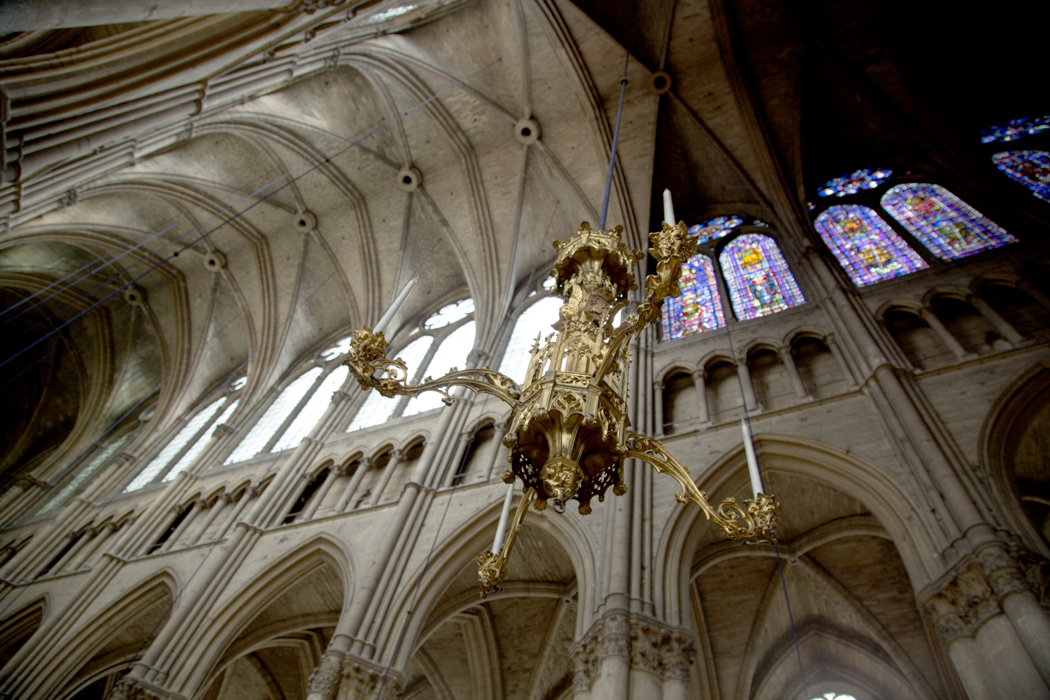
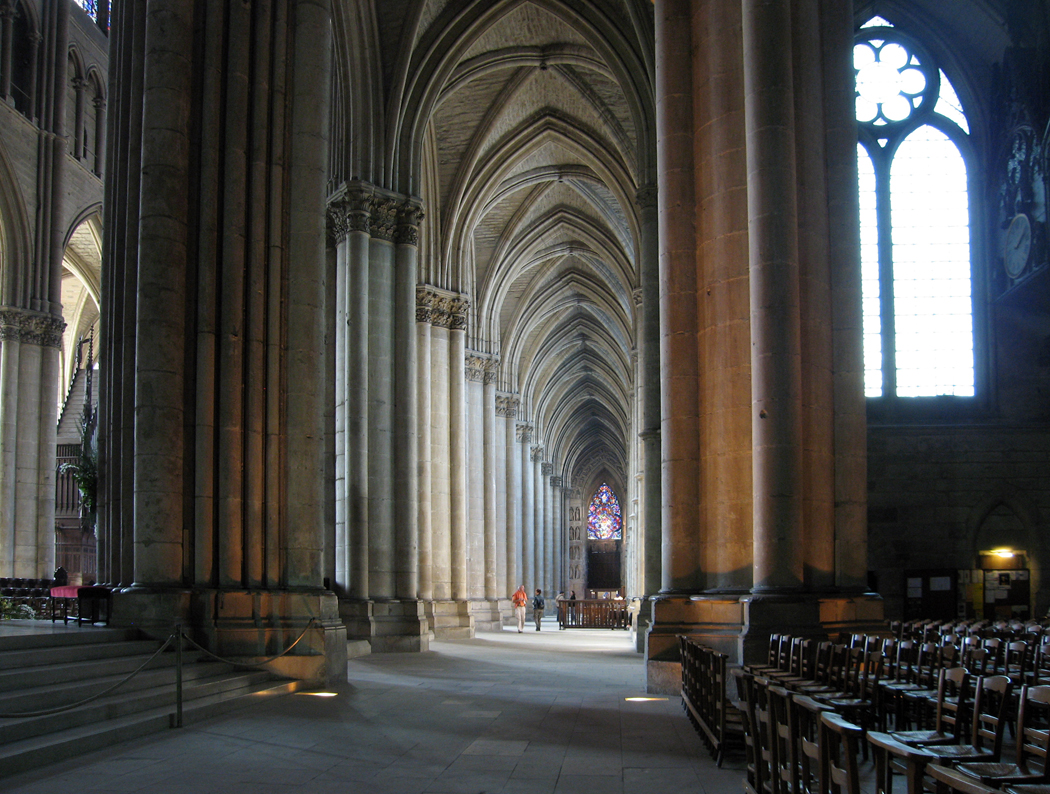
All that aside, the cathedral in Reims is from central casting; it is the handsomest, most perfect, with good bone structure and a set of capped teeth to rival the glossiest Hollywood star. If you were to invent the perfect Gothic cathedral, you would have invented Reims.

Yet, something seems just a little off, like the Hollywood star you suspect of being hollow behind the glittering eyes.

Unlike the buildings in Amiens, Beauvais, Noyon or Laon, which seem too large for the towns or villages they dominate, the cathedral in Reims sits at the center of a sizable city. Traffic is congested and parking is hard to find. When you confront it, walking into the parvis, you see an edifice that shines large, the hub of a great urban wheel.

Also unlike the other cathedrals, it is symmetrical, with two identical towers on either side of the central three portals. Other cathedrals seem hotch-potch, assembled from spare parts, almost, Reims was put together from a kit straight out of the box, all parts included.

Which is all the more surprising, considering that it has been worked over and rebuilt, redesigned and rejiggered for some 800 years. If it looks all of a piece, that is because its many restorers and rebuilders made the conscious decision to keep the essential plan unchanged.

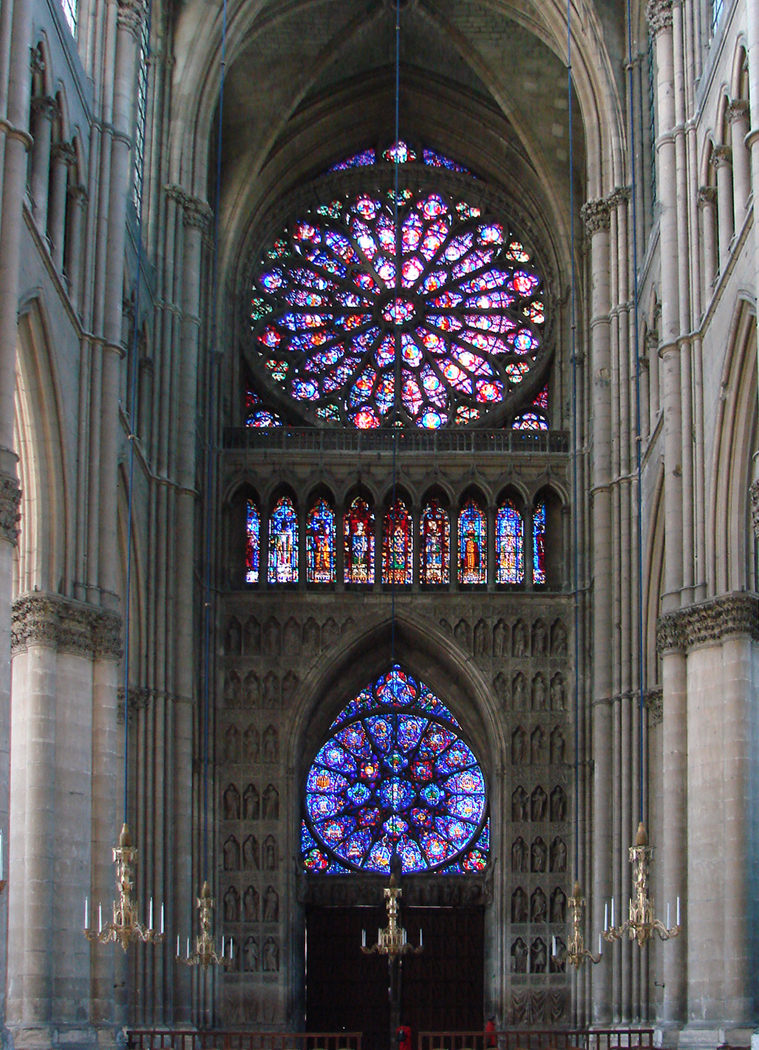
So, the first impression of Reims is of a sturdy, beautiful, archetypal Gothic church, three great arches on its western front lined with rings of sculpture, a great rose window in the center, a line of kings above that and the twin towers rising to the height of a 26-story skyscraper. It is jutting jaw and piercing eyes, all perfectly tanned.

I’m afraid I may be sounding a little too snarky about what is a very impressive bundle of awesome. If you had never seen Chartres or Paris or Amiens, then Reims would satisfy all your spiritual hunger for a Gothic cathedral.

The problem is one that you face in almost every Gothic survivor. One recalls the problem of Theseus’ ship, in which, over the years, every board, every nail, every rope has been replaced, one by one. And one asks, is this the same ship that carried Theseus home from Crete?

Or, more aptly, the Japanese temple, whose wood is replaced every 20 years. The grand shrine in the city of Ise has been replaced this way more than 60 times, yet is considered the same temple that was built in AD 692.

(It is widely believed — though not exactly true — that all the cells in a human body are replaced every seven years, yet we think of ourselves now as the same person we were when we popped out of the dark into this bright world.)

Reims has undergone something of the same constant renewal, like the goddess Aphrodite.

The modern cathedral was begun in about 1220 and was finally roofed in 1299, but work continued, adding details through the 14th century. A fire in 1481 required major reworking, finished in 1516, keeping to the Medieval style.

The continuous renewal of Reims began in 1610 with gussying up the central portal of the west facade. Nineteen statues of the central portal archivolts were replaced.

Later reworkings took place from 1727 to 1742 and from 1755 to 1760 to repair the deterioration caused by rain leakage and freezing. Many of the sculptures were repaired or replaced.

But the real overhauls began in the 19th century, as France began looking at its great cultural monuments and deciding to upgrade them. The Romantic movement in art and literature idealized the Middle Ages, and books such as Chateaubriand’s “The Spirit of Christianity,” and Victor Hugo’s “Hunchback of Notre Dame” (to give it its popular title) revived interest in buildings that had been allowed to deteriorate or had been desecrated during the violently anti-clerical French Revolution.

In 1818, a catalog of “Romantic and Picturesque Sites of Ancient France was begun, not finished, in 20 volumes, until 1878. And in 1830, the government created an post of Inspector of Historical Monuments.

Hugo wrote a pamphlet called “War on Demolishers,” to “stop the hammer that is mutilating the face of the country” by destroying historic edifices. He denounced “ignoble speculators,” who “vandalized” the great monuments to build cheap get-rich-quick developments. He called for a national law to protect the old treasures.

He also explained “There are two things in an edifice: its use and its beauty. Its use belongs to its owner, its beauty to everyone. Thus, the owner exceeds his rights in destroying it.”

Between 1826 and 1837, the first major interventions of the 19th century were carried out, replacing sculptures on the western facade. One after another, from then on, a series of restorers and architects tried to bring Reims back to what they considered the authentic and original designs of the cathedral. First diocesan architect Arveuf, then Eugene Viollet-le-Duc, the restorer of Notre Dame of Paris, who undid the modifications of 1481-1516 and replaced them with his own design.

After Viollet-le-Duc, Eugene Millet did the same thing to the south side of the nave. From 1879 to 1886, Victor Ruprich-Robert did the same thing to the north side. After him, Denis Darcy jumped in, working to 1904. From 1904 to 1915, Paul Gout reworked the western facade and parts of the chevet. The work was not quite finished when World War I broke out. The war did not treat Reims kindly. It was bombed and a good portion left in rubble.

It took another 20 years to fix what the German artillery shells had broken. Restorer Henri Deneux, began in 1919, clearing away debris and cataloging the fragments and installing a temporary roof. The glass was a particular victim of the war. Deneux had the guide of drawings made of the stained glass made before the war and had many of the windows rebuilt, sometimes from the shards of the originals.

By 1938, most of the restoration was complete,  but World War II was in the offing. This time, the windows were removed for safe storage and reinstalled after the war.

The rose windows at Reims are beautiful and unusual. Each of the four roses has an “eyebrow,” an arc of stained glass over the oculus. There are roses on the transept facades and two, one large, one smaller, on the western facade. Outside the roses at Chartres and Paris, these are among the most stunning in Christendom.

The large window dates originally from 1240s, and was restored in 1872; because of war damage, it currently contains only about a quarter of its original glass. The rest, like the lower rose, dating from 1255, now has replacement glass from 1937.

The south rose was destroyed in a storm in 1580 and replaced a year later, then destroyed again in WWI and recreated in 1937; the north rose dates from before 1241, but now contains only a couple of original panes, also having been replaced after The Great War.

Finally, there are modern admixtures, like the great trio of lancet windows designed by artist Marc Chagall and installed in 1974.

So, like Theseus’ ship or the Shinto temple, the question of how much can the current cathedral be called Gothic is problematical.


Reims was clearly one of the big boys, as far as cathedrals go, but it is hard, sometimes to really appreciate how much restoration has gone on at these buildings. The older, plainer looking churches, such as Noyon, tend to be more authentic, however you want to define that. The better looking churches are usually the ones restored by Viollet-le-Duc or one of the other enthusiastic restorers of the 19th century. You have to choose between effectiveness or authenticity. Are you willing to accept the slightly “Disneyesque” interpretations of the restorers, to get a feeling for what the buildings must once have been like, or do you approach it with a scholar’s eye, and want to see nothing but the actual evidence of the era, uninterpreted by later centuries, no matter how well-meaning.

This is why Chartres is so well admired by those who know: Most of it is original, and most of it wasn’t destroyed during the Revolution. It is the best example of the style, without the admixture of good intentions. We will be visiting Chartres soon.

Click on any image to enlarge

Next: Vezelay