Archive

Tag Archives: Arizona

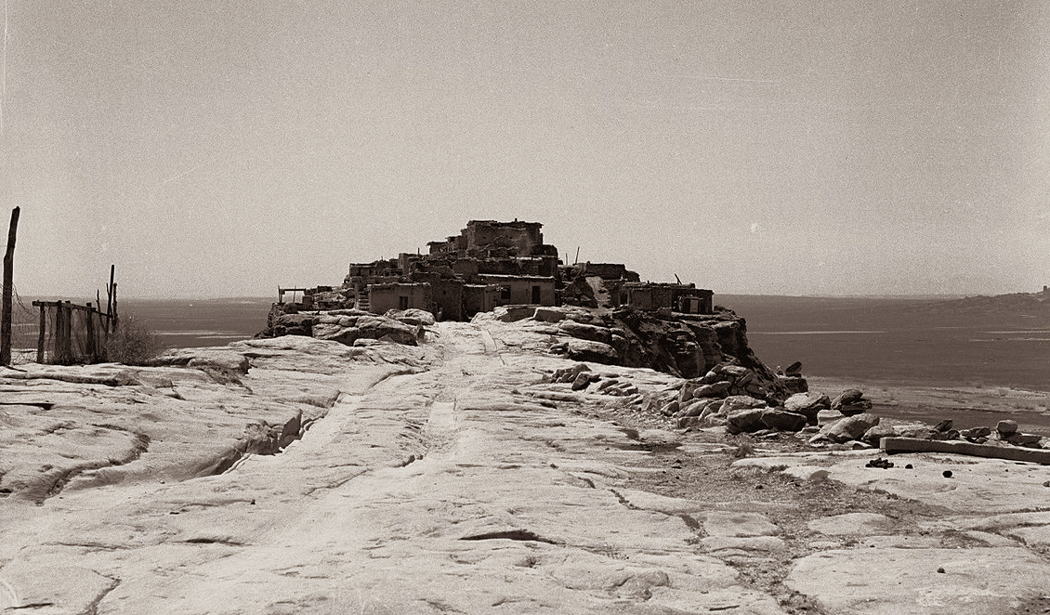
Walpi

Walpi

The best Christmas I ever had was the Christmas of four gifts.

It happened on the Hopi Reservation a few years ago, when my wife and I left Phoenix because we just couldn’t take another holiday season under the palm trees.

Like many who lived in the desert, Carole and I grew up elsewhere, where Christmas meant freezing weather and the possibility of snow. Santa rides a sleigh, after all. But in Phoenix, Santa wears sunglasses. It just doesn’t seem right.

Not that we thought we’d find a traditional Christmas among the Hopi. Their traditions are rather different. But we thought we could at least escape the TV beer ads littered with reindeer and find something new outside the city where the backyard Christmas barbecue passes for holiday cheer.

Maybe we couldn’t have our old traditions, but we could start new ones.

If the traffic and commotion of the city get on your nerves, no better tonic exists than a visit to the three great mesas of yellow-gray sandstone that rise like gigantic library lions from the vast plains of the Colorado Plateau. Atop them the Hopi have built most of their villages, all from the stone of the hills. crow mother

From the mesa-top the view is biblical: You can see for what seems forever. The San Francisco Peaks sit on the horizon, some 75 miles to the southwest, yet they seem so close you feel you can walk to them.

On that Christmas Day, the temperature was about 29 degrees and the sun was low and cold, poking through an intermittent overcast. We stopped at the base of First Mesa to get gas at the little store in Polacca. We also bought a few gifts — some coffee and sugar — to bring to the women on the mesa-top who give tours of the village.

When we got back in the car, we discovered the woman behind the counter had quietly dropped candy and fruit into the poke with our purchases.

That was the first gift.

WALKING INTO HISTORY

The highlight of a visit to the three villages atop First Mesa is a tour of Walpi. The Hopi have lived in the community on the prow of the mesa for at least 1,000 years and some of the stone homes seem to be almost that old.

You park your car in the middle village, Sichomovi, and find a tour guide in Ponsi Hall, the community center. From there, you walk out across the narrow stone causeway to Walpi. Our guide was a woman we had met on several previous visits to the area. She is a warm, generous woman who was free with her answers to our many questions. I will not embarrass her by printing her name. walpi homes
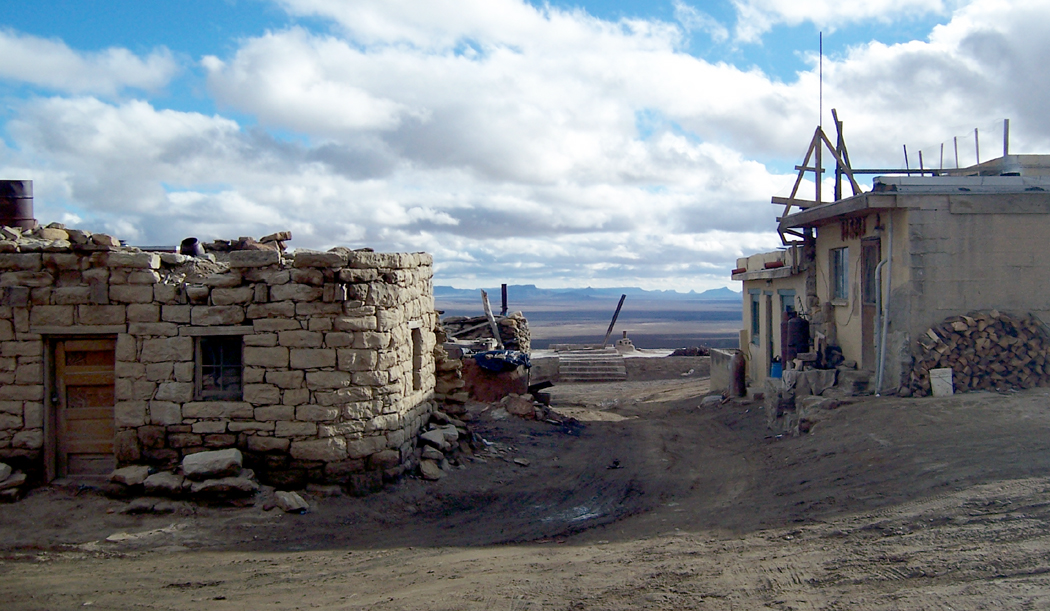
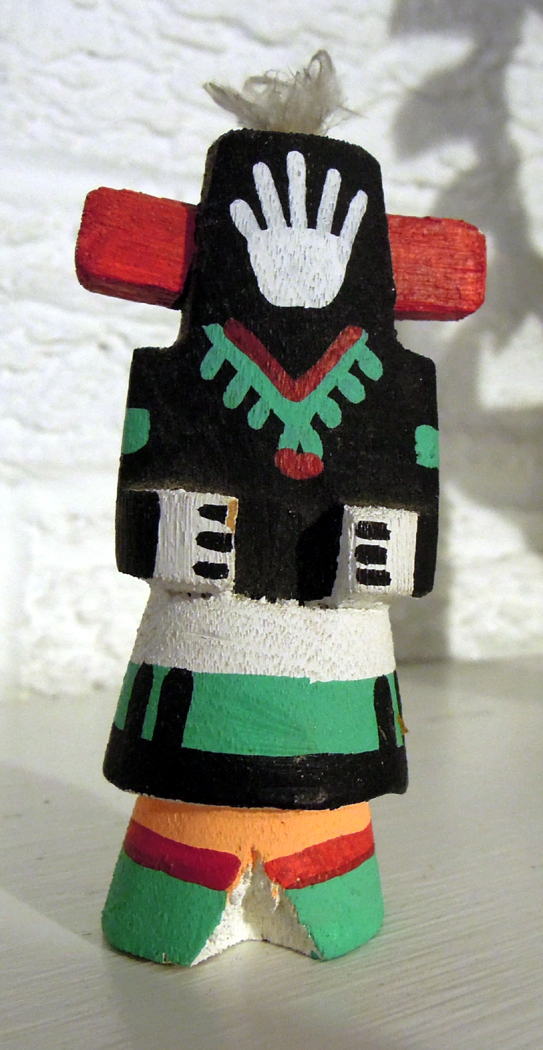
She showed us the ancient masonry, the village layout, the meaning of the kivas and their spindly ladders that protrude from the ground. She told us of the kachinas, of blue cornmeal and of pahoes , or prayer sticks, whose feathers danced in the breeze on the edge of the mesa.

She also told us of her life in San Diego and how after years away from the mesa, she felt drawn back to it. pot carrier
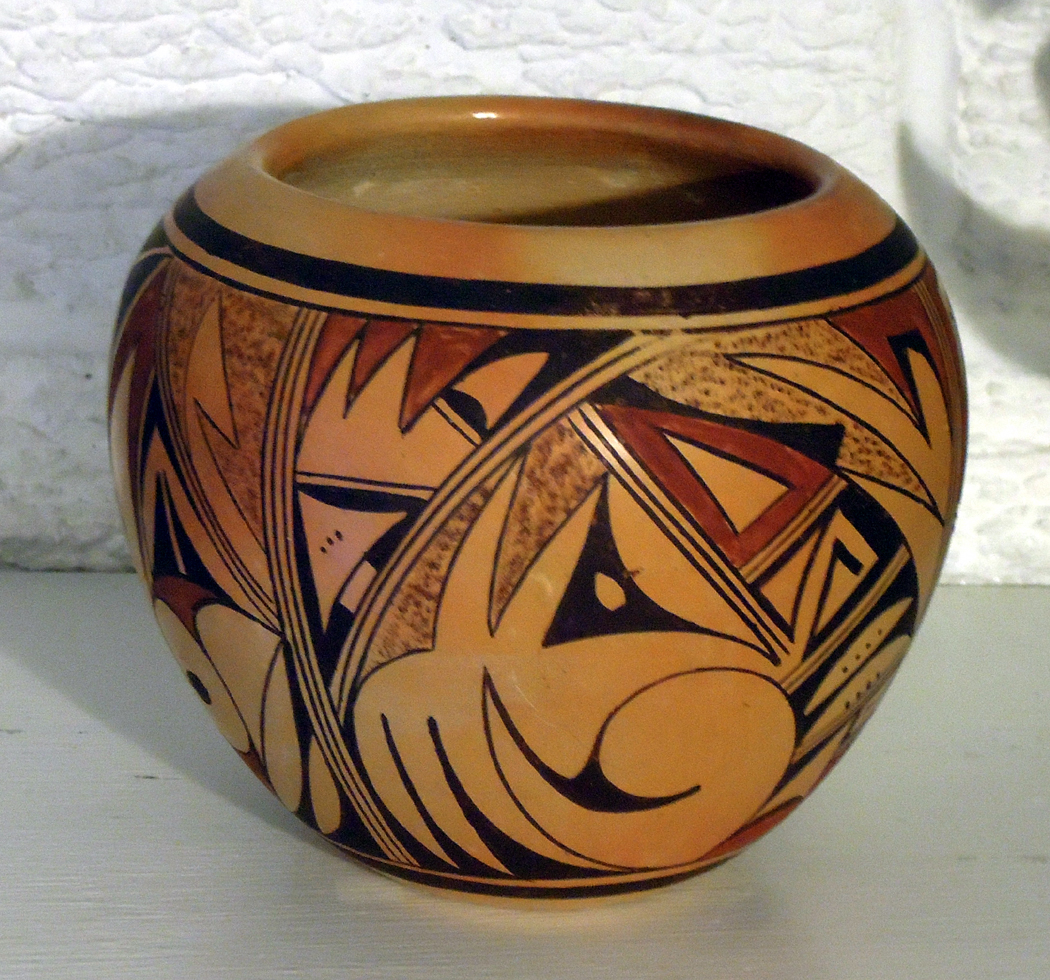
And she told us how, like many Hopi women of First Mesa, she makes pottery.

Unlike most, though, she doesn’t make bowls, but effigies of turtles.

”They are like the Hopi,” she said. ”They live a slow-paced life.”

At the highest point of Walpi we came to the home of her aunt, who is one of the better-known Hopi potters. The old woman and Carole hit it off perfectly. They seemed to speak the same language.

They talked for quite a while. At one point, Carole asked if she knew where we might buy some of the blue cornmeal we had seen all over the reservation, and the woman reached a brown paper bag down from a high shelf and gave it to Carole, with instructions for cooking Hu zru’ su ki , or fried blue-corn polenta.

And when we bought one of her bowls, she smiled and whispered something in Carole’s ear and sprinkled some corn pollen into the pot.

That was the second gift.

OFF THE USUAL TOUR

Then, on our swing around the north side of the mesa top, our guide stopped in front of one small, square building and invited us in. It was her home, and inside, her daughter was putting the final touches of frosting on a batch of Christmas cookies. Hopi pot 2
The small room, with its stone floor covered with small rugs, was a toasty 75 degrees, with a fire going in the woodstove and condensation beading on the icy window glass. The family was bustling around, with Uncle in the back room attaching some down to the end of a ”lightning stick” and two boys helping the daughter with the cookies the way youngsters always help — by eating them.

A narrow shelf ran around the top of the room, about a foot below the ceiling, holding a collection of kachina dolls, lightning sticks, a toy bow and arrow and pottery.

Our guide explained what they were and handed out cookies. They were angels, and they were the best Christmas cookies I’ve ever eaten.

That was the third gift.

So, it was Christmas Day in the gracious, generous Hopi home, spending the afternoon with the family of a woman we now consider a friend.

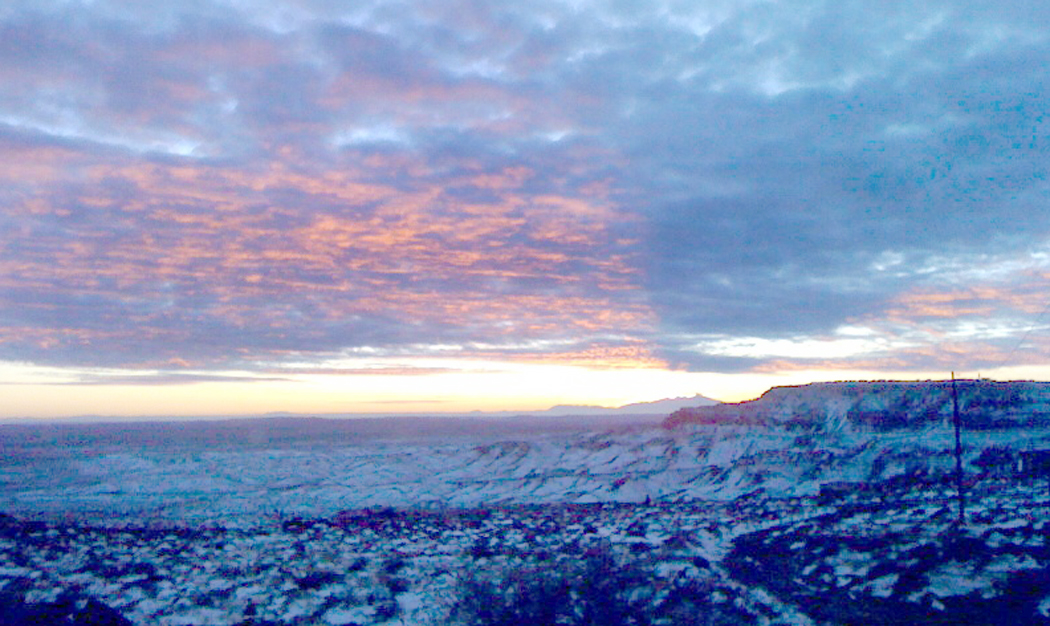
When we stepped back out into the cold to leave, snow was falling all over Hopiland.

And that was the fourth gift: the wonderful warmth of Christmas snow, dropping gently in large flakes, catching on our hair and coats.

So, I say on leaving the mesas in my best attempt at Hopi: Quo-Quai – Thank you.hopi snow
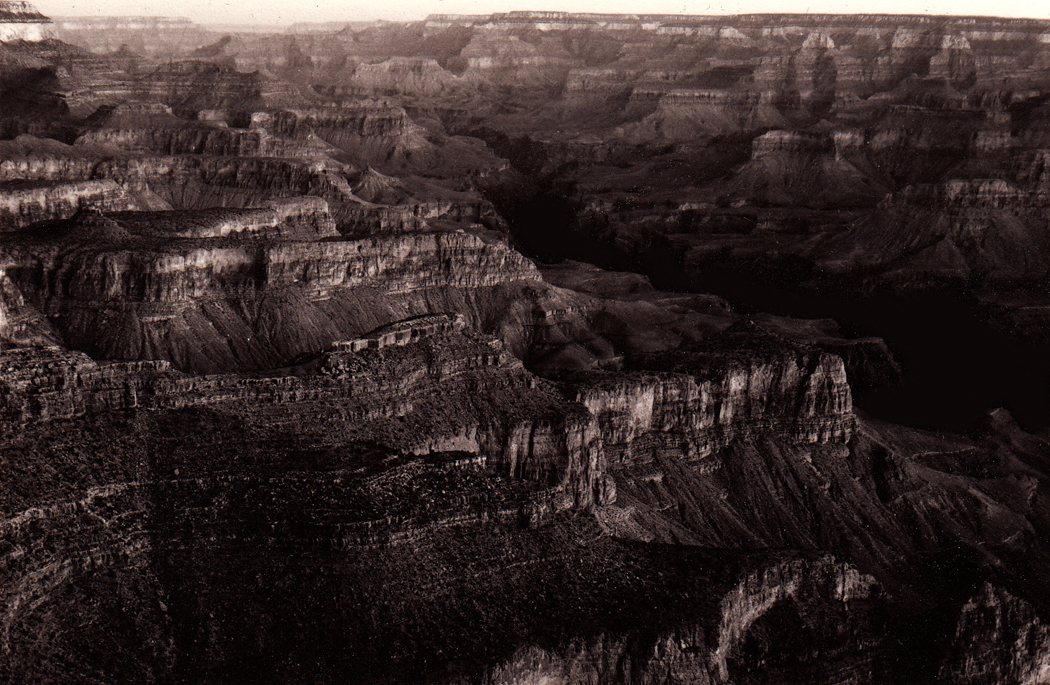
Dawn, Grand Canyon National Park

Dawn, Grand Canyon National Park

It’s nice to be reminded every once in a while that we live on a planet.

That we are lodged on a wet rock spinning in cold, black, empty space and hurtling through the void, down through time like water into a storm drain.

You are not likely to notice this while waiting at a red light downtown although sometimes waiting for the thing to change will get you a glimpse of eternity. Nor are you likely to notice it on the recliner, tuning in to American Idol. Or waiting for a table at the IHOP.

Consumer culture and all of our measly daily scratching conspires to hide from us the fact that the ground under our feet is really a large bolting asteroid.

But there are places you cannot avoid the sensation.

For me, driving long distances on the prairies of Saskatchewan or Alberta will do the trick. You watch the grain elevators rise up on the horizon in front of you like the sails on a clipper ship, and watch them lower down behind you after you pass: You know you are on a sphere and every direction falls off downhill around you.

You recognize it on an airplane, too, watching miles pass under your seat like so many inches, seeing at one time Lake Superior to your aft and Lake Michigan afore. You can take in a significant arc of the planet’s circumference at 30,000 feet.

But each of these epiphanies requires that you be traveling: the moving point on a geologic ordinate and abscissa.

If you want to have the planetary feeling without racing around the globe, you can get it standing still in Arizona: with your feet planted at the edge of the Grand Canyon. In that case, you stand stock-still and let the planet do the moving.

The first time I saw sunrise at the Grand Canyon, my wife and I were camping on the North Rim outside the National Park. We had arrived with the naive assumption we could wander in late in the afternoon and get a room at the lodge. Or failing that, we could get a slot at the campgrounds.

The desk clerk took pity on us and explained that although they were completely booked, lodge and campground, for the foreseeable future, we could find a dirt road just outside the park that would take us to a place in the National Forest where people often camped.

It was dark by the time we got to that road, and when we turned into an open place where two or three other tents were set up, it was already night.

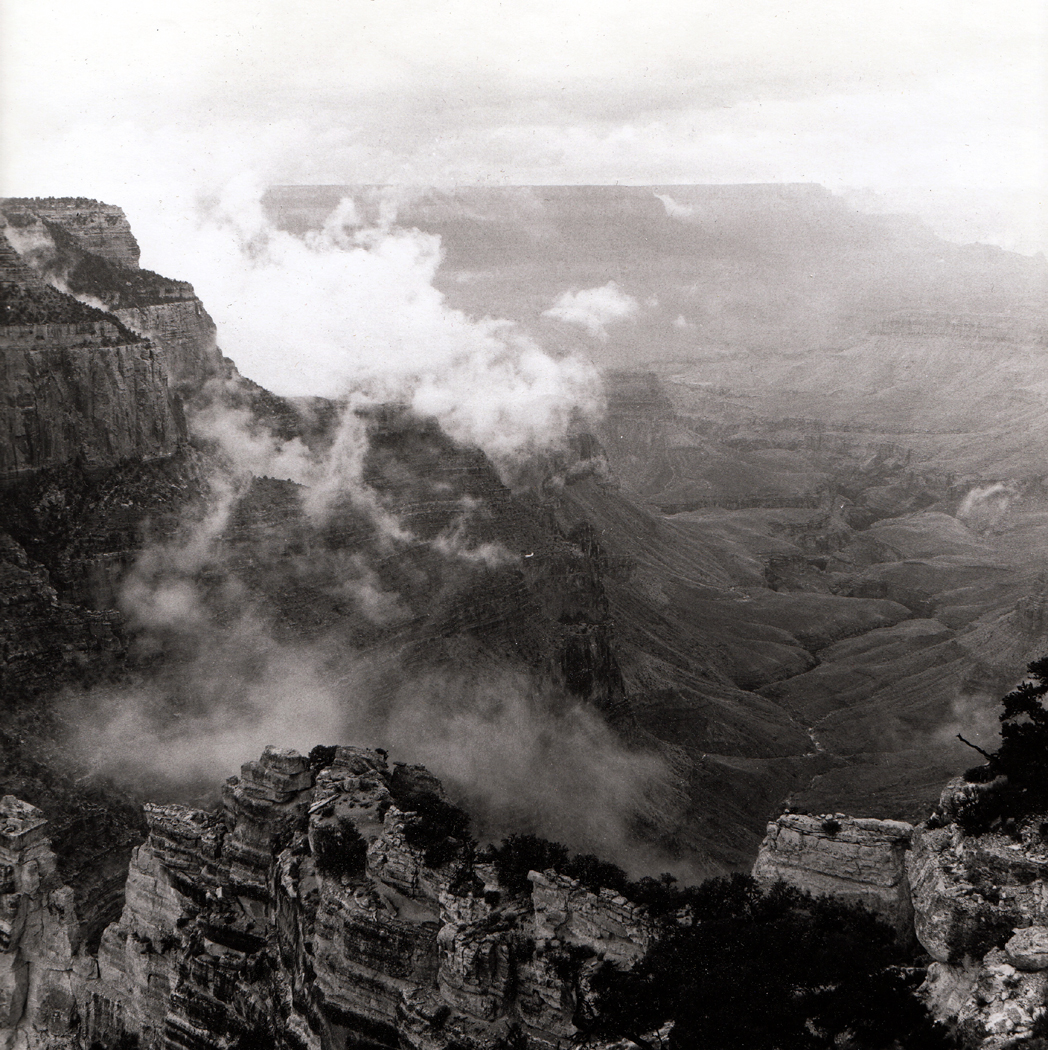
North Rim, Grand Canyon

North Rim, Grand Canyon

We slept, we dreamed, and we woke before sunrise, when the earliest glow floated in through our tent flap. And when we got out to stretch and start up the camp stove, we gasped: We were about 15 feet from the rim of the canyon. It dropped out of sight below us.

If we had pulled forward just a little farther the night before in the blackness, it would have been Thelma-and-Louise time for us. We were hard on the edge.

But more impressive, the humid late-July weather had left the entire canyon as a gigantic dish of cotton. The clouds filled in the canyon-hollow like apples in a fruit bowl. A 215-mile long fruit bowl.

The mists swirled and wisped below us, over precipices and down canyonlets, in constant motion, rising and subsiding as the new-hatched sun warmed patches of the air the mist rode upon and the breezes wafted the veils.

The Classical writer, Longinus, said that we enjoy the day-to-day things of our lives, but when it comes to awe, we get that only from the sublime. Hearth fires, he said, were nice, but erupting volcanoes make us consider a planet and cosmos larger than we are and well beyond our control. The sublime is beautiful, but it is also scary: It is the source of religious feeling.

You cannot avoid that at the Grand Canyon, with its stony layers of eons piled upon each other. The Canyon is a great wound in the Earth into which we can look and see its organs pulsating at a rate so slow as to make all of human history a mere blip on its EKG.

Sunrise is always a magic time. For me, all the more magic for how seldom I see it, being a night person and late-riser during every time of the year except vacation. Familiarity has not had a chance to dull the morning’s effect for me: Every dawn I witness is a rebirth.

The following summer, we came to the Canyon again, to the South Rim. We camped outside the park once more, and got up at 3 in the morning to drive to the rim to see the whole process of sunrise.

Even in July, it was cold in the dark. We parked at Lipan Point, where we would be able to see northeast into the canyon, where the sun should pop up. With a flashlight, I set up my 4X5 camera, with its bellows and tripod, and pointed it down into the blackness below.

By 4 a.m., the glow on the horizon widened into a band of dull brightness. I managed to focus the camera on the now-visible horizon line, and then pointed it back down into the ink.

A minivan pulled into the turnout and a few people got out, looked around at the black hole, and deciding there was nothing to see, got back in and drove off.

I moved the camera over the restraining fence and out onto a rocky knob with an unhindered view. My wife fretted I might slip off the cliff and down into the hard centuries of geology below: A very physical way to meet eternity.

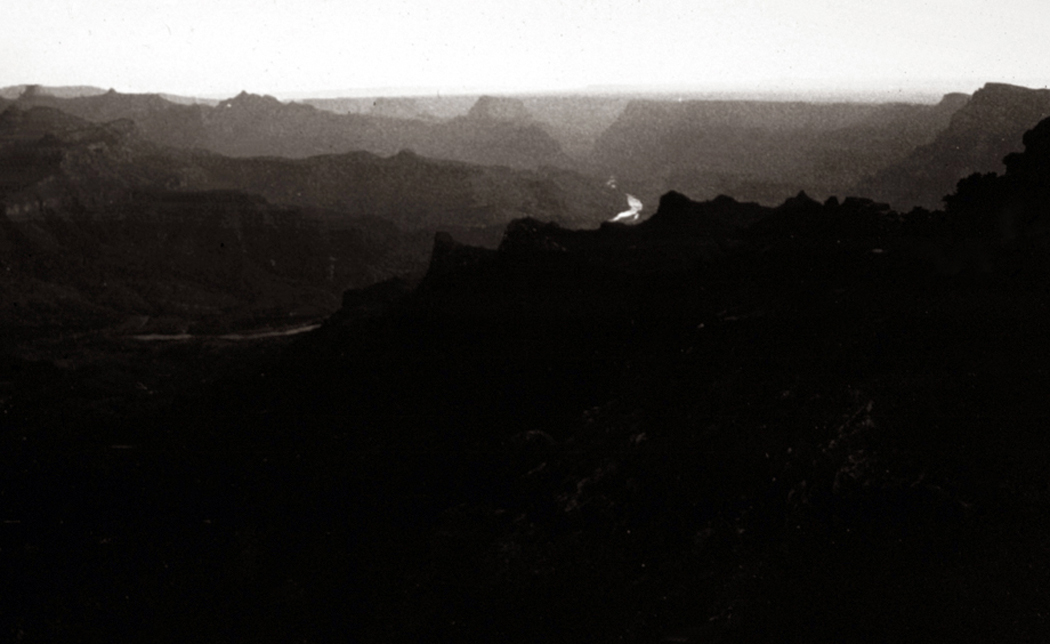
By the time I got the camera set, the glow from the horizon had made the rock below us seem less like the river Styx and more like a darkened charcoal drawing. It was beginning to take on detail. I made an exposure of five minutes or so, to try to get some of the charcoal registered on my film. Dawn, Grand Canyon with river

The river below us began to reflect the lightening sky and became a glowing white streak in the sooty rock. It pointed in one direction northeast directly at the place the sun would arise, in the other direction, it curved around the coal-colored cliffs and disappeared.

The moment the sun broke the horizon, though, was the moment we realized we were sitting on a spinning round rock: The effect is unsettling and eerie.

I’ve had this happen a few rare times in my life. When the sun is still in contact with the horizon, its motion is quite noticeable. You can actually see it move.

But at that moment, the sun stopped moving, just as if Joshua had commanded it. And as the sun stopped, the Earth like a giant machine, whirring its gears began rotating forward in front of us, lurching from under our feet. An earthquake wouldn’t have felt more tactile.

It was as if we were coming over the top of some giant Ferris wheel. The still sun made our motion all the more apparent. It was Einstein in action: relativity made palpable. A shift in frame of reference.

The rock we were reeling on, trying to keep our balance, was pulling forward toward the sunrise.

”Whew! What was that?”

It didn’t take long, though, after the disc of the sun broke free from the horizon, all that motion ceased. The common light of day had re-inaned the world. We would eat breakfast, talk about baseball, read the newspaper all the quotidian fuss of our lives and rejoin the society where the search for a good five-cent cigar seems important.

A friend was telling me once about the trouble he has been having with his insurance company. He had run into a bureaucratic Catch-22 in which he needed an official letter before the insurance would take effect, but couldn’t get the letter until the insurance was working.

”Sometimes, I don’t know how the world keeps turning,” he said.

As we fight rush-hour traffic, heat up our Pop Tarts, pay our bills, worry if our taxes will devour our raise or if Congress will ever become more than monkeys squabbling over a banana;

As we worry if our daughters will safely negotiate the pitfalls of adolescence, if the rebuilt transmission can last another 30,000 miles, and we put a few more dollars into an IRA;

As we submerge ourselves once again into the inclarity of what we call our lives, it’s good to remember that there is something larger out there, with a wider frame of reference.

We need to be reminded every once in a while that we live on a planet.

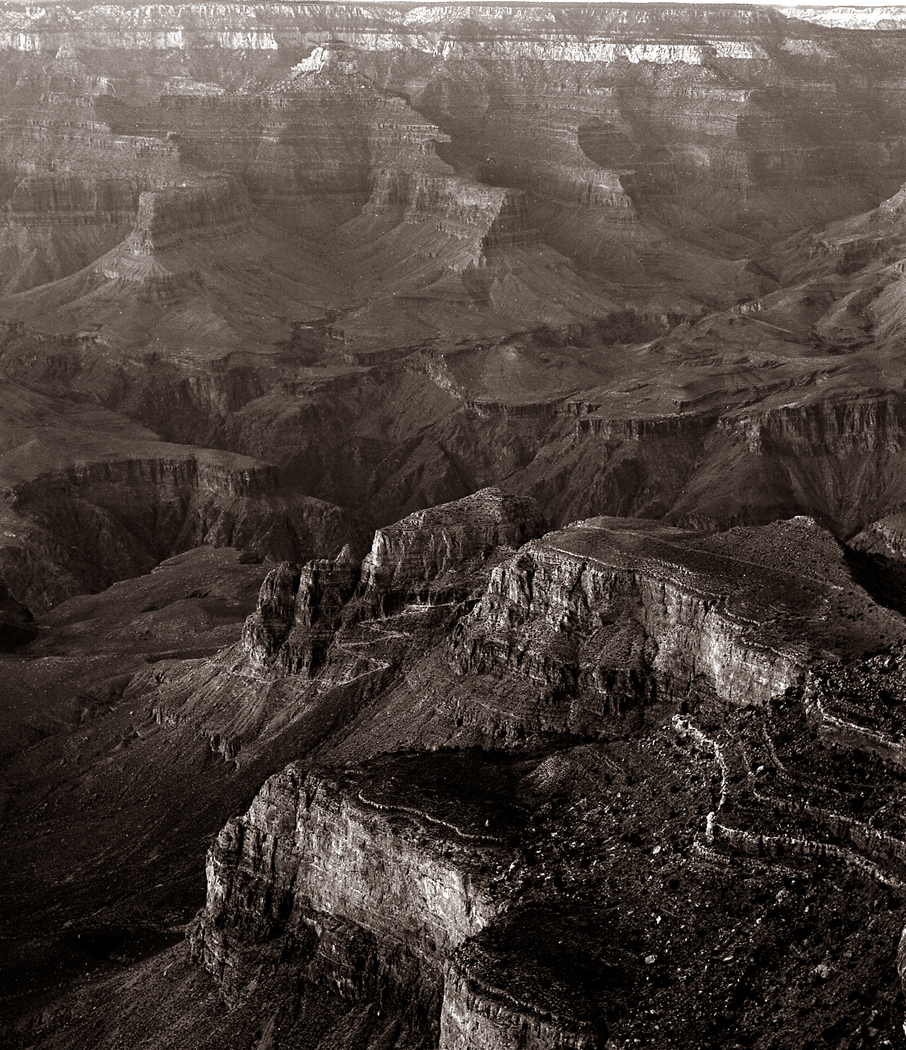
Dawn, Grand Canyon

Dawn, Grand Canyon

When my wife and I were first married, we lived on the Atlantic Ocean, facing east. It was the direction we knew best: We both were born and raised on the East Coast, and although we sometimes migrated north and south, we had never been to the West.

So, as a kind of honeymoon, several years after the fact, we decided to spend one summer driving west to see the West.

The question became something of a joke on that trip: Where does the West begin?

When the country was young, the Western frontier was the Appalachian Mountains. It took people like Daniel Boone to blaze trails over the ridges into the new, green country beyond. We drove across those mountains the first day. It didn’t feel any more like the West than New Jersey.

The first real milestone was the bridge over the Mississippi River. In some ways, it is still the unofficial boundary between the nation’s East and West. We looked at each other as we drove with smiles of excitement; we were finally in the West.

Yet, the West turned out to be Arkansas and it didn’t look any different from Tennessee on the other side of the river.

We could convince ourselves that Arkansas really was the West; it was where “Hangin’ Judge” Isaac Parker held his court, it was where Jesse James robbed trains. Yet, a look out the window told us it wasn’t really true. We hadn’t reached the West yet.

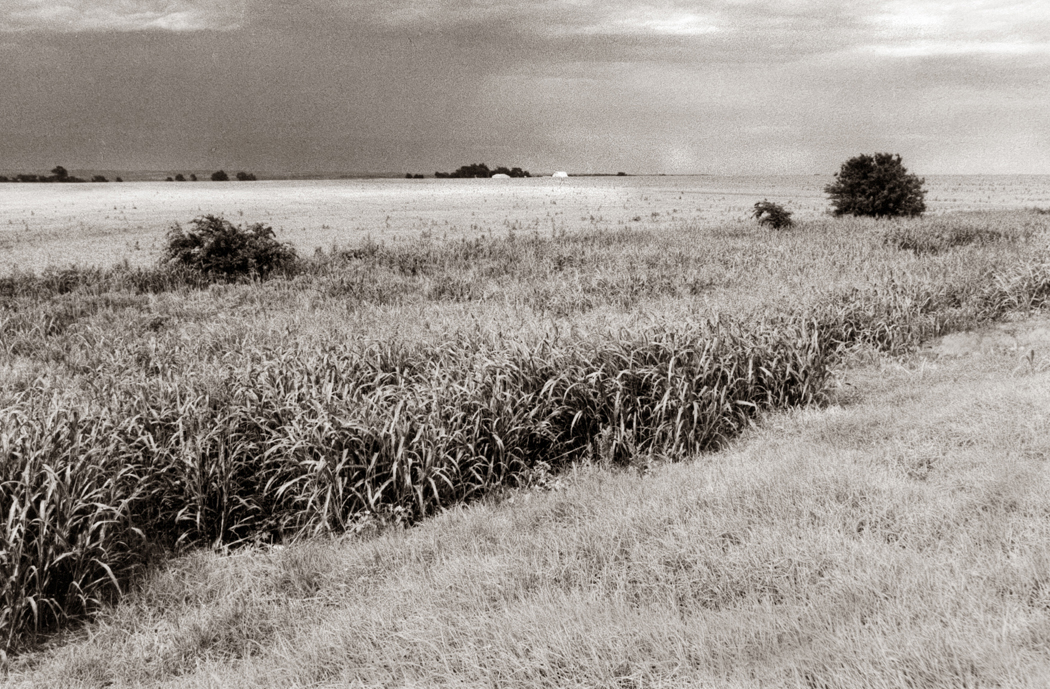
Thunderstorm, Hydro, Oklahoma

Thunderstorm, Hydro, Oklahoma

Surely, then, Texas was the West. As we cruised through on Interstate 40, though, it was a nondescript, flat, boring land. The Texas Panhandle might be technically in the West, but it wasn’t the West of the Randolph Scott movies we knew when we were young. Where were the canyons? Where were the cactus and the Indians? Even the people sounded more Southern than Western.

The first moment we really felt as if we hit the West was the Texas-New Mexico line, when the Interstate suddenly comes down off the high plains and into the eroded country of the Canadian River bottom. We saw, for the first time in our lives, mesas and buttes, red rock under smooth blue sky.

We sat bouncing up and down in our car seats for the excitement. It was like seeing the moon for the first time, it was so alien, so fresh, so different from anything we had ever known.

But were we yet in the West? The question may seem silly, but all the rain that hit the dry ground would eventually aim to drain into the Atlantic Ocean. The Canadian River dumps into the Arkansas River, into the Mississippi and into the Gulf of Mexico.

So our next goal was the Continental Divide, which we crossed near Thoreau, N.M., camping the night at Blue Water Lake.

Yet even the next day, driving across Arizona, we knew that for most of the pioneers who crossed this country a century and a half ago, the desert was just one more obstacle on the way to California. In some sense, this still wasn’t the West.

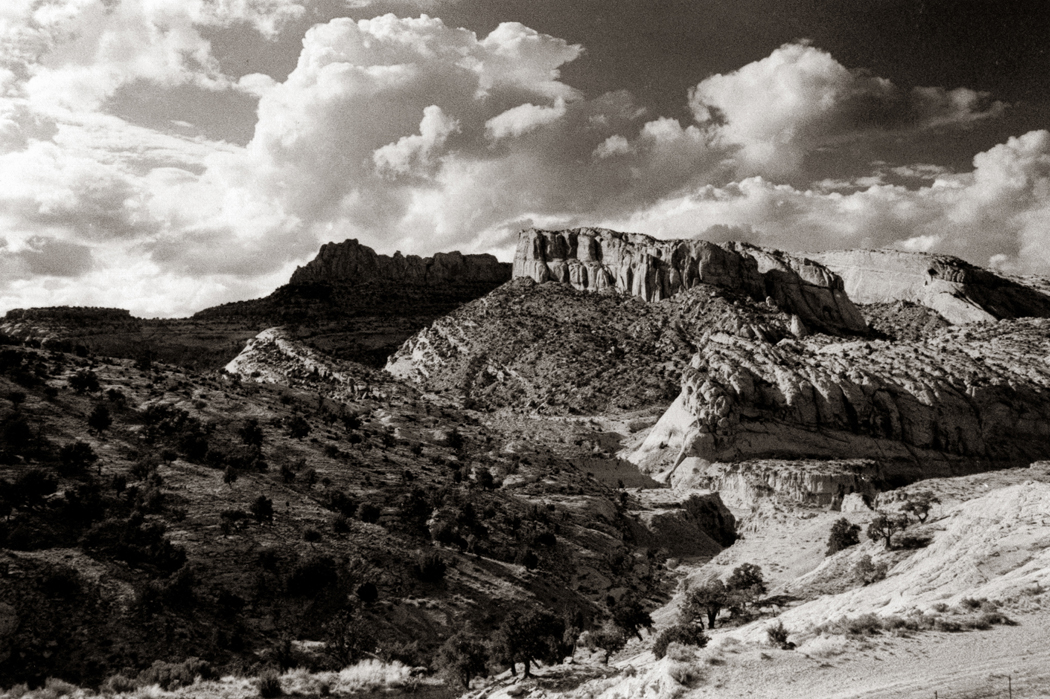
Tsegi Canyon, Navajo Reservation, Arizona

Tsegi Canyon, Navajo Reservation, Arizona

And when we finally got to the coast, we got out of the car and stood on a cliffside among the tall, drying cow parsnip and looked out over the Pacific Ocean, feeling like stout Balboa with wild surmise, silent, upon a peak in Darien. There could be no question but that we had reached the West.

Olympic Coast, Washington

Olympic Coast, Washington

But looking out over the blue sea, we knew there was yet somewhere further. Beyond was Hawaii, Japan, China, Tibet, India, Iran, North Africa — and that eventually, the westward search would lead us back to Virginia — where we began — and we would see it again as if for the first time.

And we recognized that the West isn’t a place you can ever really reach, but a destination beyond the horizon, or conversely, that every point on the planet is the West to somewhere else, and when you can see that, you can recognize the even the familiar ground on which you stand as electric with the same excitement you feel when you leave it.

For all points on the planet are its still center and that all real travel takes place not on the ground, but in the heart and mind.

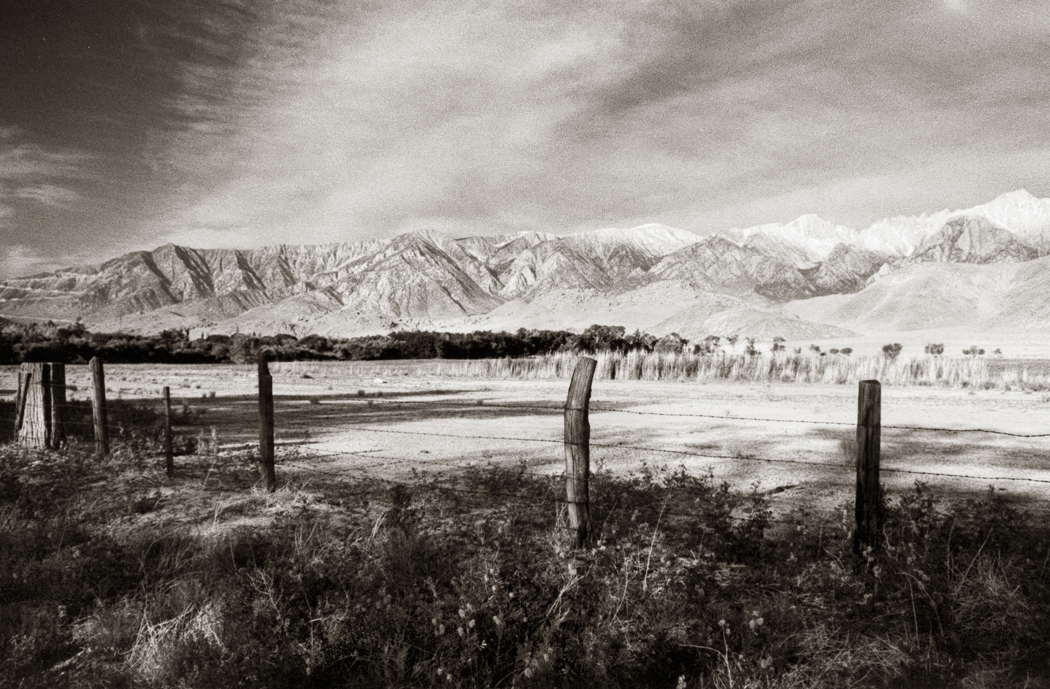
Sierra Nevada, Lone Pine, California

Sierra Nevada, Lone Pine, California