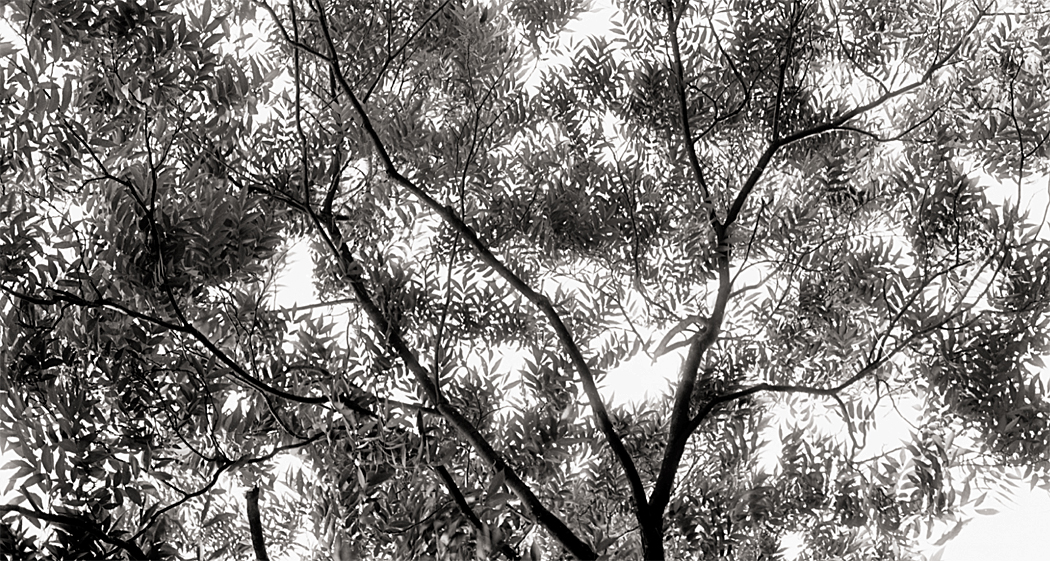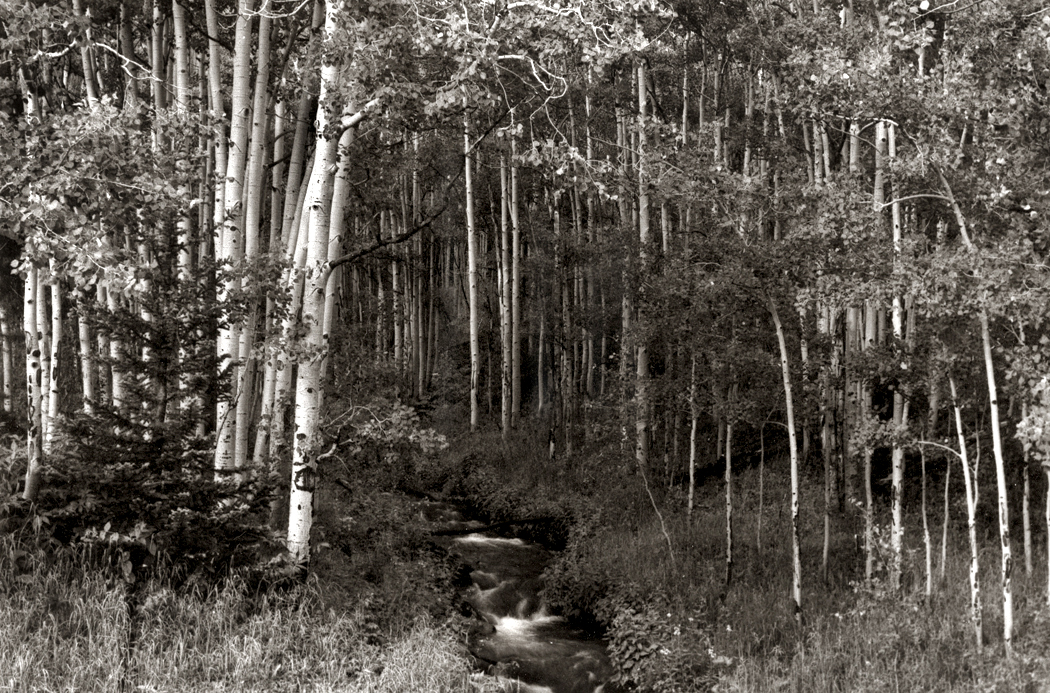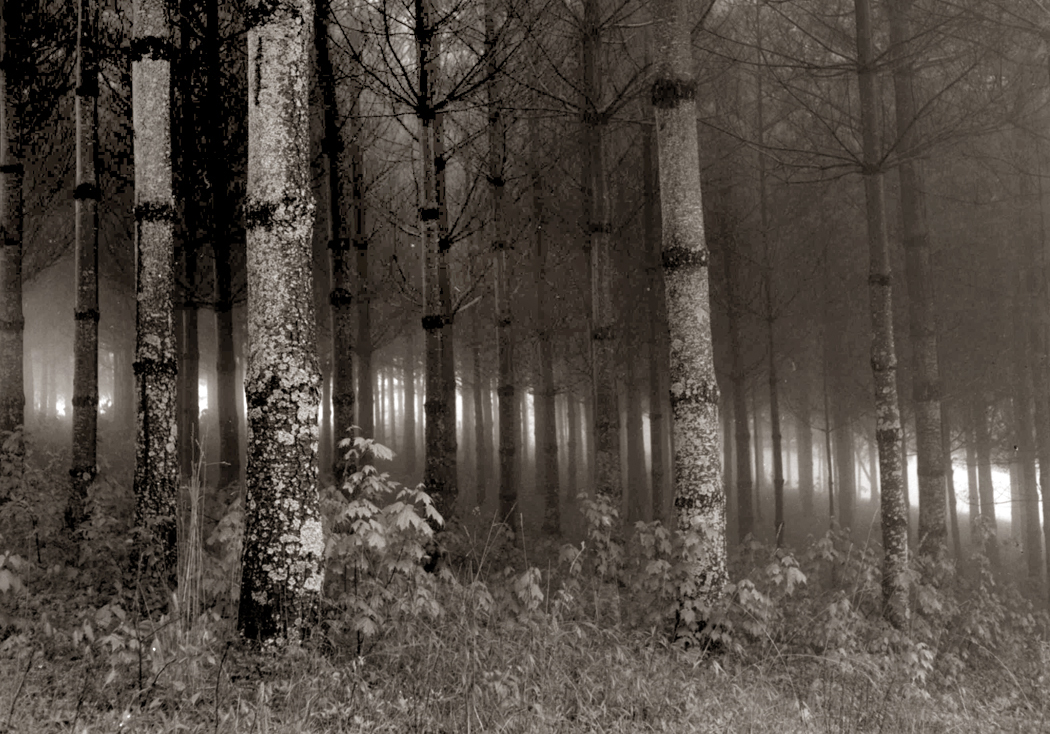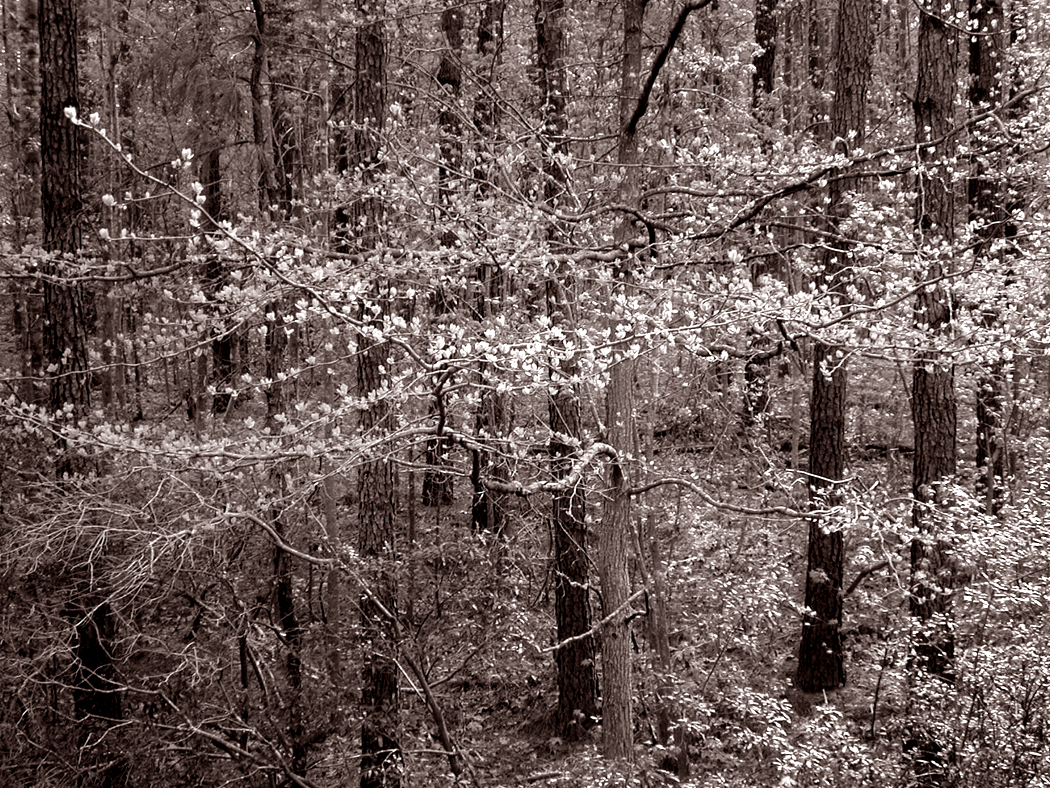
Archive

Tag Archives: art

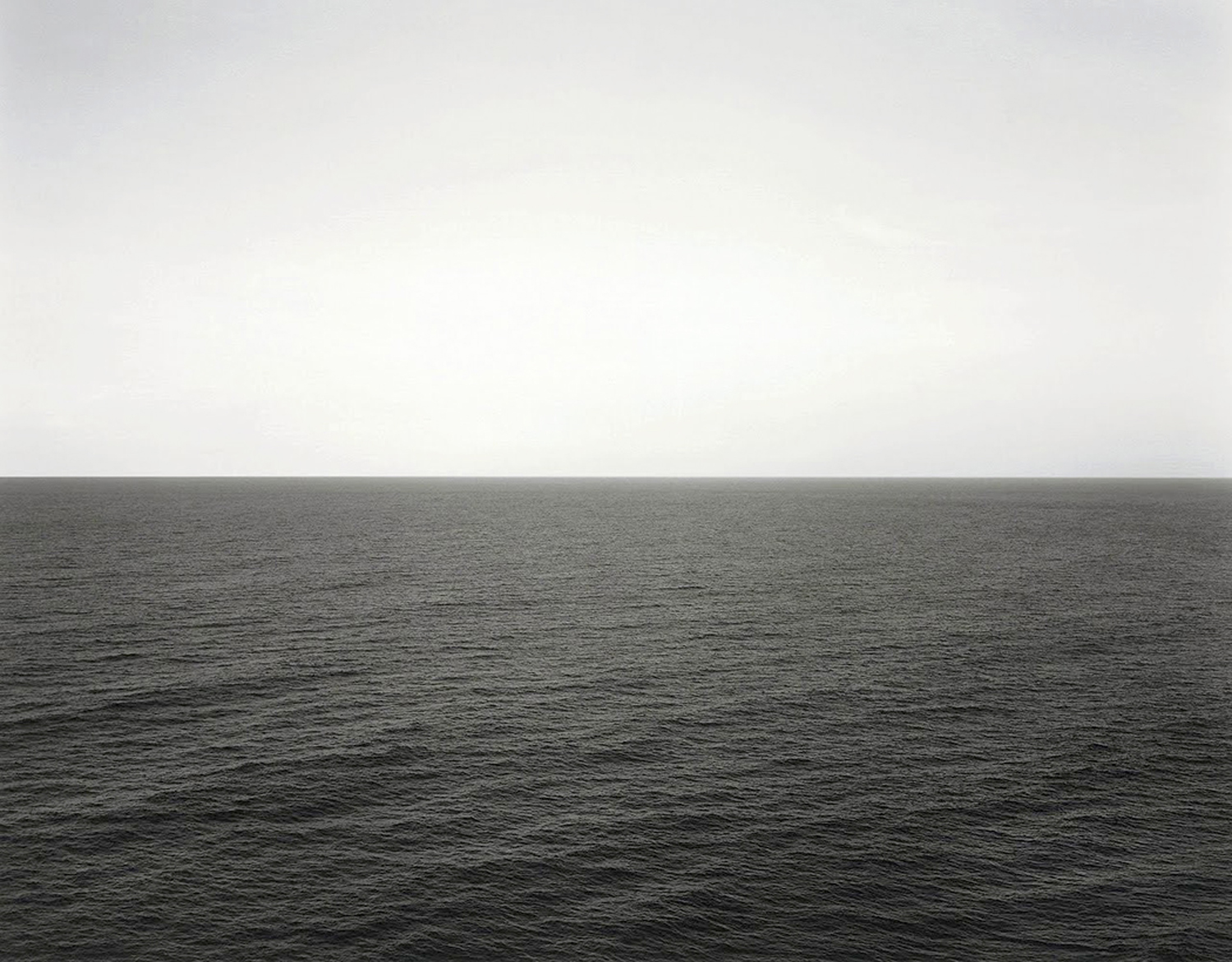
Many years ago, when I was still teaching photography in Virginia, I visited an art show that bothered me. In the gallery were a series of large black-and-white seascape photographs by Hiroshi Sugimoto. Each was about 3-feet square and each was divided exactly in half by the horizon line. 
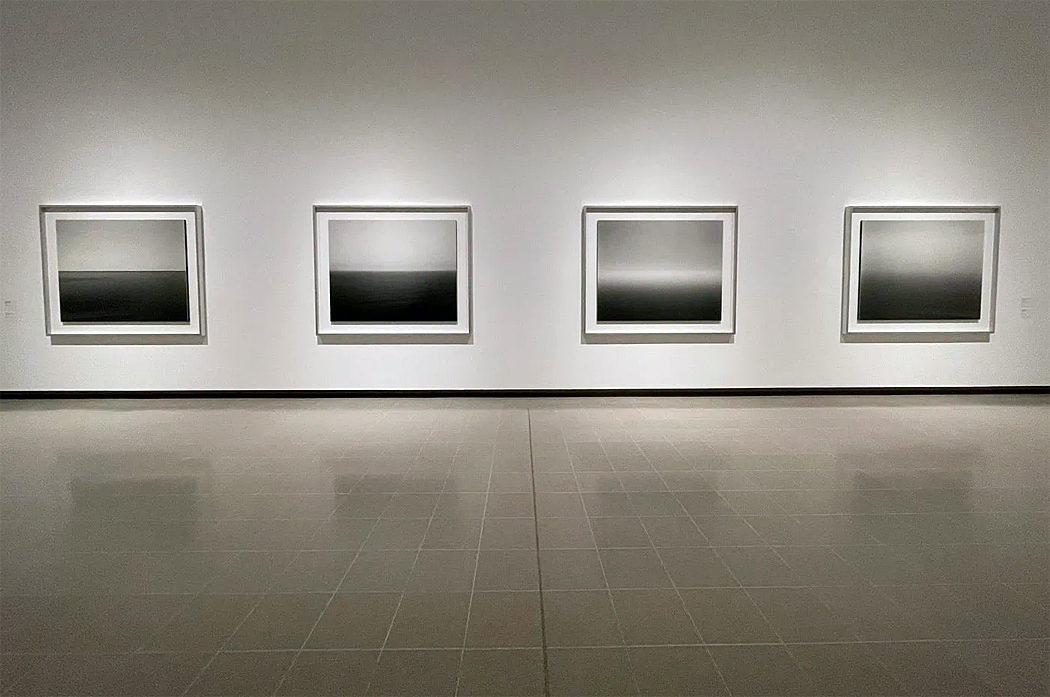
Sugimoto, who is exactly my age, is a Japanese architect and artist who created a project of making pictures of various seas, oceans and great lakes, at different times of year and different times of day and different weathers. But every one was the same size and with the top and bottom divided in half, sky and water. 
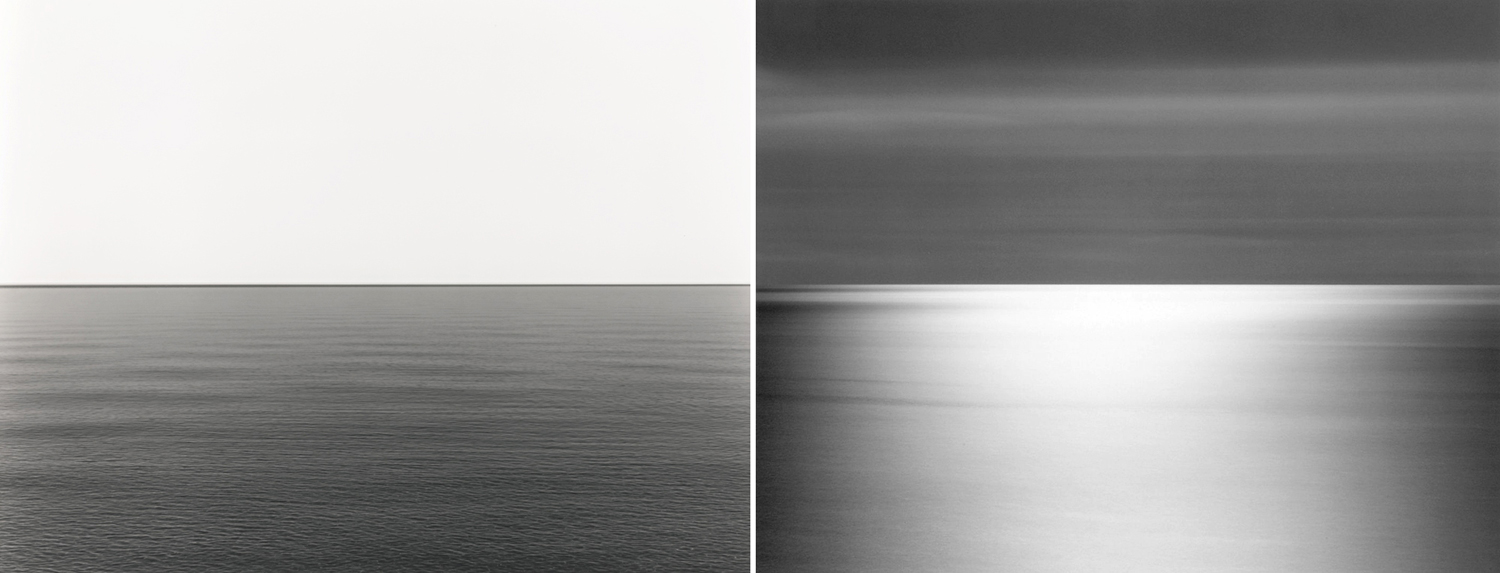
What bothered me, initially, was the featurelessness of the images. The seas were generally calm and the skies usually cloudless. 

At the time, in my class, I was trying to get ordinary students to make better pictures. Most of the students had no ambition to show in galleries, but rather had wanted to be able to make better family snapshots, or to improve as hobbyists and learn darkroom techniques. And so, I taught such normal things as making sure their images had a center of interest — a person or a dog, placed foreground against a background. If they wanted to make a landscape, to include some center of attention and not just make a dull grab-all of the scene. 

These were not “rules,” but ways to get beginners to improve. First steps, as it were.
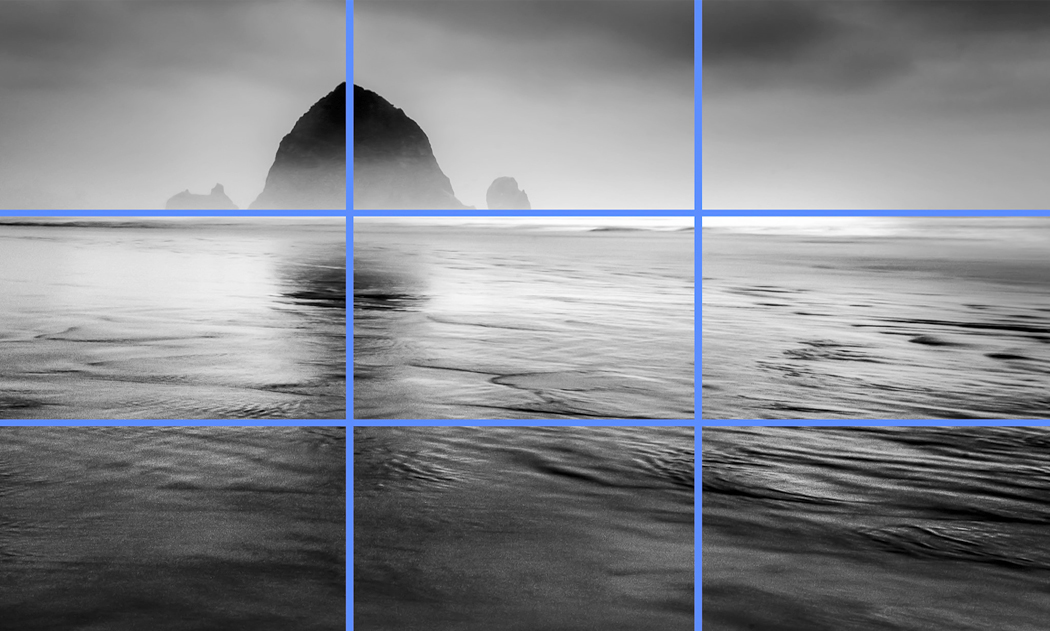
And I taught the ubiquitous “rule of thirds,” in which you help the design of a photograph by placing things a third of the way from the bottom or top, or a third of the way in from the sides of the picture. Or, also, to place your horizon line a third of the way from the bottom or two-thirds up from the bottom. And never, ever, put your horizon through the center of the image. The center is the most boring and static place in the frame. 

(Of course, no accomplished photographer pays any attention to these notions, but I was helping beginners up their games and making their pictures marginally more interesting.) 
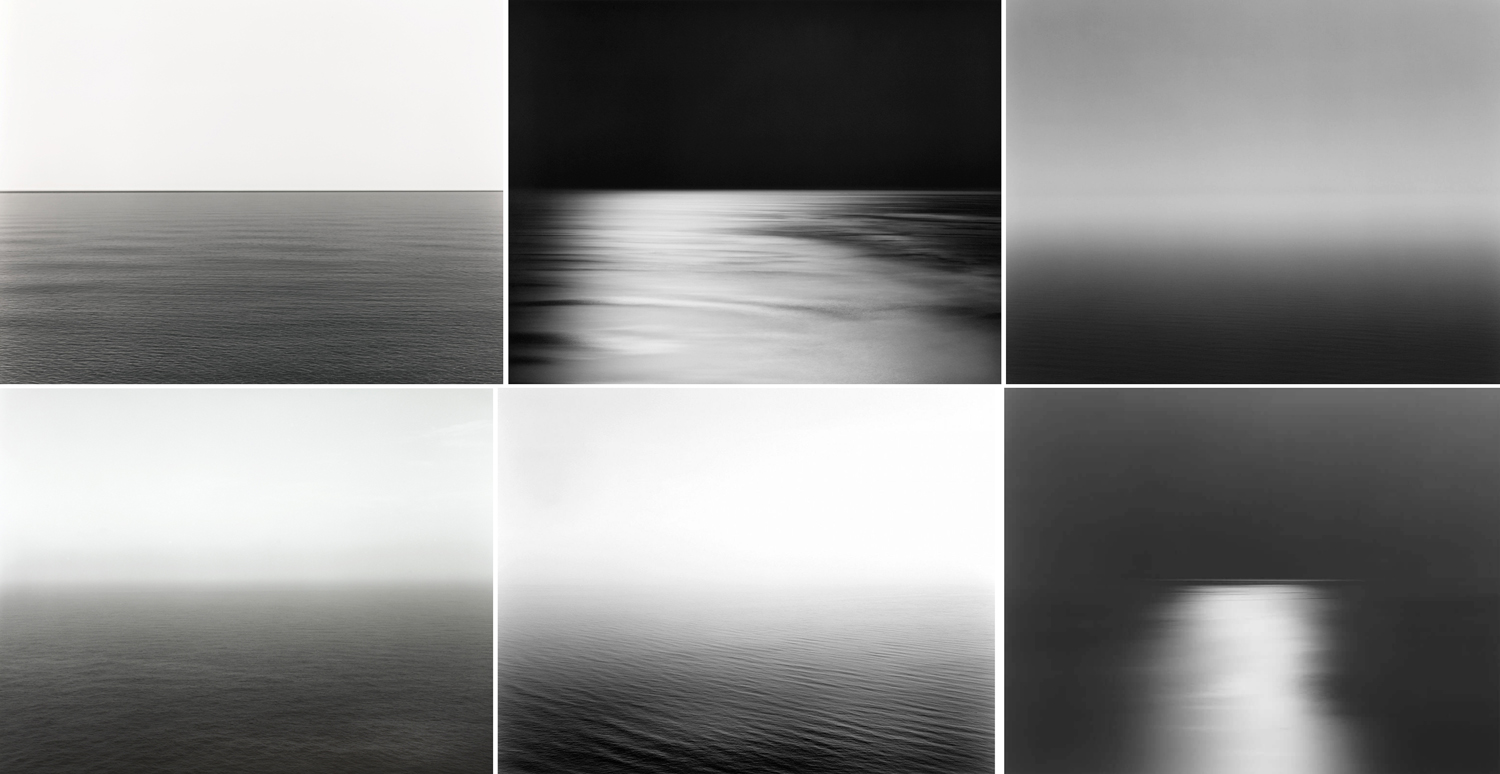
But here were Sugimoto’s seascapes, centered and otherwise featureless. It bothered me for a long time — enough so that decades later, I can remember that show, burned in my memory, when so many others that I went to in so many galleries, have faded into time and oblivion. 

I was aware that if the images stuck in my craw and couldn’t be dislodged, there must have been something to what Sugimoto was doing. I have thought long and hard on the subject. And I came to the conclusion that their very inexplicability, tied with the elemental themes of nature and the vast oceans, gave them their power. That, in fact, they were a projection of the sublime. 

The sublime is a subset of esthetics, a particular experience of the beautiful, set in distinction to what is attractive and pleasing, by showing what is immense, often frightening, and which gives the viewer a palpable sense of his own unimportance in a vast and radiant universe. 
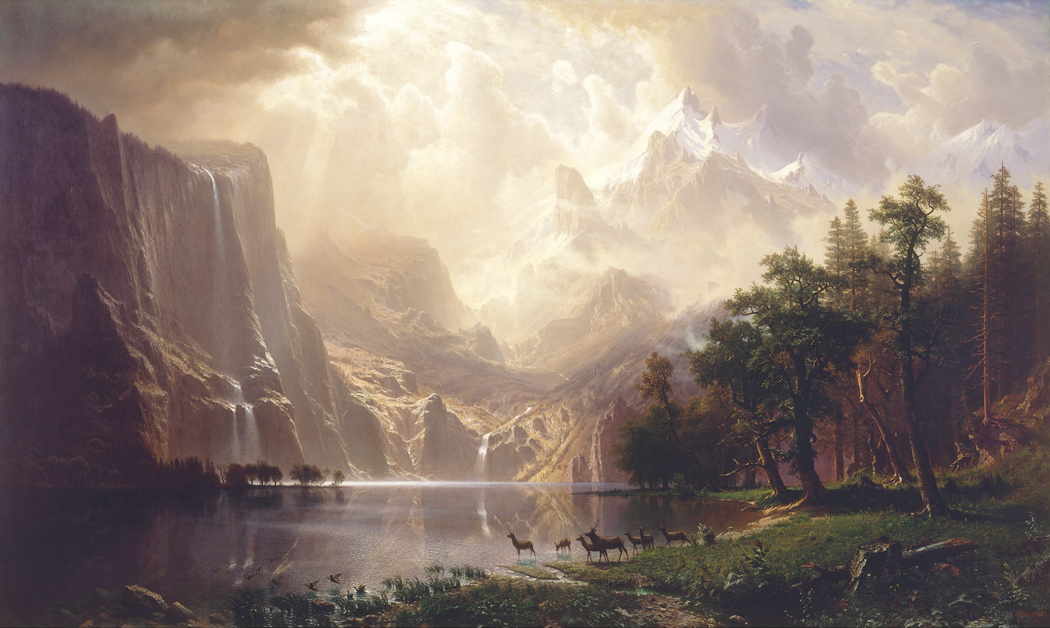
“Among the Sierra Nevadas” Albert Bierstadt 1868

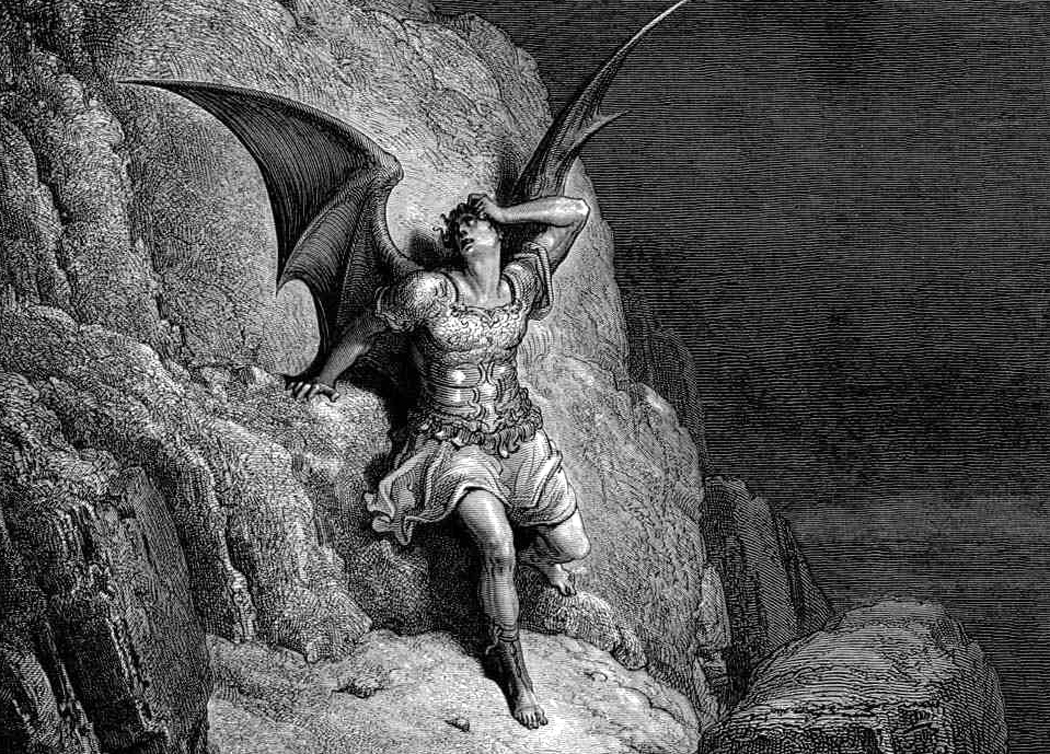
It was a popular theme in 19th century art, with landscapes of the mountains of the American wilderness, or, in England, of vast biblical scenes, or or battles or storms. You have Jacob Mallord William Turner painting disasters at sea, John Martin showing the apocalypse in giant canvases, Gustave Dore engraving images of Dante’s hell and Satan’s flight through chaos.
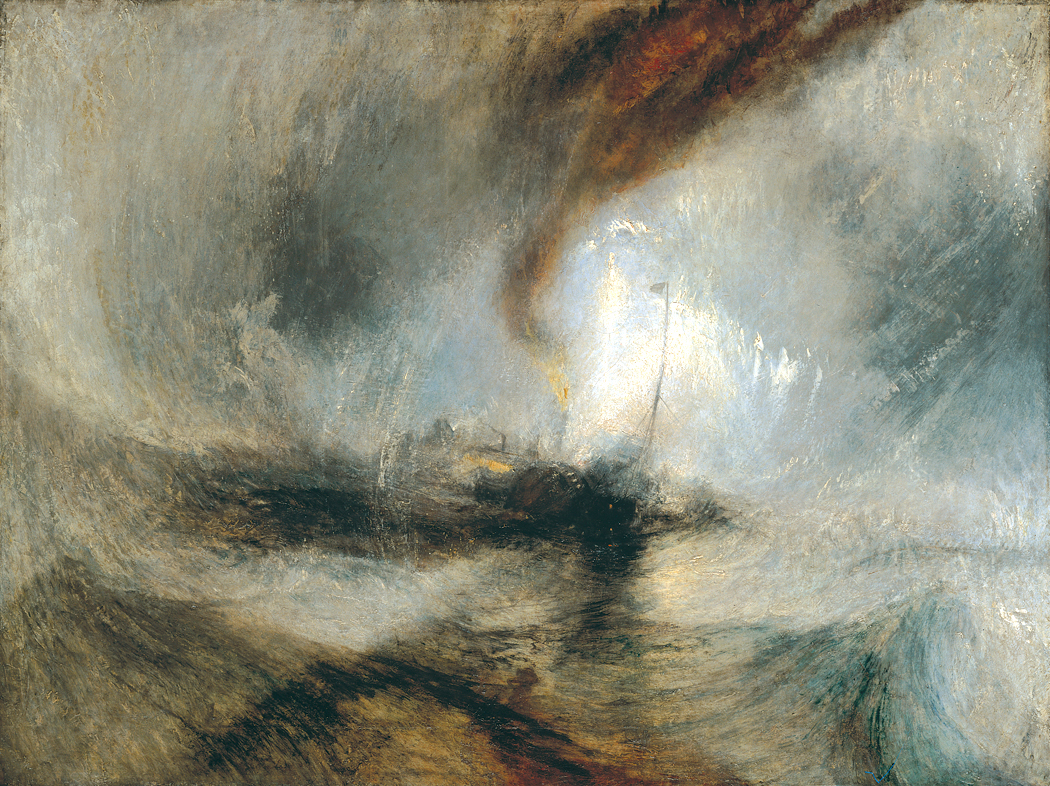
“Snow Storm at Sea” JMW Turner 1842

You have poets describing limitless scenes of the Alps or the Arctic. Mary Shelley’s Frankenstein ends in such a scene, with a ship stranded in the Arctic ice and the monster choosing white oblivion over life. The ship’s captain writes in his log: “We are still surrounded by mountains of ice, still in imminent danger of being crushed in their conflict. The cold is excessive, and many of my unfortunate comrades have already found a grave amidst this scene of desolation.”

Nature could be pretty. It could be daffodils. But it could be overpowering, desolate, dangerous. As in Percy Shelley’s Mont Blanc: “In the wild woods, among the mountains lone,/ Where waterfalls around it leap for ever,/ Where woods and winds contend, and a vast river/ Over its rocks ceaselessly bursts and raves.”
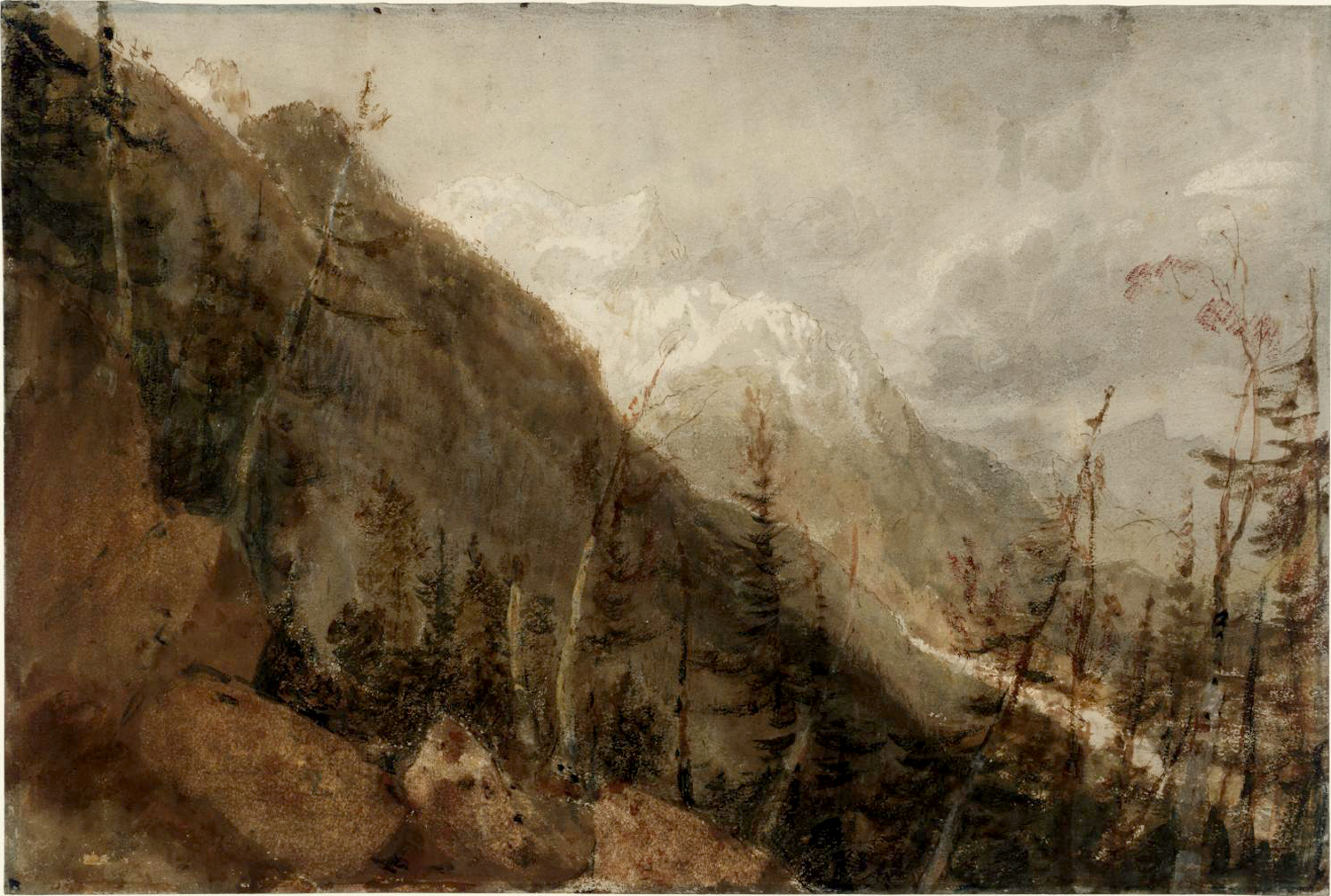
“Chamonix: Mont Blanc and the Arve Valley from the Path to the Montenvers” JMW Turner 1802

Hardly a better example could be found than Sam Coleridge’s Kublai Khan: “But oh! that deep romantic chasm which slanted/ Down the green hill athwart a cedarn cover!/ A savage place! as holy and enchanted/ As e’er beneath a waning moon was haunted/ By woman wailing for her demon-lover!”

In Byron’s Childe Harold’s Pilgrimage: “Roll on, thou deep and dark blue Ocean — roll!”

It’s all over the place in English Romantic poetry — “Tyger Tyger, burning bright,/ In the forests of the night” or later, in the works of Americans such as Walt Whitman (“Out of the cradle endlessly rocking”) or Emily Dickenson. 

British poet Samuel Taylor Coleridge describes the sublime in his 1818 lecture on “European Literature” by recalling: “My whole being expands into the infinite; earth and air, nature and art, all swell up into eternity, and the only sensible expression left is, ‘that I am nothing!’ which concludes that his ultimate realization of the sublime was of his own human insignificance.” 
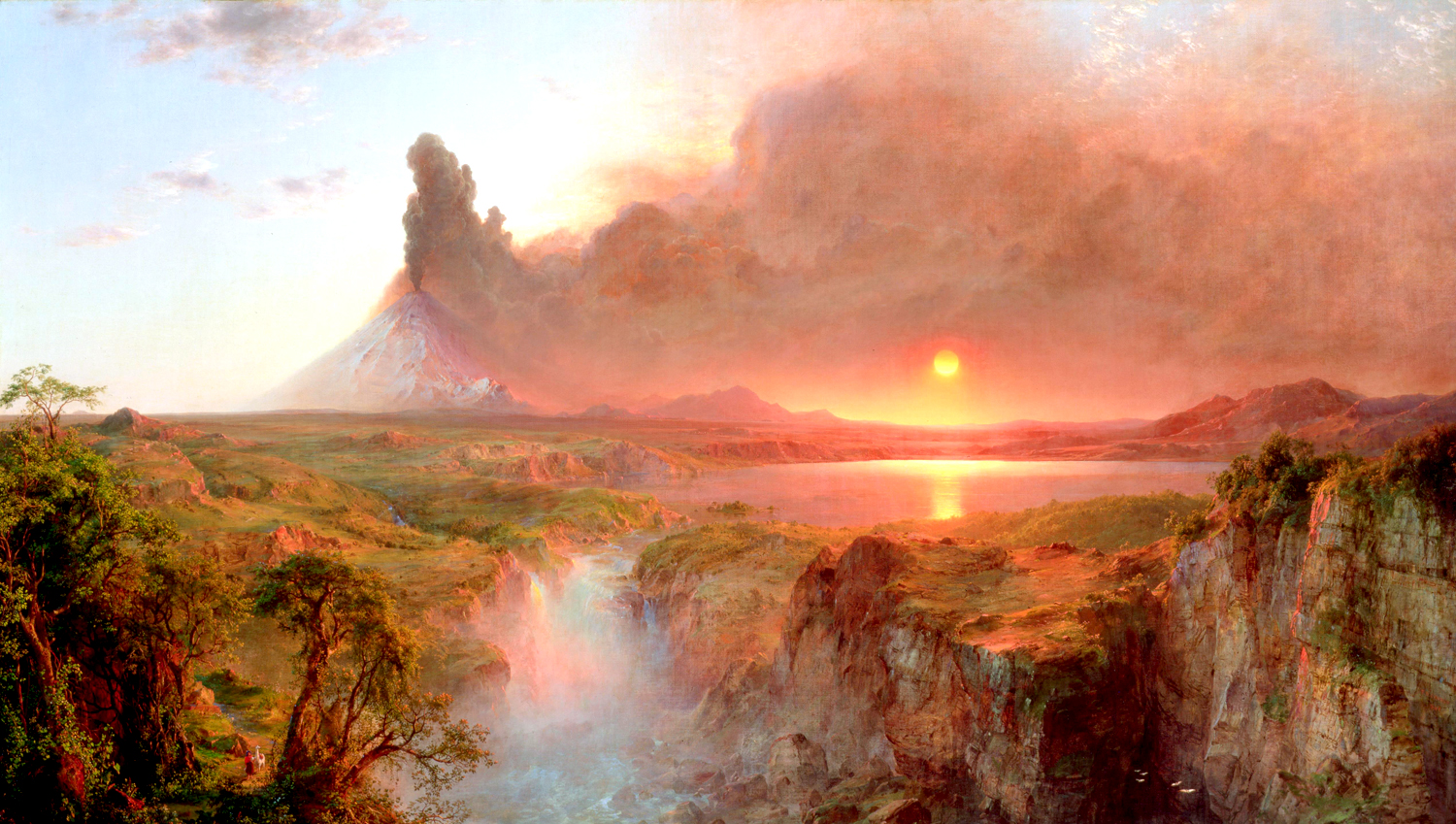
“Cotopaxi” Frederic Edwin Church 1862

Giving in to the infinite — or the emotional experience of it — can hit you whenever you are open to it. Not necessarily seeking it, but nevertheless open to it. Most often, we spend our lives closed, trying to make sense of the everyday things that take up most of our time. But there are moments when it all breaks in. These moments tend to stick in our psyches, to be brought back in memory to refresh our lives. 

In music, the sublime is found in Haydn’s depiction of Chaos at the beginning of his oratorio, The Creation. Or in the ecstatic chorus of Beethoven’s Ninth Symphony, the trumpets of apocalypse in Berlioz’s Requiem or the vastness of Mahler’s Symphony of a Thousand.
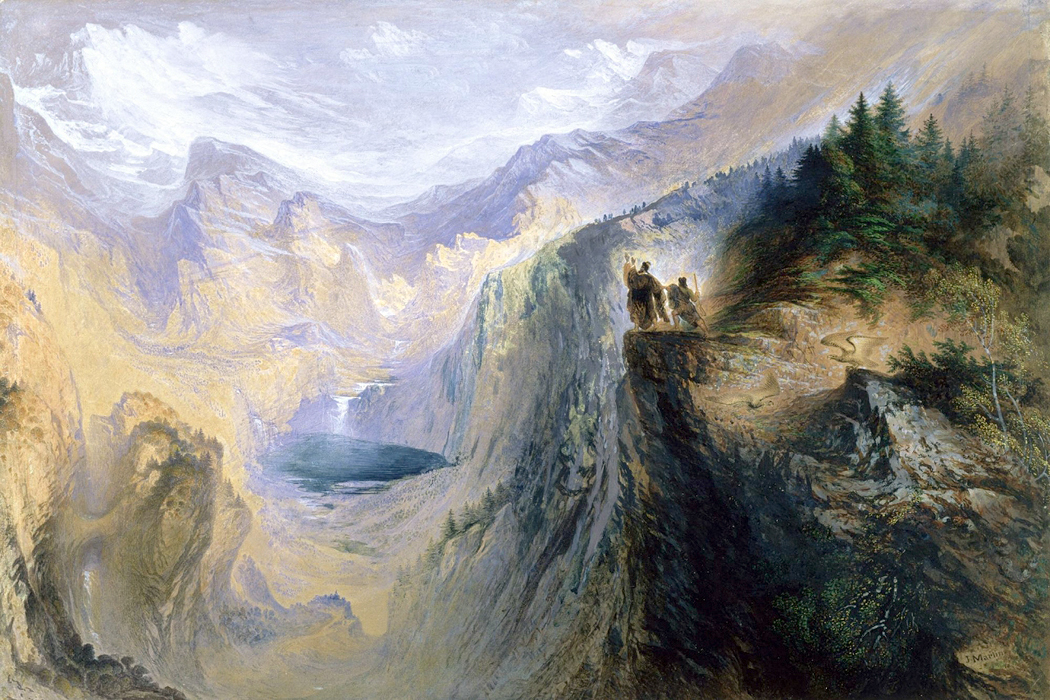
“Manfred on the Jungfrau” John Martin 1837

The problem with the Romantic vision of the sublime is that it can too easily devolve into kitsch. The sense of cosmic overload shrinks into a kind of religious sentimentality and you wind up with Charlton Heston and Cecil B. DeMille. Where you draw the line, personally, depends very much on your willingness to accept the underlying metaphor of the vastness and impenetrability of the universe. 

Any theme, including the sublime, can peter out in too-familiar tropes and cliches. And so, in the 20th century, artists and poets have needed to find new ways to explore the idea, without the hurling boulders and cataclysmic storms of the 19th century. The old ideas still persist, of course, in such things as the photographs of Ansel Adams. It came to a banal end in 1968 when Adams let his photos grace the cans of Hills Bros. coffee. 
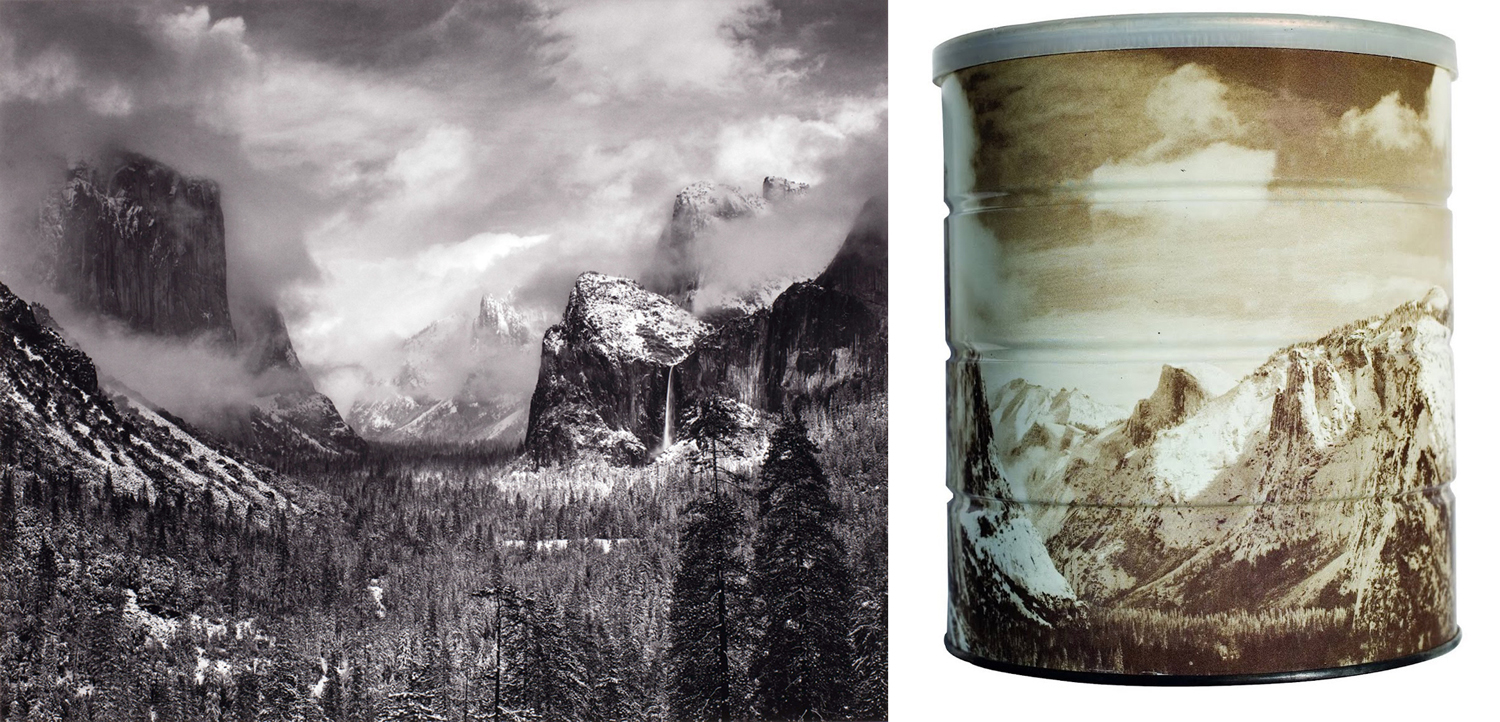
But, for the most part, the sublime has quieted down for the past hundred years or so, with priority given to social and political themes, from Brecht to Basquiat. We have a suspicion of grandiosity. Two world wars made us modest. 

Nevertheless, that cosmic power is still out there, seducing and threatening us. The night sky, the city-flattening hurricane, the ever-retreating horizon, the glimpse over the edge of the Grand Canyon precipice. And, always, our awareness of the inevitable extinction of our personal consciousness. 
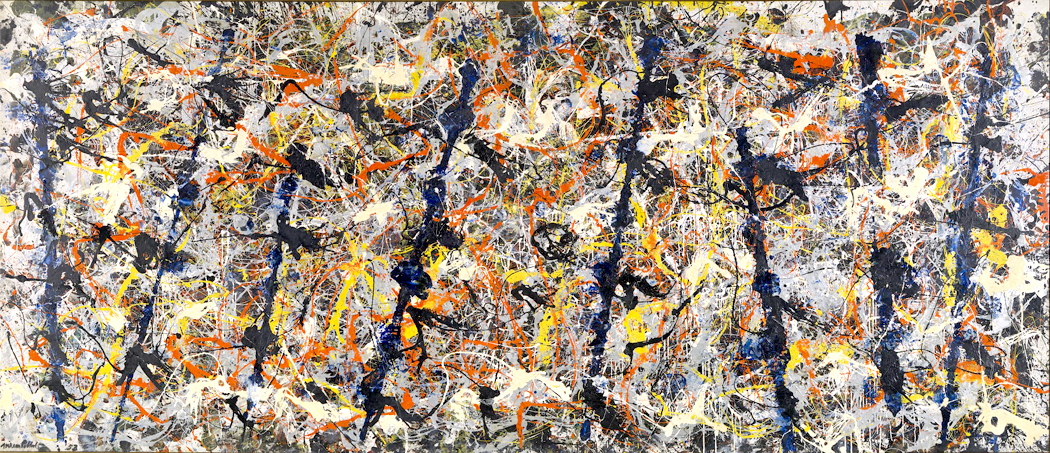
“Blue Poles” Jackson Pollock 1952

And some artists attempted to address this, but without the baggage of 19th century Romanticism. People like Barnett Newman with his huge blank colors, Jackson Pollock with his impenetrable scribbles, and Mark Rothko with his inscrutable floating squares. 

In fact, it was Rothko that first unlocked the Sugimoto seascapes for me. 

Rothko was another artist whose work initially I didn’t understand. Having only seen reproductions in books, I thought of his paintings as simply boxes of pleasing colors splashed on the canvas. 
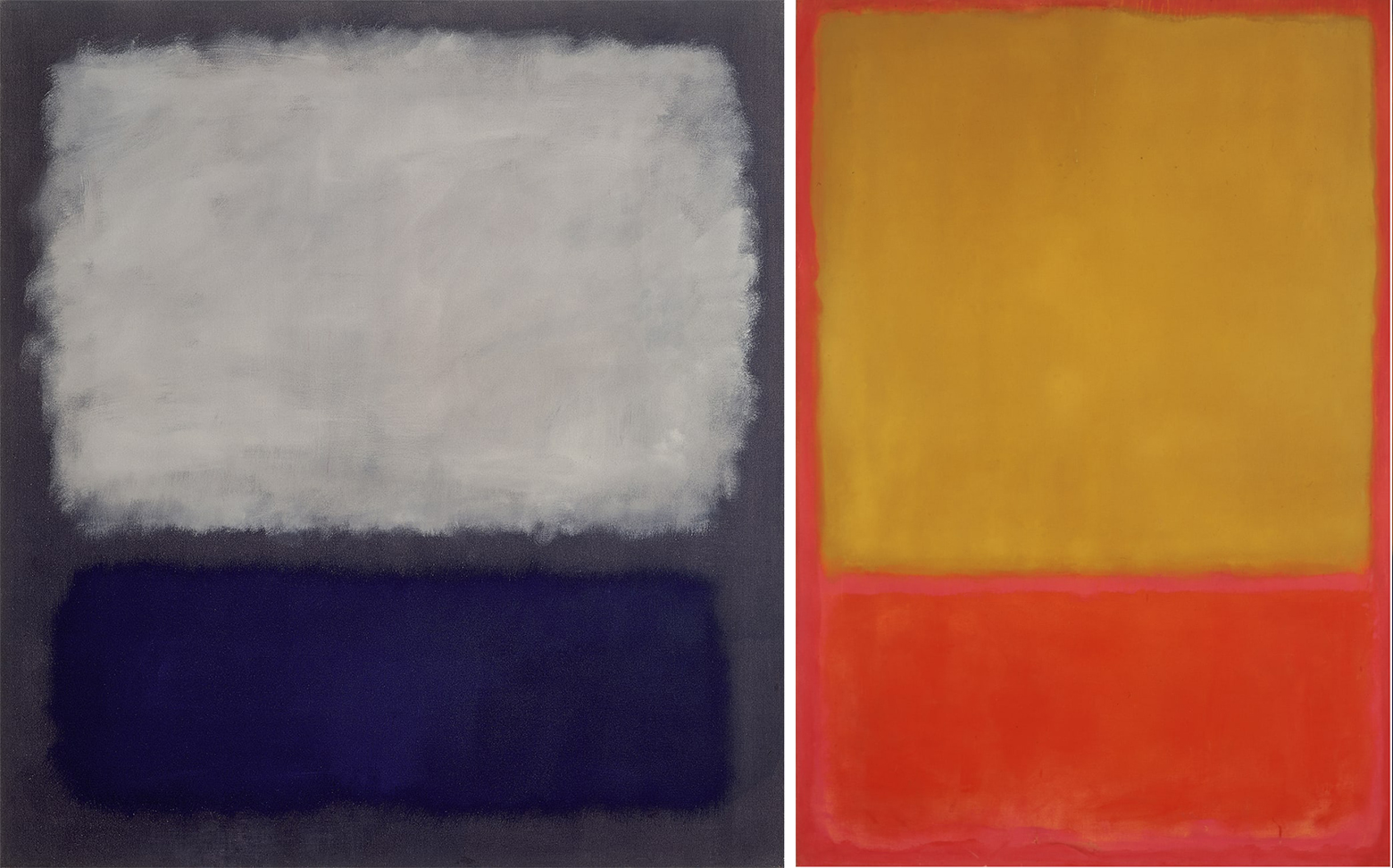
“Blue and Gray” 1962” and “Ochre and Red on Red” 1954 Mark Rothko

All that changed when I got to see the actual work, hanging on museum walls, and I realized those colors actually floated — visually — above the canvas. The colors of ink in a book illustration couldn’t do that the way actual pigment on canvas did. The difference between seeing a picture of an airplane and the actual flying at 30,000 feet. 

And so, it hit me, Rothko’s quiet illuminations were the 20th century version of the sublime. I couldn’t explain the emotions they roused in me, but they were the sense of seeing the primordial meanings of life, something no words could convey. 
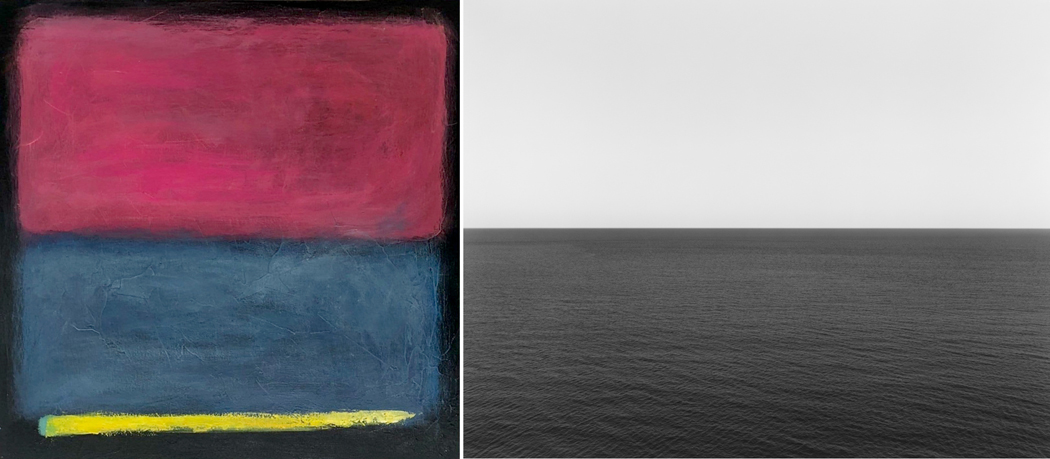
It was this same thing that nagged at me in Sugimoto’s photographs. The sky and sea were yin and yang, something primeval and immutable. 

“When you look up at outer space there’s the Moon and the Stars,” Sugimoto said. “But on the surface of the Earth, the farthest place people can see is an ocean horizon.”

Sugimoto also said that seascapes are pivotal in that they are a  scenery that we, in our modern world, still share with the ancients. Cities all look modern; even rural landscapes are crossed by interstates and power lines. But the ocean looks today the same as it did for Homer. 

(Only recently, I discovered that the Pace Gallery in London had mounted a joint exhibit of Rothko and Sugimoto in 2012, and had even published a book about it.)
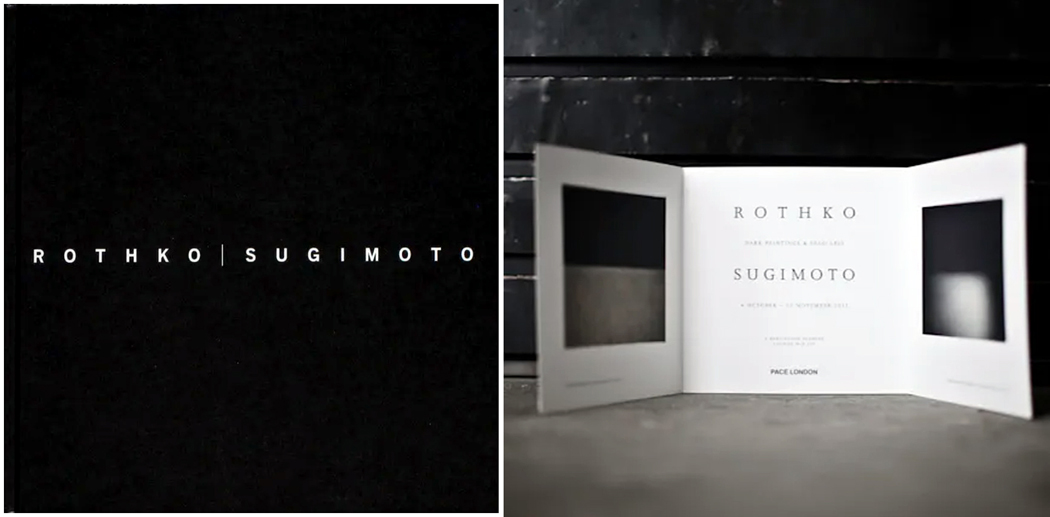
When I lived in Virginia, all those decades ago, it was on the ocean and I would almost daily have the opportunity to look out over the waves and into the horizon. I saw the seascape in sun and under the wind-blown scud of a nor’easter. It changed every day, even hourly. There were times when the sky color and sea color were so matched that the actual horizon line vanished and what I saw was a great blankness. A void. An infinity of sameness without edge. That blankness was a key to the modern sublime. 
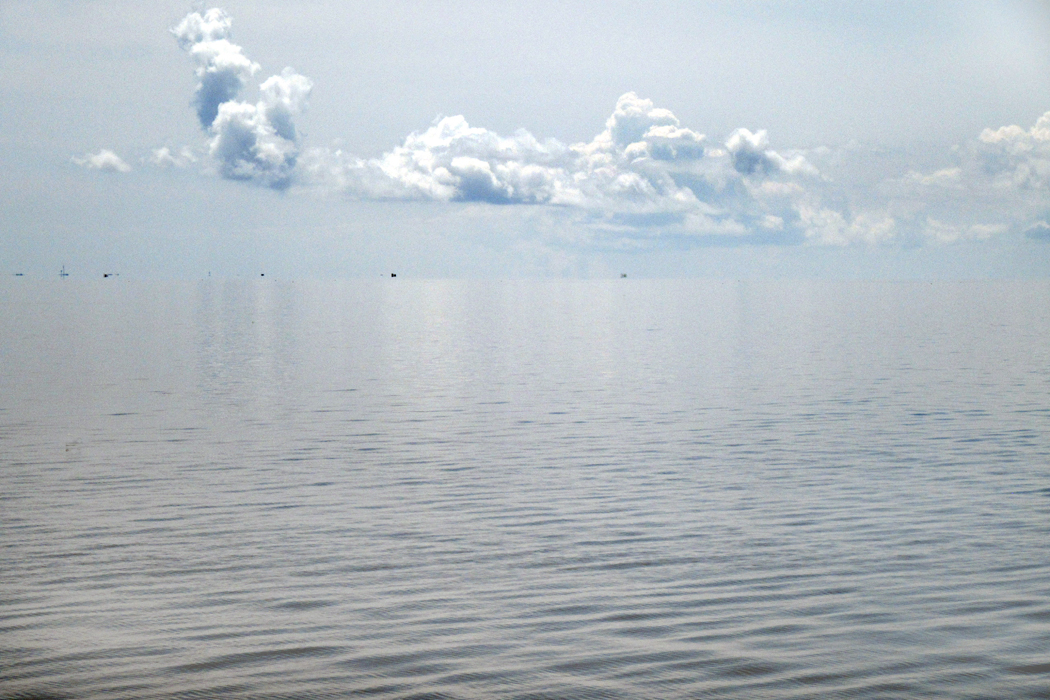
Currituck Sound, N.C.

Usually what I saw was just “the beach,” with its swimsuits and sunscreen. The everyday tends to crowd out — needs to crowd out — the eternal. After all, we have lives to live, jobs to get to, families to care for, and we cannot function if our adrenaline is always at the boil. But there were also times that I could look out at the water and air and realize that I was seeing the fundamental sense of existence. The quotidian keeps us functioning in society, but the sublime absorbs us into the universe. 

There is such a thing as an intense blankness. It is both frightening and beautiful. 
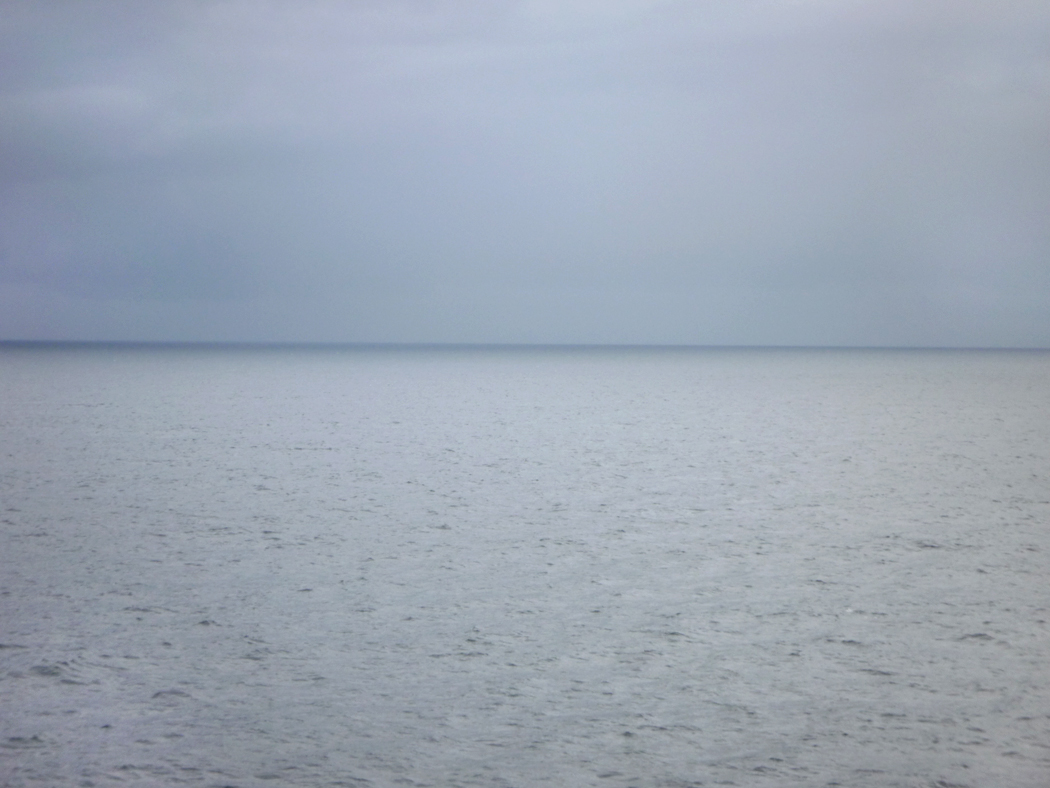
Alaska

And without consciously realizing it, those Sugimoto photos had buried their way into my psyche, and without consciously imitating his work, I had begun making my own photographs of that phantom horizon. I did so all around the world, like this one of the Indian Ocean from South Africa:
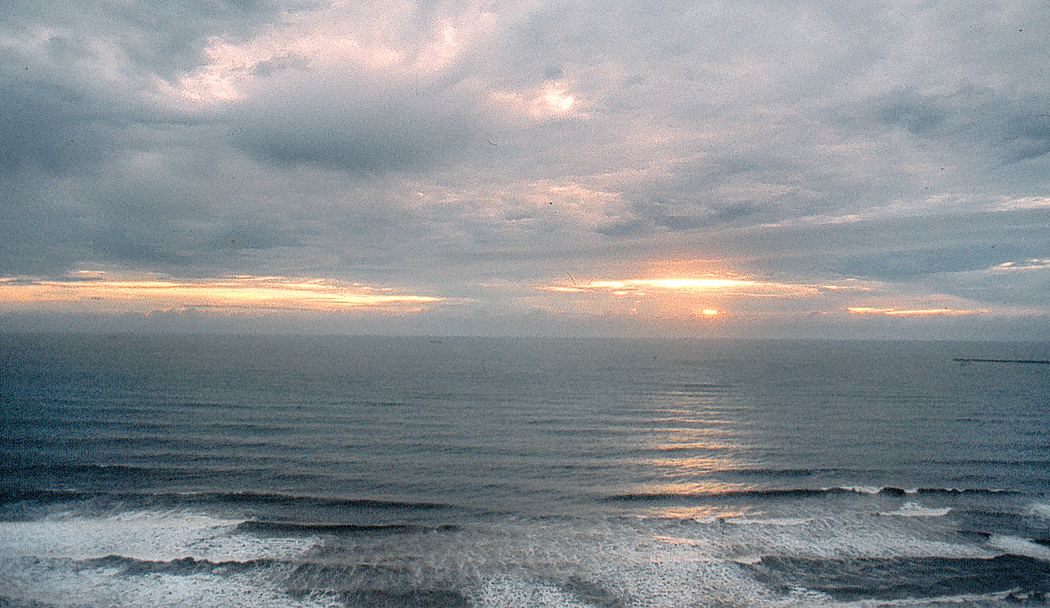
Or these from Alaska:
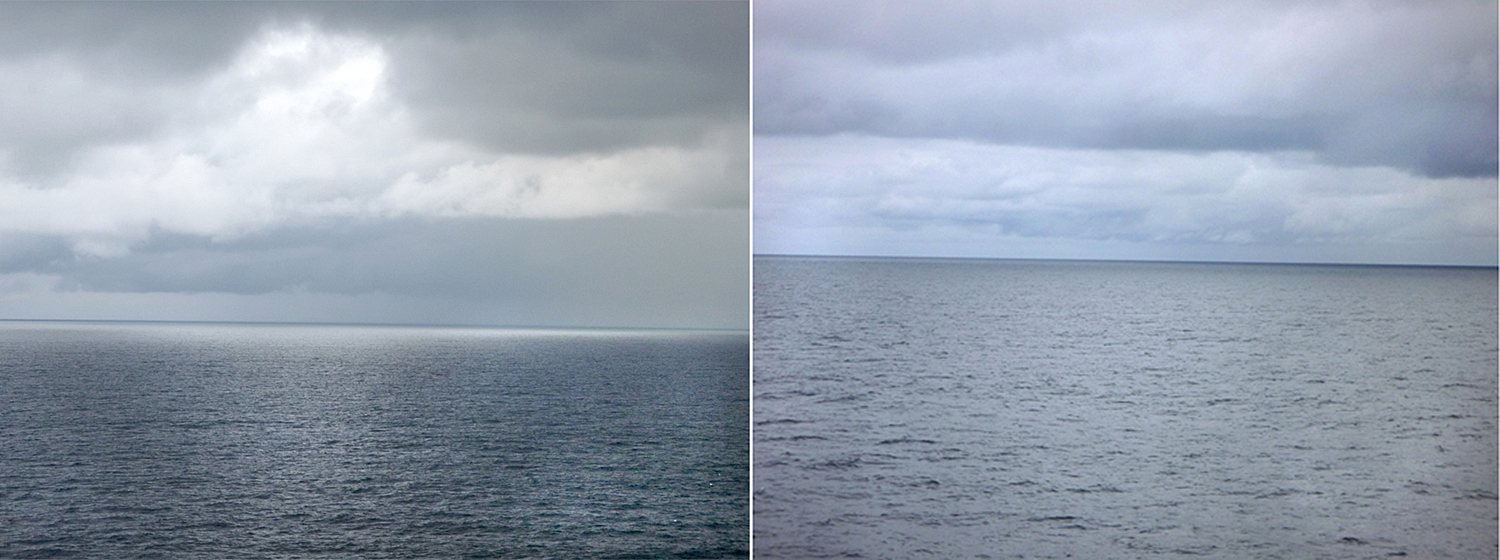
Or this coup de soleil on Puget Sound: 
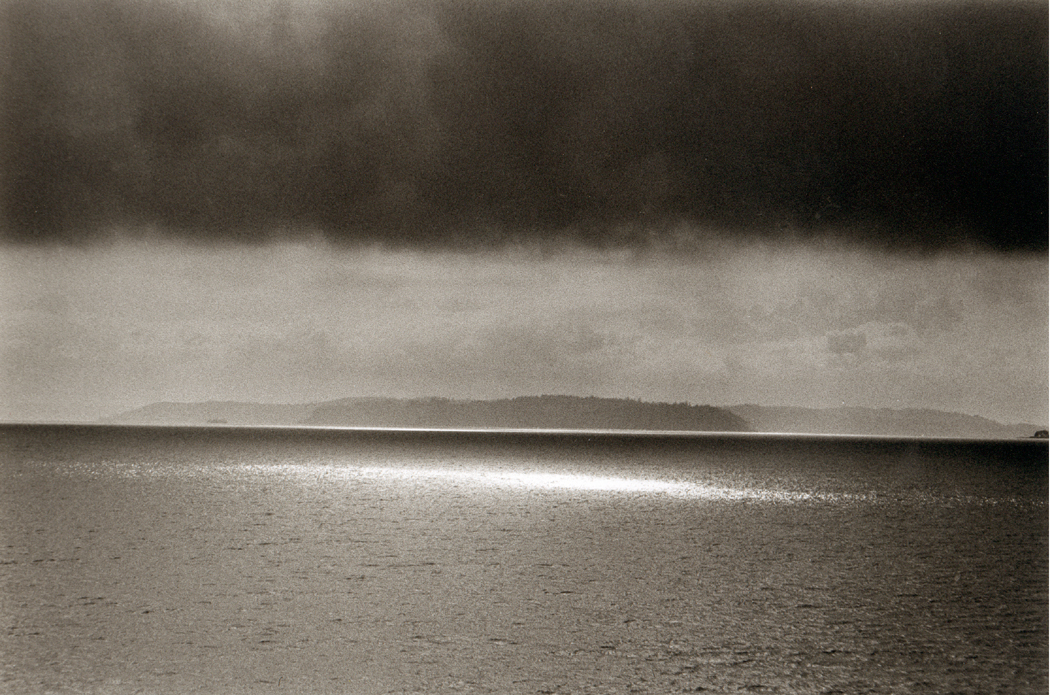
Although I was not aware, when making these images, that Sugimoto was buried in them, I was aware that they were informed by the sublime, and specifically, from a 20th- and now 21st-century version of the concept. 
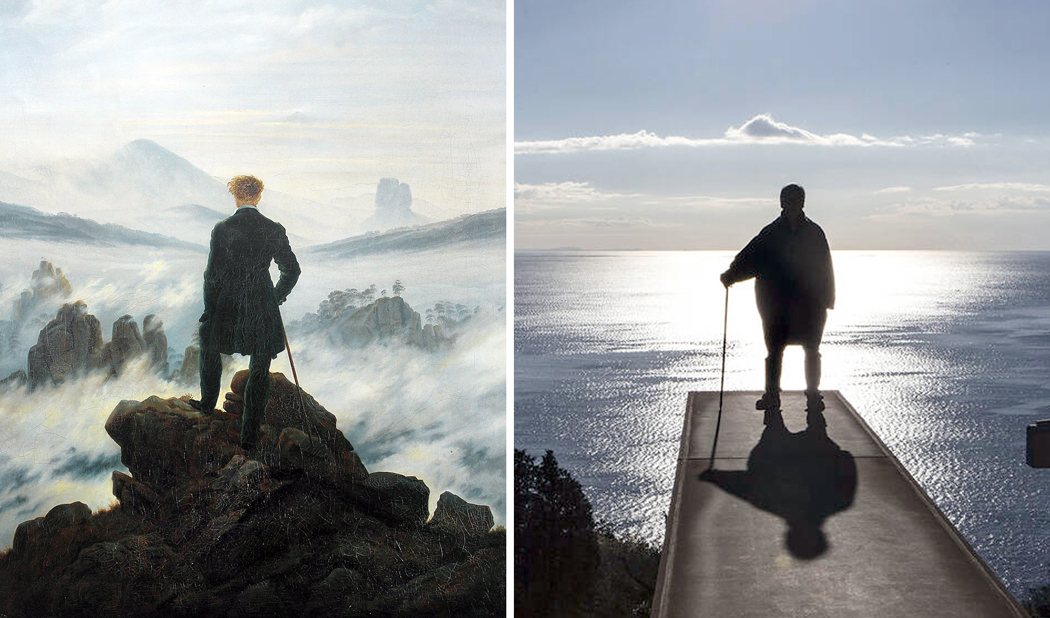
Finally, if I needed any confirmation that Sugimoto was striving for the sublime, I found it in this photo of the artist, posed to mimic the painter who was perhaps the poster-boy for 19th-century Romantic sublime, Caspar David Friedrich. 
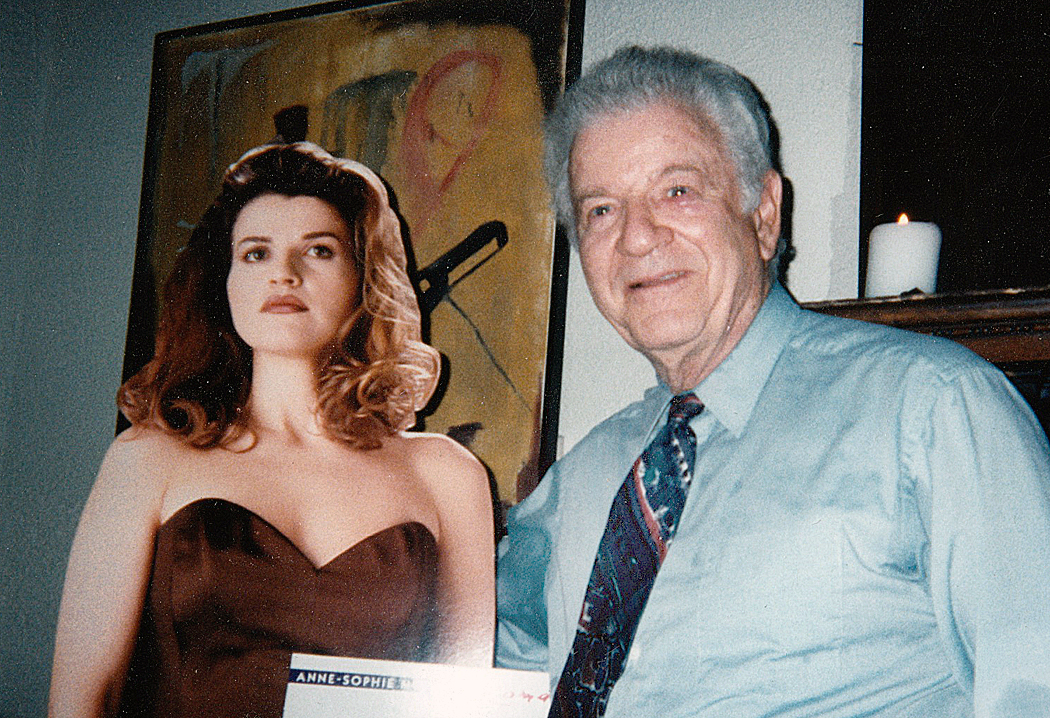
Dimitri Drobatschewsky was the most erudite man I ever knew. He spoke, wrote and read in German, French, and English. Born in Berlin and raised mostly in Luxembourg, his French and German were native, down to idiom, argot and accent. He was also conversant in Spanish, Italian and Polish (at least, he said, he knew several dirty jokes in Polish). 

He was born in 1923, fled the Nazis with his family, joined the French Foreign Legion, deserted to fight with the Free French forces in Italy in World War II. Later, he became the classical music critic with The Arizona Republic, where he and I became friends. 

(Once, when confronted by a musician who had gotten a bad review, he was challenged on his credentials. “What do you think is the most important qualification for a classical music critic?” the musician demanded. “Well,” Dimitri said. “He must have a long and unpronounceable name.”) 

Because he was still a boy when moving to Luxembourg, he was able to learn French as a native. “I had to,” he told me. “French girls wouldn’t date you if you didn’t speak perfect French.” And that’s why, after the war, when he emigrated to the U.S., he kept his accent. “American girls loved a foreign accent.” 

Dimitri felt that French was the most beautiful language, by the sounds it makes in your mouth. But for Dimitri, the best poetry was in German, and further, the greatest poet was Johann Wolfgang von Goethe. For this, I had to take his word.

Because I don’t read German, and when I approach Goethe in translation, he sounds earthbound, even banal. 

I try to hear the German in my mind to catch its melody, but I am walled out by my English. All I can gain from the reading is a commonplace. 

“Little rose, little rose, little red rose

Little rose of the heath.”

It sounds better when set to Schubert’s music, but still, in English, the words are a touch sappy, and the sentiment pedestrian.

“You have to read him in German,” Dimitri said. “The sound of words, the language is unbelievably beautiful.”

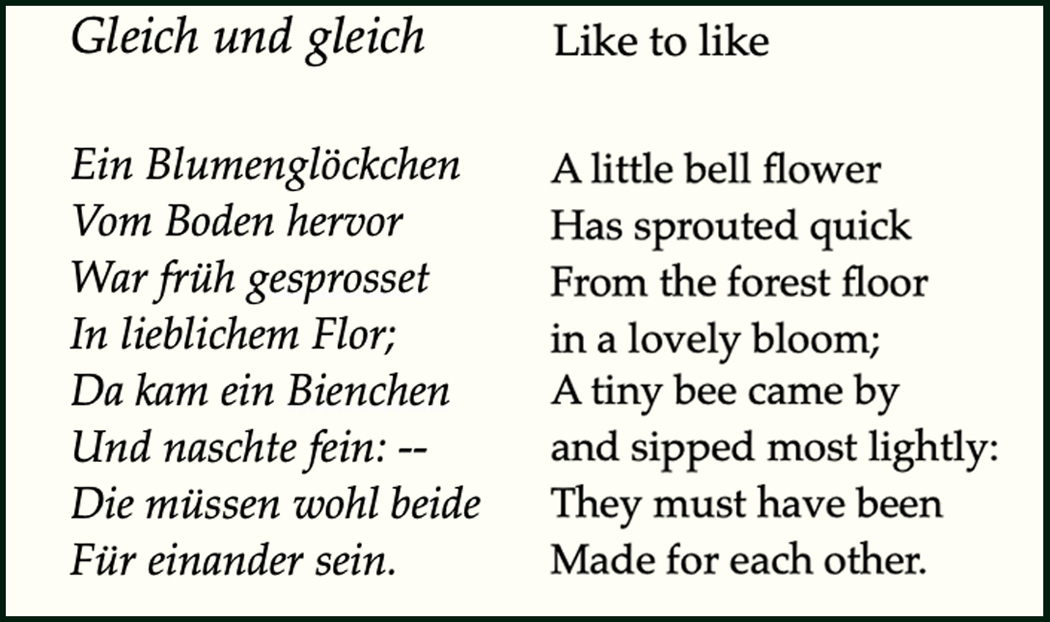
Röslein, Röslein, Röslein rot,

Röslein auf der Heiden.”

So, I’m afraid Goethe is closed to me. I’ve read Faust several times in several translations, and it never seems to quite get airborne, yet everyone who knows the original feels it is one of the greatest works of literature ever, and that Goethe is the equal of Shakespeare. 

I have the same problem with Quintus Horatius Flaccus, or Horace, in English. In English, his poetry is flat as yesterday’s ginger ale. “You have to read him in Latin,” says my friend Alexander, whose degree is in Classical languages. “In Latin, he is truly exceptional — lapidary perfection.”

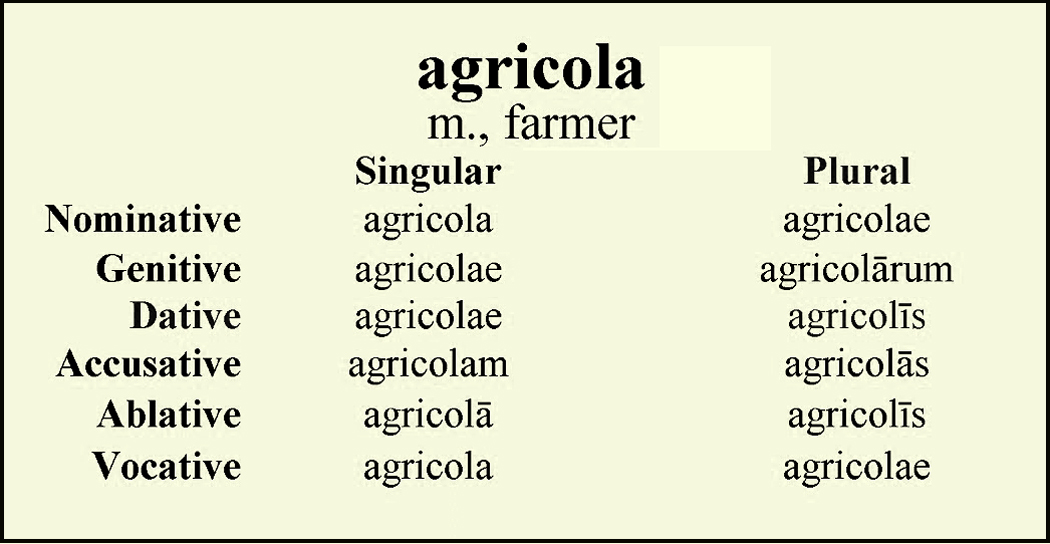
Again, I have to take his word for it. Shakespeare may have had “small Latin and less Greek,” but my Latin is even smaller than the Bard’s. I studied it in eighth grade, and mostly what I recall is “agricola.” 

I freely confess it is my loss. But there it is; I am stuck with it. 

There are those who hold that all literature is untranslatable, that you have to read it in the original language, and while I concede that you can never get all of a poem in a translation, nevertheless, I feel there is a class of work that functions perfectly well shapeshifted. 

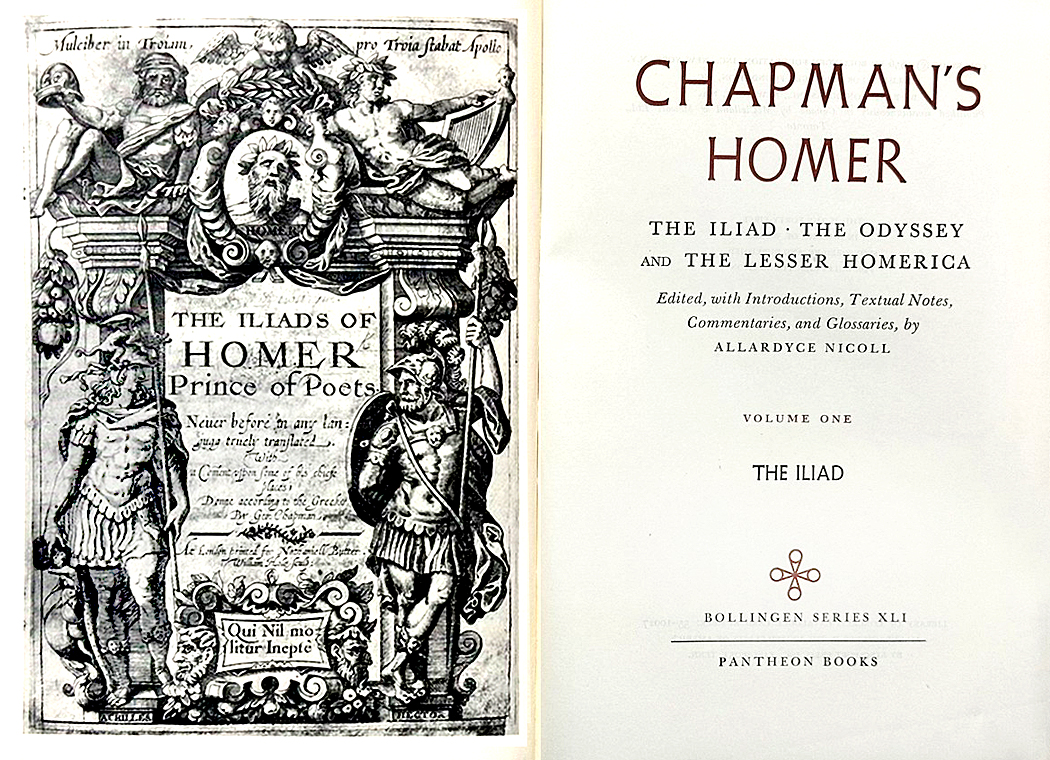
I can read my Homer not only in English, but in multiple translations, from Chapman to Pope to Fitzgerald to Fagles and I am sucked in by the poetry every time. It may very well be better in Greek, but it’s the best thing I’ve ever read even in English. I reread the Iliad once a year, and try to find a new translation each time. (I read the Odyssey, too, and I especially love the translation by T.E. Lawrence — Lawrence of Arabia. Who knew?)

The same thing happens with Dostoevsky. I’m sure it’s better in Russian, but even a good translation moves swiftly and powerfully and I am rapt by the story and moved by the humanity. There is a swift current underneath the surface of language. 

It can make a difference which translation you read. I am told by those who know, that the Scott Moncrieff translation of The Remembrance of Things Past is closest to the quality of Proust’s French, yet I find his English stuffy and outdated. The newer translations — by a range of translators for Viking (Swann’s Way is translated by Lydia Davis) — is easier to digest and flows with the quickness that ensures pleasure in the reading. But am I getting the pith of Proust? My French is better than my German, but it is still small beer. 

Constance Garnett gave us English versions of what must be every Russian novel ever written. She was a factory. And her versions are still the most widely read. But the more recent by Richard Pevear and Larissa Volokhonsky are much easier going. The duo now seem to be challenging Garnett also for the shear number of volumes converted.

Tolstoy’s War and Peace, in the English of Louise and Aylmer Maude, is the most profound and moving piece of literature I have ever read, despite the profusion of names. How much better would it read if I could understand it in Russian (and French, let’s not forget)? Its power transcends its tongue. 

This all raises the question, however, of why Homer or Tolstoy can be read in translation and Horace cannot. And the reason, I believe, is that greatness in writing comes on two essential levels: content and style. That is, how deeply it connects with our human-ness, on one hand, and on the other, how deeply it connects with its medium. This is not an either-or situation; there should always be awareness of both sides. But in practice, one side or the other tends to predominate. The more it is the universal connection with life and experience that we read, the easier the literature can travel. The more it is the words themselves, the more insular the audience.

It would be difficult to illustrate this dichotomy if we try to look at examples of foreign literature translated to English; we would need to be conversant with the original language to see how it morphs in the conversion. But consider attempting to translate several English authors into some other language.

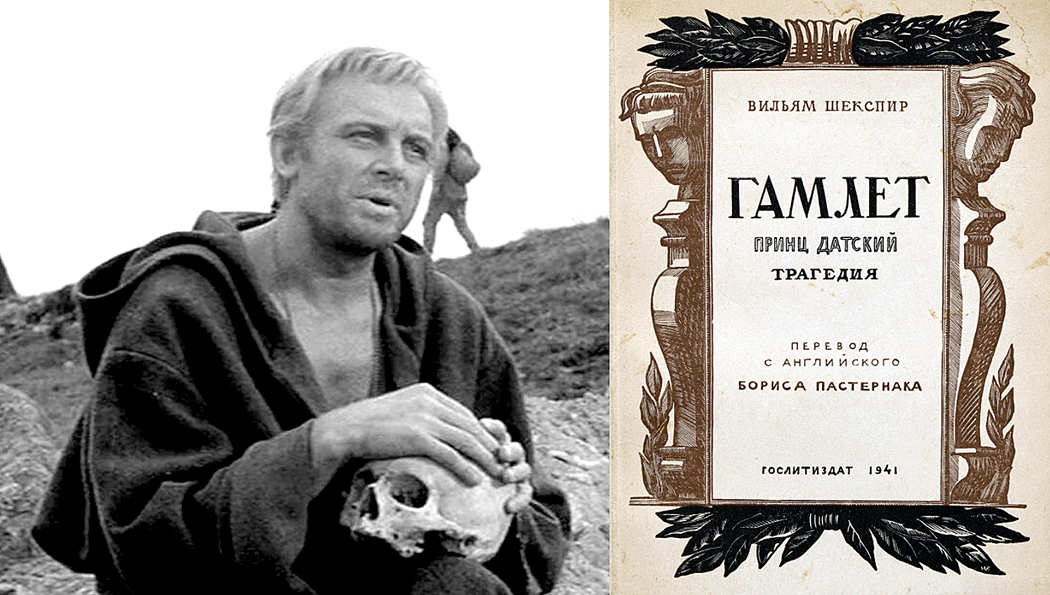
Shakespeare tends to travel well. His plays are valued in many lands and many languages. There are famous examples of Macbeth in Swahili, of Hamlet in Russian, and dozens of operatic versions in Italian, French and German. They all pack a wallop. And Shakespeare is loved in all those languages by their native speakers.

On the other hand, how in hell can you translate John Milton into French? You can tell the story of Paradise Lost, sure, but how can you convey the special organ-tone quality of his language.

“Round he throws his baleful eyes.”

Translate it into French and it comes out as the equivalent of: “He looks around malevolently.” Not the same thing, all the poetry is gone out of it. Deflated; a flat tire.

Or: “When I consider how my light is spent.”

It is only in English that the word “spent” has the two meanings: a spent taper; or money (or life) spent. The word in the opening of his sonnet “On his Blindness” has a nimbus of ambiguity about it. The primary meaning is that he is now blind, but he spreads the halo out from the word “spent” by following it up with several other financial words: “the one Talent which is death to hide” where a talent is also a biblical monetary denomination, and brings to mind the New Testament story of the servants and the talents, and the poor servant who is “cast into the outer darkness, where there will be much weeping and gnashing of teeth.” And then there is, “present my true account,” and its hint of double entry bookkeeping. It is this expansiveness in language that is the key to Milton’s greatness. He is large; he contains multitudes. But they are bound in English, anodized, as it were, not separable. How do you work that magic in French? Or German? Or Japanese?

These things are untranslatable, and hence, Milton can never have the global currency of Shakespeare. 

Or consider translating Chaucer from his own time to ours. The poetry — The sound of the words, phrases, sentences and stanzas — cannot hypnotize us as the original does. Yes, we get the sense, but we miss the art.

“And smale fowles maken melodye, that slepen all the night with open ye.” 

Or imagine James Joyce in German. The melody is gone. “Stattlich rundlich Buck Mulligan…” 

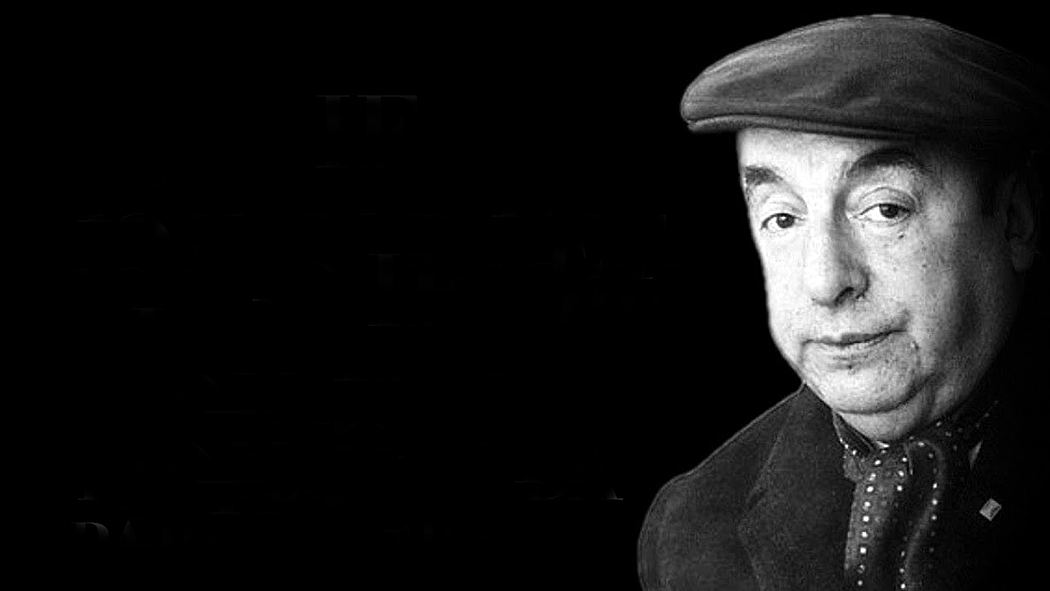
If I turn to a poet I love very deeply, and whose language I can parse, it survives translation very well. Pablo Neruda’s Spanish is so transparent, that the ideas embodied in it are clearly seen in any lingo. It is that Neruda’s primary concern in his poetry is not language, but experience. They are real pears and plums in his poetry, real life and death, real love, real sex, real toes and real stones. The poetry is about the things of this world, and not the way we express them.

The poetry is highly wrought, and in Spanish, there is a linguistic layer Neruda also cares about, but the power of the poems come from Neruda’s connection with his own life, his own experience, and that it is possible to share in any language.

Quiero conocer este mundo,” “I want to know this world,” he says in his Bestiario/“Bestiary.”

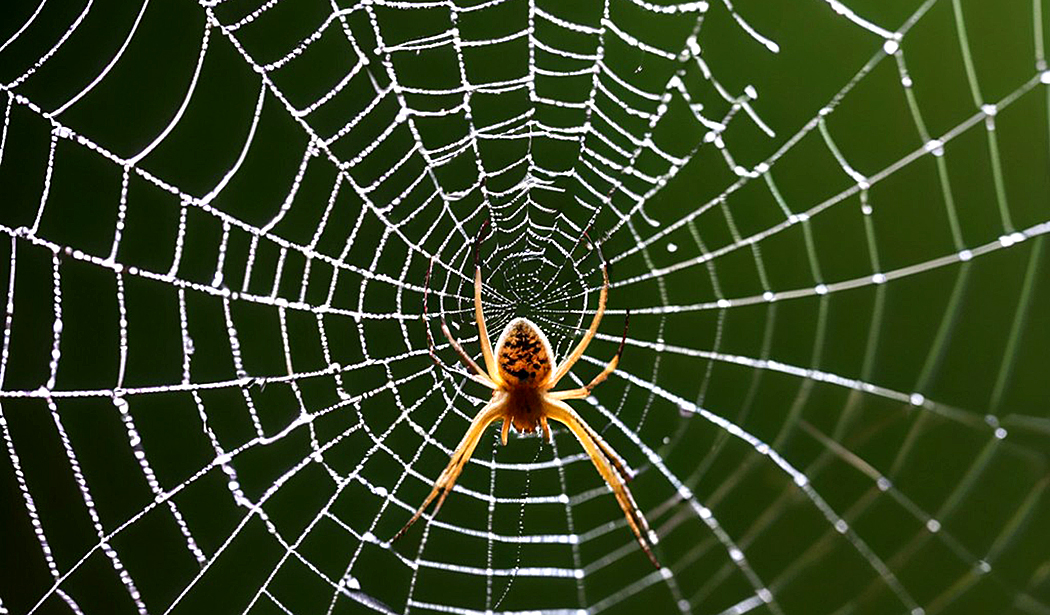
“The spider is an engineer,/ a divine watchmaker./ For one fly more or less/ the foolish can detest them:/ I wish to speak with spiders./ I want them to weave me a star.”

Language is a mask. Behind it there is a world. You can concentrate on the language, or on the world. It is easy to be lulled into forgetting the difference, to think that words describe the world, and that the best language is the most accurate lens on the things of this world — este mundo — but they are not the same, but rather, parallel universes, and what works in words does not necessarily explain how the world functions. In reality, there are no nouns, no participles. There is only “is.” Can you squeeze that “is” through words? We try. And we try again.

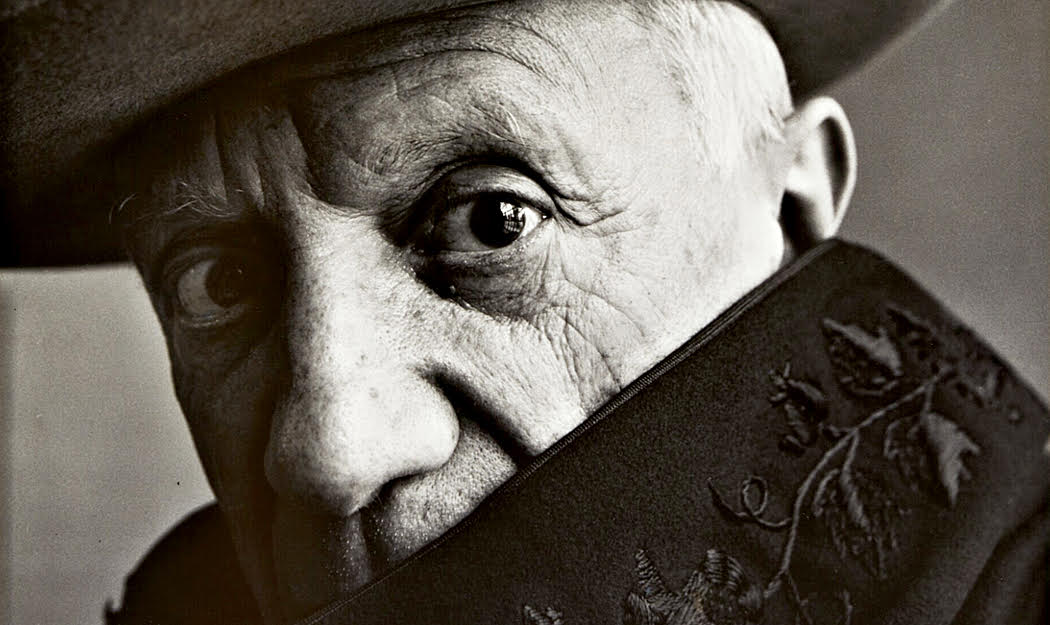
In a recent piece on this blog, I mentioned that Pablo Picasso, while he was undoubtedly a great artist, might not be a particularly good painter. That is, his craftsmanship over the years could be quite indifferent. Inventive, no question, but seldom painstaking over execution. I wrote a fuller explanation of this in an essay I wrote in 2023 for the Spirit of the Senses salon website and I thought this might be a good time to reproduce that post for a wider audience. 

Pablo Diego José Francisco de Paula Juan Nepomuceno María de los Remedios Cipriano de la Santísima Trinidad Ruiz y Picasso was a very impatient man, perhaps because his name takes so long to say or write.

I say he was impatient on the evidence of his paintings. I certainly never met the man. But I have seen a boatload of his paintings in person and hundreds in reproduction, and they all tell me he didn’t have the patience to spend time on their finishing touches.

Don’t misunderstand: Pablo Picasso was a great artist, and for many reasons. But he was not what I would call a great painter. Let’s take a look.

There was a time when many thought that Picasso’s art was a hoax. You know, the “My kid could paint better than that,” and serious-minded critics would say, “First, you have to be able to master the techniques before you can experiment with abstraction.” (Yeah, this was a while ago).

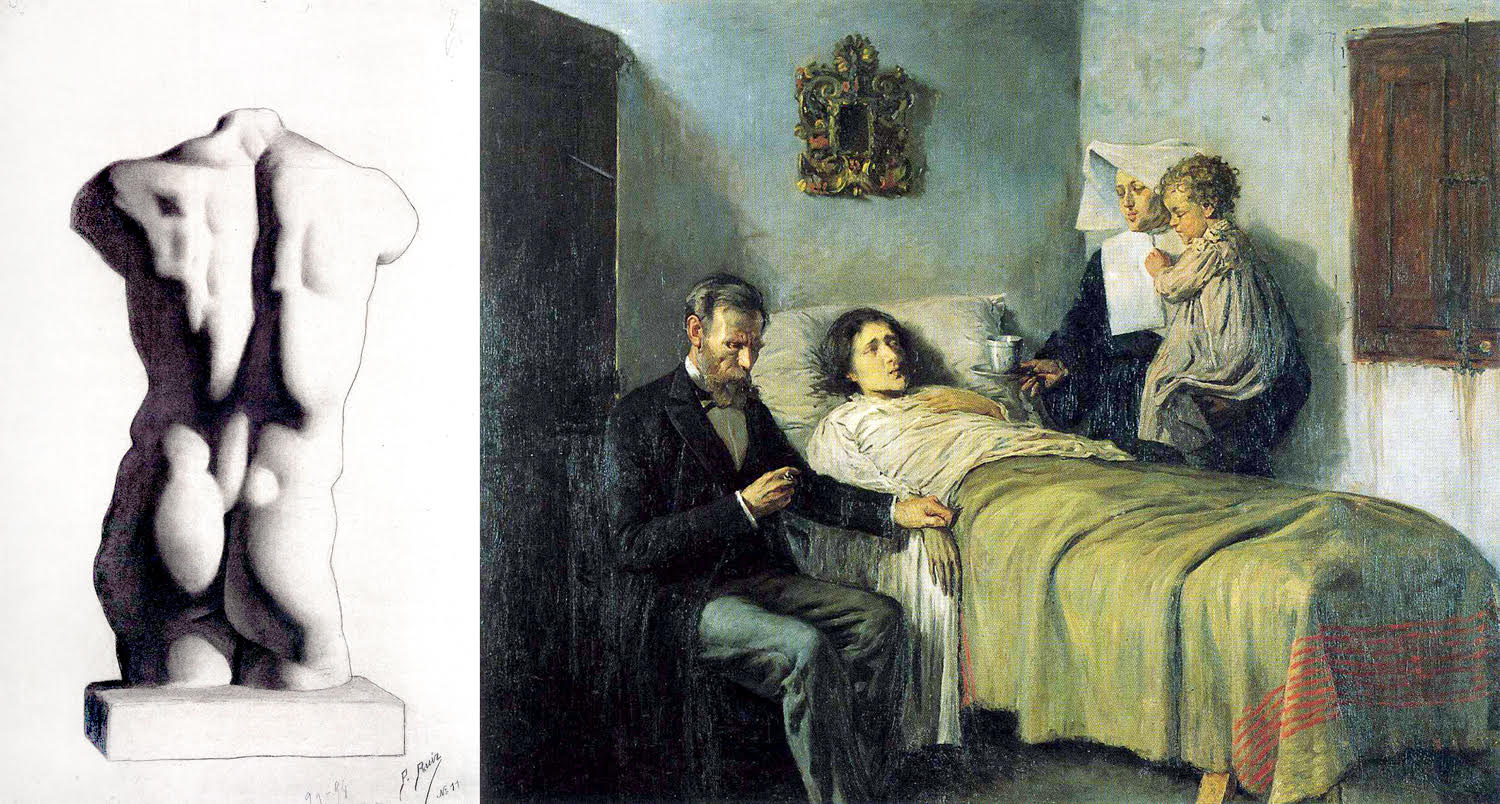
But then, some of the young Picasso’s art, from his adolescence, began showing up and it was clear that he had been a masterful draftsman and could draw and paint as realistically as anyone.

He could pump out an academic figure study like an Old Master. And he could put on canvas as realistic a painting as you could wish. Just look at some of these, from 1893, when the artist was 12, and 1896. It is clear he could do anything. But he didn’t: By the turn of the century, he had been taken with more modern trends in art, from Impressionism to Post-Impressionism, to Fauvism and Expressionism. His style loosened and the works became sketchier.

This evolution of style was characteristic not only of Picasso, but of other artists, writers and poets. There had been Impressionism and Post-Impressionism, Van Gogh, Gauguin, Cezanne — all with different styles.

By the middle of the last century (that’s the 20th, remember), Modernism had not only established itself, but become entrenched. Its hagiography had been codified and the heads of its various branches were Igor Stravinsky in music, James Joyce in prose, Ezra Pound in verse, and Picasso on canvas.

These were hardly the only names in the mix, and they may not even have been the best artists working, but they became the names we all knew. They are the names in the anthologies and textbooks.

And they all burned through styles. Stravinsky went from late Romantic chromaticism, to a savage primitivism, to Neo-Classicism and finally to his version of 12-tone serialism. Joyce from some of the most beautiful, clear prose in The Dubliners to the stream-of-conscious jumble in Ulysses and into the paronomastic almost-abstract gibberish of Finnegans Wake. Pound began with highly poeticized Edwardian prettiness to a hard-edged sarcasm and into his own form of pan-linguistic word salad.

Most serious artists go through stylistic growth from early to late periods, but Modernism seems less like organic growth and more like a conscious seeking-out of something new, something that would get attention. Pound’s battle cry was, “Make it new!” Where style had been a function of personality, it became a “brand” and ever newer versions were sought, like updating your car every few years.

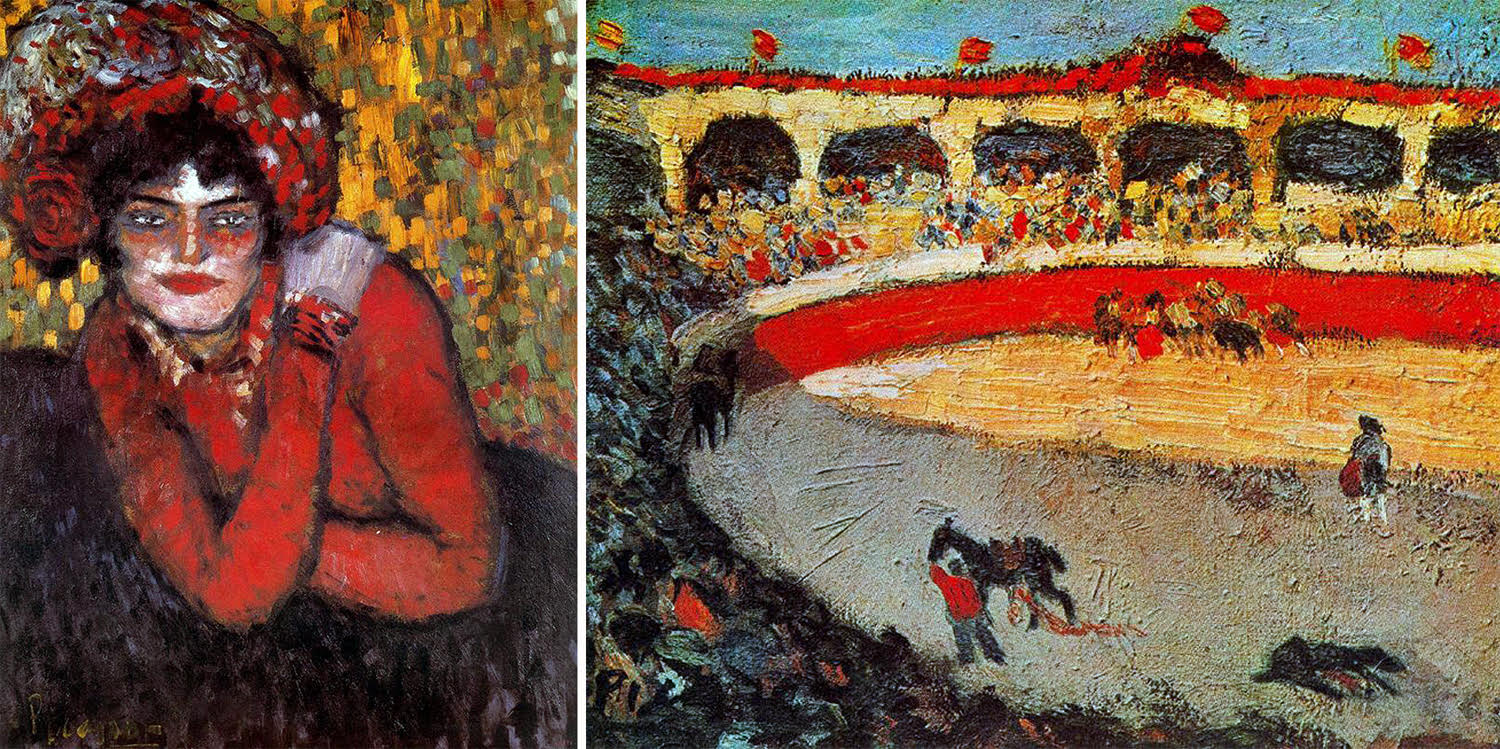
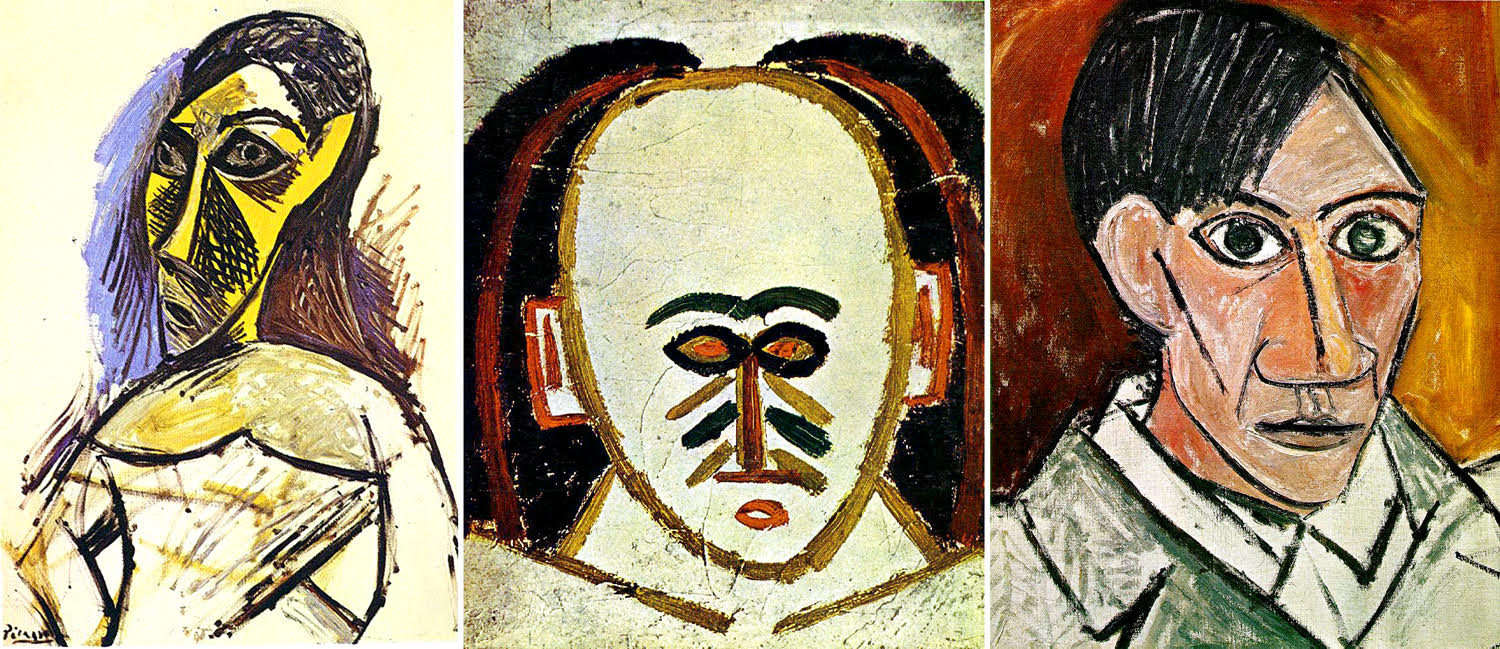
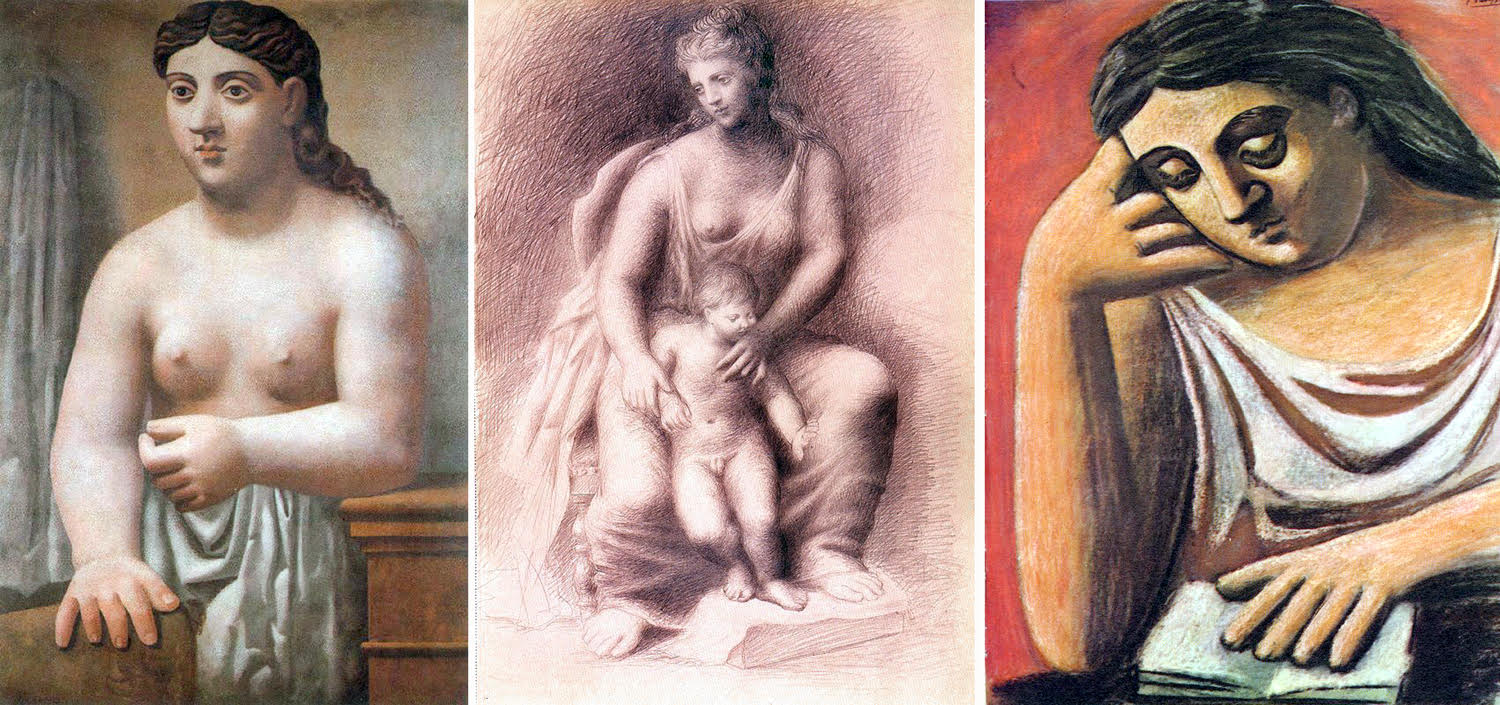
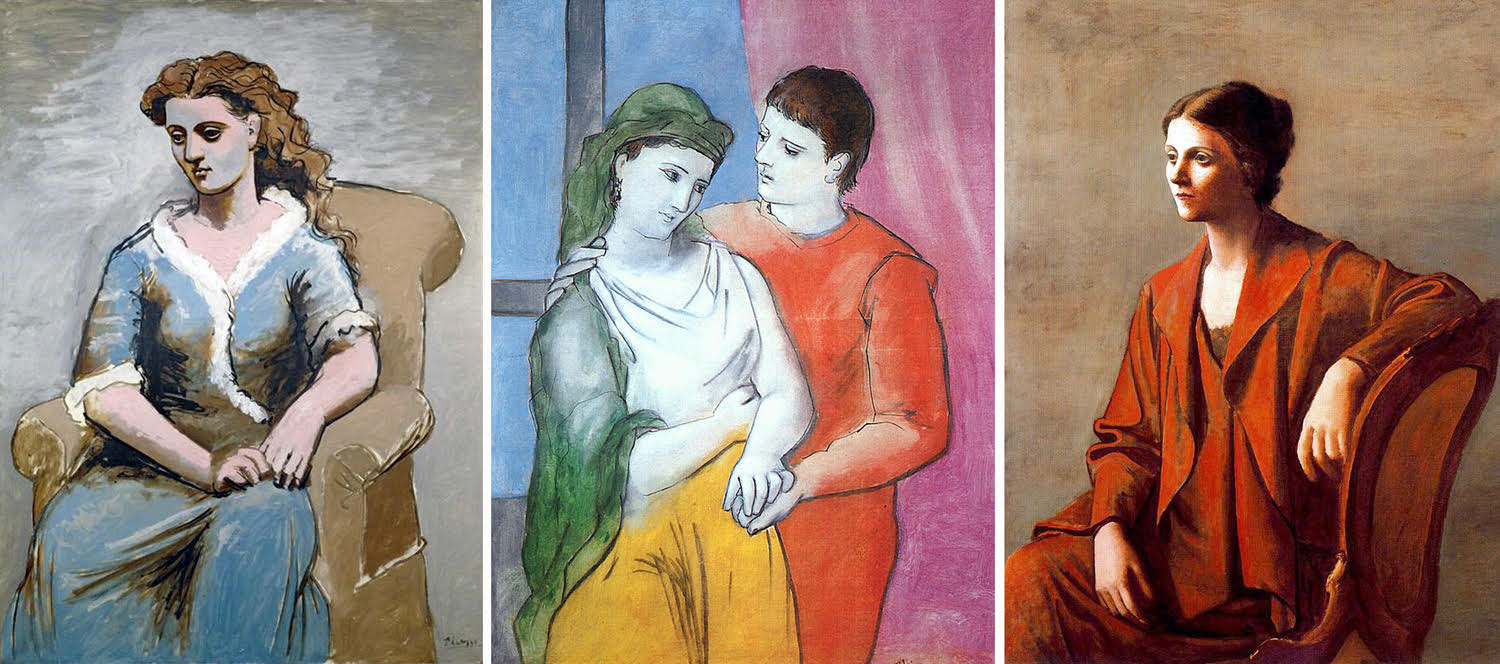
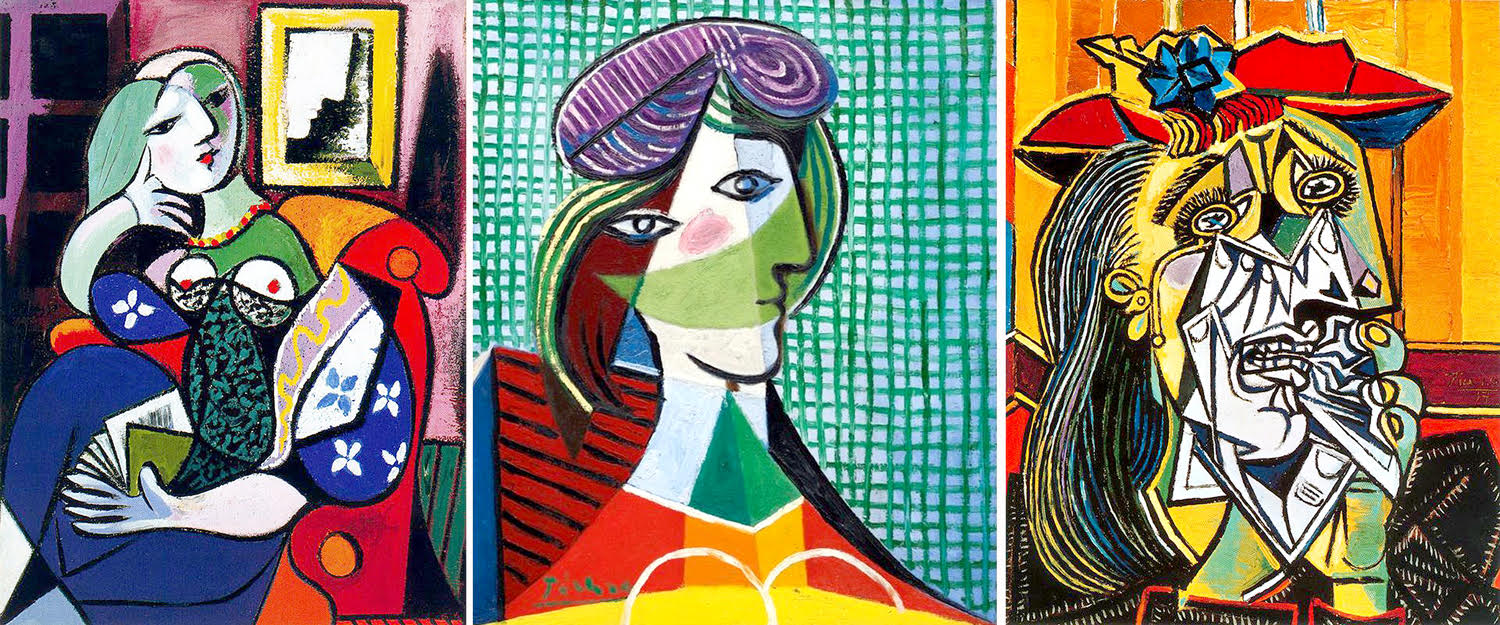
I’m being too harsh here, but to make a point. Picasso kept evolving, from that early Expressionism

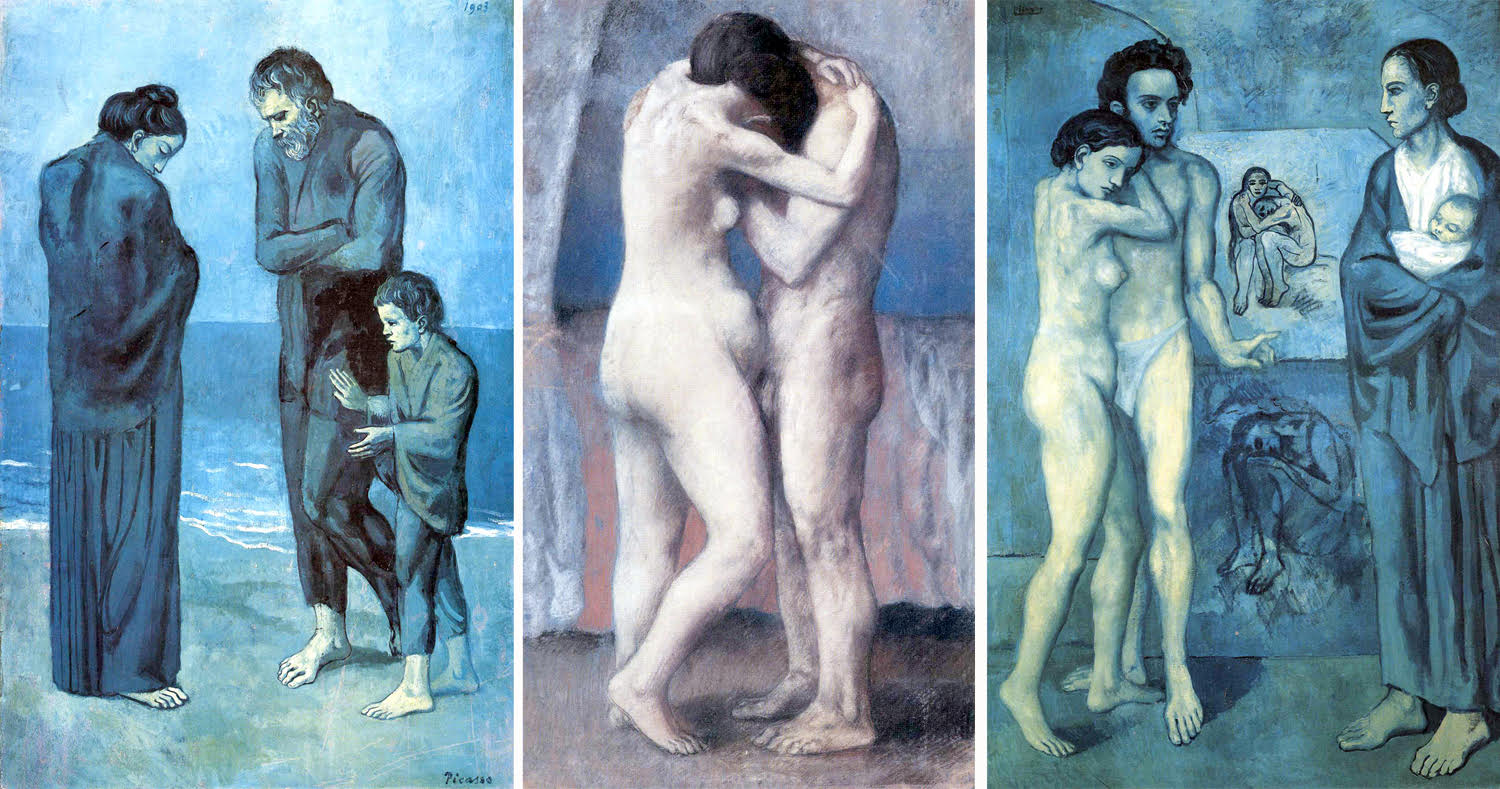
To the famous “Blue Period”

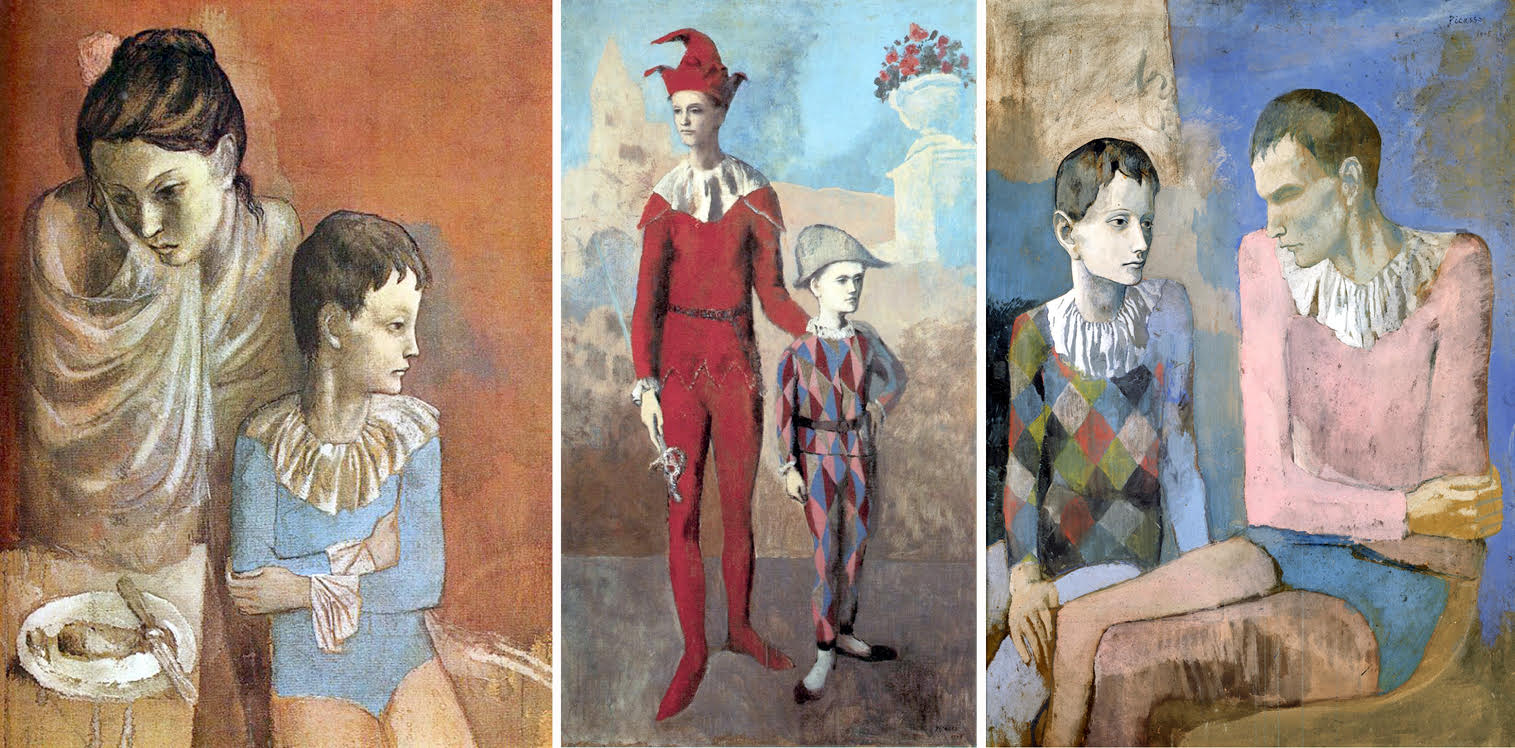
Through a subsequent “Rose Period”

to African primitivism,

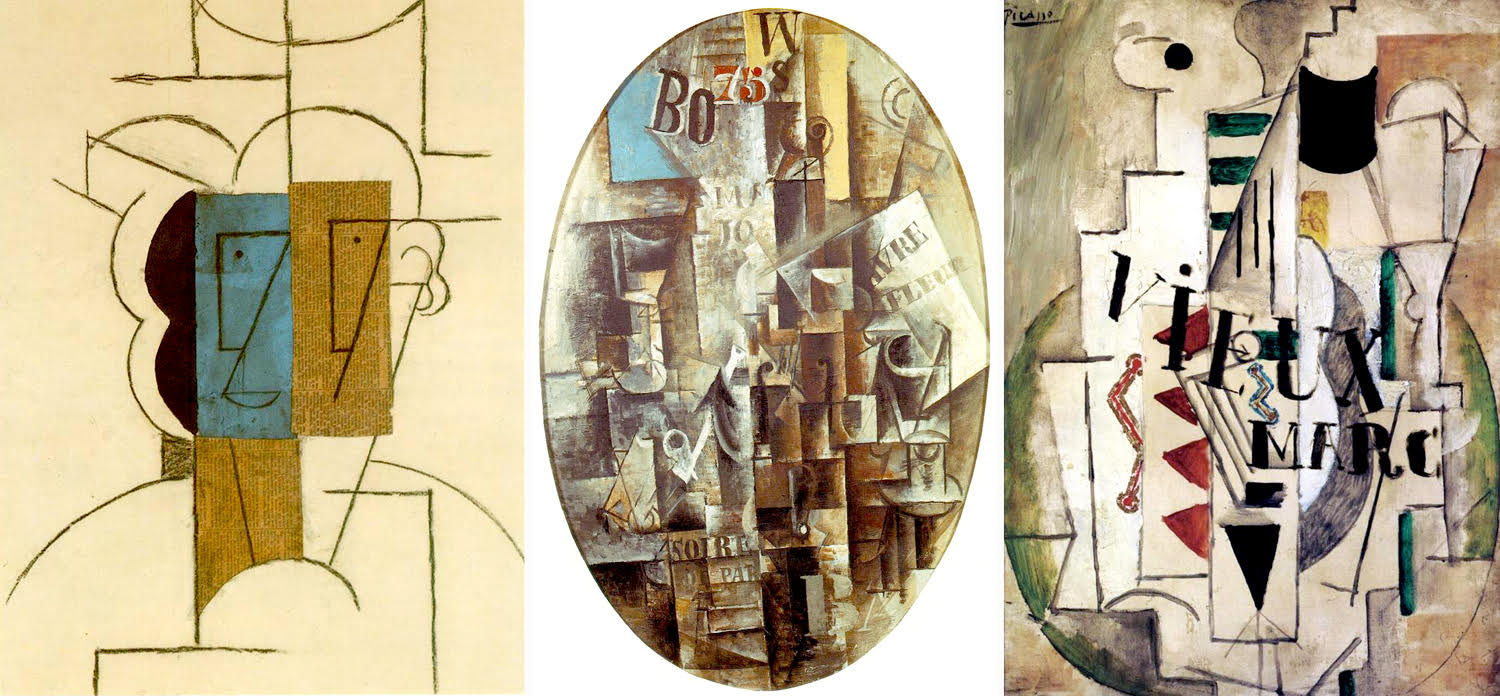
to analytic Cubism,

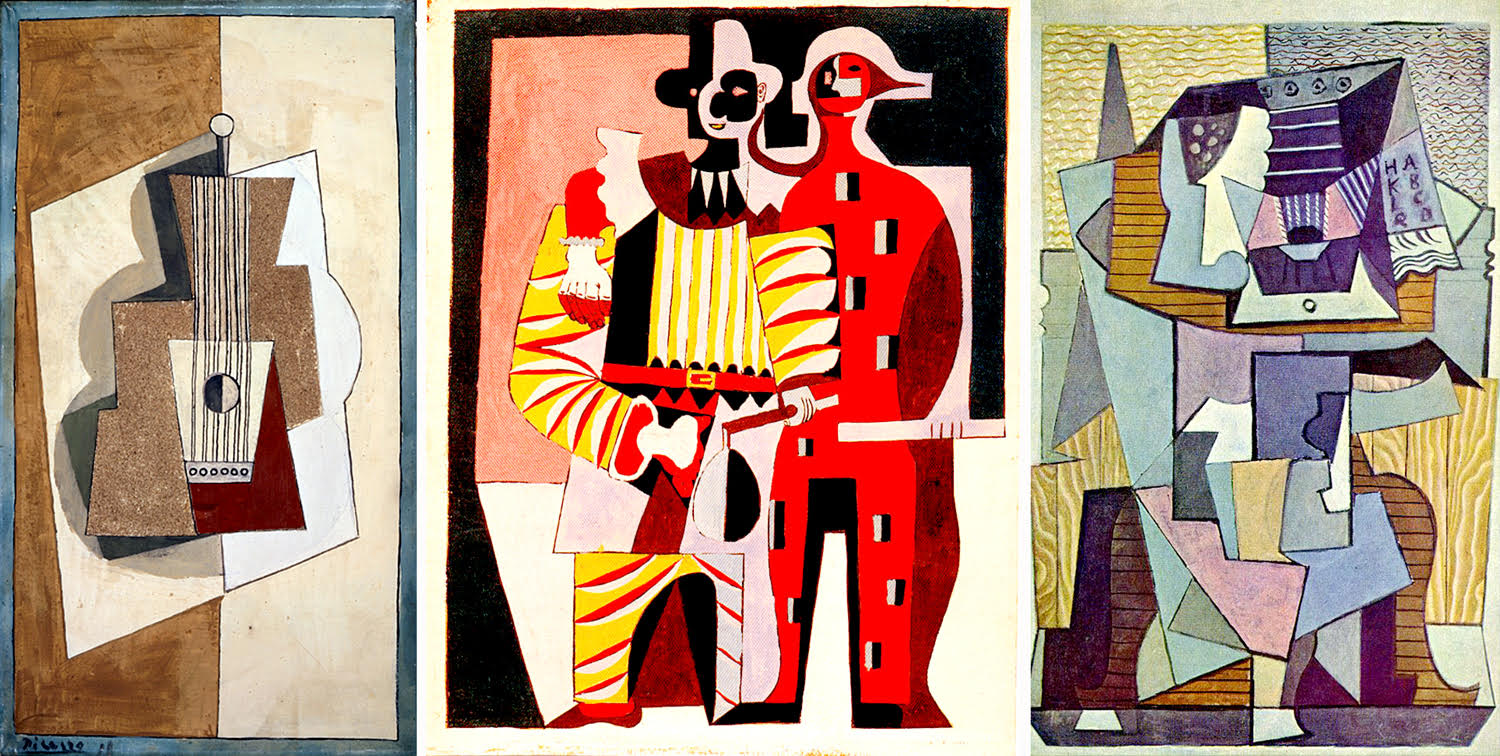
to Synthetic Cubism,

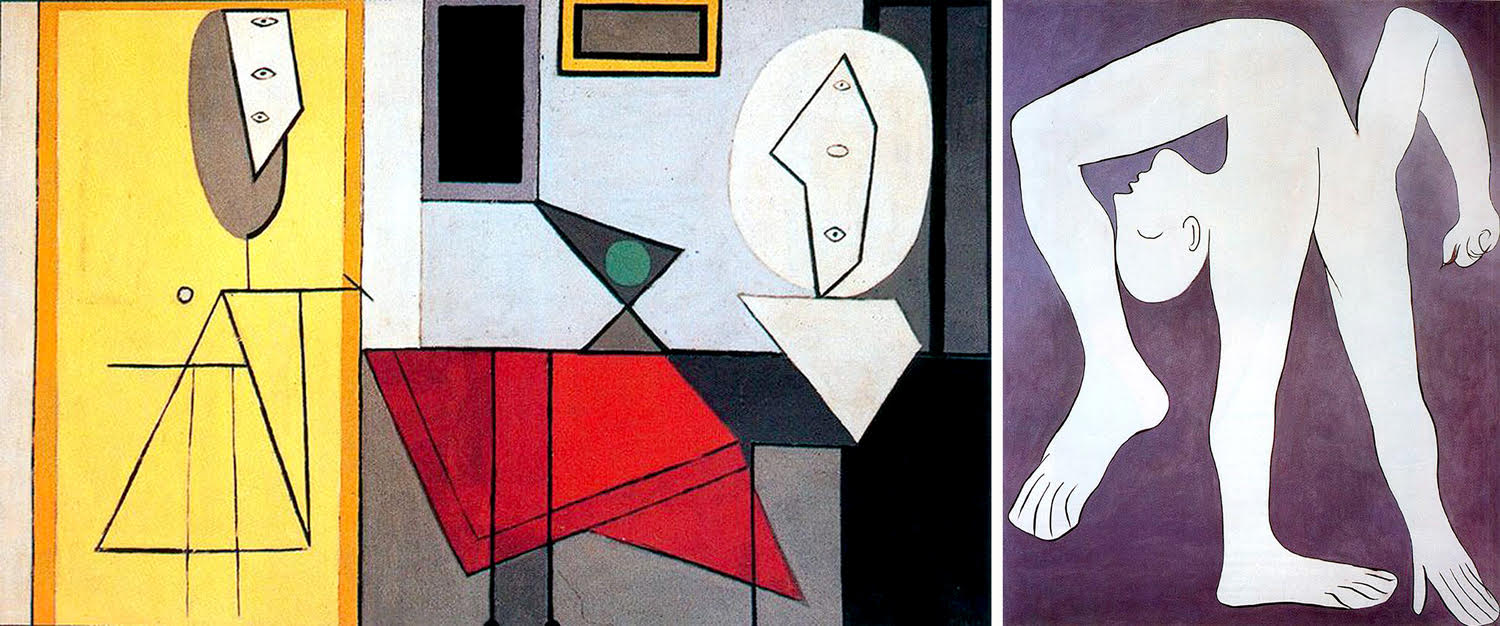
to Surrealism

and Neo-Classicism

Then a brief period in the mid 1920s of what might look like a return to a kind of realism

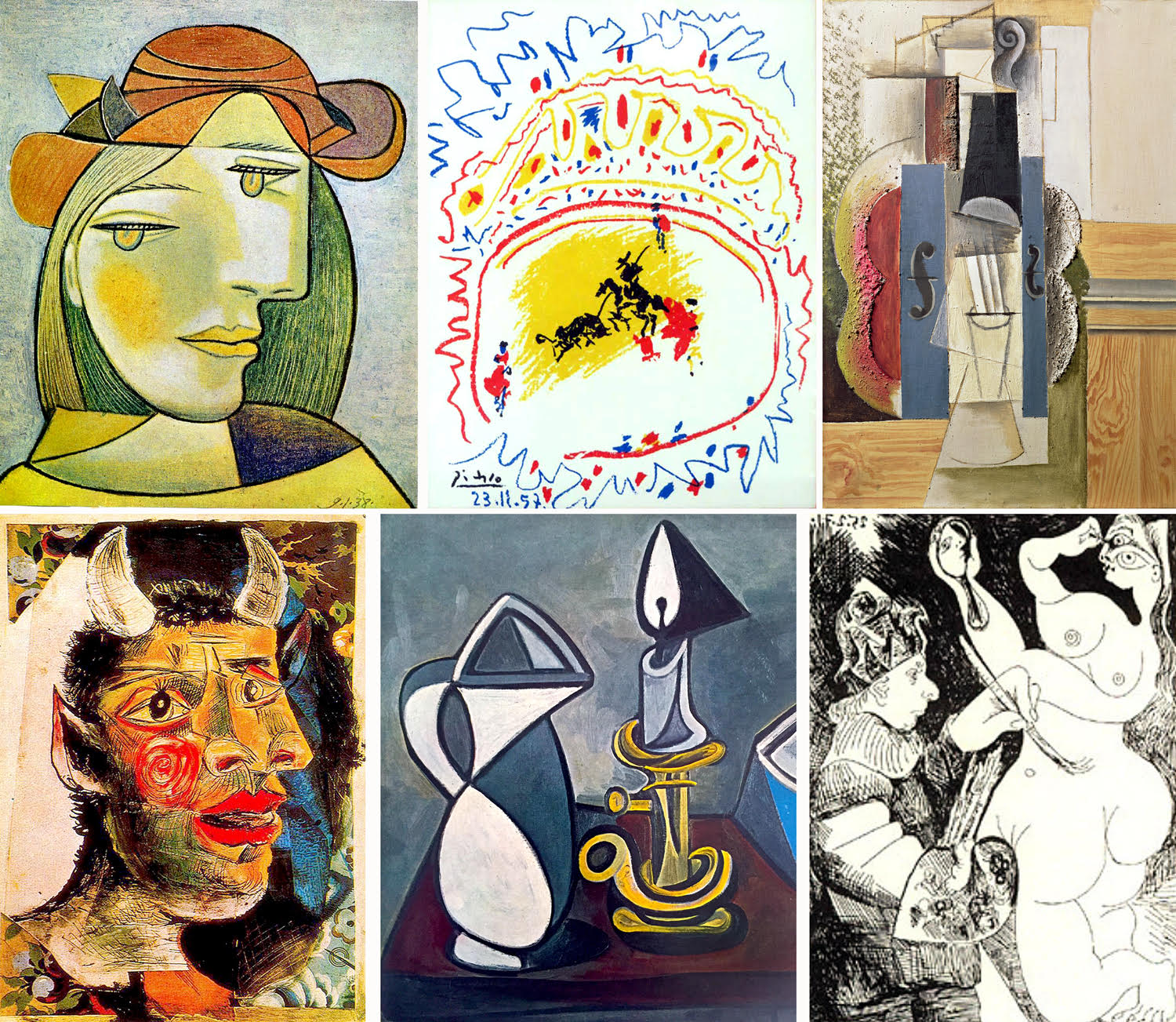
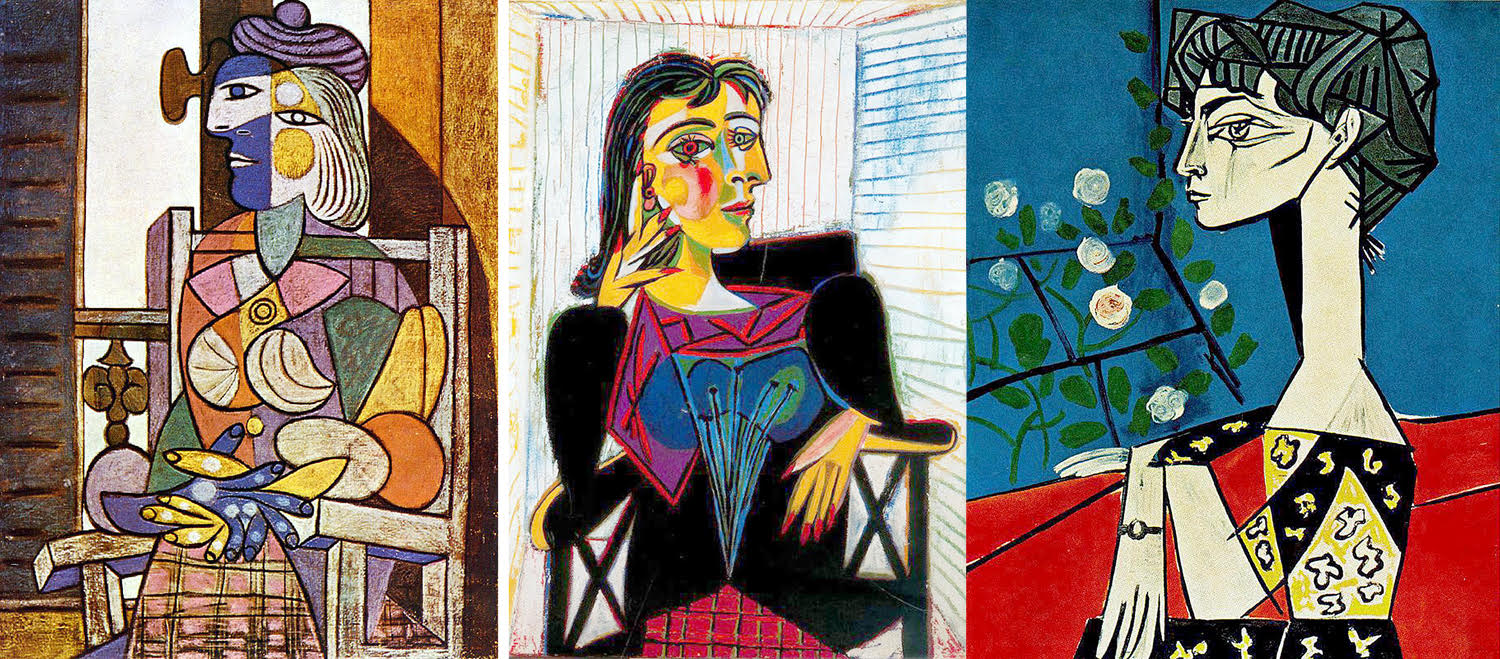
and then, into what can only be termed Picasso-ism — his playful mix of everything and anything, usually turned out in a few hours and often rather haphazard.

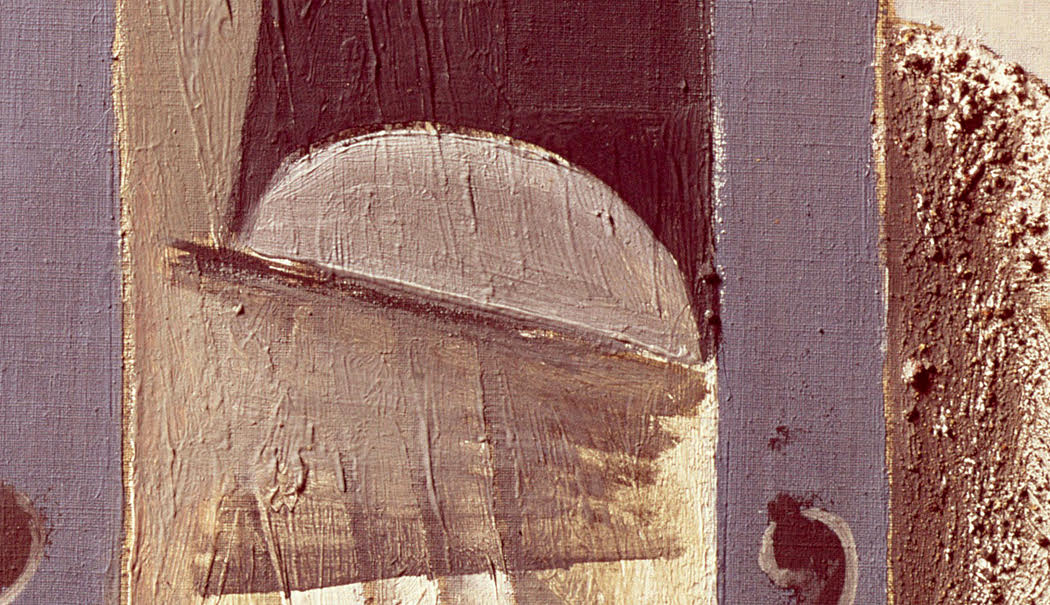
And this gets to my main point: That Picasso was an epically inventive visual artist, clever in the first degree. But from his earliest work onward, was always rather indifferent about the craft of painting. His application of paint to canvas was often sloppy; parts of many paintings were essentially unfinished; many are more caricature than character; even his color choice often seems unconsidered — any red might do, any green, any blue. His art is one of suggestion rather than observation.

This was typical of his approach in other ways. Where most artists use their work to react to life and the world, Picasso seemed always more interested in cultural tropes. That is, he picked on several archetypes — or stereotypes — and re-imagined them over and over. These are themes straight from his brain, without recourse to the actual world.

There were bulls and bullfights; Harlequin and Pulcinello; circus performers; the down-and-out; birds; women, both as portrait and as nude; satyrs, fauns and demons; still lifes; and over and over: the artist and his model.

He drew these subjects from his mind, not his eye. And the goal seems to have been to get them down as fast as possible and to get on to the next canvas. During the Renaissance, an artist might work on a painting for a month, polishing it to a perfect finish; Picasso seems to have been more likely to complete several paintings in a day.

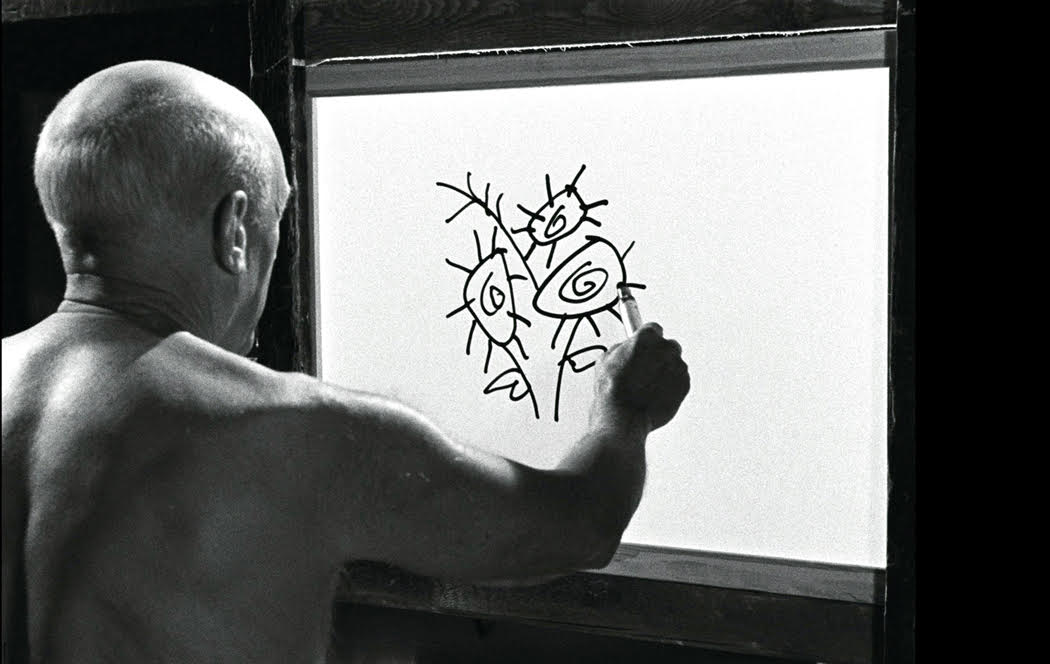
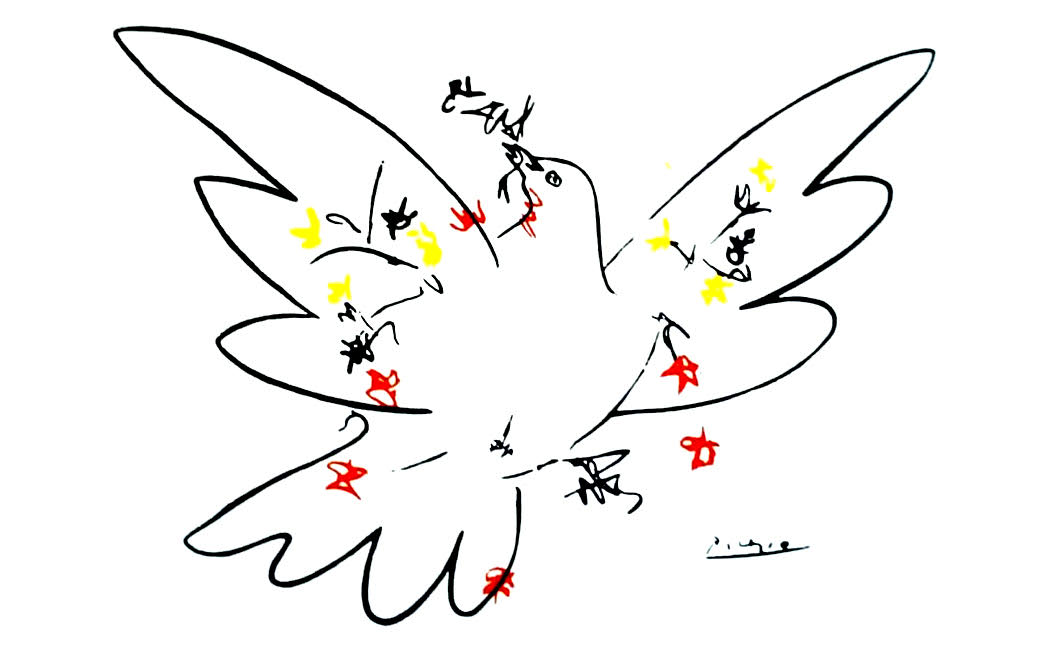
You can see how fast he works (and how fast his mind could work) in the 1956 film by director Henri-Georges Clouzot, The Mystery of Picasso, in which, over the course of its 75 minutes, the shirtless Picasso completes 20 drawings and paintings. Of course, most of these are merely sketches, but you can see how fast his brain is functioning — and how diagrammatic his take on the visual world really is. He is not capturing the way the world looks, but rather creating hieroglyphs to be read, the way his dove is a symbol for “peace.” Or the stick-figure man or woman on restroom doors.

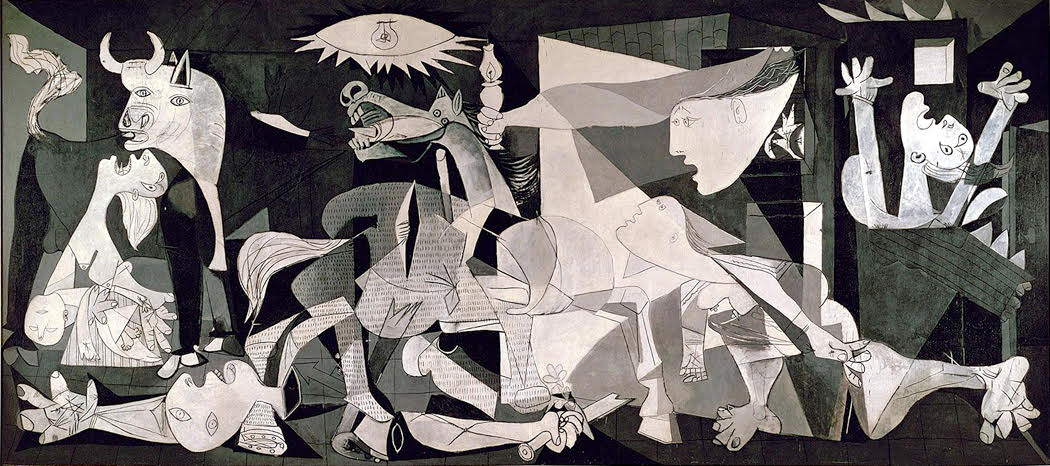
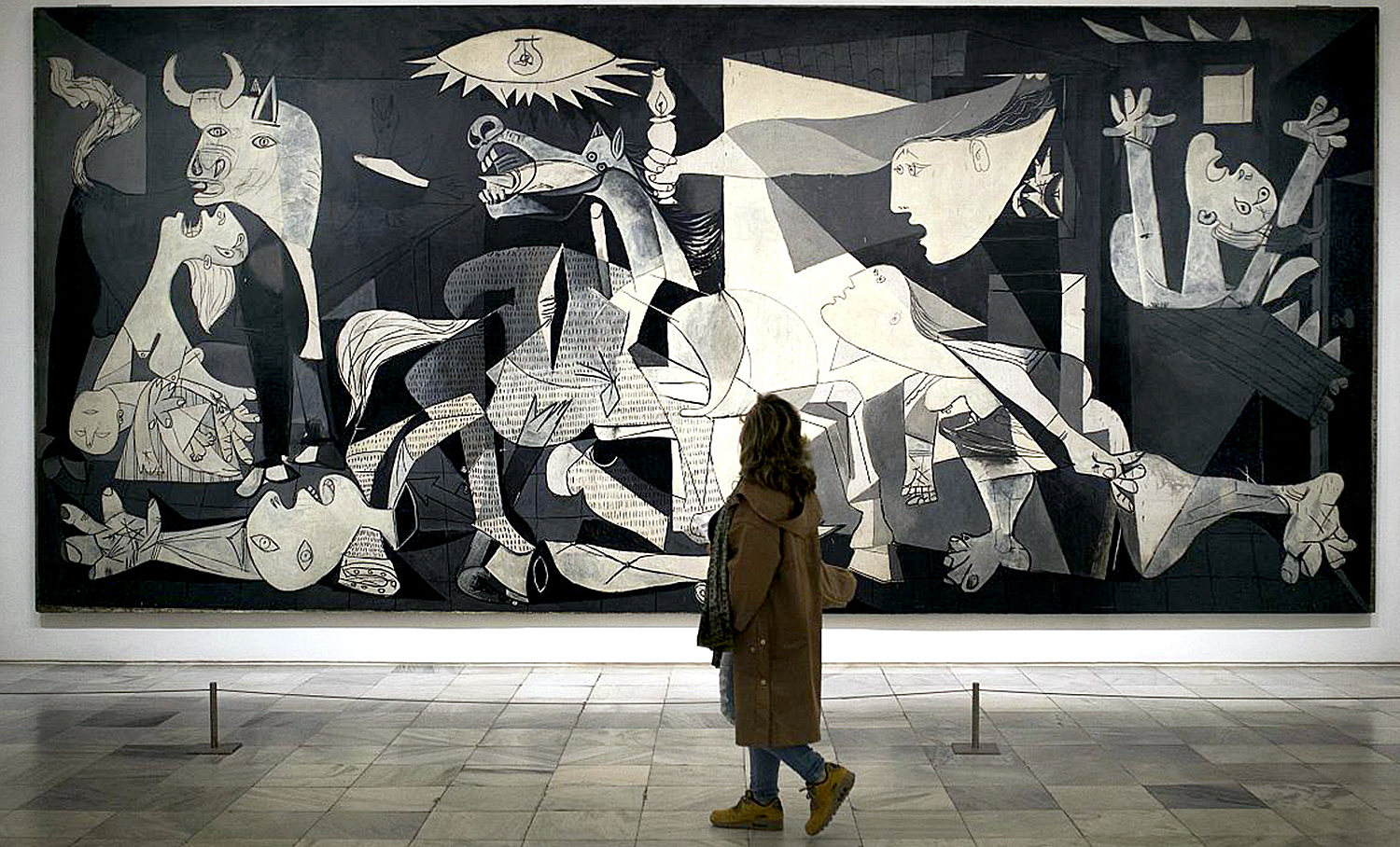
The one time he made the effort, worked over many preliminary sketches and worked his canvas to a fine finish, he produced what is probably the most important, most powerful painting of the century — his 1937 Guernica, about the bombing of the Basque city by Nazi planes supporting the Fascist forces of Francisco Franco. The giant painting —roughly 12 feet by 25 feet — hung for many years at the Museum of Modern Art in New York, as, under the will of the artist, it could not be returned to Spain until the reestablishment of democracy. It finally went home to Madrid in 1981.

I saw the painting many times when I was a young man, living just outside New York, and visiting MoMA as often as I could. It anchored one end of the museum and you could see it as soon as you got out of the elevator on the second floor, the focus of the whole museum.

I’m not saying that we would have been better off if Picasso had spent more time on fewer paintings — his prodigious energy is largely why we honor him. But what can’t be ignored is that his work is often slapdash, sometimes not much more than a doodle.

When I was young, and for the first three-quarters of the 20th Century, Picasso was a colossus, almost universally acclaimed as the era’s greatest artist — the Muhammad Ali of the paintbrush — but in recent years, his primacy has receded. Partly because the adrenalin rush of Modernism has petered out; partly because the art market has become so much more simply part of the financial world, more interested in investment and less in the actual art; and perhaps most of all because Picasso, the man, has been revealed as such a misogynist pig. He was a very unpleasant man.

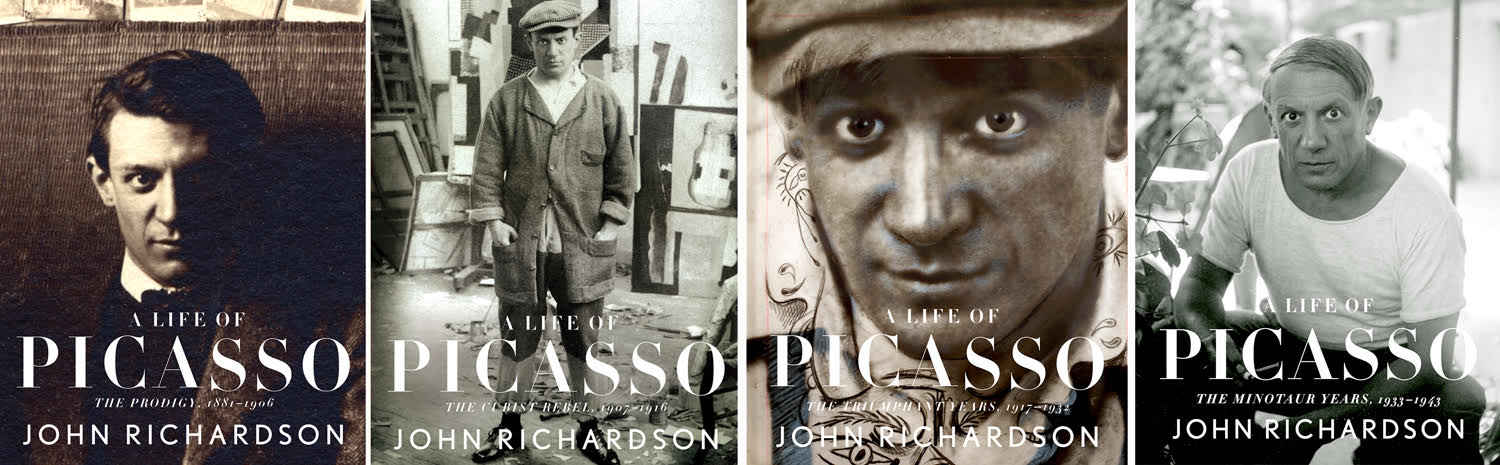
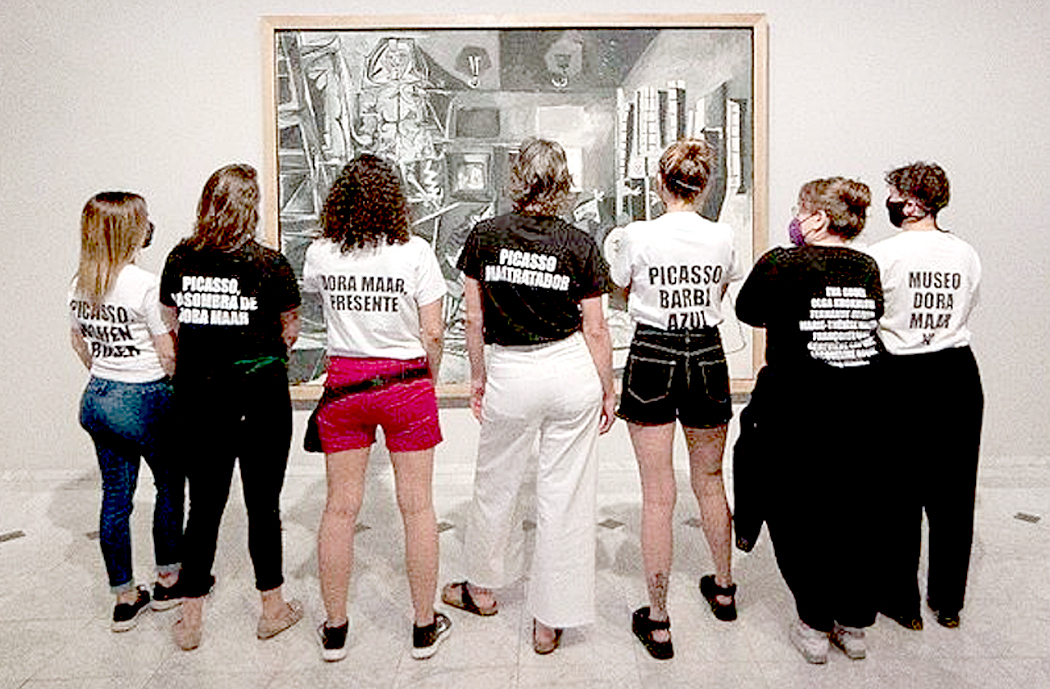
Since the publication of the four-volume biography by John Richardson, it has been clear what a self-serving, self-promoting, egotist he was. He went through wives and mistresses, using them and often abusing them. Once we thought of him as the great stud of art, now more like a frat boy with little care for the women in his life. Fernande Olivier, Olga Khokhlova, Marie-Thérèse Walter, Dora Maar, Françoise Gilot, Jacqueline Roque — there and gone.

Then, there was the semi-criminal past, selling fraudulent or stolen art, and footsying with the Nazis in occupied wartime France. In our current more censorious age, we more likely to knock the laurels off the heads of our writers, artists, filmmakers and actors — Did they diddle underage girls? Did they coddle to dictators? Did they steal the credit due to women? Were their intentions less than pure?

If we give in to these worries, we will have to strike from the record much of our cultural heritage. Artists are just as human as the rest of us.

And so, I forgive the genius his sins — they are past and he is dead — and honor the art. But I cannot ever not notice that for all his brilliance, Picasso was an indifferent craftsman. When I look at his work, I see the careless brushwork, the muddy colors, the repetitive subject matter.

My own youthful enthusiasm for Picasso has aged into a mature appreciation for his accomplishments. However diminished he is in the public eye, he is still the dominant artistic name from the first half of the 20th century.

Click on any image to enlarge

It is midwinter spring, those few days that habitually show up in February with sunshine and temperatures into the 70s that fool you into believing that spring is close at hand, only later to kick you with plummeting temperatures and perhaps another snow. The National Weather Service predicts that for this weekend. 

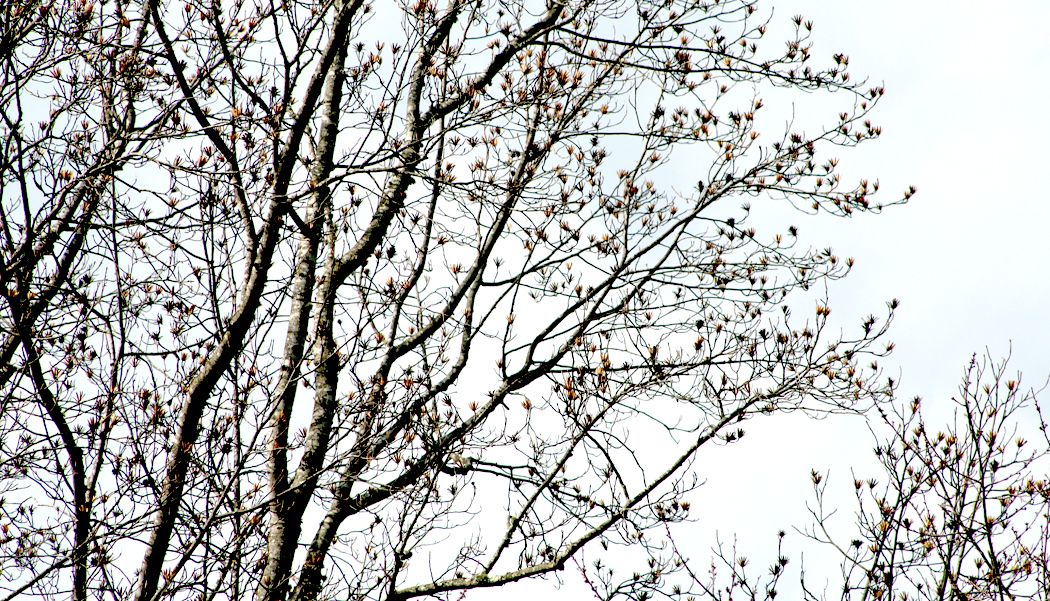
This is my favorite time of the year, when the bare trees begin budding at the twig tips. You can watch the trees change day by day, turning the dead sullen grey of December into something that clearly has a rising sap under the dull bark. When you watch the buds close up, their bud scales slowly separate, with thin lines of green beginning to spread at the edges. 

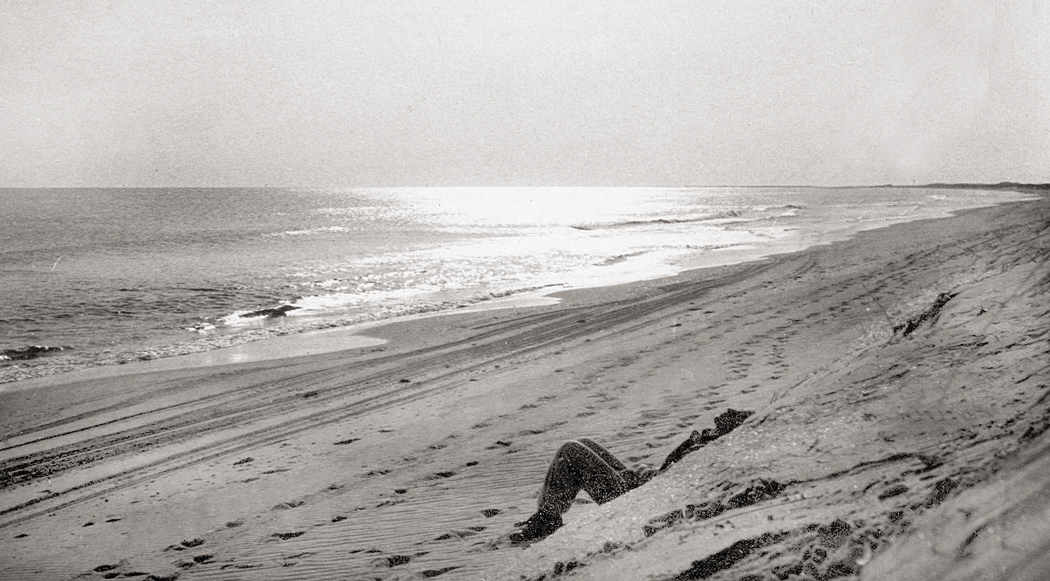
Fifty years ago, my friend Sandro and I would annually take this time to camp at the Outer Banks. Off-season meant we had the sand and sea to ourselves and could walk five miles along the strand without ever meeting another human. 

Sandro at Cape Hatteras, 1969

It was also Mud Season. You don’t read about it in literature, with its darling spring buds, its gold first green and its young sun half-run in the ram’s course. But there it is — early winter rains drained deep into soil and then turned hard as rock in the frozen air. November’s squishy footprint is turned to fossil, brittle as any sandstone, its edges wedged up in a tiny crater. But the February thaw, or later, when March brings those buds to stretch their scales, those footprints turn once more to watery goo, slippery under your shoe, sucking your heel right off your foot. It is what is wrong with pretty literature. Among all the pinking petals, among all the bright girls in spring dresses, among all the apple blossoms and greening grass to come, there is the mud, ripe, fertile, pliable in your squeezing fist, the one brown, crowning reality of the the coming spring, when there is mud again.

It is such elemental things that seem most real, most important. Culture changes, fashions change, but the cycle of seasons wears a constancy. 

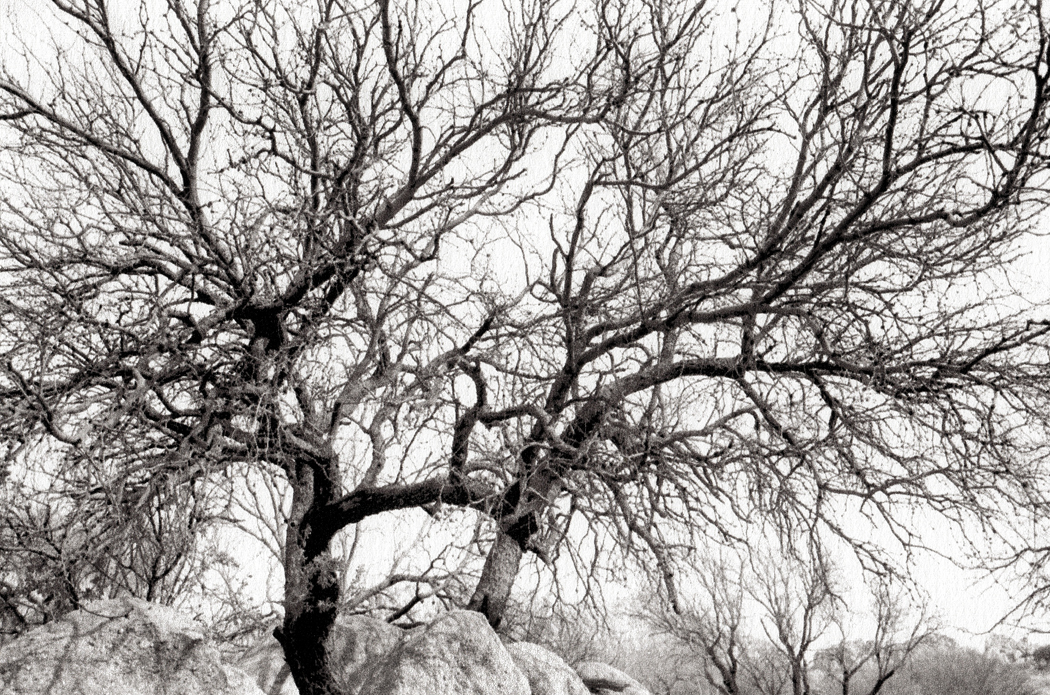
Texas Canyon, southern Arizona

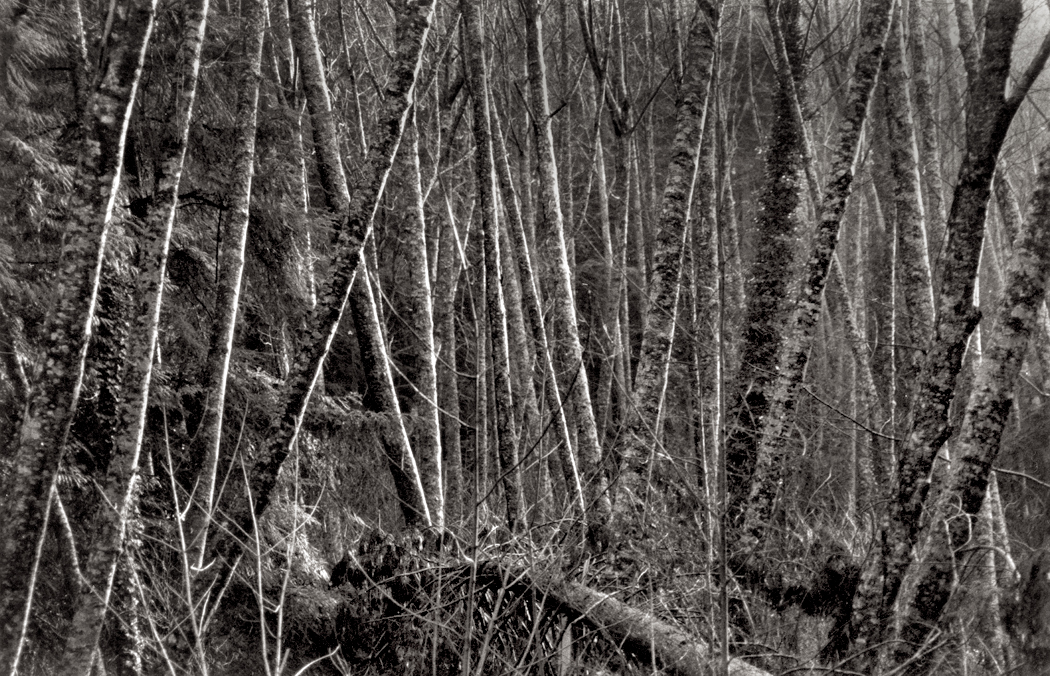
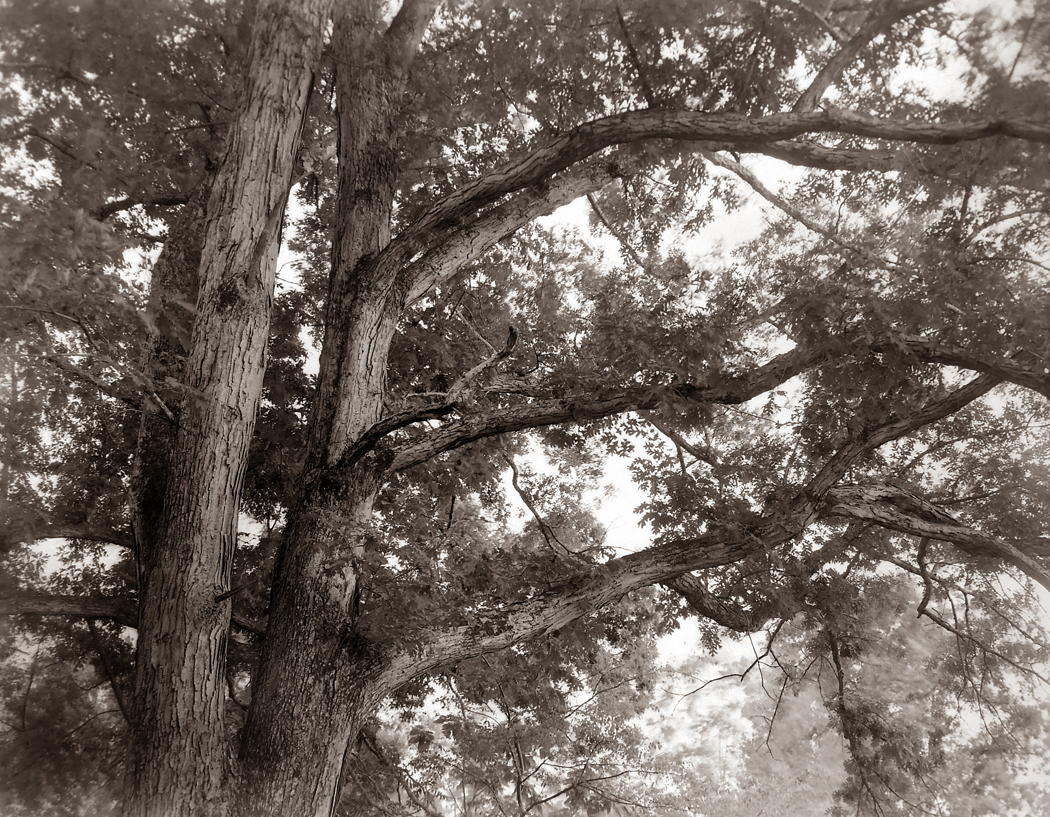
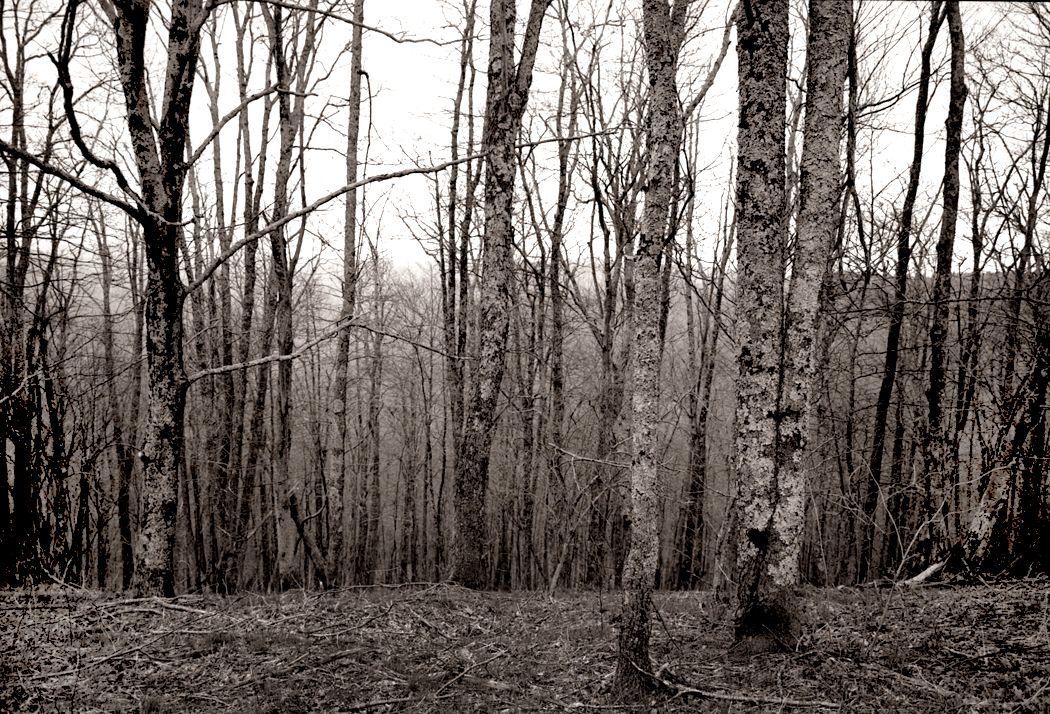
For me, it is the trees, most of all. I love the spring trees well enough, but it is this time of year, when the trees are still bare and show their bones that I wait for each fall. Drop the leaves ecdysiastically and I can see the shape of the thing they cover. 

Spring oak, Blue Ridge

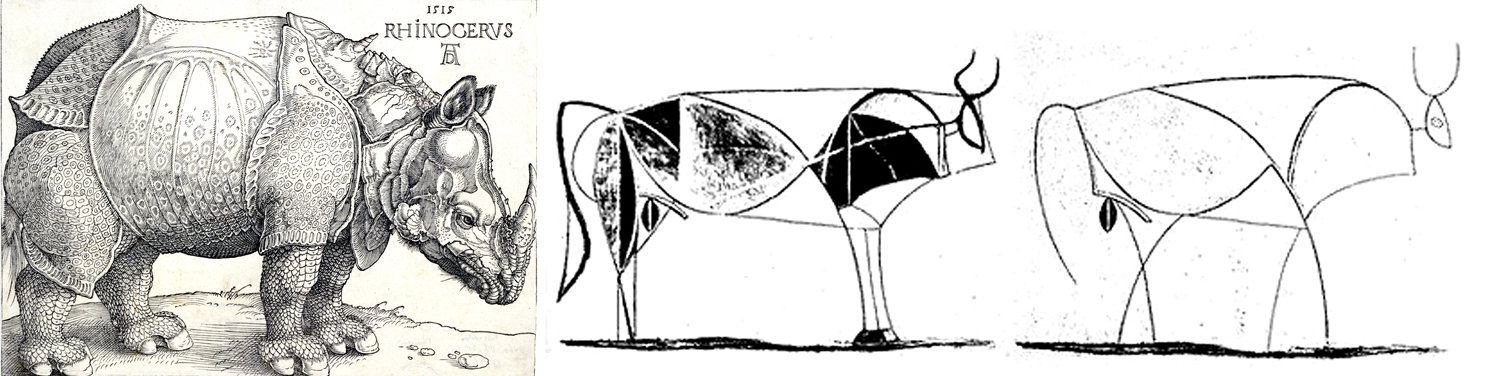
It is the lines they make against the sky. An etching more than a painting. Artists through history are generally assigned to one of two categories — they are either line people or color people. Line painters, like Botticelli, tend to draw their scenes, often in actual outlines, and then fill in the colors, while color guys, like Titian daub pigment onto the canvas and let the patterns of color define shapes. It’s one of the major distinctions made by Heinrich Wölfflin in his 1915 book, Principles of Art History. It doesn’t mean the line guy doesn’t appreciate color or the color guy doesn’t appreciate shapes and forms, but rather it defines what hits them first and most centrally. 

(There is a similar distinction in music. Composers — and performers, too — tend to be line guys or chord guys. Lots of counterpoint for the first, and washes of tonal color for the latter. Bach vs. Debussy.) 

Albrecht Dürer rhino; Pablo Picasso bull

Albrecht Dürer was a line guy, most characteristically in his wood engravings. Picasso was a line guy and certainly an indifferent colorist. Most of his paintings could easily be given different fill-in colors. Matisse, though, a color guy to his teeth. Even more recent painters can be divided. Ellsworth Kelly a color guy; Lucian Freud a line guy. 

Well, I’ve always been a line guy. And the lines drawn by winter trees have hypnotized me since I was a wee bairn. One whole category of my photographs are what I called my “tree nudes.”

The nude has a specific purpose (outside the merely voyeuristic). Clothes drop their subjects into a very particular time and place. Eighteenth century breeches; flapper skirts; bell-bottom trousers; togas; saris; morning coats with a peeking handkerchief in the breast pocket. 

But the nude is — or can be — timeless (with the caveat that hairdos can be a giveaway). There is a universality to the nude in art, which is why so many Greek statues are naked. And we are meant to appreciate the form — shape, detail, muscularity — and not just a specific person with a name, family, opinions, and personality. 

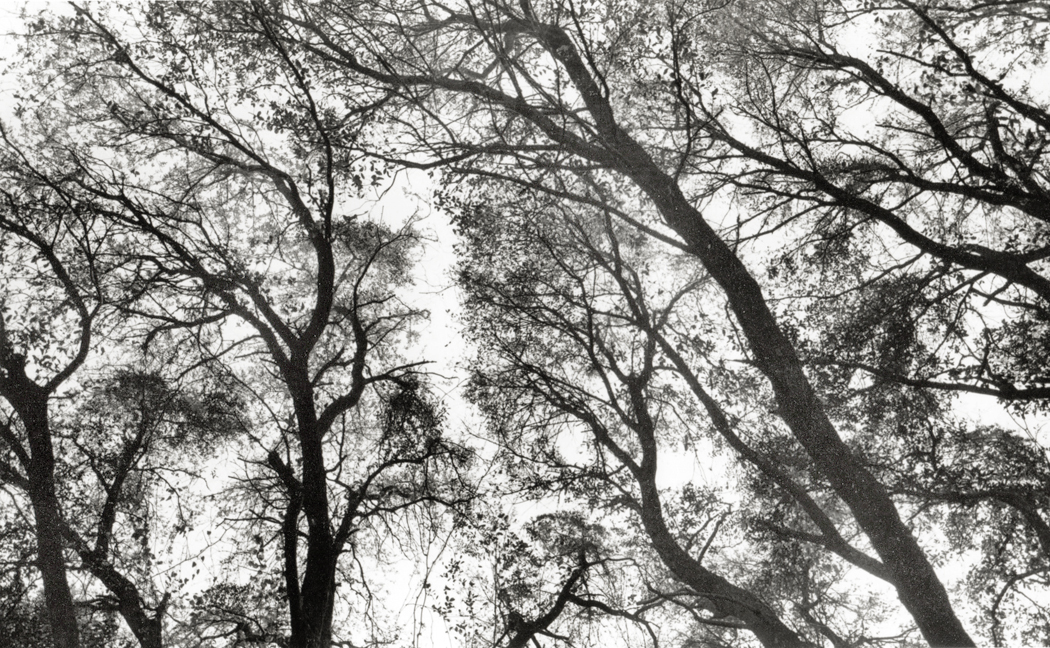
And I feel the same thing in the bare ruined quiers, where late the sweet birds sang. There is structure in the dark lines of the branches, and a systematic chaos in the way they all cross each other in a welter of visual information. 

In this, I am reminded of the drip paintings of Jackson Pollock, which I came to love in the New York art museums I visited beginning as a teenager. A good nature-scribble of branches puts a buzz in my visual brain. I love it and have sought it for the past 60 years. Among the first photographs I ever made, 60 years ago with an ancient 35mm Praktica camera were of trees. 

Of course, while trees are beautiful, they can become an obsession. If I had chosen to make a career out of photography instead of writing, the trees pictures would have dwindled. As Fred Astaire says in the film  Funny Face, “You’d be amazed how small the demand is for pictures of trees.”

But I have followed trees through seasons

Ice storm, Greensboro, NC, 1969

and all their leafy-ness

Sweetgum tree, Redwing Golf Course, Virginia Beach, Va., 1984

I have sought the best image of the jumble of buds, twigs, branches, trunks and bark that I feel as a signal for my emotions. 

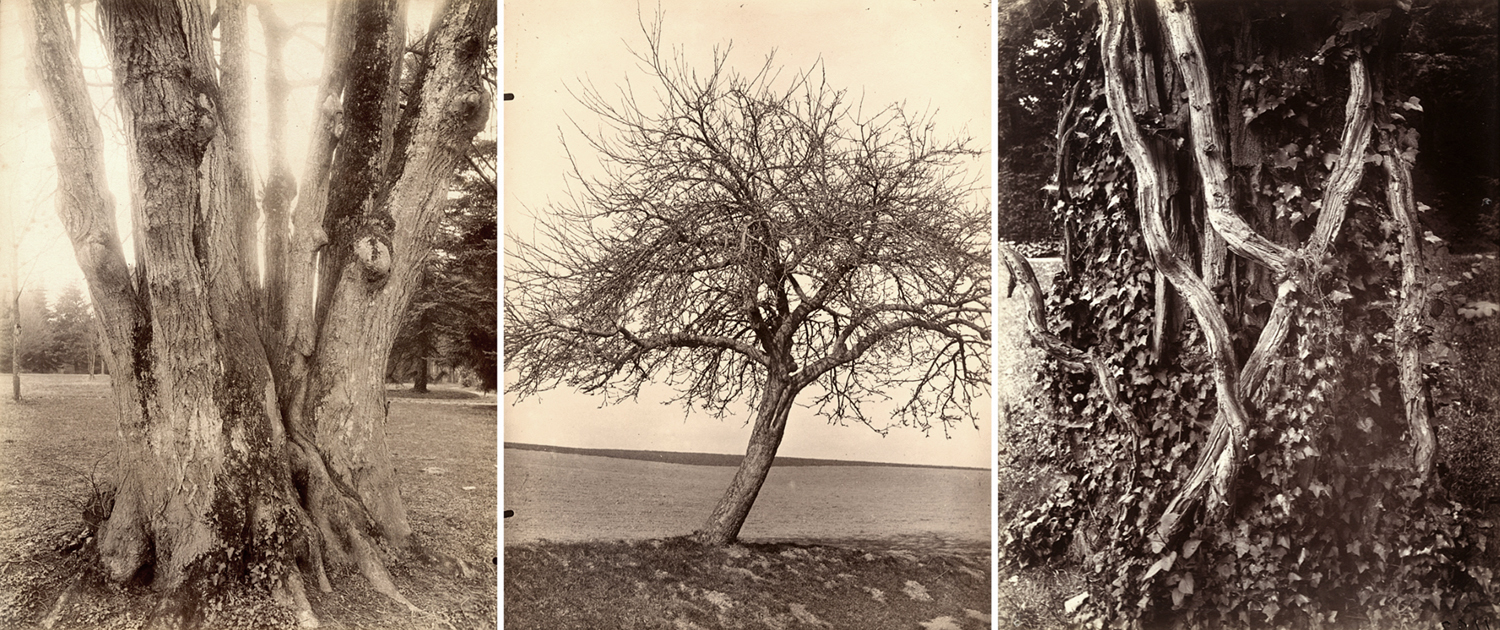
One of the first shows at the Museum of Modern Art that made a deep impression on me was in the summer of 1972, when they put together a group of 50 photographs of Paris trees by Eugene Atget (1857-1927).  

Lined up on the wall in a darkened space, with brilliant track lighting that made each photograph gleam like a jewel, the photographs made my heart jump and my eyes smile. Most of the trees were winter trees, with wiry roots dug into the ground, and ancient boughs twisted and weighed down with age. They were ungodly beautiful, but also, in Minor White’s expression, it wasn’t just what they were, but what else they were. 

Three tree photographs by Atget

The way they were lit, the gnarled forms they took, their texture and even the gold-toned sepia surface of the silver images all functioned as metaphor. They evoked emotion the way art can. 

Usually, when most people see a picture, in a magazine or newspaper for instance, the image is just a kind of shorthand for language. You see a picture of a house or car and instantly the words “house” or “car” spring to mind. The journalistic photograph is a kind of pictogram or hieroglyph, like the stick figures on the doors of public restrooms. 

But images can also do more than that: When you abjure the naming phase and feel the color, line, shape, form and also the cultural resonance of an image, they evoke thoughts and emotions beyond the named subject. 

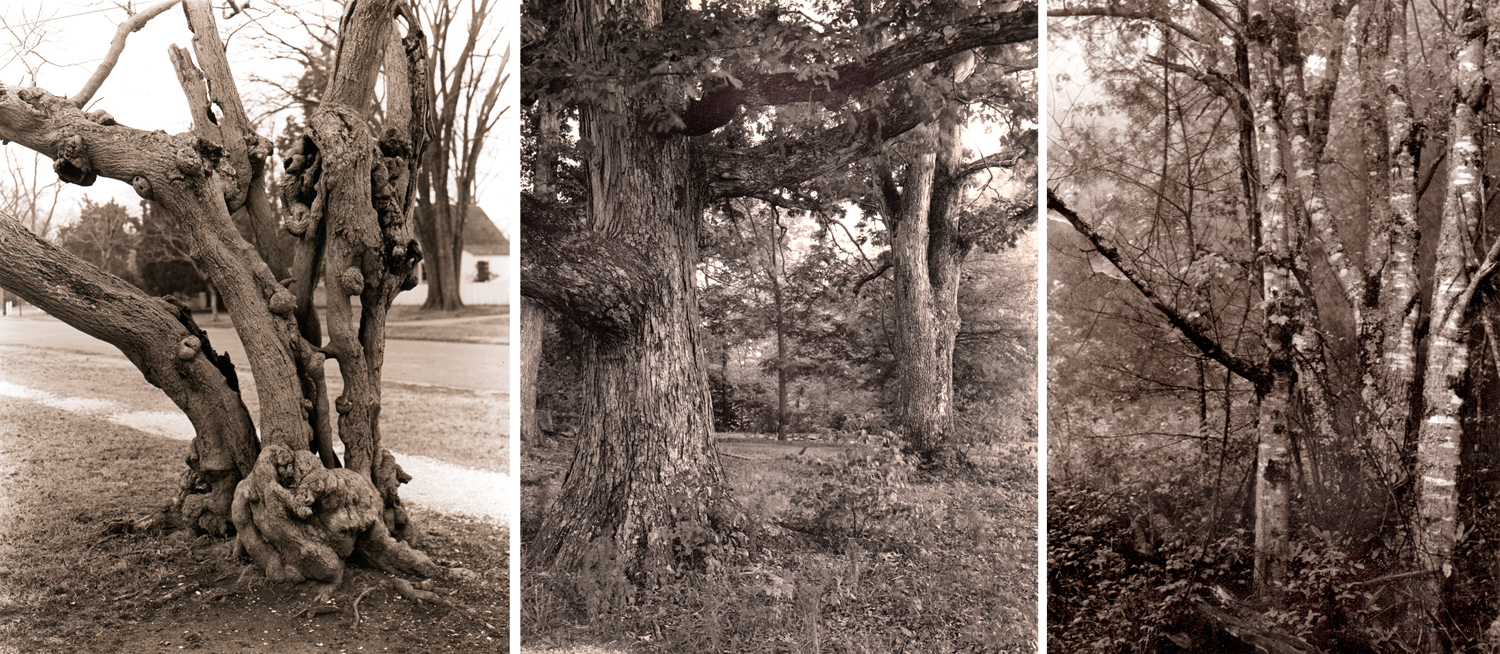
My imitations of Atget

And it was that that blew into my brain, seeing the Atget trees. 

And that is something I have been hunting all of my creative life. And attempting to find in my own photographs of trees. Or not just trees, but in all the photos I’ve tried, whether landscape or still life or nude or portrait or abstract. — What else it is. 

So, when I sit on my back patio and look up the hill at those mid-winter spring trees, with their augury of renewal, and their complex shapes and overlaps — those wonderful lines drawn against the sky’s paper — I want to catch something as it flickers by. 

Aspens, Colorado

I’ve snapped a lot of them, although I’ve caught few. Many don’t have the magic and just sit there as noble attempts. It hasn’t just been bare trees. I’ve tried to find the emotion in all kinds of them.

Morning, Obids, NC, Blue Ridge Mountains

The photographer Alfred Stieglitz called the equation between the subject of a picture and the emotions that are evoked “equivalents.” It’s part of the constant fight between the simple depiction of something you can name, and the attempt to make the image stand on its own as an esthetic entity. 

It’s what most visual art tries to do: create an equivalent in the limbic system to the shapes, colors, lines, and even the subject matter and its resonance with the personal. 

Bainbridge Island, Puget Sound, 1979

Most glossy travel photos are meant to make you wish to be there. But with the image made for display, or as art, you are there, in front of the thing itself. You don’t have to make travel plans. Not just pretty pictures, but objects of contemplation. 

Sandro’s oaks, Summerfield, NC, 1980

The point is twofold. First, to make you pay attention to the world around you, to see with intention. And second, to allow you to connect with the emotions you have in potential.

Wise, Va. 

Both together they make a single bond: interior and external; you and the world; individual and cosmos. No longer separate. 

Over the years, the images I make have become less public and more personal. I no longer pay much heed to the wide acceptance of the art I make. I don’t make it for others, but as a kind of personal meditation. 

I seek new ways of making this happen. One morning, while visiting my brother- and sister-in-law in Reidsville, N.C., I saw the shadows of winter branches projected onto the window blinds. It made for a kind of Japanese byōbu screen. 

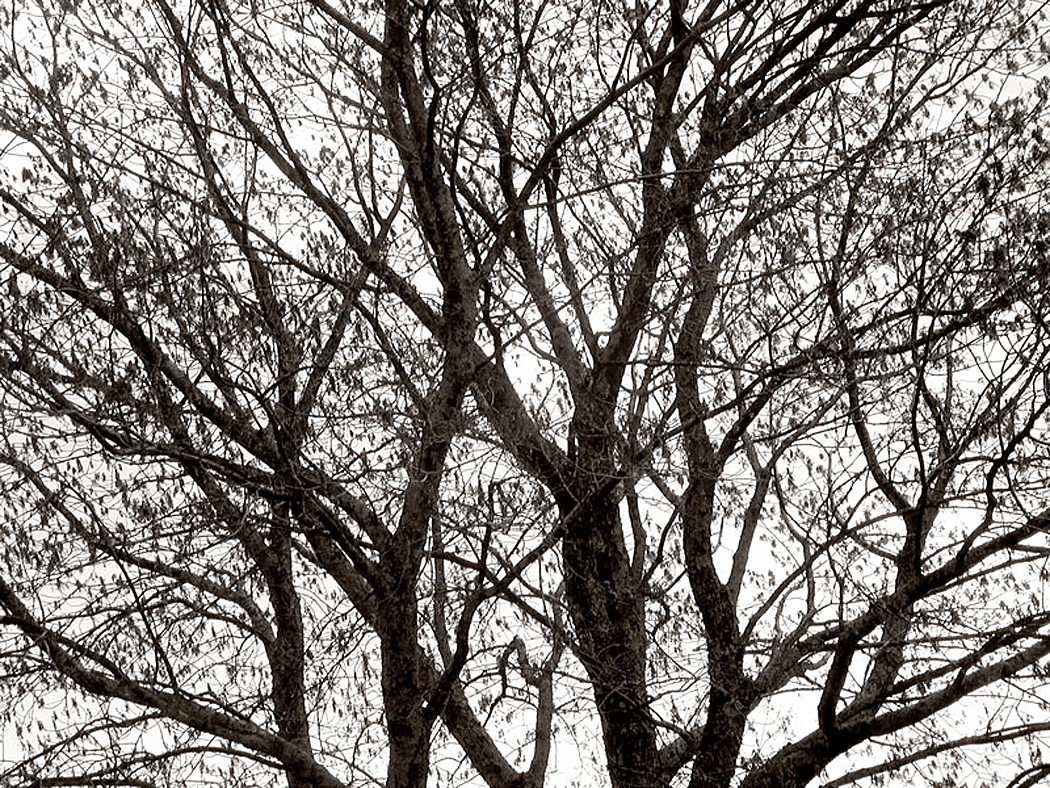
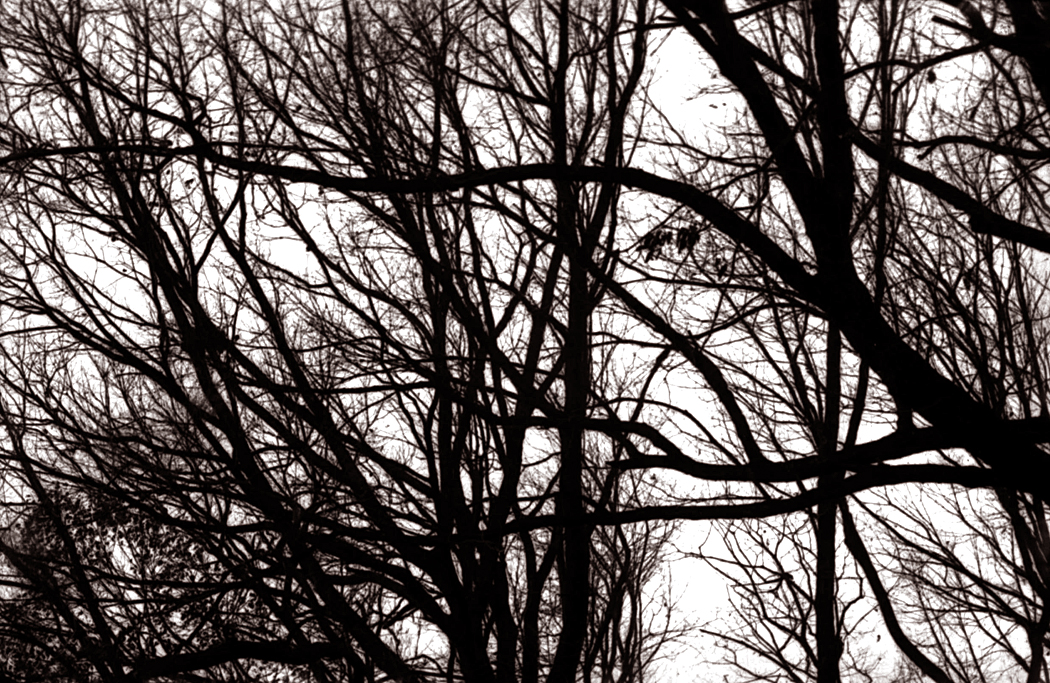
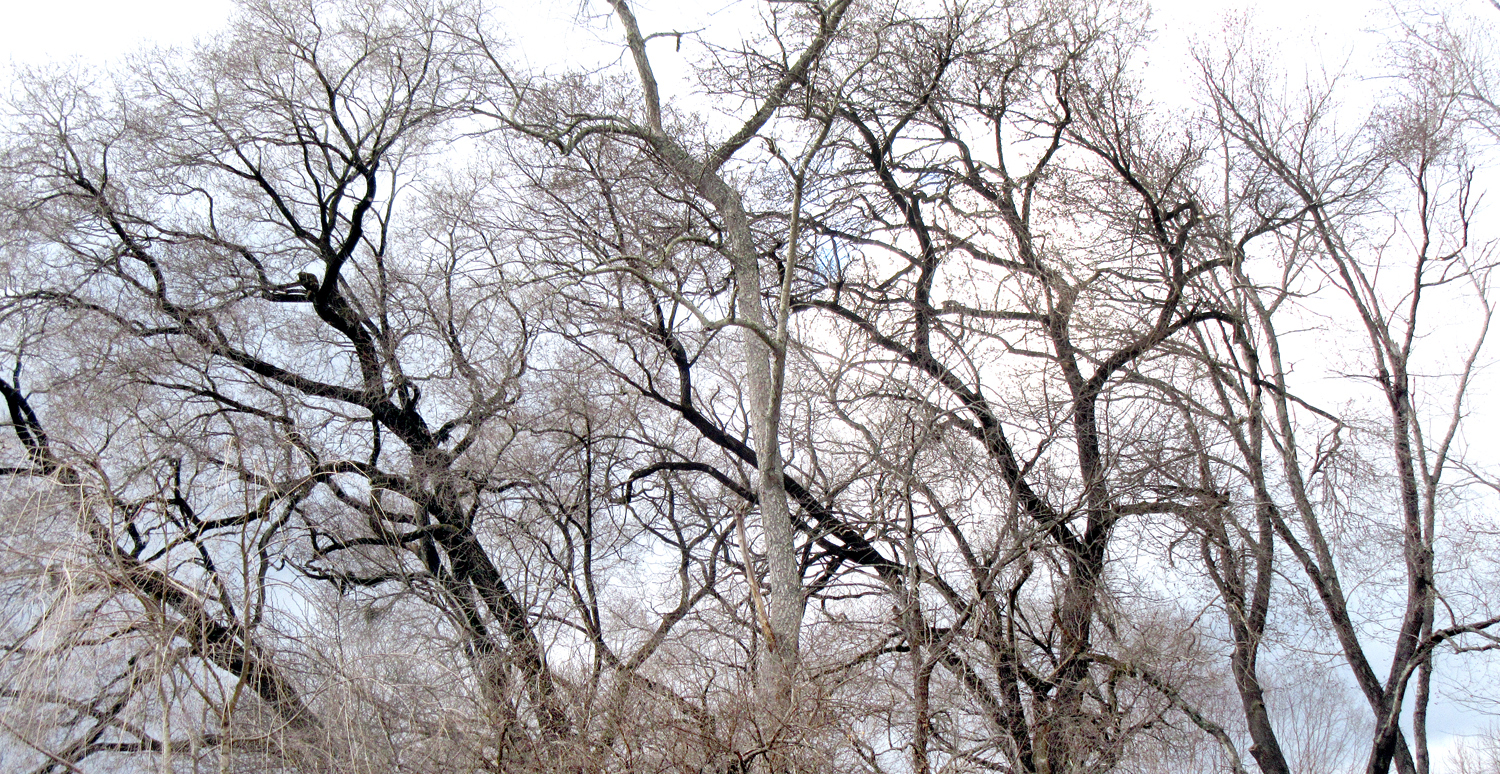
And then, one day last week, in midwinter spring, sempiternally recurring, I was sitting out back, listening to birds and airplanes, the dogs down the street and watching the clouds move west to east and the branches waving in the moving air, and I managed to make an image that finally captures for me the complexity of the abstract, neuronal jumble, all the connections, the scribble and the energy. It is small on your computer screen, but it should be large as a mural. 

If I could, I would print it out mural size to cover a wall. Or split it up over several vertical panels, like a Japanese byōbu screen.

But I no longer have means to do that, and so, I just look at it and contemplate.

Roosevelt National Park, ND

Click on any image to enlarge

During the 1980s and ’90s, I made a series of photographs of gardens. Mostly the gardens of friends, and a few public gardens. And not photographs, but rather, photographs in series — groups of 10 or 20 meant to be seen as a single unit, much like a music suite: various movements making a single titled presentation. 

There was a moment back then when “sequences” were fashionable. Duane Michaels made a living off them. But those were meant to be read like panels of a comic strip, telling a single story. Frames from a film. 

But what I was thinking of was a series not a sequence. They were meant to be shifting moods or patterns, understood the way multi-movement music was heard. A suite of images: Allemande, Courante, Sarabande, Minuet, and Gigue, for instance. And intended to be understood as a single thing rather than merely a collection. 

Whether I was successful or not, it was what I was thinking. 

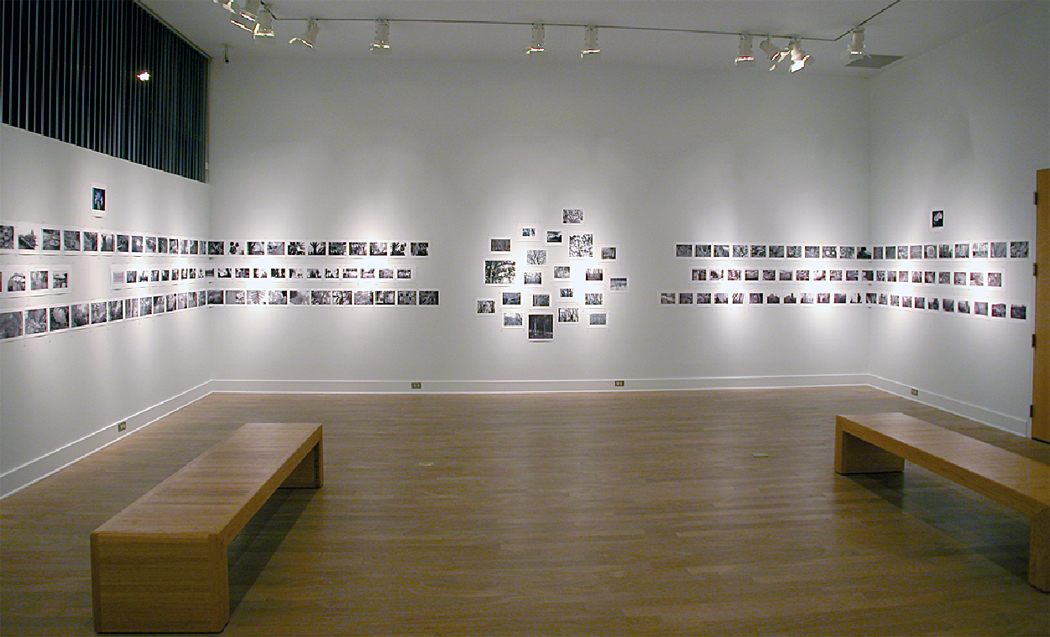
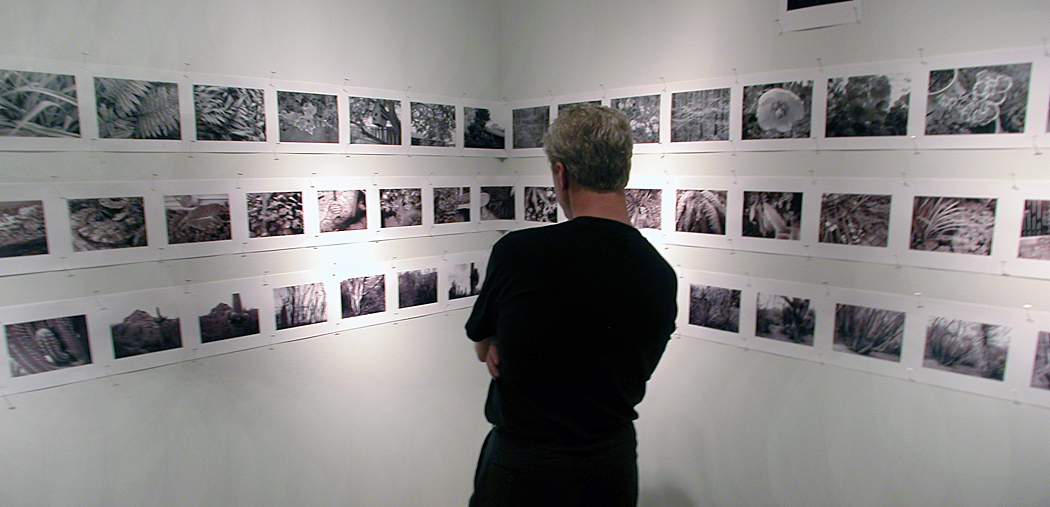
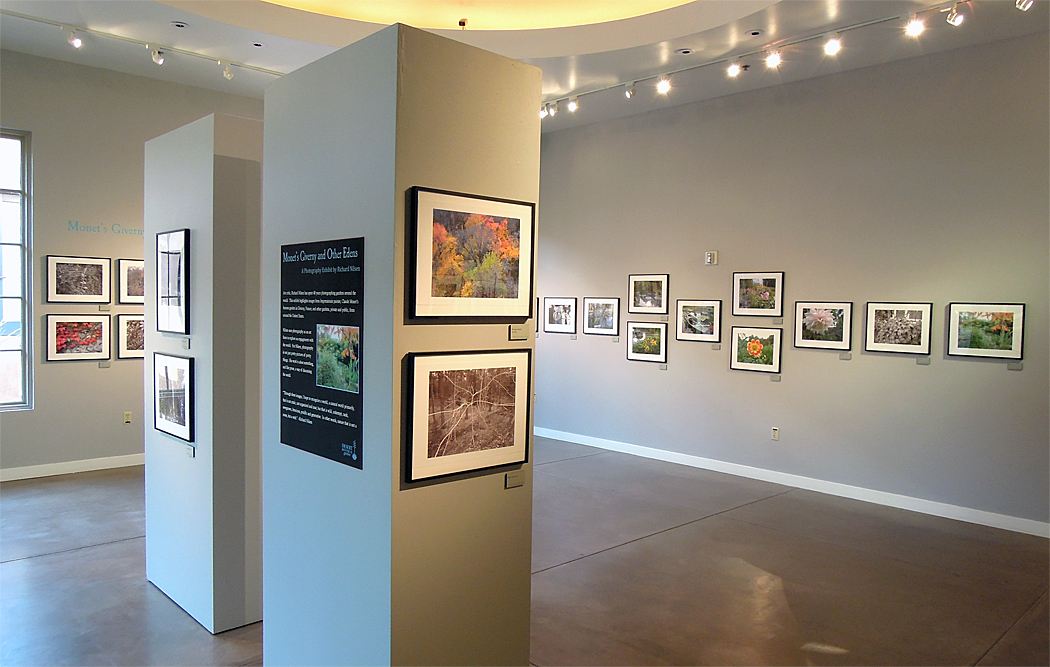
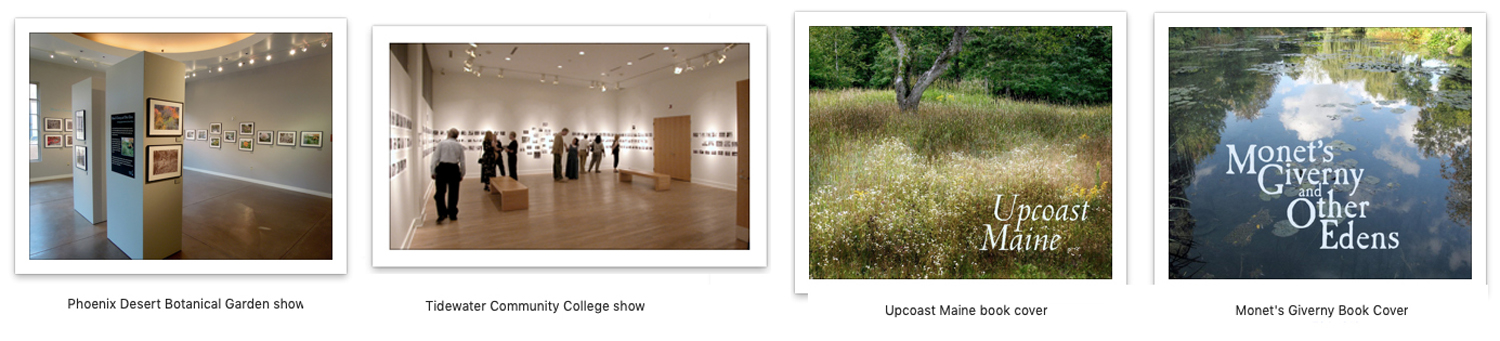
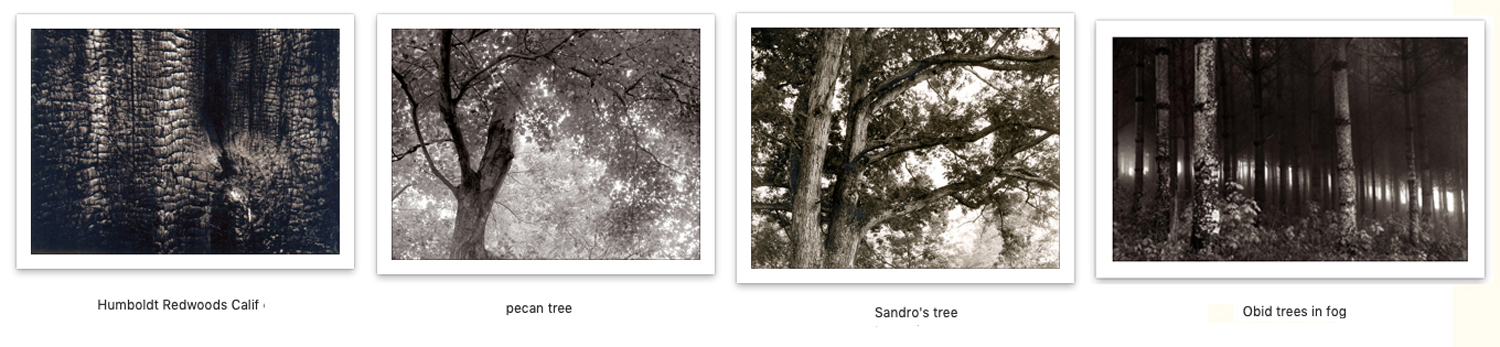
I created perhaps a dozen or so of these series, each boxed up and ordered, with a title card and with individual photographs shown in an order, and all taken during a single day as a single experience. I still work that way, although less formally. I had a show at Tidewater Community College in Virginia Beach, Va., where I had taught in the mid-1980s, and included 12 of these series on the walls. There were more than a hundred prints, lined up and organized by book. 

I’ve continued to work in series, but it was gardens I focused on back then. The photos seemed personal without being intrusive. They were metaphors of their creators. I thought I might share a couple of them. 

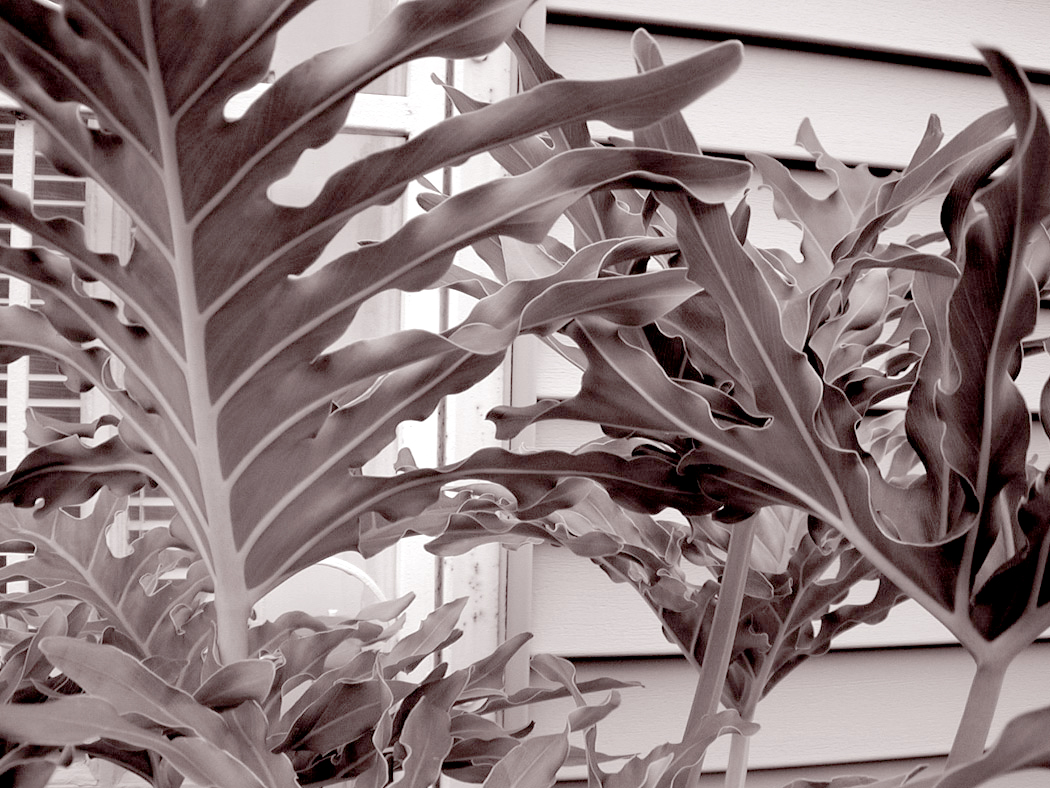
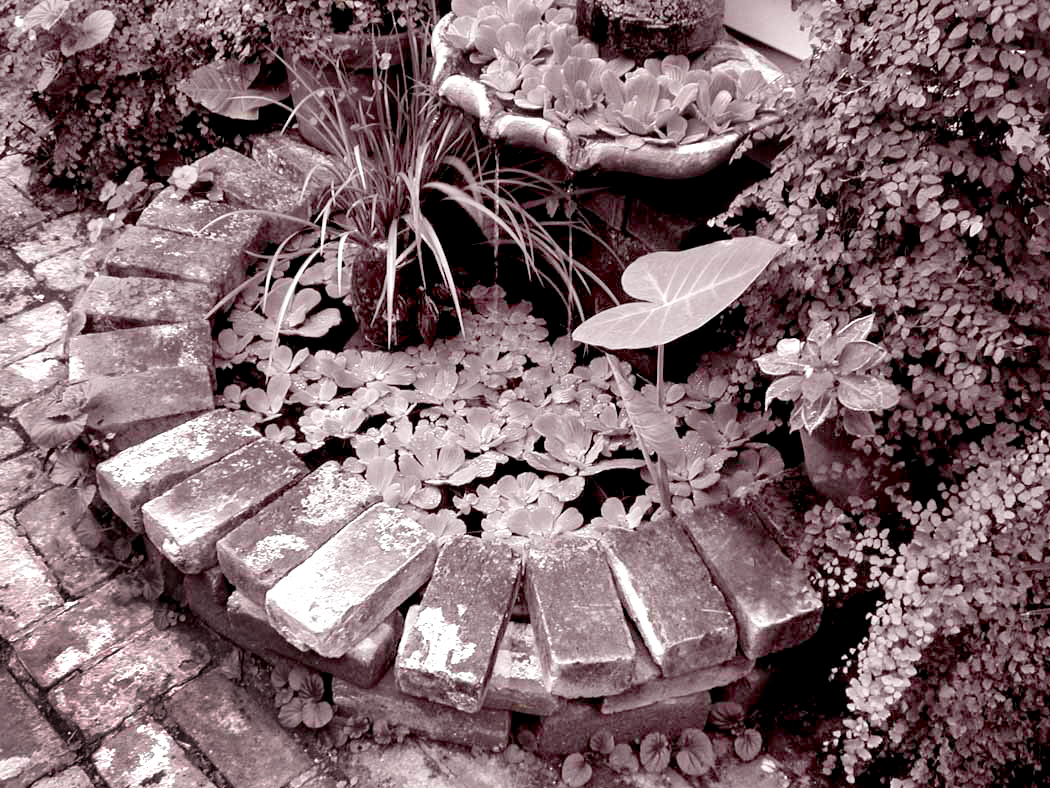
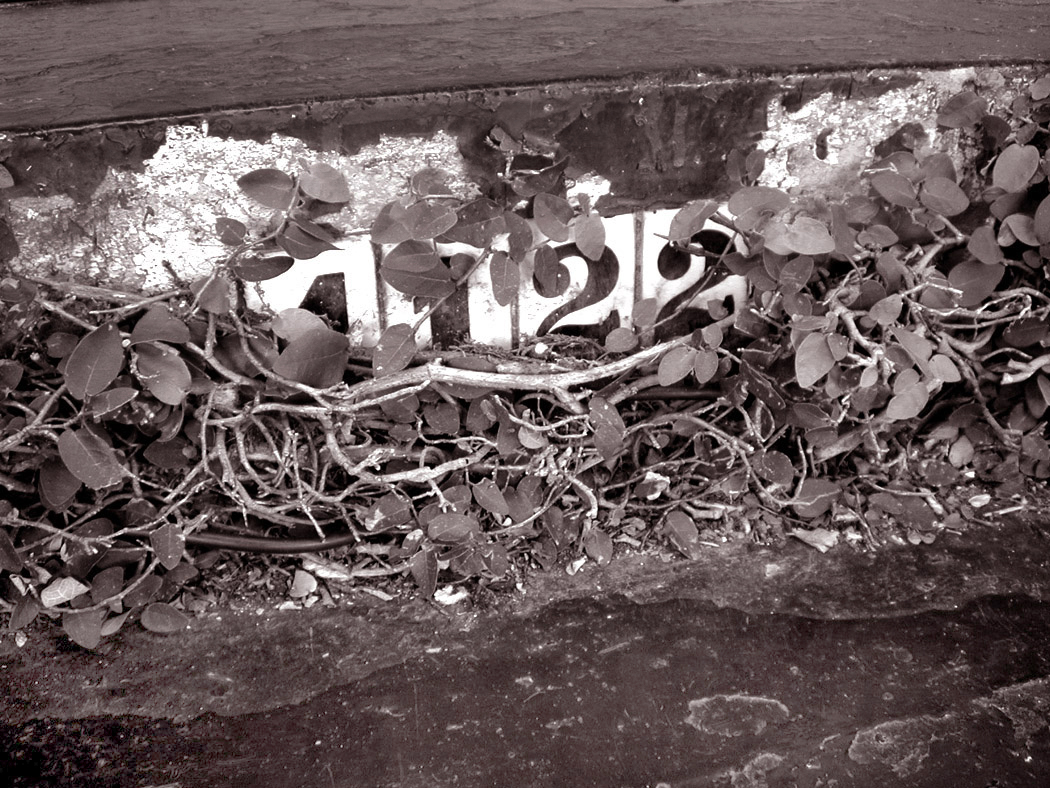
One of the first was made on a visit to New Orleans while staying with friends and former colleagues Judy and Dave Walker. Judy had been the food editor of The Arizona Republic and Dave, aka “Cap’n Dave,” had been our TV writer. They both left Arizona to work for the Times Picayune

 Judy was one of the most gracious and kind people I have ever known. She was one of those people everyone felt comfortable with and at home in any social situation. It was her garden that I thought mirrored her personality. 

Here is that set, in order:

Another kind of series was of the public garden, in this case the Desert Botanical Garden in Phoenix. I had visited many times, walking the sunny paths through cactus, cholla, agave and boojum trees. 

One winter, my friend Alexander came to visit us in the desert and I took him to the Botanical Gardens and we walked around all day. It was his first time visiting the West and I got to see it all again for the first time through his eyes. 

I first met Sandro — for that is what we call him — my sophomore year at college. He was nuts about classical music and we spent many hours in each others’ dorm rooms spinning vinyl on our portable stereos. We became lifelong friends and spent many camping trips to the Outer Banks. And later, when I was going through a rough patch in life, Sandro and his wife, Mary Lou, took me in and gave me a place to live, fed me and took care of me. I am forever grateful to the two of them. 

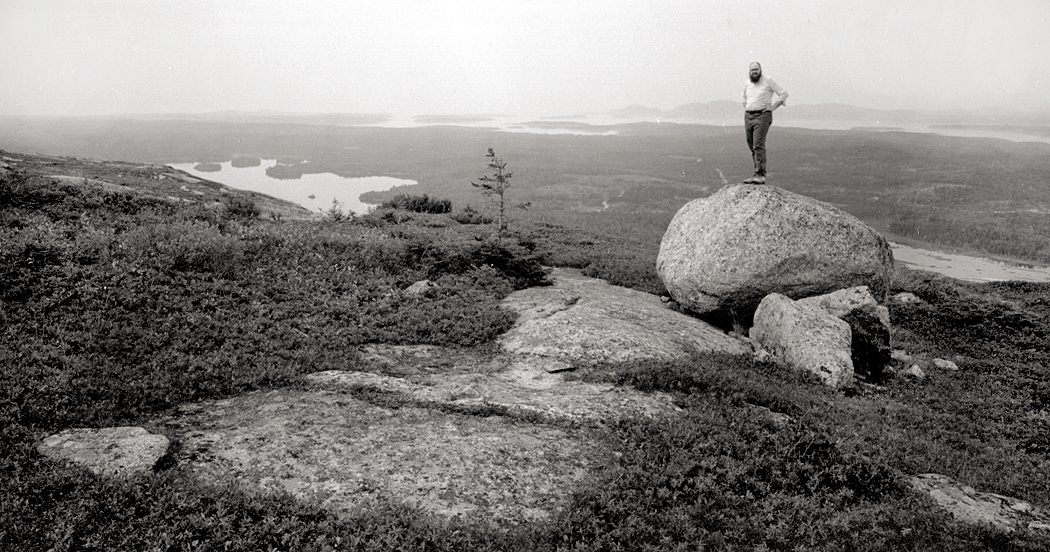
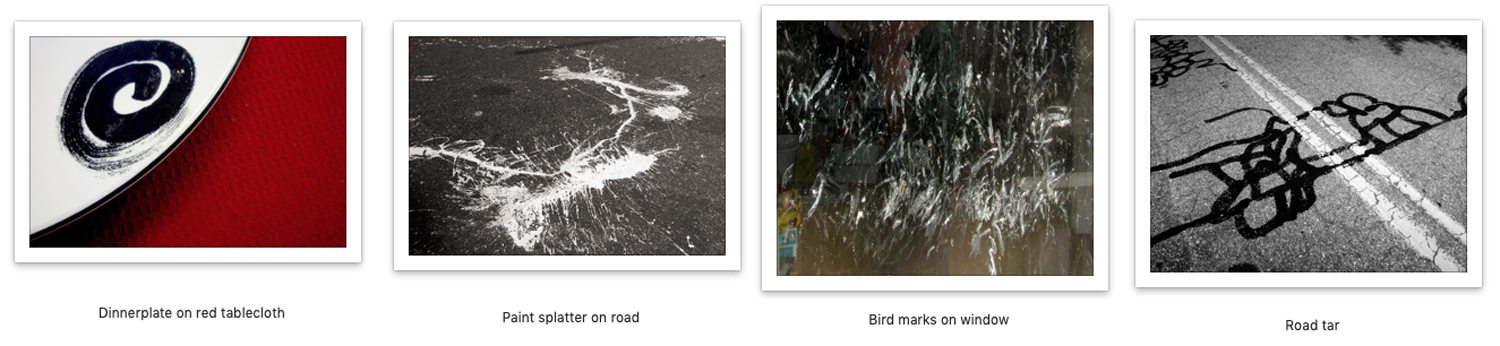
They later moved to Maine and live in an old farmhouse in Sullivan and I have visited them many times, although it has gotten more difficult now that I am old, and both driving and flying have become a problem. 

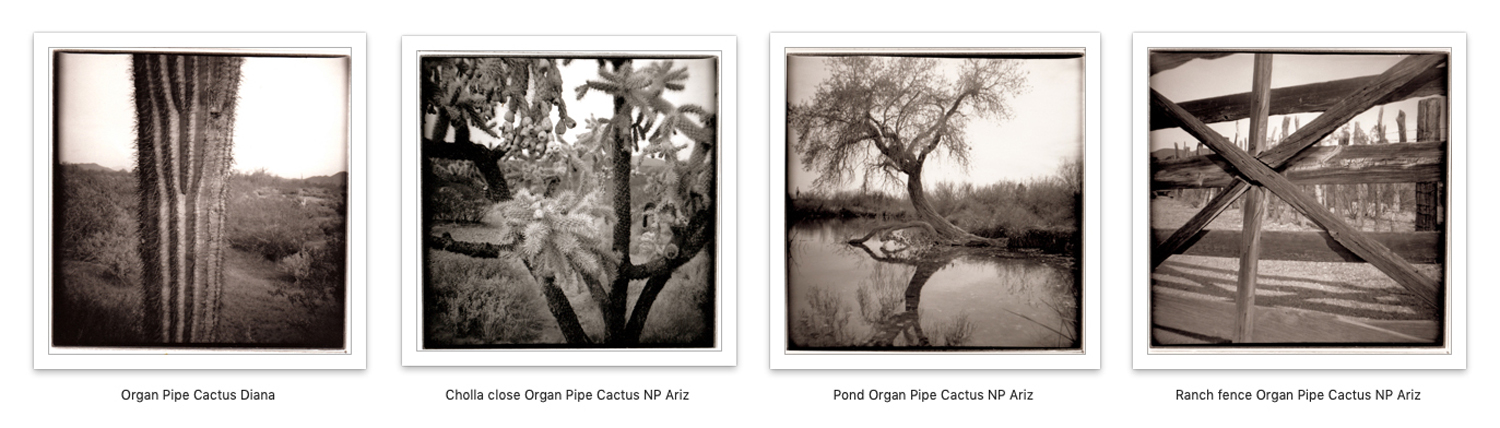
Later, just before I retired, I had a show of my garden photographs at the same Desert Botanical Garden, although this time, it was individual images from the series. The bulk of the images were of Monet’s garden in Giverny, but images from the earlier books were mixed in, in a show titled “Giverny and Other Edens.”  

I now photograph my back yard and watch it through its seasons, and my own as well. 

Click on any image to enlarge

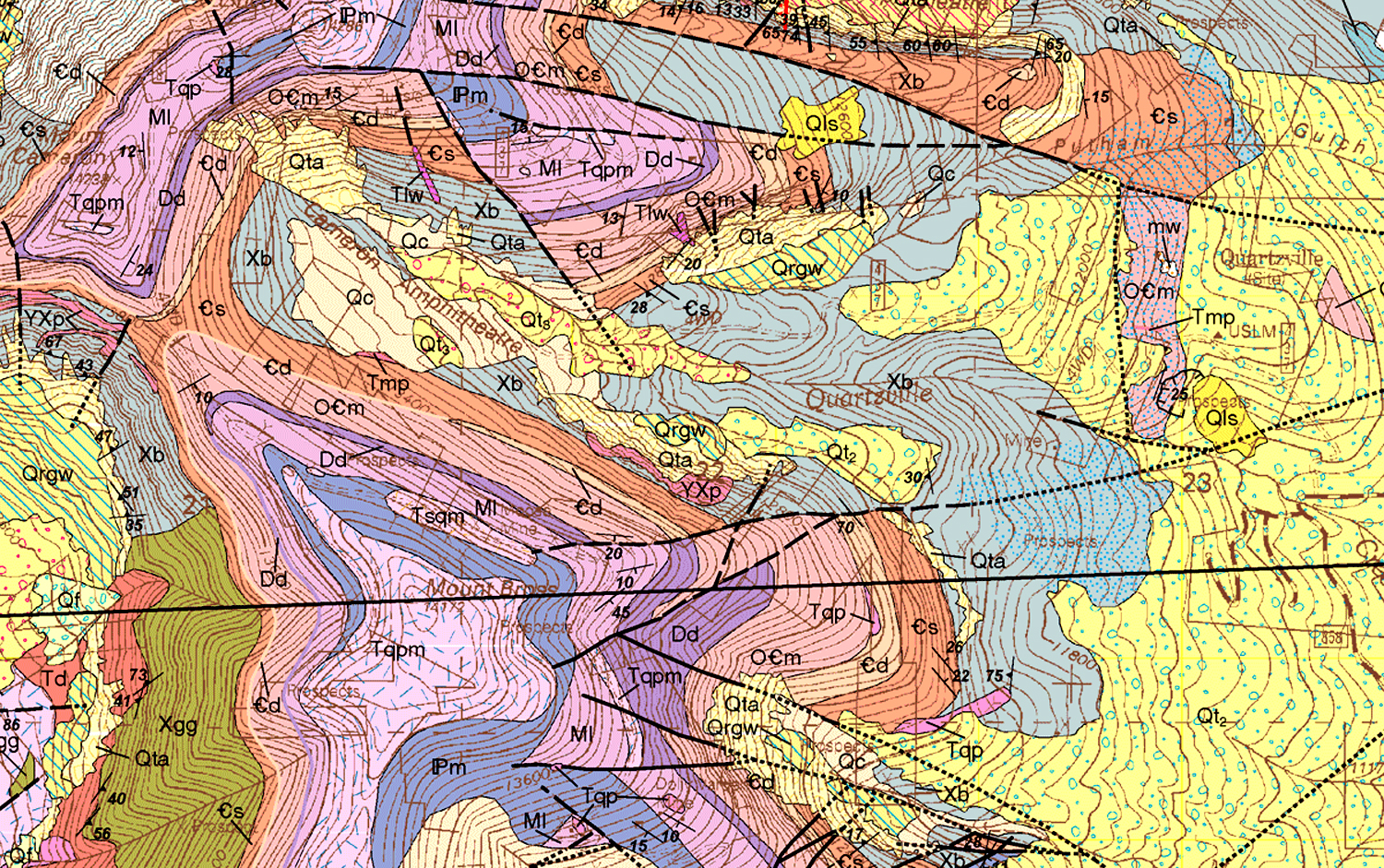
In the TV show, Big Bang Theory, physicist Sheldon Cooper claims that geology “isn’t a real science.” He’s quite a snob about it. But if you unfold any standard geological map — one that outlines the underlying bedrock of any state or county — you will see something so mindbogglingly complex and incomprehensible, that it couldn’t be anything but science. 

A geologist is someone who can tell the difference between diorite and andesite, and can measure the schistosity of mica, and explain how seashell fossils came to be found on the top of Mt. Everest. Geologists find petroleum and metals under the earth, and tell us the Earth is 4.6 billion years old. And a good deal of what is written in the field is — much as with  quantum physics — well beyond the ken and vocabulary of mere mortals. 

They write things such as: “Mass transport deposits (MTDs) occur as intercalations within turbiditic sequences above the ophiolites. They represent syncontractional submarine slides that occurred on frontal accretionary prism slopes during the Late Cretaceous–Paleocene closure of the LPOB.” That, by the way is “Ligurian-Piedmont Ocean Basin,” in case you were confused. 

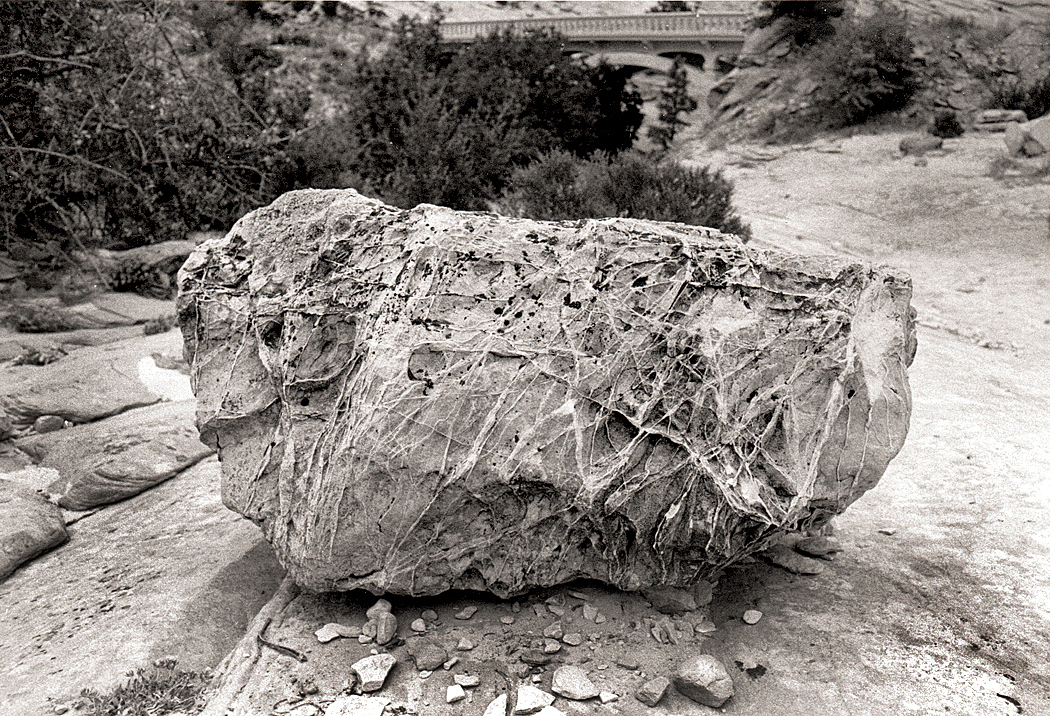
Southern Utah

So, yes, they are scientists. And it’s fun to learn as much as you can, and collect interesting rocks and minerals. But geology is also for poets, artists and cooks. And it is the humanistic aspects of geology that have fascinated me since first studying geology in college. 

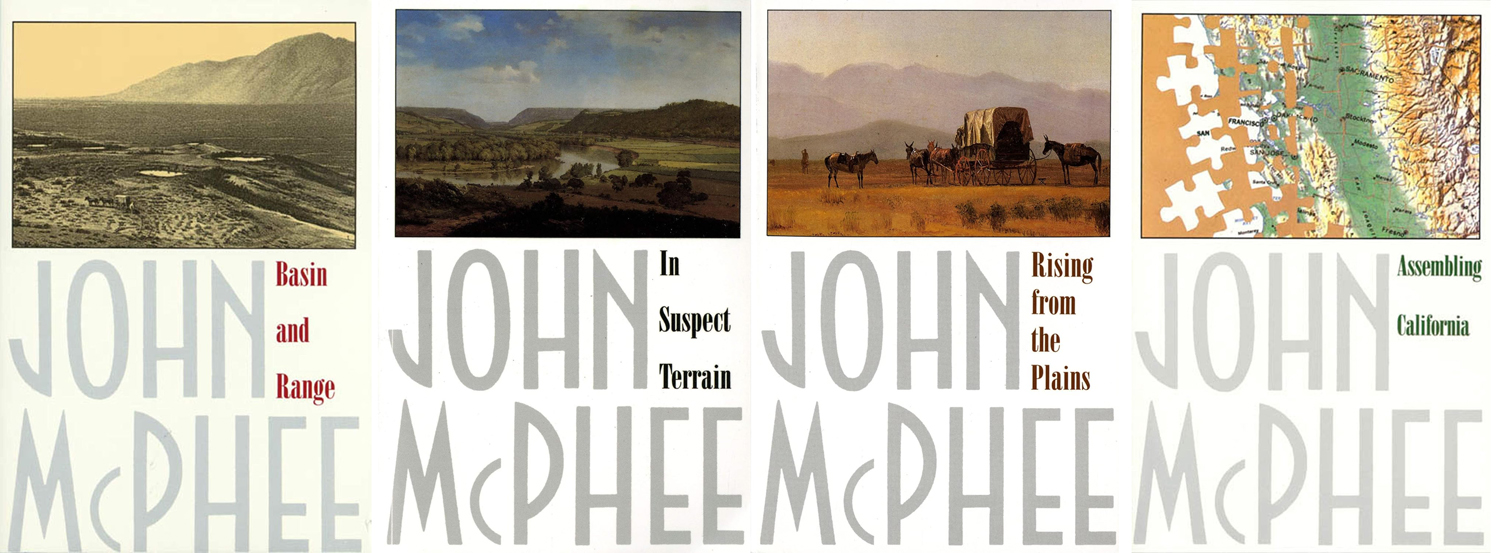
I read a good deal about geology, including the four books written by John McPhee in the 1980s — although they are about geologists as much as about the rocks they study. They are at the comprehensible boundary between general and specialist knowledge. And you’ll never drive through an interstate highway roadcut the same way again. 

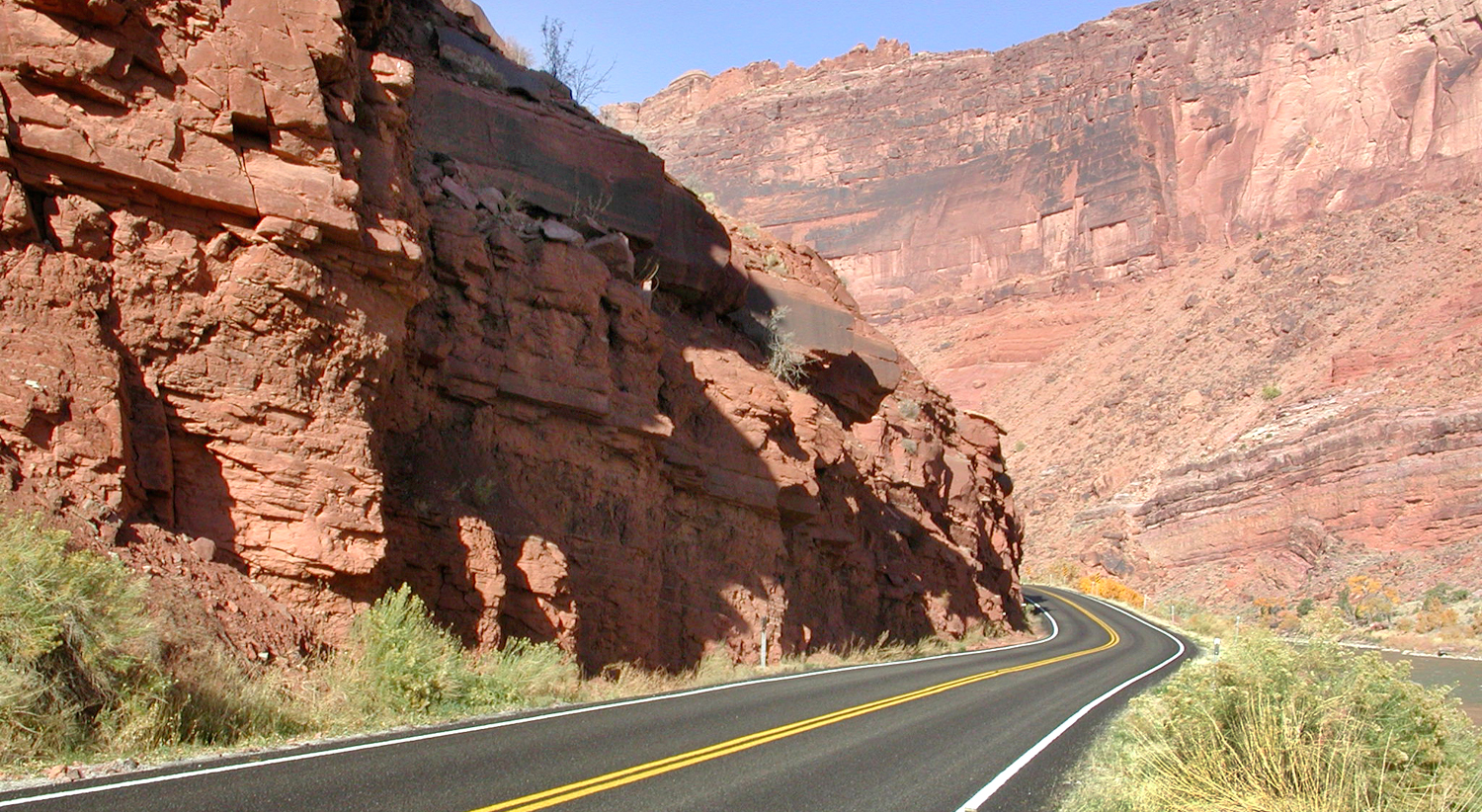
Along the Colorado River, Utah

Geology is just everywhere and affects all of our lives not only daily, but even hourly. Think of your car. Every bit of it, save only the rubber in its tires and the fabric or leather of its upholstery, came originally out of the ground. Whether it is the steel of its engine, the platinum in its catalytic converter, the glass in its windshield or the plastic of its dashboard — all dug out of the ground before being polished up and installed on your Hyundai. 

And even your tires, these days, are only partially rubber. The rest of it was dug up, too. 

The skillet in your kitchen is just a rock that has been processed. The knives, too, and the potato peeler. All just carefully refined stones. In many ways, we still live in the Stone Age; we’re just more sophisticated about it than those guys banging rocks together in the Paleolithic caves. 

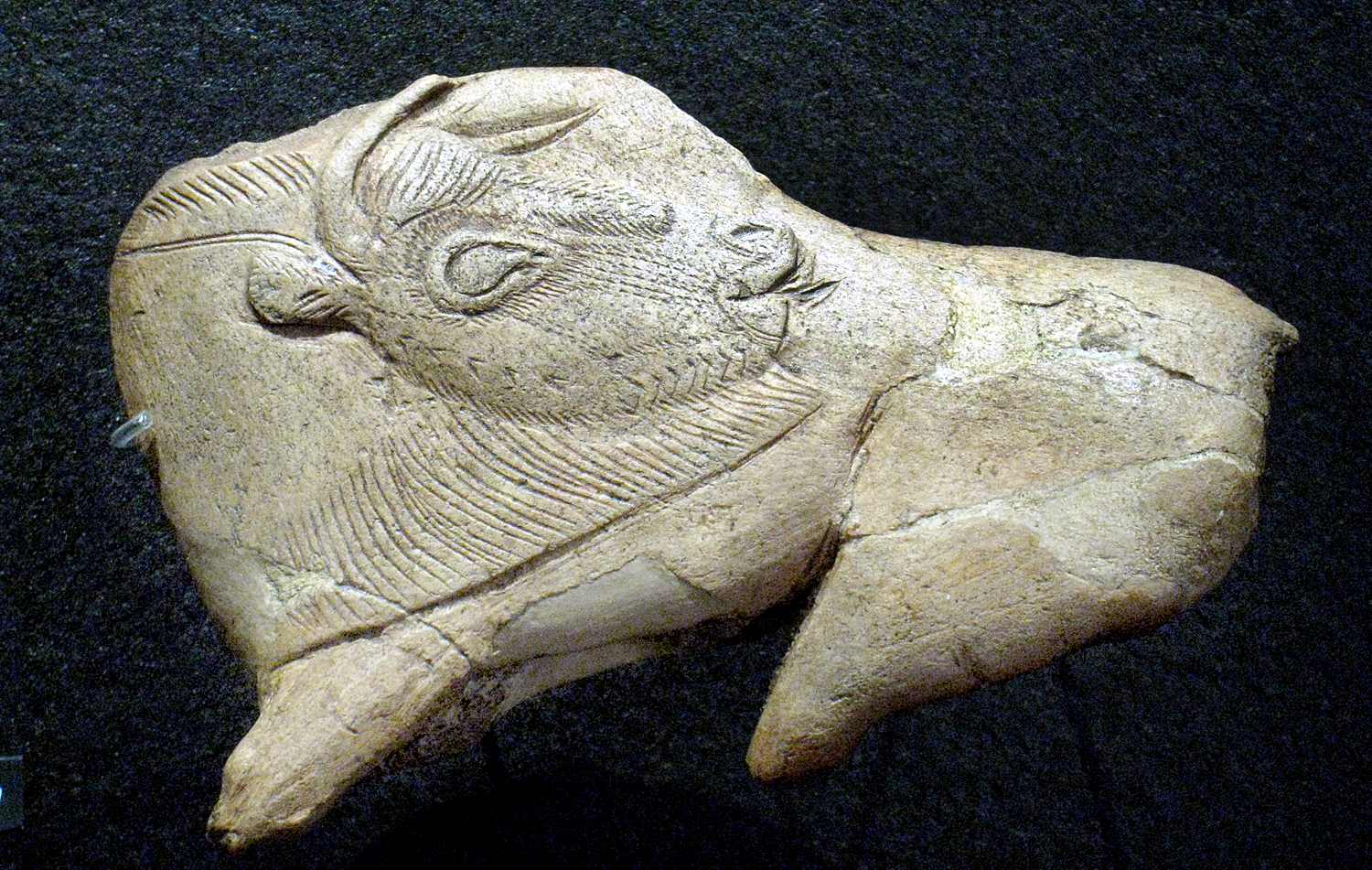
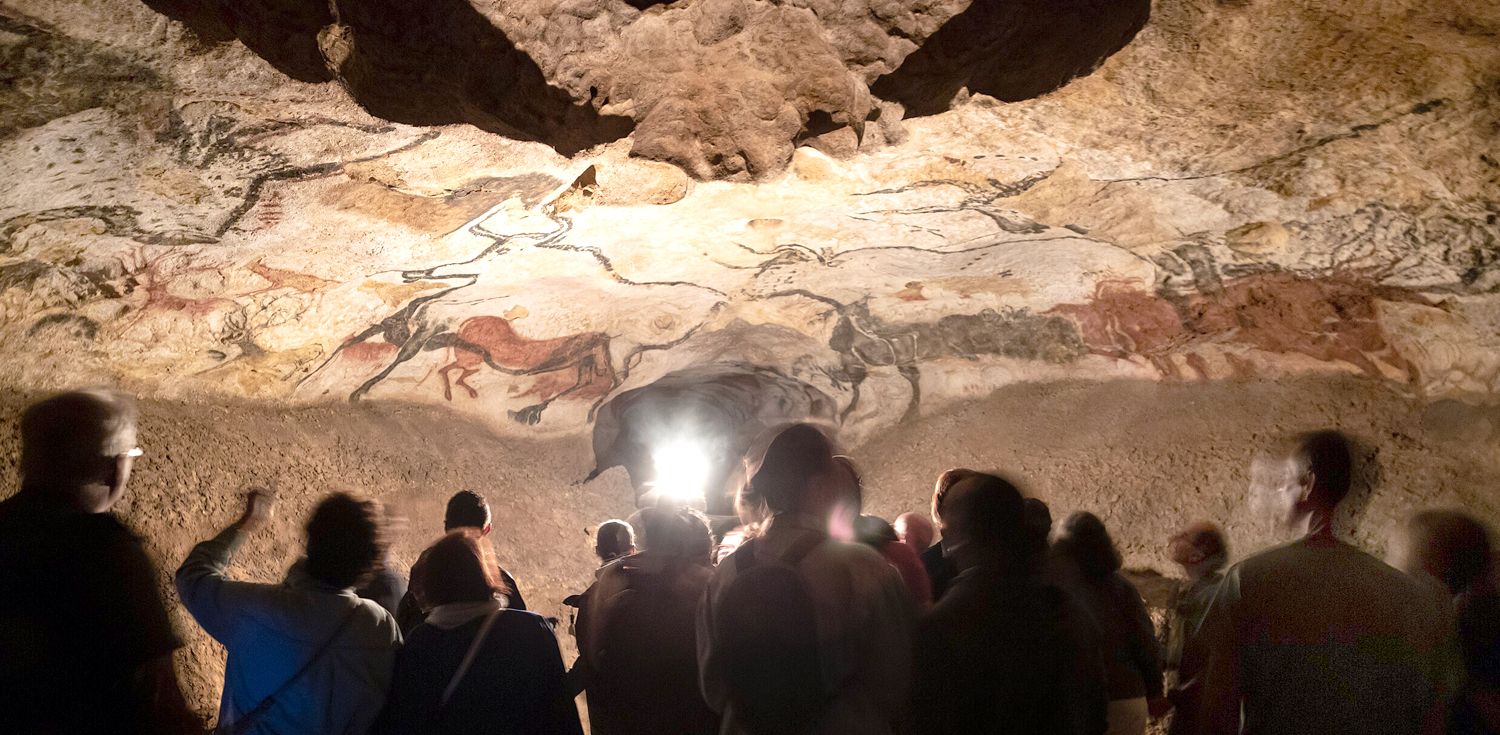
Paleolithic bison carving

Our human prehistory has been divided into the Paleolithic, Mesolithic and Neolithic. I suggest we now live in the Metalithic Age. (Everything now seems to be “meta.”) We do amazing things with the ore we dredge out of the ground and the petroleum we pump, but the foundation of our civilization is still geology. 

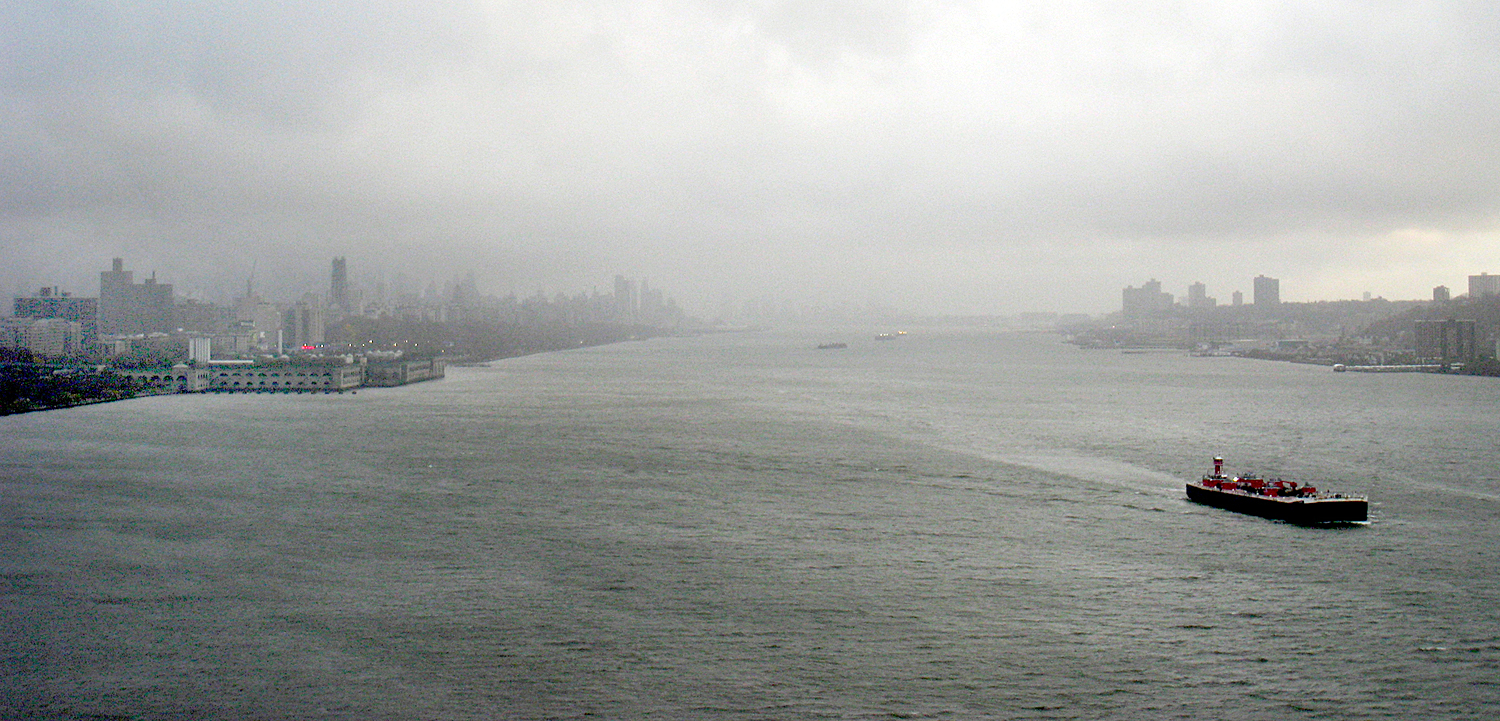
New York on the Hudson River

Cities are the index of civilization and most of the world’s great cities are built on harbors or rivers. The Indus, the Euphrates, the Nile, the Huang Ho. That’s geology. The cities are built with steel and concrete. Geology. Their streets are paved with either concrete or tar and gravel. More geology. 

Our food grows in dirt, or grazes on the grasses that sprout from the soil — a soil derived from the bedrock underneath. What are vitamins and minerals but the residue of those same rocks? 

Blue Hill, Maine 

Geology drives history, too. For instance, because Norway and Greece are so rocky and ungenerous for agriculture, their peoples took to the sea and the Greeks colonized everywhere from Spain to the Black Sea, and the Vikings from Constantinople and Sicily to England and Iceland. Geology kept the Old World and the New from interacting significantly until 1492. It blocked the westward expansion of the British colonies in North America for a century. It is the reason that Afghanistan is the “graveyard of empires.” Plate tectonics — “continental drift” — and the formation of Eurasia as a single east-west landmass has been hypothesized as the cause for European and Asian historical dominance. 

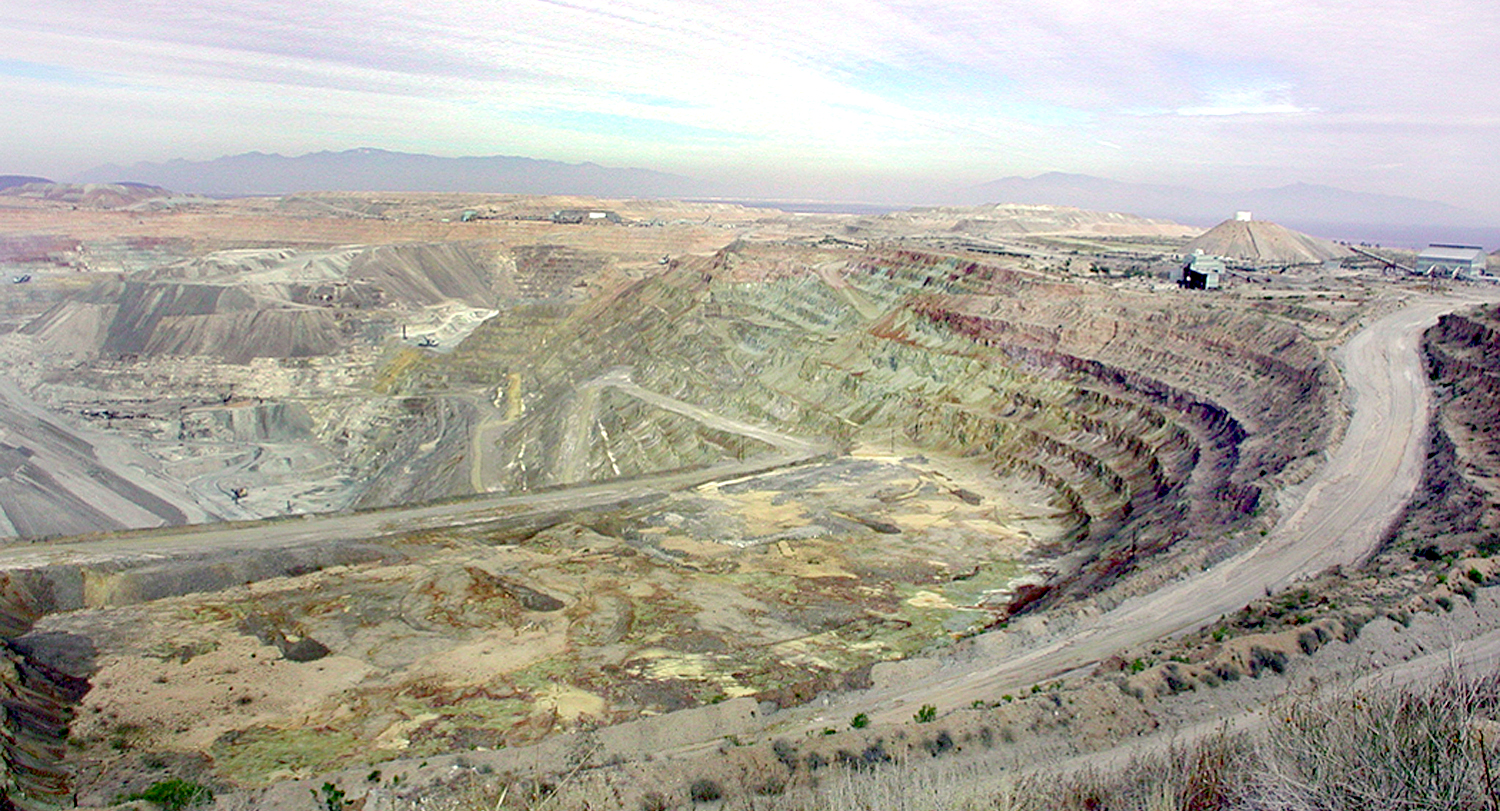
Asarco pit mine, Arizona

And geology, in the form of coal mining and petroleum extraction, is the cause of catastrophic climate change and global warming. 

Geologist Donald Beaumont wrote, “Geology will, unfortunately, remain an under-recognized, ‘phantom,’ science in that its role in explaining the foundations for human society may never be fully appreciated.”

I’m not making the case that geology explains everything, nor that it is the only thing that made us what we are, but I am saying that it helps explain it, and that you can see the same forces acting out elsewhere in the world. 

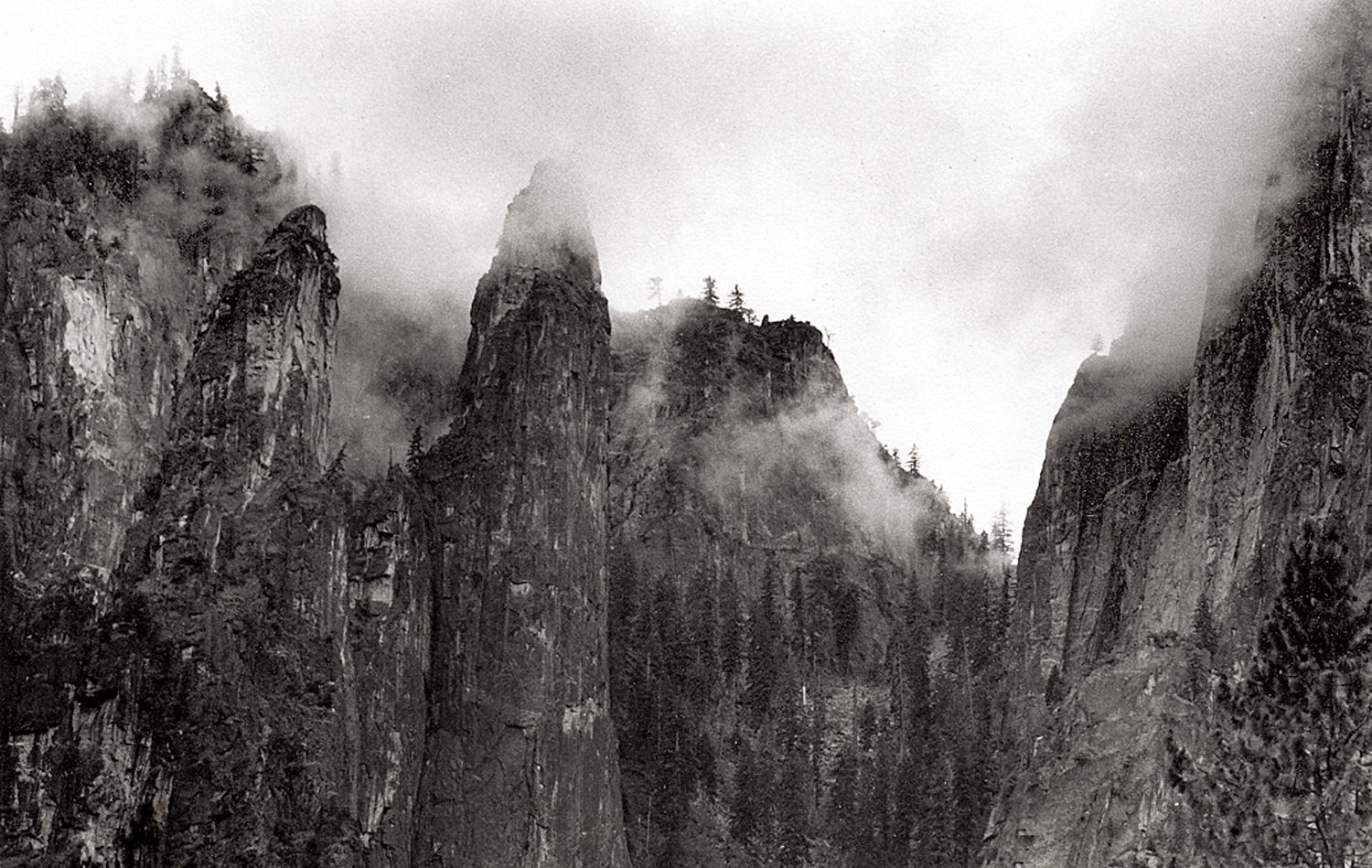
Olympic Mountains, Washington

It isn’t only physical, it is psychological also. Geology creates emotions. And so artists and poets have used geology to elicit in their audiences certain emotional states — rocky metaphors. 

Pleasant Cove, Chuckanut, Wash. 

It is to seek this power that great landscape artists — whether painters or photographers — make their pictures. It is not to make a postcard of a pretty piece of scenery, but to find in the land a metaphor for thought, emotion or state of mind — or even a political philosophy.

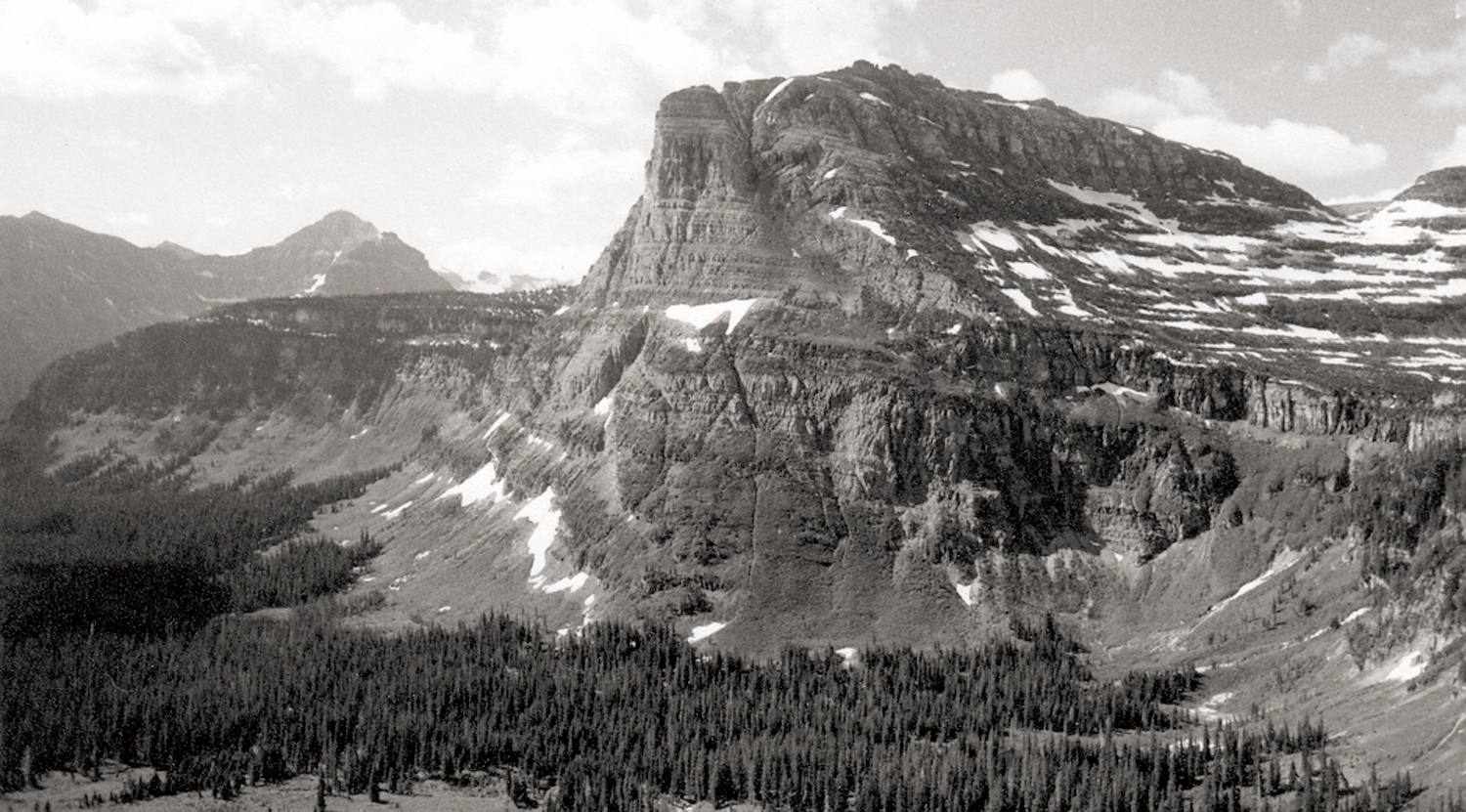
Canadian Rockies, Alberta

That mythic force is why we feel the rise in our throats when we sing of “amber waves of grain,” and “purple mountains majesty above the fruited plain.” Rocks and terrain serve as metaphors for internal states. 

“The Nymphs of the Luo River,” by Gu Kaizhi

European artists have used that metaphor since the Middle Ages, Asian artists since the Jin Dynasty. 

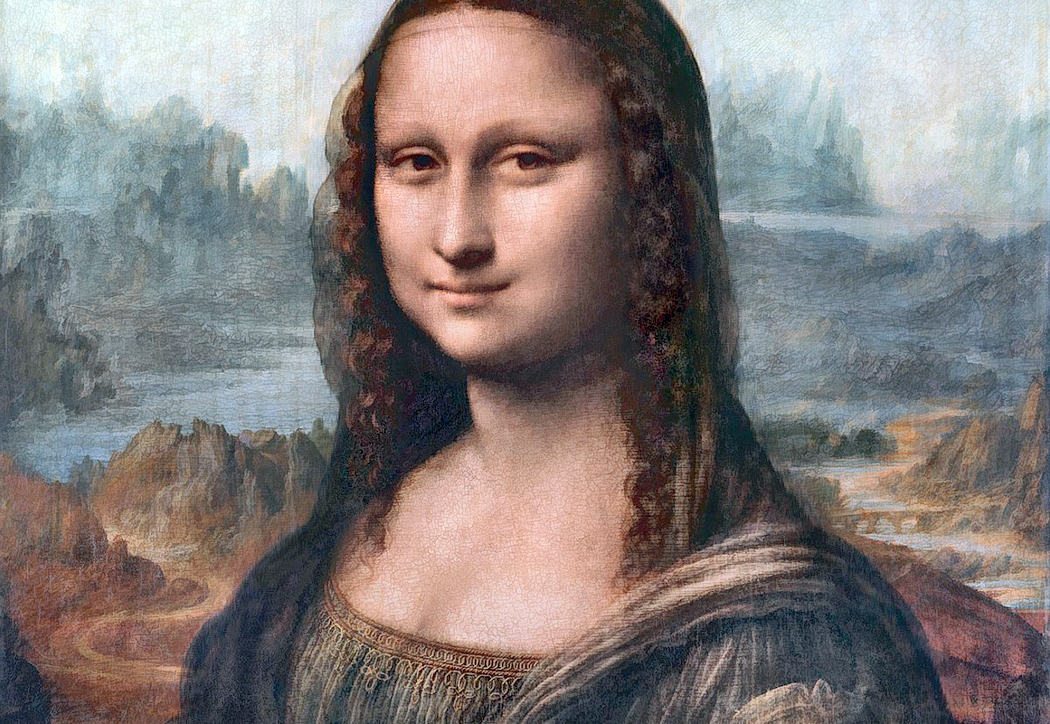
“La Gioconda” detail 

Consider the Mona Lisa. Yes, it is a portrait, but behind the smiling lady is a rocky landscape. It is not like anything actually found in Italy, but rather it is a metaphorical landscape — a mountainous desert. Renaissance artists often used such stony views as a reminder that life on earth is a kind of spiritual desert (and the afterlife is where true fulfillment is to be found). As Geoffrey Chaucer wrote: “Here nis noon hoom, here is but wildernesse.”

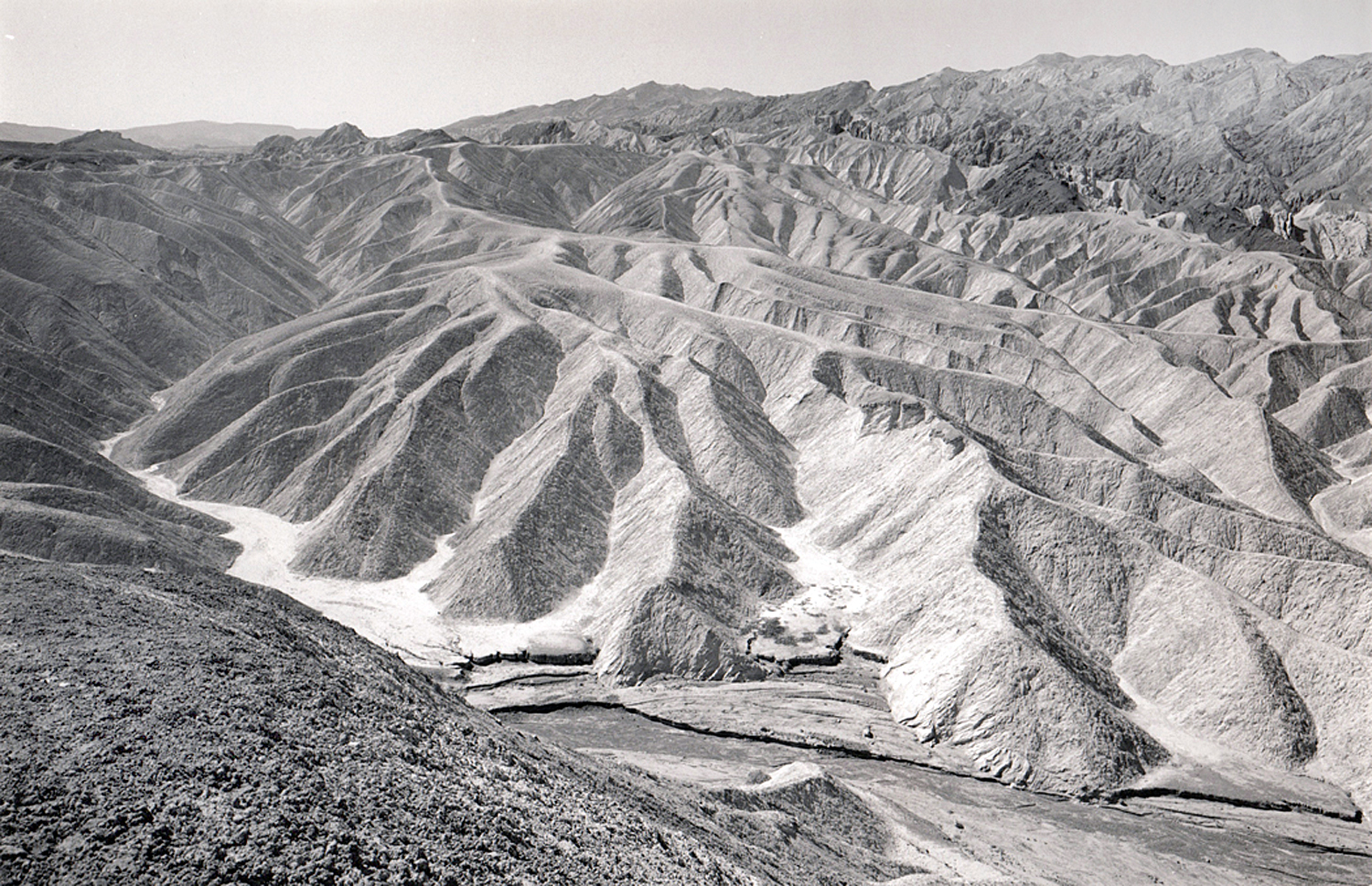
Zabriskie Point, Death Valley, Calif. 

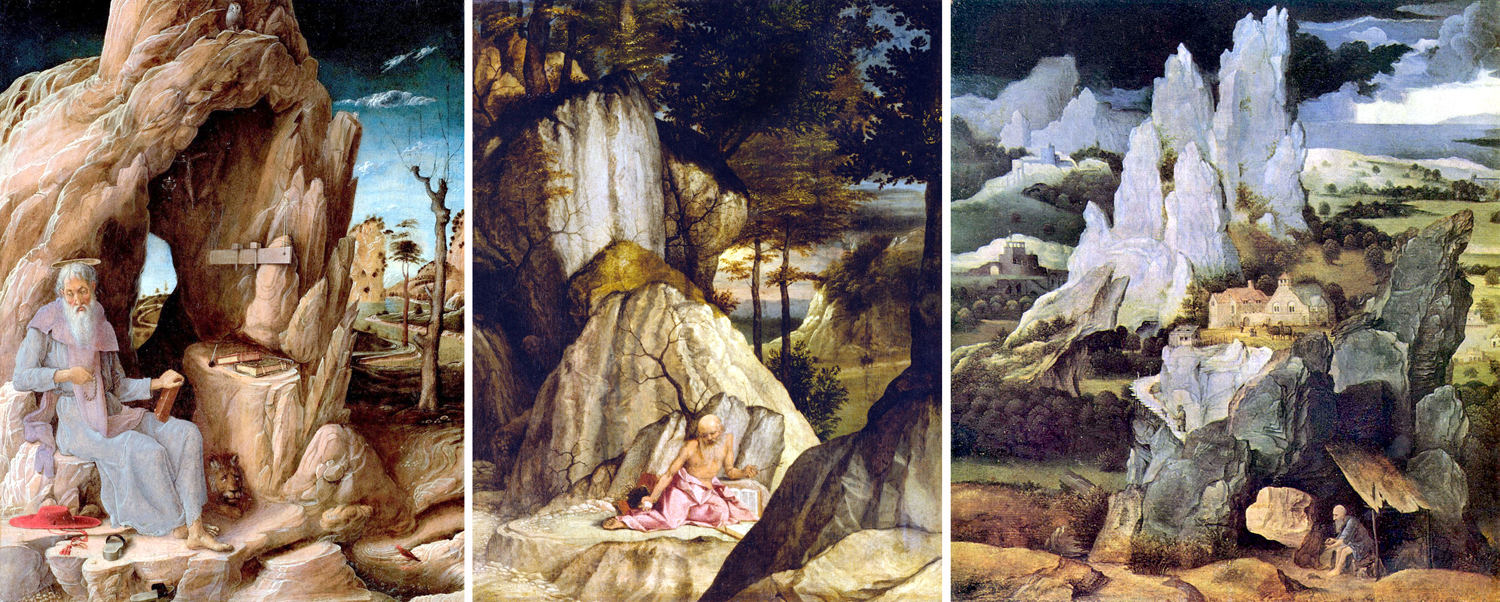
St. Jerome lived in a cave, and painters used the story to show the geology of spiritual isolation. Here are only three of many Renaissance paintings of the saint, by Andrea Mantegna, Lorenzo Lotto, and Joachim Patenier, all from the early 1500s. 

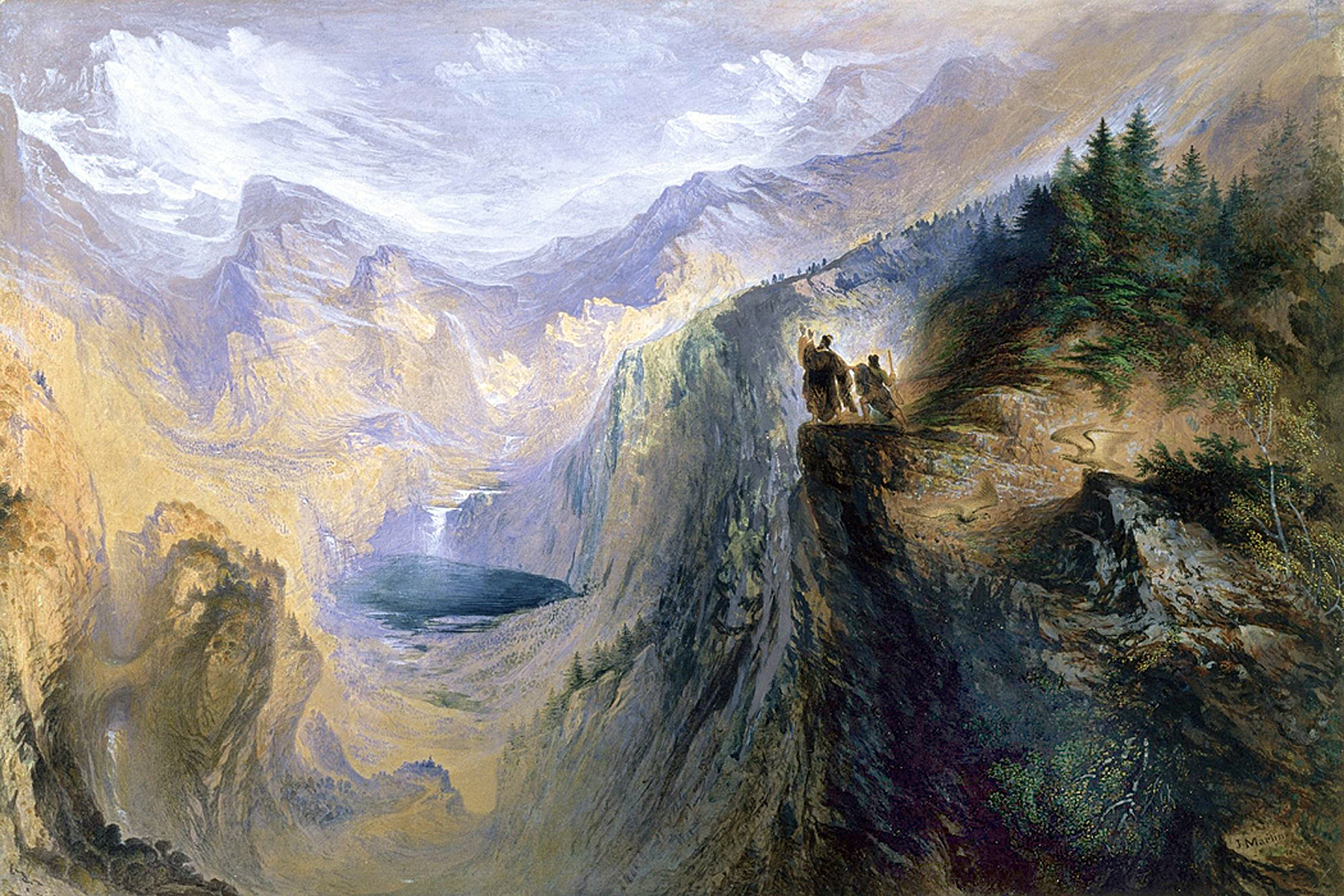
Romantic painters in the 19th century used the vast Alps as a reminder that the cosmos is infinitely larger and more impersonal than we like to believe. Geology becomes an image of The Sublime. 

“Manfred on the Jungfrau” by John Martin

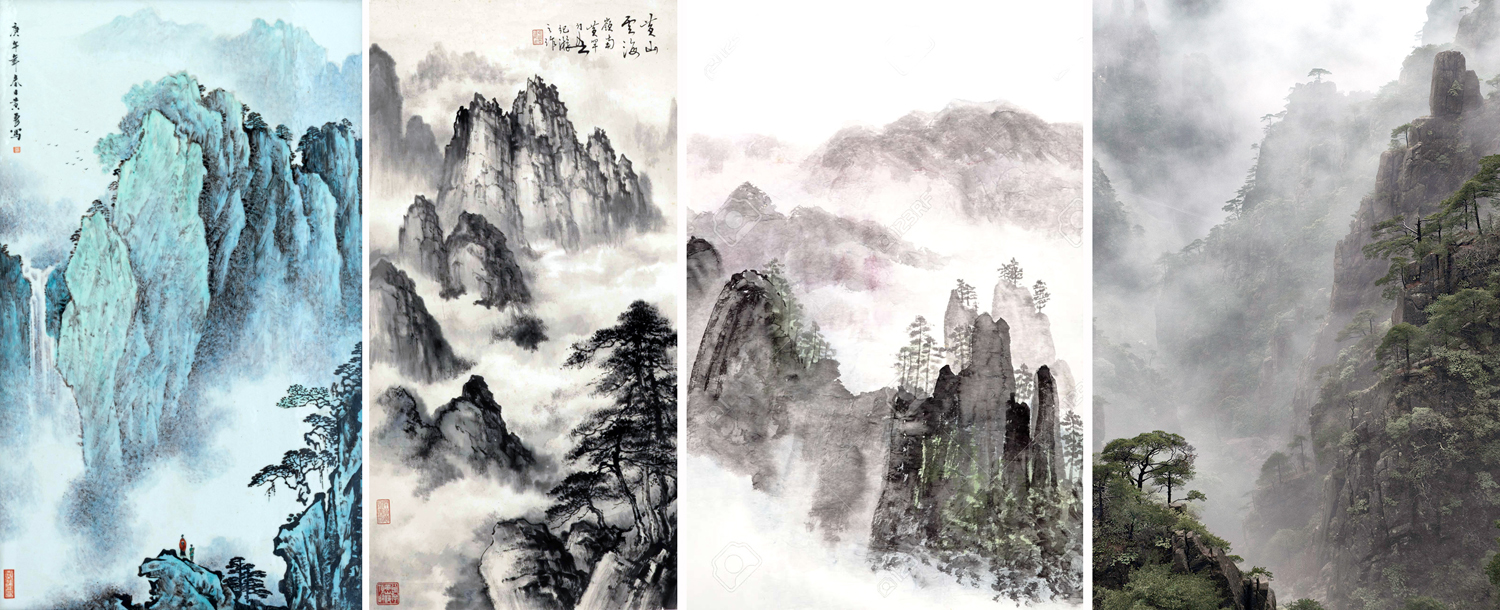
Chinese landscape painting features some amazing mountains. I used to believe these scenes were pure fantasy, but no, these mountains actually exist. On porcelain, by Huang Huanwu, a traditional painting — and a photograph, to prove they’re real. 

Three paintings and a photo

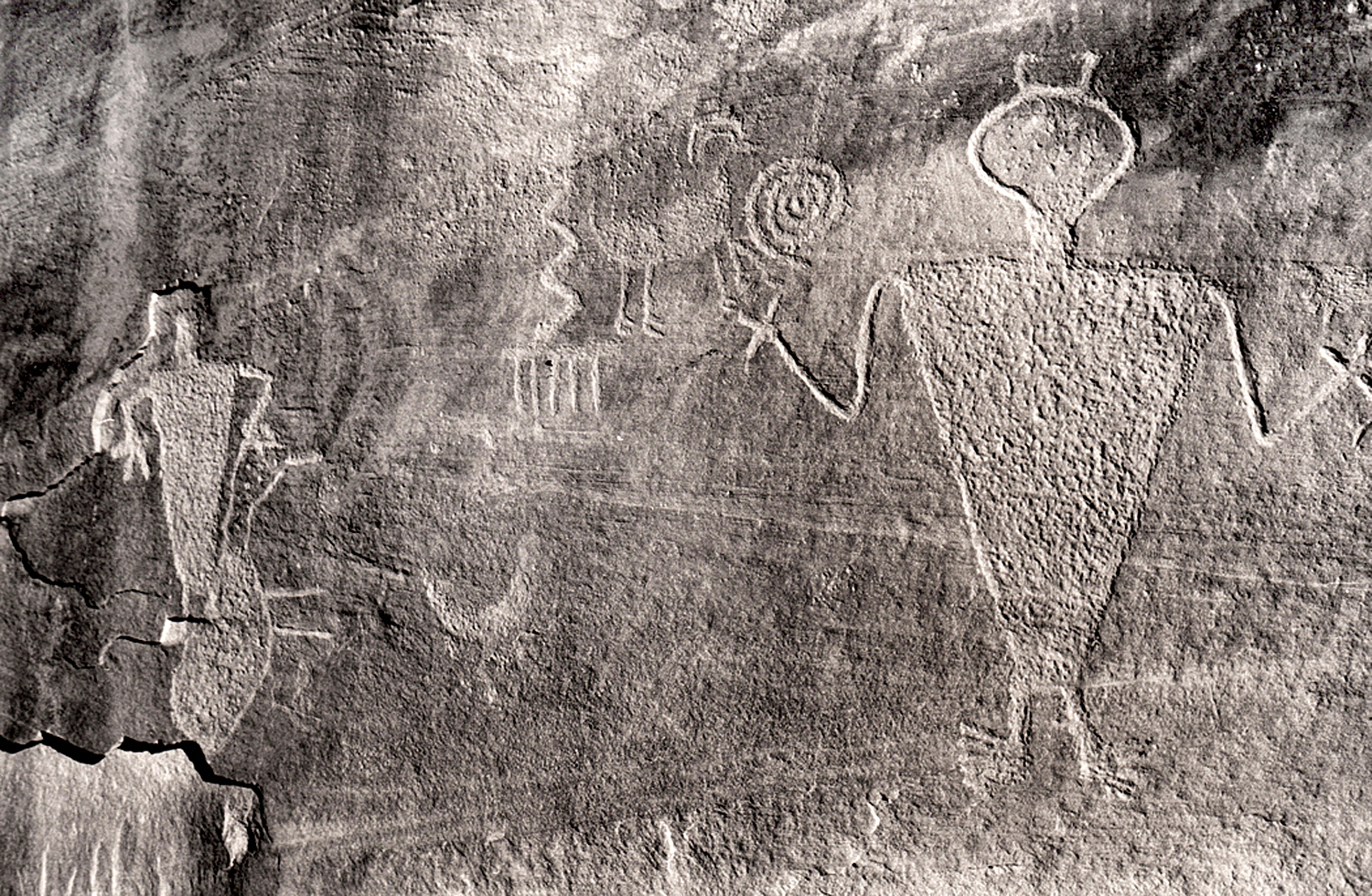
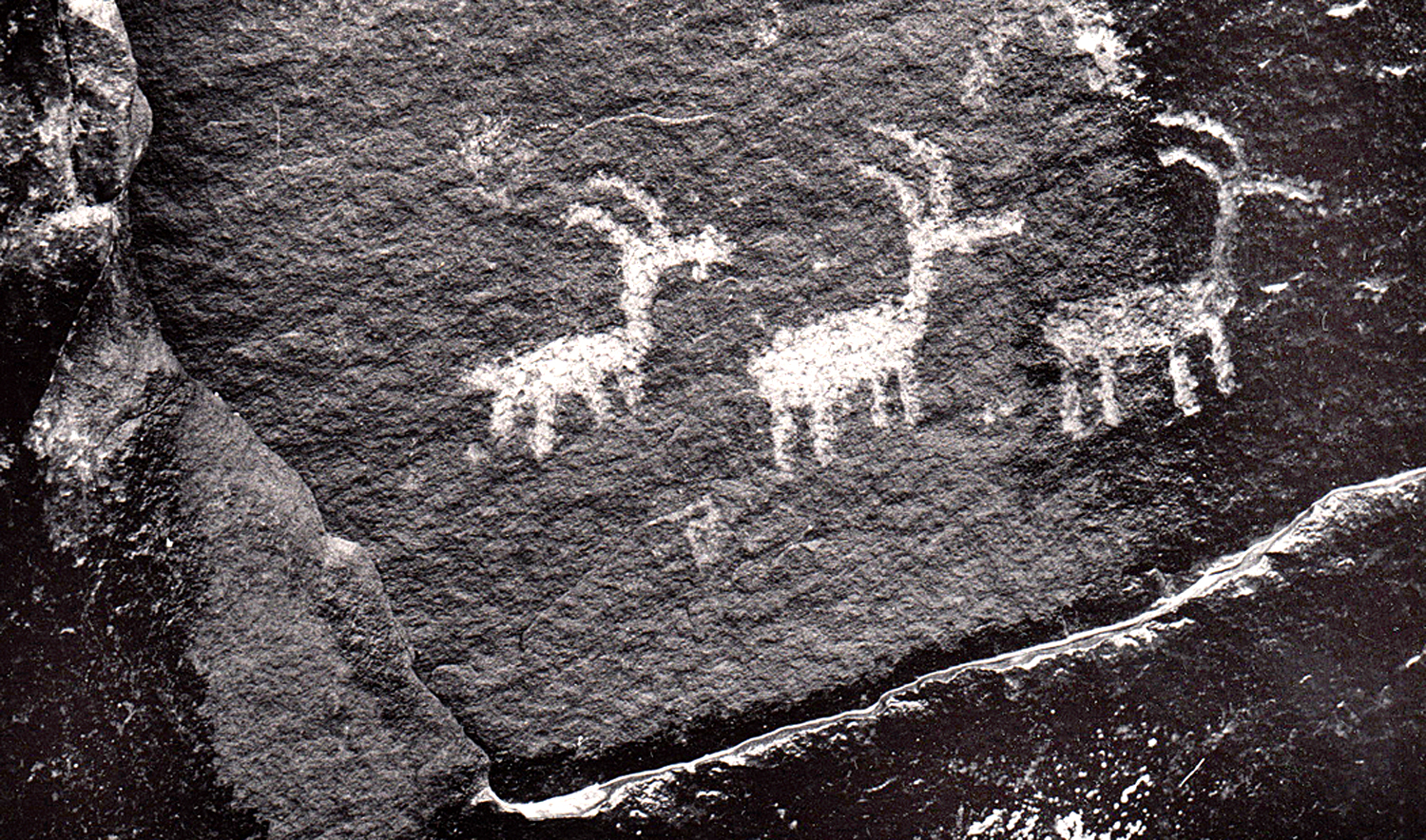
Prehistoric peoples used the rocks for their art, too. 

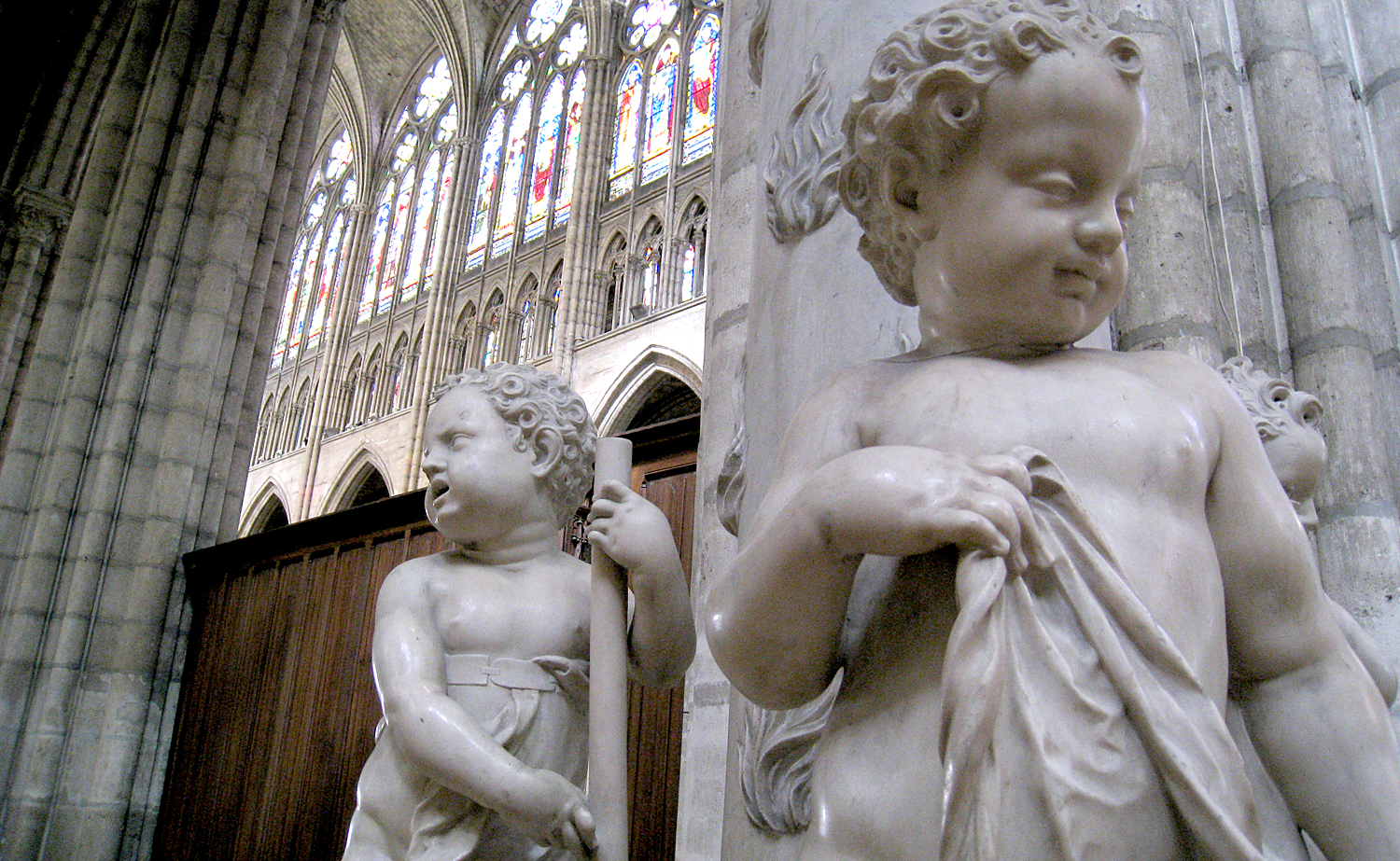
We use stone for permanence. Consider all the marble statuary and granite architecture. 

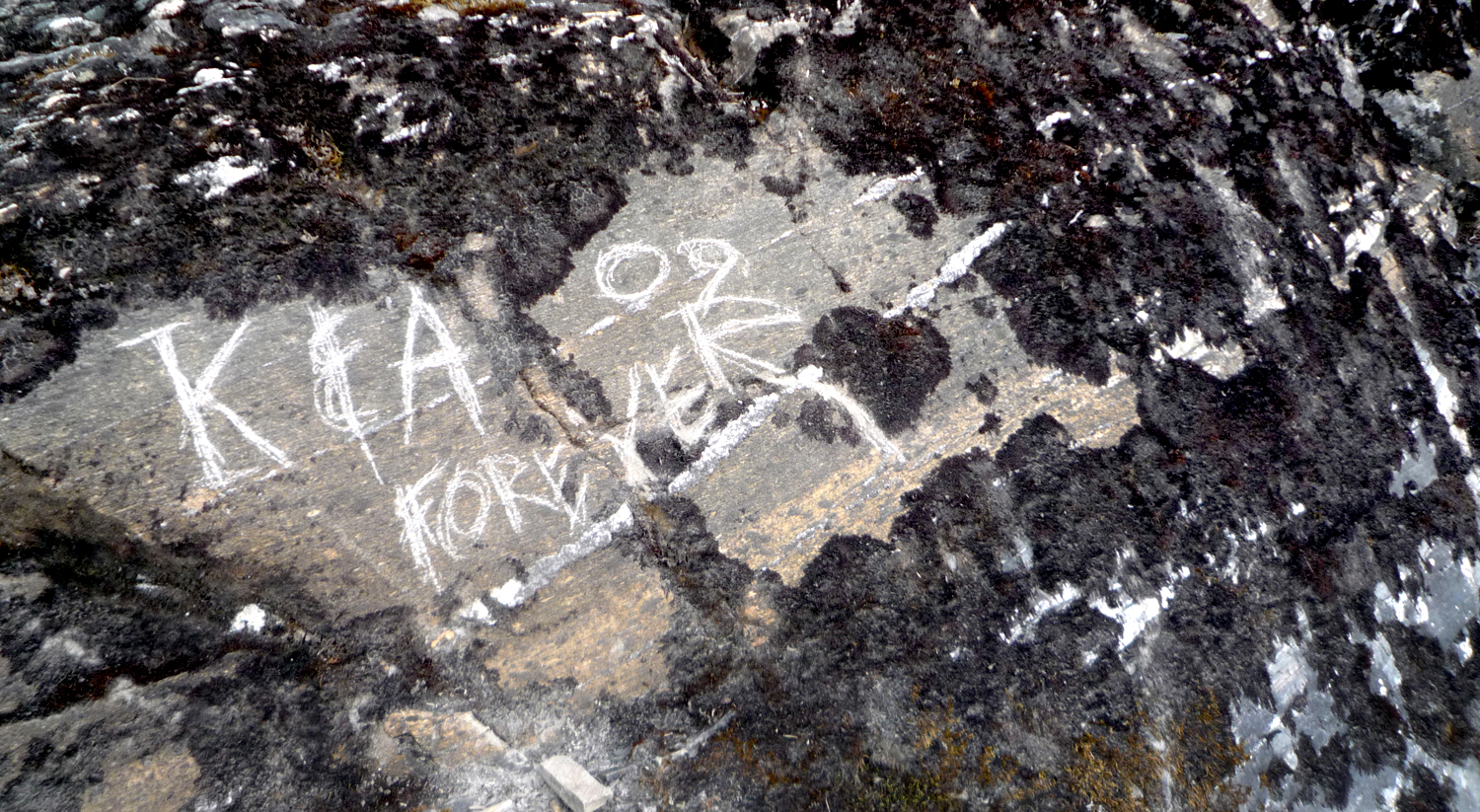
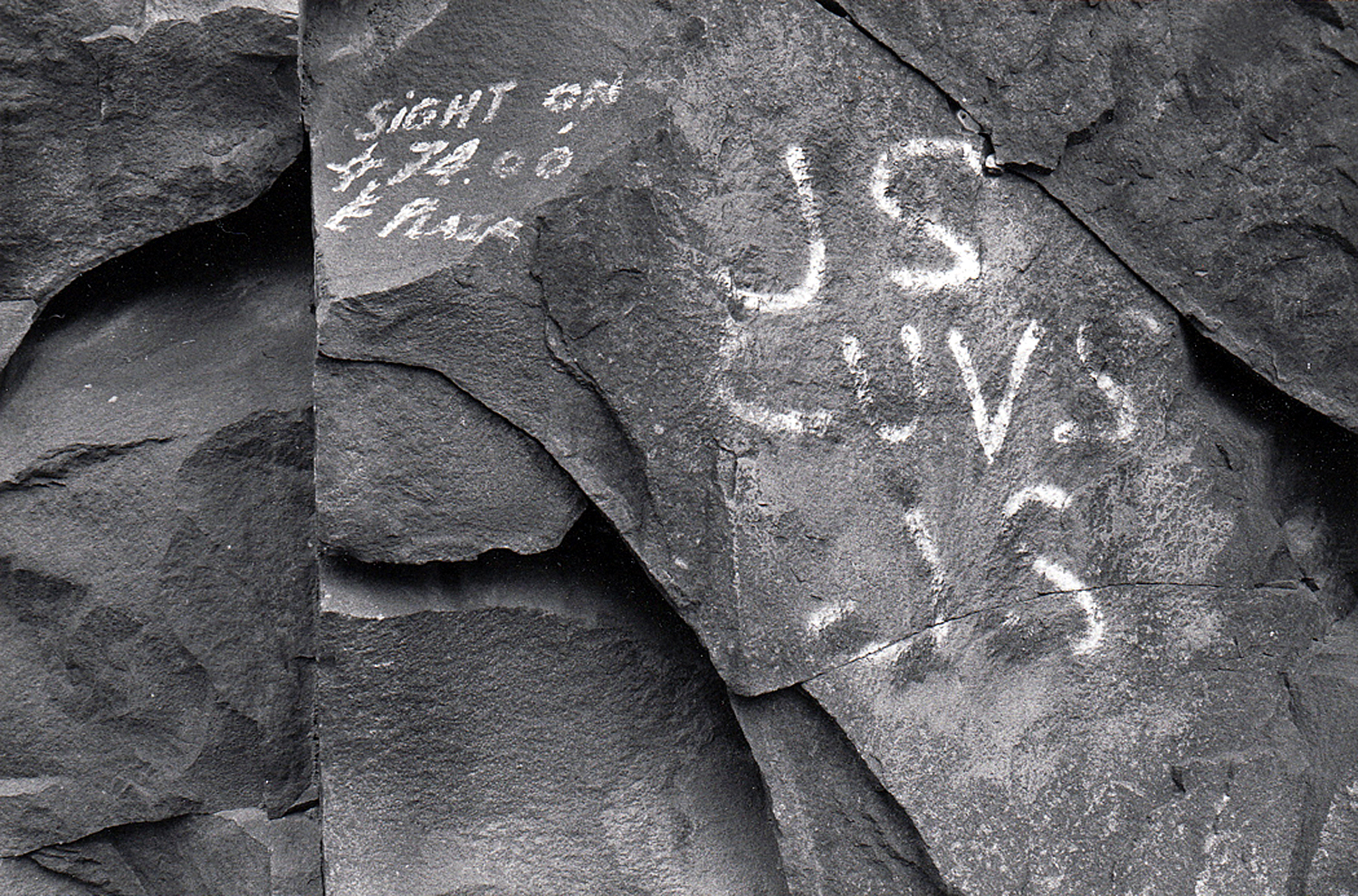
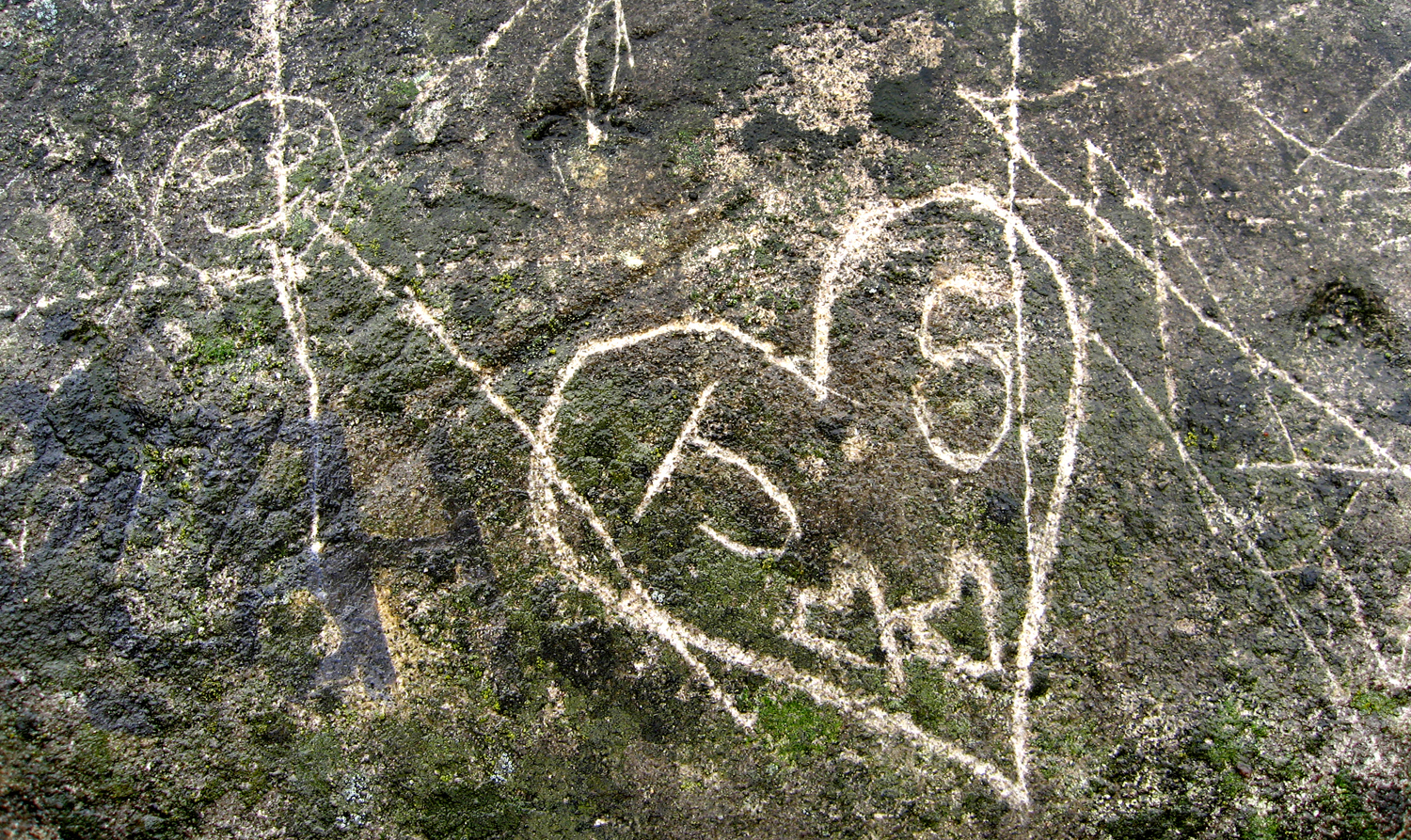
And the way we scrawl our names on rock faces. “K and A Forever.”

The stone is certainly more permanent than the relationship. 

Hudson River Palisades, N.J. 

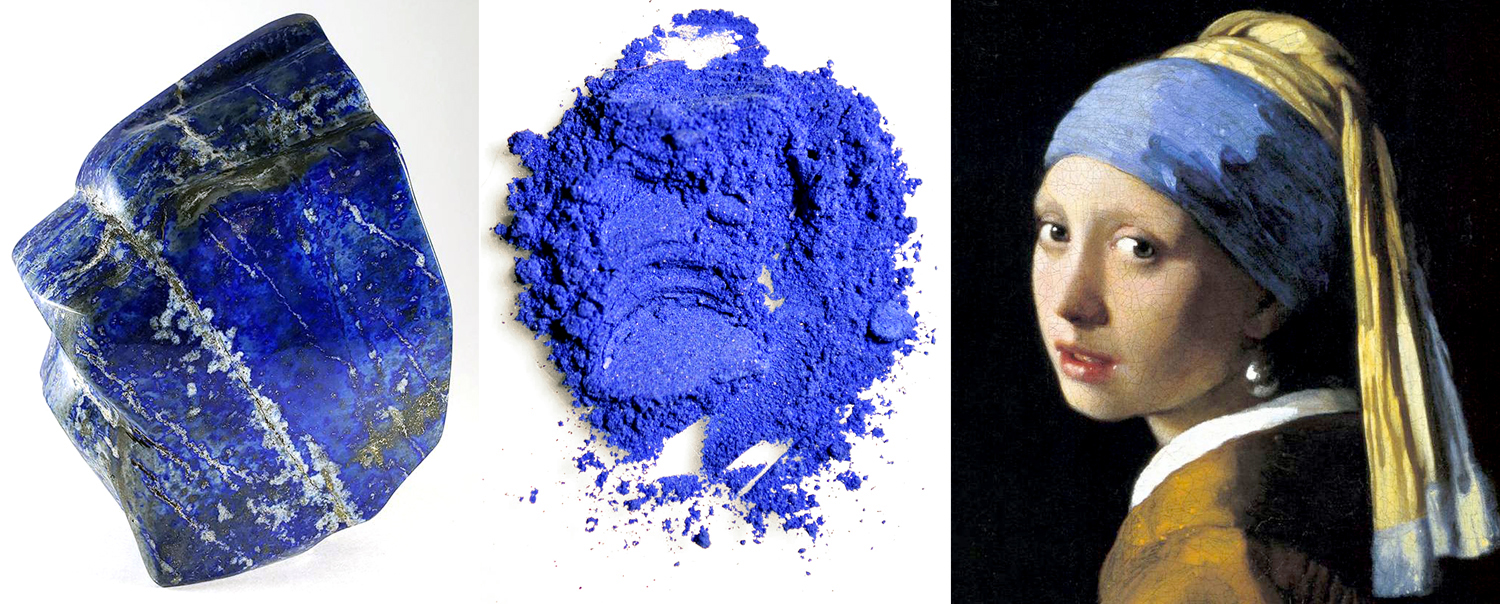
Even the pigments that artists use comes from the ground. In the past, it was actually rocks that were ground up and processed. Now, there are pigments also made from petroleum. 

Lapis Lazuli

Different rocks, with their colors and textures, evoke different emotions. Think of a brilliant diamond or ruby; think of a cinder. Different emotions. 

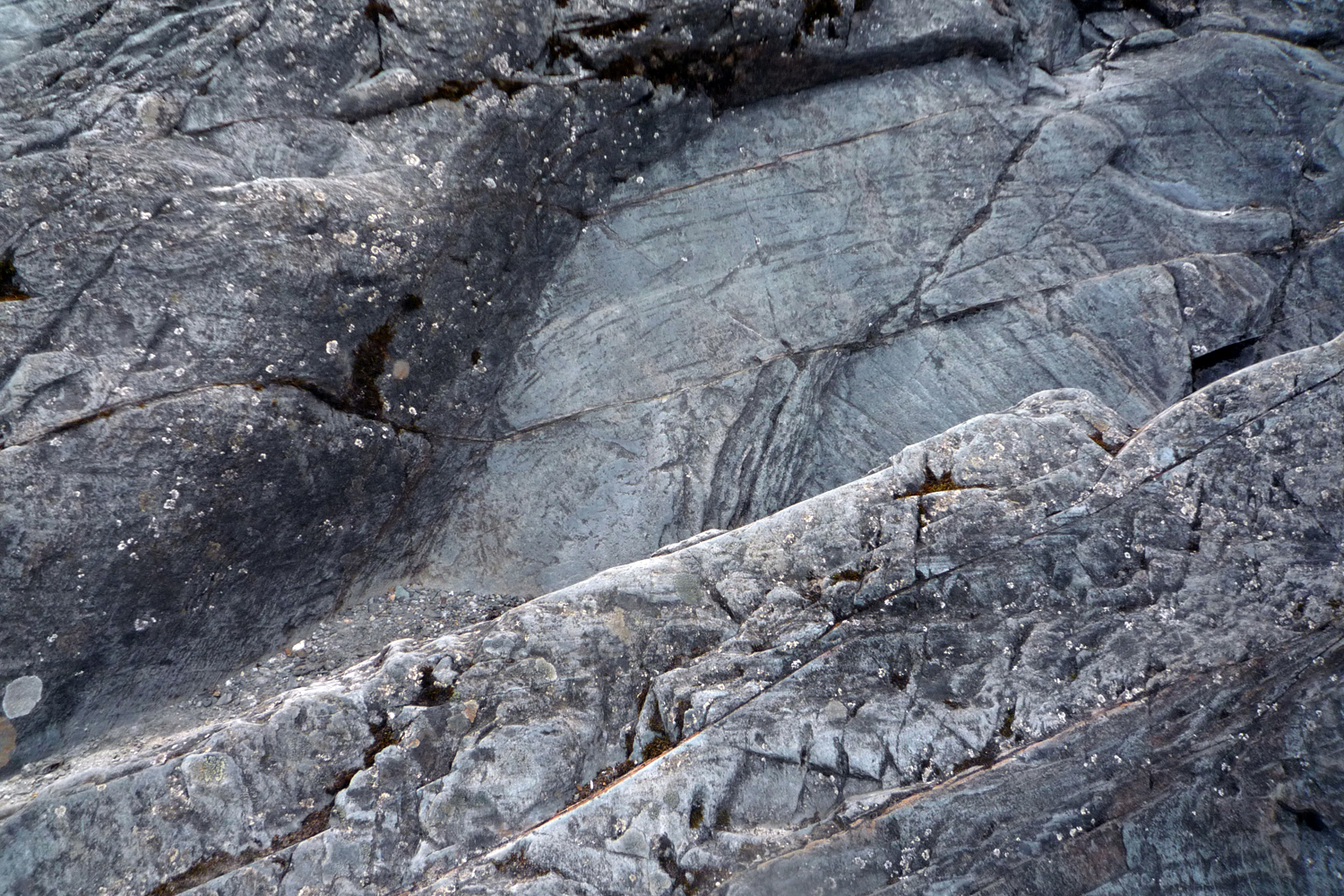
Mendenhall Glacier, Alaska

We use geology in our language, although often the words mutually exclusive import. 

“You must have been stoned when you thought that up.” “No, I was stone cold sober.” “Well, the theory is either a bit rocky or it is rock-solid.” He answered with a stony silence.

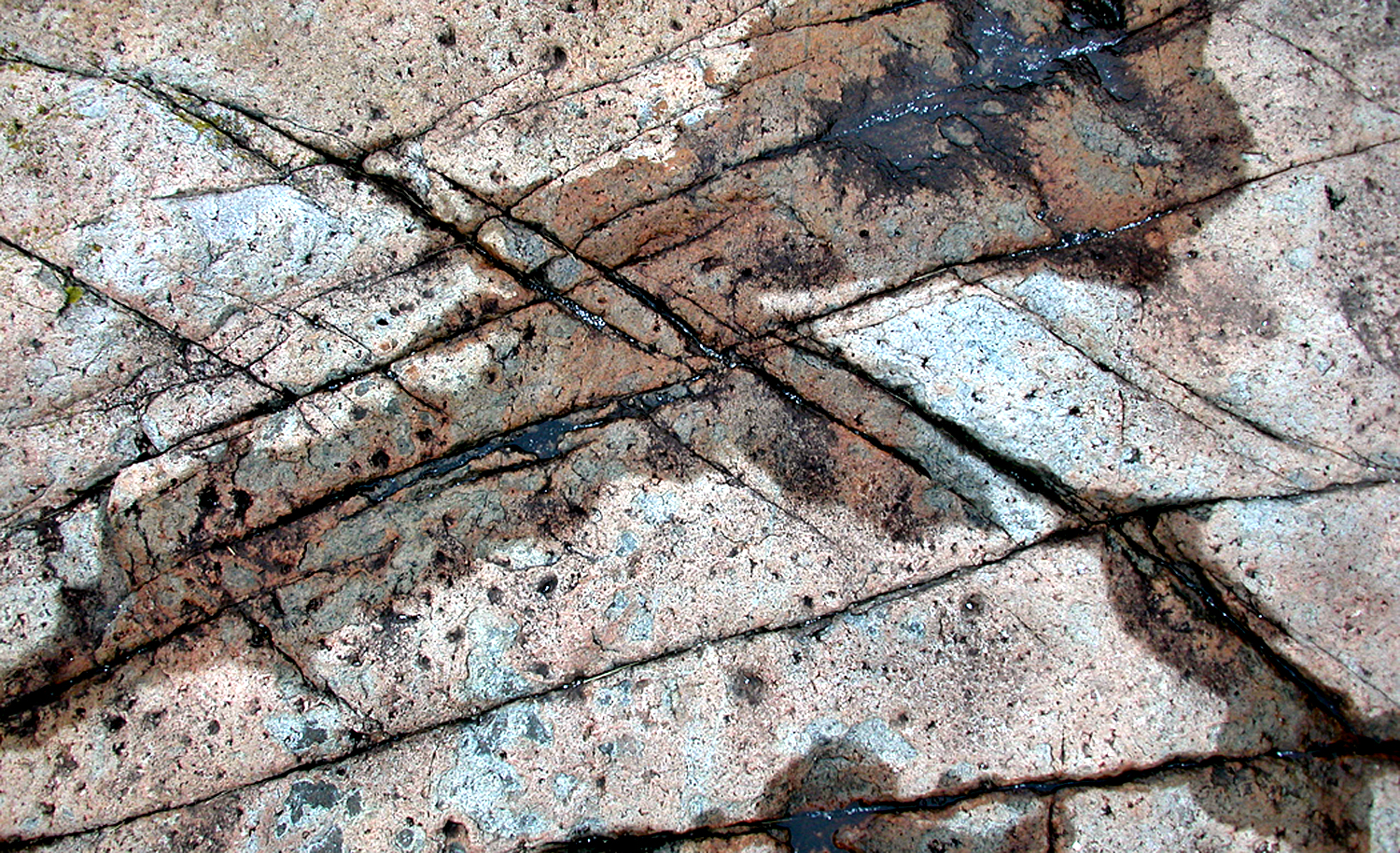
Schoodic Point, Maine

The colors, textures and the grain all impart meaning. 

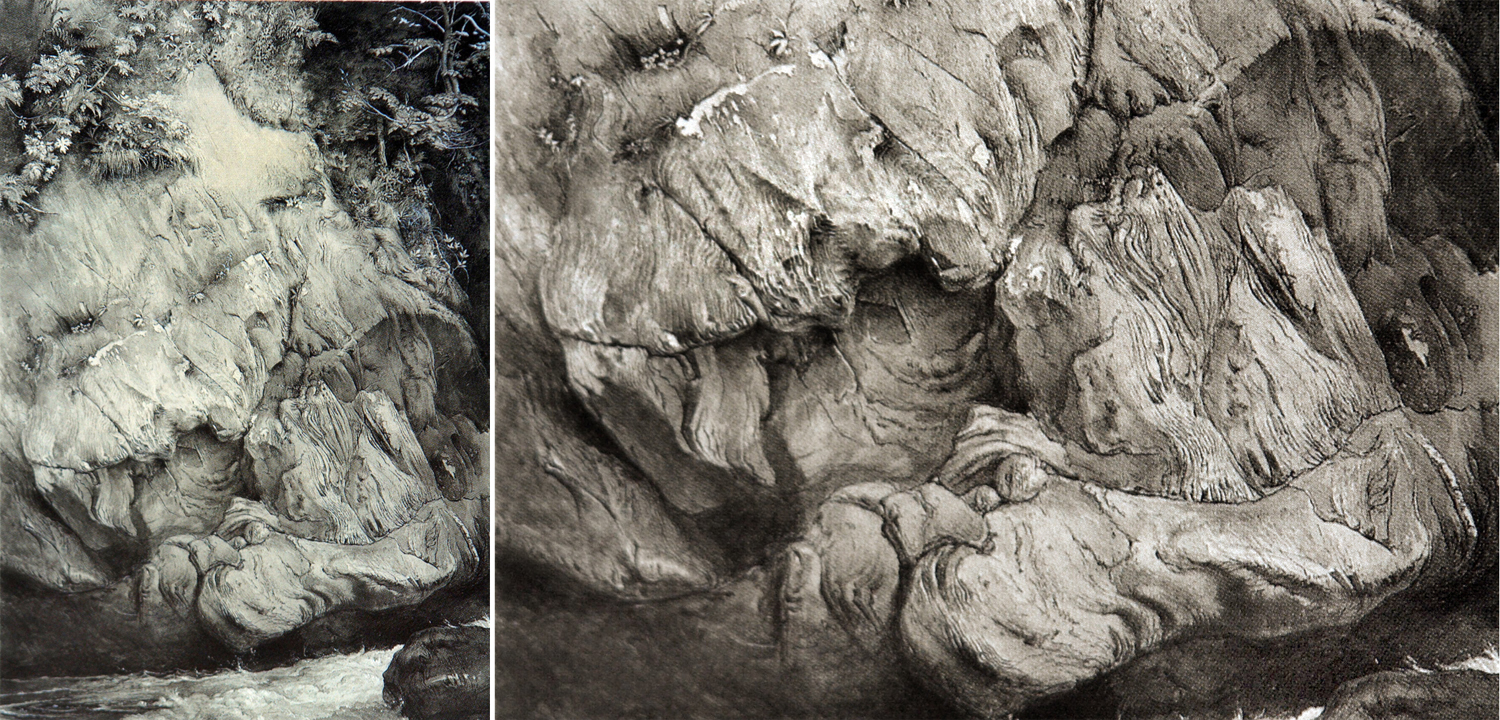
By John Ruskin

I began seriously considering the art elements of geology after seeing a splendid drawing of gneiss by English artist and critic John Ruskin. He made it over several days while visiting Scotland in 1853. The drawing had everything I respond to: texture, detail, close observation and an attention to the world as it is, that is as close to love as is possible to hold for the inanimate world. Ruskin was an astonishing draftsman. 

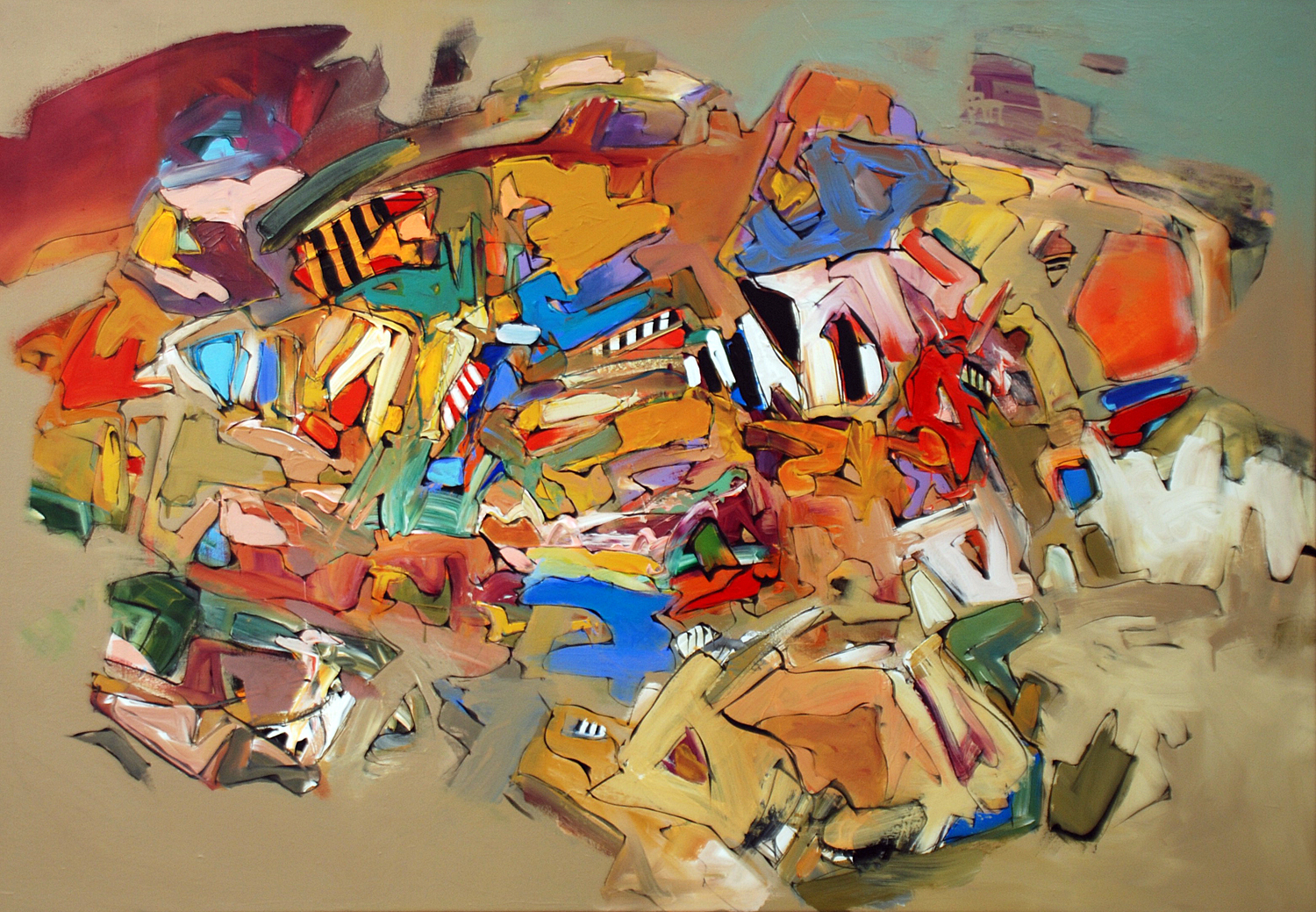
By Mel Steele

It has been one of the lessons of the 20th century and Modernism that meaning in art can transcend anecdote and be more than a story told in a still scene and can impart meaning purely through shape, color, texture, line and scale. Emotions can be evoked by all of them. We have had well more than a hundred years of abstract art. 

Even realistic painting depends on the medium it is made from. It isn’t just the face or the scene, but the color and texture of that face and scene. 

Craggy Gardens, N.C. 

And a camera pointed at the shapes of geology can create meaning in the same manner as the abstract painting we lionize. 

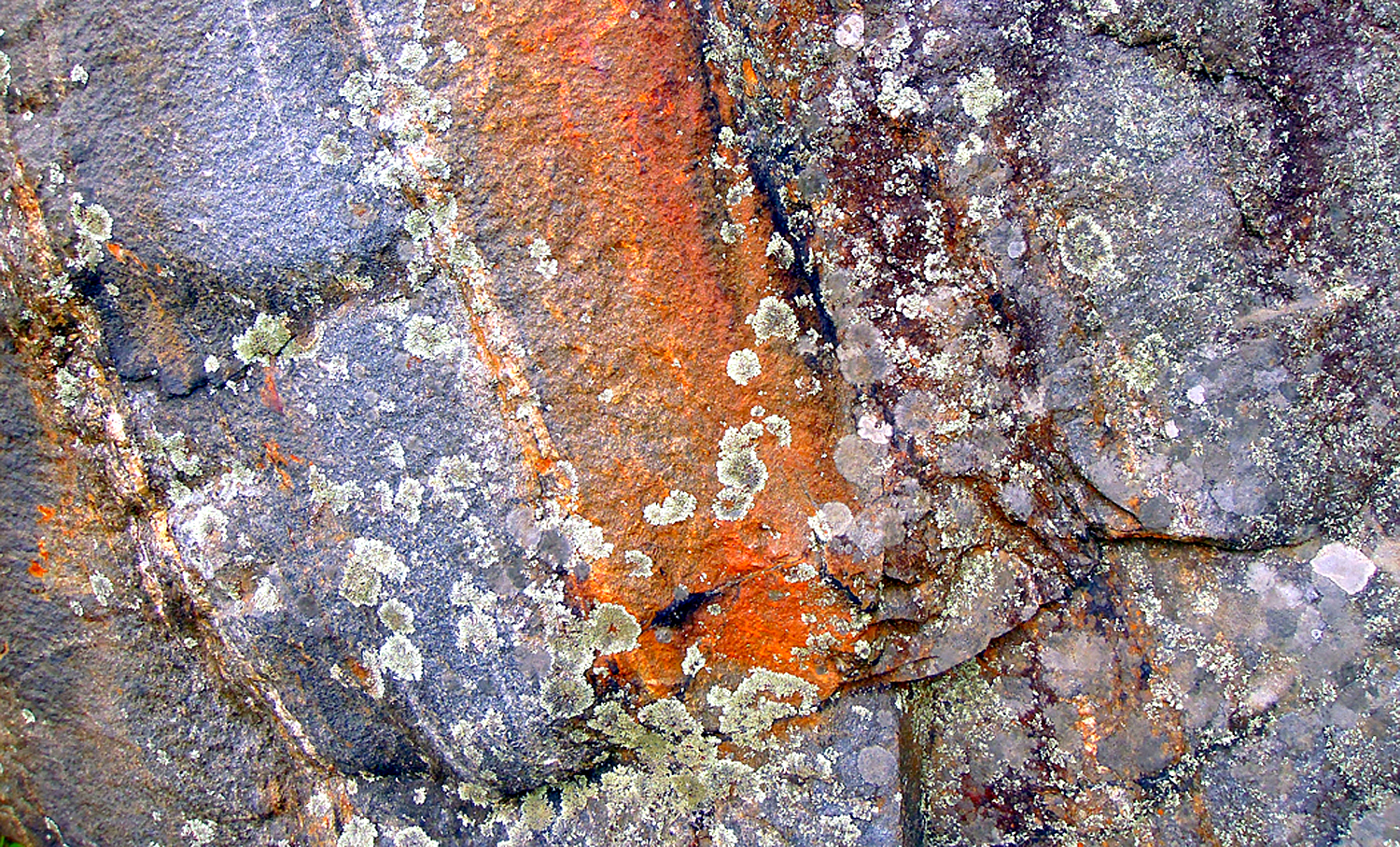
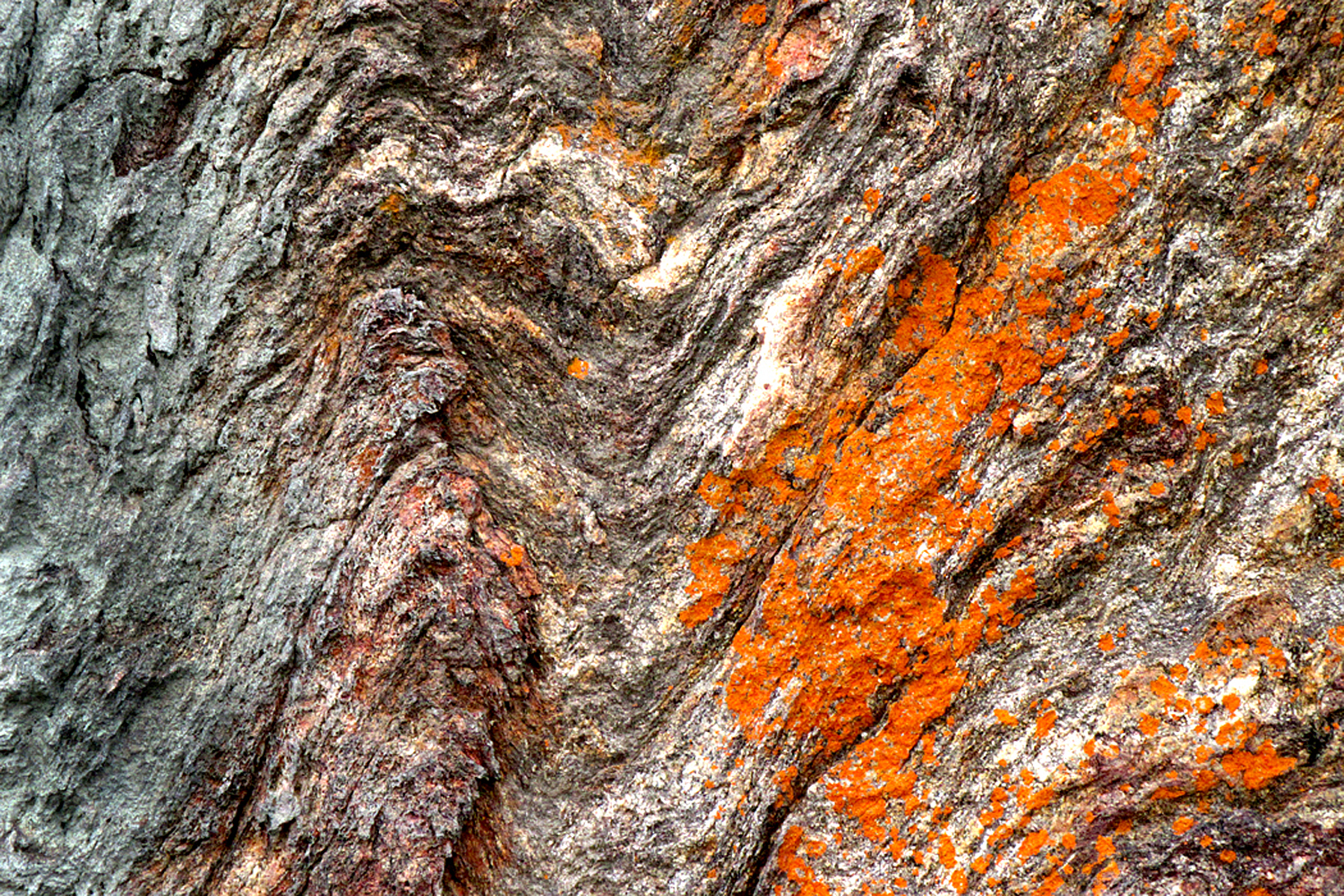
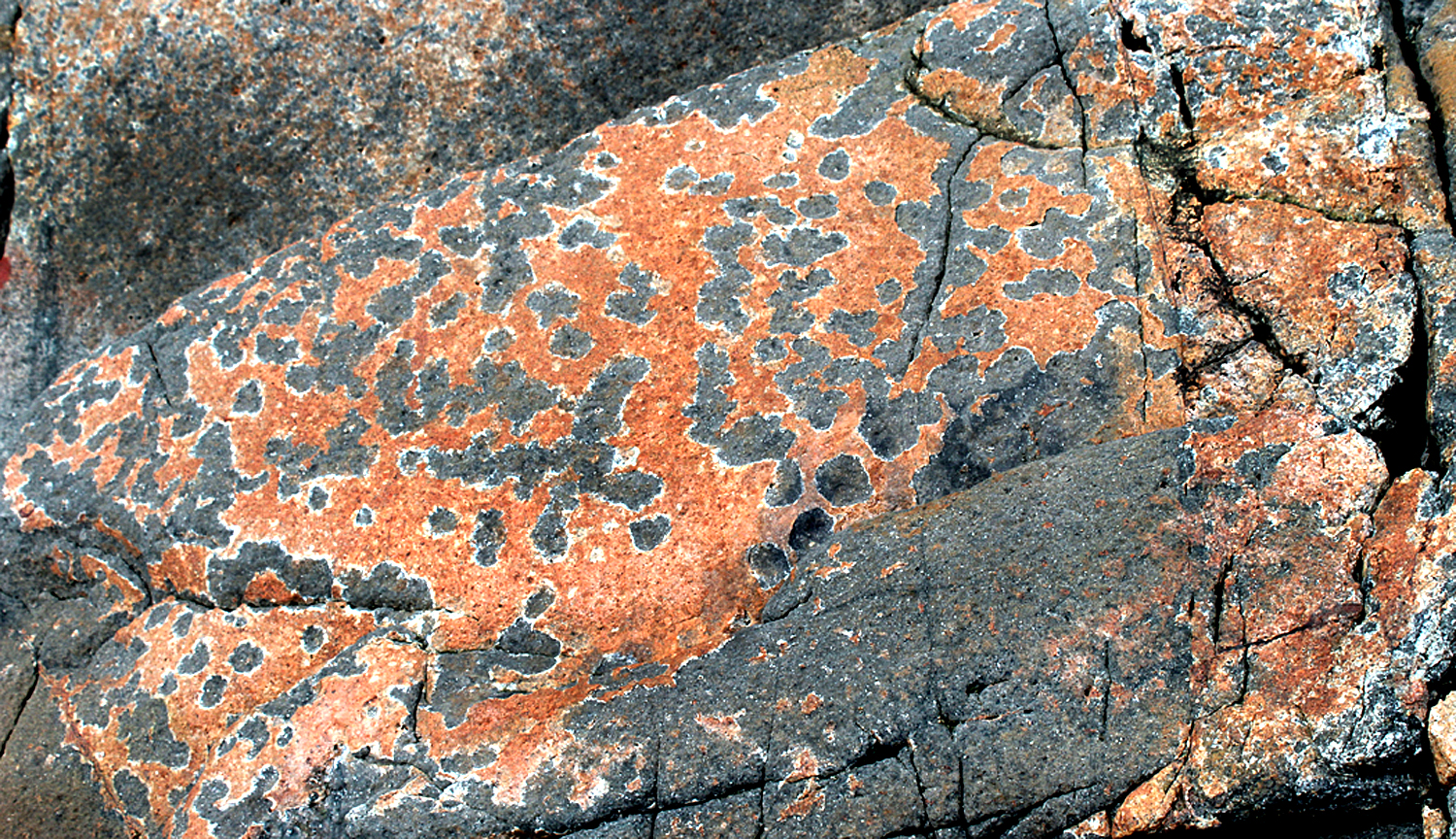
I have since found many rocks, with their esthetic pleasures. There is bright color

Blue Ridge Parkway, N.C. 

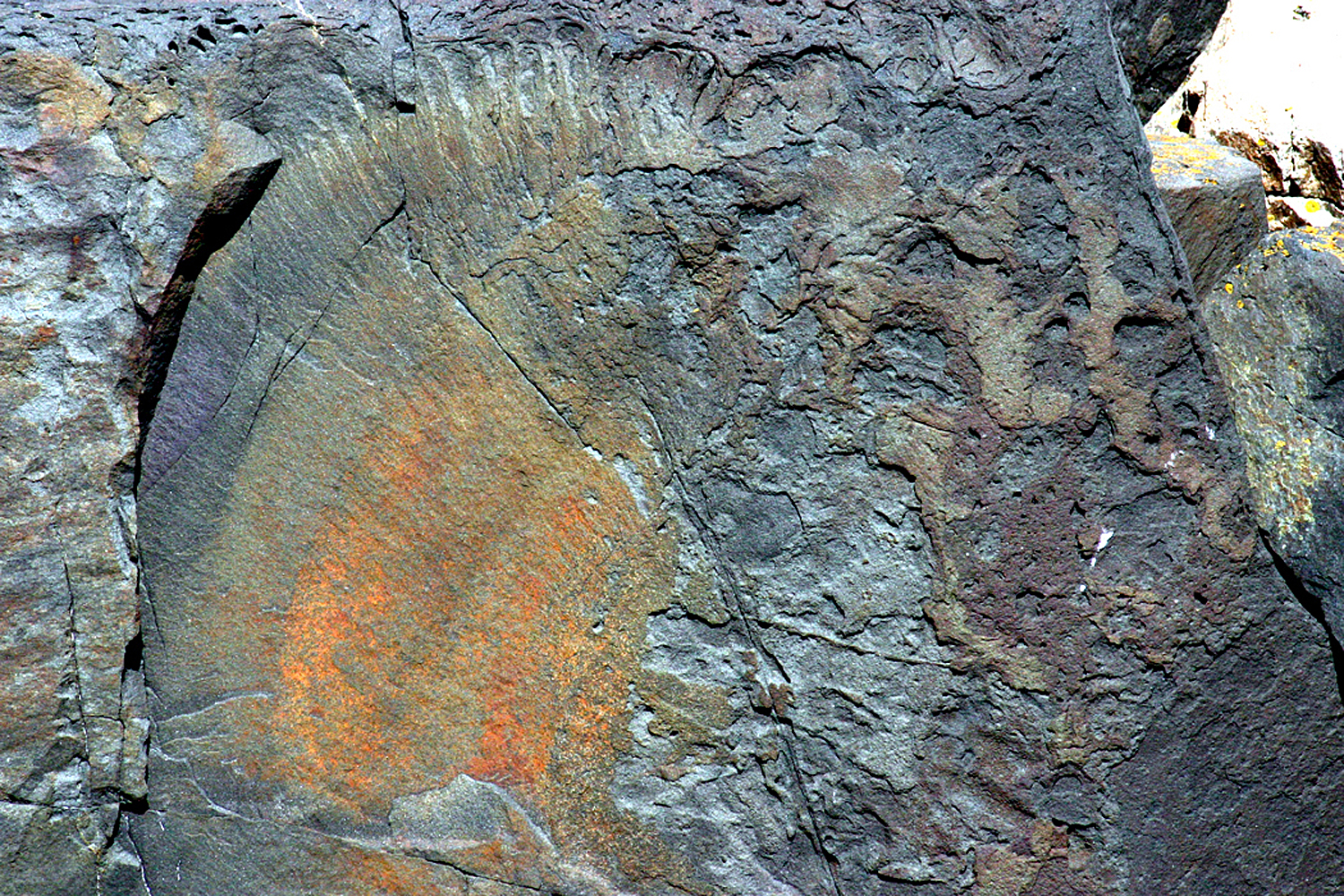
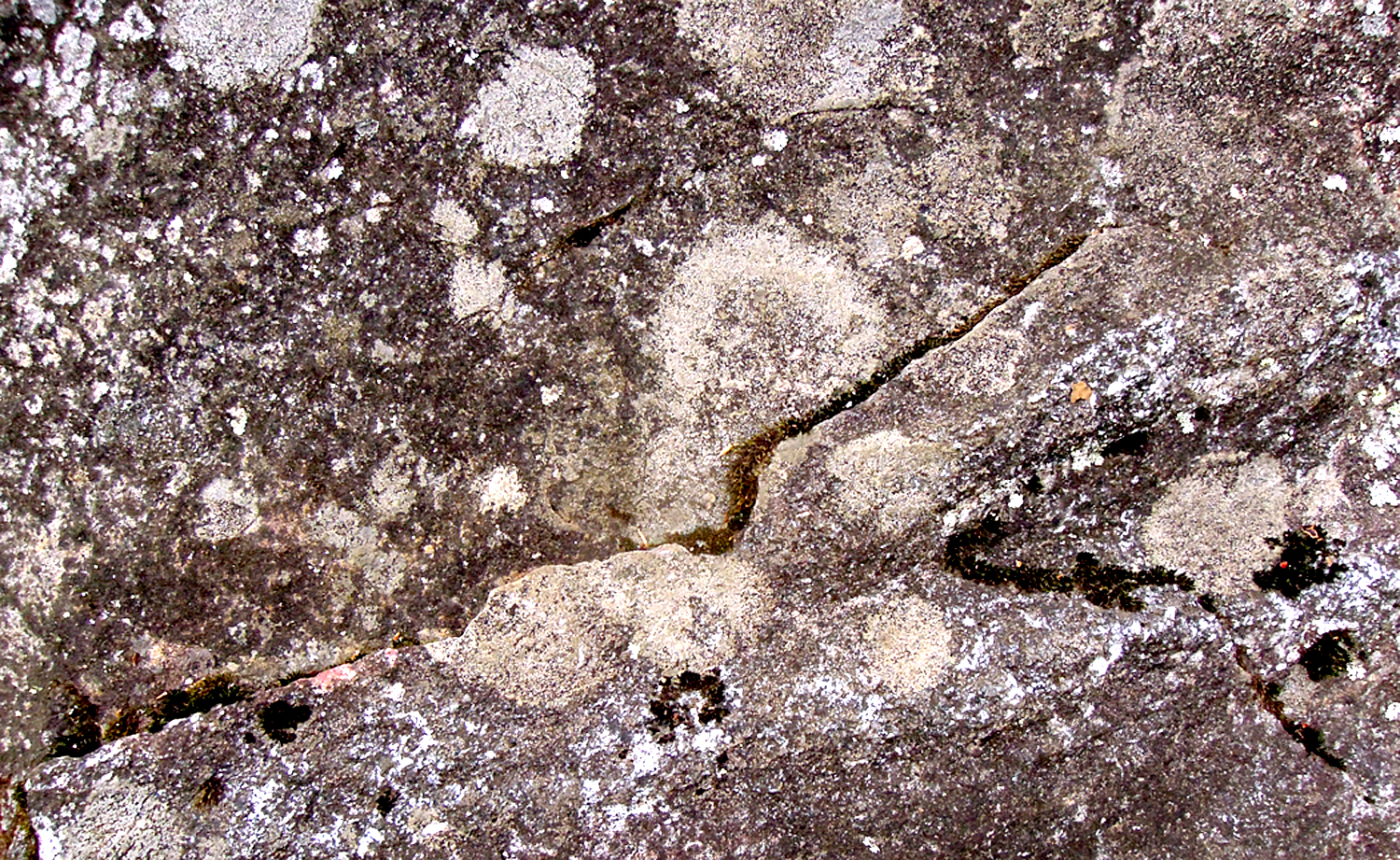
There is gnarly texture

Blue Ridge Parkway, N.C. 

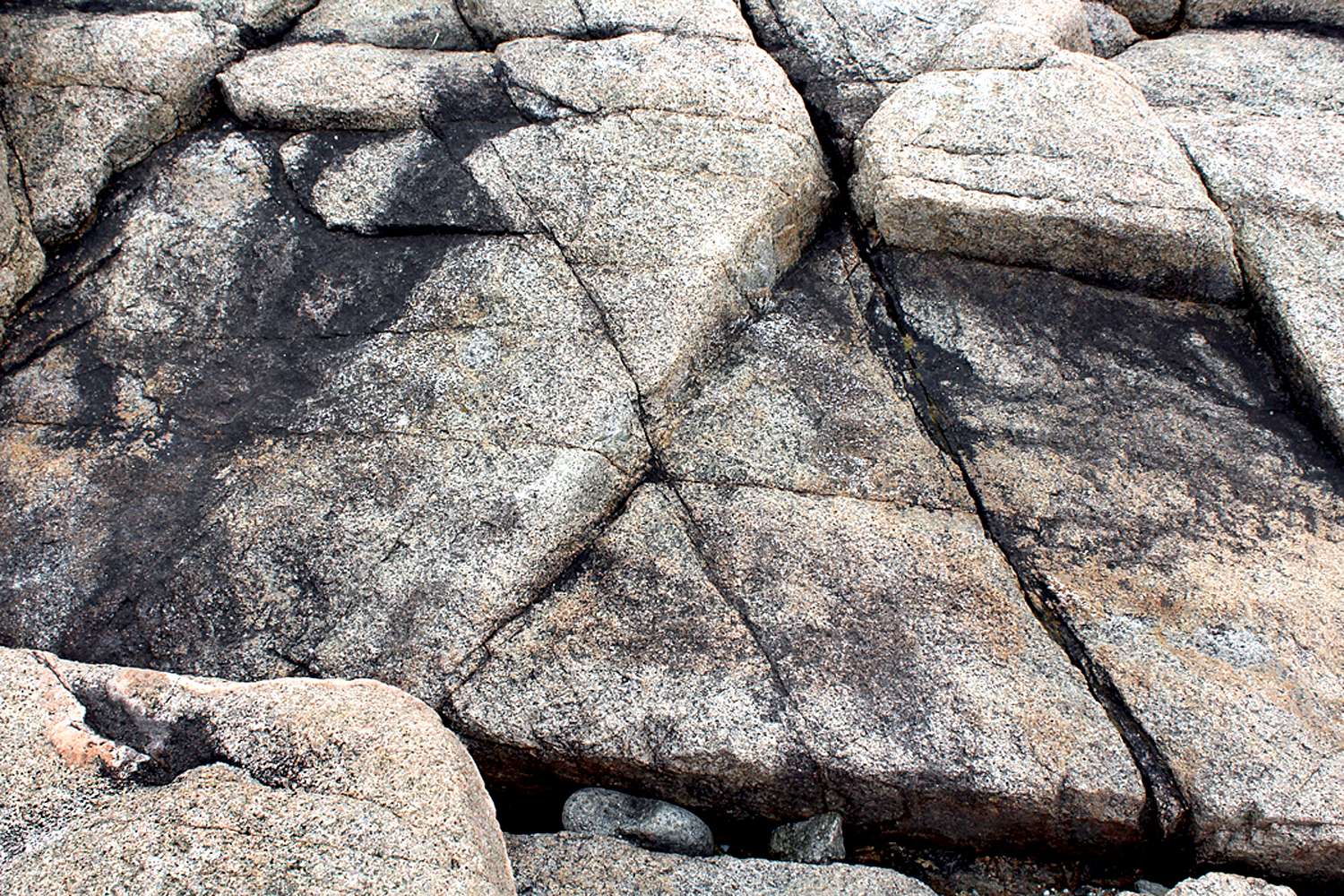
There are planes of surface

Schoodic Point, Maine

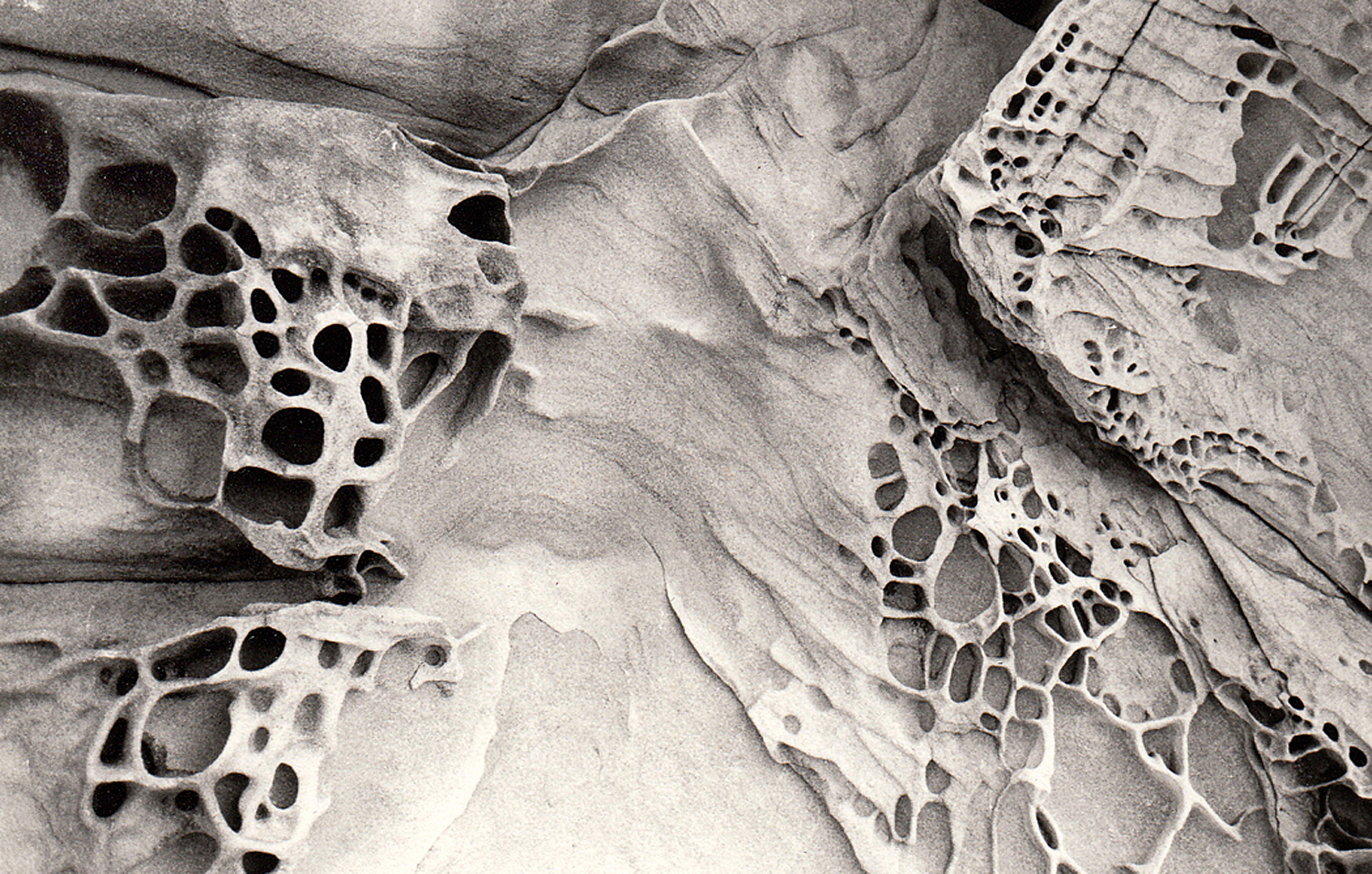
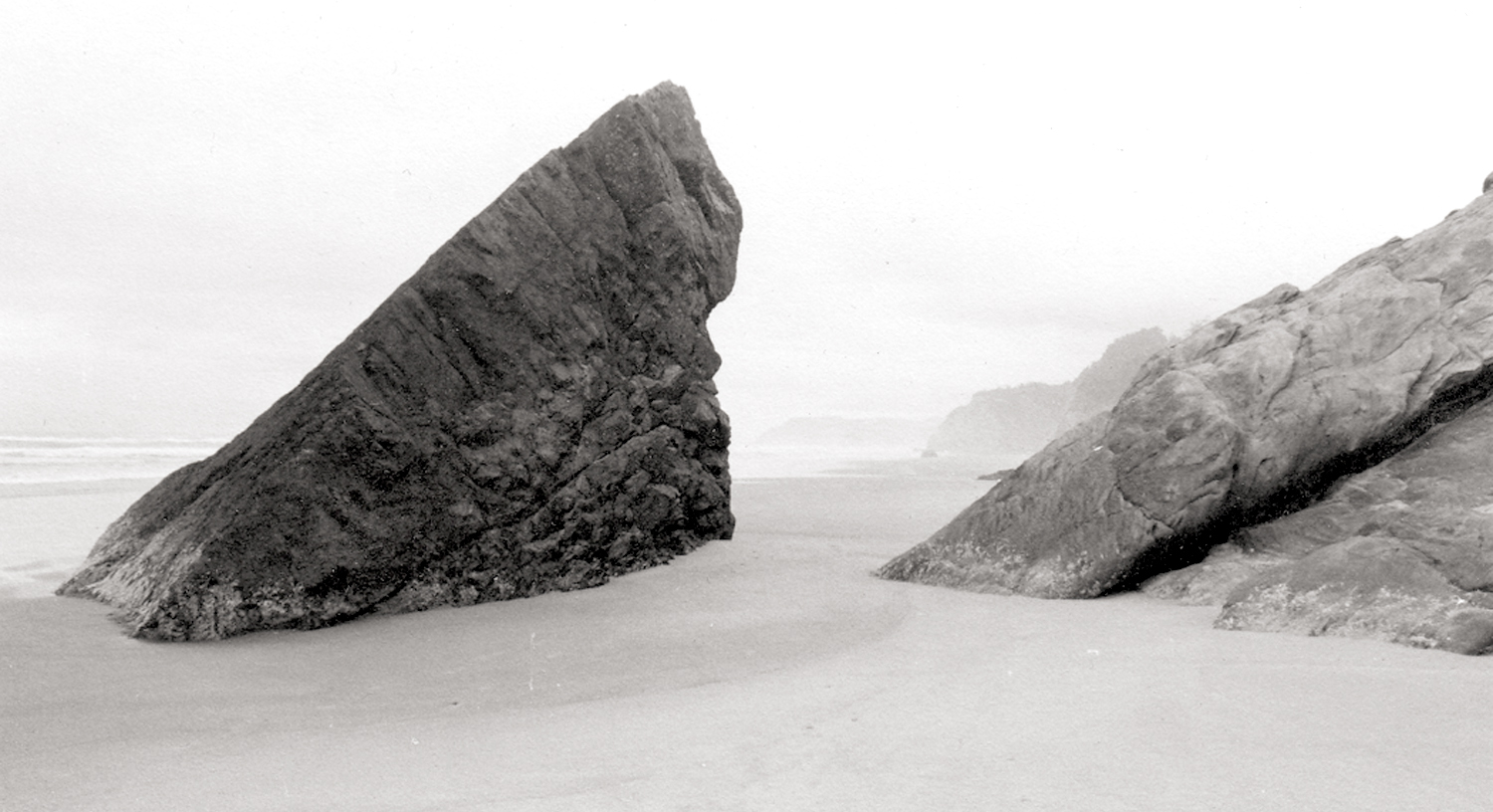
Repetition of shapes

Hug Point, Arch Cape, Ore. 

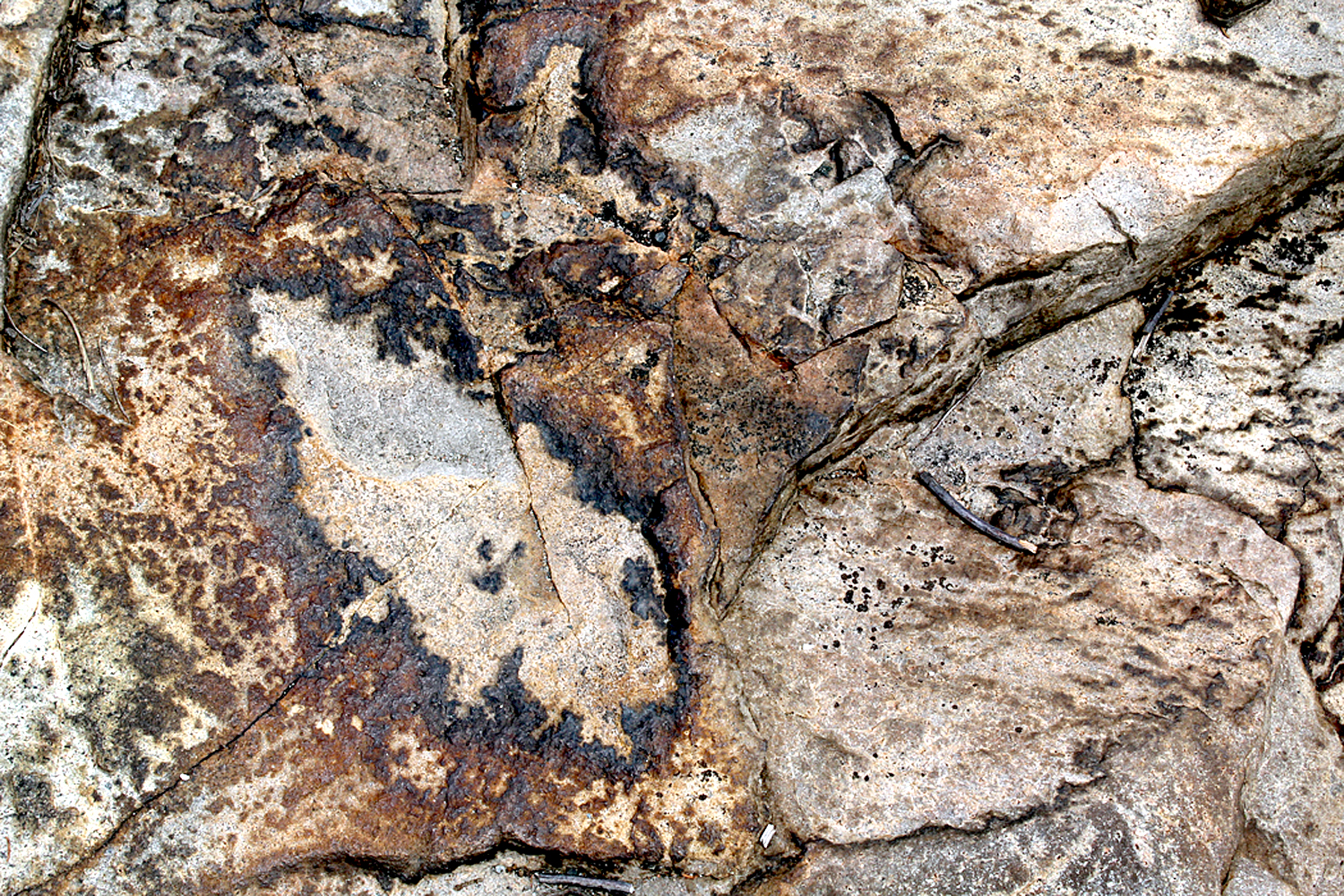
Complexity of image

Schoodic Point, Maine

And a starry night

Pisgah National Forest, NC

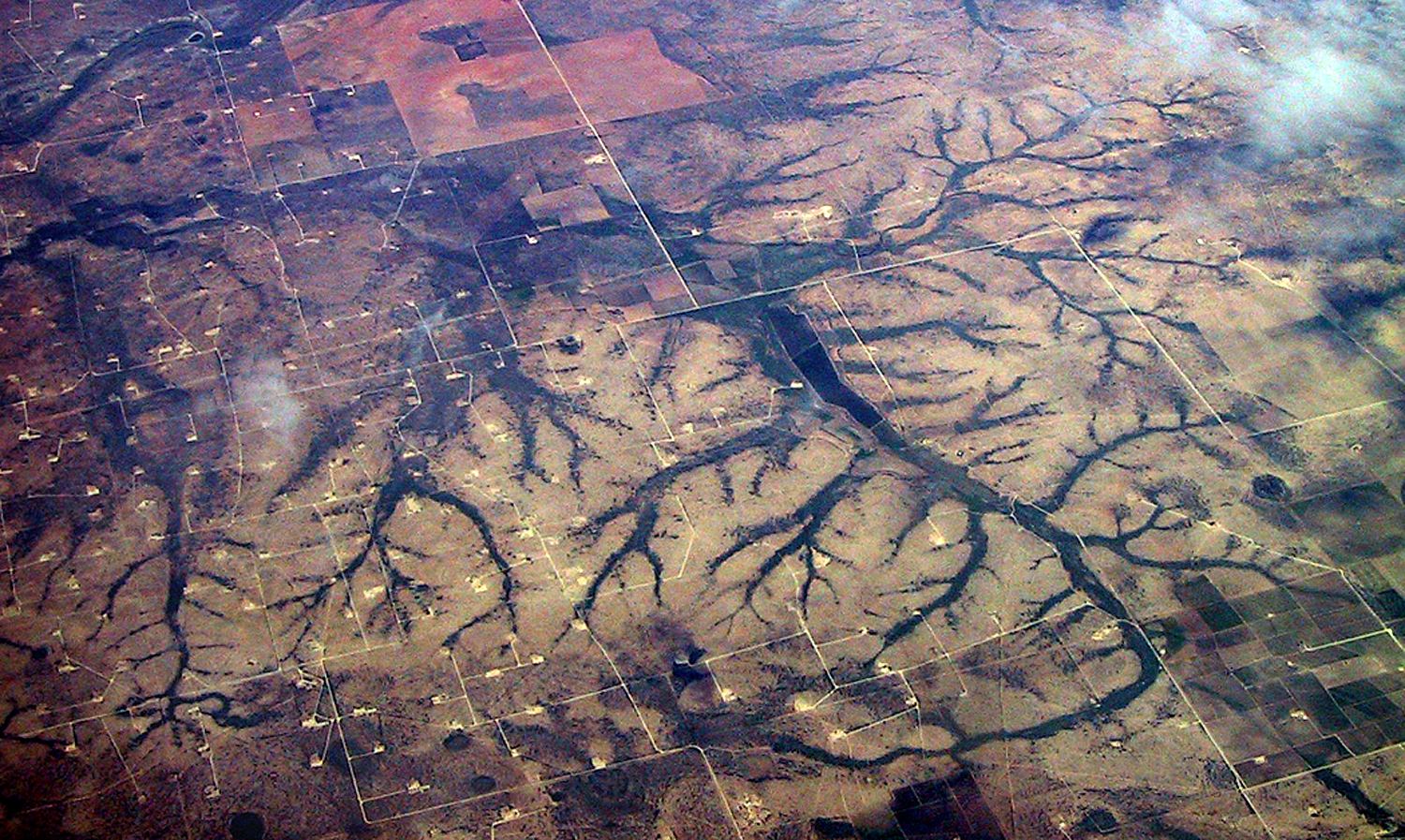
Or flying over the continent and looking down at erosion

Over Colorado

One of the primary functions of art is to make us pay attention. It is an interaction with the world and a response to it. 

Rio Puerco Ruins, N.M. 

The most important lesson I was ever taught was by a college professor who would not accept glib work. Like many bright students, I was adept at giving a teacher what he or she wanted — basically repeating back what was said in class. But when I did that in my English Romantic Poetry class, he gave me a D for a paper that was otherwise correct in every aspect except one. “Don’t give me back what I’ve said,” he told me. “Engage with the material.” Real engagement cannot be faked. 

What was real were the words written, not the words written about the words. Dive directly into the poetry. Don’t waste time learning “about” the poetry. 

Try to take the material under study seriously and be real about it. If what you find contradicts what the teacher said, all the better. You’ve learned something. 

Engage with the material — something you should do with friends, family, society, even the air and the rocks. Engage. Don’t gloss. 

Click on any image to enlarge

On Schoodic Mountain, Maine

I am within days of turning 78 and I feel my age, slowing down and dealing with new aches daily. I seem to be in reasonably good health, considering. But I don’t know how long I have left, and the length of string in front is clearly shorter than the length trailing behind. I am increasingly aware of mortality. 

And I have been considering all the things I have made and written over those piled decades and sometimes wonder why. Nothing will happen to any of it after I’m gone: It will eventually find some landfill somewhere. And part of me is perfectly alright with my life’s effort in words or images being utterly forgotten. Most of what anyone has produced over the millennia is long forgotten, and it’s fine. But I did a few things moderately well, and I can look at it all and note it. 

Over the past weeks, I have been spending time trying to consolidate a definitive version of some of the work from over the years. One has a tendency to take the long look and attempt some sort of codification of the evidence of a life lived. And so, I’ve been editing and winnowing. 

It is related to the unavoidable sadness one feels, having spent that life learning a huge trove, not merely of facts, but of useful experience — things we never understood as arrogant youths, full of ourselves and dead certain we were smarter than all those benighted generations that gave us birth — and knowing there is no way to impart that accrued experience to the children and grandchildren we love, that they will have to go through all of it again, on their own, and in turn come to rue that they will not be able to keep their own children and grandchildren from the same pains, mistakes and ignorances. 

And it will be the same for the physical evidence of that experience — the art and writing. So, I look over a lifetime of production and question to what end? 

Even I am astonished at the amount of work put in, a constant chugging away at the production machine, pictures and paragraphs. In 25 years at the newspaper, I wrote more than two-and-a-half million words, and since retiring, I have written another million-and-a-half on this blog — with another 100 essays written for the Spirit of the Senses website in Phoenix, having also given at least a score of well-researched lectures for that salon group. There are also an uncounted number of letters penned, and also both fiction and poetry. 

To say nothing of the tens — maybe hundreds — of thousands of photographs I have made.

I have always been this way. I didn’t think about it when I was a boy, but even before first grade, my idea of fun was a pile of paper and a pencil or crayon and I would spend hours drawing. Most kids do that, but most slowly lose the need as they grow up. In high school, I was given access to the darkroom and began making photographs, while also writing for the school newspaper. Always scribble, scribble, scribble. Eh, Mr. Nilsen? 

After college, I found work writing, editing and making photos for a Black weekly newspaper, where I pumped out a weekly cooking column and the “Dear Carol” advice to the lovelorn column, in addition to writing the editorials and coming up with the headlines. (My favorite: When the iconic Greensboro, N.C., nightclub closed, I wrote in giant 128 point type, “Cosmos Folds!” Thought it a grand joke.) 

In the single month of March of 1980, I wrote 500 pages of letters to friends, on a tiny plastic aqua-colored portable typewriter on a tree-stump “desk” in the back yard. When I finally began work at the daily paper in Phoenix, I averaged about three stories a week. I thought I was being lazy, but apparently I was producing more than most. (At least, that’s what my editors told me). 

I would use the word “creating,” but that seems too important for what I was doing. I was producing. 

Los, with his forging hammer, by William Blake

There is a character in poet William Blake’s obsessive mythology called Los, and he is one of the four main “gods” of human psychology, and Los spends eternity forging an endless chain. Why he does so is irrelevant: It is what he does. He is defined by it. He produces. It is what I have done: produce. 

Many jobs in life call more for other talents. Nurses and doctors, for instance, or office workers who keep the paperwork flowing, or in selling or organizing. The actual creation of something new is not for them the goal. But in my life, like that of Los, all that matters is production. Make. Make. Make. I cannot imagine spending my life without making stuff.

And so, I am going over the thousands of files stored on computer and CD-ROMs and winnowing down what I think has been the better examples, and working on them to create the best or final versions “for posterity,” by which I mean, so I can look at them and contemplate what I have spent my life doing. 

I just finished editing the bulk of the portraits I have made, cleaned them up, re-framed some, improved contrast and tone, and come up with a final version. If I were to present a portfolio, these images are what I would offer. I have about 200 such images in the file.

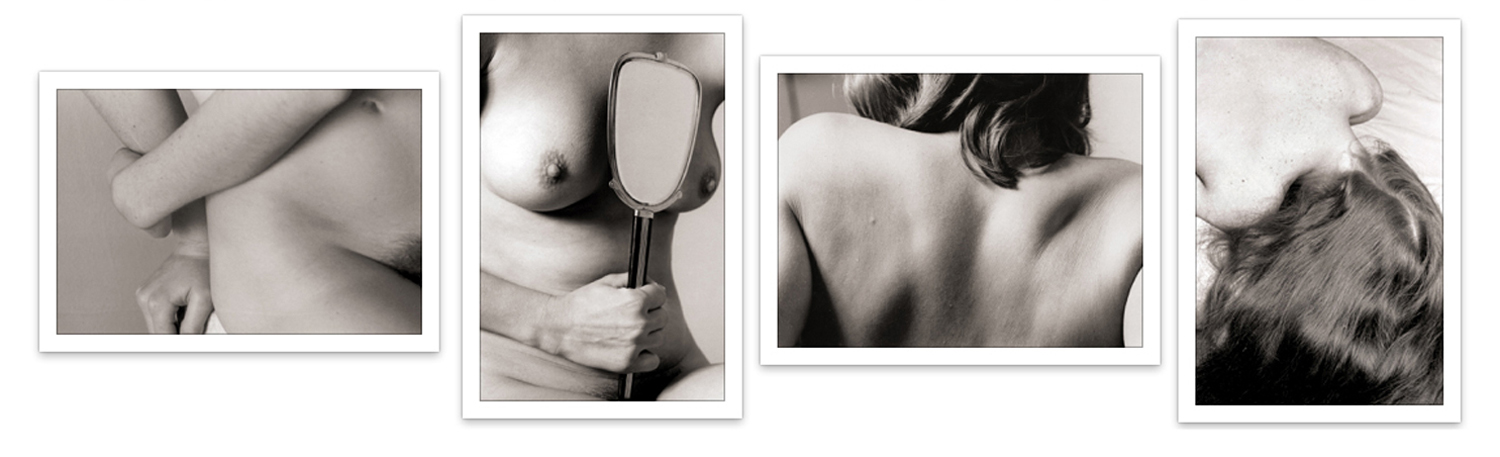
I previously did the same thing for the nudes I took over the years; there were fewer of them and even fewer of those were worth saving. 

There have been uncounted thousands, probably tens of thousands, of landscapes I have pointed my camera at. Most are just snapshots — memories of travel — but there are hundreds saved intended as works of art, and shown in gallery exhibits and printed in books

The earlier ones are more clearly derivative, but gave me lots of practice printing in the darkroom, so that I became an excellent printer of silver images. The longer I kept working, the more individual my landscapes became. 

Most of my photographic work has been in clear genres, such as portrait, nude, landscape and still life. 

One subject that has remained as a visual source of amazement over 50 years of making images are trees. I have thousands of prints of various trees in various seasons and weathers. 

And, because of when I grew up — in an era when Abstract Expressionism was king of the hill — I add to those genres a search for abstractions.

And even, non-camera work, where I played with the chemicals and papers to make my abstractions directly in the darkroom.

About 25 years ago, I began making photographs in series — collected in portfolios of between 10 and 20 prints each — made in various gardens, including public gardens and the back yards of friends and family. I must have made scores of these boxes, each with its title, and meant to be understood not as individual images, but as a kind of suite to be taken whole.

And with images made over the course of a few hours, tapping the shutter at whatever caught my eye as deserving its attention.

I expanded the series idea into images I found outside my airliner when flying around the country, a series I titled Window Seat

And another using a cheap toy camera (a $2.98 Diana) at Organ Pipe Cactus National Monument in southern Arizona.

And another made from clouds on one particularly stormy afternoon from my back yard in Phoenix, collected in a book titled Monsoon

Where does all this need to keep creating, keep producing come from? It is just my nature. I can’t help it: It keeps mind and hands busy, engaged, interested, alive.

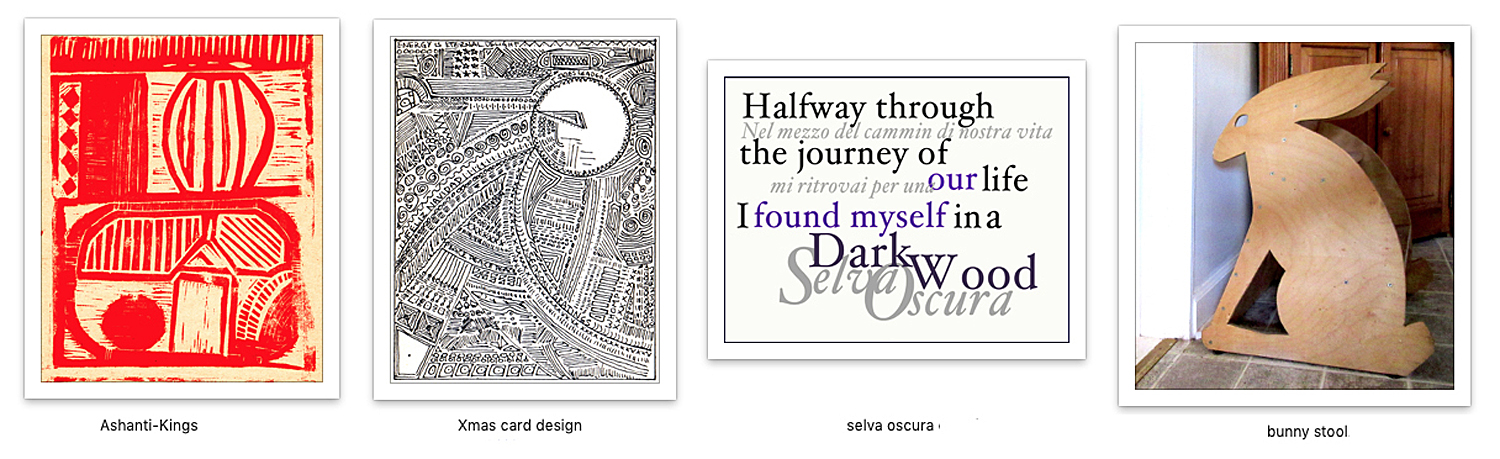
I’ve made linocuts, drawn with pen and ink, played with graphic design, and even, when my wife needed a step-stool for the kitchen, I built one from birch wood in the shape of a jack rabbit. 

None of this means I feel especially talented or important, but just that putting things into this world that hadn’t existed before I made them seems as if it is whatever purpose my life has been made for. 

When I was newly minted and 20 years old, I thought I would be an artist or poet. It was a goal. But it didn’t take long to give up such an idea. Instead, I began writing and making images. The focus was no longer on my identity, who I thought I was, and more on engaging with the world. Looking outward rather than being stuck with self. 

I’ve known plenty of genuine artists; I don’t count myself among them. But I am doing something analogous. 

I didn’t care if I was an artist. I was more interested in understanding the world, either visually or conceptually. And not so much understanding as simply experiencing it. I can’t say that self evaporated — I have always had a strong sense of self, as anyone who knows me will admit under muffled giggles. But that it didn’t matter. 

And so, a lifetime of making things was not spent in any ambitious attempt at public recognition. I certainly could have written books or sought more gallery shows, but, as comic Steven Wright once put it, “I have  ambition, but without the drive.” But I have been driven to use my words and my camera to see better, to connect better, to make objective documents recording what I have seen or learned. Making pictures forces my attention. 

So, when I question having spent my life making and producing, and what it was worth, the obvious answer is not in the rewards of having made, but in the immediate doing. The meaning is in the act. 

I will stop when I no longer breathe. 

Click on any image to enlarge

I want to put in a good word for TV sitcoms. They don’t get much respect. And it is true that many of them are routine, uninspired and forgettable. “Chewing gum for the eyes.” But the genre as a whole has both a long history (longer than you may suspect), and a significant role to play in the arts. Yes, the arts.

What we call art is a lot of things, and serves many purposes, but one thing all art, whether painting, music, theater or literature, is asked to do is entertain. There are different levels of entertainment, but even Joyce’s Ulysses or Berg’s Lulu offer an underlying level of amusement. 

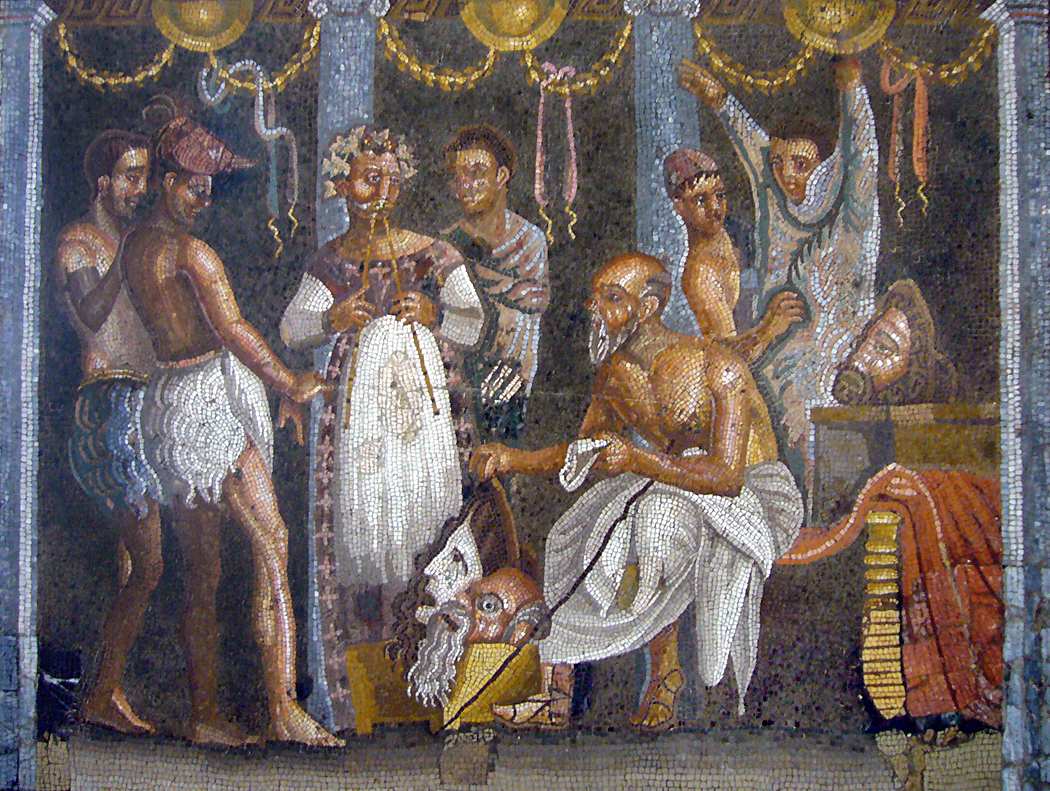
Comedy players, Mosaic from Pompeii

Some offer much more, but the base line of keeping us interested has been there from the earliest times we have record of. And much of it even fills university courses. We study Plautus and Terrence — among the earliest sitcom writers (Rome, 6th century BC), with plays full of dirty old men, unfaithful wives, clever slaves, mistaken identities and love-struck young men. 

There are few actual characters in such plays, and a great panoply of stock figures. These kinds of figures, stuck in difficult and comic situations, populate the works of Italian commedia dell’arte, the comedies of Molière, and the plays of Shakespeare (who would sometimes borrow from Plautus and Terrence). Victorian novels — by Dickens, Trollope, Thackeray —  now treated as literature, were at the time serialized in popular magazines and thought of much the same as we now consume TV shows. And all now deemed worth of academic study and even reverence. 

So, why not the same for All in the Family or The Honeymooners? Are they any “lower” an art form than The Twin Menaechmi? Or The Braggart Soldier

Remember, Shakespeare’s audience included the uneducated  groundlings; he wrote also for them. And he was not above the traditional fart joke. It ain’t all Seneca and Henry James. 

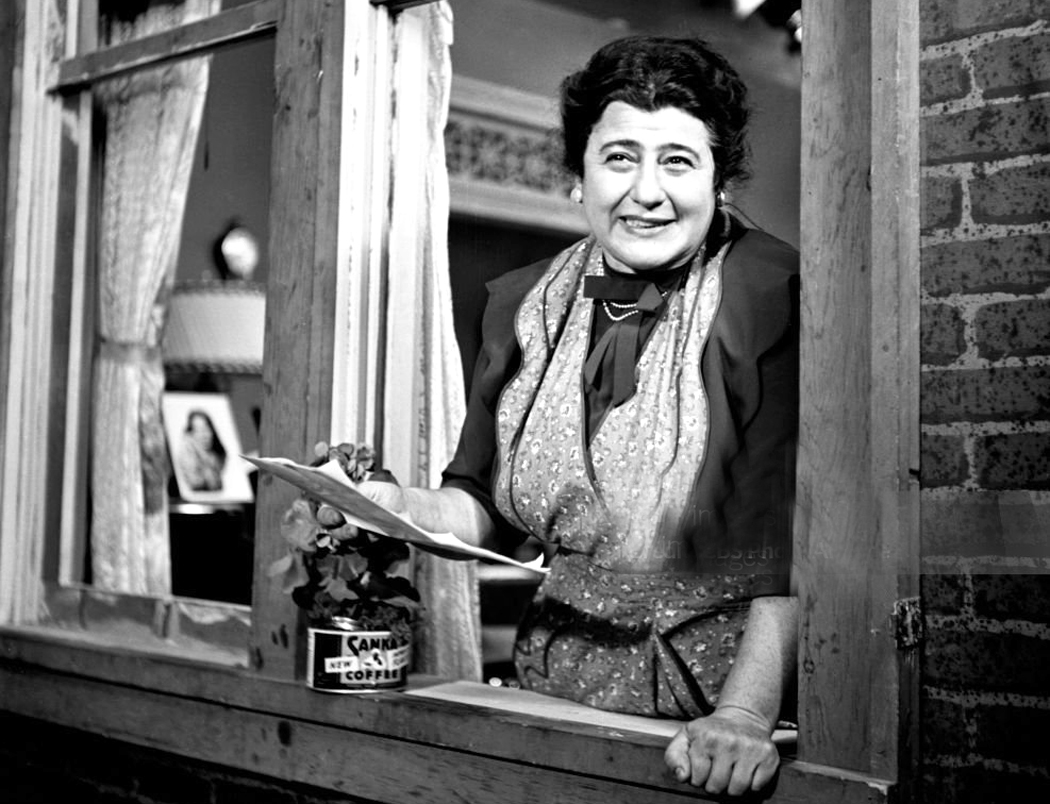
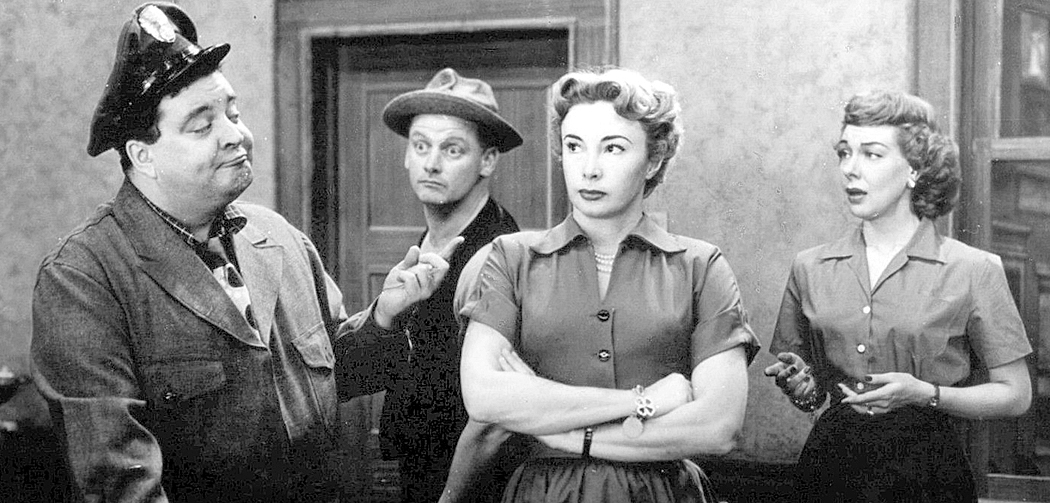
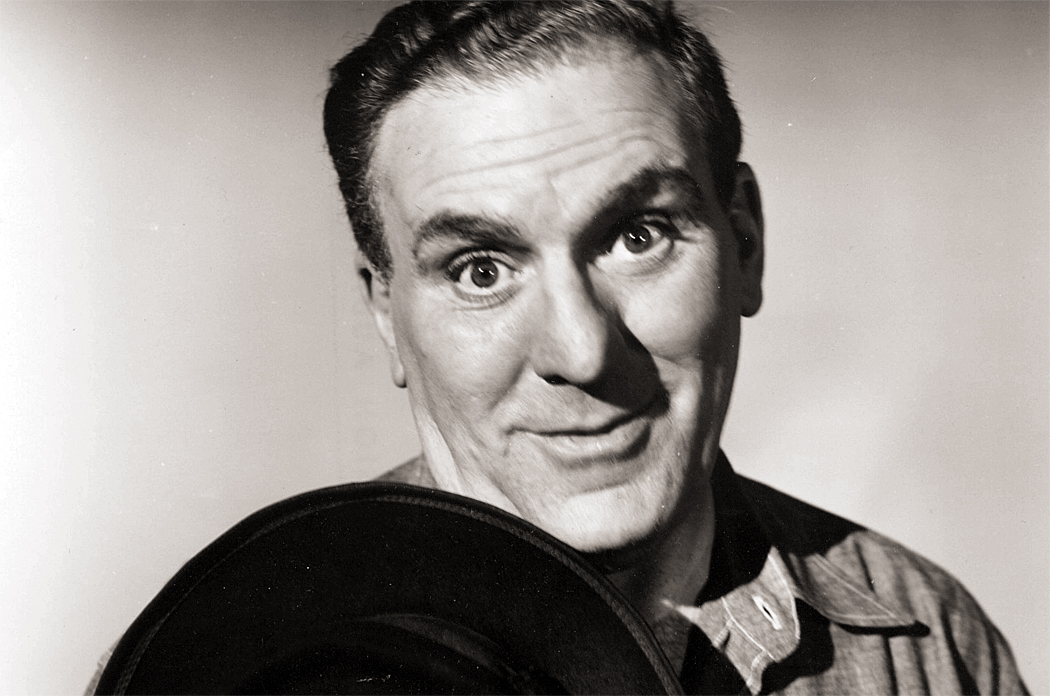
I am roughly the same age as television, and have watched the sitcom from its earliest TV days. I was one year old when The Goldbergs switched from radio to television (“Yoo-Hoo, Mrs. Bloom…”).  There was The Aldrich Family from 1949 to 1953 (“Henry! Henry Aldrich!” “Coming, Mother.”), and the first season of The Life of Riley, with Jackie Gleason originally taking over the title role from William Bendix, who had played the part on radio (“What a revoltin’ development this is”). Bendix took back the role for the rest of the series run. I don’t know how old I might have been when I first started watching these series. Probably in my playpen watching the images wiggle on the 12-inch screen of a Dumont television. 

The 1950s brought the onslaught and the sitcom became a staple of the boob tube. These series I remember quite well: Beulah; The Bob Cummings Show; The George Burns and Gracie Allen Show (the first Postmodern show, where George could watch what Gracie was planning on his own TV screen and comment to the audience); December Bride; I Married Joan; Private Secretary; Mister Peepers

I haven’t mentioned the three most important shows of the time. The Honeymooners emerged as a sometime skit on Cavalcade of Stars, the Jackie Gleason variety show on the Dumont network, sometimes taking up most of the run time. But in 1955, the skit was spun off into a half-hour sitcom for 39 episodes, still run in syndication on various cable channels. (“To the moon, Alice”). 

I Love Lucy ran from 1951 to 1957 and pioneered the three-camera filmed sitcom with live audience and laugh track. For its entire run, it ranked No. 1, No. 2, or No. 3 in the ratings. (I have to confess, contrary to the majority opinion, I never found Lucy very funny. Watching reruns, I still don’t). Those reruns can still be found in syndication on cable. 

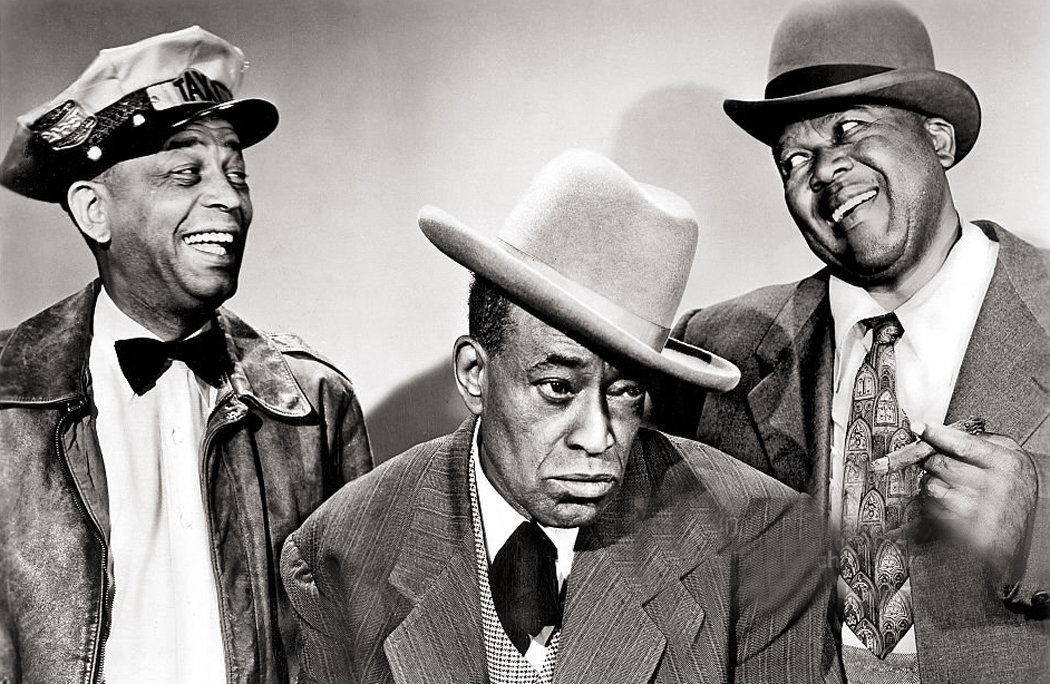
Alvin Childress, Tim Moore, Spencer Williams

But you won’t find Amos ’n’ Andy. It was enormously popular from 1951 to 1953. But reaction to the racial stereotypes changed markedly during the rise of the Civil Rights movement. It would be hard to complain about the series cancellation. In the context of its times, it was deserved. It can be hard to watch nowadays. But I have seen all 78 episodes on bootleg DVDs and must admit we have lost some brilliant comic performances, especially by ex-vaudevillian Tim Moore as the Kingfish. Yes, there are some awful stereotypes, but not everyone was shufflin’ and grifting. Amos was an upright citizen and family man, and the series showed quite a few Black doctors and judges, all horrified at the shenanigans of the series stars. 

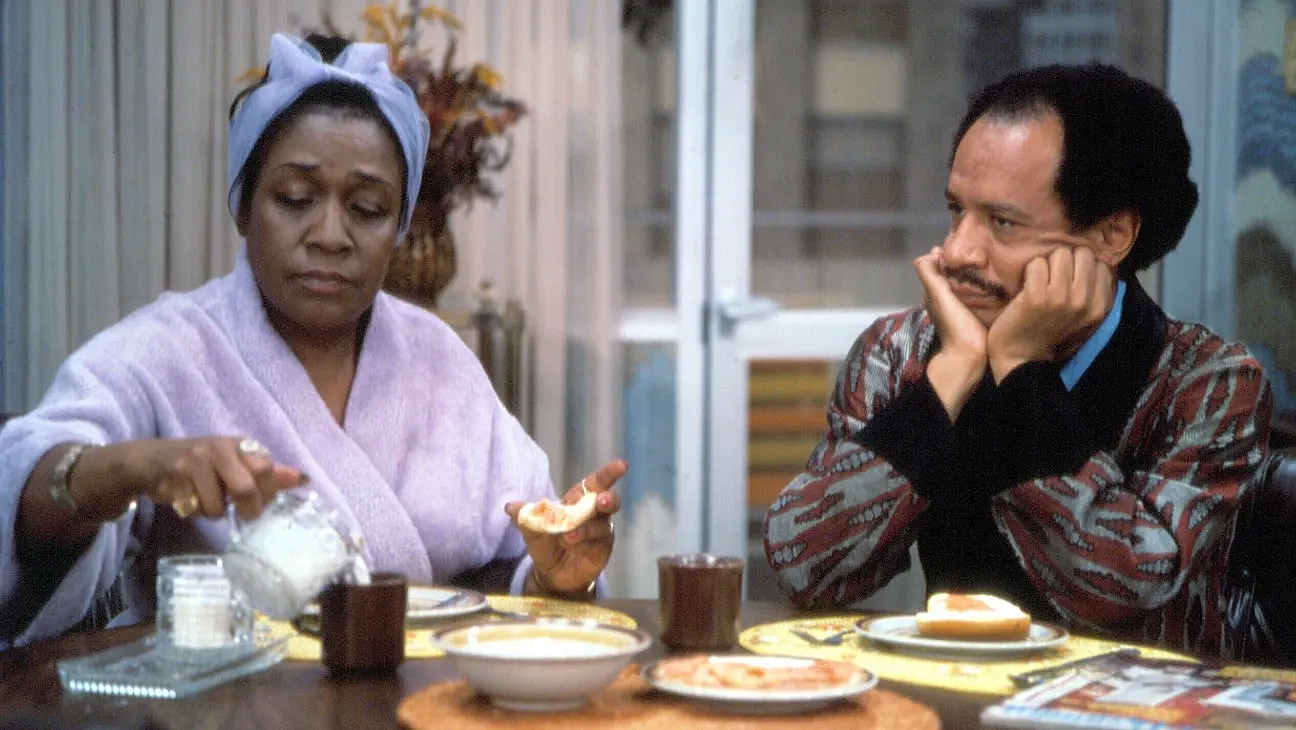
And it should be pointed out that most sitcoms, Black, white or otherwise, focus on less-than-admirable characters. Let’s face it, bland Ward Cleaver does not support a TV series. You need Archie Bunker, Ralph Kramden, or Larry David. Something out of the norm, but exaggerated. Getting past the particulars of Amos ’n’ Andy, basically the same stereotypes come back later as George Jefferson or J.J. in Good Times (“Dyn-O-Mite”) or Redd Foxx in Sanford and Son. Same caricatures, different generation. 

I’m not suggesting we forgive Amos ’n’ Andy, but rather to see it in context, and recognize the talent that went into it. 

The fact that even Millennials know who Lucy Ricardo was, or Ralph Kramden or Rob and Laura Petrie, means that some of the hundreds of sitcoms that have aired, from the last century and this, have a cultural staying power, very like the classics we read at university. 

The foundational stereotypes — or archetypes — have persisted, too. How many sitcoms feature bumbling husbands, from Chester A. Riley and Ozzie Nelson to Curb Your Enthusiasm and The King of Queens? Conversely, the trope of the ditzy wife, from Gracie Allen to Married … With Children to The Middle? Mothers-in-law are a perennial butt of jokes, as are clueless bosses and gay best friends. They each provide a predictable set of familiar and comfortable jokes. (Although the limits of comfort can and have changed over time: Blonde and Polish jokes haven’t worn as well).

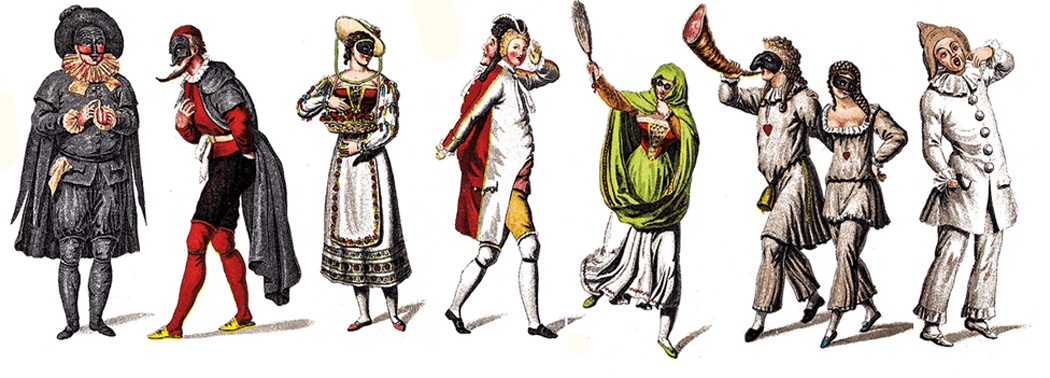
And most of these are just modern changes rung on the characters of the commedia dell’arte. Harlequin, Colombina, Pantalone, Pulcinella, Zanni and the lot. We aren’t looking for fully rounded characters so much as familiar types to build plots and gags around — the “situations” in situation comedies. 

So, the sitcom has a long history. And I have a long history with them. And I have divided them into four roughly defined groups. The borders of these groups may be squishy — you may parse them differently — but the categories are defensible.

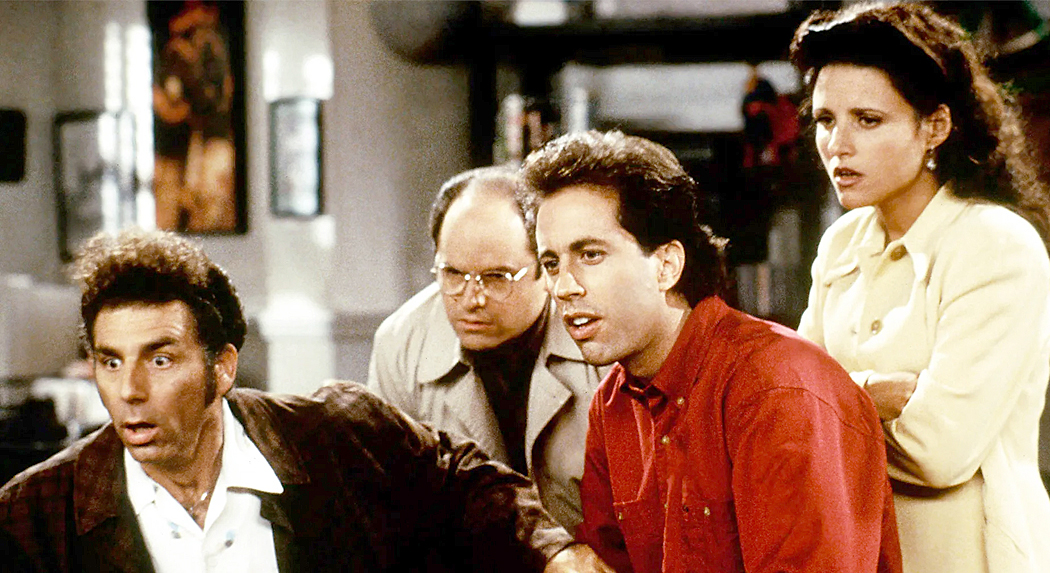
First, there are those that have had an effect on culture broadly. They tend to be the best written and acted, but they have wormed their way into the general consciousness. Class A includes I Love Lucy (my qualms not withstanding), The Honeymooners, All In the Family, The Mary Tyler Moore Show, M*A*S*H, Murphy Brown, The Office (American version), Seinfeld, Roseanne, Curb Your Enthusiasm, and The Cosby Show (which now is hard to watch — both hard to find and hard to endure, knowing what we now know). And I would include both The Big Bang Theory and Young Sheldon. Class acts all the way. 

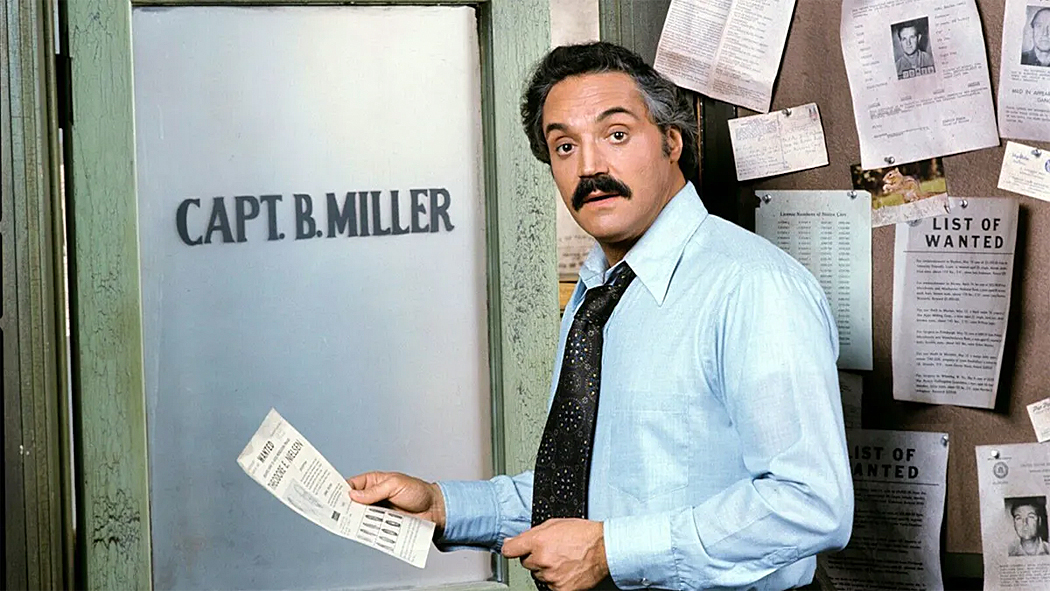
But I would include also: Taxi, Barney Miller, Dick Van Dyke, Cheers, The Bob Newhart Show (the original one), and a few that I never warmed to, but still have a cultural significance, like Friends and Married… With Children. All are or have been in the national conversation.

I should also include a few British series that have had an impact, mainly Fawlty Towers, the British Office, and Absolutely Fabulous.  

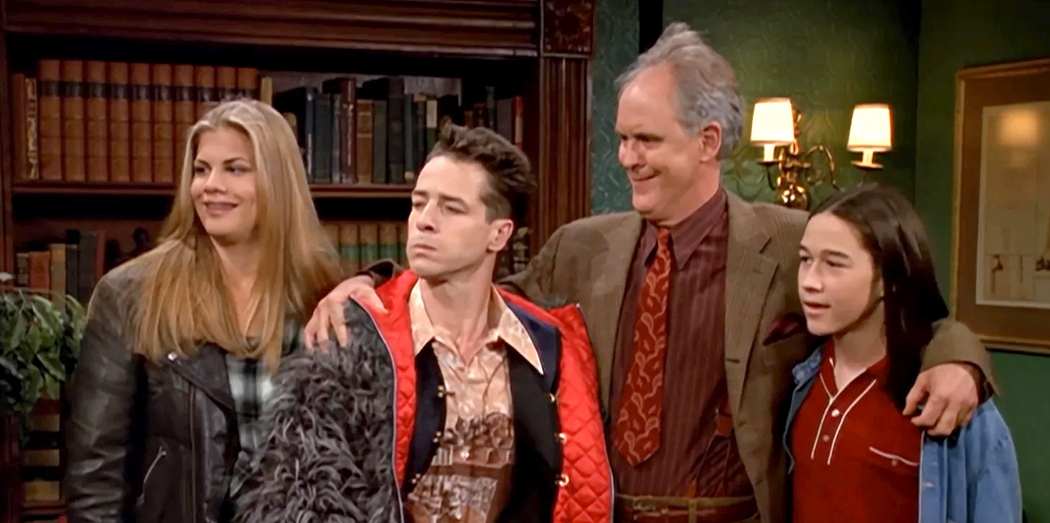
Class B includes all the quality shows that came and went, with funny characters and solid jokes, but never buried into the Zeitgeist in quite the same way. All solid entries. You can add quite a few to this list and it will depend on your taste and funny bone. I would include: 3rd Rock From the SunBlack-ish; Brooklyn Nine-Nine; Frasier; Golden Girls; The Good Place (should be in Class A, but not enough people watched); Happy Days; Malcolm in the Middle; The Middle; Mike & Molly; Modern Family; The New Adventures of Old Christine; Parks and Recreation; Scrubs; Two and a Half Men; Veep; WKRP in Cincinnati; and your choice of others. Among my favorites are Mom, Night Court, Reno 911. Individual taste may vary. (I have not included many of the old shows from the ’50s and ’60s that few people have had a chance to see: My Little Margie, Private Secretary; Topper.)

The next rung down, in Class C are the workaday shows, sometimes OK time-wasters, but full of cliched characters and tired jokes — the kind that have the familiar form of jokes, but seldom the wit or laughs. Writing on autopilot. This is the vast majority of TV sitcom bulk. The roughage and fiber of the viewing diet. 

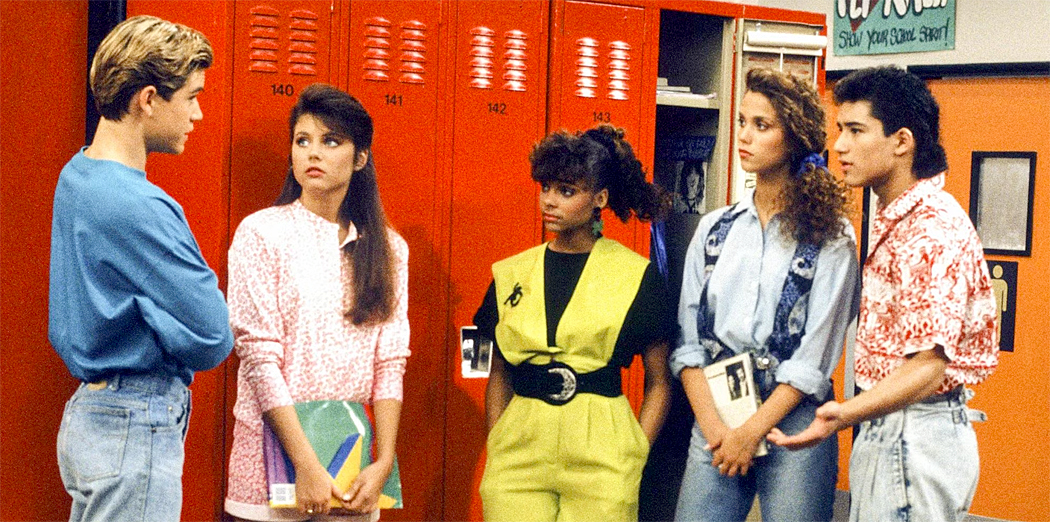
When we watch these, it is often more out of habit than desire. The forms are familiar and the laugh track tells us when a joke has passed by. Did anyone ever think The Munsters was prime comedy? or Gilligan’s Island? McHale’s Navy? Saved by the Bell? Mediocrity incarnate. Hogan’s Heroes? I could name a hundred, propelled by laugh tracks and the need of writers to fill air time. Networks toss them on the screen, hoping they’ll stick. Some do, but only because they are gluey. 

Wikipedia lists hundreds of sitcom titles and I would guess some 75 percent of them fall into Class C. At least half of those are gone in a single season, un-renewed, or cancelled after a few goes. The rest stick around because they are not overly offensive. They may feature actors we like, even if they have to spout insipid dialog. 

Bewitched; The Brady Bunch; Chico and the Man; Community; Ellen; F Troop; The Facts of Life; The Flying Nun; I Dream of Jeannie; Last Man Standing; The Monkees; Perfect Strangers; That ’70s Show; Who’s the Boss? Go ahead: Make a case for any of them. Tube fodder. 

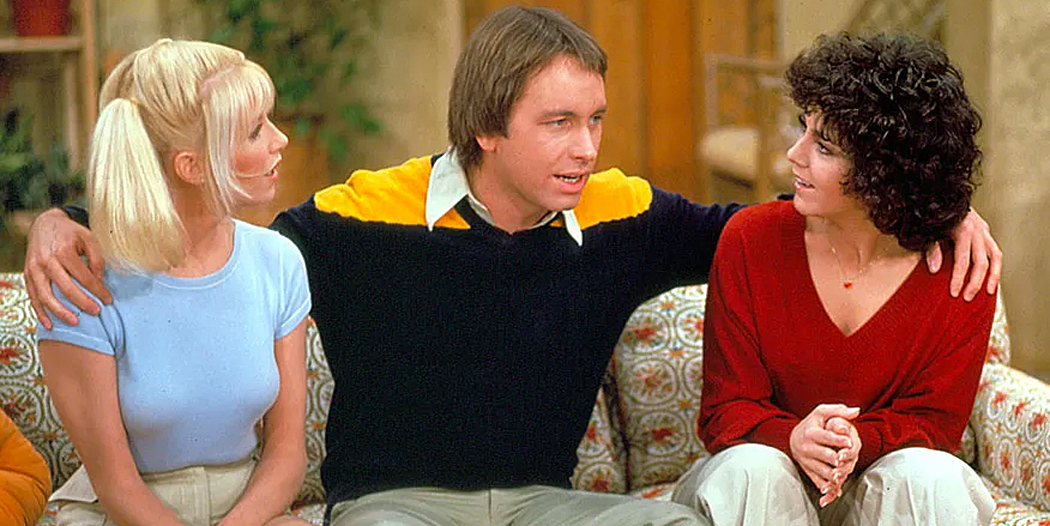
Three’s Company is the epitome of Class C, although my son, deeply knowledgeable in the ways of film and media, assures me it is a classic. He loves it. De gustibus

Then, there is the bottom feeding Class D, those shows so bad they have become legend. My Mother the Car is the type specimen for this class. A series only a studio executive high on cocaine and bourbon, and distracted by facing an expensive divorce and maybe a teenage son in jail  could have green-lighted. Quite a few of these were meant to be vehicles for aging film stars given their own sitcom series. The Doris Day Show, The Debbie Reynolds Show, The Tammy Grimes Show, Mickey (with Mickey Rooney), The Paul Lynde Show (in which he is an attorney and family man), Wendy and Me (with George Burns and Connie Stevens), Shirley’s World (Shirley MacLaine as a photojournalist), and The Bing Crosby Show. Most of these didn’t make it past the first season. 

Also at the dismal bottom: Hello Larry, New Monkees, She’s the Sheriff, The Trouble with Larry (“not just not funny, but actively depressing”), Cavemen, Homeboys in Outer Space, The Ropers. Most cancelled after one season. 

In England, Heil, Honey, I’m Home with Adolf and Eva never made it past the first episode. (currently unavailable on streaming or disk. Too soon?).  

Among the abject failures are most of the American remakes of popular British comedies. Many of them never made it past the pilot stage.

And so, you have four general classes of television sitcoms. The best worthy of saving for future generations, the worst best left for whatever is the digital version of the bottom of the canary cage. 

The past wasn’t so different. What we remember of classical Roman comedy are what is extant. Much isn’t. A good deal of it was probably just as banal as most bad TV. We don’t know: It didn’t survive. The Victorian novel was largely a serial enterprise, like seasons of a sitcom, weekly chapters published. But for each Dickens or Trollope, there were dozens, maybe hundreds of lesser works now mostly forgotten. In time, we will no doubt continue winnowing the TV past, saving the Norman Lears and perhaps the Chuck Lorres and ranking them as our Plautus and Terrence. Perhaps. 

The low arts can still be art.

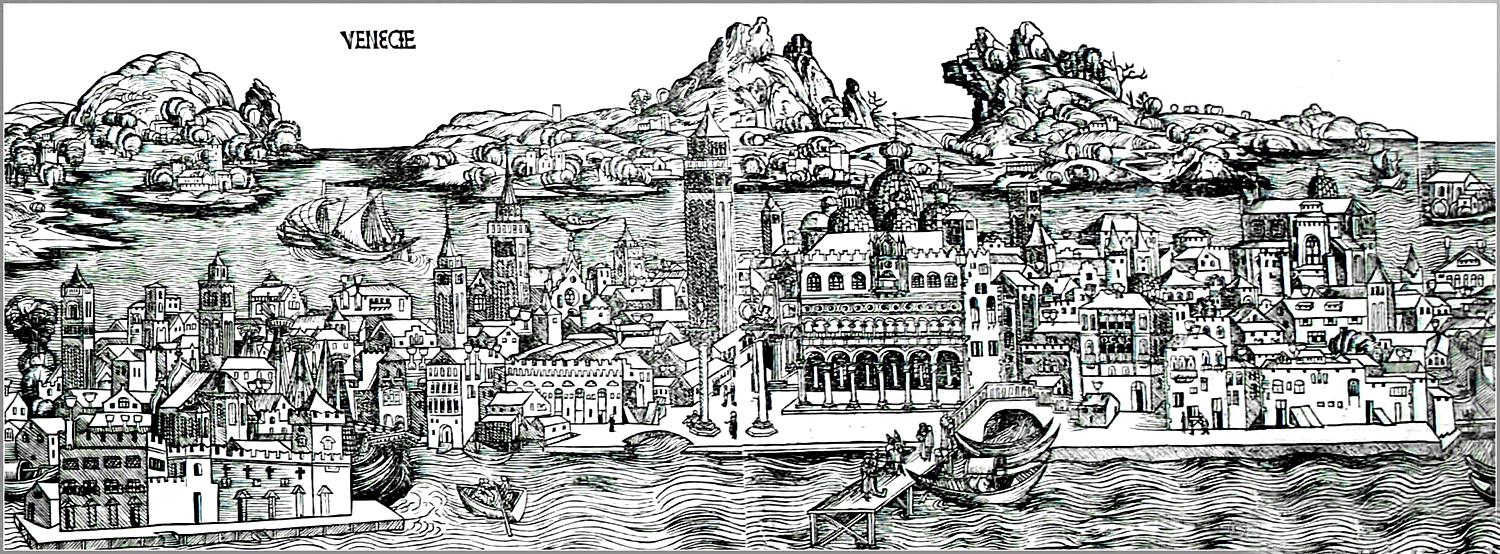
“Venice,” woodcut by Dürer

In 1494, at the age of 23, after years of apprenticeship as an artist in Nuremberg, Albrecht Dürer left Germany to visit Venice and Italy and find out what all the Hoohah was about. He was amazed at what he saw and  when he returned home to Germany, he brought the Italian Renaissance with him. He went back south for seconds in 1505 and stayed for over a year, soaking up the influences. It was what he had to do if he wanted to see what the Big Boys were doing. 

If you wanted to see, you had to travel. There were no full-color coffeetable art books to thumb through. If you wanted to see the work of Bellini, you had to go to Venice; for Raphael, to Rome. 

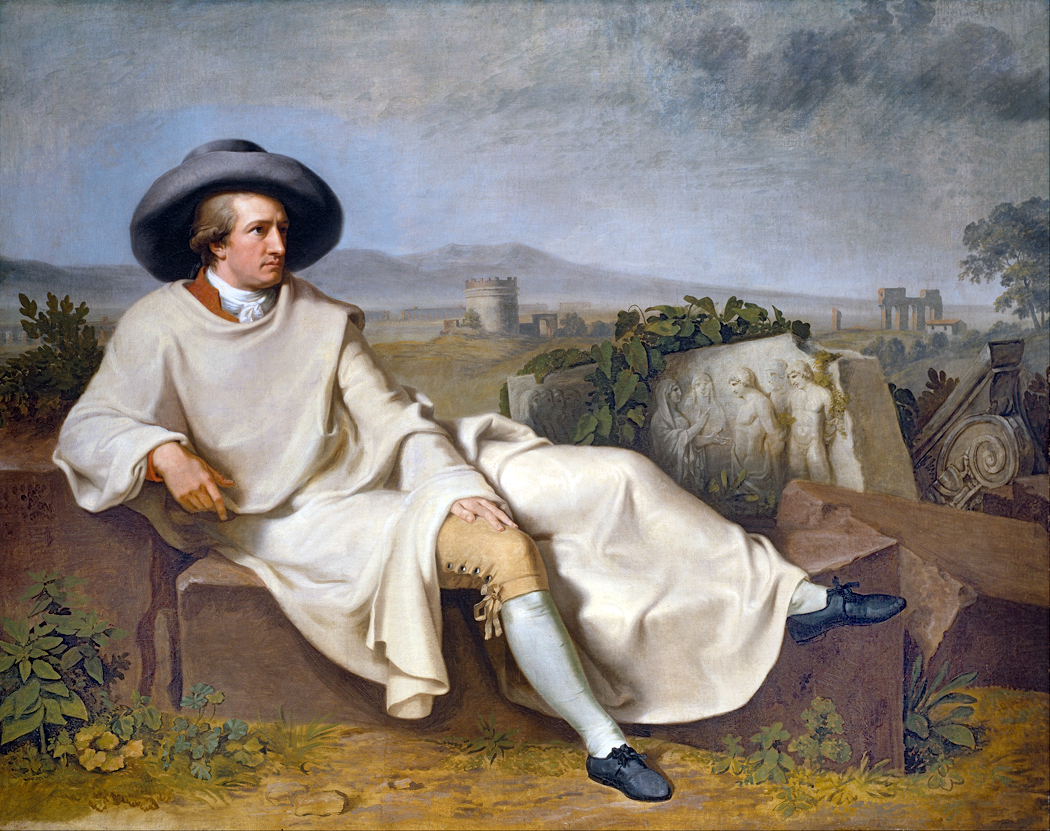
“Goethe in Italy” by Johann Heinrich Wilhelm Tischbein, 1786

In 1786, Johann Wolfgang von Goethe, then age 37, made the trip, this time to see the Roman and Greek sculpture that had been so highly praised in the work of Johann Joachim Winckelmann. He stayed until 1788, studying more than the statues, including many statuesque young women, which he later wrote about in his book of poetry, Roman Elegies

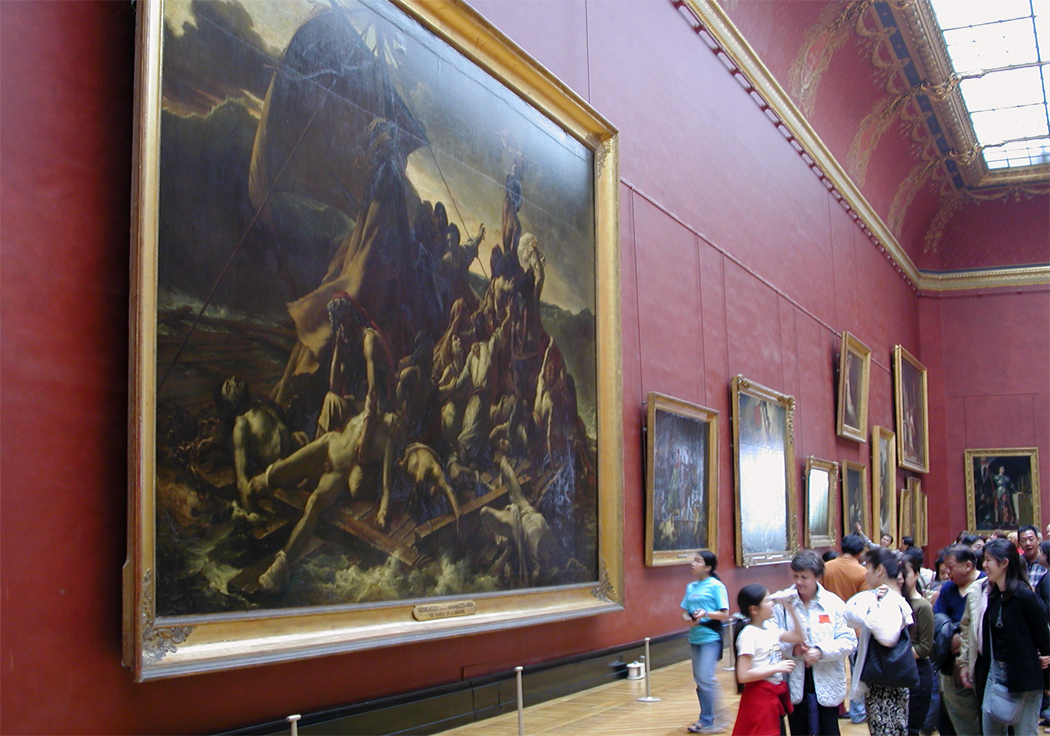
For most of history — until improvements in color printing in the middle of the 20th century — the only way to see famous art was to leave home and go there. Yes, there were engraved black and white copies published, and later monochrome halftones, but you could not really get a sense of Rembrandt or Titian without traveling. 

It gave rise in 17th century to the practice of upper-class families sending their sons on the “Grand Tour” to become educated and cultured. From the 1600s to about the middle of the 19th century, it was common for well-off young men to take a “gap year” — or two — to visit the Continent and see the sights and become men of the world before taking up their roles in government or business. Of course, many of these youths were more attracted to the live demoiselles and regazze than to the canvas madonnas. 

“Rose,” Philbert-Louis Debucourt 1788

It wasn’t just visual art. Before recordings, if you wanted to hear a Beethoven symphony, you had to attend a live concert. If you lived outside the city, you had to travel to get to the concert hall. Bach famously walked 280 miles from Arnstadt to Lübeck in order to hear Buxtehude play the organ. Even to hear now-famous symphonies and concertos you likely had to wait years between programmed performances. You might be lucky to have heard Beethoven’s Fifth once or twice in your life. Now, it seems, you can’t get away from it. 

Today, when you can own 30 different CDs of the Beethoven symphonies and have your choice from Furtwangler to Norrington; you can fill your bookshelves with illustrated volumes of any artist you want; and watch endless YouTube videos about the Mona Lisa, it is important to remember that they are not the actual experience of the art in question, but varyingly faithful simulacra. You still need the real thing. A three-inch color plate of Gericault’s Raft of the Medusa cannot replicate the experience of seeing the real thing.

And so, we go to museums and galleries to get to know the art that is our cultural inheritance. Even today people travel across the world to see some of the world’s most famous art. The Grand Tour still exists, if only in ghost form, as a gap year or a summer abroad. My granddaughter had her high school summer in Italy. The traditions continue. Such travel affords an education that books just cannot give. 

In the 1960s, I accompanied my grandmother when she went back to the Old Country for the first time since she was five years old. We went to the village where she was born, Mosby, in southern Norway, and as part of that trip, I was sent on a (literal) Cook’s tour of Western Europe, taking in Germany, the Netherlands, Belgium, Luxembourg and France. I saw the Cologne cathedral, Notre Dame de Paris, Ste. Chapelle and the Louvre, among other things. Mostly, it made suburban New Jersey seem even more banal. 

Met; Guggenheim; Frick; Whitney; Cloisters; MoMA

But then, I tried to escape the Garden State as much as possible. I was lucky: I had my own Grand Tour just a few miles away. During my own high school years, living on the Jersey side of the George Washington Bridge, I spent as much time as I could in Manhattan, going to concerts and visiting all the museums: The Met, the Guggenheim, the Frick, the Whitney, the Cloisters, the Asia Society, even the long-gone Huntington Hartford Gallery of Modern Art on Columbus Circle. 

And most of all — the Museum of Modern Art, where I felt most at home. I came to know many famous paintings as old friends. Van Gogh’s Starry Night; Matisse’s L’Atelier Rouge; Picasso’s Demoiselles d’Avignon; Pollock’s One Number 31; Mondrian’s Broadway Boogie-Woogie; Henri Rousseau’s Sleeping Gypsy; Dali’s Persistence of Memory — all proper blue-chip Modern Art landmarks. 

After I went away to college, I frequently made the trip to Washington, D.C., to visit the National Gallery of Art, and later, the Hirschhorn and Corcoran. I ate up art like a starving man. It’s hardly surprising that I later made my career as an art critic. 

And working for the newspaper, I was sent around the country for major exhibits in Boston, New York, Chicago, LA, San Francisco, Seattle, Philadelphia. I was even sent to South Africa in 1989 to study the art scene there. And vacations brought me and my wife to France many times. Seeing as much as possible and finding troves of art in even small corners of the Continent. 

There have been dozens of important artworks I have been grateful to have known, not just in reproduction, but live, in front of my own eyes. My inner life is infinitely enriched by the experiences. There are many I could name, from Rembrandt’s self portrait in DC to Gauguin’s Where Do We Come From? What Art We? Where Are We Going? from Boston, but I need to pick out at least these six as central to my understanding of art, and of life. 

When you know works from reproduction, you cannot feel their size, cannot know the precise colors and pigments used, cannot grasp their tactile surfaces. Some of the most famous art in the world is known to most people by their reproduction on coffee mugs, T-shirts or commemorative plates. What you think is art is really just iconography — the nameable subject matter. The actuality, the physicality of the work is irrelevant in such cases. Seeing the original can then be a revelation. 

So here are the six works that have meant the most to me, that I am most grateful for having been able to know personally.

Picasso, Guernica — When I was growing up, this, perhaps the greatest painting of the 20th century, was sitting in the Museum of Modern Art in Manhattan, and I visited it often. As a teenager, I knew it was “important,” because I had seen it in books and magazines. But I thought of it as “mine,” because I knew it would always be there for me. Alas, in 1981, it was repatriated to Spain, where, I have to admit, it belongs. An old friend moved away. It was the first important artwork that I had what felt like a personal relationship with. 

Jackson Pollock, Blue Poles — In reverse, Blue Poles is a painting that came to New York for me. Pollock’s 16-foot drip painting from 1952 was auctioned off from a private collection in 1973 and sent to Australia. I loved many of the great Pollocks from MoMA and the Met, but thought I had lost the chance forever to see perhaps his most famous work. But a retrospective Pollock exhibit in 1998 at MoMA brought it back temporarily to the Big Apple. I got to see it there, where it was the jewel-lit highlight of the last gallery. 

Grünewald, Isenheim Altarpiece —  The giant altarpiece comprises 10 paintings by Matthias Grünewald, including the pathos-laden crucifixion as its centerpiece, and a group of polychrome wood sculptures by Nikolaus Hagenauer, executed between 1512 and 1516. It sits in the Unterlinden Museum in Colmar, Alsace, France. The altarpiece was designed to be either closed or open, with various panels showing at different times in the Catholic calendar. I have no stake in the religious significance, I cannot help but be overwhelmed by the pathos and power of the work. 

Lascaux II — The cave paintings at Lascaux, France, date from about 20,000 years ago. They were discovered in 1963 and include about 600 images of prehistoric animals. The caves have been closed since 1963 to protect them, but a copy has been made and open to the public. I never thought I would get to experience them, but I got to visit both the reproduced experience at Lascaux II, but also the genuine cave art at nearby Font-de-Gaume. Seeing the original art there threw my spine into a buzz of uncanny deep-time — a state not rational but limbic. 

Van Gogh, Wheatfield with Crows — In 1999 the LA County Museum of Art mounted a 70-piece show of the paintings of Van Gogh from the Van Gogh Museum in Amsterdam, including many of his most famous works. My job got me sent to cover the exhibit and I was blown over by the works (also, astonished at how amateurish and awful many of his early works were: It took a while for Van Gogh to become Van Gogh). 

One of the last paintings in the last gallery was Wheatfield with Crows and up close you could see who wild and feverish the artist’s brushstrokes were, and what colors sat on his pallete, left largely unblended on the canvas. 

North Rose Window, Chartres Cathedral — I have been back to Chartres many times, and each visit, I spend a half hour, at least, sitting in the transept staring at the North Rose Window. It is, as I have said many times, the single most beautiful man-made creation I have ever seen. It is transcendent, a glowing object of meditation, whose shapes seem to move, to dance around the centerpoint. I am awe blasted. It almost makes up of all the misery, suffering and death human beings cause to each other. 

This is, of course, a limited selection. Before writing, I made a list of paintings, sculptures, plays, operas, architecture, poems, novels — I could just make a list of the types of art that would already be too long to include in a single blog entry. Narrowing down to visual arts still left me with too many things to write about — hence my squeezing it all into only six works. (It tried to make a conventional 5, but I already feel bad about only including six.) 

Seeing all this art and lamenting all that I never had a chance to see, only reinforced my sense that art is not just what makes us human, but how it makes us human. 

I was talking with my very Southern wife about how those brought up down here have a stronger connection to the land than us Yankees. Southerners have often lived on the same patch of land for generations and their sense of identity can course back through great-grandparents and beyond. Your sense of who you are includes the centuries before you were born. New Jersey never gave me that.

But I do have that same sense when looking at the paintings or hearing the music of the past. This all gave birth to me; it is who I am. We too often think of culture in terms of hoity-toity high culture. But really, culture is all the things that have accumulated over time to make the lives we now take for granted. 

When I see or hear the so-called canonical works of Western culture, I have that sense of belonging to a long, continuous line. It speaks to me; it tells me who I am. 

Artist Robert Ryman (1930-2019) made a career with his white paintings. Over and over, he applied white paint to canvas, paper, or board, always with some degree of change in application or tint or texture or shape. 

Two years before his death, he donated 21 of his pieces to the Dia Art Foundation in New York. Before its closing in 2014, the Hallen für Neue Kunst in Schaffhausen, Switzerland, had a collection of 29 Ryman white paintings. So, there have been a lot of them. 

Three Rymans, L-R: from 1959; 1962; 2012

His work has been accepted into many museum collections, but there has been a backlash. 

“Aspects of Ryman’s work definitely stink of seeing what he could get away with,” wrote one critic. Another said, “Ryman is the undisputed master of showing precisely which part of the wall you are supposed to stare at.”

Robert Ryman

There seems to be a widely held belief in the general public that a good portion of art being made these days is a sneaky attempt by artists to put something over on them. That art — at least that art being sold for millions at auction — is a scam. And that artists are hucksters laughing at us all meanwhile getting rich as Scrooge McDuck through our collective gullibility. 

“A literal blank canvas? That could symbolize the artist’s emptiness.” And, of course, “If my 5-year-old could do that with his eyes closed, it’s not worth a fortune.” 

I am not going to try to defend the rarified world of the art market, nor of any particular trendy piece of celebrity art. One should never, ever confuse the art market with the art. The art market is not a function of the the art world, but of the financial world, where people with too much money buy and trade what is currently valued by the market, as investment or even to launder questionable dollars. Very few artists have anything to do with this crawling underbelly of financial worminess. And even less is fluctuating market value a measure of esthetic worth. 

The art and the market are parallel universes, and let’s face it, the overwhelming majority of working artists don’t become rich, and in fact, often have to work other jobs to pay for their need to make art, since their artwork cannot support them. A few solid and successful working artists make a living, but seldom making over a decent middle-class income. In other words, they are working stiffs. 

When they were young, probably at a university art program, they get caught up in various trendy ideas about art and get lost diving down this or that rabbit hole, thinking all the while that they are in the process of transforming the history of art. If they have any real talent, they outgrow these fantasies when out in the world attempting to make a living as commercial artists, product designers, advertising artists, or even fine artists, struggling to make ends meet. They are an indulgence of youth. 

But is will say that, as a working art critic for most of my adult life, who has known many artists and been friends with them, I have never ever come across one who thought he or she was pulling the wool over the public’s eyes. To a person, they were sincere, sometimes heartbreakingly so. 

I don’t mean to defend a lot of the goofy art that ventures out into the world. A lot of it is bad or at least mediocre. And a great deal of it is derivative: imitations of what earlier artists have done.

Artists can develop cockamamie ideas, have brainstorms of breathtaking stupidity, or at least monumental unoriginality or brilliant vapidity. But they are not trying to scam the public. They actually take these things seriously. 

I remember seeing a production where a local Arizona artist wore a coat made from pork chops. (And she assured us the meat was past its sell-by date, and would have been thrown out, so she was not wasting food). 

Another hung a 3-foot cube of ice from the ceiling by a wire and watched for two days as the weight of the melting ice pulled it through the cutting wire till it dropped to the floor. 

And if I never see another painting of nude lesbian vampires flying out of erupting volcanoes, it will be too soon. Who knew that was a trope? 

Every one of these artists was dead serious about their ideas. (And not one got rich from the work.) But please remember that over the whole course of human existence, most things that were done were either made badly or aspired to a level of mediocrity. The work in the art history books is skimmed from the top surface of what boils up from the bottom. 

Getting back to Ryman, he was not the first to make a white painting. In 1918, Russian Suprematist Kazimir Malevitch made White on White, with a tilted white square on a larger, whiter square. (A few years earlier, he had made a completely black painting, called Black.)

L-R: Malevich; Rauschenberg; Manzoni

In 1951, Robert Rauschenberg made a series of white paintings, using a paint roller to apply flat white wall paint to panels of canvas and joining several panels together to form larger works. For Rauschenberg, the idea was that the blank canvases would change appearance depending on the light hitting them, the shadows in the room, the number of people in front of them, and so they were meant to be visually active — at least to those who were willing to pay attention to them and the take them seriously. 

Another avant-garde artist, Piero Manzoni, offered up a canvas plastered over in kaolin clay — the white clay of porcelain — in another series of “Achrome” or “colorless” works of art, made from white wool, rabbit skin or phosphorescent paint. 

(Manzoni is probably most famous for allegedly canning his own feces (Merda d’artista, it said on the cans). In 2015, one can sold at Christie’s for the equivalent of about $240,000. As for artists getting rich off fraudulent art, Manzoni originally sold the cans for $37 each. It was the auction house that got rich, along with the owner who offered it up. All of which rather made the artist’s original point: He made the shitcans as an intended critique of consumerism and the waste it creates). 
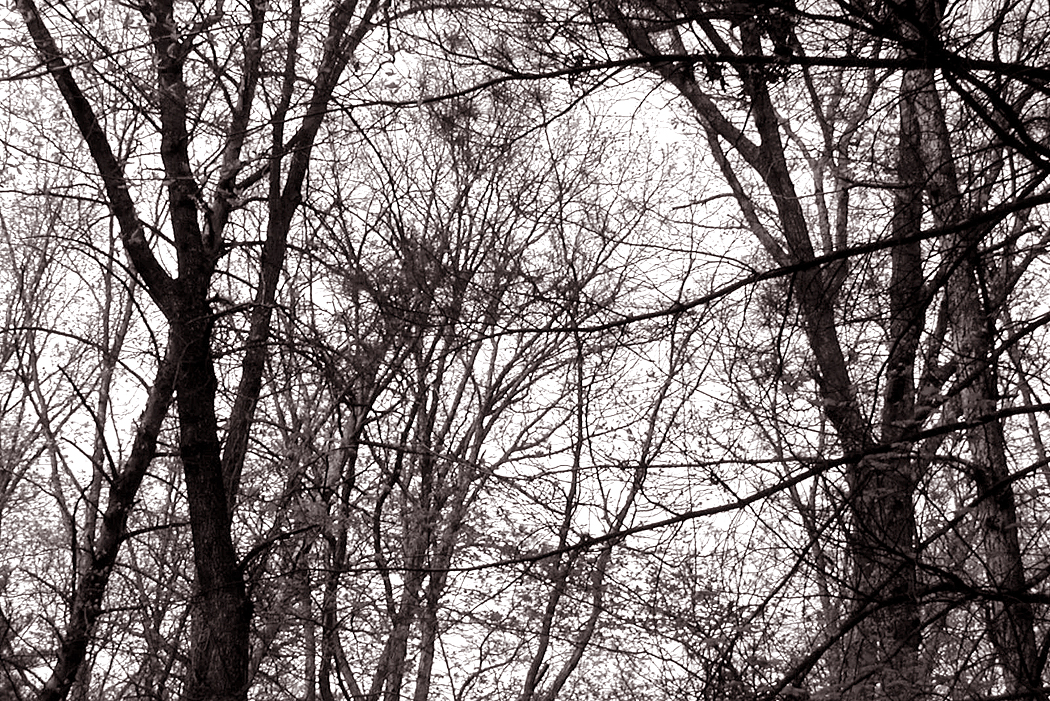
And in many cases I have come across, the artist’s idea is genuinely worth exploring, even if the non-artist public may scratch their heads. Artists see the world differently from civilians. They worry about things that never occur to normal people. 

Like: If a piece of white paper sits with a shadow over a corner of it, is the whole page white? What is white? What do we mean by white? 

How may whites are there? Paint companies offer dozens of paint cans, each labeled in some form as white, and each different. Whites come in cool and warm varieties, as ivory, as snow, as off-white. 

White is not a single thing. If we take a piece of white paper and shine a high-power halogen lamp at it, it gets whiter. So, would a stronger light make it even whiter than that? Like temperature, whiteness is more a judgment than an actual quality. 

And so, Ryman seems to have wanted to investigate how white survives in various textures, matte or glossy surface, in contrast with other whites, compared with neighboring colors. All those different white paintings were not just repeats of the same blank canvas. 

It may not be that Ryman’s art is world shaking. I’m not sure he himself thought of them as the last word in the evolution of art history. But he was quite serious about seeing what he could find out about the universe of white. 

Adrian Searle of The Guardian newspaper explained in his obituary of the artist, “Ryman worked with white, and the different kinds of whiteness different paints and pigments produced throughout his career. Lead, zinc, barium and titanium, chalky whites and hard industrial whites, silky whites and bone whites, kitchen whites and shroud whites, numinous whites and dead whites. Whites that seem to spread outward and emit light as we look and whites to fall into. The variety of their opacity, depth, brilliance and dullness all interested him. We apprehend them all differently, and differently again depending on the materials they are painted over and how they are applied, what their binders are and how much they are diluted all make a difference.”

Art, of course, isn’t a single thing. If you think painting is about making pictures of things, then white paintings don’t count. If you think they about expressing emotion, you may look in vain to find much of it in bland white; if you think art is primarily about beauty, you must acknowledge it in the eye of the beholder — remember that scene in the film American Beauty, when Ricky Fitts plays his camcorder video of a plastic bag blown about in the wind and says it is “the most beautiful thing” he has ever seen. When our attention is focused on the bag, we can suddenly see its beauty. It is the direction of focus that awakens our awareness. 

Many artists attempt to show us what we habitually ignore, to make us pay attention. Awareness — the sense of seeing the importance of the things of this world — is one of the goals of a certain branch of art. And attention must be paid, even to white. 

One of the most famous examples, that has been a whipping boy for the crowd that thinks art is frivolous, is the piece of music titled 4’33” by John Cage. For its performance, a pianist sits at his piano for the four-and-a-half minutes of the piece and does nothing. The aural equivalent of a blank canvas. 

For those without ears to hear, it is a lousy joke, or a scam pulled by the composer. But Cage’s point was that what filled the concert hall was never silence, but a cacophony of random sounds — programs rustling; people coughing; the air conditioning cycling; perhaps a police siren on the streets outside the hall; and even the sound of the blood pumping through the audiences’ ears. There was something to be paid attention to. 

I had scoffed at the idea of this music for years, until I heard it performed live and its meaning hit me like a ton of bricks. 

Admittedly, it is not a revelation that one can repeat. Once you get the message, you have it and don’t need to be jerked awake a second or third time — which makes the many imitations of Cage’s piece, such as the Two Minutes Silence track on the John Lennon-Yoko Ono album, Unfinished Music No. 2: Life With the Lions rather a pretentious knock-off rather than a meaningful experiment. 

It is easy to misunderstand art when it doesn’t play by the normal rules, or tries to get the viewing or listening public to experience the world in a new way, or understand an otherwise wordless idea. 

Perhaps the most famous (somewhat) recent example of this was the anger and outrage expressed in the late 1980s when Congressional Republicans attempted to defund the National Endowment for the Arts over the photograph called Piss Christ by Andres Serrano. The artist received death threats, the work was frequently vandalized when exhibited. 

It was described as a photograph of a crucifix in a jar of urine, but there was no jar to be seen: All it was was a crucifix in a glowing golden light and a few bubbles. It was quite beautiful, if you could forget the title. 

But what few of its critics recognized was that Serrano was a pious, believing Roman Catholic Christian who was looking at his faith in a way perhaps only an artist would, to emphasize the corporality of the incarnation: God becoming flesh. 
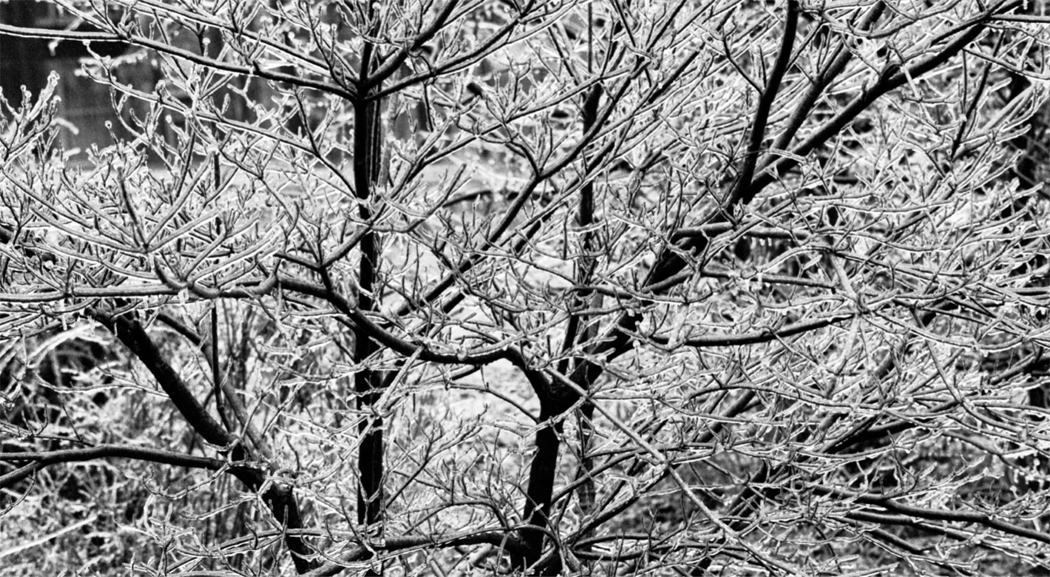
I say, “only an artist would,” but I could also say, “an artist or a child,” for I remember when I was a boy, various Catholic friends of mine, in the sixth grade, wondered whether Jesus ever had to defecate or urinate. Did the Christ sweat? Could he produce semen? These were questions that naturally occurred to boys just on the verge of discovering their own bodies. 
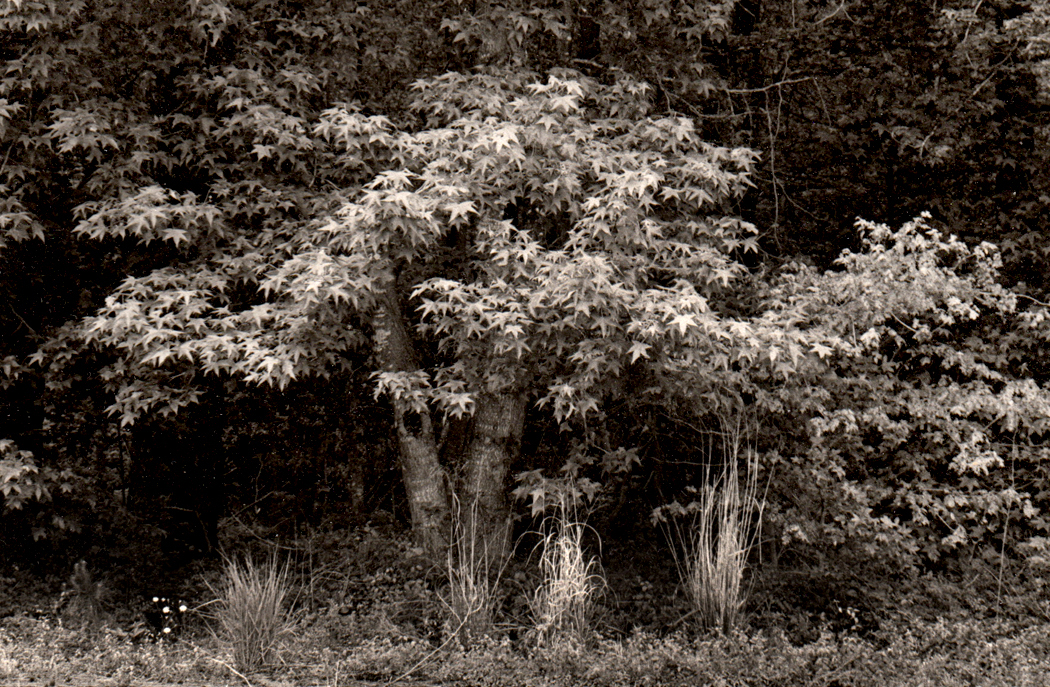
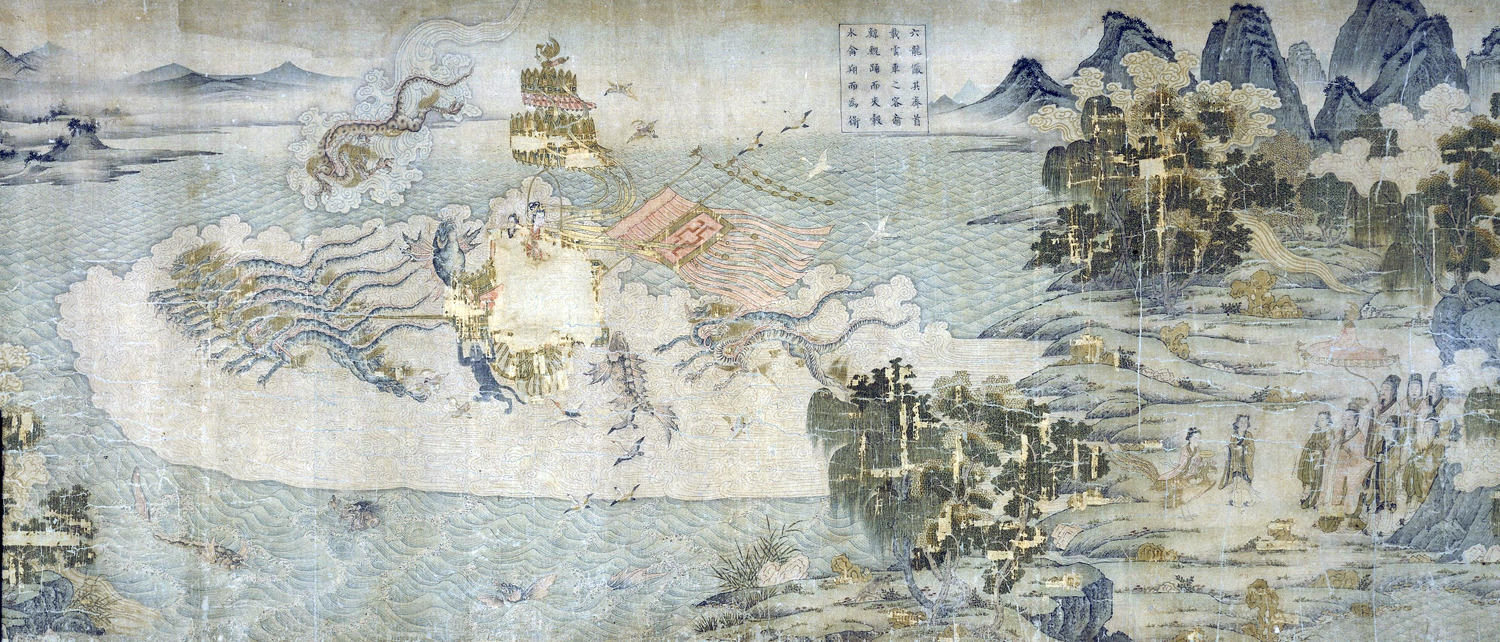
Serrano’s art often used bodily fluids, like milk or semen or urine, as reminders of the humanness of the god-become-man. I met with Serrano when I was an art critic in Phoenix, and there was no mistaking his sincerity. “Maybe if Piss Christ upsets people, it’s because it gives some sense of what the crucifixion actually was like, he said. “I was born and raised a Catholic and I’ve been a Christian all my life. The piece  was intended as a serious work of Christian art.”

If there was no doubting his sincerity, we may still question his naïveté over whether the public would easily understand. Most people have a rather lumpen and literal way of understanding figurative or symbolic imagery. A picture of a house should be a house, dammit. But artists, on the whole, are more interested in the things undefined. That could be color, line, shape, scale; it could be symbolism; it could be what the viewer brings to the experience. 

Ultimately, you will get the most from the art if you forget what you know and attempt to see what is actually happening before you. As Robert Irwin famously said, “Seeing is forgetting the name of the thing you are looking at.”

One final note: An awful lot of current art is awful, puerile, badly crafted, poorly thought out, and just plain ugly. Of course, it was the same a hundred years ago. I am not defending it as good or important art. And everyone has their own taste; you are free to like or hate any art you want. I am not making an argument that any of this art is genius that will last through the ages. Please, like what you like. 

But understand that the artist is very, very rarely just trying to trick you. They tend to be a very serious and thoughtful lot. They are artists because the see things and think things normal people don’t. And if you in turn take seriously what they have made, you may discover something that will enrich your life. 

Click on any image to enlarge