Archive

Tag Archives: audubon

Nature is messy. I mean that in a good way. But it is all over the place, hugger-mugger, one thing on top of another and with the edges of one thing blending into that of the next. 

And humans have tried their best to regularize and organize all that mess since the beginning of time, naming plants and animals, setting up categories, deciding which bits might be edible, which poisonous, which to take when you have aches or fevers. 
One of the primary means of accomplishing this is visual. Certainly the main method is verbal: the naming and sorting. But a mere word description of a plant can be so convoluted as to be confusing on its own. Take this description of the black oak, from E. Lawrence Palmer’s Fieldbook of Natural History:

Quercus velutina: Tree to height of 125 ft; trunk diameter, 4.5 feet. Upper branches ascending, lower, horizontal. Bark dark, deep-fissured between thick ridges that are cross-fissured. Inner bark yellow, bitter. Twigs stout, angular with sharp-tipped angled buds with dirty-white to yellow fuzz. Leaves to 6 in. long and 4 in. wide, highly variable, thick.  Flowers staminate, in hairy catkins, to 6 in. long. Pistillate, on short, hairy stalks. Fruit and acorn maturing in second season.” Etc. And even that is written in simplified language for the lay person. The scientific literature is close to unreadable. And would this help you find a black oak in the woods? 

Wouldn’t it be easier, quicker, better, just to have a picture? Roger Tory Peterson thought so when he came up with the idea for his now-ubiquitous field guides. “There are at least 60 ways to say that a plant is not smooth, that it has fuzz, hair, prickles or roughness of some sorts,” he wrote in the introduction to his Field Guide to Wildflowers. And he lists them, including such arcane words as bullate, canescent, coriacious, echinate, flocculent, glanduliferous, hispidulous, lepidote, verrucose, and villosulous. It takes a lexicographer rather than a botanist to navigate such things. 
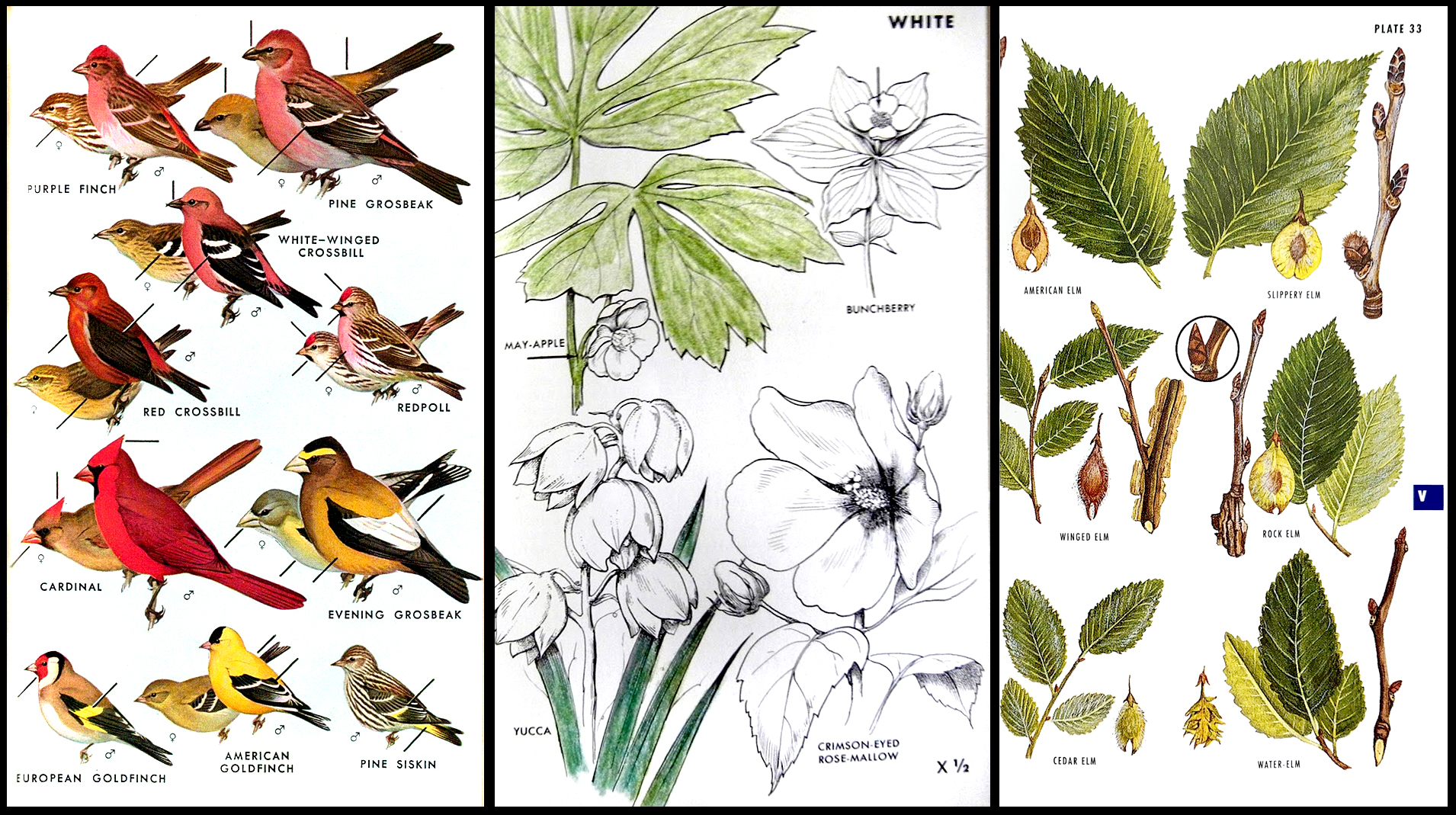
“That is why the best of keys often fail. … But, I am afraid, most of us belong to the picture-matching school.” Peterson began in 1934 with his A Field Guide to the Birds of Eastern and Central North America, which he updated with new editions — and new illustrations — until his death in 1996. The book has been immensely popular and remains so. Peterson branched out with a series of such field guides, covering wildflowers, trees, seashells, insects, fish, mammals — now more than 50 such guides, most written by specialists, while Peterson remained general editor until his death in 1996. 

Each book relies on drawings of the animals or plants in question. 
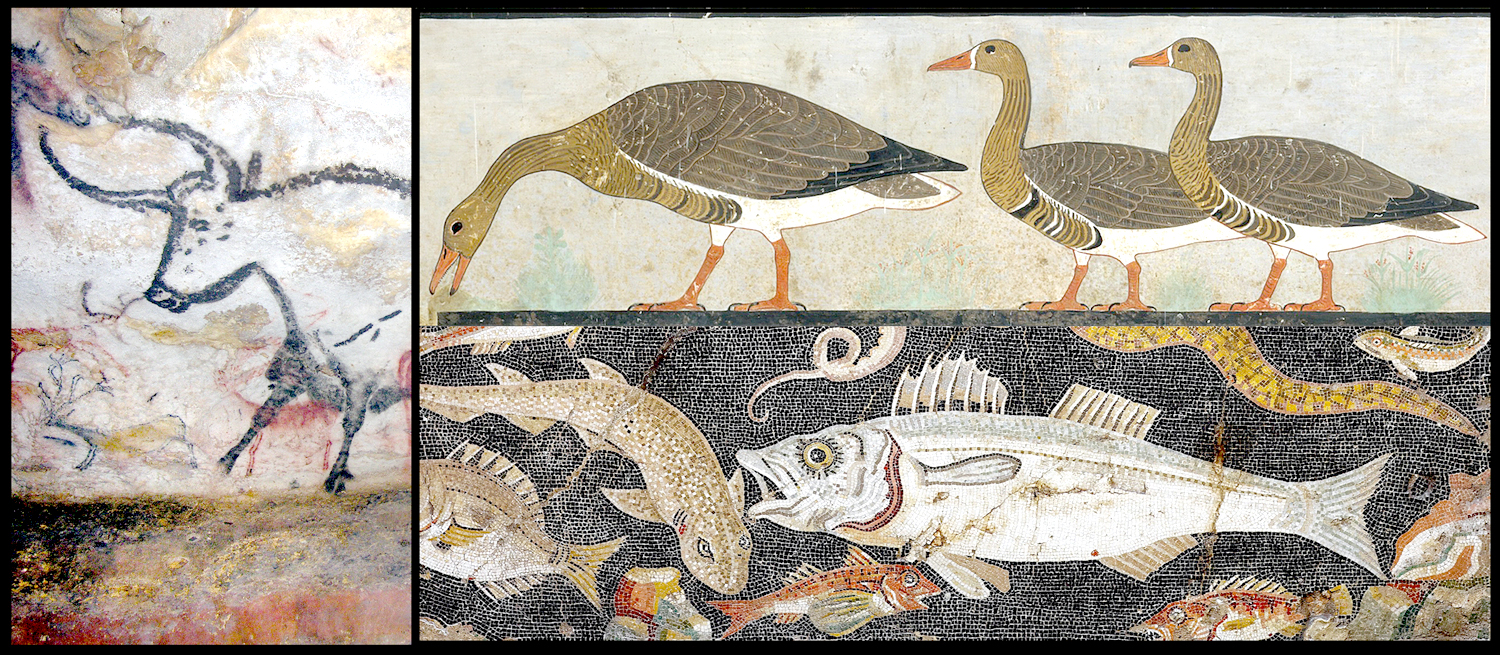
Of course, humans have been making pictures of the natural world since the beginning. The animals drawn the the caves of Lascaux date back something like 30,000 years. Egyptians painted notably realistic animals, such as the famous geese from the Chapel of Itet at Meidum from about 2590 B.C. Romans were fond of animal mosaic floors in the villas, and some are so accurate you can identify species. 

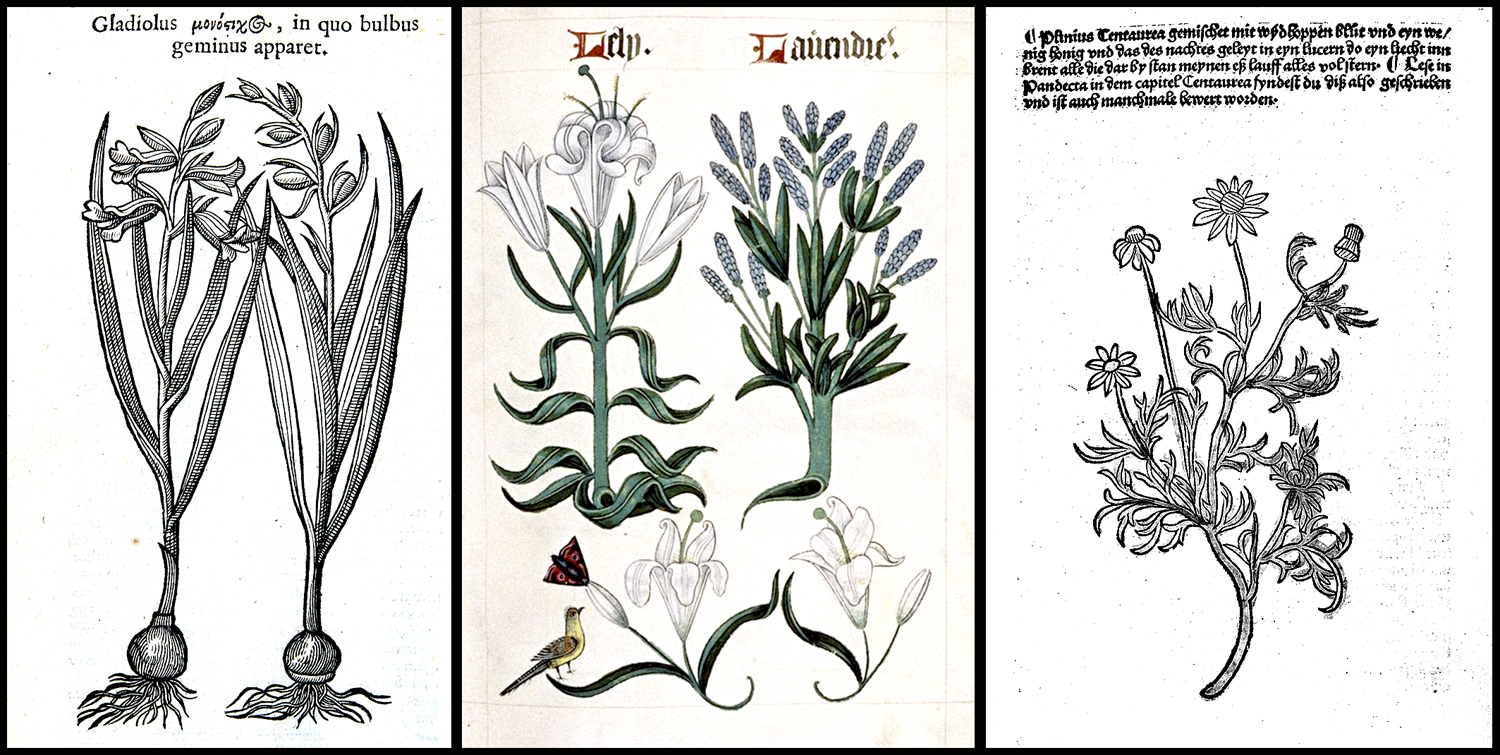
But the use of drawings for identifying plants or animals reached a new level of importance in the Middle Ages, when plants were used medicinally and books of drawings helped physicians identify the proper plant for the proper malady. 
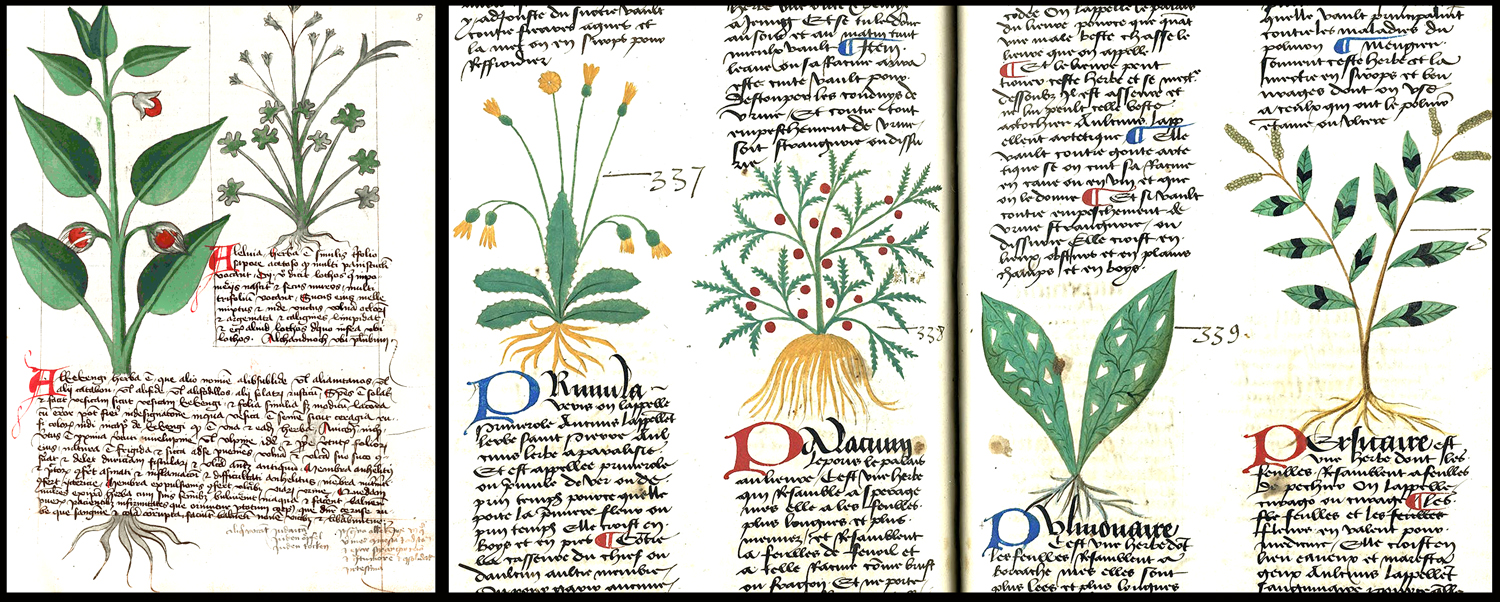
Originally, these were manuscript books. But after Gutenberg, many were printed in quantity, offering advice on the best plants for the worst illnesses.  

Often these herbals or “medicinals” were at best diagrammatic. There purpose was simply to sort out which plants would be useful. But as the Renaissance flowered, and a more realistic style of image-making took over, many artists were attracted to the natural world, looking with ever sharper detail at the plants and animals around them. There are drawings and paintings by Leonardo, Raphael and others. But it would be hard to best the small naturalistic pictures by German artist Albrecht Dürer. 

But Dürer’s paintings are one-offs. As the 17th century progressed, a more systematic approach took hold, wherein artists as botanists attempted to catalog the plant life around them. 

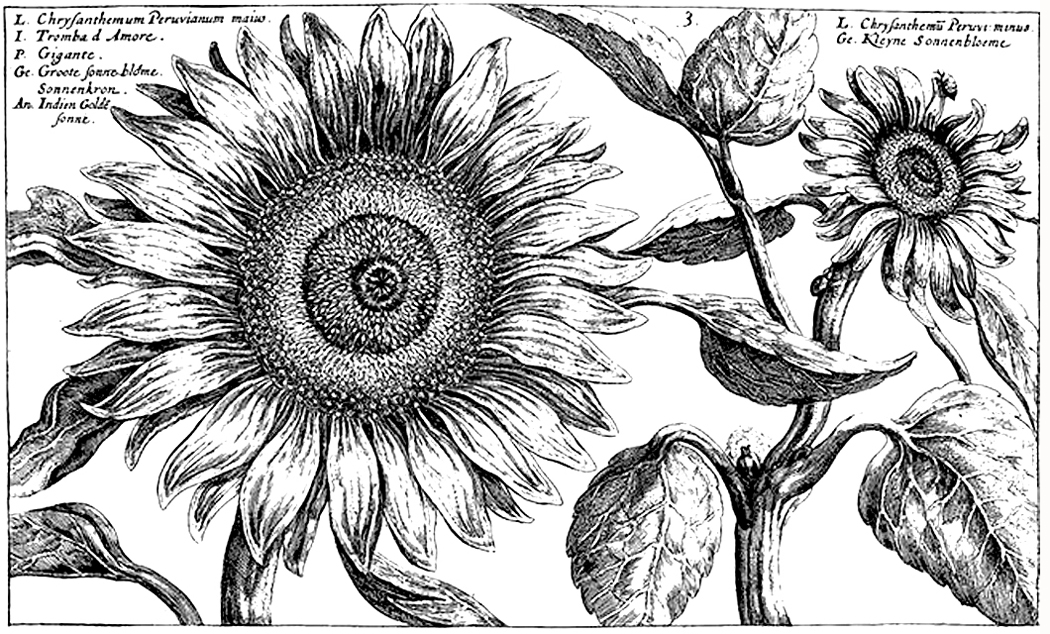
One of the first such attempts was the Hortus Eystettensis, edited by Basilius Besler (1561-1629) beginning in 1613 and spread over several years. It was a collection of copper-plate engravings of the plants collected by the prince-bishop of Eichstätt in Bavaria for his palace garden, which contained examples of all the shrubs and flowering plants known at the time, from around the world. 
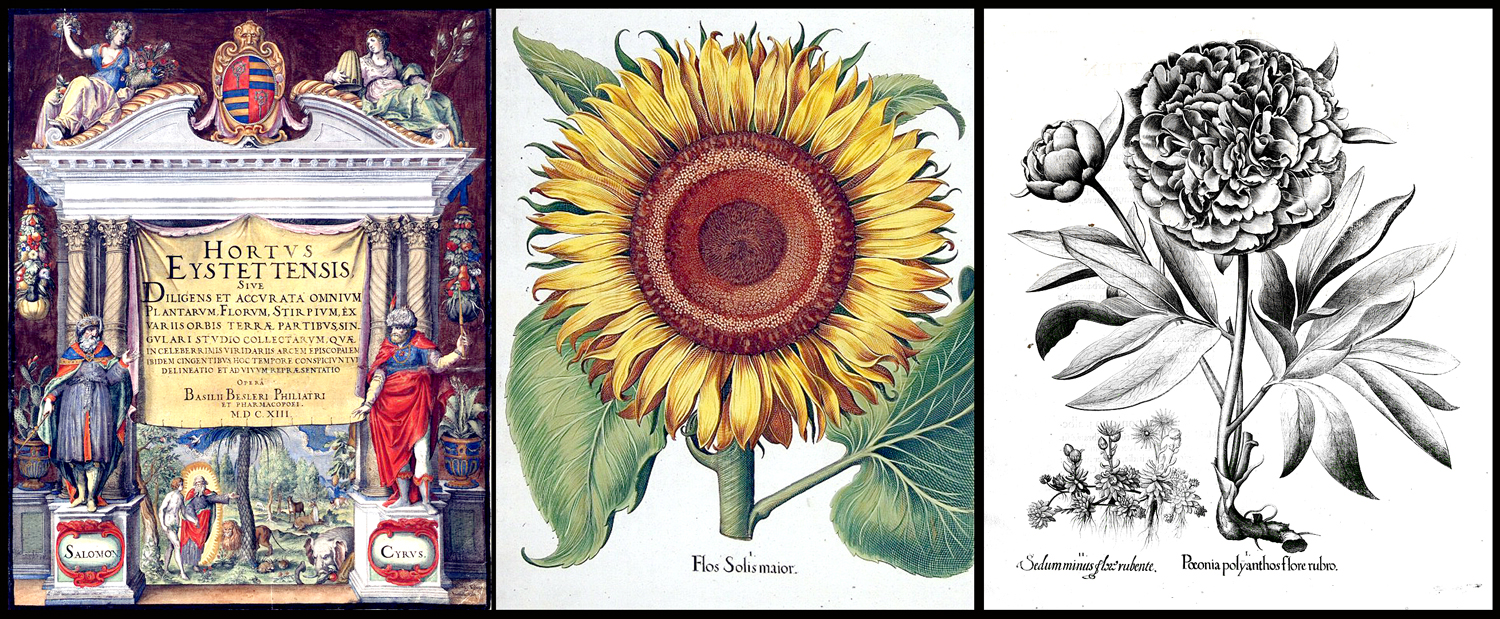
The book contained images of 1,084 species, divided into 357 plates. A cheaper black and white version was supplemented by a luxury edition in which the images where hand-colored. The book changed botanical illustration overnight. What had been crude and diagrammatic became works of art. 
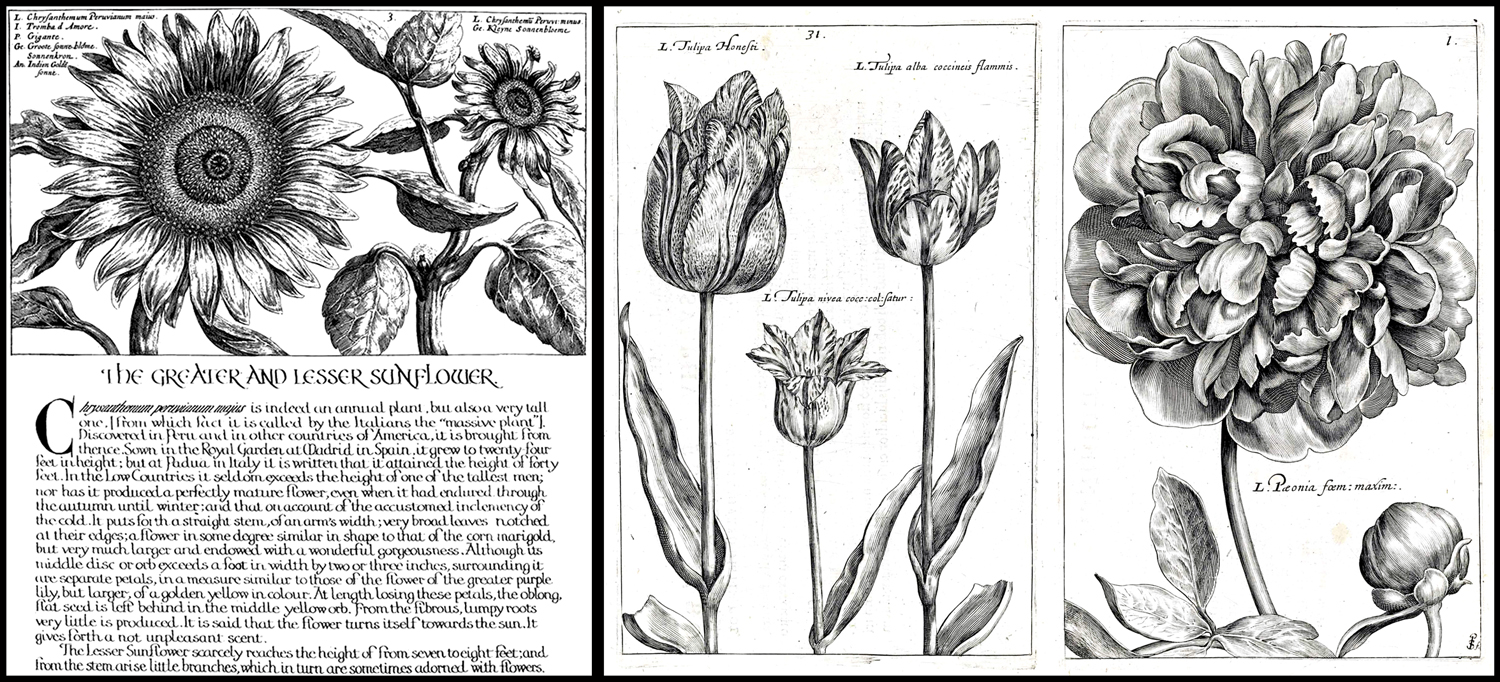
Soon in its heals came Hortus Floridus, a collection of 160 engravings of flowering plants published in 1616, which became so popular its Latin text was soon translated into Dutch, French, and English editions. The book, in modern editions is still available today. It was created by Dutch engraver Crispijn van de Passe the Younger (1595-1670), a popular and prolific engraver of the Dutch Golden Age. 

Such books of engravings, colored or not, appeared throughout the century, with Louis XIV’s official painter, Nicolas Robert (1614-1685), producing illustrations in 1640, 1660, and entries in the giant compendium  Recueil des Plantes published in 1676. 

His drawings and paintings, as well as the engravings made, were of a new freshness and delicacy and presaged a surge in flower pictures made not simply for identification purposes, but as esthetic objects — as art. 

As the 18th century began, these two strains of botanical illustration developed. On one hand, there was a rise in scientific exploration, with botanists traveling the world collecting new species of plant and animal previously unknown to European science. On the other, there was a growing market for books and images of pretty flowers. The two traditions flourished side by side, but also cross-pollenated. 

That market for flower pictures was given a jump start by the Dutch tulip craze of the 1630s, when speculation in the market for rare tulips created a financial bubble that burst in 1637. But the Dutch economy was expansive and a growing middle class had money to spend on luxury items such as art. The actual tulip mania was confined to a small but important few speculators, the public at large wanted their part and so prompted the production of pictures of the fanciest tulips. If you couldn’t afford a tulip bulb that cost as much as a house, you could afford a colored engraving of the same flower. And so, pictures of flowers became a thing.

There had always been still-life paintings: pictures of flowers in vases; even kitchen scenes with food on the table and game hanging above. But what I am interested in here are those images of singular plants, birds, or animals, usually devoid of background context, meant to show off the specimen to best advantage. Where still life is meant to elicit warm feelings of comfort and beauty, the botanical illustration is meant to focus attention on a particular item, to see it for itself alone. 

The 17th and 18th centuries were the great era of cataloguing the world, and it led to a plethora of illustration of new and exotic species as scientists accompanied military explorers around the globe, gathering natural history data and both collecting specimens and illustrating them, usually in books. 
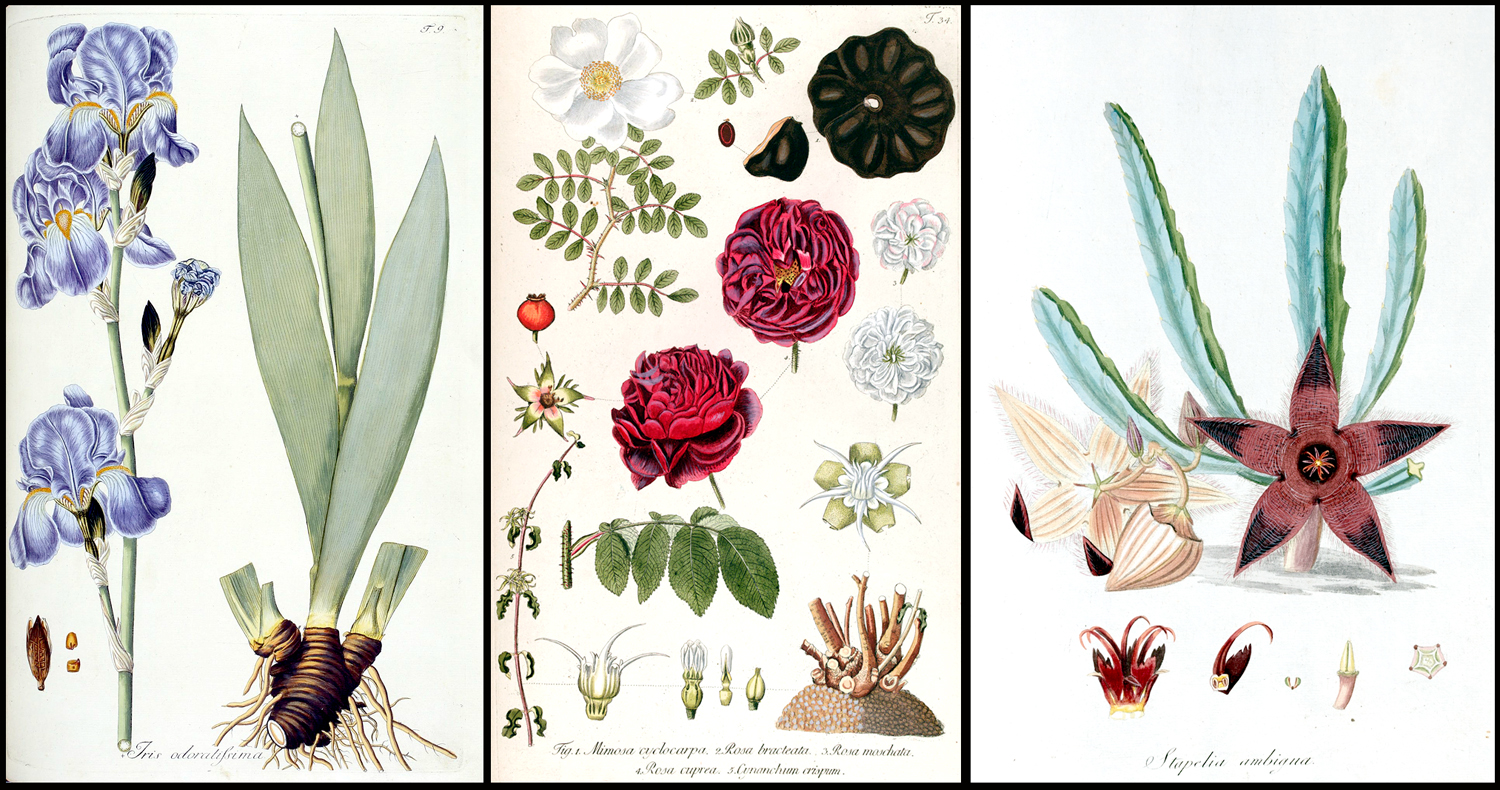
Dutch-born Nikolaus Joseph von Jacquin (1727-1817), for instance, travelled to the West Indies, Central and South America, publishing prolifically throughout the 18th century. 
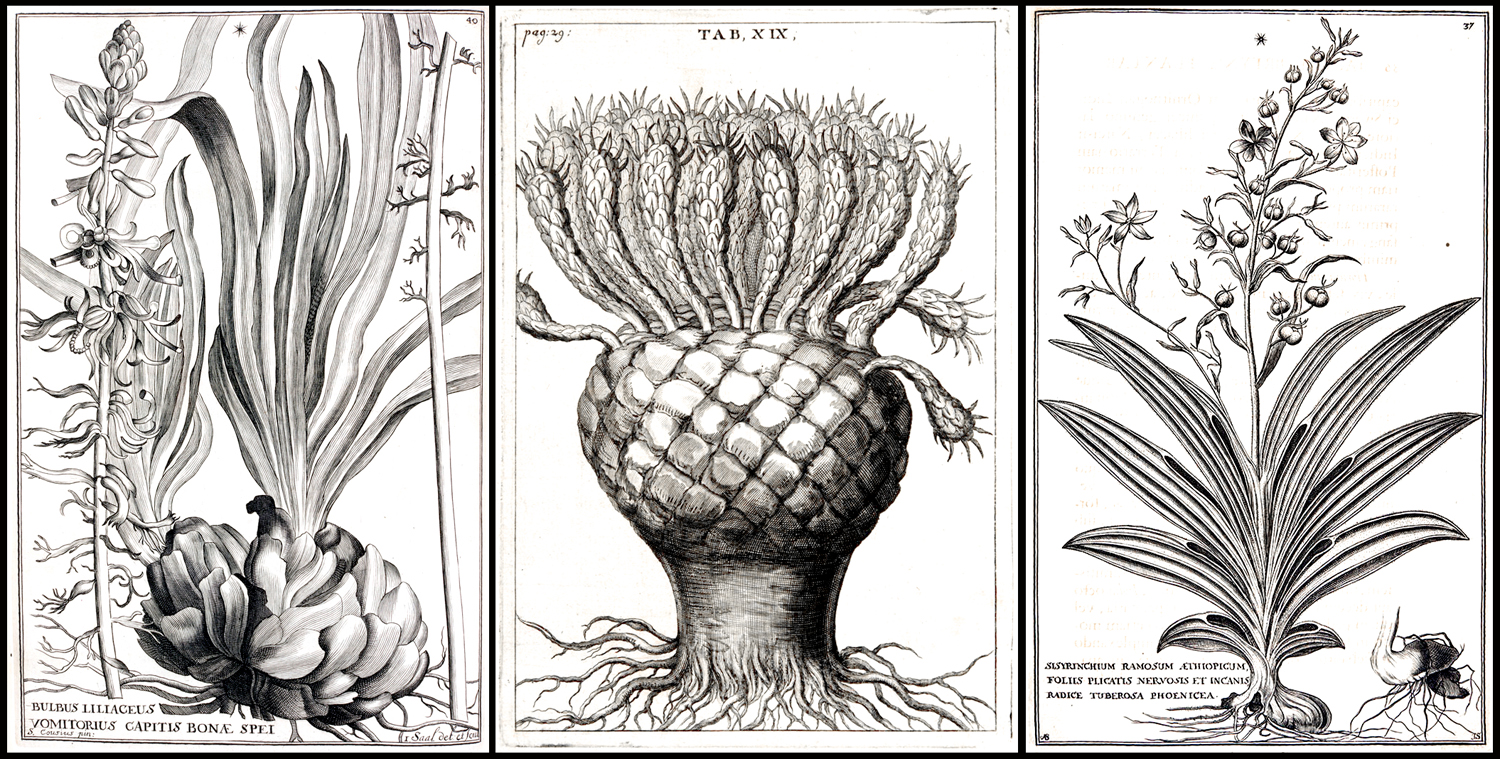
Sometimes, they went on their own, like the Polish Jacob Breyne (1637-1697), who travelled to South Africa and catalogued plants. 
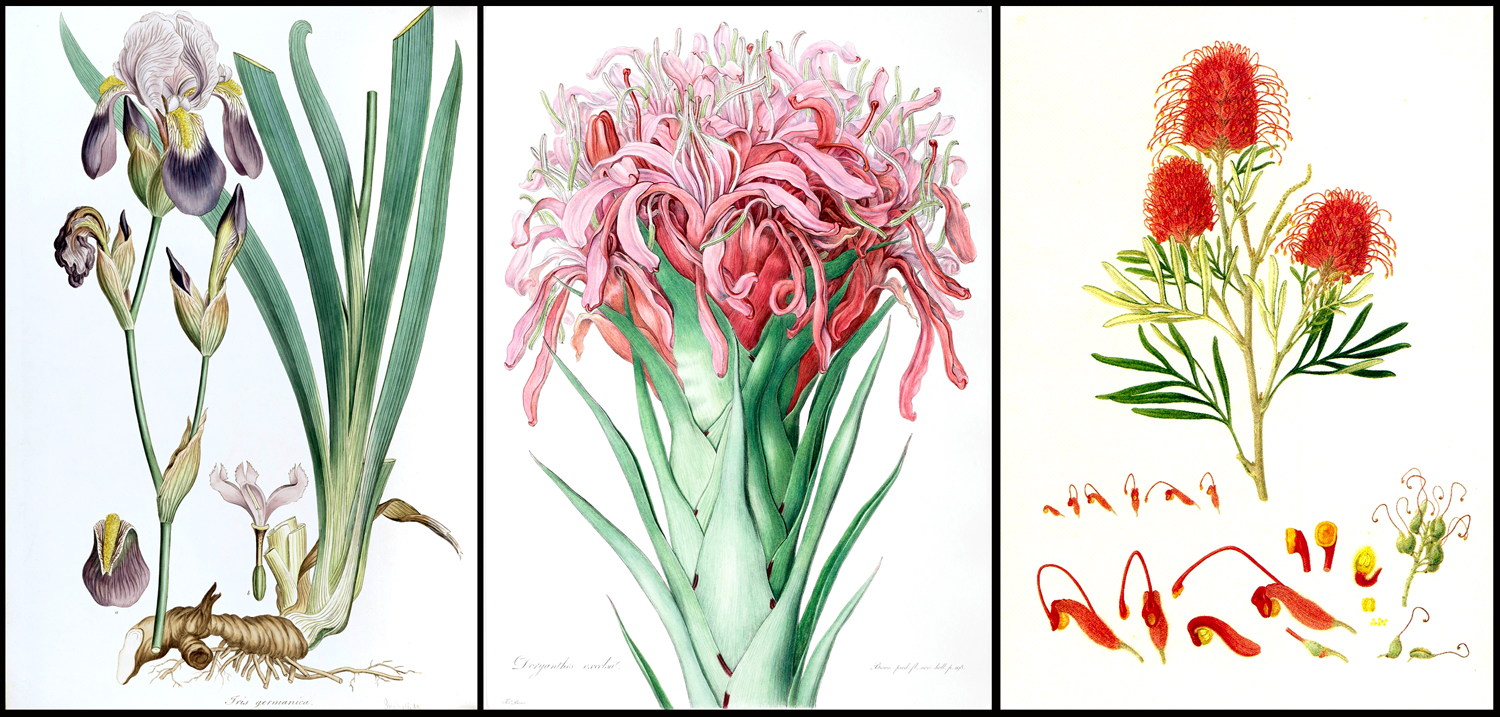
Austrian Franz Bauer (1760-1826) went to Australia, collecting and painting what he found.
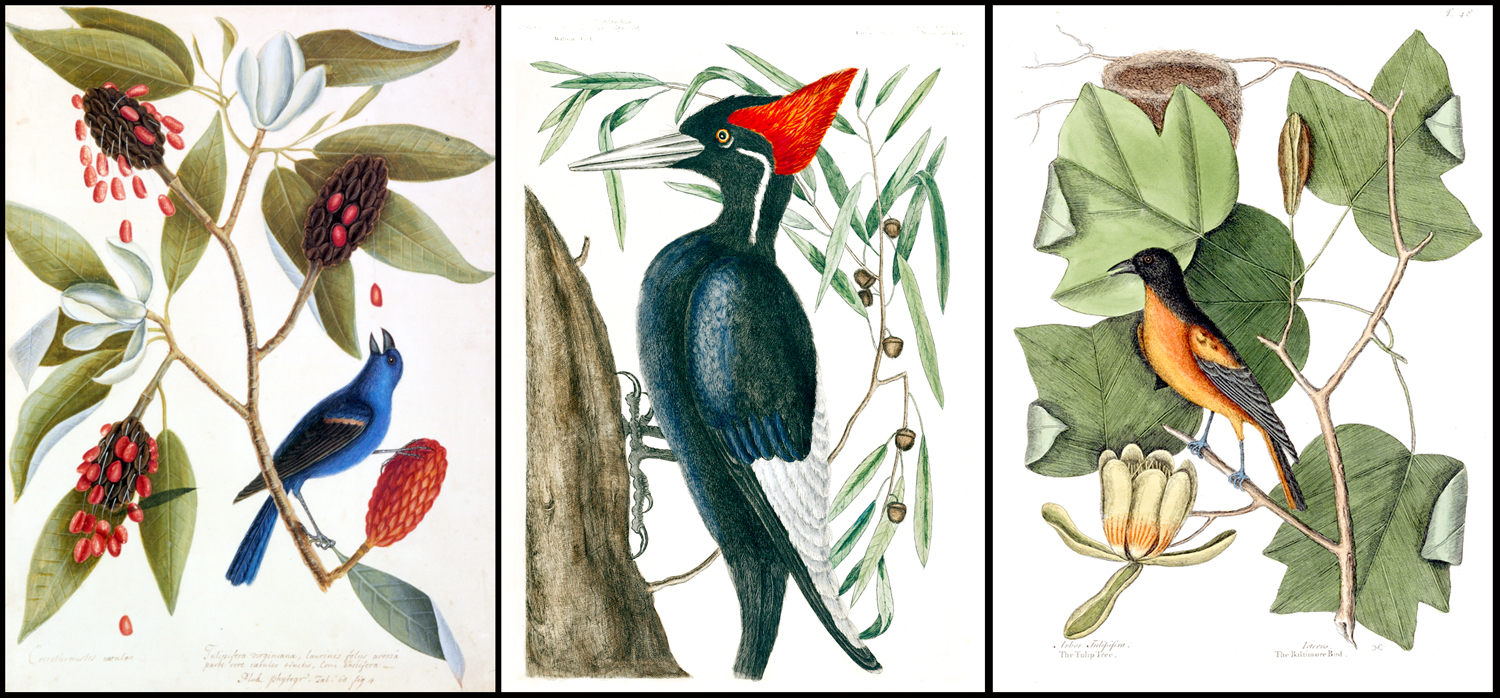
Englishman Mark Catesby (1683-1749) sailed to the New World, publishing his Natural History of Carolina, Florida and the Bahama Islands in volumes between 1729 and 1747.

Henri-Lois Duhamel de Monceau (1700-1782) was a French  Encyclopedist, writing on many subjects, but catalogued the flora of his native France over his long lifetime, including his 1768 Treatise on Trees and Shrubs

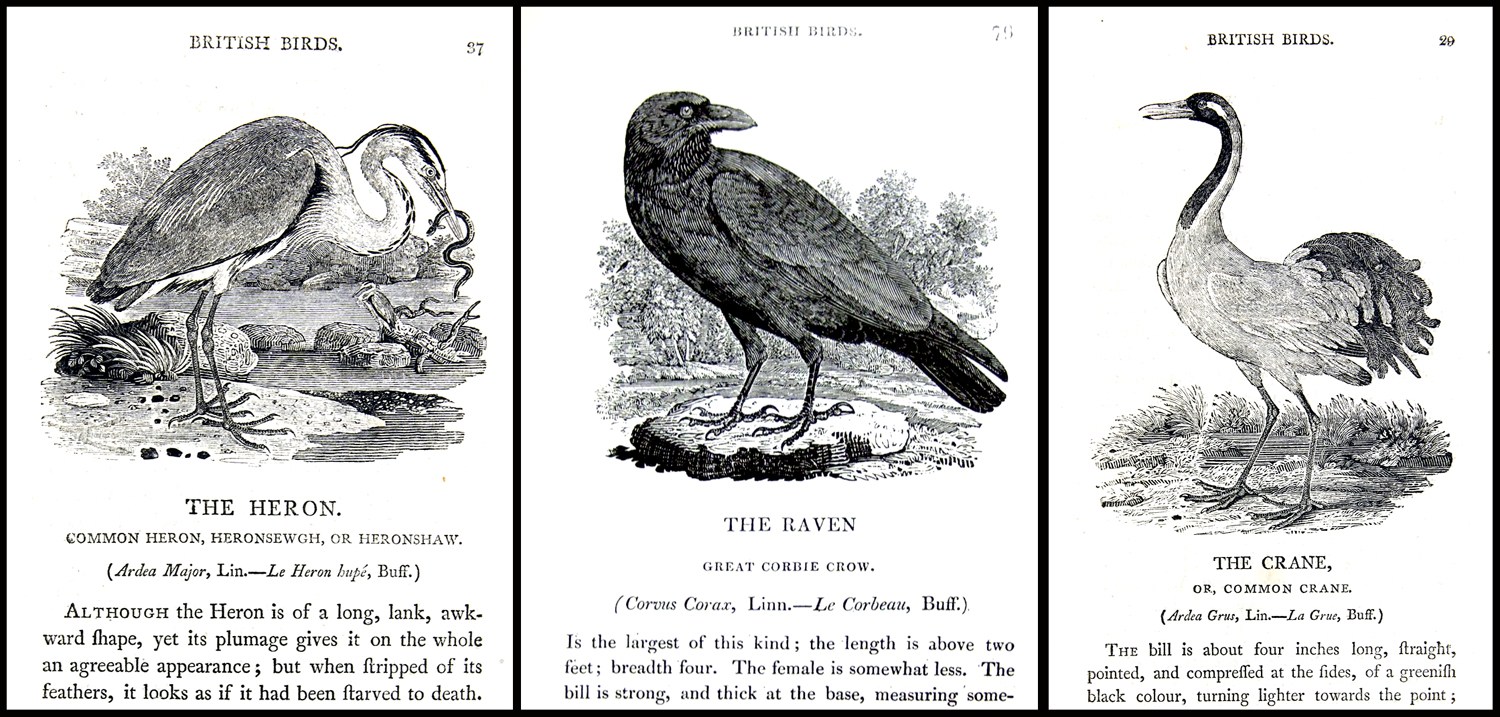
Likewise, Englishman Thomas Bewick (1753-1828) stayed at home and made wood engravings of his native animals and birds. 

Grub Street writer Oliver Goldsmith neither drew nor painted, but his enormously popular Natural History of the Earth and Animated Nature, first published in 8 volumes in 1774, went through many subsequent editions, each time copiously illustrated by an army of anonymous engravers. 

As the 18th crossed over into the 19th century, two men characterized the two thrusts of botanical illustration. 

William Bartram (1739-1823) traveled through the New World exploring for flora and fauna. His book, Travels through North and South Carolina, Georgia, East and West Florida, the Cherokee Country (1791), is still in print, usually known just as “Bartram’s Travels,” and covers his travels through Georgia, Florida and western North Carolina and is a readable a travel book as it is important as a naturalist survey. 
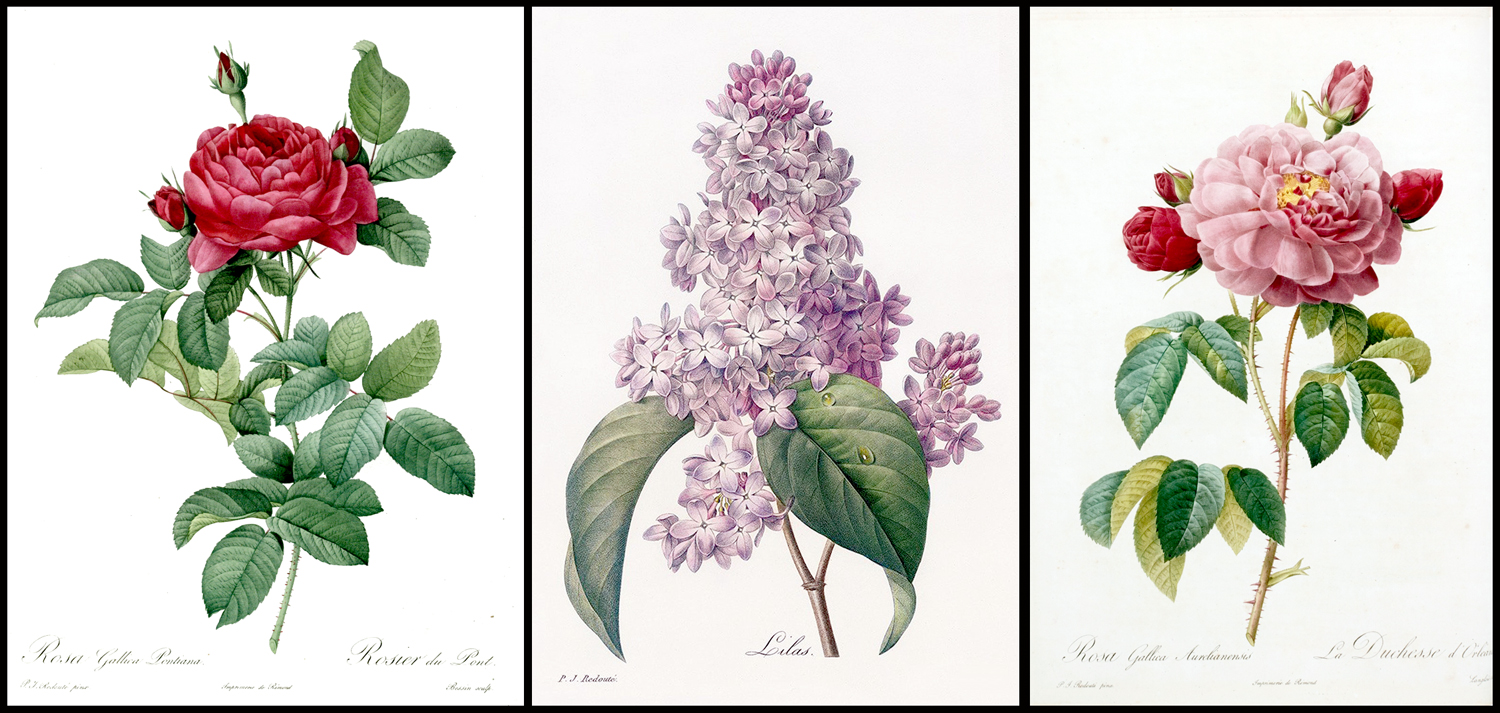
The other impulse for botanical illustration is the creation of art for the beauty of it. And no one did more for that than Pierre-Joseph Redouté, whose images of roses and lilies are still popular in framed prints to hang in tasteful middle class homes. As Wikipedia puts it: “Reproductions of his prints are available from virtually all print and poster shops.”

Redoute’s life was fascinating. He was official illustrator to Queen Marie Antoinette, and somehow survived with his head after the French Revolution and the Terror, despite his aristocratic credentials, and lived to become official artist for Empress Joséphine de Beauharnais and then survived her divorce from Napoleon Bonaparte, only later to be made Chevalier de Legion d’Honeur, France’s highest honor, and his work bought by Charles X. 

His early work was watercolor, but later in life, much of his art was engraved and hand-colored or turned into chromolithographs. And now, there are boatloads of books featuring Redouté’s art. 

Two developments affected the publication of prints of the natural world as the 19th century overtook the 18th. One was the mainstreaming of colonialism, and the number of biologists and artists who traveled to the new lands to catalog the flora and fauna. 

In the 18th century, much of the exploration was just to find out what was out there, to discover new Pacific islands or what was going on in the polar regions. But in the next century, the drive was to exploit what the colonies offered, and to do that meant to catalog all the new things these colonial toyboxes had to offer. 
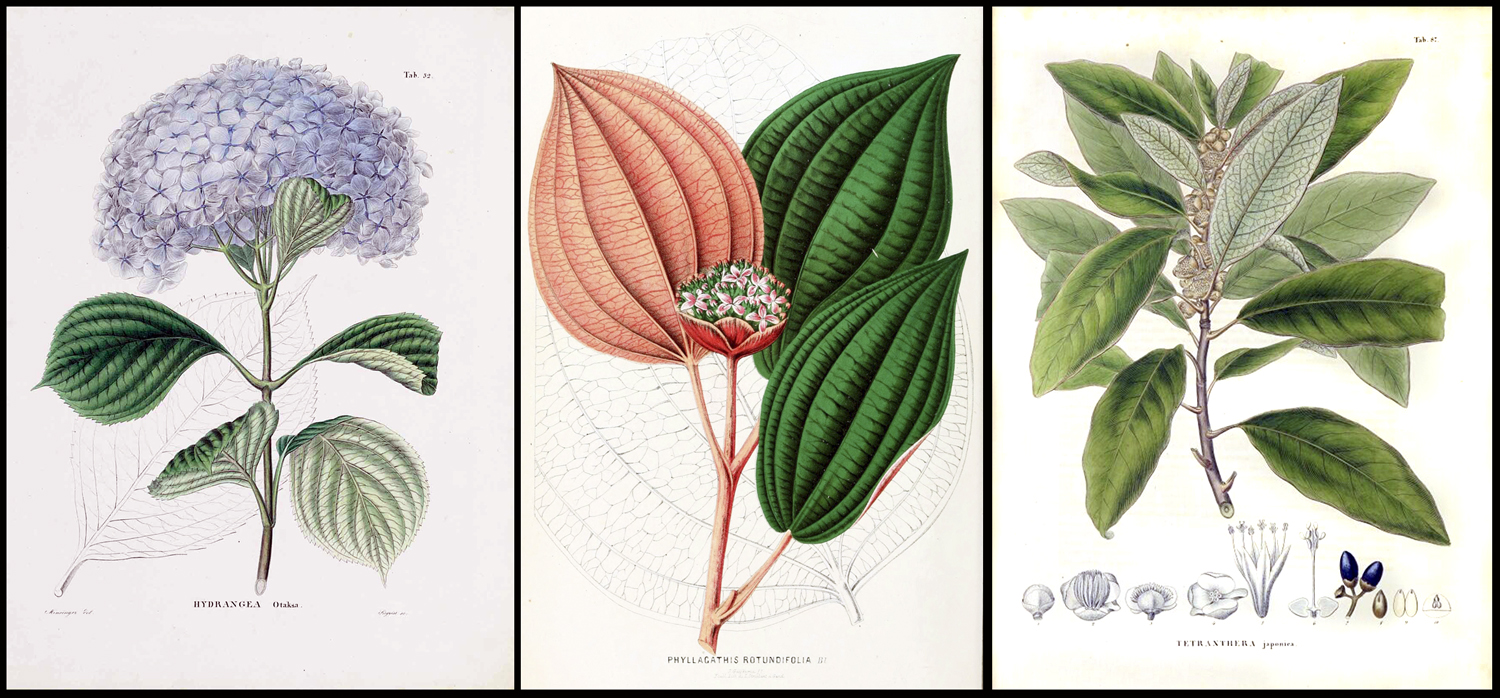
And so, scientists such as Philipp Frans van Siebold (1796-1855) went to Japan; Nathaniel Wallich (1786-1854) went to India; Johann Joseph Peyritsch (1835-1889) went to Sudan. They collected specimens and wrote books illustrated by a host of artists who made illustrations from the specimens they brought back. 
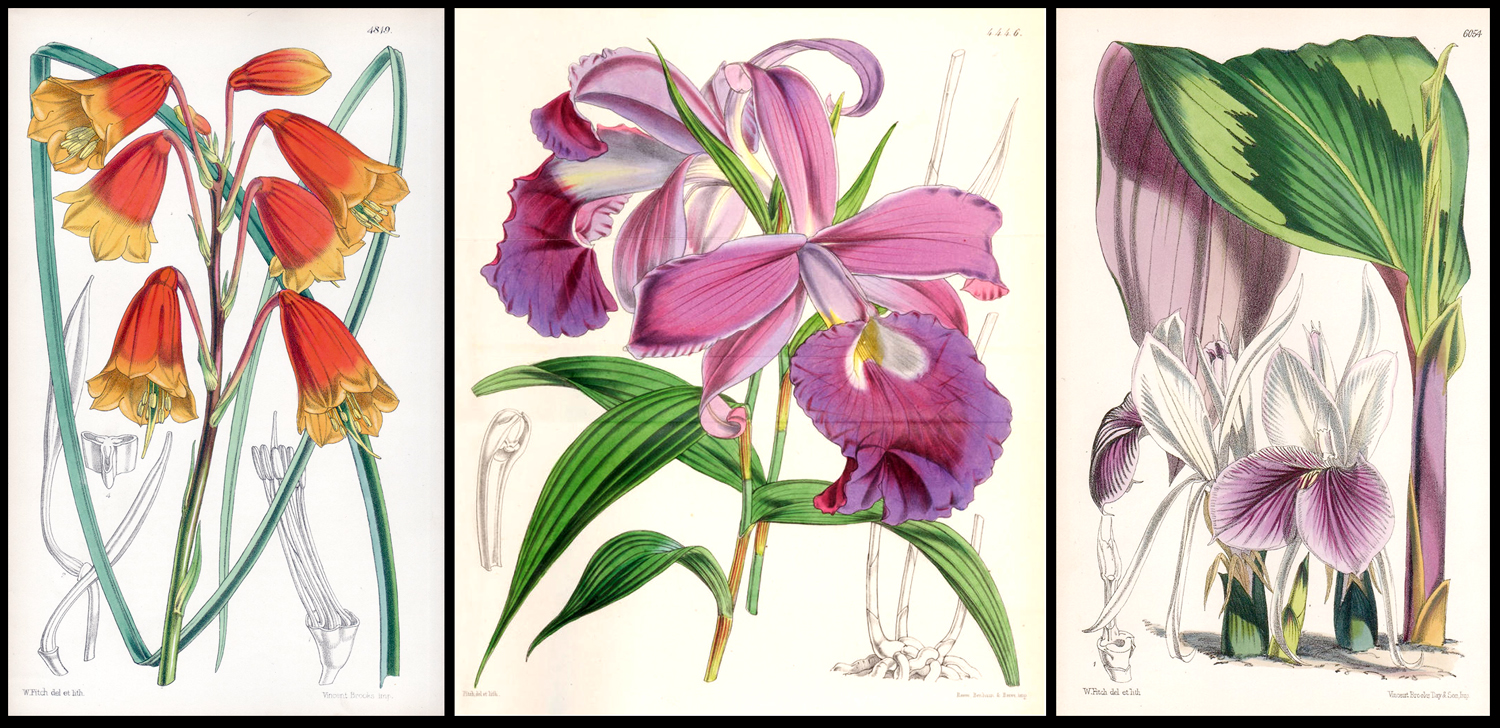
One of the artists employed by the botanists was Walter Hood Fitch (1813-1892). Fitch supplied many of the illustrations for John Dalton Hooker’s 1855 Flora Indica, a survey of plants of India and the Himalaya mountains. 
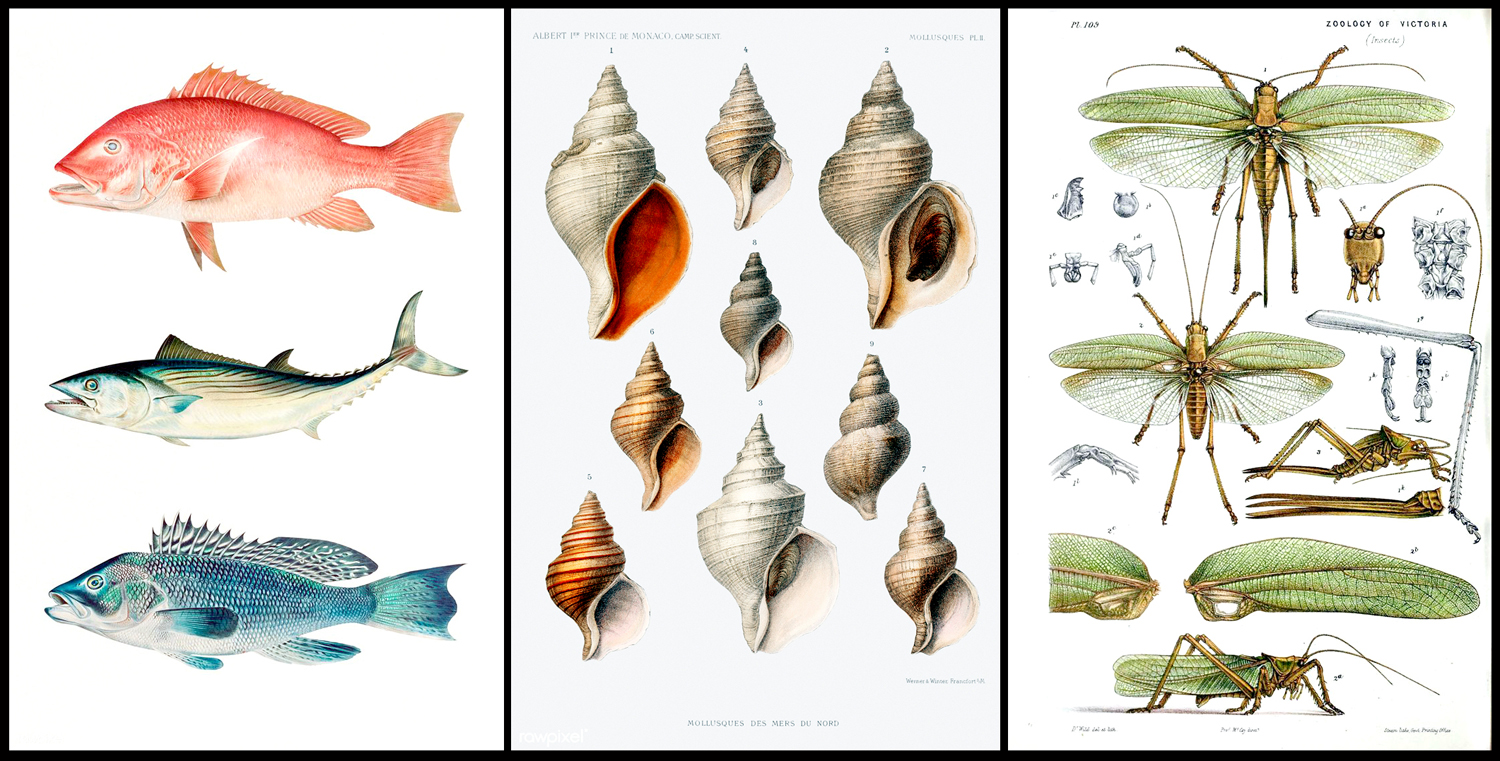
While botanical illustration comprised maybe 80 percent of all natural history artwork, much was done with animals, too, and even such things as seashells, rock types, and landforms. 
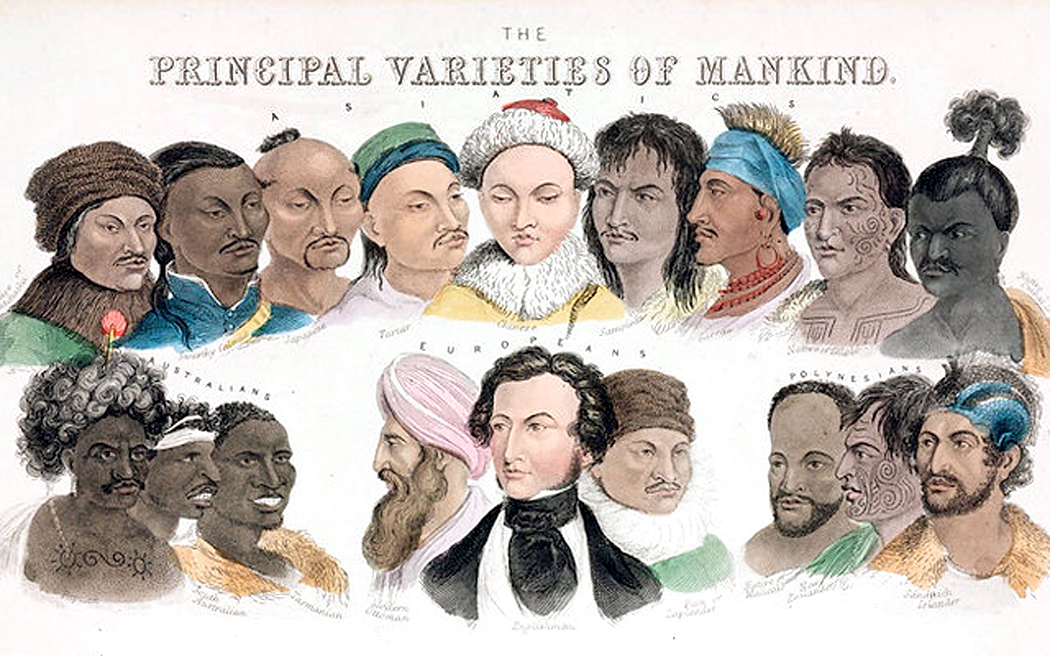
Colonialism brought in an infection called “scientific racism,” and natural history illustration looked not only at flora and fauna, but at human beings, typing them just as they did genus and species of orchid. 

There was almost a mania to classify and name everything. 
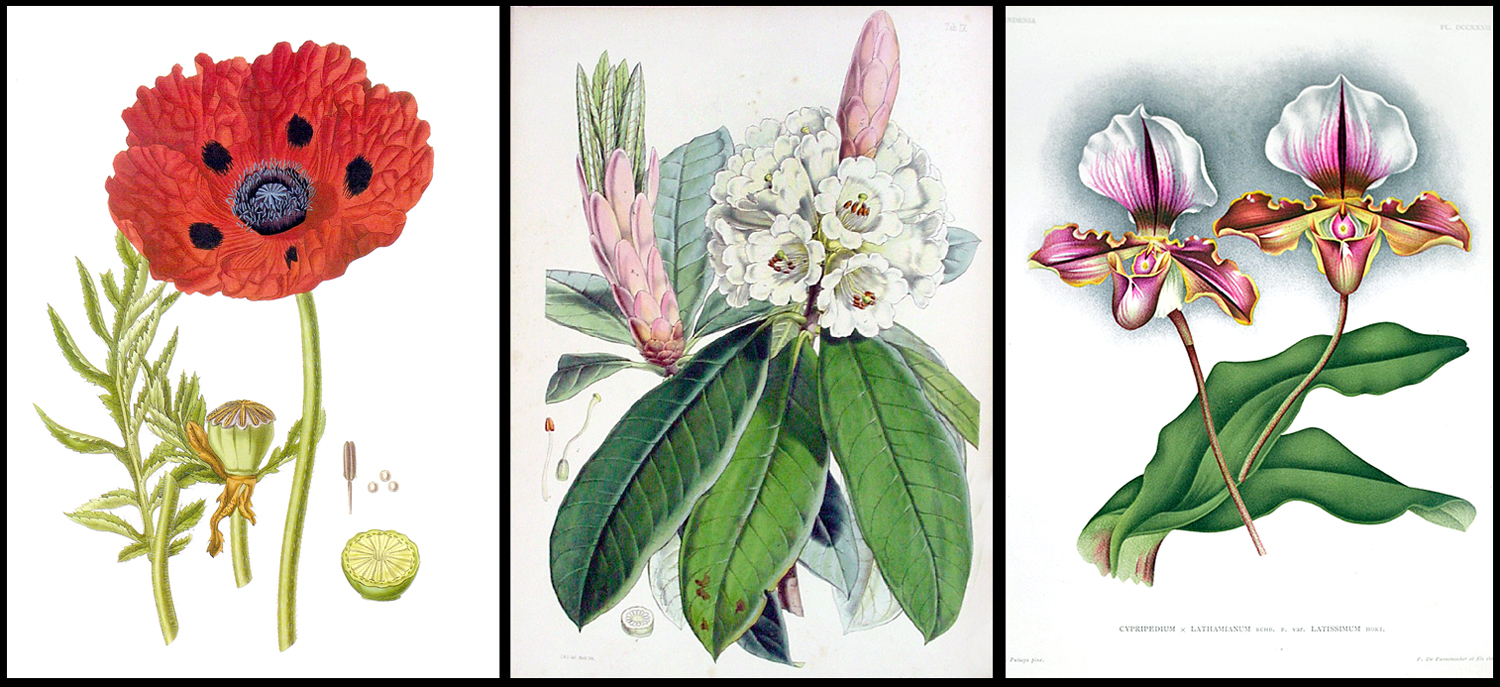
The second development was the invention of lithography, in 1796, which gave both scientists and artists a better means of mass producing images. 

The first botanical illustrations were either drawings or paintings, and the first reproductions were by woodcut. But copper-plate engraving supplanted the coarse woodcut and those engravings were often hand-colored, an expensive and time-consuming process for publication. 

For instance, when John James Audubon (1785-1851) published his original edition of Birds of America in England, in sets from 1827 to 1838, at least 50 colorists were employed and no more than about 200 full sets were printed. 
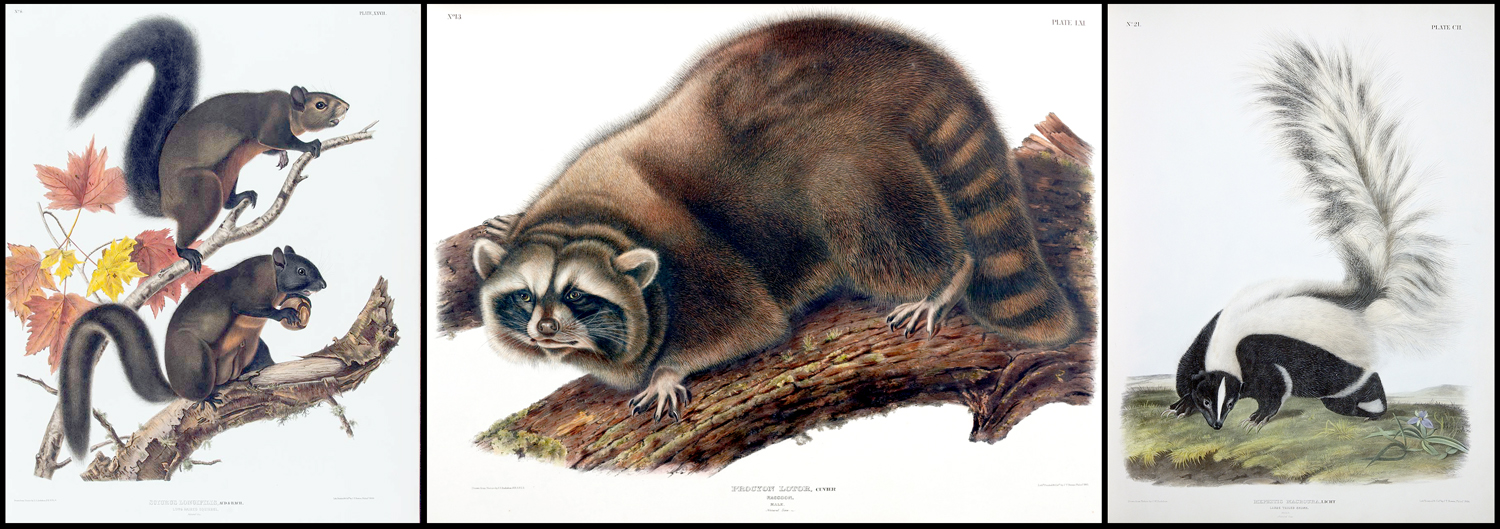
But lithography, and later chromolithography, allowed much larger editions of prints and mass production of images. The later work of Redouté was made with the new process. And when Audubon came to work on his later Viviparous Quadrupeds of North America (published in 1851, after his death) the images were lithographs. 
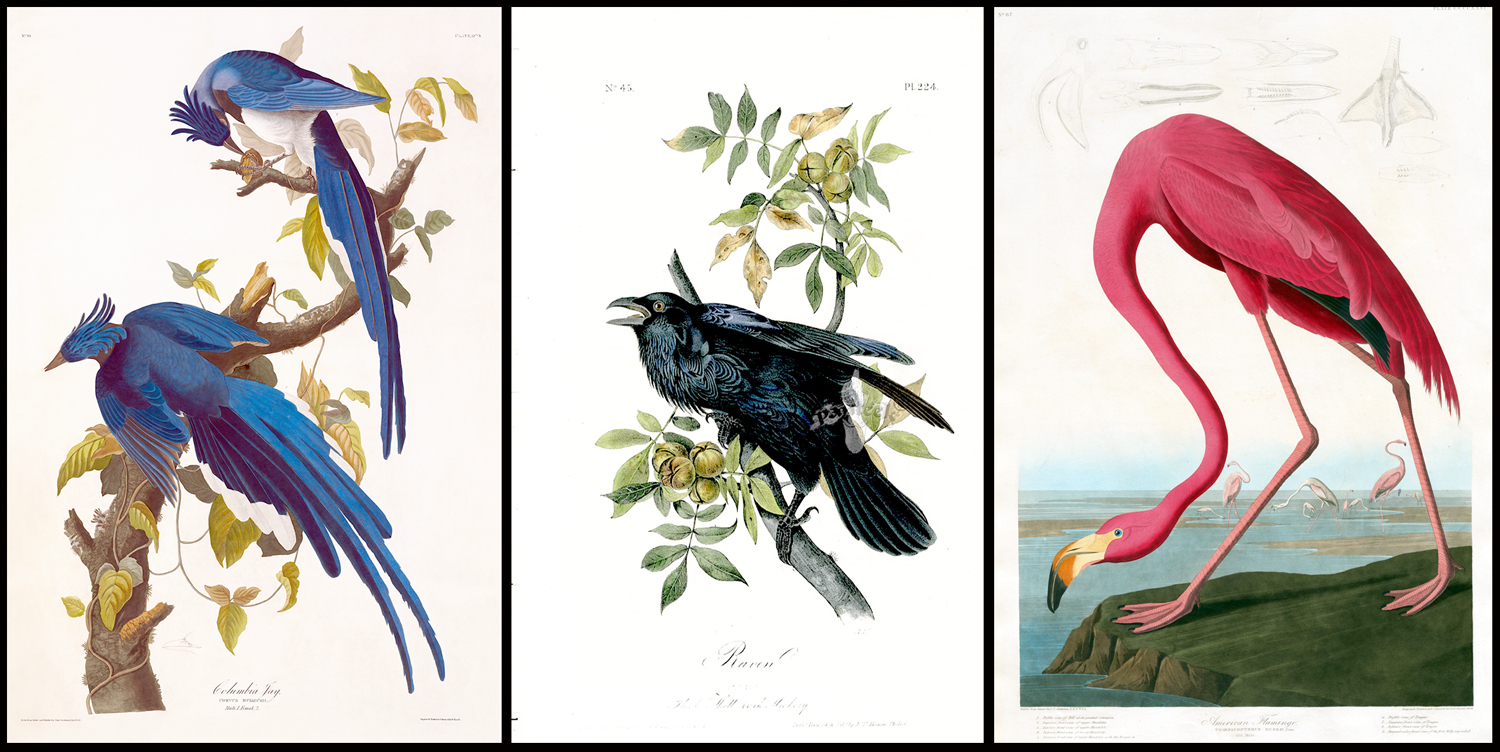
Of course, the most famous natural history art has to be Audubon’s Birds of America. He initially produced 435 large-scale plates, each with life-size images of the birds he drew and painted in his travels through America. The plates were engraved and etched and hand colored. The pages were called “double elephant” size — roughly 28 inches by 40 inches — and you can see he had to contort some of the larger birds, such as the flamingo, to fit those pages and still have them life size. 

Later editions came in smaller pages. 

The market for natural history imagery was immense during Victorian times and the number of artists working in the field from the late 18th- through the 19th-century was to great for me to cover them all. But I wanted to show off a few of them. 
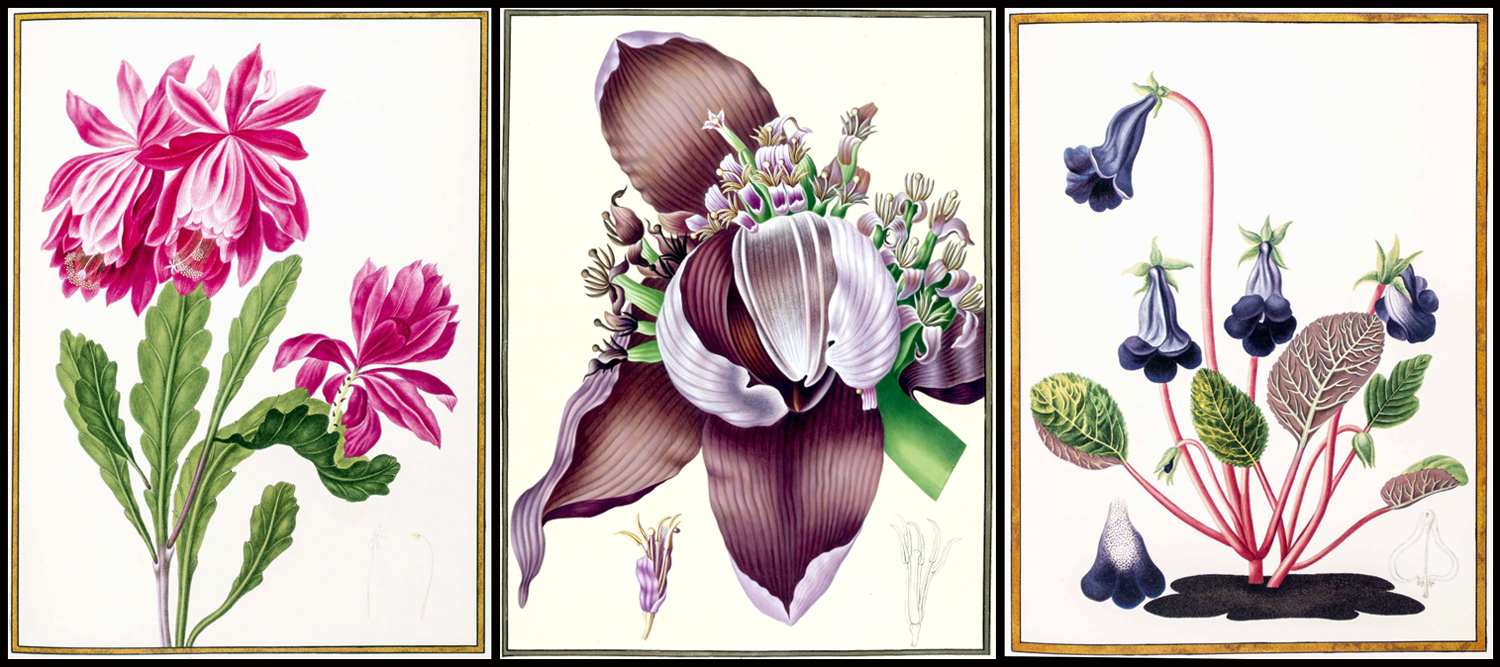
Such as Matthias Schmutzer (1752-1824), who produced 1433 plates for Das Florilegium Kaiser Franz I, a compendium of plants from the garden of Emperor Francis I, the final emperor of the Holy Roman Empire and first of the Austrian Empire.
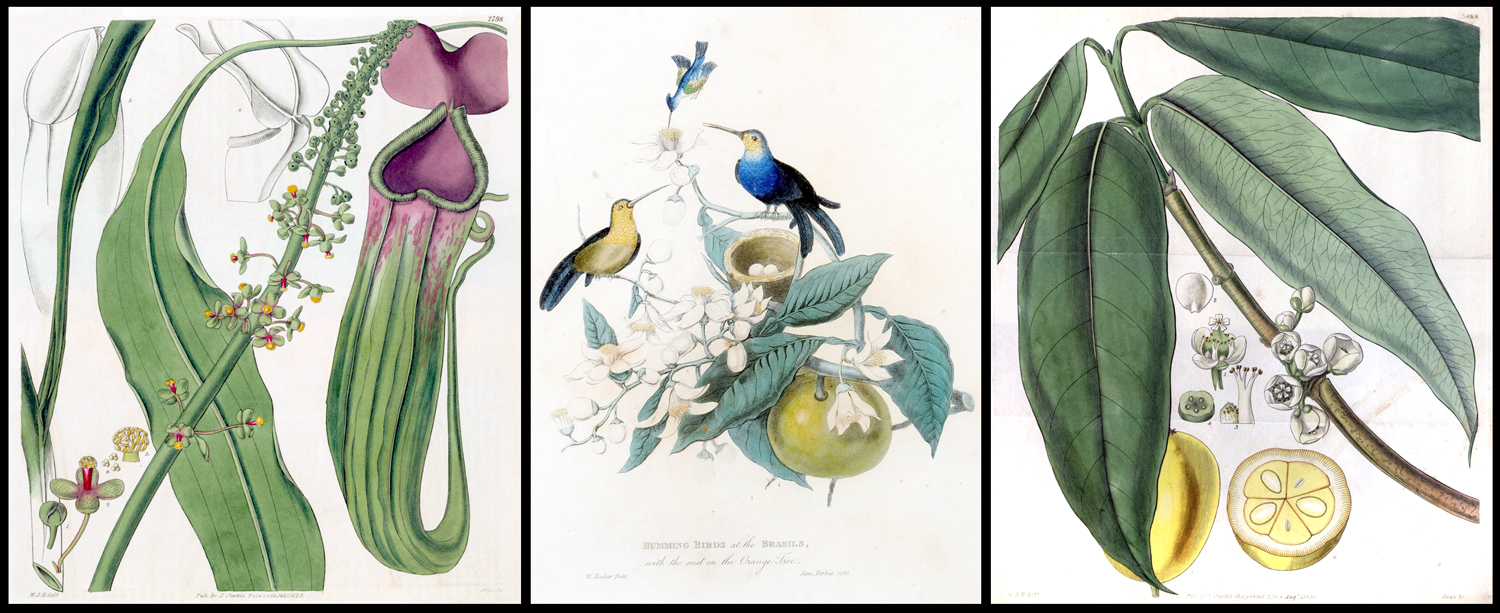
And I should mention the father-son pair of William Jackson Hooker (1785-1865), a botanist and illustrator and first director of Kew Garden in London. Hooker published more than 20 major botanical works over a period of 50 years. 
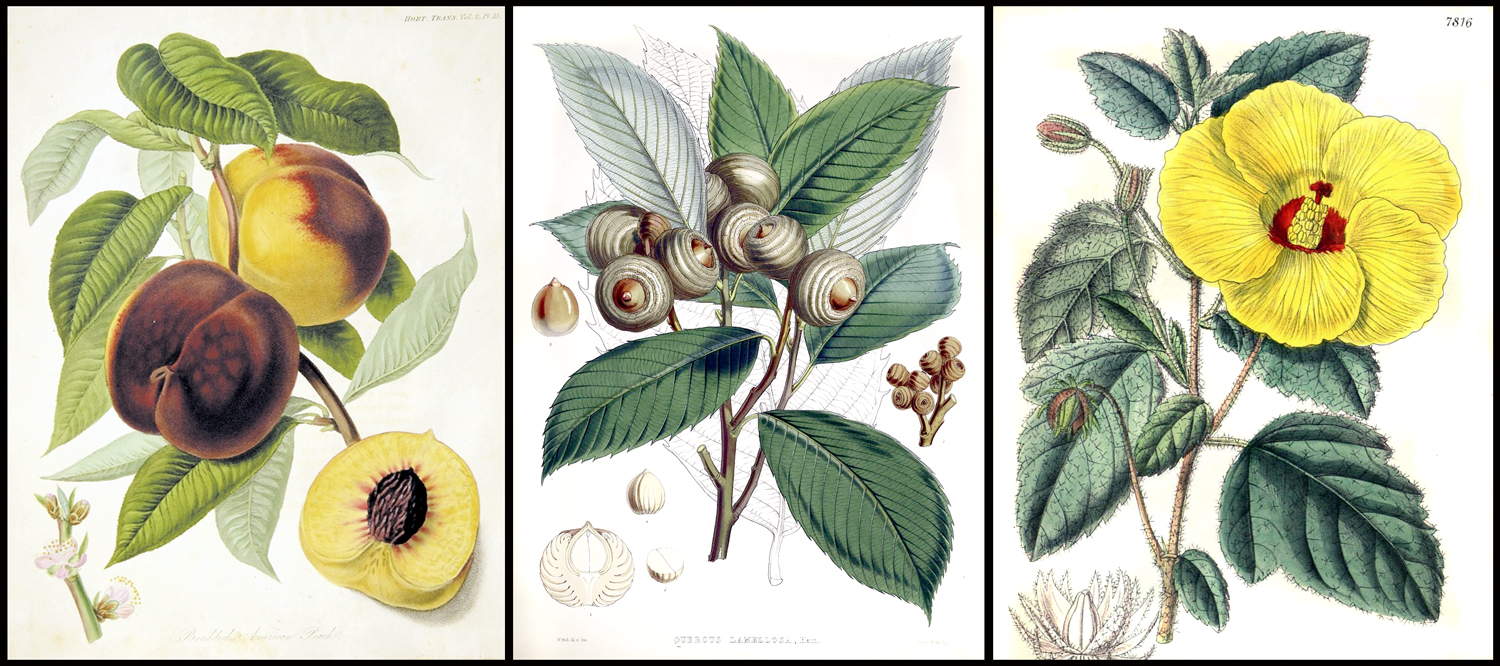
His son, Joseph Dalton Hooker (1817-1911), who succeeded his father as director of Kew, and was Charles Darwin’s friend. He joined expeditions to the Antarctic, Palestine, Morocco, the Himalayas, and the western United States, collecting specimens along the way, and publishing books on what he found, illustrated by many familiar botanical illustrators of the time, including Fitch. 
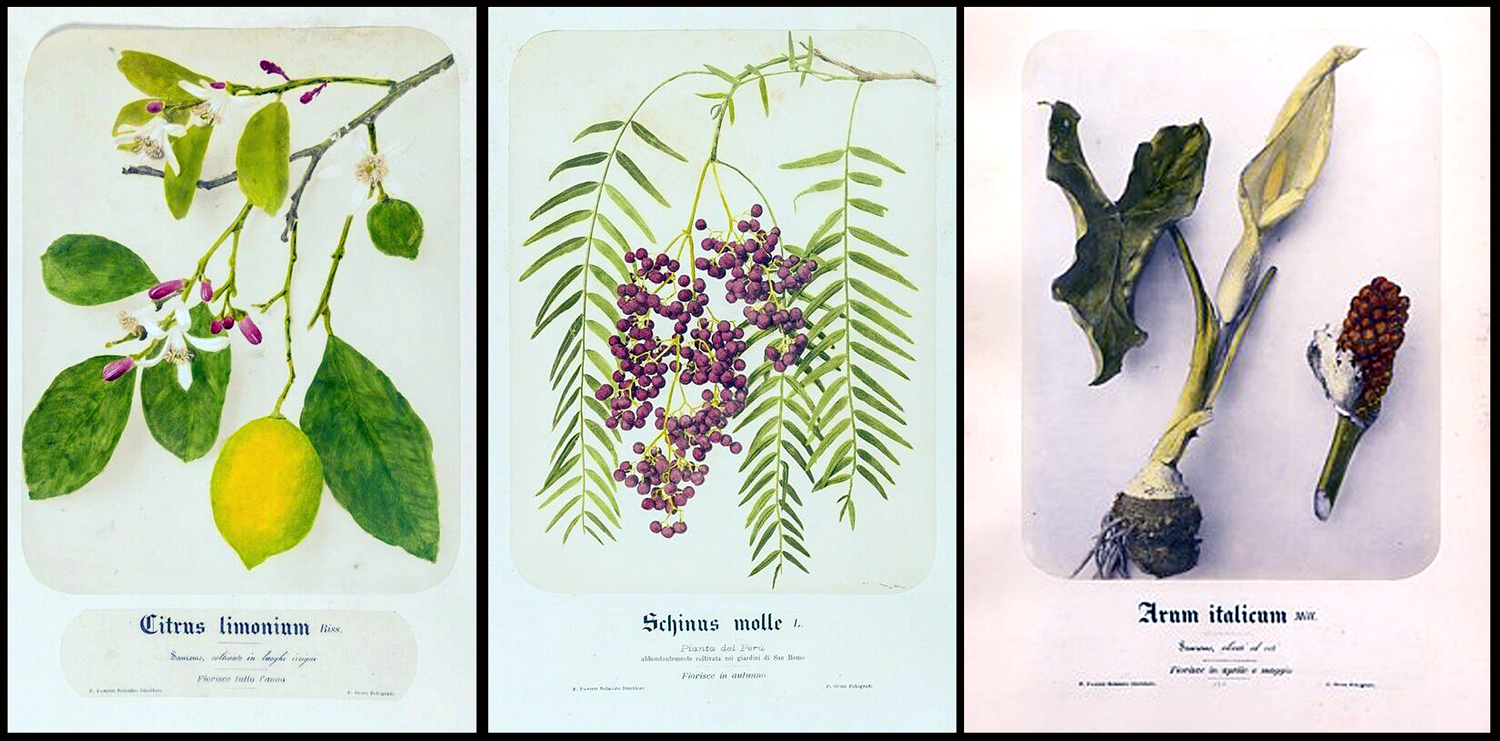
By the late 19th century, photography began to take over. The earliest I can find is an 1879 set of botanical photographs by Pietro Guidi. The black and white images still had to be hand-colored, just as the old engravings had to be. 

And by the fin-de-siecle, as art nouveau gathered steam, the link between nature and art became important. Nature motifs played out in furniture, architecture, book design and painting. Several artists and scientists became immersed in the subject.
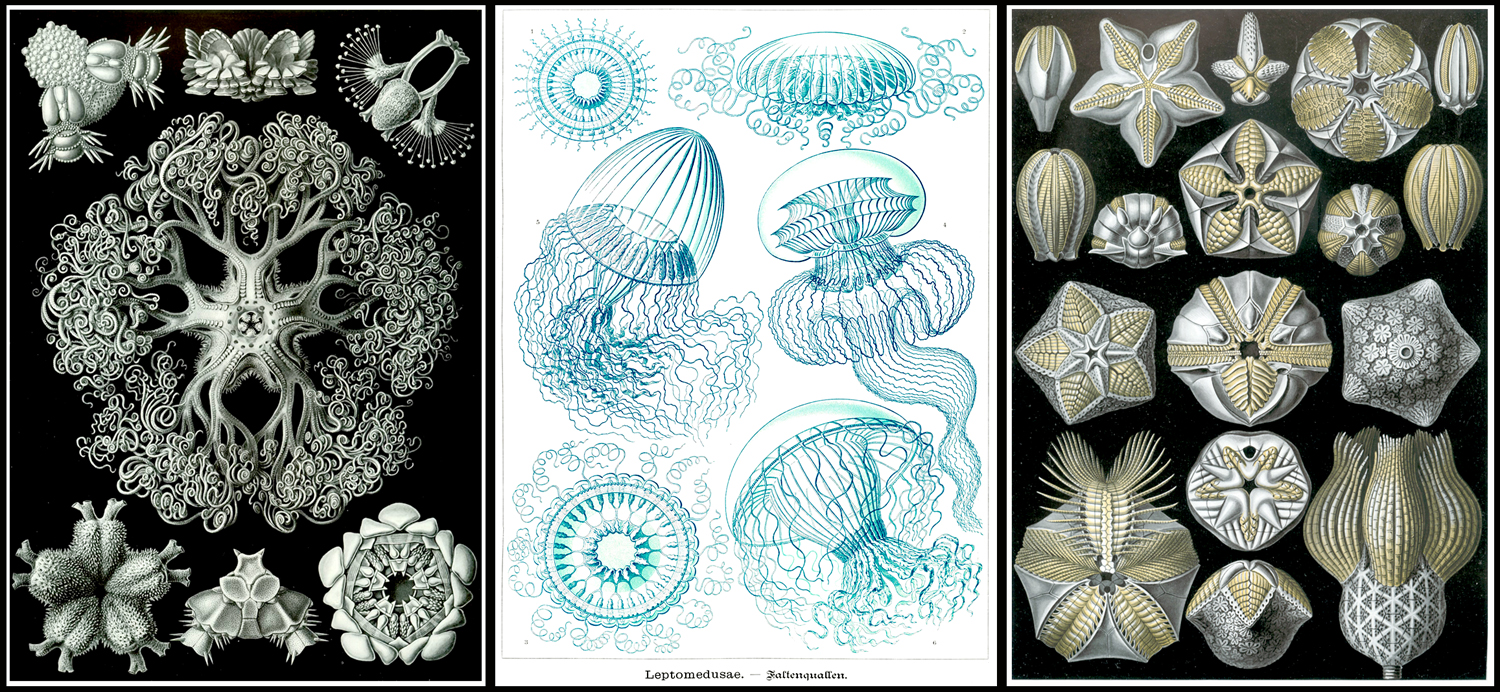
Ernst Haeckel (1834-1919) was a biologist obsessed with Darwin and symmetry. His Kunstformen der Natur (“Art Forms in Nature”), published in 1904. It consists of 100 prints of various organisms, many of which were first described by Haeckel himself. Haeckel’s intricate drawings were transferred to print by lithographer Adolf Giltsch. 
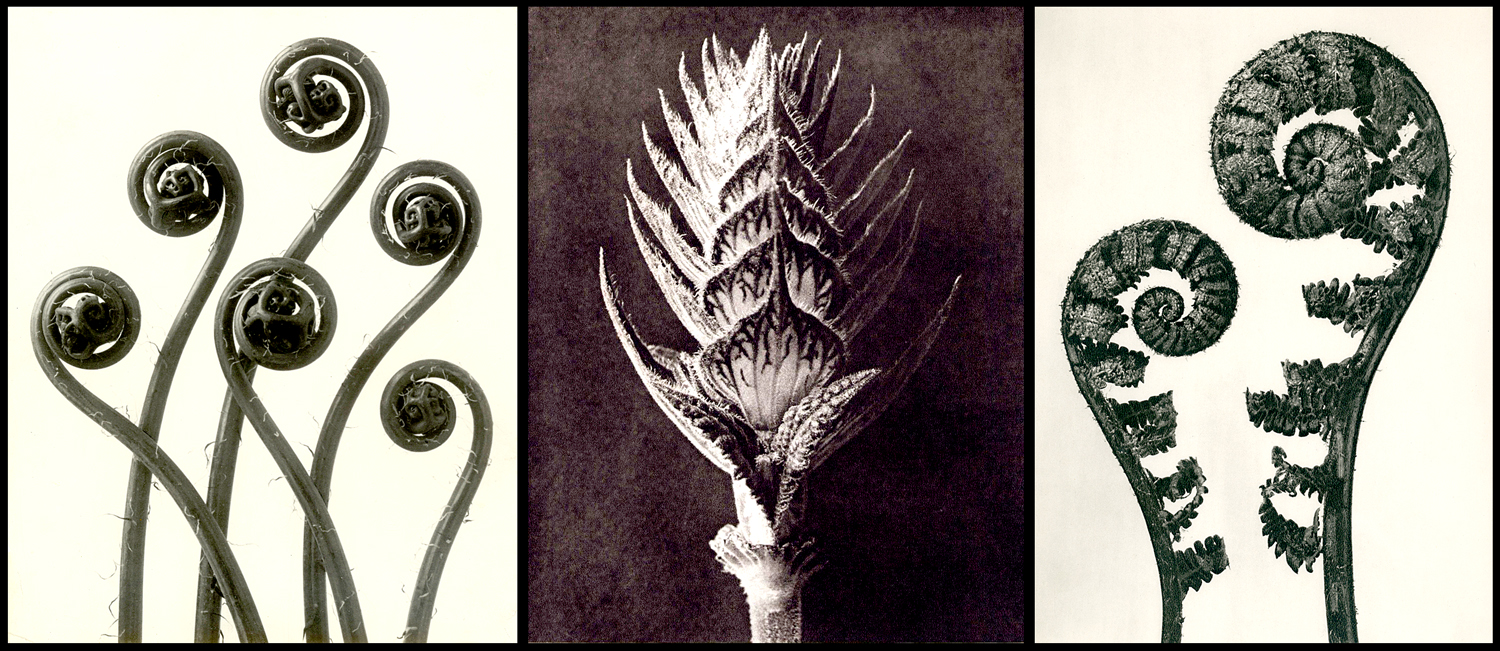
In 1929, professor Karl Blossfeldt (1865-1932) used photography to express the relationship between nature and modern art in his Urformen der Kunst (“Original forms in Art” or “Art Forms in Nature”). His purpose was pedagogical, teaching his art students to seek for inspiration in natural forms.

This cataloguing and regularizing tendency in German art extended beyond botany and zoology. In the 1920s and ’30s, photographer August Sander attempted to photograph all the jobs and professions in Weimar Germany, and later, Bernd and Hilla Becher made multiple images of German water towers, mining tipples, cooling towers, grain elevators, coke ovens, and blast furnaces, among other things. Those images, made mostly from the 1960s through the 1990s were part of a movement dubbed the “New Objectivity.” 

But back to nature: It is hard to overemphasize the attractiveness and popularity of natural images, especially birds and flowers. 

Charles Philip Hexom (1884-1959) executed a series of covers for Nature Magazine in the 1930s and ’40s. I have collected several of these. They are simple but elegant. 
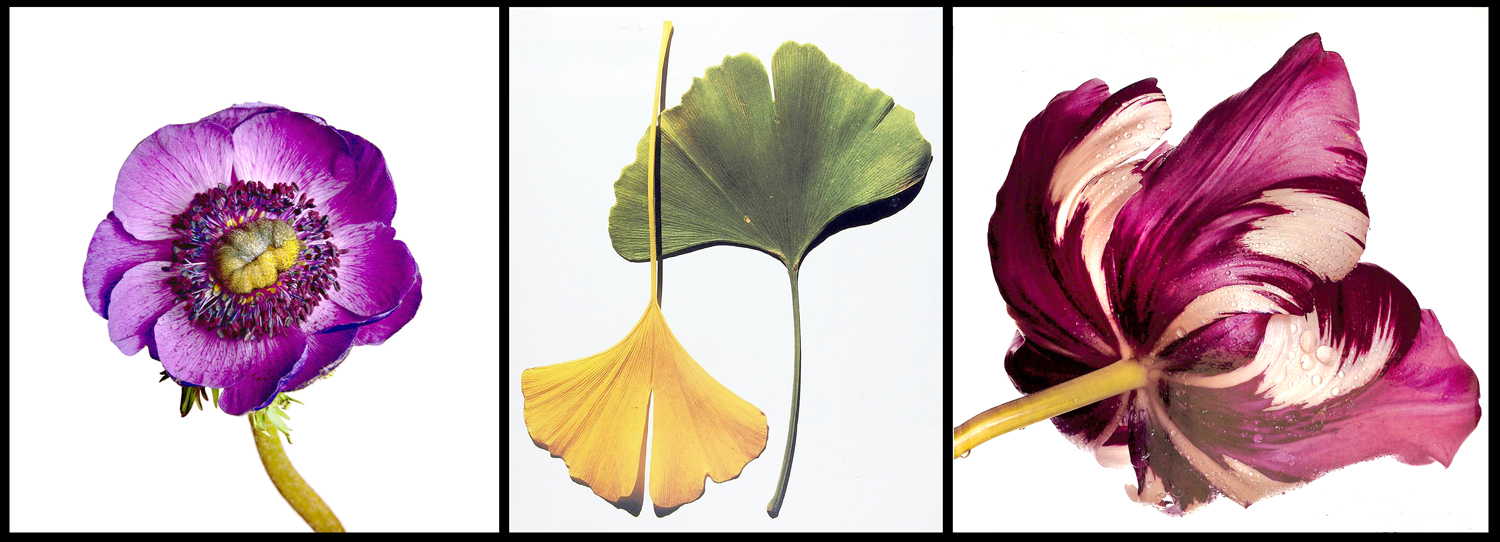
Irving Penn (1917-2009) published Flowers in 1980 and the perfection and simplicity of the photographs remind one of Redouté.

And finally, for our purposes, Robert Mapplethorpe photographed flowers over his whole career, with his book, Flowers, coming out posthumously in 1990. 

This has been a short, embarrassingly incomplete survey of botanical and natural history illustrations from the late Roman Empire until the Post-Modern age. Whole books have been written on the subject and more will likely be published in the future. 
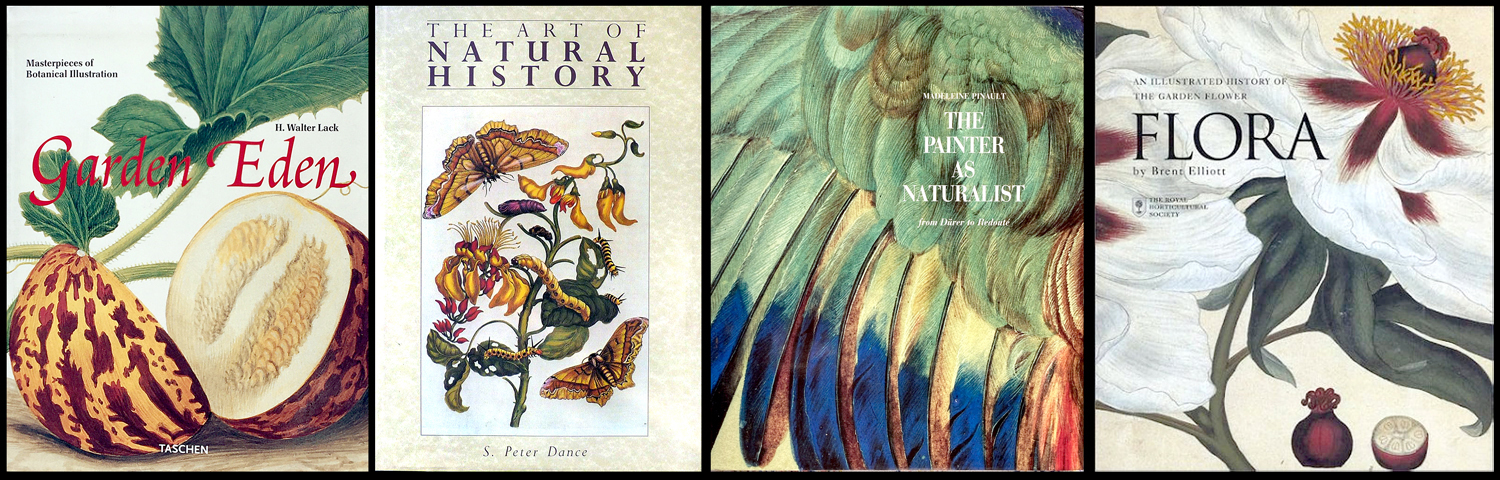
I consulted about 20 books for this essay, among them are: The Art of Natural History by S. Peter Dance; The Painter as Naturalist: from Dürer to Redouté, by Madeleine Pinault; Un Jardin d’Eden by H. Walter Lack; and Flora: An Illustrated History of the Garden Flower, by Brent Elliott. 

Click on any image to enlarge
In my seven decades — half of them spent as an art critic — I have been to too many art galleries and museums to be able to count the shows I have seen. Nor can I count the concerts, recitals, theater productions I’ve seen or books I’ve read. Most of them I’ve enjoyed, but few were so memorable that I still have in my nostrils the aroma they gave off. 

This is not to disparage most of the others. I’ve eaten too many restaurant meals to count. Most of them I enjoyed. They did what was asked of them. But can I recount a ribeye I once had in Bakersfield? No. That would be silly. 

But there are meals and concerts that stick, art exhibits that did more than give an hour’s pleasure, concerts that changed my way of thinking about the world. 

And let’s be honest, one is willing to pay the ticket price for a lot of minor pleasure in the expectant hope that this next one will be a world-changer. The odds are against it, but we persist. Every once in a while, we are gobsmacked, and know why it has been worthwhile to sit through a hundred Beethoven Fifths to get to this one that goes beyond mere pleasure to transcendence. 

We live for those moments; they make life worth living. 

In a recent blog, I recounted my earliest such encounters, with Eugene O’Neill at the McCarter Theatre in Princeton, N.J., when I was in high school. With J.M.W. Turner at the Museum of Modern Art in New York a few years later. With Emil Gilels at the Brooklyn Academy of Music the same year. These all set my life on a course to spend it with art and music. These all proved to my adolescent heart and mind that there was something more real, more important, than the suburban life I was being brought up in. 

But the immersion didn’t end there. In subsequent years, there were many exhibits and concerts that stand out. That became such an engrained part of my life and world view, that it is as if I was still standing in front of those paintings, or sitting in the concert hall, hearing those notes. 

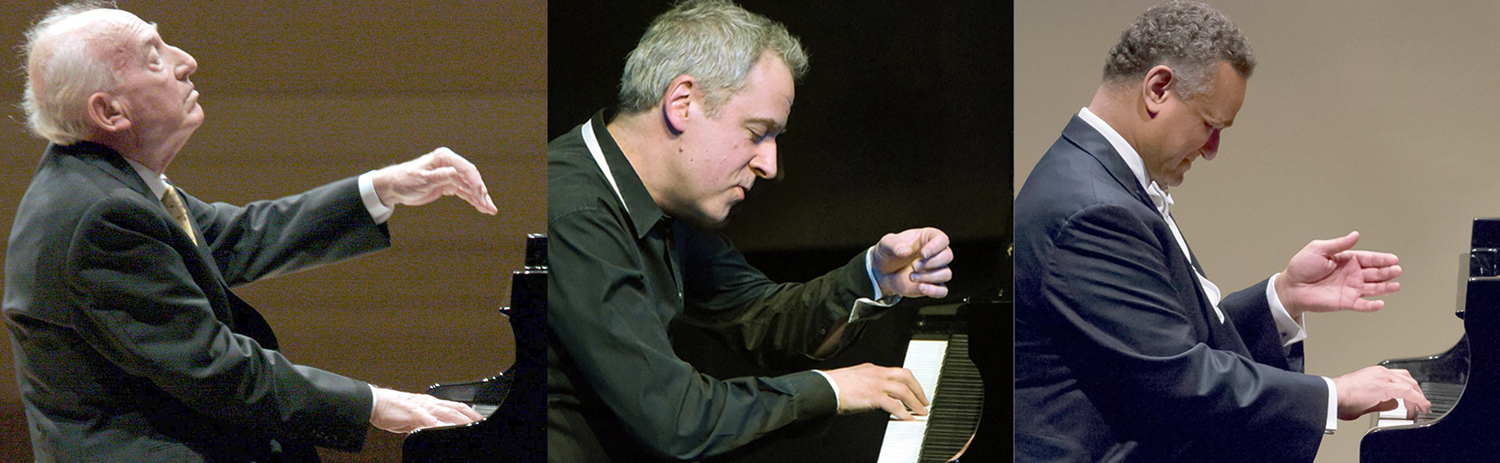
Let’s just take three piano recitals as examples. In 1991, I heard Maurizio Pollini at the Dorothy Chandler Pavilion in Los Angeles. In the first half of the recital, he played all of Chopin’s Preludes. In the second half, he played the Berg sonata and Schoenberg’s Six Little Pieces, Op. 19. All that was great. But he finished with the Stravinsky Three Scenes from Petrushka, one of the most difficult bravura piano pieces ever written. Pollini tore through it like a demon, but made every note musical. It blew me away. (The recital was notable for its intermission, too. The doors to the hall were locked and for nearly an hour, we could hear the piano being re-tuned behind those doors. Apparently Maestro Pollini was not satisfied with the instrument. We were kept waiting in the lobby until he gave his approval to the tuning). 

In 2008, I heard Jeremy Denk at Zankel Hall in New York, the recital hall that is part of Carnegie Hall, play the single most daunting program I could imagine, with Charles Ives knucklebusting Concord Sonata in the first half, and Beethoven’s mind-busting Hammerklavier Sonata in the second. I could only think of John Lennon’s immortal line “I got blisters on me fingers.” For an encore, he reprised the Hawthorne movement of the Concord. Very like running a 200-meter directly after running a marathon. 

I’ve heard Denk several times since then, and each time, his playing was, if not so Olympian, certainly significantly memorable. He proved to me, for instance, that the etudes of Gyorgy Ligeti are great music. And that Beethoven’s Eroica Variations are actually comic. 

Then, in 2011, I heard Andre Watts play the Liszt B-minor sonata in Scottsdale, Ariz., on an all-Liszt program. I had the perfect seat to see his fingers spin over the keys, and learned a great deal about the disposition of Liszt’s voicings by being able to see Watt’s fingers. His playing was ethereal. Liszt was a Watts specialty. 

But it wasn’t only music. After my initial infatuation with O’Neill in high school, I had seen too many mediocre live theater productions, and had come greatly to prefer movies. Theater seemed too artificial, too, well, “theatrical” for my tastes. But then, in 1993, I saw the original Broadway production of Tony Kushner’s Angels in America — both parts on successive days — and saw what live theater can do that nothing else can. It was one of the seminal experiences of my life. 

(It was also ruined for me most other theater, because so seldom is it ever this overwhelmingly powerful. But I have seen other great theater since then. Angels is not sui generis. I have seen Angels three more times, once in its road production —not all that good — once in a production by Actors Theatre in Phoenix, which was nearly as good as the New York production, and finally, in its Mike Nichols filmed version, which is very different from the stage version. It is a movie, not theater. Very good, but still, not the live experience on stage. The same difference between seeing the movie Amadeus and the stage version. Movie is good; live is great.)

I got to travel for my newspaper, and was able to review many major art shows around the country. They have been some of the most eye-opening and mind-expanding things I’ve done. 

In 1994, I saw John James Audubon: The Birds of America at the Art Institute in Chicago. It featured 90 of the original paintings used for the engravings published in his books. The originals persuaded me that Audubon might be considered America’s greatest artist. (You can read a version of my newspaper review here.)

In 1996, I visited Philadelphia for the big Cezanne show at the Philadelphia Museum of Art. One hundred oil paintings, 35 watercolors and 35 drawings from public and private collections. It was an overwhelming experience. I never knew there were this many distinct greens, blues, blue-greens, and greenish blues. And when you swipe a bit of vermilion against them, the whole thing glows like neon. Seeing Cezannes live is a very different thing from seeing them reproduced in books. 

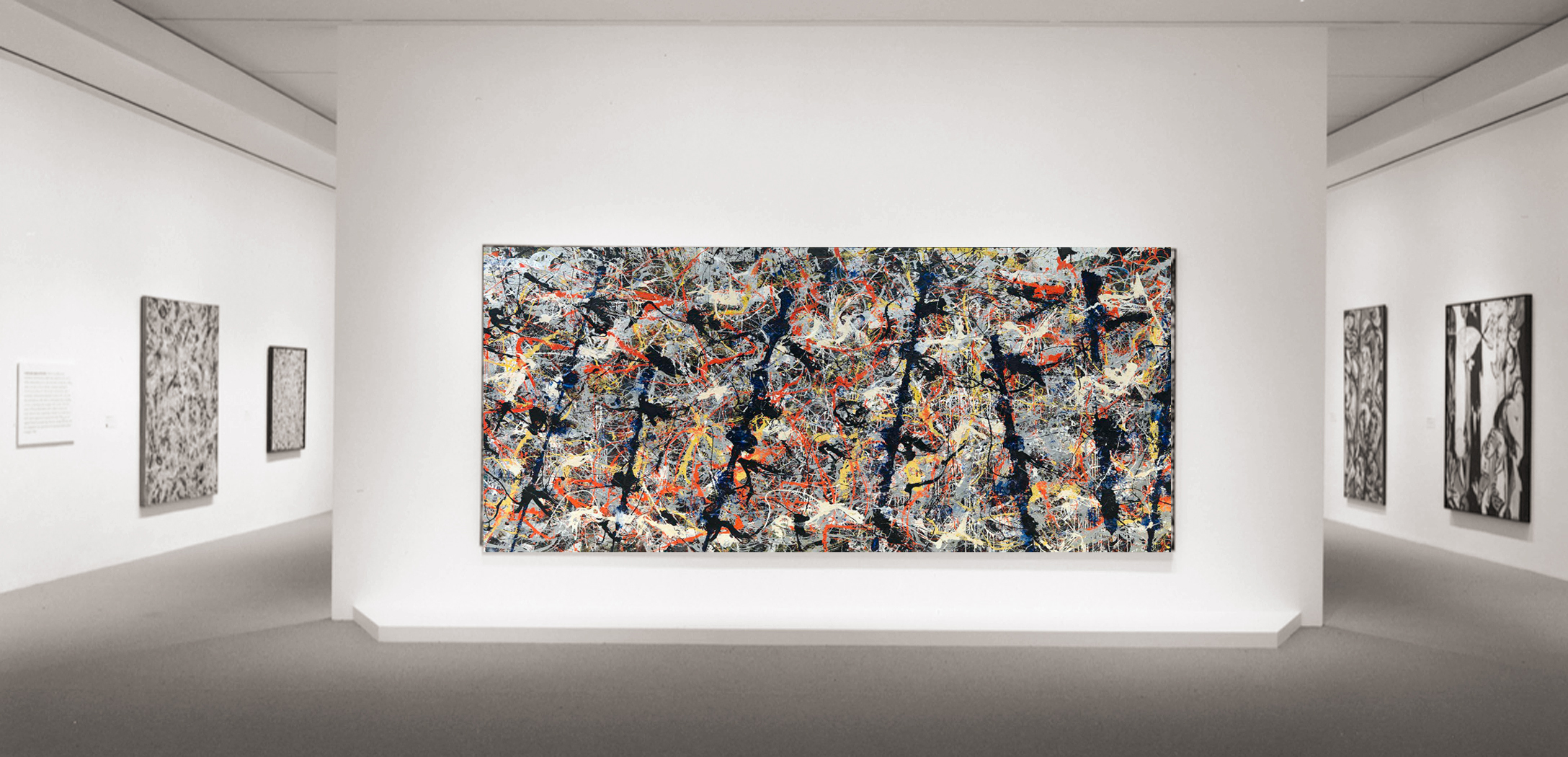
In 1999, I got to see the great Jackson Pollock retrospective at the Museum of Modern Art, which gave me the rare chance to see his Blue Poles, which is normally hidden away in the National Gallery of Australia in Canberra. 

That same year, there was a great Van Gogh show at the Los Angeles County Museum of Art from the Van Gogh Museum in Amsterdam. Like having the chance to see Pollock’s Blue Poles, I got to see Vincent’s iconic Wheatfield with Crows. The show as a whole was the best introduction to the artist’s growth from a clumsy, almost talentless neophyte to one of the world’s greatest painters. He wasn’t always Van Gogh, but when he became himself — the very definition of transcendence. 

I’ve been to Chartres Cathedral four times, and each time was overwhelming. I’ve now been to most of the great churches of northern France. The single most beautiful manmade thing I have ever seen is the north rose window at Chartres. I have sat transfixed in the south part of the crossing, staring back to the north, in total, for hours. It is a meditation or very like a prayer, if such can be said for a complete atheist. 

Overall, it is music that has most provided me with this feeling: Of taking me out of myself and letting my mind expand to a size larger than mere me-ness. Of course, most of the hundreds of concerts I have attended have only provided pleasure and entertainment. But there are those that do more. I thirst for those. 

In 1994, I heard the Philadelphia Orchestra under Wolfgang Sawallisch play the Strauss Don Juan and I felt music not just through my ears, but through my whole body and being. 

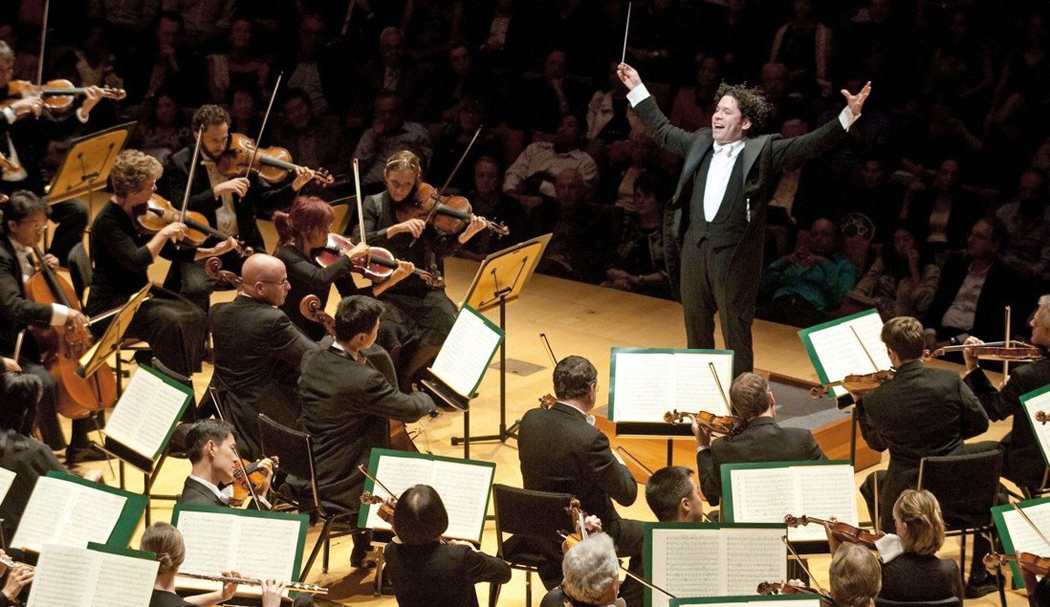
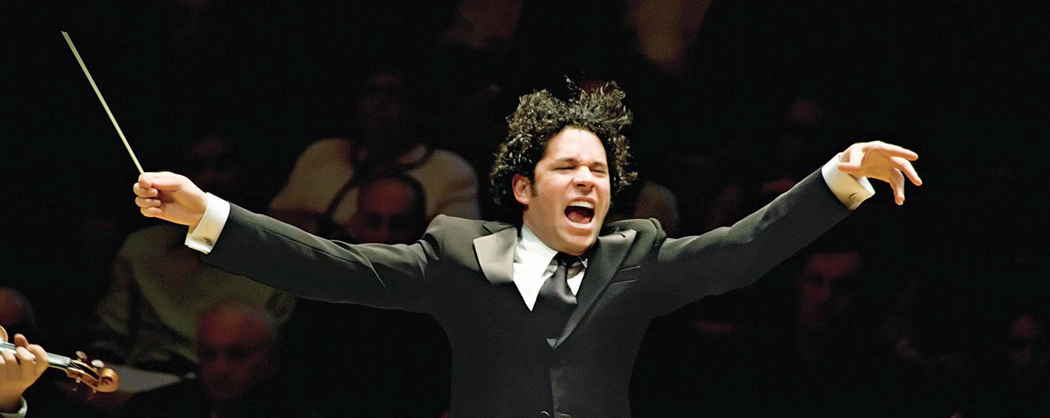
I’ve heard Gustavo Dudamel twice live. Once playing the Mahler First with the LA Phil, shortly after his appointment as music director. But before that, in New York with the Israel Philharmonic, playing the Tchaikovsky Fourth. That was in 2008; the Israel Phil was then an orchestra made up of older, formerly Eastern European men — bald-headed old pros who could give a polished performance under any conductor. But they played with the enthusiasm of little boys, even smiling at this bit or that as they produced the sound. After the performance, Dudamel, instead of turning and bowing to absorb the adulation of the audience, immediately danced up into the orchestra and jumped up and down with the musicians, shaking hands and pointing out soloists. I’ve never seen such a powerful effect a conductor has had on a group of musicians. They seemed to love him back. 

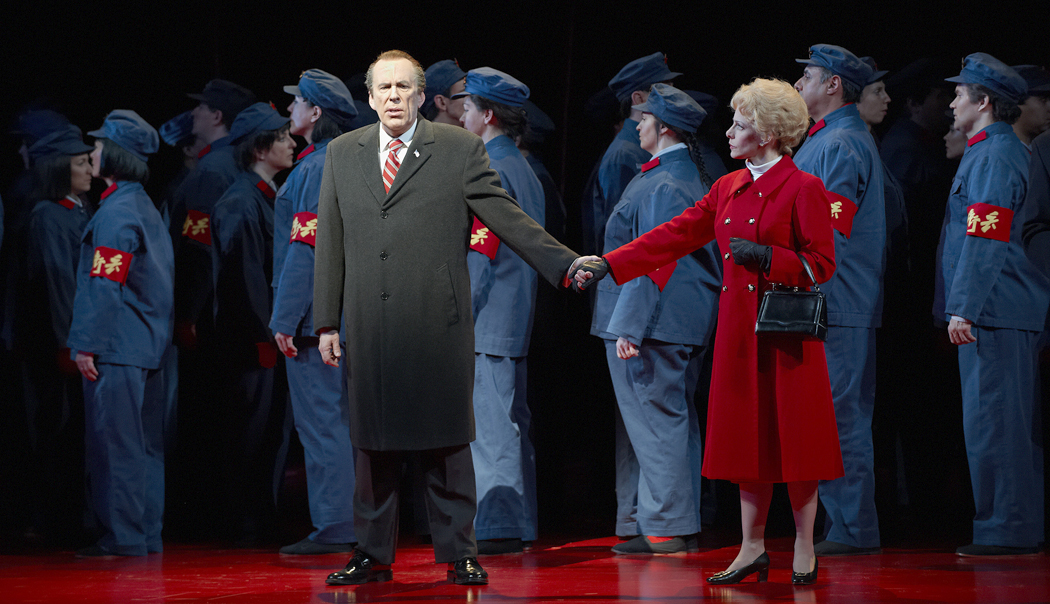
There have been other concerts: In 2008, there was Ozvaldo Golijov’s Ainadamar with Dawn Upshaw; in the same year, there was Doctor Atomic at the Metropolitan Opera in New York. In 2009, there was Nixon in China with Robert Orth in the title role. In 2010, Steven Moeckel played the Beethoven violin concerto with the Phoenix Symphony at the Scottsdale Center for the Arts. I have never heard a better, more moving and detailed performance of the concerto. At least not live. 

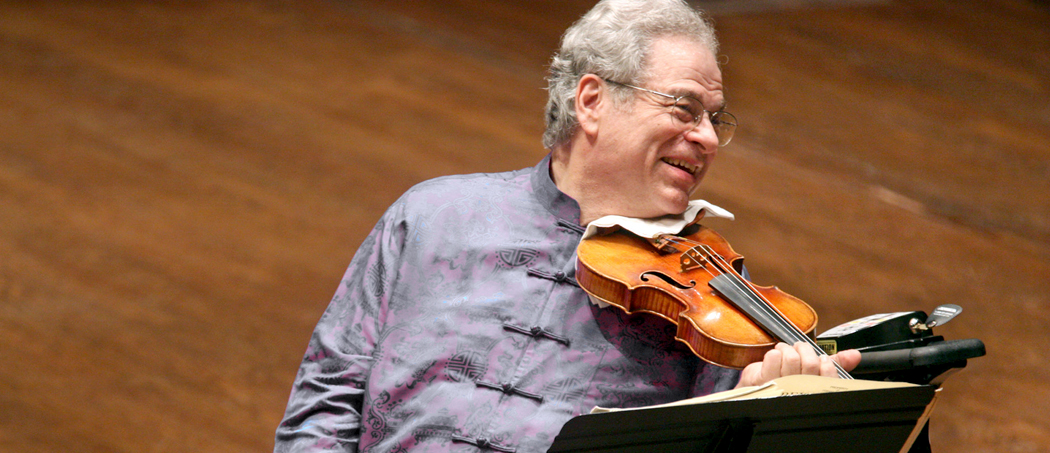
Sometimes, it is only a single work on a program. I’ve heard Itzhak Perlman I don’t know how many times. He’s a miracle; but he isn’t always completely engaged. He can give a creditable performance even half asleep — and he has been known to. But then he will redeem himself. In 2008, he gave a performance in Scottsdale. He ended the recital with his usual encore pieces and tired jokes. The same jokes over and over each concert. Perlman can be quite tiresome. And he opened with a Bach sonata, well played but nothing special. Then, as I wrote in my review:

“But then, with the Richard Strauss violin sonata, the sun shone through and the angels sang. It’s not for nothing that Perlman is a superstar. He gave us a version of the music no one else could give. Rich as butter, emotionally complex and powerful, he persuaded us that the Strauss sonata is a major piece of music, rather than B-list work by an A-list composer, which is how it’s usually ranked.

“From the opening notes the music dripped with personality, as Perlman pushed or dragged the notes just enough to create the kind of perfect phrasing that makes the music speak directly to your innards.”

It is for moments like that for which we will put up with so much less for so long. 

There are two other moments I would like to mention. 

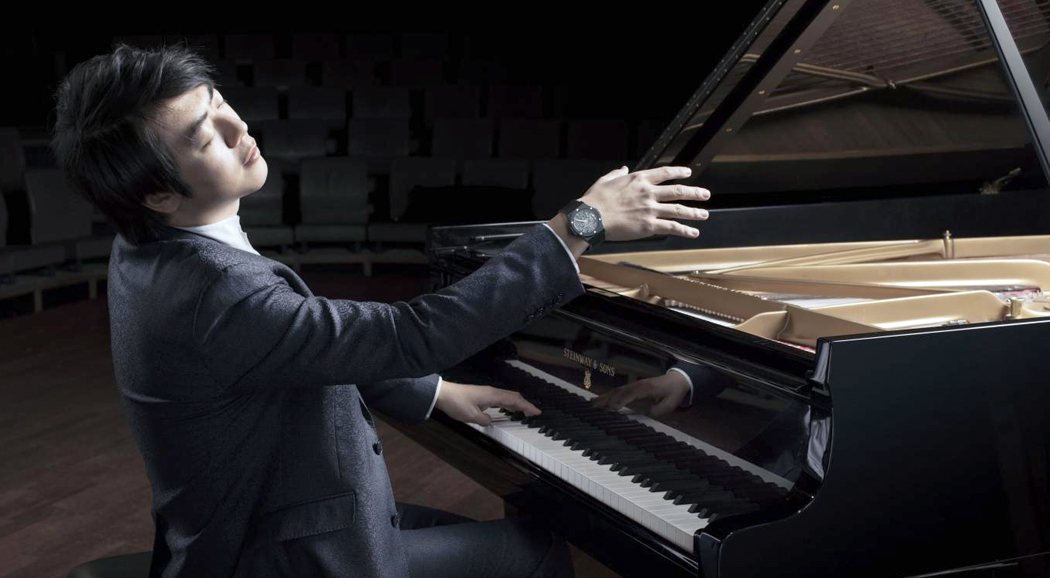
The first is a concert with pianist Lang Lang. He has a bad reputation with some critics for histrionics on stage — rocking and eye-rolling — and he has on occasions played loud and fast, but without much impact, for which he has gotten the nickname “Bang Bang.” But he can also play the way he did in the slow movement of the Chopin concerto, on Oct. 24, 2008 (2008 was a very good year for me). As I wrote in the review:

“At the conclusion of Goethe’s Faust, his aging hero looks out on the world with a note of satisfaction. ‘I could almost wish this moment to last forever, it is so beautiful.’

“That is exactly how pianist Lang Lang played the slow movement of the Chopin E-minor piano concerto Sunday with the Phoenix Symphony. He lingered over it, stretching its already vague rhythmic drive down to a near halt, and stopping the audience’s breath with it.

“Each phrase seemed to pour forth spontaneously from the pianist’s fingers, followed by another seemingly thought of on the spot. No two phrases were played at the same tempo, and each tempo seemed perfectly expressive.

“It is a rare performer who can risk such an arrhythmia, and who can use it to make the music express poetry and longing, dreaming and anticipation. It was one of the best performances ever given by a soloist at Symphony Hall.”

My best moments in the concert hall has been when time completely stops and I get a glimpse of eternity — not eternity as an infinite number of moments end-to-end, but a eternity as utter timelessness. Time ceases to exist. 

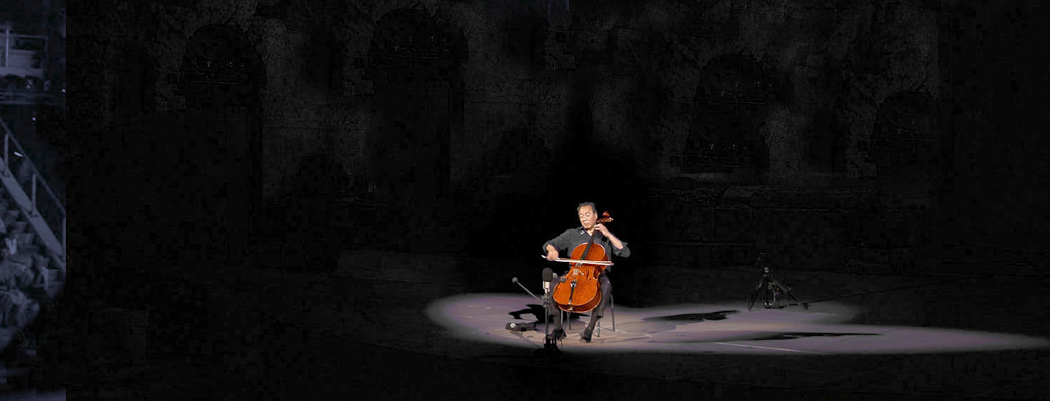
That has happened each time I’ve heard Yo-Yo Ma play the Bach cello suites. I’ve heard him several times, including doing all six in a single concert. 

“Ma concluded with the sixth suite, as intense as an Aeschylan tragedy, with climaxes at the slow allemande and the even slower, deeper, more intense sarabande. Blood almost ceased moving in my veins and only started pulsing once more with the gavotte that followed, as the relief from tragedy, and a reawakening to the life of the body.

“This kind of music is why we listen to classical music: It isn’t enjoyment we are after but solace, reflection, a reconnection with the more important parts of ourselves. It brings us to the place where the deepest thought and the most profound emotion cannot be told apart; they are the same thing. It is proof that art is not merely entertainment, but food for our deepest hunger.”

There are many more such moments over the years, but I can’t mention them all. This is already too long. But, my life has been nurtured by such moments and experiences. They have made me who I am. 

Loon

Who is America’s greatest painter?

There are many who could be named, from Eakins to Homer to Whistler to Pollock, but the name I would like to place in nomination is John James Audubon.

That comes as a surprise to me as well. I once knew him, as most Americans do, as the author of a book of overly familiar colored engravings of birds.

But the original watercolor paintings reveal him to be a soul of great emotional power, even moral force. An exhibition of many of them is currently on view at the New York Historical Society, through May 19, and changing shows continue through 2015, until all of the 474 originals for his book have been displayed. (A stunning book, “Audubon’s Aviary,” is also available through the NYHS or Amazon).

Audubon — America’s most famous Haitian immigrant — was born there in 1785 as the illegitimate son of a French merchant and slave trader. He moved to France with his father when he was 5, and to the United States when he was 18.

He went through a series of disastrous business ventures, making and losing several fortunes and wound up, at 35, as a part-time taxidermist and portrait painter.

It was then he conceived a plan to publish a book about American birds with his paintings as illustrations. Audubon had been a nature lover since boyhood and had often drawn the birds he loved. It came to him that these drawings could be supplemented to illustrate all the bird species then known in America. It was an ambitious plan.

John_James_Audubon_1826

Too ambitious

Too ambitious, as it turned out, to interest any American publisher, so he wound up in England, where he found Robert Havell Jr., an engraver with the perfect talent match for Audubon’s drawings.

The book they published in installments over a dozen years beginning in 1827 was the ”double-elephant edition,” named after the page size: 29 1/2 by 39 1/2 inches, with engravings by Havell made from the paintings of Audubon and hand-colored by apprentices.

They sold by subscription for $1,000, an astronomical sum in those days. It is hard to compare dollars over centuries, but at the time, the average laborer made the proverbial dollar a day, so it would not be out of line to say they sold for the equivalent of about $30,000.

In Dec., 2010, a complete first edition of “The Birds of America” sold at Sotheby’s in London for $11.5 million — a record for the most expensive printed book ever sold at auction.

Over three decades, Audubon tracked down, studied, shot, drew and painted more than 400 of the country’s bird species, with the paintings turned into a book that would document them for the first time, and eventually make its author’s name synonymous with nature and conservation.

And he did so with a commitment so intense that he became one with his subject. In some sense, every bird he painted is a self-portrait.

More than anything else, it is for this reason they rise above documentary art to become among the greatest art ever made by an American.

But it was the book Audubon meant us to see, not the watercolors. They were painted only as studies for the engravings that illustrate the book.

And so, Audubon felt comfortable doing things he would never do for a display picture. He mixed media like crazy, using ink, watercolor, gouache, pencil, even collaging birds scissored from earlier drawings.

He used each of these techniques to particular expressive ends that could not always survive the engraving transformation. In the case of the Magnificent Frigatebird, for instance, he used the sheen of his graphite pencil over the top of watercolor to imitate the iridescent effect of the bird’s plumage.

Magnificent Frigatebird

Magnificent Frigatebird

Still, the very first thing that wallops you as you enter the Audubon show at the Art Institute is the monumental size of the paintings.

Everybody knows what Audubon’s bird pictures look like, or at least they think they do. But seeing poor reproductions in books will not prepare you for the real thing.

What we are used to seeing are small reproductions of large engravings that are themselves reproductions of Audubon’s original paintings. Each painting is about 2 by 3 feet. Poster size, not postage-stamp size.

In that giant space, Audubon places all his birds. It was his intention to paint every bird life-size, whether hummingbird or eagle.

It meant that very large birds, such as flamingoes or condors, had to be contorted to fit into the space.

Total involvement

Yet it isn’t mere exigency that causes Audubon’s animals to be so animated. More than anything else, it is his total body identification. He is one of the world’s most haptic artists.

Over and over, you sense that Audubon felt his own muscles and sinews moving in sympathy with the birds he drew.

Time after time, you can see the intense life reflected in the eyes of his birds. They are never mere circles, but always pools of living awareness.

One of his secrets may be that he remained always a child in his direct response to nature.

”Every child is an artist,” Picasso said. ”The problem is how to remain an artist once he grows up.”

It was a problem Audubon solved.

Look at his poses. The competency of the drawing is a different level from a child’s but the poses are straight out of first or second grade. The animal is always moving and live.

Naturalists have always carped that the Audubon bird prints are not as realistic as those of Louis Agassiz Fuertes or Roger Tory Peterson. They cavil that Audubon poses his birds in exaggerated positions that are unnatural for the real bird when alive.

But these people are not letting Audubon be Audubon. While it is true that he was on some level making identification pictures, it isn’t that level that rises to greatness. It isn’t as a field guide he is to be judged.

Audubon watched his birds with the minute carefulness of a mother bird, and recognized in every bird action an analogous human emotion. He then projected the human back into his avian. Like the leader strike of lightning that makes a path for the great burst of electricity back in the opposite direction.

A human element

Audubon’s birds function metaphorically as symbols of human affective states.

Fuertes is more useful scientifically precisely because he treats his birds as an ”it.” Audubon treats them as a ”thou.”

Detail, Chuck-Will's Widow

Detail, Chuck-Will’s Widow

You can see it in his Chuck-Will’s-Widow with its giant gaping mouth, the essence of appetite. In the uxorial affection of his Passenger Pigeons, which almost seem to kiss as the one feeds the other. In his nesting Barn Swallows, where the one shields the other with his upraised wing.

Ultimately, Audubon’s paintings are not about birds, but about human beings. Where Bach or Beethoven uses a series of notes to convey a human emotion, Audubon used a picture of a bird. And more than anything, it was that Audubon felt the importance of paying attention.

It isn’t that his paintings are so detailed, but that he paid attention to that detail with an urgency that approached love.

”To be awake is to be alive,” wrote Henry Thoreau. ”I have never yet met a man who was quite awake. How could I have looked him in the face?”

But to see the preliminary studies Audubon made for his “Birds of North America” is to see the work of a man wide awake and with his abilities at full throttle.