
In 1991, actress Demi Moore posed for a famous Vanity Fair cover photograph, taken by celebrity photographer Annie Leibovitz. It exploded as a “meme,” and was copied many more times.
Soon, it became impossible for an aspiring starlet not to be seen naked and gravid on the cover of one magazine or other.
Leibovitz herself seemed to feel “ripped off” and sued when an ad featuring Leslie Nielsen used the pose to sell the film, Naked Gun 33 ⅓: The Final Insult.
The courts didn’t agree with her, and anyway, we had moved on to other memes, including dancing cats on You Tube. The courts could hardly have decided otherwise, not only on the basis of fair use for parody, but because borrowing poses has been an essential tool in artists’ kit for millennia.
As Picasso didn’t actually say, “Good artists borrow; great artists steal.” Actually, that quote has been attributed not only to Picasso, but to T.S. Eliot and Igor Stravinsky, but goes back at least to 1897, when a variant version was used by critic W.H. Davenport Adams. Even quotes get borrowed or “stolen.”
L-R: Venus de Milo; Eva Green in The Dreamers (2003).
The examples are legion. My interest came to me through the paintings of Manet, Titian and Giorgione.
First let’s look at a few examples.
One of the most familiar is the pose of the “Three Graces.” It shows up in many forms in antiquity.
L-R: mural from Pompeii; statue in the Louvre; mosaic from Anatolia.
It was used by many Old Master painters.
L-R: Raphael; Rubens; Pontormo.
And even later.
L-R: Edward Burne-Jones; Henri Regnault; Leonard Nimoy.
You could find dozens of others.
Adam and Eve became such a meme, too. One version has Adam with his arms around Eve. It became used for other things, too.
L-R: Jan Gossaert, 1520; Gossaert, Neptune and Amphytrion, 1517; Two Virgins album, 1968.
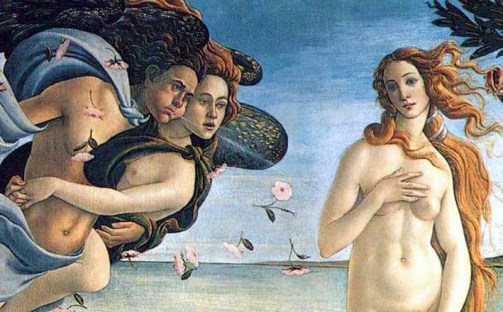
Or take the famous Botticelli painting, Birth of Venus. The pose, with the goddesses hands vaguely protecting her modesty, and you find it all over Classical art and Renaissance painting, to say nothing about one of the oldest figures in Western art.
Or even Playboy magazine, which — probably not on purpose — imitates some other, more famous images.
Top: Playboy; Gauguin. Bottom: Boucher; Modigliani
But the main course:
 Edouard Manet created a scandal in the 1865 Paris salon when he exhibited his Olympia, a nude featuring the model Victorine Louise Meurent dressed up — or rather undressed — as a prostitute. She wasn’t, by the way, and later became a painter herself. Here is what she really looked like in 1865.
Her pose in the painting is an obvious quote of two famous paintings of the past, Titian’s Venus of Urbino from 1538,
and Giorgione’s Sleeping Venus, from 1510 (and probably finished by Titian, after Giorgione’s death).
The salient points of the pose are the recumbent nude woman, with her calves crossed.
This is a pose that even Giorgione can take no credit for. It goes back to antiquity. Here she is from Pompeii
The full meme version is the Titian painting, with these other points that get “borrowed” over and over, including in the Manet version.
 Notice that the space of the painting is divided in half, near and far, and that there is a distinct vertical line that, in this case points downward directly to the model’s pudenda, which is caressed by the curling fingers of her left hand. This gesture is highly ambiguous: Is she really masturbating? Can a great master really have meant that to be our take-away?
In the Manet, the similar gesture is more assertive: Olympia uses her hand as a kind of gate to paradise for which she and she alone holds the key. You won’t get past that hand unless she gives permission.
There is also an animal in the picture, other subordinate people.
These elements are used over and over, not least of all by Titian himself, who used the pose, or variants in several paintings.
Jupiter and Antiope from 1535.
Venus and Cupid from 1550.Venus,
Cupid and the Organist, from 1548.
 And then, more lasciviously, in the variant, Venus, Organist and Little Dog, from 1550, in which the so-called “male gaze” is fairly explicit, even comical.
But Titian is not the only artist obsessed with this pose. Lucas Cranach the Elder (1472-1553) painted nearly a dozen versions between 1515 and 1550, which he usually titled Nymph at the Fountain. Here are four of them.
She can’t quite figure out just what to do with that left hand.
Through so many of these paintings, note the presence of animals, the near-far background, the frequent strong vertical line bisecting the picture, and the frequent use of drapery behind the woman’s head.
Not all these paintings have all the components of the Ur-painting of Urbino, but each has some of the components.
Here’s a 1639 painting by Guido Reni, with the crossed legs, the drapery, the near-far and if there are no animals, well, Cupid at least has wings.
A 1540 painting by Paris Bordone, called Sleeping Venus
From 1523, a Sleeping Venus from Girolamo da Trevesi
From 1520 and Palma Vecchio
Even in the north, from Maarten von Heemskerk, in 1545
And Jan Massys painted her as Flora in 1514
While most of these come from the 16th century, the pose streches beyond, including this 1844 Nude Girl on Panther Skin by Felix Trutat
Lord Frederic Leighton painted Cymon and Iphegenia in 1884, with the pose, but with Iphigenia modestly covered in drapery
He also did the nude version, Actaea Nymph on the Shore, in 1854.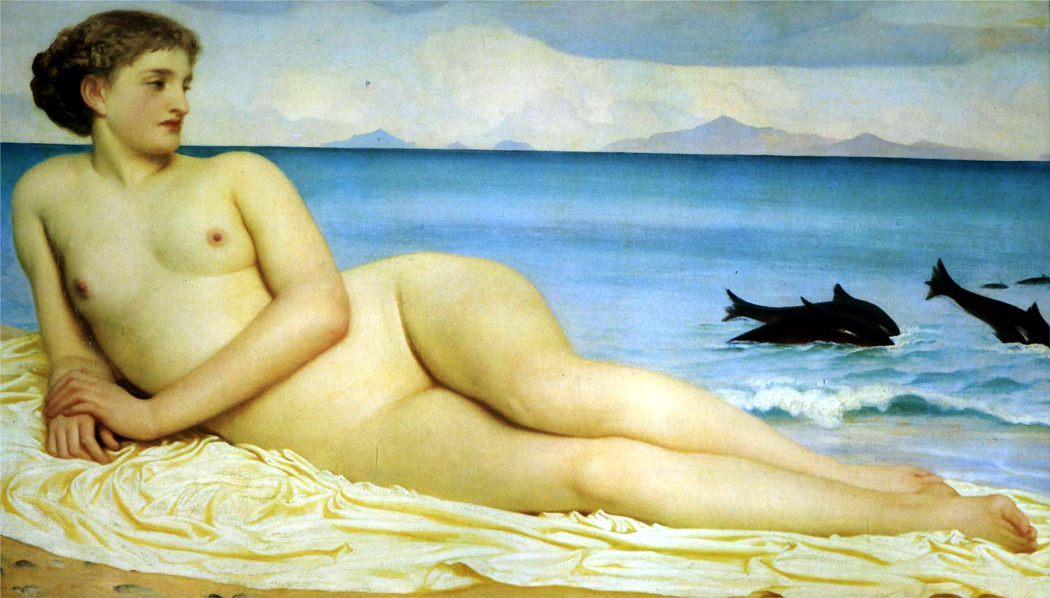
And Paul Gauguin’s Noble Woman from 1896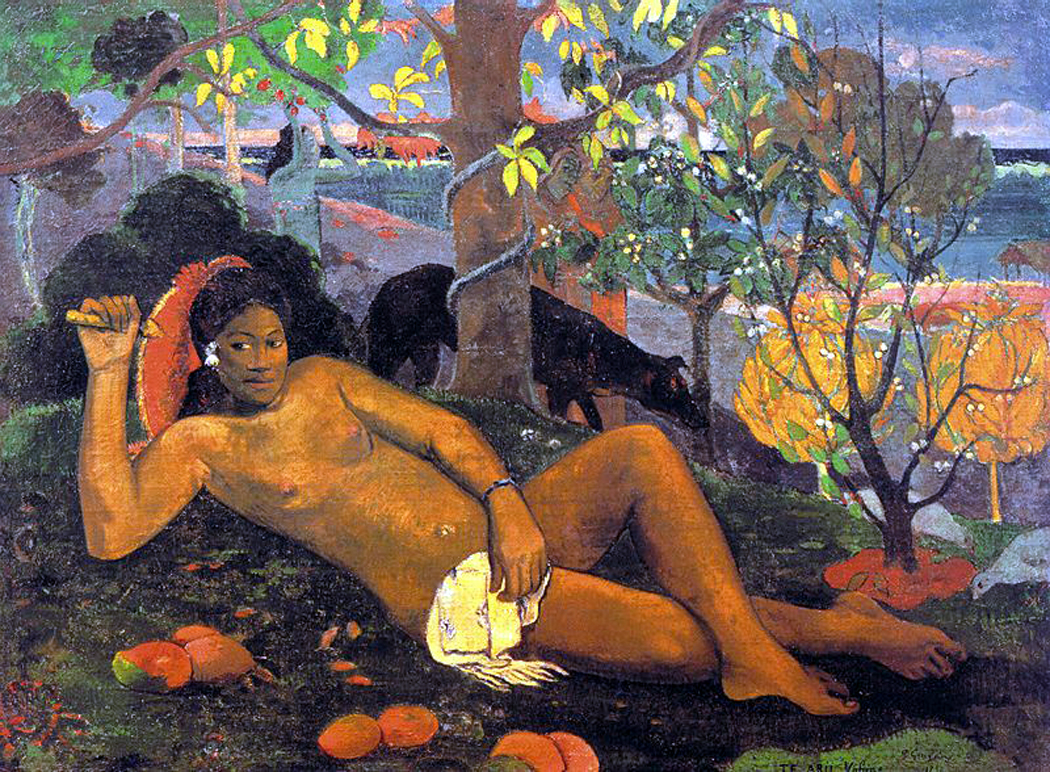
There are many more. A pile of them are mirror images, with the nude on the right side of the painting.
Giulio Cesare Procaccini painted Venus and Cupids in 1625
Palma Giovane in 1610 did Venus and Cupid at Vulcan’s Forge
Lorenzo Lotto’s 1540 Venus and Cupid gets kinky
Allesandro Allori’s Venus and Cupid from 1586
Sebastiano Ricci’s Venus and Satyr from 1720
I think you can even make a case for Piero di Cosimo’s Venus and Mars from 1490. Although, here it is Mars with the crossed legs. Still, animals.
This is just a skim across the surface. I’m sure you can find many more examples of the reclining nude, legs crossed, with animals or cupids, with figures in the background and a wandering hand.
I’ll leave you with only three more:
Pablo Picasso’s parody, Olympia, from 1901
and Claes Oldenburg’s Pat, Lying as Olympia from 1959
And finally, E.J. Bellocq’s Storyville prostitute from New Orleans in ca. 1912
This meme gets around.
 Richard Nilsen