Archive

Tag Archives: cape hatteras

We were camping at Huntington Beach in South Carolina, and I woke up before dawn and walked down to the ocean. The sky was beginning to brighten to the east and I watched for the coming sunrise. 

When the sun broke the horizon, its motion was noticeable and I watched it slowly lift from the water. But then, something happened: The sun stopped dead in its tracks and my frame of reference shifted involuntarily and instead of the sun moving up, the earth I was standing on jerked forward, as if I were coming over the top of a ferris wheel and I nearly lost my balance. It seemed the ground was moving away from under my feet, toward the immobile sun. 

At the same time, seawaves reflected the bright copper sheen and the shadowed portions of the water formed a network of glossy black, making the entire landscape before me into a shimmering enameled lattice and more, it seemed not so much to reflect the sun, but rather to be glowing from within. 

The magic lasted only a few moments and the earth stood still again and the sun began climbing once more. I felt that I had been given a chance to see how things really were — a stationary sun and a rotating earth — and the whole, with its copper and black waves, was unutterably beautiful.

Such visions are epiphanies. 

Of course, “Epiphany” means different things. In the Roman church, it is the name for the visitation of the wise men; in the Orthodox churches, it marks the baptism of Jesus and the descent of the dove; according to some early Church fathers, it marks the miracle at the wedding feast at Cana; and for Syriac Christians, it celebrates the rising light of dawn, as expressed in Luke 1:78. In all these versions, it refers to the recognition of divinity as it shines forth. 

But I take the word for its otherwise secular meanings. It is a sudden recognition of reality, or the momentary transformation of the ordinary into something strange, or the psychological state of overlaying the personal in registration with the objective world, the way you might orient a map to match the landscape in front of you. Then the two meld into a single thing. In any version, you experience a moment out of time. 

It is the word James Joyce used when referring to such experiences, usually something quite ordinary, but seen in a new, illuminating way. A theophany with no theos

In his early novel, Stephen Hero, he defined these epiphanies as “a sudden spiritual manifestation, whether in the vulgarity of speech or of gesture or in a memorable phase of the mind itself.” And he “believed that it was for the man of letters to record these epiphanies with extreme care, seeing that they themselves are the most delicate and evanescent of moments.” 

In an early manuscript, Joyce collected 22 pages of these moments he found in his own life, and used many of them later in his finished works. At one point, there were at least 71 epiphanies written down in Joyce’s own handwriting. 

Later in his career, the term grew in meaning and significance, and tends to mean moments of behavior observed or experienced that seem to metaphorically summarize some insight or contain “meaning” in some way or other. 

In ordinary usage, “meaning” is a term of translation: “This means that,” but it has another purpose: significance. An experiences doesn’t have to “mean” something that we can express in paraphrase, or take as a lesson we have learned, but can have meaning, unexplainable except in terms of itself, as when a dream feels meaningful even if you don’t know why. 

I believe we all have such moments. They tend to stick with us. I know I have had them throughout my life. The first one I can remember was at the age of four or five and driving with my family along the Palisades at night, looking across the Hudson River at the constellation of lights in the darkened Manhattan buildings. It was my first remembered experience of something I would call beauty. I couldn’t wait for the next time we visited my grandparents so I could see those lights again. 

Often we function as actors in a stage set, with the world as backdrop. Our focus is on the particular action or conversation, with the set merely happenstance; it could easily be some other set. But the epiphany is when you step back and see actor, set, words, as a single unit, all of a piece. We can live our lives barely noticing the world we walk through, except as it helps or hinders us — it is functional. But that moment comes when the boundary between us and the rest of it all evaporates and we sense ourselves as part of a whole. That instant is the epiphany and for it, time stops, even as the clock keeps moving. It is an uncanny feeling.

It feels as if you are taken out of the real world for a moment, but actually, you are dropped into it. The illusion of separateness is dispelled and you become face to face with something bigger. 

When I was about 10, my younger brother, Craig, and I thought to follow the brook that ran through our property in New Jersey, through the woods behind the house, to see where it went. It ended as it fed into the Hackensack River. We then followed the river to the Oradell Reservoir and followed the railroad tracks. We were crossing a little bridge when a train arrived and we ducked under the bridge, sitting on the concrete abutment  not more than a couple of feet from the screaming wheels of the train as it passed over. Time may have stopped, but the train didn’t. It was thrilling. It was untameably real. 

In high school, I spent one summer vacation in Europe, crossing over the Atlantic on a steamship. After days of faceless unchanging ocean horizon, one  night came when on deck I looked out and saw pinpricks of light in the darkness, maybe 8 or ten miles away. It was the Orkney Islands and I was dumbstruck at their remoteness. They were ghostly lights strung out along the horizon in a seemingly infinite blackness. They seemed unmoored to this now. 
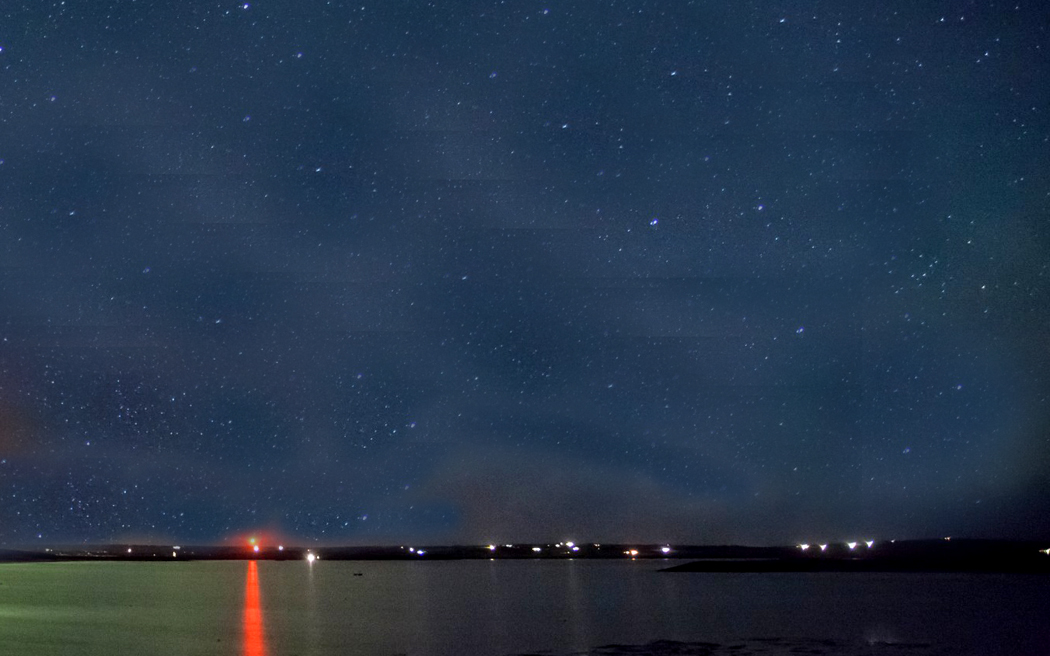
There is often sense of the uncanny, of something we don’t quite see, but feel it is there. 

On night, I was driving up the Big Sur, between San Luis Obispo and Monterey. With the sun finally below the horizon, it was completely black, but with grades of black showing in front of me. The blackest black is rock, rising in cliffs to the right side of the road. The glossiest black was the ocean on the left below. As I whipped along the road with my up-beams gleaming back at me from the reflectors on the road stripe, I could occasionally see a flash of light in the corner of my eye. When I looked, there is nothing, but when I turned back to the road, it flashed again. But there seemed to be something riding beside my car. I called it the “God of the Nighttime Highway.” 

It turned out to be my own running lights reflecting off the guard rail at the edge of the road. But for 10 minutes or so, until I figured it out, the experience was eerie and I almost believed in a spirit world that I don’t believe in. 

I imagine it must be episodes like this that gave rise to the myths and folklores of the ancients. The experience feels so real, it must be real. 
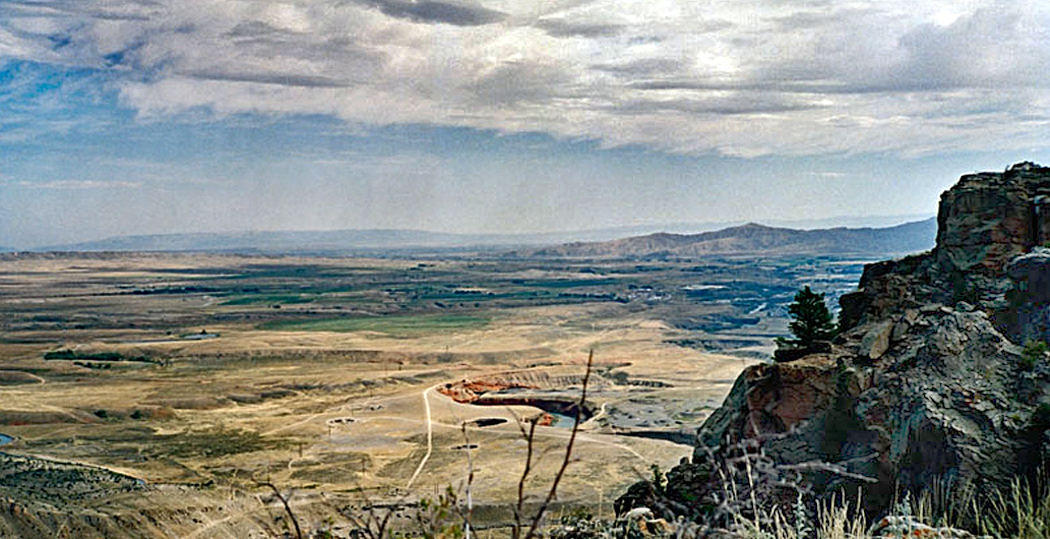
And these epiphanies are not especially rare. I’ve had many in my life. My wife and I had left Yellowstone National Park early on a gray, rainy day, driving eastward on the North Fork Highway through Wyoming’s Shoshone Canyon. At the canyon’s mouth the land broadened out and dipped down into vast plains with the Buffalo Bill Reservoir in the distance. We had just turned on the radio and the skies suddenly parted and the scene before us was drenched in sunlight just as the radio began pouring out the early morning sign-on music of “America the Beautiful,” and the Mormon Tabernacle Choir sang, “Oh beautiful for spacious skies and amber waves of grain…” And there it was, before us, just as in the song, and we had to laugh, but also we had to recognize the emotional power of what we were seeing. 

Once, camping at the Outer Banks with my friend Sandro, we walked along the beach at Hatteras Point at night, carrying a Coleman lantern. The air was so humid that it was on the edge of becoming fog. And the light we carried threw our shadows up into the sky, among the stars, and we could see we were giants. 
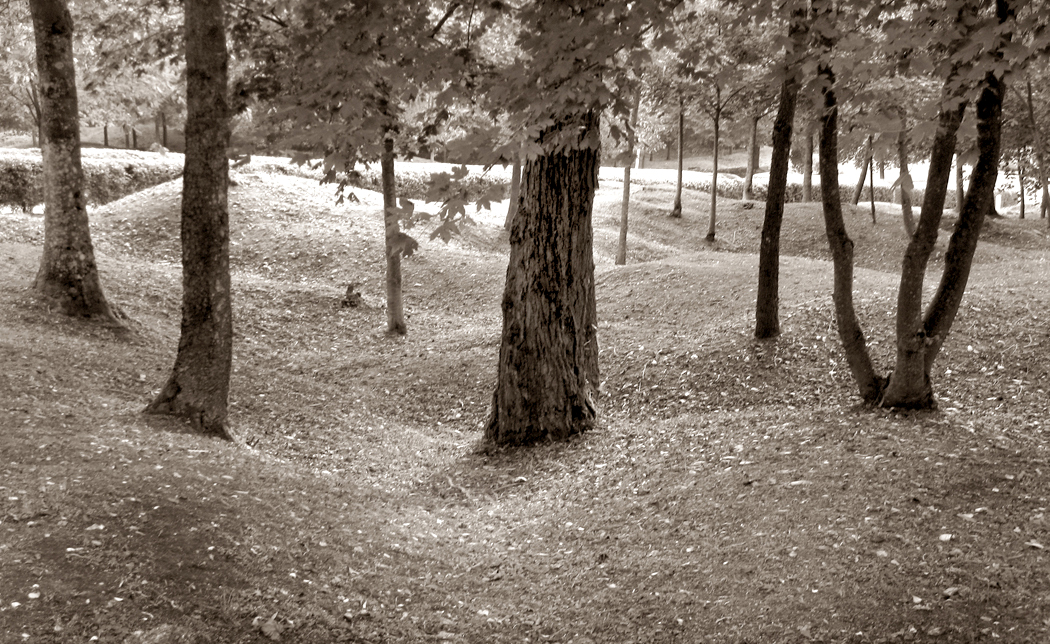
Or, visiting Verdun in France, my wife and I drove through the old World War I battlefields that had been blasted into moonscape by artillery fire, but now had grown back into woodlands. But there, between the tree trunks, the shell craters were still there, pock-marking the ground nearly a hundred years later. 

I’ve had that strange recognition many times when visiting old battle sites — as if the past is always present. I’ve had it at Antietam, at the Little Bighorn, at Shiloh, at the Normandy beaches, at Wounded Knee, at Appomattox. The epiphany that breaks through isn’t just history as you read it in books, but rather the persistence of events: that what once happened is still happening; wave ripples running out through time. 

I once spent the night alone on the North Rim of the Grand Canyon in Arizona. My campsite was a good 30 miles from any other human being and the sky was darker than any I had seen before or since and the stars were spilled like beach sand across the expanse, with the Milky Way splitting the dome in two. About 3 in the morning, I woke up, left the tent and sat on the hood of my car, staring up at the infinity. I stared for maybe 20 minutes or a half hour, and a kind of hypnosis took over and I no longer felt like I was on my back staring up, but rather as if I were at the forward point of a planet racing through infinite space toward those stars. The planet was at my back, and I could almost feel the wind on my face as this planetary vehicle was racing forward toward the lights. 
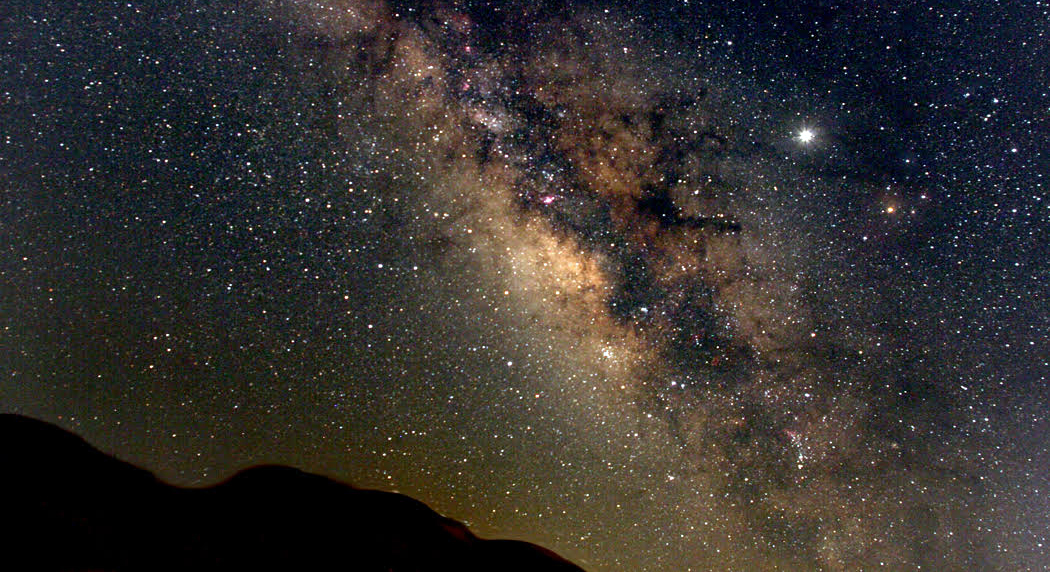
And, of course, this is exactly what was happening. The ordinary sense of terra firma under a wide sky is the illusion. The recognition of a giant ball of earth and water raging through an infinite void is the reality. Sometimes we see it that way. 

And that is the epiphany. 

van gogh

I am sitting in my car in the parking garage of the local mall, waiting to chauffeur my granddaughter home after a shift at the food court. It’s one of the perks of being a grandfather; we get to talk on the ride. But I have been  misinformed and I’m an hour early. No problem, I sit back in the shade of the parking garage and pop in a CD of Strauss’s Four Last Songs, the heartbreaking beauty of which always leaves me weeping.

Outside, in the sun, the breeze blows the branches and leaves of a tree in eccentric and seemingly random arcs. A whole tree doesn’t blow this way or that, but becomes a symphony of animated parts, very like a dancer. Behind the tree, in the distant sky, brilliant white thunderheads rise against the blue; they are the source of the fresh breeze that moves my tree.

It is a moment of epiphany — a pulling back of the veil. It is one of those instant recognitions of intense beauty, the kind that makes your insides swell and overflow through your eyes. It is the thing about such moments that dozens of shoppers coming out of the mall and finding their cars can see the same thing and not be overwhelmed because seeing the beauty requires being ripe for its discovery. It is available there for anyone to see, but most of the audience — like me most of the time — are preoccupied and so the moment escapes and they are robbed of one of those times that transfigures the mere act of living and gives one a reason to be grateful.milky way 1

At such times, it is occasionally possible to be misled into believing that the world is truly a beautiful place and that we just don’t take the time to notice. The beauty is overwhelming in its persuasion. I’m not talking here about pretty scenery or colorful flowers, but about a metaphysical insight into the animating spirit of the cosmos. It is the sense one gets if you find yourself in an unpopulated region of the planet and can see at night the bright gash across the sky that we call the Milky Way. You sense something bigger, transcendent, sublime. It is both profoundly beautiful and also more than a bit scary.

One has a memory trove of such moments — and they almost all come in brief flashes; I’m not sure how we could stand it for any length of time. I felt it one dawn at the beach in South Carolina, staring east at the twilight getting brighter. At the moment the sun popped the horizon, when its movement against the stationary line dividing ocean and sky becomes apparent, like a second hand instead of a minute hand on a clock, I got dizzy, almost lost my balance on the sand, because instead of seeing the sun rise above the horizon, I felt as if I were at the top of a planetary ferris wheel, jerked forward toward the sun; I was moving, not the sun. The light played on the waves, dividing the lit from the shadowed water in a shifting network of obsidian black and glowing copper. The effect lasted only a few seconds before the quotidian world reasserted itself into a familiar sunrise, but the memory of that instant is burned into my mind with a fury and insistence that informs now every sunrise, even when I no longer lose my balance.

Arch Cape

Many years ago, I went to the Pacific Ocean with a woman I was crazy about. We rented a cottage on the Oregon coast and after a night of playing geography on her body and memorizing it (so that I knew every swell and bulge, every mole and wrinkle on it), when the morning came, we stayed in bed until our consciences ached. We smelled of each other and reveled in it, our muscles were sore. When Robin finally got up, she said, “I’m going to make breakfast this morning.” I stayed in bed with my head propped up on a pillow and I watched her silently going about her business. The world had stopped turning; the fury of machinery, trucking, commerce and struggle had ceased. Robin opened the curtains and the light poured in, but she was herself lit solely from within.saskia

She was more than just Robin at that time — she was transfigured in the light and seemed almost to glow. It was just a beam of sunlight that struck through the window, but the light seemed to come instead from some internal tungsten filament. She became all women. She was Ruth and Naomi, Eve and Rembrandt’s Saskia. She was not performing some minor task, but had hooked into the flow of the world and was living, glowing myth. Pure Archetype.

In a white blouse and black pleated trousers, she began fixing breakfast in a slow, methodical fashion and everything she did was the mimicking of thousands of years of daily living. She slowly cut off a piece of butter and placed it in the sizzling pan; she sliced the onion and cheese and with her arms holding the bowl on her hip close to her belly, she beat the eggs and prepared to dump them in the pan. The light was uncanny and I nearly cried for the beauty of that morning, the quiet intensity of her motions. All I know is that for 15 minutes Robin ceased being Robin and became everyone who ever prepared breakfast.

That moment couldn’t last, and neither could that relationship. Things beyond my ken were involved. They usually are.

P02969 001In the late 1960s I went camping at Cape Hatteras with my college buddy, Alexander. It was March, before the tourist season and the beach was empty and the wind was cold and brisk. One night we went out toward the cape point. The only light we had was our Coleman lantern and near the point the surf sounded from both sides. The air was thick with moisture and the lamp cast our shadows up into the sky where our heads touched the constellations. Our forms cast out on the cosmos and looked rather like the Colossus of Goya’s late “Black Paintings.” And I recalled the phrase from the Magnificat — “quia fecit mihi magna,” — and I felt magnified.

There are many instances of such epiphanies, although each will be personal to us, unshared in particulars, but common in outline. I have the climb up Mount Angeles in the Olympic Mountains of Washington to the lake with a pure John Martin waterfall on the opposite shore. There is the moment that slammed me in Port Jervis, at the joint of New York, New Jersey and Pennsylvania, when I saw a vacant lot by the railroad roundhouse that was blasted with fall wildflowers — ironweed, asters, yarrow, goldenrod, queen-anne’s lace, joe pye weed, mullein, cow itch — it was one of the most beautiful things I have ever seen and even now I prefer weeds to domesticated gardens.

Buchenwald

Buchenwald

But I said such epiphanies can mislead us. For the religious or the sentimental, such moments speak of a beautiful cosmos. But these epiphanies can carry the opposite. When I was still a boy — probably five or six years old and it was just a few years after World War II — films from the liberated concentration camps were shown on television. I don’t know whether they were George Stevens’ films from Dachau or Army films from Buchenwald or Bergen-Belsen. But these films burned into even my childhood imagination, those spectres, those skeletons, those harrowed, sunken cheeks, those piles of skeletons wrapped in sacks of their own withered leathery skin. Soldiers picked up the stiffened bony puppets and tossed them into the backs of trucks. This too is ephiphany, the drawing back of the veil.

Aleppo, 2016

Aleppo, 2016

I see something of the same in the eyes of Syrian refugees, I see revenants of postwar Berlin in the bombed out walls of Aleppo. There is beauty in the world, but there is also horror. Ugliness to balance that transcendence, evil to mock the elation.

One thinks of all the genocides, mass murders, atrocities and pogroms of history, the cities razed to the ground with all their populace put to the sword, of all the gulags, all the dead Cathars, Tutsis and Hutus, all those drowned in the cataclysms of swollen rivers, ravaging earthquakes, the decimation of populations through plague, the millions lost to bizarre insect-born diseases. As soon as you find yourself Panglossing over the glory of a sunrise, you catch yourself short remembering Cain and Abel and the real meaning of the brotherhood of man.

One could make a list of those moments of disillusionment and disaffection. Such a list is a weight around the neck of any afflating joy. One recognizes the moment when you realize someone you have loved no longer loves back, when one is betrayed at work or by a friend, when you see the ravages of illness in those you care most deeply for. The world is not an easy place to love. Suffering is universal; even the rich lose their loved ones.

The truth is that we seldom live in the joy or the pain, but rather spend our days in utter banality. Banality is our salvation: If we lived in the joy we would go mad; if we lived in the pain, we would also go mad. So, we don’t see the dancing tree and we ignore the drowning refugees so that we can get on with our lives. It can hardly be otherwise. The world would come to a halt if we all lived in the beauty, if we all bore the suffering.

grunewald

pieta 1Yet, we cannot ignore our epiphanies, either. They sneak up on us, and for a brisk instant we glimpse eternity and its glorious, horrible uncaring. We recognize our place in this swirling inhuman chaos, both ecstatic and virulent. We ask our artists to memorialize both. They can take the two and bind them together, such as the exquisite beauty of Grunewald’s painting of the torture and gruesome death of a man on the rack of a crucifixion, or the sorrow of a mother grieving over the death of her son.

Certainly not all art addresses this special issue, but a surprising amount of our art, whether painting, sculpture, music or poetry, attempts to remind us of the forgotten intensity of existence, whether on the side of ecstasy or on the side of suffering. Even so simple as a watercolor of a vase of flowers hints at this.

If it is banality that saves us from madness, it is art that saves us from banality.

Sandro at Hatteras copy

Cape Hatteras is a place for pilgrimages.

It is a bit of sand that emerges from the ocean 30 miles out to sea off North Carolina. It is a place where you go to be reminded that you don’t live in an apartment, you don’t live in a city, but rather, you live instead on a planet.Hatteras cape point from lighthouse copy

For years in the late 1960s and early ’70s, my college friend Alexander and I went to Hatteras each February to experience the organ-point surf and a constant 20-knot wind that keeps your lapels flapping and your skin wrung raw. It’s a wind that can part your eyebrows.

Others may visit in the summer, when the ocean is tamed and the wind warmed, but February is the only real time to visit if it is a pilgrimage you are on.

Hattaras is much congested these days, but in 1968, at least in February, you could grab a mile or two of beach all for yourself.

In February, the last nor’easters of the season have blown through and chiseled the dunes into new shapes.

And each February, it seemed, there was a stretch of about a week when winter breaks and the temperature would climb each day to the mid-70s and the sun could warm your chill-chapped face.

It was then that Hatteras gave up its best.NC12, Hatteras Island NC copy

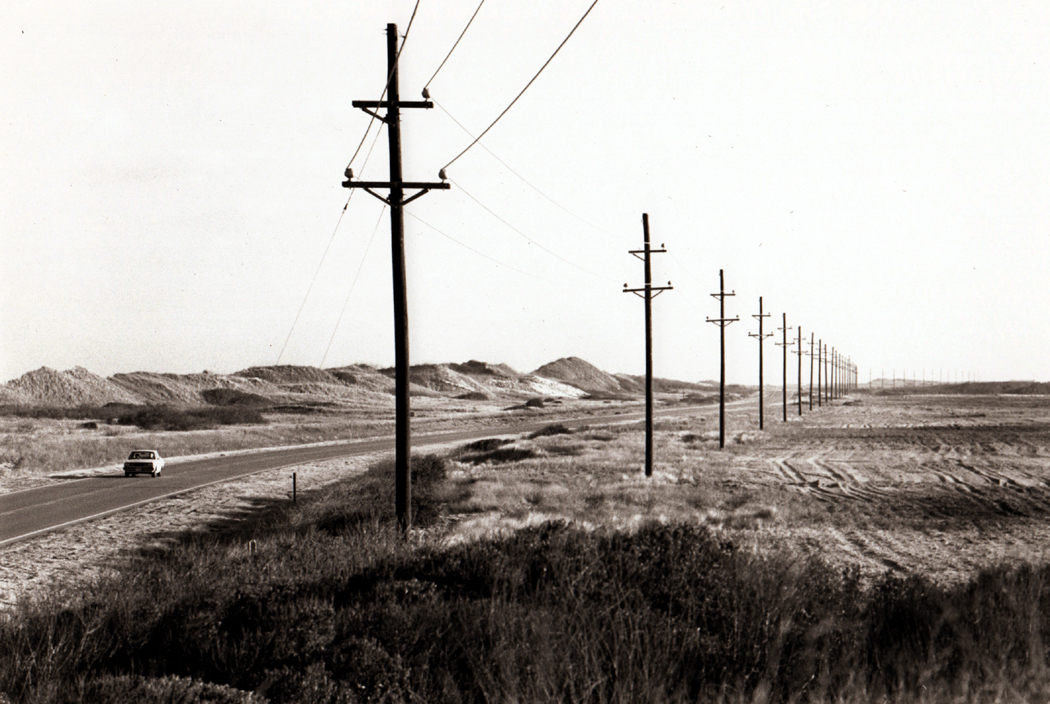
To get there, you take N.C. 12, a two-lane blacktop that runs the length of the Outer Banks like the vein down the back of a shrimp. For the 50 miles from Nag’s Head to the cape, the road runs straight between the Atlantic Ocean on one side and Pamlico Sound on the other.

Sandro and the lighthouse copyThe Banks are a series of barrier islands that begin to tear away from the mainland in Virginia and reach their greatest distance from terra firma at Cape Hatteras, about 100 miles farther south.

At their skinniest, the banks are only a few hundred yards wide, with its single road protected from the stormy Atlantic by only the skimpiest of sand dunes.

And in February, it is not unusual for portions of the road to be flooded or blown over with sand.

After one vicious nor’easter, the road about five miles north of Buxton at the cape was nearly washed away. A vast pool of salt water covered what used to be highway. To make our way through it, Alexander had to take his shoes and socks off and wade through the icy water, feeling for the pavement with his bare feet. I followed in the car, driving at a cautious crawl through water that washed over the top of our hubcaps.

As befits a pilgrimage, we had our rites. We camped in the dunes and drank Alexander’s ceremonial hot chocolate in the mornings. His penitential recipe called for equal parts milk and Hershey’s syrup.

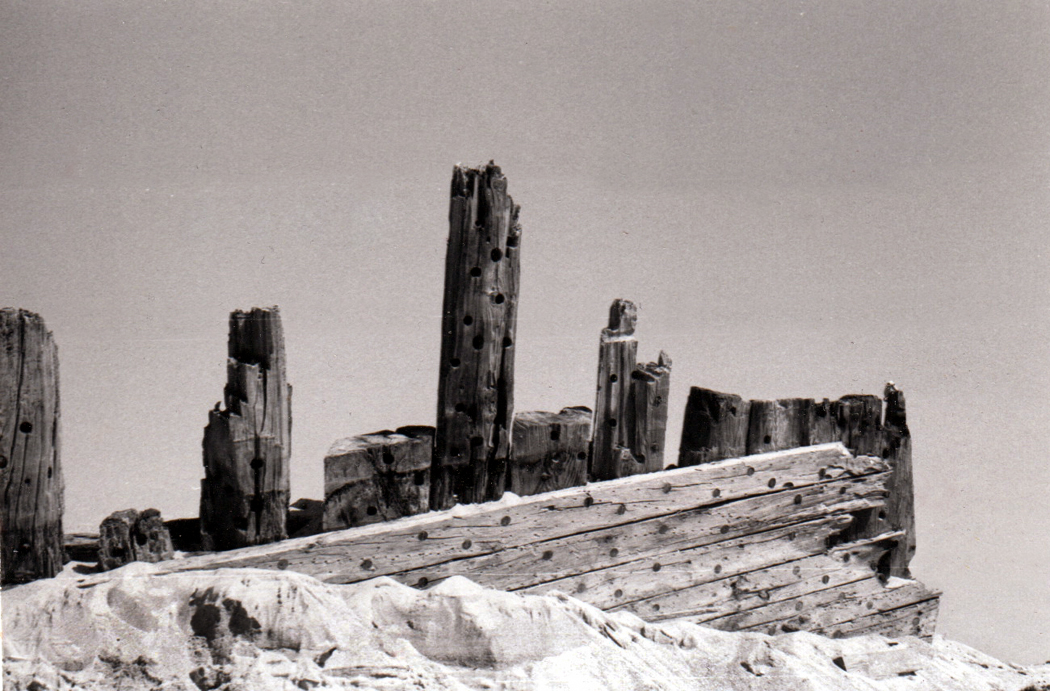
There were the whelks, Scotch bonnets, skate egg cases, dogfish carcasses, the 360-degree aural horizon of surf crash, the snap of the tent’s oily canvas in the wind, the intermittent flash of the lighthouse at night seen from our campsite, the squeak and squawk of the gulls and terns, the beef stew simmering in the black iron pan, the corroded spikes pulled from the wreck of the Laura Barnes — iron pulled and twisted like taffy — the swig of Courvoisier in the morning followed by that tar-thick hot chocolate.

There were those mysterious — to me anyway — channel markers land-locked on the mud flats near the Bodie Island campsite — the surf so far away — that unnamed wreck near the lagoon at the Cape, those Loran towers, the old dune-covered ruins of the former Route 12 near the light house that we walked along one evening and watched the stars through binoculars — the most stars I had ever seen.

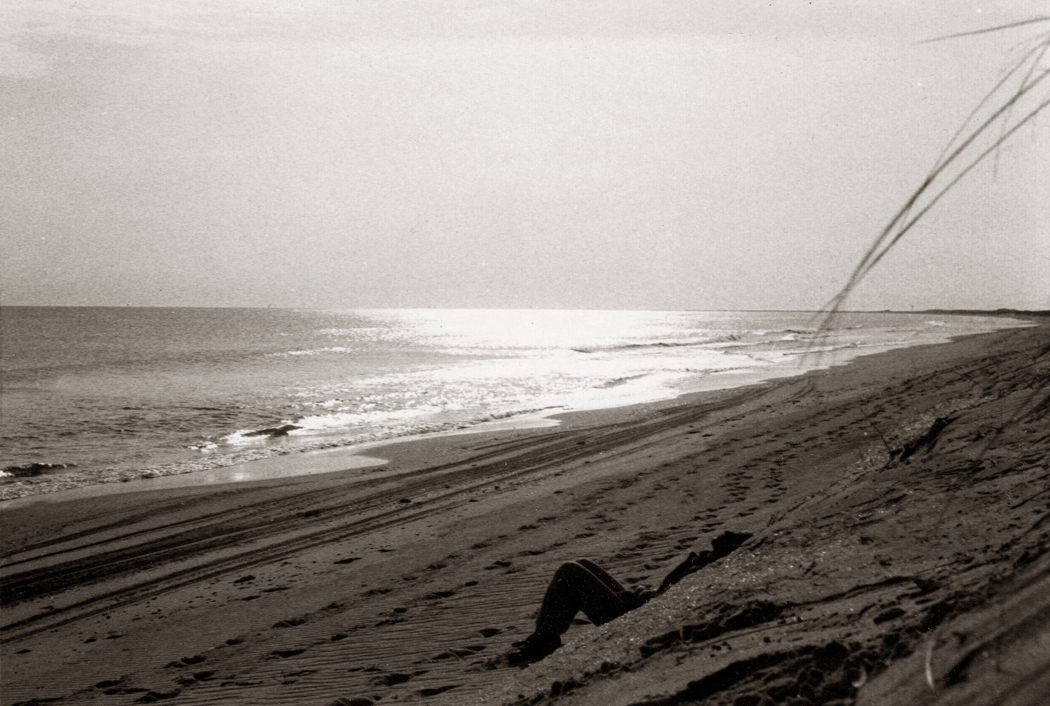
A great deal has been erased and recorded over in my memory, but these items are indelible. I can even see it in these photographs awful as they are.

In all the years we went on this pilgrimage, two episodes stand out.

First, one inky night, we walked past the base of the lighthouse on our way to the beach. For some reason, the door to the lighthouse, which was always locked, was left open. There was no one around, and we didn’t hear anyone in the lighthouse tower when we poked our heads in, so we started climbing the iron spiral stairs.

It is a long way up the tallest lighthouse on the East Coast, and when we got to the top, we opened the door to the balcony that surrounds the lamp and walked out in the wind and watched the light flash over our heads and swing out to sea, where the tiny stars of ships shown on the black horizon.

The other episode occurred as we walked out in the dark toward the cape point, a mile or so from the lighthouse.

At the cape point, the surf crashes around you in all directions. You can lose your bearings quite easily, especially when you are below the dunes and can’t see the lighthouse.shipwreck Hatteras copy 1

The air is thick with the mist of exploded breakers; it collects in your beard and dampens your peacoat.

To make our way, I carried a hissing Coleman lantern that threw our shadows on the sand at our feet. And when we looked up to spy Orion in the sky, we were startled to see two giants walking in the air.

The lantern threw our silhouettes up into the sky, and we walked among the constellations.

In many ways the Outer Banks have become a place in my head — an eternal place in my head where all the adventures are always happening — and have slipped out of place in time.Sandro inside the Okracoke lighthouse copy

Which year did I photograph Alexander inside Okracoke lighthouse?

I want desperately to recapture every detail.

But in another sense, he always in that lighthouse, looking up its whitewashed core.