Archive

Tag Archives: Catcher in the Rye

I have infinite respect for school teachers. My late wife was one. I was one myself, for six years earlier in my career. Teachers work harder and for less pay that pretty much anyone else I can think of. And more than anyone else, the best teachers I had made me what I became in life. 

But. 

There was something about the teachers I had in public schools — grade school and high school — that mystifies me to this day. It was “required reading.” Nothing against the idea of having students read, but the problem was the books they had us read. 

They were “great books,” unquestionably, and among the best of literature in the English language. But what, I ask, what can a 13 year old possibly make out of The Scarlet Letter? It is written in a rather formal  early 19th century style, about a culture long faded in America, and involving minute shades of thought and feeling, with, like an iceberg, more beneath the surface than above. I was required to read it in eighth grade and was bored silly by it, mostly because I could not possibly understand it. 

I remember one of the test questions on the book. “What is the significance of Hester naming her daughter ‘Pearl?’” Uh — I dunno. I was 13 years old and I had a hard time telling the difference between Arthur Dimmesdale and Roger Chillingworth. Perhaps I wasn’t paying close enough attention. Most likely the book was way over my head. Way over the head of any 13 year old. Which is my point. Why was it assigned? 

My teachers wanted to expose me to the best in literature, I’m sure. And Scarlet Letter is certainly a great novel. I’ve read it as an adult and was amazed at how different it was from the same book I read in eighth grade. Deep and true, and subtle. All of which was lost on a boy with not enough life experience to be able to absorb what I was reading. 

For most kids at that age, a novel was its plot. If I could keep the story clear in my head, that was what I took from the book. So, there were a few assigned books that I read and enjoyed. Oddly, one of them was Ben-Hur: A Tale of the Christ, by Lew Wallace. It was assigned in seventh grade, and it was, at the time, the longest book I had ever read. 

It was no doubt assigned because of the 1959 movie, but I had not yet seen the film, and so I never had to compare the book with Charlton Heston. It was fresh to my eyes. 

But it was a story told without excessive subtlety. If I followed the plot, I got out of the book pretty much all that was put into it by its author. I was 12 and at the time, fascinated by history. Lots of that in Ben-Hur.

It should be pointed out that I had nothing against reading books. I read them all the time. I was an avid reader, but pretty much every book I picked up was non-fiction. (I once complained about novels, “Why would I want to read anything that wasn’t true?” Little did I understand.) I read tons of books about World War II. I was obsessed with the war my father had fought in. 

And so, Ben-Hur was right up my alley. A story clearly told and with little hidden between the lines.  

Another great choice for a young person was To Kill a Mockingbird. As a pubescent teen, I was deeply moved by the injustice and the countering righteousness of Atticus Finch. I read it at a time of the Civil Rights Movement in the U.S., and it seemed instantly relevant to my life. The fact that it was told through the eyes of 8-year-old Scout, and the moral issues seemed so clear only made it easier to digest at my tender age. 

The novel is still taught in many schools, and is perhaps the perfect book for required reading, although at the age I was asked to read it, I had no clue as to the the fact that its author also addresses issues of class, courage, compassion, and gender roles in the Deep South.

All the subtleties and complexities in the book were irrelevant to my reading it at the perfect age to encounter it. But then, as Flannery O’Connor said, “It’s interesting that all the folks that are buying it don’t know they’re reading a child’s book. Somebody ought to say what it is.”

In contrast, we also were assigned The Great Gatsby. On the surface, it is not difficult to understand. The language, unlike that in Scarlet Letter, was reasonably modern. But the book relies almost entirely on what is between the lines, which is exactly the part that a 14-year-old cannot perceive. When I first read it, in eighth grade, I thought it was a story about Nick Carroway. After all, he narrates it. This Gatsby guy seemed entirely peripheral and I couldn’t understand why the book had his name on it. And what the heck were those giant eyeglasses about? And that green light? No clue. 

Oh, I followed the plot well enough, I thought. But boy, I had not the first inkling of what the book was actually about. 

And how could I have. One has to have a decent fill of life’s vicissitudes, disappointments, misunderstandings, loves, longings, sex, ulterior motives — to say nothing of complex, multiple motives — before one can take in all that is going on in Fitzgerald’s book. 

Or any book written for grown-ups. We were assigned The Grapes of Wrath, and I enjoyed most of it, but on the test, we were asked why Chapter Three talks about a turtle crossing a highway. A chapter that fits what Steinbeck calls “hooptedoodle.” In Sweet Thursday, a character says, “Sometimes I want a book to break loose with a bunch of hooptedoodle. … Spin up some pretty words maybe or sing a little song with language. That’s nice. But I wish it was set aside so I don’t have to read it. I don’t want hooptedoodle to get mixed up with the story.”

And so, Chapter Three seems to have nothing to do with the story. Or does it? At an age before hair began growing in unfamiliar places, I had no clue. 

Worse, the end of the book just seemed like a vaguely smutty joke to make a teen laugh like Beavis and Butthead. Now, as an adult, it makes me weep. 

There were other books assigned that my yet-vacant mind could not get around: Emma, The Return of the Native, Oliver Twist. Why were such books put into the hands of a boy who had not yet outgrown Cocoa Puffs? 

I could barely make it through Emma, and couldn’t for the life of me understand why such a self-involved cupcake should be worthy of my attention (I said to my utterly self-involved teen self). At that age, irony is an unfathomable concept. No one my age at the time should be forced to read Jane Austen. Way above my pay grade at the time. 
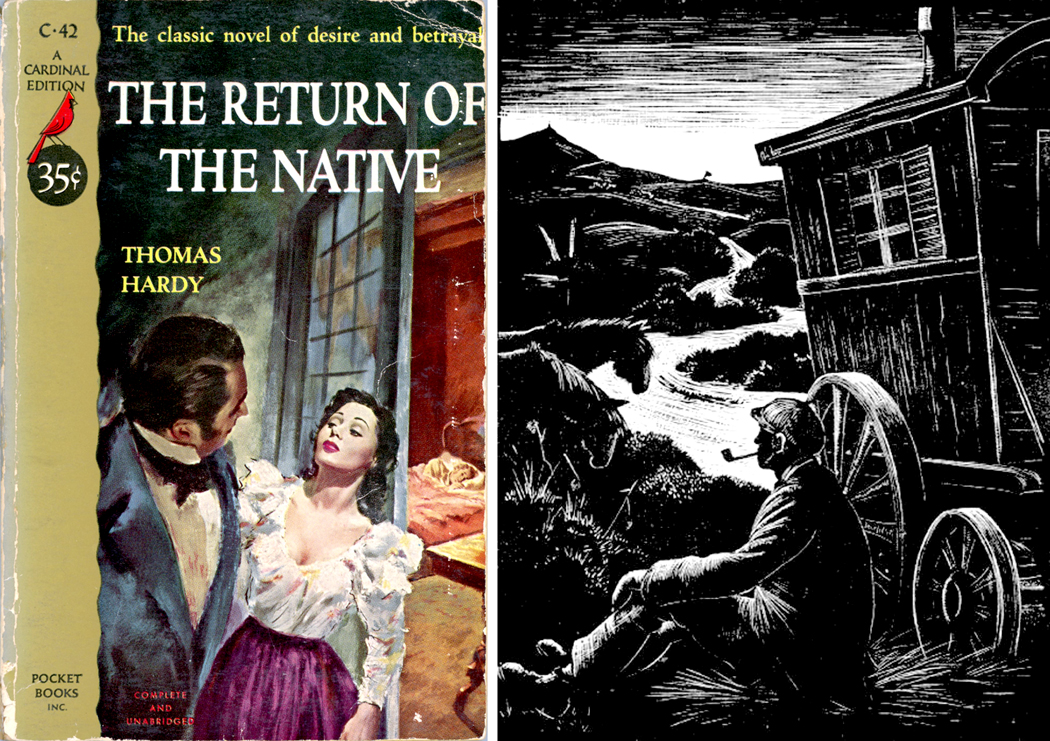
And worse, Thomas Hardy. I had no notion of what a reddleman might be, nor furze, nor a heath. Reading the prose was like chewing dry straw. Why, why, O why was this book handed to a pre-teen American boy, who never cut a wisp of furze in his life? 

Last year, I found a used copy of the paperback book I was given back then, so many decades ago, and I began reading it to see if it was as bad as I remembered it, and surprise: I found some of the most resonant, deeply felt writing I’ve ever read. As twilight settles, on the first page of the book: “Looking upwards, a furze-cutter would have been inclined to continue work; looking down, he would have decided to finish his faggot and go home.” That image rings so instantly true. I’ve been there. When I was a kid, not so much. 

There were other books assigned that memory has happily wiped from my mind. 

But worst of all, and for this I hold Miss Irene Scheider completely guilty, was my lifelong inability to read Charles Dickens. She was otherwise a fine teacher of my eighth grade class, but she decided she would assign each student his own book, chosen by her as the perfect match for his taste and personality. And for me, she chose Oliver Twist

I cannot tell you how much I hated, hated, hated that book. I found it turgid, boring, endlessly prolix, and completely unrelatable. I trudged through it dutifully, But I found it the absolute opposite  of anything my taste and personality would have fancied. “Please sir, I want less.” 

No blame should be ascribed to Dickens for this failure. I believe the enthusiasm so many intelligent readers feel for his books. But my experience with Oliver Twist in the eighth grade has ruined Dickens for me for the rest of my life. I cannot even pick up another of his books. My muscles twitch and my eye develops a tick. “Oh keep the Dog far hence, that’s friend to men, Or with his nails he’ll dig it up again!”

I understand the impulse of grade school teachers to introduce great lit-rich-your to young minds. But forcing a teenager to read works they are not equipped to comprehend can only deter them from ever wanting to read books they haven’t been assigned. 

I was lucky. I loved reading too much to be thrown off by boring books. I had my own direction. Before high school, most of what I read was non-fiction. I always had a book or two going. Some I read so avidly, I finished them in a day. You could not have stopped me from reading. But I only came to fiction and an appreciation for what it had to afford, after my brain had become fully formed, in my twenties. Then, I attacked all those classics I had dreaded when I was younger. Ulysses, yay! “Madame’s Ovaries,” whoopee! “Lady Loverly’s Chatter,” sign me up! 

I am pretty sure that if you want to instill a love of reading into young minds, you have to let them read what they choose for themselves. Don’t worry if it’s not great literature. Don’t worry even if it’s trash. Or even if it’s comic books. If they enjoy it, they will keep reading. And if they keep reading, they will grow out of the junk and seek the real deal. 

There are books that speak directly to eager minds. The Catcher in the Rye is only possible to read when you are young. Believe me, I tried to re-read it a few years ago and nearly upchucked. It’s not for adults. And there is a huge market for YAF (an acronym that makes me hiccup: Young Adult Fiction) that is surprisingly well written and tackles subject meaningful to their audience. Encourage that. Don’t, my god, hand them Brothers Karamazov

So, let them soak up Harry Potter if they want. It’s OK. Better than never being able to read Charles Dickens again. 

A Facebook friend left a challenge for her followers: 

“In a text post, list 10 books that have stayed with you in some way. Don’t take but a few minutes, and don’t think too hard — they don’t have to be the “right” or “great” works, just the ones that have touched you. Tag ten friends, including me, so I’ll see your list.”

bookshelves

Of the 20 books on my top 10 list, none of them comes from my high school years. This is hardly surprising; adolescence is a time apart from the normal flow of life — actually years of pupation between childhood and adulthood, spent in a chrysalis of self-regard, dread and hero worship.

That doesn’t mean books weren’t important. Indeed, they may have been most important in those years, but it does mean that the books that were important then have faded. Indeed, have become more likely a source of personal embarrassment as we remember them. selby cover

For me, those years were filled with almost obsessive reading. I ate up books like potato chips, at times during summer vacations at the rate of a book-a-day. And I devoured more contemporary fiction than I have at any other period in my life. I read everything Saul Bellow had written up to that time. I read John Updike, Malcolm Purdy, Hubert Selby Jr., Thomas Pynchon, Jules Feiffer, James Drought, Herbert Roth, James Baldwin, Norman Mailer and a host of others I cannot recall at the moment.

The fact I don’t recall them is germane. I hardly remember what was in any of these books because, clearly, I was reading way over my head. What could a goyishe 14-year-old suburban boy, pimply-faced and horny, ever understand about urban Jewish angst or African-American anger? Simply beyond my realm of experience. More to my concern: whether my shoes were pointy enough, my hair wavy enough and if my trousers had cuffs or not. I forget now whether it was cool to have cuffs or supremely uncool. OLYMPUS DIGITAL CAMERAI tried to instruct my parents in these finely parsed issues, but they were too block-headed to understand.

And speaking of not understanding: My young libido, raging but unfocused, led me to Terry Southern’s Candy and Robert Gover’s One Hundred Dollar Misunderstanding. It was my primary source of sex education, and it is a wonder to this day that I survived.

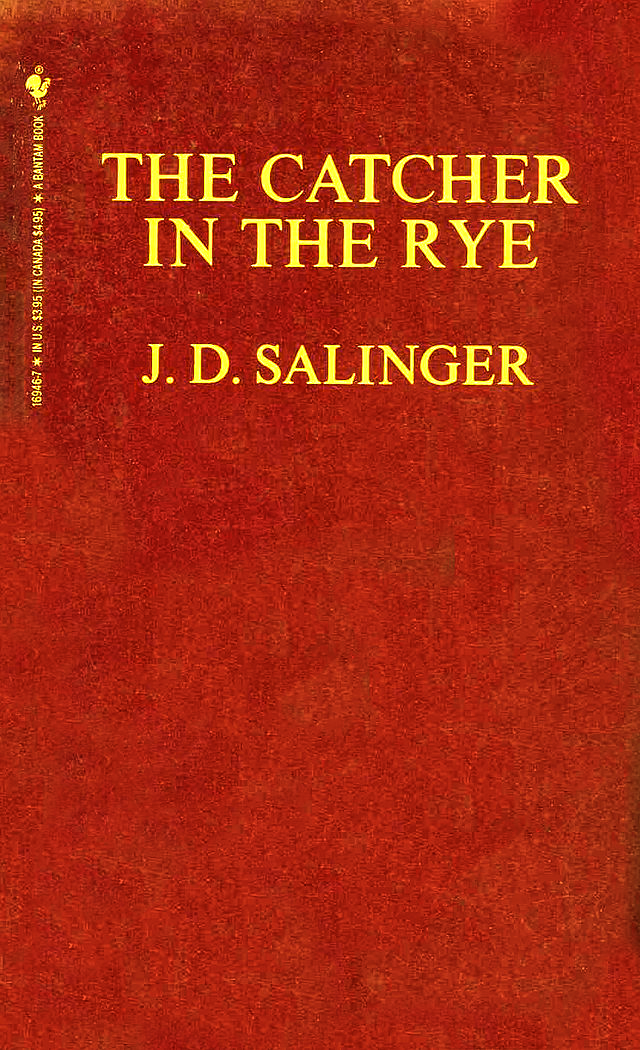
But I’m dancing around the central issue. The bible of pubescence was and remains J.D. Salinger’s The Catcher in the Rye. Here was a book that addressed my concerns directly, that understood my life from the inside, that expressed those unsayable thoughts. I gobbled it up, and all the Glass family sagas and short stories. I wanted more; there were no more.

There were other books that teens revered, and I read those, too: John Knowles’ A Separate Peace and William Golding’s Lord of the Flies — which, because I was a teenager and therefore an idiot, so it never bothered me that Golding told of a world-view diametrically opposed to Salinger’s fable of self-righteous innocence. catcher cover

Holden Caulfield recognized the essential hypocrisy of adulthood and pointed fingers everywhere but reflexively. The purity of his heart guarded the cleanliness of his soul. I signed on. It was society that was rotten.

Of course, looking back, one realizes Holden Caulfield was the biggest phony of them all. But it is the nature of hucksters and demogogues that they project their limitations outward. It is what makes them so convincing, at least to the unformed souls they lead around by the nose.

I have tried to reread Salinger a few times as a grown-up, but the treacle leaves an unpleasant coating on the inside of my mouth.

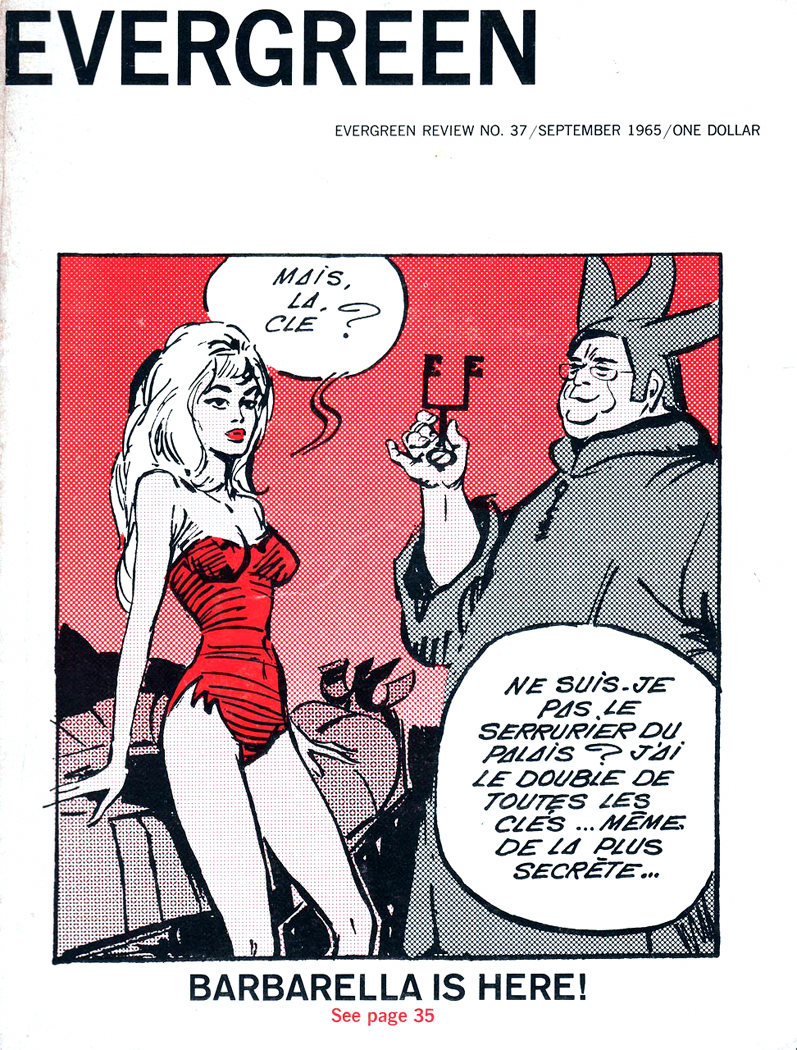
My self-image at the time was that I was a budding bohemian, that I was an intellectual among cattle. I had subscriptions to Evergreen magazine and Paul Krassner’s The Realist. I read Jean-Paul Sartre’s Les Mots. I listened most nights in my bed to Jean Shepherd on the radio, and never really understood that the “hipsters” he railed against were the very people I idealized. evergreen 1965Irony, at that age, is invisible. We look right through it without seeing it. I went to Greenwich Village every opportunity I got and frequented the Sheridan Square Paperback Corner.

Lordy, I was a pretentious twit.

There were books I was required to read for school, but while these books are worthy, they are wasted on adolescents who cannot grasp their import. I read The Great Gatsby for school, and never quite understood that Gatsby was a gangster. Over my head. The Scarlet Letter was assigned, and I don’t think I even understood that Pearl was Hester’s daughter. I’m not sure why a punk kid was ever asked to read such a rich and subtle book. There was clearly no way I could wrap my tiny, unformed brain around the complexity of that book — to say nothing of the boredom induced by paragraphs that long without being broken up into constant bites of dialog.

There was a tendency during those years, when introduced to a book I enjoyed, to attempt to read everything else by that author. Gobble it all up, nine-yards and a tail. That is the way it was with the Glass family, and that is how it was with Jack Kerouac.juliette greco

There was scarcely a Kerouac book in print in the mid-1960s, that I didn’t inhale, starting with On the Road, which I read twice. I fantasized riding the rails, driving a broad-hipped Hudson at a hundred miles an hour through the nights of Nebraska, listening to Ornette Coleman and dispensing off-the-cuff witticisms to the Juliette Greco on my lap. When I had a chance to travel to Europe between my junior and senior years, I took Lonesome Traveler with me, and in the bookstalls along the Seine in Paris, found Big Sur and Subterraneans in British paperback editions.

I am amazed when I look back, at how much I read — all of which was outside schoolwork, which I neglected. And I am amazed now at how little of anything I read then I retained. It went through me like a sieve. All that verbiage accumulated around me like gravel around a caddis fly larva, and when I left for college, I shed that cocoon and started fresh with a new set of enthusiasms.

Next: Reading outside the curriculum

bruckner stamp austria

Are you old enough for Bruckner?

Poet Ezra Pound said there is no reason you should like the same book (or music or art) at 40 that you liked at 16. At 16, I liked Ezra Pound; now I’m 65.

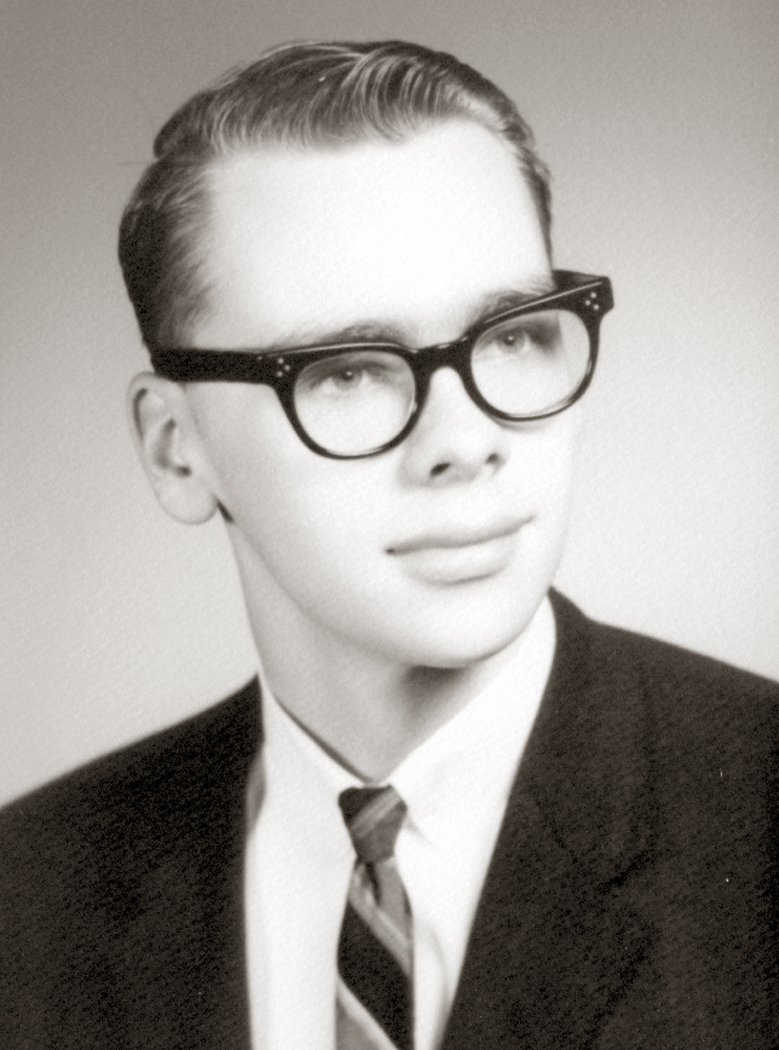
The author graduates high school in 1966

The author graduates high school in 1966

Our tastes change as we age, or they should. My introduction to classical music was Tchaikovsky. His symphonies and concertos pumped new-generated hormones through my arteries like adrenalin — when I was in high school.

It wasn’t long before I left him behind for Stravinsky, then Beethoven.

By the time that I was middle-aged, I had gone through Bach, Mozart, Berlioz, Debussy, Mahler, and most recently had added Bruckner and Haydn to the list. I get things from each of them I was deaf to earlier. Now that I am retired, I have finally come to appreciate Verdi. But, boy, it was hard to get past all the oom-pah-pah-pah, oom-pah-pah-pah.

The path won’t be the same for everyone, but there are some general patterns that seem to hold.

In painting, we all loved van Gogh at about the same time we loved Tchaikovsky. There is a bigger-than-life striving in van Gogh that appeals to the adolescent, striving himself for some sense of the heroic.

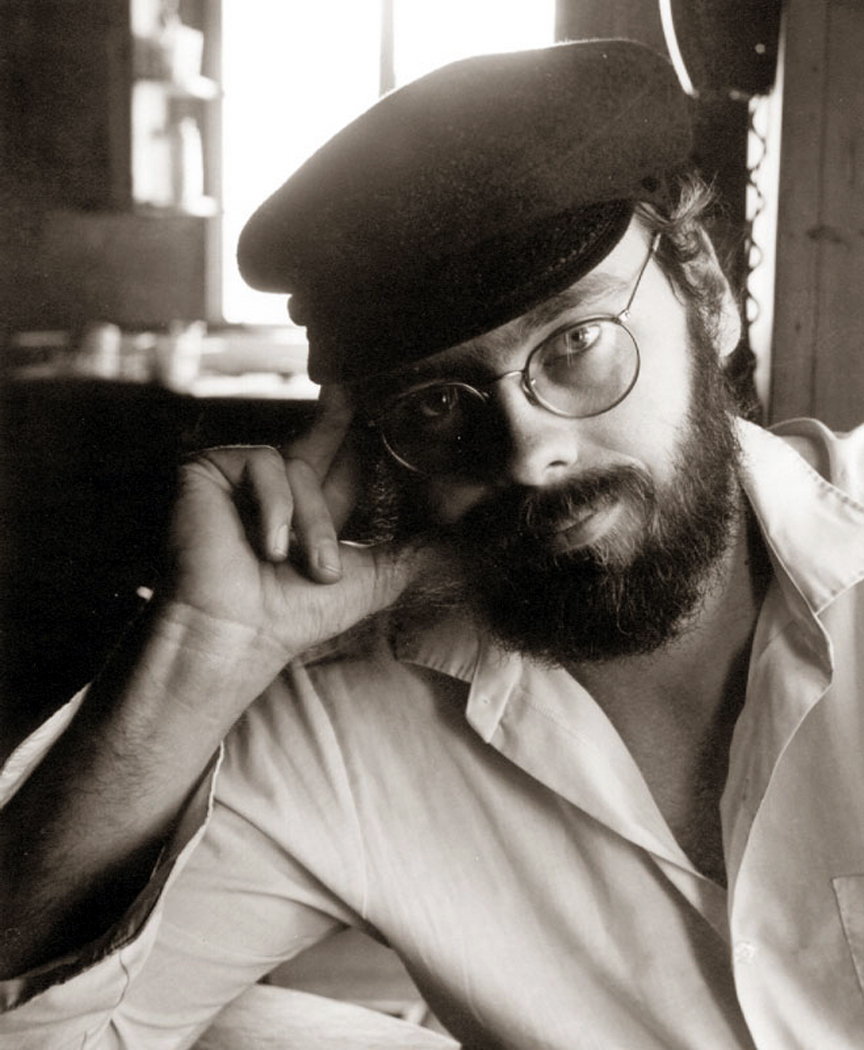
The author 1975

The author 1975

That same aspiration drove us to read Catcher in the Rye.

With a few more years under an increasingly large belt, we drop Tchaikovsky as hopelessly sentimental, Salinger as naive and simply move past van Gogh as we become aware of the Impressionists, who tickle our eyes all over again. Hormones calm, reality sets.

When we are in college or as grad students, we tend to gravitate to those things that are trendy, new, and exclusive, that set us off from the proles: We read Umberto Eco or — in my generation, Alberto Moravia and Robbe-Grillet. We jumped on Marina Abramowic  and Bruce Nauman and listened to Lutoslawski, Schnittke and Harry Partch. Yes to Pina Bausch, meh to Swan Lake.

The author 1977

The author 1977

Yes, we were showing off. In many cases we admired more than enjoyed.

We then gave up the need to be au courant or exclusive as we came to distinguish between the gee-whiz and the substantial.

As adults, we craved the substantial. Adult tastes are acquired tastes: Poussin, Schoenberg, Milton, rutabagas, pickled herring.

Old age now brings something else: simplicity and inclusiveness. I am no longer quick to drop the critical meat-cleaver and sever away something I consider unworthy. They are all worthy. Tchaikovsky as much as Webern, Salinger as well as Joyce. We are enriched by each of them.

The author in his "Van Gogh" pose 1980

The author in his “Van Gogh” pose 1980

(No, I haven’t gone senile — I’m not ready to accept Andrew Lloyd Webber or Thomas Kinkade, although I see some value in Norman Rockwell that would have shocked me to hear anyone admit when I was 20. No, Rockwell is no Raphael, but there is room for an entire spectrum of abilities and accomplishments. What I ask isn’t so much undying masterpieces, as sincerity of attempt, and a willingness to put in the work.)

So, growth isn’t just a case of moving on from one thing to another, but adding more and more to our trove. By the time you are my age, you will have a heady backlog of esthetic experiences to draw on.

What is most interesting to me is that, if we continue to grow, we can return to art we left behind and find something new in it. From age 17 to about 40, I couldn’t bear Tchaikovsky — it seemed like treacle. But then I began noticing his bizarre harmonic sense and what I might call ”orchestration from Mars.” You only have to read the scores to see how peculiar is his voice leading. When I could get past the heart on the sleeve, I discovered an intelligence there that was hiding, or rather, that I was unwilling to discover, having made up my mind and moved on.

The author at Canyon de Chelly, 1989

The author at Canyon de Chelly, 1989

An now that I am bald, bearded and grey, I find that there is something even in the emotional immediacy that once embarrassed me.

As we grow, we not only grow into new experiences, we grow out of our old prejudices.

This all came back to me this week as I watched Lust for Life on cable. The 1956 biopic starred Kirk Douglas as van Gogh and Anthony Quinn as Gauguin. The film is an odd combination of excellence and awfulness, mixing insight with bromides, sanitizing the painter’s life while emphasizing the insanity.

More than anything, this is the van Gogh who appeals to adolescents, the van Gogh of idealism, identity crisis and suicide.

Alienated, misunderstood.

But there is one more aspect of him that is included: his commitment and perseverance. These quieter virtues, more than his insanity, give van Gogh his stature as an artist.

the author lecturing 2005

the author lecturing 2005

There was a time, in my 20s, that I dismissed van Gogh. The peculiar paint-busy canvasses, I was convinced, were just the evidence of a deranged mind. If you were schizophrenic, you could be a great artist, too.

But more careful study in recent years, especially of the many notebooks filled with drawings, told me something else again. Van Gogh paints the way he does because of his unwavering honesty to his eyes. He kept looking till he got it right.

And ”right” for him was to notice everything that his eyes saw, not merely what he had been trained to see.

If you stare long enough and with enough concentration, you can see something of the granular reality van Gogh saw. We no more pay attention to it in daily life than we pay attention to the grain in a movie’s film stock. It is not the information, but the medium of the information. We filter out so much. Van Gogh didn’t.

the author at Giverny 2008

the author at Giverny 2008

The other wonderful thing about van Gogh is that he had so little talent.

We tend to think of great artists being as fluent as Mozart or Raphael. Yet talent is a poor indicator of quality in art. For every Raphael, there are scores of Geromes and Bouguereaus: accomplished and pretty, but ultimately empty.

Van Gogh shared a lack of talent with several other great artists: Cezanne, for instance; or Jackson Pollock. One searches the drawings and oil sketches of Cezanne for even the slightest encouragement of talent. His drawing is hopelessly awkward.

Pollock searched for years for an adequate means of expressing what was inside him. To do it, he had to give up everything he had learned. If he had no talent for drawing, he would not draw. He found a talent for splashing instead.van gogh landscape

Van Gogh’s notebooks are full of erasures. He looked, drew, erased, looked again, drew again, erased again. Many drawings are never finished, but those that are, are right in a way the more facile Ingres never is.

Van Gogh was stubborn. I admire that in him more than I admire the talent of William Merritt Chase.

But give me another 10 years and we’ll see.