When I was a kid, most things in the world just were. Everything was normal, even if it wasn’t. People lived in houses, roads were paved, families had a mom and dad. And, for a kid, parents were just parents; I never gave much thought to why they did what they did. It wasn’t even that if they did something, they must have had a reason. They just did things. They were Mom and Dad, and as children, me and my brothers just followed along. As a child, the world is a given.
It’s hard to recall that state of affairs, when things happened because they happened. That they might have done things for the abstract good of their children never dawned on me. Of course, now that I am old, I look back and realize how much they did for us, things they didn’t have to do, or things they probably would have preferred to do some other way, including some other things they might have wanted to do with their sparse vacation time.
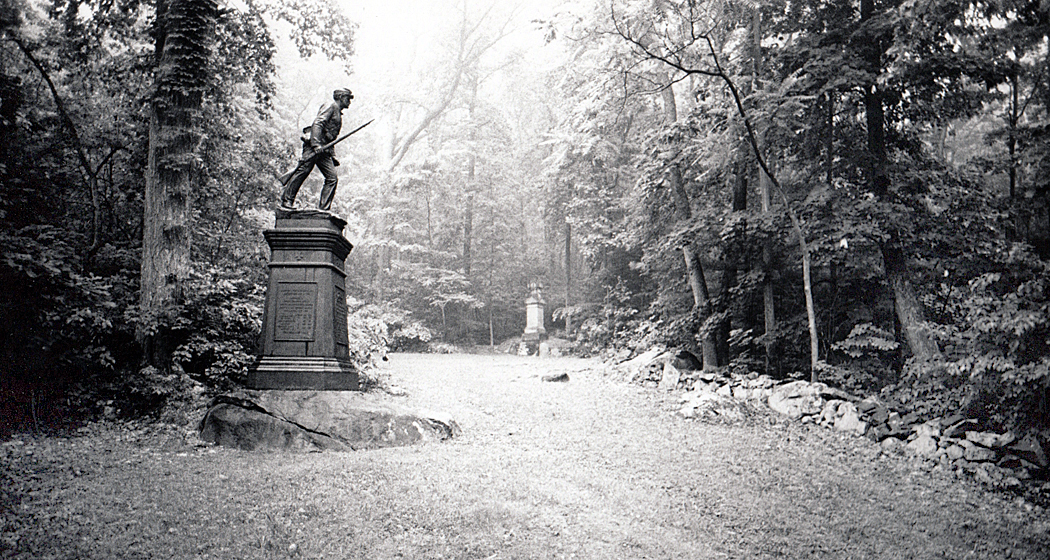
Gettysburg, Pennsylvania
But one of the things they did for us was travel. When we had our summer school vacations, Mom would pore over various brochures, magazine articles, and roadmaps and carefully plan routes to drive and sites to take in, and then, when it came time, we would load up the car and take off. We went to Washington D.C., to Niagara Falls, to Fort Ticonderoga, to Gettysburg — and many spots in between. Only later did I come to understand there was a purpose to these vacation trips. they chose these things to expose their children to history, geography, politics and to let us see what was possible outside suburban New Jersey. Travel was part of our education.
Back when they were children, they didn’t get to travel. They both grew up in northern New Jersey and neither had more than a high school education. Dad’s family was heavily religious and didn’t approve of having fun, and Mom had to raise her two younger siblings after her father died when she was still in grade school and her mother had to find work in New York City. And so, the worlds they grew up in were limited.
German gun, Omaha Beach, Normandy, France
But when my father was drafted in 1940, he was sent to Camp Wheeler in segregated Georgia. He didn’t talk much about his army life, but he did express shock at discovering the pervasiveness of racial discrimination. And then he was sent overseas after D-Day to France, Czechoslovakia and Germany and found that other peoples had various ways of making a decent life. His horizons were involuntarily expanded.
When they got married, shortly after the war, they felt it was important to broaden their children’s horizons, too, and to make sure we got the best educations. There was never any question that their kids would go to college. (I was told that when I entered second grade, I asked if that meant I could go to college “next year?”) Education was Priority One. Travel was a component of that.
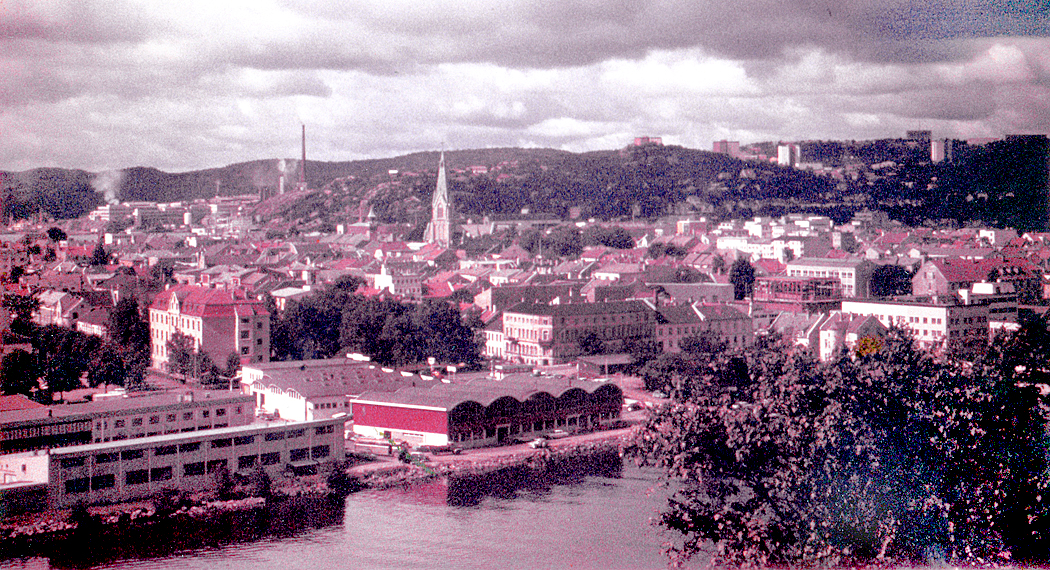
Kristiansand, Norway
Later, when I was in high school, they made it possible for me to go to Europe, accompanying my immigrant grandmother to her birthplace in Norway, and to take a bus tour through France, Germany, the Netherlands, Belgium and Luxembourg. A few years later, my younger brother, Craig, was sent off on a similar trip.
Mark Twain famously said that “Travel is fatal to prejudice, bigotry, and narrow-mindedness, and many of our people need it sorely on these accounts. Broad, wholesome, charitable views of men and things cannot be acquired by vegetating in one little corner of the earth all one’s lifetime.”
The vast bulk of the MAGA world, it seems to me, is made up of those who have never ventured far from their birthplace. If they had seen how others live, they would not accept the lies.
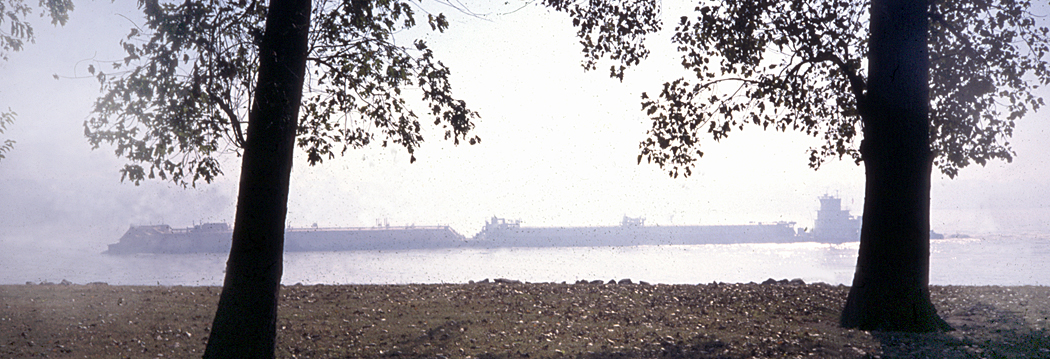
Cairo, Illinois
Travel, then, has pretty much always been an essential part of my life, and having become an adult — at least as quantified in years accrued on the planet — I have continued the habit instilled by my parents. Education wasn’t only in books; I read Huckleberry Finn, of course, but I’ve also been to Mark Twain’s childhood hometown of Hannibal, Mo., and to what remains of Cairo, Ill. I’ve driven along the entire length of the Mississippi River, from Lake Itasca, Minn., to the Venice Marina where the road ends in Louisiana.
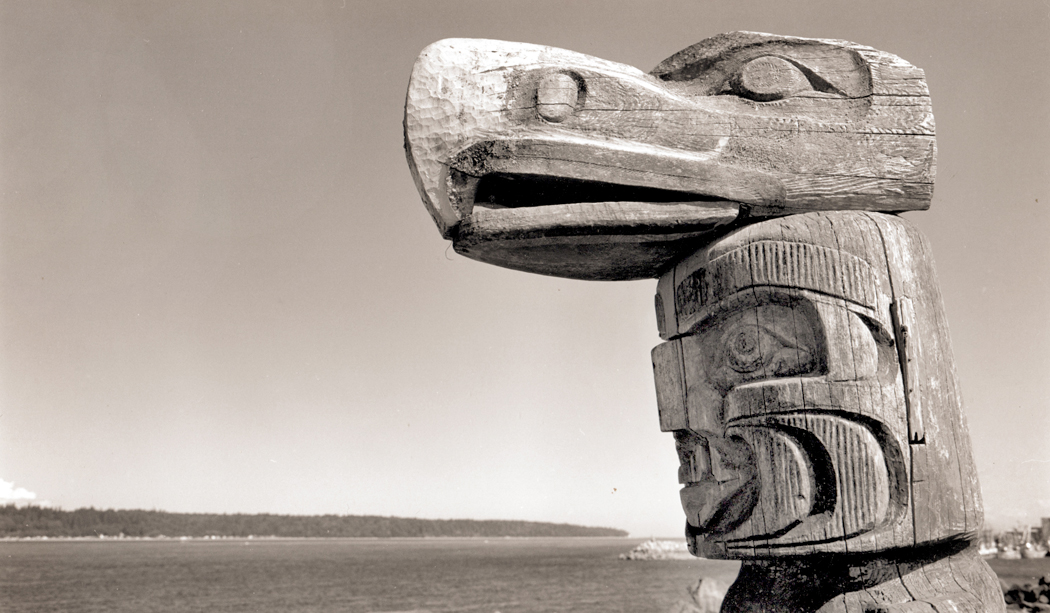
Vancouver Island, British Columbia
It is rare to mention a place I haven’t been in the continental United States or provincial Canada. Big Sur; Mt. Katahdin; the Everglades; El Paso;, the Union Pacific Bailey Train Yard in North Platte, Neb.; Hudson Bay; Halifax, Nova Scotia; the Tehachapi Loop in California; the Sturgis Rally in South Dakota; even Glacier Bay in Alaska.
Glacier Bay, Alaska
Believe me, I can be quite irritating, when someone mentions some far-off place and I chime in, “Oh, yeah, I’ve been there. Had a great Po Boy sandwich in a little shack along the road in Pecan Island.” Which is a tiny community along the southernmost road in Louisiana. Or “Abiquiú? Yes, we visited Georgia O’Keeffe’s place there.” I am slowly learning to keep my yap shut.
Red Mesa, Navajo Reservation, Arizona
I’ve been to every state except Hawaii, and most of them many times, and every province in Canada, save only Prince Edward Island and Newfoundland. I’ve lived in four corners of the continental states, growing up in the Northeast, moving to the American South, then to Seattle in the Northwest, and spending 25 years as a writer in the Southwest. Each move gave me a chance to explore all the territory nearby, often in some detail (There’s hardly a square meter of Arizona that I haven’t been to. Go ahead, name something obscure: Ajo? Red Mesa? Tumacacori? Freedonia? Gadsden? Quartzsite? Check, check, check, check, check and check.)
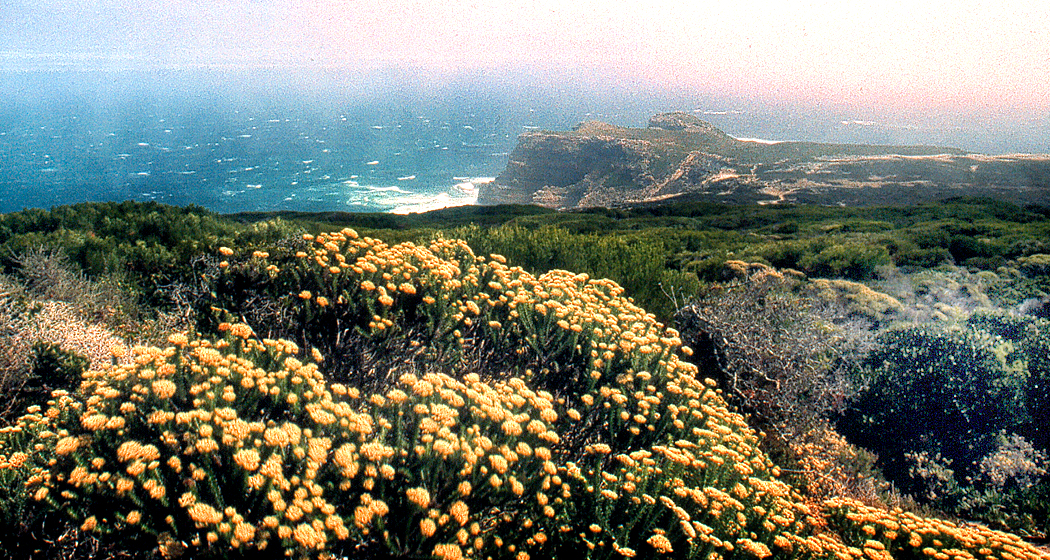
Cape of Good Hope, South Africa
I’ve been to the Cape of Good Hope in South Africa and to Marylebone Road in London; I’ve been to the Chartres Cathedral, and to the bull ring in Arles, in Provence. My late wife and I went back to France many times, and drove to all six corners of “The Hexagon.”
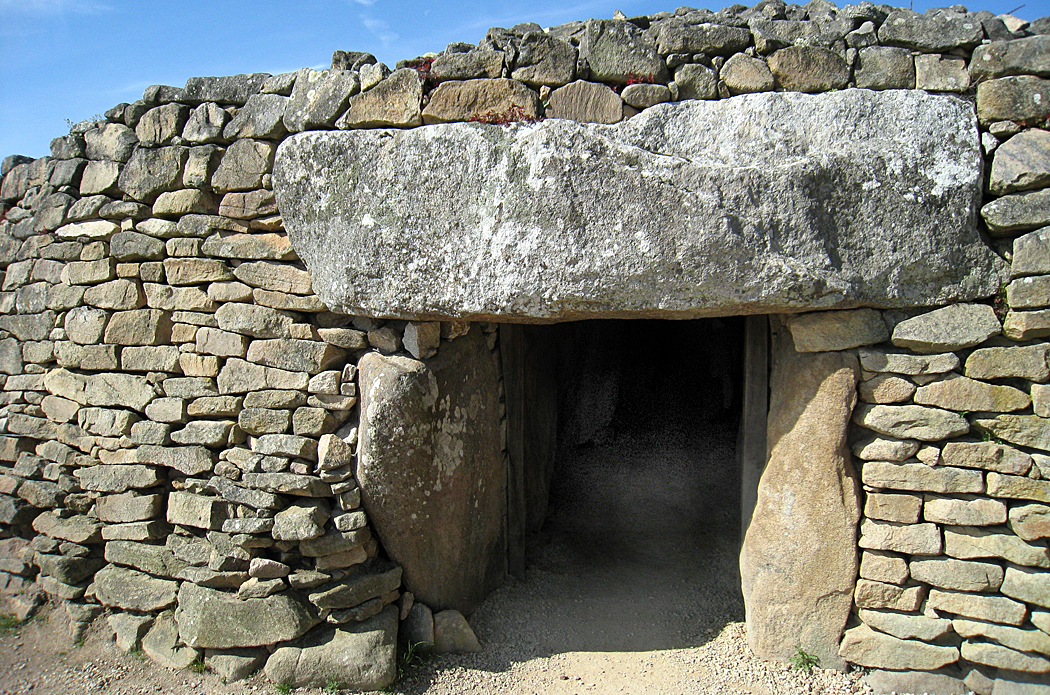
And so, yes, I’ve been to the D-Day beaches at Normandy and to the bomb craters still evident in Verdun, to the cave art along the Vézère Valley, to the paleolithic menhirs and dolmens near Locmariaquer.
Dolmen, Locmariaquer, Brittany, France
I’ve visited the Museum of Questionable Medical Devices, the Museum of Jurassic Technology and the Hammer Museum of Haines, Alaska.
And it has all been an education. I certainly learned that the omelet I get at Denny’s is a pale mutilation of the rich, creamy offering you can find at any neighborhood cafe in Paris.
O’Keeffe Country, New Mexico
Of course, I’ve also learned how little of the world I’ve actually seen. I have so much of the non-European inflected planet yet to see, although, at my age, it’s almost certain I will never get to Japan or the Seychelles or Samoa. Just as, no matter how many books I’ve read, there is always a hundred times more books I will never get to read, and not enough time left even to put a dent in that list. I keep trying.
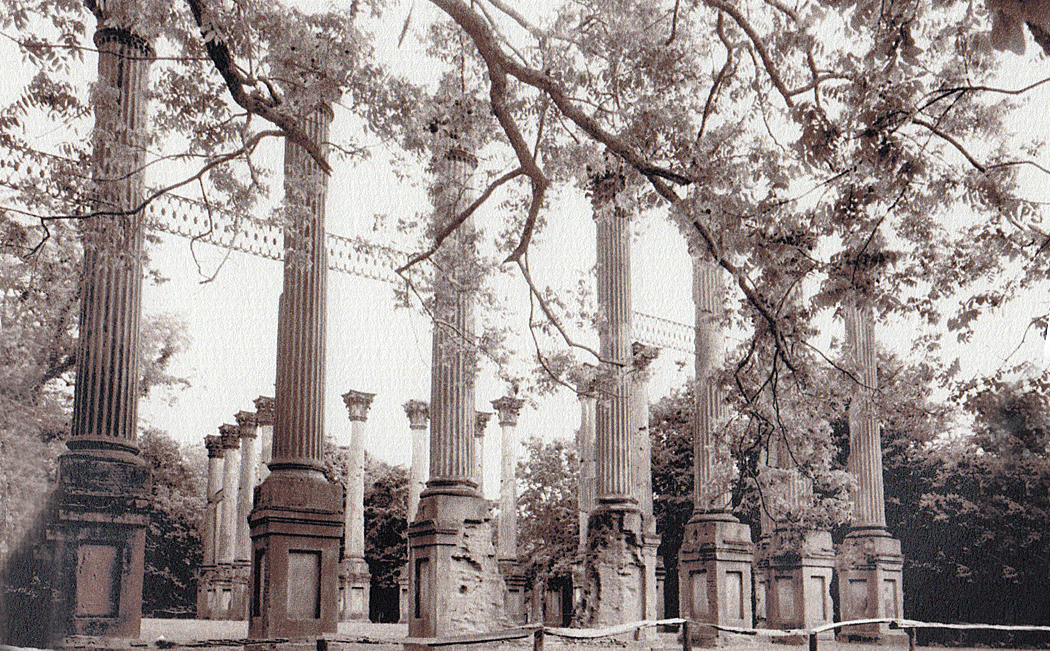
Windsor Ruins, Mississippi
And so, in addition to bragging about all the places I’ve been, I am shamed by all those places I have not gone to, just as all the art I haven’t seen, all the books I haven’t read, all the music I have never heard. But I think that it is only because of all I have read, seen, and heard, that I know enough to feel the gaping holes in my education.
Happiness is a strange emotion, not a single thing, but really an umbrella term for a diffuse group of hard-to-define states. Periodically, studies are published about which nation is the happiest (usually, it seems, a Scandinavian country.) But what they are measuring is a rather tepid version of happiness. Usually, if we ask if someone is happy, what we mean is an absence of problems — basically a neutral state in which we are not currently threatened, hurting, being oppressed, or worried. “Are you happy?” “Yeah, sure, I guess so.” Enough to eat, a roof over the head, a relationship that isn’t a chore, no pending hospital bills or tax audits.
Really, that is a condition to be wished for, as dull as it sounds. For most people in the world, its achievement would be a godsend. So, I don’t want to downplay such a state. Not getting bombed is a net positive. Yet, there are other happinesses. Falling in love, birth of a child, success at work — these all provide a joyful uplift that raises the psyche above the day-to-day and makes life more radiant, if only briefly. It is a state we cannot maintain over long periods without being considered a bit loopy. So, we return back to the state of happiness that is unremarkable.
But, as adults, we can watch our children at play and recognize in their faces such a state of unreflective happiness that can only break our hearts. Oh, what they don’t know yet about being alive. It’s not just an emotion: The entire body explodes with it.
There is what I might call “body happiness,” which they express in movement, in play, in dancing and skipping, singing, letting out squeals that express the inner state that, as adults, we can only mourn the loss of. “There hath passed away a glory from the earth.”
I mention all this because one of the reasons I listen to music — primarily, for me, what is called classical music — is its ability to evoke emotions in its listeners. They arise sympathetically and are often emotions more subtle than mere language can name. It has been said that music is more precise than words, and I recognize that, whenever I am moved by a quartet or sonata but cannot speak exactly the words that would distort the emotion into easily fixed categories.
A standard symphony moves from thought to thought, emotion to emotion, in ways that express the same sort of progress a story makes, beginning, middle, end. Episodes all build together to a longer, coherent emotional or intellectual ride. Our limbic system moves along with that progress and we can basically take our emotional selves through the moves. The widest range is the most completely human.
And one of the things music can express is that ebullient, body happiness, so that we can feel it again.
Mostly, it jumps out of a single movement in the whole, or even a few bars in the movement, but it is inexpressible joy, and it makes our body move, to tap toes or sway our bodies to and fro, often with a surprised smile on our faces. I think of the finale of Haydn’s Symphony No. 88, for instance, or the scherzo from Dvorak’s Eighth Symphony. I can’t sit still while listening.
George Frideric Handel has two “happy”numbers in his Acis and Galatea. The opening chorus sings of “Oh the pleasures of the plains, happy nymphs and happy swains,” which extolls the life of the peasants, and a love duet that repeats endlessly, “Happy, happy, happy we.” It all sets up the tragic ending.
But, there are a very few works that take that body happiness from start to finish, works you can play or stream, that will infallibly lift your mood and remind you of the happiness that is upwards of neutral, and can replace all the fret and sorrow for the length of its performance, and usually, for some time after, as you bathe in the memory of its tunes.
There are at least eight of these that I can name, which always leave me uplifted, my senses turned up several notches, and my memory of childhood’s version of happiness is re-animated.
Prime among these is Franz Schubert’s “Trout” Quintet. It bounces and sings through five distinct movements, each of which floods with tune, rhythm and color, anchored by the bottom notes of the double bass.
It was written in 1819, when Schubert was 22 years old, and before the lingering illness that eventually killed him nine years later. The haunting of death darkens the later String Quintet that he completed in 1828, just two months before his death. But the “Trout” is the antithesis of all that: Life giving, life affirming, joyful from first bar to last. What can you do when every tune is an ear-worm. Once inside your body, you carry the “Trout” with you the rest of your life. Play it every time you need it.
Less well-known, but even more relentless is Darius Milhaud’s Le Boeuf sur le Toit, or “The Ox on the Roof.” Milhaud wrote it in 1919 after living in Brazil for two years in the French diplomatic service, and quotes dozens of Brazilian folk songs, adapted into a dance-hall band playing Latin rhythms, complete with güiro. He employs a polytonal technique, where different parts of the band play in different keys at the same time, giving the whole a piquancy and aliveness that has a feeling of spontaneity, like an amateur band in a smoky bar. It’s always just about to come apart.
Written in the Baroque form of ritornello, with an 8-bar tune coming back over an over between alternate dances, it has some 20 Brazilian tunes buried in it, with infectious beats that express the unabashed happiness of a sweaty dance hall. Evybody dance now!
Mostly we think of Johannes Brahms as a sober German burgher writing symphonies with the seriousness required of höchste Deutsches Kunst. But the boy could let his hair down, which he did with two sets of vocal quartets, Liebeslieder Waltzes, op. 52 and op. 65.
Brahms made his living, early in his career, when he moved to Vienna, as leader of various choruses such as the Singakademie and Musikverein, for which he wrote tons of choral music and songs. So, he had a popular streak in him.
The 33 songs, each no longer than a minute or two, celebrate bourgeois domestic love in tunes so meltingly gemütlich that you will have them running through your head for days. They were meant to be sung in homes or in taverns, so they are best with normal voices, not the operatically trained soloists that so often record the set. “Ich gäbe dir so gern hunderttausend Küsse” — “I long to give you a hundred thousand kisses.”
When Georges Bizet was a mere stripling of 17, he wrote a Symphony in C as an exercise for his studies at the Paris Conservatoire. It was never performed in his lifetime and ultimately forgotten about, until it was rediscovered in 1933, and performed two years later by Felix Wiengartner, a suitable conductor, whose first name means “happy.”
Bouncy and tuneful from first note to last, it has proven hugely popular since then, and one wonders why Bizet never had it published, in fact, never even mentioned it. It is a masterpiece, but not on one of those marble pedestals, but the kind that makes your ears grateful to be on your head. It is breezy and fluent and just makes you happy to be alive.
Georges Balanchine choreographed it for the Paris Opera Ballet, and I was lucky enough to see the New York City Ballet perform it with a live orchestra at the Palais Garnier in Paris, (where it was first performed in 1947). One of the highlights of my life.
Also a youthful work is Serge Prokofiev’s Classical Symphony, written in 1916 when he was a conducting student at the St. Petersburg Conservatory. When one of his teachers, Boris Asafyev, mused “that there is no true joyfulness to be found in Russian music,” as Prokofiev wrote, he responded with one of the happiest works ever written by a Russian.
And so, he wrote in his diary, “I composed a new finale, lively and blithe enough for there to be a complete absence of minor triads in the whole movement, only major ones.”
It displays what is often called the composer’s “wrong note Romanticism,” with catchy tunes and ascerbic harmonies, and was meant to mimic the spirit of Haydn and Mozart. What a joy.
Much shorter, at merely five minutes, but so fresh and lively as to become its composer’s most frequently performed piece, the overture Leonard Bernstein wrote to his musical Candide just can’t stop laughing, and teasing, with bubbling wit and elan.
The musical (or operetta — it could never entirely make up its mind and went through multiple reworkings) never quite caught on the way West Side Story has, but its overture, shaped as a mock Rossini overture, is irresistible.
Johann Strauss II produced music the way a lawn sprinkler sprays water. The “Waltz King” composed over 500 waltzes, polkas, quadrilles, and other types of dance music and several operettas, all of surprisingly consistent craftsmanship.
No one in his right mind, though, would sit for all of it; before too long the program would become monotonous: How do you tell one polka from another. That is, except for the large handful of truly memorable masterpieces, all of which will raise you spirits and make you want to dance.
I mean, the Blue Danube, the Voices of Spring, Tales of the Vienna Woods, the Artist’s Life, the Kaiser Waltz — a CD full of the best Strauss is a must-have for any collection. It’s hardly surprising that Brahms envied Strauss’ gift for melody. Each is basically a tone poem in three-four time. Lift the spirits, make you smile and move your body.
Finally, there is Benjamin Britten’s Simple Symphony, which displays a childlike joy in just spinning tunes, which is hardly surprising, since he wrote those tunes when he was a child, between the ages of 10 and 13. When he turned 20, he reworked the tunes into this four-movement suite for strings, with movements titled “Boisterous Bouree,” “Playful Pizzicato,” “Sentimental Sarabade,” and “Frolicsome Finale.” It premiered in 1934 with Britten conducting.
Since then, it has been recorded dozens of times, usually as a filler on discs with other Britten pieces.
There are other joyful pieces, but these are eight that come immediately to mind. They are each available in videos on YouTube, and worth seeking out, especially if you’re having a bit of a down day.
In a 1993 interview on the Charlie Rose show on PBS, author David Cornwell (aka John le Carré) talked about his childhood. “We are creatures of our background and environment,” he said. “We are very quickly made in life. The first few years seem to be determining who we are for years and years afterwards. You look for explanations for yourself and you go further and further back and wonder if you ever changed or ever developed.”
When we look at a life as a story, with a single trajectory, and rather like a novel that we tell ourselves about ourselves, one way to organize the narrative is in chapters, and those chapters are the houses we have lived in.
Each house has its particular memories, its particular emotional resonance and its beginning, middle and end, an end leading to the next chapter, the next home. Some chapters are short, some are long. There are even those among us whose lives are told in a single long chapter — a house they were born in, raised in, married in, inherited from parents and eventually died in. Such continuity is rare; most of us have many chapters.
Until I was about three, I lived with my mother and father in a house in Ridgefield Park, New Jersey, about a block from the New York Central rail line. There were six tracks alongside each other back in 1948. The rails are gone now, chewed up by langoliers but left in memory.
The novel I have internalized begins there, with the sight of sunlight striping the walls in the room where I sat in my playpen. I then added to Chapter One the soot and roar of the steam engines that ran on the tracks a block away. Little else remains; I was two when we moved.
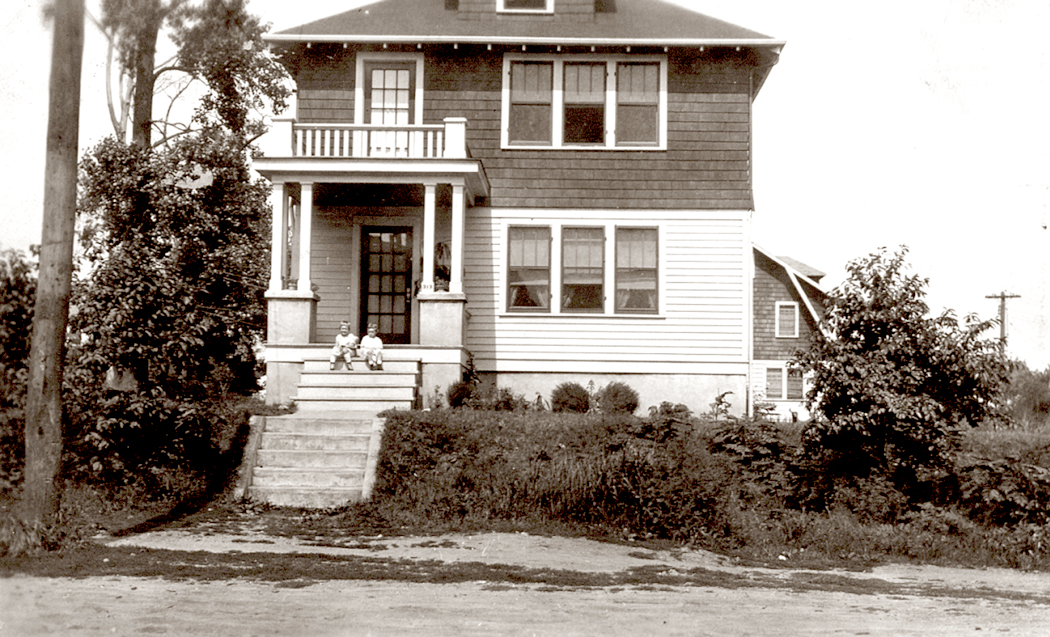
We moved then to the house my grandmother owned in Teaneck, N.J., only a few miles away. It was a tall, old house where we shared the lower floor and my grand-aunt and her husband shared the top floor. I have been back to see that house. It is much changed. The vacant lot next door is now an apartment building. The driveway is seeded over with grass. It’s been repainted many times.
It was in that house that I watched my grandmother make applesauce from apples gathered from the tree in the back yard. It was here that my great-grandmother died in my bed, while I had to move temporarily to a bed in my Nana’s room. I remember my great-grandmother only vaguely, as a very shriveled old woman confined to my bed and then, one day, not there anymore. No one spoke about it much. She just wasn’t there anymore.
I can piece out the floorplan of the house, with the living room stretched across the front of it, the dining room at right angles running back toward the kitchen — the kitchen in most houses almost always at the back — with two swinging doors, one on each side of the room, almost like the kitchen doors of a restaurant. Parallel to the dining room ran a hall that connected three bedrooms, and the bathroom, with a great animal-claw bathtub which fascinated me. The front bedroom was for my parents, the middle for my grandmother, and the back for me, and later also for my baby brother.
Behind the kitchen was a pantry with the house’s back door and the stairs that ran down to the basement.
Houses are said — by fantasists and psychologists — to be metaphors of our selves, and the dark basement, with its golem-like furnace and the thick, insulation-coated pipes and duct-work, was the animating presence in the house. I played with my toy rocket ships down there almost as much as I played outside in the vacant lot.
There was another dark place in the house, an under-stairs closet left unfinished with lathe and plaster walls. The public rooms, that is, the living room, dining room and kitchen, were all light and airy, but I was drawn to the shadowy parts of my universe.
I walked a mile to school to kindergarten and first grade, passing a friendly old policeman who stopped traffic on the main street so I could cross.
Not all of the houses I’ve hunkered down in have left a psychological mark. Maybe only three of about twenty, but the Teaneck house was the first and gave me a profound sense of place, of what architecture means emotionally. Thus ends chapter two.
The summer before entering second grade, we got ready to move to a new house my parents had built. It wasn’t quite finished yet, and so we spent the summer living with my mother’s sister and her husband in New Milford. Where Teaneck had an urban feel, this summer had that suburban, tract housing feel. Mostly what I remember from then is that the tap water smelled very strongly of chlorine. It was a brief residence, but I made close friends with the boys who lived next door and went to Catholic school — something that seemed absolutely exotic to me. “Glory, glory hallelujah, Sister hit me with a ruler.”
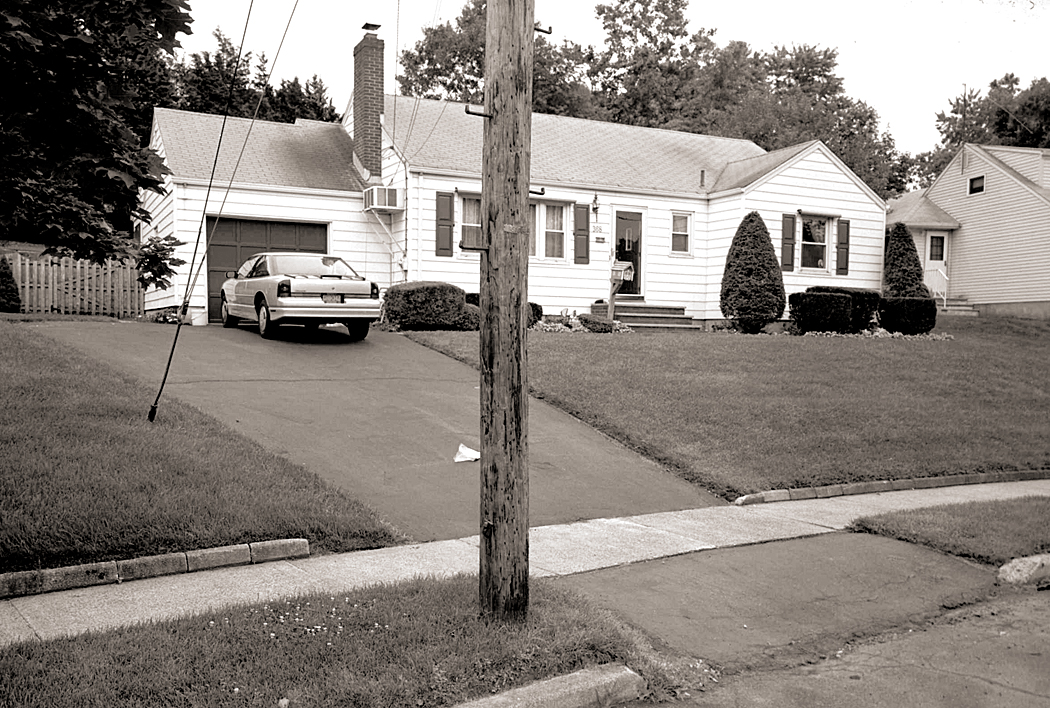
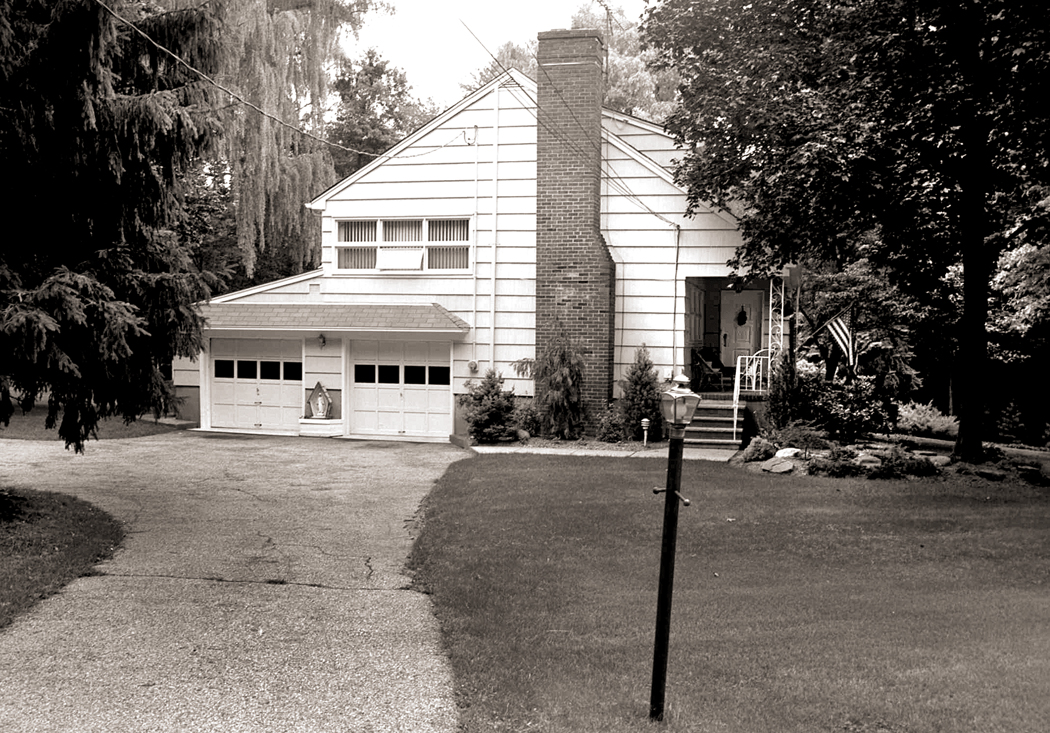
Chapter Four was a split level in the then-rural township of Old Tappan, on the border with New York’s Rockland County. It was a house my parents had built on a half-acre lot they bought with a stream running through it and woods on three sides. For a kid it was idyllic. In the years I lived there, I saw the town grow into a suburban bedroom community. Busses to New York City stopped by every hour on the street corner. Bits of woods everywhere were turned into housing developments, but the woods around our house remained wild.
The house zigged and zagged from floor to floor, as if cut down the middle and half raised up between floors. On the bottom was a cellar, next up to the other side, the garage and laundry rooms, zag back to the other side and up the stairs and you get the living room, dining room and — at the back of the house — the kitchen. Back the other way and up a flight were the bedrooms and bathroom. By now I had two brothers and we all shared the same room. But up still another set of steps and you had my grandmother’s apartment, with its own living room, bedroom and bath.
It’s a house plan not much favored today, but a split-level was the height of suburbanocity back then. From second grade through high school, I watched the town fill up, tract housing explode and farms and woodlands disappear. All that happened just as I was becoming rebellious and angry at my middle-class life. It was the Holden Caulfield syndrome, and I despised everything middle class, suburban and bourgeois. I couldn’t wait to get away to college.
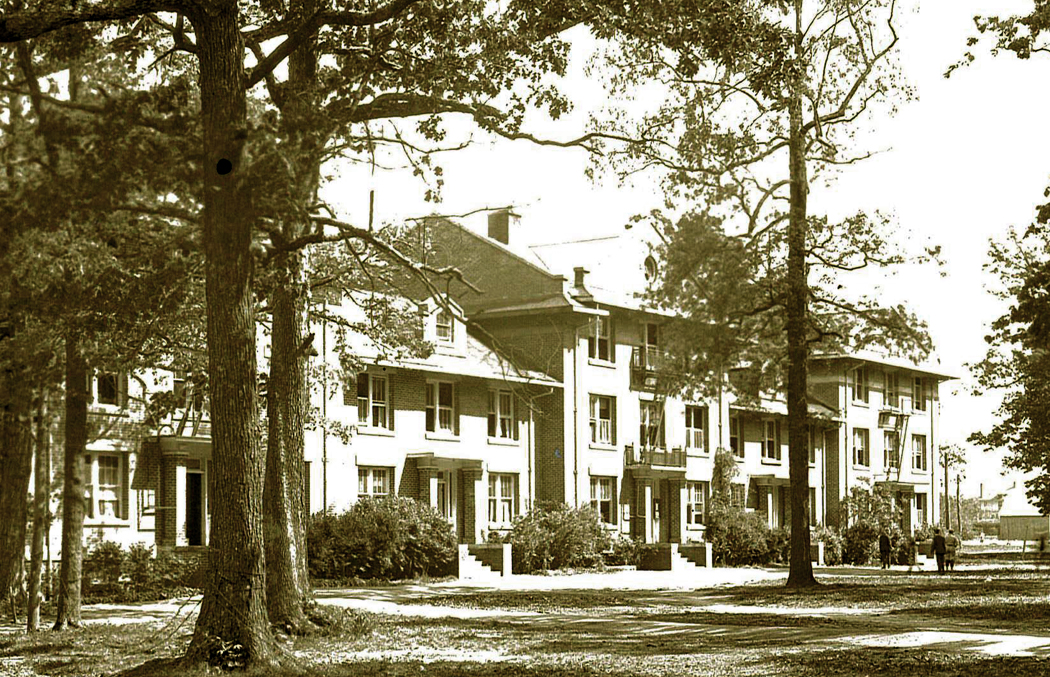
Next chapter was Cox Hall, a dorm at Guilford College in Greensboro, N.C. My rude introduction to the American South came on my first day, when I faced my dorm and saw a giant banner hanging from the third floor that said, in crude handwritten letters: “Forget? Hell!!” I didn’t know what those words meant, but I quickly came to understand.
Cox Hall was built before World War I, and was quite seedy, with wobbly wooden floors and thick plaster walls. I was dumped into a room with a proudly redneck bully and an ineffectual milksop, neither of whom had any academic interest. Mostly they were after poontang and Everclear. (Everclear, for the uninitiated, is a brand of pure grain alcohol of especial toxicity. Wikipedia tells us that it “is also used as a household ‘food-grade’ cleaning, disinfecting, or stove fuel alcohol.”)
I got moved to a two-person room, but my roommate quickly dropped out of school, and I had the room to myself. It was heaven, just me and my books and my Sears Silvertone phonograph on which to play my pile of classical music LPs.
For my sophomore year, I was moved to the more modern and quite faceless Milner Hall, which might as well have been designed as a prison — all brick and tile and fluorescent lighting. There was a communal bathroom and showers arrangement that echoed like a cavern.
I hated dorm life; it was riotous, noisy, crowded and cramped. I petitioned the dean to let me live off campus and eventually, because I was such a thorn in his side (over many a social issue, like women’s rights and integration), he let me go.
And I moved with my friend, Hank, into the home of a sociology professor and his wife. They had an addition at the back of the house with its own entrance and two bedrooms and a bath, and it was only a block from campus. It became a meeting place for all the other disaffected “hippie” students of 1969, and one night we threw a grand party when about 80 students showed up, most of them not invited, and the party lasted till dawn and left the back yard covered in beer cans. It did not ingratiate us with our landlords.
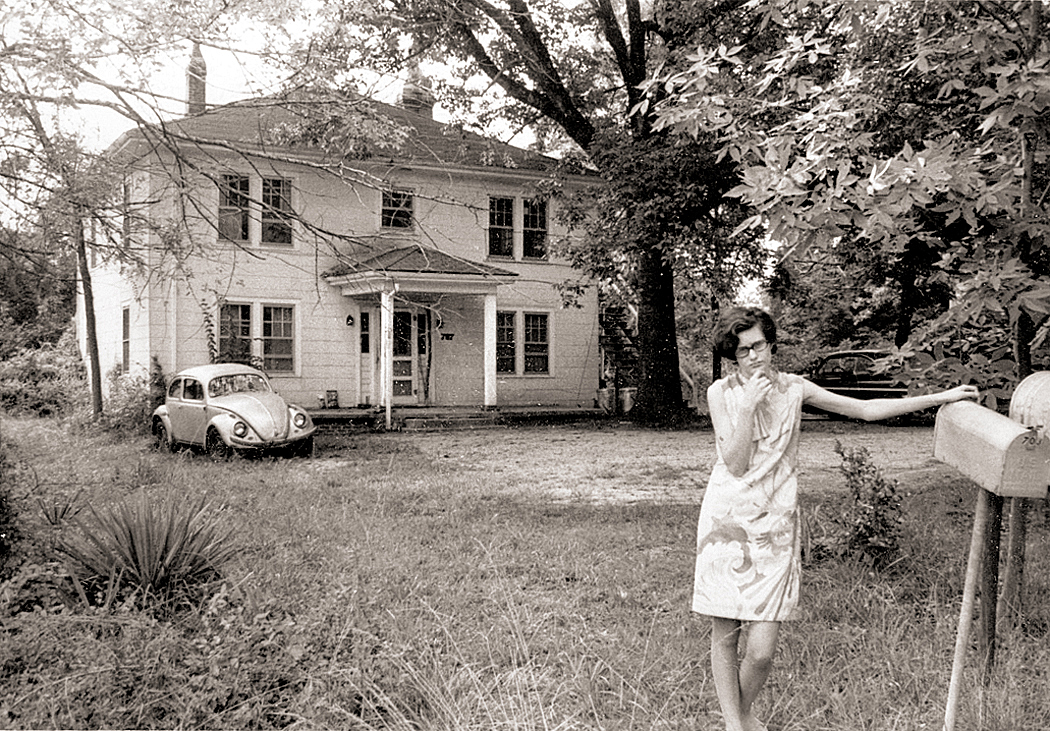
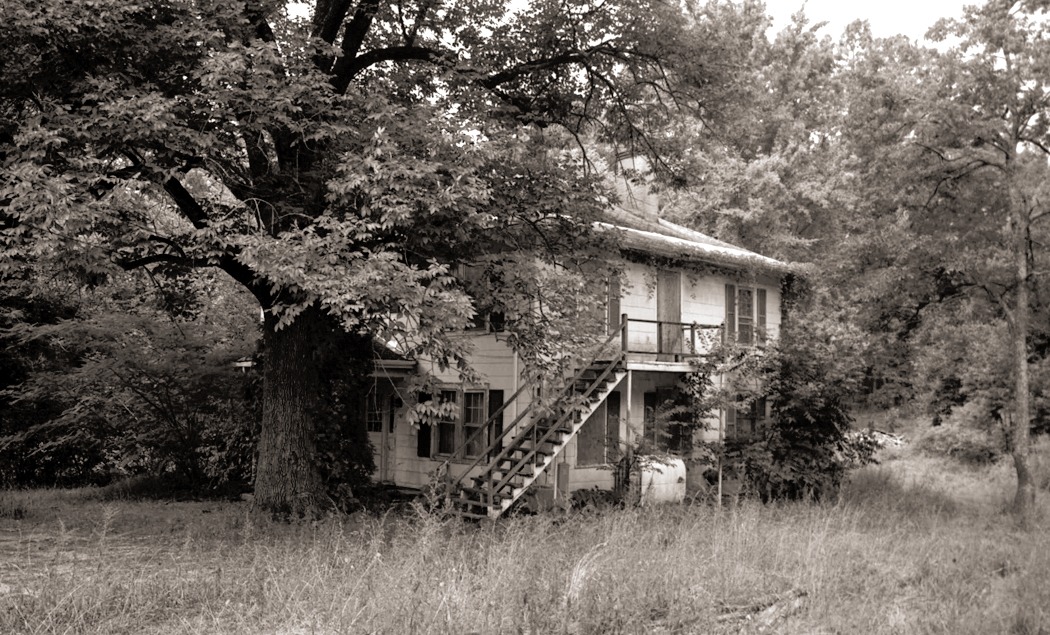
But by then, I had become engaged to be married, and my new wife and I moved to our own rental house. It was the second floor of a duplex and our entrance came with an outside staircase, which in winter was a treachery of ice. Rent was $50 a month.
There are three times in life when a home becomes mythic. Obviously, first when you are a child and the entire world has that glow and the house is the axis of the universe. Every corner and cornice has meaning.
The second is when you first consider yourself an adult, have gotten married and must make a life for yourself. The world has a lesser glow, but it is renewed, a decent echo of the magic of your childhood home. And this old house, with its tiny kitchen with enameled metal cabinets, became the projection of my inner state.
It was 1969, and I painted the living room burnt orange, with avocado green trim. It was a testament to the zeitgeist, but so was I.
Like so many houses built in the nineteen-teens and -twenties, it had a central hallway with rooms off each side — what architect Frank Lloyd Wright excoriated as “boxes inside boxes.” When you entered the house from the outside steps, you reached the living room. At the back of the house was the kitchen. On the other side of the hall were two bedrooms and the bathroom.
There was a vacant lot behind the house with a felled apple tree that continued to produce fruit, even while horizontal.
The house had no heat except for a kerosene stove in the living room. In the winter, I would have to walk down the icy stairs to get a gallon of kerosene from a 50-gallon drum of fuel in the back yard, carry it up, pour it into the reservoir at the back of the stove, crumple up some paper, let it soak up some kerosene, throw a match in and slowly let the kerosene heat up and vaporize so it could catch fire. Sometimes the heat would be so intense as to turn the stovepipe cherry red and begin shaking violently, and I would have to swivel the damper to discourage the fire. This too, is a metaphor.
We moved to a new house shortly before we broke up. It was about mile away and was another duplex. It would remain my home for the next seven years and the next “permanent” relationship. It was also an old house, and even more of a mythic Eden than the last. This was Chapter Eight.
There was a front door, but we hardly ever used it. We entered the house from the back, through the kitchen and into living room beyond. There was also a back bedroom — a guest room — and the master bedroom at the front of the house. What made the house such an Eden was the grounds; a great black walnut tree in the front yard, a pecan tree in the back. A vacant lot to our side and a patch of woods behind us. All year long, new weeds would blossom — I called them wildflowers. I counted once and found 190 different species of plant in our yard and the lot next door, including a pear tree. We grew a vegetable garden in the front yard and there were a couple of fig trees that gave us fresh figs to eat. This counts as one of the high water marks of my life. I was happy.
At least until my partner told me one day that she was getting married — to someone else. Eden was gone and so was my Eve. I was in shock. I sold most of what I owned and took the train from North Carolina to Seattle, where I moved in with a friend on Phinney Ridge, sharing a house with two lesbian doctors and the world’s most obscene man.
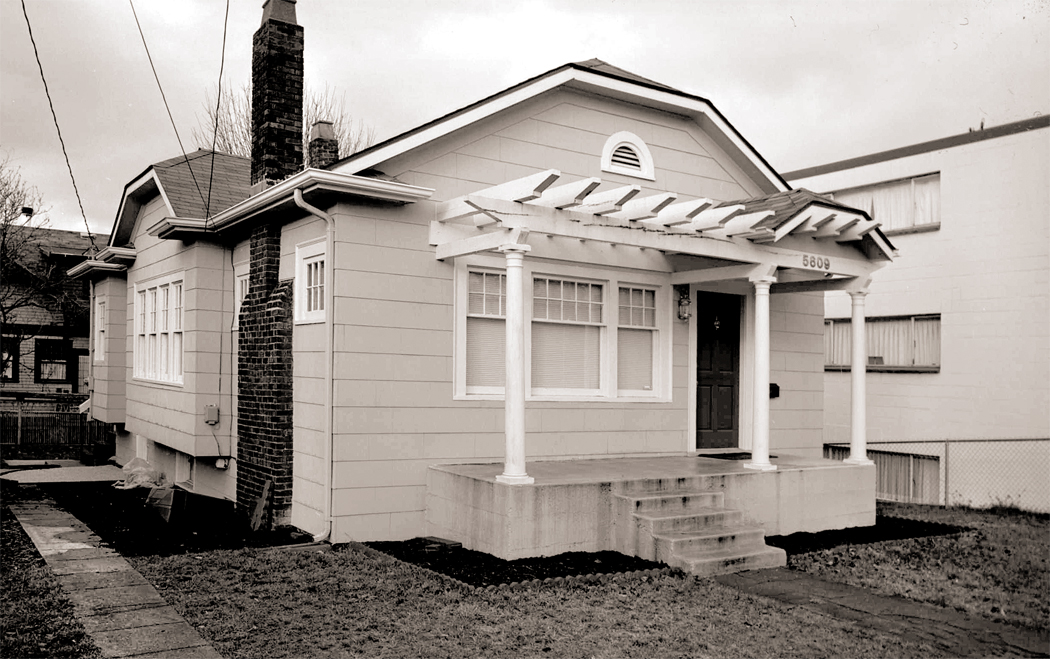
Chapter Nine was a small house and I made a room for myself in the coal bin in the basement. Upstairs, there was a living room, dining room, two bedrooms, bath, and a kitchen at the back, where we took turns cooking, almost always with hot peppers. I got work at the zoo and spent my days in an iron box selling popcorn, hot dogs and cokes. In the chill gray air of Seattle, the hot dog steamer filled the box with a Dante-esque steam-fog which condensed on every surface. The smell of those dogs and the chemical popcorn butter have put me off both for life.
A short but ecstatic relationship came crashing down and I found myself moving back to North Carolina, where my best friends from college offered me a room in their house in Summerfield, just north of Greensboro. I was a mess; I was not over the heartbreak that had shattered my selfhood. I had no job, no money — if they hadn’t given me a place to stay, I would have been homeless. I spent the next year and a half there, doing the cooking and maintenance work and feeling the comfort of a surrogate family.
The house was an old farmhouse, with a barn, or shed in the back. My room was on the ground floor with the kitchen-dining area, which were combined in one space, with the wood stove, which was the only heat in the house. In the winter, the stove was kept going constantly, and we spent almost all our time in that room. When I woke up in the morning, a glass of water would be frozen solid next to my bed. I chopped a lot of wood during that year and a half. If you have never done so — a more modern life being what it is — you will not know the calming power of splitting logs. This is the third time when life became mythic: I was hyper-aware of being the protagonist in an epic that was my own life. The world had an inner glow and throb and I recognize now that I am old, that I was not quite in my right mind.
It was while trying to regain my balance that I began writing. There was an old tree stump in the back under an ancient oak tree. I put my aqua green portable typewrite on the stump and typed away, writing letters to everyone I knew. One was 50 pages long.
I was saved when the woman I would spend the next 35 years with wrote me and asked me to come and visit her in the mountains. I visited but never left.
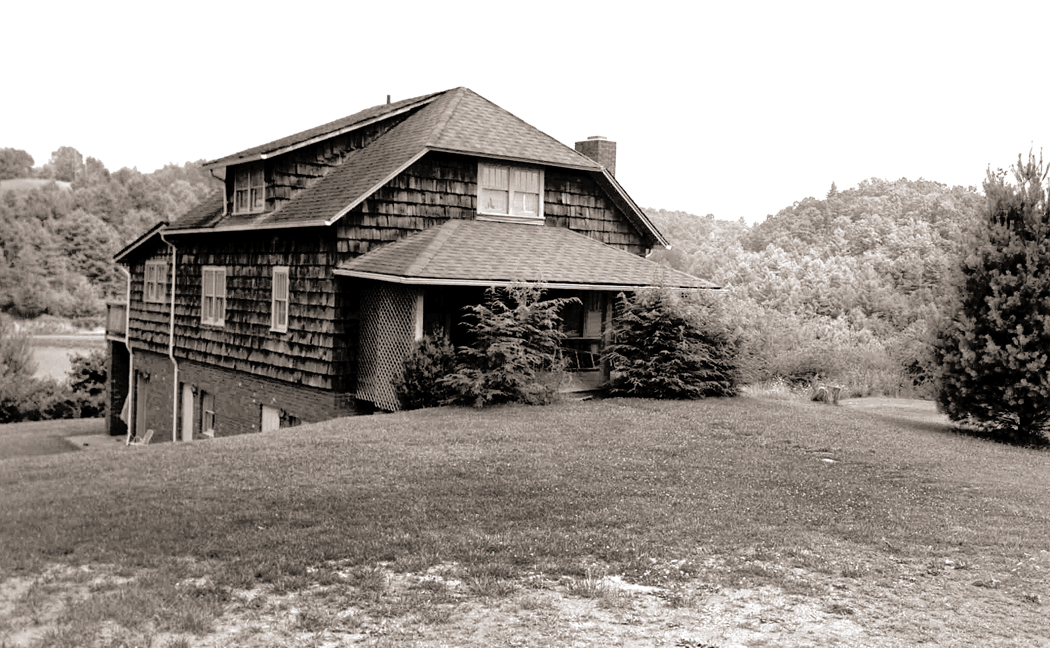
And so, Chapter 11 ended my psychic bankruptcy and I moved to a house on a bluff overlooking the New River in Ashe County, North Carolina. It was a new house, with a living-dining area, a bedroom and a kitchen at the back, with a basement and another bedroom for the teenage daughter that I acquired. Off the kitchen was a porch that hung out over the bluff looking down at the river, a hundred feet below us. From the kitchen window, I could watch the shifting weather on Mount Jefferson as I washed dishes. Mt. Jefferson was the central mountain in Ashe County and it changed constantly as the sun and weather shifted.
It was a long drive on a snowy winter day to the schools where my new lady was teaching, and so we moved closer to Boone, in Watauga County and found a small house in the community of Meat Camp. The house sat on a creek just below the hill on which one the schools she taught in sat.
The house had two floors, the first with a living room in front and a dining room and kitchen in the back. Upstairs there were two bedrooms, with angled ceilings under the roof. Both were small and the one we didn’t use became just storage. In the summer heat, I could lie in the creek in the icy water and cool down.
Unfortunately, the Watauga school system shut down several programs, including the art program and we needed to find other jobs. I had taught a class part time at Tidewater Community College in Virginia Beach, Va., and Carole found a job teaching art in the Norfolk School system. And so, we moved everything down to an apartment building on a cul-de-sac about a half mile from the ocean. Our apartment was next door to my brother’s. He was a fulltime teacher at the school.
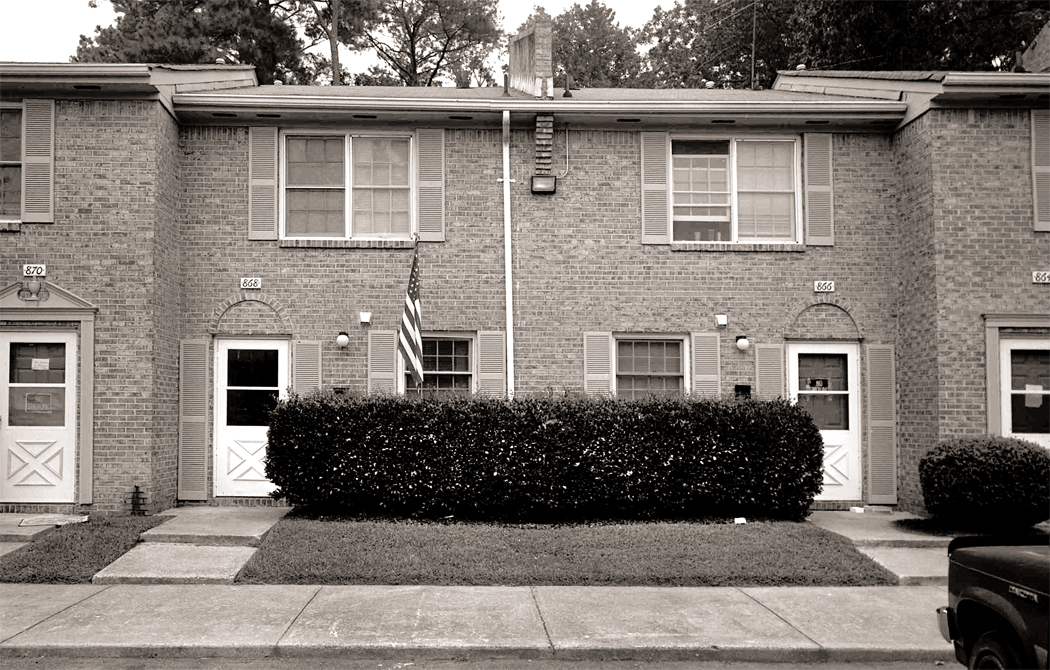
It was a building with 10 apartments, side-by-side, two stories each. In ours, the kitchen was at the front, with a window that looked out on the street. Behind it was the living-dining area. Upstairs were two bedrooms. The art faculty at the school all became great friends and we held great dinner parties together. We lived there for six years.
Then my wife got a job offer from her old boss, who had moved to Phoenix, Ariz. and we decided it might be fun to live in the desert. We imagined a little adobe house with a white picket fence. Never did get that.
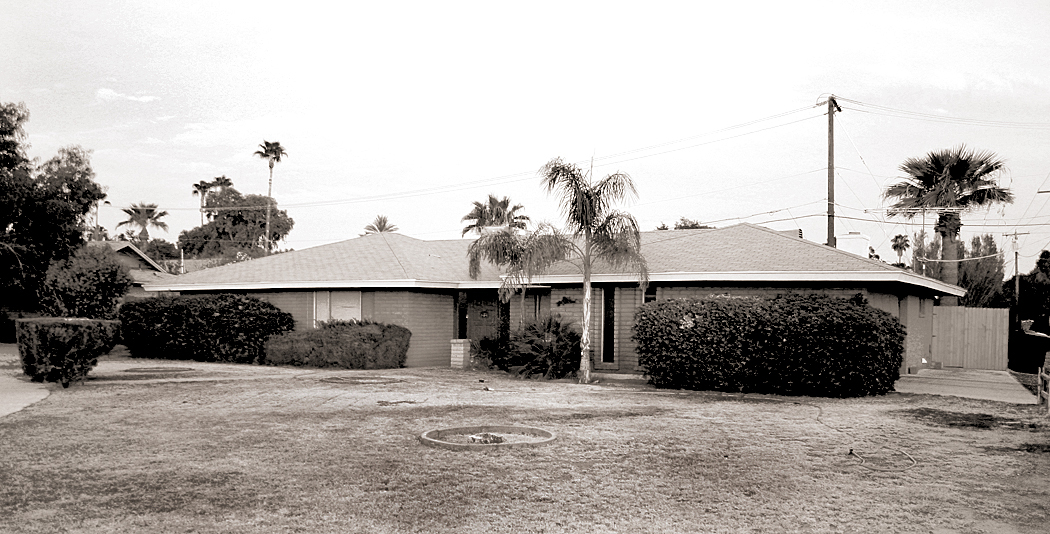
Instead, we had four different houses over a period of 25 years. We had packed everything up into a Ryder truck and drove across the continent, towing our car behind us. We didn’t have a place to move to, but came completely unprepared. We pulled into the street where her new boss lived, and stayed there a few nights. It turned out the house next door was for rent and we moved in.
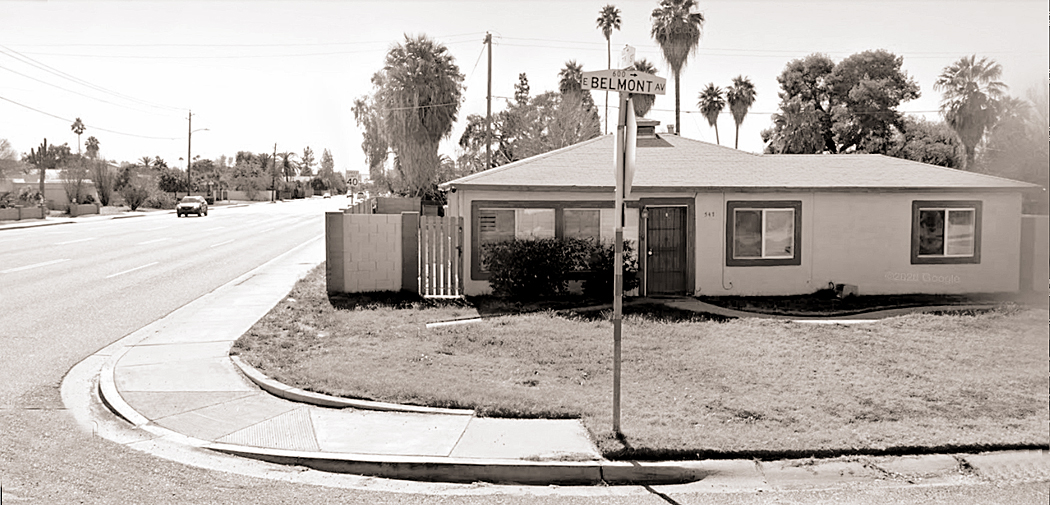
It was a small place, with its kitchen rightfully in the back again, with two bedrooms and a combined living-dining area. It was on the corner of Seventh Street, which is probably the busiest street in all of Phoenix — probably all of Arizona. It was like living by the ocean, with the constant roar of the surf — i.e., traffic — and, while you sort of get used to it, it also wears on you long term. We had to get out.
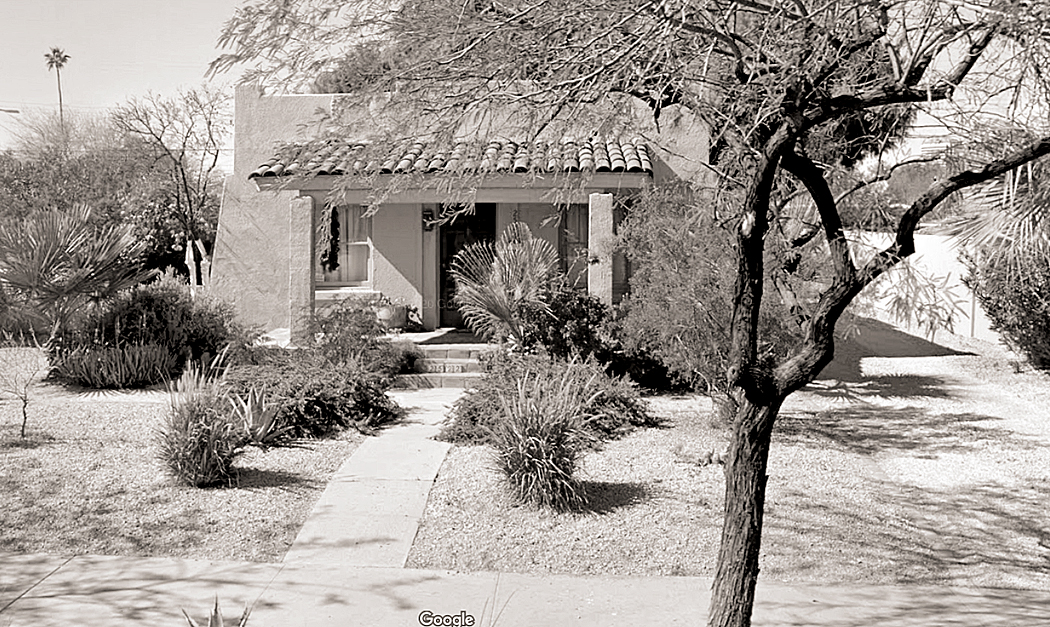
We found a flat-roofed faux adobe house on 13th Street, a quiet back street closer to downtown. It was owned by an artist who was covered in tattoos — we called her the “dragon lady,” and who had painted the stucco on the front of the house in a trompe l’oeil imitation of crumbling adobe, revealing its bricks. Across the front of the house was a living room, which led to a hallway kitchen, to another hallway with more than 20 built-in cabinets — more storage than I have ever had or seen in a house — and a glassed-in drop-down family room with a view of a lily pond. At the back of the house was the bedroom and bathroom.
Both of our first homes had no air conditioning. In Phoenix, that is a problem. They had swamp coolers, which work beautifully in the spring and early summer, when the humidity is non-existant, but fail to cool anything in July when the monsoon humidity hits, leaving everything hot and sweaty.
That’s when my wife’s best friend offered us her place. She was moving to Hawaii and needed a tenant for her house, on Cheery Lynn Road (which everyone mistook for “Cherry Lane”). For the first time since living in Greensboro, the yard was an Eden of trees, flowers, plants and roses. Ivy devoured the entire western half of the house and the front was covered by a great tree.
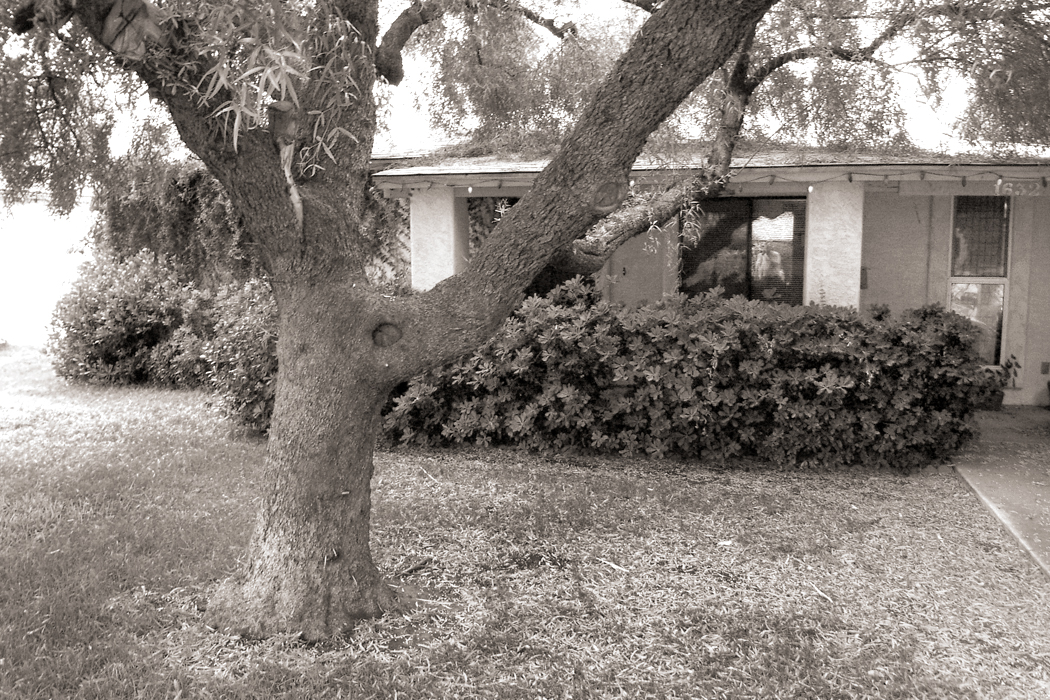
Inside, the living room gave way to a kitchen behind, with a dining room jutting off it, which was actually a converted garage, tutted up with lots of added windows. Three bedrooms under the ivy half of the house, one of which became my office. We lived there for seven years. Then our landlady moved back to Arizona.
And so, we moved into the shadow of Camelback Mountain, the most familiar landmark in the city — a 2700-foot mountain on the border of Phoenix and Scottsdale in the double-hump shape of …
It was the most suburban house I had lived in since my childhood and I felt almost as if I had sold out. It was a sprawling ranch house with a drop-down living room, a huge kitchen with a fireplace and three bedrooms. And there was a swimming pool in the back yard. In Phoenix, the swimming pool usually runs a constant temperature of about 95 degrees in the summer, but feels downright chilly compared with the 110-degree air.
The house was exactly the time of one Haydn symphony to work, and so, I listened to all 104 of them, two a day going and coming, for 52 days. The commute was the highlight of my day.
Ah, but there’s always a worm in the apple and my worm was named Gannett, the newspaper chain that bought The Arizona Republic, where I worked, and everything changed from “our responsibility to our readers” to “our responsibility to our shareholders,” and there were layoffs, management stupidities, a lowering of standards, and a general dumbing down of the paper. Many of the staff were horrified, and when, at age 65, I was offered a buyout, I knew I had to take it. I loved my job, but it was dissolving in front of me. Leaving was the only rational option.
After 25 years in the desert, we moved back to North Carolina, where our daughter was living, in Asheville, up in the Blue Ridge Mountains. Asheville is a blue city in a red state, full of art, music, hippies, restaurants and craft breweries.
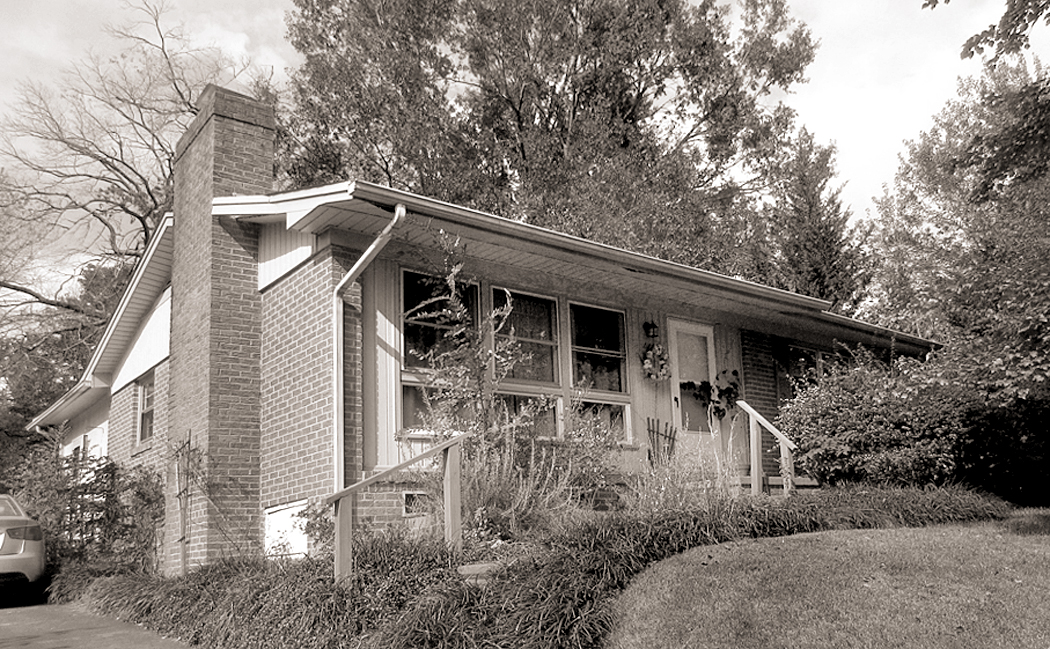
We found a house in a quiet neighborhood with the best landlords we’ve ever had. The house sits on a hill, with a kitchen at the back, and three bedrooms, one of which is my office. I have now been here 10 years, which is longer than anywhere else I have lived. My wife of 35 years died five years ago and my daughter moved away.
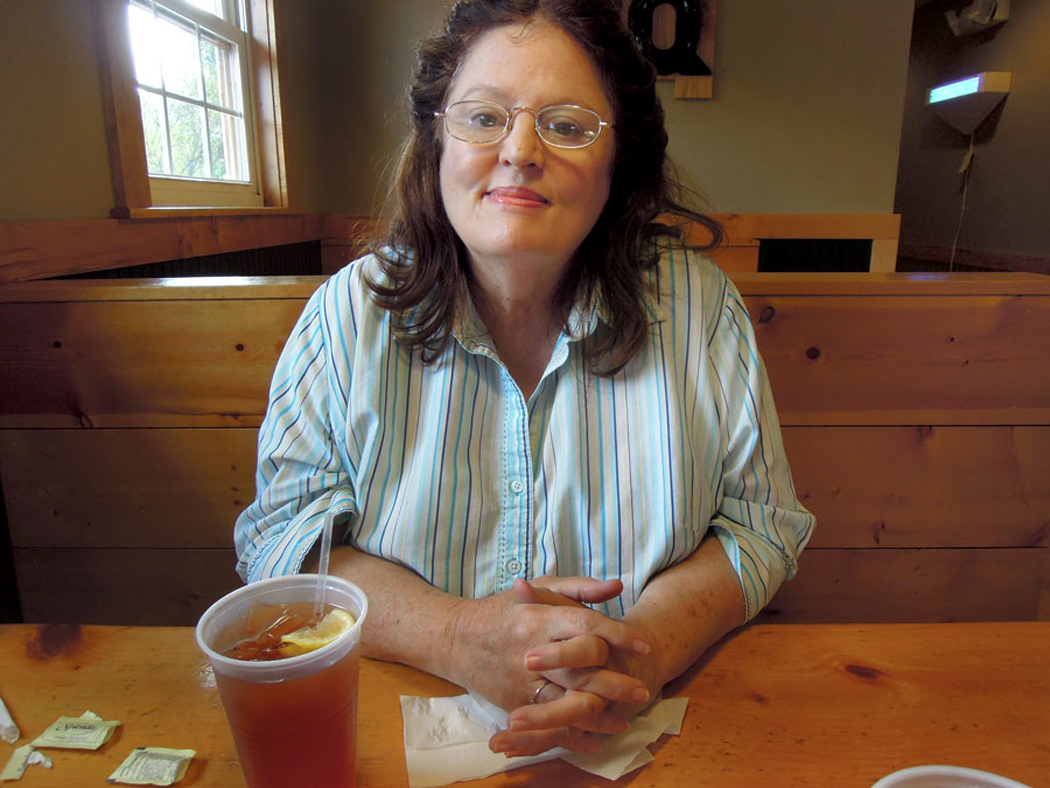
I am now approaching 75 years old and am writing Chapter 18, and through one of the oddest series of circumstances, I am now reconnected to my first wife, who I had not seen or spoken to in 50 years. She has moved in and we share this house. We are not planning to move anywhere else. Oddly, I am not at all the same person I was, but because through all the chapters, I was me, there is an equally odd continuity.
Cornwell, on that TV show I mentioned at the top of this mountain of words I have written, called life a “dangerous journey of introspection.” I first became aware of that fact as a student in North Carolina. Over the course of that life I have lived in all four corners of this continent and have, in the end, returned to North Carolina. And I wonder at how much I’ve changed and developed.
Next week, my wife reaches a milestone; not one with a round number, but perhaps more significant: She fills 75 percent of the century-long container she was born into. She has passed her “three score years and ten” by five.
While she is hampered by a dozen ailments requiring enough medicine to count each morning as a full breakfast, none is immediately life threatening.
But it started me thinking about those traditional milestones we set for ourselves. There are annual birthdays that we count off, but really, is there that much difference between being 32 and being 33? So, there are longer stretches that actually count out time that feels significant. For many, watching the odometer turn over from 29 to 30, or from 39 to 40 is accompanied by an unwelcome breakfast of existential angst.
“Am I really getting old?”
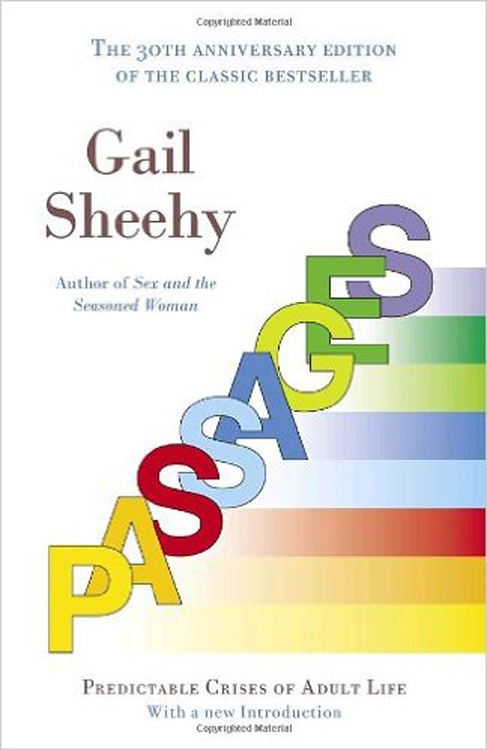
Gail Sheehy wrote a famous book about the changes we go through as we grow. But Passages is more about the psychology of such changes. What I’m talking about are the arbitrary milestones. In Sheehy’s book, the lifestages are sequent, but not hardwired to a specific age, but a likely decade — your 20s or your 30s. What I am looking at here are not the stages themselves, but the signposts that we recognize as they pass.
For me, this starts with age five, when we first leave home daily to attend kindergarten. It is a great wrench in our lives, and we are no longer always safe in our nests, cared and fed by an attentive mom.
The next big one is when we turn thirteen. Eleven and twelve are technically “teens,” but only when we hit thirteen does it seem to count, perhaps because the syllable “teen” is explicit. On your thirteenth birthday, you proudly consider yourself no longer a child, but an adult, or at least and adult manqué. “Today, I am a man,” goes the rite of the bar mitzvah, along with the gift of a fountain pen.
Next up is a bifurcation of genders. Girls have their “sweet sixteen” party, or, if Latina, their quinceañera, marking their fifteenth or sixteenth birthday. In the past, this advertised their marketability as brides, although nowadays, when people marry later, it is a vestigial celebration of “coming out” as a wearer of party dresses.
For boys, sixteen goes by unannounced. When I was growing up, boys had their counterpart at 18, when they signed up for their Selective Service card, marking their eligibility for the military draft. Then, it was accompanied by a deep hard swallow and a nervous smile waiting for a letter from the draft board. Nowadays, without an actual draft, registration is largely a formality.
For boys and girls, there is the age of the learner’s permit for driving, but this varies widely from state to state, beginning usually at fifteen, but for some not till eighteen. Northern states tend to a later age, Southern states tend to let their bairn get behind the wheel much younger.
Eighteen also marks the official “age of consent,” demarking the legality of sex. This is currently an age more honored in the breech than in the observance. It is also voting age, also honored more in the breech.
For most states, eighteen is also the age of legal majority, save Mississippi, where you still must reach twenty-one.
Twenty-one used to be the standard bar for majority, when you become legally responsible. In less enlightened ages it was accompanied by the boast of being “free, white and twenty-one.” Now it is primarily the age at which it becomes legal to get drunk. It is the signal irony that just at the moment the person in question finally declares him- or herself a grownup, he (or she) is most likely to do the most immature thing imaginable.
Most of these age signposts seem front-loaded into growing up. After that, they become more spaced out over time. For some, turning thirty is a hazard, for others, it hits turning forty; it is the moment you realize you will never be young again, that the responsibility of adulthood, family, career and citizenship have replaced dating, playing and experimental sex. Sobriety hits, and it isn’t always fun.
Fifty is a quiet marker; most people find they are relatively happy at that age. There is, perhaps, more satisfaction at having reached the half-century mark than unease at getting on in years. Most of us, at fifty, are still vital and energetic, and we have the added benefit of all that accrued experience.
(When I was young, I calculated how old I would be at the turn of the millennium and realized I would be fifty-two, and I was daunted because I really didn’t believe it likely I would live that long. When it actually happened, it almost snuck up on me. I was hardly aware I was over fifty.)
Sixty is stealthy, because it comes and goes hardly noticed because one’s eyes are firmly on the big sign ahead: sixty-five and the finality of retirement. They keep moving the finish line on us, upping the age for Social Security, but sixty-five is so deeply entrenched in our collective psyches, that the subsequent years just seem like a tiny hesitation.
The round numbers seem less meaningful than the fivers. Seventy-five is three quarters of a century and an accomplishment more than merely a signpost. Beyond that, the years seem less important than the life put into them. Currently the average life expectancy for American men is seventy-seven and for women, just under eighty-two. Past that, the only one that really counts is the even hundred. The George Burns point. Beyond that, you begin to count every years once again, just as you did as an infant.
Sometimes, when I’m having trouble getting to sleep, I take six decades of my living and slide them aside, like a Japanese door, to open on the landscape of my childhood. I remember the house I lived in when I was five or six years old, trace its floorplan, walk out its door and wander the streets. What is most surprising is how much there is stored in the neurons, untouched for half a century, that can be re-animated. Each door I open opens into a room with new doors to open, that open on other rooms with other doors.
And so, I remember the front room of the house where we lived with my grandmother, Nana, in New Jersey just after the war. It sat directly on the town boundary between Teaneck and Bogota at the point Degraw Avenue began its long westerly descent to the Hackensack River. It was the house where my mother grew up, where her father died when she was seven, where she then had to raise her younger brother and sister while her mother worked in Manhattan. It meant that my mother never really had a free childhood, and perhaps as a result, adulthood always seemed to feel like a burden.
That two-family house divided at the front door. To the right was the front room of our apartment. Straight behind the front door were the stairs to the second floor, where Nana’s sister and her husband lived. Tante Esther and Uncle Gerry. That front room led through a wide arch to the dining room, at the far end of which were two spring-mounted swinging doors — one on either end of the wall — which led to the kitchen. Off the dining room to the left, underneath the staircase to Tante Esther’s, were the bedrooms and the hard-tiled bathroom with its claw-footed bathtub. At the back of the house, tucked behind the kitchen, was an addition my father had built where Nana’s mother came briefly to live and finally to die. She was a formidable woman, born Anne Gurina Kristiansen in Norway, but so old by the time I knew her she seemed almost like death already. The fact she died in what became my bedroom hardly registered on me. I was too young to understand.
Usually, I get drowsy by this time, and I descend into a nether world.
The basement, reached by the dark stairs behind the kitchen, was a dungeon in which a large beast of many white asbestos tentacles resided, sitting in the middle of the cavern roofed with rafters and ducts. A coal chute gave some light beyond the golem, and what was once a window to the backyard near the top of the wall was now dark, covered with the addition where the old lady died. A cat once gave birth to kittens in the crawlspace accessed by that window. My father hated cats. I don’t know what happened to the kittens, but it is unlikely he harmed them. More likely he called the dogcatcher to come and get them. At any rate, they disappeared as quickly as they arrived.
That golem, the furnace, played in the cast of the adventures I devised in the cellar, turning used Reddi-Wip cans into space ships, which I shot through outer space with noises I generated in my throat, shooting each other into oblivion. Some days later, my mother wondered what the bad smell was and discovered the remaining cream in the cans had soured, stinking up my cosmos. Reddi-Wip was invented the same year I was born.
Captain Video
That interest in outer space came from a mahogany box in a corner of the dining room, which had a tiny curved glass window in it on which I religiously watched Captain Video, Tom Corbett, Space Cadet, and Rocky Jones, Space Ranger, to say nothing of Captain Midnight. Television was new, quality was dubious, reception iffy, and programming spotty. We all knew the familiar “test pattern” that burned into the cathode ray tube before the day’s schedule began.
My father aided and abetted my fascination with space travel by fabricating for me and for my younger brothers what we called “space boards,” which were masonite panels we could hold on our laps, filled with various buttons and switches we could flip and push, in imitation of the control panels of our space heroes. It is amazing how easy it is to amuse a young boy with an active imagination.
But it wasn’t only space that captured my imagination, it was also cowboys. Because there was so little programming available for the early TV stations, they recycled endless movie re-releases to fill up the time. Many of these, at least on morning TV, were Westerns from the 1930s. I came to know and love Buck Jones, Tim McCoy, Hoot Gibson, Ken Maynard, Bob Steele — the “Three Mesquiteers,” and above all, Hopalong Cassidy. William Boyd had struck a coup by buying up the rights to his old movies and now refitted them for television, and later making a whole new series of TV adventures. Boyd was my favorite.
At the age of three or four — at any rate, before I began school — I remember my grandmother getting on my imaginary horse, Whitey, with me and riding her from the kitchen to the front door to see her off to work in the morning. Cap guns and cowboy hats were always the preferred Christmas presents.
This isn’t about nostalgia, however, but about how a small boy experiences life. As an adult, one has a well of experience to draw on, a series of related moments forming a net, so that each new occurrence has some resonance with its past. But as a child, each thing is new and as yet unconnected to the rest. There are things taken as given: family, the house, the yard; later, the school, the way to the grandparents house. All these things ultimately mesh together, but those early memories are discrete; it is only as I pull them together while trying to doze off, that they begin cohere.
In those first years, the world was largely circumscribed by the house and yard, with the rooms, the mystery of the understair closet, with its odor of dust and uncovered lathe, the cavern of the cellar, the apple tree in the back yard from which Nana made a yearly batch of applesauce, and the vacant lot next door, which was our cow prairie or our moonscape, depending on what we were playing that day. Or, for that matter, our jungle when we took our shirts off and “went native.”
Beginning with kindergarten, the world opened up. I walked the mile to school each day and the mile back, and the streets became tentacles of geography on which I built my picture of the world. Each street was a different reality. To give a summary picture of that geography: Degraw Avenue ran basically east-west; the few blocks on which our house sat was a plateau; down the west side, into Bogota and Hackensack, the road went downhill; and in the east, from Queen Anne Road on, it went downhill the other way toward the Meadowlands, Overpeck Creek and Fort Lee. That was the spine of my earth. Crossing it, almost like shoulders and hips, were Queen Anne Road and Palisade Avenue.
Our house was on the corner of Degraw Avenue and Farrant Terrace, which was the street that ran along the side of our house, took a 90-degree turn and continued down to Queen Anne Road as a kind of anastomosis, leading the same place as Degraw Avenue. My best friend, Tommy, lived in a house where Farrant Terrace bent. The Clems lived in the house next door to us; they were an older couple who treated us like an aunt and uncle. Their back porch had jalousie windows, a fact that much fascinated both me and my little brother.
The other arteries in this circulation all came off this main armature. It is difficult to express just how central this picture of the world was to one in the process of piecing together a whole self. At that age, I knew nothing of Nebraska or Timbuktu; it was the spine of my streets that were the core, the seed on which the crystal grew. From those first certain streets grew an internal sense of how the entire globe might be pulled together in a single flash of connectedness.
Out the front door of our house and across the street was Crestview Place, which ran uphill steeply to Fourth Place in Bogota, where Nana’s mother-in-law, Aase, lived, upstairs in a house where her sister lived downstairs — Tante Marie. The two were very old, very wrinkled and very powdered. When I was still pre-school, Aase lived with her ancient husband Thorvald, who wore thick black wool suits with a vest and a pocket watch, had wire-brush whiskers and the distinctive smell of old man. He died early on in my life and Aase — whom we called “Bestemor (Norwegian for “grandma”) — lived on into her nineties. I spent many a day at Bestemor’s house, climbing into the attic to play with the toys she still had from the childhood of my mother’s brother, painted lead cars and airplanes.
Down the hill to Palisade Avenue is where my father had his hair cut by a barber named Dick, who wore a white coat and had one of those pencil mustaches one knows from Hollywood movies of the 1930s. It also led to Olsen Flooring Company, where my father worked as office manager and accountant.
Down the other way, to Queen Anne Road, led to the A&P, the delicatessen where we bought potato salad, and across the street from the deli, the bakery where we bought “mudballs” — a round, chocolate covered cupcake that we loved as kids.
At the point Farrant Terrace ended at Queen Anne Road was a tiny private grocery store whose floor was covered in sawdust — a common occurrence back then, now frowned upon by health codes — and a stationery we called the “candy store,” where I spent my nickels on Three Musketeers bars, Necco Wafers, and a particular favorite, a packet of five sweet jellies called Chuckles, whose flavors were cherry, orange, lime, lemon and licorice.
By the time my mind wandered around to the candy, I would probably be asleep. But if not, if I still couldn’t drop off, I will wander around that circumscribed world as I did when I was in kindergarten and first grade. I walked to school every day and home afterwards, doubling that inner map of the world. A friendly policeman stopped traffic on Queen Anne Road to let me cross the street. I recall Mrs. Winters and my kindergarten class, the naps we took, the milk containers we drank from, the rhythm bands, the finger painting. I remember the playground around Longfellow School (now closed and turned into a church) and my Aunt Sally who was the school nurse, and little Willie Shydecker, whose fifth birthday party I went to in a house just two away from where Aunt Sally and Uncle Bernie lived. I sometimes wonder what ever happened to Willie.
Longfellow School today
But it was walking home from school that left its biggest mark on my being. I wandered. I didn’t always take the same route. I took what I called “short cuts.” These led me miles out of my way, exploring where other streets might lead. If I have traveled much as an adult, it was only a habit set in motion when I wandered down Fort Lee Road, past Amman Park with its small fountain, and up the hill and back down to Bogota and the broad mainline railroad tracks — at that time six tracks wide; now most of the tracks are ripped up and gone — which I would stand over on the bridge and watch the trains pass, shaking the ground. The boy is father to the man.
My wanderings amazed my parents, who thought it odd that I would walk so far out of my way, but they never seemed to think it might be dangerous for me to do so. I think they were quietly proud of their boy for being able to find his way around so easily. They also showed me off to the adult world for my prodigy ability to name all the cars on the street by make from the time I was two or three. One Fourth of July at a fireworks display over the Hackensack River I was carried around by my father on his shoulders who showed me off to uncles and grandfathers by pointing at cars parked in the lot and having me name them: “Pontiac, Studebaker, Packard, Rambler, De Soto, Kaiser, Crosley …”
1949 Frazer
Other times, he would test me, sitting on the front porch of the house and I named the cars as they passed on Degraw Avenue. From that time on, tests at school were never frightening; rather, they were a chance to show off again.
The odd thing remains that these memories of Teaneck seem to have a different reality from later memories, almost as if they were of a different person. I can draw a straight line from me at 68 back to me in fourth grade, me in college, me during my first marriage, me when I became a writer. But there is a kind of memory lacuna between that me and the me of these earliest thoughts. It is as if I have to dig down into the layers of soil separating me now from me then, like an archeologist, to discover this fragment or that, and then piecing together the shards into a full pot.
313 Degraw Avenue today
We all have a story-line in our memories, that continuous ego, that who-ness that we are. It is a novel told straight through. But these earliest memories are more of a collage, the bits and pieces reassembled in no particular order, the scents, the memory of being picked up and held, the doors swinging open to the kitchen, the golem in the basement. They are a preface to the story, oddly unconnected, yet, still of a piece. Tributaries to the river.
The box still has many pieces unrecollected here. I can take them out and play with them again next time a churning brain keeps me awake.


















 And so, I remember the front room of the house where we lived with my grandmother, Nana, in New Jersey just after the war. It sat directly on the town boundary between Teaneck and Bogota at the point Degraw Avenue began its long westerly descent to the Hackensack River. It was the house where my mother grew up, where her father died when she was seven, where she then had to raise her younger brother and sister while her mother worked in Manhattan. It meant that my mother never really had a free childhood, and perhaps as a result, adulthood always seemed to feel like a burden.
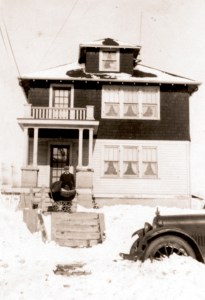 That two-family house divided at the front door. To the right was the front room of our apartment. Straight behind the front door were the stairs to the second floor, where Nana’s sister and her husband lived. Tante Esther and Uncle Gerry. That front room led through a wide arch to the dining room, at the far end of which were two spring-mounted swinging doors — one on either end of the wall — which led to the kitchen. Off the dining room to the left, underneath the staircase to Tante Esther’s, were the bedrooms and the hard-tiled bathroom with its claw-footed bathtub. At the back of the house, tucked behind the kitchen, was an addition my father had built where Nana’s mother came briefly to live and finally to die. She was a formidable woman, born Anne Gurina Kristiansen in Norway, but so old by the time I knew her she seemed almost like death already. The fact she died in what became my bedroom hardly registered on me. I was too young to understand.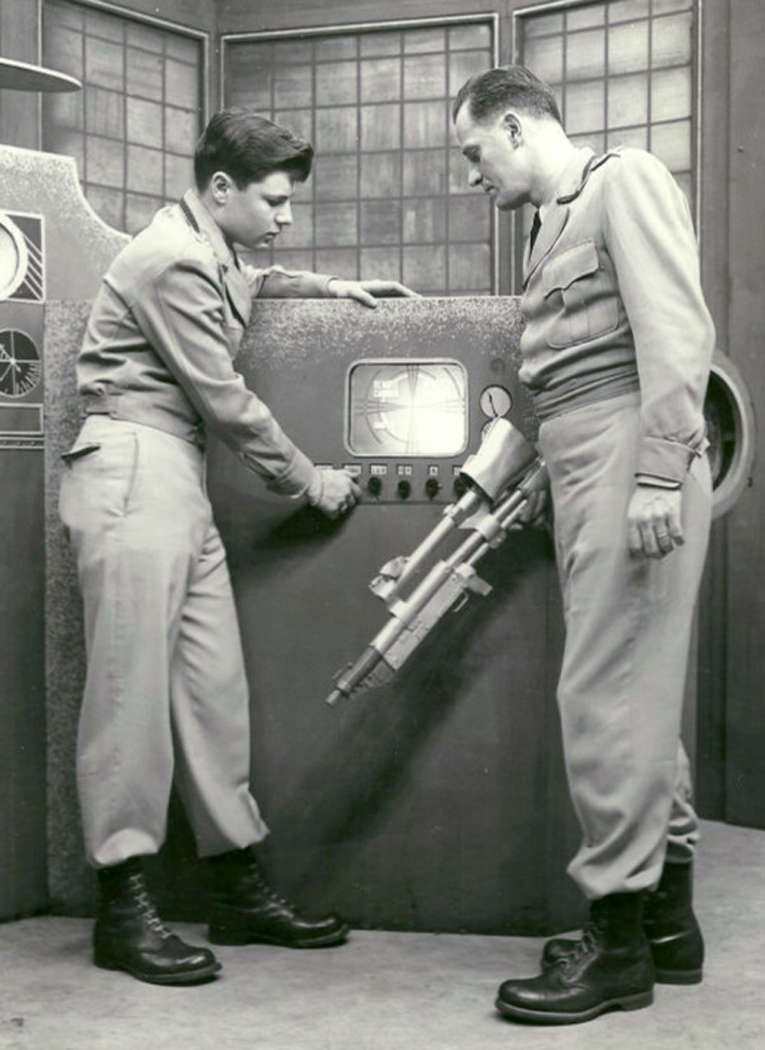
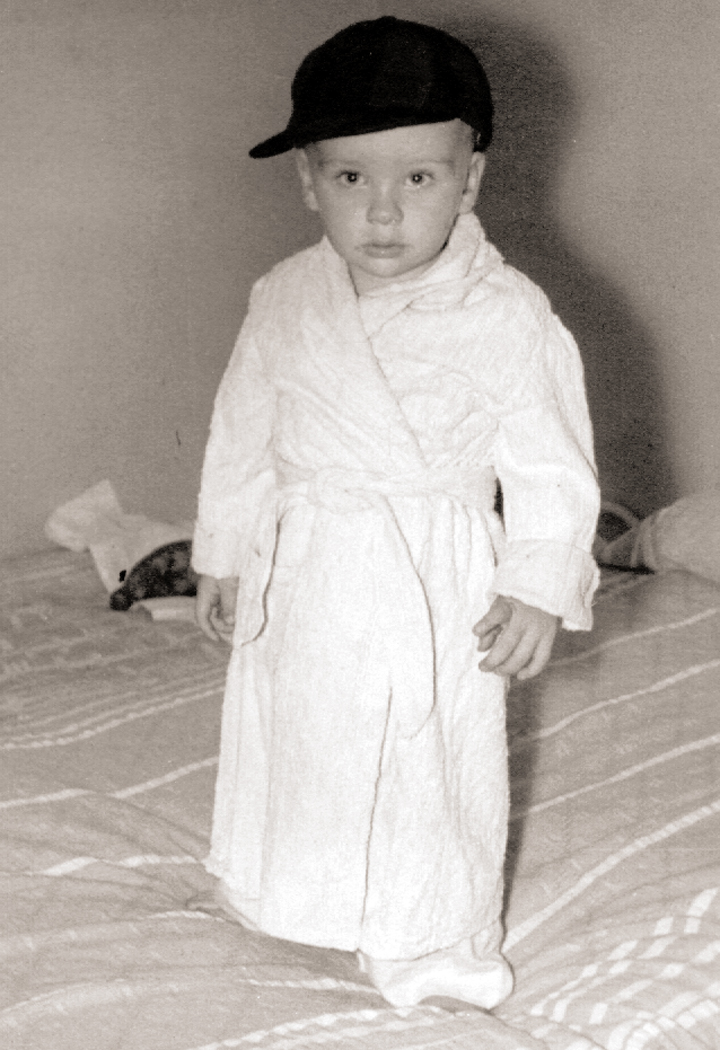 This isn’t about nostalgia, however, but about how a small boy experiences life. As an adult, one has a well of experience to draw on, a series of related moments forming a net, so that each new occurrence has some resonance with its past. But as a child, each thing is new and as yet unconnected to the rest. There are things taken as given: family, the house, the yard; later, the school, the way to the grandparents house. All these things ultimately mesh together, but those early memories are discrete; it is only as I pull them together while trying to doze off, that they begin cohere.
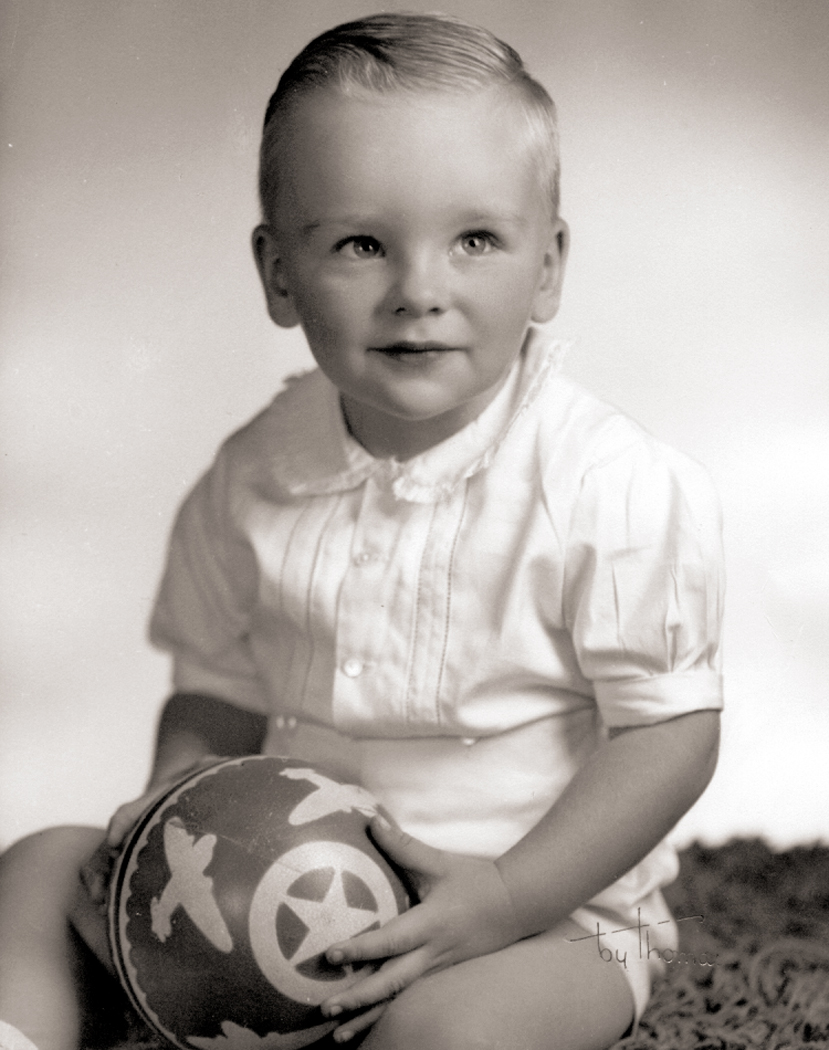 Out the front door of our house and across the street was Crestview Place, which ran uphill steeply to Fourth Place in Bogota, where Nana’s mother-in-law, Aase, lived, upstairs in a house where her sister lived downstairs — Tante Marie. The two were very old, very wrinkled and very powdered. When I was still pre-school, Aase lived with her ancient husband Thorvald, who wore thick black wool suits with a vest and a pocket watch, had wire-brush whiskers and the distinctive smell of old man. He died early on in my life and Aase — whom we called “Bestemor (Norwegian for “grandma”) — lived on into her nineties. I spent many a day at Bestemor’s house, climbing into the attic to play with the toys she still had from the childhood of my mother’s brother, painted lead cars and airplanes.


 Richard Nilsen