Archive

Tag Archives: clouzot

In a recent piece on this blog, I mentioned that Pablo Picasso, while he was undoubtedly a great artist, might not be a particularly good painter. That is, his craftsmanship over the years could be quite indifferent. Inventive, no question, but seldom painstaking over execution. I wrote a fuller explanation of this in an essay I wrote in 2023 for the Spirit of the Senses salon website and I thought this might be a good time to reproduce that post for a wider audience. 
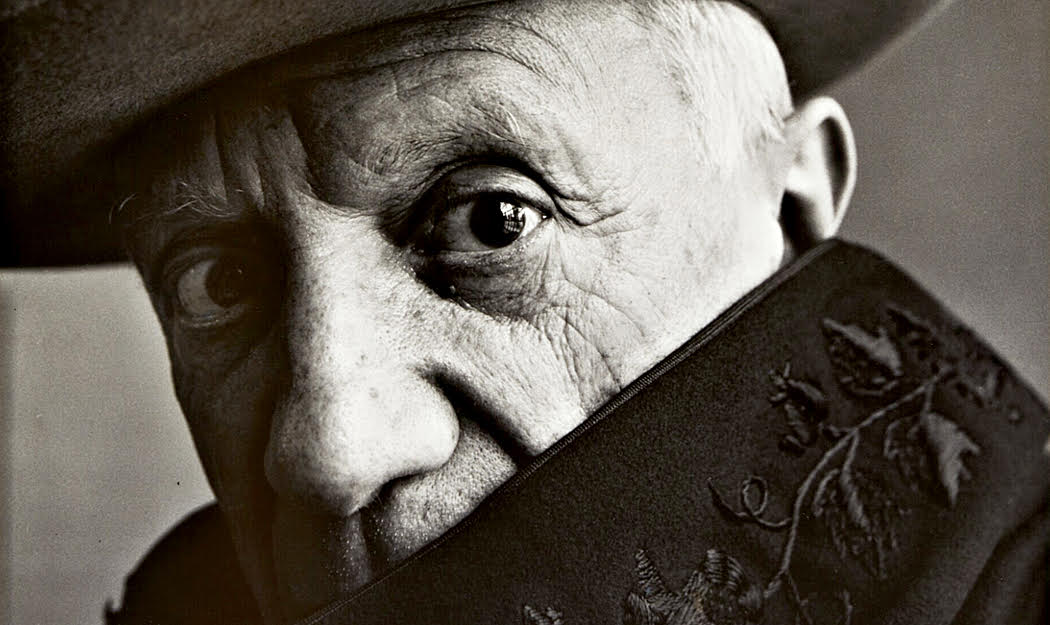
Pablo Diego José Francisco de Paula Juan Nepomuceno María de los Remedios Cipriano de la Santísima Trinidad Ruiz y Picasso was a very impatient man, perhaps because his name takes so long to say or write.

I say he was impatient on the evidence of his paintings. I certainly never met the man. But I have seen a boatload of his paintings in person and hundreds in reproduction, and they all tell me he didn’t have the patience to spend time on their finishing touches.

Don’t misunderstand: Pablo Picasso was a great artist, and for many reasons. But he was not what I would call a great painter. Let’s take a look.

There was a time when many thought that Picasso’s art was a hoax. You know, the “My kid could paint better than that,” and serious-minded critics would say, “First, you have to be able to master the techniques before you can experiment with abstraction.” (Yeah, this was a while ago).

But then, some of the young Picasso’s art, from his adolescence, began showing up and it was clear that he had been a masterful draftsman and could draw and paint as realistically as anyone.
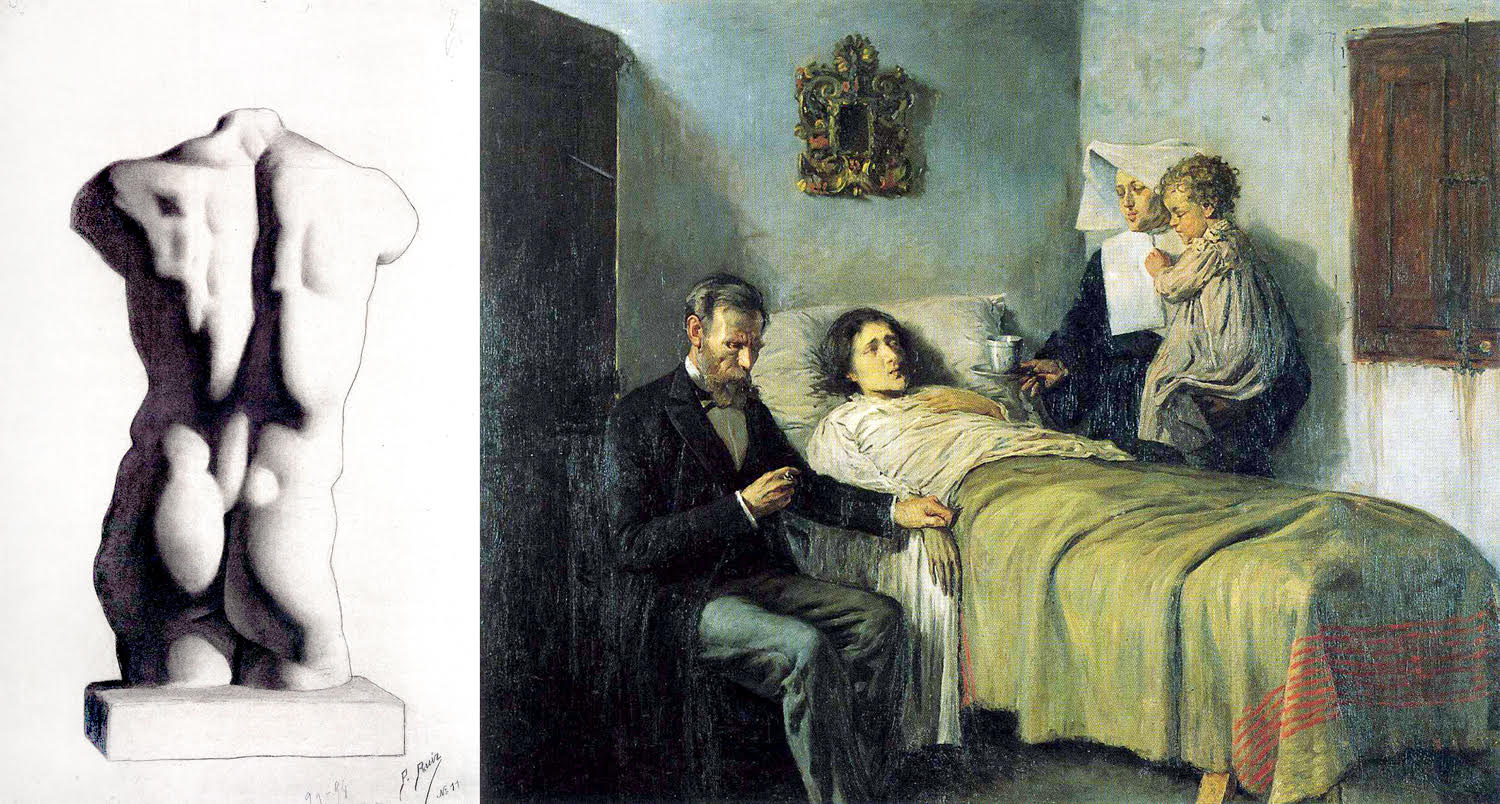
He could pump out an academic figure study like an Old Master. And he could put on canvas as realistic a painting as you could wish. Just look at some of these, from 1893, when the artist was 12, and 1896. It is clear he could do anything. But he didn’t: By the turn of the century, he had been taken with more modern trends in art, from Impressionism to Post-Impressionism, to Fauvism and Expressionism. His style loosened and the works became sketchier.

This evolution of style was characteristic not only of Picasso, but of other artists, writers and poets. There had been Impressionism and Post-Impressionism, Van Gogh, Gauguin, Cezanne — all with different styles.

By the middle of the last century (that’s the 20th, remember), Modernism had not only established itself, but become entrenched. Its hagiography had been codified and the heads of its various branches were Igor Stravinsky in music, James Joyce in prose, Ezra Pound in verse, and Picasso on canvas.

These were hardly the only names in the mix, and they may not even have been the best artists working, but they became the names we all knew. They are the names in the anthologies and textbooks.

And they all burned through styles. Stravinsky went from late Romantic chromaticism, to a savage primitivism, to Neo-Classicism and finally to his version of 12-tone serialism. Joyce from some of the most beautiful, clear prose in The Dubliners to the stream-of-conscious jumble in Ulysses and into the paronomastic almost-abstract gibberish of Finnegans Wake. Pound began with highly poeticized Edwardian prettiness to a hard-edged sarcasm and into his own form of pan-linguistic word salad.

Most serious artists go through stylistic growth from early to late periods, but Modernism seems less like organic growth and more like a conscious seeking-out of something new, something that would get attention. Pound’s battle cry was, “Make it new!” Where style had been a function of personality, it became a “brand” and ever newer versions were sought, like updating your car every few years.

I’m being too harsh here, but to make a point. Picasso kept evolving, from that early Expressionism
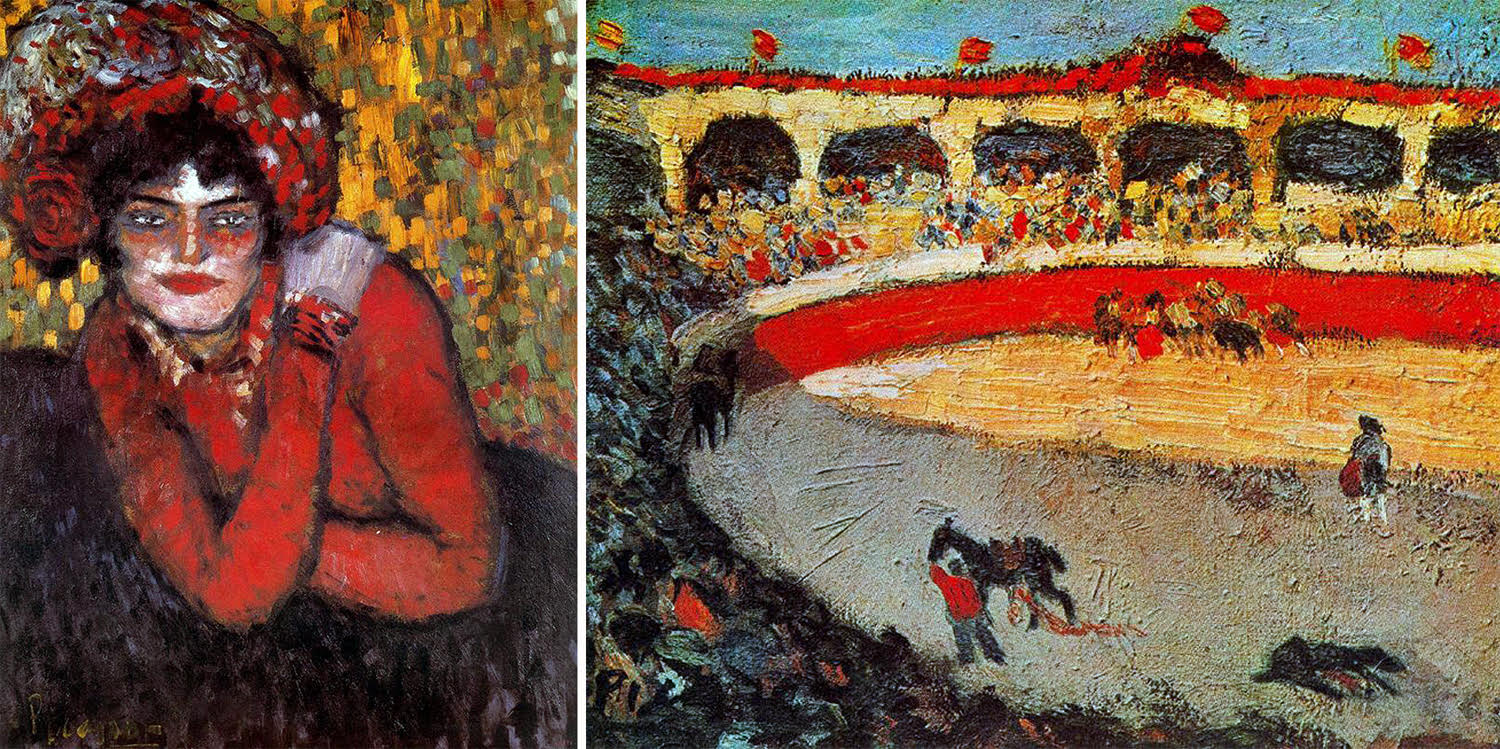
To the famous “Blue Period”
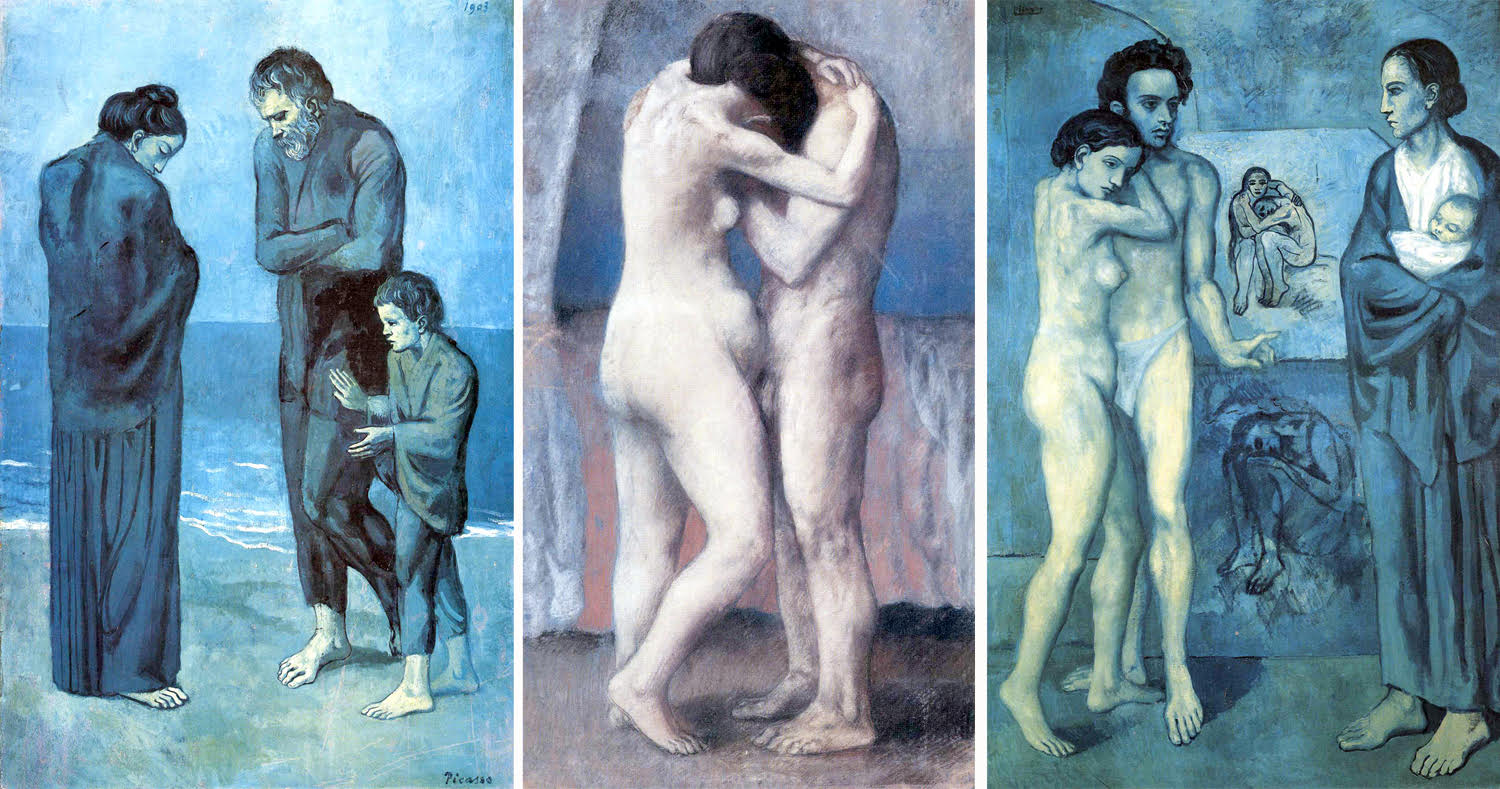
Through a subsequent “Rose Period”
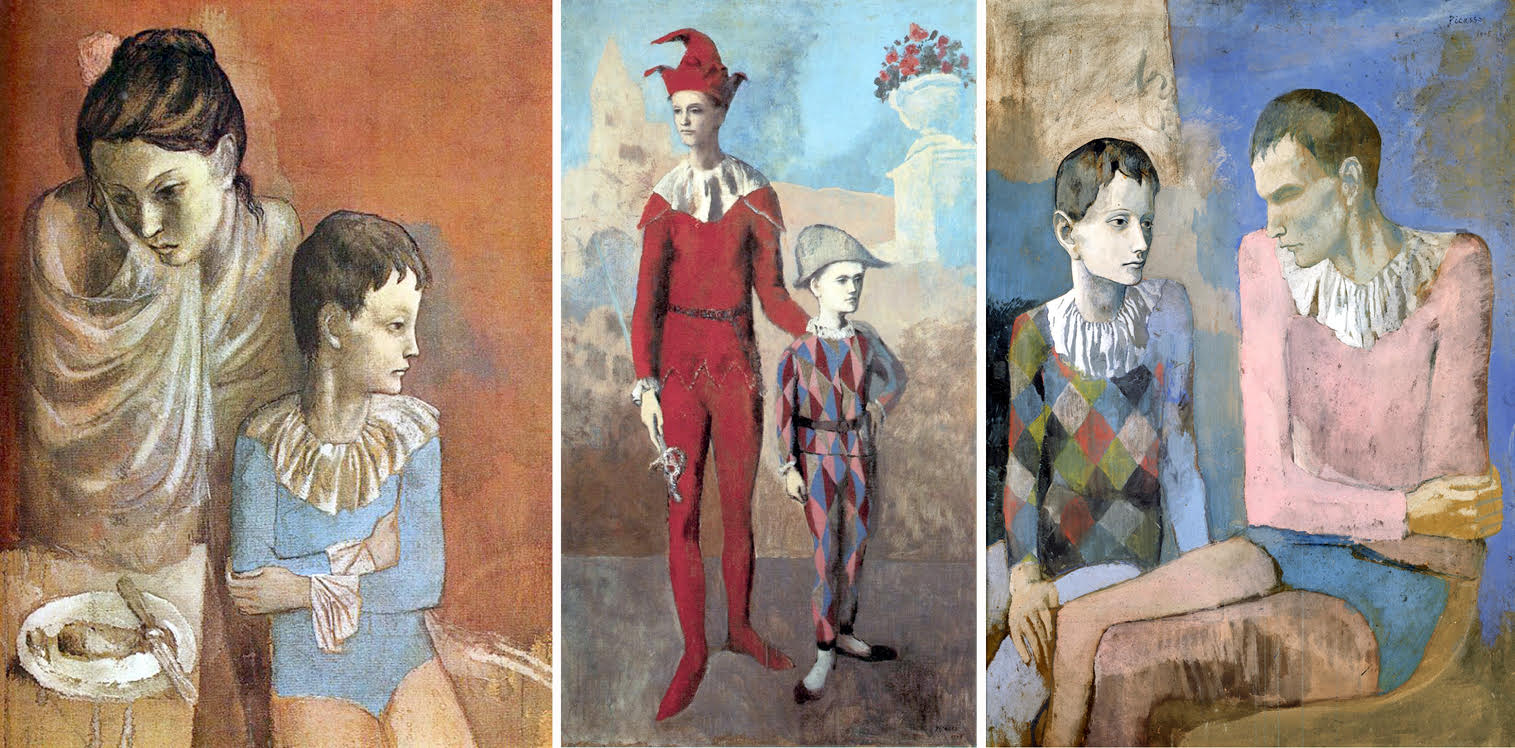
to African primitivism,
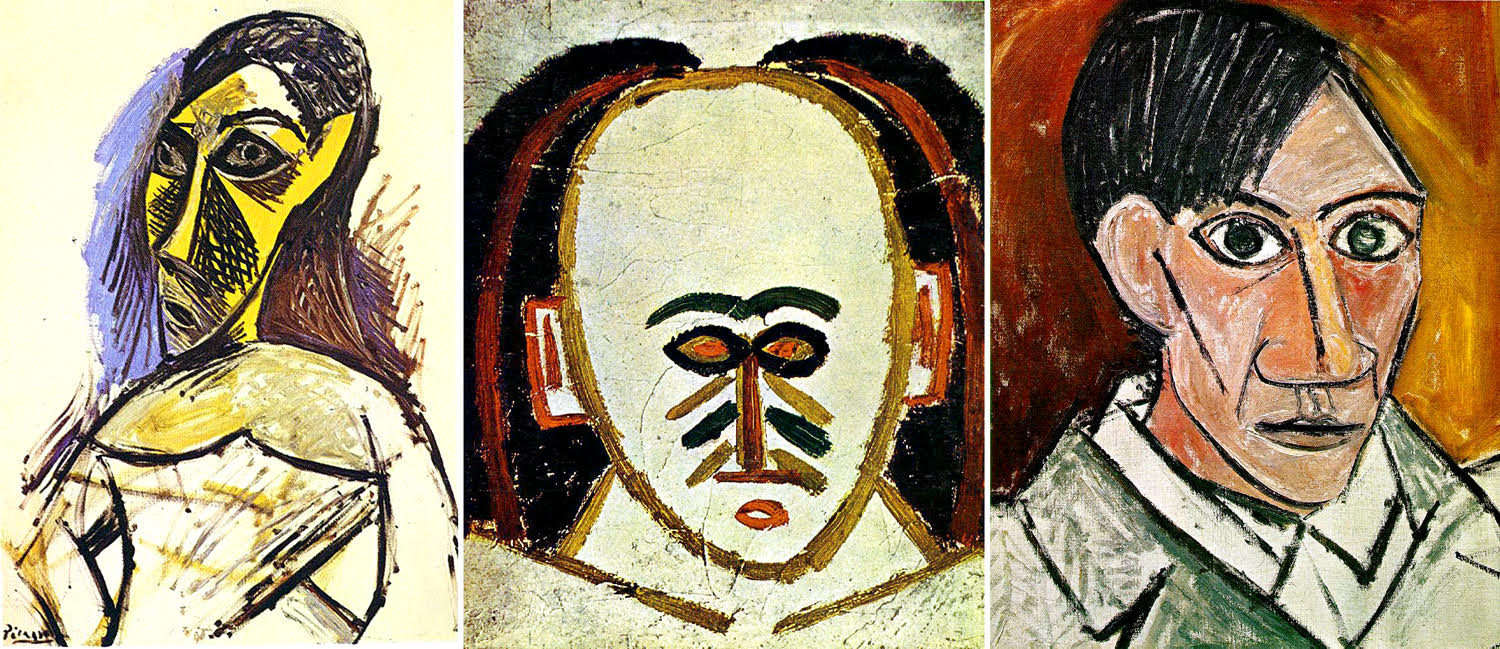
to analytic Cubism,
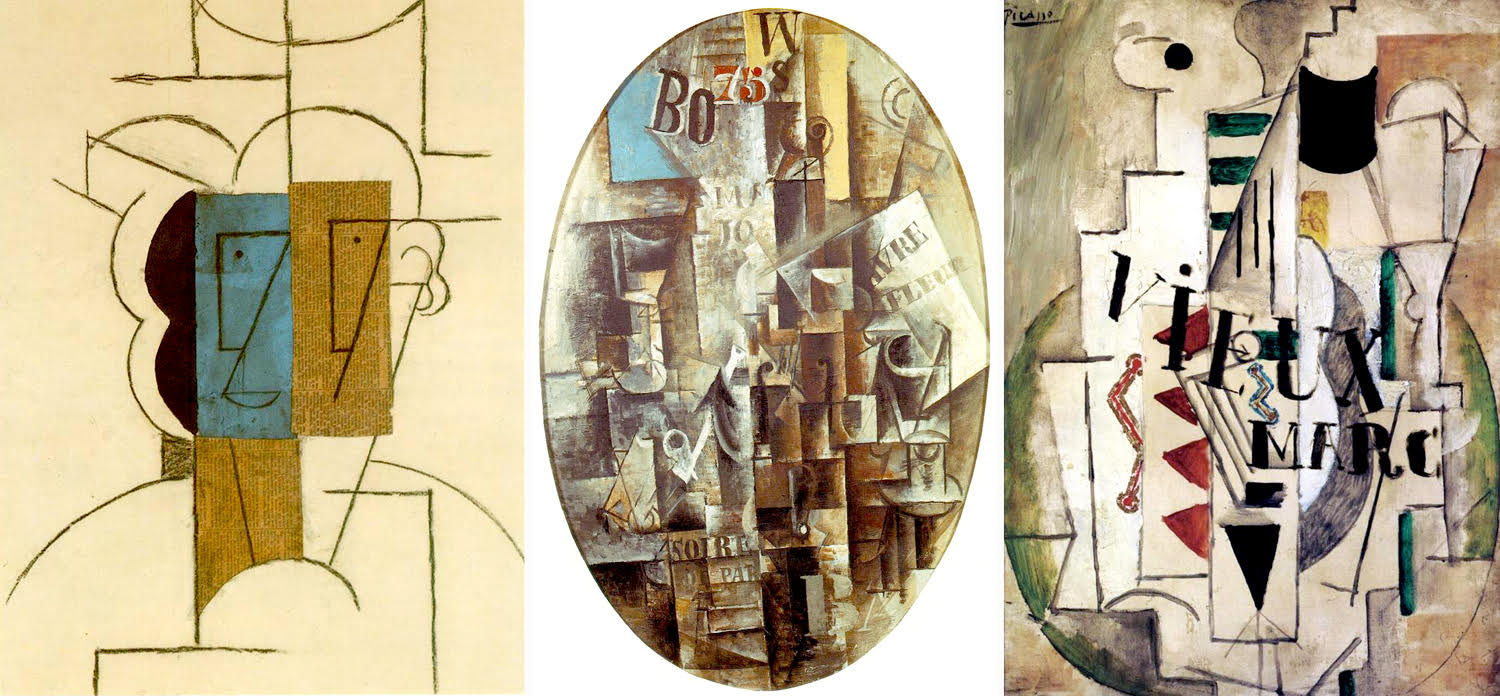
to Synthetic Cubism,
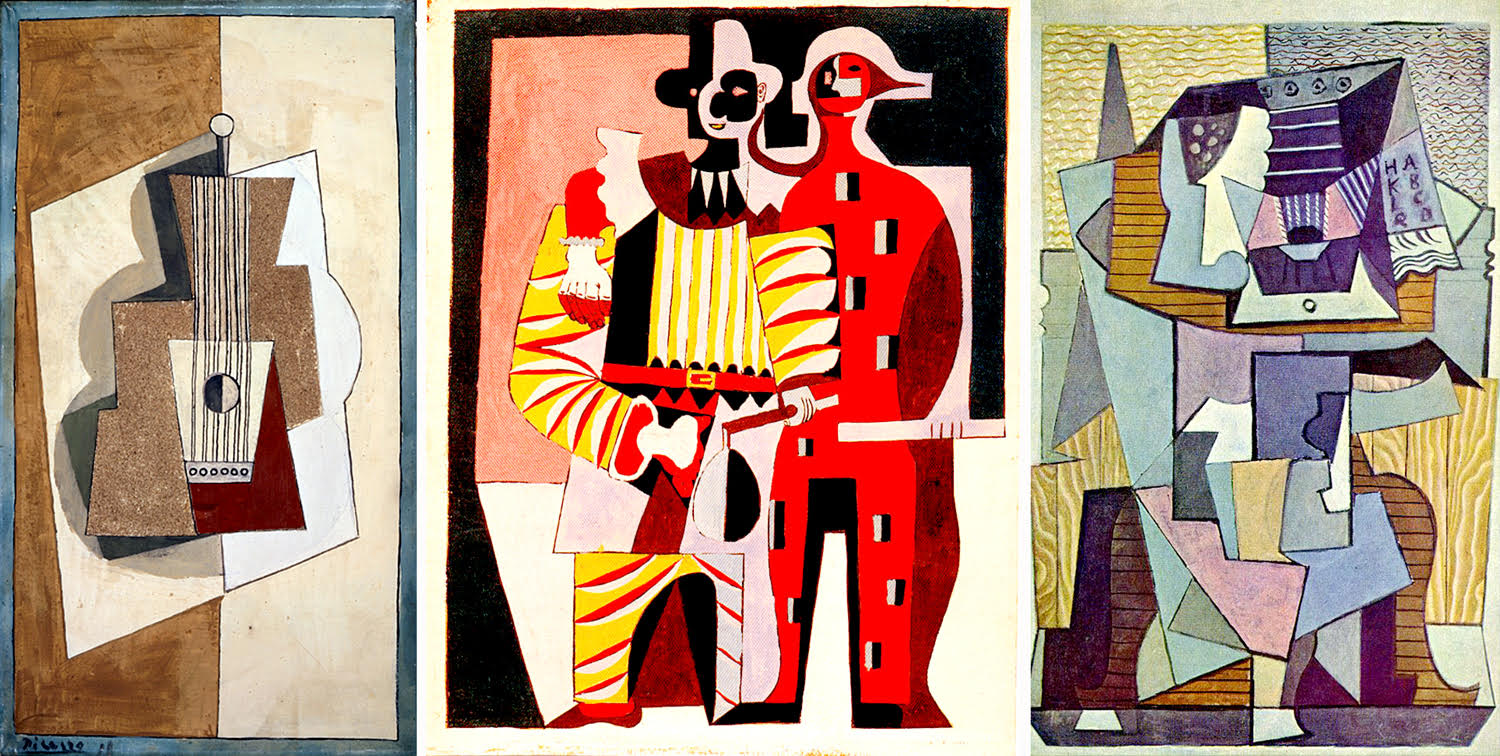
to Surrealism
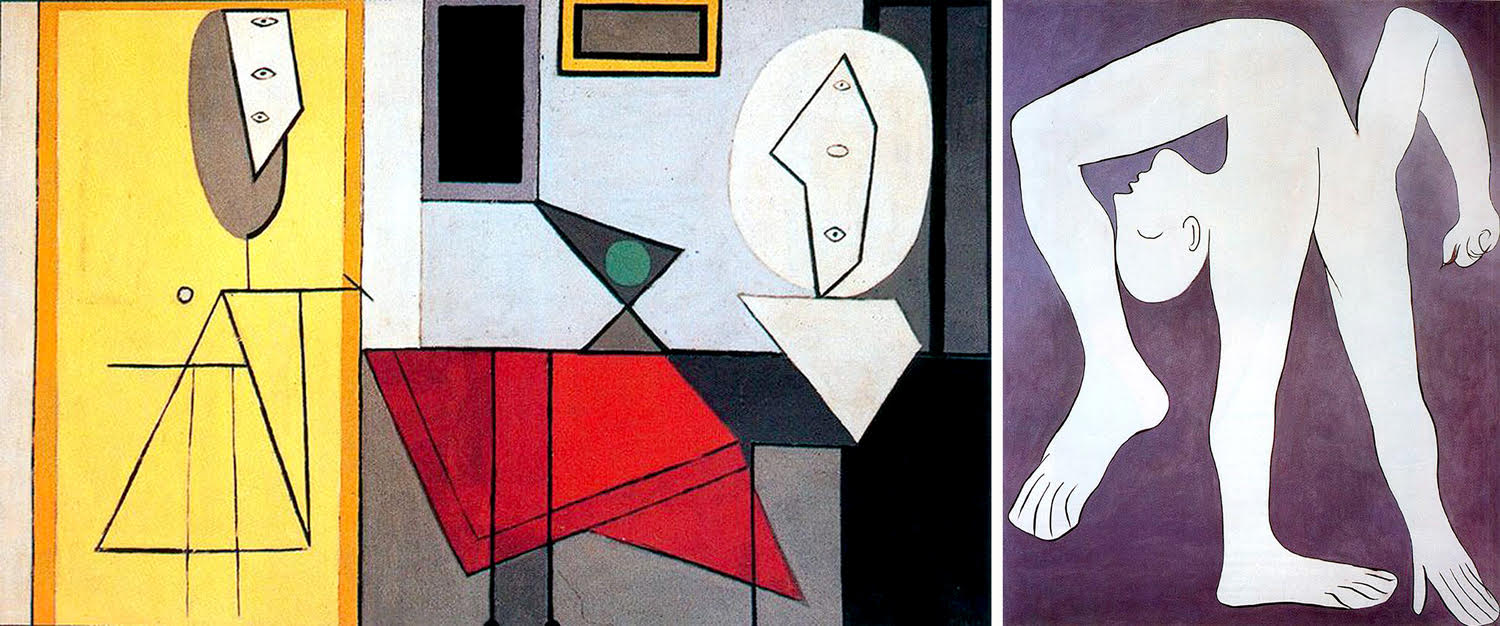
and Neo-Classicism
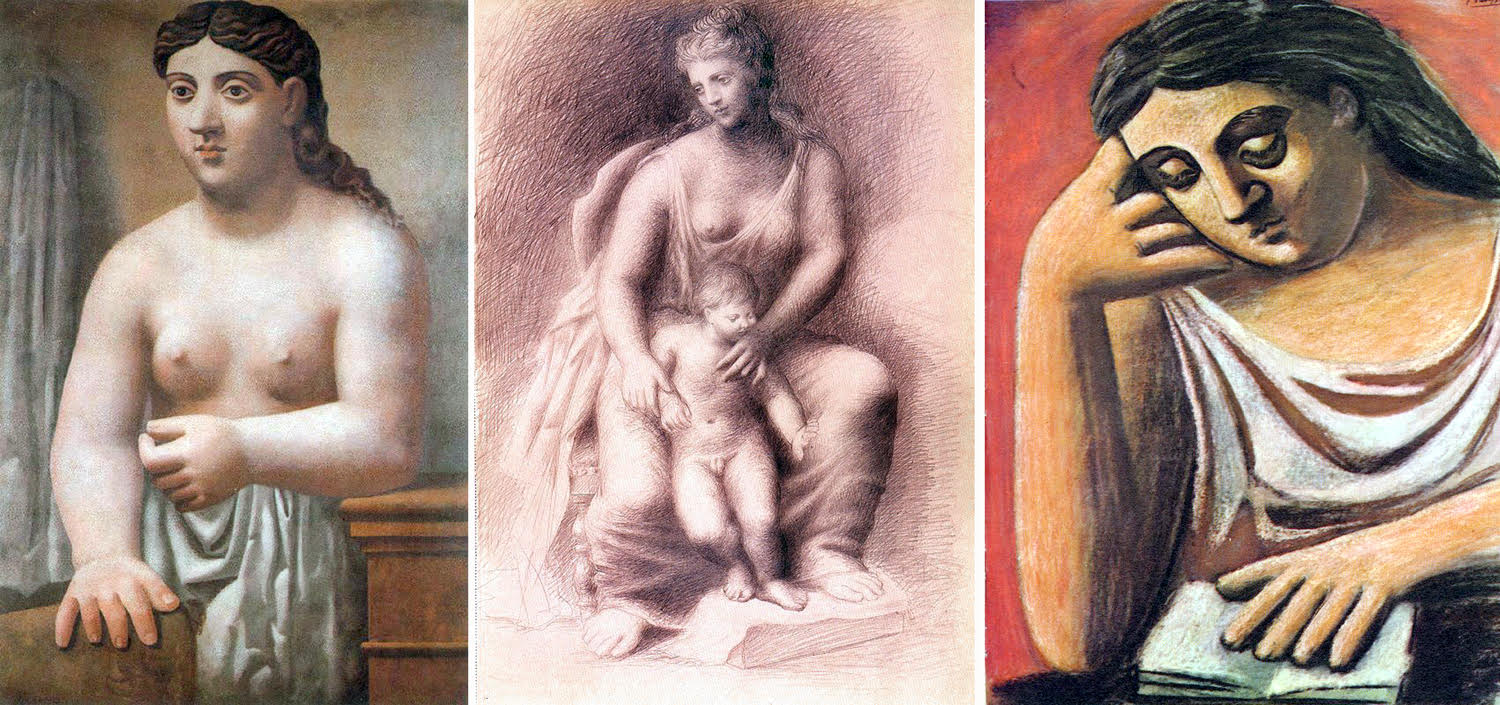
Then a brief period in the mid 1920s of what might look like a return to a kind of realism
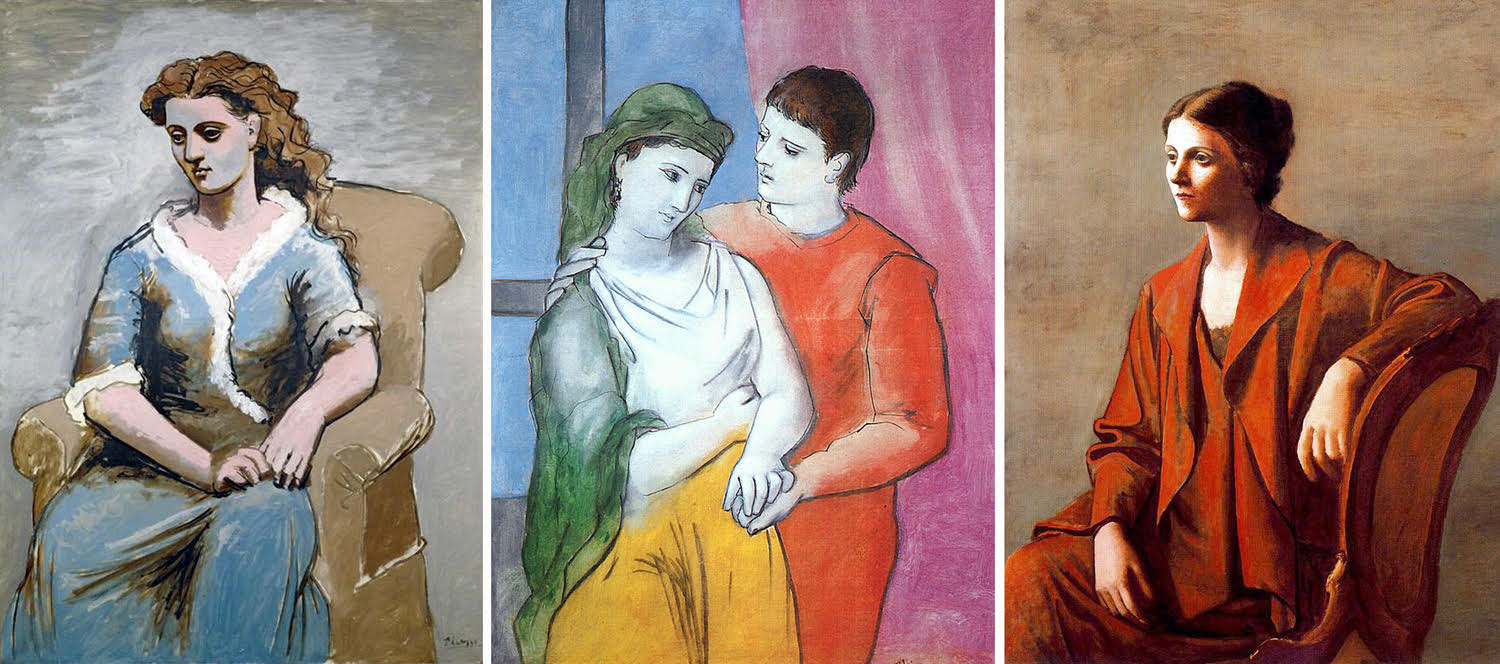
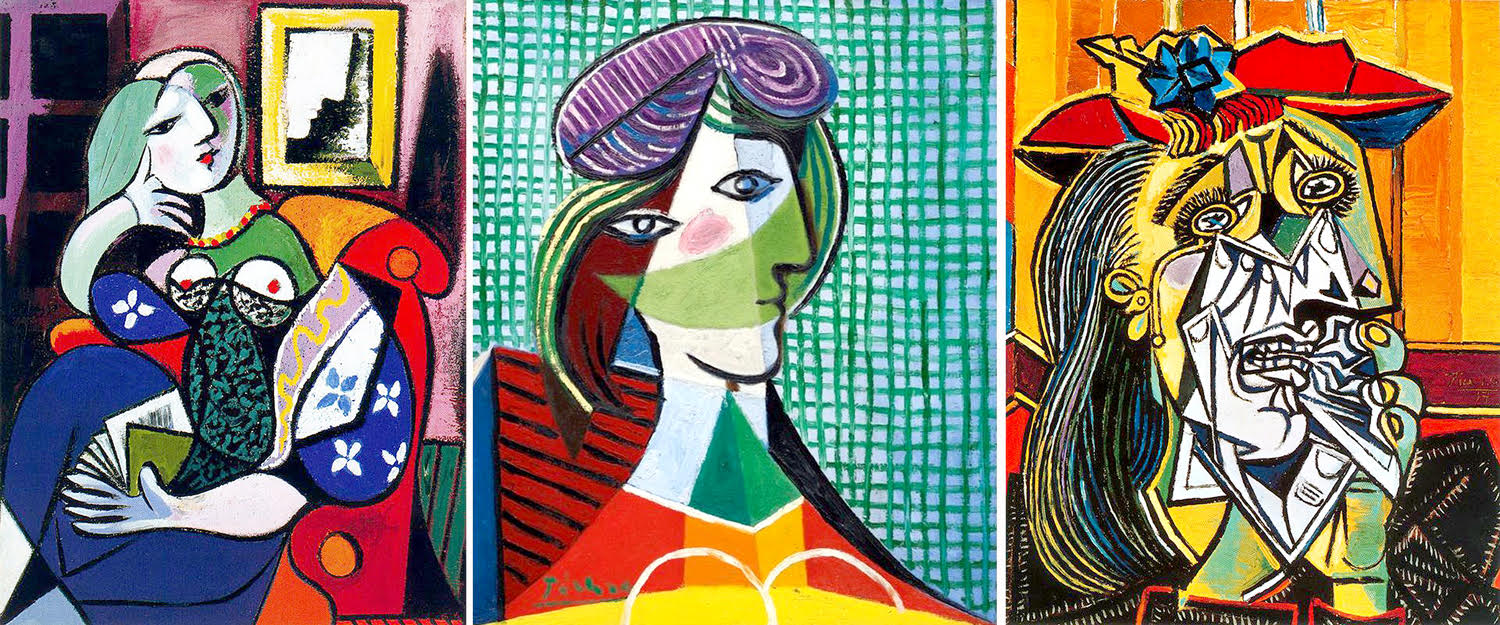
and then, into what can only be termed Picasso-ism — his playful mix of everything and anything, usually turned out in a few hours and often rather haphazard.
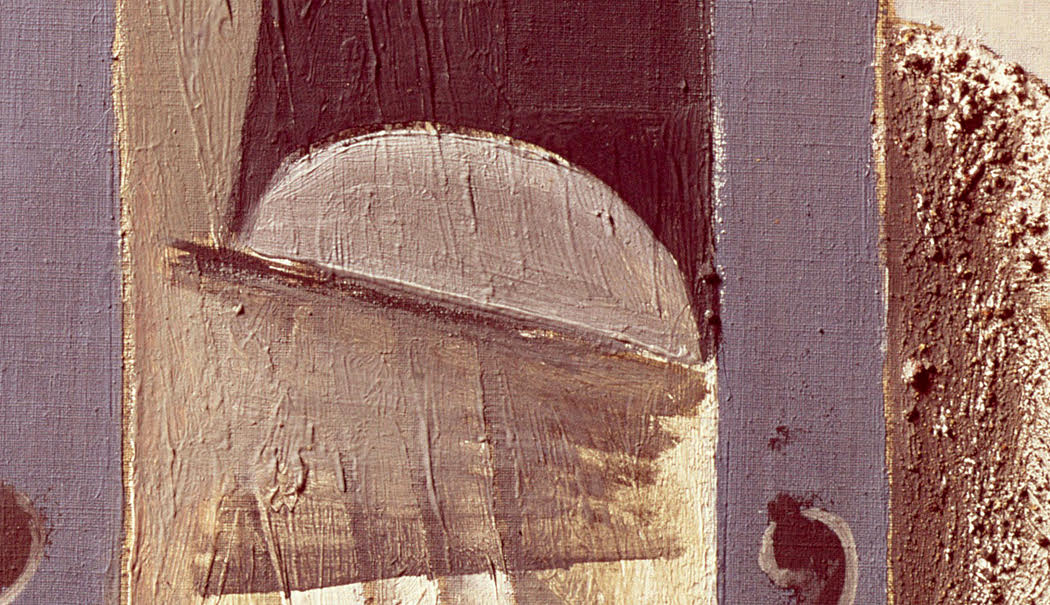
And this gets to my main point: That Picasso was an epically inventive visual artist, clever in the first degree. But from his earliest work onward, was always rather indifferent about the craft of painting. His application of paint to canvas was often sloppy; parts of many paintings were essentially unfinished; many are more caricature than character; even his color choice often seems unconsidered — any red might do, any green, any blue. His art is one of suggestion rather than observation.
This was typical of his approach in other ways. Where most artists use their work to react to life and the world, Picasso seemed always more interested in cultural tropes. That is, he picked on several archetypes — or stereotypes — and re-imagined them over and over. These are themes straight from his brain, without recourse to the actual world.

There were bulls and bullfights; Harlequin and Pulcinello; circus performers; the down-and-out; birds; women, both as portrait and as nude; satyrs, fauns and demons; still lifes; and over and over: the artist and his model.
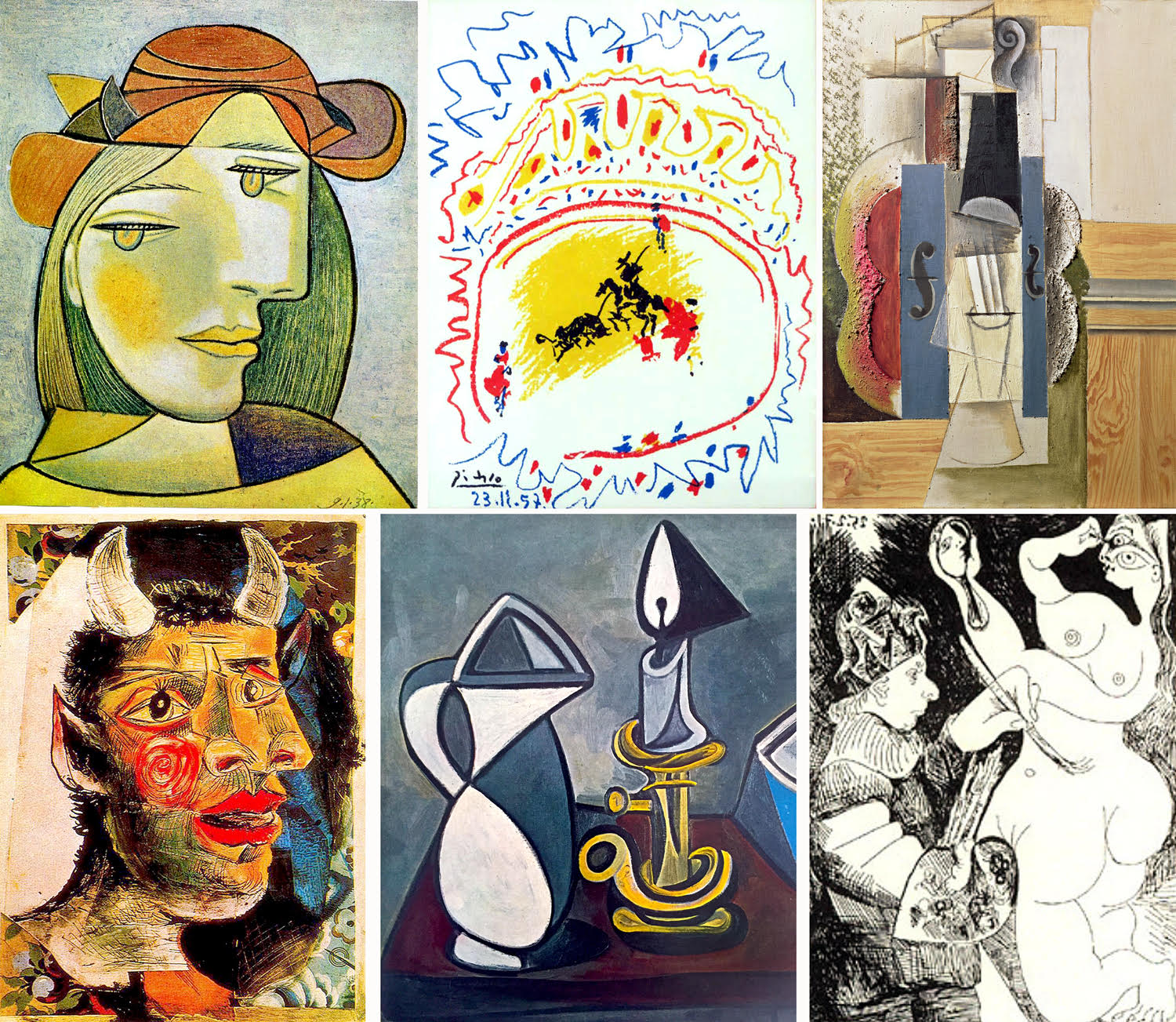
He drew these subjects from his mind, not his eye. And the goal seems to have been to get them down as fast as possible and to get on to the next canvas. During the Renaissance, an artist might work on a painting for a month, polishing it to a perfect finish; Picasso seems to have been more likely to complete several paintings in a day.
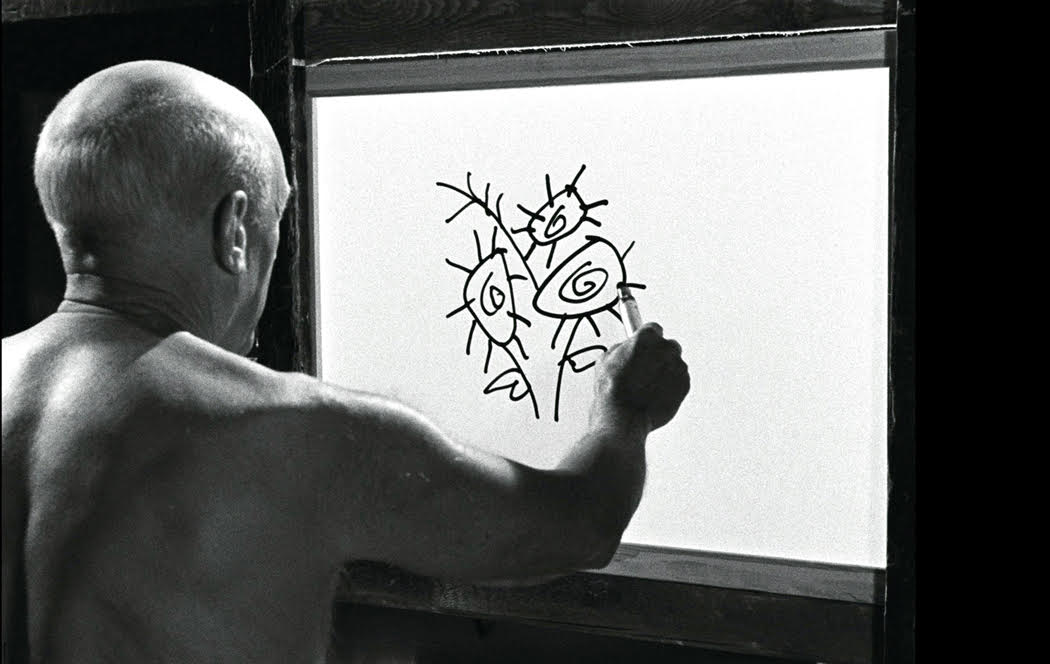
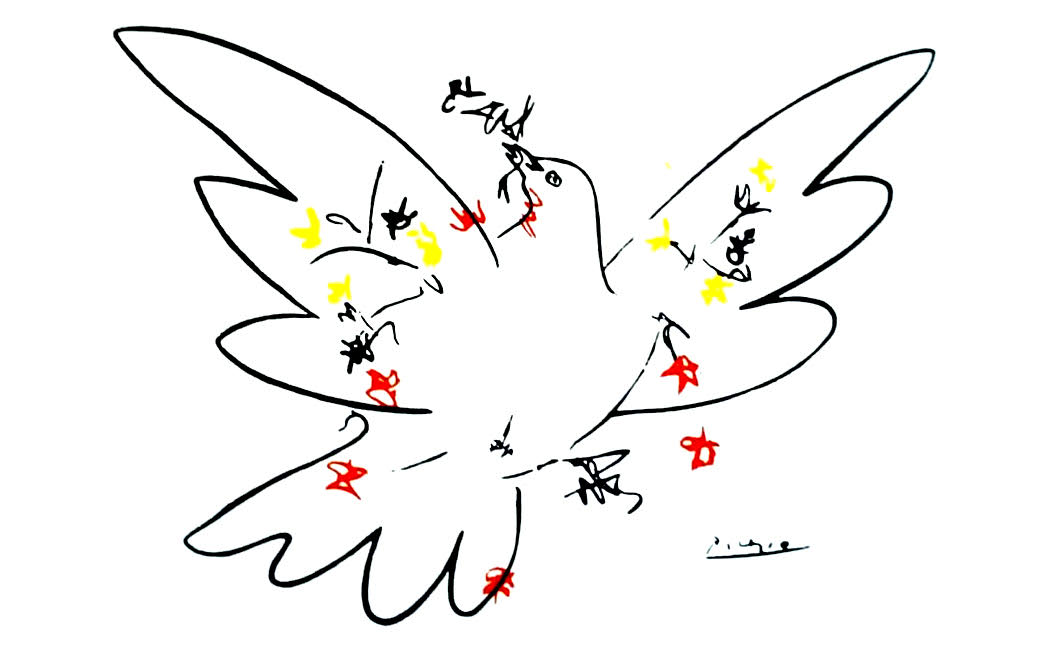
You can see how fast he works (and how fast his mind could work) in the 1956 film by director Henri-Georges Clouzot, The Mystery of Picasso, in which, over the course of its 75 minutes, the shirtless Picasso completes 20 drawings and paintings. Of course, most of these are merely sketches, but you can see how fast his brain is functioning — and how diagrammatic his take on the visual world really is. He is not capturing the way the world looks, but rather creating hieroglyphs to be read, the way his dove is a symbol for “peace.” Or the stick-figure man or woman on restroom doors.
The one time he made the effort, worked over many preliminary sketches and worked his canvas to a fine finish, he produced what is probably the most important, most powerful painting of the century — his 1937 Guernica, about the bombing of the Basque city by Nazi planes supporting the Fascist forces of Francisco Franco. The giant painting —roughly 12 feet by 25 feet — hung for many years at the Museum of Modern Art in New York, as, under the will of the artist, it could not be returned to Spain until the reestablishment of democracy. It finally went home to Madrid in 1981.
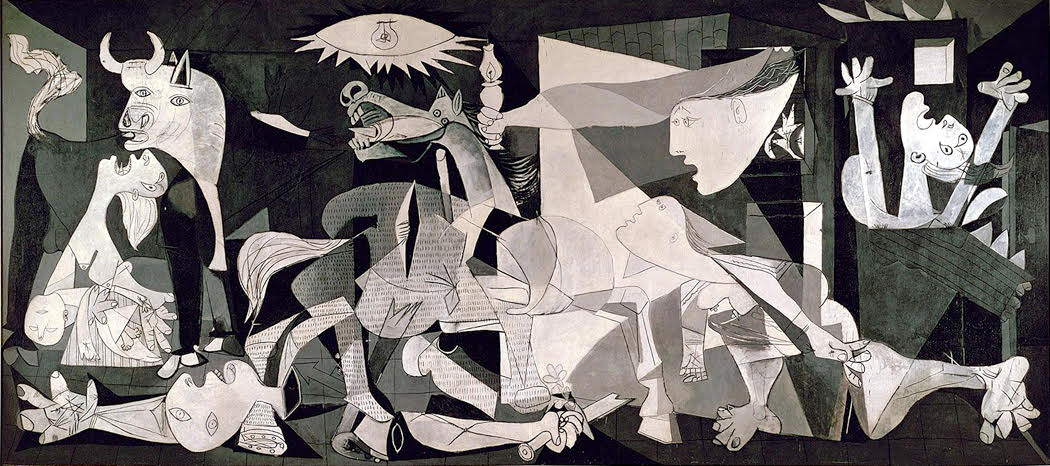
I saw the painting many times when I was a young man, living just outside New York, and visiting MoMA as often as I could. It anchored one end of the museum and you could see it as soon as you got out of the elevator on the second floor, the focus of the whole museum.

I’m not saying that we would have been better off if Picasso had spent more time on fewer paintings — his prodigious energy is largely why we honor him. But what can’t be ignored is that his work is often slapdash, sometimes not much more than a doodle.

When I was young, and for the first three-quarters of the 20th Century, Picasso was a colossus, almost universally acclaimed as the era’s greatest artist — the Muhammad Ali of the paintbrush — but in recent years, his primacy has receded. Partly because the adrenalin rush of Modernism has petered out; partly because the art market has become so much more simply part of the financial world, more interested in investment and less in the actual art; and perhaps most of all because Picasso, the man, has been revealed as such a misogynist pig. He was a very unpleasant man.
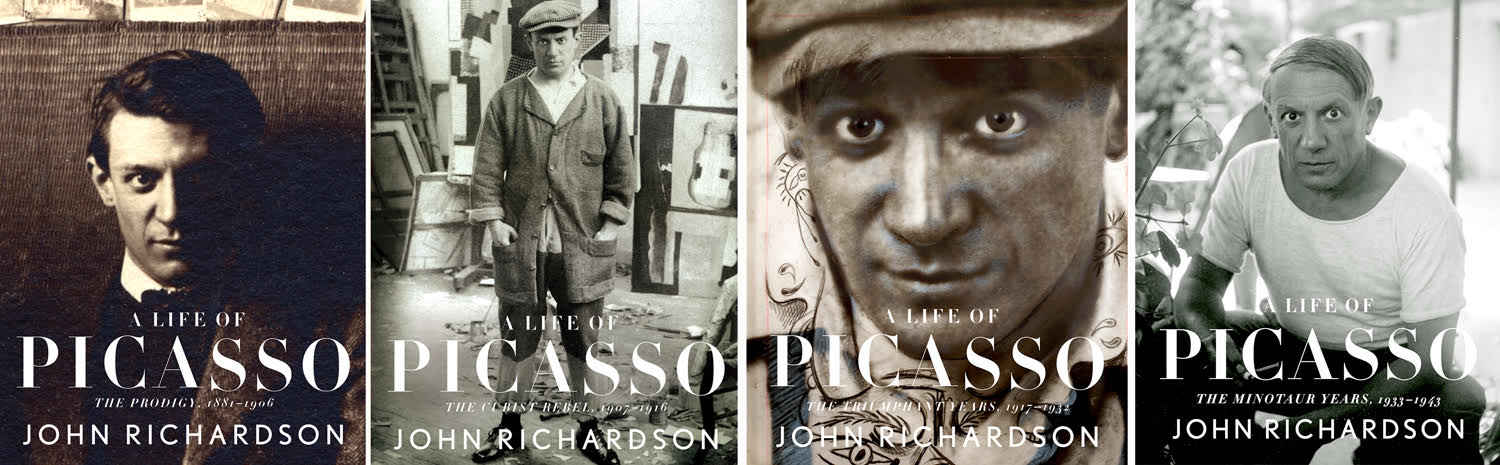
Since the publication of the four-volume biography by John Richardson, it has been clear what a self-serving, self-promoting, egotist he was. He went through wives and mistresses, using them and often abusing them. Once we thought of him as the great stud of art, now more like a frat boy with little care for the women in his life. Fernande Olivier, Olga Khokhlova, Marie-Thérèse Walter, Dora Maar, Françoise Gilot, Jacqueline Roque — there and gone.
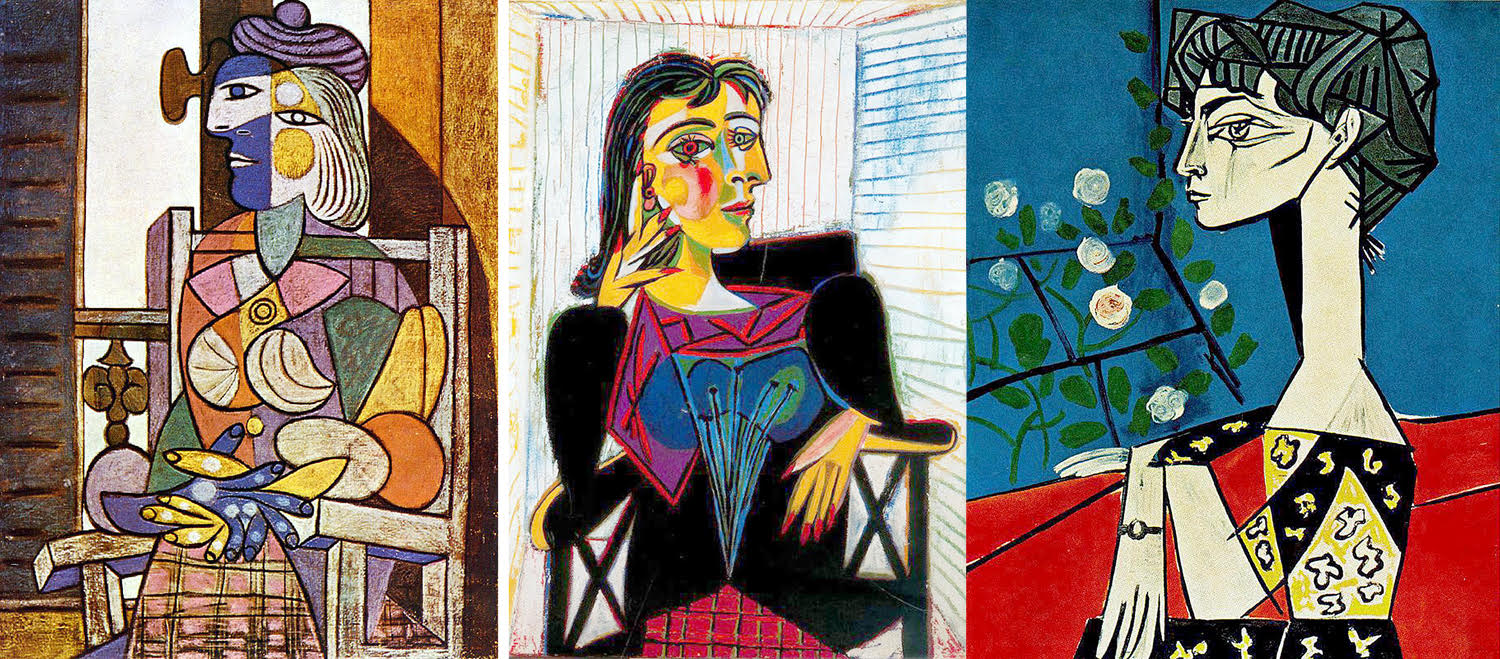
Then, there was the semi-criminal past, selling fraudulent or stolen art, and footsying with the Nazis in occupied wartime France. In our current more censorious age, we more likely to knock the laurels off the heads of our writers, artists, filmmakers and actors — Did they diddle underage girls? Did they coddle to dictators? Did they steal the credit due to women? Were their intentions less than pure?
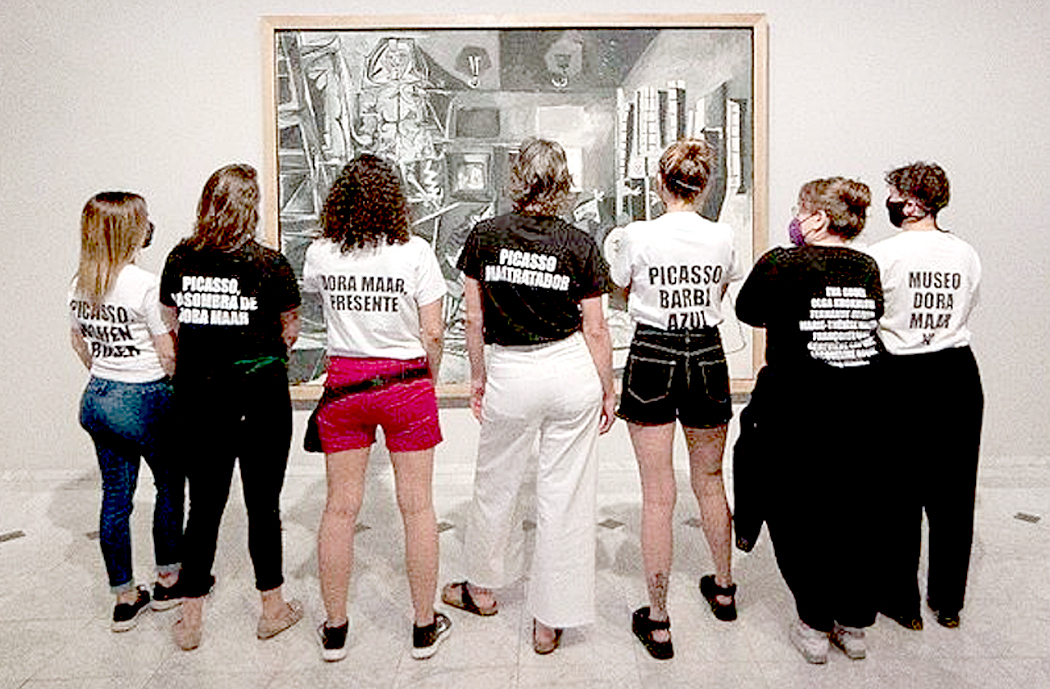
If we give in to these worries, we will have to strike from the record much of our cultural heritage. Artists are just as human as the rest of us.

And so, I forgive the genius his sins — they are past and he is dead — and honor the art. But I cannot ever not notice that for all his brilliance, Picasso was an indifferent craftsman. When I look at his work, I see the careless brushwork, the muddy colors, the repetitive subject matter.

My own youthful enthusiasm for Picasso has aged into a mature appreciation for his accomplishments. However diminished he is in the public eye, he is still the dominant artistic name from the first half of the 20th century.

Click on any image to enlarge

Finally! One of the great films of all times has become available. For years I have waited for a good copy of Marcel Pagnol’s La femme du boulanger (“The Baker’s Wife”) to be transferred to DVD. The only version I have is one I recorded from a Turner Classic Movies broadcast decades ago. The subtitles were horrible and the print none too good. I have treasured it for years and proudly introduced it to friends whenever I could. 

But now, Criterion will be offering a new, cleaned up, re-titled version. It is one of the greatest films ever. After watching it, Orson Welles claimed that its star, Raimu, was “the greatest actor in the world.” He called the move “perfect.” 

Raimu etches a perfect line between the comic and the tragic, playing a French village baker whose wife runs away with a younger man and who, heartbroken, refuses to bake another loaf until she returns. The villagers, despairing of ever again getting a good baguette, go all out to retrieve her. All the fine details of pre-war village life are drawn with subtle precision. As novelist Graham Greene said of the film, “the human actors are only part of the general setting — the well and the olive trees and the crude, crowded church and the Cercle Republicain (tavern) with the tin advertisements, and the hunter going out in the dawn with his dog and his gun while the baker sleeps in his (dough) trough beside the oven.”

It is a closely observed and beautifully seen world. 

(It is hardly the only great film too long unavailable: Abel Gance’s famous 6-hour silent film, Napoleon, has been restored, but is unavailable in the U.S. for ridiculous legal reasons — blame Francis Ford Coppola — but is available on a Region 2 disc from Amazon. All-region DVD players are common and inexpensive and worth the small investment.)

The popular conception of “foreign films” has changed over the years. Where once the term meant Bergman, Fellini and French films, it has now gone on to mean Pedro Almodovar, Johnnie To and Oscar-winning Mexican directors. A foreign language film is more likely to be in Cantonese than in Swedish. 

But I was born in the earlier era, and for me, the great movies are French. Yes, I have almost all of Bergman’s films on DVD, and most of Tarkovsky, but the great majority of the discs on my shelves are in French. I once catalogued them and counted well over 200 of them. 

Most people, when they think of French movies, think of the New Wave — that handful of directors in the late 1950s and into the 1960s who brought new techniques and new energy to the industry, along with an appreciation of Hollywood’s best work. 

But French cinema is much more. There were great movies before Truffaut ever came along. And great directors. Pagnol, Becker, Duvivier, Vigo, Clair, and above all, Jean Renoir. 

And there have been great directors since the wave hit the shore: Patrice Leconte, Jean-Pierre Jeunet, Agnes Jaoui, Catherine Breillat, Jamel Debbouze.  

I am going to suggest a few of their movies, all (at least when I bought them) available on disc. Many are also available on streaming video. 

I have listed no more than a single film from any one director, to ensure a variety and a wide scope. I have tried to avoid the obvious choices, because you may already be familiar with them: Rules of the Game, Grand Illusion, Breathless, Jules and Jim, Wages of Fear. And, I have not included any Renoir films, mostly because they are self-recommending and any real movie lover should already be familiar with them. 

The earliest of these films is Pepe Le Moko, which was remade (and sentimentalized) in the Hollywood remake with Charles Boyer, Algiers. The French original is much better, in large part because Jean Gabin is so much greater an actor than Boyer. Julien Duvivier was a great standard of French directors in the 1930s. 

I am including also a peculiar film, The Story of a Cheat by Sacha Guitry. Guitry is one of the great French comics, who wrote many stage comedies, was as famous a performer in his day as, say, Richard Pryor was in his. This film is unusual in that it is presented almost entirely as voice-over narration. It is excellently clever. 

Mainstream French films of the ‘40s and ‘50s include many wonderful genre films, almost all better plotted and with more interesting characters than their Hollywood cousins. 

Touchez pas au Grisbi, by Jacques Becker, is one of Gabin’s greatest roles. And that is saying a lot. (The title translates, roughly, as “Hands off the loot.”) 

Les Diaboliques, by Henri-George Clouzot is the greatest suspense movie of all time, outdoing Hitchcock by a large margin. It was remade in Hollywood  in 1996 with Sharon Stone. Oy. 

A third crime drama from the 1950s is Louis Malle’s Elevator to the Gallows, which has a great soundtrack by Miles Davis. It marks a shift in French film. Malle’s early work is not generally considered part of the New Wave, yet, there were several directors working at the time who prefigured the New Wave, giving us very personal films and often using locations rather than sets, and a more naturalistic style of acting.

Among those directors is Jean-Pierre Melville. Most of his work comprises heist dramas or crime stories. But I didn’t want to overweight this series of films with gritty thugs and grittier cops. And Army of Shadows tells an almost autobiographical story of the French underground in World War II. It has plenty of suspense and drama. 

Now we come to the New Wave itself. There were a handful of directors working in this new style, more free and improvisational, using location shooting rather than studio sets, and breaking up the normal beginning-middle-end narrative structure. 

The two gods of Nouvelle Vague couldn’t be more different. Jean-Luc Godard is anarchic, innovative and indefatigably political. He wants to destroy the status quo. He probably never made a completely successful film, but moments in every one of the astound with brilliance. He does things no one ever thought to do: drop out the soundtrack, edit arbitrarily, shoot dialog from behind the heads of the actors, shift from color to black and white and back, point the camera away from the actors. Godard freed up filmmaking for the next 40 years. Band of Outsiders is one of his most famous films, and includes the race through the Louvre that is quoted in several other films.

Francois Truffaut, on the other hand, is a dyed-in-the-wool humanist, and he finds the humanity in pretty much everything he films. As warm as Godard is cold, he is everyone’s favorite New Waver. So many of his films are so well known, I’ve tried to find one for you that you probably haven’t seen, The Woman Next Door. It’s a late film and features Gerard Depardieu before he became a joke. He was then a great actor. 

Claude Chabrol was the most prolific New Wave director, with nearly 60 films under his belt. He was also the most conventional of the New Wave directors, turning his talents primarily to suspense and crime films, but seen in the fresh style of the New Wave. Le Boucher is probably his most characteristic film. 

Eric Rohmer may be an acquired taste. They are talky, and were made in series, one group called “Moral Tales,” and another called “Comedies and Proverbs.” Summer (in French Le Rayon Vert: “The Green Ray”)  is one of the Comedies and Proverbs. 

Jacques Rivette is another New Waver, and he is notable for the length of his films, and his patience. It can try the patience of his viewers, but not if you pay attention. My favorite film, La Belle Noiseuse, is four hours long and spends a lot of that time showing an artist drawing with a crow-quill pen on paper. I’m not letting that out of my house. 

But I’m going to suggest instead, Va Savoir, probably his most accessible film, that has a great part for Jeanne Balibar. Claude Berri has a supporting part as a librarian.

I only mention that because Berri is really a director, and The Two of Us is a great film, and probably the only one in which an anti-Semite comes across as lovable. Michel Simon is a force of nature and I recommend seeing any film he is in. 

Finally, two recent films. French cinema has long ago taken what it could from the New Wave and moved on to more contemporary themes. 

One of my favorite living directors is Patrice Leconte. The Hairdresser’s Husband is quirky and heartbreaking and stars Jean Rochefort. He’s great in everything he does. 

There are several women directors who should be included. My favorite is Agnes Varda, but I’m including here instead Fat Girl by Catherine Breillat. It can be rather brutal, but it is definitely worth seeing. 

Lastly, I’m including a musical. Yes, a musical. It is Francois Ozon’s 8 Women, and it features an “all-star” cast of great French actresses: Catherine Deneuve, Isabelle Huppert, Emmanuelle Beart, Fanny Ardant, Virginie Ledoyen, Danielle Darrieux, Ludivine Sagnier and Firmine Richard. This is like lining up Lauren Bacall, Judy Garland, Ava Gardner, Veronica Lake, Barbara Stanwyck, Lucille Ball and Marilyn Monroe, all in the same movie. It’s a doozy. 

I hope you enjoy all these. There’s plenty more to see, if these whet your appetite for Gallic filmmaking and if any of these directors particularly hits your buzzer, there are another five or ten films by the same maker. 

That’s your first 15 recommendations. But here are 25 or so more (I cheated. Some are trilogies, one is a pair). These are all films I love dearly:

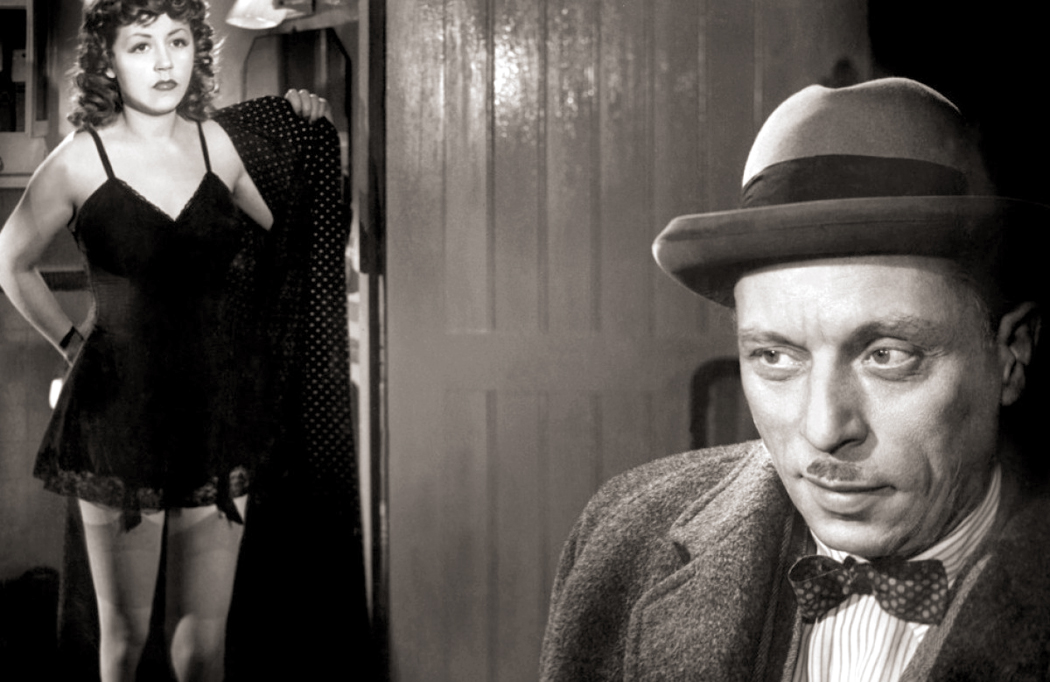
Quai des orfevres by Henri-Georges Clouzot

La bete humaine by Jean Renoir

La ronde by Max Ophuls

Une femme est une femme by Jean-Luc Godard

Bob, le flambeur by Jean-Pierre Melville

Betty by Claude Chabrol

Le quai des brumes by Jacques Prevert

Monsieur Hire by Patrice Leconte

Le Trou by Jacques Becker

Mouchette by Robert Bresson

Mesrine: Public Enemy No. 1 by Jean-Francois Richet

Under the Roofs of Paris by Rene Clair

Man on the Train by Patrice Leconte

The Taste of Others by Agnes Jaoui

Vagabond by Agnes Varda

The Dreamers by Bernardo Bertolucci

The Marseille Trilogy by Marcel Pagnol, three films: Marius; Fanny; and Cesar

The Earrings of Madame de … by Max Ophuls

Trilogy by Lucas Belvaux, including: Cavale on the Run; An Amazing Couple; and After Life

La Vie en Rose by Olivier Dahan

The Widow of St. Pierre by Patrice Laconte

Inspecteur Lavadin and Cop au Vin by Claude Chabrol

Le Samourai by Jean-Pierre Melville

Shoot the Piano Player by Truffaut

Jet Lag – (Decalage Horaire) by Danièle Thompson

Sex is Comedy by Catherine Breillat

Ridicule by Patrice Laconte

I am deeply embarrassed by the films I have left out. If you have a favorite, please add them to the comments.

Click any image to enlarge