Archive

Tag Archives: colorado plateau

The American Southwest is the landscape of John Ford Westerns, Roadrunner cartoons and, of course George Herriman’s Krazy Kat. It is a landscape I know very well, writing about it often for The Arizona Republic when wearing my hat as travel writer. And while I can’t say I miss big-city Phoenix, I do sometimes feel quite homesick for the desert and the canyons. There is a special sense of space there, of horizons bordered not by trees or homes, but by the curve of the earth. 

But there was a time before that landscape and I became intimate, when my wife and I were teachers in Virginia and first planned a summer vacation trip to the half of the country on the other side of the Mississippi River. We were unprepared, back in 1981, for what we found, having been conditioned primarily by movies, television and the occasional Arizona Highways magazine Christmas edition. 

Driving west on I-40 across the Panhandle of Texas, through Amarillo, the earth was as flat as a billiard table, but at the exact border between Texas and New Mexico, the bottom dropped out of the land and the highway sloped down onto a landscape with buttes and mesas. This is the West, we thought. Finally here. 
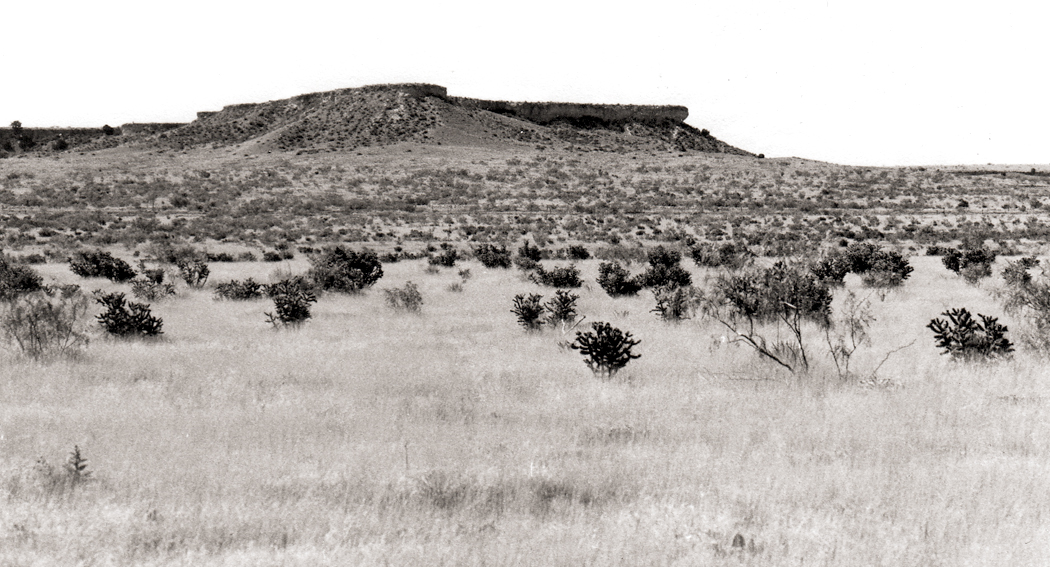
On the border between Texas and New Mexico

Carole had always been interested in Indians, and one of the goals of the trip was to visit Canyon de Chelly in the Navajo Reservation. In our Eastern ignorance, we pictured the canyon as these steep walls of rock rising up from the land on either side of us. At least, that’s what the photographs looked like. 

Canyon de Chelly by Edward S. Curtis, 1904

But we had it backwards. Canyons are not cliffs rising up, but great holes dug below the surface. 

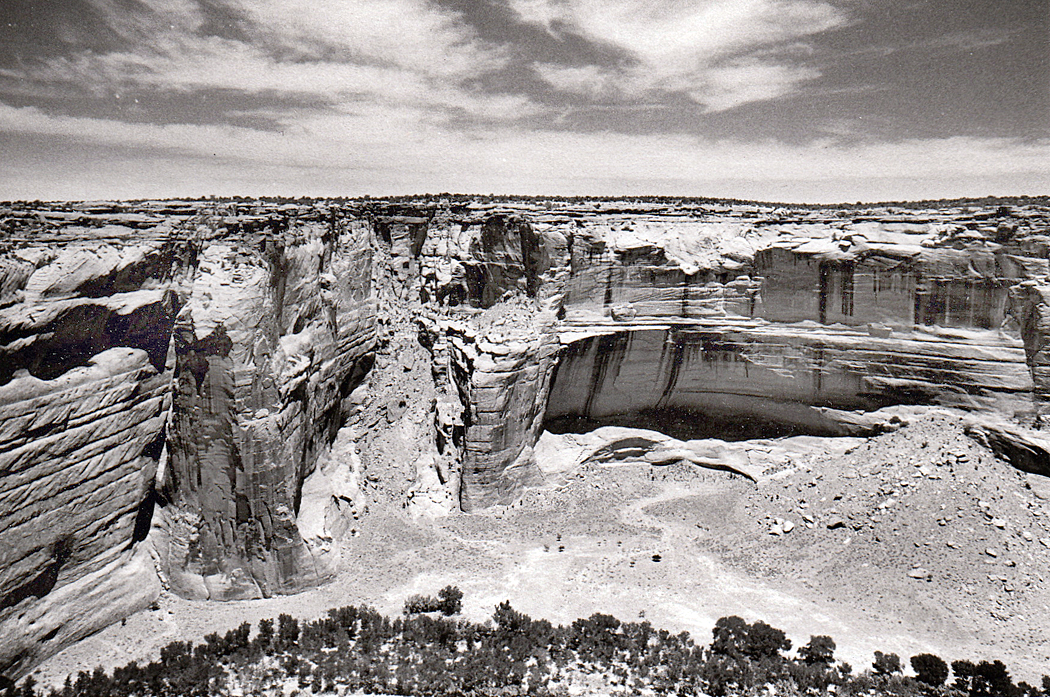
We were lucky, we approached Canyon de Chelly from the east. Most people arrive through the town of Chinle, to the immediate west of the canyon. Chinle is a tourist trap of motels and souvenirs. But coming to it, as we did, there was nothing but pine covered mountains and rocky wilderness. We drove in on an unpaved road — Navajo Route 7 through Sawmill — from New Mexico and coming up to an unmarked fork in the road, we saw a Navajo man sitting next to his pickup truck, which was piled with firewood. We asked him the way to the canyon. He said nothing but turned his head and lifted his chin to point the way. We continued down a wooded hill into a low scrub land, looking across the plain, and I noticed a darker spot in the sun-splashed land. When we pulled over and parked and walked to that spot, it was 400 feet straight down to the bottom of the canyon. It was somewhat like viewing a negative instead of a photograph: It was all backward. It was down, not up. It was Bat Canyon, one of the side shoots of Monument Canyon, one of the many side canyons to the main event. 

Of course, we slapped our foreheads (figuratively), because, of course, a canyon is an empty space, not a mountain range. Later as we continued on and found Chinle, and a motel for the night, we realized also how lucky we were to have found the canyon for ourselves, and not through the tourist muck. We had that side canyon all to ourselves. We sat alone on the rim looking down into the abyss for hours, listening to the breeze and the birds, before another car even drove by. 

Canyon de Chelly National Monument covers 131 square miles in northeastern Arizona on the Navajo Indian Reservation. Seen from the air or on a map, it is a chicken-foot shape of multiple canyon systems that runs for about 24 miles toward the east and the Chuska Mountains. 

Most tourists in Arizona head straight for the Grand Canyon, which is vastly larger and more immediately impressive. “Most famous places are always at least a little disappointing when you finally get there,” my brother once said, “but not the Grand Canyon. You just gawk at it, bigger than you had ever imagined.” 

But some of us love the human size of Canyon de Chelly even more than the Grand Canyon. Many days you can pick a corner and have it all to yourself. 

We went back many times, after we moved to Arizona, and Canyon de Chelly became a kind of talisman for us. One summer, probably 1998, we decided to hire a Native guide and ride horses into the canyon’s further reaches. We found Dave Wilson, who arranged for us to go up Canyon del Muerto on horses. His teen sons Delbert and Delmar came along, too. 

Canyon de Chelly National Monument is divided into two main forks, the southerly one is Canyon de Chelly itself, the more northern is Canyon del Muerto. The national monument’s name is a redundancy, like “Table Mesa” or “Glendale,” since its name derives from the Navajo word for “canyon” — Tsegi — turned by quasi-French transliteration into Chelly, pronounced “Shay.” (There is also a Tsegi Canyon on the Navajo Reservation, near Kayenta, further complicating matters).  
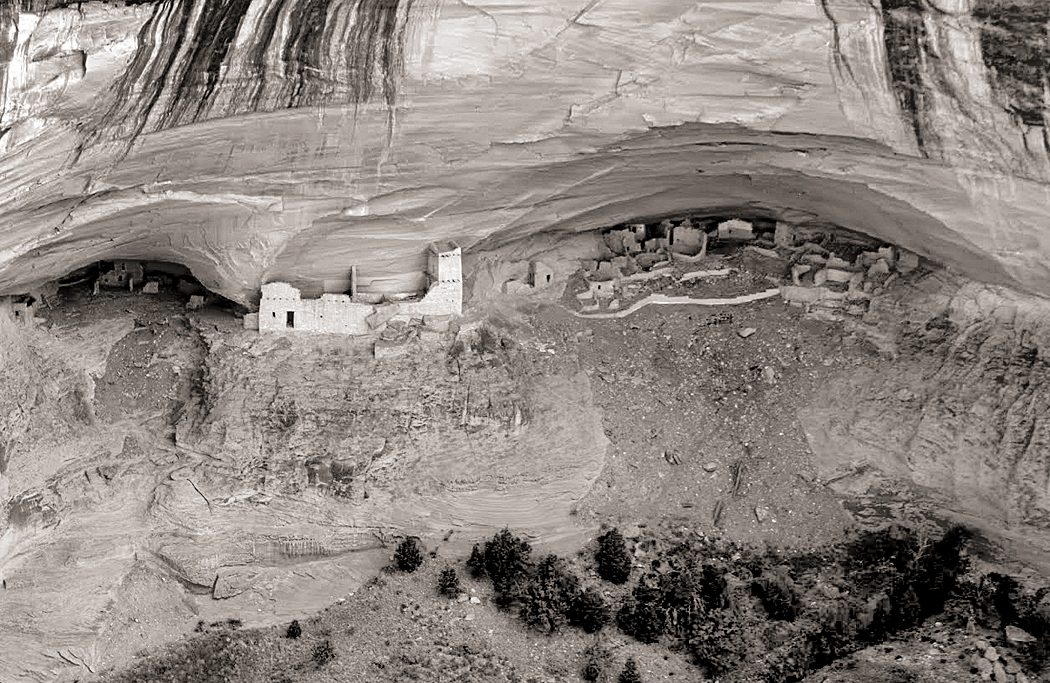
Mummy Cave

Canyon de Muerto, or “Canyon of the Dead” got its name in 1882, when topographical engineer James Stevenson discovered two prehistoric mummified bodies in a rock shelter ruin, now known as Mummy Cave, and then named the north branch of the place Canyon de los Muertos, now shortened to Canyon del Muerto. 

It could have been named for other reasons. Humans have lived in Canyon de Chelly for about 5,000 years. Long before the Navajo arrived, the prehistoric Anasazi peoples lived in the area and in Canyon de Chelly had built cliff dwellings to protect them from various warring groups. Those ruins are still to be seen in the canyons. And even after the Athabascan-speaking peoples, now called Navajo, arrived, sometime around 1700, the canyon continued to provide shelter from raids and wars with other tribes. It’s a long history of wars, battles and skirmishes, but two occasions stand out more recently. 

First, in 1805, Spanish forces, under Antonio Narbona trapped about 150 Navajo in a cave high on the walls of the canyon. In his report Narbona  stated “They entrenched themselves in an almost inaccessible spot, and fortified beforehand, we succeeded after having battled all day long with the greatest ardor and effort, in taking it the morning after and that our arms had the result of 90 dead warriors, 25 women and children and as prisoners three warriors, eight women and 22 boys and girls.” That cave is now called Massacre Cave. 
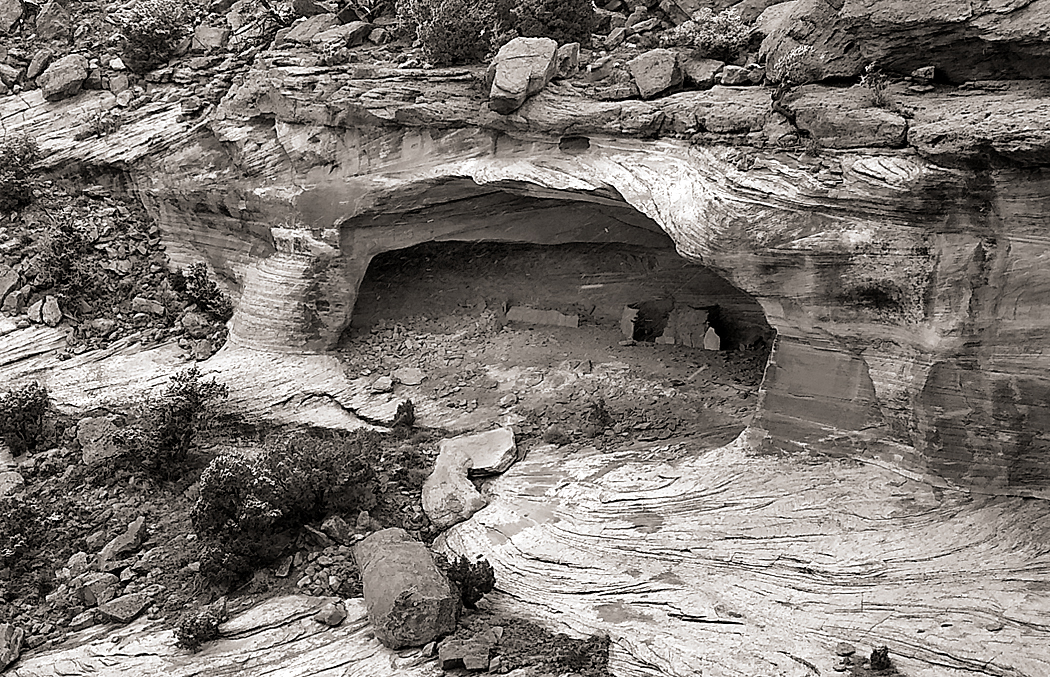
Massacre Cave 

Then, in 1863, the American Army began an attempt to bring the Navajo to a new reservation at Bosque Redondo in New Mexico, and Col. Christopher (“Kit”) Carson was tasked with rounding the Indians up to march them 300 miles to their new home. He had been given orders to destroy their crops and livestock, and the famous peach orchards of Canyon de Chelly. By March of 1864, some 2,400 Navajo had been collected and marched to New Mexico in the “Long Walk.” Thousands followed in later roundups. 

And so, there has been plenty of muerto in Canyon del Muertos. 
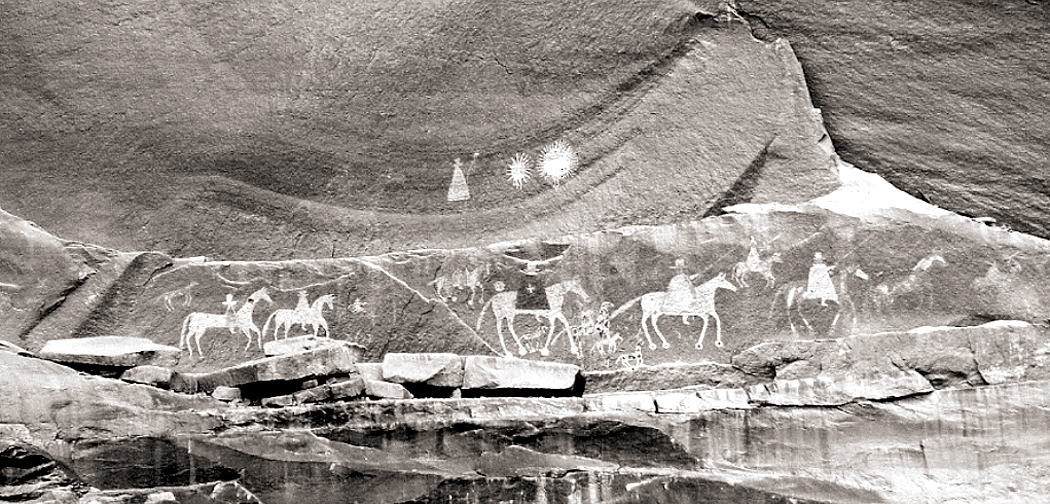
It might be a good place here to discuss Navajo superstitions and taboos. The canyon is filled with Anasazi ruins — good sturdy brick homes that just need a bit of sprucing up and new roofs. But taboos keep the Navajo from using them, or even entering them. Death is a principle taboo. A person’s name who has died should not be uttered. If someone dies in a hogan, traditionally, you move out and no one ever lives in it again. 

There are many more — a list of them could make a book. One online posting names more than 200 such superstitions. Do not look at lightning in a mirror or it will strike your hogan. Do not watch clouds moving in the sky or you will become a slow runner. If you see a shooting star, you have to blow at it or you will receive bad luck. Do not put salt on a piñon nut or it will snow. Do not kill grasshoppers or it will give you a nosebleed. 

We already encountered one, when the Navajo man with the pickup indicated the road to take by pointing with his chin and pooched lips. Pointing with a finger is considered aggressive. 

In 1993, I went to visit famous Navajo painter Jimmy Toddy in his home in Wide Ruins, on the Reservation. Unlike the hogans he had grown up in, or the ranch houses that pass for government housing on the Reservation, in 1947, he built a two-story frame house with a stone foundation. I parked in the dust of his front yard and entered through a front door that was off its hinges. “I never fixed it,” he told me. “There are bees that made a hive there and it would bring bad luck if I didn’t let them fly anywhere inside or outside.” 

At the newspaper where I worked, I became friends with Betty Reid, a Navajo reporter. She asked me to help her copy edit a proposal for a book she was planning. 

“Yuhzhee is my Navajo name,” she said. “It means ‘short,’ or ‘small’ in English.” She spoke only Navajo until she was seven and her family, who raised sheep, lived near the edge of the Grand Canyon at a place called  Bii Daa. “I’m a middle-age journalist who walked away from a traditional life to write for newspapers,” she said. “The two worlds are very different.”

I once asked her about the superstitions. “Yes, we are very superstitious.” “Do you believe in them still?” I asked. “Oh, no. Very few younger Navajos still hold on to such things. They make no sense.”

She paused a beat. “I still do them, though.” 
But back to 1998. My wife, Carole, had been fascinated by Indians and Indian culture since she was a little girl and collected arrowheads turned up by North Carolina farmers plowing their fields. She had always wanted to ride horses with Indians, and now she was getting her chance with Dave Wilson. 

We drove to his home, on a bluff just above the entrance to the canyons. His wife invited us in as Dave got the horses ready. It seemed like a very ordinary ranch house with modest furnishings, except that it had a dirt floor and just by the front door was a TV console with its tube removed, letting it serve as a home for a few chickens. 

I had never ridden a horse before, if you don’t count a pony ride at the state fair when I was a little boy. Dave assured us his horses were used to beginners and it would be easy. Just follow him.

We mounted the horses and followed Dave and his two sons, each on his own horse. He didn’t lead us down a road, but straight down the side of the hill, at a precipitous angle. I had to lean back so far in the saddle, my head rested on my horse’s rump. Luckily, the horse knew what he was doing. I certainly didn’t. Their hooves slid and kicked up gravel the whole way down. 

At the bottom of the hill, it flattened out and we rode into the canyon mouth, turning left into Canyon del Muerto. My horse was balking. It lagged behind the rest and they had to stop so I could catch up. At one point the horse, apparently impatient, began to trot after the others and I feared I would fall off. New Jersey boys make poor cowboys. 

What can I say? Not only was I a poor equestrian, but my body was not built for the saddle. One sees bow-legged cowpokes in the movies, who have long acclimatized to the barrel-shaped body of a horse, but my straight legs were agonizingly twisted to the stirrups, feeling like my knee cartilage was being torn sideways from my leg bones. It was a form of Medieval torture. Nobody expects the Spanish Inquisition. 

Carole, on the other hand, was in horse heaven. I tried to last through the first few miles, but eventually, I had to get off and let my legs assume their normal lines. I limped around my sturdy mount, trying to regain the use of my knee joints. 

Dave had, no doubt, come across such greenhorns before and kindly offered to continue our tour of the canyon by car, and sent one of his sons back out of the canyon to bring back his station wagon. About 20 minutes later, it arrived and we all got in and began the tour again. The older son led the horses back home. 

But then, the car got a flat tire. Neither Dave, nor his remaining son, Delbert, cussed or fumed, but acted as if this were just a normal course of events. We got out and waited. Dave took out the spare, but it was flat, too. He never expressed any emotion about it all. It’s just normal. 
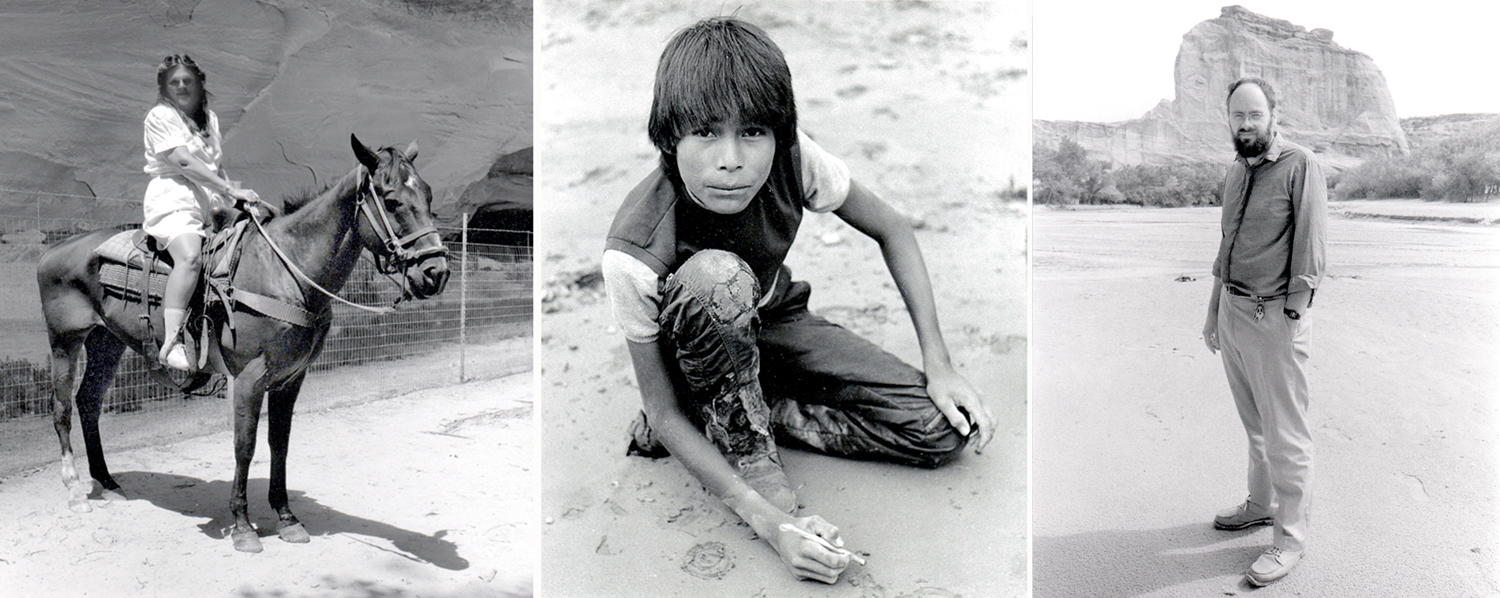
Carole on horseback; Delbert Wilson drawing; me, standing

Other tour cars passed us, other horse tours. But Dave never said a word to any of them, never asked for help. We sat in the sand for perhaps two hours. Delbert began drawing in the wet sand with a stick, to the delight of Carole, who was an art teacher. The sun went behind the canyon walls and it began to darken. 

It must have been about 7 p.m. when another car arrived, driven by Dave’s wife. We all got in and drove back out the canyon and up to Dave’s house (taking the road this time), where they apologized for the cock-up. They offered to feed us supper, but Carole wanted to get back to our motel. Dave’s wife gave Carole a gift of a small necklace and we all smiled and thanked one another. 

The impassivity that Dave showed with the problems we faced, we came to know as one of the cultural characteristics of the Navajo — which we learned over time with the many other Navajos we came to know and become friends with. I don’t know what Dave was feeling inside, but outwardly, it was all the same to him. 

When we got back to Phoenix, we mailed a box of presents up to the Wilsons. 
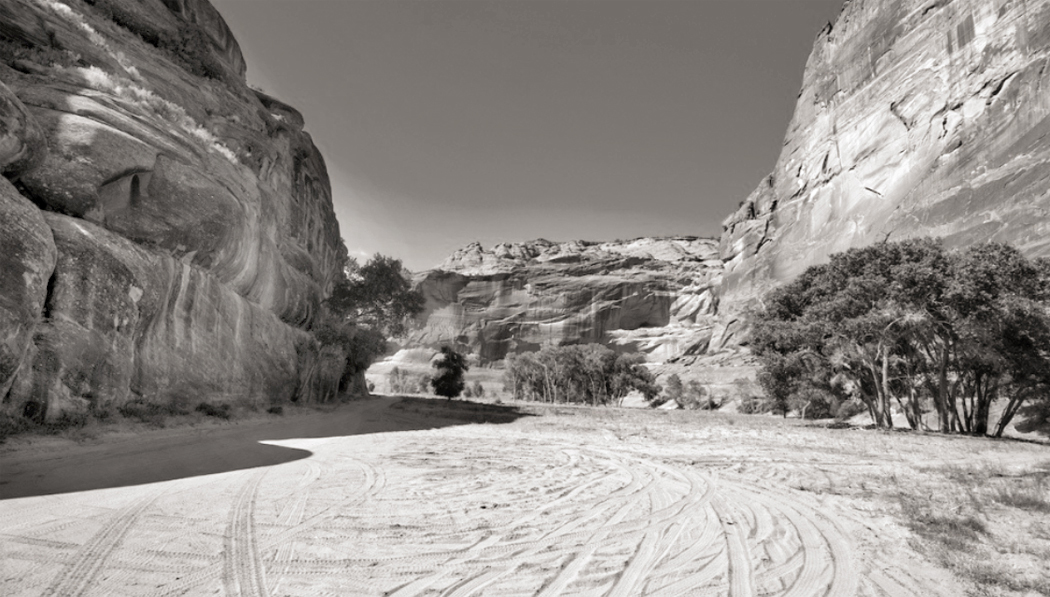
Canyon de Chelly National Monument is situated on land owned by the Navajo nation, and travel in the park is open only to tribal members or those accompanied by authorized Navajo guides, such as Dave Wilson. The only exception to that is a public trail from the cliff edge down to the White House Ruins, about five miles up from the canyon mouth. You walk down a steep path, 600 feet down through switchbacks and tunnels to the canyon floor. The trail is about 2.5 miles long and leaves you at the foot of White House Ruins, an Anasazi cliff dwelling, first built around A.D. 1060. 

The pueblo originally had an estimated 80 rooms, on two levels, with some featuring a light plaster, which led to the Navajo name for the site, Kinii’ ni gai — which means “White House.” 
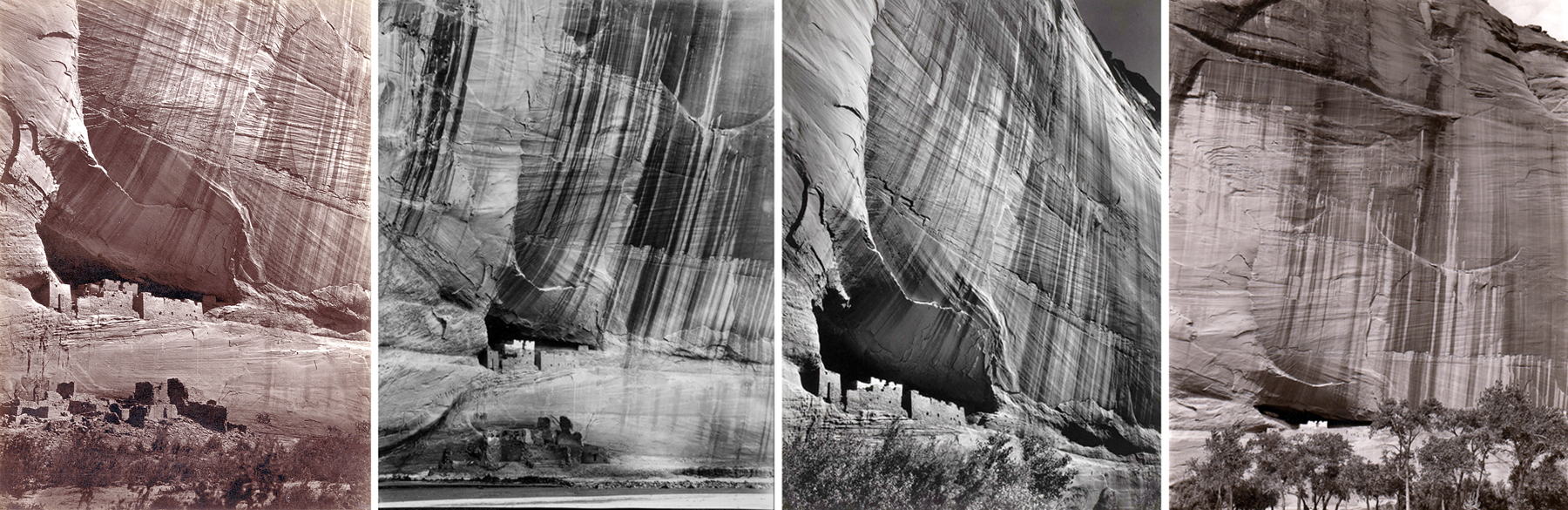
White House ruins by O’Sullivan, Gilpin, Adams, and me

The cliffs above the ruins are streaked with desert varnish, a mix of iron and manganese oxide, that makes a visual scene that is absolute catnip to photographers. The first photo of the ruins and the varnish was made in 1873 by Timothy O’Sullivan, but a parade of others have followed, including Laura Gilpin in 1930, Ansel Adams in 1950 (having made an almost identical photo in 1942), and me in 1981. Gilpin visited and studied the Navajos and the land they occupy and published, in 1968, the classic book, The Enduring Navajo. It is still in print. 

The scene absolutely frames itself, which means that hosts of images are basically repeats. 
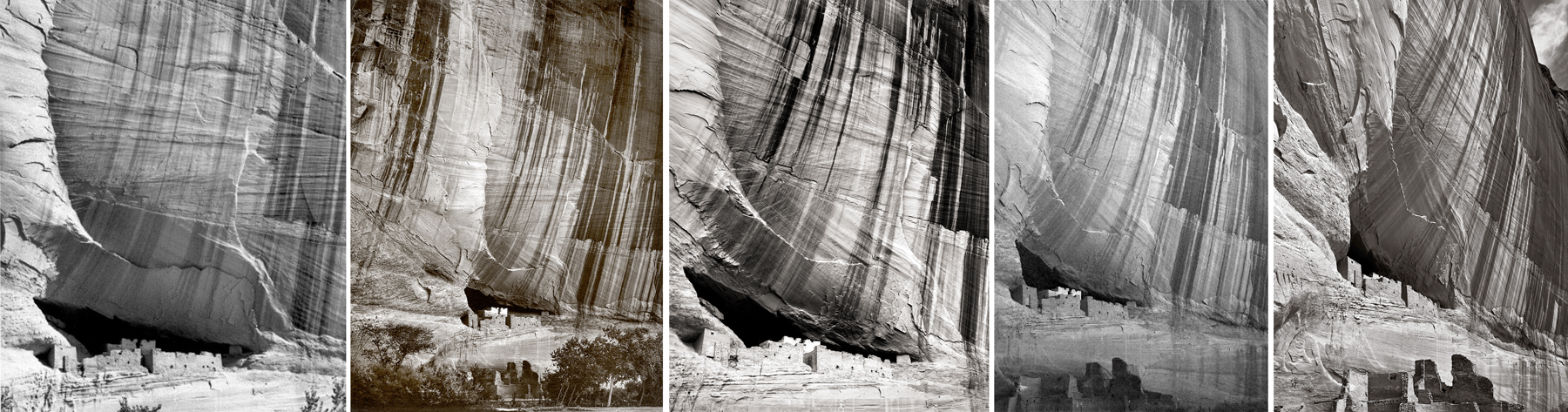
Photos by Tad Nichols, 1931; Jerry Jacka, 1976; Don Whitebread, 2009;  Patrick McBride, 2012; Richard Boutwell, 2017

It’s a highly tempting subject and I’m sure that many other tourists have made the same picture, now with their iPhones. 

Without getting down into the canyon, you can drive along its rim, both along the south branch and the north, with overlooks at such famous vistas as Spider Rock and Massacre Cave. 
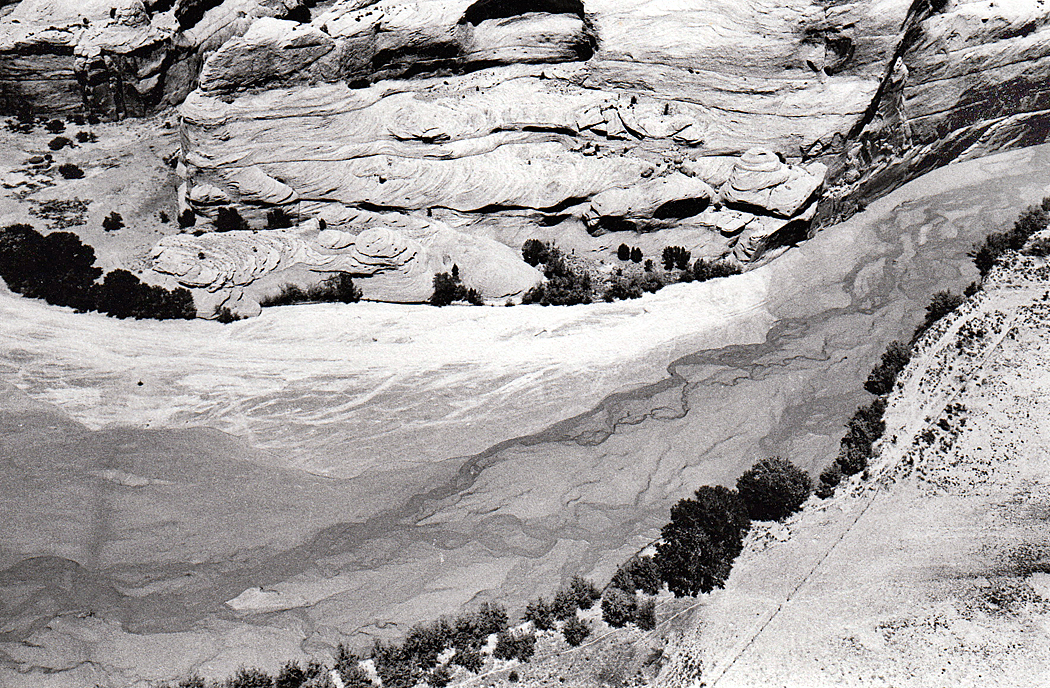
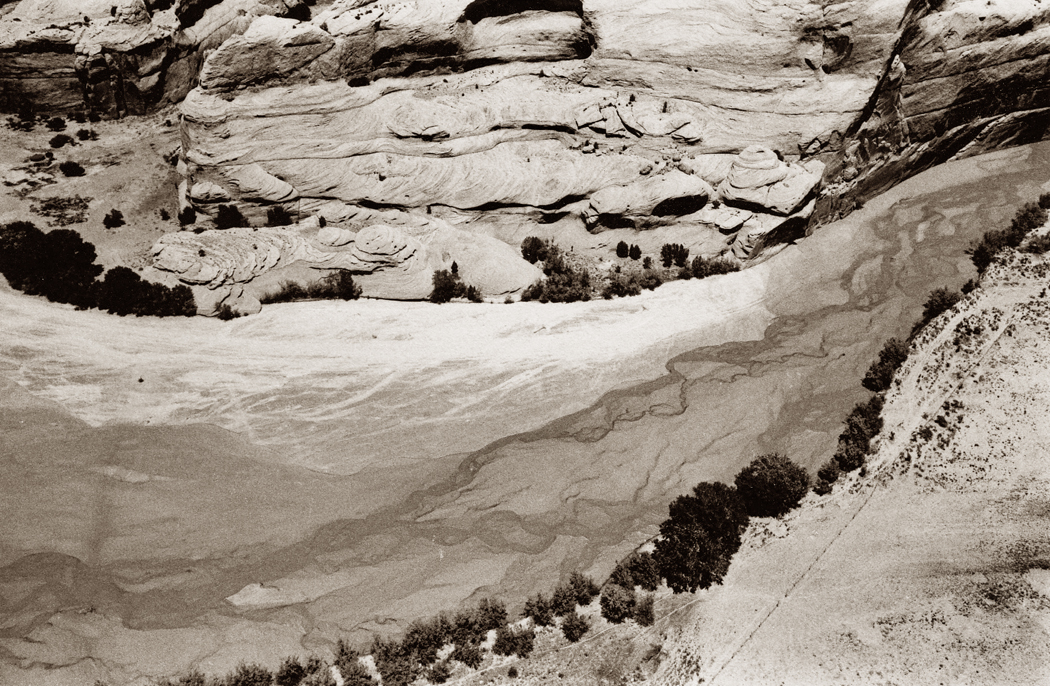
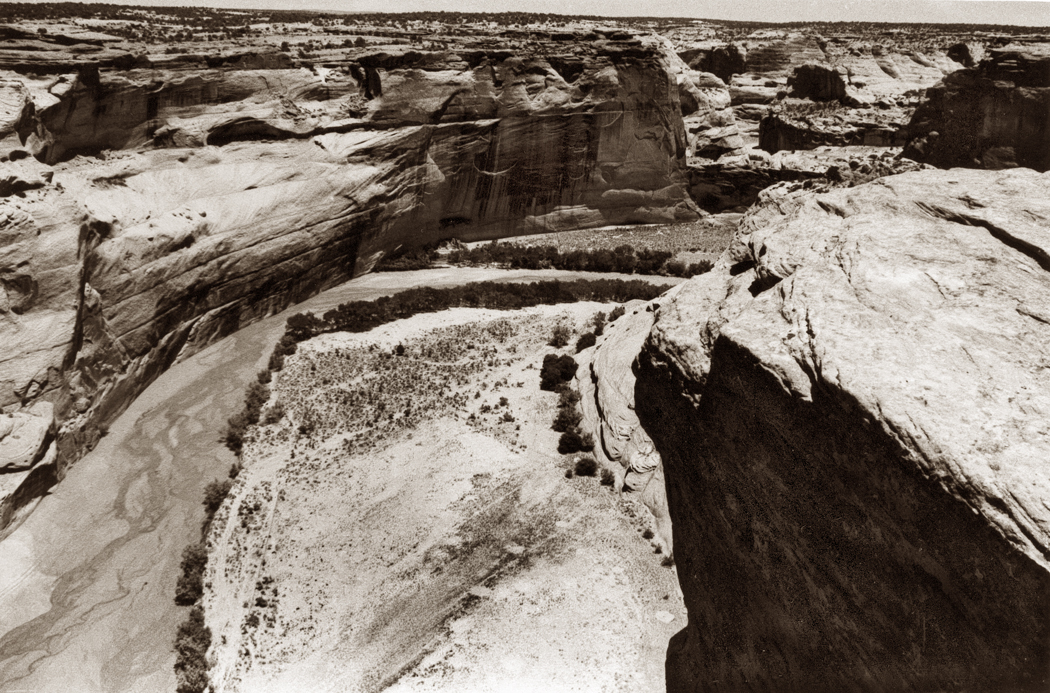
You stand at the rim of Canyon de Chelly on the Navajo Reservation and look down to the braided stream at the bottom that scoured this great hole out of the sandstone and wonder how long it must have taken. Then you see the tiny Anasazi relics built into the walls of the rock and realize how long people have been living here, and then you see the sandstone itself an think about how much longer ago — exponentially longer — that ancient river deltas deposited the silt that later became that stone.

We visited Canyon de Chelly many times, and at one point, Carole applied for a teaching job on the Reservation. We drove up for an interview, but the terms of the employment contract would have made it difficult to ever afford to live there — the 10-month contract came with a 10-month lease on a home, meaning we would have to leave with all our belongings during the summer months. It was clear they would rather have a Navajo teacher than a bilagáana. We couldn’t begrudge them that. 

Click on any image to enlarge

Some years ago, there was an unusual installation at the Scottsdale Museum of Contemporary Art. It was a 34-minute video by Mungo Thompson titled The American Desert (for Chuck Jones) and consisted of altered clips from old Warner Brothers Roadrunner cartoons, with the protagonists filtered out, leaving a series of edited backdrops of the American Southwest, with mesas, buttes, canyons and cliffs. 

Screen grabs of Mungo Thompson’s “The American Desert (for Chuck Jones)

The video loop (it played continuously) showed me the landscape I knew so well, but translated into cartoon visuals, with all the shapes, colors and weirdness I loved from the Colorado Plateau — Monument Valley, Canyonlands National Park, Capitol Reef NP and Arches NP, the Navajo and Hopi reservations — simplified and turned into theatrical backdrops. 

That region has served its term many times over more than a century, as backdrop for drama, from early silent Westerns (The Vanishing American, 1925), through classic John Ford films (beginning with Stagecoach, 1939), and most recently in the Coen Brothers’ Ballad of Buster Scruggs. The Southwest is photogenic, if nothing else. 

But the Warner Bros.-Chuck Jones animation presented a stripped-down, diagrammatic version of the landscape that gave us the essentials only — the rocks, cactus, roads and precipices. 

Warner Brothers, already famous for its Bugs Bunny and Daffy Duck cartoons, tried something new in 1949, with the first of its series of Roadrunner cartoons, Fast and Furry-ous, with characters created by writer  Michael Maltese and drawn by Chuck Jones. 

Michael Maltese (l.), Chuck Jones (r.) and their star (c.) 

The seven-minute short was a series of attempts by a hungry coyote (originally named “Don Coyote” after Don Quixote) to capture and dine on a roadrunner (given spurious scientific names in the cartoons, such as “Disappearialis Quickius,” although in the natural world, Geococcyx Californianus). The Coyote comes up with an endless series of Rube Goldberg contraptions to catch the bird, who perpetually escapes usually leaving the coyote blown up by dynamite or falling to a sodden crash at the bottom of a canyon. 

For 49 animated cartoons, the formula never really changed, each film just a catalog of gags with the same outcome. And after Warner Brothers closed down their animation studio in 1963, Jones took his Roadrunner into various newer permutations, both in theaters and on TV, never varying the formula, but later adding a sheepdog, or Bugs Bunny into the works — even a baby roadrunner and coyote. 

The formula never changed, but the desert did. Several background designers worked on the films. The earlier ones, by Robert Gribbroek, were more realistic, but as time went on the landscape, designed by Maurice Noble, became both more abstract and more surreal. 

Roadrunner landscape, early (l.) and late (r.)

But, to be honest, how can you really make such a landscape more abstract or more surreal than the actual thing. The Southwest, and particularly the Colorado Plateau of northern Arizona and southern and central Utah, is a wonderland of geoforms, with buttes rising up and canyons dropping down. And in the popular mind, they have become a generic version of the American West, the place setting for countless cavalry-and-Indians movies, and endless TV series. 

The idea of a cartoonish Southwest landscape goes back before the Roadrunner. Beginning in 1913 and continuing until his death in 1944, cartoonist George Herriman filled Hearst newspapers with Krazy Kat comic strips, set in a bizarro world Coconino County, the original of which sits in northern Arizona. 

Although now famous, the Krazy Kat cartoon strips were not terribly popular when they first ran. They were too weird for popular tastes. Only because the big boss, Hearst himself, loved them, they continued until Herriman’s death. But since then, Krazy has become a cult favorite. 

Of course, just like the Roadrunner cartoons, they never changed. Gender-fluid Krazy is in love with Ignatz the mouse, who hurls bricks at the cat and is punished or admonished by Offissa Pup, the doggy policeman of Coconino County. A thousand changes are rung on the formula. 

And behind them, the surreal landscape that was a stylized version of the Four Corners region, a landscape Herriman himself came to love through many visits to the Kayenta area just south of Monument Valley.

But, it should be noted that Herriman wasn’t the first cartoonist to fall in love with the Western landscape. It is often stated that the first cartoon strip ever created was The Yellow Kid, by Richard Outcault, which ran in the Pulitzer and later Hearst papers at the end of the 19th century. But the prize for being first has an equal claimant in Jimmy Swinnerton (1875-1974), who began producing the Little Bears strip for the San Francisco Examiner a few years earlier than The Yellow Kid

Panel from Swinnerton comic strip, with Hopi kachinas

Like Herriman, the California-born Swinnerton loved the American West. When diagnosed with tuberculosis, he moved to Arizona. In 1922, he began a cartoon strip for Good Housekeeping magazine, titled Canyon Kiddies, about Navajo children and life in the Four Corners region. Each was a series of pictures with rhyming verse underneath. 

In one, he almost predicts the Roadrunner cartoons, as a coyote eyes a rabbit (instead of a roadrunner) but asks, “It’s simply terrible to have a meal/ That can run much faster than yourself.” 

Swinnerton was also a serious painter, and from the 1920s on, made many landscapes of the West. They were more realistic than his comic-strip landscapes, but were still a kind of stripped-down style that borrowed from the popular Art Deco esthetic of the times. 

That style has proved durable over the decades. There are artists who prefer a more detailed, more photographic style, but many others seem to have realized that a smoothed-out, simplified version of the landscape was perhaps more expressive. They emphasized tones and colors above detail. 

Maynard Dixon

Among the first serious artists who adopted the style was Maynard Dixon (1875-1946). Born in California, he later lived, and died, in Arizona. 

Dixon began as an illustrator and painter of a kind of generic California Impressionism, but his career hit its stride with the landscape of the West, and a more Modernist approach. 

What was a distinct style with Dixon later became a common vision for painters of the West. Simplified mesas and buttes, huge clouds above a low horizon, and dusty pastel colors. 

Maynard Dixon 

With Georgia O’Keeffe, geology turns almost to biology, as her many paintings of New Mexico seem almost like bulging muscles and twisting torsos. 

Of all the artists working in this style, no one did more to make the style personal. You can spot an O’Keeffe from the other side of the room. Who knew that the most stubbornly cussed Modernist painter of the Southwest could share so much with Roadrunner cartoons? 

What all these artists have in common is the reduction of sharp detail and an emphasis on color and general form. The desert Southwest surely demands such.

As the turn-of-the-20th-century art critic John C. Van Dyke wrote in his book, The Desert (1902): “Painters for years have been trying to put it upon canvas — this landscape of color, light, and air, with form almost obliterated, merely suggested, given only as a hint of the mysterious. Men like Corot and Monet have told us, again and again, that in painting, clearly delineated forms of mountains, valleys, trees, and rivers, kill the fine color-sentiment of the picture.”

Van Dyke continues: “The great struggle of the modern landscapist is to get on with the least possible form and to suggest everything by tones of color, shades of light, drifts of air. Why? Because these are the most sensuous qualities in nature and in art. The landscape that is the simplest in form and the finest in color is by all odds the most beautiful.”

Dixon (l.) and O’Keeffe (r.)

 In my years as an art critic in Arizona, I knew many artists who found the color more important than the texture. The Art Deco style of Dixon or (more idiosyncratically) O’Keeffe proved to be infinitely malleable for their work. 

Many more recent artists have adopted and adapted this style for their landscapes of the Southwest. 

Dennis Ziemienski (l.), Martin Sabransky (c.), and David Jonason (r.)

There is a thriving market for Western paintings. (I had to deal with quite a bit of it during my stretch as art critic in Arizona, where a kitschy version, called “Cowboy Art,” was popular in toney art galleries. These artworks, filled with bronco busters and noble Indians, were often painted with considerable technical skill, but very little originality — they were really more merchandise than art). 

But among the kitsch are quite a number of landscape artists, including Brett Allen Johnson … 

G. Russell Case … 

Gary Ernest Smith, who usually paints more Midwestern scenes, but occasionally gives a go at the Southwest … 

And Doug West, whose work is often done in silkscreen, or mimics the silkscreen style, which is the simplified color-and-shape taken to extremes. 

If you think we have wandered too far from the Roadrunner cartoons, they consider at least this one painting by Carol Bold:

Roadrunner cartoon (l.) and Carol Bold (r.)

But there are two artists I want to mention in particular, both of whom I knew back when I kept track of all the art being made in Arizona. 

The first is Ed Mell, who began his career painting fancy cars as a commercial illustrator. Not finding personal satisfaction as a New York advertising artist, he took a job teaching on the Hopi Indian Reservation and rediscovered the landscape of the Colorado Plateau. 

His early works tended to be influenced by Maynard Dixon, but as his career progressed, his painting tended to combine the Art Deco with a kind of Cubism, to what one might call “Cubist Deco.” More like the stylized landscape of the cartoons.

That Cubist Deco has made it to other artists, as well, including the above-mentioned David Jonason …

The other artist I want to bring up is Bill Schenck, who has also given us work in the Deco style …

But has also branched out into what can only be called a “paint-by-numbers” esthetic. It gives a hard edge to the otherwise more Impressionistic styles of his contemporaries. 

The style has also been mixed with the techniques of Bob Ross, to make a kind of “furniture store” art. One example shows up as a background to MSNBC security analyst Frank Figliuzzi. It is a painting by gallery-owner and artist Diana Madaras. 

And I couldn’t end this study without mentioning the Roadrunner esthetic of Wes Anderson’s Asteroid City

He even has a few appearances of a roadrunner, just to let you know, wink-wink.

I collected more than 200 images for this essay, and I had to leave out so many that I wanted to include. But there is only so much space, and so much attention willing to be subjected to this rabbit hole. 

But I did want to end with one final road runner, set in the landscape we’ve been discussing. 

Click on any image to enlarge

Cartoonist Reg Manning said you could take in all of Arizona in three great bites. Manning was the Pulitzer-Prize winning political cartoonist for The Arizona Republic from 1948 to 1971. And he wrote a book, What is Arizona Really Like? (1968), a cartoon guide to the state for newcomers (he also wrote a cartoon guide to the prickly vegetation of the state, What Kinda Cactus Izzat? Both required reading for any Arizonan.) 

Anyway, his introduction to the state bites off three large chunks: the Colorado Plateau in the north; the mountainous middle; and the desert south. It is a convenient way to swallow up the whole, and works quite well. 

I spent a third of my life in Arizona and I traveled through almost every inch of the state, either on my own or for my newspaper, and I never found a better explanation of the state (and state of mind) than Manning’s book. Admittedly, the book can be a bit corny, but its basis is sound. 

But my life has been spent in other parts of the country as well, and I came to realize that Manning’s tripartite scheme could work quite as well for almost any state. 

I now live in North Carolina, which is traditionally split in three, with the Atlantic Coastal Plain in the east; the Piedmont in the middle; and the mountains in the west. The divisions are quite distinct geologically: The escarpment of the Blue Ridge just up from the Piedmont, and the coastal plain begins with the Fall Line — a series of dams, rapids and waterfalls that long ago provided the power for industry. 

But that is hardly the only example. I grew up in New Jersey, which could easily be split into the crowded suburban north, where I grew up; the almost hillbilly south, which is actually below the Mason-Dixon Line, and where the radio is full of Country-Western stations (and who can forget the “Pine Barrens” episode of The Sopranos?); and finally, the Jersey Shore, a whole distinct universe of its own. 

And when I lived in Seattle, Washington state was clearly divided into the empty, dry east; the wet, populated coast; divided by the Cascade Mountains. Oregon was the same. It divided up politically the same way: a redneck east, a progressive west, and a mountain barrier between. 

So, I began looking at other states I knew fairly well. South Carolina and Georgia follow North Carolina with its mountains (“upcountry” in South Carolina), its Piedmont and its coast. Even Alabama does, although its coastal plain borders the Gulf of Mexico. 

Florida has its east coast; its west coast; and its panhandle — all quite distinct in culture. Michigan has its urban east, its rural west and then, hardly part of the state, the UP — Upper Peninsula. There’s lakefront Ohio, riverfront Ohio and farmland Ohio. 

Maine has a southern coast that is prosperous and filled with tourists; a northern coast (“Down East”), which is sparsely populated and mostly poor; and a great interior, which is all lakes, forests and potatoes. 

Massachusetts has its pastoral western portion, with its hills and mountains; its urban east, centered on Boston; and then there’s Cape Cod, a whole different universe. 

Heck, even Delaware, as tiny as it is, has its cities in the north, its farms on the Delmarva Peninsula and its vacationland ocean shores. 

Go smaller still. Draw a line down the center of Rhode Island and everything to the west of the line might as well be Connecticut. For the rest, Providence eats up the northern part and south of that, Rhode Island consists of islands in Narraganset Bay. 

Colorado has its Rocky Mountains and its eastern farmlands, separated by the sprawling Denver metropolitan area. 

But I don’t want to go through every state. I leave that to you. Indiana has its rural south, its urban midlands with Indianapolis, and that funky post-industrial portion that is just outside Chicago. Oy. 

Yet, as I looked at that first state, defined by Manning’s cartoons, I realized that each third of Arizona could be subdivided into its own thirds. This was getting to be madness. 

The Colorado Plateau is one-third Indian reservation, both Navajo and Hopi; one-third marking the southern edge of northern Arizona in what might be called the I-40 corridor of cities and towns from Holbrook through Flagstaff and on through Williams to Kingman; and a final third that encompasses the Grand Canyon and the remote Arizona Strip. 

The mountainous middle third of the state includes the Mogollon Rim and its mountain retreats, such as Payson; another third that is the Verde Valley; and a finishing touch the Fort Apache and San Carlos Indian reservations.

Finally, in the south and west, there is the urban spread from just north of Phoenix and continuing south through Tucson and that nowadays continues almost to Nogales and Mexico; there is the Chihuahuan Desert portions in the southeast, from Douglas through the Wilcox Playa; and in the southwest, the almost empty desert including the Tohono O’odham Indian Reservation, the Barry Goldwater bombing range, and up to the bedraggled haven of trailer parks that is Quartzsite. And no, I’m not forgetting Yuma. 

It’s a sort of “rule of thirds” applied to geography. It seems almost any bit of land can be sliced in three. Phoenix itself, as a metro area, has the East Valley, including Mesa, Scottsdale and Tempe; central Phoenix (which itself is divided into north Phoenix, the central Phoenix downtown, and the largely Hispanic south Phoenix), and the West Valley, which nowadays perhaps goes all the way up through Sun City to Surprise. 

Here in North Carolina, the Coastal Plain runs through the loblolly pines and farmland of eastern North Carolina; into the swampy lowlands of marshy lakes and tidal rivers; and on to the Outer Banks and the ocean. Another tri-partite division. The Piedmont has its 1) Research Triangle; 2) its Tri-city area of Greensboro, High Point and Winston-Salem (extending out to Statesville and Hickory); and 3) the Charlotte metro area; and the mountains include first the northern parts of the Blue Ridge, around Boone and Linville Falls; second, the Asheville area, which is a blue city in a red state; and finally the southern mountains around the Great Smokies. Thirds, thirds, thirds. 

Even Asheville, itself, comes in three varieties: East Asheville (where I live); downtown (where the drum circle is); and West Asheville (where the hippies live). West Asheville is actually south of downtown. Why? I dunno. 

You can go too far with this and I’m sure that I have. After all, it’s really rather meaningless and just a game. But you can divide California into thirds in three completely different ways. 

First, and too easily, there is Southern California; central California; and northern California. Each has its culture and its political leanings. But you can also look at it as desert California, including Death Valley and Los Angeles; mountain California, with the Sierra Nevada running like a spine down the long banana-shaped state; and populated California north of LA and in the Central Valley. 

Finally, you can split California into rural, farming California, that feeds the nation from the Central Valley; wilderness California with deserts and mountains; and entertainment California, from Hollywood and LA up through San Francisco and Skywalker Ranch (and all the wine) that keeps America preoccupied with vino et circenses

The U.S. as a whole is often looked at as the East, the Midwest and the West. The East then subdivides as the Northeast, the Middle Atlantic States and the South; The Midwest has its Rust Belt, its Corn Belt, and its Wheat Belt. The West has its Rocky Mountain States, its Pacific Coast states and, well, Texas. 

And, I suppose if you look at the world in toto, you have the West, including Europe, North America and Australia; you have Asia, or the East, which includes China, Asian Russia, and most of the Muslim nations; and the Third World, which comprises most of the rest. You can quibble over Japan as Asian or a First World Nation; and India seems caught between, with growing prosperity and growing poverty at the same time. 

These distinctions are coarse and could well be better defined and refined. And I mean nothing profound — or even very meaningful — with this little set of observations. It is an exercise in a habit of thinking. If anything, I just mean it as a counterbalance to the binary cultural prejudice of splitting everything up into pairs. There is a countervailing cultural pattern that prefers threes to twos. I wrote about this previously in a different context (link here). 

We think in patterns, and well-worn templates. But the world doesn’t often present itself in patterns. The world lacks boundary lines and the universe is a great smear of infinite variety. The mental template allows us to organize what is not, in reality, organized. The most pervasive template is the binary one, but we are entering an increasingly non-binary culture. Of course, thirds is only one alternative pattern. Perhaps best is to ignore patterns and look fresh at evidence. 

The patterns are roadmaps for thought, and we can too easily take the easy route and fit the evidence to the pattern rather than the reverse. 

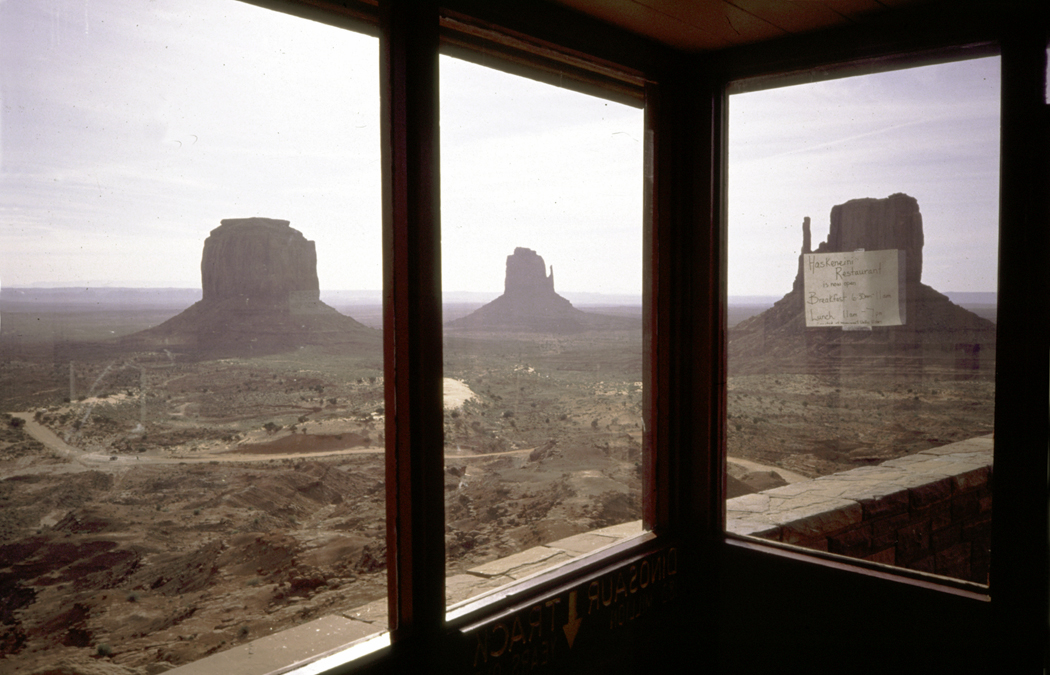
Monument valley windows 2

We’ve all had the experience of revisiting some place that meant something to us when we were young, only to find it ruined by the passing years — the blight in tract homes where there had been woods we played in; the proliferation of 7-Elevens or Starbucks; the widening of roads we had ridden our bikes down and the concomitant soot-spewing storm of traffic. The divided-highway bypass and the Walmart near the exit. Time has not been good to the landscape we knew.

But I have always thought, there must be someone of a generation previous who looked at the landscape I bicycled down and thought, how much better it had been when the road was gravel and there were no houses — including the one I grew up in — lining that road.

The fact is, time is furious and eats up the land just as it eats up the remaining years of my life. “Panta Horein” said the Greek philosopher Heraclitus: “Everything changes.” Doubtless, there was someone before my elder who loved the same land when there was nothing but a footpath through the forest and thought it better for all that.

And no doubt there will be some future progeny who will look at the scene some 50 years hence and lament the loss of those same 7-Elevens, replaced by something even crasser and more demoralizing. To them, the land I now lament will have been Eden.

Holbrook, Arizona

Holbrook, Arizona

Too often we think of the land as something permanent through which plays the impermanence of our comings and goings — a static stage set for our dramas. Its pace may be slower than ours, but the land changes, also; it has its own drama. I particularly love to see the scars of those changes, the evidence of what used to be, the peeping out from under the macadam of the buried eyes of the past.

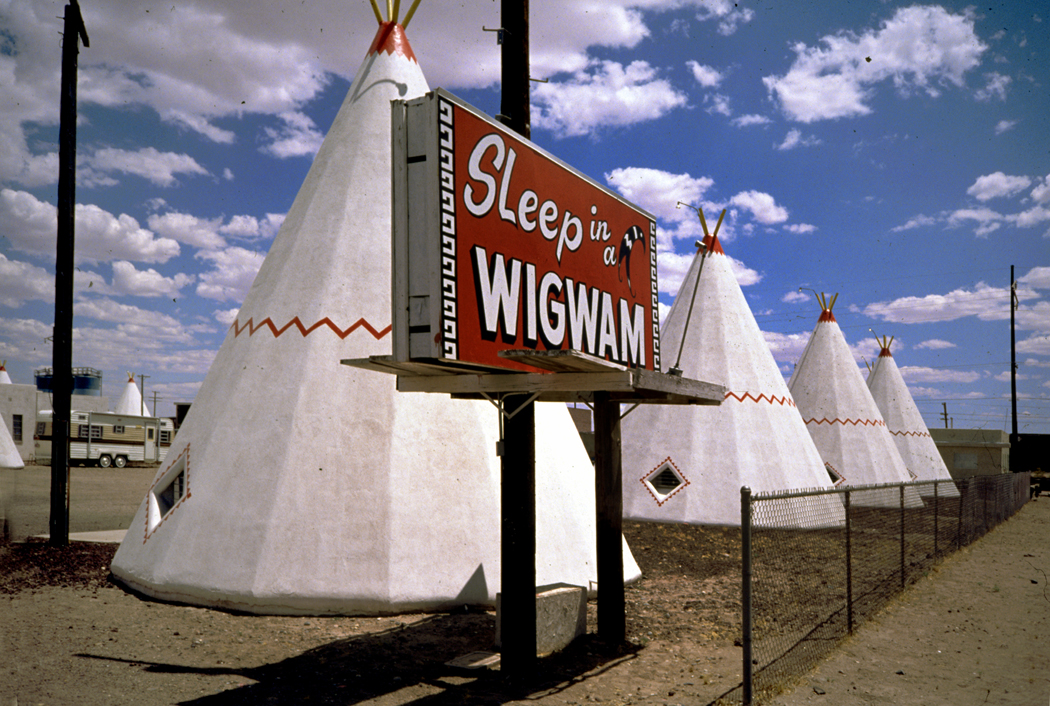
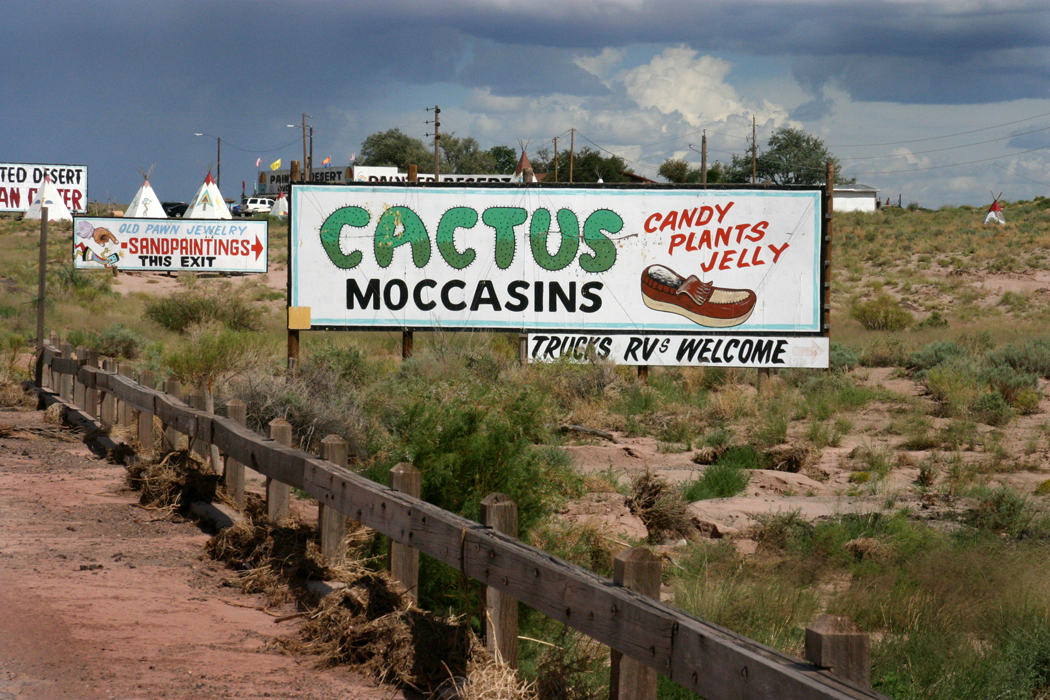
Along old 66 Signs and storm

One of the prizes I have is a Rand-McNally road atlas from the year I was born (1948). The map of Arizona has no interstates on it, and you can see that the very getting from Phoenix to Flagstaff was a detour, driving first through Wickenburg and up to Prescott before either heading north to Ash Fork and then east on U.S. 66 to Flag, or taking the more mountainous route up Alternate 89 over Mingus Mountain, down to the Verde Valley and then up the hill through Sedona and up the face of the Mogollon Rim to your destination.

Along old 66 Tumbleweed

Of course, there was a more direct route, through Dugas and Camp Verde, but the road was mostly dirt and rutted.

The thing is, that if you look for them, all those ruts are still there. You can, if you wish, and if your car is sturdy enough, drive those roads up through Bumble Bee, through Orme, through Skull Valley, Iron Springs or Happy Jack. Like Schliemann digging down through layers of Troy, the archeology of Arizona is there — or its fossils are.

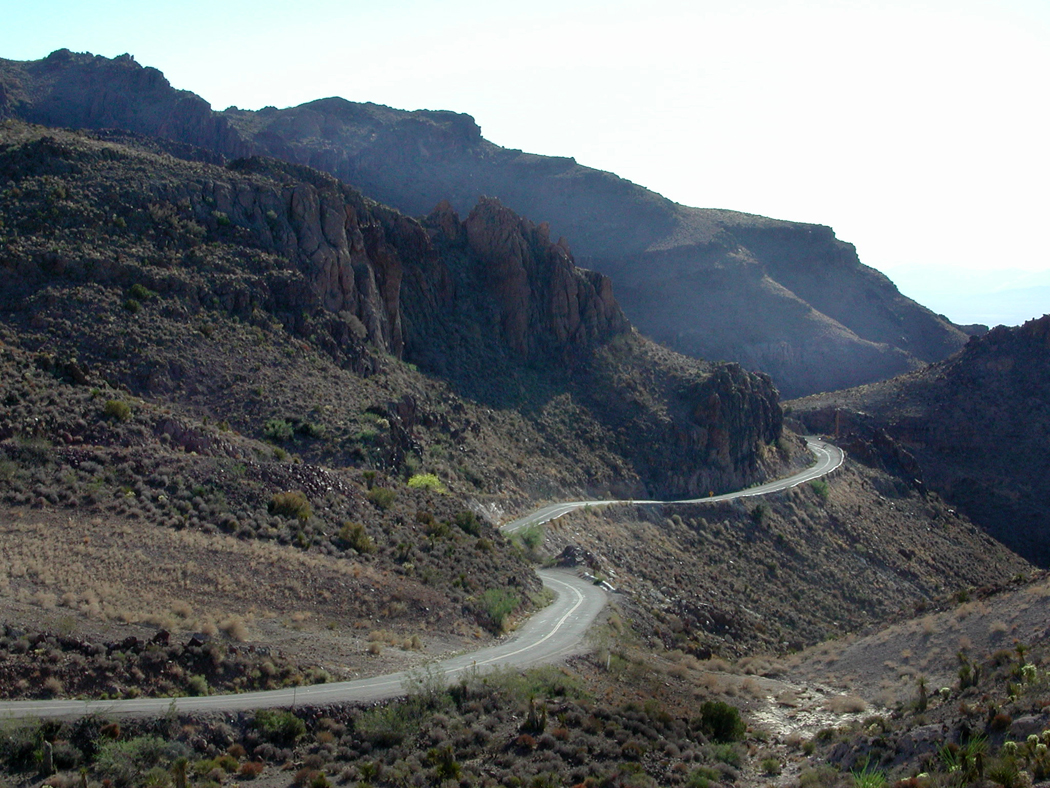
West of Kingman

West of Kingman

All of which brings me to the slice of Arizona across its northern tier, now defined by Interstate 40. The interstate ate up what used to be U.S. 66 — Route 66 of legend — and takes the speediferous driver across the flatter parts of the Colorado Plateau, up through Flagstaff, and down through Williams, Kingman and on to California. “You’ll see Amarillo, Gallup, New Mexico, Flagstaff, Arizona. Don’t forget Winona, Kingman, Barstow, San Bernardino…”

Along old 66 Interstate 40

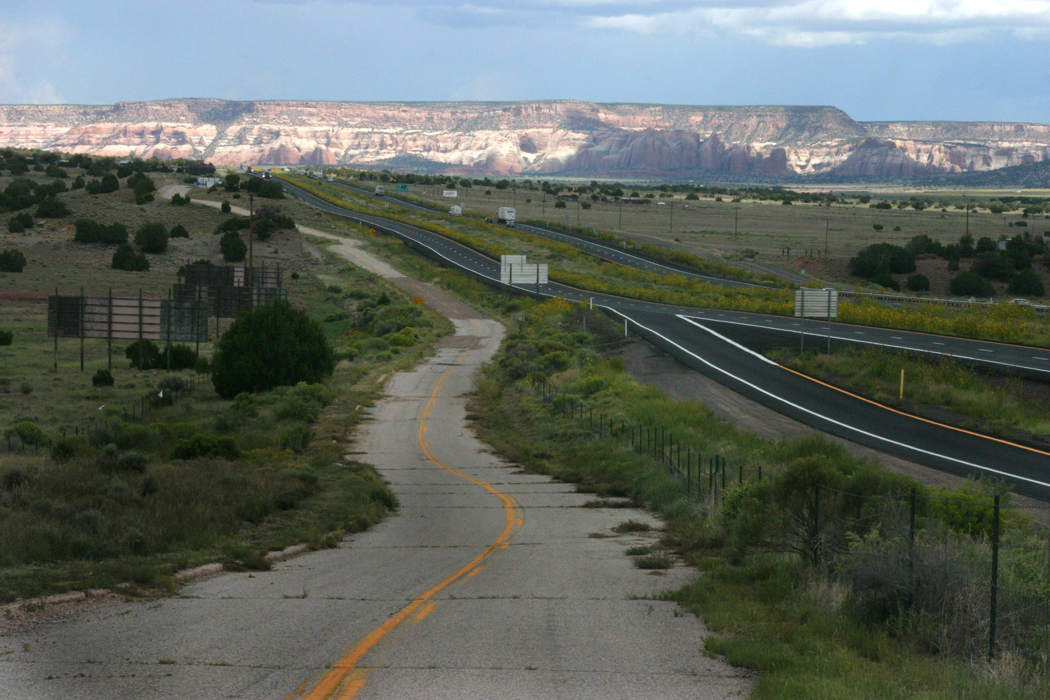
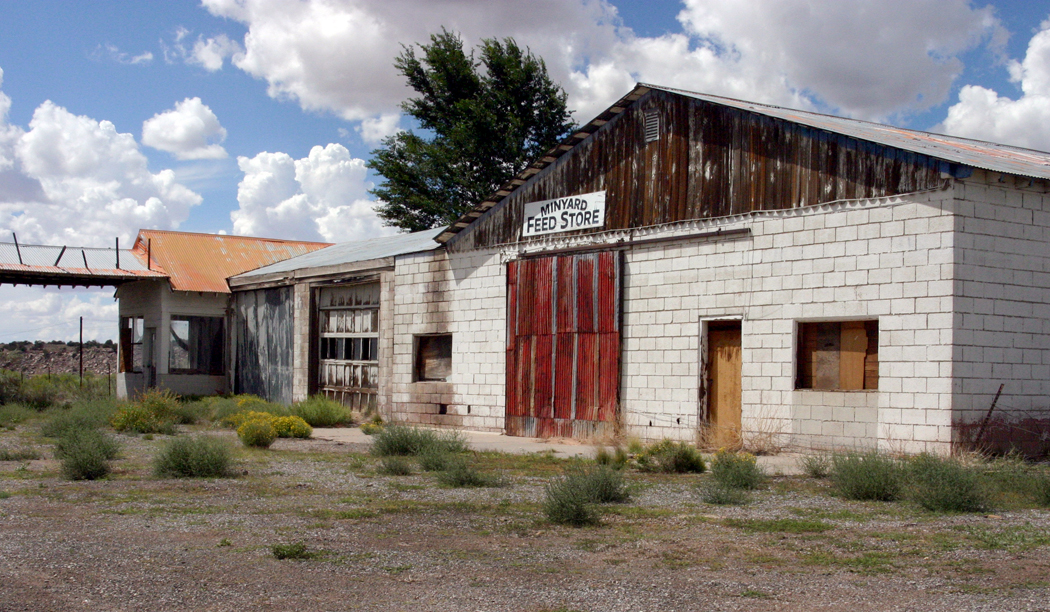
But, if you get off the interstate, right at the state line in Lupton, you can find the ghost road, mostly paralleling the freeway, and you can drive along it, at a steady 45 mph, watching for potholes, and see the scars of the past dug into the dry stony soil. The road is discontinuous — you will have to get back on the interstate for an exit or so, or ride over the tide of traffic to pick up the auxiliary road on the other side, where old 66 will start again. It is a ghost of itself, and along it are a few forgotten towns, many gutted old service stations with their paint peeled, their windows blown out and their driveways split by weeds busting through.

Along old 66 Minyard Feed Store

Time is fierce, it eats everything.

I admit to a weakness for these pentimenti, for the palimpsest of time, showing through the later “improvements.” They provide a glimpse of the process, of the metamorphosis — using Ovid’s word — of the constant writhing and seething of the planet and our place as people in the ferment and bubbling.

Along old 66 sunflowers

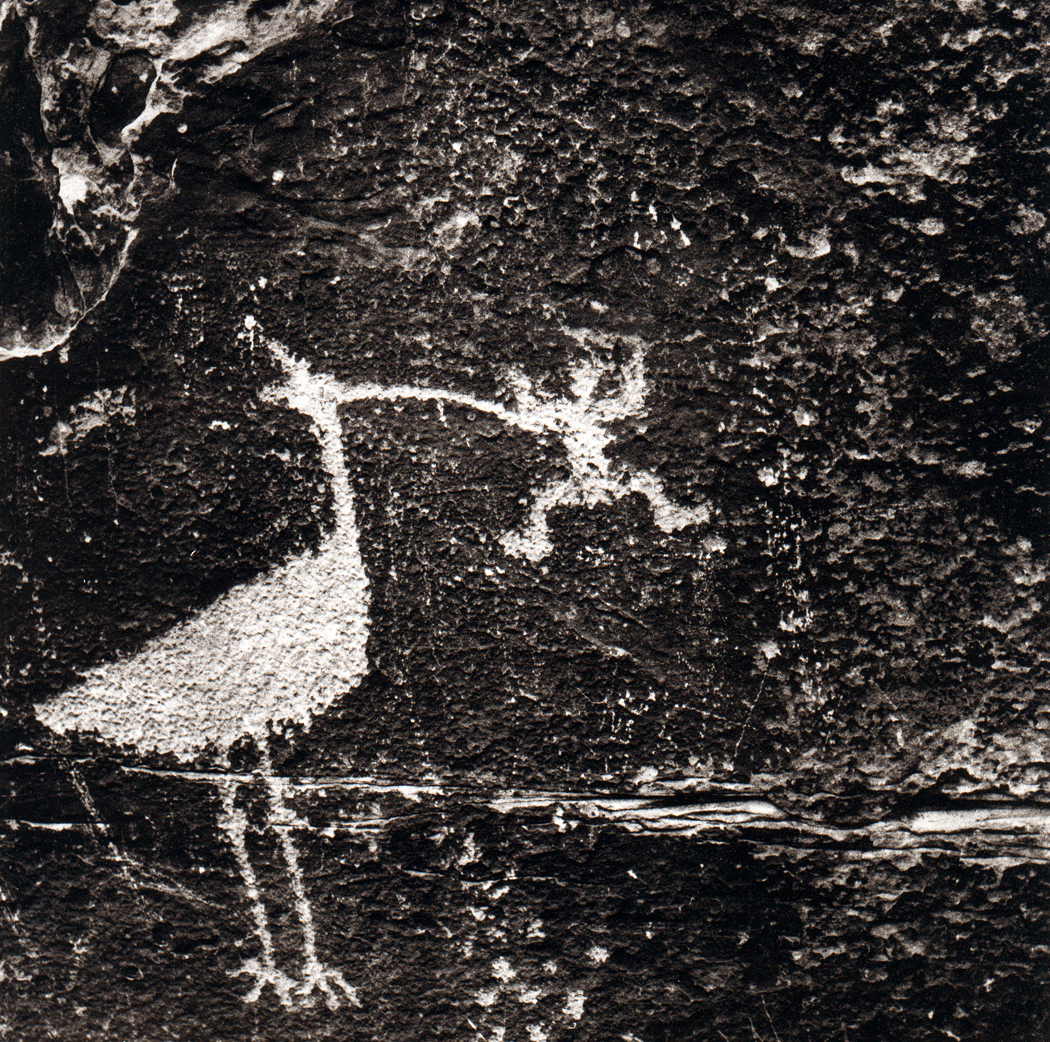
It comes in the shorter term, such as old Route 66 being devoured by grasses and crucifers, but it also comes in longer terms, such as the Anasazi ruins of Canyon de Chelly and Betatakin, the petroglyphs of Rio Puerco in the Petrified Forest National Park.

Rio Puerco Ruins

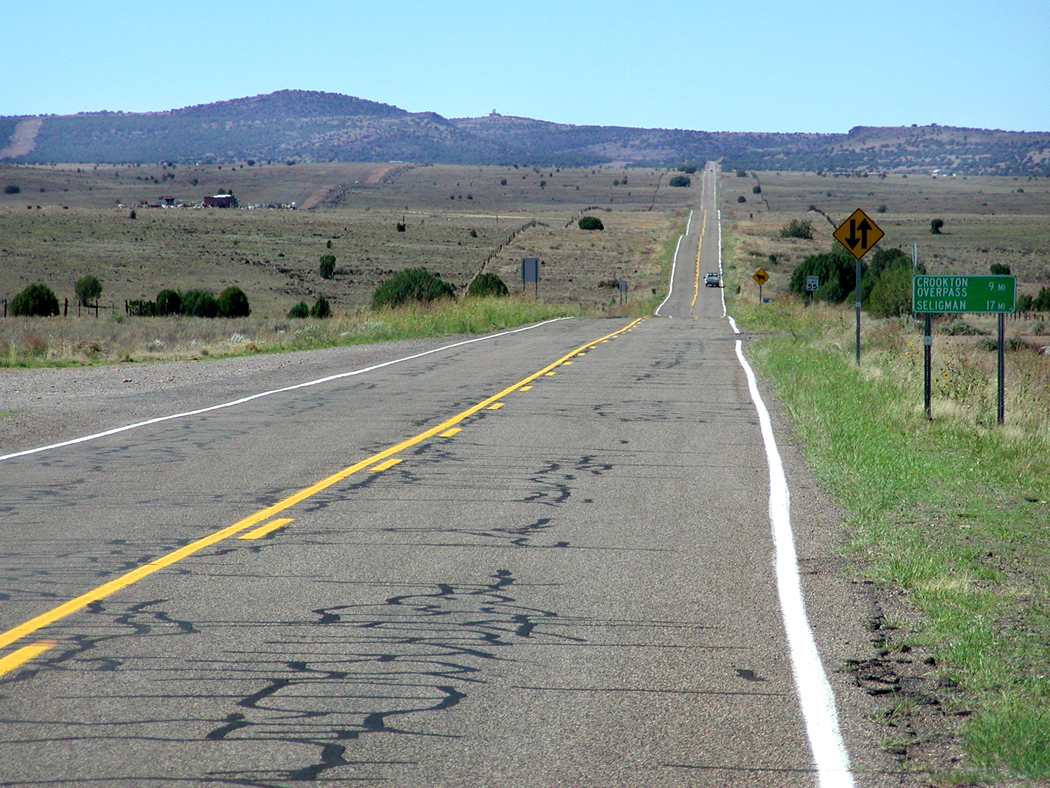
There are remaining parts of old Route 66, running through Seligman, and it is mined constantly for nostalgia. But it isn’t that I am feeding on, but the sense of sand sifting through my fingers, of time leaving. It comes out of some chthonic well and runs past us and dissipating in an ocean of we know not where. The old road is still there, and it will be there even when there are no cars — just as the wagon ruts can still be found along the Santa Fe Trail, sunk into the grasses of Kansas.

Old 66 to Seligman

I relish all the different tickings and tockings of the various clocks running their various races.

Sliding Rock Ruins, Canyon de Chelly

Sliding Rock Ruins, Canyon de Chelly

You stand at the rim of Canyon de Chelly on the Navajo Reservation and look down to the braided stream at the bottom that scoured this great hole out of the sandstone and wonder how long it must have taken. Then you see the tiny Anasazi relics built into the walls of the rock and realize how long people have been living here, and then you see the sandstone itself an think about how much longer ago — exponentially longer — that ancient river deltas deposited the silt that later became that stone.

White House Ruins, Canyon de Chelly

White House Ruins, Canyon de Chelly

How much more do you sense these multiple time scales at this rift’s big brother, the Grand Canyon.

Marble Canyon

Marble Canyon

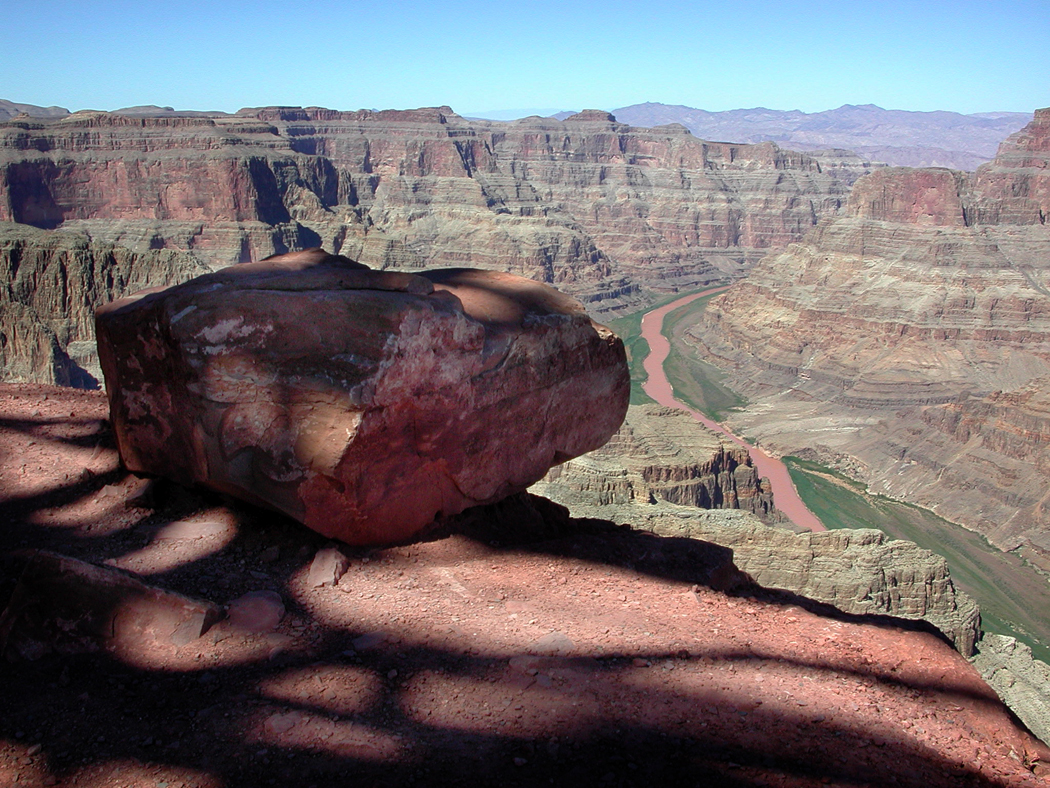
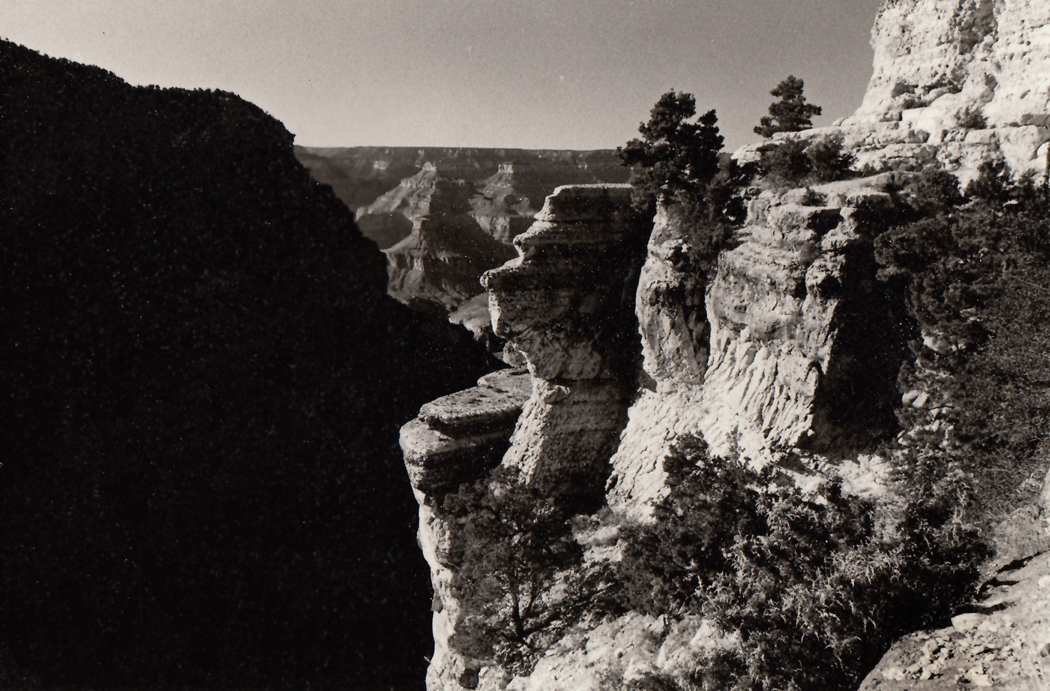
If you want to have the planetary feeling without racing around the globe, you can get it standing still in Arizona: with your feet planted at the edge of the Grand Canyon. In that case, you stand stock-still and let the planet do the moving.

North Rim, Grand Canyon

North Rim, Grand Canyon

The first time I saw sunrise at the Grand Canyon, my wife and I were camping on the North Rim outside the National Park. We had arrived with the naive assumption we could wander in late in the afternoon and get a room at the lodge. Or failing that, we could get a slot at the campgrounds.

The desk clerk took pity on us and explained that although they were completely booked, lodge and campground, for the foreseeable future, we could find a dirt road just outside the park that would take us to a place in the National Forest where people often camped.

It was dark by the time we got to that road, and when we turned into an open place where two or three other tents were set up, it was already night.

We slept, we dreamed, and we woke before sunrise, when the earliest glow floated in through our tent flap. And when we got out to stretch and start up the camp stove, we gasped: We were about 15 feet from the rim of the canyon. It dropped out of sight below us.

If we had pulled forward just a little farther the night before in the blackness, it would have been Thelma-and-Louise time for us. We were hard on the edge.

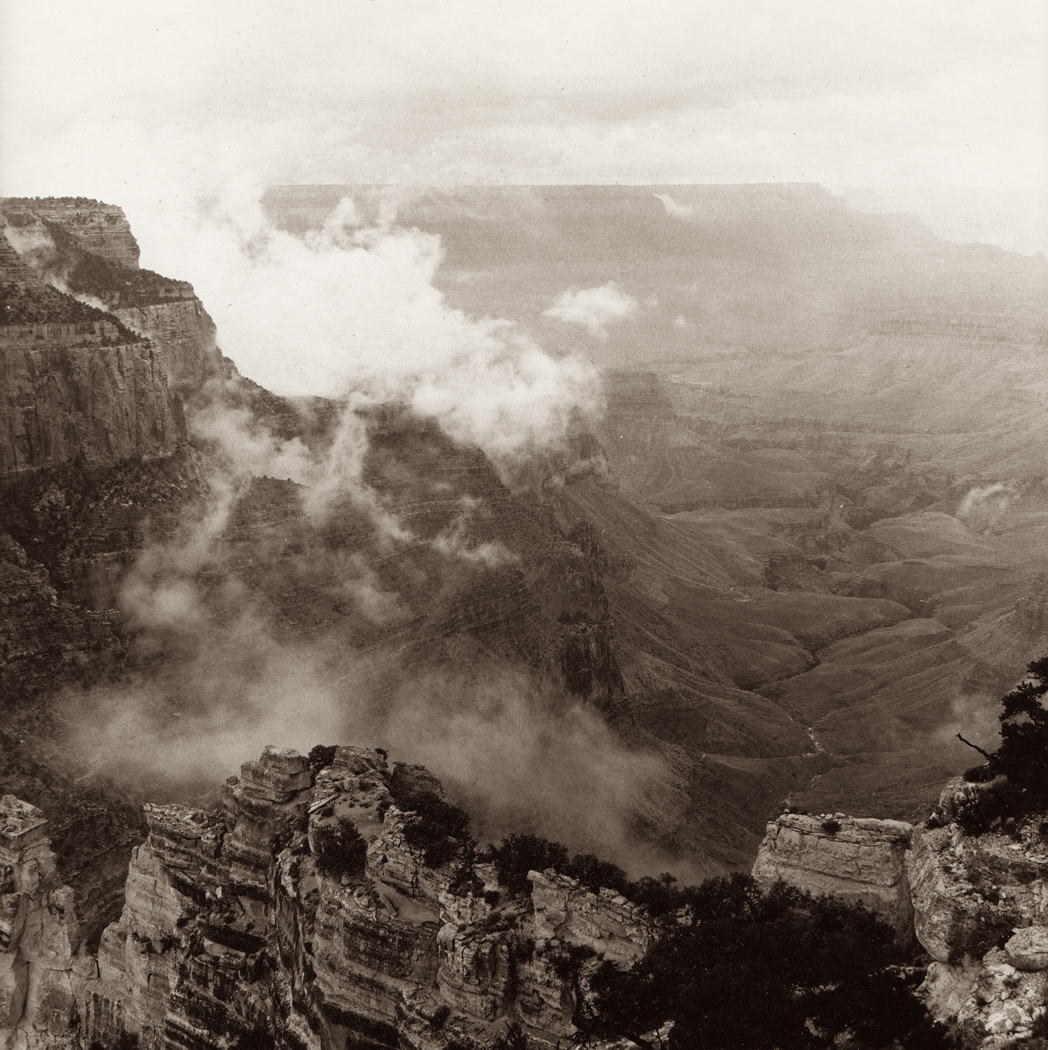
But more impressive, the humid late-July weather had left the entire canyon as a gigantic dish of cotton. The clouds filled in the canyon-hollow like apples in a fruit bowl. A 215-mile long fruit bowl.

The mists swirled and wisped below us, over precipices and down canyonlets, in constant motion, rising and subsiding as the new-hatched sun warmed patches of the air the mist rode upon and the breezes wafted the veils.

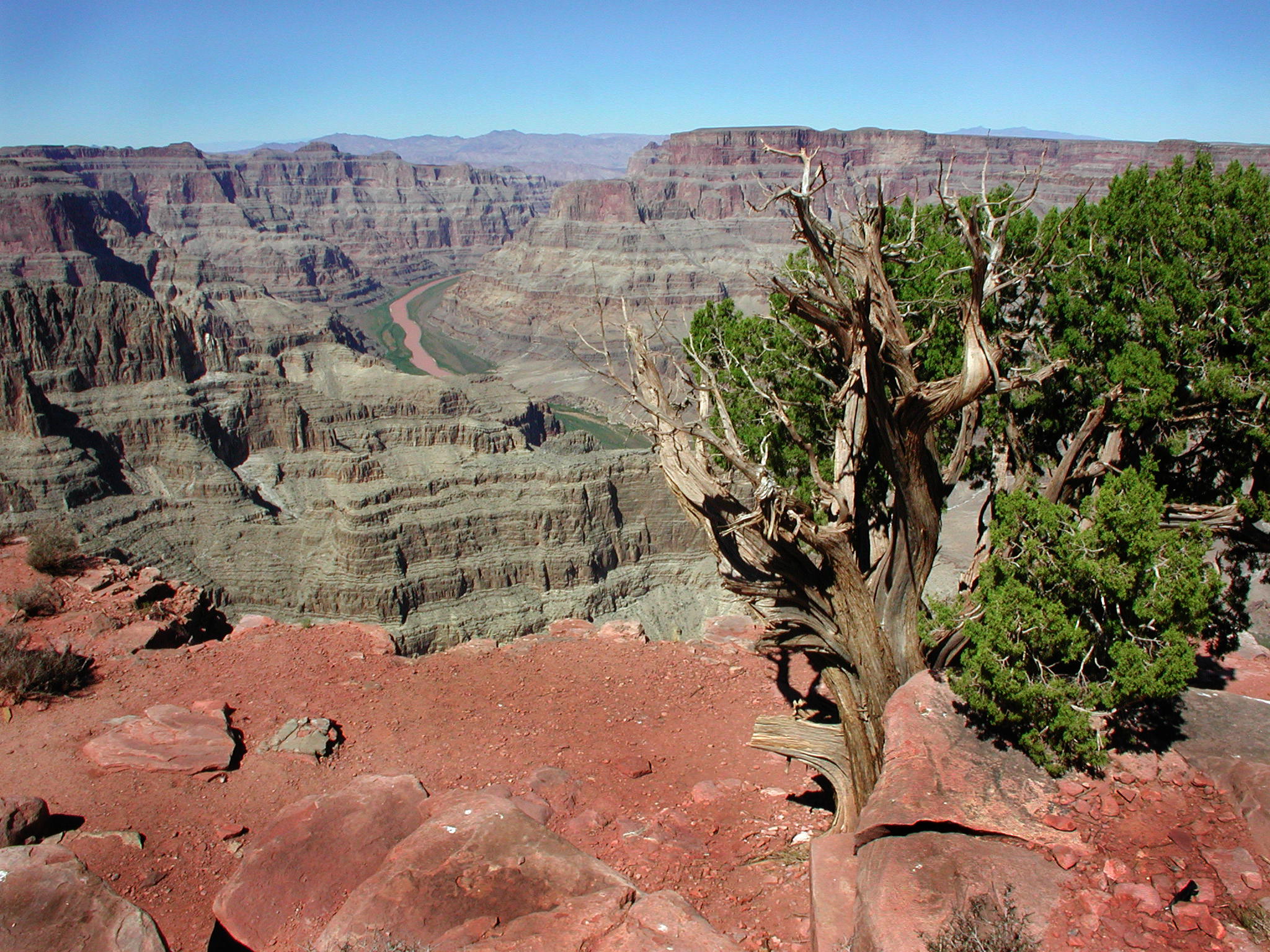
Grand Canyon West

Grand Canyon West

The Classical writer, Longinus, said that we enjoy the day-to-day things of our lives, but when it comes to awe, we get that only from the sublime. Hearth fires, he said, were nice, but erupting volcanoes make us consider a planet and cosmos larger than we are and well beyond our control. The sublime is beautiful, but it is also scary: It is the source of religious feeling.

You cannot avoid that at the Grand Canyon, with its stony layers of eons piled upon each other. The Canyon is a great wound in the Earth into which we can look and see its organs pulsating at a rate so slow as to make all of human history a mere blip on its EKG.

Grand Canyon

The Grand Canyon is a clock. It has a big hand and a little hand.

The little hand moves very slowly, telling the time in geologic terms. To see the hand move, you must wait millions of years.

In that time, you would see continental oceans lay down sediments and tectonic forces push those layers upward, only to be eroded by a river, like a sand pile washed by a hose.Grand View Point, Grand Canyon NP Ariz

One stands at the rim now and looks back into the past, washed away eon by eon, stratum by stratum, until one’s eye stands on the Vishnu schist, the Precambrian footings of the Canyon.

You hardly can take in the vastness of it. It is an earthly reminder of eternity, that time beyond time that turns our lives into flyspecks.

But this geological clock has a fast-moving big hand, too. And it changes all 200 miles of the Canyon second by second. It can seem to the observer like time-lapse photography in real time as the sun jumps from the horizon and changes the shadowed blacks of the deep walls to a burning cherry ruddiness and on much too quickly to the weathered indigo blueness of noon.

Cycles and epicycles, wheels inside wheels, the turning of time on itself in all its speeds.

The first time I saw the Canyon, I got there before dawn. My wife and I had arrived late the previous night and wound up camping in the Kaibab National Forest outside the park. I set our alarm clock for 4 a.m., and when we got up, it was completely dark.

We drove to the overlook at Lipan Point, and I set up my camera in the blackness, out on a rocky ledge beyond the guardrail.

The tripod barely could find purchase on the narrow outcrop, and my wife warned me about taking chances, especially by the glow of a flashlight.

A little after 4, the horizon began to appear. It was July, but it was icy cold before the sun rose. The batteries of my light meter ceased to work in the cold.

Yet it was beginning to be possible, as the far edge of the Canyon contrasted with the blue-gray of the lightening sky, to focus my lens on the ground glass of the camera. And I saw there little more than that dividing line.

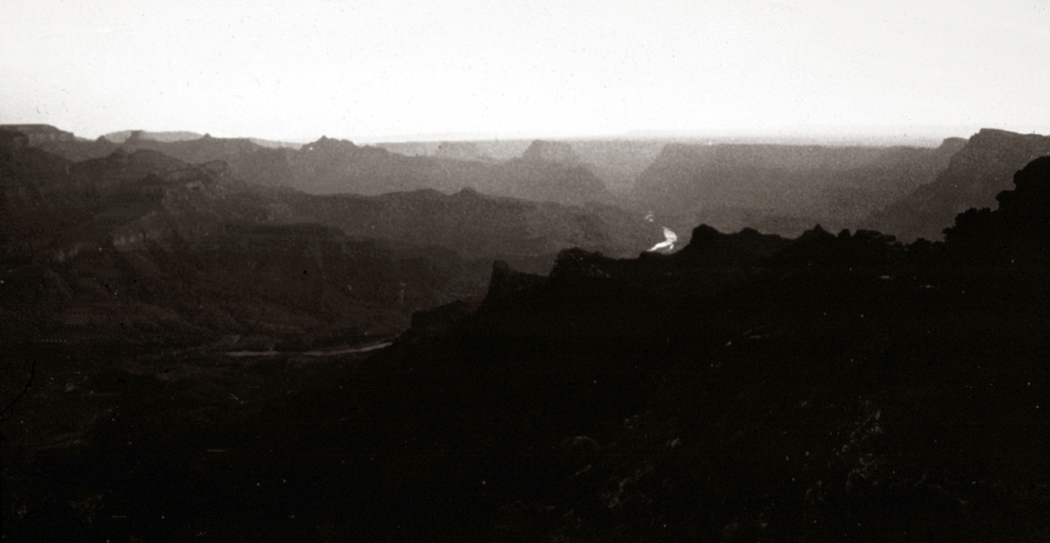
But down in the bottom of the Canyon, a mile below us, there was a snaky line of a reflecting light.

Dawn, Grand Canyon

It was the river, a white tube of neon cut off here and there by the mesas and buttes below us. At times, the rope of water actually seemed brighter than the sky.

I managed to take a two- or three-minute exposure of the nearly black landscape. The glow in the sky had begun to make some of the rock texture visible, but less so to the eye than to the camera.

Dawn, Grand Canyon NP Ariz 2

Moment by moment, the scene changed, a slow crescendo of light that began where the river disappeared in the northeast until the fire broke the horizon and the first sliver of sun appeared.

What is most surprising is the quickness of the change. If you were to take a photograph once a minute over the course of a day, you hardly would have two alike.

When the sun is on the horizon, you actually can see it move. And as it rose and sank its light deeper into the Canyon, what had been a charcoal mass of rock mazes became lighted at the top ends of the rocks, like the cherry end of a cigarette in the dawn.

You could see probably scores of miles down the Canyon to the west and see the angle of the sun on the edge of the rock.

Nothing is so like the Earth waking up.

Grand Canyon NP, with shadow

Looking toward the sun, the Canyon became a receding stage set of silhouettes, each lighter and grayer as it retreated toward the sunrise. Looking away from the sun, the rock faces became increasingly red, then orange, then brick, with layers of white and green thrown in.

The Grand Canyon is grandest in the dawn. Those willing to awaken early enough stare into the clock of the day playing on the stone and see their lives moving before them. If time is a stream, as Thoreau says, at the Grand Canyon you can see its rapids. The change continues all day. On most summer days, the midday hours are the least interesting. The hazy blueness of the distant rim seems steady from about 10 a.m. to 2 or 3 p.m. But if you stare with enough commitment, you can see the changes even then as the downward angle of the sunlight twists slowly from one side of the cliffs to the other.

Grand Canyon West

Grand Canyon West

Later, when the sun’s angle lowers to day’s end, the changes accelerate once more, taking the rocks back from blue to red and into darkness.

There is no mistaking the Earth as a clock, turning with the sun as the hour marker, moving in orderly procession around the rim of the great circle we live on.

But the two clocks at the Canyon also remind of the conflicting realities of the place. On the one hand, the slow clock tells of the everlastingness of things, their physical endurance. On the other, how can you believe in reality if the same limestone that can be red at 8 a.m. can be blue by 9?

It reinforces your sense of rock-solid reality and undercuts your belief at the same time. To live in two times at once: This is the central message of all the world’s religions.

When people find spiritual meaning in the Canyon, perhaps it is these conflicting clocks more than anything else that create that sense. Certainly, the Canyon’s vast space is inspiring, but it is time that speaks of eternity and our place in it.

Snake infinityClick any image to enlarge

MapI have lived in the four corners of the U.S. I was born in the Northeast, lived in the South, the Southwest and the Pacific Northwest. And yet it is somehow the vast middle of the nation that most draws me to it.

In the Northeast, there are cities and woods, the Hudson River slicing up New York State, the “bare and bended arm” of Massachusetts jutting out into the cod-waters of the cold Atlantic. There are the great curved ridges of the Alleghenies forcing highways into what look like Golgi bodies on the gas-station maps. This is the land of salt-rust on the undercarriage of family cars; Of hillside cemeteries bordered by brick apartment buildings. Warehouse districts and tract housing; turnpikes and wharves; glacial till and the stone walls the till makes both possible and necessary — and the fallen ruins of those walls making forgotten property boundaries in second- and third-growth forests. Swimming holes from abandoned quarries and the ever-present nose dust of bus fumes.New York 3

I look back on these things and a wave of nostalgia warms me. Manhattan in the winter, with the Con-Ed grates pouring steam into the air; the periodic burst of warm air blowing up from the sidewalk as the subway train rumbles in the Stygian underground. People in vast tides walking with purpose up Fifth Avenue. The smell of coffee and pie at the Horn and Hardart.

But I left the Northeast at just about the same time as the Horn and Hardart began fading away. I moved to the South, where I became accustomed to slower talking, slower walking and human interactions that were not based on efficiency and gain. It was a land of pine trees grown for paper pulp, a coastline of sea oats and dunes on barrier islands, cities of fewer restaurants, and what there were served meatloaf and fried chicken. When I moved there, the single Chinese restaurant in Greensboro, N.C. pretty much restricted its menu to chop suey and egg foo yung with pot roast gravy.red maple

I have lived in the South now longer than I have lived anywhere else, although I have not been faithful, and have moved elsewhere, yet I seem always to return. There are pinxter flowers dripping with rain along the Appalachian Trail; there are bass-filled man-made lakes where small towns used to be; there are old lawyers in worn suits who meet every morning in the coffee shop to talk about the day’s events while sipping hot coffee cooled by pouring it out into its saucer slurp by slurp. When I moved to the South, the Klan was still common — in both senses of the word — and otherwise perfectly decent white folk made a sincere case for not changing things too precipitously. Every town had its black community, usually on the other side of the railroad tracks that had once provided the reason for the town’s existence and formed the terminator as clearly as if there were the lit and dark sides of the moon.

There were cotton warehouses and tobacco barns; men actually used spitoons — and if they didn’t have one, they might have an empty tin can into which to spit the brown excess saliva from their chaw. I know of one old reprobate who actually died when he passed out drunk and rolled off his couch, cutting his throat on the jagged edge of his spit can.

If, in the North, people had little time for each other, always in a rush to get somewhere and do something, in the South, everything revolved around relationships, around talking and with that talk establishing social rank and responsibility and anyone you knew, you also knew who their daddy was. People talked endlessly, about weather, business, politics, gossip, taxes, planting, hunting, dogs and church meetings. Even now, so many decades later, when I made my first visit to the local barber, one of the things he asked, making small talk, was what church did I go to. He wasn’t being nosy nor was he proselytizing, he was merely establishing a relationship.nc church jesus saves

A good deal has changed in the South since I first got there four decades ago. Accents that used to define hierarchy have begun flattening out: You can walk through whole blocks of Atlanta and hear the same language you might hear in Allentown, Pennsylvania. Fine dining is now possible if your city or town is now large enough. Your mayor has at least a 50-50 chance of being African-American. When I got there, every white Southerner was a Democrat; now, they are all Republicans.barista

I moved to Seattle in the late ’70s, before half of California swept north, and before every streetcorner had baristas pouring white swirls into the foam of a latte. The railroad switchers shunted cars from dock to dock along Alaskan Way where homeless men in dirty coats and black watchcaps clutched brown paper bags while sleeping in industrial doorways. The ferry moved out of its pier in the morning light to make its way to Winslow on Bainbridge Island or to Bremerton. Although it rained most days during the three non-summer seasons, it was mostly a drizzle and few people even thought it counted as rain and no one I saw ever carried an umbrella.

From my house on Phinney Ridge, across from the Woodland Park Zoo, you could see the snow-capped Olympic Mountains to the west and the snow-capped Cascade Mountains to the east. To the south was the biggest permanent, unmoving white cloud you ever saw — on those days you could actually see it for the weather — and it was called Mt. Rainier, which was pronounced, unlike the sovereign of Monaco, as if it described the precipitation in the Puget Sound: rainier. Certainly rainier than Arizona, where I moved later.Seattle docks

There was Olympia beer and Rainier beer, and I could hardly believe it to see pedestrians stop at the “don’t walk” lights, even at 2 in the morning when there were no cars on the road. No New Yorker would do that; I had friends who otherwise had a cavalier attitude toward authority who would stop me from jaywalking, as if the Stasi were keeping files.

When I got out of the city, the forests were populated with douglas fir and western redcedar. Nothing else. Endless miles of the stuff, climbing up the sides of mountain ranges and with downed logs greened over with moss, and the path a spongy loam under your feet.Hurricane Ridge, Olympic NP, Wash

I think that is what finally drove me to move back to the South: The sense of homesickness for a forest with scores, even hundreds of varieties of tree. The sameness of the Northwestern forest seemed unnatural to me, as if I shouldn’t be there.

There is much I loved in the Northwest. The moist air, the cool summer, the planked salmon and Ivar’s Acres of Clams. I knew a bunch of bicycle messengers, known as “Buckies,” and enjoyed the friendship they provided. There was a political progressiveness that was nearly universal; one could shop at the co-op grocery, the Public Market at Pike Place. Stop off at a bar and have a beer like a real person.Badger Creek Ariz

Finally, there is the American Southwest, as dry as Seattle was moist. One can see for 20 miles at a glance, taking in a meaningful quadrant of the earth circumference. The Southwest mean space. At least outside the city of Phoenix, where we settled — and we got out of the city as often as we could — the desert was intense, sharp and beautiful. Before a rain, the humidity made the creosote bushes smell like spicy cologne. The saguaro cactus stood vertical above the thorny undergrowth. Jack rabbits, roadrunners, the occasional javalina or rattlesnake darted in and out of view. The air was dry; sweat evaporated before you even knew it had escaped your pores. The sun bleached the landscape and radiated heat like an open oven door.

There were three different experiences of Arizona. The most common one was the urban experience of Phoenix.

My wife and I moved there because we had traveled summers across the country and thought it might be pleasant to live in the West for a few short years. I’m sure we were thinking of Flagstaff or Santa Fe. We wound up in Phoenix. We were thinking of having a little adobe house with a white picket fence and perhaps a butte in the background and a few pinto horses grazing in the pasture.  We wound up on Seventh Street, the busiest thoroughfare in the city, with traffic noise like endless surf crashing outside the house, and exhaust soot collecting in the cooling ducts of the house.

The street grid was punctuated by Circle Ks and 7-Elevens. The right-angle network of streets were broken in places by the eruption of mountains: Camelback, Squaw Peak, South Mountain. Enthusiasts climbed them to get a view of the city below, which spread out like a plaid tablecloth, divided into square patches. You could hardly get lost in this checkerboard of roads; you were either driving north-south or east-west, and the city’s mountains provided easy landmarks. You always knew where you were.camelback mountainSaguaro NP Ariz

Outside the city, the land was split between northern and southern Arizona. To the south, there were greasewood flats, saguaro cactus and stony mountains catching the sun late in the day to demarcate the rosy lit areas from the bluish shadows. Dry lake beds hovered in the distance, white salt pans, and the taller mountains caught snow in the winter.

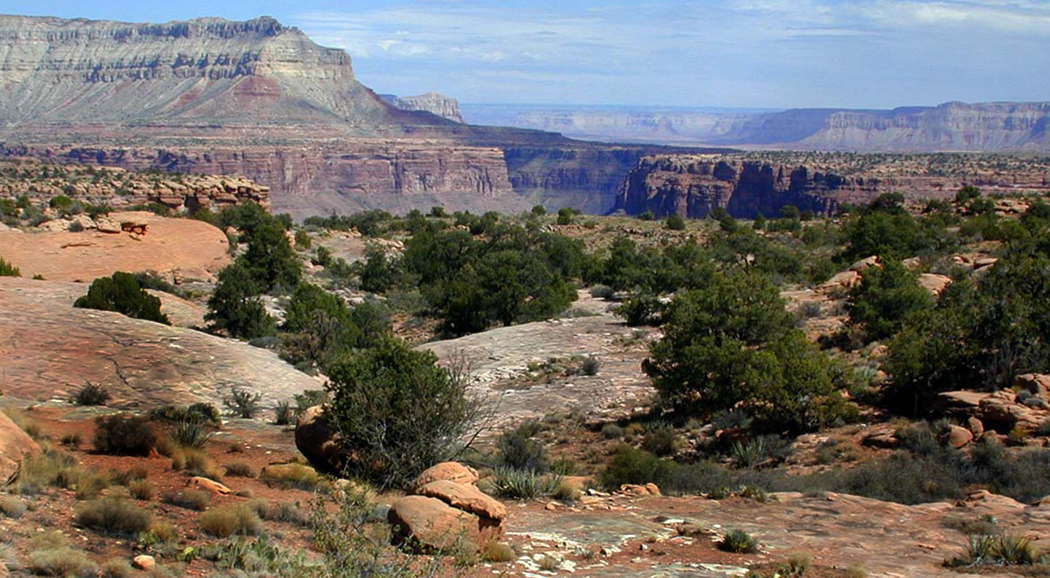
To the north was the Colorado Plateau, Flagstaff, the Navajo and Hopi reservations and the Grand Canyon. The air was noticeably thinner and cleaner — no Phoenix, no Tucson to fill the valleys up with yellow smog. Roads unrolled in long ribbon streams ahead of you heading to the horizon bounded by mesas and buttes. The landscape painted tawny, ruddy, sooty, whitish and blue by streaks, the sky larger than you have seen it anywhere, and most likely uniform blue, only darker toward the zenith.

At First Mesa on the Hopi reservation, you can hardly tell the blocks of stone making up the hillside from the stone houses built atop. You drive endless miles across grassy plains to the next habitation. Streams are marked by slight empty depressions that only fill up in the rare rains that come, mainly in late summer as thunderstorms and mid-winter as constant frontal drizzles. They can become roiling mud rivers almost instantly. Cars will be washed away in the flow. You can always tell the newbies in the desert; they think they can drive through the flooded washes. They fill the nightly news and we see the cars floating downstream, their owners on the roof waiting for rescue.

We spent one Christmas day with friends in Walpi. We brought apples and oranges, coffee and sugar. They gave us cookies they were baking. It snowed on First Mesa; the fire in the stove heated the low stone house.

What you are never quite prepared for is the sense that the canyons are not, like mountains, something that rise from the level, but rather are gigantic holes in the ground you don’t see until you are right on top of them. The stratigraphy is a geological story that is told, part by part, as you move from one part of the state to another. The same layers, in the same order hundred of miles apart, although they might be covered by yet more layers in one place, and rest on the surface elsewhere. You could, like a good geologist, anthologize the landscape to tell a continuous saga.

When we left Arizona, we immediately became homesick for the Plateau and the desert. I cannot say, however, that we missed the city. I used to call it “Cleveland in the desert.” I loved my job there, and my colleagues and friends, and my wife loved her job and her colleagues and friends, but the city itself is rather charmless. The South called us back.

And so, we returned — for me it was my third homecoming. Now we live in the Blue Ridge Mountains of North Carolina and I am constantly amazed, as a Yankee, at just how open and friendly the people are — so much so, it sometimes creeps me out.

But as I was saying at the head of this periplus, I have lived and absorbed the people and land in the four corners of the country, but somehow, there is a gravitational pull to the middle I have always felt, to the place I have never managed to live, the vast gut of the continent.Chicago, Ill

For me, there are two emotionally resonant attractions to the middle. First, there is the rustbelt city, the factories, the immigrant populations, the train yards and highway junctions that all spoke of the industrious rise of the nation from the late 19th century through the Second World War. It is where so many of our great writers came from. It is the home of pirogis and deep fried ravioli, sausages and red cabbage. I have loved taking the train across the lower shores of the Great Lakes past Cleveland and Toledo to Chicago. There is a Midwest that is populated. What is not industry is farm. And there is corn and wheat, silos and tractors. The land tends to lie flat. You could play billiards on the ground in places in western Indiana.Joes Colo haystacks

But there is the second middle of the country that calls to me even more insistently: It is further west than the prairies; it is the Great Plains. Driving through North Dakota or Nebraska, eastern Colorado or eastern Montana — there you feel more than anyplace else in the 48 states that you live on a planet. On the coasts, it used to be proof of the roundness of the earth that you could see the ships and their masts slowly dip below the horizon; on the plains, you see the next grain elevator rise from the same horizon in front of you as you drive and later drop again behind you. You are always on the high point of a dome; the earth falls away from you in all directions. And on this dome, the grasses curl like whitecaps on the ocean.

It is this sense that Melville captures so well in his late story and poem (or is it poem and prose prologue) John Marr. “Blank stillness would for hours reign unbroken on this prairie. ‘It is the bed of a dried-up sea,’ said the companionless sailor — no geologist — to himself, musing at twilight upon the fixed undulations of that immense alluvial expanse bounded only by the horizon, and missing there the stir that, to alert eyes and ears, animates at all times the apparent solitudes of the deep.” The landscape between the Mississippi River and the Rocky Mountains  was “hooped round by a level rim, the prairie was to John Marr a reminder of ocean.”

There is little in this expanse that can count as a city. Much that seems uninhabited. Moving across the Dakotas and into Montana, you find that neighbors count their separation not by fences but by miles. The land rises and falls like sea swell, and from the top of any ridge, you can see the land spread off in grassy waves.

Why this landscape should call to me so seductively is a mystery, even to me. I have wondered if it is some atavistic genetic memory of the Indo-European origins in the Caucasus, the Trans-Oxiana, where the grass continues unabated for a thousand miles, that Scythian homeland of my peoples, or at least of my language.Pawnee Buttes 5

Or perhaps, even further back, it is the imprinted memory of the African savannah where even before the global diaspora, we hairless monkeys were born. Why should I feel a homesickness for the grasslands that I have never actually lived in, unless there be some tick in my chromosomes that was molded there?

Whatever the cause, I feel it strongly. I feel it also in Manitoba and Saskatchewan, and eastern Alberta. The grasses swirl in the breeze, like animated hair whorls on an infant’s head; you can see the breeze moving through the grass in waves, the way a man in a sailboat sees the fretting of the lake surface as the gust approaches.

I am old now, and it is unlikely that I will dot the center of a quincunx of habitations by finally moving to the continental center. I will stay fixed in the North Carolina mountains. The Northeast, Southeast, Southwest and Northwest are part of my past. The spindle around which they all turn will remain a psychic locus, not an actual one for me. And the gust that frets the water a hundred yards off is the final one.

toroweap 6I’ve been to the Grand Canyon enough times that I couldn’t accurately count.

But sometimes familiarity makes us lose the magic. If I’ve been to Mather Point once, I’ve been a dozen times, at all hours of the day. And while it is still beautiful, still breathtaking, there is something missing — that virgin sense of seeing it for the first time.arizona highways magazine cover

This is replaced by the proxy pleasure of watching someone else see it for the first time, but now I’ve had even that vicarious fun often enough that I know what to expect.

But there are other places to see the canyon besides the official viewpoints of the National Park Service.

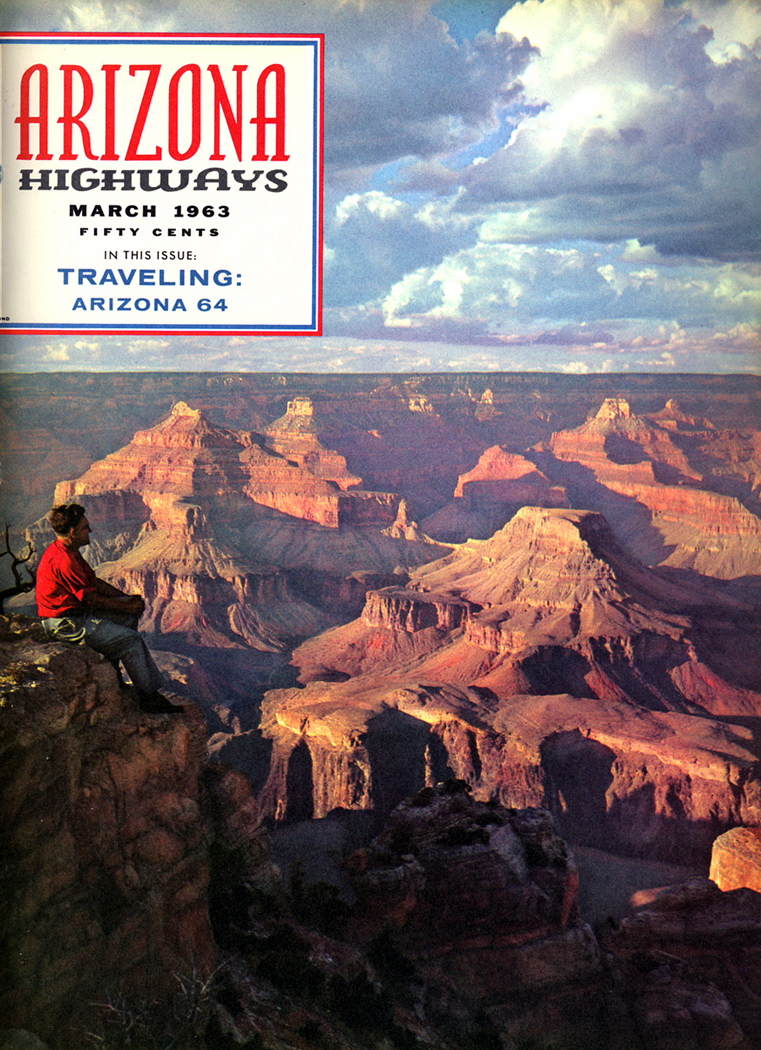
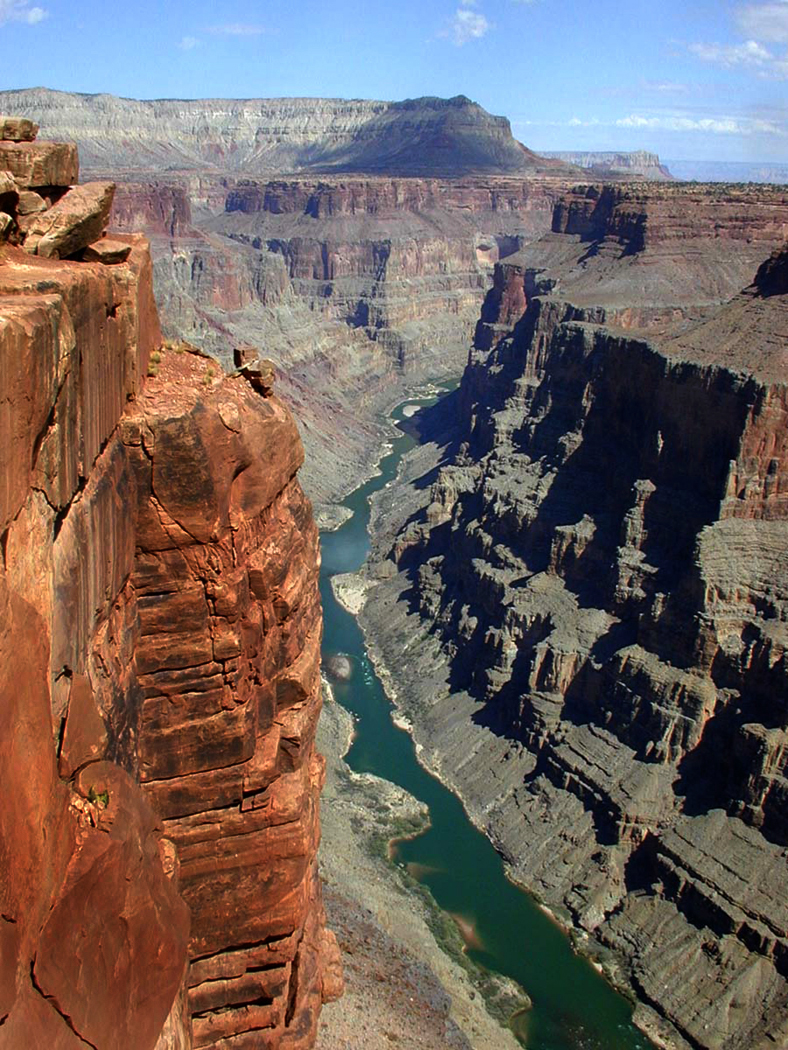
One of my first images of the Grand Canyon came when I was a child in the Christmas edition of Arizona Highways magazine, which was once a year available on the magazine racks in New Jersey. One of the pictures in it was a stunning photograph of the Canyon from Toroweap Overlook. I never forgot that name, it seemed so odd — although I don’t know why an Indian name should seem exotic to a Jersey boy living between Hackensack and Ho-Ho-Kus.toroweap 15

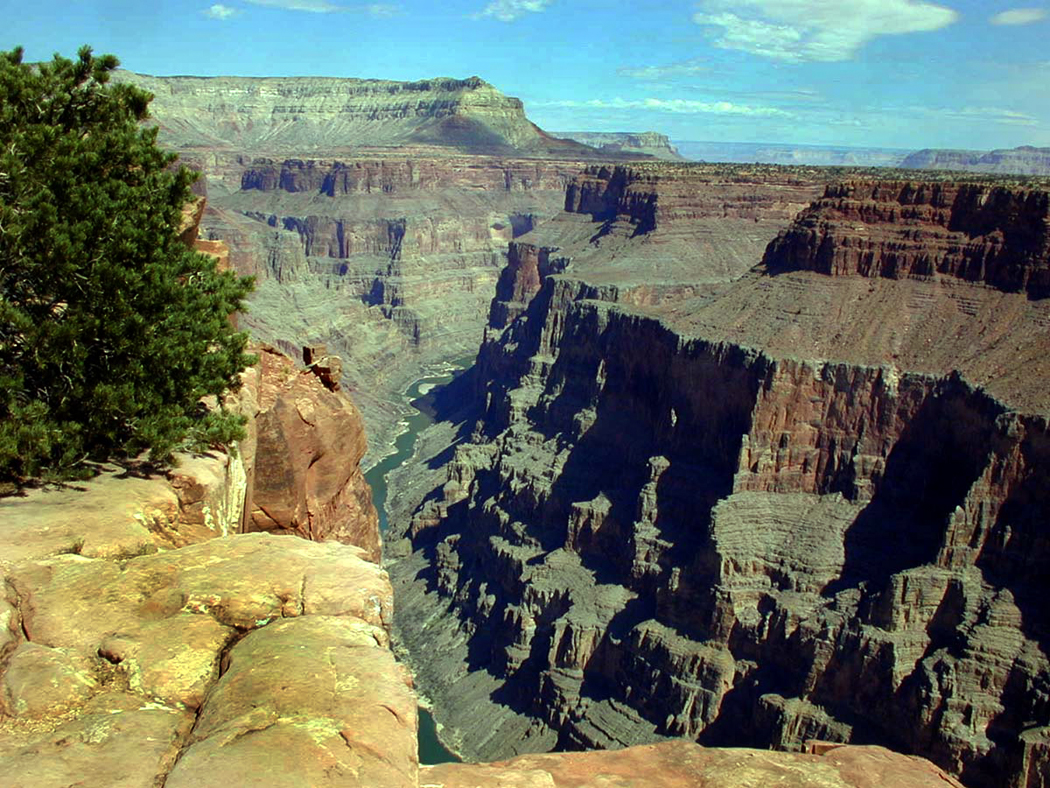
Nevertheless, I always wanted to go to Toroweap, to see that vertical panorama, the 3,000-foot drop to the river.

The overlook is reached by 61 miles of dirt road. And those miles start from a point 9 miles west of Fredonia, Arizona, which is already as remote as it is possible to be in the state. On the Arizona Strip between the Canyon and Utah, Fredonia is a little town you pass through on the way to Kanab, which is no Chicago either.

Fredonia is 120 miles from the nearest Arizona town of any significance, Flagstaff, through the Navajo Indian Reservation and across the northern margin of the state skirting the Vermilion Cliffs. It is so remote that when you pass the turn off for the Grand Canyon North Rim, you still have to press on into the wilderness to get to Fredonia.toroweap 9

How remote is it? Well, it is technically considered frontier. Any place with fewer than two people per square mile is officially called frontier, said the ranger at Pipe Spring National Monument, which is also in this neck of the woods.

The Arizona Strip easily qualifies. Arizona, for instance, has a population density of about 50 people per square mile. When you subtract the population center of Fredonia, with its 2100 people, the rest of the Strip checks in with .014 people per square mile. That’s fewer than 3 people per 20 square miles.

That is the official definition of empty.toroweap 7

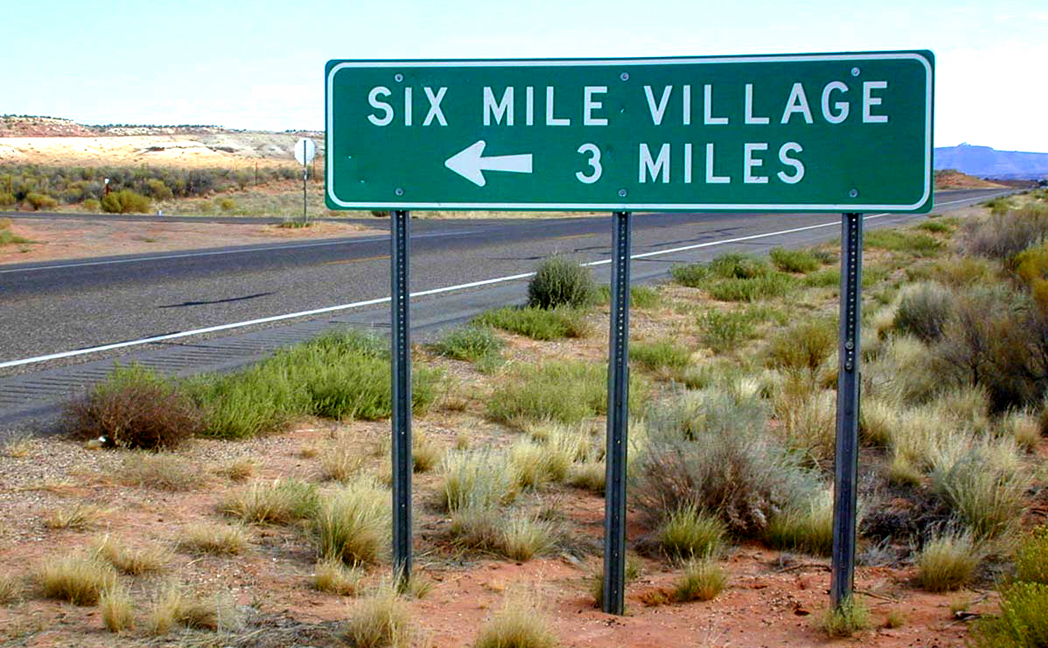
toroweap 17Well, a little past the sign that reads “Six Mile Village, 3 miles” you find a dirt-road turn off with a sign to Toroweap Overlook. It says, “Toroweap Overlook, 61 miles.”

At first, you feel rather confident. Anyone who regularly drives the dirt and gravel back roads in this state will be lulled into a false sense of security.

The first 20 miles or so are pretty flat, pretty well kept up and surprisingly civilized. You can do a comfortable 50 miles an hour if you don’t mind kicking up a few stones and hearing them clatter against your undercarriage.toroweap 10

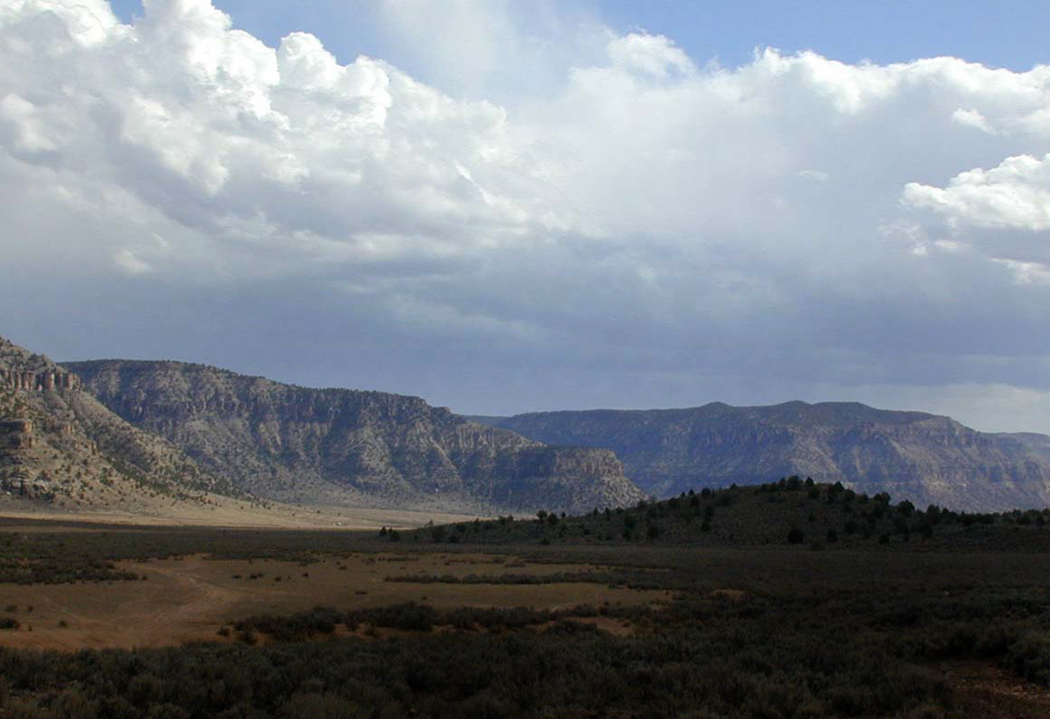
But then, after crossing the Antelope Valley, you have to climb the first small plateau and the road begins to wind and narrow. Patches of sand appear in the hollows of the land and you have to slow down or risk losing control of your car.

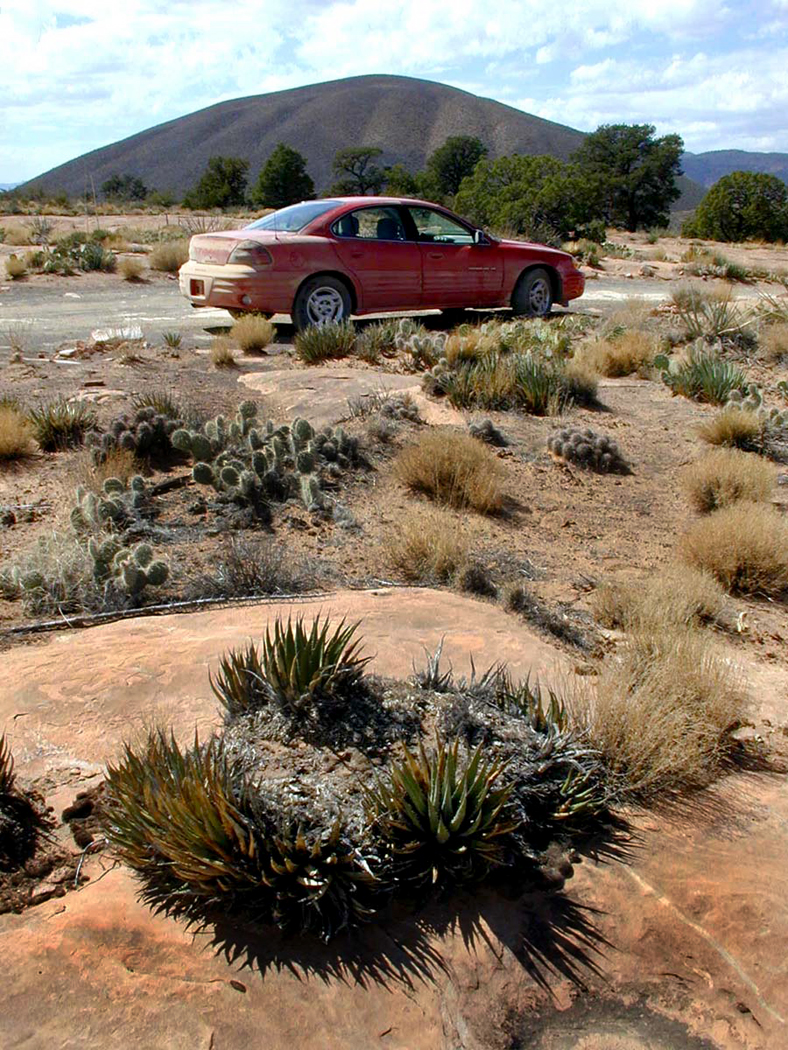
Yes, I said car. Every guide book I checked out said the trip can be made in a passenger car. And since I am an intrepid risker of my car, I thought that this sounds like a piece of cake. I have driven my car through mountainside cow pastures, through North Carolina woods with no roads, twisting between the trees like a Daniel Boone in a Chevy. I have taken my car on the 30 miles of washboard someone jokingly called a road on the far side of Death Valley from the highway.

I can go anywhere.toroweap 8

But the road to Toroweap became hinkier. About 45 miles in, just after the turn-off for the road to Mt. Trumbull, the road gets questionable. And I mean, like I question that it deserves the name road at all.

Since I was two-thirds of the way to my longed for magic dream, I pushed on.

After all, I am the man who drove my car across Thompson Wash to the north of Canyonlands National Park in Utah. I am the man who keeps an entrenching tool and a Hudson Bay ax in the trunk at all times in case I need to dig out of the sand and chop down brush to thrust under the tires for some purchase.toroweap 13

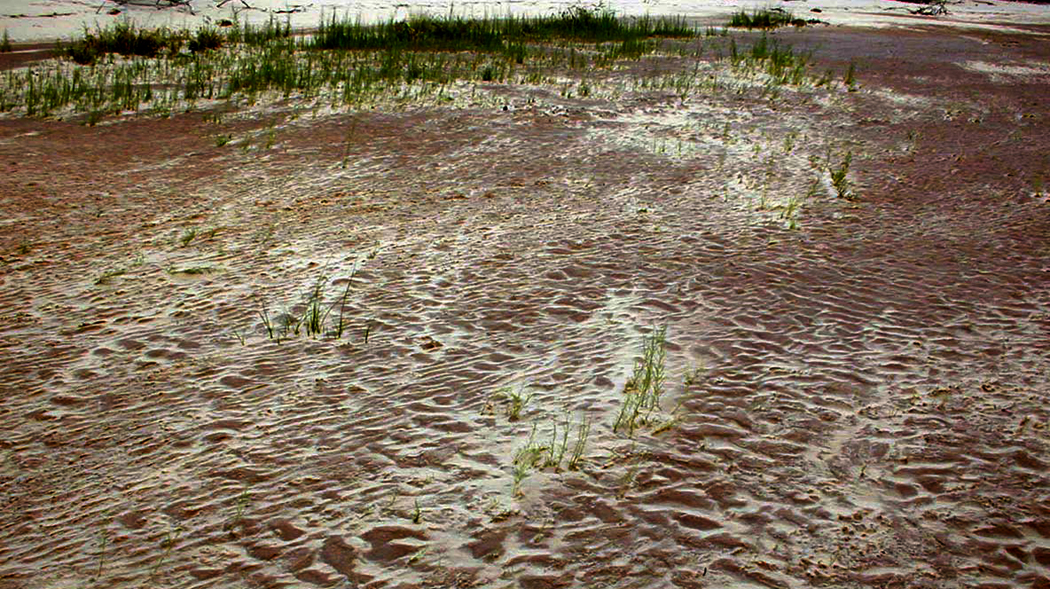
There were some sand pans along the way, where your tires no longer go where you point them and your careen through the powder like a raft going downstream. The steering wheel becomes a tiller and you just try to keep pointed forward. But if you get up a head of steam going into the sand, you can more or less bull your way through.toroweap 14

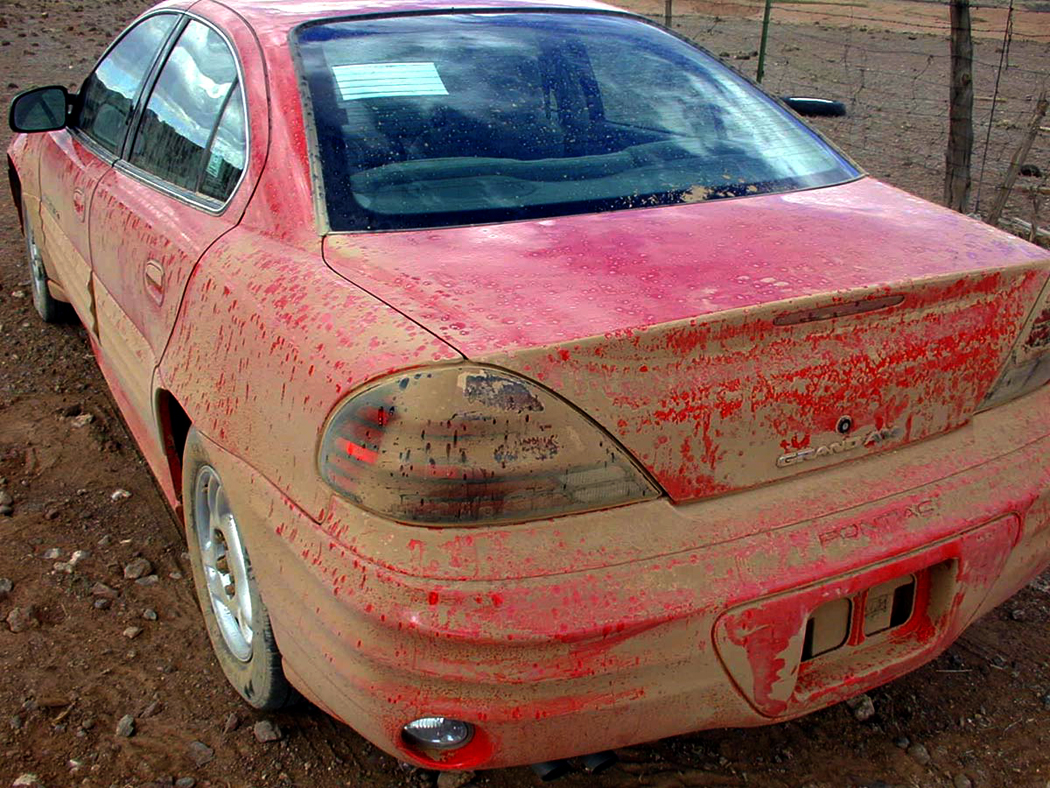
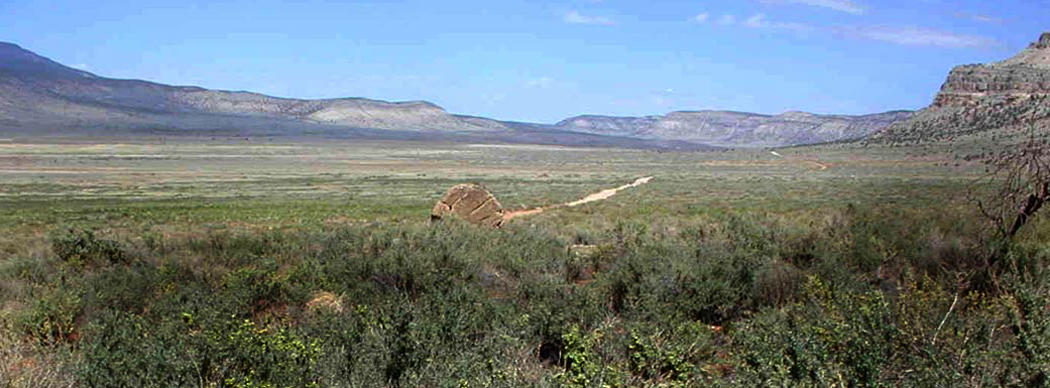
But after the Tuweep Ranger Station, where you enter the national park lands, it started getting tricky. I had had some touchy moments in the sand, but nothing I didn’t think I could handle in my Pontiac Grand Am. But in the final eight miles from there to the overlook, the road gets positively grim. The sand — I call it sand, but it is really a fine, pulverized powder that sits axle-deep in the roadway — had previously been in recognizable pans, small patches of up to 100 feet in extent. But along the Toroweap Valley, there is a stretch of about a quarter mile of unrelieved sand.toroweap 4

As I was driving along — careening, really — I came upon the ranger in a road grader smoothing the roadbed. He should have saved his effort. The grader was smoothing off the top of the sand, but that didn’t make it any easier to plow through. In fact, the ruts provided better traction for the tires, as long as the high sand in between didn’t contain any large rocks waiting to score the bottom metal of the car.

With the sand passed, the road got narrower and rockier. The rocks were bumpy and you had to take them slowly, especially around the tight curves up and down the canyon, but they were negotiable. The final three miles slowed me down to a pace of between 5 and 10 mph, but I didn’t mind so much, since at least I knew the road wouldn’t swallow my tires.

At the end, Toroweap Overlook was a small rocky parking lot with a port-o-let to one side and a giant hole in the ground to the other.toroweap 2

They view was spectacular and the rawness of the experience made the South Rim look positively urban. There are no guard rails, no interpretive signs, no ranger walks, just an edge of rock with a vertical drop down to the river of three-fifths of a mile. The canyon at Toroweap is very narrow — it is about a mile to the southern rim across the gorge, and directly below, you can hear the roar of the rapids.toroweap 11
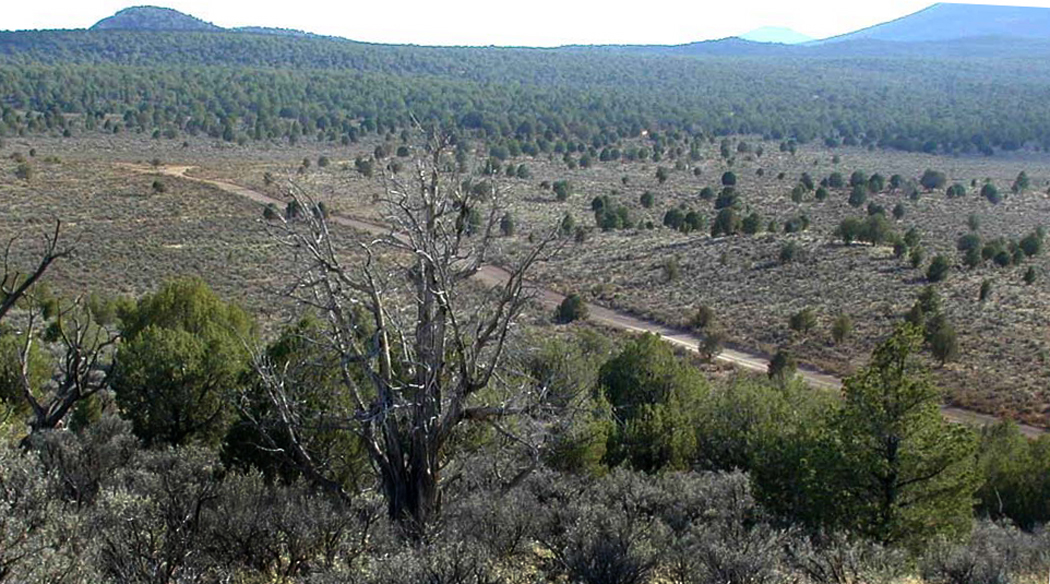
Two German couples were there looking down the hole and taking pictures of each other on the ledge. One of the men, seeing my once-bright red sedan now a uniform dun of dust — and comparing it with their two high-water SUVs, came over to me and asked me which route I had taken. When I told him, the looked at me like I was crazy, laughed and said, “In that car? How did you do it?”toroweap 3

And, you know, I’m not completely sure myself. But I knew that ahead of my was another 61 miles of the same thing just to get out again.toroweap 1

So, this is a warning to you. Don’t believe everything you read in a guidebook.

Yes, it is possible to get to Toroweap in your car, if you have the gumption.

But don’t expect any yellow brick road.toroweap 16