Archive

Tag Archives: der abschied

Classical music critic David Hurwitz recently posted a YouTube video on works that “reduce me to a quivering puddle of emotional resonance.” He cited 10 compositions that seem to work, no matter how they are performed (although, they can be ruined by a miserable performance). 

“The crying can be sadness; it can be happiness. Usually for me it’s a confrontation with something which is so beautiful … it just seems to get to the heart of the universe and makes me weep. What can I tell you? It happens.”

He then invited his viewers to submit their own lists of works that bring on the waters. A subsequent video addressed those lists. 

Such lists usually come in round numbers: “Top Ten,” or “The Hundred Best,” etc. But when I made my own list, I realized I could go on for quite some time. 

I begin my list with the sarabande in J.S. Bach’s Suite No. 5 for unaccompanied cello. It is a ridiculously simple composition, barely more than a hundred individual notes, almost all unrelieved slow eighth-notes, but notes that plumb the deepest depths of innigkeit — that profound sense of inner subjective experience, of aloneness from the world, contemplation of things beyond words. 

The tears come, not from sadness, but from a sense of being left to your own thoughts in the darkness, the knowledge that, no matter how much you love or engage, there is always an awareness of separation. An aloneness we share with everyone else on the planet. 
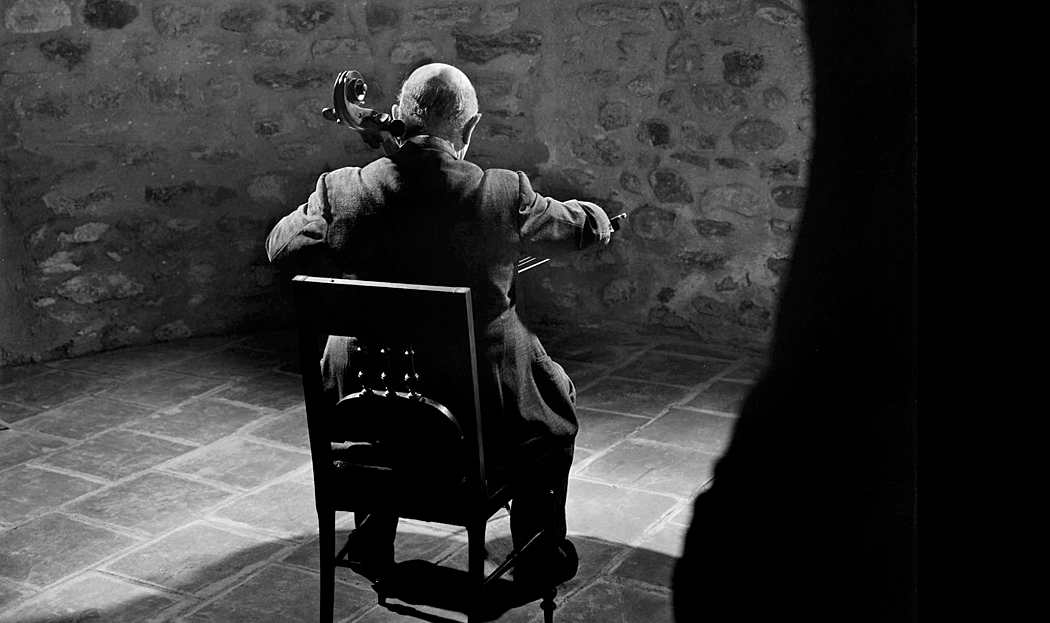
I’ve heard the sarabande, and the suite, countless times, both live and on recordings. The one that always does me in is the version played by Pablo Casals in 1939. Casals was the person most responsible for the resurrection of the score, after he found a forgotten copy in a used book store in 1889, when he was 13 years old. He waited until he was 60 before recording them. There is some fuzz and hiss to the old 78rpm recordings, but the depth of Casal’s playing speaks through it all. 

The sarabande has struck many as special, even among the whole of Bach’s works. Cellist Paul Tortelier called it an “extension of silence.” Yo-Yo Ma played it on Sept. 11, 2002, at the site of the World Trade Center, while the names of the dead were spoken, on the first anniversary of the attack. 

Second on my list is the final chorus of Bach’s Passion According to St. Matthew, Wir setzen uns mit Tränen nieder, which expresses grief over the death of Jesus on the cross. That chorus transcends religious doctrine so that I, as a non-believer, can internalize the sense of loss, of death, and grieve along with them. “We sit down in tears,” they sing, with a section that also asks for “peace, sweet peace.” 
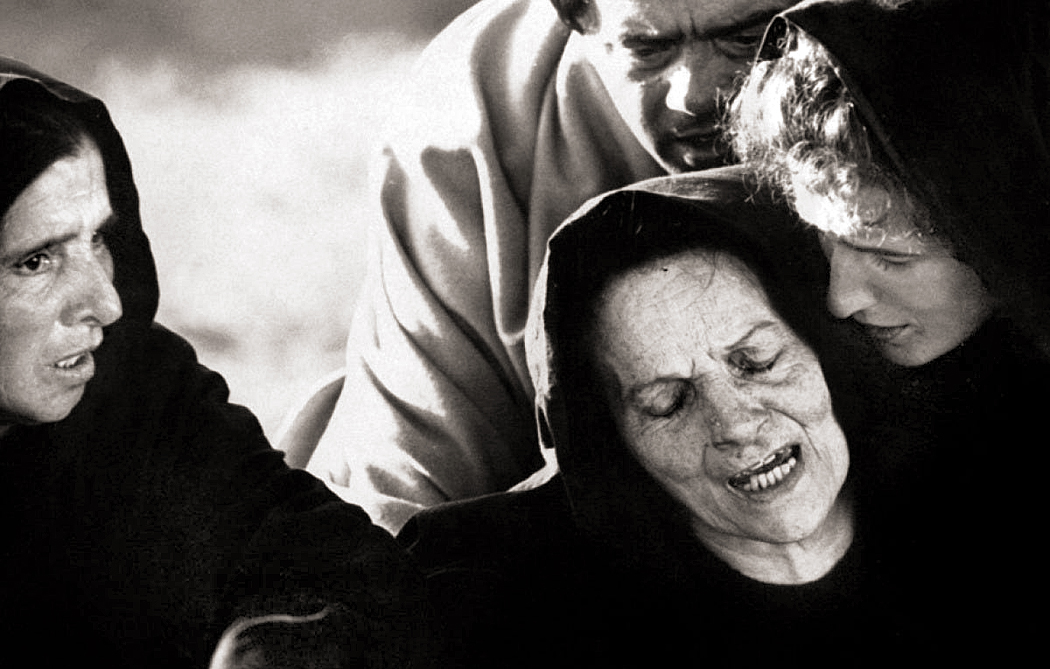
I first head the chorus as film-score music for Pier Paolo Pasolini’s Neorealist retelling of The Gospel According to St. Matthew, a dour black-and-white version, almost word for word from the Bible (and how peculiar that the most successful Christian film should come from a homosexual Communist atheist, but with reverence for the humanity of the story; no Cecil B. DeMille hokum and claptrap for this one). 
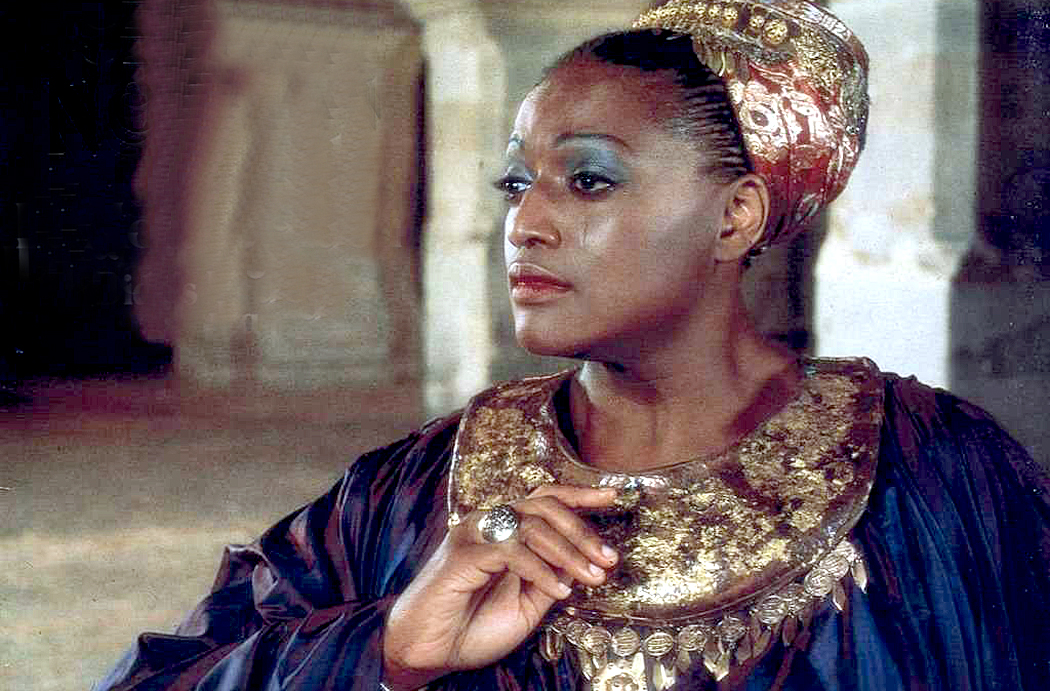
Grieving is one cause for the waterworks in listeners. How can you not feel the intense sadness of Dido as she faces her own death in Henry Purcell’s Dido and Aeneas, in the section known as Dido’s Lament, “When I am Laid to Rest.” It is a ground bass (repeated bass line), over which she sings “Remember me … remember me.” It is heartbreaking. 

Alban Berg used his entire Violin Concerto to express mourning over the death of Manon Gropius, daughter of Walter Gropius and Alma Mahler, who died of polio in 1935 at the age of 18. Berg dedicated his concerto “To the memory of an angel.” 

It begins quietly on the violin’s open strings, builds to an angry climax, and reaches a point of cosmic acceptance with a quote of J.S. Bach’s chorale, “Es ist Genug” (“It is enough.”) 
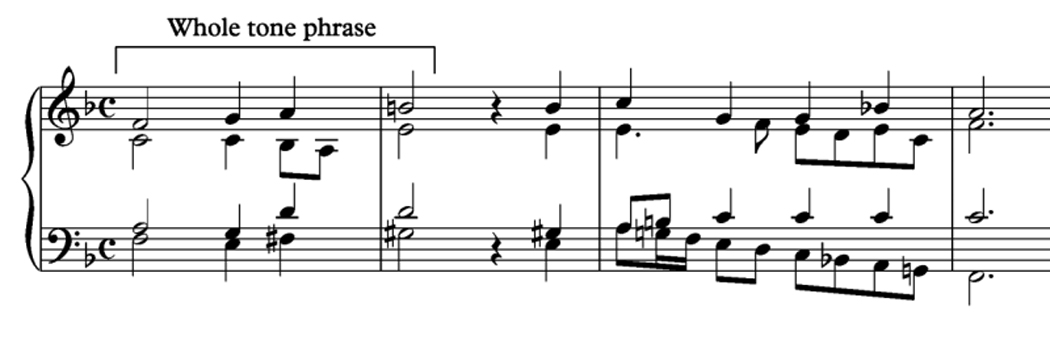
After all the turbulence of the anger, the simple hymn, albeit harmonized in a very 20th-century way, seems like the peace of the angels, a calm in the universe. I, for one, cannot listen to the concerto without tears streaming down my cheeks. 

Although it is written in his idiosyncratic 12-tone style, the Berg Violin Concerto is never simply noise: Even those who hate modern serial music love this concerto. It is music, not theory. 

These several pieces work because, while they are expressing their grief over a specific death, they also subsume the rest of us. And there is music which expresses not individual grief, but Weltschmerz — “the sorrows of the world” — that sense that all lives have an end, that life is suffering, that “no one gets out alive.” 

The work that seems to hit everyone in the gut with this is Samuel Barber’s Adagio for Strings. Originally the slow movement of a string quartet, Barber orchestrated it to create the version known best. 

The music is simple, barely more complex than a Gregorian chant, but builds slowly to an overwhelming climax, then silence, then a short peroration of calmness and repose. Never a dry eye. 

The only problem with the Adagio for Strings is that it has become so popular, played at the funerals of Franklin Roosevelt, John F. Kennedy, Princess Grace of Monaco, Albert Einstein, and Barber himself. It has become de rigeur for public tragedies such as Sept. 11, The Charlie Hebdo attack, the 2016 Brussels bombing and the Orlando nightclub shooting, and the 2017 Manchester Arena bombing, and in 2020 for the victims of the Coronavirus. To say nothing of how many movies it provides a trigger for emotions, as in Platoon, The Elephant Man and Lorenzo’s Oil. So that, for some, it can no longer be heard innocently, but only with irony, as in its appearance in Seinfeld, The Simpsons, and South Park

But so far, the Adagio has proved bulletproof. It always works. Emotions pour out. The music is powerful.
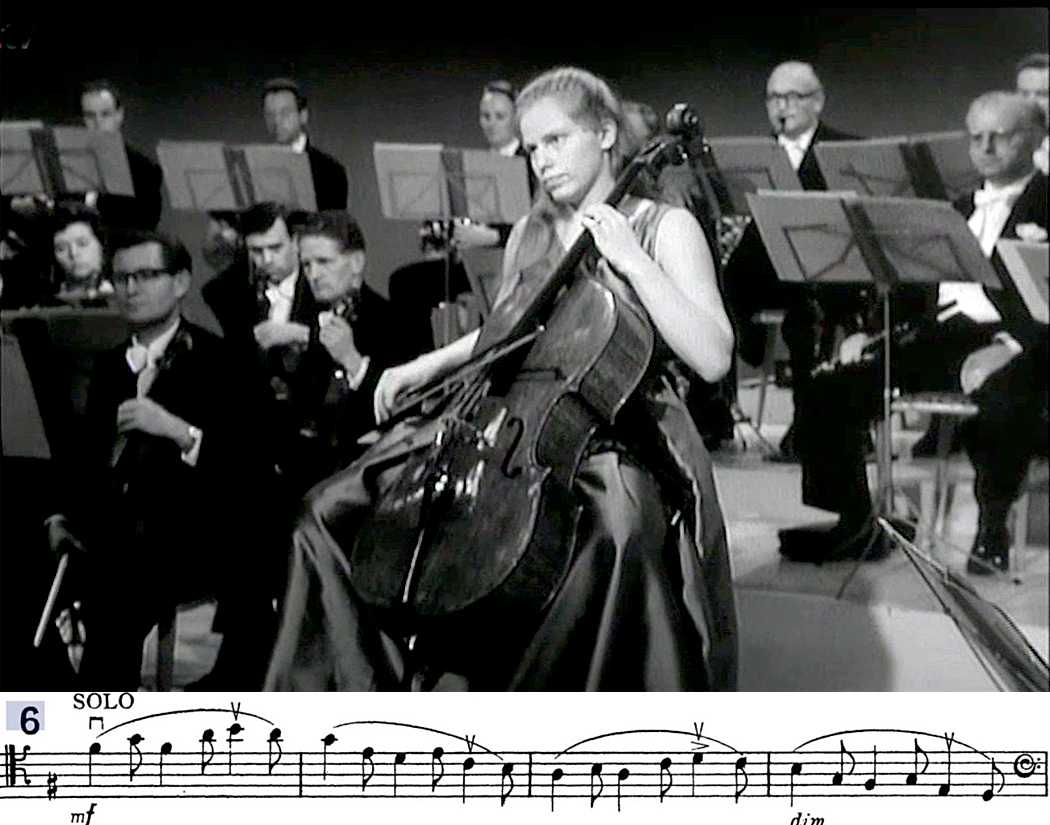
And talk about Weltschmerz: Another concerto brings out the emotions almost instantly, and that is Elgar’s Cello Concerto. Unlike most classical music concertos, it opens with the solo cello playing widely spaced E-minor chords, ringing sad and hollow, followed by a short cadenza before the orchestra ever plays a note. 

Elgar wrote it in 1919 in distress over the death and destruction of the First World War. It is a musical evocation of the famous lament of British Foreign Secretary Sir Edward Grey in 1914: “The lamps are going out all over Europe and we shall not see them lit again in our lifetime.” It is hard, with our distance from the events, and after the Second World War and the horrors of the Cold War, to fathom what a psychological wrench that first cataclysm was for the world, and how much it was clear that everything anyone knew had changed utterly and forever. So much was lost. Elgar’s concerto puts that sentiment into music. 

That sense of loss is personal as well as civic, and you sense it in the greatest of Richard Strauss’ Four Last Songs, “Im Abendrot.” It is a song for soprano and orchestra that conveys such a sense of longing and loss that even without the words, the orchestra alone can bring out the tears. 

In it an old couple stands on a hill looking at a sunset, a lark flies off into the twilight and the words by German poet Joseph von Eichendorff, say, “Wie sind wir wandermüde — Is dies etwa der Tod?” “How weary we are of wandering — Is this perhaps death?” 

There is something of the same feeling (and similar orchestral lushness) in Gustav Mahler’s Der Abschied, the final song of the cycle, Das Lied von der Erde, “The Song of the Earth.” The half-hour song tells of the beauty and permanence of nature and in the brevity of the human life. Even for a Mahler nut like me, who loves pretty much everything the man put on paper, Der Abschied is the single most beautiful and heartbreaking thing that composer ever wrote. 

O Schönheit! O ewigen Liebens – Lebens – trunk’ne Welt!” “O beauty! O eternal loving-and-life-drunk world!” And the voice finally shrinks down to near-silence repeating the word “Ewig,” “forever…” over and over until it and the orchestra dissolve in emptiness. 

Mahler himself asked whether the music should even be played. “Won’t people go home and shoot themselves?” he asked. The thing is that the highest art may tell the most dismal tale, yet the beauty of the telling is life-enriching and leaves us weeping but full of joy. 

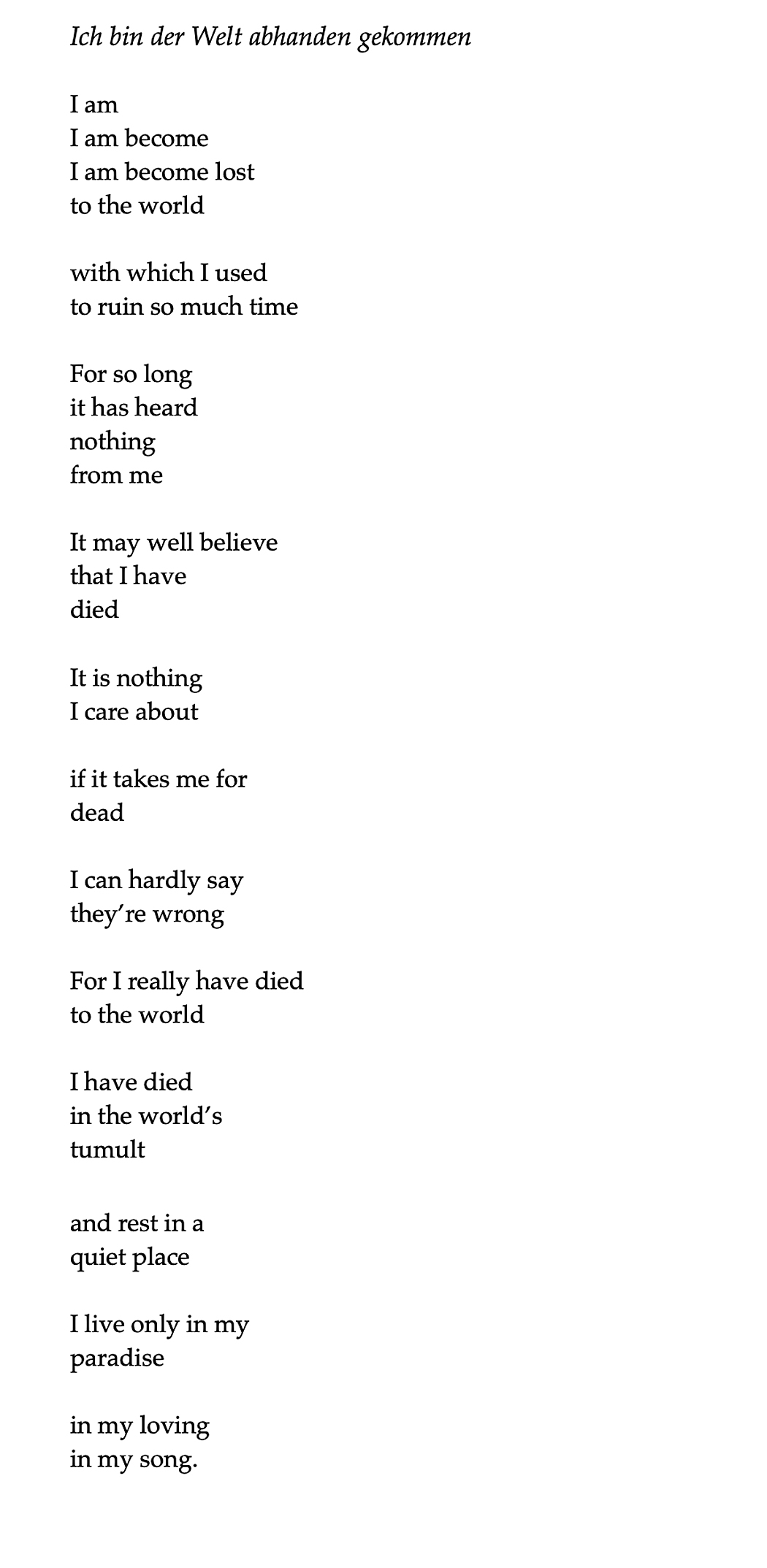
Mahler gave us also a song of such inwardness and reflection in the Rückert Lieder, “Ich bin der Welt abhanden gekommen,” a setting of a poem by Friedrich Ruckert. “I am become lost to the world, with which I used to waste so much time. It has for known nothing of me for so long, it may well believe me dead.” The slow tread of the song, with its repeated incomplete upward motive, leaves you floating between earth and sky. 

That Mahler song may not be the deepest expression of giving up on life. That honor has to fall to the final song in Franz Schubert’s song cycle Winterreise, “Winter Journey.” The cycle of 24 songs by German poet Wilhelm Müller collectively tell the story of a romantic young man spurned in love, who travels in suffering through a winter landscape, telling of loneliness, heartsickness, futility, fate, and finally, in Die Leiermann, “The hurdy-gurdy man,” finds an image of utter hopelessness. 
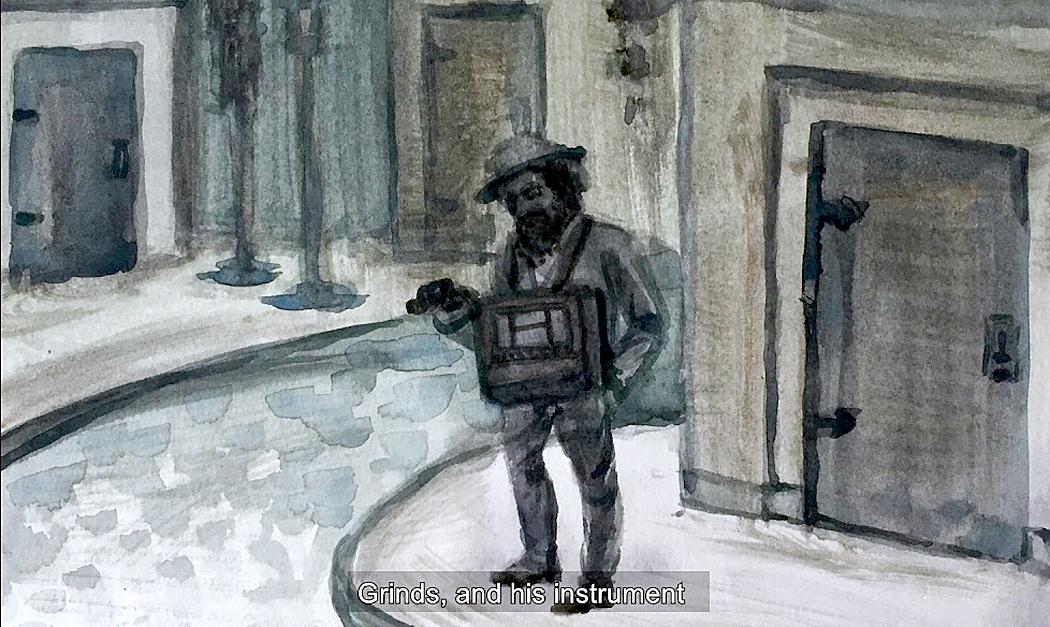
“Barefoot on the ice, he sways to and fro, and his little collection plate remains empty. No one wants to listen to him; no one looks at him. … He plays and his hurdy-gurdy never stops.” The piano accompaniment repeats the same figure over and over, with no sense of forward motion, and the singer sings his words over and over with little variation. This is psychological depression at its peak expression. “Strange old man, shall I go with you?” The implication is that the Leiermann is simply Death itself. 

 But I may be giving the wrong impression. While music of woe may bring on the deepest emotion, so, too, can music of joy and beauty. There is a reason people cry at weddings. When any emotion, from grief to ecstasy, fills the interior space, it can swell and overflow, and the overflow valves in the human being are the eyes. The emotional pressure in the body swells until it cannot be held in check. Tears of joy, tears in the face of beauty. 

I remember the words that playwright Peter Shaffer put in the mouth of Antonio Salieri in his play, Amadeus. Salieri overheard the adagio of Mozart’s Gran Partita for winds. 
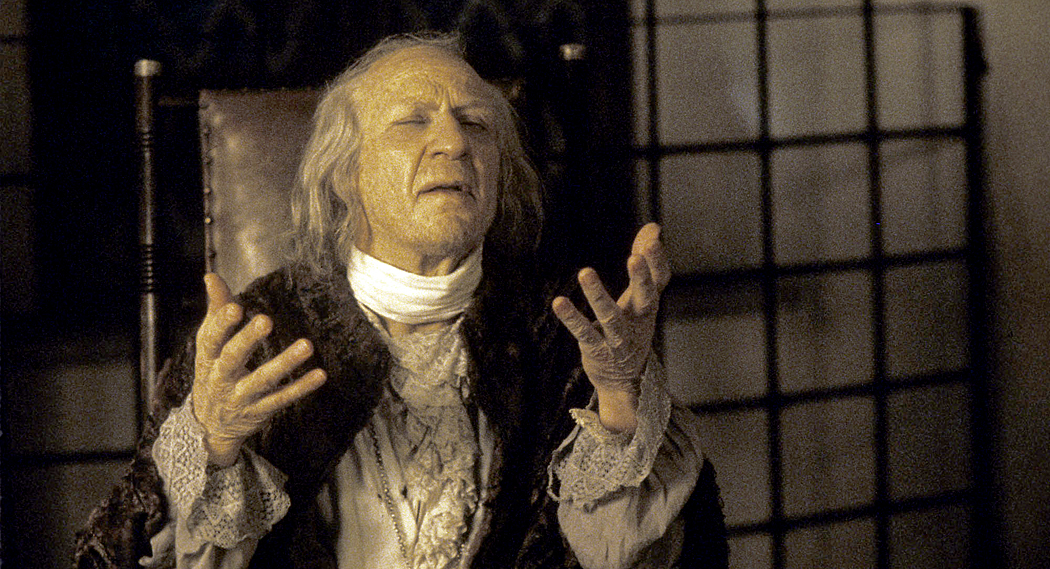
“Extraordinary!,” he says. “On the page it looked nothing! The beginning simple, almost comic. Just a pulse. Bassoons, basset horns — like a rusty squeezebox. And then, suddenly, high above it, an oboe. A single note, hanging there, unwavering. Until a clarinet took it over, sweetened it into a phrase of such delight! This was no composition by a performing monkey! This was a music I had never heard. Filled with such longing, such unfulfillable longing. It seemed to me that I was hearing the voice of God.”

It is an astonishing thing about beauty, real beauty, that it can sit beside the horrors of the world, the miseries, the deaths, the wars, the hatreds and injustices, and make you pause, fill you with emotions and remind you that no matter how bad things are, you still cling to life. The beauty can not excuse the suffering, but in some inexplainable way can somehow balance it. Beauty can stop time and fill you up to overflowing. 

Shostakovich wrote his 13th symphony, setting the Yevtushenko poem, Babi Yar, about the 1941 massacre of more than 30,000 Jews by Nazis at Babi Yar, near Kiev. It is a powerful poem denouncing anti-Semitism and the horrors of war and hatred (and a warning about Soviet anti-Semitism). The following movements of this choral symphony take on bitter humor as antidote to bureaucracy and tyranny; the hunger of food shortage; the use of fear by totalitarians; and finally, the difference between amoral careerism and the need for artists to express truth. 

This finale is introduced by a flute duet of such sweet delight, such soothing calmness, that although it cannot gainsay the horrors, it somehow balances them. The music itself, while beautiful, is nothing special in itself, but coming as it does at the end of this explosion of the miseries of the world (and especially Stalin’s Soviet Union), is such an unexpected release, it seems a miracle, and with the pressure taken off, at least momentarily, it can only be felt and expressed by its audience in the immediate explosion of waterworks. 

Now, all I have to hear is the flute bit, and I instantly recall all that went before, and I weep uncontrollably. 

That sense of beauty as counterbalance is the overwhelming sense you can get from the slow movement of Beethoven’s Ninth Symphony, which gives us 15 to 20 minutes (depending on performance) of stillness in the universe, a slow pulse that seems more cosmic than corporeal. It comes after a terrifying first movement and a relentless scherzo. The world then, after flowing through turbulent rapids, empties out into the calm ocean of the adagio. The release is overwhelming. 

It is also the slow motion of the finale of Mahler’s Third Symphony, which, after earlier movements titled “What the flowers in the meadow tell me,” “What the animals in the forest tell me,” What Man tells me,” and “What the angels tell me,” ends his symphony with a half-hour movement, “What Love tells me.” 
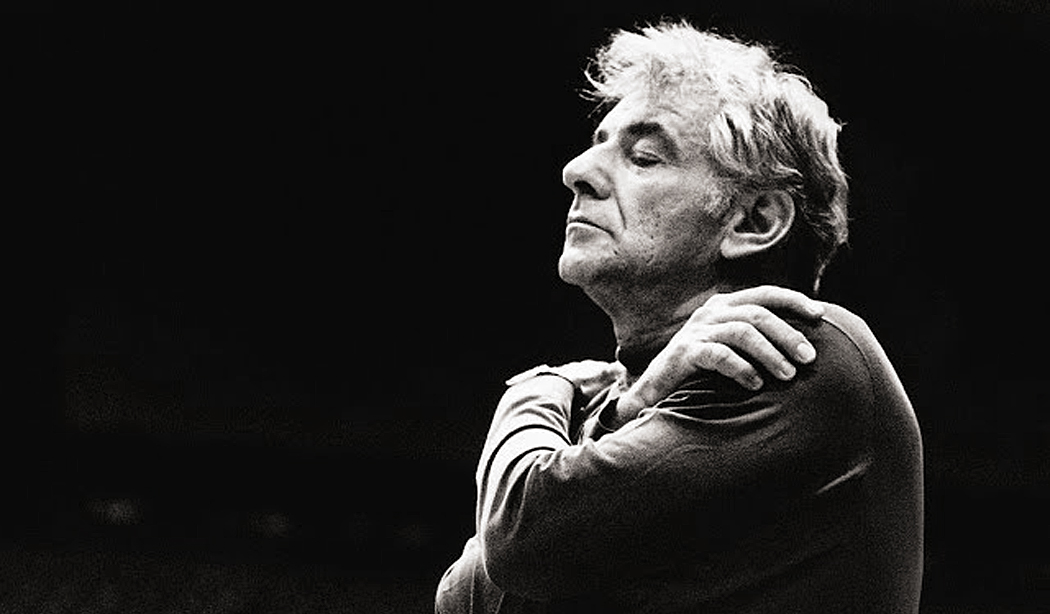
It is marked “Langsam — Ruhevoll — Empfunden,” (Slowly — Peacefully — Deeply felt,” and moves at a slow tread, first in the strings and building, a half-hour later, with trombones and brass and a final chord that can last to eternity. Conductor Bruno Walter, who knew Mahler and conducted the premieres of both his Ninth Symphony and Das Lied von der Erde, said of this movement, “Words are stilled — for what language can utter heavenly love more powerfully and forcefully than music itself? The Adagio, with its broad, solemn melodic line, is, as a whole — and despite passages of burning pain — eloquent of comfort and grace.”

The Swiss critic William Ritter said it was, ”Perhaps the greatest Adagio written since Beethoven.” Another anonymous critic wrote about the Adagio: “It rises to heights which situate this movement among the most sublime in all symphonic literature.” At its premier in 1902, Mahler was called back to the podium 12 times, and the local newspaper reported that “the thunderous ovation lasted no less than 15 minutes.”

That sense of time standing still reaches a much quieter apotheosis in the slow movement of Maurice Ravel’s Piano Concerto in G. With subtle cross-rhythms and a melody that seldom rises above a mezzo-piano, it is entirely hypnotic. The beauty of it brings me to tears almost even just thinking of it. 

And there is the sublime beauty of Mozart’s Ave Verum Corpus, a choral work that lasts a mere four minutes in just 46 bars of sighing chromaticism and sotto voce music, and, as one critic put it, is “capable of leaving the listener just as moved as might an entire five-day long cycle of Wagner’s Ring.” 

Some of these may work their magic only on my ears, some seem to work for everyone. And there are times when the listener may be too tired, to caught up in other things, or a bad meal or just in a sour mood, when such music can pass by almost unnoticed. And there are times in a concert when I am so tuned in, that almost any music, played well, may bring on the waterworks. 

But for me, this music almost never fails. The music triggers some empathetic response, and the emotions shiver to life. I am human; these are human feelings; these emotions are what make us human. 

Music can do that better, and more immediately, than any other art. 

Translation is a funky thing. You can try to be literal and lose all the flavor, or you can try to find equivalent idiomatic expressions, or you can recast the whole thing, as if you were writing an original from a similar inspiration — your own words for a similar thought. 

And unless you are brought up bilingual so that you are completely comfortable in both languages, you will always be working from a disadvantage. You can work from crib notes, or take a literal translation and recast it. Many writers these days do something of the sort. Ezra Pound did not read Chinese, but that didn’t stop him from translating Chinese poetry. Scholars may quibble with the results (or laugh outright), but the versions Pound printed are good poetry, whether or not they are good translations. 

Would I rather read a poet’s regeneration or a scholar’s word-for-word? The answer is both. When it comes to poetry in languages I do not read, I’d rather have multiple versions to absorb and take in all the angles to arrive at something triangulated. 

There are languages I have some familiarity with and so, I can usually read Pablo Neruda straight from the trough. And in French or German, I have some dealings with the originals, although I do not speak the languages with anything like fluency. I can read a French newspaper, but cannot always make out the spoken version. (Luckily, when in France, I have learned you don’t really need the fineries of grammar. You can speak French pretty usefully even with no verbs at all. You go to the patisserie and when it is your turn, you just say, “Deux croissants, s’il vous plait,” and you get what you want. No one before you on line has used a verb, either.)

And so, I have come to translate some poetry for myself, from German, from French or Spanish (even an occasional Latin poem), and mostly in self-defense. 

I say “self-defense” because most of the translations I’ve been subjected to sound like musty old Victorian twaddle. The translators seem to love archaic word forms and odd word orders — as if written by Yoda they were. 

Such things offend my ear. 

It’s not that I want them to be prose, but the secret of poetry is in the metaphor and the clever turn of phrase, not in the conventional language of old poetry forms. Take the first two lines of Nietzsche’s Zarathustra’s Rundgesang. In German:

O Mensch! Gib acht! Was spricht die tiefe Mitternacht?

Which could be translated, word for word, as:

“O men! Give attention! What says the deep midnight?”

Traditional translations usually go something like:

“O Man! Take heed! What saith deep midnight’s voice indeed?”

or:

“O Man! Attend! What does deep midnight’s voice contend?”

There is the problem with the original. “O Man!” is poetic cliche. It has to go. I suppose you could turn it into idiomatic English as “Hey, y’all, listen up,” but that would be a crime in a different direction. 

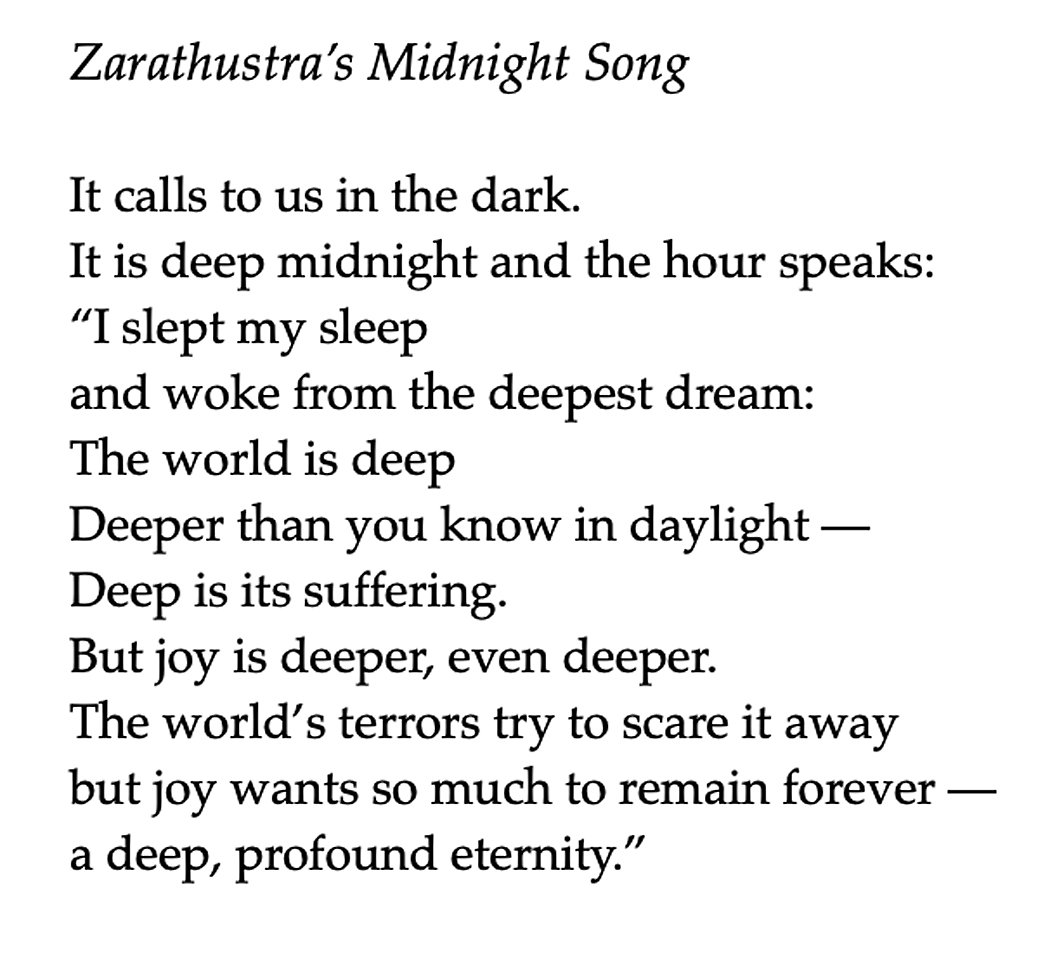
If I were to translate this bit, I would just leave off the unnecessary parts and rewrite it as: “It calls to us in the dark. It is deep midnight and the hour speaks:” This sets up a light/dark dichotomy that pays off later in the piece. 

Too many translations, especially of classic Greek or Latin literature are written in this fusty, worn out poeticized and conventional twaddle. It’s amazing anyone waded through the Iliad in the 19th century. Homer’s actual style was immediate and direct. 

Imagine if Robert Frost had written: “Two paths in twain divided were; traverse we may but one.” Who would now bother with it? It is Circe turning men into pigs. 

In other words, I have no issue with completely recasting the originals to make modern, idiomatic sense in a language that I hope remains poetic but without the equipage of outworn convention. 

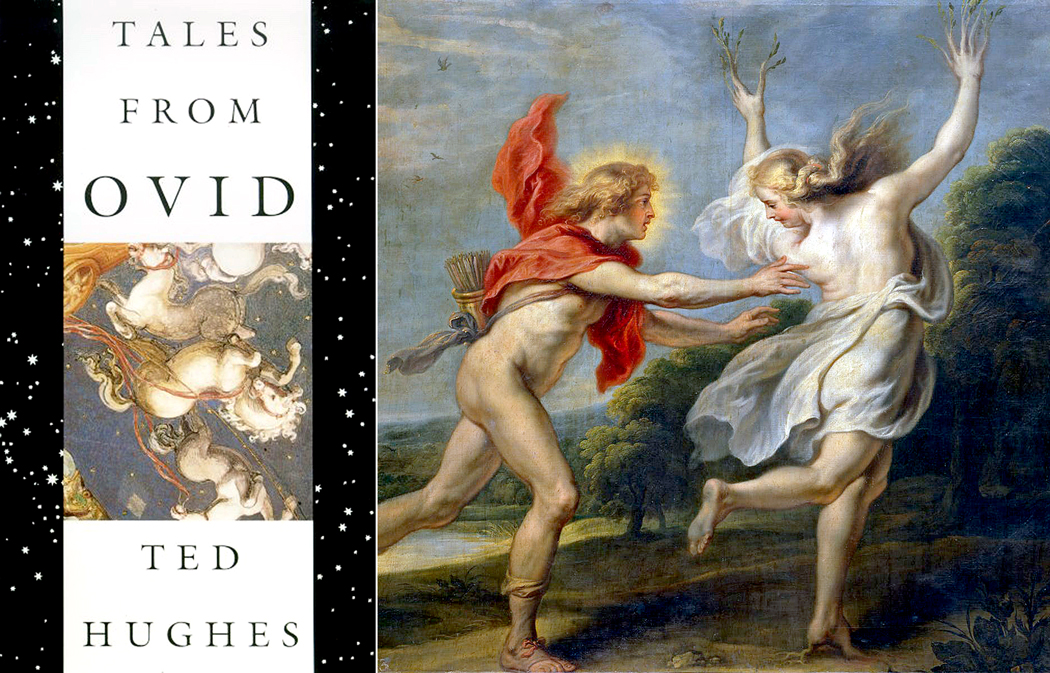
A stunning example of this approach is Ted Hughes’ Tales from Ovid, beautiful translations of several bits from The Metamorphoses. In Hughes’ style the stories move quickly and smartly and you turn the pages as in a best-seller. One only wishes Hughes had completed the whole thing, instead of mere sniglets. 

In this way, I have translated (or rewritten, if you hesitate) a good bit of German lieder. So much of it is hyperventilated Romantic sludge, which speaks to the early 19th Century of a generation that was weaned on Young Werther, and undoubtedly expressed the genuine feelings of those who lived through it, but now seem unrealistic and kitschy. 

Yet, there are real things being said and expressed in the poetry of Müller, Hölderlein or Eichendorff. It comes through like a buzz saw in the music of Schubert or Schumann, where the music has an authenticity that the verse sometimes lacks. 

I have tackled whole swaths of lieder verse, including a translation of all of the Winterreise. I found I could be a bit more faithful near the beginning of the cycle, but the deeper in, the more I had to rethink the verse. 

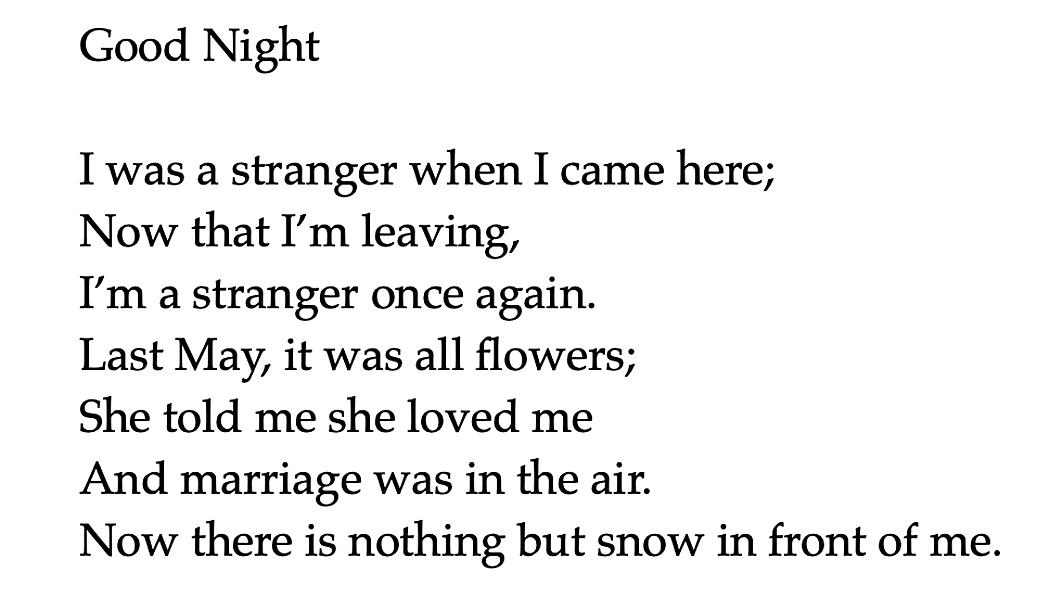
Take the first song, Gute Nacht. The text takes care of itself. A simple translation of the first stanza would be:

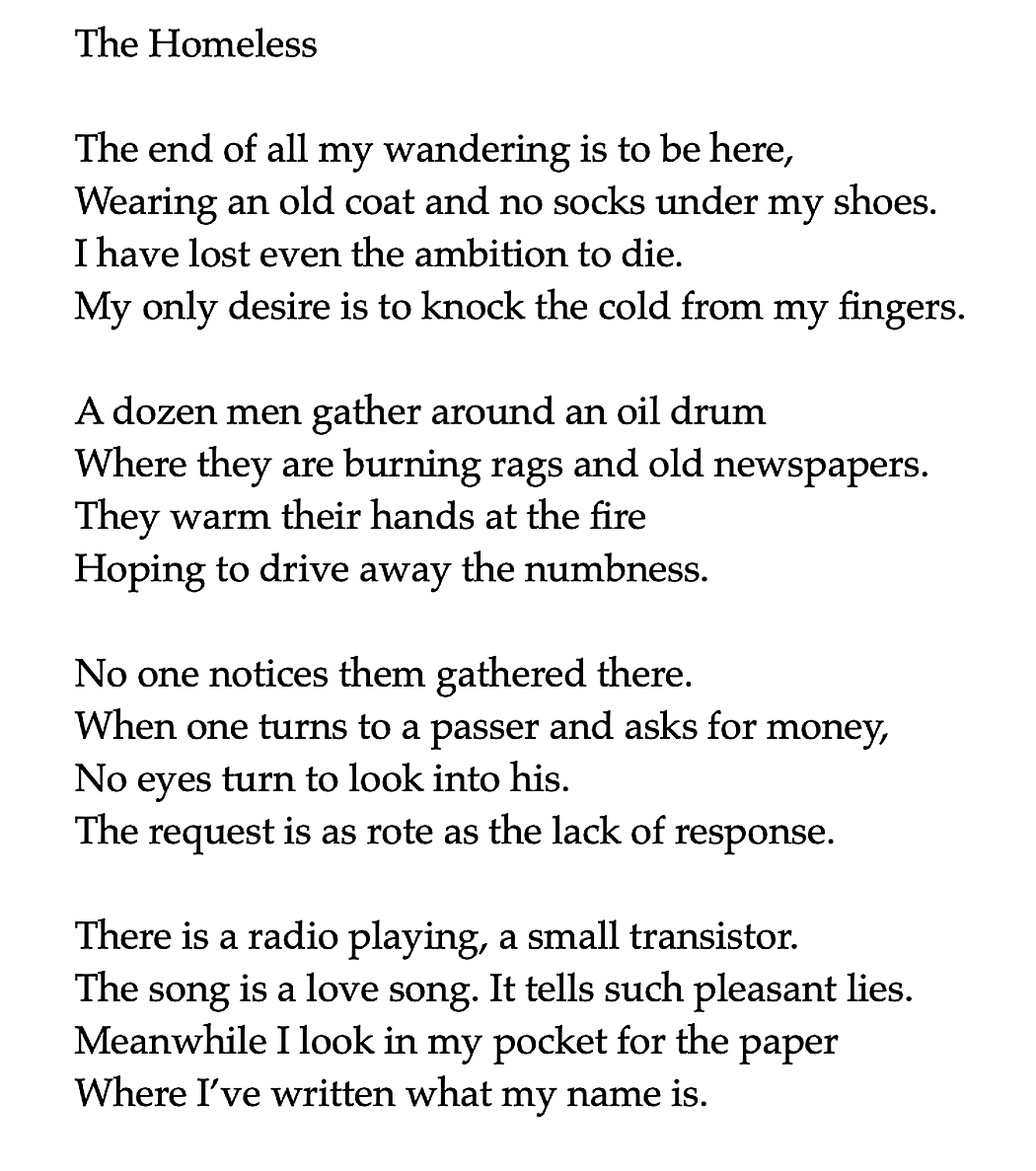
But, 24 songs later, the text of Der Leiermann, about a hurdy-gurdy man, is too bland without the devastating music Schubert provides (one of the most desolate and despairing bits of music ever penned), and so I’ve written my variation on it, to stand without the music:

Just this week, I started another project, translating four of the texts that Gustav Mahler set. I have arranged them into a set that belongs together, in four “movements,” rather like a symphony, meant to be taken as a single whole. 

I am offering them here as my apology for the type of translation I most appreciate — at least when others my better do it. 

The main benefit of doing such work (since I have no plans or hope ever to publish my translations — they are simply for the pleasure and knowledge I get from them — is that they force me to pay attention to the poetry and to the words. 

We can read through poetry much as we may distractedly hum a favorite tune. But good poetry offers much more, and forcing yourself to go through it word by word, can help you uncover much more. Translating forces concentration. 

And so, I read the German for its sound, parse individual words for their various meanings (for no word in any language has but one simple meaning), read various translations to compare how others have understood the words, reassemble them in my own English and then revise, over and over, until I get something that sounds good to me and — more importantly — makes sense. 

I have to admit that I generally like my own translations better than the ones packaged with the CD as the libretti or lyrics. But that is likely because they match my own particular esthetic — they are tailor made for my ear. Your ear may resonate to a different frequency. 

And so, the first “movement” of my Mahler word-symphony comes from the second of Mahler’s Songs of a Wayfarer, words originally written by the composer himself. The main melody of the song became the first theme of his Symphony No. 1. 

The second movement is Mahler’s own crib of Zarathustra’s Rundgesang, or “Zarathustra’s Midnight Song,” as the composer has it. All four of the texts I have translated focus on the twin but opposite facts that life is suffering but also it is joy. 

Third, there is heartbreaking and rueful song by Friedrich Rückert, Ich bin der Welt abhanden gekommen, set by Mahler first for voice and piano, but later orchestrated and part of his Sieben Lieder aus letzter Zeit (“Seven songs of Latter Days”). It is surely one of his greatest songs, and can hardly be heard or sung without feeling it was written directly with you in mind. 

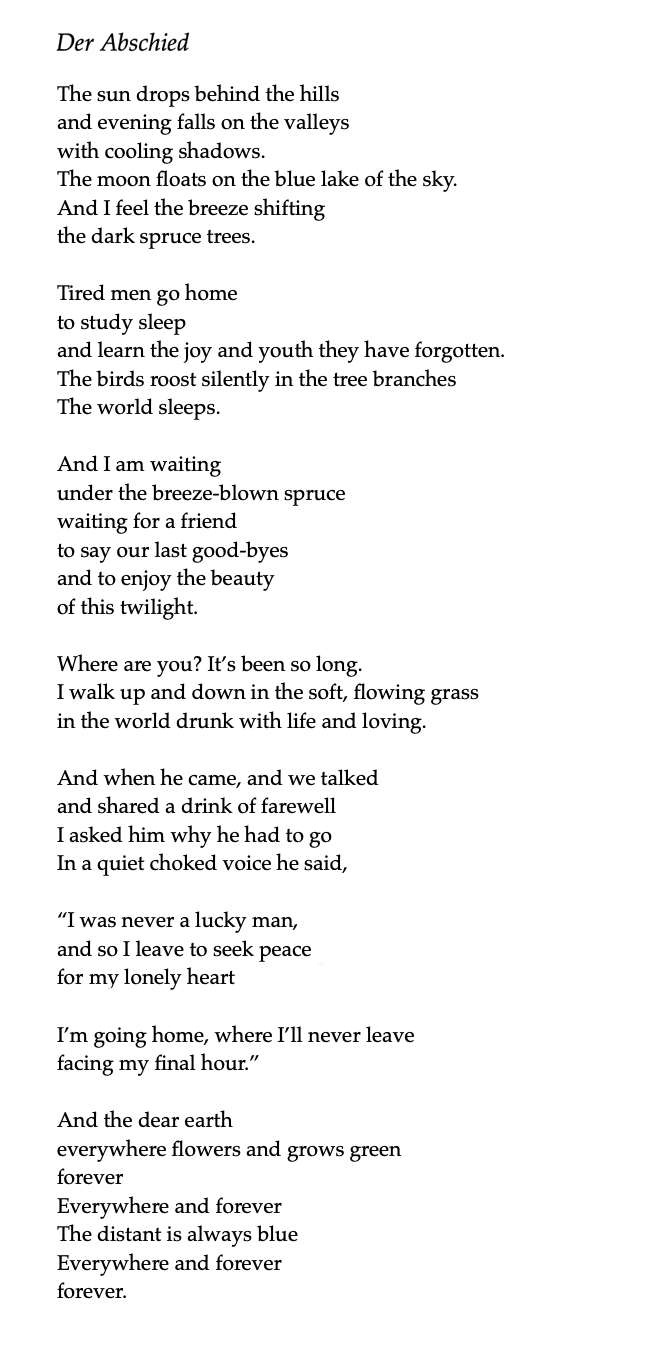
Finally, there is Der Abschied (“The Farewell”), the final movement of Mahler’s Das Lied von der Erde (“Songs of the Earth”). In it, Mahler has pieced together two Chinese poems of dubious provenance (themselves translated or rewritten, or perhaps invented in French and German) purportedly by Tang Dynasty poets Meng Haoran and Wang Wei, with three lines added at the end, written by Mahler himself. Der Abschied is Mahler’s summa, and at 30 minutes, is as long as the previous five movements combined. And it ends with the quiet reiteration, over and over, in dying voice, “Ewig… ewig…” (“forever… forever…”) finally so in performance you can never quite tell when it ends, the final “Ewig” as quiet as the silence that follows. 

In the end, I recommend to everyone that they attempt to translate a poem from a different language. Take a Baudelaire, for instance, or a Neruda (avoid Rilke like the plague, unless you wish to end in an asylum), and parse it through, word by word. Read it out loud in the original language to hear the music of it (yes, your French may not be as liquid as the original) and read various translations to see how differently the words are construed. Then arrange a version of your own.

In the end, you will have internalized the poetry and it will never again be a stranger to you. 

I was in bed, having trouble getting to sleep, and so making mental lists instead of counting sheep. I made a list of the CDs I would keep, if allowed only one per composer, then if allowed 1 boxed set for each of the dozen major composers, then… well, it went on and I still couldn’t fall asleep. I had made probably half a dozen lists when I began a list of the most beautiful human-made things, one visual, one musical, one verbal, etc. 

Filling in the list was surprisingly easy, considering how many nominees should be considered, but I had no trouble finding single primary answers, which surprised me. 

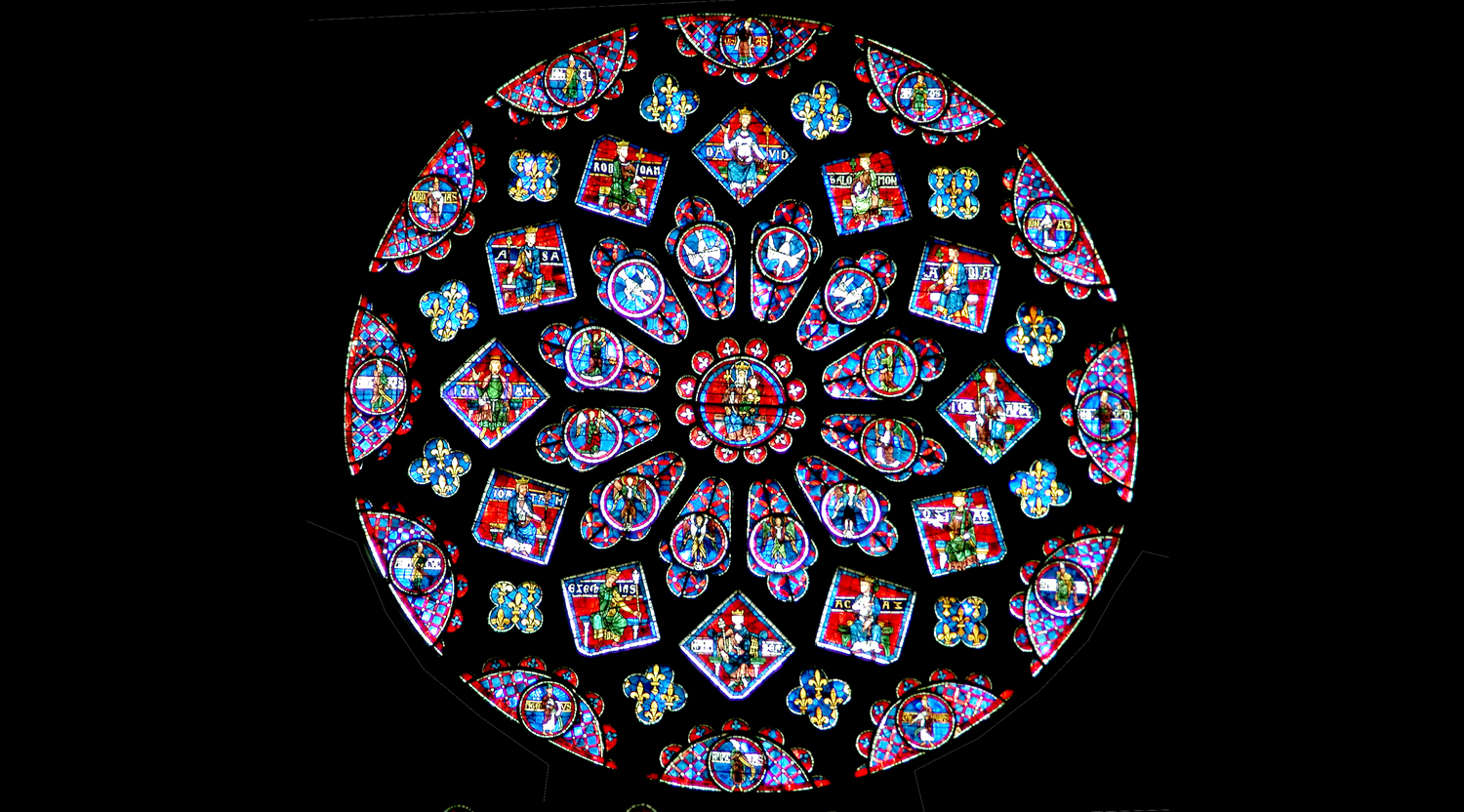
I’ve written numerous times that the single most beautiful thing I’ve seen, visually, is the north rose window at Chartres Cathedral. I’ve been there four times (five if you count multiple visits to the cathedral over a two-day visit to the town), and I never fail to fall spellbound by that tumbling wheel of light. Its beauty is not found in how pretty the colors are, but in something transcendent — the intent of the Gothic idea of architecture, that if God is light, then a building that celebrates light celebrates God. Even as a non-believer, I can appreciate that glimpse of eternity. The north window is singular in its design, with its set of 12 diamonds turning over and over as they circle the center, giving an illusion of motion — as of angels dancing around divinity. 

I love all the rose windows I’ve seen, but the north rose of Chartres is the dance of the cosmos. 

And if I had only one piece of music to listen to, it would be Der Abschied, the final half-hour song that finishes Gustav Mahler’s Das Lied von der Erde. Every time I listen to it, I dissolve into a puddle of helpless emotion, filled to the brim with the sense of eternity and the world. I have heard countless versions of Der Abschied — I own more than a dozen recordings — and I have my favorites, but even the least of them leaves me wrung dry. 

Das Lied von der Erde is a set of six songs, supposedly translated from Chinese into German and published, among other poems, in 1907 in a book titled Die chinesische Flöte (“The Chinese Flute”), by Hans Bethge. Mahler set his selection of six to orchestral music so rich as to be fattening. The final song, as long as the first five together, tells of the departure of a friend. The poet confronts the beauty of nature around him as he waits for the friend so they may make their farewells. Each stanza is alternated with long orchestral interludes of refined delicacy. 

The music ends — if it can be said to end at all — with lines Mahler wrote himself, perhaps sensing his own imminent death: “Die liebe Erde allüberall/ Blüht auf im Lenz und grünt aufs neu!/ Allüberall und ewig blauen licht die Fernen!” And then, repeated and repeated, ever more quietly and hesitantly, “Ewig … Ewig … … Ewig” — “Forever … Forever … … Forever” — until at last you can barely hear the word, and the music dies.

“The dear earth everywhere/ blooms in spring and grows green anew!/ Everywhere and forever blue lightens the horizon!” and “Ewig … Ewig…” 

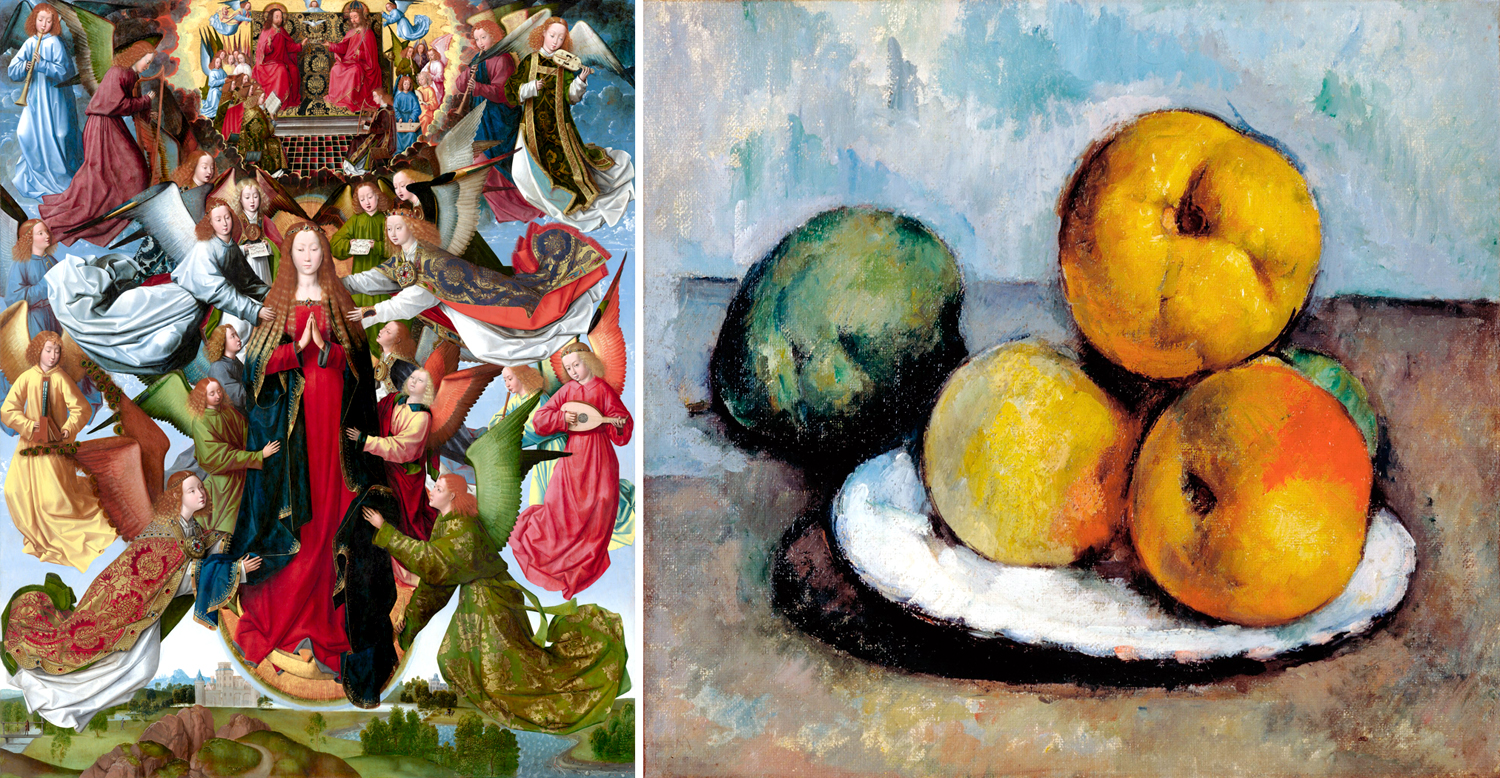
These choices came to me almost instantly, without having to think. There are other obvious choices that could be made. Other works of art that are profoundly beautiful, other music nearly as affecting. I have stood rapt in front of the Mary Queen of Heaven at the National Gallery in Washington DC, and been knocked silent by the pears and apples of Cezanne. And nearly as gut-slamming as Der Abschied is Richard Strauss’ Im Abendrot, the final of his Four Last Songs. Or a dozen other paintings and musics. 

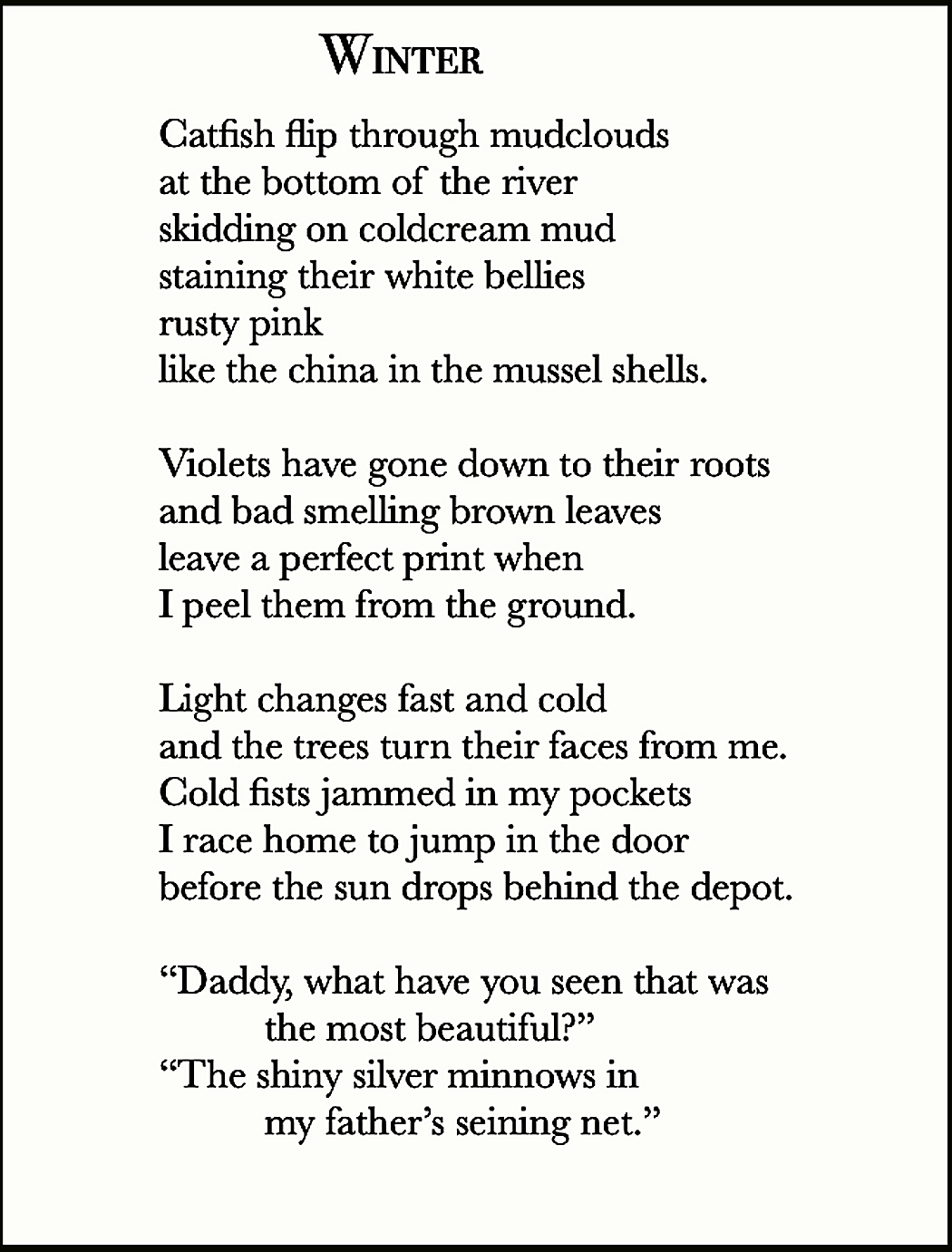
As I lay there in the dark, unable to sleep, I rifled through my brain trying to remember a poem that moves me the same way, or any piece of literature: words that leave me drained each time. I went through all the major English poets — and there is plenty of poetry that moves me deeply — and even poems in translation. But the one poem that came back and slapped me upside the head isn’t by Yeats or Wordsworth, but by Carole Steele, my late wife. It is the first poem in her book, 42 Poems.

Carole was the genuine article. And that poem brings me to tears every time. Certainly part of my response comes from the 35 years we spent together, and the overwhelming sense of loss at her death five years ago. But I had the same response when she was alive: This is a poem that makes the connection between the inner and outer worlds; it responds to the physicality of the world in words that startle in their aptness, and combines the directness of childhood with a slant acknowledgement of death, and the awareness that others share in the knowledge of beauty. It isn’t the particular example that counts, but the shared awareness of its existence. 

We may all have different ideas of beauty, and you can each make your own list, but what must be common in all of them is the engagement. Beauty does not work as some passive prettiness outside the psyche. Pretty is not Beauty. Pretty is what is conventional. Beauty is the result of engagement and the creation of meaning. It is an awareness between you and the cosmos, each of the other. It is the recognition, sometimes startling in its suddenness, of the wholeness of it all, of its permanence and its evanescence. 

I have thought for more than 70 years about this. The world is many things, and it offers a share of misery, pain and loss, there is war and death, but it also affords moments of epiphany, the breakthrough of beauty, like the red glow in the black ashy cracks of a dying fire. 

This can easily devolve into “Raindrops on roses and whiskers on kittens,” but I mean something more difficult. Yes, I resonate to warm spring rain and the crisp, dry, cold and sunny October afternoon. These things are beautiful and they can fill up our emotions to bursting, but only if we actually pay attention. Just a plain rainy day spent polishing the silverware, or spending a fall Sunday watching football on TV don’t elicit the response. Paying attention does. 

And when the beauty hits, it is not something external or “out there,” and neither is it something merely subjective or “internal,” but rather it is the identification of them together as a single entity. My awareness of the spring rain brings the rain into my psyche, and my awareness also give the rain its actuality. It makes it real. Yes, the tree falling in the forest makes a sound, but it doesn’t have meaning unless it is heard. The spring rain may fall whether or not anyone notices, but its existence has meaning only when my awareness and its existence become a single thing. 

It has been said that human consciousness is the universe’s means of self-awareness, that our senses are the mirror for the cosmos. It is what Andrew Marvell meant in his poem, The Garden: “The mind, that ocean where each kind/ Does straight its own resemblance find,/ Yet it creates, transcending these,/ Far other worlds, and other seas…”

Beauty is the amour de soi of the cosmos. Our sense of beauty, in the physical world or in art, its mask and mimic, is our sense of identity with the cosmos. “I am he as you are he as you are me/ And we are all together.” This sense is lost when we act like crabs in a bucket, each out for himself and not recognizing our shared humanity, but also when we fail to recognize ourselves as the conscious portion of the universe. Beauty is the breakthrough. 

What we consider pretty is merely a matter of taste, but beauty is a breaking up of our singularity and an identification, however brief, with totality.