Archive

Tag Archives: der ring des nibelungen

David Attenborough on Desert Island Discs with host Kirsty Young in 2012

One of the longest running radio shows is Desert Island Discs, which has been on the BBC since 1942. It is often said to be the second longest-running radio show after the Grand Ole Opry, which cranked up in 1925, although a few critics have discovered some obscure programs in foreign climes that may have been on longer, and there’s also the British Shipping Forecast which began in 1861, before radio was even invented, and first disseminated via telegraph before switching to radio in 1924. 

On Desert Island Discs, prominent people, whether politicians, entertainers, sports stars or academics, are asked to choose eight recordings they would take with them to the proverbial desert island, and place them in the context of their lives. Since the 1950s, they have also been asked to name a book, other than the Bible or Shakespeare, they would also take, and later still, adding on a “luxury item” they couldn’t live without. 

Nearly 4,000 episodes have been broadcast, with some predictable results. The music most often mentioned is Beethoven’s Ninth Symphony, and the luxury item most chosen is pen and paper, or “writing materials,” although Tom Hanks specifically mentioned “a Hermes 3000 manual typewriter and paper.” 

Many of the archived broadcasts can be heard from various online sources, and you can learn, for instance, that Alfred Hitchcock’s book choice was Mrs. Beeton’s Household Management, and his luxury item was “a continental railway timetable.” Some of the choices were equally eccentric. Oliver Reed wanted Winnie-the-Pooh to read and “an inflatable rubber woman.” Actress Janet Suzman wanted a “mink-lined hammock,” and Hugh Laurie asked for an encyclopedia and “a double set of throwing knives.” His long-time double-act partner Stephen Fry wanted a PG Wodehouse anthology and a “suicide pill.” 

My favorite, so far, is John Cleese, who asked for Vincent Price’s cookery book and “a life-size statue of Margaret Thatcher and a baseball bat.” 

One of the inevitable by-products of such a format is the urge to create your own list. And so, I have my own. 

I grew up in New Jersey in a family largely indifferent to music. What music there was came on TV in such variety shows as Perry Como or Dinah Shore. When I was little, there was a small portable record-player on which I played children’s songs, but I don’t count any of that. “Fire, fire, fire, raging all about. Here come the firemen to put the fire out.” 
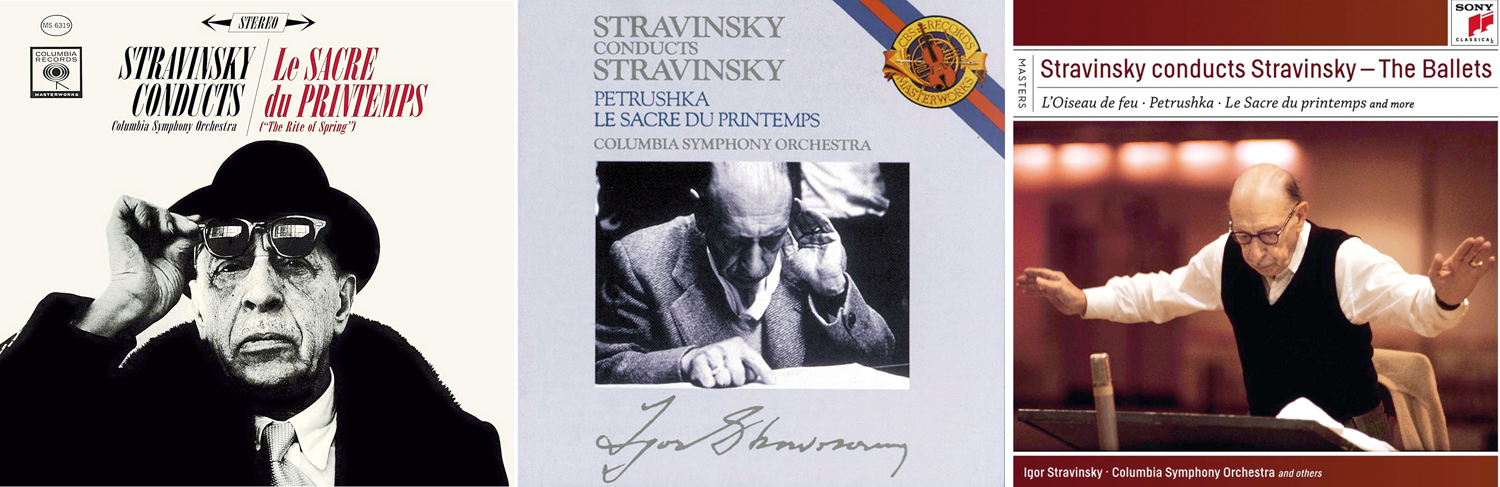
My musical education began in high school when my first serious girlfriend played music on the phonograph while we spooned on the sofa in her parents’ house. She went on to become a professional bassoonist and was studying at the time with Loren Glickman, who played the difficult opening bassoon solo on Igor Stravinsky’s recording of his Rite of Spring. I hadn’t known such music existed. It was mesmerizing. Who knew it was great make-out music? And so, that is my first choice for my desert island disc. 

There have been hundreds of other recordings of that music, and a few, perhaps, more exciting or primitive than the composer’s own, but that recording has never been out of print and comes in many versions, from LP to 8-Track to CD and now, streaming. As an introduction to classical music, I could hardly have done better — dive into the deep end. 
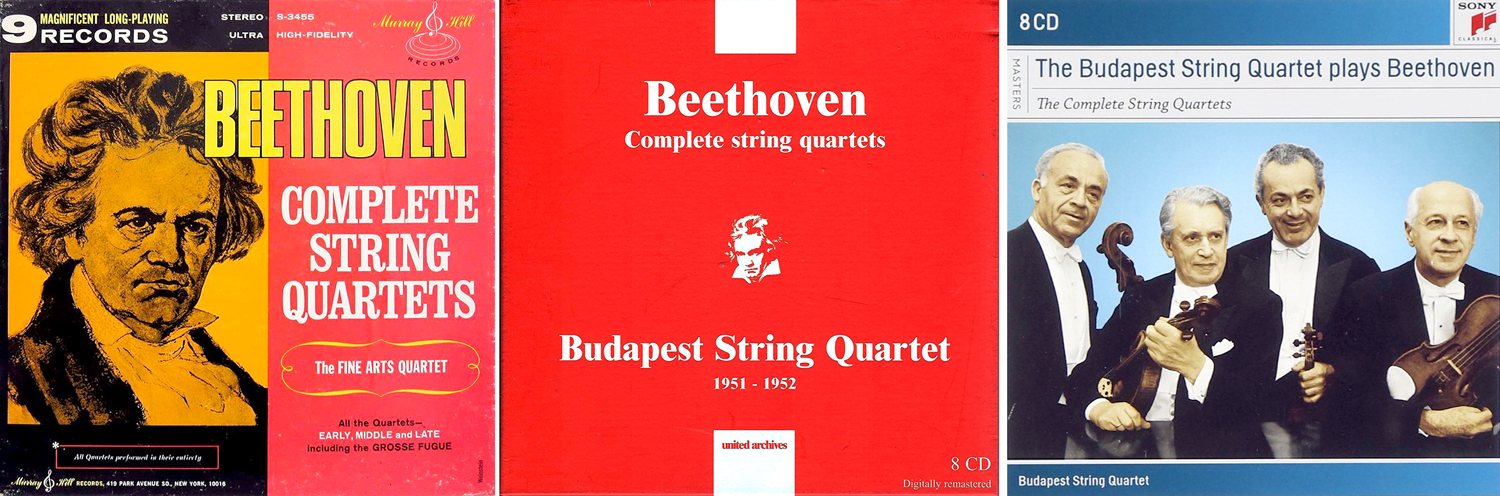
When I got to college in North Carolina, I made the acquaintance of Alexander Barker, who has remained my best friend for 60 years. He was as enthusiastic about classical music as I was and we spent hours in our dorm rooms spinning LPs and introducing each other to music that was our favorites. We were, of course, very serious about great music, as only college students can be, but we knew Beethoven’s string quartets were as serious as you could get. I bought a budget-line set of the quartets, by the Fine Arts Quartet on the off-brand Murray Hill label, and one evening, we started with Opus 18, No. 1 and played through all 16 of them, plus the Grosse Fuge, in one marathon session. (We later attempted the same thing with the piano sonatas, but gave up in exhaustion and the need for sleep by the time we hit the Hammerklavier.)

I have not been able to find a CD version of the Fine Arts Quartet set, but I found much better-played versions later on. I have owned a half-dozen or so complete sets of the Beethoven quartets, and as many of just the late quartets, but on the desert island, I would take the original mono versions by the Budapest String Quartet. They redid them later in stereo, but I like the earlier set better. I could have chosen the Guarneri, or the Tokyo or the Emerson, but I still think the Budapest have the measure of them best.
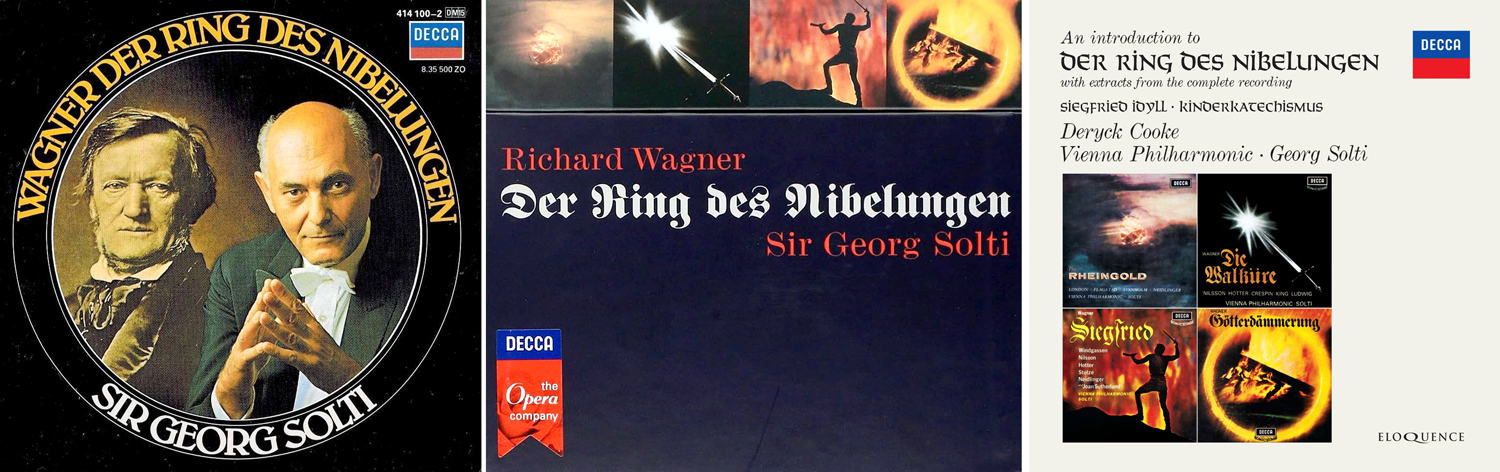
If you have the earnest seriousness of youth, you will eventually get into Wagner. After college and after a failed first marriage, I was living in North Carolina with my favorite redhead, scratching by on subsistence jobs, and I managed to save enough money to finally buy the Solti Ring. Something like 16 hours of music subsuming four operas, it opened up a world of myth and raw musical power. Now in retirement, I own five Ring cycles on CD and another two on DVD. And I’ve attended two complete live Ring cycles (not a patch on my late friend Dimitri Drobatschewsky, who went to Bayreuth 16 times beginning just after World War II.) But the Solti Ring of the Nibelungs is still my go-to set. And with it, I must also take the Deryck Cooke explication of the cycle, An Introduction to “Der Ring des Nibelungen.” Can’t have one without the other; they’re a set.
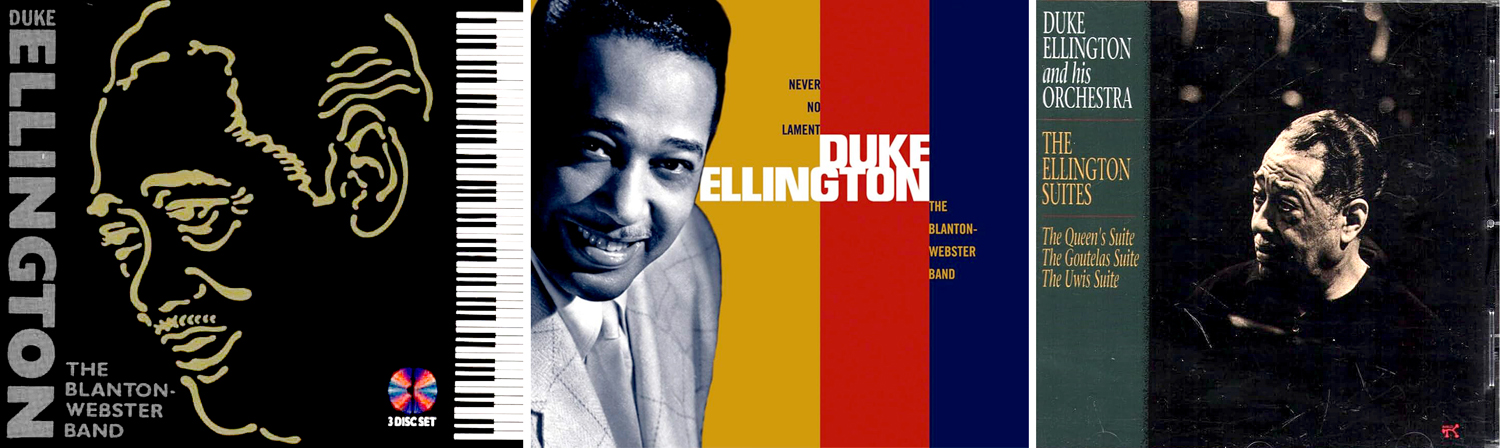
When the redhead and I split up, after seven years, I moved to Seattle and began working at the zoo, where I met a zookeeper whose hair was as blond as the sun. I fell. She had been a professional swing dancer at one time, and she played me old swing records on her Wurlitzer jukebox, which she had at her home. I had a whole new universe of music to learn about. But the one who stuck was the jazz musician closest to writing classical music, Duke Ellington. 

I still have about 50 CDs of Ellington’s recordings. There are counted several epochs of Ellington’s career, beginning with the “jungle music” of the 1920s and going through his rebirth at the Newport Jazz Festival in 1956. But most count the high point of his band and music to be those years in the early 1940s when Ben Webster was his tenor sax man and Jimmie Blanton was his string bass player. A collection of their recordings has been issued several times as “The Blanton-Webster Band.” It was the era of Take the A Train, Ko-Ko, Harlem Airshaft, and Perdido

But then, neither can I do without The Queen’s Suite, which he wrote with Billy Strayhorn in 1971, and is his most completely classically composed work. I love it. And so, I’m adding it to my Ellington entry. 

The zookeeper dumped me and I moved back to North Carolina. A few years later, I met Carole, who I married and lived with for 35 years, until her death in 2017. Marriage humanized me, and the most human composer is Mozart and the most humanistic of conductors was Bruno Walter. It was the the last years of the LP era, in 1980, and before digital took over, I found the last six symphonies of Mozart played by Walter and the Columbia Symphony Orchestra (a pickup ensemble, mostly of musicians from the New York Philharmonic). 

Walter’s Mozart remains the most humane and beautiful version of these works, which are now buried under historical-performance rhetoric and bounce along at a jog-trot, mechanistic pace. But one can still find the echt-Mozart, songful, emotional, and velvety rich, under Walter’s baton. Like all of my choices for the desert island, it has never been out of print. 
Carole and I moved to Arizona in 1987, where she took up teaching art to elementary pupils, and I began writing for The Arizona Republic as its art critic (later also its classical music critic). 

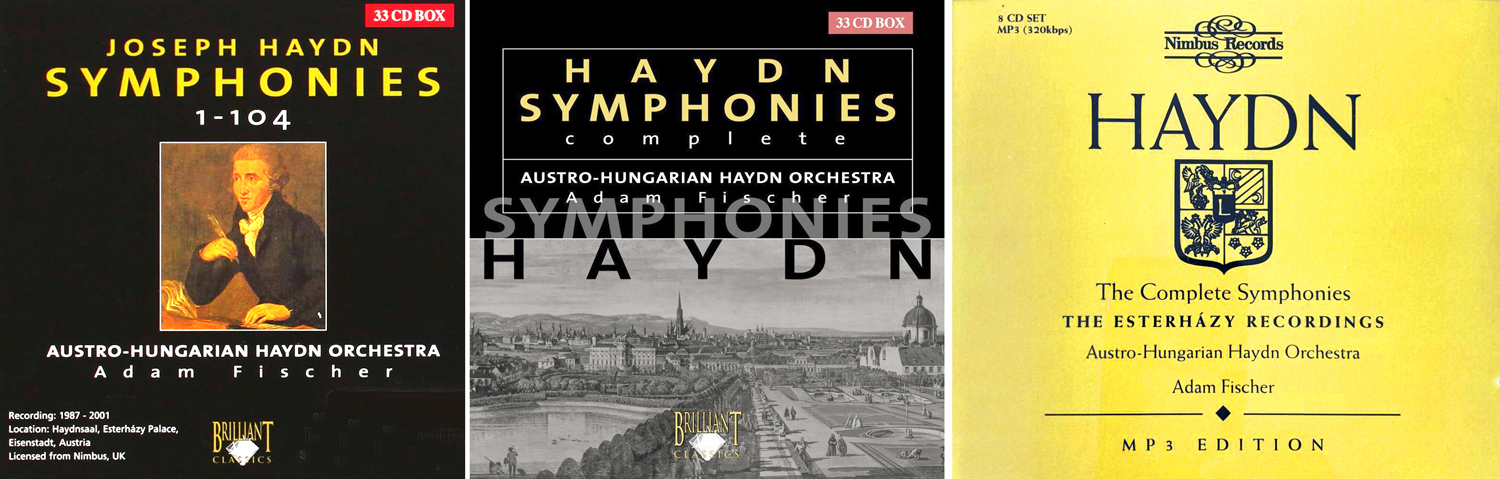
When we moved to a house at the foot of Camelback Mountain, it was a 20 to 30 minute drive (depending on traffic) to the Republic office downtown, and I found the perfect drive-time music, playing a Haydn symphony each way. I eventually went through all 104 symphonies, driving back and forth, three times, and absorbed their spirit from the Austro-Hungarian Haydn Orchestra and Adam Fischer. They have become my go-to performers for this music. I also have the earlier Antal Dorati version, which sometimes sounds like a quick read-through, and later was sent a review copy of the Dennis Russel Davies versions on Sony, which proved to be the most utterly humorless Haydn possible and I had to give them away. How can anyone misunderstand this music so thoroughly? 

When Carole died, and I sunk into grief, from which I have never fully recovered, I found myself listening with my whole being to Brahms German Requiem. I have spent the anniversary of her death every year driving up the Blue Ridge Parkway to find an old fire road into the woods, and sit quietly to Bruno Walter’s recording of the German Requiem. It is the most sympathetic, consoling music ever written. 

On Desert Island Discs, they also ask the guests to choose the one recording, above all, which they would take if everything else were not possible. And for me that is Johann Sebastian Bach’s Passion According to Saint Matthew, a three-hour musical retelling of the last days of Jesus and his death. I am not religious. (I am so not religious, I not even an atheist.) But every note of Bach’s music speaks to me on the deepest level of humanity. The opening chorus and the ending chorus are, for me, the greatest musical utterances ever penned. I’m keeping it with me.

There are many performances, and no one really does it badly, but most recordings now have been run through the historical performance wringer and the juice has been squeezed out. This is majestic and noble music, not something from a squeeze box. And the recording left behind by Otto Klemperer is the one I listen to over and over. He’s got the measure of this music. 
That leaves us a book and a luxury. People value books for, usually, one of three reasons. Either for the information they gather, or for the stories that are told, or for the prose they are written in. I fall into the last camp. I thought about Gibbon’s Decline and Fall of the Roman Empire, which is an utter joy to read, whether you care about the factual history of Rome or not. I revel in its river of words. But I read it in short segments, ultimately filling up like a rich meal and need to wait some hours before hitting the table again. And, for all the wonderful writing, there is a sameness that can creep in. 

Or I might have chosen a classic that somehow I’ve missed in 77 years of life. Many on Desert Island Discs have taken Marcel Proust’s Á la Recherche du Temps Perdu. But when it comes to monster works, I already put in my time, having gotten through The Gulag Archipelago. I no longer need to prove myself. 

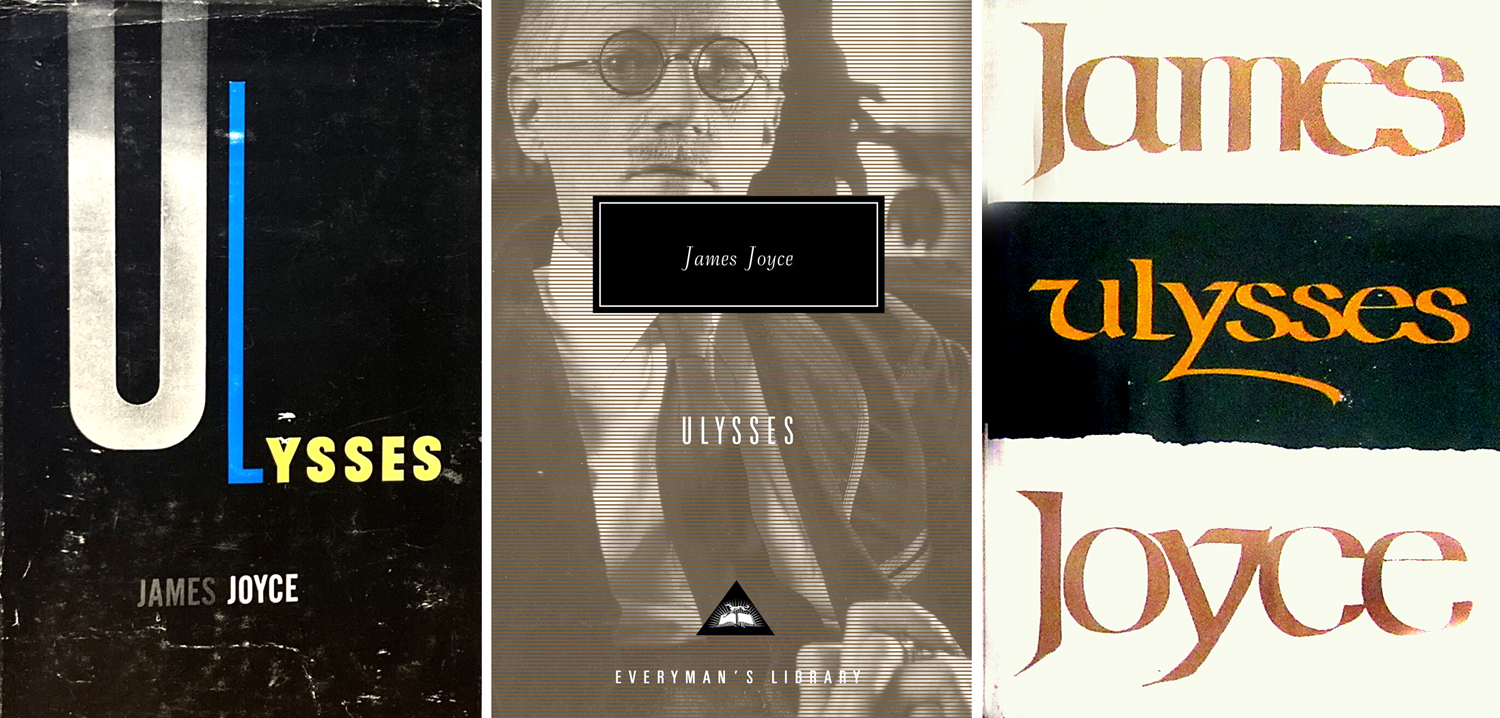
So, I have chosen Joyce’s Ulysses, the book I can read and re-read over and over, with such a variety of prose and method and such delicious words, that I don’t think I could ever tire of it. 

As for a luxury item, I had some difficulty coming up with something, because I am not much for luxury. But I have always owned a pear-wood handled Opinel folding knife. The current one sits in the glove compartment of the car, ready for anything called for. A man needs his tools.

Of course, the whole exercise is entirely pointless. There is no desert island, and with a house full of books, CDs, musical scores, and art, I don’t need to choose so parsimoniously. The whole idea is merely a pleasant game to play. 

But going through the process, and forcing myself to narrow the list arbitrarily, I come to see myself in a dusty mirror. And I surprise myself, looking back at me. 

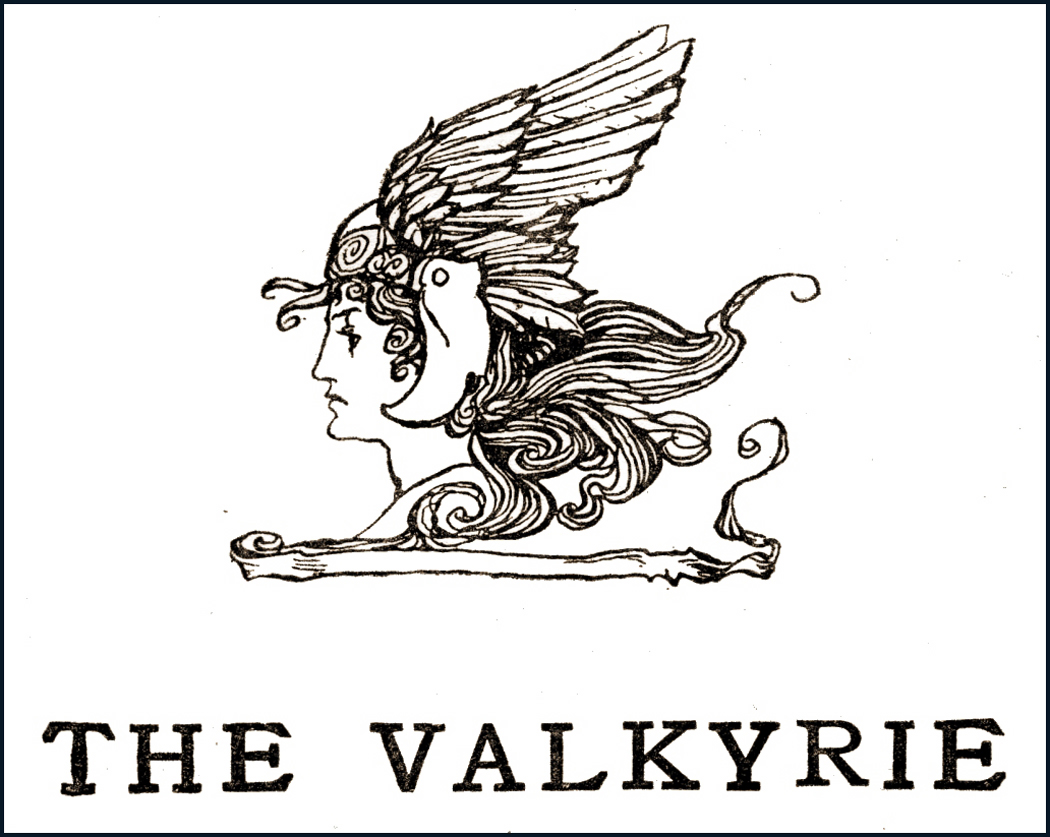
rackhambookcovervalkyrie

We live two lives. Everyone does, although we seldom acknowledge it.

The first is the life we know daily, the ordinary life filled with people and things. It is the life of work and fast foods, traffic and journalism. It is a loud, swarming stage, with 7 billion competing egos jostling for their air.

In such a life, it is easy to become submerged, easy to lose our way. The demands of survival and success blind us to the larger, more important issues.

Which is why that second life is so very important. That is the life we recognize when we are alone at night under the starry sky. In this second life, the 7 billion disappear, and we are conscious of only two players: ourselves and the universe — the single, moving, conscious point on the infinite ground.

We become aware in a way we cannot during busier times, that the universe we live in is intensely beautiful and awesome and is driven by a power we cannot conceive of — and what is more, we are a part of it and have been given the chance to participate.

In the first life, we are never more than an extra in a crowd scene, but in the second life, we are each the protagonist in our own autobiography.

Or more exactly, we are each the hero of our own existence.

It is this second life that animates one of the most extraordinary works of art ever conceived, one so huge, multifarious, demanding and overwhelming, that only a few people are willing to invest themselves in it. Those who do, tend to become unbearable to those who have not. They become Wagnerites.

In one way of looking at it, the history of art is a vast pendulum that swings back and forth between works created out of the friction between peoples, on a personal, familial, tribal or national level. The individual and his place among human society. The other extreme is art that examines the individual and his place in nature and the universe. We move from Alexander Pope to William Wordsworth, from The Marriage of Figaro to the Symphonie Fantastique. One shouldn’t have to choose, but the fact is, one’s Zeitgeist chooses for you which paradigm will be most valued during your lifetime.

It is this second life that animates Richard Wagner’s 15-hour quartet of music dramas, The Ring of the Nibelungs. The massive theater-and-music work tells the story of the creation and death of the universe, and the human actions that animate it. If you are looking for a concise story with a coherent plot, turn instead to Bizet or Puccini; Wagner focuses directly on that inner life that pivots under the constellations.

That is why so many people love his music, and why just as many hate it. The Ring is populated with gods and heroes. La Boheme is populated with people. La Boheme is — on the surface, at least — about the first life; The Ring is unapologetically about the second.

There is, in some cultures, the idea of ”The Long Man,” that is, the individual seen as the summation of history: ontogeny recapitulates phylogeny — the one life contains all life.

So that Wagner’s retelling of all of history is also the birth and death of each individual consciousness.

Das Rheingold, the first of the four operas, begins with Eden, a perfect paradise in which the creatures who inhabit it are perpetually in touch with the radiance of nature. The beginning of the opera — and of the cycle — is unprecedented in music history.

alberichandrhinemaidens

It begins with the watery creation of the world, and the composer wrote it in the key of E-flat. The opening of the first of the Ring operas is one of the most astonishing stretches of music in all of history. Wagner holds onto a single E-flat major chord for a full four-and-a-half minutes — 136 bars, longer than some Mozart symphony movements. That is an eternity in music without a change.

It begins in the basses with a deep fundamental note, which breaks slowly into a rising arpeggio on the E-flat chord and slowly speeds up to a crescendo of runs and arpeggios — an immense pile of busy-ness, but without any of the forward sense of motion that harmonic progression provides.

In this, Wagner has provided a musical metaphor of the Hindu concept of maya, or illusion. He had been reading Indian philosophy — albeit in the very German version of Schopenhauer — and his illustration of the idea is perhaps the clearest in art.

Before consciousness, it is said, the mind is like a placid lake reflecting the sky perfectly. But such a state is impossible, for a breeze is inevitable, and it breaks up the surface into ripples and waves, and the sky — eternity — is then reflected individually in every wavelet. Such is creation in Hindu philosophy, where we are all fragmented into individuals by the accident of the animating wind. But the fragmentation is an illusion — maya. The busy play of the world is just a trick; eternity itself is unchanged.

So Wagner shows the indestructible and unmoving E-flat spinning out into a busy surge of notes, building the world into existence.

The idea came to Wagner while he was drowsing, dreaming he had fallen into a rushing stream of water.

”The rushing sound formed itself in my brain into a musical sound, the chord of E-flat major, which continually re-echoed in broken forms,” he wrote. ”These broken chords seemed to be melodic passages of increasing motion, yet the pure triad of E-flat never changed, but seemed by its continuance to impart infinite significance to the element in which I was sinking.

”I awoke in sudden terror from my doze, feeling as though the waves were rushing high above my head. I at once recognized that the orchestral overture to the Rheingold, which must long have lain latent within me, though it had been unable to find definite form, had at last been revealed to me. I then quickly realized my own nature; the stream of life was not to flow to me from without, but from within.”

“Within” — That’s the second life.

rackhamvalkyrieglyph

In one of the most prodigious imaginative feats in history, Wagner then managed to create most of the remaining 15 hours of music in his Ring from the initial 4 1/2 minutes of arpeggio — fragmenting it further, turning it upside down and inside out, to generate most of the melodic ideas in his epic.

So that, just as all scales and harmony in Western music are generated through overtones of the fundamental bass note, so all of Wagner’s universe likewise grows from that one, deep vibration.

That “radiance of nature” is also the gold at the bottom of the Rhine river. The three nixies who ”guard” the gold sing its glories.


rackhamrhinemaidens and ring

It is the ”visionary gleam” of childhood that Wordsworth elegized in his Intimations ode.

It is Nature, unsullied by greed and striving, which is the philosophical ground of The Ring. And it is Nature that is disturbed by the theft of the gold by a dwarf, who gives up any hope of love in order to possess the treasure and its power.

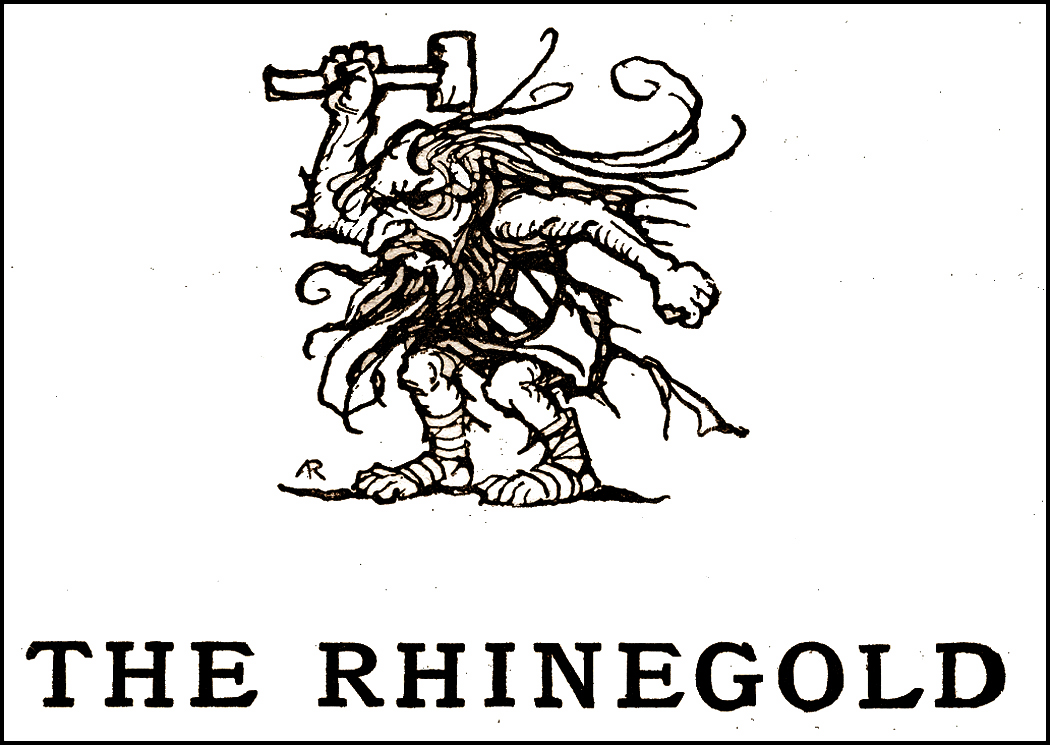
rackham rhinegolddwarf

So, love and power are the two poles of the moral universe in The Ring, and they play out against each other for the remaining three operas.

And in the end, the gods die and the world is engulfed in fire and flood. All that survives, at the final notes of the fourth opera, Goetterdaemerung, is the high, hanging violin melody that we have come, in all those hours of music, to associate with the redemptive power of love. It is the final word on life, history and the cosmos, and just as the world is destroyed it provides the hope of the next creation, just as our children provide a hope against our own deaths.

This is more than an entertainment: Wagner is trying to say something genuine about existence and to the extent we are open to his music and ideas, we will value them.

In the second life we all lead, the same two forces play out: career versus family, law versus justice, greed versus generosity, selfishness versus universal love. In each case, the first binds us in pain and frustration and the second redeems us through a connection to the transcendent.

Such an ambitious aim in art is held in great suspicion these days, where too easy a transcendence turns quickly into sentimentality. And a great deal of what followed Wagner is mawkish. We are much more comfortable now with a skeptical irony. After all, Wagner’s grandiosity fed into the rise of Nazism in Germany. Wagner was, after all, Hitler’s favorite composer.

wagnerphoto

(Wagner, himself, was an awful man. A ridiculous anti-Semite, a ruthless user of women and patrons, and more than comfortable living the high life on other peoples’ money. Take my word, you wouldn’t have liked him.)

But Hitler looked for the Germanness in The Ring and ignored the humanness. The narrowness of his ideology is the very thing Wotan, the chief god in the operas, comes slowly to understand is the cause of human misery.

We are all, if we are truly sentient beings, on something like Wotan’s learning curve.

There is a great deal in The Ring. It is the single most compendious work of art in European history. Wagner manages to take on rapacious capitalism, national identity, Schopenhauer, Hinduism, mythology and the role of the artist, among other things. There are as many interpretations of The Ring as there are hearers. And that is as it should be.

There are Freudian interpretations, Jungian ones, Marxist readings and neo-Feminist glosses.

Yet, it all comes down, in the end, to an awakened awareness of our second life.

The Ring has its faults; it is not a perfect work of art. It is sometimes dull for stretches as bits of plot are rehashed. Like Rossini said, there are some great moments and some tedious quarter-hours.

And in some sense, it is quite silly to take all this seriously. With its dragons and horn-helmeted Valkyries, its gods and dwarfs — to say nothing of its 200-pound sopranos — it can be hard to see past the adult fairy tale aspect. To some, it is as tedious as a musical version of Tolkien.

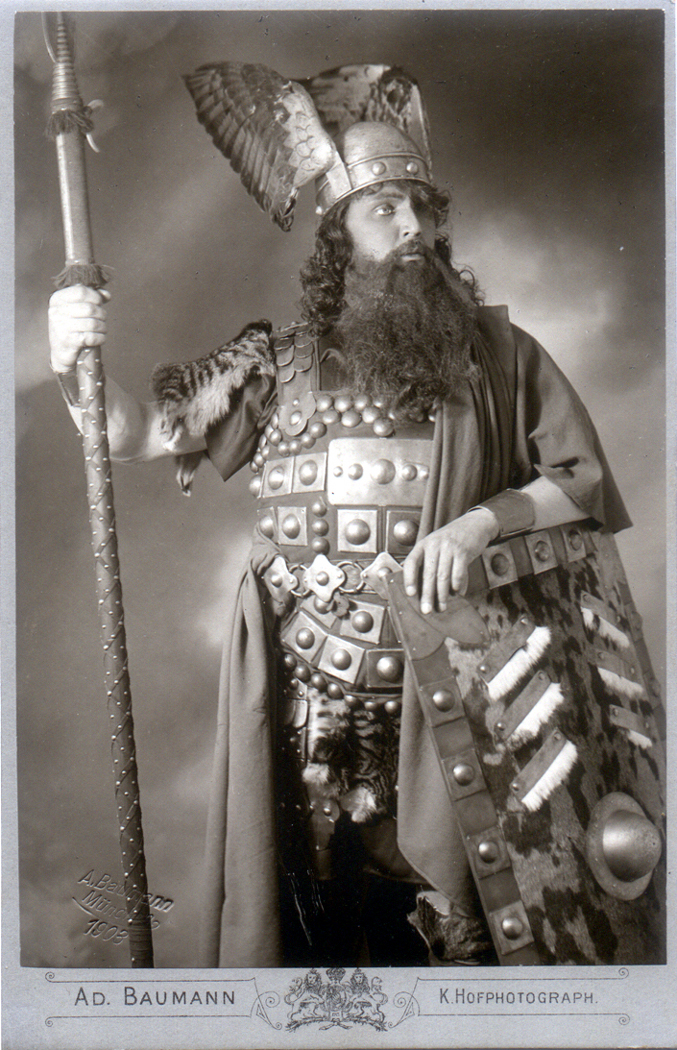
Fritz Feinhals Wotan

Yet, the music itself, underlying and amplifying the experience of The Ring, reawakens in us our awareness of our second life, which is ultimately the source of all that is good in life for ourselves and those we love.

Finally, as the critic Longinus says, all great works of art are flawed and we should always prefer flawed greatness to perfect mediocrity.

And make no mistake, The Ring is truly great.

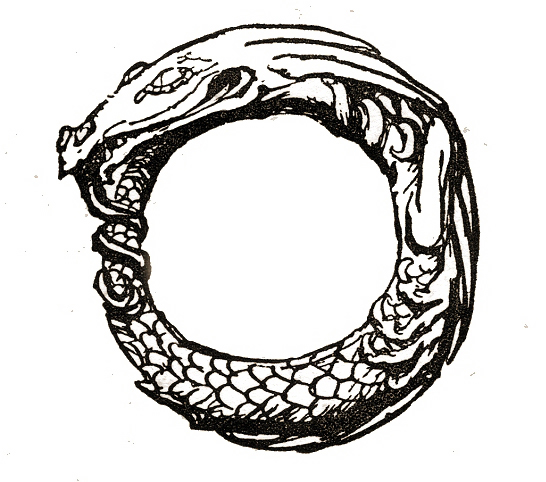
rackham ring circle

A SHORT RETELLING OF THE RING — SO FAR

Richard Wagner’s Der Ring des Nibelungen is a four-opera monument to myth, history and psychology. First performed in 1876, The Ring was designed to be played on consecutive days as a single, 15-hour unit, broken up into these four operas, or ”music dramas” as Wagner called them:

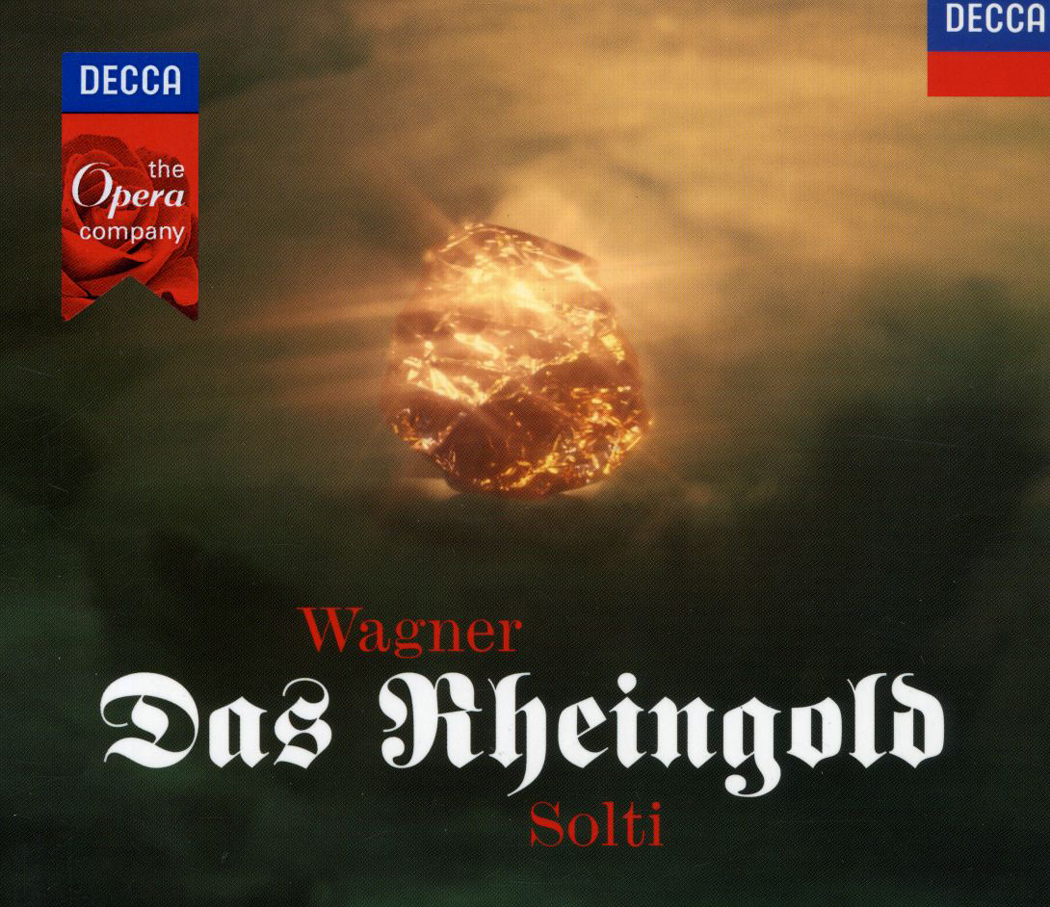
rheingoldalbum

Das Rheingold — In this prelude to the main story, Wotan, the chief of the Viking gods, gains and loses the gold stolen from the Rhine River. The gold confers power on its possessor; unfortunately, it has been cursed and it also confers death. To retrieve the gold for himself, Wotan concocts an elaborate scheme, which plays out in the subsequent operas.

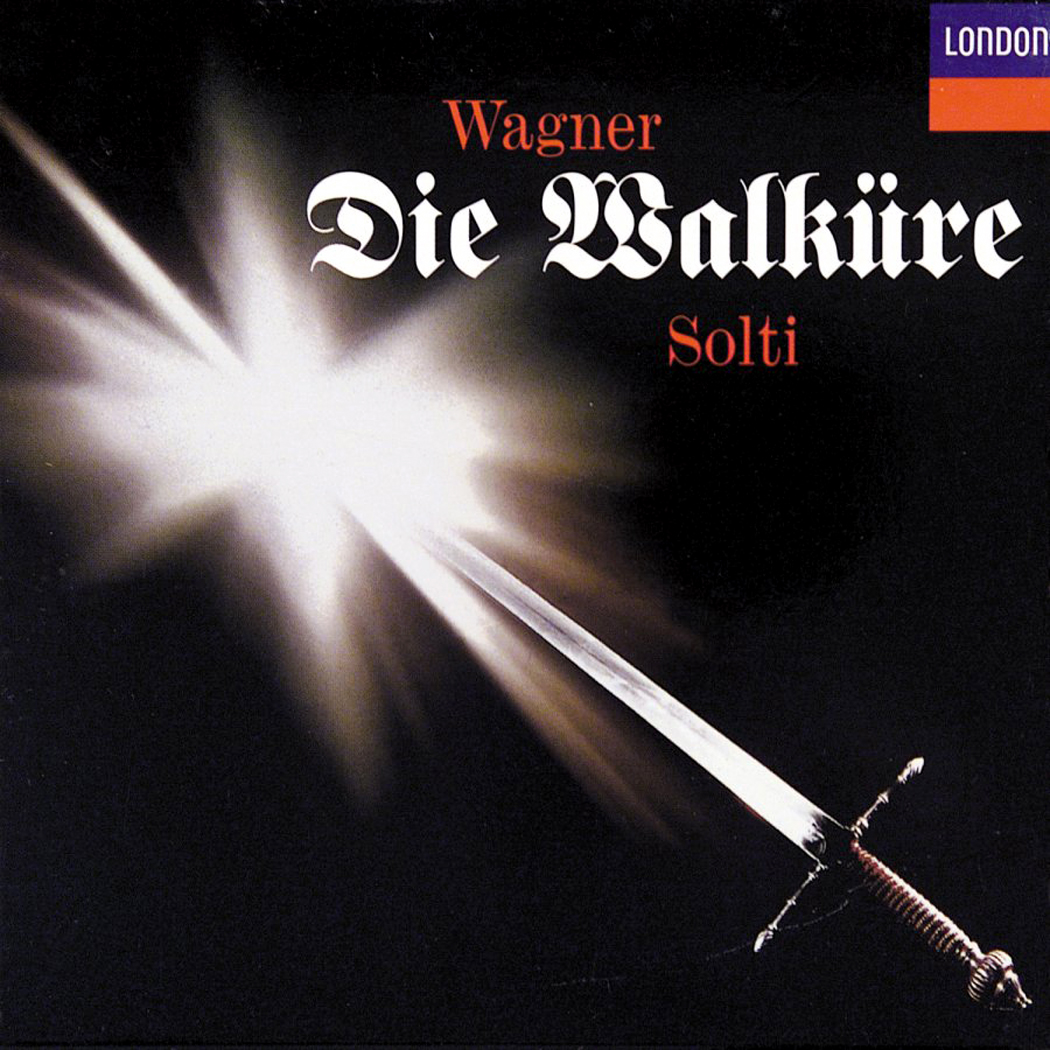
walkurealbum

Die Walkuere — Because he is bound by his own laws not to get the gold himself, Wotan fathers a hero, Siegmund, to do it for him. Siegmund falls in love with his own sister, Sieglinde, and Wotan, again bound by law, is forced to kill Siegmund, but Wotan’s daughter, Brunnhilde — who is a Valkyrie, or divine warrior maiden — saves Sieglinde and her unborn child. For her disobedience, Wotan puts Brunnhilde to sleep on a mountain surrounded by fire.

siegfriedalbum

Siegfried — Sieglinde’s child, Siegfried, is raised in the forest by a dwarf. The hero kills the dragon that guards the gold and climbs the mountain and awakens Brunnhilde. Wotan’s plan seems to be working, except that Siegfried isn’t really interested in the gold.

gotterdammerungalbum2

Goetterdaemmerung — The title translates as ”The Twilight of the Gods” and shows the sad end of Wotan’s plan. Siegfried is drugged by the evil half-dwarf Hagen — who also wants the gold — so that he forgets Brunnhilde and plans to marry Hagen’s sister. Brunnhilde feels betrayed and joins with Hagen to kill Siegfried. When she realizes that Siegfried had been tricked, she sings one of the most difficult 20 minutes in opera, and in remorse for her part in the murder, rides her horse into the hero’s funeral pyre, igniting the final conflagration that destroys both the world and the gods. Wotan’s plan has failed, but Wotan has achieved something more valuable than the gold: Wisdom. As the opera closes, hints of the redemptive power of love suggest that the world can start over again with a fresh beginning.

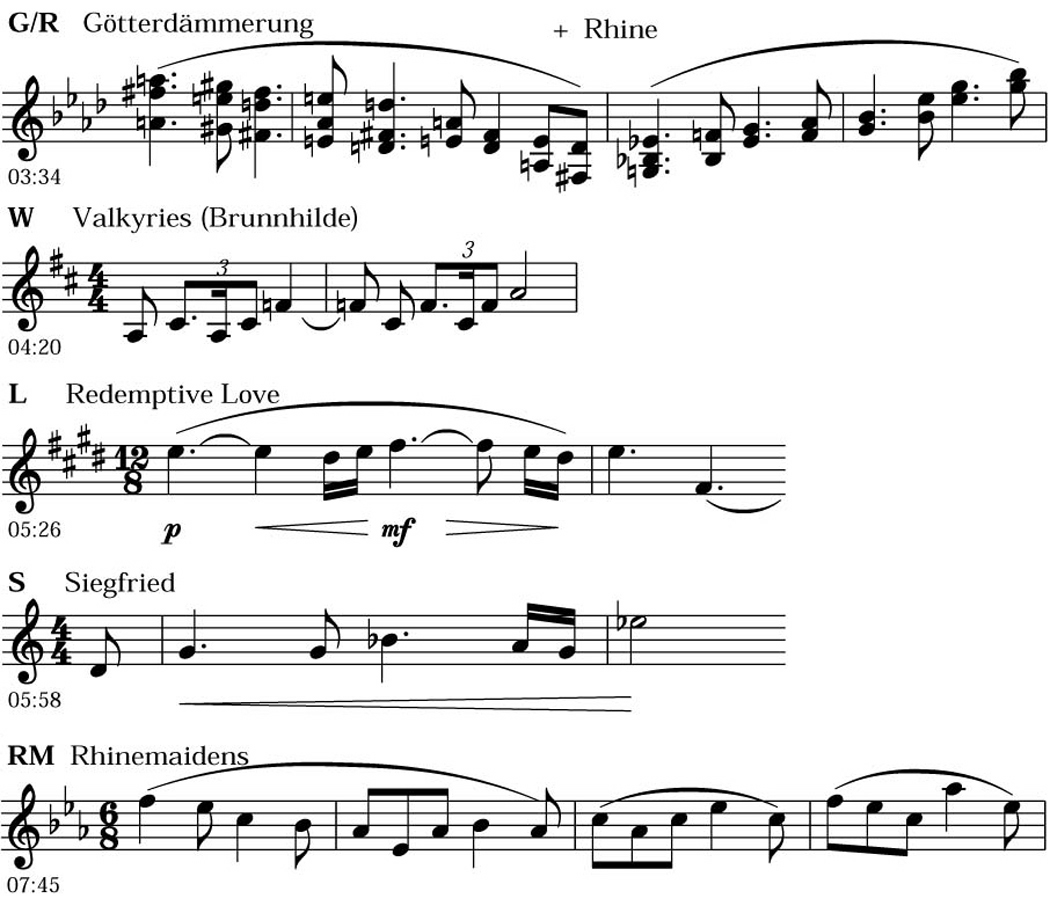
leitmotifs

To unify the sprawling story, Wagner used repeated musical phrases — called leitmotivs, or leading musical ideas — and developed them symphonically over the 15 hours. The music expresses the emotions and thoughts of the characters — sometimes hidden — and the music changes as the characters grow and the plot thickens, helping the audience keep track of what is happening.

rackhambookcoverdragon