Archive

Tag Archives: dictionary

My Uncle Stanley had an ambition in life to own a Weimaraner hound. I was only a boy at the time and didn’t quite understand the appeal of such a dog, but for the IBM typewriter technician he was, living in New Jersey in the 1960s, I imagine it had something of the attraction a solid gold toilet had for Elvis Presley. The rest of us had dogs that we lucked into, finding a stray, or getting a mutt from the dog pound. But the Weimaraner was a pricey breed and my uncle wanted one. He finally got one. It was a nice dog, but for me, that’s just what it was — a dog. 

Many, I think, have some similar focus in their lives, some object that signifies arrival, or a sense of completeness in life. Most items hold that position only for as long as they are unachieved. Yet there remains a pride in the achievement, even if the reward is rather less than anticipated. 

I think of those who have yearned to own a Cadillac. They may live in a mobile home and work as janitor in the local factory, but if they can park a Caddy out front, it will show they aren’t complete failures. 

As in the familiar song, St. James Infirmary: When I die, “Put a twenty-dollar gold piece on my watch chain,/ So the boys’ll know that I died standin’ pat.”

The idea of getting that bit you believe you want or need is common. Perhaps it is a $300 Wüsthof chef knife; or a Rolex watch; or a bespoke suit from Hong Kong. Whatever is your icon of either quality or status or style, it chases you through life until you can finally afford it. I certainly have felt it. When I was young, it was a Nikon camera, then a Leica and then a Hasselblad. I finally got each and while I wasn’t disappointed — they are all as good as their reputations — they never quite made that great a difference in the photographs I made. 

I imagine that if the People’s Republic of China ever finally get their hands on Taiwan, it will not prove to be quite so satisfying a triumph as they had imagined. 

I never chased a particular car or watch, but there are books I longed for. I have managed to get some of them; others still elude me. But here are the big three I lusted after for years.
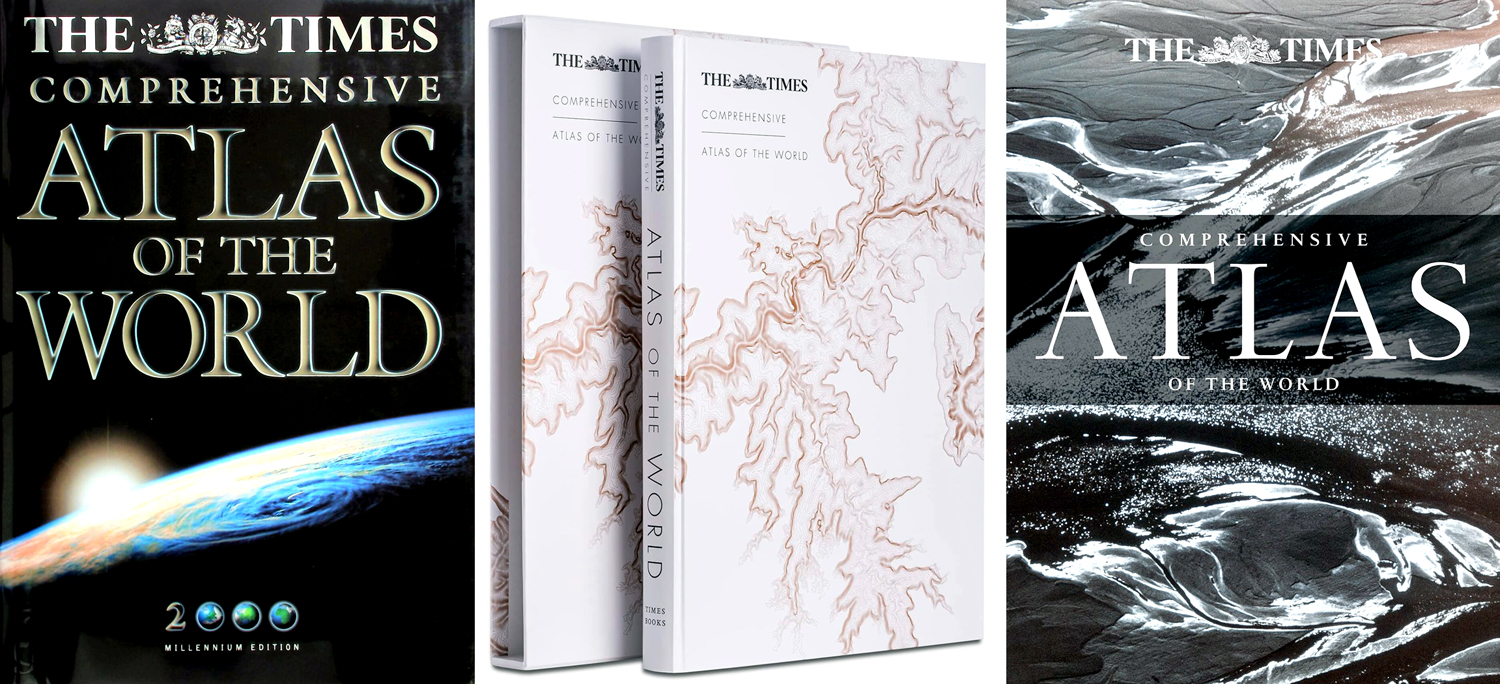
The Times Comprehensive Atlas of the World

Beginning in the third grade, I loved maps. And what I loved more than any were the big maps in the classroom that were pulled down like a windowshade, and were richly colored in thick inks — not halftone dots: The green was dark green ink, not a mix of yellow and cyan dots. Mountain regions were a rich chestnut brown. Those maps were beautiful. They may have been out of date even in my childhood, but I didn’t love them for their accuracy, but as art. 

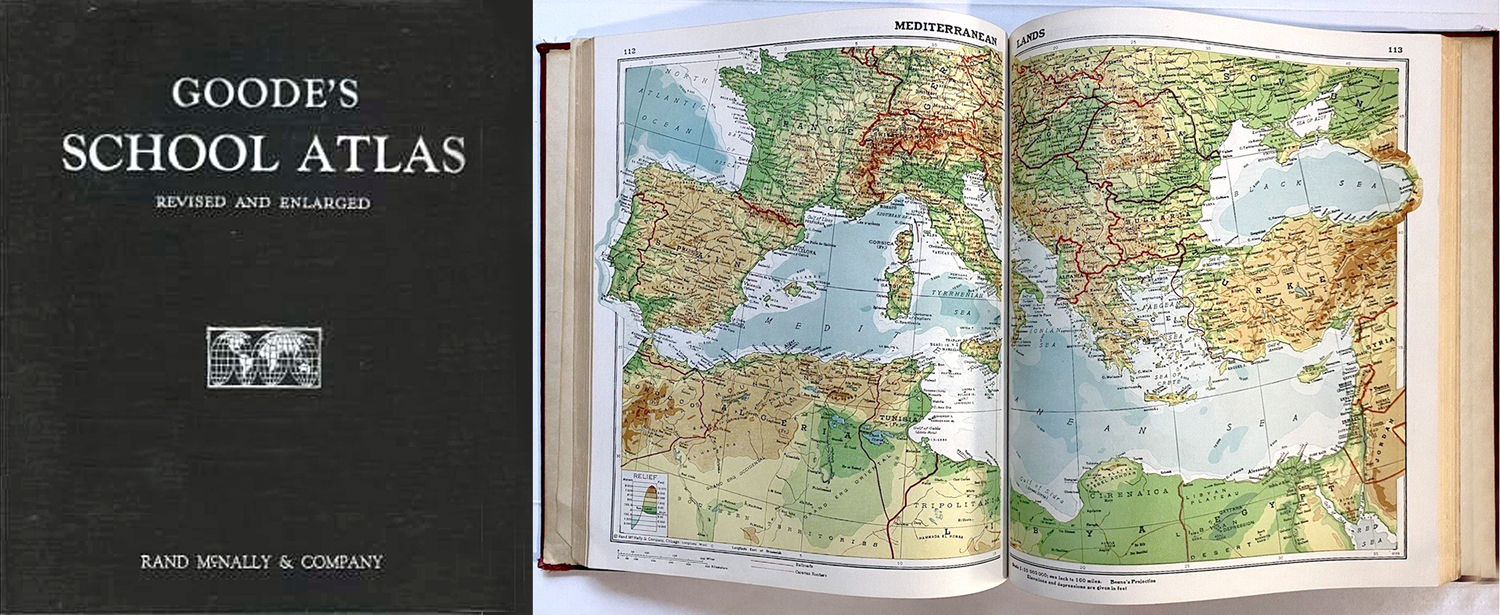
Years later, I found something very similar in older editions of the Goode’s School Atlas, where the maps were created using wood engravings, so there were straight-line cross-hatchings for shadings, and again, multi-colored inks for the printing. I saw them as art books. I found a few in old, musty used book stores and I still treasure them. 
The very first puzzle pieces I remember, as far back as infancy, were map puzzles, where each U.S. state was a single piece. I took apart and redid that states puzzle hundreds of times, even as, in my infant-tongue the states were Uncle Homer and Miss Thompson. 

Later, as a young man, newly empowered with a car and an income, I began traveling, and to aid that travel, I had a Rand McNally Road Atlas. I have updated them every other year or so, but I also acquired vintage versions from 1935 and 1942, which are things of beauty of their own, in two-color printing, with most roads in dark blue and highways in red. I treasure the old ones, while the newer, full-color maps are merely disposable useful tools. 

But, out there on the horizon, was the Times Comprehensive Atlas of The World, published in constantly updated editions from 1895 through its 16th edition in 2023. By 1959, the Midcentury Edition of the atlas was a five-volume elephant folio edition measuring 12-by-19-inches. It was the Cadillac of world atlases and it was way out of my price range when I was young. I did manage to get the single volume 10th edition, picked up used. 

It was a large, handsome volume. The maps were halftones, so, not as esthetically distinct as the Goode’s, but still, it was by all counts the best atlas on the market. Unfortunately, when I retired, I had to sell off about 75 percent of my library to make the move across the country from Phoenix to North Carolina, and the Times atlas was one of the casualties. Kept the Goode’s, though. 
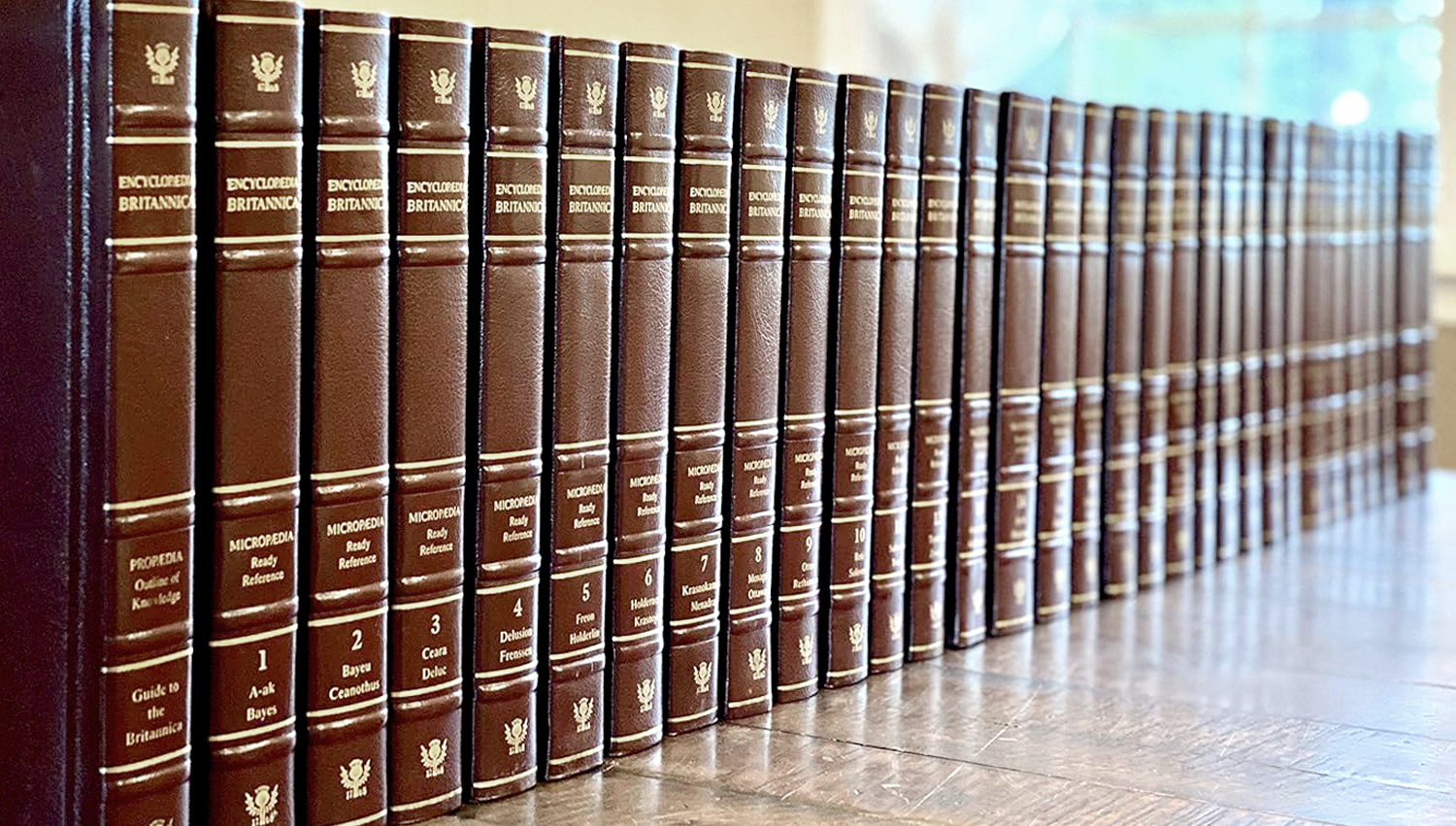
The Encyclopedia Brittanica

By the time I was in sixth grade, I wanted to learn everything. I was young enough still to think that possible. And where would I find all this knowledge? I’d read the encyclopedia. 

My neighbors had an old Compton’s Picture Encyclopedia, from the 1930s, which they gave us, and I read it over and over, with its streamlined steam trains, autogyros and biplanes. But even as a kid, I knew the books were out of date. A wonderful long entry on “The Great War,” but, although I was reading it in 1953 or so, less than 10 years after WWII, there was no mention of any of it. 

My mother wanted to help, and so, she began buying the promotional supermarket offering Funk and Wagnalls, one per week, for 99 cents each, until we had the full set, cheaply printed and bound. I used them for years to write theme papers for school. But I always knew that they weren’t the “real thing.” For that I needed the Britannica, which was way outside my family’s budget. 
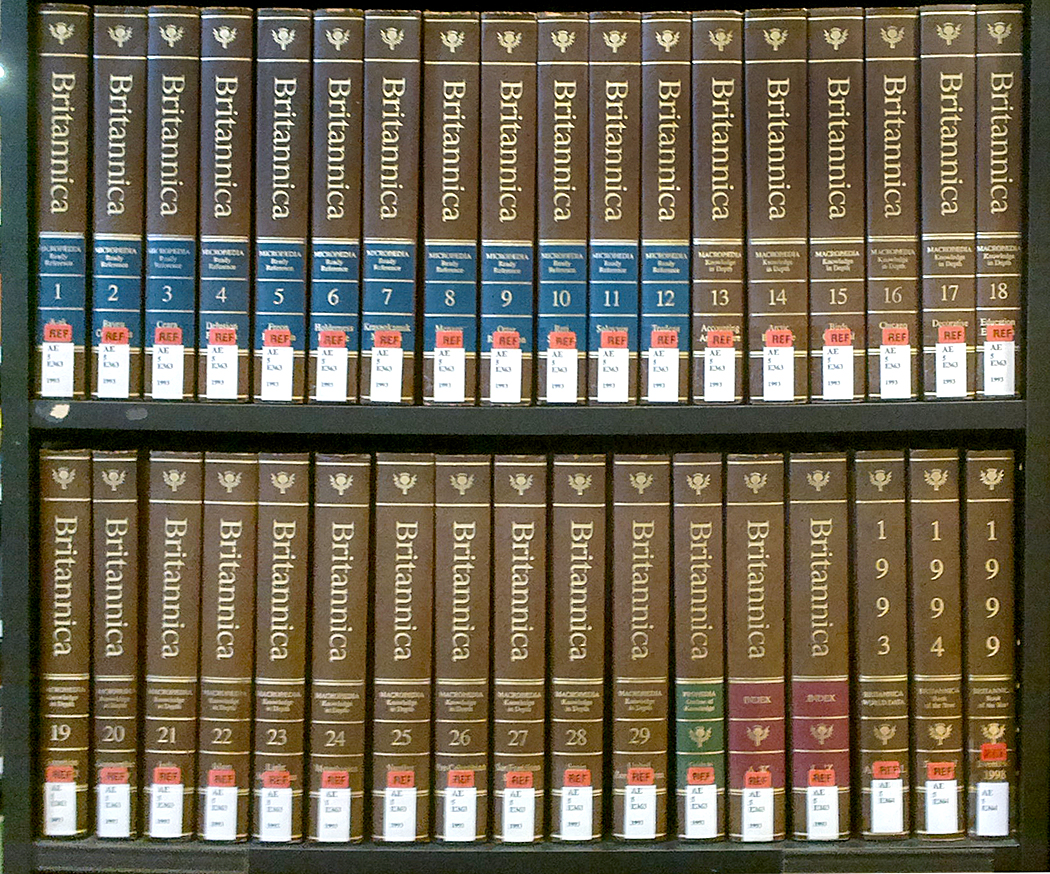
I continued lusting for my own Encyclopedia Britannica, all through college, the jobs that followed and into my years at the newspaper in Arizona, when I finally got a set at Bookman’s, a used book store in Mesa. But my enthusiasm was tempered by the fact that the set I got was not the traditional Britannica, but the combined “micropædia” and “macropædia,” in which the entries were divided into the more popular entries, in shorter, easier to read versions — the micropædia — and the more in-depth entries in the rest of the volumes. It felt like a dumbed-down, even trendy version of what I truly wanted. I wanted the Belmondo Breathless and got the Richard Gere Breathless

Years later, I came across the revised 14th edition, in 24 volumes and its leathery maroon covers and thistle logo, and managed to buy it. This was the real thing, at last. The pride of my collection. 
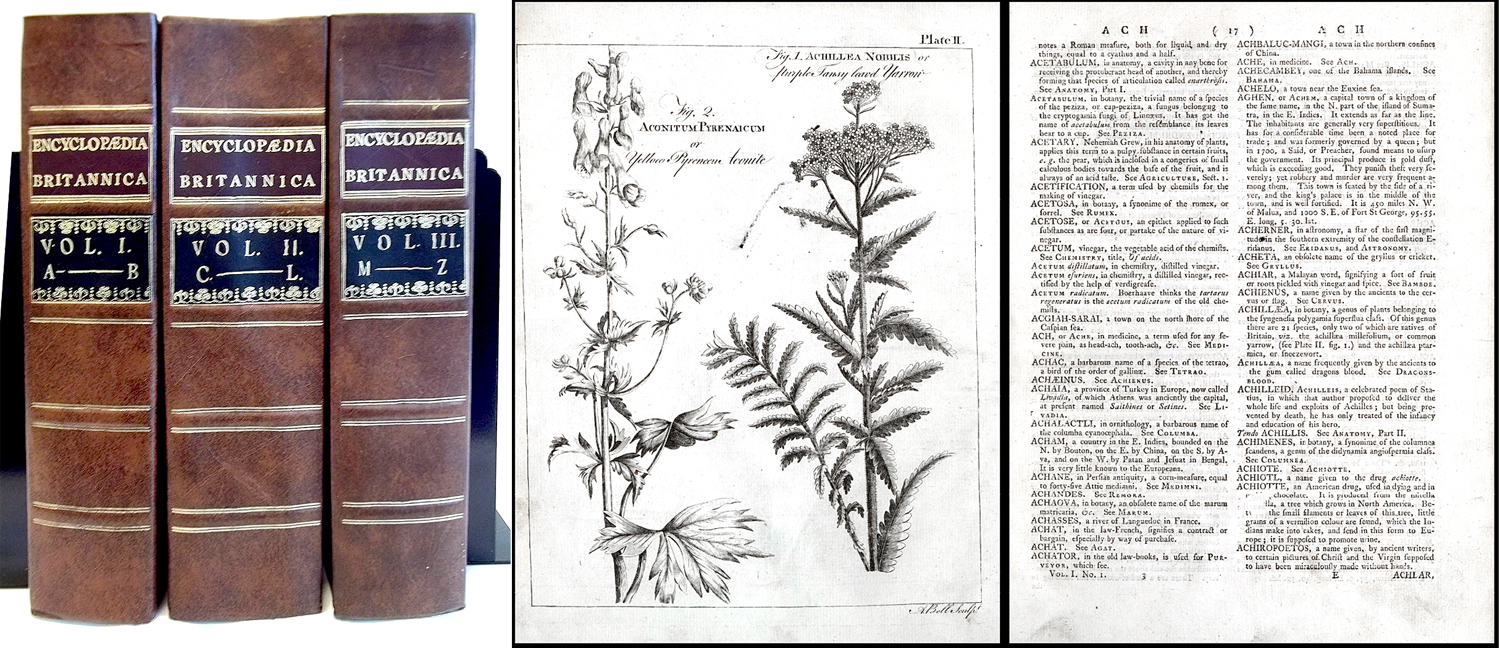
At Bookman’s, I later also found a facsimile version of the original three-volume Encyclopædia Britannica, from 1768. The replica was quite convincing, even including (imitation) foxing on some of the pages. More interesting was evidence that the 18th century project engaged the enthusiasm of its makers early on, and then rather petered out. The first volume covers the letters “A” and “B.” The second includes “C” through “L.” And the third and slimmest volume gets to cover everything else to the letter “Zed.” The facsimile edition was published in 1971. 

Then, of course, the internet came along, with its Wikipedia. The Britannica sat on the shelf as a kind of trophy, but largely unused. And when we moved, it was one of the casualties. So long in the getting, so short in the forgetting. 
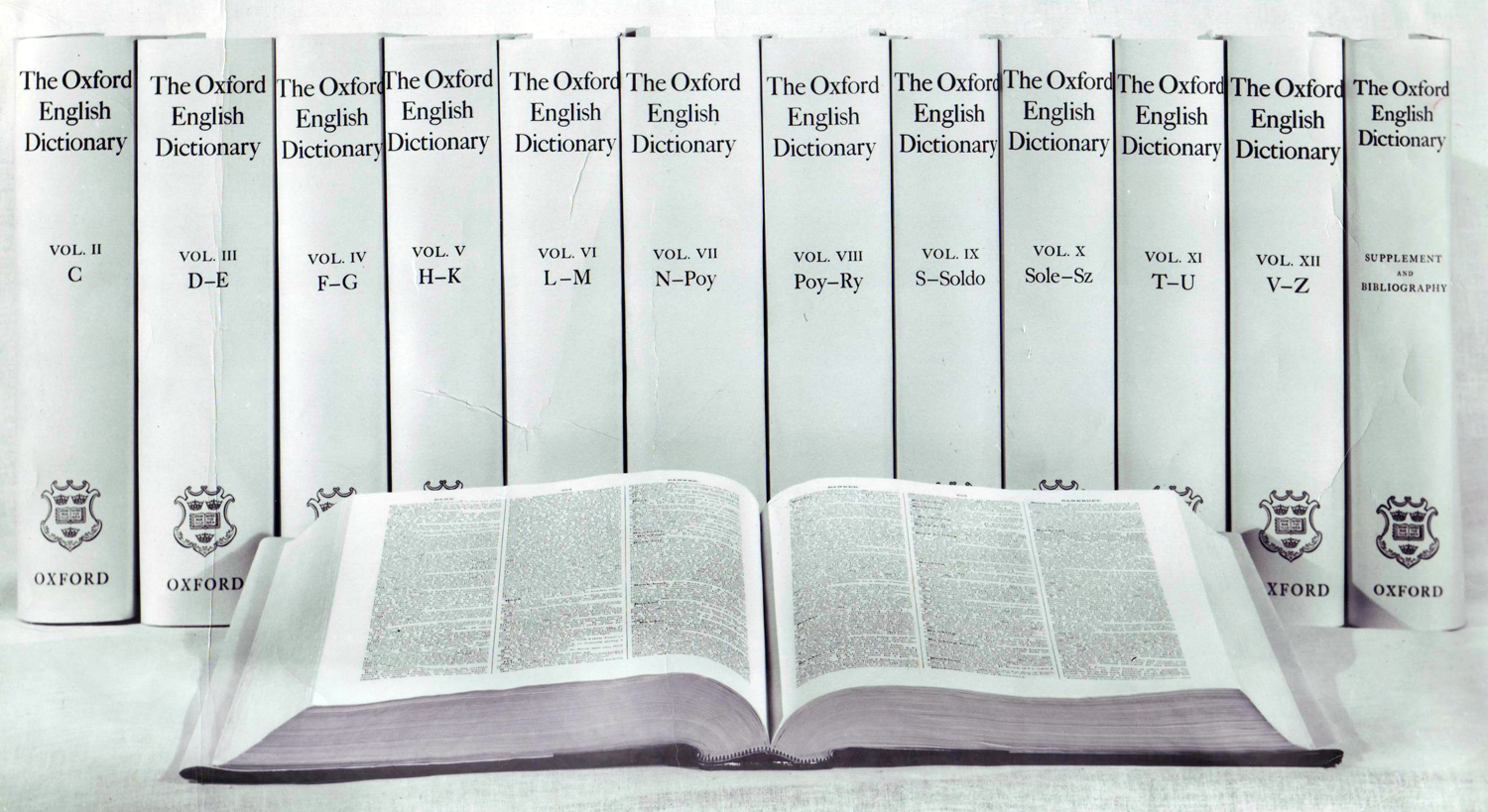
The Oxford English Dictionary

But the real prize, the one thing that I lusted for more than any other, was the Oxford English Dictionary, the 20 volume final word on the English language. 

I was a long-time reader of dictionaries. From second-grade on, I loved learning vocabulary. From 8th grade on, I loved learning the etymologies of words, and how they could change meaning over time. The OED contained all that information. Entries were long, involved and gave dozens, maybe scores, of citations, each dated and quoted. A simple word with multiple meanings, such as “set,” went on for pages, and required 60,000 words to describe some 580 senses. The whole of the dictionary was 21,730 pages and 59 million words covering more than 300,000 entries. It was heaven. It was also pricey. The set could sell from $1500 to $2000, depending on where you bought it. 

The full OED is still my unicorn. I have never found an affordable used set. But, in the 1970s, the Oxford Press put out a 2-volume Compact Edition, with every four pages of the original OED shrunk photomechanically down to quarter-size and printed four original pages squeezed into each single page of the edition, which required the use of a magnifying glass (included) to be able to read it. The Compact Edition was offered at rock-bottom price as a promotion through a book club, and I signed on, and got my copy.
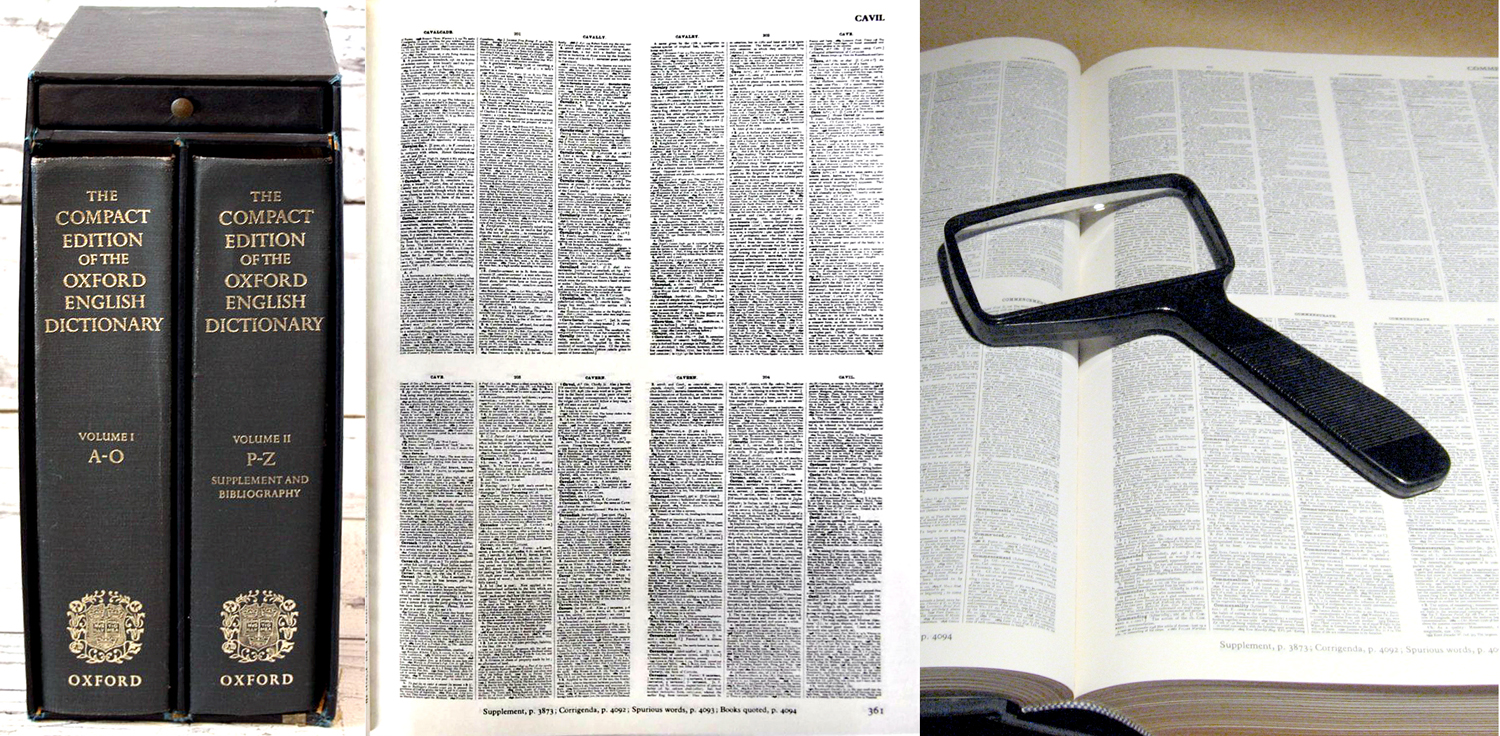
It is very hard to read, even with the magnifying glass, and the volumes were big and bulky and uncomfortable to use, but at least I owned a version of the OED. This was as close as I got to Nirvana. 

I still have the Compact Edition, occupying the upper shelf of a coat closet. I haven’t dragged it out in years, but I still have it, a reminder of those things I once thought would change my life forever. Perhaps they did. 

So, what did you always want and did or didn’t finally achieve? 

Click on any image to enlarge

Johnson dictionary

I love long sentences. I’m tired of all the short ones. Hemingway can keep them. Newspapers can urge them. Twitter can mandate them. To hell with them.

My ideal can be found in the long serpentine railways of words shunted hither and thither over dependent clauses, parenthetical remarks, explanatory discursions and descriptive ambiguities; sentences such as those found in the word-rich 18th century publishing world of Fielding, Sterne, Addison, Steele, or Boswell, and perhaps most gratifyingly in the grand, gravid, orotund sentences of Edward Gibbon, whose work I turn to not so much for information about the grandeur that was Rome, but for the pure sensuous pleasure to be had from those accretive tunes built from the pile of ideas and imagery (to say nothing of ironic asides), and peppered liberally with the notations of colons, semicolons, dashes and inverted commas.

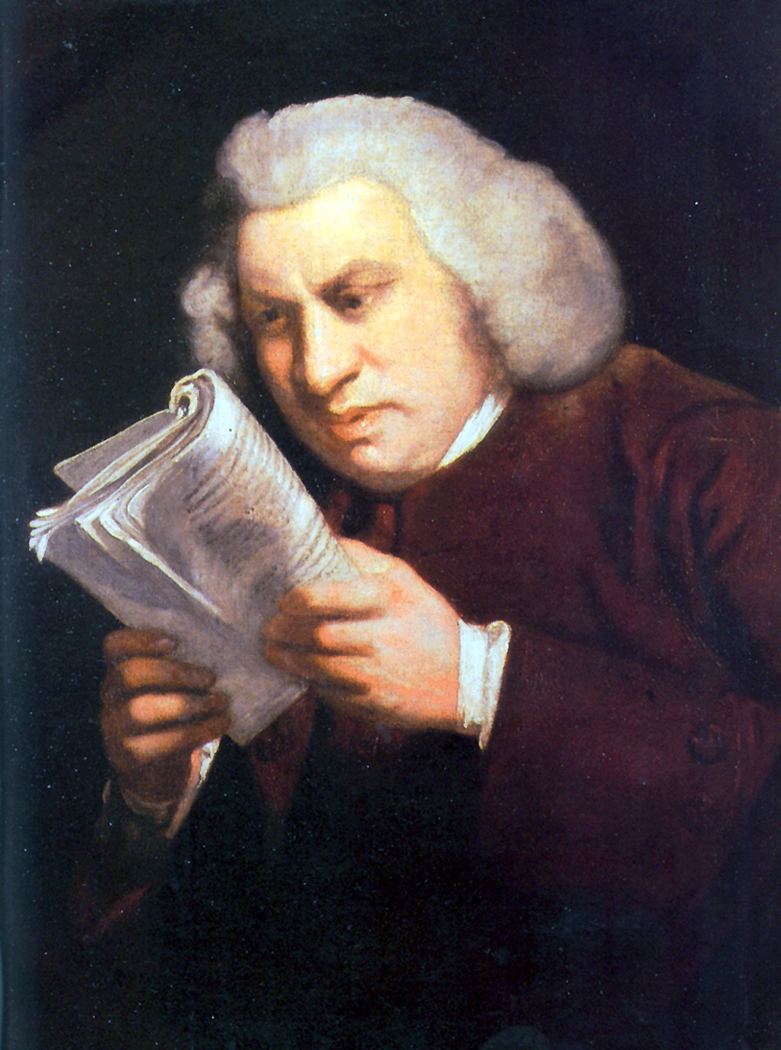
Johnson by Joshua ReynoldsNeedless to say, my love of such sentences caused me some embarrassment during my years as a practicing journalist, where I was encouraged to keep my sentences simple and clear. I am sure I must have tested the patience of many an editor over those years. I did pick up one countervailing habit: My paragraphs tend to be short. Often a single sentence per.

It is not only 18th century writing I enjoy. The same love of the trailing, dawdling sentence gives me pleasure in William Faulkner, James Agee and Lawrence Durrell. I want to settle into each sentence as if it were a good book.

I remember in the second or third grade learning to diagram sentences. Noun, verb, object; subject, predicate. This was the armature upon which was built increasingly baroque structures. (When we had assignments to use our newly learned vocabulary words in sentences, I always tried my best to use the entire list in a single sentence.)

What kind of sentence am I talking about? When Gibbon talks ironically about how the spiritual “gifts” of early Christians as well feathered their own nests as proved their piety, he follows with: “Besides the occasional prodigies, which might sometimes be effected by the immediate interposition of the deity when he suspended the laws of nature for the service of religion, the Christian church, from the time of the apostles and their first disciples, has claimed an uninterrupted succession of miraculous powers, the gift of tongues, of vision, and of prophecy, the power of expelling daemons, of healing the sick and of raising the dead.”  I like that: “suspending the laws of nature for the service of religion.” Gibbon has a way of making clear his own skepticism through irony while at the same time never crossing the line into a simple “Nya-nya.” It is a performance of extreme delicacy.tristram shandy hogarth

Tristram Shandy lays the (comic) misfortune of his life to the interrupted coitus of his conception, explaining in one grand run-on sentence: “Believe me, good folks, this is not so inconsiderable a thing as many of you may think it; — you have all, I dare say, heard of the animal spirits, as how they are transfused from father to son, etc., etc. — and a great deal to that purpose: — Well, you may take my word, that nine parts in ten of a man’s sense or his nonsense, his successes and miscarriages in this world, depend upon their motions and activity, and the different tracts and trains you put them into, so that when they are once set a-going, whether right or wrong, ’tis not a half penny matter, — away they go cluttering like hey-go mad; and by treading the same steps over and over again, they presently make a road of it, as plain and as smooth as a garden-walk, which, when they are once used to it, the Devil himself sometimes shall not be able to drive them off it.”

The extreme pleasure of the book is as much linguistic as it narrative.

Or from The History of Tom Jones, A Foundling: “For the reasons mentioned in the preceding chapter, and from some other matrimonial concessions, well known to most husbands, and which, like the secrets of freemasonry, should be divulged to none who are not members of that honourable fraternity, Mrs. Partridge was pretty well satisfied that she had condemned her husband without cause, and endeavored by acts of kindness to make him amends for her false suspicion.”

Simple thoughts may be satisfied with simple sentences, but knotty thoughts, thoughts of subtlety and complexity, require longer compound and compound-complex sentences; sentences in which ideas are parsed, turned over, elucidated, tested and rubbed up against themselves.

(I am reminded that in The Bear, a portion of Faulkner’s Go Down, Moses, a single sentence continues for 11 pages. To say nothing of Molly Bloom’s soliloquy. Hurrah.)

These sentences I admire and enjoy, are not mere coagulations of verbiage, but rather like puzzle pieces that fit together ultimately to make a perfect construction. Or the worms and gears of an intricate machine turning smoothly. They might be compared to their advantage to the miserable word salad of unfinished thoughts and undefined terms of the blather of Republican presidential candidate Donald Trump: long empty strings of cliches and bigotry, and cliched bigotry, in a never-ending stream of inanities and incoherencies that never reach that concluding peroration that brings all the eggs into a single meaningful basket. It is language spewed, not built. My heroes learned their lessons from the classical languages, whence Aeschylus can have his opening speaker in The Agamemnon go on for a full page before punctuating his speech with the single concluding verb that ties the whole performance up in a word that makes sense of all that came before. Grammar can be used to effect: Trump hardly knows there is such a thing as grammar. He is a bilge pump.

But all this is only prolog to my actual subject for today: The odd and magical concatenation of entries, definitions, etymologies and examples found in the famous dictionary of Dr. Johnson. Johnson has his many prejudices that today strike the reader as comical, as when he defines “oats” as “A grain, which in England is generally given to horses, but in Scotland supports the people.” Or defines “stateswoman” as: “A woman who meddles with publick affairs. In contempt.”

rhinoNevertheless, if you consider the immensity of the task he set himself in 1746 — a task that wound up taking away nine years of his life — you must admire his profound sincerity and deep devotion. He put together the first comprehensive English dictionary, and in doing so, pretty well had to come up with the plan for it ab ovum. (There were glossaries and word lists, and a few dictionaries before him, but none complete or even attempting to be so). If his definitions sometime seem a trifle punctilious, it must be remembered he was pretty much inventing the whole idea. The definitions range from those that hardly convey what we would consider sufficient information (“Rhinoceros: A vast beast of the East Indies armed with a horn on his front”) to those that seem to do verbal somersaults to convey their meaning (“Network: Anything reticulated or decussated, at equal distances, with interstices between the intersections.” By the way: “To Decussate: To intersect at acute angles” and: “Reticulated: Made of network; formed with interstitial vacuities.”)swine

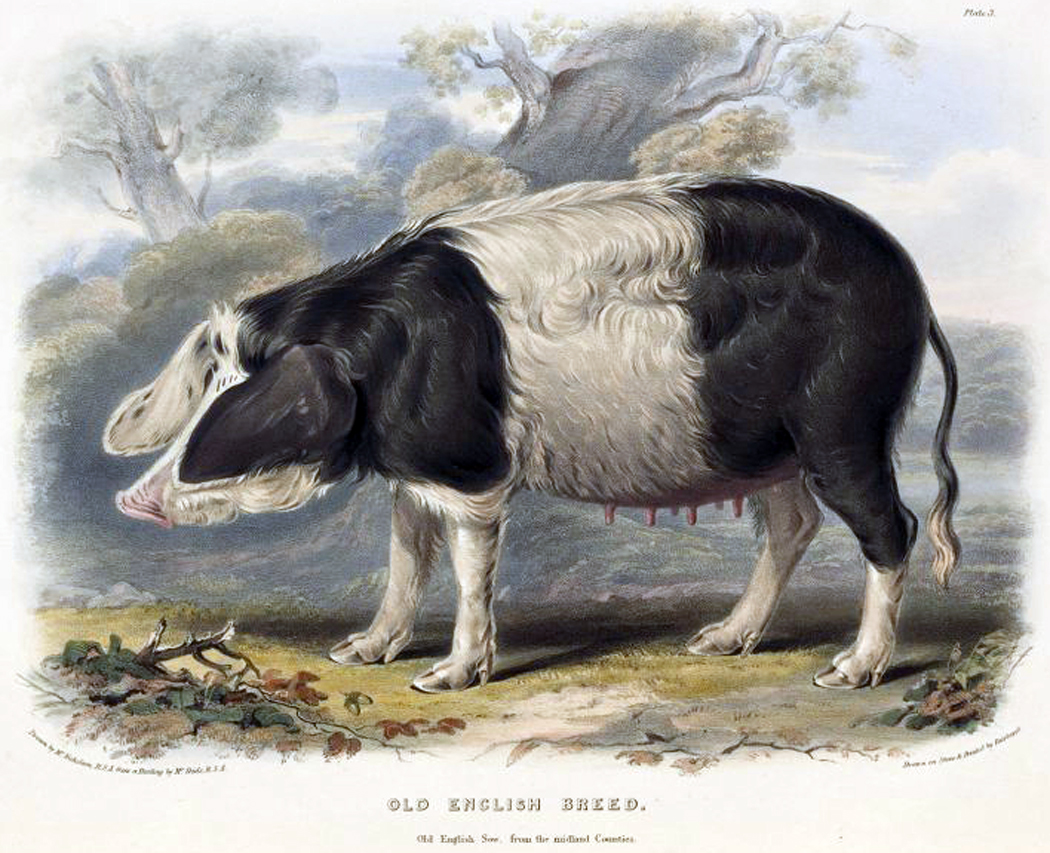
We are so used to a more casual and informal speech these days, that it is a pleasure to see these words in their after-five formal dress. (“Rosin: Inspissated turpentine; a juice of the pine.”) Remember, Johnson had to invent his definitions from sheer air. How would you do if you were faced with defining several thousand words from scratch? How would you define “lard,” for instance. For Johnson, it was “the grease of swine.” There is both an elegance to that terse explanation, but also, to our ears, a kind of humor. We don’t speak that way anymore.

Or how would you explain “smoke?” Johnson: “ The visible effluvium, or sooty exhalation from anything burning.” “Sun?” “The luminary that makes the day.”

Den? “A cavern or hollow running horizontally, or with a small obliquity, under ground; distinct from a hole, which runs down perpendicularly.” The nicety of the distinction is deeply felt for someone who cares about language.

“Mouth: The aperture in the head of any animal at which the food is received.”

“Tree: A large vegetable rising, with one woody stem, to a considerable height.”

“Wolf: A kind of wild dog that devours sheep.”

“Orgasm: Sudden vehemence.”

Can you do better? Well, in some cases, yes, but only because we have several hundred years worth of lexicography behind us (and less delicacy about sex). Remember, Johnson was inventing the thing, a first draft.

I like it when the language is wearing its white tie and waistcoat: “Cough: A convulsion of the lungs, vellicated by some sharp serosity. it is pronounced coff.” If you flip the pages, you find also: “To Vellicate: To twitch; to pluck; to act by stimulation.”

Or: “Whey: The thin or serous part of milk, from which the oleose or grumous part is separated.”

Some of the definitions bear the wisdom of Johnson’s worldview, giving us more than we may actually need to know: “Compliment: An act, or expression of civility, usually understood to include some hypocrisy, and to mean less than it declares.”

There are many words that no longer survive in any meaningful form: “Stirious: Resembling icicles.” And there are words where Johnson threw up his hands: “Stammel: Of this word, I know not the meaning.” (OED says, “A coarse woolen cloth,” and “a shade of red in which the cloth was commonly dyed”).

There are moments where the lexicographer simply got things wrong, or took a metaphorical use as a second definition. He defined “pastern” as “the knee of a horse.” It is rather, part of the foot of a horse. When a woman  asked Johnson how he came to make such a mistake, he answered, “Ignorance, Madam, pure ignorance.”

But by and large, his work was an admirable thing, for which I thank him. And thank him for the pleasure I gain both from his formality, his erudition, and the not infrequent (and often unintended) humor. It is impossible to read through the dictionary and not sense the very particular and idiosyncratic man behind it. Most dictionaries feel distant, academic, objective. Not Johnson’s book: Who read it, hears the blood and bones behind it. Everything in it — and especially its preface — its intensely personal. Its triumphs and its failings are human and profoundly so.

This shows nowhere more than in his botany and zoology. There were many animals with which he clearly had no first-hand information. Some of these were merely legendary, and often a skepticism of such hippogryphs comes out in his entry. Sometimes not.

alligator crocodile“Alligator: The crocodile. This name is chiefly used for the crocodile of America, between which, and that that of Africa, naturalists have laid down this difference, that one moves the upper and the other the lower jaw; but this is now known to be chimerical, the lower jaw being equally moved by both.”

“Salamander: An animal supposed to live in the fire, and imagined to be very poisonous. Ambrose Parey has a picture of the salamander, with a receipt for her bite; but there is no such creature, the name being now given to a poor harmless insect.”

“Tarantula: An insect whose bite is only cured by musick.”

camelopard“Camelopard: An Abyssinian animal, taller than an elephant, but not so thick. He is so named because he has a neck and head like a camel; he is spotted like a pard, but his spots are white upon a red ground. The Italians call him giaraffa.”

It is fun to read through the dictionary as a kind of bizarro-world view of 18th century natural science, punctuated by Johnson’s peculiar phraseology and word choice: “Tadpole: A young shapeless frog or toad, consisting only of a body and a tail; a porwiggle.” As for the tail: “That which terminates the animal behind; the continuation of the vertebrae of the back hanging loose behind.”

I wish I could go on with so many more entries, but I can only end with a few.

starfish“Starfish: A fish branching out into several points.”

“Frog: A small animal with four feet, living both by land and water, and placed by naturalists among mixed animals, as partaking of beast and fish. There is likewise a small green frog that perches on trees, said to be venomous.”

“Toad: An animal resembling a frog; but the frog leaps, the toad crawls: the toad is accounted venomous, I believe truly.”

“Wasp: A brisk stinging insect, in form resembling a bee.”

“Serpent: An animal that moves by undulation without legs. They are often venomous. They are divided into two kinds; the viper, which brings young, and the snake, that lays eggs.”

“Lizard: An animal resembling a serpent, with legs added to it.”

“Shrewmouse: A mouse of which the bite is generally supposed venomous, and to which vulgar tradition assigns such malignity, that she is said to lame the foot over which she runs. I am informed that all these reports are calumnious, and that her feet and teeth are equally harmless with the mouse. Our ancestors however looked on her with such terrour, that they are supposed to have given her name to a scolding woman, whom for her venom they call a shrew.” (vide:  “Shrew: A peevish, malignant, clamorous, spiteful, vexatious, turbulent woman.”)

elephant“Elephant: The largest of all quadrupeds, of whose sagacity, faithfulness, prudence , and even understanding, may surprising relations are given. This animal is not carnivorous, but feeds on hay, herbs and all sorts of pulse; and it is said to be extremely long lifed. It is naturally very gentle; but when enraged, no creature is more terrible. He is supplied with a trunk, or long hollow cartilage, like a large trumpet, which hangs between his teeth, and serves him for hands: by one blow with his trunk he will kill a camel or a horse, and will raise a prodigious weight with it. His teeth are the ivory so well known in Europe, some of which have been seen as large as a man’s thigh, and a fathom in length. Wild elephants are taken with the help of a female ready for the male: she is confined to a narrow place, round which pits are dug; and these being covered with a little earth scattered over hurdles, the male elephants easily fall into the snare. In copulation the female receives the male lying upon her back; and such is his pudicity, that he never covers the female so long as anyone appears in sight.”

And the elephant also brings us back to the GOP and its excrescences: “Trumpery: Something fallaciously splendid; something of less value than it seems.”