Archive

Tag Archives: english majors

I was an English major and I’m married to an English major and it’s hard being an English major and only getting harder. An English major feels genuine pain hearing the language abused, mal-used, corrupted and perverted. 

I’m not talking here about outdated grammar rules and a fussy sort of prisspot pedantry. As a matter for fact, one of the most persistent pains a true English major suffers is such misplaced censure, especially when interrupting a casual speaker to let them know that “them” is plural and “speaker” is singular. In my book, this is merely rude. A caboose preposition is nothing to lose sleep over. 

No, what I’m writing about here is are things that are genuinely ugly or purposely unclear, or overly trendy, to the point of losing all meaning. You know — politics. That and corporate language, or management speech — which I call “Manglish” — is a great corrupter of speech. 

“We have assessed the unprecedented market shifts and have decided to pivot this company’s new normal to a deep-dive into a robust holistic approach to our core competency, circling back to a recalibrated synergy amid human capital in solidarity with unprecedented times.”

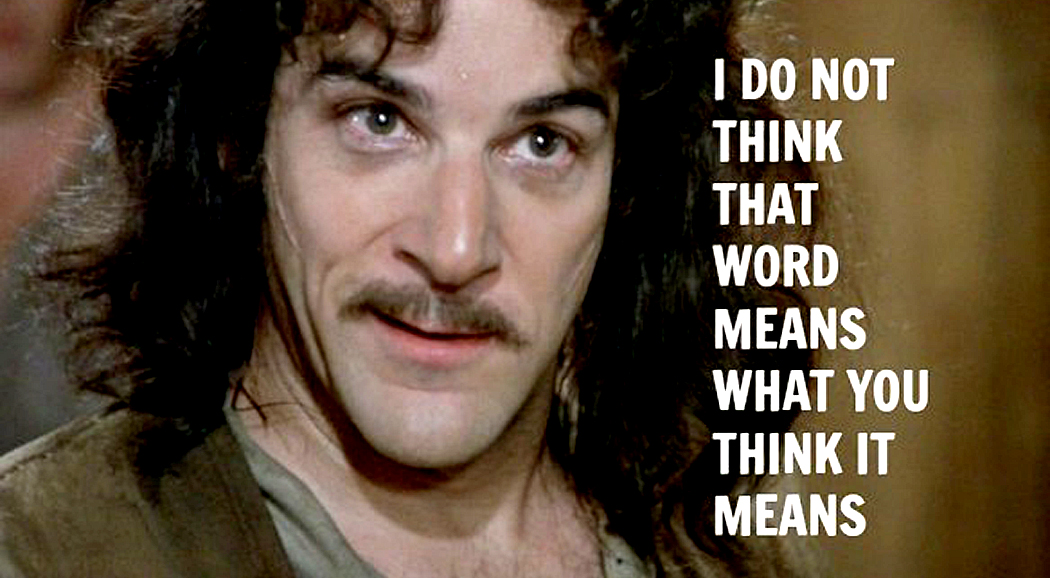
Committees try to make language sound profound and wind up writing piffle. I’m sure it was a committee that agreed in Iredell County, N.C., to make the county slogan, “Crossroads for the future.” I do not think that word means what you think it means. 
I wrote for a daily newspaper and language was my bread and butter, but the higher you go up the corporate ladder, the worse your words become. I remember the day they posted a new “mission statement” on every other column in the office, filled with buzz-word verbiage that didn’t actually mean anything. I looked at my colleague and said, “If I wrote like that, I’d be out of a job.”

But it isn’t just Manglish. Ordinary people are becoming quite lax about words and meanings. Too often, if it sounds vaguely right, it must be so. And you get “For all intensive purposes,” “It’s a doggy-dog world,” being on “tender hooks,” or “no need to get your dandruff up.”

“I’ve seen ‘viscous attack’ too many times recently,” my wife says. “It gives me an interior pain like a gall bladder attack.” 

And the online world is full of shortcuts, some of which are quite clever, but most of which are just barbarous. An essay about digital usage is a whole nother thing. Not room here to dive in. 

But, there is a world of alternative usage that is not standard English, that any real English major will welcome as adding richness to the mother tongue. Regionalisms, for instance. Appalachian dialect: “I’m fixin’ to go to the store;”— actually, that is “stoe,” rhymes with “toe” —  “I belong to have a duck;” “I have drank my share of Co-Cola.”

And Southern English has served to solve the historical problem of having lost the distinction between the singular “thee,” and the plural “you,” with the plural “you all,” or “y’all.” Although, more and more “y’all” is now being used also for the singular, and so is becoming replaced with “all y’all.” Keep up, folks. 

Then, there’s African-American English, which has enriched the American tongue immensely, as has Yiddish: “Shtick,” “chutzpah,” “klutz,” “schmooze,” “tchotchke.”

Regionalisms and borrowings are like idioms. Sometimes they don’t really make sense, but they fall comfortably on the tongue. “Who’s there?” “It’s me.” Grammatically, it would be proper to say “It is I,” but no one not a pedant would ever say such a thing. The ear is a better arbiter than a rulebook. 

George Orwell ended his list of rules for writing with the most important: “Break any of these rules sooner than say anything outright barbarous.”

English is a happily promiscuous tongue and so much of the richness of the language comes from borrowings. But there are still other problems: bad usage, misuse of homonyms, loss of distinctions. The English major’s ears sting with each onslaught. 

What causes our ears to burn falls into three broad categories. Things that are just wrong; things that are changing; and things that offend taste. Each is likely to set off an alarm ping in our sensitive English major brains. 
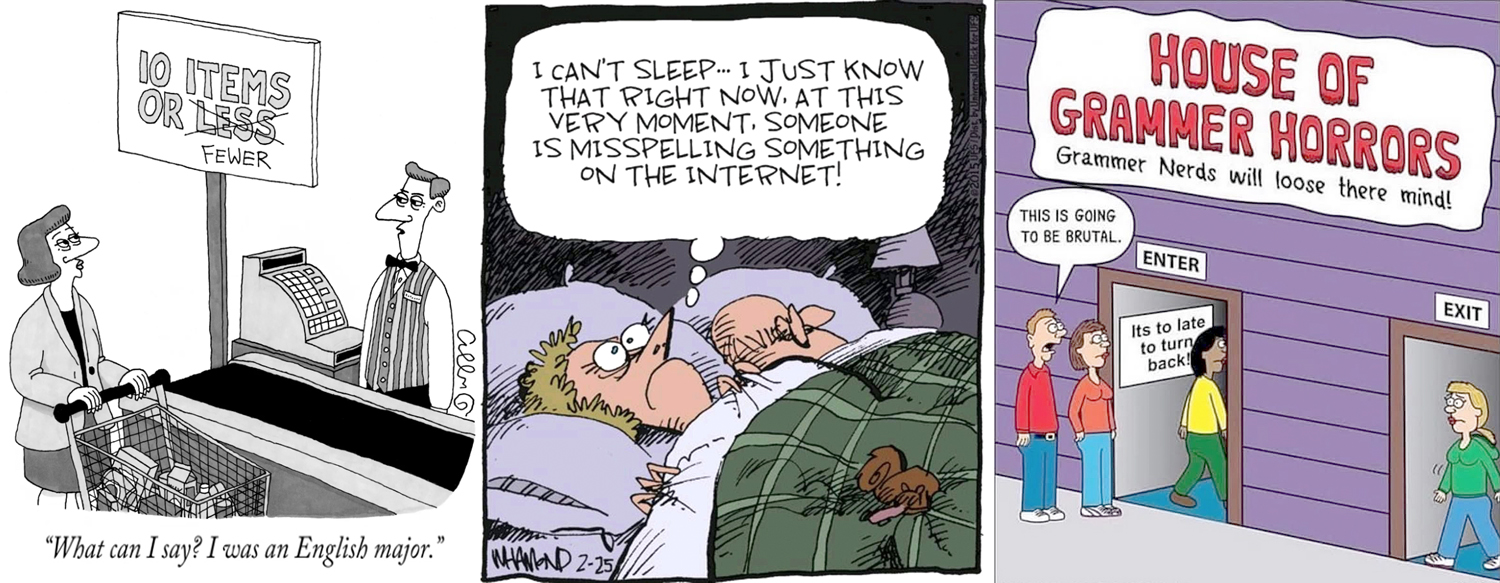
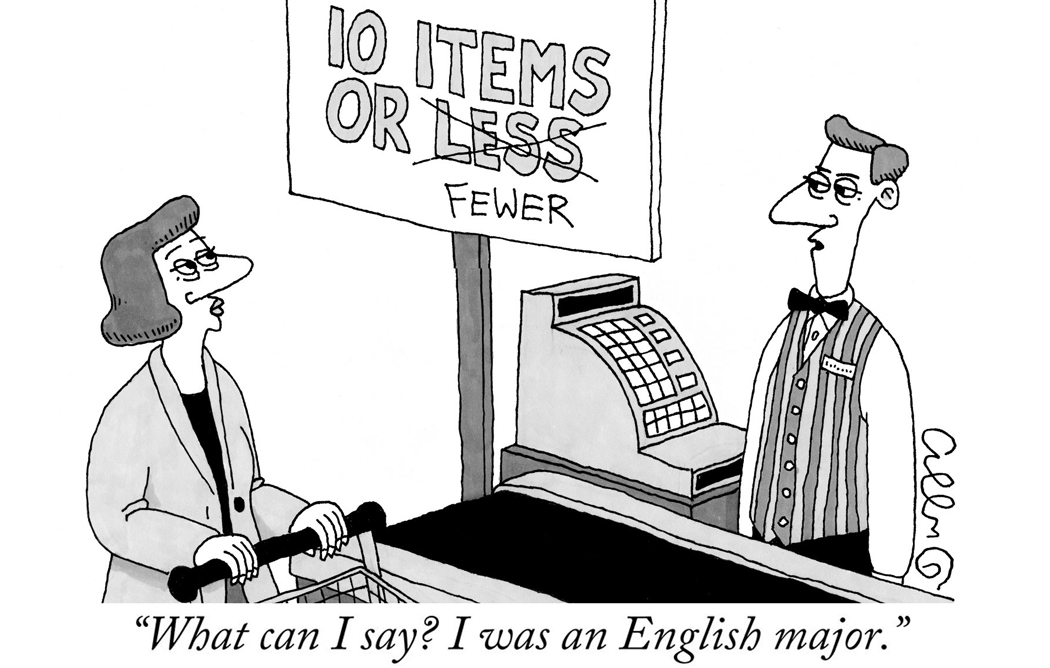
Every time I go to the grocery store I am hit with “10 items or less.” Few people even notice, but the English major notices; we don’t like it. “Comprised of” is a barbarism. “Comprises” includes all of a certain class, not some items in a list of choices. I feel slapped on the cheek every time I come across it mal-used. 

And homonyms: a king’s “rein,” or a book “sited” by an article, or a school “principle” being fired. It happens all the time. It is endemic online. “Their,” “they’re,” “there” — do you know the difference? “You’re,” “your?” Most young’uns IM-ing on their iPhones don’t seem to care. 

And fine distinctions of usage: I am always bothered when I see a murderer get “hung” in an old Western, when we know he was “hanged.” 

Again, most Americans hardly even notice such things. They all get by just fine not caring about the distinction between “e.g.” and “i.e.” In fact, they can get all sniffy about it. 

I know a former medical transcriptionist who typed up a doctor’s notes each day, and would correct his grammar and vocabulary. She corrected the man’s “We will keep you appraised of the outcome,” with “apprised,” and each time, he would “correct” that back to “appraised.” Eventually, she gave up on that one. 

English majors know the difference between “imply” and “infer,” and it causes a hiccup when they are mixed up. “Disinterested” mean having no stake in the outcome; “uninterested” means you cannot be arsed. They are not interchangeable. 

We EMs cringe when we hear “enormity” being used to mean “big,” when it actually means a “great evil.” And “unique” should remain unique, unqualifiable. Of course, “literally” is used figuratively literally all the time.  Something is not “ironic” simply because it is coincidental. 

I hear the phrase “begging the question” almost every day, and always misused. It refers to circular reasoning, not to “raising the question.” I hold my ears and yell “Nya-nya-nya” until it is over. 

Some things, which used to be wrong, are slowly being folded into the language quietly, and our EM ears may still jump at hearing them. “Can” and “may” used to mean distinct things, but that difference was lost at least 100 years ago. We can give that one up. And “hopefully” used to be a pariah word, but we have to admit, it serves a grammatical function and we have to let it in, however grudgingly. 

My wife is particularly sensitive to the non-word, “alot.” She absolutely hates it. I understand, although I recognize a need for it. “A lot” is a noun, and sometimes we use it as an adjective: “I like chocolate a lot.” Perhaps “alot” will eventually become an adjective. Not for Anne. 

People are different and have differing talents. We seem to be born with them. Some people grasp mathematics in a way a humanities student will never be able to match. Some have artistic or musical talent. We can all learn to play the piano, but only certain people can squeeze actual music out of the notes. 
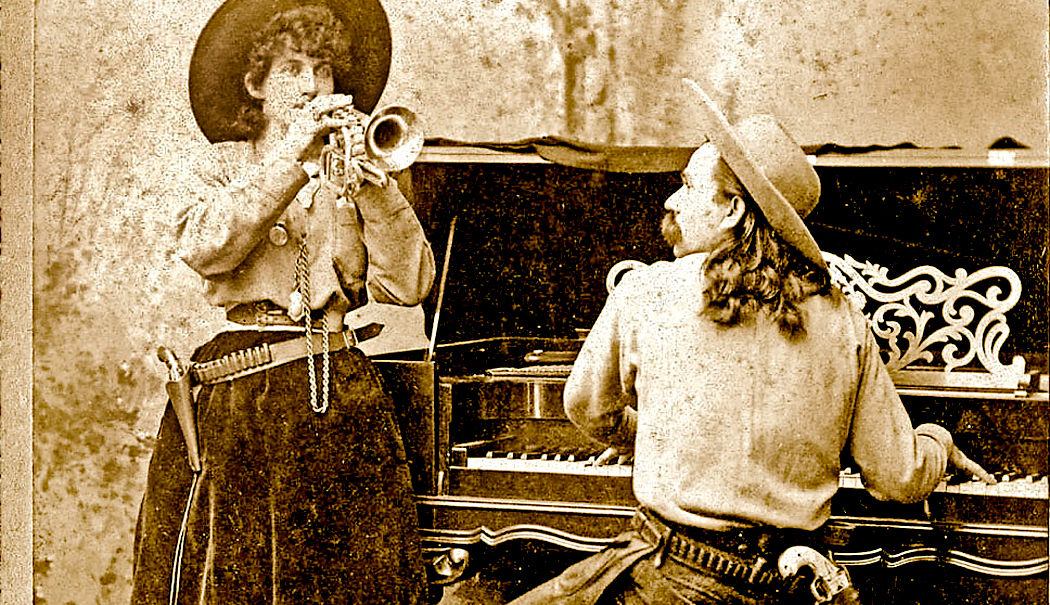
And each of us can learn our native tongue, but some of us were born with a part of our brains attuned to linguistic subtlety. We soaked up vocabulary in grade school; we won spelling bees; we wrote better essays; we cringe at the coarseness of political speech. Language for the born English major is a scintillating art, with nuance and emotion, shadings and flavors. We savor it: It is not merely functional. 

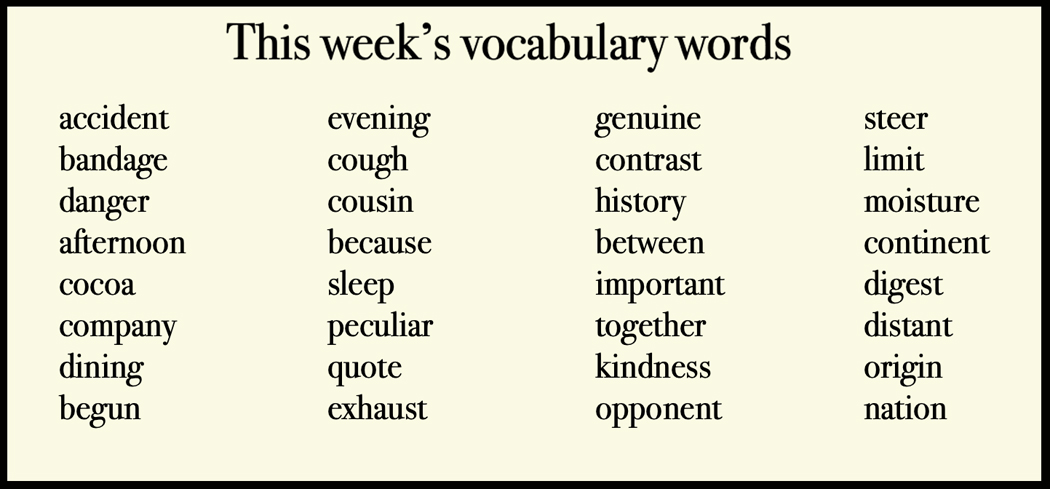
(I loved my vocabulary lessons in grade school, and when we were asked to write sentences using that week’s new words, I tried to use them all in a single sentence. People who show off like that often become writers.)
Just as my piano playing, even when I learned whole movements of Beethoven sonatas, was always the equivalent of speaking English as a second language, my best friend, Sandro, could sit at a piano and every key was fluent, natural, and expressive. It was a joy to hear him play; a trial for me just to hit the right notes. 

I am saying that those of us who gravitate to speech, writing, and language in general, have something akin to that sort of talent. It is inherent, and it can be a curse. Bad language has the same effect on our ear as a wrong note on a piano. 

We can feel the clunkiness of poorly expressed thoughts, even if they are grammatical. Graceful language is better. And so, we can rankle at awkward expressions.
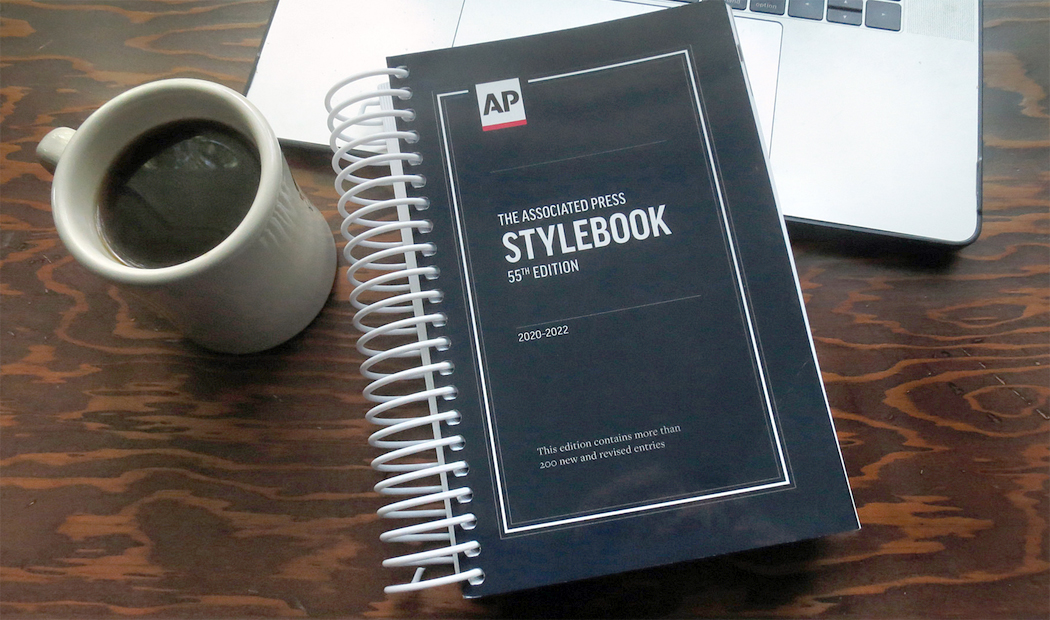
I have a particular issue, which I share with most aging journalists, which is that I had AP style drummed into me — that is, the dicta of the Associated Press Stylebook, that coil-bound dictator of spelling, grammar and usage. One understands that AP style was never meant to be an ultimate arbiter of language, but rather a means of maintaining consistency of style in a newspaper, so that, for instance, on Page 1 we didn’t have a “gray” car and on Page 3 one that was “grey.” 

And so, the rules I lived by meant that there was no such thing as 12 p.m. Is that noon or is that midnight? Noon was neither a.m. nor p.m. Same for midnight. They had their own descriptors. “Street” might be abbreviated in an address, but never “road.” Why? I never knew, but in my first week on the copy desk I had it beaten into me when I goofed. 

“Back yard” was two words, but one word as an adjective, “backyard patio.” Always. “Air bag,” two words; “moviegoer, one word. “Last” and “past” mean different things, so, not “last week,” unless Armageddon is nigh, but “this past week.” Picky, picky. 

I had to learn all the entries in the stylebook. The 55th edition of the AP Stylebook is 618 pages. And this current one differs from the one I had back in 1988; some things have changed. Back then, the hot pepper was a “chilli pepper,” and the Southwestern stew was “chili.” I lived and worked in Phoenix, Ariz., and we all understood this would get us laughed off the street, and so exceptions were made: yes, it’s a chile. 

Here I am, nearly 40 years later, and retired for the past 12 years, and I still tend to follow AP style in this blog, with some few exceptions I choose out of rebellion. But I still italicize formal titles of books, music and art, while not italicizing chapter names or symphony numbers, per AP style. I still spell out “r-o-a-d.” It’s a hard habit to break. 
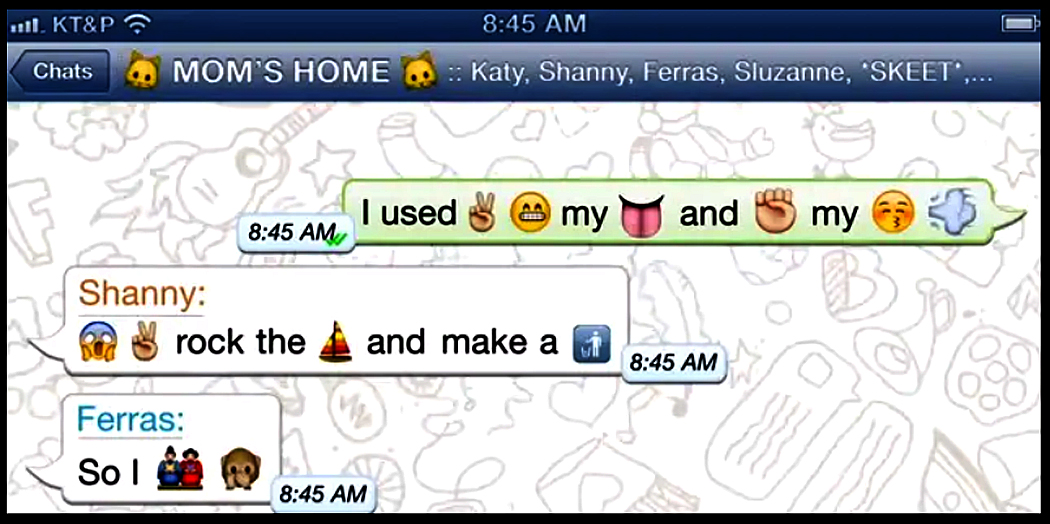
The online world seems to care little for the niceties of English. We are even tending back to hieroglyphs, where emojis or acronyms take the place of words and phrases. LMAO, and as a card-carrying alte kaker, I often have to Google these alphabet agglutinations just to know what my granddaughters are e-mailing me. Their seam to be new 1s each wk. 

And don’t get me started on punctuation.
When faced with some difficult problem of geometry or algebra, I usually just throw up my hands and say, “Don’t look at me, I was an English major.” I’ve noticed, however, that Anne will always phrase that a little differently. She say would shrug and say, “I’m an English major.” 

The difference in tense speaks to how we each view ourselves and our place in the world. When it comes to things such as grammar or usage, I tend to be more flexible while Anne has more in common with a British sergeant-major. For her, there is right and there is wrong. 

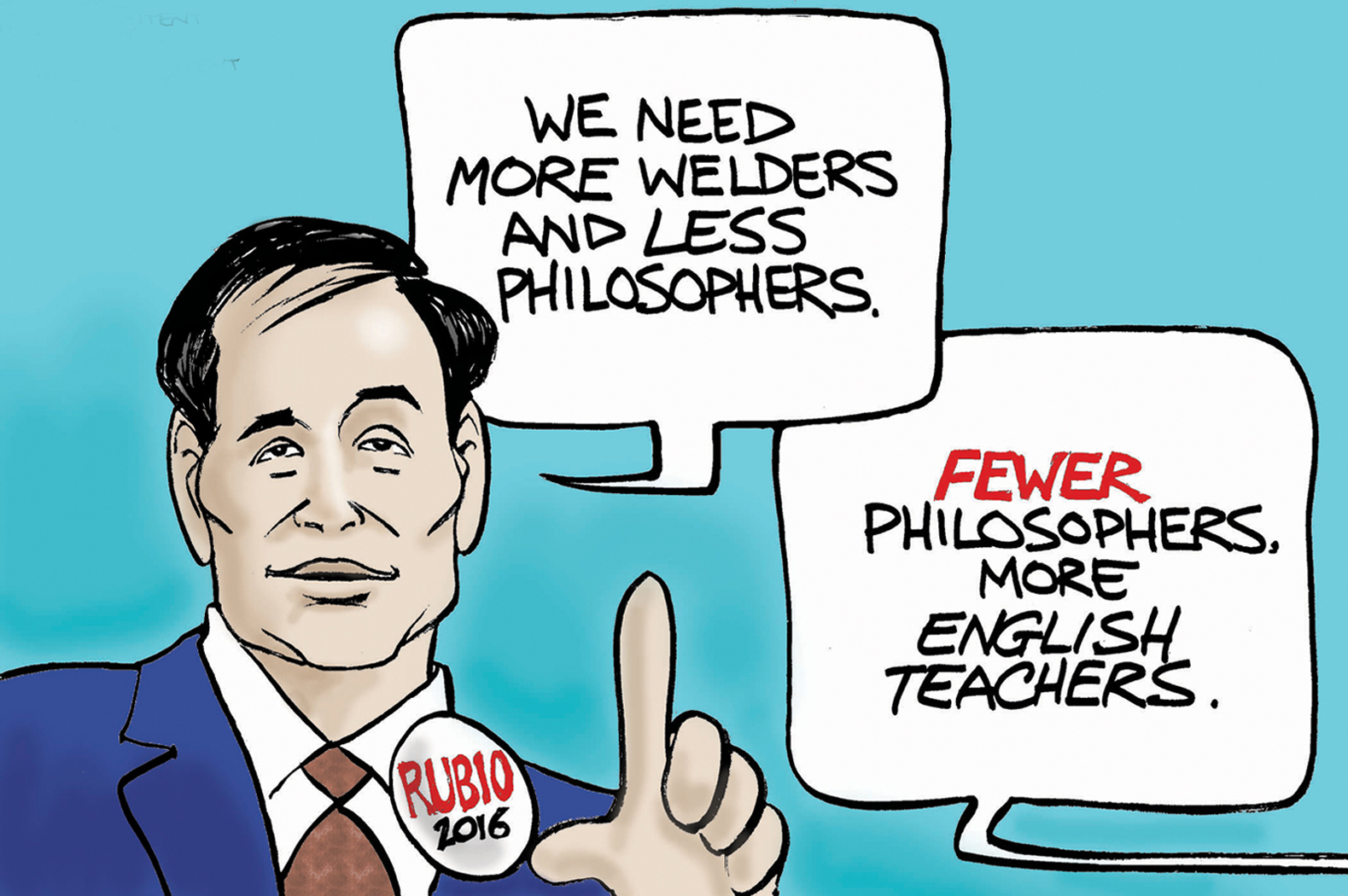
Of course, there are those more lax than I am and some more unbending than Anne. It is a spectrum. I have many peeves about poor usage, and especially misused words. I admit the definitions of such words as “enormity” and “disinterested” are changing and in the future they will mean whatever their speakers intend them to mean. But for now, it gives me hives when I hear a newscaster say, “There are less people having babies now.” Drives me nuts. But for Anne, this is not so much fighting a rear-guard action against change, as building a fortress against incoherence. “Things mean what they mean; illiteracy is no excuse.” 

To gauge where you fall in the spectrum, consider a simple sentence: “Who did you give the book to?” There are two things “wrong” with this sentence, but how you intend to fix it, or fix it at all, may help you decide. 

If you are one of those people who still believe that a sentence should not end with a preposition, then you will change it to, “To who did you give the book?” But that sounds all wrong. No one would actually say that. 

And that’s because of the other problem — “who” should be “whom.” And so it becomes “To whom did you give the book?” But that can sound pedantic. So, you choose one mistake over the other and wind up with, “Whom did you give the book to?” 

So, you pick your poison. Of course, in reality, you wouldn’t say any of these. What you would actually say is “Hooja give the book to?” And language is filled with hoojas. 

We don’t speak word-by-word, but in phrases, and those phrases become units all their own. “Jeet jet?” Did you eat yet? “I’m gonna sell the old Ford.” “I dunno what is correct.” Sometimes these vocal elisions make it back into print. How many times have you seen “I would of gone” instead of “I would have gone?” But, of course, this isn’t so much an illiteracy but a back-transference from spoken language. You say, “I would’ve gone.” If that’s what you hear, you might very well think you’ve heard “would of” and then use it in your Tweet. 

These back-transferences now often make it into print, mostly in dialog in fiction, to make the speech sound more natural. Ultimately, these have a chance to become standard English, and in the same way that “a nuncle” became “an uncle” by printing what the ear heard. At some point in the future, it will be in the Chicago Manual of Style to write, “We’re gonna study alot of stuff we dunno much about.” 

That brings up “a lot,” which is one of the main bugbears for Anne. She yells at the page when she comes across “alot.” The word bothers me, too, but not as much as it rankles her. And I have to admit that at some point in the not-too-distant future, it will be common in dictionaries. 

That’s how languages go. What is an ugly and ignorant solecism in one age becomes propriety in the next. Garish new money becomes respectable old money when the billionaire entrepreneur is knighted. 

So, language changes, but almost never by fiat. Suggestions can be made. They may catch on, they may not. 

One of the most successful came with Noah Webster’s desire to create a “more American” spelling. His 1806 Compendious Dictionary of the English Language sought to simplify spelling. Eventually, his changes caught on and we now spell “color” without a superfluous “u,” and “theater” with the “e” in its functional place. 

Among British language reformers were George Bernard Shaw, H.G. Wells, Alfred Tennyson, and Charles Dickens. A Simplified Spelling Society was created in 1908 (currently, the English Spelling Society). America had its own Simplified Spelling Board, begun two years earlier, with a grant from Andrew Carnegie. President Theodore Roosevelt issued an order for all federal documents to adopt the suggested new spellings. That lasted short while. The old spellings were soon re-instated. The Louisville Courier-Journal published an article ridiculing him, which stated: “Nuthing escapes Mr. Rucevelt. No subject is tu hi fr him to takl, nor tu lo for him to notis.”

But if these things can’t be imposed from above, they can take hold from below. Consider the effect of Twitter and the Internet on language: “R U There?” Texting language now occasionally shows up in print. Expect more of it.

Language changes because there is a need, or because the newer versions seem simpler, or get adopted because technology or culture changes. 

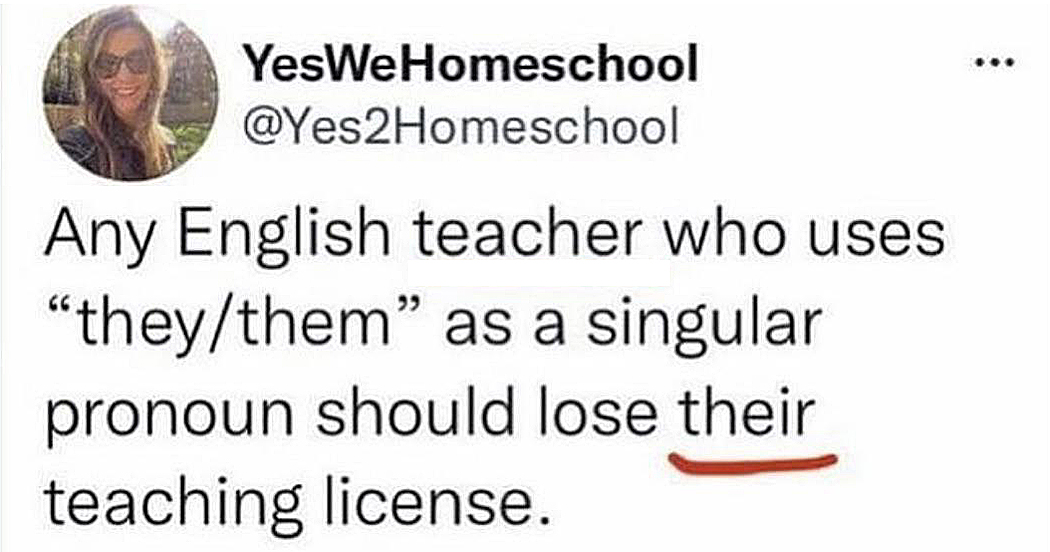
There are those who want to invent new pronouns to accommodate the rising awareness of gender fluidity. Some new words have been floated, such as “xe,” “xyr,” “em,” or “fae.” None has caught on. Given time, one of these may win out and may become normal. I don’t count on it. But the use of a so-called “singular they,” has long infiltrated common usage: “Everyone should take their hat off.” Solves an awkward problem (“his or her” is just cumbersome) and has actually been hiding in the language for centuries, no matter what edicts are handed down from hide-bound grammarians. 

The last time a new gender-bound word has successfully entered the language was “Ms.” It is now used by almost everyone, and by many who don’t even know it was lobbied for in the 1970s when Ms. magazine first began publication. (And first proposed as far back as 1901). It is just a normal part of our vocabulary now, although those of us who remember when it was new can recall the angry backlash that came from the stodgier sections of our society. 

Another group wants to get rid of apostrophes in contractions. Dont need them, they say. Context makes the meaning clear. “What Id like to study is the human id.” “Dont eat the yellow snow.” There are very few places where the meaning isnt clear, and even with the apostrophes, there is plenty of confusion in the language. 

Linguist Geoff Lindsey points out that in spoken language, we don’t really ever hear the “t” in such words as “can’t.” That when we speak them, the difference between “can” and “can’t” isn’t in the “t” but in the vowel. If you say, “I can’t do it,” you actually say, “I can’ do it.” But you pronounce the “a” as the “a” in “bad,” while when you say “I can do it,” the vowel goes like “ken” — “I ken do it.” 

So perhaps we don’t need the “t” — or perhaps we can just take out the apostrophe and say “cant.” And then write “ken” when we mean the opposite. 

I’m not sure eliminating such apostrophes would make up for the number of supererogatory apostrophes added to create plurals. This is an ugliness that leaves me feeling like King Canute before the sea. It makes me hiccup every time I see it, but I am powerless to stop the rising tide. Perhaps in 40 or 50 years, even the Chicago Manual of Style will accept it as standard. 

There are many normal progressions in the history of languages, expected simplifications and sometimes added complexities. Words that used to be two words became hyphenated expressions and then turned into compound words. Cellphone used to be cell phone; webpage was once web page, then, briefly web-page; hotdog was hot dog. English moves in the direction of eliding these words back down to one. 

It has been pointed out that the perfect tense in English is fading. Where we once said “Have you finished yet” we often say instead, “Did you finish yet.” 

Irregular verbs are being replaced by regularized versions. I remember when I was a journalist and required to use Associated Press style, we had to used “burned” instead of “burnt,” or “dived” instead of “dove.” I liked the older words with more taste in the mouth. But the direction of our language is toward regularization, at least in words less seldom used. We now sneaked instead of snuck; pleaded instead of pled; dreamed instead of dreamt. Maybe at some point “I did it,” will become “I dood it.” 

Also, as we head into the soft middle years of the new century, borrowings from Spanish will become more common. They’ve always been there, from rodeo to hoosegow, but newer ones will proliferate. English has always been promiscuous and up to 80 percent of our vocabulary has been acquired from other languages (depending on your starting point — where was English first English and not related at all to what we speak now?).

And speech is the important issue. English has had a relatively quiescent period for the past several hundred years, as the language has been held steady by print. But as electronic media take over, spoken language is becoming more central, whether spoken on television or radio, or mimicked in texting and tweeting. Before print, English spelling varied widely. It looks like that Wild West of orthography could be our future.

And if so, then the hoojas will take over the tongue. And the didjas, the woodjas, the havyas and canyas.

I was an English major, and how anyone can survive that is a miracle. It is only through love that I have survived: love of the language I speak and write, a love that was nearly extirpated by those who explain literature and write the prefaces to anthologies. The experts, that is. 

It was nurtured, however, by many a teacher and professor, who also love the language and its productions. I don’t remember ever having an English teacher who propounded such gobbledygook as the professional explainer class regularly emits. (This, by disclaimer, is a class of which I was once a member, having made my living as a critic.)

I tried my best to write clear prose with understandable ideas, but my fellow guild members too often do the opposite. They can take something so simple and direct, so unimpeachably beautiful and clear, and turn it into a tangled knot of impenetrable theory, catching the flying sparrow in the fine mesh net of academic verbiage. I was, more particularly, an art critic, and I always said that I couldn’t read art criticism, that doing so was like eating an old mattress. 

It is the same for much buncombe written about literature and poetry. Something that should be read for pleasure, understanding or solace turns into a midterm exam, the kind that you have in your recurring dreams when you discover you aren’t wearing any pants. 

I am pretty sure such explainers are cases of arrested development, stuck in the sorrowful stage of the sophomore. The memory of having been once a sophomore myself gives me pause. There was a time when I, like so many other young minds, sought to “decode” a poem, finding the hidden meaning in the symbols therein. As if a poem required an enigma machine to untangle its “true”meaning, found in footnotes at the bottom of the page. 

Is Billy Budd a Christ figure? A victim of patriarchy or capitalist oppression. Perhaps he is a Marxist hero. Maybe, he is just a handsome sailor, like Melville tells us. What we are meant to glean from the story’s reading is inherent in the story itself. 

As Archibald McLeish put it: “A poem must not mean but be.” 

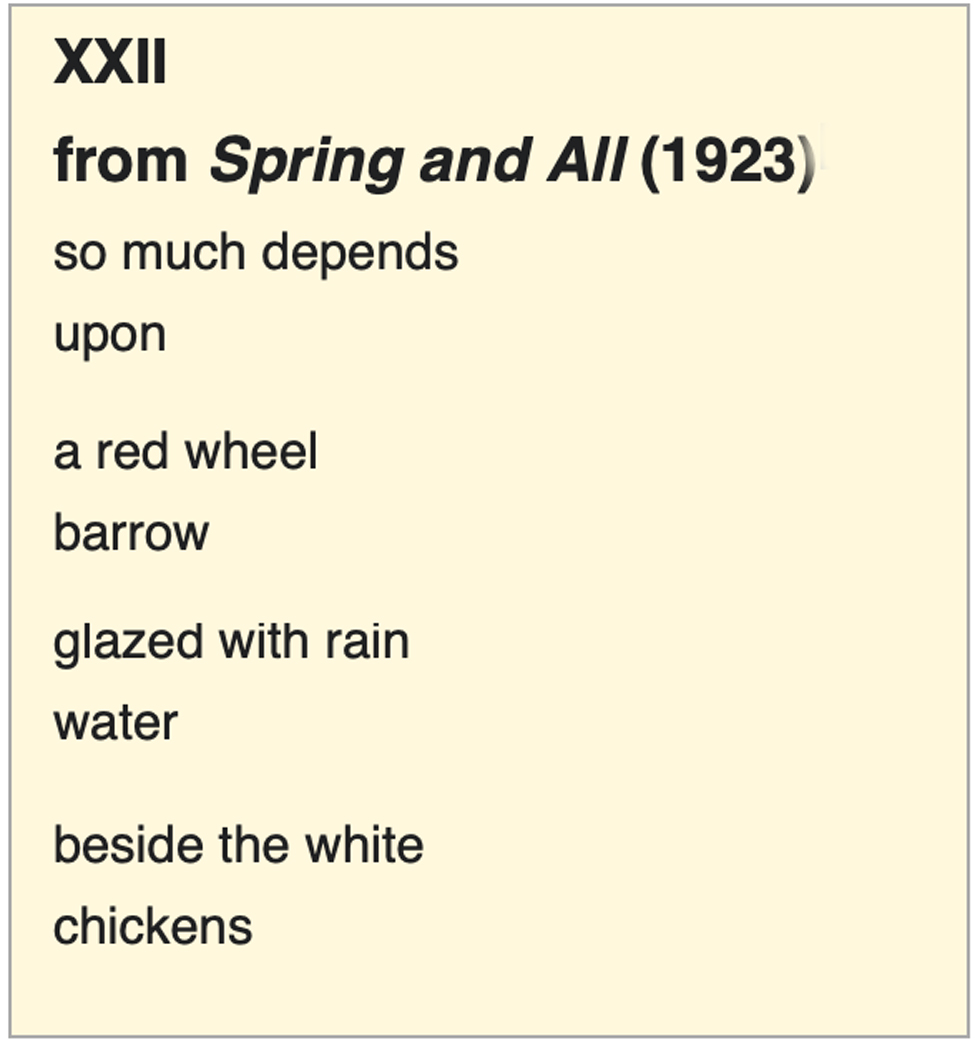
Any good work of literature explains itself, if we are willing to listen, to pay attention and to stay within the work and not require a university seminar to unpack. All this comes to mind because of a short discussion recently about an eight-line poem by William Carlos Williams. And a comment by critic Dave Wolverton who wrote: “The poem was meant to be appreciated only by a chosen literary elite, only by those who were educated, those who had learned the back story…” 

Such ideas raise the hackles. 

The poem in question couldn’t be simpler, more complete, more self-explanatory, but no, Mr. Wolverton tells us we need to take a secret decoder ring to it, to find out what it is “really” about. 

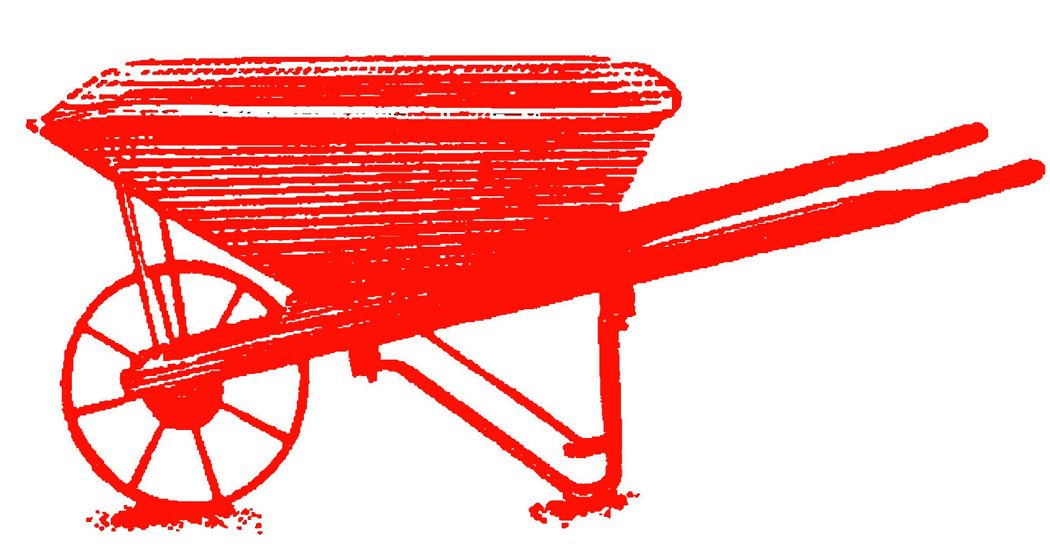
The back story he refers to is of the poet-physician, who was attending the hospital bedside of a dying young girl and happened to look out the window to see a red wheelbarrow and some chickens. First problem: Williams was a doctor in Rutherford, New Jersey, where it is quite unlikely to find chickens outside a hospital window. More likely a traffic jam. 

Second problem is that despite the widespread retelling of this dying-girl tale, Williams himself tells us the genesis of the poem. It “sprang from affection for an old Negro named Marshall. He had been a fisherman, caught porgies off Gloucester. He used to tell me how he had to work in the cold in freezing weather, standing ankle deep in cracked ice packing down the fish. He said he didn’t feel cold. He never felt cold in his life until just recently. I liked that man, and his son Milton almost as much. In his back yard I saw the red wheelbarrow surrounded by the white chickens. I suppose my affection for the old man somehow got into the writing.”

It was first published in 1923, and one head-scratching comment I found suggested the poem was a comment on women getting the vote. How the critic got there from the contents of the poem, I leave to you and perhaps your bong. 

Another sees it as a celebration of the proletariat. This is the kind of stuff that turns high-school students away from poetry and literature and toward auto repair. 

To wit: “The wheelbarrow is an enduring and universal tool, used by people for thousands of years. It is most commonly associated with farming and construction—arguably, the foundation upon which civilization is built. In the poem, the wheelbarrow and its surrounding environment could also nod specifically towards agricultural workers and rural communities. As such, the poem’s contemplation of the wheelbarrow can be read as a meditation on the link between humanity and the natural world—as well as an assertion of the importance of respecting the latter.”

Where is that assertion? Show me the line. 

Elsewhere: “By extension, the wheelbarrow here might be taken to represent the value of the working class. This class — the people actually performing said manual labor, such as farmers, miners, construction workers, etc. — is often stereotyped as being unskilled and unintelligent. Physical work, in general, is often misclassified as ‘lowly’ or ‘simple,’ which ignores the complexity that goes into planting, pollinating, etc. Seeing as this work is often undervalued despite its importance to human survival, the attention given to the wheelbarrow (and, through it, the people who use wheelbarrows) could act as a subtle acknowledgement and celebration of the working class.”

Where do manual laborers spend their time “pollinating?” Et cetera. 

It might be noted that none of any of that shows up in the 16 plain words that comprise the poem. What there is, is a red wheelbarrow and some chickens. They are not symbols, they do not require a gloss. They are, in fact, a wheelbarrow and chickens. It is the ability to see them as just that that is the gift of the poem. They have been separated out of the rest of existence and shown to us as something worthy to be noticed. 

My acquaintance was remembering a common friend who had recently died, who had introduced him to the poem.  

“With my spotty poetry background, I’d never read this gemlike summing up of the power of first impressions. We were probably talking about things that seized our imaginations when we were very young.”

I always took it not as about first impressions, but about the importance of noticing, i.e., paying attention, even to the things you ignore in quotidian life. Paying attention is, for me, tantamount to being alive — I mean really alive, as opposed to merely existing. That is what so much depends on. 

It is also the importance of the senses, as opposed to rationality. So much of what we think is merely done in linguistic categories. House, bird, horse. We tend to value logic and think it is what we hold in opposition to irrationality. But logic has its own pitfalls: It is also thinking in linguistic categories, and so much of what is “logical” is only so in words. Zeno’s paradox never actually prevents Achilles from overtaking the tortoise in a single step. 

As Stephen Fry says over and over, the counter position to superstition and irrationality is not logic, but empiricism. Empiricism is paying attention. In that sense, so much depends on that red wheelbarrow. Without it, Galileo is put under house arrest. In this sense, paying attention and sense data are a bundle, inseparable. 

Paying attention to our senses — looking carefully, hearing intently, touching, tasting, smelling — is also the key factor in squeezing the most enjoyment out of this brief moment we spend on the planet (seeming briefer with each birthday). In Keat’s words: “seen of none save him whose strenuous tongue/ can burst joy’s grape against his palate fine.” 

So much depends…