Archive

Tag Archives: film

It Stinks

Wall Street Journal writer Charles Passy recently wrote a piece describing “10 Things Movie Critics Won’t Tell You.” Some of those things were certainly true: “We’re not as powerful as we once were;” “My Top 10 List is Full of Movies Nobody’s Seen.” But one of his observations made me cringe: “We’re Not in Tune with the Public’s Taste.”

To ordinary moviegoers, critics seem often to project a snobbish attitude to movies the ticket-buyers most enjoy. Critics love to dump on Michael Bay, for instance, even as theater lines extend around the block. The public (or at least the part of the public that is the demographic for most current blockbuster movies) loves to see things blow up real good. The critics? Not so much. It seems they would much rather see a film in Hungarian shot on poorly lit video in which a lonely widow starves slowly to death in real time.

Passy is not a film critic, and he cannot possibly understand one of the basic dynamics of the career he criticizes. But I’ve seen it in action.

He complains: “How to explain this gap between critics and the public? Some filmgoers see it as elitism at its worst: ‘Most critics are trying to impress the public (and other critics) by flaunting their perceived affluent taste and intelligence,’ one movie fan wrote on a Yahoo message board about the issue.”

He points out that Rotten Tomatoes, a film website that gives scores to movies based on a survey of reviews from as many as 200 critics, gives Tyler Perry’s Diary of a Mad Black Woman a 15 percent approval rating, while in the audience rating section of the website, Diary received an 88 percent approval. How can critics and audiences be at such odds?

Passy quotes Leslie Gray Streeter, a film writer with The Palm Beach Post, who observed: “The most objectionable reviews are disturbingly dismissive of the movie’s audience and its presumably simplistic religious or cultural attitudes. They read like ‘Who is this Tyler Perry fellow and who does he think he is?’”

Surely, the movie audience reacts, the critics must be snobs, showing off their “superior” taste and cinematic knowledge. Cries of elitism abound.

Yet, as I say, I have seen the true dynamic at work. It has nothing to do with showing off, or any feeling of cultural superiority (except perhaps for John Simon: There is no excuse for John Simon).

When I wrote for The Arizona Republic in Phoenix, Ariz., the old movie critic moved on to greener pastures, and the paper’s management decided to replace him with an “Everyman” reviewer. Exactly the kind of critic who would see movies through the eyes of the ordinary film goer. They fixed on  Bill Muller, an award-winning former investigative and political reporter, full of extroverted bonhomie and a regular guy if ever there was one. Not only was he someone you would like to have a beer with, he was someone you, in fact, did have a beer with.

Muller

When Muller arrived in the Features department, he professed to having no knowledge of movies at all. He didn’t know a DP from a grip from a Foley artist. It wasn’t that he was proud of his ignorance; in fact, he immediately set to learning his new field. He asked questions constantly of those around him who were movie buffs. Muller was ignorant of movies, but he was incredibly intelligent. Hungrily curious.

His first reviews were just what his bosses were looking for: true appreciation of movies in which things blew up real good. For the first year of his tenure, he continued to be the voice of the common man.

The problem is, that if you see one movie where things blow up real good, you can really enjoy the fireworks. If you see 10 such movies, you begin to rate which of them does the blowing up better than the others. If you see 100 of them, you really cannot avoid developing what can only be called “taste.” The more movies you see, the higher rises your taste level. It is inevitable. Critics see a lot of movies.

The monotony of fireballs and car crashes eventually become wearing. At some point, you have simply seen enough.

When Muller first began writing about movies, he avoided Foreign Films. Like most Americans, he hated subtitles. I was the beneficiary of his aversion: He passed on most foreign language films to me to review. I got to see scores of great films that he just wasn’t interested in. I was in pig heaven.

The result, for me, was that seeing so many French films, made me realize that not all foreign films are masterpieces. I began to recognize the dross (at a lower percentage than Muller and Hollywood: Americans get to see only a preselected group of foreign films. Most French films never see the light of Dayton, Ohio).

But, as I say, Muller’s taste level unavoidably began to rise as he realized one blowing-up movie was pretty much like another. And after a few years, he began looking forward to the so-called “art films” he had once tossed aside.

He never became a hoity-toity snob. There was nothing preventing him from enjoying a popular movie that was well made and original. It wasn’t a movie’s popularity that interested him. But having seen thousands of movies over that time made him able to distinguish between movies that tackled something real and worthy, and those that just fed fodder into the studio machine and spit out unimaginative clones.

And so, some readers began to complain about Muller, calling him an elitist and a snob. It was unfortunate. If you see only a few movies a year, like most people, most of them seem exciting; if you see hundreds, like a professional movie critic, the dreck stands out by contrast. I’m talking to you, Michael Bay.

By the time of his untimely death, in 2007, Bill Muller had become one of the best movie critics in the country. Nobody was less elitist than Muller, but he could never be less than honest about his judgement.

This is an affliction that visits anyone, like Muller, who sees that many films.

The solution, obviously, is for newspapers to change film critics at least once a year. That way, the critic is always in the unlearned state of the beginner. We should pluck him out of his desk the moment he begins to say nice things about Pedro Almodovar or has his first qualms about “Spiderman 5: The Regurgitation.”

Of course, this has already happened, in its way. As newspapers spiral down the drain of historical insignificance, their place is taken by an infinite number of bloggers (mea culpa) who cannot afford to see a film a day, sometimes two, and have their tastes involuntarily elevated.

These happy many, writing online, can pour forth panegyrics about the latest Adam Sandler film, or find the virtues in Tyler Perry, or conversely, complain about the casting of the latest Star Trek feature.

Every man his own critic. And nothing rises to converge.

thumbsupdown

solomon and sheba lollabrigida

The problem with reading history in books is that there are never enough dancing girls.

We can sit in silence with our Gibbon, Prescott or Tacitus and turn pages like a hermit, one after the other, but nothing makes history come alive like Hollywood. No footnotes, no pesky scholarship, no long sentences and paragraphs, no boring analyses: Hollywood gives us the battles, the orgies, the casts of thousands, the costumes and the lack thereof.

It gives us Victor Mature, Gene Tierney, Yul Brynner and all-time champ Charlton Heston.

It gives us Cleopatras, Caesars, Delilahs, Mata Haris, Lucretia Borgias and Genghis Khans.

They wear togas, tunics, buckskins, goat-skins and mastodon skins. They bring with them plagues, wars, dynasties, lust and ambition. They speak in a language with no contractions and in ponderous formalities and utter such memorable lines as ”Harness my zebras, gift of the Nubian King!,” and ”War, war! That’s all you think about, Dick Plantagenet.”

Or ”Take a letter. Mark Antony, The Senate, Rome . . .”

Or ”This Tartar woman is for me, and my blood says, ‘Take her!’ ”

Yes, Hollywood has a certain way with history. When director Alex Korda was told he needed six demurely dressed vestal virgins, he snapped back, ”I want 60, and I want them naked!”

Or, as James Thurber once remarked after seeing Cecil B. De Mille’s Ten Commandments, ”It makes you realize what God could have done if he’d had the money.”

History continues to inspire Hollywood execs, from Steven Spielberg’s Lincoln to Quentin Tarantino’s Inglourious Basterds. We even get a history lesson from Bill and Ted’s Excellent Adventure (1989) and Brad Pitt’s Troy (2004). Not to forget the forgettable Gladiator (200), with Russell Crowe killing the Roman emperor, Commodus in the somewhat historically questionable coliseum.

But the heyday of historical dramas came with the studios, and the sword and sandal epics, with their “cast of thousands” before CGI made such a claim unnecessary.

kitschy posters

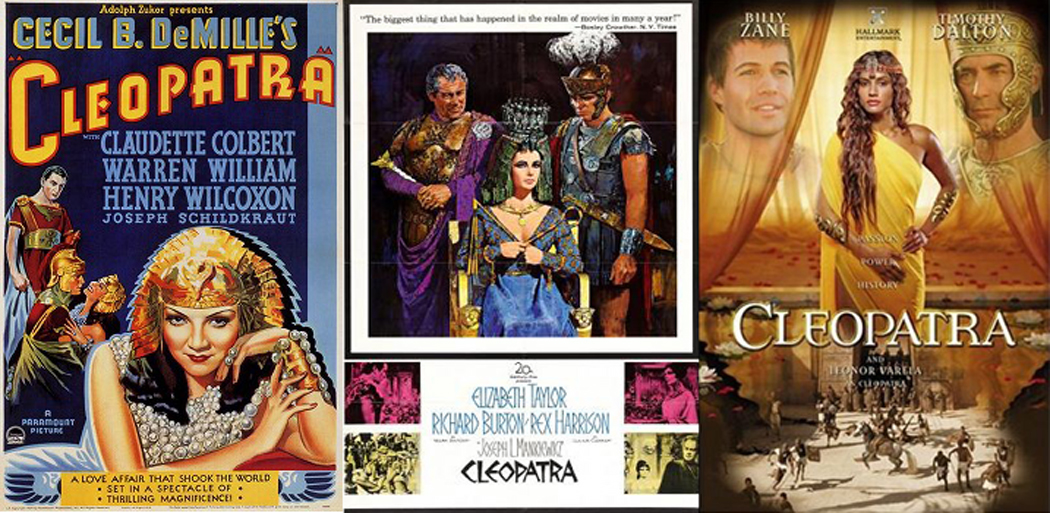
This all comes up because that megaturkey epic, Cleopatra (1963), with Liz and Dick, has been issued on Blu-Ray. All 243 bloated minutes of it. Stilted dialog, purple eye shadow, togas out the wazoo, to say nothing of barges on the Nile. And Rex Harrison as Caesar.

Hollywood is always historically accurate, at least in so far as there actually was a Caesar. After the establishment of that fact, all bets are off. Hollywood has made many Cleopatras, but I wouldn’t try to look for any fact larger than a mouse in any of them.

cleopatraposters

But accuracy is overrated in history. Some of the greatest artistic successes make for questionable history, such as Shakespeare’s Richard III or Oliver Stone’s Nixon.

The facts may be in question, but you nevertheless feel this is the way it should have been.

It’s like the dictum from The Man Who Shot Liberty Valance: ”When the legend becomes fact, print the legend.”

And if there’s not a legend, let the publicity department invent one.

What’s the point of reading all those scholarly books if, once you put them down, you can’t remember anything in them? On the other hand, who can forget Claudette Colbert as Nero’s wife in The Sign of the Cross, bathing in asses’ milk?

sign of the cross colbert bath

So, Hollywood provides us with a history that sticks to the brain like used chewing gum.

Think of your video store as a university.

It begins with prehistory.

raquel welch

Your main problem will be in choosing which movies to watch from the riches available: Do you want Raquel Welch in One Million Years B.C. (1966) , Darryl Hannah in Clan of the Cave Bear (1986) or Rae Dawn Chong in Quest for Fire (1981)?

I always go for the last. I tell people it is because of the clever artificial language created by linguist and novelist Anthony Burgess, but it is really because Chong takes her clothes off. Several times.

quest for fire rae dawn chong

When it comes to pharaohs and Caesars, the film world is immense. There must be thousands of movies featuring Romans, from 1908’s silent Julius Caesar to 1980’s Caligula, by Penthouse publisher Bob Guccione, which wouldn’t shut up.

It is interesting: Hollywood loves Ancient Rome, but it ignores Ancient Greece. As I look down the long list of history, I can’t help but notice that every time civilization reaches an apex of intelligence and literacy, Hollywood grows mum. We have lots of gladiators, but few philosophers onscreen.

The pattern holds up in later history, too. It’s hard to find a good movie that takes on the Enlightenment or the Reformation. But give us revolution, debauchery or intrigue, and the cameras start spinning.

You’d think there would be something to film in the 18th century: Perhaps Hollywood has not yet discovered the Duc de Richelieu, who invented mayonnaise in 1756 and was notorious for holding nude dinner parties. I’m sure the two things must be related in a way Hollywood can use.

But there is something about knee-britches that puts Hollywood off. For all the films on the Civil War, there are darn few on the Revolution. Lincoln shows up over and over, but George Washington might as well never have lived. I guess Hollywood thinks he looks too foppish in that satin and wig.

To do their patriotic duty, Hollywood has managed two films on the Revolution. It tried to tart it up once in 1776 (1972) by turning the war into a musical; the next time, it thought it could make Al Pacino sound like an 18th-century Bostonian in Revolution (1985). Both films are predictably awful.

Intolerance

An entire history curriculum could be devised from Hollywood films, matching titles with history’s centuries and movements.

As with any course of study, there are crib notes for those who cannot take the time for the whole thing.

You can get an overview of history from these three films:

1. D.W. Griffith’s Intolerance.

2. The Story of Mankind, with the Marx Brothers.

3. Mel Brooks’ History of the World Part One — ”It’s good to be da king.”

I can’t give you a diploma for completing this curriculum, but I can promise that you’ll have as good a grasp on history as the average American student.


The Beast from 20,000 Fathoms

The Beast from 20,000 Fathoms

The 1950s were a decade of fear and paranoia. Schoolkids learned to duck and cover and at night, dreamed of mushroom clouds. Grownups were spooked by Commies hiding behind every bush and screenplay. They built fallout shelters in their back yards. Congress held hearings and inquisitions. They had lists. Not only were spies giving our secrets to the Rooskies, but comic books were debauching our youth. Armed soldiers accompanied little girls to school, defending them from angry, fearful mobs.

It’s all there to see in our movies. It was a decade of noir, a decade of “psychological” Westerns. But most of all, it was the decade of crummy science fiction. In those films the shadows that frightened us were allowed out of their cages. There be dragons.

Godzilla was really only the most overt of those films, but the message was everywhere. If it wasn’t about nuclear bombs reawakening prehistoric beasts, as in The Beast From 20,000 Fathoms or The Giant Behemoth (can there be a small behemoth?), then it was about our fear of Cold War Communists: The subtext of Invaders From Mars — one of the creepiest movies ever — was that aliens could infiltrate our comfortable suburban lives and we wouldn’t even know it. It was a nightmare of true paranoia. It was there in Invasion of the Body Snatchers, too: People weren’t who we thought they were and we couldn’t trust anyone.

Subtext was king.

There were few sci-fi films from the time that didn’t bear this extra freight, from Them! (not us) and its giant ants in the LA sewers to The Thing and its call to “keep watching the skies.”

Certainly the 1953 version of The War of the Worlds carried this Cold War message. We were at risk of invasion from aliens, and whether they were from Mars or the Soviet Union hardly mattered.

The narration made this explicit, describing the course of the 20th century from World War I — “nations combined to fight against nations using the crude weapons of those days” — through World War II — with “new devices of warfare which reached an unparalleled peak in their capacity for destruction” — to the next war, “fought with the terrible weapons of superscience, menacing all mankind and every creature on Earth.”

This was a movie about the fears we felt in the 1950s.

And it is why those wretched movies, made on a shoestring with cardboard sets and vacuum-tube control boards, can stick in our memories like some pop tune. There is the power of dream and nightmare underneath the aluminum spray paint and prehistoric iguanas.

Star Wars? Star Snores.

Can’t compare with Devil Girl From Mars. There is a unacknowledged fear of a rising feminism. Same for Cat Women of the Moon or Queen of Outer Space.

Devil Girl from Mars

Devil Girl from Mars

Those of us who grew up on the real thing know that if you want the bona fides, you must find them not in the Technicolor epics, but in the mustier corners of your video store or the back channels of your basic cable.

For the kind of sci-fi that sticks to your frontal lobe for a lifetime, you must look to something a lot less classy than George Lucas’ New Age Wookiee-fest.

You’re talking the 1950s. The decade was to science fiction what the 1930s were to screwball comedies, or the 1940s to war movies.

The production of that single decade is astounding. There are hundreds of them, really cheesy space monster movies, made with the collective budget of a middle-size Levittown, N.Y., household. During Lent.

Those films, from Rocketship X-M in 1950 to Teenagers From Outer Space in 1959, outlined a genre. Even today’s most up-to-the-state-of-the-art FXtravaganza will manage to pay homage to those cheese-athons of yore.

You know the drill: An elderly scientist with a beautiful daughter discovers a new planet or an underground civilization that will destroy the world, or at least dent a small out-of-the-way English coastal village. All the best World War II stock footage of tanks and cannon cannot gun down the menace until our hero invents a new ray or oxygen destroyer that manages to vaporize the menace or at least cause it to doze off, meanwhile winning the daughter, whose name, by the way, is always a transgender name like Chris or Pat. (The hero has to be surprised at the beginning that the elderly scientist’s assistant is a ”girl.”)

And at the end she hugs her man, who is usually dressed in a leather flight jacket, and they stare off into the empty ocean and she asks him if the danger is over, if the flying saucer/interplanetary dinosaur/giant centipede will ever come back, and he looks pensive and says: ”Keep watching the skies.”

How can Star Wars compete with that?

And the acting in these low-budget classics is sometimes mind-blowing. Hollywood didn’t put its Gary Coopers and Cary Grants in cheap genre flicks. No, it drew from the shallow end of the pool of talent that included such luminaries as William Lundigan and Lyle Talbot. Most of them made Al Gore look as animated as Roger Rabbit.

I mean, let’s face it: Mark Hamill may be a lousy actor, but he’s no Sonny Tufts.

What is so surprising about those awful films is just how much affection we feel for them when they show up on Mystery Science Theater 3000 or during a baseball rain delay.

Actually, there are two types of affection we feel for them. For there are two different ways they stand out.

First, there is the movie that is so bad, it is fun to watch.

Plan 9 From Outer Space (1958) is the archetype for this. Director Ed Wood has often been credited with making the worst movie ever. But this is calumny. There is something naively loopy about Plan 9 that makes us cherish its every goofy blunder.

And the dialogue: ”Greetings, my friends. We are all interested in the future, for that is where you and I are going to spend the rest of our lives. And remember, my friends, future events such as these will affect you in the future.”

Now, that’s writing!

And: ”Explode the sunlight here, gentlemen, and you explode the universe.”

Audiences howl with laughter all the way through the movie. Nobody could have made anything so cheesy on purpose.

But Ed Wood wasn’t alone. There are plenty of bad movies, with plywood sets, paper-plate flying saucers and cardboard acting.

But there is another sort of film that we love, too. In those, a miserable script and lumpy acting are somehow saved by either a director who makes more of it all than you have any right to expect, or by an idea or image that sticks in the mind like a dream.

The Man from Planet X

The Man from Planet X

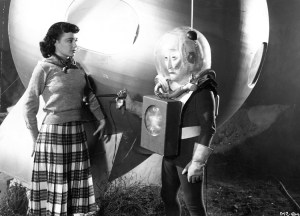
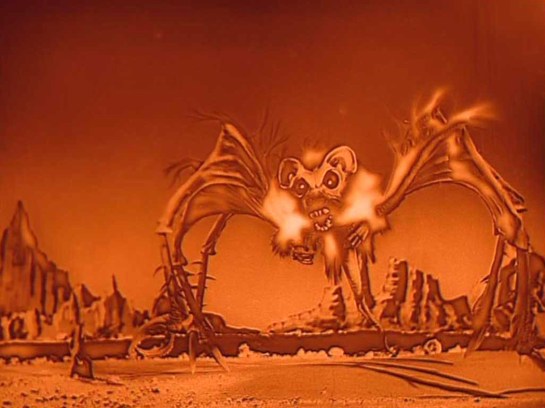
What alien is more inexpressibly “other” than the glass-helmeted homunculus from The Man From Planet X (1951)? And what planet is more memorably odd than the partly solarized, red-colored landscape from Angry Red Planet (1959)?

And there is a subgenre in this, in which such moviemakers as Ivan Tors tried naively but sincerely to show what space travel or robots would be like. Destination Moon (1950), or Gog (1954), for instance.

The movies are not actually good, but they have good hearts.

The ’50s had its share of larger budget sci-fi, too. Some of them are classics, such as The Day The Earth Stood Still (1951). They transcended their genre.

Some people consider Forbidden Planet (1956) to be a minor masterpiece.
Robot Monster

Robot Monster

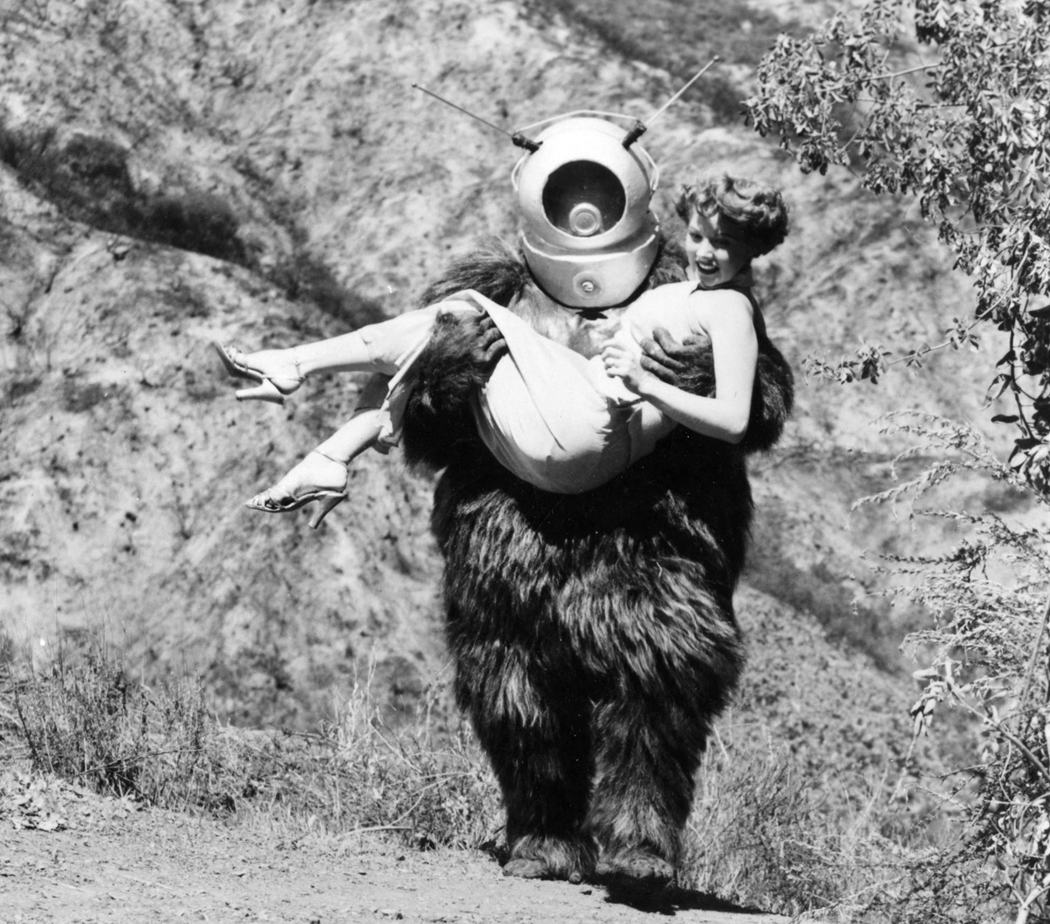
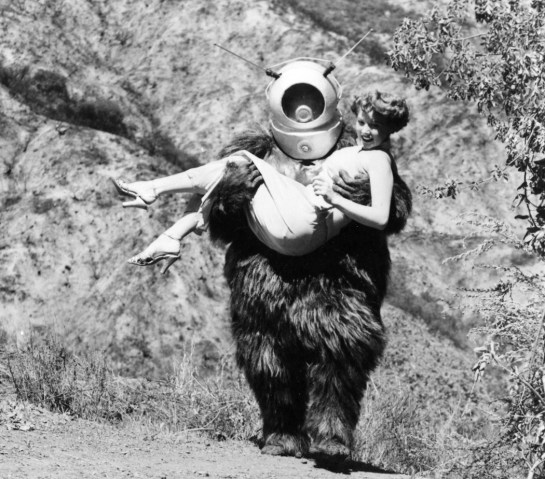
But it is those benighted films such as Robot Monster (1953), with its man in a gorilla suit and a diving helmet, or Killers from Space (1954), with its out-of-shape zombies dressed in spandex with fried eggs for eyes, that truly deserve worship.

Killers from Space

Killers from Space

Unfortunately, with the advent of the 1960s, science fiction took a turn and not for the better. What had been naive attempts at entertainment in the previous decade took on the more ominous tone of exploitation. Producers aimed their films at the teenage market, and the gore level rose. The monsters had faces like used chewing gum and they oozed slime.

And worse, it was all caught on really bad, underlit color film.

The flatly lit black and white film of the ’50s was a signature style. You could tell instantly what you were in for. Flood lamps illuminated the scene evenly and spread twin shadows to the right and left of everything. But the bad lighting of the ’60s couldn’t help the goo-faced monsters. There was a failure of sincerity.

We can recognize that in retrospect, looking back through an age that imitated the loopiness of the earlier films. But it doesn’t matter if you call your film Slave Girls From Beyond Infinity (1987), these made-for-cable cheesers are way too self-conscious.

We can never regain our innocence. And as for our paranoia? Welcome to the post-Sept. 11 world. You can now see the same subtext showing up once more. Not only in the many Middle-Eastern villains in our superhero movies, but in our science fiction once again.

And Steven Spielberg’s new take on War of the Worlds is fairly marinated in it. It oozes everywhere.

The new film has a different shadow villain: “Is it the terrorists?” little Rachel asks when things start blowing up.

Although Spielberg never undercuts the sheer velocity of his thriller with academic discourse, he fills his movie with striking imagery that makes the subtext clear: An airplane crashes into a building, posters stapled to walls with pictures of missing people, debris falling from the sky.

These are the images of our current fears. Older movies reveal our former fears.

The newer subtext is terrorism, which even comes out in the comic relief.

When Tom Cruise is trying to escape the destruction of the aliens with his two children, they ask him about the fearful strikes of lightning that have prefigured the chaos. This wasn’t ordinary lightning, he tells them, “It came from somewhere else.”

“Like Europe?” his teenage son asks.

“No, Robbie, not like Europe,” he replies. And we recognize, someplace non-European, where people have different clothing and different beliefs, somewhere utterly alien to most Americans.

It isn’t that Spielberg’s film is about 9/11, but that some of the emotion and fear we feel watching it is recalled from having seen the real event. It sets up a resonance: You can’t see the one without thinking of the other.

This is subtext speaking.

TOP 10
Cheesy Sci-Fi movies from the 1950s

Cat Women of the Moon

Cat Women of the Moon

10. Cat-Women of the Moon (1953) – Our astronauts, led by Sonny Tufts, reach
the moon only to find a cave full of exotic dancers in black cat suits. There
is also a giant spider. Similar plots show up in Missile to the Moon (1959)
and Fire Maidens From Outer Space (1954), but neither can top the original.
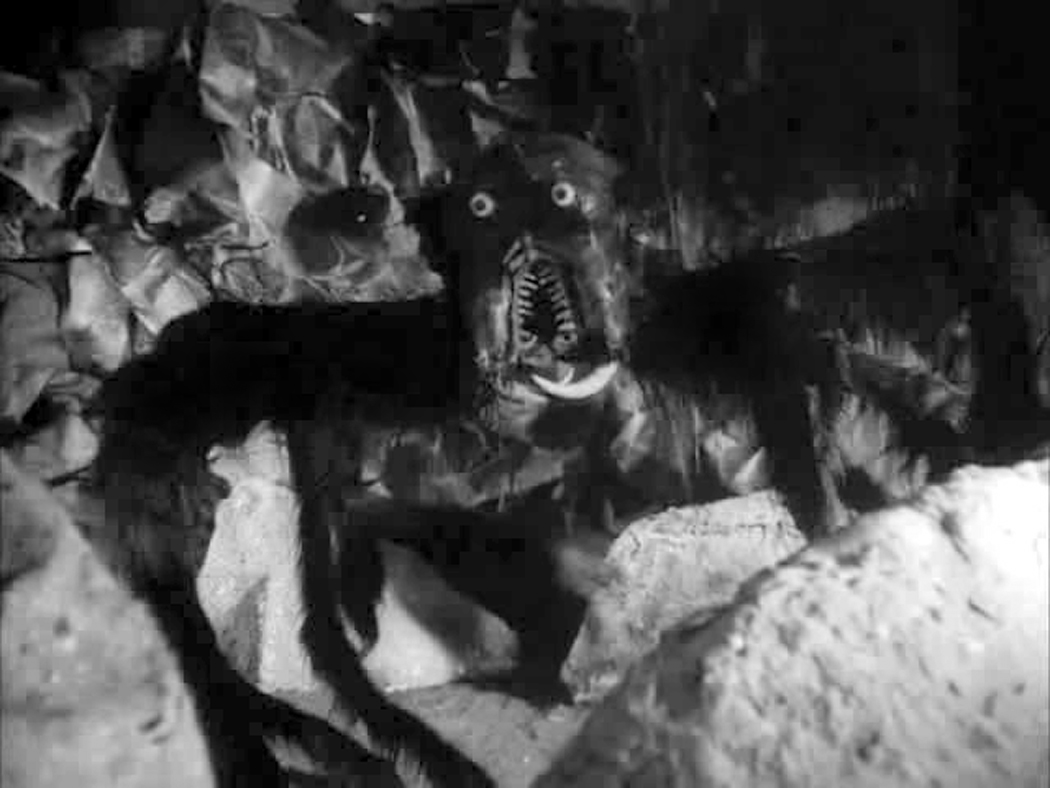
9. Angry Red Planet (1959) – An American space team lands on Mars and is eaten
by giant spiders with rat faces. Only the ”girl” survives. The acting is
rudimentary, but the visuals are unforgettable, even in their cheesiness.
8. The Crawling Eye (1958) – Forrest Tucker acts his heart out in this tale of
giant eyeballs with tentacles that live in frozen radioactive clouds above a
Swiss village and communicate psychically with a young woman.
7. Invaders From Mars (1953) – This is almost a work of genius. Despite
vestigial special effects, no movie has ever portrayed childhood paranoia
better than this. A boy suspects his parents have been made into zombies by
the buried flying saucer. No one believes him.

Kronos

Kronos

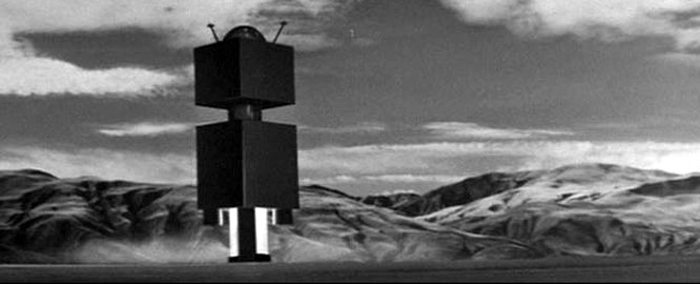
6. Kronos (1957) – A giant cube from outer space eats energy and gets bigger.
So, what does the army do? Try to kill it with an A-bomb. ”You Earth people
are stupid! Stupid! Stupid!,” as Eros says in Plan 9. The sight of a
building-size monster moving across the landscape is eerie.
5. Plan 9 From Outer Space (1958) – Sometimes called ”the worst movie ever
made,” Plan 9 nevertheless has a loopy genuineness to it, an almost
soft-hearted pacifist message at its core, as zombies raised from the dead by
aliens are meant to take over the Earth. This movie is a party waiting for you
to invite your friends to.
4. Riders to the Stars (1954) – One of the rare color films from this age of
black and white, Riders is a straightforward, even humorless attempt to
explain the travails of space travel, with lots of centrifuge scenes and a
love triangle. Little excitement, but lots of sincerity.
3. Gog (1954) – This is Ivan Tors at his best, telling a story about how man’s
development of technology can come back to harm him. Gog and its twin, Magog,
are among the best robots ever put on film. They are not humanoid but look
more like what we see in industrial robots today.

Queen of Outer Space

Queen of Outer Space

2. The Queen of Outer Space (1958) – This may have been Zsa Zsa Gabor’s best
role. She plays a kind of Hungarian freedom fighter rebelling against a masked
evil queen of the universe and saving the lives of the American space men.
This is actually a fourth version of Cat Women of the Moon, but it is even
campier. Its silliness unfortunately forecasts the doom of the naive space
movie.
The Man from Planet X

The Man from Planet X

1. The Man From Planet X (1951) – Shot for less than $50,000 in six days by
low-budget genius Edgar G. Ulmer, this film manages to make a virtue of every
budget shortcut he was forced to take. The atmospheric sets, supposedly
English moors, are foggy to hide their phoniness. But the imaginative
spacecraft – a sort of upside down aluminum ice-cream cone – and
pathos-evoking blank-face alien are unforgettable. So is villain William
Schallert, before he became Dobie Gillis’ teacher, Mr. Pomfritt. This film is
a minor classic and shows how you can do a great deal on a shoestring and an
idea. And a scientist with a lovely daughter.
Angry Red Planet

Angry Red Planet

SCI-FI OF THE ’50s
Angry Red Planet, 1959
The Astounding She-Monster, 1957
The Atomic Man, 1956
Attack From Space, 1959 (Japanese)
Attack of the 50-foot Woman, 1958
Attack of the Puppet People, 1958
The Beast From 20,000 Fathoms, 1953
The Blob, 1958

Cat Women of the Moon

Cat Women of the Moon

Cat-Women of the Moon, 1953

Conquest of Space, 1955

The Cosmic Man, 1959
The Cosmic Monsters, 1958
The Crawling Eye, 1958
The Day the Earth Stood Still, 1951
The Day the World Ended, 1956
The Deadly Mantis, 1957
Destination Moon, 1950
Devil Girl From Mars, 1954
Earth vs. the Flying Saucers, 1956
Earth vs. the Spider, 1958
The Electronic Monster, 1958
Enemy From Space, 1957
The Evil Brain From Outer Space, 1956
Fiend Without a Face, 1957
Fire Maidens of Outer Space

Fire Maidens of Outer Space

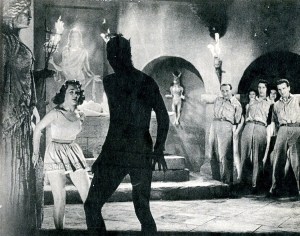
Fire Maidens From Outer Space, 1954
First Man into Space, 1959
Flight to Mars, 1951
The Flying Saucer, 1950
Forbidden Moon, 1956
Forbidden Planet, 1956
The 4-D Man, 1959
From the Earth to the Moon, 1958
The Gamma People, 1956

The Giant Behemoth

The Giant Behemoth

The Giant Behemoth, 1959 (and try to imagine a tiny behemoth)
The Giant Claw, 1957
The Giant Gila Monster, 1959
Godzilla, King of the Monsters, 1956
Gog, 1954
The H-Man, 1958
I Married a Monster From Outer Space, 1958
The Incredible Shrinking Man, 1957
Invaders From Mars, 1953
Invaders From Space, 1959
Invasion of the Body Snatchers, 1956

Invasion of the Saucer Men, 1957
It Came From Beneath the Sea, 1955
It Came From Outer Space, 1953
It Conquered the World, 1956
It! The Terror From Beyond Space, 1958
Killers From Space, 1954
King Dinosaur, 1955
Kronos, 1957
The Lost Missile, 1958
The Lost Planet, 1953
The Magnetic Monster, 1953
Man Beast, 1956
Manhunt in Space, 1956
The Man From Planet X, 1951
Menace From Outer Space, 1956
Mesa of Lost Women, 1953
Meteor Monster, 1957
Missile to the Moon

Missile to the Moon

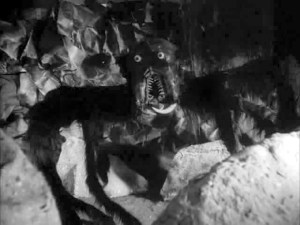
Missile to the Moon, 1959
The Mole People, 1956
The Monolith Monsters, 1957
Monster From Green Hell, 1957
Monster From the Ocean Floor, 1954
The Monster that Challenged the World, 1957
The Mysterians, 1957
Phantom From Space, 1953
Plan 9 From Outer Space, 1958
Project Moonbase, 1953
Queen of Outer Space, 1958
Radar Men From the Moon, 1952
Riders to the Stars, 1954
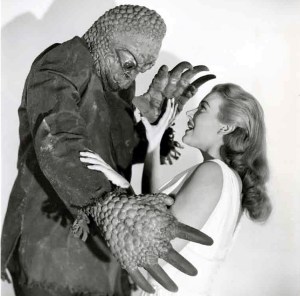
The Mole People

The Mole People

Robot Monster, 1953
Rocket Attack, U.S.A., 1958
Rocketship X-M, 1950
Rocky Jones, Space Ranger, 1954-55
Rodan, 1956
Stranger From Venus, 1954
Tarantula, 1955
Target Earth, 1954
Teenagers From Outer Space, 1959
Terror From the Year 5000, 1958
Them!, 1954
The Thing, 1951
This Island Earth, 1954
Tobor the Great, 1954
20 Million Miles to Earth, 1957
The 27th Day, 1957
Untamed Women, 1952
Warning From Space, 1956
War of the Colossal Beast, 1958
War of the Worlds, 1953

When Worlds Collide

When Worlds Collide

When Worlds Collide, 1951
The Wild Women of Wongo, 1958
X The Unknown, 1956
Zombies of the Stratosphere, 1952


Barbarella group

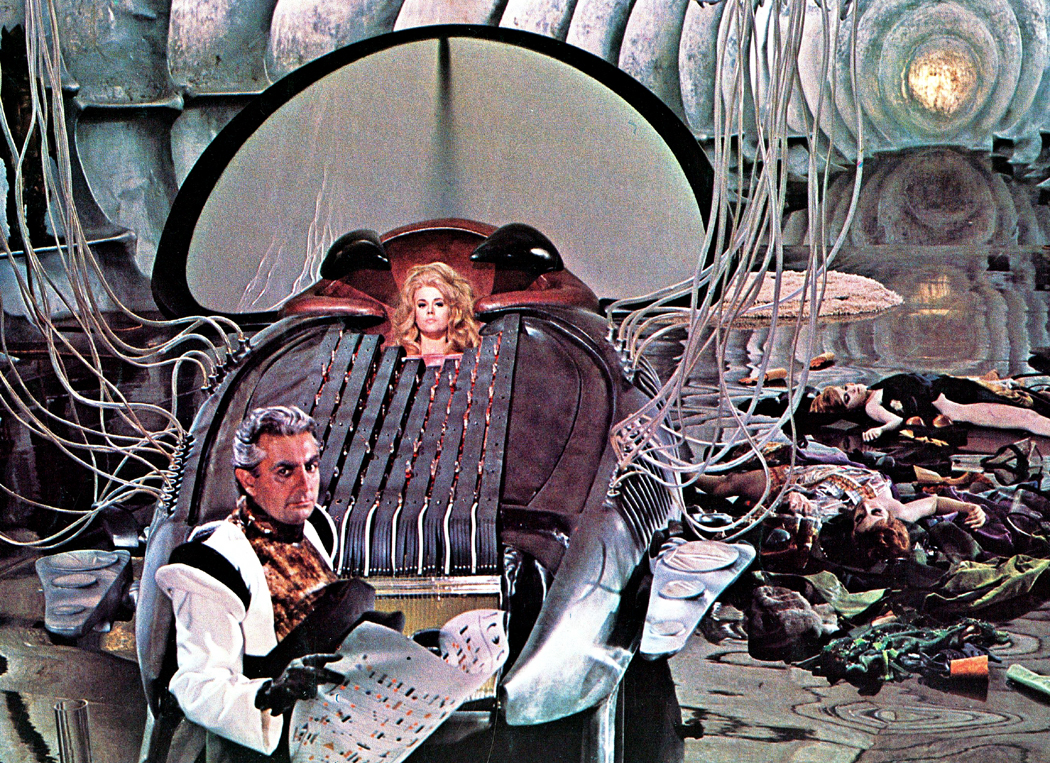
Forty-five years  ago, Jane Fonda  got naked in outer space.

That zero-G striptease is all that most people know about Barbarella,  a movie that opened in October 1968  and was seen at the time as the worst kind of cheese.

“A mix of poor special effects and the Marquis de Sade,” one reviewer said.

And that is the reputation it has been saddled with ever since.

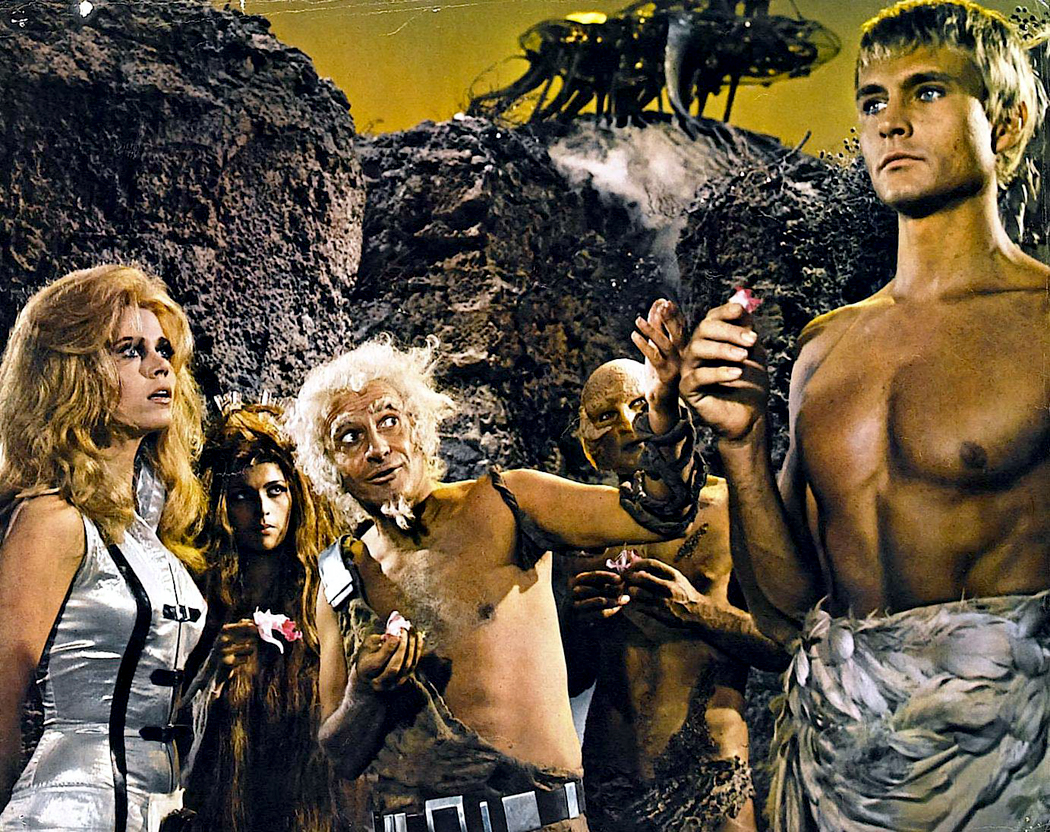
But the movie, directed by French Svengali Roger Vadim  and made for a pittance, has an odd staying power: Many of its scenes are memorable the way a Mozart melody is. Whether it is Pygar the blind angel, the eye-patch Evil Queen — the “Great Tyrant” —  or the psychedelic “Mathmos”  — a kind of molten id-lava that flows under the city — the film sticks in the mind like a particularly disturbing dream.

English and original French comic book versions of "Barbarella" with scene from film.

English and original French comic book versions of “Barbarella” with scene from film.

“A dream we dreamt with our eyes open,” as Fellini  says.

If you look at it purely objectively, Barbarella is a really bad movie. The dialog is campy. The acting is either wooden or, if you are feeling generous, stylized. The plot wouldn’t hold a Flash Gordon  serial together.

The costumes are polyester and scanty. Even the sets are comically shoddy: Barbarella’s space ship is covered up the walls with orange shag carpeting and even the exteriors, like the Forests and Lakes of Weir,  or the Labyrinth of the City of Evil,  have the claustrophobia of a cheap soundstage. Special effects are not much more advanced than a lava lamp.

The Mathmos

The Mathmos

Yet, none of that ultimately matters. Like a small cache of sister films, Barbarella transcends its tawdry birth because it gives us dream-memorable scenes. The parts are greater than the whole.

“A film is a ribbon of dreams,” Orson Welles  said. “The camera … is a medium via which messages reach us from another world that is not ours and that brings us to the heart of a great secret.”

One shouldn’t be too portentous about such things, but the history of cinema is littered with bad movies that are too memorable to die. Like advertising jingles you can’t stop hearing in your head, they just stick.

Think of King Kong (1933).  Its acting is wooden, its writing jejune, yet it is one of Hollywood’s greatest classics. On any objective level, the movie is awful – every time Bruce Cabot  opens his mouth, you cringe – yet those scenes with the big monkey have buried themselves in our collective unconscious. The movie is great not because it is a finished work of art, but because it connects directly to our psyches like a dream you can’t understand, but know is meaningful.

The majority of great bad movies are science fiction or horror films. This shouldn’t be surprising, after all fear has a more driven imagination than hope.

It is what makes 1950s’ monster films such an instantly recognizable genre.

Our fear of nuclear annihilation is given vent in fighting giant ants, spiders or iguanas; our fear of the Soviet Union shows in the number of Martian invaders.

But the list isn’t limited to Them!The Angry Red PlanetThe Crawling Eye  or Things to Come. For it isn’t only a B-movie thing. Mainstream Hollywood schlock can lodge in our collective brains, too, like the Statue of Liberty at the end of Planet of the Apes  or the spinning head of Linda Blair,  spewing invective and vomit in The Exorcist.

The value of such films is not in their thin plots and narrative contrivances, but in those brief scenes that traumatize us. They are straight from our id and are burned into our memory like a cattle brand.

Think of Freddie Krueger  pushing the girl around the ceiling in Nightmare on Elm Street,  or the flaming Plymouth chasing the teenager down the road in Christine.

Or Rae Dawn Chong  teaching the missionary position to the Neanderthal in Quest for Fire.

All of them have left the confines of their movies to become part of our common mythic inheritance.

Barbarella is full of such mental peanut butter to stick to the roof of our brains. Before Barbarella, did you know that angels built nests? That flying manta rays could pull sleds? That you could be killed by a mechanically induced excess of pleasure? That the mathmos could rise and devour us all in a colorful burp of lava lamp?


Durand Durand (Milo O'Shea) tries to kill Barbarella in the "Excessive Machine."

Durand Durand (Milo O’Shea) tries to kill Barbarella in the “Excessive Machine.”

Despite its candy-color design scheme and its stretched polyethylene see-through sets, Barbarella overflows with unforgettable detail. But that isn’t all it has.

Barbarella has one claim to uniqueness. It is a camp film all the way.

Writer Susan Sontag defined camp in a famous 1964 essay as a style that emphasizes artifice, frivolity, and shocking excess, among other things.

You couldn’t find a better description of Barbarella.

More important, she said, “You can’t do camp on purpose.” It cannot be made to order; it bubbles up from the sincerity of lesser talent. Camp cannot know it is camp.

Yet Barbarella may be the exception that proves the rule. By all appearances, it was meant to be read as camp, and yet, it still functions well as camp, unlike all the other films from the era that tried so hard to be hip and with-it, but now only seem as dated as bell bottoms.

The reason must be found with its maker, Roger Vadim.  A minor-league filmmaker, Vadim was the creator of Brigitte Bardot,  whose most famous film, And God Created Woman (1956),  managed to transform her into a “sex kitten,” the neotonic French Marilyn Monroe. Vadim’s Bardot films are filled with memorable scenes, mostly coy and erotic, but none rises to the level of great cinema. When he was done with her, he tried his star-making power on Jane Fonda;  he also married her. Their films together, including her 1964  remake of the great Arthur Schnitzler  play, La Ronde,  were entertaining, but mediocre at best.

But sometimes, when you put a mediocre mind to work on a mediocre idea, something clicks. With Barbarella, Vadim could create a camp world sincerely, because he believed in it, but without the self-consciousness that ruins most trendy films of the time. His esthetic level and the camp level meet perfectly, with neither aspiration nor condescension to upset the balance.

Perhaps that is why the proposed remake of Barbarella, by super-hip cinemaker  Robert Rodriguez,  went nowhere. Rodriguez is too knowing a filmmaker. Barbarella works on the thin, slippery edge between sincerity and irony, a place too small for a large talent like Rodriguez to find foothold.

Worse, he proposed to use Rose McGowan in the title role, and she is prima facie the wrong actress to play the part: too smart, too sophisticated, too knowing. All wrong.

Other actresses run up the flagpole include Scarlett Johansen, Carey Mulligan and Anne Hathaway. You have to scratch your heads.

When Rodriguez gave up on it, the rights were bought by Dino de Laurentiis, before his death in 2010. His widow is now set to produce the new version. The de Laurentiis name on a film is the kiss of death. Remember King Kong of 1976?

Fay Wray (1933) and Jessica Lange (1976), best forgotten.

Fay Wray (1933) and Jessica Lange (1976), best forgotten.

The new Barbarella would ostensibly be a TV series, perhaps for French TV, perhaps in English.

Don’t hold your breath. Like the original King Kong, it was done right the first time.

accordion lady

Time, said Alfred Hitchcock, was meant to be stretched and squeezed like an accordion. Sometimes, you need to cover a lot of ground quickly; sometimes you need to slow the ticking clock to drag out the tension.

Joan Fontaine is eating dinner with her wealthy family in Hitchcock’s Suspicion and she is called to the phone. She rises slowly and anxiously and walks through a door, down an endless hall and off screen to the right, and we follow her with our eyes, a long, slow aggravating wait with suspense for the possibly distressing news the call will bring.

It’s a typical moment in a movie by the master of suspense. What happens next may be even more typical for Hitchcock. After the suspense is drained, Fontaine puts the phone down, takes two steps toward us and eases quickly back into her seat.

joan fontaine

What happened to the hallway? The door? The slow steps?

It’s the time accordion. Hitchcock was its virtuoso.

Movies and time:

One small experimental film I’ve seen takes 90 minutes to cover the events of 10 minutes. Terrence Mallick’s Tree of Life apparently covers 12 billion years in its two hours.

But time, in America, is money, and we have little of it to waste: We want our rewards now. We don’t want to work for it; we don’t want to linger.

One-Hour Photo? Takes too long. Digital is instant.

Minute Rice? Who has the time? You can buy a pre-made pilaf at the grocery store on the way home from work.

Instant tea? Why, when you can buy it in a bottle?

Let’s face it: Do you actually have the time to read this story?

Or are you conference-calling on the cellphone while driving 75 mph down the freeway on your way to drop off a package at FedEx?

In America today, not only has time speeded up, but we demand it be so.

There is little patience for anything slow. Especially in our movies. Fast editing, short, punchy dialog, and lots of things blowing up, without too much exposition in between the ignitions. Fuses, thus, must be short: We cannot wait for the boom.

I remember coming out of one recent art film and overhearing a fellow audience member saying, “I just spent the last two weeks at the theater watching that movie. Maybe it was two hours that just seemed like two weeks.”

But people go to the movies for different reasons. If it’s action you want, or a good plot, Hollywood has a vast menu of tapas, quick hits. Even most Indie films — the butt of many a complaint about sluggishness in film — move like arrows through the air compared to some of filmdom’s real glaciers.

There are films – and filmmakers – who do their best to slow the viewer down, make him pause and ponder, to consider the smaller issues, or the details that normally go past us unnoticed. They are the Bruckner symphonies of the cinema.

They want to to notice what’s hanging on the walls of the bedroom, what the weather is like outside the window, what emotional color the lighting is.

Such art movies are aimed at a different audience from those usually found at the multiplex. Such films are difficult. Some are nearly unwatchable.

But they are great art nonetheless, and true classics.

Those of us who appreciate glaciers on film don’t just want to “get” the story, to move the plot along, but rather, we want to live in the world the filmmaker has created, so savor its flavors, scents and sensations. We engage with that world even as we compare it with our own to find the congruences and divagations. Some of the greatest films ever made are long, slow and trying.

Here is my list of the Top 5 Unwatchable Gold-plated Classic Films:


La belle Noiseuse

La belle Noiseuse

Number 5: La Belle Noiseuse (1991)  – Director Jacques Rivette  spends a good deal of this 4-hour  film showing us an artist drawing. He’s drawing a naked Emmanuelle Béart,  so it’s not all tough going, but we watch endless moments of pen-scrawl on paper as the fictional artist who is the film’s hero, tries to recapture his earlier genius.

The Sorrow and the Pity

The Sorrow and the Pity

No. 4: The Sorrow and the Pity (1969)  – This is four hours plus  of talking heads, discussing the collaboration with the Nazi government during the Vichy years of France, and the excuses otherwise good people make for acceding to evil. By director Marcel Ophuls.


Andrei Rublev

Andrei Rublev

No. 3: Andrei Rublev (1969)  – Spend 3 ½ hours  in medieval Russia with Andrei Tarkovsky’s  truly glacial moodpiece about a 15th-century  monk and artist who created religious ikons.  Utterly hypnotic, it is also opaque: We don’t always know what’s going on, but it is almost mystical.


L'Avventura

L’Avventura

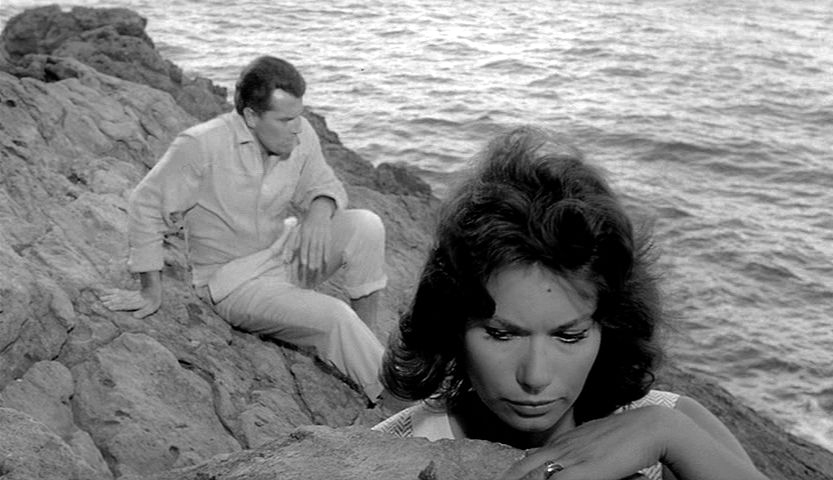
No. 2: L’Avventura (1960)  – A young woman goes missing on a rocky island in the Mediterranean in Michelangelo Antonioni’s  ur-existentialist rumination, and her lover and her friend spend the rest of the film looking for her. Hint: They never find her. One of the most beautiful films of all times, it also drives many viewers crazy with impatience.


And the No. 1 Unwatchable Gold-plated Classic Film of all time:


Last Year at Marienbad

Last Year at Marienbad

Last Year at Marienbad (1961)  – The poster child for artsy-fartsy films, Alain Resnais  notorious L’Année dernière è Marienbad  is the most self-conscious film of all time. You never know – and never find out – exactly what is happening, or if it is happening, or if it happened, or maybe it will happen. This is the supreme test of the artfilm lover. You have to check to make sure you are still breathing by the end.


Of course, there are lots of candidates for such a list. If we forgot your “favorite,” well, here are a bunch more of the movies that give art film a bad name. Nevertheless, they are all great films. Just not for the multiplex.


Hiroshima Mon Amour (1959, Renais)

Heart of Glass (1976, Werner Herzog)  (He actually had the actors hypnotized for their performances)

Woman of the Dunes (1964, Hiroshi Teshigahara)

Solaris (1972, Tarkovsky)

The Passion of Joan of Arc (1928, Carl Theodore Dreyer)

Dogville (2003, Lars von Trier)

Hour of the Wolf (1968, Ingmar Bergman)

Arabian Nights (1974, Pier Paolo Pasolini)

Zabriskie Point (1970, Antonioni)

The Thin Red Line (1998, Terrence Mallick)

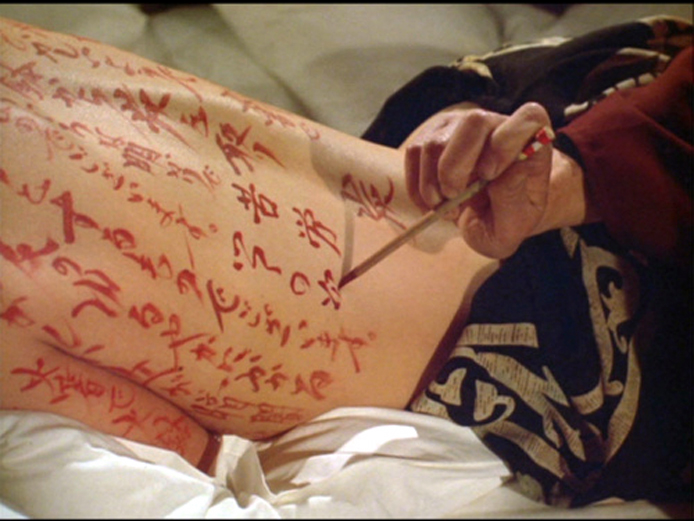
The Pillow Book (1996, Peter Greenaway)  (Actually, anything by Greenaway counts. He’s the current king of the pretentious.)


Pillow Book

Pillow Book

You probably have your own nominees: But for this list, it only counts if you also think they are great films: Bad tedium remains bad tedium.