Archive

Tag Archives: history

It is 14 years after the assassination of Julius Caesar and three decades before the birth of Christ and the Greek queen of Egypt is about to die. The 39-year-old Cleopatra VII is the mother of four children by two fathers, both now dead. This much everyone seems to agree on. What happens next is romantic fairy tale, or conjecture, or cynical posturing — or all three.

The most widely believed version, used by Shakespeare in his tragedy, Antony and Cleopatra, has the queen, fearing to be taken captive to Rome by the conquering Octavian, has a basket of figs delivered to her, with a smuggled asp hidden under the fruit. She takes the venomous snake and applies it to her tender bosom and expires from the poison.

The problem is that there are conflicting stories told by the ancient writers.

The best known version, and the one Shakespeare cribbed from is that of Plutarch in his essay on Mark Antony.

The two rebellious lovers, having  been conquered by the young Octavian were at odds over what to do. Cleopatra had a false message sent to Antony that she is dead. Antony ran himself into his sword, but botched his suicide and was brought to Cleopatra, where he then expired. Cleopatra mourned and locked herself in her mausoleum. And then, according to Plutarch:

“Having made these lamentations, crowning the tomb with garlands and kissing it, she gave orders to prepare her a bath, and, coming out of the bath, she lay down and made a sumptuous meal.”

An old man came with a basket. The guards Octavian had sent to keep Cleopatra in check stopped him to examine the contents.

“The fellow put the leaves which lay uppermost aside, and showed them it was full of figs; and on their admiring the largeness and beauty of the figs, he laughed, and invited them to take some, which they refused, and, suspecting nothing, bade him carry them in.”

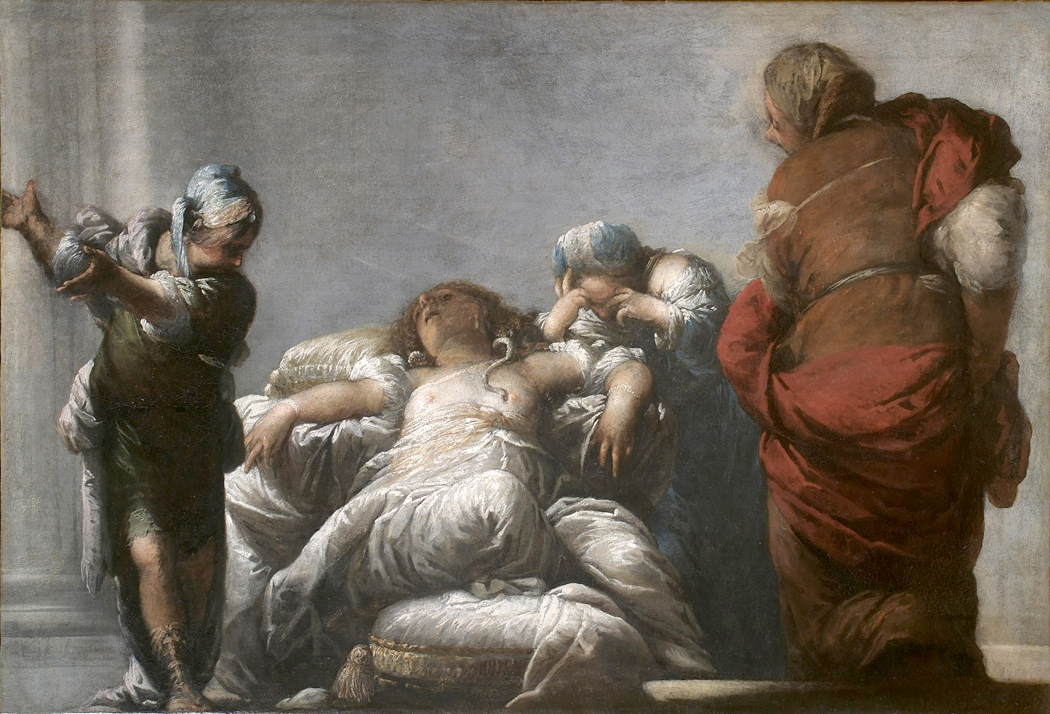
The queen then sent a letter to Octavian describing her intent to kill herself and locked herself in the monument with her two servants, Charmion and Eras. When Octavian got the note, which asked that she be buried next to Antony, he sent messengers to stop her from killing herself. But they found her already dead, “lying upon a bed of gold, set out in all her royal ornaments.”

Eras lay dying at her feet and Charmion, just ready to fall, barely able to hold up her head, was adjusting her mistress’s crown. And when the soldier that came in said angrily, “Was this well done of your lady, Charmion?”

“Extremely well,” she answered, “and as became the descendant of so many kings”; and as she said this, she fell down dead by the bedside.

“Some relate that an asp was brought in amongst those figs and covered with the leaves, and that Cleopatra had arranged that it might settle on her before she knew, but, when she took away some of the figs and saw it, she said, ‘So here it is,’ and held out her bare arm to be bitten. Others say that it was kept in a vase, and that she vexed and pricked it with a golden spindle till it seized her arm. But what really took place is known to no one.

“Since it was also said that she carried poison in a hollow hairpin, about which she wound her hair; yet there was not so much as a spot found, or any symptom of poison upon her body, nor was the asp seen within the monument; only something like the trail of it was said to have been noticed on the sand by the sea, on the part towards which the building faced and where the windows were. Some relate that two faint puncture-marks were found on Cleopatra’s arm, and to this account Caesar seems to have given credit; for in his triumph there was carried a figure of Cleopatra, with an asp clinging to her.

“Such are the various accounts. But Caesar, though much disappointed by her death, yet could not but admire the greatness of her spirit, and gave order that her body should he buried by Antony with royal splendor and magnificence. Her women, also, received honorable burial by his directions.

“Cleopatra had lived nine and thirty years, during twenty-two of which she had reigned as queen, and for fourteen had been Antony’s partner in his empire. Antony, according to some authorities, was fifty-three, according to others, fifty-six years old. His statues were all thrown down, but those of Cleopatra were left untouched.”

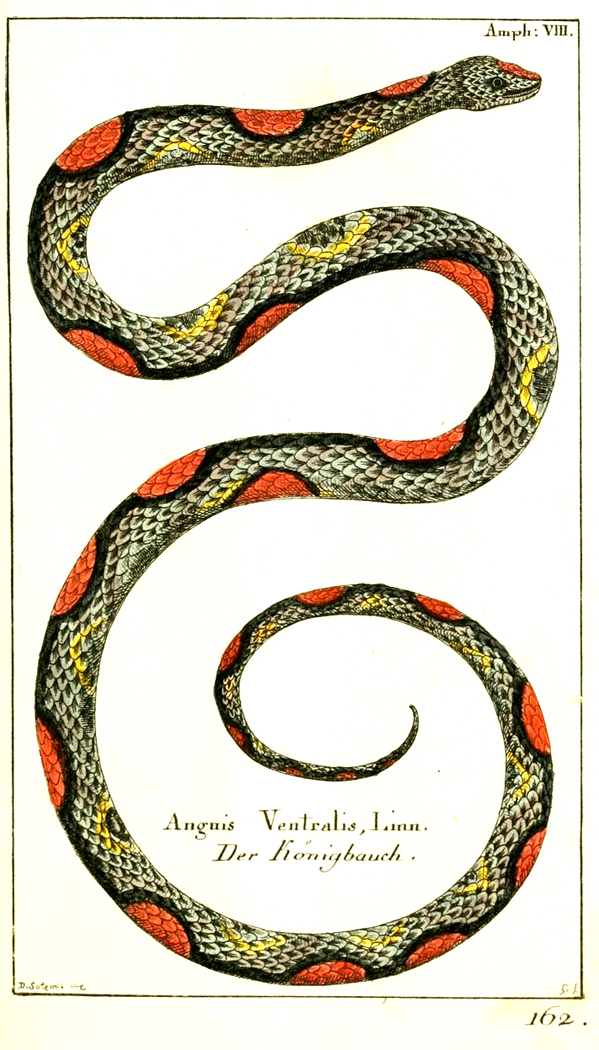
European asp

While Plutarch’s story has been repeated many times, it must be remembered that it was written 120 years after the events. Other historians and poets also told stories of Cleopatra’s death: Strabo, Velleius, Florus, Suetonius, Dio Cassius and Galen, Virgil, Horace and Propertius.

Of the historians, the only one who was alive at the time of Cleopatra’s death was Strabo, who wrote: “(Octavian) took the city at the first onset, and compelled Antony to put himself to death, but Cleopatra to surrender herself alive. A short time afterwards, however, she also put an end to her life secretly, in prison, by the bite of an asp, or (for there are two accounts) by the application of a poisonous ointment.”

Strabo was about 34 years old when Cleopatra died, but his account was written at least 10 years after that. It is thought he might have been in Alexandria at the time of the queen’s death.

The poet Horace wrote his ode, “Nunc est bibendum,” within a year or two of the queen’s death and mentioned it near the end of the poem: “Caesar came back to put the deadly monster in chains, but she, wanting to die more nobly had no feminine dread of the sword, and finding no way out of the situation, went to her palace lying in ruins and with a tranquil face was brave enough to handle vicious serpents and drink their black venom into her body. Having chosen death, she was fiercer still, unwilling to be taken back to Rome and led in a humiliating victory parade.”

The physician Galen (AD 130-200) wrote in De Theriaca ad Pisonem that “The queen had bit her arm and then rubbed the wound with poison.”

Virgil in the Aeneid says she died of “two fatal asps.”

Modern commentators tend to suspect that all the stories of Cleopatra’s suicide may very well be spin concocted by Octavian (by then Augustus Caesar) to cover up her murder at his orders. We know he had Cleopatra’s oldest son killed. Caesarion was the natural son of Julius Caesar and was 17 when Caesar’s adopted son had him quietly eliminated. “Too many Caesars is not a good idea,” he supposedly said.

So, Cleopatra either killed herself by taking poison, or by rubbing herself with poison ointment, or by stabbing herself with a sharp comb laced with poison, or held an asp to her arm to bite her, or scratched her arm up and rubbed it with venom from the smuggled asp, or — and the list goes on — it probably wasn’t an asp, since there are no actual asps in Egypt and if there were, their venom causes a very slow and painful death, and would more likely have been an Egyptian cobra, which is the sacred snake of the Egyptian pharaohs. Or she was killed by Caesar.

As Plutarch admits: “What really took place is known to no one.”

Among other accounts, Cleopatra tested various poisons on her slaves before picking the one that would cause her the least suffering. A good deal of the gloss on Cleo comes from the Romans, who had a vested interest in presenting her in the least flattering light. She was, after all, an enemy of Rome — at least after the disputed empire fell from the likely rule of Antony into the sure hand of Octavian.

Denouement: In addition to Caesarion, born to Julius Caesar, she had three children by Mark Antony. A son named for the sun and a daughter named for the moon survived her. Ptolemy Philadelphus was the youngest. Octavius spared them but gave them to his sister, the legal wife of Antony, to raise. The daughter, Cleopatra Selene, eventually married King Juba II of Numidia in north Africa. The son, Alexander Helios, is lost to history along with his brother.

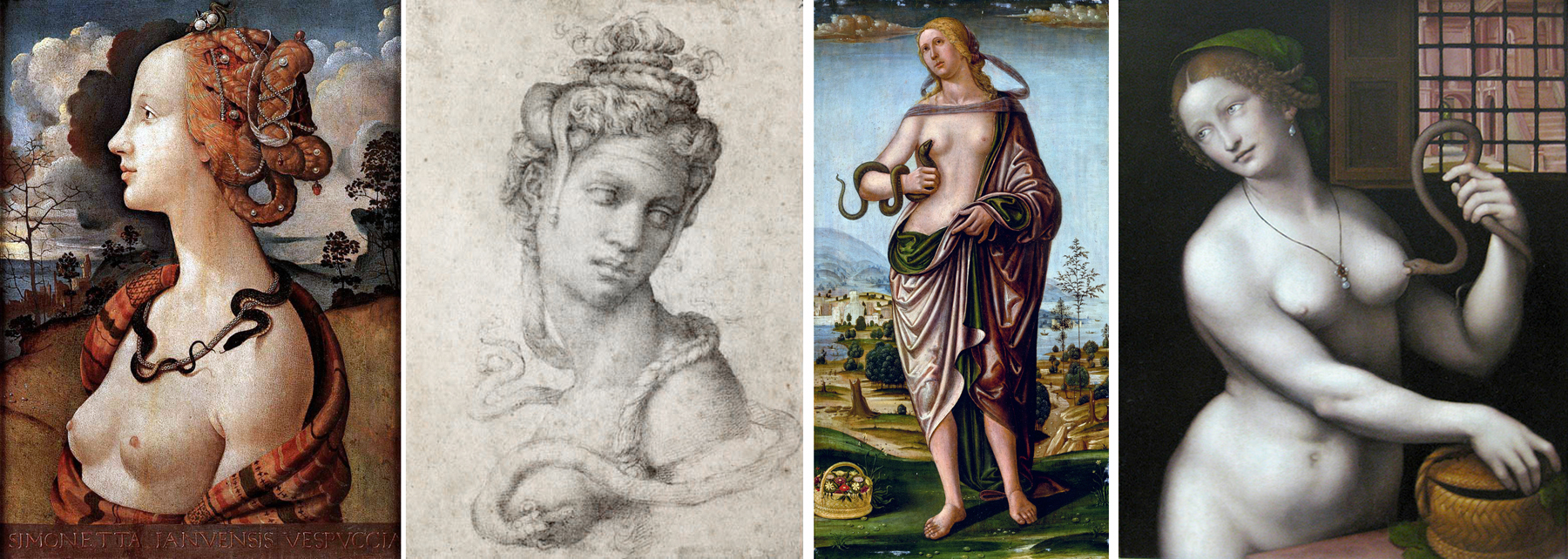
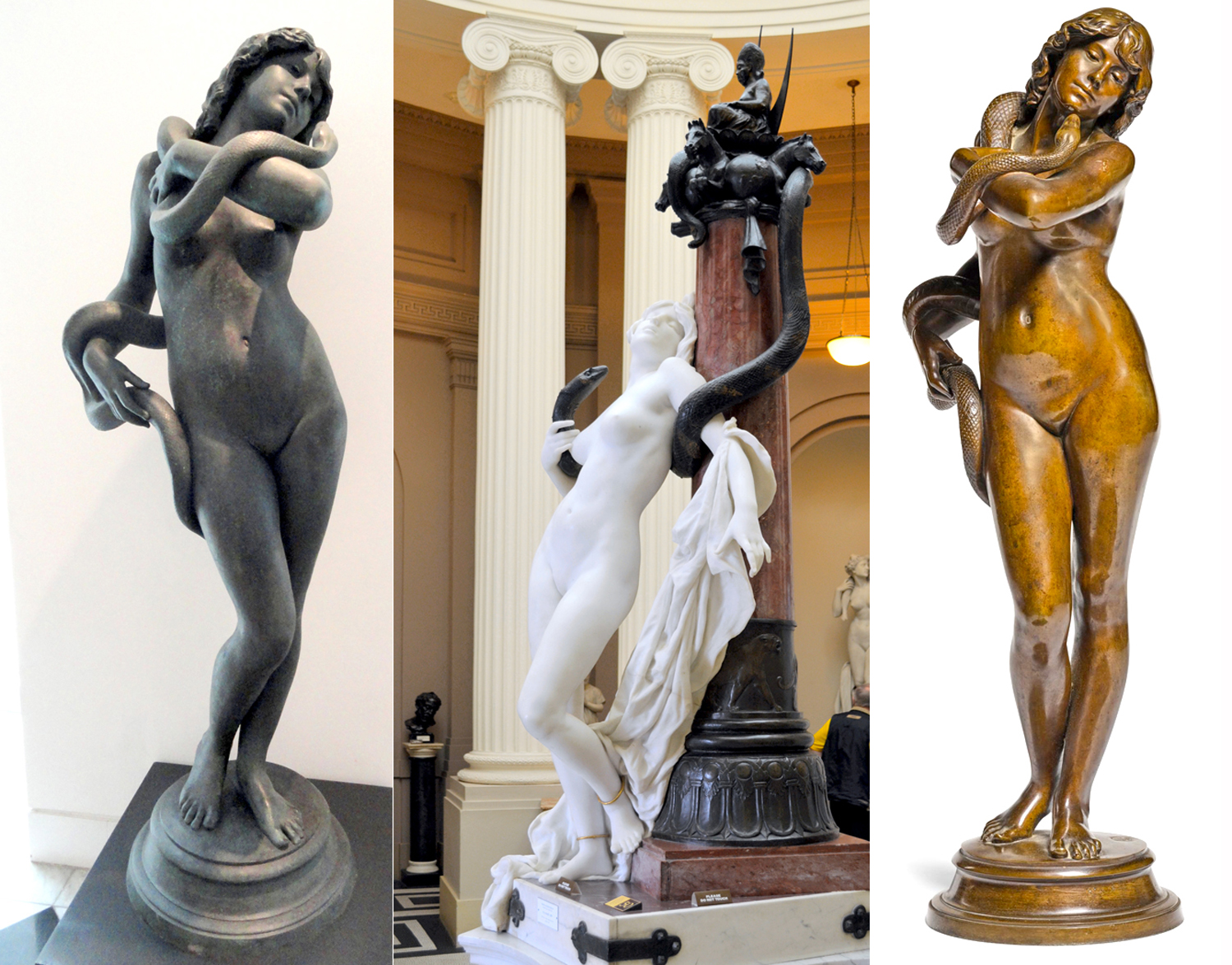
Of course, you will have noticed that in none of the ancient stories of her death does Cleopatra apply the serpent to her firm but supple breast. That version comes later, especially as painters attempted to give us the version not so much of Plutarch as of Joseph L. Mankiewicz. There is a Cecil B. DeMille quality to most of the historical paintings of Cleopatra, who ranks second only to Eve as a ripe subject for images of naked women with snakes.

Not that they are the only two: There are paintings and sculptures of the Roman goddess Hygea, goddess of health, which show her feeding a snake — the snake being the sacred animal of Asclepius, the god of medicine.

Lord Leighton, the English painter, gave us a grand tondo of the Hesperides, the home of the golden apples Hercules was to gather, which was protected by a serpent.

And there is the story of Harmonia and Cadmus. Cadmus, king of Illyria, had killed a serpent and the gods then turned Cadmus into a snake. His wife, Harmonia, stripped herself naked and begged Cadmus to come to her. As she embraced the snake the gods turned her also into a snake.

There is an obviously salacious element in these stories, especially as they are told, painted and sculpted by artists in the Victorian age, where they could be hypocritically sanctimonious about expressing the moral uplift of the glory that was Rome and the grandeur that was Greece while at the same time thinking “Look at the boobies on that one,” and, as the French say, “L.H.O.O.Q.”

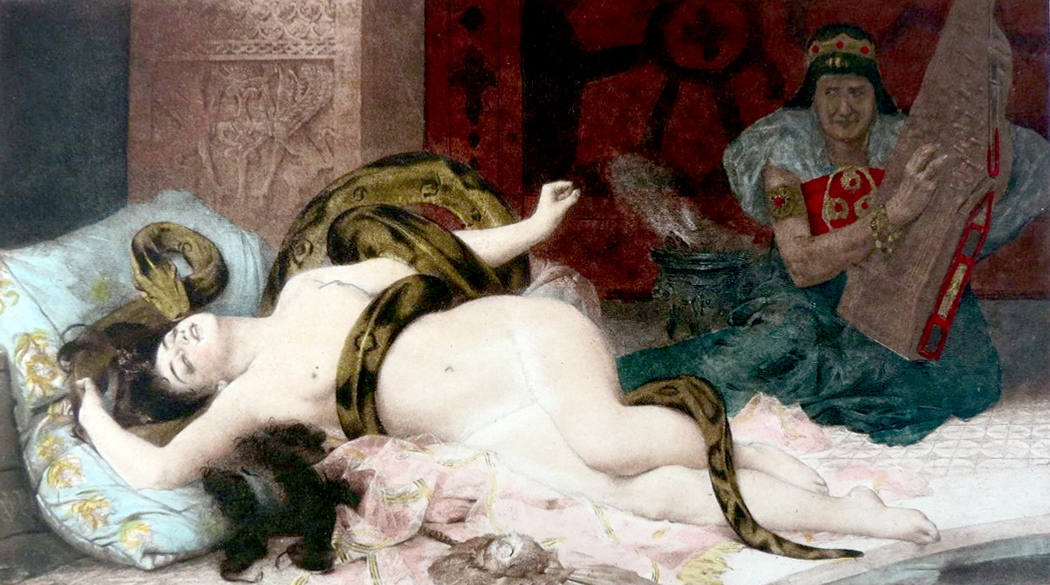
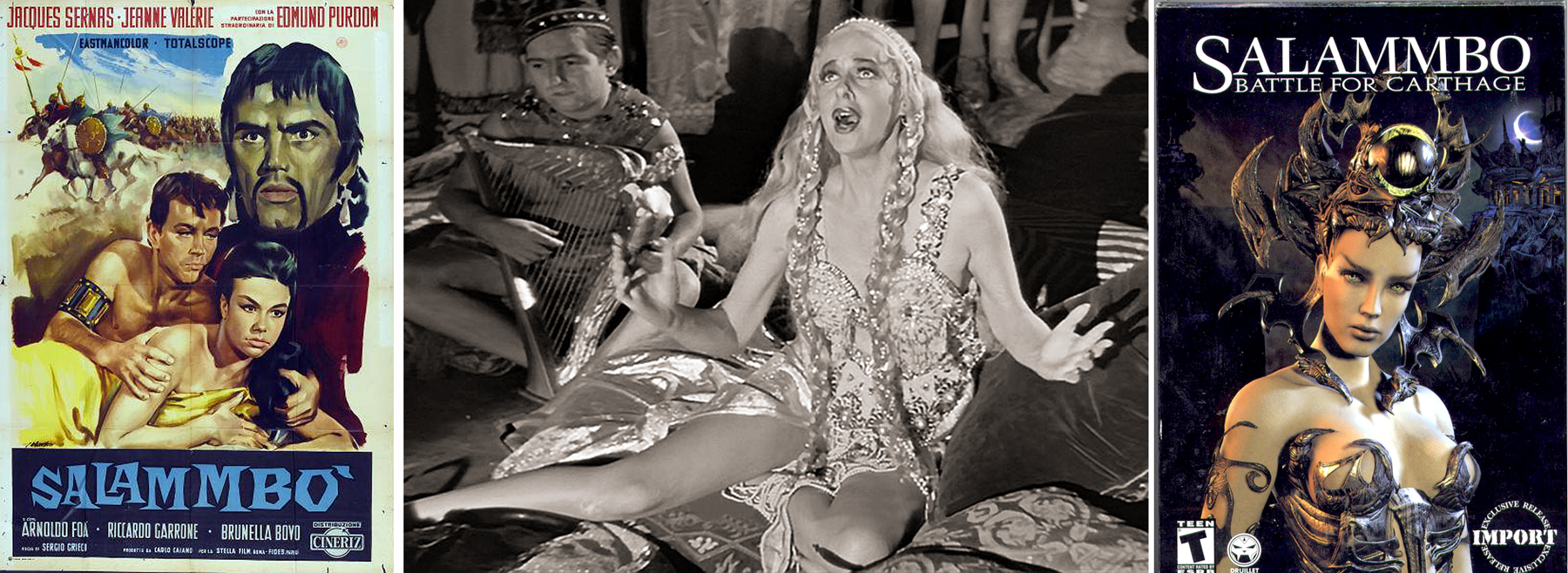
But the crown of this Orientalizing prurience must be in Gustave Flaubert’s novel, Salammbo — his followup to the scandalous Madame Bovary. It is the tale of the daughter of a Carthaginian general, set shortly after the first Punic War (264-241 BC). The plot is silly enough for an opera or a Hollywood epic. But there are scenes of sex and lasciviousness, not the least when the priestess Salammbo enters the enemy camp to retrieve the MacGuffin and encounters a prophetic snake. It is hard to avoid the Freudian undertones. They can hardly be called undertones.

“The moon rose; then the cithara and the flute began to play together.

“Salammbo unfastened her earrings, her necklace, her bracelets, and her long white simar; she unknotted the band in her hair, shaking the latter for a few minutes softly over her shoulders to cool herself by thus scattering it. The music went on outside; it consisted of three notes ever the same, hurried and frenzied; the strings grated, the flute blew; Taanach kept time by striking her hands; Salammbo, with a swaying of her whole body, chanted prayers, and her garments fell one after another around her.

“The heavy tapestry trembled, and the python’s head appeared above the cord that supported it. The serpent descended slowly like a drop of water flowing along a wall, crawled among the scattered stuffs, and then, gluing its tail to the ground, rose perfectly erect; and his eyes, more brilliant than carbuncles, darted upon Salammbo.

“A horror of cold, or perhaps a feeling of shame, at first made her hesitate. But she recalled Schahabarim’s orders and advanced; the python turned downwards, and resting the centre of its body upon the nape of her neck, allowed its head and tail to hang like a broken necklace with both ends trailing to the ground. Salammbo rolled it around her sides, under her arms and between her knees; then taking it by the jaw she brought the little triangular mouth to the edge of her teeth, and half shutting her eyes, threw herself back beneath the rays of the moon. The white light seemed to envelop her in a silver mist, the prints of her humid steps shone upon the flag-stones, stars quivered in the depth of the water; it tightened upon her its black rings that were spotted with scales of gold.

“Salammbo panted beneath the excessive weight, her loins yielded, she felt herself dying, and with the tip of its tail the serpent gently beat her thigh; then the music becoming still it fell off again.”

Yes, Flaubert; Mr. Mot Juste. More like Mot Jeaux, i.e. mojo.

We’re not done yet with naked women and snakes. More anon.

Click on any image to enlarge

How long ago was history?

When I was in grade school, whatever history I was taught seemed as distant as fairy tales, a never-never of such ancientness as to be inconceivable. It was certain that there was an unbridgeable divide between the now I lived in and a history that resided only in books, and pained us with dates and names we were required to memorize. There was no continuity; past and present were as immiscible as diesel fuel and salt water.

These things change as you get older and what is taught as history is what you lived through when you were younger. When I was born, Harry Truman hadn’t yet campaigned for president. For my grandchildren, Truman is a fuzzy black-and-white halftone in their textbook. For me, however, he was my first president. Eisenhower, the Vietnam War, the Kennedy assassination, the moon landing — these were things I can remember a time that was before.

Now that I’m about to turn 70, a century doesn’t seem like such a long time, or such a meaningful slice of eternity. My grandmother was born in the 19th century and I’m now alive in the 21st. She used to muse occasionally on the fact that she was born before the Wright brothers flew at Kitty Hawk and lived to see Neil Armstrong walk on the moon.

It’s really just a flash before you connect with what seemed so alien in that history textbook. Six degrees of separation.

Literally.

From me to my wife takes the first step. Her great-grandmother, Nancy Jane Steele, was alive until my wife was 8 years old. She was 98 when she died, in my wife’s childhood bed. She could remember eating sandwiches made from the cambium layer of tree bark because there was nothing else to eat during the Civil War. She had been married to Civil War veteran Rowan Steele, who had been messenger and courier for Col. Robert E. Lee, Jr., who was the youngest son of the legendary general, Bobby Lee. And that’s only five degrees of separation. Who knew a Yankee boy from New Jersey would be this close to the biggest name in the Confederacy?

We think of a century as being the measurement of a considerable piece of time — it is long enough to tick off entire ages in the history books: The 19th Century was distinct from the 18th Century; the 14th Century was so different from the 10th Century: the revolution between the Romanesque and the Gothic. But a century is really just the space from grandparent to grandchild. Not long at all.

In Ancient Rome, that is exactly how they counted eras. The Latin word we translate as “century” is “saeculum,” but saeculum doesn’t actually mean a hundred years. It is the time from the birth of a grandparent that you outlive to the death of the child who outlives you. They calculated it to be anywhere from 112 to 117 years.

How we can skip across these centuries. Let’s take something from the history books, say, the accession of James II of England in 1685. Unutterably distant, no?

Well, I can trace a person-to-person connection to that year in only nine degrees of separation. And without Kevin Bacon entering the equation at all.

That same year, Johann Sebastian Bach was born in Eisenach in Thuringia, now part of Germany. One of his sons was Johann Christian Bach, also a composer. J.C. Bach was friend and mentor to Wolfgang Amadeus Mozart, who once heard the young Beethoven play the piano. He was impressed. Beethoven had a few paying students to help him afford his daily vin de pays. One of those students was Carl Czerny, who wrote an infernal and deeply hated series of piano finger-exercises that young pianists still suffer through. One of Czerny’s students became probably the greatest piano teacher of all time, Theodor Leschetizky (among his students are Jan Paderewski, Alexander Brailowsky, Ignaz Friedman, Ossip Gabrilowitsch, Benno Moiseiwitsch, Artur Schnabel, and Fannie Bloomfield Zeisler — all of them among the most famous pianists of the first half of the 20th century). And Mieczyslaw Horszowski — who died in 1993 at the age of 101, playing and recording well into his 90s.

Well, Horszowski had a piano student named Eugene Istomin, who made a series of legendary piano-trio recordings with Isaac Stern and cellist Leonard Rose. And when I was a volunteer photographer for the Eastern Music Festival, in Greensboro, N.C., in the early 1970s, I was tasked with picking Rose up from the airport, cello and all. I was his chauffeur.

There it is, from Bach to me in nine easy steps. So, the 17th Century isn’t all that far away. Another nine and we could be building Chartres. History is not that long ago.

A few years ago, I read the Bible, cover to cover, and my general response was “These people were out in the desert sun too long.”

I mean, you must slice off bits of your private parts, but you must never cut off your sideburns? You cannot wear cotton blends without risking being stoned to death or eternally damned? If you have a flat nose, you cannot go to your house of worship? I mean, either you have to allow the possibility that in 40 years in the wilderness of the Sinai Desert, someone suffered sunstroke, or that perhaps the manna from heaven was actually some sort of psychotropic mushroom.

Or, you can read the so-called prophetic books and ask yourself, is this some sort of occult conspiracy gibberish? It too often reads like word salad. There is some sanity in the gospels, but then you descend back into paranoid craziness with St. Paul.

I can think of no better prophylactic against religion than actually reading the Bible. Those who profess belief too often cherry-pick the parts they like and ouija-board interpret the prophesies and ignore the batshit nutjob stuff that surrounds it all.

So, I hope I have established my bona fides as a non-believer when I say I am against removing the Bible from public schools. That’s right — I believe the Bible should be taught in school from an early age. Not for religious indoctrination, and also not for religious inoculation, but rather to familiarize the upcoming students with the stories from the book.

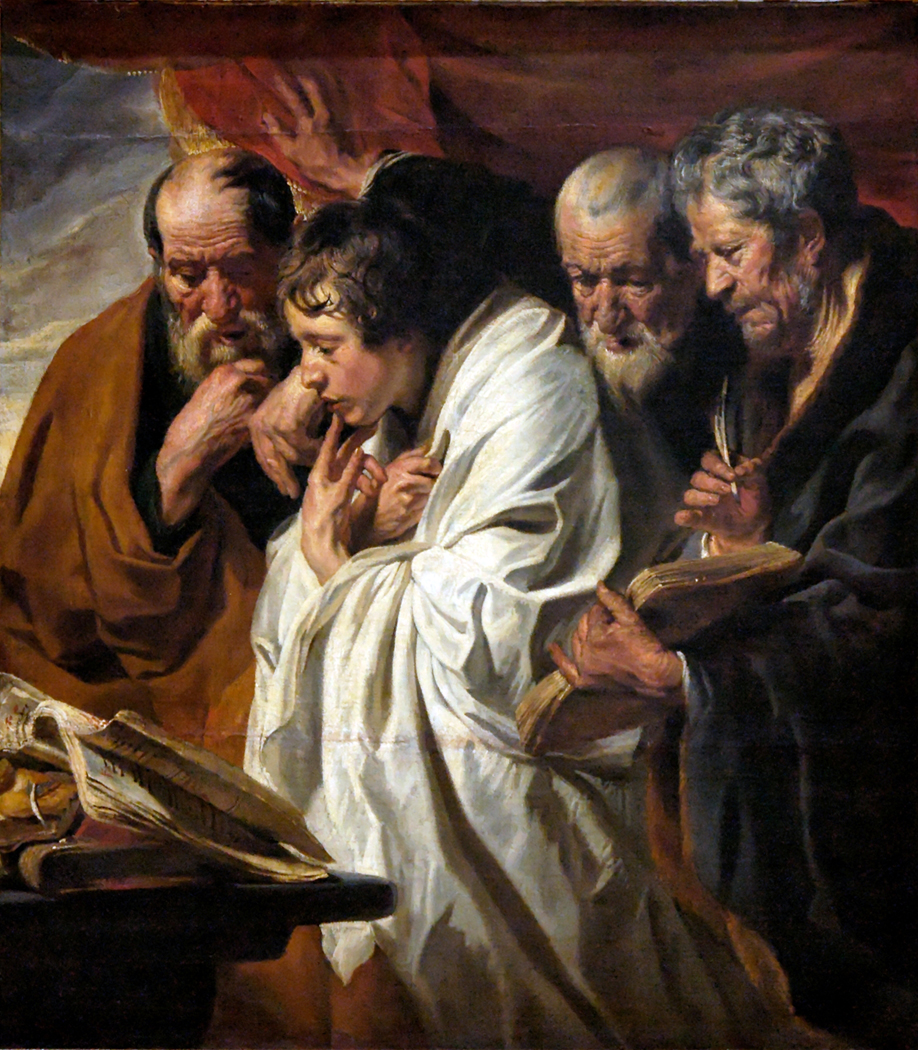
The Four Evangelists by Jacob Jordaens

When I was teaching art history, many, many years ago, I was surprised that my students knew so little about the subject matter of the paintings we were studying. Renaissance and Baroque paintings are suffused with biblical imagery, and to understand what is going on in many of those paintings, you need to know the cultural context — i.e., you need to know the Bible stories.

But, in a test, when I asked “Who were the four Evangelists,” only two of a class of 22 knew. One of them half-remembered, “John, Paul, George and Ringo.”

It hardly mattered if the students considered themselves Christian, or even merely generally religious. They were by and large, astonishingly ignorant of their cultural patrimony.

Abraham and Isaac. Cain and Abel. Lot’s wife. Jacob and Esau. Potiphar’s wife. Jacob’s ladder. Aaron’s rod. The golden calf. Balaam’s ass. Joshua and Jericho. David and Jonathan.

There are tons of stories that were once the common well of cultural reference for all European and Euro-American peoples, and by extension and the African-American church, for Black Americans, too.

It isn’t just Renaissance paintings, but in everything from Medieval illuminated manuscripts to the poetry of W.H. Auden. It shows up in sculpture, in novels, in dance, in symphonic music and Baroque opera.

The Slaughter of the Innocents by Rubens

Daniel in the lion’s den. Boaz and Ruth. Jonah and the great fish. Paul and the road to Damascus. The massacre of the innocents. The wedding at Cana. The raising of Lazarus. The giving unto Caesar. Doubting Thomas.

The loss of these stories in popular parlance isn’t just a loss of religious faith, but a casting off of hundreds of years of art, literature and mores.

When Herman Melville begins his magnum opus with “Call me Ishmael,” we need to understand who Ishmael was in the Bible if we want to feel the depth of the meaning of such a simple statement. It resonates.

When John Steinbeck titles his book, East of Eden, do we know what geography he is laying out for us? When William Jennings Bryan exhorts us not be be crucified on a “cross of gold,” do we feel the mythic undertones of his rhetoric? Everything we say has resonance, more and less, with the long line of cultural continuity. We have lived with the Bible, in one form or another (depending on denomination) for nearly 2,000 years, and the Torah, for even longer and the residue from it has colored almost every cultural effusion since the Emperor Constantine decided to change the rules for the Roman Empire.

Of course, it isn’t only the Bible that needs to be taught. All of Greek and Roman mythology is equally part of our cultural inheritance. It should also be taught. How can you read Shakespeare or Milton — or John Updike — without it? I would recommend that everyone by the 8th grade have read Ovid’s Metamorphoses.

What I see is a rising population of those cut off from their past, from their inheritance. They are like untuned strings, with no fiddle or lute to provide resonance. And it is this resonance that is so important. A familiarity with our cultural origins allows meaning to open up when you read, that emotions become complex and connections are made. The world is electrified: A switch has been turned on and a darkened room is lit.

And what do you get without this resonance? I fear you need only look at the White House and its current occupant (and I use the word advisedly: an “occupant,” like an anonymous piece of junk mail rather than a “resident,” which implies roots.) For without resonance, you have simplicity instead of complexity, you have response without consideration of consequence. If someone insults you, heck, punch him in the face — a simple and simple-minded response. And a dangerous imbecility in the face of the complex cross-forces and dangers of the interconnected world.

Tower of Babel, by Pieter Brueghel the Elder

Resonance is complexity. It is the plate tectonics under the surface geography.

A great deal of art and literature has something important to say to us, and the best of it resonates within the sounding board of 6,000 years of cultural development, with each layer built on the last and a through-line of meaning. Without it we are intellectually, emotionally and morally naked.

Size matters, at least in the case of Medieval churches vying with each other for bragging rights. The two tallest Gothic cathedrals in France are only a few miles apart, but they tell very different stories.

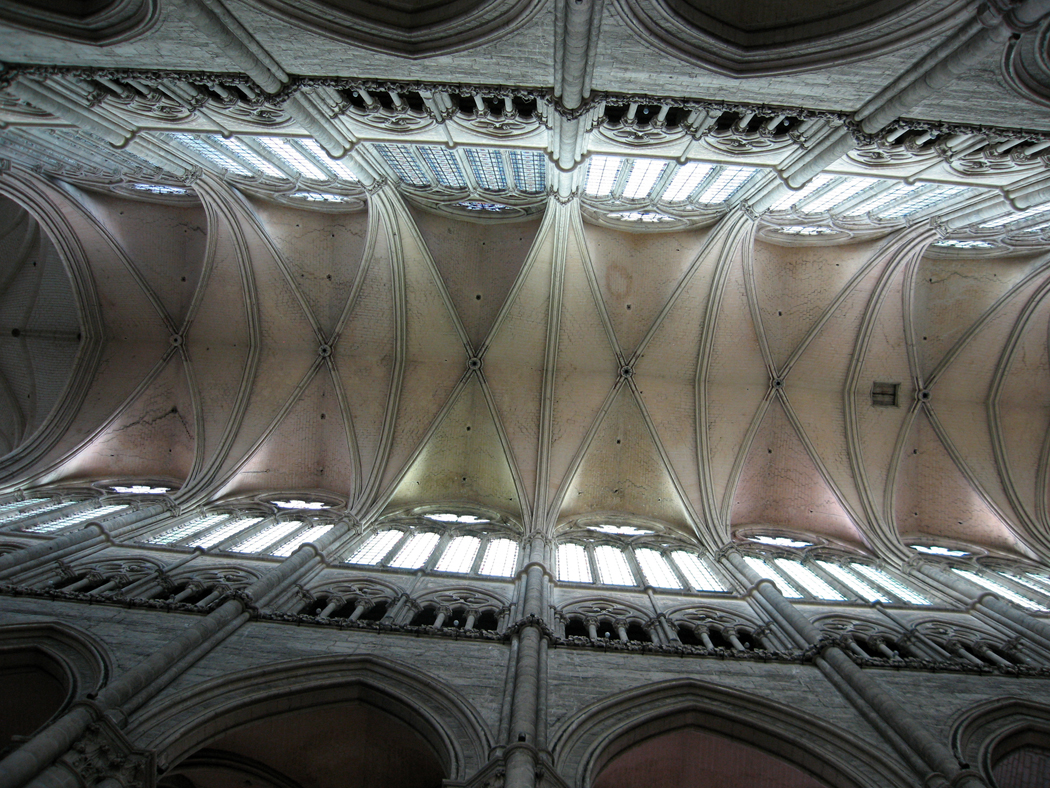
In the high Middle Ages, towns built churches the way American cities build sports stadiums, striving for the biggest, best and most impressive. They also advertised the best saintly relics, to draw pilgrims and their money to town. Some 70 miles north of Paris is the city of Amiens, which has the cathedral with the highest vaulted ceiling of any completed church and some 30 miles from that is the incomplete Beauvais, with a ceiling even higher, but an unfinished nave, leaving the church truncated and mutilated.

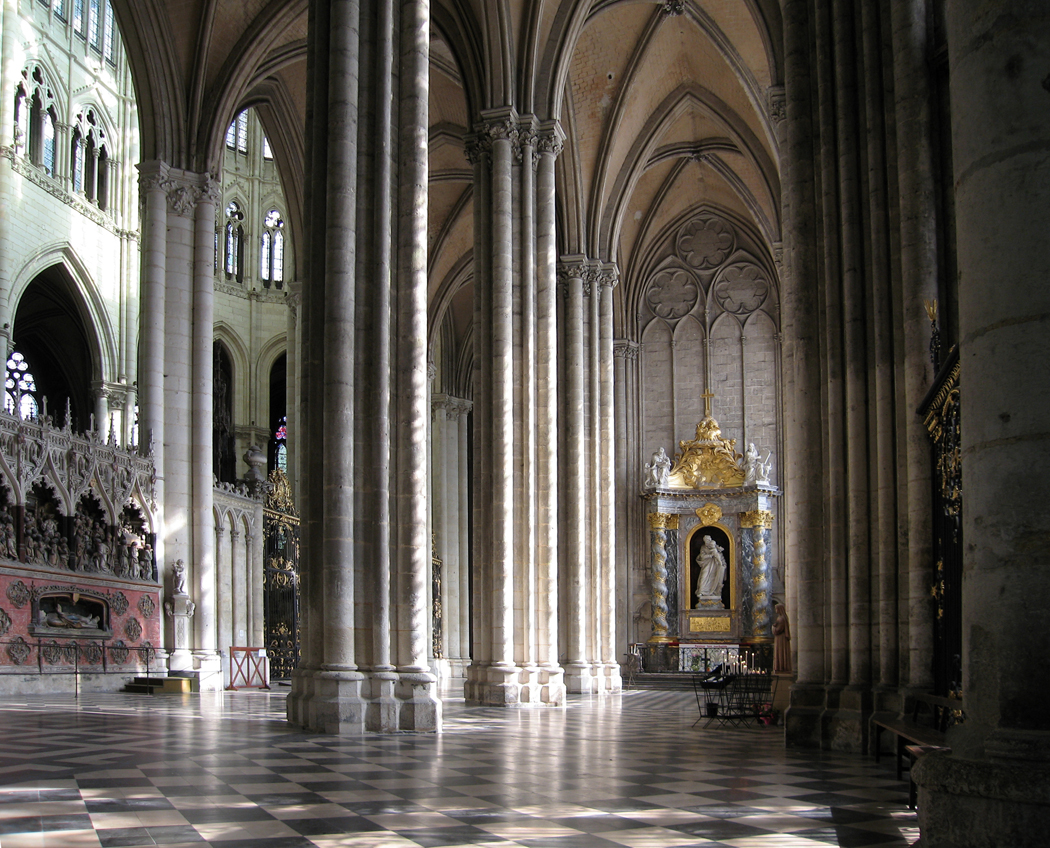
Amiens is a nearly perfect relict of the architecture of those years (and I shorthand the city’s name for the cathedral, otherwise I must write Notre Dame d’Amiens — or more precisely “The cathedral basilica of Our Lady of Amiens” to give it its official name — and almost all of these churches, cathedrals and basilicas are called Notre Dame or “Our Lady,” after the Marian cult that figured so prominently in Roman Catholicism in the area and at that time) It is the largest by volume and the tallest from floor to ceiling (save only the unfinished Beauvais, about which more later) with 13 stories of emptiness above the visitor.

It sits in the center of the town with a small by handsome parvis, or plaza, at its front. Three portals punctuate the western facade, which is covered with statues of saints and biblical figures. The north tower is slightly taller than the south, and because the building sits on a slight incline, there are more steps to climb at the north end of the facade than in the south.

Inside is brightly lit. Like the cathedral at Rouen, most of its stained glass is gone and the clear or frosted glass lets sunlight stream in.

The odd effect of the church’s regularity, its brightness and its isolation from other buildings nearby, Amiens doesn’t seem as big as it is, with ceiling 138 feet above the floor, and encompassing 260,000 cubic yards of air inside — three times the volume of Notre Dame of Paris. It is, however, the perfect model of the Gothic cathedral and the one I would suggest be the first to see, so as to gauge all the other you find in the northern half of the hexagon that is France.

There are a whole series of such cathedrals and basilicas in northern France, usually not more than 50 miles between each, and in 2006, my wife and I took a trip through the area, visiting 11 of these monuments. From Paris, we took the train to Rouen, where we rented a car and drove to Amiens and Beauvais. Then to Noyon, Laon, Reims, Vezelay, Chartres and back to Paris and Sainte-Chapelle, ending at the earliest Gothic architecture at St. Denis.

Of all of them, Amiens is perhaps the most classical, the ur-cathedral, and certainly the most unified, having been built rather quickly, by Medieval standards, from 1220 to 1260, with additions made in following centuries. Where some other churches are still rather grimy from the exhaust of the Industrial Revolution, Amiens has been cleaned up and is bright and presentable.

If anything is true of these prodigies of architecture, it is that there is no such thing as a Gothic cathedral — at least no such thing as a “pure” Gothic cathedral. Each has been built over decades, even centuries, and each has add-ons in different styles, rebuilds made more “modern,” and restorations by well-meaning finaglers such as the 19th-century Eugene-Emmanuel Viollet-le-Duc, who replaced damaged statuary, added grotesques and redesigned finials and gargoyles according to his Victorian sense of what Gothic style should be.

Viollet-le-Duc was put in charge of restoring Amiens in the late 19th century, and he added a whole new line of statues at the top of the west facade, called the “Galerie des Sonneurs,” or “Gallery of Bell Ringers,” a passageway arcade between the two towers. He redid a good deal of the statuary and had the cathedral floor redone to smooth out the cobbling of centuries of foot traffic. Modern standards for restoration were not part of his procedure. “To restore an edifice”, he observed in his Dictionnaire raisonné, “is not to maintain it, repair or rebuild it, but to re-establish it in a complete state that may never have existed at a particular moment.” In other words, as he might imagine it

But such rejiggering is hardly unusual for these cathedrals.

Amiens was originally built in what is called “high Gothic” style, but all kinds of stylistic incongruities have been patched on. Although the building was essentially complete by 1280, in the 16th century, the mayor of  the city of Amiens decided it should have a spiffy new rose window in the then-current “flamboyant” style, highly sinuous and curvy, so the front window of Amiens doesn’t match the rest of the facade.

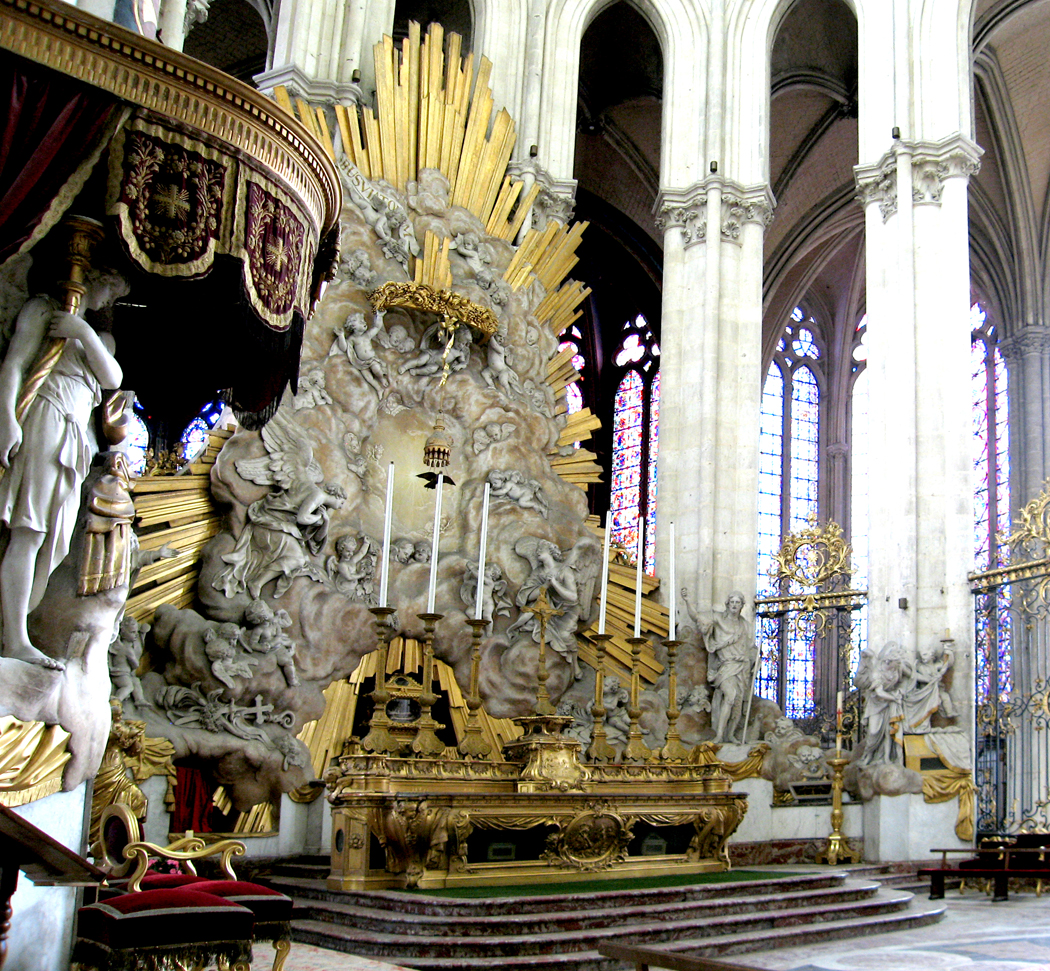
Not that one can complain. Inside, there are altars added in the Renaissance and the Baroque eras, so completely out of sympathy with the more rigorous taste of the Gothic. In some cathedrals, there are even Modernist stained glass windows.

It is the genius of the Gothic style that it can absorb almost anything and still seem perfectly harmonious. Some historical styles that strive for unity require any additions to be matched stylistically or the new parts seem like carbuncles grown where they are least desired. (Can  you imagine an addition to London’s Saint Paul’s Cathedral designed by, say, Louis Kahn?) But Gothic is an accepting style. There is not much you can do to it and not have it welcomed into the family.

The 19th century gave us a pervasive sense of the Middle Ages. Whether it was Victor Hugo in his hunchback novel, or Sir Walter Scott in his Waverly novels, Alfred Tennyson in his Idylls of the King, or Mark Twain (who tried to take the whole thing down a peg or two) in his Connecticut Yankee in King Arthur’s Court, there are knights in shining armor, kings and their courtiers, castles and cathedrals. Those artists and authors gave us an era of dour religion and grey stone monuments. And when we look at the front of Amiens, with its ranks of saints standing like an army between the portals, we tend to have a purist vision of the stern asceticism of that era. Yet, we now know, from recent restoration work, that those grey statues guarding the church were originally brightly colored with paint. Traces of that paint is found in the stone, and in recent years, a fancy computer program has managed to create a light show that projects the original colors back onto the neutral stone. We can see what the front of the cathedral was meant to look like. It comes as a shock. One is reminded of certain Arab sheikhs painting the statues in their gaudy Los Angeles mansions.


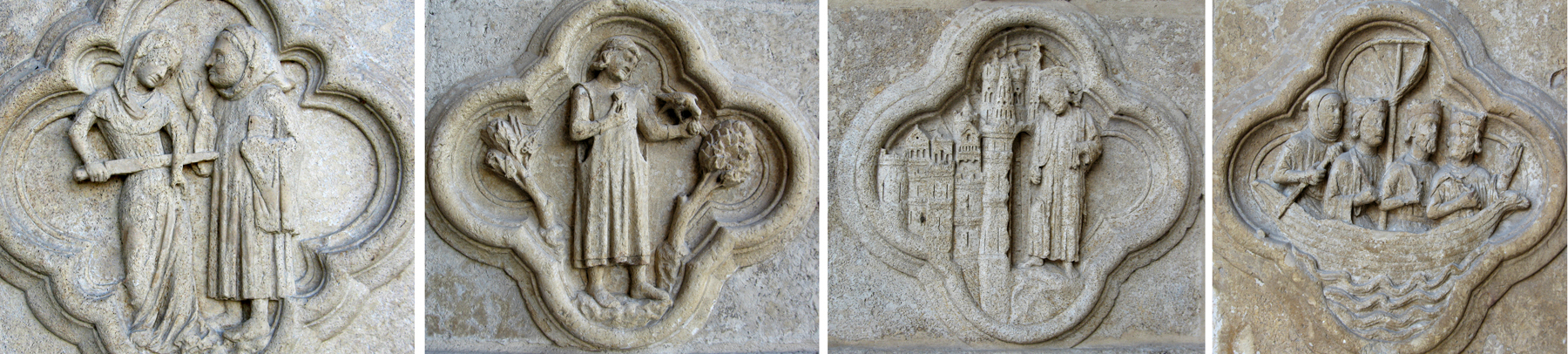
There are ranks of small bas reliefs at eye-height along the front of the cathedral that depict the zodiac signs, the works of the seasons, and the stories of local saints. They are now monochrome, but inside, you can find similar quatrefoil reliefs that are still painted.

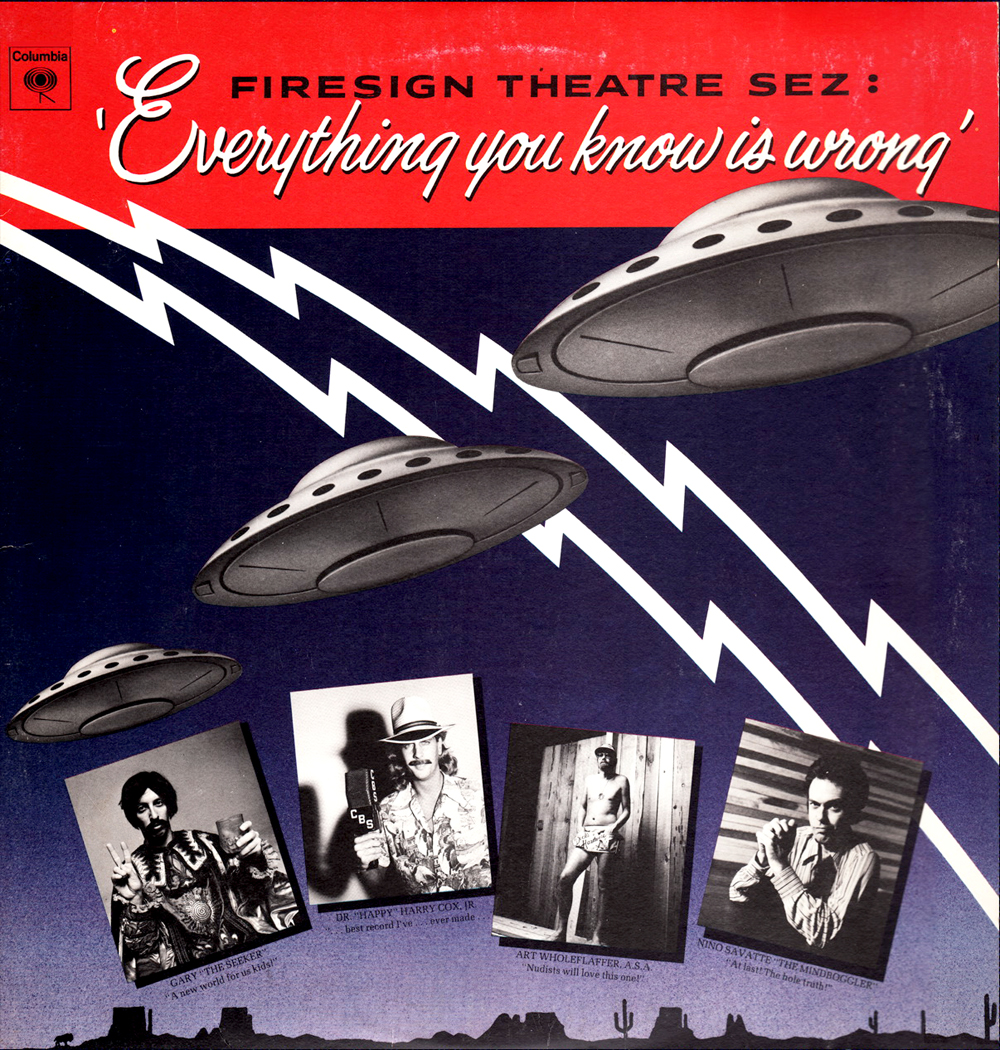
The past as we imagine it is always a shaky construct. History is always being revised, and those scholars who do the work are initially derided as “revisionist,” when, of course, that is their job. To quote the revered Firesign Theatre, “Everything you know is wrong.”

Click any image to enlarge


Beauvais

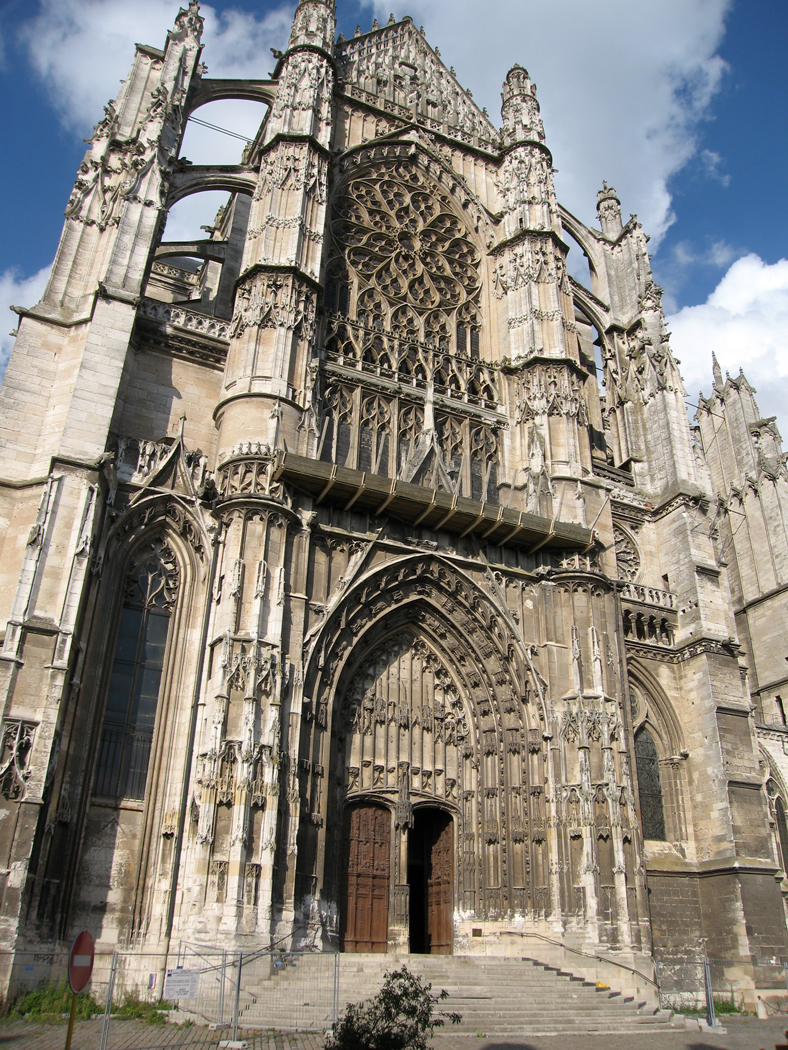
Some 35 miles from Amiens, the cathedral at Beauvais is a testament to overreach. One cannot avoid thinking of the Tower of Babel, where cultural hubris outstrips engineering acumen and it all comes tumbling down.

The central metaphor of all these Gothic cathedrals is altitude, the sense inside them, that they reach to the heavens — or rather, to heaven. Their naves and choirs get taller and taller as the years move along, and when you are inside, it is nearly impossible not to be drawn upward, craning your neck into the vast space above your head. The light in a Gothic church also comes from above, reinforcing the metaphor: Above your head is divine.

This spiritual metaphor exists alongside the more earthly desire of city fathers to brag that they have the biggest and best, and so, a kind of competition existed in the 13th and 14th centuries to see who could build the most vertiginous vaulting. The winner of this inter-city battle was Beauvais, although its victory was Pyrrhic.

In AD 1225, the city authorities decided to replace an older church with one in the new Gothic style. The ambitions of the church and the local barons coincided in a plan to make this church the tallest and best in the world. The barons were in in  struggle with the French throne of Louis VIII and wished to assert their supremacy with the building, and the bishop wanted to assert his own primacy in this grand construction.

They finished the choir of the new church in 1272, with a ceiling vault that was 157 feet above the floor. An empty space the size of a 15 story building.

A Gothic church is usually built with a floorplan in the shape of a cross. The top part is called the choir, at the east end nearest the sunrise, the cross pieces are called the transept and the long side of the cross is the nave. Such churches were usually constructed with the choir made first, because that is where the Mass is celebrated and where the altar is located. (Amiens was unusual, in that the nave was built first and the whole constructed from west to east). So, in Beauvais, the choir was up and church services begun before the whole was finished.’’

It makers were proud, certainly, not only of the tallest church, but the finest, slenderest flying buttresses supporting the roof. But 12 years after it was finished, the roof collapsed. It seems to modern engineering studies, that a gale wind off the English Channel caused sympathetic vibrations in the structure and it shook apart. They rebuilt.

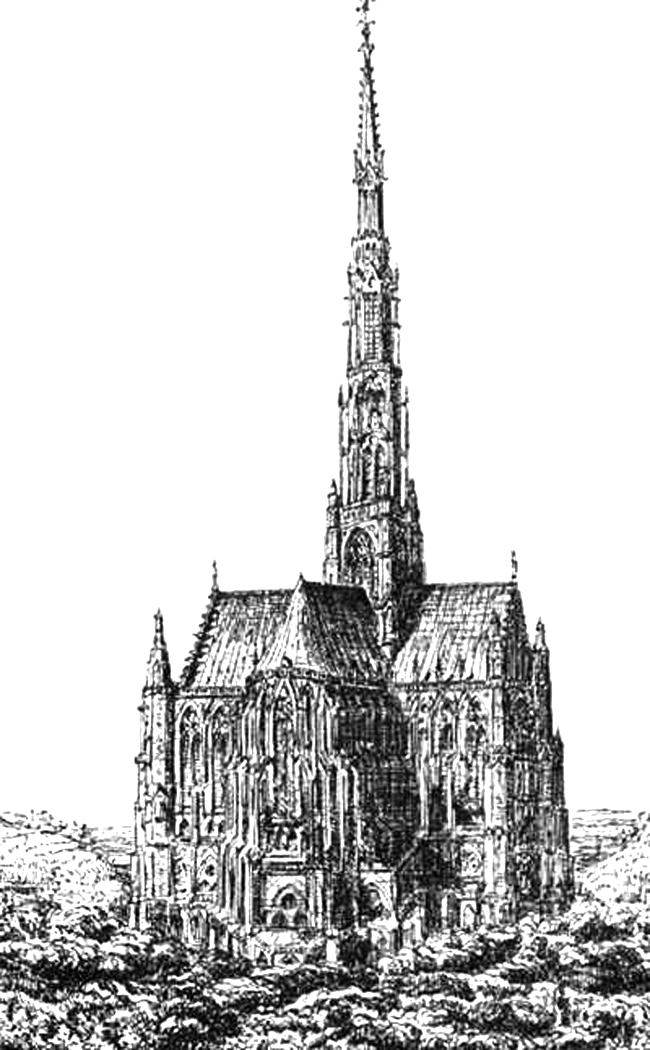
But the collapse, which caused concern about the engineering, and trouble fund raising to complete the whole left the church with only the choir and transept. At some point, it was decided that instead of using the money they had to finish the nave, they would use it to top the whole with a giant spire, which was finished in 1569 and left the church — at 502 feet high — the tallest building in the world at the time.

“We will construct a spire so high that once finished those who see it will think that we were crazy.”

Perhaps they were. Unfortunately, on April 30, 1573, it, too, came crashing down, along with three levels of the bell tower.

As described by author Elise Whitlock Rose, “On the eve of Ascension Day, 1573, a few small stones began to fall from its heights. The next morning, a mason, who had been sent to test it, cried out in alarm; the bearers of the reliquaries, about to join the Procession of the people and the clergy who were waiting outside, fled; — there was a violent cracking, — and in an instant, the vault crashed amidst a storm of dust and wind. Then, before the eyes of the terrified worshippers, the triple stories of the lantern sank, the needle fell, and a shower of stones rained into the church and on the roofs.”

The choir was rebuilt once more, but without the spire. But the nave (except for one bay) was never completed, leaving Beauvais as the trunk of a cathedral, a mutilated fragment.

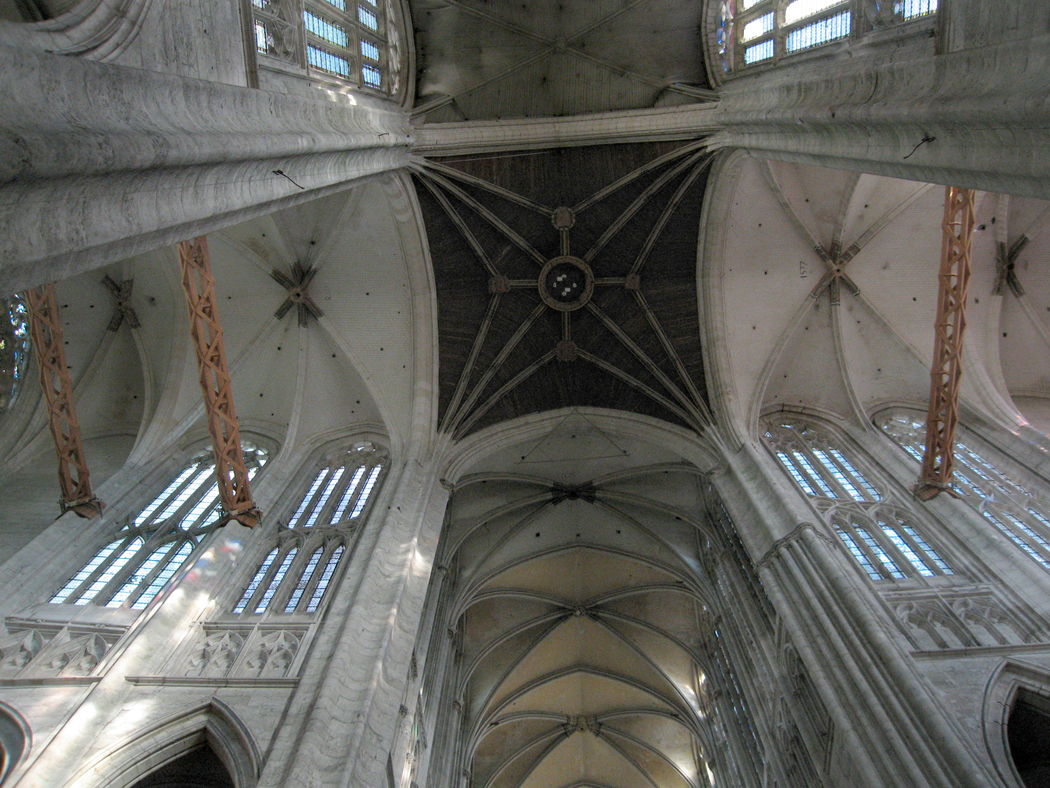
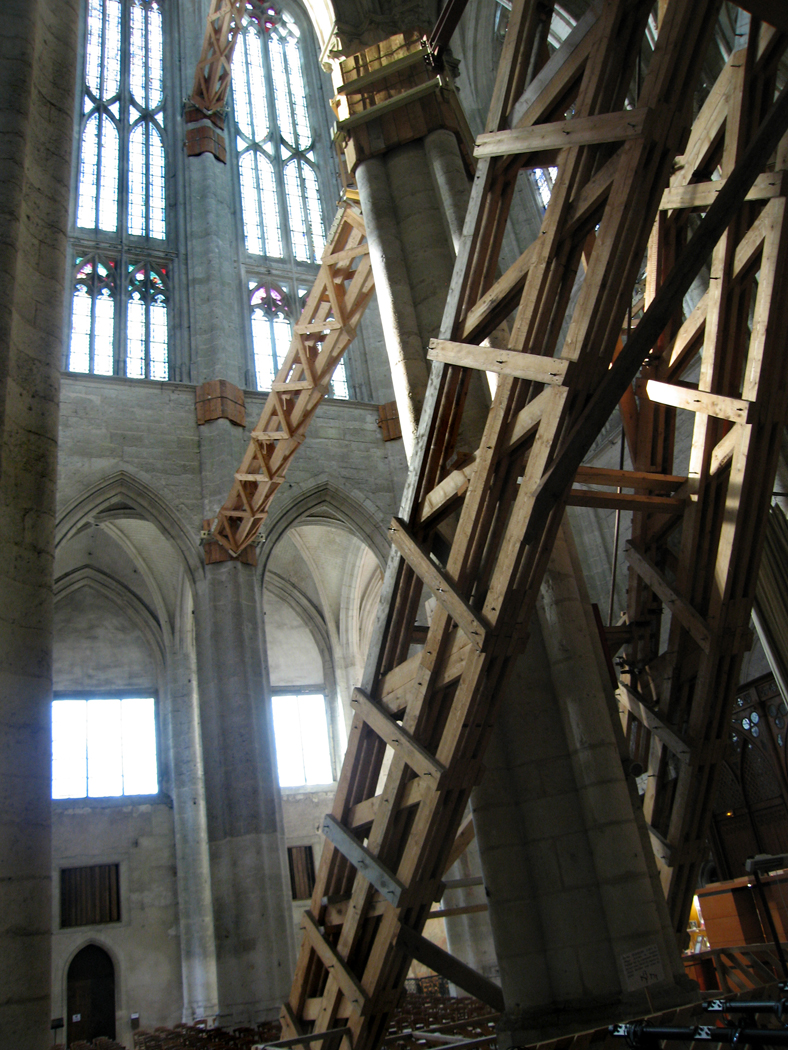
The shakiness of its construction continues to threaten the building even today. The inside, meant to be an awe inspiring sublime holy space, is filled with trusses and braces, attempting to keep the whole from final catastrophe.

“I can remember Beauvais, because it didn’t have figurative sculpture on the outside and it didn’t have a nave” wrote Carole in our journal, “and inside I was frightened because so much of it was supported by wooden beams and screws. I wondered if it could fall.”

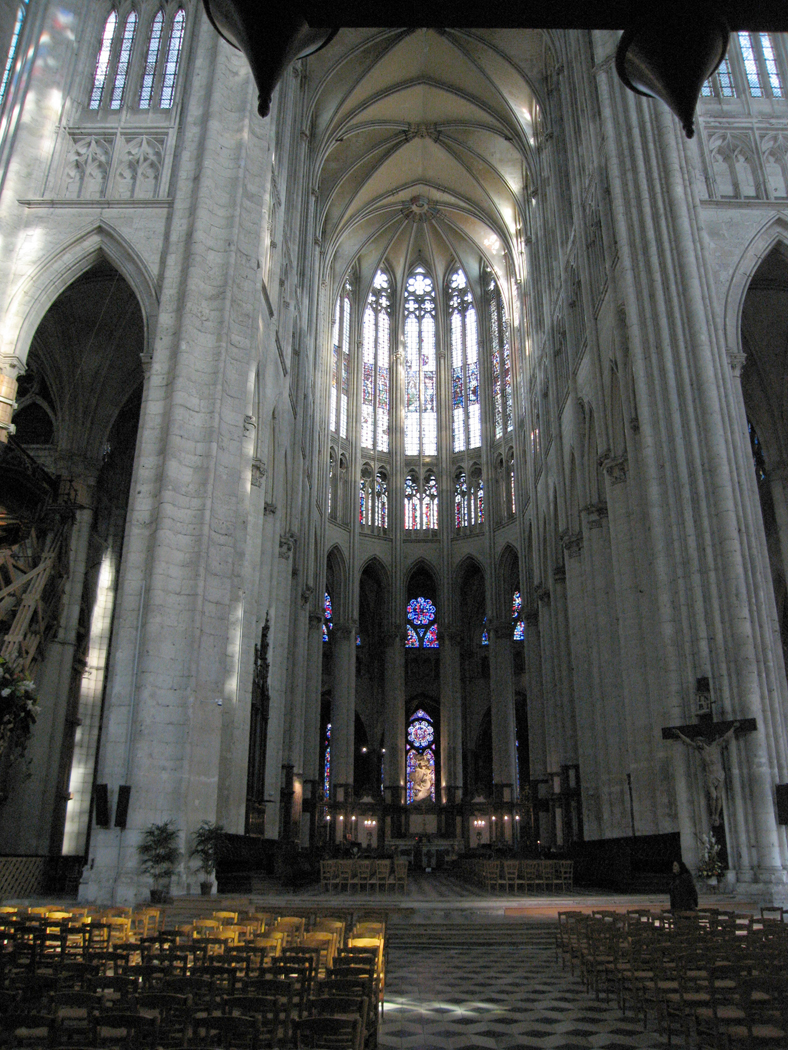
The lack of nave makes another point about the architecture: Despite Beauvais having the highest vaulting, its spiritual effect is diminished by the lack of nave. When you first enter Notre Dame de Paris, or Amiens, through the west portal, the view down the long stretch of nave gives you perspective on the height, making it all the more effective. You can see the height because of the length. At Beauvais, despite the height, there is something of a claustrophobic feel to it, squeezed into the heights instead of expanding to them.

Next: Noyons and Reims

trump-neuman-2

I have avoided writing about current politics for several reasons. Firstly, because the situation so quickly changes, nothing you write today may hold for tomorrow. Secondly, because it is so touchy a subject, you risk alienating your reader for minor offenses that can be taken as index markers for major disagreements. Thirdly, because politics is such a minor part of what makes a difference in our individual lives; so many other things are more important and more interesting.

Nevertheless, the chaos of the current American situation calls for some small clarification. Arguments muddy when thinking is unclear.

To begin, there is the issue of Donald Trump, which is a great squirt of squid juice, obscuring more lasting problems. It is easy to make fun of the Great Pumpkin, he practically satirizes himself. While he has fervent supporters, it is hard to know exactly what he stands for, because his words are so vague in application, no matter how blunt in expression. It is always possible to assume he is your ally, because you only listen to those words that honk your horn. Is he conservative? Conservatives value free trade. Is he pro-business? Business has told him they need an immigrant workforce. What does he stand for besides ignorance?

He is an obfuscation on the surface, a chaos beyond that because, of course, he has no ideology, other than Trumpism. It is not his supposed conservatism that I object to; there have been many thoughtful conservatives. Trump is not one of them; he isn’t even a conservative at all. What scares the bejeezus out of me about him is that he is so clearly unbalanced mentally. The word Andrew Sullivan has used is “bonkers,” and that can hardly be improved for accuracy. The constant wheezing about his vote count, poll numbers, inauguration crowd, all spouted against obvious and visual evidence, is a clear indication that he is unmoored from reality.

Then, there are the speeches, barely in English. They are really just sentence fragments thrown together with unattached adjectives. Yuge, sad, unbelievable, disgusting. They, as Philip Roth has counted them, are constructed from a vocabulary of a mere 77 words, reused and rearranged ad hoc. They jump around from topic to topic with little or no segue. And then, they are filled with things that are demonstrably untrue. One watches over an over when Trump says he never said this or that, followed by the videotape of him saying exactly what he now says he never said. Does he not know that his words have been recorded?

It cannot be easily said that Trump is a liar, because a liar knows what he is saying is untrue. Others manipulate statistics to make their arguments; Trump just pulls stuff out of his ass. Evidence is irrelevant.

Further, he uses these exanus pronouncements to support his chaotic policy pronouncements, which tend to be simple-minded in the extreme. Problems are usually complex and systemic; his solutions are simple-minded and blunt as a cudgel. He shows contempt for subtlety. If the problem is illegal immigration, his solution is not to consider the cause of the immigration, but to build a wall, despite the fact that the majority of the illegal immigration does not cross the desert border, but flies into our airports. My favorite joke about the wall: “Wall — cost: $12 billion; ladder — cost: $35.”

But this is not meant to be a jab at Trump, who is clearly unhinged, not very bright, not at all subtle, and basically a bully at heart. It is too easy to target him; he is a joke. A dangerous joke, who may very well destroy the world at the push of a button, but a joke nonetheless.

No, what I want to point out is that there is, beyond Trump, a basic misunderstanding of the political divisions in the country.

The divisions are very real. Between urban and rural, between liberal and conservative, between Republican and Democrat. But I want to point out that these may overlap, like Venn diagrams, the dipoles are not identical. We too often confuse conservative with Republican and liberal with Democrat. There may be overlap, but more important, their goals are different.

There is a clear difference between liberal and conservative. As they are defined nowadays (very different from when they originated and when conservatism favored a strong central government), the conservative now seeks a smaller central government and the liberal, an activist government working for the betterment of its citizens. The one favors the individual, the other, the community. The one is exclusionary, the other inclusive. And it is clear that as the political scene is currently deployed, Republicans tend to favor conservatism and Democrats tend to the liberal, although Republicans are more extremely weighted to the far-end of conservatism than the Democrats are to the left wing.

But, such thoughts of political philosophy are largely irrelevant to the actualities of politics. One should never conflate Republican with conservative, nor Democrat with liberal. The aims of ideology are to promote a world view and an action plan to enforce that world view. But that is not the aim of the Republican party. Certainly, it will use conservative ideas to further its ends when it can, but its primary driving aim is the accrual and preservation of power. This is central and should never be forgotten: Republicans will do whatever they need to to gain and keep power. Democrats have a similar, but weaker drive. Many Democrats join the party because they think they can make the world a better place. Some Republicans do that, too, but the aim of the party on the whole is not the improvement of society, but the exercise of power. It is King of the Hill on a hemispheric playing field.

This is not to say that most Republicans don’t believe, by and large, that conservative policies would help the nation, but that whether or not they do is secondary to the accretion of political power. Hence, the contorted, serpentine Congressional districts, gerrymandered into silliness in order to ensure Republican supremacy. (Yes, Democrats have done the same — in fact, they invented the procedure in the 19th century — but they were pikers compared to the modern attempt to engineer a “permanent Republican majority.”) Hence, the bald-faced hypocrisy of choosing sides on an issue solely on the basis of whether a Republican or Democrat is offering it for a vote (as with the Republican-designed Affordable Care Act, which became an unswallowable “disaster” when recycled by the Obama administration. Hence, the use of arcane Senate or House rules, or the threat of the “nuclear option,” when it favors them, and outrage when used against them.

And it is why Republicans were gulled into supporting Trump when it looked like he might win the White House back for the party, despite the problem of Trump espousing ideas contrary to longstanding Republican policies. Trump is, after all, not a Republican, except in name, and not a conservative, as it is usually defined. He is sui generis, a propounder of Trump now, Trump tomorrow, Trump forever.

One area in which Trump and Republican world views agree is that the primary lens through which to view policy is economic. Money is the gravity that holds that world together. Whether it’s tax cuts, deregulation or fear of unions and a raise in minimum wage, the heart and soul of the conservative world view is money. The very idea of “running government like a business” is a consequence of this Weltanschauung. But across the world, this idea is changing. Governments are not businesses.

There is a historical storyline here. In the feudal past, with the king at the top of the pile, government was essentially a protection racket, with each level of vassalage “wetting its beak” in the next level down, and everyone feeding on the peasants. The general welfare of the populace was not even an empty platitude. As nation states developed from the Medieval sense of monarchal real estate, the idea of decent governance took hold. Since the New Deal in the U.S., and post-war in the better part of the rest of the world, governments have assumed the duty of protecting the welfare of its populace. All through Europe, governments guarantee health care, safety, minimum living wages, shorter work weeks and longer vacations. The U.S. has resisted such things. For Republicans (distinct from conservatives, who also have many social issues) and Trump see the world through dollar-tinted glasses. It is a reversion to the Medieval model, where all wealth floats upward like a bubble in the champagne. And it is power that guarantees the income. The goal of the Republican party is not so much the institution of conservative ideas, rather it is the use of conservative ideas to protect and increase individual wealth.

The problem is, that while money can make life easier to navigate, money cannot make life worth living. For that, you need the other aspects of life that Democrats — and most of the rest of the world — embrace. Freedom from oppression, sufficient means for living, cooperative communities, aid for the less fortunate, an even playing field for all. Among the things that make life worth living are family, love, art, religion, good health, and shared interests and shared mythology.

For Trump and the Republican party both, the world they see is transactional. It is also a zero-sum game, and the winning is all. We need to recall that when we let ourselves be gulled into arguing over conservative and liberal. Those labels are merely the masks worn in the more brutal fight over who will be the alpha dog.

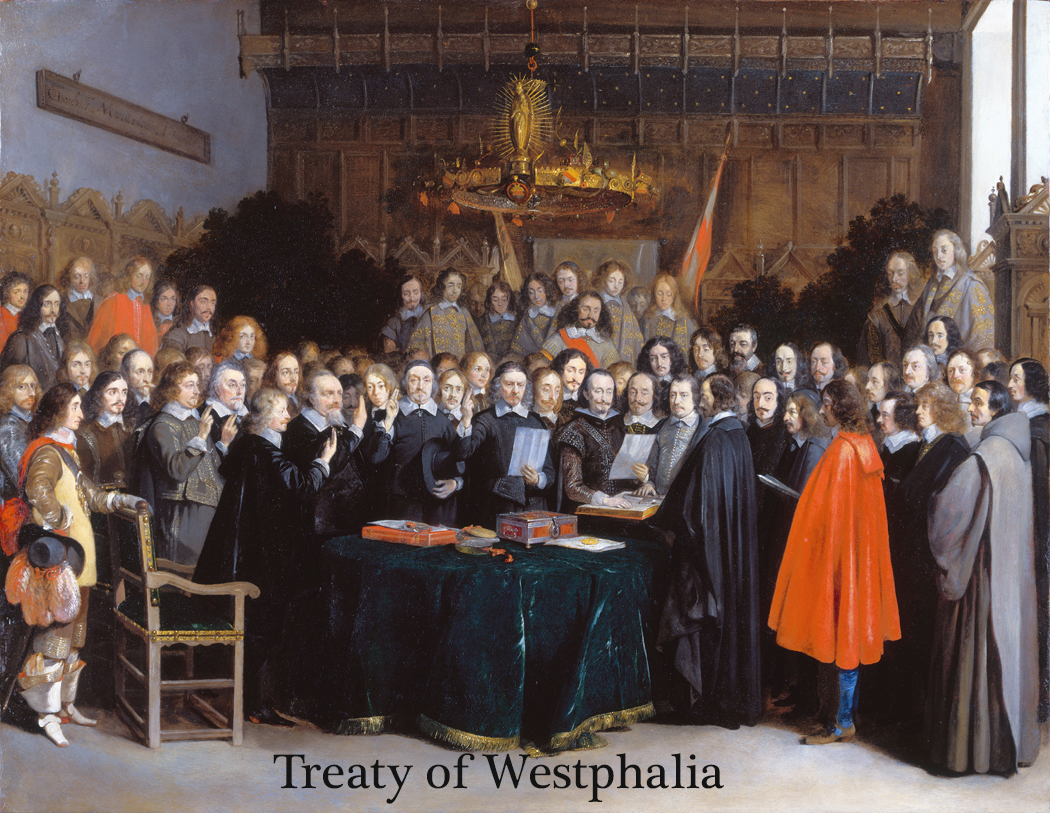
De ratificatie van de Vrede van MunsterOver several years in the 1870s, composer Bedrich Smetana wrote a series of six tone poems for orchestra that he titled Ma Vlast, or “My Country.” Although the patriotism explicit in Smetana’s music is genuine, the fact is Smetana was a citizen of the Habsburg Empire and grew up speaking German. His most popular piece of music is “Vlatva,” a glorification of the river that runs through what is now the Czech Republic, but is almost universally known by its German name, “Die Moldau.”

It is one of the stranger and unremarked oddnesses of history that most of those Nationalist composers of the 19th century had no nation to call home. Dvorak had no Czechoslovakia, Liszt had no Hungary, Edvard Grieg’s Norway was ruled by a Swedish king, and despite all the mazurkas and polonaises that Chopin wrote, there was no Poland on the face of the earth. Even the Germany extolled in Wagner’s “Die Meistersinger” was only a gleam in the eye of Otto von Bismarck.

In truth, they were not so much “nationalist” composers as composers of ethnic awareness. Which brings up an important point. What we mean by a “nation” is a fairly recent concoction, and although we tend nowadays to assume that a map divided into colors bounded by border lines is a natural and inevitable reality, history tells us otherwise.

We hear politicians and demagogues harangue us about national sovereignty and the threat of immigrants diluting our national character, and we tend to regard our country — regardless of whether it is the United States, Germany, China or Iraq — as a fixed and permanent “thing” consecrated by history and natural law. But a closer look tells us otherwise. Our idea of a nation-state is rather new in history, and may have been merely a temporary thing. To take it as unchanging and unchangeable is a serious miscalculation.

Going back before reliable history, kingdoms were just areas successfully defended by military leaders who demanded taxes in a kind of protection racket. No one spent much fret over what languages the subjugated people spoke, or what their ethnic descent might be.

Through the Middle Ages, when we speak of Henry V at Agincourt what we are talking about is real estate. Henry ruled land, not people. He owned most of the British Isle and a good chunk of the Continent. The people living on his land owed him taxes and fealty — meaning a term in the army when needed. There was no legal construct known as England or France or Germany, but feudal cross-relations and family ties securing deeds of title to chunks of real estate. The idea of a nation as we know it didn’t exist.

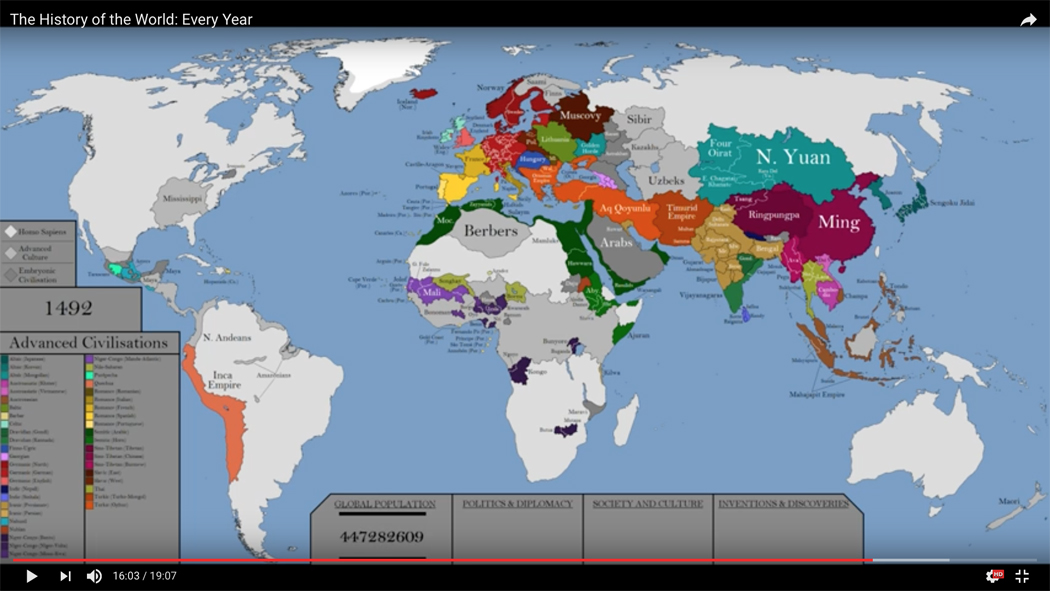
1492

It wasn’t until 1648 and the Peace of Westphalia that the concept of the nation-state emerged, and we developed a sense that France exists whether or not a Bourbon sat on the throne, and that national borders were somehow permanentized — although, of course, they weren’t. Wars — now between nations instead of between kings — kept those boundary lines in flux.

Later ideas gave us different concept of nationhood, often in conflict with the Westphalian ideal. Ethnicity gave many people a different sense of identity, even though ethnicity itself is a slippery thing, and can swell and shrink through time, including and excluding various groups and subgroups. Are you European? Are you Polish? Are you a Slav or a German?

Ethnicity sometimes falters in face of language identity. We talk of “Russian speakers” in Ukraine. Are they Ukrainian or Russian? Certainly they are Slavs. Where do we draw the line?

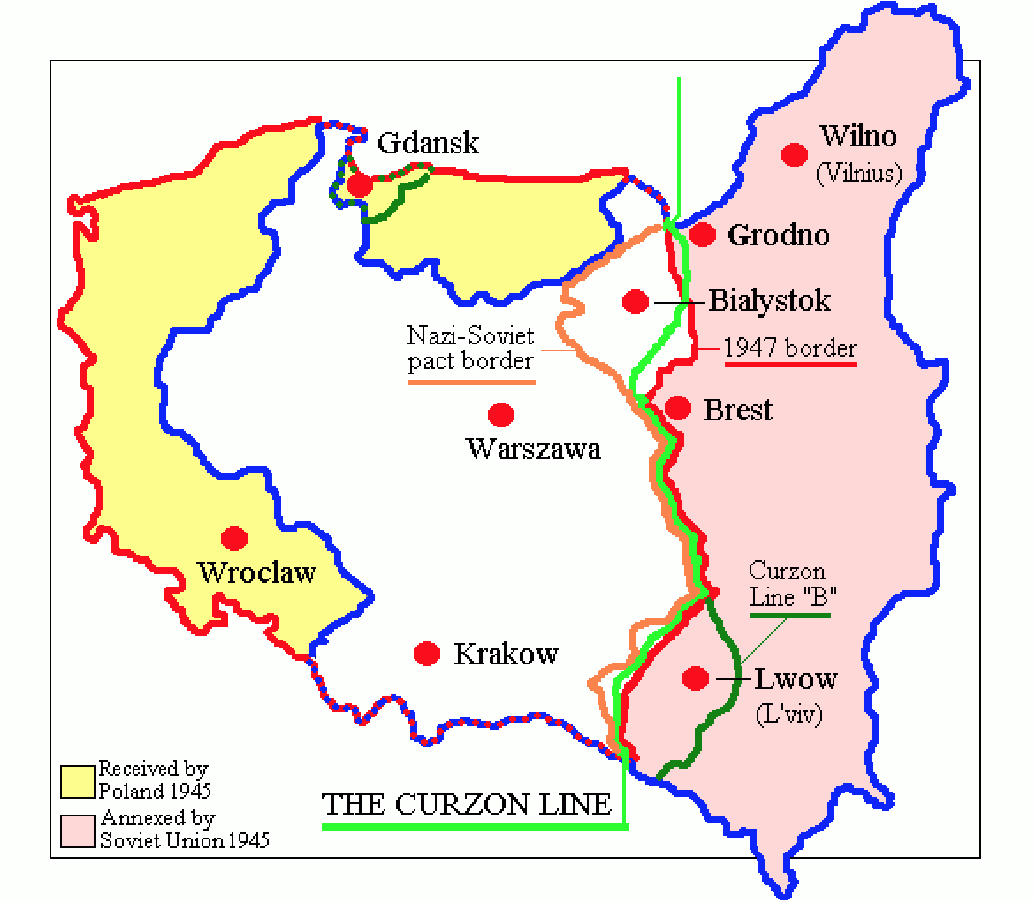
The historical result of all these shifting ambiguities can be seen in the unstable borders seen on maps. Let’s take Poland as an example. If we think of the country as it exists currently, stuck between Germany and Ukraine, we might assume this was somehow the true and ultimately proper place for Poland. But the country has rolled around the map of Europe like a bead of mercury on a plate. At times it reached the Black Sea, at times it vanished from the face of the earth. You can see this in a clever You Tube video at: https://www.youtube.com/watch?v=66y49BnxLfQ

Poland pre-war outlined in blue; postwar outlined in red.

Poland pre-war outlined in blue; postwar outlined in red.

At times Poland expanded, at times, joined with the kingdom of Lithuania, after it was split into pieces and annexed by Prussia, Russia and Austria in 1795 it ceased to exist as a nation, until it was reconstituted in 1918 at the end of the First World War. It was invaded in 1939 by both Germany and the Soviet Union and essentially disappeared again. After World War II, because Stalin refused to give back his half, the entire country lifted up its skirts and moved some 200 miles to the west, where it set itself down again and became the Poland we have now — although that is no guarantee that it won’t move again sometime in the future. The eastern half of Poland became part of the Soviet Union until it split off and became Ukraine, while the eastern third of Germany, having lost the war, turned into the western half of Poland and millions of German-speaking inhabitants were politely asked to relocate in East Germany — which later reunited with West Germany to be the Germany we have today.

1918

You might consider Yugoslavia, which is now several different sovereign nations, or the “sovereignty” of Czechoslovakia, which finally gave Smetana and Dvorak their own nation, only to dissolve into the Czech Republic and Slovakia.

These constantly unsteady borders should not be seen as anomalies, but rather the norm. You can find another entertaining video displaying the bubbling ferment of national border from roughly AD 1100 to now at: https://www.youtube.com/watch?v=Iha3OS8ShYs

(It should be noted that the dates in the animation are not terribly accurate, and should be taken as a general indication of the era demonstrated by the time-lapse maps rather than a precise year-by-year definition.)

1982

We have talked primarily about Europe, but the same sense of unstable borders and the comings and goings of nations can be seen worldwide. Another video worth watching: https://www.youtube.com/watch?v=-6Wu0Q7x5D0

So when some knucklehead politician tells you that the U.S. should defend its “natural” borders, consider the phantom nature of nationhood and its outlines. The United States itself began as a group of 13 separate nation-states joining together for the common good and soon spread outward and westward, eating up other nations, evicting other peoples and other national authorities, stealing most of northern Mexico and reconstituting that nation’s “natural” borders.

1992

All across the world, there are people corralled inside those lines screaming to get out: Basques and Catalans in Spain, Kurds in Iraq and Turkey, Chechens in the Russian Federation, Russians in Ukraine, Scots from Great Britain, Quebecois from Canada, Tamils in Sri Lanka, the Flemish and Walloons in Belgium, Uighurs in China. Driving around southern France and the Camargue, you will come across angry graffiti demanding Occitan separatism

Nationhood is a dynamic; it is not permanent. Russia is altering the map around the Black Sea and globalization is destabilizing the Westphalian arrangement. Corporations are now transnational, the European Union is subverting ancient sovereignties (with considerable pushback from rising nationalisms) and the post-World War I national borders in the Middle East seem ever more tenuous and artificial. Can the Kurds create their own ethnic state? Can Shia and Sunni ever coexist in a multi-sectarian state?

Instead of assuming that the world cannot change and the Rand-McNally maps we grew up with are the way things should be from now into posterity, we should recognize nations as transient entities momentarily agreed to by whoever is powerful enough to maintain a stalemate.

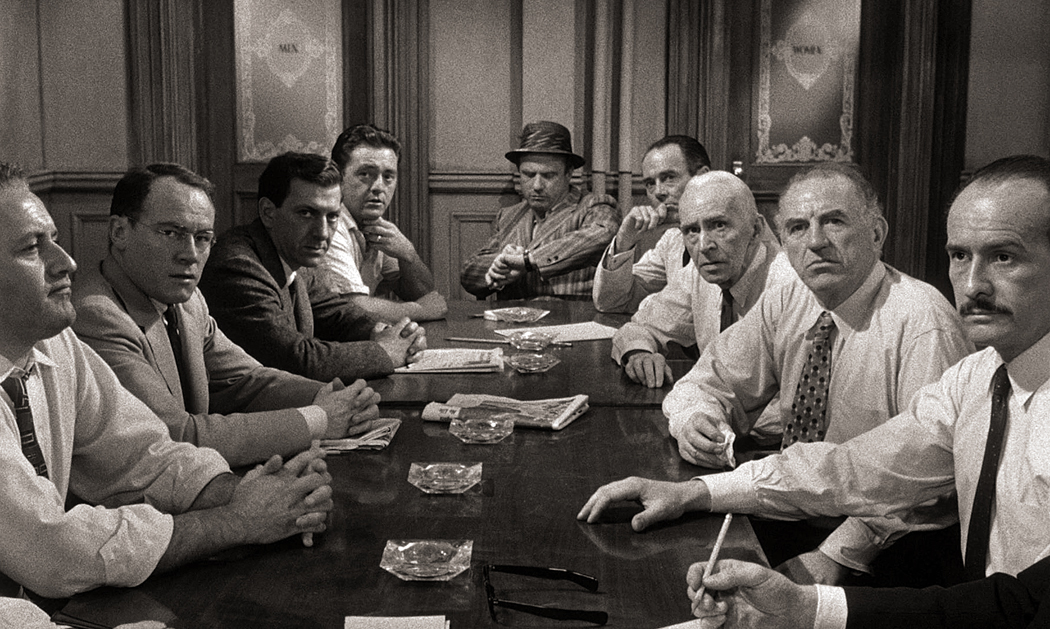
12_angry_men_jury_table

I just got back from jury duty, and boy, are my arms tired.

It was my first jury duty summons since moving to North Carolina; it’s taken them four years to track me down. I must be a favorite of the legal system, because I’ve been on half a dozen juries in my life. Others in my recent panel said they have been on one or two, or none, over the course of their lives. But I am old and I’ve seen a lot.

Each time I serve, I get a lump in my throat because I see from the inside how seriously each of my fellow jurists takes the job. Only once in all those juries was there the stereotypical white businessman on a cellphone barely able to spare a moment to consider the case. He was roundly drummed by the rest of the members and eventually forced to put down the phone.

This case was both simple and dull. A man was charged with drunk driving. He was videotaped during the initial traffic stop and after the arrest, tested via the breathalyzer and shown to have double the legal limit of hooch in his veins. We were all charged by the judge in the case to maintain our presumption of innocence. The defendant sat quietly next to his lawyer and until we heard any evidence, I certainly had no trouble assuming he might be innocent.

If you have never had the pleasure of sitting in a jury box, you might not understand how slow and methodical a trial must be. You can’t ask a witness what someone’s blood alcohol might have been; first you must establish that the witness is qualified to testify and that the equipment used had been recently maintained and whether it was a test accepted by the state of residence and other states in the union. Then the district attorney will take us through the process of administering the test, step by slow, slow step. This simple process of asking the police officer in the witness box whether the defendant had a blood alcohol level above the prescribed point-zero-eight percent can easily fill up an hour, during which time we learn how long the officer has been with the force, what his previous jobs were, where he lives, whether he is married. They nearly asked him to empty his pockets to see what he carries.

During the entire trial, the defendant said nothing, either to the court or to his lawyer, sitting next to him at the table. He might as well have been a stuffed teddy bear. Meanwhile the two D.A.s spread out all the evidence, had us watch the dashboard camera videotape of the traffic stop — most of which was taken up by the man standing behind his car waiting for the police officer who was off-camera in the car filling out paper work.

There were frequent interruptions while the jury marched out of the courtroom into the holding cell while the lawyers conferred with the judge on some legal matter, after which we were marched back in to resume the glacial accumulation of damning evidence. We also learned the marital status of two more police officers. The first witness was the officer who pulled the defendant over at 2 p.m. on a Sunday morning after noticing that he was weaving back and forth in his car. But because that officer hadn’t yet earned the proper certification, he called in backup — an officer cleared to administer the field sobriety tests necessary to determine if an arrest was warranted. The second officer — married, by the way — then gave our borrachista three standard tests, whose scientific pedigrees were painfully explained in trial testimony. We saw on the video that the defendant had trouble with all of the tests — walking heel to toe down a straight line and stumbling on the way; following a pen the officer moved back and forth in front of the defendant’s eyes; and standing on one foot for a prescribed period of time while answering questions.

After a lunch break of an hour and a half — during which time, we are assured, the judge and lawyers were not just imbibing three martinis, but were continuing to conference and work while grabbing a quick bite of sandwich their wives must have packed them in the morning — we resumed. It was time for the defense. The defendant’s attorney stood up professorially and said with due gravity, “No witnesses, your honor.”

The judge turned to us and explained that we were now to hear the summations, which we were not to take as evidence, but purely as spin — although he did not use that precise characterization. The prosecuting attorney just rehearsed the evidence they had previously presented — the failed sobriety tests and the breathalyzer test showing a point-one-five.

He sat down.

The defense attorney got up, walked to the jury and reminded us that the machine that tests a driver’s breath for alcohol was a large, opaque box and we could not see into it, and so, could we really trust the numbers it spit out on a ribbon of paper? Clearly he was grasping at straws.

The judge then explained the law we were to apply and the questions we were to answer and the bailiff marched us back out into the jury room, where on a fast show of hands, we convicted the poor fellow. We were also supposed to decide on two aggravating conditions. The remaining time in the deliberations were spent on deciding if we thought the defendant had been “grossly impaired” while driving, and whether he had reached the aggravating limit of a point-one-five alcohol level. The machine answered the second charge, but we seriously considered the question of what was meant by “grossly.” We sent a note to the judge asking for guidance, and he sent back a not saying “It’s up to you.” We argued back and forth for maybe 10 minutes before we all agreed that we might be able to give him the benefit of a “reasonable doubt” about the word “grossly,” and let him off the hook on that one.

We marched back into the courtroom, went through the prescribed ritual of a jury poll and delivered the verdict and were released by the judge. Everyone else went home. I went back to the courtroom to hear the sentence. Our man was given 180 days in county jail, suspended; a year’s probation; a mandatory alcohol rehabilitation term; loss of driver’s license for two years and a $200 fine. No change of expression on his face.

As they were leaving the courtroom, I asked the prosecuting attorneys if it were not odd that a case with essentially no defense at all should make its way to a jury trial. It would have seemed to the defendant’s advantage to take a plea deal. Why did he insist on going the full monte? “From what I heard,” said the D.A., “pure spite.” He cost the county two days of court time (I haven’t mentioned the first day, which was spent entirely on jury selection. Most of those selected were eventually dismissed. After the panel was finalized with 12 men and women and my name had not been called, I felt something of a relief, until the judge announced, “Now we have choose an alternate.” Bingo. My name. In further news, the next morning when I arrived to be the alternate, one of the jury’s elect had been hospitalized overnight, and so I became Juror No. 6.)

I now am free from jury duty for the next two years, and pocketed a quick $24 for my service. But I have to say, I have never looked upon serving as something to be shunned. Not only is it a civic obligation, it is genuinely interesting. Especially now that I am retired, it provides a welcome break in routine, but even when I was working, it was something I felt was a meaningful look at a part of my humanity that I otherwise would not know, at least no more than what I had gleaned from watching old Perry Mason episodes.

The episode caused me to remember my previous trials, beginning with the first in the mid-1970s. It was for a man named “Babe” who had shot up a pizza parlor in Greensboro, N.C. Babe had come that night with his teenage daughter, who, we learned, was a regular, where she would leave each night with a different man. On the night in question, the comely daughter was approached by a potential suitor (if that is what we might call him) and the father took offense, especially over the haggling of a price for the evening. Apparently Babe didn’t know what line of business his daughter had adopted. Anyway, a fight broke out, beer pitchers were smashed and shards of glass proffered as weapons; Babe then took out his Second-Amendment argument and proceeded to use it to punctuate the ceiling of the establishment. Needless to say, the joint emptied out rapidly and eventually the police came and arrested Babe.

At the trial, Babe, a graduate of no known law school, decided he should be his own defense attorney. The judge asked him if he had ever been arrested before. Babe said yes. The judge asked, “What for?” And Babe said, “You name it.” Let’s just say the defense went downhill from there. Babe’s primary witness was a friend who had run from the pizza parlor the moment the fracas commenced, so he didn’t see anything, but offered himself as a character witness. The judge asked him “Have you ever been arrested?” “Yessir.” “What for?” “Assault on a woman.”

The next trial I was called for was in Arizona and left me with a bad taste in my mouth for civil trials. It was a case where one party claimed the other party had failed in its obligation to a contract. Let me say right now, that if you ever find yourself summoned to a jury, pray you get a criminal case and not a civil one. We in the jury sat through a week of financial statements, ledger books, fine print, receipts and transcribed telephone conversations. Day after day, the slow build up of numbers piled on top of numbers, witnesses claiming this fiduciary that and that binding word this. At the end of the week, we were called back from the jury room and told we were dismissed, as the parties had settled out of court. That is a week of stultifying boredom I will never have restored to my brief span on this earth.

On the other hand, a criminal trial can be unimaginably depressing. The next trial was one of domestic violence, and both the perpetrator and victim were such wretched specimens of my species that it was all I could do not to weep inconsolably at the sight of them both. Poor, unschooled, barely able to cover their hides with decent clothing, we first tore our hearts for the wife — barely skin and bones — who had been whipped by her man and left bruised and battered. We were ready to draw and quarter the villain. But then, he was himself so wretched, had been battered as a child by his father and was so inarticulate that we knew the only communication he knew was by knuckle and beltbuckle. He was guilty as hell, and we knew we had to convict him, but we also hoped that the judge would recognize the misery in front of him on both counts. Please, I thought, feed them a decent meal, send him to jail, and find someone to look after the battered waif.

On television, criminals all seem to be supervillains, drug lords or serial killers so clever they leave tantalizing clues written in ancient Greek scrawled on the bathroom mirror. But my experience with the court system tells me that the bulk of those hauled in to trial are no geniuses, but sorry specimens, usually poor and uneducated with few good options in the furtherance of their lives. They do stupid things and are caught because they are notably not clever. My heart goes out to them, while not excusing any crime they might have committed.

The final case I sat through in Arizona was a double homicide, in which some gang-members with a beef with some guy, blocked his car in a parking lot and went up to the side window and shot both driver and passenger. They didn’t seem to notice that there was a teenage boy in the back seat. During the trial, the boy was the chief eye-witness. The defense attorney attacked him mercilessly on the stand, but the kid was so honest and innocent, he didn’t notice he was being badgered, and just quietly answered each question with open-faced sincerity. If the kid had once weaseled or hesitated, the attorney would have pounced, but the kid was imperturbable. He simply sank any potential defense.

The district attorney laid out the details and evidence with such simple efficiency, one after another like pops from a machine gun, never for a moment making a simple rhetorical flourish or cheap aside. Just an accumulated pile of fact burying the defendant. The poor defense attorney had little choice but to pile the theatricality thick. Red herring was his primary weapon. Did the witness say it was a revolver or a semi-automatic pistol? Did he not contradict himself? The lawyer jumped and pounced and began to sound rather like Foghorn Leghorn. He had no real evidence to present, so all he could do was pretend the prosecution evidence was somehow a pile of beans. Several times he tried to make a point that depended solely on a bad translation from Spanish to English. There was no ambiguity in the Spanish. Living in Arizona, we, the jury, had no problem understanding the Spanish in question, so it only made the defense attorney look more desperate and hopeless. My heart goes out to any poor defense attorney with no legs to stand on. It’s a thankless job.

In several of the cases I observed, there was a highly educated lawyer in a good suit seated next to someone who could barely write his name, wearing a rumpled Goodwill suit and tie, probably bought for them just for the trial date, looking like a deer caught in a headlamp, never fully comprehending what was happening around him, and probably headed for his second or third stretch at the county jail. At the other table was the prosecuting attorney, in another good suit, with piles of condemnatory notes in front of her and both tables facing a superior court judge, also with a fancy law degree, a good house in a gated community, a second or third wife, and a BMW waiting in a parking spot with his name on it. Behind them, in the grandstands, sit those witnesses waiting to be called: prosecution witnesses often in police uniforms, or doctors called as expert witnesses; defense witnesses in Goodwill suits that don’t quite fit and sporting mullets and professional-wrestling mustaches, and maybe a tattoo or three.

Somehow, it hardly seems like a fair fight. The indictment says it all: “The State vs. so-and-so.” One cannot help but think of Franz Kafka. Perhaps that is why I feel so proud of the jury, which is made up of — in this most recent case — farmers, teachers, car mechanics, students, grocery-store clerks, and at least one retired art critic. The jury is notably more representative of the society we live in than the lawyers who run things. I hope it all serves to even the odds.


hitler stalin say hi

firesign theatreAll of us grow as we age; some more than others. Things we thought simple and obvious when we were children turn out to be infinitely complex. Judgments we handed down when we were innocent later turn out to be self-righteous piffle. Uncles we thought were hilarious when we were 6, when we are 15 turn out to be insufferable. If you live long enough, your life gives proof to the Firesign Theatre dictum: “Everything you know is wrong.”

This is the evolution of — what? Of an understanding. A widening of the historical record. I’m using the Second World War as my exemplar. I have been aware of it from my earliest childhood, but my understanding of it has changed radically over the decades.

I was born just after the war ended, and it was an immediate presence in those years. My childhood featured the shabby remainders of that war gotten from the proliferation of war surplus stores. We all played war, and the nerdier kids were condemned to play Japs and Krauts, while the alpha kids were Americans. I envied my friends who had helmet liners, machetes, canteens or drilled and emptied hand grenades to play with.

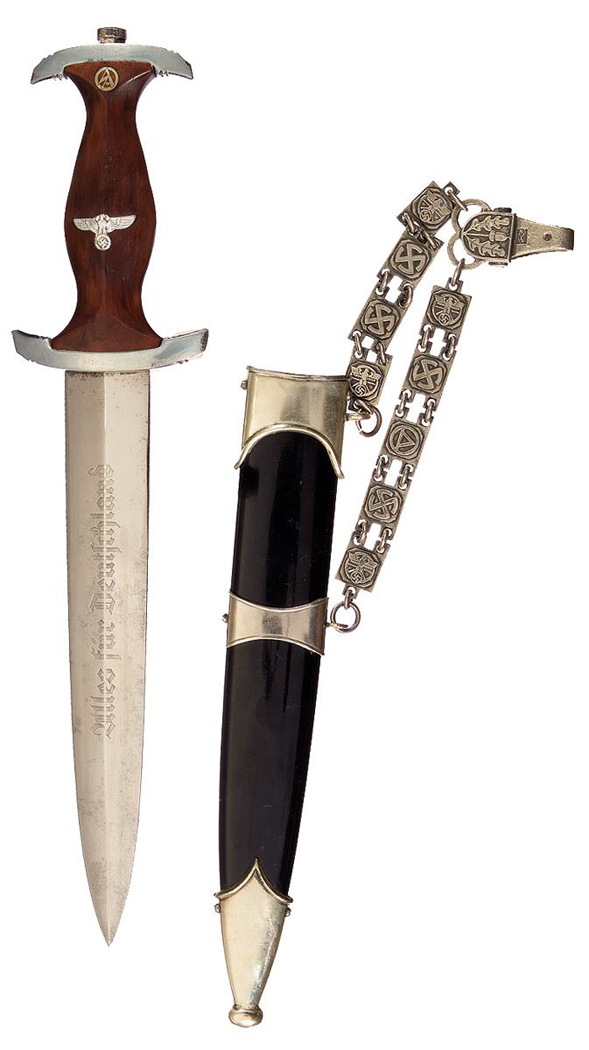
daggerMy father saw France and Czechoslovakia in that war, although he downplayed his part in it. He had several war souvenirs that were kept in the basement: a German helmet, an SS dagger, pair of binoculars, a Walther PPK pistol. I was fascinated by them, and pulled them out to play with. (When he found out I had been playing “war” with the PPK, he immediately took it and sold it to get it out of the house). These things were catnip to a little boy.

This was the early 1950s, and I learned about World War II through movies shown on television. This was the war of John Wayne and William Bendix. The Americans were the heroes; the Japanese and the Germans were the villains. It was an easy call; there were the good guys and the bad guys.

The version of Hitler that shows up in these films is insubstantial. When mentioned at all, he is satirized as a clown with a funny mustache, but most often the Nazis are an undifferentiated enemy with nefarious aims. Little distinction is made between Germans and Nazis. We argued over which way the swastika bent, and whether they were “knot-sees” or “nah-zees.”

guadalcanal diary bendix

When the German war aims are mentioned, it was that they sought “world domination.” When the movie is set in the Pacific, the Japanese war aims were never mentioned at all: They were just evil and our enemy.

There were documentaries, also. On TV, there was also the resonant voice of Leonard Graves and the music of Richard Rodgers on Victory at Sea, and a Saturday morning filler program produced by the Army called The Big Picture. Both fed a version of the war that was about the United States defeating its enemies.

dead bodies at Nordhausen

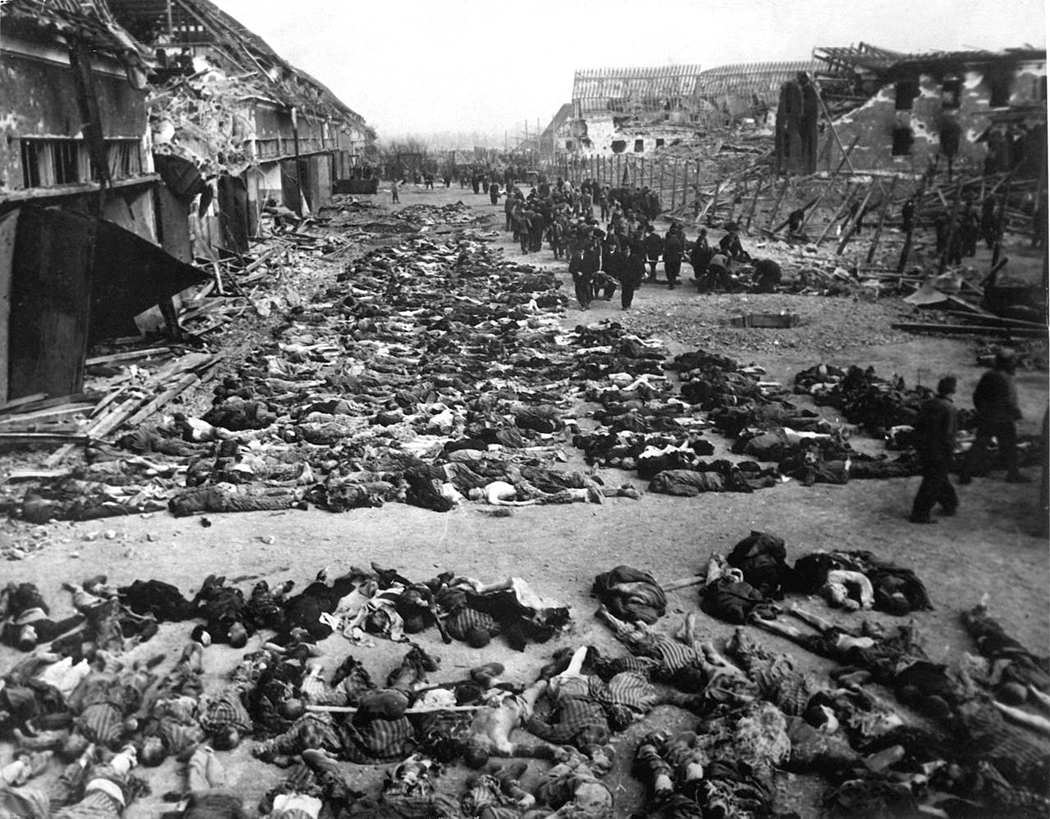
It was in those Army documentaries that I first saw images of the liberated concentration camps when I was a boy. I was horrified — and fascinated — by those piles of dead naked bodies bulldozed into mass graves by the American soldiers, and the spindly, glaze-eyed skeleton-survivors. I don’t know how these images affected others, but in my tiny 6-year-old brain, they were the fountainhead of moral development: Those images are indelible; I can draw them up in my mind anytime. Nothing from my childhood has such potent emotional power as the memory of those films. But the Holocaust was a separate issue, barely related in my boyish brain with the war my father had fought. Only later, did the Holocaust become central to my understanding of the war, of Nazism, of Hitler.

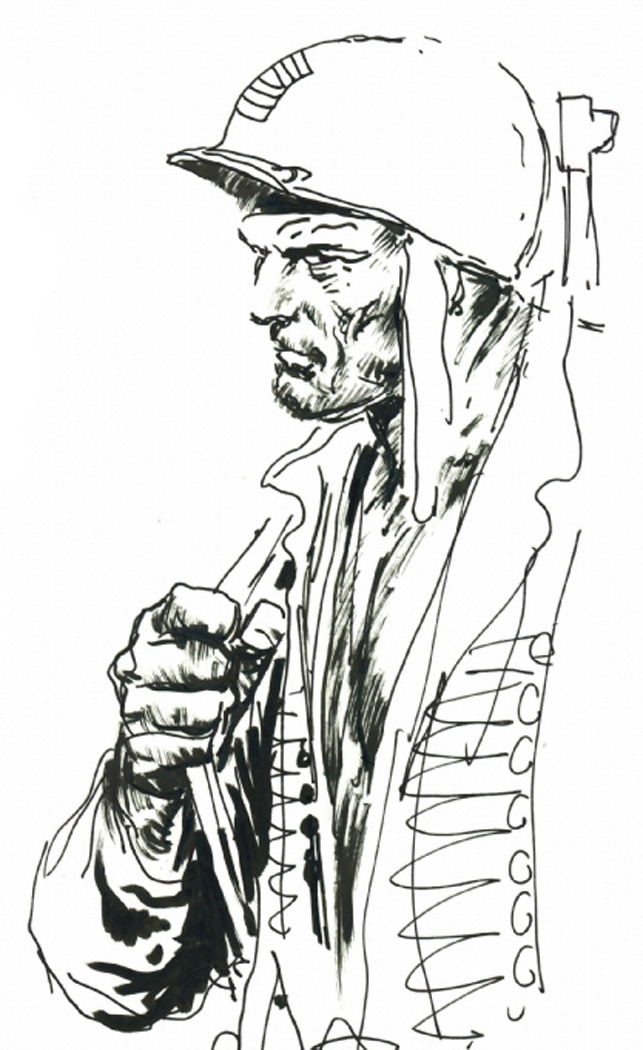
sgt rockBy the time I was in the seventh grade, my interest in the war had changed: In typical adolescent (male) fashion, I became hypnotized by the machinery and regalia of the war. I learned the names of each type of Panzer tank, fighter plane, each sort of submarine and corvette, destroyer and cruiser. I drew them endlessly in stereotyped scenes learned from primarily from Sergeant Rock comic books.

By then, I was also becoming aware of the centrality of Auschwitz. But German anti-semitism made no more emotional sense to me than the “world domination dictator” image of Hitler. I grew up in northern New Jersey and my Boy Scout troop leader was Mr. Weinstein. I knew many Jewish people and I could not see any difference between them and the Italians, Irish, Germans or South African families sprinkled through the suburban neighborhoods. Anti-semitism seemed no more possible than men in the moon.

The version of the war that persists in the American imagination is the one in which Americans, with a little help from England, beat back Hitler and won the war.  D-Day was the turning point. There was a niggling awareness that there might also be some fighting on the eastern front, and that somehow the Soviet Union was our ally in the war, despite their being “godless communists.”

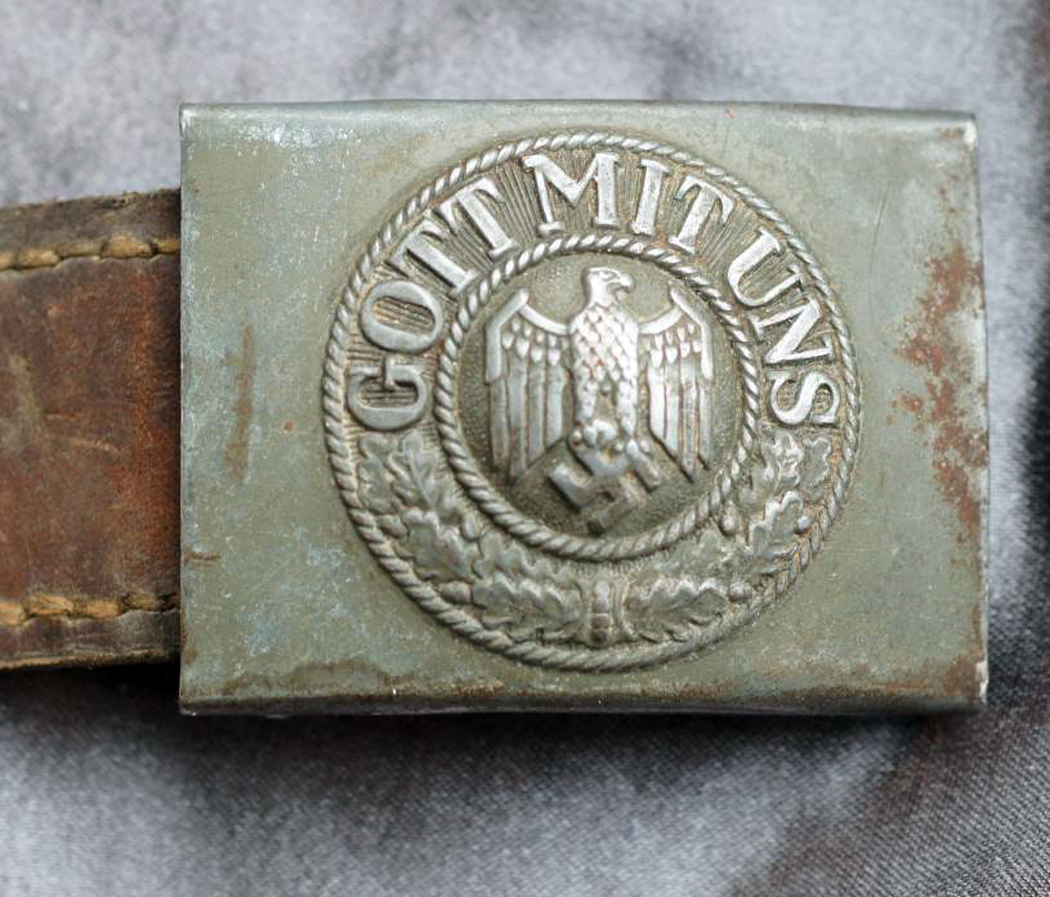
belt buckleThis version was filled with stories of American heroism in the war. We won, it was implied, because democracy always wins. It was our system vs. their system, and ours was more virtuous. After all, God was on our side (despite the Wehrmacht beltbuckles that read “Gott mit uns.”)

I had read a good deal about the war and had finally come to the conclusion that perhaps D-Day was not the central turning point of the war and that perhaps the conflict with the Soviets was a bigger deal than the war in France. (This is not to diminish the efforts of the Allied soldiers in western Europe, but to recognize the balance of the death and fighting was in the east).

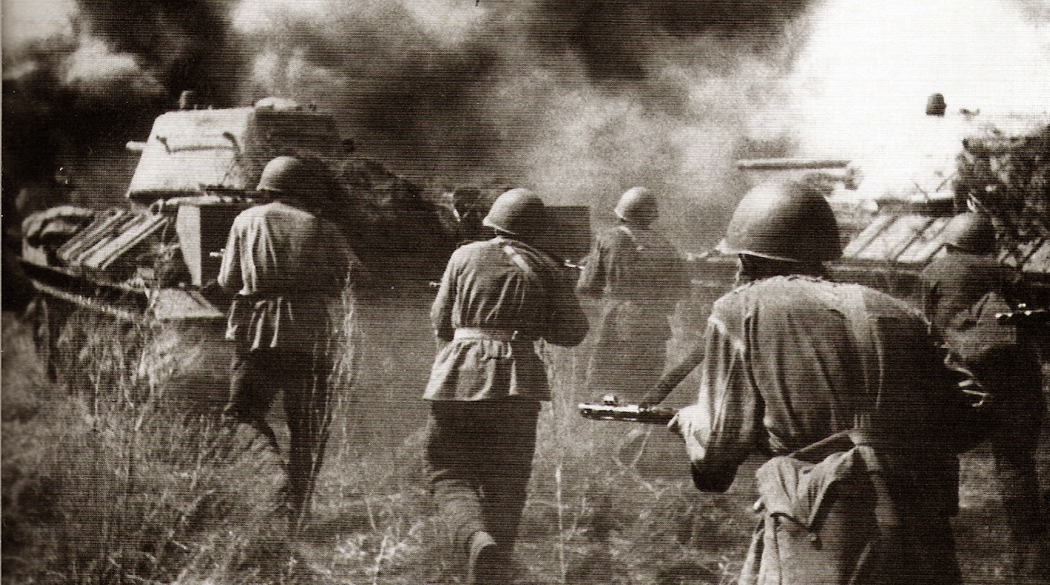
I began to see World War II as the “Great Patriotic War,” a war primarily between Germany and the Soviet Union, with the Western Allies as a sort of sideshow. All those riveting TV documentaries about D-Day and the retro-movie version of the war in Saving Private Ryan seemed like empty chauvinism. How many Americans died in the war? About 400,000, which is a staggering number until you compare it with the number of Soviet forces killed: 10 million. If you add in the civilian war deaths, the number rises to  27 million. That is nearly 14 percent of their total population. In the U.S., that percentage is less than one-third of one percent. (Again, I don’t mean to diminish the enormity of the American suffering or the part played by our soldiers, but to put it into the larger context of the war horror).

Kursk

Kursk

On D-Day, American deaths were about 2,500, roughly the same number as died in the World Trade Center on Sept. 11, 2001 (and roughly the same number who were killed in the attack on Pearl Harbor Dec. 7, 1941), but consider the battle of Kursk in the Soviet Union, when some 10,000 Germans were killed and the Soviet deaths estimated at three times that. Or the Battle of Stalingrad, which admittedly continued over several months, but wound up with nearly 2 million casualties. If there was a turning point in the war, it was Stalingrad, not D-Day. Germany never recovered.

Stalingrad

Stalingrad

japanese stereotype 2Forgotten in all of this is Japan. When I was a child, it was clear that the Japanese were treacherous people who designed the deaths of Americans, presumably for irrational reasons. They were a crazed nation of  squint-eyed, buck-toothed people insanely loyal to an emperor.

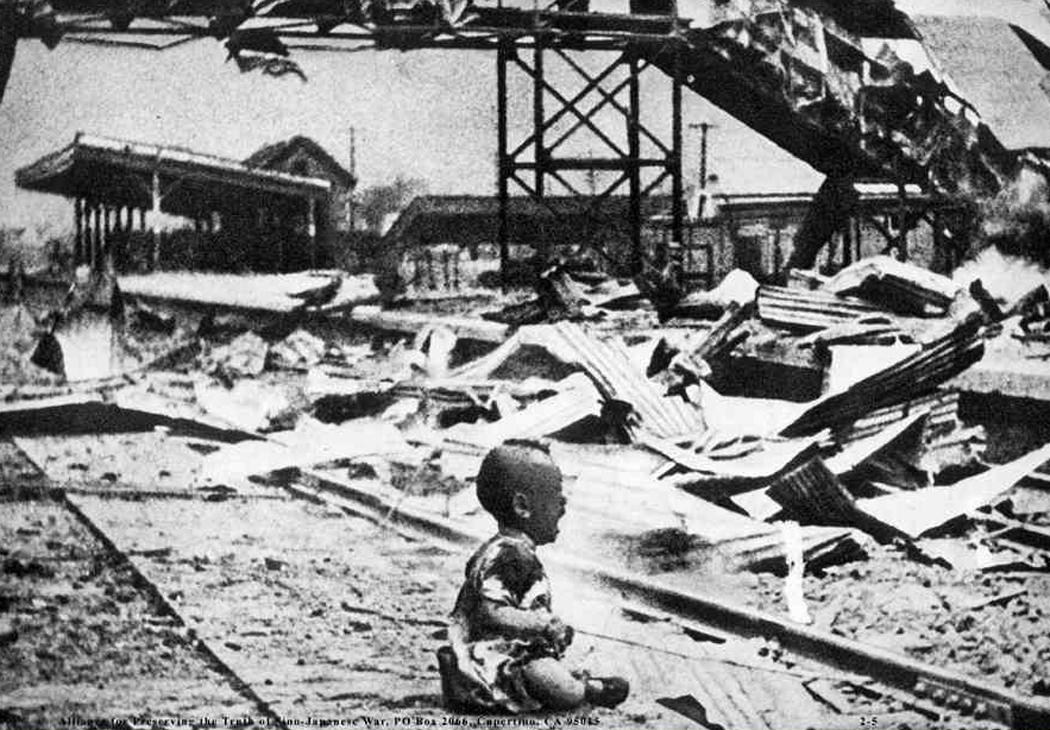
World War II was in most books a single entity with combat theaters in Europe and in the Pacific. But at some point, I came to understand that there were really two unrelated wars being fought concurrently, or rather that the two wars overlapped. The European war began in 1939, if you were Polish, 1941 if you were Russian (June 22) or American (Dec. 7). But the Pacific war had begun in 1931 with the Japanese invasion of Manchuria and turned into the so-called Second Sino-Japanese War beginning in 1937. Just as in Europe, where we glory over D-Day and forget the millions who died in Eastern Europe, so in the Pacific, we remember Iwo Jima and Guadalcanal and tend to forget that the real misery was felt in China, where the war death estimates run from 10 million to 25 million. (It should also be remembered that until Pearl Harbor, Germany and the Soviet Union both allied themselves with the Chinese against the Japanese.)

rape of nanking baby

But the one question I could never quite answer to my satisfaction, the issue I could not quite understand was: What were the goals of the Axis powers? What did they hope to accomplish?

warner bros hitlerThe standard answer was: World domination. Hitler wanted to invade Europe to achieve power. Why he might want to conquer France was a mystery. Why he bombed London never made sense. And that was just the Germans. The Italians hardly entered the equation. They were an afterthought. And finally, it was never clear what sort of domination the Japanese might be after.

In the Warner Brothers cartoons I was weened on, Hitler, Tojo and Mussolini were three comic villains with the same aim: world domination. (No one asked if they had accomplished this goal, whether they would turn their rifles on each other).

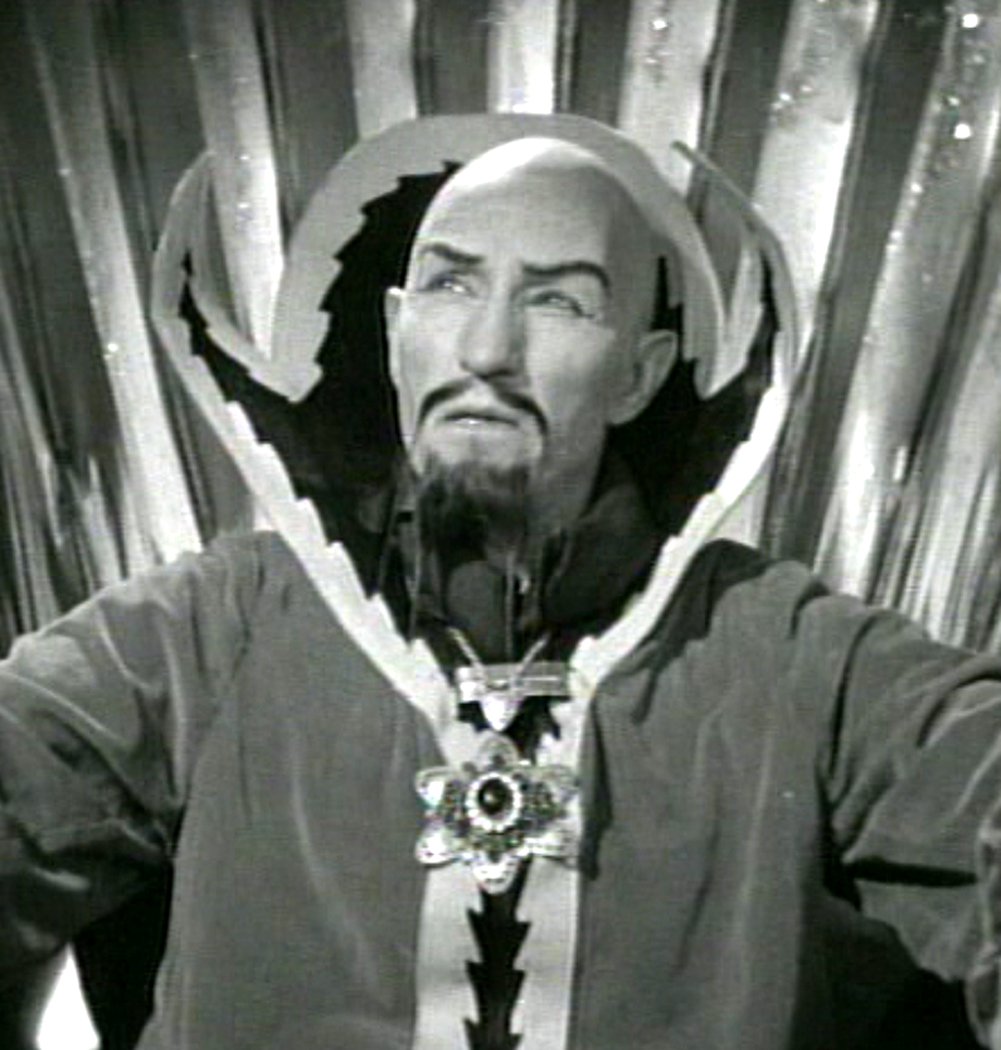
Ming the Merciless

Ming the Merciless

Hitler was, in this view, hardly different from the nefarious Fu Manchu or Dr. Mabuse or Ming the Merciless. Why any nation would bend to the will of such a madman was an enigma.

Wars are political and economic. We remember them militarily, but they are gestated through power and money. Now that I am an old man, I no longer see World War II as the “Good War” — the American version — or the “Great Patriotic War” — the Russian version — but rather as The War between Hitler and Stalin over Poland.

Poland has rolled around eastern Europe for centuries, expanding and shrinking, becoming an empire and disappearing altogether. You could make an animated map showing how over time Poland moved east, then north, then west like a ball of mercury on a plate, then evaporated like a dried-up puddle. In western Europe, nationality conveniently tends to follow ethnicity. France is filled with the French, the Netherlands are filled with the Dutch. But throughout eastern Europe, ethnicities are scattered like confetti. There were Germans in Poland, Poles in Ukraine, Lithuanians in Poland, Russians in Lithuania, and Jews all over. It made national borders more arbitrary than they are in the west. Much of Hitler’s plan before the war broke out in earnest concerned bringing ethnic Germans together under one nation-state. Hence the Anschluss and the annexation of the Sudetenland in Czechoslovakia. His ostensible aims were to “protect” the German people from persecution by non-Germans. The Nazi slogan was “Ein Volk, ein Reich, ein Führer” — One people, one country, one leader.einvolk einreich einfuhrer

Ein Volk” — this was a nearly mystical idea of race and genetics. Hitler believed in two things that were current in his age. One was Social Darwinism, that competition was not only between individuals, not only between species, but between “races,” or genetic bloodlines. His Germanic race was in competition with all other races, and only the strong would survive. Second, he believed in a neo-Malthusian sense that as population increased, food production would begin to fail. And, as Germany industrialized, fewer people were producing food, and less land was given to farming. These two things were behind his announced need for “Lebensraum” — living room. He proposed not only to aggregate the Deutsche Volk under one political system, but also to annex new farmland to Germany and repopulate that land with German farmers.

In this, one ventures to say, he was little different from American Manifest Destiny in the 19th century. As we proposed forced migration of Native Americans and to appropriate their lands, so Hitler proposed to move Poles and other non-German people out of his section of Poland and repatriate a growing population of Germans into it.

He faced two international political problems with this plan. The Soviet Union would likely object, and the allied forces of western Europe had a treaty to defend the independence of Poland.

Molotov and Ribbentrop

Molotov and Ribbentrop

To eliminate those problems, he made a pact with Stalin — the Molotov-Ribbentrop non-aggression pact — which freed him up, he expected, to face the armies of France and England that intended to protect the sovereignty of Poland.

In reality, there was an unpublished portion of the Molotov-Ribbentrop Pact that split Poland in two, with one half going to Hitler, and the remains going to Stalin.

So, when Hitler invaded Poland on Sept. 1, 1939, he planned also to turn his Blitzkrieg on France, which he neutered in 1940, taking over most of western Europe save Great Britain and the neutral countries of Spain, Switzerland and Sweden. This meant he thought he no longer had to worry about a two-front war. In this sense, the whole war in western Europe was a sideshow to the real carnage.

When the forced immigration of Poles, Jews and other non-Germans proved problematic, and after Hitler decided Blitzkrieg could bring him not only Poland, but also most of the European territory of the Soviet Union, he invaded eastern Poland (by then, a part of the Soviet Union) and headed for Moscow.

A separate industry developed to deal with the displaced peoples, which, by Hitler’s racial thinking were Untermensch, or lesser humans, and with his own propaganda blaming Jews for the loss of the First World War, and the “Jewish Bolshevism” of Communist Russia, his Nazi planners came up with a “final solution” for what to do with all those unwanted people. Six million Jews were exterminated over the course of the war, mostly from 1942 to the end of the war. But also nearly 2 million ethnic Poles, 3 million Ukrainian and other non-Jewish victims.

liberated prisoners at Ebensee 1945
bloodlands cover(Timothy Snyder’s 2010 book, Bloodlands, covers all the deaths in the tragic lands between Germany and Russia from the 1930s through 1945, including the Holodomor — the deliberate starvation of between 3 and 7 million Ukrainians by Stalin’s order. In all, between Hitler and Stalin, Snyder estimates that some 14 million non-combatants were murdered for political reasons between 1933 and 1945. The numbers are all estimates; the death was so pervasive, accurate records for most deaths were impossible. And these 14 million were all separate from the military deaths of the war.)

What I have written here is an obviously very simplified version of things. Almost every sentence here could be expanded into a book. I have left out many important things (not the least of which is the bifurcation of Europe after World War I into camps espousing Communism and camps promoting Fascism. For a time in the 1930s, it even looked as if America was going to have to choose between them).

MBDRUOF EC010This is a lot of words, all to show the slow development of ideas about the war, from childish to mature, from simple and unexamined to complex and nuanced. The case I am trying to make is that this is true not simply for my pathetic little understanding of World War II, but that this kind of growing complexity is symptomatic of getting older, seeing more of the world, and tying it all together.

I could have chosen almost any subject and gone on at length about how my understanding has changed, widened, saddened. For, if there is anything that results from broader experience — which is what getting old gives you, want it nor not — is the sad truth expressed in Jean Renoir’s 1939 film, Rules of the Game, spoken by Octave (played by Renoir himself): “You see, in this world, there is one awful thing, and that is that everyone has his reasons.”

giza view from cairo

We were watching a TV show about ancient Egypt and the voiceover told us the pyramids we were visiting were “35 centuries old,” and that phrase suddenly struck me in a new way.

I am now 68 years old, which is a bit more than two-thirds of a century, and I have a body-sense, a memory-sense — a conceptual awareness — of what a century feels like. I wrote for the newspaper for a quarter of a century. Four times that and Bingo! So, a century has a palpable meaning for me. I feel it in my bones. Hearing the TV presenter, then, made me react, “Thirty-five is not a very large number.” I can picture in my mind’s eye what 35 centuries might be, and it really doesn’t seem like all that long. The Viking Age ended only 10 of them ago.

Anton and Laura Nilsen

Anton and Laura Nilsen

After all, my grandfather, who I knew when I was a boy, was born in 1890, which was the year Vincent van Gogh died. It was also the year Sitting Bull died, and the Elephant Man (John Merrick), and Heinrich Schliemann — the man who discovered Troy. My grandfather was seven years old before Johannes Brahms died. These historical figures seem that much less remote when I think of it that way.

Rowan and Nancy Steele

Rowan and Nancy Steele

For my wife, it is even more present. When she was a girl, her great-grandmother lived with her family. Her great-grandmother, Nancy Jane Steele, was a Civil War widow. She married Rowan Steele after that war, but Rowan had been a cavalry soldier during the battle at Appomattox. That dumps the War Between the States right in my wife’s lap. History is not some remote collection of facts gathered from a book, it is family.

The word, “century,” has its roots in family. The Latin word was “saeculum,” which was an indistinct time period that measured, basically, the time from your grandfather to the time of your grandchild. Caesar Augustus regularized that time to be 110 years, but in effect it varied from 90 years to about 120 years. It was an “age.”

History, as a subject, is different if you think of it that way. It is not a set of facts for a trivia contest, but a continuity, of which we are each a knot along a string.

For many, these days, that continuity is found in genealogy: How far back can you trace your ancestors? With various DNA tests, you can discover ancestry beyond the civic records of the standard genealogy. A y-DNA test can follow the paternal haplogroup all the way back to Africa, with punctuated stops along the way. A maternal mitochondrial DNA test can do the same for the distaff side.

It means that you are very personally connected to the history you study in school. Somewhere among those pogroms, crusades, wars and massacres, your strands of DNA were either slaughtered or doing the slaughtering, and probably both at different times. Looked at through the small lens, genealogy is your story; looked at through the big lens, all of history is your story. How can one not be interested?

Carol Lily

Carol Lily

My granddaughter is now studying AP world history, and sometimes, she comes to me for help understanding the subject. I wish I could somehow inspire her to see it not as an impersonal school subject she has to be graded on, but the story of how she got here, what happened on the way to her creation, and how she fits into that grand, long picture. She makes good grades, but it would be more important to think of history as something personal, something that informs her life: She is Southern, so the slavery that ended 151 years ago colors her life every day; the arguments held in Philadelphia in 1787 affect what she can and cannot do today; that the battle of Plataea in 479 BC is part of the reason she speaks English today and not some descendant of Farsi.

The horsemen from Mongolia shaped what later became Russia, which became the Soviet Union, which defeated Nazi Germany, became our enemy in the Cold War, and led to Vladimir Putin today. It is not ancient history, it is merely the dangling end of a long cord: The same people who gave us Xanadu and Kublai Khan gave us the Silk Road and the Golden Horde, and is one of the reasons given for why Hungary is named HUN-gary, and, incidentally, gave their name to the tartar sauce you put on fried fish.

Know-Nothing poster

Know-Nothing poster

It is disappointing to see so many Americans with so little sense of history, of where we came from. We hear the resurrected Know-Nothing-ism of Donald Trump and too many of his followers hear no resonance of the anti-Catholic, anti-Irish sentiment of the earlier wave of xenophobia. The past, for them, is a black hole out of which no wisdom can emerge.

Presentism, as it is sometimes called, is rampant: the belief that what is now is somehow “true,” and the past was all a big mistake; it is the error that what we think and believe now is the “right” and “correct” version of the world, and those benighted people of old were merely beta-versions of humanity. We require more humility; history can provide that humility.

I can remember when the faces of Eisenhower and Stevenson on the tiny black and white television we had in the house when I was yet too young to go to school. I remember the Dodgers at Ebbets Field. I remember when they added the second deck to the George Washington Bridge. ike and adlai 1952These things are now history. They are ink on a page in the history book my granddaughter reads for class. But I was a real person who lived through them. My father lived through the Battle of the Bulge in World War II. My great-uncle wore puttees as a dough boy in the first War to End Wars. My wife’s great-grandfather fought in the Civil War. Somewhere, back before my genealogy became writ into the family bible, I surely had ancestors who went a-viking and worshipped the lord Odin.

I feel those connections, not as dry intellectual answers to history-class homework questions. History is not something merely read, it is red, it runs through our veins. It’s been there for 35 centuries, at least.

World Map 1689Stuart got a job recently. Well, a part-time job — as adjunct faculty teaching a history course. I’m not sure how he got it; he doesn’t have a degree in history. But he said he talked the department head into it by describing his take on world civilizations. He did his Stuart dance for his dinner.

“Well, I said I wanted to teach world history a different way,” he said to me over lunch the other day. “I wanted to look at it through the lens of geography. It explains so much.”

Mostly, he said, he just wanted to try organizing the Big Picture a different way, because looking at something differently opens a subject up for fresh insights. At least, that’s my stuffy way of saying what he was up to.
aegean sea map

“From even prehistoric times,” Stuart explained, “human cultures have organized themselves in two ways — either around a body of water or in the middle of a chunk of land. These two societies tend to approach the rest of the world differently.

“You can see this in the signal conflict of the classical world — the Persian Wars. We may think of Greece as a nation, like France or Argentina, but back then, Greek civilization was a constellation of cities and islands around the Aegean Sea. It was built facing the water, so to speak, and like the ancient Lake People of Switzerland, they looked across the pond and saw trading partners. They built ships and launched out across the water to find their likeness on the far shore.

“Rome was built around the Mare Nostrum, the Mediterranean. In the Middle Ages, the Hanseatic League was all about trade.

Persia satellite view“But Persia was a continental power, built on land, surrounded primarily by land, where other people may have been trading partners, but they were primarily a threat. All through the Middle East, you have one conquering nation after another invading their neighbors. Their gods told them to. Persia, like the standard model continental power, wanted to expand, to push its borders out farther, absorb the neighbors to nullify the threat.

“These are two fundamentally different ways of approaching the outer world, and those two ways govern so much of what happens in history.”

“And this is what you told the department head?” I asked. “And he bought it?”

“She did,” he said — which explained a bit more about Stuart’s persuasiveness. If you know anything about Stuart, you know he approached the world, not so much by riparian or continental cultures, but through the interaction of men and women.

“And so, now you’re teaching world history to students at a two-year school.”

“It’s great, although class is rather early for me: It starts at 10 every Tuesday and Thursday morning. But I can get up for it; it’s been really fun so far.”

“It’s always fun until the grading starts,” I said.

“I haven’t got there yet,” he said. “But I’ve assigned the first paper.”

I remembered my time teaching, and the surprising papers that were turned in. I used to read the really bad ones at dinner parties for fun; we all had a good laugh. Bad grammar, misunderstood concepts, lazy ideas. Once, in an art history class, I had 16 students and 16 different spellings of “Coliseum,” and not one of them correct — despite the fact there were two acceptable spellings: “Coliseum” and “Colosseum.” I knew Stuart was in for a disappointing surprise when those papers were turned in. Indus river map

“Think of all the early civilizations,” Stuart went on. “Egypt on the Nile, the Indus River civilization, the Chinese living along the Huang Ho and Yangtze. Later, you have Vikings around the Baltic Sea and North Atlantic. China is interesting, because it starts as a riparian civilization, but as it grew, it turned continental. It gives a distinct flavor to Chinese history.”

“And the continental?” I asked.

“Think of the Mongolian Hordes,” he said. “Or early American tribes conquering each other. Persia, the Ottomans, Moguls.

“If you look at pre-colonial Africa, you see some cultures are riparian, like Ghana, and some are continental, like the Berbers. The distinctions have been blurred over by the pie-slicing of the continent by its colonial powers into supposed nation-states mimicking those of Europe. Quite unnatural. But they were there: riparian and continental ways of looking at the world.

thirteen colonies“I thought, this explains a lot about us,” he said. “About America. When we were founded, we were an outpost on the other side of the pond. We looked across the Atlantic and saw our compadres there. Europe and the New World were built around the ocean, whether it was England and the 13 colonies, France and Quebec, or Spain and Latin America. It may be a distortion to consider the interrelation between the Old and New Worlds as trade, considering we didn’t really give the native peoples a choice in the matter, but from the point of view of the colonizers, who really didn’t take the original inhabitants seriously, they saw themselves as Europeans trading with their parent nations.

“And for the 13 colonies, when they were still colonies, they were Englishmen trading with England, later making alliance with France. We began, like China, as a riparian society. There were even laws passed to prevent settlers from moving west of the Appalachian Mountains, to keep it a riparian culture.

“But we expanded anyway and became, over time, a continental power. Expansion was seen as not only good, but necessary, even ordained by God. This change explains the current political landscape.”

“How so,” I said, innocently, while waiting for the punchline.red and blue

“Think about it. Where are the blue states and where are the red? By and large, the blue states are on the edge of the continent, both on the Atlantic and and on the Pacific, or around the Great Lakes. The red ones are in the center, where they remain continental in outlook, fearful of foreigners and the core of isolationism.”

“I thought the difference was between the agrarian states and the urban states,” I said.

xi jinping 2“Certainly. My outlook isn’t the only factor in this. But it is there, not often mentioned, and is in part also the reason the coastal states built their economies on trade and the interior states on farming and ranching. I’m not making the case that this theory explains everything, or that it is the only thing that made us what we are, but I am saying that it helps explain it, and that you can see the same forces acting out elsewhere in the world. Maoism was continental in China, but the coastal cities of China were built on trade. The new China of Xi Jinping has grown as it has seen its place in the larger world — and as a riparian economy, not a continental one. The burgeoning economy is largely a coastal event. The Chinese poor are largely in the interior.

“And so, blue states look outward to the world, the red states are xenophobic.eurasia

“Look at Russia,” Stuart said. “They are a quintessential continental power, hunkering down in the middle of Eurasia. Invaded by Tatars, Verangians, and Teutonic Knights, they came to fear the outside and built a national identity on creating a fortress mentality, and conquered neighboring lands to make redouts to protect the national core from attack. Peter the GreatPeter the Great attempted to turn Russia into a riparian culture by building his capital on the Baltic, hoping to become part of the European world of trade. But since then, the country has retreated to Moscow and glowered out at the rest of the world. It’s how the Union of Soviet Socialist Republics accrued, and after a brief period of glasnost, why PutinVladimir Putin has resumed the essential Russian inwardness, and his need to expand the borders again to build up those protective buffer nations around the national heartland. Lookout, Ukraine.”

I wondered if Stuart taught any of this chronologically, or was the whole course built around this theory. Were there any parts of history unrelated to his bifurcation of world outlooks.

“Oh, I fit all that other stuff in, too,” he said. “But mainly I wanted to explore this idea for myself. Teaching is the best way to learn.”

I couldn’t argue that.

“And your department head thinks this is OK? To use your class for you to explore your ideas?”

“Oh, didn’t I tell you? I moved in with her last week. We’re good.”