Archive

Tag Archives: latin

 Translation is a funky thing. You might think a literal transcription would be best, but language doesn’t work that way. 

If we translate Holly Golightly into French, and have her window shopping, the French reader will assume she is looking for a glazier — i.e., shopping for windows. If the original had been in French and we translated it to English as “licking the glass,” we’d assume Holly was more than slightly daft.

You can try to be literal and lose all the flavor, or you can try to find equivalent idiomatic expressions, or you can recast the whole thing, as if you were writing an original from a similar inspiration — your own words for a similar thought. 

I recently posted a blog entry about various versions in English of Ovid’s epic poem Metamorphoses. (link here). 

“It’s amazing that all the translations are so different,” responded a friend. And they are. I have been fascinated with the issue of translation for years, now, and have compared many versions of several works and am also “amazed” at how different they can be. 

Most recently, the Ovid comparisons has been obsessing me. And so, I went back to the original to see what I could ferret out about these variations. One discovers that although Ovid’s language moves quickly and simply, there is some ambiguity built in to those words. A translator has to disambiguate the text, and in the process make a single meaning for what in Latin can be multiple. 

The first four lines of the Metamorphoses, in Latin, read: 
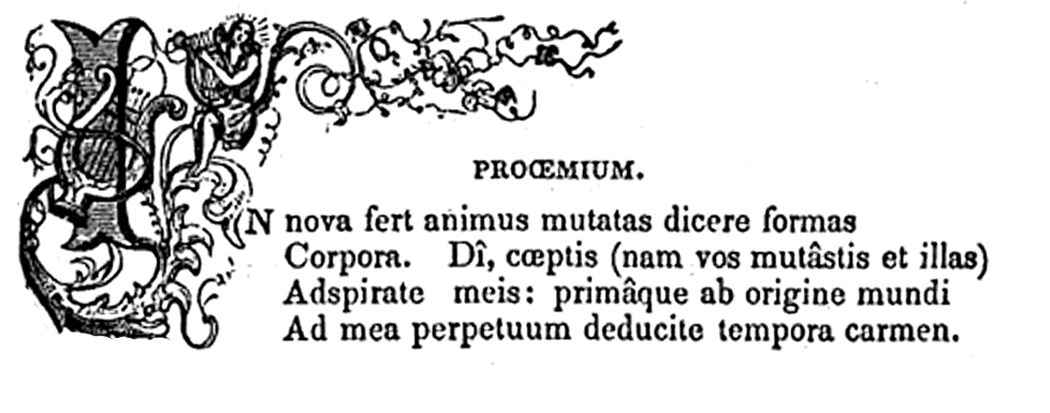
The Latin is alien to English speakers first because word order is not a central concern of Latin grammar. Ovid arranges his sentences according to his metrical choice — Latin hexameter. And that is built around syllable length, not stress. And so if you were to just put down a word-by-word transference from Latin to English, you get, essentially, nonsense.

In 1828, a British publisher printed an interlinear translation, intended to help students in learning Latin. To simplify the project, Ovid’s word order has been shifted to mimic English word order. Thus published, the sense, more or less, becomes clear.
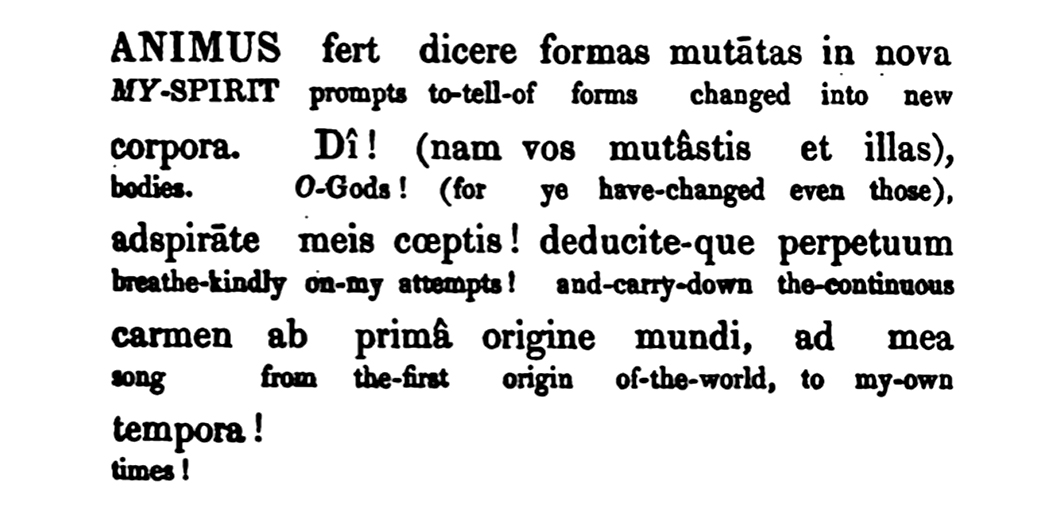
That is: “My-Spirit prompts to tell of forms changed into new bodies. O-Gods (for ye have-changed even those). Breathe-kindly on-my attempts and-carry-down the-continuous song from the-first origin of-the-world to my-own times.” 

(The hyphenated phrases are Latin single words that must be broken into multiple words to be rendered in English). 

All this is good, and one could easily smooth all this out into very plain English: “My spirit prompts me to tell of forms changed into new bodies. O Gods (for you have changed even those), breathe kindly on my attempts to carry down this song continuously from the origin of the world to my own times.” 

And there you have it: Ovid translated cleanly and understandable.

Except.


Except that this version, as plain as it might be, avoids some of the complexities of the Latin, which doesn’t so easily give up its meaning in a one-to-one way with our King’s English. And it doesn’t explain the wide variants rendered by translators from 1567 to our own times. 

Over the years, translators couldn’t make up their minds whether bodies were changed into new forms or forms into new bodies. Ovid writes forma into nova corpora. But in English that seems backwards. 

It’s been explained as hypallage (a rhetorical trope in which elements are switched from the place expected, as in “the angry crowns of kings” instead of the “crowns of angry kings.” It was a trope often used in Latin writings.) Ovid talks of “forms” changed into new “bodies,” where, in English, we might expect “bodies changed into new forms.” The difference is that in Latin, “forma” describes the “true” shape of something, in other words, the way it was created, such as your body or mine. Ovid is saying that the true shape of his mythological figures are being altered to new, perhaps temporary, bodies — in other words, the new bodies are not the “real” bodies.

In English, we would tend to word it the other way around, so that our “real” bodies are given new “forms.” And so, some translators write it that way, while others maintain the forms-to-bodies version.

This may seem like a trivial thing, but if you grew up with Platonic ideals and they were ripped apart into “false” new shapes, you’d understand what Ovid is getting at here. Of course, he does not make a big thing about it: He expected his listeners (or readers) to understand that the way we might understand “three strikes and you’re out.” It is just buried in the culture. Theirs, though; not ours. 

Most English translations really start with anima

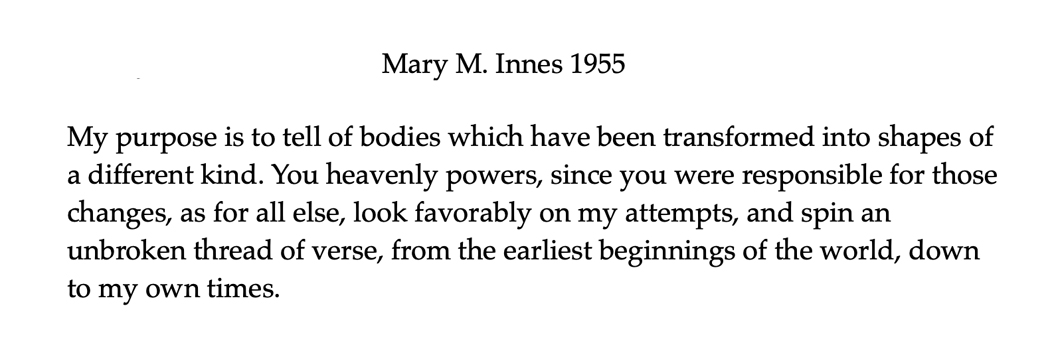
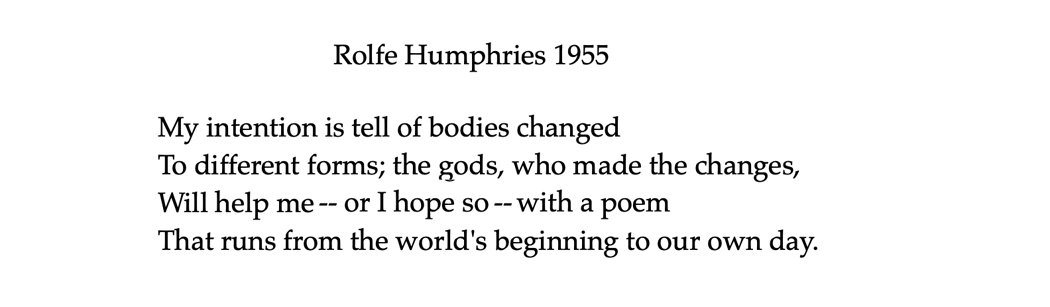
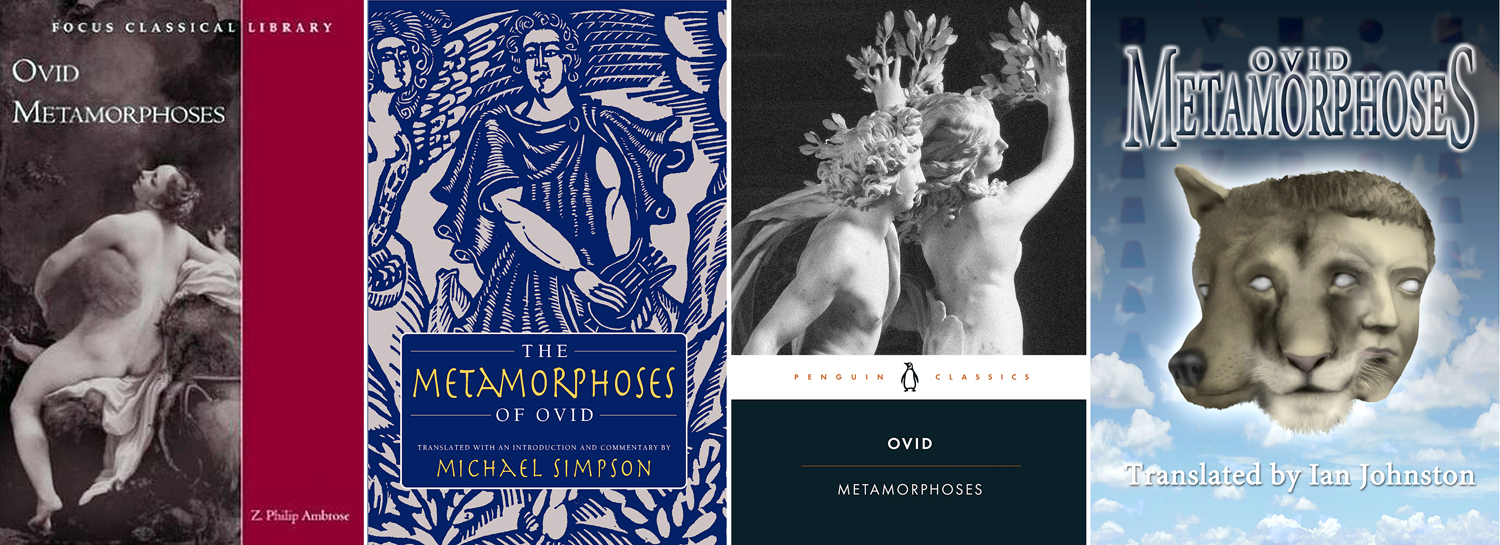
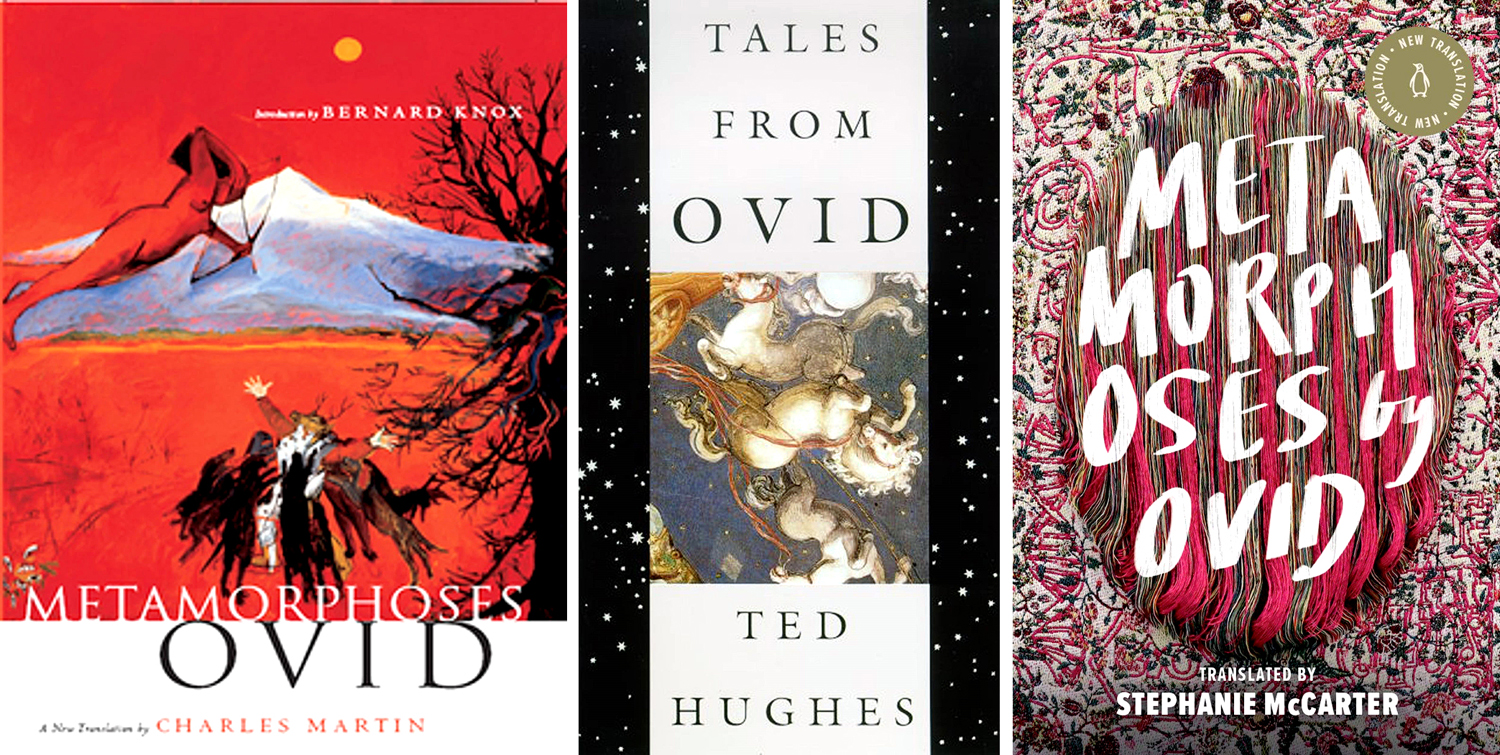
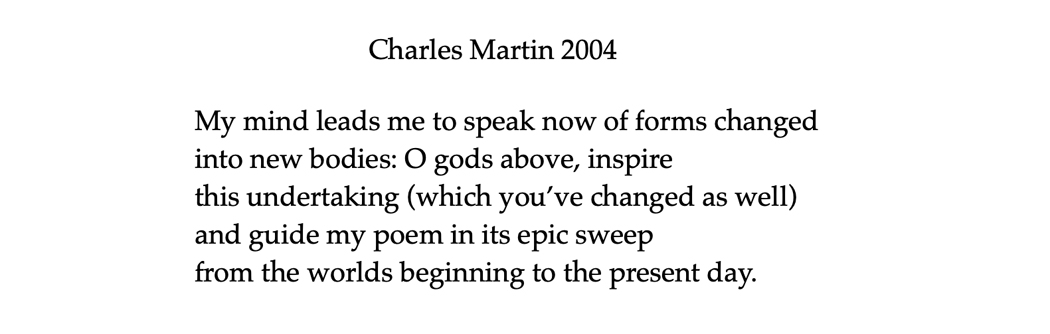
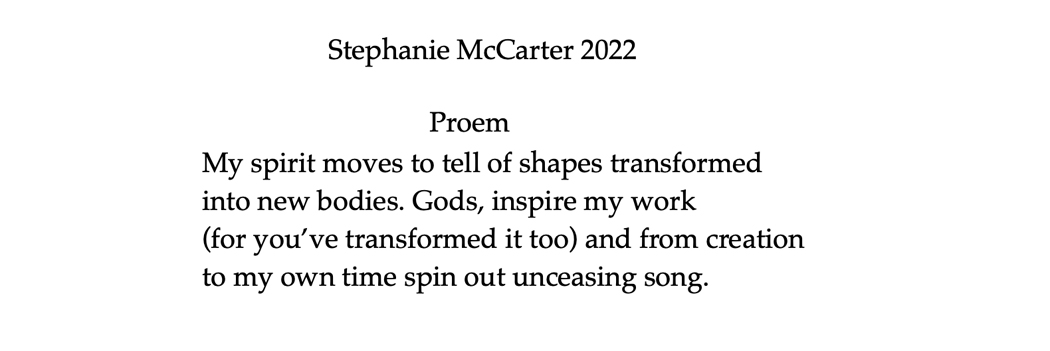
“My spirit prompts” can be understood as “My design leads me” (1899 Riley); “I want to speak about” (1903 Kline); “My mind is bent to tell of” (1916 Miller); “My soul is wrought to sing of” (1922 More); “My purpose is to tell of” (1955 Innes); “My intention is to tell of” (1955 Humphries); “My soul would sing of” (1993, Mandelbaum); “My spirit drives me now to sing about” (2012 Johnston); “My mind leads me to speak now of” (2012 Martin); and most recently, “My spirit moves to tell of” (2022 McCarter). 

But of course, the poem really begins with the word “Nova”… “New.” And a few attempt to mimic the Latin word order, approximately. One could attempt something in English, contorting it like a gymnast: 

Certainly, that is awkward sounding, and I am not recommending it as a preferred translation. We should want something that moves as cleanly in English as Ovid moves in Latin. Mimicking Latin won’t do that. 

But there are other issues, too. You’ll notice I used “weave the thread” of song. Ovid has “deducite” — to lead away, draw out, turn aside, divert, bring out, remove, drive off, draw down. It is used, says one set of notes, to mean to extend like a chain, or, as I have it, “weave the thread,” but more like “add links to links to make up a whole chain” of mythological stories. 

You can see the problem here: Which idiomatic Latin usage of “deducite” should you use here — again, without turning the passage into something utterly unreadable. 

That chain, and its metaphorical maritime implication is echoed in “adspirate,” which implies a fair wind in the sails, as if the gods were blowing their breath to move ships. These things are not clear in English and are only implied in Latin, but they are there. 

The multiple possible meanings of many of these words can bring variation to a potential translation. “Carmen,” for instance, can be a song or a poem — or a prophecy, an incantation, a tune. “Tempora” can be time, or a season, or a duration. “Fert” can be to pick something up, to carry it, to take something up. A translator has to decide what is best meant and how in English to make that clear.
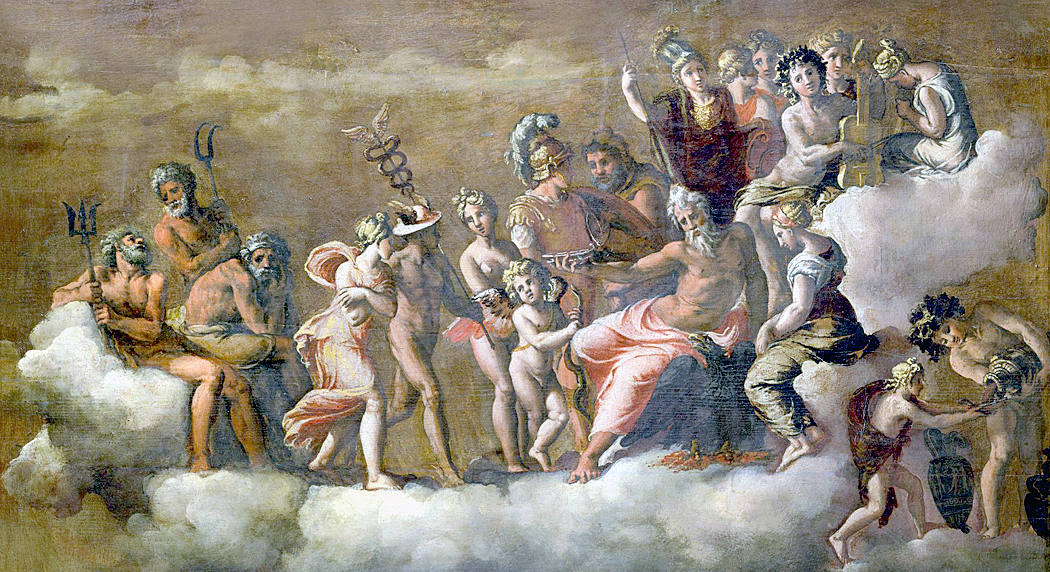
 

There is a giant ambiguity in these lines that gets very differently translated. When Ovid calls on the gods, he says “nam vos mutastis et illas,” which means, literally, “for you (plural) change (or move, or remove, or move away from) and that (or there, or yonder).” What do you make of that? 

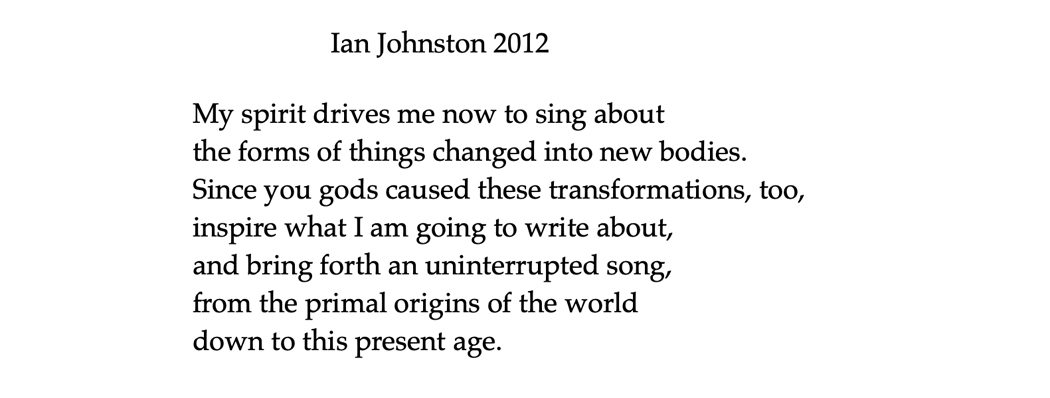
In previous centuries, it was taken to mean, basically, “for you gods caused those changes.” And that seems to make sense of it. But beginning in 2001 with Michael Simpson’s translation, many have assumed it is the poem that the gods have changed. “Gods, inspire this poem I’ve begun (for you changed it too)” (2001 Simpson); “O gods (it is you who have even transformed my art)” (2004 Raeburn); “inspire this undertaking (which you’ve changed as well)” (2004 Martin); “inspire my work (for you’ve transformed it too)” (2022 McCarter). 

These two interpretations can not both be correct. Ovid is obscure here, and leaves a good deal to the discretion of the translator.   

Or to the edition. A translator has to pick among variant texts in Latin, collated by different editors. And the Latin is not completely identical in all of them. Remember, Ovid survives not in manuscripts from Roman times, but from copies made by monks in scriptoria through the Middle Ages and into the Renaissance, and when copies are made, mistakes are made. Which is the true version: That is the job of an editor putting together a modern published edition. 
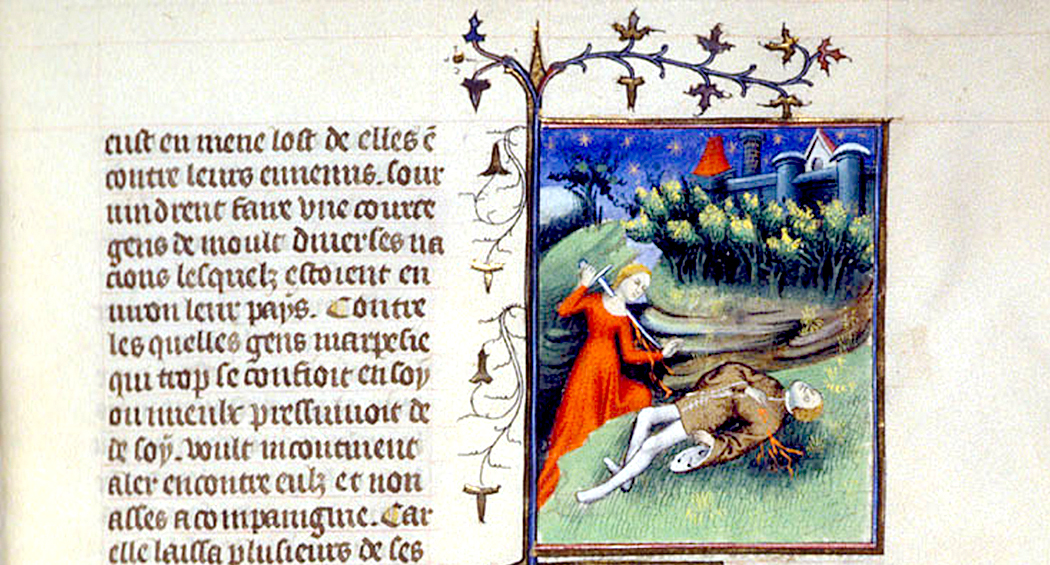
Joseph Reed, in his annotations to the new edition of Rolfe Humphries’ translation write of this confusion: “Most manuscripts have ‘for you, gods, changed those [forms] as well’ (nam vos mutastis et illas), which Humphries seems to be translating here, omitting the troublesome ‘as well,’ which has no clear reference. Since the 1970s, most editors prefer to read the slightly different text, ‘illa,’ found in a few manuscripts, which yields the very different sense: ‘for you changed that [undertaking of mine] as well,’ referring to the new direction Ovid’s own poetry now takes from his earlier themes and metrical forms (love elegy) to those of epic-length mythological narrative.”

The difference between “that” and “those” (illa et illas). No matter how you parse it, the original is obscure. 

Finally, you must decide what you want in your Ovid. If you are a scholar you want whatever is closest to the poet’s original language, even if it is obscure. And I sympathize with the impulse. But if you are simply a reader who is looking for Ovid’s storytelling, then you will be just fine with letting the translator turn the ambiguity into something that makes sense (culturally and linguistically) in English. Sometimes the actual words don’t relate the actual meaning. 
Ovid is lucky, in that he really does survive translation well. He can be reworked without losing his essential Ovid-ness. And it is true that some writers survive the tidal pull of translation better than others. That pull can distort some works beyond help, while others keep their gussets unruffled. Hence, a good translation of the Iliad or Shakespeare can work just fine in a new language, because the story is paramount. Shakespeare tends to travel well. His plays are valued in many lands and many languages. There are famous examples of Macbeth in Swahili, of Hamlet in Russian, and dozens of operatic versions in Italian, French and German. They all pack a wallop. And Shakespeare is loved in all those languages by their native speakers.

But that other class of writing, where the effect depends on how it is being said can defy the best translator. I have never found a good translation of Goethe, for instance. In English, his poetry often sounds commonplace. But I am assured by a native German speaker that Goethe’s poetry is the best from his country by being written in the most elegant of German language. Horace in Latin is similar; in English you wonder what the fuss is all about; in Latin, it is the height of sophistication and elegance.

Going in the other direction, how in hell can you translate John Milton into French? You can tell the story of Paradise Lost, sure, but how can you convey the special organ-tone quality of his language.

“Round he throws his baleful eyes.”

Translate it into French and it comes out as the equivalent of: “He looks around him malevolently.” Not the same thing, all the poetry is gone out of it. These things are untranslatable, and hence, Milton can never have the global currency of Shakespeare. 

There is behind language, a world. You can concentrate on the language, or on the world. It is easy to be lulled into forgetting the difference, to think that words describe the world, and that the best language is the most accurate lens on the things of this world but they are not the same, but rather, parallel universes, and what works in words does not necessarily explain how the world functions. In the reality of our experience, there are no nouns, no participles. There is only “is.” Can you get at that “is” through words. We try. And we try again.

And so, Ovid is lucky, he takes translation with grace, even glee. For although his Latin is singled out as impeccable, it is the stories that matter, and we can get them in English (or French or German or Chinese). 

Which is why my favorite version is Ted Hughes’ Tales from Ovid, which is only a partial translation (it includes just 23 of the hundreds of stories Ovid retells) and is really more a metamorphosis of Ovid into English: rewritten as if Hughes himself were telling the stories, rather than translating the words of Ovid. It is a re-creation rather than a translation. 
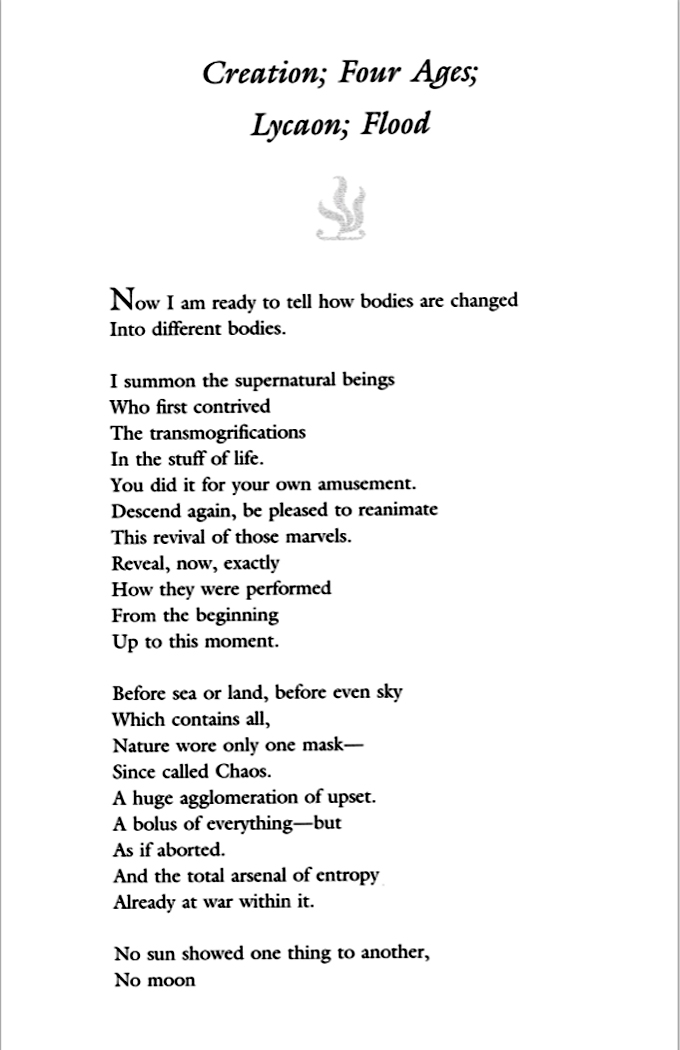
It is a version I recommend to everyone as a complete joy. 

Click on any image to enlarge

Ovid is just plain fun to read. There are classic Latin texts that feel like doing homework, but Ovid — especially his Metamorphoses — just scoots by and can only be described in modern terms as a “page turner.” 

Publius Ovidius Naso (43 BC to AD 17) was probably the most prolific poet of ancient Rome, writing many books, often quite salacious. He wrote about how to seduce a woman, how women should attract men, how to break up with a woman — you get the picture. But his most famous book was “Changes,” or Metamorphoses in its original, which told dozens of mythological stories, mostly old Greek tales. It was a best-seller when it was written, copied out by hand many times over, and remained a best-seller through the Middle Ages and into modern times. Many writers — including Shakespeare — cribbed from Ovid and a good deal of what most people have absorbed of Greek mythology really comes through Ovid as the middle man. If you know about Daphne and Apollo or Pyramus and Thisbe, it is likely the Ovidian version you have seen. 

Ovid wrote in a sleek, fast Latin that told his stories economically. He has been used to teach students Latin for centuries, and has been translated into most of the world’s languages.

I’m one of Ovid’s devoted readers, and have gone through the book many times, in different translations, beginning in the 1960s with the old, standard Rolfe Humphries version (which I can’t say I found easy going). 

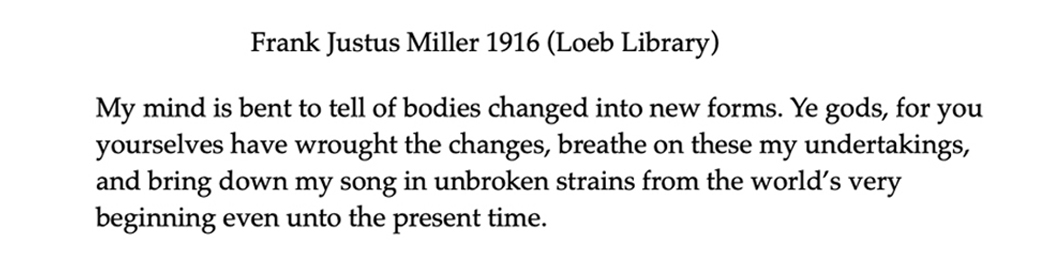
Since then, I have re-read the Metamorphoses many times, each time in a new translation. The newest is by Stephanie McCarter. She is not the first woman to take on the work, but she has made it a point to unforgive the gods their brutality. Where other translators give us gods “ravishing” their mortal victims, McCarter forthrightly calls it rape. In the “Me-Too” era, there is no glossing over the violence and brutality, the sexism and misogyny inherent in the myths. 

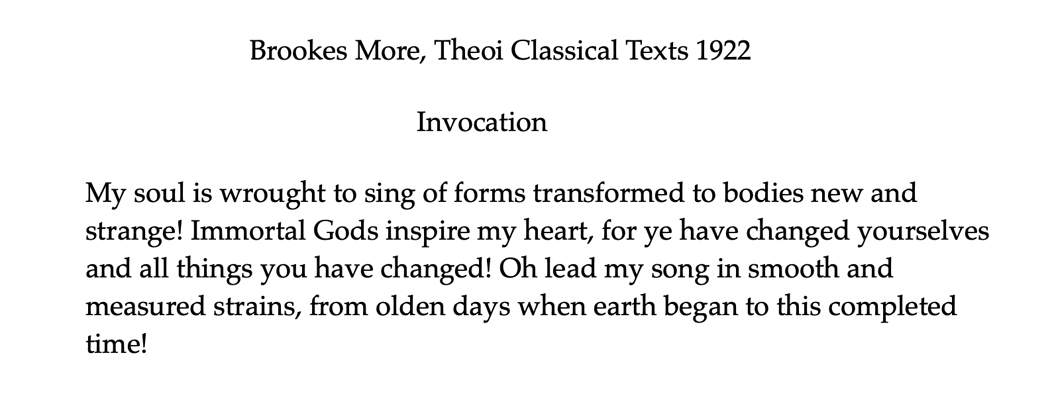
I applaud this shift of reference, but despite that, I found her verse tough plowing. These things are a matter of taste. Previously I had sailed through the 2004 translation by Charles Martin and found the lines so fast under my eyes, I hardly noticed I was reading a translation. Turning the pages with McCarter, I never forget that under her words there is a Latin pluperfect subjunctive. That it is a reasonably accurate version I don’t question. It is. But I want something else for my pleasure. Ovid’s original was always praised for its fleetness, and so I would wish my English equivalent also to fly by, so that I am immersed in the story rather than in the mechanics of the language relaying it. 

But reading this new version also made me want to look at how others have assayed the project. 

I took on a week-long effort to concentrate on the first four lines of the book and compare how each translator has looked at them, and found rather notable differences, considering how plain the meaning actually is. 

For this, Ovid must take a share of the responsibility. There is some ambiguity in his words, which make the poetry richer, but the translations more problematic. 

Then, there is the question of whether the translation should be prose or verse, and if verse, should it rhyme? Ovid wrote in hexameters, but English is geared to pentameter. Should you try to count six or count five? Six often sounds a bit awkward in English, while pentameter comes as naturally as breathing. Is six closer to Ovid’s original, or is the swiftness of English pentameter more faithful. Each translator has his or her own solution, and any can work. 

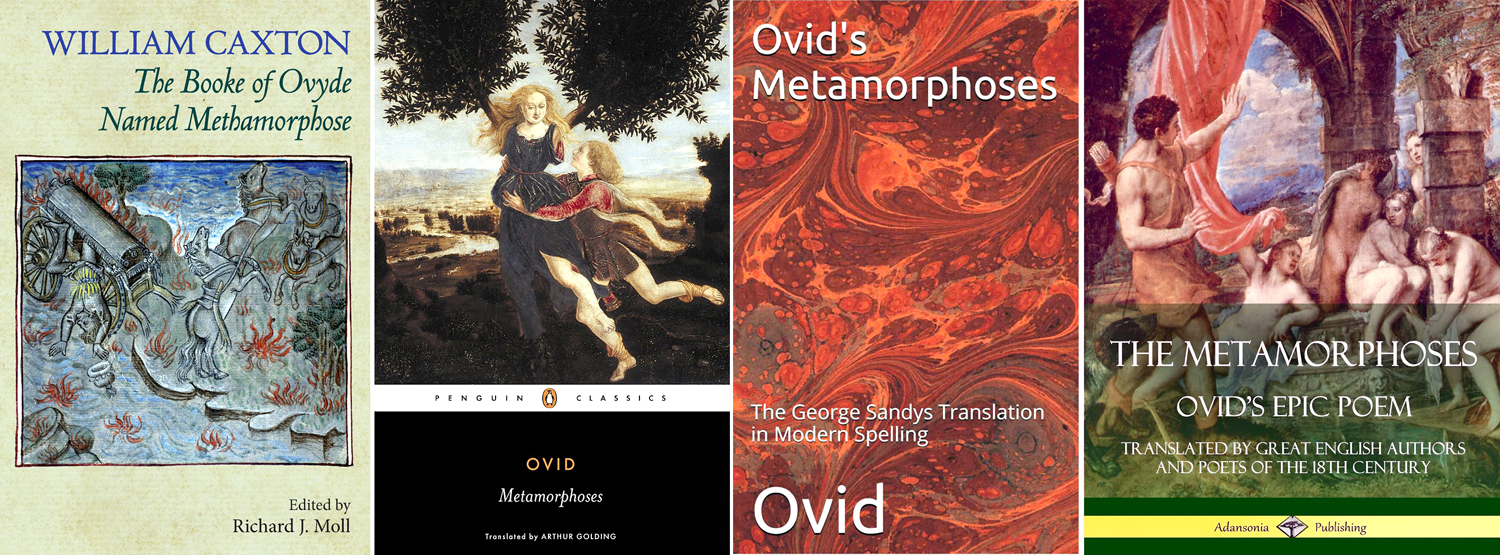
The first English translation was by William Caxton, who probably also gave us the first printed version (as opposed to hand-written by scribes), although the only versions extant seem to be the handwritten ones). It was in the Middle English that Chaucer would have read. He titled it The Booke of Ovyde Named Methamorphose

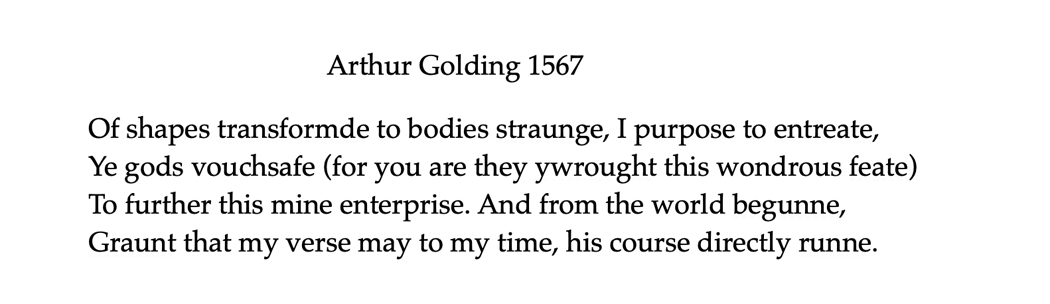
But the first translation that counts and is still readily available was made in 1567 by Arthur Golding. It was Golding that Shakespeare read and cribbed from. He opens his version with the four-line prologue:

It is written in “fourteeners,” the meter and rhyme scheme of the theme song to Gilligan’s Island: “Just sit right back and hear a tale, a tale of a fateful trip/ That started from this tropic port, aboard this tiny ship.” It was a popular meter in the 16th and 17th centuries. Nowadays, it can feel a touch jogtrot. (Now try to read Golding’s lines without singing them to the tune). 

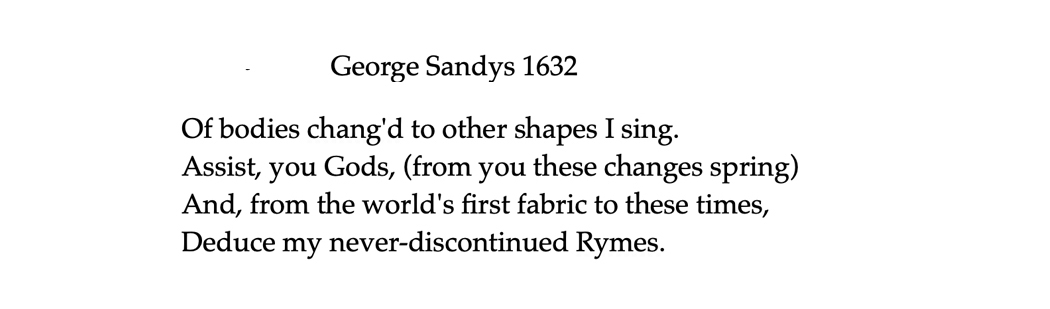
The second translation came in 1632, by George Sandys, who decided that English pentameter was more natural to the native speaker and recast the whole in a five-beat line, which shortened each and made for swifter reading, but also left out a bit of the original meaning.
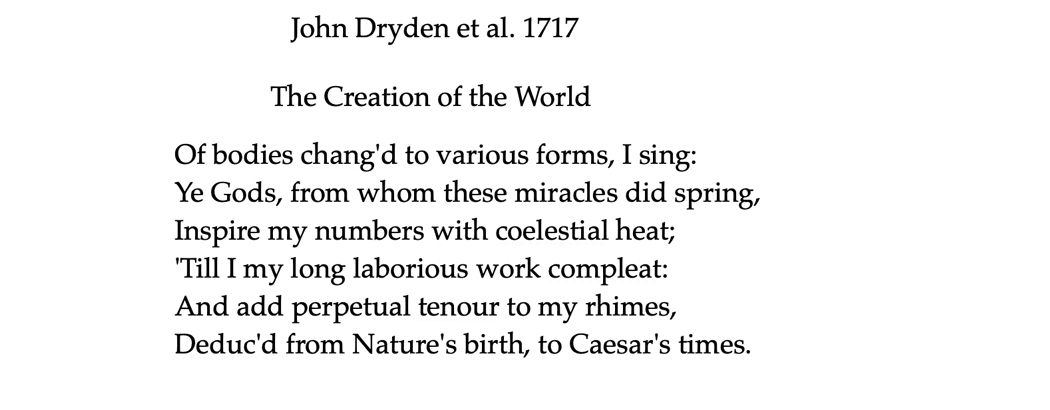
The most famous early translation came out in 1717, done by a team of writers rather than a single translator. These included John Dryden, Alexander Pope, Joseph Addison, John Gay, and William Congreve, among others. In was rendered in heroic couplets and was surprisingly fluent. Dryden took on the whole first book and began the introduction:

That became the standard Ovid for many years, and is still read and still quite readable. 

But then came the Victorians, who saw, among other things, Ovid’s usefulness in teaching Latin to its young men. And so you get a spate of them, usually in prose, meant almost as cribs for translation. 

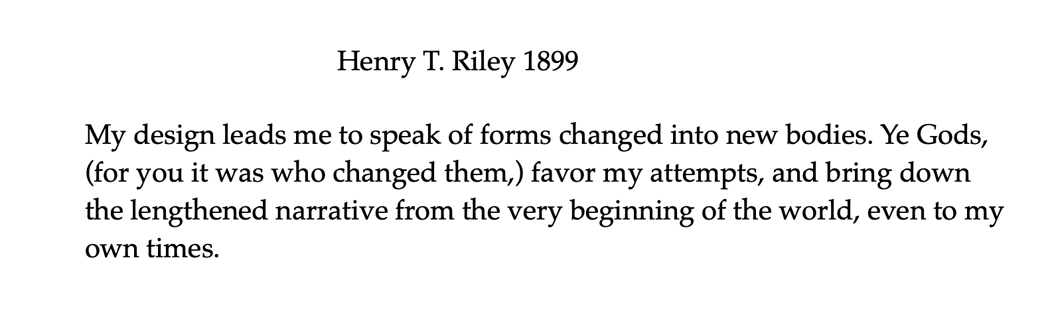
The one I have read several times is the Henry T. Riley, in a two volume pocket series published in 1899. Like many of the versions of its era, its notes try very hard to reconcile Ovid’s paganism with Victorian Christianity, and so, where Ovid talks of “gods,” the Victorian translators often write “God.” This isn’t much of a problem, if you are aware of it as you read. Riley’s proem runs:

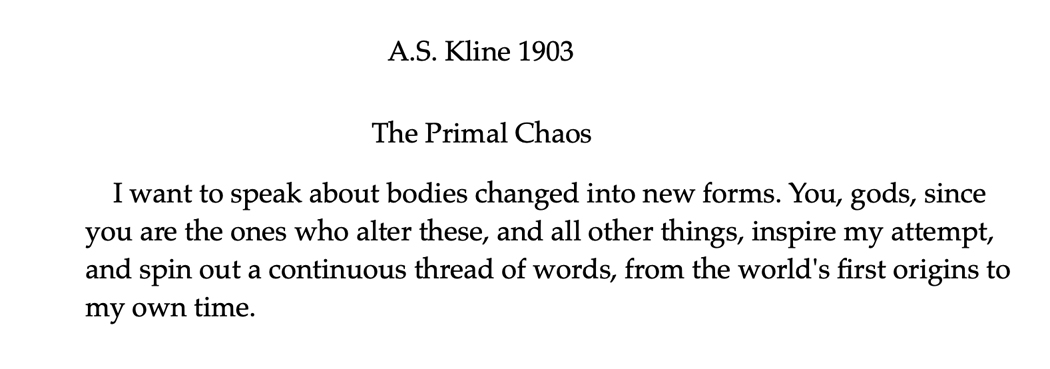
Anthony S. Kline, who seems to have translated pretty much everything at one point or another, came out with his Ovid in 1903. It is still widely available. It is in prose and meant to be almost pedestrian, i.e., not high-falutin’ and poeticalized. 

In 1916, the Loeb Library translation came out, with Ovid’s Latin on the left-hand page and Frank Justus Miller’s prose on the right-hand, opposite the original. It doesn’t quite work as an interlinear, but it will help anyone attempting the work in Latin. 
In 1922, writer Brookes More gave us a prose version for Theoi Classical Texts. Like many others, it as much interprets Ovid’s words as translates them. The word “strange” does not appear in the Latin. 

A new spate of translations hit in the 1950s, after the war, when so many new students were headed to university under the G.I. Bill. 

In 1954, A.E. Watts put it in pentameter and squeezed it all down to a fast-running nugget. His purpose seems to be to get the gist as directly as possible. 

A year later, Mary M. Innes uses prose and is pretty much as close to the original as it can get, across languages and cultures. It has been a mainstay of Penguin Classics and is still widely available and read. 

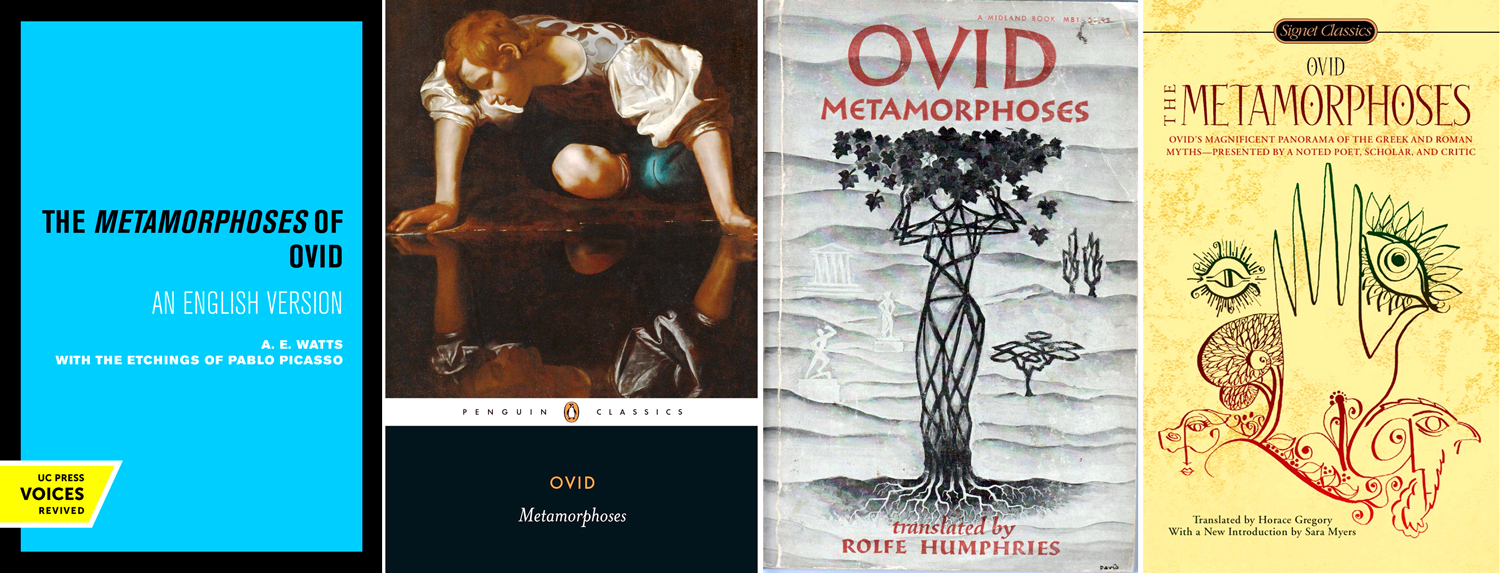
The same year, the widely read Rolfe Humphries version came out in what must have been at the time a very contemporary sounding verse. It is the one I read in high school and didn’t like. Reading it now, I wonder what was I thinking. It is still in print, in a shiny, new annotated version published by Indiana University Press. It moves quite fast. 

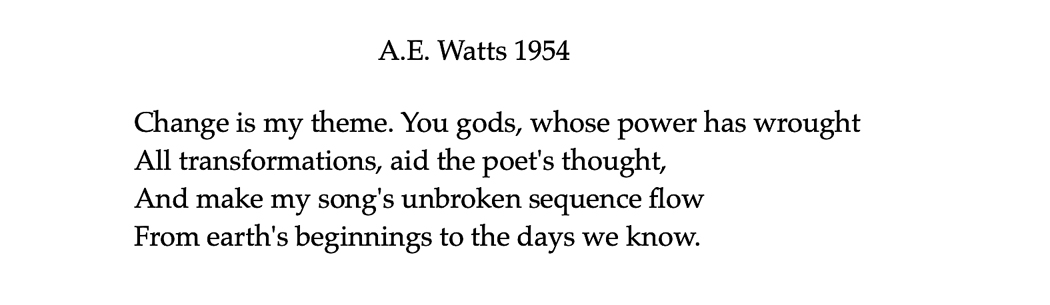
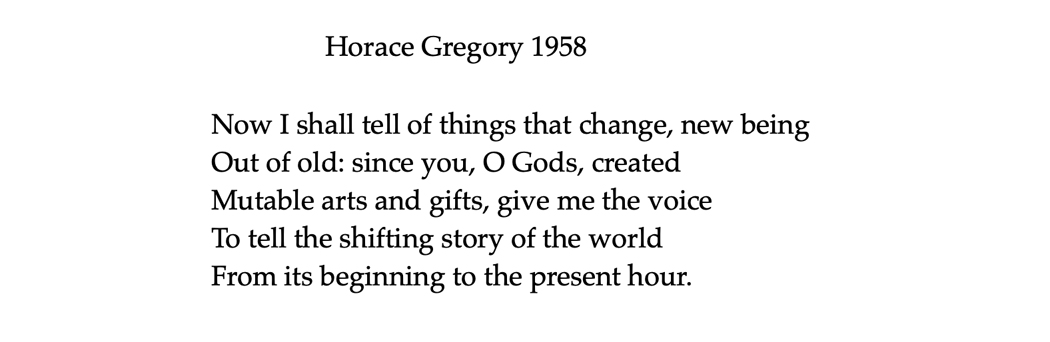
Finally, in 1958, Horace Gregory published his verse version, which attempts, also, to feel contemporary, but to my ears feels a tad straight-laced. 

The text sat dormant for a couple of decades, but in the 1980s, Ovid became a growth industry again. 

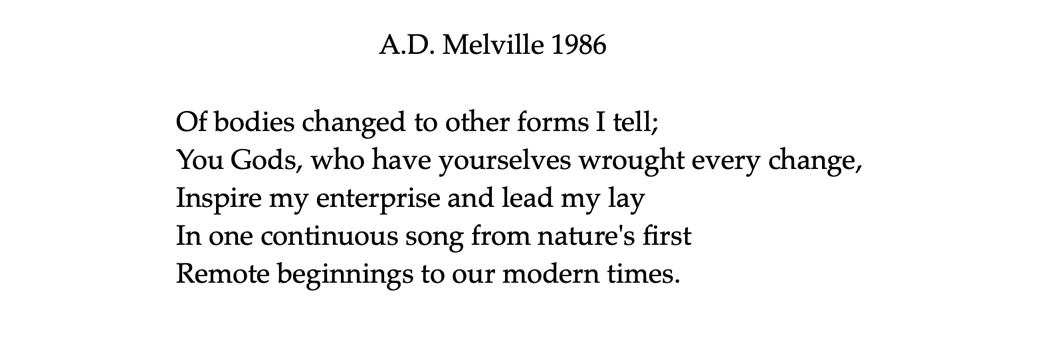
Oxford World Classics commissioned A.D. Melville for a new translation of the Metamorphoses, published in 1986. It is self-consciously poetic, with words such as “ere,” “countenance,” and “naught” to stumble over where more conversational words would be clearer. 

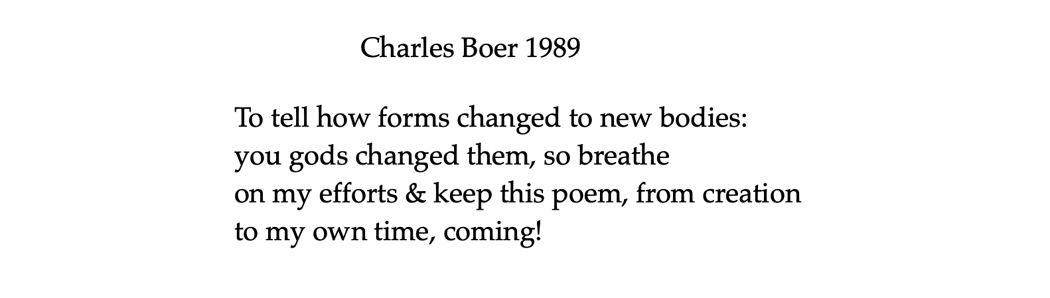
Charles Boer took another approach in 1989, with what one reviewer said is “like it’s spouted from the lips of some prehistoric shaman, barking out a tale to his animal skin-garbed flock.” In short, punchy lines, not always strictly grammatical, he seems to want to express each point as curtly as a newspaper headline. Articles evaporate and nouns shoot each other. It’s sui generis. To give the flavor of it, I have to quote more than just the proem. 

The proem is short and pithy, but the whole book is an acquired taste

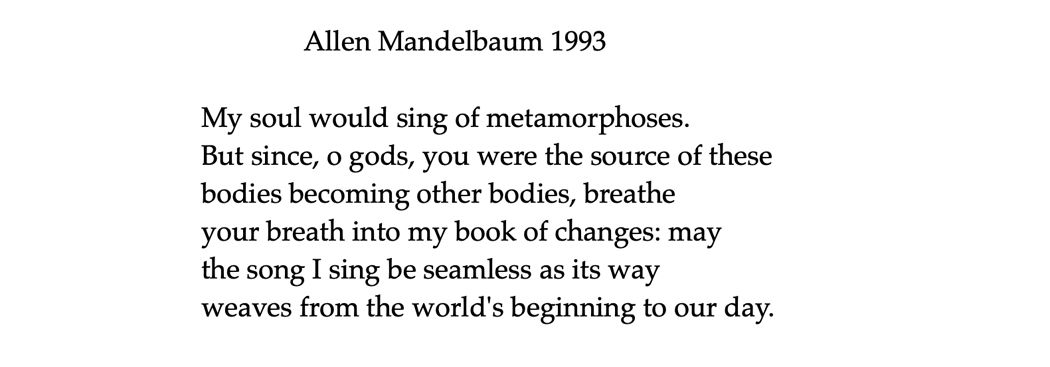
Allen Mandelbaum was a translating machine, and has given us versions of almost everything we might want to read, from Homer to Vergil to Dante. His Ovid, from 1993, in an Everyman Classic, which means it is gorgeously bound and printed in a handsome Bembo typeface. This is a book that looks really good on a bookshelf, but I’m afraid I find the translation rather worksmanlike. He takes six lines to say what Ovid said in four. 

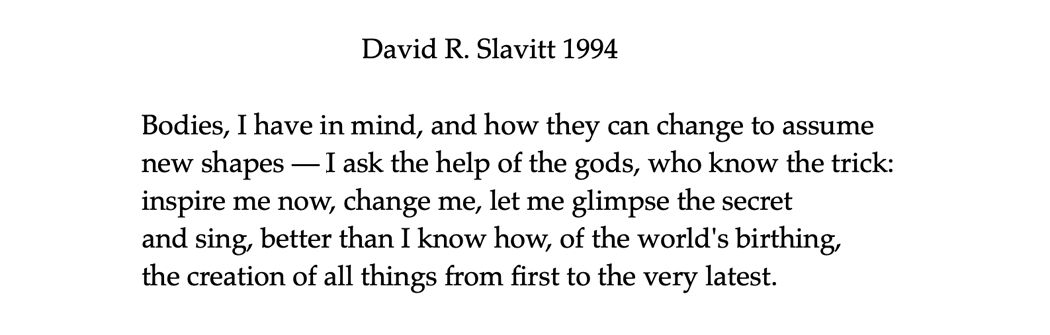
David Slavitt competed in 1994, with an entry in a very loose hexameter and what he says is “translated freely into verse.” He wanders a bit, and seems to add things into the text that sound more like commentaries on the text. In his introduction he writes: “As a translator, I take all kinds of liberties, but I am strict in my observation of length and scale, which I take to be significant artistic decisions that any new poem ought to respect and re-create.” In other words, he’d rather match Ovid’s prosody than his content. Some people swear by him.

The new century, 2000 years after Ovid actually wrote the thing, has exploded with new versions of his magnum opus. 

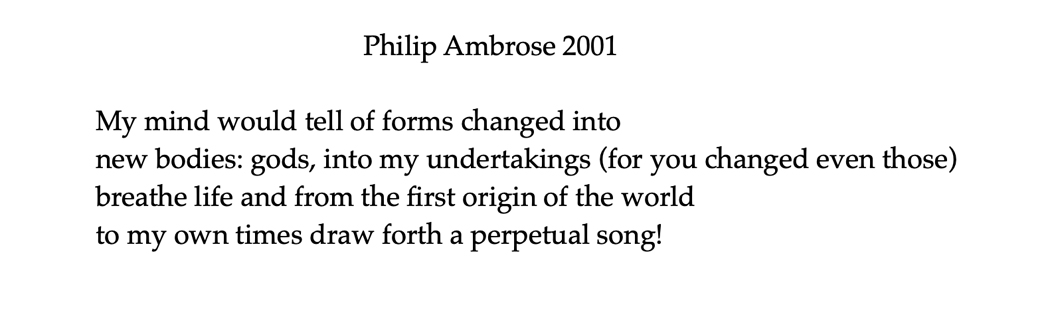
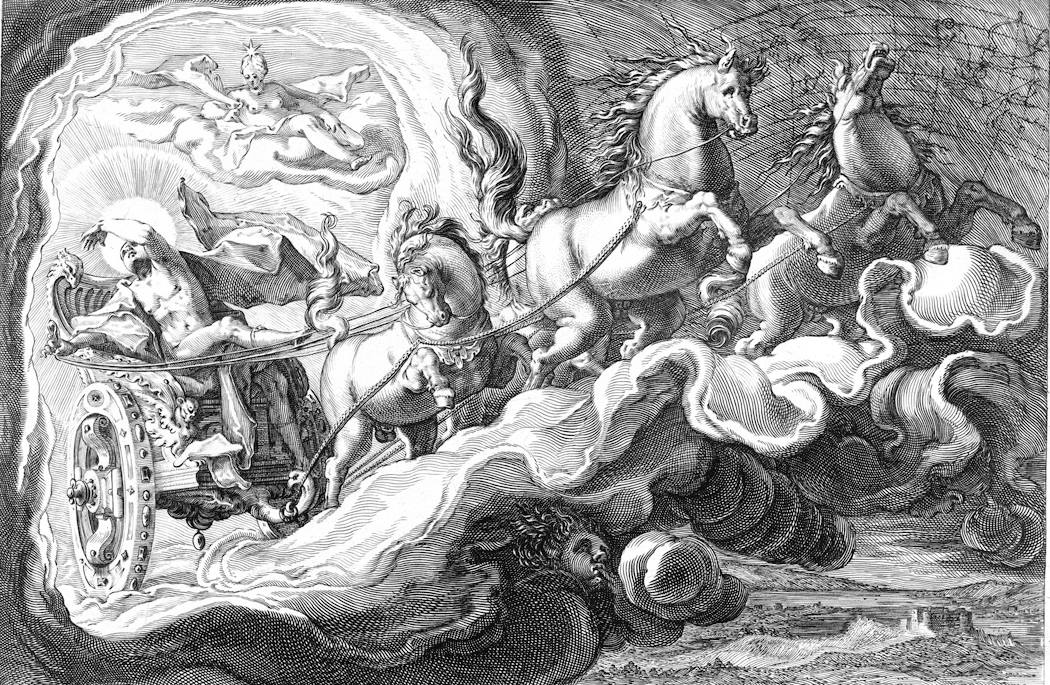
Philip Ambrose attempts to keep a line-by-line parallel with Ovid’s Latin, with sometimes an awkward phrasing, as when Phoebus, sounding like Yoda, tells Phaethon “But warn against this action I can”

Also in 2001, Michael Simpson brought out his prose version, attempting, he says in his introduction, “the rapid and direct American idiom while avoiding colloquialism on the one hand and academic translationese on the other. His version includes as many pages of notes, as of poem. 

I’m jumping ahead to 2004, skipping over Charles Martin for the moment, and to David Raeburn’s version for Penguin Classics, available in a handsome clothbound edition. It looks great on a bookshelf, but Raeburn’s somewhat wordy take means that most of the lines are longer than the page is wide, leading to insufferable line-breaks. Ugly. Reading it is like taking three steps forward and one back, over and over again. (This is a problem of book design rather than translation). 

In 2012, Ian Johnston put the text into swift pentameter, and what is more, posted the entire book for free on his website. There is also, of course, a handsome physical book to buy. The tales are laid out with marginal headings to keep track of the often confusingly interlaced stories. 

That leaves three translation to consider: My two favorites and the newest one. 

Charles Martin’s 2004 version for W.W. Norton is about as graceful as you can get, with a very free pentameter that moves as swiftly as Ovid is meant to move. I find no speedbumps in its wordage or lineage. It is the version I read over and over. 

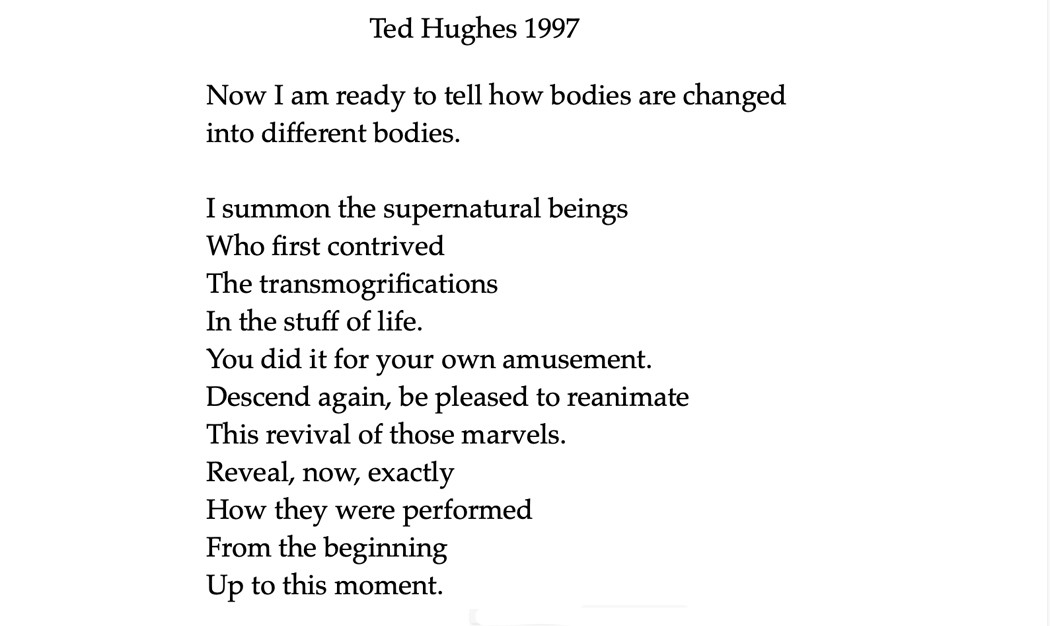
But that doesn’t mean it is my true favorite, which is, I think, the best translation of anything that I have ever encountered. The problem is that Ted Hughes only worked on sections of the Metamorphoses, and so his version is incomplete, and second that his truly free approach means that he occasionally slightly rewrites Ovid to make things clearer or more proportioned to English (Ovid’s Latin doesn’t work word-for-word in English). It’s as if it were a completely original poem by Hughes rather than a translation of the Latin. I absolutely love Ted Hughes Tales from Ovid and cannot recommend it highly enough.

Which brings me back to the new McCarter translation, the latest in the long freight-train line of Penguin Books versions. If you read just the proem, she gets the gist of it absolutely perfectly, both metrically (as pentameter) and by giving us Ovid’s meaning as clearly as possible. 

But the rest of the book is less graceful, and about three pages in, I found myself working to read it. Martin’s version is greased and slides frictionless. McCarter is more like bumper-to-bumper traffic on the interstate, with a kind of start-and stop hiccups, and it sometimes suffers from what Simpson dubbed “translationese.” 

Translations seem to fall into one of three camps. One attempts to be as faithful as possible to the original, to simplify it and make it plain; the second seeks to poeticize it and make it sound as much like poetry as possible, and by that, we mean Victorian poetry; a third stream values contemporaneity, to make Ovid sound as if he were writing today, with the risk that in another 10 years it might sound as dated as Beatniks or bell bottoms. 

Any of these approaches can work, as long as the words spring along quickly and effortlessly, and Ovid’s stories keep you turning pages. Tastes vary and any one of these translation may strike you. I’ve laid out the range of them, and they can all be found somewhere in some published form. 

The best version for you is, of course, the one that keeps you reading to the end. 

Next time: A closer look at Ovid’s Latin

In nova fert animus mutatas dicere formas corpora.

With these words, Publius Ovidius Naso begins one of the most famous and influential books of the ancient world, his Metamorphoses. 

“Now my spirit brings me to speak of changing forms into other bodies.” In the poem, he recounts hundreds of mythological stories, all to do with transformation. Nothing in his universe is permanent; everything seems to change into something else, women into birds, men into horses, gods into bulls. The poem recounts such tales with the wit and fizz of a supreme ironist. 

The Metamorphoses is a compendium of Greek and Roman mythology. It is the primary source for later writers who use it to retells the stories of Echo and Narcissus, Daphne and Apollo, King Midas, Venus and Adonis, Pyramus and Thisbe and Phaethon and the sun chariot. Some of the myths are found only in Ovid. He is primary source for Chaucer, Dante, Shakespeare, Milton, Dryden and hundreds of others, including Nathaniel Hawthorne, in his Wonder Book and Tanglewood Tales. 

He was popular in his time, largely derided as “pagan” in the early Christian centuries, rediscovered in the Renaissance, enjoyed in the enlightenment, again avoided in the Victorian era of high-mindedness and didacticism, and only again come out of the shadows after mid-Twentieth Century with a spate of new translations. (The most recent trend is away from him once more, in a “Me-Too” era that takes umbrage at all that rape and patriarchy.) 

With all that shapeshifting, it makes me think of how I manage to read the poem: in English. In the past year, I have read three different translations, plus I have re-read Ted Hughes’ Tales from Ovid. And I have loved every moment. 

And so, now my spirit brings me to speak of changing language into other words. Specifically, how can we translate from one tongue to another, from Ovid’s Latin to my English. It should be simple: Just take the ancient words, one by one, and turn them into English words. But if we do that, we get gibberish. “In now bring spirit change to speak forms bodies.” 

To say nothing of the multiple meanings of each of the Latin words. A few bits: animus can be “mind,” “soul,” “feelings,” “heart,” “spirit,” “courage,” “character,” “pride,” or even “air.” Corpora may mean “body,” but it also means “person,” “self,” “virility,” “flesh,” “corpse,” “trunk,” “framework,” or “collection.” So, which of each of these do you choose. A possible, but nonsensical translation, borrowing synonymous meanings from the words in the opening sentence, could read, “Within the extraordinary, pride wins a substitute for pleading a collection of patterns.” 

Huh? Of course, no on thinks that is what Ovid was trying to say. It is completely unidiomatic. But how do you make meaning in English from a language spoken 2000 years ago? 

One of the first translators into English was Arthur Golding. In 1567, he gave the first line as, “Of shapes transformde to bodies straunge, I purpose to entreate.”

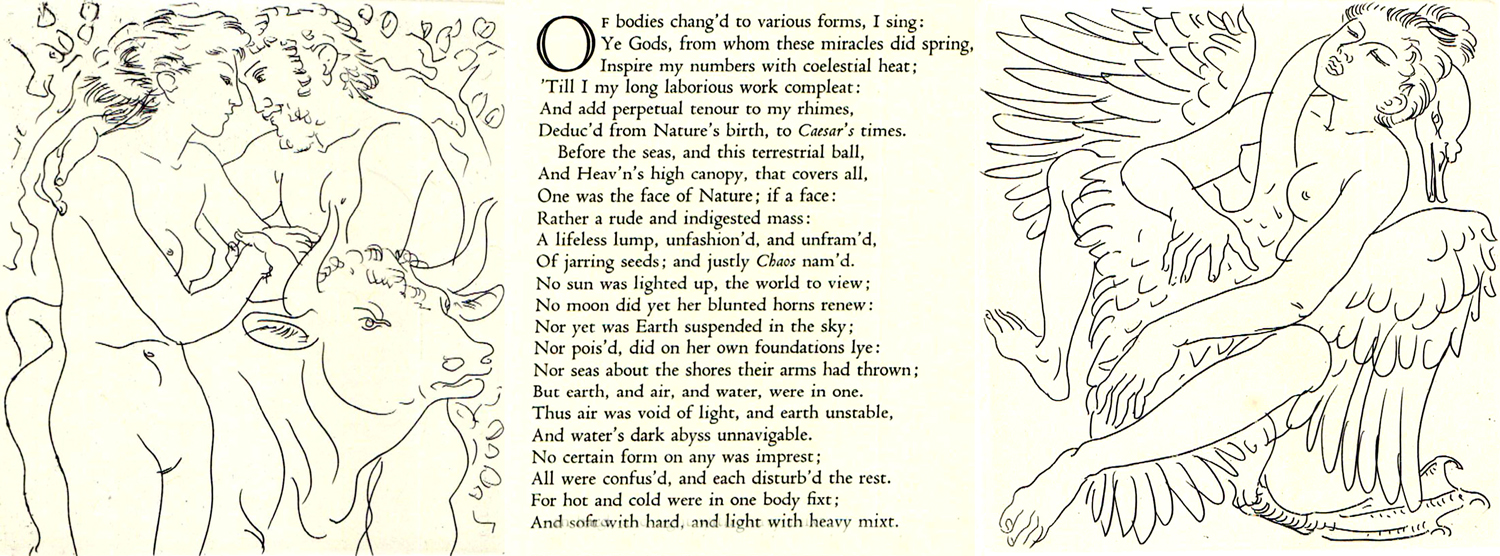
The most famous translation, by John Dryden in 1717, makes it short and sweet: “Of bodies chang’d to various forms, I sing.” 

In 1899, Henry T. Riley gave it as: “My design leads me to speak of forms changed into new bodies,” which is fairly literal. 

“My soul is wrought to sing of forms transformed to bodies new and strange!”  Brookes More, 1922.

 Horace Gregory, in 1958 has it: “Now I shall tell of things that change, new being out of old.”

William S. Anderson, rather clumsily makes it nearly unreadable in 1978 with: “From bodies various form’d, mutative shapes my Muse would sing.” 

I have collected (a “corpus” of data) some 20 different versions of this single sentence, including Hughes’ “Now I am ready to tell how bodies are changed into different bodies.”

Ovid’s Latin is not only light and ironic, it is often self-consciously poetic, and other times comically demotic. Because of the different structures of Latin and English — the Latin being built of case endings, declensions and conjugations — it is impossible to recreate accurately the tone and content of the original. Parallels must be found, and those vary from age to age, mandating new and current translations. 

Outside of Hughes, who is near perfect but only translates barely a tenth of the whole, my current favorite is Charles Martin, which is easy to read, idiomatically English, but able to shift tones when needed. It is also in a swift pentameter, unlike those hexameters so many try to match Ovid’s own verse form, which is oddly ungainly in English. 

But, what I started out to say, before shifting off into all this about language, is that the same piling up of version in language has its counterpart in imagery. Ovid’s tales have been subject matter for countless painters and sculptors. 

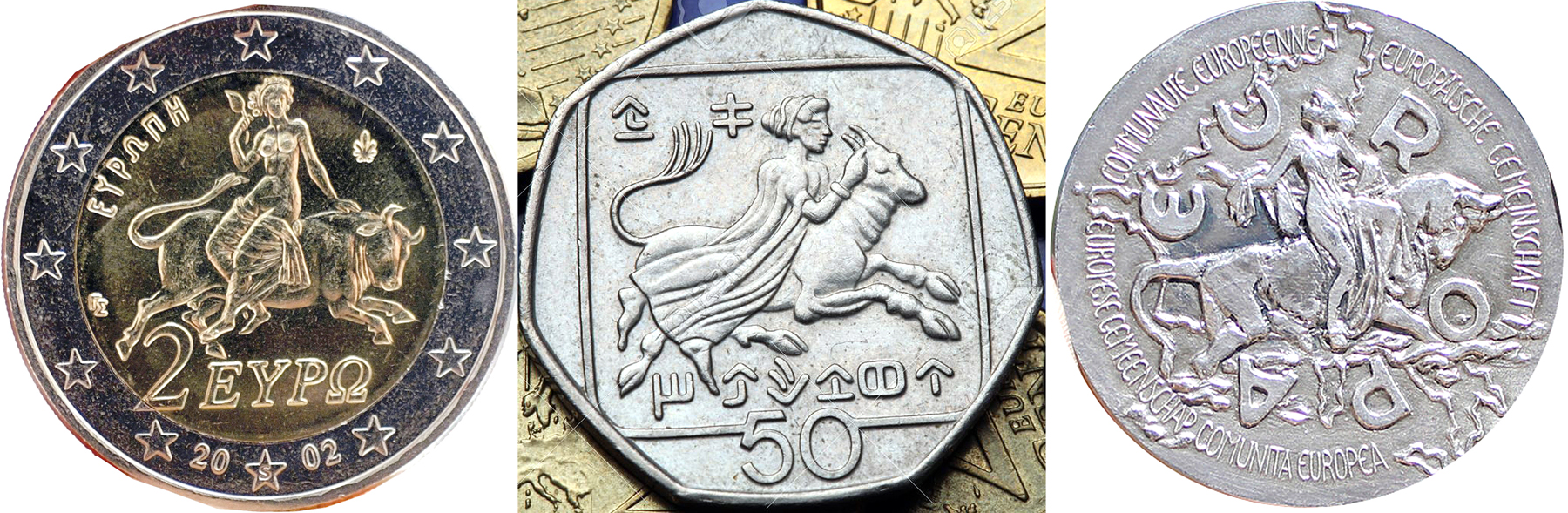
So, now I am moved to write about verse changed into other art media. I wanted to take a single tale and decided, since I feel so European, I might consider the continent’s eponym, Europa. 

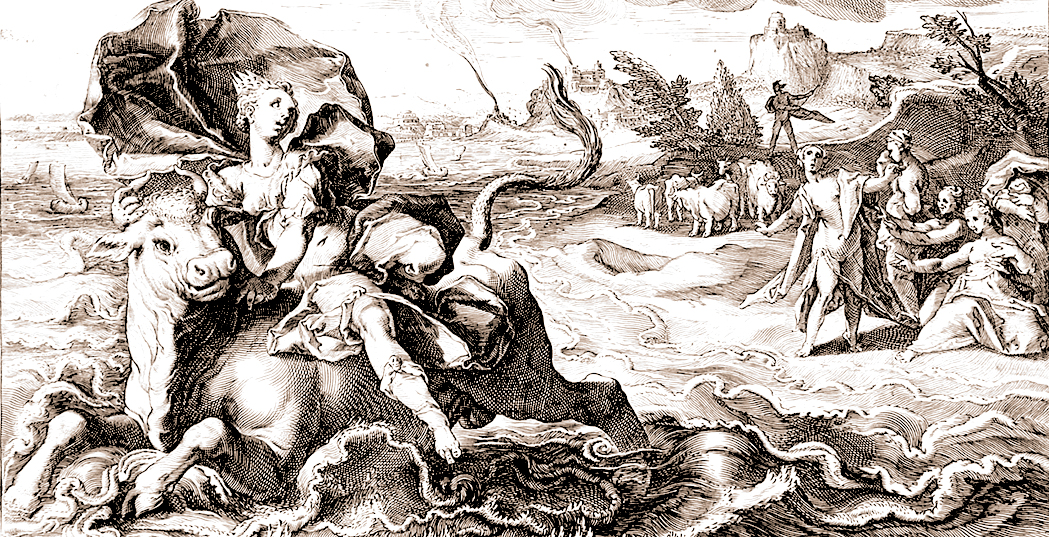
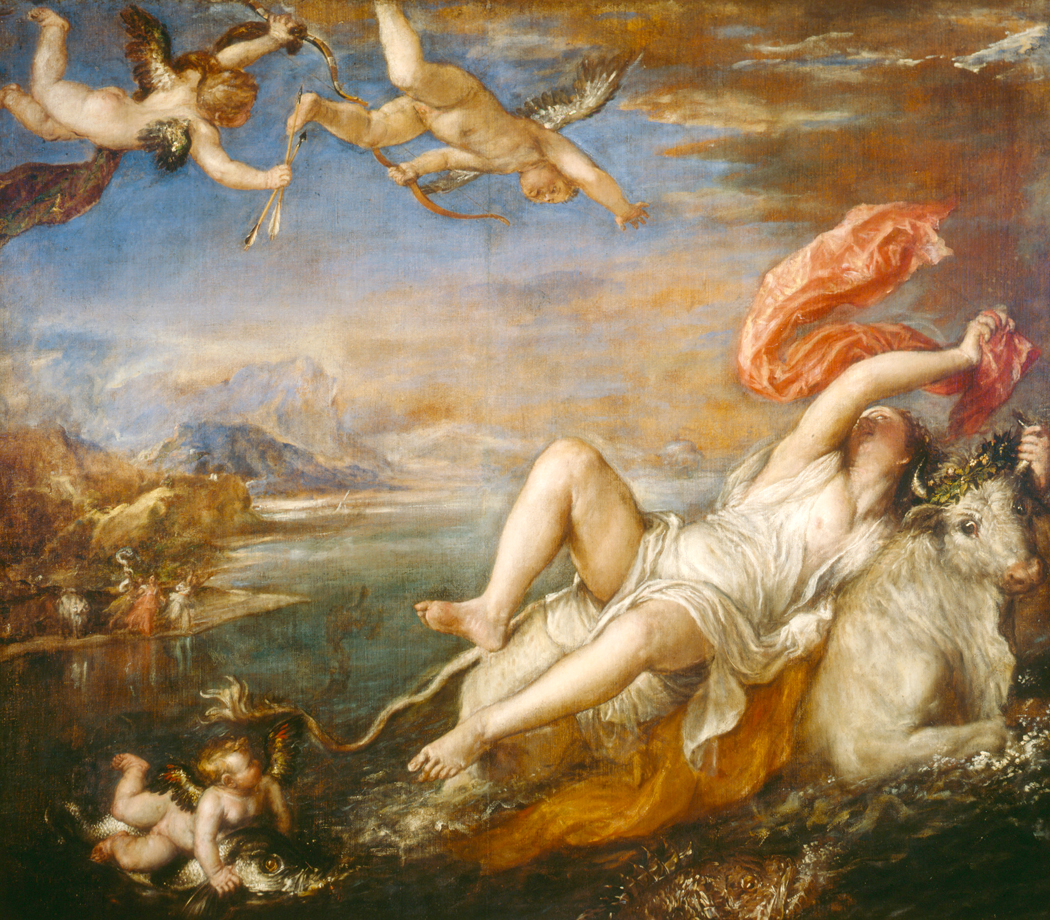
In the Metamorphoses, Jupiter, head god, gets the hots for the young woman, Europa, and seeing her among her herd of kine, plots to abduct her. 

“The great father and ruler of the gods — whose right hand is armed with the three-forked lightning, who shakes the world with his nod — puts on the appearance of a bull, and having mixed himself with the bullocks, he lows and walks about beautiful on the tender grass. 

“He is as white as the untrampled snow before the south wind turns it into slush. His shoulders brawny, his dewlap dangles on his broad chest. His horns are curved but as if they were hand made and flawless as pearls. 

“He seemed unthreatening and his eye filled with no anger; he was all peaceful. 

“And so Europa, the daughter of Agenor, wondered at him that he was so beautiful and gentle. At first she was afraid to touch him, even though he promised no threat, but she did approach him and held out flowers to his white mouth. The would-be lover rejoices and biding his time till he gets what he wants, he kisses her hands. It isn’t easy for him to hold back. 

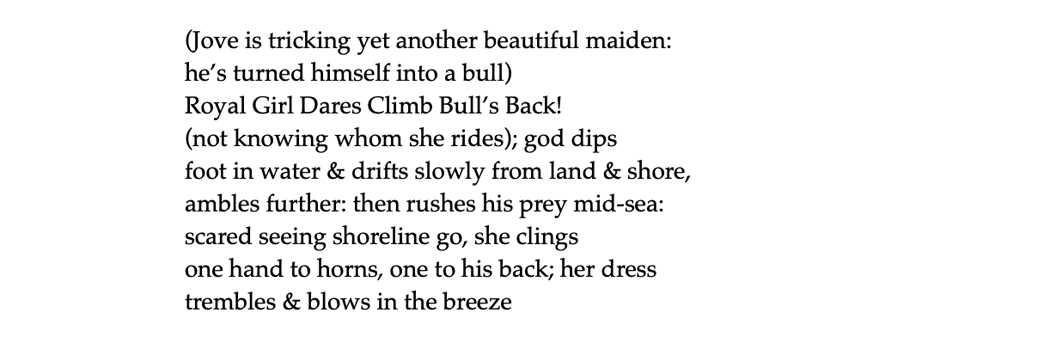
“And so, he fawns upon her and gambols on the green grass, he lays down his snowy side on the yellow sands; her fear evaporates slowly. He offers his breast to be stroked by the virgin’s hand and his horns to be snared by her garlands. She dared then to sit on the back of the bull, not knowing who he really was. 

“The god by slow degrees plants his foot in the sand, leaving prints there, moving incrementally to the edge of the waves, and then suddenly he goes off farther through the waves into the wide sea. She trembles and being carried away, she looks back on the shore left behind, holding his horn with her right hand while the other was placed on his back. Her windswept garments shook behind her. And so, the god, having then changed back from his lying bull form, confessed himself to her.”

The story is later picked up in Book 6, in the story of Arachne, challenging Minerva to a weaving contest. Arachne weaves a picture of Europa “deceived in the form of the bull: You would have thought it a real bull and real waves in the tapestry. Europa is seen looking back to the shore she has left and calling to her companions, afraid of the surging water and nervously lifting her feet.” 

 It’s in little details, like the feet, that Ovid makes his stories palpable. 

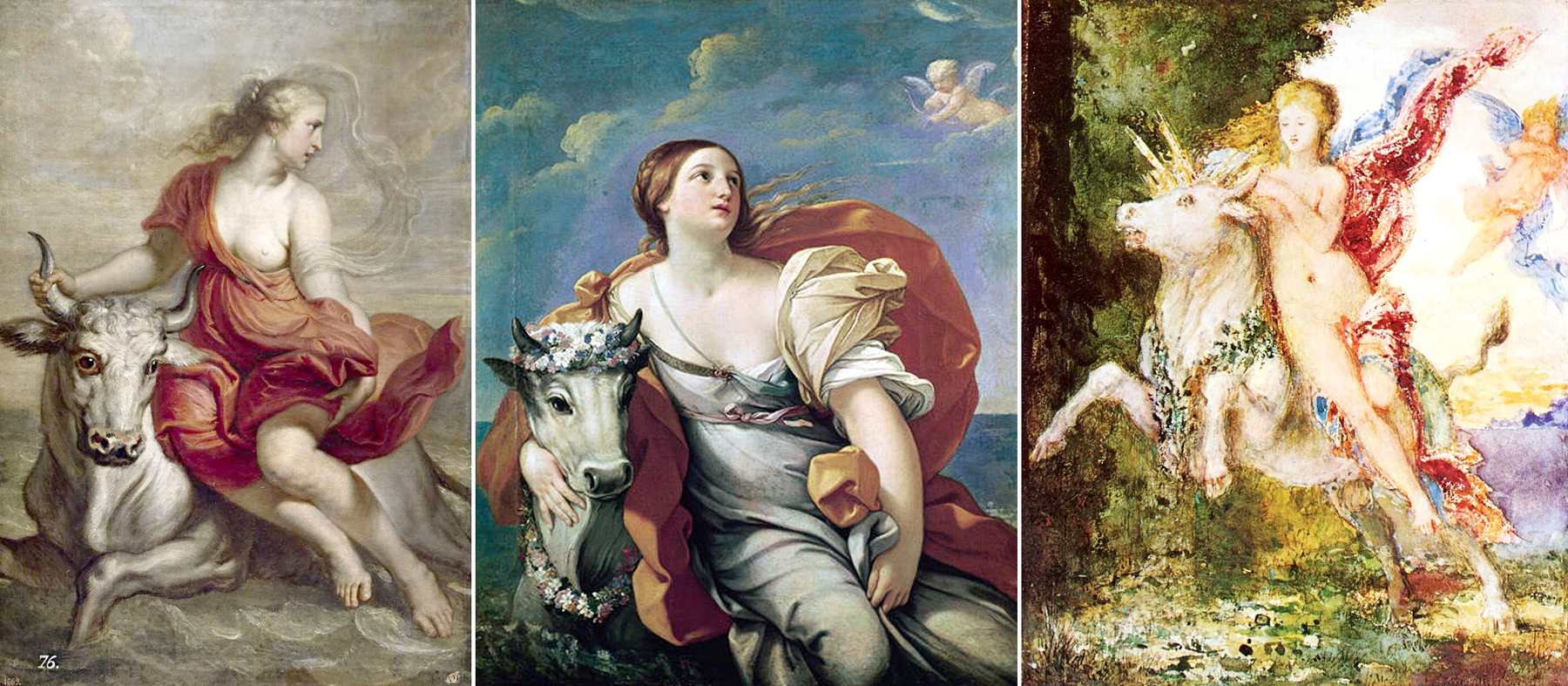
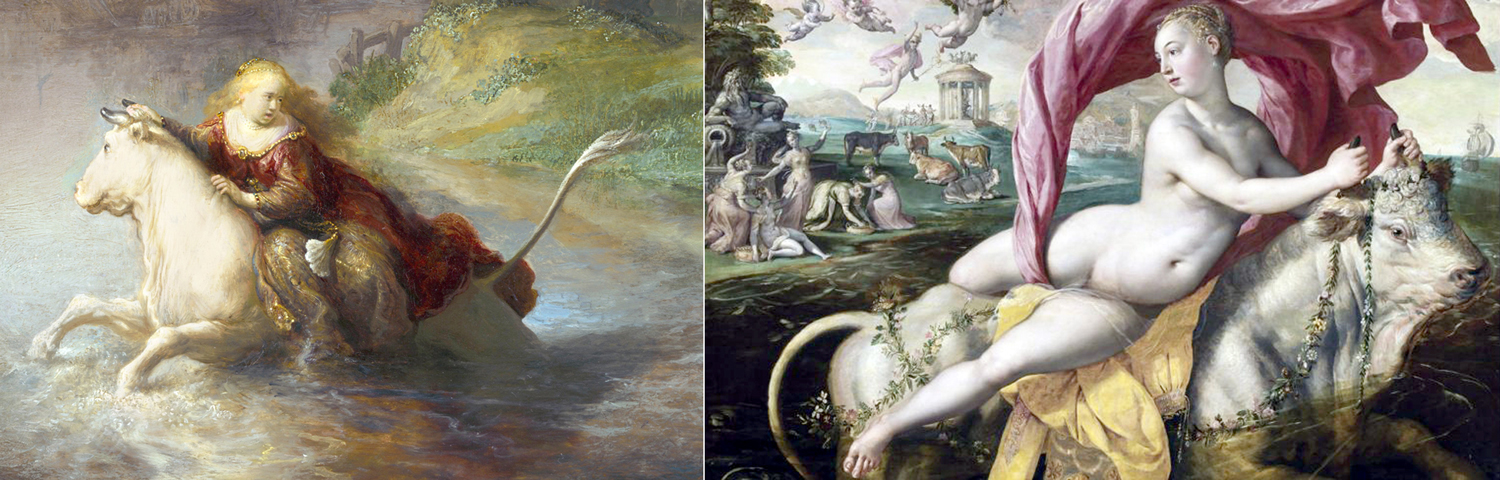
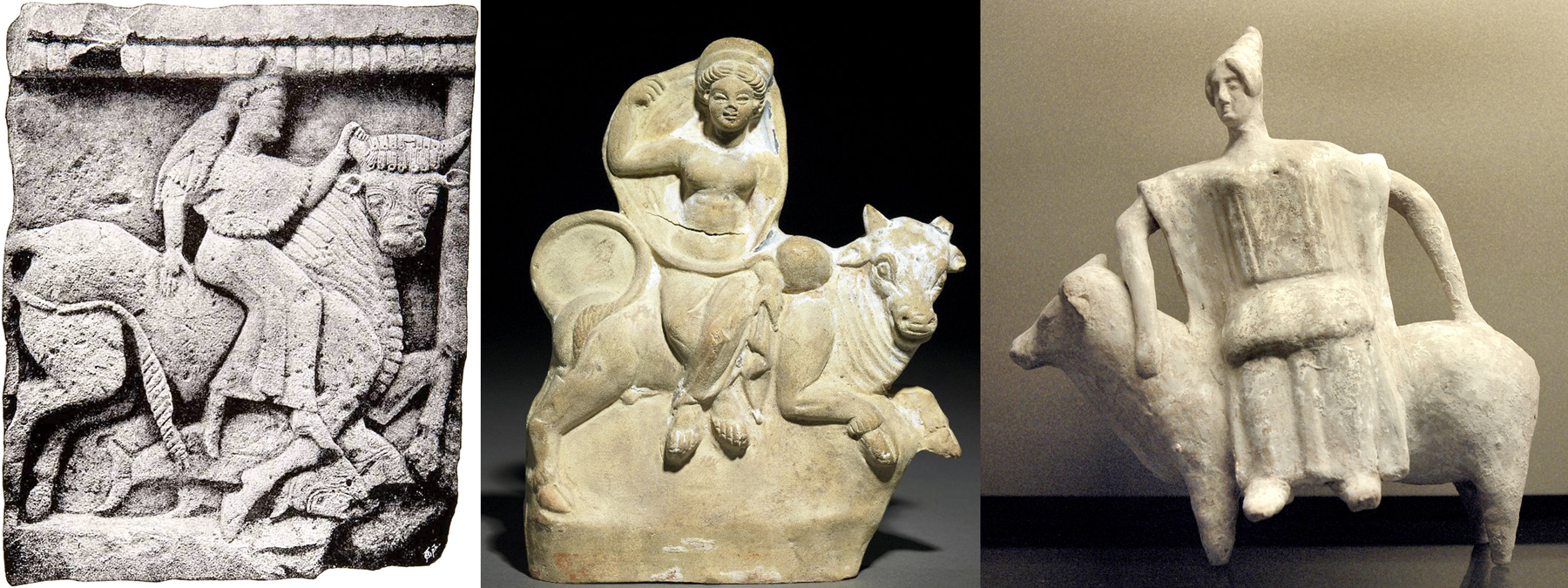
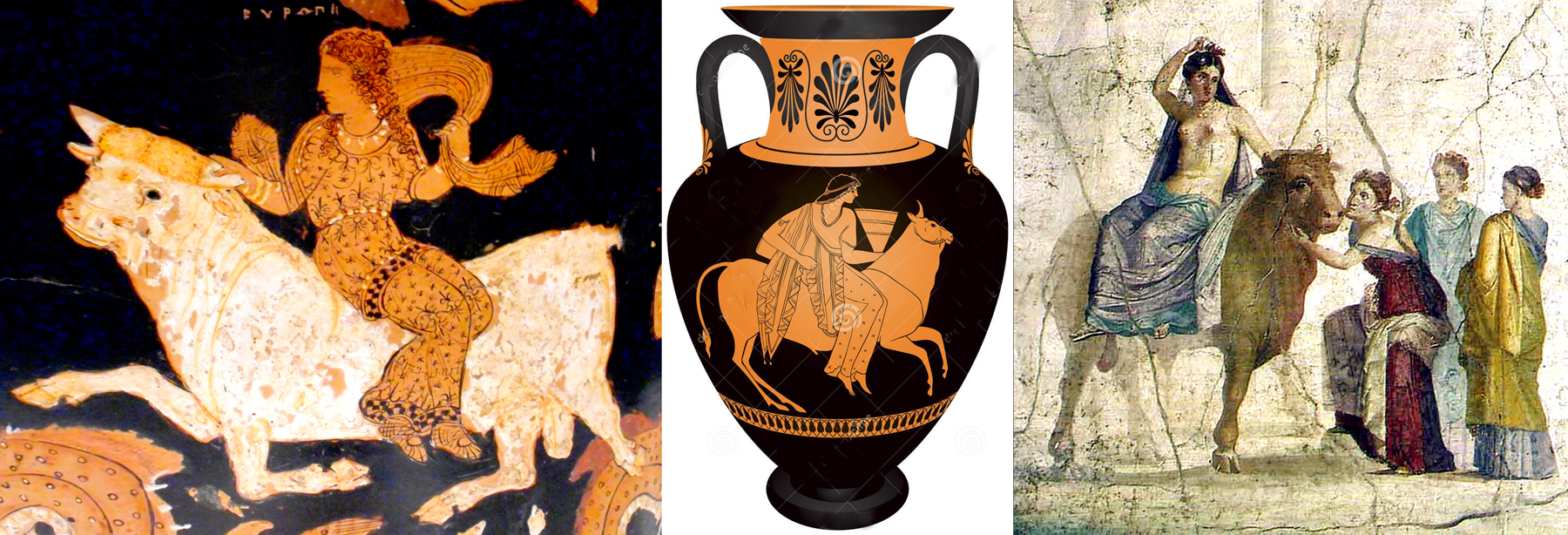
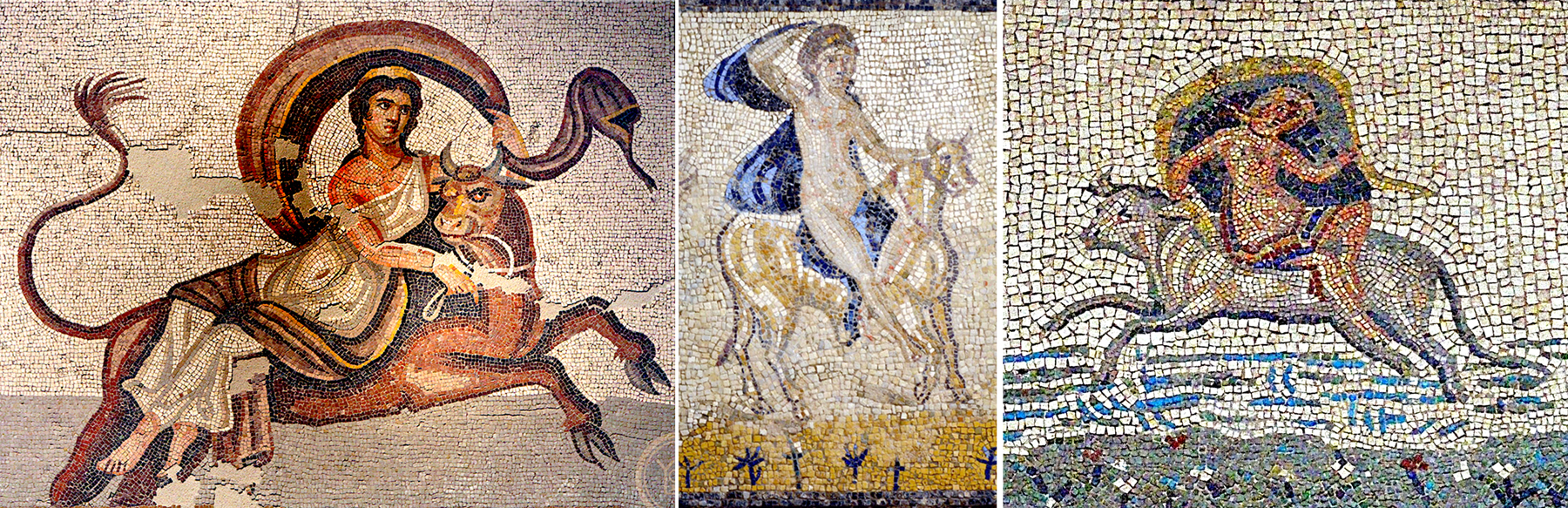
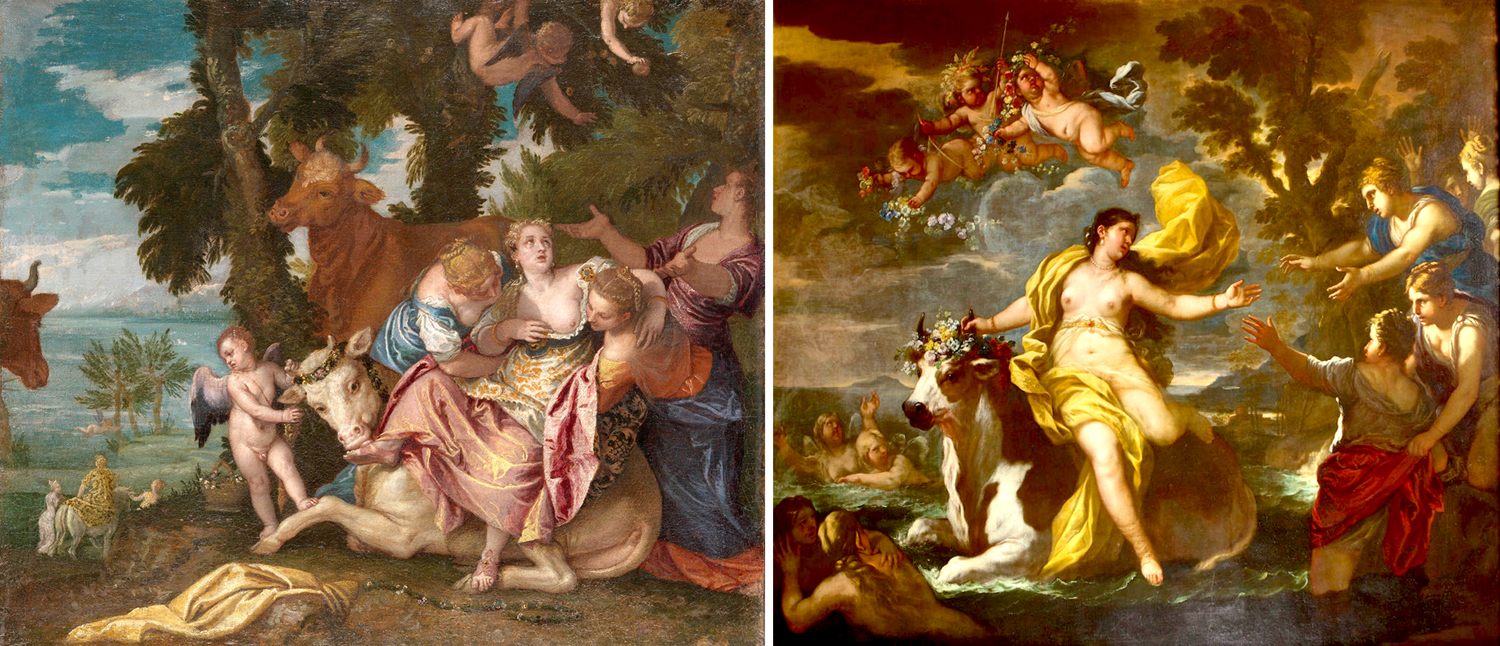
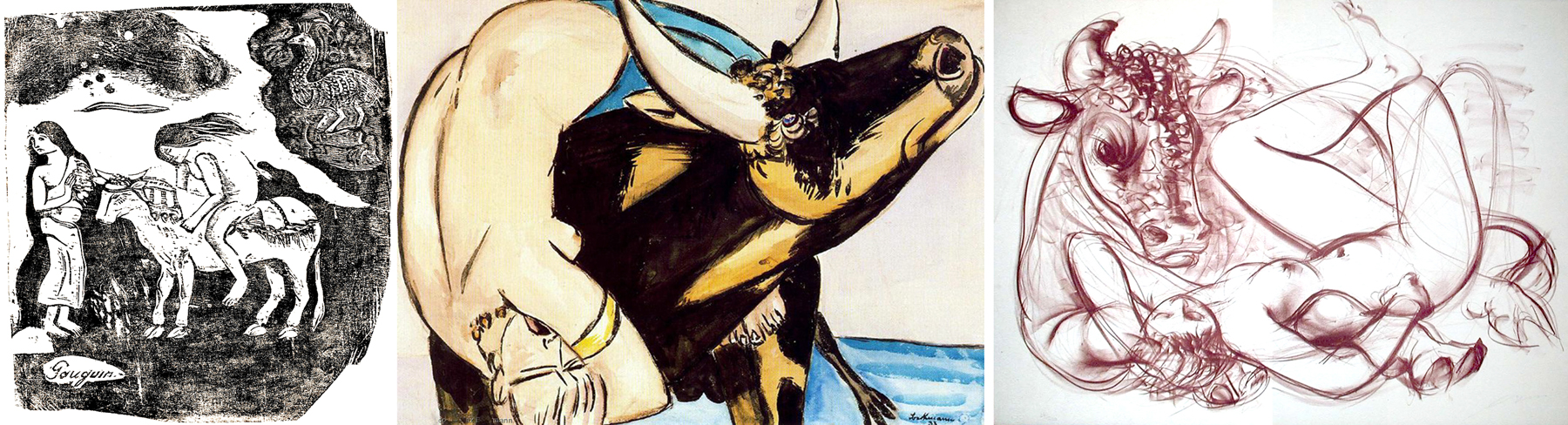
I have now collected more than a hundred images of drawings, paintings, sculpture and relief depicting Europa and the bull, usually with the girl holding the animal’s horn and her clothes sailing off behind her. 

The earliest of these predate Greek mythology: There are Babylonian figures of a woman riding a bull, and others from the Middle East. 

And of course, there are all those images of bull umping in Mnoan Crete.

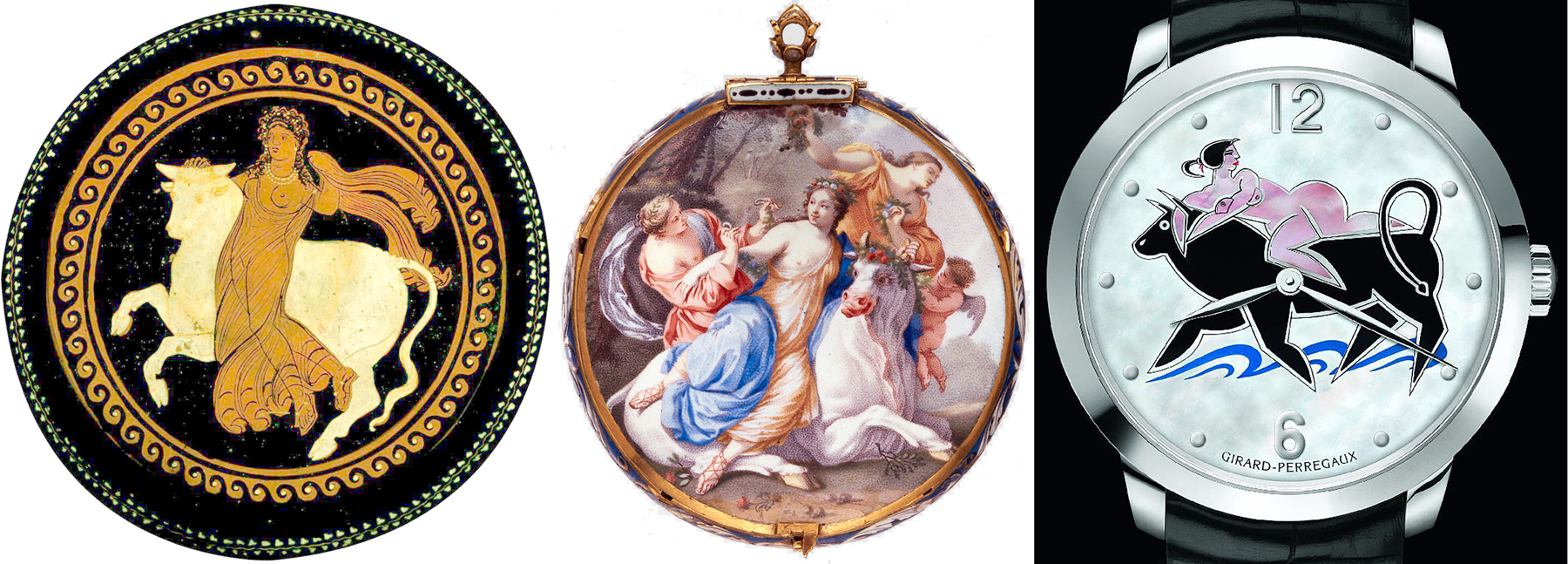
There is a depiction on red-figure Greek vases and on the walls of Pompeii

and numerous floor mosaics — The Rape of Europa seemed to be a popular image for Roman homes. 

But it was later, in the Renaissance and Baroque ages that Europa exploded with painters and sculptors. Every artist who was anybody did at least one version of the story, usually a vast mythological scene with the bull and the virgin, but also various putti and godlets swirling around. 

The iconography is fairly uniform: The bull is usually white, the girl hangs on for dear life to a bull horn, and her clothes sweep away in a grand gesture. In some, the shore features her distraught friends, in others she sits lovingly on the gentle beast, before the mad dash. 

There are modern versions, too. Some are by serious artists, such as Gauguin, Max Beckmann and Hans Erni.

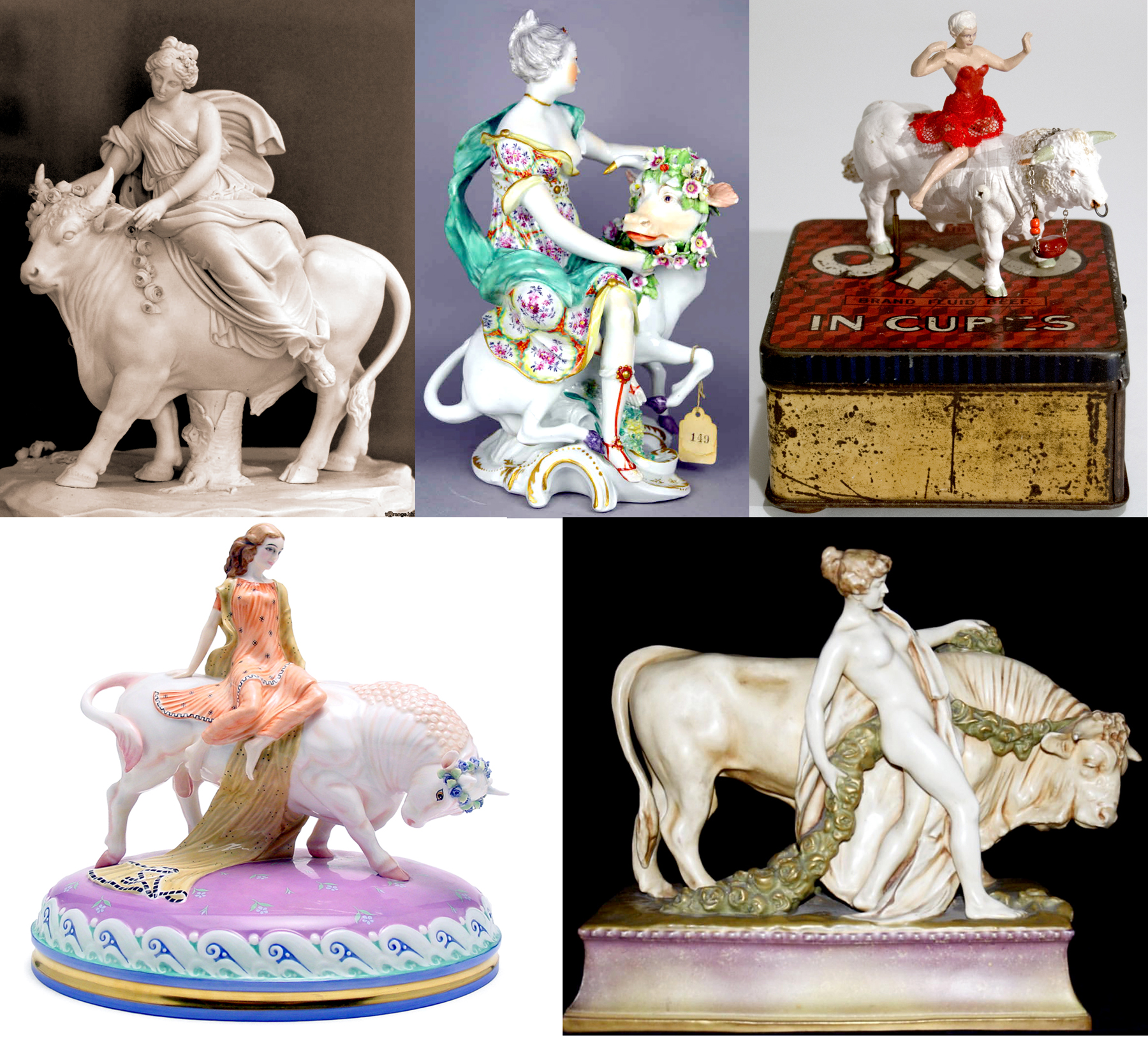
Some are more kitschy or popular.

There are modern sculptures.

There are figurines by the dozen.

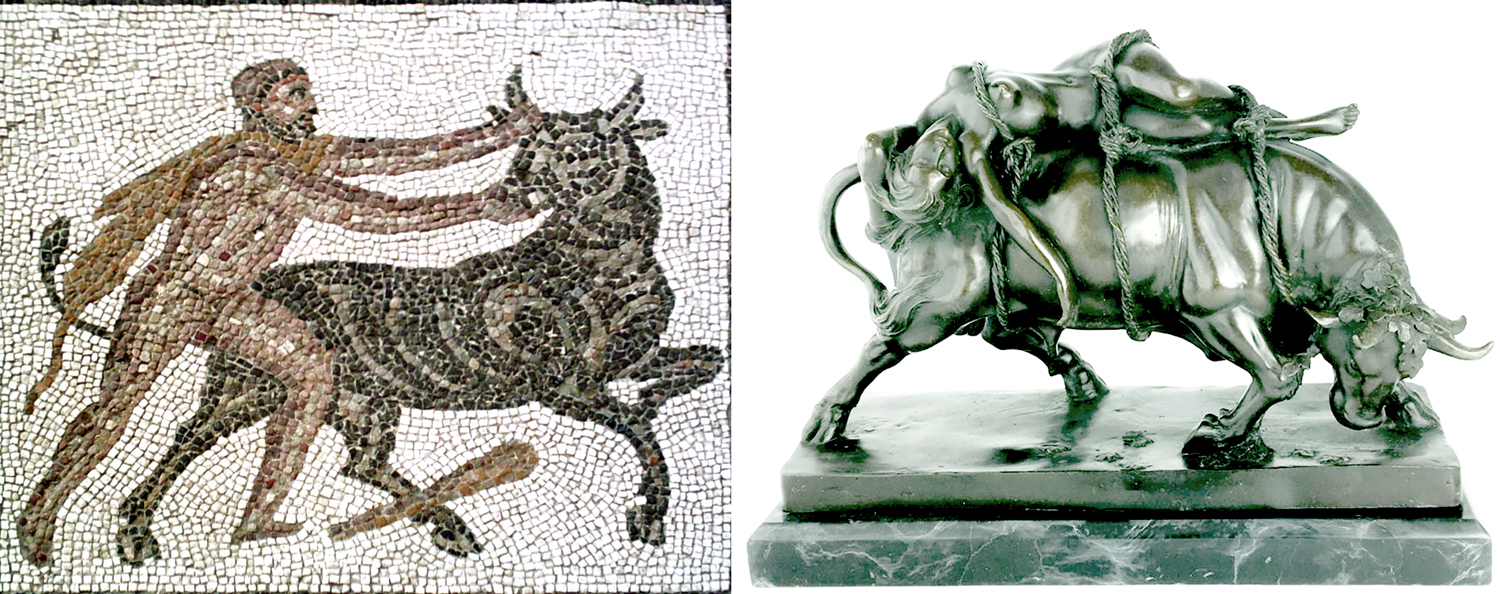
And there is at least one drawing that, compared with the Rococo version of Jean-Francois de Troy, make absolutely clear the brutality of the story as rape. 

It needs to be pointed out also, that the bull shows up over and over in mythology, like with Hercules and the Cretan Bull, or, closely paralleling the story of Europa, there is Dirce, who is punished by her twin nephews by being tied to a bull and ridden to her death. 

But I want to end with a version that may not have been intentional, but has a wonderful resonance as it makes a contemporary political point. It is the girl facing the bull on Wall Street. Called “Fearless Girl,” by Kristen Visbal, it was originally a kind of publicity gimmick for a Wall Street firm, erected in 2017, but became a symbol for feminism and anti-capitalist protest, as it was first positioned in front of the iconic 1989 “Charging Bull” by artist Arturo Di Modica. Complaints from De Modica and support from protesters and NY Mayor Bill de Blasio ended in a 13-month standoff, but eventually, the “Fearless Girl” was moved. 

I think of it as Europa gets her own. 

Click on any image to enlarge