We look at history all wrong. In school, history seems like a bunch of random dates we have to remember. You know: 1492; 1066; 1929; 1588. Just numbers. But history isn’t like that. History is continuous, all connected.
It all needs to be looked at a different way. I think of history as a series of grandmas. It makes history more relatable, but also a good deal shorter than you might imagine.
My grandmother was born in 1900. It is now 2025. That’s a 125 years. The way the Romans counted centuries — grandparents birth to grandchild’s death — was called a “saeculum,” which we tend to translate either as “era” or “century.” But I know my grandmother was born before the Wright brothers flew and didn’t die until after Neil Armstrong walked on the moon. An augenblick in time.
And so, I try to line up these consecutive eyeblinks to imagine how distant, really, is the past. Now, I understand that not all grandma-to-grandkid timespans are the same. Some are considerably shorter. But I use my own as a milestone to count my way through the past I’ve learned about. In that way, the Declaration of Independence was from my grandmother’s grandmother’s time. Only two grandma’s ago, so to speak.
The Roman Empire, in the east, fell in 1453, which is just 4.5 grandmas in time. My grandmother’s grandmother’s grandmother’s grandmother could have witnessed it.
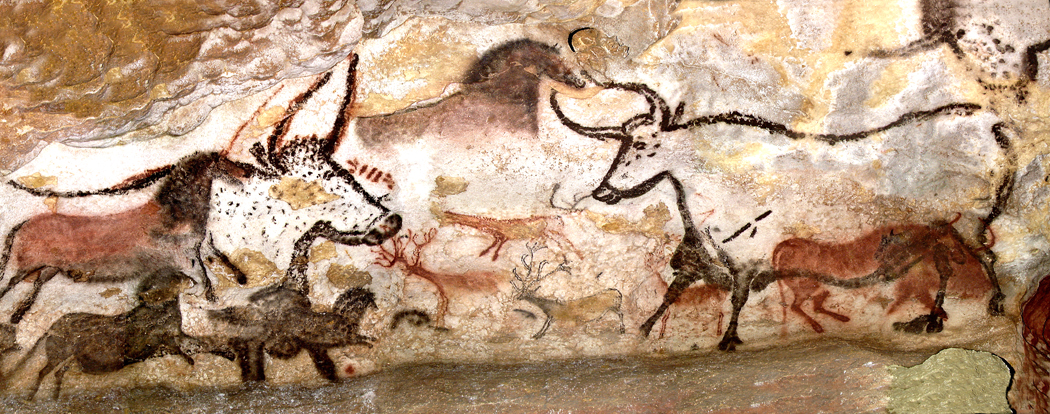
We think we have been on this planet so long, that prehistory seems interminable. But I attempted to calculate how long it has been since humans painted aurochs on the cave walls at Lascaux. The date for the original artwork is usually given as about 19,000 years ago. A long time, no?
Well, in grandmas, that is just 152 grandmas ago. Your standard charter bus carries about 50 people, and so it would only take three busloads of grandmas and their grandmas to get us back to the cave paintings. It really isn’t all that long ago.
In sum, I have long believed we should never teach history simply as dates, and shouldn’t teach it from back then to now, but rather from now, counting grandmas — or some other measure of time — backwards through time to see the continuous thread we are connected with.
 Richard Nilsen