Archive

Tag Archives: maine

Part 4: In which we enter the landscape of the mind

Sorrento dock

Each of the United States has its own flavor, its own existence as myth. It is the sense one has, if one does not live in that state, but imagines what it would be like to visit.

One imagines what Arizona must be like, with its cowboys and cactus, but the reality of Phoenix — “Cleveland in the Desert” — negates that myth. That is the nature of myth.

Some states have bigger personae. California, for instance, which existed as myth both for “Forty-Niners” and for Okies. Montana offers big skies and clean air. Oregon had its trail and Mississippi has its Yoknapatawpha County.

Texas claims for itself the largest myth, although it is hard to warrant such big ideas if you have actually been to Midland or Odessa. Texas is only big in hectares. Otherwise, it is the state of large hats as substitutes for small manhood.

Each state has its mythic presence, although it is hard to make the case for Delaware as anything but the “gateway to New Jersey,” and the Garden State gains any resonance it has only from Tony Soprano and Bruce Springsteen.

But one state led all the rest historically in this landscape of the mind, as a special place in the American imagination, a place you dream about when you think your daily life is too mundane.

Lubec

Lubec

Historically, the state that has had the longest claim on the American spirit is Maine, with its deep woods and rocky coast, its taciturn, independent people and its echoing loons. Maine is the original great escape, the place to go to return to nature and feel what it is like canoeing across a backwoods lake with a mist rising from the water.

Maine is the place Henry David Thoreau went when his Walden Pond seemed too citified. Maine is the place that dozens of American artists went to find some glimmer of inspiring wilderness.

It’s also the place the 19th-century robber barons went for summer vacations.

As America has expanded westward, Maine has lost some of its magic, but it is still a mythical place, drawing millions of visitors every year.

But there isn’t a single Maine. Regionally, there are at least four Maines.

The first is the southern coast, which first attracted a wealthy clientele a hundred years ago. This is where old money came for the summer. It is where former President George H.W. Bush had his place in Kennebunkport. It is also home to the new Yuppie tourism centers on Penobscot Bay, where you can always get a good brioche: Camden and Rockport. They are not much different, in their way, from Carmel, Calif., or Sedona, Ariz. — all trendy shops and new museums. You visit L.L. Bean in Freeport, and see a hundred other factory outlet stores.
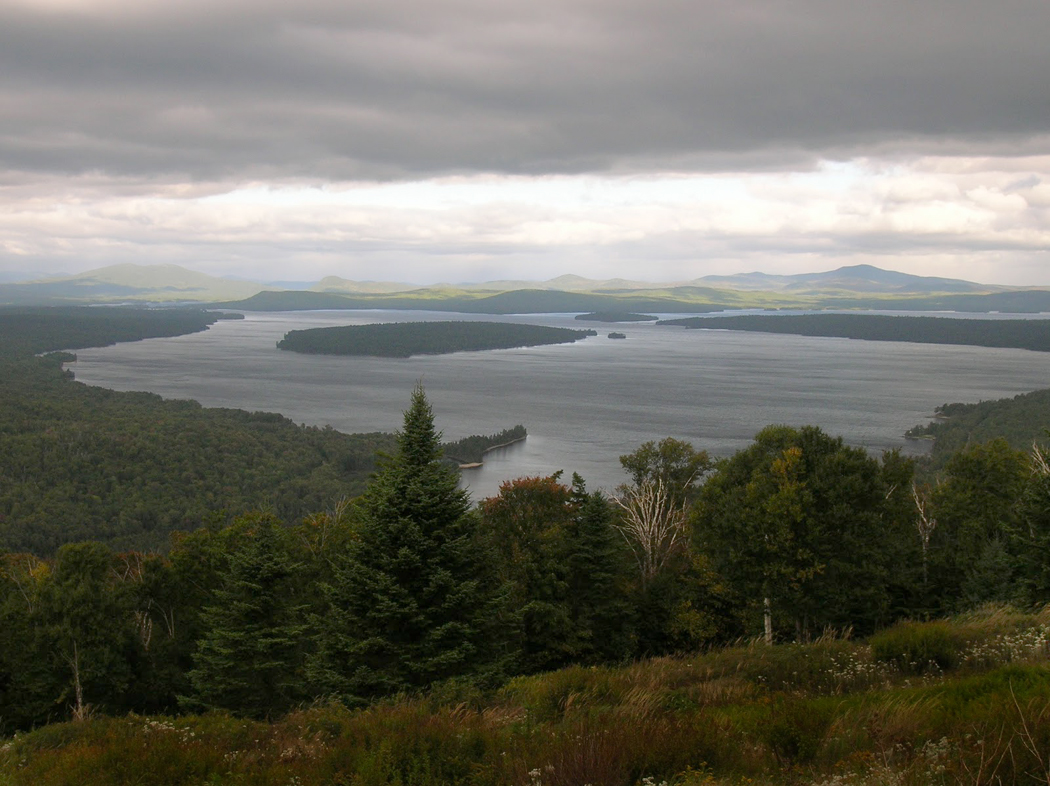
Mooselookmeguntic Lake

Mooselookmeguntic Lake

Then, there is the mountainous Maine of the western part of the state with its thousand lakes, from Rangeley Lake to Mooselookmegunticook. This is the part of Maine famous for its out-of-place town names: Mexico, Norway, Paris. It is a place to go for fishing and camping or renting a cabin for a week.

The large northern part of the state is especially impressive. Vast tracts of woodland crisscrossed by narrow logging roads down which rumble the most frightening, earthshaking pulpwood trucks, piled high and tenuously with rattling bundles of spruce trunks. It is the north of Baxter State Park and Mount Katahdin. This is the Maine that Thoreau wrote about in his book, The Maine Woods. It is also the part of the state, on its eastern side, where they grow potatoes.Maine tree

But it is the fourth Maine that I love the most: the upper coast, from Mount Desert Island to the Canadian border.

This is Down East. It is the least touched by commercialism. It is still composed of blue-collar working towns where men go out to fish or pull lobsters from the rocky-bottomed sea. It is old wooden houses on granite foundations and cars rusted out from wet, salty winters.
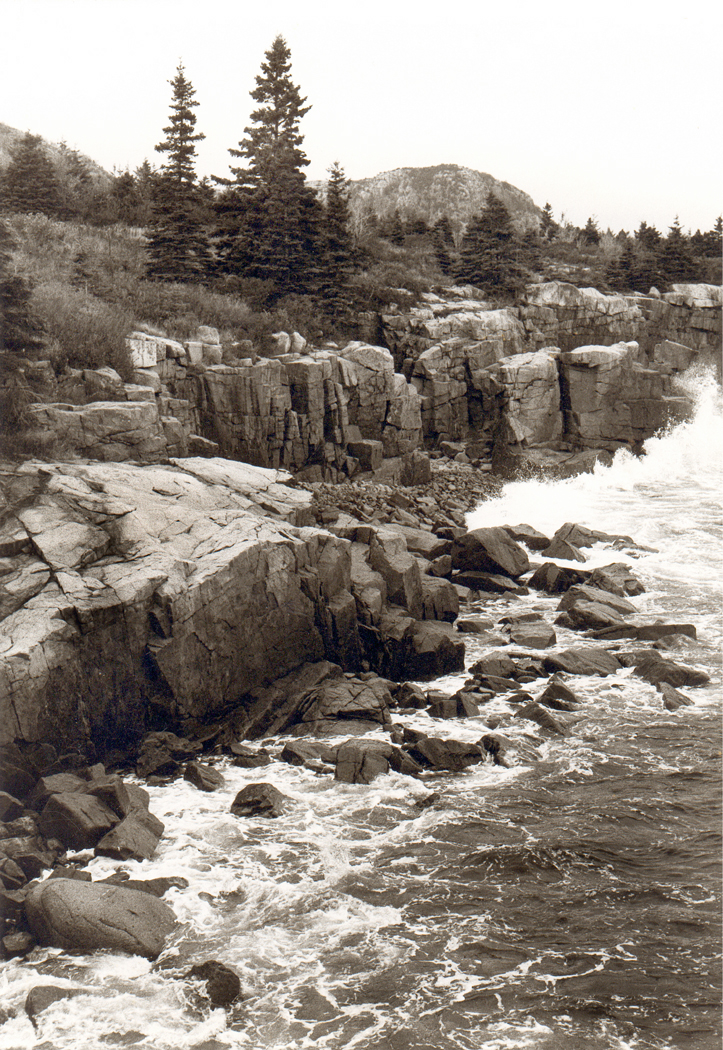
Otter Cove, Acadia NP

Otter Cove, Acadia NP

It is called Down East because when 19th-century sailing packets traveled up the coast from Boston, they sailed downwind, with the prevailing breezes abaft. Back then, Maine was still part of Massachusetts. Maine owes its statehood to slavery: The Missouri Compromise of 1820 let the slave state Missouri enter the union, but separated Maine from Massachusetts and entered it as a state at the same time to keep a balance of free and slave states in Congress.

The coast of Maine is about 250 miles long, as the crow flies, but it must have been a very drunken crow that first flew the distance. With all the bays and headlands, the actual distance of that zig-zag coastline is closer to 3,000 miles. And that’s not counting the islands, thousands of them.

Mount Desert Island is the largest of them. It is properly pronounced Mount “Dessert,” as if it were filled with chocolate moose, but most people just call it MDI and be done with it. MDI is the home of Acadia National Park, one of the most beautiful in America.
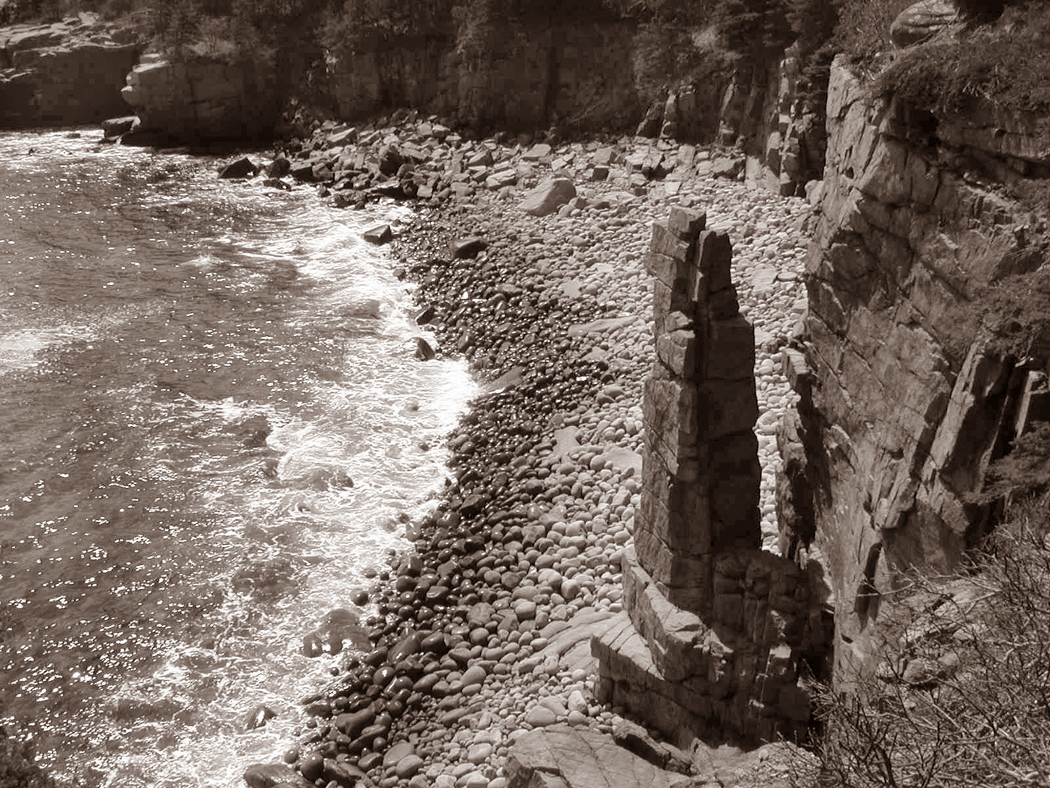
Monument Cove, Acadia NP

Monument Cove, Acadia NP

It is also the home of Bar Harbor, one of the most congested towns. In the summer, Bar Harbor is a vacation nightmare, with no parking, crowded restaurants and no room at the inn.

Acadia National Park covers about half the island and includes Cadillac Mountain, the tallest mountain on the East Coast north of Rio de Janeiro. At 1,530 feet, it catches the first rays of sunlight to hit the U.S. each day.

A road to the top provides splendid views.

But it is the view of Cadillac Mountain, rather than the view from it that is best. And the best views are from the coast roads that continue farther down east.

The real Down East begins beyond MDI. From Ellsworth — which may look like one unending K mart and KFC — you drive east and north on U.S. 1 and you leave all the tourists and development behind.
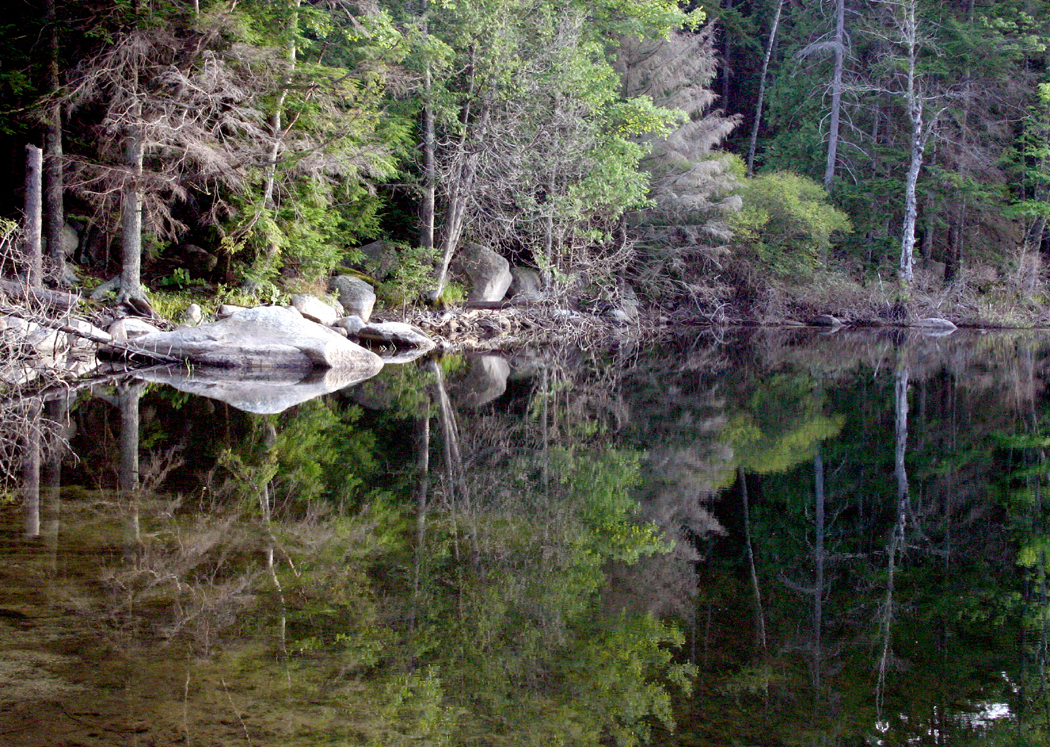
Fox Lake

Fox Lake

The towns you pass are small and picturesque: Sullivan, Gouldsboro, Sorrento, Winter Harbor, Jonesport. You see tall church steeples and town squares with bronze statues of World War I soldiers.

This is Maine for the traveler rather than the tourist. You won’t find many fancy restaurants, and the motels are all low-dollar. Look instead for breakfast in the local lunch counter with the lobstermen. There are no “destination locations.” You have to be interested in the place for itself, and not for an amusement park.

If you are looking to get away from it all, Down East is the definition of the phrase.
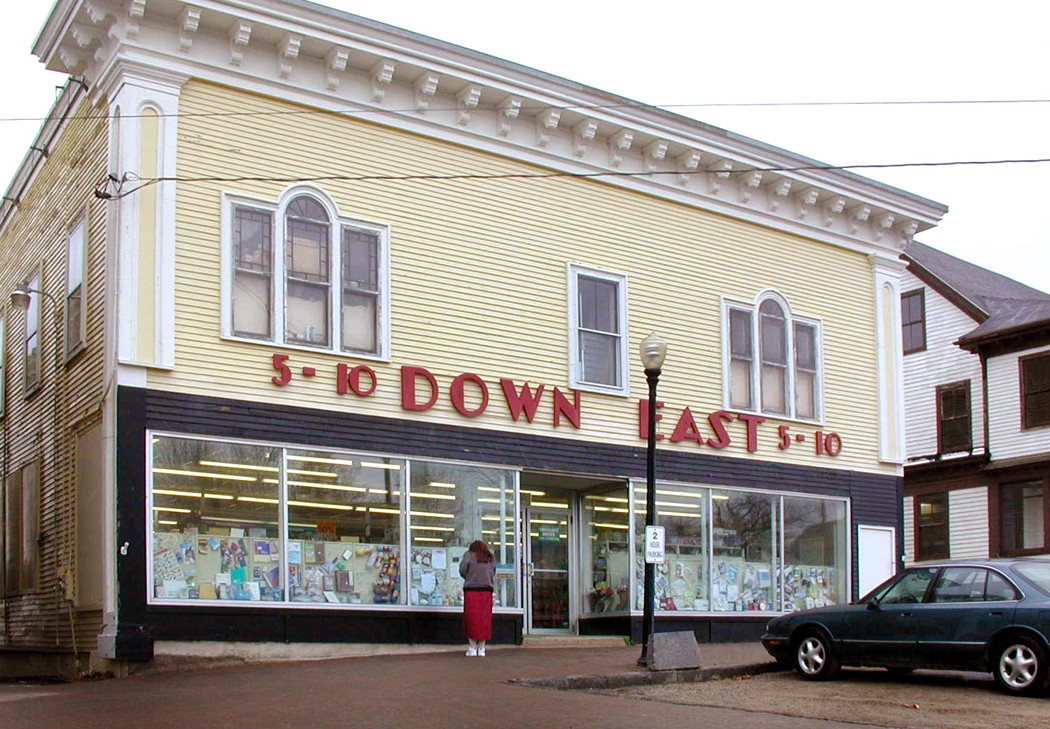
Machias

Machias

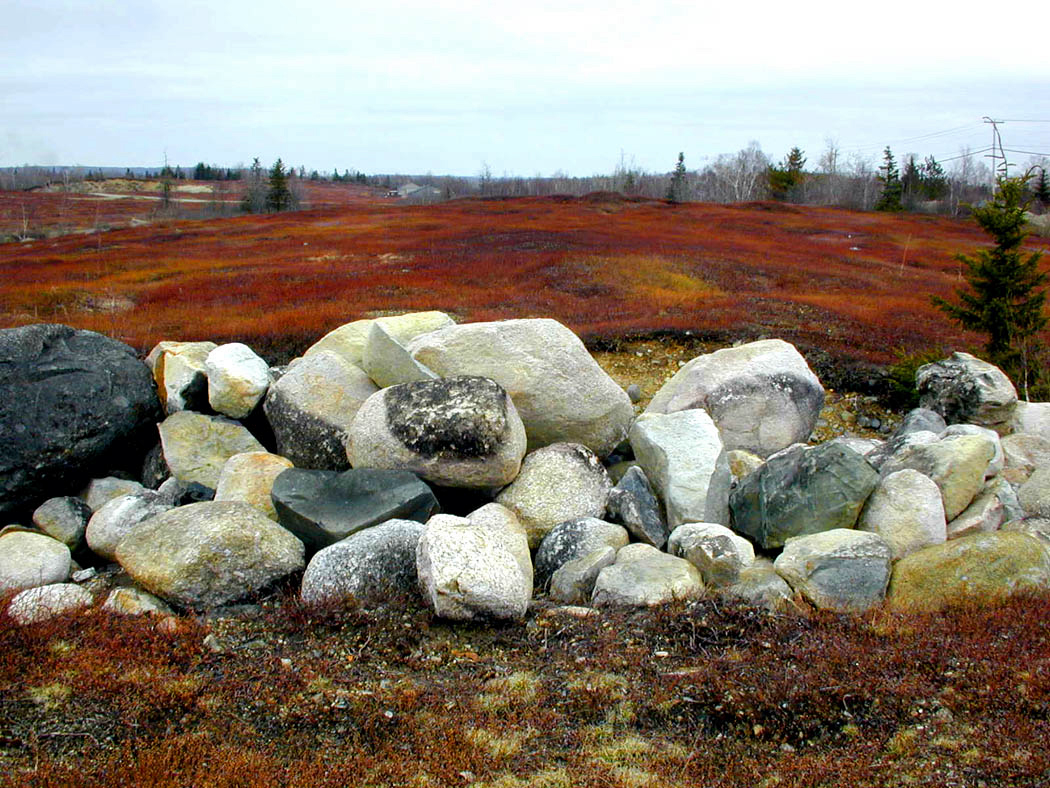
There are mountains to be climbed, woods to be hiked, lakes to be canoed. There are heaths to be gleaned of their blueberries and birds to scout out and listen to.

Blueberry heath

Blueberry heath

If you hike in the woods behind Sullivan, off Taunton Bay, you will find the abandoned granite quarries that used to provide curbstones for the cities of the East Coast.

Climb 1,069-foot Schoodic Mountain for the panoramic view. Or if that is too high, try 397-foot Tucker Mountain. A walk through the birches and alders will bring you to a splendid view of Frenchman Bay and Cadillac Mountain.
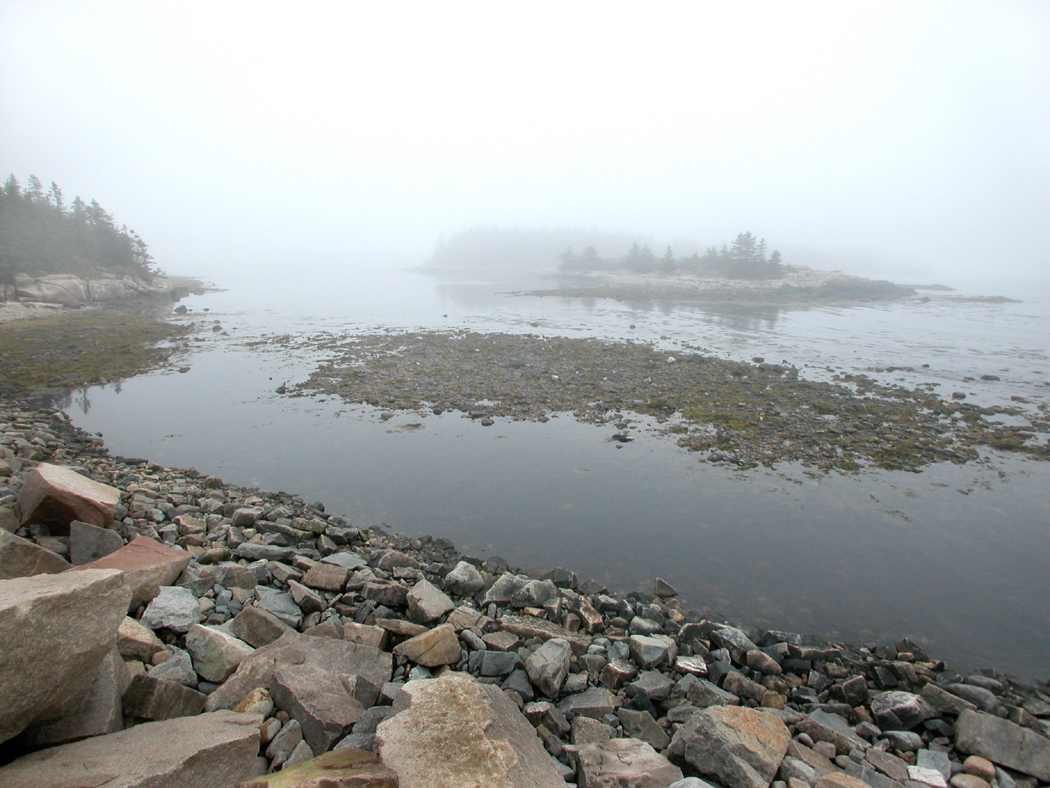
Schoodic Point, Acadia NP

Schoodic Point, Acadia NP

From Gouldsboro, head south to Schoodic Point, which is part of Acadia, but without the crowds. The waves boom on the rocks and a cold ocean separates you from Cadillac in the west. If there is one perfect place to visit Down East, Schoodic Point is it.

Quoddy Head Lighthouse

Quoddy Head Lighthouse

Or take the narrow road south of Lubec and you will come to the West Quoddy Head lighthouse, the easternmost point in the U.S. Out on the horizon you will see Canada’s Grand Manan Island. It might as well be China.

Take a look at any map of the eastern bump of Maine and see how the web of roads thin out. Hancock and Washington counties are nearly unpaved. It is empty. It is beautiful. It is the real Maine.

NEXT: Maine redux
Part 1: Bad weather and Longinus

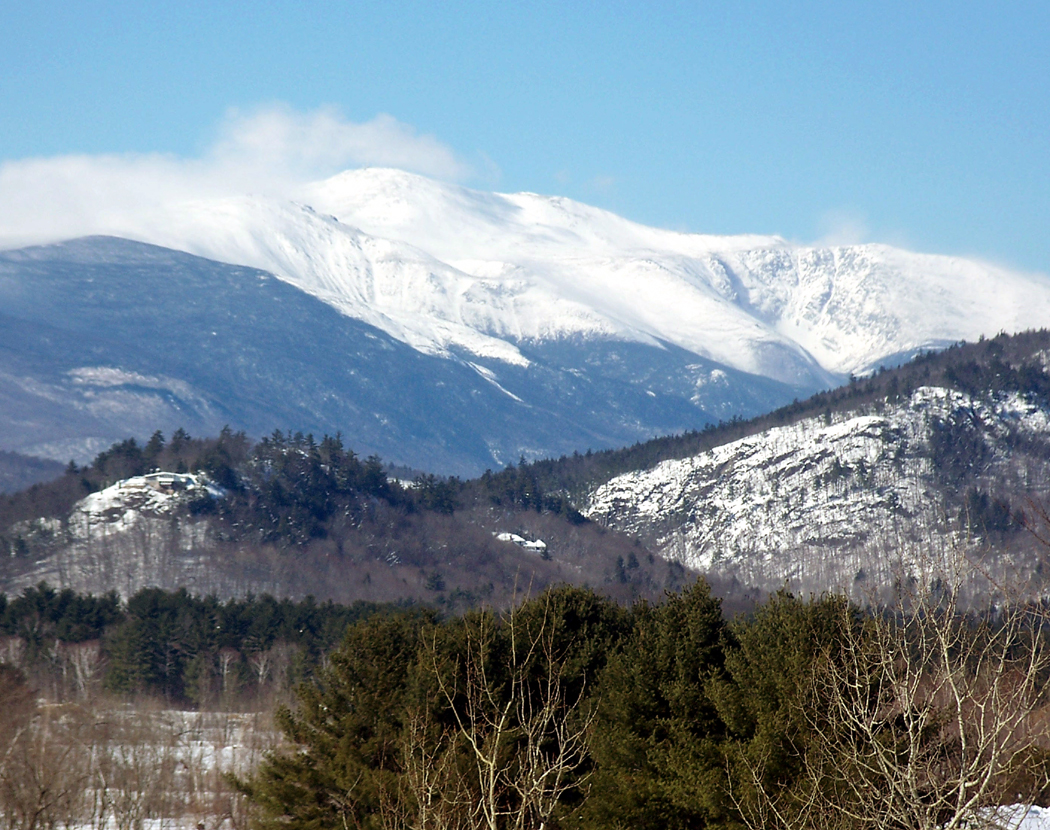
Mt. Washington

Mt. Washington

It is not at all unusual to drive past the most imposing mountains in the East and not even see them.

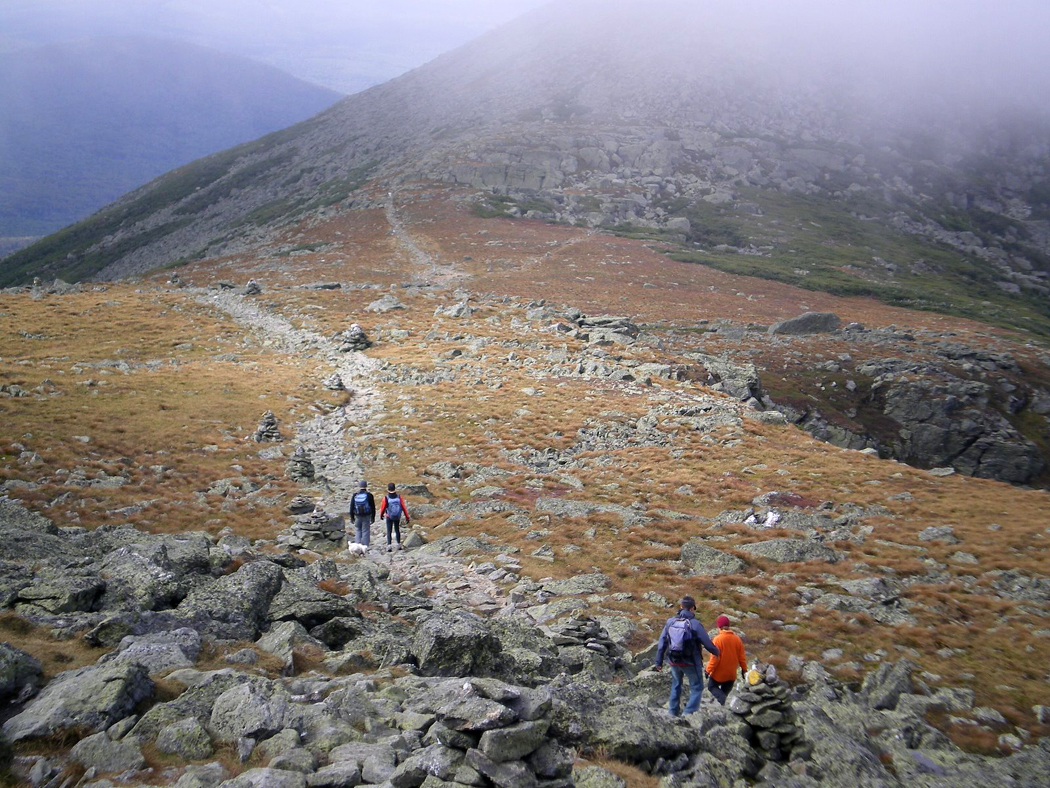
The White Mountains of New Hampshire may not be taller than those in the Smokies down South, but because they are so much farther north, their tops bust through the tree line and leave their summits raw with rock. They are craggy and wild.

Between Mt. Washington and Mt. Clay

Between Mt. Washington and Mt. Clay

But the weather can hide them in swirling mists and all you see is a whitish, nebulous screen blotting out the roadsides as you drive past.

The northern Appalachians strive to reach the Whites, beginning with the low Litchfield Hills in Connecticut that grow into the Berkshires in Massachusetts and the Green Mountains of Vermont. The White Mountains cap this part of the cordillera, climaxed with the Presidential Range in northern New Hampshire and its imposing Mount Washington, which, at 6,288 feet, is the highest peak in the Northeast.

It is an impressive sight, if you are lucky enough to see it.

But Mount Washington’s other claim to fame is that it suffers the worst weather in the world outside the polar regions — at least the worst weather reported by an official weather station. mt washington chained building

On April 12, 1934, the wind spat across the top of the mountain at 231 mph, the highest wind speed ever recorded on this planet. That’s about a third the velocity of a shotgun blast. Winds in excess of 100 mph are not uncommon, and there are fog and mist at the summit at least part of 300 days every year.

The building at the summit has to be held down with guy wires.

And then there are the snow and ice. Most of the annual 70 inches of precipitation comes in the form of snow. But this whiteout isn’t unique to Mount Washington. Other mountains also hide in the clouds.

When Henry David Thoreau climbed Mount Katahdin, which rises 5,267 feet above sea level in Maine, he faced more winds and mist.

”It was like sitting in a chimney and waiting for the smoke to blow away,” he wrote in his book The Maine Woods. ”It was, in fact, a cloud factory.

”Occasionally, when the windy columns broke in to me, I caught sight of a dark, damp crag to the right or left, the mist driving ceaselessly between it and me. It reminded me of the creations of the old epic and dramatic poets, of Atlas, Vulcan, the Cyclops, and Prometheus. Such was Caucasus and the rock where Prometheus was bound.”

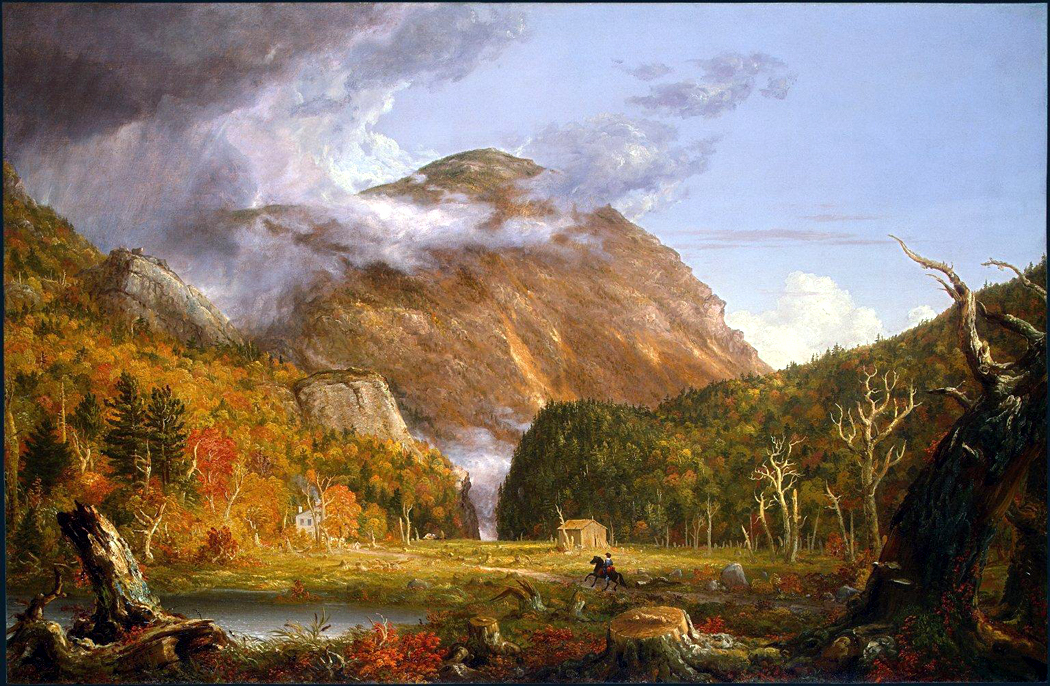
"Crawford Notch" by Thomas Cole

“Crawford Notch” by Thomas Cole

One can see the weather in the painting by the great 19th-century American artist Thomas Cole, whose Crawford Notch captures the mizzly scene: A mountain on the left is obscured in scud; on the right, sunlight glows from the opposing crest. At the bottom of the valley, a horseman heads for a log cabin.

The painting, at the National Gallery in Washington, D.C., looks as wild and Romantic as it sounds. You certainly don’t believe for a moment that Cole has not exaggerated the effect to make a more dramatic painting. But I’ve driven through Crawford Notch, a valley just south of Mount Washington, and seen the same blowing clouds, sweeping from the peaks on my left to those on my right.

The northerly end of the Appalachians is less populated than the southern or central parts. There are more animals, and it is not that unusual to see moose wandering the roadsides. Loons swim in the lakes, and black bears rummage through the woody underbrush.

Lake Ambejejus, Maine

Lake Ambejejus, Maine

As the mountains hunker down again north of the Whites, their loss of altitude is made up for in the profusion of lakes. Western Maine is as wet as Minnesota, and as good for canoeing. The lakes have long, difficult Indian names, such as Mooselookmegunticook, Apmogenegamook, Nesowadnehunk and Ambajejus. Such names are a linguistic wilderness all their own.

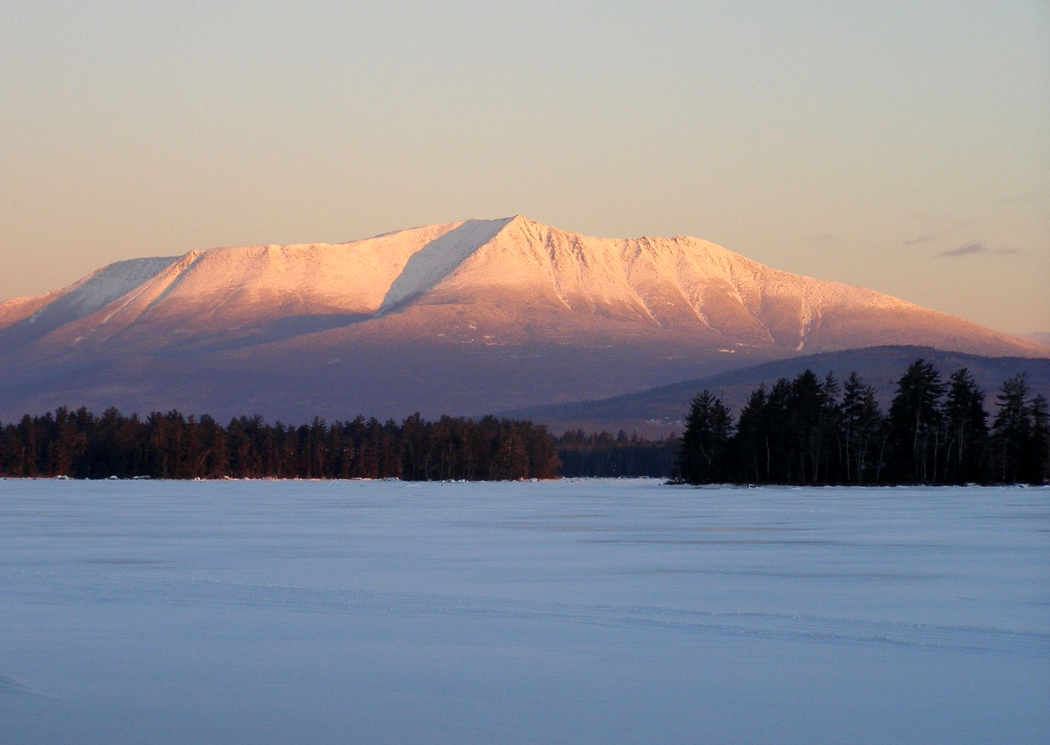
Mt. Katahdin

Mt. Katahdin

But in Baxter State Park, the land rises high once again, reaching its peak at Katahdin, a monadnock, or mountain remaining after erosion has washed away the rest of the range. Katahdin can be seen from Interstate 95, 30 miles away, rising above the green-treed plain.

At least, when the weather is clear.

NEXT: Kancamagus Highway

a house

You walk through New England and you sense that it is a place that has finished itself. It was once the seed from which America grew, but it is now the seed husk, and the growth is elsewhere.

The Southwest, for instance, where people move around like billiard balls on a break. Or the Northwest, where eyes watch the Pacific Rim for the coming millennium.

But New England has settled like an old house. It has become itself and leaves becoming to others.

I don’t mean to imply that New England is dead. Boston is a busy city, and Hartford or New Haven might as well be a suburb of Manhattan. Nor do I mean that change has left New England behind. They have their satellite dishes and their shopping malls, just like the rest of the country.

Yet, there is a sense, as you walk through the countryside, that New England has become comfortable with what it is, and no longer feels the need to change into something else.

Blueberry heath

New England wasn’t the first part of the New World settled. Not even the first part of the United States. Virginia, Florida and the Southwest can claim that distinction. But the settlers of Massachusetts gave us the first American myth: The hard-driving Yankee industriousness that weathered all kinds of inconvenience to create a government and an independent nation. We remember Plymouth Rock, the Pilgrims, Cotton Mather, Paul Revere, Samuel Adams — the myth of Yankee ingenuity, hardiness and perseverance.

It was a useful myth for our nation’s first 150 years or so. But the United States has left the Novae-Anglo myth behind in a spurt of expansion and immigration. Culturally, New England, outside the big cities, now looks kind of monochrome.

You travel through New England and you see the idea that America used to have of itself. There are paths through woods around lakes, roads through farms built on stony ground, old warping wooden houses with weathered clapboards along the Maine coast.

Fox lake

This is the New England that gave us our first cultural identity, through the writings of Nathaniel Hawthorne, Henry Thoreau, Ralph Waldo Emerson, Herman Melville, William Cullen Bryant, Henry Wadsworth Longfellow, James Russell Lowell, Emily Dickinson.

It was a cultural identity that taught hard work and little play. It taught guilt and redemption, tight lips and stoicism.

That once-ideal American, hard working and suspicious of pleasure, seems to have disappeared, replaced by a softer, fun-addicted American. But the habitat of that earlier American is still there to be seen.

Visit the less-populated portions of Cape Cod, for instance, south of Truro, and feel the salt wind whip over the sandy dunes. It’s a wind that can turn your face into leather.

Or climb Mount Greylock, with its granite and white pines. You get the long view from its summit.

Or watch the white water in the Swift River along the Kancamagus Highway in New Hampshire. You can see the power that New Englanders sought to run their mills.

Or walk along the Boston Common on a warm Sunday morning and see the office buildings that border it, the business that the Common grass provides relief from.

Perhaps you can saunter along the shore of Walden Pond in Concord, Mass., on an oak-orange fall afternoon. You know that the Massachusetts winter is coming soon. You feel, like cold humidity in your joints, that life is short.

You can see the aftermath of that first American in the emptied brick factories of Fall River and Lowell and the white steeples of the churches in every hamlet of Vermont.

Victorian house

Sometimes, New England seems surprisingly unpopulated. It was once the most crowded part of the country, but now, outside its main population centers, you can find a lot of empty space to walk through.

Your boots slog through piles of fallen leaves and stub on the outcropped stones that float in the New England soil.

And finally, you stop on the granite of the Maine coast and watch the surf peck away at the continent, slowly and with great noise.

LIttle Tunk Pond, Maine

LIttle Tunk Pond, Maine

I’m big on climbing small mountains. From coast to coast, I’ve managed to hike my way up mountains large enough to have names, but not so imposing that special equipment is involved. It’s become something of a specialty.

Those that are big, I drive up: Colorado’s Pike’s Peak; New Hampshire’s Mt. Washington; North Carolina’s Mt. Mitchell; Washington’s Hurricane Ridge. The views are sprawling, the air is thin and you can sometimes find snow even in June.

But the greatest pleasure comes from what you can climb on foot. I’ve “conquered” Roden Crater in northern Arizona, Humpback Rocks in Virginia — give me a mountain climb under 1,200 feet and I’m Edmund Hillary.

Others may dream of K2 or Aconcagua; I fancy the mighty Watchungs of New Jersey.

But just because my ambition is small, don’t think there is no challenge. Some small mountains are quite rugged, and when climbed in the proper nasty weather, you can work up quite an appreciation for their wildness and tenacity.

I’m thinking in particular of Schoodic Mountain in Maine. At 1,069 feet, it qualifies as my kind of mountain, but it is no pushover. Even to get to its bottom requires either a 4-wheel drive or long hike on shank’’s mare from the spot where you finally decide the road has gotten too primitive for your car. On a cool, humid day in July, the mosquitoes are thick near its foot and the foliage is dense and close over the path. Higher up, it’s all rock.

Summit, Schoodic Mountain

Summit, Schoodic Mountain

Of course, there is great breeding in its name. “Schoodic” is a name you will see elsewhere in these climes, most notably in Schoodic Point, which is a detached portion of Acadia National Park. Most of the park is on Mt. Desert Isle, with smaller sections on Isle au Haut some miles out to sea off Stonington, and at Schoodic Point, a rocky peninsula across Frenchman’s Bay from the main part of the park.

For many, Acadia National Park has become synonymous with the tourist development in Bar Harbor, with its T-shirt emporia, cappucino bars and Cap’n’s Table restaurants. Like many national parks, Acadia in the summer has become crowded and intolerable. But Schoodic is different. Fewer people make it out to the peninsula; although it is only something like eight miles across the bay from Bar Harbor, Schoodic Point is closer to 40 miles by road and with no shopping, it doesn’t attract the vacationers.

The main section of Schoodic Point is a pile of cracked and weathered granite jutting into the sea waves at the end of the peninsula. On a good, mizzly day, the gray of rock, sea and air all mesh in a uniform mood that is the essence of the Maine Coast. You can stand on the precipice and watch the churning ocean rise over and drain from the kelp and barnacles on the rocks below, wrenching the green seaweed this way and that.

Schoodic Point, Acadia National Park, Maine

Schoodic Point, Acadia National Park, Maine

What must be millions of gallons of salt water, beaten into a white seafoam, collide into the granite with each swell. In some crevices, the surf traps air which explodes like a rocket, sending spume high into the air and leaving the whole rock perpetually wet with the descending mist.

The same craggy spirit built Schoodic Mountain, about 15 miles north of the point. Locals pronounce the name with its double-“O” matching that in the word “good.” It is an Indian word said to mean “Place near water,” but in Maine, it is hard to find a spot that isn’t. Schoodic Bog at the bottom of the mountain, for instance, is soggy underfoot and thick with birch and alder.

The trail up the south face of the mountain crosses the col between the summit and Schoodic Nubble, a secondary peak to the west, and then continues east till it reaches the top. The broad mountaintop is smooth with weathered granite and decorated with scattered erratics, boulders that are the leftovers of the glaciers that ground the mountain down to its present size during the last ice age.

A tower is anchored in the rock with guy wires that hum in the wind.

It is a fine time to sit down and enjoy the view. To the north, there are other similar drumlins, with their gradual north slopes and abrupt southern precipices — Caribou and Tunk mountains and further, on the horizon, Lead Mountain.

To the south of Schoodic, just below the peak are several small lakes and the unused railroad trunk line, which looks like it is sinking in the bog. Further out, you can see Frenchman’s Bay and Mt. Desert Isle, topped with the imposing dome of Cadillac Mountain, said to be the spot where the sun first hits the United States each morning.

In the winter, my friend Alexander, who lives nearby, likes to ski up Cadillac Mountain. That’s right, up the mountain. Cross-country skiers are a strange lot.

As for me, I’ve driven up the summit road.