Archive

Tag Archives: nature

Fall color reflected in surface of Walden Pond, Concord, Mass.

Fall color reflected in surface of Walden Pond, Concord, Mass.

Four seasons may seem like enough. Maybe for a resort hotel. It is the conventional way to divvy  up the annual circumambulation of the sun. But four is an arbitrary number. In some places, two seasons are all there is, rainy season and dry season, or in Arizona: unbearable heat, and respite from unbearable heat.

And even in those climes where the traditional four account for our calendar, there are really any number of discernible seasons: Indian summer, midwinter spring, mud season. In Maine, there’s black fly season; there’s tourist season at the Jersey shore. Many places have their annual infestations.

Some of the most interesting moments of the annual cycle are those that fall between the seasons, those moments that are neither quite winter nor quite spring, or neither summer nor fall.

Of these, my favorite has always been that slip in time between autumn and the harder breath of winter — when the color has passed from the cheeks of the trees but not all the leaves have dropped to gather in soft, brittle piles on the ground.

It was like that near the end of October at Walden Pond in Massachusetts, about 30 miles west of Boston. The Canada geese were flying south in droves across the crisp sky, the alders at water’s edge were naked except for the tiny seed cone at the tip of each branch. The pond water was beginning to chill, but not so much that the fish lost their will to bite the hook.

Walden Pond is a small kettle pond, left in place just south of Concord by the glaciers that covered the land 10,000 years ago. It is essentially a dimple left in the ground by the weight of the ice. When the ice melted, the water remained in the depression.

Around the pond, the land rises up in places something like 20 feet above the water level in formations the geologists call ”eskers,” which are the loose junk left behind by the ice. The twin tracks of the railroad run along the back side of the pond.

On the October morning, before the sun arises, the temperature is in the low 40s and desert-dry. You can see the light catch in the tops of the trees along the heights of the eskers and slowly descend into the water as the morning progresses. walden pond aerial view

Walden is an oblong stretch of lake, with one shallow bubble along its northeastern side. A bit of the lake is cordoned off by a footpath causeway, leaving a shallow lagoon trapped in the backwater.

Most of the trees’ leaves have dropped, leaving only the maroon of the red maple and the bright tan of the beech tree still hanging. A huge number of the leaves have collected on the surface of the lagoon, making it look as if it were paved in tree droppings.

On the water, about 50 yards out, I can see four ducks buzzing along, with their necks held flat on the water and their faces half-submerged as they wiggled their heads back and forth, gleaning a meal from the detritus of the pond. As they swam this way and that, moving like feathered zambonis, each left a wake behind it cleared of leaves.

Immediately, what had seemed a randomly mottled pond surface of tree-junk took on order and meaning as the old ”contrails” remained, leaving the water scratched with a history of duck dinners. Their names may have been ”writ in water,” as Keats had it, but those signatures had persistence.

I crouched down at the mucky edge of the water and waited. Patience pays off. The ducks slowly swam my way. Twenty minutes later, they were so close I could have stroked their slick, waterproof feathers. One started and flew off, leaving two females and a single male mallard. They scooted in circles, clapping their bills through the jetsam. One of the females came up to the water’s edge where I knelt down and began poking her beak into the mud. She found something to eat and continued.

A small boy approached on the path, calling back to his mother. I looked at him, put my finger to my lips to hush him and pointed at the birds. He looked briefly and walked right past. I wondered what he could have been racing to find that wasn’t right here: three ducks in arm’s reach.

It was early on a Sunday morning and the path around Walden Pond had perhaps 10 hikers on it. It is about a mile and a half to circumambulate the pond, so it never seemed crowded.

In addition, there were a dozen or so fishermen standing at the western and southern ends of the pond with their poles anchored in the sand and bobbing weights hanging like goiters from the poles.

”What do you catch?” I asked one.

”Trout. Rainbows and brookies,” he said in that dodgy Boston accent. ”This is our second time out this year” — said as “yee-ah” — “and we haven’t caught anything yet. There’s a fellow down the way there who pulled in a couple of them this morning.”

When I got to him, he had them strung on a line and submerged back in the water about three feet out. Each was about a foot long, one was speckled.

”Mighty good eating,” was all he said.

By the time I made it all the way around the pond, the sun was up and the temperature had climbed into the upper 50s. The light gleamed on the bark of the tree trunks and glared on the remaining leaves.

A century and a half ago, when Walden Pond first became known to a wider public, it was a quiet place, a few miles outside of town, where only the muskrats and crows came for recreation.

The silence was shattered only momentarily when the train to Fitchburg came through. Nowadays, a road passes right by the pond, and a divided highway sits only a quarter-mile away.

The sound as you walk across the far shore of the pond is a constant but subdued roar of whizzing cars, mixed with an occasional jet airplane and the same railroad commotion.

Oddly, though, as you walk around to the edge of the pond nearest the highway, its noise becomes blocked by the esker and the pond seems quiet once more.

Journalism is a funny profession, because its readers read about what happened yesterday and its reporters are writing what will be published tomorrow. It has little use for today.

But a day as distinct as this one on Walden Pond, in the cusp between the seasons, speaks only of the deliberate now, the specific and incandescent moment, as thin and sensuous as the membrane of the water’s surface as you stick your arm through it to pick a pebble from the pond’s bottom.

inez fishing

I have a problem with aquariums. I love them and visit every one I can possibly find, but I can’t look at all those fish swimming around without getting hungry. All the fish look so darn tasty. Whether it’s the salmon, silver as Boeing jets, at the Seattle Aquarium, or catfish in New Orleans, which I fantasize wearing corn meal suits, I imagine all those finny beasts on my platter.

So, you might think I was a big fisherman. Catch my own dinner, hold up the sea bass for a photo, scale and gut it and fry it up in butter and white wine. But I have only been fishing three times in my life. I consider it one of my character flaws that I never became an angler; it’s a missed opportunity. But growing up in New Jersey did not nourish the outdoorsman in me. I knew a lot more about discount malls than I did about trout.

The first time I went fishing, I went out on a half-day boat with my uncle when I was a teenager, off the Jersey shore. We caught flounder and sea robin — certainly one of the ugliest of Providence’s creations — and the grown-ups drank beer the whole time. I figured that fishing, like TV football, was really just an excuse to lubricate the church key.

The second time I went fishing was some 20 years later when my wife and I were invited to a North Carolina pig pickin’, and were encouraged to fish in the trout ponds that our host had built near his house in the Blue Ridge Mountains. I fished with cheese balls on my hook and caught a half-dozen rainbows and browns. They were good eating.

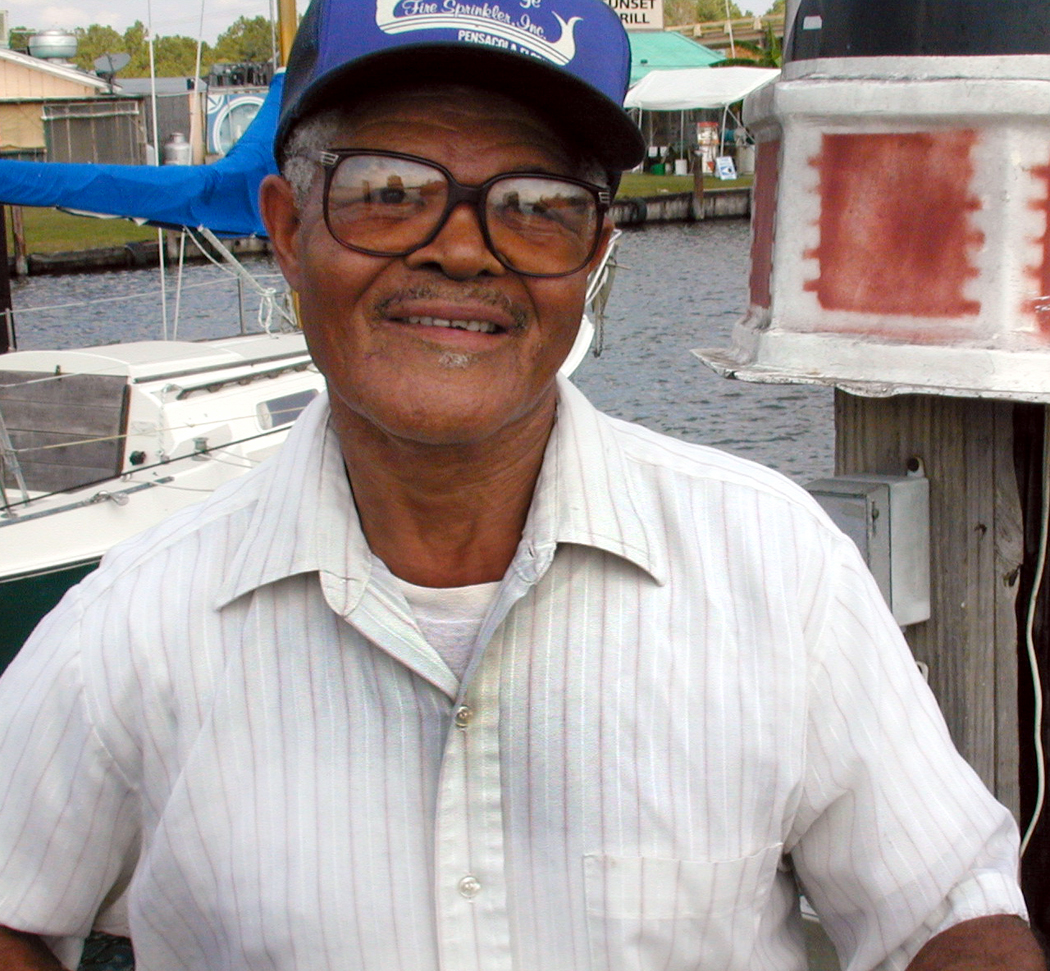
Norris Allen

Norris Allen

The third time, though, I went with my daughter in Alabama. We went out on a pier in Weeks Bay, off Mobile Bay, with Norris and Inez Allen. Inez was my daughter’s nanny for her twin daughters. In the South, a nanny is more than an employee; when you hire a nanny, you are starting a lifelong relationship. It’s more like hiring an aunt or an extra grandma for your babies.

We spent the day in October on the dock, casting and reeling in our bait. Norris caught some pinfish with our boughten bait, and immediately started cutting them up into little pieces, so we wouldn’t have to pay for any more chum. The fishing trip was really an excuse to picnic and gab.

It was a social event for my daughter, her twins, the Allens and my wife and me. Inez sat in an aluminum folding chair under the shade of a broad straw hat. She held a fishing pole over the side, but never paid much attention to it. Norris, though, was a dedicated angler.

Norris cutting chum

Norris cutting chum

“I like to go out at least once a week,” he said. “But I’ve had a problem recently, so it’s been a while. I got to go to the doctor again tomorrow.”

Norris was in his 70s and as lean as Inez was not. Norris caught the most fish, but I caught the biggest.

“What is it?” I asked him.

“That’s a white trout,” he answered.

It was about 10 inches long and weighed about two pounds. Most of what we caught were pinfish, three or four inches long, silvery discs in the hazy sunlight. But we caught a few white trout, too, long and torpedo shaped. They fought harder and splashed water angrily as we hauled them out of the bay.

White trout

White trout

I mention all this because of two things. The first is that we ate the best fish dinner that night I have ever tasted. I was in ecstasy. My wife can attest. I ate pinfish and white trout, fried in cornmeal the proper Southern way, and I nearly cried when I was too full to finish off any more fish.

The second is that the following day I went to the Weeks Bay Natural Resource Center, about a hundred yards from the dock where we fished, to talk to a park ranger and ask about the fish we caught. I wanted to find out more about our worthy opponents.

“What were they?” she asked me.

“Norris said they were pinfish and white trout, but I don’t know what their scientific names are.”

“Well, there’s no such thing as a white trout,” she told me.

(There really is, it’s scientific name is Cynoscion arenarius, and it is one of the weakfish family, not really a trout, but who cares?)

“No such thing,” she repeated.

“That’s too bad. It was the best tasting fish I ever ate. For that matter so were the pinfish.”

“Pinfish?” She seemed confused. “No one eats pinfish.”

Pinfish

Pinfish

“No? They were delicious,” I said.

“No. No one eats pinfish.” She repeated that mantra several times in our conversation as if that settled the matter, as we looked through several reference books trying to match up what we ate with the pictures and IDs.

It was one of those oblique demonstrations of the differences over race in America. The ranger was a White woman in her late 20s, obviously college educated, and just as obviously oblivious to the culture around her.

Black Alabamans eat pinfish with relish, but apparently the ranger’s well-to-do White family thought pinfish beneath comestibility. This wasn’t a case of overt racism, but an illustration of the profound breach between cultures, which is magnified in the American Deep South.

And I can guarantee, after eating a bellyful of pinfish, that it is White America that is cheating itself.

Linville falls from upper look

I first saw Linville Falls 40 years ago. Getting there meant finding an unmarked gravel road and an unmarked dirt parking lot — really just a thicker place in the road to pull over onto.

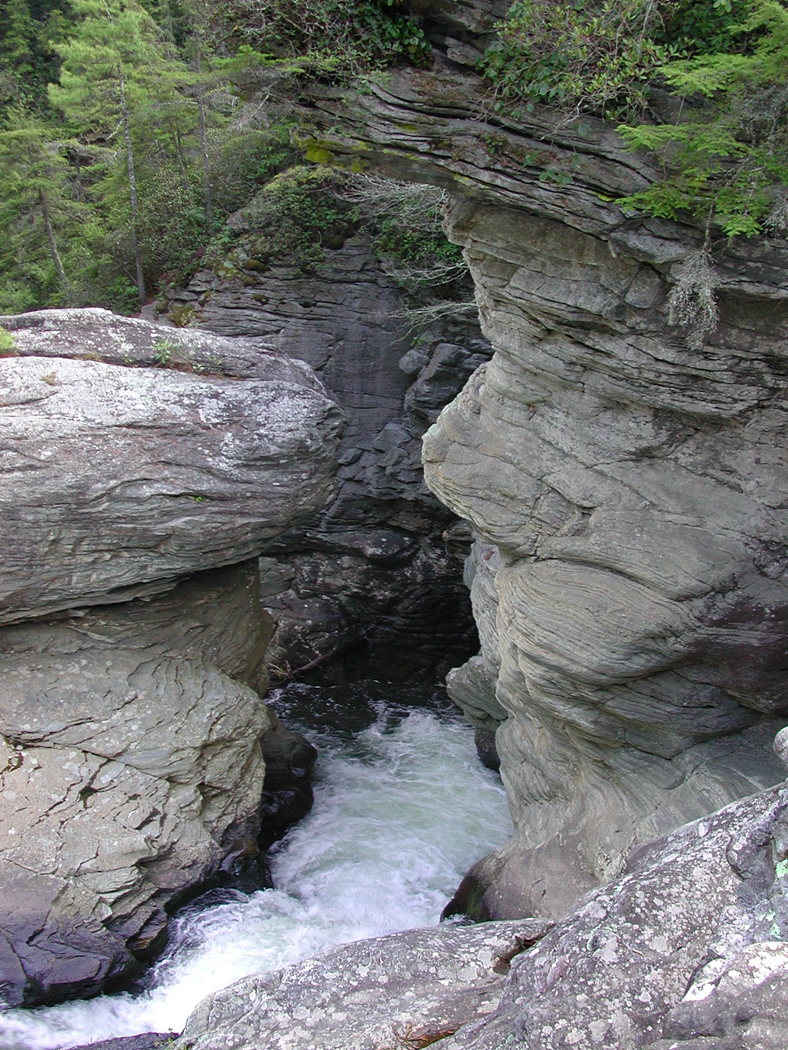
Then we followed a spongy, loamy footpath under the hickories and oaks toward the distant roar of the waterfall on North Carolina’s Linville River. No one was there but us, and we picnicked on the rocks over the crashing water. The upper falls are a broad, shallow drop, but at the lower falls, the quartzite pulls tight, constricting the river and forcing it down a spiraling chute that drops over the edge of the cliff and down 75 feet to the river and Linville Gorge.

Linville Falls 03

It is an impressive torrent with a basso profundo roar, and nothing will ever change the way it seemed to me that day, as I leaped over rocks, crossing the white water to the other shore so I could climb on the gnarled rock to see down the waterway.

I’ve been back many times over the years. The National Park Service built a paved road from the Blue Ridge Parkway, making it easier to find. Then they paved the parking lot and built a pedestrian bridge over the river upstream from the falls.

The last time I went back, there was a visitor’s center and a souvenir shop and a parade of vacationers trotting down the path to the fenced-in overlook. The falls are just as impressive, but the experience isn’t.

If I speed up those 40 years in my head like time-lapse photography, I can see time take shape. It builds and it destroys in a constant rise and fall like an ocean tide.

And what comes in, ebbs.

Linville trillium

A few years ago, my wife and I visited another familiar site, on Old Route 16, a dirt road that drops down the side of the Blue Ridge toward North Wilkesboro. When we lived in the mountains, we used to visit an abandoned farm along the road, halfway down the mountain face.

There was a clearing in the wood and an old wooden house with a broad porch that looked out over the steep valley below. Above us was the spot ominously known as the ”Jumpin’-Off Place.”

We could picnic on the porch with the bluebird and tanager singing in front of us, the buzz of insects all around and the gentle breeze rattling the grass in the field.

It had been 14 years since we visited that farmhouse, and we thought we should see what had become of it.

About three miles down the old dirt road, we passed where it should have been, but there was no break in the forest, no open field. We couldn’t find the house. We kept driving, hoping we’d find something that looked familiar, but we didn’t. Finally we stopped the car where the farm should have been and walked deep into the woods.

Buried a hundred yards into the tangle of maple trees was a naked standing chimney, completely eaten up by brush and undergrowth.

When I climbed down the hill toward it, I discovered the forest floor was spongy with rotten boards, completely collapsed in on themselves, with a few nail heads showing.

In the 14 years since we last visited, the old house had been completely digested by the woods, leaving only the indigestible brickwork of the twin-sided chimney.

And the once-glorious view of the declivity was now completely obscured by trees and brush. Instead of a vacant field overgrown, the house was survived only by complete woods.

In 14 years.

Nature can reclaim an entire farm in 14 years and leave nothing behind but the masonry. And that won’t last much longer.

Linville Gorge1

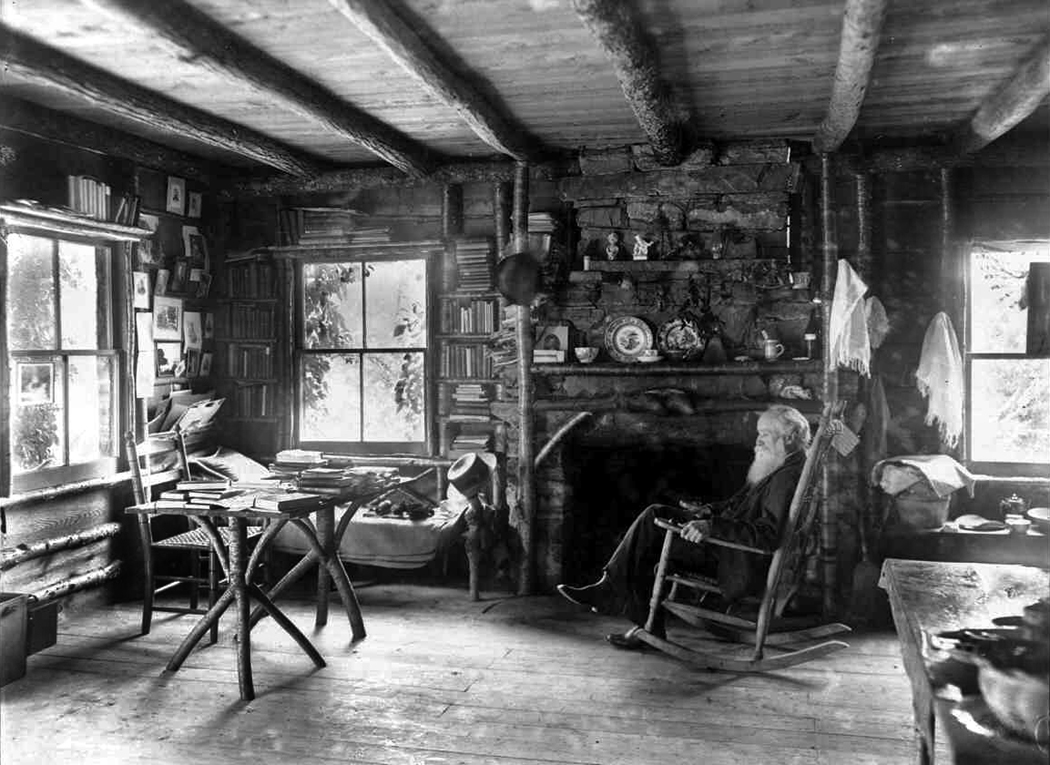
John Burroughs at Slabsides

John Burroughs at Slabsides

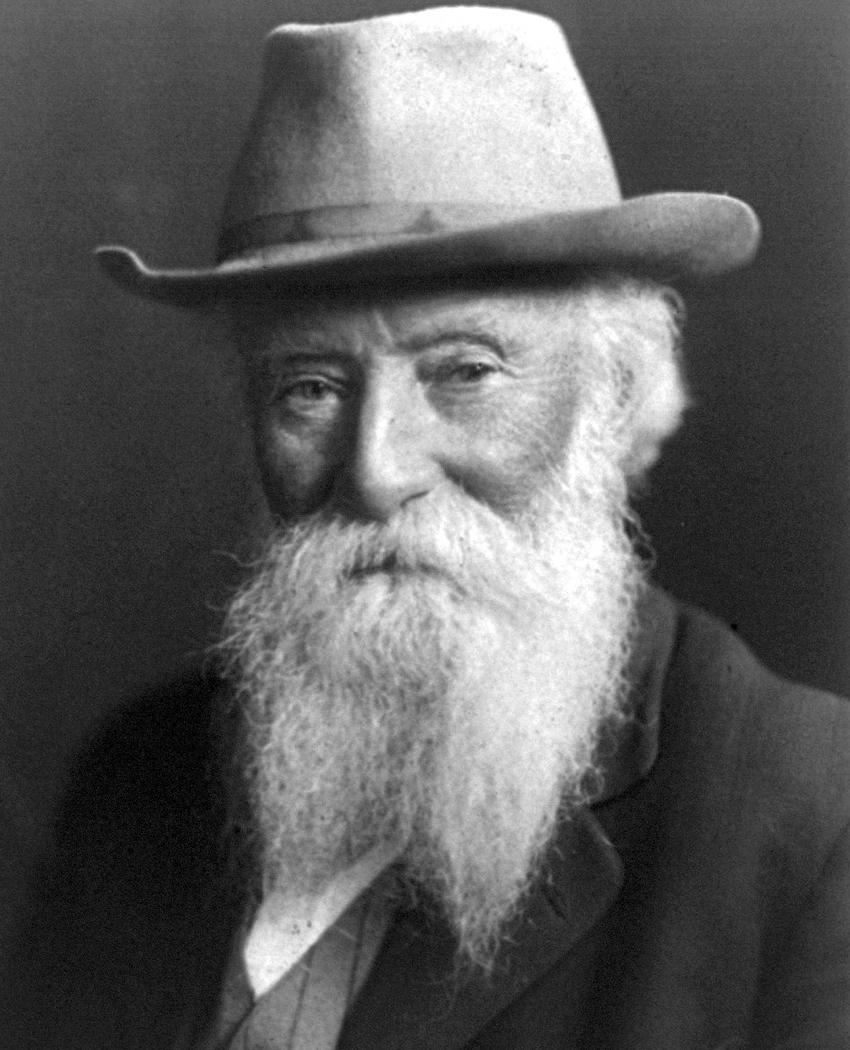
I doubt if you’ve ever heard of John Burroughs.

He died as an old, old whitebeard in 1921. Not many people now alive recognize his name.

But between the Civil War and his death, Burroughs was the most popular and respected writer in America on natural subjects.

His 23 volumes of essays sold millions of copies for his publisher, Houghton Mifflin. They sold in such profusion, in such a variety of formats, that they can still be found fairly easily in used-book stores. Many also remain in print.

I mention Burroughs because we share a connection, although I didn’t know it until a few years ago. Actually, what we share is a place: West Park, N.Y.

It is a tiny community on the western shore of the Hudson River, midway between Poughkeepsie and Kingston. It was there that Burroughs spent his adult life in a slate farmhouse he built called Riverby, on the Hudson, and a rustic cabin called Slabsides a mile back in the woods.


Slabsides

Slabsides

And it is in West Park that my grandparents had an even more rustic vacation bungalow with no name at all a hundred yards up a stony driveway in the woods.

Our bungalow was built in 1916. My grandfather worked in the Hoboken shipyards and had constructed it himself from wood salvaged from a burned ship.

The bungalow was primitive by any standards. There was no plumbing, no insulation and no room.

When they spent summers there before World War II, grandmother and six children slept, ate and lived in three tiny rooms and a screened-in porch. At the end of the school year, the seven rode the train from Fort Lee, N.J., to West Park and walked, carrying all their baggage, the two miles to the bungalow. Grandfather took the train up on weekends.

They bought their milk fresh from the cow at Vandewater’s farm over the hill and got their mail at the post office by the train station. When I was a boy, the postmaster was Mrs. Ackert. She was a very round woman and I remember the rhyme: ”Sweet Mrs. Ackert / is as wide as a Packard.”

The main road in West Park was named for her son, Floyd, who was killed in World War II.

After the war, with the six children grown, they would all continue to spend time in West Park, now with their own children.

My parents, aunts and uncles were less ecstatic about cramming up to 20 people in less than 200 square feet, less enthusiastic about using the ”two-seater” down the path in the back yard, less than happy about having to walk up the road to the pump for water.

And then there were the mosquitoes, as large as hailstones and just as stinging.

But even the adults loved the chance to do some fishing or go swimming in Charlie’s Lake on Black Creek, with its cascading waterfall down the slabs of rock by Valli Road.


Swimming hole

Swimming hole

Growing up as I did in suburban New Jersey, West Park was my introduction to nature: The lake was not a concrete-bottom swimming pool, and the little fish nips that you would get while swimming were reminders that nature is wild and unruly.

The loam underfoot was springy, the rocks covered with lichens and the underbrush thick as bird nests. The wood thrush sang in the trees and perch jumped in the lake.

These same birds and fish, the same spongy soil were written about nearly a century earlier by Burroughs.

”Life has a different flavor here,” he wrote in Wild Life About My Cabin. ”It is reduced to simpler terms; its complex equations all disappear.”

Instead, around his Slabsides grew the saxifrage, wood aster and witch hazel. He heard the whistle of the pewee and dry scratch of the cicada.

Slabsides was named for the slabs it was shingled with.

”A slab is the first cut from the log,” he wrote, ”and the bark goes with it. It is like the first cut from the loaf, which we call the crust, and which the children reject, but which we older ones often prefer. I wanted to take a fresh cut of life — something that had the bark on.”

Burroughs’ prose is leisurely; it breathes. It was certainly more popular with its Victorian reader than it would be now for a generation of short attention spans. But give him his space and his writing is still worth reading. It is detailed and humane; it gives a flavor and a sense of the place.


Burroughs fishing

Burroughs fishing

He was also surprisingly modern. In fact, I don’t know how he managed to be so popular in pious Victorian America. He had little use for the pat moral or anthropomorphic Disneyfication of nature. He was no Aesop.

Indeed the biggest controversy of his career was over an article he wrote excoriating the cute but popular ”nature fakers” who made up mawkish animal stories.

And unlike Henry Thoreau, for whom all nature was a metaphor, Burroughs wrote, ”The universe is no more a temple than it is a brothel or a library.”

John Burroughs

John Burroughs

He had a scientist’s sensibility, brooked no sentimentality and was as close as you could be to an atheist in 19th-century America. Several of his essays take organized religion to task. This doesn’t seem like the route to popularity in the time of Ella Wheeler Wilcox and James Whitcomb Riley.

He did not see any need for a providence that took interest in his life. Rather, he took great comfort in the impersonality of the beauty around him. ”I love nature, even if it does not love me,” he said.

Slabsides and the land around it is now a nature sanctuary and open to the public. His farmhouse, Riverby, is slowly falling into disrepair, and Burroughs’ vineyard is grown-over.

Our own bungalow is now long gone from the family. But I still visit West Park every time I drive to the East. Now I make the trip to visit Slabsides and slap the mosquitoes there.

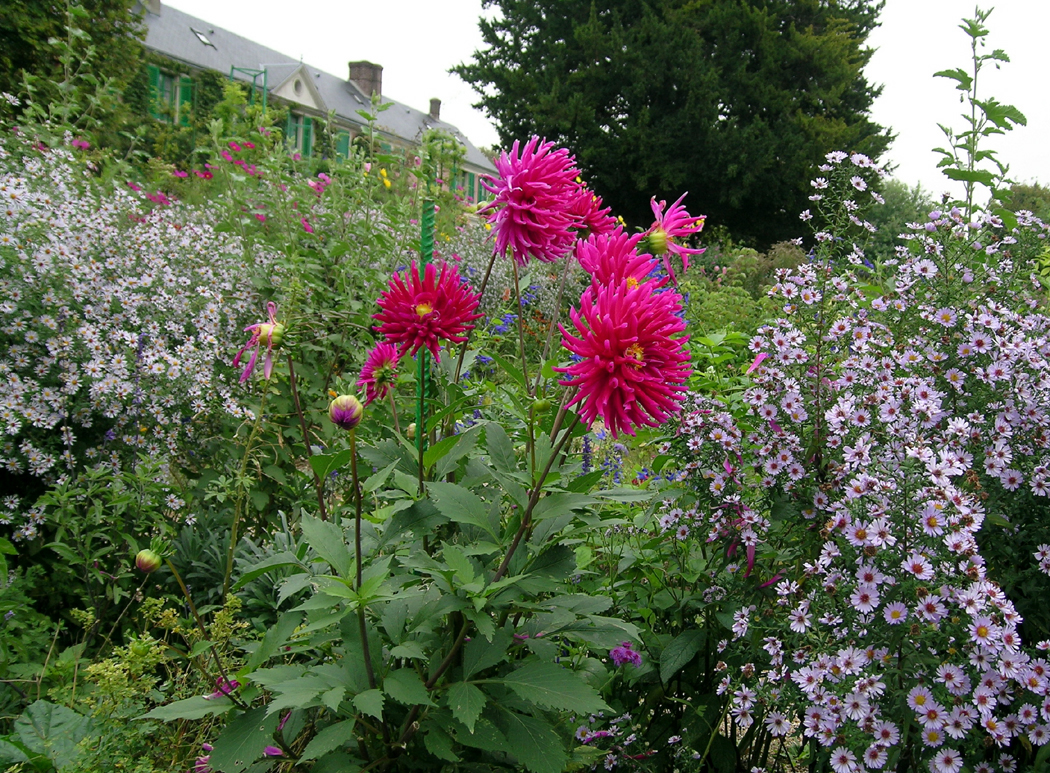
Waterlily pond at Giverny

Waterlily pond at Giverny

When Claude Oscar Monet arrived at his new home in the spring of 1883, he had to borrow money to pay the rent.

The sturdy burger with the black Babylonian beard, smoker of strong cigarettes and painter of soft paintings was broke. He was one of many Frenchmen still suffering from the economic depression that had hit 10 years earlier and reduced the demand for paintings — among other things. Unable to sell his work, Monet had trouble feeding the mouths that depended on him.

For when he moved into the great barn of a house in Giverny, some 40 miles northwest of Paris, he didn’t come alone. He came equipped with his two sons, his companion, Alice Hoschede, and her six children. The youngest was only 5. They soon added a half-dozen servants.

The painter lived in his pink and green house in Giverny, along with his alternately growing and shrinking family, for the next 43 years, producing the body of work for which he is best known, a body of work that cannot be separated from the home he lived in.

That home served not only to shelter him, but to inspire him. The house and its surrounding gardens became, as he got older, the only thing he painted.


House at Giverny

House at Giverny

COMFORTABLY MIDDLE CLASS

Monet was born in 1840 in Paris and moved to Le Havre when he was 5 years old, and grew up there in comfortable middle-class surroundings. When he was a teenager, he decided he wanted to be an artist, began his studies and finally set up as a painter along with a ”brat pack” of his buddies, all of whom challenged the status quo in the French art world of the 1860s.

They later were called Impressionists and among their number was Renoir, Pissarro, Degas, Caillebotte, Sisley and Berthe Morisot.

They were beginning to achieve success when a double-headed ax fell on their careers. First, there was the Franco-Prussian War of 1870-71, and then the bank crash in 1873.

By 1880, things had improved, but Monet had to start from scratch building his career. He was lucky in that he had Paul Durand-Ruel as his dealer. Durand-Ruel was a saint among dealers and regularly advanced Monet money on paintings he hadn’t painted yet.

That is how he managed to pay the annual rent on the 2 acres of land with the house and outbuildings.

The bank crash had brought him Alice, too. Originally the wife of one of his benefactors, Ernest Hoschede, who had commissioned paintings and decorations from Monet, she gravitated to the painter when her husband fell bankrupt and abandoned his family.

At first, Alice and her six children lived with Monet and his wife, Camille, and their two boys in the town of Vetheuil. But Camille died in 1879 and Monet and Alice set up house together quickly after that.

It was one of the great partnerships in art, a perfect match between people, one intemperate and moody, the other steady and gracious, with all the tact the painter himself lacked.


Punt at waterlily pond

Punt at waterlily pond

ON THE BANKS OF THE SEINE 

Giverny was not more than a village, with fewer than 300 residents, when they moved there. It sat on the north bank of the Seine River in the angle where the Epte joins it, on a slightly rising bank above the river and below the wooded hills that rose behind.

Monet’s new home sat near the edge of town between the two main roads. The house itself was a monster of an old farmhouse, looking something more like a warehouse than a home. On one end was a barn that Monet turned into his studio. The building was covered in a pinkish stucco that Monet made pinker, with gray shutters that Monet painted green.

The yard that came with the house had an old orchard in it and room for the gardens that Monet planned. Within a few years, the grounds were overgrown with the many flowers and trees Monet planted.

And life began slowly to improve for the Monet-Hoschede family. At a time when a common laborer made about 10,000 francs a year, Monet was selling his canvases for 12,000 francs each. By 1888, Monet was making 100,000 francs a year.

He spent it lavishly, building studios and greenhouses, adding to the house, improving the garden.

”Everything I have earned has gone into these gardens,” he wrote.

And when his lease ran out in 1890, he had no trouble buying the house and grounds for 22,000 francs, payable over four years.

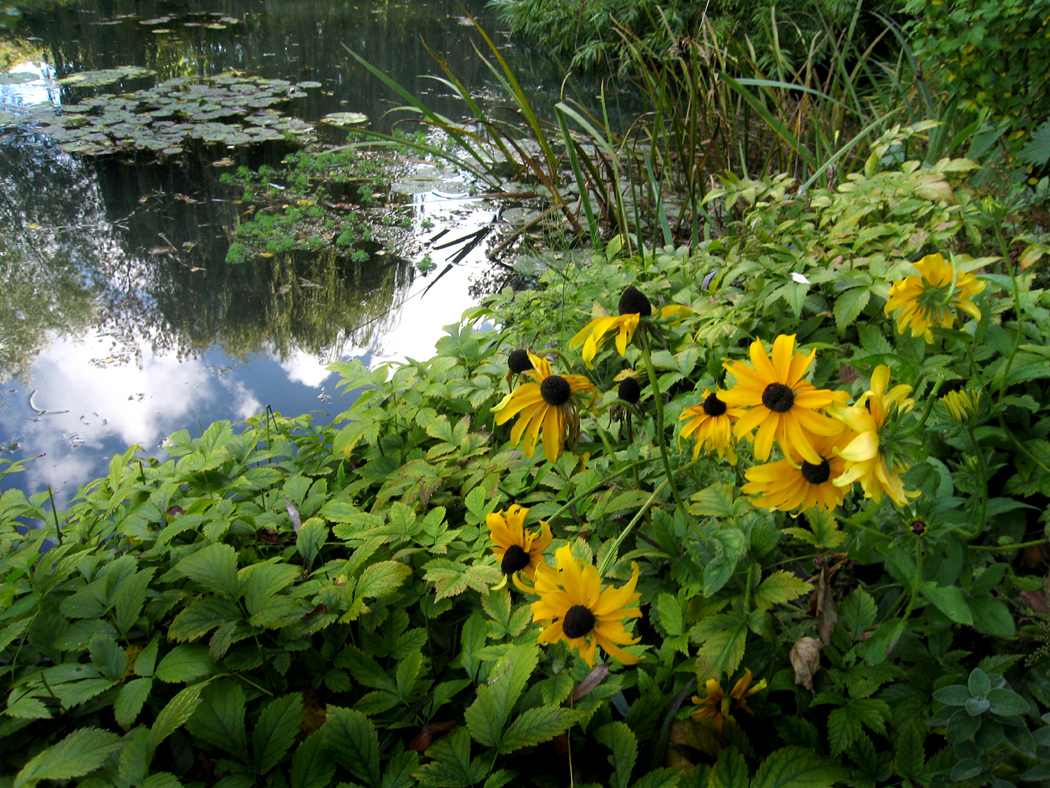
In 1893, he bought an adjacent lot, on the other side of the railroad tracks that bordered his property, and began making a pond to grow waterlilies.


Japanese bridge at Giverny

Japanese bridge at Giverny

AN EARLY RISER 

Monet’s life in Giverny turned into an ordered process of days, not only as the seasons progressed through the year, but even as the day progressed.

He got up early, between 5 and 6 in the morning, took a cold bath and ate a big breakfast, often an ”English” breakfast of bacon and eggs. From then until midday dinner, held promptly at 11:30 a.m. every day, he painted. He carried his canvases with him, often working on more than one, passing from canvas to canvas as the light changed with the hour.

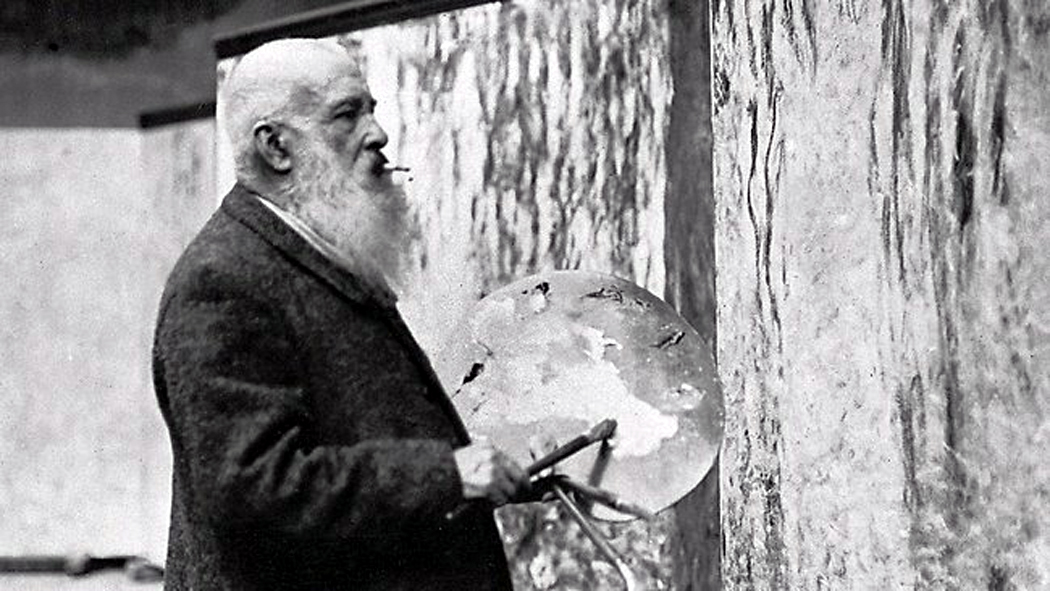
He would sit out in the sun in his tweed suit and pleated shirt wearing a broad-brimmed old hat and smoking his stinky Caporal Rose cigarettes.

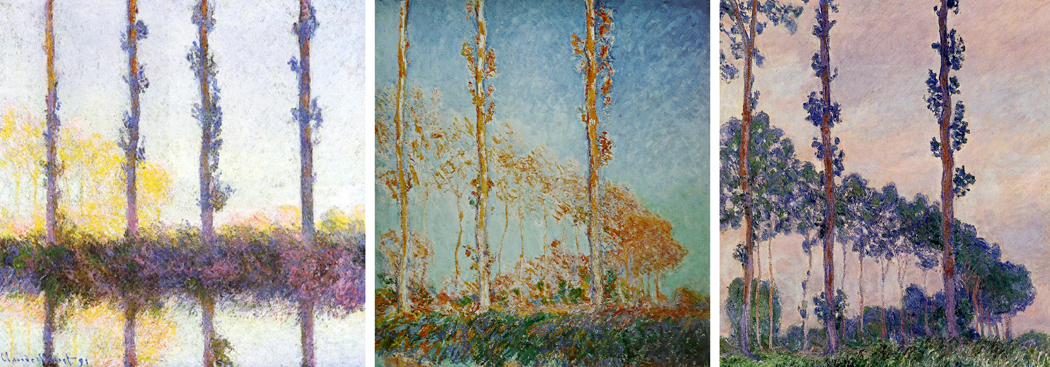
Monet had begun working in series, attempting to catch the evanescent effects of light as they flew by. A series of haystacks was followed by a series of poplar trees, each showing what their subject looked like at dawn, early morning, late morning, midday, afternoon and evening. As the sun changed, he changed canvases.

Monet poplars series

His critics complained that he was just trying to sell the same painting many times over. But Monet showed a dogged determination to make these series.

When the land with the poplars was sold, Monet paid the new owner not to cut down the trees until he was finished painting them.

Lunch was the major social event of the day. When Monet had visitors — which was often, more often than he sometimes wanted — they did their visiting at midday.

The afternoon was given over to painting once again, followed by a small supper at 7, and for Monet, bed by 9:30. He was notoriously bearish if this schedule wasn’t kept precisely.

So that, when his son-in-law, who was a slow eater, visited, Monet gave orders to the servants that no seconds should be offered.

And the painter could get out in the field with his canvases and brushes on time.


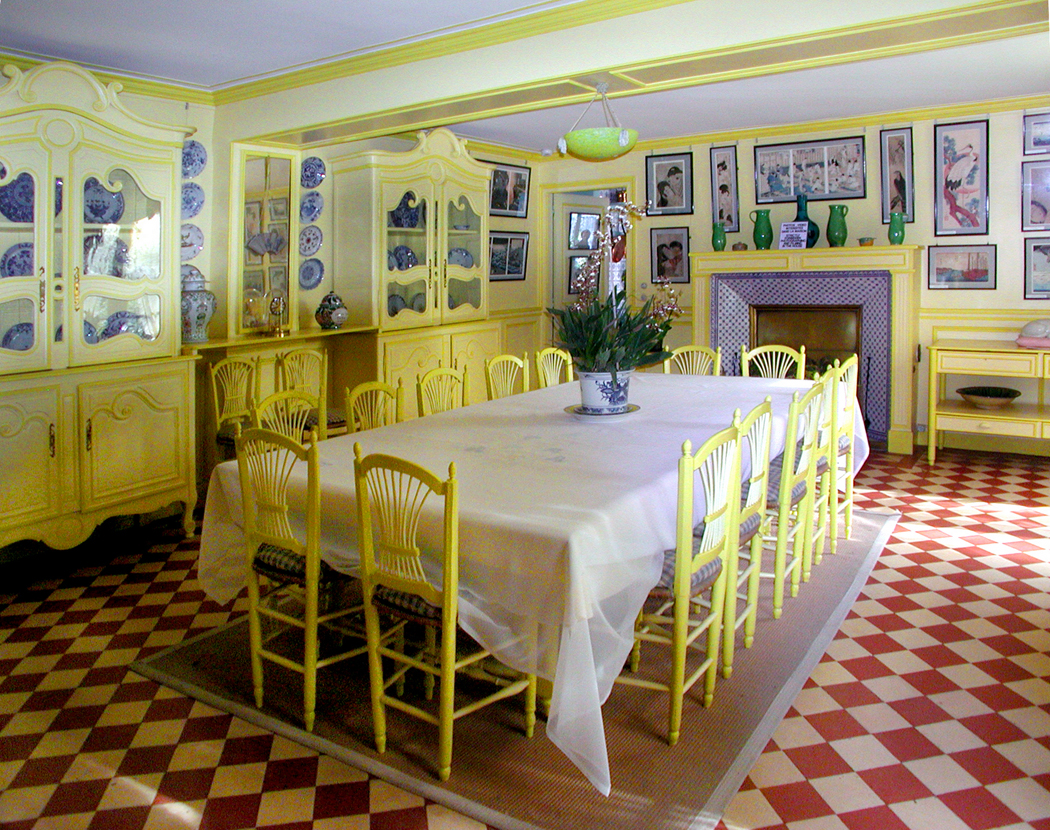
Dining room at Giverny

Dining room at Giverny

THE GOLDEN YEARS 

The 20 years after he moved to Giverny were the best of his life. His prices kept rising, he painted happily and productively through the year, taking time most years for an extended trip. One year, he went to Venice, another to Norway.

In 1892, after Ernest Hoschede’s death, Monet and Alice got married. The following year, he built his first water garden. In 1897, his son, Jean, married Alice’s daughter Blanche. Monet’s solo exhibitions regularly sold out.

The only troubles he had were in getting the municipal cooperation on improving his pond. Local residents were concerned that Monet’s plan to divert water from the Ru River, actually little more than a brook, would affect their crops and cattle grazing, but some help from the mayor swayed them and the permits were issued.

Alice’s daughter Suzanne married the American painter Theodore Butler and another daughter, Germaine, married a businessman from Monaco. The marriages soon brought four grandchildren to the family.

Meanwhile, Monet added more acreage to his holdings, including the ”Maison bleu” — the ”Blue House” — in the middle of town, where he installed a gardener named Florimond to cultivate his kitchen garden, which supplied the family with vegetables for their elaborate menus.

At one point, he employed six gardeners alone, along with a cook named Marguerite, a butler and valet named Paul, who was Marguerite’s husband, a maid named Delphine and a combination chauffeur and wine steward named Sylvain.

He needed the chauffeur because, although he owned automobile after fancy automobile — fast cars were a passion, along with watching auto racing — he never learned to drive.

The family also owned four boats, which they moored on the Seine, including the one boat Monet had fitted out as a floating studio. Monet often was accompanied on his painting forays by his step-daughter Blanche, also a painter, and they shared space on the boat.

Once a month, Monet retreated to Paris to have dinner with his circle of artist friends. He and Alice would take in the latest theater, see the gallery shows, and attend concerts.

Or watch wrestling — a particular favorite of the otherwise demure Alice.


Clos Normand

Clos Normand

A DISTRESSING UNDERTOW

Yet underneath the comfortable bourgeois existence of the increasingly wealthy painter was a distressing undertow. If Monet made paintings that soothed — he once called them a ”refuge for a peaceful meditation” — perhaps it was because he had a better than passing acquaintance with death and loss.

His mother had died when he was 18. Friends had died in the war. His wife, Camille, had died in 1879 after three years of lingering illness. The very month he moved into Giverny, his mentor, Edouard Manet, had died and Monet had served as pallbearer.

The early years at Giverny had proved a reprieve, but as Monet’s once black beard turned into a vast white haystack on his chest, time caught up with him.

Monet in the garden

In 1894, Suzanne developed a paralysis and five years later, she died. Alice went into a depression from which she never fully recovered.

”Our beloved Suzanne died last night,” Monet wrote Durand-Ruel, ”while her poor mother was in bed with a bad case of bronchitis which she caught the other day at Moret. One sorrow after another.”

Around him, his colleagues began dying, too. Caillebotte — a particular friend — had died in 1894. Alfred Sisley died only a week before Suzanne.

Pissarro died in 1903; Cezanne in 1906. By 1917, Rodin and Degas were dead, along with Monet’s friend, the playwright Mirbeau. And in 1919, Renoir died.

Part of this was the natural result of living a very long life. But there were special sorrows for Monet.

A flood destroyed his lily pond and large portions of his gardens in 1910. It took several years to rebuild.

In 1911, Alice died after a long illness. Monet entered a deep depression that prevented his painting for some time.

In 1914, his son, Jean, died. Jean’s widow, Blanche, returned to Giverny and served Monet as hostess and housekeeper.

And the outbreak of World War I weighed heavily on the painter.

”I’m back at work,” he wrote. ”It is still the best way of not thinking about present sorrows, although I’m rather ashamed of thinking about little researches into forms and colors while so many suffer and die for us.”


Pond edge, Giverny

Pond edge, Giverny


FAILING EYESIGHT

There was another sorrow for Monet, one that threatened his very identity as a painter.

Beginning at the turn of the century, Monet’s eyes, which had bothered him since his youth, began to develop thick cataracts that interfered with his vision.

He painted through them, but friends and critics noticed a change in the paintings, which sometimes seemed oddly colored.

”I’m working very hard and I would like to paint everything before I cannot see anymore,” he wrote Durand-Ruel.

The condition worsened and relented over the years, but by 1922, his eye doctor reported that Monet’s vision was reduced to ”one-tenth in the left eye and to perception of light with good projection in the right eye.”

Monet continued painting, sometimes knowing what color he used only by reading the label on the tube of paint.

”I could paint almost blind,” he told a visiting journalist, ”as Beethoven composed completely deaf.”

The operation his doctor recommended on his right eye helped things in 1923, but resulted in a peculiar condition called ”xanthopsia,” which caused him to see everything too yellow. When this condition abated, it resulted in its opposite, in which Monet saw everything as too blue.

”It’s disgusting, I see everything in blue,” Monet complained to a visiting professor.

”How do you know it’s blue?” the visitor asked.

”By the tubes of paint I choose.”

His ophthalmologist finally found a pair of tinted glasses that brought his vision back to something approaching normal, and Monet painted like a demon.

In 1925, he wrote, ”My vision has improved tremendously. I am working harder than ever, I am pleased with what I do, and if the new glasses are better still, I would like to live to be a hundred.”


Orangerie, Paris

Orangerie, Paris

A FINAL GIFT

He didn’t make it to a hundred, but the final years were spent on a vast project of painting the waterlilies in his water garden.

Conceived as a gift to France, he worked in increasingly larger formats, finally building a new studio to house the 8-foot-tall, 12-foot-long segments of the murals he was painting.

”These ‘water and reflection’ landscapes have become an obsession,” he wrote the journalist Gustave Geffroy in 1908. ”They’re too much for an old man’s strength, yet I should like to be able to reproduce what I feel.”

He destroyed paintings he didn’t think up to his standards. At one point, he wrote Durand-Ruel, ”I have five or six at most that merit consideration, and have just, to my great satisfaction, destroyed at least 30.”

The large waterlilies marked a significant change in Monet’s approach. In the past, he had been rigorous in painting outdoors, directly from life. But for these ”decorations,” as he called them, he worked inside, in his studio, from his imagination.

Monet at canvas

That underlined not just a change in technique, but in the basic purpose of his painting. What had been an attempt to reproduce an accurate record of what his eye saw became an involvement in what paint can do and mean.

Pablo Picasso had painted his first Cubist painting in 1906 and the winds of Modernism were blowing the old smoke out of the room. Monet caught the fresh air and enthusiastically took part in the change. The late waterlilies are no longer Impressionism; they are modern art.

”I am looking for something I have not done before, a shiver my painting has not yet given,” he wrote.

In 1926, a lifetime of smoking cigarettes caught up with Monet. By late summer, he was bedridden with pulmonary sclerosis. His eyesight had deteriorated; he no longer could paint. He died on Dec. 5 with his family around him.

The following year, his waterlily decorations were installed at the Musee de l’Orangerie in Paris.

As for his beloved home, it stayed in the family, eventually abandoned in World War II. But in 1957, Monet’s surviving son, Michel, donated the deteriorating property to the Academie des Beaux-Arts, along with the paintings left behind by the painter at his death.

The Giverny site, now renovated with gardens replanted in the 1970s, draws about a half-million visitors a year.

On Michel’s death in 1966, the paintings reverted to the Musee Marmottan in Paris.

It is hard to calculate how much this one small piece of provincial property has given to art. Monet painted what he loved, and what he loved for the final four decades of his life was his home in Giverny.

”My heart is to Giverny for ever and ever,” Monet wrote.


a house

You walk through New England and you sense that it is a place that has finished itself. It was once the seed from which America grew, but it is now the seed husk, and the growth is elsewhere.

The Southwest, for instance, where people move around like billiard balls on a break. Or the Northwest, where eyes watch the Pacific Rim for the coming millennium.

But New England has settled like an old house. It has become itself and leaves becoming to others.

I don’t mean to imply that New England is dead. Boston is a busy city, and Hartford or New Haven might as well be a suburb of Manhattan. Nor do I mean that change has left New England behind. They have their satellite dishes and their shopping malls, just like the rest of the country.

Yet, there is a sense, as you walk through the countryside, that New England has become comfortable with what it is, and no longer feels the need to change into something else.

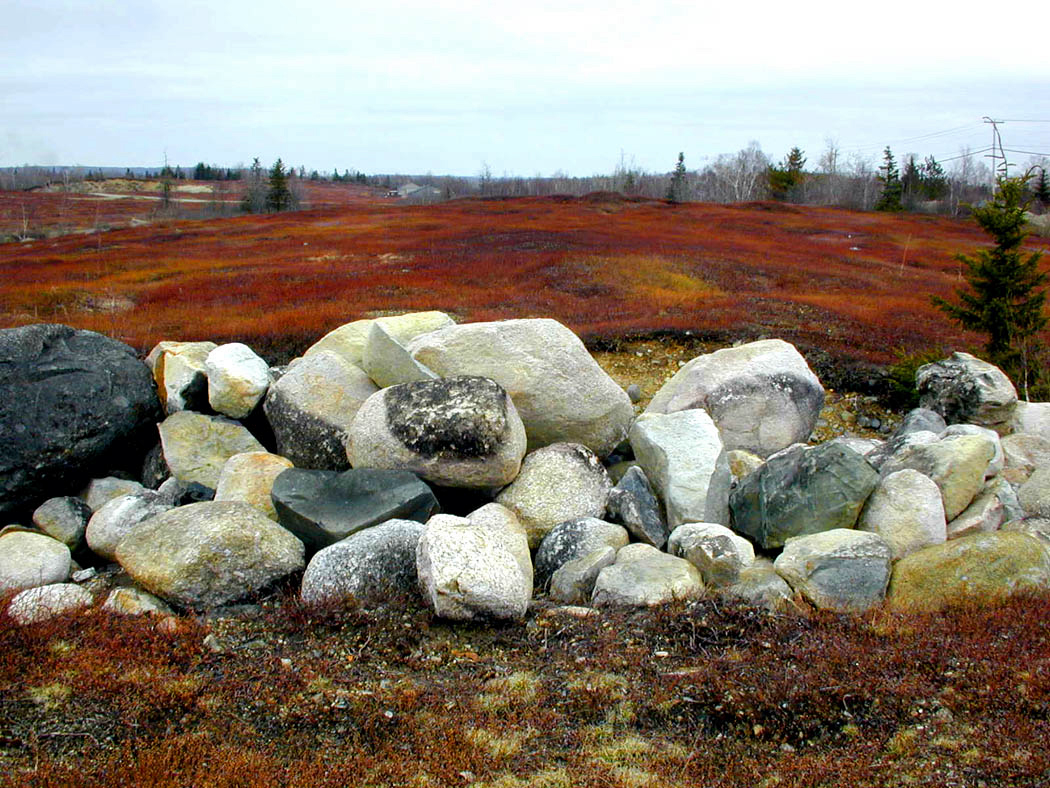
Blueberry heath

New England wasn’t the first part of the New World settled. Not even the first part of the United States. Virginia, Florida and the Southwest can claim that distinction. But the settlers of Massachusetts gave us the first American myth: The hard-driving Yankee industriousness that weathered all kinds of inconvenience to create a government and an independent nation. We remember Plymouth Rock, the Pilgrims, Cotton Mather, Paul Revere, Samuel Adams — the myth of Yankee ingenuity, hardiness and perseverance.

It was a useful myth for our nation’s first 150 years or so. But the United States has left the Novae-Anglo myth behind in a spurt of expansion and immigration. Culturally, New England, outside the big cities, now looks kind of monochrome.

You travel through New England and you see the idea that America used to have of itself. There are paths through woods around lakes, roads through farms built on stony ground, old warping wooden houses with weathered clapboards along the Maine coast.

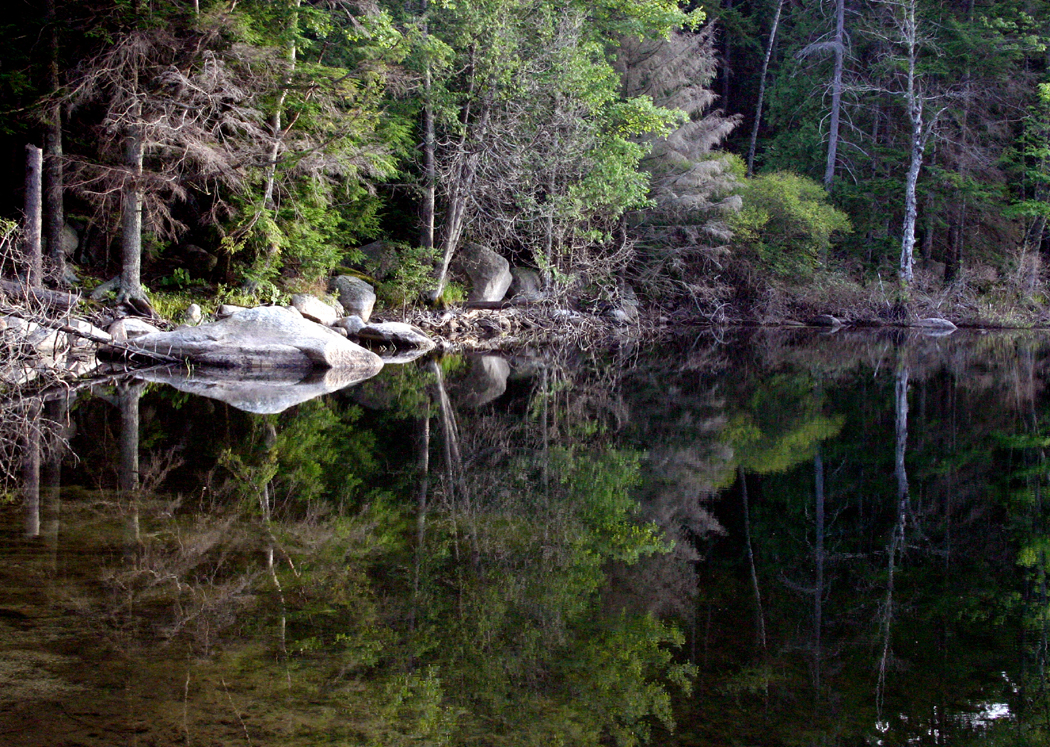
Fox lake

This is the New England that gave us our first cultural identity, through the writings of Nathaniel Hawthorne, Henry Thoreau, Ralph Waldo Emerson, Herman Melville, William Cullen Bryant, Henry Wadsworth Longfellow, James Russell Lowell, Emily Dickinson.

It was a cultural identity that taught hard work and little play. It taught guilt and redemption, tight lips and stoicism.

That once-ideal American, hard working and suspicious of pleasure, seems to have disappeared, replaced by a softer, fun-addicted American. But the habitat of that earlier American is still there to be seen.

Visit the less-populated portions of Cape Cod, for instance, south of Truro, and feel the salt wind whip over the sandy dunes. It’s a wind that can turn your face into leather.

Or climb Mount Greylock, with its granite and white pines. You get the long view from its summit.

Or watch the white water in the Swift River along the Kancamagus Highway in New Hampshire. You can see the power that New Englanders sought to run their mills.

Or walk along the Boston Common on a warm Sunday morning and see the office buildings that border it, the business that the Common grass provides relief from.

Perhaps you can saunter along the shore of Walden Pond in Concord, Mass., on an oak-orange fall afternoon. You know that the Massachusetts winter is coming soon. You feel, like cold humidity in your joints, that life is short.

You can see the aftermath of that first American in the emptied brick factories of Fall River and Lowell and the white steeples of the churches in every hamlet of Vermont.

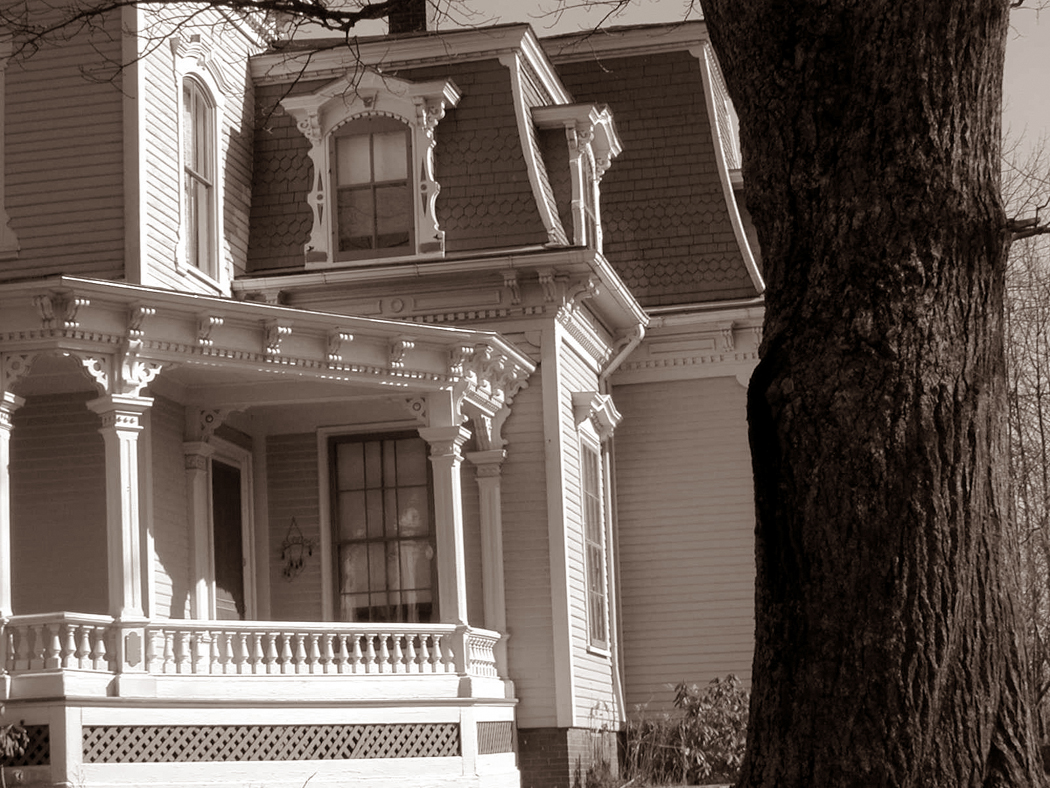
Victorian house

Sometimes, New England seems surprisingly unpopulated. It was once the most crowded part of the country, but now, outside its main population centers, you can find a lot of empty space to walk through.

Your boots slog through piles of fallen leaves and stub on the outcropped stones that float in the New England soil.

And finally, you stop on the granite of the Maine coast and watch the surf peck away at the continent, slowly and with great noise.

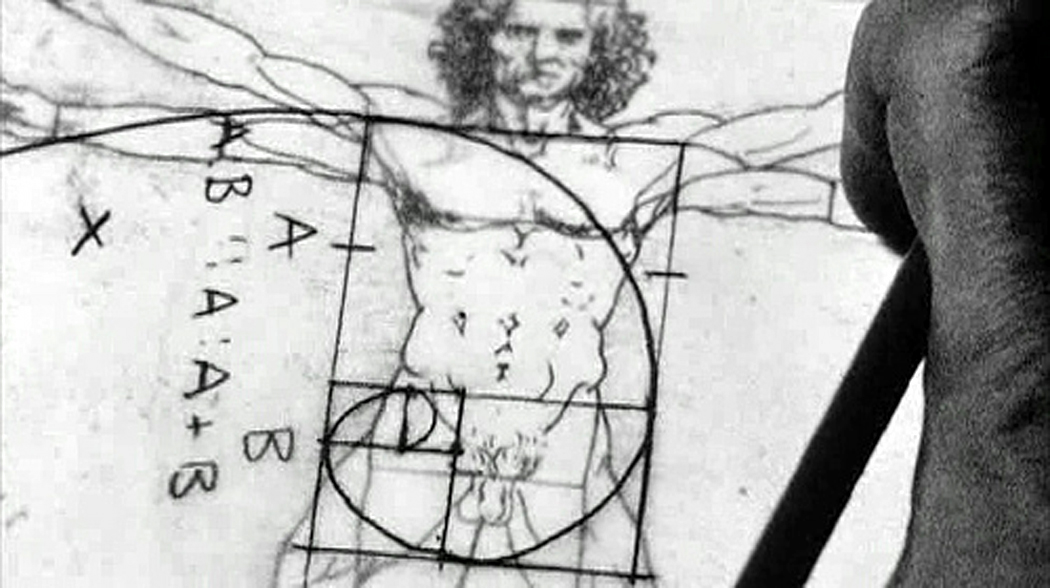
fibonacci in blue

Too often, we take what we hear at face value. Facts turn out not to be facts. No one changed your family’s name at Ellis Island. Didn’t happen.

These are not just myths, they are just things that sound like they could be true and so become embedded in our midden of common knowledge. No, Eskimos do not have 30 or 43, or 90 words for “snow.” Human beings do not use merely 10 percent of their brains.

This is all stuff for the Cliff Clavins of the world.

Sometimes this stuff gets caught in our mental wheel spokes because we simply don’t look closely enough.

Take the Fibonacci series. We are told that this interesting pattern of numbers governs much of what appears in nature, including the spiral patters we see everywhere from whelk shells to spiral galaxies. The problem is, observation does not support this idea, at least not as it is usually presented.

The series is created by starting with a zero and a 1 and adding them together, and continues by adding each new number with the previous, making the series: 0, 1, 1, 2, 3, 5, 8, 13, 21, 34, 55, etc. The series has many interesting properties, one of which is the generation of the so-called “Golden Section.”

To the Greeks, the golden section was the ratio ”AB is to BC as BC is to AC.” It also generates the Fibonacci series and is said to define how nature makes spirals.

golden overlap

Look at the end of a whelk shell, they say, or the longitudinal section of a nautilus shell, and you will see the Fibonacci series in action.

whelk

Yet it is not actually true. When you look at whelks, you find spirals and the Fibonacci series creates a spiral, but the two spirals are quite different: the mathematical spiral opens up much more rapidly. The shellfish has a tighter coil. The whelk’s spiral makes roughly two turns for every turn the Fibonacci spiral makes. Math is precise, but nature is various.

fibonacci whelk

What I am most interested in here is not just the agon of conflicting beliefs, but rather the faith in mathematics, and the sense that math describes, or rather, underpins the organization of the world.

I cannot help thinking, in contrast, that these patterns are something not so much inherent in Creation, as cast out from our brains like a fishing net over the many fish in the universe.

Take any large string of events, items or tendencies, and the brain will organize them and throw a story around them, creating order even where none exists.

Consider the night sky, for instance, a rattling jostle of burning pinpoints. We find in that chaos the images of bears and serpents, lions and bulls. Even those who no longer can find the shape of a great bear can spot the Big Dipper. The outline seems drawn in the sky with stars, yet the constellations have no actual existence outside the order-creating human mind.

Ursa major

Our own lives — which are a complex tangle of events, conflicting emotions and motives — are too prodigal to fit into a single coherent narrative, even the size of a Russian novel. Yet we do so all the time, creating a sense of self as if we were writing autobiographies and giving our lives a narrative shape that makes them meaningful to us.

We usually believe the narrative version of our lives actually exists. Yet all of us could write an entirely different story by stringing events together with a different emphasis.

The question always arises: Are the patterns actually there in life and nature, or do we create them in our heads and cast them like a net over reality?

The issue is central to a brilliant movie made in 1998 by filmmaker Darren Aronofsky called Pi. In the film, a misfit math genius is searching for the mathematical organizing principle of the cosmos.

His working hypotheses are simple:

”One: Mathematics is the language of nature.

”Two: Everything around us can be represented and understood through numbers.

”Three: If you graph the numbers of any system, patterns emerge.

”Therefore: There are patterns everywhere in nature.”

Pi movie scene 3

The movie’s protagonist nearly drives himself nuts with his search until he cannot bear his own obsession anymore.

But the film also questions in a roundabout way whether the patterns exist or not.

When different number series — each 216 digits long — seem to be important, an older colleague warns our hero that, once you begin looking for a pattern, it seems to be everywhere.

It’s like when you buy a yellow Volkswagen and suddenly every other car on the road is immediately a yellow VW. Nothing has changed but your perception.

Mathematicians find patterns in nature, yet math itself is purely self-referential. It can only describe itself.

As mathematician/philosopher Bertrand Russell put it: ”Mathematics may be defined as the subject in which we never know what we are talking about nor whether what we are saying is true.”

In other words, ”one plus one equals two” is no different from saying ”a whale is not a fish.” You have only spoken within a closed system. ”A whale is not a fish” tells us nothing about whales but a lot about our language.

It is a description of linguistic categories, rather less an observational statement about existence. Biology can be organized as a system of knowledge to make the sentence false — indeed, at other times in history a whale was a fish.

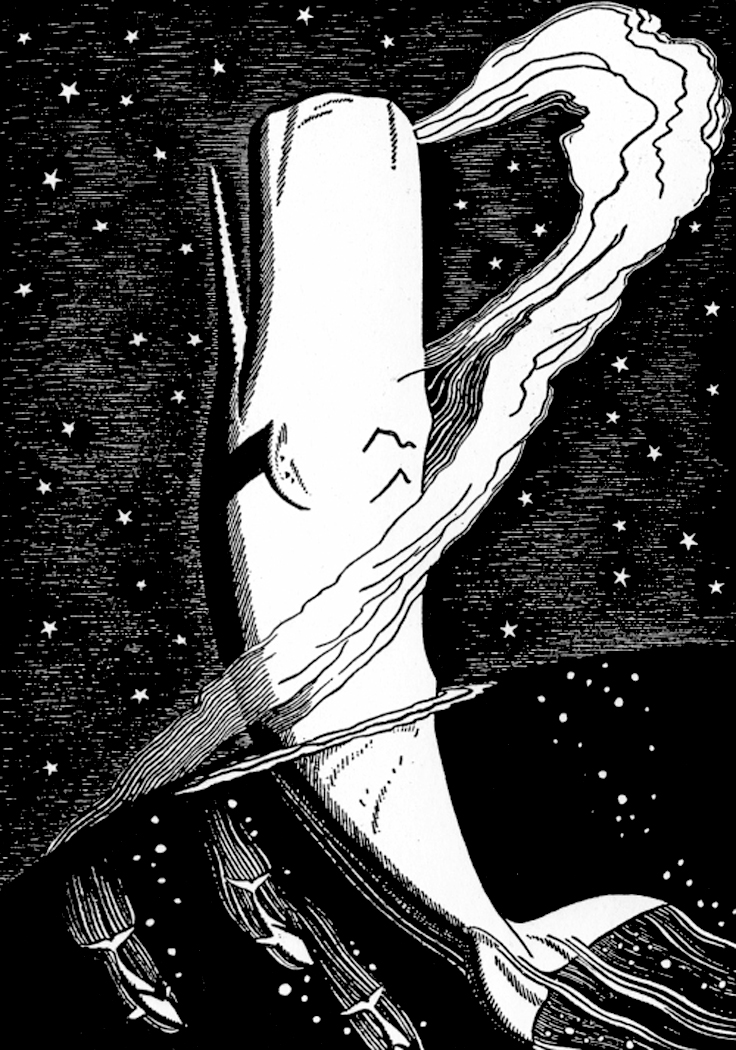
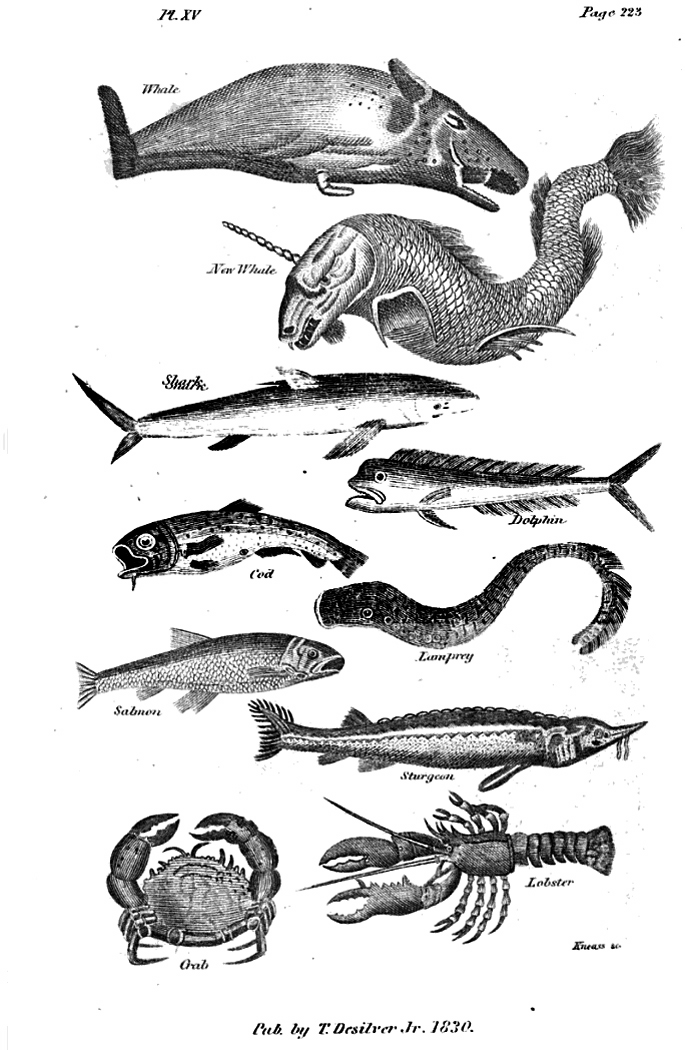
Before Carl Linne, who created the modern biological nomenclatural system, there were many ways of organizing biology. In his popular History of the Earth and Animated Nature, from 1774 and reprinted well into the 19th century, Oliver Goldsmith divided the fish into “spinous fishes,” “cartilaginous fishes,” “testaceous and crustaceous fishes” and “cetaceous fishes.” A mackerel, a sand dollar and Moby Dick were all kinds of fish.

Plate from Goldsmith's "Animated Nature"

Plate from Goldsmith’s “Animated Nature”

Let’s face it, although the Linnaean system is useful, it is kind of arbitrary to organize nature not by its shapes, or where it lives, but rather how it gives birth or breathes.

”One plus one” likewise describes the system in which the equation is true.

It is possible to cast other patterns over reality. For instance, artists understand perfectly well how ”one plus one equals three.”

That is, there is the one thing, the other thing and then the two together: one sock, the other sock, and the pair of socks. That is three things.

Three things

Three things


In art, we constantly put one object up against another object and observe the interaction between them. In that sense, one plus one can equal three.

When mathematicians say that numbers describe the world, they are speaking metaphorically. Numbers do not, in fact, describe the world. The patterns of numbers seem to mimic the patterns we discern in nature and bear an analogical relation to them.

The fact that this seems to happen so often may be little more than the yellow VW effect.

For experience is large and contains multitudes, even infinities. In any very large set, patterns can be found.

That is the trick behind numerology. If the name Ronald Wilson Reagan can be turned numerologically into the symbol for Satan because each of his names has six letters, making the “666” or “mark of the beast” from the book of Revelations, well, looked at another way, it can be turned into a recipe for Cobb salad. All it takes is a system ingenious enough to do it.

Our hero in Pi believes in the Fibonacci spiral: ”My new hypothesis: If we’re built from spirals while living in a giant spiral, then is it possible that everything we put our hands to is infused with the spiral?”

He begins to sound more and more paranoid.

And paranoia has been defined as a belief in an invisible order behind the visible world.

Paranoia and idealism thus are siblings.

There seems to be hard wiring in the human brain that makes us cast patterns over the world. That hard wiring seems to bring forth what Carl Jung called archetypes, that is, the narrative patterns our brains spin out and the shape we then jigger all of actual experience into.

And when forced to choose between the coherent pattern and the incoherent reality, we always choose the pattern.

Perhaps we could not live otherwise. But it makes me mistrust idealism just as I mistrust mathematics.

grass fireworks

This world is filled with useless things: old habits we refuse to give up; new answers to problems that long ago vanished; professional football.

Most of them are inoffensive. We can live with them. But there are some that really get under my skin. Prime among these is the front lawn.

In my list of senseless things, the suburban front lawn takes the lead, surpassing such other bits of silliness as:

1. neckties

2. chrome detailing

3. parsley garnishes

4. extended warranties, and

5. nipples on men.

Explain for me, if you will, why so many well-meaning people work so hard to put a spot of green along the street, in an area of their property they never visit, save to mow it.

Of course, a thirsty lawn makes even less sense in the American Southwest, where it might well be considered a crime against nature. Yet, drive the streets of Phoenix and see all the pretty lawns: like kangaroos in Greenland.

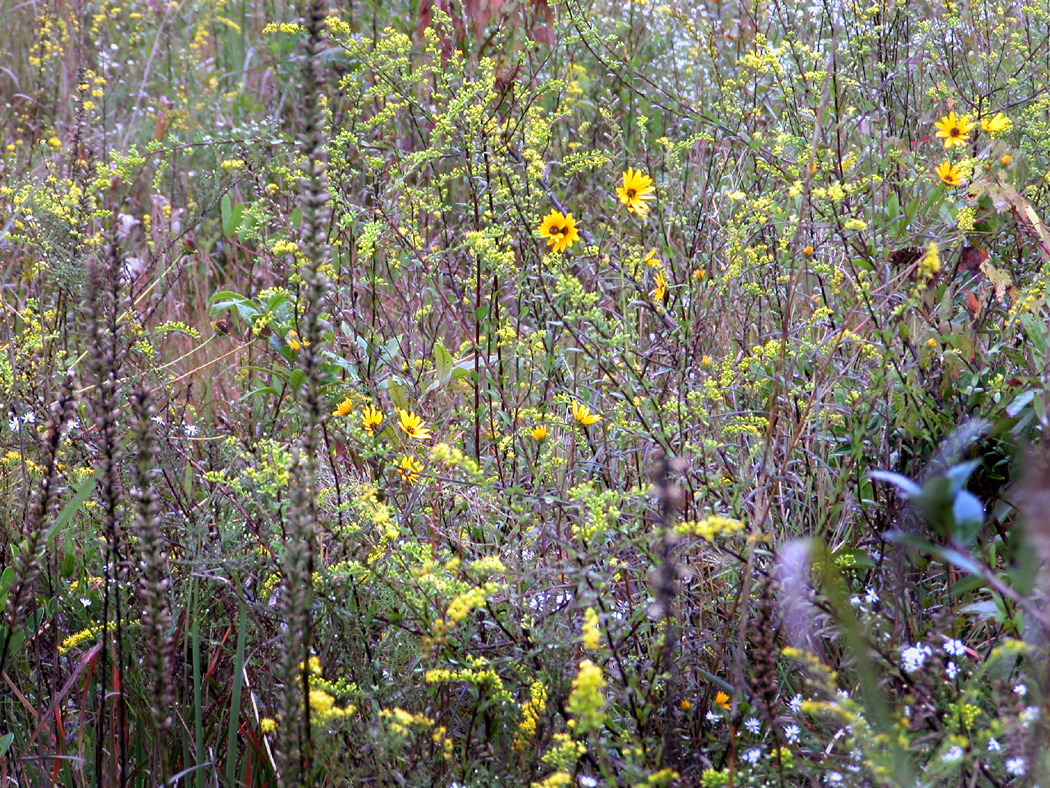
It has been argued that front lawns are beautiful. Certainly grass growing in the meadow is among the most satisfying sights in nature, with its rusty autumn seedheads waving in the breeze above the thousand wildflowers that fill out the landscape.

OLYMPUS DIGITAL CAMERA

Birds and butterflies are drawn to the meadow. It is a perfect Eden.

But lawns are not the same thing as grass. In a lawn, we chase away the wildflowers, which we call weeds, and discourage insects with noxious chemicals and we shoo away the birds that might eat up the newly seeded turf.

And the ample seedheads, with their glumes and awns, are slaughtered by the riding Toro, so the lawn approaches its Platonic ideal: AstroTurf. The lawn, as envisioned in the American suburb, might as well be a green shag carpet.

It is also argued that the tightly mowed lawn is a delight to walk upon, that it is a wonderful place for children to play or for the family to have a picnic.

That might be true of the back yard. But almost none of us does such a thing in the front yard. The neighbors would stare. About the only purpose the front lawn serves is to provide a comfortable place for the neighbor’s dog to poop.

That is a long way from the English estate lawn, which the American suburban lawn attempts to emulate.

We didn’t have lawns in America until after the Civil War. Houses were built right up on the street.

Dirt, which could be swept clean, was the ground cover of choice.

But after the Civil War, urban patterns began to change. Streetcars and passenger trains allowed more people to move out of the city to live and commute to work.

There are many reasons for the triumph of lawns in American landscaping. The idea took root in a century that was much more concerned with nature than our own. It was a time of Romantic poetry and art, and people looked for ways to be closer to nature. The lawn satisfied this need, in a small and distorted way.

But what began as bringing nature to suburbia ended, by the 1950s, as outright war against nature.

“A good many homeowners feel this way,” said Changing Times magazine in 1954: “Mother Nature has beaten them to a stand still for so many years that revenge is worth almost any price, as long as it comes in the form of a real good, drought-tolerant, weed-resistant lawn.”

I once lived in a house next to a jowly retiree who kept his lawn cut to the same length as his Marine crewcut. He was so intent on regimenting the naturally wild grass, that after he finished giving his lawn the buzzcut, he actually rode his mower for a half-mile up and down the road shoulder in front of his house to keep it all perfectly manicured. He did this at least twice a week.

I suspect he spied on his lawn at night to make sure it didn’t misbehave.

For if a lawn is a bit of nature, it is nature bridled and harnessed.

In his book, Second Nature, author Michael Pollan argues that “Lawns are a symptom of, and a metaphor for, our skewed relationship to the land. They teach us that, with the help of petrochemicals and technology, we can bend nature to our will.”

If we followed the logic of the lawn, we would create the front-yard equivalent of the plastic wood-grain walnut tabletop. Indeed, a friend of mine in Seattle, to avoid having to mow his lawn, poured in a layer of concrete instead, and painted it green. It frees him up to drink beer and watch ballgames.

If anything, the lawn is a peculiar case of cultural persistence. All around us are things that once made sense, but as they persisted through changing times, they lost touch with reality. Parents teach their children to play with “choo-choo” trains, although no one has seen steam locomotives since their grandparents.

We find Gothic pointed-arch windows — which made engineering sense in Medieval stone churches — in modern wooden churches.

And we get on and off the left side of jet airplanes because right-handed cavalry officers used to wear sabers on their left side, making it more sensible to mount and dismount their horses from the left. Early military airplanes — as part of the “air cavalry” — took the cue and the practice has never changed. (Indeed, those WWI biplanes often had “stirrups” on which to climb up into the open cockpit.)

Even neckties may once have had a reason to exist. It is said they served as bibs for sloppy eaters; but let’s face it, today you can throw a shirt in the washing machine, but you have to take the tie to the dry cleaners to get that mustard spot off. Tie as bib does not make economic sense.

And so, lawns, which originally functioned on English and French estates to provide hay for agricultural animals, later became symbols of rank, wealth and title.

Maine grass

They oddly persist this way in American suburbs.

It played into the curious American delusion that in our democratic nation — where everyone is theoretically equal — we are not equal as commoners, but as aristocrats. Every man in his white clapboard house was king in his castle. And each of us deserves his own rolling green estate, and if we only own enough property for a postage-stamp lawn, so be it.

Thorstein Veblen, the social critic who first came up with the concept of “conspicuous consumption,” at the turn of the century, saw the American obsession with lawns as yet another example of showing off your wealth, no matter how pitiful its amount.

And we began a century of “keeping up with the Joneses.”

After World War II, it became almost unpatriotic not to have a perfectly kept lawn to show off.

I suppose the reason I get so exercised about lawns is that I really, really love grass. I love the lacy panicles of panic grass, the bushy-eyebrow racemes of sixweeks grama, and the three-fingered tassles of big bluestem growing man-high in the few remaining patches of Midwest tallgrass prairie.

Grass B&W

And nothing beats the stiff stalked timothy, where the redwings like to squat and squabble.

It has been suggested that people value lawns in part because we have some faint genetic memory of developing as a species on the savannahs of Africa. I feel that atavistic pull, but it is prairie that excites it, not front lawns.

In the prairies, vast fields of wheat or wildgrass blow like seawaves in the wind.

In America’s suburbs, the front lawns mock “nature without check with original energy.”

It has been said that an eagle in a cage is not an eagle. And grass in a lawn is not grass.

Back Bay, Virginia

Back Bay, Virginia

When you are young, it is easy to be in love with art. You may love its artifice, you may love the colors or the rhymes or the great blaring sounds of the music you listen to. Art is vibrant; it seems so alive. But most of all, you are in love with the sense of importance art brings: It seems to validate the belief we all have when we are young that our own lives matter, that we count in the larger scheme of things.

We are all Tristan or Holden Caulfield.

Perhaps that is why the young make so much art. They are not yet unhappy with it, not yet dissatisfied at the lies that art creates, not yet disgusted with the prettiness of it all.

Most of all, the art we make when we are young imitates the art we have come to love: Art most often imitates art, not life. There is so much bad imitation T.S. Eliot written in college, so much abstract painting of no consequence, so much herd-instinct.

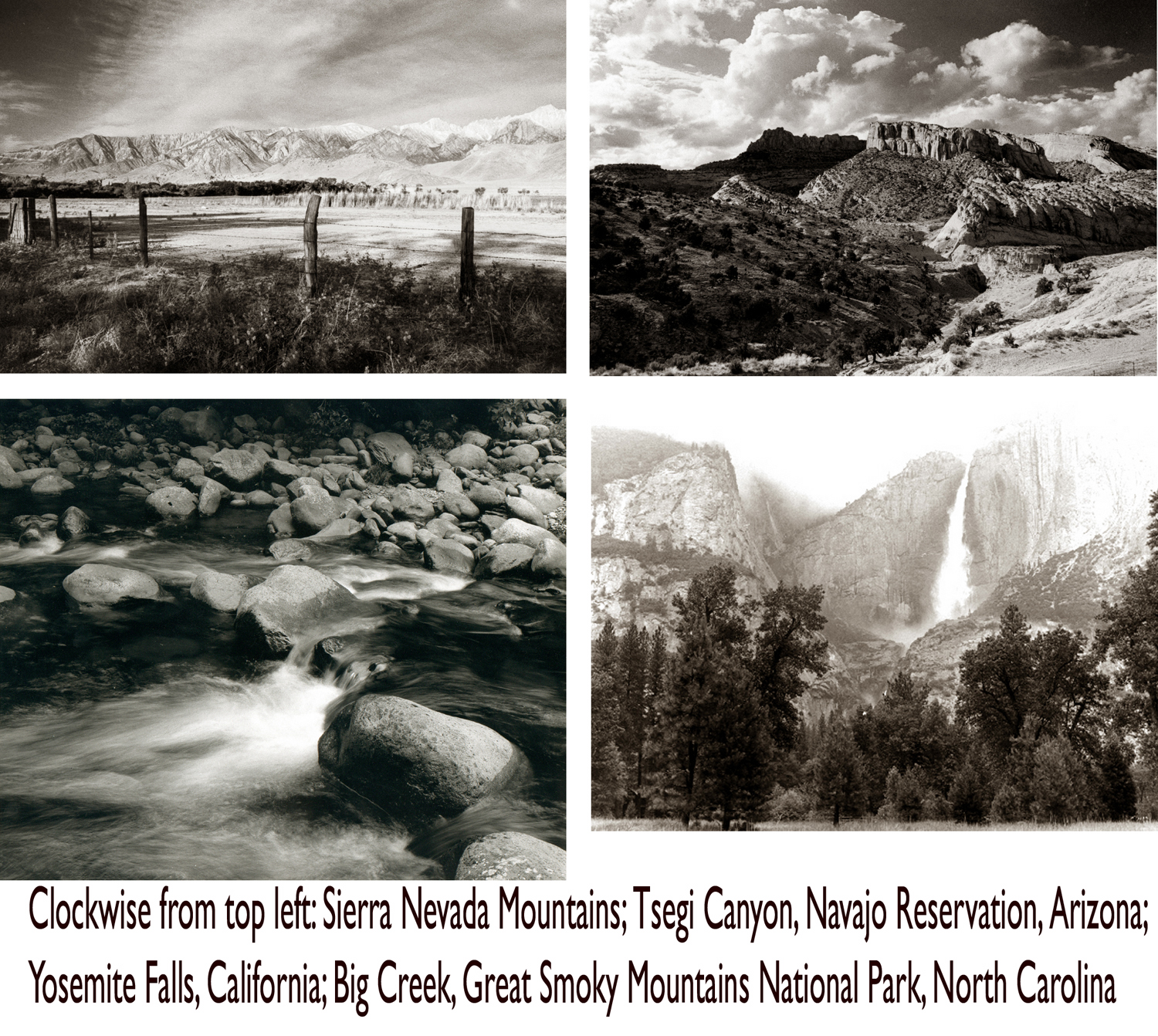
I have been as guilty as anyone. In 45 years of photography, the bulk of my work has been imitation Ansel Adams or Edward Weston or Irving Penn. I make my confession: I have photographed a pepper. I was learning to make images that I could recognize as art, because it looked like the art I knew. Big mistake.

Go to any art gallery and you see the same process unfolding. Imitation Monet here, imitation Duchamp there, imitation Robert Longo there. Whatever the current trend in art is, there are acolytes and epigones.

At some point, as you age and if you are lucky, you let all this shed off you, and you no longer care about art. What takes its place is caring about the world, caring about the experience of being alive. It isn’t going to last long, so you begin paying attention: close attention to soak in as much as you can before you die.

And if you are inclined toward art, you give up caring whether you are making “great” art, or whether you are part of the great parade of art history, and you care only about what you see, hear, touch, smell and taste. The world becomes alive and art fades to pathetic simulacrum.

When you reach this point, then you can begin making art. And you make it for yourself, not for posterity. You make it to attempt to capture and hold the world you love, or to understand the world, or to transcend it, when it becomes too difficult to endure or accept.

Art becomes a response to the world, rather than a substitute for it.

Walnut Tree, Greensboro, NC

Walnut Tree, Greensboro, NC

 2.

The first garden I made was a vegetable garden in the front yard of the North Carolina house I was renting in the early 1970s. I grew the usual tomatoes and peppers, beans and spinach. I also ventured into eggplant, which turned into the most successful part of the garden, to my surprise.

But what I really learned from my garden is the difference between the neat, orderly photographs in the seed catalogs and the rampant, weedy, dirt-clod messiness of the real thing. Gardens, I discovered, were not military rows of uniform plants, but a vegetative chaos.

The stupid thing was that I should have known this going in. All around me trees, vines, shrubs, roadside flowers and Bermuda grass were telling me one single thing, over and over: Profusion is the order of nature. Variety, profligacy, energy, expediency, growth.

Whether it is a kudzu shell over a stand of trees, or the tangle of saplings that close over an abandoned farm field, or the knot of rhizomes that run under the turf, the rule of nature is clutter.

The walnut tree outside the front door was old, and its bark was stratified with moss, lichen, beads of sap, and a highway of ants running up and down. From a distance, it was just a tree, but up close, it was a city.

When I was a boy, there was an abandoned farm beside our property. An old, unpainted barn and farmhouse stood in the center of a field of grass and weeds. When I was maybe 8 years old, those buildings burnt down one night, in a glory of flame.

In the years that followed, the course of plant succession took over. I learned my lessons from the Boy Scout merit badges I earned, but even there, the story of succession seemed much more orderly than what I saw out my window. Plant succession wasn’t a clear progression from annuals to perennials to shrubs and through a clearly delineated march of one kind of tree into another till we reached climax growth. It was instead a tangle of saplings through which it was nearly impossible to walk. There was not a “baby forest” that we saw, but an overpopulated struggle for sunlight, every plant elbowing its neighbor for survival. In a forest, the trees stand a certain distance apart, their crowns touching to make a roof. But this young version was more like a thick head of hair; there was no distance between the shoots.

Everything in nature told me the same thing: busyness, struggle and chaos. It was all exhilarating, and I loved the tangle of it all, the textures, the smells, loam and rot, the mud and dew.

And yet, that isn’t what I saw when I looked at art about nature, whether it was glossy calendar photos or Arizona Highways’ covers on the low end, or whether it was Raphael and Delacroix on the high end.

The nature I saw in most art was tame as a housecat. And the art wasn’t really about nature at all, but about order. It wasn’t made to see the world we saunter through, but to see how our minds organize and codify it.

Whether it was 18th century paintings or Ansel Adams’ photographs, the art was all about order. In fact, you could say that the point of the art wasn’t to make us see nature, but to understand order.

I was unsatisfied with it and with my own art. I wanted to make an art that would look at the natural world and make images that spoke to me about what I was really seeing and feeling.

Notre Dame de Paris

Notre Dame de Paris

 3.

I recognized something of what I wanted in the arts of the Gothic, Baroque and Romantic periods, eras in art that glorified the energy and visual confusion of the world. They are arts that responded to the profuse variety of experience. They were also arts that were devalued by the mainstream art world of the 20th century. Eliot deprecated Milton; Stravinsky insulted Berlioz; Mies van der Rohe is the anti-Gothic architect.

Yet, I loved Shelley, Schumann, Chartres. And I wanted to find a way to make that art over in our new century, in a new way, and reattach art to the world around me. It had been untethered too long; too long it had been its own reason for being. Art for art’s sake? Not any more.

It can be hard — it is probably impossible — to make art completely divorced from one’s time. The visual universe is too persuasive. We cannot even know how deeply we are affected by the stylistic twitches of our own age, and I am not saying my own work is sui generis. It certainly is not.

The light that knocked me off my horse on my own way to Damascus was a single book of photographs — still a fairly obscure book — by Lee Friedlander, titled  Flowers and Trees, from 1981. It was spiral bound, printed in a matte finish, and had virtually no text. Inside, I found a mirror of the nature I knew and felt. Nothing was framed neatly, nothing was glorified by the light poured on it, nothing was reified into monumentality. Instead, there was the profusion, confusion and organicism that I recognized from my own experience.

And I realized that I had been working in that same direction for years, but had buried those photographs among the more conventional mountainscapes and detail photographs where I had imitated my betters. I had several series of images that were my own immediate response to nature and they were all photographs I had made in the gardens of friends. I gathered them together and looked. The conventional photographs seemed to have no value whatsoever and these others, almost random, usually confused, and always ad hoc, seemed to breathe the life I had been looking for.

Since that time, and with the advent of digital photography, I have been liberated. I take my camera with me, point it at something I want to feed it, and let it do the chewing. I never look through the viewfinder anymore, but instead look at the larger shapes, darks and lights, that show in the digital screen on the back of my camera. I see how I see, and click the shutter.

Over the years, I have made many of these sets of photographs, usually 15 to 35 pictures in a group, and printed together to be seen as a “book,” that is, a print cabinet, where my audience can spend as much or as little time as they wish and shuffle to the next.

And the unit of my work is the book, not the individual photo. You can’t see a forest by looking at a single tree.

Baldwin County, Alabama

Baldwin County, Alabama

4.

If I have succeeded, I have also failed.

For in the end, my attempt to wrestle with the world has turned into an art that is also about order, about how the mind engages with the things around it. I have wound up doing exactly what my predecessors have done.

It isn’t surprising. After all, when I turn on my elders and find their efforts insufficient, I am doing nothing different from what they did when they turned on their elders. It is how art grows. Wordsworth rebels against Pope, Eliot rebels against Wordsworth, Ginsburg rebels against Eliot. One generation finds its parents lacking and tries its on its own to finally express the truth.

And I can only be happy when a generation after mine points its own finger backward and wiggles it in reproach at me.

It seems we never get closer to what we are all after. Value is all in the trying.

Reno, Nevada

Reno, Nevada

Loon

Who is America’s greatest painter?

There are many who could be named, from Eakins to Homer to Whistler to Pollock, but the name I would like to place in nomination is John James Audubon.

That comes as a surprise to me as well. I once knew him, as most Americans do, as the author of a book of overly familiar colored engravings of birds.

But the original watercolor paintings reveal him to be a soul of great emotional power, even moral force. An exhibition of many of them is currently on view at the New York Historical Society, through May 19, and changing shows continue through 2015, until all of the 474 originals for his book have been displayed. (A stunning book, “Audubon’s Aviary,” is also available through the NYHS or Amazon).

Audubon — America’s most famous Haitian immigrant — was born there in 1785 as the illegitimate son of a French merchant and slave trader. He moved to France with his father when he was 5, and to the United States when he was 18.

He went through a series of disastrous business ventures, making and losing several fortunes and wound up, at 35, as a part-time taxidermist and portrait painter.

It was then he conceived a plan to publish a book about American birds with his paintings as illustrations. Audubon had been a nature lover since boyhood and had often drawn the birds he loved. It came to him that these drawings could be supplemented to illustrate all the bird species then known in America. It was an ambitious plan.

John_James_Audubon_1826

Too ambitious

Too ambitious, as it turned out, to interest any American publisher, so he wound up in England, where he found Robert Havell Jr., an engraver with the perfect talent match for Audubon’s drawings.

The book they published in installments over a dozen years beginning in 1827 was the ”double-elephant edition,” named after the page size: 29 1/2 by 39 1/2 inches, with engravings by Havell made from the paintings of Audubon and hand-colored by apprentices.

They sold by subscription for $1,000, an astronomical sum in those days. It is hard to compare dollars over centuries, but at the time, the average laborer made the proverbial dollar a day, so it would not be out of line to say they sold for the equivalent of about $30,000.

In Dec., 2010, a complete first edition of “The Birds of America” sold at Sotheby’s in London for $11.5 million — a record for the most expensive printed book ever sold at auction.

Over three decades, Audubon tracked down, studied, shot, drew and painted more than 400 of the country’s bird species, with the paintings turned into a book that would document them for the first time, and eventually make its author’s name synonymous with nature and conservation.

And he did so with a commitment so intense that he became one with his subject. In some sense, every bird he painted is a self-portrait.

More than anything else, it is for this reason they rise above documentary art to become among the greatest art ever made by an American.

But it was the book Audubon meant us to see, not the watercolors. They were painted only as studies for the engravings that illustrate the book.

And so, Audubon felt comfortable doing things he would never do for a display picture. He mixed media like crazy, using ink, watercolor, gouache, pencil, even collaging birds scissored from earlier drawings.

He used each of these techniques to particular expressive ends that could not always survive the engraving transformation. In the case of the Magnificent Frigatebird, for instance, he used the sheen of his graphite pencil over the top of watercolor to imitate the iridescent effect of the bird’s plumage.

Magnificent Frigatebird

Magnificent Frigatebird

Still, the very first thing that wallops you as you enter the Audubon show at the Art Institute is the monumental size of the paintings.

Everybody knows what Audubon’s bird pictures look like, or at least they think they do. But seeing poor reproductions in books will not prepare you for the real thing.

What we are used to seeing are small reproductions of large engravings that are themselves reproductions of Audubon’s original paintings. Each painting is about 2 by 3 feet. Poster size, not postage-stamp size.

In that giant space, Audubon places all his birds. It was his intention to paint every bird life-size, whether hummingbird or eagle.

It meant that very large birds, such as flamingoes or condors, had to be contorted to fit into the space.

Total involvement

Yet it isn’t mere exigency that causes Audubon’s animals to be so animated. More than anything else, it is his total body identification. He is one of the world’s most haptic artists.

Over and over, you sense that Audubon felt his own muscles and sinews moving in sympathy with the birds he drew.

Time after time, you can see the intense life reflected in the eyes of his birds. They are never mere circles, but always pools of living awareness.

One of his secrets may be that he remained always a child in his direct response to nature.
”Every child is an artist,” Picasso said. ”The problem is how to remain an artist once he grows up.”

It was a problem Audubon solved.

Look at his poses. The competency of the drawing is a different level from a child’s but the poses are straight out of first or second grade. The animal is always moving and live.
Naturalists have always carped that the Audubon bird prints are not as realistic as those of Louis Agassiz Fuertes or Roger Tory Peterson. They cavil that Audubon poses his birds in exaggerated positions that are unnatural for the real bird when alive.

But these people are not letting Audubon be Audubon. While it is true that he was on some level making identification pictures, it isn’t that level that rises to greatness. It isn’t as a field guide he is to be judged.

Audubon watched his birds with the minute carefulness of a mother bird, and recognized in every bird action an analogous human emotion. He then projected the human back into his avian. Like the leader strike of lightning that makes a path for the great burst of electricity back in the opposite direction.

A human element

Audubon’s birds function metaphorically as symbols of human affective states.

Fuertes is more useful scientifically precisely because he treats his birds as an ”it.” Audubon treats them as a ”thou.”

Detail, Chuck-Will's Widow

Detail, Chuck-Will’s Widow

You can see it in his Chuck-Will’s-Widow with its giant gaping mouth, the essence of appetite. In the uxorial affection of his Passenger Pigeons, which almost seem to kiss as the one feeds the other. In his nesting Barn Swallows, where the one shields the other with his upraised wing.

Ultimately, Audubon’s paintings are not about birds, but about human beings. Where Bach or Beethoven uses a series of notes to convey a human emotion, Audubon used a picture of a bird. And more than anything, it was that Audubon felt the importance of paying attention.

It isn’t that his paintings are so detailed, but that he paid attention to that detail with an urgency that approached love.

”To be awake is to be alive,” wrote Henry Thoreau. ”I have never yet met a man who was quite awake. How could I have looked him in the face?”

But to see the preliminary studies Audubon made for his “Birds of North America” is to see the work of a man wide awake and with his abilities at full throttle.