Archive

Tag Archives: new york

shepherd palm out

I’ll award the brass figligee with bronze oak-leaf palm to the reader who can tell me who Jean Shepherd was. I mean, who he really was.

Most people remember Shepherd — who died in 1999 at 78 — as the author and narrator of the 1983 film A Christmas Story. That movie may not quite rival It’s a Wonderful Life as the most popular Christmas movie of all time, but it comes in a clear second.

It was made into a Broadway musical last year, which picked up three Tony Awards, although I imagine Shepherd would have pooh-poohed the whole thing (while secretly busting with pride over having made it in the mainstream entertainment world he so overtly despised.)

Yet, for any of us who knew Shepherd via his radio show in New York during the 1950s, ’60s and ’70s, the movie — and musical — is a sad travesty of what made Shepherd memorable, even important.

For in his several films, and in his books and later magazine articles, Shepherd turned his Indiana childhood into something dangerously close to a Norman Rockwell picture. While his families squabbled and his kids were missing teeth, they were nevertheless basically sweet and lovable.

The real Shepherd, the radio Shepherd, would never have stood for that.

The real Shepherd was a notorious sorehead and cynic. And that’s by his own account. On radio, the same characters that smiled and cooed in the movies spit and cursed and picked their ears. On radio, the lovable losers of the movies turned into losers and misfits.

On the air, on WOR radio in the 1950s and ’60s, Shepherd told stories, made acidic comments on society and culture, and played around endlessly, singing old songs and quarreling with his sound engineers, radio station management and sponsors.

Shepherd was always coy about whether his radio stories were literally true. At times, he said they were; at times, he made fun of the rubes who would believe such stories.

I’m not sure I would have wanted to know Shep personally. But I’m very glad I knew him on radio.

Every night at 10:15, WOR-AM, a 50,000-watt station in New York, would rev up Edouard Strauss’ Bahn Frei Polka and Shep would begin his antics. He sang After You’ve Gone three or four times in a row, doing an early version of karaoke along with a recording of bad saloon piano. Then he played Stars and Stripes Forever on the kazoo and Chinatown My Chinatown on Jew’s harp.

He was a virtuoso on the Jew’s harp and had once played it professionally. Then, a little Ragtime Cowboy Joe.

He pounded his fists on his desk; he ranted about slob culture and carried on a continuous feud with whoever was his engineer for the evening.

On notable evenings, he would recite Casey at the Bat or the poetry of Robert Service, all underlined with atonal recordings by Karlheinz Stockhausen.

Once, before his show started, the station’s normally impassive announcer warned, with some caustic irony in his voice, “stay tuned for WOR’s resident genius.” He was apparently not always liked by his colleagues.

But no matter how chaotic the show began, he usually managed to bring things to a head with a story, either about his childhood or about his years in the Army Signal Corps during World War II. Both experiences turned him into an anarchist and a deeply convinced cynic. He discovered just how air-headed authority could be, and it taught him to never take such people seriously.

It landed him in trouble with his employer several times. He did everything he could to undermine the commercials he played. He talked over them, pointing out their absurdities. He sometimes boosted products that were not actually paying advertisers. After one such event, he was actually fired while on the air.

But what made him last, and what won him a rabid if small following, were his stories.

Shepherd was a virtuoso storyteller. There are few who could match him. He always went off on a half-dozen tangents in the middle of the story. One thing would remind him of another: He might go from his days in Fort Monmouth, N.J., to a diatribe about department store mannequins, off to a snide comment on the 1964 World’s Fair, into a somersault on the difference between American and British slang, and somehow bring it all back together by the end, fitting together as tightly as a new jigsaw puzzle.

In reality, Shepherd was a performance artist, before there was such a name for what he did.

He turned his autobiography into homilies of cynicism, the good kind of cynicism, not the cheap kind worn as an ornament by college sophomores. Shepherd’s cynicism was deeply won. It seemed like truth.

At his best, he didn’t find nostalgia in his childhood, he found irony. In fact, sometimes, when pressed to define what he was, he said he wasn’t a comic — he didn’t tell jokes — and he wasn’t really a humorist. He was, he said, an ironist, like Jonathan Swift.

In turning his life into New York myth, he was the spiritual father of Garrison Keillor and Spaulding Gray. It is hard to imagine either of them existing without Shepherd having paved the way.

Yet, speaking of the way, Shepherd seemed to lose his in the late ’60s and early ’70s. There was something in him that wanted to be ”cool,” to transcend his Indiana upbringing and become a hipster. He was ill suited for the transition. He could never really be cool, because, in Marshall McLuhan terms, he was a ”hot” personality.

He was out of his element, doing Playboy interviews with the Beatles, or writing his books, Wanda Hickey’s Night of Golden Memories and In God We Trust, All Others Pay Cash.

He grew an unconvincing bebop goatee, sometimes wore disco beads, and seemed to be the kind of person who actually read the ”Playboy Advisor.”

It was painful to watch him mix genuine Shepherdisms with his ”cool” act during his brief forays into television. He did a series for PBS in 1971 called Jean Shepherd’s America. He had a face for radio, and a personality to match.

He had done research on Indiana journalist and humorist George Ade, and seemed to want the kind of immortality that print could give. So, he softened, gave up his nasty, funny, insightful edge and began churning out warm, fuzzy stories.

It was sad to see.

In his last years, he lived in Florida as something of a recluse. He appeared one last time on radio in 1998 and dismissed his entire radio life as meaningless.

I recently came upon a source for cassette tapes of some of Shep’s old radio programs. I’ve been listening to them for the past month or so, remembering some of them from when I first heard them, now almost 50 years ago. Some of the material is dated, other material grows tiresome. You can only hear Sheik of Araby on kazoo so many times before it loses its appeal.

But I was surprised at how well most of it stands up. Shep had many real insights. Some of his predictions have come true 30 years down the line. He predicted, for instance, a culture of celebrity, the very culture we live in now.

And his stories still manage to hypnotize and keep me riveted to the radio, waiting to see if he can bring it all together at the end yet one more time. He does. He always does.

So, Shep, I say to you, wherever you may be in the ether of whateverness, ”Keep your knees loose, keep your glove oiled, and watch out for those high hoppers. They’re hard to judge.”

River

The RIVER

Probably everyone has a river in his life.

I suppose it needn’t be a river; for some it is a mountain. For others it is the ocean, that great river that circles the known world.

But it is an image of the larger picture of life: the flowing from one point to another; the sense that nature was here before us and will be here after we’re gone.

For Mark Twain, it was the Mississippi, for Henry Thoreau it was the Concord. You have yours: the Colorado through the Grand Canyon or the Columbia past the wheat fields of eastern Washington. For me, it is the Hudson.

From Battery Park north to Albany and beyond, the 315-mile-long Hudson is broad, gray and dignified, three miles wide at its broadest point, the Tappan Zee.

It was for me, as I was growing up, the single very definition of what a river should be. When I later lived in North Carolina and would cross the Deep River or the Yadkin, I had to laugh. They were little more than creeks.

Even more preposterous are the rivers of the Southwest, flowing with dust and gravel. There is the story of the old Arizonan who visited Manhattan. When he got back, his friend asked him if he had seen the Hudson River. “Yep.” “What did it look like?” “Couldn’t tell, it was covered in water.”

Adding to the river’s stateliness is its history.

The Hudson passes underneath the steep basalt cliffs of the Palisades, where George Washington beat a hasty retreat from the British troops when leaving Manhattan in 1776. It runs past the tiny town of Tappan where the spy John Andre was hanged. The river circles Bear Mountain just south of West Point, where Benedict Arnold tried to sell out the rebel nation.

All of these places are still there for the traveler to see.

And so are the earlier historic spots, leftover from the Dutch colonization of the area. There are old stone houses with Mansard roofs along the river and places with names made famous by Washington Irving in his stories, The Legend of Sleepy Hollow and Rip Van Winkle.

That Dutch presence is still felt in many place names: High Tor, the Spuyten Duyvil, Yonkers, Sparkill.

What isn’t still there are many of the landmarks I knew as a boy. The “Mothball Fleet” of hundreds of World War II liberty ships are no longer lined up north of Haverstraw in a crook in the river. The white-knuckle stretch of U.S. 9W around Storm King has been straightened and tamed. The Yonkers ferry long ago ceased running from the base of the Palisades to what was then a quiet, middle-class suburb of New York City.

But that is part of the mythology of the river: You can’t step into the same moment of history twice, either. It is all one great flowing.

At least 9W is still there, and it still the best way to see the river and its countryside. From the George Washington Bridge, it travels up the West Shore of the river until it rejoins its eastern branch, U.S. 9, at Albany.

Along the way, you pass Harriman State Park, with its scenic Seven Lakes Drive; you pass Bear Mountain, with its winter ski jumping; you pass West Point, Newburgh, Kingston. You pass tiny West Park, where the famous 19th Century nature writer John Burroughs had his rustic cabin in the woods.

Further north, you skirt the Catskills, where America’s first great assembly of painters called themselves the “Hudson River School.” Asher Durand’s painting, Kindred Spirits, shows the school’s founder, Thomas Cole, meeting with the poet William Cullen Bryant in the “Cathedral of Nature.”

The Catskills were later the home to many plush resort hotels, such as Grossingers, where Jewish comedians honed their acts in a circuit known as the “Borscht Belt.”

The river flows down from the north through the mountains, which rise on both sides. The Catskills on the west, the Taconics on the east.

It is through them that I left the Hudson Valley many years ago on the Twentieth Century Limited which rode the tracks on the east of the river past Sing Sing Prison and Peekskill on the way to Chicago, where I caught the Empire Builder to Seattle.

I felt a little removed, seeing the familiar landscape on the Western Shore from the unfamiliar perspective of the opposite river bank. But I couldn’t help respond to the gentle green curves of the mountains and the hundreds of ducks that shivered the water that November morning as the train spooked them.

In some way, the Hudson River is who I am. That’s what rivers are for.

GWB cables

The BRIDGE

The best way to enter any great city is across a great bridge, and there is neither city nor bridge greater than the George Washington Bridge and Manhattan.

And the best way to cross the bridge is neither by bus nor car, but by foot. Park by a meter on Kelby Street in Fort Lee, N.J. — you don’t really want to drive in New York City anyway — and begin walking toward the noise. You can’t miss it.

On the way, notice the broad expanse of green where the Port Authority, which operates the bridge, decided to beautify the cement by painting it the color of grass.

The GWB is a monument to pre-war design and engineering. With its lower deck, added in 1962, it handles a total of 14 lanes of traffic, all spewing fumes and rumbling geologically: The noise shakes the ground underneath your feet.

The bridge approach cuts through a rise of raw basalt, leaping out past the cliff-face of the Palisades and flying high over the Hudson River, 200 feet below.

You walk under the graffiti-sprayed rock of the approach, and pass Brobdingagian air vents that clear exhaust from the lower road level tunneling under you. And then you see the cable anchors, with the main steel cables like twin pipes, each three feet in diameter, angling up from the ground toward the top of the first of the Erector Set towers.

Looking almost as delicate as spider web from the distance, twined iron cables descend from these main tubes and support the weight of the roadway. If you touch these vertical cables, you can feel them vibrate and hum sympathetically with the noise of trucks and buses.

As you step out onto the bridge proper, the view opens up. If you are lucky and the air is clear — a rare but glorious occurrence — you can see all the way from 178th Street, where the bridge connects with the island, down to the lower harbor to the south and Rockland County in the north. Most of Manhattan spreads before you, from the Spuyten Duyvil to about 30th Street, where the river bends around the south part of the island. Boat traffic moves below you in poetic slow motion.

More often, the city disappears in a whitish haze by about 145th Street. The smog can be choking, to say nothing of the diesel fumes from the Red and Tan buses passing a few feet from you on the roadway.

There is wind, there is traffic roar and their is the smell of exhaust. It is all exhilarating.

The bridge was opened in 1931 and its criss-cross of iron girders has been painted so many times the silver-gray has built up like cake frosting over the rivets and joints. Each upper surface is further highlighted in a dusting of grimy soot.

The concrete sidewalk makes a detour around the outer edge of the tower, which rises to the height of a 60-story building. From there, you can look back and see the apartment buildings at the top of the cliff where Palisades Amusement Park and its roller coaster used to be. At the bottom of the cliff, Henry Hudson Drive meanders through Palisades Interstate Park. You can see families on outings alongside the drive below you, looking like ants at their own picnic.

The first half of the mile-long walk across the bridge is slightly uphill. At the peak, where the giant cables loop down close to the roadway, there is a sign marking the boundary between the two states. And from there, it is all downhill into the city.

But as you approach the second steel-lattice tower, you should look down over the handrail. On the rocks at the base of the tower is the little red lighthouse of the children’s book. It is still there, but looking rusty and scribbled on with spray paint.

little red lighthouse

You’ll pass a few hardy joggers and a bicycle or two, but for most of the walk, you’ll have the bridge to yourself.

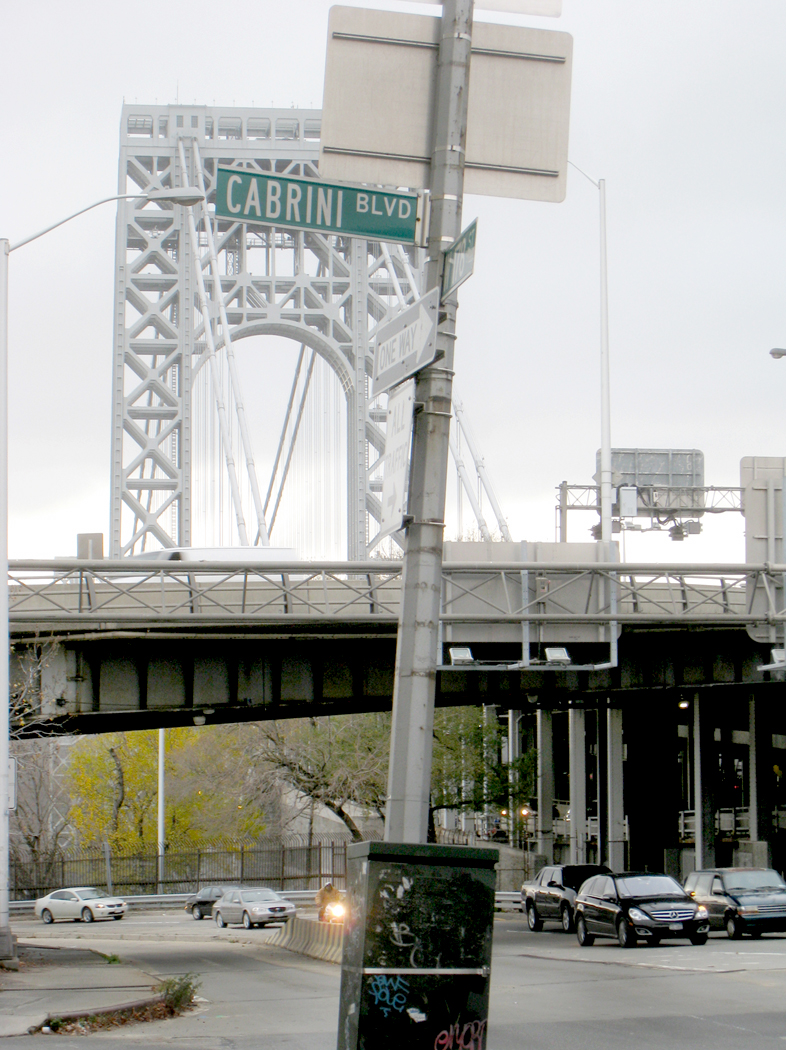
Once in Manhattan, you take a descending spiral walkway down to Cabrini Boulevard and walk up 178th Street toward the bus terminal, which was designed by Pier Luigi Nervi and opened in 1962.

cabrini blvd

From their, you catch the A-Train.

I take this walk each time I visit New York. I do this in part because it is such an invigorating hike, but it is also a pilgrimage.

My grandfather worked as an engineer during the construction of the bridge, from 1927 until his death of tuberculosis in 1930; my mother was six years old.

So although I never knew him, I feel through him a kind of inheritance, an ownership of the regal old bridge.

And like some English lord whose castle is now part of the public trust, I like sharing the experience of my bridge with others.