Archive

Tag Archives: normandy

I have traveled more widely than most, I believe. I was a travel writer for my newspaper (among other things). But even outside of vocational duties, travel has been central to my life. My late wife and I have been on the move considerably, visiting each of the 48 contiguous states many times, and gone outside the country when we could. In the summer of 1981, for instance, we put 10,000 miles on the car while driving around the country. We were both teachers and the summer gave us the chance to wander. 

There are places, however, that I have gone back to, over and over, throughout my life, not through mere happenstance, but because they have been meaningful. They are destinations for non-religious pilgrimages. 

Meaning can be hard to define. On first thought, one thinks “meaning” implies a second message: “This” means “that.” “I know what he said, but what did he mean?” That sort of thing.

But meaning has a more personal existence, a psychological one. Something can have meaning even if you don’t know what it means. I suppose you might otherwise call this significance. And there are places I visit over and over because they bear the weight of personal significance. They have meaning. And I go back to them. 
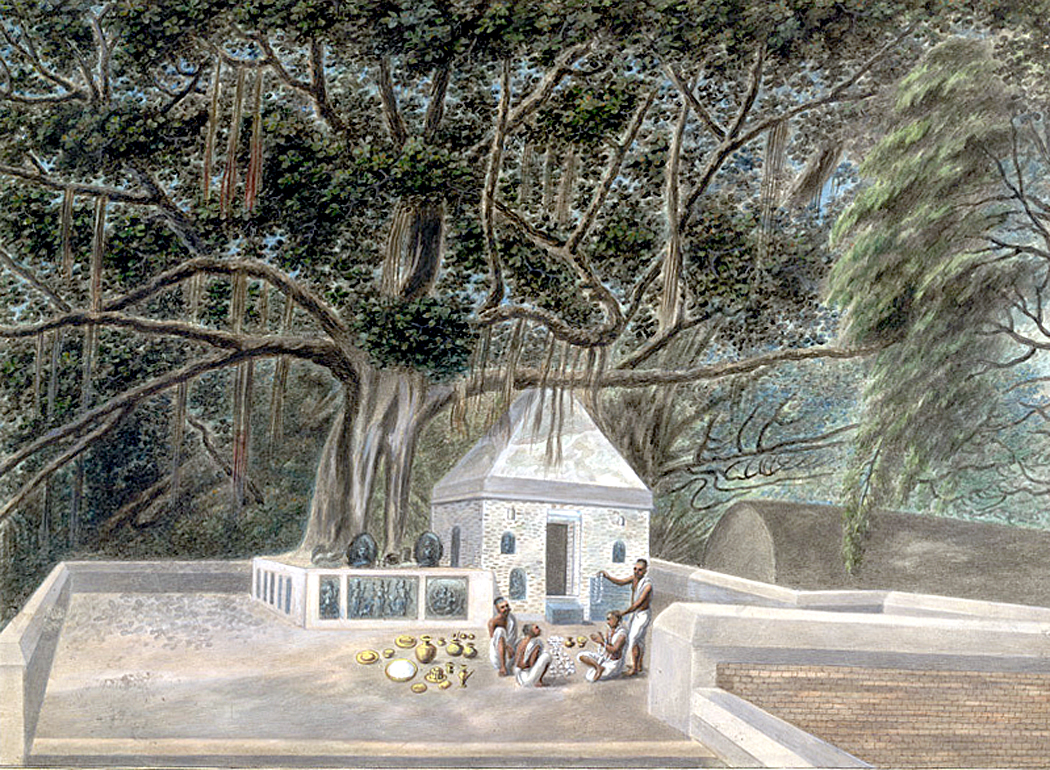
Bodhgaya

It isn’t just me. The world is full of such places, some personal, some cultural, some religious or spiritual. They can be sacred spaces or holy ground. They have accrued some emotional hold on those for whom this kind of significance has meaning. It can be the Buddhist bo tree, the Dome of the Rock, the Western Wall, Independence Hall. For a few of us, the list would include Fenway Park. These are places of social significance and people will make the hajj to see them out of devotion or just to absorb the numinous halo surrounding them. Life is empty without meaning, although what we call meaning and where we might discover it is personal. 

Meaningful places needn’t be so to groups, or to have religious importance. I have no belief in ghosts, spirits or ouija boards and I don’t believe that the past hangs on to the present to make itself palpable. But I have several times experienced a kind of emotional resonance when visiting certain famous sites. 
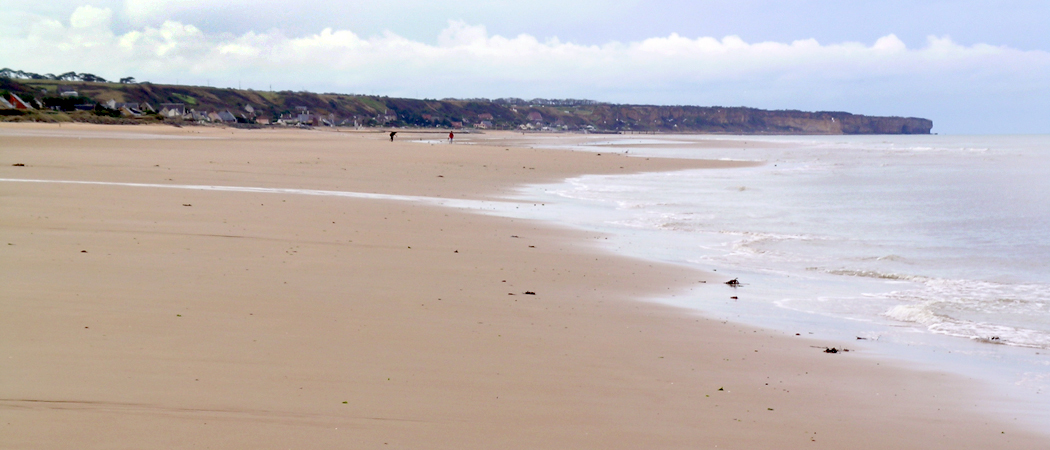
Normandy beach

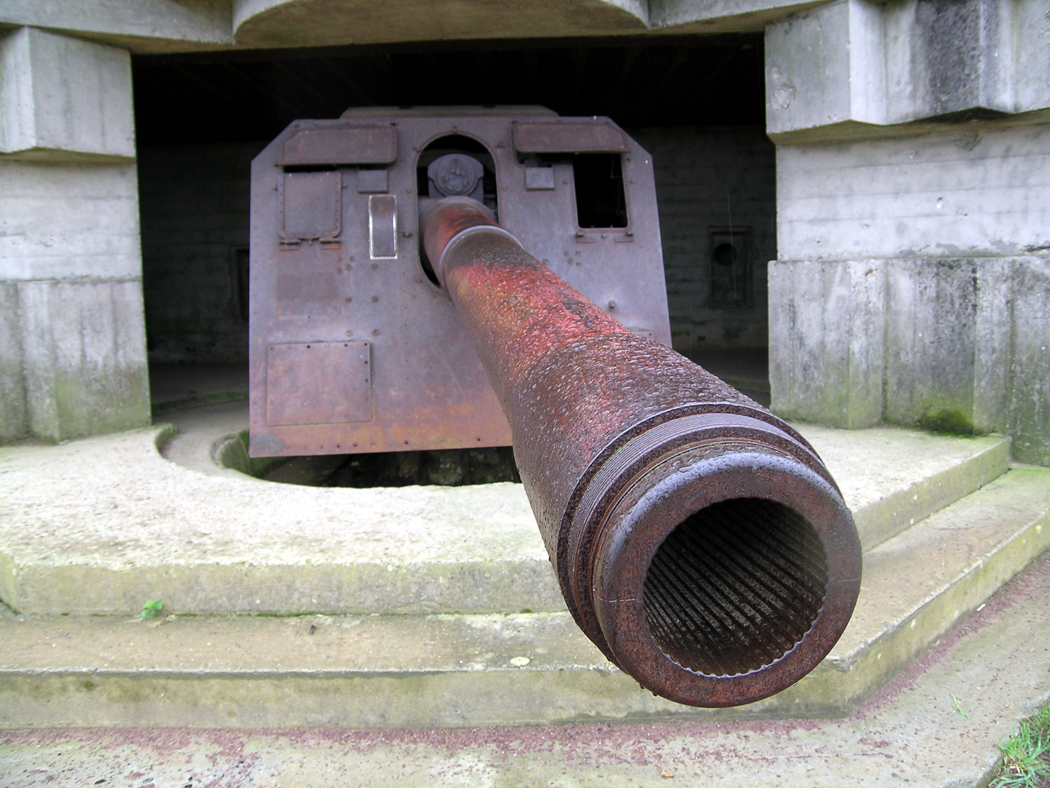
The thought re-emerged recently while watching the recent commemoration of the 80th anniversary of the D-Day landings in Normandy. I have visited those beaches and had an overwhelming rush of intense sadness. It was inevitable to imagine the thousands of soldiers rushing up the sands into hellish gunfire, to imagine a thousand ships in the now calm waters I saw on a sunny day, to feel the presence in the concrete bunkers of the German soldiers fated to die there manning their guns. 

The effect is entirely psychological, of course. If some child with no historical knowledge of the events that took place there were to walk the wide beach, he would no doubt think only of the waves and water and, perhaps, the sand castles to be formed from the sand. There is no eerie presence hanging in the salt air. The planet does not record, or for that matter, much note, the miseries humans inflict on each other, and have done for millennia. But for those who have a historical sense, the misery reasserts itself. Imagination brings to mind the whole of human agony.  

Perhaps I should not say that the earth does not remember. It can, in certain ways. Visiting the woods of Verdun in France, site of a horrendous battle in World War I, I saw the uneven forest floor, where time has only partially filled in the shell craters. Once the trees were flattened by artillery, leaving a moonscape littered with corpses. The trees have grown back, but the craters are still discernible in the wavy forest floor. The same child who thought of sand castles in Normandy might well think the churned land at Verdun merely a quirk of geology, but the land itself bears its scars. 

The presence of the dead was overwhelming at Antietam, site of the bloodiest battle during America’s Civil War. In one spot alone, a 200-yard stretch called Bloody Lane, 5,000 men were blown apart in a few short hours. 

Before Sept. 17, 1862, the brief dirt drive was called the Sunken Road, and it was a shortcut between two farm roads near Sharpsburg, Md. All around were cornfields rolling up and down on the hilly Appalachian landscape.

The narrow dirt road, depressed into the ground like a cattle chute, now seems more like a mass grave than a road. And it was just that when Confederate soldiers mowed down the advancing Federals and were in turn mowed down. The slaughter was unimaginable.

You can see it in the photographs made a few days after the battle. The soldiers fill the sunken road like executed Polish Jews. It was so bad, as one Union private said, “You could walk from one end of Bloody Lane to the other on dead soldiers and your feet would never touch the ground.”

It is difficult to stand now in Bloody Lane and not feel that all the soldiers are still there, perhaps not as ghosts, but as a presence under your boot-sole, there, as blood soaked into the dirt.

But it needn’t be horror or blood that gives meaning to a place. It may be achieved through personal association with something we lived through, or through esthetic appreciation — the sudden awareness of sublimity — or through an awareness of a less traumatic history born in a landscape. And I thought about places I have gone back to over and over; places that bear significance to me. I’m sure most of us could make such a list, whether long or short. Here are 10 of my personal pilgrimage sites that I have visited and revisited over a long life.  
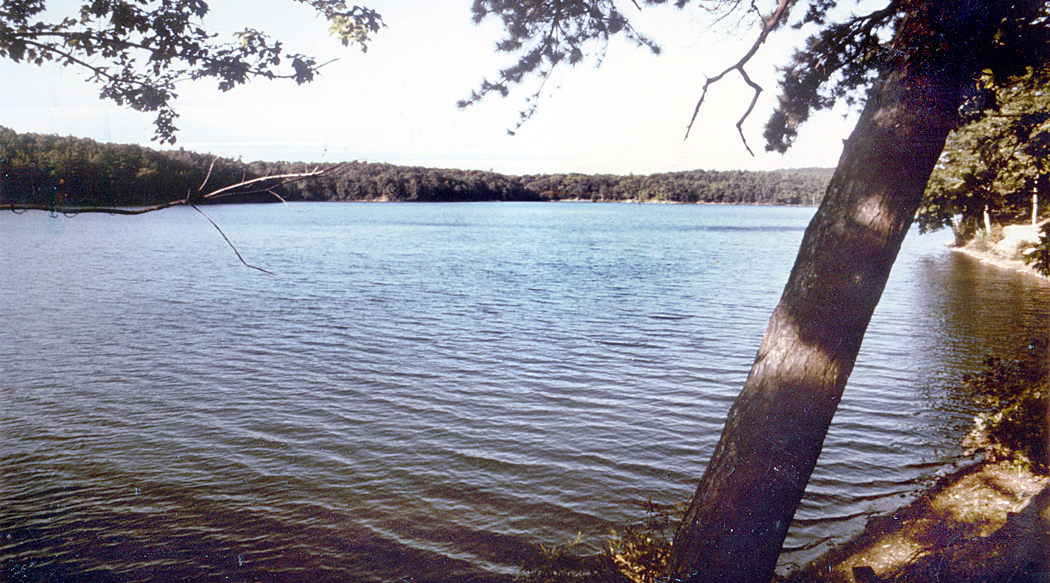
Walden Pond — I cannot count the number of times I have visited Concord, Mass., or how often I have made the pilgrimage to the glacial kettle lake just outside downtown where Henry David Thoreau built his cabin and lived for two years, and which led him to write his book about the experience. 

The most recent visit was only two years ago, passing through on my way to friends in Maine. The site now has a large parking lot and a visitor center (although the parking is primarily for summertime local beachgoers, who use Walden Pond as a swimming hole). When I first saw it, there was not much there but the water and the woods; I had to park alongside the road. 

I have circumambulated the pond, a walk of just under two miles, the first time in the early morning when a mist hung over the water and the sun slowly burned through. I have read Walden several times, and own several editions, both cheap and deluxe, and Thoreau’s other books, including his Journals, and eaten up his idiosyncratic style of writing with relish. 

Walpi

Hopi Mesas — In northern Arizona, the Hopi have built their towns primarily on three mesas, First, Second, and Third, which are really the southern fingers of the larger Black Mesa. We have visited all three mesas many times, including one snowy Christmas spent with a Hopi family we knew on First Mesa in the village of Walpi. The warmth of the hearthfire in the stone house, and the cookies we were offered, and the smiles on the faces of the children are indelible. 

Another time, we were invited to a social dance on Second Mesa in Old Oraibi, and climbed to the roof of one of the houses with the rest of the Hopi to watch and cheer the Kachina dancers. Another time, driving past New Oraibi, at the foot of Second Mesa, we were caught as traffic was halted so the sacred Kachina dancers could cross the road from where they emerged from the kiva and marched toward the plaza. We were not supposed to be there but couldn’t leave, with the Kachina traffic cop in front of us and several cars behind. We apologized profusely, but the angry cop didn’t seem to care. We shouldn’t have been there, but we also couldn’t have known a sacred dance had been scheduled for that day. 

You can stand at the cliff edge on First Mesa and look south over the Navajo Reservation, nearly to Flagstaff and marvel at the intense beauty of the Colorado Plateau. 

Chartres Cathedral — It wasn’t until our second visit to France that we managed to get to Chartres, but after that we went back over and over. The cathedral is, of course, a World Heritage Site, and a sacred place to many. But it spoke to me less of religion than of history — architecture 800 years old and still functioning for its original purpose. 

Most of the cathedrals and basilicas of Northern France have been restored and reworked (Notre Dame, before the fire, was largely re-imagined in the 19th century as it was restored by Viollet-le-Duc) but Chartres is almost entirely original. If you are sensitive to it, you can feel all that passage of time embodied in the stonework and the interior space. 

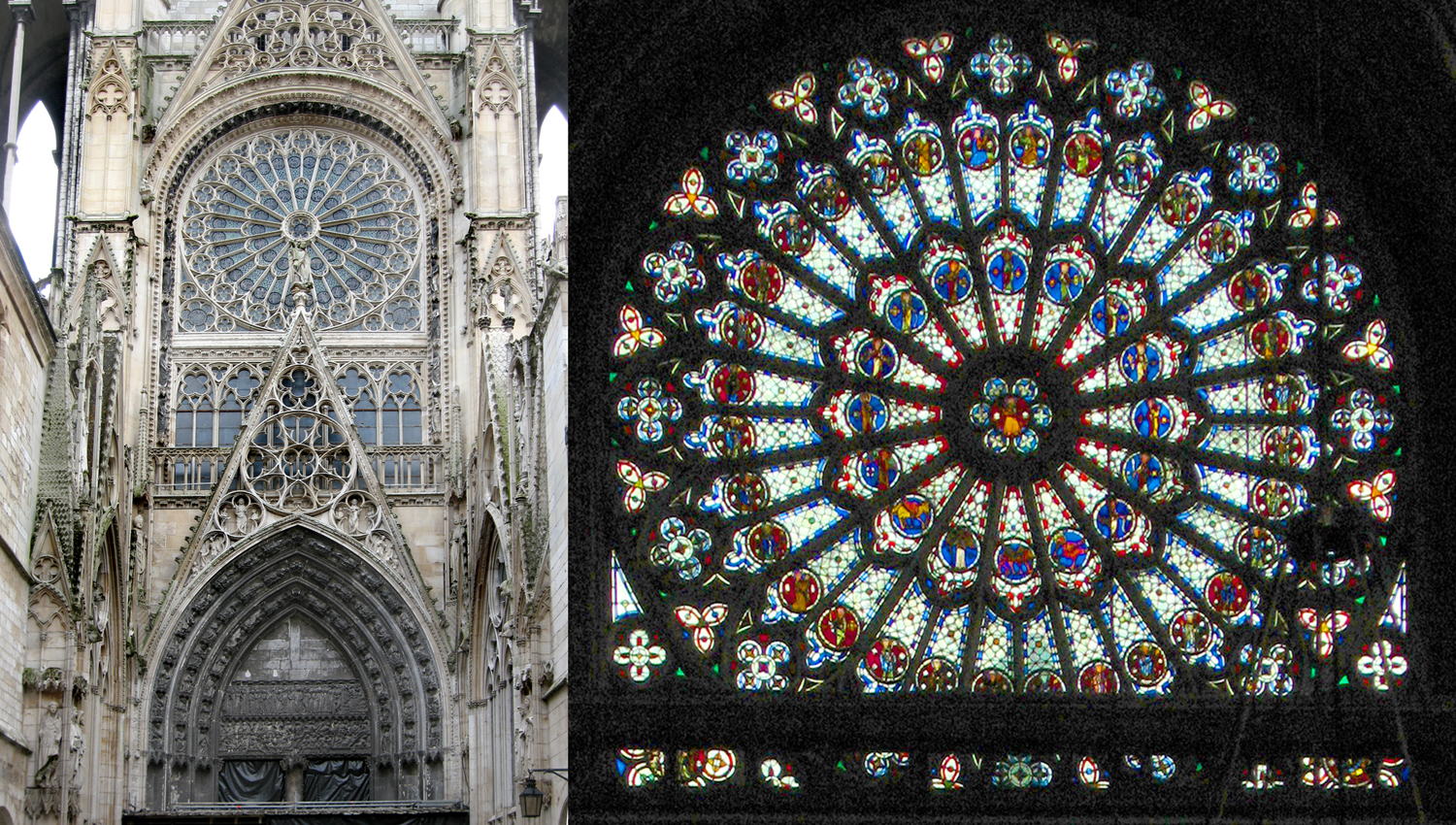
The cathedral sits at the top of a hill at the center of town, and can be seen in the distance from miles around. I have spent hours sitting in the transept meditating over the great north rose window, which remains the single most beautiful manmade object I have ever seen. The entire experience engenders awe. 

American Museum of Natural History — I was originally going to list New York City here, but then narrowed it down to Manhattan, but, really, the center of magic for me is the Natural History Museum. I first visited on a third-grade school trip and fell in love with the dinosaurs. But all through my childhood and adolescence I visited the museum as often as I could. I loved the dioramas, the dinosaur bones, the giant stone Olmec head, the huge suspended blue whale — even the “Soil Profiles of New York State.” To say nothing of the room full of chunks of quartz, each with a little typed tag explaining where it was collected. 

I could also have mentioned the George Washington Bridge, which my grandfather helped build; he was an engineer working on the bridge in the 1930s. Through most of my life, when living in or visiting New Jersey, I would take the bus to the bridge and walk across the bridge to 178th St. I have walked the bridge too many times to count. 

The Outer Banks — I went to Guilford College in North Carolina beginning in 1966 and soon met lifelong friend Alexander and we made annual camping trips to Cape Hatteras, usually in winter when the beaches were empty. Later, my first wife and I spent our honeymoon camped directly under the lighthouse. It was February and the regular campsites were closed, and so we pitched our tent in the dunes. 

I have been back over and over, with each succeeding wife or possl-q, although as I got to be old, we tended to sleep in motel rooms. When my brother began teaching in Virginia, he lived at the northernmost bit of the Outer Banks, Sandbridge, and when visiting I often made a side-trip back down to Hatteras and Okracoke. 

Once, with Alexander, we went after a huge storm, and parts of the road were washed out just north of the lighthouse. He got out of the car and walked in front, feeling the asphalt under his feet and leading me safely past the overwash. Another time, at night, we walked down to Cape Point with a Coleman lamp projecting our shadows, like giants, up into the misty black sky. 
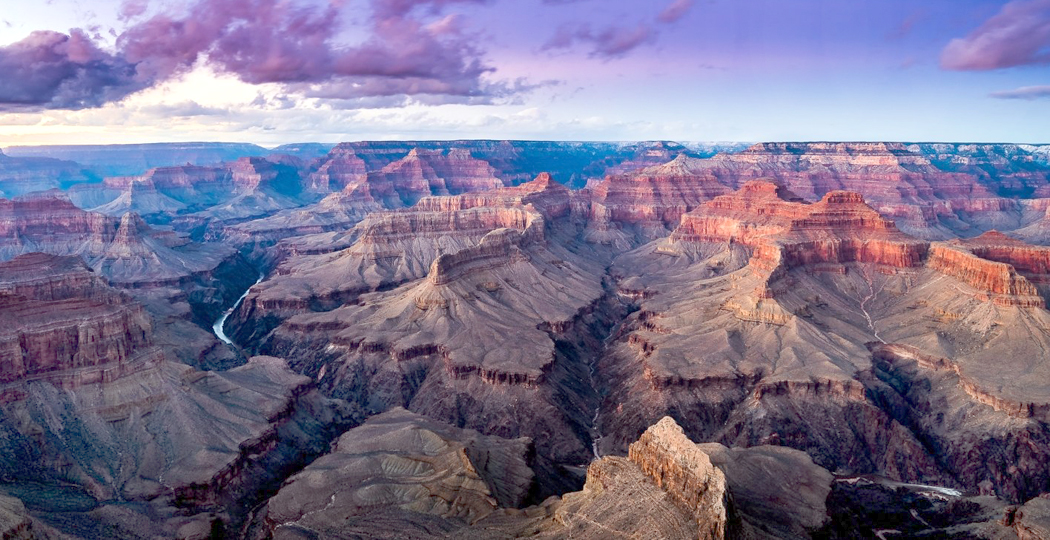
Grand Canyon — My brother once observed that unlike most hyped destinations, where you are always at least a tiny bit disappointed when you finally get there, the Grand Canyon is actually more impressive, more overwhelming, when you actually see it live: It never lets you down. It is 200 miles of vast geology, color, and depth. 

We lived in Arizona for 25 years and so I cannot number the times we visited the Canyon, mostly the South Rim, where most of the tourist action happens. But the second time we came, in 1982, we went to the North Rim and when we couldn’t get a room at the hotel there (it is always full), we went out of the park after dusk into the national forest, where it is legal to camp anywhere, and pulled into a side road in the dark. In the morning, we got out of the tent and discovered that if I had backed the car up 10 feet  further, we would have tumbled down into the canyon. We were right on the edge. 

And once, on assignment from the paper, I drove 60 miles off road to the Toroweap Overlook, also on the North Rim, but in pure wilderness where only a rare person ventures, and camped away from all city lights, where the night sky was neon in intensity. 


Hudson River Valley — I grew up in northern New Jersey, in the apotheosis of suburbia. But my father’s family had a rustic house — a “bungalow” — in West Park, N.Y., halfway up the Hudson River, and we spent many summer vacations, and at least one winter ski vacation, at the bungalow. It was the town where the once-famous nature writer John Burroughs lived. There was woods, a swimming hole with a waterfall. 

But up and down the river, from Dunderberg through Bear Mountain and the Seven Lakes Drive, it was the escape from the ordinariness of the suburbs. We regularly went swimming in the summer at Lake Welch, or watched ski jumping at Bear Mountain. 

In 1986, we drove up Perkins Drive to the top of Bear Mountain, during an outbreak of gypsy moth caterpillars. The tower at the top was covered in a sheath of hairy worms and the ground was gooey with the squashed ’pillars. It was eerie and more than a little stomach churning. 

The bungalow at West Park

The Nilsen family drove up Route 9W on summer weekends to visit the bungalow, and the three-lane highway had to curl around Storm King Mountain, a section of road that made my cautious father extremely nervous with a sheer drop down the edge to the river. They are gone now. That portion of 9W has now been re-routed and the treacherous third (middle) lane now long gone. Near Haverstraw, the “Ghost Fleet” of WWII-era liberty ships were moored. They are gone now. So is the bungalow. I am sorry for that. 

From the Palisades up through the Catskill Mountains, the Hudson River is holy ground, as far as I am concerned. It glows with the inner light of myth. 
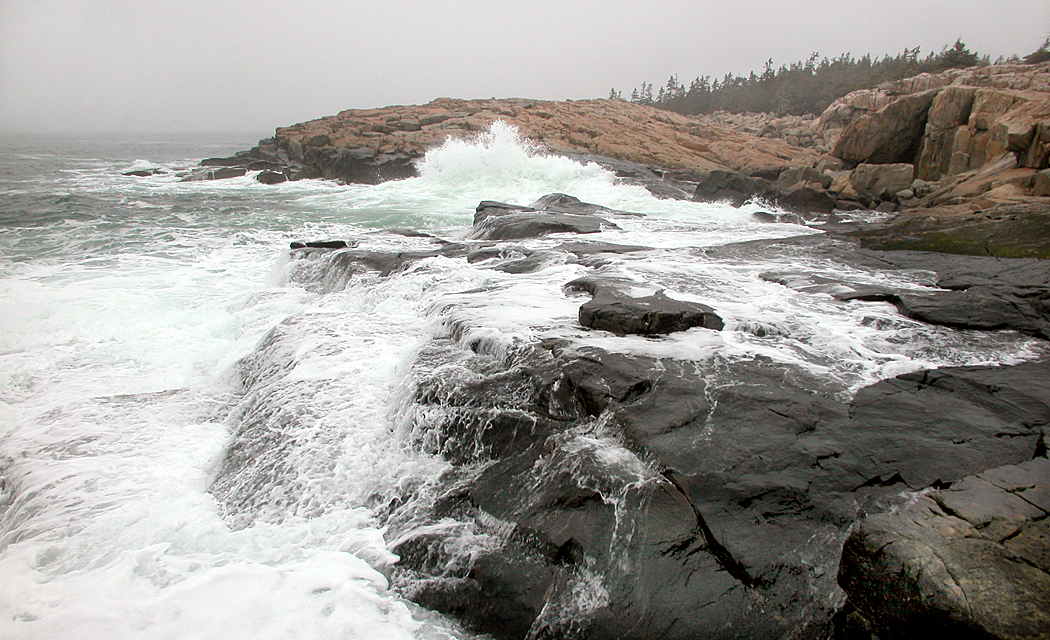
Schoodic Point — Maine is its own mythology, and like the city of New York, I was going to include the whole state in my list, but likewise, I have narrowed it down to the place that I have been back to over and over for the longest. I first visited Maine as an infant when my parents took a trip there. I can’t say I have any memory of then. But subsequently, I have been there many times, now to visit my friends Alexander and Mary Lou. I’ve traveled the whole state over, camped at Mt. Katahdin, driven round Mooselookmeguntic Lake, reached the summit of Cadillac Mountain on Mt. Desert Island, took the tour of the paper mill in Millinocket — and you can get there from here. 

But the mythic center of Maine for me has been the rocky bit of coastline that juts out into Frenchman’s Bay north of Acadia National Park, called Schoodic (with the double “O” pronounced as the “oo” in “good.”) It is one of those windswept romantic landscapes where the spume blows into your face, the waves crash against rock with an explosive boom, and the sky, water, and land still seem of one substance. 

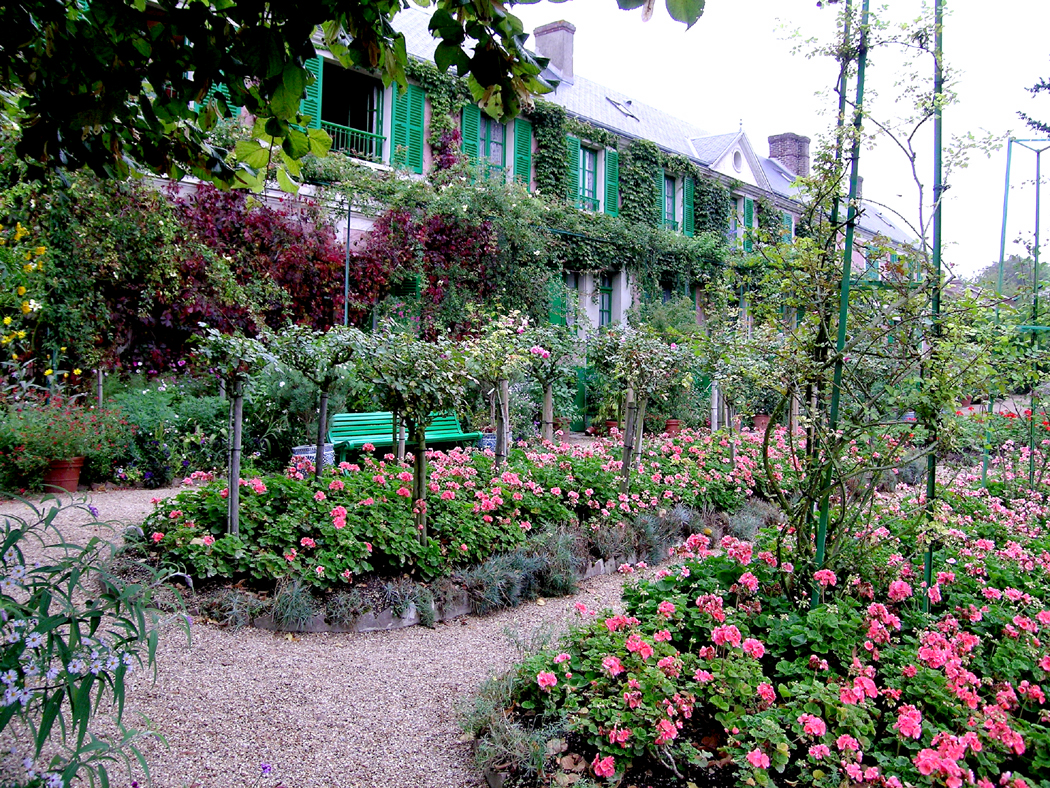
Giverny — I’ve been to Monet’s house and gardens three times, once in the spring and twice in the fall. He and his family lived in the small town 50 miles north of Paris, from 1883 until his death in 1926, and many of his greatest works were made there, primarily his extensive series of water lily paintings. 

I had become familiar with some of those wide canvases in museums in New York and at the Carnegie Museum in Pittsburgh. And I had been inspired to make scores of photographs of waterlilies in imitation of Monet’s paintings. 


But the chance to get to see the genuine article in situ, in the grand gardens in Giverny was a pilgrimage from the get-go. One enters, of course, with curiosity, but also with reverence. 

Austin house

Rock Castle Creek, Woolwine, Va. — Some of the happiest and unfettered moments of my life have been spent on the porch of the Austin house along Rock Castle Creek in Virginia. I have been back many times, beginning during my college years, when a group of Guilford students hiked the five or so miles up the creek, fording over logs, and reaching the 1916 farmhouse, with its spring house and barn. 

With my companion, or with a group, we would break into the house (not recommended, for legal reasons) and roll out our sleeping bags on the floor. At night in the summer, the field in front of the house was a galaxy of blinking lightning bugs. 

At the end of Bergman’s film, Wild Strawberries, the old professor Isak Borg, lies in bed after a tumultuous day, full of cares and regrets, and in voice over, says, “If I have been worried or sad during the day, it often calms me to recall childhood memories,” and he thinks of a time he saw his parents together, with his father fishing. It soothes him and he sleeps peacefully. For me, that moment of pure calm happiness that I recall is of sharing a hammock with my beautiful red-headed mate on the second floor porch of the Austin house and watching the sun go down over the creek and meadows beyond. Such moments consecrate a place. 


These are all places I have gone back to multiple times. But there are places where I have only ventured once that still have that emotional buzz that signifies a sacralized locale. These may be places set aside by history or by personal experience, or simply by their extraordinary natural setting. 

We all have such places, and they while they may be widely shared, such as the World Trade Center, they are just as often special only to one or a few people. Places where we stand in awe, and may not even be able to speak. 

From top right: Cape of Good Hope; Gaspe; Montauk; Finisterre

For me, many have been where the land runs out and the seas begin. There is something about the extremity, the sense of the limitations of land and the seeming infinity of the watery horizon. I seek them out, such as the Gaspé Peninsula, Long Island’s Montauk Point, Brittany’s Finisterre, or South Africa’s Cape of Good Hope. At my age, I know my existence shall soon run out and the dark infinite void is the horizon, and that I will not likely ever get to visit such places again. 

And I have been to Civil War sites where I felt the ghosts in the soil: places such as Shiloh, Vicksburg, Appomattox, Gettysburg, Petersburg, Bull Run, Chancellorsville, Fredericksburg, and Five Forks. And important places in the Western expansion: Sand Creek, Little Bighorn, Wounded Knee, Washita. Japanese internment camps at Manzanar and Poston. And to the Lorraine Motel in Memphis, where Dr. King was shot; and the slave quarters at the Oakley Plantation in Louisiana. All places where death and suffering are felt in the air breathed there — at least to anyone with an awareness of history. 

Mt. Saint Michel

And I could list many less fraught places with their own resonance that I have only visited once, but that have created space in my psyche: Mt. Saint Michel; Big Bend National Park; the catacombs in Paris; the caves at Lascaux; the town of Moosonee on James Bay in Ontario; the Okefenokee swamp in Georgia; Mt. Angeles in Washington’s Olympic Mountains; Hallingskarvet mountains in the spoon of Norway; Chaco Canyon; Taliesin in Wisconsin; Ice Water Springs in the Smokies; the Salton Sea; Glacier Bay in Alaska. 

Each of these places has become a part of me. They are my sacred spaces. 

Click any image to enlarge

I have no belief in ghosts, spirits or ouija boards and I don’t believe that the past hangs on to the present to make itself palpable. But I have several times experienced a kind of spooky resonance when visiting certain famous battlefields. 

The thought re-emerged recently while watching a French TV detective show that was set in Normandy, and seeing the panoramas of the D-Day landing beaches. I visited those beaches a few years ago and had an overwhelming rush of intense sadness. It was inevitable to imagine the thousands of soldiers rushing up the sands into hellish gunfire, to imagine a thousand ships in the now calm waters I saw on a sunny day, to feel the presence in the concrete bunkers of the German soldiers fated to die there manning their guns. 

The effect is entirely psychological, of course. If some child with no historical knowledge of the events that took place there were to walk the wide beach, he would no doubt think only of the waves and water and, perhaps, the sand castles to be formed from the sand. There is no eerie presence hanging in the salt air. The planet does not record, or for that matter, much note, the miseries humans inflict on each other, and have done for millennia. 

But for those who have a historical sense, the misery reasserts itself. Imagination brings to mind the whole of human agony. 

Perhaps I should not say that the earth does not remember. It can, in certain ways. Visiting the woods of Verdun I saw the uneven forest floor, where the shell craters have only partially been filled in. Once the trees were flattened by artillery, leaving the moonscape littered with corpses. The trees have grown back, but the craters are still discernible in the wavy forest floor. 

This sense came to me first many years ago visiting the Antietam battlefield in Maryland. There is a spot there now called Bloody Lane. Before Sept. 17, 1862, the brief dirt drive was called the Sunken Road, and it was a shortcut between two farm roads near Sharpsburg, Md. All around were cornfields rolling up and down on the hilly Appalachian landscape.

The narrow dirt road, depressed into the ground like a cattle chute, now seems more like a mass grave than a road. And it was just that in 1862, when during the battle of Antietam Creek, Confederate soldiers mowed down the advancing Federals and were in turn mowed down. The slaughter was unimaginable.

You can see it in the photographs made a few days after the battle. The soldiers, mostly Southerners, fill the sunken road like executed Polish Jews. It was so bad, as one Union private said, “You could walk from one end of Bloody Lane to the other on dead soldiers and your feet would never touch the ground.”

Even today, with the way covered with crushed blue stone, the dirt underneath seems maroon. Perhaps it is the iron in the ground that makes it so; perhaps it is the blood, still there after 160 years.

Antietam was the worst single day of the Civil War. Nearly 23,000 men were killed or wounded. They were piled like meat on the ground and left for days before enough graves could be dug for them. There were flies, there was a stench. The whole thing was a fiasco, for both sides, really.

But all these years later, as you stand in Bloody Lane, the grassy margins of the road inclining up around you and the way lined with the criss-cross of split-rail fencing, it is painful to stand in the declivity, looking up at the mound in front of you, covered in cornstalks in a mid-July day. You can see that when the Yankees came over the rise, they were already close enough to touch. There was no neutralizing distance for your rifle fire to travel, no bang-bang-you’re-dead, no time, no room for playing soldier. Your enemy was in your face and you had to tear through that face with lead, the blood splattered was both Federal and Confederate, in one red pond among the furrows. In four hours on 200-yard stretch of Bloody Lane, 5,000 men were blown apart.

It is difficult to stand in Bloody Lane and not feel that all the soldiers are still there, perhaps not as ghosts, but as a presence under your boot-sole, there, soaked into the dirt.

It is almost, as some cultures believe, as if everything that happens in a place is always happening in that place. The battle was not something that occurred before my great-grandfather was born, but a palpable electricity in the air. You can not stand there in Bloody Lane and not be moved by that presence.

A similar wave of dismay overcame me at several Civil War sites: Shiloh; Vicksburg; Fredericksburg; Cold Harbor; Petersburg; Appomattox. Always the images rise in the imagination. Something epochal and terrible happened here. 

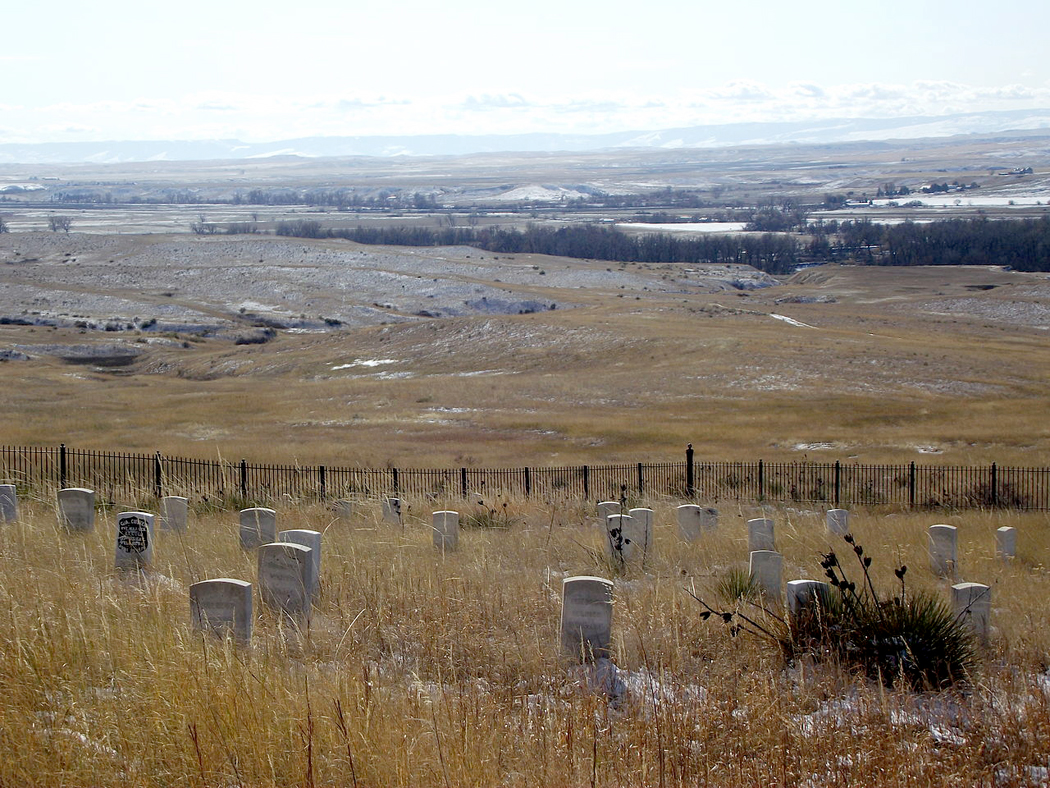
Visiting the Little Bighorn Battlefield in Montana, there are gravestones on the slope below the so-called “Last Stand,” but you also look down into the valley where the thousands of Sioux and Cheyenne were camped. 

I’ve visited Sand Creek and Washita. And Wounded Knee. That was the most disturbing. You travel through the Pine Ridge Reservation and the landscape is hauntingly beautiful, then you pull into the massacre site and you see the hill where the four Hotchkiss guns had a clear shot down into the small ravine where the victims huddled. The sense of death and chaos is gripping. The famous image of the frozen, contorted body of Big Foot  glowers in the imagination. It feels like it is happening in a past that is still present. 

This sense of horror and disgust wells up because of the human talent for empathy. Yes, I know full well that there are no specters of the victims waiting there for me, but my immediate sense of brotherhood with them resurrects them in my psyche. I am human, so I know that those dead were just like me. I can imagine myself bowel-loosening scared seeing my comrades to either side being blown to pieces and an enemy who I’ve never met and might have been friends with races toward me with bayonet stretched in front of him, eyes wide with the same fear. 

History is an act of the imagination. The most recent may be memory, but for me to know what my father went through in France and Czechoslovakia in World War II requires my identification with him, my psyche to recognize the bonds I share with him — and with all of humanity. 

So, when visitors are shaken by visits to Auschwitz or stand on the plains of Kursk, or the shores of Gallipoli, they well may sense that history as more present than past. I have had that experience. The ghosts are in me.

rouen-facade-sunny

Visiting the churches, basilicas and cathedrals of Gothic northern Europe can be an intoxicating experience, and one can find oneself drugged into excessive panegyric. One recalls the excessive gushing of early 19th century writers and artists over the Romantic Middle Ages, with their knights in shining armor, courteous chivalry, and ladies in distress: Strawberry Hill, La Belle Dame sans Merci, Ivanhoe, et al.

rouen-chandelier

Certainly, a visit to Chartres or Sainte-Chapelle leaves one almost breathless in the sublimity of the interior space, the vaulting of heaven, the light through the stained glass. It is easy to become drunk with love for such buildings. But you should be careful not to fall into idolatry. They were, after all, built by human beings, and like their makers, can be imperfect.

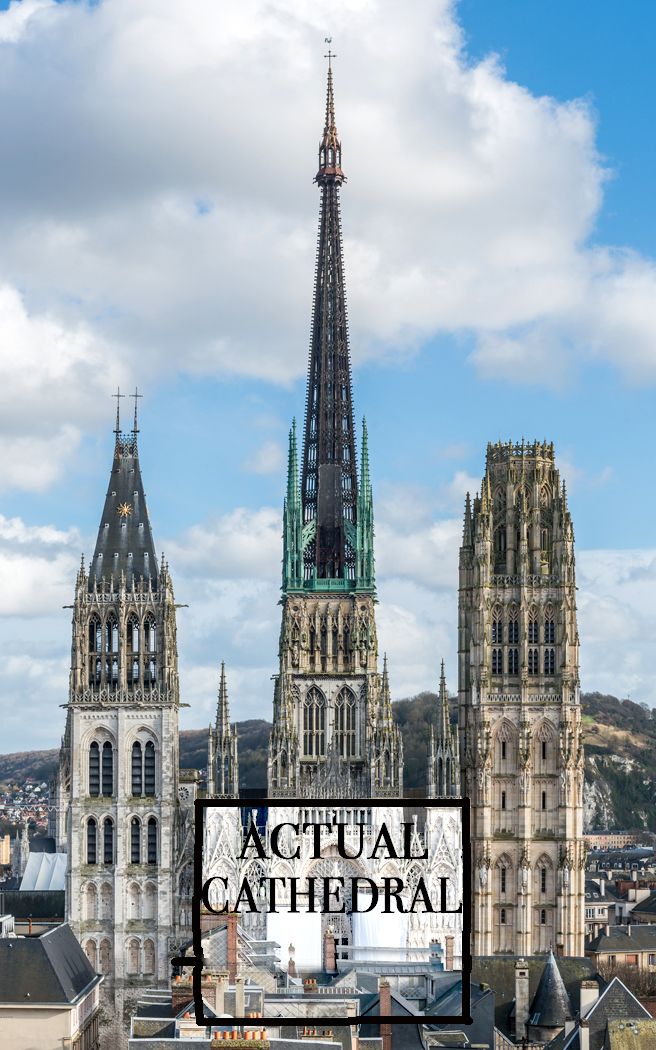
Rouen Cathedral as seen from Gros HorlogeThe antidote to such architectural genuflection can be a visit to a Gothic cathedral that fails to rise completely to such admiration. For me, that moment came on seeing the monster at the heart of Rouen in Normandy. Rouen cathedral bullies the town, dominating the city with its giant spire, so out of proportion.

There is a perfectly good cathedral in the middle of it all, but it is buttressed on both shoulders by giant towers so out of scale as to seem like prison guards hectoring the poor dwarf between them, and then topped with a Victorian-era cast-iron steeple that is twice the height of the church itself. It is this Gothic designed taffy-pulled into parody.

Inside, the cathedral is spare. It was badly damaged by bombs during World War II, and most of the stained glass has been replaced by clear frosted glass. This makes the interior brighter than in most cathedrals, but also makes it look, as Rick Steves says, “like the largest mens’ room ever.”

rouen-nave-toward-apse

It is hard to recognize just what the Victorian critic John Ruskin was thinking when he wrote of Rouen, “It is the most exquisite piece of pure Flamboyant work existing. There is not one cusp, one finial, that is useless, not a stroke of the chisel is in vain; the grace and luxuriance of it all are visible — sensible, rather, even to the un-inquiring eye; and all its minuteness does not diminish the majesty, while it increases the mystery of the noble and unbroken vault.” Ruskin may have been smoking something.

That is the kind of gushing I believe a modern visitor to Rouen will find quelled by simply looking at what is in front of him. Ruskin, it seems, was still blotto on the overkill of breathy Victorian enthusiasm.

rouen-angled-facade

Historians like to divide the Gothic idea into subsets, early, high, rayonnant and flamboyant styles. Rouen, as it exists now, is primarily the last, gauded up with all kinds of filigree and tracery. Its west facade (aka, its front), is so detailed as to make it impossible to take it all in as a single entity. This is made worse by the twin towers muscling the central building into a cowering detainee. The older tower, the Tour St. Romain, sits to the left (to the south), and rises on decaying brick and stone. The newer one, the so-called Butter Tower, was added much later to balance the earlier one, and re-establish symmetry. The result is that the building’s footprint is wider than it is tall (not counting the spire, but just the actual nave and aisles huddled below) and therefore negating the whole upthrusting heavenward leap most characteristic of Gothic church architecture. Instead of reaching for the heavens, it seems as wide as a warehouse.

Most of the Medieval churches were constructed piecemeal over centuries, and in almost every case, styles changed over that time, and so Gothic architecture is an especially heterogeneous one: unity out of difference. Rouen takes that idea and runs with it. It was begun in 1035 on the ruins of a previous Romanesque site that had burnt down. Since then, the history of Rouen is one of calamity and rebuild. This constant reboot has made it a less harmonious jumble than one finds elsewhere, of ad hoc fixes, misguided redesigns and megalomaniac civic striving.

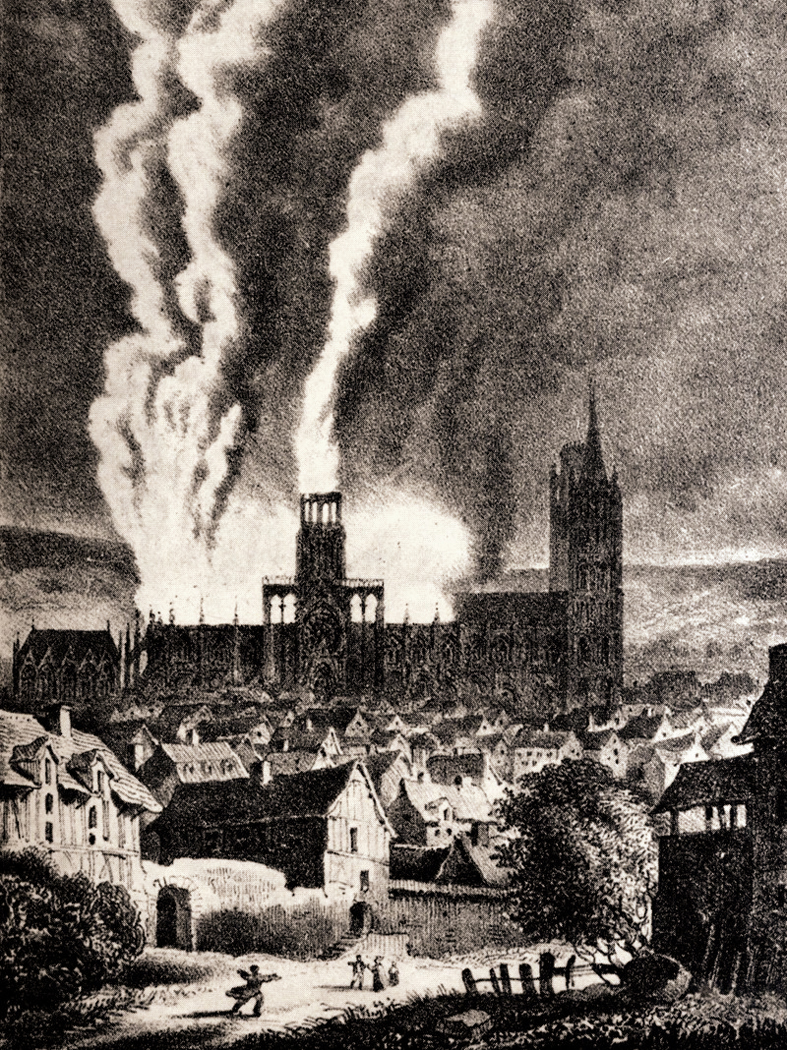
spire-destroyed-by-fire-in-1822It is the Peter Abelard of cathedrals, and a book could be written on the history of its misfortunes. The previous cathedral was struck by lightning in 1110, and construction began on the current building. The new one burnt again in 1200, destroying all but the nave arcades, the Saint-Romain tower and the left portal, with work ending in 1250. It was struck again by lightning in 1284, was partially taken down and rebuilt in 1302, the spire was blown down in a wind storm in 1353. The construction of the Butter Tower in the 16th century led to disturbances in the facade, which had to be reinforced (finished 1530). The original Gothic spire had burned down in 1514 and was finally replaced by a wooden spire covered in gold-plated lead in 1580, paid for, in part, by the selling of indulgences. In 1562, it was damaged by rebelling Calvinists  during the Wars of Religion, when much of the statuary and windows were destroyed. The cathedral was struck again by lightning in 1625 and 1642, damaged by a hurricane in 1683. The choir burnt in 1727 and a bell broke in 1786. During the French Revolution, the church, like many in France, was deconsecrated and turned into a civic building and metal parts of the church were melted down to make cannons and cannonballs. The spire was again blasted by lightning in 1822 and a new one made from cast iron added in 1876 (making it the tallest building in the world until displaced from atop the list four years later by the cathedral at Cologne. (Then to the Eiffel Tower in 1889).

rouen-wwii-2The misfortunes continued. In 1940, a fire damaged the building’s structure and burned that part of the city from the church to the Seine river, and later during World War II, the cathedral was bombed twice, first by the British, then by the Americans, just before D-Day. Parts of the south aisle were destroyed and the south tower burned. Much of the remaining stained glass was blown out, leading to the current situation with frosted glass in many of the windows.

Then, in 1999, a cyclone named Lothar destroyed one of the four wooden turrets surrounding the central lantern tower was blasted and fell crashing into the choir. The history of Rouen’s cathedral is one of constant upkeep and rebuilding, like trying to sustain a sand castle against the tide.

Yet, if the building seems a disappointment after Notre Dame de Paris, after Chartres or St. Denis, perhaps I am being too hard on it. It still has many redeeming details, and some very ancient survivors, like the north portal, or St. John the Baptist Portal. In its tympanum one sees the story of the prophet, Salome’s dance (more an gymnastics exhibition), the beheading of John and the presentation of his head on a platter. It was created in the 12th century and has survived fire, storm and the ravages of war.

rouen-tympanum

Then, there is the Booksellers’ Stairway (Escalier de la Librairie), which once led to the archives of the chapter, begun in 1479 and completed in 1788. And also on the north side is the only rose window that retains its stained glass, over the Portail des Libraires, created in the late 14th century by the artist Guillaume Nouel. The rose is partially blocked, but still can be seen. (The opposite rose window, above the Calende Portal in the south transept, is clear glass).

rouen-booksellers-rose-window-pair

There are some delightful tapestries hanging in the arcade between nave and aisle.

rouen-tapestry-1

Also, there is the Lady Chapel, growing out of the apse, like an elongated caterpillar, are some excellent windows and a huge 17th century altarpiece dedicated to the Virgin. The Lady Chapel (that is Our Lady — the Virgin Mary) was built in rayonnant style beginning in 1302 to replace an earlier, smaller chapel.

rouen-chapel

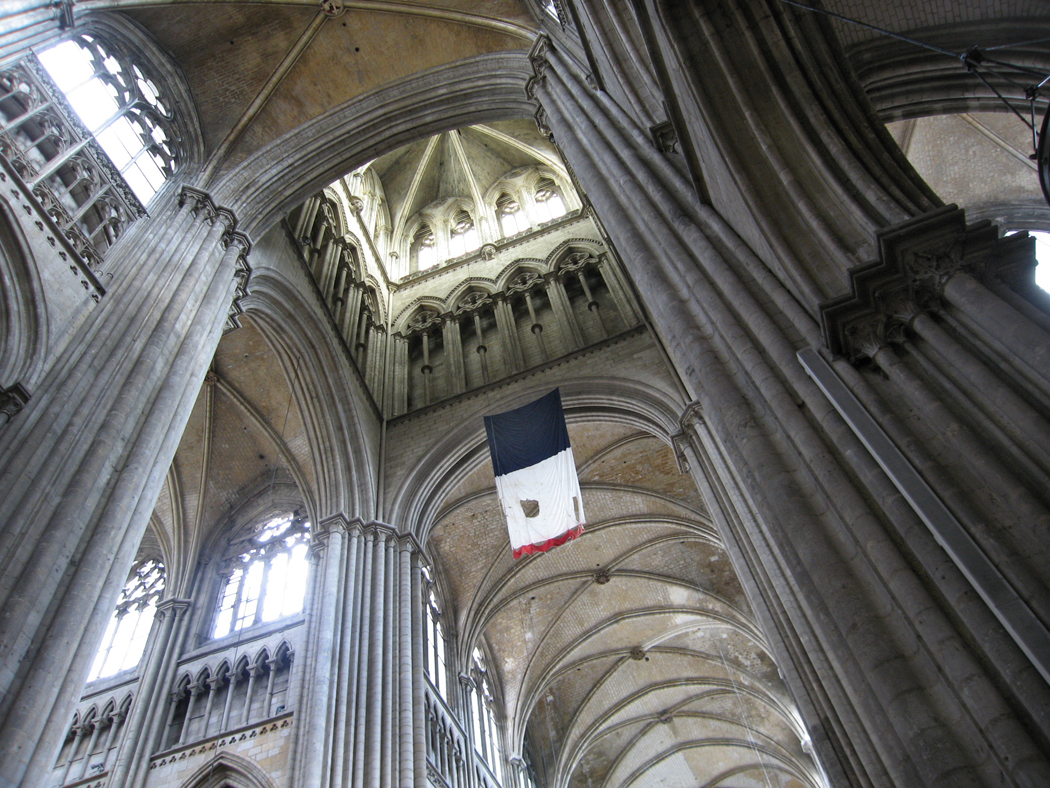
And rising from the crossing of the transept is the opening in the ceiling that leads upward to the spire. While the vaulting is impressive enough, it is ever more striking to see the empty space defined by the interior of the nave opened up even higher, as if the incense and prayers could escape heavenward through it, like smoke through a chimney hole in Medieval dwelling. The vast spire tower and the godawful cast-iron spire are supported by four grand pillars marking the crossing of nave and transept, but even with those giant supports, the ceiling and the hole in it inspire an exceptional sense of what you could call “spiritual uplift,” as if the chimney had an efficient updraft.

rouen-tricolor

Nowadays, the parvis (plaza in front of the cathedral) is notably commercial, with an underwear store across from the triple portals —

rouen-lingerie-shop-window

the western exterior of the church has nevertheless inspired one of the great painting series of the Impressionist era. Claude Monet painted that cathedral front something like 30 times, in sun, shade, rain, moonlight and in morning, afternoon, and night. The paintings are now spread around the world in various museums.

The painter would set up his easel — sometimes easels — across from the church and paint on one canvas in the morning to catch the first glow of light, then switch to another canvas later on to paint the afternoon light. He might switch canvases many times, over days and weeks, to catch the various effects.

I couldn’t do that in my short visit to Rouen, but I did photograph the cathedral throughout the day to make my own mini-Monet spread.

rouen-poster-2


Click on any image to enlarge
house
The Seine  river loops northwest out of Paris into the rich, green French countryside of Normandy. The river is contained by low parallel ridges of hills on either side that form a kind of geologic sluice guiding the flow of the river toward Le Havre  and the ocean.

Some 50  miles from Paris, near the provincial town of Vernon,  the River Epte joins the Seine, although to call the Epte a river is to exaggerate.

It is hardly more than a creek.

Nothing would make one notice this tiny riverine junction, if it were not that Claude Monet chose this area to live, to paint, and to create one of the most celebrated gardens in the world.path

The great Impressionist painter moved to the hamlet of Giverny (Zhee-vair-nee) in 1883, and from then until his death in 1926,  he cultivated the kind of garden that made his home a modern Eden. Even now it is as much pilgrimage destination as tourist attraction.giverny village street

“Once settled, I hope to produce masterpieces,” Monet wrote his dealer when he first came to Giverny, “because I like the countryside very much.”

Monet settled on a two-acre parcel of land that sloped from the center of the village down toward the small branch of the Epte that runs parallel to the road. There he set up house with his second wife, Alice Hoschedé, and their combined brood. It was a bustling bourgeois home, full of bustles and lace, children and cakes.flower 1

The house still exists: an odd old farmhouse, it is only one room wide and long as a barn, made of pink stucco, with forest green shutters and doors.

Each room is painted in its special color – the kitchen is blue and the dining room is brilliant yellow. Monet had little use for beige.clos normande from window

Outside is the “clos Normand,”  or the Norman enclosure, where Monet immediately began planting his garden, “so that there would be flowers to paint on rainy days,” he wrote.

But the garden took over. By the time he set to work on the great waterlily paintings that he gave to the nation as a gift, he had six gardeners on his staff.flower 2

Thousands each year make the pilgrimage to Giverny. They want to see where Monet worked; they want to see the waterlilies that he made into icons of art. But the gardens still retain their independence: There are those who visit not because of the painter, but because of the flowers themselves.

Monet’s property has become one of the greatest gardens in the world.

In the summer, the place is crowded, but in the spring and fall, the tourists fade away and you can have the grounds to yourself, or nearly so.flowers against wall

One would think that in the middle of October, when the rains are already cold on your skin, the flowers would have died away, but it is not true.

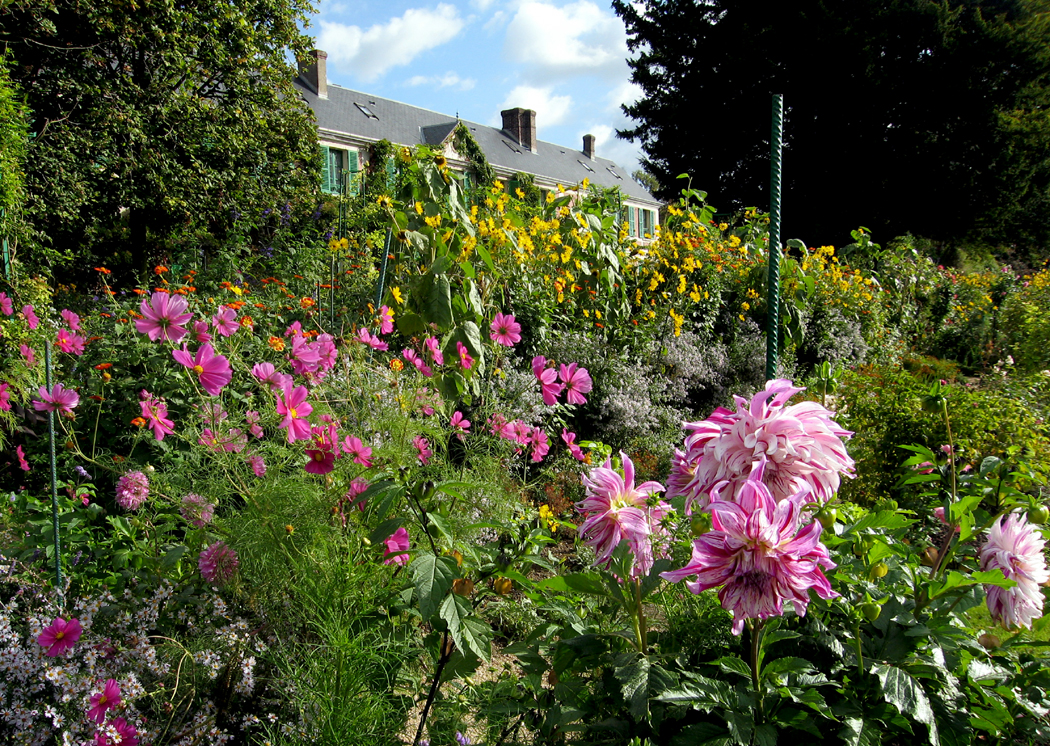
Even then, the clos Normand is riot with the yellows of sunflowers, the reds of dahlias, the blues of asters and the pinks of cosmos. The garden paths are choked with flowers.clos normande

It was an effect that Monet sought: that weedy nature should take over the place, luxuriant in growth.

The formal French garden, as you find it in Versailles or the Tuileries, is orderly and tamed. Square and round plots, with a grid of garden path between. Every flower marches in rank and file, as if their gardeners were drill sergeants.clutter

In distinction, the English garden gives us a different vision of nature.

There, the meandering forest paths take us past informally planted shrubbery and flower beds, to provide the illusion that we are not in a garden at all, but rather walking through some especially lush bit of wildness.flower 3

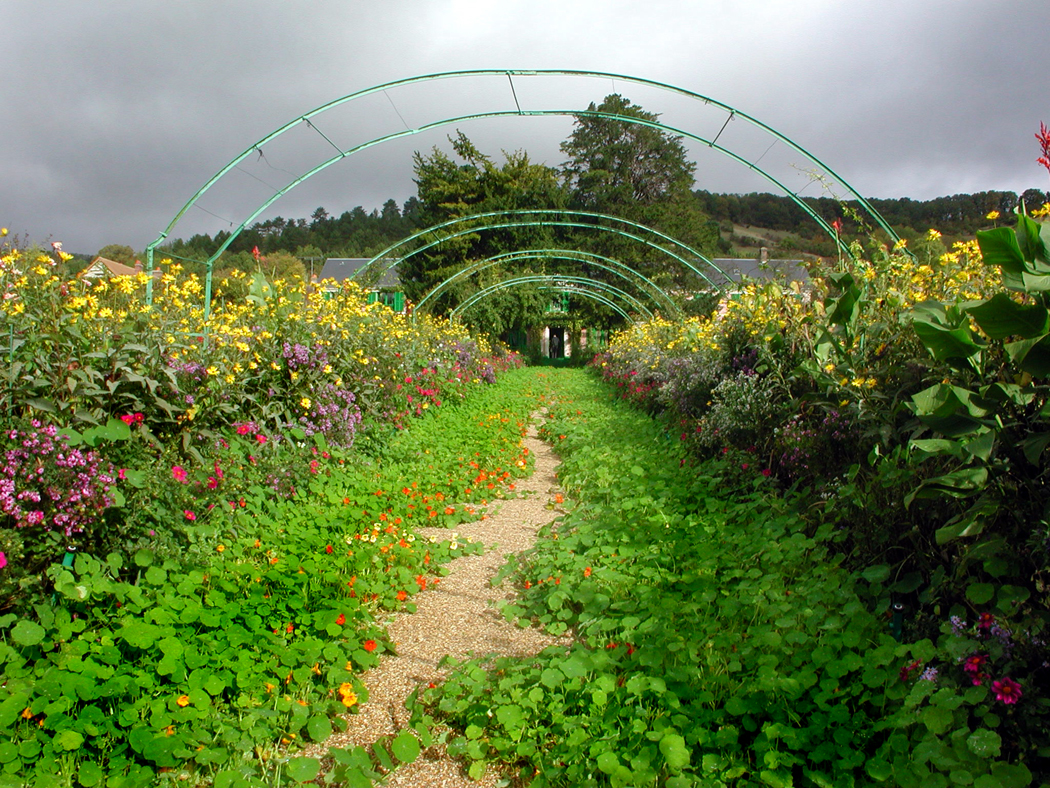
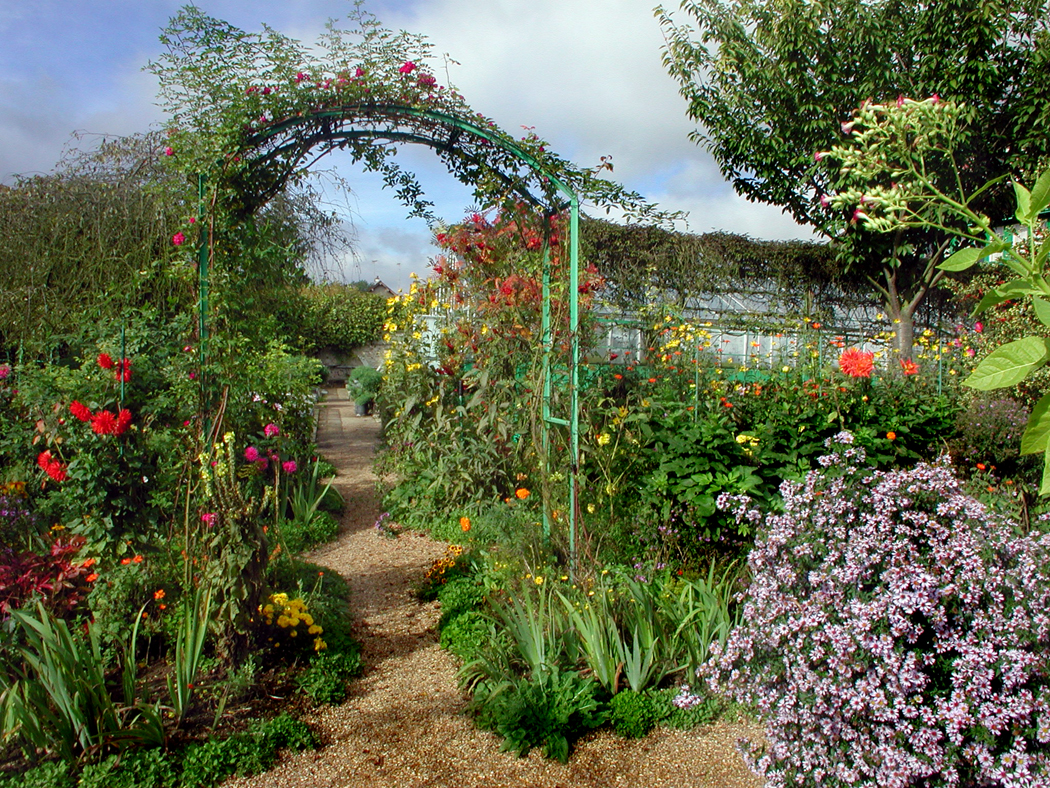
Monet’s garden is a hybrid of these: The paths are rectilinear and formal, but the plants have taken over, spreading out over the footways, up into the air and intertwined with each other. There is a formal layout, but a rich chaos of growth defeating the formality. It creates the illusion of a patch of garden left untended so the flowers grow rampant.

The effect is still overpowering. Instead of looking down at patches of roses or dahlia, they instead grow up to nose-height, so they force their aroma into your nostrils. They rise to eye level as you walk the paths.

They hang overhead and dangle down at you.greenhouse

One cannot help but recall the stanza by Andrew Marvell:

“What wondrous life is this I lead!

Ripe apples drop about my head;

The luscious clusters of the vine

Upon my mouth do crush their wine;

The nectarine and curious peach

Into my hands themselves do reach;

Stumbling on melons as I pass,

Insnared  with flowers, I fall on grass.”flower 4

The present gardens are a miracle. After Monet’s death, his family dispersed and eventually left the old homestead to ruin. The gardens fell untended, the house sprung leaks.

As the great art critic John Rewald  wrote, “Rodents – as undernourished as the local inhabitants (at the end of World War II) – had gnawed away the roots of the plants in and around the pond. The waters had stopped flowing – it was a dried-out, devastated, heartbreaking site. Nothing was left but the memory of past glories and the paintings of Monet, of which quite a few were still in the house and others in the studios, where some of the skylights were broken.”house 2

The artist’s son, Michel,  hadn’t lived there for decades and showed little interest in keeping the place up. When he died, in 1966,  he bequeathed both estate and paintings to the French Academy of Fine Arts.  The grounds were slowly restored and the gardens replanted, taking as their guides the many paintings and photographs that had documented the place.flower 5

And in 1980,  the gardens were opened to the public, nearly 100 years after Monet first started planting bulbs.

Modern visitors find a large parking lot south of the gardens, within easy walking distance. The entrance to the garden takes them first through the large studio Monet had built to paint his large waterlilies in. It is now also the gift shop. Through that and into the clos Normand, you get your first view of the long shotgun house, covered in vines and flowers.red flowers
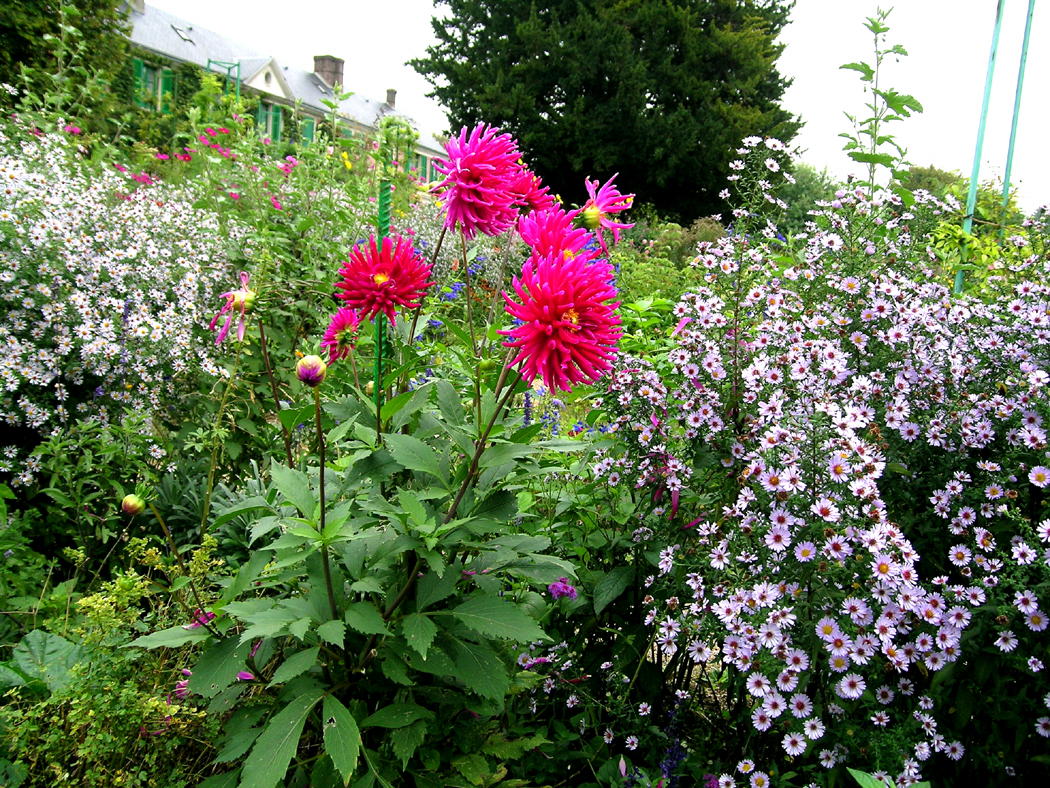
The clos is gridded with pathways, skied-in with trellises and arches and splattered with the petal-dots of color.bridge 2
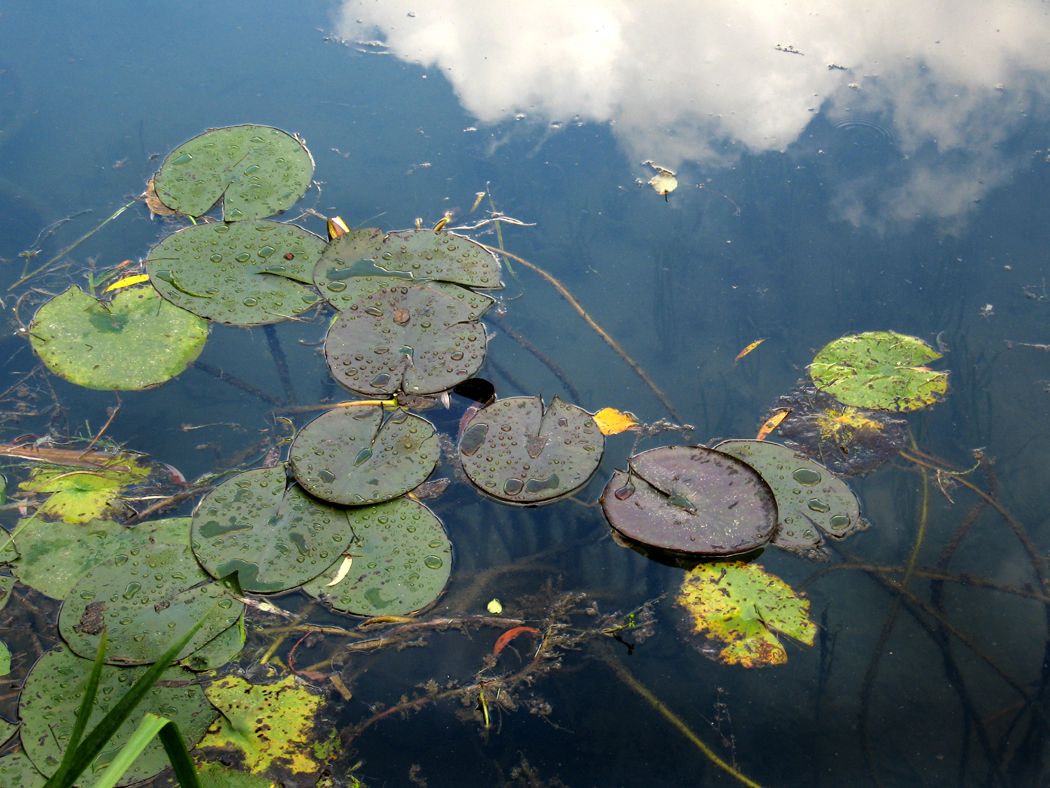
As Monet himself wrote of them, “The overall effect is endlessly varied.

Not just from one season to the next, but from one minute to the next, for rather than making up the whole spectacle, the flowers are only the accompaniment to it.”waterlilies

In the water garden across the road, he noted, “the heart of everything is the reflecting mirror of the water, whose appearance fluctuates endlessly according as it catches the teeming life and movement of the every-changing sky. A passing cloud, a freshening breeze, a squall that looms then strikes, the gale that comes without warning, the light that fades then intensifies anew – all these things transform the color and texture.”Bingo

“How could such sweet and wholesome hours/Be reckoned but with herbs and flowers?”