My Uncle Stanley had an ambition in life to own a Weimaraner hound. I was only a boy at the time and didn’t quite understand the appeal of such a dog, but for the IBM typewriter technician he was, living in New Jersey in the 1960s, I imagine it had something of the attraction a solid gold toilet had for Elvis Presley. The rest of us had dogs that we lucked into, finding a stray, or getting a mutt from the dog pound. But the Weimaraner was a pricey breed and my uncle wanted one. He finally got one. It was a nice dog, but for me, that’s just what it was — a dog.
Many, I think, have some similar focus in their lives, some object that signifies arrival, or a sense of completeness in life. Most items hold that position only for as long as they are unachieved. Yet there remains a pride in the achievement, even if the reward is rather less than anticipated.
I think of those who have yearned to own a Cadillac. They may live in a mobile home and work as janitor in the local factory, but if they can park a Caddy out front, it will show they aren’t complete failures.
As in the familiar song, St. James Infirmary: When I die, “Put a twenty-dollar gold piece on my watch chain,/ So the boys’ll know that I died standin’ pat.”
The idea of getting that bit you believe you want or need is common. Perhaps it is a $300 Wüsthof chef knife; or a Rolex watch; or a bespoke suit from Hong Kong. Whatever is your icon of either quality or status or style, it chases you through life until you can finally afford it. I certainly have felt it. When I was young, it was a Nikon camera, then a Leica and then a Hasselblad. I finally got each and while I wasn’t disappointed — they are all as good as their reputations — they never quite made that great a difference in the photographs I made.
I imagine that if the People’s Republic of China ever finally get their hands on Taiwan, it will not prove to be quite so satisfying a triumph as they had imagined.
I never chased a particular car or watch, but there are books I longed for. I have managed to get some of them; others still elude me. But here are the big three I lusted after for years.
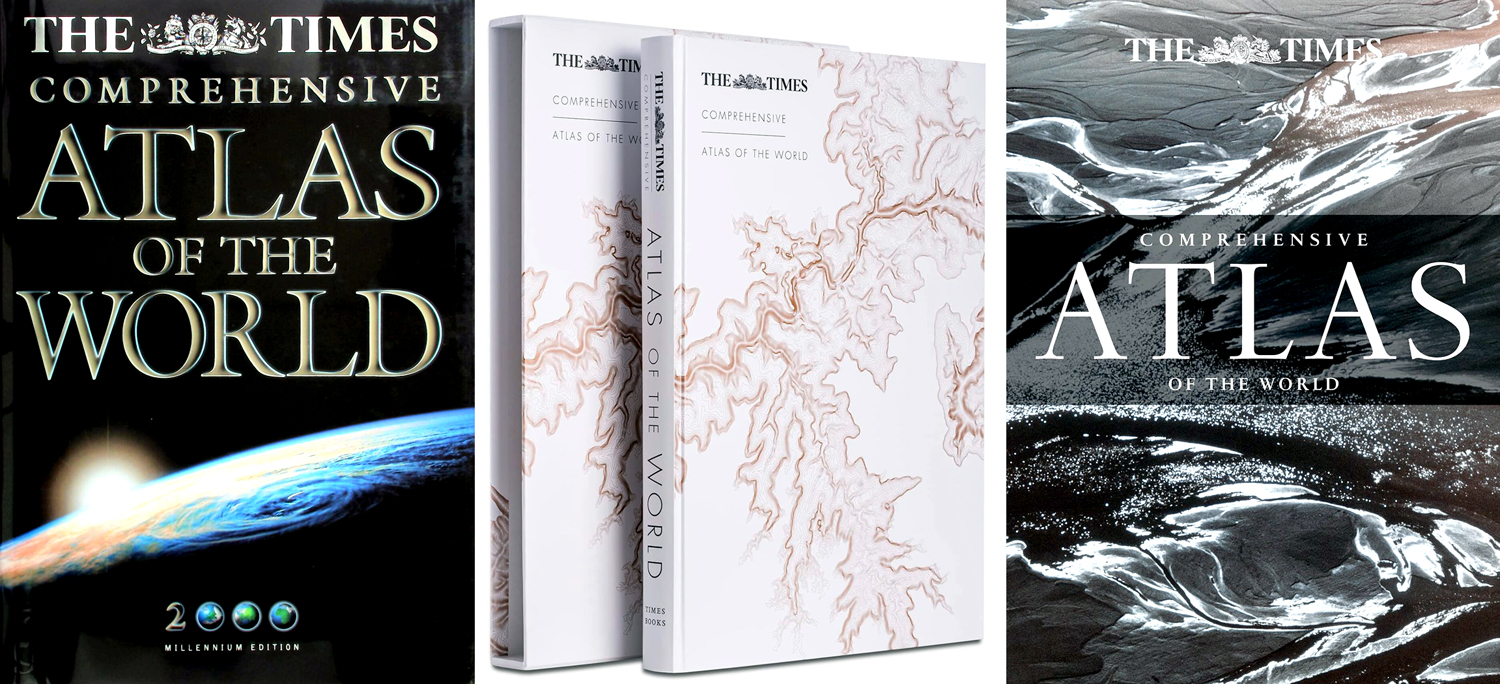
The Times Comprehensive Atlas of the World
Beginning in the third grade, I loved maps. And what I loved more than any were the big maps in the classroom that were pulled down like a windowshade, and were richly colored in thick inks — not halftone dots: The green was dark green ink, not a mix of yellow and cyan dots. Mountain regions were a rich chestnut brown. Those maps were beautiful. They may have been out of date even in my childhood, but I didn’t love them for their accuracy, but as art.
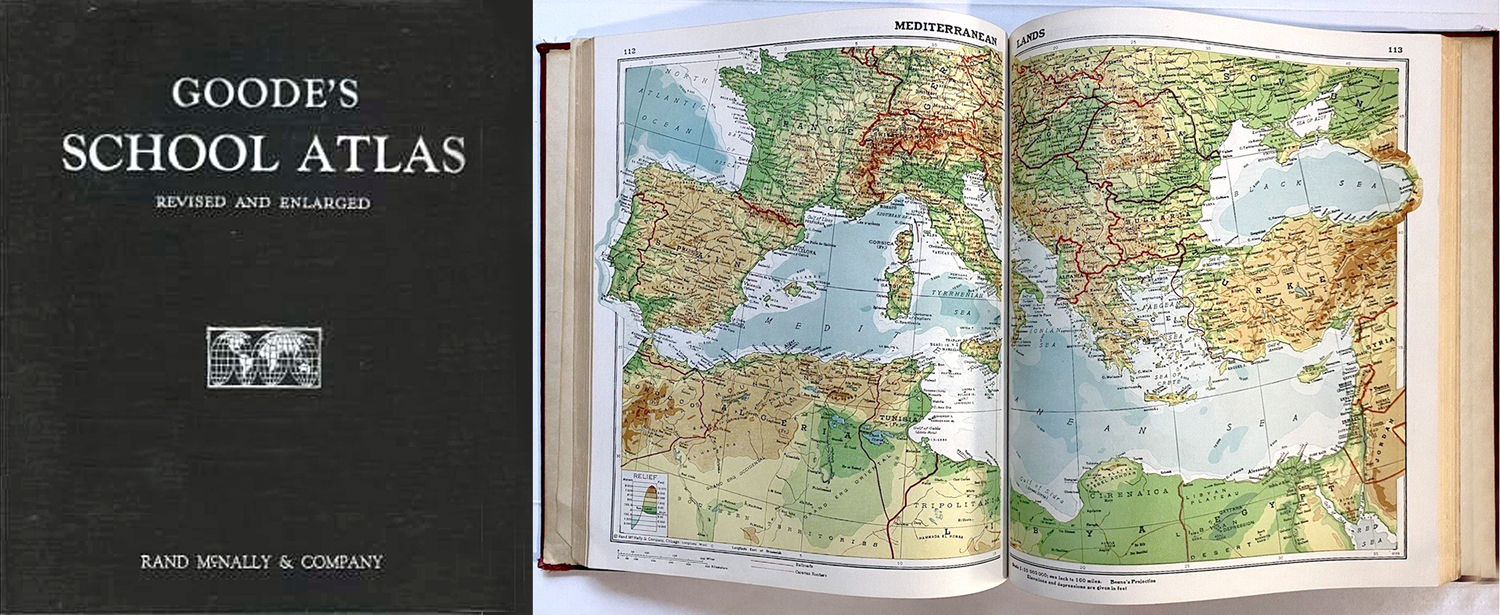
Years later, I found something very similar in older editions of the Goode’s School Atlas, where the maps were created using wood engravings, so there were straight-line cross-hatchings for shadings, and again, multi-colored inks for the printing. I saw them as art books. I found a few in old, musty used book stores and I still treasure them.
The very first puzzle pieces I remember, as far back as infancy, were map puzzles, where each U.S. state was a single piece. I took apart and redid that states puzzle hundreds of times, even as, in my infant-tongue the states were Uncle Homer and Miss Thompson.
Later, as a young man, newly empowered with a car and an income, I began traveling, and to aid that travel, I had a Rand McNally Road Atlas. I have updated them every other year or so, but I also acquired vintage versions from 1935 and 1942, which are things of beauty of their own, in two-color printing, with most roads in dark blue and highways in red. I treasure the old ones, while the newer, full-color maps are merely disposable useful tools.
But, out there on the horizon, was the Times Comprehensive Atlas of The World, published in constantly updated editions from 1895 through its 16th edition in 2023. By 1959, the Midcentury Edition of the atlas was a five-volume elephant folio edition measuring 12-by-19-inches. It was the Cadillac of world atlases and it was way out of my price range when I was young. I did manage to get the single volume 10th edition, picked up used.
It was a large, handsome volume. The maps were halftones, so, not as esthetically distinct as the Goode’s, but still, it was by all counts the best atlas on the market. Unfortunately, when I retired, I had to sell off about 75 percent of my library to make the move across the country from Phoenix to North Carolina, and the Times atlas was one of the casualties. Kept the Goode’s, though.
The Encyclopedia Brittanica
By the time I was in sixth grade, I wanted to learn everything. I was young enough still to think that possible. And where would I find all this knowledge? I’d read the encyclopedia.
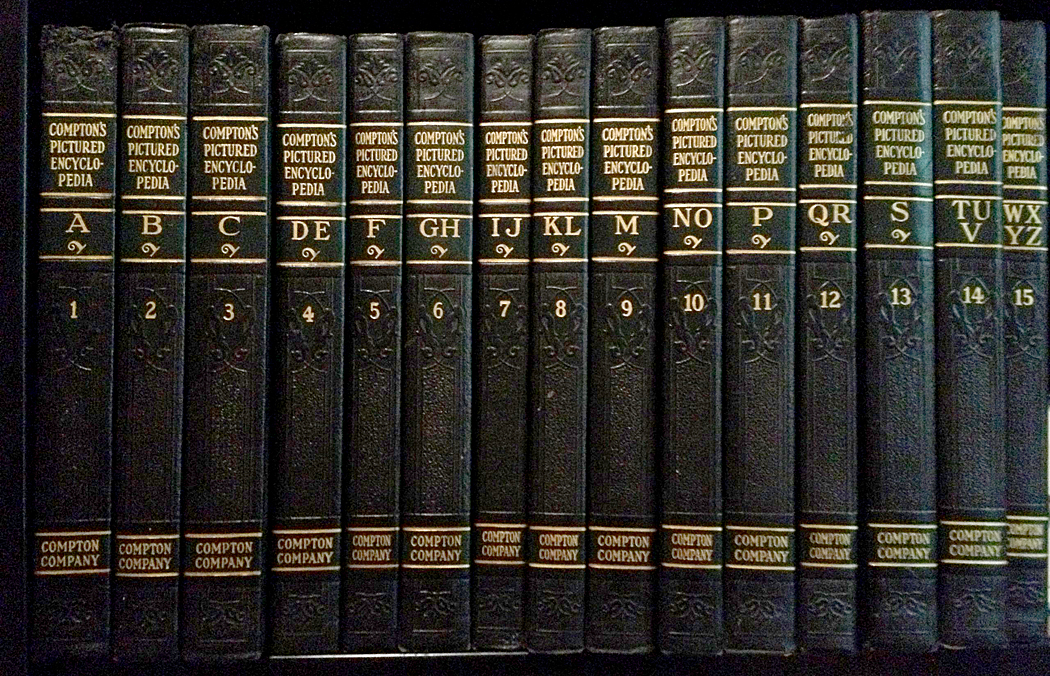
My neighbors had an old Compton’s Picture Encyclopedia, from the 1930s, which they gave us, and I read it over and over, with its streamlined steam trains, autogyros and biplanes. But even as a kid, I knew the books were out of date. A wonderful long entry on “The Great War,” but, although I was reading it in 1953 or so, less than 10 years after WWII, there was no mention of any of it.
My mother wanted to help, and so, she began buying the promotional supermarket offering Funk and Wagnalls, one per week, for 99 cents each, until we had the full set, cheaply printed and bound. I used them for years to write theme papers for school. But I always knew that they weren’t the “real thing.” For that I needed the Britannica, which was way outside my family’s budget.
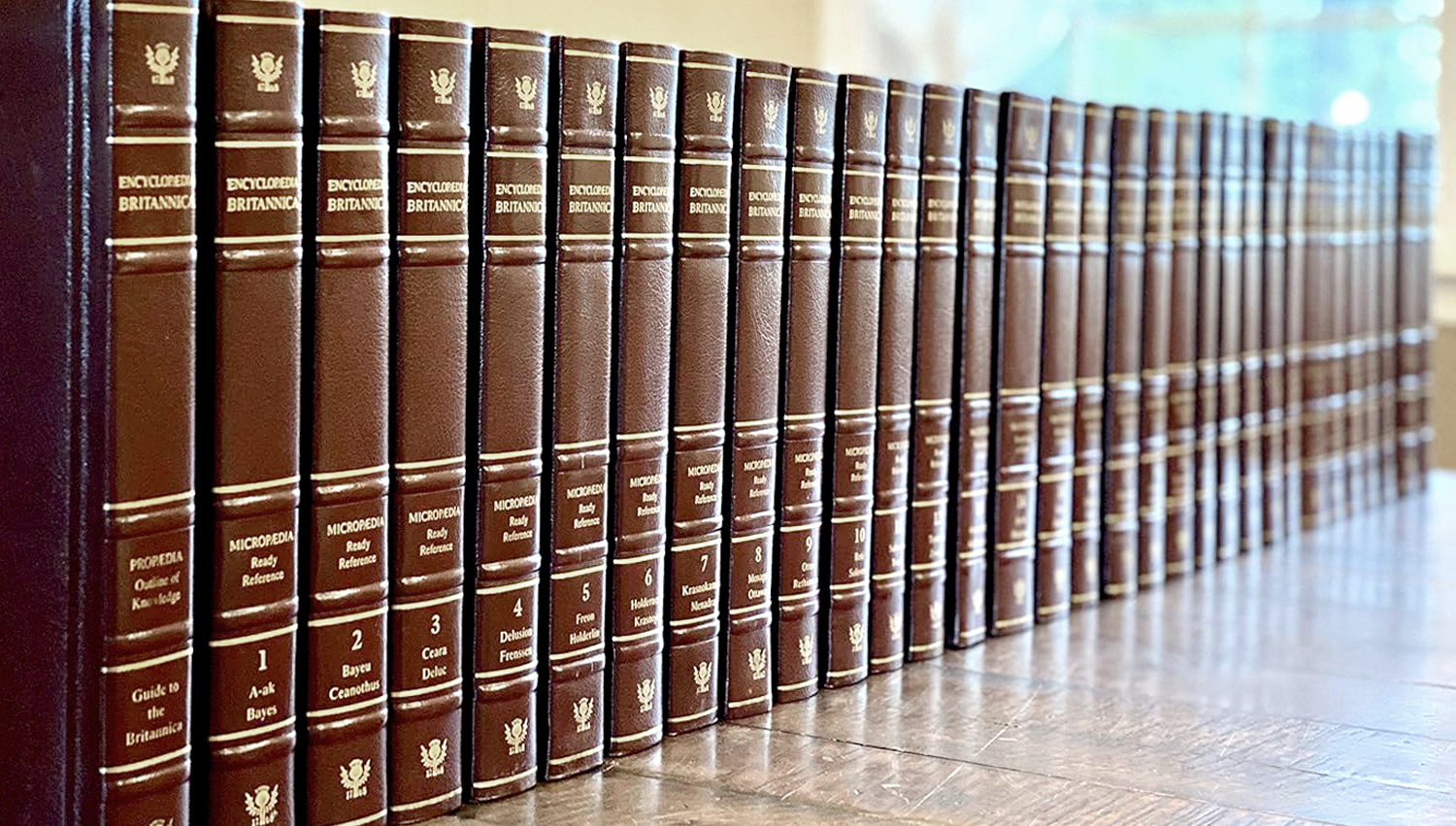
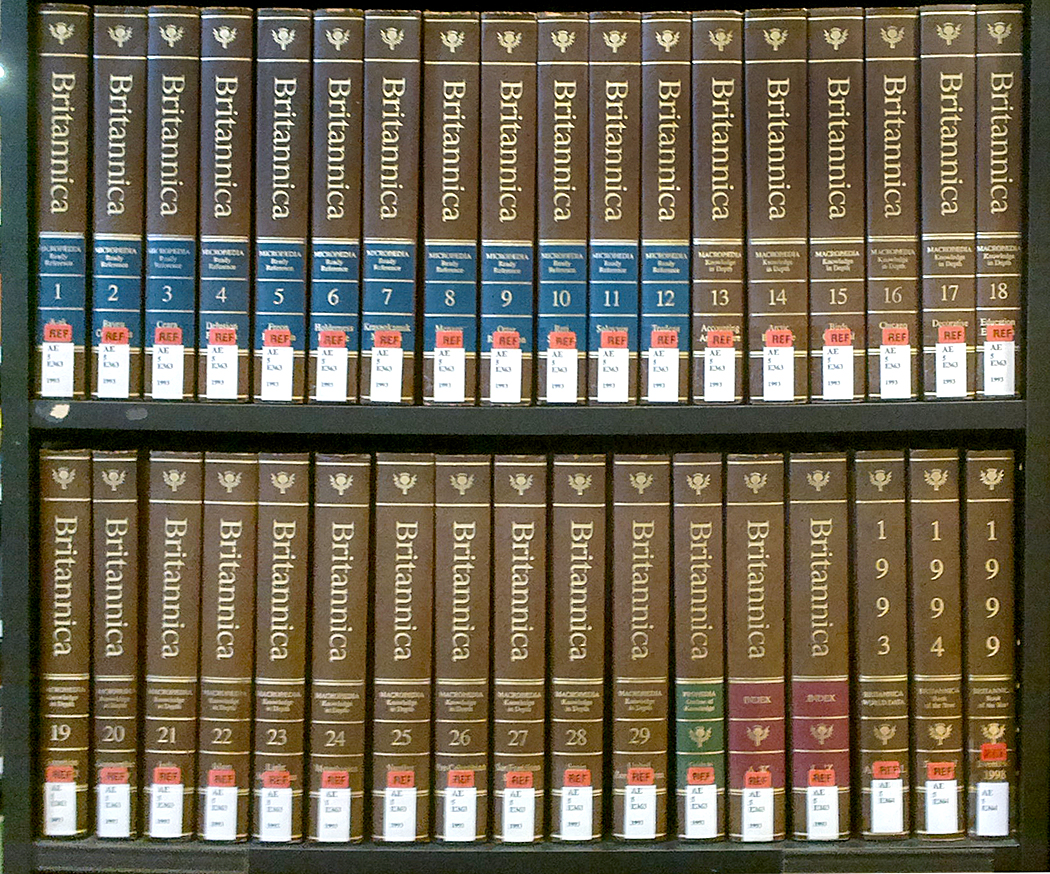
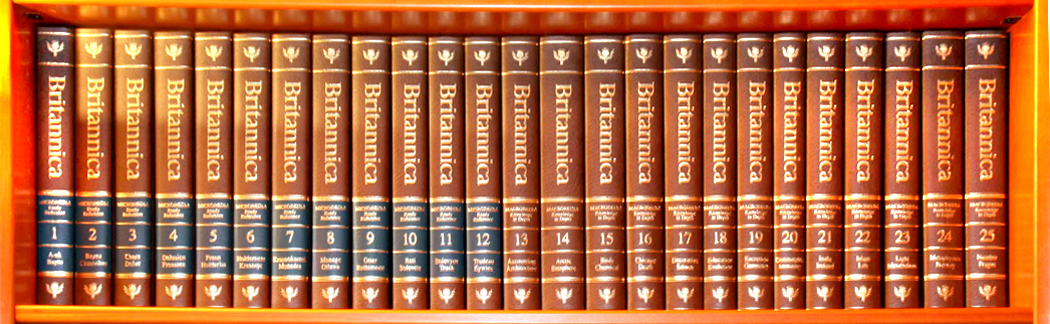
I continued lusting for my own Encyclopedia Britannica, all through college, the jobs that followed and into my years at the newspaper in Arizona, when I finally got a set at Bookman’s, a used book store in Mesa. But my enthusiasm was tempered by the fact that the set I got was not the traditional Britannica, but the combined “micropædia” and “macropædia,” in which the entries were divided into the more popular entries, in shorter, easier to read versions — the micropædia — and the more in-depth entries in the rest of the volumes. It felt like a dumbed-down, even trendy version of what I truly wanted. I wanted the Belmondo Breathless and got the Richard Gere Breathless.
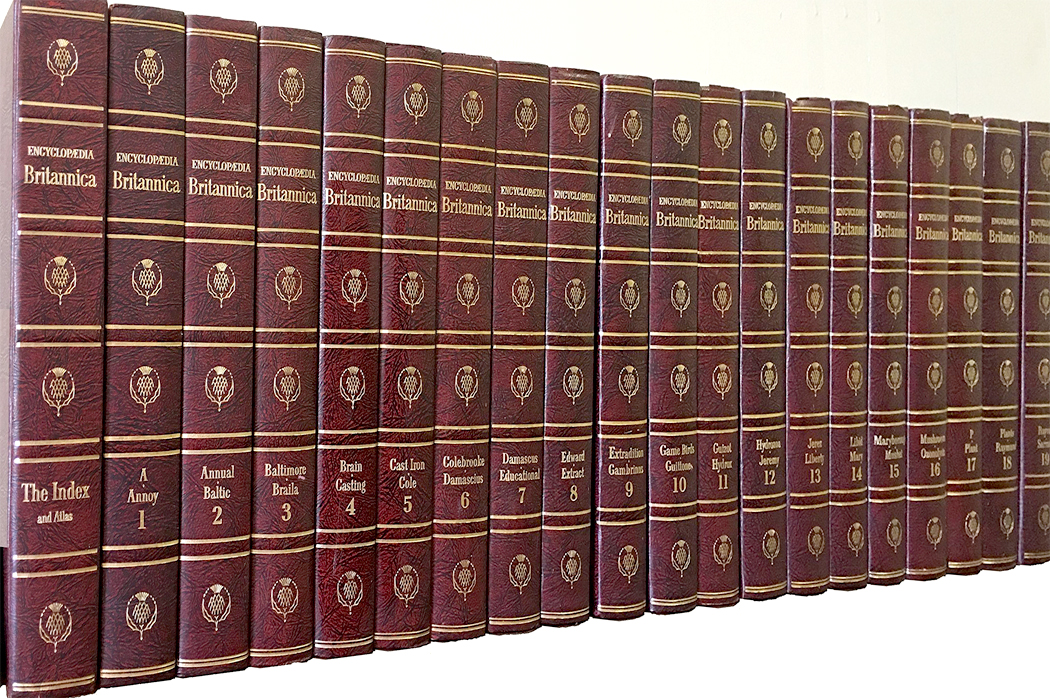
Years later, I came across the revised 14th edition, in 24 volumes and its leathery maroon covers and thistle logo, and managed to buy it. This was the real thing, at last. The pride of my collection.
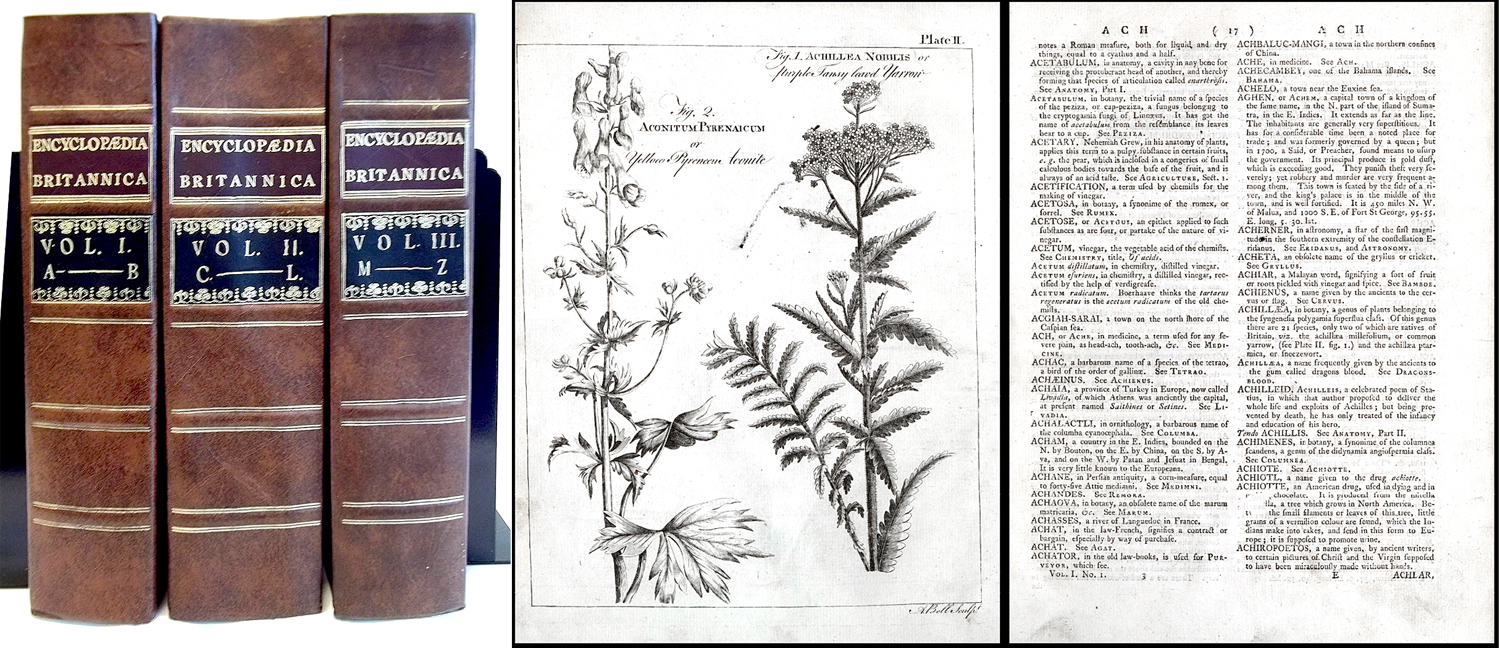
At Bookman’s, I later also found a facsimile version of the original three-volume Encyclopædia Britannica, from 1768. The replica was quite convincing, even including (imitation) foxing on some of the pages. More interesting was evidence that the 18th century project engaged the enthusiasm of its makers early on, and then rather petered out. The first volume covers the letters “A” and “B.” The second includes “C” through “L.” And the third and slimmest volume gets to cover everything else to the letter “Zed.” The facsimile edition was published in 1971.
Then, of course, the internet came along, with its Wikipedia. The Britannica sat on the shelf as a kind of trophy, but largely unused. And when we moved, it was one of the casualties. So long in the getting, so short in the forgetting.
The Oxford English Dictionary
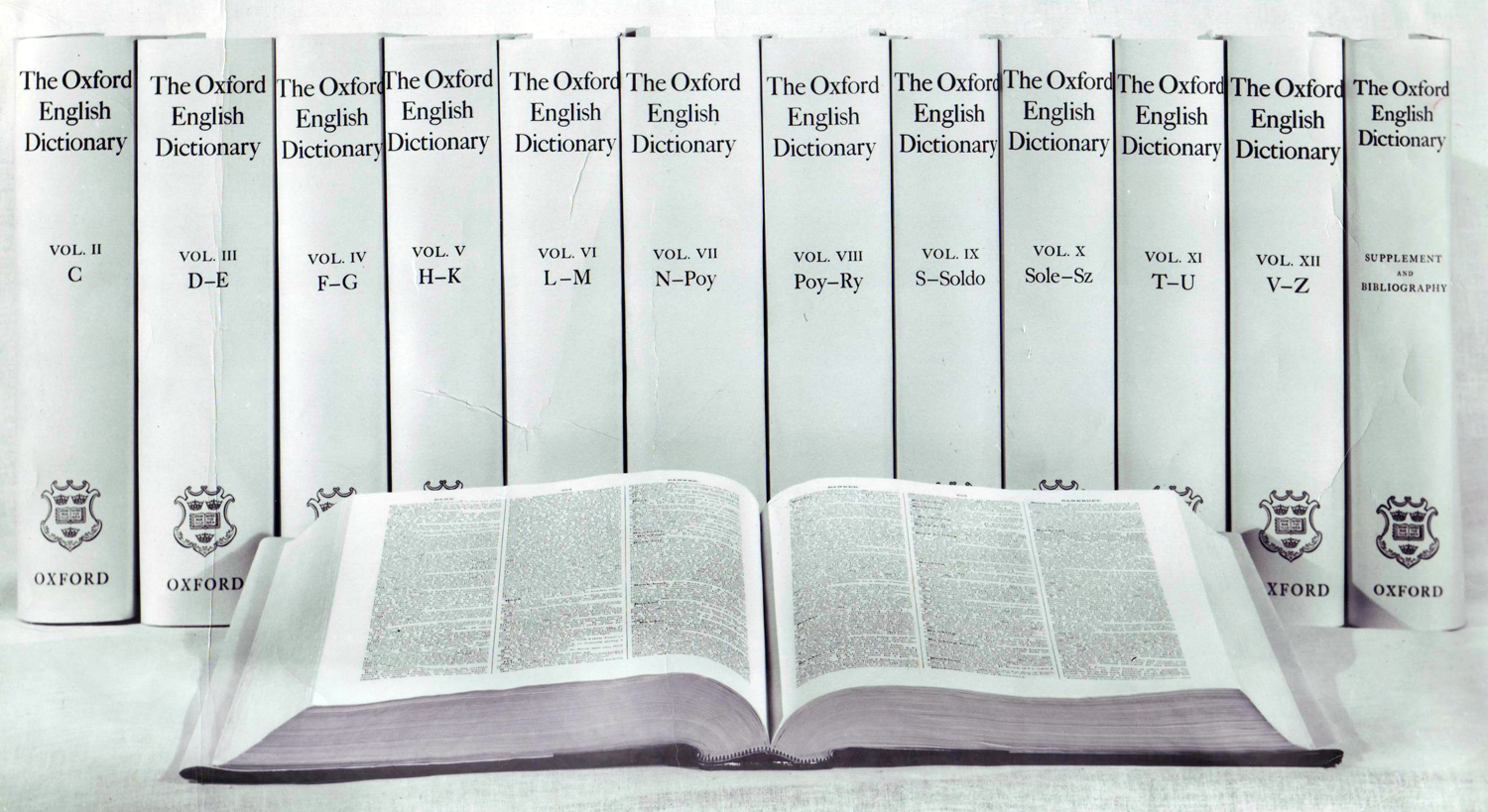
But the real prize, the one thing that I lusted for more than any other, was the Oxford English Dictionary, the 20 volume final word on the English language.
I was a long-time reader of dictionaries. From second-grade on, I loved learning vocabulary. From 8th grade on, I loved learning the etymologies of words, and how they could change meaning over time. The OED contained all that information. Entries were long, involved and gave dozens, maybe scores, of citations, each dated and quoted. A simple word with multiple meanings, such as “set,” went on for pages, and required 60,000 words to describe some 580 senses. The whole of the dictionary was 21,730 pages and 59 million words covering more than 300,000 entries. It was heaven. It was also pricey. The set could sell from $1500 to $2000, depending on where you bought it.
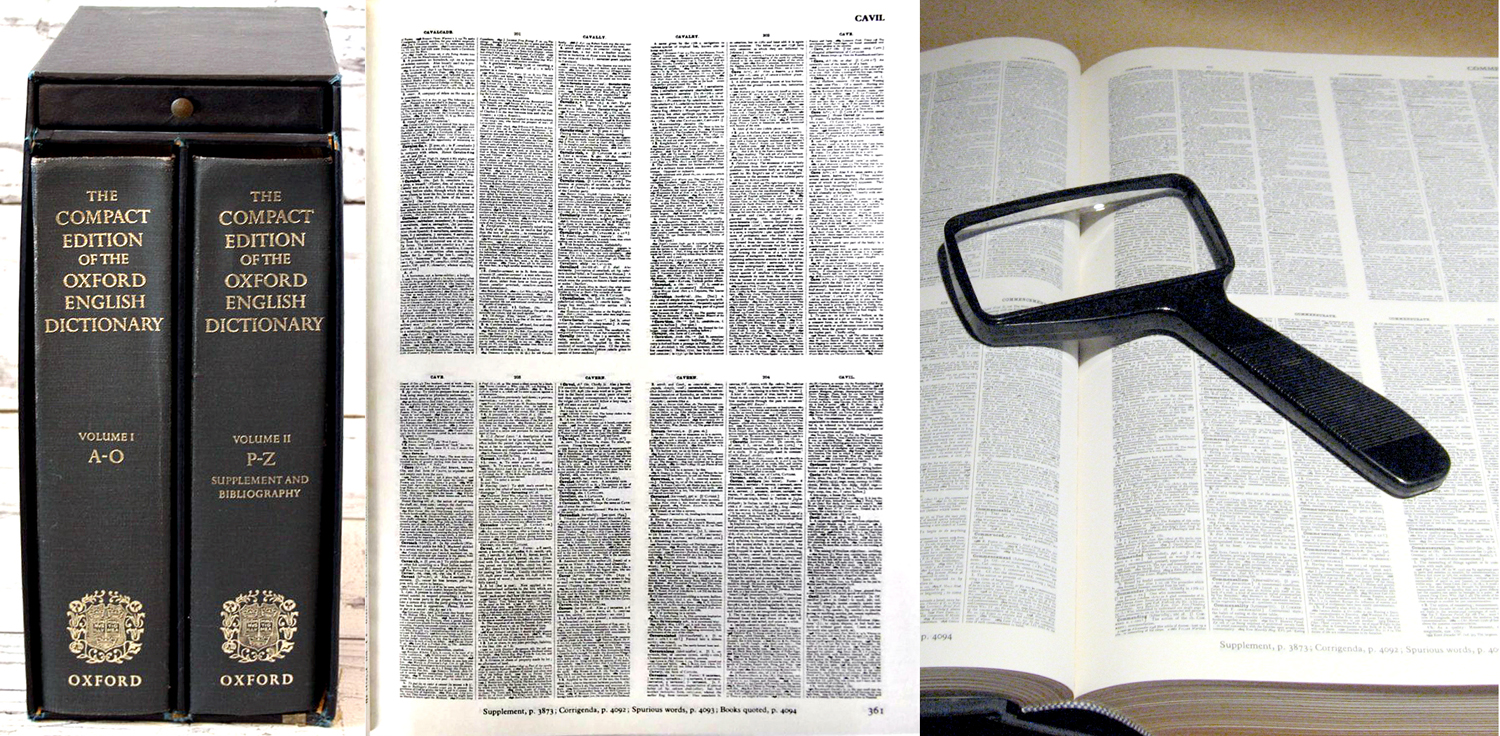
The full OED is still my unicorn. I have never found an affordable used set. But, in the 1970s, the Oxford Press put out a 2-volume Compact Edition, with every four pages of the original OED shrunk photomechanically down to quarter-size and printed four original pages squeezed into each single page of the edition, which required the use of a magnifying glass (included) to be able to read it. The Compact Edition was offered at rock-bottom price as a promotion through a book club, and I signed on, and got my copy.
It is very hard to read, even with the magnifying glass, and the volumes were big and bulky and uncomfortable to use, but at least I owned a version of the OED. This was as close as I got to Nirvana.
I still have the Compact Edition, occupying the upper shelf of a coat closet. I haven’t dragged it out in years, but I still have it, a reminder of those things I once thought would change my life forever. Perhaps they did.
So, what did you always want and did or didn’t finally achieve?
The Seventeenth Century produced in Europe giants of science and philosophy and brought to birth the beginnings of Western Modernism. Their names are a pantheon of luminaries: Francis Bacon; Galileo Galilei; Thomas Hobbes; Rene Descartes; Blaise Pascal; Isaac Newton; Johannes Kepler; Gottfried Wilhelm Leibnitz; Baruch Spinoza; John Locke — names that mark the foundations of the culture we now live in.
But during their lifetimes, their pioneering work remained the province of a rare sliver of humankind, those others of their intellectual gift who could understand and appreciate their thought. The mass of European population remained illiterate, and subject to centuries-old traditions and institutions of monarchy and religion. It wasn’t until the next century that the dam broke and the results of rationalism and empiricism made a wide splash in society, in a movement that self-congratulated itself as The Enlightenment.
And in the center of it all, in France, was Denis Diderot, one of the so-called “philosophes,” a group of writers and thinkers advocating secular thinking, free speech, the rights of humans, the progress of science and technology, and the general betterment of the human condition.
Among the philosophes were Voltaire, Montesquieu, Abbé de Mably, Jean-Jacques Rousseau, Claude Adrien Helvétius, Jean d’Alembert, the Marquis de Condorcet, Henri de Saint-Simon, and the Comte de Buffon. They wrote about science, government, morals, the rights of women, evolution, and above all, freedom of speech and freedom from dogma. They advocated the expansion of knowledge and inquiry. And they didn’t write merely for other intellectuals, but for a wider, middle-class literate readership. It was a blizzard of books, pamphlets and magazines.
Denis Diderot was born in 1713 in the Champagne region of France, the son of a knife-maker who specialized in surgical equipment. His father expected him to follow in the family business, but Diderot first considered joining the clergy before studying for the law and by the early 1740s, had dropped out to become a professional writer, a metier that paid little and brought him into conflict with the royal censors with notorious frequency.
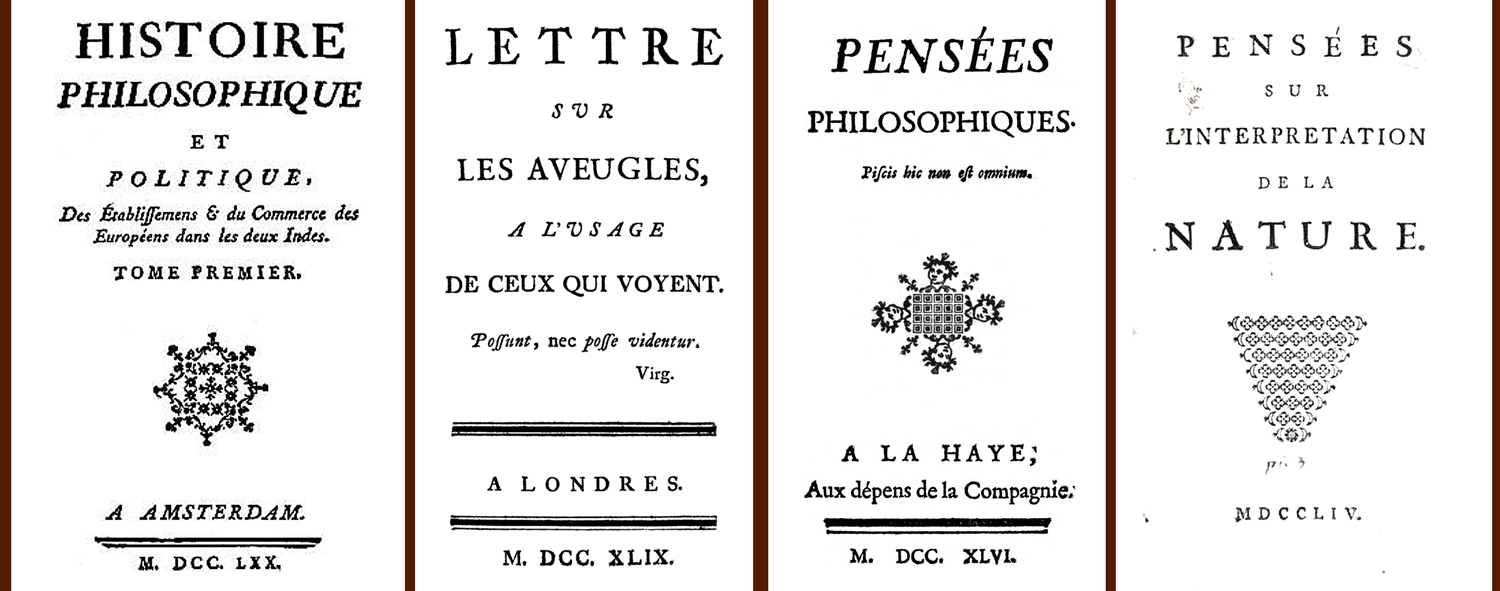
He translated several works, including a medical dictionary, and in 1746, he published his Pensées Philosophiques (“Philosophical Thoughts”), which attempted to reconcile thought and feeling, along with some ideas about religion and much criticism of Christianity.
He wrote novels, too, including in 1748, the scandalous Les Bijoux Indiscrets (“The Indiscreet Jewels,” where “jewels” is a euphemism for vaginas), in which the sex parts of various adulterous women confess their indiscretions to a sultan who has a magic ring that can make vaginas talk.
His most famous and lasting novel is Jacques le Fataliste et son Maître (“Jacques the Fatalist and his Master”), from 1796, a picaresque comedy in which the servant Jacques relieves the tedium of a voyage by telling his boss about various amorous adventures.
But Diderot is remembered primarily for his work on the Encyclopédie, which he edited along with Jean le Ronde d’Alembert, and for which he wrote some 7,000 entries. It was published serially and periodically revised from 1751 to 1772 and mostly published outside of France and imported back in — censorship was strict and many books were published in the Netherlands or Switzerland to avoid French government oversight.
In fact, Diderot spent some months in prison for his work on the Encyclopédie.
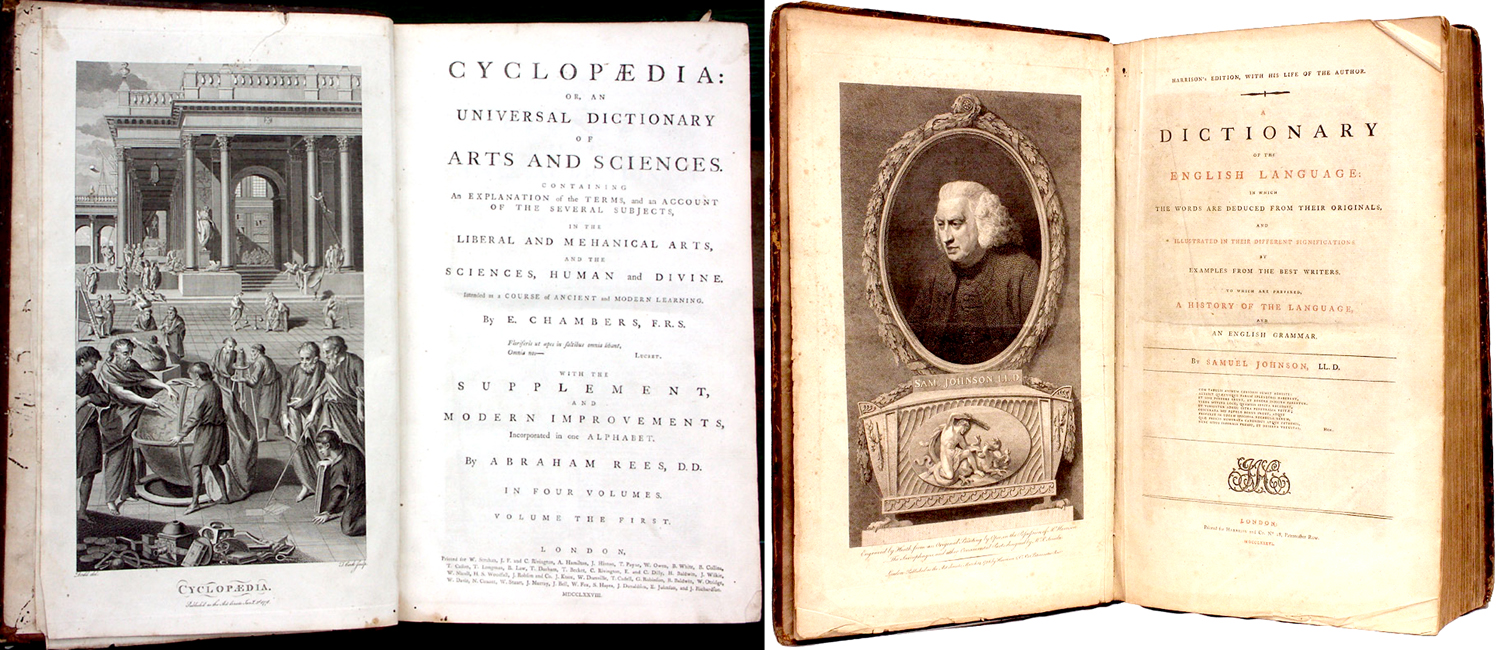
There had been earlier attempts at encyclopedias, including Ephraim Chamber’s Cyclopedia, or an Universal Dictionary of Arts and Sciences published in London in 1728, and John Harris’ 1704 Lexicon Technicum: Or, A Universal English Dictionary of Arts and Sciences: Explaining Not Only the Terms of Art, But the Arts Themselves. The 18th century wallowed in long book titles.
Among the projects of this age with an appetite for inclusiveness was Samuel Johnson’s Dictionary of the English Language of 1755.
And the idea of binding all of human knowledge up in a single volume goes all the way back to the Naturalis Historia of Pliny the Elder in the First Century CE.
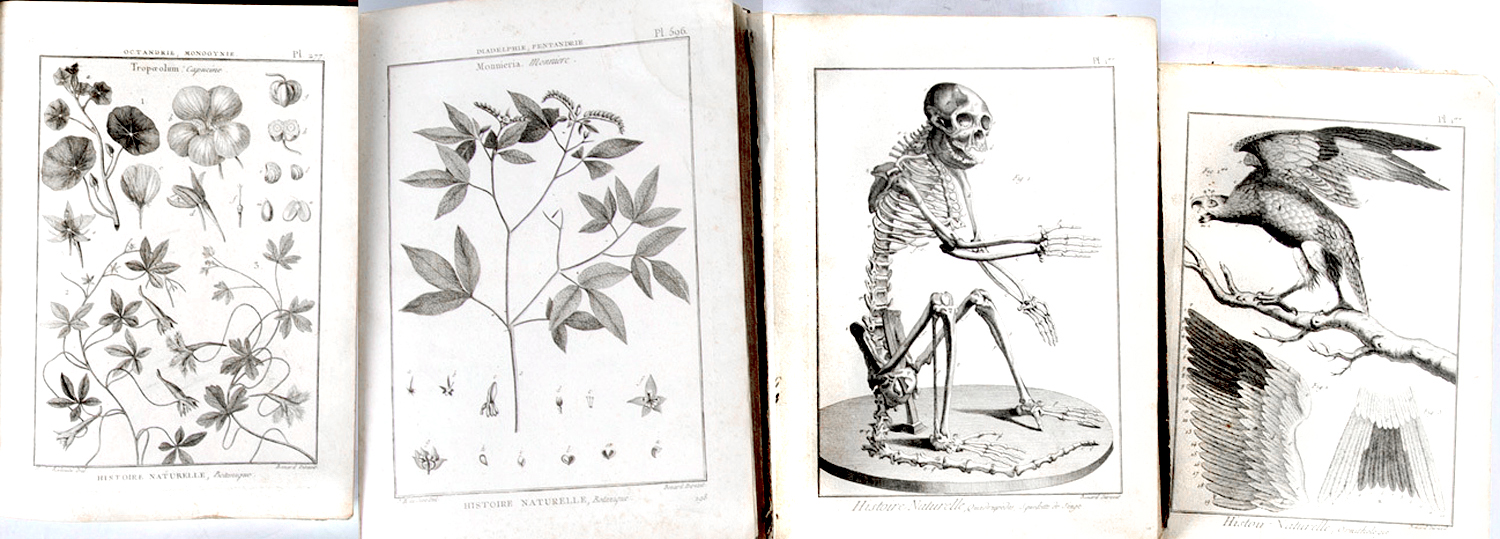
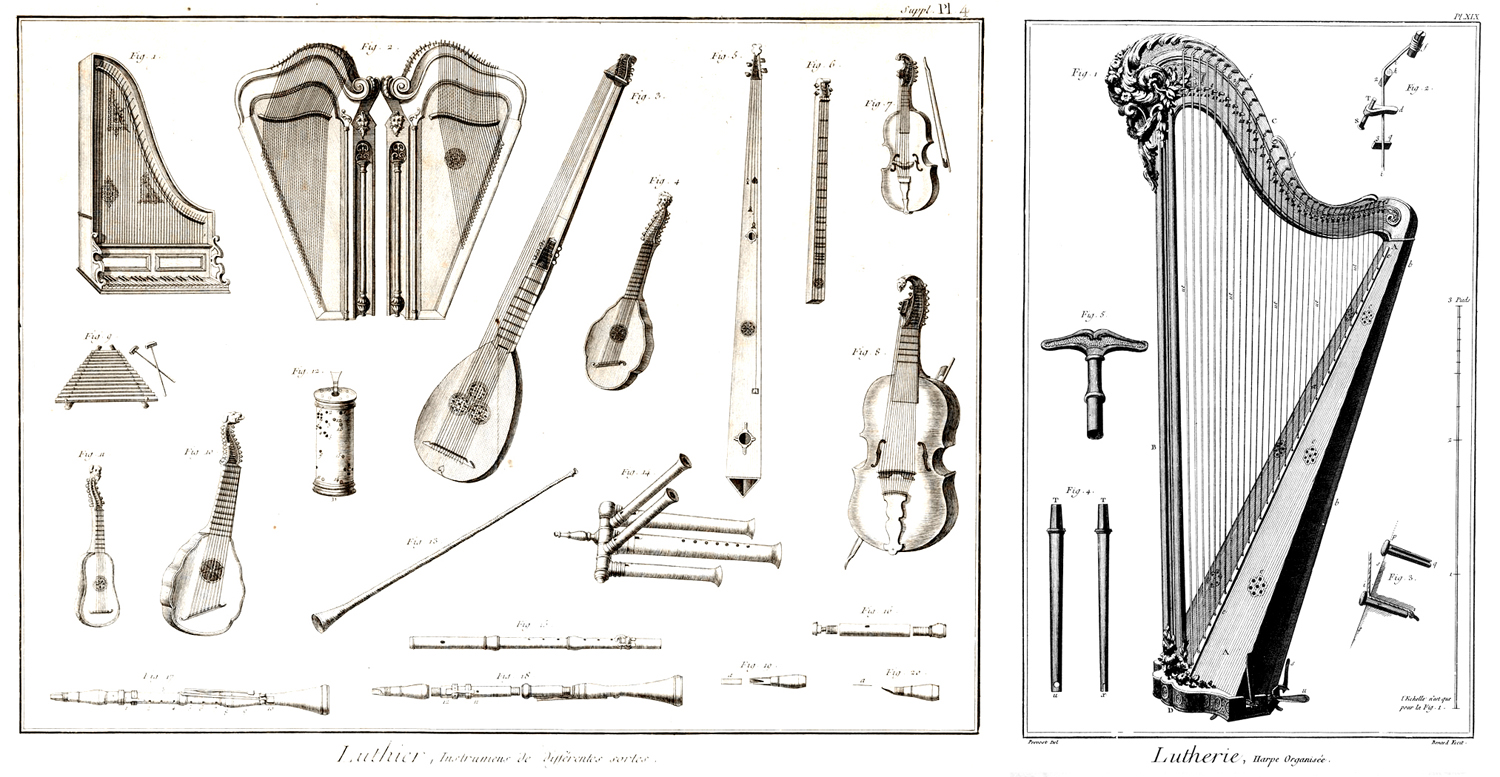
But none of these were as compendious in intent as the French Encyclopédie, which initially ran for 28 volumes and included 71, 818 articles and 3,129 illustrations. It comprised some 20 million words over 18,000 pages of text. It was a huge best-seller, earning a profit of 2 million livres for its investors.
In his introduction, Diderot wrote of the giant work, “The goal of an Encyclopédie is to assemble all the knowledge scattered on the surface of the earth, to demonstrate the general system to the people with whom we live, & to transmit it to the people who will come after us, so that the works of centuries past is not useless to the centuries which follow, that our descendants, by becoming more learned, may become more virtuous & happier, & that we do not die without having merited being part of the human race.”
In the article defining “encyclopedia,” Diderot wrote that his aim was “to change the way people think.”
Their goal was no mean or paltry one, but to encompass everything known to humankind. So that, according to Diderot himself, if humankind descended once again into a Dark Age, and if just one copy of his Encyclopédie survived, civilization could be reconstructed from reading its pages.
A good deal of its content concerned technical issues, such as shoe-making or glass blowing. But other articles addressed political and religious ideas. These are what got the Encyclopédie contributors into legal trouble. The Catholic church and the monarchy were not happy about the generally deist and republican leanings of its authors.
And there were a lot of authors. Most of the leading philosophes wrote one or another of the entries. Louis de Jaucort wrote some 17,000 of them — about a quarter of the total. Each of the contributors wrote about his specialties. D’Alembert, who was a mathematician, wrote most of the math entries. Louis-Jean-Marie Daubenton took on natural history. Jean-Jacques Rousseau wrote about music and political theory. Voltaire on history, literature and philosophy.
All under the editorship of Diderot and d’Alembert, and, after 1759, by Diderot alone.
Diderot divided all of human knowledge into three parts: memory; reason, and imagination. In his Preliminary Discourse to the Encyclopedia of Diderot, d’Alembert explained these as “memory, which corresponds with History; reflection or reason, which is the basis of Philosophy; and imagination, or imitation of Nature, which produces Fine Arts. From these divisions spring smaller subdivisions such as physics, poetry, music and many others.”
In fact, d’Alembert asserts, all of human knowledge is really just one big thing: a unified “tree of knowledge,” which if we could grasp, would explain everything with a single simple principle, which rather prefigures the unified field theory of modern physics.
It would be hard to overemphasize the influence of the Encyclopédie in the 18th century and in the political changes of France up to and through the Revolution. The Encyclopédie disparaged superstition, of which they counted religion as an example, and it saw the purpose of government to be the welfare of its people and the authority of government to be derived from the will of its citizens. The king existed, they said, for the benefit of the people, and not the people for the benefit of the monarchy.
It’s no wonder, then, that the church and the aristocracy tried to suppress parts of the Encyclopédie, and that many of its authors spent time in prison.
Its successor, the Enyclopedia Britannica, wrote of Diderot’s labors, “No encyclopedia perhaps has been of such political importance, or has occupied so conspicuous a place in the civil and literary history of its century.”
Beyond the Encyclopédie, Diderot continued as a freelance writer, as an art and theater critic, a playwright, novelist, political tract writer and freethinker.
But despite his fame and productivity, Diderot never made much money from his work, and when Russian empress — and groupie to the philosophes — Catherine the Great, heard of his poverty, she offered to buy his extensive library, paying him an enormous sum for the books and as salary for his employment as librarian to his own collection.
In 1773, Diderot traveled to St. Petersburg to meet Catherine. Over the next five months, they talked almost daily, as Diderot wrote, “almost man-to-man,” rather than monarch to subject.
Catherine paid for his trip in addition to his annuity and in 1784, when Diderot was in declining health, Catherine arranged for him to move into a luxurious suite in the rue de Richelieu, one of the most fashionable streets in Paris. He died there a year later at the age of 70.
Despite her admiration for Diderot and his revolutionary ideas, Catherine ignored all of them in her own autocratic rule of Russia. But Diderot and his Encyclopédie pointed the way to the Declaration of the Rights of Man and of the Citizen, the triumph of democracies, and even the American Declaration of Independence and Constitution.
According to philosopher Auguste Comte, Diderot was the foremost intellectual in an exciting age, and according to Goethe, “Diderot is Diderot, a unique individual; whoever carps at him and his affairs is a philistine.”
—————————————————————-
“On doit exiger de moi que je cherche la vérité, mais non que je la trouve.”
“I can be expected to look for truth but not that I should find it.”
—Denis Diderot, Pensées Philosophiques (1746)
————————————————————
When I was a young man, more than a half century ago, I had a simple ambition: To know everything. I suppose I was thinking mainly of facts; I would have no inkling of anything that couldn’t be named and catalogued. I wanted to read everything, name every bird and wildflower, every tree and understand every philosopher. I read all the poetry I could find, listened to all the symphonies and quartets and attempted to ingest all of astronomy and physics and history. Yes, I was an idiot.
As early as the second grade, I believed that when I got to college, then I would finally have access to everything. And so, when I went to Guilford College in North Carolina, I couldn’t wait and in my first semester, I signed up for 24 credit hours of courses. I had to get permission from the dean for the extra hours above the normal 18 that for most students was a full course load. I grabbed Ancient Greek language, astronomy, Shakespeare, the history of India, esthetics, music theory — and over four years, everything I could think of.
To my surprise and disappointment, not all of it was as edifying as I had hoped and not all the professors as brilliant as I had imagined. Still, it was a lot better than high school.
What I sought was knowledge that was encyclopedic, encompassing all there was to know. Yes, I know now that all this was silly. I was young, naive and idealistic. Always a poor combination.
The match that ignited this quest was probably the first actual encyclopedia I had. When I was in grade school, our next door neighbor, who worked for Doubleday publishing in New York, gave us boxes of books, mostly old, and that included a full set of Compton’s Pictured Encyclopedia — probably the set our neighbor had when he was a boy. It dated from the 1930s and had great imagination-burning articles on such things as “The Great War,” dirigibles, and steam locomotives. The endpapers of each volume included illustrations of such things as elevated roads, autogyros, and speedboats.
It didn’t matter that much in the set was out of date. It was a multi-volume key to unlock a whole world.
Later, our parents bought a more up-to-date Funk and Wagnalls encyclopedia, purchasing a single volume each week through a promotional deal at the A&P supermarket. It was a much cheaper production, on cheaper paper, with blank endpapers, but at least it included the Second World War.
All through my childhood and adolescence, I would grab a volume and randomly read entries. I would pore over its pages, reading it all for fun. When I had to write a term paper in high school, I did my research in our Funk and Wagnalls.
I can’t say I read every article in the whole encyclopedia, but I may have come close.
And as I grew, my ambition grew: I wanted, more than anything, to own the two great compendia of all human knowledge: The Oxford English Dictionary and the Encyclopedia Britannica. Both were well out of my price range, but I lusted, the way most boys my age lusted after Raquel Welch.
Years later, after college, the OED was published in a two-volume compact form, with microscopic print and a magnifying glass to read it, and I managed to get a copy through signing up for a book-of-the-month club. I still have it, and I still browse through it to find random words, their histories and the curious way language changes over the years.
The Britannica took longer. The Encyclopædia Britannica, or, A Dictionary of Arts and Sciences, compiled upon a New Plan, was published in Edinburgh first in 1768, as an answer to Diderot’s Encyclopédie. At first, it was bound in three equally sized volumes covering: Aa–Bzo; Caaba–Lythrum; and Macao–Zyglophyllum. There have been 15 editions since, but each edition was continually updated, making the Britannica a constantly evolving entity. It was briefly owned by Sears and Roebuck, and eventually migrated to the University of Chicago. Currently it is privately owned and only available digitally. They stopped printing it in 2010.
It wasn’t until I was in my 30s, when working as a teacher in Virginia, I found an old used set of Britannicas at a giant book sale held annually in the city’s convention center. It was an 11th Edition version — still the standard as most desirable edition. I felt like Kasper Gutman finally getting his hands on the Maltese Falcon. But when I unwrapped my prize, it was, in fact, the real thing.
It sat, in pride of place, on my bookshelves, more as trophy than anything else. And when we moved to Arizona, I had to give it up in the great divestment of worldly goods necessary to truck our lives across a continent. I hated to give it up, but had to admit, I wasn’t using it as much as I had expected. I had an entire library of other books that I could consult.
Then, in Arizona, I came across a more recent edition of the Britannica for sale at Bookman’s, a supermarket-size used book store in Mesa, Ariz. It was the version divided into a “macropedia” and “micropedia.” I bought it to replace the earlier version I had once coveted.
I have never warmed to this version of the encyclopedia — a smaller set with simpler, introductory articles about a wider range of subjects, and a longer set with in-depth scholarly articles about a smaller range of more commonly referenced subjects. It felt dumbed down — and worse, confusing, because you could never quite tell if you should first consult the micro- or the macro- section of the series.
But at least, I still owned a Britannica, and felt that somehow, I possessed, if not the actual knowledge of the universe, at least access to it.
The end of Britannica was also the end of my obsession with it. With the advent of Wikipedia, I no longer needed to shuffle through pages of multiple volumes, sort through indexes, or cross-reference material. In researching a story for my job as art critic with the newspaper, I could just go online and get the birth date of Picasso or the list of art at the Armory Exhibit of 1913. Wikipedia was easier to use, and for my purposes, just as accurate as my beloved Britannica.
And so much easier to use. I cannot now imagine being a writer without Wikipedia. If I need a date or check spellings, it is instantly available.
And just as I spent time as an adolescent swimming through my Compton’s or Funk and Wagnalls, reading random articles for the fun of it, I now spend some portion of my time sitting in front of my computer screen hitting the “random article” button on Wikipedia to read about things I wouldn’t have known to be interested in. Lake Baikal? Yes. Phospholipidosis? It is a “lysosomal storage disorder characterized by the excess accumulation of phospholipids in tissues.” De Monarchia? A book by Dante Alighieri from 1312 about the relationship of church and state, banned by the Roman Catholic Church. I know of some politicians who might profit by reading Dante.
It’s fun picking up random bits of information like this. But it also demonstrates why my interest in owning all the world’s knowledge in book form has evaporated.
First, the cosmos is infinite and packing 20 volumes of an encyclopedia with information about it is really like taking a teacup to the ocean. Second, knowledge keeps changing and growing. What we thought we knew a hundred years ago has been replaced by more complete data and theory — and so knowledge is not so much a teacup as a sieve.
Then, there is the even more knotty problem, that knowledge isn’t even the most important part of understanding. Facts are good, and I wouldn’t want to be without them, but infinitely more essential is the interrelationship between them; the complexity of human mind as it interacts with what it knows, or thinks it knows; the moiling stew that is the mix of thought and emotion; the indistinct borders of learning and genetic inheritance; the atavistic tribalism that seems to overcome any logic; the persistence of superstition, magic and religion in how we understand our Umwelt; and ultimately, the limitations of human understanding — how much more is there that we not only don’t know, but cannot know, any more than a goldfish can understand nuclear fission.
The reality of our existence is both infinite and unstable. Trapping it in print is an impossibility. It swirls and gusts, churns and explodes. Any grasping is grasping handfuls of air. We do our best, for the nonce, and must be satisfied with what we can discern in the welter.
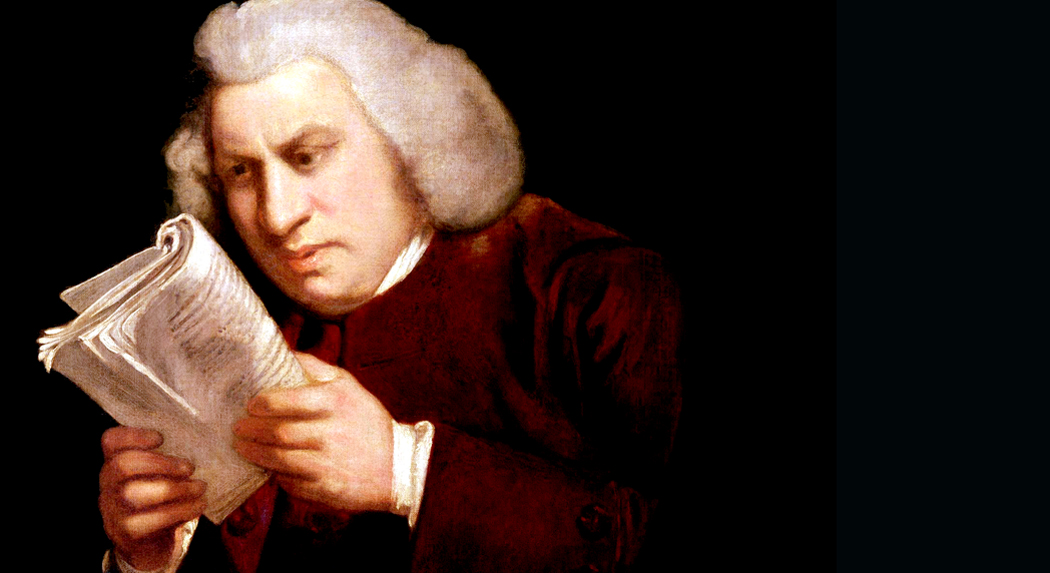
I think of Samuel Johnson’s heartbreaking preface to his 1755 Dictionary, which every thoughtful person should read and lock to mind. “To have attempted much is always laudable, even when the enterprise is above the strength that undertakes it: To rest below his own aim is incident to every one whose fancy is active, and whose views are comprehensive; nor is any man satisfied with himself because he has done much, but because he can conceive little. … When I had thus enquired into the original of words, I resolved to show likewise my attention to things; to pierce deep into every science, to enquire the nature of every substance of which I inserted the name, to limit every idea by a definition strictly logical, and exhibit every production of art or nature in an accurate description, that my book might be in place of all other dictionaries whether appellative or technical. But these were the dreams of a poet doomed at last to wake a lexicographer. … I saw that one enquiry only gave occasion to another, that book referred to book, that to search was not always to find, and to find was not always to be informed; and that thus to pursue perfection, was, like the first inhabitants of Arcadia, to chase the sun, which, when they had reached the hill where he seemed to rest, was still beheld at the same distance from them.”
“What do you read, my lord?” “Words, words, words.”
For 25 years, I made my living by writing words. In all, some two and a half million of them, writing an average of three stories a week. Yet, in all that time, I had an underlying mistrust of language, a sense that, even if I could still diagram a compound-complex sentence on a blackboard, the structure I saw in chalk did not necessarily mirror the structure of things I saw around me in the world before it is named. The one was neat and tidy, the other was wooly and wiggly.
A good deal of misery and misunderstanding derives from a failure to recognize that the logic of language and that of the real world are not the same.
We find this in simple form whenever someone tells you that, for instance, “a tomato is not a vegetable, it is a fruit.” This is a sorry assertion. A tomato is neither animal nor mineral, therefore, it is a vegetable. But, of course, that is not what is meant. In common usage, we use the word, “fruit,” to name a sweet edible and “vegetable” to name a savory. But “vegetable” is also an umbrella word, describing all things vegetative. To aver that a tomato is not a vegetable is to confuse these two usages, and therefore to make an assertion both pedantic and ignorant.
More importantly, this doesn’t really say anything about the Solanum lycopersicum, but about the categories we use language to establish. It is an argument not about the berry (and that is the technical term for the red globe you slice onto your salad), but about the English language.
Or consider this: “A whale is not a fish.” When such a statement is made, it does not discuss whales or fish, but rather, makes a claim about language. The whale is unaffected by the words and fish swim happily past it. But it is a discussion about the categories of nouns: We choose to make the definition of the two classes mutually exclusive. A whale is a mammal.
But it needn’t be so. Through the 18th century, a whale was a fish. Jonah was swallowed by a “great fish.” Anything torpedo-shaped that swims in the sea by the action of its fins was considered a fish. A whale was a very large fish, who just happened to be one that gave birth to live young and suckled them. It was an idiosyncrasy of the whale, just as it is an idiosyncrasy of the salmon that it swims upriver to spawn.
In fact, if you read Oliver Goldsmith’s “History of the Earth and Animated Nature,” the best-selling nature book of its century, the category “fish,” also included many other things that live in the watery parts of the world. Whales were “cetaceous fishes,” flounder were “spinous fishes,” sharks were “cartilaginous fishes,” crabs and lobsters were “crustaceous fishes,” and clams and oysters were “testaceous fishes.” It was a perfectly natural way to divide up the various denizens of the undersea. It wasn’t till Carl Linne decided to slice up the world in a new way, based on a combination of skeletal morphology and reproduction, that the whale was surgically removed from the universe of fishes and told to line up on the other side of the room with lemurs, llamas and raccoons. Did the whales even notice?
The basic problem is that language is an intercessor. It sits between experience and understanding. When we approach language, we see only the intercessor — we mistake the priest for the deity.
Words always distort, they always lie. Yet, at bottom, we trust words more than we trust our own eyes. We judge politicians by the labels they are tagged with, not by paying attention to what they actually say or do: Conservative or liberal — when applied to reality, the labels are close to meaningless.
The case may be a little easier to understand in terms of Greek. The ancient Greeks were the first logarchs, they valued verbal meaning over experiential meaning; they actually thought language was a one-to-one descriptor of reality. Their faith is naive to us now. For instance, Zeno’s paradox is only possible in words. Set a tortoise and Achilles out on a race and see if Achilles can’t catch it. No problem. Set it in words, and suddenly, it can’t be done: The problem is entirely in the words, words, words.
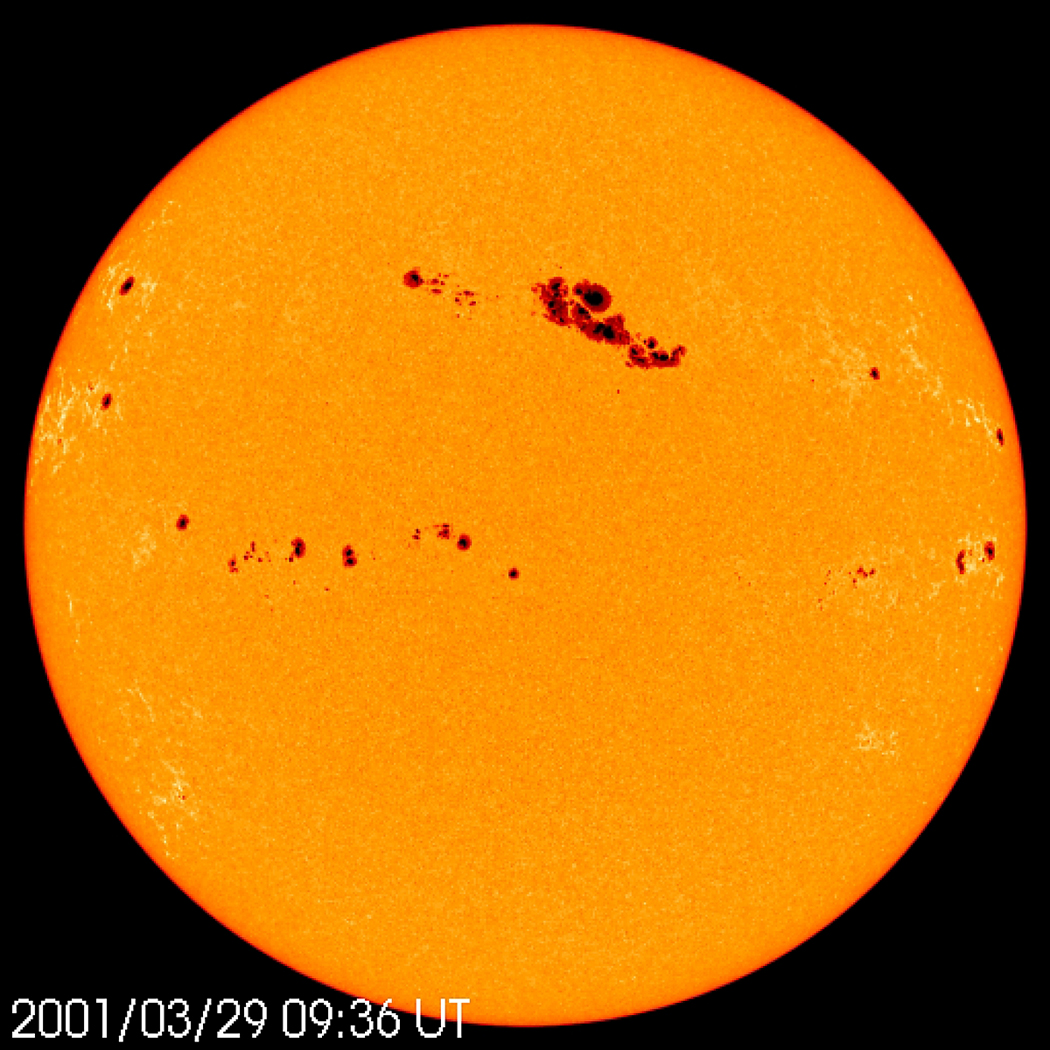
It is the logic of language that frustrates Achilles, not the tortoise. It guided how the Greek thought about the world. Polarity, opposites, hidden ironies and surprising conjunctions, it’s how the language is organized, even before you even consult reality. So, when the Greek saw language as a mirror of the reality and language posits polarity, it must be because the world is polar. But is it? Opposites are only a linguistic trick. Hot and cold are just relative points on a single thermometer: Sunspots are “cold” places on the sun, even though they are thousands of degrees Farenheit; liquid nitrogen is “warmer” than absolute zero. Linguistic legerdemain.
Even liberals and conservatives are just guys in the same blue suits. They don’t look like a dime’s worth of difference to the Fiji Islander.
By the logic of language, the world is divided into nouns and verbs; look out the window, however, and what you see is the conflation of noun and verb: something very much closer to Ovid’s Metamorphoses: a constant velocity of things ever growing and changing. No noun is static; no verb without its referent.
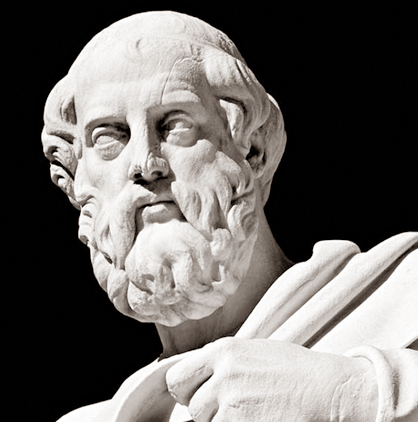
The issue I have with Plato — aside from his totalitarian fascism — is his faith in an “ideal” of things. The ideal bed, unlike any real bed, is a stultified noun, not a bed. To Plato, the world is cataloged with nouns, only nouns. The perfect human is a form of arrested development. For Plato, the perfect human form is a male figure, age of about 25, all muscle and lithe, with little fat. But a real person is born tiny, grows, ages, marries, has his own bairns, gains experience, grows feeble and dies. Just as a rose isn’t the pretty flower, but a shoot, a bud, a flower, a rose-hip bursting to seed and once more from the top. Over and over. All the world is at every moment changing, growing, shrinking, spreading, running, molting, squawking, collapsing, weeping and rising. It is a churn, not a noun. “Panta horein,” as Heraclitus says: “Everything changes.”
Language is this thin veneer, the shiny surface, the packaging we are cajoled by. Break open the box, and the reality is something else.
It is much like the belief that geometry transcends embodiment. In other words, a triangle is a universal possibility, no matter if one was ever built. It is one of Plato’s ideals. God himself cannot create a four-sided triangle. But to change this “truth,” all we have to do is change our definition of the word. We don’t need a deity to do that, all we need is a lexicographer.
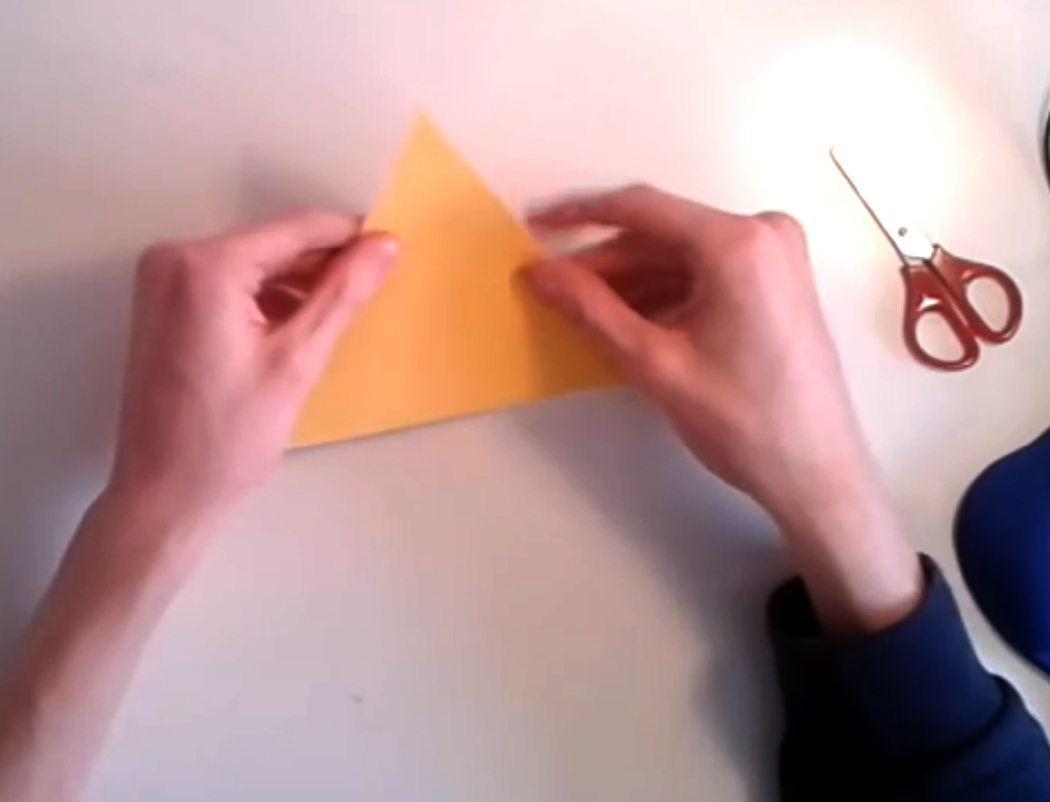
Or better, we can look at the problem a different way: I have written elsewhere (https://richardnilsen.com/2012/06/24/artists-math) that a triangle is a five-sided figure — the three usual sides, plus the top, looking down on it, and the bottom, resting on the desk. You can turn any triangle over from its back and lay it on its belly. If triangles exist in the world of things, they must have five sides. Language, like the axioms in geometry, pales in comparison to the real world of mud and bricks. There are 300,000 words defined in the Oxford English Dictionary, but that is an infinitesimal number compared with the number of things, acts, colors and sizes in the phenomenological world. There are an infinitely large number of things in the universe for which there are no words.
Take this, for instance. Here, where two walls meet is a corner. But where the wall and the ceiling meet? What is its name? In English, it has none.
Or this place on the wall — it is named the “center.” But this point, just as real, only a few inches from the center, is nameless and so is the one a few inches beyond that.
Names are like the stars in the sky, only points, between which is an infinity of space, just as real as the stars.
Language is feeble. It is up to us to see the space between the words, to recognize the feelings between the signpost emotions of hate, joy, anger, sadness — this million slight inflections that are nameless.
Up to us to explore the confusing rush of sense data, the confusing signals of society and nature, the overwhelming input that we censor with our language, allowing only those portions that sport nametags, as if they were Shriners at a convention.
It is up to us to recognize and celebrate all the things, times, places, acts, flavors, feelings, breath and abysses that don’t have names, to enjoy the cold floor and sunlight coming through the window in the morning when the birds haven’t yet begun chattering.





















 Richard Nilsen