Archive

Tag Archives: pletnev

bachtrack page
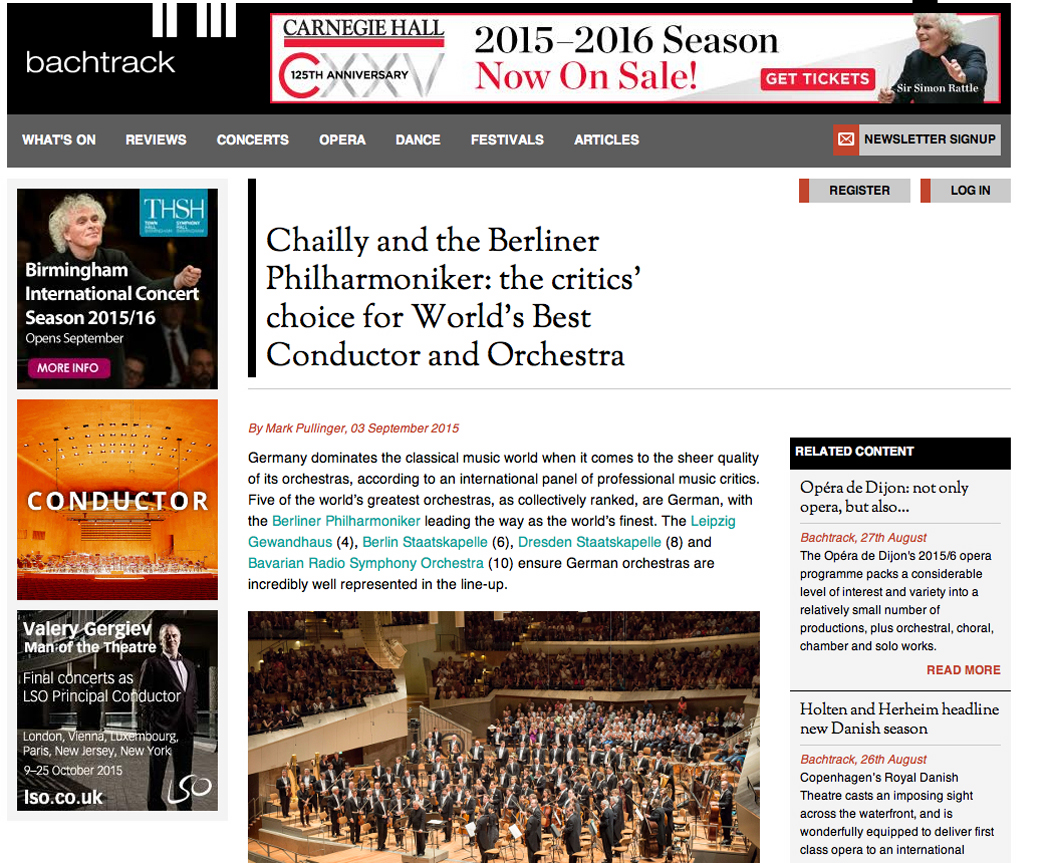
The website Bachtrack has just released its poll of (mostly) European classical music critics, choosing the top ten orchestras and top ten conductors in the world. It is a list designed to be argued with — as most such lists are — and a list with some very odd missing persons.

First, the primary news, which is hardly news at all: The top three bands in the world are Berlin, Vienna and the Royal Concertgebouw Orchestra. These three orchestras top almost everyone’s list. If they hadn’t been in win-place-and-show, we would all have known the contest was rigged.worlds best_orchestra_2015_bachtrackz

The rest of the list includes, in order, No. 4 through No. 10: The Leipzig Gewandhaus Orchestra; the Chicago Symphony Orchestra; The London Symphony Orchestra; the Berlin Staatskapelle; the Dresden Staatskapelle; the Boston Symphony Orchestra; and the Bavarian Radio Symphony Orchestra. All perfectly deserving bands, although some people in Cleveland might be squawking.

Only two American orchestras made the cut, but then, the ranking was made by Europeans (with only a handful of American critics included), so the bias is natural — they haven’t had a chance to hear the American groups. And of course, it goes without saying (except I’m saying it here) that all such rankings are essentially meaningless and serve only to start bar fights.

I can’t have any real opinion on orchestra rankings, because I only know most of them them through recordings. I haven’t heard all of them live.

The top conductor of the day, according to Bachtrack, is Riccardo Chailly, currently head of the Leipzig Gewandhaus. Also on the list: Simon Rattle; Mariss Jansons; Andris Nelsons; Riccardo Muti; Daniel Barenboim; Kiril Petrenko; Esa-Pekka Salonen; Yannick Nezet-Seguin; and Christian Thielemann. What? You say, no Bernard Haitink? No Pierre Boulez? There are several heavy hitters that are Missing in Action.

Such lists are inevitably subjective, and also political: Most of the critics gauged were German, so perhaps it is Valery Gergiev’s friendship with Vladimir Putin that has kept him off the list.

And I can say, from personal experience, that if you have only heard Haitink conduct on recordings, you may very well think of him as a timid kapellmeister. He is one of those musicians who seems to tone down his personality on recordings. I have heard him live with the London Symphony at the Salle Pleyel in Paris doing Beethoven’s Eroica, and it was one of the most exciting, and deeply moving performances I have ever heard. Live Haitink can be electric.

Still, for most of the baton-wavers, most of our experience of them comes on disc, and for most of them, the discs give us a very decent idea of their abilities. Chailly on disc is riveting. His Mahler Third is my personal favorite, and his recent Matthew Passion — swift enough to fit on two discs instead of the usual three — is a revelation.

So, I have an opinion on the top conductors, and it differs from Bachtrack’s list. My top conductors are not time-beaters, but have distinct personalities, so that you might hear a recording cold and think, that must be Gergiev, or that must be Pletnev. Many critics value the impersonal in performance: “Just the facts, ma’am,” and look for each performance to embody a Platonic ideal mystically assumed to be embedded in the score, with no “interpretation.” I don’t buy it. I want my music brought alive by someone who sees something in the music beyond the bar lines and semiquavers.

If I had a mission as a music critic for all those years, it was to make the case that music — particularly what is called classical music — is about more than entertainment, and that it has meaning beyond the mere patterns of notes on the page, and that musicians, no less than actors, must interpret the music, and bring their individuality to the game. No one wants a Hamlet where the best thing you can say is, “He stuck to the words on the page and didn’t try to interpret them.”

So, here is my list of the top conductors of the day, based both on live experience and on recordings: These are the conductors who give me exciting performances, show me something new, bring out the hidden, find the humanity behind the Pythagorean mathematics, and rattle my cage.

I can’t place them in order, like a horse race. So, as a group they are, in alphabetical order:barenboim
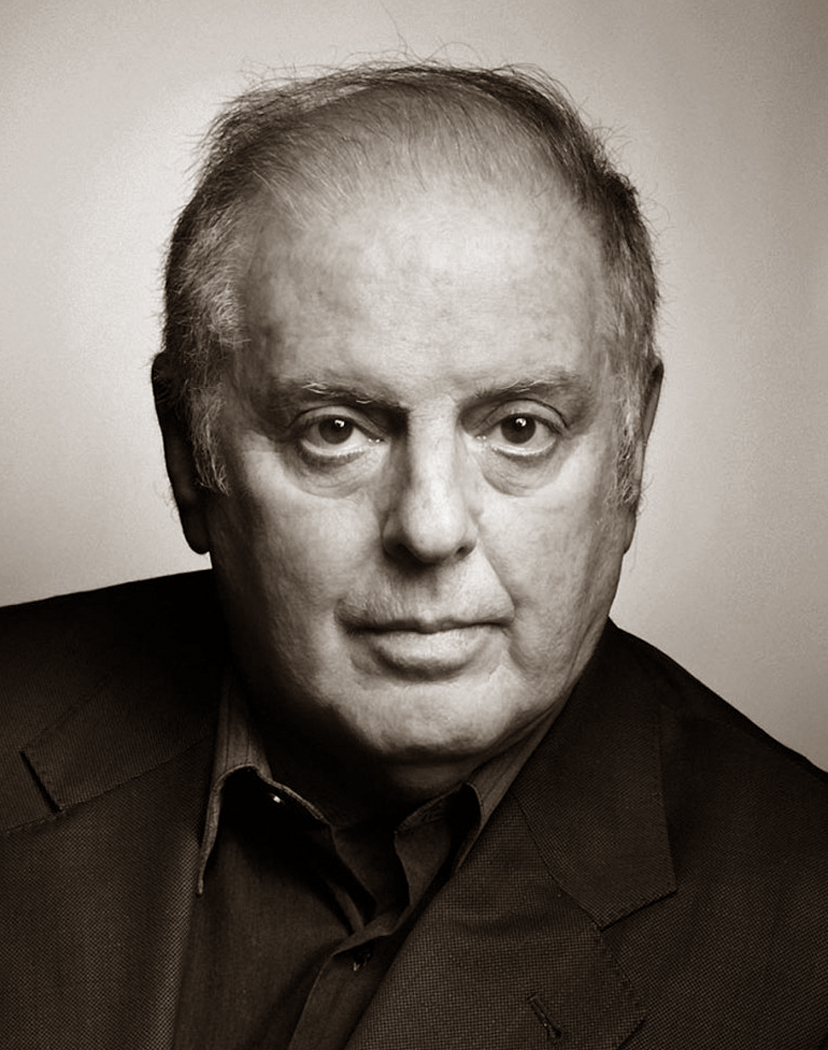
Daniel Barenboim — There is no doubt that Barenboim has ambitions of becoming the grand old man of classical music, and he has largely succeeded, taking up the mantle of a Furtwangler or Casals. There are times when his imitation of those giants of the past has been a kind of pastiche, an aping of idiosyncracies. But he has grown into a musician of considerable maturity and depth. The wishing-to-be has been overtaken by the has-become. His recordings of the Beethoven symphonies joins a few others as definitive, and his Bruckner recordings with the Chicago Symphony match brilliant engineering with perfect performances. boulez

Pierre Boulez — There is no one who does quite what Boulez does on the podium. His sense of color and balance is supernatural, and the crispness and cleanness of his performances are signature. He first became known to me through his recording of the Chereau Ring Cycle, where he managed to make Richard Wagner’s din sound like chamber music. His Mahler may be more “objective” and less manic than others, but no one makes the score more brilliantly etched. And he has a lock on the Second Vienna School. chailly

Riccardo Chailly — Over a long career, Chailly has found a corner all his own, bringing clarity and energy to familiar scores. His tempi tend to the speed-demon edge — he cuts an hour off the normal performance time for Bach’s Matthew Passion — but through some kind of maestro-magic, he makes those tempi expressive. Any performance by Chailly — especially with his house band, the Leipzig Gewandhaus — is worth hearing for what will be revealed. dudamel

Gustavo Dudamel — Yes, he’s the wunderkind and all that, and yes, there has been a kind of backlash against his celebrity status, but I heard him lead the Israel Philharmonic in Carnegie Hall playing the Tchaikovsky Fifth and that group of old pros — the kind of musicians who have played the music so many times, they don’t even need a conductor and who can be a little jaded — they looked like little boys being given a pony. Their eyes burned and they played like demons. I also heard him with his own LA Phil playing the Mahler First, and it was gangbusters. He’s for real. gergiev

Valery Gergiev — You have to see this guy on the podium; he’s all fingers. When he conducts, with both hands waving about spastically and each finger on each hand giving different cues, you have to wonder that his players can follow him at all. He has a very personal sound he draws from them: darker than other conductors, richer in the bass regions. I heard him twice in New York with his Mariinsky musicians dong Prokofiev and I feel I was given special insight into that composer. His recordings of Shostakovich’s “War Symphonies” are the best I know of that group of works. haitink

Bernard Haitink — There are unfortunately some musicians who just don’t record well. Yo-Yo Ma, for instance — his recordings are letter perfect and you could hardly ask for better, but they seem weak and pale compared to hearing him live, when you realize that you are, in fact, hearing God on the cello. Haitink can sound strait-laced on disc, but live, he can blow the roof off the dump. harnoncourt

Nikolaus Harnoncourt — This is a man who can be so perverse that you want to strangle him, yet, at times, that waywardness means you understand something you never did before. He brought “original instruments” out of the dark ages, but even with modern orchestras, he is likely to shake things up. And even when he’s not playing bad boy, as in his recordings of the Beethoven symphonies, he makes a personal mark on the music. The world will be a lesser planet when he leaves it. pletnev

Mikhail Pletnev — Pianists don’t always make great conductors. Barenboim and Ashkenazy are two of the few, and Pletnev, who is as wild a pianist as he is a conductor, makes my case that music needs to be interpreted. His Eroica is my personal favorite, played as I have never heard it before, with different accents and rhythms that bring the old chestnut back to its rightful place as being revolutionary.Berliner Philharmonie Gruppenbild Dez Berliner Philharmonie Gruppenbild Dez 2011 253
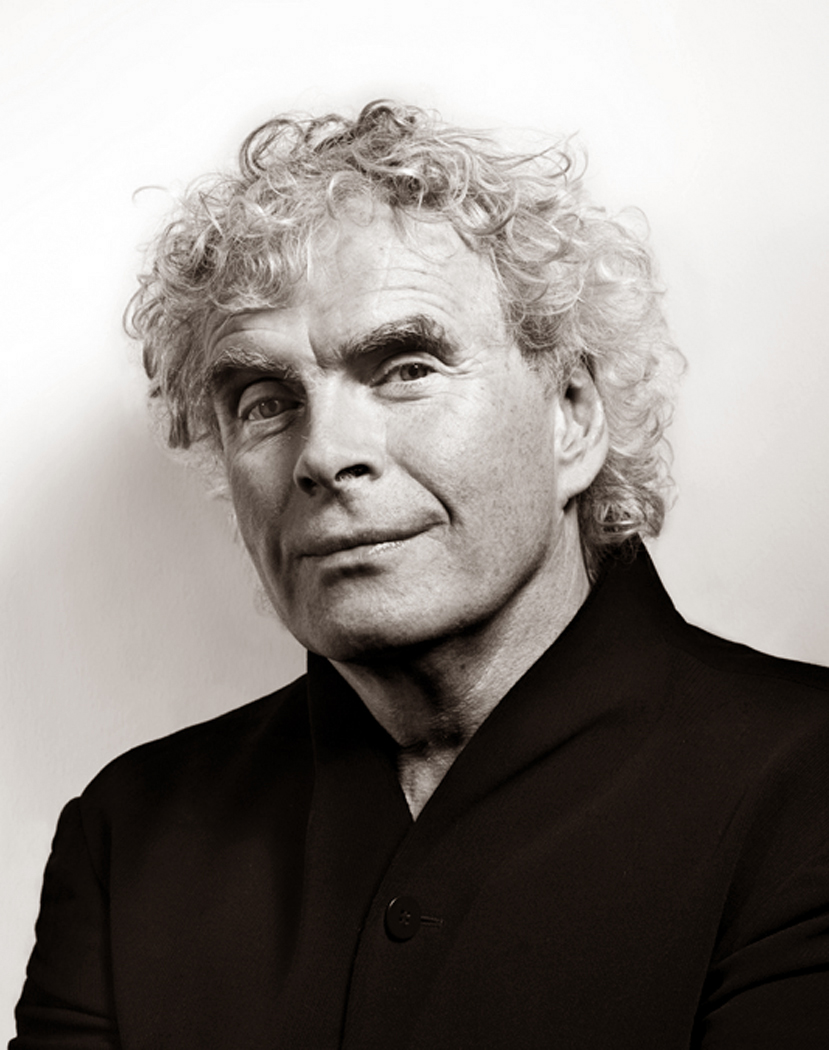
Simon Rattle — From the beginning, when he was the upstart at the City of Birmingham Symphony Orchestra, Rattle showed a talent for both new music, new angles on old music, and a general awakeness to the world and its music. When he moved on the Berlin, he was a race car driver given the fastest machine in the world. The recordings he has made with them are nearly perfect. There is a depth behind the sheen. He finds the wit in Haydn and the neuroses in Mahler, the Weltschmerz in Brahms and the impishness in Stravinsky. His range is spectacular.

That is my list. It has nine conductors. You get to choose the tenth.

gould goldbergs

Periodically the publishing world throws out a book put together by a critic or writer listing the “best of” or “greatest” and then lists books, recordings, movies, DVDs, TV shows or places to visit. The lists are always a great way to start off a conversation, even if they are always flawed, biased and at best partial.

So it is with Tom Moon’s book, 1,000 Recordings to Hear Before You Die (Workman, $19.95).bookpix

I can’t comment on most of his selections, although it would be hard to quarrel with the idea that you should be familiar with Miles Davis’ Bitches Brew  or Jimi Hendrix’s  Are You Experienced.  To say nothing of Duke Ellington’s  Blanton-Webster Band  or Ray Charles’  Modern Sounds in Country and Western.

These are all recordings that anyone with a musical curiosity should know, and probably love. And Moon has a thousand of ’em.

But Moon chooses to include classical music in his selections, too, and there he really seems to miss the boat. It is clear that he is a part-timer when it comes to Bach, Bartok  and Boccherini.

It isn’t that the music he chooses is wrong: You can’t really argue that anyone who loves music should have listened to Beethoven’s symphonies or Bach’s keyboard music. But while his popular and jazz albums recognize truly great performances, his choices for the classical selections are      invariably bland and middle-of-the-road. Safe. Boring, even.

The title of the books is “recordings to hear before you die,” and should be recordings that you grab someone by the lapels over and say, with scary enthusiasm in your eyes, “You gotta hear this!”

That won’t always be the best performance, in classical music, but rather the most grabbing, the one that says something new or different, that makes you rethink the music, or just sit up and take notice.

And the classical catalog is full of such recordings: Not just for classical music snobs, but for anyone who cares deeply about music in general, whether their favorite is Led Zeppelin  or Public Enemy.  These are performances that have appeal outside their narrow intended audiences.

So here are 25 classical recordings you have to hear before you die.


gould1. Bach, Goldberg Variations, Glenn Gould, piano  – The 1955 performance by the strange Canadian pianist turned classical music world on its head, with playing faster and slower than anyone else, and with an extraterrestrial energy and clarity that has never been matched, even by Gould’s second recording, from 1981.


2. Tchaikovsky, Symphony No. 6 “Pathetique,” New York Philharmonic, Leonard Bernstein, cond.  – The hyper-emotional Pathetique normally takes 45 minutes to play. Bernstein’s later recording (on DG) takes an hour and wrings from the music the deepest tragedy, perfect accompaniment for a suicide.


3. Mozart, Piano Sonatas, Mikhail Pletnev, pianist – Wolfgang’s piano sonatas are normally thought of as his “B” material; not under the hands of crazy Russian genius Mikhail Pletnev. He plays them like his life depends on them – the greatest recording of these works ever.


celi4. Bruckner, Symphony No. 4, Munich Philharmonic, Sergiu Celibidache, cond. –  Playing something slowly doesn’t always add weight, but here Bruckner’s most accessible symphony is played with the slow, careful intensity you might expect from someone defusing a bomb.


5. Mahler, Symphony No. 4, Concertgebouw Orchestra, Willem Mengelberg, cond. – Mahler was always over the top, even though many modern conductors rein him in. Mengelberg knew Mahler, heard him conduct, and gives us echt-Mahler, full of its requisite retardandos and portamentos. This is how Mahler is supposed to be played.


6. Wagner, Tristan und Isolde, Philharmonia Orchestra and soloists, Wilhelm Furtwangler, cond.  – Don’t be afraid of Wagner. If you like Lord of the Rings,  Wagner is just the same thing with tunes. With Kirsten Flagstad and Ludwig Suthaus,  this is the Tristan for the ages.


casals7. Bach, Brandenburg Concertos, Marlboro Festival Orchestra, Pablo Casals, cond.  – Politically incorrect performances of Bach’s essential concertos, meaty, expressive, lush, vibrant – and a slap in the face to those who believe there is only one right way to perform Bach.


8. Bach, Suites for Unaccompanied Cello, Pablo Casals, cello  – Casals singlehandedly resurrected these profound works, where Bach made the single instrument as rich and varied as a full orchestra. He plays them as if he were alone in the universe. Only Casals could do that.


9. Beethoven, Diabelli Variations, Uri Caine, piano, with Concerto Koln  – Postmodern Beethoven, with the 33 variations Beethoven wrote turned into marches, show tunes and fireworks. Not for the faint of heart, but explains to a new generation why Beethoven is worth knowing about.


10. Schulz-Evler, Arabesques on Johann Strauss II’s “Blue Danube Waltz,” Josef Lhevinne, piano  – The great show-off piece played as no one else has ever managed: You swear on your grandmother’s babushka that there are at least two pianists working up a sweat, maybe three. This is what a virtuoso is.


shostie11. Shostakovich, Symphony No. 7, Chicago Symphony, Leonard Bernstein, cond.  – Lenny finds the core of this long, often-derided masterpiece, that can turn into shlock in lesser hands. This is one of the most glorious orchestral recordings ever made, blazing with brass and passion.


12. Vivaldi, The Four Seasons, Concentus Musicus Wien, Alice Harnoncourt, violin, Nikolaus Harnoncourt, cond.  – Unconventional approach to familiar music turns these little concertos into tone pictures: Vivaldi meant them to create sound images, and here, you hear the dogs barking and the rain falling.


13. Barber, Adagio for Strings, Los Angeles Philharmonic, Leonard Bernstein, cond.  – There are people who cannot listen to Samuel Barber’s mournful, tragic piece without breaking into uncontrollable sobs, and Bernstein seemed to feel a special connection to the music, which he plays for all he is worth.


kissin14. Chopin, Piano Concertos, Evgeny Kissin, piano, Moscow Philharmonic, Dmitri Katayenko, cond.  – Wunderkind Kissin was only 12  when he recorded these, but it would be hard to find anyone who has better captured the verve and spirit of these Chopin concertos. This is magic.


15. Chopin, Nocturnes, Maurizio Pollini, piano  – Pollini finds more pith and mettle in these nocturnes, usually played to bring out their dreaminess. For Pollini, one of the superstars of the piano, they have more shadow and threat, things lurking behind corners, and military bands playing in the distance.


gabrieli16. Gabrielli, The Antiphonal Music of Gabrieli, various performers  – The assembled brass sections of the Chicago, Philadelphia and Cleveland orchestras play the glorious music of the Gabrielis the way it must sound in Heaven. This is virtuoso brass playing from a legendary album. You gotta hear this!


17. Brahms, piano music, selections, Glenn Gould, piano  – Thought he could only play Bach? Gould was at heart a romantic, and his Brahms is subtler, more nuanced, more beautiful than anyone else’s. This playing comes as a complete surprise, and utter joy.


rachmaninoff18. Rachmaninoff, A Window in Time, piano music, selections, Serge Rachmaninoff, piano  – The dour Russian was one of the greatest pianists of the century, but his electric recordings are dulled by scratches and boom. These are digitally enhanced Duo-Art  piano rolls, played on a Yamaha Synclavier,  that brings back the luster to his piano.


19. Chopin, Sonata No.2 “Funeral March,” Serge Rachmaninoff, piano  – Or you could try the thing itself, un-reconstructed. Rachmaninoff’s take on the familiar sonata is so fresh, powerful and driven, you’ll be shocked to hear it again as if it were for the first time.


valentina20. Liszt, Virtuosa Valentina, piano selections, Valentina Lesitsa, piano – Franz Liszt  was a showman, who brought to piano the same sense of spectacle that Spielberg brings to the seashore; Valentina Lesitsa plays them that way, all out, thunder and cannon-shot, fireworks and passion.


21. Beethoven, Symphony No. 3, “Eroica,” Russian National Orchestra, Mikhail Pletnev, cond.  – Pletnev plays the Eroica like it means something, and replaces tunes and rhythms with the kind of persuasive rhetoric that starts nations marching.


22. Wagner, Liebestod, Vladimir Horowitz, piano  – Real virtuosity isn’t just lots of notes real fast, but rather total control of the piano and expression. In Horowitz’s final CD, The Last Recording,  made when the was 86,  the ol’ magician wrings thunder and tears out of the death of Isolde. It becomes our death, too.


tureck23. Bach, The Great Solo Works, Rosalyn Tureck, piano  – Too often we think of Bach as mathematical, but he was really a crazy Baroque composer, layering hysterical detail on detail. Tureck plays him that way with the Capriccio on the Departure of a Beloved Brother,  and the Italian Variations,  with notes sweeping in like a tidal surge.


24. Gershwin, Rhapsody in Blue, Los Angeles Philharmonic, Leonard Bernstein, piano and cond.  – Bernstein plays Gershwin’s familiar symphonic jazz almost as if it were Brahms, big, romantic, serious. This is not everyone’s cup of Gershwin, but you simply have to hear it.


25. Grieg, Peer Gynt Suite, Royal Philharmonic Orchestra, Thomas Beecham, cond.  – Peer Gynt? Seriously? Hall of the Mountain KingAnitra’s Dance? Beecham plays the music with such suave joy, and with not a single mote of condescension, and revivifies the old chestnut. You’ll tap your toes and sing in the shower.