
Ovid is just plain fun to read. There are classic Latin texts that feel like doing homework, but Ovid — especially his Metamorphoses — just scoots by and can only be described in modern terms as a “page turner.”
Publius Ovidius Naso (43 BC to AD 17) was probably the most prolific poet of ancient Rome, writing many books, often quite salacious. He wrote about how to seduce a woman, how women should attract men, how to break up with a woman — you get the picture. But his most famous book was “Changes,” or Metamorphoses in its original, which told dozens of mythological stories, mostly old Greek tales. It was a best-seller when it was written, copied out by hand many times over, and remained a best-seller through the Middle Ages and into modern times. Many writers — including Shakespeare — cribbed from Ovid and a good deal of what most people have absorbed of Greek mythology really comes through Ovid as the middle man. If you know about Daphne and Apollo or Pyramus and Thisbe, it is likely the Ovidian version you have seen.
Ovid wrote in a sleek, fast Latin that told his stories economically. He has been used to teach students Latin for centuries, and has been translated into most of the world’s languages.
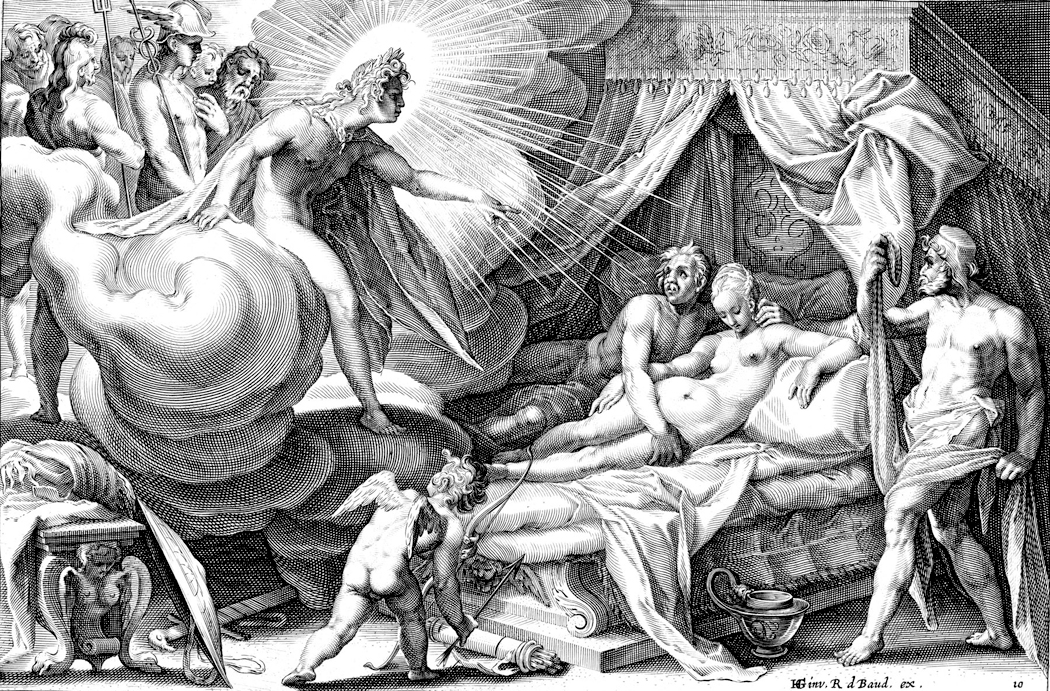
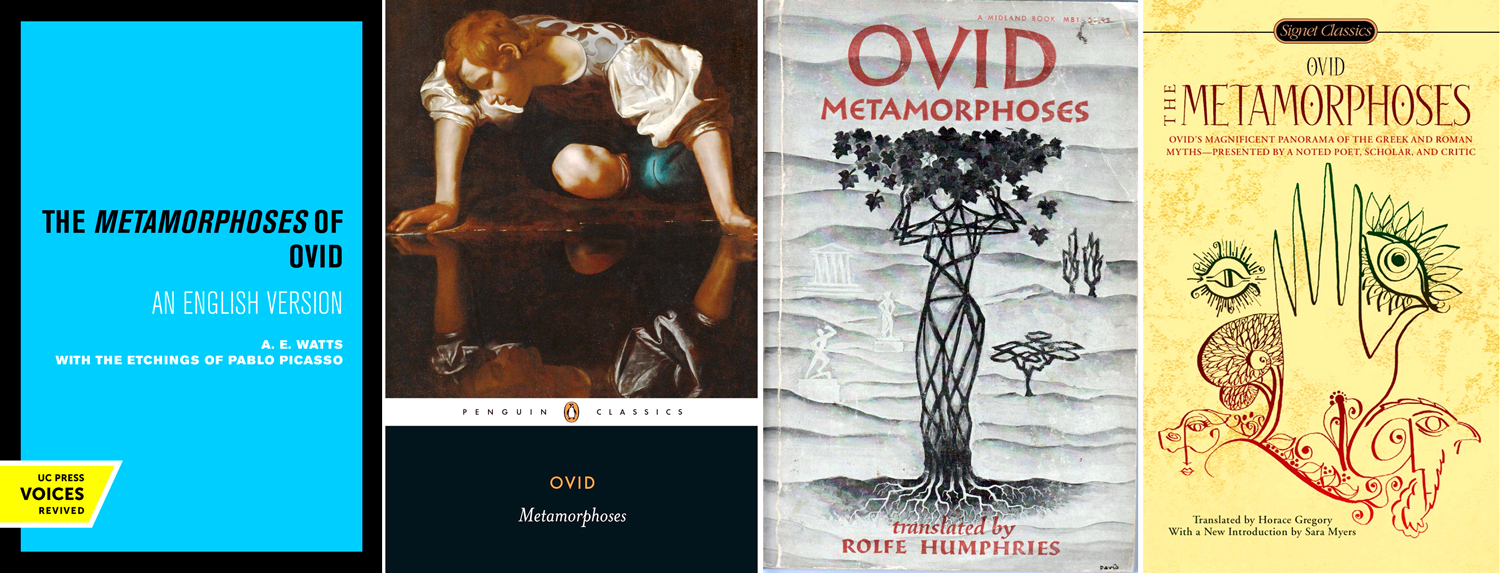
I’m one of Ovid’s devoted readers, and have gone through the book many times, in different translations, beginning in the 1960s with the old, standard Rolfe Humphries version (which I can’t say I found easy going).
Since then, I have re-read the Metamorphoses many times, each time in a new translation. The newest is by Stephanie McCarter. She is not the first woman to take on the work, but she has made it a point to unforgive the gods their brutality. Where other translators give us gods “ravishing” their mortal victims, McCarter forthrightly calls it rape. In the “Me-Too” era, there is no glossing over the violence and brutality, the sexism and misogyny inherent in the myths.
I applaud this shift of reference, but despite that, I found her verse tough plowing. These things are a matter of taste. Previously I had sailed through the 2004 translation by Charles Martin and found the lines so fast under my eyes, I hardly noticed I was reading a translation. Turning the pages with McCarter, I never forget that under her words there is a Latin pluperfect subjunctive. That it is a reasonably accurate version I don’t question. It is. But I want something else for my pleasure. Ovid’s original was always praised for its fleetness, and so I would wish my English equivalent also to fly by, so that I am immersed in the story rather than in the mechanics of the language relaying it.
But reading this new version also made me want to look at how others have assayed the project.
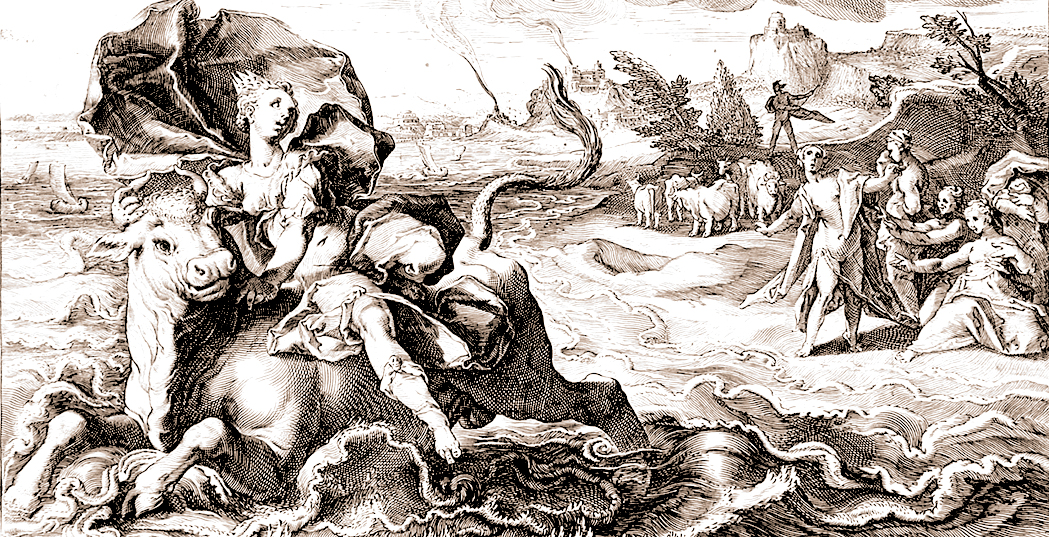
I took on a week-long effort to concentrate on the first four lines of the book and compare how each translator has looked at them, and found rather notable differences, considering how plain the meaning actually is.
For this, Ovid must take a share of the responsibility. There is some ambiguity in his words, which make the poetry richer, but the translations more problematic.
Then, there is the question of whether the translation should be prose or verse, and if verse, should it rhyme? Ovid wrote in hexameters, but English is geared to pentameter. Should you try to count six or count five? Six often sounds a bit awkward in English, while pentameter comes as naturally as breathing. Is six closer to Ovid’s original, or is the swiftness of English pentameter more faithful. Each translator has his or her own solution, and any can work.
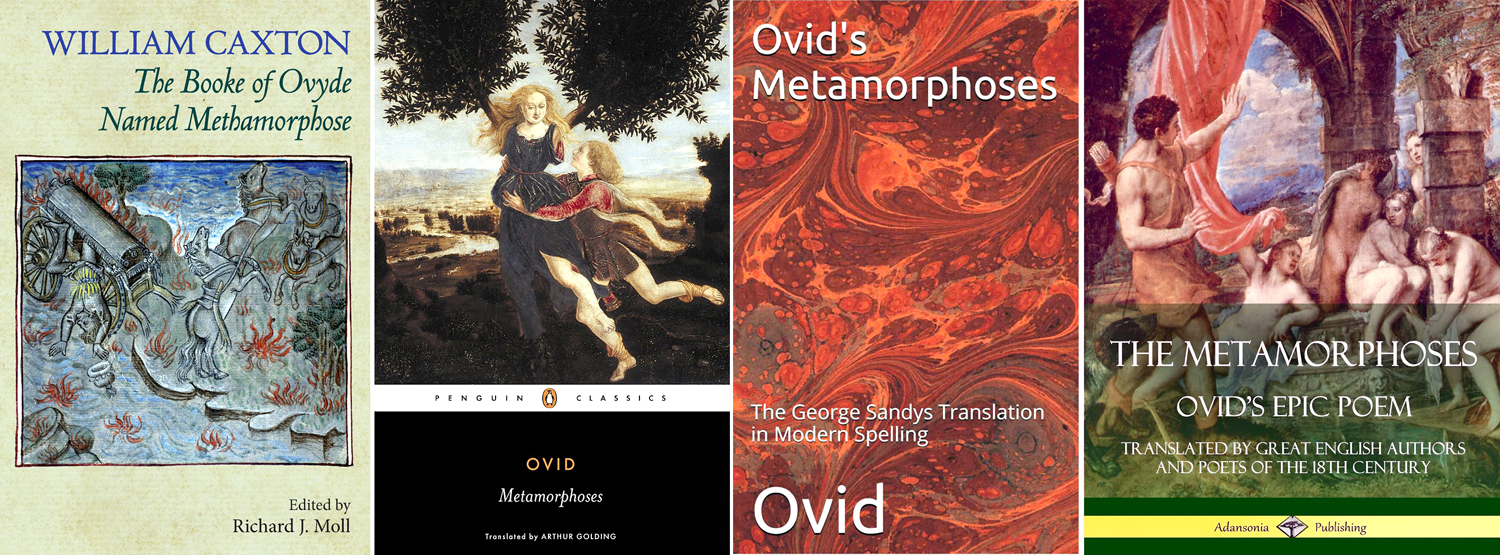
The first English translation was by William Caxton, who probably also gave us the first printed version (as opposed to hand-written by scribes), although the only versions extant seem to be the handwritten ones). It was in the Middle English that Chaucer would have read. He titled it The Booke of Ovyde Named Methamorphose.
But the first translation that counts and is still readily available was made in 1567 by Arthur Golding. It was Golding that Shakespeare read and cribbed from. He opens his version with the four-line prologue:
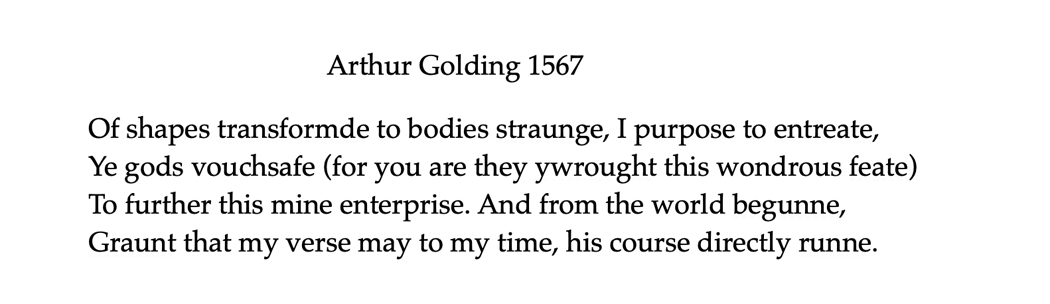
It is written in “fourteeners,” the meter and rhyme scheme of the theme song to Gilligan’s Island: “Just sit right back and hear a tale, a tale of a fateful trip/ That started from this tropic port, aboard this tiny ship.” It was a popular meter in the 16th and 17th centuries. Nowadays, it can feel a touch jogtrot. (Now try to read Golding’s lines without singing them to the tune).
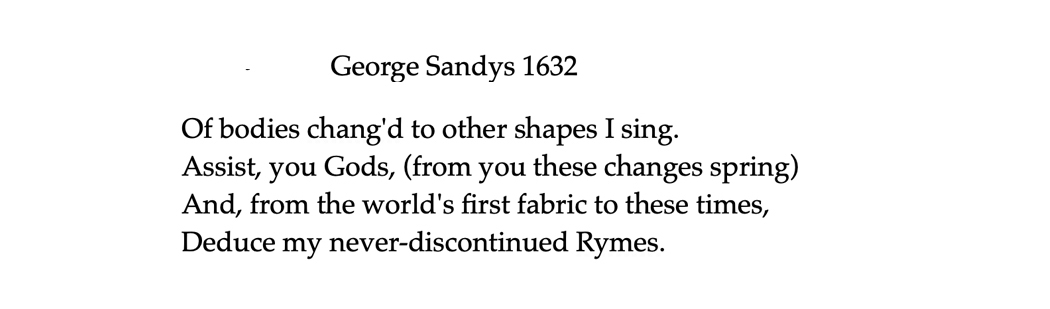
The second translation came in 1632, by George Sandys, who decided that English pentameter was more natural to the native speaker and recast the whole in a five-beat line, which shortened each and made for swifter reading, but also left out a bit of the original meaning.
The most famous early translation came out in 1717, done by a team of writers rather than a single translator. These included John Dryden, Alexander Pope, Joseph Addison, John Gay, and William Congreve, among others. In was rendered in heroic couplets and was surprisingly fluent. Dryden took on the whole first book and began the introduction:
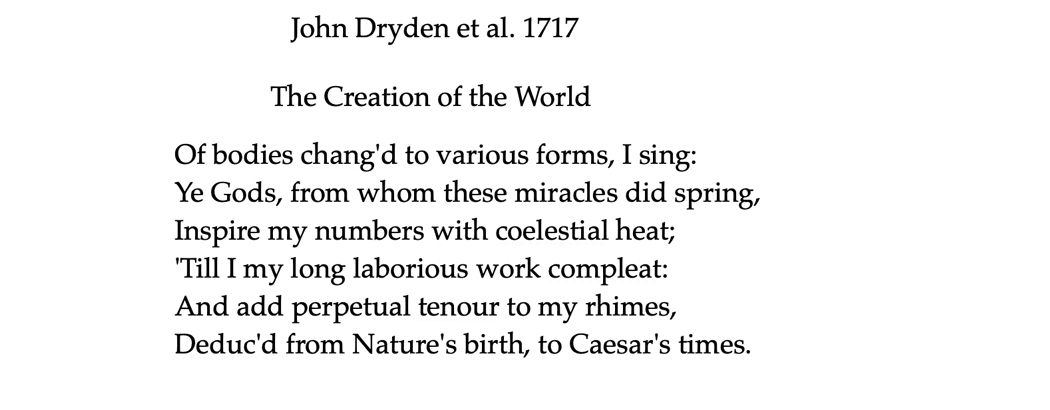
That became the standard Ovid for many years, and is still read and still quite readable.

But then came the Victorians, who saw, among other things, Ovid’s usefulness in teaching Latin to its young men. And so you get a spate of them, usually in prose, meant almost as cribs for translation.
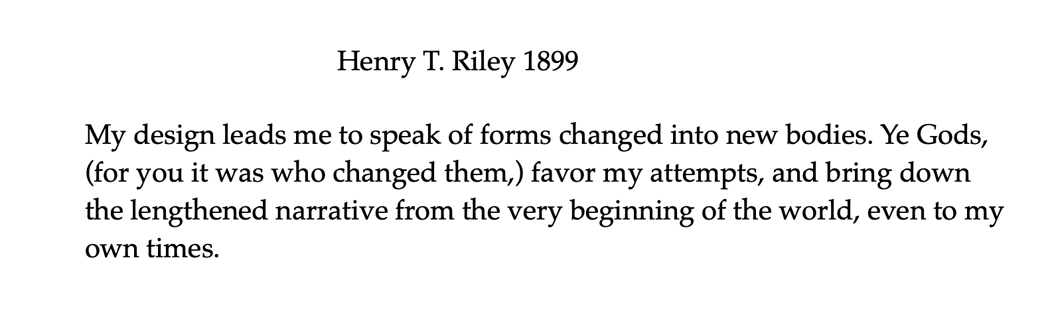
The one I have read several times is the Henry T. Riley, in a two volume pocket series published in 1899. Like many of the versions of its era, its notes try very hard to reconcile Ovid’s paganism with Victorian Christianity, and so, where Ovid talks of “gods,” the Victorian translators often write “God.” This isn’t much of a problem, if you are aware of it as you read. Riley’s proem runs:
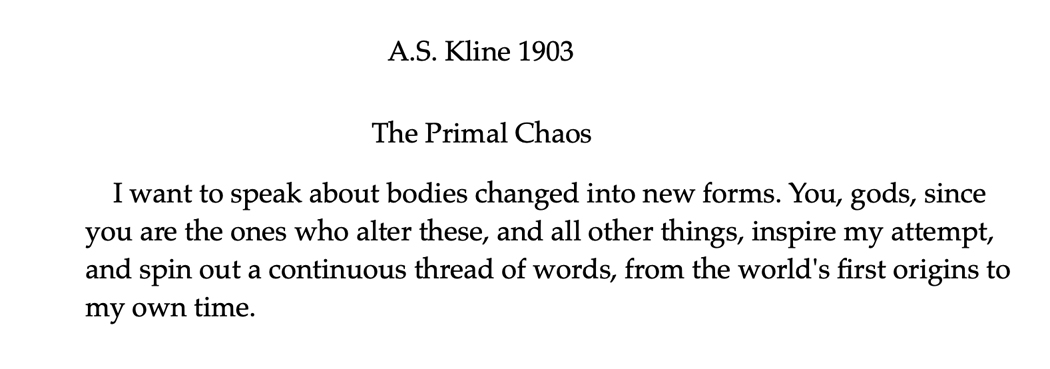
Anthony S. Kline, who seems to have translated pretty much everything at one point or another, came out with his Ovid in 1903. It is still widely available. It is in prose and meant to be almost pedestrian, i.e., not high-falutin’ and poeticalized.
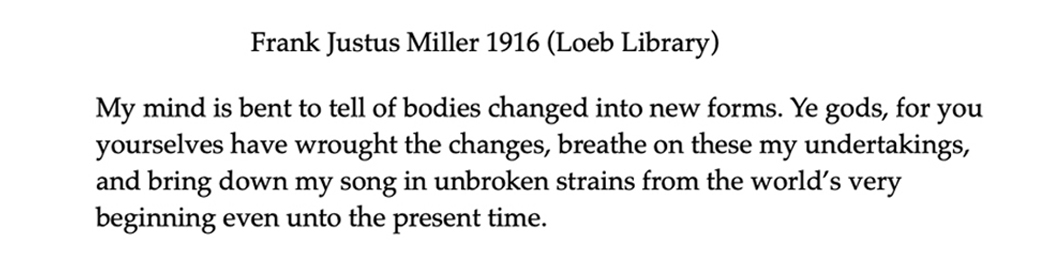
In 1916, the Loeb Library translation came out, with Ovid’s Latin on the left-hand page and Frank Justus Miller’s prose on the right-hand, opposite the original. It doesn’t quite work as an interlinear, but it will help anyone attempting the work in Latin.
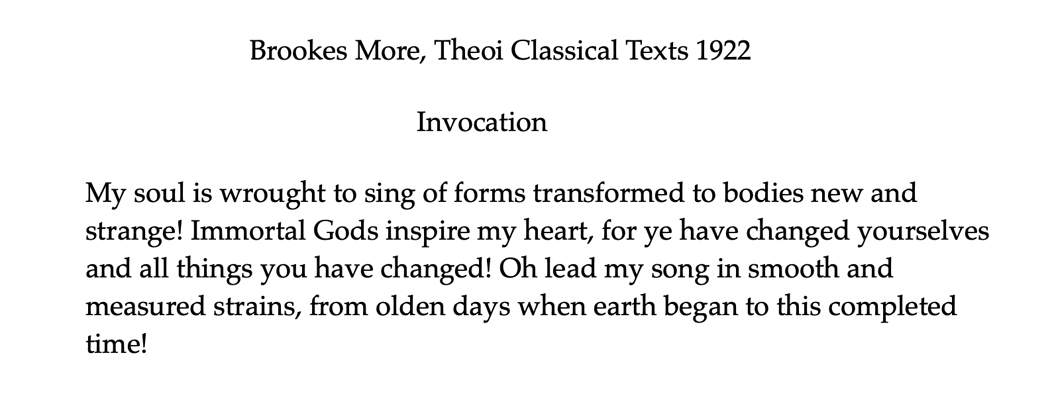
In 1922, writer Brookes More gave us a prose version for Theoi Classical Texts. Like many others, it as much interprets Ovid’s words as translates them. The word “strange” does not appear in the Latin.
A new spate of translations hit in the 1950s, after the war, when so many new students were headed to university under the G.I. Bill.
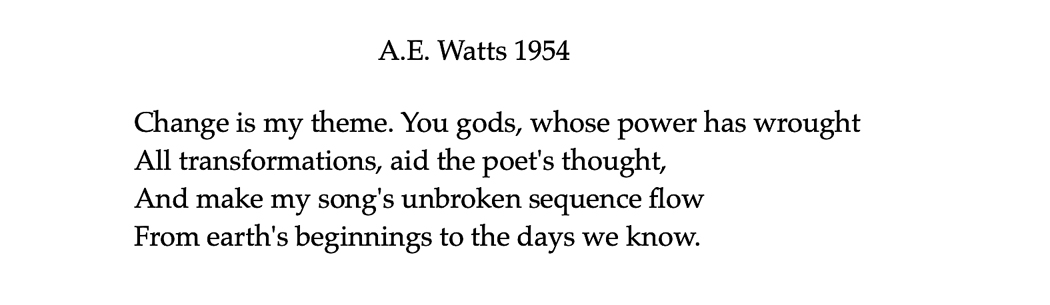
In 1954, A.E. Watts put it in pentameter and squeezed it all down to a fast-running nugget. His purpose seems to be to get the gist as directly as possible.
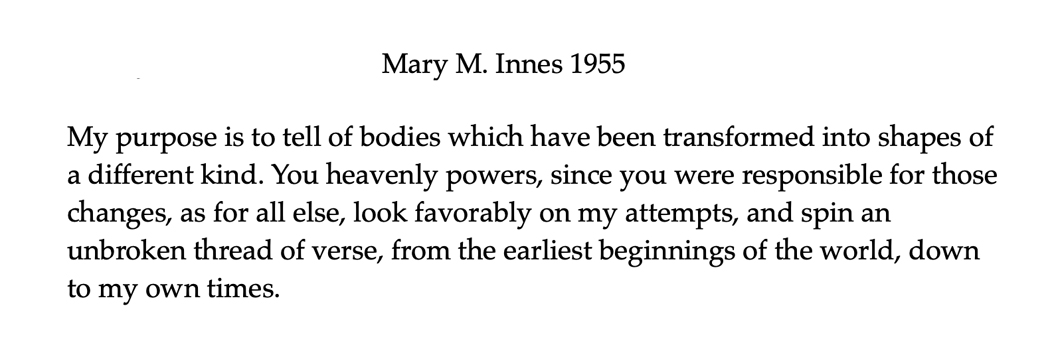
A year later, Mary M. Innes uses prose and is pretty much as close to the original as it can get, across languages and cultures. It has been a mainstay of Penguin Classics and is still widely available and read.
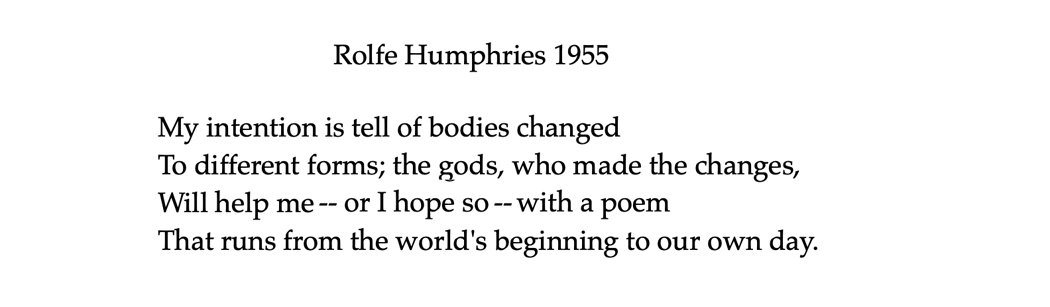
The same year, the widely read Rolfe Humphries version came out in what must have been at the time a very contemporary sounding verse. It is the one I read in high school and didn’t like. Reading it now, I wonder what was I thinking. It is still in print, in a shiny, new annotated version published by Indiana University Press. It moves quite fast.
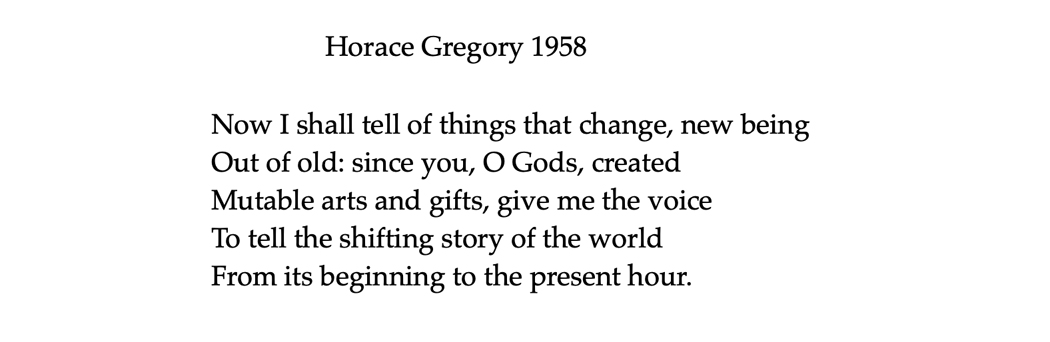
Finally, in 1958, Horace Gregory published his verse version, which attempts, also, to feel contemporary, but to my ears feels a tad straight-laced.
The text sat dormant for a couple of decades, but in the 1980s, Ovid became a growth industry again.

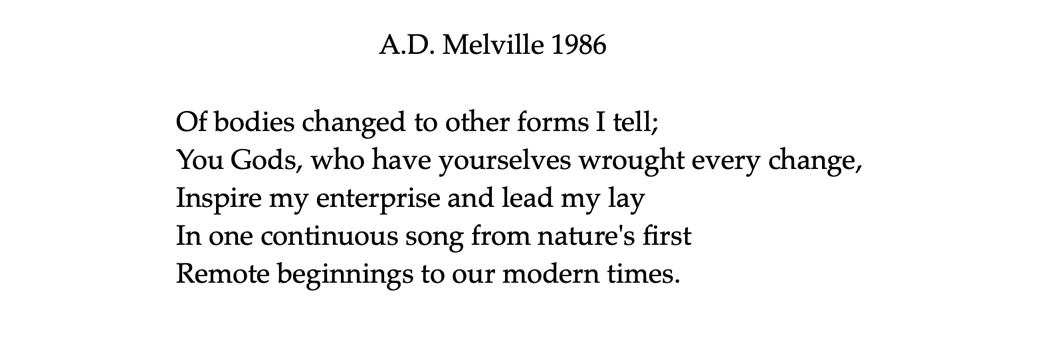
Oxford World Classics commissioned A.D. Melville for a new translation of the Metamorphoses, published in 1986. It is self-consciously poetic, with words such as “ere,” “countenance,” and “naught” to stumble over where more conversational words would be clearer.
Charles Boer took another approach in 1989, with what one reviewer said is “like it’s spouted from the lips of some prehistoric shaman, barking out a tale to his animal skin-garbed flock.” In short, punchy lines, not always strictly grammatical, he seems to want to express each point as curtly as a newspaper headline. Articles evaporate and nouns shoot each other. It’s sui generis. To give the flavor of it, I have to quote more than just the proem.
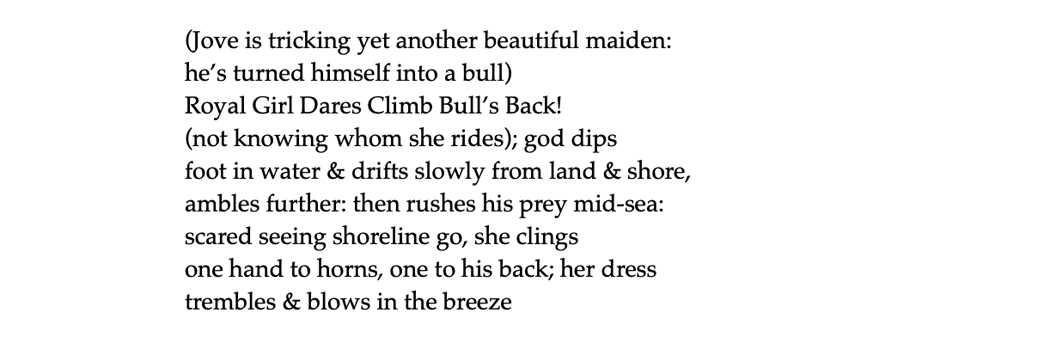
The proem is short and pithy, but the whole book is an acquired taste
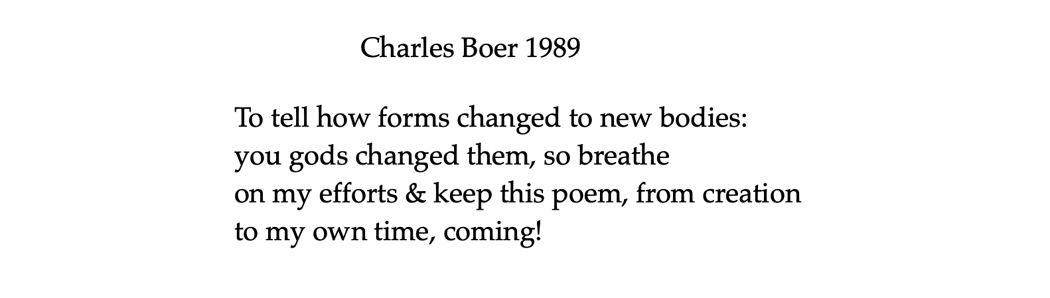
Allen Mandelbaum was a translating machine, and has given us versions of almost everything we might want to read, from Homer to Vergil to Dante. His Ovid, from 1993, in an Everyman Classic, which means it is gorgeously bound and printed in a handsome Bembo typeface. This is a book that looks really good on a bookshelf, but I’m afraid I find the translation rather worksmanlike. He takes six lines to say what Ovid said in four.
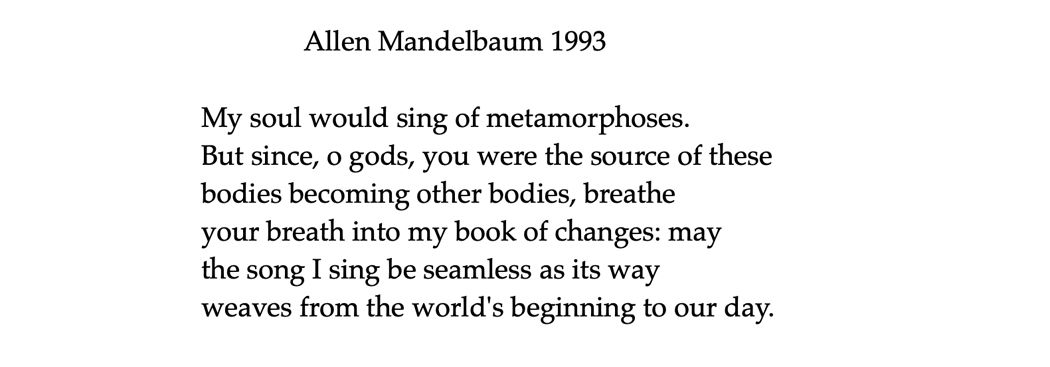
David Slavitt competed in 1994, with an entry in a very loose hexameter and what he says is “translated freely into verse.” He wanders a bit, and seems to add things into the text that sound more like commentaries on the text. In his introduction he writes: “As a translator, I take all kinds of liberties, but I am strict in my observation of length and scale, which I take to be significant artistic decisions that any new poem ought to respect and re-create.” In other words, he’d rather match Ovid’s prosody than his content. Some people swear by him.
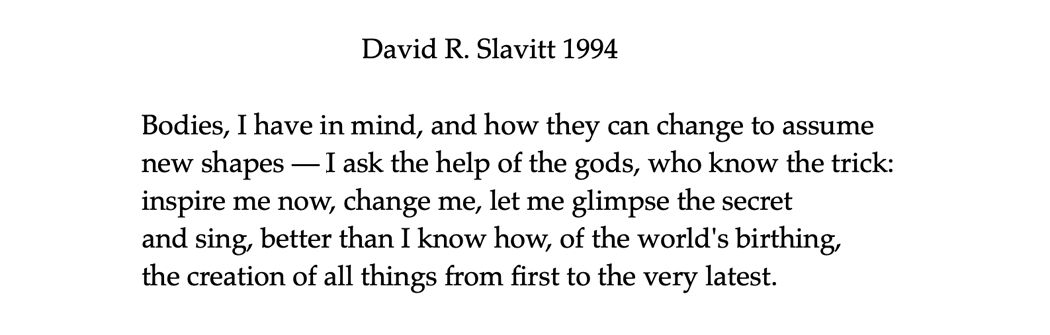
The new century, 2000 years after Ovid actually wrote the thing, has exploded with new versions of his magnum opus.
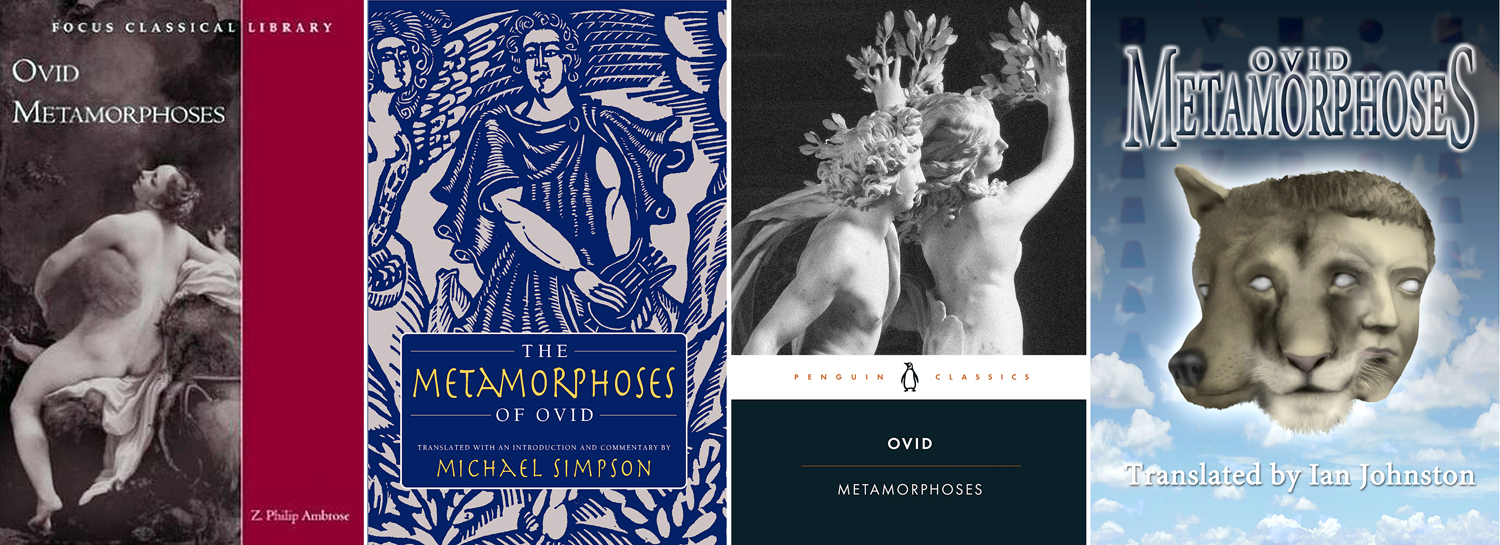
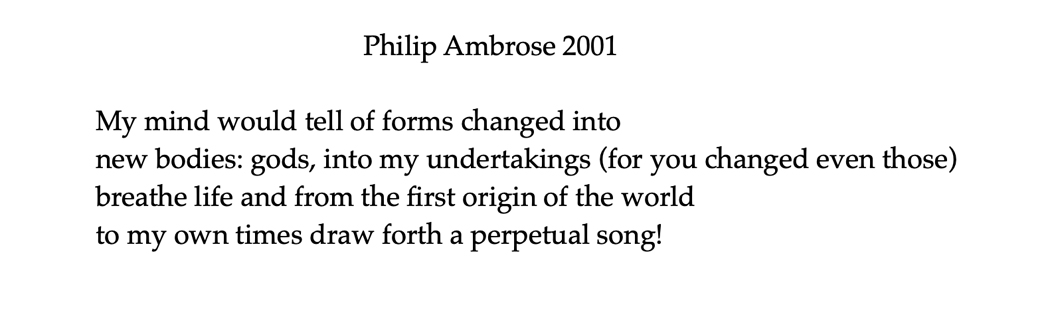
Philip Ambrose attempts to keep a line-by-line parallel with Ovid’s Latin, with sometimes an awkward phrasing, as when Phoebus, sounding like Yoda, tells Phaethon “But warn against this action I can”
Also in 2001, Michael Simpson brought out his prose version, attempting, he says in his introduction, “the rapid and direct American idiom while avoiding colloquialism on the one hand and academic translationese on the other. His version includes as many pages of notes, as of poem.

I’m jumping ahead to 2004, skipping over Charles Martin for the moment, and to David Raeburn’s version for Penguin Classics, available in a handsome clothbound edition. It looks great on a bookshelf, but Raeburn’s somewhat wordy take means that most of the lines are longer than the page is wide, leading to insufferable line-breaks. Ugly. Reading it is like taking three steps forward and one back, over and over again. (This is a problem of book design rather than translation).

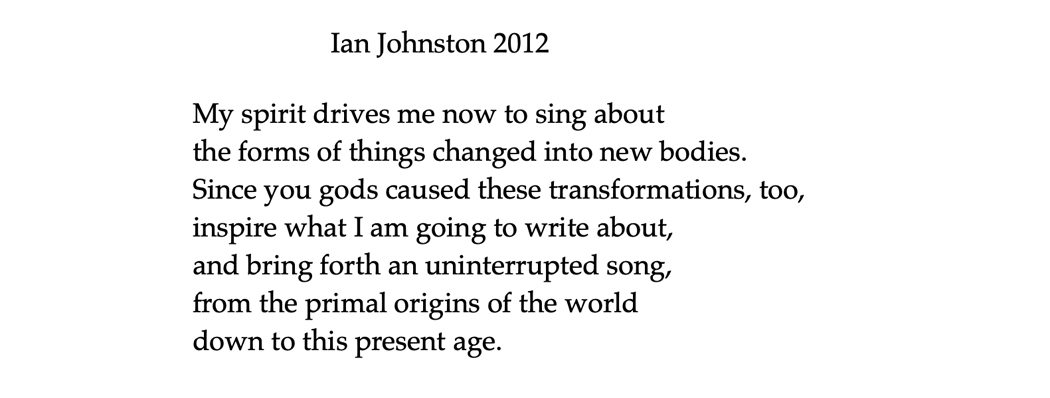
In 2012, Ian Johnston put the text into swift pentameter, and what is more, posted the entire book for free on his website. There is also, of course, a handsome physical book to buy. The tales are laid out with marginal headings to keep track of the often confusingly interlaced stories.
That leaves three translation to consider: My two favorites and the newest one.
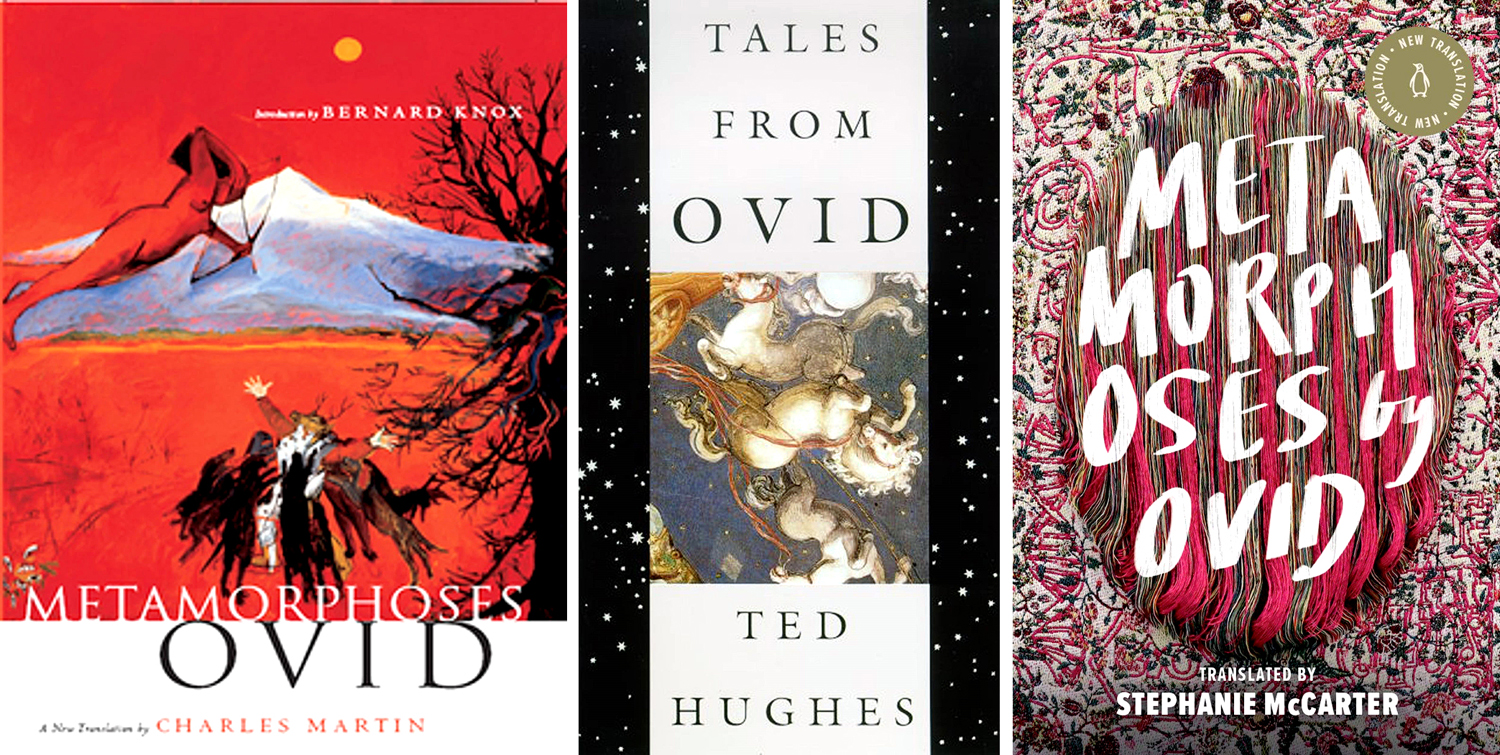
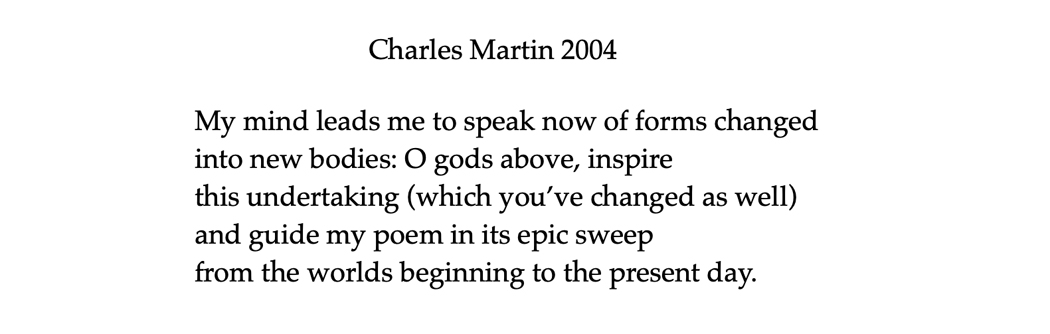
Charles Martin’s 2004 version for W.W. Norton is about as graceful as you can get, with a very free pentameter that moves as swiftly as Ovid is meant to move. I find no speedbumps in its wordage or lineage. It is the version I read over and over.
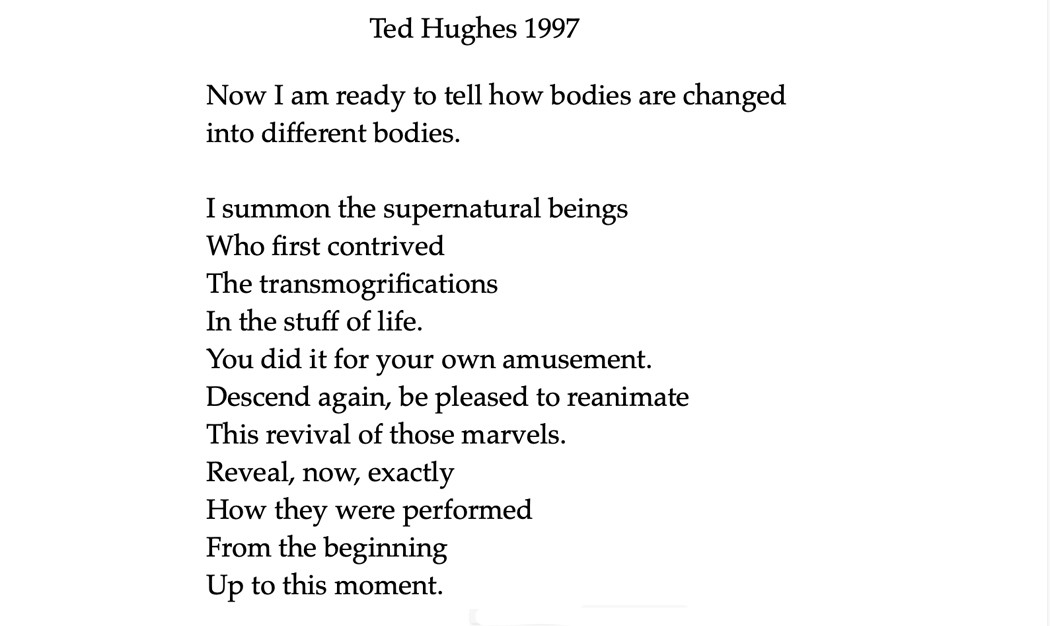
But that doesn’t mean it is my true favorite, which is, I think, the best translation of anything that I have ever encountered. The problem is that Ted Hughes only worked on sections of the Metamorphoses, and so his version is incomplete, and second that his truly free approach means that he occasionally slightly rewrites Ovid to make things clearer or more proportioned to English (Ovid’s Latin doesn’t work word-for-word in English). It’s as if it were a completely original poem by Hughes rather than a translation of the Latin. I absolutely love Ted Hughes Tales from Ovid and cannot recommend it highly enough.
Which brings me back to the new McCarter translation, the latest in the long freight-train line of Penguin Books versions. If you read just the proem, she gets the gist of it absolutely perfectly, both metrically (as pentameter) and by giving us Ovid’s meaning as clearly as possible.
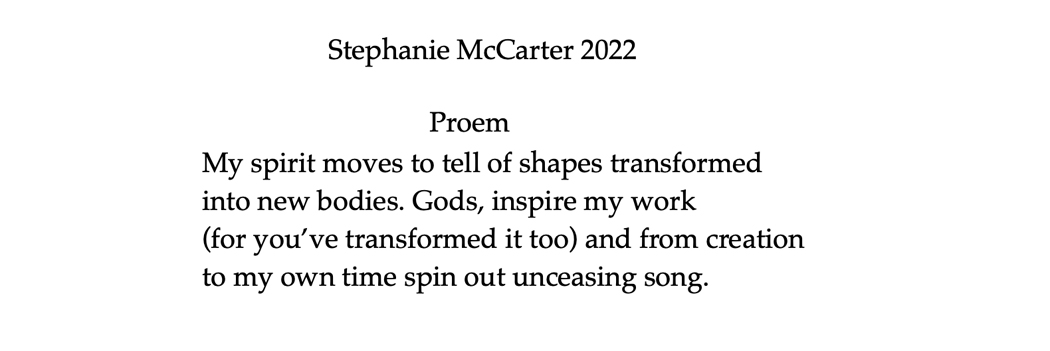
But the rest of the book is less graceful, and about three pages in, I found myself working to read it. Martin’s version is greased and slides frictionless. McCarter is more like bumper-to-bumper traffic on the interstate, with a kind of start-and stop hiccups, and it sometimes suffers from what Simpson dubbed “translationese.”
Translations seem to fall into one of three camps. One attempts to be as faithful as possible to the original, to simplify it and make it plain; the second seeks to poeticize it and make it sound as much like poetry as possible, and by that, we mean Victorian poetry; a third stream values contemporaneity, to make Ovid sound as if he were writing today, with the risk that in another 10 years it might sound as dated as Beatniks or bell bottoms.
Any of these approaches can work, as long as the words spring along quickly and effortlessly, and Ovid’s stories keep you turning pages. Tastes vary and any one of these translation may strike you. I’ve laid out the range of them, and they can all be found somewhere in some published form.
The best version for you is, of course, the one that keeps you reading to the end.
Next time: A closer look at Ovid’s Latin











 Richard Nilsen