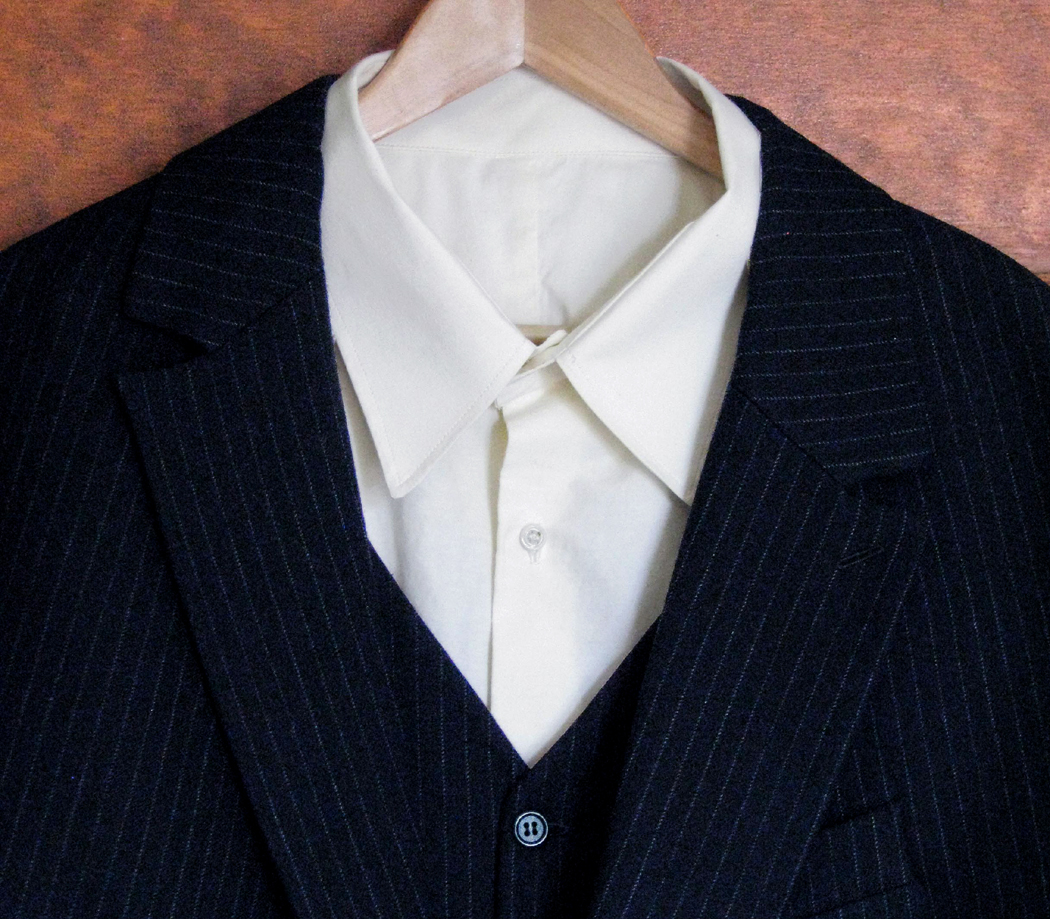
T. Baxter Frim rode to work on the subway each day, wearing a blue suit so dark it might as well have been black.
It was a heavy, wool suit, with stripes barely visible, and a vest with a watch pocket. He did not own a pocket watch; he would have thought it an affectation. The suit smelled in the rain, but he kept it neatly pressed, with cuffs.
You might think he was reflexively conservative, but along with the suit, he never wore a hat. And this was five years before Kennedy’s hatless inauguration. Frim was ahead of the world on this one issue.
But this is not a story about the suit, but about a man who would choose to wear such a suit.
Born in Quidney, Vermont, he was trained as an accountant, but found his life’s work as an actuary for the New Haven and Manhattan Indemnity Corporation. When he was 45, he started writing poetry.
It was an unusual avocation for an actuary, perhaps, but none of his coworkers knew about it. The only one who did was his wife, Marie, and she didn’t think about it much.
He had a few pieces published, in “Garden Monthly,” the “National P.T.A. Journal,” the “Melville, Alabama, Weekly Star,” “American Steel Smelting News” and his hometown newspaper, the “Quidney, Vermont, Record.”
Other than that, he had a shoebox full of rejection notices. He kept it in the bottom of his bedroom clothes closet, and popped a new slip in every second or third month.
His life, such as it was, was happy enough. He laughed reasonably often, had a ready pun on occasion, and genuinely loved his wife. His coworkers liked him and he rose steadily, but not spectacularly, at the firm. At the age of 52, he had his own office and a secretary, who we’ll call Hazel.
Everyone who knew him called him Ted. His first name was actually Theophrastus, but Ted seemed to work better.
It was a Monday morning and Ted was crumpling paper and throwing it over his shoulder. One after the other, the rubbish collected on the floor behind his chair.
He started writing again, and wadded up the paper once more.
“It reads like it was written by a committee,” he said to himself.
He was writing his resume.
Since he had turned 50, he had felt the intestinal rumblings of hormonal change in his body. He told himself it was nothing, the way one might say, “It’s only the house settling.” Harry wanted to get out of his job, although he wasn’t sure what he wanted.
He also knew that if he ever wrote the resume the way he wanted it, he probably wouldn’t mail it anywhere.
Ted had felt something like this once before, and quashed the feeling by joining the Army. It was just before Pearl Harbor. He thought a tour in the military might show him a wider corner of the world. The recruiting officer had promised that the Army had need of accountants.
But, instead, they made him a quartermaster and sent him to Kansas.
Just before he left Vermont, he married Marie. They had met at a party at school, and he saw her at the edge of the room, with eyes like a cow’s, looking ready to drip tears. He thought she looked ineffably beautiful.
She was, in fact, in the middle of a trauma that tested everything she had been brought up to believe. She had followed her high-school sweetheart to college when he received a football scholarship. He was the star quarterback and he squired Marie around until their second year, when he came out of the closet.
“I’m queer,” he told her.
“Take some Bromo Seltzer,” she replied.
When he made her understand what he meant, she refused to believe it. She followed him around, trying to figure out how to cure him, and at the very moment Ted had spotted her at the edge of the party, she had spotted her man in a dark corner with his arms around the neck of a young sociology instructor. She could taste the metal of electricity in her tongue, and there was a ringing in her ears.
By the end of the year, she had married Ted and one of her first letters to him in Kansas said, “Great news — I’m in the family way.”
In Kansas, Ted discovered something: a 33 percent markup over wholesale made the wholesale a 25 percent discount. There was never any actual difference in the cost, but it could be like looking into opposite ends of a pair of binoculars. And it meant that when he wrote up his reports, he could use whichever figure, higher or lower, made his case sound better.
Ted had few illusions about the Army.
The Army confirmed Ted’s realism by awarding him a medal for his cost-cutting bookkeeping methods. But it didn’t hurt, he knew, that he was able to supply a certain colonel with his favorite scotch.
(Ted really got the medal, though he never knew it, for running one of the less corrupt units in the war. Officially, though, his medal was for bookkeeping.)
When the war was over, Ted was honorably discharged and returned to see his daughter and wife and take a job at NHMI Corp.
By way of footnote, his daughter will have an interesting life, herself. When she is 16, she will move in with an unpublished novelist who will never be published. At 18, she will get religion and become Presbyterian. That will last a year until she decides to go to vocational school and learn library science. By the time she is 24, she will be running the San Diego city library and all its branches. At 40, she will suffer a one-year marriage to an undertaker. At 52, she will move in with an unsellable painter, also 52. They will live happily for several years. There will be no grandchildren for Ted and Marie.
Meanwhile, T. Baxter Frim rode the subway every day down to 59th Street and walk crosstown to the office. During his lunch hour, he would eat a roast beef sandwich on a kaiser roll, drink a pint of milk and scribble verses on the back of bits of waste paper.
There are stories of businessmen making good in the poetry world, men who rose to vice president in charge of new accounts while transforming the course of English-language poetry at the same time. Ted was not one of them. His knowledge of literature, and his abilities were modest. He liked the verse of Eugene Field and Ella Wheeler Willcox. His own work tended to be sentimental and sincere, and nothing made him happier than to come across a clever rhyme.
It isn’t everyone, after all, who needs to be Ezra Pound or T.S. Eliot. Not every artist needs to be Picasso, not every musician needs to be Horowitz. There is pleasure enough in small things, performing the rituals of art and poetry, and partaking, in a tiny way, of the giant river of art. The writing was the most satisfying part of Ted’s life, aside from his love for wife and daughter.
And who is to judge Ted’s talent? Perhaps there is more honor in trying than in succeeding. Certainly, there is more satisfaction in the writing than in the having written. If it was a private pleasure, not shared with the larger reading audience, so be it.
At night, after dinner, while the rest of the family watched Red Skelton or Dinah Shore on the Emerson, Ted would transcribe his lunchtime verse and rewrite it, editing it and honing it to the best of his modest abilities.
Marie knew he wrote, but she never bothered him about it, and had never read any of it. He never offered it.
So, when he died, she was surprised by his will.
He had left a condition.
Ted had followed the normal procedures for a will. He left his estate, such as it was, to his wife, with a nice, honorable portion for his daughter.
But he had left the condition.
To quote the document verbatim, it read, “Before the aforementioned party of the first part may have possession of any of the worldly goods left by the party of the deceased part, she will have to arrange for and complete the process of the publication of all the extant rejection notices received by T. Baxter Frim during his long and industrious reign as the laureate of Quidney.”
Her lawyer told her that it wouldn’t take much to fulfill this codicil. That a small run by a vanity press would easily fulfill the requirements, and then she could take possession of the bequest.
But Marie wanted to do right by her late husband, and took the shoebox around from publisher to publisher. No one would take her seriously. Just when she thought she would have to rely on a vanity press, she got a phone call from Viking. An editor there had thought about the problem and believed he had an idea.
The editor organized the contents of the shoebox and later that year, Viking published a volume titled, “The Poet’s Alienation.” It was subtitled, “The Exploring Years, 1946-1965.”
There wasn’t much hope for the book, but Marie was clear for the money.
Then Tom Wolfe reviewed the slender volume in the “New York Review of Books.” He called it “a reflection of our age,” and sales skyrocketed.
All the college professors were discussing a newly found creative genius. The public demanded T.’s earlier writings.
Then came, “The Rainbow’s Eye,” the complete poetry of T. Baxter Frim. With it, “The Collected Letters of Baxter Frim.” Several biographies, ranging from the cheap paperback, “The Passion and the Poet,” to Dr. Everett Bonamy’s expensive hardcover, “T. Baxter Frim and the Contemporary Poetic Situation.”
Marie had many invitations to interviews for famous magazines. Even Ed Murrow called. But she refused all such requests and accidentally created a legend.
She was headlined in all the articles written about her as “the mysterious devoted martyr to the poet’s art.”
Just before she died, three years ago, Marie Frim stipulated in her will that the manuscript of the biography she had written of her late husband should be burned. She figured that would ensure its publication. It became an instant success and sat on the “New York Times” bestseller list for 28 weeks.
And T. Baxter Frim’s daughter donated his blue wool suit to the Library of Congress.






 Richard Nilsen