Archive

Tag Archives: sound

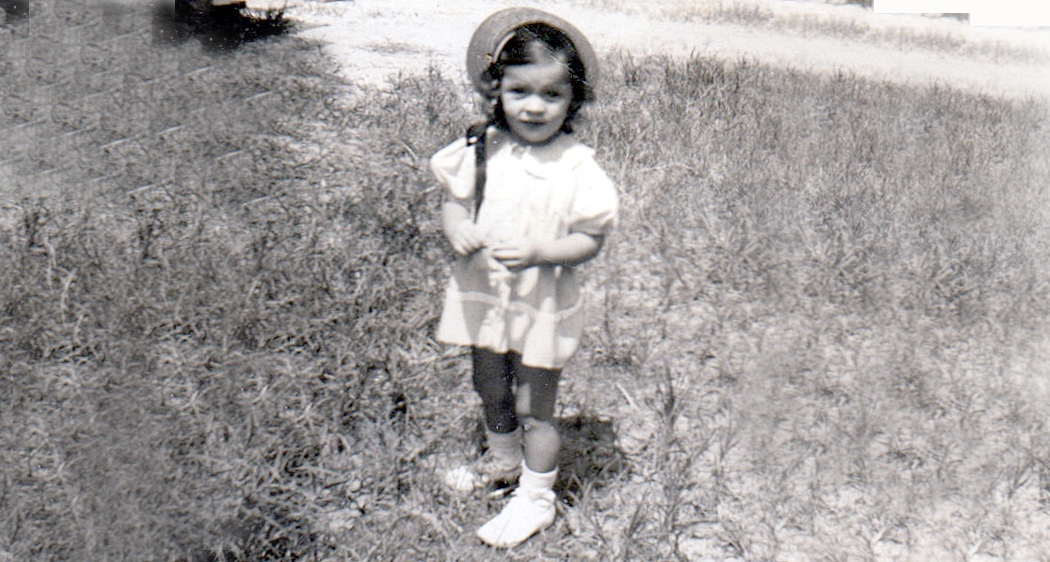
“What do humans sound like?” That was a question that my late wife, Carole, used to ask. She meant something quite specific by it. Carole was the smartest person I ever knew, but her intelligence was not contained within the usual structures of thought. Not so much that she thought “outside the box,” as that there was no box to begin with. 

She used to ask if it were possible to “fall into blue.” When she was a little girl, she used to bend over to see the world behind her, upside down, as she looked at it through her legs. “I wanted to see what it really looked like, and not just what I had grown to know it looked like,” she said. She wondered, as a girl, if the night’s darkness could leak into her bedroom from under the window sill. She was awake to all the input the world offered. 
When she asked about the sound of the human voice, she meant, what it sounds like aside from its meaning. We know what a dog sounds like, for instance, or a bird or a cat. But what is the pitch, rhythm, tempo and tune of a person speaking? We know a bird’s song in part because we don’t know what the song means, only its music — but not even music is the right comparison, since music comes with a syntax and structure of its own. We know the raw sound of the birdcall, but we cannot normally know the same for human speech because our brains process the language instantly into content. We bypass the awareness of the sound for the sense. 

I got some inkling of the sound this morning while sitting in my back yard. Normally, I hear birds and maybe the chatter of squirrels. But there is a house just beyond the trees that border my yard where the family runs a little day-care operation. And I can hear the children talking and yelling, but not well enough to hear what they are saying. I hear only the pitch and rhythm, the overlap, the space left between utterances, the rise in volume with excitement. I hear the adult voices, too, and their pitch and rhythm, all without knowing what they are saying. I am hearing the sound that humans make.

Yes, I know it is being filtered through the English language. I’m sure if I heard little Mexican children playing, their rhythm would be a variant, or French kids behind the walls of their school in Paris (which I once heard and listened to). French has a less percussive sound. Spanish has a rapid-fire rattle to it. And Chinese comes with a melody that imparts its own meaning. But the basic sound was there. 

And so, I hear, in my back yard, the combined sounds of distant dogs barking, the “kweet… kweet” of a towhee, the “shshsh” of the breeze rustling the tree leaves, and the vocalizations of those dozen or so children. And it is all of a piece. It is an experience of the world before knowing. 

One of the problems is that the human mind is a pattern-recognition machine. It seeks and spots them, even without our willing to do so. Understanding speech is an example. The sounds become words involuntarily and the words get in the way of hearing the sounds as sounds. Of course, the words are the point of speech and the desire to hear the sounds without the words is a peculiarity of mind that Carole had. For most of us, the actual sounds are irrelevant, as long as our brains recognize them as phonemes, morphemes, words, phrases, sentences and thoughts. 

Yet, the patterns we recognize — not just in speech, but throughout our lives and culture — are, in some sense, second hand, a gloss on the primary experience. They are a colored glass through which we see the world. The patterns, like so many mullions in a large window, force us to see, hear, taste, smell, the world in the patterns that our brains force on it. 

A frame separates the subject of a picture and points it out to us, but it also cuts away everything not in the picture — the wider context. 

You might laugh, because functioning in the world requires us to make sense of it and our brains do that. But that pattern-making and pattern-finding aspect of our consciousness can also prevent us from experiencing existence directly. Really, only artists, visionaries and crazy people get to lift that veil. Artists want to; visionaries get to; and the insane have no choice. 

Some of those patterns are the cultural baggage we carry. We have the expectation of a certain pattern for governments, for marriages, for friendships, for gender, for tribal affinities. These patterns may merely be inherited habits, but they are buried deeply in us. An attempt to escape them is one of the things that artists do. Entrenched interests often become agitated by the art and fight back. Eventually, the art becomes classic and everyone more or less agrees that the artists had it right in the first place. But by then, the art has become the pattern and is itself entrenched. 

Trying to escape not only the patterns, but the incessant pattern-finding and pattern-making of the brain is difficult. Sometimes that brain outweighs the rest of our bodies. Getting rid of the “middle man” and experiencing things directly can be a revelation. 

It is, I believe, what Walt Whitman was getting at in his Song of Myself: “The atmosphere is not a perfume, it has no taste of the distillation, it is odorless,/ It is for my mouth forever, I am in love with it,/ I will go to the bank by the wood and become undisguised and naked,/ I am mad for it to be in contact with me.” 

 To smell the new-mown grass without knowing it is new-mown grass; to feel the radiant heat on your skin and not know it is caused by the summer sun; to taste the sweetness of spring water without knowing what you are drinking; to hear the sound of children playing without hearing mere words; to feel the earth under your toes and the air against your skin and never parse their meanings. 

“You shall no longer take things at second or third hand, nor/ look through the eyes of the dead, nor feed on the spectres in books,/ You shall not look through my eyes either, nor take things from me,/ You shall listen to all sides and filter them from your self.”
I’m not recommending that we all turn into gibbering idiots; our minds’ ability to forge sense of it all makes life possible. We couldn’t give that up even if we wanted to. What I am trying to do is supplement its meaning-making drive with the ability to let that go for the sake of pure experience, non-judging, non-deciding experience. It would be a kind of return to roots, before all the layering of culture and idea, where we might discover some of those ideas have no foundation. 

Meaning is important, and we all want meaning in our lives. But perhaps we are missing something more primary, more direct. 

A wise person once said, “What we seek is not the meaning of life, but the experience of life.” The experience has precedence. We can hardly make meaning without it. 
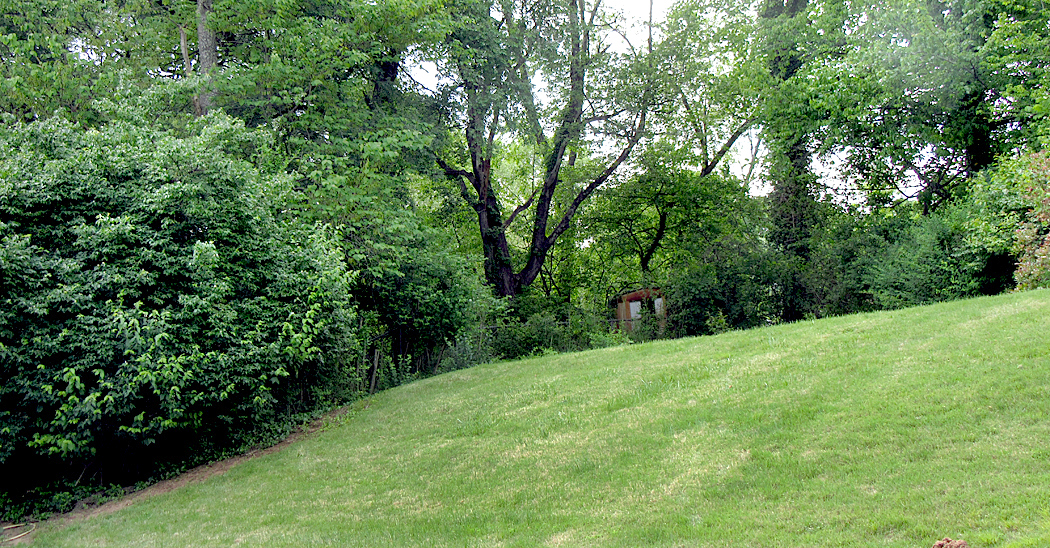
Now that it is well into spring, I like to sit in the back yard and just soak up the experience. On a chair on the patio, I can sit for a half-hour or so and just listen to what is going on around me. Often, I just close my eyes and enjoy the bird calls, the distant lawnmower, the occasional and distant roar of a passing jet high in the air. It is my form of meditation. 

It affords me great pleasure to hear all the sounds, and more, to hear them all at once, piled up in counterpoint, like so many voices in a Bach fugue. Indeed, I try with the same effort to be able to hear all the parts simultaneously. It is great training to hear the more traditional music of the concert hall. 

For, in any decent music, there are many things going on at the same time. Not only in dense Baroque counterpoint, but in all music. There is melody, harmony, rhythm, timbre, texture — to say nothing about a bass line. If you listen only for the tune, you miss so much else. 

And so, in the concert hall, I often close my eyes and concentrate on taking in all the bits. It takes some practice, but it is possible to hear multiple lines of melody at the same time. At the very basic, to hear the tune on top and the bass line at the bottom playing off one another. 

In my back yard, I enjoy the stereo effects of a cardinal squawking to my right, while a chickadee yawps to the left, while the mower sounds two blocks away and a dog barks somewhere behind me, down the hill. There is always traffic on the main road, about a quarter-mile up the hill, and the breeze shuffles the leaves on the trees that ring my yard in an aleatory rhythm that serves as bass line to the rest. The mockingbird has his repetitive medley of greatest hits. You can’t fool me. I know it is you. 

Listening to it all tells me the world is alive. It is animated and bustling, and it sings an earthy chant. 

I am reminded of John Cage’s infamous 4’33’’ — the piece where the pianist sits in front of his keyboard for that amount of time and plays nothing at all. Often seen as a hoax by those unwilling to take Cage at his word, and feeling they are being cheated, such a listener misses the point. The composer intends for his audience to actually hear the sounds of the hall — the rustling of programs, the passing truck outside, the AC unit clicking on, the throat clearing and feet shuffling — and appreciate them as a kind of music of their own.

It is one of the primary functions of art, and music included, to wake you up to the world, to see what is usually ignored, to hear what surrounds you, to feel what is churning inside. It all boils down to paying attention. 

The world is full of miraculous sound. I remember Kathy Elks, from eastern North Carolina, telling us of when she was an infant, just after World War II, and would hear the propeller sounds of an airplane too high in the sky to see, and how she always thought that buzz was “just the sound the sky makes.” 

Or Emily Dickinson’s “I heard a fly buzz when I died.” Or the “good grey poet,” Walt Whitman: “Now I will do nothing but listen,/ To accrue what I hear into this song, to let sounds contribute toward it./ I hear bravuras of birds, bustle of growing wheat, gossip of flames, clack of sticks cooking my meals…” 

Samuel Taylor Coleridge, in the Ancient Mariner: “A noise like of a hidden brook/ In the leafy month of June,/ That to the sleeping woods all night/ Singeth a quiet tune.” 

“Listen to them. Children of the night. What myoosik they make,” says Bela Lugosi in Dracula (1931). 

Beethoven included a quail, nightingale and cuckoo in the slow movement of his Pastoral symphony. Messiaen wrote whole symphonies built from transcribed birdcalls. Charles Ives built the sounds of his Connecticut village into his music. Rautavaara’s Concerto for birdsong and orchestra. Vivaldi imitates birds in his Spring concerto. Alan Hovhaness And God Created Great Whales, with its whalesong sounds buried in orchestral texture. 

Gustav Mahler said the symphony must embrace the world, and he included cowbells, hammer blows, distant military bands, bird calls, the memory of the postillion’s watery horn call, and even begins his first symphony with seven-octaves of unison A-naturals, almost a tinnitus of the universe — the music of the spheres — interrupted by a cuckoo in the woods. His own defective heartbeat was the opening of his final completed symphony. 

Bedrich Smetana wrote his tinnitus into his first string quartet, “From My Life,” in the form of a long-held high “E.” 

 The same world of sound that fills all this music waits outside my back door, waiting to be organized into coherence. The first step is paying attention. Engagement is the secret to unlocking the world. The ear is a gate to paradise. 

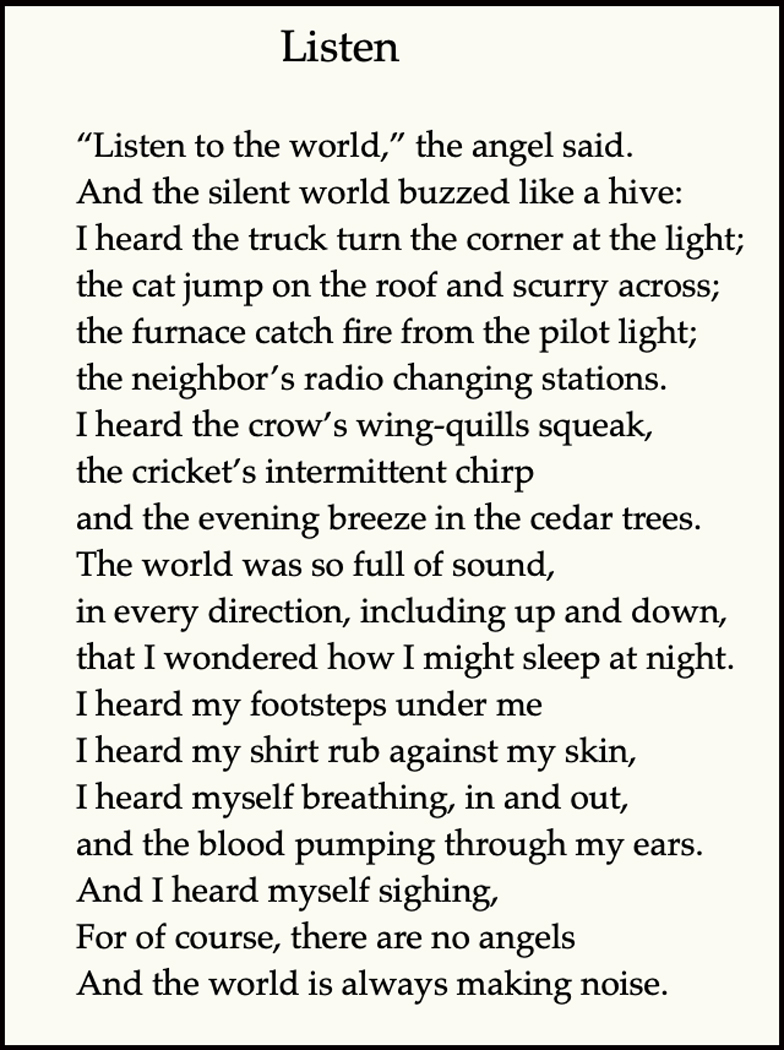
Some years ago, when I was still regularly penning verse, I wrote about this:

poconosnow3

There is no silence more palpable than when you’re alone in the woods on a windless winter morning with new snow a foot deep on everything.

It is eastern Pennsylvania, in the meatloaf Pocono Mountains on a late November weekend and when we pitched our tent late the night before it was cold and dry. The stars were acetylene, caught in the naked treebranches.

But during the night, it began to snow and when we got out of our sleeping bags in the morning, there was a new layer of white caught in those branches and all over the rocky ground underneath.

Winter camping has many rewards, but certainly the most magical is the weird acoustic effect of snow. It sucks sound out of the air and replaces it with something as solid as styrofoam.

What breaks the silence are your own squeaky footsteps in the snow as you step out of the tent and start to prepare breakfast. You rub your hands together noisily and blow fog into them with your breath.

Silence is an exotic commodity and we should learn to value it and enjoy it as if it were a balm from heaven.

It is a rare place that you can find where you can’t hear a gasoline engine.

The internal combustion engine fills our noses with stink and makes the roadside clutter of ugly billboards and fast-food restaurants inevitable. But what is worse, it fills our ears with the rattle of rpms and gears.

You stand on the rim of the Grand Canyon and the tour busses roar by. You take a sailboat out on the water and the lake-shrinking Evinrudes drown out the sound of your luffing jib.

I knew a woman once who told me that when she was a little girl, she heard the summer sky hum.

As children, we often are content with the mystery and don’t ask for an explanation. It’s just the way the world is: The summer sky hums.

As an adult, she came to recognize what the noise was, and how banal. She was hearing a sound hardly known anymore: a propeller-driven airliner flying too high to be seen.

That was more than half a century ago, when the planet was still quiet enough that you could pick out the airplane’s buzz over the local noise. Nowadays, even though jets are much louder, you seldom hear them flying at 30,000 feet because their roar is drowned by the din of traffic, the boom of car stereos, the cackle of the TV set and the occasional gunshot from a few blocks away.

Complete silence is profound and rare. It is the aural equivalent of complete darkness: the place where no sound exists at all.

In a cave, for instance, when you are still and your lamps are turned off. The deadest sound and most obscure blackness are somehow cousins. But even that silence isn’t complete: In such a silence, you can hear the blood squirting through the capillaries of your inner ear. Perhaps you can hear your relaxed heart thumping.

At such a time, there is nothing that exists but your autonomic sense of your own meat and nerves. You face only inward; the outer has ceased to matter.

And the only quiet more utter is death.

But that isn’t the kind of silence that recharges our batteries. For that we turn to nature and wilderness.

It is the reason we drive to the Poconos and hike into the campground.

If there is a place we can get out in nature, away from the parking lot and out from under the flight path, we can let our ears register the planetary rhythm. There are dry beech leaves that crackle in the breeze all through winter before they fall off in spring, there are the squirrels chattering in the elms and the occasional cardinal flapping its wings in the snow to clear a spot where it searches for some food.

Sounds such as these are always present, but are suffocated by the commotion of daily urban living. If somehow all the electricity and gasoline were instantly neutralized, and our ears somehow adjusted, we would hear the natural sounds even on Main Street downtown.

You recognize the symptoms: The air conditioner suddenly cycles down in the office and you notice that you hadn’t known it was making noise till it stopped. Silence is in part only known in relief, against the unheeded white noise.

Part of the appeal of wilderness hiking is the silence we enjoy there. Our cochleas catch their breath and come to terms with the persistent quiet of the natural world. And if we stay long enough, and our ears catch up with the reality, the birds begin to seem noisy and even sunrise groans.

poconosnow2