Archive

Tag Archives: symphony no. 88

Happiness is a strange emotion, not a single thing, but really an umbrella term for a diffuse group of hard-to-define states. Periodically, studies are published about which nation is the happiest (usually, it seems, a Scandinavian country.) But what they are measuring is a rather tepid version of happiness. Usually, if we ask if someone is happy, what we mean is an absence of problems — basically a neutral state in which we are not currently threatened, hurting, being oppressed, or worried. “Are you happy?” “Yeah, sure, I guess so.” Enough to eat, a roof over the head, a relationship that isn’t a chore, no pending hospital bills or tax audits. 

Really, that is a condition to be wished for, as dull as it sounds. For most people in the world, its achievement would be a godsend. So, I don’t want to downplay such a state. Not getting bombed is a net positive. Yet, there are other happinesses. Falling in love, birth of a child, success at work — these all provide a joyful uplift that raises the psyche above the day-to-day and makes life more radiant, if only briefly. It is a state we cannot maintain over long periods without being considered a bit loopy. So, we return back to the state of happiness that is unremarkable. 

But, as adults, we can watch our children at play and recognize in their faces such a state of unreflective happiness that can only break our hearts. Oh, what they don’t know yet about being alive. It’s not just an emotion: The entire body explodes with it.

There is what I might call “body happiness,” which they express in movement, in play, in dancing and skipping, singing, letting out squeals that express the inner state that, as adults, we can only mourn the loss of. “There hath passed away a glory from the earth.” 

I mention all this because one of the reasons I listen to music — primarily, for me, what is called classical music — is its ability to evoke emotions in its listeners. They arise sympathetically and are often emotions more subtle than mere language can name. It has been said that music is more precise than words, and I recognize that, whenever I am moved by a quartet or sonata but cannot speak exactly the words that would distort the emotion into easily fixed categories. 

A standard symphony moves from thought to thought, emotion to emotion, in ways that express the same sort of progress a story makes, beginning, middle, end. Episodes all build together to a longer, coherent emotional or intellectual ride. Our limbic system moves along with that progress and we can basically take our emotional selves through the moves. The widest range is the most completely human. 

And one of the things music can express is that ebullient, body happiness, so that we can feel it again. 

Mostly, it jumps out of a single movement in the whole, or even a few bars in the movement, but it is inexpressible joy, and it makes our body move, to tap toes or sway our bodies to and fro, often with a surprised smile on our faces. I think of the finale of Haydn’s Symphony No. 88, for instance, or the scherzo from Dvorak’s Eighth Symphony. I can’t sit still while listening. 

George Frideric Handel has two “happy”numbers in his Acis and Galatea. The opening chorus sings of “Oh the pleasures of the plains, happy nymphs and happy swains,” which extolls the life of the peasants, and a love duet that repeats endlessly, “Happy, happy, happy we.” It all sets up the tragic ending. 

But, there are a very few works that take that body happiness from start to finish, works you can play or stream, that will infallibly lift your mood and remind you of the happiness that is upwards of neutral, and can replace all the fret and sorrow for the length of its performance, and usually, for some time after, as you bathe in the memory of its tunes. 

There are at least eight of these that I can name, which always leave me uplifted, my senses turned up several notches, and my memory of childhood’s version of happiness is re-animated. 

Prime among these is Franz Schubert’s “Trout” Quintet. It bounces and sings through five distinct movements, each of which floods with tune, rhythm and color, anchored by the bottom notes of the double bass. 

It was written in 1819, when Schubert was 22 years old, and before the lingering illness that eventually killed him nine years later. The haunting of death darkens the later String Quintet that he completed in 1828, just two months before his death. But the “Trout” is the antithesis of all that: Life giving, life affirming, joyful from first bar to last. What can you do when every tune is an ear-worm. Once inside your body, you carry the “Trout” with you the rest of your life. Play it every time you need it. 

Less well-known, but even more relentless is Darius Milhaud’s Le Boeuf sur le Toit, or “The Ox on the Roof.” Milhaud wrote it in 1919 after living in Brazil for two years in the French diplomatic service, and quotes dozens of Brazilian folk songs, adapted into a dance-hall band playing Latin rhythms, complete with güiro. He employs a polytonal technique, where different parts of the band play in different keys at the same time, giving the whole a piquancy and aliveness that has a feeling of spontaneity, like an amateur band in a smoky bar. It’s always just about to come apart. 

Written in the Baroque form of ritornello, with an 8-bar tune coming back over an over between alternate dances, it has some 20 Brazilian tunes buried in it, with infectious beats that express the unabashed happiness of a sweaty dance hall. Evybody dance now!

Mostly we think of Johannes Brahms as a sober German burgher writing symphonies with the seriousness required of höchste Deutsches Kunst. But the boy could let his hair down, which he did with two sets of vocal quartets, Liebeslieder Waltzes, op. 52 and op. 65. 

Brahms made his living, early in his career, when he moved to Vienna, as leader of various choruses such as the Singakademie and Musikverein, for which he wrote tons of choral music and songs. So, he had a popular streak in him. 

The 33 songs, each no longer than a minute or two, celebrate bourgeois domestic love in tunes so meltingly gemütlich that you will have them running through your head for days. They were meant to be sung in homes or in taverns, so they are best with normal voices, not the operatically trained soloists that so often record the set. “Ich gäbe dir so gern hunderttausend Küsse” — “I long to give you a hundred thousand kisses.” 

When Georges Bizet was a mere stripling of 17, he wrote a Symphony in C as an exercise for his studies at the Paris Conservatoire. It was never performed in his lifetime and ultimately forgotten about, until it was rediscovered in 1933, and performed two years later by Felix Wiengartner, a suitable conductor, whose first name means “happy.” 

Bouncy and tuneful from first note to last, it has proven hugely popular since then, and one wonders why Bizet never had it published, in fact, never even mentioned it. It is a masterpiece, but not on one of those marble pedestals, but the kind that makes your ears grateful to be on your head. It is breezy and fluent and just makes you happy to be alive. 

Georges Balanchine choreographed it for the Paris Opera Ballet, and I was lucky enough to see the New York City Ballet perform it with a live orchestra at the Palais Garnier in Paris, (where it was first performed in 1947). One of the highlights of my life. 

Also a youthful work is Serge Prokofiev’s Classical Symphony, written in 1916 when he was a conducting student at the St. Petersburg Conservatory. When one of his teachers, Boris Asafyev, mused “that there is no true joyfulness to be found in Russian music,” as Prokofiev wrote, he responded with one of the happiest works ever written by a Russian. 

And so, he wrote in his diary, “I composed a new finale, lively and blithe enough for there to be a complete absence of minor triads in the whole movement, only major ones.” 

It displays what is often called the composer’s “wrong note Romanticism,” with catchy tunes and ascerbic harmonies, and was meant to mimic the spirit of Haydn and Mozart. What a joy. 

Much shorter, at merely five minutes, but so fresh and lively as to become its composer’s most frequently performed piece, the overture Leonard Bernstein wrote to his musical Candide just can’t stop laughing, and teasing, with bubbling wit and elan. 

The musical (or operetta — it could never entirely make up its mind and went through multiple reworkings) never quite caught on the way West Side Story has, but its overture, shaped as a mock Rossini overture, is irresistible. 

Johann Strauss II produced music the way a lawn sprinkler sprays water. The “Waltz King” composed over 500 waltzes, polkas, quadrilles, and other types of dance music and several operettas, all of surprisingly consistent craftsmanship.

No one in his right mind, though, would sit for all of it; before too long the program would become monotonous: How do you tell one polka from another. That is, except for the large handful of truly memorable masterpieces, all of which will raise you spirits and make you want to dance. 

I mean, the Blue Danube, the Voices of Spring, Tales of the Vienna Woods, the Artist’s Life, the Kaiser Waltz — a CD full of the best Strauss is a must-have for any collection. It’s hardly surprising that Brahms envied Strauss’ gift for melody. Each is basically a tone poem in three-four time. Lift the spirits, make you smile and move your body. 

Finally, there is Benjamin Britten’s Simple Symphony, which displays a childlike joy in just spinning tunes, which is hardly surprising, since he wrote those tunes when he was a child, between the ages of 10 and 13. When he turned 20, he reworked the tunes into this four-movement suite for strings, with movements titled “Boisterous Bouree,” “Playful Pizzicato,” “Sentimental Sarabade,” and “Frolicsome Finale.” It premiered in 1934 with Britten conducting. 

Since then, it has been recorded dozens of times, usually as a filler on discs with other Britten pieces. 

There are other joyful pieces, but these are eight that come immediately to mind. They are each available in videos on YouTube, and worth seeking out, especially if you’re having a bit of a down day. 

Happiness is the most innocuous of emotions; it is plain and uninflected. Compared with its brawny cousins, such as hatred, passion, grief or joy, it is rather simple and nondescript. It is to those as water is to wine. 

Happiness is what you see on the faces of children playing outdoors. It is for them, who don’t yet have the burdens of adulthood or the cares of life. They can innocently play with happy abandon. Heaven lies about us in our infancy! 

Yet, in those cares of life, who doesn’t wish for a few seconds freedom to experience once again the simple happiness of when we were young and didn’t know any better.

Most of our art and music concerns the bigger things. The emotions you get from Mahler are big, complex emotions, piled Pelion on Ossa, building overpowering climaxes that leave us hollowed and purged. 

Think about Bach’s B-minor mass, Wagner’s Tristan, Stravinsky’s Oedipus Rex and you find the complexity of life threaded around itself. Of the big emotions, none is uninflected, but includes a tincture of its opposite.   “Our sweetest songs are those that tell of saddest thought. Our sincerest laughter with some pain is fraught.” 

Happiness, as I’m using the term here, is unalloyed. And while most of the greater emotions are felt as “happening” to yourself, happiness takes you out of yourself. You are unaware of your self when experiencing it. It is a grace.

In that sense, there is ego invested in the transcendence of Mahler or the Ode to Joy of Beethoven, but when you are happy, you barely exist: Only the happiness exists. You are only really aware of it when you wake from it and realize what you have been gifted. 

Of course, such a state can only last a comparatively short time. When the philosopher asks if you have had a happy life, the only accurate answer is that life is not happy, but only moments are. 

Art can rouse in us a huge range of emotions, and classical music is designed to explore the subtleties of them, and we are overwhelmed by the passions in Mahler, the transcendence in Bruckner, the joy in Beethoven’s Ninth, the angst in Berg’s violin concerto. All huge, complex emotions. 

But surely, there must be some music completely devoid of such cares, and can arouse in us those feelings of abandon and freedom we had as little children. Is there music that is simply happy? This is music I put in the CD player when I just want to rock back and enjoy the simple tunes and unfettered sounds of being happy. Bouncy, tune-filled, catchy feel-good music. 

The place to start, where most of the habits of classical music start, is Joseph Haydn. He seems to have invented everything: the symphony, the string quartet, the sonata form — they all descend from Haydn. And Haydn was perhaps the sanest person ever to write music, burdened by no metaphysical agonies. But even his music expresses a variety of thoughts and emotions, movement by movement, from the depth of the Seven Last Words of Christ to the finale of Symphony No. 88, which bounces with unfettered happiness. (Link here). 

That kind of ebullience is hard to sustain, but here are five examples from classical music that bounce from beginning to end, along with some suggestions for recordings. (Not “the best” for I have not heard all of the recordings, but these are my favorites). 

Franz Schubert Piano Quintet in A “The Trout”

The Trout Quintet is unusual in that it includes a double bass, which provides a solid bottom for the music, which allows the tunes to float along like rafters down a river. It is a sunny quintet, with hardly the whisper of a shadow in its five bright movements. Even the minor-key variation in the fourth movement is dispelled with a major chord — “I was just playing,” its composer seems to be saying.

It was written in 1819, when Schubert was 22, for piano, violin, viola, cello and bass. Through most of his best music — the late piano sonatas, late quartets and the great C-major string quintet — there is a strain of despair that is heartbreaking. Even in his short piano pieces, beloved of amateurs for a century and a half, there runs a vein of deep melancholy that shades even his happiest moments.

But none of this in the Trout. It spreads sunshine from beginning to end.

Almost any performance of The Trout will leave you giddy, but the one essential element of any recording is that you can hear — even feel — the string bass at the bottom. It is the foundation for the edifice. 

I’ve always loved two performances. The first is Alexander Schneider with Peter Serkin on piano, Michael Tree on viola, David Soyer on cello and the indomitable Julius Levine on bass. It was on the Vanguard label. And Peter’s father, Rudolf Serkin anchors the Marlboro Festival musicians on Sony (then, Columbia). With Serkin is Jaime Laredo on fiddle, Philipp Naegele on viola, Leslie Parnas on cello and Levine, again, on bass. A classic performance, much loved by many, features Clifford Curzon on piano, with musicians from the Vienna Philharmonic. Originally on Decca (classical music labels are in constant flux, as mega-corporations gobble up older established labels; you never know where a classic performance will show up. Just check Amazon and you’ll find it.)

YouTube video at this link

Gioacchino Rossini String Sonata No. 1 in G

It shouldn’t be surprising that most of the music that expresses mere happiness should have been written by very young composers. The six sonatas for strings were written by Rossini when he was 12 years old, arranged for four string parts: two violin parts, one for cello and one for double bass — again providing that delightful solid bottom for the tunes. 

The bass is there because Rossini wrote them while visiting the home of bass player Agostini Triossi in Ravenna, Italy, in 1804, and tossed all six sonatas out in the space of three days to be played by members of the household, with Rossini himself on second violin. 

Although written for a quartet of players, they are usually performed by a full ensemble. Versions have been adapted for normal string quartet and for wind band, but the string ensemble has that fresh appeal that matches the music. 

I could have chosen any of the six sonatas. They are each in three movements, fast-slow-fast, and in major keys. But I mention the first because I particularly love its jaunty finale, with a tune I can’t get out of my head. 

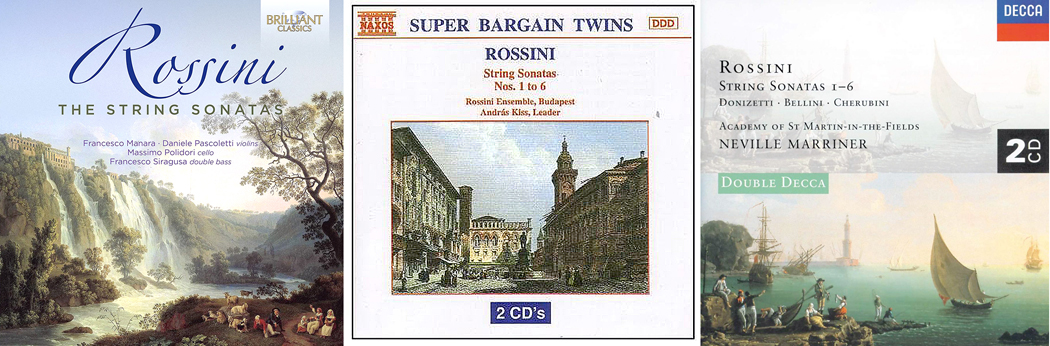
I’ve never heard a bad performance on disc, but mostly I listen to the Naxos recording of the Rossini Ensemble, Budapest. They almost always come in a pack of all six sonatas, so you are likely to love them all. Neville Marriner has a smooth set with the Academy of St. Martin’s in the Field, and Brilliant Classics has the version with four solo players. 

YouTube video at this link


 Georges Bizet Symphony in C

Another prodigy, Bizet wrote his symphony when he was 17 years old and a student at the Paris Conservatoire. It was never performed in the composer’s lifetime and indeed was lost and forgotten until 1933, when it was found in the composer’s papers, and was given a first performance by Felix Weingartner in 1935. Since then, its infectious tunes and untroubled elan have found it a place in the repertoire. 

I have always thought of it as a 19th century version of a Haydn symphony — perfectly proportioned, tuneful, and with no dead spots. Others may have stormed the heavens with Wagnerian thunder and Blitzen, but this symphony contents itself with pleasing its listener with melody, rhythm and smooth harmony. 

It has also been lucky on disc, when three of the most lively conductors have taken it on. Leonard Bernstein with the NY Phil, and Leopold Stokowski with the National Philharmonic (a pickup orchestra), and Thomas Beecham with the Royal Philharmonic. You can’t go wrong. 

YouTube video at this link

Serge Prokofiev Classical Symphony in D major, Op. 25

Another student work, in 1917 Serge Prokofiev wrote his first symphony in a kind of parodistic style of Haydn or Mozart, but with modern piquant dissonances — what has been derisively called “wrong-note romanticism.” 

But the four-movement symphony has proved enormously popular. It bounces from first to last, with memorable tunes and sharp wit. 

The composer Boris Asafyev, according to Prokofiev, “put into my mind an idea he was developing, that there is no true joyfulness to be found in Russian music. Thinking about this, I composed a new finale, lively and blithe enough for there to be a complete absence of minor triads in the whole movement, only major ones.” 

The energy in this music is propulsive. If anyone is feeling down, with the feeling of systematically knocking the hats off anyone you meet on the streets, a listen to the Classical Symphony will cure you and leave you with a goofy grin on your face. 

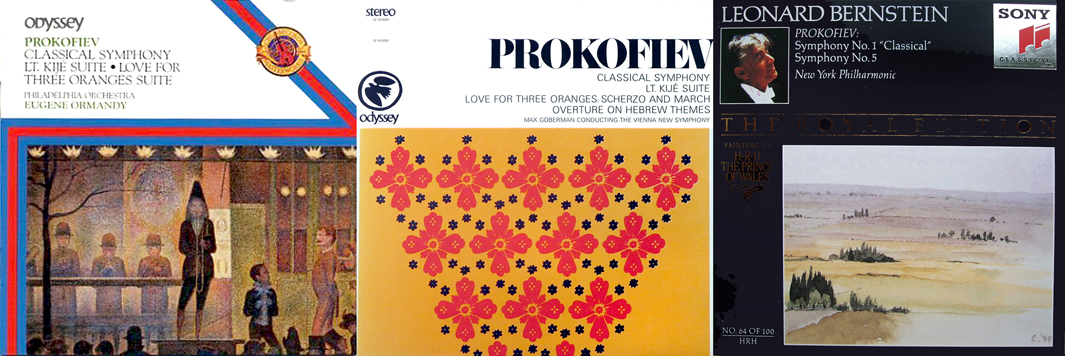
Many have recorded the symphony. The only failures are when the conductor takes the music too seriously or lacks any sense of humor. There are several dry versions. But I have three that I have loved. Leonard Bernstein and the NY Phil have all the elan and vigor you could ask for, if the ensemble is a tad scruffy. Eugene Ormandy and Philadelphia cannot be topped. It is a perfect recording of the music, bright and witty with gorgeous string playing. And I remember an old Odyssey LP I once owned with Max Goberman and the Vienna New Symphony. Perhaps one day a CD version will be offered. 

YouTube video at this link


Darius Milhaud Le Boeuf sur le Toit, Op. 58

Imagine you are in a Brazilian dance hall and the crowd, sloppy with  drink and dance, are bouncing to the music of an exuberant band — not all of whom are playing the the same key. And you cannot help but tap your toe, then jiggle your leg, and then get up and dance and sweat with the crowd. That is Milhaud’s Le Boeuf sur le Toit (“The Bull on the Roof”). 

It is a string of mostly Brazilian tunes, some borrowed, some invented by Milhaud, all of which are infectious and life-affirming. It is the most single-mindedly happy music I have ever encountered, completely unselfconscious and joyful. Milhaud himself called it, “15 minutes of music, rapid and gay, as a background to any Charlie Chaplin silent movie.” 

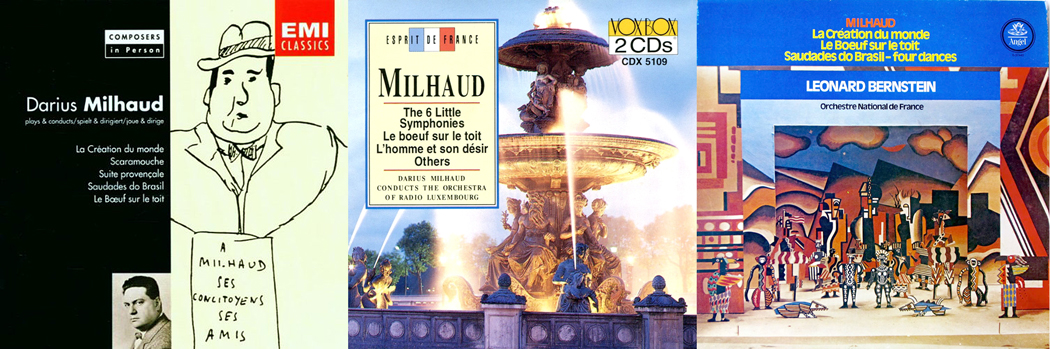
 You can get a recording of Milhaud himself conducting the Orchestre du Théâtre des Champs-Elysées from 1958, perhaps a bit ragged, but with all the spirit. A standard for decades has been Louis de Froment and the Orchestra of Radio Luxumbourg. But for me the perfect embodiment of this happy music is the Orchestra National de France under Leonard Bernstein; he is the perfect vehicle for the life-spirit of this music. 

YouTube video at this link

Those are my five suggestions. There are others: Benjamin Britten’s 1834 Simple Symphony, made up of tunes he wrote when he was 10 years old; or  perhaps Shostakovich’s Three Fantastic Dances from 1920, which he wrote between the ages of 14 and 16 — before the specter of Joseph Stalin darkened his art. Perhaps you have other suggestions to leave in the comments. 

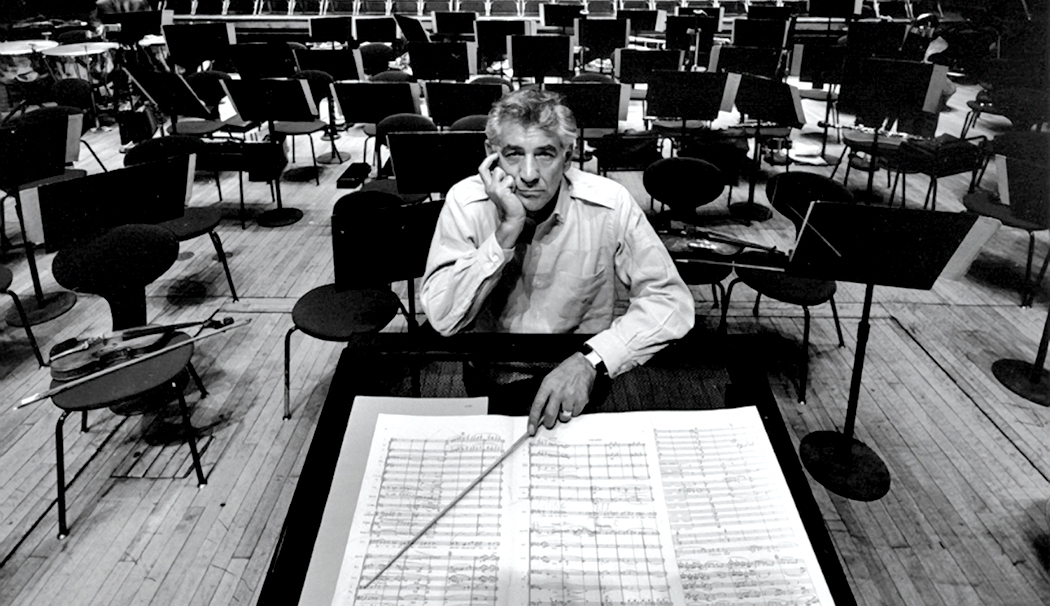
Yesterday, I accidentally came across a YouTube video of Leonard Bernstein conducting the Vienna Philharmonic in the finale of Joseph Haydn’s Symphony No. 88, which is one of the composer’s bounciest, most ebullient movements, and therefore one of the bounciest, most ebullient in all music. And I was transfixed: After a tiny initial tempo beat with the baton, the conductor dropped his arms and stood there, letting the orchestra play the entire movement, indicating directions entirely with facial expressions. (Link here). 

He was conducting with his face. It was brilliant. Every fleeting emotion played across his face, as if he were the music. And each expression came a half-second before the orchestra reacted, so Bernstein wasn’t following the music, but leading it. Extraordinary. It was one of the best performances of that finale I’ve ever heard, with a naturalness and clarity, but more important, a joy and spontaneity. 

I go back a long way with Lenny. When I was a mere bairn, I watched him on the Young People’s Concerts and I remember his explanation of Beethoven’s Fifth Symphony on the Omnibus TV show. I was just six years old in 1954, so I don’t remember much of what he said, but I remember the set, with the score of the symphony on the floor, so he could position his players on their staffs to show what they were doing. I was fascinated. 

Since then, Lenny has been a part of my life. Sometimes a small part, in the background, sometimes I spent extra money to buy one of his recordings over a cheaper Turnabout or Vox recording, with the trust that I would be rewarded by something special. I usually was. 

I heard Lenny conduct at New York’s Philharmonic Hall (later Avery Fisher Hall, now David Geffen Hall — it changes as much as the names on ballparks). I remember a rousing version of Debussy’s La Mer with the New York Phil. But mostly, I heard Lenny via recordings, first LP and then CD. There were also videos and TV presentations. 

I don’t deny that Lenny talking could be hard to take, with that resonant basso voice that he seemed to be in love with, and sometimes a ham actor’s thesbianicity. But if you can get past that surface, what he says is almost always revelatory, precise, and true. I listen to his Harvard lectures over and over, and despite some tedious Chomskian linguistic folderol, really insightful. (He drops the Chomsky in the latter lectures, thank god). 

But it is the music that really counts. For many, Bernstein was the great podium presence of the second half of the 20th century. The singer Christa Ludwig, who performed with Lenny often, once said she worked with three truly great conductors: Karl Böhm, Herbert von Karajan and Bernstein, but the difference was, she said, “Bernstein was a genius.” 

Others have commented that when he conducted, he “became” the music. A member of the Vienna Philharmonic told my old friend, the late music critic Dimitri Drobatschewsky, “Name one other conductor who, just by standing in front of the orchestra, could make them play better than they thought they could.” Bernstein seemed to have a special relationship with the Vienna Phil, and many of his later recordings were with them.

Lenny had his detractors, who thought he was showing off in front of the audience and orchestra, or that he exaggerated details, or — especially later in his career — dragged tempos. But, as critic David Hurwitz has said many times, “Every time I think Bernstein has distorted something, I look in the score and see that it is exactly what the composer had notated. He was truer to the score than almost any other conductor I know.” 

It is true that for Lenny, as for Old Lodge Skins in Little Big Man, “Sometimes the magic works, sometimes it doesn’t.” But the best recordings have something to give that few others can match: commitment, power, emotion, persuasiveness. 

I have chosen 10 of Lenny’s recordings that for me summarize his best. There are many others. He was especially great with Haydn, with Beethoven, with Mahler, with Stravinsky, with Shostakovich. And Modern music — if it was tonal or polytonal, like Milhaud — he made it all just bounce. 

We’ll start with Haydn’s Paris Symphonies, that is symphonies Nos. 82-87, including “The Hen” and “The Bear.” It is pretty well consensus that Bernstein’s Paris Symphonies are the reference recordings. Sprightly, bright, witty, energetic and beautifully played. Bernstein was always good in Haydn, and I would have listed his Creation here, or his Nelson Mass or Tempore Belli Mass. You can’t go wrong with Bernstein and Haydn. In comparison, almost everyone else just feels soggy. 

In roughly chronological order, we come to one of his most controversial recordings ever: the live recording of Beethoven’s Ninth Symphony from 1989 and the fall of the Berlin Wall. Bernstein substituted the word “Freiheit” (“freedom”) for Schiller’s “Freude” (“joy”) in the finale, caught up in the moment’s exhilaration over the fall of East Berlin and Communism. Actually, he only does it once, and later reverts back to the original. But it is jarring when you hear the baritone intone it at the start of the finale. Yet, I am listening to it now as I write this and it is an absolutely thrilling version of the Beethoven’s greatest symphony. Members of six different orchestras came together and meld perfectly under Lenny’s baton. It is my go-to version of the symphony. It is a symphony played so often (I can’t count the number of times I’ve heard it live) that it has lost some of its magic as occasion, but here, it magnifies that sense of occasion. Despite the mutilation of the “Freiheit,” but because of the intensity and emotional engagement of the 20-minute Adagio — more like a prayer than anything else. (Roger Norrington takes it in 10 minutes of throw-away carelessness.) 

Then, there’s Berlioz’s Grande Messe de Morts, or Requiem. There are few decent recordings, and most fail for exactly the same reason: They attempt to make sense of the thing, toning it down into something “normal.” That is the issue with Colin Davis’ version. But Lenny lets it all hang out. What is fevered and hysterical, comes across as fevered and hysterical, just as Berlioz wrote it. 

If there is any symphony from the 19th century more Haydnesque than Bizet’s Symphony in C, I have yet to discover it. It is fresh, bright, tuneful and unendingly happy. The composer wrote it in 1855, when he was 17, and it remained unplayed until 1935 and I feel pity for all those audiences who, for 80 years could have been enjoying it, but never had the chance. Lenny was the perfect conductor for its joie de vivre and rhythmic snap. It is as if Bizet wrote it with Bernstein in mind. 

Lenny recorded Tchaikovsky’s Sixth Symphony at least twice, once with the New York Philharmonic, in 1964 for Columbia, and then again in 1987 for Deutsche Grammophon, with the same orchestra. What a difference. The first — an excellent version — takes about the usual 45 minutes. The second comes in at just a chip under an hour. Most of that extra time comes in the finale, which in the second recording is wrenching and heartbreaking. One critic wrote that it “devastates the emotions. … At the end of the last movement, the despair is complete.” Of course, the performance has its detractors, with some finding it distended and, as one always hears the complaint against Lenny, “is more about the conductor than the composer.” Poppycock. This is Tchaikovsky titrated and distilled into pure essence. 

Lenny recorded Stravinsky’s Rite of Spring many times, also, but there is no quibbling about the one to go to. It is his first, from 1958 with the New York Phil. When the composer first heard the recording, his only response was “Wow!” Lots of conductors have the measure of the Rite, but there is a rhythmic vitality, a violence and explosiveness to the 1958 recording that has never been matched, even by Lenny. 

Just seven years after Stravinsky’s blast, came Darius Milhaud’s Le Boeuf sur le toit (“The Bull on the Roof”), which he says he wrote as “fifteen minutes of music, rapid and gay, as a background to any Charlie Chaplin silent movie.” It is a piling up of Brazilian tunes, in several keys at once, and is as bright and toe-tappy as anything. Indeed, it becomes an ear-worm and you will be hearing its tunes over and over in your head for the rest of the day. The Bernstein recording also features La Création du Monde from 1923, which is a fully realized jazz composition for a ballet about an African creation story. This is Lenny in his element. You can just see him dancing on the podium with happiness and joy. 

Then, there is another highly controversial recording — his DG performance of George Gershwin’s Rhapsody in Blue. Lenny, playing the piano part himself, plays it not as a jazz riff, but as if it were, from bottom-to-top, a classical piano concerto, rather like Ravel’s Concerto in G. Critics miss the easy jazzy element of famous performances by Earl Wilde or Oscar Levant, but Bernstein’s version seems to those who adore it (as I do) as a perfectly genuine alternate view. And it is gorgeous. Did I mention that? Absolutely gorgeous. 

Dimitri Shostakovich wrote his massive Symphony No. 7 “Leningrad” during the German siege of that city in 1942. It is a piece that defeats many orchestras and conductors; it is very difficult to keep it from diffusing into long, undigested sections. Lenny keeps it going as a single directional line from beginning to glorious end, and the Chicago Symphony has the cojones to perform what is asked of them. Almost everyone agrees, this is the Leningrad Symphony to hear. 

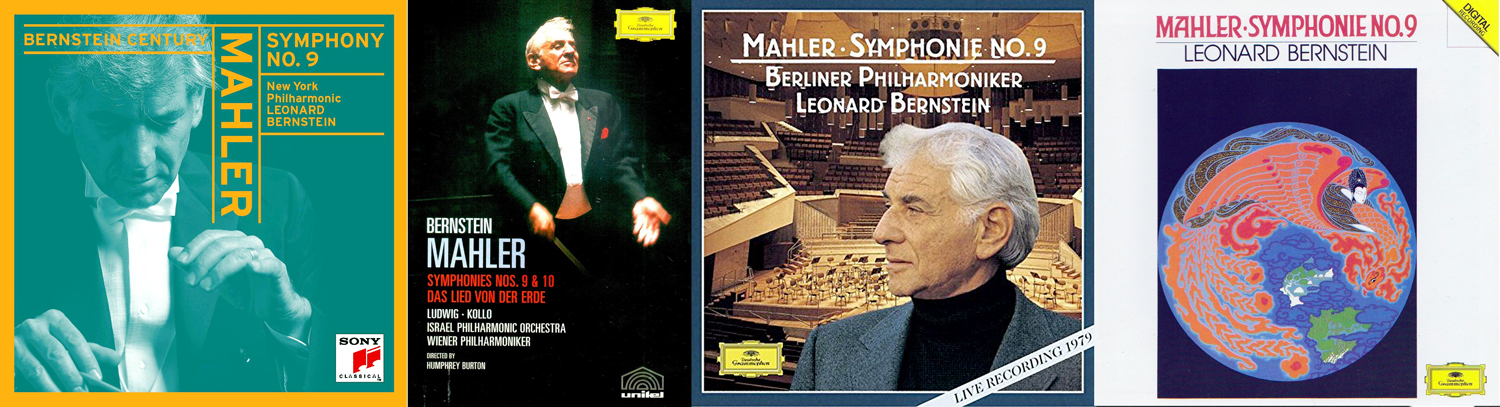
Finally, I’ve kept last (and out of order), Mahler, which sometimes seems like Bernstein’s personal property. It isn’t, of course, but he brings something special to his Mahler performances, and none more so than with the Ninth, which he recorded at least six times (1965 NY Phil; 1971 Vienna Phil; 1979 Berlin Phil; 1979 Boston Symphony; 1985 Concertgebouw; 1985 Israel Phil). It is perhaps the Mahler symphony Bernstein felt closest to. Only four of these are genuine releases, not bootlegs, and among them it is hard to choose, but I suppose I migrate to the late Concertgebouw recording. Berlin has the intensity, but there is a major cock-up in the finale when the trombone section failed to play in the climax (apparently an audience member had died of a heart attack directly behind the brass section and there was some commotion that distracted the players). But listening to any one of them seems as if the music becomes more than music; it is a direct communication from one soul or heart to another. There are other great performances of the Ninth — it seems to draw out the best in most conductors — but there is something extra in the Bernstein versions, something more immediate, more direct. 

That is a list of 10 (or more), but I feel I’ve left out so much. There’s his Bartok Music for Strings, Percussion and Celeste; there’s two complete surveys of Beethoven symphonies; there’s his Copland, his Ives, his Schumann, his Sibelius. And so much more. But I believe the 10 I’ve chosen are not just great, but peculiar to Lenny — and I choose the word carefully. He was an idiosyncratic conductor, but all the personality that went in to his performances meant they are often memorable in a way more straightforward ones are not. 

Many moons ago, when I was a snotty college kid, I went through a period of disdaining Lenny. I bought the canard that he was shallow, heart-on-sleeve and bombastic. I wuz a idjit. One should never let the opinions of others block your ears. There is a world of difference between words and sounds, and the sounds are always more meaningful. I am older now, have experienced a great deal more of living, discovered depths in myself I hadn’t understood, and now Lenny’s insistence on finding the marrow is what I value. My ears are opened to what is gifted to me. 

Click on any image to enlarge