Archive

Author Archives: Richard Nilsen

I stood in the class like William Yeats among school children, old and grey-headed among all that well-scrubbed freshness. I had been asked to come and speak.

It was a history class and the bright young men and women in their seats were talking about American government and the genius of the American constitution for providing practical compromises for knotty problems.

I was gratified by the intelligence and interest of the students, but what struck me the most was the palpable glow of their idealism. It radiated from their faces like heat; it broke my heart.

That sort of idealism — the concern for justice and fairness in the world, and the belief in the ability of government to ameliorate wrongs, and in the essential goodness of humankind — is essential to have at that age, just as it is essential to cast it off as you grow older.

It doesn’t take too much living to wear the luster off that kind of naïve idealism. The more you are exposed to the world, the more cynicism seems like a measured response. Certainly the self-righteousness of both sides in the current presidential debacle draws from the world-weary a sigh of recognition.

Yet, it isn’t just experience that sandpapers away that shine from their faces.

As they get older, they will come — if they have brains — to mistrust that idealism for other reasons, too.

For idealism in adults is a dangerous thing. It leads to a great deal of blood and human suffering. It is Robespierre ordering those who did not measure up, to the guillotine and it is Robespierre in the tumbrel himself.

When people are motivated by ideas rather than things, by their idea of how the world should be instead of how it is, they do reprehensible things.

In fact, most of the misery humankind has inflicted on itself, from slavery through the Inquisition were driven by ideals. McCarthyism — though not Joe McCarthy — was idealism in action. Jingoistic nationalism, colonial imperialism, wars and starvation have been fueled by self-righteous idealism.

There has been no segment of the American population so idealistic as the Southern White slaveholder. Read what they wrote: They were proud of their idealism and their civilization. They really and truly thought of themselves as good, moral people.

Let us not forget that both sides in the abortion debate are driven by ideals.

The acrimony is intense, and compromise is impossible. It always is with committed idealists.

And let us not forget that Hitler was an idealist. It may be odd to think of him that way, but that is what drove him: wretched, perverted and seriously misinformed ideals.

Any thoughtful, observant adult must be suspicious of idealism carried into adulthood.

I am reminded of Jons, the squire, in Ingmar Bergman’s film, “The Seventh Seal,” who comes back to Europe with his knight from the crusades, having wasted 20 years of their lives.

“The crusades were so stupid and wasteful, only an idealist could have invented it,” he says.

Yet, my heart breaks when I see such students, because it is my own idealism I mourn for. Without ideals, you no longer have anything to strive for. You give up. That is not good.

Ultimately, you have to come to a compromise, just like our founding fathers.

Idealism turned outward upon the world is a horror. It must be blocked by reasonable people if we are to avoid throwing people into dungeons, chopping their heads off or gassing them.

But idealism turned inwards on ourselves — forgetting the world, but holding ourselves to the highest possible standards — is as necessary as air. Anything less is an abdication.

I don’t like Bill Bennett. I think he is a very unpleasant man. In fact, every time I saw the former education secretary and ”drug czar” on “Face the Nation” or “Larry King Live,” his smug, unctuous face made my blood boil. It still does

There are few faces that scream out louder: sanctimonious prig.

He makes his pronouncements about cultural values with an insulting certainty, speaking as if he had personally been up on Mount Sinai getting the tablets from Jehovah. His dictums are as irritating as those of any name dropper. And if the name he drops belongs to God, it is all the more obnoxious.

It is his certainty that bugs me more than anything else. It is a quality that inhabits a certain kind of male: A certainty that whatever position he takes is the true one, simply by virtue of his taking it. It is a very male thing, and it reminds me once again that testosterone is a hallucinogen.

One of the reasons he makes me so angry is that the cause he has latched onto is an important one. Our values need to be discussed.

But his version of them is deeply distorted by that inflexible certainty.

Bennett knows what the virtues are that we should maintain: He has made a list. In his “Book of Virtues,” he includes self discipline, compassion, responsibility, friendship, work, courage, perseverance, honesty, loyalty and faith.

It seems a measure of Bennett that humility is not among these virtues.

Some of these seem obvious and inarguable. Others less so. And in reality, such categorical expectations cannot be convincingly maintained. There are times when loyalty conflicts with honesty, times when faith conflicts with compassion. If you are a Sufi mystic, self discipline may be just the opposite of what you require. Perseverance is sometimes merely stupidity. Sometimes diplomacy outranks honesty, for the good of all.

And work, as Bennett outlines it, smells suspiciously of the Victorian principle espoused by such moralists as Andrew Carnegie and Henry Ford, who made millions because other people worked long, virtuous hours.

Perhaps the opposite is truly the virtue. At least Henry Thoreau made a convincing case in “Walden.”

”We are made to exaggerate the importance of what work we do,” he wrote. ”But men labor under a mistake. The better part of the man is soon plowed into the soil for compost.”

Americans already work like dogs. It is the quality of their leisure that needs improving.

But it is not the individual virtues on Bennett’s list that I take exception to, but the list itself.

For too often, we think of virtues as being something as simple as a list: A series of words.

Virtue, for Bennett in his book, ”involves rules and precepts – the do’s and don’ts of life with others.” In other words, we are good because we do what we are told.

He reiterates his position in his follow-up book, “The Moral Compass,” by asserting, ”Moral education must involve following rules of good behavior.”

In other words, virtue is etiquette.

Personally, I find this view trivializing, and worse, I suspect it is propounded merely to perpetuate an economic and governing system that makes it possible for Bennett and people of his economic and educational advantage to live comfortable lives.

There are other possible lists of virtues.

The Roman Catholic Church lists the theological virtues of faith, hope and charity; the cardinal virtues of prudence, justice, temperance and fortitude; and the evangelical counsels of poverty, chastity and obedience.

I doubt Bennett considers poverty a virtue.

But whichever list we observe is ultimately forced upon our lives in the style of Procrustes. We are not meant to think about them, but to obey them.

Yet, rules are always insufficient. There are always circumstances that require our disobeying.

William Blake, for instance, wrote in his “Marriage of Heaven and Hell” how Jesus of Nazareth broke each of the 10 Commandments, enumerating them, one by one. Jesus was good, Blake says, because ”Jesus was all virtue, and acted from impulse, not from rules.”

The meaning of the word ”virtue” has changed over time. If it now means righteous behavior, it once meant something less rigid.

For the Greeks, and later the Romans – who gave us the word – virtue meant to be yourself in the utmost. ”Virtue” didn’t take on its acrid sanctimoniousness until the Victorian age, when it was used to approve of behavior that furthered the goals of colonialism and jingoism.

For the Victorians, virtue meant not having sex.

The word ”values” that is bandied about so glibly by politicians now has also undergone such a change.

Our values are those things we take as the rock-bottom basic truths that experience gives us, that we can count on and therefore can act in the world with the expectancy that particular behaviors will result in particular outcomes.

In other words, our values are not written down on paper somewhere, but found in the world around us, the world we experience, the lives we live. And instead of turning out to be as vaporous as the words of a list, values are as solid as the oak tree that grows in the yard. Indeed, they may be the oak tree. Or the birds roosting in it.

If a so-called value handed down to us is proven false by experience, we must either forsake the value or live an inauthentic life. Many of the values Bennett would foist on us no longer ring true. Perhaps some still do. But we must find them out for ourselves. It is one of our life’s tasks.


It is a commonplace that America is materialistic, that it grasps after money and wealth and lacks the spiritual values it used to have.
Of course, that nostalgic view ignores that Americans have always chased wealth: It’s built into the Constitution.
But more importantly, it ignores the fact that America isn’t really materialistic at all, and in fact, is largely indifferent to the material world.
If we were really materialistic, we would never tolerate walnut-woodgrain plastic.
No, the physical composition of their existence is simply not a high priority for most Americans. Yes, they are after wealth, but wealth isn’t a material value, but a spiritual one.
When we say Americans “worship the almighty dollar,” we aren’t saying that they value material objects over spiritual ones, but rather that they place worth on one set of spiritual values instead of another, more worthy set.
Money, after all, isn’t a physical object. It isn’t material. It is no more physical than an inch or a pound. It is a measuring item, to measure wealth.
Real wealth is the possession of useful or meaningful things. To own land, or to grow 40 acres of artichokes is to possess wealth. You can eat artichokes; you can’t eat money.
Money cannot be worn, it cannot be used to build with. It must be translated back from its symbolic existence to a material existence by spending it.
I’m not saying that money isn’t nice to have around. But that it is a mental construct, not a physical reality. If we want money, it isn’t because sewn together, dollar bills make a nice quilt.
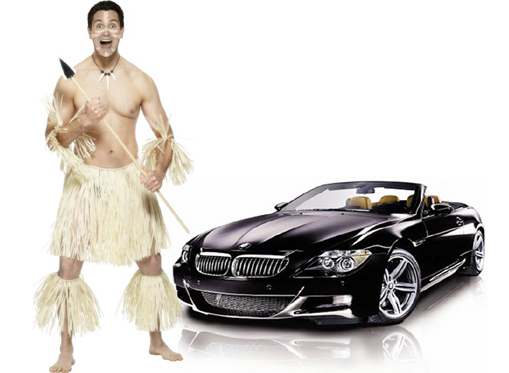
Even the things Americans spend their money on tend to be owned for spiritual rather than physical reasons. If we want to own a BMW or a Lexus, it isn’t because these are better cars than a Honda or an Ford — though they may be (I’m not convinced) — but because they are status symbols that let other Americans know where we rank on the totem pole. Armani suits and Gucci bags are not something most Americans really enjoy on a physical level. They are the civilized equivalent of the eagle feathers the chief wears, or the lion-ruff anklets worn by the Zulu leader: They confer prestige and denote status.
These are spiritual values.

As a matter of fact, America would be a whole lot better off if it were more materialistic. The planet is bursting with stuff: It all has a texture, a feel, a smell, a taste, a sound. If we were materialistic, we would be aware of how much richness the material existence affords, and we would revel in it. We would be mad — as Walt Whitman says — for us to be in contact with it.
And what is more, the deeper we involve ourselves in the physical world, the more spiritualized we will become — that worthy spirituality. It is because we are so unmaterialistic that our environment suffers so. We don’t value the physical world we live in. It doesn’t bother us that there are fewer birds singing in the morning, or that codfish are disappearing.
In part, this is a remnant of the contempus mundi that was fostered under Medieval Christianity. It is that suspicion of the physical world that the Old World monks felt would seduce them from the righteousness of prayer and ritual.
We have inherited the contempt, but without the prayer. It leaves us in a hollow place.
As an adult I have come not to trust anyone who doesn’t love the physical world.
I don’t trust him to make policy choices about oil drilling or lawn seeding. I cannot imagine how it is possible not to fall in love with the things of this world, but I see just that happening all the time.
I pick up the lump of spring earth and squeeze it in my fist to judge whether it is time to plant my potatoes. I listen for the birds globing and twisting as they rise from the trees in the morning. I look for the light caught in the cholla spines and the twill in my gabardine. There is velvet in heavy cream and scratchiness in wool blankets.
The physical sensations make us more aware, more awake. The love of the physical world keeps us from becoming dullards. Living in a world of symbol and status dulls us. At its worst, it leads to ideology.
Would that America really were a materialistic society.

Image

Vulgarity is everywhere these days, from T-shirts to dinner conversation. This is a vulgar society we live in, one that supports a Howard Stern and a Rush Limbaugh: vulgar brothers under the skin, although the one has more skin than the other.

But conversely, vulgarity is also undervalued.

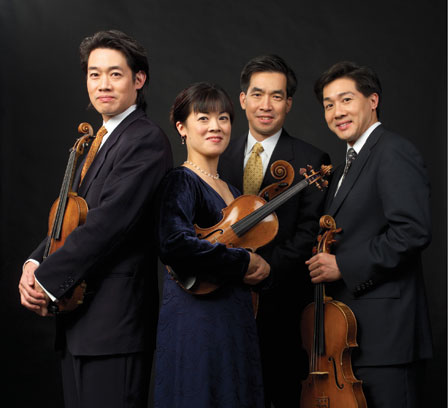
I recognized that at a concert recently, listening to the wonderful Ying String Quartet, which played Mozart, Bartok and Debussy with taste and refinement. But I knew that, as good as they were, they lacked that last touch of vulgarity that all really great art has access to.

I have heard the Guarneri and the Budapest quartets and they were both capable of making vulgar sounds — the buzzing tone of playing by the bridge, the taffy-pull of tempo, sudden shift from aggressive to sweet. It gave life to the music.

There are those who hold that the fine arts are supposed to be a safe haven from the vulgarity of daily life, that they should offer only the highest, finest and most elevated thoughts and emotions. To them, it is a way of insulating us from the barbarians we see on television each night.

But I’m afraid that is the very definition of snobbery, and misunderstands the nature of art.

Yes, fine art is more elevated than Two and a Half Men, yet it also embraces the possibility of such slapstick: Art is large, it contains multitudes.

First, what is vulgarity?

It is the awareness of the animal side of humanity — the body processes and appetites; and it is the trivial in an otherwise important context. It is the introduction of the quotidian into the ceremonial; it is farting in church.

It is also the reaquaintance of mind with body and it is vitality giving breath to the spirit.

It is found in all the greatest, most profound and elevated works of art.

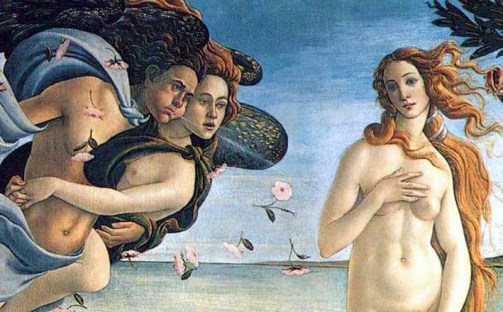
Think of Botticelli’s Birth of Venus, for instance. What could be less vulgar? Yet, there is that cherub with his cheeks pooched out, like Dizzy Gillespie, blowing the sea wind that animates Venus’ hair. His expression is close to grotesque.

And, more subtly, although her nudity is certainly not vulgar, the goddess’ attempts to cover that nudity is. It is bourgeois propriety.

Or, at the height of Beethoven’s Ninth Symphony, a hymn to universal love and brotherhood, the music stops for the belch of a double bassoon and a Hogan’s Heroes march.

Don’t misunderstand me: I am not saying that vulgarity is fine art, but that the greatest art of our culture does not ignore vulgarity, but includes it in the mix.

It is the bumptious Minuet in the Classical symphony, the seemingly-naive tone-painting in a Schubert song accompaniment, the exaggerated muscles in a Michelangelo nude.

It is the Miller’s Tale in Chaucer, the porter’s scene in Macbeth, it is the cacophany of marching bands in Charles Ives and the Jewish wedding in Mahler.

Even Josquin, that most angelic of Renaissance voices, whose music for the Catholic Mass defined for centuries what religious music should be — at other times, he can also have his singers chirp like crickets.

Sometimes vulgarity is expressed by choice, sometimes by miscalculation, as when Keats writes, “She heaved her precious dainties meant to still an infant’s cry.” But no first-rank artist has any fear of the vulgar.

It is Ray Nanton’s growling trombone in Duke Ellington’s impressionism.

It is Pablo Neruda calling for the impure in poetry.

It is the ornament reaquainted with architecture in Postmodernism, a reaction to the dull inhuman “purity” of the International style.

And when you think of the greatest musicians, you recognize Horowitz, Kreisler, Casals, each capable of the most obvious vulgarity — the gauche portamento, the foot-stomping downbeat. Compare Leonard Rose with Mstislav Rostropovich and you will understand why the Russian is considered the greater cellist: He is unafraid of the peasant in him.

Art is not about being bloodless and noble, but about being human.

Hence the Hungarian peasant dances in Bartok’s Modernism, the Austrian folksongs and dancing bears in Haydn.

“Nothing that is human is alien to me,” said Cicero.

And being human begins — although it doesn’t end — with the body.

That is why Ezra Pound said that poetry atrophies the further it gets from music, and that music atrophies removed from dance. Dance is the body in motion, the foot — bunions and all — hitting the floor. (Someone once defined a ballerina as “a beautiful woman with ugly feet”).

There is a separation in Western culture between body and spirit. Art can reconnect them. And the pinch of vulgarity thrown into the mix act as an anchor, firmly keeping the more ethereal impulses in art from floating away on the ether of their own enthusiasms.

That art is greatest, not that hits the greatest heights alone, but that has the greatest reach: Homer, Michelangelo, Cervantes.

They reacquaint me with my own life and make it possible to aspire, not by setting the stars beyond human grasp, but by teaching me my connection with them: The dirt I stand on and the constellations over my head are of a piece.

We live on a planetary canvas; colors and shapes are spread across the stretched linen of the Earth’s surface, although we have to step back to see it with any clarity.

The best way to do that is to climb up into the air. Up a tree and the neighborhood looks different; up a mountain and the valleys change; up in a jet plane and whole quarters of the continent are transformed.

That is the gift of the window seat. The view out and down paints a completely different picture of the world: clouds below us; shadows stretch out for dozens of miles late in the day, or as the sun rises; seas catch the sunlight in a scatter of sparks; the sky overhead is so dark a blue as to mimic midnight at midday.

I love flying. There is nothing quite so exciting as seeing a whole state underneath you opened up like a life-size map.

From 30,000 feet, you get a sense of the world as a tiny globe and can see whole ranges of many mountains as single features, like wrinkles on a face.

Few of us will ever see the Earth from the moon, or even from orbit, but anyone with a boarding pass can have his sensibility slapped silly with the incredible beauty of the planet.

So I always book a window seat for the show. And no matter how long the flight, I’m glued, stiff-necked, to the view.

You can spot the Rio Grande and its terrace, the Mississippi and its wiggle. You can tell Chicago from Detroit, Oklahoma from Arkansas.

Several times on cross-country flights, sitting on the north side of the plane, away from the glare of the direct sun, I looked out the window and down below the jet would be a floating pool of light, moving with the plane at some 500 mph. It is called a “glory” and it is certainly well-named. It is a visual effect much like a rainbow, and no two people see it in just the same place.

It can be seen at a point 180 degrees opposite the sun, speeding across the map-landscape below, crossing interstates and rivers, past the pegged dots of new housing developments, looking like mitochondria in an electron microscope, or the great circles of irrigated crops — great green coins spaced across Texas.

But it isn’t just the landforms that excite me. Even bad weather keeps my attention. Think of all the thousands of generations of humans who were never able to see the tops of clouds, which form their own fantastic landscapes, with mountains and valleys of crenellated whiteness.

The pilot curves the jet route in wide circles around a towering thunderhead, bleach-white at top and sooty at bottom, with its cauliflower protuberances catching new light. The distance is crowded with them, sprouting like mushrooms to the horizon. Dozens of fresh, new thunderstorms rising sunward like children reaching up for their mothers.

Over California once, after a rainstorm, with a low mist of water evaporating up into the atmosphere, the millions of puddles aggregated their mirror effect into a single flash, moving at the speed of the plane and making Fourth of July lightning bolts that flashed just beneath the surface of the mist, the way you can sometimes see the blood pulsing under the skin of a newborn. It gave me a feeling of intimacy with the planet.

Or a night flight, with the ground black underneath you as you fly over the empty expanses of the Southwest, with the small embers of tiny desert communities coming periodically into view, glowing like the last bit of a dying campfire. As you approach Phoenix, those embers gather into a vast pattern of incandescence, like some great lava field, with the glowing magma breaking through the cracks of the cooling stone above it. Almost nothing is as radiant as a city at night seen from the air. You want to hold your palms out toward it, to warm your hands in its heat.

Earthbound, we have a very bland, utilitarian sense of the celestial body we ride around on. It is all streets and signage, houses and mini malls. It is the place we go to work every day, the place where we watch television in the evening.

It is true, to those who have the eyes to see it, the planetary nature of our home is there to be seen: Daybreak shows us the sun breeching the horizon and moving across the heavens; the stars are there to see at night; there are rainy days and lightning storms to remind us of the larger forces. But they have all become ordinary through habit and usage. How many of us take the time to look up and admire a mackerel sky or a fair-weather cumulus cloud floating puffy on the slightly denser air beneath it?

But take an elevator to 30,000 feet and you get the god’s-eye view, moving across the curved surface of the world, where the people aren’t even ants and where the Earth is one small aggie in a great colliding pile of cosmic marbles.

(Buy “Window Seat” here.)

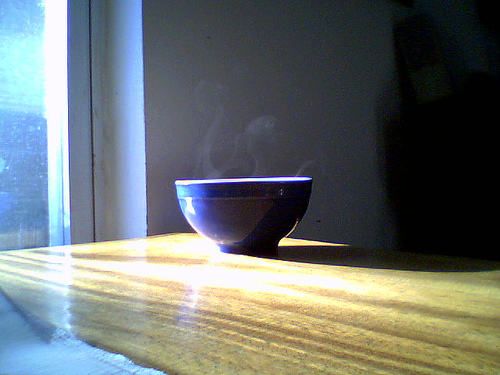
I am not a religious man, but I have a ritual that I perform every day: I wash my breakfast bowl.

It doesn’t seem like much, especially in this age of dishwashing machines and takeout food on paper plates, but my ritual has a long and meaningful history.

There was a year in my life when I didn’t have a job. I lived with friends in North Carolina and did their cooking and cleaning. Every morning, after breakfast, I washed all the dishes.

To others, dishwashing may seem a boring chore, but to me, it was a time to regain contact with the eons. I could stand at the sink with my hands in the steamy suds and stare out the kitchen window at the leaves blown from their trees.

I stared out the window as I worked, mentally walking down the path behind the house past the tin-roof barn and the wide rolling field where old Mr. Price grew beans and tobacco. On the far side, there was a brook that meandered into a small ravine about a dozen feet deep, wet on its north, sunless side, and dry on the south.

And across the granite that forms the streambed as it cascades through this ravine was a long white stripe of quartz, an igneous dike where molten lava once inched up a joint in the surrounding rock and cooled into quartz bright and shiny against the black of the basalt streambed.

And standing at the sink with my hands glossy with detergent, I could travel upstream into myself the same way, finding, eventually, the glistening evidence of my own deepest thoughts: people I had long forgotten, places I hadn’t remembered being, songs I had sung with my grandmother, and sometimes even peace.

And so I rinsed the hot soap from a dish with scalding water and left it in the drain rack. I reached for the next dish and I thought about other times I have washed dishes.

I recalled the night my son was born. I had been at the hospital for his birth, in the delivery room as he entered the world screaming and miry. After I had taken the usual photos and Annie went back to her room for some well-deserved sleep and the kid was cleaned off and sent to the nursery, I drove home and found a kitchen full of dishes, greasy and smeared, waiting to be cleaned. Annie had been in labor almost two days and, though I had been with her through most of it, I also had gone home periodically for meals.

Those dishes and the ones left over from the dinner at which she started feeling her contractions were scattered all over the house. I filled the sink with hot water and divided up the dishes from the pots and set the plates and silverware into the sink to soak. Steam rose from the suds.

I remember that night; I was in knots, loaded with the new responsibility of a child and desperate with the empty feeling that my wife and I no longer could live together. I stuck my arm into the water and my guts began to relax.

I rinsed the first plate and my mind went blank – the blankness of meditation. My belly loosened and my teeth, which had been gnashing through the nights as I slept for months, relaxed. I rinsed the next plate, and it clicked against the first as I settled it in the drain rack. Soothing.

My problems were not solved, but I could look at the dilemmas I faced without the desperation I had been feeling. My frenzy abated.

Dishwashing became my mantra.

I recall camping with the redhead who succeeded my wife. We were staying in an abandoned farmhouse in a hidden valley of the Blue Ridge. Looking out over the balustrade, we saw the cliff across the glade, the rocky stream that poured down the valley bottom, the second growth in the old farm fields, millions of black-eyed Susans swaying in the breeze. As the sun dropped behind the cliff, I took our supper dishes down to the stream and washed them, scouring them with sand from the creek bottom and rinsing them in the icy water. Billions of fireflies made Fourth of July for us. I left the cold dishes on a large rock to dry overnight.

I recall once seeing a twisting globe of blackbirds rise from the trees and stretch out like the Milky Way across the sky. Hundreds of thousands of birds roosting took flight and spanned the evening sky. I dipped the last pan into the darkened suds and scrubbed it.

When the student asked Zen master Chao-Chou for instruction, the sage answered, ”Wash your bowl.” All philosophies else try to figure out logical ultimates, leaving us, at the end, only a useless ash.

No matter if Plato be right, or Whitehead, or Sartre, the one action that we all share is ”washing our bowl.” No matter if everything Wittgenstein ever wrote is absolutely true, we must act as if he never wrote anything. We still must wash our bowls. If everything is explained, nothing is explained, and we are back on square one. Better to wash your bowl.

So, as I wiped the final grease from the stove top and wiped down the counters and cutting board, I replaced the salt and pepper in the middle of the table and wiped off the tabletop.

All that remained was to rinse the dishrag and dump the greasy suds down the drain, setting the washbasin out to dry. That completed, I dried my hands on a fresh towel and began on one of the day’s other tasks.

Once, long ago, when I visited a friend, Judy Crawford, at her mountain house up near the Plott Balsam mountains of North Carolina, I cooked her a giant meal of coq au vin and I made French bread. We had several friends over and feasted, making such a pile of greasy dishes that we all agreed to let the mess sit overnight. ”I can’t look at the kitchen tonight,” Crawford said.

I woke early the next morning and dressed and went downstairs to the kitchen. It was a little after 6, and the sun was hours from rising over the first peak. I filled the sink and started the dishes. Boonie, her cat, crawled around my ankle, looking up at me, squealing for milk. A few robins and a bluebird were scratching at the ground outside the kitchen window. It was quiet – calm and silent. I finished every last dish before Crawford woke up.

”Golly. You didn’t have to do that,” she said when she saw her shining kitchen. No, I didn’t have to, but I enjoyed it. I was at peace.

Most of what we do in our lives is frivolous – watching TV, fixing the car, reading books, waiting for the bus – but the washing of dishes is important: It is necessary. And it is something humans have been doing since before the days when Abraham lived in Ur. Washing dishes is part of being human.

It’s like watching the centuries change.

In the 22 late paintings Claude Monet made in his suburban Paris gardens during the first quarter of this century, you can see the sensibility of the previous age give way to that of the current one. And you see Modern Art being born before your eyes.

Monet is not the sole creator of Modern Art, of course. In fact, he might be considered a latecomer to the movement. By the beginning of World War I, the avant-garde of painting in Europe had already seen the advent of Fauvism, Cubism, Orphism and Futurism. And during the war it saw De Stijl and Dada.

But the old eagle, having been in on the creation of Impressionism in the 1860s, was not left behind as he plunged into his seventh decade.

And the paintings he made in his garden – some 250 of them – chart the change in sensibility.

In the earliest work seen at a recent show, his Water Lilies of 1903, you can see the familiar imagery of Impressionism. It is a picture of the surface of the lily pond on his estate. The illusion of the reflection of the distant trees in the water is seductive. Across the water float several rafts of lily pads, creating a horizontal movement across the vertical tree reflections.

The canvas is still, in some sense, a window through which we look at a pleasant scene, and the virtuosity of the illusion is astonishing.

But as the years go by, Monet becomes less interested in the illusion and more interested in the paint, so that by the time we get to Water Lilies and Agapanthus, of 1914-17, there is almost no depth to the scene. It is not a landscape at all, but a canvas inhabited by images all the same visual distance from the viewer.

If there is a single definition of Modernism, it is that painting ceases to be a virtual window we look through, and becomes one we look at.

Time after time in the late paintings, the gobs of paint build up on the surface like daubs of tar, forcing us to see the paint, the brush strokes, the patches of unfinished canvas.

As I said, Monet was not alone in this. Cezanne, for instance, had already been headed in the same direction two decades before Monet joined in. Gauguin and a host of later Post-Impressionists forced the issue. But it is a sign of Monet’s stature that he never felt as if he could merely repeat himself and his earlier successes, but continued what he called his ”little researches into forms and colors.”

Some critics of the time recognized the change. One review said, ”His language differs more and more from nature (and) replaces it.”

You can see that happening in Weeping Willow, from 1918. The painting may in part be a response to the horrors of the war that raged around him, a symbol of a weeping tree, but more than anything else it is a denial of illusionistic space. The background is the same distance from our eye as the tree trunk, all built out of the squirrelly and obsessive zips of paint.

Or the Japanese Footbridge, from the same year, in which it is difficult to find any subject matter at all. If we weren’t so accustomed to seeing the stereotyped arch of the bridge from his earlier paintings, we’d be hard pressed to say what the picture is of.

One after another of these late paintings becomes about paint, or rather, about the application of paint to surface. In some, the application is soft and feathered, in others, it is violently gouged into the canvas.

Monet’s accomplishments are all the more astonishing in light of his increasing blindness. Beginning in 1912, he developed cataracts in both eyes. By the end of the decade, he was mixing colors more by memory than by eyesight, sometimes using the names printed on the side of the tubes instead of the pigments, which were becoming increasingly distorted by his clouded corneas.

In a way, Monet became the visual equivalent of Beethoven.

At the time, there were those who believed the change in Monet’s painting was caused by the cataracts. They blamed the eye disease for what they thought was a falling-off of Monet’s talents.

The painter went into surgery in 1923 and the cataracts were removed, restoring his vision. But the change in the painting style remained; it was not due merely to pathology.

The 22 paintings in the central portion of the exhibit will not make everyone happy. They are not the easy-on-the-eye parasol and silk-skirt paintings that Impressionism devolved into. As others around him repeated the stylistic habits he pioneered 40 years earlier, and let Impressionism descend into shtick, Monet moved ever forward, finding ever new things to express.

He was disgusted with these epigones, and as hordes of largely American imitators descended on the little town of Giverny to create an ”artists’ colony,” Monet even considered moving away. Artists don’t live in colonies.

But he stayed until his death in 1926, unable to leave the gardens he created and loved.

”Everything I have earned has gone into these gardens,” he once told an interviewer. ”I do not deny I am proud of them.”

Got a good recipe for a hamburger?

A recipe? For a hamburger? Who uses a recipe for a burger? You cannot live in America for more than six months and not know how to make hamburgers without needing a recipe. It’s too easy.

Well, for someone who cooks regularly, it is the same way for most dishes. You don’t need a recipe to fry chicken or to bake a meatloaf. Besides, it isn’t really a recipe at all, but a process.

The hamburger, for instance. You can make them big or small, from ground chuck or ground sirloin. You can douse them with ketchup or mustard. Add Swiss cheese or Velveeta. Cover them in slices of raw onion or smother them with caramelized, sauteed onions. Plop them on a kaiser roll or an onion roll. You even can smother them with bacon and bleu cheese. There are hundreds of variations, yet each and every one is a hamburger.

Anyone who cooks regularly knows this: Cooking is not a rote activity, but one that you feel in your fingertips. It is process, not rules.

And it is surprising how few processes there are. There is boiling, frying, poaching, baking, braising, sauteing, grilling – a few more: saucemaking, egg separation, dough-kneading, etc.

But if you can fry a chicken breast, you can fry a breaded veal cutlet.

In fact, if you master the few basic techniques, you can interchange ingredients with complete abandon and come up with a vast menu of dishes.

I call it ”modular cooking,” and it means you can build up your own ”recipes” from whatever you have in your larder.

GETTING STARTED

Let me take just one example: Linguine Nilsenesca.

It’s a fancy name for an ordinary dish. (In fact, one of the great subsidiary pleasures of cooking up your own ideas is you can name them whatever you want to.)

Linguine Nilsenesca, for instance, is a basic Italian tomato sauce.

I start with hot olive oil in a deep frying pan. I add chopped onions, garlic and peppers. Sometimes the peppers are jalapenos, sometimes just blocky bell peppers.

When the vegetables begin to soften, add a fistful of dried or fresh basil. It’s personal taste, but I don’t think it’s possible to add too much basil.

It doesn’t really matter how much of any of this you use. Different proportions merely vary the flavor. Any proportion will work. If you like more garlic, double the amount. If you don’t care for peppers, leave them out.

The whole thing fills the kitchen and the nearby rooms with the pungent aroma of great eating. Family members float into the kitchen hooked by their noses.

You cook this mess down until it looks really ugly. The ugliness is important: The uglier your sauce looks at this stage, the better it will taste.

At this point, you can add some browned chopmeat. If you don’t want meat in the sauce, leave it out. If chopmeat isn’t enough, add some cooked Italian sausage.

When it is all hot and sputtering, douse the whole in a good dose of red wine. It will sputter and fuss and deglaze the bottom of the pan. I usually let the wine just barely cover the mess in the pan. Less will do, so will more.

Cook the wine down until you cannot imagine eating what you see in your pot: a dark, purple, gummy conglomeration of ingredients, sticking together like tar.

But it is not ugly enough.

When the wine is almost gone, add the contents of a small can of tomato paste, stirring it in with a spoon so that everything is covered with a thin layer of paste. Fry it down until just before it begins to burn, stirring constantly.

When you have reached this stage, it is as ugly as it’s going to get. Then you save your reputation by adding tomato sauce or canned tomatoes. It doesn’t matter exactly how much, but enough to make the sauce come up red.

If you have the time and inclination, you certainly can use fresh tomatoes, peeled and dumped in, instead of canned.

Whichever you use, stir it into the mess and smooth everything out.

In the meantime, you will have cooked up a mess of linguine in a separate pot. When the sauce is cooked, you simply ladle it over the drained linguine and eat it, with or without Parmesan cheese.

This is the best spaghetti sauce I have ever eaten.

MEET THE MODULES

I call this cooking modular, because it is essentially built up from six essential modules:

* Fat

* Vegetables

* Meat

* Seasoning

* Sauce

* Starch

You now can change anything around: Substitute chicken for chopmeat and you have Chicken cacciatore.

Switch them all around and you can come up with:

* Coq au vin

* Beef stroganoff

* Mock Hawaiian Chili

* Chicken Motocross

For instance, if you make coq au vin, you begin with bacon fat instead of olive oil. You brown your floured chicken pieces in the hot fat and reserve them. Add a bunch of small onions and mushrooms – carrots and small potatoes, if you want ’em – and brown them, along with some garlic, thyme and tarragon.

They don’t need to get as ugly as the tomato sauce, but they should turn a nice golden color. Add the chicken back to the pot, and dump in a lot of red wine, enough to cover generously. You can mix the wine half-and-half with chicken stock.

Let the pot cook down for over an hour or so, depending on how thick you like your sauce and how soft you like your chicken.

Serve the whole thing with baguettes of stiff French bread and you’re in business.

Substitute beef for chicken and a coq au vin turns into a boeuf bourguignon.

LOTS OF OPTIONS

For stroganoff, begin with butter, saute your stew beef and mushrooms, add your paprika and sour cream, slowly, incorporating it slowly to prevent curdling, and serve it over egg noodles.

For the chili, you start much the way you do for the Linguine Nilsenesca, but you make sure the peppers are hot ones and you use a blander vegetable oil. If you want something less bland, use lard. It has a distinct flavor, but few Americans retain the taste for it that their ancestors had.

And after you add your browned chopmeat, you dump in a dose of cumin instead of the Italian seasoning, and you also add lots and lots of beans. You can use canned beans, or you can use some dried pintos you have cooked up. Canned tomatoes help make a sauce, along with the bean juice.

To make this variation, ”mock Hawaiian,” we add some raisins and diced pineapple.

Then, it is served on a bed of rice.

The process is always the same, get the fat hot and add the meat and/or veggies, get them skizzied, add the spices or herbs, dump in the sauce and cook till done, then ladle the stuff over your starch.

PANTRY SEARCH

The simple process turns into hundreds of variants:

* Possible fats: butter, peanut oil, olive oil, ghee, bacon fat, fatback, lard.

* Possible meats: stew beef, sausage, ground beef, lamb, pork, chicken, tuna fish, veal.

* Possible spices: coriander, thyme, basil, cumin, rosemary, garlic, vanilla, chiles, more garlic, sage, tarragon, garam masala, parsley, etc.

* Possible vegetables: potatoes, tomatoes, carrots, corn, peas, beans, pintos, spinach, cabbage, etc.

* Possible sauces: gravies, sauces, glazes, soups; made with tomatoes, wines, milk products, bouillons, coffee, bechamels, etc.

* Possible starches: pastas, potatoes, breads, rice, noodles, zwieback, grits, etc.

When you get the process down, you will enjoy the creative challenges it presents. Like when you have nothing planned, or you weren’t able to get out to the grocery store.

You look through your pantry and see what is available. Then you play mix and match, plugging what you have into the basic modular process.

That is exactly how Chicken Motocross was invented.

CHICKEN MOTOCROSS

This is low-rent food if ever there was. It is the basic, stripped-down version of the process, and as fast to make as anything:

* Oil – whatever you have.

* Meat – chicken. You even can use canned chicken.

* Vegetables – I like onions and diced carrots. Canned is fine.

* Seasoning – It doesn’t take much beyond ground pepper, although a small amount of thyme is good, too.

* Sauce – After the above ingredients are skizzied, add a can of cream of mushroom soup and serve over:

* Starch – sliced, toasted bread.

It’s not exactly gourmet fare, but it is filling and fast.

No mistakes

I have touched on only one modular process here. There are many others, including lower-fat modules. There are salads to be constructed, vegetable dishes, omelet processes. Even breadmaking can be approached this way, once you learn what a basic dough should feel like as you knead it.

The process should free you. No longer are you tied to recipes and no longer should you ever worry about failing in the kitchen. A mistake is only a variation.

After that, salt and pepper to taste.

This is my valentine to Los Angeles, a dusty, crowded, noisy, sprawling, chaotic city.

We’ve had an on-again, off-again relationship, but though I once had my doubts, I’m now head over heels.

There are other cities with energy, others with a more urban ambience. But there is no other city in the world quite like LA. It is unique.

Drive down Wilshire Boulevard, up Sunset. See the Deco theaters with boarded-up windows, the endless garish billboards selling conspicuous-consumption manic grins.

Down La Cienega and up Sepulveda. There’s a Vons, there’s a Ralph’s. Tiny shops selling used leisure suits, giant shopping malls touched down on their real estate like alien mother ships.

Look at its thousand tract-house bungalows, each tarted up in pink and yellow, with a surreal topiary garden along its foundation.

Stop at its aging Moderne luncheonette for a scrambled-egg breakfast served by a wrinkled waitress in a starched white uniform.

She speaks in a voice like beans in a coffee grinder.

All around there are signs that you cannot read, in languages you don’t recognize. Those in English often are so crowded with type, you cannot get the gist of them in the few seconds you have as your car zips past the intersection.

There are open markets selling leather handbags and cheap jewelry. A dog is tied to a fireplug. Posh shops in Beverly Hills. The sleazy agora of the Sunset Strip.

Get on a freeway and be prepared to stop. Take a surface street and make your appeal to the gods for a place to park.

And when you do, try the Persian lunch, with its dried limes, lamb and pile of basmati rice with a fragrant streak of yellow down the middle.

The car in front of you pours blue smoke from its pipes like sewage from a culvert, and when the light changes, he sounds like a B-29 and you can’t hear the traffic report on the car radio.

The choking smell of partly burned petroleum comes in through your vents. It feels slightly oily in your trachea.

On one side, an in-line skater wearing a bikini over her long johns glides past, and a BMW on your left looks like it is being driven by a hung-over wino.

Up the Baldwin Hills and down Chavez Ravine. The city’s river runs in a concrete gutter ornamented with broken shopping carts lying on their sides.

I love it all.

Los Angeles has more than its share of bad taste mixed in with some surprising good taste. But, most of all, it has taste. Most places in America are way too bland; LA doesn’t suffer from that.

It is a stylish city. Look around where you live – do you see much style? I didn’t think so. There is a sameness to our city blocks, a developer’s efficiency that makes our houses useful but not very individual.

Look at our downtowns and see skylines of insipid boxes, the visual equivalent of the lowest bid.

Then see LA. Everything screams style. From the Arts and Crafts Movement homes in turn-of-the-century neighborhoods to the new postmodern megagargantuan offices downtown, everything speaks of its self-awareness. In a city of toys, style is not an option; it comes standard equipment.

Like the extra chiles that heat up your papusa in the Salvadoran restaurant that charges you $6.95 for the best dinner you’ve had in months.

You ain’t eatin’ if you ain’t sweatin’.

What you get in Los Angeles is a great big buzzing alarm clock to jolt you awake. It is the vial of smelling salts under your nose. In LA, you feel more conscious, more aware. It provides you with endless stimulation.

You can complain that not all the stimulation is entirely pleasant, and that is certainly granted. But you cannot say that taken as a whole, assault on senses and sensuous pleasure, the city is not more alive, more electric, more ”more.”

FORM, FUNCTION & FEELING

ARCHITECTURE MORE THAN BLUEPRINTS, IT’S HEARTPRINTS, TOO


 Not everyone loves paintings, not everyone goes to the symphony, not everyone reads poetry. But almost every person in the world has a relationship with architecture: It is the art we live in and work in.


Whether it’s a tract house or a $1 million A-frame, the place we sleep in becomes something more than wood and windows: It’s home.


Of course, some architecture is better than others. And the difference isn’t just cost or engineering.


“Architecture is the difference between art and mere building,” says architect Eddie Jones of Jones StudioInc. “Architecture is spiritual; building is just construction.”


Jones is bringing his entire studio to the Scottsdale Museum of Contemporary Art this month in an unusual exhibit that puts the daily work of his firm on view for the public. Everything will be there, from staff meetings to staffers drawing plans to meetings with clients.


“We were asked to do a traditional show, but I wasn’t really interested in doing that, with photos and plans and text on the walls,” he says. “But then we thought, ‘Why don’t we just put ourselves on display, let people see what architects really do.’ ”


Jones is one of the best-known firms in the Valley, designing a range of buildings from private homes to the new Lattie Coor Hall at Arizona State University, a 274,000-square-foot classroom building in which every room has natural light.


“You can buy a beige stucco house,” Jones says. “Get a variation of one of the five cracker boxes on sale that week. But there’s something else out there.”


Among the clients who have come to him for a home is Lou Ann O’Rourke, who has a Jones house in Scottsdale.


“The house is a very high-tech contemporary home, but very soft and livable inside,” she says. “It’s just the entire environment that is happy, and it’s exactly what my husband and I envisioned. I consider my house a happy home, because it makes you smile.”


And emotion is what architecture, like any great art, is all about.


“If it’s architecture, it’s emotional,” says Michael Schroeder, of Langdon Wilson Architects, who designed the Phoenix City Hall and was consulting architect on Richard Meier’s federal courthouse in downtown.


“If it’s just functional, then it’s a numbing intellectual exercise. Architecture impacts your moods. You feel emboldened, or humbled, or joy and delight, or claustrophobic. It can induce, in good and bad examples, a whole range of emotions.”


But how does architecture do this? What is the essence of the discipline?


We all recognize that some buildings make us feel comfortable and others make us twitchy. There’s the coziness of a well-designed home and the anomie and angst that is a bad shopping mall.


The trick is that architecture isn’t just a visual medium. It isn’t just sculpture that you walk through.


3 elements


There are three essential elements of a well-designed building.


The first is called sculpture: the building as a three-dimensional form. You walk around it, front to back, and its lines are interesting. This is the part of architecture you learn about in art history, and the part that bears the weight of nomenclature: a Gothic cathedral or a Tuscan home. How does it look from the street?


The second part is engineering: An architect had better know his stuff or his building could fall down. It’s also well designed when its function fits comfortably into its design. A school has to have workable classrooms; a garage had better have a place for a car.


Architects can use engineering to create something new, with an innovative lighting scheme or experimental heating system. The engineering is not just the boring parts.


But there is a third aspect to architecture that’s not often understood: It is the heart of the endeavor, the part that isn’t shared with sculptors or engineers. And that is the empty space inside.


“Architecture is creating space,” says Marlene Imirzian, a Phoenix architect. “Creating a space that enhances the experience of the people who are in it.”


Because it’s not like other, more familiar art, it’s the most difficult part of architecture to discuss.


But an architect molds empty space the way a sculptor molds clay, moving from small spaces to large spaces, opening up space to the outside with windows or closing it in with walls, raising a ceiling up or lowering a floor. You move through a well-designed building like an explorer finding ever-new ideas about space.


Many of us know the magic of the embracing hollow from childhood, when we built a fort in the woods or threw a blanket over a table to create the tiny space within. When we were children, we had a natural sympathy for architecture.


Comforting shelter


“For me, it was underneath my neighbor’s porch,” says Vern Swaback, dean of Arizona’s architectural thinkers. “I’ll never forget that: comforted, sheltered, mysterious, explorative.”


Even a cardboard appliance box can be seen as architecture.


Too many of us lose our sensitivity as we become adults and feel any space is good enough. It is not.


“Think of all those people who move here to Arizona because they love the desert, but buy a custom home and move in and close the door and lock out that spirit,” Swaback says. “And inside could be anyplace.”


But if they could live in a home that gave them the same feeling as underneath the neighbor’s porch, or that tree house — that’s what good architecture gives them.


Although we are talking primarily about the architecture of Western civilization, other cultures have their own, but those also partake of these three qualities: what it looks like, how it functions and how the interior makes you feel. That much is universal.


“Great architecture doesn’t need to have an intellectual agenda,” says architect Will Bruder, who designed the Burton Barr Central Library in Phoenix, “but it gets to your senses and embraces you. It gives you a way to look at the world from a different perspective.


“You don’t need a degree to understand great architecture, but it raises the hair on the back of your neck.”


\


Glossary of architectural terms


* AIA: American Institute of Architects; the largest advocacy and support group for professional architects.


* Adaptive reuse: To teach an old building new tricks, such as turning an obsolete factory into condominiums or a warehouse into an art gallery.


* Art Deco: A type of modernism from the 1920s that emphasized geometrical shapes and ornamentation. Also called “Moderne.” Best-known examples are the Chrysler Building in New York, and the Luhrs Tower and the old City-County Building in Phoenix.


* Beaux Arts: An umbrella term for a movement in design that used motifs and ideas from the past to create seriousness in buildings. Popular from the 1880s to about 1920. The Walker Building in Phoenix is an example. It is also the parent of the many “revival” styles so popular in tract housing.


* Box: What needed to be smashed: the old habit of making rooms into discrete boxlike cubicles. So yesterday.


* Client: The reason a building is built: the person or organization that foots the bill.


* Design-build: A system of designing and constructing that integrates all the separate parts of the process so they can happen concurrently and not just serially, as in the traditional scheme, where the architect designs, the project goes out to bid and then the contractor is hired to build. In theory, it means that the architect is also the contractor; although in practice it can also mean that the contractor is the architect.


* Elevation: A schematic architectural drawing of what the outside of a building looks like straight-on; also, the outside of a building, i.e., facade.


* Entrance: Not only the door, but what looks like the door: How is it perceived by a person approaching it? Sometimes hidden, sometimes glorified, depending on the ideology of the architect.


* Gated neighborhood: A voluntary prison.


* Historic preservation: In Phoenix, saving what was good from the past, while allowing developers to do what they want.


* Interior design: A point of contention in the field, over whether architects should design the insides of a building as well as the outsides, or whether the insides should be left to a specialist.


* International Style: A subspecies of Modernism, popularized by Mies van der Rohe and Philip Johnson, most easily recognized as the glass-and-steel tower. See Bank One Center or the former Mountain Bell Building in Phoenix.


* Machinery: Gymnastics has its compulsories; architecture has its machinery: the boring stuff you have to get right — plumbing, air-conditioning, elevators.


* Mission Revival Style: A modern style borrowing details from historic mission architecture of the Southwest, often with arches and stucco. See the Heard Museum or St. Mary’s Basilica in Phoenix.


* Moderne: A branch of Art Deco, sleek and with a love of machinelike imagery and surfaces.


* Modernism: In architecture, the movement to try new ideas and designs, rather than quote old ones, but generally with the emphasis on engineering and classicism, with a disdain for ornament. “Less is more” was the watchword, “purity” the dogma. See the Sandra Day O’Connor Federal Courthouse in Phoenix.


* Passive solar: A means of using the sun for climate control, without the use of fancy technology; i.e., shade.


* Postmodern: Since the 1970s, the attempt to reinstall ornament and “fun” in building design, often purposely quoting or comically misquoting styles from the past and often using many styles at once. See the new Municipal Courthouse in Phoenix.


* Processional: Fancy word for the footpath you take approaching a building and through a building. It can be seen as a scenario and controlled by a clever architect.


* Program: the list of specifications and requirements that a client has for the design of a building.


* Scale: The size of a building relative to other buildings, relative to the size of a human and relative to its importance.


* Sense of place: The expectation that the landscape or a building’s surroundings will make itself felt in the architecture.


* Site: Architect’s word for vacant lot.


* Spanish Colonial Revival Style: Sometimes called “Taco-Bell” architecture, this stucco-and-tile-roof style borrows decor from colonial Spanish architecture of the Southwest.


* Sustainable: Green, not greenback.


* Victorian: The popular style of the latter part of Queen Victoria’s reign, even outside England, characterized by superfluity of ornament; often called “gingerbread.”


\


Styles abound downtown


In the small space of downtown Phoenix, you can take a short tour of architecture and style.


* Victorian — Rosson House, 139 N. Sixth St., built 1895, A.P. Petitt, architect.


* Beaux Arts Classical Revival — the Walker Building, 302 W. Washington St., 1920, J.W. Walker, builder.


* Neoclassical Revival — Arizona Capitol, 1700 W. Washington St., 1900, James Reiley Gordon, with many additions.


* Mission Revival — St. Mary’s Basilica, 360 E. Monroe St., 1903-14, R.A. Gray and George Gallagher.


* Spanish Colonial Revival — Orpheum Theatre, 203 W. Adams St., 1929, Lescher and Mahoney.


* Art Deco — Luhrs Tower, 45 W. Jefferson St., 1929, Trost and Trost.


* International Style — Chase Bank Building (formerly the Valley National Bank Building), Central Avenue and Van Buren Street, 1972, Welton Becket.


* High Modernism — Sandra Day O’Connor Federal Courthouse, 401 W. Washington St., 2000, Richard Meier.


* Postmodern — Phoenix Municipal Courthouse, 300 W. Washington St., 1999, Daniel, Manning, Johnson and Mendenhall in association with Helmuth, Obata and Kassabaum and the Omni Group.


\


5 notable buildings in the Valley


There are many interesting buildings in the area, but these five have elicited the most comment, for and against. People either love ’em or hate ’em.


* Arizona Biltmore — It’s either the best non-Frank Lloyd Wright building in town or its original integrity was compromised by its makeover by the Taliesin Associated Architects.


* Burton Barr Central Library — Most people love its clever and innovative design; some think it’s the biggest metal shed they’ve ever seen.


* Nelson Fine Arts Center — It has one of the most interesting interiors in the state, but some say its exterior looks like a penitentiary.


* Sandra Day O’Connor Federal Courthouse — OK, it would be a great building elsewhere, but who thought it was a good idea to build a greenhouse in the desert?


* Taliesin West — It was the Valley’s first tent city, but it’s showing its age, and for some, there is too much odor of a cult.