In addition to this blog, which I have been writing since 2012, I have written a monthly essay since 2015 for the Spirit of the Senses salon group in Phoenix, Ariz. The readership for each site seems to have little overlap, and so, I thought if I might repost some of the Spirit essays on my own blog, it might achieve a wider readership. This one, originally from Dec. 7, 2021, is now updated and slightly rewritten. 

There are pleasures to be had in this world. And for a small group of particular people, one of the great pleasures is the used book store. Days can be spent wandering the aisles, like negotiating an English hedge maze. 
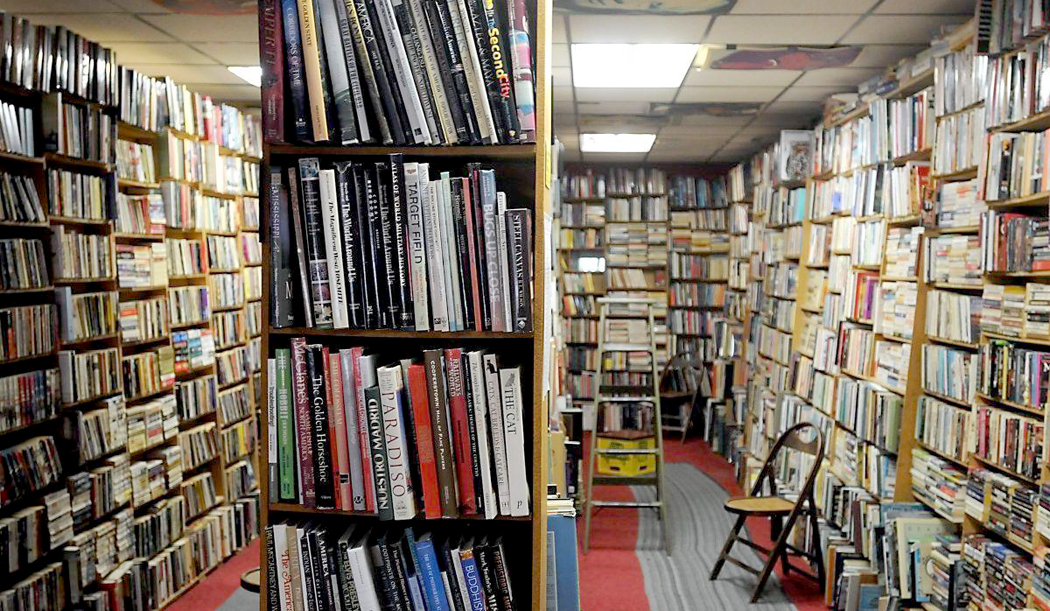
I confess that I am one of those people. An afternoon in a used bookstore is heaven. When traveling, my late wife and I would always stop for any used bookstore we came across, and even in the Midwest, where towns may be 20 miles apart, there was usually at least a little shop off Main Street filled with paperbacks. Others might seek out theme parks or historical monuments; we sought out-of-the-way and forgotten emporia of discarded books. 

But the days of the best used bookstores is gone, I’m afraid. 
It is used-book stores I mean, not used bookstores. Although, thanks to Amazon, bookstores are not as used as they used to be.

There are still lots of used-book stores, but their character has changed. Many are just storefronts in minimalls, stuffed with paperback mysteries and romance novels. Or, more recently, a spate of former grocery stores or automobile dealershops taken over by stores selling used books, records, CDs, DVDs and T-shirts with store logos on them. 

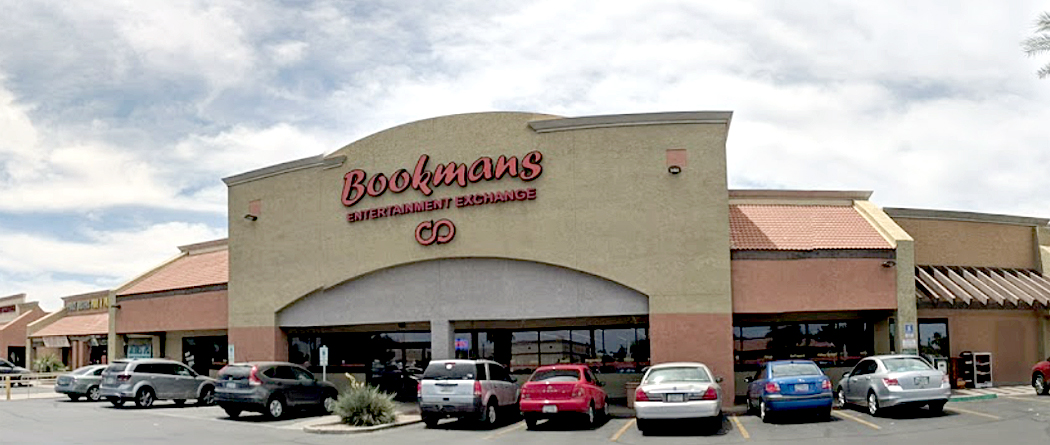
Bookmans in Phoenix and Mesa, Ariz., is one of them. I loved going there when I lived in Arizona. But it is in a shopping mall with acres of parking and the store itself is a refurbished supermarket. It is well organized and they make it easy to find what you want. But it is less fun to be lost in. 

I am old enough that I remember Manhattan’s Fourth Avenue, known in the 1950s and ’60s as Book Row, where there were, at one time, 48 used bookstores, many specializing in one type of book: cookbooks, or science books. In its heyday, Book Row spanned the stretch of Fourth Avenue between Union Square and Astor Place. They are all gone now, lost to exploding rents and the retirements and/or deaths of the stores’ original owners. The only vestige of Book Row is the Strand Bookstore, which isn’t even on Fourth Avenue anymore. In 1957, it moved to Broadway and East 12th Street. 

In many of those old dinosaurs, the books piled high on swayback shelves, with rolling ladders to get to the high-up books. There was must in the air, and any book you picked up tended to have a patina of dust along the top, which you blew off, like foam from a glass of beer. 

In such bookstores, you didn’t usually enter looking for a specific book, but rather, you were treasure hunting, seeking some wonderful volume you didn’t even know existed. Old books, from the 19th century, or the 1920s, with silver or gold titles on dark blue cloth binding. Their texts were letterpress, and each wonderful letter was embossed into the paper, leaving a texture on the surface. 

In one such bookstore in Virginia Beach, Va., — now long gone — the proprietor had a word for the die-hard book lover. She called us  “bibliopaths,” and she recognized us as soon as we entered the shop. A bibliopath is more than a book lover, but rather someone with an addiction that cannot be satisfied without a constant fix of more and more pages. 

In such stores, the books are not always well organized. They stuff the shelves, and rest in stacks on the floors. 

When I was in college in the 1960s in North Carolina, the Book Exchange in Durham was one of these troves. It finally closed in 2009 after 75 years in business, but back then, it had multiple stories of books, piled high and deep. I miss it like I miss my grandparents, long gone. 

One old customer remembered, “The Book Ex was enormous. It seemed to go on forever, up, down and sideways. It was a warren, a maze of narrow aisles between towering bookshelves and precarious piles. There were ladders propped everywhere, for reaching the shelves extending high overhead. As you wandered around, attempting to decode the organizational system and snuffling up the scents of old paper, new ink and dusty floorboards, you felt like an explorer about to make a life-changing discovery, and you felt right at home.”

It was never a “clean well-lighted place.” 
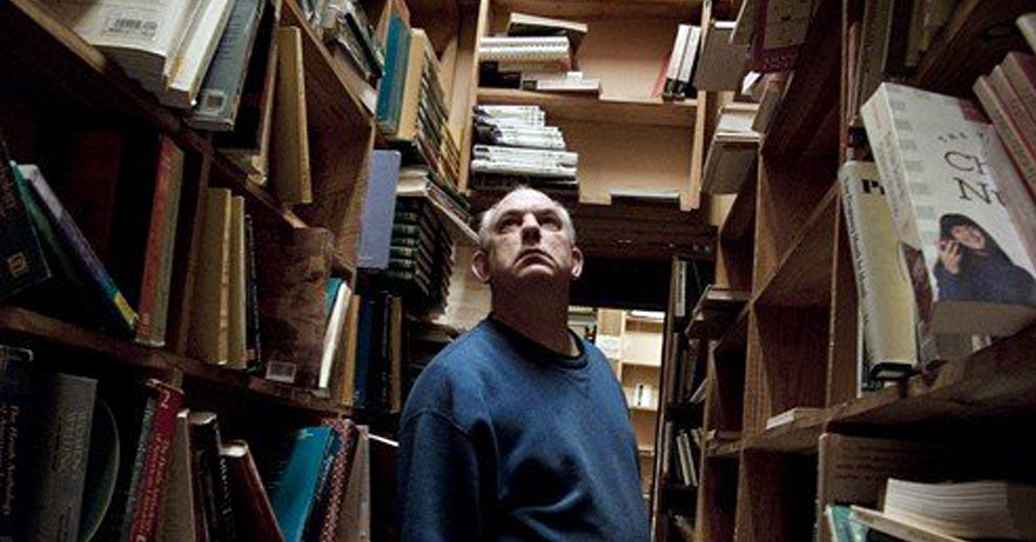
Another recalled, “When I walked in to this place, I noticed a sign up from the fire marshal, granting them some sort of exemption for having … gosh, I wish I could remember the exact phrase … something like ‘high stacks of flammable material.’ Anyway, that mental image might give you some idea of the inside of The Book Exchange — shelves and shelves of books going up the walls, everywhere you turn.”
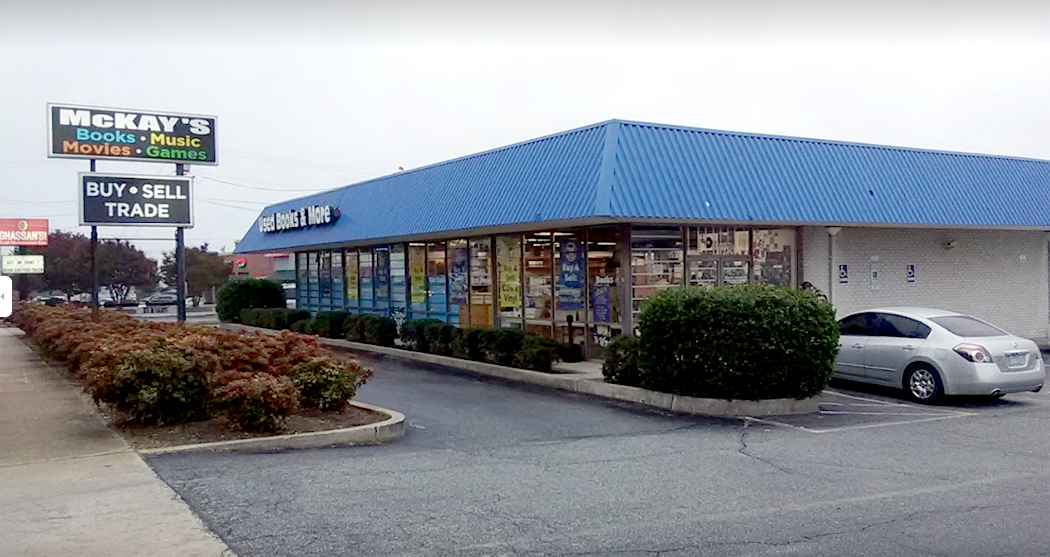
Most current used bookstores of any size have cleaned up, added bright signage and clever display racks. Stores like McKay’s Books in Greensboro. It has a coffee bar attached and modern hanging lighting, making the interior bright and cheery. There is still a great deal of treasure to be found, but the store has a more corporate feel to it. 
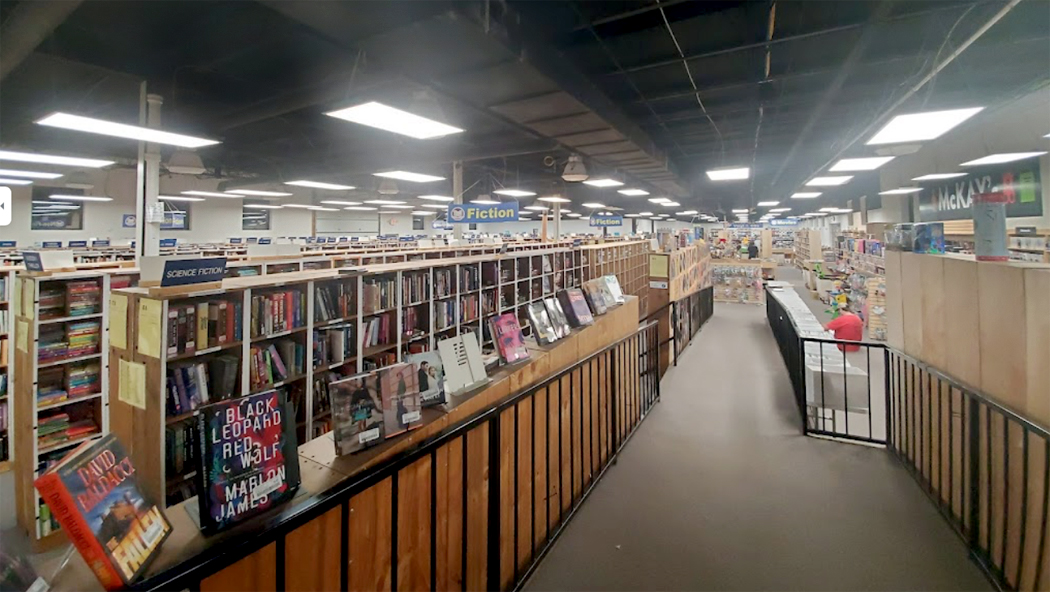
Some of the old stores, like Powell’s City of Books in Portland, Ore., have kept up with the times. The first time I went there, it felt a bit like the Book Exchange. The store covers an entire city block and had multiple floors of books. The staff was astonishing. You could ask for some obscure title and — this was before computer cataloguing — the clerk would take you three aisles over, up to a shelf seven-feet in the air and pull out the book, as if he had just left it there earlier this morning. 

Powell’s is still the largest used bookstore in the world, but it has modernized and made itself user-friendly. Good lighting, modern display racks — and a coffee bar. 
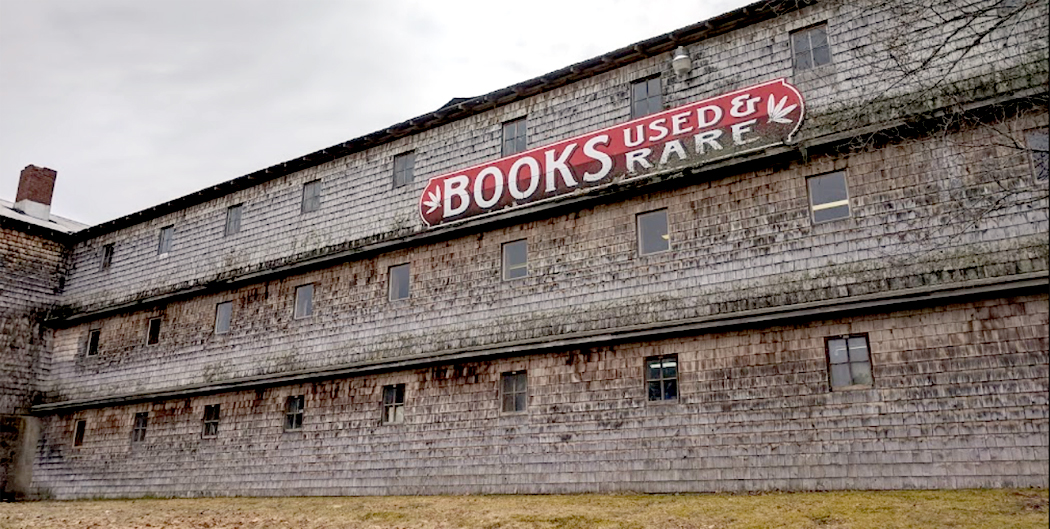
In Ellsworth, Maine, (actually a few miles out of town), there is the Big Chicken Barn, which still has the old feel, with creaking wooden floors and sagging shelves. It is an antique shop on the bottom floor, but upstairs is all books and magazines (you can find pretty much any Life magazine or Saturday Evening Post you might want, all racked up). The old wood shingled building is as long as a football field. Perfect for getting lost in the books and finding something you didn’t know you belonged to have. 

The owners and proprietors of many a shop is as eccentric as their catalog system. Often, they have spent their whole lives with books, and are more comfortable with them than with the people who come looking for them. 

We went once to a now-defunct used bookstore in Tucson, Ariz., called The Mad Hatter. We found out why. There was a sign that said, “No Talking,” and the man behind the cash register sat reading, bearded and scruffy. We asked about a particular book we wanted and he flew into a rage. “No talking!” he yelled. When we tried to apologize, he told us we were scum, and said, “Get out, now! Leave or I’m calling the police.” I don’t think he really wanted to let go of any of his stock, but sat on it like a dragon on its hoard. 
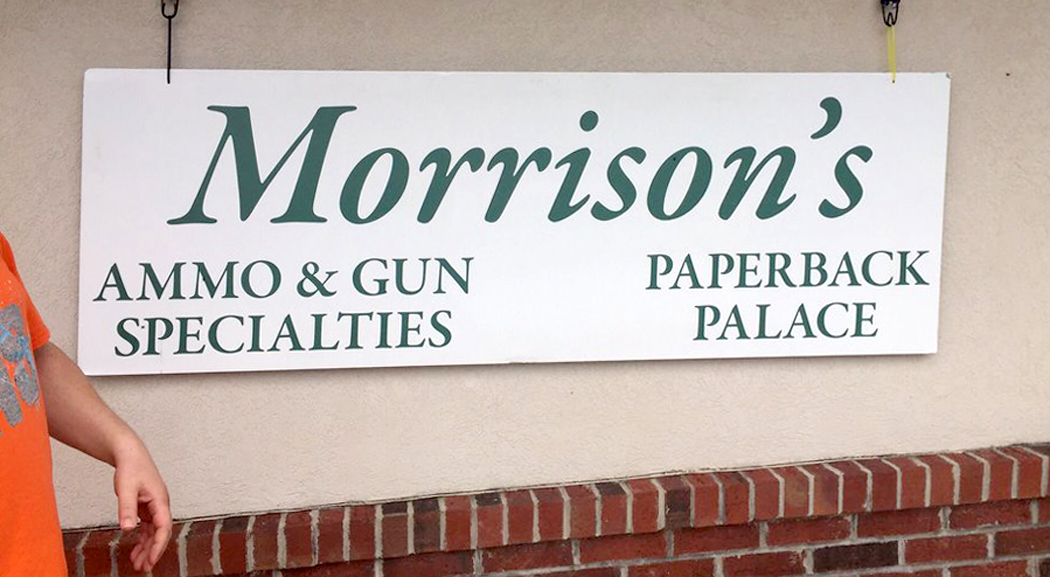
There is a place just south of Asheville, where I now live, called Morrison’s Paperback Palace Guns & Ammo. One side of the store is a welcoming warren of shelves, by and large unsorted, covered with books so diverse they must have been bought by the dumptruck. The other side of the store was racks of rifles, shotguns and pistols, with display cases of cartridges and hunting gear. Most of his customers barely looked at the books; they were there for the ordnance. The man behind the counter tolerated our presence on the bookish side of the shop. 
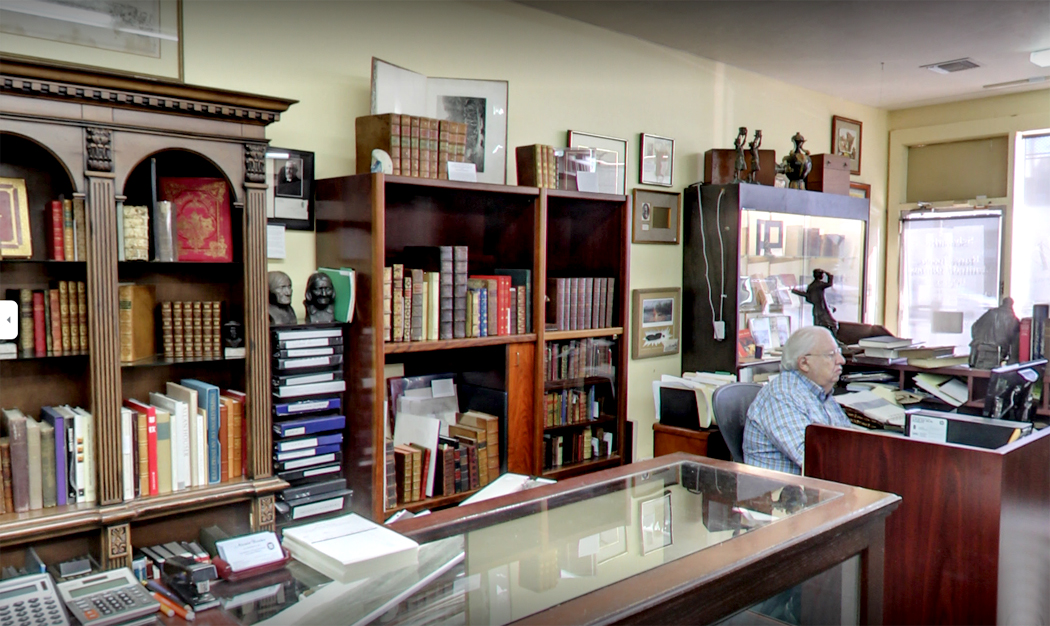
In contrast the quiet and aged owner of Alcuin Books in Scottsdale would rather have a long discussion about early Christianity, or the Latin language than take your money. Richard Murian often helped me find something I needed, even if it took a week, and he’d phone me telling me he had gotten it. He is a gem of a human being. 
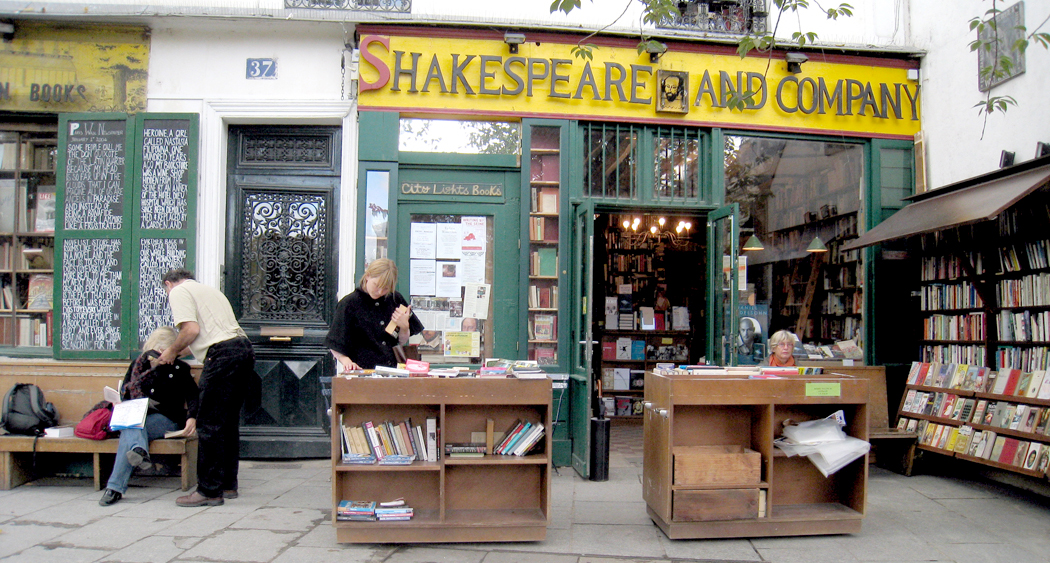
Or Sylvia Whitman, who currently runs Shakespeare & Co. in Paris. Famous for its original owner, Sylvia Beach, who kept the bookstore as a haven for expats in the 1920s, the store maintains its bohemian culture and will let writers down on their luck sleep there. And often, when someone could not afford a book, it was given or “lent” to them. 
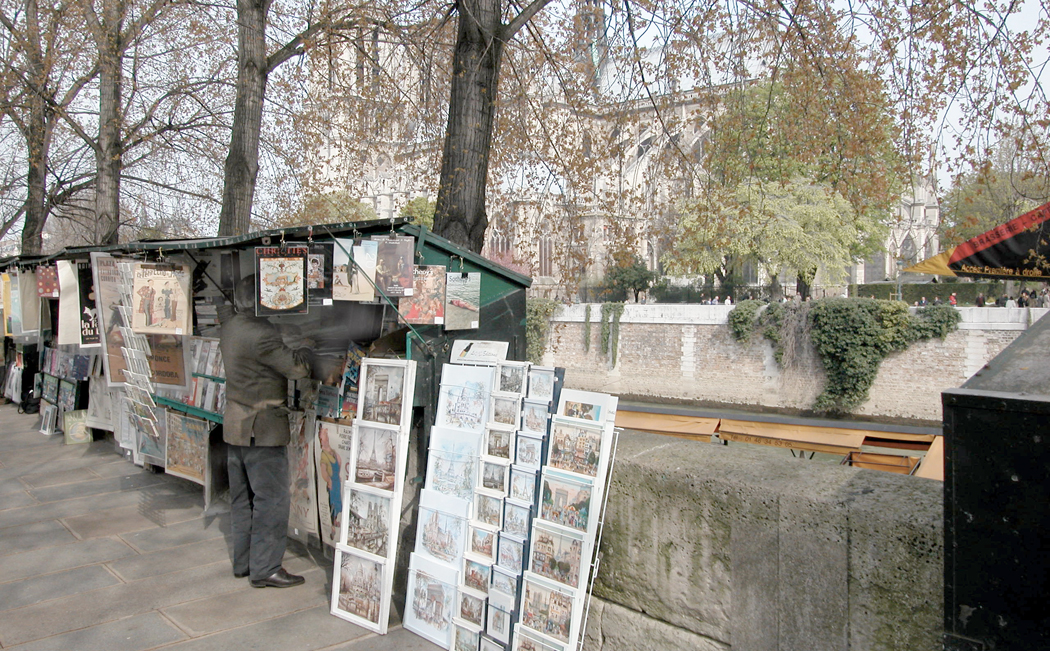
It is on the Left Bank, near the rows of outdoor booksellers and their kiosks, where old books can be pored over and treasures found. 

So too was the owner of a fly-by-night used bookstore that operated out of an attic in Greensboro in the late ’60s. I can no longer remember the name of the store, or of the generous owner of it, who also loved to talk with his customers, offering them coffee from a hotplate pot. He saw, one time, that I was especially interested in a photography book by Edward Weston. He wouldn’t sell it to me; he gave it to me, saying he knew I was the right owner for it. 

I still have California and The West by Weston and Charis Wilson. I treasure it, as my benefactor knew I would. We bibliopaths recognize each other. 

That book is now worth something on the collectors’ market, which is a plague on those of us who love the books. We buy them to read, and a cheap price is essential. But books that used to be shelf fodder are now priced beyond our means. The old Modern Library volumes used to stuff the shelves and were priced at a buck fifty or two bucks and gave us a chance to load up on classics. Now, an old Modern Library book can go for $20 or more to someone who isn’t interested in what’s inside, but whether it has its original dust jacket. 

Luckily, whatever old, musty used-book stores still remain can harbor the old books — naked without jacket — and the price pencilled onto the flyleaf when it arrived at the store, maybe 20 years ago. 
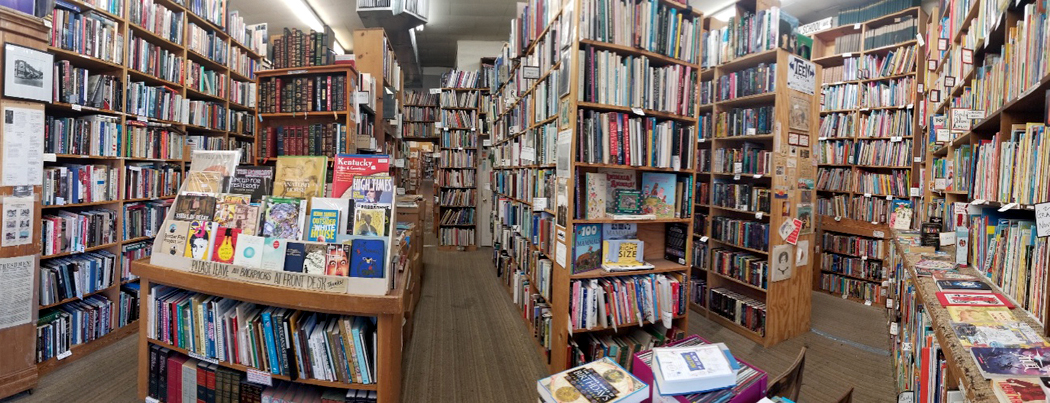
It is the treasure we bibliopaths hunt. 
In addition to this blog, which I have been writing since 2012, I have written a monthly essay since 2015 for the Spirit of the Senses salon group in Phoenix, Ariz. The readership for each site seems to have little overlap, and so, I thought if I might repost some of the Spirit essays on my own blog, it might achieve a wider readership. This one, originally from Oct. 1, 2021, is now updated and slightly rewritten

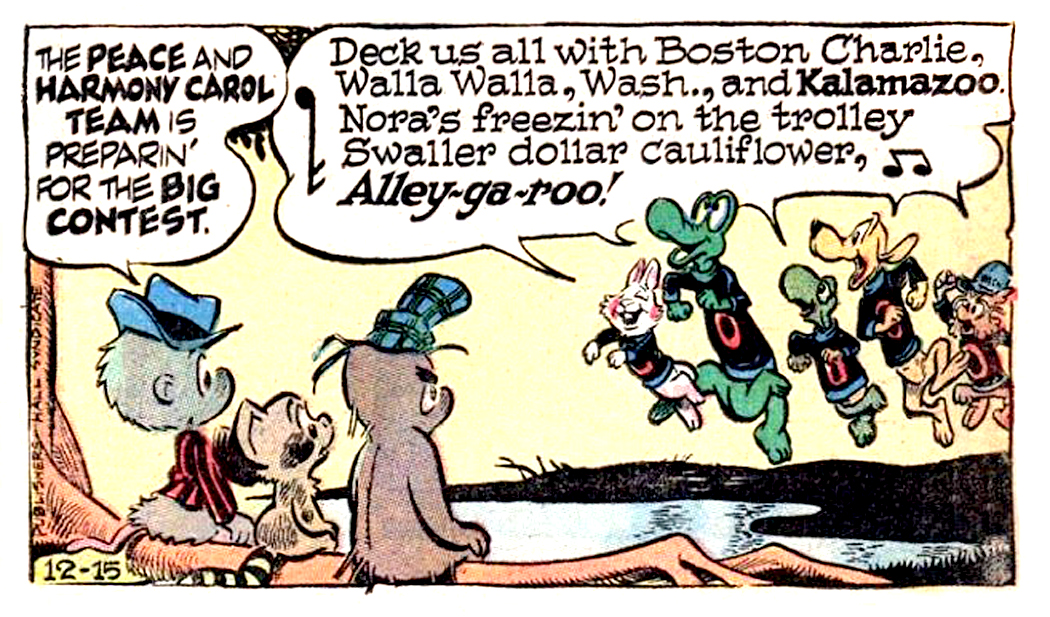
When I was a wee bairn, back in the wilds of New Jersey, I remember a certain consternation when listening to — and being forced to sing — various Christmas carols. What, I wondered, does “Fa-la-la” mean? Couldn’t the song writer think of any real words? I tended to sing the Walt Kelly version: “Deck us all with Boston Charlie, Walla-Walla, Wash., and Kalamazoo.” 

But those nonsense syllables continued to bother me. And fascinate me.

And in school, we sometimes had to sing songs with such nonsense words in them, like “Tra-la-la” and “Hey, nonny-nonny.” When I got a little older, and learned to read and write, I wondered if these had actually been just corruptions of real words, as a kind of mondegreen. Like “round John Virgin in Silent Night.

Then, as a school kid watching Warner Brothers cartoons on television, I learned of certain popular tunes from the 1940s — which to me in the 1950s seemed as far away as the Middle Ages — like “Mairzy doats and dozy doats and liddle lamzy divey/ A kiddley divey too, wouldn’t you?” Such songs would show up in Loony Tunes. Another was “Hut set rawlson on a rillerah, and a so-and-so and so forth.” from the 1942 cartoon  Horton Hatches an Egg. I was sure I must be mis-hearing the lyrics. Only later did I find out that no, I wasn’t, but “Mairzy doats” was, in fact a mondegreen for “Mares eat oats and does eat oats and little lambs eat ivy.” Which is still pretty much nonsense. 

Oh, but then. Then, I became a teenager in the ’60s. Little Richard (I then thought of myself as “Big Richard”) sang “Wop bop-a-loo-bop a-wop bam boom.” And “Tootie-Frootie, Ah Rooty.” And then in 1958 came: “Ooh-eee Ooh-ah-ah, Ting-Tang Walla-walla Bing Bang.” And the next year with “Shimmy-shimmy ko-ko-bop.” We were off to the nonsense syllable la-la-land. “Rama Lama Ding Dong.” 

Well, be-bop-a-Lula she’s my baby 

Be-bop-a-Lula I don’t mean maybe” 

Gene Vincent’s phrase “Be-Bop-a-Lula” is similar to “Be-Baba-Leba”, the title of a 1945  Helen Humes song, remade by Lionel Hampton as “Hey! Ba-Ba-Re-Bop.” This phrase, possibly being ultimately derived from the shout of “Arriba! Arriba!” used by Latin American bandleaders to encourage band members. Things work the rounds. 

I have since learned that these sounds are officially known as “non-lexical vocables.” There are learned papers written on the subject, some of which can be downloaded in PDF form (“Non-lexical Vocables in Scottish Traditional Music” by Christine Knox Chambers, 1980, 340 pages). 

Later, in college, as a music minor, I had to learn solfège, in which the syllables “do,” “re,” and “mi” stood for the notes “C” “D” and “E.” Originally, it was “ut,” “re” and “mi.” If you’ve ever wondered where this all came from, as you are singing “Doe, a deer, a female deer,” blame the Middle Ages. As a mnemonic to remember a tune, each pitch was assigned a syllable (this was before standard musical notation) from the beginning syllable of the prayer: “Ut queant laxis/ resonare fibris/ Mira gestorum/ famuli tuorum/ Solve polluti/ labil reatum, Sancte Iohannes.” (The last note combines the S and I from “Sancte Iohannes”) 

Translated: “So that your servants may,/ with loosened voices,/ Resound the wonders/ of your deeds,/ Clean the guilt/ from our stained lips,/ Saint John.” 

In the 1600s, because “Ut” was harder to sing, it was changed to “Do.” And “Si” is sometimes changed to “Ti.” Giving us “Do Re Mi Fa Sol La Ti and back to Do,” which, is Homer Simpson’s favorite word.

Ah, but  before all this pedantry, I meant to be writing about silly lyrics. “Doo wah diddy diddy dum diddy doo.” “Poppa Oom Mow Mow.” “Ob-La-Di Ob-La-Da.” Or the name song: “Katie, Katie, bo-batie,/Bonana-fanna fo-fatie/ Fee fi mo-matie/ Katie!” 

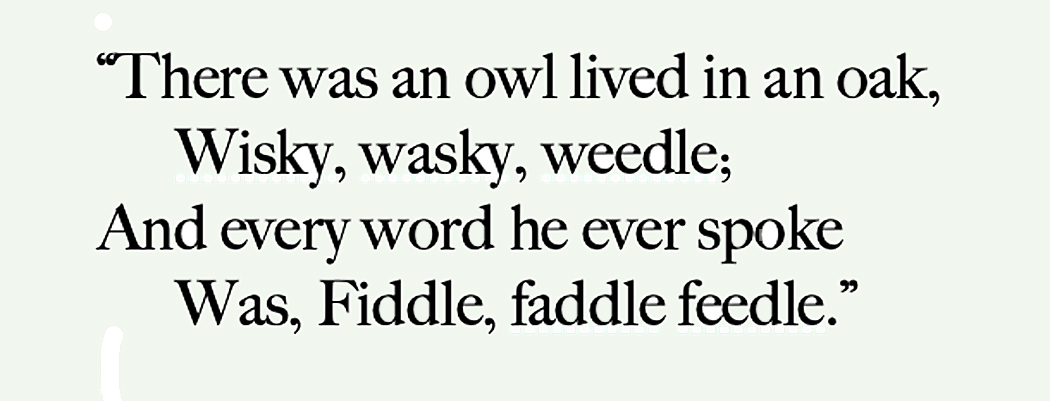
There really is a long tradition. I opened up my Oxford Dictionary of Nursery Rhymes (Oxford University Press, 1951, 559 pages) and found “Fiddle-de-dee, fiddle-de-dee, The wasp has married the humble bee,” and “Diddlety, diddlety, dumpty, The cat ran up the plum tree.” “Hickory-Dickery Dock, the mouse ran up the clock.” “Eenie, Meenie, Miney, Mo.” “Hey Diddle-diddle, the cat and the fiddle.” 

This sort of thing is all through the tome:

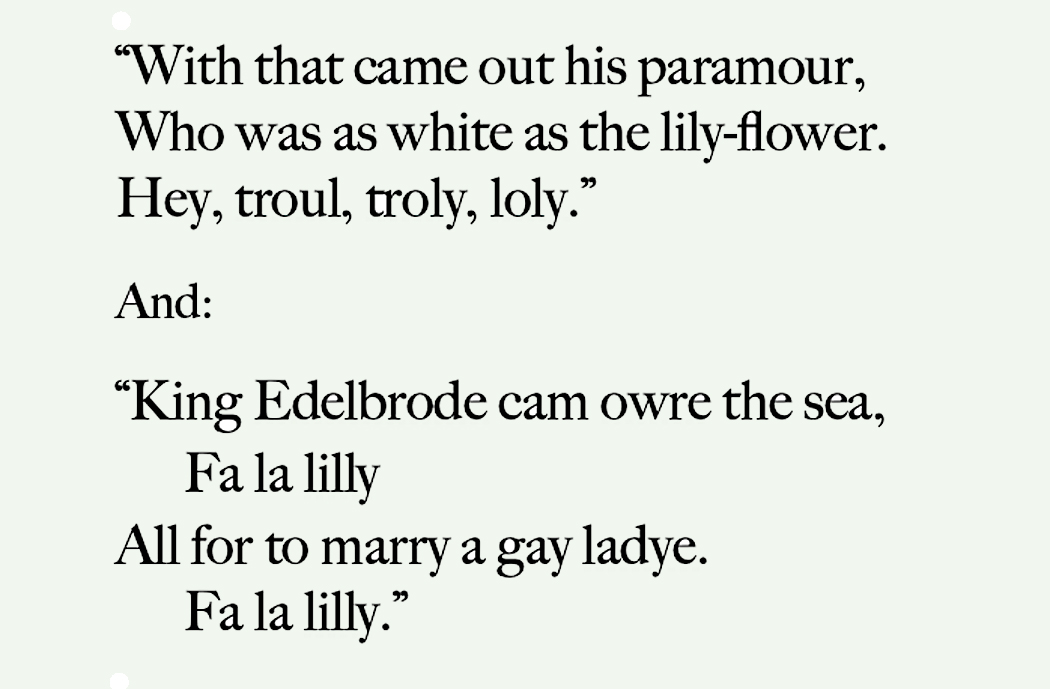
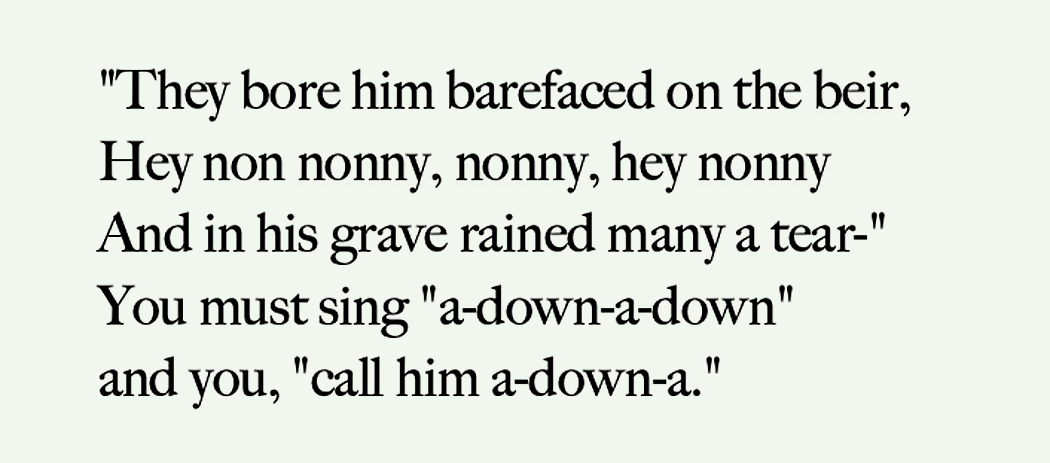
Open up Child’s Ballads, or English and Scottish Popular Ballads (Cambridge University Press, 1904, 723 pages), you find refrains such as

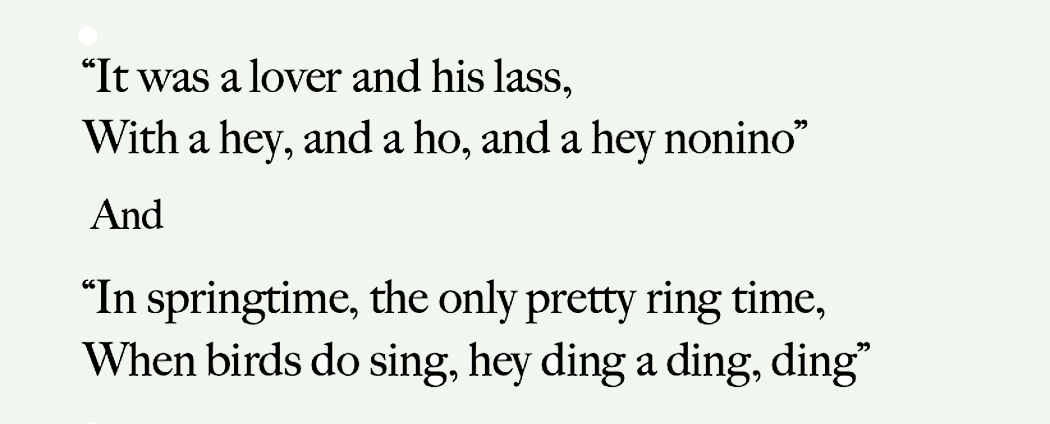
Shakespeare from As You Like It

Elizabethan songs are often called “Hey Nonny Nonnies.” 

As in Ophelias “mad song” from Hamlet:

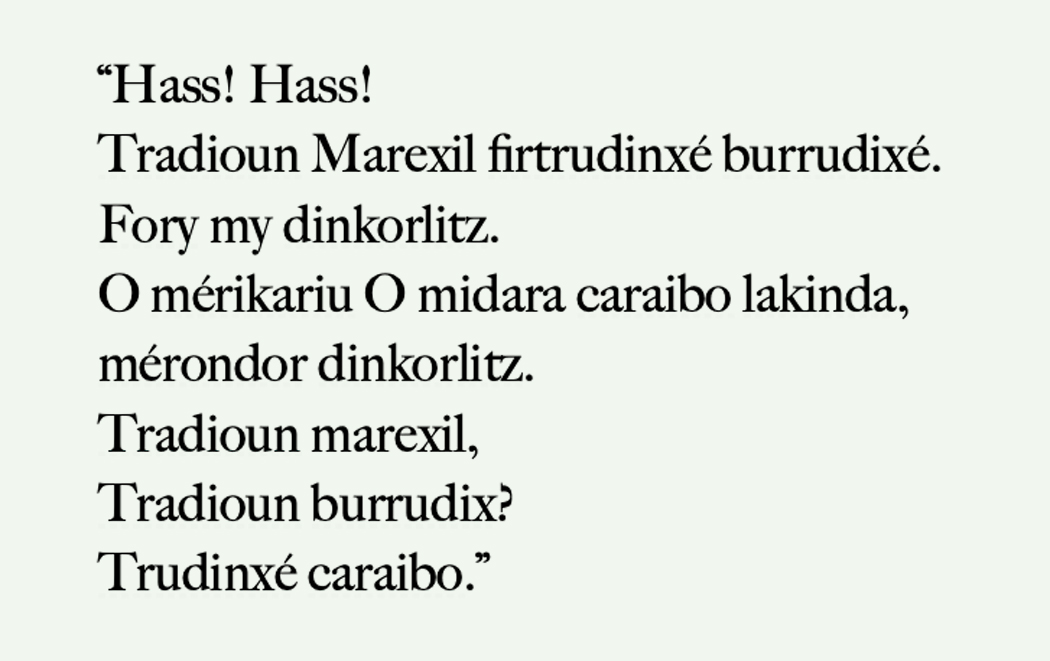
Opera has its share of nonsense, and some of that is in the libretto. Hector Berlioz wrote a chorus for the demons in The Damnation of Faust that goes on quite a while with stuff like this: 

And Wagner liked to invent gibberish almost as much as he loved himself. The famous Ride of the Valkyries actually has words. And what are they? “Hojotoho! Hojotoho! Heia ha-haeia!” Over and over. 

And his Rhine Maidens, gurgling underwater, sing the praises of the Rhine gold: “Heiajaheia! Heiajaheia! Wallalalalala leiajahei!” 

There’s at least a section of gibberish in each of his operas. The sailors in The Flying Dutchman all sing a Wagnerian version of “Yo-ho-ho” — “Ho-ho! Je holla ho!” And when they make merry: “Ho! He! Je! Ha! Klipp’ und Sturm’, He! Sind vorbei, he! Hussahe! Hallohe!” This kind of gibberish is of a different order from the gibberish that passes as Wagner’s philosophy. 

But is any of this different from “Fododo-de-yacka saki Want some sea food, Mama.” Or Frank Sinatra’s “Doo-be doo-be doo.” 

This stuff is all over the place, from Sly and the Family Stone: “Boom Shaka-laka, boom shaka-laka,” to the hit song from 1918 (yes, it’s that old): “Jada, jada, jada-jada-jing-jing-jing.”

Going back further, there’s Stephen Foster’s “Camptown ladies sing dis song, Doo-dah, doo-dah,” and Ta-ra-ra Boom-de-ay was a vaudeville and music hall song made famous in 1892 by British performer Lottie Collins. But its provenance goes back further, at least to the 1880s, when it was sung by a black singer, Mama Lou in a well-known St. Louis brothel run by “Babe” Connors. 

Then, in 1901, Yale graduate Allan Hirsh wrote the fight song, Boola-Boola.  “We do not know what it means,” Hirsh wrote, “except that it was euphonious and easy to sing and to our young ears sounded good.”

As far as “boola,” it was rumored to be a Hawaiian word for “good,” but linguists point out, there is no “B” sound in the Hawaiian language. 

“Sometimes, with these college fight songs,” said Kalena Silva, director of the College of Hawaiian Language at the University of Hawaii  at Hilo, “they just made up words.” 

After the 1915 Panama-Pacific Exposition in San Francisco, which featured a popular Hawaiian pavilion — which sported floor-to-ceiling flowers, pineapple give-aways, a back-lit aquarium and the Royal Hawaiian Quartet playing music, with a steel guitar — a craze for Hawaiian-themed songs took over Tin Pan Alley. 

The year 1916 gave us Yaaka Hula Hickey Dula, which begins: “Down Hawaii way, where I chanced to stray/ On an evening I heard a Hula maiden play Yaaka hula hickey dula, Yaaka hula hickey dula.” 

It should be stated that “Yaaka hula hickey dula” is not Hawaiian — or any other language. Also from 1916 was They’re Wearing’Em Higher in Hawaii, and Oh How She Could Yacki Hacki Wicki Wacki Woo.

Later came more exoticism: “Bingo Bango Bongo, I Don’t Wanna Leave the Congo.” 

Of course, African-American culture gave us scat singing, which features improvised nonsense syllables. There are great examples from Louis Armstrong and Fats Waller.

But perhaps the most popular for the scat was Cab Calloway, whose Minnie the Moocher gave us “Hey-dee-hi-de-ho.” But also, “Skeedle-a-booka-diki biki skeedly beeka gookity woop!” And, “Scoodley-woo-scoodley-woo scoodley-woodley-woodley-woo Zit-dit-dit-dit-dittle but-dut-duttleoo-skit-dit-skittle-but-dit-zoy

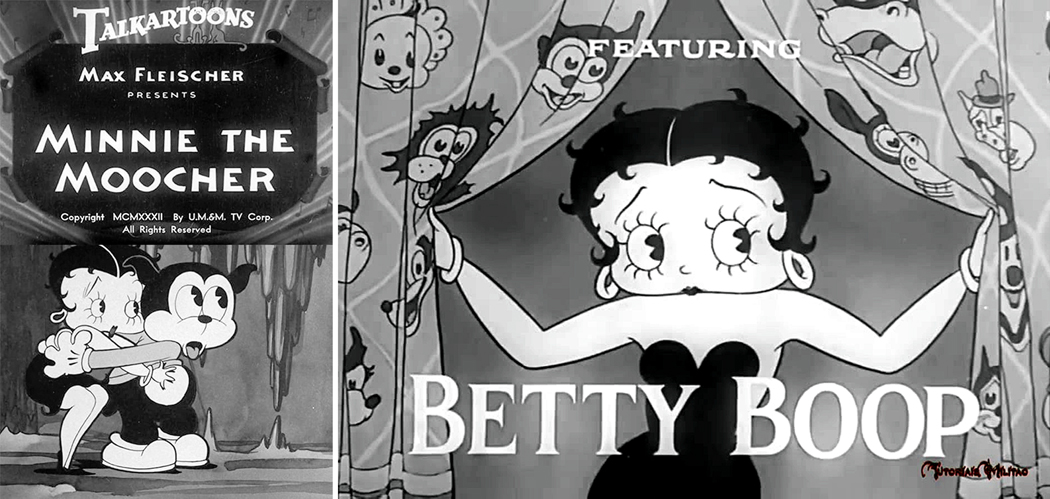
Calloway made an appearance in the 1932 Fleischer Brothers animated cartoon, Minnie the Moocher, with Betty Boop, whose catch phrase, “Boop-Boop-a-Doop,” was originally a scat phrase.  

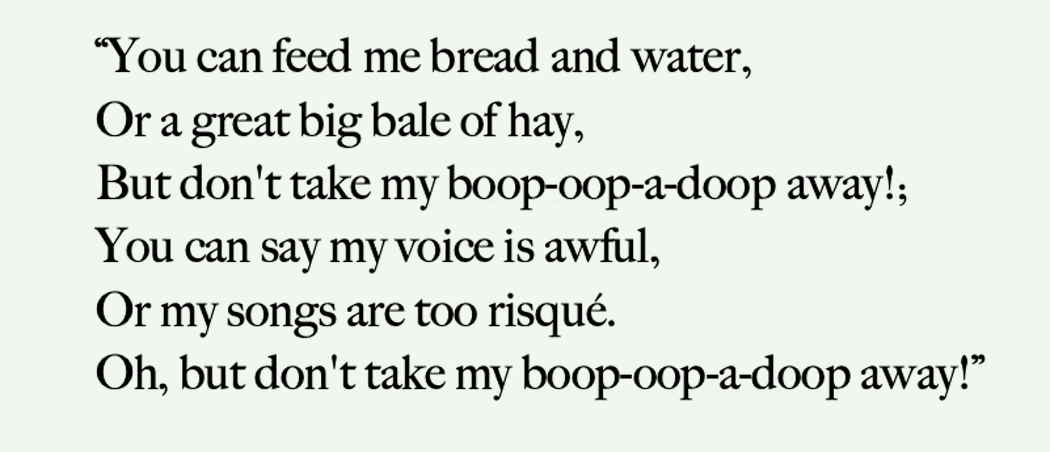
The phrase was heard by some blue-stockings as a euphemism for something rude and a backlash developed, leading to a 1932 cartoon, Don’t Take My Boop-Oop-A-Doop Away,” where Betty sang a little song:

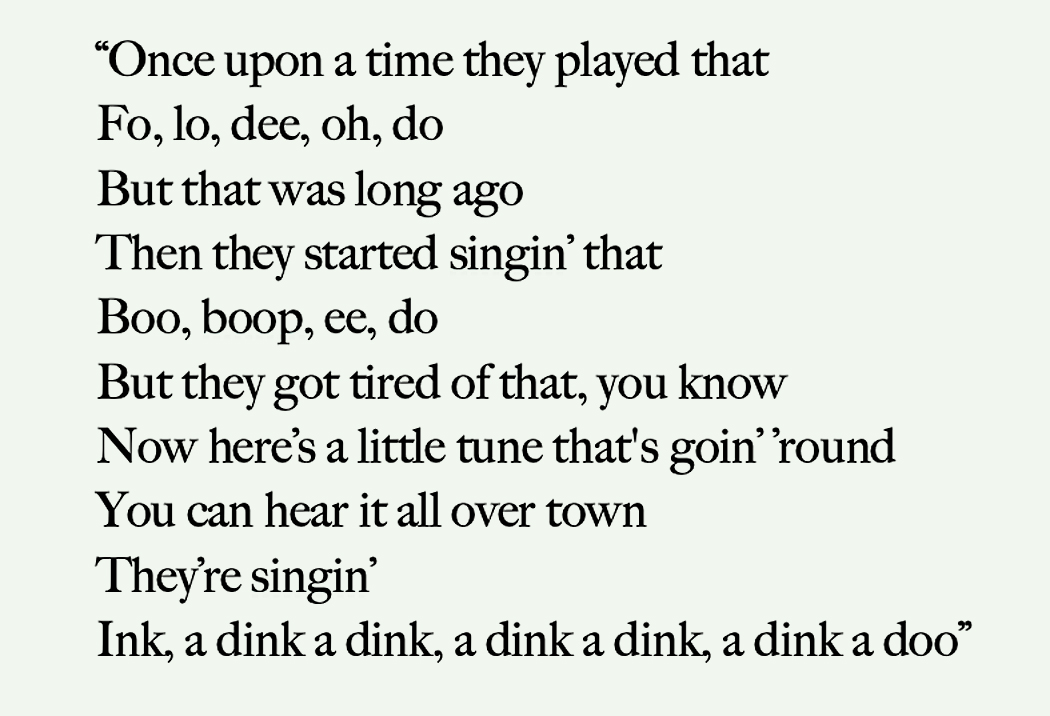
The following year, Jimmy Durante gave us Inka-Dinka-Doo, which sang:

Getting into the 1940s, Disney has given us a share, from “Zip-A-Dee Doo-Dah, Zip-A-Dee Ay, My, oh my, what a wonderful day” to “Sala-gadoola-menchicka-boo-la bibbidi-bobbidi-boo.”

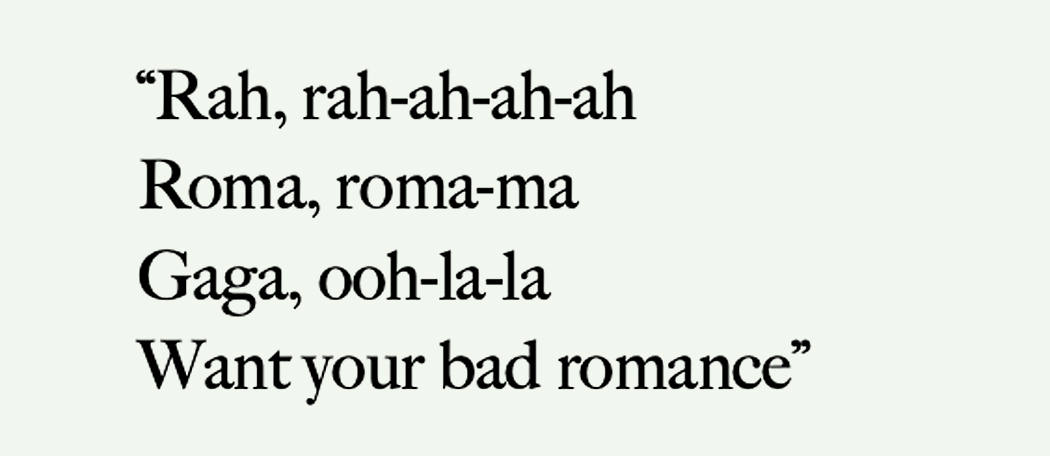
The tradition continues, as even Lady Gaga has Bad Romance:

I’ve already mentioned the non-lexical vocalisms from Little Richard and Gene Vincent. Now we move on to Iron Butterfly and their notorious 17-minute 1968 extravaganza, In-A-Gadda-Da-Vida

I mentioned mondegreens earlier. Apparently, the lyrics to the song were supposed to be “In the Garden of Eden,” but when song-writer Doug Ingle played the song for his bandmate, Ron Bushy misheard the words, sung in a drunken slur by Ingle after drinking a gallon of cheap red wine, as “In-A-Gadda-Da-Vida,” and wrote it down that way. I suppose it could have been corrected the next sober morning, but it wasn’t, and has gone down as legend. 

The Beatles had a history of using nonsense words in their songs, from Ob-La-Di Ob-La-Da to the “na-na-na” chorus of Hey Jude. Sometimes they used nonsense to fill out a song, usually with a plan to add better words later. 

Ryan Miller of the alternative rock band Guster said that many songwriters use sounds a placeholders — the way movies are made with “working titles” before the real one gets put in place. 

“Ninety-eight percent of the time you replace them with words but sometimes those sounds fit the spirit of the song or even become the spirit of the song,” said Miller. “And sometimes I don’t want there to be words — there can be a Rorschach version this way where you have your own experience with the music.”

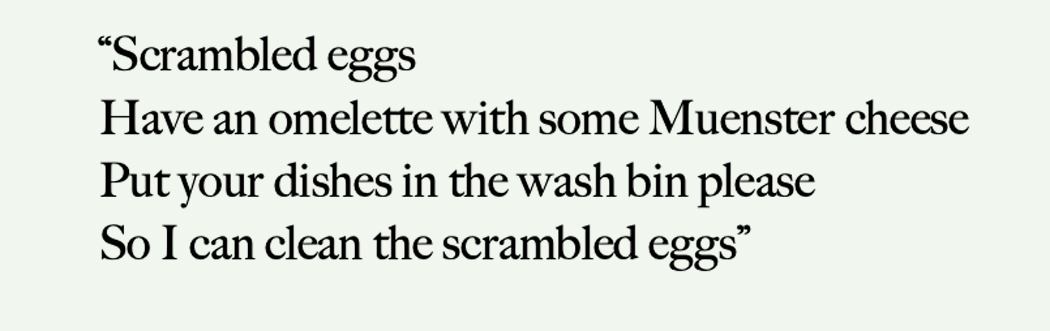
When Paul McCartney was writing Yesterday, he had the tune, but not the words, so in the demo tape, he used placeholders and sang:

“Scrambled eggs” and “yesterday” scan the same. Go ahead, sing it with the old words. It works. But he did the right thing and switched up the words.

Other Beatles songs, though, feel as though the placeholders were just left in. “Well you can syndicate any boat you row,” or “Words are flowing out like endless rain into a paper cup.”

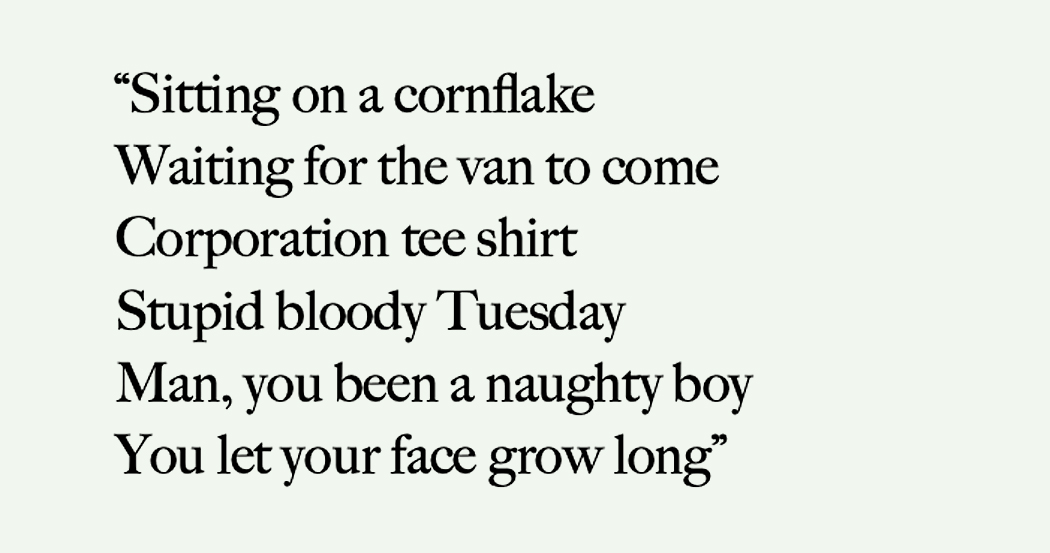
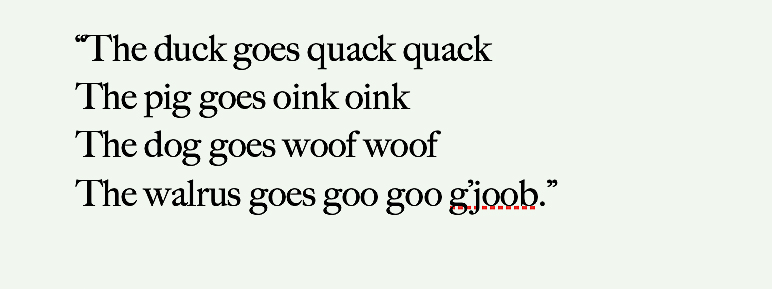
The all-time champ must be I Am the Walrus

John Lennon said he was tired of listeners trying to “analyze” Beatles lyrics, and wanted to write something to confuse them — the “Rohrschach effect” that Ryan Miller mentioned. 

And so:

Those of us who have written professionally have all faced editors. There are those who despise those who have that power over them, and those of us who welcome their help. I was lucky: I always had supportive editors, whose work always only made my prose better. 

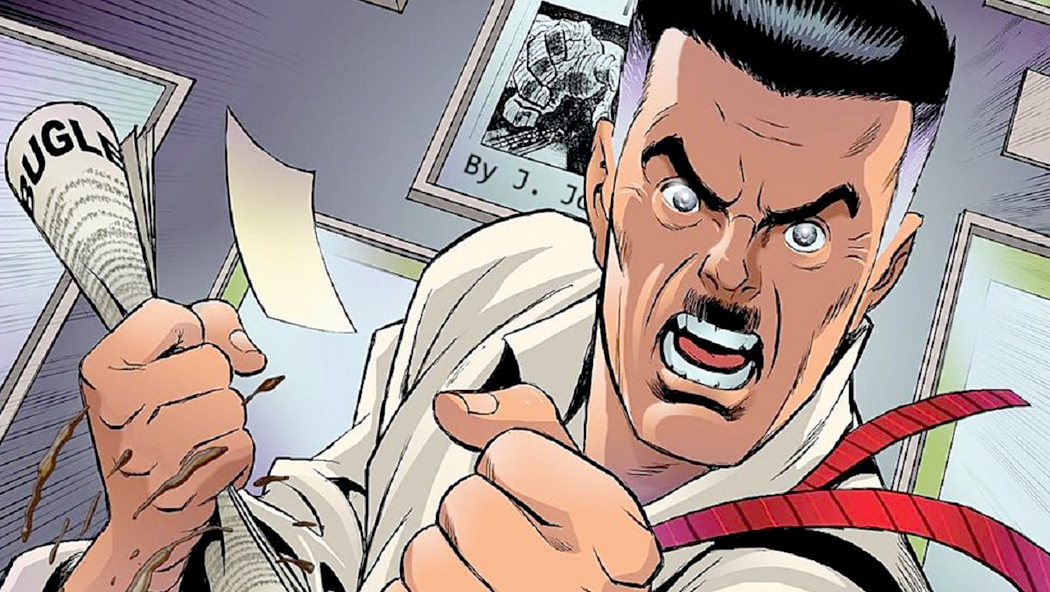
But I also feel sympathy for them, as a whole, for having to put up with my tendencies. I wrote for a newspaper, where the ideal prose is that which disappears, is clear as spring water, and is aimed at a readership that wants to get the information it needs in as short and pithy a means as possible. Short sentences; short paragraphs; direct communication. 

Unfortunately, that was not what I usually did. I wasn’t a trained journalist and I never quite caught the knack. I loved the words as much as the matter they conveyed. Subordinate clauses, parenthetical asides, amplifying sidenotes — these were what I loved, and what I plopped down, like a dead fish, on the desk of my poor editors. I’m sure I used more em-dashes and semicolons than the entire rest of the writing staff combined. My sympathetic editors let me get away with it — usually. 

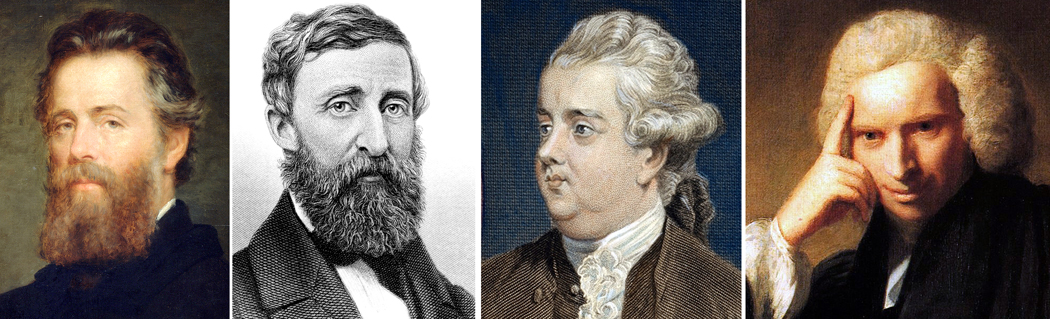
My ideal writers, those whose works I loved to read — and the operative word is “love” — are those who expatiate, amplify, pile up metaphors and imagery, i.e., whose prose was tasty and rich. Authors who one reads less for the plot or subject and more for the glory of the words themselves. Melville, Thoreau, Gibbon, Laurence Sterne. Words to gobble up and savor over the palate. 

I wrote about this in a previous blog, where I described the kind of writing I enjoyed:

“My ideal can be found in the long serpentine railways of words shunted hither and thither over dependent clauses, parenthetical remarks, explanatory discursions and descriptive ambiguities; sentences such as those found in the word-rich 18th century publishing world of Fielding, Sterne, Addison, Steele, or Boswell, and perhaps most gratifyingly in the grand, gravid, orotund sentences of Edward Gibbon, whose work I turn to not so much for information about the grandeur that was Rome, but for the pure sensuous pleasure to be had from those accretive tunes built from the pile of ideas and imagery (to say nothing of ironic asides), and peppered liberally with the notations of colons, semicolons, dashes and inverted commas.”

One sentence; 114 words; 14 commas; a semicolon; a parenthesis; a hyphen; and the supporting gravy of digression. Sentences such as that must have provided my editors with reason enough to keep a sixpack of Pepto-Bismol in their desk drawers. 

The fact is, writers tend to be those who hone their text down to the essentials, like Hemingway, or those who pile it on with a rich depth of detail, like Faulkner. They are perhaps the exempla of the two tendencies. 

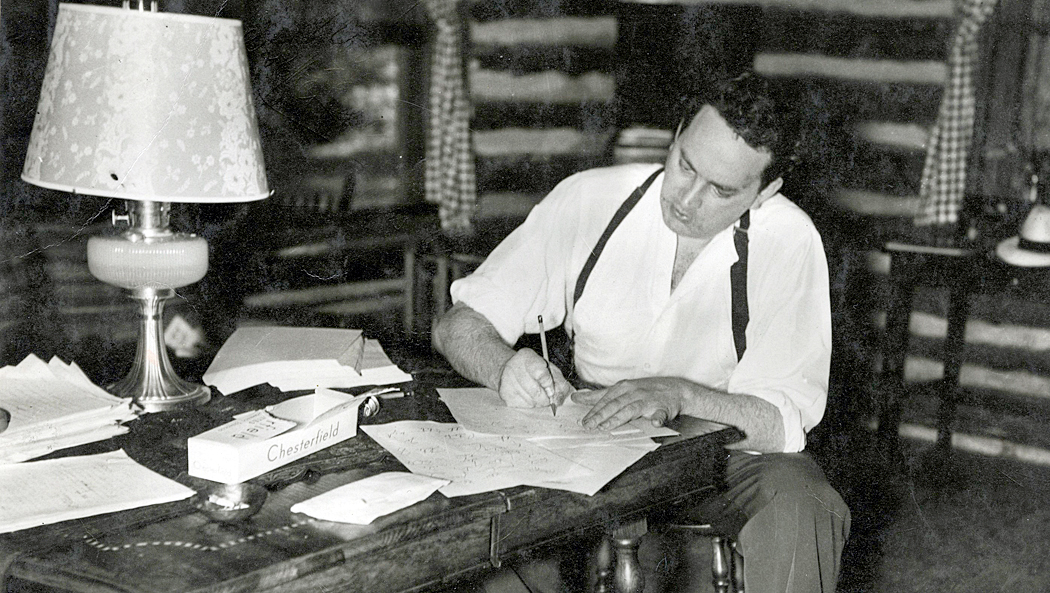
In 1937, F. Scott Fitzgerald wrote a letter to his sometime friend, Thomas Wolfe, urging Wolfe to prune his prose down to essentials, cut back on some of that overwhelming exuberance, and advocating for Flaubert’s laconic supremacy over the wordier Emile Zola. Wolfe wrote back, in a bit of understandable pique: “Flaubert me no Flauberts, Bovary me no Bovarys. Zola me no Zolas. And exuberance me no exuberances.”

 Wolfe argued: “I have mentioned Don Quixote and Pickwick and The Brothers Karamazov and Tristram Shandy to you in contrast to The Silver Spoon or The White Monkey as examples of books that have become ‘immortal’ and that boil and pour. Just remember that although in your opinion Madame Bovary may be a great book, Tristram Shandy is indubitably a great book, and that it is great for quite different reasons. It is great because it boils and pours — for the unselected quality of its selection. You say that the great writer like Flaubert has consciously left out the stuff that Bill or Joe will come along presently and put in. Well, don’t forget, Scott, that a great writer is not only a leaver-outer but also a putter-inner, and that Shakespeare and Cervantes and Dostoevsky were great putter-inners — greater putter-inners, in fact, than taker-outers and will be remembered for what they put in — remembered, I venture to say, as long as Monsieur Flaubert will be remembered for what he left out.”

Yeah — Take that! (The Silver Spoon and The White Monkey are two of the three books in the John Galsworthy trilogy, aka The Forsyth Saga, along with Swan Song.) 

Wolfe knew who he was and what he wanted to do, and yes, his editor, Maxwell Perkins (also Hemingway’s editor at Scribners) did manage to trim some 90,000 words out of Wolfe’s first novel, Look Homeward Angel, which first came to his desk at 330,000 words. And Wolfe did complain constantly about Perkins’ blue pencil, eventually leaving Scribners because of it. And yes, Perkins’ work immeasurably helped Wolfe become a great writer. 

In his letter to Fitzgerald, Wolfe painted a wonderful caricature of how the public pictured Wolfe as an author:

“The little fellows who don’t know may picture a man as a great ‘exuberant’ six-foot-six clodhopper straight out of nature who bites off half a plug of apple tobacco, tilts the corn liquor jug and lets half of it gurgle down his throat, wipes off his mouth with the back of one hairy paw, jumps three feet in the air and clacks his heels together four times before he hits the floor again and yells ‘Whoopee, boys I’m a rootin, tootin, shootin son of a gun from Buncombe County — out of my way now, here I come!’ — and then wads up three-hundred thousand words or so, hurls it back at a blank page, puts covers on it and says ‘Here’s my book!’ Now Scott, the boys who write book reviews in New York may think it’s done that way; but the man who wrote Tender Is the Night knows better. You know you never did it that way, you know I never did, you know no one else who ever wrote a line worth reading ever did. So don’t give me any of your guff, young fellow.” 

As an experiment, I thought I might take a famous bit of “putter-inner” prose and give it the Flaubert treatment. Herman Melville writes a prose as fertile as anyone ever planted on a page, with excursions, explosions, eructations and effusions all over the place. It is, of course, what makes Melville Melville, and why anyone reads all that stuff about harpoons and try pots. The exuberance of the words piled onto the page is what makes the book such fun to read. 

And so, I imagined the opening paragraph of the first chapter, “Loomings,” and took my pencil to it. 

As it was written: 

“Call me Ishmael. Some years ago — never mind how long precisely- having little or no money in my purse, and nothing particular to interest me on shore, I thought I would sail about a little and see the watery part of the world. It is a way I have of driving off the spleen and regulating the circulation. Whenever I find myself growing grim about the mouth; whenever it is a damp, drizzly November in my soul; whenever I find myself involuntarily pausing before coffin warehouses, and bringing up the rear of every funeral I meet; and especially whenever my hypos get such an upper hand of me, that it requires a strong moral principle to prevent me from deliberately stepping into the street, and methodically knocking people’s hats off — then, I account it high time to get to sea as soon as I can. This is my substitute for pistol and ball. With a philosophical flourish Cato throws himself upon his sword; I quietly take to the ship. There is nothing surprising in this. If they but knew it, almost all men in their degree, some time or other, cherish very nearly the same feelings towards the ocean with me.”

I love that paragraph. Full to overflowing; images piled on images. A great introduction to our narrator, whose personality becomes the substance of the book. But, I thought, what if a gimlet-eyed editor from a harried city newsroom saw that coming across his desk, what would he do to it. Take out all the hoopde-doo. Just the facts, ma’am. 

“Call me Ishmael. Some years ago having little in my purse, I thought I would sail and see part of the world. Whenever I find myself growing grim about the mouth I account it high time to get to sea as soon as I can. There is nothing surprising in this. Almost all men cherish the same feelings towards the ocean with me.”

See how much more efficient it becomes. Gets straight to the point. 

But really, if he wasn’t on deadline, he might well send it back for rewrite. I which case, we could turn it into right perfect journalese:

“My name is Ishmael. A few years ago, when I was broke, I decided to go to sea. Whenever I’m down, I do that. I believe that most of us feel the same about the sea.”

And really, do we need that last sentence? Out it goes. Editorializing. 

I believe that most of us feel the same about the sea.

It always reminds me of Woody Allen describing how his mother used to “run the chicken through the deflavorizing machine.” The value is weighted heavily upon the words, rather than the mere story. The flavor. 

I look back now on my 25 years as a critic with The Arizona Republic in Phoenix and feel tremendous gratitude to the many editors who put up with me, let me write what I wanted to, and mostly let me write it the way I was constitutionally built for, and often let me use a vocabulary beyond what was found in McGuffey’s Sixth Eclectic Reader. I wouldn’t have had a career without them. 

In addition to this blog, which I have been writing since 2012, I have written a monthly essay for the Spirit of the Senses salon group in Phoenix, Ariz., since 2015. The readership for each site seems to have little overlap, and so, I thought if I might repost some of the Spirit essays on my own blog, it might achieve a wider readership. This one, originally from July 1, 2022, is now updated and slightly rewritten. 

The world is fuzzy. I am constantly reminded of the fact that when looked at with any concentration, what might have seemed sharply focused, is, in fact, quite blurred. 

No matter how precise we try to make our language, there is always a nimbus of ambiguity clouding our meaning. What we mean by a word, and what our hearer means is only explainable in a Venn diagram. Some overlap, much personal and distinct. 

We keep trying to clarify our thought, to make it more precise, to nail down just exactly what we mean, but that whittled edge always seems to elude us and we are left with “sort of” and “it’s like …” 

What I’ve come to understand is that it has to be that way, and that meaning and communication can only happen in that aura of mist and glimpse.  

We try to sort out our reality with definitions and categories, but, so much is simply uncategorizable, and definitions are often murky.

I was re-reading my Lucretius, an epic poem about science written in Latin in the First Century B.C. De Rerum Naturae  (“On the Nature of Things”) is some 7,000 verses long, divided into six books and explains the universe in surprisingly modern detail. Lucretius was an Epicurean, and spends a portion of his book explaining atomic theory. If you allow for the use of metaphorical thinking instead of mathematics, and allow for guesswork to replace the subsequent 2,000 years of scientific advance, the poem can often stun you with its prescience. 

Yet, is De Rerum really science? Or is it poetry? Like a good epic poem, it begins with an invocation to a goddess. But like science, it spends its time discussing being and nothingness, matter and space, the atoms and their movement, the infinity of the universe, time and space. But then again, it’s in verse. 

So, was Lucretius a poet? A scientist? A philosopher? I need an optometrist: It’s all gone fuzzy. 

This uncertainty is constant in our intellectual lives. Is light a wave or a particle? Is Beethoven a Classical composer, like Mozart, or a Romantic, like Wagner? A case can be made either way. When did the Renaissance begin? Was Camus an Existentialist or an Absurdist? When and where, exactly did Latin turn into French, Spanish and Romanian? We tend to think of all these categories as discrete, yet, when looked at, they blur out. Can a Londoner really understand a Yorkshireman? They both speak what is called English, but evidence says Londoners are as confused by northern language as Americans are. We all need subtitles. 

Language divides things up so we may talk about them. Cats are one one side, dogs on the other. Mammals on one side, reptiles, birds, and fish on the other. Animals are on one side, vegetables and minerals sit on the other side of the room. Divide, divide. Name, name. 

But anyone who has ever tried to re-organize their homes or office has run into the problem: Here are letters; divide them into piles. Business letters, personal letters, old letters, current letters, personal letters discussing business, business letters with a personal P.S. added. Letters to you, letters to your wife, letters addressed to both. How many piles do you make? The biggest file by far can only be those uncertain of classification — and maybe next time you go through them, you can decide. In other words, the biggest pile is “miscellaneous.”

As the obscure philosopher Anne Burnette said, “The world has miscellaneous built into it.” 

The same if you organize books. Fiction, non-fiction. But where on its best-seller list should The New York Times have put Edmund Morris’ Dutch, a semi-fictionalized biography of Ronald Reagan? Is poetry fiction or non-fiction? Is Lucretius science or literature? In the end, you wind up subdividing your categories so finely, that perhaps each volume gets its own subcategory. How is that different from chaos? 

The New York Times now prints 11 weekly lists of best-sellers, all subdivided: Combined Print & E-Book Fiction; Combined Print & E-Book Nonfiction; Hardcover Fiction; Hardcover Nonfiction; Paperback Trade Fiction; Paperback Nonfiction; Advice, How-To & Miscellaneous; Children’s Middle-Grade Hardcover; Children’s Picture Books; Children’s Series, Young Adult Hardcover. And that’s not counting the monthly lists: Audio Fiction; Audio Nonfiction; Business Graphic Books; Mass Market; Middle Grade Paperback; and Young Adult Paperback. 

Burnette says, organize your books by color. It’s as good as anything else. Even the Dewey Decimal System has “miscellaneous” built into it and the Library of Congress organization actually begins with it, called “General Works.” 

Just talking with each other and trying to communicate requires fuzziness and imprecision. Trying to be too precise only invites misunderstanding. Total order and total chaos are, after all, identical.

I was once playing with my brother’s dog and thinking about scientific nomenclature. How should I classify Roxanne? She had a very distinct personality. A one-in-a-million springer spaniel, for sure. Science does it with a hierarchical layering of categories. Once we separate animals out from everything else, we then divide them up into phylum, class, order, family, genus, species. A dog, for instance is phylum chordate; class mammal; order, carnivore; family, canid; genus, Canis; species, familiaris. We usually only use the last two for identification: Canis familiaris

But even the category “dog” can be subdivided into breed: schnauzer; doberman; chihuahua. Breeds get broken down, too: water spaniel; springer spaniel; cocker spaniel Indeed, the nomenclature is constantly being subdivided into sub-phylum, sub-order, etc. Taxonomists are fervid with smaller and smaller divisions. Family is subdivided into sub-family, tribe and sub-tribe; there are subgenera and subspecies. 

But these categories are sometimes squishy. Not every taxonomist agrees, and the labels can change over time. And so they can’t be satisfied with one rank, but often try to find distinctions within genera so they may create new ones. In times past, for instance, a lion was classified as “Felis leo,” that is a cat of the lion species; But no, that wasn’t enough. It was noticed that cats come in two varieties: Small and large — i.e., those that can purr and those that can’t. And so, Felis was divided into Felis and Panthera and lions became Panthera leo


But even that wasn’t enough for some taxonomists, who found enough difference between tigers, leopards, on one hand — and lions on the other, to create yet a new genus: Leo, held solely for our leonine brethren, and so, it became Leo leo. But there were African lions — Leo leo leo — and the subspecies of Asiatic lions — Leo leo persica. Enough already. Indeed some taxonomists have gone back to using Panthera. And the Indian lions have been relumped back into Panthera leo. Not all zoologists agree, and if you visit different zoos, you will find different labels attached to cages, depending on who is choosing the name (and also how often zoo officials update their signage). 

To take the whole enterprise to absurdity, that dog we were discussing can be so roundly classified as to prove the meaninglessness of the attempt to do so. We classify in an attempt to make order of chaos. But the more we subdivide, the more chaotic we make things. Your dog is not only separated out as a chordate mammal carnivore canid of the familiaris species, but also of the breed spaniel, the kind springer spaniel (they come in multiple colors), and the individual name, Roxanne. Every dog can be thus subdivided down to its individual name, meaning that at the end of the most precise descriptions, there are as many categories as there are things in the cosmos — in other words, chaos. 

In other words, the more precise a word is, the less it describes, and perfectly precise language is functionally meaningless. Meaning depends on fuzziness. “Dog” is ambiguous, but we all know what is meant, more or less. “Roxanne” has only meaning to those who know that particular dog. 

And so, fuzzy is good. Precision is a phantom. Fuzziness helps us communicate, creates a wider field of shared experience. 

But I’m using language only as an exemplum. Fuzziness is characteristic of the world in general, and is a necessary, or at least helpful ally in negotiating it. 

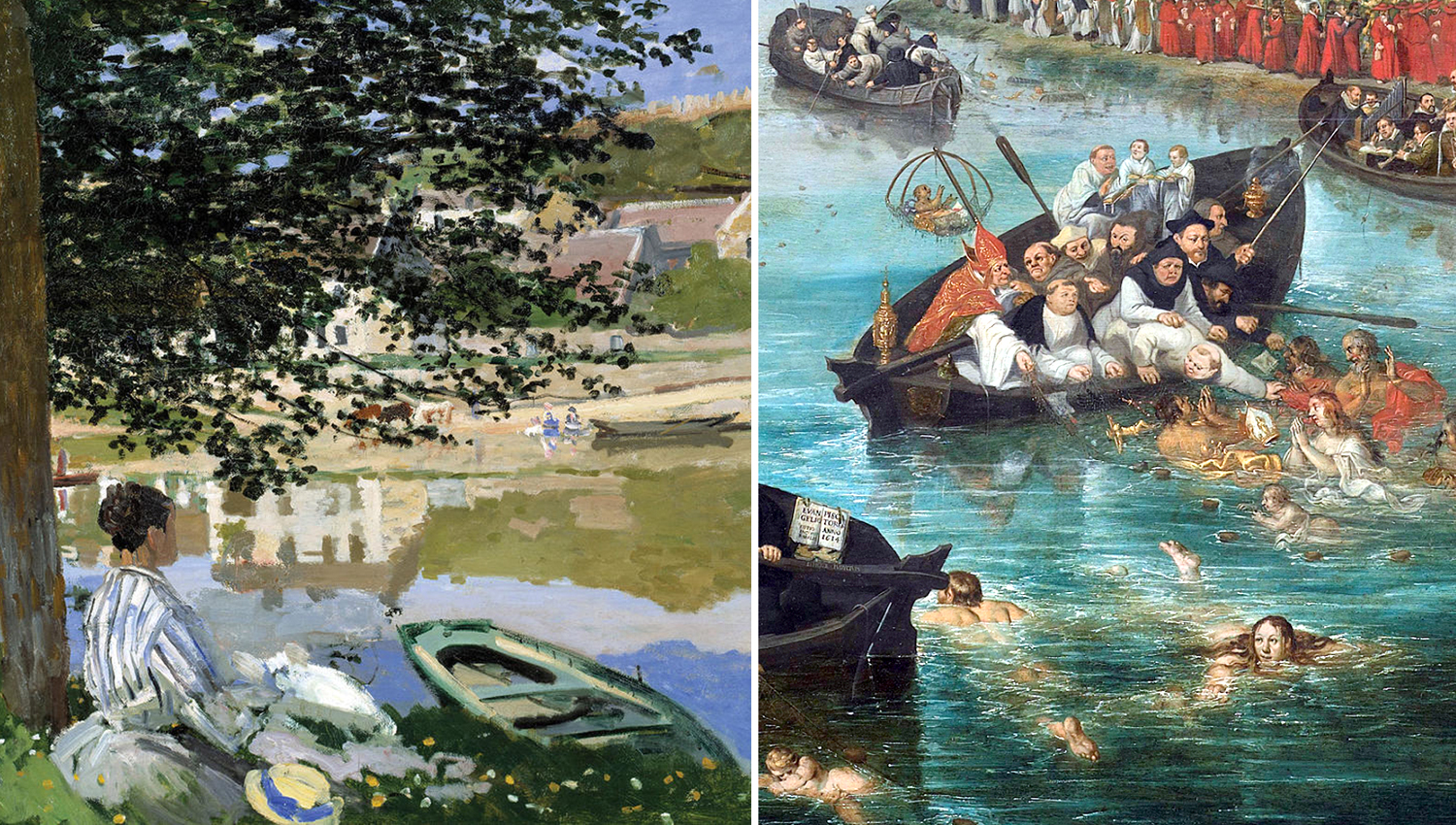
Like an Impressionist painting, which can actually look more real than the finely detailed and finicky painting of the Renaissance and Baroque. The fuzzier river reflections in the Impressionist painting are almost photographic compared with the sharply detailed but unrealistic reflections in the older painting.

(And where exactly does the Baroque shade into the Rococo? Or the Romantic Age become the Victorian? Where did Modernity begin? With Picasso or Einstein? With the Crimean War? With Napoleon? With the Enlightenment? With the Renaissance? With Rome? With Egypt? With agriculture? History is always fuzzier than our outlining of it.)

Where do you, as a person, begin and end? It would seem that one’s skin is the border between self and not-self. But proprioception can create a different self: Amputees can “feel” their selves extend into phantom limbs. And for most, if you are driving a car, say, your sense of selfness can extend to the limits of the car — you become one thing operating on the streets, like man and horse becoming centaur. You can back into a parking space because you have a proprioceptive sense of how far you and your automobile extend into space. 

And you can feel uncomfortable if someone invades your personal space. So, where does the self end? 

National borders and identities have the same issues. When Winston Churchill wrote his books, he titled them History of the English Speaking Peoples, because he couldn’t draw a line around England without extending it to Scotland and Wales, and then the United States and Canada, and then, what about Australia and New Zealand? 

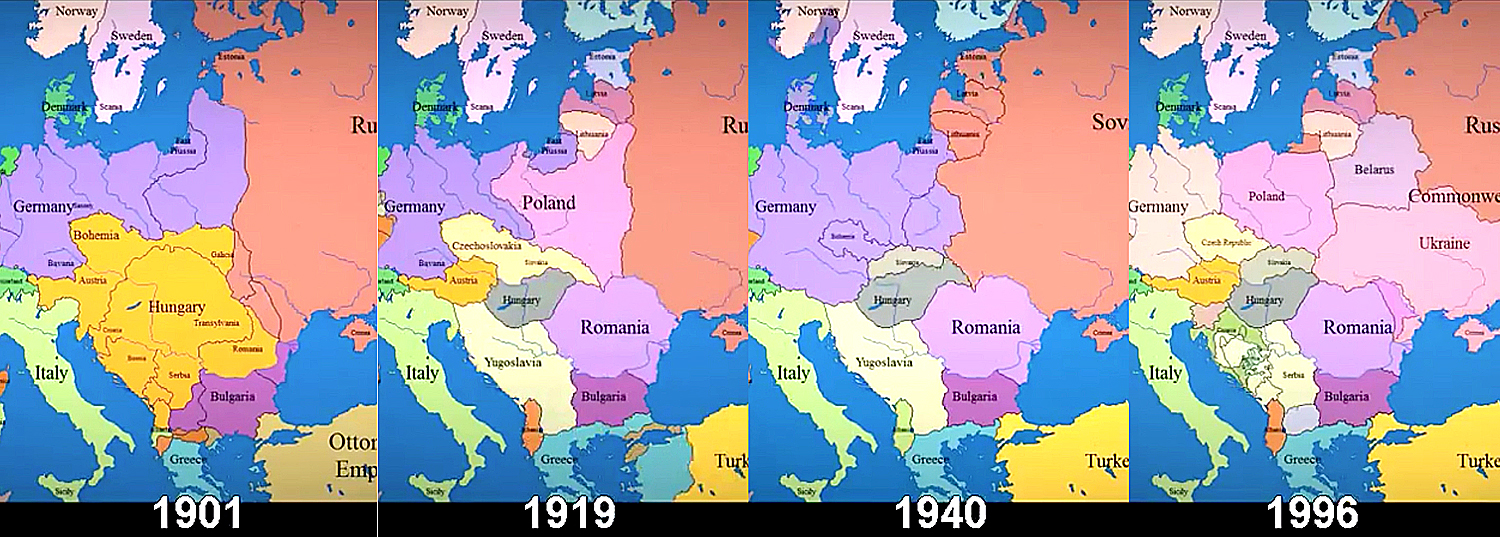
National borders keep shifting. Poland has appeared and disappeared many times over history. In the 20th Century alone, it disappeared and reappeared twice, and after World War II, the entire country picked up its skirts and skidded west by roughly 200 miles, ceding part of its former self to the U.S.S.R. and taking in turn a chunk of what was used to be eastern Germany. 

We are watching borders shift constantly. Where will Ukraine be two years from now? South Sudan popped into existence; Yugoslavia evaporated.

We think of the world in nouns, as if it were static, but truly it is all verb, and the constant motion blurs every outline.

I can’t be everywhere. But I want to be. 

I have lived all around the United States, but no matter where I’ve staked my claim, I wanted to travel elsewhere. When I was a teacher, my wife (also a teacher) and I had all summer long to travel. Later, as a writer in Arizona, I wrote hundreds of travel stories for my newspaper. I’ve been to three continents, seen more than seven seas, been to all but one state (Hawaii) and to all Canadian provinces and territories (save Nunavut, Labrador and Prince Edward Island). From Hudson Bay in the north to the Cape of Good Hope in the south, travel has been a source of experience, growth, joy, and enlightenment. 

Cape of Good Hope, South Africa

Travel dissipates provincialism, fosters tolerance, expands awareness, and perhaps most importantly, keeps one alive, awake and engaged. 

But I can’t be everywhere. And now that I am 75 with wobbly knees and the straitened pocketbook of a retiree, travel has become difficult. Long hours driving are too exhausting, and the last time I flew anywhere, I thought it would kill me (I’m six-foot-four and the airplane seats keep getting more and more squeezed: On the last flight, I had to angle my legs out into the aisle — and then the passenger in front of me decided to recline his seat. And that doesn’t even account for the madness of gate hopping at a sprawling hub-airport.)


When I was a kid, my parents made sure that my brothers and I were exposed to travel and they spent many summer vacations taking us to places, such as Niagara Falls or Washington, D.C. And when at home, in the 1950s, I’d watch whatever travel shows turned up on TV. There were a few: Bold Journey, Kingdom of the Sea, I Search for Adventure. Col. John D. Craig, John Stephenson and Jack Douglas hosted these shows, made mostly of home movies of travelers, and with lots of South Sea islands and exotic tribes. I ate them up. 

And so, television provided a surrogate for travel. And I continued to watch any travelogue I could find, up through Michael Palin and Tony Bourdain. (Food and cooking shows were often just as much about travel and culture as about frying or simmering.)


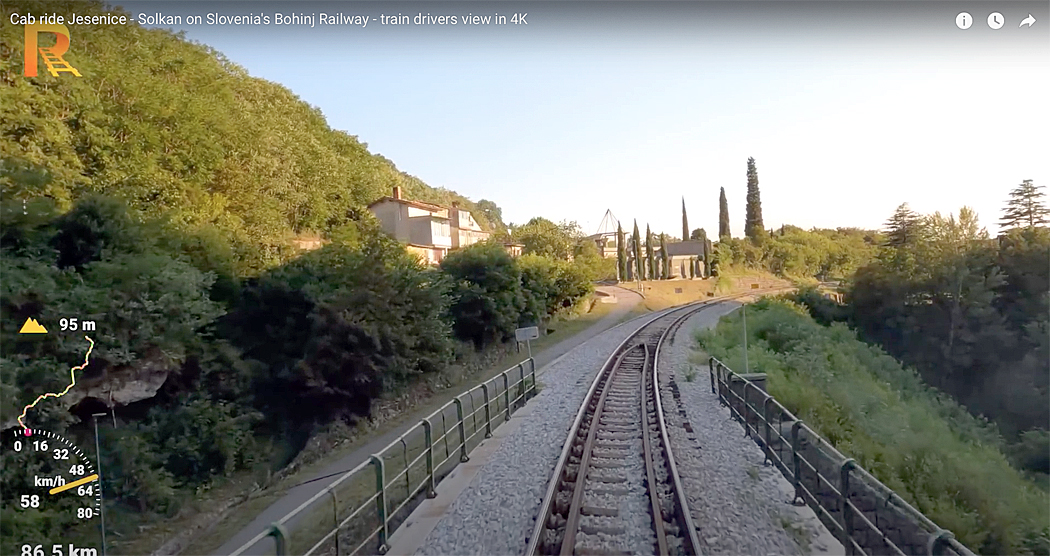
Now that YouTube has elbowed its way past TV, it has its own brand of travel, and one variety I have found absolutely riveting are the many — hundreds, really — postings of train journeys, filmed from the front window of a locomotive cab. These videos usually run anywhere from about a half hour to up to 9 hours, and typically run unedited, showing the view from the front of a train as it crosses huge swaths of countryside. 

Scottish Highlands

You learn a huge amount about nations from such trips. Normal travel shows tend to focus on the highlights and the cities. But the train, running, say, from Nice to Paris, shows you the land that tourists pay little attention to. And yet, it is those long “flyover” miles that can speak most eloquently about a nation’s character. 

Admittedly, no one is likely to watch a three-hour uninterrupted window view, which can become monotonous, but I put the video on while I do other things and keep track of the voyage, the same way you might read a book on a real train trip and glance out the window from time to time to see how the countryside had changed. 

Slovenia

Nevertheless, I find myself hypnotized, wanting to see what is just around the next bend, and that often keeps me watching for hours. 

These videos vary in quality from fuzzy, low-resolution and often shaky, hand-held images, to the highest quality HD productions, sometimes sponsored by the nation itself, or the rail line. But always, they take me traveling when I cannot leave the house. 

Norway

They come from almost everywhere, with the three biggest sources being Switzerland, Norway and Japan. But I’ve found train trips in New Zealand, 

New Zealand 

Siberia, 

Siberia

Montenegro, Which turns out to be one of the most beautiful countries I’ve never actually visited. 

Montenegro

and “the mountains of the Netherlands” (Yes, I’m not making that one up). 

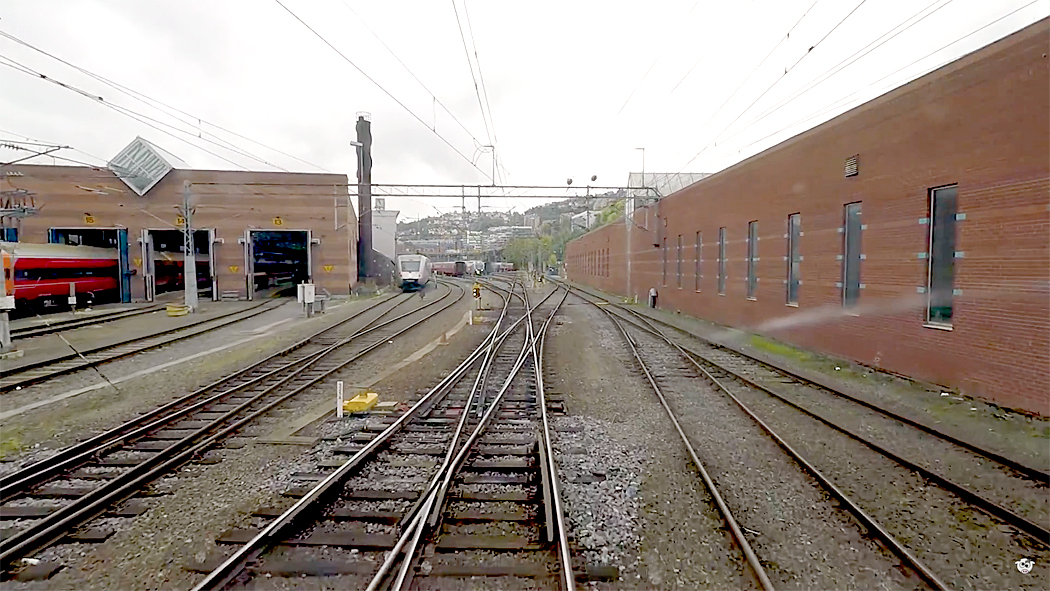
Train yard in Oslo

Norway comes to us by a YouTuber going under the rubric RailCowGirl. She is a train driver and has uploaded more than a hundred train trips, seen through her windscreen. (A second train driver has also posted videos, under the name “GingerRail.” It’s worth checking those out, too.) They cover many seasons and weathers, and while many of them are of the same trip from Bergen to Oslo, there are also excursions to other sites, including the Arctic Circle. Following the seasons alone is often simply beautiful. A few run over the mountains in a snowstorm with the rails completely hidden under the white. Wind blows, window-wipers try to keep the view clear, the snow comes swirling down, although “down” might be wrong to describe horizontal weather. 

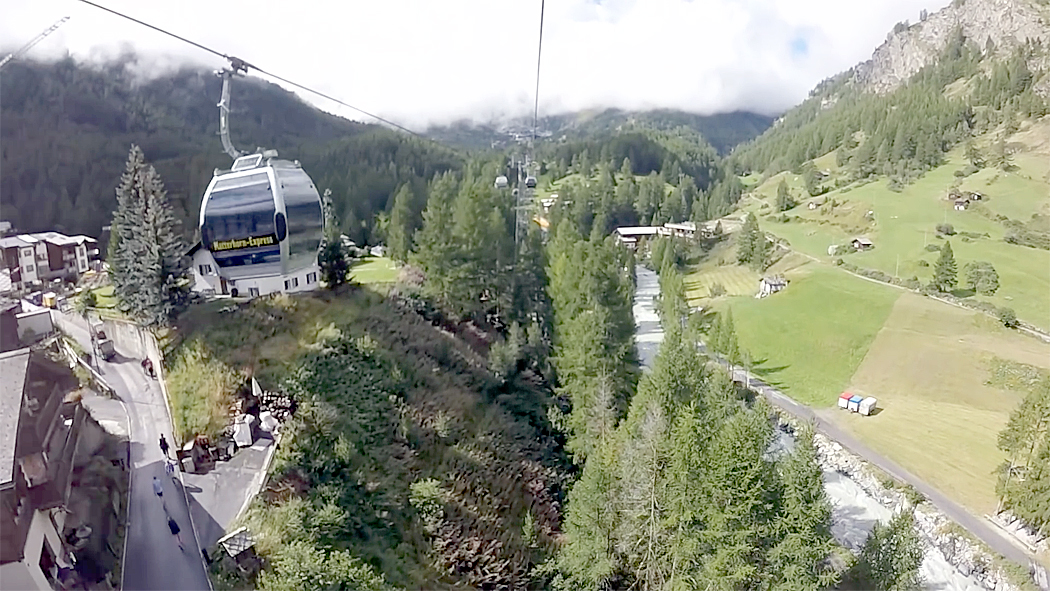
The Switzerland videos focus primarily on the Alps and mountain landscapes. There are also several city tram videos, and at least one I’ve found taken from an aerial tramway (It’s stunning). 


The winner, though, as far as I’m concerned, is Japan. I’ve learned more about Japanese geography from these videos than from almost any other source. We tend to think of Japan as an urban nation, with 14 million people scrunched into a city of blaring neon lights, loud traffic, and a million tiny ramen shops and pachinko parlors. But take one of these train trips out of the city and you discover that the vast majority of Japan is both rural and mountainous. 

A special aspect of the Japanese videos is found in the many local regional trips on diesel-powered one-car trains that go from countryside community to to other countrysides, on old, squeaky tracks through the backcountry of Japan, into mountain valley villages and riverside towns. They travel at a slower pace and you can see so much to the right and left of the tracks — the farmland, the houses and architecture, the local businesses and the people, often waving at the train as it passes. 

Other Japanese videos do go through cities, and often from one jammed up urban center to another, with lots of rural clean air between them. There is a fastidiousness to most of the Japanese train videos that vies with the commercial professionalism in the Swiss films. 

I often choose a Japanese trip above any other for its beauty and peacefulness. It’s just amazing watching a trip through the springtime with all the cherry trees in bloom. 

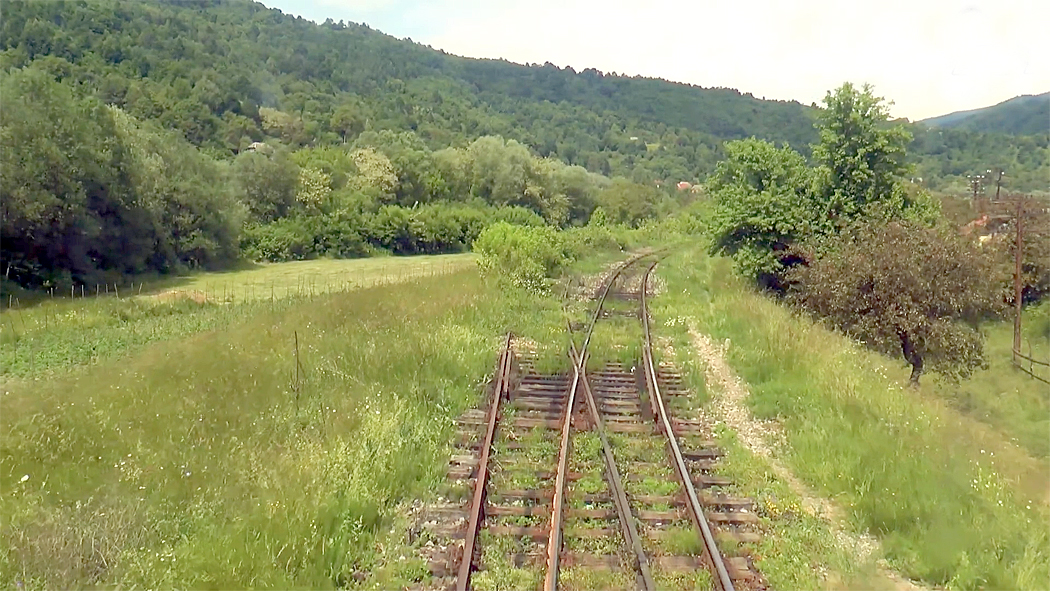
In contrast to the tidiness of the Japanese videos, those from Eastern Europe and Russia often show us overgrown tracks, decaying railway stations, abandoned rolling stock, and an industrial landscape with no environmental concern evident. The rural trips are nevertheless often beautiful, even if weeds are growing in the rail ties. 

Romania 

You can take the jungle ride from Peru’s Machu Picchu down to the flatlands. 

A trip to New Zealand

British Columbia’s Kootenay River Valley

Colorado’s Royal Gorge

Through Queens on New York’s elevated subway

Singapore,

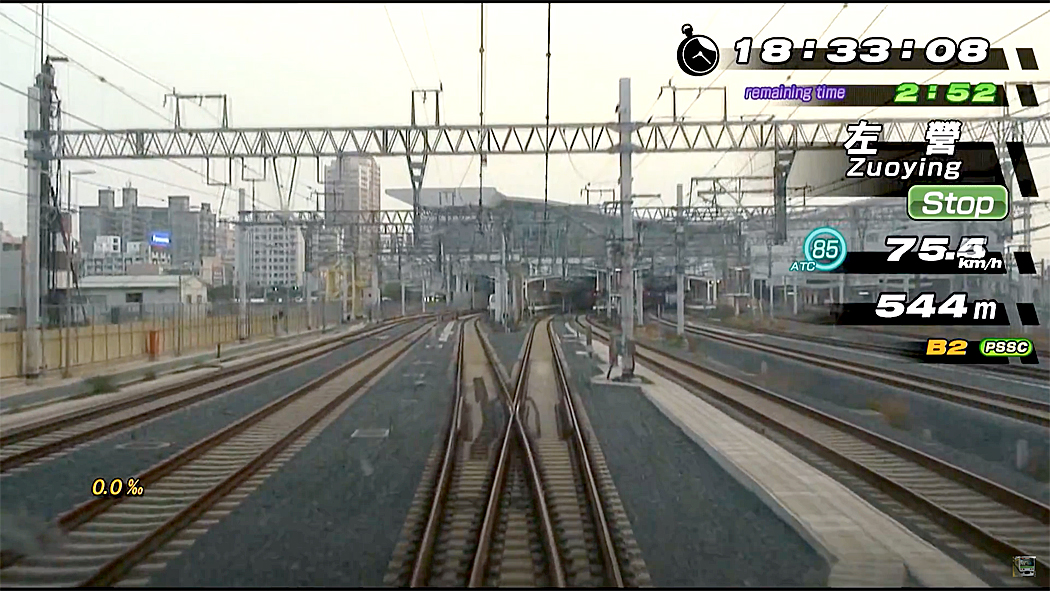
Taiwan

Thailand

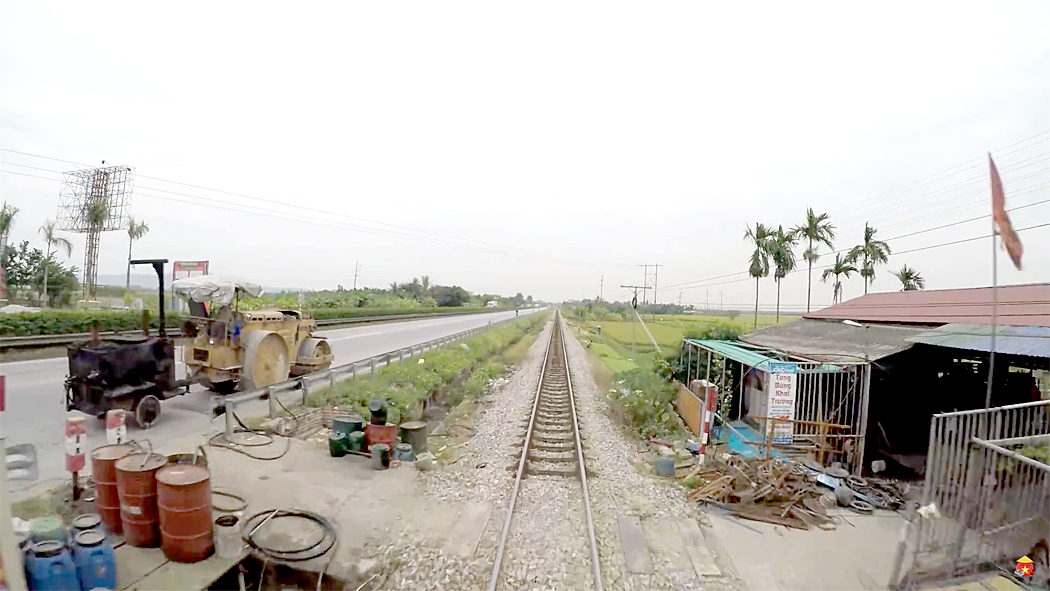
Multiple trips through Vietnam go from crowded hovels in the back streets 

To beautiful pastoral countryside

You can get a very wide picture of a country from multiple of these train journeys.

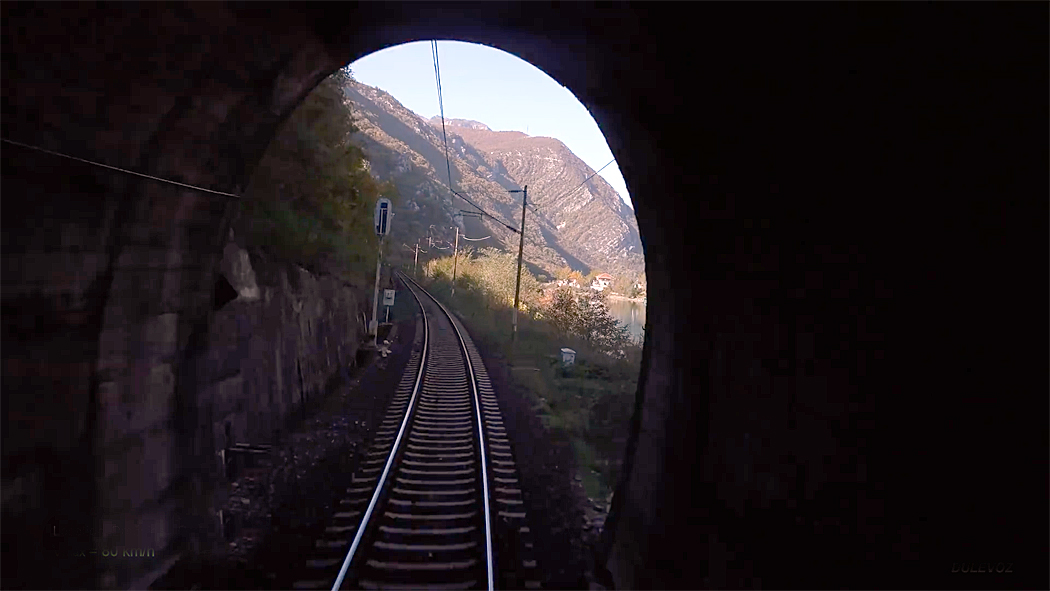
For railfans, there are tons of tunnels

Bosnia

And bridges

Vietnam

And views of locomotive controls

French train from Nice to Paris

RailCowGirl often begins her videos with her engine in a yard and we watch as she inspects it before boarding, drives it through the yard to pick up passenger cars, and brings it into the station, before taking off on the journey. It is fascinating for anyone interested in railroads and rail procedures. 

Not everyone has the patience for a four-hour stare out the front window of a train, but for those who do, there is a world to learn. 

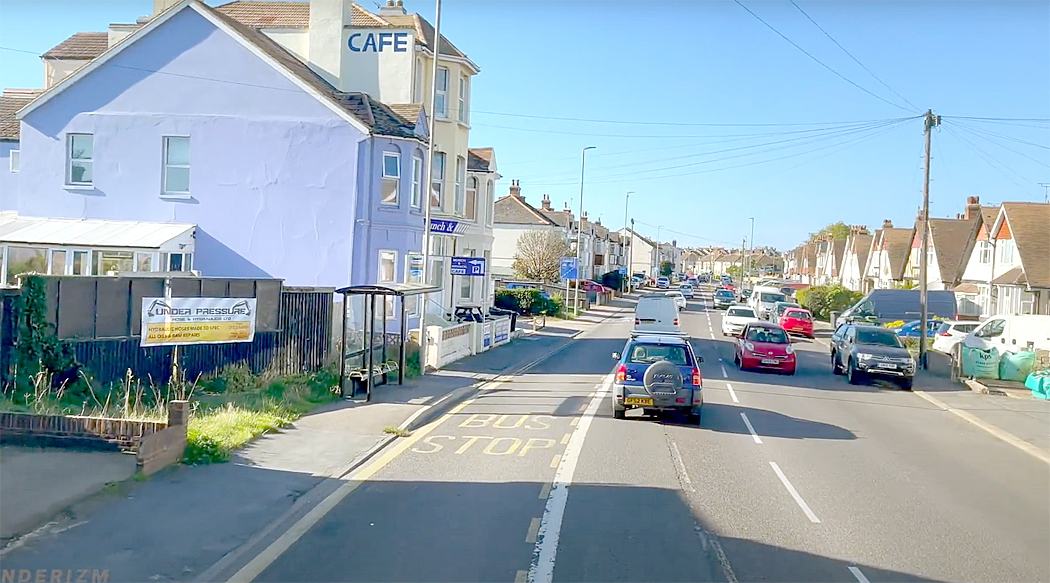
I’ve concentrated on train travel. But there are also many videos of boat and ship travel, and a great series of British intercity bus trips. 

A number of Americans have posted “dashcam” footage of road travel, including at least one running for 9 hours using time-lapse photography to squeeze in some 3000 miles of driving. 

Watching these over the years I have supplemented my own travel across portions of the globe, and gotten an overpowering sense of the roundness, smallness, and the continuity and kinship of the world. 

Click any image to enlarge

The first photograph I have of myself is at 15 weeks old, being weighed. Those first moments of life are only measured in weeks. 

Then, in the first year or so after we are born, our age is normally given in months. “He is 10 months old,” or “18 months.” We don’t usually start counting years until after the age of two. Then, it is a year-by-year thing. 

Perhaps there is, when very young, a tendency to split years in half, so that one might claim to be “two-and-a-half years old,” but that soon changes. It would sound very odd for some freshman in high school to say he was “12-and-a-half years old.” Or worse, later on on a job application to claim to be “23-and-a-half years old.” 

So, from three on, we tend to measure our lives in whole years. One is five, or twelve or 18. The last year, though, that gets its own frame, is probably 21, a year with a certain magic ring to it, as if, “Now I am officially an adult.” 

And so, the 20s slip by and the next major milestone is 30, then 40, and 50 and 60. As adults, we think in decades. “I’m in my 40s,” or “My 60s.” 

To go along with that, of course, there is the accelerated sense of time, so the decade becomes a reasonable yardstick for age. The difference between 32 and 33 is basically meaningless. Not like the difference between being four years old, and being five and first heading off to kindergarten. 

And so, the measurement of time goes from months to years to decades. And the psychological perception of time passing changes, too, and so summer vacation after you were in second grade was an endless horizon of infinite time — at least until you were trundled off to third grade. 

So, the years become the milestones, then the decades. When we are young, the day can seem forever, with all that daylight after school to go out into the yard and play until dinnertime. But this diurnal spinning speeds up, so that when you are become a grandparent, the sun circles  across the sky like the dizzy spinning an airplane propeller. 

But there is another stage in this time-perception shift. I just turned 75. Three-quarters of a century. And I look back and see my time on this planet divided into chunks of 25 years — quarters of a century. I have now completed the first three chunks, with no promise — even likelihood — that I will see another quarter-century. And I look back and see a very different landscape in the rear-view mirror, one divided into segments of a century — the unit of a hundred years now seems the yardstick to use. 

Bits of a century: Me, in Lion King pose, at roughly 20, 50, and 75

I was born just after the world war ended. The Korean War happened mostly before I was old enough to go to school. The Kennedy assassination was the present I lived through, before it became current events, and later a chapter in a history book (and by now, probably a paragraph). It is fading into a past that has gobbled up most of my life. 

There is a through-line from the earliest memory to the moment I am typing this. Parts, of course, have faded and other parts no doubt given unearned importance, but that skein of fabric runs continuous, but in longer and longer segments, and so, now, 25 years seems a meaningful chunk. 

Five generations: Great grandmother, grandmother, mother, wife and son

But I can also sense the longer sway of time. Now that I have lived 75 years, I can easily imagine the quarters-of-a-century before my birth, back to my father’s birth in 1919 or my great grandmother, Anna-Gurine Kristiansen, who was born in Norway in 1871. I knew my mother’s grandmother, Aase Aagesdatter, born in the Old Country in 1879 and lived until I was 30 years old, when I was still counting by decades. 

And I can see my granddaughters, born at the turn of the newest century and now entering the decade-by-decade portion of their lives, and see that time spreading out ahead of them well after I am gone. And so, perhaps even centuries are not long enough to gather it all in. 

In Ancient Rome an age — a saeculum — often translated as a “century,” was measured from the birth of your parents to the death of your children after you. It averaged perhaps 110 years, but was left indefinite. That was a meaningful container for time to be understood. My father, born in 1919, me in 1948, my daughter in 1963 and her twin daughters in 2001. That age will end when they grow old and look to the future of the children they might have. 

When I was young, the present moment was the fulcrum of time, leaving the past to the past and the future to obscurity. But now, having lived through my portion of a century, I sense no pivot point, just a continuum, in saecula saeculorum, from back before any memory and ahead past any speculation.  

 Translation is a funky thing. You might think a literal transcription would be best, but language doesn’t work that way. 

If we translate Holly Golightly into French, and have her window shopping, the French reader will assume she is looking for a glazier — i.e., shopping for windows. If the original had been in French and we translated it to English as “licking the glass,” we’d assume Holly was more than slightly daft.

You can try to be literal and lose all the flavor, or you can try to find equivalent idiomatic expressions, or you can recast the whole thing, as if you were writing an original from a similar inspiration — your own words for a similar thought. 

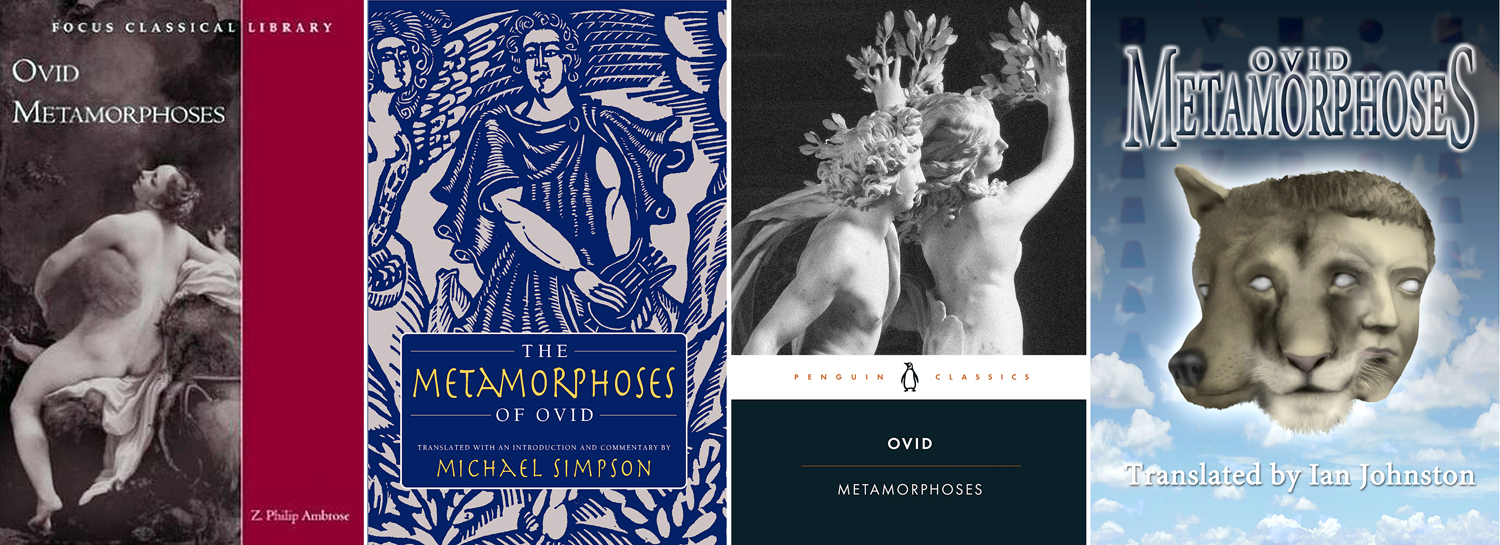
I recently posted a blog entry about various versions in English of Ovid’s epic poem Metamorphoses. (link here). 

“It’s amazing that all the translations are so different,” responded a friend. And they are. I have been fascinated with the issue of translation for years, now, and have compared many versions of several works and am also “amazed” at how different they can be. 

Most recently, the Ovid comparisons has been obsessing me. And so, I went back to the original to see what I could ferret out about these variations. One discovers that although Ovid’s language moves quickly and simply, there is some ambiguity built in to those words. A translator has to disambiguate the text, and in the process make a single meaning for what in Latin can be multiple. 

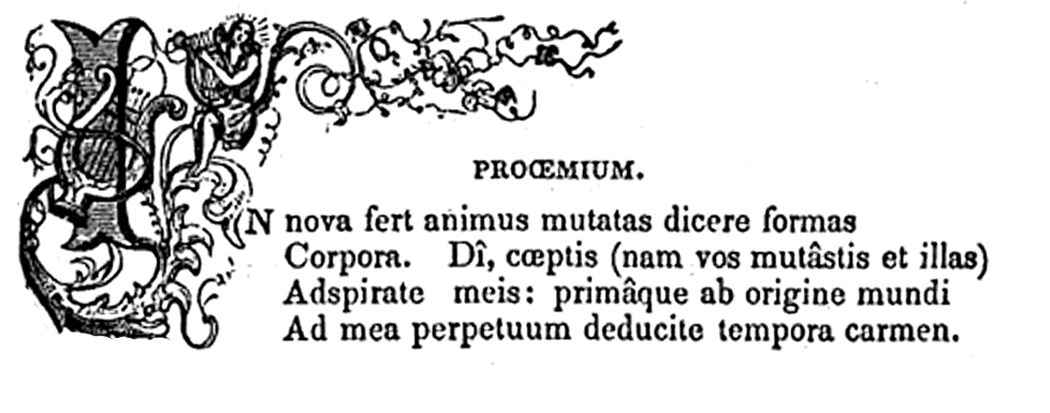
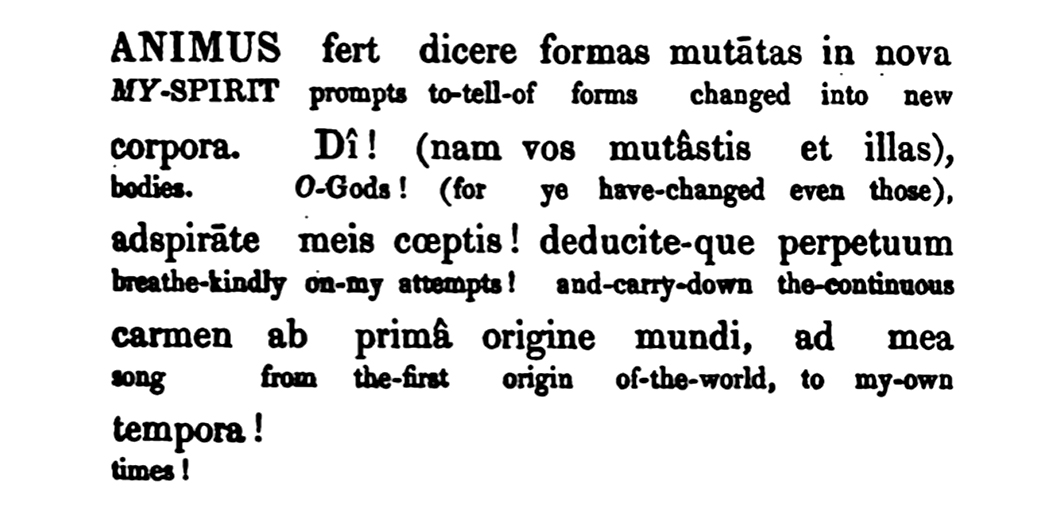
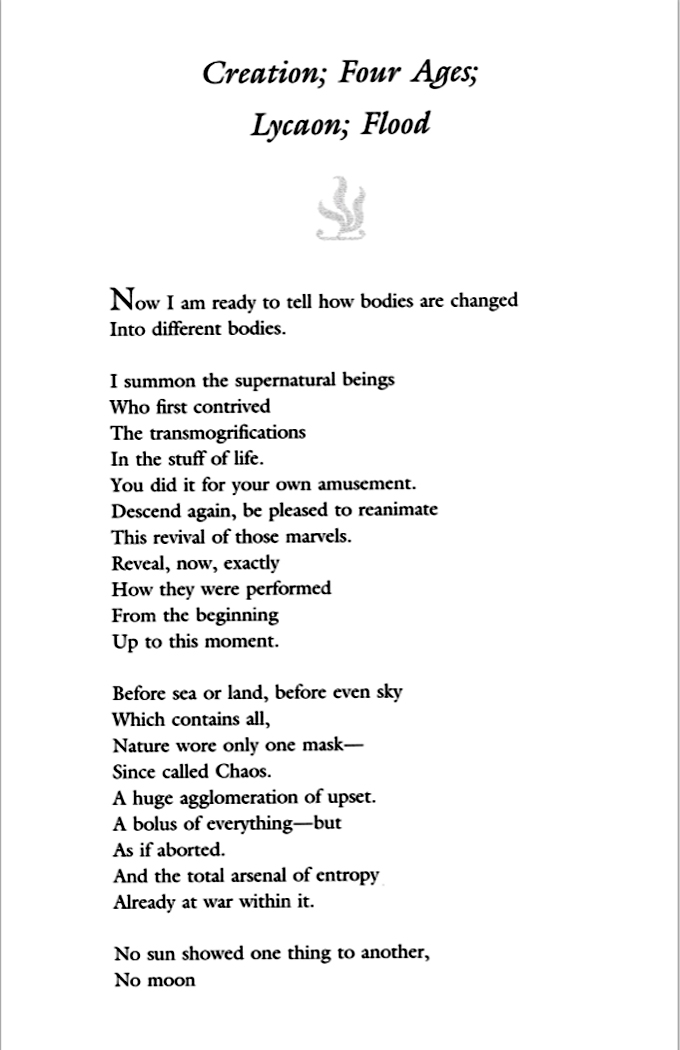
The first four lines of the Metamorphoses, in Latin, read: 

The Latin is alien to English speakers first because word order is not a central concern of Latin grammar. Ovid arranges his sentences according to his metrical choice — Latin hexameter. And that is built around syllable length, not stress. And so if you were to just put down a word-by-word transference from Latin to English, you get, essentially, nonsense.

In 1828, a British publisher printed an interlinear translation, intended to help students in learning Latin. To simplify the project, Ovid’s word order has been shifted to mimic English word order. Thus published, the sense, more or less, becomes clear.

That is: “My-Spirit prompts to tell of forms changed into new bodies. O-Gods (for ye have-changed even those). Breathe-kindly on-my attempts and-carry-down the-continuous song from the-first origin of-the-world to my-own times.” 

(The hyphenated phrases are Latin single words that must be broken into multiple words to be rendered in English). 

All this is good, and one could easily smooth all this out into very plain English: “My spirit prompts me to tell of forms changed into new bodies. O Gods (for you have changed even those), breathe kindly on my attempts to carry down this song continuously from the origin of the world to my own times.” 

And there you have it: Ovid translated cleanly and understandable.

Except.


Except that this version, as plain as it might be, avoids some of the complexities of the Latin, which doesn’t so easily give up its meaning in a one-to-one way with our King’s English. And it doesn’t explain the wide variants rendered by translators from 1567 to our own times. 

Over the years, translators couldn’t make up their minds whether bodies were changed into new forms or forms into new bodies. Ovid writes forma into nova corpora. But in English that seems backwards. 

It’s been explained as hypallage (a rhetorical trope in which elements are switched from the place expected, as in “the angry crowns of kings” instead of the “crowns of angry kings.” It was a trope often used in Latin writings.) Ovid talks of “forms” changed into new “bodies,” where, in English, we might expect “bodies changed into new forms.” The difference is that in Latin, “forma” describes the “true” shape of something, in other words, the way it was created, such as your body or mine. Ovid is saying that the true shape of his mythological figures are being altered to new, perhaps temporary, bodies — in other words, the new bodies are not the “real” bodies.

In English, we would tend to word it the other way around, so that our “real” bodies are given new “forms.” And so, some translators write it that way, while others maintain the forms-to-bodies version.

This may seem like a trivial thing, but if you grew up with Platonic ideals and they were ripped apart into “false” new shapes, you’d understand what Ovid is getting at here. Of course, he does not make a big thing about it: He expected his listeners (or readers) to understand that the way we might understand “three strikes and you’re out.” It is just buried in the culture. Theirs, though; not ours. 

Most English translations really start with anima

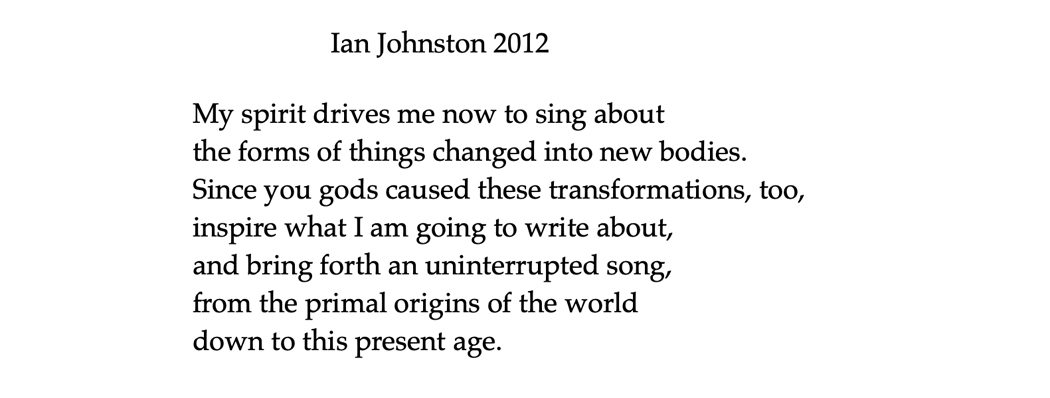
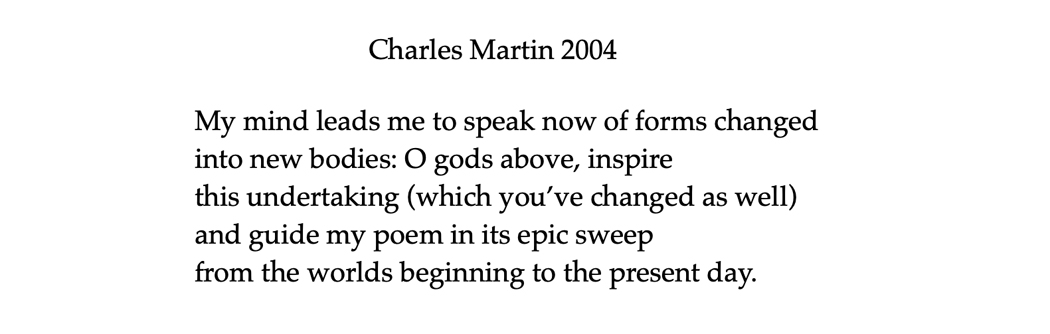
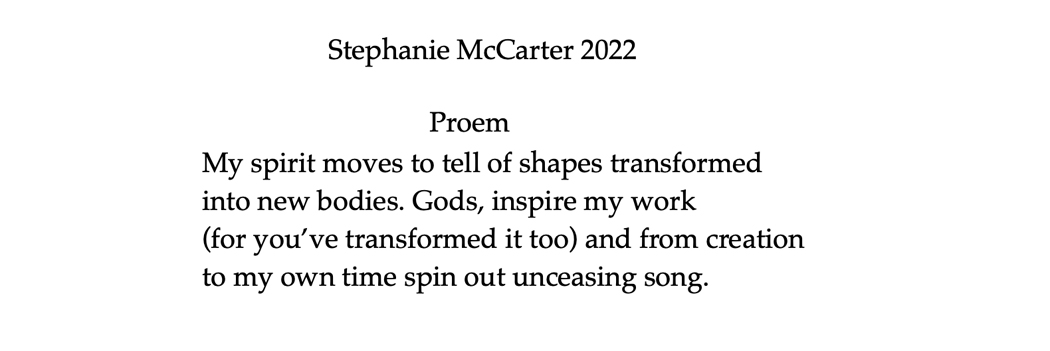
“My spirit prompts” can be understood as “My design leads me” (1899 Riley); “I want to speak about” (1903 Kline); “My mind is bent to tell of” (1916 Miller); “My soul is wrought to sing of” (1922 More); “My purpose is to tell of” (1955 Innes); “My intention is to tell of” (1955 Humphries); “My soul would sing of” (1993, Mandelbaum); “My spirit drives me now to sing about” (2012 Johnston); “My mind leads me to speak now of” (2012 Martin); and most recently, “My spirit moves to tell of” (2022 McCarter). 

But of course, the poem really begins with the word “Nova”… “New.” And a few attempt to mimic the Latin word order, approximately. One could attempt something in English, contorting it like a gymnast: 

Certainly, that is awkward sounding, and I am not recommending it as a preferred translation. We should want something that moves as cleanly in English as Ovid moves in Latin. Mimicking Latin won’t do that. 

But there are other issues, too. You’ll notice I used “weave the thread” of song. Ovid has “deducite” — to lead away, draw out, turn aside, divert, bring out, remove, drive off, draw down. It is used, says one set of notes, to mean to extend like a chain, or, as I have it, “weave the thread,” but more like “add links to links to make up a whole chain” of mythological stories. 

You can see the problem here: Which idiomatic Latin usage of “deducite” should you use here — again, without turning the passage into something utterly unreadable. 

That chain, and its metaphorical maritime implication is echoed in “adspirate,” which implies a fair wind in the sails, as if the gods were blowing their breath to move ships. These things are not clear in English and are only implied in Latin, but they are there. 

The multiple possible meanings of many of these words can bring variation to a potential translation. “Carmen,” for instance, can be a song or a poem — or a prophecy, an incantation, a tune. “Tempora” can be time, or a season, or a duration. “Fert” can be to pick something up, to carry it, to take something up. A translator has to decide what is best meant and how in English to make that clear.


There is a giant ambiguity in these lines that gets very differently translated. When Ovid calls on the gods, he says “nam vos mutastis et illas,” which means, literally, “for you (plural) change (or move, or remove, or move away from) and that (or there, or yonder).” What do you make of that? 

In previous centuries, it was taken to mean, basically, “for you gods caused those changes.” And that seems to make sense of it. But beginning in 2001 with Michael Simpson’s translation, many have assumed it is the poem that the gods have changed. “Gods, inspire this poem I’ve begun (for you changed it too)” (2001 Simpson); “O gods (it is you who have even transformed my art)” (2004 Raeburn); “inspire this undertaking (which you’ve changed as well)” (2004 Martin); “inspire my work (for you’ve transformed it too)” (2022 McCarter). 

These two interpretations can not both be correct. Ovid is obscure here, and leaves a good deal to the discretion of the translator.   

Or to the edition. A translator has to pick among variant texts in Latin, collated by different editors. And the Latin is not completely identical in all of them. Remember, Ovid survives not in manuscripts from Roman times, but from copies made by monks in scriptoria through the Middle Ages and into the Renaissance, and when copies are made, mistakes are made. Which is the true version: That is the job of an editor putting together a modern published edition. 

Joseph Reed, in his annotations to the new edition of Rolfe Humphries’ translation write of this confusion: “Most manuscripts have ‘for you, gods, changed those [forms] as well’ (nam vos mutastis et illas), which Humphries seems to be translating here, omitting the troublesome ‘as well,’ which has no clear reference. Since the 1970s, most editors prefer to read the slightly different text, ‘illa,’ found in a few manuscripts, which yields the very different sense: ‘for you changed that [undertaking of mine] as well,’ referring to the new direction Ovid’s own poetry now takes from his earlier themes and metrical forms (love elegy) to those of epic-length mythological narrative.”

The difference between “that” and “those” (illa et illas). No matter how you parse it, the original is obscure. 

Finally, you must decide what you want in your Ovid. If you are a scholar you want whatever is closest to the poet’s original language, even if it is obscure. And I sympathize with the impulse. But if you are simply a reader who is looking for Ovid’s storytelling, then you will be just fine with letting the translator turn the ambiguity into something that makes sense (culturally and linguistically) in English. Sometimes the actual words don’t relate the actual meaning. 

Ovid is lucky, in that he really does survive translation well. He can be reworked without losing his essential Ovid-ness. And it is true that some writers survive the tidal pull of translation better than others. That pull can distort some works beyond help, while others keep their gussets unruffled. Hence, a good translation of the Iliad or Shakespeare can work just fine in a new language, because the story is paramount. Shakespeare tends to travel well. His plays are valued in many lands and many languages. There are famous examples of Macbeth in Swahili, of Hamlet in Russian, and dozens of operatic versions in Italian, French and German. They all pack a wallop. And Shakespeare is loved in all those languages by their native speakers.
But that other class of writing, where the effect depends on how it is being said can defy the best translator. I have never found a good translation of Goethe, for instance. In English, his poetry often sounds commonplace. But I am assured by a native German speaker that Goethe’s poetry is the best from his country by being written in the most elegant of German language. Horace in Latin is similar; in English you wonder what the fuss is all about; in Latin, it is the height of sophistication and elegance.

Going in the other direction, how in hell can you translate John Milton into French? You can tell the story of Paradise Lost, sure, but how can you convey the special organ-tone quality of his language.

“Round he throws his baleful eyes.”

Translate it into French and it comes out as the equivalent of: “He looks around him malevolently.” Not the same thing, all the poetry is gone out of it. These things are untranslatable, and hence, Milton can never have the global currency of Shakespeare. 

There is behind language, a world. You can concentrate on the language, or on the world. It is easy to be lulled into forgetting the difference, to think that words describe the world, and that the best language is the most accurate lens on the things of this world but they are not the same, but rather, parallel universes, and what works in words does not necessarily explain how the world functions. In the reality of our experience, there are no nouns, no participles. There is only “is.” Can you get at that “is” through words. We try. And we try again.

And so, Ovid is lucky, he takes translation with grace, even glee. For although his Latin is singled out as impeccable, it is the stories that matter, and we can get them in English (or French or German or Chinese). 

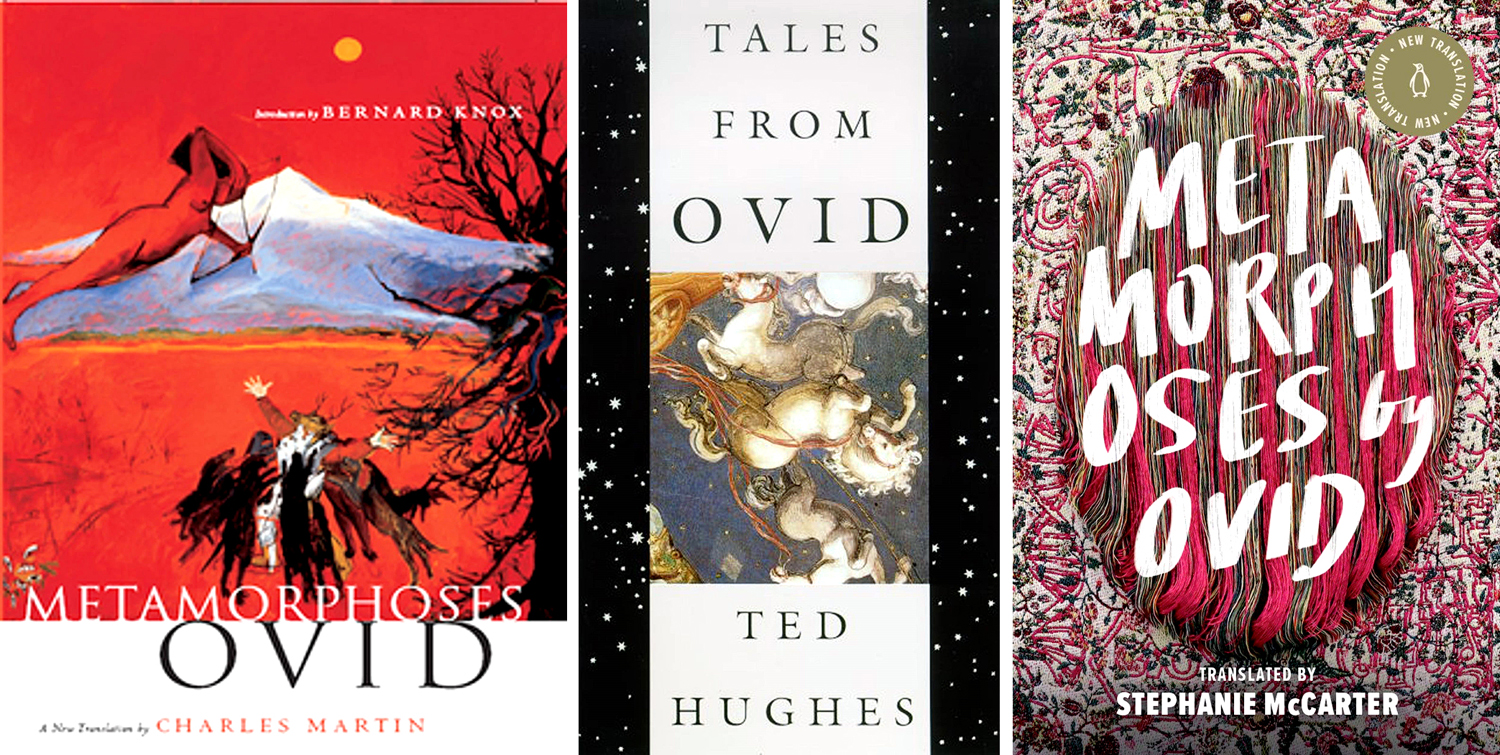
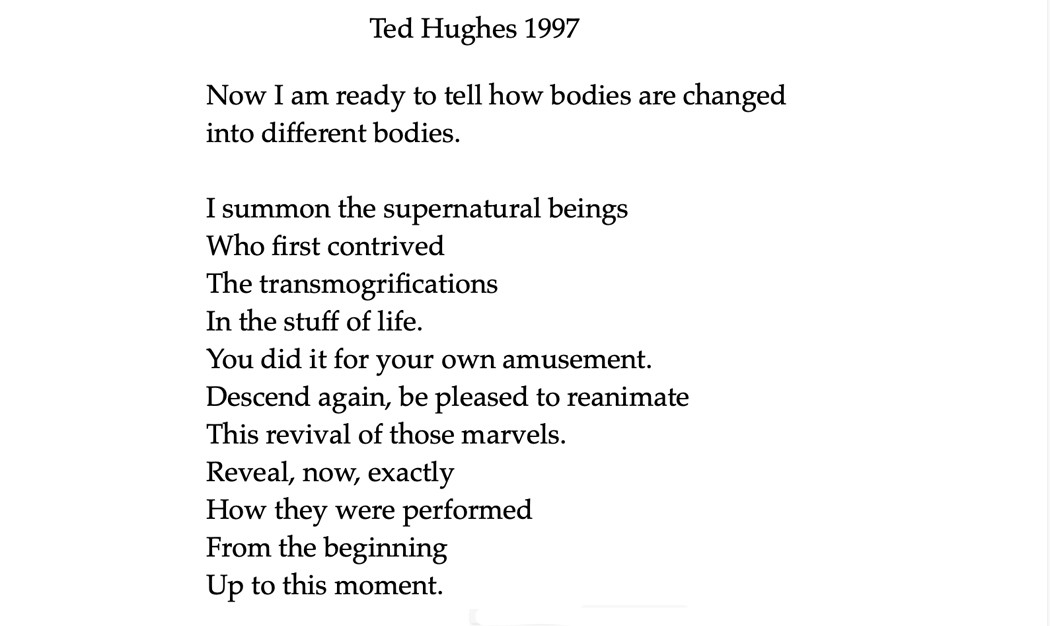
Which is why my favorite version is Ted Hughes’ Tales from Ovid, which is only a partial translation (it includes just 23 of the hundreds of stories Ovid retells) and is really more a metamorphosis of Ovid into English: rewritten as if Hughes himself were telling the stories, rather than translating the words of Ovid. It is a re-creation rather than a translation. 

It is a version I recommend to everyone as a complete joy. 

Click on any image to enlarge

Ovid is just plain fun to read. There are classic Latin texts that feel like doing homework, but Ovid — especially his Metamorphoses — just scoots by and can only be described in modern terms as a “page turner.” 

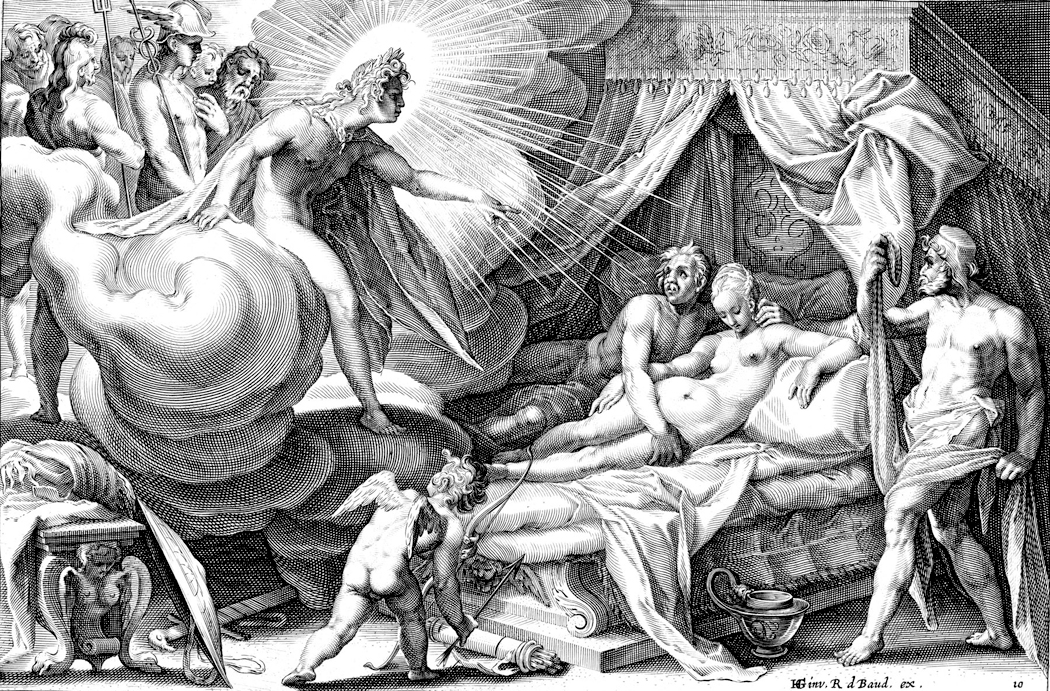
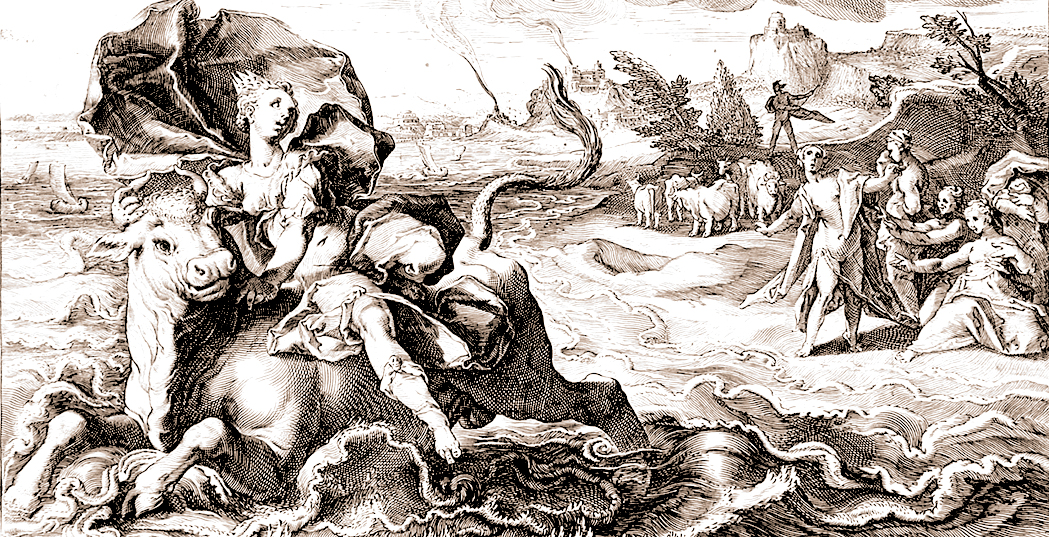
Publius Ovidius Naso (43 BC to AD 17) was probably the most prolific poet of ancient Rome, writing many books, often quite salacious. He wrote about how to seduce a woman, how women should attract men, how to break up with a woman — you get the picture. But his most famous book was “Changes,” or Metamorphoses in its original, which told dozens of mythological stories, mostly old Greek tales. It was a best-seller when it was written, copied out by hand many times over, and remained a best-seller through the Middle Ages and into modern times. Many writers — including Shakespeare — cribbed from Ovid and a good deal of what most people have absorbed of Greek mythology really comes through Ovid as the middle man. If you know about Daphne and Apollo or Pyramus and Thisbe, it is likely the Ovidian version you have seen. 

Ovid wrote in a sleek, fast Latin that told his stories economically. He has been used to teach students Latin for centuries, and has been translated into most of the world’s languages.

I’m one of Ovid’s devoted readers, and have gone through the book many times, in different translations, beginning in the 1960s with the old, standard Rolfe Humphries version (which I can’t say I found easy going). 

Since then, I have re-read the Metamorphoses many times, each time in a new translation. The newest is by Stephanie McCarter. She is not the first woman to take on the work, but she has made it a point to unforgive the gods their brutality. Where other translators give us gods “ravishing” their mortal victims, McCarter forthrightly calls it rape. In the “Me-Too” era, there is no glossing over the violence and brutality, the sexism and misogyny inherent in the myths. 

I applaud this shift of reference, but despite that, I found her verse tough plowing. These things are a matter of taste. Previously I had sailed through the 2004 translation by Charles Martin and found the lines so fast under my eyes, I hardly noticed I was reading a translation. Turning the pages with McCarter, I never forget that under her words there is a Latin pluperfect subjunctive. That it is a reasonably accurate version I don’t question. It is. But I want something else for my pleasure. Ovid’s original was always praised for its fleetness, and so I would wish my English equivalent also to fly by, so that I am immersed in the story rather than in the mechanics of the language relaying it. 

But reading this new version also made me want to look at how others have assayed the project. 

I took on a week-long effort to concentrate on the first four lines of the book and compare how each translator has looked at them, and found rather notable differences, considering how plain the meaning actually is. 

For this, Ovid must take a share of the responsibility. There is some ambiguity in his words, which make the poetry richer, but the translations more problematic. 

Then, there is the question of whether the translation should be prose or verse, and if verse, should it rhyme? Ovid wrote in hexameters, but English is geared to pentameter. Should you try to count six or count five? Six often sounds a bit awkward in English, while pentameter comes as naturally as breathing. Is six closer to Ovid’s original, or is the swiftness of English pentameter more faithful. Each translator has his or her own solution, and any can work. 

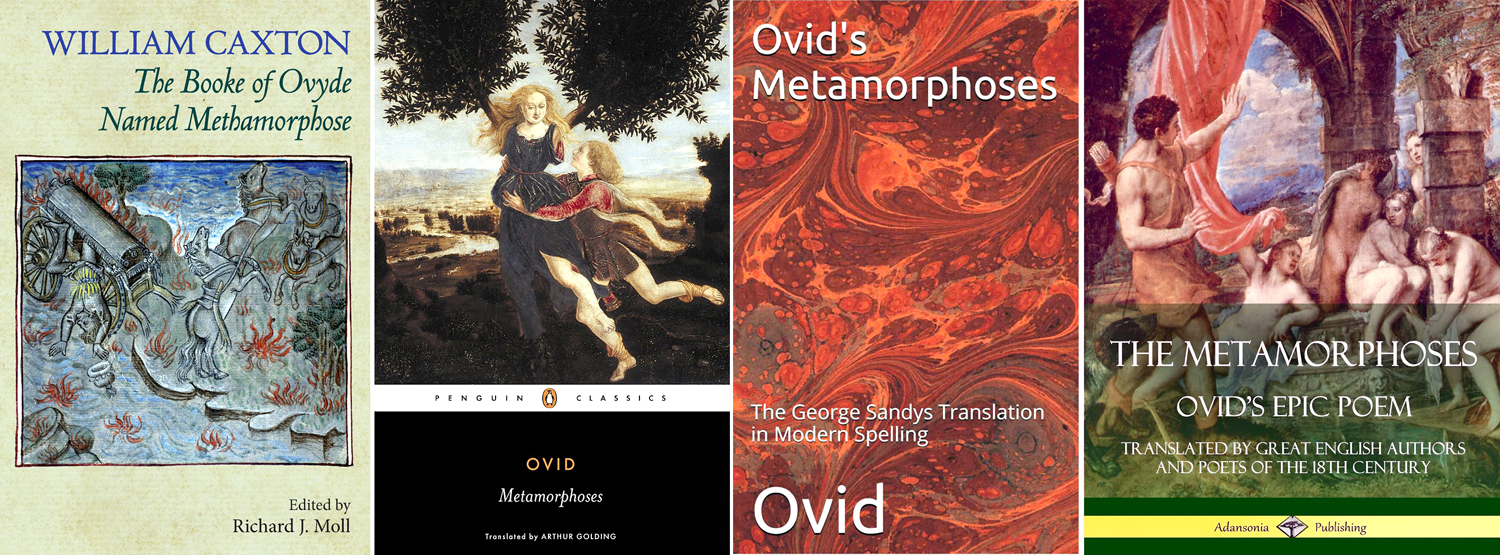
The first English translation was by William Caxton, who probably also gave us the first printed version (as opposed to hand-written by scribes), although the only versions extant seem to be the handwritten ones). It was in the Middle English that Chaucer would have read. He titled it The Booke of Ovyde Named Methamorphose

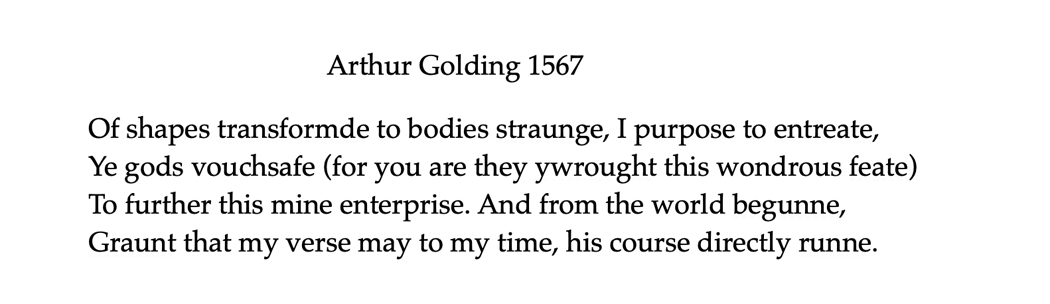
But the first translation that counts and is still readily available was made in 1567 by Arthur Golding. It was Golding that Shakespeare read and cribbed from. He opens his version with the four-line prologue:

It is written in “fourteeners,” the meter and rhyme scheme of the theme song to Gilligan’s Island: “Just sit right back and hear a tale, a tale of a fateful trip/ That started from this tropic port, aboard this tiny ship.” It was a popular meter in the 16th and 17th centuries. Nowadays, it can feel a touch jogtrot. (Now try to read Golding’s lines without singing them to the tune). 

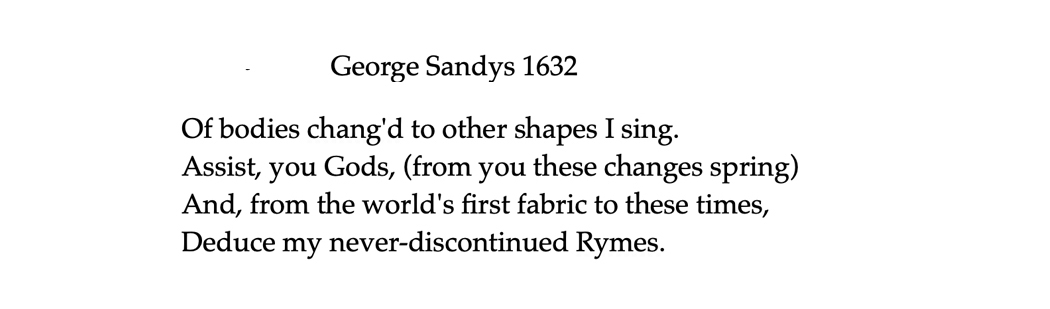
The second translation came in 1632, by George Sandys, who decided that English pentameter was more natural to the native speaker and recast the whole in a five-beat line, which shortened each and made for swifter reading, but also left out a bit of the original meaning.

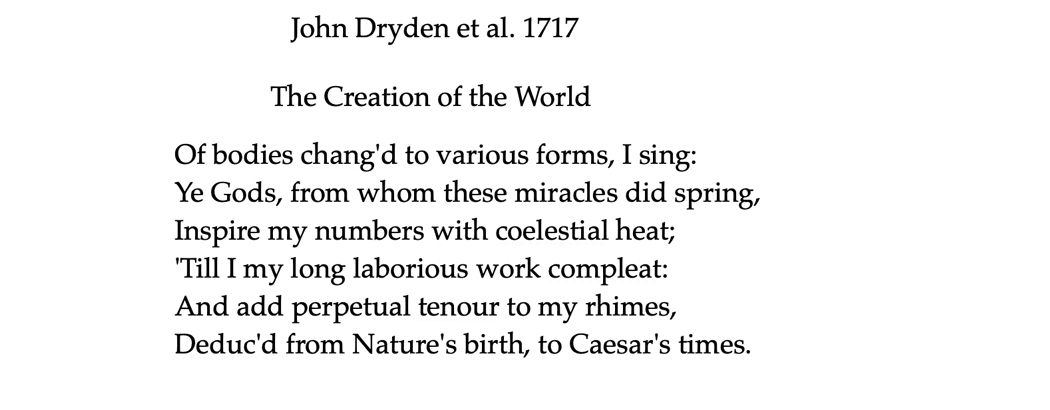
The most famous early translation came out in 1717, done by a team of writers rather than a single translator. These included John Dryden, Alexander Pope, Joseph Addison, John Gay, and William Congreve, among others. In was rendered in heroic couplets and was surprisingly fluent. Dryden took on the whole first book and began the introduction:

That became the standard Ovid for many years, and is still read and still quite readable. 

But then came the Victorians, who saw, among other things, Ovid’s usefulness in teaching Latin to its young men. And so you get a spate of them, usually in prose, meant almost as cribs for translation. 

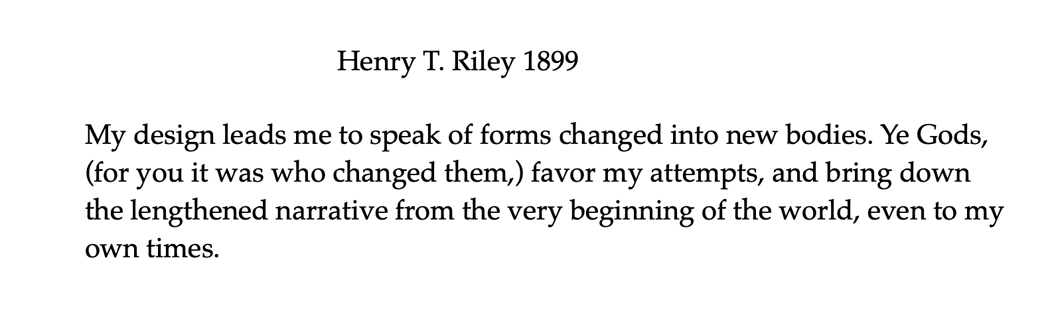
The one I have read several times is the Henry T. Riley, in a two volume pocket series published in 1899. Like many of the versions of its era, its notes try very hard to reconcile Ovid’s paganism with Victorian Christianity, and so, where Ovid talks of “gods,” the Victorian translators often write “God.” This isn’t much of a problem, if you are aware of it as you read. Riley’s proem runs:

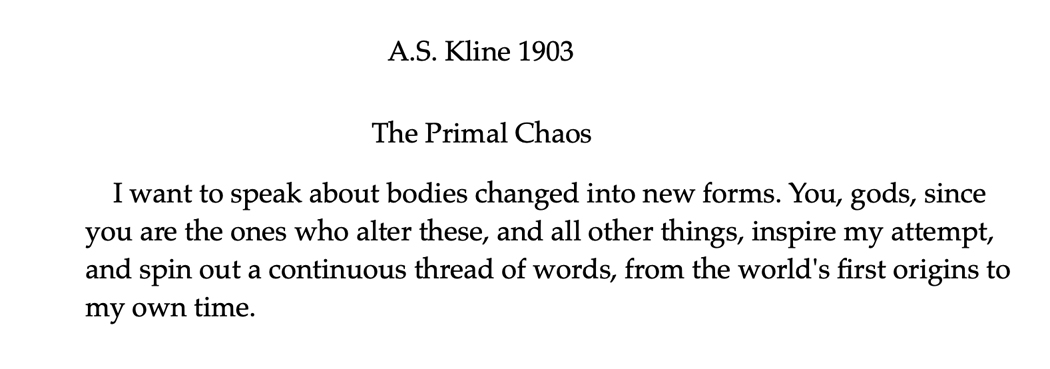
Anthony S. Kline, who seems to have translated pretty much everything at one point or another, came out with his Ovid in 1903. It is still widely available. It is in prose and meant to be almost pedestrian, i.e., not high-falutin’ and poeticalized. 

In 1916, the Loeb Library translation came out, with Ovid’s Latin on the left-hand page and Frank Justus Miller’s prose on the right-hand, opposite the original. It doesn’t quite work as an interlinear, but it will help anyone attempting the work in Latin. 

In 1922, writer Brookes More gave us a prose version for Theoi Classical Texts. Like many others, it as much interprets Ovid’s words as translates them. The word “strange” does not appear in the Latin. 

A new spate of translations hit in the 1950s, after the war, when so many new students were headed to university under the G.I. Bill. 

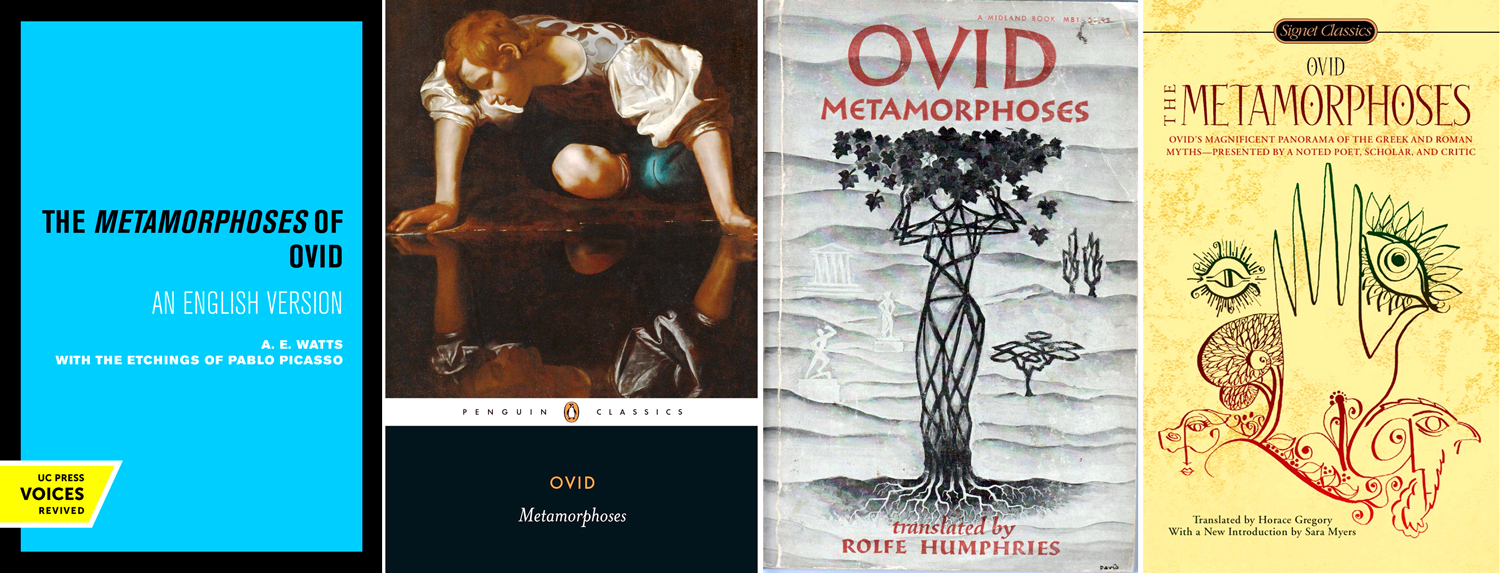
In 1954, A.E. Watts put it in pentameter and squeezed it all down to a fast-running nugget. His purpose seems to be to get the gist as directly as possible. 

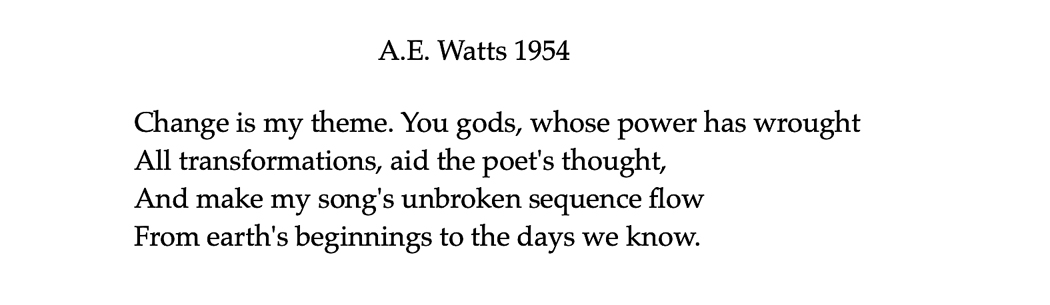
A year later, Mary M. Innes uses prose and is pretty much as close to the original as it can get, across languages and cultures. It has been a mainstay of Penguin Classics and is still widely available and read. 

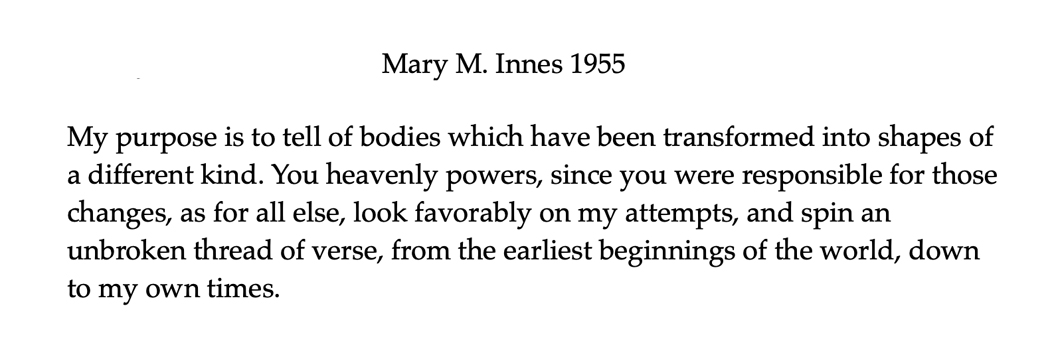
The same year, the widely read Rolfe Humphries version came out in what must have been at the time a very contemporary sounding verse. It is the one I read in high school and didn’t like. Reading it now, I wonder what was I thinking. It is still in print, in a shiny, new annotated version published by Indiana University Press. It moves quite fast. 

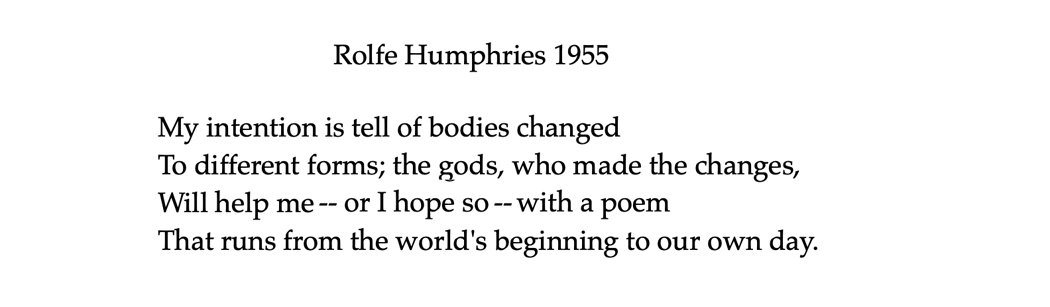
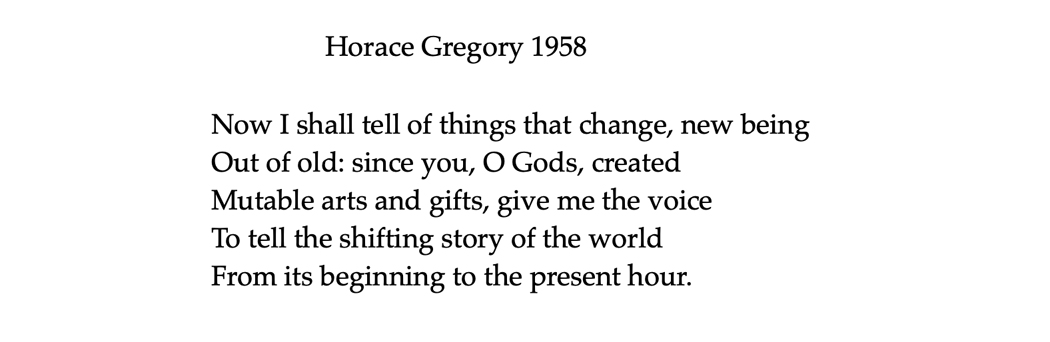
Finally, in 1958, Horace Gregory published his verse version, which attempts, also, to feel contemporary, but to my ears feels a tad straight-laced. 

The text sat dormant for a couple of decades, but in the 1980s, Ovid became a growth industry again. 

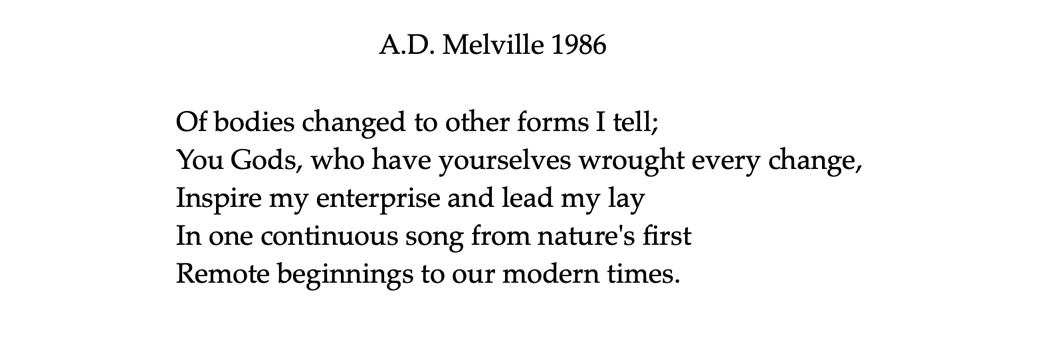
Oxford World Classics commissioned A.D. Melville for a new translation of the Metamorphoses, published in 1986. It is self-consciously poetic, with words such as “ere,” “countenance,” and “naught” to stumble over where more conversational words would be clearer. 

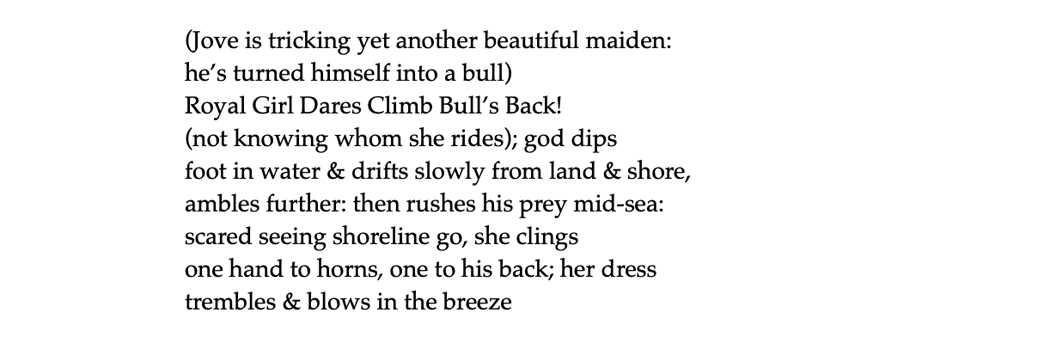
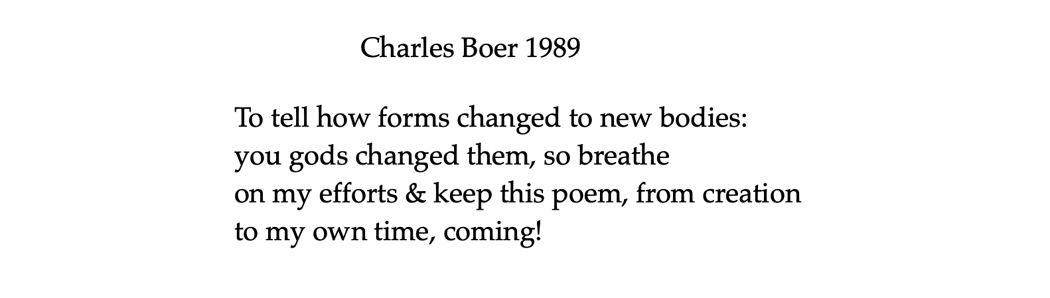
Charles Boer took another approach in 1989, with what one reviewer said is “like it’s spouted from the lips of some prehistoric shaman, barking out a tale to his animal skin-garbed flock.” In short, punchy lines, not always strictly grammatical, he seems to want to express each point as curtly as a newspaper headline. Articles evaporate and nouns shoot each other. It’s sui generis. To give the flavor of it, I have to quote more than just the proem. 

The proem is short and pithy, but the whole book is an acquired taste

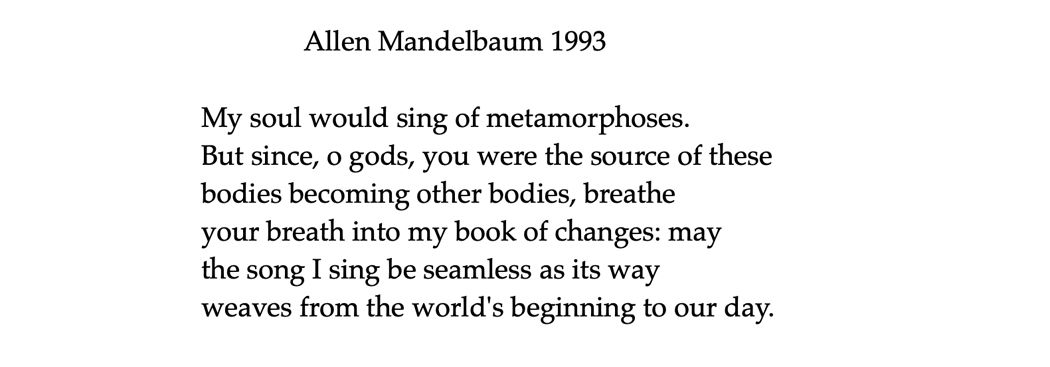
Allen Mandelbaum was a translating machine, and has given us versions of almost everything we might want to read, from Homer to Vergil to Dante. His Ovid, from 1993, in an Everyman Classic, which means it is gorgeously bound and printed in a handsome Bembo typeface. This is a book that looks really good on a bookshelf, but I’m afraid I find the translation rather worksmanlike. He takes six lines to say what Ovid said in four. 

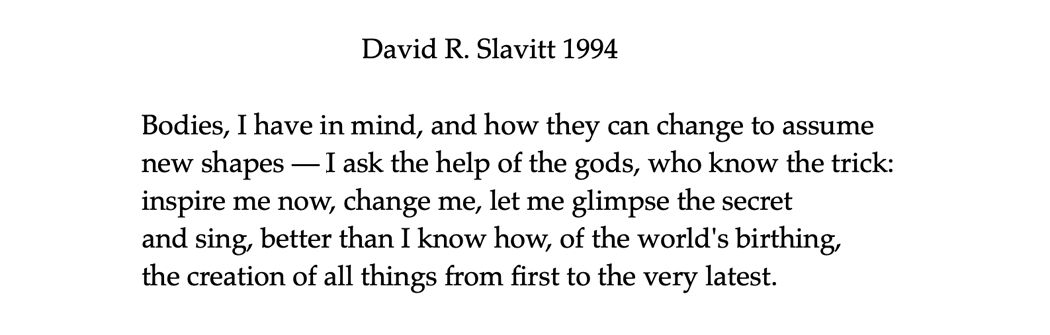
David Slavitt competed in 1994, with an entry in a very loose hexameter and what he says is “translated freely into verse.” He wanders a bit, and seems to add things into the text that sound more like commentaries on the text. In his introduction he writes: “As a translator, I take all kinds of liberties, but I am strict in my observation of length and scale, which I take to be significant artistic decisions that any new poem ought to respect and re-create.” In other words, he’d rather match Ovid’s prosody than his content. Some people swear by him.
The new century, 2000 years after Ovid actually wrote the thing, has exploded with new versions of his magnum opus. 

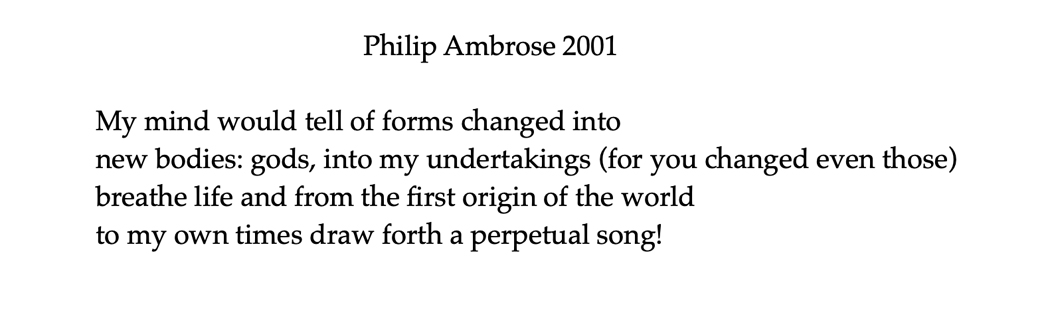
Philip Ambrose attempts to keep a line-by-line parallel with Ovid’s Latin, with sometimes an awkward phrasing, as when Phoebus, sounding like Yoda, tells Phaethon “But warn against this action I can”

Also in 2001, Michael Simpson brought out his prose version, attempting, he says in his introduction, “the rapid and direct American idiom while avoiding colloquialism on the one hand and academic translationese on the other. His version includes as many pages of notes, as of poem. 

I’m jumping ahead to 2004, skipping over Charles Martin for the moment, and to David Raeburn’s version for Penguin Classics, available in a handsome clothbound edition. It looks great on a bookshelf, but Raeburn’s somewhat wordy take means that most of the lines are longer than the page is wide, leading to insufferable line-breaks. Ugly. Reading it is like taking three steps forward and one back, over and over again. (This is a problem of book design rather than translation). 

In 2012, Ian Johnston put the text into swift pentameter, and what is more, posted the entire book for free on his website. There is also, of course, a handsome physical book to buy. The tales are laid out with marginal headings to keep track of the often confusingly interlaced stories. 

That leaves three translation to consider: My two favorites and the newest one. 

Charles Martin’s 2004 version for W.W. Norton is about as graceful as you can get, with a very free pentameter that moves as swiftly as Ovid is meant to move. I find no speedbumps in its wordage or lineage. It is the version I read over and over. 

But that doesn’t mean it is my true favorite, which is, I think, the best translation of anything that I have ever encountered. The problem is that Ted Hughes only worked on sections of the Metamorphoses, and so his version is incomplete, and second that his truly free approach means that he occasionally slightly rewrites Ovid to make things clearer or more proportioned to English (Ovid’s Latin doesn’t work word-for-word in English). It’s as if it were a completely original poem by Hughes rather than a translation of the Latin. I absolutely love Ted Hughes Tales from Ovid and cannot recommend it highly enough.

Which brings me back to the new McCarter translation, the latest in the long freight-train line of Penguin Books versions. If you read just the proem, she gets the gist of it absolutely perfectly, both metrically (as pentameter) and by giving us Ovid’s meaning as clearly as possible. 

But the rest of the book is less graceful, and about three pages in, I found myself working to read it. Martin’s version is greased and slides frictionless. McCarter is more like bumper-to-bumper traffic on the interstate, with a kind of start-and stop hiccups, and it sometimes suffers from what Simpson dubbed “translationese.” 
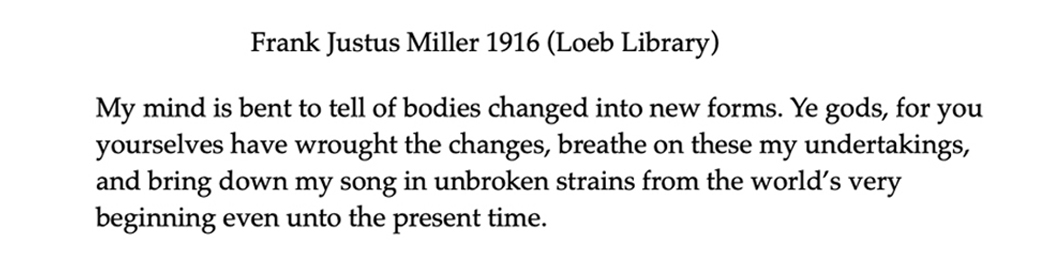
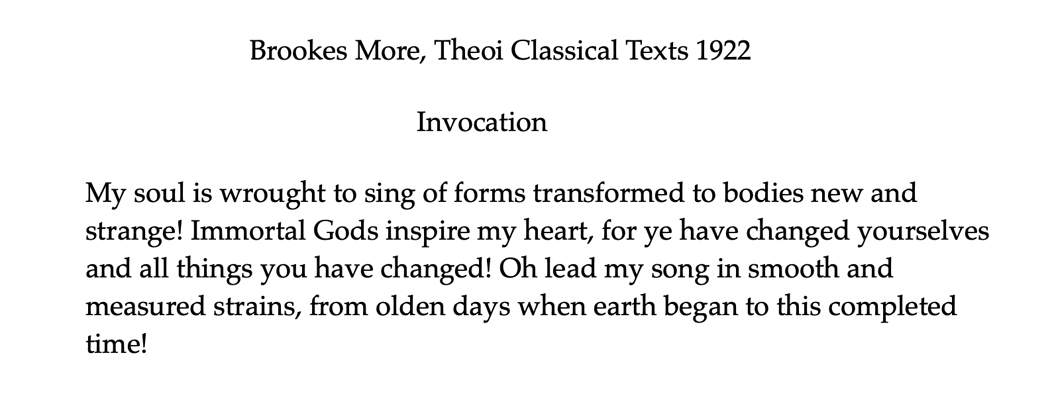
Translations seem to fall into one of three camps. One attempts to be as faithful as possible to the original, to simplify it and make it plain; the second seeks to poeticize it and make it sound as much like poetry as possible, and by that, we mean Victorian poetry; a third stream values contemporaneity, to make Ovid sound as if he were writing today, with the risk that in another 10 years it might sound as dated as Beatniks or bell bottoms. 

Any of these approaches can work, as long as the words spring along quickly and effortlessly, and Ovid’s stories keep you turning pages. Tastes vary and any one of these translation may strike you. I’ve laid out the range of them, and they can all be found somewhere in some published form. 

The best version for you is, of course, the one that keeps you reading to the end. 

Next time: A closer look at Ovid’s Latin

I’m tired of hearing that we live in a visual culture. The fact is, we are generally very bad at seeing. I am constantly reminded of this by bad signage, bad book design, bad photographs, and bad TV. To say nothing of the horror that is TikTok. 

It may be true that we like to use images instead of text whenever we can, but we also tend to treat the images as if they were text: That is, we turn them into the equivalent of hieroglyphs or rebuses. Hence the popularity of emojis. 

But seeing a picture of a house and thinking “house,” is really just turning a picture into a word. Yes, no alphabetic letters need be used, but the information conveyed is basically the same. That is not seeing; it is translating. 

I am reminded of this because of a frequent problem I find on some back-channel TV stations when they broadcast a program in the wrong aspect ratio. It is a visual goof that bothers me no end, and yet, so many people, when I point it out, simply don’t notice it. Faces can be squeezed thin or stretched fat and the visual-verbal translation isn’t affected, and therefore, not noticed. 


Believe me, I’ve been laughed at for fussing over aspect ratio. But how can people not SEE? The visual information is distorted even if the verbal information is left unbothered. 

Aspect ratio is simply the ratio of the width of an image compared with its height. A square is the same in both measurements, and hence, its ratio — its aspect ratio — is one-to-one — 1:1. 

If a rectangle is twice as wide as it is tall, its aspect ratio is 2:1. 

When photographs are made, or films or TV is shot, they are created in a particular aspect ratio. For instance, for decades, the standard aspect ratio for Hollywood films was 1.375:1, which was adopted in 1932 for the entire industry. Before that, silent films were mostly shot in a 1.33:1 ratio, which can also be stated as a 4:3 ratio, which corresponded to four sprocket-holes on standard 35mm film. But when sound was added as an extra track alongside the image on the film, the picture had to be made a wee bit smaller to accommodate, and hence, the 1.375:1 ratio. 

That all sounds very technical and who cares? Well, what happens, then, when you display an old film on a new TV, which are now standardize at an aspect ratio of 16:9, a “widescreen” ratio? When done right, you get a “letterboxed” image, with black bars on either side of the picture. When done wrong, the squarer image is stretched out to fill the wider screen and you get a lot of fat people. 

This used to be a big problem in the early days of digital television, when many stations heard complaints about those letterboxed images. The response was to crop the movies down to fit the screen, losing a good bit of visual information in the process (a process dubbed “pan and scan”), or — too often — just stretch it all out to fit. To anyone sensitive to visuals, this was a nightmare. But again, many people — especially at the TV stations mutilating the images — just didn’t seem to think it important. 

The reverse also happens when a real widescreen movie (some films are made in aspect ratios wider than 16:9, such as the 2.4:1 of the most widely used widescreen movies. Then, shown on a standard TV screen, you get everything squished down. 

Many of these widescreen movies were shot with anamorphic lenses, which allowed for a wider image to fit onto a narrower piece of film. In essence, they squeezed the picture thin on purpose, and then when it was projected in a theater, a reverse anamorphic projection lens would spread the image back out to its natural dimensions. Tons of films were made (and are made) this way. 

The problem shows up with DVDs, too. Some are produced in a natural aspect ratio, usually 16:9, but others, mostly older ones, were created anamorphically, and so you may need to use your remote to find the proper aspect ratio (or “screen size”) for the disc. If not, you watch squeezed people. 

I remember when my college film series showed a version of Bad Day at Black Rock but didn’t correct the anamorphic images. We watched the whole movie distorted into a squished frame. It was nauseating, at least to me. The projectionist, when this was pointed out, said he didn’t see what I was talking about. (The same projectionist showed Birth of a Nation with the music track turned off because “it’s a silent film.” There is no accounting for how these people get in charge of things.) 

Most all of us have something like this, which bothers us no end. For some it is bad spelling or incorrect grammar. For others, it is making too much noise when eating soup. Others still cannot bear canned laughter on sitcoms, or the superfluous chyrons streaming across the bottoms of cable newscasts, telling us exactly what the speaker is saying. We can hear them, you know. You don’t need to spell it out. 

Anyway, one of those irritations that just drives me nuts is the inability of so many to actually notice when the picture has gone bad on their TV. The wider the original, the squishier the mistake. I remember seeing an early broadcast of The Good, The Bad and The Ugly scrunched into an old cathode-ray TV screen, like a closed accordion, and I thought, “How can poor Clint Eastwood even breathe?”

The aspect ratio problem, though, is really just a symptom of a wider issue: that too many of us are just bad at seeing, of not paying attention to what our eyes are telling us. It is the translation problem: We don’t see to see, we see to extract only so much information as we feel we need. If we can follow the plot with skinny people, then good enough. 

But seeing isn’t just about keeping track of the story. It is about being alive in the world, of noticing everything around you, of taking in what existence gifts you with. The green of a tree, the roundness of a tire, the texture of denim. To notice is to be alive; failure to notice is deadening. 

Art, and I include even popular art, is there to remind us of, and to interpret, the world we live in and the lives we lead. The best art slaps us awake, the way the slap of the doctor makes the newborn take its first breath. We can see what we had taken for granted, we can reinterpret what had become habitual. Failure to use your eyes is to refuse a gift being offered by existence. 

Click any image to enlarge

I have lived in all four corners of this country: in the Northeast until I was 17; in the South — for the first time — until I was 30; in the Northwest for a bit more than a year; back in the South until I turned 39; moved to the Southwest until I was 64; and back, finally, to the South. I am now 74. And so, I’ve lived in the American South longer than anywhere else, and while that does not give me the right to consider myself a Southerner (you have to be born here for that — maybe even your granddaddy had to have been born there for that), I have come to have a complex and conflicted love for the region. The South has a mythic hold on the psyche that no other region can match. 

Oxford, Mississippi

Perhaps the biggest problem in dealing with the American South is that there is no good way to separate the reality of it from its mythic power. Other regions have their myth, too, for sure. There is a Puritan New England, and there is the Wild West, but both of those have an element of legend to them — they are made up of familiar stories, whether of pilgrims debarking at Plymouth Rock, or Wild Bill Hickok playing aces and eights. These are stories that get repeated and we presume they tell us something about the character of the inhabitants of these regions. But the South is not built of stories, but of myth, which another thing entirely. 

There is something external about stories and legends; myth is born from that place in the psyche that Carl Jung called “the shadow.” Stories are told; myth is felt. It is something profound but unexamined — it is the sense of significance, of meaning, even if we cannot exactly put our finger on any specific meaning — the way a dream can feel significant, even if we don’t know why. 

Windsor Ruins, Mississippi

And there are at least four conflicting myths about the South, which can overlap. There is the “moonlight and magnolias,” which is now and has always been bullhockey; there is the redneck South, riven with poverty, ignorance and superstition; there is the Black South, which has its own subdivisions. And then, of course, there is the “New South,” with its Research Triangles and its civic progress. 

Yanceyville, North Carolina

The first is the bearer of the Lost Cause, a self-deluded sense that the Old South was a place of gentility and honor; the second includes both the rural farm South and the Appalachian hillbilly; the third is counterweight to both of the first two, and yet, is also the power-grid on which the first two run — it is there behind all of it. 

And lastly, if you have ever watched a new butterfly wriggle slowly, struggling out of its chrysalis, seeming to be stuck halfway, then you have a pretty good image for the New South trying to leave behind the problems of the Old. The Old is unwilling to let go. 

Because history is the foundation of Southernness. 


Zubulon Vance birthplace, North Carolina

When I first arrived in the South, in 1966, one of the first things I saw on driving into the campus of Guilford College, in Greensboro, N.C., was a giant banner hanging out of the third-story window of my dorm with “Forget? Hell!!” written on it in gigantic hand-scrawled letters written on a bedsheet. It was my introduction to the sense of grievance that has ridden the back of the South since the Civil War. It is a sense of being put upon by others, of having been defeated despite the assumed bravery, honor and courage of the soldiers attempting to protect the South and its heritage. Of course, this is all myth, but myth is a powerful driver. 

In Homer’s Iliad, when two soldiers meet on the fields outside Troy  and are about to beat each other into bone-snapping pulp, they first stop to tell each other their genealogy. 

“And the son of Hippolochus answered, ‘Son of Tydeus, why ask me of my lineage? … If, then, you would learn my descent, it is one that is well known to many. There is a city in the heart of Argos, pasture land of horses, called Ephyra, where Sisyphus lived, who was the craftiest of all mankind. He was the son of Aeolus, and had a son named Glaucus, who was father to Bellerophon, whom heaven endowed with the most surpassing comeliness and beauty’…” And this goes on for another 30 lines, explaining the history of his family from its origin among the gods. No one is merely an individual, but rather the tail-end of a long history, known to both the warrior himself and to his foe. 

Bell Family, Mayodan, North Carolina

This sense of history is rife in the American South, too, and the Civil War takes the place of the heights of Ilion. 

My late wife, Carole Steele, was born in North Carolina and learned about the war first-hand from her great-grandmother, Nancy Hutcherson Steele, who was 10 when it began. She had plowed the fields during the war while her father and brothers were away fighting. When she died at the age of 98, she did so in my wife’s childhood bed in a small house on the banks of the Dan River. Carole was 8 at the time.

Steele family, just after Civil War

The confluence of childhood and history formed the seed of the poetry she wrote. The blood in her veins was the blood in her father’s veins, in her grandfather’s and great-grandfather’s. History, blood and identity flowed like a river. 

“My father’s blood is always a river/ rushing to his mind/ igniting diamonds,” she wrote. She called the sense of history being alive in the genes the “long man,” an identity stretching across centuries. 

Carole described the feeling in several of her poems. One describes the feeling of being in the South and reads, in part, “It was for the wasps/ singing in the rotten apples/ under the trees,/ the sweetish smell/ of rabbit guts and/ frozen fur stuck to the bloody/ fingers/ and frost on the stubble,/ the dipper and the well,/ tobacco juice in the privet hedge,/ and liquid night/ the muted rumble/ of old voices/ at the kitchen table/ drifting up the wooden stairs”

I learned from Carole and her family, that there is usually a deep sense of belonging that Southerners feel: The second pillar of Southernness is place, and what is more, place and history are almost the same thing. A genuine love of the patch of ground where they grew up, a love like you feel for a parent. It is a love of where you were born that may not extend beyond the town or county and maybe the state. But for Carole, Rockingham County was where her father and grandfather were buried. Another poem ends: “your Daddy is a fragrance/ gathered in the peach trees/ over there.”

That fact alone meant there was an unseverable umbilical connection to that omphalos, that tiny patch of Piedmont, those trees, those creeks and rivers, those very weeds that crept over the edges of the crumbling pavement on the back roads. It is the feel of the red clay between your fingers, the blackbirds roosting by the hundreds in the oak tree. Home. 

And, in the meantime, the blood of countless slaves and freedmen enlarged the tragedy of the South. There were lynchings and later the violence of the civil-rights movement.

Mobile, Alabama

It isn’t only rancor and slaughter that give the South its sense of history, but the land itself. You can stand in a cornfield in rural Sprott, Ala., 25 miles north of Selma, and see the stand of trees at its border, knowing the trees are no more than 60 years old. And that before those trees began filling in the countryside, there were cotton, sharecroppers and poverty. A dilapidated wooden shack sits in the middle of the woods, and you wonder why anyone ever built there.

Then you recognize they didn’t. The sharecroppers’ home — just like those written about by James Agee in his Let Us Now Praise Famous Men of 1941 — was built by a cotton field, but times change and history presses on and the fields are now woods.

Sprott, Alabama

There is history elsewhere in the country, too: Bunker Hill, Mass., Fort Ticonderoga in New York or Tombstone, Ariz. But they are singular places you go to visit — somebody else’s history. The South is so full of history that its land and people seem buried under the sense of it.

The first democratic legislature in the New World was Virginia’s House of Burgesses. The author of the Declaration of Independence was a Virginian. And the Revolutionary War came to a close at Yorktown, Va.

Shiloh battlefield, Tennessee

Each state has its Civil War sites, where thousands of its men are buried. There are the street corners where civil-rights workers were hosed and beaten by police. Cotton fields where slaves were whipped. It is interesting that the one place in the country where Black and White share the most is the South.

For most Americans, history is a story told in a schoolbook. It seems removed from the lives we live. For most Southerners, history is something their grandparents did or was done to them.

And I, of course, have come late to this epic, first in 1966 when segregation was officially illegal but still largely in effect. The local barber shop would not cut a Black man’s hair; “We were not trained how to,” the barber explained, weakly and not very convincingly.

Jim Crow was so unconsciously buried in the White brain that a local ministry could, with no irony, proudly boast that it offered help and aid to “the alcoholic, the prostitute, and the Negro.” 


After graduating from college, I eventually found work writing for the Black weekly newspaper in Greensboro, N.C., The Carolina Peacemaker, where I found myself writing editorials for the city’s Black population. It felt strange to do so, but I never felt less than completely welcome. When I visited the African Methodist Episcopal church, I was invited in with a warmth I never felt in New Jersey — and, I might add, magnificently fed in the church basement after the service. Clearly the resistance to change in the South was a one-way thing. 

My daughter, Susie, who is also a journalist, worked in daily papers in Jackson, Miss., and Mobile, Ala., also started on a Black weekly — the Jackson Advocate, in Mississippi, where she had the same experience I did of welcome and inclusion. 

I did not find that sense in 1967 when I and a few of my college friends attended a Ku Klux Klan rally in Liberty, N.C. There, the sheriff of Forsyth County gave the keynote harangue with tales of Africans feeding their babies to crocodiles, and how Africans still had the “stub of a tail.” The smell of alcohol was pervasive, and the festivities ended with the circling and burning of a 30-foot cross, built of intersecting phone poles set alight with poured kerosene. Meanwhile, a scratchy recording of The Old Rugged Cross played on a miserable loudspeaker system. 

Later, I covered the followup to the 1979 Klan shootings in Greensboro. Klan members and American Nazi Party members were acquitted for the killings of five protesters. The city police were claimed to have colluded with the Klan, and 25 years later, the city apologized. So, the recent rash of police violence against people of color comes as neither surprise nor shock to me. 

Yet, I love the South and choose to live here. It fills my mythic life also. In the 1970s, it was the Eden from which I was exiled. I was setting roots and rhizomes in the soil of the house I shared with the woman I expected to grow old with. It was the paradise garden: In the front yard was an Yggdrasil of a shaggy, ancient black walnut tree, covered in moss. In the back yard was a pecan tree. There were two fig trees from which we ate fresh figs. There was a vacant lot next door with an old pear tree. A chinaberry grew on the street side. And a proud row of the most brilliant red maple trees along the road, changing reds throughout the year — buds, flowers, leaves, branches, each with their own ruddy glow. 

There were lilacs beside the house, wild Cherokee roses along the driveway, random chickory spreading blue along the foundation. Between our yard and the vacant lot, I counted more than a hundred species of weed — or rather, wildflower — with my Peterson Guide. I grew a vegetable garden with beans, peppers, eggplants, okra and tomatoes. 

There were mockingbirds that I trained to whistle, pileated woodpeckers that would climb the pecan tree. Crows, owls, cardinals, sparrows, redwing blackbirds, the rare ruby-throated hummingbird. Circling overhead were buzzards and hawks. There were butterflies and beetles. Ants highwayed up and down the walnut tree. A luna moth sat on the screen door. 

We lived there for seven years, digging our feet deeper into the soil, until the Archangel Michael came brandishing his sword: My love left me suddenly and I left the house. And I left the South. 

When I returned, some years later and bearing with me a numbed depression, I was taken in by my college friend and his wife, and a second, shadow-Eden was set in Summerfield, N.C., in an old house with only a wood stove for heat, and three great ancient oak trees in the back. I walked through the woods behind the house and into a small ravine — the petit canyon — and soaked my loss in the loam and leaf litter. 

The thing about depression and myth is that they play into each other. It isn’t so much that depression makes you the center of the universe, but that it wipes away everything else, leaving only yourself and your loss. You are forced to experience your life at a mythic level and for me that meant the land, its history and its people. 

New River, Ashe County, North Carolina

I recovered, moved to the Blue Ridge Mountains when I was invited by Carole. The house was on a bluff above the New River, with a dark green patch of pine trees on the hill and an unmowed grassy field on the other side of the house. I could stand at the kitchen sink, doing dishes, and watch the weather shift over the peak of Mt. Jefferson, five miles off to the north. 

Ashe County, North Carolina

Together we moved to Virginia, where Carole taught in Norfolk and I taught in Virginia Beach. Six years there, with much travel around the country. When Carole got a job offer in Arizona, we moved, lived in the desert for 25 years and when we both retired, moved back to North Carolina, to be near our daughter. 

Swannanoa Mountains, Asheville, North Carolina

It’s been 10 years now, and five since Carole died, and I have hunkered down in Asheville, at the foot of the Swannanoa Mountains, and feel as if I am where I belong. The trees and birds, the weeds and the occasional wandering black bear, the snow on top of the hills, the barbecue joints and auto parts stores. 

Age has a way of deflating myth. When I was in my 20s, the world seemed aglow, lit from within by a kind of mythic importance. The South had that glow: its people, its landscape, its history. I have come back to the South after a quarter-century in the desert. It has lost some of its oneiric power, as, indeed, the world has in general. But the South feels comfortable and human and my children and grandchildren all live here and I cannot imagine living anywhere else. I burrow in and pull its blankets around my shoulders. 

Click any image to enlarge