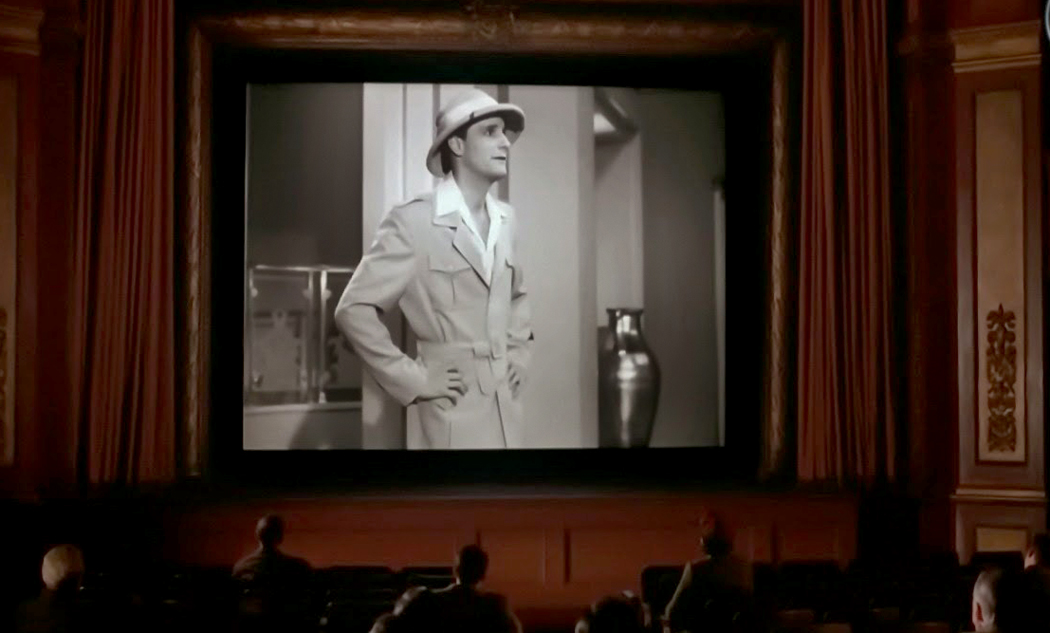
Day 3 at the Palm Springs International Short Film Festival in AD 2000, and the jurors are beginning to be a little bleary-eyed. 

eyes have it

Aug. 3

By the end of the day, I’ve seen a cumulative total of 56 movies.

The process is interesting. The first day, you have nothing against which to judge the movies you see. You don’t know if the film that was pretty good is in fact the best movie of the festival, or if it will turn out to be in the bottom half.

By the second day, you’re beginning to get a good idea what the general run of film is going to be like. And by the end of the day, the deluge of film is beginning to blur together into a single gigantic epic instead of a machine gun of individual shorts. The similarities link together and you see all the pretty, ambitious, miniskirted, black haired, shoulder-padded career women turn into a single type. All the scruffy, unbathed, snotty-nosed begging children turn into a single caricature. All the rock-playing, layabout, scraggle-haired skinny boyfriends become one.

I have sat in a dark theater from 8:30 in the morning and on some days, don’t get out of the dark until nearly midnight. The crowd is mostly insiders — filmmakers and distributors — and they applaud each others’ efforts so no film goes unappreciated. When the maker of one of the screened films is present, he or she is introduced before the program begins and asked to make a few appropriate comments. Most thank their mothers.

The way the judging is set up, we have three pairs of jurors. Two handle all the student films. The next two handle the animation and all the films longer than 15 minutes. Finally, Fred Ofield and I handle all the documentaries and all the live action films under 15 minutes.

The 250 movies entered in the festival are screened in the main theater in programs of 6 to 8 or 9 films in 90 to 120 minute segments, each attendable by the ticket purchasing audience as if it were a single feature.

The programs are built around themes. One program features children, another features gay themes, another looks at crime films. One program is ghost stories and another is experimental. That means that films from each of the five categories (student, animation, documentary, more and less than 15 minutes) show up in each program, making it necessary for all the jurors to attend all the programs.

Luckily, there is a way around this problem, and the problem of overlapping programs, when we cannot be in two theaters at once. That is that we can view videos of the films in the Festival office.

The very first afternoon, we had to set up a dozen or so videos, just to catch up with the films shown the first day, before the jurors actually arrived.

Today, we looked at another 9 films trying to catch up with stuff we couldn’t get to, and even at that, we didn’t finish before closing time. We did manage to see the videos of the films that would be shown tonight, so we worked it to get an evening off. We’re getting worn.

There have been a healthy number of bad films. A few so bad that me and Fred would look at each other and silently hold our fingers to our noses.

“That one was a complete waste of film,” I said of one.

When I mentioned to fellow juror Norman Gerard that his category, with the longer than 15 minute live-action films, seemed to have better films than our category, he just said, “grass is greener.”

I’m sure he had his turkeys, too.

Yet, the level of proficiency has been quite high. Few films suffer from technical incompetence. Most look gorgeous.

The problems are not generally technical, but a lack of something to say. All that technique is used to imitate the cliches of Hollywood, or used for a good idea that the filmmaker never takes anywhere. It dies on the vine.

There were some good lines in the films.

A small girl at a train station watching the odd behavior of the people around her says, “Deep down, there’s an explanation for everything. Trouble is, you can never get deep down.”

An aging blond model is asked about how full her clothes closet is and says, “I don’t change my clothes, they change me.”

In another film a former drug dealer and ex con becomes a father and tells us, “I was the poster child for the anti-father, and I’ve always kind of liked that about myself.” He changes.

A woman who lives in Japan for a few months is bewildered by the culture and its contradictions and hypocrisies, and finally decides she is limited to “seeing through the keyhole that is my own experience.”

Another woman’s idea of excitement is the “high-risk perfectly executed one-nighter.”

There is a good deal of cleverness and wit in these films, although too many of them peter out in the second half. And considering they are all under 15 minutes, that is a mighty quick petering. Interesting set up, no payoff.

Seeing the videos all afternoon freed us up to travel around Palm Springs in the evening.  There are a gracious plenty plastic surgery offices in town. Some cosmetic dentistry, too. And at least one office that promised “biological age reversal.” Whatever that is.

As far as the city goes, it is almost like a science fiction movie. Palm Springs in August is a ghost town. Shops are closed, restaurants are closed. We have trouble finding a place to eat. The Hyatt Regency, where we are staying (at the Festival’s expense) is empty. We can walk around the lobby and listen to the great hollowness.

palm springs hyatt

Yet, at every Festival event, the people ooze from the woodworks. Hundreds show up for the screenings. Hundreds hang around the “Hospitality suite” in the shopping center, where filmmakers hawk their films to the industry. And on Thursday evening, Palm Canyon Road is decked out in a street fair, with food booths, rides, radio station promos and craft tents. Thousands of people walk up and down the pavement getting temporary tattoos and eating tacos and ice cream cones. Bands play music and kids take pony rides. Where did all these people come from? This afternoon, you could have shot a bazooka down mains street and not have injured a fly.

It is almost like a Twilight Zone episode, the transition is so mysterious. Ghost town — bustle and hustle. Where do they go in the daytime: Shopping centers are closed. The shopping mall next to the hotel is vacant. We walked up and down the street on Tuesday evening trying to find a place to buy some bottled water, and everything was closed up. It was like a university campus during spring break.

Tomorrow, we’re scheduled to begin looking at films at 8:30 a.m. The question now is if we’ll be able to survive the next 50 films.

It is the second day of the Palm Springs International Short Film Festival in 2000 and I am one of six jurors looking at dozens of shorts, of varying degrees of eptness and ineptness. Four more days to go after this one. 

palm springs post card

August 2

Breakfast at 8:30 with my fellow jurors and Fred Linch. We are introduced to the “juror wranglers,” who will follow us around and make sure we do what we’re supposed to. They will make sure we don’t miss any of our films.

Because screenings began yesterday — we didn’t know it; we weren’t told — we had to catch up on a few films, so after lunch, we drove to the festival office to watch videos of them. When we got there, juror Jack Ofield was already watching. We went through a quick dozen of them and managed to finish in time to get to the 5 p.m. program at the theater.

I won’t go over the films individually here, but I should note a few trends. It seems that short films are for short people. Over and over, the films were about talented and sensitive children and their loutish parents. It seemed a film couldn’t go by without an adult punching, slapping or otherwise bruising a quiet, sensitive youngster. Some of these films were good, some middling, some bad. But the theme pervaded.

There was a lot of street begging, too.

Another thing I noticed is that short films are slower than features. Although they follow less action and their plots are more compact, the camera will follow an action endlessly, letting us savor every millimeter and moment. Where a mainstream film will cut from one significant action directly to another, avoiding the transitions as needless upholstery, the short film will pretty well pass up the important action — often too complex or expensive to film — and concentrate on the transition, letting the camera linger excruciatingly over the character rising from his chair and walking step by painful step all the way over to the door, grab the door handle, turn it a full 140 degrees, slowly, with every creak of metal, and open the door, finally walking into the next room, closing the door behind him. The main part of the scene, however, is likely to be played out elliptically.

We see a lot of waiting in the films, too. Rain falls and we wait. The elevator is paged and we wait. Life in short films is full of waiting. Pensive, portentous, meaningful waiting.

In general, the foreign entries are less trivial than the American ones. The American films tend to be about the peeves of young Americans, their boyfriends, girlfriends and parents, all miffed at each other. Or they are about nothing but rehashed feature film ideas: ghost stories, superheroes, action adventures, all concocted out of previously-owned plot material. Characterization is brief and sketchy, pretty much borrowing “types” familiar from other films.

The American films have a tendency to be flashy, slickly made and banal. The European and Latin American films seem to be more concerned with actual life, not life as learned from the TV screen.

As we left the theater to go and grab a quick bite for dinner we passed a man on a cell phone making a deal in the parking lot. He held his briefcase in the same hand as the phone and it wagged off one side of his head like a giant Dumbo ear.

“I welcome your energy,” he said.

Dinner was at a health food restaurant. Carole had the carrot shaving and alfalfa sprout burrito and I had the avacado and lettuce quesadilla. It was said to be quite nourishing.

Meanwhile, a man came in and looked at their magazine rack.

“Do you have the Yogurt News?” he asked.

Bergman DeathWe had to rush back to the theater for the 8 p.m. showing of Jewish documentaries, mostly involving the holocaust. Scary looking stuff, but the real winner was a film called King of the Jews, which took a very personal look at the image of Jesus as seen by a young Jewish boy who was deathly afraid of Jesus. It was all made up of clips of family films and old movies, set to the music of Bartok and Arvo Part. It made me cry. It gets my vote for best documentary. At least, so far.

There was also a Brazilian short about Bergman’s pasty-faced Death looking for his next appointment in a bar and having a drink with a suicide. It was a scream, with a paunchy Death and a couple of absurd deaths.

We got back to the hotel by about 11 p.m. in time to go to bed and wake up for the next day’s haul.

I wrote a fair share of movie reviews as a critic with The Arizona Republic. Because of my interest, I was chosen in 2000 to be a juror at the Sixth Annual Palm Springs International Short Film Festival by event  director Fred Linch. I recently rediscovered the daily notes I made during my sojourn in Palm Springs, and will post them over the next several days. 

palm springs night

August 1, 2000

I am a juror at the Sixth Annual Palm Springs International Short Film Festival and I’ll be seeing something like 250 films over the next five days.

The festival is the largest international short film festival in North America, a title that I notice is worded quite explicitly, with a lot of loopholes.

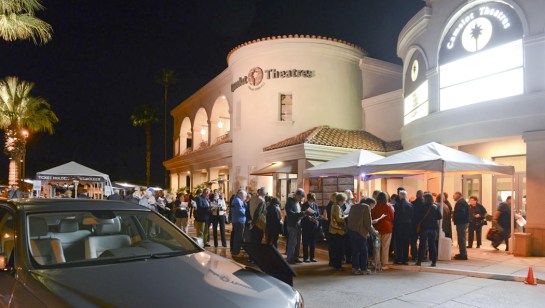
Nevertheless, opening night festivities are crowded with about 400 people. Some are jurors, like me. Others are presenters, even more are filmmakers and industry flacks. There are corporate sponsors and a sizable army of hangers on. You recognize them by their heavy makeup and garish black costumes. One fortyish woman in black capri pants looked as if, not counting her silicone, she must have weighed 80 pounds. Counting the silicone, I doubt I could have picked her up. Her chest rose like twin balloons, held down by twine. If she had inhaled too sharply, I think her chest would have strangled her.

The event began with the usual procession of officials making slack jokes and applauding each other. The city councilman congratulated himself, and then everyone else he knew, either personally or by reputation. The schoolkid who designed the poster was applauded and given a prize check. The jurors were identified from the podium. We had to stand and let ourselves be known. Later this proved amusing.

line to enter theater

After the ceremonies, we watched five short films, all rather on the longish side, but probably worth seeing. Then the lights came up and we all exited the theater and joined the buffet in the parking lot.

Lines formed everywhere for the tiny Mexican burritos, the tiny enchiladas and the baby-size tacos. Drinks were a couple of bucks and they were going fast.

There were only a few tables and chairs, and they were full, so we walked around with our plates in our hands, popping chicken wings into our mouths and licking the grease off.

One young man with a handful of promo cards shoved one in my hand.

“You’re that judge, aren’t you?”

“Yes, I guess I am.”

“Well, make sure you see this film.” He slapped one of the cards in my empty hand. “Riddle of Ararat,” it read. “World premiere of a film by Robin Simmons, produced by George Adams.”

“Is an ancient volcano at the center of the earth’s land mass the hiding place of Noah’s Ark?,” is said, rather longishly for a catchphrase.

“Ararat,” he said. “It’s in northern Turkey.”

“I know where it is,” I said. “And now I know where the movie is, too.”

“What? Oh. Yeah.” And he turned away looking to slap a card in another juror’s mitts.

People were lined up being interviewed against the marquee by TV cameras and their attendant microphone pointers in red blazers. One after another, camera lights went on, microphones were pointed, trenchant comments were made and lights went off.

An older woman passed by and saw my neck tag.

“Oh, I better not mention it to you. You’re a judge.”

“Oh, it’s OK,” I said.

“Oh, nothing,” she said. “I’m the filmmaker’s grandmother and I want everyone to know how wonderful he is.”

A young man in a white shirt with no collar looked at me funny.

“Aren’t you one of the judges?”

“Guilty.”

“Which one did you vote for?” he asked.

I looked puzzled. This was the first night. We hadn’t seen any of the entrants yet.

“I mean, you are one of this year’s judges, aren’t you?” he asked.

“Yes, but we haven’t seen the films yet.”

“Then how can you judge them?”

“We’ll be seeing them over the next week, then we’ll judge.”

“But I thought you already saw them.”

“No.”

He looked at me like I obviously didn’t know what I was talking about and that unless I told him the truth about which film I voted for, he wasn’t going to waste his time with me. He didn’t and left, disappointed.

A blond woman in a black dress introduced herself.

“I’m from Scottsdale,” she said. “I read your reviews in The Arizona Republic. But what I want to know is why doesn’t Phoenix have a film festival?

“We do.”

“We do?”

“There is the Scottsdale Film Festival. I was a juror for it, too, earlier in the spring. At Scottsdale Community College.”

fred linch ast scottsdale film fest

Fred Linch (left) at the Scottsdale International Film Festival

“I must have missed it.”

Meanwhile a radio station DJ was blaring very loud music all across the parking lot and making market-savvy interjections between the songs.

It was beginning to wear on us, so we went back to the hotel.

When we got to the lobby Fred Linch was sitting at a stuffed chair just outside the bar waiting for some friends. Fred is beginning to look a little too much for his own good like what Rod Steiger became. He also has one upper front tooth missing.

He reminded me about the jurors’ breakfast the next morning and told Carole, “There’s a really good discount mall at the edge of town, just take Palm Canyon Road out of town past the I-10 junction and go a couple of miles beyond to the Indian reservation. It’s the greatest discount mall. Bigger than the Fashion Square in Scottsdale.”

Earlier in the evening, he had told Carole she wouldn’t be seeing much of her husband in the next five days.

In both cases, our teeth shriveled for the obvious dismissal of Carole as a mere wife, whose interests must lie in shopping or something else more trivial than the movies we important people were going to watch.

So, we rode the elevator up to our room, enjoyed the air conditioning and prepared for bed.

Forrest City Arkansas

Travel writing is so unbearably perky. Resorts are wonderful, restaurants are heavenly. In most such writing, even traffic jams are quaint. As if the entire planet were one big Club Med, full of martinis and masseurs.

But travel isn’t really like that. Despite the best propaganda from the nation’s chambers of commerce, often travel is bad food and lumpy beds. There is rain and mud, closed museums and long, hot queues. And with endless miles between destinations, one is often forced to choose interstate highways, which are endless miles of boredom. An interstate in Kansas doesn’t look much different from one in Vermont: just a closed off view of trees and crown vetch.

And so, you suffer soggy, cold fried chicken, motel mattresses with valleys running down both sides, showers with water that smells like a dead opossum, gas station restrooms smeared with grime and tar and perpetually wet floors, and occasional automobile breakdowns, flat tires or the anxiety of passing a sign that says, “next services 235 miles.”

What is all the more astonishing, and seldom written about, is that it is frequently the miserable portions of a trip that are most memorable. Surviving them can strengthen the bond between travelers the way surviving a war bonds veterans.

And when we reminisce, it is often as not about the night there were no motel rooms to be had, or the day the transmission fell out in Death Valley.

I call such occurrences “adventures.” We had many adventures during the 1980s, when my wife and I were both teachers and had long summers off. Each year, we packed up the car and set off on cross-continental trips. The first, in 1982, covered 10,000 miles in two months. If I recount a few of those adventures, we cannot hold it against the places where they happened. Times have changed. Some we have revisited and had a great time, even if our first impression was somewhere below the level of dismal.

Nathan Bedford ForrestTake Forrest City, Arkansas. It is now more than 30 years since we came to that benighted place in the flat floodplain farmlands just west of the Mississippi River. We had traveled some 600 miles that day, from western North Carolina and were too exhausted to go further.

The city was named for Nathan Bedford Forrest, one of the founders of the Ku Klux Klan and a notorious Confederate cavalry general during the Civil War. Today, I’m sure the town — for to call it a city is to inflate a civic brag — is much nicer now, with better accommodations and eateries, but when we stopped there, it was a sorry, forlorn town, in every particular on the wrong side of the tracks. We stopped at the D&M Motel, now long out of business, if my Google search is right, which was advertised as “the best in the state.”

sanitized for your protectionThe cracked concrete parking lot, with crabgrass poking through didn’t tip us off. The crazy old crone who was “concierge” didn’t give it away, either. I suppose our first real signal was when we got to our room, that underneath the paper “sanitized-for-your-protection” band on the toilet seat, a cigarette butt and a raft of soggy ashes floated in the water.

We needed to eat before turning in, and when I asked the hotel keeper for a dining recommendation, she told me, “If it’s just good old fashioned eatin’ yer after, I guess the best is the Blue and White Cafeteria. If ya want barbecued beef, then Barbecue Pete’s … no, wait, he was closed down by the health board. Yeah, I guess the Blue and White. It’s where we always go.”

The restaurant was a cracked stucco building next to a railroad bridge. We were the only car in the dirt parking lot. When we were seated, our booth had a view, through the flyspecks on the window, of the railroad embankment.

Three obese middle-age trailer-park renegades were dolled up in waitress uniforms and one took the pencil from behind her ear and stopped chewing gum long enough to bring us menus and greasy glasses filled with water. I removed a hair and took a slug, stared at the menu and tried to choose something non-toxic.

I forget what I ordered, but whatever it was, the flies loved it.

But even after this repast, I believe the concierge was right. After driving through the town, I believe the Blue and White was the best place in town. I had no reason to assume there was anything better on down the road and we had already driven 600 miles, so we did our best to sleep discovering to our itchy discomfort that the room had already been rented to a national convention of fleas. Too tired to complain, we slept and scratched.

Annual Sturgis Motorcycle Rally Celebrates Its 75th Year

A few years later on another trip we were in the upper Midwest, headed from the North to South Dakota to see Mount Rushmore. After a long day’s drive we looked for a motel only to discover it was the weekend of the Sturges Rally, and tens of thousands of motorcyclists had converged in that quadrant of the state. We steered slowly through Sturges in between large bearded men in sleeveless leather coats and biker chicks in jeans and boots, and among the thousands of shiny choppers leaning beside the road chock-a-block like schools of fish. We stopped at one motel and a very helpful concierge laughed a kindly sort of “what-fools-they-be” chuckle but phoned around to see if any other hostelry might have a chink in the wall they could rent to us. No luck. He finally found a place; it was a hundred miles away, off to the northeast from town, down endless state highways, well off any beaten track and well out of the itinerary we had so lovingly planned. Exhausted as we were, we wove our way back out of the invaded territory and its armies of bikers, and into the back of the back of beyond. We found when we got there, there was one single room left. We took it, slept in it, and felt grateful that the water coming out of the tap only smelled necrotic.

Rising storm, I-40 Texas

Another time, we camped near Shamrock, Texas, just off Interstate 40. It was one of those industrial campsites filled with RVs, with a laundry and camp store in the center. That evening a violent thunderstorm blew up. Before it hit, our neighbor, who had been there for a week, told us that the previous day, a tornado had ripped through the area. Did marvels for our confidence. When the storm came full, our the floor of our tent began to wobble like a water bed and the whole thing began to luff wildly. We were actually afloat in our tent. Then, we were airborne in the tent. We knew we had to get out, but when we did, the tent began to fly off. I held onto it as it gained altitude, and over my head, it tore back and forth like a kite out of control. The rain did not come down in drops, individuated, but more like Niagara Falls, a sheet of water.

Shamrock, Texas

My wife ran to cover in the brick laundry while I wrestled the tent to a draw as it got caught in the sheet metal roof of a concrete picnic table. I joined her in the safety of the building. All the campers were there. Babies were crying, newlyweds were feuding, old people were remembering the storm of ’47. As the worst of it passed those in camper-vans began to return to them and we went back to our car. I managed to disassemble the tent, and stow it. We got in the car and tried to sleep in the seats. It was misery.

Eventually, we gave up and drove into town looking for a motel and found one open at 1 a.m., with an office aromatic with curry. We woke up the concierge and got the last room, half hidden by a tool shed. Inside, the floor was covered in a none-too-clean grass-green shag carpet that not only sat on the floor like a bad toupee, but actually continued up the wall for three feet, like a hairy wainscoting, and also continued up the sides of the bed. We were soaked, our clothes were soaked, the car was soaked, the tent was a jumble of nylon and tentpoles puddled with water. But we slept well. We didn’t have to deal with any of it till the next morning.

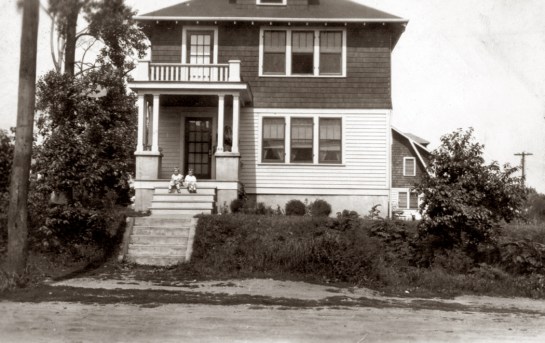
313 DeGraw Ave. 1927

Sometimes, when I’m having trouble getting to sleep, I take six decades of my living and slide them aside, like a Japanese door, to open on the landscape of my childhood. I remember the house I lived in when I was five or six years old, trace its floorplan, walk out its door and wander the streets. What is most surprising is how much there is stored in the neurons, untouched for half a century, that can be re-animated. Each door I open opens into a room with new doors to open, that open on other rooms with other doors.
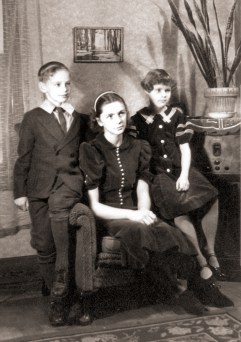
Mom, Sue and Stan as kidsAnd so, I remember the front room of the house where we lived with my grandmother, Nana, in New Jersey just after the war. It sat directly on the town boundary between Teaneck and Bogota at the point Degraw Avenue began its long westerly descent to the Hackensack River. It was the house where my mother grew up, where her father died when she was seven, where she then had to raise her younger brother and sister while her mother worked in Manhattan. It meant that my mother never really had a free childhood, and perhaps as a result, adulthood always seemed to feel like a burden.
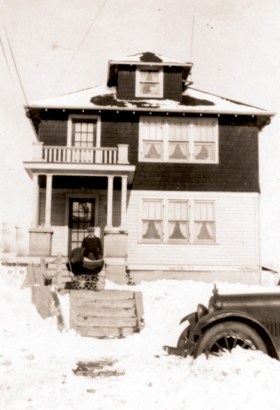
313 degraw ave 1927 in snowThat two-family house divided at the front door. To the right was the front room of our apartment. Straight behind the front door were the stairs to the second floor, where Nana’s sister and her husband lived. Tante Esther and Uncle Gerry. That front room led through a wide arch to the dining room, at the far end of which were two spring-mounted swinging doors — one on either end of the wall — which led to the kitchen. Off the dining room to the left, underneath the staircase to Tante Esther’s, were the bedrooms and the hard-tiled bathroom with its claw-footed bathtub. At the back of the house, tucked behind the kitchen, was an addition my father had built where Nana’s mother came briefly to live and finally to die. She was a formidable woman, born Anne Gurina Kristiansen in Norway, but so old by the time I knew her she seemed almost like death already. The fact she died in what became my bedroom hardly registered on me. I was too young to understand.

Usually, I get drowsy by this time, and I descend into a nether world.
The basement, reached by the dark stairs behind the kitchen, was a dungeon in which a large beast of many white asbestos tentacles resided, sitting in the middle of the cavern roofed with rafters and ducts. A coal chute gave some light beyond the golem, and what was once a window to the backyard near the top of the wall was now dark, covered with the addition where the old lady died. A cat once gave birth to kittens in the crawlspace accessed by that window. My father hated cats. I don’t know what happened to the kittens, but it is unlikely he harmed them. More likely he called the dogcatcher to come and get them. At any rate, they disappeared as quickly as they arrived.

That golem, the furnace, played in the cast of the adventures I devised in the cellar, turning used Reddi-Wip cans into space ships, which I shot through outer space with noises I generated in my throat, shooting each other into oblivion. Some days later, my mother wondered what the bad smell was and discovered the remaining cream in the cans had soured, stinking up my cosmos. Reddi-Wip was invented the same year I was born.

captain video

Captain Video

That interest in outer space came from a mahogany box in a corner of the dining room, which had a tiny curved glass window in it on which I religiously watched Captain Video, Tom Corbett, Space Cadet, and Rocky Jones, Space Ranger, to say nothing of Captain Midnight. Television was new, quality was dubious, reception iffy, and programming spotty. We all knew the familiar “test pattern” that burned into the cathode ray tube before the day’s schedule began.

My father aided and abetted my fascination with space travel by fabricating for me and for my younger brothers what we called “space boards,” which were masonite panels we could hold on our laps, filled with various buttons and switches we could flip and push, in imitation of the control panels of our space heroes. It is amazing how easy it is to amuse a young boy with an active imagination.

But it wasn’t only space that captured my imagination, it was also cowboys. Because there was so little programming available for the early TV stations, they recycled endless movie re-releases to fill up the time. Many of these, at least on morning TV, were Westerns from the 1930s. I came to know and love Buck Jones, Tim McCoy, Hoot Gibson, Ken Maynard, Bob Steele — the “Three Mesquiteers,” and above all, Hopalong Cassidy. William Boyd had struck a coup by buying up the rights to his old movies and now refitted them for television, and later making a whole new series of TV adventures. Boyd was my favorite.

At the age of three or four — at any rate, before I began school — I remember my grandmother getting on my imaginary horse, Whitey, with me and riding her from the kitchen to the front door to see her off to work in the morning. Cap guns and cowboy hats were always the preferred Christmas presents.
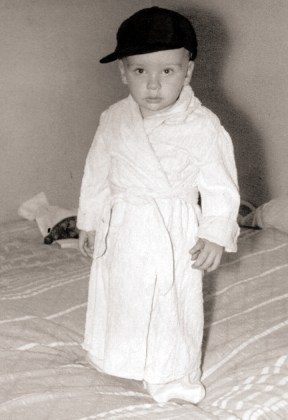
Richard Newburgh 1949 copyThis isn’t about nostalgia, however, but about how a small boy experiences life. As an adult, one has a well of experience to draw on, a series of related moments forming a net, so that each new occurrence has some resonance with its past. But as a child, each thing is new and as yet unconnected to the rest. There are things taken as given: family, the house, the yard; later, the school, the way to the grandparents house. All these things ultimately mesh together, but those early memories are discrete; it is only as I pull them together while trying to doze off, that they begin cohere.

In those first years, the world was largely circumscribed by the house and yard, with the rooms, the mystery of the understair closet, with its odor of dust and uncovered lathe, the cavern of the cellar, the apple tree in the back yard from which Nana made a yearly batch of applesauce, and the vacant lot next door, which was our cow prairie or our moonscape, depending on what we were playing that day. Or, for that matter, our jungle when we took our shirts off and “went native.”

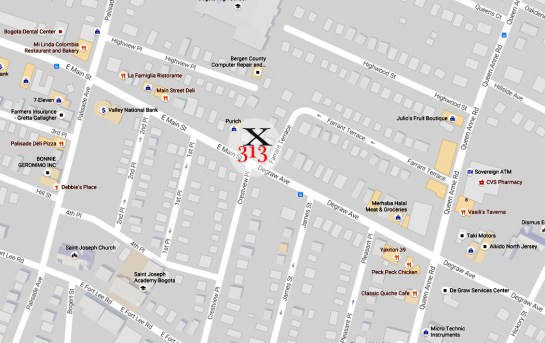
Beginning with kindergarten, the world opened up. I walked the mile to school each day and the mile back, and the streets became tentacles of geography on which I built my picture of the world. Each street was a different reality. To give a summary picture of that geography: Degraw Avenue ran basically east-west; the few blocks on which our house sat was a plateau; down the west side, into Bogota and Hackensack, the road went downhill; and in the east, from Queen Anne Road on, it went downhill the other way toward the Meadowlands, Overpeck Creek and Fort Lee. That was the spine of my earth. Crossing it, almost like shoulders and hips, were Queen Anne Road and Palisade Avenue.
Home territory map

Our house was on the corner of Degraw Avenue and Farrant Terrace, which was the street that ran along the side of our house, took a 90-degree turn and continued down to Queen Anne Road as a kind of anastomosis, leading the same place as Degraw Avenue. My best friend, Tommy, lived in a house where Farrant Terrace bent. The Clems lived in the house next door to us; they were an older couple who treated us like an aunt and uncle. Their back porch had jalousie windows, a fact that much fascinated both me and my little brother.

The other arteries in this circulation all came off this main armature. It is difficult to express just how central this picture of the world was to one in the process of piecing together a whole self. At that age, I knew nothing of Nebraska or Timbuktu; it was the spine of my streets that were the core, the seed on which the crystal grew. From those first certain streets grew an internal sense of how the entire globe might be pulled together in a single flash of connectedness.
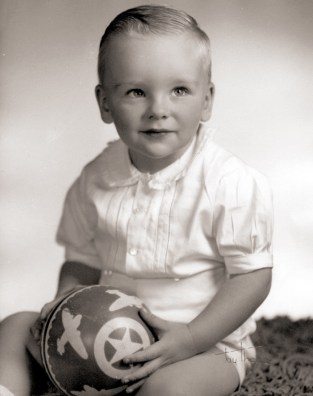
Ricky 20 mos copyOut the front door of our house and across the street was Crestview Place, which ran uphill steeply to Fourth Place in Bogota, where Nana’s mother-in-law, Aase, lived, upstairs in a house where her sister lived downstairs — Tante Marie. The two were very old, very wrinkled and very powdered. When I was still pre-school, Aase lived with her ancient husband Thorvald, who wore thick black wool suits with a vest and a pocket watch, had wire-brush whiskers and the distinctive smell of old man. He died early on in my life and Aase — whom we called “Bestemor (Norwegian for “grandma”) — lived on into her nineties. I spent many a day at Bestemor’s house, climbing into the attic to play with the toys she still had from the childhood of my mother’s brother, painted lead cars and airplanes.

Down the hill to Palisade Avenue is where my father had his hair cut by a barber named Dick, who wore a white coat and had one of those pencil mustaches one knows from Hollywood movies of the 1930s. It also led to Olsen Flooring Company, where my father worked as office manager and accountant.

Down the other way, to Queen Anne Road, led to the A&P, the delicatessen where we bought potato salad, and across the street from the deli, the bakery where we bought “mudballs” — a round, chocolate covered cupcake that we loved as kids.

At the point Farrant Terrace ended at Queen Anne Road was a tiny private grocery store whose floor was covered in sawdust — a common occurrence back then, now frowned upon by health codes — and a stationery we called the “candy store,” where I spent my nickels on Three Musketeers bars, Necco Wafers, and a particular favorite, a packet of five sweet jellies called Chuckles, whose flavors were cherry, orange, lime, lemon and licorice.

Chuckles Candies

By the time my mind wandered around to the candy, I would probably be asleep. But if not, if I still couldn’t drop off, I will wander around that circumscribed world as I did when I was in kindergarten and first grade. I walked to school every day and home afterwards, doubling that inner map of the world. A friendly policeman stopped traffic on Queen Anne Road to let me cross the street. I recall Mrs. Winters and my kindergarten class, the naps we took, the milk containers we drank from, the rhythm bands, the finger painting. I remember the playground around Longfellow School (now closed and turned into a church) and my Aunt Sally who was the school nurse, and little Willie Shydecker, whose fifth birthday party I went to in a house just two away from where Aunt Sally and Uncle Bernie lived. I sometimes wonder what ever happened to Willie.
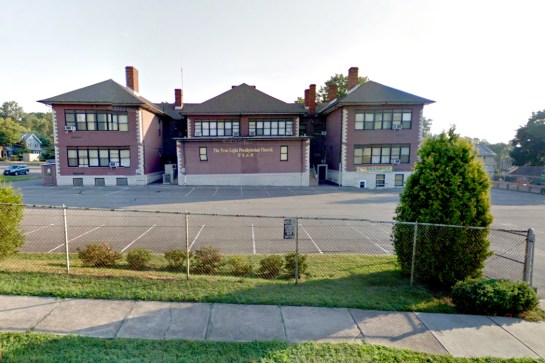
former longfellow school streetview 1

Longfellow School today

But it was walking home from school that left its biggest mark on my being. I wandered. I didn’t always take the same route. I took what I called “short cuts.” These led me miles out of my way, exploring where other streets might lead. If I have traveled much as an adult, it was only a habit set in motion when I wandered down Fort Lee Road, past Amman Park with its small fountain, and up the hill and back down to Bogota and the broad mainline railroad tracks — at that time six tracks wide; now most of the tracks are ripped up and gone — which I would stand over on the bridge and watch the trains pass, shaking the ground. The boy is father to the man.

My wanderings amazed my parents, who thought it odd that I would walk so far out of my way, but they never seemed to think it might be dangerous for me to do so. I think they were quietly proud of their boy for being able to find his way around so easily. They also showed me off to the adult world for my prodigy ability to name all the cars on the street by make from the time I was two or three. One Fourth of July at a fireworks display over the Hackensack River I was carried around by my father on his shoulders who showed me off to uncles and grandfathers by pointing at cars parked in the lot and having me name them: “Pontiac, Studebaker, Packard, Rambler, De Soto, Kaiser, Crosley …”

1949 Frazer sedan

1949 Frazer

Other times, he would test me, sitting on the front porch of the house and I named the cars as they passed on Degraw Avenue. From that time on, tests at school were never frightening; rather, they were a chance to show off again.

The odd thing remains that these memories of Teaneck seem to have a different reality from later memories, almost as if they were of a different person. I can draw a straight line from me at 68 back to me in fourth grade, me in college, me during my first marriage, me when I became a writer. But there is a kind of memory lacuna between that me and the me of these earliest thoughts. It is as if I have to dig down into the layers of soil separating me now from me then, like an archeologist, to discover this fragment or that, and then piecing together the shards into a full pot.
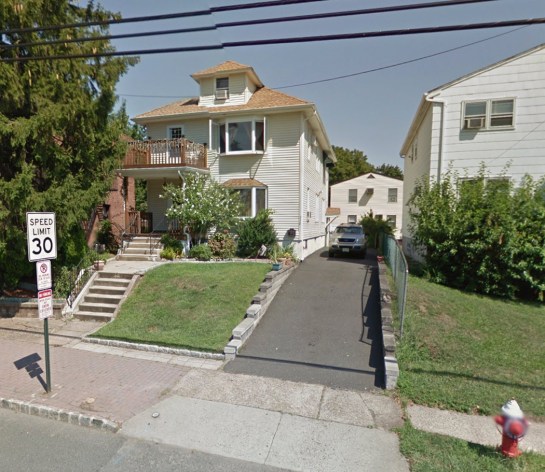
313 De Graw now

313 Degraw Avenue today

We all have a story-line in our memories, that continuous ego, that who-ness that we are. It is a novel told straight through. But these earliest memories are more of a collage, the bits and pieces reassembled in no particular order, the scents, the memory of being picked up and held, the doors swinging open to the kitchen, the golem in the basement. They are a preface to the story, oddly unconnected, yet, still of a piece. Tributaries to the river.

The box still has many pieces unrecollected here. I can take them out and play with them again next time a churning brain keeps me awake.

Maelstrom

“The center cannot hold.”

This is a common saying these days from political commentators on TV or in op-ed pages. The assumption is that there is such a thing as the political center. It is an assumption that needs to be challenged.

We tend to lionize the political center, as if it were the place where sanity is found, battered on left and right by zealots and ideologues. But, in fact, there is no codified political theory that can be tagged with the label. It is, in fact, the bin for dumping the leftovers.

Those who hold genuine political thought fall down the steep slopes of the bell curve on both sides, toward conservatism and reaction on one side, and toward socialism on the other. Marx vs. Ayn Rand. Both sides hold their opinions with passionate intensity. What we call the middle is really just the no-man’s land between them where they battle it out, and with no clear victor, they fall, exhausted, between the two poles, and we have a stalemate. That is what we call the center.

In practice, this has actually worked out quite well for the rest of us, who are not card-carrying members of either side. It is as if two out-of-phase sine waves have cancelled each other out, and we live in relative peace. Politics, when done right, is the clash of interests, where no one interest prevails all the time, and compromises are reached to keep each side, not happy exactly, yet equally miffed, but just under the boiling point.

“The trick from my angle is to make my play strong enough to tie you up, but not make you mad enough to bump me off against your better judgment.”

This, then, is the center, where most of us, unafflicted by theoretical strait-jackets, try to live our lives spending the least possible time on policy and government. Government is something up with which we must put. To paraphrase Willie Loman, “Taxes must be paid.”

This doesn’t mean we don’t recognize the importance of social order, or a ruling forum that functions efficiently and cleanly, but more important than making rules about who gets to use which bathroom, are such things as the welfare of our children, our careers, the availability of food, and whether the Cubbies will ever again win the World Series. That a well-run government is necessary for some of those things is acknowledged, but just how much energy we put into politics is the issue. In ancient Athens, you were judged in part by whether or not you were politically aware and active. But for most of us in middle-class America, being politically active is rather more a badge of how misguided you are, how obsessed, how geeky.

We have, since 1789, run on the well-oiled principle that if we let the two sides fight it out, we can comfortably nestle in the hammock left in between them. There have been a few times, like the years from 1861 to 1865, when the center did not hold and the country erupted. We came close again in 1968, as those of us who lived through it remember. The pressure has been building up again. Both political parties found their basic premises threatened this election cycle. Republicans have discovered that the dissension, obstructionism and bigotry they have sowed for the purpose of maintaining power in Congress has come back to bite them. What they hold as true conservative values are shredded by the buzz words and palaver of Donald Trump, who seemingly holds no values whatsoever, outside of Donald Trump. Democrats found that a socialist roused a significant sector of their membership, driving their conventional candidate further to the left and away from the coveted “middle.”

That middle has become a vacuum as the polar sides pull apart and we suffer the pain.

The central problem is that, because the middle is not a platform, not a policy, not an ideology, it cannot clearly enunciate its principles, outside of a basic, “Don’t go nuts.” The Right and Left have manifestoes and position papers, arguing with faultless logic the rightness of their causes — albeit within the confines of the definitions they use and the axioms they leave unexamined. We in the middle have only a defensive “please go away” and “leave us in peace.”

Once in a while, however, we are called upon to slough off our natural passivity and take a stand. In the 1960s, we had to decide whether segregation was morally defensible, as a hundred years before, we had to pick a side on slavery. When we didn’t step in, as with the Know-Nothings of the 1840s, or the McCarthy era in the 1950s, the country went off the rails and the looneys took over. We face something of the same now, with Donald Trump, whose unfinished sentences pile cliche on cliche, Ossa on Pelion, and we are buried under a mountain of verbal garbage, un-thought-through, indefensible, and outright dangerous.

My great friend, the late Dimitri Drobatschewsky, grew up in pre-war Berlin. His family was forced to flee the Nazis, and his father eventually died at Auschwitz. He remembers as an adolescent hearing Adolf Hitler speaking live. “Everything he said was a banal platitude,” Dimitri recalled. “It was meaningless cliche piled on meaningless cliche. But he was such a persuasive and hypnotic speaker that I found myself, a Jew in Germany, that it was all I could do to keep my arm from raising in the Nazi salute.” Dimitri eventually left Germany for France, and after the fall of that country, joined the Free French forces under De Gaulle.

But Dimitri reminded me that Hitler didn’t usually come right out and say specific things. He let his minions do that. Hitler spoke of vague ideas, such as “Germany for the Germans,” and “Make Germany great again,” which are hardly controversial on the surface, but underneath was an unspoken agenda, heard by his followers as clear as a gong. One after another the meaningless platitudes piled up until an entire nation found themselves committing atrocities their grandchildren are still ashamed of.

One doesn’t want to pull out the Nazi trump card too easily. One gets tired of calling any opponent a “Hitler.” It too often trivializes the insult. But there is the parallel, too easily overlooked, especially by his followers. If we don’t want to discover in four or five years that we were “good Germans,” we had better decide now that even if we are not enthusiastic about the choice we have to make in November, we had better not give in to apathy, we had better make the effort to go to the polls, else we could wind up somewhere very dark, very violent, very shameful.

The New York Times runs a feature in its book section called “By the Book,” where famous authors are asked a set of questions. The Times will never get around to me, so I decided I needed to ask myself these standard questions.

Gulag 2

Question: What books are currently on your nightstand?

Aleksandr_Solzhenitsyn_1974Answer: I am about 70 pages into the second volume of Alexander Solzhenitsyn’s Gulag Archipelago. There are three volumes; I fear my nightstand may collapse. Not only for the weight of the books — they are real doorstops — but for the sagging heaviness of its content. For some reason, I have an unquenchable thirst for validation of my pessimism, for a dim view of humankind’s inhumanity to humankind, and likewise a depressing recognition of the tiny flame of idealism that refuses to be extinguished. I wish I could get rid of it. It always breaks my heart.

Q: That’s fine for your nightstand, but what book are you currently reading?

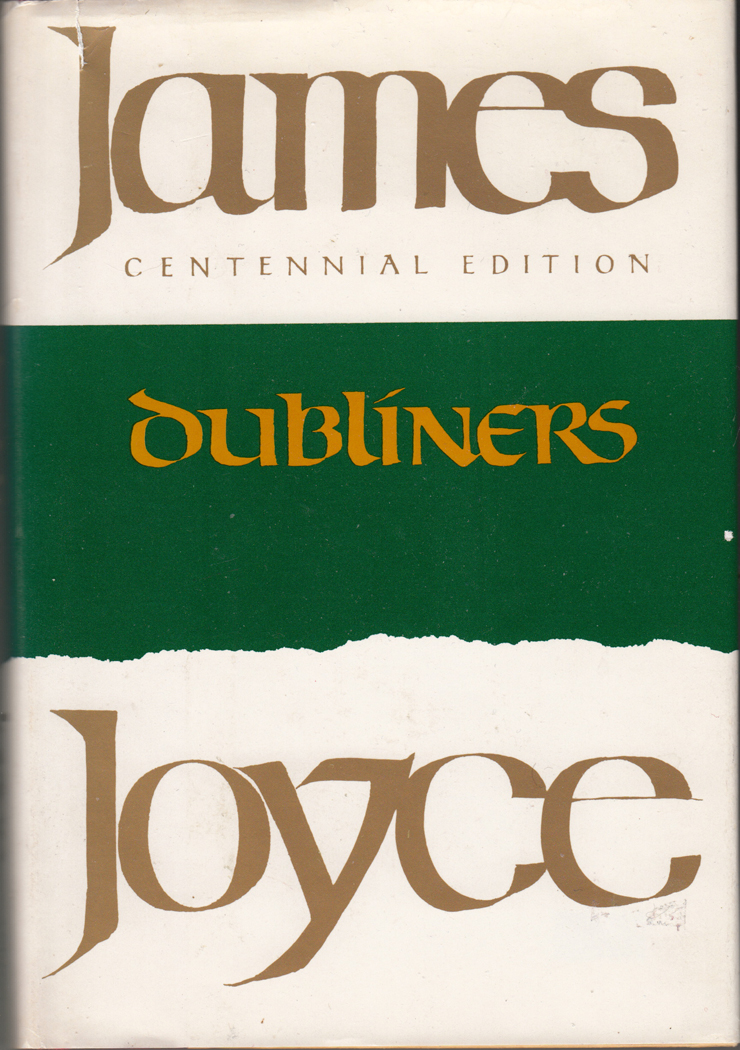
DublinersCaught me. Yes, I’m 70 pages in to Vol. 2 of the Solzhenitsyn, but it was so depressing, I needed to take a short break. So, I am now finishing up James Joyce’s Dubliners. Turns out it’s nearly as depressing. I’ll be getting back to the Russian as soon as I’m done with the Irishman.

Q: What was the last great book you read?

A: That’s a tough question to answer, because you have to decide where to set the bar. Does the Solzhenitsyn count, even though I’m not finished? Before that, Timothy Snyder’s Bloodlands. But that is for content, not for style (nothing wrong with his prose, but that’s not the reason for picking up that depressing book). Ted Hughes’ Tales from Ovid is one of the best translations I have ever read. I just finished rereading it (again). I read all three of John Updike’s Bech books and reread Saul Bellow’s Herzog, which I first read in high school when it first came out. But if you mean really great, like Moby Dick or Proust, then I will up the ante, if you want great, the greatest book I have ever read is Homer’s Iliad. How can it be that the first book in our culture is also the greatest? I reread it once a year.

Q: What book did you hate reading as a child?

A: Hands down: I was required in 8th grade to read Oliver Twist. I hated it. I hated, hated, hated it. The teacher had picked out a book she thought each student would most enjoy and I got saddled with Dickens. I don’t know what she saw in me that thought I would enjoy reading a Victorian novel, but it has ruined me for life, not just for Dickens, who I still cannot bear, but for all Victorian literature. The fault is not in the books, but in myself. I grant that. But I feel like I’m chewing an old mattress when I try once more.

Q: Disappointed, overrated, just not good: What book did you feel you were supposed to like but didn’t? Do you remember the last book you put down without finishing?

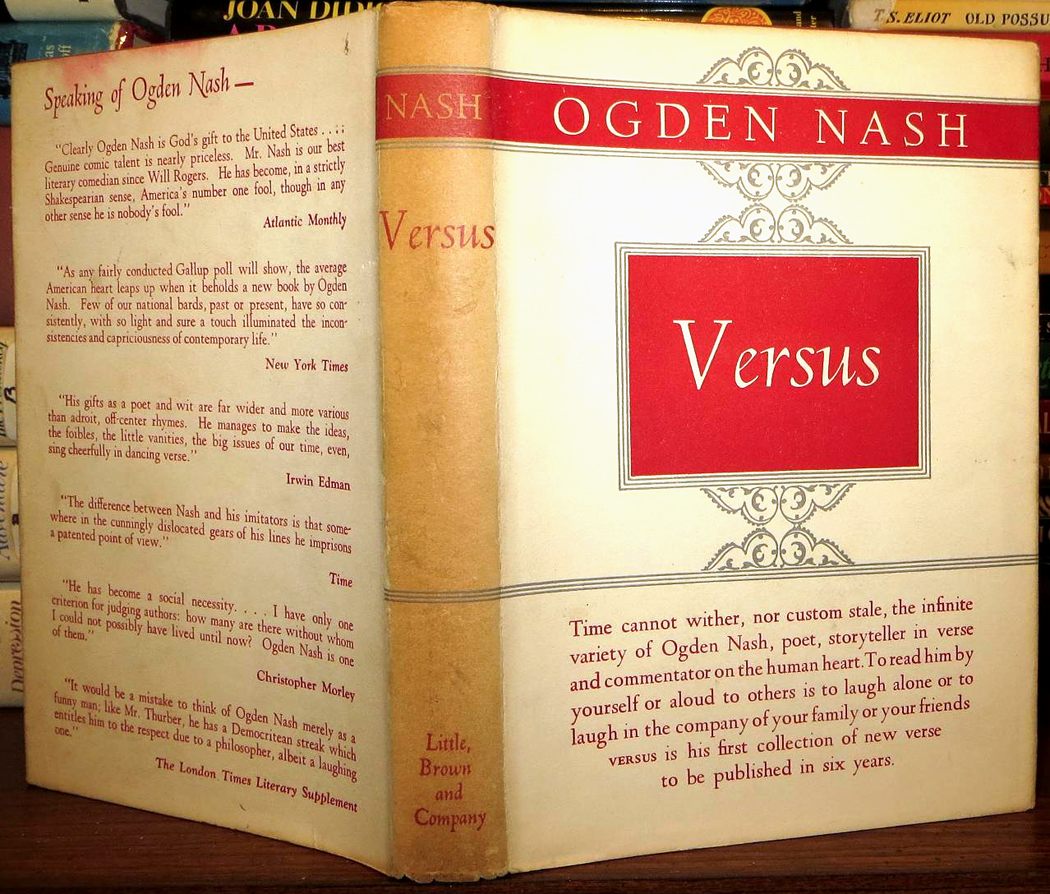
ogden nashA: We are all inclined to favor certain styles and epochs and to fail to appreciate others. I have never been able to stand Virgil’s Aeneid. It feels completely stiff and academic to me, too literary, too contrived, artificial. I have tried to read many different translations, hoping to find one I could stomach, but so far … no. As for not finishing, I came across a used set of the complete works of Ogden Nash. I so looked forward to wallowing in his wit. Lightweight, yes, but clever. At least, so I thought. Turns out, all the great bits he wrote are already anthologized to death and the stuff that you don’t already know — it turns out there’s a reason you don’t know it. Pedestrian, dull, dated, trying too hard, puerile, or contorted beyond enjoyment. I couldn’t finish it. I’ll keep to the good verses I already know.

Q: What do you read for fun?

brian lambA: My wife makes fun of me by calling me “the man who can’t have fun.” She means I’m always in some serious book of history, or the classics. She means that on weekends, I watch C-Span. (There are some very few beings in this world whose utter humanity and service to humankind recommends them for sainthood and among them I place the Dalai Lama, David Attenborough and Brian Lamb). My wife wants me to go see some popular movie or wear a funny hat for a costume party, and I just cannot get any pleasure from such things. I dread state fairs and Renaissance festivals. Shoot me if you ever see me at a karaoke bar. But that doesn’t mean I don’t have fun. It’s just that my definition of fun is different from hers. I get the greatest pleasure from listening to Bach or Schoenberg, reading John Milton, viewing films by Tarkovsky and rereading Ovid one more time. I can’t help it. I’m not pretending, or trying to make myself sound more brainy; these are the things I genuinely enjoy. I do them for pleasure. Utter pleasure.

Q: All the time? Really?

A: Well, my wife and I share an enjoyment watching British detective series on TV. American cop shows are too violent for our tastes, and the crimes are always by serial killers, drug kingpins or terrorists. The British series tend to focus on the more mundane crimes we are all more likely to encounter in life, crimes of jealousy, greed, anger. And the British series  often bypass the actual murder, joining the story as the body is found. We love them all, from the wimpiest to the grittiest. Unfortunately, between the two of us, we have defused too many of these mysteries by discovering the most successful trick in fingering the guilty party, and it has nothing to do with clues. It is a metalogic method: Just look for what we call “the unnecessary character,” the supererogatory person in the story — an extra sister not otherwise needed, a solicitor outside the main story, an ex-boyfriend or a retired cop, dragged into the story for reasons not otherwise clear. The unnecessary person rarely fails us.

Q: But this is about books. Do you read mysteries, too?

Bruno CremerA: Sort of. I’m addicted to Maigret books. Whenever I have to decompress from reading more about genocide in Eastern Europe, I pop open another Maigret. But properly speaking, they aren’t mysteries. We often know who the culprit is early in the book. Instead, they are novels about crime, and Georges Simenon fills the pages with vivid characters, drawn in three dimensions. There is little of the piling up of clues and gathering people together at the end to ferret out the killer. Instead, the same books could probably have been written without the crime at all, as perhaps love stories or travel books. I love Simenon as a writer. By the way, we have the DVDs of all the Bruno Cremer Maigret episodes and the British version with Michael Gambon. Watched them all multiple times.

Q: What books give you the most pleasure in the reading?

A: And the re-reading. There are a handful of books I can read over and over and always give me pleasure, not so much in the storytelling — since I already know how it comes out — but in the words. The words, words, words. Certain writers just make my mouth water with the words they use, the metaphorical and playful use they make of them. If I were to make a list of, say, the top five books that give me utter, ecstatic pleasure, they would be: 1. Tristram Shandy; 2. The Decline and Fall of the Roman Empire; 3. Paradise Lost; 4. Joyce’s Ulysses; and 5. The Iliad. I cannot get enough of all of them. Oh, and I have to add Chaucer; can’t leave him off. And Moby Dick. Jeez, I love that book. I cannot limit it to five. How could I leave off Ovid’s Metamorphoses?

Q: What books most influenced you as a writer?

Herman MelvilleA: So many people were influenced by Hemingway. I was not. Instead, I loved the long, baroque sentences and richly figurative language of Herman Melville and Henry David Thoreau, image piled on image with a profuse fertility, leaving me, as a reader, feeling like I was being pulled one way and then another by breakers at the beach. Oddly, I often read secondary works before moving on to the main course. I read all of Melville’s short stories, including Benito Cereno and Billy Budd, before I ever finished Moby Dick. Perhaps because I loved the opening chapter of Moby Dick so much, every time I put the book down and picked it up again, I started from the beginning. I must have read “Loomings” a hundred times before finally moving on to the rest. The other great influence was Henry Miller, not for the obscenity, but for the torrent of words, the forward motion of the narration in such books as Plexus, Tropic of Capricorn and Big Sur and the Oranges of Hieronymus Bosch. I’ve since left Miller behind, but he was a great ignition flame.

Q: Which writers writing today — novelists, poets, playwrights, journalists, critics — do you admire most?

A: I am not being disingenuous when I say my favorite living poet is my wife, Carole Steele, whose book, Rust Sings, is full of life and great lines. And I always open my New Yorker to its final pages looking for Anthony Lane.

Q:  What author, living or dead, would you most like to meet, and what would you like to know?

Laurence_Sterne_by_Sir_Joshua_ReynoldsA: First, it would have to be an author in English. I can’t speak ancient Greek. There are some that come to mind, but I’m not sure I really want to know them: Nabokov is too waspish; Faulkner too inebriated; Gibbon too erudite. I go through a list and realize most authors I would rather read than meet. But there is one I would love to spend a lazy afternoon with, talking and making jokes and maybe commiserating a bit — Laurence Sterne. We could share a beer easily. What would I want to know? Not a thing; let’s just talk.

Q: What is your favorite word?

A: We’ve made a pivot (Bernard) in this Q&A, haven’t we. What’s the loveliest word in the English language, officer? In the sound it makes in the mouth? In the shape it makes in the page? Not “elbow,” not for me, though it is a fine word. No, I like “smudge,” or perhaps “caliper,” which on the page has both an ascender and a descender, which makes it a good word to compare typefaces with. Really, I can’t pick one word. How does a mother choose among her children? Not possible.

Q: What is your favorite curse word?

A: I rarely curse, which makes it more effective when I do.

Q: If a movie were to be made from your life, who should play you?

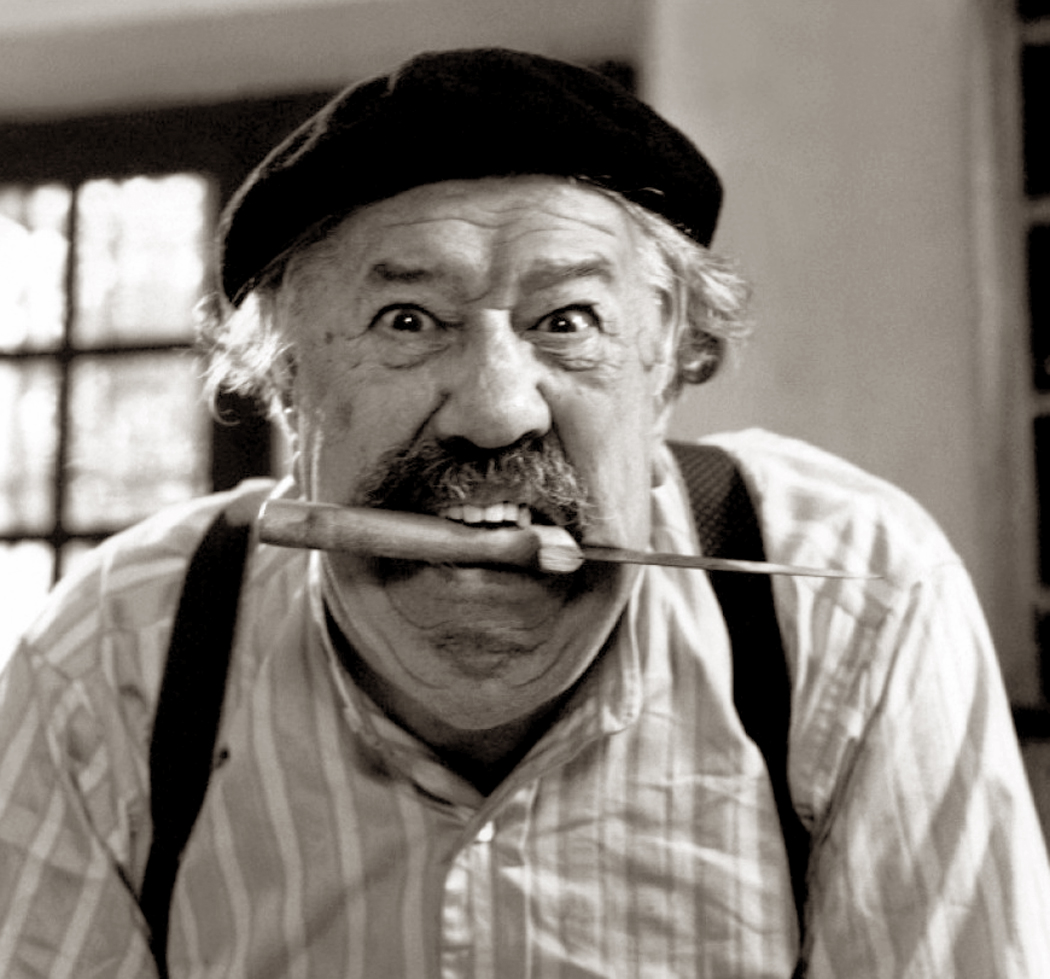
michel simon 1A: Ideally, Jean Gabin, but more realistically, Michel Simon.

Q: What sound or noise do you love?

The squall of thousands of Canada geese in a pond and flying overhead. A noise most people find excruciating, but in me, it brings forth the swelling of my chest and the tears one sheds faced with ultimate beauty.

Q: If Heaven exists, what would you like to hear God say when you arrive at the Pearly Gates?

A: “Don’t unpack, we’re sending you back for another round.”

purple rose 2

Most people, when they go to the movies, go to see aliens blow up the world, or they go to see the lovers win out over odds, or to see the superheroes beat out the supervillains.

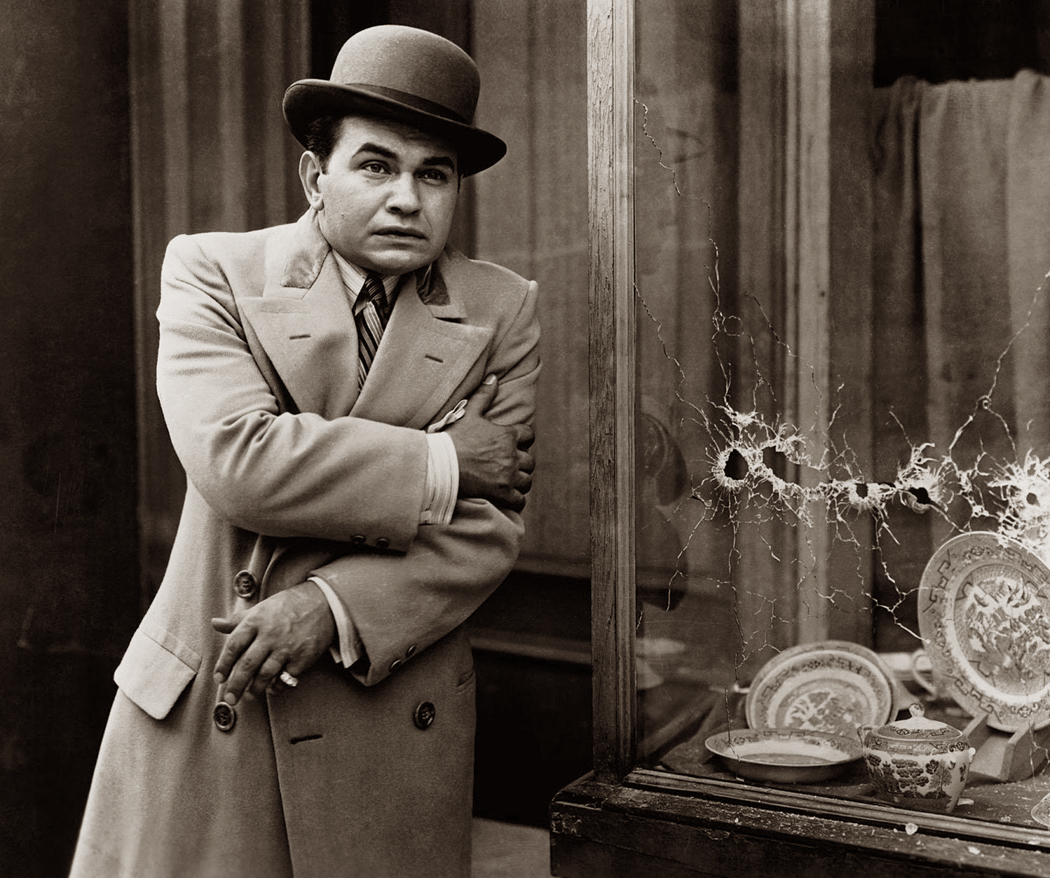
end of ricoThat is not much different from why they went to see the movies 80 years ago, except then they might have gone to see the chorus girl become a star, Fred and Ginger glide over the dance floor, or the end of Rico.

In other words, the initial satisfaction of moviegoing is the story, setting up characters and then seeing what happens next. And next after that. We think of them as having happy endings, but such endings are not necessary; some movies end in tragedy.

One is reminded of director Sam Fuller, when asked “what makes a good movie?”

sam fuller“A story,” he said.

“And what makes a good story?”

“A story!”

There is, however, another level of satisfaction that comes from watching a film, and that is an awareness of how the film is made. Not everyone understands the process by which the story is told, and not everyone cares. If a story is well-told, it is enough that the story is appreciated.

But there is a separate class of film buff who are moment-by-moment aware of how the pieces of film are put together to tell that story. They are aware of the lighting, the editing, the camera angles, the camera movement, the point of view — and are aware of how all these things are used to manipulate the story and the emotions of the filmgoer. An entire critical apparatus is brought to bear on a film, and especially if it is a film made by a director known to be innovative or astute at using these elements of film. For these people, watching a film is always a dual-track affair, as if they were reading a book in translation, seeing not only the story, but how it has been constructed at the same time.stagecoach

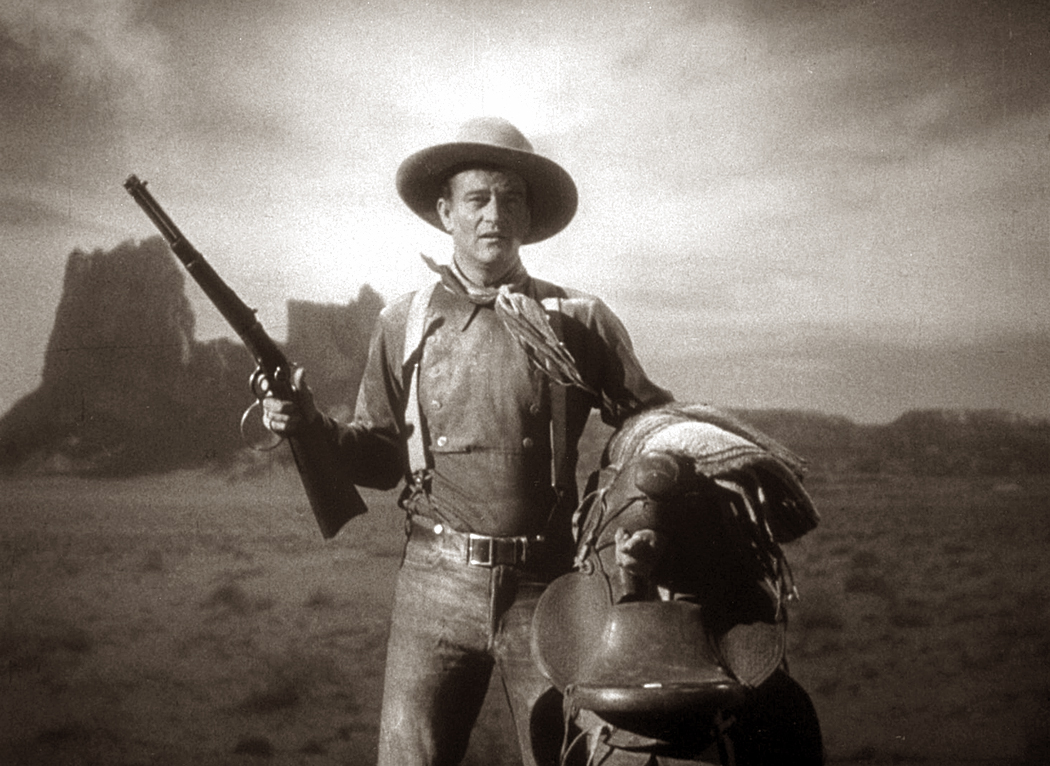
One can look at the studio films of Hollywood’s golden age and dissect them and notice how well made they are, and one can catalog the special habits of some of the better movie directors of the time — William Wellman’s overlapping dialog, Hitchcock’s time distortion, John Ford’s landscapes — and, indeed, whole books have been written (to say nothing about doctoral dissertations, and worse: books made from doctoral dissertations) about what makes Woody Van Dyke different from Gregory La Cava, but this is film-school subculture grist. The people who paid their pennies and dimes to watch those films in the grand movie palaces of the 1930s seldom considered the problems of reverse shots in editing dialog. They just wanted to know what happens next.

citizen kane low angleNowadays, one can hardly turn over a stone and not find someone spotting the use of camera angle in Citizen Kane or yanking our lapels to point out the amazing tracking shot that begins A Touch of Evil.

There is a subset of this sensibility that brings to bear the whole history of cinema — especially genre film — when viewing a film. I call this the Tarantino effect; it is that if we want to truly appreciate what is going on in, say, Kill Bill, one needs to know who Sonny Chiba is, what are the differences between Hong Kong martial arts films and those made in mainland China, and what is more, individual scenes from individual movies that are quoted or referenced in Tarantino’s opus.sonny chiba

This is the foundation of the current bumper crop of superhero movies, too. Fans know the backstory of each character, and the full weight of the “Marvel universe,” or the “DC universe.” The fact that all comic-book superhero movies are basically the same hardly matters if fans argue minutia of the worlds inhabited by these cliches.

The problem with all this is that it becomes a form of in-joke, or worse, a shibboleth separating those who “get it,” from those who don’t. And in this eddy of thought, the references become the subject of the film and the plot becomes incidental. One of the results is that it fosters cliche, with a wink and a nod, and negates original ideas, or at least glibly assumes that original thought is no longer possible. In this it buys into the Postmodern mentality, wherein it is held everything worth saying has been said, and now our job is just to rearrange the game pieces in clever ways. This conveniently forgets the fact that it has always been hard to be original, even for Raphael or Goya.

So, in our film culture now we have two strata of movie appreciation. There are still those who go the movie theater to enjoy a good story, but there is another class that blogs endlessly about the subtext, meta-theory and the film-school techniques of their favorite movies.

However there is a third level to be considered when assessing a film.  If most films don’t aspire to more than story and technique, in the greatest films both story and technique are just tools for for a further end: Expressing something real about life. These are films made by people who have something important to say, something to tell us. They are films that investigate our humanity.

Stories alone can be entertaining, and the meta-view can be engrossing to those whose minds are attuned to “what’s really happening underneath,” but when I make a list of the best movies ever made, it is neither of these levels I care about. Or rather, I assume them as given. No, what I look for is whether the movies have something to say about human existence, that I can weigh against my experience and decide if it is true or not, whether it has something to say about the experience of being alive.

battle of algiers

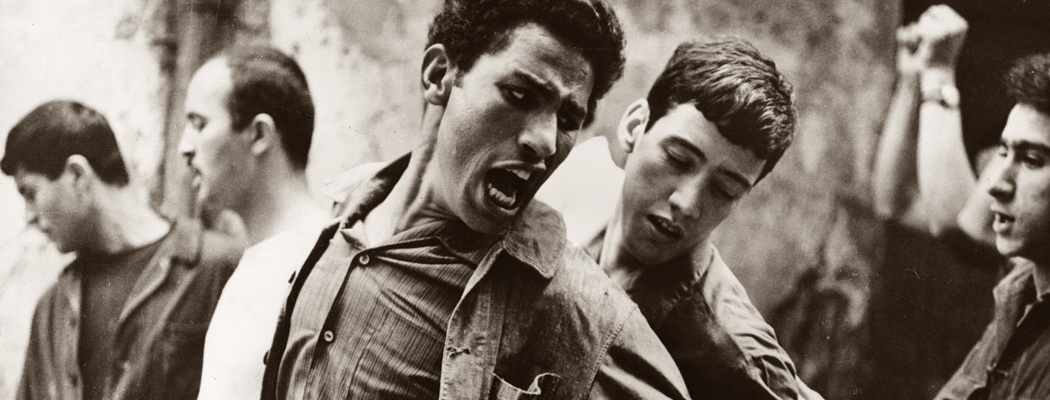
That is why my Top 10 list does not feature The Dark Knight or Star Trek II: The Wrath of Khan. Such films may be diverting, but they don’t say much about the real world. Instead, my list contains films such as Rules of the Game, The Battle of Algiers, and La Dolce Vita. I learn more about love and sex from My Night at Maud’s than from all the Wedding Crashers and Knocked Ups combined. It is this third dimension that is missing from most popular movies. Content to be clever or scary or thrilling, they forget to be human.

Such films put me in touch with the deepest well of my being, remind me that such depth is shared by all of humanity, and that all our lives are complex and what is most important to us is not our jobs or our automobiles, but the emotional connection we have with the earth. One leaves such films profoundly moved and deeply shaken.

uma pulp fiction

Pulp Fiction, to take one example, is certainly a cleverly told story, beautifully written and just scrambled enough to keep us attentive. Yet, unlike Tarantino’s more recent films, it has a third dimension. In Pulp Fiction, death has human meaning and aftermath. There are consequences. When Mia overdoses and Vincent rushes her to Lance’s house for an antidote, her immanent death is something felt by the audience and when Marvin is blown away in the back seat of the car, there is blood everywhere. Yes, it’s a joke, but it’s also very real. In Pulp Fiction, each of the characters is a believable human being. Compare those episodes with the fight scene in Kill Bill where a comic-book Uma Thurman slices and dices her way through “The Crazy 88.” Nowhere is anyone mourning the death of a father or brother. They are tin ducks in a shooting gallery.

Most truly great films have these three dimensions. I don’t want to denigrate a good story, and surely a badly made film won’t move us, no matter how profound the content. But of these three levels, the only one that can elevate a film to classic status is its humanity. Stories and film technique create patterns we recognize and respond to, but what we really need from patterns is more than mere recognition; what we need is meaning.

Of course, it isn’t only in film we need meaning, but in all of art. And so, we search paintings or poetry not just for pretty pictures or clever rhymes, but for what answers that need in us to understand, to find or create meaning.

cassattNone of this is to deny you the pleasure you may get from Captain America or from paintings of pretty flowers. There’s room for that, too. Such things are fine on days when your ambition is cooling out, but the real satisfactions of art come when you are challenged by something more substantive, where you find your life reflected back at you, and you are forced to confront moral dilemmas, the inevitability of death and loss, the complexities of ideas, and the ultimate interconnectedness of all life on the planet. More ambition is good.

So, when we look to justify art in a world increasingly dominated by technology and STEM disciplines on one hand, and an increasing reaction into superstition and tribalism on the other (nativism, fundamentalism, bigotry and its retinue), it is important to make a case for looking inward with a piercing eye to find what is there, at the bottom of the human well.

wall panels

Two of the most common complaints I heard at art galleries were: “My kid could do that,” and “It’s the emperor’s new clothes.”

As far as the first, I suspect the kid could do that, although the parent could not. Kids’ art is amazing. As for the second, it implies that the artist is somehow hoodwinking the public, setting out to create something to “fool the rubes.”

But in my 25 years of being an art critic and seeing hundreds, probably thousands of shows, I have to say I cannot remember a single example of an artist deliberately scamming the public. On the contrary, no matter how godawful the art, how silly the conceit, how pretentious the content, every single one of them was utterly sincere.

The issue has been raised by my former esteemed colleague, Kerry Lengel, on his Facebook page: “What percentage of Modern art was created for the sole purpose of making rubes like me scratch their heads and go, ‘Whuh …?’ ” Included is the above photo of a four-panel Minimalist artwork. He seems to have addressed this question specifically to me.

My initial response to his percentage question was “13.7 percent.” But that was merely facetious. He suggested 40 percent. But my real answer is closer to zero.

This is not to exonerate all the really bad art that hangs on gallery and museum walls, but to claim that the miserableness is not by intent. Remember the rule of thumb: 90 percent of everything is crap. (Others calculate that at 99 percent, but I’m not here to quibble).

Nor am I going to argue that many arts professionals aren’t gargling jargon and hiding behind graduate degrees and claiming to have arcane knowledge the ordinary art goer is not privy to. Any profession has its shibboleths. I have complained many times about the ridiculous text that curators post beside the art on the wall, claiming all kinds of political and philosophical content in otherwise simple imagery. Such content may or may not be there, but if it isn’t communicated by the art itself, what good is having an explanation next to it?

The academic and intellectual world has been infected for the past 30 or 40 years with “theory,” and it has deracinated a good deal of the art, both by explaining away the work, or by substituting theory for actual experience. There is much to be learned from deconstruction or semiotics, but it cannot replace just looking at the art itself. All theory is an attempt to replace living experience with dry words. Language is a way to tame the effusive and prolific chaos of human experience. It is a map instead of a voyage.

(I thank goodness that we seem to be leaving the constipated orbit of post-structuralism. I could never understand why we should take seriously any theory that by its own tenets is meaningless. It has been one of the least helpful things the French have ever given us.)

Let’s take a look at the four wall panels above. First, they aren’t just any colors, but specifically the primary colors of the additive color system, that is, the colors in your TV and computer screen. The blue isn’t any blue, but the almost purple blue, the red is a tomato red. If you look closely at the colors and try to ingest them the way you might a salami sandwich, roll them around on your eyes the way you might roll that deli meat on your tongue, you can simply enjoy their intensity. They are a pleasure to look at.

But they may also make you consider the difference between the mediated world of digital experience and the sensuous world that you float in daily. The artist could have chosen the printer’s subtractive primary colors (the colors of the printed page), cyan, yellow, magenta and black (abbreviated to CYMK, where the K stands for black).

wall panels cmyk

So, they are not just any colors. You bring to the art your knowledge of the color choices you use daily on your iMac, the same way you bring your knowledge of biblical mythology to the paintings of Titian, or your knowledge of the French demimonde to Impressionists.

Further, the rectangular shape of the canvases (or panels, I can’t tell from the photo) is the shape of the pixels on your TV or computer screen. If you look with a magnifying glass at the screen you can see them lined up in register. These four panels seem to be about something, not merely four panels of random colors.

What you make of all this is up to you, but you should not simply dismiss the art. I don’t want to make to great a claim for this specific piece of art, but the artist clearly had something in mind.

What we are asked to do by any piece of art is to take it seriously. We may ultimately decide it belongs with the 90 percent that deserves to be flushed away, but we haven’t earned the judgment unless we first allow ourselves to assume its sincerity (even when it is clearly an ironic comment). It’s the art world equivalent of “innocent until proven guilty.” Admittedly, it can sometimes be a short trial, but it shouldn’t be a lynching.

It should also be noted that there is a difference between liking a piece of art and appreciating it. We all have tastes and sometimes we like vanilla and don’t like asparagus. But we can recognize that some people love the vegetable. Liking is not a judgment, it is an expression of personal taste. There are many works of art I recognize as important and distinguished but that I have no taste for. I have a personal animus toward all Victorian literature. Can’t stand the stuff. But just because I was put off Dickens by being forced to read Oliver Twist in eighth grade doesn’t mean I think Dickens is no damn good. I just don’t resonate to Victorian writing. I don’t enjoy Browning, either, or Hardy. Liking is merely personal; quality is something else.Holzer

Samuel Coleridge says somewhere in his Biographica Literaria that there is a difference between “gustibus” and “gusti.” De gustibus non est desputandum, he says is merely the personal liking and disliking of something, but taste, he says, is not like that. It can be cultivated and developed.

I remember recoiling at the rather glib statement by artist Jenny Holzer that “Money creates taste.” That should be, “Money creates fashion.” Taste is something else. Just ask Donald Trump.

Taste requires engagement. Spending time and effort. It is not a question of academic degrees, but willingness and openness; and an ability to forget the myriad conventional categories we have been ground down by. Art that is unfamiliar is usually art that is going somewhere beyond the norm, and invites us to go with it.stella-flowers-italy-1931-copy

So, if you don’t recognize value in the four panels of color on the wall, this should be a sign that you should stop and plan to spend an hour with it trying to figure out what the artist might be attempting that you cannot understand with the speed and alacrity you might get the punchline of a New Yorker cartoon. (See: https://richardnilsen.com/2014/07/10/how-to-look-at-a-painting/ )

Engagement — not in the Sartrean political sense, but in the sense of spending your time and attention — is the bottom line both in making art and in perceiving it. Let it absorb you as you absorb it. Seek the pleasure in the simplest things, such as the green; not just any green, but this very specific green. Taste it in your eye. For the time you stand in front of it, let the painting or sculpture, or installation, be everything in the world, a funnel into which you pour your whole life experience, and let it come back out in a torrent.

Obviously, you won’t get the big reward every time. Some art is thin gruel. But you should never just assume it is pabulum. It just may prove worth your time.

Waterlilies Brookgreen Garden, SC

Some years ago — never mind how long precisely — when I was still earning a crust as an art critic, I wrote a nasty review about a painter who had genuinely made me angry. This artist had some currency in the region, and a cadre of fans. I was not one of them.

Some years later, I discovered that the review I wrote had caused the artist to stop painting altogether for five years. When I was  asked if I felt bad about that, I always said, no, I felt I had performed a public service. There was a smugness in my flippancy which I now regret.

Because, now in my senescence, I have become somewhat gentler, and regret the tone of that review, although I cannot gainsay the content. (When I met the artist many years later, when she came to a lecture I was giving — after she had survived not only my review, her hiatus from work and a fight with cancer — she was surprisingly forgiving and said she did not hold the review against me. I don’t know why not.)

She has recovered from her cancer and from my review and recently mounted a new show. She still has her cadre. I wish her well. But I do want to explain my anger. It wasn’t simply the quality of her work, or its purported subject.

I didn’t get angry over her technique, which was rather sloppy — I’m sure her fans call it “spontaneous,” although I took her to task for it. And I didn’t get angry over her popularity. Certainly lots of popular artists are awful, sentimental, shallow — but there are also quite popular artists who are among the best. It’s hard to knock Van Gogh or Monet for being popular, although the general run of popular, in the demotic sense, tends to be in the Thomas Kinkade and LeRoy Neiman or P. Buckley Moss camps.

The sins of this painter I refer to — aside from painting poorly — was that she presented her work as “spiritual,” and surrounded it with all the cliche buzzwords that accompany such pretensions. The show was called “The Lotus as Metaphor,” and it purported to lead us on a spiritual journey.

There is a whole class of artist who gush spiritual, a quality less evidenced in the work, but more in the words they pack around their work. They claim a kind of spirituality and it is usually of the soft-focus kind that blurs all inconvenient edges. Often they pick up the conventional symbols and signs of a religious tradition and use them like bumper stickers. This is mistaking the Völkergedanken for the source.  Not so much spirituality as it is cultural tourism.lily-lotus comparison

The particular show that got my dander up was a series of paintings of “sacred lotus.” The first problem was, she had not painted lotus but waterlilies. Not the same plant, not the same cultural meaning.

It isn’t that I was being pedantic about botanical nomenclature, but that I have noticed over the years that those who wax ecstatic about the spiritual often have such an indifferent relationship with the real.

The lotus (genus Nelumbo) has a different growth pattern, leaf shape and flower — to say nothing of cultural meaning — than the more common water lily (Nymphaea). The painter’s plants were not clearly drawn, but they grew more like Nymphaea, have the heart-shaped leaves of Nymphaea and the flowers of Nymphaea.

This may seem like caviling, but I firmly believe that before you start jumping on the otherworldly bandwagon, you should learn something about this world. This retreat into “spirituality” evidences a certain medieval contempt for the world that is not earned. In fact, as any dedicated artist knows, looking closely at something, as when you draw it with total concentration, will lead you to the edge of mystical experience. (See: https://richardnilsen.com/2012/06/21/apple-of-my-eye/ ) Without the commitment to this world, you cannot break on through to the other side.

Rather than starting with the here and now and taking the path to eternity, the artist seemed content with the road map. She approached spirituality from the exterior, with not a hint of introspection. She started — and ended — with the public symbol — borrowed though it be from an alien public — instead of finding a fresh, direct and personal symbol that might express personal experience. Borrowed profundity isn’t profound. It is hearsay.

That kind of facile pontificating on “harmony with nature” and “celebrating the joyousness of life” is what I call “Mah-jong mysticism,” the kind that seems to satisfy bored middle-class housewives with too much time on their hands. Surely one should be suspicious of any warm and fuzzy mysticism that tells us only what we want to hear. And make no mistake, this sort of thing is usually quite self-congratulatory.

In fact, after seeing these paintings, I’m not convinced the artist has ever had a mystical experience more profound than the buzz from white wine at a gallery opening. The artist wore the word “spiritual” the way some coffeehouse poets used to wear berets.

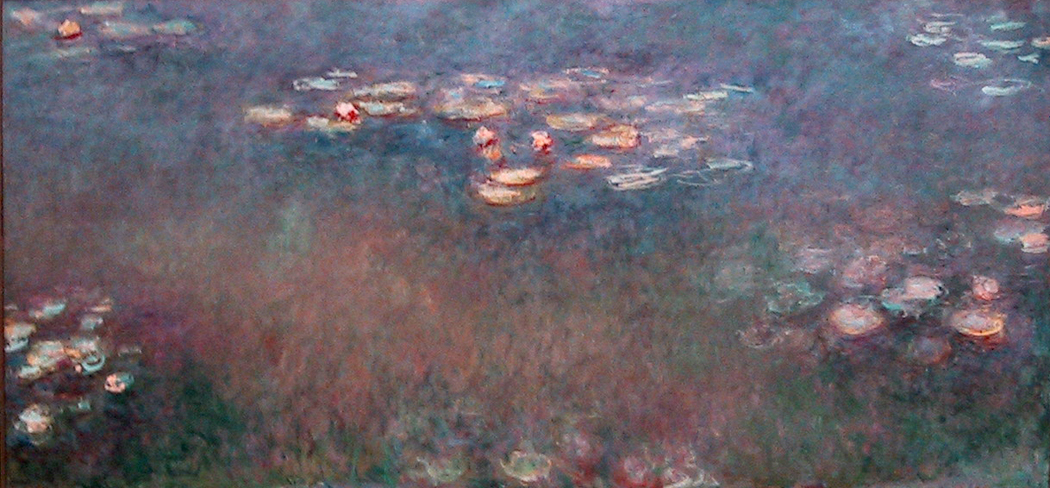
The paintings were like third- or fourth-generation color Xerox copies of Monet waterlilies, with all the subtlety of color and drawing sucked out. Indeed, my initial response was generated by the effrontery of copying Monet so blatantly and yet so ineptly.

It isn’t that waterlilies aren’t a perfectly good subject, but for many of these paintings, the painter adopted the same angle of view, the same distance from her subject and the same loose, scumbly brushwork that is so familiar from Monet. The debt was too obvious.

monet waterlilies st louis

monument valley 2It was as if she hadn’t looked at waterlilies at all, but looked at Monets instead. This is secondhand experience, like reading the Cliff Notes instead of the book. If she had looked at waterlilies intently and followed them down into the depths of her mind and heart, she might have painted something astonishing. That’s what Monet did. But imitating the look of Monet is no better than standing at the visitor center of Monument Valley and photographing the Mitten Buttes, thinking you have equaled Ansel Adams.

Her art mimicked the words and images that have conventional currency among those who bask in what is held to be spirituality. But those words and images have less to do with genuine spirituality than they have to do with conventionality. They are like gamepieces in a board game with all the rules known and understood, at least by the initiates. They are Tarot cards, ouija boards, seance knocks, and are at root just as fraudulent.

All this might well provoke a bad review in the local newspaper, but it might not, in any other critic, provoke anger. My reaction was not merely to the work on the gallery walls, but to an entire class of thought, a class that seems to me to be cheating. I felt cheated. Here the world is all around you, a vast forest of burning bush speaking “I am that I am,” and yet the artist does not see it, but rather gives us the names of metaphors other people have used to describe the ineffable. I have always called this “imitation art,” not just imitation of already existing art, but imitation of the origin and purpose of the genuine article. It is a variety of “play-pretend,” and avoids the real work of art to give us instead a pale simulacrum.

The deep roots of art is a profound love for the things of this world. Not ideas about things, but the things themselves. We live so much by habit and fail to notice what is about us. Not merely raindrops on roses and whiskers on kittens, not just birdsong and clouds, but the smell of hot tar on the road, the hurt of a stubbed toe, the layer of dust on the enamel gloss of a car hood. And not solely the physical manifestations of the world, but the inner workings as well, the emotions and sensations, the perceptions and the occasional borborygmus. That is, the entire world filtered through your sensibility. It is only when you are not aware of the world and the things of the world that you find existence so drab and monotonous that you need to invent a bogus “spirit” world to revitalize your life, to make it — and you — feel special.

hare krishnaThose who see “auras,” read horoscopes and feel the cold presence of “emanations,” seem precisely those who are incapable of finding the transcendent in fleas or sphagnum moss. Those who wear yellow robes in downtown Cleveland and chant “Om” are not actually connecting with the source, but with an imitation of it. The Edgar Cayce-ites, the crystal gazers, the astral-projectionists and clearers of engrams, seem not aware of or interested in the fact that the ordinary world given us is astonishing enough on its own. Nothing they have come up with matches the weirdness of an elephant or coconut or the shimmering skin of a squid.

I suspect any use of such buzz words as “energies,” “toxins” or “healing.” They are bogey-words, intended to invest their users with a sacerdotal shine. You can have Atlantis; I’ll take the Bronx. I can predict what  you will find in Atlantis — such things are defined by the conventions of the occult, and seldom vary much — but I could never predict what I might find on any house on any street in the Bronx, or in any city. The real world is too varied and multifarious and constantly challenges our expectations.

cezanne

So, I say, look at those apples and pears in the Cezanne painting, look at the roofs and olive trees in the Van Gogh, or hear the birdcalls transmogrified in Messiaen’s music, or regard the madeleine in Proust. Engage with the world, become engorged with it, swallow it whole, let it illuminate your inner life and become the passageway to transcendence. All of it, good and bad, joyful and hurtful, fulfilling and frustrating, pointed and aimless.

It is inexhaustible and inextinguishable.