ITR-PCL-00051429
If one takes the long view of history, recent events often turn out to be part of larger patterns, or “themes” of history. Nowadays, for instance, we can see World War II as the completion of World War I. And we can see World War I as the natural continuation — a flare up — of the same thing that caused the Thirty Years War of the 17th Century. These things can smolder for centuries, like a peat fire, and flare up when local events add oxygen.

It is important to understand the long view on history if you want to find a lasting solution to current problems. You don’t treat heart disease by prescribing an aspirin for chest pain.

I don’t want to make unrealistic claims for this. The local symptoms do need to be addressed and the current situation needs to be handled in a way that deals with the contemporary realities of the case.

But we will only make things worse if we act in a knee-jerk fashion with no understanding of the complexity of events.

The underlying mistrust between the European or Western world and the Islamic world can be traced back at least as far as the 11th Century, when Pope Urban II called for a crusade to wrest the Holy Land from the infidel.

It was the European version of a jihad or holy war. In calling for the war to “liberate” Jerusalem, the Pope declared, “It is the will of God.”

Over the next several centuries, European armies contended with “pagan” armies over the region, winning some and losing some. The horrors of that time, and the crimes of the crusaders are well recorded and nowadays would certainly be understood as war crimes, even terrorism.Ninth Crusade

When they first conquered Jerusalem in 1099, the crusaders slaughtered some 40,000 Muslims and Jews who lived in the city.

Yet, the Moslem defenders don’t get off the hook, either. They committed their own series of atrocities. It was a time that didn’t reflect well on the humanity of either side.

Each side was certain of its rectitude and each side knew that divinity was backing them against the unbelievers.

The contested borders of Christianity and Islam continued long after.

Indeed, the problems in the Balkans recapitulated the battles in Kosovo during the 14th and 15th centuries between the Muslim Turks and the Christian Serbs. acropolis mosque

The World Trade Center isn’t even the first well-known building to be destroyed by the enmity. In 1687, the Venetians were fighting the Ottoman Turks when they managed to blow up the Parthenon on the Acropolis in Athens. Before then the old temple had survived relatively intact for more than 2,000 years.

It is important to recognize that it isn’t merely a battle for territory, like many intra-European disagreements.

The two sides have fundamentally different world views.

Which means that in another sense, the roots of the current attack go back well before the Crusades and begin in the Persian Wars of the Aegean in the Fifth Century B.C.

It was during those conflicts between ancient Greece and Persia that the defining difference between East and West was first, and principally defined.

Up until then, wars were largely fought between sides claiming to be bigger and better than their foes. The biggest monkey kept the banana.

But the Greeks defined themselves against the Persians as an idea. The Greeks — and their historical progeny in Europe — have tended to think of themselves as free, as democratic and as rational and have seen their counterparts in the East as despotic, uncivilized slave societies.

We’re not claiming that this is literally true. There is barbarity and nobility to go around.

But the West has largely thought of itself in these terms, even when in fact it didn’t measure up. Persia is now Iran.

We still see this battle with terrorism as one of “freedom and democracy” against the blind superstition of unreasoning fanatics.

And when Vice President Joe Biden was still a senator, and chairman of the Senate Foreign Relations Committee, put it even more directly.

“This is not a struggle over ideology. This is not a struggle over religion. This is a struggle between civilization and barbarity.”

These are the very terms the Greeks used in describing their war with Darius and Xerxes.

I am not suggesting that the Islamic world is barbaric, but that we have set up the terms of the argument in this old language, learned from the Fifth Century B.C.

But there is this kernel of truth to the matter: The West has come largely to believe that the purpose of government is the well-ordered organization of society — a belief they hold even in its breach. Meanwhile, the East has seen government as settling the issue of “who’s in charge.”

For the West, the theoretical end of political desirability is “benevolent anarchy” — such as that called for by Libertarians and “shrunken-government” Republicans, while for the East, the same theoretical end is the “benevolent theocracy,” centralized rule that preserves societal order.

The two systems are at such fundamental loggerheads that we mistake the meaning of such words as “democracy” when uttered from across the cultural divide. They mean something different by the word.

It is this difference, cooked long and slow by history, that must be taken into account when we seek to solve global problems.

It is what worries me when I hear even university presidents declare the obsolescence of the humanities, and when I hear the appalling lack of historical knowledge held by American students — to say nothing of a political leadership that has no more historical memory than last week’s car bombing. Those who refuse to learn from history are condemned to repeat it.

And it is what worries me when I hear increasingly bludgeoned rhetoric from our lower-grade politicians — “the windiest militant trash” — looking for quick and easy revenge.

They are missing the point. I am reminded of the lines by W.H. Auden:

I and the public know/ What all schoolchildren learn,/ Those to whom evil is done/ Do evil in return.”


TS Eliot
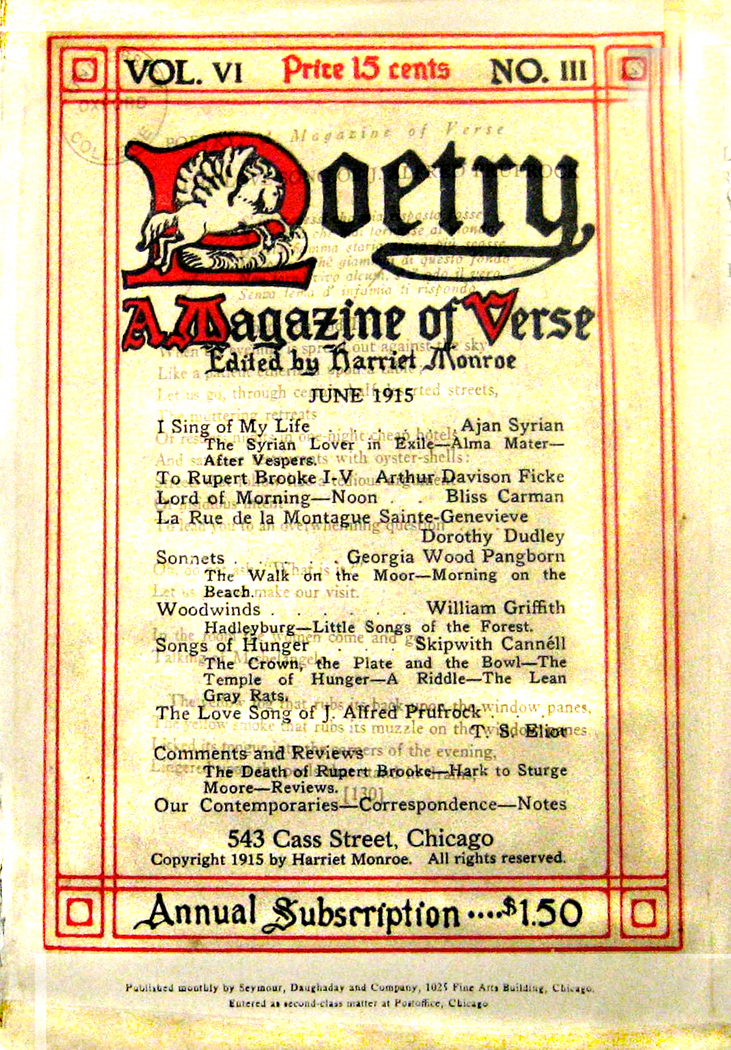
This year is the centennial of the publication of T.S. Eliot’s “Love Song of J. Alfred Prufrock.” And the long view is that Eliot was the greatest, most influential poet of the 20th century, at least, in the English language.poetry june 1915 2

But oddly, he seems to have written only seven poems.

Along with “Prufrock” and “The Wasteland,” there are the “Four Quartets” and “The Hollow Men” — the last surely one of his weakest poems, whose popularity appeals to the shallow cynicism of pimpled adolescence. Beyond that — and not counting the ubiquity of the “Old Pussum” poems, for which the posthumous Eliot must be sorely embarrassed — the rest of his oeuvre is something read by graduate students. How many, after all, have actually read “Ash Wednesday” or the Choruses from “The Rock?”

It isn’t that these poems aren’t good, or aren’t worth studying or reading, but they haven’t stuck with us, while everyone can quote or misquote, “not with a bang but a whimper” and “April is the cruelest month.”

This isn’t to denigrate Eliot or his importance. I love reading through “Burnt Norton” over and over, or “The Dry Salvages.” But rather to illustrate a common point of art and culture.

After all, we hold William Wordsworth up to be one of English literature’s most exulted poets, maybe the greatest since Milton, yet, beyond the “Intimations Ode” and “Tintern Abbey,” and a few sonnets and Lucy poems, and maybe some notable passages from the interminable “Prelude,” how much of the vast output of that poet ever gets read outside of class?

I have a special place in my heart for Coleridge. I read and reread with intense pleasure a handful of his poems. “This Lime Tree Bower My Prison,” “Kubla Khan,” “Frost at Midnight,” “Tale of the Ancient Mariner” — but beyond that, how much of his work comes off as fustian.

Even Shakespeare, who wrote some 40 plays, is known to most of us through the “Romeo and Juliet” and “Macbeth” we studied in high school, and the “Hamlet,” “Lear,” or “Henry IV, Part I” we read in college. And perhaps there was that “Twelfth Night” put on by the college drama department. The bulk of his output languisheth in obscurity.

It’s not just in poetry. How many of us have read Melville’s “White Jacket” or “Israel Potter?” Or Thoreau’s “Week on the Concord and Merrimac?” Vitruvian Man

And not just in literature. Leonardo drew and painted many things, but the “Mona Lisa” and the Vitruvian Man outweigh all the ladies in Ermine or Madonnas of the rock.

Beethoven has his Fifth Symphony and his “Ode to Joy.” Warhol has his soup cans and his Marilyns. Even Springsteen has his “Born to Run” and “Born in the USA.”

The life and work of almost everyone gets boiled down to a few most characteristic and often the few best works. The rest, like the Latin poems of John Milton, are left to specialists.

In the preface to his “Collected Poems,” Wystan Auden makes this point with some clarity and poignancy.

The work of every author falls into four classes, he wrote. In the first is “pure rubbish,” which he regrets ever having conceived. (Although, I would say from experience, he doesn’t always recognize this at the time). auden

Second, Auden says, are the good ideas that come to naught through incompetence or impatience.

Third, are “those pieces he has nothing against except their lack of importance: these must inevitably form the bulk of any collection.”

This is the journeyman work, competent, even pleasing, and certainly better than lesser talents could accomplish, but still, it is the “filler” portion of a life’s work.

Finally, there are “those poems for which he is honestly grateful,” which, if he were to limit his publication to these alone, “his volume would be too depressingly slim.”

And, I would add, an impoverishment to doctoral students everywhere.

There are higher and lower batting averages among artists and writers, but, even the best hitters fail seven out of 10 tries. It is humbling.

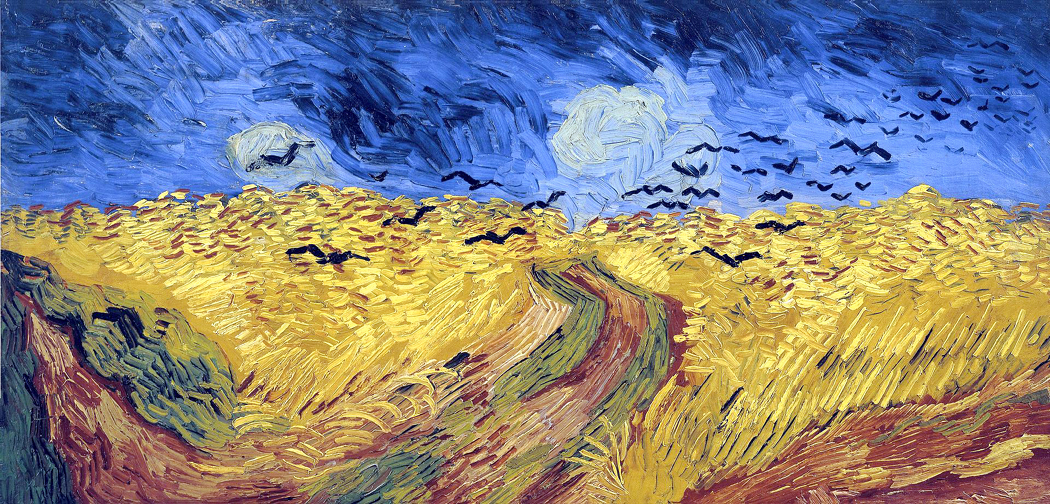
More to the point, it isn’t just the author who feels gratitude for the home runs of his or her production, but we readers, listeners, seers and participants. We are those who feel our inner lives buoyed by the “Intimations Ode” or Chaucer’s prologue, or Van Gogh’s wheatfields.van gogh wheatfield

house
The Seine  river loops northwest out of Paris into the rich, green French countryside of Normandy. The river is contained by low parallel ridges of hills on either side that form a kind of geologic sluice guiding the flow of the river toward Le Havre  and the ocean.

Some 50  miles from Paris, near the provincial town of Vernon,  the River Epte joins the Seine, although to call the Epte a river is to exaggerate.

It is hardly more than a creek.

Nothing would make one notice this tiny riverine junction, if it were not that Claude Monet chose this area to live, to paint, and to create one of the most celebrated gardens in the world.path

The great Impressionist painter moved to the hamlet of Giverny (Zhee-vair-nee) in 1883, and from then until his death in 1926,  he cultivated the kind of garden that made his home a modern Eden. Even now it is as much pilgrimage destination as tourist attraction.giverny village street

“Once settled, I hope to produce masterpieces,” Monet wrote his dealer when he first came to Giverny, “because I like the countryside very much.”

Monet settled on a two-acre parcel of land that sloped from the center of the village down toward the small branch of the Epte that runs parallel to the road. There he set up house with his second wife, Alice Hoschedé, and their combined brood. It was a bustling bourgeois home, full of bustles and lace, children and cakes.flower 1

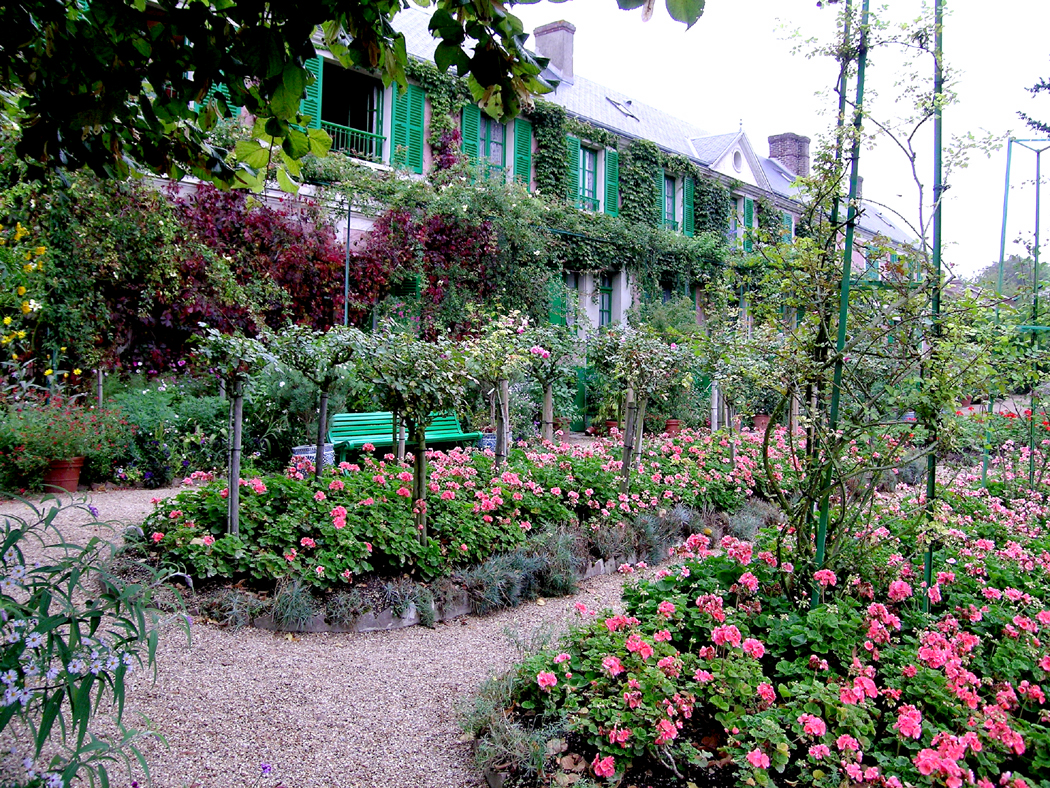
The house still exists: an odd old farmhouse, it is only one room wide and long as a barn, made of pink stucco, with forest green shutters and doors.

Each room is painted in its special color – the kitchen is blue and the dining room is brilliant yellow. Monet had little use for beige.clos normande from window

Outside is the “clos Normand,”  or the Norman enclosure, where Monet immediately began planting his garden, “so that there would be flowers to paint on rainy days,” he wrote.

But the garden took over. By the time he set to work on the great waterlily paintings that he gave to the nation as a gift, he had six gardeners on his staff.flower 2

Thousands each year make the pilgrimage to Giverny. They want to see where Monet worked; they want to see the waterlilies that he made into icons of art. But the gardens still retain their independence: There are those who visit not because of the painter, but because of the flowers themselves.

Monet’s property has become one of the greatest gardens in the world.

In the summer, the place is crowded, but in the spring and fall, the tourists fade away and you can have the grounds to yourself, or nearly so.flowers against wall

One would think that in the middle of October, when the rains are already cold on your skin, the flowers would have died away, but it is not true.

Even then, the clos Normand is riot with the yellows of sunflowers, the reds of dahlias, the blues of asters and the pinks of cosmos. The garden paths are choked with flowers.clos normande

It was an effect that Monet sought: that weedy nature should take over the place, luxuriant in growth.

The formal French garden, as you find it in Versailles or the Tuileries, is orderly and tamed. Square and round plots, with a grid of garden path between. Every flower marches in rank and file, as if their gardeners were drill sergeants.clutter

In distinction, the English garden gives us a different vision of nature.

There, the meandering forest paths take us past informally planted shrubbery and flower beds, to provide the illusion that we are not in a garden at all, but rather walking through some especially lush bit of wildness.flower 3

Monet’s garden is a hybrid of these: The paths are rectilinear and formal, but the plants have taken over, spreading out over the footways, up into the air and intertwined with each other. There is a formal layout, but a rich chaos of growth defeating the formality. It creates the illusion of a patch of garden left untended so the flowers grow rampant.

The effect is still overpowering. Instead of looking down at patches of roses or dahlia, they instead grow up to nose-height, so they force their aroma into your nostrils. They rise to eye level as you walk the paths.

They hang overhead and dangle down at you.greenhouse

One cannot help but recall the stanza by Andrew Marvell:

“What wondrous life is this I lead!

Ripe apples drop about my head;

The luscious clusters of the vine

Upon my mouth do crush their wine;

The nectarine and curious peach

Into my hands themselves do reach;

Stumbling on melons as I pass,

Insnared  with flowers, I fall on grass.”flower 4

The present gardens are a miracle. After Monet’s death, his family dispersed and eventually left the old homestead to ruin. The gardens fell untended, the house sprung leaks.

As the great art critic John Rewald  wrote, “Rodents – as undernourished as the local inhabitants (at the end of World War II) – had gnawed away the roots of the plants in and around the pond. The waters had stopped flowing – it was a dried-out, devastated, heartbreaking site. Nothing was left but the memory of past glories and the paintings of Monet, of which quite a few were still in the house and others in the studios, where some of the skylights were broken.”house 2

The artist’s son, Michel,  hadn’t lived there for decades and showed little interest in keeping the place up. When he died, in 1966,  he bequeathed both estate and paintings to the French Academy of Fine Arts.  The grounds were slowly restored and the gardens replanted, taking as their guides the many paintings and photographs that had documented the place.flower 5

And in 1980,  the gardens were opened to the public, nearly 100 years after Monet first started planting bulbs.

Modern visitors find a large parking lot south of the gardens, within easy walking distance. The entrance to the garden takes them first through the large studio Monet had built to paint his large waterlilies in. It is now also the gift shop. Through that and into the clos Normand, you get your first view of the long shotgun house, covered in vines and flowers.red flowers

The clos is gridded with pathways, skied-in with trellises and arches and splattered with the petal-dots of color.bridge 2

As Monet himself wrote of them, “The overall effect is endlessly varied.

Not just from one season to the next, but from one minute to the next, for rather than making up the whole spectacle, the flowers are only the accompaniment to it.”waterlilies

In the water garden across the road, he noted, “the heart of everything is the reflecting mirror of the water, whose appearance fluctuates endlessly according as it catches the teeming life and movement of the every-changing sky. A passing cloud, a freshening breeze, a squall that looms then strikes, the gale that comes without warning, the light that fades then intensifies anew – all these things transform the color and texture.”Bingo

“How could such sweet and wholesome hours/Be reckoned but with herbs and flowers?”

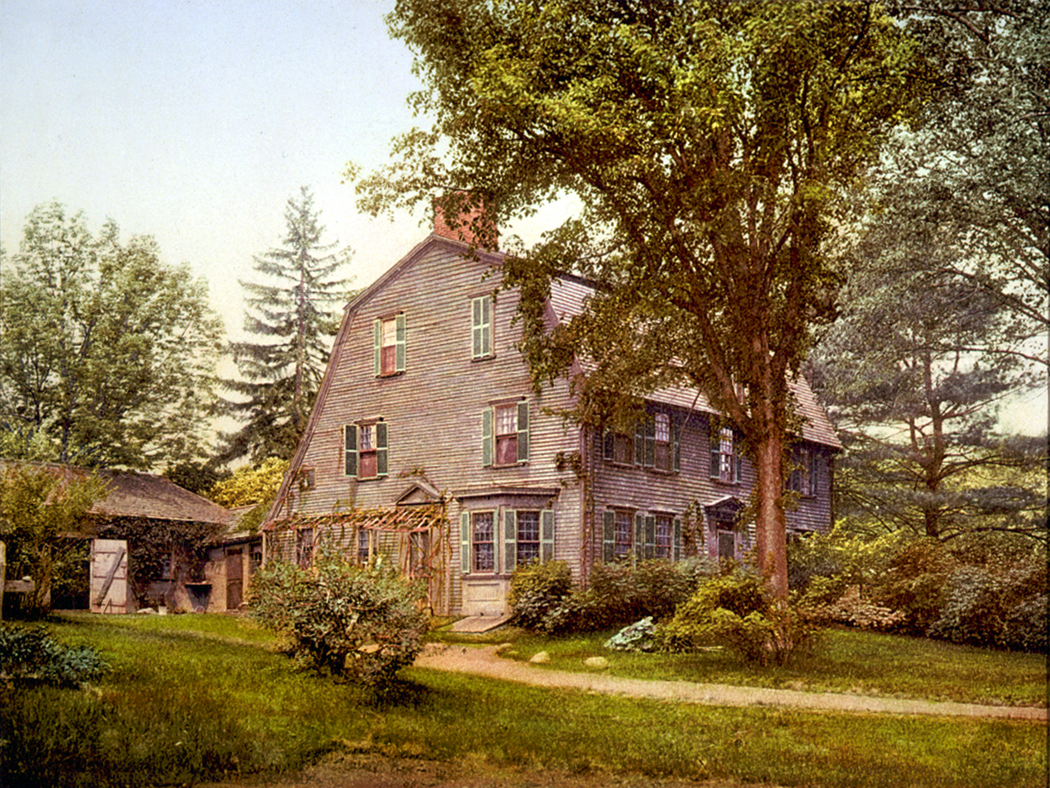
old manse with wallThe Old Manse is one of the most extraordinary houses in America. It saw the birth of two revolutions and was lived in by a string of some of the most exceptional Americans every to grace a town noted for exceptional people.
rw emerson

Concord is that town, a small, suburban Massachussets community, only 15 miles west of Boston. There is a grassy town square with its monument, a hillside cemetery, a single street lined with shops and several venerable old churches with  white, pointy steeples.

Concord was also, for a time in the center of the last century, the intellectual center of the young nation. Among its residents were writers, preachers, lecturers, editors and abolitionists. Some of their names are still current: Ralph Waldo Emerson, Henry David Thoreau, Louisa May Alcott, Daniel Chester French — sometimes it seems you have to have three names to live in Concord — and Nathaniel Hawthorne, who broke the three-name rule. Others were once as eminent, but are now remembered mostly by scholars and readers of history books: Amos Bronson Alcott, William Ellery Channing the younger, and Ezra Ripley among them.old manse 1930s

The Manse sits on a wooded rise on Monument Street north of the town center. It is a two story wood frame, gambrel center-entrance twin chimney Colonial house, now with gable windows in the roof and most of its paint gone, leaving a gray, old weathered building in the arbor of trees and vines. It is notable for its many tiny rooms, unusual for an eminent house of that time.old north bridge from manse

Its back yard slopes off toward the Concord River and the Old North Bridge, where American Minutemen fought British regulars on April 19, 1775 and “fired the shot heard round the world.”

That was the first revolution the house presided over.

Mary Moody Emerson, who was an infant at the time, used to say that she, too was “in arms” that day, because she was held up by her mother to the second-floor window of the Old Manse to witness the battle.

Her father, Reverend William Emerson, built the Manse in 1770.

“It was all mother’s fault that the Manse was cut up into so many small rooms,” she later wrote. “My father built it just according to her ideas and she used to say, ‘she was tired of great barns of rooms’ so he had all the rooms little boxes to please her.”ezra ripley silhouette

When William Emerson died in 1776, from disease contracted at Fort Ticonderoga, his widow tried to carry on by herself, but then, in 1780, she married the formidable Reverend Ezra Ripley. He preached up a thunder for 63 years as minister of Concord.

Ripley’s step-grandson, Ralph Waldo Emerson, remembered him this way: “Dr. Ripley prays for rain with great explicitness on Sunday, and on Monday the showers fell. When I spoke of the speed with which his prayers were answered, the good man looked modest.”

And when he died, he was laid out “Majestic and noble,” recalled Ralph’s older sister, Ellen.

“Waldo, taken to see him, walked round and round the couch and at last asked, ‘Why don’t they keep him for a statue?’ ”

Mary Moody Emerson became an eccentric, herself. She was witty, bright and well-read and was Ralph Waldo’s favorite aunt. “For years,” he wrote, “she had her bed made in the form of a coffin. … She made up her shroud, and death still refusing to come, and she thinking it a pity to let it die idle, wore it as a night-gown, or a day-gown, nay, went out to ride in it, on horseback, in her mountain roads, until it was worn out. Then she had another made up. …. I believe she wore out a great many.”old manse dining room

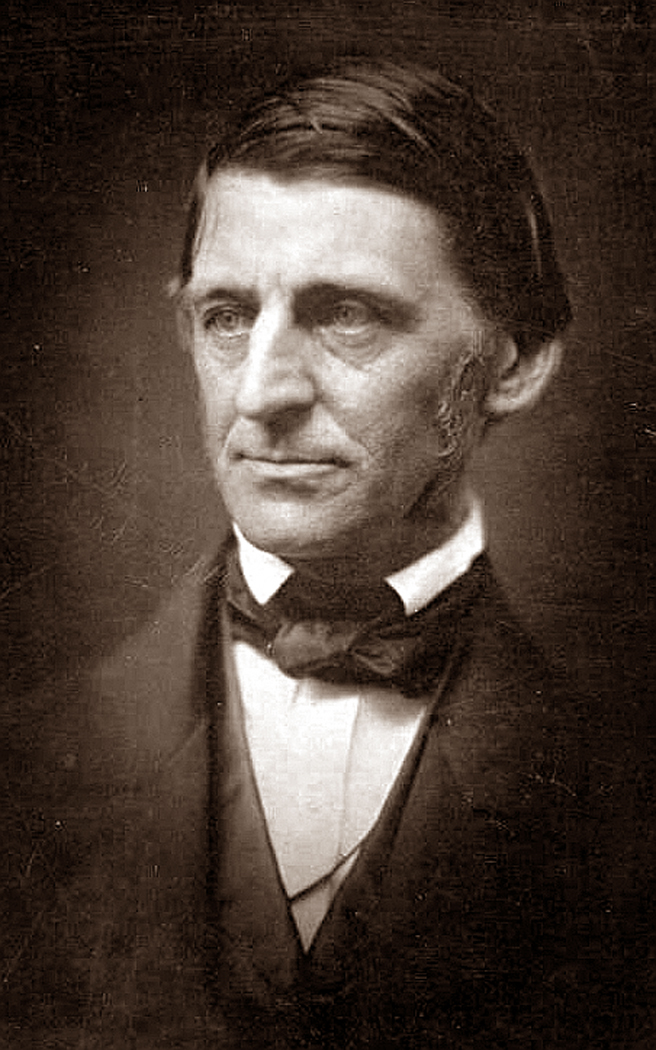
Ralph Waldo only lived at the Manse for a single year, but it was for him and important year. It was at the Manse that he wrote his first, and most influential essay, “Nature,” which spelled out the tenets of Transcendentalism.

That was the second revolution. It altered the intellectual direction of the country and was the first genuinely American philosophical venture. Its effects can still be seen in American culture, from the photographs of Ansel Adams to the American national park system.sophia peabody 2

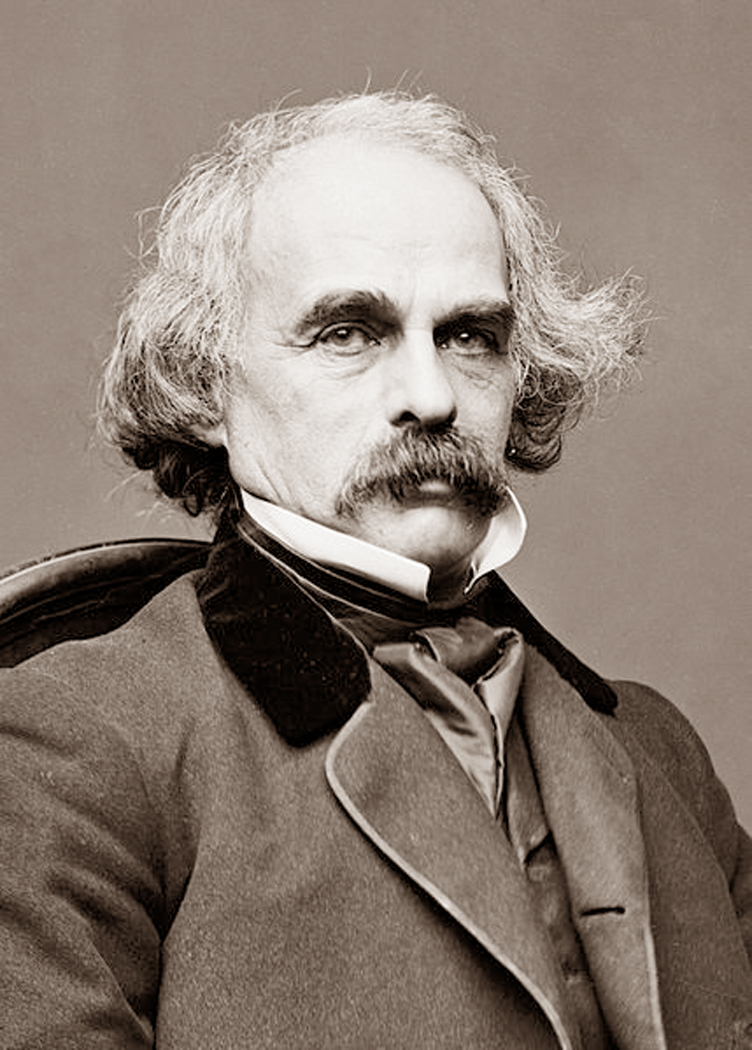
In July 1842, Nathaniel Hawthorne and his bride, Sophia Peabody (that’s “So-FYE-uh PEEB-iddy”), became tenants at the Old Manse. They stayed three years “in Eden,” he wrote.

He wrote many of his best known short stories in the Old Manse and also the introductory essay for the volume of stories known as Mosses from an Old Manse.

Ralph Waldo, recently married and removed to his own house, had suggested the Old Manse to Hawthorne. Henry Thoreau became Hawthorne’s gardener. The couple was transcendently happy.nathaniel hawthorne

“We seem to have been translated to the other state of being, without having passed through death,” he wrote.

The house had always before reflected the dour Puritan esthetic of its builder, but the young couple redecorated it, brightening it up and modernizing.

“It required some energy of imagination to conceive the idea of transforming this musty edifice, where the good old minister had been writing sleepy sermons for more than a half-century, into a comfortable modern residence,” he wrote. By the aid of cheerful paint and (wall)paper, a gladsome carpet, pictures and engravings, new furniture, bijouterie and a daily supply of flowers, it has become one of the prettiest and pleasantest rooms in the whole world.”

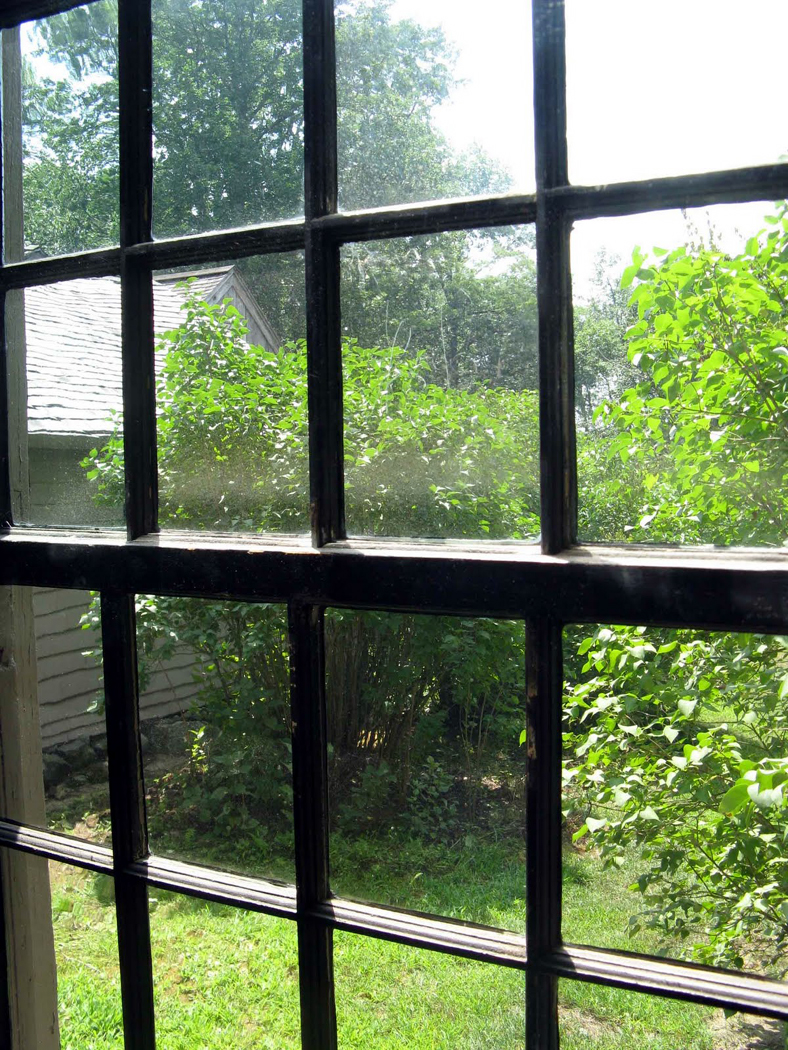
In the north window of the upstairs study, Hawthorne and his wife scribed sweet nothings into the glass.old manse window

“Man’s accidents are God’s purposes. Sophia A. Hawthorne, 1843.”

“Nathaniel Hawthorne. This is his study, 1843.”

“The smallest twig leans clear against the sky.”

“Composed by my wife and written with her diamond.”

“Inscribed by my husband at sunset, April 3, 1843. On the gold light. S.A.H.”

The scratchings are still there to be seen. We think them immeasurably romantic. Their landlord looked at it something more like vandalism and they were asked to move out.sarah ripley

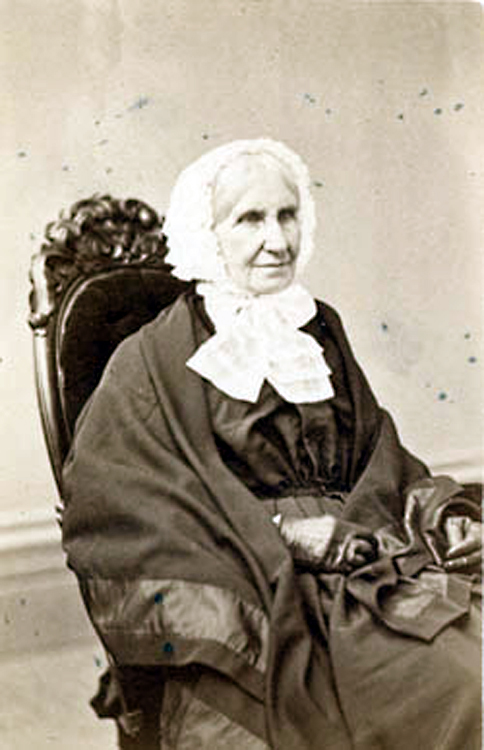
Samuel Ripley and his wife, Sarah, then moved in.

Sarah was perhaps the brightest light ever to live in the Old Manse. She was exceptional in any age, and a miracle in her own.

With only a year and a half of formal schooling, Sarah went on to teach herself botony, calculus, Greek, Latin, and most modern European languages. When she was in her 60s, she took up Sanskrit.

She apologized to one visitor that she still needed a Sanskrit dictionary to help her, implying that she could read the Odyssey or the Aeneid the way some people read the daily newspaper.

She sighed, “I cannot think in Sanskrit,” recalls her grandson, Edward Simmons.

Another visitor records a trip to the Old Manse and seeing Sarah rock the cradle with one leg while cooking dinner with her hands and tutoring one student in German and another in geometry.

Ralph Waldo wrote of her, “Mrs. Ripley is superior to all she knows. She reminds one of a steam-mill of great activity and power which must be fed, and she grinds German, Italian, Greek, Chemistry, Metaphysics, Theology, with utter indifference which, — something she must have to keep the machine from tearing itself.”old manse kitchen

The Manse remained in the Emerson-Ripley-Ames family until 1939, when the family transferred the property to the Trustees of Reservations, a non-profit organization that maintains historic properties in Massachussets.

“The Concord literati are gone,” wrote Simmons, “the town has completely changed, but the Old Manse is still there, holding many secrets.”

skull heartTen years ago, the Paris police discovered an outlaw movie theater, complete with bar and restaurant, hidden in a sealed-off old quarry tunnel under the 16th Arrondissement, just across the Seine from the Eiffel Tower.

“The whole thing ran off a professionally installed electricity system and there were at least three phone lines down there,” police were reported to say.

Three days later, when they came back to dismantle the illegal theater, it had all been packed up and shipped out, leaving only a single note for the police: “Do not try to find us.”

Every city has an underground.

But in Paris, the underground is literal. Ten percent  of the city is built above underground caves, tunnels and medieval limestone quarries. When building foundations are constructed, the tunnels have to be taken into account, and since no one in Paris has a complete and accurate map of the tunnels, it sometimes becomes a problem.

It is estimated that there are some 180 miles  of tunnel beneath the streets of Paris – and that’s not counting the 1,300 miles of sewers or 125 miles  of subways.old paris tunnel

Access to most of the tunnels has been illegal for civilians since 1955, but hordes of young people have been using them for recreation – of various sorts – since they were constructed. Even now, everything from rock concerts to picnics are held in the limestone tunnels by those called “cataphiles,” after the catacombs of the city. Less innocently, they are also the site of many drug deals and other underworld activity.

During World War II, the tunnels provided shelter for the Resistance. In the 1950s, there were underground jazz clubs. A fascination with the underworld is hardly a new thing.

From Ulysses to Dante, we have been deeply curious about a world that seems mysterious and dark, dangerous and illicit. And even for some tourists, a visit to the sunless portions of a city is an irresistible draw.

Luckily, there are legal ways to visit the subterranean Paris.

catacombs 1

CATACOMBS

When Paris was young and the Romans gave the orders, many of its important buildings were constructed of limestone quarried in the local hills. As the city grew, the quarries dug deeper into the hills, and the beige limestone city overtook its suburbs and their quarries, which now honeycomb the hills of Montparnasse and Montmartre.

By 1786,  Paris had grown to more than a half-million people, and there was need for fresh real estate. The city council decided it could empty out the cemeteries and use the land to build on, and so, from 1786 to 1860, graveyards were dug up and their bones transported to the tunnels under Montparnasse. In all, more than 5 million bodies made the move.

They are an eerie sight in the dark. All that death, all those bones, all that underworld, Avernus, Chiron, Cerberus.

The trip through the catacombs is long and arduous, with stairs going down six stories into the bedrock of Paris, then a good half mile of twisting narrow tunnels before you ever even get to the bones.catacombs halt sign

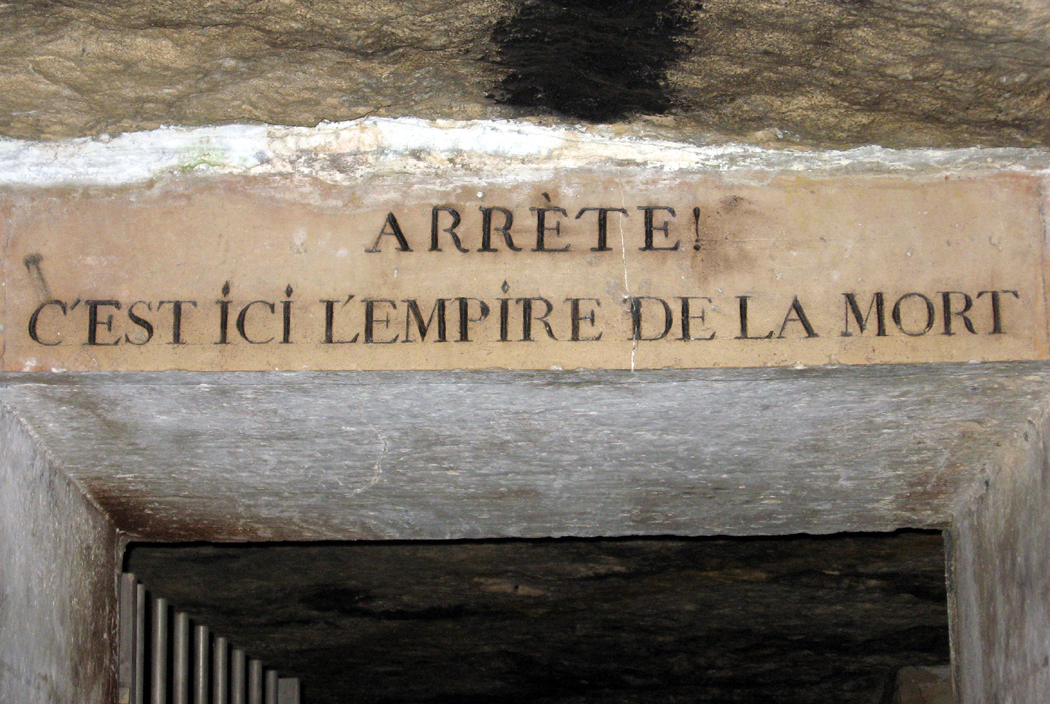
“Stop!” said the sign above the final door. “You are entering the empire of the dead.”

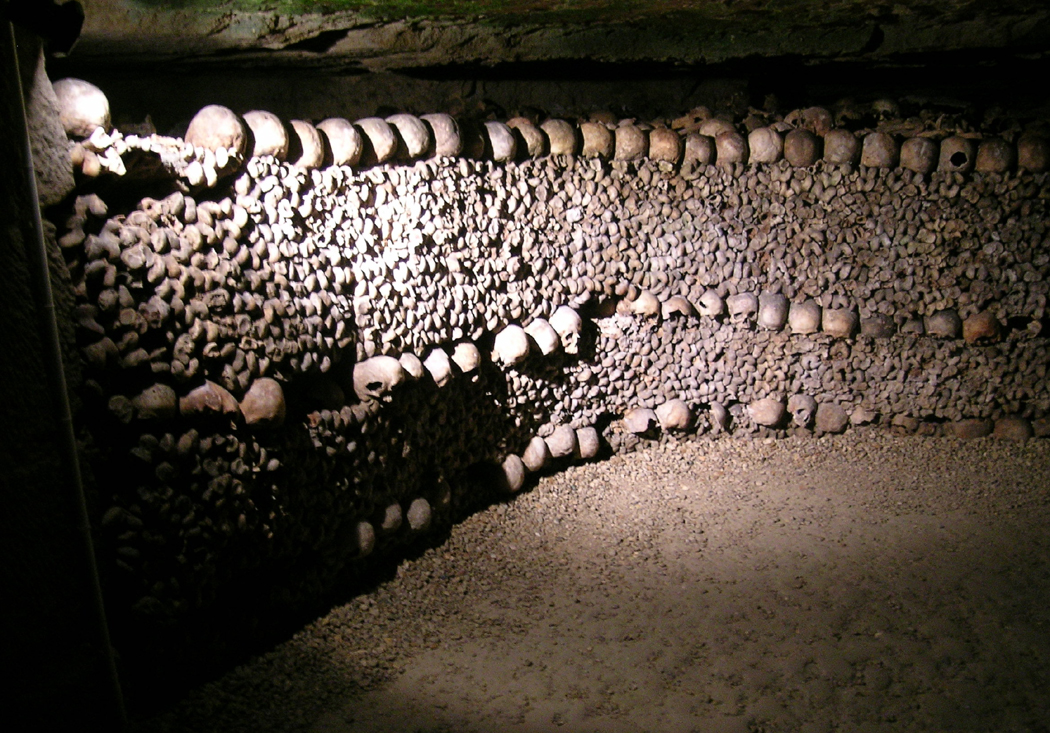
The tunnel contorts around in the underworld, with niches to right and left piled with the bones torn up from Paris graveyards.catacombs 2 - skulls

Millions of the dead from Paris’s past are piled here, with a wall of tibias and skulls making a kind of bone-dike, holding the remaining body parts behind it. Usually, the bones are assembled almost like masonry, with the knob-ends of the tibia bones left end out, and a line of skulls across them, like strata in rocks, or ornament in brickwork.

The tunnels are never higher than about 6-feet and maybe 2 inches high, and only one person wide. Their floors are often damp or wet with cave-drizzle.

Electric lights are placed on the walls every 10 or 15 feet, but with fairly low wattage bulbs.

catacomb cornerSigns were left with the bones describing what cemetery they were disinterred from, almost like regimental monuments in a battlefield.

After snaking through the underworld for perhaps a mile, you came to an even narrower spiral stone staircase with 84 steps, as the sign says, bringing you those six stories up from Hades, and you open out into a side street from a nondescript stone building-front with no markings to warn anyone this is the exit from Tartarus.

The trip is a genuine experience, an encounter with history.

Going through the tunnels is a completely alimentary experience. The bowels of the earth. Expelled into sunlight.

paris sewer 5

THE SEWERS

The sewer system of Paris is one of the world’s wonders. If straightened out, they could run from Paris to Istanbul.

They have a place in fable and lore far exceeding that of any other sewer system in the world: They are the tunnels through which Jean Valjean carried the wounded Marius in Les Miserables.

“By degrees, we will admit, a certain horror seized upon him. The gloom which enveloped him penetrated his spirit. He walked in an enigma. … How was he to get out? Would he find an exit? Would he find it in time? Would that colossal subterranean sponge with its stone cavities, allow itself to be penetrated and pierced? …Would they end by both getting lost, and by furnishing two skeletons in a nook of that night? He did not know. He put all these questions to himself without replying to them. The intestines of Paris form a precipice. Like the prophet, he was in the belly of the monster.”

The “intestines,” is the right word. They are called in French, Des Egouts — the “guts.”paris sewer 9

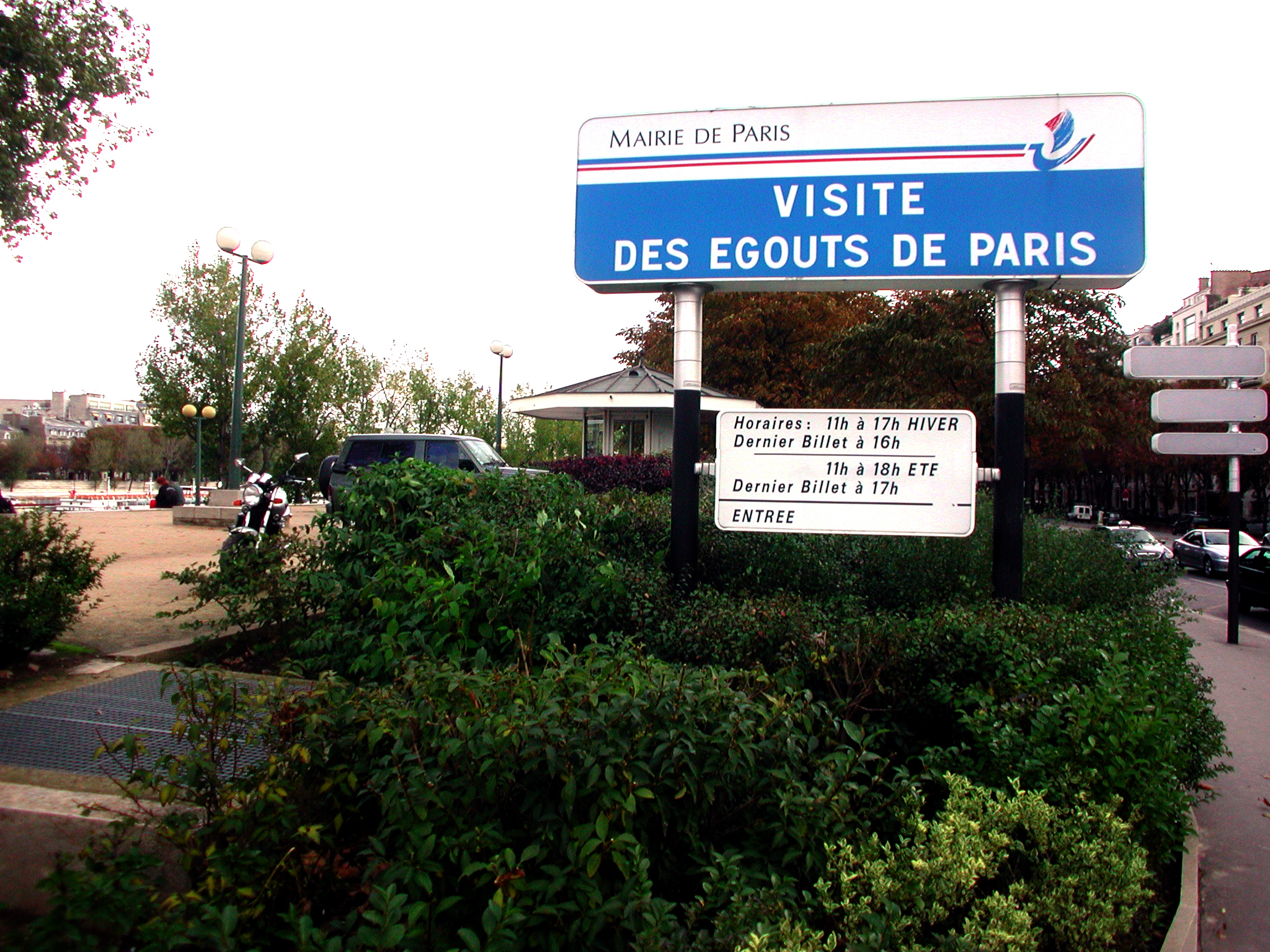
The entrance to the portion open to the public is like a tiny lemonade stand beside the bridge over the Seine. You buy tickets and descend into the depths, where a very faint odor of sewage wafts up — so faint that in a few moments, you no longer notice it.

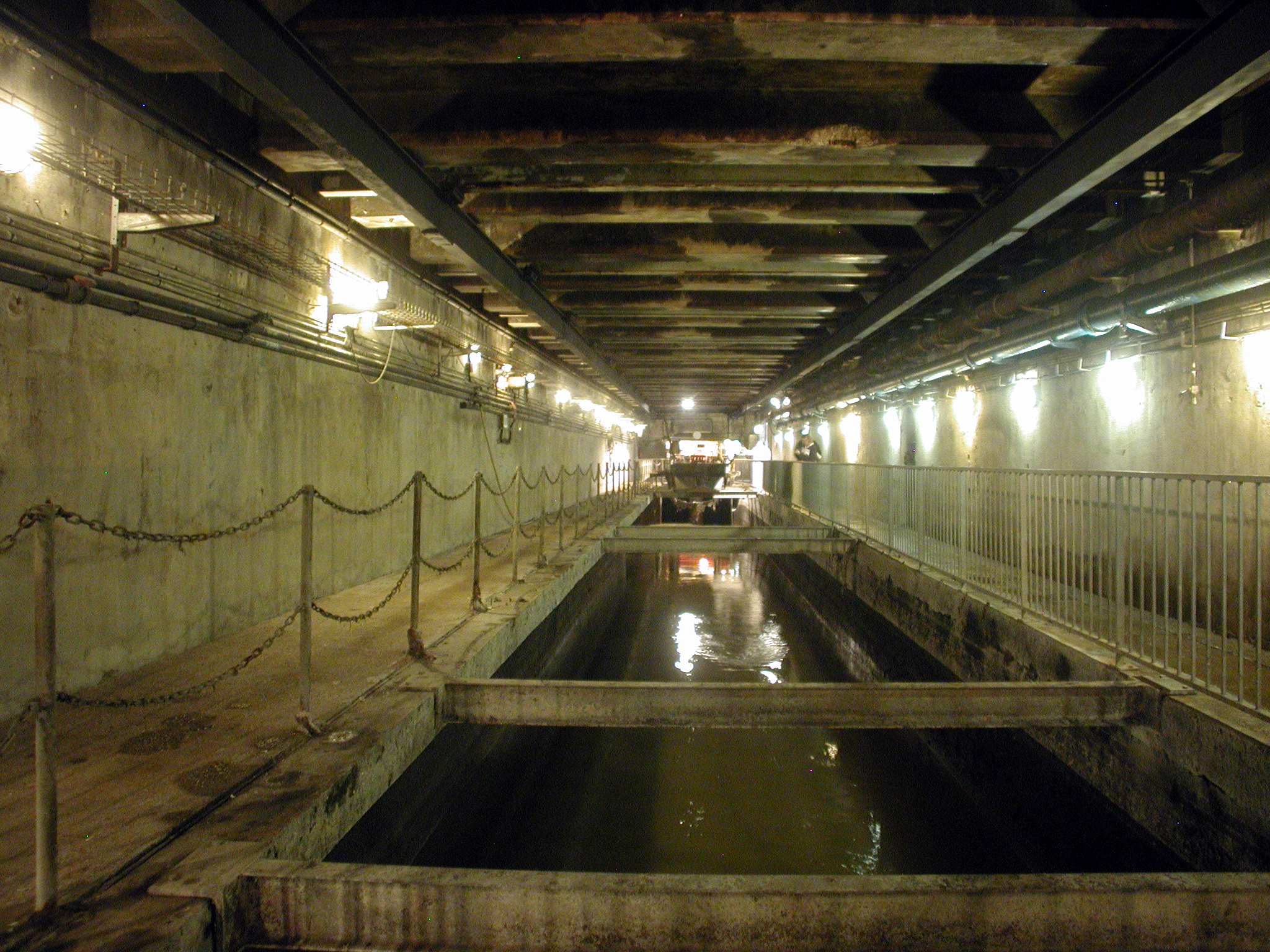
What first hits you in the darkness of the sewer tunnels is the sound, the thunderous sound of water, like a torrent over a waterfall. Part of this is the sound amplification of the tunnels, but most is the enormous quantity of water passing through the system. As you walk down one wide tunnel – more like an extended garage — the water passes underneath you as you walk over a steel mesh walkway.paris sewer 3

There are signs along the way explaining not only the sewers, but the history of the sewers, beginning in Roman times. The current system is a gift of Baron Haussmann from his city rebuilding plan of the mid 1800s.

There is a kind of pulse, or bloodflow, that the system implies, a circulation system for the city.

One looks at a city from above ground and sees the traffic, the shops, the restaurants, the pedestrians, the apartments above the stores, the metro stations, the statuary and monuments, but they are all just the skin of the city.

Under it run the subways, the catacombs, the sewers, the remains of hundreds of years of quarrying, the abandoned tunnels of previous water and sewer lines, abandoned subway tunnels, and millions of miles of cable.

And, of course, the people milling around on the surface, drinking their cafe cremes, could not exist in the city without the subsurface infrastructure.

cimetiere montparnasse

THE CEMETERIES

It says something about Charles Baudelaire that he is buried in a grave listed under his despised step-father’s name. It is odd, that someone as famous and accomplished as the poet was, of course, baudelaire 1someone’s son, and part of a family, and all the wretched dynamics that implies: Charles was Petit Charles  to his mom and step-dad, and even after he grew up, he seemed to remain their little boy, so that, unlike other more pompous and be-medalled Frenchmen, with their giant sepulture, with statues and trumpeting angels, he gets second billing on a plain headstone in the cimetiere Montparnasse, with his mother — who outlived him by two or three years — billed third.

It is her revenge on her wayward child.

There are three large cemeteries in Paris, and they each have their celebrity tombs.

Most famous is the grave of Jim Morrison of The Doors at the cimetiere du Pere-Lachaise near Montmartre.

There, you can also discover Apollinaire, Balzac, Beaumarchais, Sarah Bernhardt and Frederic Chopin.

At the cimetiere de Passy you find Debussy, Manet and Joan of Arc.three graves

Visiting the cimetiere Montparnasse leads one to discover things about personages that one might not have guessed: Henri Langlois, who ran the Cinémathèque Française, has a gravestone filled with publicity photos from scores of movies; Jean-Paul Sartre and Simone de Beauvoir share a headstone with only their names and dates; actress Jean Seberg has a simple flat stone grave with a tiny headstone with her name in a badly written script, as though done by an amateur. Many small stones had been left on the sarcophagus lid.

It is no surprise that composer Camille Saint-Saens has a sepulcher with sculpture carved inside. He was an honored figure from the French intelligentsia, but all his pomp doesn’t say as much as the one grave, with no name, and the only thing written on it, in elegant letters is “Le paradis c’est Paris.”le paradis c'est paris

Paradise, but also the underworld.

nj pizza
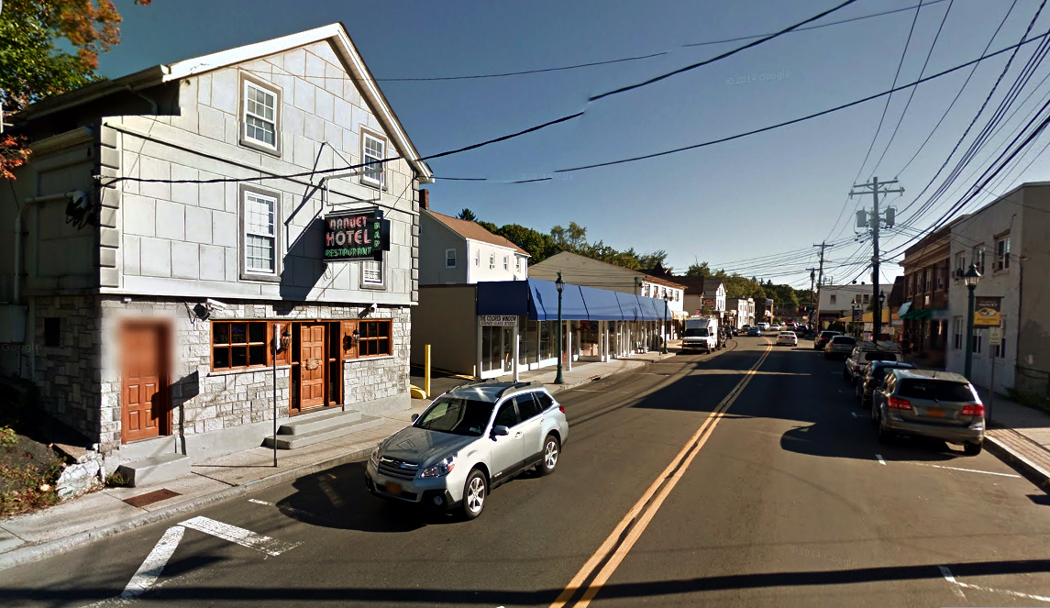
I stepped into the Nanuet Hotel in New York’s Rockland County because I hadn’t had a real pizza in 15 years.

I’m not un-American: I’ve eaten my share of Super Bowl delivery pizzas and to this day, when both my wife and I have had tiring days at work, we phone in pizza from one of the standard brands.

But they aren’t real pizza. Like most people, I grew up in a region of America with an identifiable cuisine. Philadelphia has its scrapple and cheese steaks; North Carolina has its barbecue; Texas has its chili. New Jersey’s cuisine is pizza.

I know there are Chicagoans who say they know what real pizza is, but they are misguided. I grant they know something about kielbasa, but real pizza can only be found in New Jersey and portions of New York. It is different from the populist menu item in that it is almost Calvinist. It has no frills. There is no such thing as a real pizza with ham and pineapple, for instance, to say nothing of the crime against nature advertised as a “taco pizza.”

The real item has a thin, biscuity crust, lots of spicy, garlicky tomato sauce and a thin covering of mozzarella that bakes into a papery crust over a stretchy, palate-burning stratus. It can be dusted with some grated Parmesan and sprinkled with some ground hot pepper. And if you are in a daring mood, it can come with pepperoni. But that’s the limit.

It also takes 30 minutes from order to table — unless you are buying it by the slice, that is.Nanuet Hotel

Well, the Nanuet Hotel is a seedy bar and grill in a tiny, decaying town just north of the New York/New Jersey boundary. The narrow street is lined with cars along both curbs, some sit with two wheels up on the sidewalk. The storefronts are bars, laundromats, video stores and the occasional Korean grocery. There are no Starbucks on this street; no sushi bars; no upscale sandwich shops with outdoor tables under awnings.

The hotel has tilting white clapboard walls and a door whose sill is worn down to a hollow of splinters. Inside, it is dark and — unfortunately — smoky. Along one wall are shelves of Johnny Walker and Jim Beam; along the other are tables with paper place mats and paper napkins.

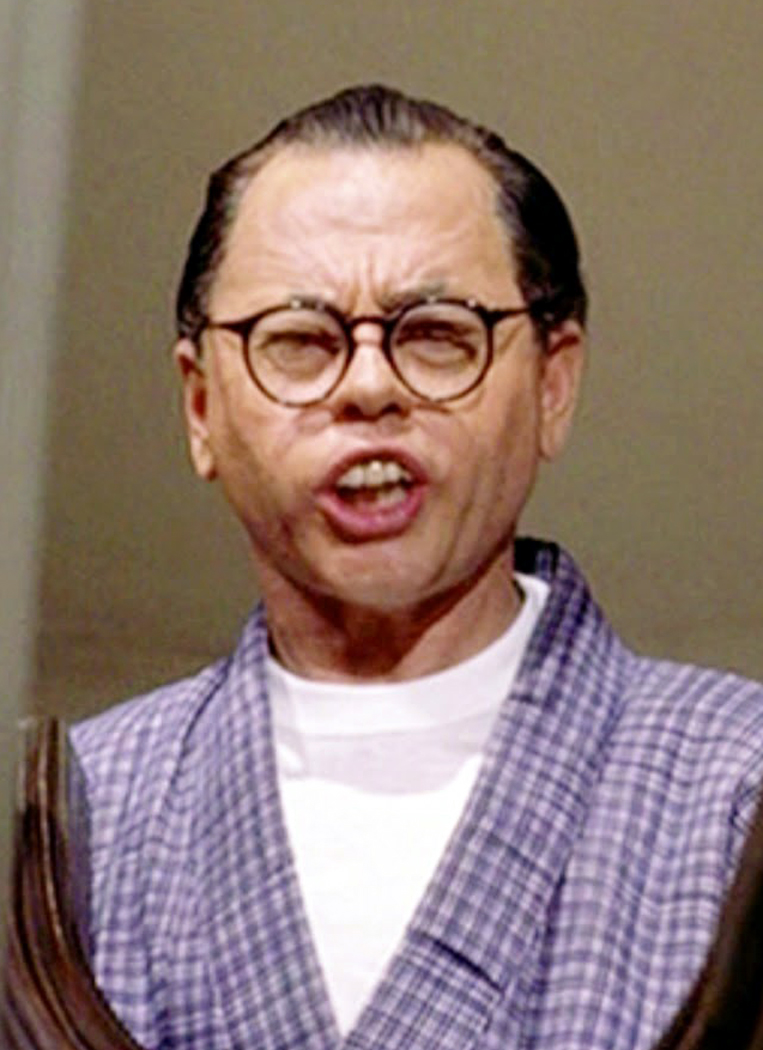
The man behind the counter is in his late 50s with a serviceable gut and balding head: He could be Peter Boyle’s brother.

There are two TVs playing with their sound down. One carries a soap opera, the other a Yankee game, but with a twist: it is a game the Yankees played against the Detroit Tigers in June of 1976. Ron LeFlore and Mark “The Bird”  Fydrich on one side, Oscar Gamble and Graig Nettles on the other.

“This is great,” Peter Boyle tells another aging customer. “I found this channel the other day and they were showing that Roberto Duran fight, you know, ‘No mas, no mas.’ ”

There is a Keno board with flashing numbers on one wall and a tumbler full of entry forms at each table: You pick numbers and give the card to the barkeep and wait for your numbers to show up and win big bucks. Your number never shows. Glasses clank and the spritz of beer bottles being twisted open gives the place the feel an old Jerseyite like me can call nostalgic.nanuet hotel customer

The pizza is thin, hot and scarifying and I drink a brew along with it. I tell the barkeep that I have come all the way from Arizona to taste the real pizza once again. He knows what I mean.

“It’s the water, I found out. My nephew tried to open a pizza place in Denver, but he couldn’t make a go of it. It wasn’t the sauce, you can import that from here if you need to. But the dough won’t come out right. It’s the crust.

“Now when he comes home, he buys a load of bread and rolls and packs them up with dry ice to take back with him. Bottom line is, it’s the water.”new york pizza

Everyone has a theory, but none of them has proved sufficient to export the Tri-State national pizza. You gotta go to New Jersey, New York, or southern Connecticut.

Anton, Laura and family copy 1
“I’m not sure I know why we have families,” he said. “Can you find any excuse in existence for them?”

Stuart was on about something again.

“I don’t know,” I said. I had pretty much always taken the existence of family for granted. Didn’t think about it much.

Stuart obviously had and his own experience of family was not encouraging.

“What I do know,” he said, “is that for me — and I think this is true for my generation — family seemed kind of irrelevant. I know when I was a kid, I never wanted to spend time with relatives. They were boring.

“What I had instead was friends. You don’t choose your family, so you’re stuck with the luck of the draw. You do choose your friends. So, when Thanksgiving comes around, I want to spend it with those near and dear to me, in other words, my friends, and not my family.”

“But aren’t you close to your brothers?”

“Well, I’m close to Bernie, but I chose him as a friend, I didn’t merely inherit him as a relative.”

“So,” I said, “friends are a substitute for family?”

“I don’t really think of it that way. Not a substitute; friends are my family. And I’ve talked to many of my friends about this, and they feel the same way. Perhaps it is only our generation; we grew up in the ‘60s, and the whole panoply of institutional authorities were not just drawn into question, but actively disparaged. It isn’t that we don’t like our parents, but rather that our parents did what they were supposed to do: They didn’t choose us, either. Oh, they chose to have us…”

He thought for a moment. “I guess,” he said.

“But whether they chose to have children or we came by accident, they didn’t choose to have the particular kids they did have. We came as strangers to their house, and pretty much, when we grew up, we left as strangers.”

“Then, how come everyone seems to think family is so damn important?” I asked. I was thinking of political speeches, lauding family; Biblical injunctions; I was thinking of all the literature I had read, family epics, family tragedies, family comedies. Homeric or Faulknerian. It was as if I were missing something.

“I’m not sure, but I think that in the past, and I mean centuries ago, maybe eons, people didn’t travel as much, didn’t meet as many people, and in more tribal times, clan and family gave you something you felt you could trust — despite the evidence of all those family epics you mention, whether Homeric or Faulknerian. Nowadays, we go off to university, meet many more people and community is formed around shared interests rather than shared blood.”

I thought about this and was not satisfied.

“You create a family when you marry.”

“Well, I’ve had …” and here he stopped to count, his eyes turned upward and this tongue between his lips … “lemme see, seven wives, official and unofficial, no, eight, if you count Helen, although she never actually moved in, and either I left them or they left me. Mostly, they left me.

“But the family you create is akin to the friends you make: It’s voluntary. At least in our culture, you get to choose your wife. If you do it right, your wife is your friend. Further, and this is an important point: Your wife or your husband is the only family member you actually want to have sex with, or at least that you are allowed by custom or law to have sex with. That makes a spouse an anomaly in family relations.

“This voluntary relationship — the ‘elective affinity’ — is essentially different from what you have with your cousins or your older brother. Any relationship there is purely accident. The lottery numbers pop up one by one, but you cannot predict any of them.”Dad, Ricky July 1948 copy

“That may be, but when you get married, whether your wife is your friend or not, you have kids and you love your kids and want to give them preferential treatment in a hard and harsh world. They may be accidents, in terms of personality and how you interact with them, and even if they are teenagers and don’t want to be seen with you in public, you still love them in a way you cannot love even your best friends.”

“Well,” said Stuart sheepishly, “I haven’t got any kids, so I wouldn’t know.”

“But you have nephews. Do you love them?”

“I guess so, but that doesn’t mean I want to have them over for Thanksgiving.”Carole-Steele

“I take your point. But I have the example of my wife.”

“Carole.”

“Yes, Carole.”

“You’ve been with her a long time.”

“Thirty years …”

“Can’t fathom that. Mind you, Carole’s great. You hit the lottery, as it were. But my longest stretch, I think, was seven years before it blew up.”

“But anyway, Carole has a take on family I’d never really considered. Family is something different for her. For her, it is where she came from.”

“You mean, like genealogy?”

“Sort of, but she isn’t so much into the family tree as such, or into whether or not she has a coat-of-arms, but rather, that she is made up of the hand-me-downs, genetically, of the ancestors, the piling up of character — of meaning — that has concentrated in her. Her family is her roots, deep in the ground, and she is connected to them as literally as the tree is to the root ball, all of a piece.

“She sees her hair in her grandmother’s hair, her jawline in her father’s, her love of nature — and, I might add, her stubbornness — in her grandfather. Great grandmother, Nancy Jane Lind Hutchison Steele, wife of Rowan Steele.She grew up with her great-grandmother in the house, who was a Civil-War widow, and sees history not in paragraphs on a page in a book, but in her wrinkly skin. She wants to know how her great grandfather came to live in North Carolina, whether he is Scots-Irish, why they eat collards or sing certain hymns as opposed to others. Obviously, this is not all genetic. A good deal is cultural, but I don’t think Carole makes that much distinction: It is all roots, all the long line of ancestors, which, for her, go back — and I’m not kidding — to Adam and Eve, or whoever you want to pick as the ur-progenitors. Her interest in cave men is part of the same thing. She calls it ‘the long man,’ the person drawn from one generation to the next the same way a plant goes to flower, a flower to seed, a seed to seedling, to plant, to flower, to seed and so on in a continuous recreation of the same life — the same DNA shuffled around — of which she is merely the latest flowering. Or the antepenultimate: She has now sprouted a daughter, and that daughter twin granddaughters. So now Carole can see she isn’t the end of a long line of ancestry, but only one link in a continuity.Five generations 1971 copy

“Thus, family for her isn’t simply the people who she shares Thanksgiving dinner with, as if they were all discrete entities, but rather as if they were the acorns hanging on the same oak tree, in a sense, a single person with multiple incarnations. At Thanksgiving, even if she is alone, she is having dinner with all of them.”

“Well, that is Carole, through and through, isn’t it?”

“Yes, and it has made me think differently about family. I share your sense of relatives as something you’d rather not have to spend time with. I have chosen my own ‘family’ of friends, who mean a great deal to me. But I also have come to see the ‘mystic bonds’ of family — again, not as a question of whether I want to spend time with them. I don’t, really. But rather as a continuation of a process.

“Looked at another way, I am a bit of my parents planted in the future to grow, and to plant my son there in the future that extends beyond my harvesting.

“I had the oddest experience a few years ago. Did I ever tell you about it? You remember when I was married to my first wife, we had a son.

“Yes. Boy, that was a long time ago.”

“And just after he was born, we split up and I didn’t see my son anymore. I lost touch with my ex-wife and with my son. I was young and a prat, so I moved on without much thought of it. But a few years ago, I got a phone call and on the other end a voice said, “Are you my father?” It was my son, some 30 years later. I had not seen or had any contact with him for 30 years.

“Well, Carole and I went to Austin, Texas, where he was living and we met him and the shock was palpable: He looked exactly like I did when I was his age. Not just in physiognomy, but he wore the same kind of thick-rimmed glasses, the same plaid shirts, the same long hair I had back then. It was uncanny. He was living with a woman who came from the same county in North Carolina that Carole came from. His house was a mess of books and CDs and DVDs. He worked, at the time, in a used bookstore and was in charge of the classics section and the poetry section. His favorite literature was the classics. The resemblance was uncanny. Patris et fili copy

“I had always assumed that in the ‘Nature vs. Nurture’ controversy, that nurture was by far the more important. We were raised at a time when we thought, ‘It’s all cultural.’ But here was evidence in front of me that perhaps it wasn’t all cultural. Perhaps DNA ruled not only the shape of our noses, but the preference we might have for Manhattan or New England clam chowder.

“The real clincher came when we walked through his office at the back of his house and there, on the top of a bookshelf, he had a world globe with the ball taken off, turned upside down with Antarctica now at the top, and replaced. I laughed. Back home, on top of my bookshelf in my office was a world globe that I had reversed to put Antarctica on the top. It was almost scary. How many people have done that with their globes? What are the chances that father and son, with no interaction for three decades, would each do the same peculiar thing?”

“So, you’re saying then, that as opposed to the question of whether you choose family or friends, that the question is basically irrelevant: That family is who you are, that ancestry defines your nature and you have family to thank or blame for it.”

“I remember having this discussion many years ago with a colleague. We had both grown up in New Jersey in the 1950s and ‘60s. We shared a good deal of nurture and could understand many of the same cultural references. But he was from an Italian family and I was from a Norwegian family. Despite how much we shared, he had a preference for Fellini films and I had a preference for Bergman.

“Not that I couldn’t appreciate Fellini — I do — but that deep in my bones, I knew the Bergman world; it was my interior world. While the Fellini was tremendous, but exterior to me. There is something in my genes that responds familially to the world of Bergman that Fellini doesn’t hit. But it was the reverse for my colleague. Italian genes felt at home in Fellini.

“In the old days, I would have chalked it all up to culture: He grew up in an Italian family and so the folk ways would have felt familiar. But now, I think — it’s only tentative, of course — but I think perhaps it may be something genetic. This may be the collective unconscious that Jung wrote about. The pile of chromosomal tendencies, tastes, judgments, behaviors, that have been reinforced over the generations by the distillation and concentration of DNA.

“I’m sure that upbringing and culture plays a part, no doubt, but I now think that there may be something inherent, that if I had been adopted by an Italian family, I would still feel more at home in Bergman. Not provable in my case, perhaps, but I think plausible.”

“So, I think you are saying, that you are inevitable in terms of family as you are in terms of history, that you may not like the times in which you are born, but you simply have no choice in the matter, and that all those relatives who bore you on holidays are just the titrations of chromosomes and you are thus embedded in your family like raisins in a muffin. No choice. Just is.”

“Yes.”

“Still don’t want them over for dinner.”


beethovn lede photo
Ludwig van Beethoven would have turned 244 this week. belushi beethoven

Everyone knows Beethoven. He wrote “Da-da-da-dum” and “Ode to Joy.” He’s the scowling visage parodied by John Belushi on Saturday Night Live. He’s the plaster bust on Schroeder’s toy piano.

Ask anyone to name a classical music composer and nine out of 10 will utter his name. Even those with no familiarity with classical music know he’s the one who rolls over to tell Tchaikovsky the news.

So it’s not surprising that symphonies program his music more than anyone else’s, and often devote entire festivals to the music. schroeder 2
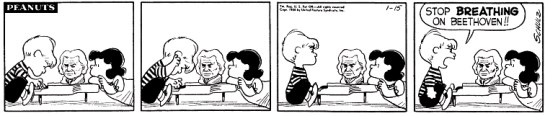
It would be silly to call anyone the “greatest” composer, but Beethoven — along with only Bach — is the one most often given that honor. Such is his power as a producer of human emotion through the ear canal, that his only real rivals in European art music are Bach and perhaps Mozart. That doesn’t mean he is everyone’s favorite composer. There are many who cannot stand his relentless pounding and drive. And surely among “great” composers, Beethoven probably has the third-most detractors, after Schoenberg and Wagner.

But it would be hard to find anyone who has altered Western music history more directly and obviously than the scowling master from Bonn. michael christie

“There are many reasons one could say Beethoven’s music is the greatest. His music speaks to the listener from the first note,” says conductor Michael Christie, music director of the Minnesota Opera.

It isn’t just that the music is familiar, it’s overpowering. It’s big, loud, sublime and of an intensity unheard before him.

“Just take the opening of the ‘Eroica’ symphony,” conductor Joel Revzen says. “The first two chords. Haydn or Mozart used a slow introduction to prepare us for what is to come. Beethoven takes a hammer and hits you over the head with it.”

Two crisp E-flat chords, and we’re off to the races.steve moeckel

“You can listen to one chord and know it’s Beethoven,” conductor James Sedares says. “He had a voice that was completely unique for his time and always.”

Violinist Steven Moeckel has given wonderfully insightful performances of Beethoven’s violin concerto.

“This may sound cheesy, but it feels, when you play it, Beethoven got a glimpse of heaven. Audiences are taken on this journey, so epic. Beethoven is on a heroic scale — and he means to be.”

Difficult to appreciate

But why does Moeckel qualify it? “It may sound cheesy … . ”

There are several things that stand between us and Beethoven, and make both the performance and appreciation of his music difficult.

Beethoven’s music is about big ideas, such as heroism, nobility, struggle, brotherhood. He believed in them; the question is, do we? Or have such ideas been rendered into toothless bromides and platitudes?

Can we still understand Beethoven’s music after the trenches of World War I, after Auschwitz, after all the dehumanizing misery of the 20th century?

Music historian Richard Taruskin has written about the difficulty of accepting the grand vision of Beethoven’s Ninth Symphony, with its paean to universal brotherhood.

“Why? Because it is at once incomprehensible and irresistible, and because it is at once awesome and naive,” he wrote.

“We have our problems with demagogues who preached to us about the brotherhood of man. We have been too badly burned by those who have promised Elysium and given us gulags and gas chambers.”

You can hear the problem in many modern performances of Beethoven. The conductor no longer believes in the grand ideas and falls back instead on the music’s obvious rhythm and drive. There’s a great divide between the conductors who performed before World War II and those who came after.james de preist
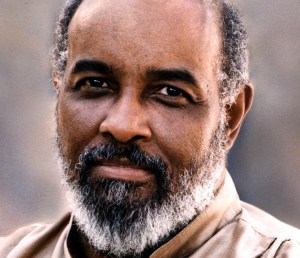
“I look for the old depth and breadth of expression that was there and can be retrieved if we listen to the right master,” the late conductor James DePreist said. “And most of the right masters are dead.”

You listen to recordings by Wilhelm Furtwangler or Willem Mengelberg and you hear a Beethoven different from that of Roger Norrington or David Zinman.

To many modern ears, the older performances seem melodramatic and overwrought. The modern performances seem cleaner and less fussy. The older conductors interpreted the music and massaged its rhythms. They conducted by phrase length, not by bar length, and they knew the rhetoric of performance and often spoke to their orchestras about the philosophy and meaning of the music. Modern conductors speak of the notes.

But Beethoven was clear about this. In the same way a great actor interprets Shakespeare when performing as Hamlet, and makes pauses and emphases, the musician was asked by Beethoven to do the same.

“The poet writes his monologue or dialogue in a certain continuous rhythm, but the elocutionist, in order to ensure an understanding of the sense of the lines, must make pauses and interruptions at places where the poet was not permitted to indicate it by punctuation,” Beethoven told his friend Anton Schindler. “The same manner of declamation must be applied to music.”

‘Writing for history’

But ours is an unheroic age. We reserve the word for firemen and soldiers, who certainly perform courageous acts. But a hero is more than that. Mythologically speaking, a hero is the individual who translates the will of the gods into history.

This is no small claim: A hero changes the world. Beethoven certainly did.

There is good reason to be suspicious of such things now. Too many have changed the world for the worse.lawrence golan

But Beethoven, born in Bonn, Germany, in 1770, clearly saw himself as a hero. He knew he was changing the world. He championed freedom and democracy in a restricted and aristocratic age.

“He changed the world of music,” conductor Lawrence Golan says. “Right off the bat, with the first chord of his first symphony. It was revolutionary at the time.”

He performed for the aristocracy and slummed with the nobility, but he told Schindler, “My nobility is here,” pointing to his heart, “and here,” pointing to his head.

“We’re clearly looking at big ideas in Beethoven’s music,” conductor Timothy Russell says. “Mozart wrote for an audience, but Beethoven knows he’s writing for history.”

History, however, has moved on.

Disposable music

For the 21st century, music has mostly become entertainment. Music written to be pondered and meditated upon does not fit into the jigsaw puzzle of a niche-market audience, where music is used and discarded in months.beethoven bust

“Beethoven wrote Velcro music and this is a Teflon Age,” DePreist says.

“We have deconstructed the 19th century and have an initial impulse to jettison so much of it. But the idea that the 20th century — or the 21st century — would simply supplant the 19th was absurd,” he says. “But we have much to learn from every century.”

The difficulty has been to separate the desire to be free from the past — which is an honest desire — from the tendency to ignore the past and refuse to look at what the past teaches us.

“It teaches us more than the notes of the stylistic things,” DePreist says.

Art has a responsibility to challenge people, says Moeckel.

“To broaden their horizons, and, so, if you don’t like it, that’s fine, but let’s talk.”

And what he confronts us with is the struggle of being alive.Joel Revzen 1

“Beethoven was a man who struggled every day of his life, a man shaking his fist at the heavens constantly,” says Revzen. “It is the human condition to struggle against adversity, whether socially, politically or one’s physical limitations. It is the struggle of the human condition through eternity.”

If you want to relate it to the contemporary world, he says, just think of what the people in in Syria or Afghanistan are going through just to survive, “or the people who struggle against oppression every day around the world, or the people who struggle in this recession.”

“How can I survive until tomorrow in hopes maybe my life will change?”

It is that engagement with the big things that drives Beethoven’s music and gives it such power to move us, even when we are suspicious of its meaning. The problem is ours, not Beethoven’s.

“There is still a message in the ‘Eroica’ or the ‘Ode to Joy,’ ” conductor Benjamin Rous says.

“Our time is broken in a way Beethoven’s music isn’t. Maybe a broken era needs an art that is whole.”

Three creative periods

Critics, biographers and historians divide Beethoven’s life and work into three periods: early, middle and late.

Since Beethoven, the tripartite division has come to fit the careers of many artists, but it began with the composer.beethoven young man

His Early Period features music that imitates the style of Haydn and Mozart, and although the music sometimes strains to escape the bonds of that style, it’s thoroughly Classical.

His Middle Period contains most of the music for which he’s best loved: the “Eroica” symphony, the “Emperor” concerto, the “Archduke” trio, the “Appassionata” sonata. It is big, brawny, heroic music that strains to escape not just the style but the very limits of the musical instruments of his time, the philosophical and religious conventions of his era, and sometimes the very heart in his breast. It is loud, pounding music.

“He grabs you by the collar and says, ‘I’m Beethoven, and I have something to say!’ ” says Revzen.

There are a lot of musical exclamation points in this very publicly aimed music.beethoven primary portrait

It is in the Middle Period that Beethoven staked his claim to being the first Romantic composer, emphasizing emotion over formal restraint. But, as conductor Benjamin Rous puts it, “He started out as Classical and ended up as Romantic, but in reality, he was Classical and Romantic at every moment in his life.”

Finally, Beethoven’s Late Period defines the term for all others: The music becomes more inward and searching, it has left behind the formal constraints of the time and experiments with new form, new meaning and expression. His late quartets bewildered not only the audiences of his time but the musicians who played them.schuppanzigh

“Do you imagine, when the spirit speaks to me, I have your wretched fiddle in mind?” he asked violinist Ignaz Schuppanzigh, whose string quartet premiered most of Beethoven’s late quartets.

Beethoven’s late music remains a challenge for many listeners. The “Grosse Fuge,” was his final movement to the string quartet op. 130, but was a movement so difficult for both listeners and performers that when Beethoven originally submitted it for publication, his publisher requested he substitute something easier. It is still work to listen to, albeit work with a tremendous payoff to those willing to dive in.

The rondo he wrote in its place as the quartet’s finale turned out to be the last piece of music Beethoven wrote before his death.

A gut reaction

Ludwig van Beethoven was probably history’s most famous sufferer of irritable-bowel syndrome. It made the composer’s life miserable and likely accounts for the scowl he wears in almost every portrait.

“The cause of this must be the condition of my belly which, as you know, has always been wretched and has been getting worse, since I am always troubled with diarrhea, which causes extraordinary weakness,” the composer wrote a friend in 1801.beethoven death mask
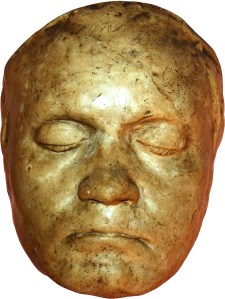
It was a problem that plagued him his entire life, and its likely cause is what killed him.

This may seem an undignified way to introduce “the greatest composer in history,” but you have to do something to clear away the idolatry that accumulates around a world-changing figure, to see him as a man rather than a demigod.

Otherwise, when we spin panegyrics about the man’s greatness, our eyes will glaze over, reading it as conventional boilerplate.

So, it must be said that this colossus who changed music and directed its course for more than a century was in reality a short, stocky German with a provincial accent, boorish manners, who wrote in bad grammar and frequently uttered banal platitudes as if they were earth-shaking profundities.

He was born in Bonn in 1770, and his drunken father tried to pass the child off as a prodigy, like Mozart. But Beethoven’s virtues were not Mozart’s: He had none of the grace and felicity of Mozart; his music grew from hard work and infinite rewriting.

Beethoven went to Vienna to make his fortune as a piano virtuoso and found many aristocratic patrons. He frequently insulted the hand that fed him.

He told one of his patrons, “Prince, what you are, you are by accident of birth; what I am, I am through my own efforts. There have been thousands of princes and will be thousands more; there is only one Beethoven!”beethoven ear trumpet

But just as he began to achieve fame, his hearing started to fail. In later years, he was completely deaf: At the premiere of his Ninth Symphony, a soprano had to turn him around onstage so he could see the applause he could not hear.

Each new piece found both acclaim and criticism: Conservatives disliked the profusion of ideas in the music, finding them confusing and the works too long and difficult; admirers recognized in his work overwhelming emotional power.

By the time of his death, in 1827 at the mere age of 56, he was generally acclaimed as the greatest composer in the world. More than 20,000 people attended his funeral.

It is only in recent years, after scientific analysis of a few strands of his hair, that we know how the composer died: It was lead poisoning, probably by drinking wine from a lead-lined cup, that slowly killed the composer and probably caused his lifetime of colic.

The ‘Mighty Nine’

Beethoven’s nine symphonies are the cornerstone of classical music. Every conductor cuts his teeth on them; every audience expects them.

Their monumentality influenced every composer who came after him for at least a century, and even now, it’s impossible to dip into classical music without addressing “The Nine,” as they’re known.

But the symphonies are very distinct; each has its own personality. Collectively, they are probably the best entry point for discovering the music of the titan, Beethoven.

There are many sets of them on CD, spanning nearly the entire history of recorded music. The first complete set of symphonies was recorded in 1920 and since then there have been at least 100 traversals. There have been 60 full sets sold since 1960. Herbert von Karajan recorded them all four times, Bernard Haitink and Eugen Jochum each did it three times. Any conductor worth his salt wants to prove his mettle by tackling the nine.

There is no one “best” set — pretty much everyone is agreed on that point — but if you want them all in one package, you could hardly to better than the set with Daniel Barenboim and the Staatskapelle Berlin recorded on Teldec. Both the performance and engineering are tops. Teldec makes the orchestra sound like it’s in your room with you. Barenboim has a unified and coherent view of the cycle which is intelligent and emotionally persuasive.

But for some, it will feel old-style. It is. If you want the modern huff-and-puff race to the finish, then you should look to John Eliot Gardiner and the Orchestre Revolutionnaire et Romantique on so-called original instruments.

You could hardly find two more different views of the music, but both are played with commitment and musicality. (Avoid the Norrington sets, which are dreadful and downright unmusical).

One-by-one

There are many who insist the best way to acquire the best of them is to get them individually and not in complete sets. Different orchestras and different conductors respond to certain symphonies better than others. David Zinman and the Tonhalle Orchestra Zurich, for instance, cannot be beat for discovering the wit and verve in Beethoven’s first symphony, but they don’t really believe in the nobility and heroism inherent in the bigger, odd-number symphonies, like the Fifth. For that, you have to go to an old-order conductor, such as Wilhelm Furtwangler and the Berlin Philharmonic, which recorded the most harrowing and emotionally wrought versions of the Fifth Symphony.

Any choices among the symphonies will be idiosyncratic: As listeners we are just a variable in our sympathies as the conductors themselves. You may want the bounce and beat of a modern performance, or you may be more moved by the old tradition.

These are a few of my suggestions, along with some information about each of the Nine.

Please note that modern critics aren’t the only ones who are idiots.

Symphony No. 1 in C

First performed: 1801.
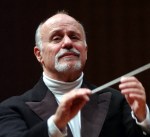
david zinmanBeethoven’s first is his lightest, brightest and funniest, an obvious imitation of the spirit of his teacher, Joseph Haydn. Its jokes begin with the very first notes: a dissonance in the wrong key!

Initial critical response: One critic called it “a caricature of Haydn pushed to absurdity.”

Suggested recording: No one has captured the wit of this symphony better than David Zinman and the Tonhalle Orchestra Zurich.

Symphony No. 2 in D

First performed: 1803.

bernard haitinkNow considered one of Beethoven’s “shorter, lighter” symphonies, it was a large symphony by the standards of the time and a challenge for its first audience.

Initial critical response: The Leipzig critic called it “a gross enormity, an immense wounded snake, unwilling to die, but writhing in its last agonies, and (in the finale) bleeding to death.”

Suggested recording: Bernard Haitink and the London Symphony.

Symphony No. 3 in E-flat, “Eroica”

First performed: 1805.

bernstein youngThis immense symphony single-handedly changed the course of music history; twice as long as the standard Haydn symphony and built on ideas of heroism, with a great funeral march as a slow movement.

Initial critical response: The leading music journal of the day described it as “a daring wild fantasia of inordinate length and extreme difficulty of execution. … There is no lack of striking and beautiful passages in which the force and talent of the author are obvious; but, on the other hand, the work seems often to lose itself in utter confusion.”

Suggested recording: Many modern performances are too tame. For the needed heroism and grandeur, and the sheer visceral excitement, try Leonard Bernstein and the New York Philharmonic.

Symphony No. 4 in B-flat

First performed: 1807.

claudio abbado 2Robert Schumann called it a “graceful Grecian maiden between two Norse giants.” It seems like a retreat after the furious charge of the “Eroica,” but if it is less noisy, it is subtly subversive, with an introduction in the “wrong” key.

Initial critical response: Carl Maria von Weber wrote a review in which the orchestra instruments all bitterly complain about having to play this symphony and then are threatened with being forced to play the “Eroica” if they don’t shut up.

Suggested recording: Claudio Abbado and the Berlin Philharmonic are as elegant as it gets.

Symphony No. 5 in C-minor

First performed: 1808.

wilhelm furtwanglerFor two centuries, this has been Beethoven’s calling card, the primal symphony, restless, turbulent, an epic struggle to wrest a triumphant C-major out of an obsessive C-minor, and with more than 700 relentless iterations of the iconic rhythm: “Da-da-da-dum.”

Initial critical response: French critic Jean Lesueur said it was such exciting music that it shouldn’t even exist.

Suggested recording: The music is so familiar, and so emotional, it’s hard to play now without irony, but when attacked with conviction, it still packs a wallop. Wilhelm Furtwangler and the Vienna Philharmonic are still the champs in a pre-stereo recording, but in modern sound, Carlos Kleiber and the same orchestra come very close.

Symphony No. 6 in F, “Pastoral”

First performed: 1808.
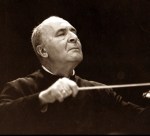
bruno walter 2This is Beethoven’s musical picture of nature, complete with birdcalls and thunderstorm. But it’s also one of the composer’s most tightly argued pieces musically, with much of the symphony drawn from the first two bars: It’s a miracle of concision, even when most discursive.

Initial critical response: Berlioz agreed with critics, “as far as the nightingale is concerned: the imitation of its song is no more successful here than in M. Lebrun’s well-known flute solo, for the very simple reason that since the nightingale only emits indistinct sounds of indeterminate pitch it cannot be imitated by instruments with a fixed and precise pitch.”

Suggested recording: Every critic’s choice in this seems to be Bruno Walter and the pickup Columbia Symphony Orchestra.

Symphony No. 7 in A

First performed: 1813.
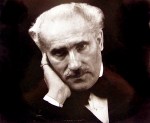
arturo toscanini 1Richard Wagner called this the “apotheosis of the dance,” and it is the most rhythmically driven of all symphonies; the second movement hardly contains anything but its rhythm. It all comes together in a Dionysian paean to the spirit of life.

Initial critical response: Weber expressed the opinion that Beethoven “was now ripe for the madhouse.”

Suggested recording: Even though it’s a pre-stereo recording, you have to hear Arturo Toscanini and the NBC Symphony in a driven performance that wrests every ounce of power out of the score.

Symphony No. 8 in F

First performed: 1814.

georg solti 1The composer looks backward with a smaller, almost Haydnish symphony, full of Haydnesque “jokes,” such as the metronome tick-tick of the second movement.

Initial critical response: One critic wrote that “the applause it received was not accompanied by that enthusiasm which distinguishes a work which gives universal delight; in short — as the Italians say — it did not create a furor.”

Suggested recording: Georg Solti and the Chicago Symphony give a brawny performance of this work and include a really fine Symphony No. 7 as well.

Symphony No. 9 in D-minor, “Choral”

First performed: 1824.

bernstein oldBeethoven’s magnum opus, which adds singers and chorus to the symphony and expresses the composer’s view of universal brotherhood and the joy of the cosmos. At more than an hour long, it is immense and usually performed for ceremonial occasions.

Initial critical response: “Beethoven is still a magician, and it has pleased him on this occasion to raise something supernatural, to which this critic does not consent.”

Suggested recording: Despite mangling the finale by changing Beethoven’s “Freude” (“joy”) to “Freiheit” (“freedom”), there is no more committed performance than the one given by Leonard Bernstein at the fall of the Berlin Wall in 1989 with an orchestra composed of musicians from many orchestras in both East and West Germany.

“We need ice,” she said, just as he had gotten his shoes off. “There must be an ice machine somewhere. All motels got them, don’t they.”

“OK.” And he started to pull his shoes back on.

“And what about a Coke machine? Did you see one when we came in?”

“No, but I’ll look.”

“If they have one, I want a Dr. Pepper, OK?”

“OK.”

Vernaise pulled her sweater up over her head and caught her elbows in the wool. She looked like an animal trying to wriggle out from under a tarpaulin. When it finally came loose, her glasses were lost and she had to dig through the sweater as if it were a suitcase.

“Here they are,” she announced, but Bill was already off in search of ice and drink. The smell of wet wool was everywhere.

The weather in the mountains had been just awful and they abandoned their campsite for the Capri 700 motel with gingerbread decorations on the veneer four-poster bed and scenes from Pompeii framed around the walls. The TV had cable and adult video. Vernaise had chosen it.

“No ice,” Bill slammed the door. “But here is a Mountain Dew.”

“No Dr. Pepper?”

“No.” He looked at her in her underwear. It didn’t fit. The elastic in her panties was all stretched out of shape and her bra was too big. Her breasts looked like hard boiled eggs rolling around in cereal bowls.

“The rain looks like its getting worse,” he said. “I think we did the right thing.”

“No shit. I’m soaked,” she said with more than a hint of whine in her voice. “Even my bra is wet.”

She unhooked it and hung it over the towel rack in the bathroom. It looked friendless.

The pasty marks it left on her back and sides was a topographic map. Red lines on clammy, white skin.

Bill pulled the tab on her Mountain Dew and took a slug himself. “Here.” He offered it to her.

She took it and turned the knob on the TV. As the tube crackled and whistled while warming up, she sat on the edge of the bed and sipped her drink. A game show came on and she got up and spun the dial.

“Nothing but game shows.”

“What did you expect in the afternoons?”

“But what about those adult videos? They gotta be here somewhere.”

Bill started taking off his wet clothes. His shoes squeaked; his socks left wet black lint between his toes. His thighs stuck to the damp denim of his jeans. His scrotum shriveled.

“Isn’t this romantic,” she sighed.

“Your glasses must be fogged.”

“No, I mean, here we are in a motel, pretending to be married. And we can spend the whole night together in bed.”

“That’s what we would have done in the tent.”

“But this is different. Everybody camps together. Staying in a motel is something that would give Mom shitfits.”

Bill unbuttoned the last layer of flannel shirt and peeled it back from his skin. “That makes it romantic, huh?”

“Sure. It’s exciting.” She turned the dials some more and settled on Family Feud.

He walked to the bathroom, picking up rug lint on the bottoms of his wet feet, and turned on the hot water for a shower. The water was hot enough, but the spray from the shower head was a mere drizzle. “Hey, there’s no soap.”

His voice sounded to Vernaise like it came from an oil drum. “I’ll look through the pack  and get ours.”

She pulled nearly everything out of the pack — it was all damp. She found the soap and it was already lathering. “Here it is.”

“Thanks. Want to join me?”

“I never take showers. Only baths. Bad for my hair. It gets all frizzy.”

He was already burbling and sloshing before she finished her sentence. She went back to Family Feud.

As she was watching, she unconsciously started pulling off her panties. All Bill heard was a horrible scream.

“A tick! A tick! Get it off!” She had found it clinging to her skin just above the dark line of her pubic hair. She jumped and wiggled her hands aimlessly in the air. “Get it off! Get it off!” Her voice was an octave higher than usual.

He ran into the bedroom, not knowing what to expect and dripping like a mop. He saw Vernaise performing a St. Vitus dance in the middle of the floor. “Get it off! AAAAAAAHHHH!”

“Calm down. Let’s see.” Sure enough, there was a tick burrowed in. “Calm down, we’ll get him off.”

“Now! Now! Don’t wait!”

“Lie down. Sit still. Let’s see.”

She sat down on the bed and then lay down. Bill tried to brush off the offending spot, but it wouldn’t move. “I’ll try a match.” He rummaged around through the pack and found the watertight capsule. He lit one and blew it right out. He applied the smoking end of the match to the tick’s head, but it wouldn’t pull out. He tried again. Then he tried dousing it with mercurochrome from the first aid kit. It looked pretty all in red, but it didn’t budge.

“I’ll have to pull it out,” he said, and grabbed the tick’s body and yanked. The body came, but the head stuck firm. Vernaise thought she would be sick. Bill somehow grasped the remaining head between two fingers and it pulled loose, taking a sliver of skin with it.

“Yuck. Yuck. Awful. I’ll never go out in the woods again.”

“Come on, it isn’t that bad.”

“You wouldn’t say that if it was your body. I feel so unclean. I gotta take a bath.”

Bill just stood there, dripping, naked, holding a tick’s head in his fingers and wondering if it were time for a tick check of each others’ bodies.

The tub filled and Vernaise sloshed in. “Yuck!”

2

The mood had been ruined for Vernaise. All she could think about was crawly things. Bill found a Marx Brothers film on one of the cable channels and reclined on the bed, watching the film between his feet. Vernaise  dried off and wrapped herself in a blanket. The red lines on her body had faded somewhat, but her skin, no longer clammy, was still wet.

“Bring those lips over here,” said Bill, in the way of being romantic.

“No, I couldn’t. Are there bedbugs in the bed? Fleas?”

“No. Don’t be silly.”

“Silly?”

“Sure. It was just a tick.”

“Just a tick?”

“Yeah. It won’t kill you.”

“Men!” She was only 19, but already she knew the curse that described all that was wrong with the universe.

Duck Soup.”

“Huh?”

Duck Soup. Marx Brothers. It’s on.” He gestured toward the tube but she didn’t seem interested. She sat on the edge of the bed, turned away from Bill.

“Don’t be that way,” he said, reaching across the bed to squeeze her boiled eggs. She jumped up, taking him with her and he fell, flat on his nose on the floor.

“AAAGGHH!”

She screamed, too. “Bill! Are you OK?” His nose was a bleeding pancake.

“What’d you do that for?” He sounded a little like an oboe. “Why’d you pull away?”

“You scared me. Besides, I don’t feel like it, after the tick and all.”

“Jesus.” He held his nose and walked naked to the bathroom where he pulled off a skein of toilet paper and mopped his schnoz with it.

“It’s swelling,” he yelled from the oil drum.

3

They slept in the bed with its stiff sheets and hard mattress. Bill’s arm wrapped around her. She had her back to him. Once, in the night, she had to get up to pee. He hardly noticed.

The next morning, it was still raining. One of those warm April rains that rises in steam to your nose and saturates the air with humidity.

Bill could hardly breathe. His right nostril was split and a black plug of blood hung on the fleshy part. The nose was not only larger than it should be, but bent, too, he thought.

Vernaise rolled over towards him, opened her eyes to a slit, barely aware of the daylight. She saw the plug of blood and let out the beginning of another scream, but caught it mostly in her throat. In the haze of sleepiness, she thought it was a tick, or it reminded her of the tick she had.

It wasn’t a pleasant way to start off the morning. She lifted the sheets and looked down at her crotch. The tick was gone. Hardly even a little ring of redness remained.

“Damn, my period started,” she said. It was regular as the full moon, and because of that dogged dependability, she purposely refused to keep track of it, and it surprised her punctually every 28 days.

“Huh?” Bill honked. He was just waking up, too. In fact, he didn’t want to wake up. He wanted to stay asleep. But he slowly became aware of something wet in the bed, and consciousness jumped him like a bandit.

“What’s that? Oh.” He knew as soon as he asked the question. This wasn’t a new thing in their relationship.

“I’ll get a towel.”

He got up, walked to the bathroom, stood over the toilet and drained for a minute or two, grabbed one of the face towels and wiped the clot off his nose, brought the towel back into the bedroom and handed it to Vernaise.

“No, I don’t want your bloody old towel,” she said. “I want a clean one.”

“OK.”

He walked back into the bathroom, picked up another towel and stood there for a minute, as if he had forgotten what he was doing.

It is important to realize that men don’t, in such situations, actually think about love or relationships. They wouldn’t have the vocabulary for it even if they had wanted to. But there were fleeting sensations and images flashing across the inside of his skull. He stood there and thought about the wet, sticky part of the mattress. He thought about Vernaise demanding a clean towel. It reminded him of the time she wanted a sticky bun for breakfast, and when he went out to the 7-Eleven and brought one back, she had complained it wasn’t the right kind of bun. He shoveled that thought on top of his memory of the red-striped skin from yesterday under the elastic of her underwear. That soaked over the thought of the way her voice rose an octave when she got upset. It not a pleasant squeak in her voice. More like a door that needed oiling. Annoying. Oh, and he thought about her mother. Large woman. Muu-muus. Teased hair. They say you can tell what a woman will become by looking at her mother. He pictured her mother with Vernaise’s face. He pictured Terry Bradshaw passing to Lynn Swann in the Super Bowl. He was losing focus.

“You have the towel?” she asked from the next room.

“Oh, yeah.” He remembered why he was there.

Vernaise sat on the edge of the bed, feeling a little logey. Perhaps it was the time of month, perhaps it was the interrupted camping trip and the lack of sleep. She looked toward the bathroom and saw only Bill’s behind as he stood there like a statue with his head cocked to the side.

She had been attracted to him, she realized, because — well, now she was wondering. She thought it was because he seemed older and more experienced. But she realized now that he wasn’t really. He played in a band, but then, it was only a garage band. He took her places. They had sex. She liked that. Mostly.

She tried to remember exactly why she was with Bill. Probably because he asked, she realized. Being wanted is the most potent aphrodisiac.

But she also admitted to herself that she already knew he wasn’t the one. Her thoughts were more direct than his. She didn’t wander: She compared him with Paul. She compared him with Shelley. Then with Al and Frederick. She had a mental tab column in her head.  Make a list. Looks. Potential. Sense of Humor. Check, check, check. Al gets a double check here. Oh, and Ted, too. She had forgotten Ted. She hadn’t stayed with any of them longer than she did with Bill, but she wasn’t really sure why.

Later in the morning, still in the room, since there was no place to go for breakfast, they mixed up some of their trail food — a strawberry shake that tasted less like strawberries than liquified cardboard.

They signed out of the room at noon when the maid knocked, went back to the campground and struck the tent. It was twice as heavy with all the water soaked in. They threw it in the trunk.

“Some romantic weekend,” he said.

All he could think about was the squeaky hinge. All she could think about was the tick.


word 4
“I’m confused by language,” said Stuart.

I wasn’t sure what he meant. His language confused me. I assumed he meant that he found certain sentences and paragraphs deliberately obfuscating.

“Many people are confused,” I said. “Politicians use language deliberately to confuse, and so do corporations. Mystify. Mystify. Vague it away.”

“That’s not what I mean,” said Stuart. “This is all true, and I am always scratching my head over what comes out of a politician’s mouth. But my confusion is much more basic: Language itself. Speaking. How does it work? How does it function?”

Stuart had the look of a bunny rabbit looking at a hatchet, with the concentration and intensity, but also the complete lack of comprehension.

“I mean, take the same sentence or phrase said by an Alabaman, a Brooklynite and a Calcuttan. The sounds they utter are utterly different, yet, we can understand each immediately. So, it cannot be the sounds alone that convey meaning. The Awe-stryl-yin ‘Good Die’ is never taken in New Jersey to be about death. We can parse it out just fine.

“The New Yorker who asks his friend, as Woody Allen had it, ‘Jeet jet?’ and answered, ‘No, jew?” It just means they’ll go to the deli and get a pastrami sandwich.

“So, of course, we don’t speak in words. How could we? Just try it. Speak the sentence out slowly and with clear articulation for each syllable: ‘Did you eat yet?’ and ‘No, did you?’ and you realize you sound like a synthetic recording, like Stephen Hawking or something.

“No, we speak in whole sentences, or at least in well-rehearsed phrases. ‘I’m going to go to the store’ is really ‘Ime gonna go tooda store,’ or, ‘tooda stow,’ if you are in a different region, or in another place, ‘staw.’

“In fact, the letter ‘R’ by itself is a summation of the problem. Howcum we can understand words with the letter ‘R’ even though it varies from the veddy veddy British ‘D’ version to the rolled burr of the Scottish, to the little flip of the tongue in Spanish and then to the back-of-the-throat gutteral French ‘ghghgh…’ the voiced uvular fricative.”

And here Stuart gargled something in his throat that sounded very much like a possum expiring on a kitchen floor.

“Merci,” he says, “Meghghgh-see.”mr yunioshi

“And then there’s the undifferentiated liquid of Asian languages, which we make fun of, not understanding that ‘L’ and ‘R’ are such close relatives. ‘So solly,’ says the vaudeville Chinese stereotype. And ‘flied lice,’ and its opposite, ‘rotsa ruck.’ You cannot help but throw up a little in your mouth, thinking of Mickey Rooney in Breakfast at Tiffany’s.”

“Oh, yeah. That’s really embarrassing.”

“More than embarrassing; even more than offensive. It is tin-eared. That’s not what’s going on with the undifferentiated liquid.

“But then, there’s the American ‘R,’ which is probably the single most distinguishing giveaway to an American accent whenever an American attempts to speak another language. ‘Moochas grrrassee-aas.’ That rhotic  ‘R’ hangs in the mouth way too long. ‘RRRRRRRRR,’ like some dog growling when you get too close to his bone. ‘Murrrrr-see boe-cooo.’ Americans speak in such a rhythm that you almost have to stretch the ‘R.’

“But then, we stretch out our consonants, too. Listen to Mexican speaking and you hear the clipped, quick syllables rattle by. Then hear the American imitate him and you see a slow train entering the freight yard. I am grateful whenever one of our presidents attempts to say a few phrases in Spanish, but I also cringe at the wrong rhythm. It’s like a Republican playing jazz. The beat is all wrong, to say nothing of the nasality of the American voice, which — thanks to the prevalence of Valley-girl speak — is only becoming more and more unavoidable in American speech. At some point, American English will pass French for the ‘most-nasalicious’ trophy.

“I used to love English, the sound of it, the sense of vocal pleasure achieved by sounding out those luscious consonants. We conventionally say that French is such a beautiful sounding language, or Italian. And they are, in their own way. But usually we say such things to distinguish our own lack of appreciation for the language we were born into.”

“Yes, my wife likes to try to ‘hear’ human speech the way we hear bird calls or cattle lowing,” I finally get a word in edgwise. “She asks, ‘What is the sound of human speech,’ not meaning what is the content of the language, but what is its animal timbre. She tries very hard to filter out the semiotics and syntax and hear what is said the way we hear whale singing or coyotes howling. It’s nearly impossible, because we understand our mother language so instantaneously as it is spoken. There is almost no time lag there to climb down into and grasp the sound waves. The closest she gets, she tells me, is when she hears children playing in the schoolyard. A human flock of cackling birds. But it’s hard to hear it without being blocked by knowing what is said.”

“Yes,” said Stuart, “and if you do manage to do something of the sort, you realize now what an ugly direction American speech is taking, how whiny it has begun sounding, with all that torpor and nasality. I think of, say, John Gielgud speaking Shakespeare and I love the words that leap crisply from his lips, the deliciousness of them, lovingly shaped and tasted as they are spoken. And then you compare that with, say, Taylor Swift — and I’m not picking on her for any reason other than she is so typical of young American English — and you hear a slow, unconsidered whine. Valley-girl-ism. It’s everywhere. Even our best actors and actresses are now infected with it. In our own lifetime, we have seen the evolution of American English.

“And if it has changed so much in so short a time, I mean the sound of it, the way it is produced in the throat and mouth, imagine how much it has changed since the time of Chaucer. ‘Whan that Aprille with its shoures soote …’  How long before the language of, say, Franklin Roosevelt in an old newsreel, sounds as archaic as that? And I’m not referring primarily to the change in vocabulary, but merely the alteration in vocal production, the next great vowel shift.”

“Yet,” I said, “we can still, if we pay attention, hear Chaucer and understand it. At least for the most part.”

“That is precisely my original point,” Stuart said. “How can it be that when a New Yorker says, ‘youse guys’ or a Virginian says ‘y’all.’ The fact is, as I said, we don’t speak words, but sentences and phrases, all balled up into a little melodic jingle.

“Take a simple sentence, like ‘Please hand me the lamp, I want to plug it in.’ What we really say is something like, “Pleez/ hanmedalamp/ eye wanna plugidin.’ Words elide into tiny musical phrases, like ‘hanmedalamp.’ If there is a single linguistic unit there, ‘hanmeda,’ it is that tune. But the tune changes radically when you say it in another regional accent. In a Yiddish accent, you ask for the ‘lemp.’ In a Downton Abbey voice, you call it a ‘lahmp.’ In a Southern drawl, you ask for the ‘layump.’ These accents cannot even agree on the number of syllables in the word.

“Yet, we absorb the meaning of the sentence easily, no matter which version we hear.

“This tunefulness is that makes it so hard to learn a new language after a certain age. You want to hear the words a Frenchman speaks to you, but he isn’t speaking words, he’s speaking phrases. You are trying to parse out the sounds you have heard into discrete vocabulary, but you cannot do it in anything like real time. The lag is too long. You need to learn a new language not by reading it, where it is separated with little lacunas between type, but in the long swirl of phrase and sentence, as she is actually spoke.

“So, ‘Como esta Usted’ become ‘co-mwes-taoos-ted.’ And I’m not even taking into account the problem of hearing a Hispanic ‘D,’ which slides between the tongue and teeth like an Old English thorn.”

“You mean the ‘TH’ sound?”le monde

“Yes. You know, when I go to France, I have little trouble reading Le Monde or Le Figaro. But I have the hardest time understanding the concierge or waiter when he asks me a question. I can navigate the type fairly easily because it is all divided up into words, many of which are cognates in English. And it isn’t just that French is so differently pronounced from its spelling. I have the same situation in Mexico with Spanish. Easy to read, harder to hear. And the Spanish is not pronounced at variance with its orthography. But the problem is that the French waiter isn’t speaking in words, but in phrases, in melodies. And I am a toddler, having learned words built with my alphabet blocks.

“The point here is that I can hear my own language spoken in a variety of melodies or accents, even radically different from my familiar usage, and seem to have no difficulty accommodating the changed pronunciations, but have such a damnedly hard time wrapping me ears around even the most proper spoken French.

“I remember the character actor Luis van Rooten, who wrote a series of nursery rhymes in French, which, when spoken out loud, sound like English spoken with a comic French accent. ‘Un petit d’un petit s’etonne aux Halles,’ or ‘Humpty Dumpty sat on a wall.’

“I am certain that a Frenchman has the same situation hearing the Marseille accent or the Parisian one, and sails through the different melodies with no problem, but has the devil of the time hearing clarity in English spoken even by Gielgud.”

“You remind me of Lady Mondegreen,” I said. “Hearing language not in words, but in a smear of sound in a phrase. Our hearing is amazing, when you think about it, how we can absorb whole sentences, or chunks of them, without ever thinking of them broken into words. But we can also mishear them. Which only proves it is the melody we are listening to and not the words.”

“Lady Mondegreen? Who dat?”

“You know, a mondegreen, when you mishear something. Like in the folk song, ‘They hae slain the Earl O’Moray and Lady Mondegreen,’ which was originally ‘and laid him on the green.’ It’s now the official word, like a pun or Spoonerism or Malapropism, for misheard lyrics, or misheard language in general, like the famous ‘Excuse me while I kiss this guy’ in the Jimi Hendrix song.”

“Yes. Mondegreen. I’ll remember that. It’s my point exactly. When we speak in phrases, we often elide the sounds in them into other sounds, not always clearly related. I remember the story of the kid who drew the Nativity scene with all the usual figures and a fat man beside the manger. ‘Who’s that?’ she was asked. ‘That’s Round John Virgin.’ As we speak it, the ‘D’ of ‘round’ and the ‘Y’ of ‘yon’ scrunch our tongue into making a ‘J’ sound, not a simple ‘DY’ sound. And we hear it in ‘John.’ ”glodderbin toad 1

“An old friend of mine remembers when he was camping with his girlfriend and he was inside the tent trying to wrestle with the tent poles while she was outside giving moral support. Then she yelled with some joy and excitement, ‘Look, look, a Glodderbin toad! A Glodderbin toad!’ He poked his head out of the canvas looking at the ground all over. ‘No, up there, in the air — a glider being towed.’ You have to say it in a Southern accent.”

“Ah, the Bufo glodderbinensis. Perhaps one day, some scientist will give a newly discovered toad that name and your friend will be vindicated.”