A Facebook friend left a challenge for her followers: 

“In a text post, list 10 books that have stayed with you in some way. Don’t take but a few minutes, and don’t think too hard — they don’t have to be the “right” or “great” works, just the ones that have touched you. Tag ten friends, including me, so I’ll see your list.”

Church Iceberg flotante, 1859

There are so many books I have overlooked. There is no way to tally up the consequence of reading most of them: Such cumulation is like measuring the rain that fills the sea bed.

But I want to pick out several of the idiosyncratic ones, outside the usual suspects (Camus, Dostoevsky, Lawrence, Shakespeare, Faulkner, Hemingway, et al.), which can be assumed. My taste has always gravitated to the forgotten, abused and out-of-fashion. There is something in my sensibility that just flat-out enjoys complex, baroque sentences and the kind of observational intensity that you find most developed in those authors hovering on the edge of custom or sanity.

Part of this preference comes from a desire for transcendence, and transcendence never comes in conventional form.

Longinus explains why my tastes may run to the extravagant.

“The startling and amazing is more powerful than the charming and persuasive,” he writes.

His On the Sublime is a sometimes numbing description of rhetorical tropes, but several times in their midst, he breaks free and discusses the big issues. In the climactic 35th chapter, he breaks out:

etna erupting“What was it they saw, those godlike writers who in their work aim at what is greatest and overlook precision in every detail? … (W)e are by nature led to marvel, not, indeed, at little streams, clear and useful though they be, but at the Nile, the Danube, or the Rhine, and still more at the Ocean.  … nor do we consider out little hearthfire more worthy of admiration than the craters of Etna whose eruptions throw up rocks and boulders or at times pour forth rivers of lava from that single fire within the earth.

“We might say of all such matters that man can easily understand what is useful or necessary, but he admires what passes his understanding.”

It is that great writing that attracts me to Henry Thoreau and Herman Melville. Both have a foundation in a kind of biblical tone, a King James timbre, full of striking metaphor and cosmic awareness.

“Time is but the stream I go a-fishing in. I drink at it; but while I drink I see the sandy bottom and detect how shallow it is. Its thin current slides away, but eternity remains. I would drink deeper; fish in the sky, whose bottom is pebbly with stars.”

Or: Herman Melville 1885

“All visible objects, man, are but as pasteboard masks. But in each event — in the living act, the undoubted deed — there, some unknown but still reasoning thing puts forth the mouldings of its features from behind the unreasoning mask. If man will strike, strike through the mask! How can the prisoner reach outside except by thrusting through the wall? To me, the white whale is that wall, shoved near to me. Sometimes I think there’s naught beyond. But ’tis enough. He tasks me; he heaps me; I see in him outrageous strength, with an inscrutable malice sinewing it. That inscrutable thing is chiefly what I hate; and be the white whale agent, or be the white whale principal, I will wreak that hate upon him. Talk not to me of blasphemy, man; I’d strike the sun if it insulted me.”

That ain’t Hemingway.

But it isn’t only Walden and Moby Dick; I have spent many hours in happy lucubration over the pages of Thoreau’s Journals, collected in two giant volumes by my favorite publishing house, Dover Books. And I can hardly pass up re-reading most of Melville’s short stories, I and My Chimney, The Apple-Tree Table and Piazza. I read them over the way one listens to a favorite tune, waiting for your favorite chorus to set your toe tapping.let us now praise cover

But for intense unreadability married to heartbreaking self-flagellation and obsessive observational skill, you cannot beat James Agee’s Let Us Now Praise Famous Men, a volume of such personal journalism that it makes Tom Wolfe or Hunter Thompson look like disinterested sub-sub-librarians.

The book is an investigation of tenant farmers in Alabama during the Depression and Agee spends a portion of his life living with one of the families he reports on. And he spends an entire chapter describing the shanty room he is sitting in late in the night under a kerosene lamp as the family sleeps in the other room. He describes, it seems, every knot in the wood of the walls he stares at, every hook holding up every potholder or towel. It approaches the insane, but in the same way the fevered eyes of Vincent Van Gogh looked at the wheatfield and crows. Every bush is the burning bush.

The intensity, the engagement is the thing. 2006.13.1.8 002

“Every fury on earth has been absorbed in time, as art, or as religion, or as authority in one form or another,” he writes. “The deadliest blow the enemy of the human soul can strike is to do fury honor … Official acceptance is the one unmistakable symptom that salvation is beaten again, and is the one surest sign of fatal misunderstanding…”

Perhaps Agee attempts more than is possible in sewn signatures and binding, and maybe he is a fool for even trying, but I am his target and he hits me in the quick.

Official acceptance means becoming part of an unexamined and cataloged orthodoxy: Things settled so you don’t have to parse them out all over again. The problem with that is:

“The way that can be named is not the constant way.”tao te ching

The Tao Te Ching can be read as an ambiguous and mystical series of woo-woo New-Age aphorisms, or it can be taken as precise and direct in meaning. Most of its readers, and many of its more recent translators opt for the former, turning it into a kind of text to daze its readers and perhaps sell them a regimen of dietary supplements.

I take the latter view, that it means what it says and means it directly.

If there is one thing at the core of my intellectual being, as a dense molten iron core of the planet, it is a recognition — I cannot call it a belief, because it is too obvious — a recognition of the primacy of diversity and fecundity in the cosmos. A sense that existence is too complex ever to be summed up in a political philosophy, theology or epistemology. Every esthetic and intellectual movement comes a cropper against the largeness and variety of the universe. As the Tao puts it, any time you name something, you have lied.

The way that can be named is not the constant way: Our cultural world view and our personal understanding of the structure and meaning of the world — our umwelt — changes over time, and changes in ways that are largely predictable, at least in wider outline, even if details surprise us.

These are the waves hitting the shores that we see over and over — a pendulum swinging back and forth — over the centuries, and embodied in cultures we name as pairs: Hellenic and Hellenistic, Romanesque and Gothic, Renaissance and Baroque, Neoclassical and Romantic. It is the same pendulum slowly rocking.

Most people take sides, like T.S. Eliot’s angry brief against John Milton, but some of us step back and observe them as two sides of the same coin. Taking sides is self-limiting: “mind-forged manacles.”

“It is the way of heaven to show no favoritism.”

For me, the most interesting times are those on the cusp of one or the other named moments: the change itself, rather than the brief second when the pendulum stills on one end of the arc or the other.

maistre book 2And it leads me to such peculiar books as Xavier de Maistre’s Voyage Around My Room, a travel book — or a parody of a travel book — about the room de Maistre is trapped in during a house arrest in 1790, at just the point that the classicism of the 18th century was melting into the weirdness of the coming age. But it also takes seriously — if that is the word — the possibility that one might invest a description of one’s daily surroundings with the same majesty one might use to describe, say, Goethe’s journey over the Alps. Every bush, again.

Oh, I wish I could go on. I have left out Robert Burton’s Anatomy of Melancholy; I have left out the Mahabharata and its Bhagavad Gita; I have snubbed Yeats’ A Vision. Villon’s Testament; the Daybooks of Edward Weston — I have inherited for the meat of my bones the DNA from my parents, for better or worse, but I have inherited my intellectual genes from all the books I have had the happiness to encounter.

NEXT: The books age with their reader

A Facebook friend left a challenge for her followers: 

“In a text post, list 10 books that have stayed with you in some way. Don’t take but a few minutes, and don’t think too hard — they don’t have to be the “right” or “great” works, just the ones that have touched you. Tag ten friends, including me, so I’ll see your list.”

birds

This is about two very unpleasant men and a third about whom I know little except his work and talent. I learned from all three.

Old EzThe first is Ezra Pound, a vile anti-semite and spouter of crackpot economic and political — to say nothing of conspiracy — theories. He also wrote some profoundly beautiful verse. When I was in college, I pored over his Personae, the collection of his shorter poems. But that is not why he makes this list. I read a lot of wonderful poetry by lots of excellent poets.

The one thing you have to say about Pound is that he knows a lot of stuff. And as he got older, more and more of that stuff became the upholstery of his writing — cushion stuffing, basically. Pound couldn’t help writing about what he knew — or rather what he had read about. It is very literary knowledge and you wonder if he ever looked around him to see the street traffic or the overcoats his fellow pedestrians were wearing against the winter. Instead, his head is stuck in the world of Procne and Philomela, that of Greek classical culture, Renaissance finance, the historical concepts of founding fathers and Provencal verse forms.

I mention Procne and Philomela for a reason. In his early poetry, any reference to nature comes in the form of a literary reference. Hence nightingales and doves. In the myth, Procne was turned into a swallow and her sister into a nightingale. In Pound, owls are Athena and eagles are imperial. One gets used to this as one gets used to the scenic flats in a stage set. pound mugshot

But then, after the war, when Pound, who had been making rather silly anti-American radio broadcasts for il Duce, was arrested and imprisoned as a traitor in a POW camp in Pisa, his poetry begins to crack, much like he cracked mentally. The Pisan Cantos, for which he won the Bollingen Prize for poetry in 1948, has its share of remembered, misremembered and half-remembered arcana, but throughout the many sections of the book, moments pop through where you are suddenly out of the dusty library of his brain and in a cage in Pisa, noticing actual weather and actual birds.

“4 birds on 3 wires, one bird on one”

And you see them, black notes on a musical staff. The world begins to break through the battlements of book learning. Air ventilates the stony cell of his brain.

“The Pisan clouds are undoubtedly various

and splendid as any I have seen since

at Scudder’s Falls on the Schuylkill

by which stream I seem to recall a feller

settin’ in a rudimentary shack doin’ nawthin’

not fishin’, just watchin’ the water,

a man of about forty-five

nothing counts save the quality of the affection”

At several points he notices small but very real details:

“That butterfly has gone out thru my smoke hole.”

And you weep to know that buried under all that pointless erudition — an erudition that is a deflection of experience — there is a genuine human soul who might have been truly great. Cantos

The final fragments of Cantos speak of his dawning understanding of what he has failed to grasp.

“Let the gods forgive what I

have made

Let those I love try to forgive

what I have made”

These are the final words of his Cantos, and your heart breaks. And you remember the quote from Henry Miller: “What is not in the open street is false, derived, that is to say, literature.”

Literature is nice, but living one’s life in the actual weather wearing actual galoshes is more to the point.

The relationship between brain and book is explored in the next book — which has the most unfortunate title since the now out-of-print Design of Active-Site Directed Irreversible Enzyme Inhibitors: ZenbookIt is Robert Pirsig’s Zen and the Art of Motorcycle Maintenance. The title is a faddish one, that practically screams, “I was written in 1974!” The book has nothing meaningful to say about either Zen Buddhism or motorcycles. But it has a lot to say about the central distinction between nouns and verbs as they play out both in our minds and in the world before us.

Pirsig makes no attempt to be likable. He is spiny, querulous, bossy, pedantic, and exhibits some of the anempathetic qualities of Asberger syndrome. Yet, he is unquestionably brilliant.

He uses Plato’s dialog, Phaedrus, to examine what he calls “Quality,” which he defines in an entirely idiosyncratic way, essentially remaking the word entirely. Pirsig

“Quality is not a thing. It is an event.”

That is, a verb, not a noun. It is one’s engagement with the world in the instantaneous present, before anything is named or understood.

The book slowly builds to this understanding as Pirsig takes a motorcycle trip with his son. The tour is interrupted by long stretches of philosophical discussion taking us into the issues of perception.

“Any intellectually conceived object is always in the past, and therefore unreal.” When you have experienced something and given it a name, it is already over. That unintellectualized instant of engagement is an active boiling; anything after it is already a snapshot looked at in leisure.

And we tend to fit what we experience into the patterns of the snapshots we already have in our photo album. As I have said many times, “What you know prevents learning.”

The climax of the book, for me, comes when Pirsig makes the leap from this to the words of the Tao Te Ching of Lao Tzu, and suddenly, the odd, incomprehensible language of that Chinese classic pops into palpable reality: “The name that can be named is not the absolute name.” Pirsig substitutes his odd definition of “quality:” “Fathomless! Like the fountainhead of all things …  Yet crystal clear like water it seems to remain.”

I have since substituted the word “beauty” for “quality.” If art seeks beauty, it is in the form of engagement with “the fountainhead of all things,” the precious, unslotted, uncataloged now and its very active nowness. Beauty is the engagement, not the thing: A verb, not a noun.

But language itself can be bypassed. Too many seem to believe that thought comes in words. It may do so, but a good deal of thought comes non-verbally. There is visual thinking, aural thinking, spatial thinking, temporal thinking. You cannot verbally engage your brain with a pitcher’s slider and hope to connect with the bat. The thinking involved is completely non-verbal.artur schnabel

Music is the great cultural means of making an argument over time without words, and you cannot get a better example of this than Beethoven’s piano sonatas.

Of all the things I learned at college, the one I am most grateful for is the ability to read musical scores. I collect scores — Eulenberg and Kalmus miniatures — the same as language books, and read them with much pleasure. If you are on an airplane and try to listen to music through headphones, all you get is static drowned in jet noise. But if you bring along the score, say, to Beethoven’s Seventh Symphony, you can read it and hear it in your head and the jet noise disappears.

And no score has meant more to me than Artur Schnabel’s edition of Beethoven’s sonatas. The notes sit on the pages like Pound’s blackbirds on their wires and sing their song. schnabel edition score

Schnabel is a micromanager as an editor, and many pages have more footnotes than musical notes. But he was one of the greatest performers of this music ever — his recordings of the complete set, made in the 1930s, is still in print and has never been superseded, even as technology has progressed. And his insight into the music, expressed in those footnotes, is always enlightening. I have gone through those two volumes of sonatas many, many times, always with profound enjoyment and growing depth.

I cannot imagine my library without them.

NEXT: What has fallen by the wayside

A Facebook friend left a challenge for her followers: 

“In a text post, list 10 books that have stayed with you in some way. Don’t take but a few minutes, and don’t think too hard — they don’t have to be the “right” or “great” works, just the ones that have touched you. Tag ten friends, including me, so I’ll see your list.”

Henry Miller horizontal copy

I was now 30 years old and I knew I was going to be a writer. The only problem was that I had not written anything, outside of a few letters to my parents asking for money.

I nevertheless had a firm belief in the isotonic theory of artistic production, which is that the osmotic pressure would eventually reverse: For the time being, I was taking in all the influences — the life reversals, the sufferings, the travel … and the books I read, paintings I looked at and music I heard — and eventually, I would be so full, that it would reverse the flow and it would all come out in an esthetic eructation forced by a kind of intellectual back-pressure. henry miller books

In this, I had a model: As I was reading, as I say, not books but authors, I absorbed through my skin everything written by Henry Miller. He had not had anything meaningful published until he was 40, so I figured I had at least 10 years to make it work out.

Miller helped me another way, too.

Everything I had written had a problem, capsulized by an episode from high school. I had written a play for a drama course I had taken. It was about suicide and it was told — “borrowing” an idea from John Updike’s The Centaur — as a kind of Greek myth. The play was supposed to be performed by the drama class, along with two other plays written by two other pupils, but the school principal banned my play because of its subject matter. I felt crazy proud of being banned. It was a badge of honor. But this pride was quashed considerably by my English teacher, a kindly and intellectual man who managed to see something in me when I was just a lazy C-student. I showed him my play and he said, “Don’t you think perhaps it might be a little too … literary?”

It had never occurred to me that “literary” might be a pejorative.

His kind criticism had little effect on me at the time. I believed that great writing should be literary. In fact, what I was attempting to write was the verbal equivalent of having a stick up my ass. henry miller brassai

But Miller told me “What is not in the open street is false, derived, that is to say, literature.”

And, in the opening pages of Tropic of Cancer, he wrote: “I have no money, no resources, no hopes. I am the happiest man alive. A year ago, six months ago, I thought that I was an artist. I no longer think about it, I am. Everything that was literature has fallen from me. There are no more books to be written, thank God.”

In effect, I gave up wanting to be a writer, and instead needed to write. There is a huge difference. Many young people want to be artists. There is something romantic about the very idea; the issue of having to actually create something seems less germane than the idea of sleeping on a mattress on the floor amid a scruff of unlaundered sheets stained with sex and coffee or perhaps sucking the smoke out of a Gitane. It is all pose.

And all my talk of being a writer was the same kind of pose. joe gould's secret

It came to a head with a letter from one of my college professors who told me to read Joe Gould’s Secret, by Joseph Mitchell. Gould was a Greenwich Village eccentric in the first half of the 20th century who claimed to be writing the compendious oral history of modern life — millions of words that he refused to show anyone, but shared his notes for. Of course, such manuscript never actually existed, but Gould talked a good game.

My professor was warning me that I was in danger of following Gould’s footsteps. I was unemployed and living off the generosity of friends. I needed to put up or shut up. If I was going to write, I needed to write. And it was Miller who showed me the way.

I gave up any thought of being a writer and instead began writing.

But sitting down at — at the time — a small, aqua plastic portable typewriter and pounding out something, anything, was in and of itself a joy. It was liberating. Mostly, it was letters. With no thought of publication, I spewed endless accounts of my days to friends, like William Blake’s Los forming a never-ending chain. It was my apprenticeship. In one month, in March, 1978, I wrote a total of 500 typed pages of letters. henry miller 2 nudes

It wasn’t the sex-saturated Miller that I loved. It was his ability to tell a story, one step after another, and his talent for character and caricature. The sex hardly seemed like sex; it was more like a Futurist description of steam pistons chugging and spurting. It was the other Miller that kept me turning pages. I loved Plexus, the large middle volume of his Rosy Crucifixion, with its endless tales of making do in Depression-era Brooklyn and all the dramatis personae that kept him eternally amused, frustrated and filled, like a well drawn from but never emptied.

Mostly it was the torrent of words, piling up. Yes, there were doldrums and I could hardly bear his occasional descent into surrealism — it was like reading an account of someone telling you his dreams, and we all know what a trial that can be.

I read his two trilogies, and all his New Directions anthologies of essays. The only pieces that escaped me were some of the late books put out by small arthouse publishers. It was just too hard to keep track of them.

There is still an entire shelf in my library filled with Miller’s work, although I have moved past them and no longer read them. They are more of an altar to a turning point in my life. They served their purpose for me and for that I am ever grateful.

NEXT: The wilderness years, Part 3 — Diving in

A Facebook friend left a challenge for her followers: 

“In a text post, list 10 books that have stayed with you in some way. Don’t take but a few minutes, and don’t think too hard — they don’t have to be the “right” or “great” works, just the ones that have touched you. Tag ten friends, including me, so I’ll see your list.”

bear after me

It was after college that my real education began.

There was one official marriage of three years and one unofficial marriage of seven. There were also several crash-and-burn episodes of affection and desire before, during and after. There were many jobs, too: sales clerk, grounds crew, substitute teacher, delivery driver, teacher of crime-scene photography, editor of a black weekly newspaper, and year spent working at the Seattle zoo, but also a year and a half spent almost homeless and broke. At one point, I was literally down to two nickels and three pennies.

There was nevertheless much travel, north and south along the East Coast and east-west taking a train cross country. I knew what it like to sit in the smelly back of a Trailways bus watching 2 a.m. passing in Virginia. And there was a summer hiking part of the Appalachian Trail and feasting on Velveeta, Slim Jims, and Tang mixed with Blue Ridge spring water.Doug as pervert 1978

In Seattle, I lived in a house with two lesbian medical students and the world’s most obscene man. When I was broke and moved back to North Carolina, I was taken in by my college best friend, who, with his wife, nurtured me back to something like sanity.

One learns a lot this way, although they are often things you wish you didn’t have to learn.

But there was a parallel education, and that came from endless reading.

The thing about hard knocks and waxing maturity is that the books and the knocks come to be mirror reflections of each other. You learn the answer to the surly, snotty question you probably asked in high school: “Why do I have to read Jane Austen? It has nothing to do with my life.” Or Gatsby, or Dickens. At that callow age, it all seems so irrelevant (outside, say, Catcher in the Rye, which you insert directly into your vein with a needle).

It is as if they are trying to make you learn things you don’t want to learn. (Hint: They are; and hint: You’re an idiot at that age). Richard back porch 1975

But with a few divorces under your belt, and a couple of employers whipping you from pillar to post, and a few miles under your tires, the world opens up and you begin to understand things you blessedly had no clue of.

It is that parallel education, then, I mean to write about. Those books that cascaded through the years in the wilderness. I tore through a lot of books. Frequently unemployed, I had a lot of time on my hands.

And I didn’t just read books; I read authors. I read all of Hawthorne, all of Melville, all of Thoreau. And when I say all, I mean Israel Potter and A Yankee in Canada. Reams of Faulkner, Hemingway and Steinbeck. I couldn’t get enough Wallace Stevens, Pablo Neruda or William Carlos Williams.

A few spoke to me most directly.alexandria quartet

One was Lawrence Durrell’s Alexandria Quartet. You have to be a certain age and in a certain state to take in those four books. I was. Thirty is its age, just as 14 is Salinger’s.

The “trick”of the four books is a kind of Rashomon retelling of the story several times. First through the eyes of a man in love, second from the point of view of a disinterested outsider, and third from an omniscient narrator and each version contradicts the previous and fills in missing information and corrects their misunderstandings and misperceptions. It is a byzantine tale set in a duplicitous ex-pat Egypt before and during World War II. The prose is dense and florid; the plot is even more so, and the characters even more than that. It is a huge pile of musk, perfume and offal.

I read it with a dictionary at hand. Durrell rather likes arcane and esoteric words and the list I drew up while reading became a daily vocabulary lesson. Etiolated, pegamoid, ululation, exiguous, exigent, vulpine, objurgations, tenebrous, integument, hebetude, fatidic, pullulation, crepitating, emollient, cachinnation, splenetic, comminatory, plethoric, usufruct, mansuetude, titubating.

The author’s habit leads to such sentences as:  “He has manumitted the colloquial…”

But there is a concomitant grace and directness of balancing sentences, such as: “She took kisses like so many coats of paint.”

It is a baroque style that is meat to only a few. I was hungry for it and the reasons were personal.

I only late found out that the woman I had been living with had had a very active secret life of which I knew nothing. I was as naive as Darley in Justine. I had friends who could have written me a Balthazar, but they didn’t and I fled cross country in exile and in metaphysical pain.

This was a devastating case of literature as a mirror and the face I saw there shamed me. But it also instilled in me a sense of caution, a humility concerning what I think I know and a skepticism for what others think they know.

Balthazar at one point says, “Truth naked and unashamed. That’s a splendid phrase. But we always see her as she seems, never as she is. Each man has his own interpretation.” rules of the game

Or, as Octave says in Jean Renoir’s film, Rules of the Game, “The awful thing about life is this: Everyone has his reasons.”

We almost never know enough to make informed judgments: The truth is always hidden from us and people act from motives we cannot be privy to.

Durrell taught me to be perpetually in a state of tolerant unknowing.

Or at least he reinforced through art the lesson I had been given but perhaps did not fully comprehend. Some lessons come in the form of a ball-peen hammer to the head.

NEXT: Part 2 Wilderness years: A bigger library

A Facebook friend left a challenge for her followers: 

“In a text post, list 10 books that have stayed with you in some way. Don’t take but a few minutes, and don’t think too hard — they don’t have to be the “right” or “great” works, just the ones that have touched you. Tag ten friends, including me, so I’ll see your list.”

guilford 2

College is where the majority of attendees do the most reading of their lives. Indeed, surveys consistently record that at least a third of college grads never read another book after graduation. One must assume that these are the people who become politicians.

For the rest of us, college is where we encounter the first books that we recognize as opening the doors of our minds and either forming the adults we become, or providing reinforcing arguments for the personalities we have already developed: Really, both.

Coursework reading is where we first discover that other people have had the same thoughts we have had, and what is more, have been entirely more articulate about those thoughts. And those writers have considered issues that had never, as yet, occurred to us.

It is a four-year span in which we are, for the second time in our lives, slapped awake.

As for me, I couldn’t wait. College was an escape from the oppressive banality of suburbia. I was told by my parents that upon entering second grade I asked if that meant I could “go to college next year.”

I really wanted to get away and enter what I imagined to be the real “adult” world of intellectual pursuit.

However, when I got there, I proceeded to waste most of my time and my parents’ money. I was a terrible student. Oh, I worked hard and made excellent grades in those courses that interested me, but in courses that didn’t interest me, or in which I felt contempt for the professor (being the know-it-all that we all are as adolescents), I hardly attended class and instead slept late, drank beer, or spent time in the company of the serial list of women who let me into the mysteries for which I was such an eager sleuth.

There were, nevertheless, a few things from early-morning classrooms that have stuck with me. I want to mention four of them.shelley

The first, and probably most indelible, is Percy Bysshe Shelley’s Defence of Poetry.

There are many for whom art, whether poetry or TV sitcom is essentially a branch of entertainment. These people includes highbrows as well as low. But there are some — and I am unfortunately one — who see a more serious purpose for art. It is probably just a genetic relic of the Norwegian Lutheranism I was born into, but boy, did I ever suffer from it.

This is a position that it is difficult to maintain in part because of the solemn piety of its adherents: easy to make fun of. And the grand claims made by Victorian do-gooders and Modernist manifestos are often preposterous, even laughable, and further undermine any effort to find a moral purpose to scribbling on paper, whether with pen or brush.

Too often, moral purpose in the arts has led to boring, didactic works, espousing this partisan view or that, whether Christian or Marxist — or in the case of that great fashioner of doorstops, Ayn Rand, unreadable tracts.

But Shelley makes clear in his argument that it is not the modeling of behavior that makes art moral, but the very act of imagination: The ability to conceive of thoughts, emotions, pains and motives not our own. Imagination fuels empathy.

“The great instrument of moral good is the imagination; and poetry administers to the effect by acting upon the cause.”

At the heart of great art is compassion. Not as a subject matter — that is left to the preacher’s sermons — but through opening each of us up to the multifariousness of experience and the variety of responses to experience. A great work of art must make us understand even that which we abhor. Humbert Humbert, for instance.

As Yeats wrote, “From our arguments with others, we make rhetoric; poetry from our arguments with ourselves.”

The class where I read the Defence was one in English Romantic Poetry, and it left me with a trove of things I return to over and over, from Wordsworth’s Intimations Ode (which I re-read at least once a month), to William Blake’s Marriage of Heaven and Hell, to the psychedelic fourth act of Shelley’s Prometheus Unbound, which is my substitute for bong and hash: “With a mighty whirl the multitudinous orb/ Grinds the bright brook into an azure mist /Of elemental subtlety, like light.” Flashing, man.greek myths 2

The second lingering from class is Robert Graves’ Greek Myths. I took several courses in classical literature, including a blunted attempt to learn the language of the ancient Greeks. En arche hen ho logos. I foundered on the aorist voice, among other things, including my growing dislike of the word-games and fascistic tendencies of Plato, whose Euthyphro I was tasked to translate.

But, I came to love the classics. They have enriched my life from then to now (more about them in a later blog entry). But Graves gave me a deeper and richer appreciation of mythology, and upset any naive notion I had that it was all a coherent, organized system of gods and goddesses (as it was made to appear in Edith Hamilton or Hawthorne’s Wonder Book), but rather a welter of conflicting local stories, changing over time and mixed into a stew that no one ever held onto in a single grip. Again: multifarious and complex. robt graves

One of the underlying messages of any important reading: Everything you know is wrong. Or at least, no single idea or ideology can adequately describe the world. It is always more complex than that, and we should beware of anyone who tells us they have the answer.

It is true that Graves had his hobby horse and you can’t take everything he avers as solid truth. But the underlying mash of malt and hops captures the brew pretty well.

Third, there was E.M.W. Tillyard’s The Elizabethan World Picture, which I read for a Shakespeare course. Tillyard covers several aspects of that world view, but most essentially, the idea of hierarchy, the sense that God created a world in which everything exists on a rung of a ladder of which there is always something above and something below. Thus, lions are the “king of beasts,” the way gold is the most noble of metals and the oak is the top tree. Further, that trees as a whole top minerals, and animals top trees, and man is atop all this, yet under angels, which in turn, are under God, who is the end of the line, very like Canarsie. descent of man

It can get quite silly and convoluted: arguing whether a siamang or white-handed gibbon is higher on the chain, or whether a peach is more noble than an apricot, since clearly, one must rank higher. Medieval literature is chock full of such debates: Who ranks higher, king or pope? But we still have these arguments, all over the place.

Becoming aware of this persistent trope in our culture turned the lights on: We are still suffering from this idea, and it is all around us, unexamined. Tillyard made me see and examine it: Every time someone talks about something being “higher on the evolutionary ladder,” one must counter that such an idea is a misunderstanding of Darwin. But that misunderstanding drives so much policy and inflames so much political rhetoric.

Tillyard made me re-examine many of the axioms and assumptions of our culture in a way more direct and concrete — and easier to understand — than all the horse-hair stuffing of the French Post-structuralist philosophers and deconstructionists. prolog canterbury tales

Finally, from class, and by no means least, I came to love Geoffrey Chaucer. I have become a fair reciter of Middle English, with a credible accent. And I found that reading Chaucer out loud enhances his comprehensibility. It become very like getting used to a thick Scottish burr or the sing-song of English spoken in the Indian subcontinent. When you get used to it, it disappears. Outside of some arcane vocabulary, Chaucer’s language isn’t all that difficult.

What is more, the poetry itself is overwhelming, whether it is the Wife of Bath’s prologue or the short poem, Trouthe, the language is as delicious as can be found in our mother tongue.

“The wrastling for the world axeth a fall.”

“Here is noon hoom, here nis but wildernesse.”

“Much wele stant in littel businesse.”

My wife periodically asks me to recite the general prologue to the Canterbury Tales, which I have fairly well committed to memory, and I can’t think of a greater or more pleasurable chunk of poetry in the English language.

NEXT: The years in the wilderness

A Facebook friend left a challenge for her followers: 

“In a text post, list 10 books that have stayed with you in some way. Don’t take but a few minutes, and don’t think too hard — they don’t have to be the “right” or “great” works, just the ones that have touched you. Tag ten friends, including me, so I’ll see your list.”

bookshelves

Of the 20 books on my top 10 list, none of them comes from my high school years. This is hardly surprising; adolescence is a time apart from the normal flow of life — actually years of pupation between childhood and adulthood, spent in a chrysalis of self-regard, dread and hero worship.

That doesn’t mean books weren’t important. Indeed, they may have been most important in those years, but it does mean that the books that were important then have faded. Indeed, have become more likely a source of personal embarrassment as we remember them. selby cover

For me, those years were filled with almost obsessive reading. I ate up books like potato chips, at times during summer vacations at the rate of a book-a-day. And I devoured more contemporary fiction than I have at any other period in my life. I read everything Saul Bellow had written up to that time. I read John Updike, Malcolm Purdy, Hubert Selby Jr., Thomas Pynchon, Jules Feiffer, James Drought, Herbert Roth, James Baldwin, Norman Mailer and a host of others I cannot recall at the moment.

The fact I don’t recall them is germane. I hardly remember what was in any of these books because, clearly, I was reading way over my head. What could a goyishe 14-year-old suburban boy, pimply-faced and horny, ever understand about urban Jewish angst or African-American anger? Simply beyond my realm of experience. More to my concern: whether my shoes were pointy enough, my hair wavy enough and if my trousers had cuffs or not. I forget now whether it was cool to have cuffs or supremely uncool. OLYMPUS DIGITAL CAMERAI tried to instruct my parents in these finely parsed issues, but they were too block-headed to understand.

And speaking of not understanding: My young libido, raging but unfocused, led me to Terry Southern’s Candy and Robert Gover’s One Hundred Dollar Misunderstanding. It was my primary source of sex education, and it is a wonder to this day that I survived.

But I’m dancing around the central issue. The bible of pubescence was and remains J.D. Salinger’s The Catcher in the Rye. Here was a book that addressed my concerns directly, that understood my life from the inside, that expressed those unsayable thoughts. I gobbled it up, and all the Glass family sagas and short stories. I wanted more; there were no more.

There were other books that teens revered, and I read those, too: John Knowles’ A Separate Peace and William Golding’s Lord of the Flies — which, because I was a teenager and therefore an idiot, so it never bothered me that Golding told of a world-view diametrically opposed to Salinger’s fable of self-righteous innocence. catcher cover

Holden Caulfield recognized the essential hypocrisy of adulthood and pointed fingers everywhere but reflexively. The purity of his heart guarded the cleanliness of his soul. I signed on. It was society that was rotten.

Of course, looking back, one realizes Holden Caulfield was the biggest phony of them all. But it is the nature of hucksters and demogogues that they project their limitations outward. It is what makes them so convincing, at least to the unformed souls they lead around by the nose.

I have tried to reread Salinger a few times as a grown-up, but the treacle leaves an unpleasant coating on the inside of my mouth.

My self-image at the time was that I was a budding bohemian, that I was an intellectual among cattle. I had subscriptions to Evergreen magazine and Paul Krassner’s The Realist. I read Jean-Paul Sartre’s Les Mots. I listened most nights in my bed to Jean Shepherd on the radio, and never really understood that the “hipsters” he railed against were the very people I idealized. evergreen 1965Irony, at that age, is invisible. We look right through it without seeing it. I went to Greenwich Village every opportunity I got and frequented the Sheridan Square Paperback Corner.

Lordy, I was a pretentious twit.

There were books I was required to read for school, but while these books are worthy, they are wasted on adolescents who cannot grasp their import. I read The Great Gatsby for school, and never quite understood that Gatsby was a gangster. Over my head. The Scarlet Letter was assigned, and I don’t think I even understood that Pearl was Hester’s daughter. I’m not sure why a punk kid was ever asked to read such a rich and subtle book. There was clearly no way I could wrap my tiny, unformed brain around the complexity of that book — to say nothing of the boredom induced by paragraphs that long without being broken up into constant bites of dialog.

There was a tendency during those years, when introduced to a book I enjoyed, to attempt to read everything else by that author. Gobble it all up, nine-yards and a tail. That is the way it was with the Glass family, and that is how it was with Jack Kerouac.juliette greco

There was scarcely a Kerouac book in print in the mid-1960s, that I didn’t inhale, starting with On the Road, which I read twice. I fantasized riding the rails, driving a broad-hipped Hudson at a hundred miles an hour through the nights of Nebraska, listening to Ornette Coleman and dispensing off-the-cuff witticisms to the Juliette Greco on my lap. When I had a chance to travel to Europe between my junior and senior years, I took Lonesome Traveler with me, and in the bookstalls along the Seine in Paris, found Big Sur and Subterraneans in British paperback editions.

I am amazed when I look back, at how much I read — all of which was outside schoolwork, which I neglected. And I am amazed now at how little of anything I read then I retained. It went through me like a sieve. All that verbiage accumulated around me like gravel around a caddis fly larva, and when I left for college, I shed that cocoon and started fresh with a new set of enthusiasms.

Next: Reading outside the curriculum

Faust reading
A Facebook friend left a challenge for her followers:

“In a text post, list 10 books that have stayed with you in some way. Don’t take but a few minutes, and don’t think too hard — they don’t have to be the “right” or “great” works, just the ones that have touched you. Tag ten friends, including me, so I’ll see your list.”

My initial response was to laugh at myself, because my list would undoubtedly make me sound like a dusty old pedant. It would include a good number of the “right” or “great” works, but not because I wanted to sound learned, but because they are the ones that have touched me. I can’t help it; given a choice between John Milton and Jonathan Franzen, I will always choose Milton — with no calumny directed at Franzen: It is merely my pleasure. And I mean pleasure.paradise lost

My old newspaper deskmate, Kerry Lengel, who is a very good writer, used to laugh at me because I would wax eloquent about how much I enjoyed reading Paradise Lost. He couldn’t imagine anyone actually enjoying that dense verbiage. But I was genuine about it. Milton gives me tremendous pleasure. I read it not for its theological import, but for its organ-tone language, which I can roll around on my tongue like a good, well-seasoned, well-aged piece of beef. Poetic umami. meat

But the request, sent out on the ether, did make me consider which books have meant the most to me. As we enter an age where printed matter goes the way of papyrus and clay tablets, I wonder at just how decisive have been the books that entered my life.

I don’t expect anyone to be absorbed by the fact that this or that book changed my life. My life is fairly banal. I certainly don’t expect anyone to run out and buy these books in hopes they might change their lives. But, I hope it might be interesting enough to see just how an anthill of tiny black marks on a page can affect the growth of a sensibility, and perhaps reading about it might give someone the urge to consider not merely which books most affected them, but how and why.

There are books we read with no more lasting effect than a sitcom we watch on TV. They are still worth reading, and they add to our experience of life, but they don’t leave lasting footprints. They make up the bulk of our reading.

There are books that we enjoy more than others and that we want to read and reread many times, and when we do, we discover the book itself has grown as we have grown and is completely different from the one we read as a callow youth. Rereading is one of life’s imperatives.

But beyond these, there are the fewer books that completely changed our way of regarding the world, changed our outlook, our philosophy, our very umwelt. They are the life-changing books and they stay under our skin like chiggers for a lifetime.

They are not necessarily the best books, but the ones that altered our lives. When we are children, they may very well be otherwise insignificant books that nevertheless opened our hearts and minds to things we knew not of.

As young adults, they are the books that removed the scales from our eyes, so that we emerged from our adolescent pupae into the brighter world.

As adults, they are the books that re-oriented us and the direction of our lives.

And as old age closes over, they are the books that remind us most powerfully of our connection to the eons.

I cannot winnow the list down to a mere 10. But I can give you a list divided into the different ages of life and how they helped me navigate into the present.

I will consider them over the next several blogs. First, though, I want to look at the books that ruled my childhood. “As the twig is bent, so the tree inclines.” the world we live in

In 1956, on my eighth birthday, my grandmother gave me a copy of Life magazine’s The World We Live In. I still have it, in its red leatherette binding, although with a few nicks in it. There is no book that more completely threads the boy I was with the man I became.

The chapters of the book — “The Earth is Born,” “The Miracle of the Sea,” “The Face of the Land,” “The Pageant of Life,” “The Starry Universe” — taught me the great variety of life on the planet, and, more important, the great time frame of the cosmos. It instilled in me — or reinforced what was already an inclination — a love for the things of this earth and conversely, though not actually an argument of the book, a mistrust of things merely “spiritual” or conceptual. I wanted to rub it between my fingers; to taste and smell it. dinosaur 2

The photos and illustrations of sea life, dinosaurs, and “The Woods of Home” became a catalog of those things I continue to hold in my cor cordiumall about dinosaurs

There were other books, too. All About Dinosaurs, by Roy Chapman Andrews, which fed my childhood fascination with the Mesozoic, and other in the “All About” series, each taking on some aspect of the natural world. There were the Golden Nature Guides, those tiny books on insects, weather, geology or weeds written or edited by Herbert S. Zim. golden guidesI have lost and rebought copies of most of them throughout my life. I still have about 25 of them, tucked away on my bookshelves, and I still take them out periodically and leaf through their simple illustrations — pictures that lit up my childhood from within.

One can see from the number of hits on Google that Zim bent many twigs for many young readers.

And there was Compton’s Picture Encyclopedia, an edition from the 1930s that our neighbor gave us.comptons It was filled with pictures of autogyros, streamlined trains and soldiers wearing puttees. It further reinforced a vision of the world that infinitely varied and multifarious. There was more to life, clearly, than the New Jersey suburbia I grew up in.

When I was a little older, my parents bought for me a young-adult novel, thinking that I might enjoy it. Their hearts were in the right place, but they didn’t really understand where my little brain was going. I thanked them, but told them outright, “I don’t like fiction; I don’t want to read anything that isn’t true.”

Yes, I was an idiot, but who isn’t at that age. autogyros

The bottom line was that my childhood reading put me in touch with the physical world and its magnificent diversity. Even as an adult, I inclined (there is that word again) toward the “thingness” of the world, and later in life, that what Kant calls the “noumenon” can best be reached through awareness and connection with the physical presence of the world, rather than through words and mere ideas. In other words, poetry, not philosophy.

Yes, as the twig is bent, so the tree inclines.

NEXT: The maelstrom of adolescent reading

O and E movie

I had doubts.

You don’t disturb a smooth-running bureaucracy with impunity. There are reasons for all those regulations.O and E Rodin

What is more, I was not unhappy down here. I was not happy, either — such words don’t mean anything here, except as memory.  To be roused by his request from the grayness was too much like being awakened on a chilly morning when you just want to stay in bed under the covers.O and E pina bausch

But there it was. He had come down here, asking to take me back.

It wasn’t that I really wanted to go. But he wanted it so much, how could I refuse him. I never could refuse him.

I remember that. Memory here is so precise, so exact, so complete.

I remember him, too, with that same clarity that no one topside can even imagine. We have the talent for memory here, but we never use it. There is no need. It is a steady state. O and E Egyptian textileNeither happy nor unhappy, neither awake nor aware. You can pass eons without ever knowing it, not that it would matter if you did.

But I remember his wide shoulders, the twin sinews behind each knee. I could never refuse him.

So, I was awakened. We did not speak. He was not allowed to look at me. Never mind: It suited the way he loved me. He never really looked at me, even when we were both able to breathe. He is thought a demigod, but he was really just a man. And like all men, he stared, but he never really looked. I know now what I didn’t know then: I know what he saw when he stared at me with such soft eyes. If you think age brings wisdom, wait till you discover death.O and E bas relief

I looked at him, though, when we were above ground, the first time —  alive. I looked at him often. He didn’t know when I watched him sleep, or watched him stringing his lyre, or feeding the horse. I could see him like he was an X-ray, all the bones and joints, but also the fevers and melodies.

You think it was the music that devoured me? No. The music was beautiful, but I could have heard the music without loving him. Anyone could have. The music was played for everyone.

No, it was that he wanted me. How many women have fallen in love because they were simply asked? And now, he wanted me again.

There is a difference between Orpheus and the rest of us. We love the living people, the fickle, feckless people we share life with. One to one. That is what our love is.

He did not love that way. No. O and E corot

Orpheus had the double vision of a four-eyed fish, half above, half below the surface, and everything he saw came in two images: O and E 35mmthe one he saw above the water, and the second he saw in his imagination. Always, the things he knew came as real and image, and the two were, for him, the same thing.

You overlook a lot in a man. You have to. It’s not forgiveness so much; it is more like learning to ignore that your clock is always running fast. You make allowances.

So, he came back for me. We walked up the rocky path. I saw his back, the nape of his neck under his curls. The circles of fleshfold around his elbow points. His head was haloed by the bright light at the cave entrance. When we got near the light, he reached one arm back for me to hold as we picked our way up past the boulders.O and E Bartolozzi

These memories are in focus sharper than any lens can provide, but I don’t remember them anymore.

He turned to look at me.

I could see in his eyes that double vision for the second before he disappeared, or I disappeared. It’s all the same thing.

When he had me, flesh and blood, he saw only an image of me. Now that I no longer breathed, and exist only as image, he wanted the flesh and blood. Perhaps you never really want it until you know you are losing it.O and E etching

In those eyes I could see genuine pain for losing me a second time. But I also saw a glint that told me he knew he now had a good story to tell, a new song to sing.

wigwam motel copy

Sometimes travel, like life, is a comedy. You drive along near Monteagle, Tenn., and spot the road sign directing you to ”Fiery Gizzard and Savage Golf Trails.” Savage golf, yeah, let’s put some zip in the game:  Losers get eaten by bears.

Or you pass the warning in the Cascade Mountains of Washington: ”Danger flying rocks — 35 mph.” One wonders if the rocks travel at that speed and whether they will be passing you on the road if you are driving too slowly for them.

Or you pass by the high school in Tillamook, Ore., where they proudly announce they are the ”Home of the Fighting Cheesemakers.”

Of  course, I shouldn’t point fingers: My alma mater was the “Fighting Quakers” and my wife was a “Demon Deacon.”

The world is filled with little jokes. Sometimes intended, usually not.

Over the years, we’ve traveled pretty much everywhere in the continental United States and Canada, and we’ve come across many little geographical punchlines. miniature house ontario copy

Some things you notice are outright funny. Others only strike you odd when you think about them: The Burns Brothers Gasoline Station.

Across this wide nation, from Dekay Street in Hoquiam, Wash., to Debree Street in Norfolk, Va., you can find yourself doing double takes at road signs or the names of industries or towns.

No doubt, some of these prodigies have gone the way of all kitsch. They’ve gone out of business, probably replaced with something just as peculiar.

In Wisconsin, you could buy your souvenirs at Ethel’s Flood of Gifts. In Maine, you could stop at Pointy Head Antiques.

And when you visit Batavia, Iowa, don’t miss the House of Chrome.

There were Concrete Gifts in Coos Bay, Ore., and a Cement National Bank in Easton, Pa. There’s also the town of Concrete, Wash.

There was the Tired Chicken, a restaurant in Crescent City, Calif., and a tired gin joint in Lincoln City, Ore., called George’s Paris by the Sea.

In Las Vegas, a few years ago, we passed Murphy’s Law Restaurant. True to form, it was up for sale. Something must have gone wrong.

There was the Hollow Cocktail Lounge, Charleroi, Pa., and the Hester Prynne Restaurant in New Jersey, with its ”A-frame” entrance. At the Sanitary Cafe in Reidsville, N.C., the breakfast specialty was brains and eggs. I recommend ’em.

In Pennsylvania, you could order an Arsonburger. Las Vegas sphinx copy

The Best Western in Vancouver, British Columbia, offered ”Free escargot.” I wondered how big a draw that might be.

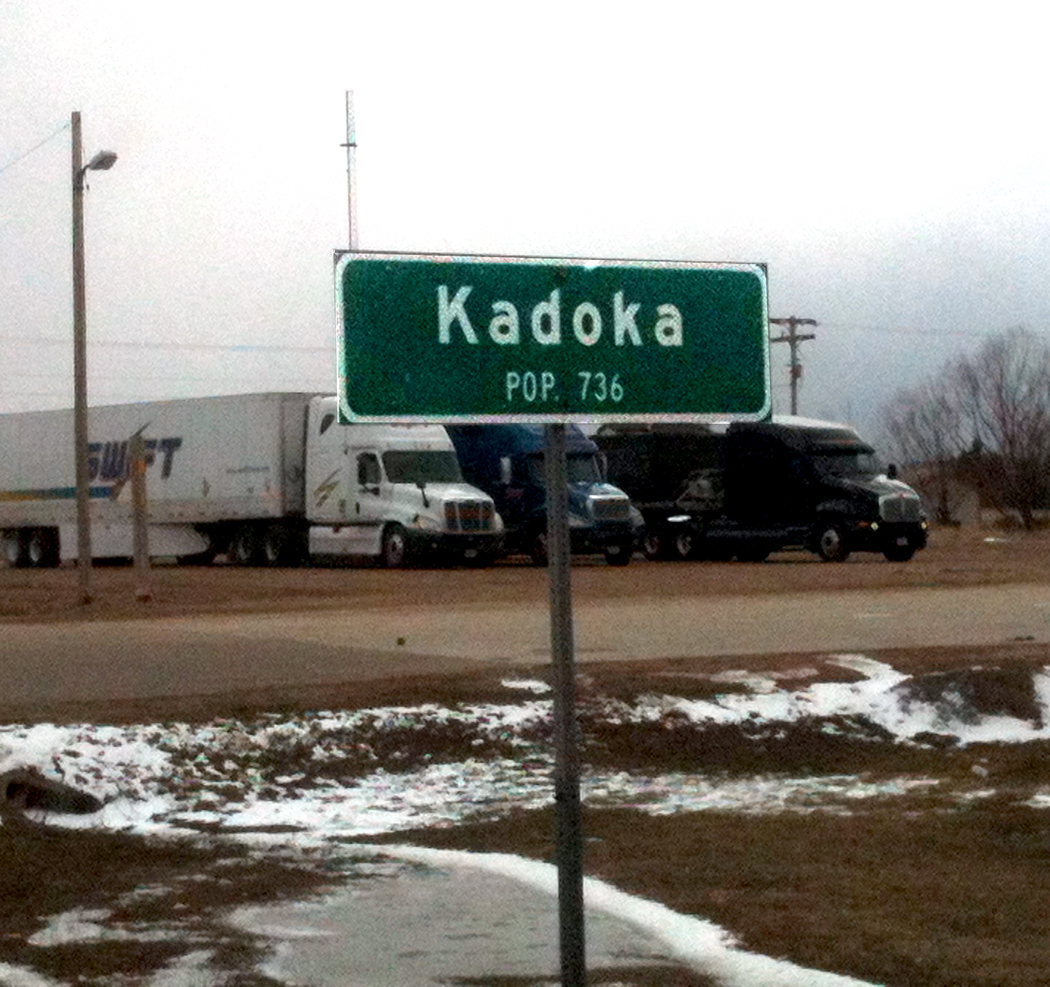
I also wonder how comfortable the Cockleburr Motel could possibly be, in Kadoka, S.D.

Kadoka is a wonderful little town. But for years, they had a sign along the interstate that read:

”Welcome to Kadoka, S.D.

Entrance to the Bad Lands

Kadoka Needs Another Doctor”

It’s not good to sound too desperate.

Maine has its own interesting town sign: ”Welcome to Kennebunk, the only village so named.”

Watford, N.D., declares itself ”The Whopper Capital of the World” in honor of the stories sports fishermen tell there. You can stay there at Four Eyes Motel, with a picture of Teddy Roosevelt on the sign. It’s also where you could find the Abstract Tile Co.

In nearby Alexander, one could hole up at the Ragged Butte Motel and Cafe, and stop by the Hard Ride Liquor Co. for your refreshment.

In Culbertson, Mont., there was Custom Built Feeds. I know the agribusiness has gone high-tech, but how scientific can silage be? OJ did it train copy

In Poplar, Mont., there was an old concrete bridge over a tiny dry creek, the way they can be in the arid West: all scrub and gravel. You’d hardly notice the bridge at all — it’s only about 15 feet long and there is nothing under it but grass and cobbles — except for the large, imposing sign: ”No Diving Off Bridge.”

The MX Motel in Chester, Mont., was named in honor of the nuclear missiles hidden underground nearby. Its sign was written in a flowery Old English script, which certainly captures the elegant and dainty spirit of nuclear holocaust.

Louisiana’s economy booms and busts with the oil business, and many businesses have a very precise focus. As you pass through such towns as Sulphur and Industries, you pass such workplaces as Concentric Pipe Rentals, the Down Hole Co. and Major Mud and Chemical. I’ve always wondered what the technical difference might be between minor mud and major mud.

But those businesses are hardly alone. There’s a Nova Mud Corp. in Ely, Nev.

Rheingold

Modern art is so ancient it’s practically a joke. It is older than my great grandmother, and I’m a geezer myself. cubist beethovenThe birth of Cubism, say, is actually closer in time to Beethoven’s Fifth Symphony than it is to us.

Modernism was a bender our culture went on; Postmodernism is the hangover we are just now getting over.

Of course, a lot of wonderful art was created in that century, but a lot of piffle was written, too, in support of the theories and ideologies that tried to argue the presumed supremacy of Modernism. Now, we look back at the wreckage and see it all as drunk-talk.

One of the arguments was over what was “appropriate” for any art form: the issue of “medium specificity,” as critic Clement Greenberg called it. Greenberg was one of the greatest pifflers at the bar, holding forth with a stein sloshing in his hand and willing to take on anyone in the bar, if they would just step outside. Here, hold my coat. clement greenburg

The idea was that each variety of art, whether painting, sculpture, theater or poetry, had its proper vocabulary and content. The lines between genres were defensive walls that should not be breached. Good walls make good neighbors, as it were.

All effects borrowed from any other medium should be proscribed, leaving the art form “pure.”  Purity becomes the sign of quality. All foreign effects must be exterminated. Esthetic cleansing, we might call it.

That means, painting must not tell a story; stories belong to literature. Sculpture must work in the round; sculpture that is meant to be seen from a single point of view is borrowing too much from painting and is therefore bad sculpture. Music that attempts to describe a scene is straying from the purity of musical expression and trying to be a picture. “Ut pictura poesis?: Not on my watch.

All this talk of purity makes us cringe now: If nothing else, the 20th century and its wars and pogroms have given the idea of purity some really bad karma.

It hadn’t always been that way: Purity didn’t used to be a shibboleth.

The issue of medium specificity is one of those generational pendulums that swings back and forth over time. nocturne in black and goldThe question is whether each art has a special message that can only be delivered in its language, or whether all the arts have the same message, only tell it in different languages.

The puritanism of the 20th century was a reaction to the promiscuous genre-mixing of the previous century, just as the pervasive tone of irony in the 20th century was an antidote to the cloying sincerity of Victorianism.

In the 19th century, it was clear that art — all art — had a single message, although there was not always agreement on what that message might be. Shelley wrote about this, Baudelaire wrote of the “perfume” of his poetry; Whistler painted “nocturnes,” as if he were Chopin on canvas; Franz Liszt gave concerts that were as much theater as music. (Nowadays, when we hear that a pianist has eliminated the hoopla and “found the music” in Liszt, we can be sure he has completely misunderstood Liszt.)bayreuth

And let’s not forget that it was the 19th century that brought us that greatest of artistic mash-ups, Richard Wagner’s Gesamtkunstwerk — the use of all the arts at a single blow in a grand design that ultimately included even architecture, in the Festspielhaus in Bayreuth. All set to a single purpose — albeit the purpose may have been the glorification of Wagner himself.

I said this was a pendulum. In the 18th century, a hundred years before Wagner, there was a sentiment, parallel to Greenberg’s, that the arts should not fraternize.

In his 1766 work, Laocoon: An Essay on the limits of poetry and painting, German critic Gotthold Lessing maintained, “that an artwork, in order to be successful, needs to adhere to the specific stylistic properties of its own medium.”Gotthold Ephraim Lessing

He was reacting to the classic line by the Roman poet, Horace, that “ut pictura poesis” — “as is painting, so is poetry” — arguing that these arts are inherently different, because while poetry unfolds in time, painting exists in space (forgetting that in a larger frame, both exist in the mind and imagination).

So, do we now use our scalpels and surgically separate music from poetry, painting from dance, and say unequivocally that what we get from Balanchine rubies balanchinebears no relation to what we get from Philip Roth? Or is there some quality they share that gives them value and worth?

As the pendulum swings back, we recognize that all art is about becoming more fully human, more aware of the world and our place in it. That awareness can be through compassion, through beauty, through politics, or through irony. It saves us from isolation, from ignorance, from emptiness. These are the big issues we face, in contrast, mutable public issues of politics or career are trivial: When we come to the end of our lives, what remains of the fustian of our existence has little to do with annual income or who got elected; it is how much we have loved and been loved, whether we have become larger in our hearts, or shrunken and dried up.

And it is art — in all its various plumage, each of its forms — that provides the imagery to do this. This is their common message.

And purity is a kind of puritanical and sanctimonious defense of the impotent notion of “good taste” that is anathema to the creation of vital art.

It is what Sir Kenneth Clark called the “fatal defect of purity.”

And as Pablo Neruda reminds us in his 1935 essay, Toward and Impure Poetry, “Those who shun the ‘bad taste’ of things will fall flat on the ice.”