Fall color reflected in surface of Walden Pond, Concord, Mass.

Fall color reflected in surface of Walden Pond, Concord, Mass.

Four seasons may seem like enough. Maybe for a resort hotel. It is the conventional way to divvy  up the annual circumambulation of the sun. But four is an arbitrary number. In some places, two seasons are all there is, rainy season and dry season, or in Arizona: unbearable heat, and respite from unbearable heat.

And even in those climes where the traditional four account for our calendar, there are really any number of discernible seasons: Indian summer, midwinter spring, mud season. In Maine, there’s black fly season; there’s tourist season at the Jersey shore. Many places have their annual infestations.

Some of the most interesting moments of the annual cycle are those that fall between the seasons, those moments that are neither quite winter nor quite spring, or neither summer nor fall.

Of these, my favorite has always been that slip in time between autumn and the harder breath of winter — when the color has passed from the cheeks of the trees but not all the leaves have dropped to gather in soft, brittle piles on the ground.

It was like that near the end of October at Walden Pond in Massachusetts, about 30 miles west of Boston. The Canada geese were flying south in droves across the crisp sky, the alders at water’s edge were naked except for the tiny seed cone at the tip of each branch. The pond water was beginning to chill, but not so much that the fish lost their will to bite the hook.

Walden Pond is a small kettle pond, left in place just south of Concord by the glaciers that covered the land 10,000 years ago. It is essentially a dimple left in the ground by the weight of the ice. When the ice melted, the water remained in the depression.

Around the pond, the land rises up in places something like 20 feet above the water level in formations the geologists call ”eskers,” which are the loose junk left behind by the ice. The twin tracks of the railroad run along the back side of the pond.

On the October morning, before the sun arises, the temperature is in the low 40s and desert-dry. You can see the light catch in the tops of the trees along the heights of the eskers and slowly descend into the water as the morning progresses. walden pond aerial view

Walden is an oblong stretch of lake, with one shallow bubble along its northeastern side. A bit of the lake is cordoned off by a footpath causeway, leaving a shallow lagoon trapped in the backwater.

Most of the trees’ leaves have dropped, leaving only the maroon of the red maple and the bright tan of the beech tree still hanging. A huge number of the leaves have collected on the surface of the lagoon, making it look as if it were paved in tree droppings.

On the water, about 50 yards out, I can see four ducks buzzing along, with their necks held flat on the water and their faces half-submerged as they wiggled their heads back and forth, gleaning a meal from the detritus of the pond. As they swam this way and that, moving like feathered zambonis, each left a wake behind it cleared of leaves.

Immediately, what had seemed a randomly mottled pond surface of tree-junk took on order and meaning as the old ”contrails” remained, leaving the water scratched with a history of duck dinners. Their names may have been ”writ in water,” as Keats had it, but those signatures had persistence.

I crouched down at the mucky edge of the water and waited. Patience pays off. The ducks slowly swam my way. Twenty minutes later, they were so close I could have stroked their slick, waterproof feathers. One started and flew off, leaving two females and a single male mallard. They scooted in circles, clapping their bills through the jetsam. One of the females came up to the water’s edge where I knelt down and began poking her beak into the mud. She found something to eat and continued.

A small boy approached on the path, calling back to his mother. I looked at him, put my finger to my lips to hush him and pointed at the birds. He looked briefly and walked right past. I wondered what he could have been racing to find that wasn’t right here: three ducks in arm’s reach.

It was early on a Sunday morning and the path around Walden Pond had perhaps 10 hikers on it. It is about a mile and a half to circumambulate the pond, so it never seemed crowded.

In addition, there were a dozen or so fishermen standing at the western and southern ends of the pond with their poles anchored in the sand and bobbing weights hanging like goiters from the poles.

”What do you catch?” I asked one.

”Trout. Rainbows and brookies,” he said in that dodgy Boston accent. ”This is our second time out this year” — said as “yee-ah” — “and we haven’t caught anything yet. There’s a fellow down the way there who pulled in a couple of them this morning.”

When I got to him, he had them strung on a line and submerged back in the water about three feet out. Each was about a foot long, one was speckled.

”Mighty good eating,” was all he said.

By the time I made it all the way around the pond, the sun was up and the temperature had climbed into the upper 50s. The light gleamed on the bark of the tree trunks and glared on the remaining leaves.

A century and a half ago, when Walden Pond first became known to a wider public, it was a quiet place, a few miles outside of town, where only the muskrats and crows came for recreation.

The silence was shattered only momentarily when the train to Fitchburg came through. Nowadays, a road passes right by the pond, and a divided highway sits only a quarter-mile away.

The sound as you walk across the far shore of the pond is a constant but subdued roar of whizzing cars, mixed with an occasional jet airplane and the same railroad commotion.

Oddly, though, as you walk around to the edge of the pond nearest the highway, its noise becomes blocked by the esker and the pond seems quiet once more.

Journalism is a funny profession, because its readers read about what happened yesterday and its reporters are writing what will be published tomorrow. It has little use for today.

But a day as distinct as this one on Walden Pond, in the cusp between the seasons, speaks only of the deliberate now, the specific and incandescent moment, as thin and sensuous as the membrane of the water’s surface as you stick your arm through it to pick a pebble from the pond’s bottom.
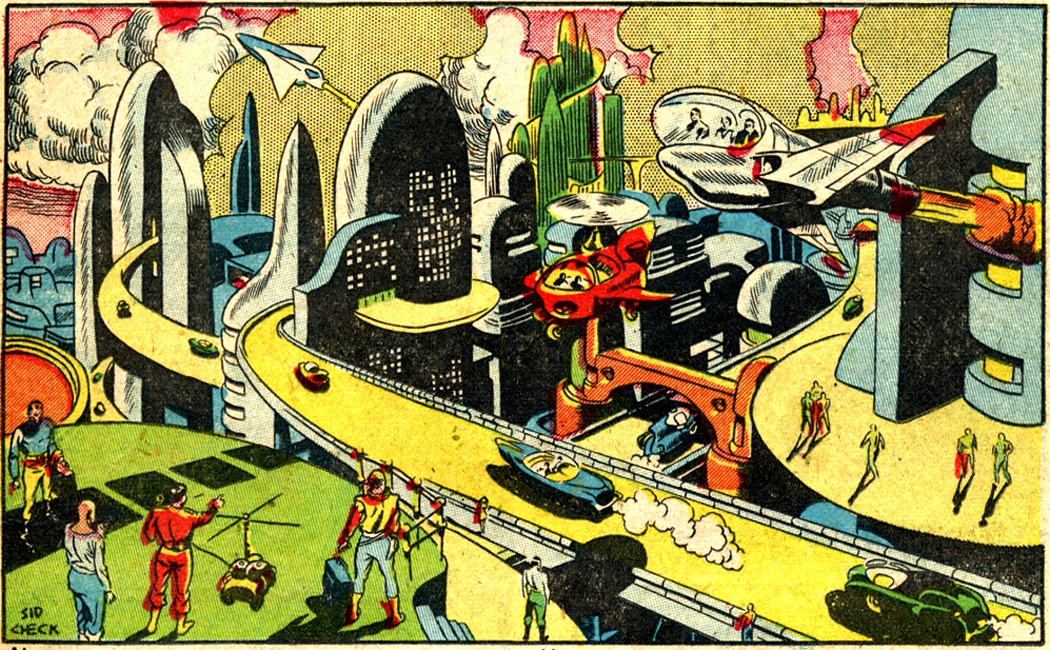
futurismo

Patience is a virtue, they say, although you could never tell it from watching a driver hit the speed dial on his cell phone while in the drive-through lane at McDonald’s.

If it is a virtue, it is one of those quaint, Victorian or medieval virtues, like chastity or temperance, that seem completely beside the point in our modern world.

Ours is a world of channel-surfing, of Federal Express, of 24-hour Wall Street, of the Concorde. drive thru holding bag

When e-mail isn’t fast enough, we invent instant messaging.

Admit it: Haven’t you left something behind at Safeway because you just didn’t want to wait in the line?

Children cannot wait to be teenagers. Teenagers cannot wait to be adults. They are all in over their heads and don’t know it.

Adults cannot wait for the traffic light to change and gun their engines. They run up escalators and microwave their instant coffee.

If they could make their clocks run faster, they would.

And what do they gain by racing through the day?

A few moments to squeeze in something else too hectic to notice as it passes by.

It is our national impatience on each Election Day that we want to know the results before the ballots are actually counted. How has that worked out?

Don’t blame the media: It is our demand for instant results that drives the networks.

But, on the other hand, we should blame media. drive thru sign

I don’t mean “the press,” for which “the media” is often used as a synonym but rather the actual mediums of communication: the television, the computer, the iPhone.

We live in two competing time realities. Media time rushes at the speed of the electrons that form it.

Our computers run at a speed clocked in gigahertz, and if tomorrow they run at terahertz, we’ll trade in our outdated desktop.

But underneath it, there is the time that there has always been: The solar time that is barely perceptible, plodding at the pace of starfish crossing undersea rocks.

In our media experience, everything flies by, helped by keyboard shortcuts.

It confuses us into thinking we live in a fast-paced world. But we don’t. We live in a slow-paced world that is chronicled by ever-faster media. A day still takes a full 24 hours to cycle.

Because so many of us work on computers and spend our leisure time watching video screens, it is easy to mistake the mediated world for the real one. We are social creatures, and the means we have created for communicating with each other can seem primary rather than derivative. cell phone pix

Our new gospel might read, “In the beginning was the flicker.”

The problem is that the faster we speed up our interaction with the world, as mediated by our technology, the less we are actually engaged with the world we live in. Instead, we are engaged with our iPhones, leaving our world to fend for itself.

This was brought home all the more forcefully the last time I went to the zoo.

We visited with a friend’s 8-year-old boy and watched as he paced from exhibit to exhibit, looked in for a maximum of 10 seconds and moved on to the next animal.

Trained by the Discovery Channel or Animal Planet, he expected instant animal action: The big cat should roar, the antelope should pronk. That is what they do on television, where all the “boring parts” are edited out. lions sleeping

The zoo, because it was there, in real time before his eyes, was a terrible disappointment. He hadn’t the patience to stand for a half-hour in front of the exhibit to see what animals actually do, as they sleep, scratch their furry behinds and tear the rinds off tangerines with their teeth.

The result wasn’t just boredom. It was a failure to identify with the animals, to scratch his bottom like the monkeys or to feel his own teeth in those tangerines. A failure of empathy.
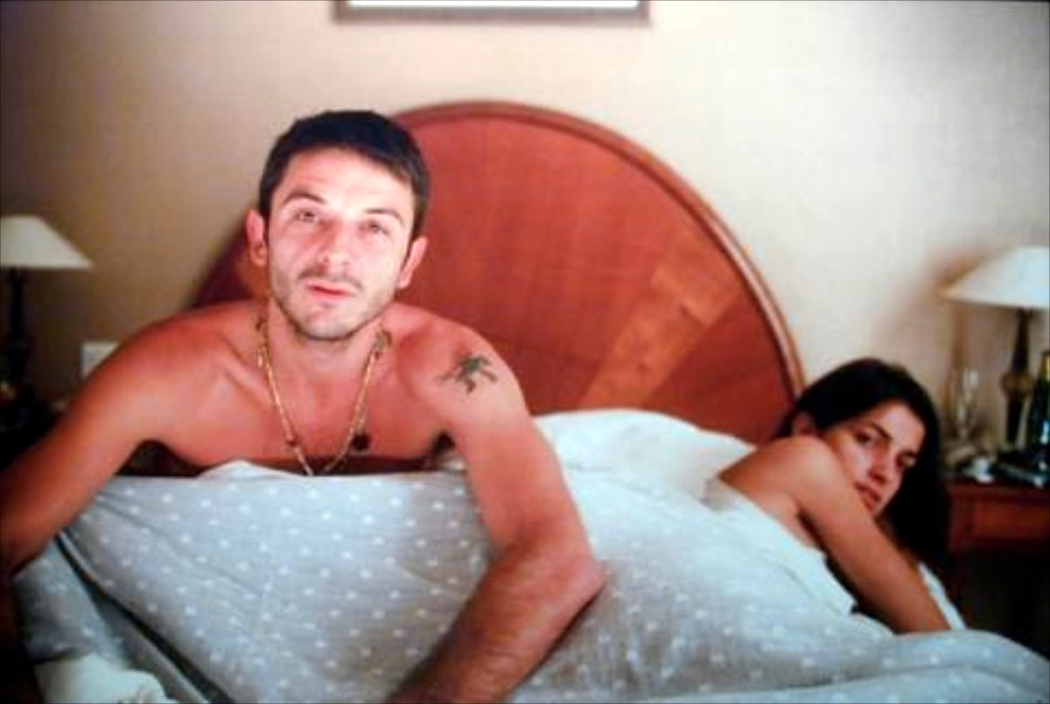
What he sees on television are just pictures: information he can manipulate.

There is nothing human about it. It is experience as flat as the video monitor. But there in front of him at the zoo, if he had the patience to see it, is a 3-D world, one infinitely complex and fascinating. It contains not only unexpected behaviors, it contains sounds and — most pungently — smells that the iPad experience cannot deliver.

At such times, we can recognize that impatience is a vice. It blocks our understanding and our growth as humans. It diminishes the world and worse, shrinks our engagement with it.

The reverse is also true: The reason that patience is a virtue — and one worth cultivating even in the 21st century — is that it provides a chance to escape our egos.

It gives us the opportunity to empathize, at real time and with real beings, so that we may act morally and ethically.

Patience allows you to seep into the world and become part of it instead of just moving it efficiently from the in-box to the out-box, stamped by your momentary attention.

Instead of making life boring, patience makes it exciting and keeps us involved in it.

AS pingpong

No major composer suffers from worse press than Arnold Schoenberg.  His music is vilified, blamed for being ugly and for destroying classical music. But how many of those who think they hate Schoenberg’s music have actually listened — and listened with an open mind and open ear — to what he actually wrote?

The problem is that one’s expectations of the music so color its perception, it can be difficult to actually hear it. Ideas about the music clog the ears.

Schoenberg and his 2nd wife in a photobooth

Schoenberg and his 2nd wife in a photobooth

(A parallel case, though less debilitating, is the myth that J.S. Bach’s music is somehow “mathematical,” when the truth is, as a high Baroque composer, his music is often wildly irrational and excessive — the Baroque is, after all, a Romantic phase of cultural history in the eternal pendulum swing between the classical and romantic sensibilities. Listen to the C-minor Prelude and Fugue from the Well-Tempered Clavier, for instance, which starts out as a repeated pattern of shifting harmonies, but then breaks into a series of appended and unrelated cadenzas. Bach tends to pile it on, not work out formulae.)

So, it is the myths about Schoenberg’s music that are the problem, not the music itself, which, given a fair hearing, is instantly communicative.

It is, however, different and unfamiliar.

“I feel air from another planet.”

These are the words the soprano sings in Schoenberg’s second string quartet (1908). Yes, a singer in the string quartet. Makes you reconsider what a string quartet is.

Although he’s one of the major composers of the German tradition, he also wrote music that dispensed with the familiar keys of, say, C-major or d-minor and developed a system for using all 12 notes — both the black and the white keys on the piano — of the octave, arranged in a series, instead of a melody. This atonal music still sounds strange to the ear, as if it came from another planet.

Hence the charge that his music is ugly; that he destroyed music; that it’s not music, it’s mathematics.

None of these canards is true, but they are persistent myths.

Myth 1: Schoenberg is all head and no heart.

If you look at the totality of his output, it becomes clear that Schoenberg is among the last great Romantics. The music is powerfully emotional.

Perhaps because Schoenberg became such an important subject for music theorists that this myth began. They analyzed the music without ever discussing the emotional content of the music. That’s not the composer’s fault: You need to listen to his music — all music — with not only open ears, but an open heart.

Those theorists looked at the basic features of Schoenberg’s theory of 12-tone music and discussed them as if they were the point of the music. AS smiling

That’s like discussing a person’s DNA but not the person’s character. No wonder it seemed to them mathematical and brain-oriented.

In fact, it may be that what really puts some people off is just how emotional it is: deeply and profoundly so, but its emotions are often painful ones rather than simple and happy ones. There is angst, pain and suffering as well as brilliant moments of transcendence, as in his early Transfigured Night. These are emotions particularly appropriate for the violent, chaotic 20th century.

He is more Bergman than Fellini.

Myth 2: Schoenberg destroyed tonality.

The problems with tonality occurred before Schoenberg. Western classical music had become so harmonically complex that often it was difficult to tell what, if any, key a piece was really written in.

Wagner’s Tristan und Isolde, for instance, sometimes wanders into the far reaches of tonal ambiguity. Debussy’s Prelude to the Afternoon of a Faun is structured around the tritone, of all things. Rather than trying to destroy tonality, Schoenberg was trying to find a solution to a problem that already existed.

Schoenberg saw what he thought was a directional arrow in musical progress, with each generation from Bach through Wagner more tonally complex and equivocal. He decided it was his duty to take music to the next step: atonality.

But he never destroyed tonality.

“There’s plenty of good music still to be written in C-major,” he once famously said, and much of his later music went back to tonal writing.

Myth 3: Schoenberg was an elitist.

The idea that the composer was an egghead has more to do with his bald pate than his actual demeanor.

He had an interest in many things, including playing ping-pong with Harpo Marx and tennis with George Gershwin. Gershwin painted Schoenberg’s portrait. When Gershwin died, Schoenberg wrote the eulogy.

George Gershwin with his portrait of Schoenberg

George Gershwin with his portrait of Schoenberg

He designed toys for his children and made them peanut-butter sandwiches cut in the shapes of animals. He enjoyed going to amusement parks, and he enjoyed jazz and socialized with Artie Shaw.

Schoenberg with Charlie Chaplin

Schoenberg with Charlie Chaplin

For his Society of Private Music Performances, which he and his colleagues arranged in Vienna before the Nazis drove them to flee, he arranged Strauss waltzes and songs from operettas.

It is silly to think he had nothing to do with the lowbrow.

He didn’t even have a high-school diploma, and when he was in school, he was an indifferent student.

It’s true that he believed music should always be the best it could be, but how elitist could it be if one of his ambitions was to score films? Although it never came to pass, he was considered for scoring the 1937 Paul Muni film, The Good Earth. Hardly an art film.

Myth 4: Schoenberg’s music is ugly.

Certainly beauty is in the ear of the listener, and some of Schoenberg’s music can be challenging, even to a seasoned audience. But there is little in music as ravishingly beautiful — in a perfectly traditional sense — than his Gurrelieder symphonic song cycle, which out-Wagners Wagner.

And even in the later, atonal and 12-tone music, there is great beauty to those who can get past their initial shock: The piano concerto at times sounds almost like Rachmaninov.

Listen to Hillary Hahn play the violin concerto: Ravishing.

In part, it is a matter of letting our ears become acclimated to the air from another planet. For some listeners, it may take years, but at some point, you wake up one day and say, “Gee, I’d like to hear Schoenberg’s string trio.” And it will give deep pleasure.

Myth 5: Schoenberg killed classical music.

Poet T.S. Eliot once complained that Milton had ruined English poetry for 250 years. Milton’s powerful voice left its imprint on all who came after.

Ironically, Eliot’s distinctive voice has been likewise imitated by everyone, especially by the bad grad-student poets in academic programs everywhere.

But you can’t blame Milton or Eliot for being good and therefore influential.

Schoenberg by Egon Schiele

Schoenberg by Egon Schiele

And it’s true that a generation of American college music programs were miserably stunted by the hegemony of 12-tone theorists in the postwar era. It is not Schoenberg, but rather that academic music that is mathematical and not emotional. That’s the music that really is ugly.

But Schoenberg himself would have been horrified at what has been done in his name since his death at 77 in 1951.

At the end of his life, when his disciples once told him that there were now more and more composers writing 12-tone works, he asked, “But, are they also coming up with music?”

Scholars will discuss the minutiae of dodecaphonic theory, but anyone willing to take the chance will learn that the real Schoenberg is one of the great composers of the tradition, whose work is moving, beautiful and — most surprisingly given the myths — deeply and profoundly beautiful.

inez fishing

I have a problem with aquariums. I love them and visit every one I can possibly find, but I can’t look at all those fish swimming around without getting hungry. All the fish look so darn tasty. Whether it’s the salmon, silver as Boeing jets, at the Seattle Aquarium, or catfish in New Orleans, which I fantasize wearing corn meal suits, I imagine all those finny beasts on my platter.

So, you might think I was a big fisherman. Catch my own dinner, hold up the sea bass for a photo, scale and gut it and fry it up in butter and white wine. But I have only been fishing three times in my life. I consider it one of my character flaws that I never became an angler; it’s a missed opportunity. But growing up in New Jersey did not nourish the outdoorsman in me. I knew a lot more about discount malls than I did about trout.

The first time I went fishing, I went out on a half-day boat with my uncle when I was a teenager, off the Jersey shore. We caught flounder and sea robin — certainly one of the ugliest of Providence’s creations — and the grown-ups drank beer the whole time. I figured that fishing, like TV football, was really just an excuse to lubricate the church key.

The second time I went fishing was some 20 years later when my wife and I were invited to a North Carolina pig pickin’, and were encouraged to fish in the trout ponds that our host had built near his house in the Blue Ridge Mountains. I fished with cheese balls on my hook and caught a half-dozen rainbows and browns. They were good eating.

Norris Allen

Norris Allen

The third time, though, I went with my daughter in Alabama. We went out on a pier in Weeks Bay, off Mobile Bay, with Norris and Inez Allen. Inez was my daughter’s nanny for her twin daughters. In the South, a nanny is more than an employee; when you hire a nanny, you are starting a lifelong relationship. It’s more like hiring an aunt or an extra grandma for your babies.

We spent the day in October on the dock, casting and reeling in our bait. Norris caught some pinfish with our boughten bait, and immediately started cutting them up into little pieces, so we wouldn’t have to pay for any more chum. The fishing trip was really an excuse to picnic and gab.

It was a social event for my daughter, her twins, the Allens and my wife and me. Inez sat in an aluminum folding chair under the shade of a broad straw hat. She held a fishing pole over the side, but never paid much attention to it. Norris, though, was a dedicated angler.

Norris cutting chum

Norris cutting chum

“I like to go out at least once a week,” he said. “But I’ve had a problem recently, so it’s been a while. I got to go to the doctor again tomorrow.”

Norris was in his 70s and as lean as Inez was not. Norris caught the most fish, but I caught the biggest.

“What is it?” I asked him.

“That’s a white trout,” he answered.

It was about 10 inches long and weighed about two pounds. Most of what we caught were pinfish, three or four inches long, silvery discs in the hazy sunlight. But we caught a few white trout, too, long and torpedo shaped. They fought harder and splashed water angrily as we hauled them out of the bay.

White trout

White trout

I mention all this because of two things. The first is that we ate the best fish dinner that night I have ever tasted. I was in ecstasy. My wife can attest. I ate pinfish and white trout, fried in cornmeal the proper Southern way, and I nearly cried when I was too full to finish off any more fish.

The second is that the following day I went to the Weeks Bay Natural Resource Center, about a hundred yards from the dock where we fished, to talk to a park ranger and ask about the fish we caught. I wanted to find out more about our worthy opponents.

“What were they?” she asked me.

“Norris said they were pinfish and white trout, but I don’t know what their scientific names are.”

“Well, there’s no such thing as a white trout,” she told me.

(There really is, it’s scientific name is Cynoscion arenarius, and it is one of the weakfish family, not really a trout, but who cares?)

“No such thing,” she repeated.

“That’s too bad. It was the best tasting fish I ever ate. For that matter so were the pinfish.”

“Pinfish?” She seemed confused. “No one eats pinfish.”

Pinfish

Pinfish

“No? They were delicious,” I said.

“No. No one eats pinfish.” She repeated that mantra several times in our conversation as if that settled the matter, as we looked through several reference books trying to match up what we ate with the pictures and IDs.

It was one of those oblique demonstrations of the differences over race in America. The ranger was a White woman in her late 20s, obviously college educated, and just as obviously oblivious to the culture around her.

Black Alabamans eat pinfish with relish, but apparently the ranger’s well-to-do White family thought pinfish beneath comestibility. This wasn’t a case of overt racism, but an illustration of the profound breach between cultures, which is magnified in the American Deep South.

And I can guarantee, after eating a bellyful of pinfish, that it is White America that is cheating itself.

psycho showerhead

At the end of our travels, how often we long to be home.

“I miss my own bed,” we say, and think of the comfort of familiarity.

But, it isn’t really the bed we miss. In my experience, hotel beds are not all that bad, as a rule, and the linens are always clean. Or almost always; I can tell you a few stories.

No, it isn’t the mattress or the blanket we miss. What we miss is elsewhere in the house: It is the shower. When I’m coming home after being away, I cannot wait to hit the showers.

And that is because: Hotel showers are a horror. Psycho (1960) Directed by Alfred Hitchcock Shown: Janet Leigh (as Marion Crane)

Many have “water saver” nozzles that limit the amount of water they spray to below the threshold needed to rinse off soap. It’s like standing under a restaurant mister. You sense the humidity, but cannot actually get wet.

Conversely, I don’t remember how many Motel 6 showers that have made attempts on my life with nozzles that so lethally concentrate the jet as to become like wet lasers attempting to slice my body in half. It makes me want to give away state secrets; there I am, some James Bond captured by Dr. No. “No, Mr. Bond, I don’t expect you to talk; I expect you to die!”

For such showers, you need to measure their muzzle velocity. You can see the knife of water so depress the skin down into the flesh as to threaten to punch through. One shouldn’t require stitches after a morning shower.

It isn’t only the flow rate that can be a problem. We have all come across water so soft that the rinse is even slimier than the soap. You rinse and rinse and cannot escape the slipperiness.

The worst was in a small town in South Dakota where the water came out of the showerhead with the mephitic smell of dead mammals. I couldn’t shake that stench from my nostrils for days.

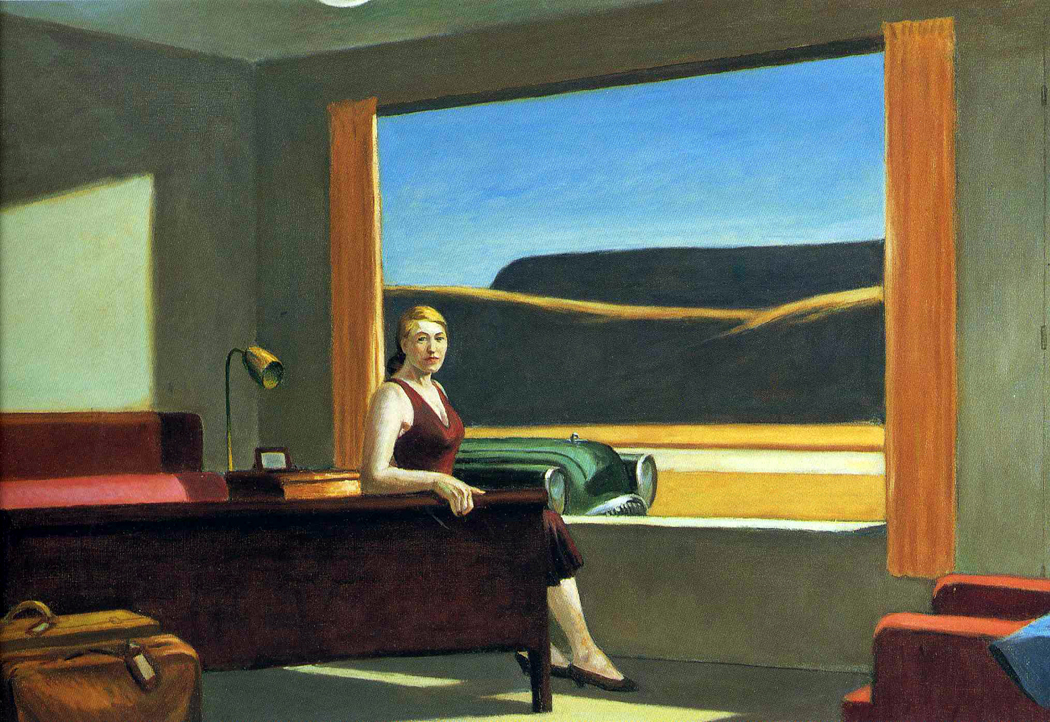
Admittedly, when I travel I tend to stay visit out-of-the-way places that don’t always have Holiday Inns, so I wind up staying at some dubious hostelries. western motel ed hopper

I remember a motel in Shamrock, Texas, which had worn-out shag rug not only on the floors but halfway up the walls, like wainscotting. That was tasteful. The carpet also ran up the side of the bed, like a high tide threatening to sweep us away.

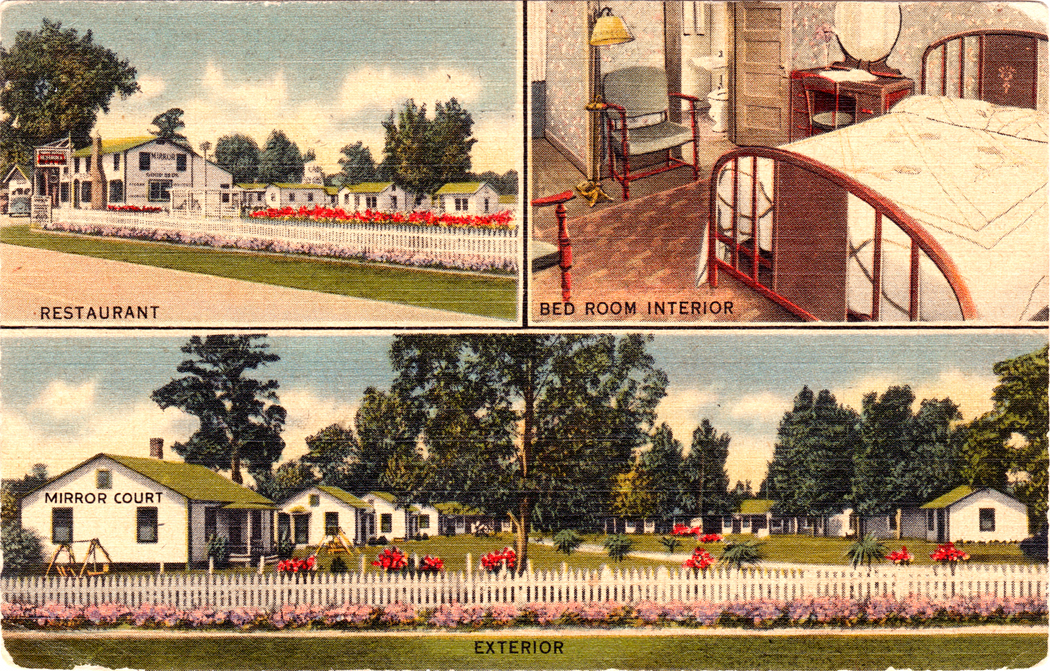
Or the motel in Forrest City, Ark., that came with fleas, and when we looked in the bathroom and saw the “sanitized for your protection” paper loop on the toilet seat, underneath a wet, crushed cigarette butt was floating in the water. mirror tourist court

I must admit, I have a soft spot in my heart for the old-fashioned motor court, with its separate cottages along a loop driveway. There is something nostalgic about those linoleum floors, so cold under your feet in the morning. Something about the squeaky iron bedsteads with their chipped paint, about the slightly musty smell — as familiar in its way as the aroma of clean wet moss. It smells natural, rather than the chemical cleaner scent of the chain motels. shower head

I prefer those old motor courts to the corporate disengagement of your standard franchise hotel, the uniform blandness that implies not that you have traveled somewhere new and different, but rather have somehow popped out of the dimension of real experience and into a kind of Disney parallel universe, a free zone, with no connection to anything. As if you were spending the night in a neutral corner.

But whether I have gone to a motel with enough layers of wallpaper to make the walls look upholstered, or to a Hyatt where, when I wake up in the morning I can’t remember if I’m in Boston or Calcutta, I can know that the shower will disappoint me.

And I cannot wait to get home to the water I know.


This blog reflects a correction sent to me by Pat Price, for which I express thanks. 

ontario goofy splice1

There must be something in these northern Ontario winters that drives a man to fill his world with giant concrete animals.

It isn’t just animals, of course, and it’s not all concrete, but in the 400-mile stretch of Canada 11 from Cochrane to Thunder Bay, there are quite a number of oddball statues by the side of the road.

It begins in Cochrane with the famous giant white concrete polar bear, named ”Chimo,” that marks the place where the Polar Bear Express excursion train leaves the station for Moosonee, 186 miles to the north on the edge of James Bay.

But it isn’t too much farther west, in the tiny but clean community of Moonbeam, that the local Chamber of Commerce office is decorated with an 18-foot-wide flying saucer made of Space Age plastics, on a tripod fabricated from playground swing-set pipes.

When I asked the woman at the information desk, she just told me the town was named for the beautiful moonbeams you can see there at night, and residents thought the flying saucer would remind them.

No, it doesn’t make sense to me, either. Perhaps it is a problem of translation. This section of Ontario is primarily Francophone, and the woman spoke English as a second language. Perhaps in French, it makes sense. It seems that when you speak French, a lot of things make sense that everyone else in the world scratches their heads over. Think of Jerry Lewis.

A local newspaper story lets on that there was controversy over the construction of the saucer, part of a $300,000 community revitalization program. Some residents wanted a giant beaver instead.

”The flying saucer won’t attract many jobs, like the beaver would have,” said local UFO critic Butch Bouchard.

Leaving the 25th century of Buck Rogers, we find ourselves back in the age of dinosaurs: In Mattice, the town’s only motel sits next to, and rather under, a giant freckled-concrete Tyrannosaurus rex, whose teeth have been further graced with a line of Christmas tree lights. Beside him sits a concrete stegosaur with a look on his face of a contented cow.

There is no mention of the dinosaurs in tourist literature; neither is there any reasonable connection with the motel. But there they stand, no more commented on than a couple of trees, with a few yapping dogs chasing each other around the lawn.

The community of Hearst is a mill town where almost everyone speaks French. Poutine1

One of the things that make sense to them is poutine, a local delicacy made from french fries covered in beef gravy and cheese curds. It’s what they serve at the local McDonalds: ”Do you want poutine with that?”

It’s not as bad as it sounds, but neither is it health food — a triple whammy of grease and enough cholesterol to clog the Chunnel.

Hearst is also the heart of moose country, so the local tourist office has a giant bronze moose out front. In comparison with the other animals, it is rather staid and conventional.

After Hearst, there is a long, long stretch of road with nothing to see but the walls of trees on either side of a straight two-lane road. Occasionally, the forest breaks open for a crystal river or waterfall.

But then, at Beardmore, a tiny village of Nipigon Indians, there is a 40-foot plywood snowman. It is, with the exception of an abandoned hotel, the biggest structure in town, and it wears a silly grin beneath eyes that look as if they come from a Hindu idol.

Next to it is one of those plywood paintings with circles cut out where you can put your head through and have a picture taken of yourself, in this instance, looking like a snowman. Perhaps this all makes better sense in the winter, when skiing becomes the regional passion.

And when Canada 11 meets Canada 17 to wind down to Thunder Bay, there is a small motel next to a 6-foot concrete trout. I should have expected it.

What I couldn’t have expected was a few miles on, standing in front of an auto-parts store: a 15-foot-tall Bigfoot chomping a cigar like a theatrical agent and giving a big thumbs up to passing motorists.

In Dorian, we stopped for the night. We could tell we had left the French area because we ate pirogis as heavy as einsteinium that sat in our bellies and weighed us down under the drowning pull of sleep.

We had a choice of two rooms at the Dorian Inn. One on the ground floor with two queen beds for $55 or one on the second floor above the bar for $26. I’m no fool. I paid the premium.

okeeffe landscape cross

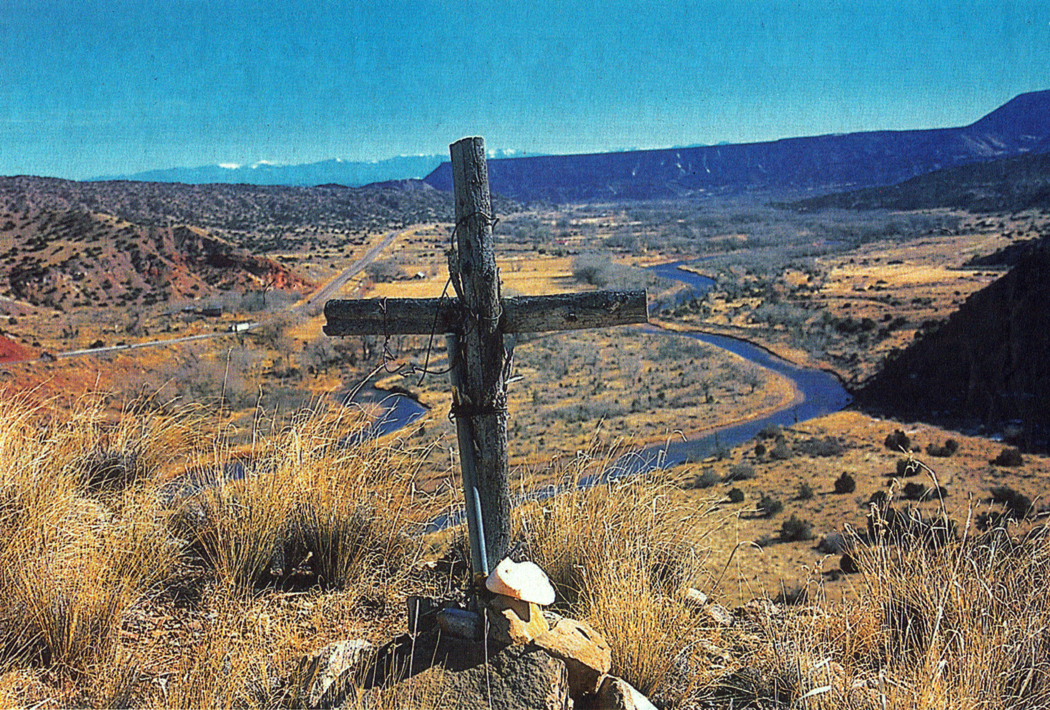
You can’t drive up the Chama River Valley in northern New Mexico and not feel the snap of recognition.

It doesn’t matter whether you’ve ever been there before, it looks familiar. The reason is not hard to guess.

It is this area north of Santa Fe that painter Georgia O’Keeffe recorded in her work, beginning in 1929, when she first started to visit the state with regularity.

”This is wonderful,” O’Keeffe said on first seeing the sage and sandstone landscape. ”No one told me it was like this.” okeeffe san jose church copy

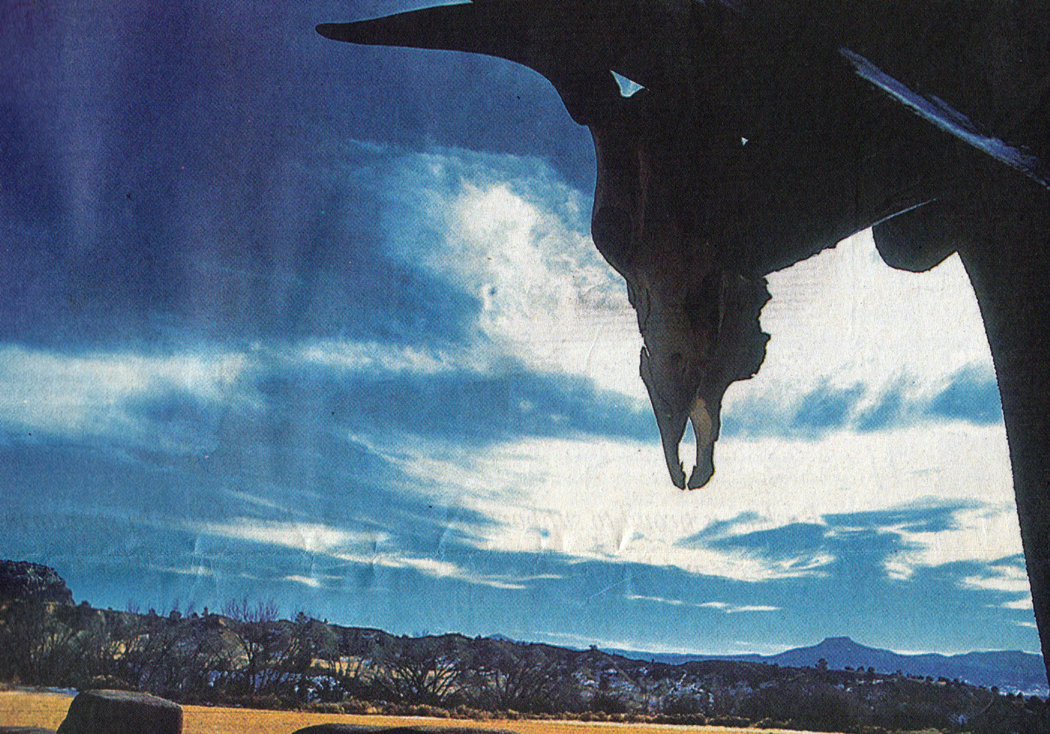
The surprising thing is that so little seems to have changed. You can still see the adobe churches, the penitente crosses, the occasional cow skull with its corkscrew horns. All of which became familiar icons in O’Keeffes paintings. okeeffe ghost house at ghost ranch copy

In fact, a drive up U.S. 84 from Espanola to Abiquiu is as close as you will ever get to driving through an O’Keeffe painting. It is all around you.

Although O’Keeffe is permanently associated with New Mexico, she was born in Wisconsin in 1887. Her family moved to Virginia when she was 14 and she later studied art in Chicago and New York.

She didn’t see New Mexico until she was 30, and then only briefly. She didn’t move to the state permanently until she was 62.

She first achieved note as a painter in New York at the art gallery run by Alfred Stieglitz, who later became her husband.

She took solo vacations to the West for many years, leaving Stieglitz behind and renting and then buying property, first at a dude ranch called the Ghost Ranch about 65 miles north of Santa Fe, and later in the tiny village of Abiquiu (Aba-cue) about 15 miles south of that. okeeffe abiquiu home copy

Her paintings, which simplified and mythologized the land around her, have become iconic for both Americans in general and women in particular she was one of the first women whose work was taken seriously in the ”man’s world” of art. okeeffe church golden NM copy

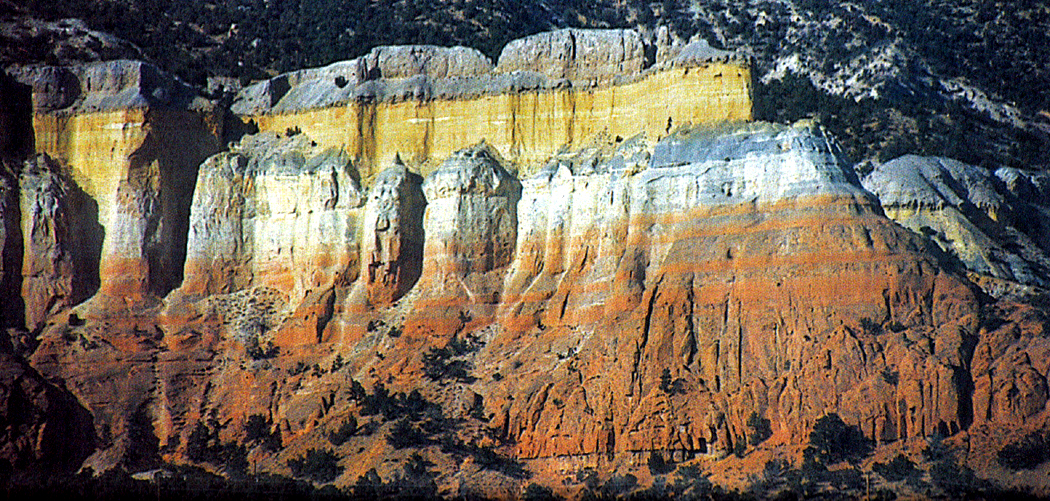
The stretch of U.S. 84 from Espanola to the Echo Amphitheater, north of the Ghost Ranch, offers the most insight into O’Keeffes work. You can see just how she translated what she called her ”back yard” into paint. okeeffe echo canyon copy

”I wish you could see what I see out the window,” she wrote to a friend in 1942. ”The earth pink and yellow cliffs to the north the full pale moon about to go down in an early morning lavender sky behind a very long beautiful tree-covered mesa to the west pink and purple hills in front and the scrubby fine dull green cedars and a feeling of much space It is a very beautiful world.” okeeffe ladder ghost ranch copy

O’Keeffe was a stubborn woman, and she stubbornly refused to leave this life until she was a few months short of turning 99.

”When I think of death,” she wrote, ”I only regret that I will not be able to see this beautiful country anymore … unless the Indians are right and my spirit will walk here after I’m gone.” okeeffe tesuque pueblo copy

No one driving along the Chama River can doubt the presence of O’Keeffe’s redoubtable spirit. okeeffe skull on eave

Mahler 9 ending

I am at this moment listening to Mahler’s Ninth Symphony and my face is covered with my own tears and my insides are torn up by the force of the music.

It is the morendo of the final movement. Ersterbend, is what Mahler asks for. And he means “dying.” Not the dramatic or theatrical dying a sensitive teenager imagines, but a slow extinguishing ad nihil: a kind of evaporation of the last molecules of life. I can hardly tell when the last note actually ends, it is so quiet.

The great music critic, Dimitri Drobatschewsky, who died last year at 90, (and who attended the Ring cycle at Bayreuth 17 times, and before he retired, managed to go to two different Mahler festivals, one in Amsterdam in 1995 and the other in Berlin 10 years later) said the highest experience he ever had in a concert hall was the Mahler Ninth conducted by Abbado in Amsterdam. As that last note hung in the ether and finally could be heard only in the mind’s ear, Dimitri said he was afraid the mood would be destroyed by the expected applause, but it didn’t: “No one applauded for a full five minutes,” he said. And I’ve read the same thing in other accounts of that concert. If he was exaggerating, it is only by a little.

Applause would have been the inappropriate response to the music; this was hardly a case of hearing pleasant tunes and enjoying them. The music, rather, spoke to its listeners on some deep, disturbing and emotional level.

The profound emotions drawn out of us by Mahler, or the late Beethoven quartets, or the Bach unaccompanieds (take your pick, fiddle or violoncello), have long ago persuaded me that music is not abstract, as the current prejudice would have it, but rather, it was meant by its composer to be “about something.” That is, the music is deeply metaphorical.

When we listen to Shostakovich’s Seventh or his Eighth quartet, or to Beethoven’s Eroica or Mahler’s Third, we are hearing the composers thoughts about extra-musical issues. Yes, they are all elaborate, complex and interesting arrangements of notes, but they are also about war, heroism, nobility, longing, death, love and idealism, among many other things. To ignore those things in the music is to misunderstand the music. Worse, it is to trivialize it.

I am not making the argument that all music, or all classical music is meant to be understood philosophically, but that a certain level of music by a certain class of composer was intended to intersect the larger issues of being alive. A brilliant Mozart divertimento may not be more than an especially graceful and intelligent divertissement, and our main concern may be the clever things he does with D-major, but you cannot hear “Viva la libertad” from Don Giovanni and not weep for its extra-musical import and what it meant at that instant of human history.

Neither am I making an argument for what used to be called “program music.” I don’t mean that the composer meant to tell a story simply by substituting notes for words. Yes, many 19th century composers published or announced “programs” for their works, but many of them also privately or later publicly disavowed those programs. And there are many cases of music writers proposing programs that are prima facie ridiculous. We now use those excesses to bludgeon the entire century of musical purpose.

But I am saying that the music we take most seriously, and hold to the longest in our lives, speaks to us of more than musical ingredients. We should not be embarrassed to be brought to tears or to elation by the Beethoven Ninth or the Verdi Requiem. That’s what those composers intended to happen. They weren’t entertaining us, they were speaking to us.

There are two aspects to this problem that I worry the most about.

The first is the assertion by some (including all those tedious French Post-Structuralists) that thoughts and words are identical. There is a good deal of thinking — perhaps the overwhelming majority — that is not verbal. We can think spatially, we can think mathematically, we can think emotionally, we can think visually. When we do something as simple as pass a car while driving, we don’t think in words about the speed of our car, the speed of the car in front of us, the speed of the car coming at us in the other lane and how far off it is. We think in temporal-spatial terms, completely without words, knowing whether there is opportunity to overtake the bumpkin in the pickup truck in front of us who is going 25 in a 45 mph zone. No words, but thought nonetheless.

And when Richard Strauss takes on the afflatus of idealistic aspiration in his Don Juan, we recognize the affliction in our own body-reaction — the heightened pulse or the rise of gorge in our goozle. I don’t have to put in words to know it. It is the perfect musical metaphor for the non-musical experience.

If one objects that the music can never be as precise, or that it is always ambiguous, I can only respond that words themselves are always ambiguous and imprecise. Their supposed precision is an optical illusion. (It is why we have lawyers). To contain largeness requires ambiguity: The more precise a word is, the less it defines, until the ultimate precise word has no more meaning than the name of a dog. Here, Spot.

(I mean, for instance, that genus is more narrow than phylum, species more precise than genus, breed yet more precise than species, and when you slice it down to an individual dog by name, you have narrowed the scope so much that whatever observation you make no longer has any wide application.)

If we think about this issue of precision, it is obvious: What is the white whale in Moby Dick? The very ambiguity is essential to its power. So, this can be no argument against metaphor in music.

And secondly, if you say music is not “universal” and is culturally inflected — as so many intellectuals do these days — then I scratch my head. Is not language culturally inflected? Do you not have to learn English to understand Steinbeck? So how is it different having to learn the tradition of European classical music to understand Mahler? Mahler is (albeit idiosyncratic) something to learn, just as you have to learn by reading Faulkner or Joyce to get past the parts that at first don’t make sense.

The Mahler Third arguably makes no sense understood merely musically. It took me years to begin to fathom what was going on in that vast ocean of music and orchestration, but now that I understand it metaphorically, it is the greatest of Mahler’s symphonies (or maybe shares that with the Ninth and Das Lied von der Erde — “Ewig, Ewig.”

The other big problem I have is the prejudice of Modernism.

I have lived through the century of Modernism, and was infected with it from my earliest years. I am only recently cured. I grew up loving abstract art and stream-of-consciousness novels. The party trick that is Modernism is to understand the means of expression as the subject of the art itself: color, form, shape, contrast: These carry meaning in themselves.

(I know Modernism has other aims as well, but this part of it is what ruins classical music for me.)

And you can see the effect of Modernism in the history of classical music recordings. The old style of performance, exemplified by Furtwangler, Mengelberg, Casals and Walter, by mid-century, gives way to Toscanini, Weingartner and eventually Szell, Solti and now, John Eliot Gardner. These are the “just-the-facts-ma’am” conductors, following Toscanini’s dictum: “To some, the Eroica may be about heroism and nobility, but to me it is just Allegro con brio.”

A century of musicians have disparaged the very idea that music can be about anything but music. “Music can express nothing,” said Stravinsky, whose music is profoundly expressive despite himself.

What is lost when this Modernist esthetic is applied to music — and 19th century music in particular — is the core of what the music is about. If a Leonard Slatkin doesn’t believe that the first movement of the Eroica strives for something and achieves it in the coda, then he is only making noise. I read reviews over and over where the critic complains that the conductor is “interpreting” the music instead of just letting it speak for itself, and what he means, of course, is that he wants the music to shut up about life, death, the universe and everything, and just scratch the familiar tickles and amuse me. As if you could play Hamlet and just speak the words clearly without all that “acting.”

The century of Modernism is over, although the effects linger on. And what we call Postmodernism isn’t all that much better (it being merely a kind of Mannerism to the Renaissance of Modernism), but you can find a number of musicians and conductors seeking to find other ways of dealing with the real issues of the music. Yes, there are the Roger Norringtons out there, mucking things up with their idiocy, but there are also the Mikhail Pletnevs and Daniel Barenboims, seeking to understand why there should be a ritardando here, or a sforzato there, even when not called for in the score. The same as a Gielgud applies a pause in “To be or not to be,” to maximize the rhetorical understanding of the content. Shakespeare did not indicate such in his text, but an intelligent actor knows where they work and why.

I also have to laugh at the way Modernism once thought of itself as the natural conclusion of a historical process, having finally gotten to the point of esthetic “purity” that all art previously only aspired to. Got a giggle out of that.

Along with Pablo Neruda, I am in favor of the impure in art.

And in favor, not of a simple-minded return to an elusive “golden age” of the past — such an age never existed, and the old recordings prove that musicians now play in better tune and with better intonation than they ever played for Mengelberg — but for some new way to explore the metaphor inherent in the music, and not to ignore the music’s meaning for the sake of keeping alive a dying flame of Modernism.

goldin 4 black eye

Even when they stand before us stark naked, the only part of their anatomy that matters is their eyes, which hold us paralyzed in their gaze. They are mirrors of infinite sadness.

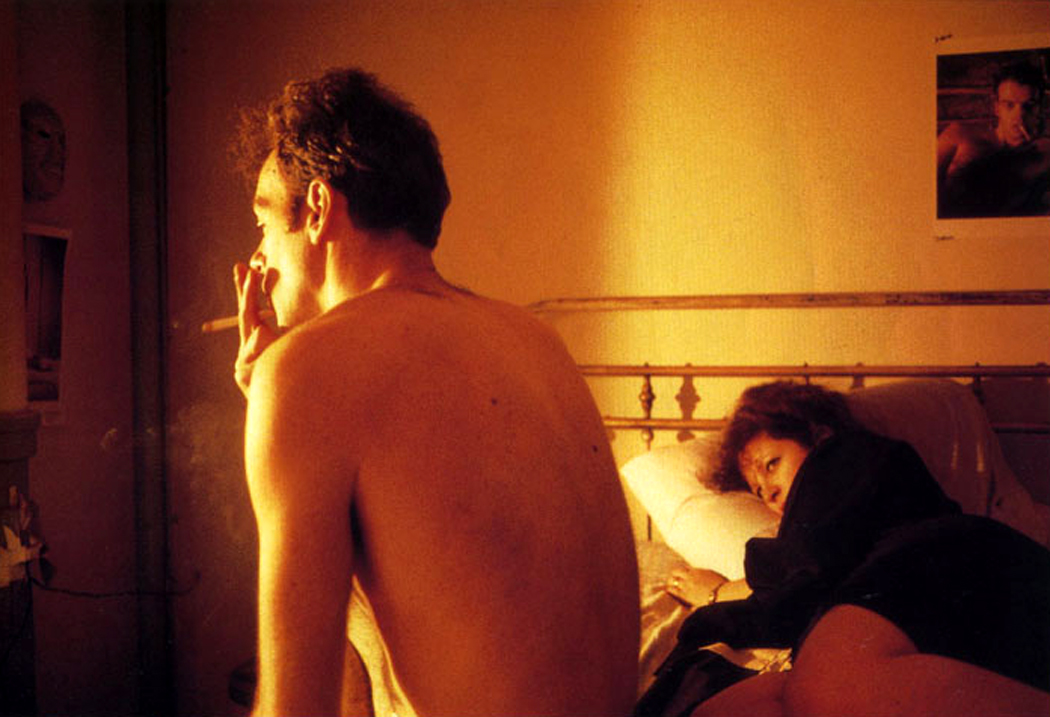
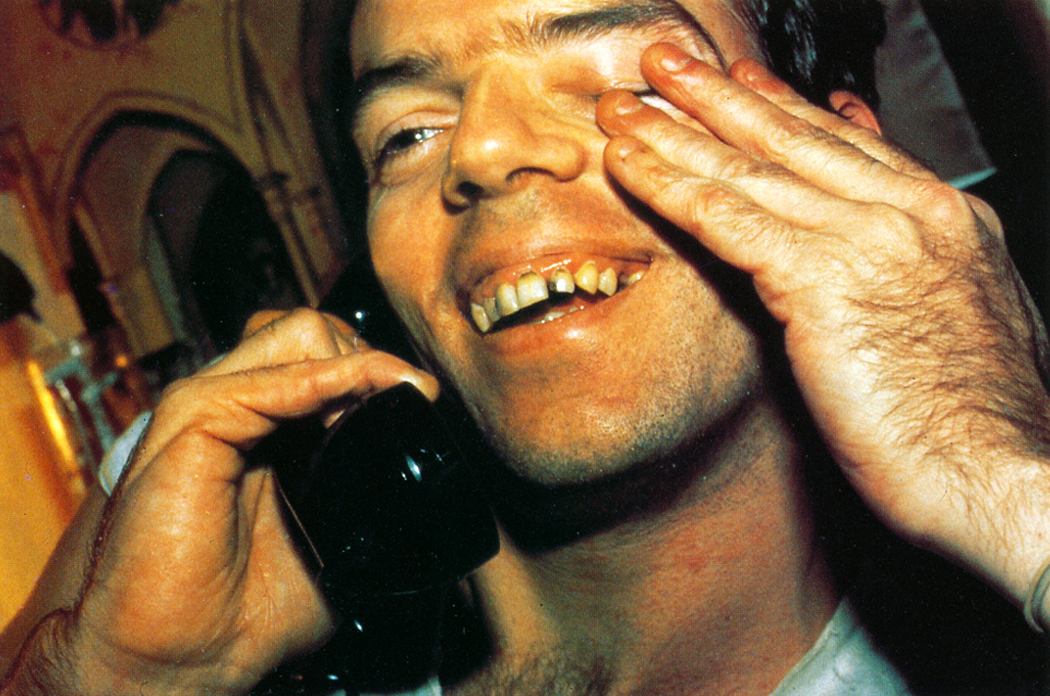
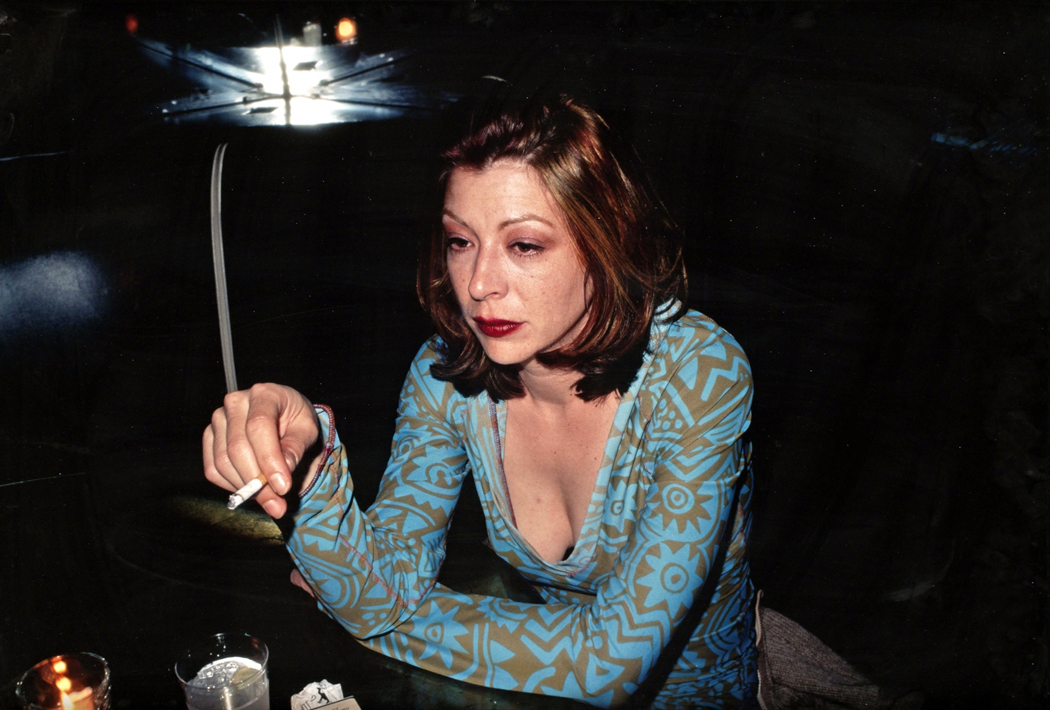
One of the perennial sellers among photographic books is Nan Goldin’s Ballad of Sexual Dependency, a woeful tale of the underbelly of the art world told in a series of primitive color photographs full of battered women, tattoos, transvestites, pimps, drugs and hangers on.

Ballad of Sexual Dependency

Ballad of Sexual Dependency

They look out at us, bruised and lost.

Over a period of 40 years, but primarily in the 1980s, Goldin has photographed the beaten underside of la vie de Boheme — the art world and the pretenders to the art world, the gay world, the broken and wounded, the young who have found what they are looking for in being lost.

And it is an impressive accomplishment. Some 700 photographs, each an intense shot of emotional cocaine, are accompanied by music, ranging from blues to heavy metal to opera.

Goldin has photographed this subculture from the inside. She bears no objectivity: These are her friends and lovers.

“I don’t choose people in order to photograph them,” she has said. “I take photos straight from my life. These photos come from relationships, not from observation.”goldin 1

The pictures are raw, like snapshots, and the life is even more raw: They love, shoot drugs, party, cry on each others’ shoulders, smoke Marlboros, dress up in costumes and search for — and intermittently find — meaning. More often, they find pain and suffering. And in the age of AIDS, they also find death.

These are people on the edge, their nerves raw from abrasion. For them, “unprotected sex” is spiritual as well as physical: Their souls are wide open and vulnerable.

The photographs at first appear nothing more than snapshots, but the cumulative effect of 700 of them proves that Goldin is instead a rare technician, able to create the effect of spontaneity and carelessness at will. The figures’ motion shows as blur in the pictures, usually lit with the garish glare of the flashbulb. The colors of the pictures are the brightest Kodachrome blues, greens, violets and golds. Goldin has created a style perfectly suited to the subject matter.goldin 6

The faces are both pathetic and heroic. The young bohemians, living in squalor, clearly see themselves heroically, participating in grand love affairs, where violence can easily be confused with passion and romantic dreams can comfortably ignore their rat-infested surroundings. It is cold water flats with concrete floors, soiled sheets and nose rings.

Which gives them a certain nobility: They know they are alive.

Most people have seen the photographs published in book form, but Goldin didn’t intend the series as a book. It was first a slide show that she dragged around the New York art world in the 1980s, showing in night clubs as well as galleries. It is meant to be accompanied by music, which is missing in the book. The music is as important as a score to a film. goldin 11

The show, which takes 45 minutes to sit through, is not endured by many museum goers when it has been shown at major museums, most of its watchers come and go after seeing a minute or so of the presentation.

And its intensity does make it hard to sit through.

But Goldin manages to keep it all coherent, scripting the show in smaller bursts of slides grouped thematically, or as an episode in a single love affair.

Because she makes you see the flow from one slide to the next, it never becomes the interminable horror of a neighbor’s travel pictures. Unless your neighbor is Dante.

Yet, it isn’t quite hell, either. It is relentlessly romantic. Goldin is never the outsider, seeing the pain and filth and commenting on it. She is instead an avid participant, able to play-pretend with all her other subjects that she is in the middle of some grand opera of love and passion. goldin 16

And while at some level she must recognize the ugliness, she is no moralist, presenting shocking scenes in hope we will pass laws or enforce a social code. Lewis Hine she is not.

No, she gives us a layered, complex vision of her world that alternately repels and attracts. She makes us want to give in to the romantic illusions, but the bruises on her face brutally contradict them.

Indeed, Goldin is a major participant in the story she tells. She appears in a large number of the photographs, including the climax series, wherein she sustains the abuse of a boyfriend and wears the black eye he gives her.

But this is never a tract about domestic abuse: Goldin clearly takes responsibility for her own actions. She is willing to trade being terrorized for the drug rush of romantic obsession.goldin 12

This is la vie boheme in the age of AIDS and crack cocaine, and Goldin is its Puccini.

And that is the key to the success of these photographs as art. We do not need to live in rat-infested cold-water flats like Goldin’s subjects, but we do need to know we are alive.

It is the primary duty of art to reacquaint us with the fact.

Daily living takes the edge off life for all of us. Habit and conformity dull our senses. We may feel more mature and less reckless than Goldin’s druggies and transvestites, but if we are honest, we also must admit that what we call maturity is too often composed of equal parts of cowardice and exhaustion.

Goldin’s people risk everything, even death, for the rush of feeling alive. goldin 13

In that, they are like the Medieval stories of Tristram and Iseult or Launcelot and Guinevere. Our notion of romantic love had its beginning in these stories of adultery. For the sake of their passion, the lovers accepted not only death, but the eternal damnation they believed would follow. The assumption of such stories was that transcendent experience could not be found in the routine, in the sanction of society; it must be found outside the rules. A life lived only by rules is a mechanical life; authenticity is found only by acting from the purest impulse.

It is a grand and romantic notion.

But we were not asked then to become adulterers and we are not asked now by Goldin’s work to go out and score a bag of heroin. Art must be understood metaphorically, not literally. The message we learn from both the Medieval and postmodern is that life requires risk, that any risk less than all doesn’t count.goldin 7

So Suzanne, Cookie, Siobhan, Claude and all the rest of the recurring denizens of this demimonde, including Nan herself, who is a principal in her own opera, throw themselves into relationships — into experience — with a foolhardy disregard for their own self-preservation.

When I call this impulse “romantic,” what I mean is that it attempts to connect with those things larger and more eternal than a smooth running society. It tests the limits rather than acceding to them.

They are a La Boheme for the current age. The violence is always mistaken for passion; the sex is always mistaken for love.

When you see something like Goldin’s pictures, you begin to understand some of the attraction of the life with its unmade beds, dirty drinking glasses and cigarettes extinguished on the rug. Perhaps you or I would not like to live that way, but there is an underlying romanticism to it: They are not living the quiet, safe world of their parents. It is a life taking chances, living on the edge, a desperate chance for transcendence.

So, the women risk beatings by their boyfriends and the men risk thrashing by their drug dealers, all in the name of feeling overpowering emotions and not giving in to what they see as the gradual death of conventional living. goldin 15

For the secret romanticism, whether it is Nan Goldin or Percy Shelley, is its aspiration to transcend life’s limits. Nothing should be forbidden and the only thing worth doing is what is impossible.

There is a wonderful scene in William Blake’s Marriage of Heaven and Hell. An angel brings the poet to a precipice and from their height, they look down on “the infinite abyss, fiery as the smoke of a burning city; beneath us, at an immense distance, was the sun, black, but shining; round it were fiery tracks on which revolv’d vast spiders, crawling after their prey, which flew, or rather swim, in the infinite deep, in the most terrific shapes of animals sprung from corruption.”

On being told of this vile place, the poet innocently suggests, “if you please, we will commit ourselves to this void, and see whether providence is here also.”

Much of what passes for art in any age merely keeps us lulled: Pretty pictures or numbing farces. People call for beauty, but what they really ask is for an anodyne: a buffer between themselves and the difficulties of being alive.goldin 8

But if we risk feeling alive, we must remember that to be alive is to suffer. Americans sometimes like to forget this fact; we live comfortable lives, insulated from the hard certainties. We kill to eat, although we never think of the slaughterhouse when we buy our burger; we grow old and die, although we spend billions on cosmetics and plastic surgery to deny the inevitable. Our love cannot protect our children and our best intentions cannot prevent us from hurting others.

But as Krishna taught Arjuna in the Bhagavad Gita, one must recognize the universal tragedy and still act.

And, like Nan Goldin’s art, manage in the face of suffering and death to say “yes.”

Mary,_Queen_of_Heaven-_c._1480_-_c._1510_(hi_res)

Wandering around the National Gallery of Art in Washington D.C., I nearly broke into tears. So many old friends, so much moving, meaningful art. There the Panini, there a Canaletto, over there the Rembrandt and there the Assumption by the Master of the St. Lucy Legend.

This is why I love art. In one spot, so much of the best and even when not the best, then the best known. Each room contains two or three of my oldest, dearest friends, and oh, how they have changed over the years since I last saw them. It has been at least a dozen years since I visited them and they have altered greatly. Some that I loved passionately when I was a college student have now become garish, cheap, obvious and unsubtle.

It isn’t just us that change as we age: It seems the very paintings do, too.

So now, others that I knew as one knows a distant aunt or uncle, not too well but by reputation, now seem as deep and wide as oceans.

I have left TerBrorch and Hals, but they have been replaced by Corot.

At noon, my brother, Craig, showed up in the rotunda and we wandered the galleries trading enthusiasms. Mostly, we walked through the 19th Century French galleries where the Cezannes are as serious as Bach and the Renoirs as cheap as a wine cooler. Through the American galleries and then to the East Wing. We stayed there until we were thrown out by guards at 5 p.m.

When we got to Craig’s car, the battery was dead. He called AAA and we waited an hour for them to show up, much of that time listening to the sorry tale of a homeless ex-drug addict, now relapsed (making him, I guess, a former ex-drug addict). He seemed bright and alert and he originally showed up in an attempt to help us start the car. He offered to call the police, saying they usually have jumper cables and help out.

“Don’t ask a cabbie,” he said. “They always want money for it. It ain’t their business. They shouldn’t be asking money for helping people. But they always want $10.”

Craig let on that $10 might be a bargain to get the car started without waiting the hour to 90 minutes the AAA had promised.

But he began telling us his life story, kneeling on the asphalt so his head was at car-window level so he could see both of us inside.

“I’m going to a program in West Virginia Tuesday. It will help. I was in a 12-step program and I kept clean for 11 months and seven days, but two weeks ago, I relapsed. You know I never did none of that crack cocaine, but it’s a depressing high. It’s a nice high, you know. But it’s depressing. I makes you, if you have a conscience, you know, makes you do things you wouldn’t. You’d sell your own mother. Well, I’m lucky cuz I never had to steal nothing to pay for it. I had a job with the government, but they found out I didn’t finish high school. I had only two credits to go, they told me, and I could finish it in summer school. I had scholarships, had …” here he held up fingers like he was counting them in his mind … “seven scholarships. I was in track and field and in football. One was for Notre Dame, and the rest were for schools here.”

But drugs intervened.

“You know, one thing I learned: You should always marry into the same religion. My wife and I are different. She’s into Yaweh and Yeshua — Is that what it is? I never understood. Yeshua and Yaweh, that’s Jesus and God. I don’t know why she calls them different. But my Mama always went to church. I’m not much of a churchgoer, really, but if you don’t have religion, you can’t kick the drugs. I really believe that. This retreat in West Virginia is religious.

“My Mama showed what you can do, how you can overcome your adversities. She didn’t have no education, really, and my Dad, well, he was paralyzed from the neck when I was two. I never seen him after that. I told everybody he was dead. He came back from that war, what was that war, in 1968? Vietnam? Was that Vietnam? And he married my Mama when I was 2 then. But later he got real, he drank too much at a party one night and when he drove home he ran into that building there, what’s that building? The FBI building. He ran into it and got thrown out of his car and layed out in the street all busted up. He weren’t ever around when I grew up.

“Mama took some courses in typing and secretary things and got a part-time job with the Government Accounting Office. It was a good job and she took courses and after about six months, she left there and got another job and went to college. She studied accounting and became a CPA and now she works for the Internal Revenue.

“I don’t wanna disappoint Mama, which why I’m out here on the street today. I don’t wanna be out here tonight, cuz if I am and I do the drugs, I’ll miss the trip to West Virginia. If I do the drugs, I won’t be here.

“Drugs is bad, and that crack cocaine is the worst. I mean, the man who invented it … I mean the man who invented any drug should be in jail, but the man who invented crack cocaine, they should shoot him.”

He never sounded inarticulate, but he lapsed from King’s English into street patois and back, sounding sometimes like a home-boy, and sometimes like a middle-class stray. He was well-groomed and with a beard.

“I have never gotten so bad, you know, that I had to eat out of the garbage or pick up some food someone dropped. But I ain’t saying that couldn’t happen, but it hasn’t yet. But if I don’t stay clean till Tuesday, it wouldn’t surprise me. You know, they say that when you relapse for the first time, it’s the worst, that things are much worse than when you’re hooked the first time. And they’re right. If I don’t get out of this now, I’ll keep going back and it’s just gonna get worse and worse.

“But I never broke with my family or nothing, so they’re there for me, my Mama is, anyway. I’m an only child and I think she tries to take better care for me for that. She always tried to buy me the best clothes, not just ordinary clothes, but the best.”

And although he had mentioned panhandling early in the conversation, he never did hit us up for money.

“It’s good to talk about it,” he said as he rose from the pavement. “It’s good to talk with someone and tell them, so thanks for listening, you hear? I can go and get the police. They’re right over here in this building,” he said, pointing to a large, characterless, bureaucratic building of poured concrete and glass. “The police here will help you; they’re good about that. Don’t stop no cabbie.”

And he walked off. About 15 minutes later, AAA showed up and jumped us.

So, after a foot-numbing day of museum-going, I hobble back to the hotel and just as I get my socks off and begin rubbing my toes, it begins raining in downtown Washington, slickering the streets and streaking my window. Lightning flashes benignly in the clouds. And though I can barely walk, I slip my shoes back on and limp down the hall to the elevator and out into the weather.

“I’m from Arizona,” I tell the doorman. “What do you call this funny stuff falling out of the sky?”

He laughs. “Rain. It rains here most every afternoon in the summer.”

“Where I come from, it hasn’t rained since last year,” I tell him. And I don’t remember any rain since before January, so it’s true.

I walk out in it, get my hair wet and my clothes dampened. A low roll of thunder and the car tires sizzle on the wet pavement.