Archive

Tag Archives: art

Sometime around 1515, the Venetian artist Titian painted a scene usually titled “Sacred and Profane Love.” In it, two women are seated at a marble well; one is nude, the other elaborately dressed. It comes as a shock to many Americans to find out that in this allegory, sacred love is represented by the naked lady.

And in general, Americans seem to have a difficult time with the nude in art. Maybe it is America’s Puritan heritage, maybe it is the low priority given art education in our schools.

Sometimes it’s just pig ignorance.

But to many Americans, the nude is something dirty, lewd and embarrassing. At the very least, nudity is equated with sexuality and eroticism.

As they said on “Seinfeld,” “Not that there’s anything wrong with that.”

We can laugh at the silliness of such a view, but it governs much of what Americans think about sexual morality, including former U.S. Attorney General John Ashcroft, who spent $8,000 in 2002 on blue drapes to hide two giant Art Deco statues — “The Spirit of Justice” and “The Majesty of Law” — at the Great Hall of the Department of Justice in Washington.

Certainly, there is a good deal of eros in art history.

Take for instance, Francois Boucher’s “Reclining Nude” from the French 18th century.

There is not much about this luscious painting that is different from, say a photograph with a staple in the middle.

An in America, too often, this is all that a nude is.

A few years ago, a woman in Tucson demanded that art and art books be removed from a public school, calling works by established masters ”pornographic and morbid.”

She was talking about Michelangelo’s “David” and Picasso’s  “Demoiselles d’Avignon.”

What is more astounding is that she managed, at least temporarily, to have 10 art books and four posters yanked from the school. The works in question were by Edouard Manet, Frida Kahlo, Paul Gauguin, Hieronymus Bosch and El Greco.

She said she considered El Greco a ”pervert.”

”We left the art teacher with about five books,” she said, with some pride. ”I took out anything with nudity in it. There’s no difference between a nude (in an art book) and a ‘Playboy’ picture.”

I’m not interested so much in the question of what is appropriate for fifth- and sixth-graders; there may be some legitimate concern for their sensibilities. Although, in this case, I doubt the kids are getting anything from Gauguin they haven’t learned long ago from Aaron Spelling.

But, I am very much interested in the widespread belief that nudes are necessarily pornographic.

Such a view ignores the evidence of centuries of art that has portrayed the human body for other, more complex purposes.

Varieties of nudity 

So what are those purposes? In other words, what does the nude mean?

All but a few cultures in the history of the world have had a place in their art for the undressed human body. Although it is probably more developed in European art than elsewhere, the nude body appears prominently in African, Persian, Hindu, Tibetan and Japanese arts.

It occurs with different meanings in them: In Chinese art, the nude is rare; the most frequent nudes are not sleek ideals of human form but fat Buddhist monks, looking like the sileni of Greek art.

But you will see that these are not different merely in style, but in purpose: These are all different meanings for the nude and the human form.

Of course, in the geography in which humans evolved, there was less need of heat-conserving hair. And in those climes, nudity has different cultural meanings.

And titillation is rarely the primary factor involved.

Like the prisoners in Abu Ghraib — Surely being made to exhibit themselves naked means more to them than it would to us, even if we feel humiliation in our nudity, how much worse is it for these Arab men?

In the temple art of India, nudity and copulation are used as a metaphor for the Cosmos. There is not one single meaning for the nude, but rather a series of layers of meaning that can overlap. Those layers run from the most primitive to the most sophisticated. There are at least four distinct layers of meaning to be addressed:

–> Appetite;

–> Intellect;

–> Power;

–> and Spirituality.

The first layer is really that of plumbing.   At the level of appetite, we have the gaze of the voyeur.

It is here we find everything from men’s room drawings to “Debbie Does Dallas” to the pillow books created by Japanese artists in the 18th century.

The faces mean little, the beauty or fitness of the physiques mean little. There is nothing going on but what Joseph Campbell has called the ”zeal of the organs for each other.”

All true pornography stops at this basement level.

And it is this level that most of the moralizing critics of the nude are stuck in, unable to see any higher.

The rippling of silk 

The second layer is that of both eroticism and idealization.

In both cases, the mind takes over from the organs and imposes standards.

Eroticism is the level at which the rippling of a silk dress is more arousing than raw flesh, with all its hair, bruises and cellulite. Pornography is stunningly literal-minded; eroticism is imaginative.

And eroticism’s flip side is the idealized nude of ancient Greece or “Playboy” centerfolds. In each case, an ideal form is held in the mind – an ideal the real world cannot actually live up to; hence the canon of Polyclitus, which defined the proportions of the perfect body, and the airbrush of Hugh Hefner.

When Sir Kenneth Clark wrote his famous book about the nude, he focused almost exclusively on this aspect of the figure in Western art: The idealization of beauty.

Here we find the pneumatic Boucher cuties and the massive Classic Zeus in bronze throwing his thunderbolt.

If pornography is often physically repulsive, no matter how fascinating, the idealized nude is  intended to be attractive. The idea of beauty enters into the equation.

The so-called Venus of Willendorf, from at least 24,000 years ago, found in what is now Austria. Is this an ideal of beauty? It is certainly an image of fertility. And fertility and beauty are often the same thing, when you live in a time and place that survival depends on fertility.

In Ancient Greece, where we generally start our narrative of Western art, the earliest statues were an expression of human perfection. And for the Greeks, human perfection meant the male human form. They worshipped male beauty. Greek vases are full of nude male bodies — athletes in the Panathanaic Games, for instance.

The early kouros was still rather stiff, by modern standards, but compared to what went before, in Egypt or Babylonia, it is a model of realism and accurate observation.

I don’t want to make this a chronological history. You have schools for that.

But you are familiar with lots of nudes in European art from the Renaissance to now.

Rather, I want to look at some thematic ideas, how the nude changes meaning.

The body still remains, however, essentially an object rather than a person.

How the world works 

We’ve seen the erotic nude, but that’s not all there is.

A third level, above the erotic and the idealized, is the level of power and the political, psychological and scientific.

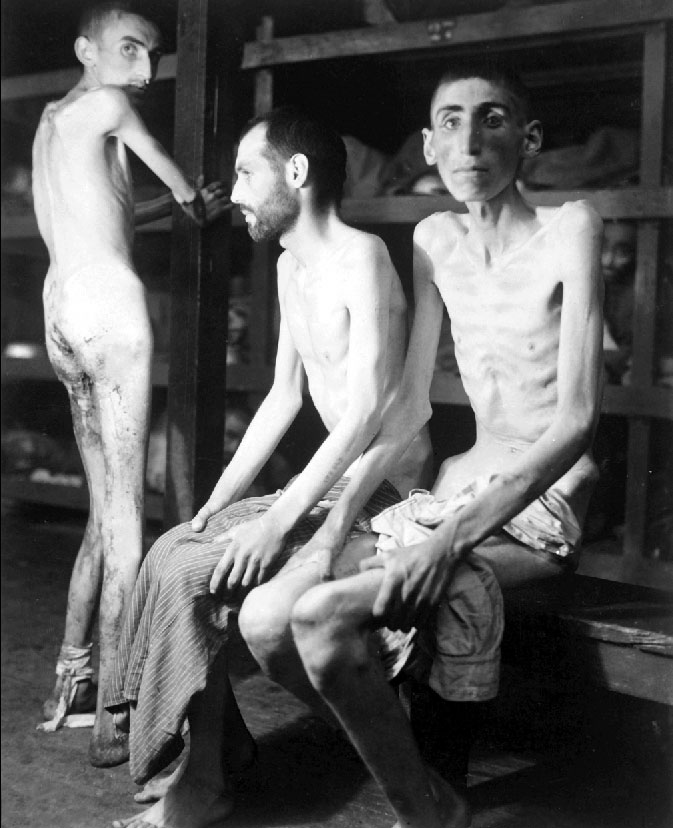
What does the nakedness here tell us? It tells us these people are powerless, humiliated, tortured and suffering.

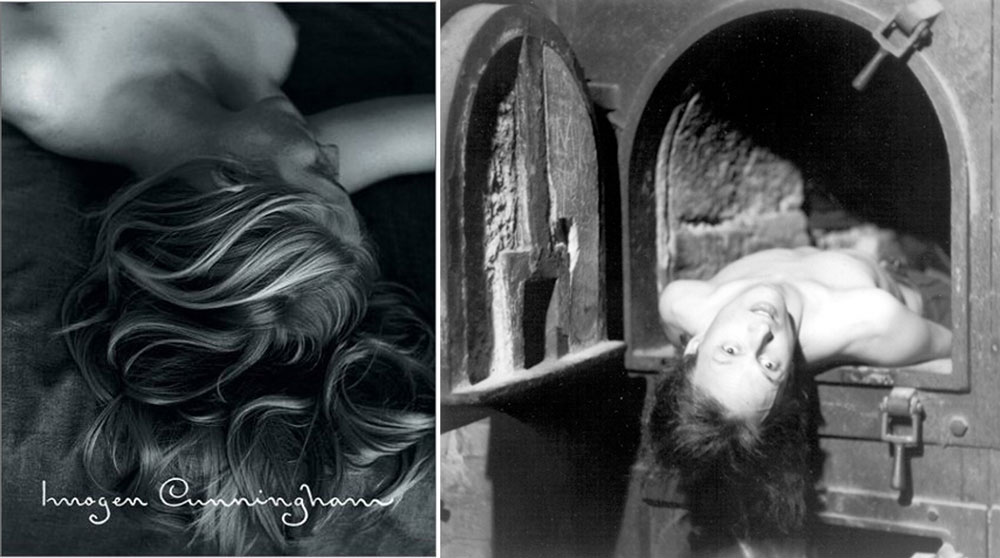
There is a famous picture by Imogen Cunningham of a young woman with her head and hair hanging off the edge of a bed. It is erotic.

But put it beside this and you see the similar pose with a completely different meaning.

No one who has seen pictures of naked Jews herded into the showers of Auschwitz can fail to recognize the political significance of nakedness. It functions to underline the powerlessness of the victims and their vulnerability.

Context makes a huge difference.

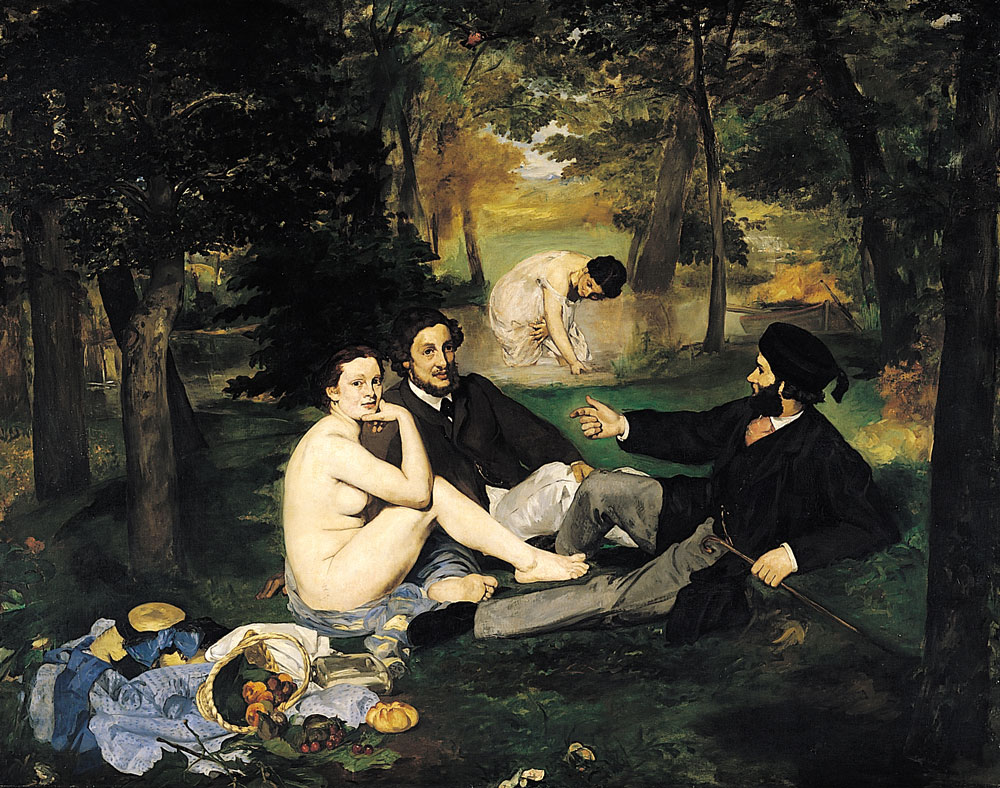
And in Manet’s famous painting, “Dejeuner sur l’herbe,” the message that comes through is ostensibly erotic, but in reality is political: Two fully clothed middle-class men are having a picnic with two nude women.

The ridiculousness of the scene makes fun of the traditional power relationship between men and women. The painting pointedly comments on such earlier paintings as Georgione’s “Fete Champetre,”   in which two Renaissance courtiers talk animatedly with each other while attended by two docile and idealized nude women.

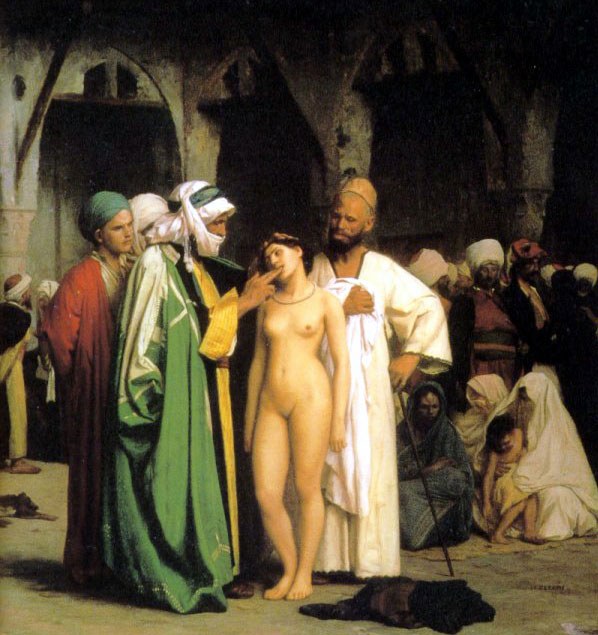
And it comments on such popular paintings of Manet’s time as Gerome’s “Slave Market,” in which clothed men paw over a nude woman, checking her teeth before purchasing her.

Gerome’s painting is merely a salacious bit of kitsch; Manet’s is biting and political. (One shouldn’t discount the tacit political message in the Gerome, probably unnoticed by the painter: Who has the power here? It isn’t the woman.)

It’s no wonder that “Dejeuner” was declared indecent while such paintings as the “Slave Market” made Gerome a wealthy man: By making his figures  bourgeois, Manet was pointing a finger at his audience. It is political commentary.

Many left-wing feminist critics of the nude get just as stuck in this level as their Christian right-wing counterparts get stuck in the first.

But the power I’m talking about at this level isn’t only political power. It is the power of  humankind over itself and the power to understand the world it lives in.

For instance: If Renaissance artists hadn’t become obsessed with drawing the nude figure, modern life expectancy would likely still be short and brutal. Modern medicine could not have developed without such artists as Leonardo and Michelangelo taking an interest in how the human body looks and how it is put together.

Before the Renaissance, Gothic artists created the figures they used to decorate the cathedrals from their imagined forms. If a figure had a torso, two legs, two arms and a head, it was enough. The bones, muscles, tendons and sinews that lay underneath the surface might as well not have existed.

”It seems rather as if you were looking at a sack of nuts than a human form, or at a bundle of radishes rather than the muscles of nudes,” wrote Leonardo of unobservant figure drawing.

But the Renaissance brought with it an interest in how the world works, how the parts of the body work.

Those artists studied the world around them intently. And to them, the most interesting thing in the universe was humankind. The human figure was to them the most perfect and beautiful form found below the level of the angels.

”Who is so barbarous as not to understand that the foot of a man is nobler than his shoe, and his skin nobler than that of the sheep with which he is clothed?” wrote Michelangelo.

In other words, clothes are trivial, the naked human body, essential.

But even at this level, so much more profound and moving, the figures still represent ideas and are not fully humanized, not fully individualized.

Empathetic encounters  

At its highest level, the nude represents spiritual virtues, unencumbered by fashion. The nude is universally true. That is why Titian’s sacred love must not wear the silks and finery of her earthly sister.

Angels are nude, and so are the putti, or cherubs, that flit around so many Baroque allegories.

Michelangelo’s designs for the Sistine Chapel are monumental nudes for that reason, and for another:

When art is most profound, it draws us out of  ourselves and forces us into an empathetic encounter with things and people who are radically different from us.

It is not possible to view the figures of the Sistine Chapel with any intensity and not feel your own body compared with them. Their sinews are your sinews; their contorted muscles are yours.

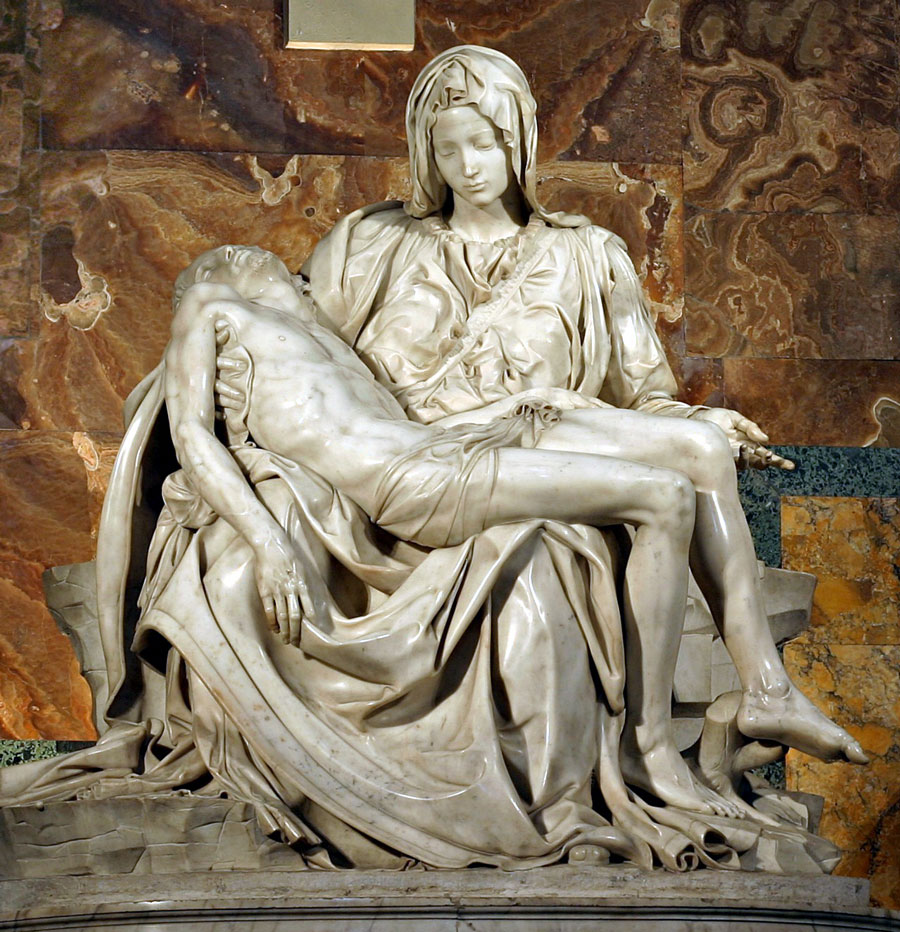
It is why the nude is used for the most profound tragedies in art: the nude Pieta and the Crucifixion, to name two very Christian uses of the nude.

Angels are often drawn as putti, or cupids, in part for their association with innocence.

We look at one of Matthias Grunewald’s tortured crucifixions and cannot help but feel the pain in our own flesh.

In all the greatest art, we are thus drawn out of ourselves and identify with the grace, power, suffering and love of others and come to escape   the isolation — and loneliness — of the ego. We recognize the similarities of all humanity and not its petty differences.

Whatever it means in religious dogma, the Christ is symbolic of our own mortality.

A lot of wind has been spent on the argument over whether there are any universal truths in the world. So many of the old Truths now seem mendacious. But there are two truths that are inescapable. We die, and people we love die. Loss is central to the human experience. It is why Michelangelo’s “Pieta” is meaningful, even for the atheist.

Our recognition of our humanity is one of the highest aims art can attempt.

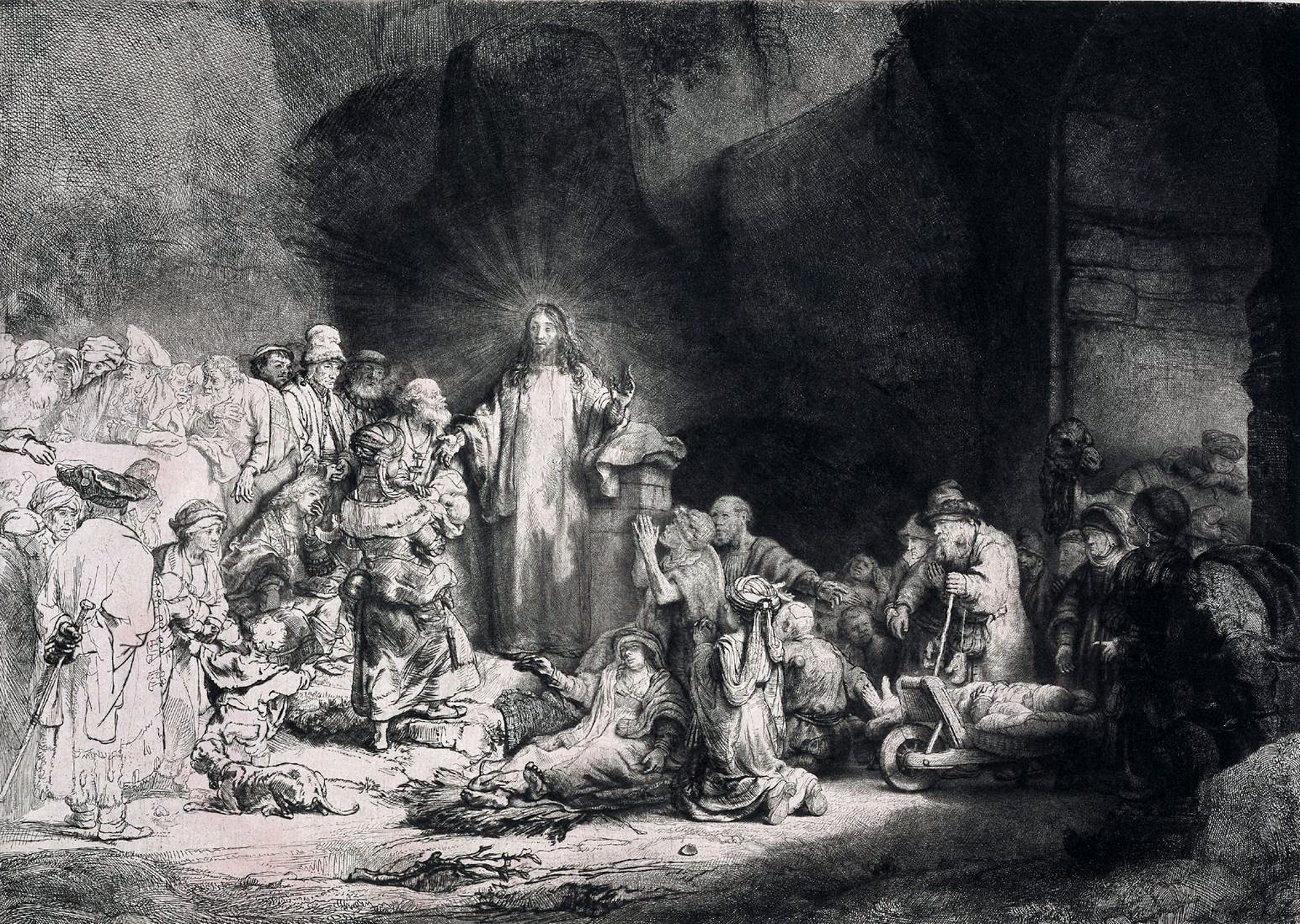
It is why Rembrandt’s nude portraits of his two wives are so compelling, why Goya’s “Disasters of War” are so frightening.

And not only are the figures in the art thus humanized, but the viewers are as well.

I wanted to write something about the tree in my back yard.

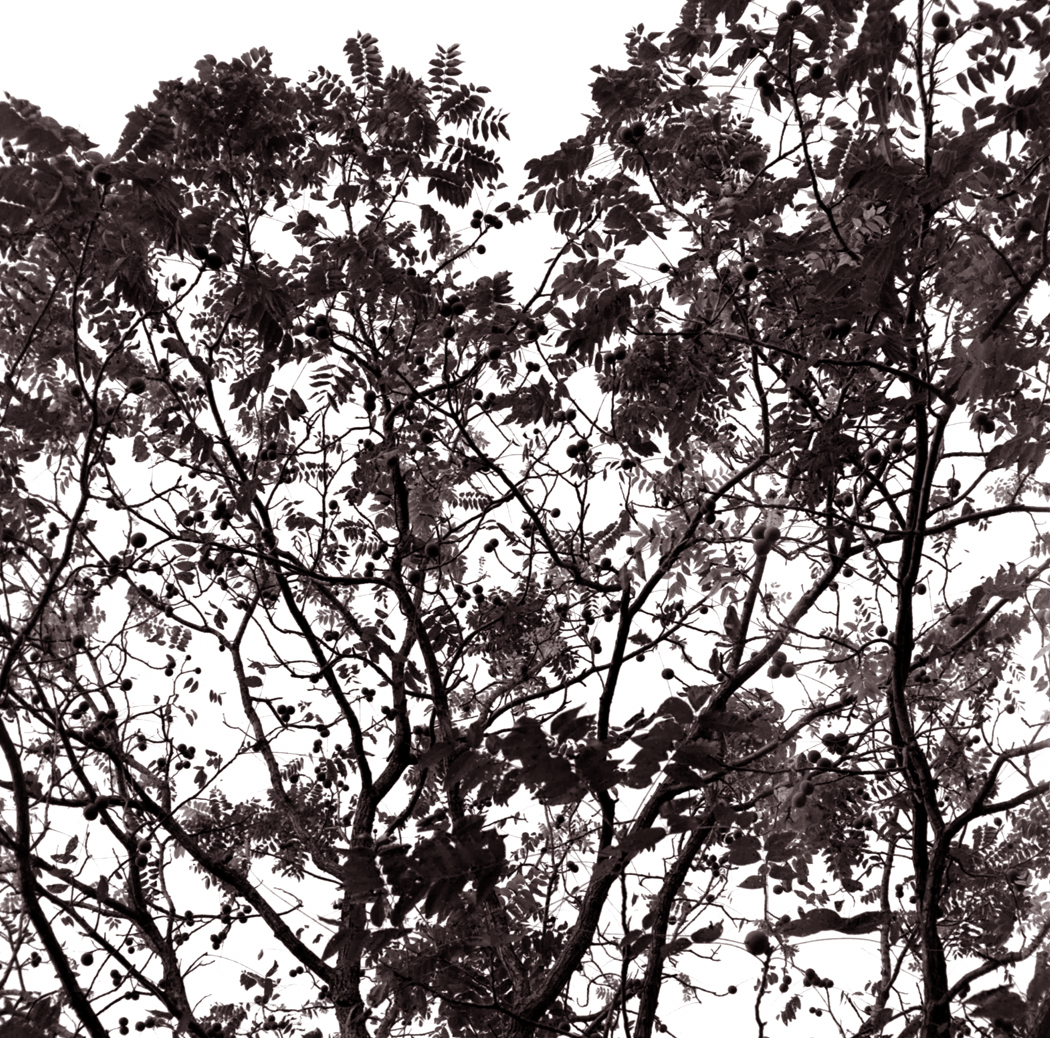
It is a big red oak, growing on the hill that rises at the back of our house in the Blue Ridge Mountains of North Carolina. It is an old tree, with wide-spreading branches that swoop out over us like wooden contrails against the sky. It is a sky tree, high up over us, elevated by hill and by tree trunk.

Its bark is shingled and cracked. Its leaves in summer are insect-eaten, dry and leathery. Moss grows on the north side of its lower stories.

It dominates the small hill like “Charlemagne among his peers.” All lesser vegetation remain vassals, and the lawn mere peonage.

One sees on its trunk the evidence of cities of insects, largely black ants, which use its bark for highways. At night in June, fireflies act as streetlamps.

One could look at the tree and think it is just an old-growth oak. There are many such trees in the mountains. They grew back after the farms that covered the area fell into disuse decades or centuries ago. Now that old growth has been parted again for housing developments, but my one old tree survives. It is hard not to think of it as an individual and not merely a Quercus rubra, something from a page in a Peterson Guide.

It seems to be a kind of spiritual umbrella, protecting this house from whatever ashfall of misfortune may drop from the heavens.

The back yard is full of vegetative growth, each shoot contending with the rest for sunlight and water. Grandfather oak watches over the welter.

It is a mythic tree.

The world is filled with such mythic trees, from Yggdrasil, the Viking “World Ash Tree” to the Boddhi tree of the Buddha. Most fall into one of two varieties of tree in myth: the fruit tree of paradise or the druidic oak that marks the axis of the world.

Of the first, the best known is the tree of the knowledge of good and evil from the Bible, although only close readers of Genesis may notice there is yet another fruit tree there, the tree of eternal life, which the god does not forbid Adam and Eve, although they never get to test it.

Such trees of fertility include the vines that Bacchus makes grow on the pirate ship and the trees of life in Mexican folk art.

But my tree is the other kind, like an Ent from Tolkein, or the so-called “Lawrence Tree” in New Mexico, painted by Georgia O’Keeffe.

This is not a tree of beginnings, not a tree of new fruit, but the kind of tree that functions as a “witness.” It sees all that happens. It cannot change what happens; it cannot interact. But it knows. What it knows, we mere humans can never fully know, but myth tells us over and over, it is not necessarily a happy knowledge. The Garden of Eden may have contained the tree of immortality, but my tree tells me of a longer time, when everything passes. It is a tree of the knowledge of death.

What makes such a tree notable is that it does not comment on this fact: It just is. That is its role as witness. It sees the suffering and knows it cannot be otherwise. It sees the long time, when whole empires are born and vanish. Perhaps even the time when the cosmos explodes into existence and then fades like a dying ember into a wash of undifferentiated particles, the ash of the burned out universe.

This is why that Odin chose Yggdrasil as the tree on which to hang himself as a sacrifice to himself, to gain wisdom. And it is perhaps why Odin is not portrayed as a happy god.

That is my tree in the back yard, today dripping with the sweat of rain in the summer heat, in a humidity so thick it is almost a mist.

As you read this, you think, but it’s just a tree. And so it is. All mythology comes not from the things themselves, but from our investing them with significance. They seem to have meaning.

It can be like a dream, which, when we wake we remember and feel was trying to tell us something important. We don’t know what, but we felt its meaning.

And myth is that state, in waking life. Things are what they are, but they are also what else they are.

This may be something like a schizoid state, but it is where art comes from, and after art, where myth, and later religion comes from. Myth is our sense of the importance of things. Not important, like the paying of monthly bills, or remembering a wedding anniversary, but important in and of itself. It is significance.

You can see it in the utter care and utter frenzy of the paintings and drawings of Vincent Van Gogh. (Really, in every artist, whether Titian or Joseph Beuys). Look at those lines of energy as Vincent draws cypress trees.

This is his recognition that every bush is the burning bush.

There are two pieces of music that never fail to set off the waterworks in me.

I’m sure we all have some signature tune that turns us into maudlin fools crying into our beer.

Lots of music can have that effect, when you’re in the right mood. Mozart is full of such tunes. No one ever wrote about the forgiveness of human foibles like Mozart. It isn’t only in his “forgiveness arias,” but the same tone of music turns up in piano concertos and wind sextets. He had some tap into divine understanding.

When I’m in the right mood, Mozart wells up in my throat. But heck, if I’m really depressed, Stars and Stripes Forever can set me off.

But I’m talking about something that doesn’t require the right mood to work.

Anyone playing Shenandoah, for instance. I don’t care what the arrangement. You can play it on a chorus of kazoos and trombones. You can play it calypso style on steel drums — the moment I’m transported “across the wide Missouri,” I’m reduced to a blubbering mass.

Clearly, I’m responding to some sort of deep seated nostalgia, some trauma of childhood or failed romance. But strike up the tune and I’m like some drunk in a bar yelling “Play Melancholy Baby.”

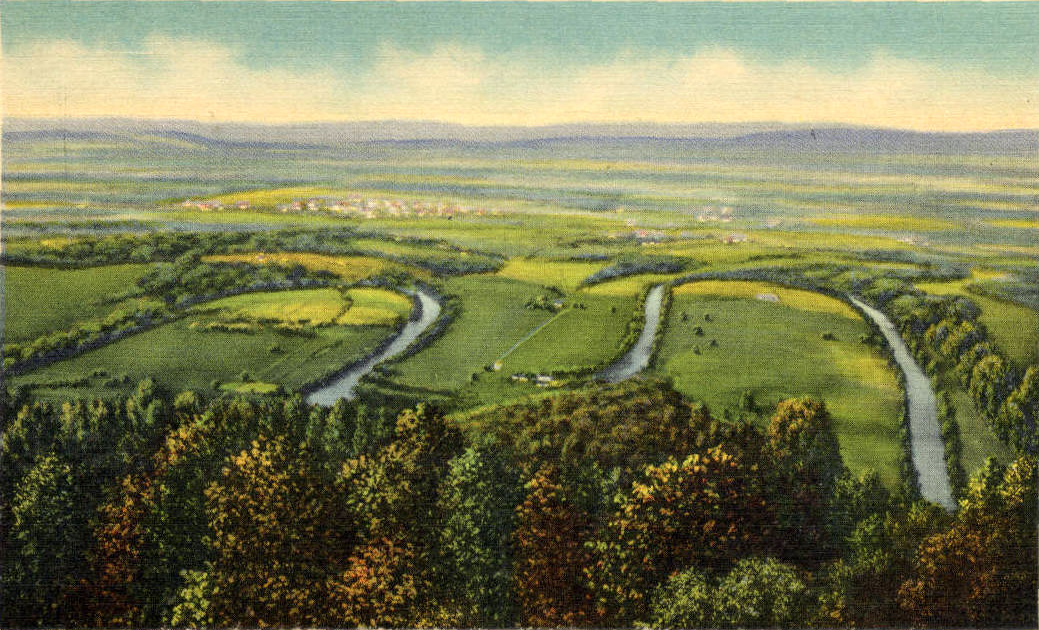
Actually, I know what it is with Shenandoah: I know the Shenandoah River and the great valley it troughs through in northern Virginia, heading north to join the Potomac at Harper’s Ferry.

It is an especially beautiful river, and only more so on a cool autumn morning when a low fog hangs over the water and the sycamore trees along its banks seem to grow out of white nothing.

The Shenandoah Valley separates the Blue Ridge in the east from the great ridges of iron- and coal-laden mountains to the west. The river rises in twin forks, one on either side of Massanutten Mountain, which rises like a long, low bread loaf in the middle of the valley.

I used to live in the Blue Ridge; I have just moved back. It was the most beautiful place I ever knew. I missed it.

And when the song says, “I long to see your smiling valley,” I knew just what it meant. “Tis seven long years since I last saw thee,” the song continues. It was 25 years since my wife and I lived in the Appalachians.

We lived in Arizona, which has a beauty all its own, but is different from the Blue Ridge. And when the song reaches its climax, “across the wide Missouri,” I knew that I was on the wrong side of the Missouri, too, in a kind of self-imposed Babylonian captivity.

“By the waters of the Rio Salado, there we sat down, yea, we wept.”

The song speaks to me — as it does to so many other people — of that lost Eden we know we can never regain.

And so, I blubber.

But that second tune that sets me off is something different.

It is Christoph Willibald Gluck’s Dance of the Blessed Spirits.

Gluck was a Czech-born composer of the 18th century who rebelled against the ornate and conventional opera of the time. His opera, Orfeo ed Euridice, tells a simple myth in simple music. Almost too simple.

Two set pieces from that opera still are widely known. The Dance of the Furies was used behind the chase scene in almost every Hopalong Cassidy movie ever made. In those “B” Westerns, budgets didn’t allow new music, so they played old classics behind the action. The music was loud and furious.

But Dance of the Blessed Spirits was something else: quiet, almost  static, and with the grace only utter simplicity can convey.

Two flutes play the song-like melody over the accompaniment of strings. Chords change slowly and never stray from simple diatonic harmonies.

And when the tune’s first phrase reaches conclusion, it stretches out in a feminine ending, a slow suspension off the beat. Nothing is insistent in the music, but rather, like the Grecian maiden on Keats’ urn, it seems suspended in time, permanently in a state of grace.

I melt when I hear it.

But its power comes from the same kind of emotion that drives Shenandoah: a sense of loss and a sense that somewhere there is an Eden where spirits are blessed.

Yet the tunes are very different, too. My reaction to Shenandoah is personal, very personal. Its power — for me — comes from my biography. I don’t expect everyone will react the same way.

The Gluck, though, has a more ritualized, formal power. It comes from its stylization.

For Gluck was aiming not for biography, but for the universal.

Art’s emotional wallop often comes not from its literal portrayal of raw feelings, but from the Apollonian distancing and formalization of those feelings. By understatement, it draws up a skeleton that we flesh out with our own experience.

The so-called Romantic artist often fails to exactly the extent he overplays his hand. Such an artist wants us to feel his feelings.

The Classic speaks not of his personal emotion, but of human emotion. Hence, they are our emotions.

In other words, when I hear Shenandoah, I feel the turns my life has taken; when I hear the Gluck I weep for the inescapable lot of humankind. The one traps me in my ego, the other frees me from it.

This is the power one feels in Homer, in Joyce, in Flaubert. It is the reason Haydn is still played along with the more personal Berlioz.

And it is the power at the end of Beethoven’s immense Diabelli Variations, those 32 monumental changes on the “cobbler’s patch” waltz sent to Beethoven by music publisher Anton Diabelli, who asked the great composer for a variation he might publish.

Through those variations, Beethoven dives deep into some of the most personal music he ever wrote, with adagios of desolation and pathos, culminating in a clattering, raging fugue that is as hard to listen to as to play.

But he winds up in Arcadia, just like Gluck: His final overwhelming variation is a dignified minuet, which takes all the terror and anger, all the humor and misery of the previous 31 variations and sublimates all that personal angst into an Olympian, stylized dance.

It is this ritualization of the overwhelming emotions that make those emotions important: The personal is mere autobiography. The ritual dispenses grace: the freedom from ego.

It is why our most important thoughts and feelings are turned into meter and rhyme, why our bodies move to the numbers of choreography, why the novel is the “bright book of life.”

And why art matters.


It is a commonplace that America is materialistic, that it grasps after money and wealth and lacks the spiritual values it used to have.
Of course, that nostalgic view ignores that Americans have always chased wealth: It’s built into the Constitution.
But more importantly, it ignores the fact that America isn’t really materialistic at all, and in fact, is largely indifferent to the material world.
If we were really materialistic, we would never tolerate walnut-woodgrain plastic.
No, the physical composition of their existence is simply not a high priority for most Americans. Yes, they are after wealth, but wealth isn’t a material value, but a spiritual one.
When we say Americans “worship the almighty dollar,” we aren’t saying that they value material objects over spiritual ones, but rather that they place worth on one set of spiritual values instead of another, more worthy set.
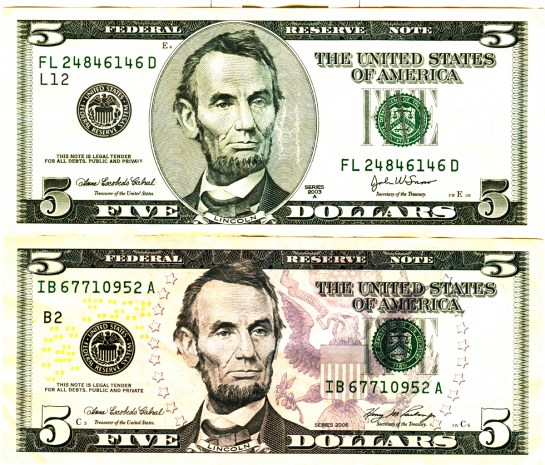
Money, after all, isn’t a physical object. It isn’t material. It is no more physical than an inch or a pound. It is a measuring item, to measure wealth.
Real wealth is the possession of useful or meaningful things. To own land, or to grow 40 acres of artichokes is to possess wealth. You can eat artichokes; you can’t eat money.
Money cannot be worn, it cannot be used to build with. It must be translated back from its symbolic existence to a material existence by spending it.
I’m not saying that money isn’t nice to have around. But that it is a mental construct, not a physical reality. If we want money, it isn’t because sewn together, dollar bills make a nice quilt.
Even the things Americans spend their money on tend to be owned for spiritual rather than physical reasons. If we want to own a BMW or a Lexus, it isn’t because these are better cars than a Honda or an Ford — though they may be (I’m not convinced) — but because they are status symbols that let other Americans know where we rank on the totem pole. Armani suits and Gucci bags are not something most Americans really enjoy on a physical level. They are the civilized equivalent of the eagle feathers the chief wears, or the lion-ruff anklets worn by the Zulu leader: They confer prestige and denote status.
These are spiritual values.

As a matter of fact, America would be a whole lot better off if it were more materialistic. The planet is bursting with stuff: It all has a texture, a feel, a smell, a taste, a sound. If we were materialistic, we would be aware of how much richness the material existence affords, and we would revel in it. We would be mad — as Walt Whitman says — for us to be in contact with it.
And what is more, the deeper we involve ourselves in the physical world, the more spiritualized we will become — that worthy spirituality. It is because we are so unmaterialistic that our environment suffers so. We don’t value the physical world we live in. It doesn’t bother us that there are fewer birds singing in the morning, or that codfish are disappearing.
In part, this is a remnant of the contempus mundi that was fostered under Medieval Christianity. It is that suspicion of the physical world that the Old World monks felt would seduce them from the righteousness of prayer and ritual.
We have inherited the contempt, but without the prayer. It leaves us in a hollow place.
As an adult I have come not to trust anyone who doesn’t love the physical world.
I don’t trust him to make policy choices about oil drilling or lawn seeding. I cannot imagine how it is possible not to fall in love with the things of this world, but I see just that happening all the time.
I pick up the lump of spring earth and squeeze it in my fist to judge whether it is time to plant my potatoes. I listen for the birds globing and twisting as they rise from the trees in the morning. I look for the light caught in the cholla spines and the twill in my gabardine. There is velvet in heavy cream and scratchiness in wool blankets.
The physical sensations make us more aware, more awake. The love of the physical world keeps us from becoming dullards. Living in a world of symbol and status dulls us. At its worst, it leads to ideology.
Would that America really were a materialistic society.

Image

Vulgarity is everywhere these days, from T-shirts to dinner conversation. This is a vulgar society we live in, one that supports a Howard Stern and a Rush Limbaugh: vulgar brothers under the skin, although the one has more skin than the other.

But conversely, vulgarity is also undervalued.

I recognized that at a concert recently, listening to the wonderful Ying String Quartet, which played Mozart, Bartok and Debussy with taste and refinement. But I knew that, as good as they were, they lacked that last touch of vulgarity that all really great art has access to.

I have heard the Guarneri and the Budapest quartets and they were both capable of making vulgar sounds — the buzzing tone of playing by the bridge, the taffy-pull of tempo, sudden shift from aggressive to sweet. It gave life to the music.

There are those who hold that the fine arts are supposed to be a safe haven from the vulgarity of daily life, that they should offer only the highest, finest and most elevated thoughts and emotions. To them, it is a way of insulating us from the barbarians we see on television each night.

But I’m afraid that is the very definition of snobbery, and misunderstands the nature of art.

Yes, fine art is more elevated than Two and a Half Men, yet it also embraces the possibility of such slapstick: Art is large, it contains multitudes.

First, what is vulgarity?

It is the awareness of the animal side of humanity — the body processes and appetites; and it is the trivial in an otherwise important context. It is the introduction of the quotidian into the ceremonial; it is farting in church.

It is also the reaquaintance of mind with body and it is vitality giving breath to the spirit.

It is found in all the greatest, most profound and elevated works of art.

Think of Botticelli’s Birth of Venus, for instance. What could be less vulgar? Yet, there is that cherub with his cheeks pooched out, like Dizzy Gillespie, blowing the sea wind that animates Venus’ hair. His expression is close to grotesque.

And, more subtly, although her nudity is certainly not vulgar, the goddess’ attempts to cover that nudity is. It is bourgeois propriety.

Or, at the height of Beethoven’s Ninth Symphony, a hymn to universal love and brotherhood, the music stops for the belch of a double bassoon and a Hogan’s Heroes march.

Don’t misunderstand me: I am not saying that vulgarity is fine art, but that the greatest art of our culture does not ignore vulgarity, but includes it in the mix.

It is the bumptious Minuet in the Classical symphony, the seemingly-naive tone-painting in a Schubert song accompaniment, the exaggerated muscles in a Michelangelo nude.

It is the Miller’s Tale in Chaucer, the porter’s scene in Macbeth, it is the cacophany of marching bands in Charles Ives and the Jewish wedding in Mahler.

Even Josquin, that most angelic of Renaissance voices, whose music for the Catholic Mass defined for centuries what religious music should be — at other times, he can also have his singers chirp like crickets.

Sometimes vulgarity is expressed by choice, sometimes by miscalculation, as when Keats writes, “She heaved her precious dainties meant to still an infant’s cry.” But no first-rank artist has any fear of the vulgar.

It is Ray Nanton’s growling trombone in Duke Ellington’s impressionism.

It is Pablo Neruda calling for the impure in poetry.

It is the ornament reaquainted with architecture in Postmodernism, a reaction to the dull inhuman “purity” of the International style.

And when you think of the greatest musicians, you recognize Horowitz, Kreisler, Casals, each capable of the most obvious vulgarity — the gauche portamento, the foot-stomping downbeat. Compare Leonard Rose with Mstislav Rostropovich and you will understand why the Russian is considered the greater cellist: He is unafraid of the peasant in him.

Art is not about being bloodless and noble, but about being human.

Hence the Hungarian peasant dances in Bartok’s Modernism, the Austrian folksongs and dancing bears in Haydn.

“Nothing that is human is alien to me,” said Cicero.

And being human begins — although it doesn’t end — with the body.

That is why Ezra Pound said that poetry atrophies the further it gets from music, and that music atrophies removed from dance. Dance is the body in motion, the foot — bunions and all — hitting the floor. (Someone once defined a ballerina as “a beautiful woman with ugly feet”).

There is a separation in Western culture between body and spirit. Art can reconnect them. And the pinch of vulgarity thrown into the mix act as an anchor, firmly keeping the more ethereal impulses in art from floating away on the ether of their own enthusiasms.

That art is greatest, not that hits the greatest heights alone, but that has the greatest reach: Homer, Michelangelo, Cervantes.

They reacquaint me with my own life and make it possible to aspire, not by setting the stars beyond human grasp, but by teaching me my connection with them: The dirt I stand on and the constellations over my head are of a piece.