Archive

Tag Archives: donald trump

This is a repeat posting of a piece I wrote in 2017, during the first Trump administration. But I believe it may still be apposite, although the stakes are even higher this time around.
I avoid writing about current politics for several reasons. Firstly, because the situation so quickly changes, nothing you write today may hold for tomorrow. Secondly, because it is so touchy a subject, you risk alienating your reader for minor offenses that can be taken as index markers for major disagreements. Thirdly, because politics is such a minor part of what makes a difference in our individual lives; so many other things are more important and more interesting.

Nevertheless, the chaos of the current American situation calls for some small clarification. Arguments muddy when thinking is unclear.

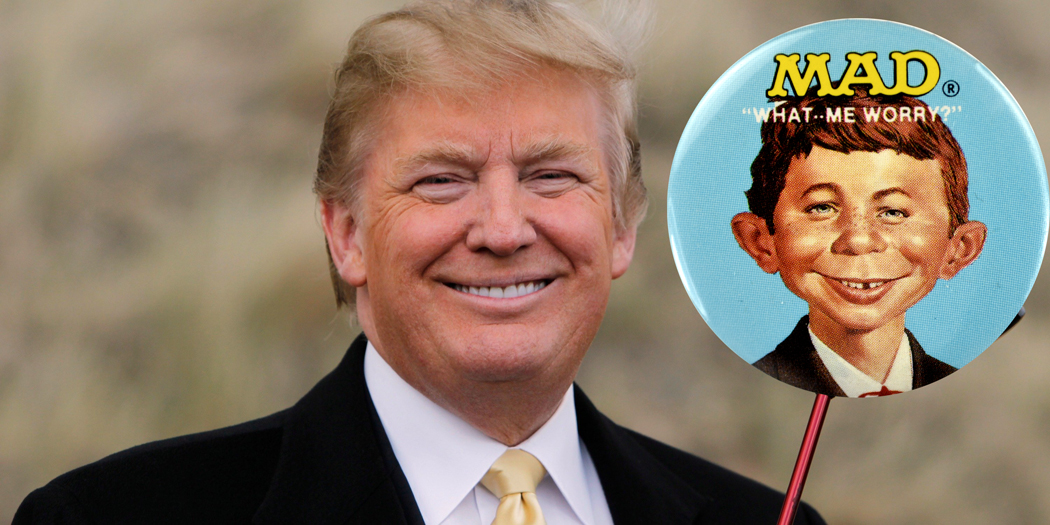
To begin, there is the issue of Donald Trump, which is a great squirt of squid juice, obscuring more lasting problems. It is easy to make fun of the Great Pumpkin, he practically satirizes himself. While he has fervent supporters, it is hard to know exactly what he stands for, because his words are so vague in application, no matter how blunt in expression. It is always possible to assume he is your ally, because you only listen to those words that honk your horn. Is he conservative? Conservatives value free trade. Is he pro-business? Business has told him they need an immigrant workforce. What does he stand for besides ignorance?

He is an obfuscation on the surface, a chaos beyond that because, of course, he has no ideology, other than Trumpism. It is not his supposed conservatism that I object to; there have been many thoughtful conservatives. Trump is not one of them; he isn’t even a conservative at all. What scares the bejeezus out of me about him is that he is so clearly unbalanced mentally. The word Andrew Sullivan has used is “bonkers,” and that can hardly be improved for accuracy. The constant wheezing about his vote count, poll numbers, inauguration crowd, all spouted against obvious and visual evidence, is a clear indication that he is unmoored from reality.

Then, there are the speeches, barely in English. They are really just sentence fragments thrown together with unattached adjectives. Yuge, sad, unbelievable, disgusting. They, as Philip Roth has counted them, are constructed from a vocabulary of a mere 77 words, reused and rearranged ad hoc. They jump around from topic to topic with little or no segue. And then, they are filled with things that are demonstrably untrue. One watches over an over when Trump says he never said this or that, followed by the videotape of him saying exactly what he now says he never said. Does he not know that his words have been recorded?

It cannot be easily said that Trump is a liar, because a liar knows what he is saying is untrue. Others manipulate statistics to make their arguments; Trump just pulls stuff out of his ass. Evidence is irrelevant.

Further, he uses these exanus pronouncements to support his chaotic policy pronouncements, which tend to be simple-minded in the extreme. Problems are usually complex and systemic; his solutions are simple-minded and blunt as a cudgel. He shows contempt for subtlety. If the problem is illegal immigration, his solution is not to consider the cause of the immigration, but to build a wall, despite the fact that the majority of the illegal immigration does not cross the desert border, but flies into our airports. My favorite joke about the wall: “Wall — cost: $12 billion; ladder — cost: $35.”

But this is not meant to be a jab at Trump, who is clearly unhinged, not very bright, not at all subtle, and basically a bully at heart. It is too easy to target him; he is a joke. A dangerous joke, who may very well destroy the world at the push of a button, but a joke nonetheless.

No, what I want to point out is that there is, beyond Trump, a basic misunderstanding of the political divisions in the country.

The divisions are very real. Between urban and rural, between liberal and conservative, between Republican and Democrat. But I want to point out that these may overlap, like Venn diagrams, the dipoles are not identical. We too often confuse conservative with Republican and liberal with Democrat. There may be overlap, but more important, their goals are different.

There is a clear difference between liberal and conservative. As they are defined nowadays (very different from when they originated and when conservatism favored a strong central government), the conservative now seeks a smaller central government and the liberal, an activist government working for the betterment of its citizens. The one favors the individual, the other, the community. The one is exclusionary, the other inclusive. And it is clear that as the political scene is currently deployed, Republicans tend to favor conservatism and Democrats tend to the liberal, although Republicans are more extremely weighted to the far-end of conservatism than the Democrats are to the left wing.

But, such thoughts of political philosophy are largely irrelevant to the actualities of politics. One should never conflate Republican with conservative, nor Democrat with liberal. The aims of ideology are to promote a world view and an action plan to enforce that world view. But that is not the aim of the Republican party. Certainly, it will use conservative ideas to further its ends when it can, but its primary driving aim is the accrual and preservation of power. This is central and should never be forgotten: Republicans will do whatever they need to to gain and keep power. Democrats have a similar, but weaker drive. Many Democrats join the party because they think they can make the world a better place. Some Republicans do that, too, but the aim of the party on the whole is not the improvement of society, but the exercise of power. It is King of the Hill on a hemispheric playing field.

This is not to say that most Republicans don’t believe, by and large, that conservative policies would help the nation, but that whether or not they do is secondary to the accretion of political power. Hence, the contorted, serpentine Congressional districts, gerrymandered into silliness in order to ensure Republican supremacy. (Yes, Democrats have done the same — in fact, they invented the procedure in the 19th century — but they were pikers compared to the modern attempt to engineer a “permanent Republican majority.”) Hence, the bald-faced hypocrisy of choosing sides on an issue solely on the basis of whether a Republican or Democrat is offering it for a vote (as with the Republican-designed Affordable Care Act, which became an unswallowable “disaster” when recycled by the Obama administration. Hence, the use of arcane Senate or House rules, or the threat of the “nuclear option,” when it favors them, and outrage when used against them.

And it is why Republicans were gulled into supporting Trump when it looked like he might win the White House back for the party, despite the problem of Trump espousing ideas contrary to longstanding Republican policies. Trump is, after all, not a Republican, except in name, and not a conservative, as it is usually defined. He is sui generis, a propounder of Trump now, Trump tomorrow, Trump forever.

One area in which Trump and Republican world views agree is that the primary lens through which to view policy is economic. Money is the gravity that holds that world together. Whether it’s tax cuts, deregulation or fear of unions and a raise in minimum wage, the heart and soul of the conservative world view is money. The very idea of “running government like a business” is a consequence of this Weltanschauung. But across the world, this idea is changing. Governments are not businesses.

There is a historical storyline here. In the feudal past, with the king at the top of the pile, government was essentially a protection racket, with each level of vassalage “wetting its beak” in the next level down, and everyone feeding on the peasants. The general welfare of the populace was not even an empty platitude. As nation states developed from the Medieval sense of monarchal real estate, the idea of decent governance took hold. Since the New Deal in the U.S., and post-war in the better part of the rest of the world, governments have assumed the duty of protecting the welfare of its populace. All through Europe, governments guarantee health care, safety, minimum living wages, shorter work weeks and longer vacations. The U.S. has resisted such things. For Republicans (distinct from conservatives, who also have many social issues) and Trump see the world through dollar-tinted glasses. It is a reversion to the Medieval model, where all wealth floats upward like a bubble in the champagne. And it is power that guarantees the income. The goal of the Republican party is not so much the institution of conservative ideas, rather it is the use of conservative ideas to protect and increase individual wealth.

The problem is, that while money can make life easier to navigate, money cannot make life worth living. For that, you need the other aspects of life that Democrats — and most of the rest of the world — embrace. Freedom from oppression, sufficient means for living, cooperative communities, aid for the less fortunate, an even playing field for all. Among the things that make life worth living are family, love, art, religion, good health, and shared interests and shared mythology.

For Trump and the Republican party both, the world they see is transactional. It is also a zero-sum game, and the winning is all. We need to recall that when we let ourselves be gulled into arguing over conservative and liberal. Those labels are merely the masks worn in the more brutal fight over who will be the alpha dog.

Originally published Feb. 17, 2017
I don’t often write about politics in this blog. My own beliefs are rather mainstream and inoffensive, on the whole. I tend to like politics as the negotiation of competing interests through compromise. But sometimes, there is something that just needs saying.

It has slowly dawned on me that we have been mistaking Donald Trump for quite some time now. I don’t know how many articles I’ve read or videos I’ve seen coming up with explanations of what Trump is really trying to do. Is he intent on creating a dictatorship? Is it world domination? Is it some clever means of manipulating the market to make himself even more rich? There are a dozen explanations put forward. Even his MAGA people don’t have a single explanation, and choose a Trump that fits their wishes. 

But I have come to the conclusion that seems to be the only one truly possible: Donald Trump is clinically insane. 

I know, we have all been saying he’s crazy for at least the past 10 years, but when we said that we didn’t really mean it. We were using a metaphor to explain the counterintuitive and counterproductive policy decisions he’s made, and the vomitation of lies that spew from his tongue. But I now mean that I think Trump is actually a madman. Spitgargling, foaming at the mouth crazy. The kind of crazy that would normally require a straitjacket  and padded room. That to attempt to understand why he does this or that is a fruitless task. There is nothing to understand. There is no secret meaning behind his policies. He is just insane, like Col Bat Guano in Dr. Strangelove. Stark, raving out of his mind. 

The scariest part of it all is the Republican congressmen and senators who line up behind him for their own craven reasons, often racist, or more often thinking they need to back up the crazy man in order to be re-elected. They repeat Trump’s crazy talk and attempt to explain “what he really means,” or, more often, just run away from town-hall meetings to avoid reasonable questions. 

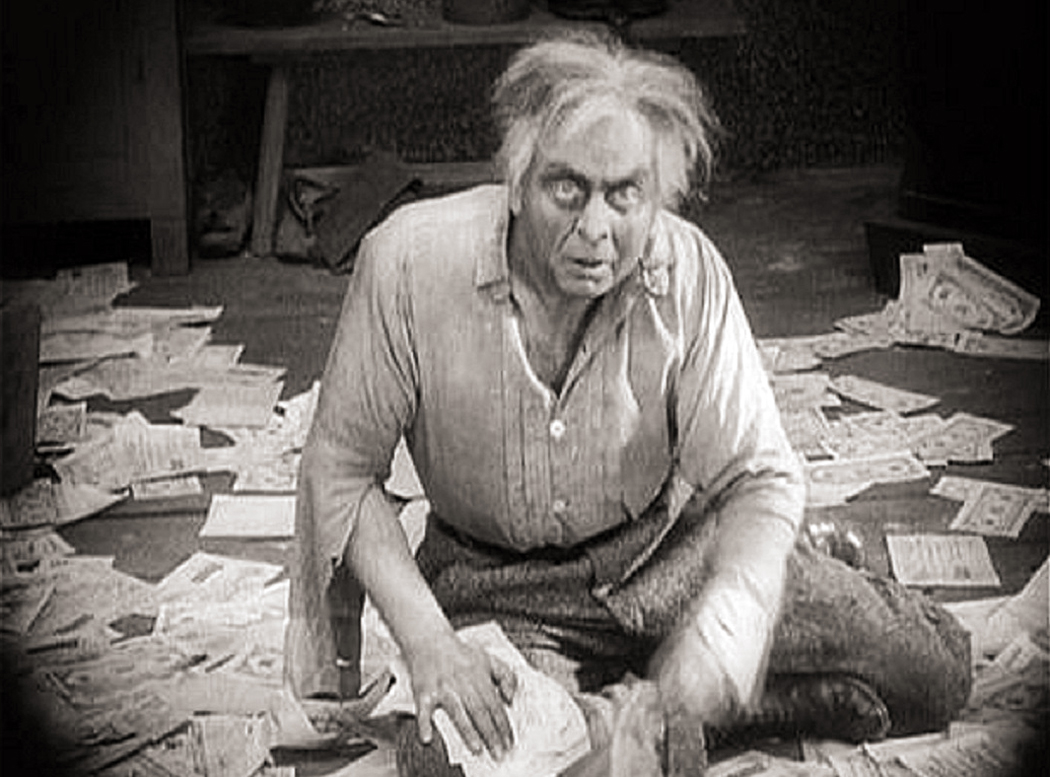
It really hit me when I remembered Fritz Lang’s 1933 German film The Testament of Dr. Mabuse, in which the famous master criminal, Dr. Mabuse (he’d been the subject of two earlier silent films by Lang) had been caught and declared insane and put in an asylum, where he wrote compulsively these scribbled nonsense notes that were smuggled out to his followers, who then used them to commit robberies, arsons, sabotage, etc. The images of Mabuse in his cell scribbling away with hysterical focus seem so much like Trump and his tweets. Both their utterances make little coherent sense. 

At one point, the police captain in the film talks about “Mabuse the criminal,” his ardent follower shoots back, “No, Mabuse the genius!” and describes admiringly how the “crimes” of the “brilliant” Mabuse will destroy a corrupt world. 

The film was banned by Joseph Goebbels, who proclaimed that The Testament of Dr. Mabuse was a menace to public health and safety and “showed that an extremely dedicated group of people are perfectly capable of overthrowing any state with violence.” Which, of course, is exactly what his boss, Herr Hitler, had already done.

Lang himself explained, “The film was made as an allegory to show Hitler’s processes of terrorism. Slogans and doctrines of the Third Reich have been put into the mouths of criminals in the film. Thus I hoped to expose the masked Nazi theory of the necessity to deliberately destroy everything which is precious to a people. … Then, when everything collapsed and they were thrown into utter despair, they would try to find help in the ‘New order’.”

Sound familiar? 

And so, I am now of the mind that Trump has no grand scheme, cryptic plan, overall policy design, but rather is a lunatic spouting inanities and non-sequiturs and a portion of the electorate suffering what they see as grievance follow him, hoping for relief, and far worse, a cadre of lawmakers who use the ravings to further their own careers. 

I hope by posting this, and having others make similar observations, we may finally reach a tipping point where the obvious insanity no longer goes normalized, and the tide shifts.

Still, it all makes me even more depressed about what is to come. 

I’ve written before about why I am not a conservative (Link here), but now I want to point out that neither are Republicans.

What is conservatism? Through the centuries, it has been defined by two central guiding principles.

First, that tradition is the best guide for governance. The wisdom of centuries of ancestors has winnowed the true and lasting from the meretricious and ephemeral. We should not make ill-considered changes in the functioning of society, but only those absolutely necessary, and even those should never be done quickly, but only with judicious deliberateness.

Second, that a strong central government is necessary for the smooth running of society. A Hobbesian Leviathan to control the powers of crime, greed, violence and selfishness that are the core of basic human nature.

This sort of conservatism has been both a strength of such lasting governments as those of Great Britain, and a weakness, when entrenched interests use its tenets to prevent the furtherance of justice. In America, we have seen this most maliciously in the retrenchment against Civil Rights and the enforcement of segregation.

So, a faith in keeping things running smoothly as it has been running, and in a strong central government are what define conservatism. But this is almost 180 degrees from what those who now call themselves conservatives believe. In fact, they seek to promote the crime, greed, violence and selfishness that are the core of basic human nature. All checks removed. Yea!

For them, the central government is too strong, too invasive, and such segments of the Republican Party as the Tea Party, seek to blow up two centuries of established patterns of governance. What happened? Conservatives are meant to be wary of change.

These once-fringe elements of the Republican Party are much closer to Anarchists than to Conservatives. As Grover Norquist famously said about the Federal government, “I just want to shrink it down to the size where we can drown it in the bathtub.”

Once again: This is not conservatism. It is anarchism.

In recent decades, the Republican Party has been the conservative party, from Barry Goldwater, through Ronald Reagan and into the 1990s, but that has all changed. There is precious little conservatism in the party these days.

Of course, parties have changed over the years, over the centuries. When the Constitution was written, it was the fervent hope of all those participating that the government would be able to function without the pernicious effect of factions. That didn’t last long, as almost immediately, the Federalists began feuding with the Jeffersonian Democratic-Republicans.

But, while the parties were originally formed on ideological grounds, they soon became something else: competing teams of political power-seekers. They might as well have been football teams. They existed on patronage and party machinery. In the 19th Century, occasional third parties arose, based on political philosophy, but they either soon faded, or were absorbed into the system. Whigs, Free-Soilers, Know-Nothings.

The one that survived and prospered was the Republican Party, begun as an anti-slavery party, and, after the Civil War, the party of Reconstruction and then the party of Big Business. The logic of this evolution is not clear, except as the party was led by power-seekers who gravitated toward money.

But it was also the party fostering conservation in the natural world, and the party that undertook the breaking up of corporate monopolies. Nowadays, that is hard to credit.

Through most of the 20th Century, the contending Republican and Democratic parties were simply teams vying for power. There were liberal Republicans and quite a few conservative Democrats. Both parties contained a spectrum of inclinations. They were just teams competing for power.

But, since Goldwater, the parties began a process of ideological cleansing, with those calling themselves conservatives drifting ever more to the Republican Party. Some were motivated by genuine governing philosophies, but many were pulled toward the right by the rise of Civil Rights. There was a conscious strategy among some Republicans to appeal, mainly via dogwhistle weasel words, to abject racism.

The Republicans claimed to be conservative; they excoriated the Democrats for being “liberal,” as though that were a pejorative term.

But just how conservative are current Republicans? Not much.

It has been pointed out by many observers that the leaders of the Republican Party have made a devil’s bargain with these fringe groups to gain and keep power in Washington, but that now, the monster has begun to kill its own creator. As a smaller and smaller faction of radicals enforce their will on primary elections, otherwise sensible politicians have had to curry the favor of the nut-groups, leading to a wider and wider division between the two political parties, and into that divide has seeped an element so toxic, it could destroy the whole thing.

Donald Trump is not a conservative. He isn’t anything. There is no philosophy of government, no thoughtful consideration or principles. He says one thing one day and the opposite the next. Heck, he can even contradict himself within a single sentence — if you can acknowledge those utterances of word salad as sentences.

Trump is a creature unfit for the office, unfit even for human company. A “short-fingered vulgarian” and self-promoter, he makes me embarrassed to be an American. And not because of his politics — which are bad enough — but because he is such a poltroon. I needn’t enumerate his gaucheries, insults, lies, distortions, self-aggrandizements, arm-twisting handshakes, bilious lip-poutings, shuffling gait, knee-length neckties, blatant nepotisms and the creepy things he has said about his daughter — all these and more can be found by the thousands on the Google.

But, because the Tea Party has controlled the Republican Party, and because a minority of voters in a crowded primary managed to win Trump the nomination in 2016, the party finds itself having to defend and support the unsupportable and indefensible.

And now, no grown-ups have gotten what they wanted, or thought they wanted. Only the immature, thoughtless and xenophobic have got what they sought.

I have no doubt that many a Republican congressman and senator would be more centrist, if they did not face rabid primary challenges in their now gerrymandered districts.

Some Republicans no doubt would like to promote genuine conservative ideals, but they have been backed into a corner, and now face defending tariffs instead of free trade. They have to campaign against the very institution they are members of. And they have to excuse behavior from their party leader that they would have salivated over being able to use against any Democrat. Did Bill Clinton lie about Monica Lewinsky? A threat to our nation. Did Trump lie about Stormy Daniels? Well, he’s just being Trump. No big deal.

They are caught, not merely in a round of hypocrisy, but hypocrisy so blatant and toxic it may well end up disintegrating the Republican Party. And most of the country  — a majority of voters — will find it hard to lament the demise.

Maelstrom

“The center cannot hold.”

This is a common saying these days from political commentators on TV or in op-ed pages. The assumption is that there is such a thing as the political center. It is an assumption that needs to be challenged.

We tend to lionize the political center, as if it were the place where sanity is found, battered on left and right by zealots and ideologues. But, in fact, there is no codified political theory that can be tagged with the label. It is, in fact, the bin for dumping the leftovers.

Those who hold genuine political thought fall down the steep slopes of the bell curve on both sides, toward conservatism and reaction on one side, and toward socialism on the other. Marx vs. Ayn Rand. Both sides hold their opinions with passionate intensity. What we call the middle is really just the no-man’s land between them where they battle it out, and with no clear victor, they fall, exhausted, between the two poles, and we have a stalemate. That is what we call the center.

In practice, this has actually worked out quite well for the rest of us, who are not card-carrying members of either side. It is as if two out-of-phase sine waves have cancelled each other out, and we live in relative peace. Politics, when done right, is the clash of interests, where no one interest prevails all the time, and compromises are reached to keep each side, not happy exactly, yet equally miffed, but just under the boiling point.

“The trick from my angle is to make my play strong enough to tie you up, but not make you mad enough to bump me off against your better judgment.”

This, then, is the center, where most of us, unafflicted by theoretical strait-jackets, try to live our lives spending the least possible time on policy and government. Government is something up with which we must put. To paraphrase Willie Loman, “Taxes must be paid.”

This doesn’t mean we don’t recognize the importance of social order, or a ruling forum that functions efficiently and cleanly, but more important than making rules about who gets to use which bathroom, are such things as the welfare of our children, our careers, the availability of food, and whether the Cubbies will ever again win the World Series. That a well-run government is necessary for some of those things is acknowledged, but just how much energy we put into politics is the issue. In ancient Athens, you were judged in part by whether or not you were politically aware and active. But for most of us in middle-class America, being politically active is rather more a badge of how misguided you are, how obsessed, how geeky.

We have, since 1789, run on the well-oiled principle that if we let the two sides fight it out, we can comfortably nestle in the hammock left in between them. There have been a few times, like the years from 1861 to 1865, when the center did not hold and the country erupted. We came close again in 1968, as those of us who lived through it remember. The pressure has been building up again. Both political parties found their basic premises threatened this election cycle. Republicans have discovered that the dissension, obstructionism and bigotry they have sowed for the purpose of maintaining power in Congress has come back to bite them. What they hold as true conservative values are shredded by the buzz words and palaver of Donald Trump, who seemingly holds no values whatsoever, outside of Donald Trump. Democrats found that a socialist roused a significant sector of their membership, driving their conventional candidate further to the left and away from the coveted “middle.”

That middle has become a vacuum as the polar sides pull apart and we suffer the pain.

The central problem is that, because the middle is not a platform, not a policy, not an ideology, it cannot clearly enunciate its principles, outside of a basic, “Don’t go nuts.” The Right and Left have manifestoes and position papers, arguing with faultless logic the rightness of their causes — albeit within the confines of the definitions they use and the axioms they leave unexamined. We in the middle have only a defensive “please go away” and “leave us in peace.”

Once in a while, however, we are called upon to slough off our natural passivity and take a stand. In the 1960s, we had to decide whether segregation was morally defensible, as a hundred years before, we had to pick a side on slavery. When we didn’t step in, as with the Know-Nothings of the 1840s, or the McCarthy era in the 1950s, the country went off the rails and the looneys took over. We face something of the same now, with Donald Trump, whose unfinished sentences pile cliche on cliche, Ossa on Pelion, and we are buried under a mountain of verbal garbage, un-thought-through, indefensible, and outright dangerous.

My great friend, the late Dimitri Drobatschewsky, grew up in pre-war Berlin. His family was forced to flee the Nazis, and his father eventually died at Auschwitz. He remembers as an adolescent hearing Adolf Hitler speaking live. “Everything he said was a banal platitude,” Dimitri recalled. “It was meaningless cliche piled on meaningless cliche. But he was such a persuasive and hypnotic speaker that I found myself, a Jew in Germany, that it was all I could do to keep my arm from raising in the Nazi salute.” Dimitri eventually left Germany for France, and after the fall of that country, joined the Free French forces under De Gaulle.

But Dimitri reminded me that Hitler didn’t usually come right out and say specific things. He let his minions do that. Hitler spoke of vague ideas, such as “Germany for the Germans,” and “Make Germany great again,” which are hardly controversial on the surface, but underneath was an unspoken agenda, heard by his followers as clear as a gong. One after another the meaningless platitudes piled up until an entire nation found themselves committing atrocities their grandchildren are still ashamed of.

One doesn’t want to pull out the Nazi trump card too easily. One gets tired of calling any opponent a “Hitler.” It too often trivializes the insult. But there is the parallel, too easily overlooked, especially by his followers. If we don’t want to discover in four or five years that we were “good Germans,” we had better decide now that even if we are not enthusiastic about the choice we have to make in November, we had better not give in to apathy, we had better make the effort to go to the polls, else we could wind up somewhere very dark, very violent, very shameful.

giza view from cairo

We were watching a TV show about ancient Egypt and the voiceover told us the pyramids we were visiting were “35 centuries old,” and that phrase suddenly struck me in a new way.

I am now 68 years old, which is a bit more than two-thirds of a century, and I have a body-sense, a memory-sense — a conceptual awareness — of what a century feels like. I wrote for the newspaper for a quarter of a century. Four times that and Bingo! So, a century has a palpable meaning for me. I feel it in my bones. Hearing the TV presenter, then, made me react, “Thirty-five is not a very large number.” I can picture in my mind’s eye what 35 centuries might be, and it really doesn’t seem like all that long. The Viking Age ended only 10 of them ago.

Anton and Laura Nilsen

Anton and Laura Nilsen

After all, my grandfather, who I knew when I was a boy, was born in 1890, which was the year Vincent van Gogh died. It was also the year Sitting Bull died, and the Elephant Man (John Merrick), and Heinrich Schliemann — the man who discovered Troy. My grandfather was seven years old before Johannes Brahms died. These historical figures seem that much less remote when I think of it that way.

Rowan and Nancy Steele

Rowan and Nancy Steele

For my wife, it is even more present. When she was a girl, her great-grandmother lived with her family. Her great-grandmother, Nancy Jane Steele, was a Civil War widow. She married Rowan Steele after that war, but Rowan had been a cavalry soldier during the battle at Appomattox. That dumps the War Between the States right in my wife’s lap. History is not some remote collection of facts gathered from a book, it is family.

The word, “century,” has its roots in family. The Latin word was “saeculum,” which was an indistinct time period that measured, basically, the time from your grandfather to the time of your grandchild. Caesar Augustus regularized that time to be 110 years, but in effect it varied from 90 years to about 120 years. It was an “age.”

History, as a subject, is different if you think of it that way. It is not a set of facts for a trivia contest, but a continuity, of which we are each a knot along a string.

For many, these days, that continuity is found in genealogy: How far back can you trace your ancestors? With various DNA tests, you can discover ancestry beyond the civic records of the standard genealogy. A y-DNA test can follow the paternal haplogroup all the way back to Africa, with punctuated stops along the way. A maternal mitochondrial DNA test can do the same for the distaff side.

It means that you are very personally connected to the history you study in school. Somewhere among those pogroms, crusades, wars and massacres, your strands of DNA were either slaughtered or doing the slaughtering, and probably both at different times. Looked at through the small lens, genealogy is your story; looked at through the big lens, all of history is your story. How can one not be interested?

Carol Lily

Carol Lily

My granddaughter is now studying AP world history, and sometimes, she comes to me for help understanding the subject. I wish I could somehow inspire her to see it not as an impersonal school subject she has to be graded on, but the story of how she got here, what happened on the way to her creation, and how she fits into that grand, long picture. She makes good grades, but it would be more important to think of history as something personal, something that informs her life: She is Southern, so the slavery that ended 151 years ago colors her life every day; the arguments held in Philadelphia in 1787 affect what she can and cannot do today; that the battle of Plataea in 479 BC is part of the reason she speaks English today and not some descendant of Farsi.

The horsemen from Mongolia shaped what later became Russia, which became the Soviet Union, which defeated Nazi Germany, became our enemy in the Cold War, and led to Vladimir Putin today. It is not ancient history, it is merely the dangling end of a long cord: The same people who gave us Xanadu and Kublai Khan gave us the Silk Road and the Golden Horde, and is one of the reasons given for why Hungary is named HUN-gary, and, incidentally, gave their name to the tartar sauce you put on fried fish.

Know-Nothing poster

Know-Nothing poster

It is disappointing to see so many Americans with so little sense of history, of where we came from. We hear the resurrected Know-Nothing-ism of Donald Trump and too many of his followers hear no resonance of the anti-Catholic, anti-Irish sentiment of the earlier wave of xenophobia. The past, for them, is a black hole out of which no wisdom can emerge.

Presentism, as it is sometimes called, is rampant: the belief that what is now is somehow “true,” and the past was all a big mistake; it is the error that what we think and believe now is the “right” and “correct” version of the world, and those benighted people of old were merely beta-versions of humanity. We require more humility; history can provide that humility.

I can remember when the faces of Eisenhower and Stevenson on the tiny black and white television we had in the house when I was yet too young to go to school. I remember the Dodgers at Ebbets Field. I remember when they added the second deck to the George Washington Bridge. ike and adlai 1952These things are now history. They are ink on a page in the history book my granddaughter reads for class. But I was a real person who lived through them. My father lived through the Battle of the Bulge in World War II. My great-uncle wore puttees as a dough boy in the first War to End Wars. My wife’s great-grandfather fought in the Civil War. Somewhere, back before my genealogy became writ into the family bible, I surely had ancestors who went a-viking and worshipped the lord Odin.

I feel those connections, not as dry intellectual answers to history-class homework questions. History is not something merely read, it is red, it runs through our veins. It’s been there for 35 centuries, at least.