Archive

Tag Archives: equivalents

It is midwinter spring, those few days that habitually show up in February with sunshine and temperatures into the 70s that fool you into believing that spring is close at hand, only later to kick you with plummeting temperatures and perhaps another snow. The National Weather Service predicts that for this weekend. 

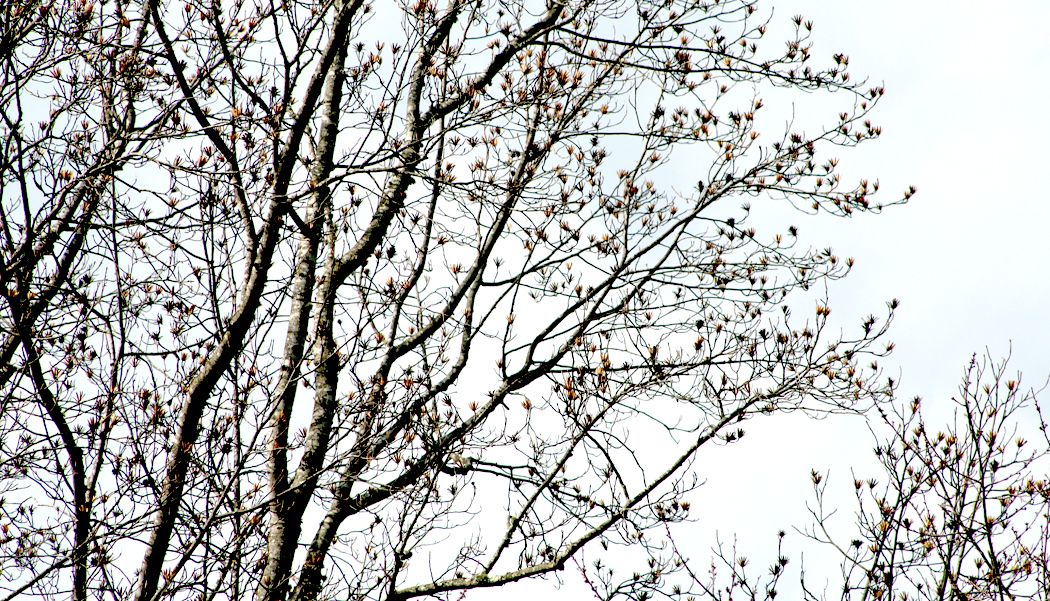
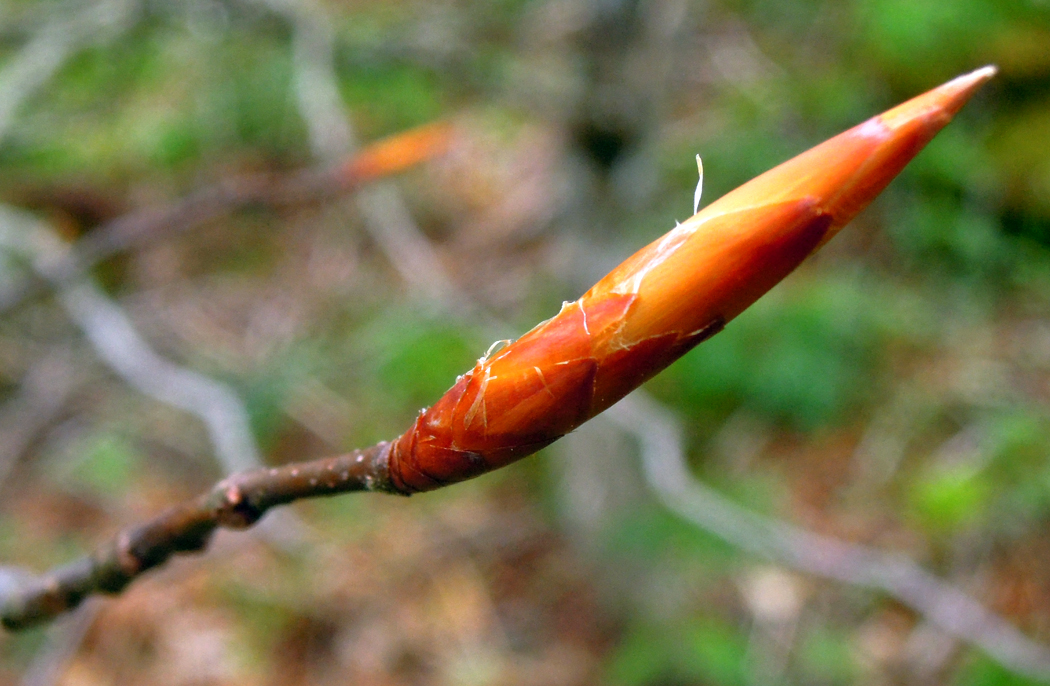
This is my favorite time of the year, when the bare trees begin budding at the twig tips. You can watch the trees change day by day, turning the dead sullen grey of December into something that clearly has a rising sap under the dull bark. When you watch the buds close up, their bud scales slowly separate, with thin lines of green beginning to spread at the edges. 
Fifty years ago, my friend Sandro and I would annually take this time to camp at the Outer Banks. Off-season meant we had the sand and sea to ourselves and could walk five miles along the strand without ever meeting another human. 
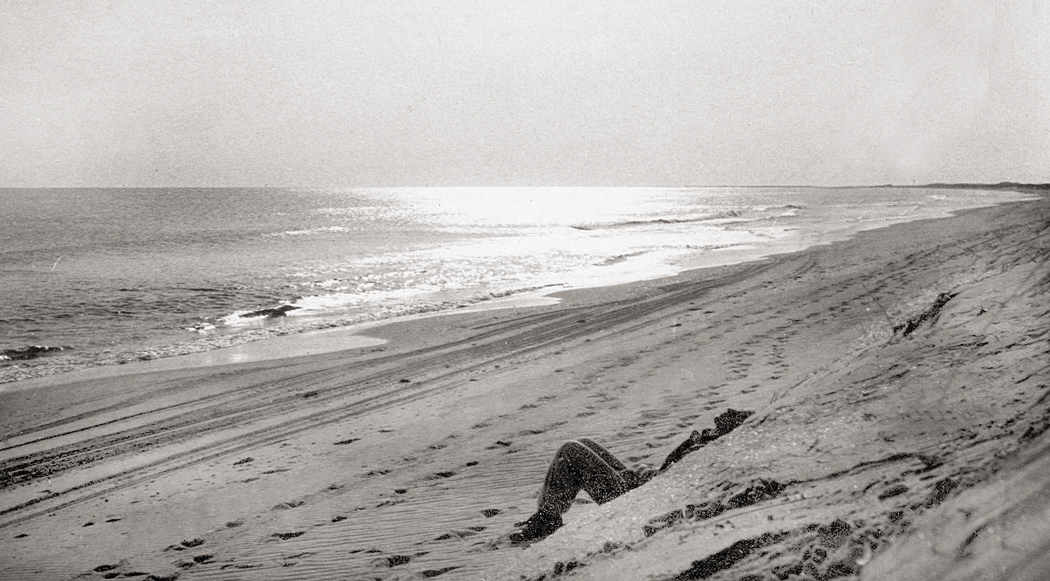
Sandro at Cape Hatteras, 1969

It was also Mud Season. You don’t read about it in literature, with its darling spring buds, its gold first green and its young sun half-run in the ram’s course. But there it is — early winter rains drained deep into soil and then turned hard as rock in the frozen air. November’s squishy footprint is turned to fossil, brittle as any sandstone, its edges wedged up in a tiny crater. But the February thaw, or later, when March brings those buds to stretch their scales, those footprints turn once more to watery goo, slippery under your shoe, sucking your heel right off your foot. It is what is wrong with pretty literature. Among all the pinking petals, among all the bright girls in spring dresses, among all the apple blossoms and greening grass to come, there is the mud, ripe, fertile, pliable in your squeezing fist, the one brown, crowning reality of the the coming spring, when there is mud again.

It is such elemental things that seem most real, most important. Culture changes, fashions change, but the cycle of seasons wears a constancy. 
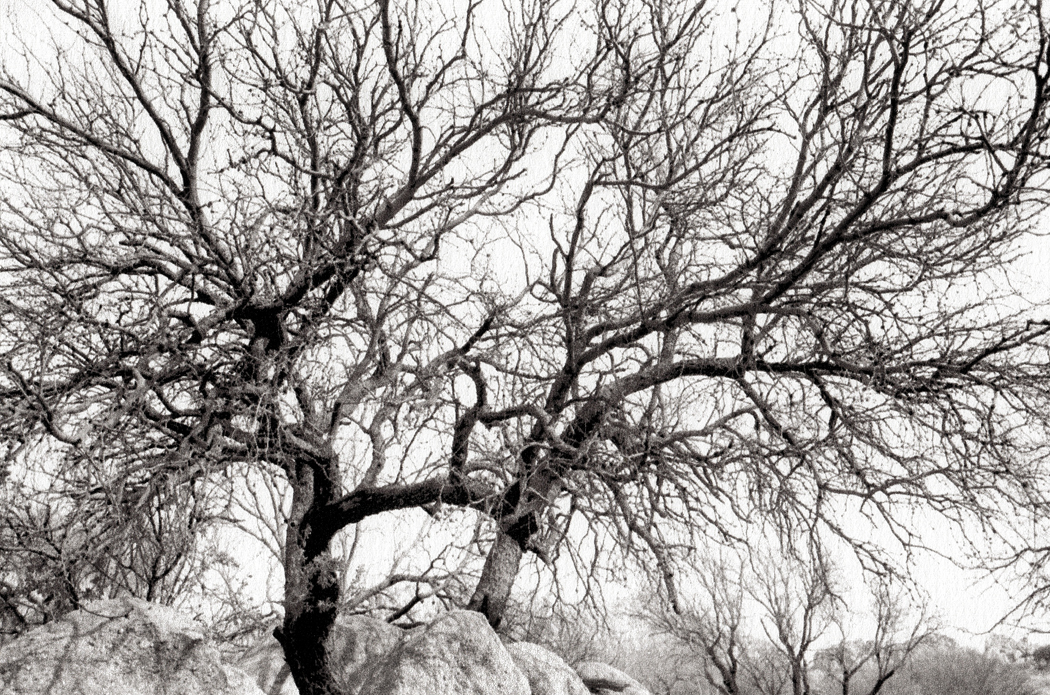
Texas Canyon, southern Arizona

For me, it is the trees, most of all. I love the spring trees well enough, but it is this time of year, when the trees are still bare and show their bones that I wait for each fall. Drop the leaves ecdysiastically and I can see the shape of the thing they cover. 
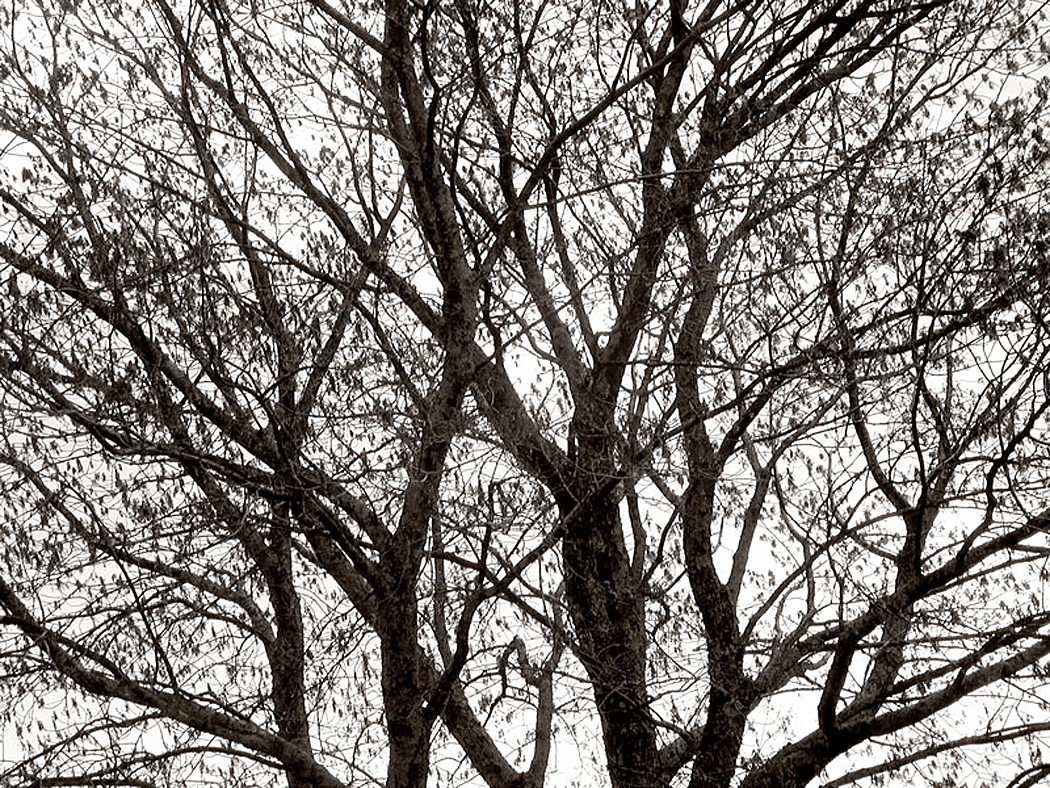
Spring oak, Blue Ridge

It is the lines they make against the sky. An etching more than a painting. Artists through history are generally assigned to one of two categories — they are either line people or color people. Line painters, like Botticelli, tend to draw their scenes, often in actual outlines, and then fill in the colors, while color guys, like Titian daub pigment onto the canvas and let the patterns of color define shapes. It’s one of the major distinctions made by Heinrich Wölfflin in his 1915 book, Principles of Art History. It doesn’t mean the line guy doesn’t appreciate color or the color guy doesn’t appreciate shapes and forms, but rather it defines what hits them first and most centrally. 

(There is a similar distinction in music. Composers — and performers, too — tend to be line guys or chord guys. Lots of counterpoint for the first, and washes of tonal color for the latter. Bach vs. Debussy.) 
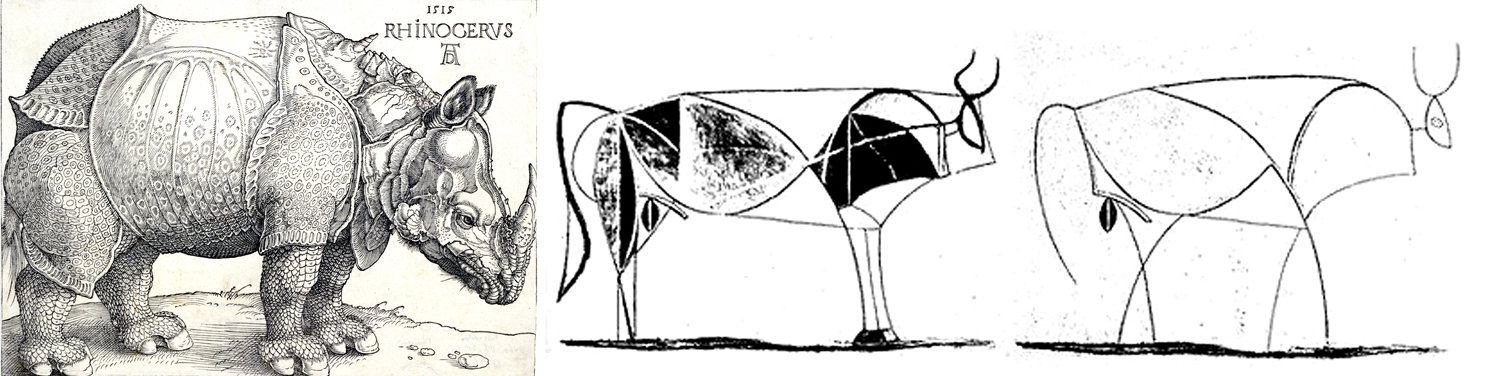
Albrecht Dürer rhino; Pablo Picasso bull

Albrecht Dürer was a line guy, most characteristically in his wood engravings. Picasso was a line guy and certainly an indifferent colorist. Most of his paintings could easily be given different fill-in colors. Matisse, though, a color guy to his teeth. Even more recent painters can be divided. Ellsworth Kelly a color guy; Lucian Freud a line guy. 

Well, I’ve always been a line guy. And the lines drawn by winter trees have hypnotized me since I was a wee bairn. One whole category of my photographs are what I called my “tree nudes.”
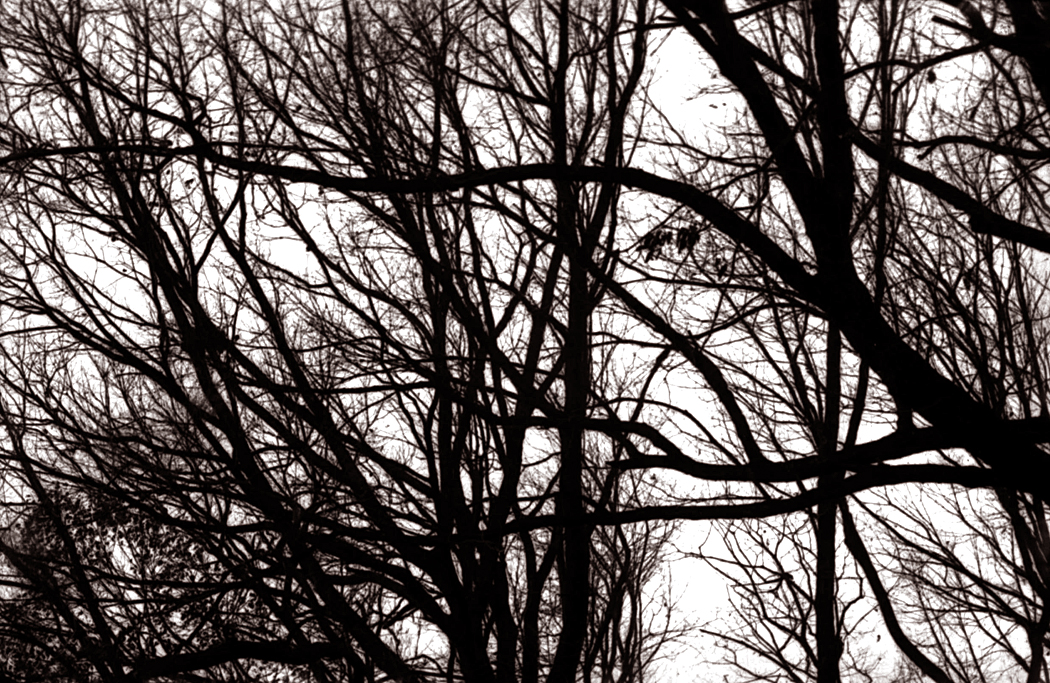
The nude has a specific purpose (outside the merely voyeuristic). Clothes drop their subjects into a very particular time and place. Eighteenth century breeches; flapper skirts; bell-bottom trousers; togas; saris; morning coats with a peeking handkerchief in the breast pocket. 

But the nude is — or can be — timeless (with the caveat that hairdos can be a giveaway). There is a universality to the nude in art, which is why so many Greek statues are naked. And we are meant to appreciate the form — shape, detail, muscularity — and not just a specific person with a name, family, opinions, and personality. 
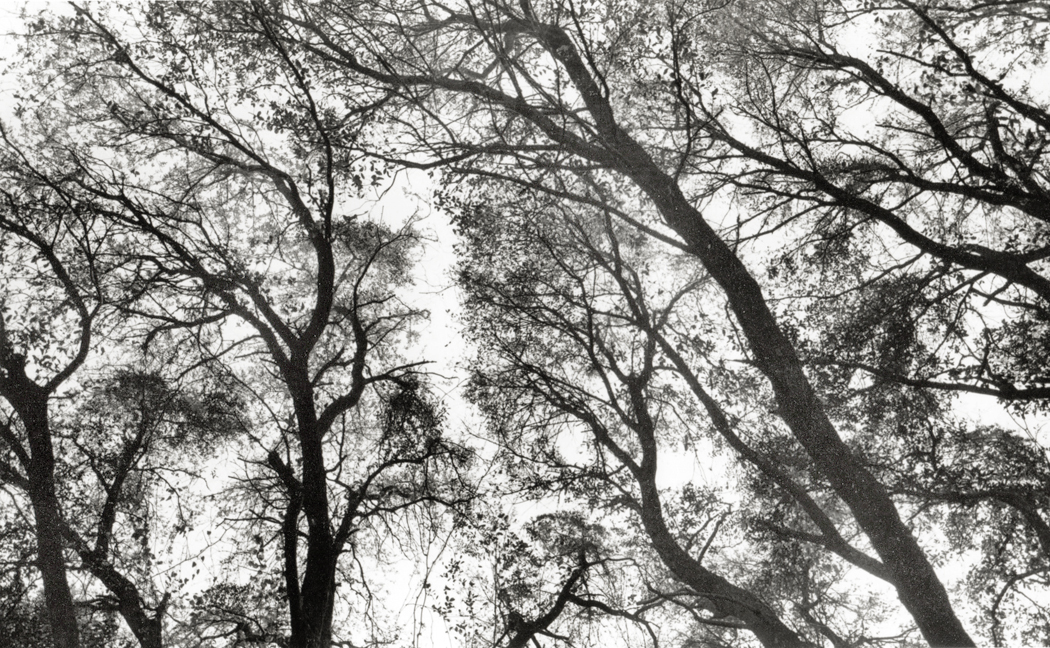
And I feel the same thing in the bare ruined quiers, where late the sweet birds sang. There is structure in the dark lines of the branches, and a systematic chaos in the way they all cross each other in a welter of visual information. 
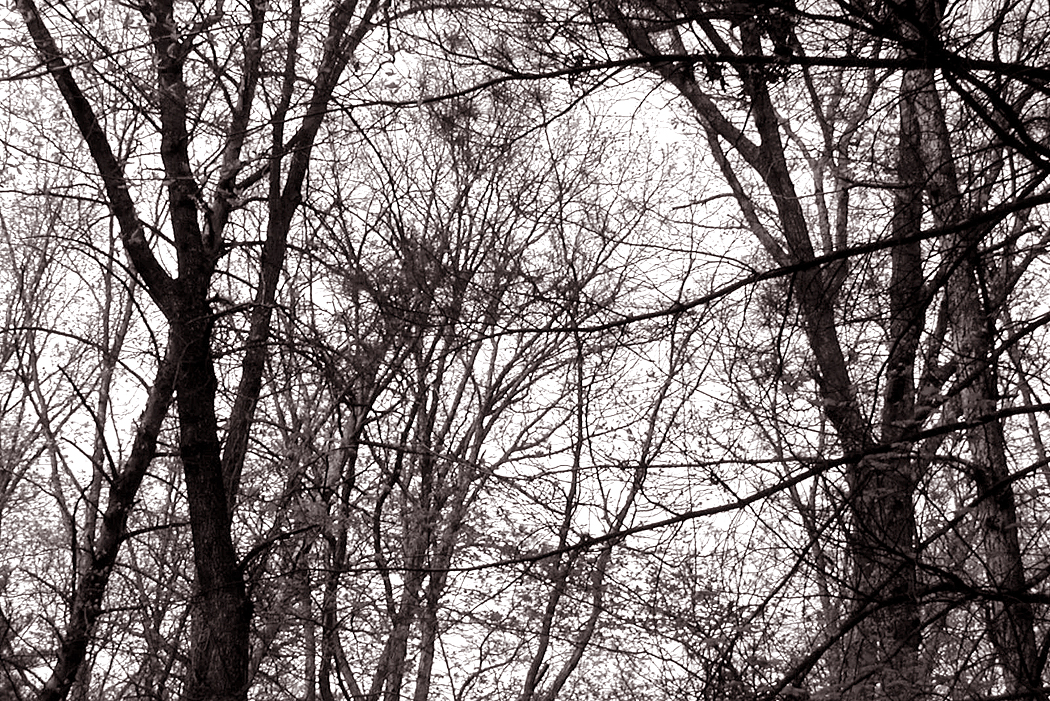
In this, I am reminded of the drip paintings of Jackson Pollock, which I came to love in the New York art museums I visited beginning as a teenager. A good nature-scribble of branches puts a buzz in my visual brain. I love it and have sought it for the past 60 years. Among the first photographs I ever made, 60 years ago with an ancient 35mm Praktica camera were of trees. 

Of course, while trees are beautiful, they can become an obsession. If I had chosen to make a career out of photography instead of writing, the trees pictures would have dwindled. As Fred Astaire says in the film  Funny Face, “You’d be amazed how small the demand is for pictures of trees.”

But I have followed trees through seasons
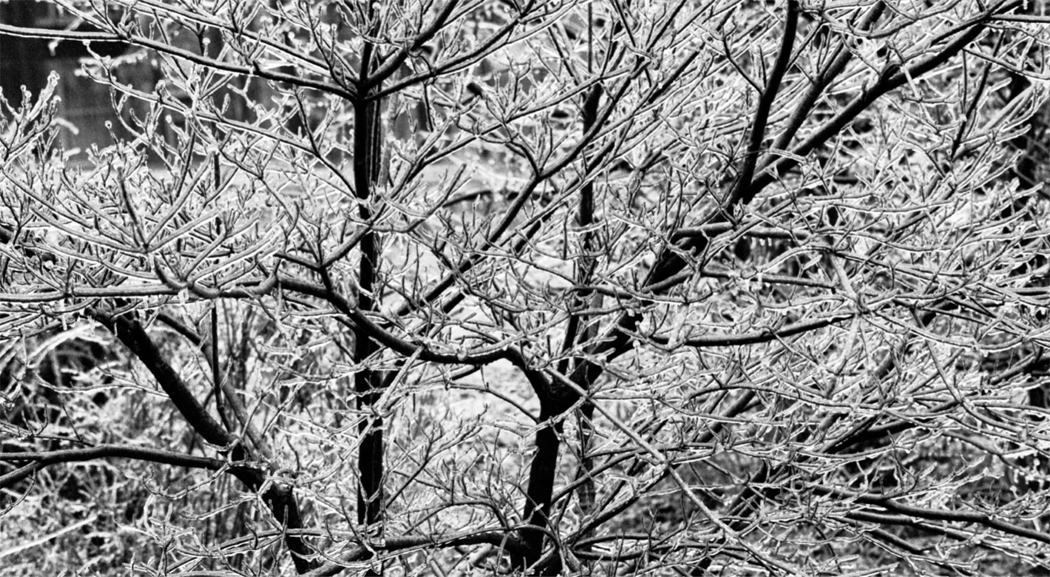
Ice storm, Greensboro, NC, 1969

and all their leafy-ness
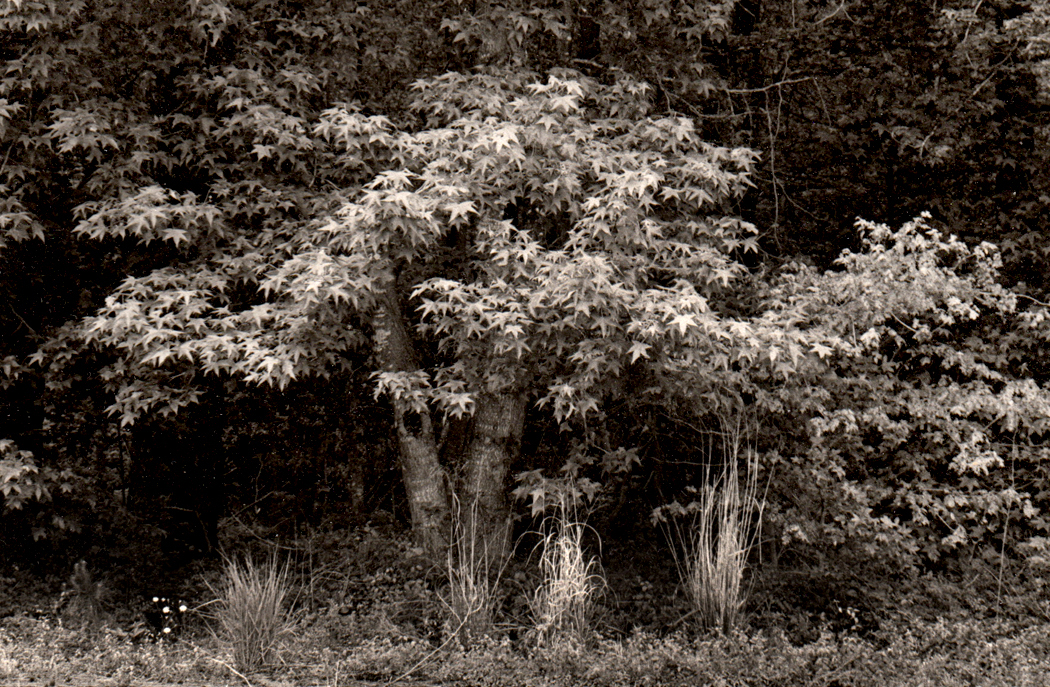
Sweetgum tree, Redwing Golf Course, Virginia Beach, Va., 1984

I have sought the best image of the jumble of buds, twigs, branches, trunks and bark that I feel as a signal for my emotions. 

One of the first shows at the Museum of Modern Art that made a deep impression on me was in the summer of 1972, when they put together a group of 50 photographs of Paris trees by Eugene Atget (1857-1927).  

Lined up on the wall in a darkened space, with brilliant track lighting that made each photograph gleam like a jewel, the photographs made my heart jump and my eyes smile. Most of the trees were winter trees, with wiry roots dug into the ground, and ancient boughs twisted and weighed down with age. They were ungodly beautiful, but also, in Minor White’s expression, it wasn’t just what they were, but what else they were. 
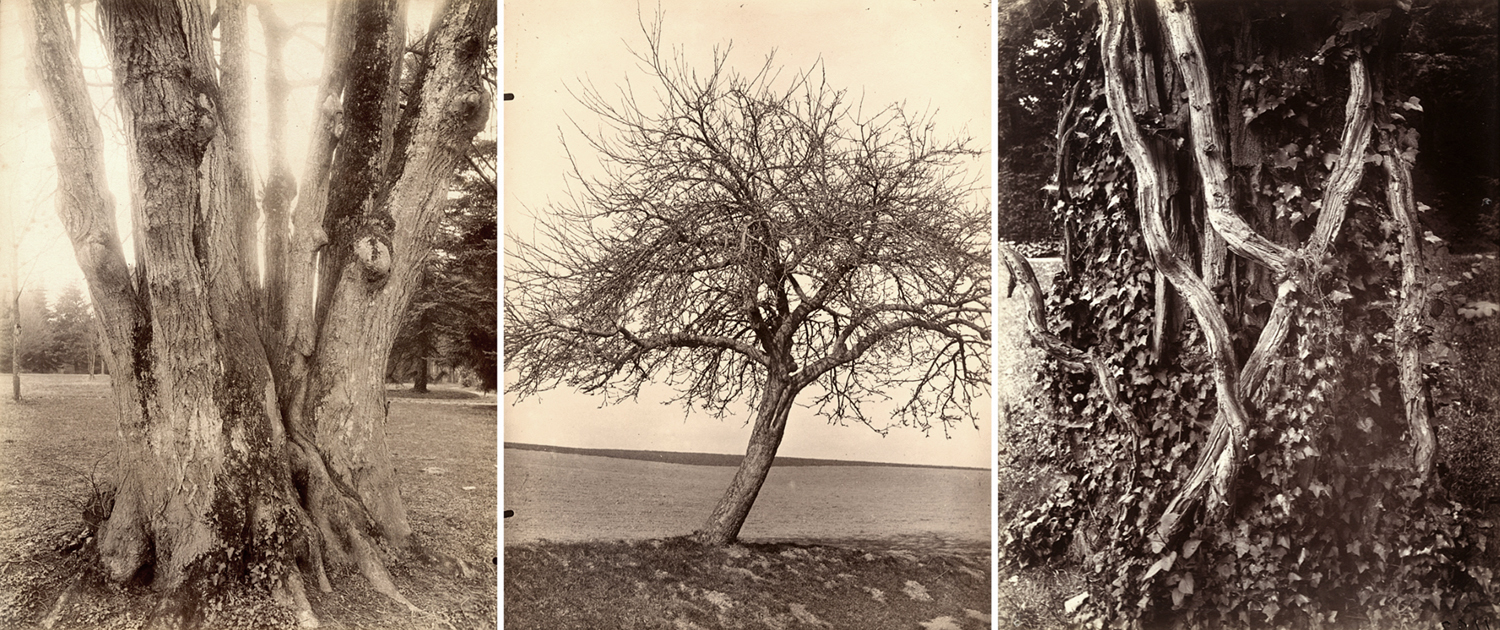
Three tree photographs by Atget

The way they were lit, the gnarled forms they took, their texture and even the gold-toned sepia surface of the silver images all functioned as metaphor. They evoked emotion the way art can. 

Usually, when most people see a picture, in a magazine or newspaper for instance, the image is just a kind of shorthand for language. You see a picture of a house or car and instantly the words “house” or “car” spring to mind. The journalistic photograph is a kind of pictogram or hieroglyph, like the stick figures on the doors of public restrooms. 

But images can also do more than that: When you abjure the naming phase and feel the color, line, shape, form and also the cultural resonance of an image, they evoke thoughts and emotions beyond the named subject. 
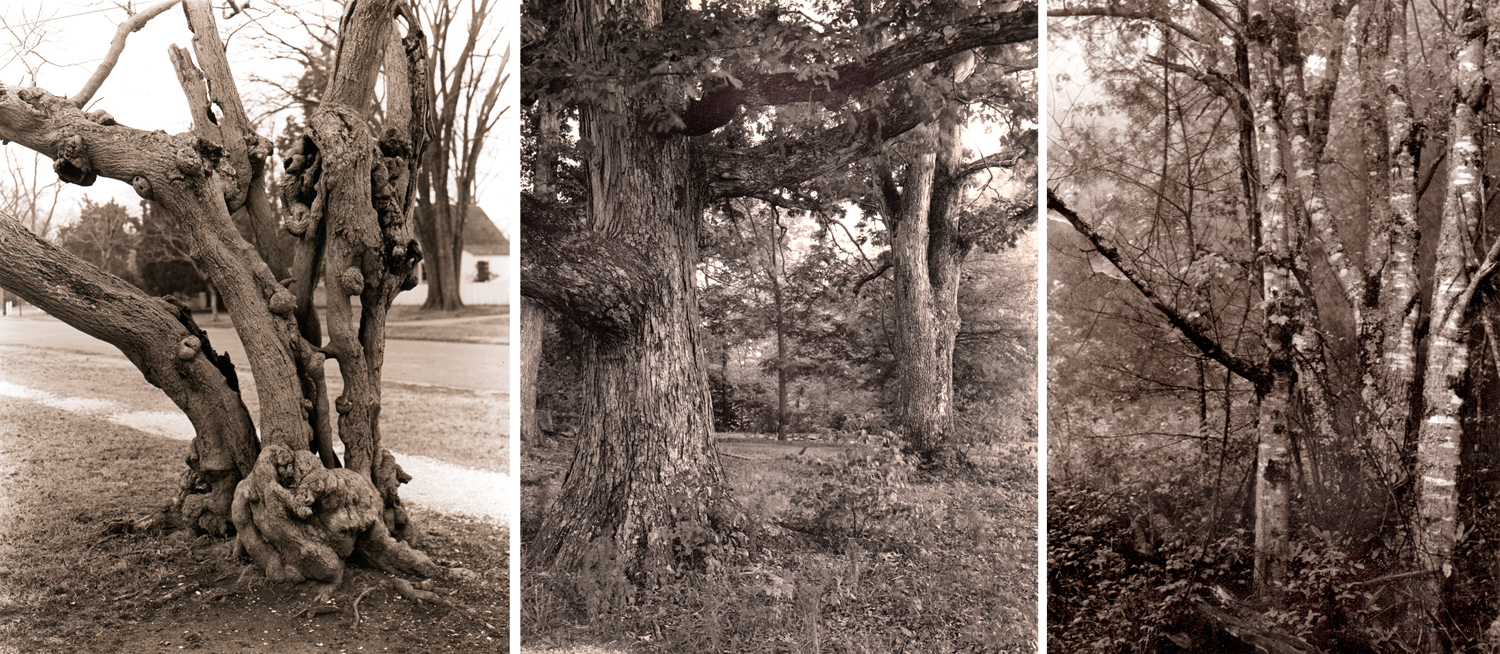
My imitations of Atget

And it was that that blew into my brain, seeing the Atget trees. 

And that is something I have been hunting all of my creative life. And attempting to find in my own photographs of trees. Or not just trees, but in all the photos I’ve tried, whether landscape or still life or nude or portrait or abstract. — What else it is. 
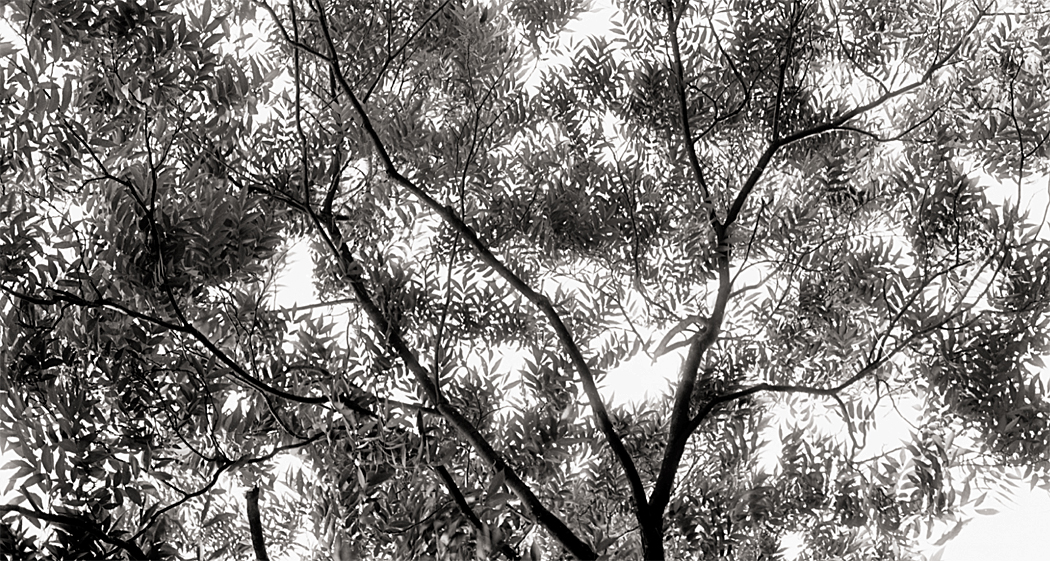
So, when I sit on my back patio and look up the hill at those mid-winter spring trees, with their augury of renewal, and their complex shapes and overlaps — those wonderful lines drawn against the sky’s paper — I want to catch something as it flickers by. 
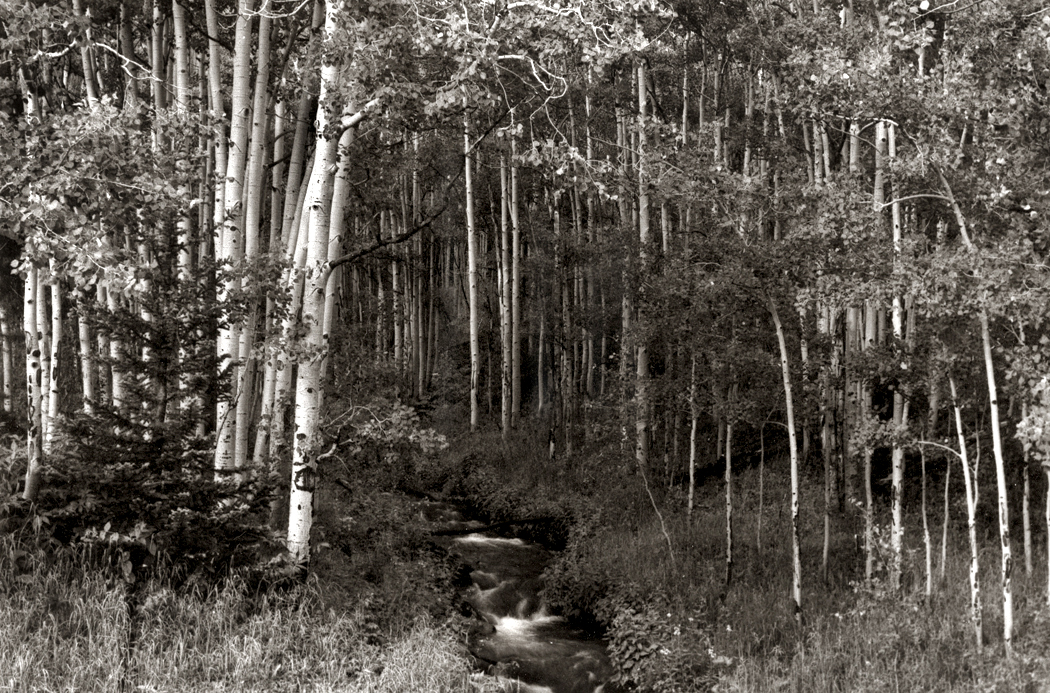
Aspens, Colorado

I’ve snapped a lot of them, although I’ve caught few. Many don’t have the magic and just sit there as noble attempts. It hasn’t just been bare trees. I’ve tried to find the emotion in all kinds of them.
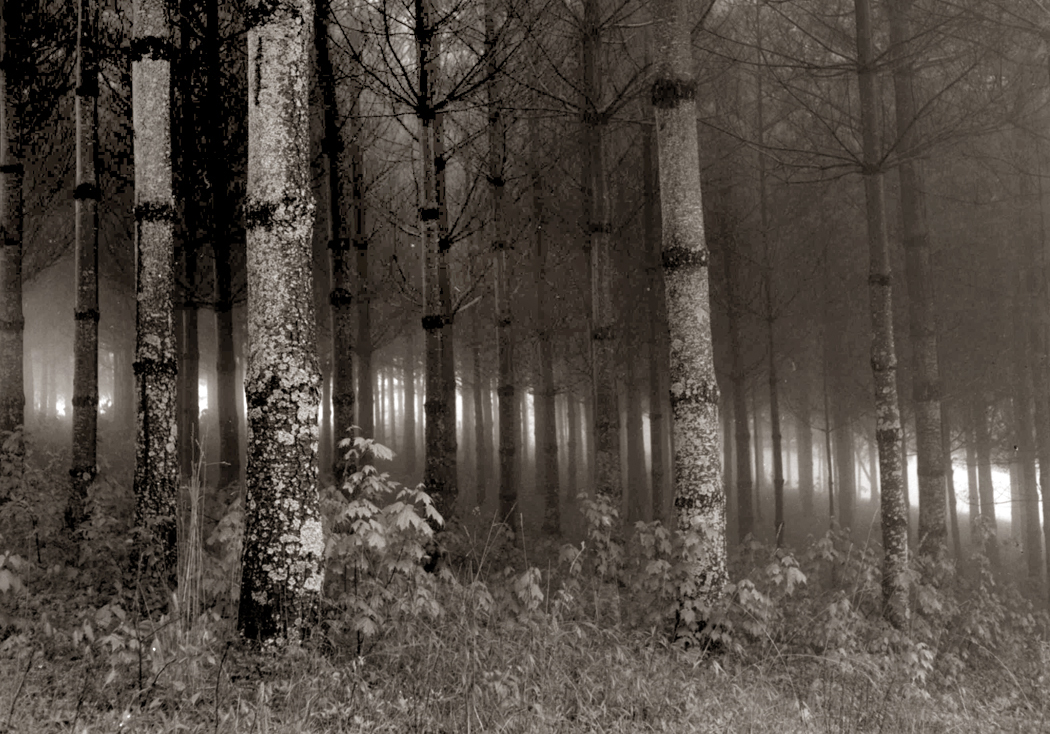
Morning, Obids, NC, Blue Ridge Mountains

The photographer Alfred Stieglitz called the equation between the subject of a picture and the emotions that are evoked “equivalents.” It’s part of the constant fight between the simple depiction of something you can name, and the attempt to make the image stand on its own as an esthetic entity. 
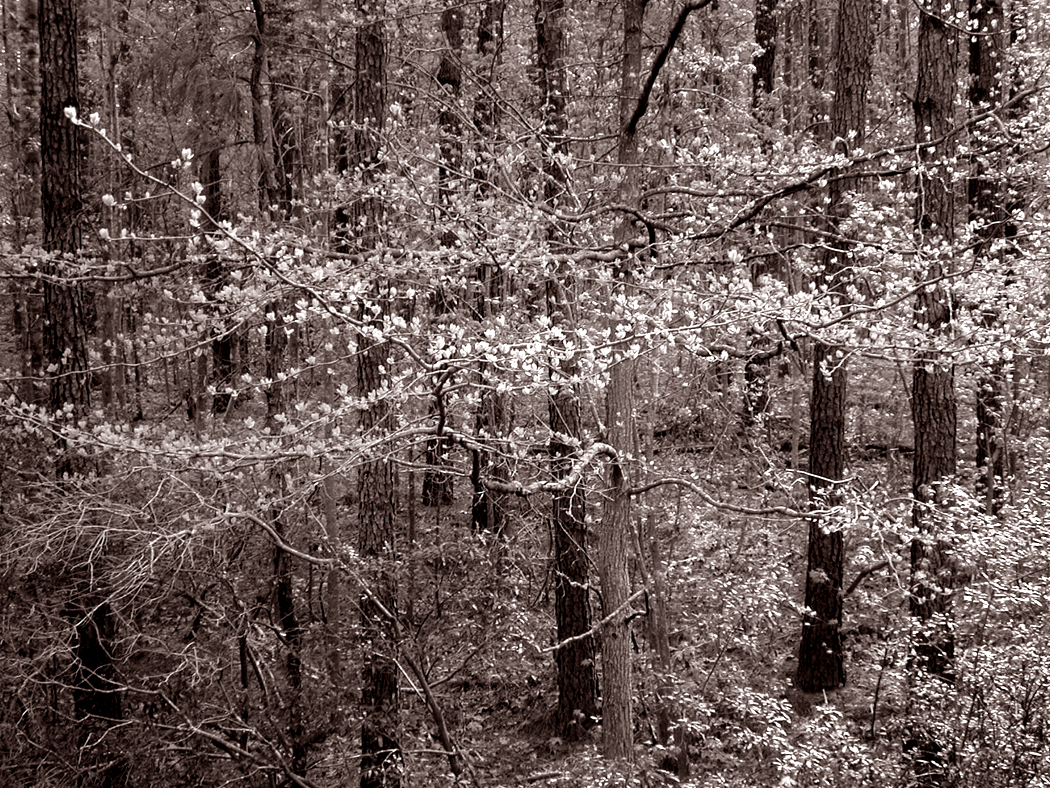
It’s what most visual art tries to do: create an equivalent in the limbic system to the shapes, colors, lines, and even the subject matter and its resonance with the personal. 
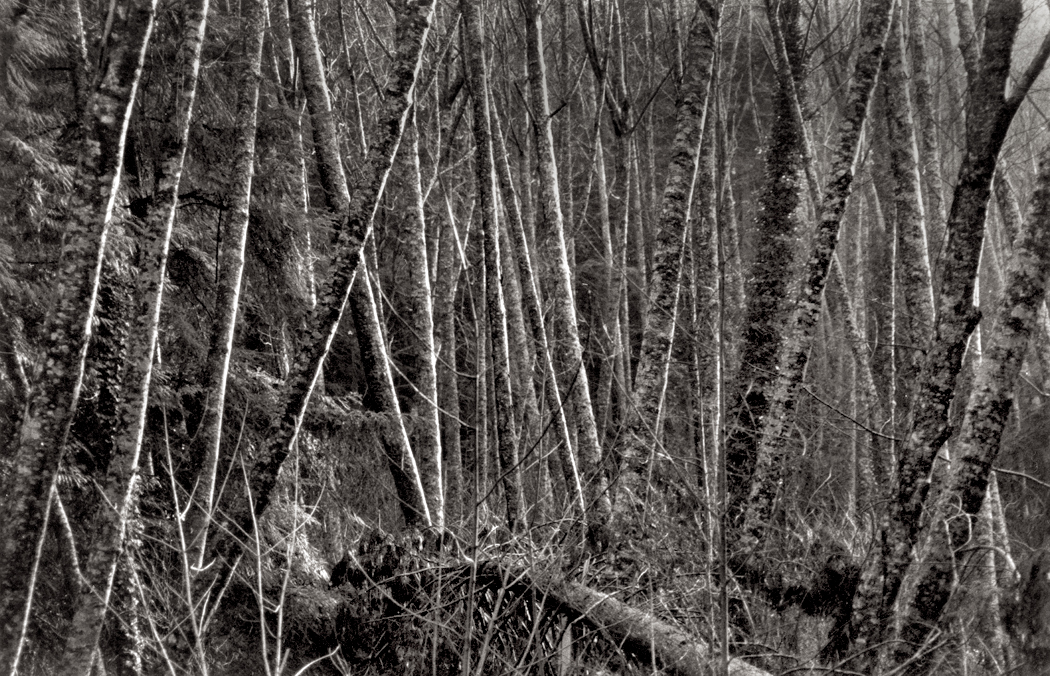
Bainbridge Island, Puget Sound, 1979

Most glossy travel photos are meant to make you wish to be there. But with the image made for display, or as art, you are there, in front of the thing itself. You don’t have to make travel plans. Not just pretty pictures, but objects of contemplation. 
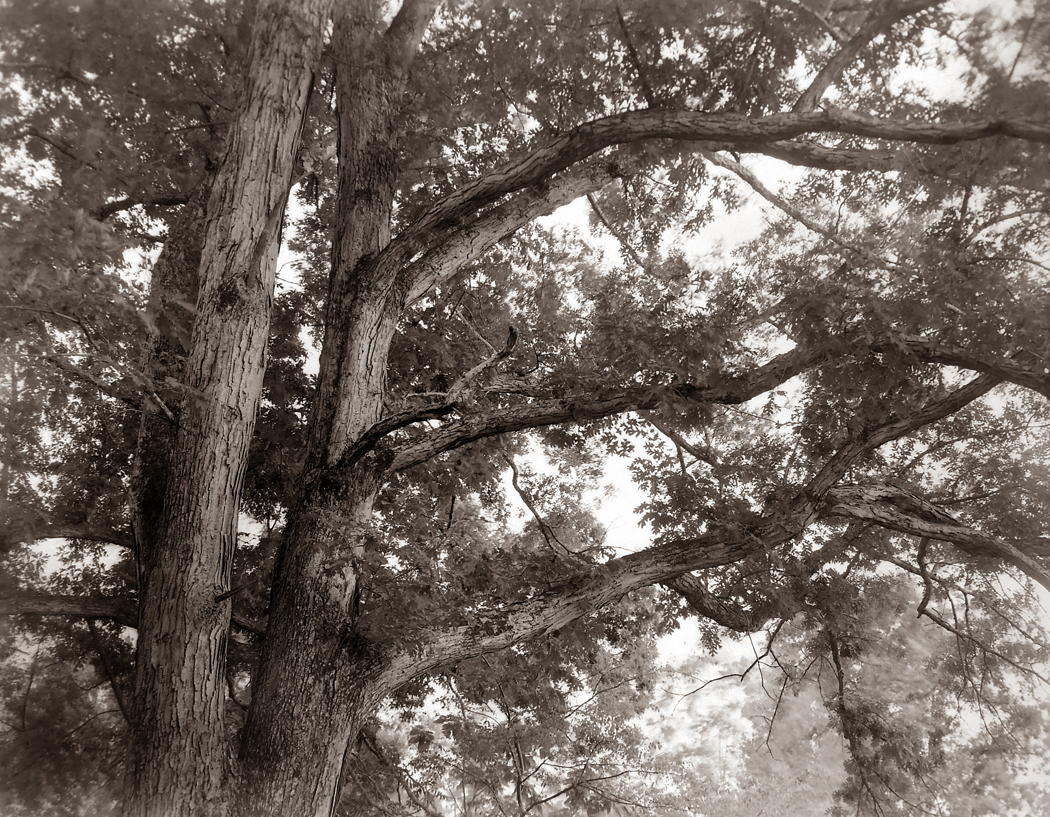
Sandro’s oaks, Summerfield, NC, 1980

The point is twofold. First, to make you pay attention to the world around you, to see with intention. And second, to allow you to connect with the emotions you have in potential.
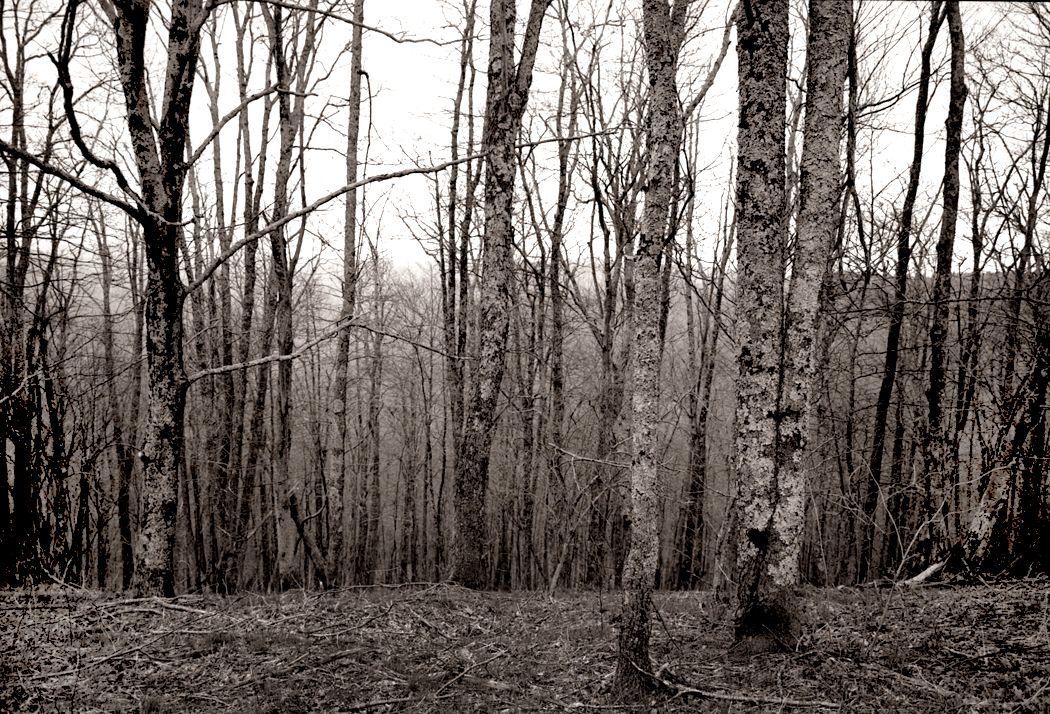
Wise, Va. 

Both together they make a single bond: interior and external; you and the world; individual and cosmos. No longer separate. 

Over the years, the images I make have become less public and more personal. I no longer pay much heed to the wide acceptance of the art I make. I don’t make it for others, but as a kind of personal meditation. 

I seek new ways of making this happen. One morning, while visiting my brother- and sister-in-law in Reidsville, N.C., I saw the shadows of winter branches projected onto the window blinds. It made for a kind of Japanese byōbu screen. 

And then, one day last week, in midwinter spring, sempiternally recurring, I was sitting out back, listening to birds and airplanes, the dogs down the street and watching the clouds move west to east and the branches waving in the moving air, and I managed to make an image that finally captures for me the complexity of the abstract, neuronal jumble, all the connections, the scribble and the energy. It is small on your computer screen, but it should be large as a mural. 
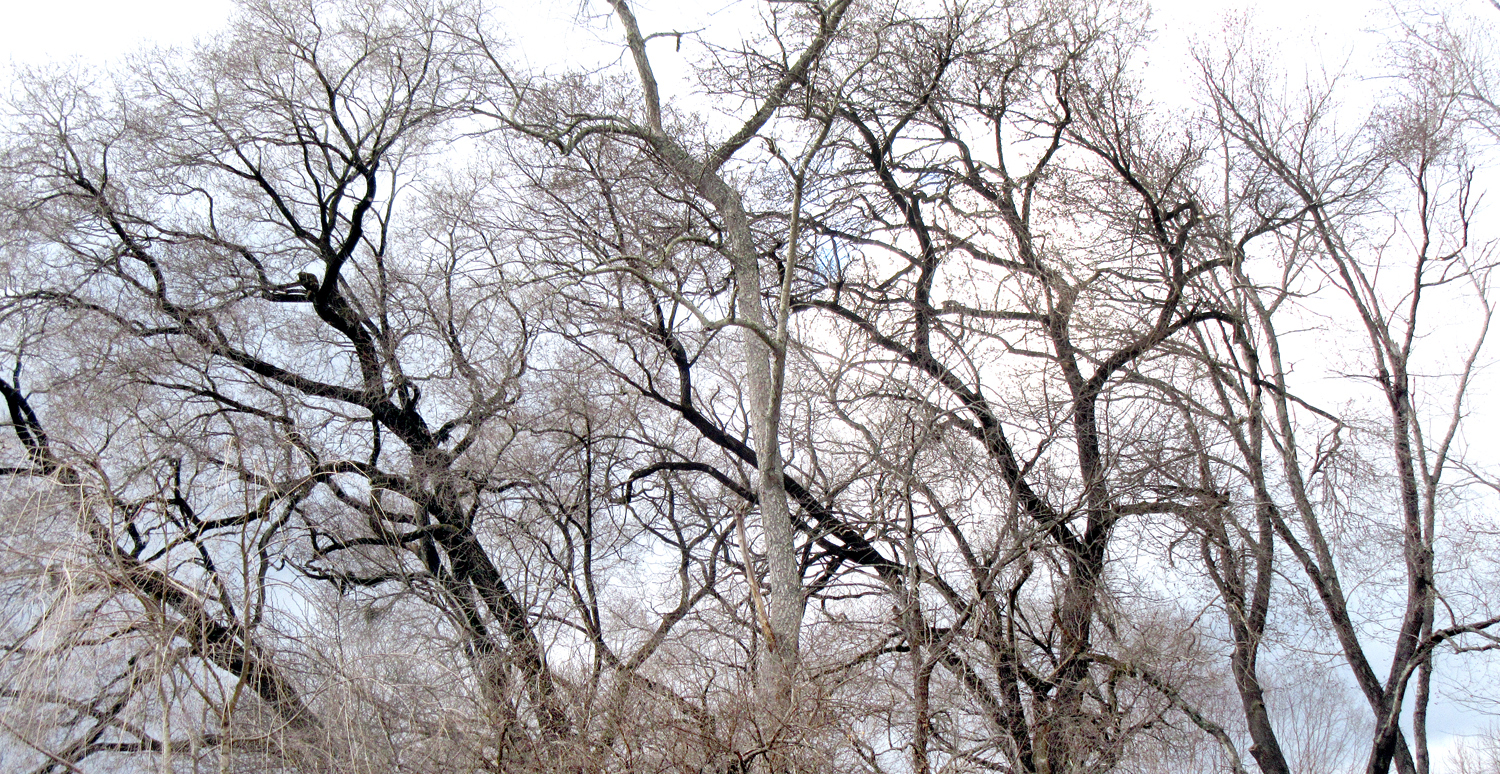
If I could, I would print it out mural size to cover a wall. Or split it up over several vertical panels, like a Japanese byōbu screen.

But I no longer have means to do that, and so, I just look at it and contemplate.
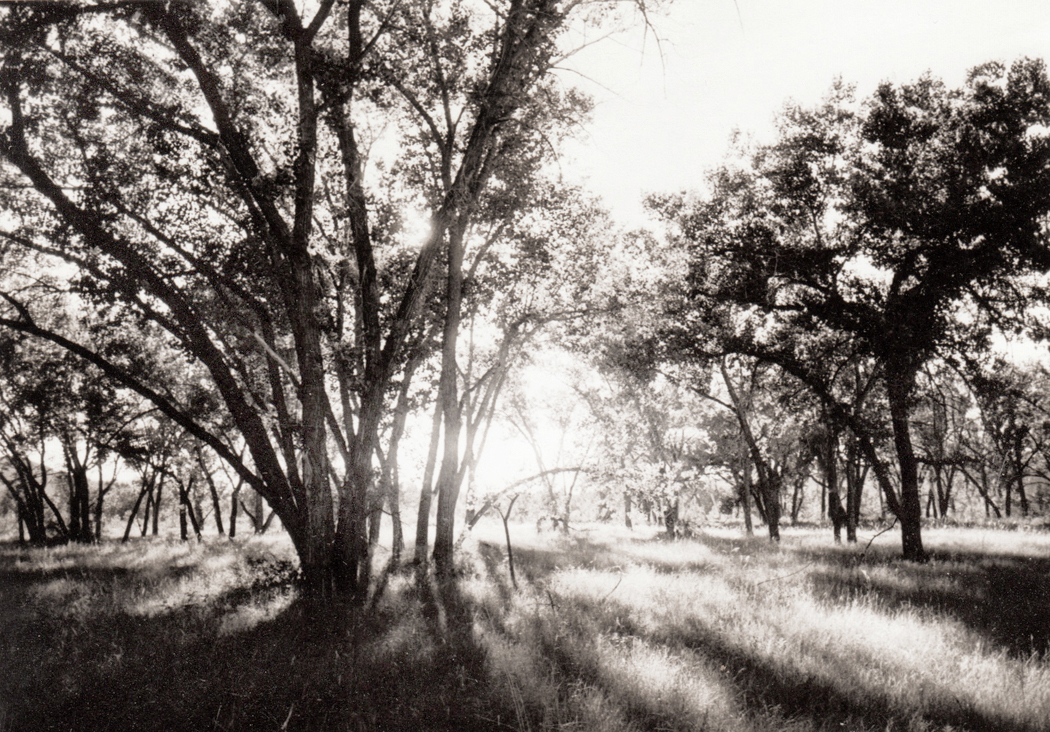
Roosevelt National Park, ND

Click on any image to enlarge

Many years ago, my late wife bought me a copy of A Book of Clouds, published in 1925 by author William A. Quayle. It is a hefty clothbound volume, primarily of old black-and-white photographs of clouds, layered with Quayle’s particular garish encomia and reminiscence about the glories of skywatching. 

Clouds seem to bring out the gooey and poeticizing cliches in a writer. “I was kinsman of the clouds,” Quayle writes. “And as I grew, the clouds still sailed their crafts of  snowy sail across the blue sea of my heart. Clouds, so to say, were indigenous to my soul. I did not begin to notice them: I always noticed them. I did not learn to love them: I always loved them.” 

The book is fervid with such expostulations: “When clouds give reports of portentous skies, of prepending tempests, when they are black as pools of midnight water, their eminences wrinkled as if zigzag lightnings had been the shears which cut their patterns, then as the sun lurches behind their darkness, the fine fire that rims them and seizes all their peaks gives a touch of delirium to the soul.”  

I love this book, for all its gushy writing, because Carole gave it to me, and because, in an era of irony and unbelief, there is something utterly sincere under the purple prose. 

A few years later, she gave me another book, The Cloud Collector’s Handbook by Gavin Pretor-Pinney, a small volume and kind of a field guide to cloud identification — almost a Peterson guide. In it, Pretor-Pinney gives genus and species names of various formations, implying that a taxonomy of anything as gaseous and impermanent as a cloud might be spoken of almost as if it were a wildflower or a bunting. 

And so, there are is a list of Latinate names, not just the familiar “cumulus” and “cirrus,” but also “lenticularis,” “castellanus,” “radiatus,” and “undulatus.” Carl von Linné would have been proud. Each page is devoted to another cloud form, or cloud-related or -adjacent subjects: “pileus,” “virga,” “nacreous,” “noctilucent,” etc. It’s lots of fun. 

Pretor-Pinney, it turns out, is a veritable cheerleader for cloud watching. His full name is Gavin Edmund Pretor-Pinney, son of Anthony Robert Edmund Pretor-Pinney and Laura Uppercu, daughter of George Winthrop Haight — in other words, he’s British and has the “twitcher’s” enthusiasm, but for clouds rather than finches. And in 2004, he founded the Cloud Appreciation Society and two years later, wrote both The Cloud Collector’s Handbook and The Cloudspotter’s Guide. In 2019, he wrote A Cloud A Day, which features 365 cloud images accompanied with a short piece of cloud science, an inspiring sky quotation or a detail of the sky depicted in a classic painting. 

The Society has its website (link here) and features galleries of cloud art by painter-members, collections of cloud poetry, and many, many photographs. The paintings are especially entertaining, and hugely varied in approach.

Artists L-R — Top: Peter Nisbet; Carol McCumber; Elizabeth Busey. Bottom: Judy Friesem; Jethro Buck; Barbara Miller. 

And there is a Cloud Appreciation Manifesto (of course, there is): 

“We believe that clouds are unjustly maligned and that life would be immeasurably poorer without them. We think that clouds are Nature’s poetry, and the most egalitarian of her displays, since everyone can have a fantastic view of them.

“We pledge to fight ‘blue-sky thinking’ wherever we find it. Life would be dull if we had to look up at cloudless monotony day after day. We seek to remind people that clouds are expressions of the atmosphere’s moods, and can be read like those of a person’s countenance. We believe that clouds are for dreamers and their contemplation benefits the soul. Indeed, all who consider the shapes they see in them will save money on psychoanalysis bills.

“And so we say to all who’ll listen: Look up, marvel at the ephemeral beauty, and always remember to live life with your head in the clouds!”

Of course, Pretor-Pinney isn’t alone. 

There are loads of books, including a raft of children’s books, all about clouds. 


The sky is a slate upon which we can project our sense of beauty, our sense of meaning, the expanse of creation, and the progress of time. We look up and always, it is new. Always it is moving. To rephrase Heraclitus, you can never look at the same sky twice. 

And the sky has been there in painting for centuries, but usually as a background for more important goings-on in the foreground. Then, in the late 18th- and early 19th-centuries several artists began studying the clouds and the sky for its own sake.

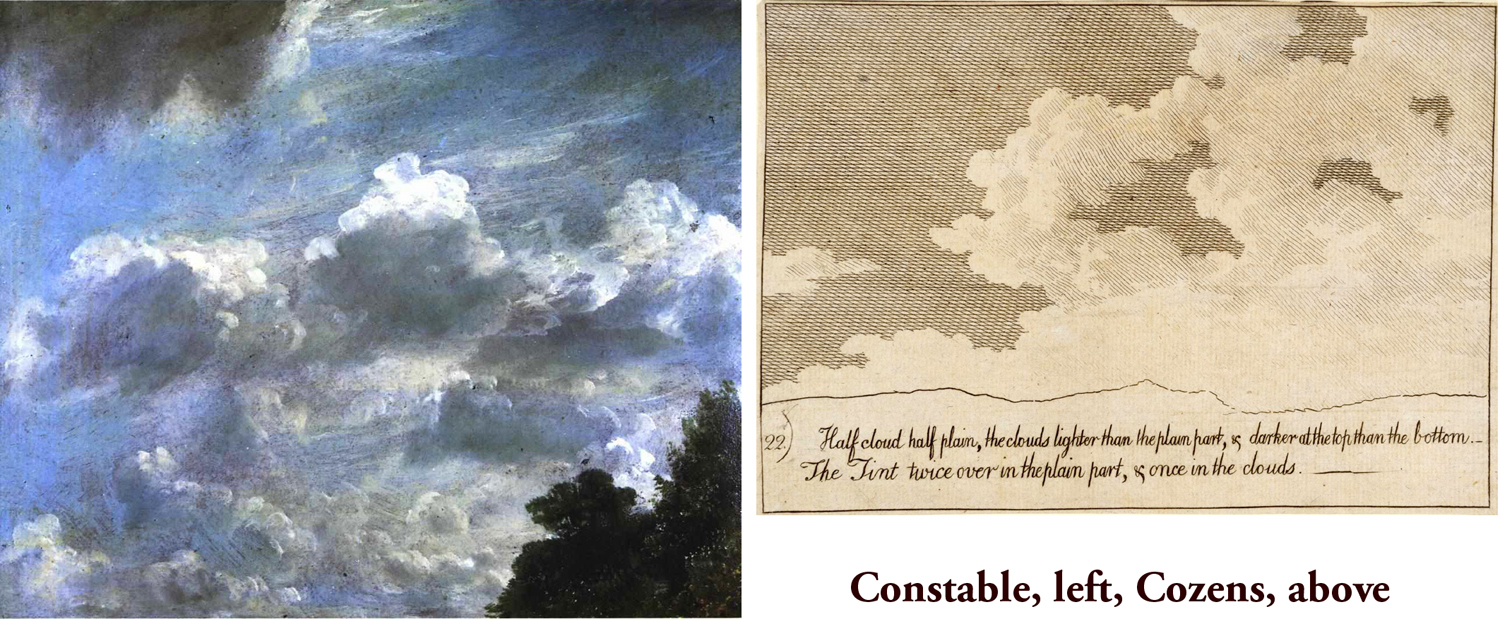
Most famously, a series of cloud studies by John Constable and sketches by Alexander Cozens. 

Cozens:

Constable:

“Clouds, for Constable, were a source of feeling and perception, an ‘Organ of sentiment’ (heart or lungs) as much as meteorological phenomena,” writes author Mary Jacobus in the book Romantic Things: A Tree, a Rock, a Cloud. “If painting is another name for feeling, and the sky an organ of sentiment, then his cloud sketches are less a notation of changing weather effects than a series of Romantic lyrics: exhalations and exclamations, meditations and reflections, attached to a specific location and moment in time.”

In other words, the clouds, either painted or merely watched, become a subject for contemplation, even meditation. Beginning in the 20th century, paintings became increasingly abstract and the point being not subject matter but the substance of paint — color, shape, line, form, design. To look at a Jackson Pollock painting, or one by Mark Rothko, you are asked not to name a subject matter, but to relate the canvas to human affect, i.e., what does the painting make you feel?

A number of artists and photographers have turned to clouds to make images that are both abstract and descriptive. The clouds themselves provide the abstraction. 

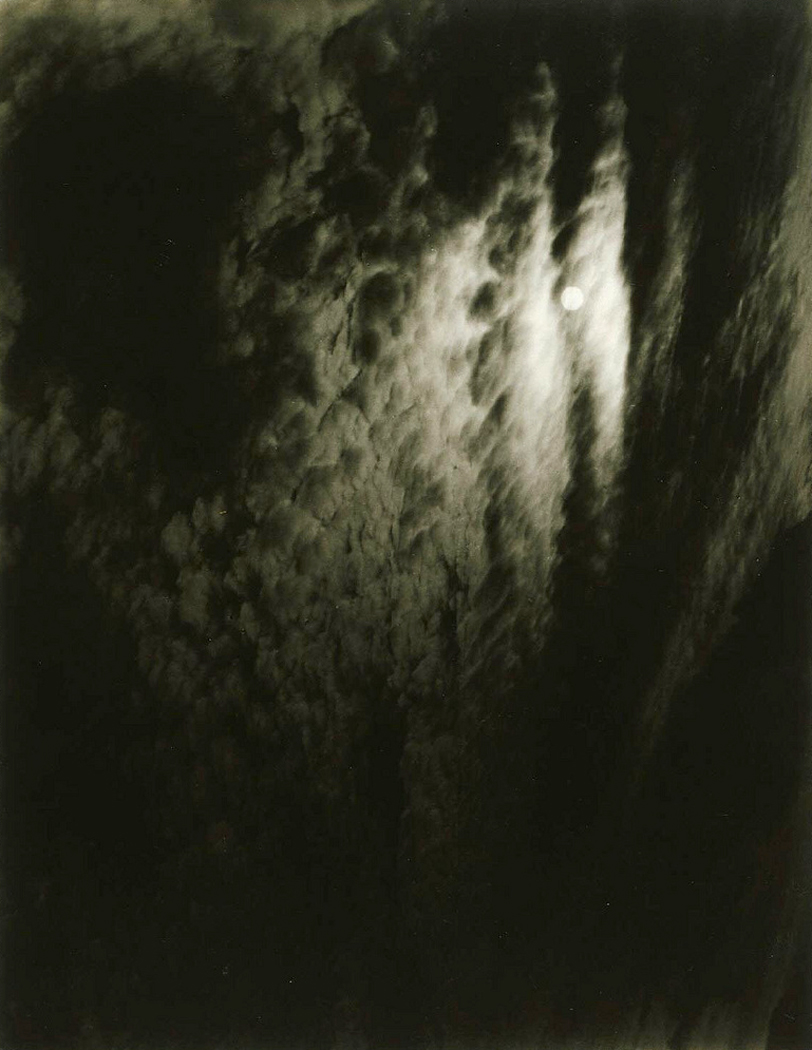
At the beginning of the 20th century, Modernist photographer Alfred Stieglitz made a tremendous series of images of clouds, which he titled, “Equivalents,” meaning that the visual was an equivalent of the emotion. 

He made more than 200 such images, with the intent that they could express emotions, much as music can, purely by abstraction. They are images of actual clouds, but they are also shapes on a piece of photographic paper. You can see them as photographs of the sky, or as pure abstractions. Either way, for Stieglitz, the important part was that an emotion be evoked. 


Another photographer, Edward Weston made pictures of clouds through his lifetime, less consciously manipulated than Stieglitz’s, but cloud abstractions nonetheless. 

The German painter Gerhard Richter made a series of cloud paintings in the 1970s. A Sotheby’s catalog said, “the clouds are caught in a moment of confrontation between the painterly and the photographic, the representative and the abstract, the natural and the supernatural.” Much of Richter’s art is political or otherwise Postmodern tricks about the nature of art itself. As for the clouds, Richter himself said, “I felt like painting something beautiful.”

He kept a notebook of images, which he called “Atlas,” in which he kept many sketches, photos and paintings of everyday items, and a whole section on nothing but clouds. 

I have made countless photographs of clouds. I step out of the house pretty much every day, just to look up and watch clouds. They keep my eyes fresh and my mind invigorated. I have two books I have made: one of images of landforms and clouds seen from my airplane window; and a second of clouds pictures made all on a single afternoon in Arizona during the rising and waning of a monsoon storm. They can be viewed online here and here

When we spend as much time indoors as most people have these past two pandemic years, it is a relief to refocus our eyes outward (and upward) to a distance beyond the four walls. The clouds are far enough that our stereoscopic vision interprets the distance as indistinguishable from infinity. That refocus is necessary to keep us in touch with the greater things. Too often our eyes are focused on electronic screens held less than arms distant. Stretch your eyes back out. Look up. Keep watching the skies. 

Click on any image to enlarge

clouds134In the 1920s, a fundamental change occurred in the part of photography that was attempting to be seen as art. What had always previously been seen as a picture of something became a picture of its own.

In this, it followed the progress of Modernism in other media. What had been a photograph of a house or a boat, and judged by how well it set off the house or boat, it now became an arrangement of grey and black, of line and form.

If anyone could claim to be the leader of this shift, it would be Alfred Stieglitz. “I was born in Hoboken. I am an American. Photography is my passion. The search for truth is my obsession.”

Despite his tendency toward oracular declamation — or perhaps because of it — Stieglitz became the prophet of a new type of photography in America. Modernist. Stieglitz equivalent 1

His first work, from the late 1890s through the 1920s was mostly figurative, but he became dissatisfied with the idea that his photographs were praised for their subject matter.

In 1922, he began photographing clouds and turning them into the equivalent of abstract paintings.

“Through clouds to put down my philosophy of life — to show that my photographs were not due to subject matter — not to special trees or faces, or interiors, to special privileges — clouds were there for everyone — no tax as yet on them — free.”

These first series of cloud abstractions he called “A Sequence of Ten Cloud Photographs.”  When he showed a new series in 1924, he renamed them “Songs of the Sky.” He continued making these prints, usually exaggerated in contrast and printed quite dark, making the blue sky black. He made them by the dozens, and by 1925, he was calling them “Equivalents.”stieglitz equivalent 2

“I have a vision of life and I try to find equivalents for it sometimes in the form of photographs…(Cloud photographs) are equivalents of my most profound life experience.”

This idea of “equivalents” was later taken up and expanded by photographer Minor White and others, but in essence, the abstraction of the clouds were to stand for “equivalent” emotional and intellectual experiences.

There is certainly a grandiosity to Stieglitz’s language, indeed to his person. But the photographs remain and many of them are deeply moving, perhaps compared to the late quartets of Beethoven.

But the underlying idea was that the medium of photography, rather than the subject matter the camera is pointed at, could be expressive: that the surface of palladium printed paper, or silver prints, and the blacks and whites of the silver on its surface, and the shapes they make, almost as if a Rohrschach test, could be sufficient for art.

Abstraction became a subset of 20th century photography, and even when there was a subject, such as a portrait or landscape, the photographer, whether Edward Weston or Paul Strand, or White or Bill Brandt, would insist on its essential abstraction as the basis of its value.

constable cozens pair But there is a problem with this: Those Equivalents that Stieglitz made are still clouds, and clouds carry with them all the baggage of subject matter. From the clouds in Renaissance paintings through the glorious cumulous in the seascapes of Aelbert Cuyp to the drawings of Alexander Cozens and countryside of John Constable. Clouds are an endless source of inspiration for the imagination of shape.

charlie brown and clouds In photography, it is almost impossible to eliminate subject matter, short of making photograms. The forms, colors, shadows, textures of the recognizable sensuous world keep intruding, no matter how extracted from context. When I was a teacher, one of the assignments I gave my students was “to photograph something so that I cannot tell what it is.” I expected them to get ultra close, or turn something upside down, or extend the contrast. But, try as they might, I could always tell what I was looking at.

I do not see this as a deficiency in photography, but a strength. Photography can keep us tethered to the world when we might wish to float free; it reminds us that our primary obligation is to the existence we occupy and work in.

clouds105 Given that, photographs of clouds still has a powerful attraction: We can see that abstraction and reality are not necessarily in opposition: We can have both at once.

Put this way, it seems obvious, a commonplace. But this “double vision” is one of the things that keeps art lively, and informs our interaction with the everyday — keeps us aware that the world is alive, not inert.

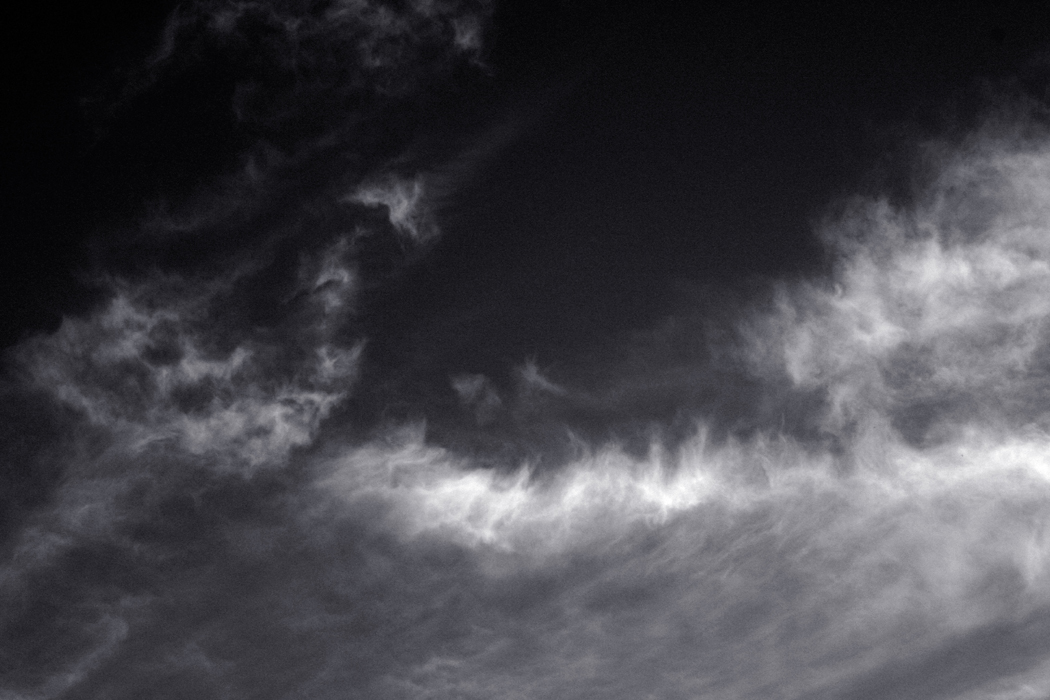
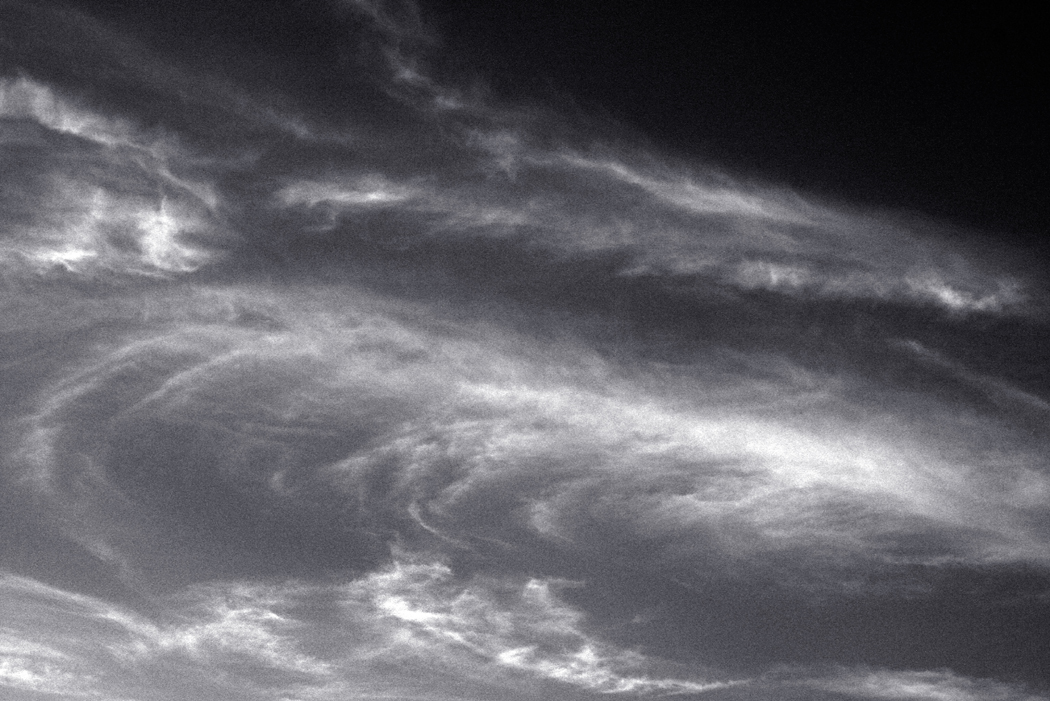
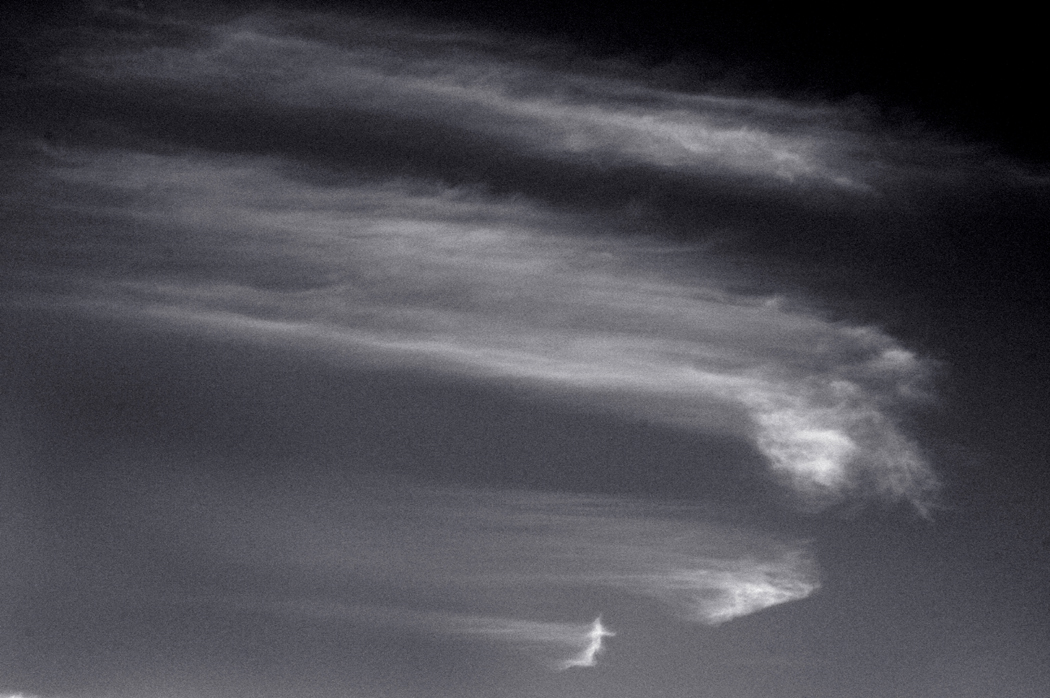
And so, I have made my own cloud photographs. The first series, seen here, are a rank imitation of Stieglitz’s Equivalents. The next blog installment will follow with the development of the idea. clouds116 clouds129 clouds115 clouds119

clouds130 clouds131 clouds139 clouds142 clouds145