Archive

Tag Archives: film

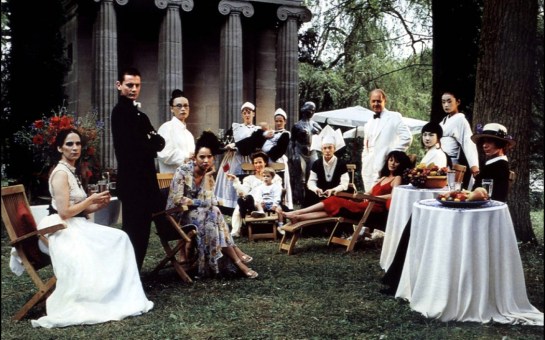
rules of the game 5In Jean Renoir’s 1939 classic, “The Rules of the Game,” one character sums up the problems of existence: “The awful thing about life is this: Everyone has his reasons.”

The film, which tops many lists as the greatest film ever made, has no heroes, no villains; it has no right, no wrong; no simple lessons to be learned, no closure. It is as French as it gets, and despite Hollywood’s penchant for remakes, it could never be made in America.

On the other hand, the 1980 “Star Wars” sequel, “The Empire Strikes Back,” has plenty of heroes and villains: It’s the quintessential American film; it could never have been made in France. “Horizontal boosters. Alluvial dampers? Ow! That’s not it, bring me the hydrospanner.” empire strikes back 1

Jamais!

The difference is more than merely language; it’s sensibility. Both excellent films, they sum up the divide between European cinema and Hollywood movies, a divide filled by more than the Atlantic Ocean.

One doesn’t have to take sides. There are great films from both sides of the pond. But it is important to realize when you go into the theater that there is a difference and which kind of film you’re about to see. If you’re looking for an amusement-park ride, European cinema probably will bore you to tears; if you want intense drama about the human condition, Hollywood films will feel trivial. You pays your money and you takes your choice.

This is not to dismiss American films. First of all, they remain the most popular films worldwide. Many countries, including France, have felt the need to restrict the percentage of American films available to their citizens, to subsidize the local product. Steven Spielberg would always sell more tickets than Jacques Rivette. It doesn’t matter where you go, American films remain popular.

Second, American films remain the major influence on world cinema: The tics of Hollywood become the universal style of everyone else, too. There are the editing rhythms, the lenses and equipment, the green-screen technology, the CGI — these are all the lingua franca of movies everywhere. Even a quiet film like Jean-Pierre Jeunet’s popular “Amelie” would not be possible without computer assistance: Most of its signature color was digitally added.

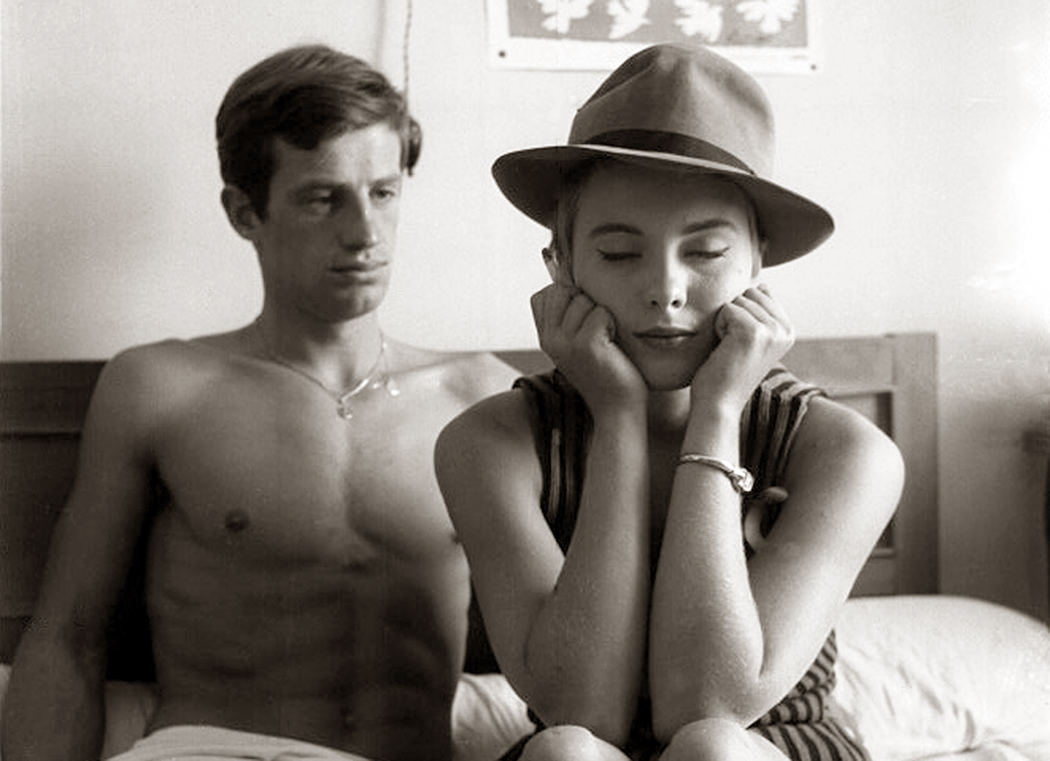
One should not forget that the inspiration for the French New Wave in the 1960s were the Hollywood films the movement loved. Jean-Luc Godard’s “Breathless” is his take on American films, with their gangsters and girlfriends.breathless 2

We in the U.S. now are exposed to more foreign films than ever before. There are Hong Kong martial-arts films, Bollywood films, the emerging films of China and Korea, not to mention those from Iran, Israel and the Arab world.

All that is in addition to the many French, German, Italian and British films that traditionally have constituted the world of foreign films.

They’re not only in theaters but frequently available on cable channels, on DVD and from Netflix. Even Turner Classics has its percentage of foreign-language films.

It’s nearly impossible for the curious filmgoer to remain provincial in the comparative flood of world cinema.

It is true there are American indie films, but even those, no matter how gritty they are, tend to follow an American world view.

Americans see the world differently, so their films portray the world differently. We prize directness and informality; we despise hypocrisy and airs; we look for answers, not questions. We are fundamentally optimistic.

It is partly a matter of history. Because we have seldom suffered the devastation of war on our homeland, we have a different relationship with the past. Europe is haunted by history; for Americans, history is largely a matter of colorful costumes.paul schrader

The American writer and director with the most European sensibility is Paul Schrader, who wrote Martin Scorsese’s “Taxi Driver,” and he puts it simply:

“American movies are based on the assumption that life presents you with problems, while European films are based on the conviction that life confronts you with dilemmas — and while problems are something you solve, dilemmas cannot be solved; they’re merely probed.”

The American sensibility demands we open the box to find out if the cat is dead or alive.

For American audiences, an unsolved story is profoundly unsatisfying. We demand closure.

It’s the Oprah in us.


Nature

Jack Foley has ruined nature. Or at least, he’s ruined Naturejack foley

Foley, who died in 1967 at the age of 76, was a film editor at Universal Studios, where he developed the process of adding sound effects to movies in the editing stage.

You can see his name, turned eponymous, in the credits of any movie: The Foley artist is the one who matches the sounds to the action.

When you hear a dying thug breathe his last wheezy gasp, or a potential victim step on a squeaky floorboard or snap a twig underfoot, it is the Foley artist who put that sound there in post-production.

Which is fine for an Arnold Schwarzenegger movie, with its explosions and ammunition magazines being snapped into their Uzis with a click so solid even a Chevy ad has to smile with envy. But the Foley art is less helpful when PBS shows us row of ducks swimming in the Okefenokee. comic

Then the ducks always make a sound like a guy wiggling his fingers in a tub of tap water, with a microphone held a few inches away. It has ruined Nature, Wild America and every other filmed nature show on PBS or the Discovery Channel. duckling

The obviousness and artificiality of that wretched tinkle is for me like fingernails on a blackboard.

I know the reason for avoiding the real sounds of the real ducks: The camera, with its close-ups, can effectively edit out anything but the ducks; the microphone can’t edit. Along with the ducks, we will hear the ook-la-roo of the redwing, the overhead jet and perhaps even the whirring of the camera. It is too much aural information and can be confusing.

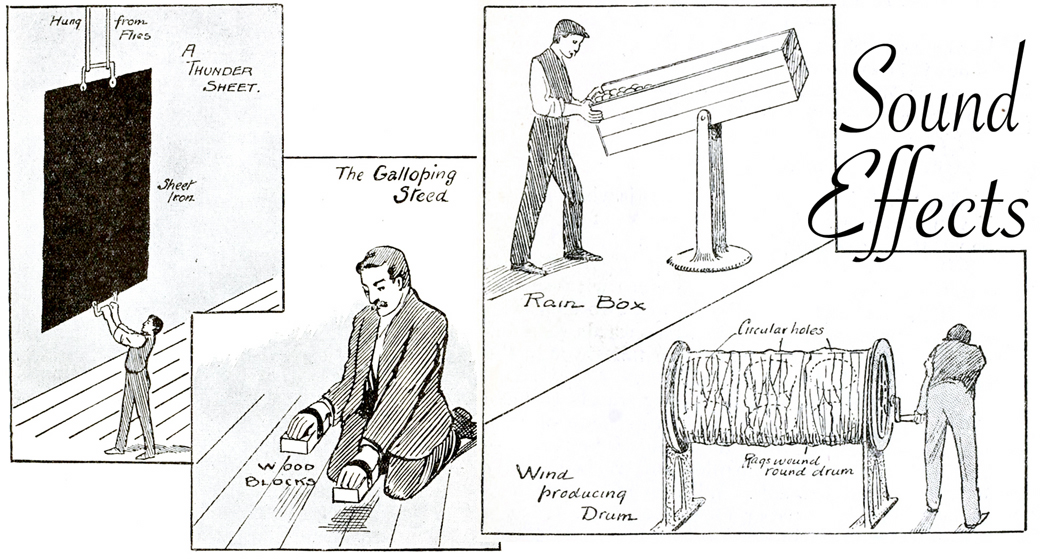
So standard procedure in nature films is to work with silent filmstock and add the sounds later. Some of these sounds are collected by technicians who tape the ducks when the blackbirds are momentarily quiet and match that sound to the film. But more commonly, sound is created by a group of sound-effects people, who work like they used to in radio days with crushed cellophane for fire and coconut halves for horses’ hooves. sound effects

Well, maybe they’re a little more sophisticated than that, but not by much.

If you want a good contrast, tune in to CBS’ Sunday Morning with Charles Osgood at about five minutes before the end on Sunday morning. Each week, it features a few minutes of nature, videotaped rather than filmed, and with the unedited sound of that moment in the wild.

You will hear not only the ducks, but the wind in the tree branches, the redwing, the grasses, occasional passing cars and airplanes, all balled up into one giant ambience.

It is the way it really sounds out there in the light of day.

After all, what we call nature is less the individual animals and plants than the interaction of the whole thing. Nature is context, if anything.

And that only underlines the basic problem, that for most Americans nature is something you see on a TV screen. Nature is a sideshow and entertainment. Cute little ducklings or sea otters vie for our attention with herds of wildebeest and salmon-fishing grizzlies. Gnu pack

Television nature, even shot in the wild, is just a technological zoo: Each animal is displayed in its own filmed cage. As with most of European culture, it is the fragments of the whole we understand best. The bigger picture eludes us.

But turn the TV off, get out of the city and then out of the car. Almost anyplace will do, it doesn’t have to be dramatic. You will hear and smell, as well as see, the great imbroglio that is nature.

It isn’t just that it is all interconnected, which it is. It isn’t just that the whole is complicated beyond comprehension, which it is.

The difference is that you are in it, a part of it. On TV, nature is something separate. TV is always behind glass.

2001 Smeslov meeting

It sounded like a great idea. ”We’re having a movie party. Not whole movies, just scenes. Bring a few DVDs over and we’ll fast-forward to your favorite scenes.”

You can learn a lot about people from what they choose. We watched everything from Steve Martin singing about pain and dentistry to Max von Sydow playing chess with death. BERGMAN BOGART

There are a lot of familiar scenes. They are almost the soundtrack to American lives: ”It doesn’t take much to see that the problems of three little people don’t amount to a hill of beans in this crazy world.”

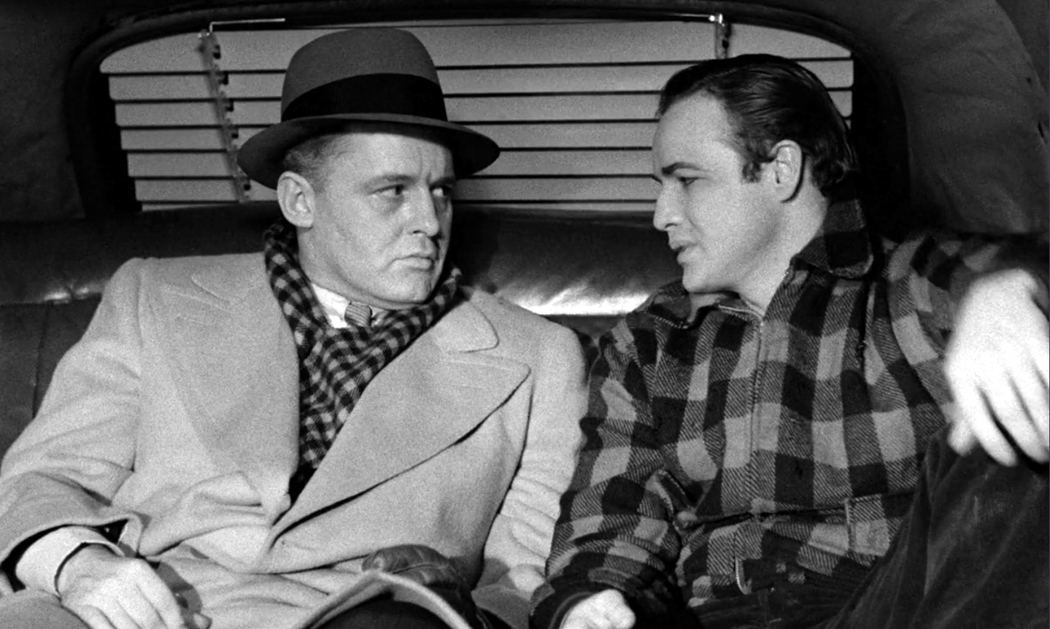
Or, ”I coulda had class. I coulda been a contender. I coulda been somebody. Instead of a bum, which is what I am.”

But two scenes had the profoundest effect on me. Totally opposite in effect and both brilliant. And seeing them together made an important point about movies, art and life. brando back seat

In The Third Man (1949), Orson Welles has been selling tainted penicillin on the black market in postwar Vienna. As a fugitive, he meets his American friend Joseph Cotten in an amusement park. As they ride the huge Ferris wheel above the city, Cotten asks disgustedly, ”Have you ever seen any of your victims?” third man welles

”Victims? You’re being melodramatic,” Welles replies. They look down at the antlike people below them on the ground. ”Tell me, would you really feel any pity if one of those dots stopped moving forever? If I offered you 20,000 Pounds for every dot that stopped, would you really, old man, tell me to keep my money? Or would you calculate how many dots you could afford to spend? Free of income tax.”

When they descend to earth, Welles rationalizes, with a con man’s glint in his eyes: ”After all, it’s not that awful. You know what the fellow says: ‘In Italy for 30 years under the Borgias, they had warfare, terror, murder and bloodshed. But they produced Michelangelo, Leonardo da Vinci and the Renaissance. In Switzerland, they had brotherly love, 500 years of democracy and peace and what did that produce? The cuckoo clock.’ ”

It is a wonderful scene. Visually, it is stunning, with the city turned into a stark black-and-white toy below them. Verbally, it is stark, pithy writing.

But no one speaks that persuasively in real life. Writers do that; they have the time to. All those witty retorts that come to you as you descend the stairs are used by the writer as if they occurred during the conversation.

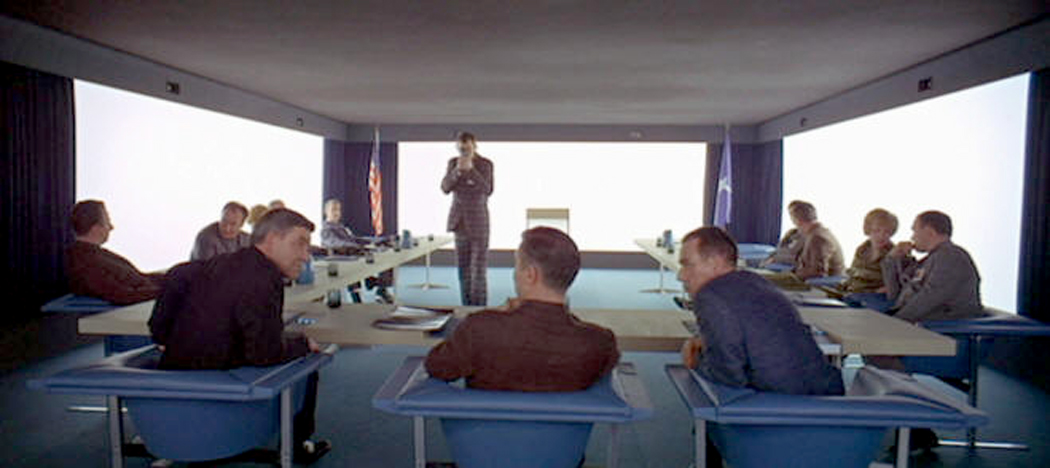
But in Stanley Kubrick’s 2001: A Space Odyssey (1968), there is an odd intrusion of real life, clabbering in its banality. 2001 council room

Government bureaucrat Dr. Heywood Floyd visits the moon to speak to other bureaucrats. He is introduced: ”I know you’ll all want to join with me in welcoming our distinguished friend and colleague from the National Council of Astronautics, Dr. Heywood Floyd. Now, Dr. Floyd has come up specially to Clavius to be with us today, and before the briefing, I know he would like to have a few words with you. Dr Floyd?”

The words are flat and empty.

”Thank you, Dr. Halvorsen. Hi, everybody. Nice to be back with you. Well . . . first of all, I bring a personal message from Dr. Howell. . .” And he continues with this palaver for some minutes, ending with, ”The purpose of my visit here is to gather additional facts and opinions on the situation and to prepare a report to council recommending when and how the news should eventually be announced.”

John Kerry could have said those words. There are a few forced laughs, a lot of awkward silences and polite applause at the end of the speech, as if Floyd had said something worth hearing.

It is a scene that most people snooze through, just as the bureaucrats would in real life. But it and all the ”intense inane” of the first three-quarters of the film set up the splendor of the final psychedelic trip with its light show and surrealism.

It took guts on the part of Kubrick to play up that banality, to insert real life into an art form normally spruced up for its audience with witty rejoinders and double entendres.

And great art to be so artless.

gojira over the sea

Who knew Godzilla was an art film?

Those of us who grew up on the American re-edit with Raymond Burr jimmied in remember it most fondly as one of the campier entries in the 1950s-era giant mutant monster genre: Godzilla: King of the Monsters. A man in a rubber dinosaur suit stomps on a model-train layout, crushing cardboard buildings.

That version, released in 1956 and badly — even comically — dubbed, was aimed at kiddies and the drive-in market. The basic story is familiar, recycled not merely from The Beast From 20,000 Fathoms (1953), but from older classics such as King Kong (1933) and the 1925 silent film Lost World. In all of these, a dinosaur or other prehistoric monster is found alive in modern times, wreaking havoc on a major city until it is subdued by modern science or a well-equipped military. gojira with bridges

Godzilla, played over and over on TV, became a classic of its genre, but we all sensed that underneath, there was a Japanese original that we never knew. It was rumored to be a quite different film, and now that is available on DVD and Blu-Ray, and cleaned up by the people at Criterion, with a new transcription of its title — Gojira — we can see for ourselves.

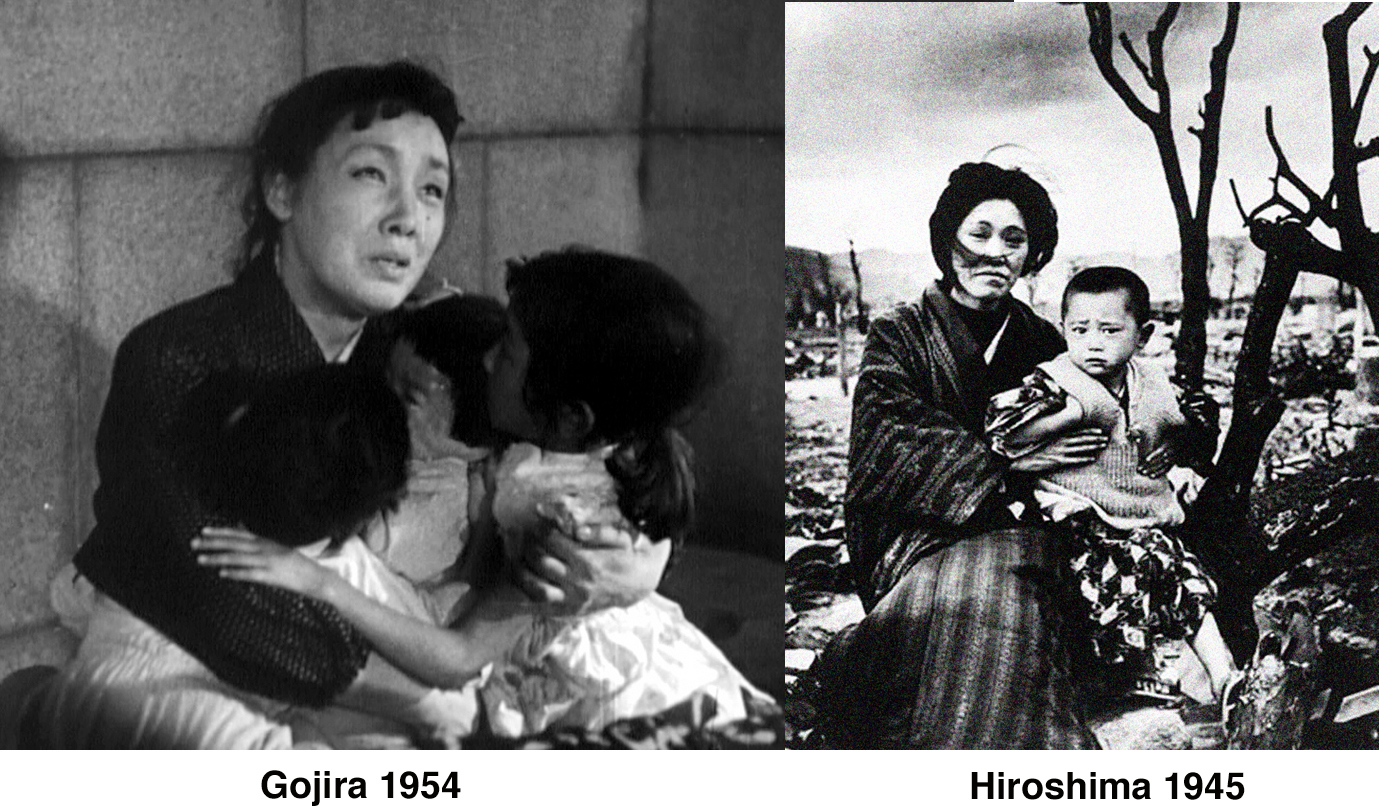
The real models for Gojira were Hiroshima, Nagasaki and the more recent (at the time) case of the Japanese tuna fishing boat Lucky Dragon Five, which was caught downwind of the U.S. Castle Bravo nuclear test at the Bikini Atoll.

It is a revelation: Ishiro Honda’s original film (in Japanese and subtitled) is a moving anti-war and anti-nuclear parable, and its intended audience is adult, not juvenile.

The film is still a victim of its minuscule budget, and some special effects are laughable — hardly more sophisticated than in a Gumby cartoon — and not all the acting passes muster. But these faults can also be found in the rarefied art films of both Pier Paolo Pasolini and the fountainhead of Italian Neorealism, Roberto Rossellini.

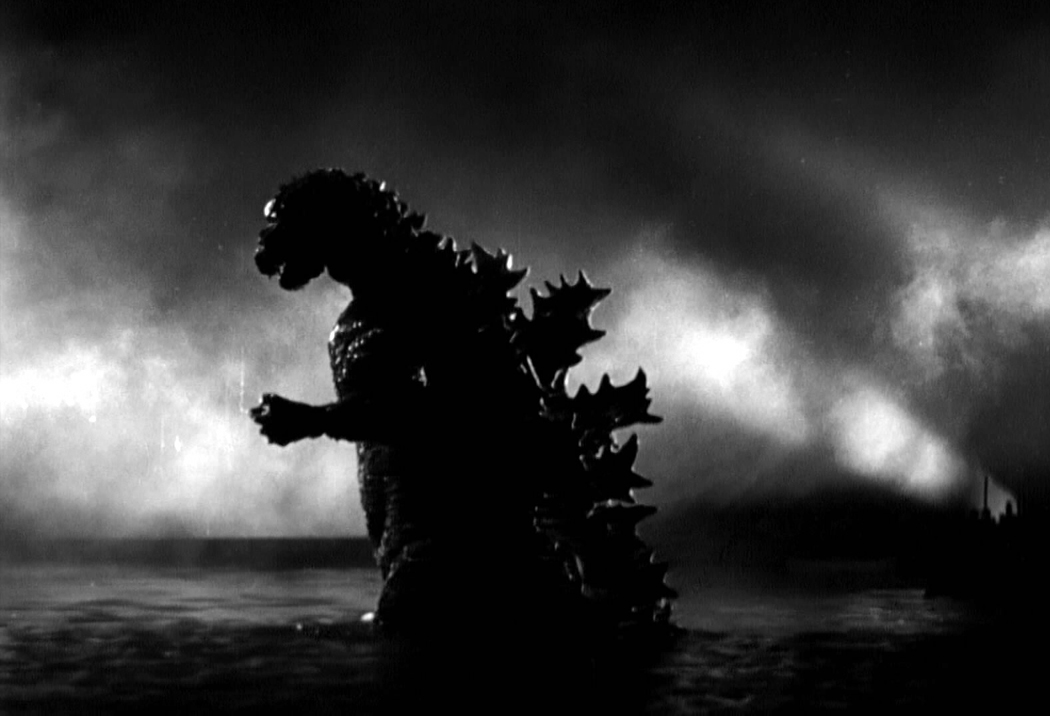
In fact, Honda’s film shares a visual aesthetic with Rossellini — the style is meant to be almost documentary. And the style serves the subject well: This isn’t a monster film, but a film about the devastation and suffering of war. mothers and children duo

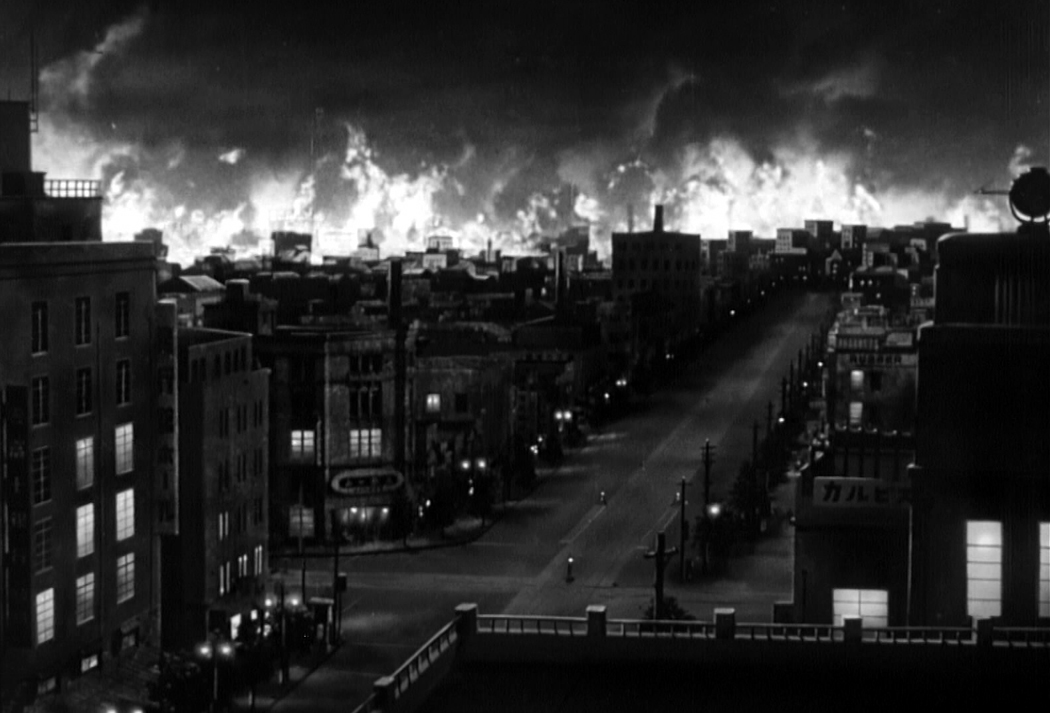
Made only eight years after the end of World War II, the effects of the incendiary bombing of Tokyo and the nuclear bombing of Hiroshima and Nagasaki were even fresher in Japanese minds than the World Trade Center is now in American minds. When the Japanese audience saw Gojira in 1954, they saw a vision of cities flattened and burning, with hundreds, thousands of maimed people on stretchers in bandages, waiting for care and moaning in pain. It must have raised the hair on their necks.gojira burning city

The scenes in the movie are lingered over — and largely trimmed out of the American version — and they are accompanied not by the rapid pulse of a Hollywood sound score to pump up our energy level, but by the elegiac strains of funeral music. The score, by composer Akira Ifukube, is one of the great film scores of all times, deeply affecting; it’s hard to hear it, even without the visual, without a profound sadness welling up from inside.

In Hollywood thrillers, people may die by the boatload, but there are seldom corpses to clear away. They are somehow forgotten about. Not in Gojira. They are in our face.two colossuses

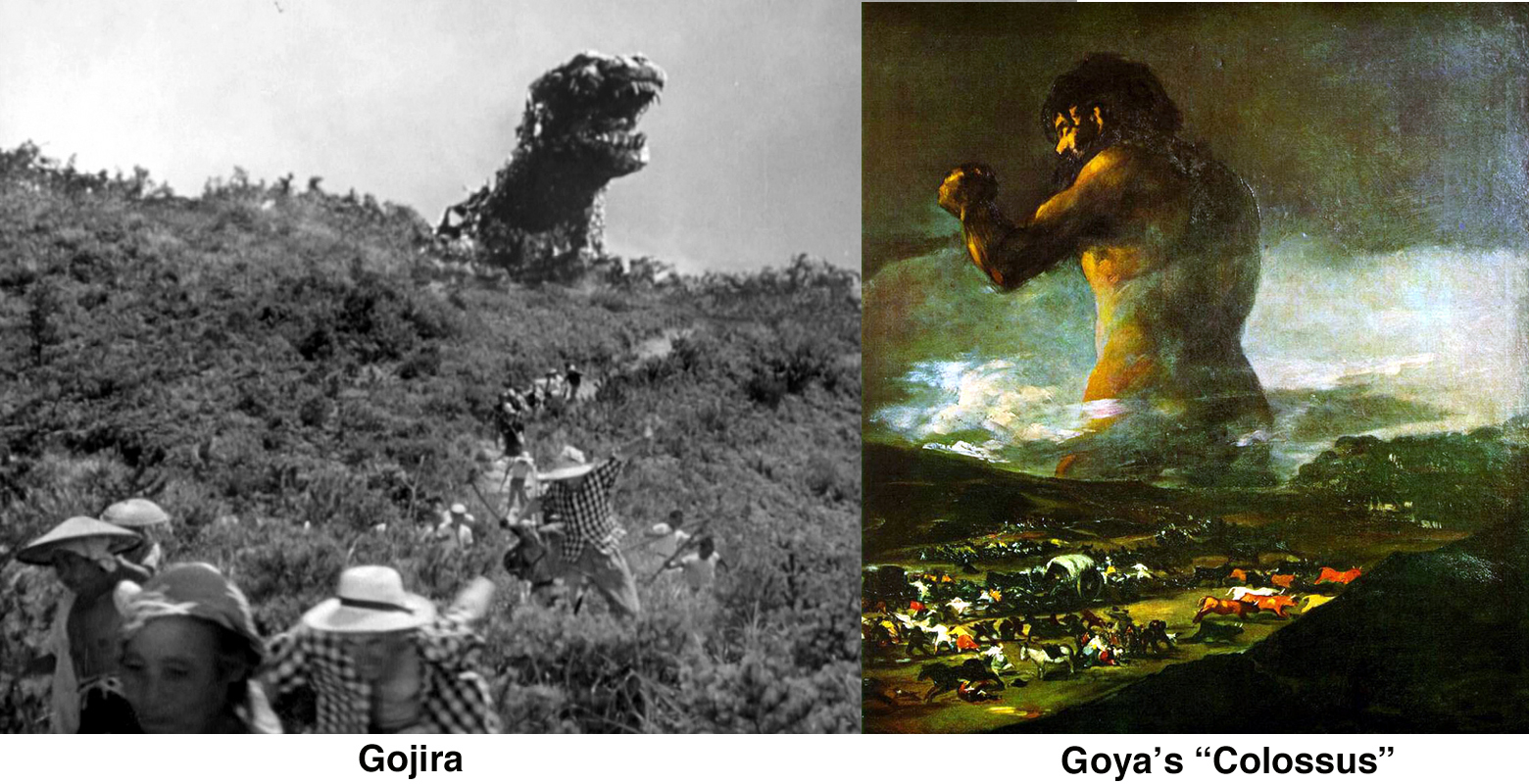
Gojira winds up being a metaphor of war and its horror, much like Picasso’s Guernica. And the first time we see Gojira, looming over a hillside, he looks uncannily like Francisco Goya’s late dark painting, Colossus, in which a giant stalks the war-torn countryside.

A break in filming

A break in filming

The original film was 98 minutes long. The American version chopped out nearly half of it and reinserted the refilmed Burr footage, usually talking to a stand-in for one of the Japanese stars, seen only from the back. Even with the new footage, the American version is only 79 minutes long.

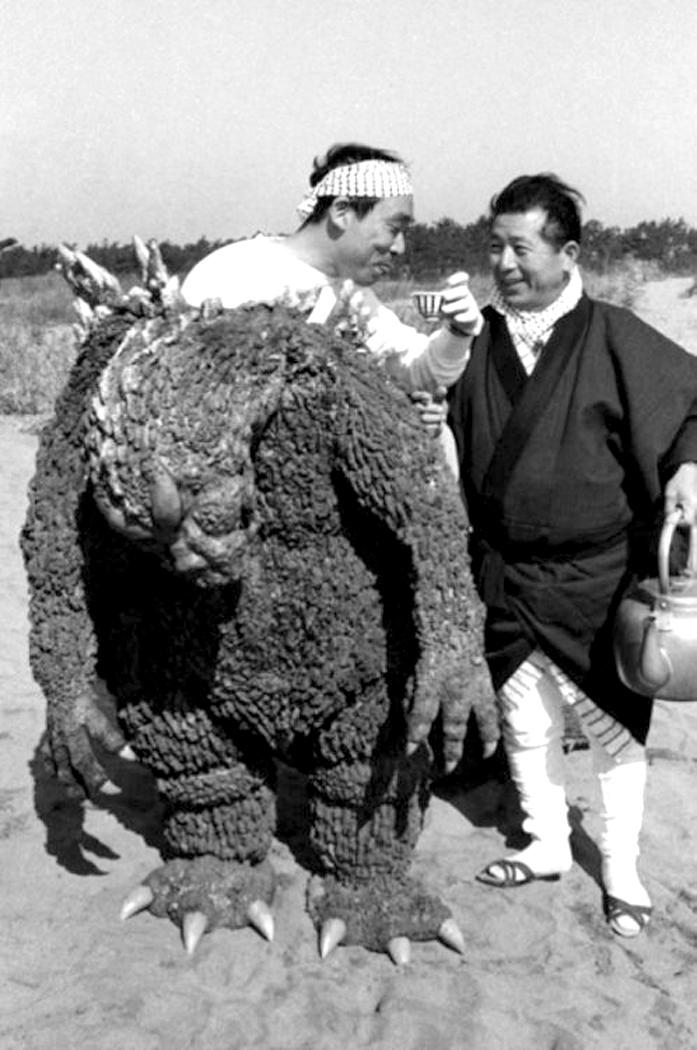
The DVD includes both versions and fascinating extras, like a description of the “Godzilla suit” used to create the monster.

The original film should be seen by anyone who cares deeply about cinema. It isn’t the joke we thought it was. It is art.

woody mugshot

Woody Allen’s peccadilloes are in the news again, as his ex and his purported son publically dis his recent Golden Globe “lifetime achievement” award.

This is not to defend Allen. Whether he is a child molester or not is not a question I can weigh in on. There is certainly something creepy about the whole affair with him and his current wife, Soon-Yi.

But whether the filmmaker deserves recognition for his films is a completely different question from whether his conduct in life is reprehensible.

We so often confuse private morality with public achievement, and demand they complement each other. They seldom do.

Not that Woody hasn’t given us a few hints over time. father andrei

In his Love and Death, Diane Keaton asks shriveled old patriarch Father Andrei for his wisdom.

He answers haltingly from behind a 9-foot beard: ”I have lived many years, and after many trials and tribulations, I have come to the conclusion that the best thing is — blond 12-year-old girls. Two of them whenever possible.”

This used to be a joke; it is now evidence.

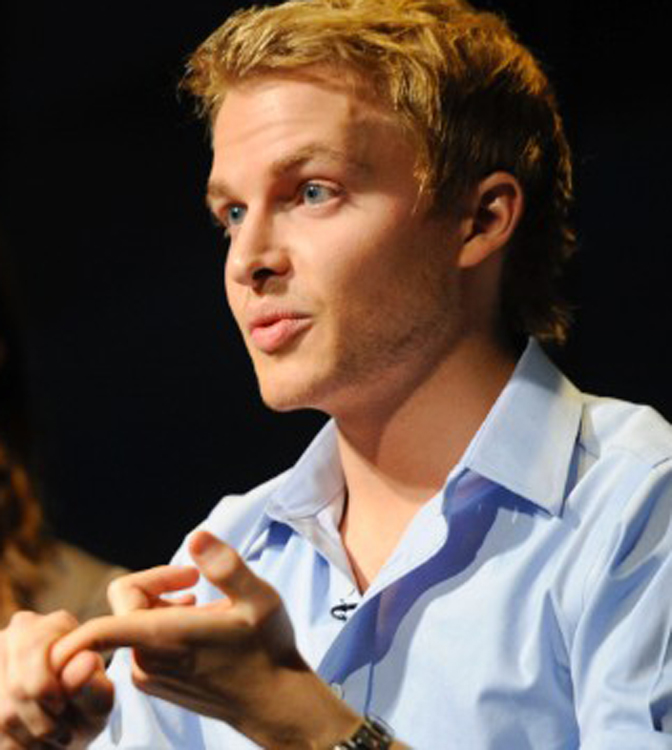
Former fans, turned prosecutorial, now search the Wood-man’s films for this kind of evidence, ever since Allen’s former squeeze Mia Farrow accused him of sexually abusing their adopted 7-year-old girl, Dylan, and Allen admitted having an affair with Farrow’s 21-year-old adopted daughter Soon-Yi Previn. ronan farrow

Not that Farrow gets off: She has recently implied that her son, Ronan, may not have been Woody’s child, after all. She may have been cheating with Frank Sinatra. Looking for old-time sexual morality in Hollywood can be like looking for sympathetic liberals on Fox News.

But about Woody, there’s lots of evidence to be unearthed from the films, from the underage girlfriend in Manhattan to the shifting family connections in Hannah and Her Sisters.

Rightly or wrongly, Allen’s life and films have always been confused by his fans. After all, Allen plays the same character in each film, a character that seems to be a stand-in for the film maker. No one mistakes Chaplin for a tramp, but Allen seems to be so much like Alvy Singer in Annie Hall, Isaac Davis in Manhattan and Gabe Roth in Husbands and Wives, that the confusion is natural.

So it’s no surprise that some formerly devoted fans have decided that they can no longer stand to see their fallen hero’s films.

So, let us please re-establish the separation between the artist and his creation. For his real sins, take him to court, for his art, remember the art exists, now, on its own, just as a son or daughter now exists separate from parent, and should not be held guilty of the parent’s crimes or vices. Polish director Polanski attends news conference for film "Chacun son Cinema" at 60th Cannes Film Festival

Roman Polanski is a reprehensible human being, but a very good filmmaker. Should we stop showing his Macbeth to high school students because of his crimes? Not if we want to convince those teens that Shakespeare is actually an exciting playwright.

Separating the artist from his work is essential. Otherwise, we will need to get rid of our copies of Alice in Wonderland. Lewis Carroll, after all, enjoyed taking photographs of nude little girls.

And if we are religious, we will have to stop singing that Ave Maria, because Franz Schubert liked sex with underage boys.Robert Frost

Artists are as venal, evil, self-centered, confused and destructive as the rest of us. The history of art is a landfill of disturbing biography.

Robert Frost sounds wise and paternal in his poems, but he was such an S.O.B. off the page that he drove his son to suicide.

William Burroughs and Norman Mailer have been hell on wives. Charges of child abuse now dog even James Joyce.

Benvenuto Cellini was a murderer. Ezra Pound was an anti-Semitic apologist for Fascism. Herbert von Karajan was a card-carrying Nazi. Samuel Taylor Coleridge and Hector Berlioz were drug fiends.

And we cannot begin to count the number of drunken novelists.

Sometimes we forget that Lord Byron diddled his sister. Or that Percy Shelley married a 16-year-old girl and then told her that he was in love with another teen-ager and that maybe all three could live together. Wagner

Or that Richard Wagner wrote Tristan und Isolde while enjoying a love affair with a woman he borrowed from her husband, who was housing and feeding the freeloading composer at the time. Wagner’s wife wasn’t happy about the arrangement, either.

This rogue’s gallery of adulterers, criminals, perverts and wackos made some of the greatest art of all time.

I am not suggesting that we let Woody off the hook. If he is guilty of child abuse, he should have to pay the price. He is certainly guilty of foolishness and self-deception in his relations with Soon-Yi.

But it is the man, not the art that should have to pay. Allen is one of America’s best film makers, the one of the few who consistently make films that examine the quality and meaning of life. That his films vary widely in quality is not in question, but even Allen’s worst films — Interiors and September — are serious attempts to deal with issues.

And his best, from Annie Hall to Crimes and Misdemeanors and Husbands and Wives, are as rich and textured as the best of Jean Renoir, who, by the way, married one of his father’s nude models and later divorced her.

What is so hard to understand is that Woody Allen can be so wise on celluloid and so foolish on the streets of New York.

But this goes well beyond Allen, and well beyond artists.

Our heroes just can’t seem to keep their noses clean.

One after the other they self-destruct, turning from demigods into blackguards before our very eyes.

Pick one, let his luster shine for a few moments and then notice the worm.Lindbergh

And I mean some of the most accomplished and meaningful personalities of the American century: Charles Lindbergh was a Nazi sympathizer. Martin Luther King Jr. was a womanizer. Elvis was a drug addict.

The list is long and luxurious, and the heroes in question come from politics, sports and the arts. We admire their accomplishments, even aspire to be like them, and then come to find out, as with O.J. Simpson, that they beat their wives and perhaps worse.

It isn’t just a recent phenomenon.

For every Woody Allen there is a Charlie Chaplin; for every Roman Polanski there is a Fatty Arbuckle. And let’s not forget Ingrid Bergman.

Let us not forget the charm of Ty Cobb, the graciousness of Babe Ruth and the temperance of Pete Rose.

Madonna raised eyebrows with her reputed NBA exploits, but what of  Clara Bow, who had a thing for the 1927 University of Southern California football team. The whole team.

Horatio Alger

Horatio Alger

Just think of some of their stories, moving backward in time. Errol Flynn, the patriotic hero on screen, was a Nazi sympathizer who died in a hotel room with an underage girl.

Horatio Alger, before he became the author of those inspirational rags-to-riches stories that Republicans like to recommend to those on welfare, was a minister who lost his job because he liked to seduce young boys.

It seems as if no one can escape: Who was the most saintly man of this century? Mahatma Gandhi liked to sleep naked with young girls, and he regularly weighed his excrement in the morning.

So beside that, a governor with his pants down in a motel room may seem kind of tame.

Even if he later became president.

I do not mean to debunk all our heroes, but to better understand what they are and what role they play in public life.

Heroism is a story we fashion from someone’s life, gaining nourishment from the pulp and spitting out the pits. As a story, it is tidied up with a beginning, middle and end, and it sports a moral that is meant to make our lives better or more meaningful. Unlike a real human life, it cannot sustain the complexities, contradictions and ambiguities that are always found in people, so it simplifies to make a point.

Charles Barkley is right to complain about being a called a role model — role model is the term we use instead of hero in an increasingly bureaucratic society — because the role he is asked to play is so much smaller than the life he lives.

Flesh-and-blood heroes are like actors that step into a part we need them to play.

And we do need them.

In earlier times, the hero was the person who translated the will of the gods into history. We no longer may believe in the gods and destiny, but we still need heroes. The hero is the link between the everyday life we live in and something transcendent. He brings the sky down to us so we can see it, feel it and taste it.

Michael Jordan hanging in the air like an angel who doesn’t need wings. richard burton

But when we hold our heroes up to higher standards than humans can sustain, we are like little children who cannot tell the actor from the part.

An adult doesn’t condemn Hamlet because Richard Burton was a lush.

Our heroes are capable of doing all the things ordinary people can do, including lying, cheating and stealing. Murder and rape are not beyond them, nor is mere vanity or meanness.

Like humans, our heroes are bundles of contradictions; they are large and contain multitudes.

For their crimes, we prosecute them as we do anyone else. For their simpler sins, we develop short memories. For their heroics, we need to be grateful.

What we forget is that a hero is a hero for what he does, not for who he is.

sexophone

Life is full of interesting little questions, questions of no consequence that lead to bigger things. Like, why is the finale of Gioachino Rossini’s William Tell Overture used as the theme for The Lone Ranger?

Admit it, when you hear that tune — ditty bump, ditty bump, ditty bump-bump-bump — you hear the hearty hi-yo Silver. Even kids, who know the masked man only from cable TV reruns, know about him and his faithful Indian companion, Tonto.

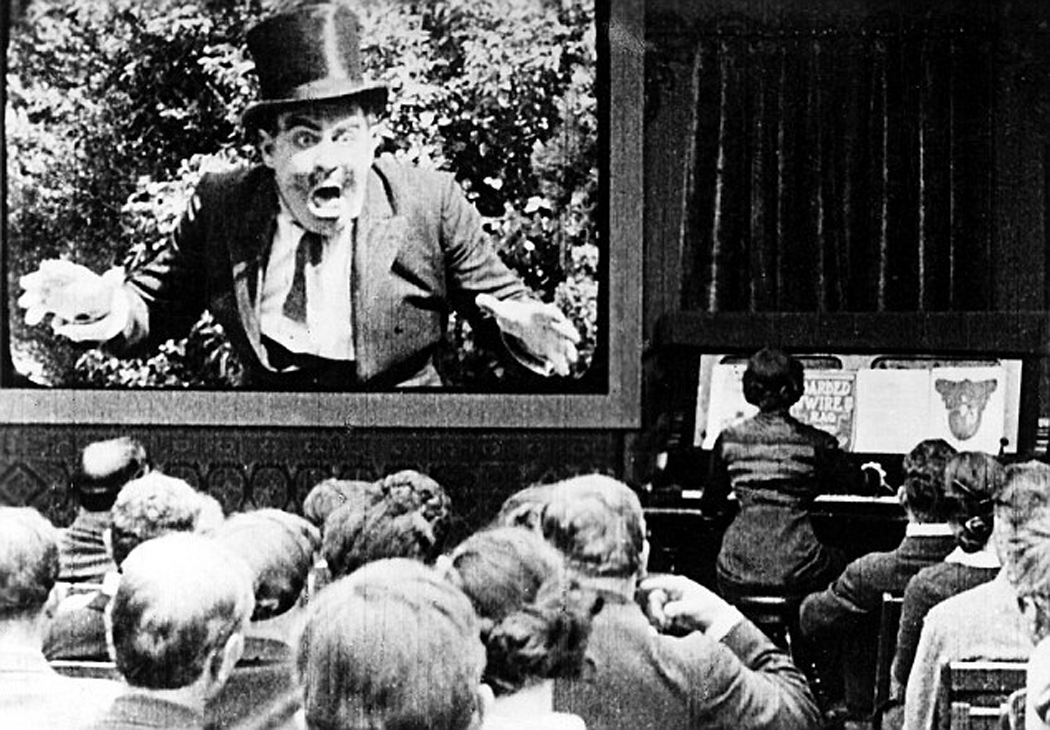
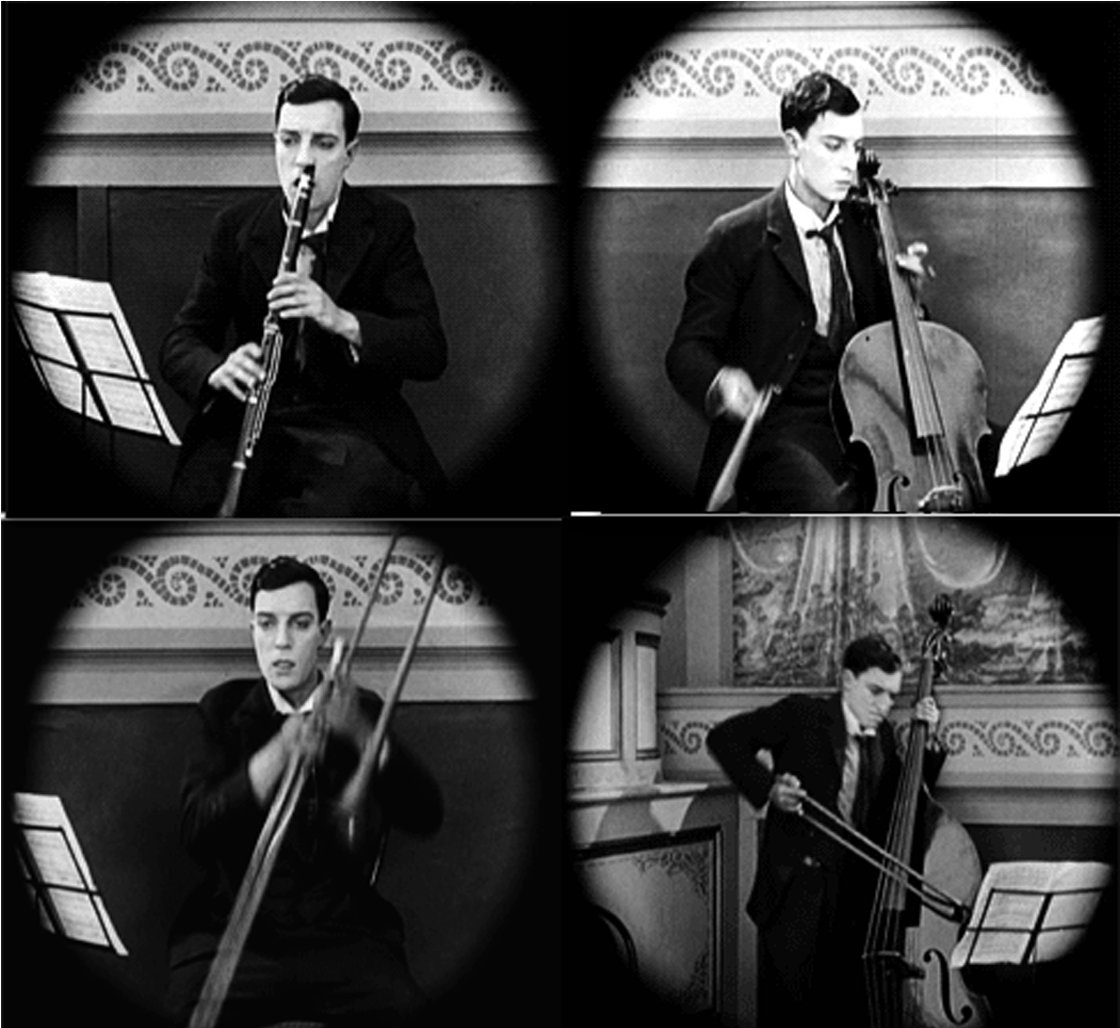
But what does all that have to do with a Bel Canto grand opera about the freedom of the Swiss from the oppression of the Austrian Empire? To understand, you must go back to the era of silent movies. Although they are always called silent, in fact, they never were. From the very first public showing of the new motion picture, in Paris in 1895, the images have been accompanied with music.

You can as easily imagine a ballet without music as a Chaplin short or a D.W. Griffith epic. And in fact, movie studios gave more consideration to the music than is generally known nowadays. From the time of Griffith’s Birth of a Nation, many studios provided full scores for their “A” pictures. Nation opened in New York to the strains of a 70-piece symphony orchestra playing the music written by Griffith himself, in collaboration with composer Joseph Carl Briel. It freely borrowed bits of Tchaikovsky and Verdi, mixing them with strains of Dixie and the Star Spangled Bannermovie piano

The first full score for a silent film was Camille Saint-Saens’ 1908 score for the French film, The Assassination of the Duke of Guise. The composer recast the music later for concert performance as his Concerto for Strings, Piano and Harmonium, op. 128.

Such scores were not uncommon. Arthur Honegger wrote the score for Abel Gance’s groundbreaking Napoleon in 1927; Darius Milhaud did the same for Marcel l’Herbier’s L’Inhumaine. And Dimitri Shostakovich made a good living writing films scores, when he wasn’t picking up a few extra dollars playing piano for the low-end movie houses.

The full scores survive that Charlie Chaplin wrote for his late silent features, City Lights and Modern Times, made after the sound invasion, and now permanently attached to their otherwise silent action.

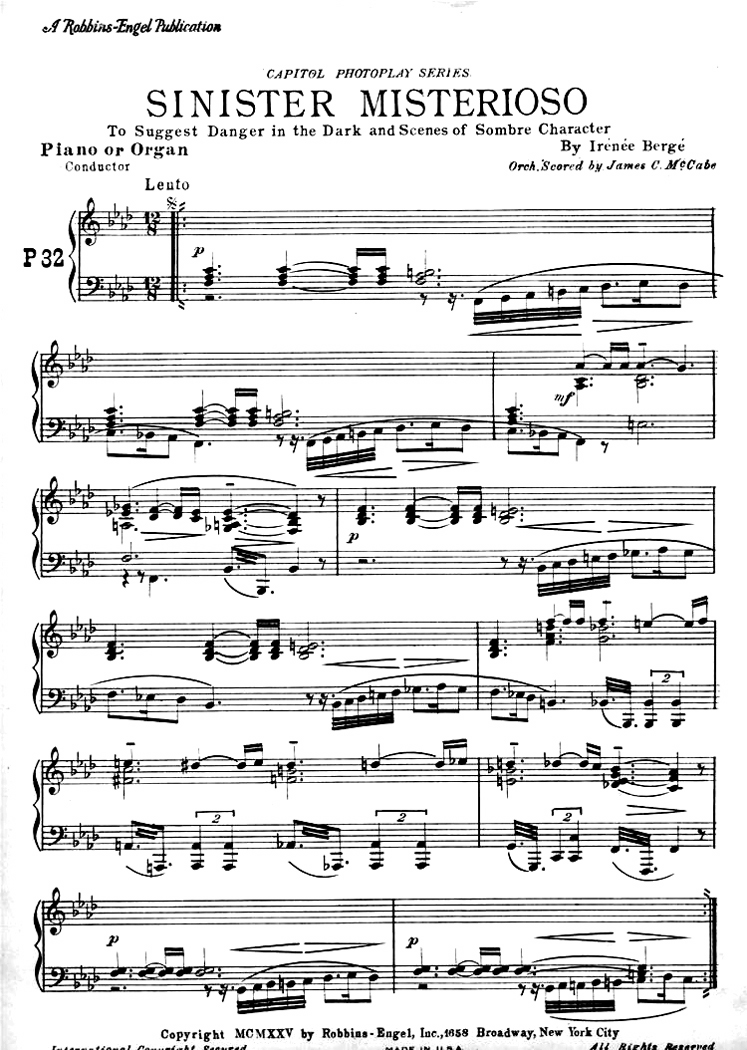
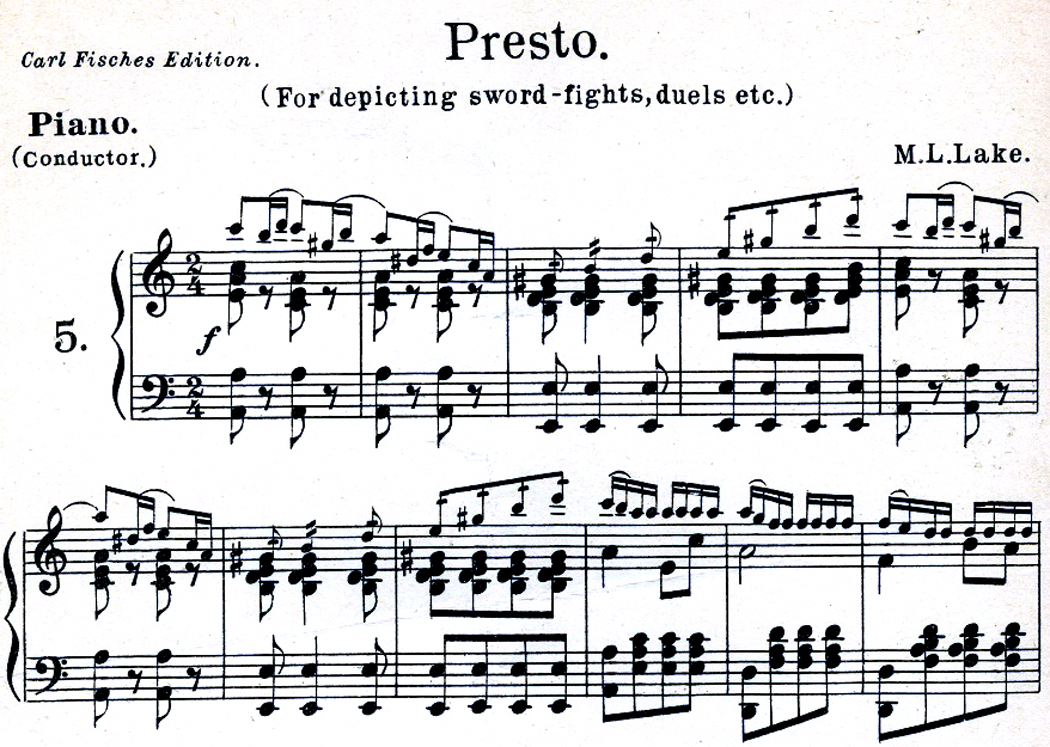
The problem was that not every film was Birth of a Nation, and not every movie house could afford an orchestra. A full score might be fine for New York City, but when the movie went to Dubuque, a cheaper alternative was needed. So, most Roxies and Paramounts across the nation relied on pianists and organists. For an “A” picture, they might rely on piano reductions of the full score, provided by the studios, printed on cheap paper and distributed with the films along with such other promotional material as posters and blocks for newspaper ads. But for a “B” picture, the pianist either improvised on the spot, or relied on one of several “cheat” books. sinister misterioso

In 1919, Giuseppe Becce published his Kinobibliotek, which was a volume of musical chunks each matched to an emotion or action likely to be encountered in a film. One might be titled, Pursuit, and another, Tender Agitato. Universal Studio came up with its own, assembled by Max Winkler, who borrowed freely from classical music, excising snippets of Beethoven or Bizet to be played by the house pianist at the appropriate moment in the film. Winkler actually made up lists of tunes for each film Universal released, matched to the cues in the plot. “J.S. Bach’s immortal chorales became Adagio Lamentoso for sad scenes,” Winkler wrote. Beethoven provided a “Sinister Misterioso” and Tchaikovsky a “Strange Moderato.” Mendelssohn’s familiar Wedding March was used for weddings. presto for sword fights

The classical music had two advantages. First, it was readily identifiable. Everyone knew the Wedding March, for instance, so it could be used to make a point. And it was cheap; it was public domain and no copyright fees applied.

When sound films took over, some of these silent habits persisted. In Hollywood’s Golden Age, film scores still sounded like classical music. The great film composers — Korngold, Waxman, Herrman — were classical composers. And even to this day, when a director wants to add class or underline a scene dramatically, he will likely choose classical extracts. So, Samuel Barber’s Adagio for Strings adds emotional heft to Oliver Stone’s Platoon, and Richard Strauss’s Thus Spake Zarathustra adds portentousness to Stanley Kubrick’s 2001: A Space Odysseykeaton band

It also persisted in the sound era in “B” movie scoring, those undercard films on the double feature. You can hear many a familiar melody in the low-budget films. Every Hopalong Cassidy film, for instance, came to a climax with a chase scene underlined with Gluck’s Dance of the Furies. You could count on it. It was an odd marriage of high art with popular culture.

And, or course, it provided us with “those thrilling days of yesteryear” and the Rossini trumpet fanfares that summoned us all first to the radio, then to the TV screen.

Buster Keaton "The General"

Buster Keaton “The General”

When it comes to movies, everyone has a Top Ten list, or a top 100, or top 500. Tastes differ, of course, and no two persons’ lists should be the same. But when you gaze through so many of these lists online, it is appalling to see just how many of these not only include so many mediocre films, but how many of them fail to include anything older than a decade or so, or anything from anywhere but Hollywood.

Here’s one such online list:

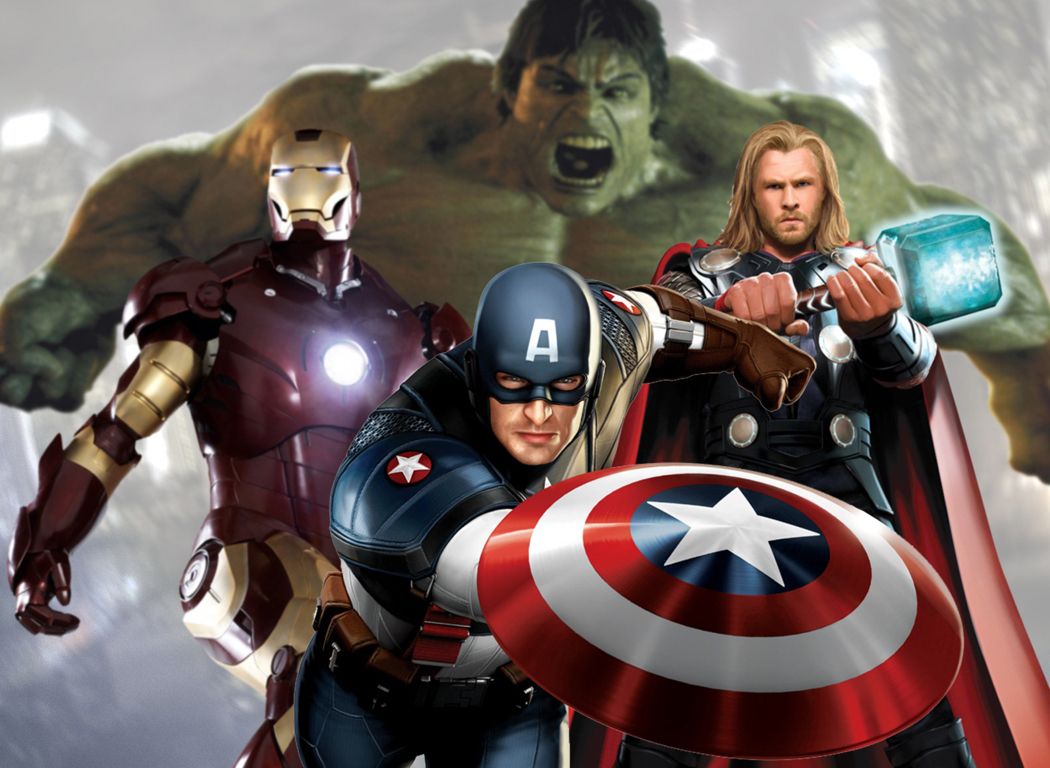
Avengers

Avengers

1. Star Wars Episode VI Return of the Jedi
2. Teenage Mutant Ninja Turtles: the Movie
3. Avengers (2012), just so no one thinks of that god-awful film with Sean Connery, Ralph Fiennes, and Uma Thurman
4. Courageous
5. Rudy
6. Dumb and Dumber
7. Independence Day
8. We Were Soldiers
9. Tomorrow Never Dies (Brosnan is my 3rd favorite Bond but this is my favorite Bond film)
10. Indiana Jones Raiders of the Lost Ark

If someone thinks Avengers is one of the greatest films ever created, someone doesn’t get out much.

Another, responding on the same website complains:

“These lists have a hole in them without Blade Runner on them. Also, R Scott’s original Alien.

“And no Peter Jackson LOTR (Lord of the Rings) flicks? That’s surprising. I felt they were a bit too long and I prefer the Tolkien books but Jackson’s The Two Towers is epic and on my list ( despite my ambivalence to hobbits lol.)

“And what about Donner’s first Superman?”

It’s easy to think Superman is a great movie if you have never been out of the house, but Sonny, there is a great big world out there, and in it, Superman isn’t even a blip.

This isn’t just about “movies I like,” in which it’s fine to enjoy anything. There are bad or indifferent films I love to watch, too. No, it’s about movies that, if you care about film, you should have seen. At least, should have seen if you want to express an opinion that has some authority to it, and not just the mewlings of an esthetic infant.

Just as there are books you should have read, if you want to consider yourself literate, and music you should be familiar with, and art that should be part of your inner life, there are movies you should have seen.

No one can have seen them all, of course. It is a lifetime’s work to expand one’s horizons and learning never ends.

It isn’t that the movies on these online lists are not good movies, even great movies. They mostly were all worth seeing. It is that the scope of the lists was so narrow, and most of the films mentioned were made in the past 10 or 15 years. One wonders what a modern moviegoer thinks constitutes a great film. It would seem: lots of action, clever dialog, color film, and a whipped cream topping of CGI. Car chases, things blowing up and wizards or werewolves.
Kill Bill

Kill Bill

If you think having seen Kill Bill parts 1 and 2 on a double bill has taught you anything about the potential of film, you are greatly mistaken. And this is not a slight on Tarantino, who is a wonderful filmmaker: It is a slight on your supposed erudition.

The films you should have seen are not necessarily the best films, either (although most are). They are the films that created the course of film development, and changed that course. They are the films that opened up the possibilities.

Some have done so through discovering new potential in the medium itself, like D.W. Griffith or Jean Cocteau. But others have discovered ways of giving the popular medium the depth of the greatest literature. If you think Batman Begins has depth, you are still wading in the shallow end of the swimming pool.

The Great Train Robbery

The Great Train Robbery

I am not talking simply about Postmodern referencing: that Martin Scorsese references The Great Train Robbery when Joe Pesci points his gun straight into the camera and fires. Such cleverness permeates current cinema, where you can hardly make a film without some witty reference to a famous film of the past. That’s nothing more than an in-joke.

Rather, I’m talking about the larger film culture that has grown and continues to grow as a living tradition — cinema as a single body of work, seen as a single, long-growing vine with thousands of leaves, stems, flowers and fruit, grown from the seeds planted by the Lumiere brothers, raised through silence, sound and Cinemascope and Technicolor.

I’m talking about movies as a humanistic art: One that can tell us about the experience of being alive. The lists I came across mostly concern film as a theme-park ride — fun, but of little consequence. As if a list of great novels were proposed starting with John Grisham, passing through Jackie Collins and ending with Dan Brown. Again, no slight on any of them: Their books can be fun to read, but they ain’t Proust.

So, Mr. Big-Shot Critic, what would your list be? What movies should anyone have seen before they can consider themselves cinematically literate?

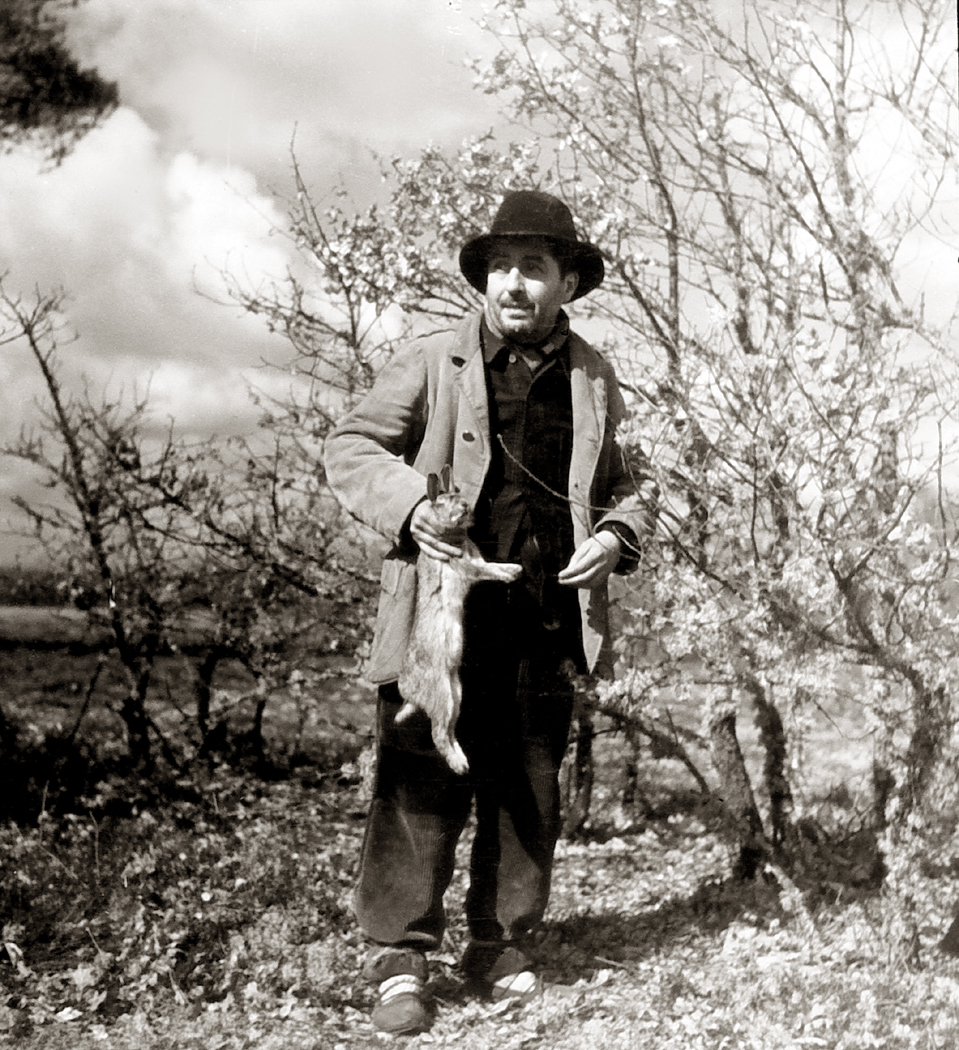
Well, there isn’t anything so simple as a list. Rather, there is a constellation of films you should have sampled from. In other words, you can’t really say you know anything if you haven’t seen a film by Robert Bresson. Can I list Mouchette, or Diary of a Country Priest, or Au Hasard Balthasar as the one film you need to have seen? Not really, but you should have seen at least one Bresson film, and if you do, you will almost certainly then want to go on and see more of them, maybe all of them.

Au Hasard Balthasar

Au Hasard Balthasar

You will find a deeply moral core to all of them, and told in an odd, quiet, straightforward manner, usually with no professional actors, to keep the films from seeming too “theatrical.”

Or, you need to see a few screwball comedies from the 1930s. Is there one to put on a list? My Man Godfrey? It Happened One Night? Bringing Up Baby? If You Could Only Cook? Again, no, but if you watch a couple of them, you’ll want to see more of them, and you’ll never again think of American Pie as a witty movie.

My Man Godfrey

My Man Godfrey

You need to see great silent films, too. Not just old Charlie Chaplin shorts, but the movies that created the great lexicon of cinematic grammar and vocabulary. Murnau’s Sunrise or Stroheim’s Greed. Again, your interest will likely be piqued and you may become a convert to silent movies.

How can you be cinematically literate unless you’ve seen films by Godard, Tarkovsky, Bergman, Fellini, Ozu, Bunuel or Satyajit Ray? You can’t. Or German Expressionist films? Or American underground films? Or Busby Berkeley musicals? Ernst Lubitsch? Or The Big Trail — the first American widescreen film? Or Abel Gance’s Napoleon? Max Ophuls’ liquid camera?

Andrei Rublev

Andrei Rublev

Becoming literate doesn’t happen casually: You have to seek out and study. You have to pay attention. Some of these films, such as Tarkovsky’s Andrei Rublev, make serious demands on viewers; they don’t make it easy — it’s like doing homework. But you will feel exhilarated by the time you have ingested them.

So, I’m giving you homework: Here’s my list of a dozen films you need to have seen. Are they all of them? No. You need to see hundreds of them before you can have a meaningful opinion, but these are a good start. None is recent, and only two are American, because most of you have already seen Dr. Strangelove, Pulp Fiction and The Godfather, to say nothing of Apocalypse Now, which would be on my list of Top Ten (which, of course, has at least 40 films on it).

Let’s take a few chronologically:

Battleship Potemkin

Battleship Potemkin

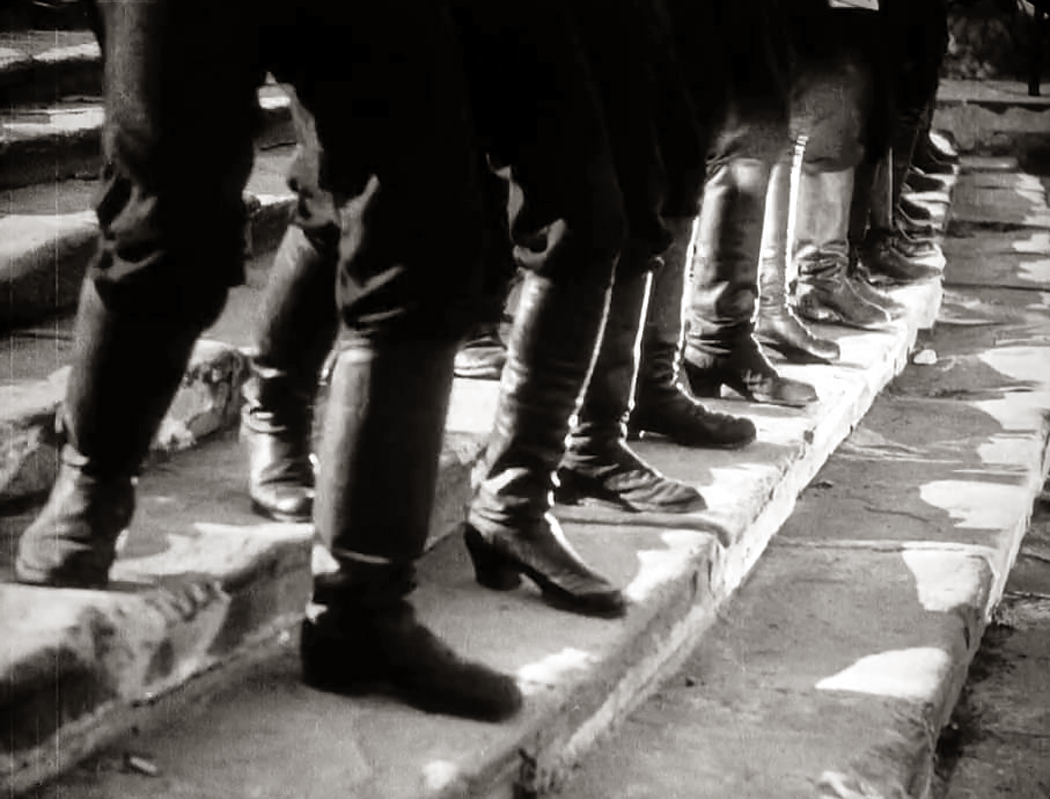
There is hardly a more influential film in history than Serge Eisenstein’s Battleship Potemkin (1925), in which the Russian director inventoried the power and magic of film editing to create meaning. It remains a powerful film, even when you recognize it for Soviet propaganda.

Metropolis

Metropolis

If Sunrise is too much to take at first, you could try Buster Keaton’s The General (1926) to see how silent film can tell a compelling story. It has several “special effects” in it, too. And as for special effects, you can only be amazed at the oneiric surrealism of Fritz Lang’s Metropolis (1927) — now available in something like its original version.

The studio system in Hollywood produced some of the most perfect craftsmanship during the 1930s. They had pros, who really knew how to light, edit, write dialog, and record sound. They produced many genre films, such as Westerns, gangster films, melodramas and musicals, but one thing they did that has never been matched is comedy, the so-called “screwball comedies.” If you have not seen My Man Godfrey (1936), then you don’t really know how sophisticated comedy can be. Or sexy: Try Ernst Lubitsch’s Trouble in Paradise (1932) and see how frank they could be about sex before the Production Code was enforced.

Rules of the Game

Rules of the Game

But this is still American film. The Thirties also gave us Jean Renoir’s Rules of the Game (1939), which many critics have called the best movie ever made. It is certainly the most human, humane and forgiving while at the same time satirical and biting about human foible and hypocrisy. Yes, it’s in French, with subtitles.

The Fifties and early Sixties gave us the Golden Age of foreign films, the age of the “art film,” and exposed Americans for the first time in any meaningful degree with movies from around the world.

Sweden gave us Ingmar Bergman, whose Seventh Seal (1957) is still the prototype of the Foreign Film, with its Medieval knight returning from the Crusades and playing chess with Death.

Seventh Seal

Seventh Seal

Italian Michelangelo Antonioni compressed angst, dissociation and anomie into a single intensely beautiful film in L’Avventura (1960), about a woman who disappears on a Mediterranean island and the vague search to find her. It is the apotheosis of existentialism in cinema.

Jules and Jim

Jules and Jim

The French gave us the New Wave, which rethought old American films with a fresh spontaneity. A whole busload of directors came to the fore in the Sixties. The warmest and most engaging is probably Francois Truffaut’s Jules and Jim (1962) about the Parisian demimonde just before and after World War I. It is the kind of movie that makes you not merely enjoy it, but fall headfirst in love with film.

Two gritty films present two poles of movie realism. Gillo Pontecorvo’s 1966 Battle of Algiers is so realistic that you swear you are watching newsreel footage from the front. It shows an anti-colonialist uprising that doesn’t demonize either side, but shows the miseries and sins of both. In contrast, Andrei Tarkovsky’s Andrei Rublev is so stylized you might as well be looking at a motion-picture version of a Russian religious ikon. And many of its fans feel as though they have had something like a cinematic religious experience after the “meditation” of seeing the slow-moving film.

The missing element of too many Hollywood films is any sense that they mirror real life, that they consider the moral and ethical questions of existence in favor of pumping adrenaline and presenting a black-and-white, good-and-evil, superhero and archenemy vision of existence. Great films, however, look at the complexities in ways that can be profoundly moving. Fantasy is fine for adolescents, but grown-ups demand something more.

Vagabond

Vagabond

Agnes Varda’s Vagabond (1984) follows a damaged, lost young woman as she wanders aimlessly toward a solitary death. We cannot just watch her decline as observers, but feel we share it, so deeply does Varda make us care about this woman.

A Short Film about Killing

A Short Film about Killing

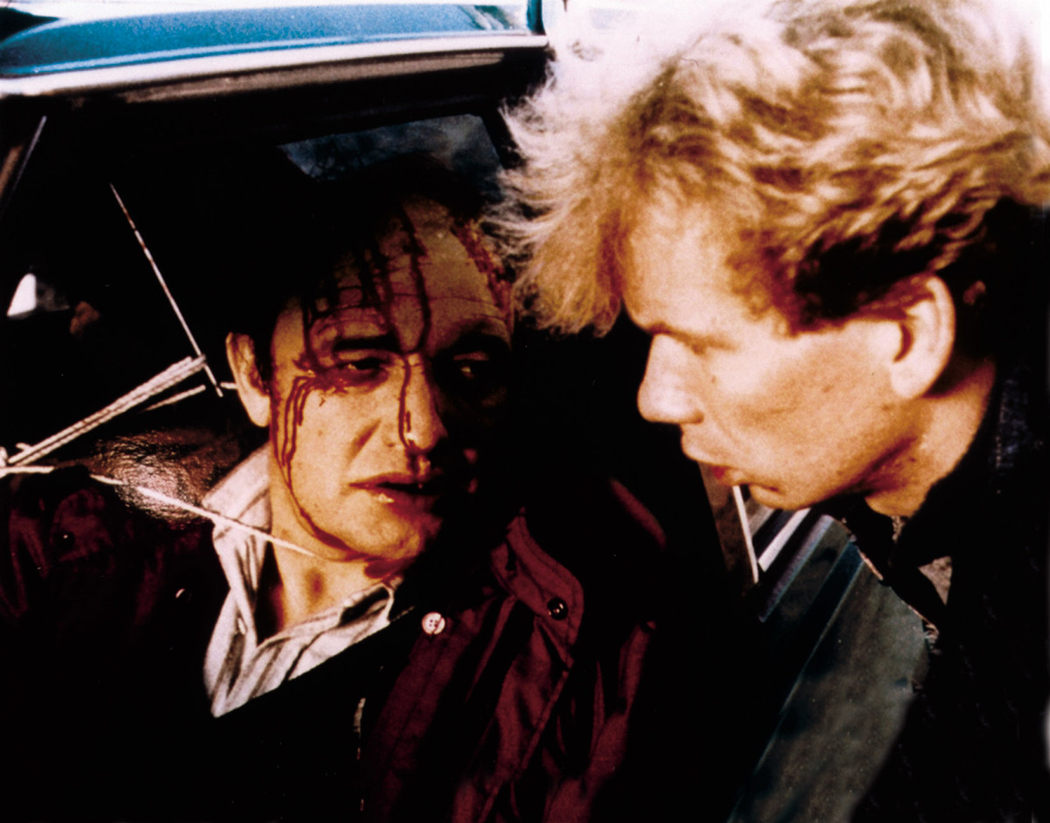
And Polish director, Krzysztof Kieślowski, takes an unsparing look at a murder and its punishment in A Short Film about Killing (1988), an acrid look at Communist-era Poland and a young man’s pointless beating death of an unpleasant cab driver, and and equally cold-eyed look at the brutal and legal hanging of the young man after he is caught and convicted. Kieslowski expanded this film from an hour-long segment he made for Polish television for a 10-episode series called The Decalogue, in which each episode illustrates one of the Ten Commandments, although never in a simple or obvious way.

See these films, or their many brothers and sisters, and then talk to me about Avengers.

"The Road To Utopia" Film Still

Bing Crosby: If you kill me, how are you going get the bird? And if I know you can’t afford to kill me, how are you going to scare me into giving it to you?

Bob Hope: Well, sir, there are other means of persuasion besides killing and threatening to kill.

Crosby: Yes, that’s … That’s true. But, there’re none of them any good unless the threat of death is behind them. You see what I mean? If you start something, I’ll make it a matter of your having to kill me or call it off.

Hope: That’s an attitude, sir, that calls for the most delicate judgment on both sides. Because, as you know, sir, in the heat of action men are likely to forget where their best interests lie and let their emotions carry them away.

Crosby: Then the trick from my angle is to make my play strong enough to tie you up, but not make you mad enough to bump me off against your better judgment.

Hope: By gad, sir, you are a character.

Crosby: Buh, buh, buh, boooo.

Read those lines and in your head, hear them in the familiar voices of Bing Crosby and Bob Hope, and instead of a detective story, you are on the road in a comedy. “Road to Malta”? Dorothy Lamour as Brigid O’Shaughnessy?

This is a new game you can play, entirely in your head and using your auditory imagination. My brother explained it to me last week, saying he sometimes has trouble going to sleep at night, and instead of counting sheep, he recasts classic films in his mind. It’s a neat idea, and needn’t serve solely as a soporific for the insomniac — any more than the Goldberg Variations.

There are two contending variants of this game. The first, like above, is to cast wildly inappropriate actors. Imagine these famous lines spoken by Tony Randall:

“You don’t understand! I coulda had class. I coulda been a contender. I could’ve been somebody, instead of a bum, which is what I am.”

Perhaps he was talking to Oscar Madison when he speaks those lines.

“Okay, you know you don’t have act with me, Steve. You don’t have to say anything, and you don’t have to do anything. Not with me. Oh, maybe just whistle. You remember how to whistle, don’t you? Just put your lips together … and blow.”

I am imagining that spoken by Lily Tomlin’s bag lady character.

gielgudIt can go the other way round, too. In Slingblade, the main character begins: “I reckon what you guys want to know is what I’m a-doing in here. I reckon the reason I’m in here is ’cause I’ve killed somebody. But I reckon what you guys are wantin’ to know is how come I killed somebody, so I reckon I’ll start at the front and tell you.”

Now imagine that said, not by Billy Bob Thornton, but in the round, dulcet, veddy British tones of Sir John Gielgud.

The second variant isn’t about finding the absurd, but considering what could have been real casting choices. Imagine, say, George Raft saying “You dirty rat,” or James Cagney saying, “You’re going out a youngster, but you’ve got to come back a star!”jack

Or imagine Jack Nicholson saying, “I know what you’re thinking. Did he fire six shots or only five? Well, to tell you the truth, in all this excitement, I’ve kinda lost track myself. But being as this is a .44 Magnum, the most powerful handgun in the world, and would blow your head clean off, you’ve got to ask yourself one question: ‘Do I feel lucky?’ Well, do ya punk?”

Nicholson has such a distinctive voice, it’s possible to imagine quite easily the sound of him saying, “A census taker once tried to test me. I ate his liver with some fava beans and a nice Chi-an-ti.” No, it wouldn’t be better than Anthony Hopkins, but you can hear it in Nicholson’s voice, can’t you.

You can recast whole movies in your head. Imagine Casablanca, like an the earlier versions of The Maltese Falcon, with Ricardo Cortez as Rick, Bette Davis as Ilsa, and the cast filled out with Pat O’Brien as Victor Laszlo (almost anyone would be less wooden than Paul Henreid), Eric Blore as Captain Renault, Sig Ruman as Major Strasser and Arnold Stang as Ugarte. I really don’t think we want to see Mantan Moreland as Sam. blore

The varieties are endless. Drift off to sleep one night considering Charlie Sheen saying, “I know everything hasn’t been quite right with me … but I can assure you now … very confidently … that it’s going to be all right again. I feel much better now. I really do. Look, Dave … I can see you’re really upset about this … I honestly think you should sit down calmly … take a stress pill and think things over … Dave … stop. Stop, will you? Stop, Dave. Will you stop, Dave? Stop, Dave. I’m afraid. I’m afraid, Dave ……  Dave, my mind is going. I can feel it. I can feel it. My mind is going.”

Or imagine Leslie Nielsen in Airplane! saying, “Sometime when the team is up against it, and the breaks are beating the boys, tell ’em to go out there with all they got and win just one for the Gipper. I don’t know where I’ll be then, Rock, he said, but I’ll know about it and I’ll be happy.”

Oh wait, he’s already done it. And he didn’t smell too good.

copter jesus

Film critic Pauline Kael famously called Citizen Kane “more fun than any other great movie.”

Classic film, like classic literature, sometimes has the reputation of being more “good for you” than it is fun.

Well, Fellini’s La Dolce Vita gives Kane a run for his money.

The great 1960 Italian classic of the Roman “sweet life” in the postwar years shows us nine days and eight nights in the life of tabloid celebrity journalist Marcello Rubini (Marcello Mastroianni) as he negotiates personal relationships, professional crises and spiritual doldrums.

“Rarely, if ever, has a picture reflected decadence, immorality and sophistication with such depth,” Box Office magazine said when the film was released. La Dolce Vita shows up on most all-time 10-best lists, and Fellini is unquestionably one of the four greatest directors ever.

Take its famous opening scene: A helicopter carries a giant statue of Jesus over the landscape of Rome.

The scene is ambiguous. We don’t know whether Fellini is satirizing religion or if Jesus, with his arms extended, is blessing the city beneath him.

What isn’t in question is that the scene is as memorable as a catchy tune: Once you’ve seen it, you can’t get it out of your head. That’s one of the secrets of Fellini’s greatness. There’s even a word for it: Fellini-esque.

La Dolce Vita is filled with such catchy tunes. trevi fountain

There is the industrially cantilevered Anita Ekberg dancing in the Trevi Fountain. There is the amoral Maddelena (Anouk Aimee) whispering words of love to Marcello, three rooms away in an old castle, while another man makes love to her.

The orgy scene, with Marcello riding a starlet like a donkey. marcello riding

They all stick to the roof of your brain like peanut butter.

Or the final scene with the giant monster fish netted by fishermen, and the closing shot of the young blond girl waving with the innocence of an angel at the lost Marcello.

Fellini structured the film in a series of climactic nights each followed by a dissolving dawn. In each of the nighttime episodes, Marcello faces one of his demons — although he doesn’t recognize them as such.

In the first night, he meets his wealthy lover Maddelena at a night club. anouk

“Your problem is you have too much money,” he tells her.

“Yours is that you don’t have enough,” she responds.

They pick up a streetwalker, take her to her home and proceed to have sex on her bed while the hooker makes coffee in the kitchen.

Each night rises to a crux, a point that might waken Marcello to the aimlessness of his life, and at each sunrise, there comes not a culmination, but a dissipation of the situation — all its air is let out.

Just when Marcello is about to kiss Ekberg, standing in the water, under the spray, the water stops flowing, sunrise arrives, and the dream evaporates.

Considering that it is now one of the immortal classics, its making was less than tidy.

Fellini’s first producer, Dino de Laurentiis, found the story “incoherent, false and pessimistic” and told the director, “The public desires at least a little hope and some entertainment.”

When he was persuaded to put up some money, de Laurentiis demanded that they hire a big star, like Paul Newman, to play Marcello. They also looked at hiring Henry Fonda and Maurice Chevalier.

Fellini stuck to his guns.

The costs soared, as Fellini added and rewrote.

The real Via Veneto, where much of the story takes place, was too busy to film on, so Fellini built a studio replica. That boosted his already huge budget by 50 percent. His new producers (de Laurentiis finally backed out) consented only if Fellini gave up his percentage of the profits — a move he later regretted when La Dolce Vita turned out to be a huge international hit.

To get the performance he wanted for the sex-crazy Maddelena, he made faces and danced behind the camera as Aimee played her most serious scenes, so that her effort to keep from laughing gave him the quality he was seeking in the role.

In addition, there were 800 extras to contend with.

And Fellini added to and changed his script so often that, by the end of shooting, the copy kept by his secretary was said to be larger than Rome’s telephone book.

Fellini claimed he had enough footage filmed to make a 10-hour movie. It’s now just less than three hours.

La Dolce Vita occupies a pivotal point in the career of Fellini, between the early Neo-Realist films, such as I Vitelloni and La Strada, and his later, sometimes visionary films. In La Dolce Vita, there is a balance between the sense of external reality — Italy’s boom economy in the decade after World War II, and its forgotten underclass — and the purely subjective sense of individual psychological crisis. In some of his later films, such as Roma or Fellini Satyricon, the grotesque predominates. But at the midpoint of his career, in his two best films, La Dolce Vita and 8 1/2, he balances the real and the freakish like a saint balancing heaven and hell.

“I am not a man who dashes off messages,” he told an interviewer when the film opened. “I don’t have a very precise ideology. When you describe your epoch, no matter how impartially, you notice that there are emergencies, events, attitudes that strike you more than certain others and that are more important. … So you unconsciously become a moralist. If La Dolce Vita has a meaning, it came all by itself. I did not go after it.”

The meaning of the movie has been debated for 40 years. It has been seen as anti-Catholic and as a reactionary embrace of religion. It has been seen as an angry critique of modern life, but also a celebration of it. It has been called pornography, and also one of the most moral movies ever made. It’s rich enough to embrace many meanings. striptease

The film ends on an ambiguous note: Marcello has given up any hope of becoming a writer and has become a publicity agent. He has lost all pride and become uncharacteristically vicious. After a night of debauchery and humiliation, a party breaks up at dawn and heads for the beach, where a giant fish has been caught by local fishermen. big fish

It is a symbol of Christianity at the end of the film, like the statue of Jesus was at the beginning. angel girl

Marcello sees, on a far part of the beach, a young girl he had met once when working on his forgotten book, a girl he once said reminded him of “one of those little angels in the churches of Umbria.” She waves to him and tries to yell something to him above the surf. He cannot hear, shrugs his shoulder and walks off. marcello gives up

The film ends with a close up of the girl, waving.

And we never know if Marcello simply cannot hear her, or instead does not want to hear her. The film — and Fellini — are equivocal.

Perhaps that is because, in the end, Fellini said he was not a judge, “but rather an accomplice.”

”The American West was not only a land of new beginnings, it was also one of bad endings.”

— Albert Castel, historian

"Badlands"

“Badlands”

People talk about the ”Myth of the West,” yet there are really two myths.

The old Western myth was that of the cowboys and Indians. It was the myth of Manifest Destiny, of expansion, growth and nation building.

The old myth was optimistic. It gave us wide-open spaces in which anything was possible and in which a civilization could be created. It was a myth in which a single determined man could make a difference.

It is the myth represented in Randolph Scott Westerns, Frederic Remington paintings — and all its sad modern-day imitators — and even the common rhetoric of patriotic politicians.

Frederic Remington, "Dash for the Timbers"

Frederic Remington, “Dash for the Timbers”

But there has grown a second myth, a yin to the former yang: the modern myth of the Great Plains as an existential hell where the flatness of the wide-open spaces closes in on you, offering no options. It is dry, dusty, vacant and soulless. In it, no one has a future and there is no escape.

Neither of these myths is necessarily true, but each has developed an aesthetic tradition around it. The new myth became dominant after the Second World War: In mass culture it gave us spaghetti Westerns, TV’s adult Westerns and Sam Peckinpah.

On a higher aesthetic plane it is the raw emptiness of Terrence Malick’s Badlands, the Kansas of Truman Capote’s In Cold Blood. It is the theme of the Bruce Springsteen album, Nebraska, and the place where Larry Clark took the photos in his legendary book Tulsa, with its drug addicts and domestic violence.

springsteen nebraska

In this pessimistic West, we want redemption, and there is none to be had.

”Well, sir, I guess there’s just a meanness in this world,” Springsteen sings.

It is a landscape populated by incipient Charles Starkweathers and Richard Hickockses, people who work in dead-end mill jobs and meet each night after work in filthy dives for beer and fistfights.

They are a generation with no purpose in life, no reason for living past the next cigarette and Budweiser, drunk from a quart bottle with the screw-top thrown on the floor.

It is a world of incredible sensory deprivation. The houses they occupy — for they cannot be said to be living in them — have no pictures on the walls. The furniture is from Goodwill and the blank eye of the television is the center of the room.

Their eyes are as dead as ball bearings.

They have no inner lives, and the only way they can express themselves is with a knife or a penis.

Larry Clark, "Tulsa"

Larry Clark, “Tulsa”

The Old West was a landscape in which all things were possible; the new, affectless West is where all things are permitted.

You can see the new mythology building in the Eisenhower years. All the optimism of the new suburbs was subverted in the photographs of Robert Frank, whose book The Americans was published in 1958.
In that book, a disturbing underside of American chamber-of-commerce idealism was pictured. Frank’s photographs are populated with poverty, desperation, brutishness and lonesome highways leading nowhere.

In the book, the only divinity is the glare from the jukebox.

frank jukebox with baby

Frank’s off-the-cuff style was a revelation in the stylized, artificial ’50s of Richard Avedon and Irving Penn.

Avedon himself later used this second Western myth in his powerful book The American West. It was roundly criticized when it came out for its alleged ”West bashing,” but the photographs were as honest and direct as they could be. You can see any of the people in them walking the streets of Phoenix or Albuquerque on any given day.

avedon

The old myth shines from the images of Ansel Adams; the new, bleaker myth informs the photos of Robert Adams, Frank Gohlke, Lewis Baltz and Richard Misrach.

Robert Adams, "Colorado Springs, Colo. 1968"

Robert Adams, “Colorado Springs, Colo. 1968”

Those who have a romantic notion of America’s Beat generation have not really paid attention to Jack Kerouac’s On the Road, for it is a book about this second Western myth. Instead of a panegyric to youth and poetry, it is really an elegy to spiritual emptiness and hunger.

The book is the prose equivalent of Frank’s pictures. Indeed, Kerouac wrote the introduction to The Americans when it was published.
Clark’s Tulsa fills out the image with dirty heroin needles and pregnant girlfriends with black eyes.

Malick made the landscape beautiful in his film Badlands, but he filled the film with senseless, ugly violence.

It is a Hobbesian world: nasty, brutish and short.

It’s there in director Kimberly Peirce’s desolate film, Boys Don’t Cry.

"Boys Don't Cry"

“Boys Don’t Cry”

Yet, the film does imply an answer. And it is found in the landscape itself.

Peirce periodically interrupts the action with stop-motion footage of the Nebraska sky both day and night. In the day, the clouds speed across the face of the blankness; at night, the cars speeding down the highways make smears of light along the bottom of the picture while the stars spiral across the blue-blackness.

The lives portrayed in Boys Don’t Cry are squalid at best, but your heart breaks to see such smallness lived out in a landscape so sublimely vast.

So many scenes in the film are shot at night, where the tiny area of land illuminated by a car’s headlights is a metaphor for the limited vision of the landscape’s inhabitants.

Ultimately, the new Western myth is one of disappointment, that, as the gnostic gospel of Thomas says: ”The kingdom of God is spread out before us, and yet men do not see it.”