Archive

Tag Archives: history

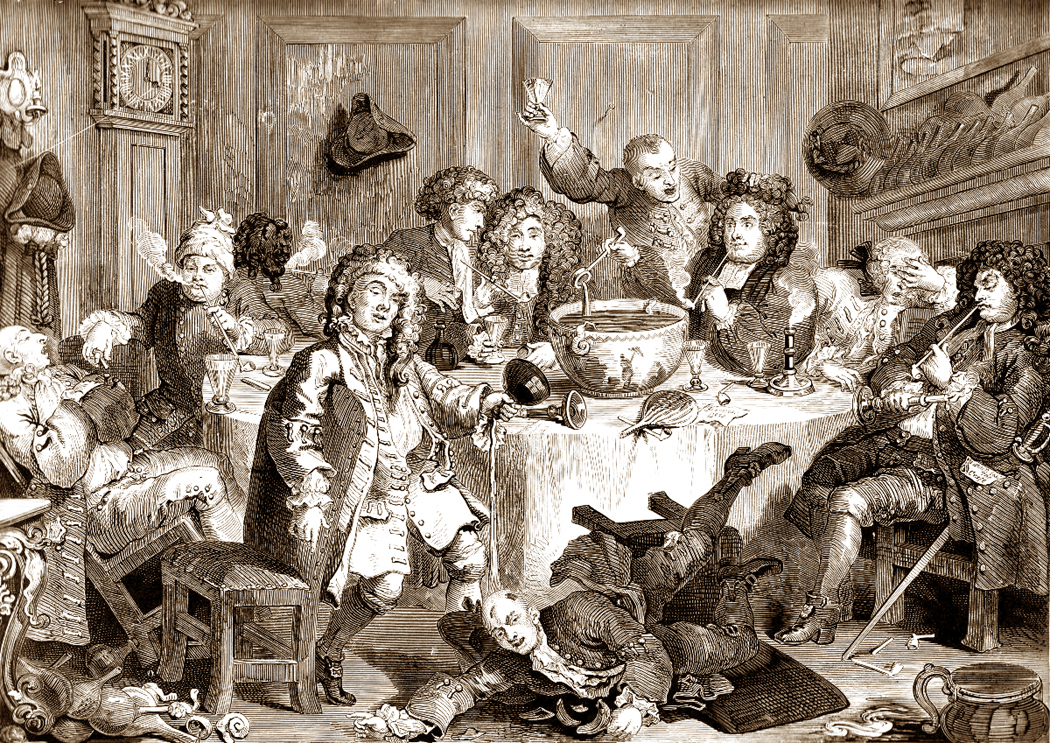
hogarth

The Star Spangled Banner didn’t begin with bombs bursting in air, it began with veins bursting in noses.

No, I don’t mean the stirring martial lyrics written by Francis Scott Key during the War of 1812, but the melody he borrowed.smith and key

The tune Key set his words to was an old English drinking song, To Anacreon in Heaven, written in 1780 by John Stafford Smith. It was the official song of the Anacreontic Society of London and was sung at the beginning of club meetings by all club members.anacreon gerome

Anacreon was a Greek poet of wine, women and song who died in 478 B.C. at the age of 86, from choking on a grape seed.

The club celebrated the grape, also.anacreontic society

Although, rather than wine, women and song, the Anacreontic Society seems more like booze, floozies and caterwauling. Imagine everyone at your local tavern or strip club getting up and singing a theme song before opening for business.

The society met every other week at the Crown and Anchor Tavern in the Strand, London, for a concert, dinner and a night of carousing. Each concert was formally opened by this song, performed by the president and joined by the company on refrain lines.

The curious Duchess of Devonshire, barred from the society by its all-male membership rules (barmaids were allowed, since they weren’t members), sometimes hid in a secret room under the stage in the tavern to hear the goings-on, enjoying the bawdy songs that were sung. Unfortunately, the duchess was a dampening influence on the society. Because the men were mortified that a woman of rank would hear them being so obscene, they disbanded in 1786 rather than continue, never knowing when the duchess would be in obscure attendance.fortmchenry_attack

Twenty-eight years later, Key penned the more familiar words during the siege of Fort McHenry outside Baltimore, on Sept. 13 and 14, 1814. The song was formally adopted as our national anthem by Congress in 1931.

For those who are curious about such things, these are the original words, or the first and last stanza, anyway, written by society president Ralph Tomlinson to Smith’s tune. Try singing it at the next baseball game.

To Anacreon in Heaven

To Anacreon in Heav’n, where he sat in full glee,

A few sons of harmony sent a petition

That he their inspirer and patron would be;

When this answer arrived from the jolly old Grecian —

(Refrain) “Voice, fiddle and flute, no longer be mute,

I’ll lend you my name and inspire you to boot;

And besides, I’ll instruct you like me to entwine

The myrtle of Venus with Bacchus’ vine.

And besides, I’ll instruct you like me to entwine

The myrtle of Venus with Bacchus’ vine.”

Ye sons of Anacreon, then, join hand in hand:

Preserve unanimity, friendship and love;

’Tis yours to support what’s so happily planned:

You’ve the sanction of gods and the fiat of Jove,

(Refrain) While thus we agree, our toast let it be

May our club flourish happy, united and free!

And long may the sons of Anacreon entwine

The myrtle of Venus with Bacchus’ vine.

And long may the sons of Anacreon entwine

The myrtle of Venus with Bacchus’ vine.

Signing_of_Declaration_of_Independence_by_Armand-Dumaresq,_c1873

Perhaps the most peculiar thing about the Declaration of Independence is that the portion of it that seemed commonplace when it was written now seems revolutionary, and the part that seemed to its framers as most central, to us seems trivial, even whiny.

As a piece of rhetoric, it begins in generalities, narrows to specifics, and ends in a course of action. It couldn’t be more concisely structured. The committee charged with drafting it in the summer of 1776 chose wisely when it asked Thomas Jefferson to write the first version. Jefferson’s prose is a model of late 18th-century style: precise, lucid and syllogistic.

But the only part of the Declaration that most people can recall, outside the opening, “When in the course of human events,” is the second paragraph. That second stanza contains the seed of every revolution that followed, from the bloody French to the bloody Russian. It is a statement of belief that is the foundation of American society, and almost every government created since 1776.

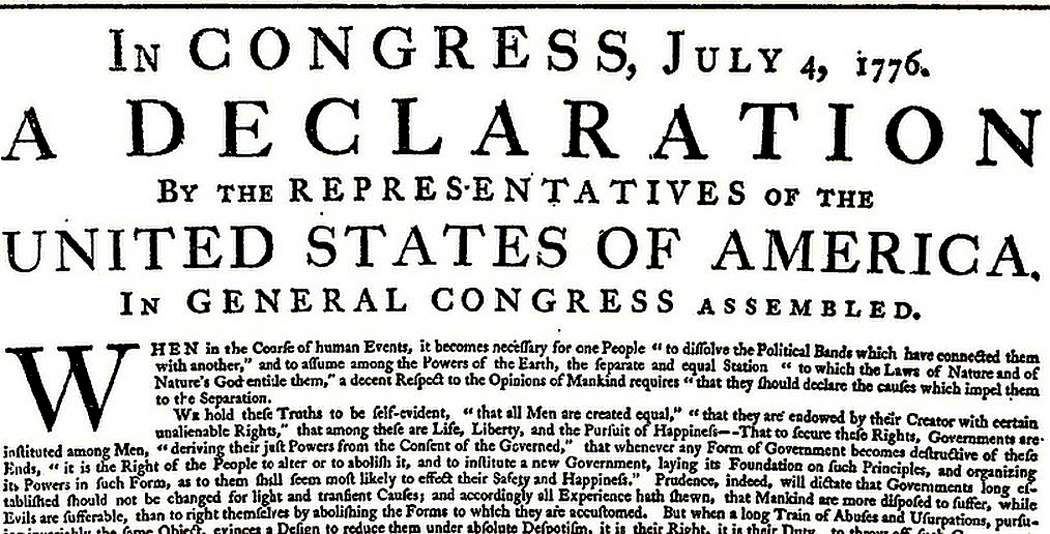
US-original-Declaration-topIt states baldly and without argument or support, that all men are born equal, have certain rights by virtue solely of being born, and that when a government fails egregiously to effect the safety and happiness of the people, it is their right to replace it.

But Jefferson didn’t invent its ideas whole cloth. In fact, as Jefferson wrote years later, the purpose of his stirring words was “not to find out new principles, or new arguments, never before thought of, but to place before mankind the common sense of the subject, in terms so plain and firm as to command their assent, and to justify ourselves in the independent stand we are compelled to take.”

Much of the remainder of the Declaration is given over to a litany of complaints the colonies had about British governance. Some of these complaints still seem legitimate; many seem trivial, even trumped up. “The King did this” and “The King did that.” ”

He has plundered our seas, ravaged our coasts, burnt our towns and destroyed the lives of our people,” it says. Pure hyperbole.

These complaints were the part of the Declaration that was “news” in 1776. They constituted what made the document inflammatory.

Few can read through the whole of the Declaration of Independence now without a sense of fatigue: Those complaints were the issues of 1776, not of today.

It is the second paragraph that seems told to all people at all times, and remains news to us in the 21st century.

Bridge between ages

But to follow those ideas from the century before the Declaration into the ink on its page shows just how important its year of birth was. It was born in the cusp between two great ages, two overriding sensibilities, and partakes of both.

The period from about 1750 to about 1825 is one of the richest in humankind’s history, fertile, even febrile. It is in many ways, the hinge between the past and the modern, between the classically minded 18th century and the Romantic 19th. From an age of Reason to one of Sentiment — as it was called at the time. In Europe, it was the age of Goethe and Rousseau.

And no figure in the American experiment better demonstrates that shift of sensibilities than Jefferson.

On one hand, he epitomized the faith in science and logic of the Enlightenment; on the other, he shared with the revolutionary Rousseau the belief in the nobility of humanity and its drive to social improvement.

You can hardly fail to notice this point when you visit Jefferson’s home in Virginia.

Monticello is a mirror of its maker. Jefferson built a model of Palladian proportion and filled it with moose antlers. The outside lines of the house are clean and mathematically rational. The inside is a warren of peculiar and unnerving spaces.

Jefferson never fully reconciled these two aspects of his personality. He was a slave owner who sings of the dignity of the free man. How much more conflicted than that can you be?

The Declaration of Independence speaks to us now, in large part, because of this clash of sensibilities in Jefferson.

On the one hand, you have the ideas of the Enlightenment, that brilliant flame of philosophy and science that sprang up in Europe in the 17th and 18th centuries.

On the other hand, you have the growth of the individual as a thinking and feeling person.

The Enlightenment preached rationality and temperance, tolerance and universal principals. One of its most influential writers was John Locke, who, in his Second Treatise on Civil Government, from 1690, wrote that all human beings have natural rights and that these included “life, liberty and the pursuit of property.”

It was an idea that took hold and flourished.

By the time of the American Revolution, the idea was commonplace. It shows up in George Mason’s Virginia Declaration of Rights in June 1776, in slightly altered form:

“That all men are by nature equally free and independent and have certain inherent rights, of which, when they enter into a state of society, they cannot by any compact, deprive or divest their posterity; namely, the enjoyment of life and liberty, with the means of acquiring and possessing property, and pursuing and obtaining happiness and safety.”

When you compare that with what Jefferson first wrote, you can see how much better a writer Jefferson was. He only needed 31 words to say what Mason required 57 for, and say it more forcefully and memorably.

An economy of words

Writing_the_Declaration_of_Independence_1776_Jefferson’s first take on this was considerably more sonorous, but still not quite there:

“We hold these truths to be sacred, that all men are endowed by their Creator with certain unalienable rights, and that among these are life, liberty and the pursuit of property.”

It was a committee of five, delegated by the Second Continental Congress, that were given the responsibility to draw up the Declaration. Jefferson wrote that first draft, but Benjamin Franklin, also on the committee, struck out “sacred” and replaced it with “self-evident.”

By 18th-century reasoning, self-evidence was universal, while sacredness could be construed as sectarian. Franklin wanted to emphasize the universal truth of the proposition.

And Jefferson himself changed “property” to “happiness,” and with that stroke made the Declaration jump from the past into the future.

The past was Thomas Hobbes, with his sense of the nastiness, brutishness and shortness of life, and a belief that the natural order of mankind was greed, rapine and thievery. Only strong central government, he wrote, could possibly control the natural impulses of humankind.

The future was Rousseau’s perfectibility of man, his belief in the nobility of those uncorrupted by society and government, the “natural man.”

The middle was Jefferson, perfectly if perilously balanced between.

The right of life remained pretty much the same looking forward and back, but the other two rights changed meaning over the cusp of 1800.

Locke believed that all humans coveted was property; Jefferson realized that there were many routes besides ownership to humanity’s true goal, individual happiness. Hence, the change in language.

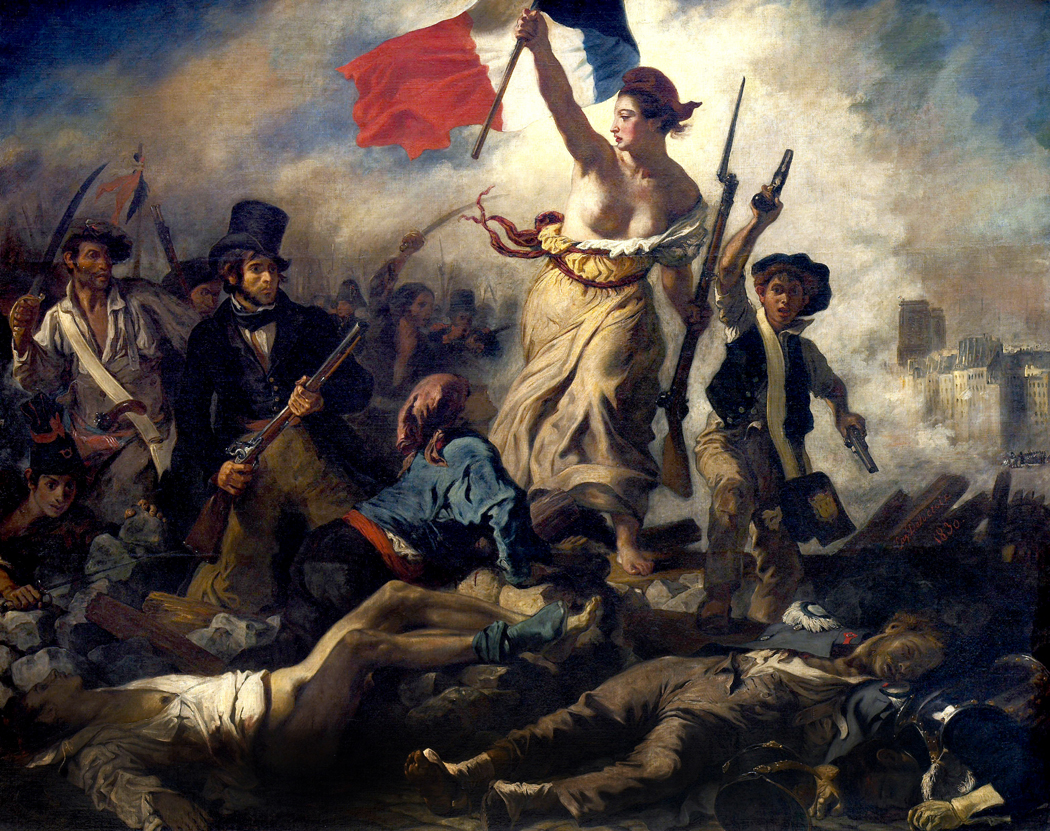
Liberty is the word that has changed the most. In the 18th century, it meant being left alone, basically. Your government let you be: Taxes shouldn’t be too onerous and armies shouldn’t be quartered in your home at the whim of the commandant.La_liberté_guidant_le_peuple

But by the 19th century, liberty took on a more revolutionary turn: Romantic writers saw liberty as the antidote to repressive regimes around the world and one read poems to Count Egmont, the Prisoner of Chillon and Nat Turner. It fueled popular movements all across Europe and led to a crisis year in 1848. Liberty meant revolt — a very different thing from what John Locke had in mind.

(And it makes almost comic the confusion of the two versions of liberty conflated by contemporary anti-tax factions and the paranoid fringe looking for the black helicopters that we can get all belligerent and militant about “tyranny” in Washington, when compared to what is happening in Sudan, Russia or North Korea, we remain among the most liberty-ridden people on earth. Admittedly, the Declaration of Independence itself is full of the same sort of inflated rhetoric.)

“Life, liberty and the pursuit of happiness.”

This meant that the Declaration could speak, Janus-like, forward and backward. The fulcrum of modern history. The Enlightenment is emerging from its chrysalis into the age of Romanticism.

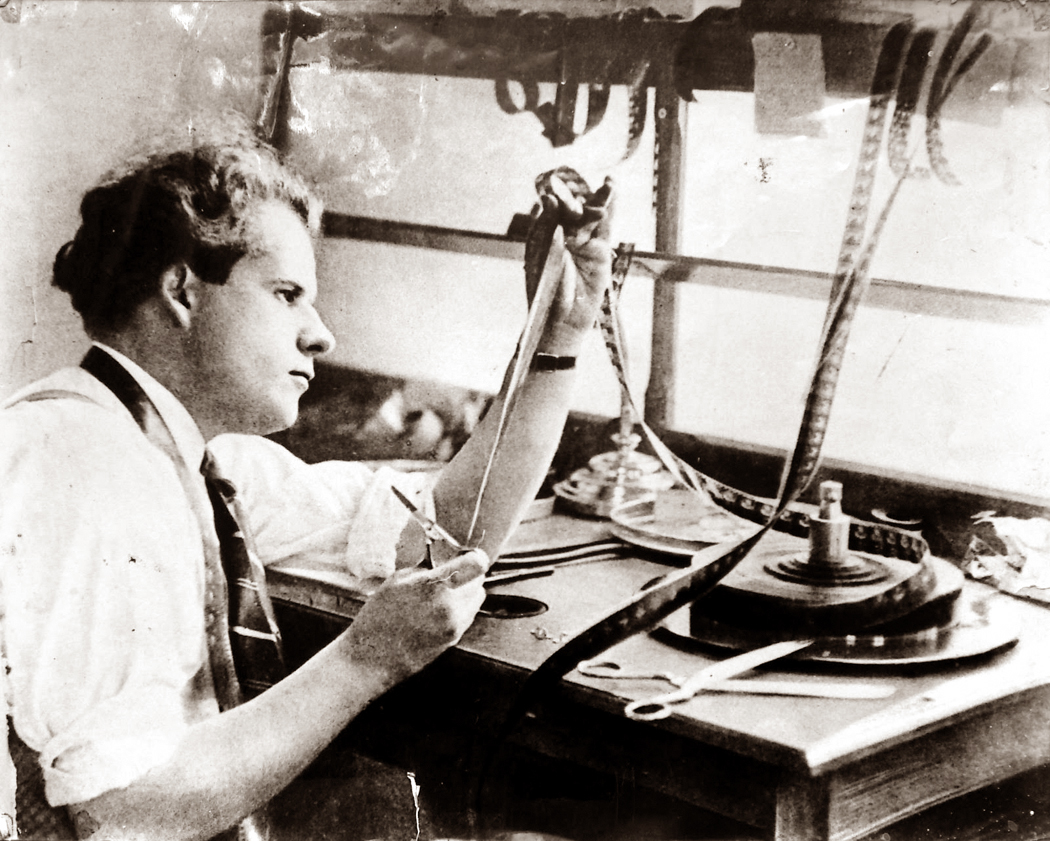
moviola 1

We travel in time as much as in space.

And just as there are moments when you stand on the top of a rise and see grand vistas and the lay of the land suddenly becomes clear, there are moments when you climb up out of the hollow of local time and the years spread out in front of you as one vast temporal landscape.

I had such an experience this summer in New Jersey.

I was born and raised in the Garden State in several communities between the Hackensack and Hudson rivers. I left for college and have rarely been back in the intervening quarter century — family and friends had all died or moved away.Old Tappan 2

But on this trip my wife and I passed through Bergen County and managed to stop by some places I knew well as a boy.

Now I’m not about to wax nostalgic. I abhor nostalgia; it is a kind of morticians’ wax applied to the dead face of the past, distorting everything we once knew. Times were not better then and never were.

But things clearly have changed.lein's grove

The first change is purely psychological: Everything has shrunk. The landscape that was so sprawling to my boy’s eyes is now condensed to a few tight city blocks. What seemed like an expedition is now walking distance. Skyscrapers are now bungalows.

Many people have experienced a similar sensation.

But the second change is more profound: The snapshot of New Jersey in my brain has remained static while time has bounded forward, so that when I revisit Teaneck or Old Tappan, I’m seeing what is in effect time-lapse photography: All the changes are accelerated so that what has moved invisibly day to day is now telescoped into a rush.

It isn’t just that there is more development. Bergen County has for a long time been the very model of suburbia; there are tract homes everywhere and more spring up every day. But nature has somehow kept up with the construction: Housing developments that were raw muddy wounds 30 years ago are now green and shaded under sprawling trees. For all the decay of time, there is a matching fecundity.

And when a quarter century exists between frames in your movie, it is a small step to move back yet another quarter century and then another, so that the history you learned in school no longer sits inkbound on the page of a book but begins to breathe as another scene in the movie you are a small part of.eisenstein

So you can slide the film back and forth in your mental Moviola only a dozen equal frames and you are in the era of Peter Stuyvesant and Dutch colonialization. It’s a blip from now to 1655 on the time line.

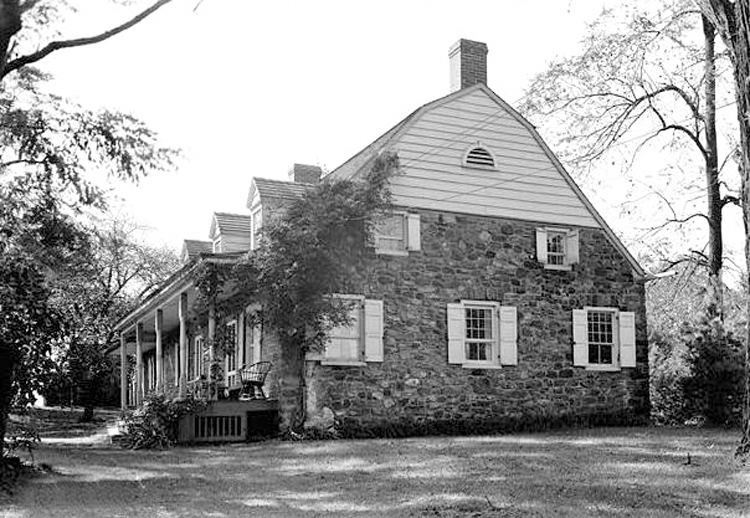
Frederick Haring HouseThe Old Tappan I grew up in was dotted with farms and old stone houses, built during the Dutch era. The houses are thick-walled and covered in lichen, moss and ivy; they are overarched by spreading oaks. They have, as it is said, settled.

Such houses were constructed of brown sandstone quarried by slaves.

It isn’t often remembered that slaves are a part of New Jersey’s history: In pre-Revolutionary times a settler was given 175 acres of land for every slave he imported. By 1737, slaves accounted for 8.4 percent of Jersey’s population.

Slave insurrections — in Hackensack, Raritan and Elizabeth, among other places — were a continual occurrence and citizens felt themselves stuck with the damnable institution. In 1772, a law was proposed ”obliging owners of the slaves to send them all back to Africa at their own expense.”

The law came to naught, but by that time free labor began to replace slavery and indenture.

I mention all this because when my boyhood home was built in 1956 in Old Tappan in northern New Jersey, the excavation turned up the stone foundation of slave quarters. It had been buried in woods for centuries and was now opened up to the sun for the first time.

It seemed little more than a curiosity then, and it was soon buried once more under the landscaping in our back yard. Its reawakening was brief.

Old Tappan 4The house has had two or three owners since I lived in it. I doubt that any of them knew what was buried under the Zoysia grass. But I thought of it again as I visited on vacation and saw how much the old house had changed: new paint, grown-up trees that were once bushes, a new bridge over the creek that cut through the property.

You play the film through the Moviola: The whole of northern New Jersey was once covered by a forest of oak and hickory. That was cut down for agriculture; the slave quarters behind my childhood home was evidence of that. But the fields grew once more into trees and were once more cut down to build the house.

The field next to the house was still pastureland when I was a boy. Now, it is dense with willows, birch and maple, on its way once more to growing oaks. If I look into its future, I can see more housing.

Time is fierce; it consumes the world.


shiloh peach blossoms

It is April 2014 and the dogwoods bleach the woods of a Civil War battlefield in southern Tennessee.

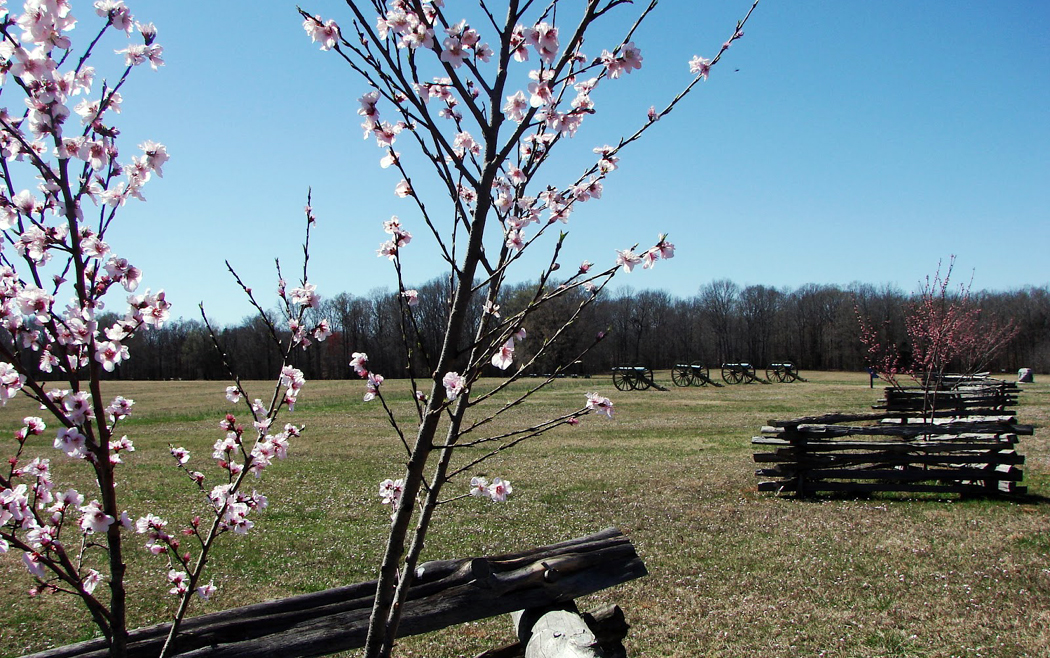
shiloh dogwoodsTheir whiteness remembers a signature episode from the fighting: On April 6, 1862, the peach blossoms near Shiloh Church, shocked from their branches by bullets and cannons, fell like a snow on the dead bodies of the Northern and Southern soldier alike.

It is best to see a historic battlefield at the same time of year as the soldiers who died there knew it. You get a better sense of it. At Shiloh, you can feel the spring humidity thickening the air. Nights are cool; they cloud up with April showers. Days are warm with sun. A million crane flies have awakened to the season and float over the unplowed fields. The redbuds wear their flowers like coral beads along their branches, and the dirt beneath our feet, still damp from the thaw, is beginning to dry enough to cultivate.

And 152 years ago, the Battle of Shiloh was the first major battle in the western theater of the Civil War. It was also the battle that first taught the Union and Confederate armies that the war was going to be long and vicious. It put a violent end to thoughts of quick and easy victory. It also nearly cost Gen. Ulysses S. Grant his job.

You drive along the narrow macadam in Shiloh National Military Park, 110 miles east of Memphis, looking at the monuments in the woods, wondering why such an obscure patch of wood and field should have the importance it has.

It is miles from anywhere; why would anyone fight over it?

With our cars and interstates, sometimes it is hard to remember that America’s past is one of rivers and railroads. When the Union Army invaded the South in Tennessee, it did so along the rivers. Military objectives often were railroads rather than cities.

And so it was in 1862, when Grant, a field general under commanding Gen. Henry Halleck, attacked forts Henry and Donelson in northern Tennessee. Grant’s victories opened up the Tennessee and Cumberland rivers, forcing the Confederate Army to abandon the entire state.

And in March of that year, Gen. Albert Sidney Johnston marshaled his Southern army in Corinth, Miss., a few miles south of the Tennessee border, where he could guard the crossing of two vital railroads.

Grant had Johnston on the run, and Grant felt confident.

In following up on the battles, Grant bivouacked most of his Union soldiers at Pittsburg Landing, about 20 miles north of Corinth. He planned to attack Corinth, but was waiting for reinforcements from Gen. Don Carlos Buell, and while he waited, his troops camped leisurely near the Tennessee River.

Pittsburg Landing

When asked if they shouldn’t fortify the camp, Grant and his assistant, Gen. William Tecumseh Sherman dismissed the thought that the Confederates would attack.

”I have scarcely the faintest idea of an attack being made upon us,” Grant wrote Halleck, his superior back in St. Louis.

Grant had miscalculated, and Johnston with his assistant, Gen. P.G.T. Beauregard was already advancing on him, hoping to win a battle before Buell could arrive with Northern reinforcements.

Unfortunately for Johnston, things didn’t go well. The trip from Corinth to Pittsburg Landing, which should have taken a day, took three days. Bad roads and worse weather slowed the troops.

”As we stood there, troops tramped by mud and rain and darkness,” wrote one Confederate soldier. ”To us who were simply standing in line in the rain, it was bad enough, but those men who were going by were wading, stumbling and plunging through mud and water a foot deep.”

The delay might have lost the element of surprise for the Southerners — if the Yankees had been paying attention. And in the Rebel camp, Beauregard argued for canceling the attack.

”There is not chance for surprise,” he told Johnston. ”Now, they will be entrenched to the eyes.”

Johnston didn’t care. He wanted a fight and wanted it immediately.

”I would fight them if they were a million,” he said.

The actual battle began at 5 a.m. April 6 and it began by accident, when forward units of the Graycoats bumped into outlying remnants of Yankees. The shooting began and it hardly stopped for two days.

thulstrup

Although Johnston had a good battle plan, it quickly fell apart, and the fighting became widely scattered and disorganized.

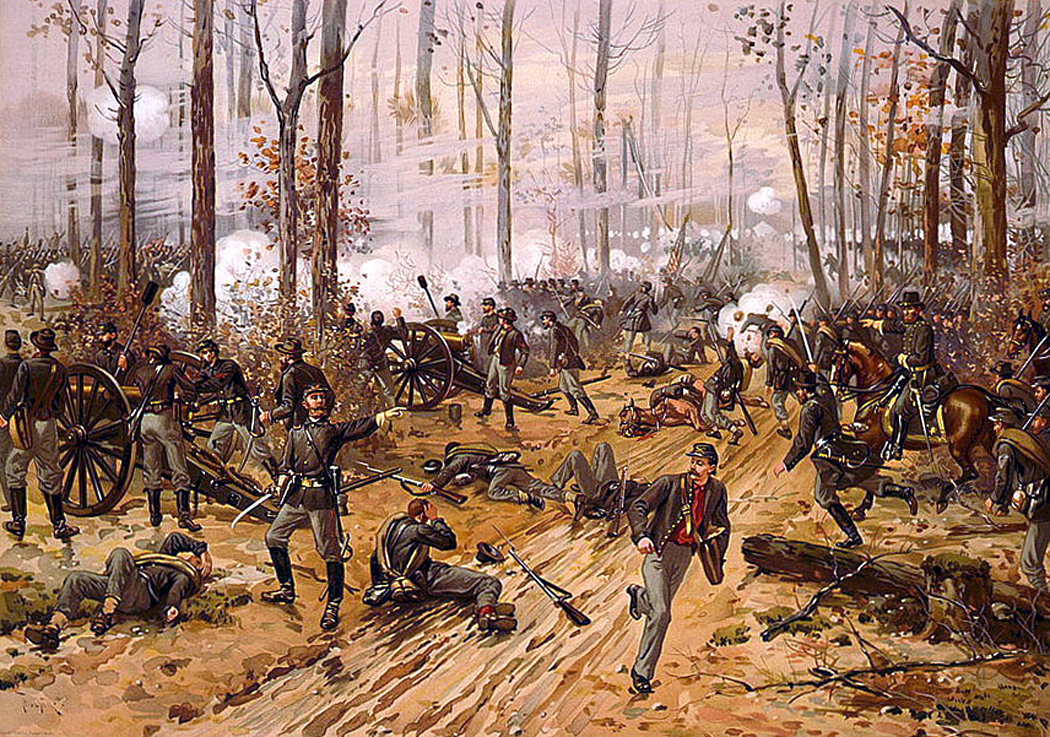
One thinks of battlegrounds as fields — rolling grass dotted with statues and cenotaphs. But the reality was quite different. Southern Tennessee is thickly wooded and the Shiloh battlefield was mostly woods. Interspersed among the trees were farm fields, square patches of clarity in the obscurity of trees and underbrush. Sherman and his units fought in the woods around a small Methodist church, a log cabin called Shiloh Meeting House. The battle takes its name from the cabin, which is no longer there. A modern church stands near the spot.

The height of fighting that day took place on a field owned by farmer Joseph Duncan. A Union force of about 5,000 men under Gen. Benjamin Prentiss had dug themselves in along a worn wagon path, called the ”Sunken Road,” at one edge of the field. A couple of hundred yards away, Confederates lined the other edge of the clearing.

For most of the day, Confederate infantrymen charged Prentiss and were pushed back by withering gunfire.

”The enemy reserved their fire until we were within about 20 yards of them,” wrote one Confederate soldier. Then the Yankees opened fire, ”mowing us down at every volley.” The whiz and buzz of Minie balls flying through the air was so loud and constant that the position was called the ”Hornets’ Nest.”

shiloh engraving

Twelve times the Rebels attacked and were repulsed.

Then Confederate Gen. Daniel Ruggles tried something different. He assembled 62 cannons and bombarded Union positions. The line to the left and right of Prentiss retreated, but Prentiss held on until 5:30 in the afternoon, when Confederates surrounded him, and Prentiss and about 2,100 Union soldiers were forced to surrender.

On the whole, the Confederates did well on April 6. They forced the Union men back toward Pittsburg Landing and the Tennessee River. But Grant, never panicking as his army was decimated, arranged his troops in a final defensive line that held as night came on.

Beauregard was so elated by the Graycoats’ success that he wired his superiors in Richmond, Va., that he had won a ”complete victory.”

It wasn’t all good news for the Confederacy that day, though. Johnston had been shot in the leg, severing an artery, and bled his life away into his boot. No one recognized the severity of his wound until it was too late. Johnston died on the field and command fell to Beauregard. Johnston’s is still the highest-ranking battlefield death in American history.

Night may have brought thoughts of victory to Beauregard, but it also brought rain. Troops, in wet wool uniforms and soggy leather boots, slept in the open. They shivered terribly in the cold of the night. Confederate soldier George Jones wrote in his diary, ”I have the shakes badly. Well, I am not alone in fact we all look like shaking Quakers.”

Grant himself slept in the open under a tree.

The next morning, Beauregard assumed all he had to do was mop up. But during the rainy night, Grant got his reinforcements, as Buell crossed the river and shored up Grant’s defenses. And when the battle resumed on April 7, the tide of battle turned. One Rebel remembered, ”The Yankees appeared to me like ants in their nest, for the more we fired upon them, the more they swarmed about; one would have said that they sprouted from the ground like mushrooms.”

The Rebel army was pushed back to its original lines, and by midafternoon, it was clear to Beauregard that he would have to retreat. The entire battle had been a fiasco.

The Yankees had been caught off guard and nearly lost the fight. The Confederates lost their best general in the days before Robert E. Lee took command in Virginia. Both sides lost huge numbers of men, and in the end, both sides were where they were before the battle began: Grant at Pittsburg Landing and Beauregard back in Corinth.

The bloodiness of the fighting came as a shock to the public on both sides of the war. Of the South’s 44,000 men in the fight, nearly a quarter were casualties, with 1,700 killed. Grant’s force, joined with Buell’s, came to 65,000, of which 13,000 were casualties, with 1,700 killed.

In fact, more casualties were inflicted at Shiloh than in all the wars America had fought before then put together.

The battle changed the nation’s attitude toward the war. Before Shiloh, one Union soldier wrote, ”My opinion is that this war will be closed in less than six months.” Shortly after Shiloh, the same soldier thought it might take 10 years.

What didn’t take long was for Northern editorial writers and politicians to call for Grant’s scalp. He was an incompetent officer, it was claimed, who hadn’t prepared for the unexpected battle.

But President Lincoln — recognizing something in Grant that he couldn’t find in a general in the East, as he went through one incompetent general after another — refused to remove Grant.

”I can’t spare this man; he fights,” Lincoln said.

shiloh peachblossoms 2

Now, when you stand at the edge of the Hornets’ Nest looking back over the field toward Ruggles’ cannons, or walk in Sarah Bell’s field, where her peach orchard used to be, near where Johnston was killed, you can see something of the confusion that must have reigned in 1862. The woods are still there, with those few fields in between. It is impossible to conceive of anyone at any part of the battle knowing what was happening at any other part. The maps show where troops moved, and where the cannons were assembled, but they give you a false sense of clarity.

That’s why you have to visit the place.

You cannot get a real feel for the battle without standing on the ground and seeing the landscape.

And if you are very lucky, when you are there in April, it will rain.

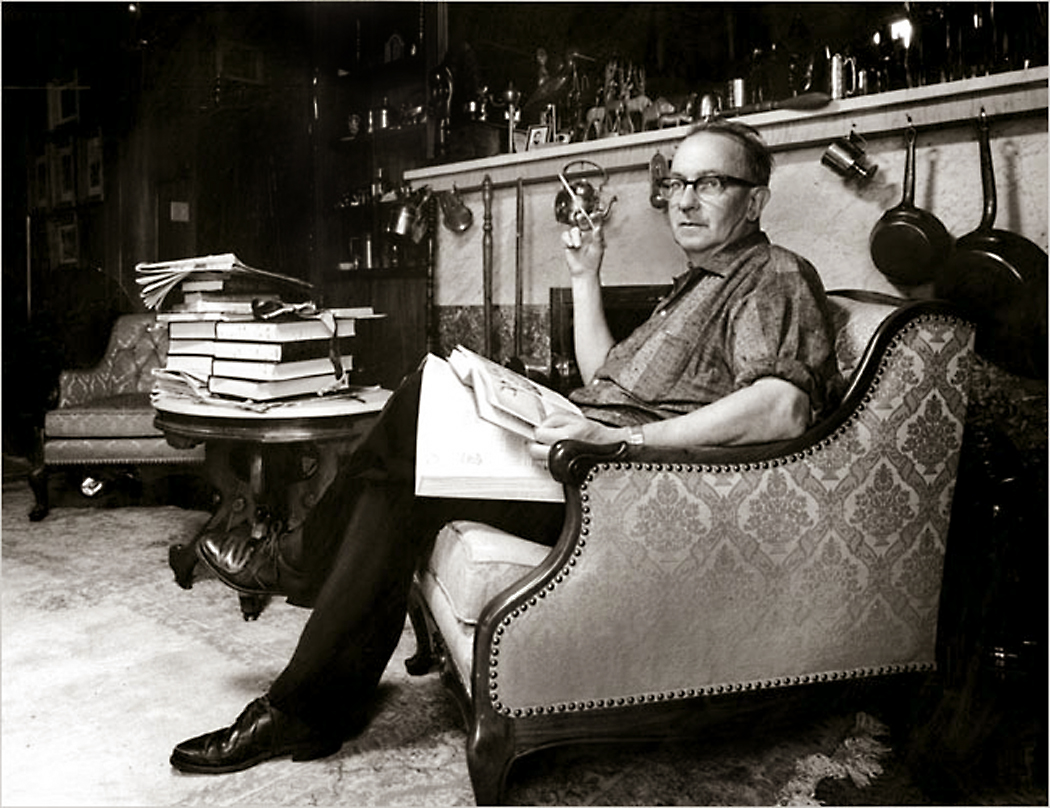
George Leonard Herter

George Leonard Herter

The British have their eccentrics, but America has crackpots.

There is something quaint about the Englishman wearing a cutaway and top hat in the Sahara sun, or refusing to read any book unless its author’s name begins with the letter “A”. But the American version of this tendency usually comes out in something more oracular: Americans create new religions and build temples out of bottlecaps. And they are obsessed with peculiar certainty that nobody has got history correctly except themselves. herters catalog

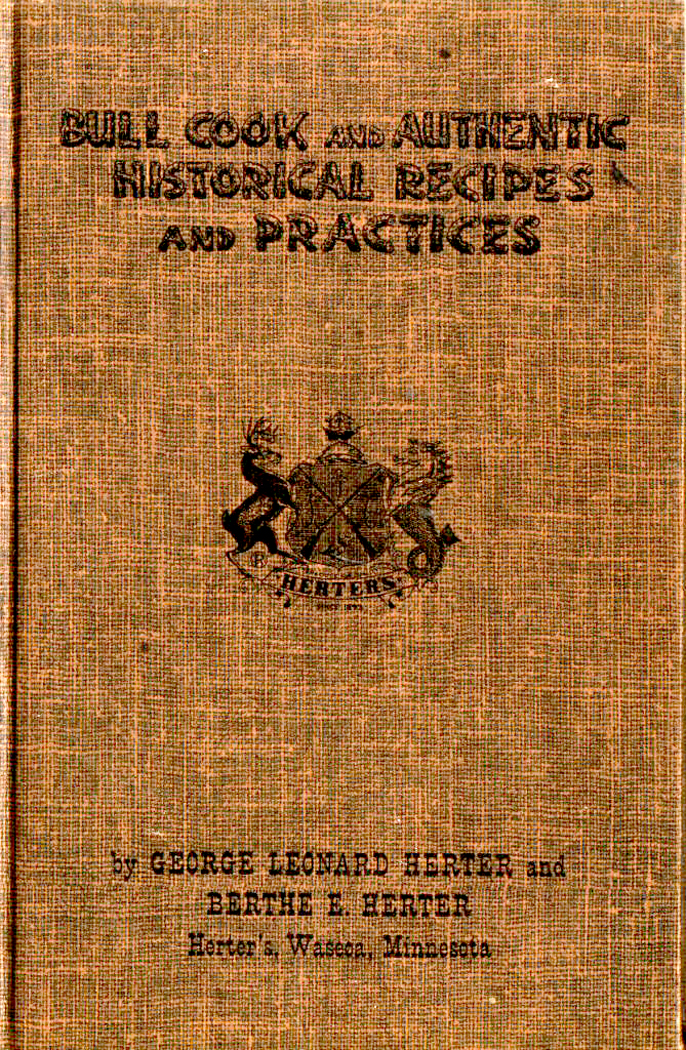
One of the great American crackpots wrote cookbooks. George Leonard Herter built one of the nation’s great outfitting businesses, in Waseca, Minn. His fortune was founded on shotgun cartridges and duck calls. But his lasting place in history comes from the books he wrote, most notably, the Bull Cook and Authentic Historical Recipes and Practices, and it is not for the faint of heart.

In what other cookbook would you find the claim: ”The Virgin Mary, Mother of Christ, was very fond of spinach”?

Herter goes on to say, ”This is as well a known fact in Nazareth today as it was 19 centuries ago. Her favorite music was that of the crude bagpipes of that time, and this is a well-known fact.” bull cook cover

He then proceeds to give us her recipe for spinach, which, he says, was the only thing she ate in the stable where Jesus was born.

No, this is not a religious book. Other ”historical” claims include, ”Sauerbraten was invented by Charlemagne,” and that St. Thomas Aquinas was so fat, ”He simply sawed out a half circle in his eating table so that his stomach could fit comfortably into the sawed out section.”

He tells us that Johannes Kepler’s work on astronomy has long since been forgotten, ”but his creating liverwurst will never be forgotten.”

He has Bat Masterson’s recipe for prairie dog, Marie Antoinette’s recipe, not for cake, but for trout. He says Joan of Arc was responsible for the invention of pate de foie gras.

His standard recipe runs something like this: ”No one knows how to bake a potato anymore. I’ll tell you how to bake a potato.”

It is clear from the presentation that Herter is not trying to be funny. He is dead serious. As when he opens the book with this: how to live with a bitch

”For your convenience, I will start with meats, fish, eggs, soups and sauces, sandwiches, vegetables, the art of French frying, desserts, how to dress game, how to properly sharpen a knife, how to make wines and beer, how to make French soap, what to do in case of hydrogen or cobalt bomb attack. Keeping as much in alphabetical order as possible.”

Of course, the index is not in alphabetical order.

Herter wrote a number of books; among the more notable were How to Live With a Bitch and The Truth About Hunting in Today’s Africa and How to Go on a Safari for $690.00 (“Baboons are simply too small for leopard bait”).

I can’t vouch for any Bull Cook recipes. Most seem to involve a “well-buttered slice of bread” and some ground beef fried in even more butter. But I can say that Herter seems to have two entertaining obsessions that make up the bulk of the book, and its sequels, volumes 2 and 3. truth about hunting

He expresses the absolute certainty of the crackpot when he tells us his version of history:

“Napoleon Bonaparte always remained a great mama’s boy.”

“Napoleon not only liked green beans very well, but believed that they helped to produce more sperm in male humans. As he was always a man who played the ladies frequently, this was just as important to him as winning wars.”

Napoleon shows up frequently in the book. So does Cleopatra. Let Herter explain ancient Roman Egypt for you.

According to Herter’s version of ancient history, Cleopatra tired of Marc Anthony and tricked him into killing himself.

“Cleopatra went over to where Mark Anthony lay and made sure that he was dead. She then sent a messenger to Octavian telling the good news and asking him to come over for the weekend. Octavian did come over to visit her as he well remembered her charms when she lived in Rome. She did her best to charm him in every way possible and he was willing. Cleopatra was now thirty-nine and had produced five children. They did not have girdles in those days, nor uplift brassieres. She had widened out and her famous bosom had sagged considerably. The old charm simply was not there. Octavian decided that the younger models were more to his liking and told her she better get out of Egypt and he did not want to see her in Italy either. Octavian made Egypt a part of the Roman Empire. The Roman Legion, now that the fighting was over, had a well-earned vacation putting Italian blood into Egypt. It is still very much there today. They actually changed the appearance of the Egyptians to a very Italian look which they still have today. Cleopatra was just in the way. Octavian had one of his men pay a servant to poison her. Her record proved she was not the type to kill herself for anything or anyone. Besides, there were no asps anywhere near the town she was in. If she did have an asp and let it bite in one of her breasts as the fable goes, it would not have killed her anyway. A woman’s breast is mostly fat and it is one of the places where the bite of any poisonous snake has little effect.”

There follows a recipe for “Watermelon Pickles Cleopatra.”

He is a fountain of prejudices, and has no doubts about his opinions.

“Henry the VIII actually never amounted to anything and would not have made a good ditchdigger. The only thing that he ever did to to his credit was to highly endorse the kidneys made by Elizabeth Grant, one of his many cooks.”

He knows with dead certainty how Genghis Kahn liked his steaks prepared and how Gregor Mendel cooked his eggs. And according to Herter, it is not his banditry or gunslinging for which Billy the Kid will be remembered by posterity, but for his recipe for cornmeal pancakes.

“Here is his own recipe which will long outlive Billy’s memory.”

Herter’s other obsession is sex, and most specifically, women’s breasts. The second volume of the Bull Cook is full of bad black-and-white reproductions of famous paintings of the nude, and his historical commentary often features descriptions of famous cleavages of the past.

He tells us that Cleopatra “was said to have the longest, most pointed breasts in all the world. The movie actresses that have tried to play Cleopatra from time to time never qualified on this point.”

“Greek women have always been known for their unusually well-developed breasts. They have always felt that bare breasts gave them more grace and beauty and that exposing breasts was not at all immodest.”

“In those days, if you didn’t have breasts worth showing, you were really in trouble. A flat chested pendulent breasted woman just did not have a chance in life.

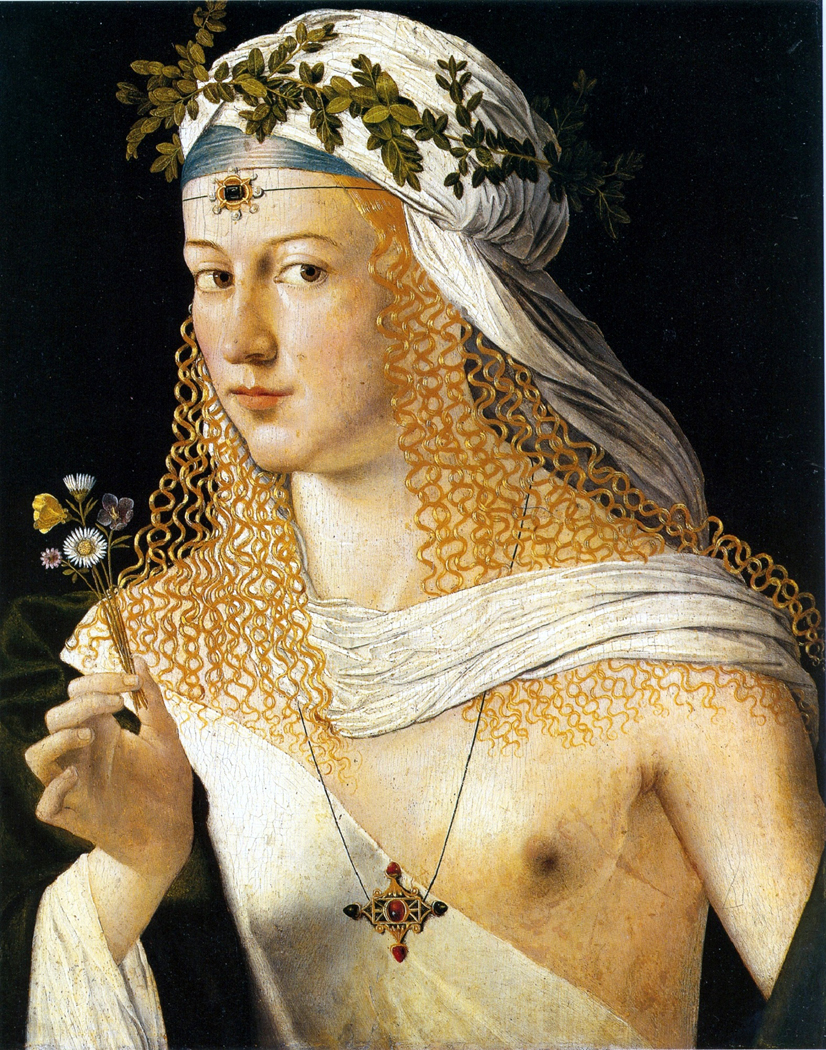
Lucrezia Borgia by Bartolomeo Veneto

Lucrezia Borgia by Bartolomeo Veneto

In another place, he reprints a portrait by Bartolomeo Veneto (and misattributing it as he does so) and tell us:

“Lucrezia Borgia, well-known poisoner, painted by Veneziano in 1520. By this time, it was popular to wear dresses with one breast exposed and the breast nicely rouged. As you can well see, this style did nothing for Lucrezia as she had nothing special to show.”

He has a chapter titled: “Bare Breasts and Food In the United States.” In it and passim, he describes various topless establishments, comparing those in Paris with those in Las Vegas. Vegas wins, by his reckoning.

“For my part I enjoy eating very much. I do not like to look at female breasts while I am eating as I like to concentrate on my food. There is a time and place for everything and I prefer exposed female breasts in a bedroom, a tepee or a clean cave.”

It isn’t only breasts, though.

“Michelangelo learned to paint and sculpture sexual organs probably better than anyone that ever lived. He never learned to use his own properly, however, and was a homosexual.”

And he has a way of combining his questionable grasp on history with his prurience:

“Charles the II of England was born in 1630 and died Feb. 6 in 1685. He married the beautiful Portuguese woman, Catherine of Braganza who brought Bombay, India and Tangier to England as part of her dowry. Those were the days when getting married could really get you something. He never had any legitimate children as Catherine was just plain scared of pushing out a child through so small a space. She became an early expert and exponent on birth control.”

There is more than an undercurrent of bigotry in him. While he exults American Indians (not always reliably: “Pizza pies were of course, unknown as these too are of American Indian origin.”), and recounts many instances where white America has raped and pillaged the Indians, he holds many questionable ideas about women and other races.

In that section on Michelangelo, for instance, he says: “Michelangelo’s statue of David shows what can be done with a piece of marble. As far as showing what David might have looked like, it is a masterpiece of errors. David was a  Jew and undoubtedly had the high cheekbones and nose of a Jew. This figure is strictly Anglo-Saxon in appearance, not even Roman.”

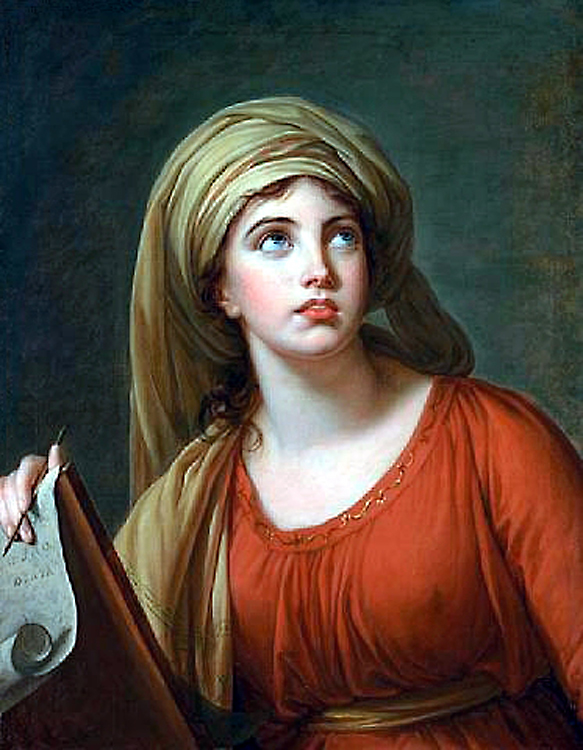
Lady Hamilton as the Cumean Sibyl by Vigee-Lebrun

Lady Hamilton as the Cumean Sibyl by Vigee-Lebrun

On a section (see below) spent with Horatio Nelson and his mistress Lady Hamilton, he includes a portrait of the woman, misspelling the name of the artist (Elizabeth Vigee-Lebrun) and in his caption tells us something about his opinion of women.

“The portrait was painted by Madam Vigee-Ledrun , one of the few good women artists the world has ever known. Women because of the effect of menstruation upon them, rarely can become even fair painters.”

Not to mention his take on Joan of Arc: “Never underestimate the strength and courage of a woman that is really mad at you.”

Among his other obsessions are nuclear war and art.

“Red pepper good for radiation and upset stomachs”

“We always have the money to buy good soap in this country and women folk look down on such menial tasks as making soap these days. An H bomb strike in this country would change the whole picture.”

“I never have  been an admirer of the paintings of Matisse but I always thought his cooking was excellent.” What follows is a recipe for “Beans Matisse.”

I could go on all day giving you quotes from the Bull Cook.

“Joshua 10:13 in about 1451 years before Christ says that the sun stood still in heaven and did not go down for the space of one day. This caused Indian Mexico to become dark.”

Or:

“Mozart was a man that believed just putting a lady on her back was not at all enough. Seducing an actress was a game with him that had to be done properly or not at all. He wined and dined his amours very well before getting down to any serious romancing. His dessert I like far better than his music and his orange wine is a classic. Here are his original recipes.”

Not to mention:

Eggs “are best eaten in a well ventilated room.”

Or:

“Never drink coffee right after eating peppered fried eggs or soft-boiled eggs.”

The combination of sex and history, scrambled, fried and soft-boiled can be enjoyed in his version of the life and appetites of Lord Horatio Nelson:

“Horatio Nelson was a fragile, very sensitive man nearly always in poor health. He was not at all good looking and women shunned him.”

“In the West Indies, on March 11, 1787, he made the greatest blunder of his life. He was more or less trapped into marrying Frances Nesbit, the widow of a doctor Nevis. Nelson had simply spent too many years on the seas with only men to look at and the prospect of having any nude woman looked like a catch to him.”

“Emma Lyon was born on May 12, 1765 … She grew up to be a lively, robust, big-breasted beauty that attracted any normal man.”

“Emma had a way with men, which consisted mainly of taking off her clothes. During Nelson’s battle of the Nile she obtained valuable information for Nelson. When Nelson returned from the campaign of the Nile to Naples, Emma arranged to meet him in her bedroom with nothing on but a string of pearls. Nelson’s wife had turned out to be a cold unenthusiastic bed partner and Emma, the vivacious, warm, bubbling prostitute was a welcome change.”

“I have always admired Horatio Nelson. He was not much physically or mentally, but he was an honest, hard-working man. He never cared what anyone thought or said about him. He liked Emma because she was a good bed partner and a light-hearted, depression chaser around the house.

“Horatio Nelson was not much of an eater as he had a bad stomach. His favorite food was a sandwich which he ate both on ship and shore. Here is his original recipe.”

It is a kind of onion sandwich on well-buttered bread. “Eat with a bottle of strong beer,” Herter recommends.

“This is a truly great sandwich befitting a truly great man and besides, it burps beautifully.”

"The Death of Marat," by Jean-Louis David, 1793

“The Death of Marat,” by Jacques-Louis David, 1793

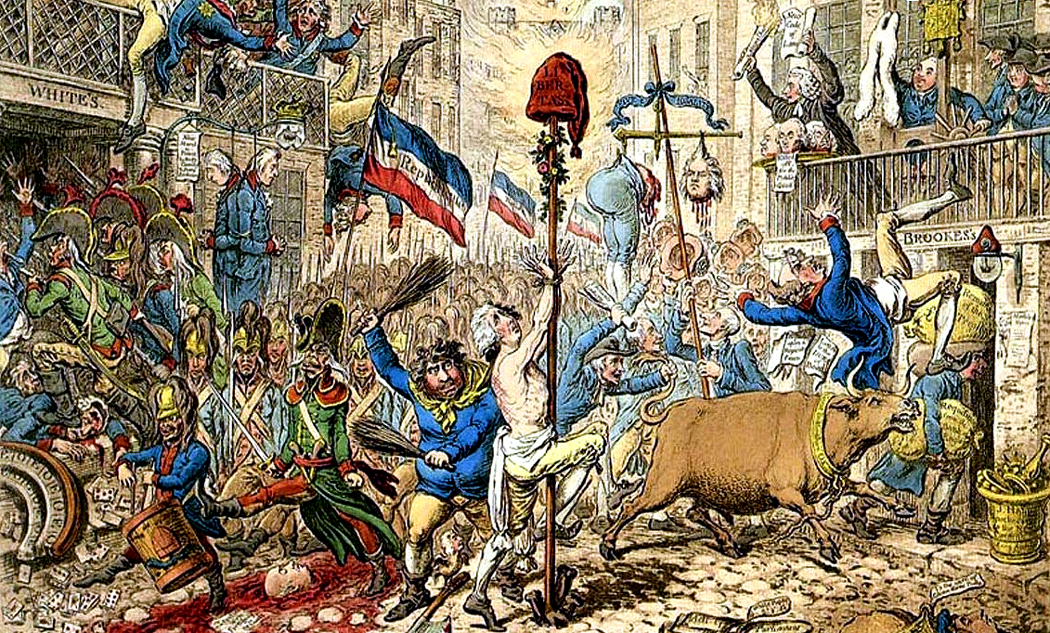
It was called, simply, “the Terror.”

the last death no one leftIt was probably the closest Western Europe ever came to the horrors of Rwanda — not just in body count, but as mere anarchy loosed upon the world.

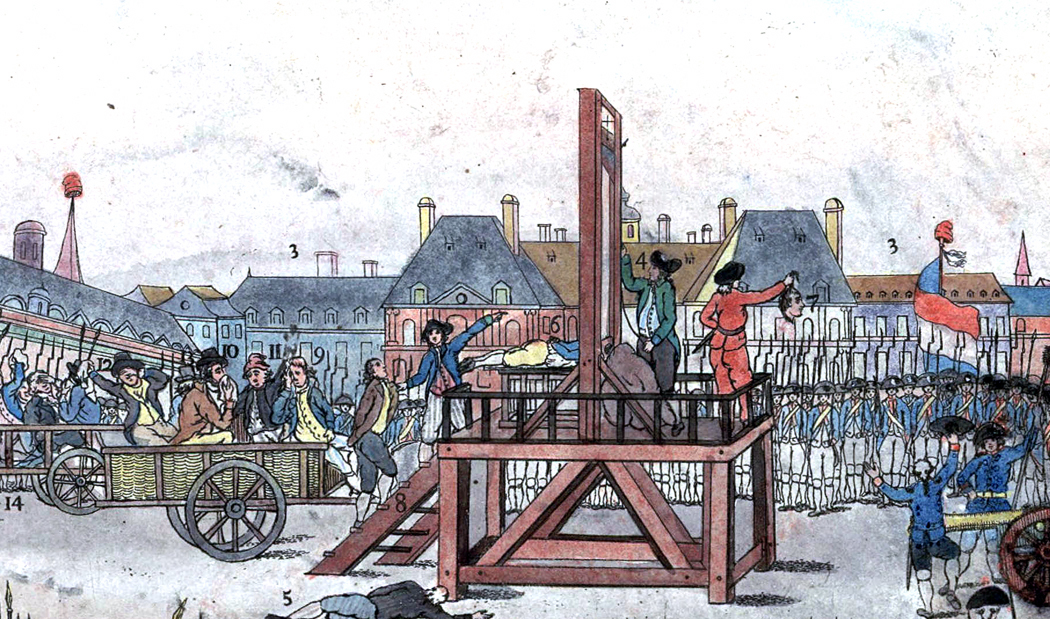
It was the French Revolution, and from September 1793 to July 1794, nearly 2,000 people a month were beheaded in Paris, many for nothing more than being too tepid in support of the Revolution.

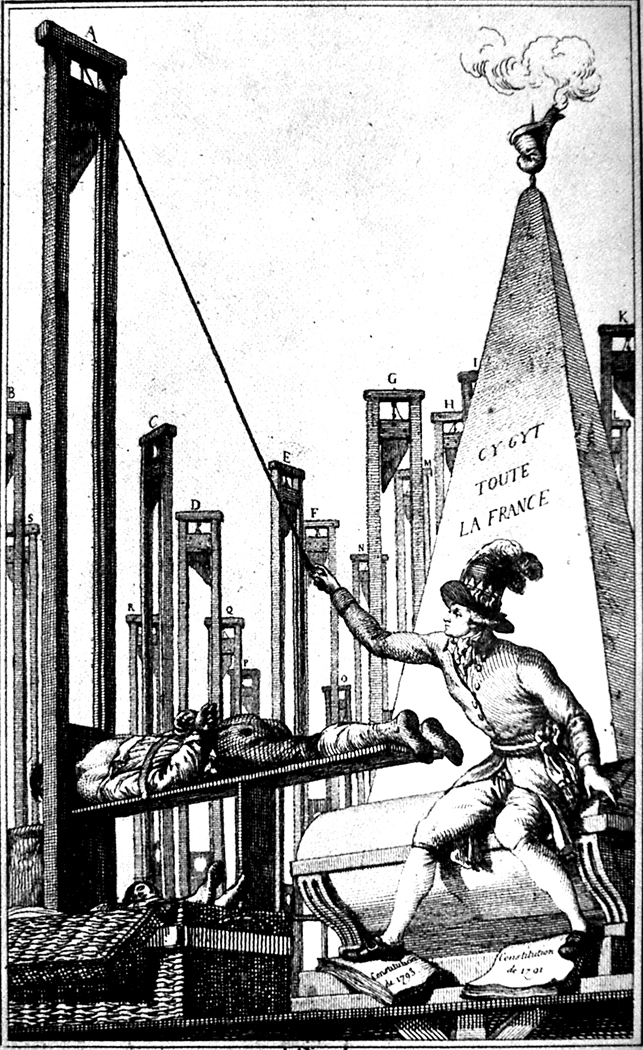
And in the middle of this bloody storm was painter Jacques-Louis David, who created the most famous painting of the Revolution, The Death of Marat, in 1793. It was a masterpiece of political propaganda.

But that is not all David did for the Revolution: That is not red paint on the artist’s hands. The painter personally signed at least 300 death warrants as a member of the Jacobin government’s Committee for General Security.

The painting, originally called Marat at His Last Breath, created a martyr of the revolution from a man who is more properly a war criminal. And it again raises the question of art’s moral responsibility.

Marat

Marat

The dead man in the painting, Jean-Paul Marat, was a journalist who called for thousands of heads to roll. “No, hundreds of thousands,” he wrote.

And on July 13, 1793 — the day before what is now Bastille Day — this greatest, most bloodthirsty exponent of the Terror was stabbed to death by a young woman.

“I killed one man to save a hundred thousand others,” she said.

She miscalculated. She had killed Jean-Paul Marat, but his death unleashed the worst of the Terror.

Jean-Paul Marat was not the kind of person you would think of if you wanted to create a hero.

He was a peculiar man, formerly a physician — some called him a quack — and at turns vicious and paranoid. He cut an unpossessing figure: Ugly, short, he suffered from a skin disease, likely a psoriatic arthritis, that left his face scarred: He called it “leprous.” To salve his discomfort, he conducted his daily business from a bathtub filled with cool water. On his head he wore a towel soaked in vinegar for relief. A board across the tub provided a desk.

Marat published a newspaper called Friend of the People, which harangued and incited. He lauded what he considered republican virtue and selflessness, and called for the death of anyone he considered a traitor: that is, anyone who didn’t agree with him. Patriotism and selfless devotion to the cause drove Marat.

James Gilray on The Terror

James Gilray on The Terror

It went well beyond a call for the beheading of the aristocracy.

In fact, during the Terror, 70 percent of those killed were from the lower classes. People settled grudges by informing on their neighbors. An accusation was enough.

But for painter Jacques-Louis David, Marat became the perfect subject to deify when he was assassinated in the early months of the “Reign of Terror.”

"Charlotte Corday" by Paul Jacques Aime Baudry, 1860

“Charlotte Corday” by Paul Jacques Aime Baudry, 1860

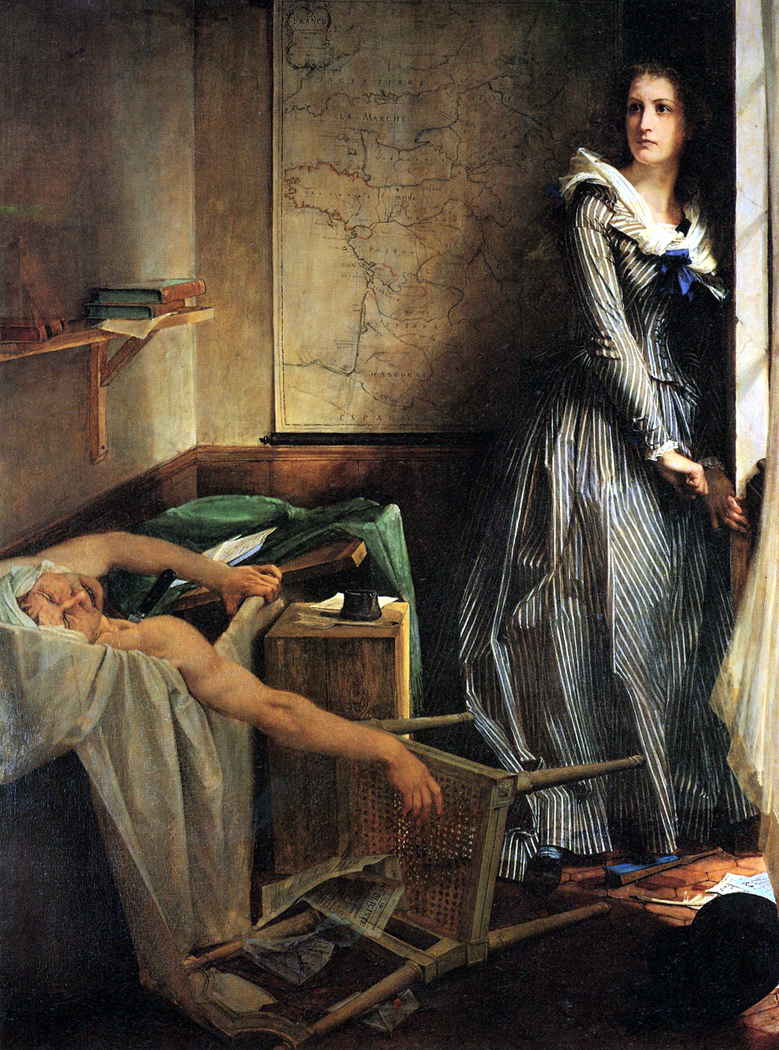
His assassin, Charlotte Corday, then just 23, felt just as keen a patriotism as Marat. But for her, patriotic duty meant she must kill “the monster, Marat,” even if it meant her own death.

She came to Paris, bought a 6-inch kitchen knife, wrote a note explaining her actions and pinned it to the inside of her dress. In it she called Marat “the savage beast fattened on the blood of Frenchmen.” She also bought a new hat, a green one.

On the morning of July 13, 1793, she went to Marat’s apartment, armed and determined. She couldn’t get past Marat’s bodyguards. But she came back in the evening, slipped in behind some delivery men, flashed a phony list of the names of “traitors.” Marat showed interest, calling her to his tub.

Marat looked the list over and told her, “Don’t worry, in a few days I will have them all guillotined at Paris.”

She then pulled out the knife and stabbed him in the chest once, severing his aorta and puncturing a lung. A jet of blood sprayed the room. He died calling for help from his friends.

Four days later Corday was beheaded for her crime, and Marat was transformed into a patriotic martyr.

And David was just the man to do it. He had been the artist of the Revolution, creating images of republican virtue and the glorious past.

When the news of Marat’s death reached the National Convention, one delegate yelled out, “David, where are you? Take up your brush — there is yet one more painting for you to make.”

Cartoon of Marat as defender of the People and the Peoples' rights

Cartoon of Marat as defender of the People and the Peoples’ rights

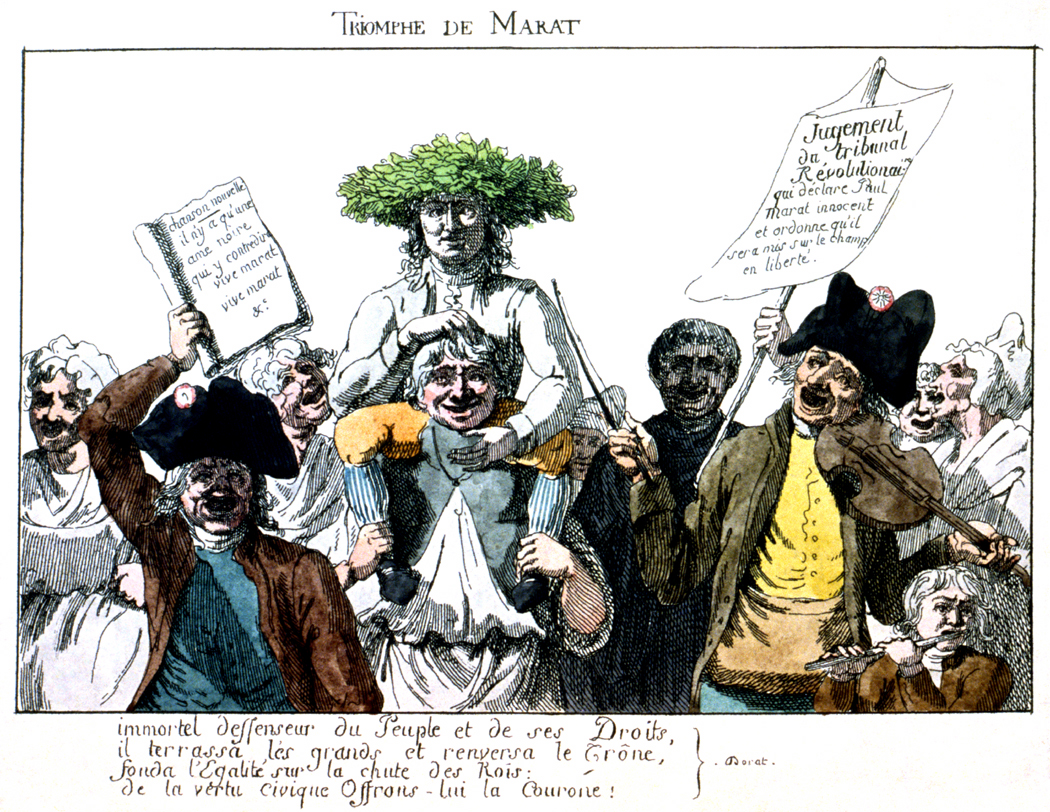
The propaganda machine went into high gear. A great public funeral was held — organized by David — streets were renamed for Marat, poems and songs were written. At least one new restaurant opened in the rue Saint-Honore called the Grand Marat.

“Indeed, Marat dead was perhaps more useful to the Jacobins than the unpredictable, choleric live politician,” wrote Simon Schama in Citizens, his history of the French Revolution.

A commission for a painting was voted and David began three months’ work on what would be seen as his masterpiece.

When it was finished, it was paraded around Paris like a Mexican santo, rallying the people to redouble their republican ardor and sharpen the cleansing edge of the guillotine’s blade.

Marat's death mask

Marat’s death mask

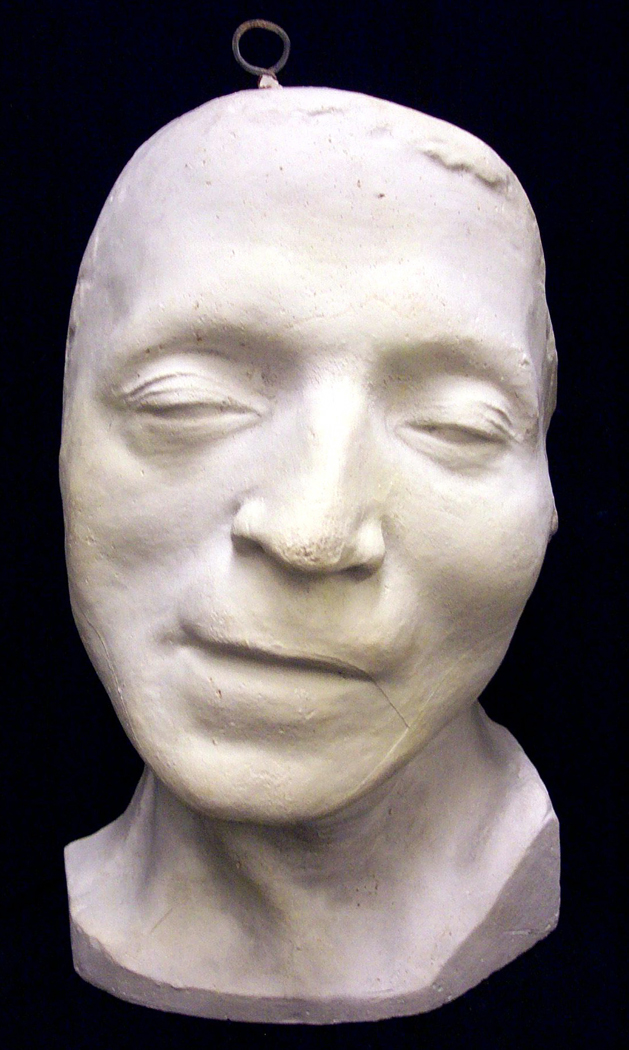
Thousands of cheap engravings were distributed, made from a death-mask portrait drawn by David. Marat’s eyes closed, his head tilted in death.

Copies of the painting were ordered from David and his atelier, to be sent to the other cities of France.

Instead of stopping the violence, as Corday had hoped, her act only worsened the Terror. The assassination now became a cause.

As for David, when the Terror ultimately collapsed and its architect, Maximilien Robespierre, was guillotined, the painter went to prison. At least he kept his head.

He was released after about a year in a general amnesty.

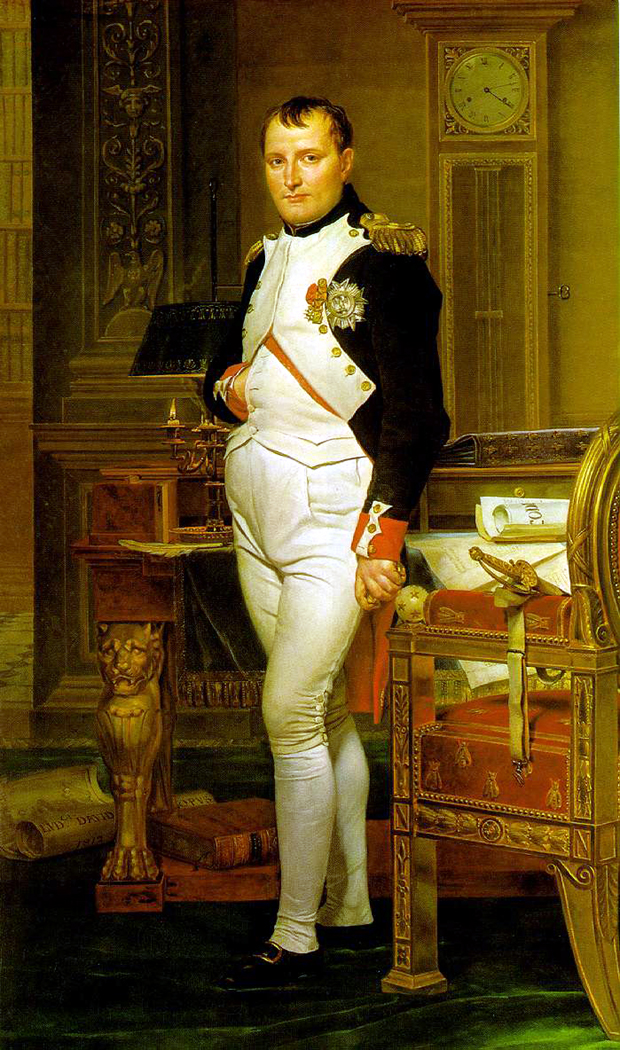
When Napoleon came to power, David became the imperial artist, glamorizing the First Consul as he had glamorized the Revolution. David was a political chameleon, a slippery eel. The artist was always looking for a “great man” to glorify, whether it was Marat or Napoleon.

"Napoleon in his study"

“Napoleon in his study”

When Napoleon fell, David went into exile in Belgium, where he died in 1825.

His great painting had a similar fate: It was withdrawn from the public shortly after the fall of Robespierre and sent back to the artist’s studio, where it remained, unexhibited till well after David’s death.

Finally, in 1848, republican sentiment arose once more in France and Marat came out of storage. The poet Charles Baudelaire saw it and wrote a famous encomium, which raised public awareness of the masterpiece once more. The painting became canonized.

Today, the most recognized souvenir of Marat’s life and death is the painting David made to immortalize the journalist.

It is powerful: “David weaponizes art,” said one museum curator.

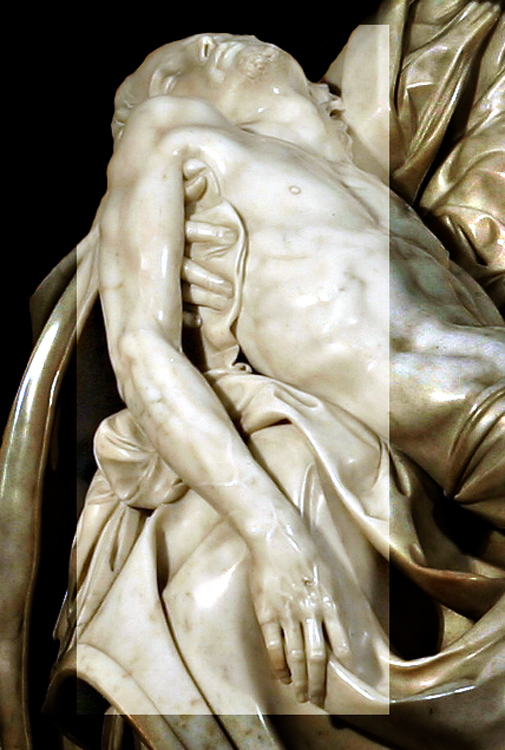
David’s painting is hugely original, mixing an almost journalistic sense of the here and now with familiar iconographic symbols, like the hanging arm of Michelangelo’s Pieta, turning the dying journalist into a Christ figure.pieta arm

That isn’t just a conceit: The subconscious reading of the painting can’t help seeing the echoes of earlier, religious paintings. David was able to mythologize current events and give them depth and power.

“If there’s ever a picture that would make you want to die for a cause, it is Jacques-Louis David’s Death of Marat,” historian Simon Schama says in his TV series The Power of Art. “That’s what makes it so dangerous — hidden from view for so many years. I’m not sure how I feel about this painting, except deeply conflicted. You can’t doubt that it’s a solid-gold masterpiece, but that’s to separate it from the appalling moment of its creation, the French Revolution.

“If ever a work of art says that beauty can be lethal, it’s Jacques-Louis David’s Marat.”

David has turned the paranoid fanatic into a saint of the revolution. He had also made what some have called the first “modern” painting: spare, direct, almost abstract in its design.

But the image raises a question: Can great art be made for evil reasons?

The question is not merely academic. These questions have come up many times in the past: Can Leni Riefenstahl be a great filmmaker if the films she made glorify Hitler? Can D.W. Griffith’s Birth of a Nation really be one of the most important films ever made if its heroes are the Ku Klux Klan?

And what about Westerns? Are our heroes cowboys? Or do we acknowledge our own genocide? What was once the patriotic foundation myth of our nation now embarrasses any thoughtful American. The once-famous Battle of Wounded Knee has now become the Massacre at Wounded Knee.

So, what do we make of art when we question the artist’s motives?

There are some who believe composer Aaron Copland’s music can’t be any good because of his lefty political leanings. And the take people have on Shostakovich often depends on whether they see him as a Soviet apologist or a secret dissident.

The art of Englishman Damien Hirst horrifies some people, because he may use dead animals, pickled in formaldehyde, as part of his art. His shows bring out the picketers.

Wagner cannot be played in Israel because of his anti-Semitism and because Wagner was Hitler’s favorite composer. Where can we draw the line on this?

Do we ban politically injurious art, the way many would ban the use of Nazi medical research?

"Execution of Robespierre" detail

“Execution of Robespierre” detail

“I can appreciate pure ‘art for art’s sake,’ ” says artist Anne Coe, whose paintings are never politically neutral.

Coe is an ardent environmentalist and lover of animals, and her paintings promote her views.

“But to me, the really knock-your-socks-off art has a little more,” she says. “It has ideas behind it. I think art is insipid without some sort of idea in it.”

And David’s art is all about ideas.

“David is the artiste engage par exellence,” says Mary Morton, associate curator of paintings at the J. Paul Getty Museum. “He gave himself completely to politics.”

The subject of the painting, she points out, is not so much Marat the man but the virtues of republican self-sacrifice.

“David’s art is very didactic,” Morton says. “It is about civic responsibility.”

And perhaps we are removed enough from the events of 1793 that we can see in David’s painting the idea rather than the man — the spirit of democracy instead of the call for blood.

“What is that line between propaganda posters, like ‘Uncle Sam Wants You,’ and the David painting, or the paintings of religious martyrs?” Coe asks.

“Does some art lead to evil things? That is the risk you take in a society that says everything is relative.”

There is no single answer to the question; you have to take each case individually and weigh it in your own conscience.

“I listen to Wagner. I love Wagner,” Coe says. “You can’t have an answer.”

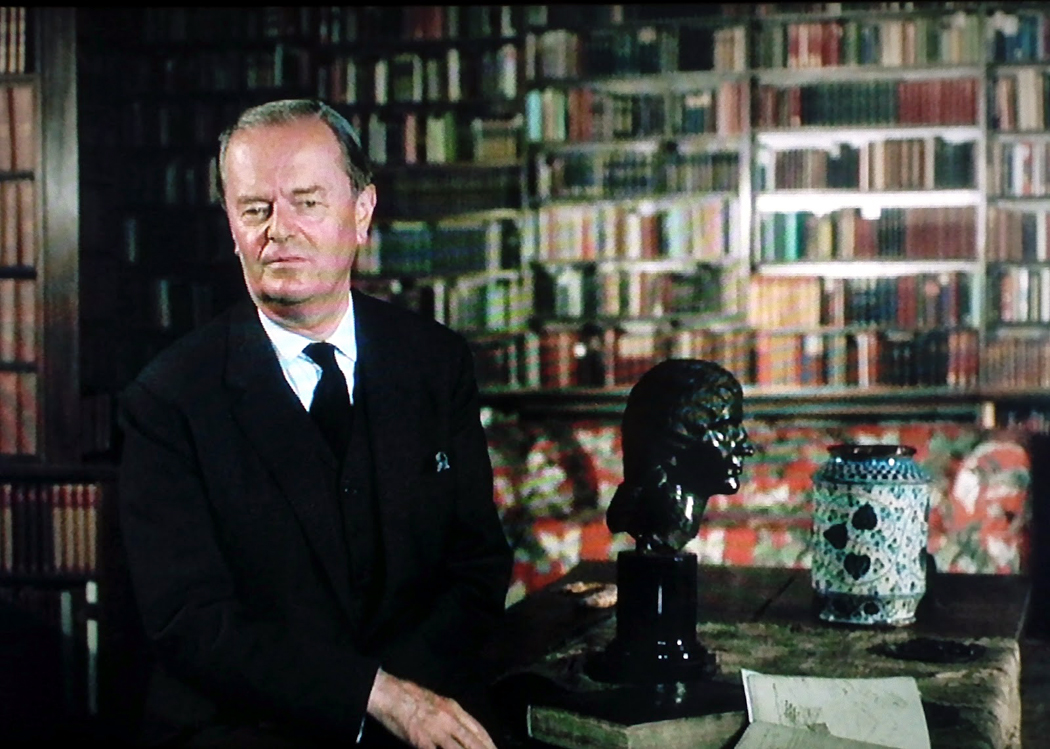
kenneth clark

Without the cosmos, there would have been no civilization.

But, without Civilisation, there would have been no Cosmos.

Bettany Hughes

Bettany Hughes

And probably no Civil War or Jazz. And no jobs for all those BBC presenters, from Bettany Hughes to Michael Wood.

And Michael Palin would have been merely another retired Python.

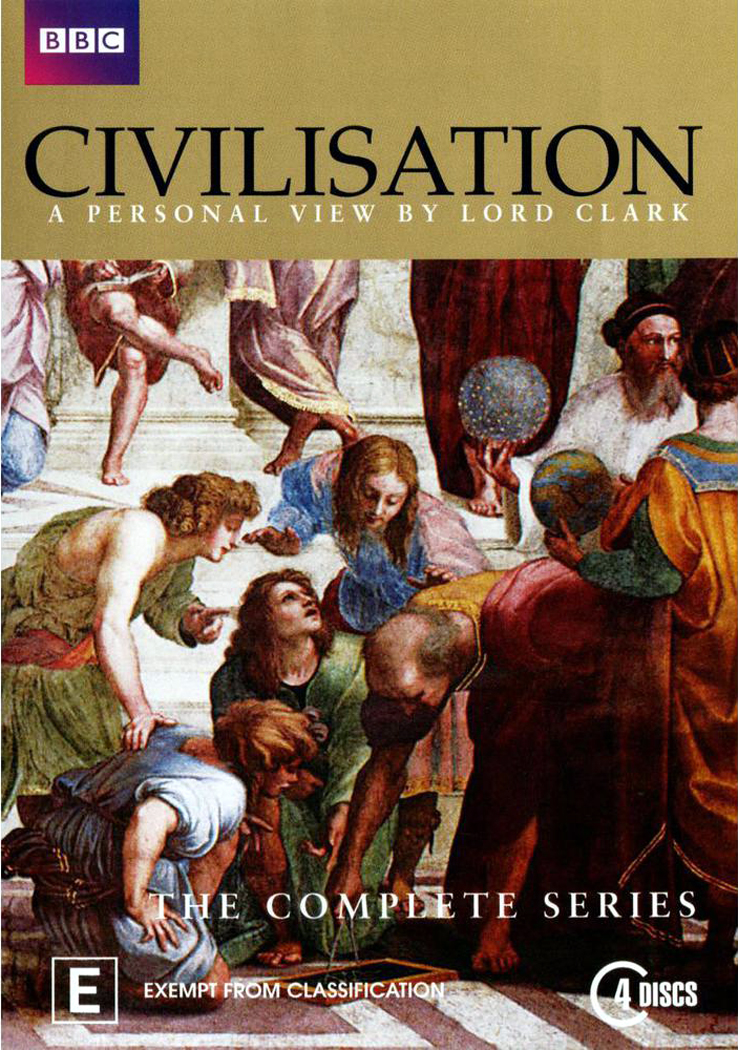
Sir Kenneth Clark’s 1969 BBC television series is the granddaddy of all BBC and PBS high-culture series, where an engaging personality teaches us history or art from a personal point of view. For anyone who remembers seeing Civilisation when it was first broadcast in the United States in 1970, seeing it again, now on DVD, will be a revelation.

First of all, the film quality is excellent. Unlike other old series, presented in grainy, contrasty aged versions, Civilisation looks mahvelous, just as crisp and bright as when it was first broadcast. civilisation dvd cover

The series was initially filmed in color, and on 35mm stock, making it visually stunning. The BBC has remastered the original films onto HD and they are now available on Blu-Ray, at least in Europe. (One hopes that an American Blu-Ray version is soon in the offing).

Second, it is a much better, more nuanced view of its subject than you probably remember. If you recall it as Clark, with the British public-school back-palate drawl, talking about the “great masterpieces” as if he were an Oxfordian tour bus guide, you will be in for a surprise: His view is much more subtle than that.

Certainly, since the series was made, the general view of art and history has broadened, and the view of Western civilization as the be-all and end-all of human existence has been tossed out on the rubbish heap of ideas. Deconstructionists have shown us how our aggrandization of certain fetish items of cultural history has merely served to legitimize a particular ruling elite.

Yeah, yeah, yeah — we know that. But Clark’s view isn’t so simple. It is true that he exemplifies an old-fashioned “great man” view of history, and for that we have to listen to him with a grain or two of sodium chloride, but he is not merely the smug purveyor of status quo. He makes a serious attempt to discover just what civilization might be, and uses the past 500 years of European history to make his discovery.

“Writers and politicians may come out with all sorts of edifying sentiments,” he says in the series, “but they are what is known as declarations of intent. If I had to say which was telling the truth about society, a speech by a minister of housing or the actual buildings put up in his time, I should believe the buildings.”

And look at the buildings, we do. That is a third surprise in the series: Clark’s willingness to shut up for long periods of time while the camera shows us the art, the building or the landscape, so we may discover it for ourselves and not just take Clark’s word for it. He is more interested in sharing something with us than pounding us with his point of view.

We could do worse than consider his point of view, for it isn’t just about justifying power, but about seeing the results of how we view ourselves and our culture.

Civilization, Clark says, is energetic above all, always making something new. It is aware of the past and supremely confident and willing to plan for a future that will extend beyond our lifetimes, and therefore has a belief in permanence. It also has a firm belief in self-doubt. It fosters compassion and is willing to consider other points of view.

It is this last that the current wave of deconstructionists has failed to notice: Deconstruction itself depends on one of the supreme ideals of Western culture.

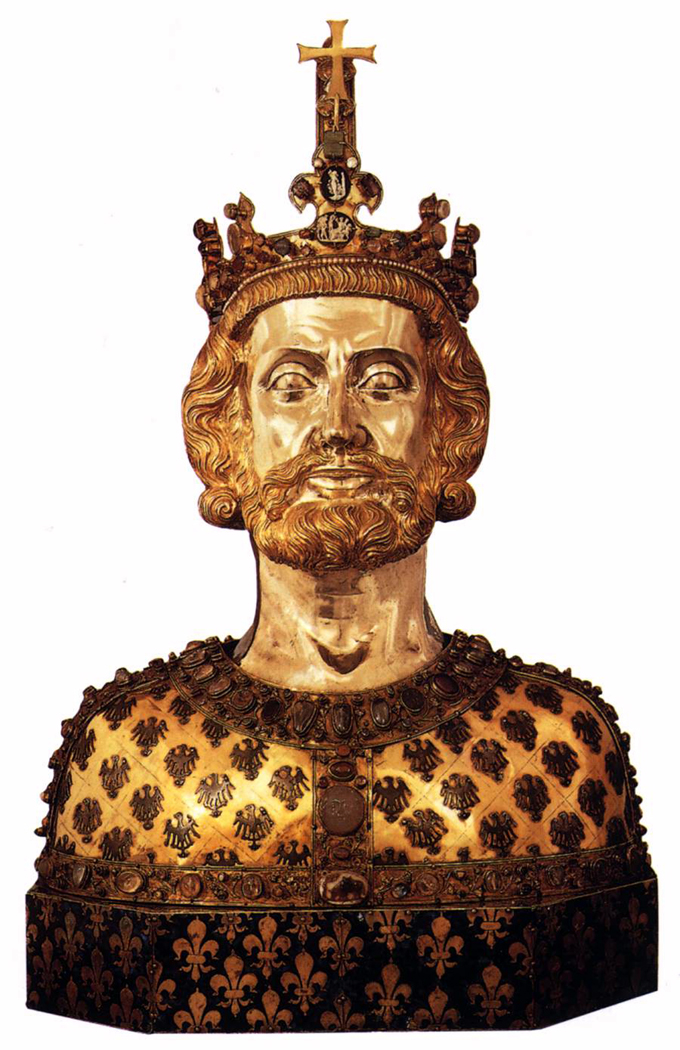
Charlemagne reliquary

Charlemagne reliquary

The full title of the series, with its British spelling, is Civilisation: A Personal View, and we should never forget — and Clark never forgets — that it is a single take on the subject. It is an opening statement in a conversation, not a final word to close off discussion.

And carping critics who complain that Western civilization — and post-Classical civilization at that — is hardly the be-all and end-all of civilizations in the world — well, Clark admits he has enough on his plate to cover Charlemagne to Monet. We wait for his counterpart to give us a similar personal overview of China, India, Africa or the New World. Clark has given us the template. Have at it.

The BBC took a chance when it made its first full-color TV series. It ultimately proved so popular that it was followed by Jacob Bronowsky’s The Ascent of Man and a host of others, from James Burke’s Connections to Ken Burns’ Civil War. It has proved a durable genre, but this release shows the first of its type remains one of the best of its type.

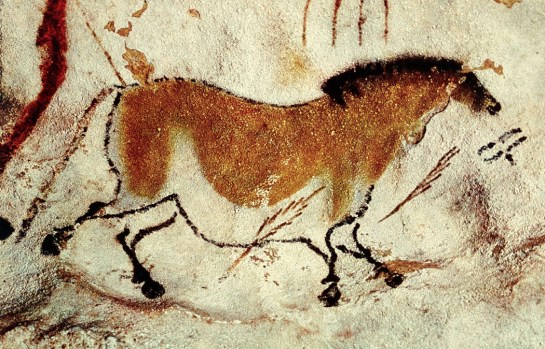
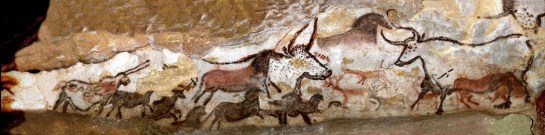
lascaux horse and sign

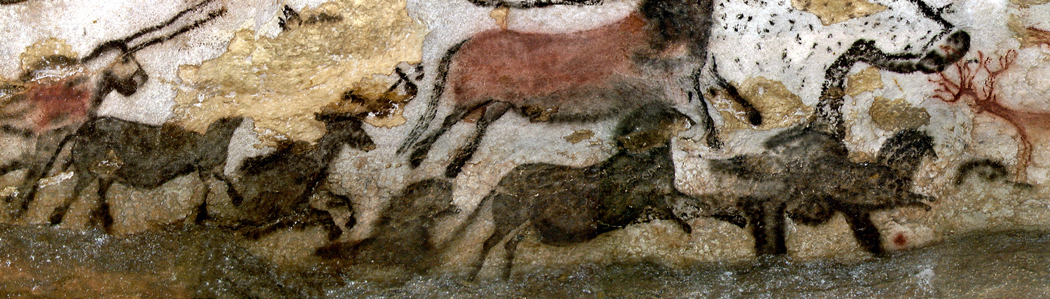
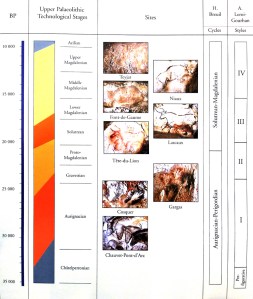
Seventeen-thousand years ago, a group of people very much like us descended into a cave in Magdalenian Europe and began painting animals on the walls. We can hardly know what drove them, although we enjoy pondering their motives.
Click to enlarge

Click to enlarge

Caves, like the one at Lascaux, had been decorated at least since 30,000 years ago — as at Chauvet caves to the east of Lascaux — but it is Lascaux that has most captured the world’s imagination. Tourists came by the thousands to walk through the galleries and be awestruck. That is, until their very enthusiasm began to endanger the drawings. Now, tourists come to see the replica of the caves at an attraction called Lascaux II.

My wife and I had been to France many times. We had visited most of the great cathedrals of northern Europe, from Amiens to Rheims, and had made pilgrimages to sites like Mont St. Michel and the Impressionist Eden where Claude Monet painted at Giverny. We had gained a profound education in the long line of history and culture that informs who we are today.

Carole likes to look into the old family photographs to see the physiognomic evidence of her genes, dating back to her great-grandfather, Rowan, who fought (on the losing side) in the American Civil War. She searches old genealogical records to carry that family history back further into time, at least back to the 18th century. For her, as an artist, looking at the bulls and horses of Lascaux is very like seeing the ultimate and oldest family photographs.

Click to enlarge

Click to enlarge

This is where our histories began, or at least, where they were first recorded, in the cave paintings along the Vezere valley from Montignac to Les Eyzies.

And, although Lascaux II is a reproduction, and not the original, it can carry the same potency that a reproduced family photograph can have. It is the pith of the image that carries the wallop and not its provenance. Seeing the imitation still gives us something that images in a book cannot convey: the size, the architecture, the surface. And it gives us a fighting chance to imagine ourselves in the caves before the development of writing, governments or digital watches. We can feel in our hearts the atavistic rumblings. That this is an act of imagination rather than a literal case is not only not a detriment, it is a positive improvement: Imagination is the source of everything here and that has come after. We would hardly be human without it.

We found the billeterie and bought our tickets for Lascaux II and were told there was an English language tour at 11:30 a.m. Lascaux II is about a kilometer out of town, up a narrow road and a narrower driveway, with lots of cinder parking lots at the top.

We waited where we were told to wait, and about 20 others joined us until a young man with balding hair and a flashlight came out and welcomed us in English with a characteristic French accent.

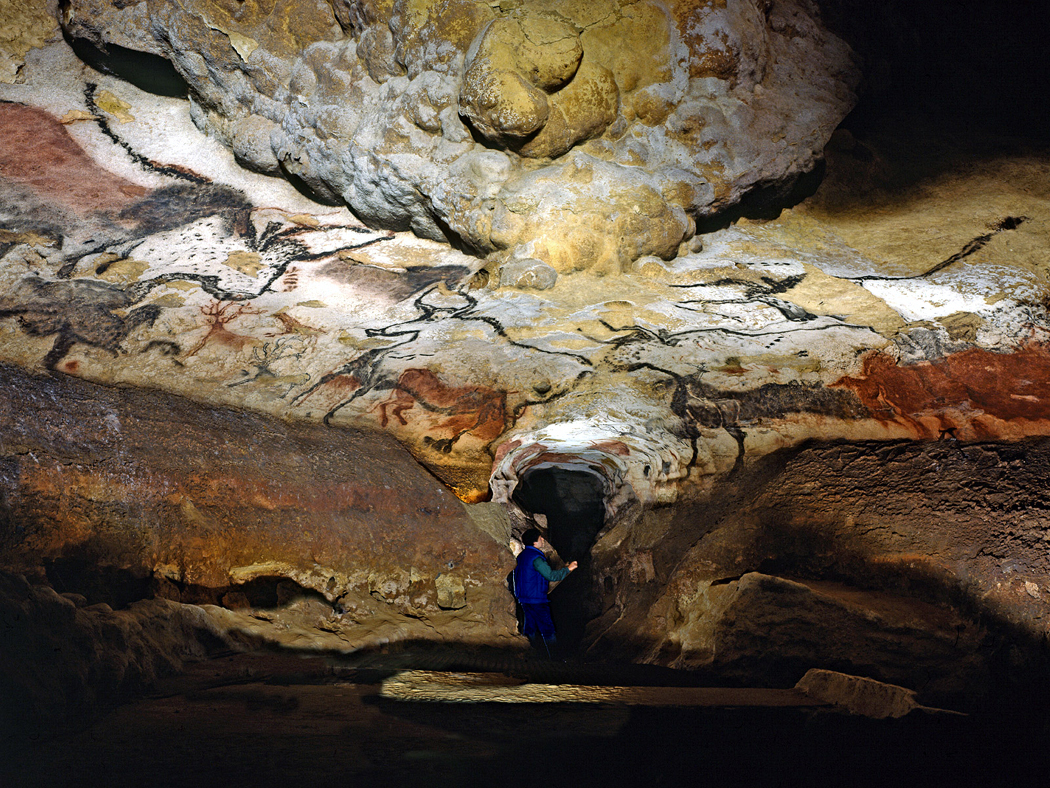
We walked down a flight of stairs into an underground chamber that had a dozen or so museum-style exhibits describing how the cave was discovered, how it was formed geologically, and how visitorship had damaged the original caves, and so a new reproduction was created for visitors, out of concrete, measured, millimeter by millimeter from the original. Two of the largest galleries were recreated in Lascaux II, including about 80 percent of the best animal drawings in the cave.lascaux ii

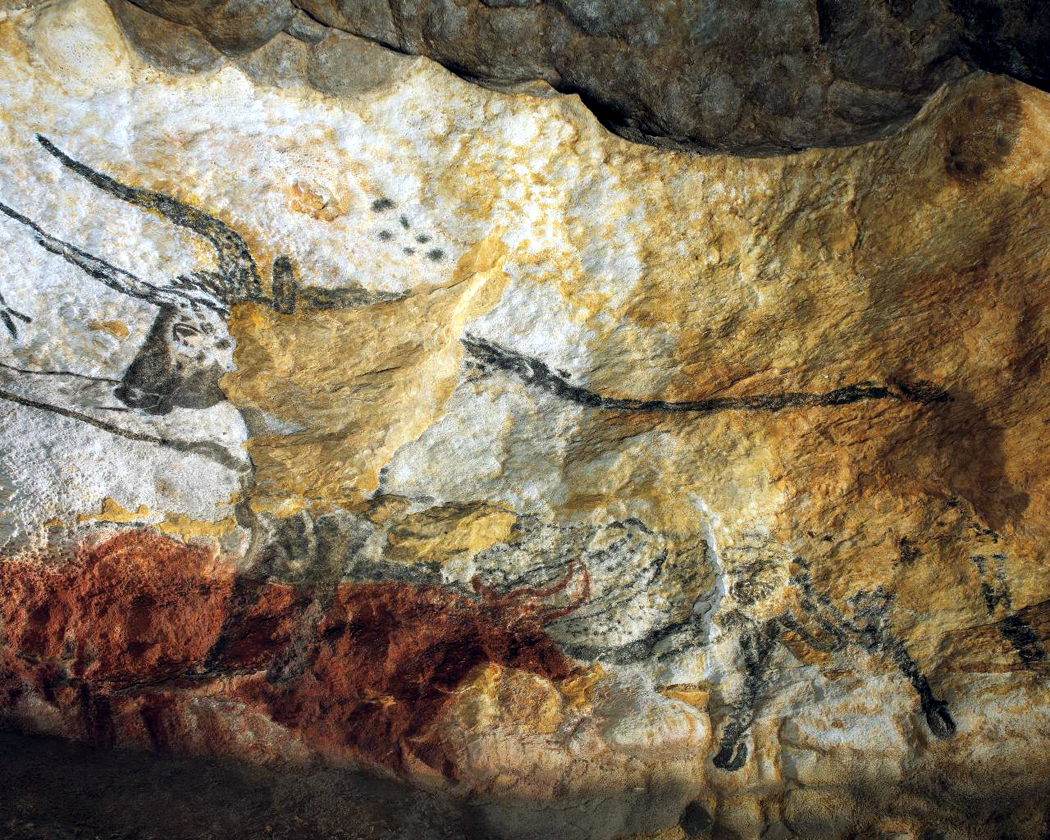
He led us into a darkened cavern the size of an auditorium and on both walls we saw animals, beautiful animals drawn, some smaller than lifesize, some, like the great 18-foot-long taurus, larger than life.

The bottom of the cave was “wainscotted” with clay, and no drawings were made on the clay.

“You cannot paint on clay,” our guide said.aurochs and horses lascaux1947
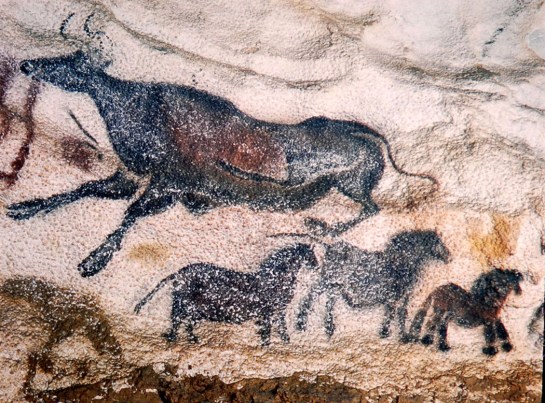
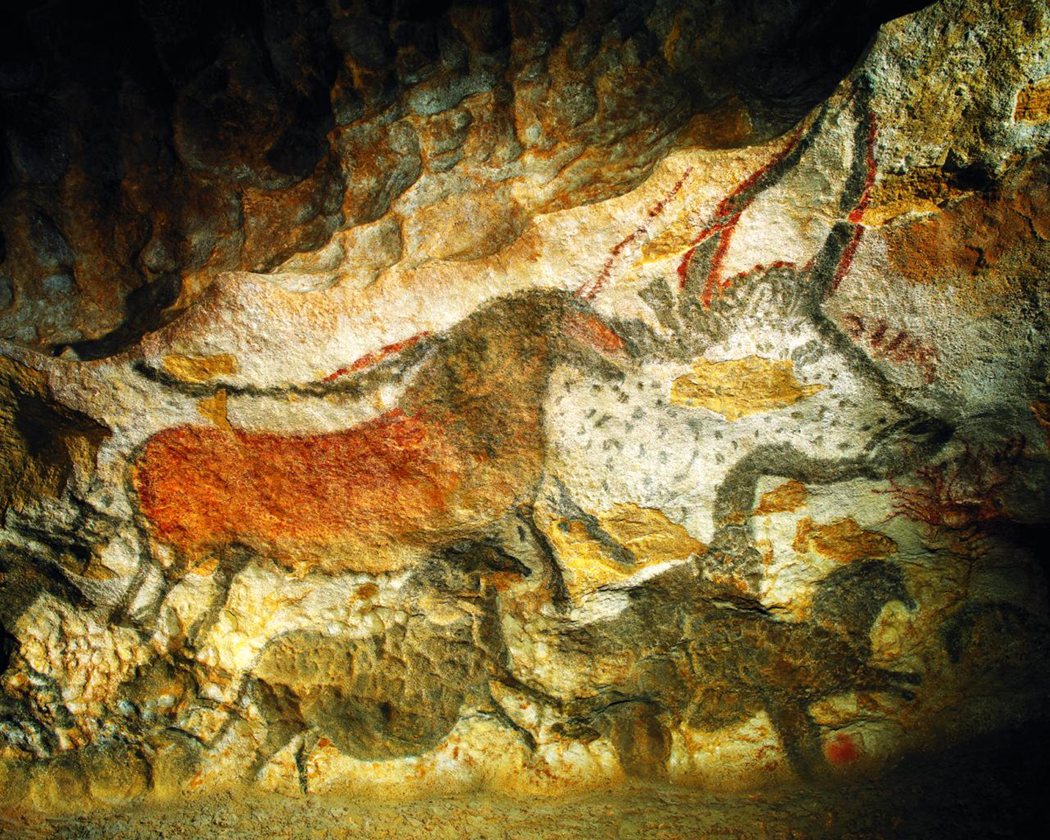
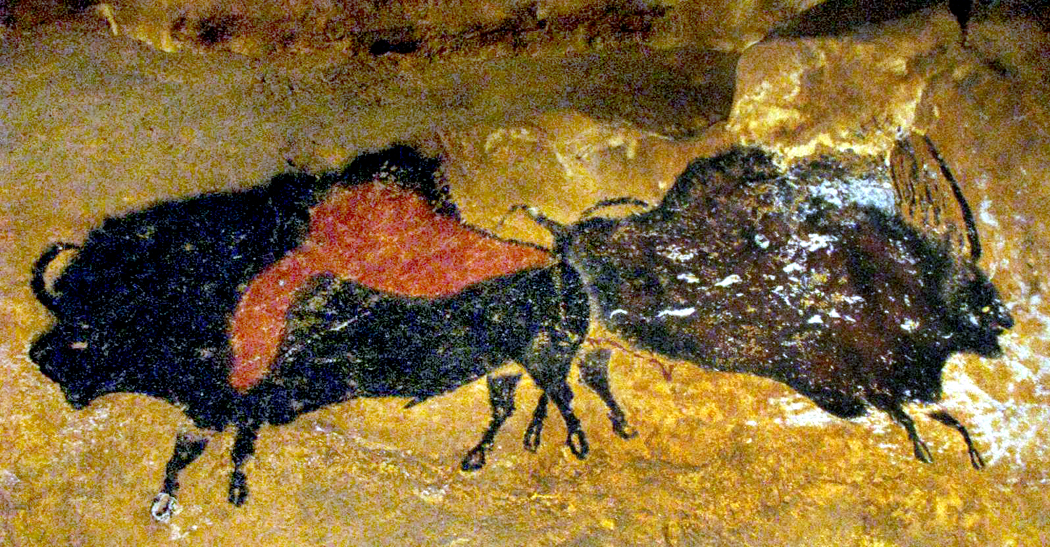
But on the limestone above were a ring of horses overdrawn with a larger ring of bulls, as if a horse cult had made an altar for equines, and maybe centuries, or millennia later, a bull cult came in and made their altar for their bulls. The bulls were all bigger than the horses, and tended to be in outline form, while the horses tended to be filled in with color. (This was not universally true, but is the tendency.)

There was also a figure the guide called a “unicorn” at the very entrance of the cave, although why it was called a unicorn, I don’t know, since it clearly had two horns blazing out of what seemed like a lion’s head.lascaux unicorn

Carole immediately spotted it as a shaman wearing an animal hide and carrying two sticks, like the African deer dancers we have seen pictures of.

“The first figure, as we entered the bull room, was not the most impressive — the big bulls were — but the first figure is something you work your way back to after recognizing what the other figures are,” she said.

“The first figure is mysterious and it isn’t drawn with the same confidence as the bulls and horses. There are not the same strong completely informed curves. The first figure looks like a man with black legs whose back and head might be covered with a lion skin. In place of his head is a lion’s head, with what looks like two long, straight horns protruding from the temples. I think those two prongs were not horns, but were sticks the man was carrying. It looked like the sides of an animal skin were hanging down on both sides from the man’s torso, if he was a man.

“Our guide showed us what he called a ‘hump of fat’ on the man’s back, like the hump of a bull, or maybe a grizzly, but I thought it was the lion’s mane. It wouldn’t have been practical to make something there like a lump of fat, if the man were wearing a costume.

Because the man was right there, and drawn smaller than most of the other figures, he did not seem to represent his own importance; he seemed to be driving the animals. His placement puzzles me. I don’t know what these paintings were for, but I do know what they are, and I think that is joy.”

click to enlarge

click to enlarge

Perhaps he was driving the animals in the cave in a kind of cattle drive.

The animals, especially the horses, tended to be drawn in series, and at least one series — “like a musical phrase,” Carole says — shows them advancing from a standing horse, through a walking horse to running horses.Lascaux II bull and horse
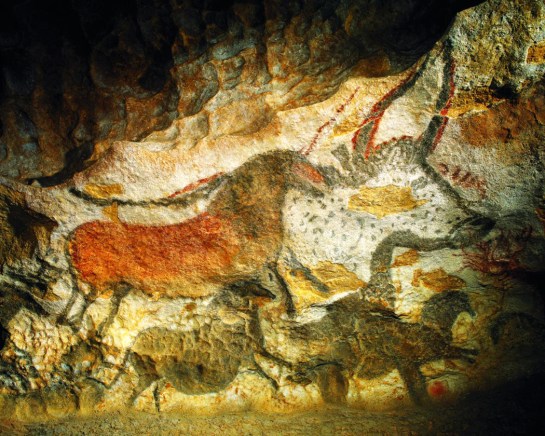
The horses were finely seen, with astonishing attention to anatomical detail, allowing for a certain amount of distortion, like the distended bellies on several of the horses, and legs rather shorter than their bodies would have had. Still, the attention to joints, hocks and fetlocks was surprising.

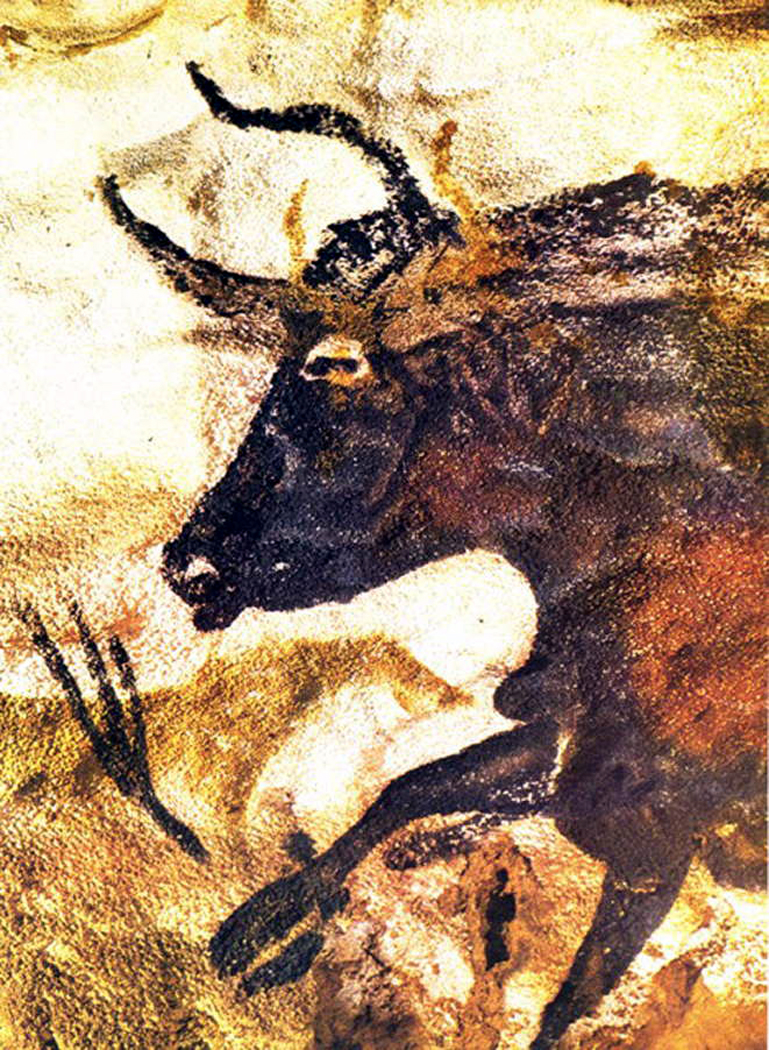
The bulls, much larger and drawn above and overlapping the horses, were often just heads and shoulders. Some had the curved backs and bellies and jaunty forelimbs racing out front. But although they also showed keen attention to anatomy, they clearly were meant to impress with size and energy.megaloceros room

The second room we entered was called the Axial Gallery and contained many more wonderful drawings, including a group on the ceiling, leading some to call it the “Sistine Chapel of prehistory.”black bull 2

You can see why they might say so, for the animals, all drawn with care for detail and expression, were everywhere.

“Our guide gave a running commentary and explanation of what we were looking at, but I tried not to hear him and tried to pretend that I had accidentally found it, so I could feel it only visually,” Carole said.

“I had a great feeling of joy and definitely a feeling of inspiration and gratitude. It felt just like a cathedral and I think I said out loud, ‘It is a cathedral, Richard.’

“I thought the most beautiful drawings and paintings were the bulls. They had wonderful curved horns, like Picasso’s bulls, but their heads were more prominent and really beautiful. Beautifully shaped and beautifully drawn. On at least one bull’s face, the detail of the nostril and the mouth were indicated by negative space against a black muzzle.

“If I had been alone, and obeying my instincts, I think I would have skipped and danced and clapped my hands, in a circle, round and round and round in the round room, just happy because of the bright contrast and the strength of the animals, and the joyous beauty of them running together, overlapped and contained within.lascaux II panorama 2

“There were little runs of horses like musical phrases.

“After seeing all these paintings and drawings, bulls, horses, reindeer, it becomes hard to believe they could have been anything but religious objects, icons or totems for clan worship.”

Despite being so realistic in so many ways, they are also somewhat stereotyped: the same horse shape from the same side angle. The same bull head over and over.

But there was one exception: At the end of the chamber, in a darkened corner where the passageway was bifurcated and narrowed, there was what looked at first like an upside down horse.falling horse

“Perhaps they thought it was Australian,” joked our guide.

“Or perhaps it had been killed and was dead,” he said.

But a dead horse is not upside down like a cockroach, but flat on its side.

No, this horse seemed to be dust-bathing, rolling back and forth on its back, almost playing. Alone of all the paintings we had seen in the Lascaux II galleries, it seemed to be an artistic rendering of something the artist had seen in the real world and was drawn not because of its totemic meaning, but simply for the pleasure of rendering experience, of seeing the world.

Lascaux II was a decidedly more satisfying experience than the Font-de-Gaume paintings: The animals were better drawn and they could be seen with a clarity missing in the other cave. There was a joy to the energy of the animals racing and jumping; you could hardly fail to be exhilarated by them.Big Bull Lascaux II

And seeing them in situ — even in a reproduced situ — gave you a much deeper understanding of them compared merely to seeing the photos in a book. Some of them are giant, like the 18-foot bull, a scale you can’t reproduce in a halftone.

They are some of the most astonishing drawings I’ve ever seen, even if they are 17,000 years old.

For Carole, as always, they hit with a more personal note.

“Maybe one reason I love these paintings and this experience so much is that I’ve made this paint myself, many times, beginning when I was about six or seven years old, in my back yard. There was plenty of iron oxide red dirt, plenty of yellow ocher clay and always charcoal from the place where we used to build a fire and roast oysters.

Notice the overlapped hindquarters

Notice the overlapped hindquarters

“I regularly made mud pies out of the red dirt and yellow clay and set them out on the back steps to dry for my playhouse bakery. The stain that the red mudpies left on the steps would not come off, no matter how much I washed it. So when Daddy had the men in his plumbing shop paint the back of our house white, I couldn’t wait for the white paint to dry; I pestered my parents about when the paint was going to be dry and unfortunately, they didn’t think to ask me why I was so interested. As soon as it was dry, I mixed up a bucket of red dirt and water and got a window sash brush. I used the step ladder and painted everything I knew how to draw all across the back of the house, as large as I could and I signed it with my name.

“I asked Mother and Daddy to come out and take a look at the wonderful thing I’d done. Daddy was not pleased and I was sent back up the stepladder with the same bucket and soapy water, but it never came off. Eventually, we painted the back of the house white again, but some of the red still bled through.

“And all I really learned from this was that that red dirt must be one of the most powerful things in the world. It made me love it more.

“I’ve written a lot of poems about that red dirt. When I went barefoot, it used to stain my feet. The red water it made in the bottom of the bathtub was beautiful, running toward the drain.

“Then, when I was in my 30s, I had a house that had a fireplace and I always had pieces of charred wood. From the time I was little, I would try to draw with pieces of charred wood, because I thought Abraham Lincoln did his homework with such a thing. On this day, I used charred wood on paper to make a large drawing of the sun’s face. I drew the outline and the features with black and I made yellow ocher paint and red iron oxide paint from the dirt in my yard in Greensboro. I hung it on the wall above the fireplace, where it hung for six years. I called it ‘Abraxas, the god of change.’Lascaux II bull paintings

“I still love the range of contrast that you get from this velvety black, strong iron red and buttery yellow ocher. There were cows the color of yellow ocher that used to sleep in the grass on the river road past our house. When the grass in those fields turned lion colored, the cows were camouflaged. In the summertime, thousands of orange day lilies filled the same pastures.

“So, actually, when I was in the cave, I experienced the pictures in my body, with my hands and memory of mixing those paints myself, and feeling like a hero making pictures with the paint.”lascaux panorama
hisitory mosaic

History is endlessly fascinating.

If I were restricted to one class of reading, history would be it. I am not alone. Whenever politicians are asked for their favorite books, they seem to be history and biography (even as you suspect that the list was actually compiled by an aide), and the busiest corners of used bookstores seem to be the history sections.

When I was a boy, devouring the school library, I avoided fiction. “I don’t want to read anything that isn’t true,” I told my parents — misunderstanding the nature of truth, as one is likely to do in the second grade.

History provides at least four important things for the growing brain. In order of ascending importance, they are:

Entertainment — A well-written history is fun to read. When you are reading Barbara Tuchman or Edward Gibbons, you are reading a page-turner. As one history lover has written on his Web page: “It’s not the facts or dates we want. We want, for a time, to be the person who rode out of Paris to go on a Crusade, and rode past serfs tilling the land, dressed in browns and blacks because they were forbidden to wear bright colors by law. We want to feel the pride of being French, thinking that we could defeat the German army because, we are French! But alas, the Germans crush us anyway. What did we feel then? Tuchman tells history as a story, and makes us feel the wonder of the connection we have with all the myriad, strange, and beautiful humans who have lived and died to bring us to where we are today.”
Guidance — Reading history shows you what other people have done when faced with situations similar to those you may find yourself facing. You can benefit by their mistakes as well as their successes. It is also useful to know history to recognize the prospects for current policy choices made for us by government. Should we get into this war?

Before entering Syria, we might want to re-read our Herodotus. We wish to god George W. Bush had read it before going into Iraq.

But you don’t have to go all the way back to the Persian Wars. You have a different view of it if you know the history of the division of the Mideast into mandates after World War I. If you want to really understand the recent presidential elections, you must know the organization of the Roman imperial and republican governments and the sway they held over this nation’s founding fathers. The roots are that deep.

The saddest truth of all — after Jean Renoir’s quote from Rules of the Game: “The awful thing about life is this: Everyone has his reasons” — is that, pace Santayana, it is not those who don’t learn from history who are condemned to repeat it; those who have learned their history are the ones who see it repeated endlessly. To those who know nothing of history, it’s brand spanking new each time it happens.
Humility — More important than reading popular histories, though, is attempting to do some actual history, yourself. Few people ever give much thought to what a historian does. I suppose if you asked the man on the street, he would say a historian reads a lot of books and then writes his own. But history is altogether more difficult and tenuous. For what is history? (I know Gibbon himself gives one answer: “little more than the register of the crimes, follies, and misfortunes of mankind.”) No, history is the tentative answer to the puzzle of missing parts. history tondo

A historian sifts through the extant records of a time long extinguished and attempts to piece them together in a way that makes convincing sense. He reads letters, court records, newspaper accounts, bank statements, weather records, church chronicles and royal edicts; he attempts to put them in chronological order and reconcile the inconsistencies; he has to weigh which records to trust and which to doubt; he has to be familiar with the biases of the times, to know what “code words” mean — and each age has its code words.

You can do some genuine history for yourself: Attempt to write the story of your grandparents, for instance, using your parents’ recollections, old family Bibles, family snapshots, birth and marriage certificates. You will be astonished at two things: how difficult it is to make it all coherent, and how fascinating it is to make the attempt. And that leads to the fourth and most important thing history can bring us.

Respect — If there is a single sin that is most widely committed by the public, it is that of presentism — the belief that people in the past thought and acted just as we would, only without the benefits of modern technology.

In fact, those in the past not only thought differently, they lived in a world differently defined: Things which were manifest to them are ignored by us; things we find self-evident, they never gave a thought to. What we learn is a different kind of humility. Not just the humility of the historian knowing what effort it takes to recreate the past, but the humility of knowing that there are other ways to organize and value the world than those we currently take for granted.

We wander into church in shorts and shirts; our grandparents wouldn’t have dared. They lived in a more formal world, in which the formality expressed respect. We live in a culture that values independence and individuality. Other cultures valued group cooperation more highly.

History shows us that we aren’t always “right” and the past isn’t always “wrong,” but that at all times, we are seeking to know and do what is real and just, but are blinded or frustrated by the biases of the day.

I’m not talking about excusing our slave-owning founding fathers but understanding how they believed the world to be organized by the divinity they believed in. Understanding is different from judging. If we recognize the sincerity of Thomas Jefferson, and not just the hypocrisy, we may allow the possibility that we, living now, may be just as guilty of another sin, which we ourselves cannot see clearly.

History makes us less self-righteous. And the less smug, the less likely we are to make evil on our fellow human beings. This is why the last aspect of reading history is the most important.

fort clatsop brochure

Most people visit Fort Clatsop in the summer and so miss understanding history. The only proper way to see it is in midwinter, when the air is as raw as frozen hamburger and the rain drizzles down into the fibers of your clothing.

Fort Clatsop National Memorial is just a few miles from Astoria, Ore., and is where the Lewis and Clark expedition spent four cold months in 1805-06, waiting for the spring thaw so they could return to civilization. Meriwether Lewis and George Clark had led an expedition of 45 men up the Missouri River beginning in 1804, exploring the Louisiana Territory that President Thomas Jefferson had just bought from France. Lewis and Clark were charged with finding a way through the territory to the Pacific Ocean on the other side of the continent.

They spent two summers and a winter getting to the Pacific and another winter camped at Fort Clatsop, which they built as temporary quarters and a way to keep some of the constant rain off their heads. Of the 106 days they spent at the fort, the sun shone for six. fort clatsop fog

Life was constant misery. According to their journal entry for the day after Christmas, 1805, ”rained and blew hard last night, some hard Thunder. The rain continued as usial all day and wind blew hard from the S.E. Joseph Fields finish a Table & 2 seats for us. we dry our wet articles and have the blankets fleed, The flees are so troublesom that I have slept but little for 2 night past and we have regularly to kill them out of our blankets every day for several past. maney of the men have ther Powder wet by the horns being repeatedly wet, hut smokes verry bad.

Lewis and Clark were not hired for their spelling.

The original fort is long since returned to the soil it came out of. But a copy of the original, built from the description and plans in the expedition journals, has arisen in the original location.

The fleas have not been re-created for the modern visitor.

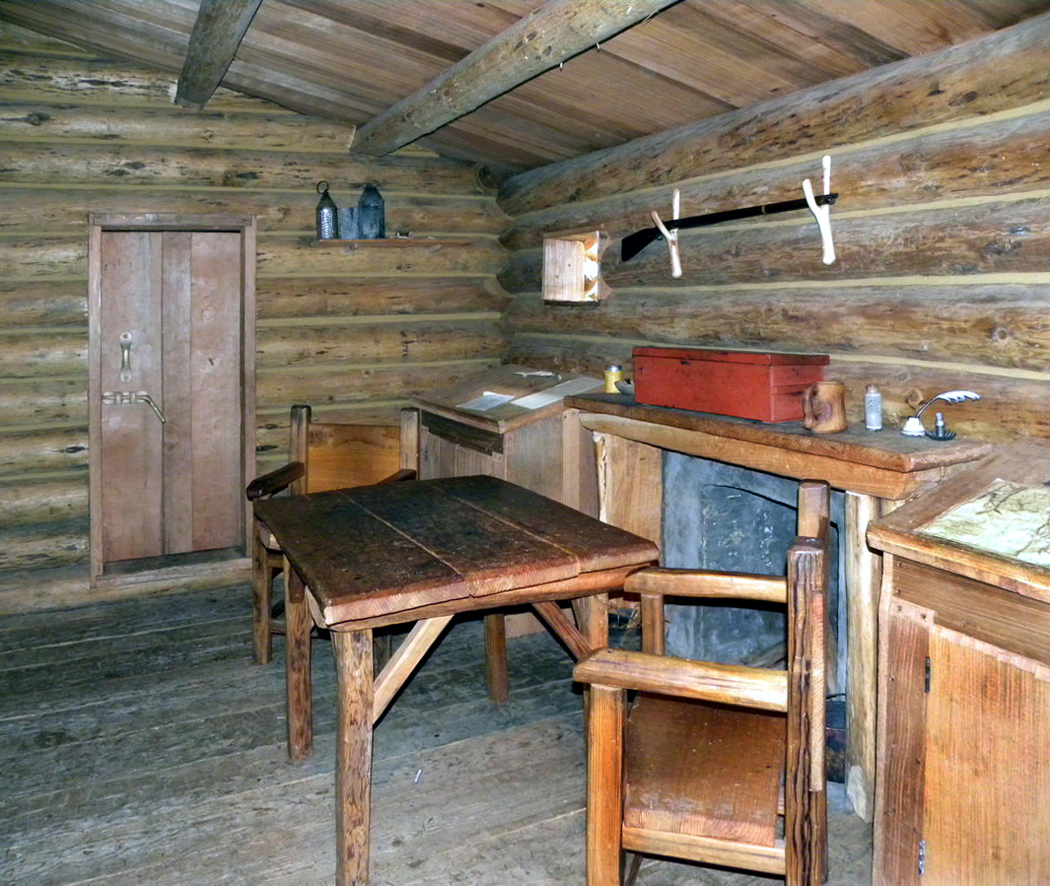
It is a very small fort by the standards of anyone who has seen palisaded forts in John Wayne Westerns. It is exactly 50-feet square and divided into eight rooms, three on one side and five on the other, with an open plaza between them. This was technically called the ”parade ground,” but no parade longer than a pace and a half would be possible in its Lilliputian length. Fort Clatsop interior

The largest room went to Lewis and Clark. The three smaller rooms on one side were given over to the remaining crew, up to 15 per room. And the smallest quarters, next to the commanders’, was given to the French trapper Touissant Charboneau and his Indian wife, Sacagawea, and their infant baby. The remaining small rooms were a meeting room and a supply closet. sacagawea dollar

In December, when you should visit the fort, fires crackle in the hearths of the rooms and volunteers give demonstrations of some of the things the explorers had to do.

A class of visiting high-school students was divided into a group that used rod and chain to learn primitive surveying and mapping techniques; another group that attempted to write with quill pens; a third group that made candles out of tallow; a fourth group that learned how to blow a glowing flint-and-steel spark into a flame; and a fifth group that heard about animal furs.

The smell of wood smoke penetrated everything. Hours later, I still could smell it in my coat. The smoke hung low above the log-cabin fort, which is a sign that canny weather watchers can use to predict rain. As if the prediction were necessary for an Oregon winter.

In 1805-06, the men came down with influenza and other sicknesses brought on by exposure. They managed to kill and eat 131 elk and 20 deer.

Lewis and Clark had to leave the fort earlier than planned when the early spring thaw drove the elk up into the surrounding mountains and left the men without a dependable menu. fort clatsop postcard

”We have not fared sumptuously this winter and spring,” they wrote in the journal as they prepared to break camp.

And when they reversed their route, they returned to St. Louis in half the time it took them to go out.