Archive

Tag Archives: jean renoir

If you’re reading this, and read blogs, it suggests you are a reader, and probably love books as much as I do. In fact, you may be a bookaholic, or have gone over the edge to become a bibliopath. Books are a central foundation of who I am, who I used to be and who I am still becaming. How can it be otherwise for anyone with a pennyweight of curiosity about people and about the world? 

I’ve written about books in my life in many blog entries, and one of the most often-read is the piece I posted on Oct. 10, 2020, called “Shelf life,” in which I chose a single rung of a bookshelf in the house and discussed all the volumes resting on it. We are, at least in part, what we read: The books become internalized. And so, as I wrote then, I wanted: “to search for myself among my books.” I decided to take a single shelf from a single bookcase, “to see if they were in any way a mirror in which I could discover my own physiognomy.”

I didn’t want to pick a neatly organized shelf, but one where books were randomly scattered, left uncatalogued after casually unpacking after a move, or after re-reading, or just was too lazy to put back where it made sense. The bookcase next to the bed seemed the proper choice. 

And so, I thought I might do so a second time. I looked at the shelf above the one I wrote about and it also seemed to be a mirror: That was me, there, in those pages, however jumbled it seemed to be. 

What surprised me the most was how many of these books have been with me for most of my life — books I read when young that still take up space in my brain and on my shelf. And also how many were only recently bought and opened. 

I should start with the three matched volumes at the right of the shelf: James Joyce’s Dubliners, Portrait of the Artist as a Young Man, and Ulysses. This handsome set replaced the many earlier versions I have owned in various editions. (I still have at least four other Ulysses on various shelves in the house, including a very special cheapie pirated paperback printed by Collectors Publications, a publisher most known for printing porn — which I suppose Ulysses was thought of when this version was published — ads at the back of the book offer The Incestual Triangle, Four Way Swappers, and All Male Nudes, among other things.)

I first read Portrait of the Artist when I was in eighth grade, in the dark green paperback Viking Compass Book edition. I’m not sure how much I could have comprehended reading it at the age of 13, but I knew I loved the way the words looked and sounded: “Once upon a time and a very good time it was there was a moocow coming down along the road and this moocow that was coming down along the road met a nicens little boy named baby tuckoo …” There was the mud of the rugby field, the great hellfire of the sermon, and the “forged in the smithy of my soul.” 

I reread the book every four or five years, and every time, it hits the spot. In the habit readers always have, I soon jumped on all the other Joyce I could find. I bought a copy of Viking’s A Portable James Joyce, and have given up or lost several versions over the years, but still have one, a hardcover one, now in a library binding — in fact, it sits on a lower shelf of this selfsame bookcase I’m writing about. I tackled the play, the poetry, Stephen Hero, the essays — even Finnegan, although, at the age of 76, I am still defeated by the whirl of the whorl of the world of Finnegan. I will leave it to the next life. 

Ulysses was a harder nut to crack after Dubliners, when I was a scrub-faced kid; Ulysses problems were verbal; Dubliners was harder to understand because of the complexity of the human emotions written about. You have to have some life pushing behind you to grasp the complexities of human experience and emotions written about in those short stories. As a teenager, I knew pimples better than I knew people. I re-read Dubliners last year and was blown away, especially by the final “The Dead.” It broke my heart.

Ulysses I did get into years later, and it is now my favorite novel of all, although, to be fair, I don’t always read it cover to cover, but rather, read again and again the bits that I most love. It astounds me: It is filled with some of the most beautiful prose I have ever encountered. No, I take that back: The most beautiful prose. 

Next to Joyce on the shelf is James Michener: Tales of the South Pacific, and Return to Paradise. I remember, in my 30s and still something of a snob, looking down my nose at Michener as a best-selling author of doorstop bricks. But one day, in a book store, I picked up a copy of Tales and thought I would read a page, maybe two, to catch the flavor of Michener’s prose. It was 30 pages later I was standing there ready to flip the next page. This was a special kind of talent: to make you need to find out “what happens next.” 

The prose was simply not the point. It was invisible; you read through the words as if looking through glass. This was story-telling, and Michener really has a value I had failed to understand. I’m not saying he didn’t eventually turn into an industrial manufactory, but in his first book, he made magic. It was also nothing like the South Pacific musical I had expected. Rather it gave me a real sense of what the war in the Pacific must have been like for those who experienced it. 

A few years ago, after re-reading it, I found a copy of its sequel, Return to Paradise. I got through a few of the stories, maybe a third of the way in, but lost interest. The magic had gone. It was OK — it wasn’t just junk — but it didn’t grab me the way the first book did. It was more like a book of short stories that a short story writer might write. Something, perhaps, that a publisher might request after a best-seller. The two sit together on the shelf nonetheless. 
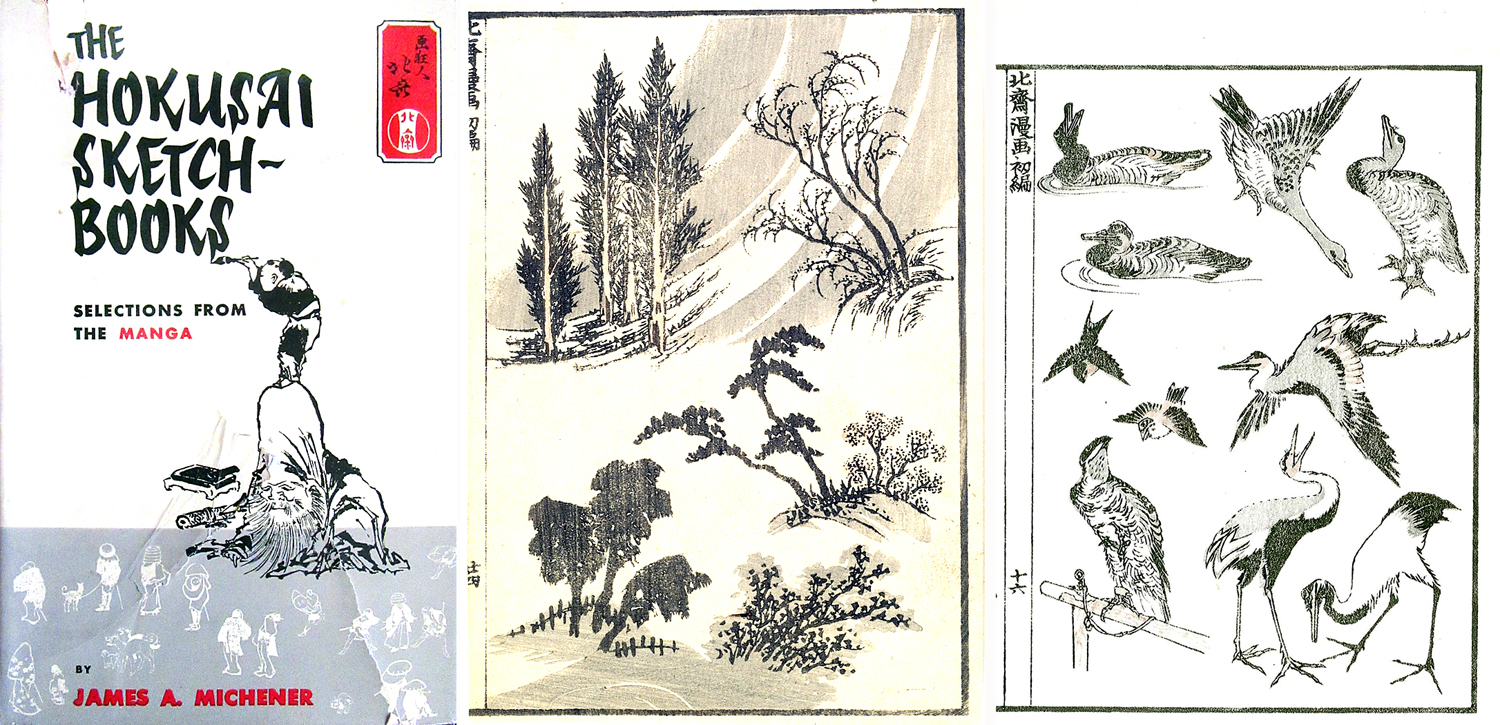
I’m going out of sequence on the shelf to mention the other Michener book sitting there. In 1958, Michener published The Hokusai Sketch-Books: Selections from the Manga. Hokusai, of course, was the famous Japanese 18th-19th century artist. In 1814, he published a multi-volume sketchbook, called manga, in which he drew everything he saw in the world around him: people, plants, animals, ghosts, architecture. It was an encyclopedic venture. Michener selected enough of these drawings to fill out a thick book. I have owned it since college. It is one of my holy-of-holies. 

From high-school days, I was fascinated with all things Asian; I read books on Zen Buddhism, listened to Noh Plays, took my girlfriend to restaurants with hibachis. There were Kurosawa movies and sumi ink paintings, which I attempted with my own shizuri and brush. 

The non-Western way of looking at the world opened my world view and I have been looking beyond the horizon ever since. 

Next on the shelf some The Great Gatsby and nothing proves how little youth knows, than what I made of the book — or didn’t make of it — when I was required to read it in eighth grade. I never then figured out who this Gatsby guy was; I thought the book was about Nick Carraway; and what the heck was all that about green light? 

It’s not that I didn’t enjoy the book then, but that I had no clue about its depths. I bought an excellent edition three years ago and reread it for maybe the third or fourth time and loved every second of it. It is a deep, rich book, with prose that is delectable. 

I believe for most young readers with a ripe curiosity, we tend to want to read beyond our abilities. We believe, as teenagers, we are grown-ups and want to partake of the adult world. And so we — and I — took to reading much that we had no business attempting. I read Saul Bellow, Henry Miller, John Updike, Jack Kerouac, Thomas Pynchon, James Purdy — a whole host of writers that I thought proved I was now in the company of the heavyweights. 

And among those books was Jean Paul Sartre’s The Words, his autobiography. I knew he was an existentialist and that all the most intellectual people (this was the mid-1960s) were hot on existentialism. Not that I knew what that meant (I’m not sure anyone really does — it encompasses so many different things, but back then, it pretty much meant berets and espresso). But I read it, enjoyed it, thought I understood it, and flashed a few words around to let anyone know. I got a subscription to Les Temps Moderne, although I couldn’t read French (and also a subscription to The Evergreen Review — I was one hip 16-year-old). I re-read Les Mots last year and it’s a fine enough autobiography, but not exactly world-shaking. 
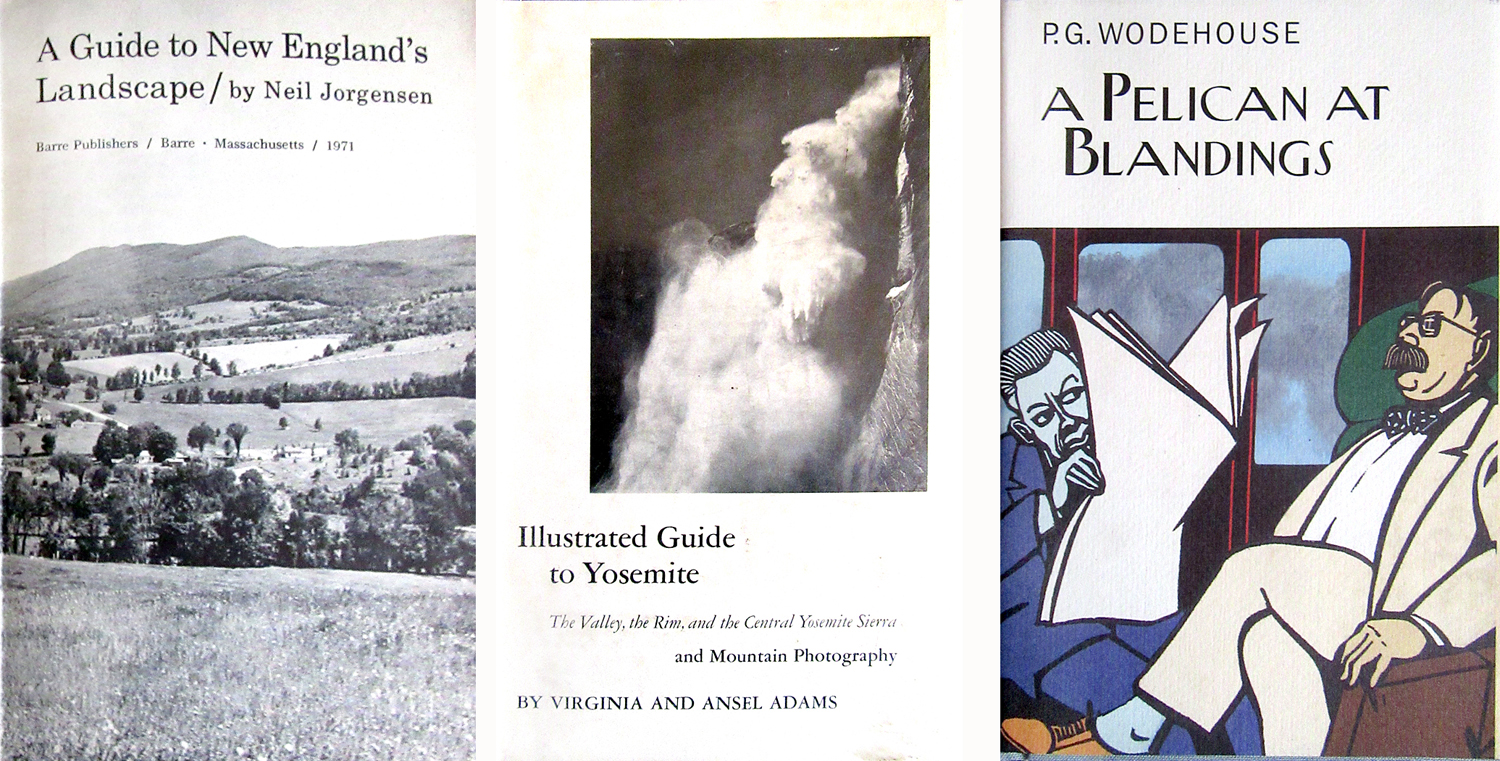
Getting back on track along the bookshelf: In the 1970s, I was living with a redhead and we wanted to travel. We hiked a good portion of the Appalachian Trail, and drove, amongst other destinations, to Maine and New England. I was fascinated by geology and I had a book by Neil Jorgensen called A Guide to New England’s Landscape. I had by then, an interest in all things under the heading of “Nature.” I had a raft of Peterson Guides, could name dozens of plants and birds by their scientific names (“Know-atia Dudiflorum,” my wife teased me), collected rock samples, and could name dozens of constellations in the night sky. 

The Jorgensen book accompanied us as we drove past monadnocks and till, varved clays and drumlins. I admit I haven’t read the book since then, but I still have it, as a memento of meaningful times.

I was by then active a photographer, and so I had another guidebook: Illustrated Guide to Yosemite, by Ansel Adams and his wife, Virginia Best Adams. I so wanted to visit Yosemite, but never had at those years the time or money for such a long trip. The book is loaded with Adams images, and so, it functioned more as a picture book than a useful guide. It was only many years later that my wife and I drove up the east slope of the Sierra Nevada along the Tioga Road and got to see the stunning Valley. The book is another that I’ve owned for 50 years and is a piece of me. 

If I could choose to write like anyone, it would be James Joyce, but if I couldn’t have that, I would want to write like P.G. Wodehouse. He is magic with words, although of a more comic variety. I have bunches of Wodehouse lying around, but three years ago, I bought a new edition of A Pelican at Blandings, mostly because these new hardback versions, by Overlook Press, were so seductively handsome. If I had the money, I would buy all the volumes in this set, but this one will have to do. 

All the Blandings books are a hoot. He may be most famous for his Jeeves stories, but I like Lord Emsworth and his pig and his sister Connie, just as much as Jeeves and Wooster. This is the kind of book I read when I just want to have fun. 
The Complete Southern Cookbook, by Tammy Algood is not one I bought. It was a gift from my daughter. I seldom use cookbooks. And when I do want one to check on some Southern specialty, I head for the old standby, Henrietta Dull’s Southern Cooking, originally published in 1928. 

I was born in New Jersey, but left there when I was 17. I’ve lived in four corners of the country, with 25 years in Arizona, and a year in Seattle, but the longest soujourn has been in the South, in North Carolina and Virginia, where my years add up to 33. I feel like an adopted Southerner. 

And while I still miss the foods I grew up with, such as a good pastrami on rye, real pizza, or a kaiser roll, I have to admit that I’ve come to love those things a Yankee will never understand, like greens, pulled pork, or fried okra. I count on Mrs. Dull for those (although, to be honest, no one uses a recipe for such things). 

The funniest book I have ever read is Laurence Sterne’s Life and Opinions of Tristram Shandy, Gentleman. It is one of the few I find myself actually laughing out loud at. So, thought I, perhaps his other book, A Sentimental Journey, must we worth looking into. It is much more straightforward, less surreal, and while it has its moments, doesn’t quite catch fire for me. The edition I have is however quite handsome to look at. 

The next two books are by Jean Renoir. Renoir is probably my favorite filmmaker. His films are so genuinely humane and wise. Nick Carraway, from Gatsby, relays that his father gave him advice to live by: “Remember that not everyone has had the advantages you have had.” That’s all well and fine, but the words that most illuminate my life are from Renoir’s Rules of the Game, when Octave, played by Renoir himself, says “The awful thing about life is this: Everybody has their reasons.” It isn’t usually malice or conspiracy that mucks things up, but rather, “Everybody has their reasons.” You learn to be less judgmental from that. 

He wrote about his work in My Life and My Films, from 1974. It is filled with anecdotes and pictures, and the quiet acceptance that is the core of his being. But even better is the biography he wrote about his father, Renoir. I was never a big fan of Pierre-Auguste Renoir. I find his paintings a little blowsy. He is the least of the major Impressionists. But, as his son writes about him, he comes off as one of the kindest, sweetest, most understanding and generous of men. I came to love old Pierre-Auguste not through his art, but through his biography. 
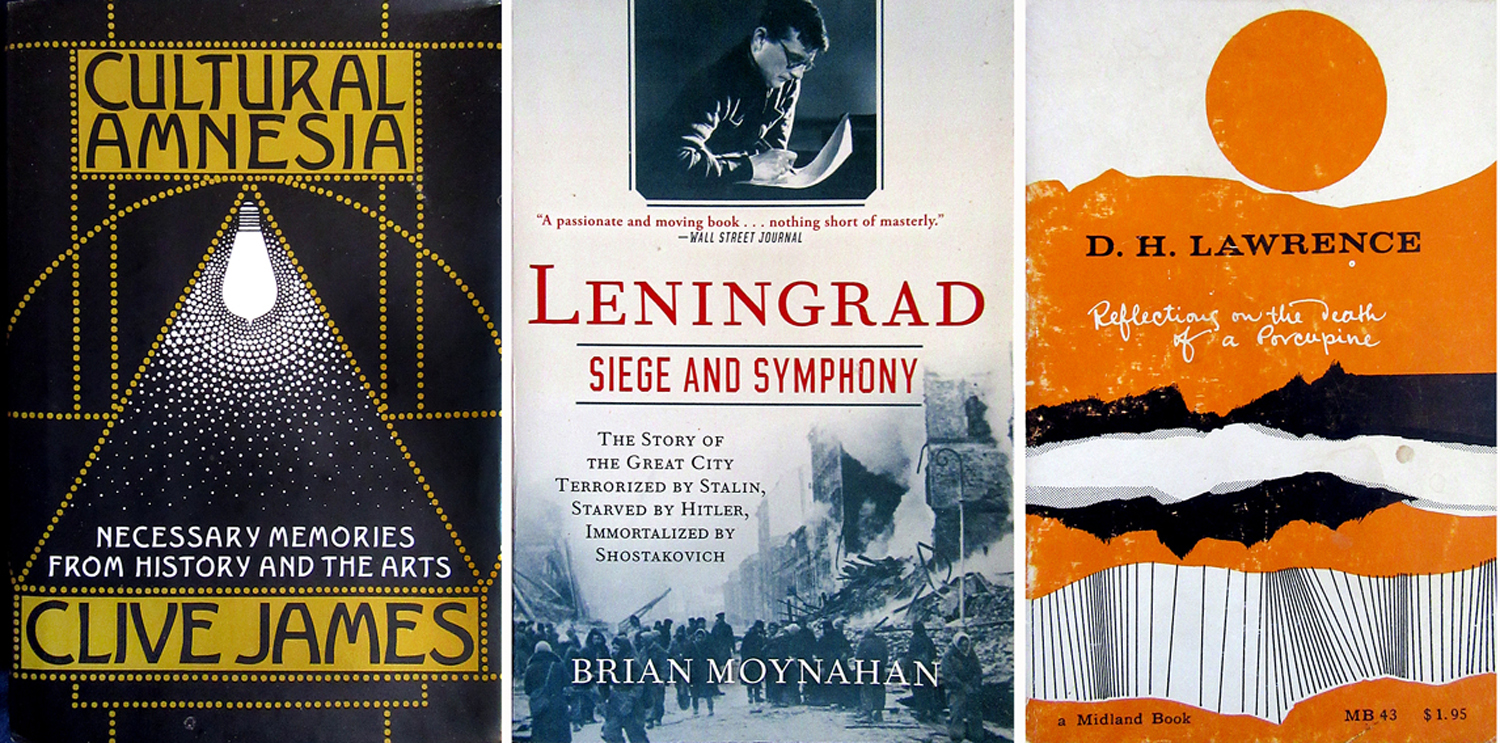
I said we readers have a tendency to find authors we like and then plow through the whole corpus willy-nilly. About five years ago, I came across Clive James, the late Australian-English writer and critic. I tore through everything, including his poetry. And when I found his book Cultural Amnesia, I couldn’t stop myself. Subtitled Necessary Memories from History and the Arts, it makes the case that too much important history has been forgotten, ignored, or misrepresented, and that if we need an understanding of the past to navigate the future, then the men and women he writes about in this book, deserve to be remembered. 

He writes about more than a hundred of them, in alphabetic order from Anna Akhmatova to Stephan Zweig. Some are hardly obscure, like Charlie Chaplin or Leo Tolstoy, but he brings to mind aspects that may have more cultural impact than you might remember, or other facets to their work. 

I love the grim joy of Dimitri Shostakovich; his music speaks volumes about misery and dictatorship. His Seventh Symphony, the “Leningrad Symphony” was partly written and later first performed in that city during the 900-day siege by the German Wehrmacht during World War II. It is a sprawling work, lasting well over an hour, and its first movement has a grinding passacaglia representing the jackboots of oppression. 

My wife gave me a copy of Leningrad: Siege and Symphony, subtitled “The Story of the Great City Terrorized by Stalin, Starved by Hitler, Immortalized by Shostakovich,” by Brian Moynahan. Its well-researched 500 pages cover everything one needs to know about the siege, the horrors, and its legacy. But, I confess, I have not read it. It sits there on the shelf, waiting. But I really feel I am told everything I need to by the music itself. 

I went through a D.H. Lawrence period, where I read everything I could get my hands on. But not the novels or short stories. For some reason, they never much appealed to me. But his essays and travel writing, and his poetry, I adored. It’s the best travel writing I know, partly because it isn’t the usual version of the kind, but his personal, very idiosyncratic way of looking at the world. 

Reflections on the Death of a Porcupine is an anthology of seven of his essays, including the title piece, which starts as thoughts on having to shoot a porcupine on his New Mexico ranch, and goes through the issue of all life dependent on devouring other life, and ends, in a disturbing turn that, for him, justifies “superior” existence having its way with “inferior.” Lawrence is capable of a good deal of piffle. 

But it is the particularity of his observation that I love, the detail. Even crazy talk can be well written. 
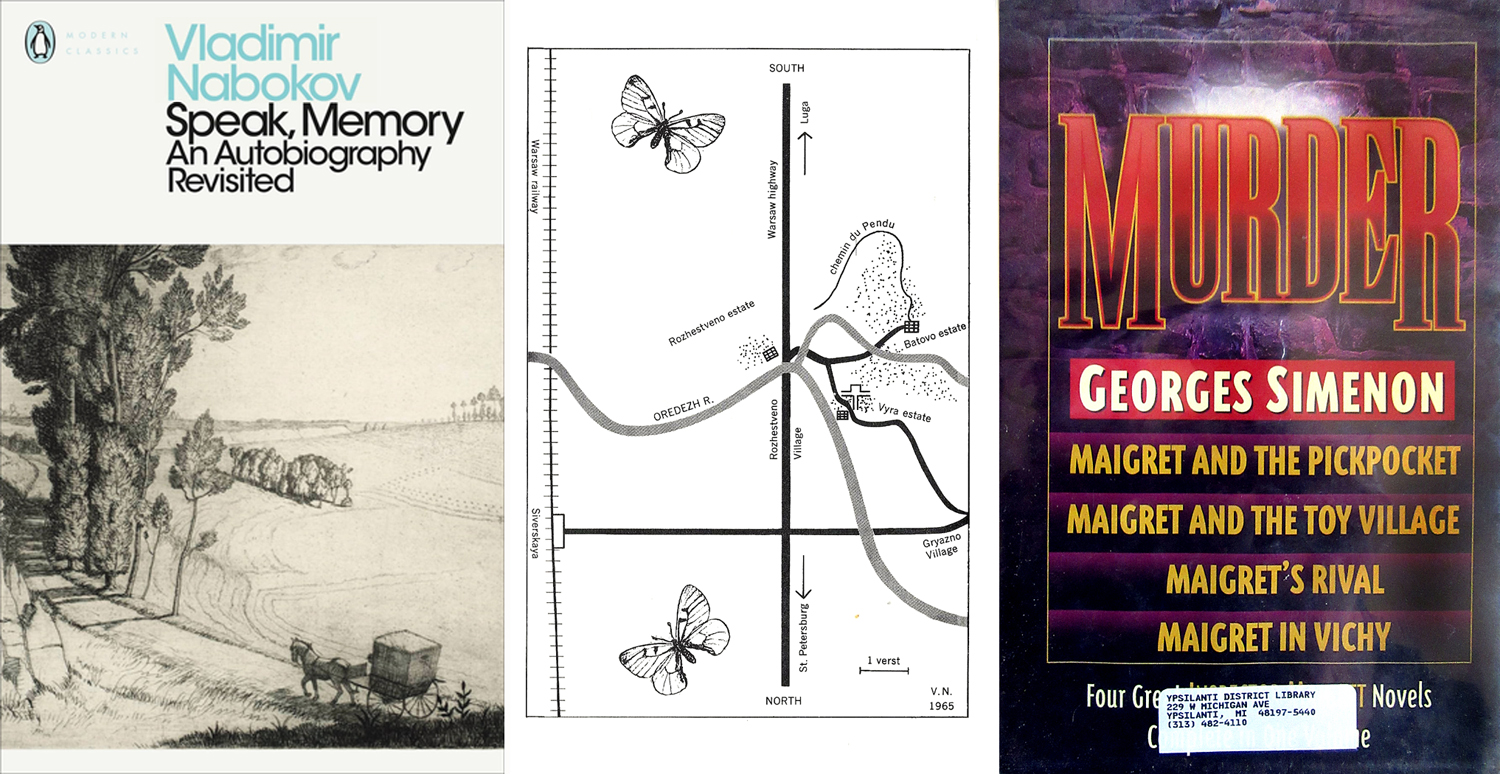
Next, the best writing, the most original use of word and sentence, since, at least Joyce, was penned by Vladimir Nabokov. Lolita is an absolute brilliance, despite is subject. And so I read Speak, Memory, his 1951 autobiography, which recounts his life in Russia, before leaving in 1940. 

It begins, “The cradle rocks above an abyss, and common sense tells us that our existence is but a brief crack of light between two eternities of darkness.” So, you know you are not just getting a sequence of entertaining anecdotes. The book is a dialog, essentially, between existence and memory, the memory of a pre-Revolution Russia, as recalled by a child, and then a young man. 

Finally, I have an omnibus edition of four Maigret novels by Georges Simenon. I have moments when I devour Simenon like chocolate-chip cookies, one after the other. But it can get expensive buying volume on volume, one at a time. This edition, once in the collection of the Ypsilanti District Library in Michigan, was bought used on Amazon, cost less than $5 and gave me four novels. I have read three. I am holding the fourth unread so far, in order to experience the delicious anticipation of reading it. 

And so, with that shelf catalogued, I look at the books and think, do I see myself in their spines, lined up? I certainly see a bit, like seeing a face through partially opened Venetian blinds. It’s me, all right, but only a bit. I look at the book case from top to bottom and see more of the rest of me. I walk down the hall and into other rooms with other bookcases and the picture fills up. The oldest books among them all speak of the boy that remains in the core, the newest of the weary old man I am now that covers it all in wrinkles. It is that “brief crack of light between two eternities of darkness.” 

Finally! One of the great films of all times has become available. For years I have waited for a good copy of Marcel Pagnol’s La femme du boulanger (“The Baker’s Wife”) to be transferred to DVD. The only version I have is one I recorded from a Turner Classic Movies broadcast decades ago. The subtitles were horrible and the print none too good. I have treasured it for years and proudly introduced it to friends whenever I could. 

But now, Criterion will be offering a new, cleaned up, re-titled version. It is one of the greatest films ever. After watching it, Orson Welles claimed that its star, Raimu, was “the greatest actor in the world.” He called the move “perfect.” 

Raimu etches a perfect line between the comic and the tragic, playing a French village baker whose wife runs away with a younger man and who, heartbroken, refuses to bake another loaf until she returns. The villagers, despairing of ever again getting a good baguette, go all out to retrieve her. All the fine details of pre-war village life are drawn with subtle precision. As novelist Graham Greene said of the film, “the human actors are only part of the general setting — the well and the olive trees and the crude, crowded church and the Cercle Republicain (tavern) with the tin advertisements, and the hunter going out in the dawn with his dog and his gun while the baker sleeps in his (dough) trough beside the oven.”

It is a closely observed and beautifully seen world. 

(It is hardly the only great film too long unavailable: Abel Gance’s famous 6-hour silent film, Napoleon, has been restored, but is unavailable in the U.S. for ridiculous legal reasons — blame Francis Ford Coppola — but is available on a Region 2 disc from Amazon. All-region DVD players are common and inexpensive and worth the small investment.)

The popular conception of “foreign films” has changed over the years. Where once the term meant Bergman, Fellini and French films, it has now gone on to mean Pedro Almodovar, Johnnie To and Oscar-winning Mexican directors. A foreign language film is more likely to be in Cantonese than in Swedish. 

But I was born in the earlier era, and for me, the great movies are French. Yes, I have almost all of Bergman’s films on DVD, and most of Tarkovsky, but the great majority of the discs on my shelves are in French. I once catalogued them and counted well over 200 of them. 

Most people, when they think of French movies, think of the New Wave — that handful of directors in the late 1950s and into the 1960s who brought new techniques and new energy to the industry, along with an appreciation of Hollywood’s best work. 

But French cinema is much more. There were great movies before Truffaut ever came along. And great directors. Pagnol, Becker, Duvivier, Vigo, Clair, and above all, Jean Renoir. 

And there have been great directors since the wave hit the shore: Patrice Leconte, Jean-Pierre Jeunet, Agnes Jaoui, Catherine Breillat, Jamel Debbouze.  

I am going to suggest a few of their movies, all (at least when I bought them) available on disc. Many are also available on streaming video. 

I have listed no more than a single film from any one director, to ensure a variety and a wide scope. I have tried to avoid the obvious choices, because you may already be familiar with them: Rules of the Game, Grand Illusion, Breathless, Jules and Jim, Wages of Fear. And, I have not included any Renoir films, mostly because they are self-recommending and any real movie lover should already be familiar with them. 

The earliest of these films is Pepe Le Moko, which was remade (and sentimentalized) in the Hollywood remake with Charles Boyer, Algiers. The French original is much better, in large part because Jean Gabin is so much greater an actor than Boyer. Julien Duvivier was a great standard of French directors in the 1930s. 

I am including also a peculiar film, The Story of a Cheat by Sacha Guitry. Guitry is one of the great French comics, who wrote many stage comedies, was as famous a performer in his day as, say, Richard Pryor was in his. This film is unusual in that it is presented almost entirely as voice-over narration. It is excellently clever. 

Mainstream French films of the ‘40s and ‘50s include many wonderful genre films, almost all better plotted and with more interesting characters than their Hollywood cousins. 

Touchez pas au Grisbi, by Jacques Becker, is one of Gabin’s greatest roles. And that is saying a lot. (The title translates, roughly, as “Hands off the loot.”) 

Les Diaboliques, by Henri-George Clouzot is the greatest suspense movie of all time, outdoing Hitchcock by a large margin. It was remade in Hollywood  in 1996 with Sharon Stone. Oy. 

A third crime drama from the 1950s is Louis Malle’s Elevator to the Gallows, which has a great soundtrack by Miles Davis. It marks a shift in French film. Malle’s early work is not generally considered part of the New Wave, yet, there were several directors working at the time who prefigured the New Wave, giving us very personal films and often using locations rather than sets, and a more naturalistic style of acting.

Among those directors is Jean-Pierre Melville. Most of his work comprises heist dramas or crime stories. But I didn’t want to overweight this series of films with gritty thugs and grittier cops. And Army of Shadows tells an almost autobiographical story of the French underground in World War II. It has plenty of suspense and drama. 

Now we come to the New Wave itself. There were a handful of directors working in this new style, more free and improvisational, using location shooting rather than studio sets, and breaking up the normal beginning-middle-end narrative structure. 

The two gods of Nouvelle Vague couldn’t be more different. Jean-Luc Godard is anarchic, innovative and indefatigably political. He wants to destroy the status quo. He probably never made a completely successful film, but moments in every one of the astound with brilliance. He does things no one ever thought to do: drop out the soundtrack, edit arbitrarily, shoot dialog from behind the heads of the actors, shift from color to black and white and back, point the camera away from the actors. Godard freed up filmmaking for the next 40 years. Band of Outsiders is one of his most famous films, and includes the race through the Louvre that is quoted in several other films.

Francois Truffaut, on the other hand, is a dyed-in-the-wool humanist, and he finds the humanity in pretty much everything he films. As warm as Godard is cold, he is everyone’s favorite New Waver. So many of his films are so well known, I’ve tried to find one for you that you probably haven’t seen, The Woman Next Door. It’s a late film and features Gerard Depardieu before he became a joke. He was then a great actor. 

Claude Chabrol was the most prolific New Wave director, with nearly 60 films under his belt. He was also the most conventional of the New Wave directors, turning his talents primarily to suspense and crime films, but seen in the fresh style of the New Wave. Le Boucher is probably his most characteristic film. 

Eric Rohmer may be an acquired taste. They are talky, and were made in series, one group called “Moral Tales,” and another called “Comedies and Proverbs.” Summer (in French Le Rayon Vert: “The Green Ray”)  is one of the Comedies and Proverbs. 

Jacques Rivette is another New Waver, and he is notable for the length of his films, and his patience. It can try the patience of his viewers, but not if you pay attention. My favorite film, La Belle Noiseuse, is four hours long and spends a lot of that time showing an artist drawing with a crow-quill pen on paper. I’m not letting that out of my house. 

But I’m going to suggest instead, Va Savoir, probably his most accessible film, that has a great part for Jeanne Balibar. Claude Berri has a supporting part as a librarian.

I only mention that because Berri is really a director, and The Two of Us is a great film, and probably the only one in which an anti-Semite comes across as lovable. Michel Simon is a force of nature and I recommend seeing any film he is in. 

Finally, two recent films. French cinema has long ago taken what it could from the New Wave and moved on to more contemporary themes. 

One of my favorite living directors is Patrice Leconte. The Hairdresser’s Husband is quirky and heartbreaking and stars Jean Rochefort. He’s great in everything he does. 

There are several women directors who should be included. My favorite is Agnes Varda, but I’m including here instead Fat Girl by Catherine Breillat. It can be rather brutal, but it is definitely worth seeing. 

Lastly, I’m including a musical. Yes, a musical. It is Francois Ozon’s 8 Women, and it features an “all-star” cast of great French actresses: Catherine Deneuve, Isabelle Huppert, Emmanuelle Beart, Fanny Ardant, Virginie Ledoyen, Danielle Darrieux, Ludivine Sagnier and Firmine Richard. This is like lining up Lauren Bacall, Judy Garland, Ava Gardner, Veronica Lake, Barbara Stanwyck, Lucille Ball and Marilyn Monroe, all in the same movie. It’s a doozy. 

I hope you enjoy all these. There’s plenty more to see, if these whet your appetite for Gallic filmmaking and if any of these directors particularly hits your buzzer, there are another five or ten films by the same maker. 

That’s your first 15 recommendations. But here are 25 or so more (I cheated. Some are trilogies, one is a pair). These are all films I love dearly:

Quai des orfevres by Henri-Georges Clouzot

La bete humaine by Jean Renoir

La ronde by Max Ophuls

Une femme est une femme by Jean-Luc Godard

Bob, le flambeur by Jean-Pierre Melville

Betty by Claude Chabrol

Le quai des brumes by Jacques Prevert

Monsieur Hire by Patrice Leconte

Le Trou by Jacques Becker

Mouchette by Robert Bresson

Mesrine: Public Enemy No. 1 by Jean-Francois Richet

Under the Roofs of Paris by Rene Clair

Man on the Train by Patrice Leconte

The Taste of Others by Agnes Jaoui

Vagabond by Agnes Varda

The Dreamers by Bernardo Bertolucci

The Marseille Trilogy by Marcel Pagnol, three films: Marius; Fanny; and Cesar

The Earrings of Madame de … by Max Ophuls

Trilogy by Lucas Belvaux, including: Cavale on the Run; An Amazing Couple; and After Life

La Vie en Rose by Olivier Dahan

The Widow of St. Pierre by Patrice Laconte

Inspecteur Lavadin and Cop au Vin by Claude Chabrol

Le Samourai by Jean-Pierre Melville

Shoot the Piano Player by Truffaut

Jet Lag – (Decalage Horaire) by Danièle Thompson

Sex is Comedy by Catherine Breillat

Ridicule by Patrice Laconte

I am deeply embarrassed by the films I have left out. If you have a favorite, please add them to the comments.

Click any image to enlarge

rules of the game 5In Jean Renoir’s 1939 classic, “The Rules of the Game,” one character sums up the problems of existence: “The awful thing about life is this: Everyone has his reasons.”

The film, which tops many lists as the greatest film ever made, has no heroes, no villains; it has no right, no wrong; no simple lessons to be learned, no closure. It is as French as it gets, and despite Hollywood’s penchant for remakes, it could never be made in America.

On the other hand, the 1980 “Star Wars” sequel, “The Empire Strikes Back,” has plenty of heroes and villains: It’s the quintessential American film; it could never have been made in France. “Horizontal boosters. Alluvial dampers? Ow! That’s not it, bring me the hydrospanner.” empire strikes back 1

Jamais!

The difference is more than merely language; it’s sensibility. Both excellent films, they sum up the divide between European cinema and Hollywood movies, a divide filled by more than the Atlantic Ocean.

One doesn’t have to take sides. There are great films from both sides of the pond. But it is important to realize when you go into the theater that there is a difference and which kind of film you’re about to see. If you’re looking for an amusement-park ride, European cinema probably will bore you to tears; if you want intense drama about the human condition, Hollywood films will feel trivial. You pays your money and you takes your choice.

This is not to dismiss American films. First of all, they remain the most popular films worldwide. Many countries, including France, have felt the need to restrict the percentage of American films available to their citizens, to subsidize the local product. Steven Spielberg would always sell more tickets than Jacques Rivette. It doesn’t matter where you go, American films remain popular.

Second, American films remain the major influence on world cinema: The tics of Hollywood become the universal style of everyone else, too. There are the editing rhythms, the lenses and equipment, the green-screen technology, the CGI — these are all the lingua franca of movies everywhere. Even a quiet film like Jean-Pierre Jeunet’s popular “Amelie” would not be possible without computer assistance: Most of its signature color was digitally added.

One should not forget that the inspiration for the French New Wave in the 1960s were the Hollywood films the movement loved. Jean-Luc Godard’s “Breathless” is his take on American films, with their gangsters and girlfriends.breathless 2

We in the U.S. now are exposed to more foreign films than ever before. There are Hong Kong martial-arts films, Bollywood films, the emerging films of China and Korea, not to mention those from Iran, Israel and the Arab world.

All that is in addition to the many French, German, Italian and British films that traditionally have constituted the world of foreign films.

They’re not only in theaters but frequently available on cable channels, on DVD and from Netflix. Even Turner Classics has its percentage of foreign-language films.

It’s nearly impossible for the curious filmgoer to remain provincial in the comparative flood of world cinema.

It is true there are American indie films, but even those, no matter how gritty they are, tend to follow an American world view.

Americans see the world differently, so their films portray the world differently. We prize directness and informality; we despise hypocrisy and airs; we look for answers, not questions. We are fundamentally optimistic.

It is partly a matter of history. Because we have seldom suffered the devastation of war on our homeland, we have a different relationship with the past. Europe is haunted by history; for Americans, history is largely a matter of colorful costumes.paul schrader

The American writer and director with the most European sensibility is Paul Schrader, who wrote Martin Scorsese’s “Taxi Driver,” and he puts it simply:

“American movies are based on the assumption that life presents you with problems, while European films are based on the conviction that life confronts you with dilemmas — and while problems are something you solve, dilemmas cannot be solved; they’re merely probed.”

The American sensibility demands we open the box to find out if the cat is dead or alive.

For American audiences, an unsolved story is profoundly unsatisfying. We demand closure.

It’s the Oprah in us.


gabin 1I love French films; I own well over 200 of them on DVD. And not just the New Wave films we all know, but the pre-war films of Julien Duvivier, Jacques Becker, Marcel Carne, Sacha Guitry — and above all, those of Jean Renoir and Marcel Pagnol.

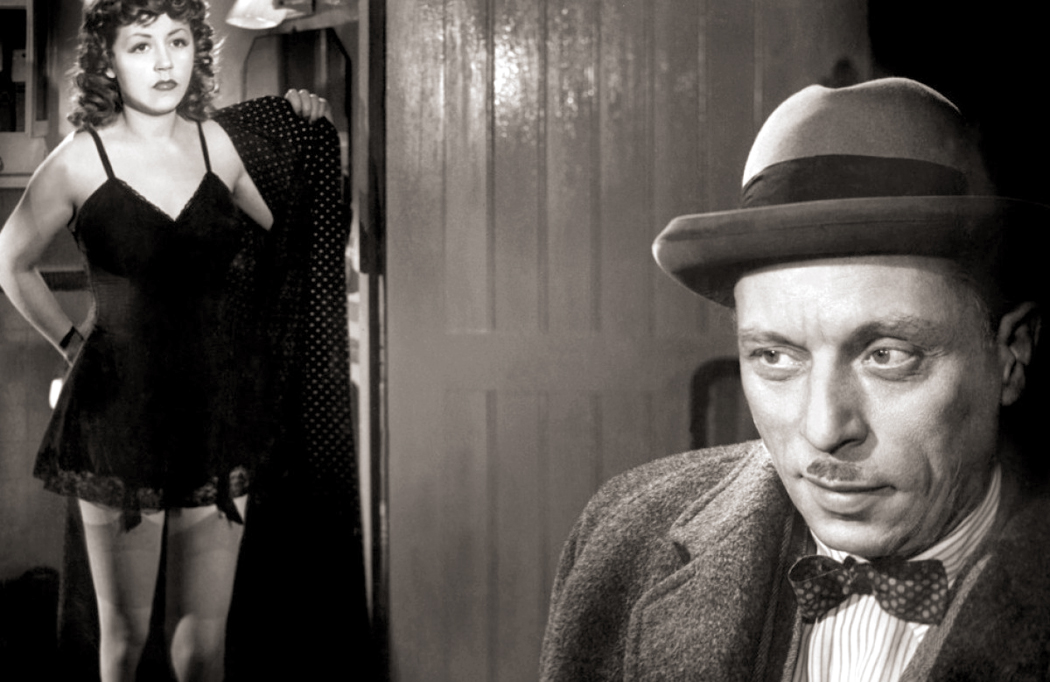
I am afraid that under the influence of such films as “Le jour se leve,” “La bete humaine,” and “Quai des brumes,” I am guilty of writing a pastiche short story Which I here present to you. Please read it in black and white. 

L’echafaud de mon desir
ou
Mon desir pour l’echafaud

My name is Etienne Duford and I am the chef de cuisine of a small restaurant in the town of _________. It is hardly more than a village, near Orleans, and a stopping place for truck drivers hauling cargo from Bourges to Paris.

And my restaurant cannot be called haute cuisine. It is only irony that causes me to name myself “chef.” Mostly I serve the truckers blanquette and gigot along with vin de table and rather a lot of digestif. I guess there was a lot of digestion needed to process the food I served. Next door is a small six-room auberge called the relais de St. Pierre. The restaurant is part of the St. Pierre, and its owner is my boss.

St. Pierre. It makes me laugh. “On this rock I build my church,” said Jesus. Well, we grow sugar beets in this corner of the world, and they are hard as rocks. Farmer, I joke, do you really need to plant the beets, can’t you just plow up the rocks that are already in the ground?

The beets pile up in the autumn in little pyramids beside the fields and along the roads, waiting to be picked up and brought to the factory. That paysage is the only thing that gives our region anything you might claim to be distinctif. Otherwise, this is flat country, both as geography and as culture.

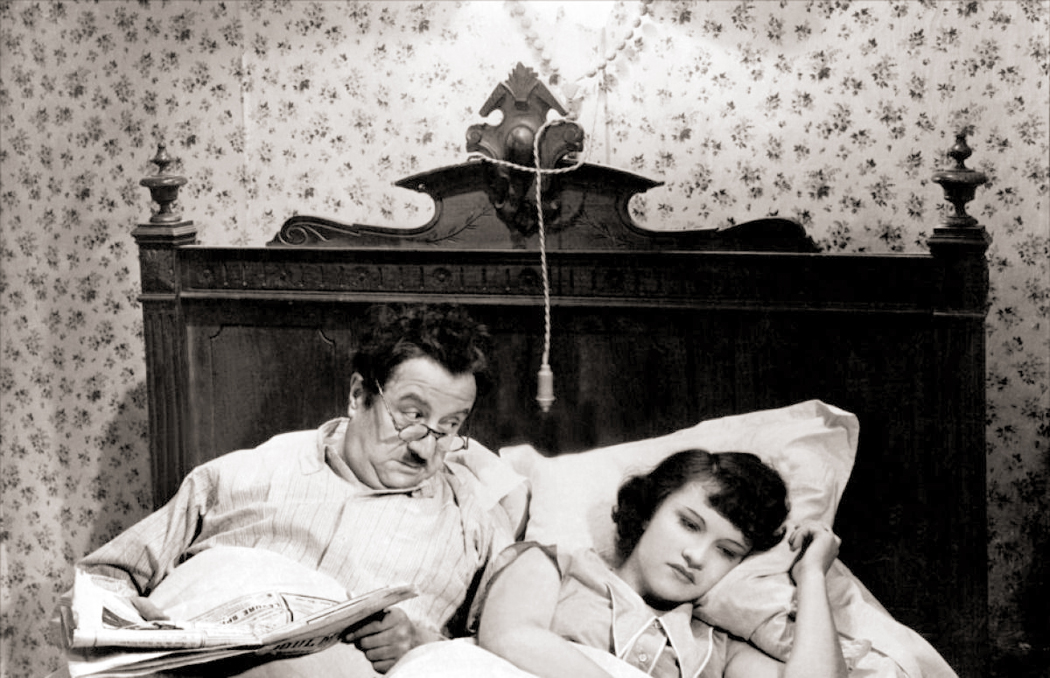
Yes, I am married, to la belle Helene, as I like to say, a farmer’s daughter. No, she is not really all that belle anymore, although, for 47, she still has a decent figure and I can’t complain. We still sleep together, although I seldom touch her. Not that she doesn’t have her own affairs to keep in order. Affairs. I can’t really call them amours. That would be much too grand a word. I don’t mind them, and it leaves her a little extra spending money.

But it is the other one you want to know about — my Juliette. Daughter of old Ambroise, owner of the St. Pierre. Julie, ma jolie. The perfect ideal of womanhood. Une vierge de 28 ans, and the main reason I have never left this dusty town. I knew her when she was a child and I was in my 20s, just opening my restaurant. I watched her grow up. She is the only pinpoint of grace in this town, or in my existence.

I would see her sweeping the dirt in front of the auberge every morning and see her shake the laundry out back. No, I didn’t pay much attention to  her when she was young. It’s strange, now that I think about it. This isn’t something that happened those many years ago. I really thought of her as a child, at least until she was in her mid 20s. Then, I realized how beautiful she was, how graceful, and how she was a door to un monde plus gentil, more refined. Too refined for me, helas. I watched her, but I could never approach her.

Then, there was Jean. If a movie were to be made, he would be Gabin. He was one of the truckers who stopped regularly at the St. Pierre. He ate at my place, and perhaps drank a bit more of the vin ordinaire than was good for him. I loathed him.

Why? Because of the attention he paid Julie, ma jolie.  She deserved better. He smiled at her. I wanted to paste him one. This was no belle et la bete. There was no prince buried underneath the coarse skin.

Twice a month he came through with his truck, spent the night at the St. Pierre and ate my rillons with mashed potatoes and mustard sauce. He smacked his lips. In others I would have taken that as a compliment.

“What do you think,” he said one evening. “Great piece of meat, no?”

Surely, he wasn’t talking about the cutlet, which should have been turned into a shoe.

“I would love to get me some of that.” And he indicated, by a rude gesture, he was referring to his nether regions in contact with something soft and feminine. “She’s really something.”
Loathing doesn’t accurately describe my feelings; I hated him. He was a pig.

That Thursday, he came to dinner. I remember, he had only oeufs and some vin rouge. There was pomade in his hair and the smell of the barber shop. His suit hadn’t exactly been pressed, but it was cleaner than usual and I assumed that he had steamed it in his room.

“She gave me the high sign.”

“She?”

“The morsel. I’ve been after her for years, and I think she’s finally ready to give in.”

A big grin covered his face like the wrong sauce on a magret de canard. He wiped his mouth with his forearm.

“Another glass, s’il vous plait,” and he slammed the empty glass down on the table.

When he left, I pulled the towel from my belt, put it on the bar, and followed him. I kept a ways behind, and ducked behind the corner of the St. Pierre as he went in. Looking in the window, I saw him laugh his greasy laugh, slap the concierge’s desk and yell out, “Juliette!” I had an instant chunk of ice coagulate in my gut.

I went back to the restaurant, closed up for the day, and went upstairs. Helene was sitting by the door.

“I’m going out tonight,” she said. “Don’t wait up.”

I’m a man with some small education, although I claim no sophistication. I never finished school. But, I have a tolerant nature. I was not going to make a fuss over this habitual betrayal. I haven’t been the best husband to Helene, and she hasn’t been the best wife to me. It’s a little compromise we both make with life. I don’t ask and she doesn’t rub my nose in it.

But that wasn’t a good night to hear it one more time. I put my coat on, went back downstairs and out the door. I walked down the street and out of the village, out into the fields. I could see only black. It was still twilight and I could make out the hills of beets by the roadside, and the windbreak of trees at the far end of the fields. I could see the windows of the village light up behind me. But inside, it was all black. I wasn’t thinking about Helene. My thoughts passed instead to Julie. “How could such a gem exist even in the same dimension as that slug? How could she abide his barbarity?”

By the time I got to the trees just to the west of the village, I sat on the ground, looking back at the houses, silhouettes now against the graying sky. I’m a grown man, but I sobbed, wiped my nose and took a deep breath. I pulled my knees up to my chest, wrapped my arms around them and sat still, continuing to look back at the cluster of homes.

Homes? What is a home? What is one supposed to expect from life? Is there anything like a good marriage? Is it all accommodation? All a matter of giving up? In those books, there are great love affairs, but how do they all end? They all end in death. Anna and Vronsky, Romeo, Juliet. Juliette?

If they end in marriage, they are Charles and Emma. Helene.

The air was unseasonably warm that night. Thursday. The day of the week with the least character. It is a bland day. An empty day.

I heard something in the woods to my left, a shifting of branches and leaves.

I hoped Helene had found more in existence than I had. I had looked for foie gras and found turnips. No sauce helps the turnips.

What’s that?

I was certainly feeling sorry for myself. The son of man knows not where to lay his head.

Again?

I wiped my nose and took a deep breath. Then there was a giggle. There was no doubting that voice.

I got up and walked quietly down to the noise.

There she was on the ground, with her legs split open and the beast wedged between, grunting and rooting. She giggled again. I yelled out. I picked up a beet, hard as stone and took a whack at the beast’s head. He rolled off his prize and looked up at me with the slack uncomprehension of a farm animal. I lifted my arm for a second sally when he pushed me off, grabbed his trousers from around his ankles, yanked them up, rolled away from me, got up and began running off into the beet field, leaving the astonished Julie on her back, white and naked from the waist down, and her tuft of pubic hair, smoke above the fire, a punctuating point in the whiteness where the two legs met, downhill from her upraised knees. I yelled a second time and brought my arm down on her head. I did it again. And again, and again. Her head split open, it was gummy with blood. Her eyes looked up, but they didn’t see anything anymore. I dropped the beet and yelled a third time.

“Julie, ma jolie!” And I cried. I cried like a baby and collapsed next to the slab of meat that used to be the girl I loved.

Now my only assignation is with la veuve, the “widow.” Its blade will will take my best part — my mind — and slice it from my gross part, and the division will be the end of me. No great loss to the world, I fear, but rather a disappointment to myself.

Signed on this 30th day of November, 1937
Etienne Duford

A Facebook friend left a challenge for her followers: 

“In a text post, list 10 books that have stayed with you in some way. Don’t take but a few minutes, and don’t think too hard — they don’t have to be the “right” or “great” works, just the ones that have touched you. Tag ten friends, including me, so I’ll see your list.”

bear after me

It was after college that my real education began.

There was one official marriage of three years and one unofficial marriage of seven. There were also several crash-and-burn episodes of affection and desire before, during and after. There were many jobs, too: sales clerk, grounds crew, substitute teacher, delivery driver, teacher of crime-scene photography, editor of a black weekly newspaper, and year spent working at the Seattle zoo, but also a year and a half spent almost homeless and broke. At one point, I was literally down to two nickels and three pennies.

There was nevertheless much travel, north and south along the East Coast and east-west taking a train cross country. I knew what it like to sit in the smelly back of a Trailways bus watching 2 a.m. passing in Virginia. And there was a summer hiking part of the Appalachian Trail and feasting on Velveeta, Slim Jims, and Tang mixed with Blue Ridge spring water.Doug as pervert 1978

In Seattle, I lived in a house with two lesbian medical students and the world’s most obscene man. When I was broke and moved back to North Carolina, I was taken in by my college best friend, who, with his wife, nurtured me back to something like sanity.

One learns a lot this way, although they are often things you wish you didn’t have to learn.

But there was a parallel education, and that came from endless reading.

The thing about hard knocks and waxing maturity is that the books and the knocks come to be mirror reflections of each other. You learn the answer to the surly, snotty question you probably asked in high school: “Why do I have to read Jane Austen? It has nothing to do with my life.” Or Gatsby, or Dickens. At that callow age, it all seems so irrelevant (outside, say, Catcher in the Rye, which you insert directly into your vein with a needle).

It is as if they are trying to make you learn things you don’t want to learn. (Hint: They are; and hint: You’re an idiot at that age). Richard back porch 1975

But with a few divorces under your belt, and a couple of employers whipping you from pillar to post, and a few miles under your tires, the world opens up and you begin to understand things you blessedly had no clue of.

It is that parallel education, then, I mean to write about. Those books that cascaded through the years in the wilderness. I tore through a lot of books. Frequently unemployed, I had a lot of time on my hands.

And I didn’t just read books; I read authors. I read all of Hawthorne, all of Melville, all of Thoreau. And when I say all, I mean Israel Potter and A Yankee in Canada. Reams of Faulkner, Hemingway and Steinbeck. I couldn’t get enough Wallace Stevens, Pablo Neruda or William Carlos Williams.

A few spoke to me most directly.alexandria quartet

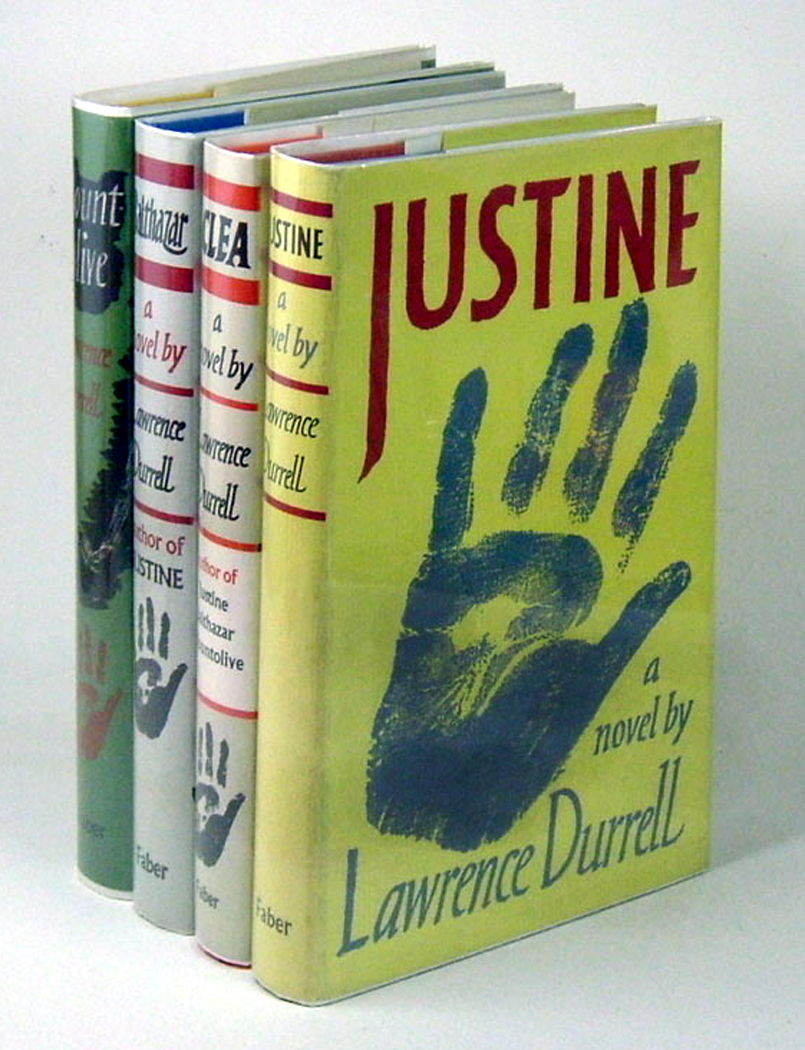
One was Lawrence Durrell’s Alexandria Quartet. You have to be a certain age and in a certain state to take in those four books. I was. Thirty is its age, just as 14 is Salinger’s.

The “trick”of the four books is a kind of Rashomon retelling of the story several times. First through the eyes of a man in love, second from the point of view of a disinterested outsider, and third from an omniscient narrator and each version contradicts the previous and fills in missing information and corrects their misunderstandings and misperceptions. It is a byzantine tale set in a duplicitous ex-pat Egypt before and during World War II. The prose is dense and florid; the plot is even more so, and the characters even more than that. It is a huge pile of musk, perfume and offal.

I read it with a dictionary at hand. Durrell rather likes arcane and esoteric words and the list I drew up while reading became a daily vocabulary lesson. Etiolated, pegamoid, ululation, exiguous, exigent, vulpine, objurgations, tenebrous, integument, hebetude, fatidic, pullulation, crepitating, emollient, cachinnation, splenetic, comminatory, plethoric, usufruct, mansuetude, titubating.

The author’s habit leads to such sentences as:  “He has manumitted the colloquial…”

But there is a concomitant grace and directness of balancing sentences, such as: “She took kisses like so many coats of paint.”

It is a baroque style that is meat to only a few. I was hungry for it and the reasons were personal.

I only late found out that the woman I had been living with had had a very active secret life of which I knew nothing. I was as naive as Darley in Justine. I had friends who could have written me a Balthazar, but they didn’t and I fled cross country in exile and in metaphysical pain.

This was a devastating case of literature as a mirror and the face I saw there shamed me. But it also instilled in me a sense of caution, a humility concerning what I think I know and a skepticism for what others think they know.

Balthazar at one point says, “Truth naked and unashamed. That’s a splendid phrase. But we always see her as she seems, never as she is. Each man has his own interpretation.” rules of the game

Or, as Octave says in Jean Renoir’s film, Rules of the Game, “The awful thing about life is this: Everyone has his reasons.”

We almost never know enough to make informed judgments: The truth is always hidden from us and people act from motives we cannot be privy to.

Durrell taught me to be perpetually in a state of tolerant unknowing.

Or at least he reinforced through art the lesson I had been given but perhaps did not fully comprehend. Some lessons come in the form of a ball-peen hammer to the head.

NEXT: Part 2 Wilderness years: A bigger library