Archive

Tag Archives: learning

snow on peaks 2

Some people say the best thing about traveling is coming home.

I say, you never do come home.

That is, if you have gotten from your travels what they best offer, you can never return to the life you had been living. You are changed.

Of course, the return to normal life, after weeks of living out of suitcases and eating out of McDonald’s bags, is a relief. Vacationing is hard work. You use all the hours of the day like each day is the last.

But an engine is not meant to run full throttle 24 hours a day.

At home, you can finally take your shoes off, sit back and watch Seinfeld reruns, knowing that you are going back to the office in the morning. It is like the rerailing of a derailed locomotive; you are back on track, you know where you are going and when. The schedule is published and you can consult your timetable.

And there is also something comfortable about being surrounded by all your things. They are familiar. Your books, your TV, your sofa — and most of all, your bed.

Home is where your family and friends are, too — or so it used to be before America decided to move every few years.

It’s like putting on an old pair of sneakers after wearing rented shoes for a week.

Yet back home, there is something you miss from the traveling. A kind of rush from not knowing what comes next, from having to pay attention. Travel can be exhausting, but it is also enlivening.

For the workaday life is a life that is not fully awake. Routine dulls the luster of the stones under your feet, turns the music of the blackbirds in your back yard to an irritating squabble.

Feijoada

Feijoada

Travel provides many other benefits. It makes you less provincial, for one thing. You can no longer believe that your local way of doing things is the only way. You may have been brought up on meatloaf and mashed potatoes, but only the most stubborn of us is not seduced by Brazil’s feijoada or London’s aloo matar. We learn that other nations may be more civilized than our own. Certainly there are many that are safer.

Travel also entertains. The scenery shifts, the menus shift, the languages shift. There is always something new to tickle our attention.

And travel can separate us from our problems, like a two-week bender. We forget office politics, forget project deadlines, forget our debts and trespasses. It is like halftime in the game of life.

But none of these things is as important as the power travel has to reawaken us to our own lives.

Drakensbergs

Drakensbergs

What travel gives us that our regular lives cannot is newness. Everything seems brand new; you can’t get enough of it. We may have mountains at home, but we don’t really see mountains until we drive through the Rockies or the Drakensbergs in South Africa. We have desert at home, or a river, but we don’t see them until we cross Death Valley in July, or see the moon glowing on the fast midnight current of the Rhine near Dusseldorf.

Our work lives are formed of clay and mud. Our travel lives burn with flame.

But if we have done our travel properly, we bring that flame home with us. And we are reawakened to our own lives; we can see it again for the first time.

It can be even more true if the travel has lasted too long. Twenty-five years too long.  A lifetime of travel, and a later return to what was once familiar. The Ithaka you left is never the Ithaka you return to.

As I write this, snow has just left the lower heights of the Blue Ridge and hangs over the tops of the bowl-rim of peaks that form the zig-zag horizon just outside Asheville in North Carolina. Up on the ridges, the white remaining on the ground provides a visual relief allowing us to see the leafless trees as distant hashmarks inked onto the hills like pen-strokes, in a way we can never see it in summer, when the foliage softens the view and makes ever mountain furry instead of hairy. snow on forest floor 2

Seeing that again this year is refreshed in a way it never was when winter was the ordinary slush of melting snow, greyed with soot and piled by snowplows into tiny cordilleras parallel to the curbs of the wet, slick streets. Coming back to the East after a quarter-century in the Arizona desert has allowed me to see the snow all over again as something miraculous, a world-state of the intensely beautiful.

And the ordinary light of day is rendered what it always is, extraordinary.
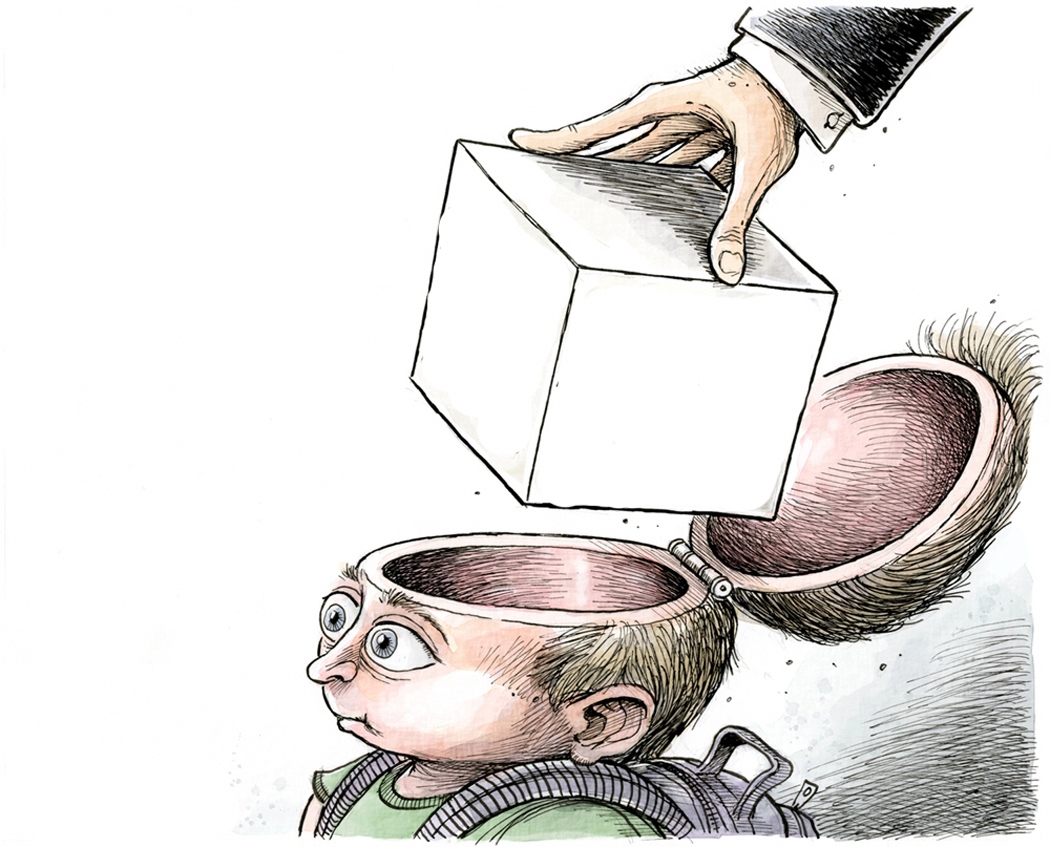
square into skull

If you want to be really smart, you have to learn to be stupid. 

Now, I don’t consider myself to be particularly intelligent, but I have noticed when other people are, there are a few things they have in common. One of them is the ability to be blunt pig-iron stupid. 

What I mean is that intelligence can best be found in ”volitional ignorance,” or a willed erasure of everything you know. I am certain of this: What you know prevents learning. 

People create for themselves a model of reality, or more accurately, many models. These models derive from experience. When anything new makes itself felt, it is immediately tested against the model most appropriate. 

If no model is right, the new fact can be dealt with in one of two ways. More commonly, it is squeezed into the model like a square peg hammered into a round hole. The new is shaved and jiggered until it conforms with what we already know. In the end, we have learned nothing; we may only have renamed what we already knew. Unless the square is a brownie and the round hole is a mouth. eating a brownie

But intelligence is what makes us throw out the old category rather than mangle the nonconforming fact. And those who are genuinely brilliant throw out the categories before even considering the new fact. This is what I mean by volitional ignorance. It forces us to reinvent the wheel every single time and is the only way to discover anything genuine about the problem of wheels. 

It means you accept the experience fresh and start for yourself rather than relying on the culturally accepted model. 

I was talking of this with someone recently and he said, ”You mean, like coloring outside the lines,” and because I am not particularly quick of mind, I agreed. 

This worried me later. For it is not like coloring outside the lines, not at all. When he said that, he was in fact squeezing my square peg into his mental round hole, translating what I was saying into something he already understood. 

We all do this constantly, and I am not criticizing him for it. I am frequently guilty of the same thing. In fact, we cannot do otherwise without becoming yammering idiots. A certain amount of structure is needed to function in our daily lives: We cannot question the egg at every breakfast. 

But still, intelligence is the ability to get past the quotidian. I call the ignorance ”volitional” because it is something I make a choice about. Those who have no choice and are forced to see everything fresh at every second of their lives are called schizophrenic; they cannot edit the information coming into their brains. 

Yet, we need to be able to allow ourselves to enter that state on cue if we are ever to learn anything new and genuine. 

Coloring outside the lines implies a disregard of the structure of the drawing we are coloring. Intelligence doesn’t mean the mere disregard of structure, but the discovery of yet another structure, as if, looking up at the night sky, we were able to ignore all the constellations and create new ones, entirely our own, and what is more, that the ones we create are better and truer than the old ones, just as the Big Dipper is easier to see than the Great Bear. 

There are also several other aspects of intelligence that need mentioning, I think, although they are all related. 

First is that intelligence can apprehend the similarities of disparate things. It recognizes in what way the horse is the same as the fork. It makes us transcend the accepted categories of things and redefine the categories. Perhaps, instead of thinking of the categories ”mammal” and ”silverware,” we might discover that through human history, both horse and fork have been used as parts of the common category ”tool.” 

Or we might compare four legs with four tines. 

I remember a segment on Sesame Street where they played the game, ”Three of these things are kind of the same,” where they show us four items and ask which doesn’t belong, and which three do belong. 

In this case, they had a red ball, a tomato, a green apple and a ruddy pear. Well, there are four different answers: The ball is different because it is inorganic; the pear is different because it is not round; the apple is different because it is not red; the tomato is different because it is soft. 

The ability to see multiple answers is another sign of intelligence. Intelligence is not afraid of ambiguity. 

And finally, intelligence understands things metaphorically, that is, it thinks in images and discovers in them reductions of complex thoughts in small, understandable packages that resonate emotionally. 

Einstein first discovered his theory of relativity not in a mathematical equation, but in a mental picture. It gave him the insight he needed to later forge the math proving his insight. But the picture came first. 

Speaking of one thing while meaning another is the heart of intelligence. This is not a game, merely substituting one thing for another as in a rebus, but rather it is the recognition that our vocabulary is limited by what we know already. When we confront something genuinely new, we cannot speak of it in language we already have, we must speak of what it is ”like.” 

As for instance: Human love is infinitely complex. When we feel it, we almost always decide the word ”love” is inadequate to describe what we feel. We can either do what Woody Allen does in one of his films, and try to invent a new word: ”I glom you, I snorfle you,” but such a course is meaningless to anyone else. 

Or we can make a metaphor and say, ”My love is like a red, red rose that’s newly sprung in June,” or ”Love is the valence of pheramones.” 

In each case, we are trying to convey something of the complexity and subtlety of what we feel, not allowing it to die the death of the normal, the bland, the banal. We are insisting that the particular emotion be understood and felt by the stranger to whom we are talking. We want exactness in our language, and we can reach it only through inexactness. Metaphor is the means of doing it. 

All our highest and best thoughts are metaphorical. All the most banal come straight from the dictionary. 

The more precise a word is, the less it describes. Meaning depends on ambiguity. 

Intelligence is the lightning bolt that arcs from one thought to another, fusing them together like glass. 

All intelligence is a form of recognition.