Documentary producer Ken Burns has just released a 3-hour film on 19th-century author Henry David Thoreau, one of my heroes when I was a younger man and more easily caught by enthusiasms.
With a bit of hesitation, I tuned in to watch it on PBS and was instantly disappointed. It was the Standard Authorized Version, with almost nothing new to say. It was the Thoreau you might get on a network morning chat show — all surface, all cliche. Its language is largely that of 21st century pop psychology, while Thoreau’s own words are saturated with 19th century Romanticism.
When Burns came out with his monumental series on the Civil War in 1990, it was groundbreaking and original. It was also a huge hit and deserved every accolade it received. He has directed and produced some epical series since then, but I’m afraid it has mostly been downhill from then. He has parodied himself and his once-innovative style, with its narrator, and its Hollywood celebrity voice-overs and vintage photographs lovingly caressed by the slowly moving camera.
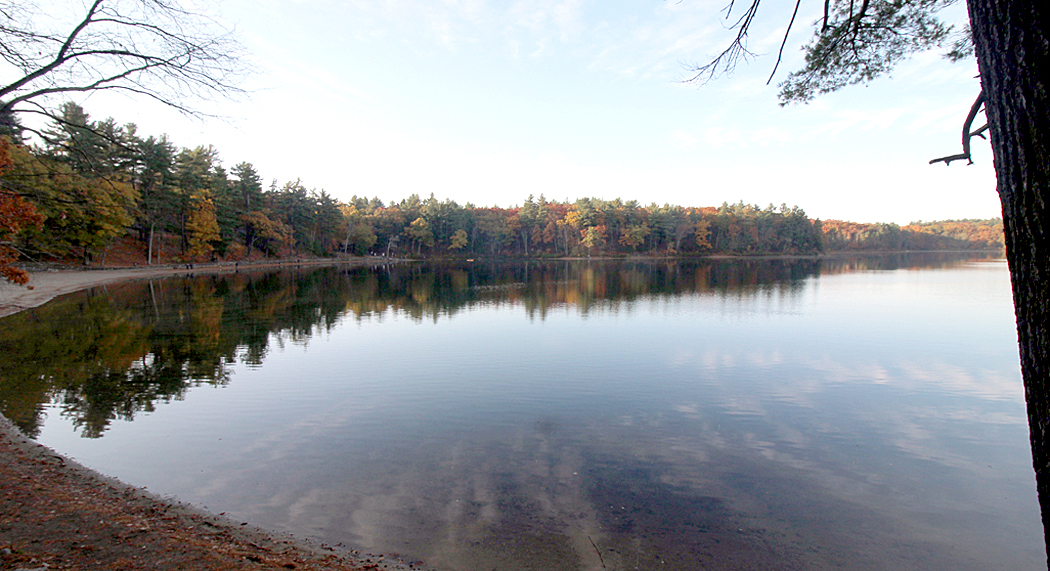
Walden Pond
And so, this series on Thoreau doesn’t offer much new or insightful. It does attempt to make the 19th century writer seem more 21st century than can convincingly be done — more social justice warrior and less tedious cataloguer of birds and ferns. To be fair, Thoreau was, in terms of his day, quite progressive, an abolitionist and environmentalist, and some of his writing has had tremendous social and political impact on the century that followed him. But the series gets the balance wrong, more in favor of things we value, and less so for the more Transcendentalist trends of his era.
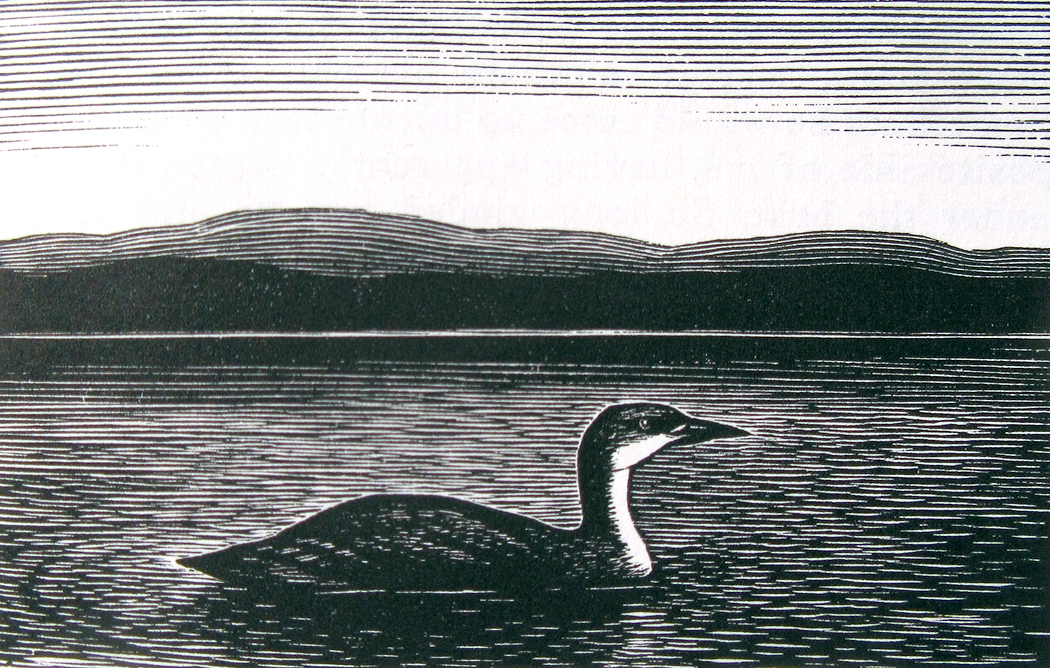
And it glosses over the fact, that in addition to being a great writer and social activist, he was also a world-class loon. He didn’t play well with other children, as they say. He liked his loneness, didn’t comfortably interact with others, and while he was a proto-environmentalist and a fervent abolitionist, he also maintained many prejudices of his age, including a romanticized view of Noble Savage Native Americans. His political views could line him up pretty well with current anti-tax Tea Party Republicans. Some have outright called him an anarchist. Recently, others have placed him on the Asperger spectrum. Others have questioned his sexuality, or lack of. At any rate, Henry Thoreau was not what is typically considered normal. If not a loon, at least a very odd duck.
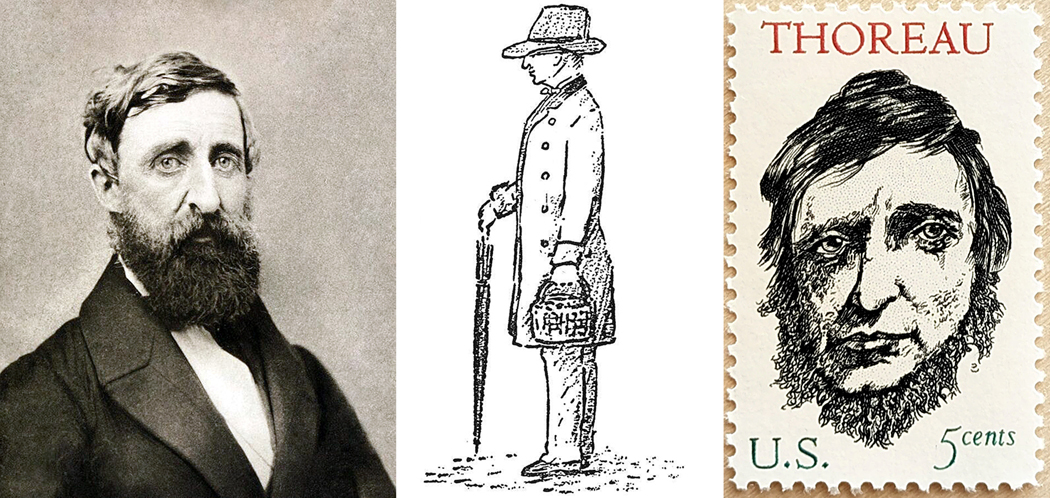
Emerson wrote of him, “He was bred to no profession. He never married; he lived alone; he never went to church; he never voted; he refused to pay a tax to the State; he ate no flesh, he drank no wine, he never knew the use of tobacco and, though a naturalist, he used neither trap nor gun. When asked at dinner what dish he preferred, he answered, ‘the nearest.’”
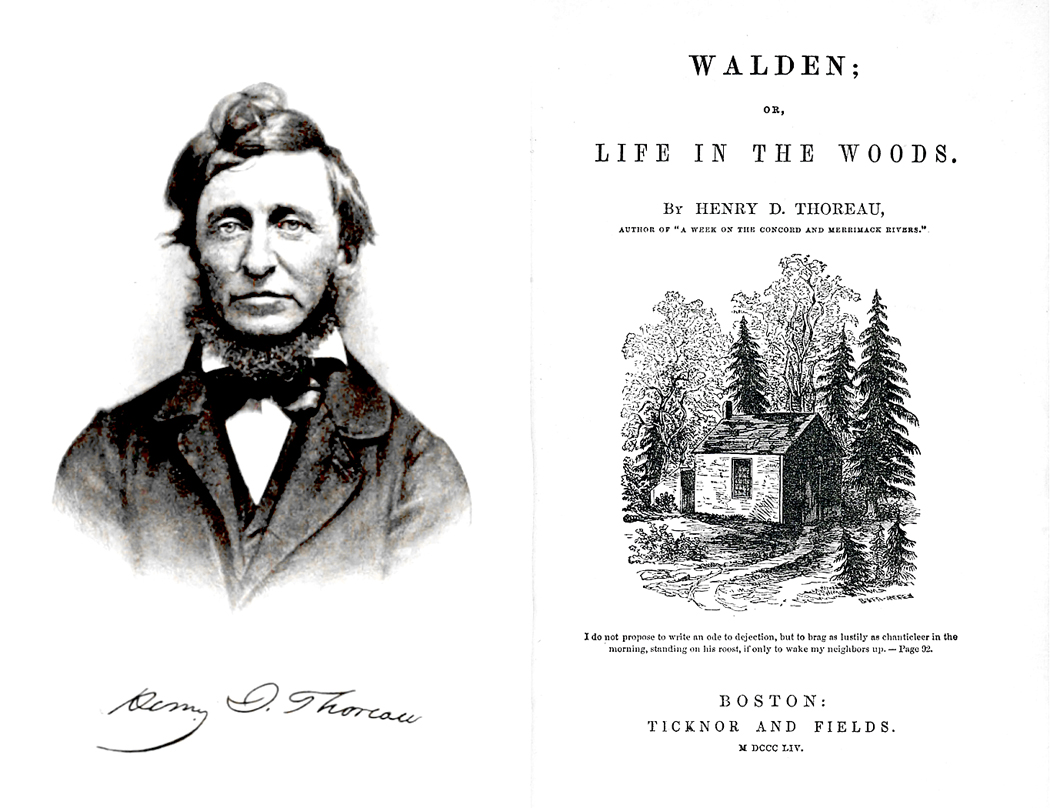
Walden, of course, chronicles his time spent in a cabin he built on the glacial lake of that name, where he lived for two years in an attempt to leave civilization behind and grow his own beans. Thoreau became the patron saint of environmentalism in the 1960s, and that despite the fact that in 1844, he personally destroyed a whole forest by, like Wilmer in The Maltese Falcon, “doubtless being careless with matches.”
Yes, he marched to the beat of a different drummer, but had little sense of rhythm.
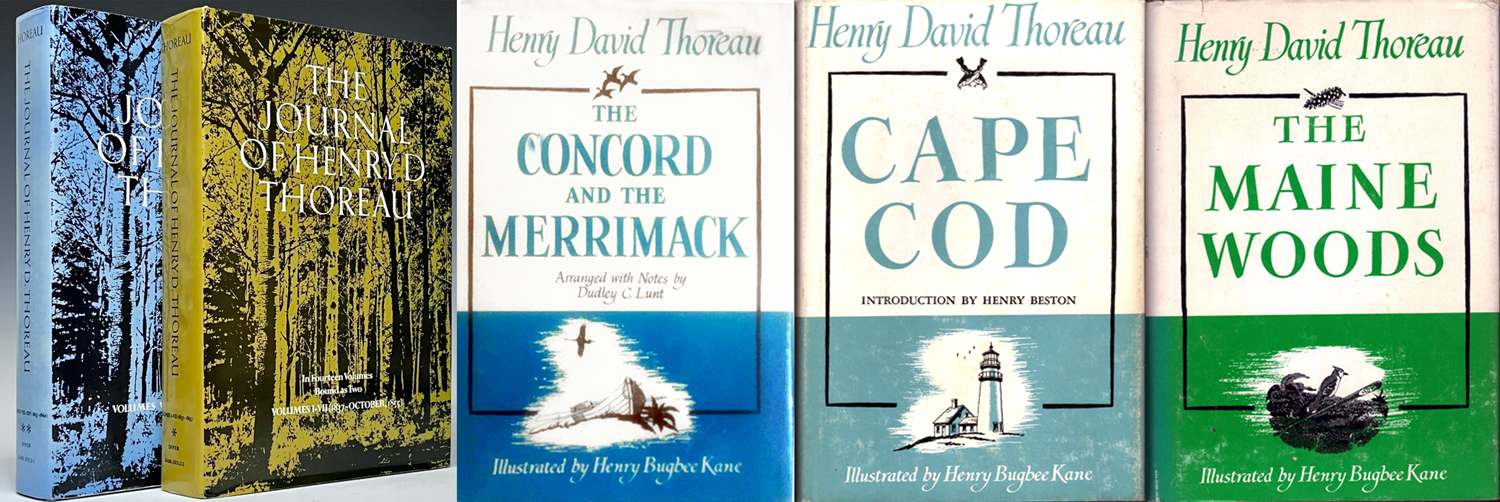
I have read most of what Thoreau wrote, including his 14-volume journals. I feel safe in saying there were four basic periods in his writing life. Early on, he was a student, and like many such, mimicked his models to the point of too often simply quoting them endlessly. He had a habit of gathering shorter piece he had composed and editing them together into longer, rather discursive pieces.
Then came his journeyman period, where he had largely found his voice, but still had some problem making the whole cohere. This was the period of the book he wrote while at Walden Pond, A Week on the Concord and Merrimack Rivers, which told the story of the boat trip he made with his brother, John, 10 years before. They sailed a dory down the Concord River and up the Merrimack, and attempted to climb Mount Katahdin in Maine, where he had a transcendental vision. After John died, Henry wrote the book as a memorial to his brother.
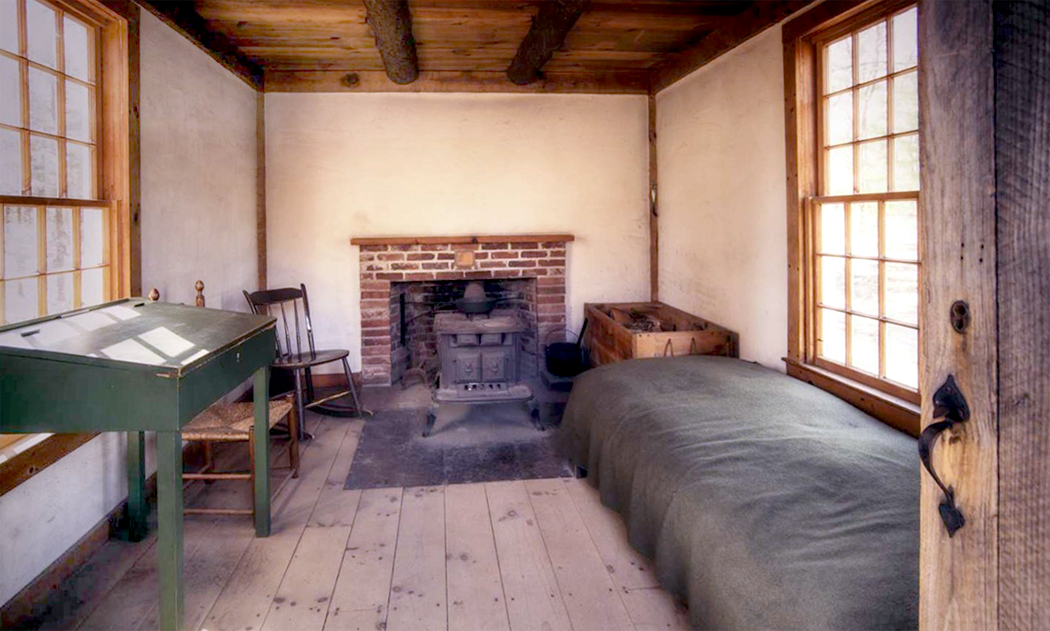
Reproduction of the interior of Thoreau’s cabin
It is a wandering volume, mostly about the boat trip they took, but also about pretty much everything else the young writer could pack into it, still with lots of allusive quotes. Perhaps he was imitating Montaigne, whose work is likewise punctuated.
He had it published at his own expense, and when it failed to sell, he wound up with all the remaindered books delivered to his home. “I now have a library of nearly nine-hundred volumes,” he said, “over seven-hundred of which I wrote myself.”
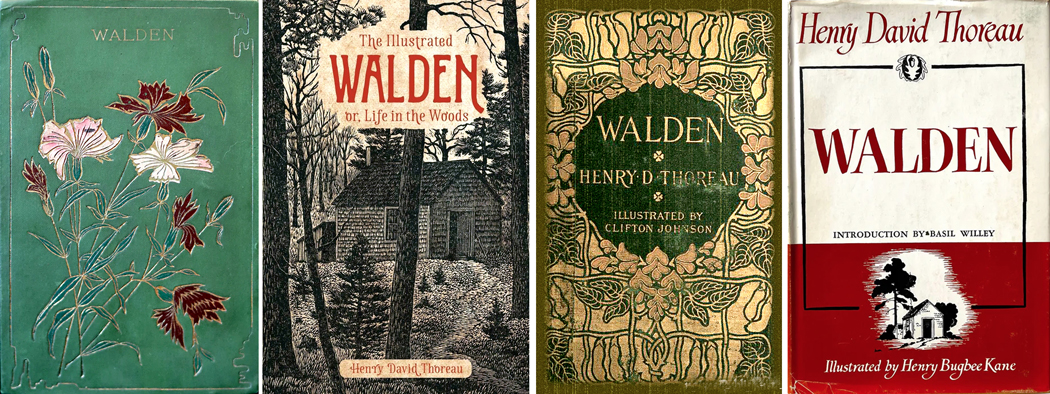
The high point came with Walden or A Life in the Woods, which he began in his lakeside cabin and finished later on. It is one of the best written books I have ever read, if taken sentence by sentence. It is delicious to peruse. I fell in love with Thoreau’s prose style, with its biblical heft and Shakespearean metaphor.
“Time is but the stream I go a-fishing in. I drink at it; but while I drink I see the sandy bottom and detect how shallow it is. Its thin current slides away, but eternity remains. I would drink deeper; fish in the sky, whose bottom is pebbly with stars.” How can you write better than that? You can’t.
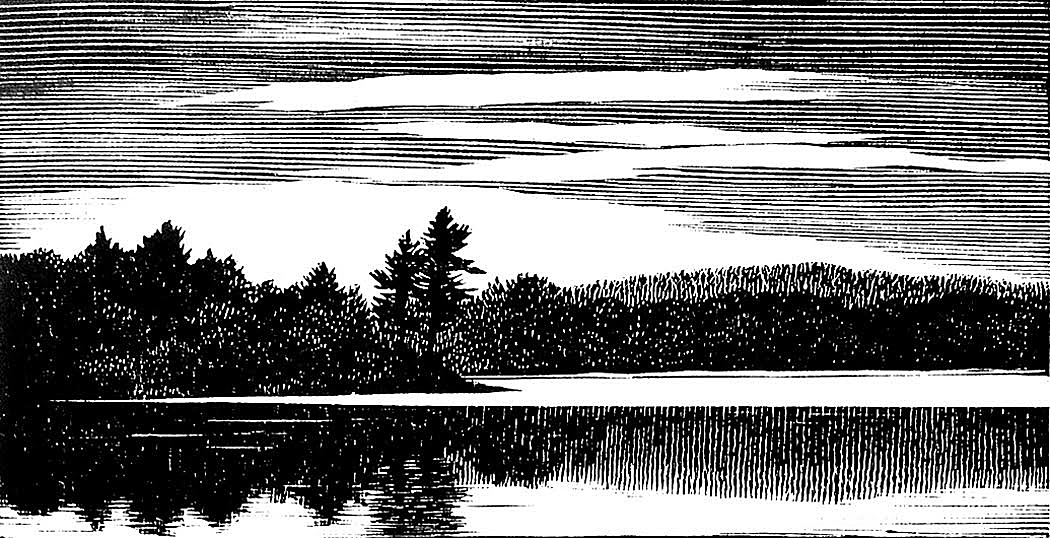
Illustration of Heritage Club edition of “Walden” by Thomas Nason
His later books were cobbled together from magazine articles he had published. They are still a delight to read. The Maine Woods and Cape Cod — neither as sustained as Walden, but still solid writing.
But as Thoreau got older, he began to lose the metaphorical fire that had made Walden so memorable. He became more concerned with collecting data, precise taxonomy and recording detailed observations.
You can see these stylistic periods in the journals, which begin with lots of quotations, rise to metaphorical heights as the years progress, and then devolve into quotidian daily notations perhaps of scientific usefulness, but no longer designed for the pleasure of reading.
He published a final travel book that demonstrates the kind of exhaustion Thoreau was facing. It was published in 1866, after his death and called A Yankee in Canada. It begins, “I fear that I have not got much to say about Canada, not having seen much; what I got by going to Canada was a cold.”
I have read it all, from A Week to Walden to Maine Woods to The Dispersion of Seeds, which is one of the first meaningful explications of plant succession. But not the poems. Gott im Himmel, not the poems. Thoreau wrote the most poetic of prose, but the most prosaic of poetry.
This he shares with his mentor. Thoreau lived for a while with Ralph Waldo Emerson, who was a celebrity and public intellectual who wrote reams. Emerson was more widely and systematically read and educated than Thoreau and he explained a good deal of German philosophy to the American public. Emerson was a better philosopher than Thoreau, but Thoreau was the better writer.
Both shared an aphoristic style, where individual sentences are hugely quotable. “A foolish consistency is the hobgoblin of little minds, adored by little statesmen and philosophers and divines,” Emerson wrote in Self Reliance.” And, “We are always getting ready to live, but never living.”
(Compare with Thoreau in Walden, where he wanted “to front only the essential facts of life, and see if I could not learn what it had to teach, and not, when I came to die, discover that I had not lived.”)
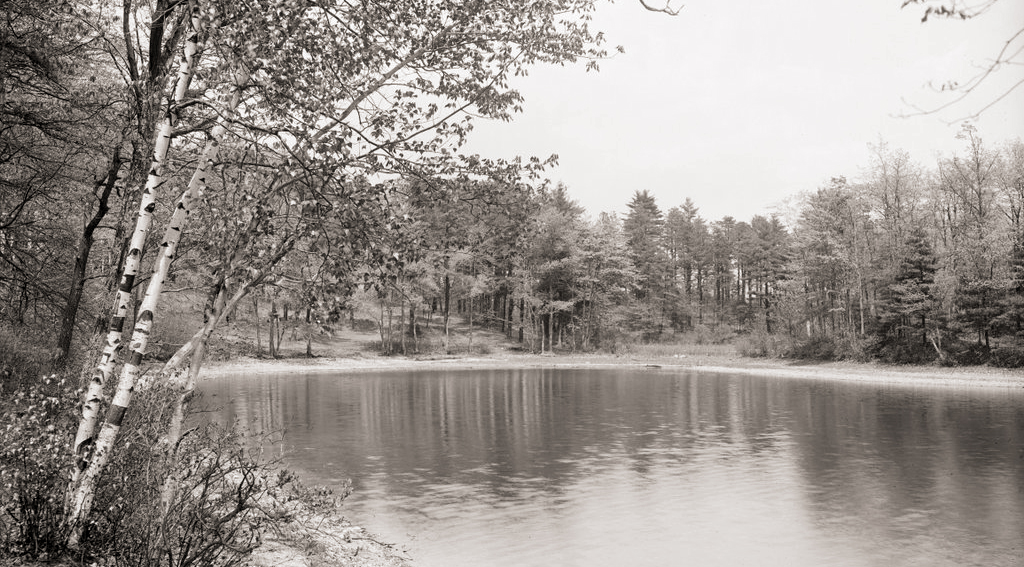
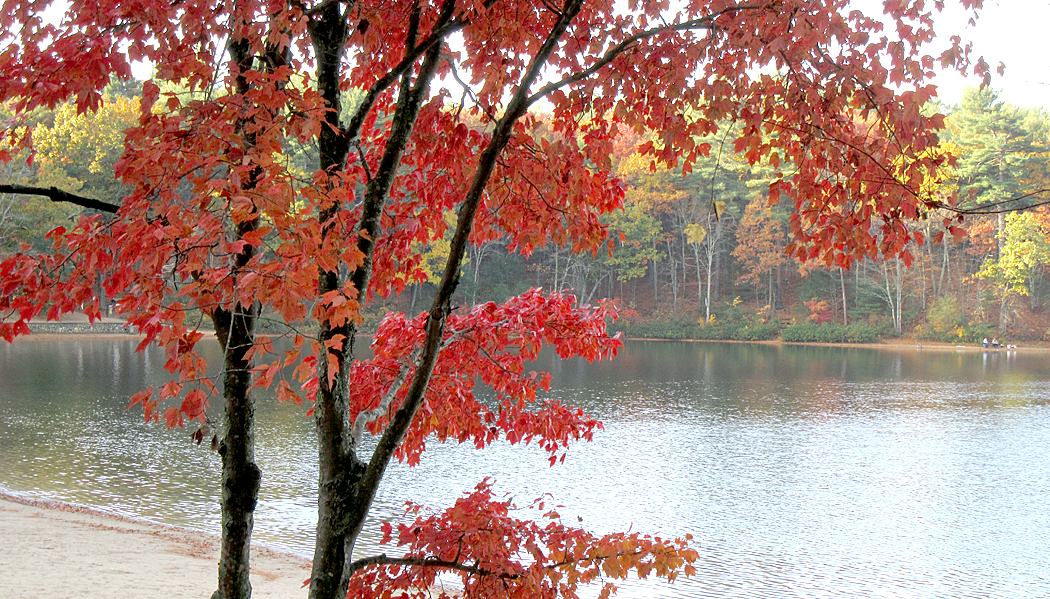
Thoreau’s Cove, at Walden Pond
The difference between them is that Emerson strings these aphorisms one after the other like shunting boxcars bumping into each other. There is often little sense of continuity. You admire each sentence but they pile up rather than add up. Thoreau has the aphorisms, but also the talent, at his best, to make them flow together melodically.
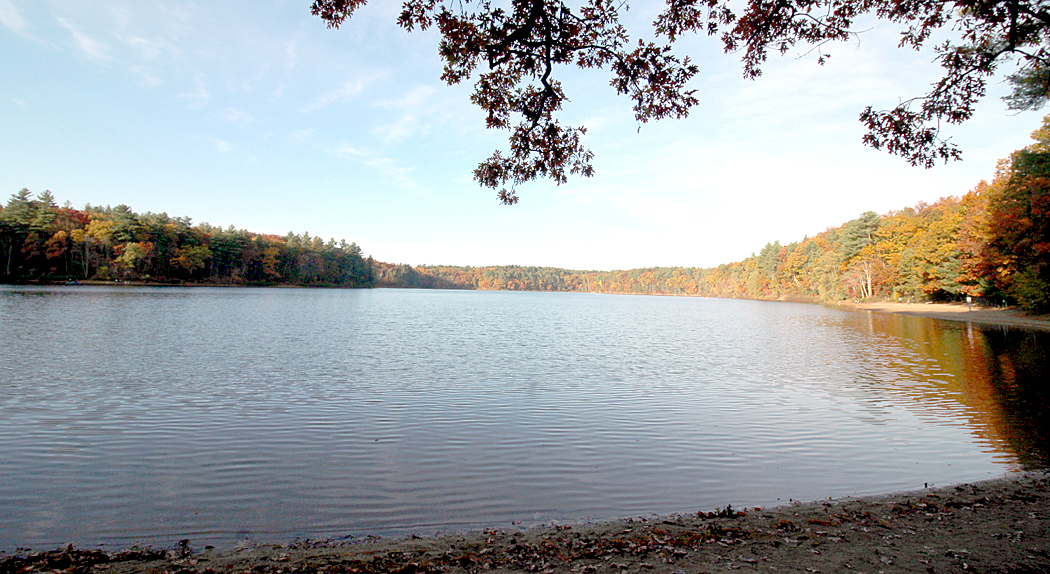
I first went to Concord and Walden Pond more than 50 years ago. I can not accurately recall the number of times I have made it back; they all blur together. I’ve been there in spring and in fall; I have had the place all to myself, and I have had visits I had to share with busloads of tourists; there were moments when I felt I was communing with the eternity that Thoreau found there, and moments that were bound by the clock — I had elsewhere to get to before dark.
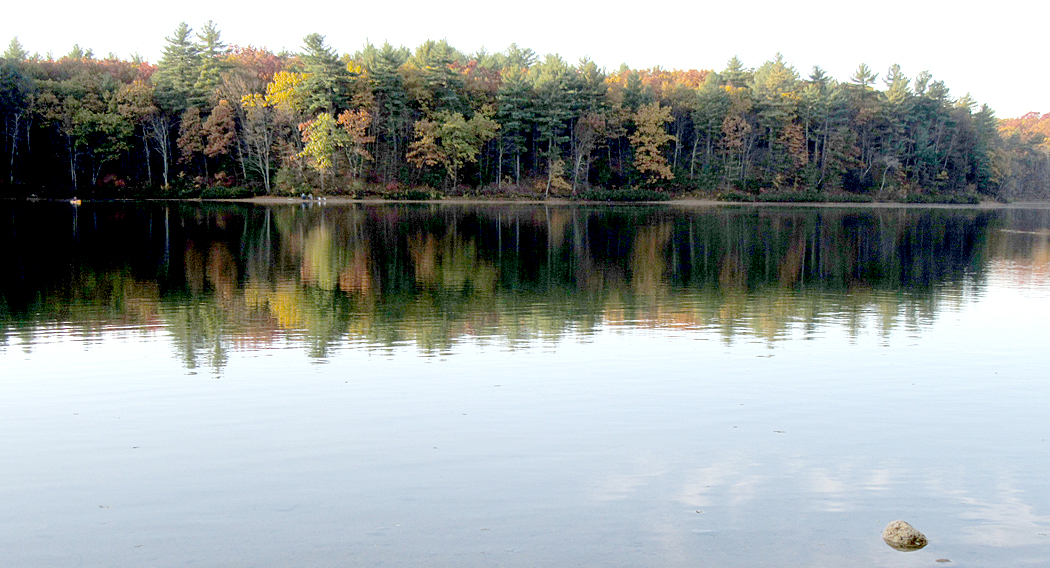
But the climax of a visit is circumambulating the pond, i.e., walking the perimeter of the water, a distance of roughly a mile and a half. At the one end is the swimming-hole beach used by the residents of Concord, Mass., and at the far end are the railroad tracks of the Massachusetts Bay Transportation Authority’s Fitchburg Line commuter train.
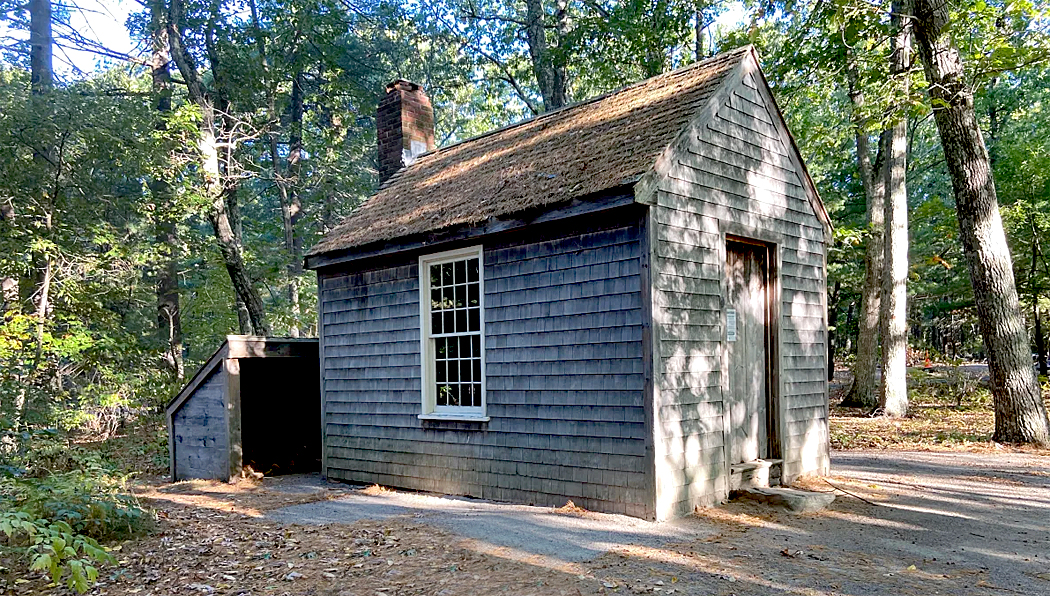
Reproduction of Thoreau’s cabin
On the way, you pass the site of Thoreau’s cabin, marked by stones where the tiny building used to be (a modern replica can be see on the other side of the highway that passes the pond, at the parking lot; yes, there is now a parking lot.)
The pond is just another kettle lake in a landscape made by their number into Swiss cheese on the map of New England. But it has a resonance built into it because of its adoption by Thoreau, a resonance that is now felt by countless acolytes for whom Walden is, if not a holy book, then at least a baedeker for self-discovery.
I may have shorted Thoreau as a political thinker. His essay on Civil Disobedience has been especially influential on reformers, from Mohandas Gandhi to Martin Luther King Jr. And his scientific essays, written later in his career, have sometimes been well ahead of their time.
But shifting the emphasis from the nature writings to the political and moral writings, as the TV series seems to do, equally distorts the life he is profiling.
He became a prophet in the hippie 1960s, but that era was too louche to fully capture him. The informality of Whole Earth Catalog would have been foreign to the Harvard educated Thoreau, who read ancient Greek and quoted Aeschylus, and believed in “higher” thoughts and endeavors. He believed in a kind of intellectual hierarchy that our postmodern world mistrusts.
“He was not easy, not ample, not urbane, not even kind; his enjoyment was hardly smiling, or the smile was not broad enough to be convincing,” wrote Robert Louis Stevenson. “So many negative superiorities begin to smack a little of the prig.”
We get very little flavor of the man, outside the comfortable mythos, from the TV series. Perhaps that is all the use we can get from him in an era of text messaging and Instagram when reading seems as antiquated as blacksmithing.
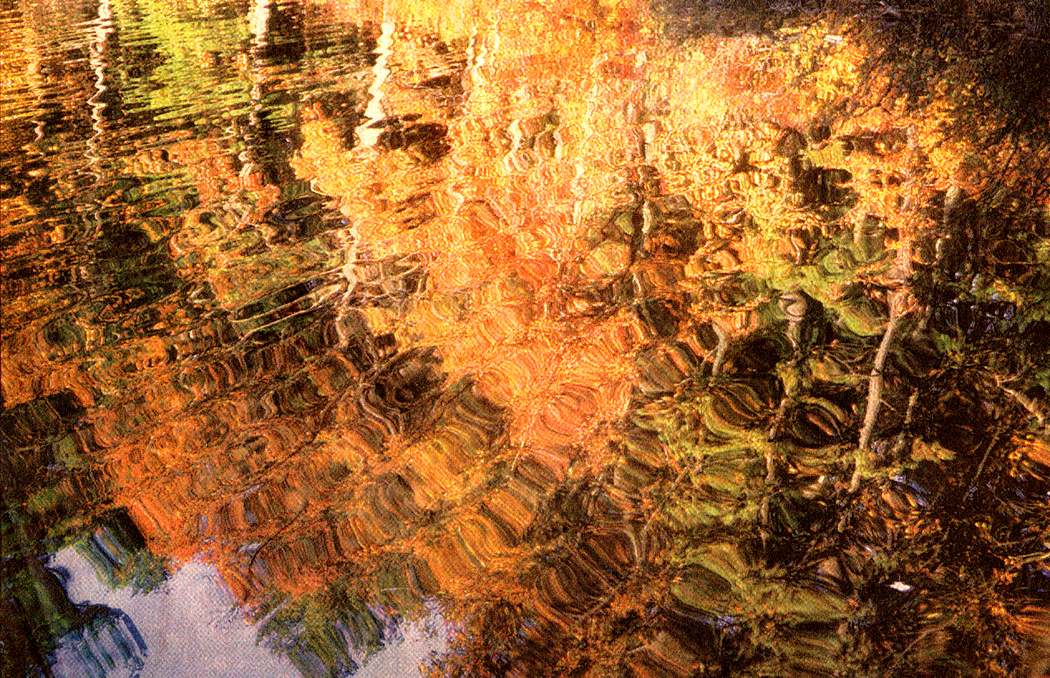
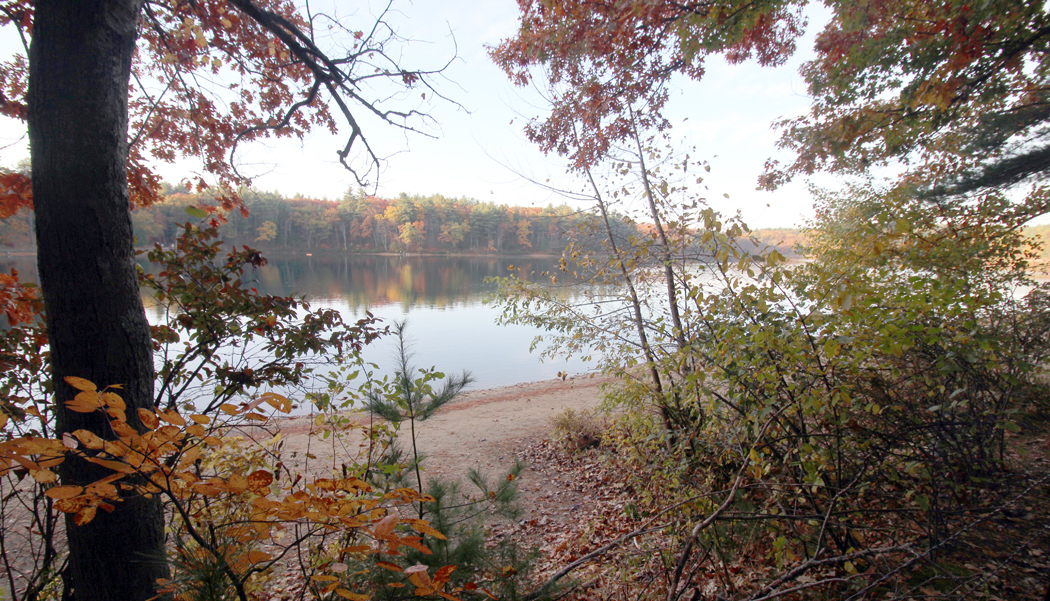
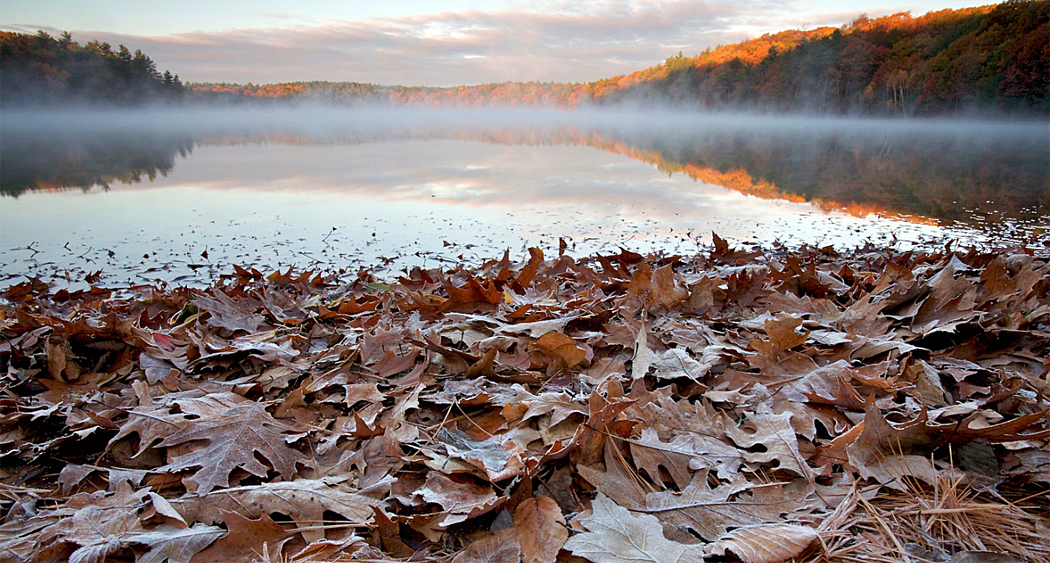
Fall leaves reflected in Walden Pond
We should, no doubt, honor the work that has immediate practical value in the world, but what ultimately gives Henry Thoreau his immortality is the writing, the words. At his best, he was one of America’s greatest writers. I wish the TV series had more of that.