Archive

Tag Archives: philosophy

blake dante

I love language; I hate language. It is how I made my living, but it always feels like cheating. It feels heartfelt, but dishonest. Odi et amo.

Do you remember the first time you were in love, or thought you were, as a teenager? The longing, the rapture. There is an almost universal response that “Love” is not an adequate word to describe the emotion. You feel as if your love is special, better, more aware, alert and awake than everybody else’s, especially  your parents’. And you say, “I wish there were another word to describe how I feel.”

That is the first awareness most of us have of the difference between authentic and inauthentic existence. It is the first, and most universal — at least in our culture — awareness that our lives are divided into separate portions, one of them alive and burning and dangerous, and the other ordinary, safe and comforting.

Heidegger

Heidegger

German philosopher and godawful writer Martin Heidegger gave us the verbal formulation for this distinction when he named the “authentic” and “inauthentic” existence.

Authentic existence: An individual’s conscious response to his existence; i.e., his “being-in-the-world,” which inescapably associates life with death. Authentic existence is thus opposed to everyday (inauthentic) existence.

Heidegger is nearly impossible to read, in part because he invents words to express his ideas rather than relying on the old, well-understood words. He has more than 200 words alone created with the suffix that means “being.”

But it couldn’t have been any other way. Heidegger felt toward the ordinary vocabulary just as the teenager does toward the word “love,” that it is worn out and sounds trite and phony on the tongue that doesn’t truly understand, or rather live through, the experience — and specifically MY experience.

That is because language is by its essence inauthentic.

Language always takes us a step away from our “being-in-the-world.” It is a way of softening the experience, a way of taming it.

In this sense, I take as a central dichotomy the opposition of language and love.

An awareness of death, says Heidegger, is what wakes us up to the here-and-now, keeps us focused on the experience of being alive. And a desire to transcend death is the ultimate goal of both language and love.

The analogy of love and language is nothing new.

When Shakespeare wrote his sonnet, “Shall I Compare Thee to a Summer’s Day,” he ends it with the telling couplet, “So long as men can breathe, or eyes can see, So long lives this, and this gives life to thee.’’

In that, he is mixing the two: the words are immortal, and therefore, so is his love.

But the actual love is an experience and at its fullest transcends words more certainly than it transcends death. We love, have children and HOPE that the love will live past death. But there is no question that the experience of love can never be adequately expressed in words: They are too small, too conventional, too ordinary.

Richard Freiherr von Krafft-Ebing with his wife, Marie Luise

Richard Freiherr von Krafft-Ebing with his wife, Marie Luise

The sliver of experience in the condition of love IS the authenticity. It is the experience of life. The words are only ABOUT the experience of life. After all, would you rather make love or read Krafft-Ebing?

Now, certainly Heidegger wasn’t the first to recognize the distinction. He is merely the philosopher who fixes the meaning of the distinction like an entomologist pinning a butterfly. Heidegger gives us the vocabulary — now necessarily inauthentic — to describe the reality. We use his words, and as a consequence, fall (another of his words) into inauthencity.

The writer Henry Miller expresses it another way in his book Black Spring:

“What is not in the open street is false, derived, that is to say literature.”

Henry Thoreau’s whole book, Walden, is essentially about living an authentic life.

“To him whose elastic and vigorous thought keeps pace with the sun, the day is a perpetual morning. It matters not what the clocks say or the attitudes and labors of men. Morning is when I am awake and there is a dawn in me. Moral reform is the effort to throw off sleep. Why is it that men give so poor an account of their day if they have not been slumbering? They are not such poor calculators. If they had not been overcome with drowsiness they would have performed something. The millions are awake enough for physical labor; but only one in a million is awake enough for effective intellectual exertion, only one in a hundred millions to a poetic or divine life. To be awake is to be alive. I have never yet met a man who was quite awake. How could I have looked him in the face?”

“As if you could kill time without injuring eternity,” he writes in another place.

Yeats called inauthentic living “automatonism.”

For William Blake, what made Christ different from the rest of us was his ability to live authentically at every moment.

“Now hear how he has given his sanction to the law of ten commandments: Did he not mock at the sabbath, and so mock the sabbath’s God? Murder those who were murder’d because of him? Turn away the law from the woman taken in adultery? Steal the labor of others to support him? Bear false witness when he omitted making a defence before Pilate? Covet when he pray’d for his disciples, and when he bid them shake off the dust of their feet against such as refused to lodge them? I tell you, no virtue can exist without breaking these ten commandments. Jesus was all virtue, and acted from impulse, not from rules.”

And in another place: “Know that after Christ’s death, he became Jehovah.” Know that for Blake, Jehovah wasn’t a good thing. Jehovah is all rules: “One God, One Law, One King.”

Or perhaps we could go all the way back to Lao-Tse, who wrote the Tao-Te-Ching and said, “The way that can be named is not the constant way, the name that can be given is not the constant name.”

The best popular discussion of authenticity comes in Robert Pirsig’s book, Zen and the Art of Motorcycle Maintenance, which has absolutely nothing to do with zen, even in its pop forms, and only a little to do with motorcycle maintenance.

The book is an investigation of what Pirsig calls “quality,” which, it turns out, is much the same as Heidegger calls “authenticity.”

Pirsig writes:

“You can’t be aware that you’ve seen a tree until after  you’ve seen the tree, and between the instant of vision and instant of awareness, there must be a time lag.”

Any intellectually conceived object is always in the past and therefore, unreal. Reality is always the moment of vision before the intellectualization takes place. There is no other reality. This pre-intellectual reality is what [I] felt [I] had properly identified as Quality. Since all intellectually identifiable things must emerge from this pre-intellectual reality, Quality is the parent, the source of all subjects and objects.”

And authenticity, rather than being a result, is likewise a source. Authenticity is a relation you have with being alive that allows you to see, feel, and experience without the intervention of word or symbol.

All art, or all worthwhile art, exists to reawaken in us this often closed-off authenticity.

Art cannot itself embody authenticity: It is, after all, words or symbols — even music is an analog of the experience.

But the best art gives us an experience in itself and demonstrates, or forces us to become aware, of how to experience the rest of our lives — that portion we live with our mates, children, parents, that portion that is our careers, that portion that gives rise to spiritual awareness.

Of course, all art is, in this sense, inauthentic.

But just as a metaphor is never the thing, but points the way to the thing, so art points the way to the authentic.


It is a commonplace that America is materialistic, that it grasps after money and wealth and lacks the spiritual values it used to have.
Of course, that nostalgic view ignores that Americans have always chased wealth: It’s built into the Constitution.
But more importantly, it ignores the fact that America isn’t really materialistic at all, and in fact, is largely indifferent to the material world.
If we were really materialistic, we would never tolerate walnut-woodgrain plastic.
No, the physical composition of their existence is simply not a high priority for most Americans. Yes, they are after wealth, but wealth isn’t a material value, but a spiritual one.
When we say Americans “worship the almighty dollar,” we aren’t saying that they value material objects over spiritual ones, but rather that they place worth on one set of spiritual values instead of another, more worthy set.
Money, after all, isn’t a physical object. It isn’t material. It is no more physical than an inch or a pound. It is a measuring item, to measure wealth.
Real wealth is the possession of useful or meaningful things. To own land, or to grow 40 acres of artichokes is to possess wealth. You can eat artichokes; you can’t eat money.
Money cannot be worn, it cannot be used to build with. It must be translated back from its symbolic existence to a material existence by spending it.
I’m not saying that money isn’t nice to have around. But that it is a mental construct, not a physical reality. If we want money, it isn’t because sewn together, dollar bills make a nice quilt.
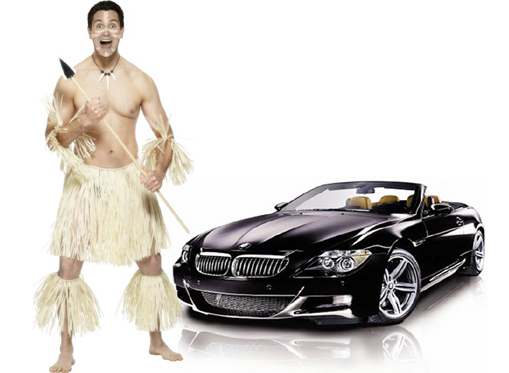
Even the things Americans spend their money on tend to be owned for spiritual rather than physical reasons. If we want to own a BMW or a Lexus, it isn’t because these are better cars than a Honda or an Ford — though they may be (I’m not convinced) — but because they are status symbols that let other Americans know where we rank on the totem pole. Armani suits and Gucci bags are not something most Americans really enjoy on a physical level. They are the civilized equivalent of the eagle feathers the chief wears, or the lion-ruff anklets worn by the Zulu leader: They confer prestige and denote status.
These are spiritual values.

As a matter of fact, America would be a whole lot better off if it were more materialistic. The planet is bursting with stuff: It all has a texture, a feel, a smell, a taste, a sound. If we were materialistic, we would be aware of how much richness the material existence affords, and we would revel in it. We would be mad — as Walt Whitman says — for us to be in contact with it.
And what is more, the deeper we involve ourselves in the physical world, the more spiritualized we will become — that worthy spirituality. It is because we are so unmaterialistic that our environment suffers so. We don’t value the physical world we live in. It doesn’t bother us that there are fewer birds singing in the morning, or that codfish are disappearing.
In part, this is a remnant of the contempus mundi that was fostered under Medieval Christianity. It is that suspicion of the physical world that the Old World monks felt would seduce them from the righteousness of prayer and ritual.
We have inherited the contempt, but without the prayer. It leaves us in a hollow place.
As an adult I have come not to trust anyone who doesn’t love the physical world.
I don’t trust him to make policy choices about oil drilling or lawn seeding. I cannot imagine how it is possible not to fall in love with the things of this world, but I see just that happening all the time.
I pick up the lump of spring earth and squeeze it in my fist to judge whether it is time to plant my potatoes. I listen for the birds globing and twisting as they rise from the trees in the morning. I look for the light caught in the cholla spines and the twill in my gabardine. There is velvet in heavy cream and scratchiness in wool blankets.
The physical sensations make us more aware, more awake. The love of the physical world keeps us from becoming dullards. Living in a world of symbol and status dulls us. At its worst, it leads to ideology.
Would that America really were a materialistic society.