Archive

Tag Archives: poetry

A Facebook friend left a challenge for her followers: 

“In a text post, list 10 books that have stayed with you in some way. Don’t take but a few minutes, and don’t think too hard — they don’t have to be the “right” or “great” works, just the ones that have touched you. Tag ten friends, including me, so I’ll see your list.”

guilford 2

College is where the majority of attendees do the most reading of their lives. Indeed, surveys consistently record that at least a third of college grads never read another book after graduation. One must assume that these are the people who become politicians.

For the rest of us, college is where we encounter the first books that we recognize as opening the doors of our minds and either forming the adults we become, or providing reinforcing arguments for the personalities we have already developed: Really, both.

Coursework reading is where we first discover that other people have had the same thoughts we have had, and what is more, have been entirely more articulate about those thoughts. And those writers have considered issues that had never, as yet, occurred to us.

It is a four-year span in which we are, for the second time in our lives, slapped awake.

As for me, I couldn’t wait. College was an escape from the oppressive banality of suburbia. I was told by my parents that upon entering second grade I asked if that meant I could “go to college next year.”

I really wanted to get away and enter what I imagined to be the real “adult” world of intellectual pursuit.

However, when I got there, I proceeded to waste most of my time and my parents’ money. I was a terrible student. Oh, I worked hard and made excellent grades in those courses that interested me, but in courses that didn’t interest me, or in which I felt contempt for the professor (being the know-it-all that we all are as adolescents), I hardly attended class and instead slept late, drank beer, or spent time in the company of the serial list of women who let me into the mysteries for which I was such an eager sleuth.

There were, nevertheless, a few things from early-morning classrooms that have stuck with me. I want to mention four of them.shelley

The first, and probably most indelible, is Percy Bysshe Shelley’s Defence of Poetry.

There are many for whom art, whether poetry or TV sitcom is essentially a branch of entertainment. These people includes highbrows as well as low. But there are some — and I am unfortunately one — who see a more serious purpose for art. It is probably just a genetic relic of the Norwegian Lutheranism I was born into, but boy, did I ever suffer from it.

This is a position that it is difficult to maintain in part because of the solemn piety of its adherents: easy to make fun of. And the grand claims made by Victorian do-gooders and Modernist manifestos are often preposterous, even laughable, and further undermine any effort to find a moral purpose to scribbling on paper, whether with pen or brush.

Too often, moral purpose in the arts has led to boring, didactic works, espousing this partisan view or that, whether Christian or Marxist — or in the case of that great fashioner of doorstops, Ayn Rand, unreadable tracts.

But Shelley makes clear in his argument that it is not the modeling of behavior that makes art moral, but the very act of imagination: The ability to conceive of thoughts, emotions, pains and motives not our own. Imagination fuels empathy.

“The great instrument of moral good is the imagination; and poetry administers to the effect by acting upon the cause.”

At the heart of great art is compassion. Not as a subject matter — that is left to the preacher’s sermons — but through opening each of us up to the multifariousness of experience and the variety of responses to experience. A great work of art must make us understand even that which we abhor. Humbert Humbert, for instance.

As Yeats wrote, “From our arguments with others, we make rhetoric; poetry from our arguments with ourselves.”

The class where I read the Defence was one in English Romantic Poetry, and it left me with a trove of things I return to over and over, from Wordsworth’s Intimations Ode (which I re-read at least once a month), to William Blake’s Marriage of Heaven and Hell, to the psychedelic fourth act of Shelley’s Prometheus Unbound, which is my substitute for bong and hash: “With a mighty whirl the multitudinous orb/ Grinds the bright brook into an azure mist /Of elemental subtlety, like light.” Flashing, man.greek myths 2

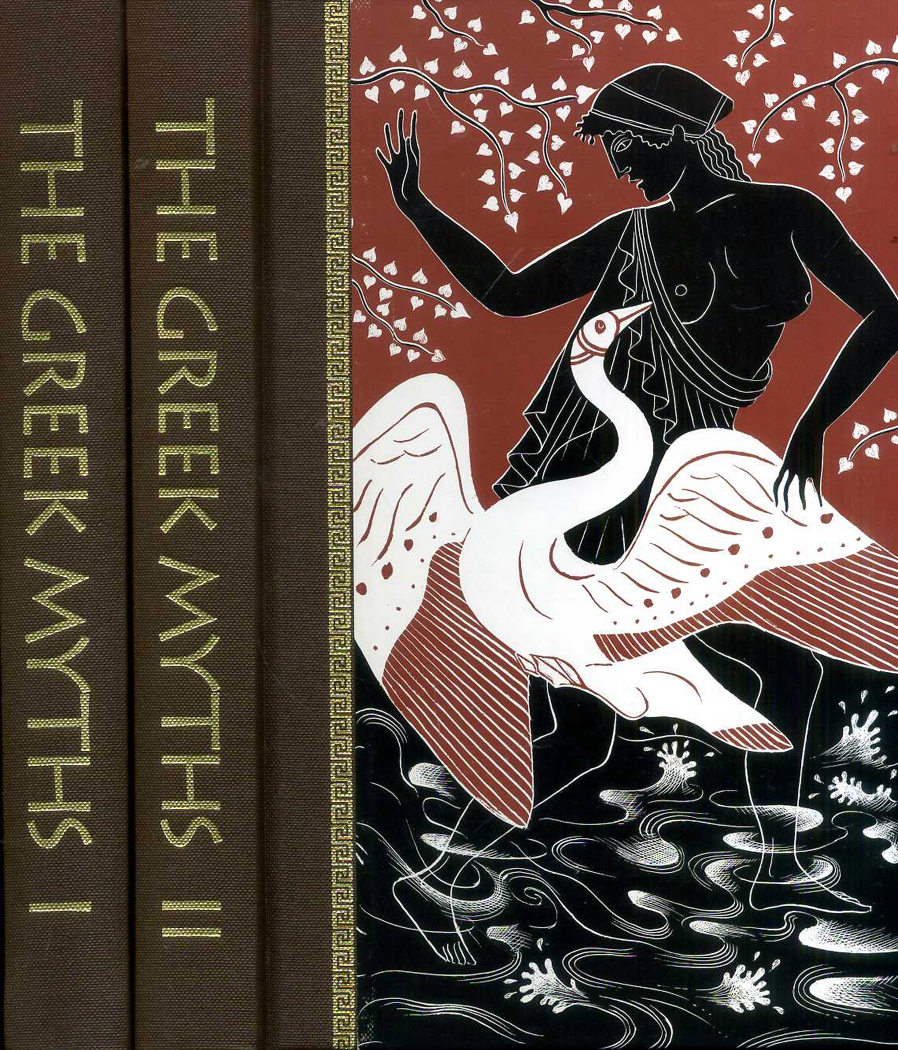
The second lingering from class is Robert Graves’ Greek Myths. I took several courses in classical literature, including a blunted attempt to learn the language of the ancient Greeks. En arche hen ho logos. I foundered on the aorist voice, among other things, including my growing dislike of the word-games and fascistic tendencies of Plato, whose Euthyphro I was tasked to translate.

But, I came to love the classics. They have enriched my life from then to now (more about them in a later blog entry). But Graves gave me a deeper and richer appreciation of mythology, and upset any naive notion I had that it was all a coherent, organized system of gods and goddesses (as it was made to appear in Edith Hamilton or Hawthorne’s Wonder Book), but rather a welter of conflicting local stories, changing over time and mixed into a stew that no one ever held onto in a single grip. Again: multifarious and complex. robt graves

One of the underlying messages of any important reading: Everything you know is wrong. Or at least, no single idea or ideology can adequately describe the world. It is always more complex than that, and we should beware of anyone who tells us they have the answer.

It is true that Graves had his hobby horse and you can’t take everything he avers as solid truth. But the underlying mash of malt and hops captures the brew pretty well.

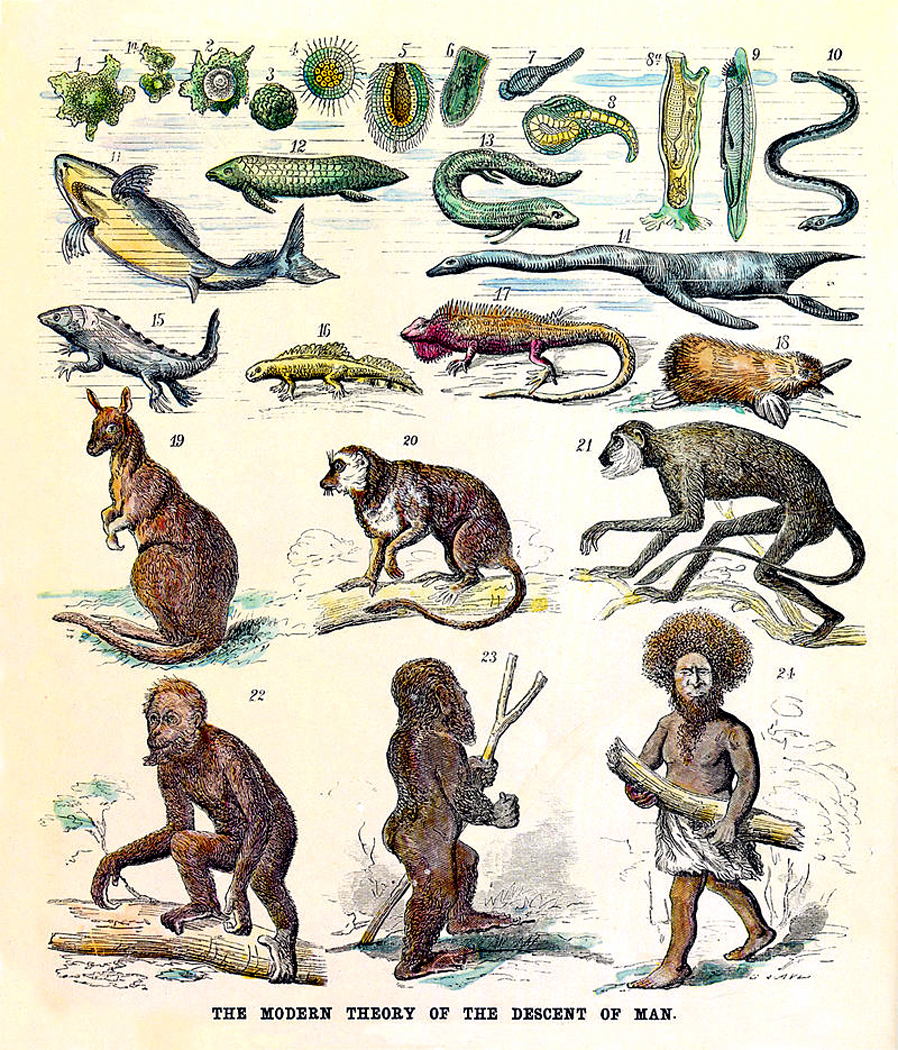
Third, there was E.M.W. Tillyard’s The Elizabethan World Picture, which I read for a Shakespeare course. Tillyard covers several aspects of that world view, but most essentially, the idea of hierarchy, the sense that God created a world in which everything exists on a rung of a ladder of which there is always something above and something below. Thus, lions are the “king of beasts,” the way gold is the most noble of metals and the oak is the top tree. Further, that trees as a whole top minerals, and animals top trees, and man is atop all this, yet under angels, which in turn, are under God, who is the end of the line, very like Canarsie. descent of man

It can get quite silly and convoluted: arguing whether a siamang or white-handed gibbon is higher on the chain, or whether a peach is more noble than an apricot, since clearly, one must rank higher. Medieval literature is chock full of such debates: Who ranks higher, king or pope? But we still have these arguments, all over the place.

Becoming aware of this persistent trope in our culture turned the lights on: We are still suffering from this idea, and it is all around us, unexamined. Tillyard made me see and examine it: Every time someone talks about something being “higher on the evolutionary ladder,” one must counter that such an idea is a misunderstanding of Darwin. But that misunderstanding drives so much policy and inflames so much political rhetoric.

Tillyard made me re-examine many of the axioms and assumptions of our culture in a way more direct and concrete — and easier to understand — than all the horse-hair stuffing of the French Post-structuralist philosophers and deconstructionists. prolog canterbury tales

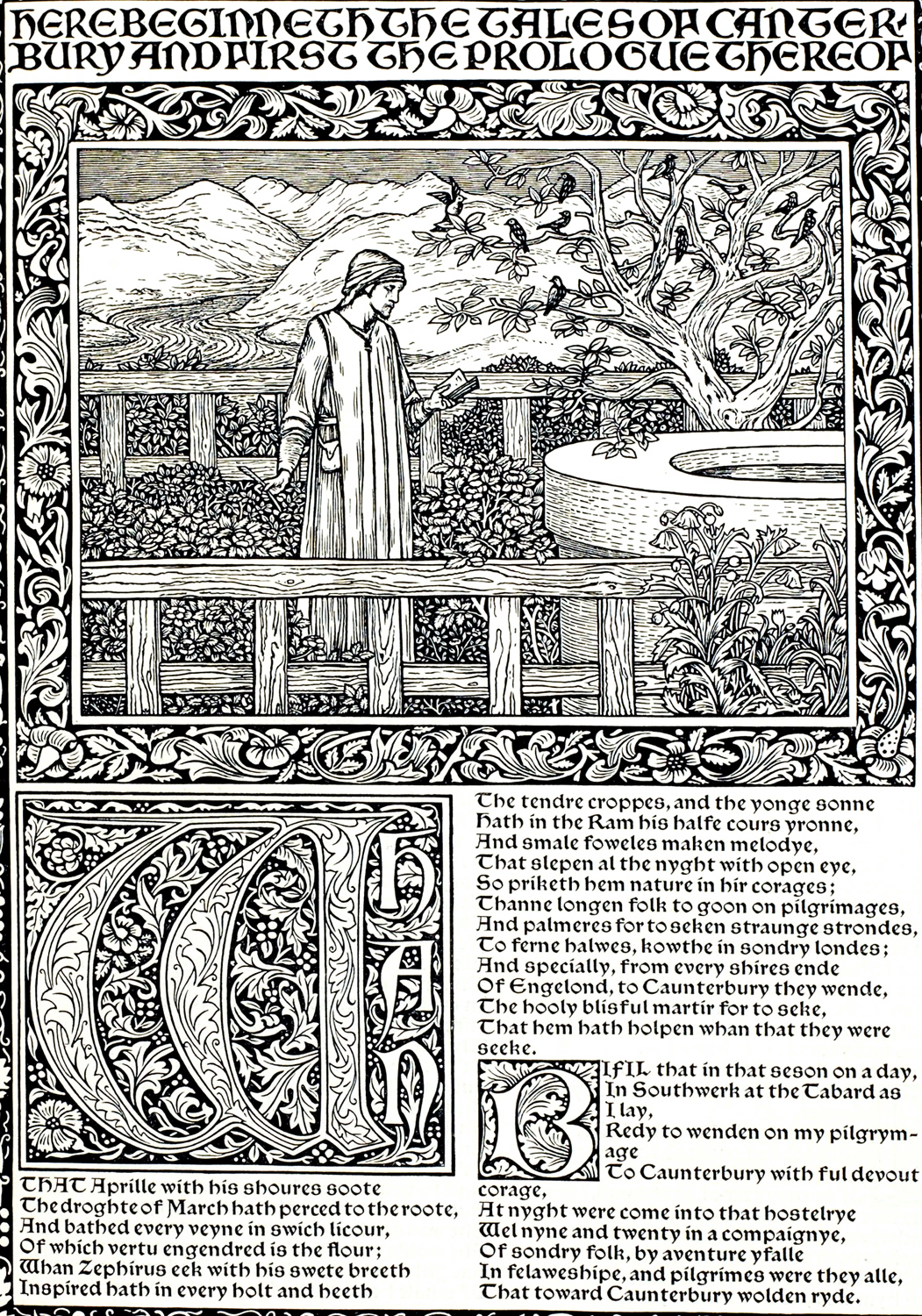
Finally, from class, and by no means least, I came to love Geoffrey Chaucer. I have become a fair reciter of Middle English, with a credible accent. And I found that reading Chaucer out loud enhances his comprehensibility. It become very like getting used to a thick Scottish burr or the sing-song of English spoken in the Indian subcontinent. When you get used to it, it disappears. Outside of some arcane vocabulary, Chaucer’s language isn’t all that difficult.

What is more, the poetry itself is overwhelming, whether it is the Wife of Bath’s prologue or the short poem, Trouthe, the language is as delicious as can be found in our mother tongue.

“The wrastling for the world axeth a fall.”

“Here is noon hoom, here nis but wildernesse.”

“Much wele stant in littel businesse.”

My wife periodically asks me to recite the general prologue to the Canterbury Tales, which I have fairly well committed to memory, and I can’t think of a greater or more pleasurable chunk of poetry in the English language.

NEXT: The years in the wilderness


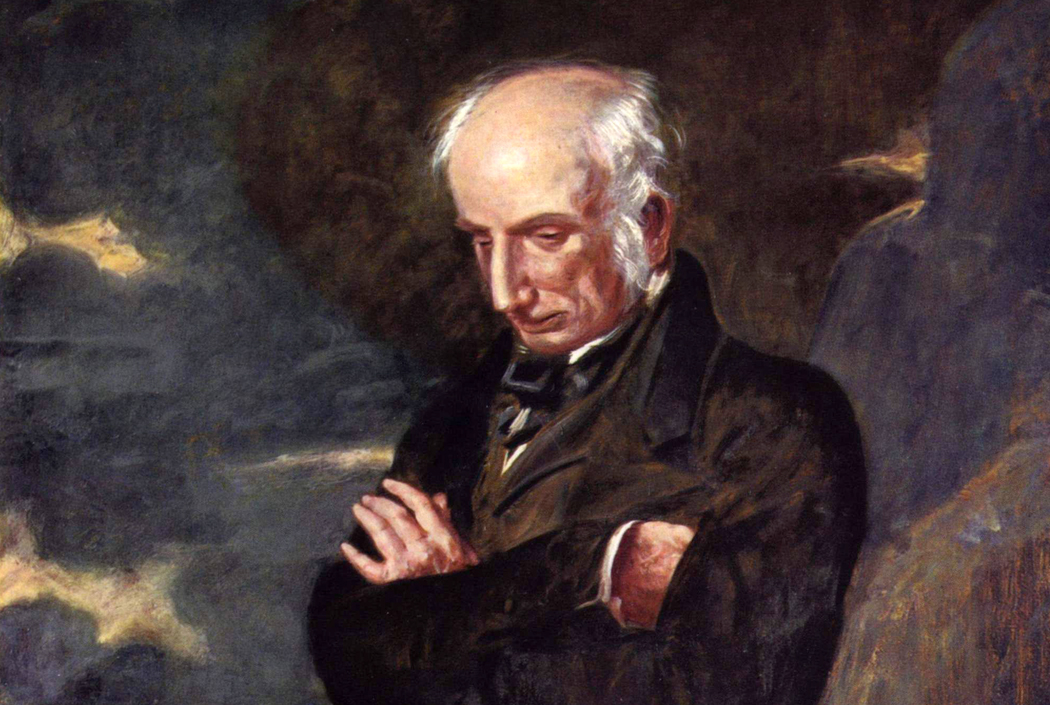
wordsworth

In the early 1800s, the population of England was roughly 8 million, and they produced Wordsworth, Coleridge, Blake, Byron, Keats and Shelley — not to mention Robert Southey, Leigh Hunt, Walter Savage Landor, Thomas Campbell, Thomas Moore, John Clare and Thomas Lovell Beddoes.

It is an astonishing flowering of poetry in a single era. Six major poets and a handful of others still read with pleasure by millions of people.

One might average them out very inaccurately as one great poet per 1 million in population.

Even in the 17th century, when the population of England was half that of the early 19th century, we have Thomas Carew, George Chapman, Richard Crashaw, John Donne, Michael Drayton, William Drummond, John Dryden, George Herbert, Robert Herrick, Ben Jonson, Richard Lovelace, Andrew Marvell, John Milton and John Wilmot (Earl of Rochester).

Of these, we can easily confer “major poet” status on Milton, Donne, Marvell and Dryden, making our ratio again 1-in-a-million.

By these numbers, we should easily expect, living in the United States at this moment, roughly 300 major poets. One scratches one’s head, because these numbers obviously are not true.

Just one state, North Carolina, is roughly equivalent in land area and in population to England in 1800. There should be at least six poets writing between Asheville and the Outer Banks of equivalent worth to Keats and Shelley, Wordsworth and Coleridge.

(Obviously, there are eras in which poetry features more importantly in a nation’s culture, and other times when the palm, the oak or bay goes to the novel or the stage, and times — and places — where emphasis is given to painting, sculpture, music or even philosophy. This equation is only meant in general terms — in any art, there should be more well-known and influential practitioners than one might generally count among the population at present).

I reckon that the problem should be understood much as a bicameral legislature. If we count a poetic house of representatives, there should, indeed, be 300 major poets writing at this moment. But instead, we have a senate, and we have a limited number of spots per nation reserved for “major” status. Perhaps we should never expect more than four at any given moment in any given nation.

That means we must look to the reading public (or art-going audience) as a conferring body that says there is only so much room in our culture model for the role of major poet, like only so many slots for general in an army.

It may be part of our cultural umwelt. We have a fixed and number-limited idea of what it means to rise to the top. Perhaps there really are 300 people writing poetry in American now that, if they had been published 200 years ago, would have been considered important, but now are merely the residue of a niche publishing market.

But I mean to present my case in much wider terms: the many arts as they manifest in the culture.

There is a top tier, and we treat these artists — currently the Damien Hirsts, the Jeff Koonses, the Richard Serras — as if they are the “major” artists, whose work is our answer to the Raphaels, Rembrandts and Monets of the past. Their work is deemed somehow more important than the work of thousands of other artists working away, often outside the beehives of New York and LA.

Of course, any critic with an ounce of humility will grant that these are only our “guesses.” That history has a way of choosing different names for the art history textbooks of the future. But as the art world is currently constituted, there is a great divide between art that is considered important and influential — art at the cutting edge of a presumed history — and all the lesser lights, the wannabes. And this doesn’t even make marginal room for all the weekend painters and watercolor society members and their pretty irises and tablecloths.

But who is art for? This is the crucial question. Is art made for the critic, curator, collector and gallery owner? Is the measure of its worth that it fulfill the expectations of narrow and self-specified interest group? If that were so, the rest of us might as well give up and turn on the TV.

This is not to disparage those critics (of which I am one), curators, collectors and gallery owners, many of whom I know and admire, and whose gifts are considerable. But it is like saying that a book is best judged by a librarian: There may be some insight there, but we choose our books by our own lights, our own interests and tastes. To the librarian, we entrust the Dewey Decimal System.

So, who is the art for? The poetry? The dance, the theater, the opera, the string quartet? They are all for all of us who love them.

The search for the “historically significant” artist is a question of history, not of art. We should all be free to enjoy whatever art speaks to us. And as artists, free to make the art that speaks for us.

The “big-boys” (and girls) of art are not disincluded: They really are making wonderful things. But so are the lesser lights, the regional artists, the undiscovered, the shy. The names you see over and over in the art magazines are there on their merit, for sure, but they are also there because of their naked ambition to climb the art-world hierarchy and because of luck. Some were just lucky enough to be spotted by some curator making the rounds for another museum biennial, or to work in a university program noted for graduating elite artists.

I worked in the fields for 25 years in Arizona, which is not usually thought of as a fertile ground for the world’s great art. And it does have its unfortunate share of blue coyote paintings and noble Indian chief portraits.

But I knew a dozen, maybe a score of artists whose work, given the proper exposure to the right people with open minds and open eyes, might stand equally before the impasto of Lucien Freud or the imposture of Jeff Koons.

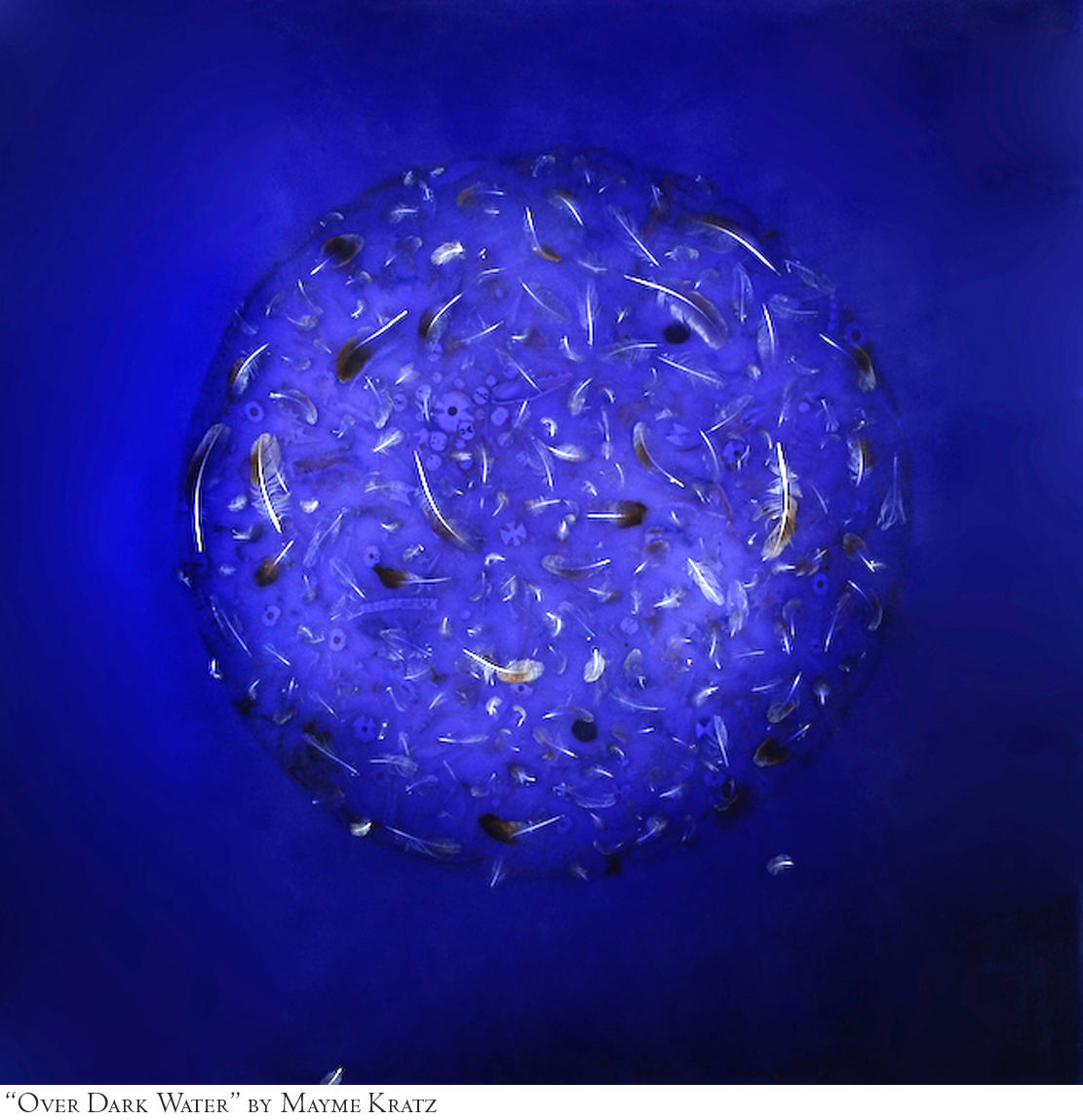
kratzThe work was forceful, imaginative, idiosyncratic and intellectually rigorous. There should be no shame in being thought an “Arizona artist” if the state could produce a Marie Navarre, a Jim Waid, a Mayme Kratz, a Bailey Doogan, an Anne Coe, a Matthew Moore, an Annie Lopez. I could name a dozen more that you’ve likely never heard of, but that you could well have, if things had gone differently.

Each of these artists had given me great pleasure and spurred my intellectual growth and widened my world for me.

And every state in the union — indeed, every nation on the globe — can put forth its own slate of names of the artists, poets, dramatists, filmmakers, architects, authors, musicians and composers whose value is underrated or ignored, whose work has made a local difference, even if not a national ripple. Who’s to say they are not important? Who’s to say their work is not the equal of the headline artists at the Whitney Biennial?

If we include these excellent but unheralded artists and poets, we probably begin to match the ratio of poets to population of 17th- or 19th-century England.

But I don’t want to stop there, either. It isn’t merely regional art I am defending. I would make a case even for such maligned art as the academic art of university teachers, the irises and tablecloths of the watercolorists — even the paint-by-numbers amateurs and the selfie-posters of Instagram.

Every person who makes an image — and especially those rare and brave people who take up a pencil and attempt to draw something on paper — makes a contribution. They learn something about the world, and about art, even if they don’t have that name for it.

Art is not merely what hangs on gallery walls. Its primary purpose is an interaction with the world, and when anyone makes that connection, with pen, brush, camera, clay or word processor, filtering through their sensibility their ideas, feelings and reactions to the world around them, they have made art.

And ultimately, it is the making of art, not its consumption that has value. Everyone should try it, everyone would benefit from it.

"Michael Jackson and Bubbles" by Jeff Koons, and Elgin Marbles figure

“Michael Jackson and Bubbles” by Jeff Koons, and Elgin Marbles figure

In 1632, the young English poet John Milton, just out of college, took up residence at his father’s country estate at Horton, near Windsor. And for the next six years he managed to read everything that had ever been written and was extant, in all languages living and dead, that a European scholar of the time might have heard of. That included literature, history, biography, philosophy, science, mathematics — the whole throatful of it. milton cigar

Everything that had ever been written.

It boggles the mind. Today, we cannot even keep up with the magazines we subscribe to; most of human knowledge falls off the edge of the Earth, where the map of our erudition shows nothing but serpents. reading the oed

We can never achieve what Milton did; it’s foolish to even try. But shouldn’t we attempt at least some sketch of what was fully painted for the poet? There have been recent books by writers who have read every article in the Encyclopedia Britannica (The Know-It-All, One Man’s Humble Quest to Become the Smartest Person in the World, A.J. Jacobs, 2004), The Oxford English Dictionary (Reading the OED: One Man, One Year, 21,730 Pages, Ammon Shea, 2008), or the equivalent of the Harvard Five-Foot Shelf (Great Books, David Denby, 1996), but such ventures are little more than stunts.

To absorb 5,000 years of human culture requires more than memorizing almanacs or dictionaries. It means to have a grounding in the art, literature, theater, music and architecture of our ancestors.

Of course, most of human knowledge, at least in ordinary life, in mass or pop culture and in our individual autobiographies is utterly trivial, and it would be a crime to stuff our brains with it.

But not all knowledge in this information age is trivial. There is still a core of useful literature — and I use the word in the broadest possible sense — that it behooves us to be acquainted with.

It is unfortunate that there is an argument over this. In the imbecilic culture wars that currently ravage the intellectual countryside, the lines are drawn between ignorant armies.

On one side, you find right-wing reactionary fossils fighting to maintain the canon of mainly European classics. On the other side, there is a cadre of victimization that wants to eliminate anything written by dead white males.

A pox on both their houses.

Milton didn’t have to worry about the canon. For him, the canon encompassed everything he could possible encounter.

Since that time, though, we have had to become more selective. Those items we have, as a culture, thought worth perpetuating we have called ”classics” and added them to the list — the canon — of ”required reading.”

But we misunderstand the very idea of culture if we believe the world froze solid with the publication of the Harvard Five Foot Shelf.

Corneille

Corneille

The canon is a garden that must be weeded and tended, and each season may call forth a different harvest.

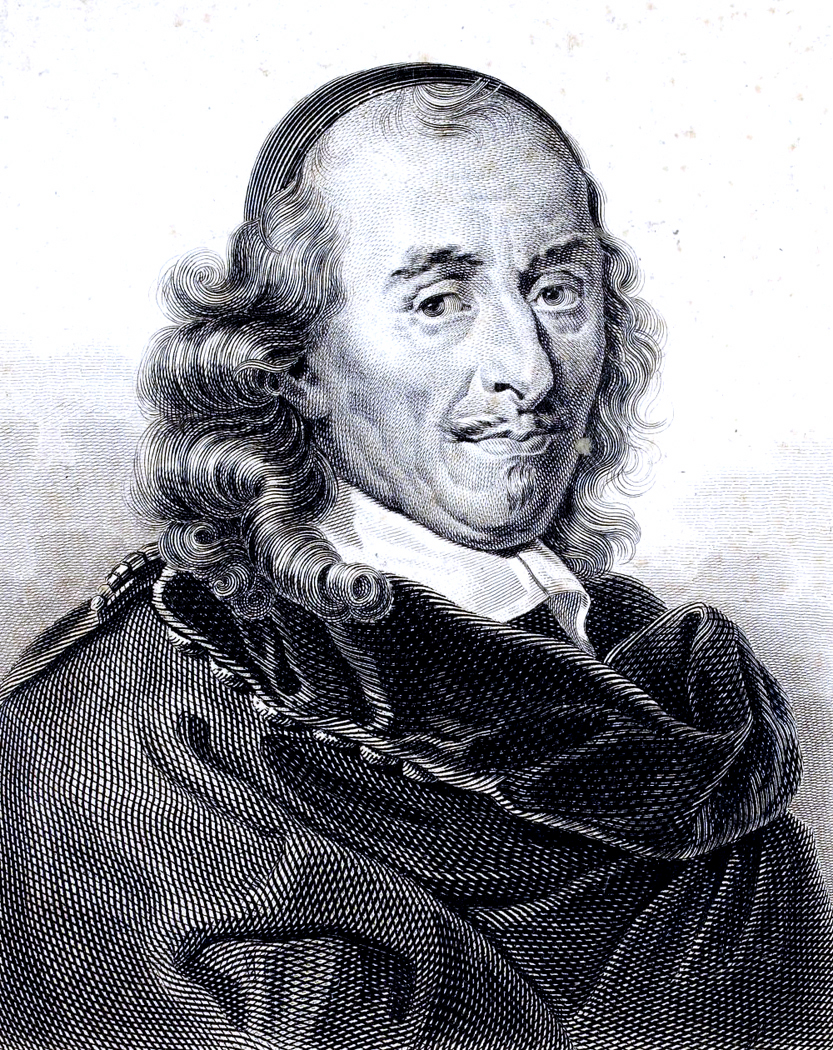
The problem with the conservative view is that it values a former ”golden age” that our own time never measures up to. It is a sentimental view of life and history, and deaf to the fact that we live now, not in the imaginary ”then.” It is the voice of Cato, of Corneille, of William Bennett — a man of whom it is said he cannot sleep a-nights if he suspects someone, somewhere is having fun.

It is a view of an idealized perfection that we have disastrously fallen short of. It is one form of imbecility.

The problem from the other side is an egalitarianism that is just as moronic. According to them, nothing is better than anything else. Either it is merely a question of personal taste, or it is one of cultural identity.

By their standards, it is elitist to prefer Pablo Neruda to Rod McKuen. Let them, I say, let them renew their subscriptions to Us magazine.

They can deconstruct its gossip to death and find the parallels with Plutarch — if they only knew who Plutarch was.

To consider one “text” more important than another, for them, is to promote colonialism and the subjugation of the downtrodden.

Hence, they judge not by esthetic considerations — it’s all just personal taste to them — but rather by politics.

For them, politics overwhelms aesthetics — overwhelms reason, emotion, common sense and experience. For them, everything has a party line. Ah, but they forget, politics answers no question worth asking.

It also worries me that behind the masks of intellectual argument, I sense a fascism on each side — at the very least a certain priggishness to both sides that any reasonable human finds dangerous.

At bottom, the problem is that both sides make the mistake of believing the canon immutable and fixed. They see the canon as an end, one side blindly despising it and the other defending it like Texans at the Alamo.

But the canon, properly seen, is a beginning, not an end; a foundation, not a roof.

It is the ABC of cultural literacy, the cardinal numbers of thought.

One used to hear the warning that when you have sex, you are having sex with everyone your partner has ever slept with. Well, when you read a book, you are also reading everything that the author read. When you hear music, you also hear everything that composer heard.

Culture is the slow accumulation of thoughts and habits. To read Melville is to hear the diapason of King James under the rich melody of the prose. Every author is the product of multiplier and multiplicand: the writer’s imagination and the long road of history leading to his standing on the curb with his thumb out.

The fact is, we cannot read everything, the way Milton did. We must be more selective. Suggestions for that selective offering is what we call the canon. But it changes constantly: It now includes James Baldwin and Toni Morrison; it includes Derek Wolcott and Yukio Mishima;  The Beatles and Duke Ellington.

The Laocoon

The Laocoon

How can you understand Jacques Derrida without standing firmly on the firm ground of Kant’s a priori? How can you read Isabel Allende without sensing the spirituality of Calderon behind her words?

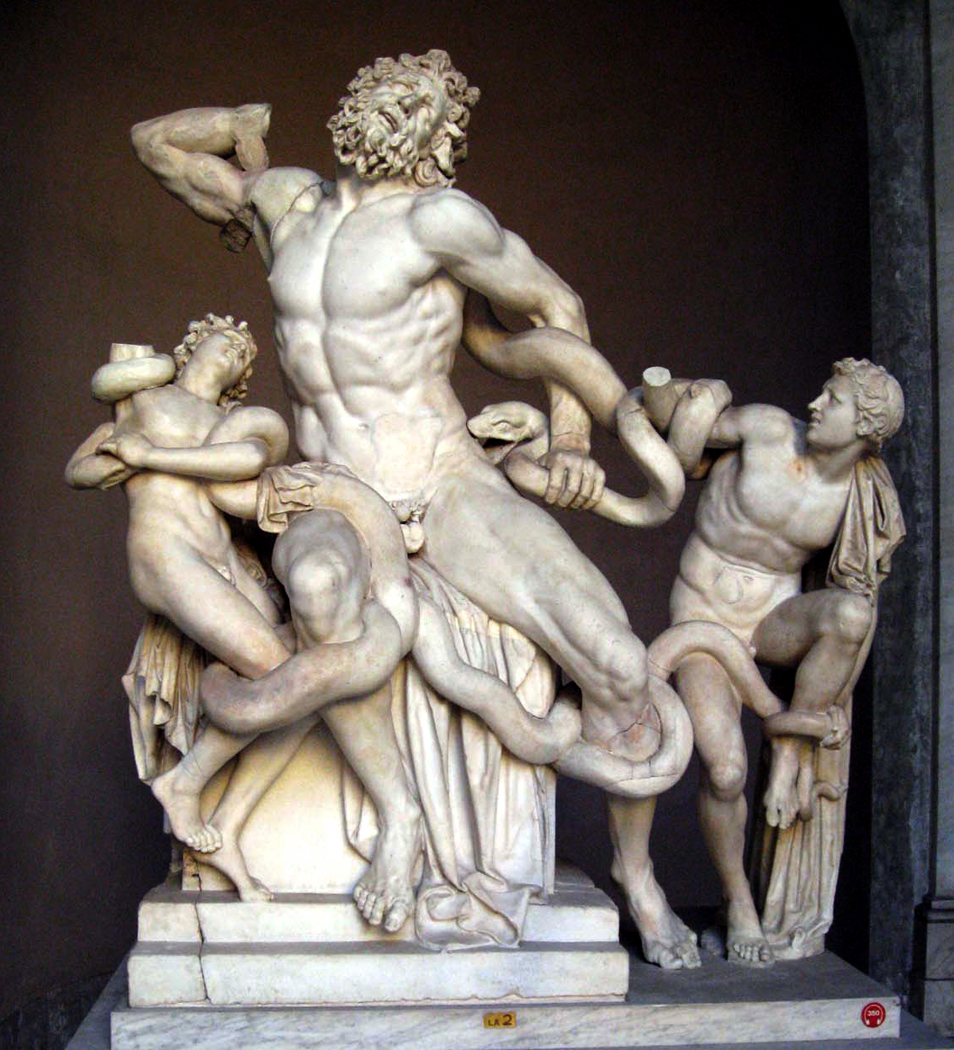
How can you understand Jeff Koons’ Michael Jackson and Bubbles if you don’t already have the Elgin Marbles in your system? You can’t. How can you get the joke on the back of countless Yellow Pages if you don’t know the Laocoon?

Certainly, the old rationale for learnedness remains: These are great writers, profound thinkers and brilliant painters and sculptors and we cannot consider ourselves educated without their acquaintance. Knowing them is its own excuse. But even more important is that when you hear the echoes in a piece of art, see its ancestry, the piece resonates. Resonance is what gives art and literature is power. kane

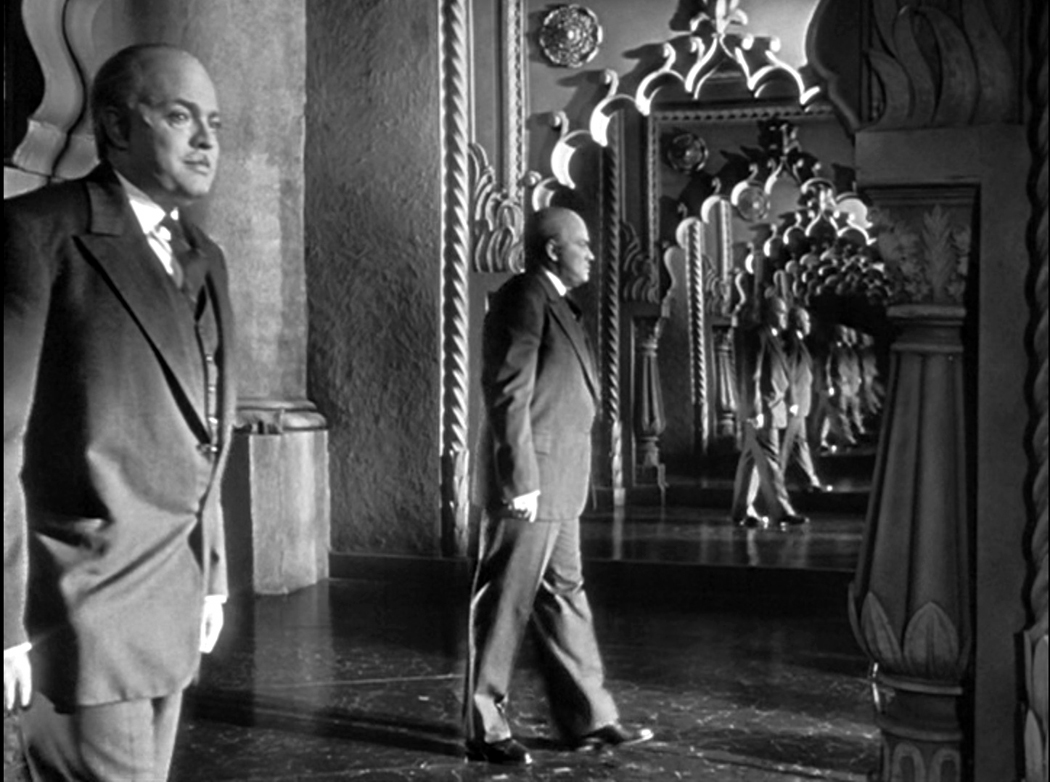
Like the mirror scene in Citizen Kane, one man is multiplied into an army. Like Isaac Newton said, if we see further, it is because we stand on the shoulders of giants. It is a wise man who knows his parents.

Orangerie Paris

What is culture, and why should we care?

These are questions that don’t get asked often enough when we discuss such inflammatory issues as government funding of the arts and humanities.

To many people, culture simply means a lot of wealthy people going to the opera and sitting through a hare-brained story in a language they don’t understand while listening to a soprano shriek so loud their elbows go numb.

Or it means drinking bad white wine from a plastic champagne glass at an art gallery opening or long, dense scholarly papers deconstructing Little Red Riding Hood as a text about the patriarchal hegemony.

We too often talk about culture as if it meant only evenings in the theater and long Russian novels.

But what would happen if all these so-called ”high” arts suddenly disappeared? Do we actually need them?

To understand the answer, we need to understand what culture is. Culture is broader than just the arts.

It’s what you eat for breakfast and whether your trousers have cuffs. It is who you are allowed to marry and what happens to your body when you die.

Culture is the set of rules — mostly in the form of traditions — by which society runs.

It is the software for our social lives.

In fact, far from being a luxury, culture is something you cannot live without. It is religion, art, laws, ethics, history and even our clothing.

Culture is who we are.

And who we are at this moment: No culture is static. It is an evolving thing — to keep up with the computer metaphor, there are constant upgrades. Culture 2.7 gives way to Culture 3.0, as the circumstances of our lives and our cultural needs change. The culture of the clipper ship means little on a jumbo jet.

Yet, although culture changes, it is inherently conservative. It changes very slowly. Nobody wants to get caught with a beta version of untested software.

Patterns from our ancestors persist in our lives. We enter the jumbo jet from the left side because our great-grandfathers wore their swords on their left sides and consequently mounted their horses from the left, to avoid entangling their swords.

You can see the history of aviation change from the stirrup on the left side of a World War I biplane to the door on a 747.

And how many children today play with ”choo-choo trains,” although not even their parents ever lived in a world with steam locomotives?

The patterns stick with us even when they no longer make sense.

But culture does change. The three-minute song remains the cultural pattern, although Dinah Shore has given way to Taylor Swift.

Songs from our agricultural past, lauding springtime and the moon, make little sense to our urban present, where nocturnal lighting is more likely neon. So we change. Slowly.

And where does cultural change come from? More often than not, from the arts.

The arts try out possible ideas onstage to see if they might make sense. Sometimes they do, sometimes they don’t. But the best minds and imaginations give it their best.

That is why we think of theater as ”culture.” Or literature, or painting.

Yes, there are some people who want to keep their old software version, and some who want to return to earlier versions. But culture cannot stand still.

Therefore, we need to be on the lookout for meaningful directions to go in. Art is our investigation of our values, testing them and throwing out some and reinforcing others.

Without art, culture ossifies and the people become emotionally and spiritually dead. So, if we mean to maintain a vital culture, we must support the best in the arts.

There is another computer saying: GIGO — garbage in, garbage out. In other words, if we don’t care for the changes in our culture, we are likely to wind up with the lowest common denominator. We are likely to wind up with nothing more than Duck Dynasty and microwave pizza.

bruckner stamp austria

Are you old enough for Bruckner?

Poet Ezra Pound said there is no reason you should like the same book (or music or art) at 40 that you liked at 16. At 16, I liked Ezra Pound; now I’m 65.

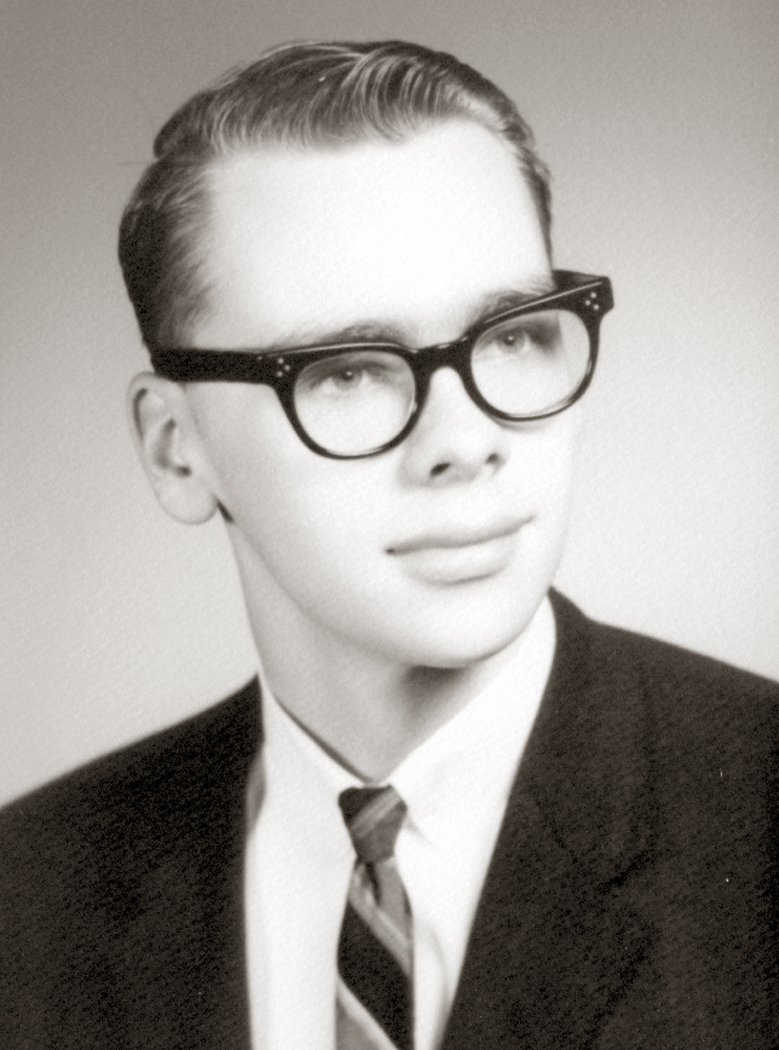
The author graduates high school in 1966

The author graduates high school in 1966

Our tastes change as we age, or they should. My introduction to classical music was Tchaikovsky. His symphonies and concertos pumped new-generated hormones through my arteries like adrenalin — when I was in high school.

It wasn’t long before I left him behind for Stravinsky, then Beethoven.

By the time that I was middle-aged, I had gone through Bach, Mozart, Berlioz, Debussy, Mahler, and most recently had added Bruckner and Haydn to the list. I get things from each of them I was deaf to earlier. Now that I am retired, I have finally come to appreciate Verdi. But, boy, it was hard to get past all the oom-pah-pah-pah, oom-pah-pah-pah.

The path won’t be the same for everyone, but there are some general patterns that seem to hold.

In painting, we all loved van Gogh at about the same time we loved Tchaikovsky. There is a bigger-than-life striving in van Gogh that appeals to the adolescent, striving himself for some sense of the heroic.

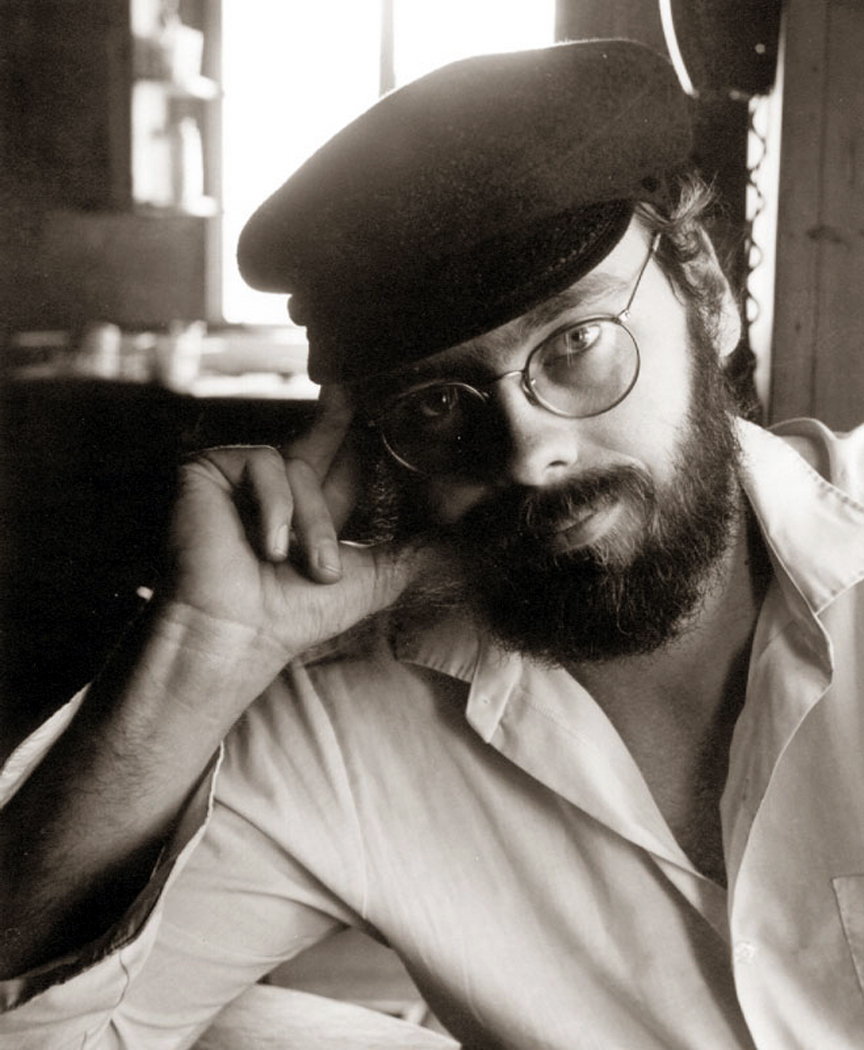
The author 1975

The author 1975

That same aspiration drove us to read Catcher in the Rye.

With a few more years under an increasingly large belt, we drop Tchaikovsky as hopelessly sentimental, Salinger as naive and simply move past van Gogh as we become aware of the Impressionists, who tickle our eyes all over again. Hormones calm, reality sets.

When we are in college or as grad students, we tend to gravitate to those things that are trendy, new, and exclusive, that set us off from the proles: We read Umberto Eco or — in my generation, Alberto Moravia and Robbe-Grillet. We jumped on Marina Abramowic  and Bruce Nauman and listened to Lutoslawski, Schnittke and Harry Partch. Yes to Pina Bausch, meh to Swan Lake.

The author 1977

The author 1977

Yes, we were showing off. In many cases we admired more than enjoyed.

We then gave up the need to be au courant or exclusive as we came to distinguish between the gee-whiz and the substantial.

As adults, we craved the substantial. Adult tastes are acquired tastes: Poussin, Schoenberg, Milton, rutabagas, pickled herring.

Old age now brings something else: simplicity and inclusiveness. I am no longer quick to drop the critical meat-cleaver and sever away something I consider unworthy. They are all worthy. Tchaikovsky as much as Webern, Salinger as well as Joyce. We are enriched by each of them.

The author in his "Van Gogh" pose 1980

The author in his “Van Gogh” pose 1980

(No, I haven’t gone senile — I’m not ready to accept Andrew Lloyd Webber or Thomas Kinkade, although I see some value in Norman Rockwell that would have shocked me to hear anyone admit when I was 20. No, Rockwell is no Raphael, but there is room for an entire spectrum of abilities and accomplishments. What I ask isn’t so much undying masterpieces, as sincerity of attempt, and a willingness to put in the work.)

So, growth isn’t just a case of moving on from one thing to another, but adding more and more to our trove. By the time you are my age, you will have a heady backlog of esthetic experiences to draw on.

What is most interesting to me is that, if we continue to grow, we can return to art we left behind and find something new in it. From age 17 to about 40, I couldn’t bear Tchaikovsky — it seemed like treacle. But then I began noticing his bizarre harmonic sense and what I might call ”orchestration from Mars.” You only have to read the scores to see how peculiar is his voice leading. When I could get past the heart on the sleeve, I discovered an intelligence there that was hiding, or rather, that I was unwilling to discover, having made up my mind and moved on.

The author at Canyon de Chelly, 1989

The author at Canyon de Chelly, 1989

An now that I am bald, bearded and grey, I find that there is something even in the emotional immediacy that once embarrassed me.

As we grow, we not only grow into new experiences, we grow out of our old prejudices.

This all came back to me this week as I watched Lust for Life on cable. The 1956 biopic starred Kirk Douglas as van Gogh and Anthony Quinn as Gauguin. The film is an odd combination of excellence and awfulness, mixing insight with bromides, sanitizing the painter’s life while emphasizing the insanity.

More than anything, this is the van Gogh who appeals to adolescents, the van Gogh of idealism, identity crisis and suicide.

Alienated, misunderstood.

But there is one more aspect of him that is included: his commitment and perseverance. These quieter virtues, more than his insanity, give van Gogh his stature as an artist.

the author lecturing 2005

the author lecturing 2005

There was a time, in my 20s, that I dismissed van Gogh. The peculiar paint-busy canvasses, I was convinced, were just the evidence of a deranged mind. If you were schizophrenic, you could be a great artist, too.

But more careful study in recent years, especially of the many notebooks filled with drawings, told me something else again. Van Gogh paints the way he does because of his unwavering honesty to his eyes. He kept looking till he got it right.

And ”right” for him was to notice everything that his eyes saw, not merely what he had been trained to see.

If you stare long enough and with enough concentration, you can see something of the granular reality van Gogh saw. We no more pay attention to it in daily life than we pay attention to the grain in a movie’s film stock. It is not the information, but the medium of the information. We filter out so much. Van Gogh didn’t.

the author at Giverny 2008

the author at Giverny 2008

The other wonderful thing about van Gogh is that he had so little talent.

We tend to think of great artists being as fluent as Mozart or Raphael. Yet talent is a poor indicator of quality in art. For every Raphael, there are scores of Geromes and Bouguereaus: accomplished and pretty, but ultimately empty.

Van Gogh shared a lack of talent with several other great artists: Cezanne, for instance; or Jackson Pollock. One searches the drawings and oil sketches of Cezanne for even the slightest encouragement of talent. His drawing is hopelessly awkward.

Pollock searched for years for an adequate means of expressing what was inside him. To do it, he had to give up everything he had learned. If he had no talent for drawing, he would not draw. He found a talent for splashing instead.van gogh landscape

Van Gogh’s notebooks are full of erasures. He looked, drew, erased, looked again, drew again, erased again. Many drawings are never finished, but those that are, are right in a way the more facile Ingres never is.

Van Gogh was stubborn. I admire that in him more than I admire the talent of William Merritt Chase.

But give me another 10 years and we’ll see.

Apollo

Apollo

The older I get, the less reading I do, and the more re-reading. It’s a common symptom of age. There are many things that change as you leave behind the enthusiasms of youth.

I remember the complaints about conductor Arturo Toscanini that his repertoire was small and repetitive: How many times can you play the Beethoven and Brahms symphonies, and why don’t you play more contemporary music?

Toscanini 2First, you have to remember that when Toscanini was young, he gave world premiere performances of many new works, including Puccini’s La Boheme and Sam Barber’s Adagio for Strings. He gave world premieres of at least 25 operas. When he was young, the music of Richard Strauss and Claude Debussy were brand new, not the concert stalwarts they later became. He gave the American premiere of Shostakovich’s Seventh Symphony. He programmed all of George Gershwin’s major pieces, even if his Italian soul never quite beat to the jazz rhythm. 

But it is true that after he came to the NBC Symphony, he concentrated on the war horses. His repertoire did narrow as he got old. The problem is that we know Toscanini mainly these days for his RCA Victor recordings, made near the end of his life, and so we have a skewed vision of his career.

That narrowing is not uncommon in artists, who generally — if they get to live long enough — develop a streamlined “late style,” which eschews much of the complexity they favored as young Turks, and gets straight to the point, as if the knew they didn’t have time for all the hoopla and somersaults. 

And so, as his hair whitened, Toscanini focused on those works he knew he could never exhaust: things like the Beethoven symphonies. They provide endless riches, endless possibilities, and endless satisfactions. 

I say I recognize this because as I’ve aged, I, too, have narrowed my focus. As a young art critic, I kept up with all the newest trends in contemporary art. I loved the buzz and fizz: Who’s up, who’s out. What’s the latest and greatest. I even went so far as to disparage much of what is found in our art museums as “relics” of the art process, and therefore not really art — real art is what is coming out of the studios today. Or even better, tomorrow.

And, as a music critic, I felt the same way. Give me something to shock my ears and lord keep me from having to hear another Beethoven’s Fifth! 

But there is a great change in one’s approach to art as one matures. Maturity isn’t just a slowing down and tightening up: It is the weight of experience. When we are young, we know so little, yet we think we know so much. We have the answers, and why don’t the fogeys understand that?

Life, however, burdens you with the accumulation of experience and what was clear as an adolescent is infinitely muddy as a grandfather. 

When we are striplings and in love with art, we tend to idolize it, and its makers. We test ourselves against our heroes, and against the art they made. Are we up to it? Can we maintain in ourselves the vibrancy and aliveness of the art we adore? Aren’t we “special,” too? Of course, we are! The world in art seems so much more brilliant and colorful, so much more emotionally intense. 

But, after a few marriages, a few divorces, a few illnesses, a few disappointments and the deaths of too many of those we loved, after seeing the politics of our time repeat themselves endlessly and stupidly, after seeing more genocides in the world, and hearing the idiocies of dogma and doctrine, the evils of ideologies and the fears of unknowing engender the hatreds of tribes and nations, after all that and the heavy weight of more, we — if we have been lucky — have earned a portion of wisdom. What we once valued from books, we know know more directly from life. And now, instead of measuring ourselves against the art we love to see if we measure up, instead we measure the art against our lives and experience to see whether the art measures up. And very often, it doesn’t. 

So, in our dotage, we fall back on a few trusted worthies, those poems, books, paintings, symphonies, choreographies that we have tested against our experience and which hold up and continue to give pleasure, consolation, understanding and — I hesitate to use the word — what we have come to regard as truth. 

It is what I find in those books and in that music that I re-read and re-listen to — that give me sustenance, that feeds my inner life and tells me that I am not alone but share something with those writers, those composers, those painters and sculptors who have gone through enough life to have developed enough emotional complexity to make art that says something real, and doesn’t just tickle my need for novelty, or — as in my youth — my self-announced grandiosity. glenn gould

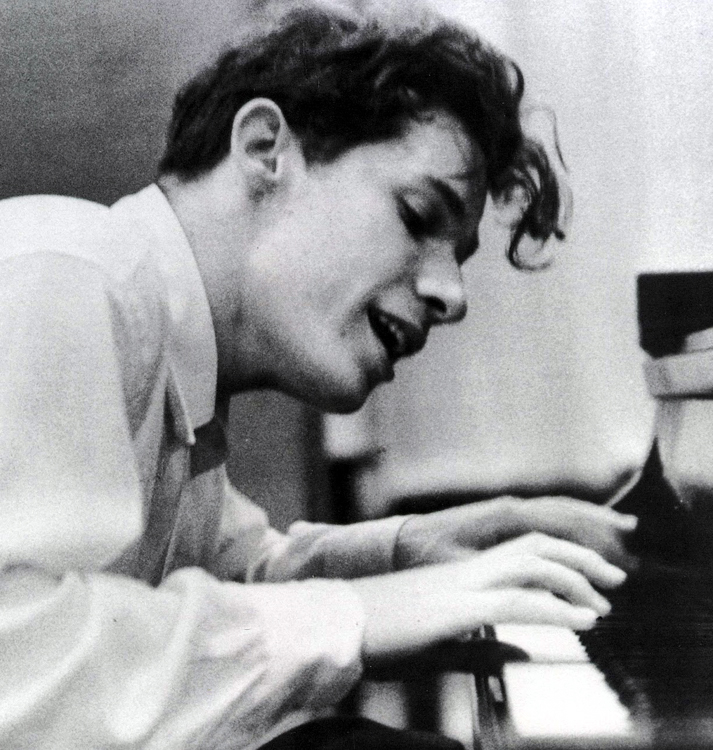
So, I re-read The Iliad at least once a year, and re-read Ovid’s Metamorphoses, Melville’s Moby Dick, Shakespeare’s Hamlet and Goethe’s Faust. I just finished again Dante’s Commedia, and expect to take on Chaucer next. I listen to Glenn Gould playing the Goldberg Variations, or to the Budapest Quartet and the late Beethovens. I weep every time I see Balanchine’s Apollo or his Prodigal Son. I cannot get all the way through Wordsworth’s Intimations Ode without sobbing quietly. 

And Toscanini doing Brahms’ Fourth. I don’t know how many times he conducted that piece, and I certainly cannot count how many times I’ve listened to that recording. I can hear it all the way through now purely in my mind; I don’t even need the score. 

These things — and many more — seem rock-solid and true. 

I expect you have or will have your own list of works that do it for you. They shouldn’t be the same ones; after all, you have lived your own life and collected your own list of wounds and sorenesses, giving you your own sense of what life must be, despite all our best efforts. 

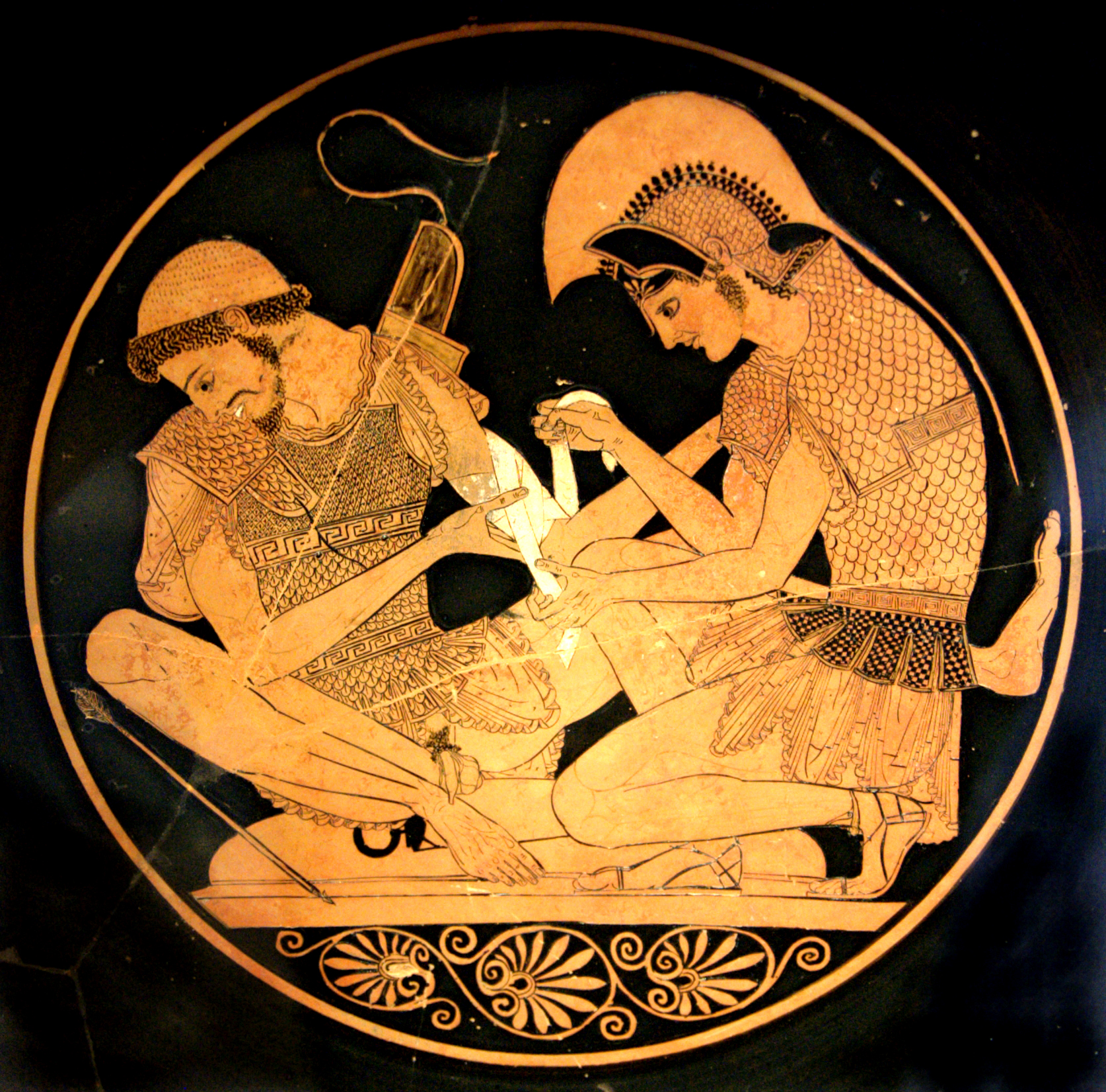
patroclus and achilles

Why should the first book written in the Western tradition still be the best book ever written in the Western tradition?

I’m talking, of course, of the Iliad, a book so beautiful, so profound, and so inclusive, as to remain unsurpassed by Tolstoy, Proust or even Dave Barry.

I try to reread it at least once a year, and in different translations. It never fails to delight me. More, it never fails to move me deeply.

For the ancient Greeks, Homer was as close as they had to a bible. It seemed to them everything one needed to know was included in the two books he is credited with writing, and the hymns he is supposed to have composed.

It reminds one of Caliph Omar, blamed by some for burning the great library of Alexandria, who supposedly said that the library was not needed, because everything we need to know is in the Koran, and if the books in the library contradict the Koran, they should be destroyed, and if they agree with the Koran, they are superfluous.

Clearly, not everything is in the Iliad: It is a little thin on women, for instance. The Odyssey does better by that count. But it is astonishing how much actually is included.

And what is also astonishing is how clear-eyed Homer is: How unblinking in the face of both good and evil. It is all there, and narrated with hardly a nod to one side or the other. This is the world that is, not the world as we should like it to be.

There is, it is true, a good deal of the Hellenic world view that is foreign to us today, but that hardly matters. The book seems modern anyway, even cinematic. (Not that any movies made of the Trojan war are anything but embarrassing — blame that on Hollywood, not on Homer.)

He writes like a movie camera: Written details play in our minds as if we were seeing them on a screen.

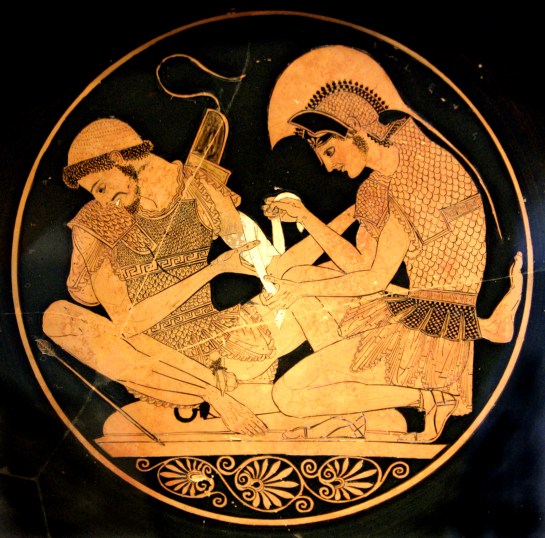
In Homer’s Iliad, when the Trojan warrior Hector has killed one of his Achaean (Greek) enemies, he “planted a heel against Patroclus’ chest, wrenched his bronze spear from the wound, kicked him over flat on his back.”

That’s cinematic.

Critic Roger Ebert talks about a movie cliche he calls the “fruit cart,” when a falling kung-fu fighter or a careening car knocks over a table or fruit cart and spills produce all over the screen.
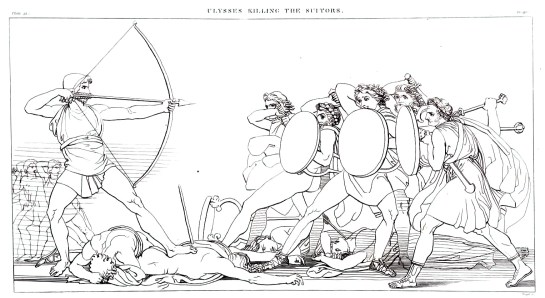
Odysseus killing the suitors, by John Flaxman

Odysseus killing the suitors, by John Flaxman

In Homer’s Odyssey, the hero comes home to find his estate infested with villains. He kills them all, starting with the head bad-guy.

“Odysseus aimed and shot Antinous square in the throat with the arrow’s point stabbing clean through to the nape of the neck and out the other side. Antinous pitched to the side, his cup dropped from his grasp as the shaft sank home, and the man’s life blood came spurting from his nostrils in thick red jets. His foot jerked forward and kicked the table and food showered across the floor, bread and meat soaked in a swirl of bloody filth.”

Fruit cart!

It is especially in the area of graphic violence that Homer anticipates Hollywood.

There was a time in movies when the bad guy got shot, grabbed his chest and keeled over. In 1967, Bonnie and Clyde turned death by gunshot into a slow-motion ballet of bodies jerked like marionettes punctuated by squibs popping like bubble wrap.

Since then, Hollywood has upped the ante, and the ballet of graphic gore has gotten more sophisticated, more precise and more messy. No one can be shot nowadays without a shower of blood spattering the wall behind him like spray paint.

In just 20 lines of the Iliad, Homer kills off half a dozen heroes in bloody style. Here’s a sampling:

“Thrasymedes stabbed Antilochus right in the shoulder and cracked through the bony socket, shearing away the tendons. Then he wrenched the whole arm out and down thundered Antilochus and darkness blanked his eyes. …

“Peneleos hacked Lycon’s neck below the ear and the sword sank clean through, leaving Lycon’s head hanging on his body by only a flap of skin. The head swung wide and Lycon slumped to the ground. …

“Idomoneus skewered Erymas straight through the mouth, the spearpoint raking through, up under the brain to split his glistening skull, teeth shattered out, both eyes brimmed to the lids with a gush of red and both nostrils spurting, mouth gaping, blowing convulsive sprays of blood. He was a corpse as he hit the ground.”

Tarantino is playing catch up.

But it isn’t merely in gore that Homer is realistic. He describes everything from the food to the landscape as if he were a gobbling camera, eating up the full existence of life. And not, like some novelist, in different chapters, but in a single sentence he can telescope from the entire battlefield down to the iris of a bee’s eye, and then back out again in the space of five or 10 words. It leaves one not with the grand view and not with the microcosm, but with a clear sense that they co-exist in a single space, a single comprehension.

Something else that should be said is that Homer survives translation. There are many great poets who live so completely in their native soil, they cannot be shipped overseas without loss of savor. Goethe in his mother tongue is the great poet; Goethe in English seems like the bearer of bromides and platitudes. Horace cannot survive the journey from Latin to English without sounding rather like Polonius.

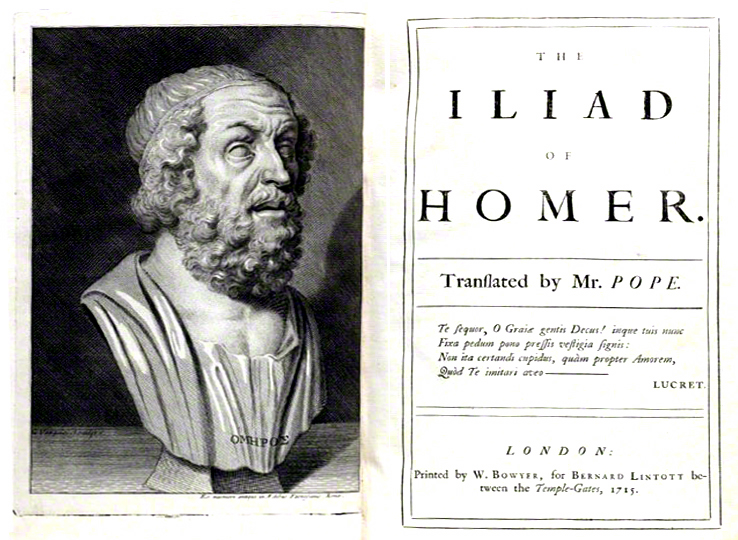
But Homer works whether in a straight interlinear or in Pope’s heroic couplets or in Stephen Mitchell’s newest colloquial English translation. The power of Homer is in his sweep, not in his preciosity.
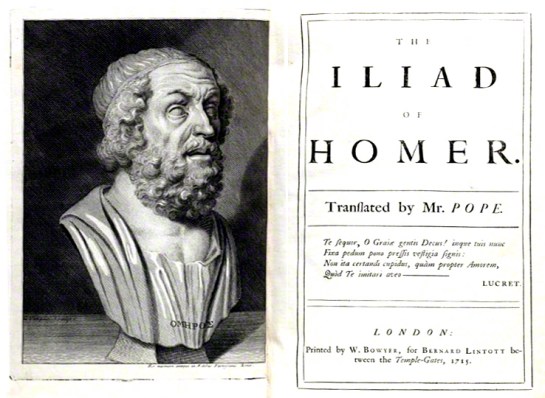
Pope Iliad

It is what Longinus praised in his On the Sublime.

He even works in the quaint antique style of George Chapman. In fact, Chapman is a great treat for someone who loves the Queen’s English.

Outside the King James Bible, there is probably no English translation of anything more famous than Chapman’s Homer.

But it is famous for being praised in John Keats’ sonnet, rather than for itself. Hardly anyone alive has actually read Chapman.

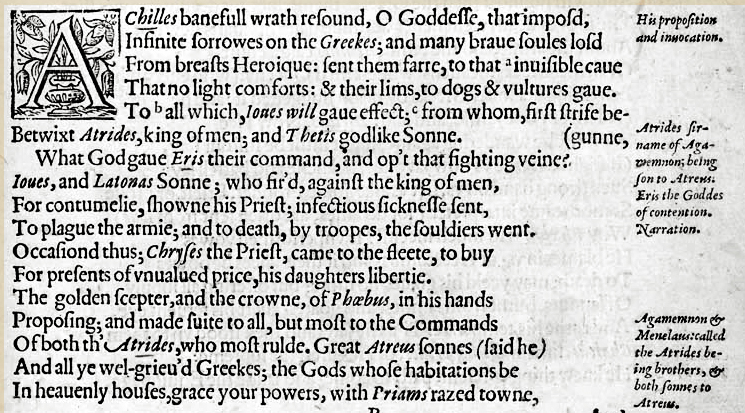
Chapman issued his translations, first of the Iliad and then of the Odyssey, from 1598 through 1615, overlapping the publication of the King James Bible in 1611. Like that Bible, it is written in a knotty Elizabethan-Jacobean style, when English was first stretching its muscles and testing its power. It is profligate in its verbal extravagance.

Keats wrote that Chapman speaks out “loud and bold,” and he certainly does.


“The man, O Muse, inform, that many a way

Wound with his wisdom to his wished stay; 

That wandered wonderous far when he the town

Of sacred Troy had sacked and shivered down.”


I love that: “sacked and shivered down.”

Of course, you lose something to gain something. Chapman’s word inversions, to fit his meter, make the words sound as archaic as the more obscure parts of King James, and can interfere with understanding the sense. You keep having to stop and reparse the sentence to understand just what he means to say.

On the other hand, there is a strength and nobility to the stylized expression.

Modern translations, even as wonderful as the recent one by Robert Fagles (which I recommend to first-time readers over Chapman), may be clearer, and it has its own felicities, but it doesn’t give us anything as palpable as that shivering city: “Sing to me of the man, Muse, the man of twists and turns driven time and again off course, once he had plundered the hallowed heights of Troy.”

The course between elevated style and easy comprehension has to be charted by each of Homer’s translators. Do you try to make him into an adventure novel, like W.H.D. Rouse, or do you look for the astonishing words that make poetry?

The opening of the Iliad has a line about how the anger of Achilles has caused the death of many men. An interlinear and literal translation says that the hero “prematurely sent many brave souls of heroes to Hades and made them prey to dogs and to all birds of prey.”

It is a grim image, of corpses littering the battlefield and being chewed on by animals.

Samuel Butler translates the same passage as “pushing brave men under the sod, feeding young men to dogs and to vultures.”

Alexander Pope, in one of the most enduring translations, gives that as:


“The souls of mighty chiefs untimely slain;

Whose limbs unburied on the naked shore,

Devouring dogs and hungry vultures tore.”


The text most often taught in colleges is Richmond Lattimore’s. He gives that same passage as:


“hurled in their multitudes to the house of Hades strong souls

of heroes, but gave their bodies to be the delicate feasting

of dogs, of all birds.”


The American poet Robert Lowell has it:


“threw so many huge souls into hell,

heroes who spilled their lives as food for dogs and darting birds.”


So you can see there is quite a wide latitude of possibility in translation, to make the sense clear and to make the imagery potent.

Here is Chapman’s opening:
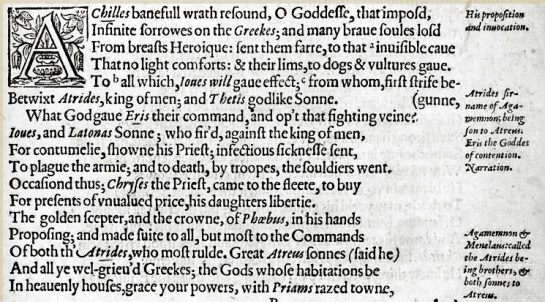
Chapman's Iliad

To give a sense how Chapman fits into all this, we should look at the opening of Book XI of the Odyssey.

It tells about Odysseus (Chapman uses the Latin version of the name, Ulysses) and his men setting off from the island of the witch-goddess Circe.

A.T. Murray’s nearly literal translation for the Loeb Library offers:


“But when we had come down to the ship and to the sea, first of all we drew the ship down to the bright sea, and set the mast and sail in the black ship, and took the sheep and put them aboard, and ourselves embarked, sorrowing, and shedding big tears.”


It is a passage translated by T. E. Lawrence — yes, that is Lawrence of Arabia — as:


“At length we were at the shore where we lay the ship. Promptly we launched her into the divine sea, stepped the mast, made sail and went: not forgetting the sheep, though our hearts were very low and big tears rained down from our eyes.”


Pope lets these words fly quick and smooth:


“Now to the shores we bend, a mournful train,

Climb the tall bark, and launch into the main:

At once the mast we rear, at once unbind 

The spacious sheet, and stretch it to the wind;

Then pale and pensive stand, with cares oppressed, 

And solemn horror saddens every breast.”


Pope has expanded the passage to make it fly gracefully. Chapman goes the other way, with his crabbed, organ-tone Elizabethan style:


“Arrived now at our ship, we launched, and set

Our mast up, put forth sail, and in did get

Our late-got Cattle. Up our sails, we went,

My wayward fellows mourning now the event.”


Over and over, in Chapman, you come across the gnarly masticated consonants that act as rocks in the clear stream of vowels. Reading him can be like walking barefoot on gravel.

But at its best, it makes you taste each word as you utter it. You cannot speed-read the poetry: You must measure each syllable.

There are parts where Chapman seems to be on auto pilot, and when his poetry ventures into the banal, but at his best Chapman gives us a view of Homer as sublime, the version of Homer that Longinus praised, as being bigger and more awesome than our ordinary course of experience.

Oh, but what might have been. There is a passage of Homer that accomplishes what Chapman did, only more so, and with a sweeping poetic power that no one has ever matched.

One wishes, though, that Ezra Pound had finished a full translation of Homer. That cranky, crazy, fraudulent genius has given us the best, most noble, most poetic, and at the same time most comprehensible translation of parts of the Odyssey in his opening section of The Cantos.

It has the best of Chapman and the best of Pope, with a 20th Century irony and an Anglo-Saxon vocabulary that dances and sings. How I wish he hadn’t gone all loony and filled his Cantos with Chinese and economics and instead have spent that same time giving us all of Homer.


“And then went down to the ship,

Set keel to breakers, forth on the godly sea, and

We set up mast and sail on that swart ship,

Bore sheep aboard her, and our bodies also

heavy with weeping.”


Well, if we can’t have a full Pound, Chapman will more than suffice.

Homer bust